WO2017163879A1 - Dispositif d'analyse de comportement, système d'analyse de comportement, procédé d'analyse de comportement, et programme - Google Patents
Dispositif d'analyse de comportement, système d'analyse de comportement, procédé d'analyse de comportement, et programme Download PDFInfo
- Publication number
- WO2017163879A1 WO2017163879A1 PCT/JP2017/009246 JP2017009246W WO2017163879A1 WO 2017163879 A1 WO2017163879 A1 WO 2017163879A1 JP 2017009246 W JP2017009246 W JP 2017009246W WO 2017163879 A1 WO2017163879 A1 WO 2017163879A1
- Authority
- WO
- WIPO (PCT)
- Prior art keywords
- shelf
- information
- unit
- approach
- behavior
- Prior art date
- Legal status (The legal status is an assumption and is not a legal conclusion. Google has not performed a legal analysis and makes no representation as to the accuracy of the status listed.)
- Ceased
Links
Images




Classifications
-
- G—PHYSICS
- G06—COMPUTING OR CALCULATING; COUNTING
- G06Q—INFORMATION AND COMMUNICATION TECHNOLOGY [ICT] SPECIALLY ADAPTED FOR ADMINISTRATIVE, COMMERCIAL, FINANCIAL, MANAGERIAL OR SUPERVISORY PURPOSES; SYSTEMS OR METHODS SPECIALLY ADAPTED FOR ADMINISTRATIVE, COMMERCIAL, FINANCIAL, MANAGERIAL OR SUPERVISORY PURPOSES, NOT OTHERWISE PROVIDED FOR
- G06Q10/00—Administration; Management
- G06Q10/08—Logistics, e.g. warehousing, loading or distribution; Inventory or stock management
- G06Q10/087—Inventory or stock management, e.g. order filling, procurement or balancing against orders
-
- G—PHYSICS
- G06—COMPUTING OR CALCULATING; COUNTING
- G06Q—INFORMATION AND COMMUNICATION TECHNOLOGY [ICT] SPECIALLY ADAPTED FOR ADMINISTRATIVE, COMMERCIAL, FINANCIAL, MANAGERIAL OR SUPERVISORY PURPOSES; SYSTEMS OR METHODS SPECIALLY ADAPTED FOR ADMINISTRATIVE, COMMERCIAL, FINANCIAL, MANAGERIAL OR SUPERVISORY PURPOSES, NOT OTHERWISE PROVIDED FOR
- G06Q30/00—Commerce
- G06Q30/02—Marketing; Price estimation or determination; Fundraising
-
- G—PHYSICS
- G06—COMPUTING OR CALCULATING; COUNTING
- G06Q—INFORMATION AND COMMUNICATION TECHNOLOGY [ICT] SPECIALLY ADAPTED FOR ADMINISTRATIVE, COMMERCIAL, FINANCIAL, MANAGERIAL OR SUPERVISORY PURPOSES; SYSTEMS OR METHODS SPECIALLY ADAPTED FOR ADMINISTRATIVE, COMMERCIAL, FINANCIAL, MANAGERIAL OR SUPERVISORY PURPOSES, NOT OTHERWISE PROVIDED FOR
- G06Q30/00—Commerce
- G06Q30/02—Marketing; Price estimation or determination; Fundraising
- G06Q30/0201—Market modelling; Market analysis; Collecting market data
Definitions
- the present invention relates to a behavior analysis device, a behavior analysis system, a behavior analysis method, and a program.
- Patent Document 1 describes acquiring information such as whether or not a customer has touched a product and whether or not the contacted product has been purchased.
- Patent Document 1 describes that information such as the display position of a product and the presence / absence of a special sale tag is used for behavior analysis, it is indicated that the shortage status of the product is reflected in the behavior analysis. Not.
- An object of the present invention is to provide a behavior analysis device, a behavior analysis system, a behavior analysis method, and a program that can solve the above-described problems.
- the behavior analysis device is displayed on the shelf, the approach information acquiring unit that acquires the approach information indicating the presence or absence of the approach of the person to the shelf on which the plurality of products are displayed.
- a detecting unit for detecting a missing item position and a missing item among the plurality of items as missing item information, and an analyzing unit for analyzing the person's behavior based on the approach information and the missing item information And comprising.
- the behavior analysis system includes a sensor that detects the approach of a person to a shelf on which a plurality of products are displayed, and the approach of the person to the shelf on which the plurality of products are displayed.
- An approach information acquisition unit that acquires approach information indicating the presence or absence of the product
- a detection unit that detects a position of a missing product and a missing product among the plurality of products displayed on the shelf as missing product information
- An analysis unit that performs an action analysis of the person based on the approach information and the missing part information.
- the behavior analysis system includes a behavior analysis device and an output device, and the behavior analysis device indicates an approach indicating whether or not a person approaches a shelf on which a plurality of products are displayed.
- An approach information acquisition unit that acquires information
- an analysis unit that performs an action analysis of the person based on the approach information, a position of a missing product among the plurality of products displayed on the shelf, and
- An output that generates output information based on the missing part information acquired from the behavior analysis device and the analysis result of the behavior analysis device.
- a generation unit is provided.
- the behavior analysis method includes an approach information acquisition step of acquiring approach information indicating whether or not a person approaches the shelf on which a plurality of products are displayed, and the behavior analysis method is displayed on the shelf.
- a missing item detection step of detecting a missing item position and missing item among the plurality of items as missing item information, and analyzing the behavior of the person based on the approach information and the missing item information An analysis step.
- the program is displayed on the shelf, the approach information acquiring step for acquiring approach information indicating whether or not a person approaches the shelf on which a plurality of products are displayed.
- a missing item detection step of detecting a missing item position and missing item among the plurality of items as missing item information, and analyzing the behavior of the person based on the approach information and the missing item information.
- it is explanatory drawing which shows the example of arrangement
- it is explanatory drawing which shows the example of arrangement
- It is explanatory drawing which shows the example of a display of the customer action parameter
- It is explanatory drawing which shows the example of the data structure of the post-association information which the memory
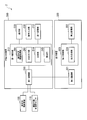
- FIG. 1 is a schematic block diagram showing a functional configuration of a behavior analysis system according to an embodiment of the present invention.
- the behavior analysis system 1 includes a pre-shelf behavior measurement sensor 110, a shelf situation photographing device 120, and a behavior analysis device 200.
- the behavior analysis apparatus 200 includes a communication unit 210, a display unit 220, an operation input unit 230, a storage unit 280, and a control unit 290.
- the control unit 290 includes an approach information acquisition unit 291, an association unit 292, a detection unit 293, a correction unit 294, a classification unit 295, and an analysis unit 296.
- the behavior analysis system 1 analyzes a person's behavior in front of the shelf. Specifically, the behavior analysis system 1 acquires an index value indicating the behavior of a person in front of the shelf. The user of the behavior analysis system 1 can grasp the person's pre-shelf behavior with reference to this index value.
- the shelf front here is the front of the product display shelf (particularly near the front), and the pre-shelf behavior here is an action performed by a person in front of the product display shelf.
- the commodity display shelf is simply referred to as a shelf.
- a user of the behavior analysis system 1 is simply referred to as a user.
- the person who the behavior analysis system 1 analyzes is also called a customer. In other words, the behavior analysis system analyzes the behavior of customers who have visited the store.
- the shelf front measurement sensor 110 is a sensor provided to detect the shelf front behavior.
- the pre-shelf behavior measurement sensor 110 for example, a distance sensor provided from the top to the bottom of the front surface of the shelf can be used.
- the behavior measuring sensor 110 before the shelf detects the horizontal position and the vertical position of the customer's hand in front of the shelf.
- the behavior analysis device 200 can estimate a product that the customer has reached out based on the position detected by the sensor 110 for measuring behavior in front of the shelf.
- the shelf situation photographing apparatus 120 includes a camera that is provided in front of the shelf and photographs a moving image or a still image, and photographs the state before the shelf and the state of the shelf continuously or at predetermined time intervals.
- the behavior analysis apparatus 200 can detect the timing from when the customer stops in front of the shelf until the customer leaves the shelf by using the image captured by the shelf situation imaging device 120. As a result, the behavior analysis apparatus 200 can detect the hand reaching to the shelf performed during the period from when the customer stops in front of the shelf until it leaves, as a series of hand reaching by the same customer. In addition, the behavior analysis apparatus 200 compares the images before and after the customer reaches the shelf, so that the customer has picked up the product and the customer has returned the product to the shelf. Can be detected.
- FIG. 2 is an explanatory diagram illustrating an arrangement example of the pre-shelf behavior measurement sensor 110 and the shelf situation imaging device 120 when the shelf is viewed from the side.
- the pre-shelf behavior measurement sensor 110 is installed downward from the ceiling 930 above the entire surface of the shelf 910.
- the shelf 910 is a plurality of shelves, and a product 920 is placed on each shelf.
- the behavior measurement sensor 110 before the shelf measures the distance between the behavior measurement sensor 110 itself and the hand. By using the measured distance, the behavior analysis apparatus 200 can determine to which level of the shelf 910 the customer has reached.
- the camera of the shelf status photographing device 120 is installed at a position and orientation for photographing the shelf 910 from the ceiling 930 in front of the shelf 910.
- the shelf situation imaging apparatus 120 includes one camera, and the camera is installed at a position and orientation where the entire front surface of the shelf 910 can be captured.
- the shelf situation imaging device 120 may include a plurality of cameras.
- FIG. 3 is an explanatory diagram showing an example of the arrangement of the pre-shelf behavior measurement sensor 110 when the shelf is viewed from the front.
- a plurality of pre-shelf behavior measurement sensors 110 are arranged on the ceiling 930 along the width direction of the shelf 910.
- the behavior analysis apparatus 200 can determine the position of the hand in the horizontal direction of the shelf 910 by identifying the sensor 110 for measuring the behavior in front of the shelf that has detected the hand.
- the pre-shelf behavior measuring sensor 110 only needs to be able to detect the position of the hand in the vertical direction of the shelf 910 and the position of the hand in the horizontal direction of the shelf 910 when the customer reaches the shelf 910. .
- a set of three-dimensional cameras may be installed above the front surface of the shelf 910 as the pre-shelf behavior measurement sensor 110 so that the front surface of the shelf is imaged in the vertical direction.
- the installation position of the pre-shelf behavior measurement sensor 110 is not limited to the upper side of the shelf 910.
- the pre-shelf behavior measurement sensor 110 may be installed on the side of the shelf 910 to sense the front surface of the shelf 910 sideways.
- the behavior analysis device 200 analyzes the behavior in front of the shelf based on the sensing data from the sensor 110 for measuring behavior in front of the shelf. Specifically, as described with reference to FIGS. 2 and 3, when the customer reaches the shelf 910, the behavior analysis apparatus 200 is based on the sensing data from the behavior measuring sensor 110 in front of the shelf. The position of the hand in the vertical direction of the shelf 910 and the position of the hand in the horizontal direction of the shelf 910 are detected. In addition, the behavior analysis apparatus 200 stores the arrangement of the products 920 on the shelf 910 in advance, and estimates the products 920 that the customer has reached out based on the position of the customer's hand. The behavior analysis apparatus 200 analyzes the behavior in front of the shelf and displays the analysis result, such as counting the number of times the customer reaches the product 920 for each product 920.
- the behavior analysis device 200 detects a missing item of the product 920 on the shelf 910 based on the image taken by the shelf situation photographing device 120.
- the behavior analysis apparatus 200 reflects the detected shortage of the product 920 in the analysis of the behavior in front of the shelf. For example, when the behavior analysis apparatus 200 counts the number of times the customer did not pick up a predetermined product 920 (for example, the number of times another product 920 was picked up), the period during which the product 920 is missing Are excluded from the counting target. As a result, the behavior analysis apparatus 200 can obtain an analysis result that reduces the possibility that the customer may have a false impression that the product 920 is not attractive because the product 920 is not attractive.
- the behavior analysis apparatus 200 is configured using, for example, a computer.
- the communication unit 210 communicates with other devices.
- the communication unit 210 receives sensing data from the sensor 110 for measuring behavior in front of the shelf. Further, the communication unit 210 receives an image captured by the shelf situation imaging device 120 as image data.
- the display unit 220 includes a display screen such as a liquid crystal panel or an LED (Light-Emitting Diode) panel, and displays various images according to the control of the display unit 220.
- the display unit 220 displays a customer behavior index value such as a count result of the number of times the customer reaches for the product.
- the customer behavior index value here is an index value calculated by the analysis unit 296 regarding the customer behavior. For example, the display unit 220 displays the customer behavior index value superimposed on the image of the shelf 910.
- FIG. 4 is an explanatory diagram illustrating a display example of customer behavior index values by the display unit 220.
- the display unit 220 displays an image of the shelf 910 on which the products 920 are arranged in the area A11.
- the display unit 220 displays the product image with a color corresponding to the number of times the customer has reached the product.
- the display unit 220 displays a legend indicating the correspondence between the number of times the customer reaches for the product and the color in the area A12. Thereby, the display part 220 has shown the frequency
- the heat map here is a display method in which the value of each element of the matrix is indicated by color.
- the product shown in the area A21 is temporarily out of stock, and the display unit 220 displays the number of times the customer reaches each product during the period when the product is out of stock. it's shown.
- the number of times the customer reaches for the product corresponds to an example of the customer behavior index value.
- the display unit 220 displays the customer behavior index value in the color attached to the image of the product at the position of the image of the product 920 in the image of the shelf 910.
- the method of displaying the customer behavior index value by the display unit 220 is not limited to the method of coloring the product image, and any method that can present the customer behavior index value to the user may be used.
- the display unit 220 may display customer behavior index values on a graph.
- the operation input unit 230 includes input devices such as a keyboard and a mouse and receives user operations. For example, the operation input unit 230 receives designation of the product by a user operation of clicking the product 920 displayed on the display unit 220 with a mouse. Further, the operation input unit 230 receives a user operation for instructing a condition for calculating a customer behavior index value, such as the number of times the customer reaches each product during a period when the specified product is missing.
- the storage unit 280 stores various information.
- the storage unit 280 stores sensing data obtained by the pre-shelf behavior measurement sensor 110, or data obtained by processing the sensing data by the control unit 290.
- the storage unit 280 stores information that associates the product identification information indicating the product 920 that the customer has reached with the time when the sensor 110 for measuring behavior before the shelf detects the customer's hand.
- the information which matched goods identification information and the time information which shows sensing time is called post-association information.
- the associating information is generated by the associating unit 292 and stored in the storage unit 280.
- the storage unit 280 stores, in the post-association information, information that associates the product identification information indicating the product 920 that the customer has reached with the time when the sensor 110 for measuring the behavior in front of the shelf detects the customer's hand. , The time period from when the customer stops in front of the shelf until the customer leaves the shelf is stored as a series of extension information by the same customer.
- the product identification information here is information for identifying the product 920 placed on the shelf 910 for each product. In the present embodiment, products having the same specifications (for example, products having the same name) are regarded as the same product. Predetermined information such as a product name may be used as the product identification information, or identification information dedicated to the behavior analysis system 1 may be determined.
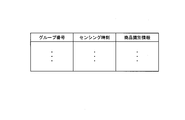
- FIG. 5 is an explanatory diagram showing an example of the data structure of the post-association information stored in the storage unit 280.
- the storage unit 280 stores a group number, sensing time, and product identification information in association with each other.
- one set of information in which these are associated is represented by one line of the post-association information. Called minutes.
- the entire information associated with these is referred to as the entire associated information.
- the product identification information indicates the product 920 that the customer has reached out, identified based on the sensing data from the sensor for measuring before-shelf behavior 110.
- the sensing time indicates the time when the pre-shelf behavior measurement sensor 110 detects the object indicated by the sensing data. For example, the time when the communication unit 210 receives sensing data may be used as the sensing time.
- the group number is used as information for grouping a series of hand stretches detected from when the customer stops in front of the shelf until the customer leaves the shelf.
- the behavior analysis device 200 detects the timing from when the customer stops in front of the shelf until the customer leaves the shelf, based on the photographed image of the shelf situation photographing device, and the sensing transmitted by the sensor for measuring before the shelf 110 during this period.
- the same group number is assigned to data-based information (a combination of sensing time and product identification information). Thereby, it can be detected that the same customer has reached the shelf 910 a plurality of times.
- the information stored in the storage unit 280 is not limited to the information that associates the sensing time and the product identification information shown in the example of FIG.
- the storage unit 280 may store the sensing data from the pre-shelf behavior measurement sensor 110 and time information indicating the sensing time in association with each other.
- the storage unit 280 may store information obtained by converting sensing data from the pre-shelf behavior measurement sensor 110 into a vertical position and a horizontal position on the shelf 910 in the form of coordinate values.
- the storage unit 280 stores shortage period information indicating a shortage start time and a shortage end time when any of the products 920 is missing.
- FIG. 6 is an explanatory diagram showing an example of the data structure of the shortage period information stored in the storage unit 280. As shown in the figure, the storage unit 280 stores product identification information, a missing item start time, and a missing item end time in association with each other.
- the product identification information in the shortage period information indicates a missing product.
- the shortage start time indicates the time when the product indicated by the product identification information becomes a shortage. For example, after the customer picks up the last item of the same product, the time when the customer leaves the shelf can be set as the shortage start time.
- the shortage end time indicates the time when the shortage of the product indicated by the product identification information ends. For example, the time when the store clerk replenishes the shelf 910 with the corresponding product can be set as the shortage end time.
- the shortage period information is generated by the detection unit 293. Specifically, when detecting the missing item, the detection unit 293 writes the product identification information and the missing item start time in the missing item period information. When detecting the end of the shortage, the detection unit 293 writes the shortage end time in the corresponding column of the shortage period information. In addition, when distinguishing one set of information in which the product identification information, the missing item start time, and the missing item end time are associated with the whole, the set of information in which these items are associated is used as the missing item period. This is called one line of information. On the other hand, the entire information associated with these is referred to as the entire shortage period information.
- the storage unit 280 stores images taken by the shelf situation photographing apparatus 120 in time series in association with the photographing time.
- the storage unit 280 is realized using a storage device included in the behavior analysis apparatus 200.
- the storage device included in the behavior analysis apparatus 200 may be a storage device built in the behavior analysis apparatus 200 or a storage device externally attached to the behavior analysis apparatus 200.
- the control unit 290 controls each unit of the behavior analysis apparatus 200 and executes various functions.
- the control unit 290 is realized by, for example, a CPU (Central Processing Unit) provided in the behavior analysis apparatus 200 reading out a program from the storage unit 280 and executing it.
- the approach information acquisition unit 291 acquires approach information.
- the approach information here is information indicating the presence or absence of a person approaching the shelf 910 and the position on the shelf 910 when there is an approach for each time.
- the approach information acquisition unit 291 converts the sensing data into coordinate values on the front surface of the shelf 910.
- the storage unit 280 stores in advance information indicating the position at which the pre-shelf behavior measurement sensor 110 detects an object for each pre-shelf behavior measurement sensor 110.
- the approach information acquisition unit 291 reads, from the storage unit 280, information on the position at which the pre-shelf behavior measurement sensor 110 detects an object, according to the pre-shelf behavior measurement sensor 110 that has detected the object.
- the approach information acquisition unit 291 reads the distance between the object detected by the front shelf action measurement sensor 110 and the front shelf action measurement sensor 110 itself from the sensing data.
- the approach information acquisition unit 291 converts the read distance into a vertical position of the shelf 910.
- the approach information acquisition part 291 produces
- the approach information indicates whether or not at least a part of the customer's body approaches the shelf 910 based on the presence or absence of the information.
- the approach information indicates the presence / absence of at least a part of the customer's body and the position on the shelf 910 when there is an approach using coordinate values.
- the position indicated by the coordinates is a position on the shelf 910 to which at least a part of the customer's body approaches.
- the associating unit 292 associates the approach information generated by the approach information acquiring unit 291 with one of the products 920 according to the position indicated by the approach information.
- the storage unit 280 stores in advance information that associates position information detected by the approach information acquisition unit 291 from the sensing data with any of the products 920.
- the storage unit 280 stores the position of the product 920 on the shelf 910 in advance in the horizontal and vertical two-dimensional coordinate values of the shelf 910.
- the associating unit 292 reads the product 920 associated with the coordinate value indicated by the approach information generated by the approach information acquiring unit 291 from the storage unit 280, thereby associating the approach information with the product 920.
- the associating unit 292 generates information associating the product identification information for identifying the associated product 920 with the time information indicating the sensing time, and causes the storage unit 280 to store the information.
- the information generated by the association unit 292 and associated with the product identification information and the time information indicating the sensing time is referred to as post-association information.
- the post-association information corresponds to an example of information indicating a product associated with the approach information.
- the detection unit 293 detects the position of the product displayed on the shelf 910 and the missing item as missing item information. Specifically, the detection unit 293 is a difference image between an image taken by the shelf situation photographing apparatus 120 before the customer stops in front of the shelf and an image taken by the shelf situation photographing apparatus 120 after the customer leaves the shelf. Is calculated. When it is detected from the difference image that a region where the product is lost is newly generated, the detection unit 293 determines that the product is missing.
- the detection unit 293 converts the position where the missing item is detected in the image of the shelf 910 into the position of the shelf 910. Then, the detection unit 293 refers to the arrangement information of the product 920 in the shelf 910 stored in advance in the storage unit 280, and identifies the product placed at the corresponding position. Alternatively, the detection unit 293 may identify a missing product by analyzing an image before the missing product. For example, the detection unit 293 specifies a missing product by pattern matching an image of the product shown in the area where the missing item is detected with an image of each product stored in the storage unit 280. That is, the detection unit 293 determines the presence or absence of the missing product 920 on the shelf 910, identifies the missing product 920, and the position of the missing product 920 and the missing product 920. The missing item information indicating is generated.
- the correction unit 294 corrects that the person's hand approaches the position adjacent to the approach position. Specifically, the correction unit 294 reads a position where a person approaches the shelf 910 from the approach information. The correction unit 294 acquires the position information of the product determined by the detection unit 293 as a missing item. For example, the detection unit 293 may detect the position in the image of the shelf 910 of the product for which the shortage is detected, convert the detected position into a position on the shelf 910, and notify the correction unit 294 of the detected position. Alternatively, the storage unit 280 may store the arrangement of each product 920 on the shelf 910 in advance, and the correction unit 294 may read out the position of the product determined by the detection unit 293 from the storage unit 280. .
- the correcting unit 294 determines whether or not the position where the person approaches the shelf 910 matches the position of the missing item on the shelf 910. When it is determined that the two match, the correction unit 294 corrects the position where the person approaches the shelf 910. The customer is generally considered to reach for the shelf 910 to pick up the product 920 or touch the product 920. Then, the customer is usually considered not to reach the position where the product is missing. On the other hand, when the approach information acquisition unit 291 detects reaching to the position where the product is missing, the cause is that the customer is missing due to the measurement accuracy of the sensor 110 for measuring behavior in front of the shelf. It may be detected that reaching out to the product next to the product being sold is detected as reaching out to the location of the missing product. Therefore, the correction unit 294 corrects the reaching of the missing product to the position of the product adjacent to the missing product. Thereby, the behavior analysis apparatus 200 can detect the product 920 that the customer has reached out with higher accuracy.
- the classification unit 295 classifies the approach information for each shortage condition detected by the detection unit 293. Specifically, when the detection unit 293 detects a shortage of any of the products 920, the classification unit 295 determines whether the product 920 is out of stock and the approach information according to the time (sensing time). Classify when there are 920 (before shortage and after replenishment).
- the analysis unit 296 analyzes a person's behavior based on the approach information and the missing part information. Specifically, the analysis unit 296 calculates an index value related to customer behavior using the approach information classified by the classification unit 295. Further, the analysis unit 296 calculates an index value related to customer behavior for the product based on the approach information when the detection unit 293 detects that the specific product is not missing. Thereby, when the corresponding product is missing, the analysis unit 296 ignores information that the customer did not pick up the product as noise. When the behavior analysis system 1 presents this index value to the user, it is possible to reduce the possibility that the user erroneously recognizes that the product is not attractive.
- the analysis unit 296 calculates an index value related to the customer's behavior based on the approach information when the detection unit 293 detects that at least one of the products is missing.
- the behavior analysis system 1 presents this index value to the user, so that the user can infer a situation in which the customer has inevitably picked up the product because other products are missing.
- the behavior analysis system 1 presents the index value to the user, so that the user can obtain information on the customer's behavior in front of the shelf when the popular product disappears. For example, the user can grasp the behavior that the customer returns without stopping in front of the shelf.
- FIG. 7 is a flowchart illustrating an example of a processing procedure in which the behavior analysis apparatus 200 generates post-association information.
- the behavior analysis apparatus 200 starts the process of FIG. 5 when the power supply of the behavior analysis apparatus 200 is connected (ON) and becomes an operation state.
- the approach information acquisition unit 291 determines whether or not a customer stoppage in front of the shelf has been detected (step S ⁇ b> 101). Specifically, when the approach information acquisition unit 291 detects that there is a customer who has not been in front of the shelf in the image captured by the shelf situation imaging device 120, the approach information acquisition unit 291 detects the stop of the customer in front of the shelf. It is determined that When a plurality of customers are shown in the image photographed by the shelf situation photographing device 120, the approach information acquisition unit 291 may determine whether or not the customer's stop is detected for each of the plurality of customers.
- step S101: NO the approach information acquisition unit 291 returns to step S101. That is, the behavior analysis apparatus 200 waits for a customer to drop in front of the shelf. If it is determined in step S101 that a customer stoppage has been detected in front of the shelf (step S101: YES), the approach information acquisition unit 291 determines a group number for the customer stoppage (step S102). For example, the initial value of the group number may be set to 0, and the approach information acquisition unit 291 may add 1 to the group number each time a customer stops in front of the shelf is detected.
- the approach information acquisition unit 291 determines whether or not a customer leaving from the shelf has been detected (step S103). Specifically, the approach information acquisition unit 291 detects the leaving of the customer from the front of the shelf when it is detected from the image taken by the shelf situation photographing device 120 that there is no customer who has been in front of the shelf. It is determined that When a plurality of customers are reflected in the image captured by the shelf situation photographing apparatus 120, the approach information acquisition unit 291 may determine whether or not the customer has left for each of the plurality of customers. When it is determined that a customer stoppage from the shelf has been detected (step S103: YES), the approach information acquisition unit 291 returns to step S101.
- step S103 If it is determined in step S103 that a customer stoppage from the front of the shelf has not been detected (step S103: NO), the approach information acquisition unit 291 has acquired sensing data from the sensor 110 for measuring the behavior in front of the shelf. Is determined (step S104). Specifically, the approach information acquisition unit 291 determines whether or not the communication unit 210 has received sensing data.
- step S104 NO
- the approach information acquisition unit 291 returns to step S104. That is, the behavior analysis apparatus 200 waits for sensing data from the shelf front behavior measurement sensor 110.
- step S104 that sensing data has been acquired
- step S105 the approach information acquisition unit 291 converts the sensing data received by the communication unit 210 into a two-dimensional coordinate value on the front surface of the shelf 910, and generates approach information based on the obtained two-dimensional coordinate value.
- the associating unit 292 generates post-association information based on the two-dimensional coordinate value obtained in step S105 (step S106). Specifically, the associating unit 292 uses information obtained by combining the group number determined in step S102, the sensing time, and the product identification information obtained from the two-dimensional coordinate values in the example of the data structure in FIG. Thus, it is generated as post-correlation information for one line.
- the associating unit 292 stores the post-associating information (information for one line) obtained in step S106 in the storage unit 280 (step S107). The associating unit 292 returns to step S103 after step S107.
- FIG. 8 is a flowchart illustrating an example of a processing procedure in which the behavior analysis apparatus 200 generates the shortage period information.
- the behavior analysis apparatus 200 starts the process of FIG. 5 when the power supply of the behavior analysis apparatus 200 is connected (ON) and becomes an operation state.
- the detection unit 293 determines whether or not a customer leaving from the shelf has been detected (step S ⁇ b> 201). Specifically, the detection unit 293 compares the image most recently captured by the shelf situation photographing apparatus 120 with the image photographed by the shelf situation photographing apparatus 120 a predetermined time before (for example, 30 seconds before). When it is detected that the customer who has been shown for a predetermined time is not shown in the latest image, the detection unit 293 determines that the customer has left the front of the shelf.
- a predetermined time before for example, 30 seconds before
- the detection unit 293 When it is determined that the customer's leaving from the shelf is not detected (step S201: NO), the detection unit 293 returns to step S201.
- the detection unit 293 acquires a difference image between the customer before the shelf and the customer leaving from the shelf. (Step S202). In this case, the detection unit 293 acquires the image after the customer has left from the shelf in the latest image in step S201.
- the detecting unit 293 refers to the captured images of the shelf situation imaging device 120 stored in the storage unit 280 in time series (that is, from the present to the past), and the image before the customer stops in front of the shelf. get.
- the detection unit 293 calculates a difference image between an image before the customer stops before the shelf and an image after the customer leaves from the shelf.
- the detection unit 293 analyzes the difference image obtained in step S202 and determines whether or not the start of the shortage of any product 920 is detected (step S203). Specifically, when the detection unit 293 detects that the product shown in the past image is not shown in the latest image for the difference area indicated by the difference image, the detection unit 293 starts the shortage. It is determined that it has been detected.
- the detection unit 293 acquires product identification information indicating the product determined to be a shortage start (step S204). Specifically, as described above, the detection unit 293 identifies a missing product based on the position where the missing item is detected, and acquires product identification information indicating the corresponding product. Alternatively, as described above, the detection unit 293 may identify a product that is missing due to pattern matching based on the image of the product for which the missing item is detected, and acquire product identification information indicating the product. .
- the detecting unit 293 registers the shortage start information (step S205).
- the shortage start information here is a combination of the product identification information and the shortage start time in the shortage period information. Specifically, the detection unit 293 newly generates one line of the shortage period information, and identifies the product that has detected the shortage start and the shortage start time (for example, the shelf acquired in step S201). (Shooting time of latest image of situation photographing apparatus 120) is written. In step S205, the detection unit 293 leaves the missing item end time in one line of the newly generated missing item period information blank.
- the detection unit 293 analyzes the difference image obtained in step S202 and determines whether or not the end of the shortage of any product 920 is detected (step S206). Specifically, when the detection unit 293 detects that the product that was not shown in the past image is shown in the latest image for the difference area indicated by the difference image, the detection unit 293 ends the shortage Is determined to have been detected.
- the detection unit 293 acquires the product identification information indicating the product determined to be the end of the shortage (step S207). Specifically, the detection unit 293 specifies a product that is out of stock based on the position where the end of the stockout is detected, and acquires product identification information indicating the product. Alternatively, the detection unit 293 may identify a product that is out of stock by pattern matching based on the image of the product that has detected the end of the shortage, and acquire product identification information indicating the product.
- the detection unit 293 registers the shortage end information (step S208).
- the shortage end information here is a shortage end time in the shortage period information.
- the detection unit 293 detects a line in which the product identification information corresponds to the product identification information acquired in step S207 and the missing item end time is blank in the shortage period information.
- the detection unit 293 writes the shortage end time (for example, the photographing time of the latest image of the shelf situation photographing device 120 acquired in step S201) in the shortage end time column of the detected row.
- step S203 determines in step S203 that the start of a shortage has not been detected. If the detection unit 293 determines in step S206 that the end of the shortage has not been detected (step S206: NO), the process returns to step S201.
- the behavior analysis system 1 may include a distance sensor array in which distance sensors that measure a distance from the front of the shelf 910 toward the shelf 910 are arranged over the entire front surface of the shelf 910.
- the detection unit 293 determines that the product 920 placed at the corresponding position is missing.
- POS Point Of Sale
- FIG. 9 is a flowchart illustrating an example of a processing procedure in which the behavior analysis apparatus 200 classifies approach information and calculates a customer behavior index value.
- the behavior analysis apparatus 200 receives a user operation instructing to calculate a customer behavior index value
- the behavior analysis apparatus 200 performs the processing illustrated in FIG.
- the classification unit 295 acquires information indicating the classification condition for classifying the approach information (step S301).
- the classification unit 295 reads out a classification condition included in a user operation that instructs to calculate a customer behavior index value.
- the classification unit 295 acquires period information indicating a period for which a customer behavior index value is to be calculated (step S302). For example, the classification unit 295 reads period information included in a user operation that instructs to calculate a customer behavior index value. When there is no instruction for the period, the classification unit 295 may target all approach information stored in the storage unit 280.
- the control unit 290 starts a loop L11 that performs processing for each piece of approach information corresponding to the period obtained in step S302 (step S303).
- the approach information that is the processing target in the loop L11 is referred to as target approach information.
- the classification unit 295 determines whether the target approach information meets the classification condition obtained in step S301 (step S304). For example, when the classification condition is to exclude a period in which a certain product is a missing item, the classification unit 295 reads the corresponding period from the missing item period information stored in the storage unit 280. In this case, since it is a condition that it does not correspond to the read period, the classification unit 295 determines that the time indicated by the approach information is outside the shortage period (the condition obtained in step S301). Classification condition).
- the analysis unit 296 adds up the target approach information (step S305). In the case where it is instructed to count the number of customer's hand reaching for each product, the analysis unit 296 adds the number of hand reaching to the product indicated by the target approach information once.
- the control unit 290 performs termination processing of the loop L11 (step S306). Specifically, the control unit 290 determines whether or not the processing has been completed for all the approach information to be processed in the loop L11. If it is determined that unprocessed approach information remains, the control unit 290 returns to step S303 and continues to perform the process of the loop L11 on the unprocessed approach information. When the control unit 290 determines that the processing has been completed for all the approach information to be processed in the loop L11, the control unit 290 ends the loop L11.
- step S306 the analysis part 296 displays the total result of approach information on the display part 220 (step S307).
- the control unit 290 ends the process of FIG. 9 after step S307. If the classification unit 295 determines in step S304 that the classification condition is not met (step S304: NO), the control unit 290 proceeds to step S306.
- the approach information acquisition unit 291 acquires the approach information indicating whether or not a person approaches the shelf 910 on which the product 920 is displayed.
- the detection unit 293 detects the position of the product displayed on the shelf 910 and the missing item as missing item information.
- the analysis unit 296 analyzes a person's behavior based on the approach information and the missing part information. Thereby, in the behavior analysis system 1, the shortage status of the product can be reflected in the behavior analysis of the customer in front of the shelf. According to the behavior analysis system 1, more accurate behavior analysis can be performed in this respect.
- the approach information includes information on an approach position indicating a position where a human hand approaches the shelf.
- the analysis unit 296 analyzes the behavior of the person based on the missing item information of the product corresponding to the approach position. As a result, the behavior analysis system 1 can analyze the relationship between the product that the person has reached out of hand and the missing item, and can perform more detailed analysis in this respect.
- the correction unit 294 corrects that the person's hand approaches the position adjacent to the approach position.
- the analysis unit 296 performs a human behavior analysis based on the correction by the correction unit 294. As described above, the behavior analysis system 1 can perform behavior analysis with higher accuracy by the correction unit 294 correcting the position of the person (particularly, the position of the hand).
- the analysis unit 296 ignores the approach information when it is determined that the product corresponding to the approach position is missing. Thereby, in the behavior analysis system 1, the data when the analysis object goods are missing can be removed as noise. According to the behavior analysis system 1, more accurate behavior analysis can be performed in this respect.
- the analysis unit 296 analyzes the behavior of the person based on the approach information when the detection unit 293 detects that at least one of the products is missing. Thereby, in the behavior analysis system 1, it is possible to analyze the behavior of the customer when the product is missing. For example, the user can use the behavior analysis system 1 to grasp whether a customer approaches the shelf when a certain product is missing or a popular item is missing. Can do.
- the behavior analysis system may perform processing in consideration of missing item information after analyzing the behavior of the person.
- FIG. 10 is a schematic block diagram illustrating an example of a functional configuration of the behavior analysis system in the case of performing processing that takes into account missing item information after performing behavior analysis of a person.
- the behavior analysis system 2 includes a pre-shelf behavior measurement sensor 110, a shelf situation photographing device 120, a behavior analysis device 310, and an output device 320.
- the behavior analysis device 310 includes a first communication unit 311, a display unit 220, an operation input unit 230, a first storage unit 312, and a first control unit 313.
- the first control unit 313 includes an approach information acquisition unit 291, an association unit 292, an analysis unit 314, and a detection unit 315.
- the output device 320 includes a second communication unit 321, a second storage unit 322, and a second control unit 323.
- the second control unit 323 includes an output generation unit 324.
- the functions of the pre-shelf behavior measurement sensor 110, the shelf situation imaging device 120, the display unit 220, the operation input unit 230, the approach information acquisition unit 291 and the association unit 292 are illustrated in FIG. 1, the same reference numerals as those in FIG. 1 are attached, and the description thereof is omitted.
- the behavior analysis device 310 is different from the behavior analysis device 200 of FIG. 1 in that the behavior analysis device 310 does not perform processing for reflecting the result of shortage detection (processing of the detection unit 293) in behavior analysis. This is because, in the configuration of FIG. 10, the output device 320 performs a process of reflecting the missing part detection result in the behavior analysis.
- the behavior analysis apparatus 310 corrects the position of a person's hand (processing of the correction unit 294) and classifies approach information (of the classification unit 295). (Processing) is not performed. Otherwise, the behavior analysis apparatus 310 is the same as the behavior analysis apparatus 200 of FIG.
- the first communication unit 311 communicates with other devices. In particular, the first communication unit 311 communicates with the pre-shelf behavior measurement sensor 110 and receives sensor data. The 1st communication part 311 communicates with the shelf condition imaging device 120, and receives imaging
- the first storage unit 312 stores various data, similar to the storage unit 280 of FIG. Similar to the control unit 290 in FIG. 1, the first control unit 313 controls each unit of the behavior analysis apparatus 310 and executes various processes.
- the analysis unit 314 analyzes a person's behavior based on the approach information. Using the post-association information generated by the association unit 292, the analysis unit 314 performs analysis such as detecting a product that a person who has picked up a certain product further picks up. Similar to the detection unit 293 in FIG. 1, the detection unit 315 detects the position of the product displayed on the shelf and the missing item as missing item information.
- the output device 320 edits the analysis result by the behavior analysis device 310 based on the shortage status of the product. Specifically, the output device 320 deletes, as noise, information on a period during which a product to be analyzed is missing from the analysis result by the behavior analysis device 310.
- the second communication unit 321 communicates with other devices. In particular, the second communication unit 321 communicates with the behavior analysis device 310 to receive the behavior analysis result and the shortage detection result by the behavior analysis device 310. The second communication unit 321 also transmits the output of the output device 320 (the behavior analysis result edited by the output device 320) to another device.
- the second storage unit 322 stores various data.
- the second control unit 323 controls each unit of the output device 320 and executes various processes.
- the output generation unit 324 deletes, as noise, information on a period during which the analysis target product is missing from the analysis result by the behavior analysis device 310.
- the output generation unit 324 generates output information obtained by deleting noise from the analysis result.
- the behavior analysis system 2 deletes, as noise, information on a period in which a product to be analyzed is missing from the behavior analysis result of the person (customer) in front of the shelf. According to the behavior analysis system 2, more accurate behavior analysis can be performed in this respect.
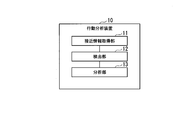
- FIG. 11 is an explanatory diagram showing the minimum configuration of the behavior analysis apparatus according to the present invention.
- the behavior analysis apparatus 10 shown in the figure includes an approach information acquisition unit 11, a detection unit 12, and an analysis unit 13.
- the approach information acquisition unit 11 acquires approach information indicating whether or not a person is approaching a shelf on which products are displayed.
- the detection unit 12 detects the position of the product displayed on the shelf and the missing item as missing item information.
- the analysis unit 13 performs an action analysis of the person based on the approach information and the missing part information.
- the behavior analysis apparatus 10 can reflect the shortage status of the product in the behavior analysis of the customer in front of the shelf. According to the behavior analysis device 10, more accurate behavior analysis can be performed in this respect.
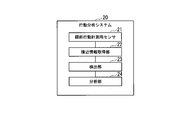
- FIG. 12 is an explanatory diagram showing the minimum configuration of the behavior analysis system according to the present invention.
- the behavior analysis system 20 shown in the figure includes a pre-shelf behavior measurement sensor 21, an approach information acquisition unit 22, a detection unit 23, and an analysis unit 24.
- the pre-shelf behavior measurement sensor 21 detects the approach of a person to the shelf on which the product is displayed.
- the approach information acquisition unit 22 acquires approach information indicating whether or not a person approaches the shelf on which the product is displayed based on the sensing data of the pre-shelf behavior measurement sensor.
- the detection unit 23 detects the position of the product displayed on the shelf and the missing item as missing item information.
- the analysis unit 24 analyzes a person's behavior based on the approach information and the missing part information. Thereby, in the behavior analysis system 20, the shortage status of the product can be reflected in the behavior analysis of the customer in front of the shelf. According to the behavior analysis system 20, more accurate behavior analysis can be performed in this respect.
- Computer-readable programs for realizing all or part of the functions of the control unit 290, the approach information acquisition unit 11, the detection unit 12, the analysis unit 13, the approach information acquisition unit 22, the detection unit 23, and the analysis unit 24 The processing of each unit may be performed by recording on a recording medium, reading the program recorded on the recording medium into a computer system, and executing the program.
- Computer-readable recording medium refers to a portable medium such as a flexible disk, a magneto-optical disk, a ROM, and a CD-ROM, and a storage device such as a hard disk built in a computer system.
- the program may be a program for realizing a part of the functions described above, and may be a program capable of realizing the functions described above in combination with a program already recorded in a computer system.
- the present invention can be applied to uses where it is indispensable to reflect the shortage status of products in behavior analysis.
Landscapes
- Business, Economics & Management (AREA)
- Engineering & Computer Science (AREA)
- Accounting & Taxation (AREA)
- Development Economics (AREA)
- Finance (AREA)
- Strategic Management (AREA)
- Economics (AREA)
- Entrepreneurship & Innovation (AREA)
- Physics & Mathematics (AREA)
- Marketing (AREA)
- General Business, Economics & Management (AREA)
- General Physics & Mathematics (AREA)
- Theoretical Computer Science (AREA)
- Game Theory and Decision Science (AREA)
- Data Mining & Analysis (AREA)
- Human Resources & Organizations (AREA)
- Operations Research (AREA)
- Quality & Reliability (AREA)
- Tourism & Hospitality (AREA)
- Management, Administration, Business Operations System, And Electronic Commerce (AREA)
Abstract
La présente invention concerne un dispositif d'analyse de comportement comportant: une unité d'acquisition d'information d'approche qui acquiert une information d'approche qui indique si une personne s'est rapprochée d'une étagère sur laquelle une pluralité de marchandises sont exposées; une unité de détection qui détecte, sous forme d'information d'insuffisance de stock, des insuffisances de stock et la localisation de marchandises qui, parmi la pluralité de marchandises exposées sur l'étagère, constituent des insuffisances de stock; et une unité d'analyse qui analyse le comportement de la personne sur la base d'information d'approche et d'information d'insuffisance de stock.
Priority Applications (2)
| Application Number | Priority Date | Filing Date | Title |
|---|---|---|---|
| JP2018507198A JP6665927B2 (ja) | 2016-03-23 | 2017-03-08 | 行動分析装置、行動分析システム、行動分析方法及びプログラム |
| US16/074,658 US11461733B2 (en) | 2016-03-23 | 2017-03-08 | Behavior analysis device, behavior analysis system, behavior analysis method, and program |
Applications Claiming Priority (2)
| Application Number | Priority Date | Filing Date | Title |
|---|---|---|---|
| JP2016059300 | 2016-03-23 | ||
| JP2016-059300 | 2016-03-23 |
Publications (1)
| Publication Number | Publication Date |
|---|---|
| WO2017163879A1 true WO2017163879A1 (fr) | 2017-09-28 |
Family
ID=59900155
Family Applications (1)
| Application Number | Title | Priority Date | Filing Date |
|---|---|---|---|
| PCT/JP2017/009246 Ceased WO2017163879A1 (fr) | 2016-03-23 | 2017-03-08 | Dispositif d'analyse de comportement, système d'analyse de comportement, procédé d'analyse de comportement, et programme |
Country Status (3)
| Country | Link |
|---|---|
| US (1) | US11461733B2 (fr) |
| JP (1) | JP6665927B2 (fr) |
| WO (1) | WO2017163879A1 (fr) |
Cited By (2)
| Publication number | Priority date | Publication date | Assignee | Title |
|---|---|---|---|---|
| JP2019219853A (ja) * | 2018-06-19 | 2019-12-26 | 東芝テック株式会社 | 画像処理装置 |
| JP2020119000A (ja) * | 2019-01-18 | 2020-08-06 | 株式会社パン・パシフィック・インターナショナルホールディングス | 情報処理装置、棚管理システム、情報処理方法、及びプログラム |
Families Citing this family (7)
| Publication number | Priority date | Publication date | Assignee | Title |
|---|---|---|---|---|
| US10831431B2 (en) | 2017-04-18 | 2020-11-10 | Anthony, Inc. | Shelving display |
| US11087273B1 (en) * | 2017-12-14 | 2021-08-10 | Amazon Technologies, Inc. | Item recognition system using reference images |
| BR112021007540A2 (pt) * | 2018-10-20 | 2021-07-27 | The Nordam Group Llc | máquina de venda neural |
| JP6581751B1 (ja) * | 2019-04-09 | 2019-09-25 | 楽天株式会社 | 決済処理システム、決済処理装置、及び決済処理方法 |
| CN110245580B (zh) * | 2019-05-24 | 2022-09-23 | 北京百度网讯科技有限公司 | 一种检测图像的方法、装置、设备和计算机存储介质 |
| US11896144B1 (en) * | 2020-12-03 | 2024-02-13 | Amazon Technologies, Inc. | Determining inventory levels using rotatable counting devices and visual imagery |
| US12406226B2 (en) * | 2022-05-16 | 2025-09-02 | 365 Retail Markets, Llc | Distance-based product event detection |
Citations (6)
| Publication number | Priority date | Publication date | Assignee | Title |
|---|---|---|---|---|
| US20020178085A1 (en) * | 2001-05-15 | 2002-11-28 | Herb Sorensen | Purchase selection behavior analysis system and method |
| JP2004348681A (ja) * | 2003-05-26 | 2004-12-09 | Nec System Technologies Ltd | 顧客購買行動分析システム |
| JP2006309280A (ja) * | 2005-04-26 | 2006-11-09 | Hitachi Software Eng Co Ltd | 非接触icタグを利用した店舗内顧客購買行動分析システム |
| JP2009126660A (ja) * | 2007-11-27 | 2009-06-11 | Toshiba Tec Corp | 物品管理システム及び情報処理装置 |
| JP2011253344A (ja) * | 2010-06-02 | 2011-12-15 | Midee Co Ltd | 購買行動分析装置、購買行動分析方法、およびプログラム |
| JP2015041194A (ja) * | 2013-08-21 | 2015-03-02 | 株式会社Nttドコモ | ユーザ観察システム |
Family Cites Families (7)
| Publication number | Priority date | Publication date | Assignee | Title |
|---|---|---|---|---|
| US7658327B2 (en) * | 2005-10-03 | 2010-02-09 | Teletech Holdings, Inc. | Virtual retail assistant |
| US20150066566A1 (en) * | 2013-08-30 | 2015-03-05 | International Business Machines Corporation | Balancing supply and demand using demand-shaping actions |
| WO2015033577A1 (fr) * | 2013-09-06 | 2015-03-12 | 日本電気株式会社 | Système d'analyse de comportement de client, procédé d'analyse de comportement de client, support lisible par ordinateur non temporaire et système d'étagère |
| US20150206188A1 (en) * | 2014-01-17 | 2015-07-23 | Panasonic Intellectual Property Corporation Of America | Item presentation method, and information display method |
| US9796093B2 (en) * | 2014-10-24 | 2017-10-24 | Fellow, Inc. | Customer service robot and related systems and methods |
| BR112021007540A2 (pt) * | 2018-10-20 | 2021-07-27 | The Nordam Group Llc | máquina de venda neural |
| US12437258B2 (en) * | 2020-08-12 | 2025-10-07 | Carnegie Mellon University | System and method for identifying products in a shelf management system |
-
2017
- 2017-03-08 US US16/074,658 patent/US11461733B2/en active Active
- 2017-03-08 WO PCT/JP2017/009246 patent/WO2017163879A1/fr not_active Ceased
- 2017-03-08 JP JP2018507198A patent/JP6665927B2/ja active Active
Patent Citations (6)
| Publication number | Priority date | Publication date | Assignee | Title |
|---|---|---|---|---|
| US20020178085A1 (en) * | 2001-05-15 | 2002-11-28 | Herb Sorensen | Purchase selection behavior analysis system and method |
| JP2004348681A (ja) * | 2003-05-26 | 2004-12-09 | Nec System Technologies Ltd | 顧客購買行動分析システム |
| JP2006309280A (ja) * | 2005-04-26 | 2006-11-09 | Hitachi Software Eng Co Ltd | 非接触icタグを利用した店舗内顧客購買行動分析システム |
| JP2009126660A (ja) * | 2007-11-27 | 2009-06-11 | Toshiba Tec Corp | 物品管理システム及び情報処理装置 |
| JP2011253344A (ja) * | 2010-06-02 | 2011-12-15 | Midee Co Ltd | 購買行動分析装置、購買行動分析方法、およびプログラム |
| JP2015041194A (ja) * | 2013-08-21 | 2015-03-02 | 株式会社Nttドコモ | ユーザ観察システム |
Cited By (3)
| Publication number | Priority date | Publication date | Assignee | Title |
|---|---|---|---|---|
| JP2019219853A (ja) * | 2018-06-19 | 2019-12-26 | 東芝テック株式会社 | 画像処理装置 |
| JP7250443B2 (ja) | 2018-06-19 | 2023-04-03 | 東芝テック株式会社 | 画像処理装置 |
| JP2020119000A (ja) * | 2019-01-18 | 2020-08-06 | 株式会社パン・パシフィック・インターナショナルホールディングス | 情報処理装置、棚管理システム、情報処理方法、及びプログラム |
Also Published As
| Publication number | Publication date |
|---|---|
| JP6665927B2 (ja) | 2020-03-13 |
| US11461733B2 (en) | 2022-10-04 |
| JPWO2017163879A1 (ja) | 2018-12-20 |
| US20190050792A1 (en) | 2019-02-14 |
Similar Documents
| Publication | Publication Date | Title |
|---|---|---|
| US20250194824A1 (en) | Image display device, image display system, image display method, and program | |
| JP6665927B2 (ja) | 行動分析装置、行動分析システム、行動分析方法及びプログラム | |
| JP7294504B2 (ja) | 物体種類特定装置、物体種類特定方法及び物体種類特定プログラム | |
| JP7251569B2 (ja) | 店舗装置、店舗管理方法、プログラム | |
| JP6194777B2 (ja) | 動作判定方法、動作判定装置および動作判定プログラム | |
| TW202147206A (zh) | 店鋪裝置、店鋪系統、店鋪管理方法及程式 | |
| JP7081310B2 (ja) | 行動分析装置、行動分析システム、行動分析方法、プログラムおよび記録媒体 | |
| JP7250443B2 (ja) | 画像処理装置 | |
| EP4160533B1 (fr) | Programme d'estimation, procédé d'estimation et dispositif d'estimation | |
| CN104169960A (zh) | 工作支持系统、工作支持设备、工作支持方法以及程序 | |
| KR20210155492A (ko) | 3d 카메라를 이용한 한우 체중 측정 방법 및 장치 |
Legal Events
| Date | Code | Title | Description |
|---|---|---|---|
| WWE | Wipo information: entry into national phase |
Ref document number: 2018507198 Country of ref document: JP |
|
| NENP | Non-entry into the national phase |
Ref country code: DE |
|
| 121 | Ep: the epo has been informed by wipo that ep was designated in this application |
Ref document number: 17769924 Country of ref document: EP Kind code of ref document: A1 |
|
| 122 | Ep: pct application non-entry in european phase |
Ref document number: 17769924 Country of ref document: EP Kind code of ref document: A1 |