WO2017164404A1 - Composition de lubrifiant pour moteur diesel à piston fourreau - Google Patents
Composition de lubrifiant pour moteur diesel à piston fourreau Download PDFInfo
- Publication number
- WO2017164404A1 WO2017164404A1 PCT/JP2017/012150 JP2017012150W WO2017164404A1 WO 2017164404 A1 WO2017164404 A1 WO 2017164404A1 JP 2017012150 W JP2017012150 W JP 2017012150W WO 2017164404 A1 WO2017164404 A1 WO 2017164404A1
- Authority
- WO
- WIPO (PCT)
- Prior art keywords
- oil
- lubricating oil
- mass
- lubricating
- oil composition
- Prior art date
- Legal status (The legal status is an assumption and is not a legal conclusion. Google has not performed a legal analysis and makes no representation as to the accuracy of the status listed.)
- Ceased
Links
Images
Classifications
-
- C—CHEMISTRY; METALLURGY
- C10—PETROLEUM, GAS OR COKE INDUSTRIES; TECHNICAL GASES CONTAINING CARBON MONOXIDE; FUELS; LUBRICANTS; PEAT
- C10M—LUBRICATING COMPOSITIONS; USE OF CHEMICAL SUBSTANCES EITHER ALONE OR AS LUBRICATING INGREDIENTS IN A LUBRICATING COMPOSITION
- C10M169/00—Lubricating compositions characterised by containing as components a mixture of at least two types of ingredient selected from base-materials, thickeners or additives, covered by the preceding groups, each of these compounds being essential
- C10M169/04—Mixtures of base-materials and additives
-
- C—CHEMISTRY; METALLURGY
- C10—PETROLEUM, GAS OR COKE INDUSTRIES; TECHNICAL GASES CONTAINING CARBON MONOXIDE; FUELS; LUBRICANTS; PEAT
- C10M—LUBRICATING COMPOSITIONS; USE OF CHEMICAL SUBSTANCES EITHER ALONE OR AS LUBRICATING INGREDIENTS IN A LUBRICATING COMPOSITION
- C10M101/00—Lubricating compositions characterised by the base-material being a mineral or fatty oil
- C10M101/02—Petroleum fractions
-
- C—CHEMISTRY; METALLURGY
- C10—PETROLEUM, GAS OR COKE INDUSTRIES; TECHNICAL GASES CONTAINING CARBON MONOXIDE; FUELS; LUBRICANTS; PEAT
- C10M—LUBRICATING COMPOSITIONS; USE OF CHEMICAL SUBSTANCES EITHER ALONE OR AS LUBRICATING INGREDIENTS IN A LUBRICATING COMPOSITION
- C10M129/00—Lubricating compositions characterised by the additive being an organic non-macromolecular compound containing oxygen
- C10M129/02—Lubricating compositions characterised by the additive being an organic non-macromolecular compound containing oxygen having a carbon chain of less than 30 atoms
- C10M129/26—Carboxylic acids; Salts thereof
- C10M129/28—Carboxylic acids; Salts thereof having carboxyl groups bound to acyclic or cycloaliphatic carbon atoms
- C10M129/38—Carboxylic acids; Salts thereof having carboxyl groups bound to acyclic or cycloaliphatic carbon atoms having 8 or more carbon atoms
- C10M129/42—Carboxylic acids; Salts thereof having carboxyl groups bound to acyclic or cycloaliphatic carbon atoms having 8 or more carbon atoms polycarboxylic
-
- C—CHEMISTRY; METALLURGY
- C10—PETROLEUM, GAS OR COKE INDUSTRIES; TECHNICAL GASES CONTAINING CARBON MONOXIDE; FUELS; LUBRICANTS; PEAT
- C10M—LUBRICATING COMPOSITIONS; USE OF CHEMICAL SUBSTANCES EITHER ALONE OR AS LUBRICATING INGREDIENTS IN A LUBRICATING COMPOSITION
- C10M129/00—Lubricating compositions characterised by the additive being an organic non-macromolecular compound containing oxygen
- C10M129/02—Lubricating compositions characterised by the additive being an organic non-macromolecular compound containing oxygen having a carbon chain of less than 30 atoms
- C10M129/68—Esters
-
- C—CHEMISTRY; METALLURGY
- C10—PETROLEUM, GAS OR COKE INDUSTRIES; TECHNICAL GASES CONTAINING CARBON MONOXIDE; FUELS; LUBRICANTS; PEAT
- C10M—LUBRICATING COMPOSITIONS; USE OF CHEMICAL SUBSTANCES EITHER ALONE OR AS LUBRICATING INGREDIENTS IN A LUBRICATING COMPOSITION
- C10M133/00—Lubricating compositions characterised by the additive being an organic non-macromolecular compound containing nitrogen
- C10M133/52—Lubricating compositions characterised by the additive being an organic non-macromolecular compound containing nitrogen having a carbon chain of 30 or more atoms
- C10M133/56—Amides; Imides
-
- C—CHEMISTRY; METALLURGY
- C10—PETROLEUM, GAS OR COKE INDUSTRIES; TECHNICAL GASES CONTAINING CARBON MONOXIDE; FUELS; LUBRICANTS; PEAT
- C10M—LUBRICATING COMPOSITIONS; USE OF CHEMICAL SUBSTANCES EITHER ALONE OR AS LUBRICATING INGREDIENTS IN A LUBRICATING COMPOSITION
- C10M159/00—Lubricating compositions characterised by the additive being of unknown or incompletely defined constitution
- C10M159/12—Reaction products
- C10M159/20—Reaction mixtures having an excess of neutralising base, e.g. so-called overbasic or highly basic products
- C10M159/22—Reaction mixtures having an excess of neutralising base, e.g. so-called overbasic or highly basic products containing phenol radicals
Definitions
- the present invention relates to a lubricating oil composition for a medium speed trunk piston type diesel engine, and more particularly to a lubricating oil composition for a marine four stroke medium speed trunk piston type diesel engine.
- Trunk piston diesel engine oil is required to have a cleansing action to prevent engine fouling by the asphaltene component of heavy fuel, and acid neutralization to neutralize acidic components derived from the sulfur content of heavy fuel .
- a large amount of detergent is blended in the trunk piston diesel engine oil.
- trunk piston diesel engine oil is also required to have dispersibility of unburned asphaltenes mixed from fuel, resin components generated by combustion, and the like.
- asphaltene dissolution dispersibility and high temperature cleanliness are also important for preventing the occurrence of black sludge that can lead to piston failure. Therefore, a group I mineral base oil containing a large amount of aromatic components is generally used as the trunk piston diesel engine oil.
- the present invention is capable of simultaneously improving the high temperature cleanliness and asphaltene dissolution and dispersibility when mixed with asphaltenes, even when using group II mineral oils that are generally inferior in solubility and dispersibility compared to group I mineral oils. It is an object of the present invention to provide a lubricating oil composition for a trunk piston type diesel engine.
- the lubricating oil composition for a trunk piston type diesel engine of the present invention (A) Mineral oil and synthetic oil having a kinematic viscosity at 100 ° C. of 3 to 6 mm 2 / s, mineral oil and synthetic oil having a kinematic viscosity at 100 ° C. of 5 to 10 mm 2 / s, kinematic viscosity at 100 ° C. of 9 to 13 mm
- a lubricating base oil that is one or a combination of two or more selected from the group consisting of a mineral oil and a synthetic oil of 2 / s, and a mineral oil and a synthetic oil having a kinematic viscosity at 100 ° C.
- component (C) is 200 to 500 ppm as a nitrogen content based on the total amount of the lubricating oil composition.
- the lubricating base oil is a base oil having a saturated hydrocarbon content of 90% by mass or more, a sulfur content of 0.03% by mass or less, and a viscosity index of 80 or more. Including.
- the component (C) is alkenyl succinimide or a derivative thereof.
- the component (D) is a hydrocarbyl carboxylic acid anhydride having a weight average molecular weight of 1,000 to 3,000.
- the component (D) is a hydrocarbyl carboxylic acid ester having a weight average molecular weight of 1,000 to 3,000.
- the base number according to the perchloric acid method of the trunk piston type diesel engine lubricating oil composition of the present invention is 9 to 55 mgKOH / g.
- the trunk piston type diesel engine lubricating oil composition of the present invention has a kinematic viscosity at 100 ° C. of 8.0 to 16.3 mm 2 / s.
- the trunk piston type diesel engine lubricating oil composition of the present invention can be preferably used for lubricating a medium speed trunk piston type diesel engine.
- the “medium speed trunk piston type diesel engine” is a trunk piston type diesel engine having a rated rotational speed (a rotational speed at the time of continuous maximum output, also referred to as a continuous maximum rotational speed or a continuous rated rotational speed). Meaning 200 to 1250 revolutions / minute.
- the rotational speed is typically 300 to 1000 revolutions / minute.
- trunk piston type diesel engine lubricating oil composition of the present invention even when Group II mineral oil, which is generally inferior in solubility and dispersibility compared to Group I mineral oil, is used, high temperature cleanability and asphaltene when mixed with asphaltenes are obtained. It is possible to simultaneously improve the solubility and dispersibility.
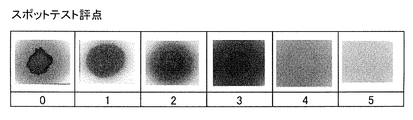
- FIG. 5 is a diagram showing a spot state corresponding to each score of 0 to 5 in a spot test.
- the lubricating base oil in the trunk piston type diesel engine lubricating oil composition of the present invention includes mineral oil and synthetic oil having a kinematic viscosity at 100 ° C. of 3 to 6 mm 2 / s, and a kinematic viscosity at 100 ° C. of 5 to 10 mm 2 / selected from the group consisting of mineral oil and synthetic oil which is s, mineral oil and synthetic oil whose kinematic viscosity at 100 ° C. is 9 to 13 mm 2 / s, and mineral oil and synthetic oil whose kinematic viscosity at 100 ° C. is 25 to 35 mm 2 / s One type or a combination of two or more types.
- the mineral base oil used for normal lubricating oil can be used.
- the lube oil fraction obtained by distilling the atmospheric residue obtained by atmospheric distillation of the crude oil is subjected to solvent removal, solvent extraction, hydrocracking, solvent dewaxing, hydrorefining.
- the total aromatic content of the mineral base oil other than the base oil (A-1) described later is not particularly limited, but is preferably 40% by mass or less, more preferably 30% by mass or less. Although the total aromatic content may be 0% by mass, it is preferably 1% by mass or more, more preferably 5% by mass or more, and further preferably 10% by mass or more in terms of the solubility of the additive. It is preferably 20% by mass or more. When the total aromatic content of the base oil exceeds 40% by mass, oxidation stability is inferior, which is not preferable.
- the total aromatic content means an aromatic fraction content measured in accordance with ASTM D2549.
- this aromatic fraction includes alkylbenzene, alkylnaphthalene, anthracene, phenanthrene, alkylated products thereof, compounds in which four or more benzene rings are condensed, and heterogeneous compounds such as pyridines, quinolines, phenols, and naphthols. Compounds having aromatics are included.
- the sulfur content in the mineral base oil other than the base oil (A-1) described later is not particularly limited, but is preferably 1% by mass or less, and preferably 0.5% by mass or less. Further preferably, it is 0.1% by mass or more, more preferably 0.2% by mass or more.
- the synthetic oil is not particularly limited, and a synthetic base oil used for ordinary lubricating oil can be used.
- poly ⁇ -olefins and hydrides thereof such as polybutene and hydrides thereof; oligomers such as 1-octene, 1-decene, dodecene, or mixtures thereof; ditridecyl glutarate, di-2 -Diesters such as ethylhexyl adipate, diisodecyl adipate, ditridecyl adipate, di-2-ethylhexyl sebacate; trimethylolpropane caprylate, trimethylolpropane pelargonate, pentaerythritol-2-ethylhexanoate, pentaerythritol pelargonate, etc.
- Polyol ester ; copolymer of dicarboxylic acid such as dibutyl maleate and ⁇ -olefin having 2 to 30 carbon atoms; aromatic synthetic oil such as alkyl naphthalene, alkyl benzene, aromatic ester; A mixture etc. can be illustrated.
- Examples of mineral base oils and synthetic base oils having a kinematic viscosity at 100 ° C. of less than 3 to 6 mm 2 / s include mineral base oils and synthetic base oils such as SAE10.
- Examples of mineral oils and synthetic oils having a kinematic viscosity at 100 ° C. of less than 5 to 10 mm 2 / s include mineral base oils and synthetic base oils such as SAE20.
- Examples of mineral oils and synthetic oils having a kinematic viscosity at 100 ° C. of 9 to 13 mm 2 / s include mineral base oils and synthetic base oils such as SAE30.
- Examples of mineral oil and synthetic oil having a kinematic viscosity at 100 ° C. of 25 to 35 mm 2 / s include bright stock.
- the viscosity index of the lubricating base oil is not particularly limited. However, from the viewpoint of obtaining excellent viscosity characteristics from low temperature to high temperature, the value of the viscosity index is preferably 80 or more, more preferably 85 or more, and further preferably 90 or more. Although there is no restriction
- the amount of evaporation loss of the lubricating base oil is not particularly limited, but from the viewpoint of oil consumption, NOACK evaporation amount (evaporation amount of lubricating oil measured according to ASTM D 5800) is 20% by mass or less. Preferably, it is 16 mass% or less, more preferably 10 mass% or less.
- the lubricating base oil preferably contains the following base oil (A-1).
- the saturated hydrocarbon content in the present application is a saturated content measured by a method specified in ASTM D 2007-93.
- the base oil (A-1) may be either a mineral base oil or a synthetic base oil, and is preferably a mineral oil base oil.
- the saturated hydrocarbon content of the base oil (A-1) is 90% by mass or more, preferably 95% by mass or more, and preferably 99.5% by mass or less.
- the aromatic content of the base oil (A-1) is 10% by mass or less, preferably less than 5% by mass, more preferably less than 3% by mass, and may be 0% by mass.
- the viscosity index of the base oil (A-1) is 80 or more, preferably 85 or more, more preferably 90 or more, and usually less than 120.
- the content of the base oil (A-1) is preferably 70 to 100% by mass, more preferably 80 to 90% by mass, based on the total amount of the (A) lubricating base oil.
- the lubricating base oil has a base oil (A-1) content equal to or lower than the above upper limit and a mineral oil base oil having a higher aromatic content (for example, API Group I base oil). By including, solubility can be ensured.
- the aromatic content of the other mineral base oil used in combination with the base oil (A-1) is preferably 1% by mass or more, more preferably 5% by mass or more as described above.
- the content of the lubricating base oil is usually 65 to 95% by mass, preferably 70 to 90% by mass, based on the total amount of the lubricating oil composition for a trunk piston type diesel engine.
- the metallic detergent in the lubricating oil composition of the present invention one or a combination of two or more selected from calcium salicylate detergent, calcium phenate detergent, and calcium sulfonate detergent can be preferably used.
- the metal detergent is preferably a calcium salicylate detergent and / or a calcium phenate detergent, and more preferably contains at least a calcium salicylate detergent. .
- the content of the metal detergent in the lubricating oil composition of the present invention is usually 7 to 30% by mass, preferably 8 to 25% by mass, and more preferably 10% based on the total amount of the composition including the diluent. To 25% by mass.
- the content of the metallic detergent is equal to or higher than the lower limit, it is possible to achieve both neutralization performance of sulfuric acid generated due to heavy fuel and engine cleaning performance.
- the solubility to base oil becomes favorable because content of a metal type cleaning agent is below the said upper limit.
- the method for producing the calcium salicylate detergent is not particularly limited, and can be produced by a known method. For example, using 1 mol or more of an olefin having 10 to 40 carbon atoms such as a polymer or copolymer such as ethylene, propylene, and butene, preferably a linear ⁇ -olefin such as an ethylene polymer, with respect to 1 mol of phenol.
- alkyl salicylic acid is produced by a method of carboxylation with carbon dioxide or the like, or a method of alkylation using 1 mol or more of the above olefin, preferably the above linear ⁇ -olefin, per 1 mol of salicylic acid.
- a calcium base such as calcium oxide or calcium hydroxide
- alkali metal salt such as sodium salt or potassium salt
- substituting the alkali metal ion with calcium ion, etc. Can be manufactured by wear.
- a solvent such as an aliphatic hydrocarbon solvent such as hexane, an aromatic hydrocarbon solvent such as xylene, or a light lubricating base oil.
- the calcium salicylate (neutral salt) obtained as described above is further heated with excess calcium salt or calcium base (calcium oxide or calcium hydroxide) in the presence of water.
- a basic salt obtained by reacting the above neutral salt with a base such as calcium hydroxide in the presence of carbon dioxide gas, boric acid, borate or the like.
- the calcium phenate detergent for example, calcium of alkylphenol sulfide obtained by reacting sulfur with an alkylphenol having at least one linear or branched alkyl group having 4 to 30 carbon atoms, preferably 10 to 18 carbon atoms.
- a calcium salt of a Mannich reaction product of alkylphenol obtained by reacting a salt or alkylphenol with formaldehyde is preferably used.
- neutral salt of calcium phenate, basic salt obtained by heating excess calcium salt or calcium base (calcium oxide or calcium hydroxide) in the presence of water An overbased salt obtained by reacting the above neutral salt with a base such as calcium hydroxide in the presence of carbon dioxide gas or boric acid or borate is also included.
- Examples of calcium sulfonate detergents include calcium salts of alkyl aromatic sulfonic acids obtained by sulfonating alkyl aromatic compounds, or basic salts or overbased salts thereof.
- the weight average molecular weight of the alkyl aromatic compound is preferably 400 to 1500, more preferably 700 to 1300.
- Examples of the alkyl aromatic sulfonic acid include so-called petroleum sulfonic acid and synthetic sulfonic acid. As petroleum sulfonic acid here, what sulfonated the alkyl aromatic compound of the lubricating oil fraction of mineral oil, what is called mahoganic acid etc. byproduced at the time of white oil manufacture are mentioned.
- synthetic sulfonic acid linear or branched alkyl obtained by recovering a by-product in an alkylbenzene production plant that is a raw material of a detergent or by alkylating benzene with polyolefin
- examples include sulfonated alkylbenzene having a group.
- Another example of the synthetic sulfonic acid is a sulfonated alkyl naphthalene such as dinonylnaphthalene.
- calcium sulfonate detergent neutral salt of calcium sulfonate, basic salt obtained by heating excess calcium salt or calcium base (calcium oxide or calcium hydroxide) in the presence of water, carbon dioxide gas
- an overbased salt obtained by reacting the neutral salt with a base such as calcium hydroxide in the presence of boric acid or borate is also included.
- the base number of the metallic detergent in the lubricating oil composition of the present invention is not particularly limited as long as the base number of the lubricating oil composition falls within a desired range described below. However, it is usually 0 to 500 mgKOH / g, preferably 20 to 450 mgKOH / g.
- Nitrogen-containing ashless dispersant As the nitrogen-containing ashless dispersant in the lubricating oil composition of the present invention, known ashless dispersants used for lubricating oils can be used without particular limitation. For example, a nitrogen-containing compound having at least one linear or branched alkyl group or alkenyl group having 40 to 400 carbon atoms or a derivative thereof can be given.
- nitrogen-containing compound examples include succinimide, benzylamine, polyamine, Mannich base, and derivatives thereof include boron compounds such as boric acid and borate, (thio) phosphoric acid, Derivatives in which a phosphorus compound such as (thio) phosphate, an organic acid, hydroxy (poly) oxyalkylene carbonate, or the like is allowed to act are mentioned. In the present invention, one or two or more arbitrarily selected from these can be blended.
- alkenyl succinimide or a derivative thereof is preferable from the viewpoint of improving high-temperature cleanability, and alkenyl succinimide ashless dispersant containing boron is particularly preferable from the viewpoint of improving seizure resistance.
- alkenyl succinimide examples include compounds represented by the following formula (1) or formula (2).
- R 1 represents an alkenyl group having 40 to 400 carbon atoms, and h represents an integer of 1 to 5, preferably 2 to 4.
- the carbon number of R 1 is preferably 60 or more, and preferably 350 or less.
- each R 2 independently represents an alkenyl group having 40 to 400 carbon atoms, and may be a combination of different groups.
- R 2 is particularly preferably a polybutenyl group.
- I represents an integer of 0 to 4, preferably 1 to 3.
- R 2 preferably has 60 or more carbon atoms, and preferably 350 or less.
- the alkenyl groups (R 1 , R 2 ) in the formulas (1) and (2) may be linear or branched, and are preferably olefin oligomers such as propylene, 1-butene and isobutene, ethylene And a branched alkenyl group derived from a co-oligomer of styrene and propylene. Of these, a branched alkenyl group or a polybutenyl group which is conventionally derived from an oligomer of isobutene conventionally called polyisobutylene is most preferred.
- a preferred weight average molecular weight of the alkenyl group (R 1 , R 2 ) in the formulas (1) and (2) is 800 to 3500.
- the alkenyl succinimide has a so-called monotype succinimide represented by the formula (1) in which succinic anhydride is added to only one end of the polyamine chain, and succinic anhydride at both ends of the polyamine chain.
- the added bis-type succinimide represented by the formula (2) is included.
- Either the monotype succinimide and the bis type succinimide may be contained in the lubricating oil composition of the present invention, or both of them may be contained as a mixture.
- the production method of the alkenyl succinimide is not particularly limited.
- an alkenyl succinic acid obtained by reacting a compound having an alkenyl group having 40 to 400 carbon atoms with maleic anhydride at 100 to 200 ° C. is converted into a polyamine. It can obtain by making it react.
- the polyamine include diethylenetriamine, triethylenetetramine, tetraethylenepentamine, and pentaethylenehexamine.
- boronated derivative of alkenyl succinimide for example, by reacting boric acid with the alkenyl succinimide described above, part or all of the remaining amino group and / or imino group is neutralized or amidated. Examples of so-called boron-modified compounds.
- the molecular weight of component (C) is not particularly limited, but a preferred weight average molecular weight is 1000 to 8000.
- the content of the nitrogen-containing ashless dispersant is 500 masses as the amount of nitrogen on the basis of the total amount of the composition from the viewpoint of enhancing asphaltene dissolution and dispersibility, and from the viewpoint of enhancing water separability for water washing treatment in an oil purifier of a diesel engine. ppm or less, preferably 450 mass ppm or less. Further, from the viewpoint of enhancing the high-temperature cleanability under asphaltene mixing conditions, the amount of nitrogen is preferably 200 ppm by mass or more, more preferably 300 ppm by mass or more based on the total amount of the composition.
- the content as boron content is usually 100 to 900 ppm by mass, preferably 200 ppm by mass or more, and preferably 500 ppm by mass based on the total amount of the composition. ppm or less.
- the lubricating oil composition of the present invention contains hydrocarbyl carboxylic anhydride and / or hydrocarbyl carboxylic acid ester.
- the weight average molecular weight of component (D) is preferably 1,000 to 3,000, more preferably 1,500 to 2,500.
- the hydrocarbyl group in the hydrocarbyl carboxylic acid anhydride is preferably an alkyl group or an alkenyl group, more preferably an alkenyl group.
- the number of carbon atoms of the hydrocarbyl group in the hydrocarbyl carboxylic acid anhydride is preferably 20 or more, more preferably 50 to 200.
- the hydrocarbyl carboxylic acid constituting the hydrocarbyl carboxylic anhydride may be a monobasic acid (monocarboxylic acid), a dibasic acid (dicarboxylic acid), or a tribasic acid (tricarboxylic acid). Or a combination thereof.
- hydrocarbyl carboxylic acid constituting the hydrocarbyl carboxylic anhydride polybutenyl succinic acid can be exemplified.
- hydrocarbyl carboxylic anhydride of component (D) an acid anhydride produced by intramolecular dehydration of hydrocarbyl dicarboxylic acid can be preferably used, and among them, alkenyl succinic anhydride can be particularly preferably used.
- the hydrocarbyl group in the hydrocarbyl carboxylic acid ester is preferably an alkyl group or an alkenyl group, more preferably an alkenyl group.
- the number of carbon atoms of the hydrocarbyl group in the hydrocarbyl carboxylic acid ester is preferably 100 or more, more preferably 200 or more.
- the hydrocarbyl carboxylic acid constituting the hydrocarbyl carboxylic acid ester may be a monobasic acid (monocarboxylic acid), a dibasic acid (dicarboxylic acid), or a tribasic acid (tricarboxylic acid). It may be a combination thereof.
- the ester may be a complete ester or an incomplete ester.
- hydrocarbyl carboxylic acid constituting the hydrocarbyl carboxylic acid ester polybutenyl succinic acid can be exemplified.
- the alcohol constituting the hydrocarbyl carboxylic acid ester may be a monohydric alcohol (monool), a dihydric alcohol (diol), a trihydric alcohol (triol), or a combination thereof. It may be.
- the alcohol constituting the hydrocarbyl carboxylic acid ester is preferably an aliphatic alcohol.
- hydrocarbyl carboxylic acid ester examples include ethylene glycol and propylene glycol.
- an ester of hydrocarbyl dicarboxylic acid can be preferably used, and among them, alkenyl succinic acid ester can be particularly preferably used.
- the content of the component (D) in the lubricating oil composition of the present invention is usually 0.5 to 5.0% by mass, preferably 1.0% by mass or more, preferably based on the total amount of the composition. It is 3.0 mass% or less.
- the lubricating oil composition of the present invention comprises, in addition to the above-described lubricating base oil, metallic detergent, ashless dispersant, and hydrocarbyl carboxylic anhydride / ester, an antiwear or extreme pressure agent, a friction modifier, One or more selected from the group consisting of antioxidants, viscosity index improvers, pour point depressants, metal deactivators, corrosion inhibitors, rust inhibitors other than component (D), demulsifiers, and antifoaming agents.
- the additive may be further contained.
- antiwear agent or extreme pressure agent a known antiwear agent or extreme pressure agent can be used without particular limitation.
- sulfur-based, phosphorus-based, sulfur-phosphorus extreme pressure agents and the like can be used.
- the content thereof is usually 0.01 to 5% by mass based on the total amount of the composition.
- ashless friction modifiers for example, an aliphatic amine compound, an aliphatic imide compound, a fatty acid ester, a fatty acid amide, a fatty acid, an aliphatic alcohol having at least one hydrocarbon group having 6 to 30 carbon atoms in the molecule, Ashless friction modifiers such as aliphatic ethers, aliphatic ureas, and aliphatic hydrazides.
- molybdenum friction modifiers include organic molybdenum compounds such as molybdenum dithiocarbamate, molybdenum dithiophosphate, and molybdenum-amine complexes.
- the total content is usually 0.2 to 5% by mass based on the total amount of the composition.
- antioxidant a known antioxidant can be used without particular limitation.
- phenolic antioxidants such as 2,6-ditert-butyl-4-methylphenol (DBPC) and 4,4′-methylenebis (2,6-ditert-butylphenol); alkyldiphenylamine, (alkyl) phenyl And amine-based antioxidants such as - ⁇ -naphthylamine; and metal-based antioxidants.
- DBPC 2,6-ditert-butyl-4-methylphenol
- DBPC 2,6-ditert-butyl-4-methylphenol
- DBPC 2,6-ditert-butyl-4-methylphenol
- alkyldiphenylamine alkyldiphenylamine
- alkyl phenyl And amine-based antioxidants such as - ⁇ -naphthylamine
- metal-based antioxidants metal-based antioxidants.
- viscosity index improver examples include non-dispersed or dispersed ester group-containing viscosity index improvers, non-dispersed or dispersed poly (meth) acrylate viscosity index improvers, styrene-diene hydrogenated copolymers, Non-dispersed or dispersed ethylene- ⁇ -olefin copolymer or its hydride, polyisobutylene or its hydride, styrene-maleic anhydride ester copolymer, polyalkylstyrene, (meth) acrylate-olefin copolymer, etc. Any known viscosity index improver can be used without particular limitation.
- the weight average molecular weight of the viscosity index improver is usually 10,000 to 400,000.
- the content thereof is usually 1.0 to 15.0% by mass based on the total amount of the composition.
- a known pour point depressant such as a polymethacrylate polymer can be used without particular limitation, depending on the properties of the lubricating base oil to be used.
- the lubricating oil composition of the present invention contains a pour point depressant, the content thereof is usually 0.01 to 1% by mass based on the total amount of the composition.
- corrosion inhibitor known corrosion inhibitors such as benzotriazole, tolyltriazole, thiadiazole, and imidazole compounds can be used without particular limitation.
- the content thereof is usually 0.005 to 5% by mass based on the total amount of the composition.
- rust preventive agent other than the component (D) for example, known rust preventive agents such as petroleum sulfonate, alkylbenzene sulfonate, dinonyl naphthalene sulfonate, and polyhydric alcohol ester can be used without particular limitation.
- rust preventive agents such as petroleum sulfonate, alkylbenzene sulfonate, dinonyl naphthalene sulfonate, and polyhydric alcohol ester can be used without particular limitation.
- these rust inhibitors are contained in the lubricating oil composition of the present invention, the content thereof is usually 0.005 to 5% by mass based on the total amount of the composition.
- demulsifier for example, known demulsifiers such as polyalkylene glycol nonionic surfactants such as polyoxyethylene alkyl ether, polyoxyethylene alkyl phenyl ether, and polyoxyethylene alkyl naphthyl ether are used without particular limitation. Is possible.
- these demulsifiers are contained in the lubricating oil composition for an internal combustion engine of the present invention, the content thereof is usually 0.005 to 5% by mass based on the total amount of the composition.
- metal deactivators examples include imidazoline, pyrimidine derivatives, alkylthiadiazoles, mercaptobenzothiazoles, benzotriazoles and derivatives thereof, 1,3,4-thiadiazole polysulfide, 1,3,4-thiadiazolyl-2,5-bis.
- Known metal deactivators such as dialkyldithiocarbamate, 2- (alkyldithio) benzimidazole, and ⁇ - (o-carboxybenzylthio) propiononitrile can be used without particular limitation.
- the content thereof is usually 0.005 to 1% by mass based on the total amount of the composition.
- antifoaming agent known antifoaming agents such as silicone, fluorosilicone, and fluoroalkyl ether can be used without particular limitation.
- these antifoaming agents are contained in the lubricating oil composition of the present invention, the content thereof is usually 0.0005 to 1% by mass based on the total amount of the composition.
- Kinematic viscosity at 100 ° C. of the lubricating oil composition of the present invention is usually 8.0 ⁇ 16.3mm 2 / s, preferably 9.0 ⁇ 15.0 mm 2 / s, more preferably 9.0 ⁇ 12.5 mm 2 / s, particularly preferably 10.0 to 12.5 mm 2 / s.
- the kinematic viscosity of the composition is less than 8.0 mm 2 / s, it becomes difficult to ensure the oil film thickness and oil pressure necessary for the reliability of the medium speed diesel engine.
- the kinematic viscosity of the composition exceeds 16.3 mm 2 / s, it becomes difficult to exert an effect of reducing fuel consumption.
- the kinematic viscosity at 100 ° C. means the kinematic viscosity at 100 ° C. defined in ASTM D 445.
- the base number of the lubricating oil composition of the present invention is preferably 9 mgKOH / g or more from the viewpoint of exhibiting good high temperature cleanliness and acid neutralization performance even when using a high sulfur fuel containing asphaltenes. Yes, more preferably 10 mgKOH / g or more. Also, from the viewpoint of avoiding liner bore polishing and scuffing due to excessive ash accumulation on the piston top land, it is preferably 55 mgKOH / g or less, more preferably 50 mgKOH / g or less.
- the base number refers to a base number determined by the perchloric acid method measured by ASTM D 2896.
- the amount of sulfated ash in the lubricating oil composition of the present invention is not particularly limited, but is preferably 0.9% by mass or more, more preferably 1.2% by mass or more, and preferably 7.0% by mass or less. More preferably, it is 6.5% by mass or less.
- the sulfated ash is JIS K 2272 5.
- the value measured by the method specified in “Testing method for sulfated ash” is mainly attributable to the metal-containing additive.
- Examples 1 to 7 and Comparative Examples 1 to 7 As shown in Table 1, lubricating oil compositions of the present invention (Examples 1 to 7) and comparative lubricating oil compositions (Comparative Examples 1 to 7) were prepared, respectively.
- “inmass%” means mass% based on the total amount of the base oil
- “mass%” means mass% based on the total amount of the composition
- “mass ppm” means mass ppm based on the total amount of the composition. Means.
- each of the lubricating oil compositions of Examples 1 to 7 contained 90% by mass of the Group II base oil based on the total amount of the base oil. Asphaltene dissolution and dispersibility could be improved at the same time.
- the lubricating oil compositions of Comparative Examples 1 to 4 that do not contain the component (D) (hydrocarbylcarboxylic acid anhydride / ester) are higher in temperature than the lubricating oil compositions of Examples 1 to 7 under conditions of asphaltenes. Performance and / or asphaltene dissolution / dispersibility were poor.
Landscapes
- Chemical & Material Sciences (AREA)
- Chemical Kinetics & Catalysis (AREA)
- General Chemical & Material Sciences (AREA)
- Oil, Petroleum & Natural Gas (AREA)
- Organic Chemistry (AREA)
- Lubricants (AREA)
Abstract
Priority Applications (2)
| Application Number | Priority Date | Filing Date | Title |
|---|---|---|---|
| SG11201808164UA SG11201808164UA (en) | 2016-03-25 | 2017-03-24 | Lubricating oil composition for trunk piston diesel engine |
| JP2018507458A JP7085469B2 (ja) | 2016-03-25 | 2017-03-24 | トランクピストン型ディーゼル機関用潤滑油組成物 |
Applications Claiming Priority (2)
| Application Number | Priority Date | Filing Date | Title |
|---|---|---|---|
| JP2016-061924 | 2016-03-25 | ||
| JP2016061924 | 2016-03-25 |
Publications (1)
| Publication Number | Publication Date |
|---|---|
| WO2017164404A1 true WO2017164404A1 (fr) | 2017-09-28 |
Family
ID=59900486
Family Applications (1)
| Application Number | Title | Priority Date | Filing Date |
|---|---|---|---|
| PCT/JP2017/012150 Ceased WO2017164404A1 (fr) | 2016-03-25 | 2017-03-24 | Composition de lubrifiant pour moteur diesel à piston fourreau |
Country Status (3)
| Country | Link |
|---|---|
| JP (1) | JP7085469B2 (fr) |
| SG (1) | SG11201808164UA (fr) |
| WO (1) | WO2017164404A1 (fr) |
Cited By (1)
| Publication number | Priority date | Publication date | Assignee | Title |
|---|---|---|---|---|
| CN109135887A (zh) * | 2018-07-26 | 2019-01-04 | 中国石油化工股份有限公司 | 中速机油组合物及其用途 |
Citations (6)
| Publication number | Priority date | Publication date | Assignee | Title |
|---|---|---|---|---|
| JP2009280816A (ja) * | 2008-05-20 | 2009-12-03 | Infineum Internatl Ltd | 船舶エンジンの潤滑 |
| JP2009280817A (ja) * | 2008-05-20 | 2009-12-03 | Infineum Internatl Ltd | 船舶エンジンの潤滑 |
| JP2012522878A (ja) * | 2009-04-07 | 2012-09-27 | インフィニューム インターナショナル リミテッド | 船舶用機関の潤滑 |
| WO2014057640A1 (fr) * | 2012-10-10 | 2014-04-17 | Jx日鉱日石エネルギー株式会社 | Composition d'huile lubrifiante pour moteur diésel à piston-fourreau |
| JP2014152334A (ja) * | 2013-02-07 | 2014-08-25 | Infineum Internatl Ltd | 船舶用エンジンの潤滑 |
| JP2015189945A (ja) * | 2014-03-28 | 2015-11-02 | Jx日鉱日石エネルギー株式会社 | トランクピストン型ディーゼル機関用潤滑油組成物 |
-
2017
- 2017-03-24 WO PCT/JP2017/012150 patent/WO2017164404A1/fr not_active Ceased
- 2017-03-24 JP JP2018507458A patent/JP7085469B2/ja active Active
- 2017-03-24 SG SG11201808164UA patent/SG11201808164UA/en unknown
Patent Citations (6)
| Publication number | Priority date | Publication date | Assignee | Title |
|---|---|---|---|---|
| JP2009280816A (ja) * | 2008-05-20 | 2009-12-03 | Infineum Internatl Ltd | 船舶エンジンの潤滑 |
| JP2009280817A (ja) * | 2008-05-20 | 2009-12-03 | Infineum Internatl Ltd | 船舶エンジンの潤滑 |
| JP2012522878A (ja) * | 2009-04-07 | 2012-09-27 | インフィニューム インターナショナル リミテッド | 船舶用機関の潤滑 |
| WO2014057640A1 (fr) * | 2012-10-10 | 2014-04-17 | Jx日鉱日石エネルギー株式会社 | Composition d'huile lubrifiante pour moteur diésel à piston-fourreau |
| JP2014152334A (ja) * | 2013-02-07 | 2014-08-25 | Infineum Internatl Ltd | 船舶用エンジンの潤滑 |
| JP2015189945A (ja) * | 2014-03-28 | 2015-11-02 | Jx日鉱日石エネルギー株式会社 | トランクピストン型ディーゼル機関用潤滑油組成物 |
Cited By (1)
| Publication number | Priority date | Publication date | Assignee | Title |
|---|---|---|---|---|
| CN109135887A (zh) * | 2018-07-26 | 2019-01-04 | 中国石油化工股份有限公司 | 中速机油组合物及其用途 |
Also Published As
| Publication number | Publication date |
|---|---|
| SG11201808164UA (en) | 2018-10-30 |
| JP7085469B2 (ja) | 2022-06-16 |
| JPWO2017164404A1 (ja) | 2019-01-31 |
Similar Documents
| Publication | Publication Date | Title |
|---|---|---|
| CN107541317B (zh) | 内燃机用润滑油组合物 | |
| KR101728191B1 (ko) | 크로스헤드형 디젤 기관용 실린더 윤활유 조성물 | |
| JP4883255B2 (ja) | 潤滑油組成物 | |
| WO2019221295A1 (fr) | Composition d'huile lubrifiante pour moteurs à combustion interne | |
| JP4768965B2 (ja) | 潤滑油組成物 | |
| JP5580051B2 (ja) | クロスヘッド型ディーゼル機関用シリンダー潤滑油組成物 | |
| KR102270368B1 (ko) | 트렁크 피스톤형 디젤 기관용 윤활유 조성물 | |
| JP5075449B2 (ja) | 銀含有材料と接触する潤滑油組成物 | |
| JP5504137B2 (ja) | エンジン油組成物 | |
| JP4975851B2 (ja) | 潤滑油組成物 | |
| JP5294933B2 (ja) | 舶用シリンダー潤滑油組成物 | |
| JP7085469B2 (ja) | トランクピストン型ディーゼル機関用潤滑油組成物 | |
| JP5483330B2 (ja) | クロスヘッド型ディーゼル機関用システム潤滑油組成物 | |
| JP5913338B2 (ja) | クロスヘッド型ディーゼル機関用シリンダー潤滑油組成物 | |
| JP2023004313A (ja) | 内燃機関用潤滑油組成物 | |
| TWI885707B (zh) | 潤滑油組合物 | |
| EP2832840A1 (fr) | Composition d'huile lubrifiante | |
| JP5952183B2 (ja) | クロスヘッド型ディーゼル機関用システム潤滑油組成物 | |
| JP6069464B2 (ja) | 潤滑油組成物 | |
| CN106133121A (zh) | 筒状活塞型柴油机用润滑油组合物 |
Legal Events
| Date | Code | Title | Description |
|---|---|---|---|
| ENP | Entry into the national phase |
Ref document number: 2018507458 Country of ref document: JP Kind code of ref document: A |
|
| WWE | Wipo information: entry into national phase |
Ref document number: 11201808164U Country of ref document: SG |
|
| NENP | Non-entry into the national phase |
Ref country code: DE |
|
| 121 | Ep: the epo has been informed by wipo that ep was designated in this application |
Ref document number: 17770444 Country of ref document: EP Kind code of ref document: A1 |
|
| 122 | Ep: pct application non-entry in european phase |
Ref document number: 17770444 Country of ref document: EP Kind code of ref document: A1 |