WO2017169261A1 - Système d'analyse de système de coagulation sanguine, procédé d'analyse de système de coagulation sanguine, et programme d'analyse de système de coagulation sanguine - Google Patents
Système d'analyse de système de coagulation sanguine, procédé d'analyse de système de coagulation sanguine, et programme d'analyse de système de coagulation sanguine Download PDFInfo
- Publication number
- WO2017169261A1 WO2017169261A1 PCT/JP2017/005861 JP2017005861W WO2017169261A1 WO 2017169261 A1 WO2017169261 A1 WO 2017169261A1 JP 2017005861 W JP2017005861 W JP 2017005861W WO 2017169261 A1 WO2017169261 A1 WO 2017169261A1
- Authority
- WO
- WIPO (PCT)
- Prior art keywords
- coagulation
- blood
- blood coagulation
- measurement
- factor
- Prior art date
- Legal status (The legal status is an assumption and is not a legal conclusion. Google has not performed a legal analysis and makes no representation as to the accuracy of the status listed.)
- Ceased
Links
Images




Classifications
-
- G—PHYSICS
- G01—MEASURING; TESTING
- G01N—INVESTIGATING OR ANALYSING MATERIALS BY DETERMINING THEIR CHEMICAL OR PHYSICAL PROPERTIES
- G01N27/00—Investigating or analysing materials by the use of electric, electrochemical, or magnetic means
- G01N27/02—Investigating or analysing materials by the use of electric, electrochemical, or magnetic means by investigating impedance
- G01N27/22—Investigating or analysing materials by the use of electric, electrochemical, or magnetic means by investigating impedance by investigating capacitance
- G01N27/221—Investigating or analysing materials by the use of electric, electrochemical, or magnetic means by investigating impedance by investigating capacitance by investigating the dielectric properties
-
- G—PHYSICS
- G01—MEASURING; TESTING
- G01N—INVESTIGATING OR ANALYSING MATERIALS BY DETERMINING THEIR CHEMICAL OR PHYSICAL PROPERTIES
- G01N33/00—Investigating or analysing materials by specific methods not covered by groups G01N1/00 - G01N31/00
- G01N33/48—Biological material, e.g. blood, urine; Haemocytometers
- G01N33/483—Physical analysis of biological material
- G01N33/487—Physical analysis of biological material of liquid biological material
- G01N33/49—Blood
- G01N33/4905—Determining clotting time of blood
-
- G—PHYSICS
- G01—MEASURING; TESTING
- G01N—INVESTIGATING OR ANALYSING MATERIALS BY DETERMINING THEIR CHEMICAL OR PHYSICAL PROPERTIES
- G01N33/00—Investigating or analysing materials by specific methods not covered by groups G01N1/00 - G01N31/00
- G01N33/48—Biological material, e.g. blood, urine; Haemocytometers
- G01N33/50—Chemical analysis of biological material, e.g. blood, urine; Testing involving biospecific ligand binding methods; Immunological testing
- G01N33/86—Chemical analysis of biological material, e.g. blood, urine; Testing involving biospecific ligand binding methods; Immunological testing involving blood coagulating time or factors, or their receptors
-
- G—PHYSICS
- G01—MEASURING; TESTING
- G01N—INVESTIGATING OR ANALYSING MATERIALS BY DETERMINING THEIR CHEMICAL OR PHYSICAL PROPERTIES
- G01N2333/00—Assays involving biological materials from specific organisms or of a specific nature
- G01N2333/435—Assays involving biological materials from specific organisms or of a specific nature from animals; from humans
- G01N2333/745—Assays involving non-enzymic blood coagulation factors
- G01N2333/75—Fibrin; Fibrinogen
Definitions
- the present invention relates to a blood coagulation system analysis system, a blood coagulation system analysis method, and a blood coagulation system analysis program.
- Thrombus formation (coagulation) and lysis (fibrinolysis) in vivo proceeds by a complex cascade reaction, which includes a number of molecular components including coagulation factors, fibrinogen, fibrin and the like, and vascular endothelial cells, platelets Both cellular components such as are involved.
- coagulation and fibrinolysis tests include quantitative tests that measure the amount of specific molecules involved in the coagulation / fibrinolysis reaction system, such as various coagulation factors, fibrinogen, and D-dimer, and the degree of work of the entire reaction system or part of it. It can be roughly divided into functional tests to be evaluated.
- the coagulation reaction system is a mechanism that begins with the formation of a complex of tissue factor and activated coagulation factor VII (exogenous system), and a mechanism that begins with the activation of factor XII due to contact with foreign substances, etc. It is divided into (endogenous system), and both join at the stage of activation of factor X.
- the clotting factor is indicated by prefixing the Roman numeral of the factor number with F, and if it is activated, a is added at the end.
- factor XII and activated factor VII are expressed as FXII and FVIIa, respectively.
- the generated FXa activates prothrombin (FII) and converts it to thrombin (FIIa), and fibrinogen is converted to fibrin by the action of thrombin.
- the produced fibrin polymerizes with each other and forms a three-dimensional network structure called insoluble stabilized fibrin by the action of FXIIIa.
- a structure in which erythrocytes are mainly involved in this network structure is a thrombus, and platelets also contribute to the structure formation. Once a thrombus is formed, the fibrinolysis reaction system begins to work to prevent excessive clotting, and the thrombus that has finished the role of hemostasis is eventually dissolved.
- Prothrombin time (PT) and activated partial thromboplastin time (APTT) are widely used as functional tests for extrinsic and intrinsic coagulation, respectively.
- substances that cause an extrinsic system and an intrinsic system coagulation reaction for example, tissue factor and ellagic acid, respectively
- normal values for prothrombin time and activated partial thromboplastin time are approximately 10 seconds and 30-40 seconds, respectively. Therefore, these tests are suitable for evaluating a significant decrease in coagulation ability, that is, bleeding tendency, but conversely, to evaluate a marked increase in coagulation ability, that is, thrombus tendency, or a subtle change in coagulation ability.
- test results are not suitable.
- the above test is performed using plasma obtained by centrifuging a blood sample, but since cellular components such as platelets and red blood cells that play an important role in the coagulation reaction in vivo are removed by centrifugation, Test results often contradict the actual clinical condition.
- TEGTE5000 registered trademark, Hamoneticsk
- ROTEM delta registered trademark, Tim Innovations
- TEG 5000 a whole blood sample is injected into a cup, which is a measurement container, and an inducer is added according to the purpose of the test. Then, a rod-like pin hung from the top of the container is dipped into the cup. Give a steady reciprocating angular motion (typically a reciprocating motion of 4.45 degrees in 10 seconds). As the coagulation reaction proceeds, the viscoelasticity of the specimen increases, the relative movement of the cup and pin decreases, and therefore the rotational displacement of the pin increases. By recording this rotational displacement with time using an optical system in the apparatus, a waveform called a thromboelastogram is obtained.
- ROTEM delta is basically based on the same principle, although there is a difference that reciprocal angular motion is given to the pin instead of the cup.
- the prothrombin time and the activated partial thromboplastin time are methods for detecting the end point of coagulation, whereas thromboelastography and thromboelastometry are a series of processes from the start of coagulation to thrombus formation and subsequent fibrinolysis. There is an advantage that it is possible to monitor over time with the apparatus.
- the thromboelastography and thromboelastometry focus on fibrin formation, which is the final stage of the coagulation cascade reaction.
- fibrin formation By monitoring the network formation (coagulation) and dissolution (fibrinolysis) processes through the viscoelasticity of the specimen, fibrin It can be said that the entire reaction system is inspected comprehensively until it is formed.
- Patent Document 1 a method of performing dielectric measurement of the blood coagulation process has been devised as a method capable of simply and accurately evaluating blood coagulation measurement.
- Patent Document 2 blood is filled in a capacitor-like sample portion composed of a pair of electrodes and the like, and an alternating electric field is applied thereto to measure a change in dielectric constant accompanying the blood coagulation process. It has been shown that the process of solidification and fibrinolysis can be easily monitored by using this method (Non-patent Document 1).
- JP 2010-181400 A Patent No. 5691168
- Japanese Patent Laid-Open No. 2012-194087 Japanese Patent No. 5762422
- hemostasis is not immediately difficult.
- the severity is classified by lack of FVIII or FIX. If the above factor is 1% or less compared to healthy subjects, 5-40% is classified as mild and there is no problem in daily life.
- the lack of coagulation factors is several tens of percent compared to healthy subjects Therefore, there is a need for an inspection method that reflects the shortage with high sensitivity.
- the existing comprehensive blood coagulation test is not so sensitive, and the quantitative measurement of each coagulation factor takes time and effort such as plasma separation, so it does not match the needs in the medical field.
- the inventors of the present application have added a new procedure / apparatus to the blood coagulation system analysis procedure / apparatus described in, for example, Patent Document 1 and Patent Document 2 described above, thereby allowing an exogenous coagulation factor or an intrinsic coagulation factor.
- the present technology has been completed.
- a blood coagulation system measuring apparatus for measuring a blood coagulation system of a blood sample; From the result of measurement by the blood coagulation system measurement device, a coagulation parameter extraction unit for extracting a coagulation parameter, and a blood coagulation evaluation unit for evaluating the degree of blood coagulation of the blood sample based on the coagulation parameter,
- a blood coagulation system analyzer comprising: With Measurement by the blood coagulation system measurement device is performed under extrinsic system acceleration conditions and intrinsic system acceleration conditions, A blood coagulation system analysis system is provided.
- the blood coagulation system analyzer may further include a fibrinogen evaluation unit that evaluates the amount of fibrinogen and / or the degree of function of the blood sample based on the coagulation parameter.
- the blood coagulation system measurement device measures a change in elasticity of a blood electrical measurement device that measures the electrical characteristics of the blood sample or a coagulated mass of the blood sample.
- the electrical characteristics are dielectric constant.
- the solidification parameter uses the clot time and clot strength based on the dielectric constant.
- the blood coagulation system analysis system causes the blood coagulation evaluation unit to evaluate the amount of coagulation factor and / or the function of the blood sample based on the coagulation parameter.
- the clotting factor is a general clotting factor and / or a common clotting factor, and the general clotting factor is an extrinsic clotting factor and / or an intrinsic clotting factor.
- this technology A measurement process for measuring a blood coagulation system of a blood sample under extrinsic acceleration conditions and intrinsic acceleration conditions; A parameter extraction step for extracting a coagulation parameter from the result of the blood coagulation system measurement; A coagulation evaluation step for evaluating the degree of blood coagulation of the blood sample based on the coagulation parameters; A fibrin evaluation step for evaluating the amount of fibrinogen and / or the function of the blood sample based on the coagulation parameters; A blood coagulation system analysis method is provided.
- the blood coagulation system analysis method performs analysis using a difference between a blood coagulation system measurement result obtained under the extrinsic system acceleration condition and a blood coagulation system measurement result obtained under the intrinsic system acceleration condition. Can do.
- the present technology includes a process function for extracting a coagulation parameter from a result of blood coagulation system measurement of a blood sample, A process function for evaluating the degree of blood clotting of the blood sample based on the clotting parameters; A process function for assessing the amount of fibrinogen and / or function of the blood sample based on the coagulation parameters; A computer program for blood coagulation system analysis is provided.
- ROTEM analysis result of the data of the blood coagulation system measurement
- Blood coagulation system analysis system 1-1 Blood coagulation system measuring device 1-2.
- Blood coagulation system analyzer First Embodiment Extraperimental example using blood coagulation factor-deficient plasma
- Outline 2-2 Experiment 2-3.
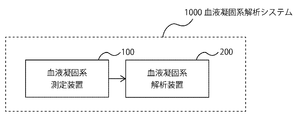
- the system 1000 includes a blood coagulation system measuring apparatus 100 and a blood coagulation system analyzing apparatus 200.
- the blood coagulation system measuring apparatus 100 is not particularly limited.
- a blood electrical measuring apparatus that measures the electrical characteristics of the blood sample or a blood coagulation ability measuring apparatus that measures the elastic change of the coagulated clot of the blood sample is used. Can do.
- the blood electrical measurement device for example, a device that performs dielectric measurement of the blood coagulation process of Patent Document 1 or 2 can be cited.
- the blood coagulation ability measuring device include thromboelastography (TEG (registered trademark)) blood coagulation analyzer (Hemonetics), rotation thromboelastometry (ROTEM (registered trademark)) blood coagulation analyzer (Nippon Fingal) Link Corporation).
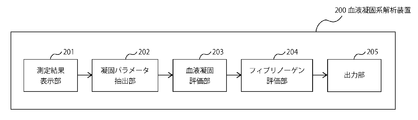
- the blood coagulation system analyzing apparatus 200 evaluates the degree of blood coagulation of the blood sample based on the coagulation parameter extracting unit for extracting the coagulation parameter and the coagulation parameter from the result of measurement by the blood coagulation system measuring apparatus 100. Includes a coagulation evaluation section.
- the measurement result display unit 201 displays the result obtained from the blood coagulation system measuring apparatus 100.
- the blood coagulation parameter extraction unit 202 performs processing such as graphing of the measurement result, and is suitable for evaluating blood coagulation from the graph, such as a graph inclination, a contact point, and a difference, specifically, clot. Time and dielectric clot strength are extracted as parameters.
- the blood coagulation evaluation unit 203 evaluates the degree of blood coagulation based on the parameters extracted from the blood coagulation parameters.
- the fibrinogen evaluation unit 204 evaluates the amount of fibrinogen and the degree of function based on the evaluation of the degree of blood coagulation and the like.
- the output unit 205 displays or prints the above result and notifies the system operator.
- First Embodiment (Experimental Example Using Blood Coagulation Factor Deficient Plasma)> 2-1.
- Outline The flow chart of FIG. 3 shows the process of this experimental example.
- This experimental example starts by performing blood coagulation system measurement (S101) by at least two assays of extrinsic system acceleration conditions (EX) and intrinsic system acceleration conditions (IN).
- EX extrinsic system acceleration conditions
- IN intrinsic system acceleration conditions
- the extrinsic coagulation promoting reagent used in the EX assay include tissue thromboplastin and tissue factor.
- Examples of the intrinsic coagulation promoting reagent used in the IN assay include ellagic acid and kaolin.
- the blood was first divided into red blood cells and plasma components by centrifugation, and the red blood cells were washed with excess PBS and the supernatant was discarded by centrifugation twice.
- Pseudo FVII factor-deficient blood was prepared by adding normal blood plasma separated from FVII factor-deficient plasma to the washed erythrocytes thus obtained.
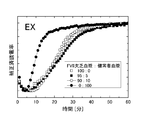
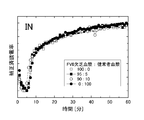
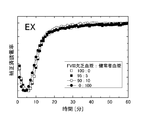
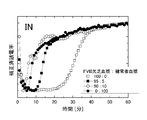
- FVII factor-deficient plasma and healthy subject plasma used for sample preparation: 100: 0, 95: 5, 90:10, and 0: 100. Measurement was performed using four types of samples having different degrees of FVII factor deficiency.
- the ratio of the factor-deficient plasma to the normal subject plasma is 100: 0. However, it should be noted that it actually contains several percent of FVII factor.
- the blood coagulation system measurement was carried out for an extrinsic system (hereinafter also referred to as EX) and intrinsic system (hereinafter also referred to as IN) assay using the blood electrical measuring device for measuring the dielectric constant of blood.
- EX extrinsic system
- IN intrinsic system
- the same blood sample was also measured by ROTEM (EX-TEM: extrinsic system and IN-TEM: intrinsic system assay).
- a specific procedure for measuring the dielectric constant by the blood electrical measuring device is as follows. First, the adjusted blood sample is put in a container (washed and dried blood collection tube), and set in the blood sample setting portion of the blood electrical measuring device.
- a measurement cartridge dedicated to blood electrical measurement devices containing a predetermined amount of EX reagent (tissue factor and calcium chloride) and a measurement cartridge dedicated to blood electrical measurement device containing a predetermined amount of IN reagent (ellagic acid and calcium chloride) Set in the measuring part of the device.
- the dedicated measuring cartridge of the blood electrical measuring device is obtained by insert-molding a titanium electrode into polypropylene resin, and two opposing electrode surfaces function as a condenser, and when blood is injected into the dedicated measuring cartridge, Therefore, it is possible to measure the electrical characteristics (dielectric constant) of blood.
- the measuring part of the blood electrical measuring device is temperature-controlled at 37 ° C., and the sample being measured is kept at 37 ° C.
- control unit control software
- a predetermined amount of blood sample is set in the sample setting unit by a dispensing unit (dispensing robot) built in the device.
- the reagent is dispensed from the blood vessel into a dedicated measurement cartridge installed in the measurement unit, and the reagent and blood are mixed by an automatic pipetting operation.
- the change in dielectric constant accompanying blood coagulation is measured over time, and the result is also displayed on the measurement result display unit 201 stored in the recording unit.
- the coagulation parameter extraction unit 202 determines at least the clot time (hereinafter also referred to as CT) and the dielectric clot strength (hereinafter referred to as CT) from the measurement result of the dielectric constant of the blood sample.
- CT the clot time
- CT dielectric clot strength
- DCS is extracted (S102).
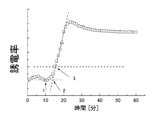
- the method is not particularly limited. For example, as shown in the graph shown in FIG. 4, it is possible to use a time for which a change in dielectric constant at 10 MHz gives a minimum value (arrow 1) as CT. DCS can be calculated based on the decrease from the peak at 1 MHz. It is also possible to determine the CT by another method.
- the blood coagulation evaluation unit 203 can make the determination when the rise of the dielectric constant cannot be seen when the dielectric constant changes, for example, at 10 MHz, or by the extreme extension of CT (S103).
- CT can be defined as 18 minutes or longer as the “extreme extension of CT”.
- This threshold value is obtained by adding 6 times the standard deviation to the average value of CT when an activator such as tissue factor is not added to the blood of healthy subjects.
- the evaluation criteria for “extreme extension of CT” can be determined by performing the same verification as described above.
- DCS generally includes both fibrin formation and platelet contribution. However, if fibrinogen is extremely low and fibrin formation does not occur sufficiently, DCS will be low even if the platelet count and platelet function are normal. Using this finding, if DCS is low in both EX and IN assays, it is presumed that fibrinogen is low (S105, S106). Such a determination is performed by, for example, the fibrinogen evaluation unit 204.
- PI assay platelet inhibition assay
- a platelet inhibition assay in which the contribution of platelets is completely inhibited artificially. It is effective for estimating whether it is a value.
- a PI assay can be realized by using a reagent that inhibits platelet aggregation, such as cytochalasin D, in addition to either (or both) of the extrinsic system or the reagent that accelerates the intrinsic system.
- Such analysis may be performed by the blood coagulation system evaluation unit 203.
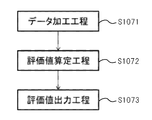
- the EX and IN assay data processing step shown in FIG. 6 (S1071), the evaluation value calculation step of the degree of blood coagulation (S1072), and the evaluation thereof. It can be implemented by the value output step (S1073). Each step will be described in detail below. Note that the present technology is not limited to this.
- the “data processing step” (S1071) in FIG. 6 is, for example, a data normalization step.
- the process (S10712) may include a normalization process (S10713) using correction numerical values A and B.
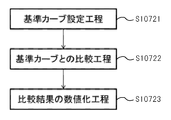
- the “evaluation value calculation step” includes, for example, sub-steps as shown in FIG. 8, that is, a reference curve setting step (S10721), a comparison step with a reference curve (S10722), and a comparison result quantification step (S10723). May be configured.
- dielectric constant data ( ⁇ ) at 10 MHz is normalized. More preferably, the standard is determined according to the following equation (1) using two points: a minimum value of dielectric constant ( ⁇ min) (“correction value A”, S10711) and a maximum value ( ⁇ max) (“correction value B”, S10712). (S10713).
- the minimum value of the dielectric constant is not necessarily used as ⁇ min.
- the dielectric constant at the point where the change (gradient) of the dielectric constant becomes maximum can be selected.
- ⁇ max may not be the maximum value of the dielectric constant, and the dielectric constant value after the time when the increase in the dielectric constant has settled (for example, 30 minutes after the start of measurement) or the average value in the vicinity thereof. Etc. can also be used.
- a is an arbitrary scaling constant
- nCT is a measurement point giving CT
- ⁇ t is a time (time interval) between measurement points.
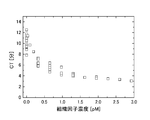
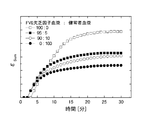
- FIG. 9 illustrates the ⁇ Sum thus obtained. It was found that the final value of ⁇ Sum (for example, a value at 30 minutes after the start of measurement) increases as the clotting reaction proceeds slowly after CT, that is, it is sensitive to deficiency of clotting factors. Furthermore, since the shape of the ( ⁇ Sum) curve changes depending on which factor is deficient, for example, more detailed analysis focusing on the slope of the increase and the length of time over which the increase over a certain level continues Is possible.
- the following determination can be performed using the ⁇ Sum thus obtained. If both the ⁇ Sum in the EX assay and the ⁇ Sum obtained in the IN assay are high, it means that the coagulation reaction progresses slowly in both the extrinsic system and the intrinsic system. Or a lack of common factors located downstream of the coagulation reaction, such as FX, prothrombin, FV, or both.
- Extrinsic clotting factor or intrinsic clotting factor decreased In “2-6. Judgment of general clotting factor decreased or common clotting factor decreased”, if either extrinsic or intrinsic ⁇ Sum is high, it is high. It can be seen that the factors related to the coagulation pathway are insufficient and / or the function is reduced. It can also be seen that both the coagulation factor associated with the lower value and the coagulation factor of the common system are not deficient and / or have a reduced function (S110). The result can be output as an evaluation result of extrinsic system and / or intrinsic coagulation (S111).
- FIG. 9 shows the result of artificially preparing and experimenting with a FVII-deficient sample by the method described in “2-2. Experiment”, and it was revealed that ⁇ Sum changes depending on the FVII concentration.
- ⁇ Sum changes depending on the FVII concentration.
- S112 deficiency of coagulation factor and / or functional decline can be denied. Even so, if clinical bleeding continues, it can be either a surgical problem or a platelet problem.
- ROTEM Rotational thromboelastometry
- Second Embodiment (Analysis Method 1 for Evaluating Blood Coagulation Factor Deficiency)> 3-1. Overview If the function of either the extrinsic clotting pathway or the intrinsic clotting pathway is concerned, the condition can be analyzed in detail by comparing the extrinsic clotting assay with the intrinsic clotting assay. . In particular, it is effective when applied to cases such as cardiac surgery involving extracorporeal circulation where there is concern about the consumption of exogenous coagulation factors.
- curves ⁇ Normalized normalized for the EX and IN assays are obtained.
- a difference curve ( ⁇ d) between the IN assay and the EX assay is calculated for this ⁇ Normalized.
- the CT in the IN assay is different from the CT in the EX assay, the time axis can be corrected so as to obtain a difference curve based on the CT.
- an integral (series sum) curve ( ⁇ dSum) is calculated by the same calculation as in the equation (2).
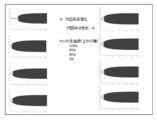
- FIG. 11 illustrates the experimental analysis results obtained in this way.
- a normalized curve ⁇ Normalized is obtained according to the equation (1).
- a difference from a virtual curve that rises vertically at CT is taken ( ⁇ ).
- the difference from the first embodiment is not a display as an integral (series) curve but a difference curve at each time.
- FIG. 12 shows an example of characteristics of the experimental analysis results obtained in this way.
- the curve of FIG. 12 is considered as a waveform representing a transient phenomenon and Fourier (Laplace) transformation is performed to obtain a spectrum on the frequency axis.
- Laplace Fourier
- the above is the analysis performed for the EX assay, but the same analysis can also be performed for the IN assay, etc., and more accurate coagulation can be achieved by comparing the EX assay analysis results with the IN assay analysis results.
- the state can be determined.
- the present technology provides a blood coagulation system analysis program for causing a computer to perform the analysis method or the like in the first to fourth embodiments.
- the program may be stored in a recording medium such as a magnetic disk, an optical disk, a magneto-optical disk, or a flash memory, and can be distributed via a network.
- the program can be executed by a personal computer externally attached to the blood coagulation system measuring apparatus, or can be executed by a computer built in the blood coagulation system measuring apparatus.
- this technique can also take the following structures; [1] a blood coagulation system measuring apparatus for measuring a blood coagulation system of a blood sample; From the result of measurement by the blood coagulation system measurement device, a coagulation parameter extraction unit for extracting a coagulation parameter, and a blood coagulation evaluation unit for evaluating the degree of blood coagulation of the blood sample based on the coagulation parameter,
- a blood coagulation system analyzer comprising: With Measurement by the blood coagulation system measurement device is performed under extrinsic system acceleration conditions and intrinsic system acceleration conditions, Blood coagulation system analysis system.
- the blood coagulation system analyzer includes a fibrinogen evaluation unit that evaluates the amount of fibrinogen and / or the function of the blood sample based on the coagulation parameters, The blood coagulation system analysis system according to [1].
- the blood coagulation system measurement device is a blood electrical measurement device that measures an electrical characteristic of a blood sample, or a blood coagulation ability measurement device that measures an elastic change of a clot of the blood sample, [1] or [2] The blood coagulation system analysis system according to [2].
- the blood coagulation system analysis system according to [3] wherein the electrical characteristic is a dielectric constant.
- a process function to extract a coagulation parameter from the result of blood coagulation system measurement of a blood sample A process function for evaluating the degree of blood clotting of the blood sample based on the clotting parameters; A process function for assessing the amount of fibrinogen and / or function of the blood sample based on the coagulation parameters; A blood coagulation system analysis program that enables a computer to realize the above.
- Blood Coagulation System Measurement Device 200 Blood Coagulation System Analysis Device 201 Measurement Result Display Unit 202 Coagulation Parameter Extraction Unit 203 Blood Coagulation Evaluation Unit 204 Fibrinogen Evaluation Unit 205 Output Unit 1000 Blood Coagulation System Analysis System
Landscapes
- Health & Medical Sciences (AREA)
- Life Sciences & Earth Sciences (AREA)
- Engineering & Computer Science (AREA)
- Chemical & Material Sciences (AREA)
- Hematology (AREA)
- Biomedical Technology (AREA)
- Immunology (AREA)
- Physics & Mathematics (AREA)
- General Physics & Mathematics (AREA)
- Molecular Biology (AREA)
- Urology & Nephrology (AREA)
- General Health & Medical Sciences (AREA)
- Analytical Chemistry (AREA)
- Biochemistry (AREA)
- Pathology (AREA)
- Food Science & Technology (AREA)
- Medicinal Chemistry (AREA)
- Microbiology (AREA)
- Cell Biology (AREA)
- Biotechnology (AREA)
- Chemical Kinetics & Catalysis (AREA)
- Electrochemistry (AREA)
- Ecology (AREA)
- Biophysics (AREA)
- Investigating Or Analysing Biological Materials (AREA)
Abstract
L'invention concerne un système qui permet d'évaluer le manque et/ou la diminution de la fonction d'un facteur de coagulation exogène ou d'un facteur de coagulation endogène à sensibilité élevée, en ajoutant un nouveau processus/dispositif à un processus/dispositif d'analyse de système de coagulation sanguine ou similaire. L'invention concerne un système d'analyse d'un système de coagulation sanguine, qui comprend : un dispositif de mesure de système de coagulation sanguine permettant d'effectuer la mesure de système de coagulation sanguine d'un échantillon de sang ; et un dispositif d'analyse de système de coagulation sanguine qui comporte une unité d'extraction de paramètre de coagulation permettant d'extraire un paramètre de coagulation du résultat de la mesure par le dispositif de mesure de système de coagulation sanguine et une unité d'évaluation de coagulation sanguine permettant d'évaluer le degré de coagulation sanguine dans l'échantillon de sang sur la base du paramètre de coagulation. Dans le système, la mesure effectuée par le dispositif de mesure de système de coagulation sanguine est réalisée sous chacune de conditions accélérées de manière exogène et de conditions accélérées de manière endogène.
Priority Applications (1)
| Application Number | Priority Date | Filing Date | Title |
|---|---|---|---|
| US16/087,438 US10962495B2 (en) | 2016-03-29 | 2017-02-17 | Blood coagulation system analysis system, blood coagulation system analysis method, and blood coagulation system analysis program |
Applications Claiming Priority (2)
| Application Number | Priority Date | Filing Date | Title |
|---|---|---|---|
| JP2016066056 | 2016-03-29 | ||
| JP2016-066056 | 2016-03-29 |
Publications (1)
| Publication Number | Publication Date |
|---|---|
| WO2017169261A1 true WO2017169261A1 (fr) | 2017-10-05 |
Family
ID=59963037
Family Applications (1)
| Application Number | Title | Priority Date | Filing Date |
|---|---|---|---|
| PCT/JP2017/005861 Ceased WO2017169261A1 (fr) | 2016-03-29 | 2017-02-17 | Système d'analyse de système de coagulation sanguine, procédé d'analyse de système de coagulation sanguine, et programme d'analyse de système de coagulation sanguine |
Country Status (2)
| Country | Link |
|---|---|
| US (1) | US10962495B2 (fr) |
| WO (1) | WO2017169261A1 (fr) |
Cited By (1)
| Publication number | Priority date | Publication date | Assignee | Title |
|---|---|---|---|---|
| CN112639468A (zh) * | 2018-09-07 | 2021-04-09 | 索尼公司 | 凝血系统分析装置和方法 |
Families Citing this family (1)
| Publication number | Priority date | Publication date | Assignee | Title |
|---|---|---|---|---|
| CN120948776B (zh) * | 2025-10-15 | 2026-03-20 | 上海基灵生物科技有限公司 | 一种用于动物凝血功能评估的多参数血栓弹力图仪 |
Citations (2)
| Publication number | Priority date | Publication date | Assignee | Title |
|---|---|---|---|---|
| JP2013221782A (ja) * | 2012-04-13 | 2013-10-28 | Sony Corp | 血液凝固系解析装置、血液凝固系解析方法及びそのプログラム |
| WO2015159623A1 (fr) * | 2014-04-17 | 2015-10-22 | ソニー株式会社 | Dispositif d'analyse d'état du sang, système d'analyse d'état du sang, procédé d'analyse d'état du sang et programme |
Family Cites Families (3)
| Publication number | Priority date | Publication date | Assignee | Title |
|---|---|---|---|---|
| AU2004231988B2 (en) * | 2003-04-16 | 2010-04-15 | Drexel University | Acoustic blood analyzer for assessing blood properties |
| JP5691168B2 (ja) | 2009-01-08 | 2015-04-01 | ソニー株式会社 | 血液凝固系解析装置、血液凝固系解析方法及びプログラム |
| JP5768422B2 (ja) | 2011-03-17 | 2015-08-26 | ソニー株式会社 | 血液凝固系解析方法および血液凝固系解析装置 |
-
2017
- 2017-02-17 WO PCT/JP2017/005861 patent/WO2017169261A1/fr not_active Ceased
- 2017-02-17 US US16/087,438 patent/US10962495B2/en active Active
Patent Citations (2)
| Publication number | Priority date | Publication date | Assignee | Title |
|---|---|---|---|---|
| JP2013221782A (ja) * | 2012-04-13 | 2013-10-28 | Sony Corp | 血液凝固系解析装置、血液凝固系解析方法及びそのプログラム |
| WO2015159623A1 (fr) * | 2014-04-17 | 2015-10-22 | ソニー株式会社 | Dispositif d'analyse d'état du sang, système d'analyse d'état du sang, procédé d'analyse d'état du sang et programme |
Non-Patent Citations (1)
| Title |
|---|
| TEG6S KETSUEKI GYOKO BUNSEKI SOCHI, 27 August 2015 (2015-08-27), Retrieved from the Internet <URL:http://teg.haemonetics.com/~/media/Sharepoint/Devices/TEG/Marketing/Brochures/TEG6s_Brochure/COL-COPY-000918-JA_Brochure_TEG6s.pdf.pdf> [retrieved on 20170321] * |
Cited By (1)
| Publication number | Priority date | Publication date | Assignee | Title |
|---|---|---|---|---|
| CN112639468A (zh) * | 2018-09-07 | 2021-04-09 | 索尼公司 | 凝血系统分析装置和方法 |
Also Published As
| Publication number | Publication date |
|---|---|
| US20190162690A1 (en) | 2019-05-30 |
| US10962495B2 (en) | 2021-03-30 |
Similar Documents
| Publication | Publication Date | Title |
|---|---|---|
| JP7192944B2 (ja) | 血液凝固系解析装置、血液凝固系解析システム、血液凝固系解析方法、及び血液凝固系解析用プログラム、並びに、出血量予測装置、出血量予測システム、出血量予測方法、及び出血量予測用プログラム | |
| CN102308203B (zh) | 血液凝固系统分析装置以及用于分析血液凝固系统的方法 | |
| JP6930568B2 (ja) | 血液状態解析装置、血液状態解析システム、血液状態解析方法及びプログラム | |
| JP6442858B2 (ja) | 血液状態解析装置、血液状態解析システム、血液状態解析方法、および該方法をコンピューターに実現させるための血液状態解析プログラム | |
| CN108603888B (zh) | 血小板聚集活性分析设备、分析系统、分析程序和分析方法 | |
| CN108474799B (zh) | 凝血系统解析装置、凝血系统解析系统、凝血系统解析方法 | |
| JP2020030217A (ja) | 血液凝固系解析装置、血液凝固系解析方法及びプログラム | |
| WO2017169261A1 (fr) | Système d'analyse de système de coagulation sanguine, procédé d'analyse de système de coagulation sanguine, et programme d'analyse de système de coagulation sanguine | |
| JP6747491B2 (ja) | 血液状態解析装置、血液状態解析システム、血液状態解析方法、および該方法をコンピューターに実現させるための血液状態解析プログラム | |
| JP2020041867A (ja) | 血液凝固系解析装置、血液凝固系解析方法及び血液凝固系解析プログラム | |
| CA2514743C (fr) | Amelioration de la qualite d'une analyse hematologique | |
| Zhang et al. | Establishment of reference intervals and transfusion criterion for Sonoclot analysis | |
| JP6750443B2 (ja) | 血小板凝集能解析方法、血小板凝集能解析装置、血小板凝集能解析用プログラム及び血小板凝集能解析システム | |
| EP3270161B1 (fr) | Échantillon devant servir à la mesure de caractéristiques électriques, procédé et dispositif de mesure associés | |
| JP6973585B2 (ja) | 血小板凝集能解析方法、血小板凝集能解析装置、血小板凝集能解析用プログラム及び血小板凝集能解析システム | |
| JP2016191668A (ja) | 電気的特性測定方法、電気的特性測定装置、及び血液状態解析システム |
Legal Events
| Date | Code | Title | Description |
|---|---|---|---|
| NENP | Non-entry into the national phase |
Ref country code: DE |
|
| 121 | Ep: the epo has been informed by wipo that ep was designated in this application |
Ref document number: 17773809 Country of ref document: EP Kind code of ref document: A1 |
|
| 122 | Ep: pct application non-entry in european phase |
Ref document number: 17773809 Country of ref document: EP Kind code of ref document: A1 |
|
| NENP | Non-entry into the national phase |
Ref country code: JP |