WO2017169341A1 - Article absorbant - Google Patents
Article absorbant Download PDFInfo
- Publication number
- WO2017169341A1 WO2017169341A1 PCT/JP2017/006711 JP2017006711W WO2017169341A1 WO 2017169341 A1 WO2017169341 A1 WO 2017169341A1 JP 2017006711 W JP2017006711 W JP 2017006711W WO 2017169341 A1 WO2017169341 A1 WO 2017169341A1
- Authority
- WO
- WIPO (PCT)
- Prior art keywords
- joint
- cell
- cells
- sheet
- strong
- Prior art date
- Legal status (The legal status is an assumption and is not a legal conclusion. Google has not performed a legal analysis and makes no representation as to the accuracy of the status listed.)
- Ceased
Links
Images









Classifications
-
- A—HUMAN NECESSITIES
- A61—MEDICAL OR VETERINARY SCIENCE; HYGIENE
- A61F—FILTERS IMPLANTABLE INTO BLOOD VESSELS; PROSTHESES; DEVICES PROVIDING PATENCY TO, OR PREVENTING COLLAPSING OF, TUBULAR STRUCTURES OF THE BODY, e.g. STENTS; ORTHOPAEDIC, NURSING OR CONTRACEPTIVE DEVICES; FOMENTATION; TREATMENT OR PROTECTION OF EYES OR EARS; BANDAGES, DRESSINGS OR ABSORBENT PADS; FIRST-AID KITS
- A61F13/00—Bandages or dressings; Absorbent pads
- A61F13/15—Absorbent pads, e.g. sanitary towels, swabs or tampons for external or internal application to the body; Supporting or fastening means therefor; Tampon applicators
- A61F13/53—Absorbent pads, e.g. sanitary towels, swabs or tampons for external or internal application to the body; Supporting or fastening means therefor; Tampon applicators characterised by the absorbing medium
- A61F13/531—Absorbent pads, e.g. sanitary towels, swabs or tampons for external or internal application to the body; Supporting or fastening means therefor; Tampon applicators characterised by the absorbing medium having a homogeneous composition through the thickness of the pad
- A61F13/532—Absorbent pads, e.g. sanitary towels, swabs or tampons for external or internal application to the body; Supporting or fastening means therefor; Tampon applicators characterised by the absorbing medium having a homogeneous composition through the thickness of the pad inhomogeneous in the plane of the pad
- A61F13/533—Absorbent pads, e.g. sanitary towels, swabs or tampons for external or internal application to the body; Supporting or fastening means therefor; Tampon applicators characterised by the absorbing medium having a homogeneous composition through the thickness of the pad inhomogeneous in the plane of the pad having discontinuous areas of compression
-
- A—HUMAN NECESSITIES
- A61—MEDICAL OR VETERINARY SCIENCE; HYGIENE
- A61F—FILTERS IMPLANTABLE INTO BLOOD VESSELS; PROSTHESES; DEVICES PROVIDING PATENCY TO, OR PREVENTING COLLAPSING OF, TUBULAR STRUCTURES OF THE BODY, e.g. STENTS; ORTHOPAEDIC, NURSING OR CONTRACEPTIVE DEVICES; FOMENTATION; TREATMENT OR PROTECTION OF EYES OR EARS; BANDAGES, DRESSINGS OR ABSORBENT PADS; FIRST-AID KITS
- A61F13/00—Bandages or dressings; Absorbent pads
- A61F13/15—Absorbent pads, e.g. sanitary towels, swabs or tampons for external or internal application to the body; Supporting or fastening means therefor; Tampon applicators
- A61F13/53—Absorbent pads, e.g. sanitary towels, swabs or tampons for external or internal application to the body; Supporting or fastening means therefor; Tampon applicators characterised by the absorbing medium
- A61F13/531—Absorbent pads, e.g. sanitary towels, swabs or tampons for external or internal application to the body; Supporting or fastening means therefor; Tampon applicators characterised by the absorbing medium having a homogeneous composition through the thickness of the pad
- A61F13/532—Absorbent pads, e.g. sanitary towels, swabs or tampons for external or internal application to the body; Supporting or fastening means therefor; Tampon applicators characterised by the absorbing medium having a homogeneous composition through the thickness of the pad inhomogeneous in the plane of the pad
- A61F13/5323—Absorbent pads, e.g. sanitary towels, swabs or tampons for external or internal application to the body; Supporting or fastening means therefor; Tampon applicators characterised by the absorbing medium having a homogeneous composition through the thickness of the pad inhomogeneous in the plane of the pad having absorbent material located in discrete regions, e.g. pockets
-
- A—HUMAN NECESSITIES
- A61—MEDICAL OR VETERINARY SCIENCE; HYGIENE
- A61F—FILTERS IMPLANTABLE INTO BLOOD VESSELS; PROSTHESES; DEVICES PROVIDING PATENCY TO, OR PREVENTING COLLAPSING OF, TUBULAR STRUCTURES OF THE BODY, e.g. STENTS; ORTHOPAEDIC, NURSING OR CONTRACEPTIVE DEVICES; FOMENTATION; TREATMENT OR PROTECTION OF EYES OR EARS; BANDAGES, DRESSINGS OR ABSORBENT PADS; FIRST-AID KITS
- A61F13/00—Bandages or dressings; Absorbent pads
- A61F13/15—Absorbent pads, e.g. sanitary towels, swabs or tampons for external or internal application to the body; Supporting or fastening means therefor; Tampon applicators
- A61F13/53—Absorbent pads, e.g. sanitary towels, swabs or tampons for external or internal application to the body; Supporting or fastening means therefor; Tampon applicators characterised by the absorbing medium
- A61F13/531—Absorbent pads, e.g. sanitary towels, swabs or tampons for external or internal application to the body; Supporting or fastening means therefor; Tampon applicators characterised by the absorbing medium having a homogeneous composition through the thickness of the pad
- A61F13/532—Absorbent pads, e.g. sanitary towels, swabs or tampons for external or internal application to the body; Supporting or fastening means therefor; Tampon applicators characterised by the absorbing medium having a homogeneous composition through the thickness of the pad inhomogeneous in the plane of the pad
-
- A—HUMAN NECESSITIES
- A61—MEDICAL OR VETERINARY SCIENCE; HYGIENE
- A61F—FILTERS IMPLANTABLE INTO BLOOD VESSELS; PROSTHESES; DEVICES PROVIDING PATENCY TO, OR PREVENTING COLLAPSING OF, TUBULAR STRUCTURES OF THE BODY, e.g. STENTS; ORTHOPAEDIC, NURSING OR CONTRACEPTIVE DEVICES; FOMENTATION; TREATMENT OR PROTECTION OF EYES OR EARS; BANDAGES, DRESSINGS OR ABSORBENT PADS; FIRST-AID KITS
- A61F13/00—Bandages or dressings; Absorbent pads
- A61F13/15—Absorbent pads, e.g. sanitary towels, swabs or tampons for external or internal application to the body; Supporting or fastening means therefor; Tampon applicators
- A61F13/53—Absorbent pads, e.g. sanitary towels, swabs or tampons for external or internal application to the body; Supporting or fastening means therefor; Tampon applicators characterised by the absorbing medium
- A61F2013/530481—Absorbent pads, e.g. sanitary towels, swabs or tampons for external or internal application to the body; Supporting or fastening means therefor; Tampon applicators characterised by the absorbing medium having superabsorbent materials, i.e. highly absorbent polymer gel materials
- A61F2013/530489—Absorbent pads, e.g. sanitary towels, swabs or tampons for external or internal application to the body; Supporting or fastening means therefor; Tampon applicators characterised by the absorbing medium having superabsorbent materials, i.e. highly absorbent polymer gel materials being randomly mixed in with other material
-
- A—HUMAN NECESSITIES
- A61—MEDICAL OR VETERINARY SCIENCE; HYGIENE
- A61F—FILTERS IMPLANTABLE INTO BLOOD VESSELS; PROSTHESES; DEVICES PROVIDING PATENCY TO, OR PREVENTING COLLAPSING OF, TUBULAR STRUCTURES OF THE BODY, e.g. STENTS; ORTHOPAEDIC, NURSING OR CONTRACEPTIVE DEVICES; FOMENTATION; TREATMENT OR PROTECTION OF EYES OR EARS; BANDAGES, DRESSINGS OR ABSORBENT PADS; FIRST-AID KITS
- A61F13/00—Bandages or dressings; Absorbent pads
- A61F13/15—Absorbent pads, e.g. sanitary towels, swabs or tampons for external or internal application to the body; Supporting or fastening means therefor; Tampon applicators
- A61F13/53—Absorbent pads, e.g. sanitary towels, swabs or tampons for external or internal application to the body; Supporting or fastening means therefor; Tampon applicators characterised by the absorbing medium
- A61F2013/530481—Absorbent pads, e.g. sanitary towels, swabs or tampons for external or internal application to the body; Supporting or fastening means therefor; Tampon applicators characterised by the absorbing medium having superabsorbent materials, i.e. highly absorbent polymer gel materials
- A61F2013/53051—Absorbent pads, e.g. sanitary towels, swabs or tampons for external or internal application to the body; Supporting or fastening means therefor; Tampon applicators characterised by the absorbing medium having superabsorbent materials, i.e. highly absorbent polymer gel materials being only in particular parts or specially arranged
-
- A—HUMAN NECESSITIES
- A61—MEDICAL OR VETERINARY SCIENCE; HYGIENE
- A61F—FILTERS IMPLANTABLE INTO BLOOD VESSELS; PROSTHESES; DEVICES PROVIDING PATENCY TO, OR PREVENTING COLLAPSING OF, TUBULAR STRUCTURES OF THE BODY, e.g. STENTS; ORTHOPAEDIC, NURSING OR CONTRACEPTIVE DEVICES; FOMENTATION; TREATMENT OR PROTECTION OF EYES OR EARS; BANDAGES, DRESSINGS OR ABSORBENT PADS; FIRST-AID KITS
- A61F13/00—Bandages or dressings; Absorbent pads
- A61F13/15—Absorbent pads, e.g. sanitary towels, swabs or tampons for external or internal application to the body; Supporting or fastening means therefor; Tampon applicators
- A61F13/53—Absorbent pads, e.g. sanitary towels, swabs or tampons for external or internal application to the body; Supporting or fastening means therefor; Tampon applicators characterised by the absorbing medium
- A61F2013/530481—Absorbent pads, e.g. sanitary towels, swabs or tampons for external or internal application to the body; Supporting or fastening means therefor; Tampon applicators characterised by the absorbing medium having superabsorbent materials, i.e. highly absorbent polymer gel materials
- A61F2013/530583—Absorbent pads, e.g. sanitary towels, swabs or tampons for external or internal application to the body; Supporting or fastening means therefor; Tampon applicators characterised by the absorbing medium having superabsorbent materials, i.e. highly absorbent polymer gel materials characterized by the form
- A61F2013/530591—Absorbent pads, e.g. sanitary towels, swabs or tampons for external or internal application to the body; Supporting or fastening means therefor; Tampon applicators characterised by the absorbing medium having superabsorbent materials, i.e. highly absorbent polymer gel materials characterized by the form in granules or particles
Definitions
- the present invention relates to absorbent articles such as disposable diapers and sanitary napkins.
- the absorbent article includes an absorbent body and a liquid-permeable top sheet that covers the front side of the absorbent body, and excreted liquid such as urine and menstrual blood passes through the top sheet and is absorbed and held by the absorbent body. It has become so.
- the absorbent body As the absorbent body, a mixture of highly absorbent polymer particles (SAP) mixed with hydrophilic short fibers such as pulverized pulp and piled up in a cotton form is widely adopted, while ensuring a sufficient absorbable amount, As a response to requests for further thinning, weight reduction, low cost, etc., a large number of cells (small chambers) surrounded by the joint portion of the front side sheet and the back side sheet and the front side sheet and the back side sheet are not joined, Various types of absorbers (hereinafter also referred to as cell absorbers) having high-absorbent polymer particles contained in the cells have been proposed (see, for example, Patent Documents 1 to 8 below).
- SAP highly absorbent polymer particles
- hydrophilic short fibers such as pulverized pulp and piled up in a cotton form
- the cell absorbers In these cell absorbers, if the volume at the time of saturated absorption of the superabsorbent polymer particles in the cell is sufficiently larger than the volume of each cell, the superabsorbent polymer particles are filled in the cell at the time of absorption, and expansion inhibition and When the so-called gel blocking may reduce the absorption amount / absorption rate, the cell may become hard due to the expansion pressure of the superabsorbent polymer particles, and the wearing feeling may be deteriorated, or when the front side sheet and the back side sheet are formed of nonwoven fabric May cause the superabsorbent polymer particles to leak out from the fiber gaps.
- a main problem of the present invention is to provide an absorbent article provided with a cell absorber that is easy to unite adjacent cells and is excellent in an increase in cell volume with respect to the number of united cells.
- ⁇ First aspect> Included in this cell are a front side sheet, a back side sheet arranged on the back side, a large number of cells surrounded by a joint between the front side sheet and the back side sheet, and the front side sheet and the back side sheet are not joined.
- an absorbent article comprising an absorbent body having a powder comprising superabsorbent polymer particles;
- the joining portion is provided in a continuous line shape or a dotted line shape so as to form a honeycomb shape having regular hexagons of the same dimensions as unit shapes, All the cells are regular hexagonal cells of the same dimensions surrounded by the joints,
- the joint located on at least one side of each cell is a weak joint that can be peeled off by the expansion force of the superabsorbent polymer particles in the cell adjacent to the joint.
- a regular hexagon having the same dimensions is a unit shape
- the term “honeycomb” of the present invention does not include a hexagon other than the regular hexagon in a plane-filled arrangement.
- regular hexagon includes those in which the front side sheet and the back side sheet are stretched and deformed to ⁇ 5% in the front-rear direction due to the effect of expansion and contraction during manufacturing.
- ⁇ Second aspect> It has a plurality of the most enlarged sections in which the portions where 6 or more cells are arranged in two or more directions are surrounded by strong joints that do not peel due to the expansion force of the superabsorbent polymer particles in adjacent cells,
- the joint located inside the strong joint in the most enlarged section is the weak joint,
- the peripheral shape of the most enlarged section is a closed shape formed by connecting two to four continuous sides per cell in a cell along the periphery of the most enlarged section.
- the maximum enlargement section of the strong joint portion is made too small as in the case of FIG. 5 described in Patent Document 3, the significance of providing the strong joint portion is lost, and when the elongated portion is formed as in the case of FIG.
- the shape after coalescence becomes a shape that does not easily swell.
- the closed shape is formed by enclosing a portion where six or more regular hexagonal cells are arranged in two or more directions with a strong joint and connecting two to four continuous sides per cell.
- the maximum expansion zone will have a shape that is easy to swell, and it will be excellent in the amount of cell volume increase with respect to the number of cell merges It becomes like this.
- Longitudinal strong joint lines which are portions where the strong joint portion extends in the front-rear direction over the entire length of the absorber, are provided at the width direction center and both sides of the absorber, A plurality of transverse strong joining lines are provided at intervals in the front-rear direction, wherein the strong joining portions are portions that continue in the width direction or oblique direction from the central longitudinal joining line to the longitudinal strong joining lines on both sides.
- the portion partitioned by the longitudinal strong joint line and the lateral strong joint line that surrounds the four sides, the joint located between the cells in the compartment is the most enlarged section of only the weak joint,
- the absorbent article of the 1st or 2nd aspect are portions where the strong joint portion extends in the front-rear direction over the entire length of the absorber, are provided at the width direction center and both sides of the absorber, A plurality of transverse strong joining lines are provided at intervals in the front-rear direction, wherein the strong joining portions are portions that continue in the width direction or oblique direction from the
- the strongly bonded portion is a portion that does not peel even if the cells on both sides absorb and expand, and after absorption, a groove having the strongly bonded portion as the bottom is formed, so that liquid diffusibility in the direction along the groove is improved. Therefore, in the case described in this section, the liquid diffusibility in the longitudinal direction is improved by the longitudinal strong joint line, which is the portion where the strong joint portion continues in the front-rear direction, and the strong joint portion is the portion that continues in the width direction or the oblique direction. The liquid diffusibility in the lateral direction is improved by the transverse strong bonding line. Moreover, the longitudinal strong joint lines on both sides also have a function of preventing leakage of the superabsorbent polymer particles from both side edges.
- the lateral strong joint line is in a zigzag shape extending in the front-rear direction while being repeatedly bent left and right, respectively, between the central longitudinal strong joint line and the longitudinal strong joint lines on both sides.
- the absorbent article of a 3rd aspect is in a zigzag shape extending in the front-rear direction while being repeatedly bent left and right, respectively, between the central longitudinal strong joint line and the longitudinal strong joint lines on both sides.
- the laterally strong joint lines are formed in such a zigzag shape, the liquid diffusion in the lateral direction can be efficiently promoted with a small number of laterally strong joint lines, and the most enlarged section becomes an almost triangular shape that is easy to bulge, This is preferable because the cell volume increase with respect to the number of coalesces is excellent.
- the joint is formed so that parallel hexagonal opposite sides formed by the honeycomb-shaped joint are along the width direction, In the middle of the width direction of the absorber, there are at least one row of low expansion cell rows in which all of the joint portions on both side edges of the cell row linearly arranged in the front-rear direction are the strong joint portions, and both sides in the width direction are The expandable height is higher than the low expansion cell row,
- the absorbent article according to any one of the first to fourth aspects.
- the low expansion cell array is a cell array in which both side edges are formed of strong joints and are linearly arranged in the front-rear direction.
- the maximum volume is small, and the height is kept low even if the internal high-absorbent polymer particles expand. Part. If there is a portion having a higher expandable height than the expansion cell column on both sides in the width direction of such a low expansion cell column, a groove with the low expansion cell column as the bottom is formed after absorption after absorption. The liquid diffusibility in the front-rear direction along the groove is improved.
- the low expansion cell row does not contain the superabsorbent polymer particles, or the amount of the superabsorbent polymer particles contained per unit area is smaller than the cells on both sides in the width direction.
- the absorbent article of a 5th aspect does not contain the superabsorbent polymer particles, or the amount of the superabsorbent polymer particles contained per unit area is smaller than the cells on both sides in the width direction.
- the joining portion is a portion where the front side sheet and the back side sheet are welded,
- the weak joint and the strong joint are provided in a dotted line pattern,
- the line width of the weak joint is narrower than the line width of the strong joint,
- the point interval between the weak joints is wider than the point interval between the strong joints,
- the absorbent article of a 2nd aspect is a portion where the front side sheet and the back side sheet are welded,
- the weak joint and the strong joint are provided in a dotted line pattern,
- the line width of the weak joint is narrower than the line width of the strong joint,
- the point interval between the weak joints is wider than the point interval between the strong joints,
- the absorbent article of a 2nd aspect is a portion where the front side sheet and the back side sheet are welded,
- the weak joint and the strong joint are provided in a dotted line pattern,
- the line width of the weak joint is narrower than the line width of the strong joint,
- the point interval between the weak joints is wider than the
- the weak joint can be formed only by widening the point interval by making the joint a dotted line, but the joint is a boundary between adjacent cells. Therefore, if the point interval is too wide, the gap between adjacent cells increases, and the superabsorbent polymer particles easily move. Therefore, if the dotted line-shaped weakly bonded portion is formed by combining the width of the bonded portion with the narrowness of the interval, the weakly bonded portion easily peels in spite of the small gap.
- the life of the blade of the cutting device may be shortened if high absorbent polymer particles are contained at this position. There is. Therefore, it is desirable that the cell at the position where the front and rear ends of the absorber pass is an empty cell.
- the absorbent body in which superabsorbent polymer particles are mixed with hydrophilic short fibers such as pulverized pulp and piled up in a cotton shape the intermediate portion of the front-rear direction LD is formed to be constricted along the leg circumference.
- the portion becomes less swelled after absorption. The shape fits around the legs.
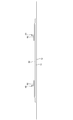
- FIG. 6 is a sectional view taken along line 6-6 in FIG.
- FIG. 7 is a sectional view taken along line 7-7 in FIG. (A) 8-8 sectional view of FIG. 1, (b) 9-9 sectional view of FIG.
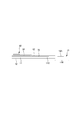
- FIG. 5 is a sectional view taken along the line 5-5 in FIG. (A) The principal part fracture
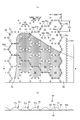
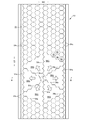
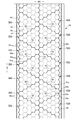
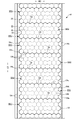
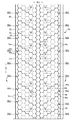
- FIG. 10 is a sectional view taken along the line 2-2 in FIGS. 8 and 9. It is a top view of the absorber which showed the junction part similar to FIG. 8 simply. It is a top view of the absorber which showed the joined part simply. It is a top view of the absorber which showed the joined part simply. It is a top view of the absorber which showed the joined part simply. It is a top view of the absorber which showed the joined part simply. It is a top view of the absorber which showed the joined part simply. It is a top view of the absorber which showed the joined part simply.
- FIG. 16 is a sectional view taken along the line 3-3 in FIG. 15.
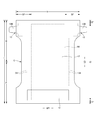
- FIGS. 1 to 6 show an example of a tape-type disposable diaper.
- symbol X indicates the full width of the diaper excluding the fastening tape
- symbol L indicates the total length of the diaper.
- Each component is fixed or bonded in the same manner as a known diaper, if necessary, other than the fixed or bonded portion described below.
- a hot melt adhesive or welding heat welding, ultrasonic welding
- This tape-type disposable diaper has a basic structure in which an absorbent body 50 is interposed between a liquid-permeable top sheet and a liquid-impermeable sheet located on the outer surface side.
- Each of which has a ventral end flap portion EF and a dorsal end flap portion EF, which are portions extending to the side and not having the absorber 50, and extend laterally from the side edge of the absorber 50. It has a pair of side flap portions SF to be taken out.
- Fastening tapes 13 are respectively provided on the side flap portions SF in the back portion B, and when attaching the diaper, the side flap portion SF of the back portion B is overlapped on the outside of the side flap portion SF of the ventral portion F. In this state, the fastening tape 13 is locked at an appropriate position on the outer surface of the ventral portion F.
- the entire outer surface of the absorbent main body 10 and the side flaps SF is formed by the exterior sheet 12.
- the liquid-impermeable sheet 11 is fixed to the inner surface side of the exterior sheet 12 with an adhesive such as a hot melt adhesive, and further absorbed to the inner surface side of the liquid-impermeable sheet 11.
- the body 50, the intermediate sheet 40, and the top sheet 30 are laminated in this order.
- the top sheet 30 and the liquid-impermeable sheet 11 are rectangular in the illustrated example, have slightly larger dimensions in the front-rear direction LD and the width direction WD than the absorbent body 50, and the side edges of the absorbent body 50 in the top sheet 30.
- the peripheral edge that protrudes further from the peripheral edge that protrudes from the side edge of the absorbent body 50 in the liquid-impermeable sheet 11 is joined by a hot melt adhesive or the like.
- the liquid-impermeable sheet 11 is formed to be slightly wider than the top sheet 30.
- side solid gathers 60, 60 that protrude (stand up) toward the wearer's skin are provided, and the gather sheets that form the side solid gathers 60, 60 are provided.
- 62 and 62 are fixed to a range from the both side portions of the top sheet 30 to the inner surface of each side flap portion SF.
- the exterior sheet 12 is a sheet constituting the outer surface of the product.
- the exterior sheet 12 has a shape in which the center part of the front-rear direction LD on both sides is constricted, and this is a part that surrounds the wearer's leg.
- the exterior sheet 12 is preferably a non-woven fabric, but is not limited thereto.
- the type of the nonwoven fabric is not particularly limited, and as the material fiber, for example, synthetic fibers such as polyethylene or polypropylene, synthetic fibers such as polyester or polyamide, recycled fibers such as rayon or cupra, and natural fibers such as cotton are used.
- a spunlace method As a processing method, a spunlace method, a spunbond method, a thermal bond method, an air-through method, a needle punch method, or the like can be used.
- a long-fiber nonwoven fabric such as a spunbond nonwoven fabric, an SMS nonwoven fabric, or an SMMS nonwoven fabric is preferable in that both the touch and strength can be achieved.
- a plurality of nonwoven fabrics can be used. In the latter case, the nonwoven fabrics are preferably bonded to each other with a hot melt adhesive or the like.
- the fiber basis weight is desirably 10 to 50 g / m 2 , particularly 15 to 30 g / m 2 .
- the exterior sheet 12 can be omitted, and in that case, the liquid-impermeable sheet 11 can have the same shape as the exterior sheet 12 to constitute the outer surface of the product.
- liquid-impermeable sheet 11 The material of the liquid-impermeable sheet 11 is not particularly limited.
- the liquid-impermeable sheet 11 is substantially made of an olefin resin such as polyethylene or polypropylene, a laminated nonwoven fabric obtained by laminating a nonwoven fabric on a polyethylene sheet, or a waterproof film.
- Non-woven fabrics that ensure liquid impermeability are composed of waterproof films and non-woven fabrics.
- materials having liquid impermeability and moisture permeability which have been used and used in recent years from the viewpoint of preventing stuffiness can also be exemplified.
- an inorganic filler is kneaded in an olefin resin such as polyethylene or polypropylene, and the sheet is formed, and then stretched in a uniaxial or biaxial direction.
- an olefin resin such as polyethylene or polypropylene
- the microporous sheet obtained in this way can be given.
- non-woven fabric using micro-denier fiber, strengthening leakage resistance by reducing the voids of the fiber by applying heat or pressure, and applying water-repellent resin or hydrophobic resin or water repellent to waterproof A sheet that is liquid-impermeable without using a film can also be used as the liquid-impermeable sheet 11.
- the top sheet 30 may be a porous or non-porous nonwoven fabric having liquid permeability.
- the constituent fiber of the nonwoven fabric is not particularly limited.
- synthetic fibers such as olefins such as polyethylene and polypropylene, polyesters and polyamides, recycled fibers such as rayon and cupra, natural fibers such as cotton, and mixed fibers and composite fibers using two or more of them. Etc. can be illustrated.
- the nonwoven fabric may be manufactured by any processing. Examples of the processing method include known methods such as a spunlace method, a spunbond method, a thermal bond method, a melt blown method, a needle punch method, an air through method, and a point bond method.
- the spun lace method is a preferable processing method for obtaining flexibility and drapeability
- the thermal bond method is for obtaining bulkiness and softness.
- the intermediate sheet 40 is joined to the back surface of the top sheet 30 in order to quickly move the excreted liquid that has passed through the top sheet 30 to the absorber 50 side and to prevent reversal.
- heat embossing or ultrasonic welding can be used in addition to using a hot melt adhesive.
- a non-woven fabric can be used, and a resin film having a large number of transmission holes can also be used.
- the non-woven fabric the same material as that described in the section of the top sheet 30 can be used. However, a material having higher hydrophilicity than the top sheet 30 and a material having a higher fiber density are changed from the top sheet 30 to the intermediate sheet 40. This is preferable because of its excellent liquid transfer characteristics.
- the intermediate sheet 40 in the illustrated form is arranged in the center shorter than the width of the absorber 50, but may be provided over the entire width.
- the length of the intermediate sheet 40 in the front-rear direction LD may be the same as the entire length of the diaper, may be the same as the length of the absorbent body 50, or may be within a short length range centered on the region that receives the liquid. .
- the side three-dimensional gather 60 is composed of a gather sheet 62 and an elongated elastic elastic member 63 fixed to the gather sheet 62 in a stretched state along the front-rear direction LD.
- a gather sheet 62 a water-repellent nonwoven fabric can be used, and as the elastic elastic member 63, rubber thread or the like can be used.
- a plurality of elastic elastic members can be provided in addition to a plurality of elastic expansion members.
- the inner surface of the gather sheet 62 has a fixing start end in the width direction WD on the side portion of the top sheet 30, and a portion outside the fixing start end in the width direction WD includes the side portion of the liquid-impermeable sheet 11 and the portion concerned. Is fixed to a side portion of the exterior sheet 12 located at a position by a hot melt adhesive or the like.
- the inner side in the width direction WD from the fixing start end of the side three-dimensional gather 60 is fixed on the top sheet 30 at both ends in the product longitudinal direction LD, but the portion in between is an unfixed free part. Yes, this free part comes to stand by the contraction force of the elastic elastic member 63.
- the diaper is mounted, the diaper is mounted on the body in the shape of a boat, and since the contraction force of the elastic expansion / contraction member 63 acts, the side three-dimensional gather 60 stands up by the contraction force of the elastic expansion / contraction member 63 and around the leg. In close contact. As a result, so-called side leakage from around the legs is prevented.
- both ends of the front-rear direction LD in the inner portion of the gather sheet 62 in the width direction WD are connected to a base end side portion extending inward from an outer portion of the width direction WD, and the base end side portion.
- each side flap portion SF has a gap between the gather sheet 62 and the liquid-impermeable sheet 11 on the outer side in the width direction WD in the vicinity of the fixing start end of the fixing portion of the gather sheet 62.
- a leg elastic member 64 made of rubber thread or the like is fixed in a state of being stretched along the front-rear direction LD, whereby the leg peripheral portion of each side flap portion SF is configured as a planar gather.
- the leg elastic member 64 may be disposed between the liquid-impermeable sheet 11 and the exterior sheet 12 in the side flap portion SF. In addition to providing a plurality of leg elastic members 64 on each side as shown in the drawing, only one elastic member 64 can be provided on each side.
- the fastening tape 13 is a sheet base material that forms a tape attachment portion 13 ⁇ / b> C fixed to a side portion of the diaper and a tape main body portion 13 ⁇ / b> B protruding from the tape attachment portion 13 ⁇ / b> C.
- a locking portion 13A for the ventral side provided in the intermediate portion in the width direction WD of the tape main body portion 13B in the sheet base material, and the tip side of the locking portion 13A is a knob. is there.
- the tape attachment portion 13C of the fastening tape 13 is sandwiched between the gather sheet 62 forming the inner layer and the exterior sheet 12 forming the outer layer in the side flap portion, and is bonded to both the sheets 62 and 12 by a hot melt adhesive. . Moreover, 13 A of latching parts are joined to the sheet
- a hook material male material of a mechanical fastener (surface fastener) is suitable.
- the hook material has a large number of engaging projections on the outer surface side thereof.
- the shape of the engagement protrusion there are a letter shape, a J shape, a mushroom shape, a T shape, a double J shape (a shape in which a J shape is combined back to back), etc.
- the shape may also be Of course, an adhesive layer can also be provided as a locking portion of the fastening tape 13.
- sheet base material that forms from the tape attachment part to the tape body part
- various nonwoven fabrics such as spunbond nonwoven fabric, air-through nonwoven fabric, and spunlace nonwoven fabric, plastic film, polylaminated nonwoven fabric, paper, and composite materials thereof are used. be able to.
- target sheet It is preferable to provide a target sheet 12T having a target for facilitating the locking at the locking portion of the fastening tape 13 in the ventral portion F.
- a target sheet 12T when the hook portion is the hook material 13A, a target sheet 12T can be used in which a large number of loop yarns are formed on the surface of a sheet base material made of a plastic film or nonwoven fabric so that the hook material engagement protrusions are entangled
- an adhesive material layer a sheet base material made of a plastic film having a smooth surface that is rich in adhesiveness can be used.
- the fastening portion of the fastening tape 13 in the ventral portion F is made of a non-woven fabric
- the exterior sheet 12 of the illustrated form is made of a non-woven fabric and the fastening portion of the fastening tape 13 is the hook material 13A.
- the target sheet 12T may be provided between the exterior sheet 12 and the liquid-impermeable sheet 11.
- the absorber 50 is a part that absorbs and holds the liquid content of excrement.
- the absorber 50 can be bonded to at least one of the front and back members via an adhesive such as a hot melt adhesive.
- the absorbent body 50 is surrounded by the front side sheet 51, the back side sheet 52 disposed on the back side thereof, and the joint portion 54 of the front side sheet 51 and the back side sheet 52, and the front side
- This is a cell absorber 50 having a cell (small chamber) 55 to which the sheet 51 and the back sheet 52 are not joined, and the superabsorbent polymer particles 53 contained in the cell 55.
- the highly absorbent polymer particles 53 can be prevented from being unevenly distributed in the absorbent body 50 by distributing and holding the superabsorbent polymer particles 53 in the large number of cells 55 surrounded by the joint 54.
- the cell absorber 50 can be packaged with a packaging sheet (not shown).
- one wrapping sheet can be wrapped in a cylindrical shape so as to surround the front and back surfaces and both side surfaces of the absorbent body 50, and can be packaged so as to be sandwiched by two wrapping sheets from both the front and back surfaces.
- tissue paper particularly crepe paper, non-woven fabric, polylaminated non-woven fabric, a sheet having small holes, and the like can be used.
- the superabsorbent polymer particles be a sheet that does not escape.
- a nonwoven fabric is used for the packaging sheet, a hydrophilic SMS nonwoven fabric (SMS, SSMMS, etc.) is particularly suitable, and the material can be polypropylene, polyethylene / polypropylene composite material, or the like.
- the basis weight is preferably 5 to 40 g / m 2 , particularly 10 to 30 g / m 2 .
- pulp fibers can be stacked on either the front or back side of the cell absorbent body, and these can be packaged together with the packaging sheet.
- the front side sheet 51 may be a liquid-permeable material or a liquid-impermeable material, but is preferably a liquid-permeable material when positioned on the top sheet 30 side as shown in the figure. .
- a porous or non-porous nonwoven fabric or a porous plastic sheet can be used in the same manner as the top sheet 30.
- the constituent fibers include, for example, synthetic fibers (including single component fibers as well as composite fibers) such as olefins, polyesters, and polyamides such as polyethylene or polypropylene, rayon, Recycled fibers such as cupra, natural fibers such as cotton, and the like can be selected without particular limitation, but thermoplastic resin fibers are preferred in terms of excellent thermal processability.
- the fiber bonding method of the nonwoven fabric is not particularly limited, but a bonding method that increases the fiber density, such as a spunbond method, a melt blown method, and a needle punch method, is preferable in order to prevent the superabsorbent polymer particles 53 from falling off.
- the opening diameter is preferably smaller than the outer shape of the superabsorbent polymer particles 53 in order to prevent the superabsorbent polymer particles 53 from falling off.
- a hydrophilic agent can be contained.
- a recess 51c that is recessed from the back side to the front side is formed in a portion constituting each cell 55 in the front side sheet 51. Is preferably formed, but may not be formed.
- the back side sheet 52 can be made of the same material as the front side sheet 51, but when the front side sheet 51 is made of a liquid permeable material, a liquid impermeable material can also be adopted for the back side sheet 52. .
- the liquid impermeable material that can be used for the back sheet 52 can be appropriately selected from the materials described in the section of the liquid impermeable sheet 11.
- the front side sheet 51 and the back side sheet 52 can be one layer in which one material is folded in two and the other layer.
- the superabsorbent polymer particles 53 are not fixed to the front side sheet 51 and the back side sheet 52 and can be freely moved, or can be adhered or adhered to the front side sheet 51 and the back side sheet 52. Further, the superabsorbent polymer particles 53 may be agglomerated to some extent.
- the particle diameter of the superabsorbent polymer particles is not particularly limited, but for example, screening using a standard sieve (JIS Z8801-1: 2006) of 500 ⁇ m (shaking for 5 minutes), and particles falling under the screen by this screening
- a standard sieve JIS Z8801-1: 2006
- the proportion of particles remaining on the 500 ⁇ m standard sieve is 30% by weight or less
- the 180 ⁇ m standard sieve It is desirable that the proportion of particles remaining on the surface is 60% by weight or more.
- the material of the superabsorbent polymer particles 53 can be used without any particular limitation, but those having a water absorption of 40 g / g or more are suitable.
- the superabsorbent polymer particles 53 include starch-based, cellulose-based and synthetic polymer-based particles such as starch-acrylic acid (salt) graft copolymer, saponified starch-acrylonitrile copolymer, sodium carboxymethyl cellulose, and the like. A cross-linked product or an acrylic acid (salt) polymer can be used.
- As the shape of the superabsorbent polymer particles 53 a commonly used granular material is suitable, but other shapes can also be used.
- the superabsorbent polymer particles 53 those having a water absorption speed of 70 seconds or less, particularly 40 seconds or less are preferably used. If the water absorption rate is too slow, the liquid supplied into the absorbent body 50 tends to cause so-called reversal that returns to the outside of the absorbent body 50.
- the superabsorbent polymer particles 53 those having a gel strength of 1000 Pa or more are preferably used. Thereby, even if it is a case where it is set as the bulky absorber 50, the sticky feeling after liquid absorption can be suppressed effectively.
- the basis weight of the superabsorbent polymer particles 53 can be appropriately determined according to the amount of absorption required for the application of the absorber 50. Therefore, although it cannot be generally stated, it can be 50 to 350 g / m 2 . If the amount of polymer is less than 50 g / m 2, it is difficult to secure the absorption amount. When it exceeds 350 g / m 2 , the effect is saturated.
- the joining portion 54 for joining the front side sheet 51 and the back side sheet 52 is preferably joined by welding the front side sheet 51 and the back side sheet 52 like ultrasonic welding or heat sealing, but via a hot melt adhesive. It may be joined.
- the joining portions 54 of the front side sheet 51 and the back side sheet 52 are provided in a dotted line shape so as to form a honeycomb shape having regular hexagons of the same dimensions as unit shapes, and as a result, all the cells 55 are joined to the joining portions 54. It is a regular hexagonal cell 55 of the same dimensions surrounded by.
- the dimension of each cell 55 can be determined as appropriate.
- the length 55L in the front-rear direction LD can be about 8 to 30 mm
- the length 55W in the width direction WD can be about 10 to 50 mm.
- the joint 54 can also be formed in a continuous line.
- the joining portion 54 is formed in a dotted line shape (intermittently)
- the joint portions 54 are formed in a dotted line shape (intermittently)
- the front side sheet 51 and the back side sheet 52 are strongly bonded at the bonding portion 54 so that the bonding portion 54 is not peeled off by the internal pressure. If so, when the superabsorbent polymer particles 53 are filled in the cell 55, there is a possibility that the amount of absorption and the absorption speed may decrease due to expansion inhibition and so-called gel blocking. For this reason, the joint 54 located on at least one side of each cell 55 is a weak joint 54 b that can be peeled off by the expansion force of the superabsorbent polymer particles 53 in the cell 55 adjacent to the joint 54.
- the cells 55 adjacent to the joint 54 are combined to form a large cell 55 by peeling off the weak joint 54b.
- Such a function is provided, for example, by providing weak joints with weak joint strength at appropriate positions so that the volume of the superabsorbent polymer particles 53 in the cell 55 during saturation absorption is sufficiently larger than the volume of the cell 55.
- the planar shape of the cell 55 is a regular hexagonal shape.
- the weak joint 54b can be peeled off with a weaker expansion force. Therefore, when the joining portion 54 surrounding the cell 55 is a weakly joining portion 54b that can be peeled, if the joining portion 54 is formed in a honeycomb shape and all the cells 55 are regular hexagons of the same size, the adjacent cell 55 at the time of absorption They will merge more smoothly and quickly.
- the planar shape of the cell 55 is a regular hexagon, the volume increase amount of the cell 55 with respect to the number of combined cells 55 is excellent. Therefore, the volume increase by combining the cells 55 can be performed efficiently.
- all of the joint portions 54 may be weak joint portions, as shown in FIGS. 7 and 8 to 17,
- the planar region is divided into the most enlarged sections 55G that surround the plurality of cells 55 by the strong joints 54a that do not peel off due to the expansion force of the superabsorbent polymer particles 53 in the adjacent cells 55.
- the positioned joint 54 is a weak joint 54b. In this case, all the weak junctions 54b in the largest expansion section 55G are peeled off by the absorption expansion pressure of the superabsorbent polymer particles 53 in the cell 55, and one cell 55 is formed over the entire largest expansion section 55G.
- the strong joint 54a surrounding the most enlarged section 55G does not peel off due to the absorption expansion pressure of the superabsorbent polymer particles 53 in the most enlarged section 55G. It is difficult to move and gather at low places such as the crotch area and deteriorate the feeling of wearing.
- the urine diffuses around as shown in FIG. 53 absorbs.
- This coalescence continues as long as the absorption expansion of the superabsorbent polymer particles 53 can peel the weakly bonded portion 54b, and can proceed to the cell 55 having the strong bonded portion 54a around it.
- a function is, for example, that the volume of the superabsorbent polymer particles 53 in the cell 55 is sufficiently larger than that of each cell 55 at the time of saturated absorption, and the entire most enlarged section 55G surrounded by the strong joint 54a.
- the superabsorbent polymer disposed in each cell 55 such that the volume at the time of saturated absorption of the superabsorbent polymer particles 53 in the most enlarged section 55G is smaller than the volume when the cells 55 are combined. This is possible by determining the type and amount of the particles 53.
- the difference in bonding strength may be easily formed by changing the area of the bonding portion 54, but is not limited to this.
- the bonding portion 54 is formed of a hot melt adhesive
- the hot melt adhesive is used.
- the weak joining portion 54b can be formed only by widening the point interval 54D by making the joining portion 54 dotted. Since the portion 54 is a portion that becomes a boundary between the adjacent cells 55, if the point interval 54 ⁇ / b> D becomes too large, a gap increases at the boundary between the adjacent cells 55, and the superabsorbent polymer particles 53 easily move.
- the weakly bonded portion 54b portion is easily peeled even though the gap is small. It becomes.
- the dimensions of the joining portion 54 that joins the front side sheet 51 and the back side sheet 52 can be determined as appropriate.
- the line width (dimension in the direction perpendicular to the direction surrounding the cell 55) 54W is about 0.6 to 8.0 mm. be able to.
- the length 54L of the joint portion 54 in the direction surrounding the cell 55 is about 0.6 to 8.0 mm
- the point interval 54D is The thickness is preferably about 0.8 to 10.0 mm.
- the line width 54W is about 1.0 to 4.0 mm
- the length 54L of the joint 54 is about 1.5 to 4.0 mm
- the point interval 54D is 0.8 to 2.
- about 5 mm is preferable.
- the line width 54W is about 0.6 to 3.5 mm
- the length 54L of the joint 54 is about 0.6 to 2.5 mm
- the point interval 54D is 1.0 to 4.
- About 0.0 mm is preferable.
- the width of the bonding portion 54 when the bonding portion 54 is formed in a continuous line shape, and the line width 54W when the bonding portion 54 is formed in a dotted line shape are fixed in the direction surrounding the cell 55, and may be changed. it can.
- the shape of each joint 54 in the case where the joint 54 is formed in a dotted line shape can be determined as appropriate, and all the shapes can be the same or different depending on the region.
- the shape of each cell 55 is a hexagon, it is preferable to provide a joint 54 at at least one of the intermediate position and the vertex position of each side.
- the strong joint portion 54a it is preferable to be provided at each vertex position.
- the weak joint portion 54b is more easily peeled off when not provided at each vertex position, so that the cells 55 are combined. Is preferable because it proceeds smoothly.
- the shape is preferably a radial (star) shape protruding in the direction of each side.
- the size, shape, and arrangement of the most enlarged section 55G (that is, the arrangement of the strong joints 54a) can be determined as appropriate. However, if the largest enlargement section 55G is made too small, there is no significance in providing the strong joints 54a, and the number of cells 55 Even if there is a large amount, when it is formed to be elongated, the shape after the cells 55 are combined becomes a shape that does not easily swell. Therefore, considering that the cell 55 is a regular hexagon, as shown in FIGS. 11 to 16, the most enlarged section 55G has six or more cells arranged in two or more directions and a peripheral shape of The cell 55 along the periphery preferably has a closed shape formed by connecting two to four continuous sides per cell 55.
- the cells 55 are merged sequentially and are easily expanded smoothly to the maximum expansion section 55G, and the maximum expansion section 55G has a shape that easily expands, and the cell 55 volume with respect to the number of combined cells 55 when expanded to the maximum expansion section 55G.
- Increases the amount of increase. 11 to 16 the strong joint 54a is represented by a thick dotted line, and the weak joint 54b is represented by a thin dotted line, as indicated by the reference numerals.
- a portion connecting two continuous sides per one cell 55 can be a straight portion, and a portion connecting three continuous sides per one cell 55 is a straight portion.
- a corner portion (direction changing portion) with an inner angle of 120 degrees, and a portion connecting four continuous sides per cell 55 can be a direction changing portion with an inner angle of 60 degrees or 180 degrees. . Therefore, by combining these linear portions and corner portions, the peripheral shape of the most enlarged section 55G (arrangement of the strong joint portions 54a) is made into a substantially equilateral triangle shape as shown in FIG. 11, or as shown in FIG.
- 16 may be a combination of a substantially square shape and a substantially circular shape, a substantially square shape over the entire width direction as shown in FIG. 13, a substantially parallelogram shape as shown in FIGS. 14 and 15, or a shape shown in FIG. It is possible to form a substantially square shape.
- a honeycomb-shaped joint portion 54 is formed so that parallel hexagonal parallel opposite sides are along the width direction WD, and linearly in the front-rear direction at the center of the absorbent body 50 in the width direction WD.
- At least one row of low expansion cell rows 57 in which all of the joint portions 54 on both side edges of the 55 rows of cells are strong joint portions 54 a are provided, and both sides in the width direction WD of the low expansion cell row 57 are from the low expansion cell row 57.
- the low-expansion cell row 57 is a row of cells 55 having both side edges formed of strong joints 54a and linearly arranged in the front-rear direction. The maximum volume is small, and the height is high even if the internal high-absorbent polymer particles 53 expand. Is the part that can be kept low. If the low expansion cell row 57 has a portion having a higher expandable height than the low expansion cell row 57 on both sides in the width direction WD, as shown in FIG. Therefore, the liquid diffusibility in the front-rear direction along the groove is improved.
- a plurality of low expansion cell rows 57 can be provided adjacent to or spaced from each other in the width direction WD of the absorber 50.
- the low-expansion cell row 57 does not contain the superabsorbent polymer particles 53 or has a smaller amount per unit area of the superabsorbent polymer particles 53 than the cells 55 on both sides in the width direction WD (for example, the ratio of the basis weight). 1 ⁇ 2 or less, particularly 1/10 or less).
- a liquid diffusion groove having a low bottom can be formed even during absorption.
- the inside of the low expansion cell row 57 does not bring about a hard feel due to the absorption expansion pressure.
- the arrangement of the strong bonding portion 54a is not particularly limited. For example, as shown in the figure, if the strong bonding portion 54a continues over a certain range in a specific direction such as the front-rear direction LD, the width direction WD, or the diagonal direction, while the cells 55 on both sides expand due to the absorption of the superabsorbent polymer particles 53 inside, the strong joint 54a does not peel to the end, so that after the absorption, the groove with the strong joint 54a at the bottom is in a specific direction. The liquid diffusibility in the direction along the groove is improved.
- the joint located on the outermost side in the width direction WD may be a strong joint 54a because the superabsorbent polymer particles 53 or the gelled product thereof may leak to the side of the absorbent body 50 when it peels off. desirable.
- the front side sheet 51 and the back side sheet 52 are extended to some extent outside the cell 55 formation region in the width direction WD, and the edge joint portion 54c is applied to the extended part for reinforcement. preferable.
- the longitudinal strong joint line 58 which is a portion where the strong joint portion 54 a continues in the front-rear direction over the entire length of the absorbent body 50
- a laterally strong joint line 59 that is provided in each of the portions
- the strong joint portion 54a is a portion that continues in the width direction WD or diagonally from the central longitudinal strong joint line 58 to each of the longitudinal strong joint lines 58 on both sides.
- a plurality of the sensors are provided at intervals in the front-rear direction.
- the vertical liquid diffusibility is improved by the longitudinal strong bonding line 58
- the horizontal liquid diffusivity is improved by the lateral strong bonding line 59.
- the longitudinal strong joint lines 58 on both sides also have a function of preventing leakage of the superabsorbent polymer particles 53 from both side edges.
- the transverse strong bonding line 59 is repeatedly bent leftward and rightward in the front-rear direction between the central vertical strong bonding line 58 and the vertical strong bonding lines 58 on both sides.
- a zigzag shape extending is preferable.
- a triangular-shaped maximum expansion section 55G having a vertex at the position of the central longitudinal strong joint line 58 and a substantially triangular-shaped maximum expansion section 55G having a vertex at the position of the vertical strong joint line 58 on both sides It is repeatedly formed alternately in the front-rear direction.
- the lateral strong bonding lines 59 are formed in such a zigzag shape, the liquid diffusion in the lateral direction can be efficiently promoted with a small number of the lateral strong bonding lines 59, and the most enlarged section 55G becomes a substantially triangular shape that is easy to swell.
- the volume increase of the cell 55 with respect to the number of cells 55 combined is also excellent, which is preferable.
- the number of the vertical strong bonding lines 58 and the horizontal strong bonding lines 59 may be determined as appropriate, but the vertical strong bonding lines 58 are 3 when provided at a position along the side edge of the cell 55 located on the outermost side in the width direction WD. ⁇ 4 are preferred, and if not provided, 1-2 are preferred. It is desirable that the number of lateral strong bonding lines 59 be about 4 to 10.
- the hatched region 53A in FIG. 8 shows a region containing the superabsorbent polymer particles 53 and assumes the shape of the spray region of the superabsorbent polymer particles 53 at the time of manufacture.
- the cell 55 has a portion without a hatched pattern, but when the superabsorbent polymer particles 53 can move in the cell 55, the position of the superabsorbent polymer particles 53 in the cell 55 is fixed in the product. Instead, the superabsorbent polymer particles 53 can be distributed throughout the cell 55 as in the state shown in FIG.
- the inclusion amount of the superabsorbent polymer particles 53 in the empty cell 56 is preferably 1 ⁇ 2 or less, particularly 1/10 or less of the other cells, and particularly preferably not contained at all.
- the front end and the rear end of the absorbent body 50 are formed by cutting into individual absorbent bodies 50 at the time of manufacture, if the superabsorbent polymer particles 53 are contained in this position, the life of the blade of the cutting device is increased. May be shortened. Therefore, it is desirable that the cell 55 at a position where at least the front and rear ends of the absorber 50 pass is an empty cell 56.
- the middle part of the front-rear direction LD is formed in a constricted shape so as to follow the leg circumference.
- the cells 55 on both sides in the middle of the front-rear direction LD are made empty cells 56, so that the portion is less expanded after absorption.
- the absorbent body 50 is shaped to fit around the legs.
- the superabsorbent polymer particles 53 are contained on the front side sheet 51 or the back side sheet 52. After the superabsorbent polymer particles 53 are uniformly dispersed over the entire region (the region excluding the portion that becomes the empty cell 56), the joint portion 54 is formed to integrate the front side sheet 51 and the back side sheet 52 and the cell. Preferably, the superabsorbent polymer particles 53 are confined in the 55.
- the superabsorbent polymer particles 53 are sprayed so that the periphery of the spraying region 53A passes through the middle of the peripheral cell 55. It is desirable to do.
- the amount of inclusion of the superabsorbent polymer particles 53 in the peripheral cell 55 is smaller than the cell 55 located on the inner side of the peripheral cell 55, and when the cell 55 is provided outside the peripheral cell 55, The cell 55 becomes an empty cell 56 that does not substantially contain the superabsorbent polymer particles 53.
- the superabsorbent polymer particles 53 are encapsulated in the cell 55, but it is also possible to encapsulate powders other than the superabsorbent polymer particles 53 such as deodorant particles together with the superabsorbent polymer particles 53. it can.
- MD direction and CD direction mean the flow direction (MD direction) in production equipment and the transverse direction (CD direction) perpendicular to this, and either one is the front-rear direction of the product. The other is the width direction of the product.
- the MD direction of the nonwoven fabric is the direction of fiber orientation of the nonwoven fabric.
- the fiber orientation is the direction along which the fibers of the nonwoven fabric are aligned.
- the fiber orientation can be determined from the measurement method according to the TAPPI standard method T481, the fiber orientation test method using the zero-range tensile strength, and the tensile strength ratio in the front-rear direction and the width direction. It can be discriminated by a simple measuring method for determining the orientation direction.
- -"Developed state” means a state where the plate is flattened without contraction or slack.
- “Elongation rate” means a value when the natural length is 100%.
- Articleificial urine is urea: 2 wt%, sodium chloride: 0.8 wt%, calcium chloride dihydrate: 0.03 wt%, magnesium sulfate heptahydrate: 0.08 wt%, and ion-exchanged water: 97 0.09 wt% is mixed and used at a temperature of 40 degrees unless otherwise specified.
- -"Gel strength is measured as follows. Add 1.0 g of superabsorbent polymer to 49.0 g of artificial urine and stir with a stirrer. The produced gel is left in a constant temperature and humidity chamber of 40 ° C.
- ⁇ "Weight" is measured as follows. After the sample or test piece has been pre-dried, it is left in a test room or apparatus in a standard state (test location is temperature 20 ⁇ 5 ° C., relative humidity 65% or less) to obtain a constant weight. Pre-drying refers to making a sample or test piece constant in an environment where the relative humidity is 10 to 25% and the temperature does not exceed 50 ° C. In addition, it is not necessary to perform preliminary drying about the fiber whose official moisture content is 0.0%.
- a sample with a size of 200 mm ⁇ 250 mm ( ⁇ 2 mm) is cut out from the test piece in a constant weight using a rice-basis plate (200 mm ⁇ 250 mm, ⁇ 2 mm). Measure the weight of the sample, multiply it by 20, calculate the weight per square meter, and use it as the basis weight. “Thickness” is automatically measured using an automatic thickness meter (KES-G5 handy compression tester) under the conditions of load: 10 gf / cm 2 and pressure area: 2 cm 2 . The water absorption is measured according to JIS K7223-1996 “Test method for water absorption of superabsorbent resin”.
- the water absorption rate is the “time to end point” when JIS K7224-1996 “Test method for water absorption rate of superabsorbent resin” is performed using 2 g of superabsorbent polymer and 50 g of physiological saline. . ⁇ If there is no description about the environmental conditions in the test and measurement, the test and measurement shall be performed in a test room or equipment in a standard state (test location is temperature 20 ⁇ 5 ° C, relative humidity 65% or less). . -Unless otherwise specified, the dimensions of each part mean dimensions in a deployed state, not a natural length state.
- SYMBOLS 11 Liquid impervious sheet, 12 ... Exterior sheet, 12T ... Target sheet, 13 ... Fastening tape, 13A ... Locking part, 13B ... Tape body part, 13C ... Tape attachment part, 30 ... Top sheet, 40 ... Intermediate sheet , 60 ... side solid gathers, 62 ... gather sheets, 50 ... absorbers, 51 ... front side sheets, 51c ... dents, 52 ... back side sheets, 53 ... superabsorbent polymer particles, 54 ... joints, 54a ... strong joints 54b ... weak joint, 54c ... edge joint, 55 ... cell, 55G ... most enlarged section, WD ... width direction, 56 ... empty cell, 57 ... low expansion cell row, 58 ... longitudinal strong joint line, 59 ... Lateral strong joint line.
Landscapes
- Health & Medical Sciences (AREA)
- Epidemiology (AREA)
- Engineering & Computer Science (AREA)
- Biomedical Technology (AREA)
- Heart & Thoracic Surgery (AREA)
- Vascular Medicine (AREA)
- Life Sciences & Earth Sciences (AREA)
- Animal Behavior & Ethology (AREA)
- General Health & Medical Sciences (AREA)
- Public Health (AREA)
- Veterinary Medicine (AREA)
- Absorbent Articles And Supports Therefor (AREA)
- Orthopedics, Nursing, And Contraception (AREA)
Abstract
Cette invention concerne un article absorbant comprenant un absorbeur (50) qui comporte : une feuille avant (51) ; une feuille arrière (52) située au dos de la feuille avant (51) ; des cellules (55) qui sont entourées par des parties liées (54) de la feuille avant (51) et de la feuille arrière (52), la feuille avant (51) et la feuille arrière (52) n'étant pas liées l'une à l'autre ; et des particules granulaires qui sont contenues à l'intérieur des cellules (55) et qui contiennent des particules polymères superabsorbantes (53). Les parties liées (54) forment des lignes continues ou des lignes en pointillés de façon à créer une forme en nid d'abeilles dont la forme unitaire est constituée d'hexagones réguliers de mêmes dimensions. Toutes les cellules (55) sont des cellules hexagonales régulières (55) de mêmes dimensions entourées par les parties liées (54). Les parties liées (54) situées sur au moins un côté de chaque cellule (55) sont des parties faiblement liées (54b) qui peuvent être séparées par la force d'expansion des particules polymères superabsorbantes (53) contenues dans les cellules (55) adjacentes auxdites parties liées (54).
Priority Applications (3)
| Application Number | Priority Date | Filing Date | Title |
|---|---|---|---|
| EP17773886.1A EP3437610B1 (fr) | 2016-03-30 | 2017-02-23 | Article absorbant |
| CN201780017373.1A CN108778215B (zh) | 2016-03-30 | 2017-02-23 | 吸收性物品 |
| US16/088,911 US11154439B2 (en) | 2016-03-30 | 2017-02-23 | Absorbent article with strong and weak bonded portions |
Applications Claiming Priority (2)
| Application Number | Priority Date | Filing Date | Title |
|---|---|---|---|
| JP2016069156A JP6186468B1 (ja) | 2016-03-30 | 2016-03-30 | 吸収性物品 |
| JP2016-069156 | 2016-03-30 |
Publications (1)
| Publication Number | Publication Date |
|---|---|
| WO2017169341A1 true WO2017169341A1 (fr) | 2017-10-05 |
Family
ID=59678222
Family Applications (1)
| Application Number | Title | Priority Date | Filing Date |
|---|---|---|---|
| PCT/JP2017/006711 Ceased WO2017169341A1 (fr) | 2016-03-30 | 2017-02-23 | Article absorbant |
Country Status (5)
| Country | Link |
|---|---|
| US (1) | US11154439B2 (fr) |
| EP (1) | EP3437610B1 (fr) |
| JP (1) | JP6186468B1 (fr) |
| CN (1) | CN108778215B (fr) |
| WO (1) | WO2017169341A1 (fr) |
Families Citing this family (2)
| Publication number | Priority date | Publication date | Assignee | Title |
|---|---|---|---|---|
| JP6186469B1 (ja) * | 2016-03-30 | 2017-08-23 | 大王製紙株式会社 | 吸収性物品 |
| JP7159144B2 (ja) * | 2019-09-27 | 2022-10-24 | 大王製紙株式会社 | 吸収性物品 |
Citations (4)
| Publication number | Priority date | Publication date | Assignee | Title |
|---|---|---|---|---|
| JPS57199801A (en) * | 1981-05-06 | 1982-12-07 | Colgate Palmolive Co | Absorbint article and production thereof |
| JPS6414301A (en) * | 1987-06-26 | 1989-01-18 | Peaudouce | Absorbing pad for sanitary product and coninuous production thereof |
| WO2014007043A1 (fr) * | 2012-07-04 | 2014-01-09 | 株式会社瑞光 | Procédé de liaison par ultrasons pour article absorbant, dispositif de liaison par ultrasons pour article absorbant et article absorbant |
| JP2014500736A (ja) * | 2010-10-20 | 2014-01-16 | フィンカ ベーフェーベーアー | 環境に優しい吸収性構造体 |
Family Cites Families (15)
| Publication number | Priority date | Publication date | Assignee | Title |
|---|---|---|---|---|
| US5433715A (en) | 1993-10-29 | 1995-07-18 | Kimberly-Clark Corporation | Absorbent article which includes superabsorbent material located in discrete pockets having water-sensitive and water-insensitive containment structures |
| JP3594103B2 (ja) | 1996-06-10 | 2004-11-24 | 花王株式会社 | 吸水性シート及びその製造方法並びにそれを用いた吸収性物品 |
| JP3675601B2 (ja) * | 1996-09-12 | 2005-07-27 | ユニ・チャーム株式会社 | 吸収体 |
| JP3892324B2 (ja) | 2002-03-13 | 2007-03-14 | 大王製紙株式会社 | 体液吸収性物品 |
| US8211815B2 (en) * | 2003-06-13 | 2012-07-03 | Kimberly-Clark Worldwide, Inc. | Absorbent structure having three-dimensional topography on upper and lower surfaces |
| JP5001099B2 (ja) | 2007-09-10 | 2012-08-15 | 花王株式会社 | 吸収性物品 |
| TWI496565B (zh) * | 2009-03-30 | 2015-08-21 | Livedo Corp | 吸收元件 |
| JP5517682B2 (ja) | 2010-03-16 | 2014-06-11 | 大王製紙株式会社 | 吸収性物品 |
| FR2966039B3 (fr) | 2010-10-13 | 2012-11-09 | Romanova Bva Starter | Structure absorbante pour un systeme de gestion des fluides integre |
| US9532909B2 (en) * | 2012-08-01 | 2017-01-03 | Zuiko Corporation | Disposable worn article and method for manufacturing same |
| US20160151213A1 (en) * | 2012-12-21 | 2016-06-02 | Basf Se | Fluid-absorbent article |
| JP6310941B2 (ja) * | 2013-11-14 | 2018-04-11 | 株式会社瑞光 | 吸収体及びその製造装置 |
| JP5957566B1 (ja) * | 2015-03-27 | 2016-07-27 | 大王製紙株式会社 | 吸収性物品 |
| JP6366565B2 (ja) * | 2015-12-09 | 2018-08-01 | 大王製紙株式会社 | 吸収性物品 |
| JP6186469B1 (ja) * | 2016-03-30 | 2017-08-23 | 大王製紙株式会社 | 吸収性物品 |
-
2016
- 2016-03-30 JP JP2016069156A patent/JP6186468B1/ja active Active
-
2017
- 2017-02-23 EP EP17773886.1A patent/EP3437610B1/fr active Active
- 2017-02-23 WO PCT/JP2017/006711 patent/WO2017169341A1/fr not_active Ceased
- 2017-02-23 CN CN201780017373.1A patent/CN108778215B/zh active Active
- 2017-02-23 US US16/088,911 patent/US11154439B2/en active Active
Patent Citations (4)
| Publication number | Priority date | Publication date | Assignee | Title |
|---|---|---|---|---|
| JPS57199801A (en) * | 1981-05-06 | 1982-12-07 | Colgate Palmolive Co | Absorbint article and production thereof |
| JPS6414301A (en) * | 1987-06-26 | 1989-01-18 | Peaudouce | Absorbing pad for sanitary product and coninuous production thereof |
| JP2014500736A (ja) * | 2010-10-20 | 2014-01-16 | フィンカ ベーフェーベーアー | 環境に優しい吸収性構造体 |
| WO2014007043A1 (fr) * | 2012-07-04 | 2014-01-09 | 株式会社瑞光 | Procédé de liaison par ultrasons pour article absorbant, dispositif de liaison par ultrasons pour article absorbant et article absorbant |
Non-Patent Citations (1)
| Title |
|---|
| See also references of EP3437610A4 * |
Also Published As
| Publication number | Publication date |
|---|---|
| US20190125596A1 (en) | 2019-05-02 |
| CN108778215A (zh) | 2018-11-09 |
| JP2017176505A (ja) | 2017-10-05 |
| CN108778215B (zh) | 2021-08-03 |
| EP3437610A4 (fr) | 2019-12-11 |
| US11154439B2 (en) | 2021-10-26 |
| EP3437610B1 (fr) | 2023-05-10 |
| EP3437610A1 (fr) | 2019-02-06 |
| JP6186468B1 (ja) | 2017-08-23 |
Similar Documents
| Publication | Publication Date | Title |
|---|---|---|
| JP6219436B2 (ja) | 吸収性物品 | |
| JP6492145B1 (ja) | 吸収性物品 | |
| JP6186469B1 (ja) | 吸収性物品 | |
| WO2021060133A1 (fr) | Article absorbant | |
| JP6219437B2 (ja) | 吸収性物品 | |
| JP6186468B1 (ja) | 吸収性物品 | |
| WO2021060132A1 (fr) | Article absorbant | |
| JP6283073B2 (ja) | 吸収性物品 | |
| JP6219435B2 (ja) | 吸収体の製造方法及び吸収体の製造装置 | |
| JP6209240B2 (ja) | 吸収性物品 | |
| WO2021060130A1 (fr) | Article absorbant | |
| WO2021193002A1 (fr) | Article absorbant | |
| JP2021052897A5 (fr) | ||
| JP7291053B2 (ja) | 吸収性物品 | |
| JP6942771B2 (ja) | 吸収性物品 | |
| JP6254739B2 (ja) | 吸収体の製造方法及び吸収体の製造装置 | |
| JP6254740B2 (ja) | 吸収体の製造方法及び吸収体の製造装置 | |
| WO2021060131A1 (fr) | Article absorbant | |
| JP2021052901A5 (fr) | ||
| JP2021052898A5 (fr) |
Legal Events
| Date | Code | Title | Description |
|---|---|---|---|
| NENP | Non-entry into the national phase |
Ref country code: DE |
|
| WWE | Wipo information: entry into national phase |
Ref document number: 2017773886 Country of ref document: EP |
|
| ENP | Entry into the national phase |
Ref document number: 2017773886 Country of ref document: EP Effective date: 20181030 |
|
| 121 | Ep: the epo has been informed by wipo that ep was designated in this application |
Ref document number: 17773886 Country of ref document: EP Kind code of ref document: A1 |