WO2017169809A1 - フィルターおよびその製造方法、並びに、ドライエッチング用装置およびドライエッチング方法 - Google Patents
フィルターおよびその製造方法、並びに、ドライエッチング用装置およびドライエッチング方法 Download PDFInfo
- Publication number
- WO2017169809A1 WO2017169809A1 PCT/JP2017/010525 JP2017010525W WO2017169809A1 WO 2017169809 A1 WO2017169809 A1 WO 2017169809A1 JP 2017010525 W JP2017010525 W JP 2017010525W WO 2017169809 A1 WO2017169809 A1 WO 2017169809A1
- Authority
- WO
- WIPO (PCT)
- Prior art keywords
- filter
- metal
- amine compound
- dry etching
- filtered
- Prior art date
- Legal status (The legal status is an assumption and is not a legal conclusion. Google has not performed a legal analysis and makes no representation as to the accuracy of the status listed.)
- Ceased
Links
Classifications
-
- B—PERFORMING OPERATIONS; TRANSPORTING
- B01—PHYSICAL OR CHEMICAL PROCESSES OR APPARATUS IN GENERAL
- B01D—SEPARATION
- B01D39/00—Filtering material for liquid or gaseous fluids
- B01D39/10—Filter screens essentially made of metal
-
- B—PERFORMING OPERATIONS; TRANSPORTING
- B01—PHYSICAL OR CHEMICAL PROCESSES OR APPARATUS IN GENERAL
- B01D—SEPARATION
- B01D39/00—Filtering material for liquid or gaseous fluids
- B01D39/14—Other self-supporting filtering material ; Other filtering material
-
- B—PERFORMING OPERATIONS; TRANSPORTING
- B01—PHYSICAL OR CHEMICAL PROCESSES OR APPARATUS IN GENERAL
- B01D—SEPARATION
- B01D39/00—Filtering material for liquid or gaseous fluids
- B01D39/14—Other self-supporting filtering material ; Other filtering material
- B01D39/20—Other self-supporting filtering material ; Other filtering material of inorganic material, e.g. asbestos paper, metallic filtering material of non-woven wires
- B01D39/2027—Metallic material
-
- B—PERFORMING OPERATIONS; TRANSPORTING
- B01—PHYSICAL OR CHEMICAL PROCESSES OR APPARATUS IN GENERAL
- B01D—SEPARATION
- B01D39/00—Filtering material for liquid or gaseous fluids
- B01D39/14—Other self-supporting filtering material ; Other filtering material
- B01D39/20—Other self-supporting filtering material ; Other filtering material of inorganic material, e.g. asbestos paper, metallic filtering material of non-woven wires
- B01D39/2068—Other inorganic materials, e.g. ceramics
-
- B—PERFORMING OPERATIONS; TRANSPORTING
- B01—PHYSICAL OR CHEMICAL PROCESSES OR APPARATUS IN GENERAL
- B01D—SEPARATION
- B01D53/00—Separation of gases or vapours; Recovering vapours of volatile solvents from gases; Chemical or biological purification of waste gases, e.g. engine exhaust gases, smoke, fumes, flue gases, aerosols
- B01D53/26—Drying gases or vapours
- B01D53/266—Drying gases or vapours by filtration
-
- C—CHEMISTRY; METALLURGY
- C07—ORGANIC CHEMISTRY
- C07C—ACYCLIC OR CARBOCYCLIC COMPOUNDS
- C07C17/00—Preparation of halogenated hydrocarbons
- C07C17/38—Separation; Purification; Stabilisation; Use of additives
-
- C—CHEMISTRY; METALLURGY
- C07—ORGANIC CHEMISTRY
- C07C—ACYCLIC OR CARBOCYCLIC COMPOUNDS
- C07C19/00—Acyclic saturated compounds containing halogen atoms
- C07C19/08—Acyclic saturated compounds containing halogen atoms containing fluorine
-
- H—ELECTRICITY
- H10—SEMICONDUCTOR DEVICES; ELECTRIC SOLID-STATE DEVICES NOT OTHERWISE PROVIDED FOR
- H10P—GENERIC PROCESSES OR APPARATUS FOR THE MANUFACTURE OR TREATMENT OF DEVICES COVERED BY CLASS H10
- H10P50/00—Etching of wafers, substrates or parts of devices
- H10P50/20—Dry etching; Plasma etching; Reactive-ion etching
- H10P50/28—Dry etching; Plasma etching; Reactive-ion etching of insulating materials
- H10P50/282—Dry etching; Plasma etching; Reactive-ion etching of insulating materials of inorganic materials
- H10P50/283—Dry etching; Plasma etching; Reactive-ion etching of insulating materials of inorganic materials by chemical means
-
- H—ELECTRICITY
- H10—SEMICONDUCTOR DEVICES; ELECTRIC SOLID-STATE DEVICES NOT OTHERWISE PROVIDED FOR
- H10P—GENERIC PROCESSES OR APPARATUS FOR THE MANUFACTURE OR TREATMENT OF DEVICES COVERED BY CLASS H10
- H10P72/00—Handling or holding of wafers, substrates or devices during manufacture or treatment thereof
- H10P72/04—Apparatus for manufacture or treatment
- H10P72/0402—Apparatus for fluid treatment
- H10P72/0418—Apparatus for fluid treatment for etching
- H10P72/0421—Apparatus for fluid treatment for etching for drying etching
-
- B—PERFORMING OPERATIONS; TRANSPORTING
- B01—PHYSICAL OR CHEMICAL PROCESSES OR APPARATUS IN GENERAL
- B01D—SEPARATION
- B01D2239/00—Aspects relating to filtering material for liquid or gaseous fluids
- B01D2239/04—Additives and treatments of the filtering material
- B01D2239/0464—Impregnants
-
- B—PERFORMING OPERATIONS; TRANSPORTING
- B01—PHYSICAL OR CHEMICAL PROCESSES OR APPARATUS IN GENERAL
- B01D—SEPARATION
- B01D2257/00—Components to be removed
- B01D2257/40—Nitrogen compounds
-
- C—CHEMISTRY; METALLURGY
- C07—ORGANIC CHEMISTRY
- C07C—ACYCLIC OR CARBOCYCLIC COMPOUNDS
- C07C17/00—Preparation of halogenated hydrocarbons
- C07C17/38—Separation; Purification; Stabilisation; Use of additives
- C07C17/42—Use of additives, e.g. for stabilisation
Definitions
- the present invention relates to a filter, a filter manufacturing method, a dry etching apparatus using the filter, and a dry etching method.
- compositions containing fluorinated saturated hydrocarbons such as 2-fluorobutane at a high concentration are etching gases, CVD gases, raw materials for producing intermediates for fluorine-containing pharmaceuticals, solvents, etc. (See, for example, Patent Document 1).
- composition containing a high concentration of fluorinated saturated hydrocarbons should be used for various applications after being filtered with a filter in which at least a part of the portion in contact with the material to be filtered is made of metal or metal compound. There is.
- a composition containing a fluorinated saturated hydrocarbon at a high concentration of, for example, 99% by volume or more has a fluorine content when at least part of the portion that comes into contact with the material to be filtered is filtered with a metal or metal compound filter.
- the fluorinated saturated hydrocarbon may decompose and the concentration of the fluorinated saturated hydrocarbon may decrease.
- the fluorinated saturated hydrocarbon is decomposed when a composition containing a high concentration of fluorinated saturated hydrocarbon is filtered.
- a filter that can suppress this.
- a filter capable of suppressing the decomposition of fluorinated saturated hydrocarbons is used as a high-purity dry etching gas after a composition containing a high concentration of fluorinated saturated hydrocarbons is filtered through the filter.
- a dry etching apparatus and a dry etching method has been a demand for a dry etching apparatus and a dry etching method.
- the present invention provides fluorinated saturation when a composition containing a high concentration of fluorinated saturated hydrocarbons is filtered, even if at least a part of the portion in contact with the material to be filtered is made of metal or a metal compound. It aims at providing the filter which can suppress that a hydrocarbon decomposes
- disassembles. Another object of the present invention is to provide a dry etching apparatus including the filter and a dry etching method using the filter.
- the present inventor has intensively studied to achieve the above object. And if this inventor used the filter which made the metal compound or metal compound part which contacts a to-be-filtered object adsorb
- the present invention aims to solve the above-mentioned problem advantageously, and the filter of the present invention has a metal or metal compound part in contact with an object to be filtered and a surface of the part. And an adsorbed amine compound.
- a composition containing a high concentration of fluorinated saturated hydrocarbons can be filtered if the amine compound is adsorbed on the surface of the portion made of metal or metal compound in contact with the material to be filtered.
- the decomposition of the fluorinated saturated hydrocarbon can be suppressed.
- the amine compound is preferably chemically adsorbed on the surface. If the amine compound is chemisorbed, the amine compound is prevented from detaching from the surface of the metal or metal compound portion, and the amine compound is contained in the filtrate obtained by filtering the material to be filtered with a filter. Mixing can be prevented.
- the filter of the present invention preferably has a desorption amount of the amine compound of 10 ppm by volume or less in a nitrogen gas atmosphere at a temperature of 20 ° C. and a pressure (gauge pressure) of 0.1 MPa. If the desorption amount of the amine compound is 10 ppm by volume or less, the filtrate obtained by filtering the material to be filtered with a filter while suppressing the desorption of the amine compound from the surface of the portion made of metal or metal compound It is possible to prevent the amine compound from being mixed therein. The amount of amine compound desorbed can be measured using a gas chromatograph.
- the filter element preferably has a mesh size of 1250 mesh or more.
- the mesh size of the filter element is 1250 mesh or more, impurities such as particles contained in the material to be filtered can be sufficiently removed.
- the amine compound is preferably composed of an amine having 3 to 5 carbon atoms.
- An amine having 3 to 5 carbon atoms is easy to handle and has an excellent effect of suppressing the decomposition of fluorinated saturated hydrocarbons.
- At least one part of the part which contacts a to-be-filtered material is a product made from a metal or a metal compound.
- a method for producing a filter comprising a step (A) of bringing an amine compound into contact with a surface of a metal or metal compound portion that is in contact with the material to be filtered.
- the amine compound is brought into contact with the surface of the metal or metal compound portion and the amine compound is adsorbed on the surface of the metal or metal compound portion, it contains a high concentration of fluorinated saturated hydrocarbons. Even when the composition to be filtered is filtered, a filter capable of suppressing the decomposition of the fluorinated saturated hydrocarbon is easily obtained.
- the method for producing a filter of the present invention further includes a step (B) of removing the amine compound physically adsorbed on the surface after the step (A).
- the step (B) includes an operation of exposing the surface to a reduced-pressure atmosphere. If the surface in contact with the amine compound is exposed to a reduced-pressure atmosphere, the physically adsorbed amine compound can be easily removed.
- the step (B) includes alternately repeating an operation of exposing the surface to a reduced-pressure atmosphere and an operation of bringing the surface into contact with an inert gas.
- the mesh size of the filter element of the filter is 1250 mesh or more.
- impurities such as particles contained in the material to be filtered can be sufficiently removed.
- the amine compound is preferably composed of an amine having 3 to 5 carbon atoms.
- An amine having 3 to 5 carbon atoms is easy to handle and has an excellent effect of suppressing the decomposition of fluorinated saturated hydrocarbons.
- the present invention aims to advantageously solve the above-mentioned problems, and the dry etching apparatus of the present invention is a dry etching apparatus that performs dry etching using a dry etching gas filtered by a filter.
- the filter is any one of the above-described filters. As described above, when the above-described filter is used, a fluorinated saturated hydrocarbon is decomposed when a composition containing a high concentration of fluorinated saturated hydrocarbon is filtered and then used as a dry etching gas. Can be suppressed.
- this invention aims at solving the said subject advantageously, and the dry etching method of this invention performs dry etching using the gas for dry etching filtered using the filter mentioned above. It is characterized by.
- a fluorinated saturated hydrocarbon is decomposed when a composition containing a high concentration of fluorinated saturated hydrocarbon is filtered and used as a dry etching gas. Can be suppressed.
- fluorination saturation occurs when a composition containing a high concentration of fluorinated saturated hydrocarbons is filtered.
- a filter capable of suppressing the decomposition of hydrocarbons can be provided.
- the dry etching apparatus provided with a filter capable of suppressing the decomposition of the fluorinated saturated hydrocarbon.
- a dry etching method using a filter can be provided.
- the filter of this invention is not specifically limited, For example, it can manufacture using the manufacturing method of the filter of this invention. And the filter manufactured using the filter of this invention and the manufacturing method of the filter of this invention is not specifically limited, When filtering the gas for dry etching in the apparatus for dry etching and dry etching method of this invention It can be used suitably.
- the filter of the present invention is not particularly limited, and is used when removing fine particles and the like contained in an object to be filtered. Moreover, the filter of this invention has the part made from a metal or a metal compound which contacts a to-be-filtered object, and the amine compound adsorbed on the surface of the part made from a metal or a metal compound.
- the composition containing a high concentration of fluorinated saturated hydrocarbon particularly fluorinated saturated carbonized carbon.
- a composition containing hydrogen at a high concentration of 99% by volume or more preferably 99.50% by volume or more, more preferably 99.80% by volume or more, and further preferably 99.90% by volume or more.
- decomposition of the fluorinated saturated hydrocarbon can be suppressed.
- the reason why the fluorinated saturated hydrocarbon can be prevented from being decomposed is not clear, but is presumed to be as follows.
- the decomposition of the fluorinated saturated hydrocarbon occurs when a Lewis acid component such as a metal atom existing on the surface of a metal or metal compound portion acts as a catalyst. If adsorbed, the adsorbed amine compound poisons Lewis acid, and fluorinated saturation is suppressed in order to suppress the occurrence of decomposition reaction (for example, deHF reaction) of fluorinated saturated hydrocarbon using Lewis acid as a catalyst. It is assumed that hydrocarbon decomposition is suppressed.
- the structure of the filter of the present invention is not particularly limited as long as it is in contact with the material to be filtered and has a portion made of a metal or a metal compound.
- the material to be filtered passes through.
- a structure in which at least a part of a portion that contacts the material to be filtered is formed of a metal or a metal compound.
- the filter of the present invention is not particularly limited, for example, a filter in which a resin filter element is disposed in a flow passage of a filter body of a metal or metal compound filter body, A filter in which a filter element made of metal or a metal compound is disposed in the flow passage of the filter body made of metal or a metal compound, and a metal or metal compound made of the filter in the flow passage of the filter body made of resin The filter etc. which arrange
- position this filter element are mentioned.
- the metal it is not specifically limited, For example, stainless steel, nickel, etc. are mentioned.
- the metal compound is not particularly limited, and examples thereof include metal oxides such as aluminum oxide (alumina).
- the resin is not particularly limited, and examples thereof include polyethylene terephthalate (PTFE).
- the filter element mentioned above may be provided in the to-be-filtered material channel of the filter body so that it cannot be detached, or may be provided in the to-be-filtered material channel so as to be removable.
- a filter element having an arbitrary mesh size can be used as long as the desired filtration performance can be obtained.
- impurities such as particles contained in the material to be filtered are sufficiently removed.
- the filter element preferably has a mesh size of 1250 mesh or more, and more preferably 4500 mesh or more.
- the amine compound adsorbed on the surface of the metal or metal compound portion is not particularly limited, and the carbon number (total carbon number) represented by any of the following formulas (I) to (III) is 10
- the following amine compounds are mentioned.
- R 1 to R 7 are each independently a hydrogen atom, an alkyl group having 1 to 10 carbon atoms, a cycloalkyl group having 3 to 10 carbon atoms, or an aryl group having 6 to 10 carbon atoms
- R 8 represents an alkyl group having 1 to 5 carbon atoms or a cycloalkyl group having 3 to 5 carbon atoms, two groups selected from R 1 to R 3 , R 4 and R 5 , R 6 and R 7 may be bonded to each other to form a ring
- A represents a divalent group having 2 to 10 carbon atoms
- n represents an integer of 0 to 5
- n is 2 or more.
- R 8 may be the same as or different from each other.
- the number of carbon atoms of the amine compound is 10 or less, the melting point of the amine compound becomes sufficiently low, the handling as a liquid or gas becomes easy, and the adsorption efficiency to the metal or metal compound portion can be increased.
- the alkyl group of R 1 to R 7 has 1 to 10 carbon atoms, preferably 1 to 5 carbon atoms.
- Examples of the alkyl group represented by R 1 to R 7 include methyl group, ethyl group, n-propyl group, isopropyl group, n-butyl group, t-butyl group, isobutyl group, s-butyl group, n-pentyl group, n- Examples include hexyl group, n-heptyl group, n-octyl group, n-nonyl group, n-decyl group and the like.
- the alkyl group of R 1 to R 7 may have a hydrogen atom substituted with a hydrocarbon group such as a cycloalkyl group such as a cyclopentyl group or a cyclohexyl group; an aryl group such as a phenyl group;
- the carbon number of the cycloalkyl group of R 1 to R 7 is 3 or more and 10 or less, preferably 3 or more and 6 or less.
- Examples of the cycloalkyl group represented by R 1 to R 7 include a cyclopropyl group, a cyclobutyl group, a cyclopentyl group, a cyclohexyl group, and a cycloheptyl group.
- the cycloalkyl group of R 1 to R 7 has an alkyl group such as a methyl group, an ethyl group, an n-propyl group, an isopropyl group, an n-butyl group, a t-butyl group, or an isobutyl group; a phenyl group, etc.
- the aryl group may be substituted with a hydrocarbon group such as
- the aryl group of R 1 to R 7 has 6 to 10 carbon atoms, preferably 6 to 8 carbon atoms.
- Examples of the aryl group for R 1 to R 7 include a phenyl group, a tolyl group, and a naphthyl group.
- the alkyl group of R 8 has 1 to 5 carbon atoms, preferably 1 to 3 carbon atoms.
- Examples of the alkyl group for R 8 include methyl group, ethyl group, n-propyl group, isopropyl group, n-butyl group, t-butyl group, isobutyl group, s-butyl group, and n-pentyl group.
- the cycloalkyl group represented by R 8 has 3 to 5 carbon atoms, preferably 4 to 5 carbon atoms.
- Examples of the cycloalkyl group represented by R 8 include a cyclopropyl group, a cyclobutyl group, and a cyclopentyl group.
- the cycloalkyl group represented by R 8 may have a hydrogen atom substituted with a hydrocarbon group such as a methyl group.
- the groups represented by R 1 to R 8 are hydrocarbon groups and do not contain atoms such as oxygen atoms and halogen atoms.
- the divalent group of A has 2 to 10 carbon atoms, preferably 2 to 5 carbon atoms.
- Examples of the divalent group of A include an ethylene group, a propylene group, a trimethylene group, and a phenylene group.
- the amine compound represented by the formula (I) includes ammonia; methylamine, ethylamine, ethyleneimine, n-propylamine, isopropylamine, cyclopropylamine, azetidine, 1-methylaziridine, n-butylamine, t-butylamine.
- N-pentylamine n-hexylamine, 2-ethylhexylamine, n-nonylamine, n-decylamine, benzylamine, cyclohexylamine, aniline, and other primary amines; dimethylamine, diethylamine, ethylmethylamine, di-n Secondary amines such as -propylamine, diisopropylamine, di-n-butylamine, di-t-butylamine, di-n-pentylamine; trimethylamine, dimethylethylamine, triethylamine, tri-n-propyl Min, tertiary amines such as triisopropylamine; aza cyclobutane, pyrrolidine, piperidine, cyclic amines such as hexamethyleneimine; and the like.
- examples of the amine compound represented by the formula (II) include ethylenediamine, propylenediamine, tetramethylenediamine, N, N, N ′, N′-tetramethylethylenediamine, and the like.
- examples of the amine compound represented by the formula (III) include pyridine, 2-methylpyridine, 3-methylpyridine, 4-methylpyridine and the like.
- these amine compounds can be used individually by 1 type or in combination of 2 or more types.
- an amine compound having 3 to 5 carbon atoms is preferable, and an amine compound having 3 or 4 carbon atoms is more preferable. This is because an amine compound having 3 to 5 carbon atoms is easy to handle. Moreover, it is because the amine compound having 5 or less carbon atoms is easily adsorbed on a Lewis acid or the like and is excellent in the effect of suppressing the decomposition of fluorinated saturated hydrocarbons.
- the above-mentioned amine compound is chemically adsorbed on the surface of the metal or the metal compound. If the amine compound is chemically adsorbed, the amine compound can be prevented from being detached from the surface of the portion made of metal or metal compound. Accordingly, it is possible to prevent the amine compound from being mixed in the filtrate obtained by filtering the material to be filtered, and to exhibit the effect of suppressing the decomposition of the fluorinated saturated hydrocarbon over a long period of time. .
- the amine compound adsorbed on the surface of the metal or metal compound portion has a desorption amount of 10 ppm by volume or less in a nitrogen gas atmosphere at a temperature of 20 ° C. and a pressure (gauge pressure) of 0.1 MPa. Is preferable, and it is more preferable that it is 5 volume ppm or less. If the desorption amount of the amine compound is less than or equal to the above upper limit value, the amine compound can be prevented from being mixed in the filtrate obtained by filtering the material to be filtered with a filter, and the fluorinated saturated hydrocarbon The decomposition inhibiting effect can be exhibited over a long period of time.
- the manufacturing method of the filter of the present invention is a manufacturing method of a filter in which at least a part of a portion that comes into contact with an object to be filtered is made of metal or a metal compound.
- the manufacturing method of the filter of this invention includes the process (A) which makes an amine compound contact the surface of the part made from a metal or a metal compound which contacts a to-be-filtered object, and optionally after a process (A) And a step (B) of removing the amine compound physically adsorbed on the surface of the metal or metal compound portion.
- the composition which contains fluorinated saturated hydrocarbon in high concentration and, in particular, a composition containing 99% by volume or more, preferably 99.50% by volume or more, more preferably 99.80% by volume or more, and further preferably 99.90% by volume or more of a fluorinated saturated hydrocarbon. Even when the product is filtered, a filter capable of suppressing the decomposition of the fluorinated saturated hydrocarbon is obtained.
- disassembles is not clear, it is guessed that it is based on the mechanism similar to the filter of this invention mentioned above.
- a filter in which at least a part of the portion that comes into contact with the material to be filtered is made of metal or a metal compound
- a filter body having a material flow channel through which the material to be filtered passes A filter element that is contained in the filter body and traps particulates contained in the filtered material flowing through the filtered material flow path, and is a part of the filter element and the filter body that comes into contact with the filtered material
- a structure in which at least a part of is formed of a metal or a metal compound.
- the filter in which at least a part of the portion that comes into contact with the object to be filtered is made of metal or a metal compound is not particularly limited, and for example, the filter body of a filter body made of metal or metal compound is filtered.
- a filter in which a filter element made of a resin is disposed in a material flow path a filter in which a filter element made of a metal or a metal compound is disposed in a flow path of an object to be filtered of a filter body made of a metal or a metal compound, and Examples include a filter in which a filter element made of a metal or a metal compound is disposed in a flow passage of a material to be filtered of a resin filter body.
- the metal it is not specifically limited, For example, stainless steel, nickel, etc. are mentioned.
- the metal compound is not particularly limited, and examples thereof include metal oxides such as aluminum oxide (alumina).
- the resin is not particularly limited, and examples thereof include polyethylene terephthalate (PTFE).
- the filter element mentioned above may be provided in the to-be-filtered material channel of the filter body so that it cannot be detached, or may be provided in the to-be-filtered material channel so as to be removable.
- a filter element having an arbitrary mesh size can be used as long as the desired filtration performance can be obtained.
- impurities such as particles contained in the material to be filtered are sufficiently removed.
- the filter element preferably has a mesh size of 1250 mesh or more, and more preferably 4500 mesh or more.
- the amine compound to be brought into contact with the surface of the metal or metal compound portion in the step (A) is not particularly limited, and examples thereof include the same amine compounds as the above-described amine compound of the filter of the present invention. It is done. Specifically, an amine compound having a carbon number (total carbon number) of 10 or less and represented by any one of the above formulas (I) to (III) can be given. Especially, as an amine compound, a C3-C5 amine compound is preferable and a C3-C4 amine compound is more preferable. This is because amine compounds having 3 to 5 carbon atoms are easy to handle. Moreover, it is because the amine compound having 5 or less carbon atoms is easily adsorbed on a Lewis acid or the like and is excellent in the effect of suppressing the decomposition of fluorinated saturated hydrocarbons.
- the method of bringing the amine compound into contact with the surface of the metal or metal compound portion is not particularly limited.
- the amine is introduced into the flow passage through the material to be filtered using a transfer device such as a pump.
- a transfer device such as a pump.
- Examples thereof include a method in which the compound is allowed to flow continuously or intermittently.
- the amine compound may be brought into contact with the surface in a liquid state or in a gaseous state. Moreover, you may perform the contact of an amine compound by batch operation. Furthermore, the amine compound may be contacted as a mixture with a small amount (for example, 10% by mass or less) of another compound, but it is preferable to contact only the amine compound alone.
- the pressure (gauge pressure) when the amine compound is brought into contact can be set to, for example, ⁇ 0.100 MPa to ⁇ 0.001 MPa.
- the time for which the amine compound is brought into contact can be, for example, from 0.1 hours to 10 hours.
- the temperature which makes an amine compound contact can be 20 degreeC or more and 100 degrees C or less, for example.
- the physically adsorbed amine compound is removed from the amine compounds adsorbed on the surface of the metal or metal compound portion in the step (A).
- the step (B) preferably, only the amine compound chemically adsorbed on the surface of the metal or metal compound portion is left. In this way, if the amine compound that is physically adsorbed is desorbed to leave only the chemically adsorbed amine compound, only the amine compound that is difficult to desorb is left on the surface of the metal or metal compound portion. be able to. Therefore, it is possible to prevent the amine compound from being mixed into the filtrate obtained by filtering the material to be filtered with the obtained filter, and to obtain the decomposition suppressing effect of the fluorinated saturated hydrocarbon over a long period of time. Can do.
- the method for removing the amine compound physically adsorbed on the surface of the metal or metal compound portion is not particularly limited, and any known adsorbate desorption method can be used.
- the metal or It is preferable to remove the amine compound by exposing the surface of the metal compound portion to a reduced-pressure atmosphere.
- the operation of exposing the surface of the metal or metal compound portion to the reduced-pressure atmosphere, and More preferably, the amine compound is removed by alternately repeating the operation of bringing the surface into contact with an inert gas.
- the number of times of repeating the operation of exposing to a reduced pressure atmosphere and the operation of bringing the inert gas into contact is not particularly limited, and may be, for example, 1 cycle or more and 100 cycles or less.
- the operation of exposing the surface of the metal or metal compound portion to a reduced-pressure atmosphere can be performed, for example, by reducing the pressure in the filtration object passage of the filter.
- the pressure reduction is not particularly limited, and can be performed, for example, such that the gauge pressure is ⁇ 0.1 MPa or more and ⁇ 0.001 MPa or less.
- the time for exposure to the reduced pressure atmosphere is not particularly limited, and can be, for example, 0.01 hours or more and 10 hours or less.
- the operation of bringing the inert gas into contact with the surface of the metal or metal compound portion is performed, for example, by filling the inert gas passage in the filter with the inert gas and then exhausting the filled inert gas. Or it can carry out by distribute
- the inert gas is not particularly limited, and for example, nitrogen, argon, helium, or the like can be used.
- the time which makes an inert gas contact is not specifically limited, For example, it can be set as 0.01 hours or more and 10 hours or less.
- the inert gas brought into contact with the surface is contacted in a pressurized state.
- the pressure of the pressurized inert gas can be 0.001 MPa or more and 0.1 MPa or less, for example with a gauge pressure.
- the desorption amount of the amine compound in a nitrogen gas atmosphere at a temperature of 20 ° C. and a pressure (gauge pressure) of 0.1 MPa is preferably 10 ppm by volume or less, more preferably 5 ppm by volume or less. It is preferable to remove the amine compound. If the desorption amount of the amine compound is less than or equal to the above upper limit value, the amine compound can be prevented from being mixed in the filtrate obtained by filtering the material to be filtered with a filter, and the fluorinated saturated hydrocarbon The decomposition inhibiting effect can be exhibited over a long period of time.
- the above-described operation in the step (B) is usually performed at a temperature of 100 ° C. or less from the viewpoint of suppressing the desorption of the chemically adsorbed amine compound.
- the dry etching apparatus of the present invention is an apparatus for performing dry etching using a dry etching gas filtered by a filter manufactured by using the filter of the present invention or the filter manufacturing method of the present invention, such as silicon nitride. It can be used when the film is selectively dry etched.
- the dry etching apparatus of the present invention usually has a raw material tank for storing a raw material for dry etching gas (a composition for dry etching), a chamber for performing dry etching such as a silicon nitride film, and the filter. Equipped with a gas pipe for dry etching that connects the raw material tank and the chamber.
- a pump that transfers the dry etching gas from the raw material tank to the chamber, and vaporization that vaporizes the raw material (dry etching composition) It is further equipped with a vessel.
- a composition containing a high concentration of fluorinated saturated hydrocarbons particularly 99% by volume or more, preferably 99.50 volumes of fluorinated saturated hydrocarbons. % Or more, more preferably 99.80% by volume or more, and even more preferably 99.90% by volume or more of the composition is used.
- the fluorinated saturated hydrocarbon is preferably a fluorinated saturated hydrocarbon having 3 to 5 carbon atoms.
- the fluorinated saturated hydrocarbon having a large effect of inhibiting decomposition by the amine compound for example, C 3 H 7 F, C 3 H 6 F 2 , C 4 H 9 F, C 4 H 8 F 2 , C 5 H 11 F .
- Fluorinated saturated hydrocarbons such as C 5 H 10 F 2 .
- examples of the fluorinated saturated hydrocarbon having a molecular formula of C 3 H 7 F include 1-fluoropropane and 2-fluoropropane.
- examples of the fluorinated saturated hydrocarbon having a molecular formula of C 3 H 6 F 2 include 1,1-difluoropropane, 1,2-difluoropropane, and 2,2-difluoropropane.
- Examples of the fluorinated saturated hydrocarbon having a molecular formula of C 4 H 9 F include 1-fluorobutane, 2-fluorobutane, 1-fluoro-2-methylpropane and 2-fluoro-2-methylpropane.
- fluorinated saturated hydrocarbon having a molecular formula of C 4 H 8 F 2 examples include 1,4-difluorobutane, 2,2-difluorobutane, and 2,3-difluorobutane.
- fluorinated saturated hydrocarbons having a molecular formula of C 5 H 11 F include 1-fluoropentane, 2-fluoropentane, 3-fluoropentane, 1-fluoro-2-methylbutane, 1-fluoro-3-methylbutane, -Fluoro-2-methylbutane, 2-fluoro-3-methylbutane and 1-fluoro-2,2-dimethylpropane.
- fluorinated saturated hydrocarbon having a molecular formula of C 5 H 10 F 2 examples include 1,5-difluoropentane, 2,2-difluoropentane, 3,3-difluoropentane, 2,3-difluoropentane, 2,4 -Difluoropentane.
- examples of the fluorinated saturated hydrocarbon having a particularly large effect of inhibiting decomposition by the amine compound include fluorinated saturated hydrocarbons in which no fluorine atom is bonded to the carbon atom at the molecular end.
- examples of the fluorinated saturated hydrocarbon having a particularly large effect of inhibiting decomposition by the amine compound include 2-fluoropropane, 2,2-difluoropropane, 2-fluorobutane, 2-fluoro-2-methylpropane, 2,2-difluorobutane, 2,3-difluorobutane, 2-fluoropentane, 3-fluoropentane, 2-fluoro-2-methylbutane, 2-fluoro-3-methylbutane, 2,2-difluoropentane, 3,3- Examples include difluoropentane, 2,3-difluoropentane, and 2,4-difluoropentane.
- the dry etching gas is filtered using the filter of the present invention or the filter manufactured using the filter manufacturing method of the present invention, so that the fluorinated saturated hydrocarbon is decomposed. Can be suppressed. Accordingly, it is possible to perform dry etching satisfactorily while suppressing a decrease in the purity of the dry etching gas.
- the dry etching method of the present invention is a method of performing dry etching using a dry etching gas filtered by the filter of the present invention or the filter manufactured by using the filter manufacturing method of the present invention, for example, a silicon nitride film Can be used for selective dry etching.
- a dry etching gas that is an object to be filtered a composition containing the above-described fluorinated saturated hydrocarbon at a high concentration can be used as in the above-described dry etching apparatus.
- the dry etching gas is filtered with the filter of the present invention or the filter manufactured using the filter manufacturing method of the present invention, so that the fluorinated saturated hydrocarbon is decomposed. Can be suppressed. Accordingly, it is possible to perform dry etching satisfactorily while suppressing a decrease in the purity of the dry etching gas.
- Example 1 [Preparation of filter]
- the pressure on the outlet side of the filter is -0.09 MPa (gauge) with respect to the filter having a filter body made of SUS316L and an alumina ceramic filter element (Pureron Japan, model: PGF-3-02SW • PC07).
- the isopropylamine as the amine compound was circulated for 1 hour at a temperature of 20 ° C. and a flow rate of 200 mL / min.
- an operation (1 minute) for setting the inside of the filtration object flow path of the filter to a reduced pressure atmosphere at a temperature of 20 ° C. and a pressure of ⁇ 0.1 MPa (gauge pressure), and a temperature of 20 ° C.
- Example 3 A filter was prepared in the same manner as in Example 1 except that ethylmethylamine (Example 2) or dimethylethylamine (Example 3) was used as the amine compound, and the performance of the filter was evaluated. The results are shown in Table 1.
- Example 1 The performance of the filter was evaluated in the same manner as in Example 1 except that the untreated filter was used as it was without using an amine compound. The results are shown in Table 1.
- fluorination saturation occurs when a composition containing a high concentration of fluorinated saturated hydrocarbons is filtered.
- a filter capable of suppressing the decomposition of hydrocarbons can be provided.
- the dry etching apparatus provided with a filter capable of suppressing the decomposition of the fluorinated saturated hydrocarbon.
- a dry etching method using a filter can be provided.
Landscapes
- Chemical & Material Sciences (AREA)
- Chemical Kinetics & Catalysis (AREA)
- Organic Chemistry (AREA)
- Engineering & Computer Science (AREA)
- Life Sciences & Earth Sciences (AREA)
- Geology (AREA)
- Analytical Chemistry (AREA)
- General Chemical & Material Sciences (AREA)
- Oil, Petroleum & Natural Gas (AREA)
- Inorganic Chemistry (AREA)
- Ceramic Engineering (AREA)
- Filtering Materials (AREA)
- Solid-Sorbent Or Filter-Aiding Compositions (AREA)
- Drying Of Semiconductors (AREA)
Abstract
Description
また、本発明は、当該フィルターを備えるドライエッチング用装置および当該フィルターを用いたドライエッチング方法を提供することを目的とする。
なお、アミン化合物の脱離量は、ガスクロマトグラフを用いて測定することができる。
また、本発明によれば、フッ素化飽和炭化水素が分解するのを抑制することが可能なフィルターを備えるドライエッチング用装置、および、フッ素化飽和炭化水素が分解するのを抑制することが可能なフィルターを用いたドライエッチング方法を提供することができる。
ここで、本発明のフィルターは、特に限定されることなく、例えば本発明のフィルターの製造方法を用いて製造することができる。そして、本発明のフィルターおよび本発明のフィルターの製造方法を用いて製造したフィルターは、特に限定されることなく、本発明のドライエッチング用装置およびドライエッチング方法においてドライエッチング用ガスをろ過する際に好適に用いることができる。
本発明のフィルターは、特に限定されることなく、被ろ過物中に含まれている微粒子等を除去する際に用いられるものである。また、本発明のフィルターは、被ろ過物と接触する、金属製または金属化合物製の部分と、金属製または金属化合物製の部分の表面に吸着したアミン化合物と有している。
ここで、フッ素化飽和炭化水素が分解するのを抑制することができる理由は、明らかではないが、以下の通りであると推察される。即ち、フッ素化飽和炭化水素の分解は、金属製または金属化合物製の部分の表面に存在する金属原子等のルイス酸成分が触媒として作用して起こると推察されるところ、当該表面にアミン化合物を吸着させれば、吸着したアミン化合物がルイス酸を被毒し、ルイス酸を触媒としたフッ素化飽和炭化水素の分解反応(例えば、脱HF反応)が発生するのを抑制するためにフッ素化飽和炭化水素の分解が抑制されると推察される。
ここで、本発明のフィルターの構造は、被ろ過物と接触し、且つ、金属または金属化合物からなる部分を有する構造であれば特に限定されるものではないが、例えば、被ろ過物が通過する被ろ過物流路を有するフィルターボディと、フィルターボディ内に収容されて被ろ過物流路を流れる被ろ過物中に含まれている微粒子等を捕捉するフィルターエレメントとを備え、フィルターエレメントおよびフィルターボディのうちの被ろ過物と接触する部分の少なくとも一部が金属または金属化合物で形成されている構造が挙げられる。より具体的には、本発明のフィルターとしては、特に限定されることなく、例えば、金属または金属化合物製のフィルターボディの被ろ過物流路内に樹脂製のフィルターエレメントを配設してなるフィルター、金属または金属化合物製のフィルターボディの被ろ過物流路内に金属または金属化合物製のフィルターエレメントを配設してなるフィルター、並びに、樹脂製のフィルターボディの被ろ過物流路内に金属または金属化合物製のフィルターエレメントを配設してなるフィルター等が挙げられる。
また、上記金属化合物としては、特に限定されることなく、例えば酸化アルミニウム(アルミナ)などの金属酸化物が挙げられる。
更に、上記樹脂としては、特に限定されることなく、例えばポリエチレンテレフタレート(PTFE)などが挙げられる。
また、フィルターエレメントとしては、所望のろ過性能が得られるものであれば任意のメッシュサイズのフィルターエレメントを用いることができるが、被ろ過物中に含まれている粒子などの不純物を十分に除去する観点からは、フィルターエレメントは、メッシュサイズが1250メッシュ以上であることが好ましく、4500メッシュ以上であることがより好ましい。
金属製または金属化合物製の部分の表面に吸着したアミン化合物としては、特に限定されることなく、下記式(I)~(III)のいずれかで示される、炭素数(総炭素数)が10以下のアミン化合物が挙げられる。

R1~R7のアルキル基としては、メチル基、エチル基、n-プロピル基、イソプロピル基、n-ブチル基、t-ブチル基、イソブチル基、s-ブチル基、n-ペンチル基、n-ヘキシル基、n-ヘプチル基、n-オクチル基、n-ノニル基、n-デシル基等が挙げられる。
R1~R7のアルキル基は、その水素原子が、シクロペンチル基、シクロヘキシル基などのシクロアルキル基;フェニル基などのアリール基;等の炭化水素基で置換されたものであってもよい。
R1~R7のシクロアルキル基としては、シクロプロピル基、シクロブチル基、シクロペンチル基、シクロヘキシル基、シクロヘプチル基等が挙げられる。
R1~R7のシクロアルキル基は、その水素原子が、メチル基、エチル基、n-プロピル基、イソプロピル基、n-ブチル基、t-ブチル基、イソブチル基などのアルキル基;フェニル基などのアリール基;等の炭化水素基で置換されたものであってもよい。
R1~R7のアリール基としては、フェニル基、トリル基、ナフチル基等が挙げられる。
R8のアルキル基としては、メチル基、エチル基、n-プロピル基、イソプロピル基、n-ブチル基、t-ブチル基、イソブチル基、s-ブチル基、n-ペンチル基等が挙げられる。
R8のシクロアルキル基としては、シクロプロピル基、シクロブチル基、シクロペンチル基が挙げられる。
R8のシクロアルキル基は、その水素原子が、メチル基等の炭化水素基で置換されたものであってもよい。
Aの2価の基としては、エチレン基、プロピレン基、トリメチレン基、フェニレン基等が挙げられる。
また、本発明のフィルターの製造方法は、被ろ過物と接触する部分の少なくとも一部が金属製または金属化合物製であるフィルターの製造方法である。そして、本発明のフィルターの製造方法は、被ろ過物と接触する、金属製または金属化合物製の部分の表面にアミン化合物を接触させる工程(A)を含み、任意に、工程(A)の後に、金属製または金属化合物製の部分の表面に物理吸着したアミン化合物を除去する工程(B)を更に含む。
なお、フッ素化飽和炭化水素が分解するのを抑制することができる理由は、明らかではないが、上述した本発明のフィルターと同様の機構によるものであると推察される。
ここで、被ろ過物と接触する部分の少なくとも一部が金属製または金属化合物製であるフィルターとしては、特に限定されることなく、例えば、被ろ過物が通過する被ろ過物流路を有するフィルターボディと、フィルターボディ内に収容されて被ろ過物流路を流れる被ろ過物中に含まれている微粒子等を捕捉するフィルターエレメントとを備え、フィルターエレメントおよびフィルターボディのうちの被ろ過物と接触する部分の少なくとも一部が金属または金属化合物で形成されている構造が挙げられる。より具体的には、被ろ過物と接触する部分の少なくとも一部が金属製または金属化合物製であるフィルターとしては、特に限定されることなく、例えば、金属または金属化合物製のフィルターボディの被ろ過物流路内に樹脂製のフィルターエレメントを配設してなるフィルター、金属または金属化合物製のフィルターボディの被ろ過物流路内に金属または金属化合物製のフィルターエレメントを配設してなるフィルター、並びに、樹脂製のフィルターボディの被ろ過物流路内に金属または金属化合物製のフィルターエレメントを配設してなるフィルター等が挙げられる。
また、上記金属化合物としては、特に限定されることなく、例えば酸化アルミニウム(アルミナ)などの金属酸化物が挙げられる。
更に、上記樹脂としては、特に限定されることなく、例えばポリエチレンテレフタレート(PTFE)などが挙げられる。
また、フィルターエレメントとしては、所望のろ過性能が得られるものであれば任意のメッシュサイズのフィルターエレメントを用いることができるが、被ろ過物中に含まれている粒子などの不純物を十分に除去する観点からは、フィルターエレメントは、メッシュサイズが1250メッシュ以上であることが好ましく、4500メッシュ以上であることがより好ましい。
ここで、工程(A)において上記金属製または金属化合物製の部分の表面に接触させるアミン化合物としては、特に限定されることなく、上述した本発明のフィルターのアミン化合物と同様のアミン化合物が挙げられる。具体的には、上記式(I)~(III)のいずれかで示される、炭素数(総炭素数)が10以下のアミン化合物が挙げられる。中でも、アミン化合物としては、炭素数が3以上5以下のアミン化合物が好ましく、炭素数が3または4のアミン化合物がより好ましい。炭素数が3以上5以下のアミン化合物は、取り扱いが容易であるからである。また、炭素数が5以下のアミン化合物は、ルイス酸などに吸着し易く、フッ素化飽和炭化水素の分解抑制効果に優れているからである。
更に、アミン化合物を接触させる時間は、例えば0.1時間以上10時間以下とすることができる。
また、アミン化合物を接触させる温度は、例えば20℃以上100℃以下とすることができる。
工程(B)では、工程(A)において金属製または金属化合物製の部分の表面に吸着したアミン化合物のうち、物理吸着したアミン化合物を除去する。そして、工程(B)では、好ましくは、金属製または金属化合物製の部分の表面に化学吸着したアミン化合物のみを残存させる。このように、物理吸着しているアミン化合物を脱離させて化学吸着しているアミン化合物のみを残存させれば、金属または金属化合物からなる部分の表面に、脱離し難いアミン化合物のみを残存させることができる。従って、得られたフィルターで被ろ過物をろ過して得たろ過物中にアミン化合物が混入するのを防止することができると共に、フッ素化飽和炭化水素の分解抑制効果を長期に亘って得ることができる。
また、本発明のドライエッチング用装置は、本発明のフィルターまたは本発明のフィルターの製造方法を用いて製造したフィルターでろ過したドライエッチング用ガスを用いてドライエッチングを行う装置であり、例えば窒化シリコン膜を選択的にドライエッチングする際に用いることができる。
そして、本発明のドライエッチング用装置は、通常、ドライエッチング用ガスの原料(ドライエッチング用組成物)を貯留する原料タンクと、窒化シリコン膜などのドライエッチングを行うチャンバーと、上記フィルターを介して原料タンクとチャンバーとを連結するドライエッチング用ガス配管とを備えており、任意に、原料タンクからチャンバーへとドライエッチング用ガスを移送するポンプや、原料(ドライエッチング用組成物)を気化させる気化器などを更に備えている。
中でも、アミン化合物による分解抑制効果が大きいフッ素化飽和炭化水素としては、例えばC3H7F、C3H6F2、C4H9F、C4H8F2、C5H11F、C5H10F2などのフッ素化飽和炭化水素が挙げられる。
また、分子式がC4H9Fのフッ素化飽和炭化水素としては、1-フルオロブタン、2-フルオロブタン、1-フルオロ-2-メチルプロパンおよび2-フルオロ-2-メチルプロパンが挙げられる。また、分子式がC4H8F2のフッ素化飽和炭化水素としては、1,4-ジフルオロブタン、2,2-ジフルオロブタン、2,3-ジフルオロブタンが挙げられる。
更に、分子式がC5H11Fのフッ素化飽和炭化水素としては、1-フルオロペンタン、2-フルオロペンタン、3-フルオロペンタン、1-フルオロ-2-メチルブタン、1-フルオロ-3-メチルブタン、2-フルオロ-2-メチルブタン、2-フルオロ-3-メチルブタンおよび1-フルオロ-2,2-ジメチルプロパンが挙げられる。また、分子式がC5H10F2のフッ素化飽和炭化水素としては、1,5-ジフルオロペンタン、2,2-ジフルオロペンタン、3,3-ジフルオロペンタン、2,3-ジフルオロペンタン、2,4-ジフルオロペンタンが挙げられる。
また、本発明のドライエッチング方法は、本発明のフィルターまたは本発明のフィルターの製造方法を用いて製造したフィルターでろ過したドライエッチング用ガスを用いてドライエッチングを行う方法であり、例えば窒化シリコン膜を選択的にドライエッチングする際に用いることができる。
なお、被ろ過物であるドライエッチング用ガスとしては、上述したドライエッチング用装置と同様に、上述したフッ素化飽和炭化水素を高濃度で含有する組成物を用いることができる。
そして、実施例および比較例において、フッ素化飽和炭化水素、アミン化合物およびその他の化合物の濃度は、下記の方法で測定した。
以下の装置(ガスクロマトグラフ)を使用し、以下の条件で測定を行った。
・装置:Agilent(登録商標)7890A(アジレント社製)
・カラム:ジーエルサイエンス社製、製品名「Inert Cap(登録商標)1」、長さ60m、内径0.25mm、膜厚1.5μm
・カラム温度:40℃で15分間保持、その後100℃/分で240℃まで昇温、240℃で10分間保持
・インジェクション温度:80℃
・キャリヤーガス:窒素
・スプリット比:40/1
・検出器:FID
[フィルターの調製]
SUS316L製のフィルターボディと、アルミナセラミック製のフィルターエレメントとを備えるフィルター(ピュアロンジャパン社製、型式:PGF-3-02SW・PC07)に対し、フィルターの出口側の圧力が-0.09MPa(ゲージ圧)となるように真空ポンプで吸引しつつアミン化合物としてのイソプロピルアミンを温度20℃、流量200mL/分で1時間流通させた。次に、フィルターの被ろ過物流路内を温度20℃、圧力-0.1MPa(ゲージ圧)の減圧雰囲気にする操作(1分)と、フィルターの被ろ過物流路内に温度20℃、圧力0.1MPa(ゲージ圧)の窒素を封入し、1分後に排出する操作とを交互に20サイクル繰り返した。そして、20サイクル目の排気中に含まれているアミン化合物の濃度を測定した。結果を表1に示す。
[フィルターの性能評価]
50℃に加熱したフィルターに2-フルオロブタン濃度が99.97体積%のドライエッチング用ガス(被ろ過物)を流量25mL/分で120分間通過させ、フィルターを通過したガス(ろ過ガス)中に含まれている2-フルオロブタン(フッ素化飽和炭化水素)の濃度を測定した。
そして、フィルターを通過する前後での2-フルオロブタン濃度の変化の有無を確認した。結果を表1に示す。
アミン化合物としてエチルメチルアミン(実施例2)またはジメチルエチルアミン(実施例3)を使用した以外は実施例1と同様にしてフィルターを調製し、フィルターの性能評価を行った。結果を表1に示す。
アミン化合物を使用することなく、未処理のフィルターをそのまま使用した以外は実施例1と同様にしてフィルターの性能評価を行った。結果を表1に示す。
アミン化合物に替えてクロロホルム(比較例2)またはメタノール(比較例3)を使用した以外は実施例1と同様にしてフィルターを調製し、フィルターの性能評価を行った。結果を表1に示す。
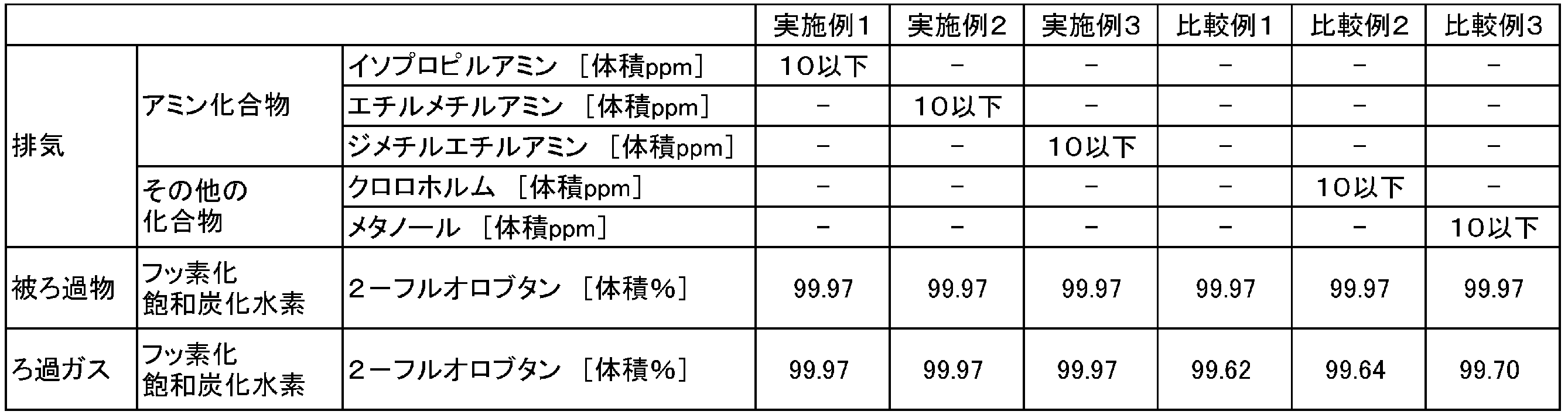
また、本発明によれば、フッ素化飽和炭化水素が分解するのを抑制することが可能なフィルターを備えるドライエッチング用装置、および、フッ素化飽和炭化水素が分解するのを抑制することが可能なフィルターを用いたドライエッチング方法を提供することができる。
Claims (13)
- 被ろ過物と接触する、金属製または金属化合物製の部分と、
前記部分の表面に吸着したアミン化合物と、
を備える、フィルター。 - 前記アミン化合物が前記表面に化学吸着している、請求項1に記載のフィルター。
- 温度20℃、圧力(ゲージ圧)0.1MPaの窒素ガス雰囲気下におけるアミン化合物の脱離量が10体積ppm以下である、請求項1または2に記載のフィルター。
- フィルターエレメントのメッシュサイズが1250メッシュ以上である、請求項1~3の何れかに記載のフィルター。
- 前記アミン化合物が、炭素数が3以上5以下のアミンよりなる、請求項1~4の何れかに記載のフィルター。
- 被ろ過物と接触する部分の少なくとも一部が金属製または金属化合物製であるフィルターの製造方法であって、
前記被ろ過物と接触する、金属製または金属化合物製の部分の表面にアミン化合物を接触させる工程(A)を含む、フィルターの製造方法。 - 前記工程(A)の後に、前記表面に物理吸着したアミン化合物を除去する工程(B)を更に含む、請求項6に記載のフィルターの製造方法。
- 前記工程(B)が、前記表面を減圧雰囲気に曝す操作を含む、請求項7に記載のフィルターの製造方法。
- 前記工程(B)が、前記表面を減圧雰囲気に曝す操作と、前記表面に不活性ガスを接触させる操作とを交互に繰り返すことを含む、請求項7または8に記載のフィルターの製造方法。
- 前記フィルターのフィルターエレメントのメッシュサイズが1250メッシュ以上である、請求項6~9の何れかに記載のフィルターの製造方法。
- 前記アミン化合物が、炭素数が3以上5以下のアミンよりなる、請求項6~10の何れかに記載のフィルターの製造方法。
- フィルターでろ過したドライエッチング用ガスを用いてドライエッチングを行うドライエッチング用装置であって、
前記フィルターが請求項1~5の何れかに記載のフィルターである、ドライエッチング用装置。 - 請求項1~5の何れかに記載のフィルターを用いてろ過したドライエッチング用ガスを用いてドライエッチングを行う、ドライエッチング方法。
Priority Applications (5)
| Application Number | Priority Date | Filing Date | Title |
|---|---|---|---|
| JP2018509001A JPWO2017169809A1 (ja) | 2016-03-30 | 2017-03-15 | フィルターおよびその製造方法、並びに、ドライエッチング用装置およびドライエッチング方法 |
| CN201780016304.9A CN108778451A (zh) | 2016-03-30 | 2017-03-15 | 过滤器及其制造方法以及干蚀刻用装置和干蚀刻方法 |
| EP17774353.1A EP3437709A4 (en) | 2016-03-30 | 2017-03-15 | FILTER, METHOD FOR PRODUCING THE SAME, DRY-ETCHING DEVICE AND DRY-ETCHING METHOD |
| US16/082,618 US20190105588A1 (en) | 2016-03-30 | 2017-03-15 | Filter, method for producing the same, dry etching apparatus, and dry etching method |
| KR1020187026644A KR20180132051A (ko) | 2016-03-30 | 2017-03-15 | 필터 및 그 제조 방법, 그리고, 드라이 에칭용 장치 및 드라이 에칭 방법 |
Applications Claiming Priority (2)
| Application Number | Priority Date | Filing Date | Title |
|---|---|---|---|
| JP2016-068869 | 2016-03-30 | ||
| JP2016068869 | 2016-03-30 |
Publications (1)
| Publication Number | Publication Date |
|---|---|
| WO2017169809A1 true WO2017169809A1 (ja) | 2017-10-05 |
Family
ID=59964321
Family Applications (1)
| Application Number | Title | Priority Date | Filing Date |
|---|---|---|---|
| PCT/JP2017/010525 Ceased WO2017169809A1 (ja) | 2016-03-30 | 2017-03-15 | フィルターおよびその製造方法、並びに、ドライエッチング用装置およびドライエッチング方法 |
Country Status (7)
| Country | Link |
|---|---|
| US (1) | US20190105588A1 (ja) |
| EP (1) | EP3437709A4 (ja) |
| JP (1) | JPWO2017169809A1 (ja) |
| KR (1) | KR20180132051A (ja) |
| CN (1) | CN108778451A (ja) |
| TW (1) | TW201800139A (ja) |
| WO (1) | WO2017169809A1 (ja) |
Cited By (3)
| Publication number | Priority date | Publication date | Assignee | Title |
|---|---|---|---|---|
| WO2022080267A1 (ja) * | 2020-10-15 | 2022-04-21 | 昭和電工株式会社 | エッチングガス、エッチング方法、及び半導体素子の製造方法 |
| JPWO2022080271A1 (ja) * | 2020-10-15 | 2022-04-21 | ||
| WO2022080268A1 (ja) * | 2020-10-15 | 2022-04-21 | 昭和電工株式会社 | エッチングガス、エッチング方法、及び半導体素子の製造方法 |
Citations (4)
| Publication number | Priority date | Publication date | Assignee | Title |
|---|---|---|---|---|
| JPS59137427A (ja) * | 1983-01-27 | 1984-08-07 | Nippei Toyama Corp | 塩素化炭化水素溶剤の処理法 |
| WO1994011329A1 (fr) * | 1992-11-10 | 1994-05-26 | Daikin Industries, Ltd. | Inhibiteur de decomposition d'hydrofluorocarbone et procede |
| JP2001314716A (ja) * | 2000-05-09 | 2001-11-13 | Nippon Seisen Co Ltd | 積層金属濾材とその製造方法、並びに該濾材によるフィルターエレメント |
| WO2014136877A1 (ja) * | 2013-03-07 | 2014-09-12 | 日本ゼオン株式会社 | 高純度2-フルオロブタン |
Family Cites Families (2)
| Publication number | Priority date | Publication date | Assignee | Title |
|---|---|---|---|---|
| CN1301791C (zh) * | 2003-12-31 | 2007-02-28 | 中国石油化工股份有限公司北京燕山分公司研究院 | 用于环氧乙烷生产用银催化剂的载体、其制备方法及其应用 |
| JP4641899B2 (ja) * | 2005-08-23 | 2011-03-02 | 財団法人地球環境産業技術研究機構 | ガス分離膜及びガス分離方法 |
-
2017
- 2017-03-15 EP EP17774353.1A patent/EP3437709A4/en not_active Withdrawn
- 2017-03-15 KR KR1020187026644A patent/KR20180132051A/ko not_active Withdrawn
- 2017-03-15 CN CN201780016304.9A patent/CN108778451A/zh not_active Withdrawn
- 2017-03-15 US US16/082,618 patent/US20190105588A1/en not_active Abandoned
- 2017-03-15 JP JP2018509001A patent/JPWO2017169809A1/ja active Pending
- 2017-03-15 WO PCT/JP2017/010525 patent/WO2017169809A1/ja not_active Ceased
- 2017-03-22 TW TW106109451A patent/TW201800139A/zh unknown
Patent Citations (4)
| Publication number | Priority date | Publication date | Assignee | Title |
|---|---|---|---|---|
| JPS59137427A (ja) * | 1983-01-27 | 1984-08-07 | Nippei Toyama Corp | 塩素化炭化水素溶剤の処理法 |
| WO1994011329A1 (fr) * | 1992-11-10 | 1994-05-26 | Daikin Industries, Ltd. | Inhibiteur de decomposition d'hydrofluorocarbone et procede |
| JP2001314716A (ja) * | 2000-05-09 | 2001-11-13 | Nippon Seisen Co Ltd | 積層金属濾材とその製造方法、並びに該濾材によるフィルターエレメント |
| WO2014136877A1 (ja) * | 2013-03-07 | 2014-09-12 | 日本ゼオン株式会社 | 高純度2-フルオロブタン |
Non-Patent Citations (1)
| Title |
|---|
| See also references of EP3437709A4 * |
Cited By (10)
| Publication number | Priority date | Publication date | Assignee | Title |
|---|---|---|---|---|
| WO2022080267A1 (ja) * | 2020-10-15 | 2022-04-21 | 昭和電工株式会社 | エッチングガス、エッチング方法、及び半導体素子の製造方法 |
| JPWO2022080271A1 (ja) * | 2020-10-15 | 2022-04-21 | ||
| WO2022080271A1 (ja) * | 2020-10-15 | 2022-04-21 | 昭和電工株式会社 | エッチングガス及びその製造方法、並びに、エッチング方法、半導体素子の製造方法 |
| JPWO2022080267A1 (ja) * | 2020-10-15 | 2022-04-21 | ||
| WO2022080268A1 (ja) * | 2020-10-15 | 2022-04-21 | 昭和電工株式会社 | エッチングガス、エッチング方法、及び半導体素子の製造方法 |
| JPWO2022080268A1 (ja) * | 2020-10-15 | 2022-04-21 | ||
| TWI796803B (zh) * | 2020-10-15 | 2023-03-21 | 日商昭和電工股份有限公司 | 蝕刻氣體及其製造方法、以及、蝕刻方法、半導體元件之製造方法 |
| JP7775835B2 (ja) | 2020-10-15 | 2025-11-26 | 株式会社レゾナック | エッチングガス及びその製造方法、並びに、エッチング方法、半導体素子の製造方法 |
| JP7786388B2 (ja) | 2020-10-15 | 2025-12-16 | 株式会社レゾナック | エッチングガス、エッチング方法、及び半導体素子の製造方法 |
| JP7786387B2 (ja) | 2020-10-15 | 2025-12-16 | 株式会社レゾナック | エッチングガス、エッチング方法、及び半導体素子の製造方法 |
Also Published As
| Publication number | Publication date |
|---|---|
| EP3437709A1 (en) | 2019-02-06 |
| US20190105588A1 (en) | 2019-04-11 |
| TW201800139A (zh) | 2018-01-01 |
| JPWO2017169809A1 (ja) | 2019-02-14 |
| KR20180132051A (ko) | 2018-12-11 |
| CN108778451A (zh) | 2018-11-09 |
| EP3437709A4 (en) | 2020-03-04 |
Similar Documents
| Publication | Publication Date | Title |
|---|---|---|
| EP2512637B1 (en) | Mercury removal from cracked gas | |
| JPWO2017169809A1 (ja) | フィルターおよびその製造方法、並びに、ドライエッチング用装置およびドライエッチング方法 | |
| JP2003286013A (ja) | ガス状三フッ化窒素の精製法 | |
| KR102453612B1 (ko) | 히드라진으로부터 수분을 제거하는 방법 및 히드라진 안정화 및 건조 방법 | |
| CN108701611A (zh) | 干蚀刻用组合物及已填充干蚀刻用组合物的容器 | |
| US7384618B2 (en) | Purification of nitrogen trifluoride | |
| JP5916949B2 (ja) | アンモニア、窒素と水素の混合物、または窒素と水素とアンモニアの混合物を精製する方法 | |
| TWI389738B (zh) | Cu-ZSM5沸石成形吸附劑、其活性化方法、溫度變化型吸附裝置以及氣體精製方法 | |
| JPH10265216A (ja) | 三塩化硼素の精製法 | |
| KR101755108B1 (ko) | 삼불화질소 정제 장치 및 이를 이용한 삼불화질소 연속 정제 방법 | |
| JP2018184348A (ja) | 高純度アセチレンガスの製造方法 | |
| JP7069473B2 (ja) | 高純度三塩化ホウ素の製造方法 | |
| JPS61197415A (ja) | ジクロロシランの精製法 | |
| CN105764877B (zh) | 氟化烃化合物的提纯方法 | |
| JP2004307507A (ja) | 活性炭上での吸着によるcf4からc2f6の分離 | |
| JP2019131418A (ja) | 高純度三塩化ホウ素の製造方法 | |
| JP5861491B2 (ja) | トリメチルシランの精製方法 | |
| CN117658167B (zh) | 一种用于吸附纯化电子气体八氟丙烷的季铵盐改性分子筛及其制备方法和应用 | |
| JPS5869715A (ja) | モノシランの精製方法 | |
| KR20180054613A (ko) | 불소화 탄화수소 화합물 충전 완료 가스 충전 용기, 가스 충전 용기의 제조 방법, 및 불소화 탄화수소 화합물의 보존 방법 | |
| JP2003226673A (ja) | トリフルオロメチルハイポフルオライトの精製方法 | |
| JP2018062479A (ja) | モノメチルヒドラジンガスの精製方法 |
Legal Events
| Date | Code | Title | Description |
|---|---|---|---|
| ENP | Entry into the national phase |
Ref document number: 2018509001 Country of ref document: JP Kind code of ref document: A |
|
| ENP | Entry into the national phase |
Ref document number: 20187026644 Country of ref document: KR Kind code of ref document: A |
|
| NENP | Non-entry into the national phase |
Ref country code: DE |
|
| WWE | Wipo information: entry into national phase |
Ref document number: 2017774353 Country of ref document: EP |
|
| ENP | Entry into the national phase |
Ref document number: 2017774353 Country of ref document: EP Effective date: 20181030 |
|
| 121 | Ep: the epo has been informed by wipo that ep was designated in this application |
Ref document number: 17774353 Country of ref document: EP Kind code of ref document: A1 |