WO2017169931A1 - メタクリル系樹脂組成物、及び成形体 - Google Patents
メタクリル系樹脂組成物、及び成形体 Download PDFInfo
- Publication number
- WO2017169931A1 WO2017169931A1 PCT/JP2017/011023 JP2017011023W WO2017169931A1 WO 2017169931 A1 WO2017169931 A1 WO 2017169931A1 JP 2017011023 W JP2017011023 W JP 2017011023W WO 2017169931 A1 WO2017169931 A1 WO 2017169931A1
- Authority
- WO
- WIPO (PCT)
- Prior art keywords
- mass
- methacrylic resin
- resin composition
- methacrylic
- resin
- Prior art date
- Legal status (The legal status is an assumption and is not a legal conclusion. Google has not performed a legal analysis and makes no representation as to the accuracy of the status listed.)
- Ceased
Links
Images


Classifications
-
- C—CHEMISTRY; METALLURGY
- C08—ORGANIC MACROMOLECULAR COMPOUNDS; THEIR PREPARATION OR CHEMICAL WORKING-UP; COMPOSITIONS BASED THEREON
- C08F—MACROMOLECULAR COMPOUNDS OBTAINED BY REACTIONS ONLY INVOLVING CARBON-TO-CARBON UNSATURATED BONDS
- C08F220/00—Copolymers of compounds having one or more unsaturated aliphatic radicals, each having only one carbon-to-carbon double bond, and only one being terminated by only one carboxyl radical or a salt, anhydride ester, amide, imide or nitrile thereof
- C08F220/02—Monocarboxylic acids having less than ten carbon atoms; Derivatives thereof
- C08F220/10—Esters
- C08F220/12—Esters of monohydric alcohols or phenols
- C08F220/16—Esters of monohydric alcohols or phenols of phenols or of alcohols containing two or more carbon atoms
- C08F220/18—Esters of monohydric alcohols or phenols of phenols or of alcohols containing two or more carbon atoms with acrylic or methacrylic acids
-
- B—PERFORMING OPERATIONS; TRANSPORTING
- B29—WORKING OF PLASTICS; WORKING OF SUBSTANCES IN A PLASTIC STATE IN GENERAL
- B29C—SHAPING OR JOINING OF PLASTICS; SHAPING OF MATERIAL IN A PLASTIC STATE, NOT OTHERWISE PROVIDED FOR; AFTER-TREATMENT OF THE SHAPED PRODUCTS, e.g. REPAIRING
- B29C48/00—Extrusion moulding, i.e. expressing the moulding material through a die or nozzle which imparts the desired form; Apparatus therefor
- B29C48/022—Extrusion moulding, i.e. expressing the moulding material through a die or nozzle which imparts the desired form; Apparatus therefor characterised by the choice of material
-
- C—CHEMISTRY; METALLURGY
- C08—ORGANIC MACROMOLECULAR COMPOUNDS; THEIR PREPARATION OR CHEMICAL WORKING-UP; COMPOSITIONS BASED THEREON
- C08F—MACROMOLECULAR COMPOUNDS OBTAINED BY REACTIONS ONLY INVOLVING CARBON-TO-CARBON UNSATURATED BONDS
- C08F136/00—Homopolymers of compounds having one or more unsaturated aliphatic radicals, at least one having two or more carbon-to-carbon double bonds
- C08F136/02—Homopolymers of compounds having one or more unsaturated aliphatic radicals, at least one having two or more carbon-to-carbon double bonds the radical having only two carbon-to-carbon double bonds
- C08F136/04—Homopolymers of compounds having one or more unsaturated aliphatic radicals, at least one having two or more carbon-to-carbon double bonds the radical having only two carbon-to-carbon double bonds conjugated
- C08F136/06—Butadiene
-
- C—CHEMISTRY; METALLURGY
- C08—ORGANIC MACROMOLECULAR COMPOUNDS; THEIR PREPARATION OR CHEMICAL WORKING-UP; COMPOSITIONS BASED THEREON
- C08F—MACROMOLECULAR COMPOUNDS OBTAINED BY REACTIONS ONLY INVOLVING CARBON-TO-CARBON UNSATURATED BONDS
- C08F212/00—Copolymers of compounds having one or more unsaturated aliphatic radicals, each having only one carbon-to-carbon double bond, and at least one being terminated by an aromatic carbocyclic ring
- C08F212/02—Monomers containing only one unsaturated aliphatic radical
- C08F212/04—Monomers containing only one unsaturated aliphatic radical containing one ring
- C08F212/06—Hydrocarbons
- C08F212/08—Styrene
-
- C—CHEMISTRY; METALLURGY
- C08—ORGANIC MACROMOLECULAR COMPOUNDS; THEIR PREPARATION OR CHEMICAL WORKING-UP; COMPOSITIONS BASED THEREON
- C08F—MACROMOLECULAR COMPOUNDS OBTAINED BY REACTIONS ONLY INVOLVING CARBON-TO-CARBON UNSATURATED BONDS
- C08F220/00—Copolymers of compounds having one or more unsaturated aliphatic radicals, each having only one carbon-to-carbon double bond, and only one being terminated by only one carboxyl radical or a salt, anhydride ester, amide, imide or nitrile thereof
- C08F220/02—Monocarboxylic acids having less than ten carbon atoms; Derivatives thereof
- C08F220/10—Esters
- C08F220/12—Esters of monohydric alcohols or phenols
- C08F220/14—Methyl esters, e.g. methyl (meth)acrylate
-
- C—CHEMISTRY; METALLURGY
- C08—ORGANIC MACROMOLECULAR COMPOUNDS; THEIR PREPARATION OR CHEMICAL WORKING-UP; COMPOSITIONS BASED THEREON
- C08F—MACROMOLECULAR COMPOUNDS OBTAINED BY REACTIONS ONLY INVOLVING CARBON-TO-CARBON UNSATURATED BONDS
- C08F220/00—Copolymers of compounds having one or more unsaturated aliphatic radicals, each having only one carbon-to-carbon double bond, and only one being terminated by only one carboxyl radical or a salt, anhydride ester, amide, imide or nitrile thereof
- C08F220/02—Monocarboxylic acids having less than ten carbon atoms; Derivatives thereof
- C08F220/10—Esters
- C08F220/12—Esters of monohydric alcohols or phenols
- C08F220/16—Esters of monohydric alcohols or phenols of phenols or of alcohols containing two or more carbon atoms
- C08F220/18—Esters of monohydric alcohols or phenols of phenols or of alcohols containing two or more carbon atoms with acrylic or methacrylic acids
- C08F220/1804—C4-(meth)acrylate, e.g. butyl (meth)acrylate, isobutyl (meth)acrylate or tert-butyl (meth)acrylate
-
- C—CHEMISTRY; METALLURGY
- C08—ORGANIC MACROMOLECULAR COMPOUNDS; THEIR PREPARATION OR CHEMICAL WORKING-UP; COMPOSITIONS BASED THEREON
- C08F—MACROMOLECULAR COMPOUNDS OBTAINED BY REACTIONS ONLY INVOLVING CARBON-TO-CARBON UNSATURATED BONDS
- C08F220/00—Copolymers of compounds having one or more unsaturated aliphatic radicals, each having only one carbon-to-carbon double bond, and only one being terminated by only one carboxyl radical or a salt, anhydride ester, amide, imide or nitrile thereof
- C08F220/02—Monocarboxylic acids having less than ten carbon atoms; Derivatives thereof
- C08F220/42—Nitriles
-
- C—CHEMISTRY; METALLURGY
- C08—ORGANIC MACROMOLECULAR COMPOUNDS; THEIR PREPARATION OR CHEMICAL WORKING-UP; COMPOSITIONS BASED THEREON
- C08F—MACROMOLECULAR COMPOUNDS OBTAINED BY REACTIONS ONLY INVOLVING CARBON-TO-CARBON UNSATURATED BONDS
- C08F220/00—Copolymers of compounds having one or more unsaturated aliphatic radicals, each having only one carbon-to-carbon double bond, and only one being terminated by only one carboxyl radical or a salt, anhydride ester, amide, imide or nitrile thereof
- C08F220/02—Monocarboxylic acids having less than ten carbon atoms; Derivatives thereof
- C08F220/42—Nitriles
- C08F220/44—Acrylonitrile
-
- C—CHEMISTRY; METALLURGY
- C08—ORGANIC MACROMOLECULAR COMPOUNDS; THEIR PREPARATION OR CHEMICAL WORKING-UP; COMPOSITIONS BASED THEREON
- C08F—MACROMOLECULAR COMPOUNDS OBTAINED BY REACTIONS ONLY INVOLVING CARBON-TO-CARBON UNSATURATED BONDS
- C08F222/00—Copolymers of compounds having one or more unsaturated aliphatic radicals, each having only one carbon-to-carbon double bond, and at least one being terminated by a carboxyl radical and containing at least one other carboxyl radical in the molecule; Salts, anhydrides, esters, amides, imides, or nitriles thereof
- C08F222/36—Amides or imides
- C08F222/40—Imides, e.g. cyclic imides
-
- C—CHEMISTRY; METALLURGY
- C08—ORGANIC MACROMOLECULAR COMPOUNDS; THEIR PREPARATION OR CHEMICAL WORKING-UP; COMPOSITIONS BASED THEREON
- C08J—WORKING-UP; GENERAL PROCESSES OF COMPOUNDING; AFTER-TREATMENT NOT COVERED BY SUBCLASSES C08B, C08C, C08F, C08G or C08H
- C08J5/00—Manufacture of articles or shaped materials containing macromolecular substances
- C08J5/18—Manufacture of films or sheets
-
- C—CHEMISTRY; METALLURGY
- C08—ORGANIC MACROMOLECULAR COMPOUNDS; THEIR PREPARATION OR CHEMICAL WORKING-UP; COMPOSITIONS BASED THEREON
- C08K—Use of inorganic or non-macromolecular organic substances as compounding ingredients
- C08K5/00—Use of organic ingredients
- C08K5/04—Oxygen-containing compounds
- C08K5/13—Phenols; Phenolates
-
- C—CHEMISTRY; METALLURGY
- C08—ORGANIC MACROMOLECULAR COMPOUNDS; THEIR PREPARATION OR CHEMICAL WORKING-UP; COMPOSITIONS BASED THEREON
- C08K—Use of inorganic or non-macromolecular organic substances as compounding ingredients
- C08K5/00—Use of organic ingredients
- C08K5/36—Sulfur-, selenium-, or tellurium-containing compounds
-
- C—CHEMISTRY; METALLURGY
- C08—ORGANIC MACROMOLECULAR COMPOUNDS; THEIR PREPARATION OR CHEMICAL WORKING-UP; COMPOSITIONS BASED THEREON
- C08K—Use of inorganic or non-macromolecular organic substances as compounding ingredients
- C08K5/00—Use of organic ingredients
- C08K5/49—Phosphorus-containing compounds
-
- C—CHEMISTRY; METALLURGY
- C08—ORGANIC MACROMOLECULAR COMPOUNDS; THEIR PREPARATION OR CHEMICAL WORKING-UP; COMPOSITIONS BASED THEREON
- C08L—COMPOSITIONS OF MACROMOLECULAR COMPOUNDS
- C08L33/00—Compositions of homopolymers or copolymers of compounds having one or more unsaturated aliphatic radicals, each having only one carbon-to-carbon double bond, and only one being terminated by only one carboxyl radical, or of salts, anhydrides, esters, amides, imides or nitriles thereof; Compositions of derivatives of such polymers
- C08L33/04—Homopolymers or copolymers of esters
- C08L33/06—Homopolymers or copolymers of esters of esters containing only carbon, hydrogen and oxygen, which oxygen atoms are present only as part of the carboxyl radical
- C08L33/10—Homopolymers or copolymers of methacrylic acid esters
-
- G—PHYSICS
- G02—OPTICS
- G02B—OPTICAL ELEMENTS, SYSTEMS OR APPARATUS
- G02B1/00—Optical elements characterised by the material of which they are made; Optical coatings for optical elements
- G02B1/04—Optical elements characterised by the material of which they are made; Optical coatings for optical elements made of organic materials, e.g. plastics
-
- B—PERFORMING OPERATIONS; TRANSPORTING
- B29—WORKING OF PLASTICS; WORKING OF SUBSTANCES IN A PLASTIC STATE IN GENERAL
- B29K—INDEXING SCHEME ASSOCIATED WITH SUBCLASSES B29B, B29C OR B29D, RELATING TO MOULDING MATERIALS OR TO MATERIALS FOR MOULDS, REINFORCEMENTS, FILLERS OR PREFORMED PARTS, e.g. INSERTS
- B29K2833/00—Use of polymers of unsaturated acids or derivatives thereof as mould material
- B29K2833/04—Polymers of esters
- B29K2833/08—Polymers of acrylic acid esters, e.g. PMA, i.e. polymethylacrylate
-
- B—PERFORMING OPERATIONS; TRANSPORTING
- B29—WORKING OF PLASTICS; WORKING OF SUBSTANCES IN A PLASTIC STATE IN GENERAL
- B29K—INDEXING SCHEME ASSOCIATED WITH SUBCLASSES B29B, B29C OR B29D, RELATING TO MOULDING MATERIALS OR TO MATERIALS FOR MOULDS, REINFORCEMENTS, FILLERS OR PREFORMED PARTS, e.g. INSERTS
- B29K2833/00—Use of polymers of unsaturated acids or derivatives thereof as mould material
- B29K2833/04—Polymers of esters
- B29K2833/12—Polymers of methacrylic acid esters, e.g. PMMA, i.e. polymethylmethacrylate
-
- C—CHEMISTRY; METALLURGY
- C08—ORGANIC MACROMOLECULAR COMPOUNDS; THEIR PREPARATION OR CHEMICAL WORKING-UP; COMPOSITIONS BASED THEREON
- C08F—MACROMOLECULAR COMPOUNDS OBTAINED BY REACTIONS ONLY INVOLVING CARBON-TO-CARBON UNSATURATED BONDS
- C08F222/00—Copolymers of compounds having one or more unsaturated aliphatic radicals, each having only one carbon-to-carbon double bond, and at least one being terminated by a carboxyl radical and containing at least one other carboxyl radical in the molecule; Salts, anhydrides, esters, amides, imides, or nitriles thereof
- C08F222/36—Amides or imides
- C08F222/40—Imides, e.g. cyclic imides
- C08F222/402—Alkyl substituted imides
-
- C—CHEMISTRY; METALLURGY
- C08—ORGANIC MACROMOLECULAR COMPOUNDS; THEIR PREPARATION OR CHEMICAL WORKING-UP; COMPOSITIONS BASED THEREON
- C08F—MACROMOLECULAR COMPOUNDS OBTAINED BY REACTIONS ONLY INVOLVING CARBON-TO-CARBON UNSATURATED BONDS
- C08F2500/00—Characteristics or properties of obtained polyolefins; Use thereof
- C08F2500/01—High molecular weight, e.g. >800,000 Da.
-
- C—CHEMISTRY; METALLURGY
- C08—ORGANIC MACROMOLECULAR COMPOUNDS; THEIR PREPARATION OR CHEMICAL WORKING-UP; COMPOSITIONS BASED THEREON
- C08F—MACROMOLECULAR COMPOUNDS OBTAINED BY REACTIONS ONLY INVOLVING CARBON-TO-CARBON UNSATURATED BONDS
- C08F2500/00—Characteristics or properties of obtained polyolefins; Use thereof
- C08F2500/03—Narrow molecular weight distribution, i.e. Mw/Mn < 3
-
- C—CHEMISTRY; METALLURGY
- C08—ORGANIC MACROMOLECULAR COMPOUNDS; THEIR PREPARATION OR CHEMICAL WORKING-UP; COMPOSITIONS BASED THEREON
- C08J—WORKING-UP; GENERAL PROCESSES OF COMPOUNDING; AFTER-TREATMENT NOT COVERED BY SUBCLASSES C08B, C08C, C08F, C08G or C08H
- C08J2333/00—Characterised by the use of homopolymers or copolymers of compounds having one or more unsaturated aliphatic radicals, each having only one carbon-to-carbon double bond, and only one being terminated by only one carboxyl radical, or of salts, anhydrides, esters, amides, imides, or nitriles thereof; Derivatives of such polymers
- C08J2333/04—Characterised by the use of homopolymers or copolymers of compounds having one or more unsaturated aliphatic radicals, each having only one carbon-to-carbon double bond, and only one being terminated by only one carboxyl radical, or of salts, anhydrides, esters, amides, imides, or nitriles thereof; Derivatives of such polymers esters
- C08J2333/06—Characterised by the use of homopolymers or copolymers of compounds having one or more unsaturated aliphatic radicals, each having only one carbon-to-carbon double bond, and only one being terminated by only one carboxyl radical, or of salts, anhydrides, esters, amides, imides, or nitriles thereof; Derivatives of such polymers esters of esters containing only carbon, hydrogen, and oxygen, the oxygen atom being present only as part of the carboxyl radical
- C08J2333/08—Homopolymers or copolymers of acrylic acid esters
-
- C—CHEMISTRY; METALLURGY
- C08—ORGANIC MACROMOLECULAR COMPOUNDS; THEIR PREPARATION OR CHEMICAL WORKING-UP; COMPOSITIONS BASED THEREON
- C08J—WORKING-UP; GENERAL PROCESSES OF COMPOUNDING; AFTER-TREATMENT NOT COVERED BY SUBCLASSES C08B, C08C, C08F, C08G or C08H
- C08J2333/00—Characterised by the use of homopolymers or copolymers of compounds having one or more unsaturated aliphatic radicals, each having only one carbon-to-carbon double bond, and only one being terminated by only one carboxyl radical, or of salts, anhydrides, esters, amides, imides, or nitriles thereof; Derivatives of such polymers
- C08J2333/04—Characterised by the use of homopolymers or copolymers of compounds having one or more unsaturated aliphatic radicals, each having only one carbon-to-carbon double bond, and only one being terminated by only one carboxyl radical, or of salts, anhydrides, esters, amides, imides, or nitriles thereof; Derivatives of such polymers esters
- C08J2333/06—Characterised by the use of homopolymers or copolymers of compounds having one or more unsaturated aliphatic radicals, each having only one carbon-to-carbon double bond, and only one being terminated by only one carboxyl radical, or of salts, anhydrides, esters, amides, imides, or nitriles thereof; Derivatives of such polymers esters of esters containing only carbon, hydrogen, and oxygen, the oxygen atom being present only as part of the carboxyl radical
- C08J2333/10—Homopolymers or copolymers of methacrylic acid esters
-
- C—CHEMISTRY; METALLURGY
- C08—ORGANIC MACROMOLECULAR COMPOUNDS; THEIR PREPARATION OR CHEMICAL WORKING-UP; COMPOSITIONS BASED THEREON
- C08J—WORKING-UP; GENERAL PROCESSES OF COMPOUNDING; AFTER-TREATMENT NOT COVERED BY SUBCLASSES C08B, C08C, C08F, C08G or C08H
- C08J2333/00—Characterised by the use of homopolymers or copolymers of compounds having one or more unsaturated aliphatic radicals, each having only one carbon-to-carbon double bond, and only one being terminated by only one carboxyl radical, or of salts, anhydrides, esters, amides, imides, or nitriles thereof; Derivatives of such polymers
- C08J2333/04—Characterised by the use of homopolymers or copolymers of compounds having one or more unsaturated aliphatic radicals, each having only one carbon-to-carbon double bond, and only one being terminated by only one carboxyl radical, or of salts, anhydrides, esters, amides, imides, or nitriles thereof; Derivatives of such polymers esters
- C08J2333/06—Characterised by the use of homopolymers or copolymers of compounds having one or more unsaturated aliphatic radicals, each having only one carbon-to-carbon double bond, and only one being terminated by only one carboxyl radical, or of salts, anhydrides, esters, amides, imides, or nitriles thereof; Derivatives of such polymers esters of esters containing only carbon, hydrogen, and oxygen, the oxygen atom being present only as part of the carboxyl radical
- C08J2333/10—Homopolymers or copolymers of methacrylic acid esters
- C08J2333/12—Homopolymers or copolymers of methyl methacrylate
-
- C—CHEMISTRY; METALLURGY
- C08—ORGANIC MACROMOLECULAR COMPOUNDS; THEIR PREPARATION OR CHEMICAL WORKING-UP; COMPOSITIONS BASED THEREON
- C08K—Use of inorganic or non-macromolecular organic substances as compounding ingredients
- C08K5/00—Use of organic ingredients
- C08K5/0008—Organic ingredients according to more than one of the "one dot" groups of C08K5/01 - C08K5/59
- C08K5/0025—Crosslinking or vulcanising agents; including accelerators
-
- C—CHEMISTRY; METALLURGY
- C08—ORGANIC MACROMOLECULAR COMPOUNDS; THEIR PREPARATION OR CHEMICAL WORKING-UP; COMPOSITIONS BASED THEREON
- C08K—Use of inorganic or non-macromolecular organic substances as compounding ingredients
- C08K5/00—Use of organic ingredients
- C08K5/0008—Organic ingredients according to more than one of the "one dot" groups of C08K5/01 - C08K5/59
- C08K5/005—Stabilisers against oxidation, heat, light, ozone
Definitions
- the present invention relates to an improved methacrylic resin composition and a molded body containing the same.
- acrylic resins ((meth) acrylic acid ester polymers) have attracted attention from the viewpoints of transparency, surface hardness, optical properties, and the like.
- acrylic resins in particular, glutaric anhydride (for example, see Patent Document 1), maleic anhydride (for example, see Patent Document 2), and the like are copolymerized with a (meth) acrylic acid ester monomer.
- glutaric anhydride for example, see Patent Document 1
- maleic anhydride for example, see Patent Document 2
- acrylic resins having improved heat resistance are excellent as optical materials.
- acrylic resins with improved heat resistance as described above are more thermally decomposed at high temperature molding than general-purpose acrylic resins, that is, copolymers of methyl methacrylate and acrylate esters.
- general-purpose acrylic resins that is, copolymers of methyl methacrylate and acrylate esters.
- it is easy.
- the molding time at high temperatures and the residence time at high temperatures become longer, so that foaming may occur during the molding process.
- the heat-resistant acrylic resin has low strength and low toughness, it has a problem that it is inferior in productivity due to film forming processability and handling properties.
- JP 2006-241197 A Japanese Patent Laid-Open No. 03-023404 JP 2000-178399 A JP 05-119217 A JP 2010-126550 A JP 2014-098117 A
- the acrylic resins disclosed in Patent Documents 1 and 2 are insufficient in heat and moisture resistance and thermal stability, and the acrylic resin composition disclosed in Patent Documents 3 and 4 above. Has problems that heat resistance is lowered by the addition of a rubber component, thermal stability is further deteriorated, and foaming and foreign matters are easily generated.
- the acrylic resins or acrylic resin compositions disclosed in the cited documents 1 to 4 are particularly excellent in the acrylic resins inherently exhibiting thermal deterioration, resin decomposition, generation of foreign matters, etc. during film formation. There is a problem that the optical characteristics cannot be sufficiently exhibited.
- Patent Document 5 it is possible to impart excellent mechanical strength and molding stability while adding a certain level of heat resistance by adding a heat stabilizer. Yes.
- the color tone tends to deteriorate due to the addition of the heat stabilizer, and there is a possibility that the heat stabilizer may bleed out during the molding process, which may cause molding defects.
- heat-resistant acrylic resins have poor fluidity, and it is necessary to increase the melting temperature when producing thinner films. Under such circumstances, higher molding stability is required for the heat-resistant acrylic resin.
- a methacrylic resin composition having practically sufficient optical characteristics and excellent in heat resistance, thermal stability, appearance, and moldability, It aims at providing the compact
- the present invention is as follows.
- the weight average molecular weight measured by gel permeation chromatography (GPC) is 650,000 to 300,000.
- the weight average molecular weight residual rate when heated at 280 ° C. for 1 hour in a nitrogen atmosphere is 80% or more, and the weight average molecular weight residual rate when heated at 280 ° C. in air for 0.5 hour is 80% or higher.
- a methacrylic resin composition characterized by that. [2] Filled in a melt indexer specified in JIS K 7210, held in a cylinder at 270 ° C. for 10 minutes, and then applied a methacrylic resin composition from the upper benchmark line to the lower benchmark line at a load of 2.16 kg in a strand form
- the structural unit (B) is a maleimide structural unit (B-1), a glutaric anhydride structural unit (B-2), a glutarimide structural unit (B-3), or a lactone ring structural unit (B-).
- the monomer unit (C) is an aromatic vinyl monomer unit (C-1), an acrylate monomer unit (C-2), or a vinyl cyanide monomer unit (C-3).
- [11] [1] A molded product comprising the methacrylic resin composition according to any one of [10]. [12] The molded article according to [11], which is an optical component. [13] The molded article according to [11], which is an optical film. [14] The optical film according to [13], which has a thickness of 0.01 to 1 mm. [15] The molded article according to [11], which is a vehicle member. [16] The vehicle member according to [15], wherein the thickness is 0.03 to 3 mm.
- a methacrylic resin composition having practically sufficient optical properties, excellent heat resistance, thermal stability, appearance, and molding processability, and a molded body including the same. it can.
- this embodiment the structural unit constituting the polymer constituting the methacrylic resin contained in the methacrylic resin composition of the present embodiment is referred to as “ ⁇ monomer unit” and / or a plurality of “ ⁇ single units”. It is called “ ⁇ structural unit” including “mer unit”.
- the constituent material of the “ ⁇ monomer unit” may be simply referred to as “ ⁇ monomer” without the “unit”.
- the methacrylic resin used in the methacrylic resin composition of the present embodiment is Methacrylic acid ester monomer unit (A): 50 to 97% by mass, Structural unit having a ring structure in the main chain (B): 3 to 30% by mass, other copolymerizable with methacrylic acid ester monomer
- the weight average molecular weight measured by gel permeation chromatography (GPC) is 650,000 to 300,000.
- the methacrylic resin preferably further satisfies the following condition (2).
- the content of the (B) structural unit is 45 to 100% by mass, where the total amount of the (B) structural unit and the (C) monomer unit is 100% by mass.
- (A) monomer unit As the methacrylic acid ester monomer unit (A) constituting the methacrylic resin (hereinafter sometimes referred to as (A) monomer unit), a monomer represented by the following general formula (1) Units are preferably used.
- R 1 represents a substituted or unsubstituted alkyl group having 1 to 6 carbon atoms, and the alkyl group may be substituted with, for example, a hydroxyl group.
- R 1 is preferably a methyl group.
- R 2 represents a group having 1 to 12 carbon atoms, preferably a hydrocarbon group having 1 to 12 carbon atoms, and the hydrocarbon group may be substituted with, for example, a hydroxyl group.
- R 2 is preferably a group having 1 to 8 carbon atoms.
- R 1 represents a substituted or unsubstituted alkyl group having 1 to 6 carbon atoms, and the alkyl group may be substituted with, for example, a hydroxyl group.
- R 1 is preferably a methyl group.
- R 2 represents a group having 1 to 12 carbon atoms, preferably a hydrocarbon group having 1 to 12 carbon atoms, and the hydrocarbon group may be substituted with, for example, a hydroxyl group.
- R 2 is preferably a group having 1 to 8 carbon atoms.
- Such monomers include butyl methacrylate, ethyl methacrylate, methyl methacrylate, propyl methacrylate, isopropyl methacrylate, cyclohexyl methacrylate, phenyl methacrylate, methacrylic acid (2-ethylhexyl), methacrylic acid (t -Butylcyclohexyl), benzyl methacrylate, methacrylic acid (2,2,2-trifluoroethyl), and the like.
- methyl methacrylate, ethyl methacrylate, cyclohexyl methacrylate , Phenyl methacrylate and benzyl methacrylate are preferred, and methyl methacrylate is preferred from the viewpoint of availability.
- the said methacrylic acid ester monomer may be used individually by 1 type, and may use 2 or more types together.
- the methacrylic acid ester monomer unit (A) of the methacrylic resin is composed of the methacrylic resin composition of the present embodiment and the molded product of the present embodiment by a structural unit (B) having a ring structure in the main chain described later. From the viewpoint of sufficiently imparting heat resistance to the methacrylic resin, it is contained in the methacrylic resin in an amount of 50 to 97% by mass, preferably 55 to 96.5% by mass, more preferably 55 to 95% by mass, and further preferably 60 to It is contained at 93% by mass, and more preferably 60-90% by mass.
- the structural unit (B) having a ring structure in the main chain (hereinafter sometimes referred to as (B) structural unit) constituting the methacrylic resin is a maleimide structural unit (B -1), at least one structural unit selected from the group consisting of a glutaric anhydride structural unit (B-2), a glutarimide structural unit (B-3), and a lactone ring structural unit (B-4) It is preferable to include.
- As the structural unit (B) having a ring structure in the main chain only one type may be used alone, or two or more types may be combined.
- maleimide structural unit (B-1) As the maleimide structural unit (B-1) constituting the methacrylic resin, a structural unit represented by the following general formula (3) is preferably used.
- R 1 is a hydrogen atom, an alkyl group having 1 to 12 carbon atoms, a cycloalkyl group having 1 to 12 carbon atoms, an alkoxy group having 1 to 12 carbon atoms, and a carbon number. It represents one selected from the group consisting of 6 to 12 aryl groups, and the alkyl group, alkoxy group, cycloalkyl group and aryl group may have a substituent on the carbon atom.
- the monomer for forming the maleimide-based structural unit (B-1) is not particularly limited, and examples thereof include maleimide; N-methylmaleimide, N-ethylmaleimide, N-cyclohexylmaleimide, and the like.
- N-phenylmaleimide N-methylphenylmaleimide, N-ethylphenylmaleimide, N-butylphenylmaleimide, N-dimethylphenylmaleimide, N-hydroxyphenylmaleimide, N-methoxyphenylmaleimide, N- ( N-aryl group-substituted maleimides such as o-chlorophenyl) maleimide, N- (m-chlorophenyl) maleimide, N- (p-chlorophenyl) maleimide and the like.
- the above monomers are preferably N-cyclohexylmaleimide, N-phenylmaleimide, N-methylphenylmaleimide, N- (o-chlorophenyl) maleimide, N- (m-chlorophenyl) from the viewpoint of imparting heat resistance and heat and heat resistance.
- Maleimide and N- (p-chlorophenyl) maleimide From the viewpoint of easy availability and imparting heat resistance, more preferred are N-cyclohexylmaleimide and N-phenylmaleimide, and more preferred is N-phenyl.
- Maleimide is mentioned.
- the maleimide-based structural unit (B-1) described above may be used alone or in combination of two or more.
- the glutaric anhydride structural unit (B-2) constituting the methacrylic resin may be formed after resin polymerization.
- B-2 As the structural unit, a structural unit represented by the following general formula (4) is preferably used.
- R 1 and R 2 each independently represent a hydrogen atom or a substituted or unsubstituted alkyl group having 1 to 6 carbon atoms, and the alkyl group is, for example, a hydroxyl group May be substituted.
- the glutaric anhydride-based structural unit (B-2) described above only one kind may be used alone, or two or more kinds may be used in combination.
- the method for forming the glutaric anhydride structural unit (B-2) is not particularly limited.
- the monomer having the structure represented by the following general formula (5) is converted into the above-mentioned methacrylic acid ester monomer unit.
- Examples thereof include a method of copolymerization with the monomer constituting (A) and then cyclization by heat treatment in the presence / absence of a catalyst.
- R 1 represents a hydrogen atom, a substituted or unsubstituted alkyl group having 1 to 6 carbon atoms, and the alkyl group may be substituted with, for example, a hydroxyl group.
- R 2 represents a hydrogen atom or t-butyl.
- the monomer having the structure represented by the general formula (5) may remain unreacted in the methacrylic resin as long as the effect of the present invention can be exhibited.
- the glutarimide structural unit (B-3) constituting the methacrylic resin may be formed after resin polymerization.
- B-3) As the structural unit, a structural unit represented by the following general formula (6) is preferably used.
- R 1 and R 2 each independently represent a hydrogen atom or a substituted or unsubstituted alkyl group having 1 to 6 carbon atoms.
- the alkyl group is, for example, a hydroxyl group. May be substituted.
- R 3 represents any one selected from the group consisting of a hydrogen atom, a substituted or unsubstituted alkyl group having 1 to 6 carbon atoms, and a substituted or unsubstituted aryl group having 6 to 18 carbon atoms. .
- R 1 , R 2 and R 3 are all methyl groups.
- the glutarimide-based structural unit (B-3) described above only one type may be used alone, or two or more types may be used in combination.
- the content of the glutarimide-based structural unit (B-3) is not particularly limited, and can be appropriately determined in consideration of heat resistance, molding processability, optical characteristics, and the like.
- the content of the glutarimide-based structural unit (B-3) is preferably 1 to 60% by mass, more preferably 3 to 50% by mass, particularly preferably 3 based on 100% by mass of the methacrylic resin. To 25% by mass.
- the content of the glutarimide-based structural unit (B-3) can be calculated by, for example, the method described in [0136] to [0137] of International Publication No. 2015/098096.
- the acid value of the resin containing the glutarimide-based structural unit (B-3) is preferably 0.50 mmol / g or less, more preferably 0 in consideration of the balance of the physical properties, molding processability, color tone, etc. of the resin. .45 mmol / g or less.
- the acid value can be calculated by, for example, a titration method described in JP-A-2005-23272.
- the glutarimide-based structural unit (B-3) is obtained by copolymerizing methacrylic acid ester and / or methacrylic acid and then reacting ammonia or amine with urea or unsubstituted urea under high temperature. It can be obtained by a known method such as a method of reacting acid-styrene copolymer or methyl methacrylate-styrene copolymer with ammonia or amine, or a method of reacting polymethacrylic anhydride with ammonia or amine. Specific examples include the method described in U.S. Pat. No. 4,246,374 of RM Kopchik.
- an acid anhydride such as maleic anhydride, a half ester of the acid anhydride and a linear or branched alcohol having 1 to 20 carbon atoms
- an ⁇ , ⁇ -ethylenically unsaturated carboxylic acid an ⁇ , ⁇ -ethylenically unsaturated carboxylic acid.
- the glutarimide-based structural unit (B-3) can be formed.
- (meth) acrylic acid ester and, if necessary, an aromatic vinyl monomer or other vinyl monomer are polymerized, and then an imidization reaction is performed, so that the above glutar A method for obtaining a resin containing an imide-based structural unit (B-3) is also included.
- an imidizing agent may be used, and a ring closure accelerator may be added as necessary.
- ammonia or a primary amine can be used as the imidizing agent.
- the primary amine methylamine, ethylamine, n-propylamine, cyclohexylamine and the like can be suitably used.
- the method for carrying out the imidization reaction is not particularly limited, and a conventionally known method can be used. Examples thereof include a method using an extruder, a horizontal biaxial reaction apparatus, and a batch reaction tank. It does not specifically limit as an extruder, A single screw extruder, a twin screw extruder, or a multi-screw extruder can be used suitably. More preferably, a tandem reaction extruder in which two twin-screw extruders are arranged in series can be used. Moreover, in manufacturing the said resin, in addition to the process of imidation reaction, the esterification process processed with an esterifying agent can be included.
- esterification step a carboxyl group contained in the resin, which is a by-product during the imidization step, can be converted to an ester group, and the acid value of the resin can be adjusted to a desired range.
- the esterifying agent is not particularly limited as long as the effect of the present application can be exhibited, but dimethyl carbonate and trimethyl acetate can be preferably used.
- the amount of the esterifying agent used is not particularly limited, but is preferably 0 to 12 parts by mass with respect to 100 parts by mass of the resin.
- an aliphatic tertiary amine such as trimethylamine, triethylamine, or tributylamine can be used in combination as a catalyst.
- lactone ring structural unit (B-4) The lactone ring structural unit (B-4) constituting the methacrylic resin may be formed after resin polymerization.
- a structural unit represented by the following general formula (7) is preferably used as the structural unit (B-4).
- R 1 , R 2 , and R 3 each independently represent a hydrogen atom or an organic group having 1 to 20 carbon atoms. Note that the organic group may contain an oxygen atom.
- the lactone ring structural unit (B-4) described above may be used alone or in combination of two or more.
- the method for forming the polymer containing the lactone ring structural unit (B-4) is not particularly limited, but a monomer having a hydroxyl group in the side chain, for example, a monomer having the structure represented by the following general formula (8) After copolymerizing a monomer having a polymer (2- (hydroxymethyl) methyl acrylate, etc.) and a monomer having an ester group such as the above-mentioned methacrylic acid ester monomer (A), a copolymer obtained And a method of producing a polymer by introducing a lactone ring structure into the polymer by heat treatment in the presence / absence of a predetermined catalyst.
- R 1 represents a hydrogen atom or a substituted or unsubstituted alkyl group having 1 to 6 carbon atoms, and the alkyl group may be substituted with, for example, a hydroxyl group.
- R 2 represents a group having 1 to 12 carbon atoms, preferably a hydrocarbon group having 1 to 12 carbon atoms, and the hydrocarbon group may be substituted with, for example, a hydroxyl group.
- R 1 is a hydrogen atom and R 2 is a methyl group.
- the monomer having the structure represented by the general formula (8) may remain unreacted in the methacrylic resin as long as the effect of the present invention can be exhibited.
- the structural units (B) contained in the methacrylic resins described so far are derived from maleimide structural units (B-1) and glutarimide structural units (B-3) from the viewpoints of thermal stability and moldability.
- it contains at least one structural unit selected from the group consisting of maleimide structural units (B-1).
- maleimide-based structural units (B-1) in view of easy availability, N-cyclohexylmaleimide-based structural units and / or N-aryl-substituted maleimide-based structural units are preferable.
- an N-aryl-substituted maleimide-based structural unit is more preferable, and an N-phenylmaleimide-based structural unit is more preferable.
- the structural unit (B) having a ring structure in the main chain is contained in the methacrylic resin in an amount of 3 to 30% by mass from the viewpoint of heat resistance, thermal stability, strength and fluidity of the methacrylic resin composition of the present embodiment. It is.
- the content of the structural unit (B) having a ring structure in the main chain in the methacrylic resin is preferably 5% by mass or more from the viewpoint of imparting heat resistance and thermal stability of the methacrylic resin composition of the present embodiment. More preferably, it is 7 mass% or more, More preferably, it is 8 mass% or more, Most preferably, it is 10 mass% or more.
- the content of the structural unit (B) having a cyclic structure in the main chain in the methacrylic resin is preferably 28 masses. % Or less, more preferably 25% by mass or less, further preferably 22% by mass or less, further preferably 20% by mass or less, still more preferably 18% by mass or less, and particularly preferably less than 15% by mass.
- (C) monomer units that can be copolymerized with methacrylic acid ester monomers, constituting the methacrylic resin.
- other vinyl monomer units (C) copolymerizable with the methacrylic acid ester monomer only one kind may be used alone, or two or more kinds may be combined.
- the monomer unit (C) can be appropriately selected depending on the properties required for the methacrylic resin, but particularly needs properties such as thermal stability, fluidity, mechanical properties, and chemical resistance.
- the aromatic vinyl monomer unit (C-1), the acrylate monomer unit (C-2), and the vinyl cyanide monomer unit (C-3) are selected. At least one of the above is preferred.
- the monomer unit (C) As the monomer unit (C), a resin excellent in fluidity is obtained, and from the viewpoint of reducing the content of unreacted monomer contained in the methacrylic resin, an aromatic vinyl-based unit is used.
- the monomer unit (C-1) is preferred.
- the monomer constituting the aromatic vinyl monomer unit (C-1) constituting the methacrylic resin is not particularly limited, but is an aromatic vinyl represented by the following general formula (9). System monomers are preferred.
- R 1 represents a hydrogen atom or an alkyl group having 1 to 6 carbon atoms, and the alkyl group may be substituted with, for example, a hydroxyl group.
- R 2 is a group consisting of a hydrogen atom, an alkyl group having 1 to 12 carbon atoms, an alkoxy group having 1 to 12 carbon atoms, an aryl group having 6 to 8 carbon atoms, and an aryloxy group having 6 to 8 carbon atoms.
- R 2 may be either the same group or different groups. Further, R 2 may form a ring structure.
- n represents an integer of 0 to 5.
- Specific examples of the monomer represented by the general formula (9) are not particularly limited, but styrene, o-methylstyrene, m-methylstyrene, p-methylstyrene, 2,4-dimethyl. Styrene, 2,5-dimethylstyrene, 3,4-dimethylstyrene, 3,5-dimethylstyrene, p-ethylstyrene, m-ethylstyrene, Occasionally-ethylstyrene, p-tert-butylstyrene, 1-vinylnaphthalene, 2-vinylnaphthalene, 1,1-diphenylethylene, isopropenyl benzene ( ⁇ -methylstyrene), isopropenyl toluene, isopropenyl ethyl benzene, isopropenyl propyl benzene, isopropenyl
- styrene and isopropenylbenzene are mentioned.
- styrene and isopropenylbenzene are preferable, and styrene is more preferable from the viewpoint of imparting fluidity and reducing unreacted monomers by improving the polymerization conversion rate.
- These may be appropriately selected according to required characteristics in the methacrylic resin composition of the present embodiment.
- the content is (A) monomer unit and (B) considering the balance of heat resistance, reduction of residual monomer species, and fluidity.
- the total amount with the structural unit is 100% by mass, it is preferably 23% by mass or less, more preferably 20% by mass or less, further preferably 18% by mass or less, still more preferably 15% by mass or less, More preferably, it is 10 mass% or less.
- the unit content ratio (mass ratio) (that is, (C-1) content / (B-1) content) includes the processing fluidity when the molded body (particularly a film) is molded, From the viewpoint of silver streak reduction effect due to monomer reduction, it is preferably 0.3 to 5.
- the upper limit value is preferably 5, more preferably 3, and even more preferably 1.
- the lower limit is preferably 0.3, more preferably 0.4.
- the aromatic vinyl monomer (C-1) described above may be used alone or in combination of two or more.
- an acrylate monomer unit (C-2) is preferable from the viewpoint of obtaining a resin having excellent weather resistance, fluidity, and thermal stability.
- the monomer constituting the acrylate monomer unit (C-2) constituting the methacrylic resin is not particularly limited, but is an acrylate ester unit represented by the following general formula (10). A monomer is preferred.
- R 1 represents a hydrogen atom or an alkoxy group having 1 to 12 carbon atoms
- R 2 represents an alkyl group having 1 to 18 carbon atoms or a cycloalkyl having 1 to 18 carbon atoms.
- the weather resistance, heat resistance, fluidity, and thermal stability of the methacrylic resin for molded articles of this embodiment are shown. From the viewpoint of enhancing, methyl acrylate, ethyl acrylate, n-propyl acrylate, n-butyl acrylate, sec-butyl acrylate, 2-ethylhexyl acrylate, cyclohexyl acrylate, phenyl acrylate, and the like are more preferable. Methyl acrylate, ethyl acrylate, and n-butyl acrylate, and methyl acrylate and ethyl acrylate are more preferable from the viewpoint of availability. As the acrylate monomer unit (C-2), only one type may be used alone, or two or more types may be used in combination.
- the total amount of (A) monomer unit and (B) structural unit is 100 from the viewpoint of heat resistance and thermal stability.
- mass% it is preferably 5 mass% or less, more preferably 3 mass% or less.
- the (C) monomer unit is preferably a vinyl cyanide monomer unit (C-3) from the viewpoint of being easily available and obtaining a resin having further excellent chemical resistance.
- the monomer forming the vinyl cyanide monomer unit (C-3) constituting the methacrylic resin is not particularly limited, and examples thereof include acrylonitrile, methacrylonitrile, vinylidene cyanide and the like. Among them, acrylonitrile is preferable from the viewpoint of easy availability and imparting chemical resistance.
- the vinyl cyanide monomer unit (C-3) may be used alone or in combination of two or more.
- the content when the vinyl cyanide monomer unit (C-3) is used is the total amount of (A) monomer unit and (B) structural unit from the viewpoint of solvent resistance and heat resistance. Is preferably 15% by mass or less, more preferably 12% by mass or less, and still more preferably 10% by mass or less.
- the monomer constituting the monomer unit (C-4) other than (C-1) to (C-3) constituting the methacrylic resin is not particularly limited, and examples thereof include acrylamide, Amides such as methacrylamide; ethylene glycol such as ethylene glycol di (meth) acrylate, diethylene glycol di (meth) acrylate, triethylene glycol di (meth) acrylate, tetraethylene glycol di (meth) acrylate, etc.
- Esterified with acrylic acid or methacrylic acid a hydroxyl group of two alcohols such as neopentyl glycol di (meth) acrylate and di (meth) acrylate esterified with acrylic acid or methacrylic acid; trimethylolpropane; Multivalent polymers such as pentaerythritol Call derivative those that have been esterified with acrylic acid or methacrylic acid; polyfunctional monomers such as divinylbenzene.
- At least one selected from the group consisting of methyl acrylate, ethyl acrylate, styrene, and acrylonitrile is preferable from the viewpoint of availability. .
- the content of the other vinyl monomer unit (C) copolymerizable with the methacrylic acid ester monomer is 100% by mass of the methacrylic resin from the viewpoint of enhancing the effect of imparting heat resistance by the structural unit (B). Is 0 to 20% by mass, preferably 0 to 18% by mass, and more preferably 0 to 15% by mass.
- the content of the monomer unit (C) is the fluidity of the polymer. In view of the above, it is preferably 0.5% by mass or less, more preferably 0.3% by mass or less, and still more preferably 0.2% by mass or less.
- the content of (B) structural unit is: It is preferably 45 to 100% by mass.
- the content of the structural unit (C) is preferably 0 to 55% by mass.
- the content of the structural unit (B) is preferably 50 to 100% by mass, more preferably 50 to 90% by mass, and further preferably 50 to 80% by mass.
- methacrylic resin The characteristics of methacrylic resin are described below.
- the weight-average molecular weight (Mw) of the methacrylic resin is 650,000 to 300,000 from the viewpoint of obtaining a methacrylic resin having further excellent mechanical strength, solvent resistance and fluidity.
- Mw weight-average molecular weight
- the weight average molecular weight is preferably 65,000 or more, more preferably 70,000 or more, still more preferably 80,000 or more, and still more preferably 100,000 or more, from the viewpoint of maintaining mechanical strength.
- the weight average molecular weight is preferably 250,000 or less, more preferably 230,000 or less, still more preferably 220,000 or less, even more preferably 200,000 or less, particularly from the viewpoint of securing fluidity at the time of molding. Preferably it is 180,000 or less, Most preferably, it is 170,000 or less.
- the molecular weight distribution (weight average molecular weight (Mw) / number average molecular weight (Mn)) of the methacrylic resin is preferably 1.5 to 5 in consideration of the balance between fluidity, mechanical strength, and solvent resistance. . More preferably, it is 1.5 to 4.5, still more preferably 1.6 to 4, still more preferably 1.6 to 3, and still more preferably 1.6 to 2.5.
- a weight average molecular weight (Mw) and a number average molecular weight (Mn) it can measure with a gel permeation chromatography (GPC). Specifically, the elution time and the weight average using a standard methacrylic resin, which is known as a reagent with known monodispersed weight average molecular weight, number average molecular weight and peak molecular weight, and an analytical gel column which elutes a high molecular weight component first. Create a calibration curve from the molecular weight. Next, from the obtained calibration curve, the weight average molecular weight and the number average molecular weight of the sample of the methacrylic resin to be measured can be obtained. Specifically, it can measure by the method as described in the Example mentioned later.
- GPC gel permeation chromatography
- the content of a component having a weight average molecular weight of 10,000 or less improves processing fluidity, and a silver-like mark called silver streak during molding.
- the content is preferably 0.1 to 5.0% by mass.
- the processing fluidity can be improved.
- the lower limit is preferably 0.2% by mass, more preferably 0.5% by mass, and still more preferably 0.6% by mass.
- the upper limit value is more preferably 4.0% by mass, still more preferably 3.0% by mass, and particularly preferably 2.0% by mass.
- the content of the component having a weight average molecular weight of 10,000 or less can be determined from, for example, the area area ratio obtained from the GPC elution curve. Specifically, in FIG.
- the end point is B
- the point on the baseline at the elution time at which the weight average molecular weight is 10,000 is X
- the point on the GPC elution curve is Y
- the curve is surrounded by the line BX, the line segment BX, and the line segment XY.
- the ratio of the area to the area area in the GPC elution curve can be determined as the content (mass%) of the component having a weight average molecular weight of 10,000 or less. Preferably, it can measure by the method of the following Example.
- the content of components having a weight average molecular weight of more than 10,000 and not more than 50,000 is preferably 10.0 to 25.0% by mass.
- the lower limit value is more preferably 12.0% by mass, and still more preferably 13.
- the upper limit is more preferably 24.0% by mass.
- content of the component whose weight average molecular weight is more than 10,000 and 50,000 or less can be calculated
- the ratio of the content (b) of the component having a weight average molecular weight of more than 50,000 to the content (a) of the component having a weight average molecular weight of more than 10,000 and not more than 50,000 (b / a ) Is preferably 2.5 to 8.5 from the viewpoint of achieving a good balance between thermal stability and workability.
- the ratio is preferably 3.0 or more, more preferably 3.5 or more.
- the ratio is preferably 8.0 or less, more preferably 7.5 or less.
- the methacrylic resin includes the above-mentioned (A) monomer, (B) monomer constituting the structural unit, (C) dimer and trimer by any combination of monomers, and the like.
- the total content of the specific components is preferably 0.01 to 0.40% by mass from the viewpoint of preventing sticking to a mold or roll during molding and suppressing foaming during film formation.
- the total content of the above components is within this range, the sticking property to a mold or a film roll at the time of molding can be suppressed, and molding processability is improved.
- the total content of the above components can be determined by gas chromatography / mass spectrometry (GC / MS) measurement.
- the column suitably used in the GC / MS measurement is preferably a nonpolar or slightly polar column, more preferably a column having (5% phenyl) -95% methylpolysiloxane as a stationary phase.
- a nonpolar or slightly polar column more preferably a column having (5% phenyl) -95% methylpolysiloxane as a stationary phase.
- CP-Sil 8CB DB-5, DB-5.625, DB-5ht, HP-5, HP-5ms, OV (registered trademark) -5, PTE-5, PTE- 5QTM, PAS-5, RSL-200, Rtx (registered trademark) -5, Rtx (registered trademark) -5 ms, SAC-5, SE (registered trademark) -54, SPB (registered trademark) -5, ULTRA-2, XTI-5, SE (registered trademark) -52, BP-5, PE-2, ZB-5, AT (register
- the carrier gas that is preferably used includes helium gas.
- the gas flow rate is preferably about 1 mL / min, and is preferably controlled to be constant during measurement.
- the sample injection amount is preferably about 1 ⁇ L.
- octadecyl 3- (3,5-di-tert-butyl-4-hydroxyphenyl) propionate is used as the internal standard substance, for example, the peak of the internal standard substance is detected at a retention time of about 20 minutes. The peak of the component including the dimer and trimer of the species is detected at a retention time longer than the retention time of the internal standard substance.
- the total content of the above components should be calculated from the area ratio of both peaks from the time when the peak of the internal standard substance is detected to the time when the peak of the above component is detected (that is, their abundance ratio). Can do.
- the total content of the above components is more specifically determined by GC / MS measurement using a specific apparatus and specific conditions described later in the examples.
- the glass transition temperature of the methacrylic resin is preferably 120 ° C. or higher, more preferably 121 ° C. or higher, more preferably 122 ° C. or higher, even more preferably 123 ° C. or higher, from the viewpoint of sufficiently obtaining heat resistance. Still more preferably, it is 124 degreeC or more, Most preferably, it is 125 degreeC or more.
- the glass transition temperature can be measured by the midpoint method in accordance with ASTM-D-3418, and specifically can be measured by the method described in the examples described later.
- the method for producing the methacrylic resin is not particularly limited as long as the aforementioned methacrylic resin is obtained.
- the methacrylic resin can be copolymerized with the methacrylic acid ester monomer unit (A), the structural unit (B) having a ring structure in the main chain, and, if necessary, the above methacrylic acid ester monomer.
- each monomer for forming other vinyl monomer units (C) it can be produced by a bulk polymerization method, a solution polymerization method, a suspension polymerization method, a precipitation polymerization method, or an emulsion polymerization method.
- the methacrylic resin For the production of the methacrylic resin, a bulk polymerization method and a solution polymerization method are preferably used, and a solution polymerization method is more preferably used.
- the production of the methacrylic resin may be a continuous type or a batch type. And in the manufacturing method of methacrylic resin, it is preferable to polymerize a monomer by radical polymerization.
- An example of a method for producing a methacrylic resin includes a preparation step of adding a monomer and, if necessary, an organic solvent to a reactor, a polymerization initiator is added to the reactor, and a monomer polymerization reaction is performed. A polymerization step to be performed and, if necessary, a devolatilization step for removing the organic solvent and unreacted monomers are included.
- ((Formulation process)) In an example of a method for producing a methacrylic resin, first, a monomer capable of constituting a methacrylic acid ester monomer unit (A), a single amount capable of constituting a structural unit (B) having a ring structure in the main chain And, if necessary, a monomer capable of forming other vinyl monomer units (C) copolymerizable with a methacrylic acid ester monomer and an organic solvent are prepared in a reactor (preparation) Process).
- the monomer is as described for each monomer unit (A) to (C) in the methacrylic resin.
- a polymerization inhibitor may remain within a range not excessively hindering the polymerization reaction.
- the total amount of all monomers is preferably 10 ppm by mass or less, more preferably 5 ppm by mass or less, and still more preferably 3 ppm by mass or less.
- the organic solvent that is optionally used is preferably a good solvent for the methacrylic resin in consideration of the removal efficiency in the devolatilization step (described later) for removing the monomer remaining in the methacrylic resin.
- the solubility parameter ⁇ of the organic solvent is preferably 7.0 to 12.0 (cal / cm 3 ) 1/2 , more preferably 8 in consideration of the solubility of the copolymer constituting the methacrylic resin. 0.0 to 11.0 (cal / cm 3 ) 1/2 , and more preferably 8.2 to 10.5 (cal / cm 3 ) 1/2 .
- the method for obtaining the value of the solubility parameter ⁇ is described in, for example, K.
- Non-Patent Document Journal of Paint Technology Vol. 42, No. 541, February 1970”.
- L. Hoy “New Values of the Solubility Parameters From Vapor Pressure Data” Reference can be made to Brandrup et al., “Polymer Handbook Fourth Edition” P-VII / 675-P714 and the like. Incidentally, 1 (cal / cm 3) 1/2 is about 0.489 (MPa) 1/2.
- organic solvent examples include aromatic hydrocarbons such as toluene, xylene, ethylbenzene, and mesitylene; alicyclic hydrocarbons such as cyclohexane, methylcyclohexane, and decalin; ketone solvents such as methyl ethyl ketone and methyl isobutyl ketone.
- polymerization can also be used as an organic solvent. If the recovered organic solvent contains an unreacted monomer component, the content of the unreacted monomer contained in the organic solvent is analyzed. Formulation can also be performed by adding a mer.
- the addition amount of the organic solvent used in the polymerization step of the methacrylic resin is preferably an amount that can be easily removed without polymerization or precipitation of the copolymer or the monomer used during production.
- the amount of the organic solvent is specifically 10 to 200 parts by mass when the total amount of all monomers to be added is 100 parts by mass. Is preferred. More preferred is 25 to 200 parts by mass, still more preferred is 50 to 200 parts by mass, and still more preferred is 50 to 150 parts by mass.
- L / D of the reactor is preferably 0.5 to 50, more preferably 1 to 25, and further preferably 1 to 10 from the viewpoint of stirring efficiency of the polymerization reaction solution.
- the amount of the monomer and / or organic solvent to be supplied to the reactor is not particularly limited as long as the heat can be sufficiently removed. Polymerization in a full solution may be used, or 50 to 99% of the reactor is charged. You may polymerize in quantity. Further, it may be refluxed during the polymerization.
- a stirring device is attached to the reactor, and examples of the stirring device to be used include an inclined paddle blade, a flat paddle blade, a propeller blade, an anchor blade, a fiddler blade (retreating blade), and a turbine blade. , Bull margin wing, max blend wing, full zone wing, ribbon wing, supermix wing, intermig wing, special wing, axial flow wing, etc. Full zone blades are preferably used.
- the stirring speed during the polymerization depends on the type of stirring device used, the stirring efficiency of the stirring blade, the capacity of the polymerization tank, etc., but both the low viscosity state in the early stage of polymerization and the high viscosity state in the late stage of polymerization are sufficiently stirred and mixed. Any speed can be used, and in view of polymerization stability, the speed is preferably about 1 to 500 revolutions / minute.
- the method for introducing each monomer into the reactor is not particularly limited as long as the effects of the present invention can be obtained. Even if they are mixed in advance and introduced into the reactor, they can be introduced separately into the reactor. Also good. In consideration of productivity and handleability, it is preferable that some or all of the monomers are mixed in advance and then introduced into the reactor. In particular, when mixing in advance, a part or all of the organic solvent that can be used in the polymerization can be mixed at the same time. When using an organic solvent, it is preferable to use a solvent capable of dissolving the monomer to be polymerized, and the solubility parameter ⁇ of the organic solvent is 7.0 to 12.0 (cal / cm 3 ). It is preferable that it is 1/2 .
- a molecular weight modifier and other additives are also included in addition to the monomer and the organic solvent as necessary. Can be added in advance.
- the polymerization reaction of the monomer is started by the start of addition of the polymerization initiator.
- the polymerization initiator may be added to the reactor after being dissolved in an additional monomer and / or an additional organic solvent.
- the polymerization initiator is not particularly limited as long as it decomposes at the polymerization temperature and generates active radicals. However, it is necessary to achieve the necessary polymerization conversion within the range of the residence time, and the half-life at the polymerization temperature is 0.
- the polymerization initiator is selected so as to satisfy 6 to 60 minutes, preferably 1 to 30 minutes. However, even for an initiator whose half-life at the polymerization temperature exceeds 60 minutes, it can be used as a polymerization initiator that generates an active radical amount suitable for this embodiment by adding a predetermined amount in a batch or a time of about 10 minutes. can do.
- a polymerization initiator is selected so that the half-life at the polymerization temperature satisfies 60 to 1800 minutes, preferably 260 to 900 minutes.
- the polymerization initiator suitably used can be appropriately selected in view of the polymerization temperature and polymerization time.
- Nippon Oil & Fats Co., Ltd. “Organic Peroxide” Material 13th Edition, Atchem Yoshitomi Technical Data
- initiators described in Wako Pure Chemical Industries, Ltd. “Azo Polymerization Initiators” and the like can be suitably used, and the above half-life can be easily determined from the various constants described.
- the polymerization initiator is not limited to the following when performing radical polymerization, but examples thereof include di-t-butyl peroxide, lauroyl peroxide, stearyl peroxide, benzoyl peroxide, and t-butyl peroxide.
- the polymerization initiator may be added in an amount necessary for obtaining a desired polymerization rate in the polymerization reactor.
- the degree of polymerization can be increased by increasing the supply amount of the polymerization initiator.
- the use of a large amount of initiator tends to decrease the overall molecular weight, and the amount of heat generated during polymerization increases. Therefore, the polymerization stability may decrease due to overheating.
- the polymerization initiator is preferably used in the range of 0 to 1 part by mass with respect to 100 parts by mass of the total amount of all monomers used from the viewpoint of easily obtaining a desired molecular weight and ensuring polymerization stability. More preferably, the content is 0.001 to 0.8 parts by mass, and more preferably 0.01 to 0.5 parts by mass.
- the addition amount of the polymerization initiator can be appropriately selected in consideration of the polymerization temperature and the half life of the initiator.
- the radical amount in the polymerization reaction system is optimal.
- the type of initiator, the amount of initiator, and the polymerization temperature so that the ratio of the total amount of radicals generated from the polymerization initiator to the total amount of unreacted monomers remaining in the reaction system is always below a certain value.
- Etc. are preferably selected as appropriate.
- the total amount of components in the methacrylic resin and the amount of components having a weight average molecular weight of 10,000 or less can be set to a desired range by controlling the amount of radicals generated during polymerization.
- the total time from the start of addition of the polymerization initiator to the end of addition is defined as B time, and at least once from the start of addition of the polymerization initiator to 0.5 ⁇ B time. It is preferable to make the addition amount per unit time smaller than the addition amount per unit time at the start of addition (condition (i)).
- the polymerization initiator per unit time is from 0.01 ⁇ B to 0.3 ⁇ B time from the start of addition of the polymerization initiator. Is preferably 70% or less of the addition amount per unit time at the start of addition (condition (ii)), more preferably 60% or less, and even more preferably 50% or less. 40% or less is particularly preferable. In addition, when adding a fixed amount of polymerization initiator at the start of polymerization and then feeding it quantitatively, the condition (ii) is not satisfied.
- the addition of the polymerization initiator is started.
- the addition amount is changed at 0 hours, and the condition (ii) is not satisfied.
- the addition rate (addition amount per unit time) of the polymerization initiator at the start of polymerization is 100 ppm / hour, and the B time that is the total time from the start of addition of the polymerization initiator to the end of addition is 10 hours
- the addition rate (added amount per unit time) is preferably 70 ppm / hour or less within 0.1 to 3 hours from the start of addition of the polymerization initiator.
- the polymerization initiator per unit time between 0.01 ⁇ B and 0.3 ⁇ B hours from the start of addition of the polymerization initiator.
- the average addition amount is preferably 70% or less of the average addition amount per unit time of the polymerization initiator in the period from the start of addition of the polymerization initiator to 0.01 ⁇ B time, and is set to 60% or less. More preferably, it is more preferably 50% or less, and particularly preferably 40% or less.
- the polymerization initiator per unit time is 0.7 ⁇ B to 1.0 ⁇ B hours from the start of addition of the polymerization initiator.
- the addition amount is preferably 25% or less of the addition amount per unit time at the start of addition (condition (iii)), more preferably 20% or less, and even more preferably 18% or less.
- the addition rate (addition amount per unit time) of the polymerization initiator at the start of polymerization is 100 ppm / hour
- the B time that is the total time from the start of addition of the polymerization initiator to the end of addition is 10 hours
- the addition rate (added amount per unit time) is preferably 25 ppm / hour or less within 7 to 10 hours from the start of addition of the polymerization initiator.
- the addition amount of the polymerization initiator per unit time between 0.7 ⁇ B and 1.0 ⁇ B hours from the start of addition of the polymerization initiator Is preferably 25% or less, more preferably 20% or less of the average amount of polymerization initiator added per unit time from the start of addition of the polymerization initiator to 0.01 ⁇ B time. More preferably, it is more preferably 18% or less.
- the addition amount of the polymerization initiator during the period of 0.5 ⁇ B to 1.0 ⁇ B from the start of the addition of the polymerization initiator is 100% by mass, preferably 20-80% by mass (condition (iv)), more preferably 20-70% by mass, and more preferably 20-60% by mass. Further preferred.
- the polymerization reaction time for carrying out the polymerization reaction of the monomer is set to 1.0 ⁇ B to 5.0 ⁇ B hours (condition ( v)) is preferred, more preferably 1.0 ⁇ B to 4.5 ⁇ B hours, and even more preferably 1.0 ⁇ B to 4.0 ⁇ B hours.
- condition (iv) and condition (v) are more preferably adopted in combination.
- the monomer and / or organic solvent used is preferably the same as that used in the polymerization reaction.
- the polymerization initiator is more preferably supplied after being dissolved in an organic solvent.
- the molecular weight modifier optionally used include a chain transfer agent and an iniferter.
- the molecular weight of the polymer to be produced can be controlled within a range that does not impair the object of the present invention.
- chain transfer agents and iniferters include, for example, chain transfer agents such as alkyl mercaptans, dimethylacetamide, dimethylformamide, triethylamine, etc .; The molecular weight can be controlled by adjusting the amount of the chain transfer agent or iniferter added.
- alkyl mercaptans are preferably used from the viewpoint of handling and stability, and are not limited to the following.
- n-butyl mercaptan, n-octyl mercaptan are used.
- These molecular weight modifiers can be appropriately added depending on the required molecular weight, but generally in the range of 0.001 to 3 parts by mass with respect to 100 parts by mass of the total amount of all monomers used. Used.
- molecular weight control methods include a method of changing the polymerization method, a method of adjusting the amount of the polymerization initiator, and a method of changing the polymerization temperature.
- a method of changing the polymerization method a method of changing the polymerization method, a method of adjusting the amount of the polymerization initiator, and a method of changing the polymerization temperature.
- only one method may be used alone, or two or more methods may be used in combination.
- a chain transfer agent molecular weight modifier
- a chain transfer agent molecular weight modifier
- the kind and usage method will not be limited.
- the methacrylic resin it is necessary to control the total amount of components including the dimer and trimer to an appropriate amount, and from the viewpoint of controlling the amount of the component having a weight average molecular weight of 10,000 or less to an appropriate amount, a polymerization reaction system It is preferable to select a method in which the amount of the remaining chain transfer agent does not become excessive with respect to the amount of monomer remaining in the substrate.
- a method for supplying the chain transfer agent a method in which the chain transfer agent is dissolved in the monomer in advance, a method in which the polymerization degree is added in a batch and / or sequentially when the degree of polymerization is 50% or less, and a polymerization degree of up to 90%.
- a method such as a method of gradually reducing the amount of the chain transfer agent to be added can be suitably used.
- additives optionally used are not particularly limited as long as the effects of the present invention can be exhibited, and may be appropriately selected according to the purpose.
- the concentration of dissolved oxygen in the polymerization solution in the polymerization step is not particularly limited, but is preferably 10 ppm or less.
- the dissolved oxygen concentration can be measured, for example, using a dissolved oxygen meter DO meter B-505 (manufactured by Iijima Electronics Co., Ltd.).
- a method for lowering the dissolved oxygen concentration a method of bubbling an inert gas in the polymerization solution, and an operation of releasing the pressure after pressurizing the inside of the container containing the polymerization solution with an inert gas to about 0.2 MPa before the polymerization are repeated. Examples thereof include a method and a method of passing an inert gas into a container containing a polymerization solution.
- the polymerization temperature in the case of producing a methacrylic resin by solution polymerization is not particularly limited as long as the polymerization proceeds, but from the viewpoint of productivity, it is preferably 50 to 200 ° C., more preferably 80 to 200. ° C, more preferably 80 to 180 ° C, even more preferably 80 to 160 ° C, and particularly preferably 90 to 160 ° C.
- the polymerization reaction time is not particularly limited as long as the required degree of polymerization can be obtained. However, from the viewpoint of productivity and the like, it is preferably 0.5 to 15 hours, and more preferably 1 to 12 hours. Time, more preferably 1 to 10 hours.
- the polymerization reaction time is the time from the start of addition of the polymerization initiator to the termination of the polymerization reaction, or from the start of addition of the polymerization initiator to the start of taking out the polymerization reaction solution from the reactor. Say time.
- a known method may be appropriately selected as a method for stopping the polymerization reaction of the monomer according to the reaction system.
- Devolatilization process From the polymerization reaction product extracted from the polymerization reactor, an organic solvent and unreacted monomers can be removed using a devolatilizer.
- the removed solvent may be reused in the polymerization reaction after the rectification operation.
- Any devolatilizer that can be suitably used may be an apparatus that can heat-treat the polymerization reaction product at a temperature of 150 to 320 ° C. and separate and recover the volatile components.
- an extruder having a vent port at one or a plurality of locations an SC processor, a KRC kneader, a vacuum decompression tank with a gear pump, a high-viscosity thin film evaporator EXEVA, a flash drum, and the like may be mentioned.
- the devolatilization apparatus can be used alone or in combination of two or more apparatuses. In the devolatilization step, the total amount of residual volatile components contained in the resin after devolatilization is preferably 1% by mass or less.
- the methacrylic resin can be produced by the production method described above.
- the methacrylic resin composition of this embodiment contains the above-mentioned methacrylic resin, and the weight average molecular weight residual rate when heated at 280 ° C. for 1 hour in a nitrogen atmosphere is 80% or more.
- the methacrylic resin composition of this embodiment may optionally contain a rubbery polymer, other resins other than methacrylic resins, additives, and the like.
- the rubber polymer may be contained in the methacrylic resin composition of the present embodiment in a range not exceeding 3.5 parts by mass with respect to 100 parts by mass of the methacrylic resin. Preferably it contains 0.5 parts by mass or more, more preferably 1 part by mass or more, and even more preferably 1.5 parts by mass or more of rubbery polymer, thereby preventing the film from sticking to the roll during film formation. Effect is obtained.
- a rubber polymer of 3.5 parts by mass or less preferably 3.0 parts by mass or less, the optical properties of the resin can be maintained.
- the rubbery polymer is not particularly limited as long as it can exhibit the above effects, and a known material can be used.
- rubber particles having a multilayer structure such as general butadiene-based ABS rubber, acrylic-based, polyolefin-based, silicone-based, and fluororubber can be used.
- a rubbery polymer having a refractive index close to that of the methacrylic resin described above can be suitably used, and an acrylic rubbery polymer is particularly preferred. Can be used.
- the rubbery polymer suitably used in the present embodiment is not limited to the following, but for example, the acrylic rubbery polymer proposed in Examples 1 to 3 below is applied. Can do.
- Example 1 Rubber polymer disclosed in JP-B-60-17406-
- the rubbery polymer of Example 1 is a multilayer structured particle produced by the following steps (A) to (C).
- a first layer forming step Step (B): an alkyl acrylate that forms a copolymer having a glass transition point of 25 ° C.
- the multilayer structured particles are multilayer structured particles made of acrylic rubber in which the molecular weight of the third layer gradually decreases from the inside toward the outside.
- Example 2 Rubber polymer disclosed in JP-A-8-245854
- the rubbery polymer of Example 2 is the following acrylic multilayer structure polymer powder.
- the acrylic multilayer structure polymer powder has a polymer melting start temperature of 235 ° C. or higher.
- the inner layer contains a polymer having a glass transition temperature Tg of 25 ° C. or lower when polymerized alone, and the inner layer is at least one soft polymer layer.
- the outermost layer is a hard polymer layer containing a polymer having a Tg of 50 ° C. or higher when polymerized alone.
- the rubber polymer of Example 2 is an acrylic multilayer structure polymer powder containing a coagulated powder obtained by coagulating an emulsion latex of an acrylic multilayer structure polymer, and is a fine powder having a particle size of 212 ⁇ m or less after drying.
- the void volume with a pore diameter of 5 ⁇ m or less measured by a mercury intrusion method of the solidified powder after drying is 0.7 cc or less per unit area.
- Example 3 Rubber polymer disclosed in JP-B-7-68318-
- the rubbery polymer of Example 3 is a multilayer structure acrylic polymer having the following requirements (a) to (g). That is, the multilayer structure acrylic polymer is (A) 90 to 99% by mass of methyl methacrylate, 1 to 10% by mass of alkyl acrylate having 1 to 8 carbon atoms in the alkyl group, and allyl, methallyl, or clothi of ⁇ , ⁇ -unsaturated carboxylic acid copolymerizable therewith.
- 25 to 45 mass of innermost hard layer polymer obtained by polymerizing a monomer mixture comprising 0.01 to 0.3 mass% of a graft-bonding monomer consisting of at least one selected from the group consisting of %When, (B) in the presence of the innermost hard layer polymer, 70 to 90% by mass of n-butyl acrylate, 10 to 30% by mass of styrene, and allyl, methallyl of ⁇ , ⁇ -unsaturated carboxylic acid copolymerizable therewith, Alternatively, a soft layer polymer of 35 to 45 mass% obtained by polymerizing a monomer mixture comprising 1.5 to 3.0 mass% of a graft-bondable monomer consisting of at least one selected from the group consisting of crotyl esters.
- examples of the rubbery polymer include the following particles.
- Acrylic rubber having a three- to four-layer structure described in JP-A-63-27516, JP-A-51-129449, JP-A-52-56150, JP-A-50-124647, etc. Particles can also be used.
- the rubbery polymer contained in the methacrylic resin composition of the present embodiment preferably has a multilayer structure.
- the larger the number of layers of the rubbery polymer the more the elasticity can be controlled within a suitable range, but the rubbery polymer is contained.
- particles having a three-layer structure or more are preferable, and acrylic rubber particles having a three-layer structure or more are more preferable.
- a rubber polymer having a three-layer structure or more refers to rubber particles having a structure in which a soft layer made of a rubber-like polymer and a hard layer made of a glass-like polymer are laminated.
- a hard layer (first layer) -soft layer from the inside A preferred example is a particle having a three-layer structure formed in the order of (second layer) -hard layer (third layer).
- the rubbery polymer composed of three layers can be formed by, for example, a multilayer structure graft copolymer.
- the multilayer structure graft copolymer can be produced using, for example, methyl methacrylate and a monomer copolymerizable with the methyl methacrylate.
- the monomer copolymerizable with methyl methacrylate is not limited to the following, but examples include known (meth) acrylic acid, (meth) acrylates other than methyl methacrylate, styrene, ⁇ -methylstyrene, etc.
- Monofunctional monomers such as ethylene glycol di (meth) acrylate, polyethylene glycol di (meth) acrylate, 1,3-butylene glycol di (meth) acrylate, 1,4-butanediol di (meth) acrylate, triallyl Polyfunctional monomers such as isocyanurate, diallyl maleate, and divinylbenzene are listed.
- the said monomer can be used individually by 1 type or in combination of 2 or more types as needed.
- the copolymer forming the innermost layer is 65 to 90% by mass of methyl methacrylate and other copolymerizable copolymerizable with this.
- a copolymer using 10 to 35% by mass of a monomer is preferable.
- the copolymer is composed of 0.1 to 5% by mass of an acrylate monomer as the other copolymerizable monomer copolymerizable with the methyl methacrylate.
- the aromatic vinyl compound monomer preferably contains 5 to 35% by mass and the copolymerizable polyfunctional monomer 0.01 to 5% by mass.
- the acrylate monomer (forming the innermost layer in the copolymer) is not particularly limited, but for example, n-butyl acrylate and 2-hexyl acrylate are preferred.
- the aromatic vinyl compound monomer the same monomers as those used in the methacrylic resin can be used.
- the molded article of the present embodiment is prepared by adjusting the refractive index of the innermost layer. From the viewpoint of improving the transparency of styrene, styrene or a derivative thereof is used.
- the copolymerizable polyfunctional monomer is not particularly limited but is preferably ethylene glycol di (meth) acrylate, polyethylene glycol di (meth) acrylate, 1,3-butylene glycol di (meth) acrylate, 1, Examples include 4-butanediol di (meth) acrylate, allyl (meth) acrylate, triallyl isocyanurate, diallyl maleate, and divinylbenzene. These may be used alone or in combination of two or more. Among these, allyl (meth) acrylate is more preferable.
- the second layer of the rubber polymer composed of three layers is a rubber-like copolymer exhibiting rubber elasticity, and is important for imparting excellent impact strength to the molded body.
- the second layer is preferably formed of, for example, a copolymer of an alkyl acrylate and a monomer copolymerizable with the alkyl acrylate, or a copolymer of a copolymerizable polyfunctional monomer.
- the alkyl acrylate is not particularly limited, and examples thereof include methyl acrylate, ethyl acrylate, n-butyl acrylate, 2-ethylhexyl acrylate and the like.
- n-butyl acrylate and 2-ethylhexyl acrylate are particularly preferable.
- other monomers copolymerizable with these alkyl acrylates are not particularly limited, and general monomers can be used, but methacrylic resins can be adjusted by adjusting the refractive index of the second layer. From the viewpoint of improving transparency by adjusting to the above, styrene or a derivative thereof is preferably used.
- the copolymerizable polyfunctional monomer is not particularly limited but is preferably ethylene glycol di (meth) acrylate, polyethylene glycol di (meth) acrylate, 1,3-butylene glycol di (meth) acrylate, 1, Examples include 4-butanediol di (meth) acrylate, allyl (meth) acrylate, triallyl isocyanurate, diallyl maleate, and divinylbenzene. These may be used alone or in combination of two or more.
- the outermost layer contains 70 to 100% by mass of methyl methacrylate and 0 to 30% by mass of other copolymerizable monomers copolymerizable therewith. It is preferably formed of a copolymer.
- Other copolymerizable monomers that can be copolymerized with methyl methacrylate forming the outermost layer are not particularly limited, and examples thereof include n-butyl acrylate and 2-hexyl acrylate. .
- the rubbery polymer may include a rubbery polymer having a crosslinked structure, and the rubbery polymer having the crosslinked structure is included in the second layer. It is preferable that The rubber-like polymer is obtained by copolymerizing a polyfunctional monomer and can form a crosslinked structure in the polymer.
- the crosslinked structure in the rubber-like polymer gives moderate rubber elasticity, and can maintain its form in a dispersed state without dissolving in the monomer mixture.
- a polyfunctional monomer for forming a crosslinked structure a compound copolymerizable with methyl methacrylate and methyl acrylate can be used.
- the amount of the polyfunctional monomer used is preferably 0.1 to 5% by mass relative to the entire second layer.
- the amount used is 0.1% by mass or more, a sufficient crosslinking effect is obtained, and when it is 5% by mass or less, an appropriate rubber strength is obtained with an appropriate crosslinking strength. Further, when the amount of the polyfunctional monomer used is 0.1% by mass or more, even when the cast polymerization step is performed, the rubbery polymer does not dissolve or swell, and the form of the rubbery elastic body Can be held.
- the polyfunctional grafting agent is a polyfunctional monomer having a different functional group and is not limited to the following, but examples include allyl esters such as acrylic acid, methacrylic acid, maleic acid, and fumaric acid. Of these, allyl acrylate and allyl methacrylate are preferred.
- the amount of the polyfunctional grafting agent used is preferably in the range of 0.1 to 3% by mass relative to the entire second layer. When the amount of the polyfunctional grafting agent used is 0.1% by mass or more, a sufficient grafting effect is obtained, and when it is 3% by mass or less, a decrease in rubber elasticity can be prevented.
- the molecular weight can be adjusted using a chain transfer agent in order to improve the affinity with the methacrylic resin.
- the average particle diameter of the rubbery polymer is 0.03 to 1 ⁇ m from the viewpoint of imparting impact strength to the molded body of this embodiment, from the viewpoint of surface smoothness, and from the viewpoint of obtaining a desired film thickness of the molded body. It is preferably 0.05 to 0.7 ⁇ m, more preferably 0.05 to 0.5 ⁇ m, still more preferably 0.05 to 0.4 ⁇ m, and still more preferably 0.05 to 0.00 ⁇ m. 3 ⁇ m.
- the average particle diameter of the rubber polymer is 0.03 ⁇ m or more, sufficient impact strength tends to be obtained in the molded body of this embodiment, and when it is 1 ⁇ m or less, the surface of the molded body of this embodiment is formed. Specularity can be obtained by preventing the appearance of fine ripples, and further, when thermoformed, a decrease in surface gloss can be suppressed in the stretched portion, and transparency can be ensured.
- a conventionally known method can be used, and examples thereof include the following methods (1) and (2).
- (1) After cutting out a portion of the molded article of the methacrylic resin composition in the circular saw, to prepare a sample for observation with RuO 4 (ruthenium acid) stained ultramicrotomy, manufactured by Hitachi, Ltd. of Co. Using a transmission electron microscope (model: H-600 type), observe the dyed rubber particle cross section and then take a picture.
- the average particle diameter of rubber particles is obtained by measuring the diameter of 20 representative particles printed at a high magnification on a scale and obtaining the average value of the diameters of the particles.
- a rubber polymer emulsion is sampled, diluted with water to a solid content of 500 ppm, and the absorbance at a wavelength of 550 nm is measured using a UV 1200 V spectrophotometer (manufactured by Shimadzu Corporation). From this value, an average particle diameter is obtained using a calibration curve prepared by measuring the absorbance in the same manner for a sample whose particle diameter was measured from a transmission electron micrograph. In the measurement methods (1) and (2), almost the same particle diameter measurement values can be obtained.
- the difference between the refractive index of the methacrylic resin and the refractive index of the rubber polymer is 0.03 or less from the viewpoint of transparency and the temperature dependence of transparency in the molded article of this embodiment. Is preferable, more preferably 0.025 or less, and still more preferably 0.02 or less.
- Emulsion polymerization is mentioned as a manufacturing method of a rubbery polymer. Specifically, when the rubbery polymer is composed of three layers as described above, in the presence of an emulsifier and a polymerization initiator, the first monomer mixture is first added to complete the polymerization, Next, the second layer monomer mixture is added to complete the polymerization, and then the third layer monomer mixture is added to complete the polymerization. Can be obtained as The rubbery polymer can be recovered from the latex as a powder by a known method such as salting out, spray drying, freeze drying and the like. When the rubbery polymer is a polymer composed of three layers, aggregation of the rubbery polymer particles can be avoided by providing a hard layer as the third layer.
- the methacrylic resin composition of the present embodiment may contain a combination of other resins in addition to the methacrylic resin and rubber polymer described above.
- the other resin a known thermoplastic resin can be used as long as it can exhibit characteristics required for the methacrylic resin composition of the present embodiment.
- thermoplastic resin examples include, but are not limited to, polyethylene resins, polypropylene resins, polystyrene resins, syndiotactic polystyrene resins, polycarbonate resins, ABS resins, acrylic resins, AS Resin, BAAS resin, MBS resin, AAS resin, biodegradable resin, polycarbonate-ABS resin alloy, polyalkylene arylate resin (polybutylene terephthalate, polyethylene terephthalate, polypropylene terephthalate, polytrimethylene terephthalate, polyethylene naphthalate, etc.) , Polyamide resins, polyphenylene ether resins, polyphenylene sulfide resins, phenol resins and the like.
- AS resin and BAAS resin are preferable from the viewpoint of improving fluidity
- ABS resin and MBS resin are preferable from the viewpoint of improving impact resistance
- polyester resin is preferable from the viewpoint of improving chemical resistance.
- Polyphenylene ether resins, polyphenylene sulfide resins, phenol resins, and the like are preferable from the viewpoint of improving flame retardancy.
- Polycarbonate resins are preferred when it is necessary to impart heat resistance, impact resistance or optical properties.
- the acrylic resin has good compatibility with the methacrylic resin described above, and is preferable when adjusting characteristics such as fluidity and impact resistance while maintaining transparency.
- the various thermoplastic resins may be used alone or in combination of two or more resins.
- the methacrylic resin composition of the present embodiment when the above-mentioned methacrylic resin and the other resin are used in combination, it may be in a range in which the effect of the present invention can be exhibited, but the effect of imparting characteristics can be achieved.
- the total amount of the methacrylic resin and the other resin is 100% by mass, and when the general-purpose acrylic resin is blended as the other resin, it is 95% by mass or less.
- the total amount of the methacrylic resin and other resins is preferably 100% by mass or less, more preferably 4% by mass or less. It is the mass%, more preferably 40 wt% or less, still more preferably 30 wt% or less, still more preferably more than 20 wt%.
- the lower limit of the blending amount when blending other resins is preferably 0.1% by mass or more, more preferably 1% by mass or more, and Preferably it is 2 mass% or more, More preferably, it is 3 mass% or more, More preferably, it is 5 mass% or more.
- the type and content of other resins can be appropriately selected according to the effects expected when used in combination with other resins.
- additives include, but are not limited to, various stabilizers such as UV absorbers, heat stabilizers, and light stabilizers; plasticizers (paraffinic process oils, naphthenic process oils, aromatics) Process oil, paraffin, organic polysiloxane, mineral oil); flame retardant (eg, phosphorus compounds such as organic phosphorus compounds, red phosphorus, inorganic phosphates, halogens, silicas, silicones, etc.); flame retardant aids (For example, antimony oxides, metal oxides, metal hydroxides, etc.); curing agents (diethylenetriamine, triethylenetetramine, tetraethylenepentamine, pentaethylenehexamine, diethylaminopropylamine, 3,9-bis (3-aminopropyl) ) -2,4,8,10-tetraox
- Aluminum pigments, mica powders for pearl-like metallic pigments, and other metallic pigments such as those coated by metal plating or sputtering on inorganic polyhedral particles such as glass); thickeners; anti-settling agents; anti-sagging agents; fillers (Fiber reinforcing agents such as glass fiber and carbon fiber, and glass beads, calcium carbonate, talc, clay, etc.); Antifo
- a light stabilizer may be added to the methacrylic resin composition of the present embodiment in order to improve weather resistance.
- a hindered amine light stabilizer HALS
- the light stabilizer suitably used include, but are not limited to, for example, bis (2,2,6,6-tetramethyl-4-piperidyl) sebacate, bis (1-octyloxy-2, 2,6,6tetramethyl-4-piperidyl) sebacate, bis (1,2,2,6,6-pentamethyl-4-piperidinyl) sebacate, 2- (3,5-di-tert-butyl-4-hydroxy Benzyl) -2-n-butylmalonate bis (1,2,2,6,6-pentamethyl-4-piperidyl), tetrakis (1,2,2,6,6-pentamethyl-4-piperidyl) 1,2 , 3,4-butanetetracarboxylate, 1,2,2,6,6-pent
- HALS hindered amine light stabilizer
- Light diffusing fine particles examples include, but are not limited to, inorganic fine particles such as alumina, titanium oxide, calcium carbonate, barium sulfate, silicon dioxide, and glass beads, styrene crosslinked beads, MS crosslinked beads, and siloxane. Organic fine particles such as system cross-linked beads. Moreover, hollow cross-linked fine particles made of highly transparent resin materials such as acrylic resin, polycarbonate resin, MS resin, and cyclic olefin resin, hollow fine particles made of glass, and the like can also be used as the light diffusing fine particles. As the inorganic fine particles, alumina, titanium oxide, and the like are more preferable from the viewpoints of diffusibility and availability. Further, the light diffusing fine particles may be used alone or in combination of two or more.
- the refractive index of the light diffusing fine particles is preferably 1.3 to 3.0, more preferably 1.3 to 2.5, and still more preferably 1.3 to 2.0.
- the refractive index is 1.3 or more, a practically sufficient scattering property is obtained in the molded article of this embodiment, and when it is 3.0 or less, the molded article of this embodiment is used as a member near the lamp. In this case, scattering in the vicinity of the lamp can be suppressed, and the occurrence of uneven brightness and unevenness in emitted light color tone can be effectively prevented.
- the refractive index is a value at a temperature of 20 ° C. based on the D line (589 nm).
- the refractive index of the light diffusing fine particles for example, immersing the light diffusing fine particles in a liquid whose refractive index can be changed little by little, and observing the interface of the light diffusing fine particles while changing the refractive index of the liquid.
- a method of measuring the refractive index of the liquid when the light diffusing fine particle interface becomes unclear An Abbe refractometer or the like can be used to measure the refractive index of the liquid.
- the average particle size of the light diffusing fine particles is preferably 0.1 to 20 ⁇ m, more preferably 0.2 to 15 ⁇ m, still more preferably 0.3 to 10 ⁇ m, and still more preferably 0.4 to 5 ⁇ m. .
- An average particle diameter of 20 ⁇ m or less is preferable because light loss due to back reflection or the like is suppressed and incident light can be efficiently diffused to the light emitting surface side.
- the average particle diameter is 0.1 ⁇ m or more because emitted light can be diffused and desired surface emission luminance and diffusibility can be obtained.
- the content of the light diffusing fine particles in the methacrylic resin composition of the present embodiment is 0 with respect to 100 parts by mass of the methacrylic resin from the viewpoint of expression of the light diffusing effect and the uniformity of surface emission.
- the amount is preferably 0.0001 to 0.03 parts by mass, more preferably 0.0001 to 0.01 parts by mass.
- thermal stabilizer examples include, but are not limited to, (a) a hindered phenol antioxidant, (b-1) a phosphorus antioxidant, and (b-2) a sulfur antioxidant. Agents and the like.
- the methacrylic resin of this embodiment is suitably used for various applications such as melt extrusion, injection molding, and film molding.
- the heat history received during processing varies depending on the processing method, but from several tens of seconds like an extruder to one that receives heat history of several tens of minutes to several hours like thick-wall molding and sheet forming There are various. When receiving a long thermal history, it is necessary to increase the amount of heat stabilizer added to obtain the desired thermal stability.
- heat stabilizers For example, (b-1) a phosphorus-based antioxidant And (b-2) at least one selected from sulfur-based antioxidants and (a) hindered phenol-based antioxidants are preferably used in combination. These antioxidants may be used alone or in combination of two or more.
- a ternary system using three kinds of a dophenol-based antioxidant, (b-1) a phosphorus-based antioxidant, and (b-2) a sulfur-based antioxidant is more preferable.
- heat stabilizer examples include, but are not limited to, pentaerythritol tetrakis [3- (3,5-di-tert-butyl-4-hydroxyphenyl) propionate], thiodiethylenebis [3- ( 3,5-di-tert-butyl-4-hydroxyphenyl) propionate], octadecyl-3- (3,5-di-tert-butyl-4-hydroxyphenyl) propionate, 3,3 ′, 3 ′′, 5 , 5 ′, 5 ′′ -hexa-tert-butyl-a, a ′, a ′′-(mesitylene-2,4,6-triyl) tri-p-cresol, 4,6-bis (octylthiomethyl) -O-cresol, 4,6-bis (dodecylthiomethyl) -o-cresol, ethylenebis (oxyethylene) bis [3- (5-tert-butyl-4-hydroxy-
- pentaerythritol terakis [3- (3,5-di-tert-butyl-4-hydroxyphenyl) propionate], octadecyl-3- (3,5-di-tert-butyl-4-hydroxyphenyl) propionate, 2- [1- (2-Hydroxy-3,5-di-tert-pentylphenyl) ethyl] -4,6-di-tert-pentylphenyl acrylate is preferred.
- (a) hindered phenolic antioxidant as said heat stabilizer may use commercially available phenolic antioxidant, As such commercially available phenolic antioxidant, it is limited to the following.
- Irganox 1010 Irganox 1010: pentaerythritol tetrakis [3- (3,5-di-t-butyl-4-hydroxyphenyl) propionate], manufactured by BASF
- Irganox 1076 Irganox 1076: Octadecyl-3- (3,5-di-t-butyl-4-hydroxyphenyl) propionate, manufactured by BASF
- Irganox 1330 Irganox 1330: 3, 3 ′, 3 ′′, 5, 5 ′ , 5 ′′ -hexa-t-butyl-a, a ′, a ′′-(mesitylene-2,4,6-triyl) Ri-p-cresol (manufactured by BASF)
- Irganox 3 Ir
- Irganox 1010 Adekastab AO-60, Adekastab AO-80, Irganox 1076, Sumilizer GS, etc. are preferable from the viewpoint of imparting thermal stability with the resin. . These may be used alone or in combination of two or more.
- the phosphorus antioxidant (b-1) as the heat stabilizer is not limited to the following, but examples thereof include tris (2,4-di-t-butylphenyl) phosphite, bis (2,4-bis (1,1-dimethylethyl) -6-methylphenyl) ethyl ester phosphorous acid, tetrakis (2,4-di-t-butylphenyl) (1,1-biphenyl) -4,4 '-Diylbisphosphonite, bis (2,4-di-t-butylphenyl) pentaerythritol diphosphite, bis (2,6-di-t-butyl-4-methylphenyl) pentaerythritol diphosphite, Bis (2,4-dicumylphenyl) pentaerythritol-diphosphite, tetrakis (2,4-t-butylphenyl) (1,1-
- a commercially available phosphorus antioxidant may be used as the phosphorus antioxidant.
- examples of such commercially available phosphorus antioxidants are not limited to the following, but include Irgaphos 168 ( Irgafos 168: Tris (2,4-di-t-butylphenyl) phosphite, manufactured by BASF), Irgafos 12 (Irgafos 12: Tris [2-[[2,4,8,10-tetra-t-butyldibenzo [ d, f] [1,3,2] dioxaphosphine-6-yl] oxy] ethyl] amine, manufactured by BASF), Irgafos 38 (Irgafos 38: bis (2,4-bis (1,1-dimethyl) Ethyl) -6-methylphenyl) ethyl ester phosphorous acid (manufactured by BASF), ADK STAB 329K (ADK STAB-329
- Irgafos 168, ADK STAB PEP-36, ADK STAB PEP-36A, and ADK STAB HP are used from the viewpoint of the effect of imparting thermal stability with the resin and the combined use effect with various antioxidants.
- ⁇ 10 and ADK STAB 1178 are preferable, and ADK STAB PEP-36A and ADK STAB PEP-36 are particularly preferable.
- These phosphorus antioxidants may be used alone or in combination of two or more.
- the (b-2) sulfur-based antioxidant as the heat stabilizer is not limited to the following, but for example, 2,4-bis (dodecylthiomethyl) -6-methylphenol (irga) Nox 1726, manufactured by BASF), Irganox 1520L, manufactured by BASF), 2,2-bis ⁇ [3- (dodecylthio) -1-oxopolopoxy] methyl ⁇ propane-1,3-diylbis [3-dodecylthio] propionate] (Adekastab AO-412S, manufactured by ADEKA), 2,2-bis ⁇ [3- (dodecylthio) -1-oxopolopoxy] methyl ⁇ propane-1,3-diylbis [3-dodecylthio] propionate] (Cheminox PLS, Chemipro Chemical Co., Ltd.), di (tridecyl) 3,3'-thiodipropionate (AO-503, AD EKA
- ADK STAB AO-412S and Cheminox PLS are preferable from the viewpoints of the effect of imparting thermal stability with the resin, the effect of combined use with various antioxidants, and the viewpoint of handleability.
- These sulfur-based antioxidants may be used alone or in combination of two or more.
- the content of the heat stabilizer is not limited as long as the effect of improving the heat stability is obtained. If the content is excessive, problems such as bleeding out during processing may occur.
- the amount is preferably 5 parts by mass or less, more preferably 3 parts by mass or less, still more preferably 1 part by mass or less, still more preferably 0.8 parts by mass or less, and more preferably 100 parts by mass or less based on 100 parts by mass of the resin.
- the amount is preferably 0.01 to 0.8 parts by mass, particularly preferably 0.01 to 0.5 parts by mass.
- the methacrylic resin (A) 0.01-2 parts by mass (preferably 0.02-1 parts by mass) of a hindered phenol-based antioxidant, and (b-1) a phosphorus-based antioxidant, (B-2) It is preferable to contain a total of 0.01 to 2 parts by mass (preferably 0.01 to 1 part by mass) of the sulfur-based antioxidant.
- lubricant-- examples include, but are not limited to, fatty acid esters, fatty acid amides, fatty acid metal salts, hydrocarbon-based lubricants, alcohol-based lubricants, and the like.
- the fatty acid ester that can be used as the lubricant is not particularly limited, and conventionally known fatty acid esters can be used.
- fatty acid esters include fatty acids having 12 to 32 carbon atoms such as lauric acid, palmitic acid, heptadecanoic acid, stearic acid, oleic acid, arachidic acid, and behenic acid, and monovalents such as palmityl alcohol, stearyl alcohol, and behenyl alcohol.
- Fatty alcohol, ester compounds with polyhydric aliphatic alcohols such as glycerin, pentaerythritol, dipentaerythritol, sorbitan, and complex esters of fatty acids with polybasic organic acids and monohydric aliphatic alcohols or polyhydric aliphatic alcohols
- a compound or the like can be used.
- fatty acid ester lubricants include cetyl palmitate, butyl stearate, stearyl stearate, stearyl citrate, glycerol monocaprylate, glycerol monocaprate, glycerol monolaurate, glycerol monopalmitate, glycerol dipalmitate.
- Tate glycerol monostearate, glycerol distearate, glycerol tristearate, glycerol monooleate, glycerol dioleate, glycerol trioleate, glycerol monolinoleate, glycerol monobehenate, glycerol mono12-hydroxystearate, glycerol Di-12-hydroxystearate, glycerol tri-12-hydroxystearate, glycerol diacetomonostearate, glycerol citrate fatty acid Ester, pentaerythritol adipate stearate, montanic acid partially saponified esters, pentaerythritol tetrastearate, dipentaerythritol hexastearate, mention may be made of sorbitan tristearate and the like.
- fatty acid ester lubricants can be used alone or in combination of two or more.
- Commercially available products include, for example, Riken Vitamin's Riquemar series, Poem series, Riquestar series, Riquemaster series, Kao's Exel series, Leodoll series, Exepearl series, and Coconado series.
- the fatty acid amide lubricant is not particularly limited, and a conventionally known fatty acid amide lubricant can be used.
- the fatty acid amide-based lubricant include saturated fatty acid amides such as lauric acid amide, palmitic acid amide, stearic acid amide, behenic acid amide, and hydroxystearic acid amide; unsaturated acids such as oleic acid amide, erucic acid amide, and ricinoleic acid amide Fatty acid amides; substituted amides such as N-stearyl stearic acid amide, N-oleyl oleic acid amide, N-stearyl oleic acid amide, N-oleyl stearic acid amide, N-stearyl erucic acid amide, N-oleyl palmitic acid amide; Methylolamides such as stearic acid amide and methylol behenic acid amide; methylene bis
- fatty acid amide-based lubricants can be used alone or in combination of two or more.
- Commercially available products include, for example, the Diamond Series (Nippon Kasei Co., Ltd.), Amide Series (Nippon Kasei Co., Ltd.), Nikka Amide Series (Nippon Kasei Co., Ltd.), Methylolamide Series, Bisamide Series, and Sripax Series (Nippon Kasei). Co., Ltd.), Kao Wax Series (manufactured by Kao Corporation), Fatty Acid Amide Series (manufactured by Kao Corporation), ethylenebisstearic acid amides (manufactured by Dainichi Chemical Industry Co., Ltd.), and the like.
- the fatty acid metal salt refers to a metal salt of a higher fatty acid, for example, lithium stearate, magnesium stearate, calcium stearate, calcium laurate, calcium ricinoleate, strontium stearate, barium stearate, barium laurate, barium ricinoleate, Zinc stearate, zinc laurate, zinc ricinoleate, zinc 2-ethylhexoate, lead stearate, dibasic lead stearate, lead naphthenate, calcium 12-hydroxystearate, lithium 12-hydroxystearate, etc.
- a metal salt of a higher fatty acid for example, lithium stearate, magnesium stearate, calcium stearate, calcium laurate, calcium ricinoleate, strontium stearate, barium stearate, barium laurate, barium ricinoleate, Zinc stearate, zinc laurate, zinc ricinoleate, zinc 2-e
- the blending amount is preferably 0.2% by mass or less from the viewpoint of maintaining transparency.
- the above lubricants may be used alone or in combination of two or more.
- the lubricant to be used those having a decomposition start temperature of 200 ° C. or higher are preferable.
- the decomposition start temperature can be measured by the 1% weight loss temperature by TGA.
- the content of the lubricant may be an amount that can provide an effect as a lubricant. If the content is excessive, problems such as occurrence of bleed-out and poor extrusion due to screw sliding may occur during processing. Therefore, it is preferably 5 parts by mass or less, more preferably 3 parts by mass or less, still more preferably 1 part by mass or less, and even more preferably 0.8 parts by mass or less with respect to 100 parts by mass of the methacrylic resin. More preferably, the content is 0.01 to 0.8 parts by mass, and particularly preferably 0.01 to 0.5 parts by mass.
- UV absorber-- examples include, but are not limited to, for example, benzotriazole compounds, benzotriazine compounds, benzoate compounds, benzophenone compounds, oxybenzophenone compounds, phenol compounds, oxazole compounds, Examples include malonic acid ester compounds, cyanoacrylate compounds, lactone compounds, salicylic acid ester compounds, and benzoxazinone compounds.
- benzotriazole compounds examples include 2,2′-methylenebis [4- (1,1,3,3-tetramethylbutyl) -6- (2H-benzotriazol-2-yl) phenol], 2- (3 5-Di-tert-butyl-2-hydroxyphenyl) -5-chlorobenzotriazole, 2- (2H-benzotriazol-2-yl) -p-cresol, 2- (2H-benzotriazol-2-yl)- 4,6-bis (1-methyl-1-phenylethyl) phenol, 2-benzotriazol-2-yl-4,6-di-tert-butylphenol, 2- [5-chloro (2H) -benzotriazole-2 -Yl] -4-methyl-6-t-butylphenol, 2- (2H-benzotriazol-2-yl) -4,6-di-t-butylphenol, 2 (2H-benzotriazol-2-yl) -4- (1,1,3,3-tetra
- benzotriazine compounds include 2-mono (hydroxyphenyl) -1,3,5-triazine compounds, 2,4-bis (hydroxyphenyl) -1,3,5-triazine compounds, and 2,4,6-tris.
- (Hydroxyphenyl) -1,3,5-triazine compounds are mentioned, and specifically, 2,4-diphenyl-6- (2-hydroxy-4-methoxyphenyl) -1,3,5-triazine, 2 , 4-Diphenyl-6- (2-hydroxy-4-ethoxyphenyl) -1,3,5-triazine, 2,4-diphenyl- (2-hydroxy-4-propoxyphenyl) -1,3,5-triazine 2,4-diphenyl- (2-hydroxy-4-butoxyphenyl) -1,3,5-triazine, 2,4-diphenyl-6- (2-hydroxy-4-butoxyv) Nyl) -1,3,5-triazine, 2,4-diphenyl-6-
- the ultraviolet absorber in particular, from the viewpoint of compatibility with the resin and volatility at the time of heating, a benzotriazole-based compound and a benzotriazine-based compound are preferable, and the ultraviolet absorber itself suppresses decomposition by heating during extrusion processing. From the viewpoint, a benzotriazine-based compound is preferable.
- ultraviolet absorbers may be used alone or in combination of two or more.
- Ultraviolet absorbers are usually added to absorb ultraviolet light and suppress transmission at 200 to 380 nm. However, it is necessary to add a large amount in a thin film or the like, and effective with only one kind of ultraviolet absorber. Transmission cannot be suppressed. In order to efficiently suppress the transmission with a small amount, it is preferable to use two kinds of compounds having an absorption maximum at a wavelength of 200 to 315 nm and a compound having an absorption maximum at a wavelength of 315 to 380 nm.
- the melting point (Tm) of the ultraviolet absorber is preferably 80 ° C. or higher, more preferably 100 ° C. or higher, further preferably 130 ° C. or higher, and more preferably 160 ° C. or higher. More preferred.
- the ultraviolet absorber preferably has a weight loss rate of 50% or less, more preferably 30% or less, and more preferably 15% or less when the temperature is increased from 23 ° C. to 260 ° C. at a rate of 20 ° C./min. Is more preferably 10% or less, still more preferably 5% or less.
- the blending amount of the ultraviolet absorber is not limited to heat resistance, moist heat resistance, thermal stability, and moldability, and may be an amount that exerts the effects of the present invention. Since problems such as bleeding out during processing may occur, the amount is preferably 5 parts by mass or less, more preferably 3 parts by mass or less, and still more preferably 2 parts by mass with respect to 100 parts by mass of the methacrylic resin. 5 parts by mass or less, more preferably 2 parts by mass or less, still more preferably 1.8 parts by mass or less, and preferably 0.01 parts by mass or more.
- a glass transition temperature can be used as an index of heat resistance.
- the glass transition temperature of the methacrylic resin composition of the present embodiment is preferably 120 ° C. or higher, more preferably 121 ° C. or higher, more preferably 122 ° C. or higher, even more preferably, from the viewpoint of heat resistance during actual use.
- Preferably it is 123 degreeC or more, More preferably, it is 124 degreeC or more, Most preferably, it is 125 degreeC or more.
- the glass transition temperature can be measured according to ASTM-D-3418. Specifically, it can be measured by the method described in the examples described later.
- ⁇ Thermal stability> When manufacturing a molded object using the methacrylic-type resin composition of this embodiment, resin may stay in a molten state within a molding machine. At that time, since the resin material stays at a high temperature for a long time, the resin material is required not to be thermally decomposed, that is, to have thermal stability. Moreover, when it is necessary to make the molded body of this embodiment thin, it is necessary to perform molding at a high temperature, and high thermal stability is required. As an index of thermal stability, a weight reduction ratio when held at a predetermined temperature for a predetermined time, and a temperature (thermal decomposition start temperature) when the weight is reduced by a predetermined ratio can be used.
- the methacrylic resin composition of this embodiment has a resin staying in the extruder for a long time of 30 minutes or longer when the resin temperature at the time of processing is increased, or when a film or sheet is attached with a polymer filter.
- the weight average molecular weight when heated at 280 ° C. for 1 hour in a nitrogen atmosphere is 80% or more, preferably 85% or more, more preferably 88% or more, still more preferably 90% or more, and particularly preferably 95% or more.
- methacrylic resins are generally easy to depolymerize by heat, but depolymerization by heat can be suppressed by copolymerizing with acrylate monomers, but heat resistance is reduced There is. Moreover, although heat resistance improves by copolymerizing with the monomer which has a ring structure in a principal chain, mechanical strength may fall. In recent years, a resin excellent in heat resistance and thermal stability has been demanded.
- the resin when the resin stays for a long time under high-temperature heating or is molded by introducing nitrogen to form a resin with a certain amount of oxygen removed, the resin It may deteriorate to produce a low molecular weight body, or a sheet may stick to a roll when forming a sheet, or a resin may stick to a mold during molding.
- the methacrylic resin composition of the present embodiment when the weight average molecular weight residual ratio when heated at 280 ° C.
- a weight average molecular weight residual rate can be measured by the method as described in the Example mentioned later.
- the weight average molecular weight residual ratio when heated at 280 ° C. for 1 hour is adjusted, for example, by gradually reducing the amount of initiator added during polymerization in order to maintain the molecular weight of 10,000 or less component content at an appropriate amount. Can do.
- the weight average molecular weight residual ratio when heated in air at 280 ° C. for 0.5 hour is 80% or more, more preferably 85% or more, and still more preferably 88%. Above, still more preferably 90% or more, particularly preferably 95% or more.
- the weight average molecular weight residual ratio is 80% or more, it is excellent in thermal stability, such as being able to suppress thermal decomposition during granulation, and excellent in strand stability during granulation.
- the amount of resin supplied into the apparatus may be reduced. In this case, the heated resin comes into contact with air and is likely to deteriorate.
- the methacrylic resin composition of the present embodiment has a weight average molecular weight residual ratio of 80% or more when heated in air at 280 ° C. for 0.5 hours. Generation of foreign matter such as foreign matter and brown foreign matter can be suppressed, and a molded article having a good color tone can be obtained regardless of whether the residence time is long or short. In addition, the moldability is further improved, and the stability of the color tone of the obtained molded body is further improved.
- the weight average molecular weight residual rate when heated at 280 ° C. for 0.5 hours is, for example, by making the amount of low molecular weight contained in the resin, that is, by making the component content of more than 10,000 and 50,000 or less an appropriate amount, etc. Can be adjusted.
- the methacrylic resin composition of the present embodiment preferably has a weight reduction ratio of 5% or less when heated at 280 ° C. for 1 hour in a nitrogen atmosphere as measured by thermogravimetry (TGA). Is 4% or less, more preferably 3% or less, further preferably 2% or less, and particularly preferably 1.5% or less.
- TGA thermogravimetry
- the weight reduction ratio is 5% or less, the heat resistance and thermal stability are further improved.
- decrease ratio at the time of heating at 280 degreeC for 1 hour in nitrogen atmosphere can be calculated
- Measuring apparatus differential type differential thermal balance Thermo plus EVO II TG8120 (manufactured by Rigaku Corporation) Sample amount: about 10mg Measurement atmosphere: Nitrogen (100 mL / min) Measurement conditions: held at 50 ° C. for 2 minutes, heated to 200 ° C. at 20 ° C./minute, heated to 250 ° C. at 10 ° C./minute, heated to set temperature 275 ° C. at 10 ° C./minute, and 275 Hold at 60 ° C., and calculate the weight loss ratio (%) after 60 minutes from the start of holding. The measurement temperature when the set temperature is 275 ° C. is about 280 ° C.
- the methacrylic resin composition of the present embodiment preferably has a weight reduction ratio of 5% or less when heated at 290 ° C. for 0.5 hours in a nitrogen atmosphere, as measured by thermogravimetry. Preferably it is 4% or less, More preferably, it is 3% or less. When the weight reduction ratio is 5% or less, the heat resistance and thermal stability are further improved. In addition, the weight reduction ratio decrease ratio at the time of heating at 290 degreeC for 0.5 hour in nitrogen atmosphere can be measured by the method as described in the below-mentioned Example. In addition, the methacrylic resin composition of the present embodiment preferably has a weight reduction ratio of 20% or less when heated in air at 280 ° C. for 0.5 hours as measured by thermogravimetry.
- decrease rate at the time of heating at 280 degreeC for 0.5 hour in the air can be calculated
- Measuring apparatus differential type differential thermal balance Thermo plus EVO II TG8120 (manufactured by Rigaku Corporation) Sample amount: about 10mg Measurement atmosphere: Air (100 mL / min) Measurement conditions: held at 50 ° C. for 2 minutes, heated to 200 ° C. at 20 ° C./minute, heated to 250 ° C.
- the measurement temperature when the set temperature is 275 ° C. is about 280 ° C.
- the thermal decomposition start temperature (temperature at 1% weight loss) (° C.) of the methacrylic resin composition of the present embodiment is preferably 290 ° C. or higher. More preferably, it is 300 degreeC or more, More preferably, it is 310 degreeC or more, More preferably, it is 320 degreeC or more, More preferably, it is 325 degreeC or more.
- the thermal decomposition start temperature may be, for example, a 1% weight reduction temperature (thermal decomposition start temperature) that is a temperature at which 1% weight is reduced when the temperature is raised, and is specifically described in the examples described later. It can be measured by the method.
- the methacrylic resin composition of the present embodiment has an YI value of a test piece of 2 mm thickness ⁇ 100 mm width ⁇ 100 mm length produced by an injection molding machine under conditions of a molding temperature of 280 ° C. and a mold temperature of 60 ° C. Regardless of the injection molding cycle time (injection time + cooling time), it is preferably 10 or less, more preferably 8 or less, and still more preferably 5 or less.
- the difference between the YI value of (a) 45 seconds and the YI value of (b) 270 seconds (degree of change in YI value) is preferably 2.5 or less, more preferably 2 or less, more preferably 1.5 or less, particularly preferably 1 or less. Note that the YI value and the degree of change in the YI value can be measured by the method described in Examples described later.
- the methacrylic resin composition of the present embodiment is a bubble having a major axis of 100 ⁇ m or more contained per 100 cm 2 of the film surface when a film formed with an extruder having a set temperature of 290 ° C. is formed with a thickness of about 100 ⁇ m, for example.
- the number is preferably less than 5, more preferably less than 3, more preferably less than 2, still more preferably less than 1, particularly preferably not more than 0.8.
- a resin containing methacrylic acid ester as a main component is easily depolymerized by heat to easily generate a monomer component.
- the methacrylic resin composition of the present embodiment since the number of bubbles on the surface of the film produced under the above conditions is in the above range, it is possible to obtain a molded body having few bubbles and excellent appearance.
- the number of bubbles on the film surface can be evaluated by calculating the number of bubbles using an optical microscope. Specifically, it can be measured by the method described in Examples described later.
- the methacrylic resin composition of the present embodiment is prepared by filling a melt indexer defined in JIS K 7210 with a methacrylic resin composition, holding it in a cylinder at 270 ° C. for 10 minutes, and then applying a piston under a load of 2.16 kg.
- the methacrylic resin composition was extruded in the form of a strand from the upper standard line to the lower standard line, and the number of air bubbles of 2 to 50 ⁇ m present in the extruded strand between the upper standard line and the lower standard line was improved in thermal stability and From the viewpoint of appearance after molding and molding processability, it is preferably 20 or less per gram, more preferably 15 or less, still more preferably 10 or less, still more preferably 8 or less, particularly preferably.
- the resin containing the methacrylic acid ester monomer unit may be decomposed by heat and decomposed into monomer components.
- the melting temperature becomes higher and the processing temperature becomes higher.
- the melt viscosity of the resin will increase.
- a polymer filter may be introduced into the extruder during processing in order to remove foreign substances in the methacrylic resin.
- the use of polymer filters exposes the resin to high temperatures for a relatively long time. When heat of about 250 to 300 ° C.
- microbubbles are likely to be generated due to decomposition of the resin or the like.
- Microbubbles having a fine bubble volume tend to stay in the resin for a long period of time compared to large bubbles.
- Large bubbles exceeding 50 ⁇ m may be discharged out of the resin when exiting from the extruder die or the nozzle of the molding machine, but the microbubbles remain and tend to become bright spot foreign matter in the molded body.
- the number of microbubbles is preferably set to a certain amount or less in order to improve the stability of the manufacturing process.
- the number of bubbles having a major axis of 2 to 50 ⁇ m present in the strand extruded under the above conditions is 20 or less per 1 g, there are few microbubbles, and bright spot foreign matter in the molded body Is unlikely to occur.
- the number of bubbles having a major axis of 2 to 50 ⁇ m per 1 g can be measured by the method described in Examples described later.
- the microbubbles may have a size within a range that can be observed with a microscope or the like, but the microbubbles in the present embodiment refer to bubbles having a major axis of 2 ⁇ m or more.
- the main chain It is effective to increase the proportion of the structural unit (B) having a ring structure and relatively reduce the amount of copolymerization of the methacrylic ester monomer unit (A).
- the ratio of the (B) structural unit to the (A) monomer unit is too high, characteristics such as molding fluidity and surface hardness required as a molded article may not be obtained. Therefore, it is necessary to determine the ratio of (A) monomer unit and (B) structural unit in consideration of the balance of these characteristics.
- a heat stabilizer may be included in order to obtain characteristics required as a molded product.
- the content of the heat stabilizer is Y (content (parts by mass) relative to 100 parts by mass of the methacrylic resin), the content of the methacrylic ester monomer unit (A) is P, When the content of the structural unit (B) having a ring structure in the chain is Q (both are contents (% by mass) relative to 100% by mass of the methacrylic resin), thermal decomposition is suppressed at high temperatures.
- the content Y (parts by mass) is preferably 0.053 ⁇ P / Q ⁇ 0.4 or more, more preferably 0.053 ⁇ P / Q.
- the methacrylic resin composition of the present embodiment is obtained by melt-kneading the aforementioned methacrylic resin, optionally added, a rubbery polymer, other resins other than methacrylic resins, and additives. Can be manufactured.
- Examples of the method for producing a methacrylic resin composition include a method of kneading using a kneader such as an extruder, a heating roll, a kneader, a roller mixer, and a Banbury mixer.
- a kneading temperature may be in accordance with the preferred processing temperature of the polymer constituting the methacrylic resin and other resins to be mixed, and is generally in the range of 140 to 300 ° C., preferably in the range of 180 to 280 ° C.
- the extruder is preferably provided with a vent port for the purpose of reducing volatile components.
- the molded body of this embodiment includes the methacrylic resin composition of this embodiment described above.
- the molded body of the present embodiment is preferably used as an optical component such as an optical film or a light guide plate, or a vehicle member.
- the molded body of the present embodiment is preferably a film.
- the thickness of the molded body of the present embodiment is 0.01 to 10 mm from the viewpoint of excellent handleability and strength, and when the molded body of the present embodiment is used as an optical component, from the viewpoint of excellent optical characteristics. Preferably, it may be 0.01 to 1 mm. From the viewpoint of suppressing birefringence, the thickness is more preferably 8 mm, further preferably 5 mm or less, particularly preferably 3 mm or less, and particularly preferably 2 mm or less. When used as an injection-molded product, it is preferably 0.02 mm or more, and more preferably 0.05 mm or more. When the molded body of this embodiment is used as a film, it may be in the range of 5 to 200 ⁇ m.
- the thickness of the molded product of this embodiment may be 5 to 100 ⁇ m, 10 to 80 ⁇ m, or 10 to 60 ⁇ m.
- the thickness of the molded body of this embodiment may be 20 to 180 ⁇ m, 20 to 160 ⁇ m, or 30 to 160 ⁇ m.
- the thickness is preferably 0.03 to 3 mm.
- the vehicle member include a meter cover, a tail lamp, a visor, a head mount display cover, and a lens.
- the absolute value of the in-plane direction phase difference Re is preferably 30 nm or less.
- the in-plane direction phase difference Re is a value obtained by converting to a thickness of 100 ⁇ m.
- the absolute value of the in-plane direction phase difference Re is more preferably 20 nm or less, further preferably 15 nm or less, and particularly preferably 11 nm or less.
- the absolute value of the in-plane direction phase difference Re is an index representing the magnitude of birefringence.
- the molded body according to this embodiment is sufficiently small with respect to the birefringence of existing resins (for example, PMMA, PC, triacetylcellulose resin, cyclic olefin resin, etc.), and requires low birefringence or zero birefringence as an optical material. It is suitable for applications such as optical parts (for example, optical films).
- existing resins for example, PMMA, PC, triacetylcellulose resin, cyclic olefin resin, etc.
- it is suitable for applications such as optical parts (for example, optical films).
- the absolute value of the in-plane phase difference Re exceeds 30 nm, it means that the refractive index anisotropy is high, and cannot be used for applications requiring low birefringence or zero birefringence as an optical component. is there.
- the absolute value of the thickness direction retardation Rth is preferably 30 nm or less.
- the thickness direction retardation Rth is a value obtained by converting to a thickness of 100 ⁇ m.
- the absolute value of the thickness direction retardation Rth is more preferably 20 nm or less, further preferably 15 nm or less, and particularly preferably 11 nm or less.
- the thickness direction retardation Rth is an index that correlates with the viewing angle characteristics of a display device incorporating the optical film when the optical component, particularly an optical film is used.
- the molded body according to this embodiment has a feature that the absolute value of the thickness direction retardation Rth is very small as compared with existing resins (for example, PMMA, PC, triacetyl cellulose resin, cyclic olefin resin, and the like).
- the absolute value of the photoelastic coefficient C R is preferably at 3.0 ⁇ 10 -12 Pa -1 or less, be 2.0 ⁇ at 10 -12 Pa -1 or less More preferably, it is 1.0 ⁇ 10 ⁇ 12 Pa ⁇ 1 or less.
- the photoelastic coefficient is described in various documents (for example, see Chemical Review, No. 39, 1998 (published by the Academic Publishing Center)) and defined by the following formulas (ia) and (ib) It is. As the value of photoelastic coefficient C R is close to zero, it can be seen that change in birefringence due to an external force is small.
- C R
- nx ⁇ ny (i ⁇ b)
- CR is a photoelastic coefficient
- ⁇ R is an extension stress
- is an absolute value of birefringence
- nx is a refractive index in the extension direction
- ny is in-plane perpendicular to the extension direction. Refractive index in direction is shown respectively.
- Photoelastic coefficient C R of the shaped body of the present embodiment, the existing resin e.g., PMMA, PC, triacetyl cellulose resins, cyclic olefin resins, etc.
- the existing resin e.g., PMMA, PC, triacetyl cellulose resins, cyclic olefin resins, etc.
- birefringence ⁇ n (S) is a value measured as a film (value obtained by the above formula (ib)). Is a value obtained by converting to a thickness of 100 ⁇ m, C is a constant, and indicates birefringence when unstretched.)
- ) of the slope K is more preferably 0.15 ⁇ 10 ⁇ 5 or less, and further preferably 0.10 ⁇ 10 ⁇ 5 or less.
- the value of K is a value obtained by measuring the glass transition temperature (Tg) by DSC measurement of the film and performing uniaxial stretching at a stretching temperature of (Tg + 20) ° C. and a stretching speed of 500 mm / min. .
- the value of K is, for example, the value of birefringence ( ⁇ n (S)) expressed in a uniaxially stretched film obtained by stretching the stretching ratio (S) to 100%, 200%, and 300%, respectively. These values can be calculated by plotting them against the draw ratio and approximating the least squares method.
- the draw ratio (S) is a value represented by the following formula, where L 0 is the distance between chucks before stretching and L 1 is the distance between chucks after stretching.
- a film-like or sheet-like molded body may be stretched for the purpose of increasing mechanical strength.
- the value of the slope K represents the magnitude of the change in birefringence ( ⁇ n (S)) with respect to the draw ratio (S), and the larger the K, the greater the amount of change in birefringence with respect to stretching. The smaller the value, the smaller the amount of change in birefringence with respect to stretching.
- the value of the slope K is sufficiently small as compared with existing resins (for example, PMMA, PC, triacetyl cellulose resin, cyclic olefin resin, etc.). Therefore, the existing resin has a characteristic that birefringence increases due to the stretch orientation during the stretching process, whereas the birefringence hardly increases even if the stretching process is performed.
- the refractive index d blend of the molded body of this embodiment is preferably in the range of 1.48 to 1.53.
- the refractive index d blend is more preferably in the range of 1.48 to 1.51. If the refractive index d blend is within this range, it can be suitably used as a polarizing plate material used in a liquid crystal television.
- the refractive index of the conventional polarizing plate material for example, the refractive index of polyvinyl alcohol resin is 1.49 to 1.53, the refractive index of triacetyl cellulose resin is 1.49, and the refractive index of cyclic polyolefin resin is 1. 53.
- the total light transmittance can be used as an index of transparency.
- the total light transmittance in the molded body of the present embodiment may be optimized as appropriate according to the application, but when used in applications where transparency is required, the total light transmission at a thickness of 100 ⁇ m is used from the viewpoint of visibility.
- the rate is preferably 80% or more. More preferably, it is 85% or more, further preferably 88% or more, and particularly preferably 90% or more. Although it is preferable that the total light transmittance is high, practically sufficient visibility can be secured even at 94% or less.
- the total light transmittance can be measured, for example, by the method of the following example.
- the molded body of the present embodiment is also assumed to be used outdoors or on a liquid crystal television, and may be exposed to ultraviolet rays depending on the application. At this time, the transparency may be lowered due to yellowing by ultraviolet rays, and a method of suppressing by adding an ultraviolet absorber to the molded body may be used.
- the light transmittance at 380 nm at a thickness of 100 ⁇ m is preferably 15% or less, more preferably 10% or less, and still more preferably 8% or less.
- the light transmittance at 280 nm at a thickness of 100 ⁇ m is preferably 15% or less, more preferably 10% or less, and still more preferably 8% or less.
- the light transmittance of 380 nm and the light transmittance of 280 nm can be obtained by measuring light beams having a wavelength of 380 nm or 280 nm in the same manner as the measurement of the total light transmittance.
- the moldability can be evaluated by, for example, the difficulty of sticking to a roll for film winding, and can be specifically evaluated by the method described in Examples described later.
- Appearance can be evaluated, for example, by the presence or absence of bubbles, the presence or absence of streaks, the presence or absence of silver streak, and the like. Specifically, the appearance can be evaluated by the method described in Examples described later.
- the molded body of the present embodiment was obtained by drying the methacrylic resin composition at 80 ° C. for 24 hours, and then molding the test piece out of 50 test pieces molded using an injection molding machine and a measurement mold.
- the number of test pieces on which silver streaks are observed on the surface is preferably 10 or less, more preferably 5 or less, and still more preferably 2 or less.
- the presence or absence of the silver streaks of a molded object can be evaluated by the method as described in the below-mentioned Example.
- the molded body of this embodiment can be manufactured by molding using the methacrylic resin composition of this embodiment.
- a method for producing the molded body known methods such as injection molding, sheet molding, blow molding, injection blow molding, inflation molding, T-die molding, press molding, extrusion molding, foam molding, cast molding, etc. can be applied. Secondary processing molding methods such as pressure forming and vacuum forming can also be used.
- methacrylic resin (composition) is kneaded and manufactured using a kneader such as a heating roll, kneader, Banbury mixer, and extruder, then cooled, pulverized, and further molded by transfer molding, injection molding, compression molding, etc.
- the method of performing can also be mentioned as an example of the manufacturing method of a molded object.
- the molded body (for example, a film) after the molding may be stretched by a known method.
- the formed body may be longitudinally uniaxially stretched in the mechanical flow direction (MD direction), transversely uniaxially stretched in the direction orthogonal to the mechanical flow direction (TD direction), and sequentially biaxially formed by roll stretching and tenter stretching.
- Biaxial stretching may be performed by stretching by simultaneous biaxial stretching by stretching, tenter stretching, biaxial stretching by tubular stretching, inflation stretching, tenter method sequential biaxial stretching, or the like.
- the strength of the molded body (for example, a film) can be improved by stretching. In particular, the tenter method sequential biaxial stretching will be described.
- a raw resin is supplied to a single-screw or twin-screw extruder, melt-kneaded, and then a sheet extruded from a T-die is placed on a cast roll. Leads to solidification.
- the longitudinally stretched sheet is introduced into a tenter type lateral stretching machine and orthogonal to the mechanical flow direction. Stretching in the direction (TD direction).
- MD direction mechanical flow direction
- TD direction tenter sequential biaxial stretching
- the final draw ratio can be determined from the heat shrinkage rate of the obtained molded / drawn product.
- the draw ratio is preferably 0.1 to 400%, more preferably 10 to 400%, and further preferably 50 to 350% in at least one of the directions.
- the bending strength tends to be insufficient
- breakage and tearing frequently occur in the film production process as a molded article and there is a tendency that the film cannot be produced continuously and stably.
- a stretched molded article that is preferable from the viewpoint of birefringence, heat resistance, and strength can be obtained.
- the stretching temperature is preferably Tg-30 ° C to Tg + 50 ° C.
- Tg glass transition point
- the lower limit of the stretching temperature is preferably (Tg-20 ° C) or more, more preferably (Tg-10 ° C) or more, and further preferably Tg or more. It is particularly preferably (Tg + 5 ° C.) or more, particularly preferably (Tg + 7 ° C.) or more.
- the upper limit of the stretching temperature is preferably Tg + 45 ° C. or lower, more preferably (Tg + 40 ° C.) or lower.
- the molded object of this embodiment when using the molded object of this embodiment as an optical film, in order to stabilize the optical isotropy and mechanical characteristic, it is preferable to perform heat processing (annealing) etc. after an extending
- the conditions for the heat treatment may be appropriately selected similarly to the conditions for the heat treatment performed on a conventionally known stretched film, and are not particularly limited.
- the target film and the film and a non-adhesive resin are coextruded with a multilayer die, and then a non-adhesive resin layer is formed.
- a method of removing only the target film can be preferably used. This method is preferable from the following viewpoints (a) to (c).
- the film-forming stability can be improved by the heat insulating effect by the non-adhesive resin layer and the effect of improving the film strength.
- It It has an effect of preventing dust, airborne substances such as dust, additives, and other foreign matters from adhering to the film during film formation.
- the film surface has an effect of preventing damage to the film surface during handling after film formation and preventing foreign matter such as dust from adhering. Even if the non-adhesive resin is applied to only one side of the acrylic thermoplastic resin and coextruded, the effects (a) to (c) can be obtained, but both sides of the acrylic thermoplastic resin are non-adhesive. A higher effect can be obtained by co-extrusion with the resin. If the value of the solubility parameter of the non-adhesive resin coextruded with the multilayer die is close to the value of the solubility parameter of the resin constituting the film, both resins will be compatible and will blend when blended.
- the acrylic thermoplastic resin is used at a temperature close to the temperature of the acrylic thermoplastic resin in the die. It is preferable to select a resin having a viscosity close to the viscosity.
- a non-adhesive resin a wide variety of thermoplastic resins can be used as long as the above-described conditions are satisfied.
- polyolefin resins, styrene resins, nylon resins, fluorine-containing resins are used, and more A polyolefin resin is preferable, and a polypropylene resin is particularly preferable.
- the methacrylic resin composition of the present embodiment can be suitably used as a material for various molded articles such as optical parts such as optical films and members for vehicles.
- Applications of molded products include, for example, household goods, OA equipment, AV equipment, battery electrical equipment, lighting equipment, tail lamps, meter covers, headlamps, light guide bars, lenses, and other automotive parts, housings, sanitary ware replacement Light guide plate, diffuser plate, polarizing plate protective film, 1/4 wavelength plate, 1/2 wavelength used in sanitary applications such as liquid crystal display, plasma display, organic EL display, field emission display, rear projection TV, etc.
- Examples thereof include a retardation film such as a plate, a viewing angle control film, and a liquid crystal optical compensation film, a display front plate, a display substrate, a lens, a touch panel, and the like, and can be suitably used for a transparent substrate used for a solar cell.
- a retardation film such as a plate, a viewing angle control film, and a liquid crystal optical compensation film
- a display front plate such as a plate, a viewing angle control film, and a liquid crystal optical compensation film
- a display front plate such as a plate, a viewing angle control film, and a liquid crystal optical compensation film
- a display front plate such as a plate, a viewing angle control film, and a liquid crystal optical compensation film
- a display front plate such as a plate, a viewing angle control film, and a liquid crystal optical compensation film
- a display front plate such as a plate, a viewing angle control film, and a liquid crystal optical compensation film
- a display front plate such as a plate,
- Various molded products such as a film using the methacrylic resin composition of the present embodiment can be further subjected to surface functionalization treatment such as antireflection treatment, transparent conductive treatment, electromagnetic wave shielding treatment, gas barrier treatment, and the like.
- N-octyl mercaptan (NOM): manufactured by NOF Corporation, used as a chain transfer agent.
- T-dodecyl mercaptan Wako Pure Chemical Industries, Ltd., used as a chain transfer agent.
- ⁇ Dimethyl phosphite Wako Pure Chemical Industries, Ltd.
- Perhexa C-75 (EB) NOF Corporation, 75% purity (with 25% ethylbenzene), used as a polymerization initiator.
- T-butyl peroxyisopropyl carbonate manufactured by NOF Corporation, used as a polymerization initiator.
- Perhexa 25B NOF Corporation, purity 90% or more, used as a polymerization initiator.
- Stearyl phosphate / distearyl phosphate mixture Sakai Chemicals, Phoslex A-18, used as a catalyst for cyclocondensation.
- ADK STAB PEP-36A manufactured by ADEKA Corporation (a-2) Irgafos 168: manufactured by BASF (a-3) ADK STAB AO-412S: manufactured by ADEKA Corporation (a-3-2) ADK STAB AO- 503: ADEKA Corporation (a-4) ADK STAB AO-80: ADEKA Corporation (a-5) Irganox 1076: BASF Corporation (a-6) Irganox 1010: BASF Corporation (a-7) LA-F70 : ADEKA Corporation (a-8) LA-46: ADEKA Corporation (a-9) Tinuvin 405: BASF Corporation (a-10) Riquemar H-100: Riken Vitamin Co., Ltd. (a-11) ) Riquesta EW-400: Riken Vitamin Co., Ltd.
- Developing solvent tetrahydrofuran, flow rate: 0.6 mL / min, 2,6-di-t-butyl-4-methylphenol (BHT) was added as an internal standard at 0.1 g / L.
- Detector RI (differential refraction) detector Detection sensitivity: 3.0 mV / min Column temperature: 40 ° C.
- Sample 20 mL tetrahydrofuran solution of 0.02 g methacrylic resin
- Injection volume 10 ⁇ L
- Standard sample for calibration curve The following 10 polymethyl methacrylates (manufactured by Polymer Laboratories, PMMA Calibration Kit MM-10) having different molecular weights but known monodisperse weight peak molecular weights were used.
- a standard solution was prepared according to the following procedure. 25.0 mg of octadecyl 3- (3,5-di-tert-butyl-4-hydroxyphenyl) propionate was collected in a 100 mL volumetric flask. Chloroform was added to the full mark of the volumetric flask to prepare a 0.025 mass% octadecyl 3- (3,5-di-tert-butyl-4-hydroxyphenyl) propionate standard solution. Next, a GC / MS measurement solution was prepared according to the following procedure. About 0.5 g of a resin sample was dissolved in 10 mL of chloroform, and reprecipitation was performed from 60 mL of methanol.
- the data in the GC / MS measurement was processed according to the following procedure. After calculating the peak area value of the detected octadecyl 3- (3,5-di-tert-butyl-4-hydroxyphenyl) propionate, it was compared with the total peak area value detected in the component detection region in the resin sample The total amount [mg] of the components was estimated. The calculation formula is shown below.
- Total amount of components [mg]) (addition amount of octadecyl 3- (3,5-di-tert-butyl-4-hydroxyphenyl) propionate 0.25 [mg]) ⁇ (peak total area value of components) / Peak area of octadecyl 3- (3,5-di-tert-butyl-4-hydroxyphenyl) propionate)
- the total amount of the components was divided by the amount of the resin sample after the reprecipitation treatment, and the total content (mass%) of the components was calculated. The results are shown in Table 1.
- the baseline may gradually increase as the oven temperature increases.
- the integration is divided into several times in consideration of the slope of the baseline, and these integral values are added together. It was set as the “peak total area value of components”.
- both the outer diameters of the first temperature control roll and the second roll were 15 cm, and the distance between the first temperature control roll and the second roll (the distance between the centers of both rolls) was 24 cm.
- the center height of the first temperature control roll and the center height of the second roll were set to be the same.
- FIG. 2 the mode of the periphery of the 1st temperature control roll at the time of film forming and the 2nd roll in evaluation of sticking prevention property to the roll of the methacrylic-type resin composition of this embodiment is shown.
- the sheet heading from the first temperature control roll to the second roll sticks along the outer periphery of the roll by a predetermined distance from the lowermost end of the first temperature control roll, separates from the roll, and then substantially the same.
- the solid line in the figure shows the film in a steady state in this test.
- the angle formed by the lowest end of the first temperature control roll, the cross-sectional center of the first temperature control roll, and the above-mentioned separation point is ⁇ (FIG. 2))
- the angle ⁇ during normal operation is usually 40 ° in this test.
- the broken line in the figure shows the film at the time of sticking, and in this test, the time when the angle ⁇ is 90 ° is taken as the time of sticking.
- the temperature difference (° C.) of (applying start temperature ⁇ glass transition temperature) was observed using the set temperature of the first temperature control roll when the angle ⁇ reached 90 ° as the applying start temperature.
- Thermal stability evaluation> (3-a) Temperature at 1% weight loss (nitrogen atmosphere) Using the methacrylic resins and resin compositions obtained in Examples and Comparative Examples described later, measurements were performed using the following apparatus and conditions. Then, the temperature when the weight of the resin and the resin composition was reduced by 1% was calculated and used as the thermal decomposition start temperature (temperature when the weight was reduced by 1%) (° C.). The evaluation results are shown in Table 1. Measuring apparatus: differential type differential thermobalance Thermo plus EVO II TG8120, manufactured by Rigaku Corporation Sample amount: about 10 mg Measurement atmosphere: Nitrogen (100 mL / min) Measurement conditions: The temperature at which the temperature was held at 100 ° C. for 5 minutes and the temperature was increased to 400 ° C. at 10 ° C./min was determined as the thermal decomposition start temperature (1% weight reduction temperature). The measurement results are shown in Table 1.
- the temperature was held at 60 ° C., and the weight loss rate (%) after 30 minutes from the start of the holding was calculated.
- the measurement temperature when the set temperature was 284 ° C. was about 290 ° C.
- the temperature was raised to 0 ° C., raised to a set temperature of 275 ° C. at 10 ° C./min, and held at 275 ° C. for 1 hour.
- the measurement temperature when the set temperature was 275 ° C. was about 280 ° C.
- the approximate residual weight is calculated from the weight loss rate measured by TGA after being held under the above temperature conditions, so that the concentration is approximately the same as before TGA measurement. Used was dissolved in tetrahydrofuran. For example, when the sample amount used for TGA measurement is about 10 mg and the weight loss rate is 10%, the residual weight is about 9 mg.
- the sample is dissolved in 9 mL of tetrahydrofuran and heated at 280 ° C. for 1 hour. Samples were prepared. Measurement conditions: The weight average molecular weight is measured by heating the sample at 280 ° C. for 1 hour, and the above sample as a sample before heating, about 10 mg of a methacrylic resin or resin composition dissolved in about 10 mL of tetrahydrofuran. Was carried out in the same manner as described above (I. Measurement of weight average molecular weight of methacrylic resin). And the weight average molecular weight residual rate (%) was computed from the following formula
- equation. The evaluation results are shown in Table 1. Calculation formula: residual ratio of weight average molecular weight (%) 100 ⁇ (Mw 0 ⁇ Mw 280N ) / Mw 0 ⁇ 100
- the temperature was raised to 0 ° C., raised to a set temperature of 275 ° C. at 10 ° C./min, and held at 275 ° C. for 0.5 hour.
- the measurement temperature when the set temperature was 275 ° C. was about 280 ° C.
- the approximate remaining weight is calculated from the weight loss rate measured by TGA after the above temperature conditions, so that the concentration is approximately the same as before TGA measurement. What was dissolved in tetrahydrofuran was used. For example, when the amount of sample used for TGA measurement is about 10 mg and the weight loss rate is 10%, the remaining weight is about 9 mg.
- the degree of change in the YI value was calculated from the average value of the YI values.
- the results are shown in Table 1.
- the YI value was measured according to JIS K 7105 using a color difference meter (manufactured by Tokyo Denshoku Co., Ltd., TC-8600A, light source: 10-C).
- Thickness direction retardation For methacrylic resins and resin compositions, the phase difference (nm) at a wavelength of 589 nm was measured using a phase difference measuring apparatus (KOBRA-21ADH) manufactured by Oji Scientific Instruments, and the obtained value was used as the thickness of the film. The measured value was converted to 100 ⁇ m. The evaluation results are shown in Table 1.
- ) and the thickness direction retardation (Rth) have the following relationship.
- Rth
- ) is a value shown below.
- both the in-plane retardation (Re) and the thickness direction retardation (Rth) are zero.
- a photoelastic coefficient (Pa ⁇ 1) was measured using a birefringence measuring device described in detail in Polymer Engineering and Science 1999, 39, 2349-2357. ) was measured. Specifically, a film tensioning device (manufactured by Imoto Seisakusho) was placed in the laser beam path, and the film was subjected to birefringence while applying tensile stress at 23 ° C. using RETS-100 manufactured by Otsuka Electronics Co., Ltd. The measurement was performed in the wavelength range of 400 to 800 nm by the rotary analyzer method.
- the obtained strand was observed using “DIGITAL MICROSCOPE VHX-200 (wide range zoom lens VH-Z100)” manufactured by Keyence Co., Ltd., and the number of bubbles having a long diameter of 2 to 50 ⁇ m present in the strand was measured. In terms of the number per unit, the number of bubbles in 1 g of the extruded strand was measured. The evaluation results are shown in Table 1. The used resin and resin composition were previously dried at 80 ° C. for 24 hours.
- Injection molding machine EC-100SX (Toshiba Machine Co., Ltd.) Mold for measurement: Mold molding conditions in which a groove having a depth of 2 mm and a width of 12.7 mm was dug in the Archimedes spiral shape from the center of the surface on the mold surface Resin temperature: 290 ° C. Mold temperature: 60 °C Maximum injection pressure: 75MPa Injection time: 20 sec Silver amount evaluation ⁇ : Out of 50 samples with 2 or less silver streaks ⁇ : Out of 50 with 5 or less samples with silver streak ⁇ : Out of 50 samples with silver streak No more than 10 samples ⁇ : More than 10 samples with silver streaks out of 50
- the feed (addition) of the initiator feed liquid was started with the profiles (1) to (6).
- B time 7 hours
- the polymerization reaction was carried out until later. During the polymerization reaction, the internal temperature was controlled at 127 ⁇ 2 ° C. When the polymerization conversion rate of the obtained polymerization liquid was measured, it was MMA unit: 93.7% by mass, N-PMI unit: 95.5% by mass, and N-CMI unit: 91.2% by mass. Overall, the polymerization conversion was 93%.
- the polymerization solution obtained above was devolatilized at 140 rpm and 10 kg / hr in terms of resin amount using a 4-forevent, ⁇ 42 mm devolatilizing extruder with 1 back vent to obtain resin pellets. The obtained pellets had a weight average molecular weight of 150,000 and a glass transition temperature of 135 ° C.
- the composition determined by NMR was MMA unit: 79% by mass, N-PMI unit: 6% by mass, and N-CMI unit: 15% by mass.
- the production method in Production Example 1 satisfied the above-mentioned production conditions (
- an initiator feed liquid A in which 0.18 kg of perhexa 25B and 0.73 kg of metaxylene are mixed and an initiator feed liquid B in which 0.061 kg of perhexa 25B and 0.24 kg of metaxylene are mixed are prepared.
- the initiator feed liquid A was fed for 10 minutes at a feed rate of 5.5 kg / hour.
- the temperature of the raw material solution was lowered to 115 ° C. over 0.5 hours, and when it reached 115 ° C., the initiator feed liquid B was fed for 10 minutes at a feed rate of 1.8 kg / hour (B time).
- the reaction was continued as it was, and the polymerization reaction was carried out for a total of 13 hours to complete the reaction.
- the resulting polymerization solution was devolatilized at 140 rpm and 10 kg / hr in terms of resin amount using a 4-forevent, ⁇ 42 mm devolatilizing extruder with 1 back vent to obtain resin pellets.
- the obtained pellet had a glass transition temperature of 132 ° C.
- the composition determined by NMR was MMA unit: 82% by mass, N-PMI unit: 8% by mass, and N-CMI unit: 10% by mass.
- the production method in Production Example 3 satisfied the conditions (i) to (v) of the production method described above.
- an initiator feed liquid A in which 0.18 kg of perhexa 25B and 0.73 kg of metaxylene were mixed and an initiator feed liquid B in which 0.061 kg of perhexa 25B and 0.24 kg of metaxylene were mixed were prepared.
- the initiator feed liquid A was fed for 10 minutes at a feed rate of 5.5 kg / hour. After 2 hours, the temperature in the reaction kettle was lowered to 115 ° C.
- the resulting polymerization solution was devolatilized at 140 rpm and 10 kg / hr in terms of the amount of resin using a 4-forevent and 1-back vented ⁇ 42 mm biaxial devolatilizing extruder to obtain resin pellets.
- the obtained pellet had a glass transition temperature of 130 ° C.
- composition determined by NMR and FT-IR was MMA unit: 81 mass%, N-PMI unit: 8 mass%, N-CMI unit: 10 mass%, and AN unit: 1 mass%.
- the production method in Production Example 4 satisfied the above-described production conditions (i) to (v).
- the feed of the initiator feed liquid was started at a feed rate of 1.00 kg / hour, and after 0.5 hours, the feed amount was changed to 0.36 kg / hour for 3.5 hours.
- the initiator was fed over a total of 6 hours of feed and then at a rate of 1.04 kg / hour for a total of 6 hours, followed by a further reaction for 1 hour to complete the polymerization reaction over a total of 7 hours.
- the internal temperature was controlled at 128 ⁇ 2 ° C.
- the resulting polymerization solution was devolatilized at 140 rpm and 10 kg / hr in terms of the amount of resin using a 4-forevent and 1-back vented ⁇ 42 mm biaxial devolatilizing extruder to obtain resin pellets.
- the glass transition temperature was 130 ° C.
- the composition determined from NMR was MMA unit: 91% by mass and N-PMI unit: 9% by mass.
- the manufacturing method in the manufacture example 5 satisfy
- Feed rate 0.20 kg / hour (2) 0.5 to 1.0 hours: Feed rate 0.10 kg / hour (3) 1.0 to 2.0 hours: Feed rate 0.08 kg / hr (4) 2.0 to 3.0 hours: Feed rate 0.07 kg / hr (5) 3.0 to 4.0 hours: Feed rate 0.028 kg / hr (6) 0 to 7.0 hours: Feed rate 0.026 kg / hour Initiator was fed over a total of 7 hours (B time 7 hours) and then allowed to react for an additional hour to complete the polymerization reaction over a total of 8 hours. It was. During the polymerization reaction, the internal temperature was controlled at 107 ⁇ 2 ° C.
- the resulting polymerization solution was subjected to a cyclization condensation reaction and devolatilization treatment at 140 rpm and 10 kg / hr in terms of resin amount using a 4-forevent, 1-back vented ⁇ 42 mm devolatilizing extruder to obtain resin pellets.
- the composition of the obtained resin was MMA unit: 82% by mass, lactone ring structure unit: 17% by mass, MHMA unit: 1% by mass, and the glass transition temperature was 129 ° C.
- the manufacturing method in the manufacture example 8 did not satisfy
- an initiator feed liquid A in which 0.029 kg of perhexa 25B and 0.10 kg of metaxylene were mixed, and an initiator feed liquid B in which 0.0098 kg of perhexa 25B and 0.10 kg of metaxylene were mixed were prepared.
- the temperature of the raw material solution reached 117 ° C.
- the initiator feed liquid A was fed for 10 minutes at a feed rate of 0.774 kg / hour and reacted for 2 hours.
- the obtained polymerization liquid was supplied to a high-temperature vacuum chamber set at 270 ° C. to remove unreacted substances and the solvent, thereby producing a 6-membered cyclic acid anhydride.
- MMA unit 78% by mass
- St unit 7% by mass
- MAA unit 4% by mass
- 6-membered cyclic acid anhydride unit 11% by mass.
- Feed rate of 1.00 kg / hour (2) 0.5 to 1.0 hours: Feed rate of 0.50 kg / hour (3) 1.0 to 2.0 hours: Feed rate 0.42 kg / hr (4) 2.0 to 3.0 hours: Feed rate 0.35 kg / hr (5) 3.0 to 4.0 hours: Feed rate 0.20 kg / hr (6) 0 to 7.0 hours: Feed rate 0.13 kg / hour Initiator was fed over a total of 7 hours (B time 7 hours), then the reaction was continued for another 1 hour, and the polymerization reaction was completed over a total of 8 hours. I let you.
- the resulting polymerization solution was devolatilized at 140 rpm and 10 kg / hr in terms of resin amount using a 4-forevent, ⁇ 42 mm devolatilizing extruder with 1 back vent to obtain resin pellets.
- 5 parts by mass (40% by mass monomethylamine aqueous solution) is introduced as monomethylamine to 100 parts by mass of the obtained resin pellets at a barrel temperature of 250 ° C. from a side feeder into a vented twin screw extruder, and an imidization reaction is carried out. did.
- Excess methylamine and moisture were appropriately removed from the vent port provided on the downstream side of the extruder to obtain glutarimide ring-containing methacrylic resin pellets.
- the imidation ratio was 5%, that is, the composition of the obtained copolymer was MMA unit: 95% by mass, glutarimide-based structural unit: 5% by mass, and the glass transition temperature was 122 ° C.
- the production method in Production Example 10 satisfied the above-mentioned production conditions (i) to (v).
- the polymer was further treated in a 10 torr volatile furnace at 250 ° C. for 2 hours.
- the finally obtained copolymer is slightly yellow and transparent, and the composition is determined by nitrogen content determination by elemental analysis, NMR, IR, MMA unit: 78% by mass, St unit: 7% by mass, MAA unit: 4 The mass%, glutarimide-based structural unit: 11 mass%.
- the above operation was repeated to prepare pellets necessary for evaluation.
- the obtained pellet had a glass transition temperature of 127 ° C.
- the manufacturing method in the manufacture example 11 did not satisfy
- the obtained polymerization solution was supplied to a vented 42 mm twin screw extruder controlled at a cylinder temperature of 240 ° C., vacuum devolatilized from the vent port, the extruded strand was pelletized, and a transparent heat resistant resin pellet was formed. Obtained.
- the glass transition temperature was 128 ° C.
- the composition determined from NMR was MMA unit: 85 mass%, N-PMI unit: 10 mass%, and St unit: 5 mass%.
- the manufacturing method in the manufacture example 12 did not satisfy
- the obtained polymerization solution was supplied to a vented 42 mm twin screw extruder controlled at a cylinder temperature of 240 ° C., vacuum devolatilized from the vent port, the extruded strand was pelletized, and a transparent heat resistant resin pellet was formed. Obtained.
- the glass transition temperature was 130 ° C.
- the composition determined by NMR was MMA unit: 91% by mass and N-PMI unit: 9% by mass.
- the manufacturing method in the manufacture example 13 did not satisfy
- a methacrylic resin composition and a film were manufactured using the methacrylic resin manufactured according to each of the manufacturing examples described above.
- Example 1 Hand blend of Adeka Stub PEP-36A: 0.05 parts by mass, Adeka Stub AO-412S: 0.1 parts by mass, and Adeka Stub AO-80: 0.1 parts by mass with respect to 100 parts by mass of the resin obtained in Production Example 1. Blended by TOSHIBA MACHINE CO., LTD.
- the strands could be stably obtained without breaking the strands.
- L / D 32, number of vents: 1
- roll temperature (glass transition)
- a film having a thickness of about 100 ⁇ m was produced at a temperature of ⁇ 10 ° C.
- Table 1 shows the details of conditions such as the blending amount of the methacrylic resin and the additive, and the evaluation results.
- a 4 mm-thick test piece was prepared using the pellet obtained in Example 1, and the Charpy impact strength (no notch) was measured on the 4 mm-thick test piece in accordance with the ISO 179 / 1eU standard. / M 2 .
- Examples 2 to 13, Comparative Examples 1 to 5 Using the resins and additives listed in Table 1, granulation was carried out in the same manner as in Example 1, and evaluation was performed. The evaluation results are shown in Table 1. In addition, granulation was implemented without adding an additive for the additive-free additive. In Examples 2 to 13 and Comparative Example 4, when 75 kg was granulated, the strand could be stably obtained without breaking the strand. On the other hand, in Comparative Examples 1 to 3, and 5, the strands were cut and stable pellets could not be obtained.
- the weight average molecular weight of the methacrylic resin is within a predetermined range and the residual ratio of the weight average molecular weight after being held at 280 ° C. is high, the optical properties, heat resistance, thermal stability and molding processing It can be seen that the film is excellent in properties and has good adhesion to a roll during film formation.
- the amount of initiator added during polymerization is gradually reduced to optimize the amount of radicals generated in accordance with the amount of monomer reduction.
- the residual ratio of the weight average molecular weight after 30 minutes at 280 ° C. in air was low, probably because the amount increased and the amount of oligomers and low molecular weight polymers generated increased.
- the present invention can provide a methacrylic resin composition having a practically sufficient optical property and excellent in heat resistance, thermal stability, and molding processability, and a molded body including the same.
- the present invention relates to household goods, OA equipment, AV equipment, battery electrical equipment, lighting equipment, tail lamps, meter covers, head lamps, light guide rods, lenses and other vehicle member uses, housing uses, sanitary ware replacements, etc.
Landscapes
- Chemical & Material Sciences (AREA)
- Chemical Kinetics & Catalysis (AREA)
- Medicinal Chemistry (AREA)
- Polymers & Plastics (AREA)
- Organic Chemistry (AREA)
- Health & Medical Sciences (AREA)
- Engineering & Computer Science (AREA)
- Manufacturing & Machinery (AREA)
- Materials Engineering (AREA)
- Physics & Mathematics (AREA)
- Mechanical Engineering (AREA)
- General Physics & Mathematics (AREA)
- Optics & Photonics (AREA)
- Addition Polymer Or Copolymer, Post-Treatments, Or Chemical Modifications (AREA)
- Compositions Of Macromolecular Compounds (AREA)
- Polarising Elements (AREA)
- Manufacture Of Macromolecular Shaped Articles (AREA)
Abstract
Description
従来、アクリル系樹脂の中でも、特にグルタル酸無水物(例えば、特許文献1参照。)や無水マレイン酸(例えば、特許文献2参照。)等を(メタ)アクリル酸エステル単量体に共重合することにより耐熱性を改良したアクリル系樹脂が、光学材料として優れていることが報告されている。
また、成形品の大型化、薄肉化(フィルム化等)に伴い、高温での成形及び高温で滞留時間が長くなるため、成形加工時に発泡が生じる場合があるという欠点も有している。
さらに、耐熱性アクリル系樹脂は、強度が弱く、靭性が低いため、フィルムの成形加工性やハンドリング性の点により生産性に劣るという問題を有している。
また、無水マレイン酸単位を含有するアクリル系樹脂にアクリルゴムを添加する技術が開示されている(例えば、特許文献4参照)。
さらには、無水マレイン酸単位を含有するアクリル系樹脂に、多層構造ゴム及び熱安定剤を添加する技術(例えば、特許文献5参照)や、主鎖に環構造を有する構造単位を含有するアクリル系樹脂に、ゴム質重合体、及び必要に応じて紫外線吸収剤を含有させる技術が開示されている(例えば、特許文献6参照)。
引用文献1~4に開示されているアクリル系樹脂又はアクリル系樹脂組成物は、特に、フィルム成形時において、熱劣化、樹脂分解、異物の発生等が見られ、アクリル系樹脂が本来有する優れた光学特性を充分発揮することができないという問題を有している。
また、複数回の異なる熱履歴を受ける工程を経る場合、従来の耐熱アクリル樹脂では各工程で求められる効果を必ずしも満たさず、短時間熱滞留及び、長時間熱滞留での熱安定性、加工性を両立できる耐熱性アクリル系樹脂が求められていた。
すなわち、本発明は以下の通りである。
メタクリル酸エステル単量体単位(A):50~97質量%と、主鎖に環構造を有する構造単位(B):3~30質量%と、メタクリル酸エステル単量体と共重合可能なその他のビニル系単量体単位(C):0~20質量%とを含み、下記条件(1)を満たすメタクリル系樹脂を含み、
(1)ゲルパーミエーションクロマトグラフィー(GPC)で測定した重量平均分子量が、6.5万~30万である。
窒素雰囲気中、280℃で1時間加熱した際の重量平均分子量残存率が80%以上であり、空気中、280℃で0.5時間加熱した際の重量平均分子量残存率が80%以上であることを特徴とする、メタクリル系樹脂組成物。
[2]
JIS K 7210に規定されるメルトインデクサーに充填し、270℃で10分間シリンダー内に保持した後、2.16kg荷重にてピストンの上部標線から下部標線までメタクリル系樹脂組成物をストランド状に押出し、上部標線から下部標線まで間に押出されたストランドに存在する、長径2~50μmの気泡数が1gあたり20個以下である、[1]に記載のメタクリル系樹脂組成物。
[3]
前記メタクリル系樹脂100質量部に対して、(a)ヒンダードフェノール系酸化防止剤を0.01~2質量部含み、且つ(b-1)リン系酸化防止剤及び/又は(b-2)硫黄系酸化防止剤を合計で0.01~2質量部含む、[1]又は[2]に記載のメタクリル系樹脂組成物。
[4]
前記メタクリル系樹脂100質量部に対して、(a)ヒンダードフェノール系酸化防止剤を0.01~2質量部含み、且つ(b-1)リン系酸化防止剤及び(b-2)硫黄系酸化防止剤を合計で0.01~2質量部含む、[1]~[3]のいずれかに記載のメタクリル系樹脂組成物。
[5]
前記メタクリル系樹脂のガラス転移温度が120℃以上である、[1]~[4]のいずれかに記載のメタクリル系樹脂組成物。
[6]
前記(B)構造単位が、マレイミド系構造単位(B-1)、グルタル酸無水物系構造単位(B-2)、グルタルイミド系構造単位(B-3)、及びラクトン環構造単位(B-4)からなる群より選ばれる少なくとも一種の構造単位を含む、[1]~[5]のいずれかに記載のメタクリル系樹脂組成物。
[7]
前記(C)単量体単位が、芳香族ビニル系単量体単位(C-1)、アクリル酸エステル単量体単位(C-2)、及びシアン化ビニル系単量体単位(C-3)からなる群より選ばれる少なくとも一種の単量体単位を含む、[1]~[6]のいずれかに記載のメタクリル系樹脂組成物。
[8]
前記(C)単量体単位が、アクリル酸メチル単位、アクリル酸エチル単位、スチレン単位、及びアクリロニトリル単位からなる群より選ばれる少なくとも一種の単量体単位を含む、[7]に記載のメタクリル系樹脂組成物。
[9]
前記メタクリル系樹脂100質量部に対して、紫外線吸収剤を0.01~5質量部含む、[1]~[8]のいずれかに記載のメタクリル系樹脂組成物。
[10]
設定温度290℃の押出機で製膜したフィルムの、100cm2あたりに含まれる長径が100μm以上の気泡の個数が、5個未満である、[1]~[9]のいずれかに記載のメタクリル系樹脂組成物。
[1]~[10]のいずれかに記載のメタクリル系樹脂組成物を含むことを特徴とする、成形体。
[12]
光学部品である、[11]に記載の成形体。
[13]
光学フィルムである、[11]に記載の成形体。
[14]
厚みが0.01~1mmである、[13]に記載の光学フィルム。
[15]
車両用部材である、[11]に記載の成形体。
[16]
厚みが0.03~3mmである[15]に記載の車両用部材。
なお、以下において、本実施形態のメタクリル系樹脂組成物に含まれるメタクリル系樹脂をなす重合体を構成する構成単位のことを、「~単量体単位」、及び/又は複数の該「~単量体単位」を含む「~構造単位」という。
また、かかる「~単量体単位」の構成材料のことを、「単位」を省略して、単に「~単量体」と記載する場合もある。
本実施形態のメタクリル系樹脂組成物に用いるメタクリル系樹脂は、
メタクリル酸エステル単量体単位(A):50~97質量%と、主鎖に環構造を有する構造単位(B):3~30質量%と、メタクリル酸エステル単量体と共重合可能なその他のビニル系単量体単位(C):0~20質量%とを含み、下記条件(1)を満たすメタクリル系樹脂である。
(1)ゲルパーミエーションクロマトグラフィー(GPC)で測定した重量平均分子量が、6.5万~30万である。
上記メタクリル系樹脂は、さらに、下記条件(2)を満たすことが好ましい。
(2)前記(B)構造単位の含有量が、前記(B)構造単位と前記(C)単量体単位との合計量を100質量%として、45~100質量%である。
前記メタクリル系樹脂を構成するメタクリル酸エステル単量体単位(A)(以下、(A)単量体単位と記載する場合がある。)としては、下記一般式(1)で示される単量体単位が好適に用いられる。

R2は、炭素数が1~12の基、好ましくは炭素数が1~12の炭化水素基を表し、当該炭化水素基は、例えば、水酸基で置換されていてもよい。R2は、炭素数が1~8の基であることが好ましい。

R2は、炭素数が1~12の基、好ましくは炭素数が1~12の炭化水素基を表し、当該炭化水素基は、例えば、水酸基で置換されていてもよい。R2は、炭素数が1~8の基であることが好ましい。
前記メタクリル酸エステル単量体は、1種のみを単独で用いてもよく、2種以上を併用してもよい。
前記メタクリル系樹脂を構成する、主鎖に環構造を有する構造単位(B)(以下、(B)構造単位と記載する場合がある。)は、耐熱性の観点から、マレイミド系構造単位(B-1)、グルタル酸無水物系構造単位(B-2)、グルタルイミド系構造単位(B-3)、及びラクトン環構造単位(B-4)からなる群より選ばれる少なくとも一種の構造単位を含むことが好ましい。
主鎖に環構造を有する構造単位(B)は、1種のみを単独で用いてもよく、2種以上を組み合わせてもよい。
前記メタクリル系樹脂を構成するマレイミド系構造単位(B-1)としては、下記一般式(3)で示される構造単位が好適に用いられる。

上記単量体は、耐熱性付与、耐湿熱性の観点から、好ましくは、N-シクロヘキシルマレイミド、N-フェニルマレイミド、N-メチルフェニルマレイミド、N-(o-クロロフェニル)マレイミド、N-(m-クロロフェニル)マレイミド、N-(p-クロロフェニル)マレイミドが挙げられ、入手のしやすさ、耐熱性付与の観点から、より好ましくはN-シクロヘキシルマレイミド、N-フェニルマレイミドが挙げられ、さらに好ましくはN-フェニルマレイミドが挙げられる。
上述したマレイミド系構造単位(B-1)は、1種のみを単独で用いてもよく、2種以上を組み合わせて用いてもよい。
前記メタクリル系樹脂を構成するグルタル酸無水物系構造単位(B-2)は、樹脂重合後に形成されてよい。
(B-2)構造単位としては、下記一般式(4)で示される構造単位が好適に用いられる。

上述したグルタル酸無水物系構造単位(B-2)は、1種のみを単独で用いてもよく、2種以上を組み合わせて用いてもよい。

R2は、水素原子、又はt-ブチルを表す。
前記メタクリル系樹脂を構成するグルタルイミド系構造単位(B-3)は、樹脂重合後に形成されてよい。
(B-3)構造単位としては、下記一般式(6)で示される構造単位が好適に用いられる。
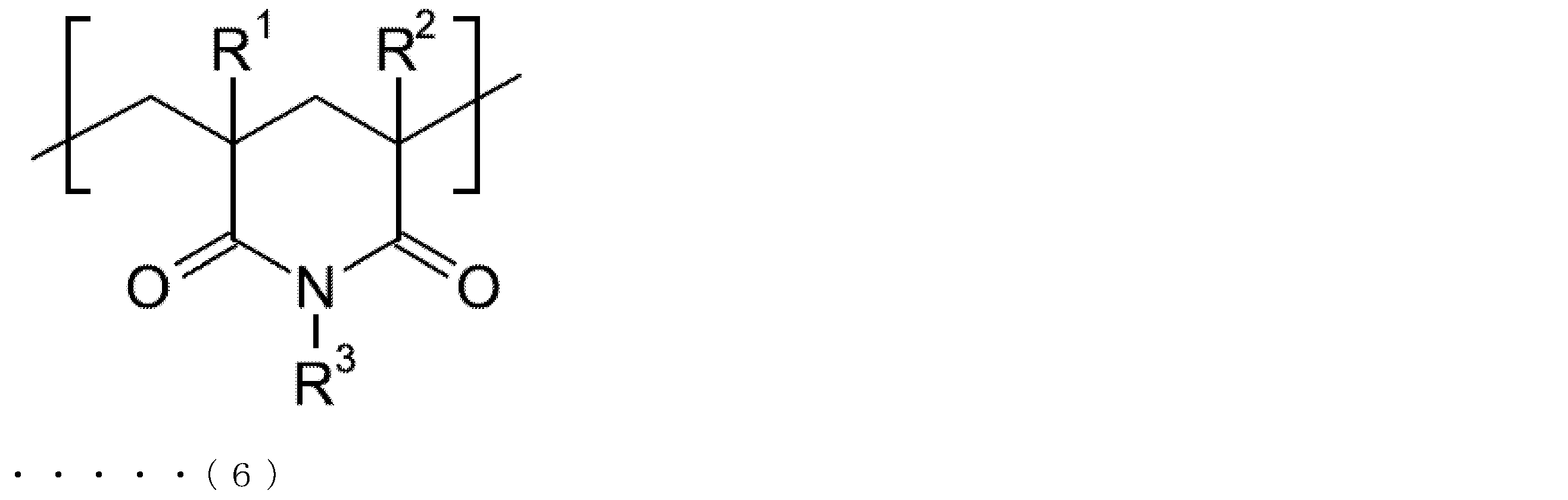
また、R3は、水素原子、炭素数が1~6の置換又は非置換のアルキル基、及び炭素数が6~18の置換又は非置換のアリール基からなる群より選択されるいずれかを表す。
特に好適には、R1、R2、及びR3は、いずれもメチル基である。
上述したグルタルイミド系構造単位(B-3)は、1種のみを単独で用いてもよく、2種以上を組み合わせて用いてもよい。
グルタルイミド系構造単位(B-3)の含有量は、メタクリル系樹脂を100質量%として、1~60質量%であることが好ましく、更に好ましくは3~50質量%であり、とりわけ好ましくは3~25質量%である。
なお、グルタルイミド系構造単位(B-3)の含有量は、例えば、国際公開第2015/098096号の[0136]~[0137]に記載の方法で、算出することができる。
なお、酸価は、例えば、特開2005-23272号公報に記載の滴定法等により算出することができる。
具体的には、アールエムコプチック(R.M.Kopchik)の米国特許第4,246,374号明細書に記載された方法等挙げられる。
イミド化反応の工程においては、イミド化剤を用いて行ってよく、必要に応じて、閉環促進剤を添加してもよい。ここで、イミド化剤としては、アンモニア又は一級アミンを用いることができる。一級アミンとしては、メチルアミン、エチルアミン、n-プロピルアミン、シクロヘキシルアミン等を好適に用いることができる。
イミド化反応を実施する方法としては、特に限定されず、従来公知の方法を用いることができ、例えば、押出機、又は横型二軸反応装置、バッチ式反応槽を用いる方法が挙げられる。押出機としては、特に限定されず、単軸押出機、二軸押出機又は多軸押出機を好適に用いることができる。より好適には、二軸押出機を2台直列に並べたタンデム型反応押出機を用いることができる。
また、上記樹脂を製造するにあたっては、イミド化反応の工程に加えて、エステル化剤で処理するエステル化工程を含むことができる。エステル化工程を含めることによって、イミド化工程中に副生した、樹脂中に含まれるカルボキシル基をエステル基に変換することができ、樹脂の酸価を所望の範囲に調整することができる。ここで、エステル化剤としては、本願の効果を発揮できる範囲であれば特に制限はされないが、好適にはジメチルカーボネート、トリメチルアセテートを使用することができる。エステル化剤の使用量は、特に制限されないが、樹脂100質量部に対して、0~12質量部であることが好ましい。また、エステル化剤に加えて、トリメチルアミン、トリエチルアミン、トリブチルアミン等の脂肪族3級アミンを、触媒として併用することもできる。
前記メタクリル系樹脂を構成するラクトン環構造単位(B-4)は、樹脂重合後に形成されてよい。
(B-4)構造単位としては、下記一般式(7)で示される構造単位が好適に用いられる。

上述したラクトン環構造単位(B-4)は、1種のみを単独で用いてもよく、2種以上を組み合わせて用いてもよい。

R2は、炭素数が1~12の基、好ましくは炭素数が1~12の炭化水素基を表し、当該炭化水素基は、例えば、水酸基で置換されていてもよい。
特に好適には、R1は、水素原子であり、R2は、メチル基である。
マレイミド系構造単位(B-1)の中でも、入手のしやすさを考慮すると、好ましくはN-シクロヘキシルマレイミド系の構造単位及び/又はN-アリール置換マレイミド系の構造単位であり、少量添加での耐熱性付与効果を考慮すると、N-アリール置換マレイミド系の構造単位がより好ましく、さらに好ましくはN-フェニルマレイミド系の構造単位である。
前記メタクリル系樹脂を構成する、メタクリル酸エステル単量体と共重合可能なその他のビニル系単量体単位(C)(以下、(C)単量体単位と記載する場合がある。)としては、芳香族ビニル系単量体単位(C-1)、アクリル酸エステル単量体単位(C-2)、シアン化ビニル系単量体単位(C-3)、これら以外の単量体単位(C-4)が挙げられる。
メタクリル酸エステル単量体と共重合可能なその他のビニル系単量体単位(C)は、1種のみを単独で用いてもよく、2種以上を組み合わせてもよい。
前記メタクリル系樹脂において、(C)単量体単位としては、流動性に一層優れる樹脂が得られ、メタクリル系樹脂に含まれる未反応のモノマー含有量が低減するという観点から、芳香族ビニル系単量体単位(C-1)が好ましい。
前記メタクリル系樹脂を構成する芳香族ビニル系単量体単位(C-1)をなす単量体としては、特に限定されるものではないが、下記一般式(9)で表される芳香族ビニル系単量体が好ましい。

R2は、水素原子、炭素数が1~12のアルキル基、炭素数が1~12のアルコキシ基、炭素数が6~8のアリール基、及び炭素数が6~8のアリーロキシ基からなる群より選択されるいずれかであり、R2は、全て同じ基であっても、異なる基であってもよい。また、R2同士で環構造を形成してもよい。
nは、0~5の整数を表す。
上記の中でも、スチレン、イソプロペニルベンゼンが好ましく、流動性付与や、重合転化率の向上による未反応モノマー類の低減等の観点から、スチレンがより好ましい。
これらは、本実施形態のメタクリル系樹脂組成物において、要求される特性に応じて適宜選択してよい。
ここで、良好な色調や耐熱性を保持する観点から、上限値は、5であることが好ましく、より好ましくは3、さらに好ましくは1である。また、残存モノマー低減の観点から、下限値は、0.3であることが好ましく、より好ましくは0.4である。
上述した芳香族ビニル系単量体(C-1)は、1種のみを単独で用いてもよく、2種以上を組み合わせて用いてもよい。
前記メタクリル系樹脂において、(C)単量体単位としては、耐候性、流動性、及び熱安定性に一層優れる樹脂が得られる観点から、アクリル酸エステル単量体単位(C-2)が好ましい。
前記メタクリル系樹脂を構成するアクリル酸エステル単量体単位(C-2)をなす単量体としては、特に限定されるものではないが、下記一般式(10)で表されるアクリル酸エステル単量体が好ましい。
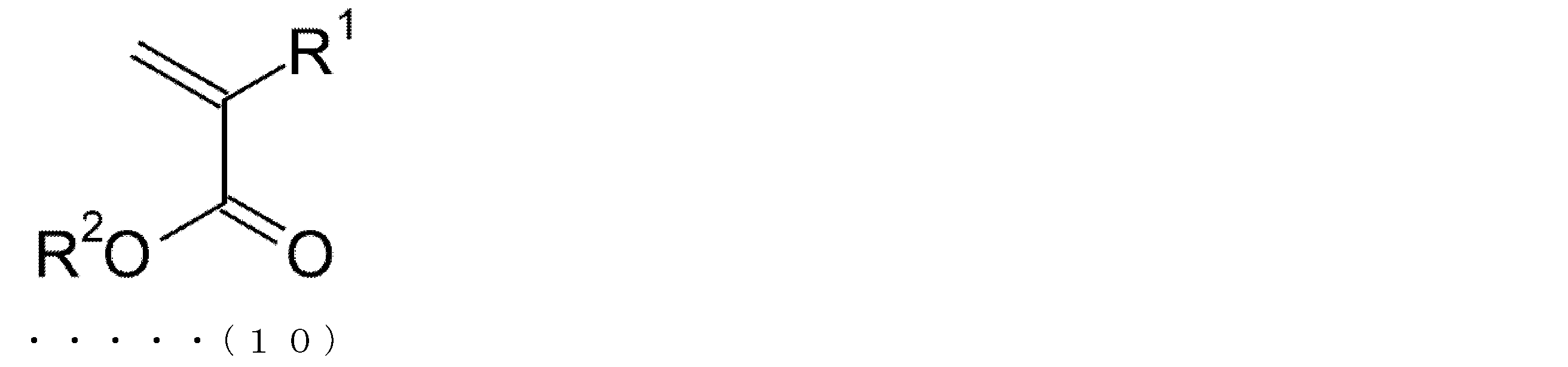
上記アクリル酸エステル単量体単位(C-2)は、1種のみを単独で用いてもよく、2種以上を併用してもよい。
前記メタクリル系樹脂において、(C)単量体単位としては、入手が容易であり、耐薬品性に一層優れる樹脂が得られる観点から、シアン化ビニル系単量体単位(C-3)が好ましい。
前記メタクリル系樹脂を構成するシアン化ビニル系単量体単位(C-3)をなす単量体としては、特に限定されるものではないが、例えば、アクリロニトリル、メタクリロニトリル、シアン化ビニリデン等が挙げられ、中でも、入手のしやすさ、耐薬品性付与の観点から、アクリロニトリルが好ましい。
上記シアン化ビニル系単量体単位(C-3)は、1種のみを単独で用いてもよく、2種以上を併用してもよい。
前記メタクリル系樹脂を構成する(C-1)~(C-3)以外の単量体単位(C-4)をなす単量体としては、特に限定されるものではないが、例えば、アクリルアミド、メタクリルアミド等のアミド類;エチレングリコールジ(メタ)アクリレート、ジエチレングリコールジ(メタ)アクリレート、トリエチレングリコールジ(メタ)アクリレート、テトラエチレングリコールジ(メタ)アクリレート等のエチレングリコール又はそのオリゴマーの両末端水酸基をアクリル酸又はメタクリル酸でエステル化したもの;ネオペンチルグリコールジ(メタ)アクリレート、ジ(メタ)アクリレート等の2個のアルコールの水酸基をアクリル酸又はメタクリル酸でエステル化したもの;トリメチロールプロパン、ペンタエリスリトール等の多価アルコール誘導体をアクリル酸又はメタクリル酸でエステル化したもの;ジビニルベンゼン等の多官能モノマー等が挙げられる。
特に、(C)単量体単位として反応性二重結合を複数有する架橋性の多官能(メタ)アクリレートを使用する場合は、(C)単量体単位の含有量は、重合体の流動性の観点から、0.5質量%以下であることが好ましく、より好ましくは0.3%質量以下、更に好ましくは0.2質量%以下である。
前記メタクリル系樹脂の重量平均分子量(Mw)は、機械的強度、耐溶剤性、流動性に一層優れるメタクリル系樹脂が得られる観点から、6.5万~30万である。
メタクリル系樹脂の重量平均分子量を前記範囲とすることにより、メタクリル系樹脂及び本実施形態のメタクリル系樹脂組成物は、シャルピー衝撃強さ等の機械的強度及び流動性に優れたものとなる。上記重量平均分子量は、機械的強度保持の観点から、好ましくは6.5万以上、より好ましくは7万以上、さらに好ましくは8万以上、よりさらに好ましくは10万以上である。また、重量平均分子量は、成形加工時の流動性確保の観点から、25万以下とすることが好ましく、より好ましくは23万以下、さらに好ましくは22万以下、よりさらに好ましくは20万以下、とりわけ好ましくは18万以下、特に好ましくは17万以下である。
また、メタクリル系樹脂の分子量分布(重量平均分子量(Mw)/数平均分子量(Mn))は、流動性と機械強度、耐溶剤性のバランスを考慮すると、1.5~5であることが好ましい。より好ましくは1.5~4.5、さらに好ましくは1.6~4、さらにより好ましくは1.6~3、よりさらに好ましくは1.6~2.5である。
なお、重量平均分子量(Mw)及び数平均分子量(Mn)については、ゲルパーミエーションクロマトグラフィー(GPC)で測定することができる。詳細には、予め単分散の重量平均分子量、数平均分子量及びピーク分子量が既知で試薬として入手可能な標準メタクリル樹脂と、高分子量成分を先に溶出する分析ゲルカラムとを用い、溶出時間と重量平均分子量から検量線を作成しておく。次に、得られた検量線から、測定対象であるメタクリル系樹脂の試料の重量平均分子量及び数平均分子量を求めることができる。具体的には、後述する実施例に記載の方法により測定することができる。
前記メタクリル系樹脂においては、ゲルパーミエーションクロマトグラフィー(GPC)で測定した、重量平均分子量が1万以下の成分の含有量が、加工流動性の向上、成形時のシルバーストリークスと呼ばれる銀状痕等の成形品の外観不良の低減、フィルム製膜時のロールへの貼り付き防止の観点から、0.1~5.0質量%であることが好ましい。
上記含有量を0.1質量%以上とすることで、加工流動性を向上させることができる。下限値は、好ましくは0.2質量%、より好ましくは0.5質量%、さらに好ましくは0.6質量%である。また、上記含有量を5質量%以下とすることで、成形時のシルバーストリークスを低減することができる等、外観不良を低減することができ、さらには、成形時の金型離れを改善し、フィルム成膜時のロールへの貼り付き性を抑制し、延伸時にフィルムを挟む際に割れの発生を抑制することができる。上限値は、より好ましくは4.0質量%、さらに好ましくは3.0質量%、特に好ましくは2.0質量%である。
なお、重量平均分子量が1万以下の成分の含有量は、例えば、GPC溶出曲線から得られるエリア面積比率から求めることができ、具体的には、図1において、溶出曲線の開始点をA、その終了点をB、重量平均分子量1万となる溶出時間におけるベースライン上の点をX、そのGPC溶出曲線上の点をYとしたとき、曲線BYと線分BX、線分XYで囲まれる面積の、GPC溶出曲線におけるエリア面積に対する割合を、重量平均分子量が1万以下の成分の含有量(質量%)として求めることができる。
好適には、下記実施例の方法により測定することができる。
上記含有量を10.0~25.0質量%とすることで、フィルム成形加工時の筋ムラ発生を抑制することができるうえ、フィルム成形時にロールへの貼り付き性が改善される。そして、加工流動性と、筋ムラの抑制・タッチロールへの貼り付き抑制といった加工時の特性をバランスよく付与する観点から、下限値は、より好ましくは12.0質量%、更に好ましくは13.0質量%であり、また、上限値は、より好ましくは24.0質量%である。
なお、重量平均分子量が1万超5万以下の成分の含有量は、重量平均分子量が1万以下の成分の含有量の場合と同様に、求めることができる。
高分子量体と低分子量体の存在比率を見た場合、加熱加工時における高分子量体と低分子量体との間での粘度差の影響により、低分子量体比率が多いと、加工流動性には優れているものの、フィルム加工時にロールへの貼り付き性が高くなる傾向にある一方で、高分子量体比率が高いと、フィルム加工時に筋ムラが発生しやすくなる傾向がある。
両者の特性をバランスよく付与したうえで、より貼り付き性を改善したい場合は、上記割合は、3.0以上とすることが好ましく、より好ましくは3.5以上である。一方で、フィルム加工時の筋ムラをより改善したい場合は、上記比率は、8.0以下であることが好ましく、より好ましくは7.5以下である。
上記成分の合計の含有量がこの範囲であると、成形加工時の金型やフィルムロールへの貼り付き性を抑制することができ、成形加工性が改善される。また、0.01質量%未満とするためには、工程が煩雑になるため好ましくない。
なお、上記成分の合計の含有量は、ガスクロマトグラフィー/質量分析(GC/MS)測定により求めることができる。
GC/MS測定において好適に使用されるカラムとしては、無極性又は微極性のカラムであることが好ましく、(5%フェニル)-95%メチルポリシロキサンを固定相とするカラムがより好ましい。具体的には、007-2、CP-Sil 8CB、DB-5、DB-5.625、DB-5ht、HP-5、HP-5ms、OV(登録商標)-5、PTE-5、PTE-5QTM、PAS-5、RSL-200、Rtx(登録商標)-5、Rtx(登録商標)-5ms、SAC-5、SE(登録商標)-54、SPB(登録商標)-5、ULTRA-2、XTI-5、SE(登録商標)-52、BP-5、PE-2、ZB-5、AT(登録商標)-5、EC(登録商標)-5等が挙げられる。
好適に使用されるキャリアガスとしては、ヘリウムガスが挙げられる。ガス流量としては、約1mL/分であることが好ましく、測定中一定となるように制御されることが好ましい。
試料の注入量としては、約1μL程度であることが好ましい。
内部標準物質として、オクタデシル3-(3,5-ジ-tert-ブチル-4-ヒドロキシフェニル)プロピオナートを用いる場合、例えば保持時間約20分において内部標準物質のピークが検出されるところ、使用したモノマー種の2量体及び3量体等を含む成分のピークは、上記内部標準物質の保持時間よりも長い保持時間において検出される。ここで、上記成分の合計の含有量は、内部標準物質のピークが検出されてから上記成分のピークが検出されるまでの間における両ピークの面積比(すなわちそれらの存在比)から算出することができる。
またなお、上記成分の合計の含有量は、より具体的には、実施例において後述する特定の装置及び特定の条件でのGC/MS測定により求められるものとする。
なお、ガラス転移温度は、ASTM-D-3418に準拠して中点法により測定することができ、具体的には、後述する実施例に記載の方法により測定することができる。
前記メタクリル系樹脂の製造方法は、前述のメタクリル系樹脂が得られる限り、特に限定されるものではない。
前記メタクリル系樹脂は、メタクリル酸エステル単量体単位(A)、主鎖に環構造を有する構造単位(B)、及び、必要に応じて、上述したメタクリル酸エステル単量体に共重合可能なその他のビニル系単量体単位(C)を形成するための各単量体を用い、塊状重合法、溶液重合法、懸濁重合法、沈殿重合法、乳化重合法により製造できる。メタクリル系樹脂の製造には、好ましくは塊状重合法、溶液重合法が用いられ、より好ましくは溶液重合法が用いられる。
また、メタクリル系樹脂の製造は、連続式としてもよいし、バッチ式としてもよい。
そして、メタクリル系樹脂の製造方法では、ラジカル重合により単量体を重合することが好ましい。
メタクリル系樹脂の製造方法の一例は、反応器に単量体と、必要に応じて有機溶媒とを加える調合工程と、重合開始剤を前記反応器に添加して、単量体の重合反応を行う重合工程と、必要に応じて、有機溶媒及び未反応の単量体を除去する脱揮工程とを含む。
メタクリル系樹脂の製造方法の一例においては、初めに、メタクリル酸エステル単量体単位(A)を構成し得る単量体、主鎖に環構造を有する構造単位(B)を構成し得る単量体、必要に応じてさらに、メタクリル酸エステル単量体と共重合可能なその他のビニル系単量体単位(C)を構成し得る単量体と、有機溶媒とを反応器で調合する(調合工程)。
単量体としては、前記メタクリル系樹脂における各単量体単位(A)~(C)について述べた通りである。
なお、使用する単量体中には、重合反応を過度に妨げない範囲で重合禁止剤が残存していてもよく、残存する重合禁止剤の含有量は、重合反応性及び取扱性の観点から、全単量体の総量に対して、10質量ppm以下であることが好ましく、より好ましくは5質量ppm以下、さらに好ましくは3質量ppm以下である。
任意選択的に用いられる有機溶媒としては、メタクリル系樹脂中に残存するモノマーを除去するための脱揮工程(後述)での除去効率を考慮して、メタクリル系樹脂の良溶媒であることが好ましい。
有機溶媒の溶解度パラメータδは、メタクリル系樹脂を構成する共重合体の溶解度を考慮して、7.0~12.0(cal/cm3)1/2であることが好ましく、より好ましくは8.0~11.0(cal/cm3)1/2、さらに好ましくは8.2~10.5(cal/cm3)1/2である。
溶解度パラメータδの値の求め方は、例えば、非特許文献「Journal of Paint Technology Vol.42、No.541、February 1970」中のP76-P118に記載されているK.L.Hoy著「New Values of the Solubility Parameters From Vapor Pressure Data」や、J.Brandrup他著「Polymer Handbook Fourth Edition」P-VII/675-P714等を参考にすることができる。
なお、1(cal/cm3)1/2は、約0.489(MPa)1/2である。
有機溶媒の具体例としては、トルエン、キシレン、エチルベンゼン、メシチレン等の芳香族炭化水素;シクロヘキサン、メチルシクロヘキサン、デカリン等の脂環式炭化水素;メチルエチルケトン、メチルイソブチルケトン等のケトン系溶媒等が挙げられる。
回収された有機溶媒中には未反応の単量体成分が含まれている場合には、有機溶媒中に含まれる未反応の単量体の含有量を分析し、その後、必要な分だけ単量体を追加することによって、調合を行うこともできる。
メタクリル系樹脂の重合を溶液重合法で行う場合、有機溶媒の配合量は、具体的には、配合する全単量体の総量を100質量部とした場合に、10~200質量部とすることが好ましい。より好ましくは25~200質量部、さらに好ましくは50~200質量部、さらにより好ましくは50~150質量部である。
反応器は、材料の量及び除熱の観点から必要となる大きさを考慮して、適宜選択すればよい。
反応器のL/Dは、重合反応溶液の撹拌効率の観点から、0.5~50が好ましく、より好ましくは1~25であり、さらに好ましくは、1~10である。
特に、予め混合する際には、重合で使用可能な有機溶媒の一部又は全部を同時に混合することができる。有機溶媒を使用する際には、重合に供される単量体を溶解可能なものを使用することが好ましく、有機溶媒の溶解度パラメータδは、7.0~12.0(cal/cm3)1/2であることが好ましい。
メタクリル系樹脂の製造方法の一例においては、次いで、重合開始剤、必要に応じて、分子量調整剤、その他の添加剤、追加の単量体を、調合工程後の反応器に添加して、単量体の重合反応を行う(重合工程)。
なお、重合開始剤は、追加の単量体及び/又は追加の有機溶媒に溶解させたうえで、反応器に添加してもよい。
前記重合開始剤は、重合温度で分解し活性ラジカルを発生するものであればよいが、滞留時間の範囲内で必要な重合転化率を達成することが必要であり、重合温度における半減期が0.6~60分、好ましくは1~30分を満足するような重合開始剤が選択される。但し、重合温度における半減期が60分を超える開始剤に関しても、所定量を一括もしくは10分程の時間で投入することで、本実施形態に適した活性ラジカル量を発生する重合開始剤として使用することができる。その場合に必要な重合転化率を達成するためには、重合温度における半減期が60~1800分、好ましくは260~900分を満足するような重合開始剤が選択される。
好適に使用される重合開始剤は、重合温度、重合時間を鑑みて適宜選択することができ、例えば、日本油脂(株)「有機過酸化物」資料第13版、アトケム吉富(株)技術資料及び和光純薬工業(株)「Azo Polymerization Initiators」等に記載の開始剤を好適に使用することができ、上記半減期は、記載の諸定数等により容易に求めることができる。
前記重合開始剤としては、ラジカル重合を行う場合は、以下に限定されるものではないが、例えば、ジ-t-ブチルパーオキサイド、ラウロイルパーオキサイド、ステアリルパーオキサイド、ベンゾイルパーオキサイド、t-ブチルパーオキシネオデカネート、t-ブチルパーオキシピバレート、ジラウロイルパーオキサイド、ジクミルパーオキサイド、t-ブチルパーオキシ-2-エチルヘキサノエート、1,1-ビス(t-ブチルパーオキシ)-3,3,5-トリメチルシクロヘキサン、1,1-ビス(t-ブチルパーオキシ)シクロヘキサン(例えば、パーヘキサ(登録商標)C)、アセチルパーオキサイド、カプリエルパーオキサイド、2,4-ジクロルベンゾイルパーオキサイド、イソブチルパーオキサイド、アセチルシクロヘキシルスルホニルパーオキサイド、t-ブチルパーオキシビパレート、t-ブチルパーオキシ-2-エチルヘキサノエート、iso-プロピルパーオキシジカーボネート、iso-ブチルパーオキシジカーボネート、sec-ブチルパーオキシジカーボネート、n-ブチルパーオキシジカーボネート、2-エチルヘキシルパーオキシジカーボネート、ビス(4-t-ブチルシクロヘキシル)パーオキシジカーボネート、t-アミルパーオキシ-2-エチルヘキサノエート、1,1,3,3-テトラメチルブチルパーオキシエチルヘキサノエート、1,1,2-トリメチルプロピルパーオキシ-2-エチルヘキサノエート、2,5-ジメチル-2,5-ジ(t-ブチルパーオキシ)ヘキサン(例えば、パーヘキサ(登録商標)25B)、t-ブチルパーオキシイソプロピルモノカーボネート、t-アミルパーオキシイソプロピルモノカーボネート、1,1,3,3-テトラメチルブチルパーオキシイソプロピルモノカーボネート、1,1,2-トリメチルプロピルパーオキシイソプロピルモノカーボネート、1,1,3,3-テトラメチルブチルパーオキシイソノナエート、1,1,2-トリメチルプロピルパーオキシ-イソノナエート、t-ブチルパーオキシベンゾエート等の有機過酸化物や、アゾビスイソブチロニトリル、アゾビスイソバレロニトリル、アゾビスジメチルバレロニトリル、アゾビスシクロヘキサンニトリル、1,1-アゾビス(1-シクロヘキサンカルボニトリル)、2,2’-アゾビス-4-メトキシ-2,4-アゾビスイソブチロニトリル、2,2’-アゾビス-2,4-ジメチルバレロニトリル、2,2’-アゾビス-2-メチルブチロニトリル、1,1’-アゾビス(1-アセトキシ-1-フェニルエタン)、ジメチル-2,2’-アゾビスイソブチレート、4,4’-アゾビス-4-シアノバレリン酸等のアゾ系化合物等の、一般的なラジカル重合開始剤を挙げることができる。
これらのラジカル重合開始剤と適当な還元剤とを組み合わせてレドックス系開始剤として用いてもよい。
これらの重合開始剤は、1種単独で用いることができ、2種以上組み合わせて用いることもできる。
重合反応においては重合開始剤の供給量を増やすことで重合度を上げることができるが、多量の開始剤を使用することで全体の分子量が低下する傾向にあるうえ、重合時の発熱量が増大するため、過熱により重合安定性が低下する場合もある。
重合開始剤は、所望の分子量を得やすくし、重合安定性を確保するという観点から、使用する全単量体の総量100質量部に対して、0~1質量部の範囲で用いるのが好ましく、より好ましくは0.001~0.8質量部であり、より好ましくは0.01~0.5質量部である。重合開始剤の添加量は、重合を行う温度及び開始剤の半減期も考慮して、適宜選ぶことができる。
より具体的には、反応系内に残存する未反応モノマー総量に対する重合開始剤より発生するラジカル総量の割合が、常時一定値以下となるように、開始剤の種類、開始剤量、及び重合温度等を適宜選択することが好ましい。
かかる方法によれば、重合時のラジカル発生量を制御することによって、メタクリル系樹脂中の成分の合計量や重量平均分子量1万以下の成分量を所望の範囲とすることができる。
なお、重合開始時に一定量の重合開始剤を添加した後に、定量フィードする場合は条件(ii)を満たさない。例えば、初めに必要開始剤量のうち1/3量を一括で投入した後に、残りの2/3量を一定時間(例えば3時間など)かけて投入する場合は、重合開始剤の添加開始から0時間で添加量を変更していることとなり、条件(ii)を満たさない。
例えば、重合開始時の重合開始剤の添加速度(単位時間当たりの添加量)を100ppm/時とし、重合開始剤の添加開始から添加終了までの時間の合計であるB時間を10時間とした場合に、重合開始剤の添加開始から0.1~3時間の間に、添加速度(単位時間当たりの添加量)を70ppm/時以下とすることが好ましい。
例えば、重合開始時の重合開始剤の添加速度(単位時間当たりの添加量)を100ppm/時とし、重合開始剤の添加開始から添加終了までの時間の合計であるB時間を10時間とした場合に、重合開始剤の添加開始から7~10時間の間に、添加速度(単位時間当たりの添加量)を25ppm/時以下とすることが好ましい。
任意選択的に用いられる分子量調整剤としては、連鎖移動剤やイニファータ等が挙げられる。
本実施形態のメタクリル系樹脂組成物に含まれるメタクリル系樹脂の製造工程においては、本発明の目的を損なわない範囲で、製造する重合体の分子量の制御を行うことができる。
連鎖移動剤及びイニファータとしては、例えば、アルキルメルカプタン類、ジメチルアセトアミド、ジメチルホルムアミド、トリエチルアミン等の連鎖移動剤;ジチオカルバメート類、トリフェニルメチルアゾベンゼン、テトラフェニルエタン誘導体等のイニファータ等を用いることによって分子量の制御を行うことができ、さらには、これらの連鎖移動剤やイニファータの添加量を調整することにより、分子量を制御することができる。
これら分子量調整剤は、要求される分子量に応じて適宜添加することができるが、一般的には使用する全単量体の総量100質量部に対して、0.001~3質量部の範囲で用いられる。
また、その他の分子量制御方法としては重合方法を変える方法、重合開始剤の量を調整する方法、重合温度を変更する方法等が挙げられる。
これらの分子量制御方法は、1種の方法だけを単独で用いてもよいし、2種以上の方法を併用してもよい。
前記メタクリル系樹脂においては、2量体及び3量体を含む成分の合計量を適量に制御する必要があり、また重量平均分子量1万以下の成分量も適量に制御する観点から、重合反応系に残るモノマー量に対して、残存する連鎖移動剤の量が過剰にならないような方法を選択することが好ましい。
連鎖移動剤の供給する方法の一例としては、連鎖移動剤を予めモノマーに溶解させておく方法、重合度が50%以下の段階で一括及び/又は逐次添加する方法、重合度90%までの間に一括及び/又は連続的に添加する方法で、連鎖移動剤を添加する量を、徐々に減じていく方法等の方法を好適に用いることができる。
任意選択的に用いられるその他の添加剤は、本発明の効果を発揮できる限り特に限定されることなく、目的に応じて、適宜選択されてよい。
なお、溶存酸素濃度は、例えば、溶存酸素計 DOメーターB-505(飯島電子工業株式会社製)を用いて測定することができる。
溶存酸素濃度を低下させる方法としては、重合溶液中に不活性ガスをバブリングする方法、重合前に重合溶液を含む容器内を不活性ガスで0.2MPa程度まで加圧した後に放圧する操作を繰り返す方法、重合溶液を含む容器内に不活性ガスを通ずる方法等が挙げられる。
なお、重合反応時間とは、重合開始剤の添加開始から重合反応の停止を行うまでの時間、又は、重合開始剤の添加開始から、重合反応溶液の反応器内からの取り出しを開始するまでの時間をいう。
該重合反応器から抜き出された重合反応生成物は、脱揮装置を用いて有機溶媒及び未反応の単量体を除去することができる。除去した溶媒は、精留操作を行った後、重合反応に再利用してもよい。
好適に使用できる脱揮装置としては、重合反応生成物を、150~320℃の温度で加熱処理し、揮発分を分離回収処理ができる装置であればよい。
一例を挙げると、一か所又は複数個所にベント口を有する押出機や、SCプロセッサ、KRCニーダー、ギアポンプ付真空減圧タンク、高粘度用薄膜蒸発器EXEVA、フラッシュドラム等が挙げられる。
上記の脱揮装置は、1種単独でも2種以上の装置を併用して使用することができる。
脱揮発工程にて、脱揮後の樹脂中に含まれる残存揮発分量の総計が1質量%以下であることが好ましい。
本実施形態のメタクリル系樹脂組成物は、前述のメタクリル系樹脂を含有し、窒素雰囲気中、280℃で1時間加熱した際の重量平均分子量残存率が80%以上である。
本実施形態のメタクリル系樹脂組成物は、この他に、任意選択的に、ゴム質重合体、メタクリル系樹脂以外の樹脂であるその他の樹脂、添加剤等を含有していてよい。
ゴム質重合体は、本実施形態のメタクリル系樹脂組成物中に、メタクリル系樹脂100質量部に対して、3.5質量部を超えない範囲で含有してもよい。好ましくは0.5質量部以上、より好ましくは1質量部以上、さらにより好ましくは1.5質量部以上のゴム質重合体を含有することにより、フィルム成形時にフィルムがロールへの貼りつきを抑制する効果が得られる。3.5質量部以下、好ましくは3.0質量部以下のゴム質重合体を含有することにより、樹脂の持つ光学特性を保持することができる。
例えば、一般的なブタジエン系ABSゴム、アクリル系、ポリオレフィン系、シリコーン系、フッ素ゴム等の多層構造を有するゴム粒子を使用することができる。
本実施形態の成形体において高い透明性が求められる場合には、上述したメタクリル系樹脂と近い屈折率を有するゴム質重合体を好適に用いることができ、アクリル系ゴム質重合体が特に好適に用いることができる。
当該例1のゴム質重合体は、以下の(A)工程~(C)工程により製造される多層構造粒子である。
(A)工程:メチルメタクリレート単独又はメチルメタクリレートとこれと共重合可能な単量体との混合物を乳化重合し、25℃以上のガラス転移点をもつ、メチルメタクリレートを主体とする重合体の分散液を得る第一層形成工程。
(B)工程:前記(A)工程により得られる生成物に重合させたときにガラス転移点が25℃以下の共重合体を形成するアルキルアクリレートと、さらにこれと共重合可能な単量体又は多官能性架橋剤と、混合物全重量に対して0.1~5質量%の多官能グラフト剤と、を含有する混合物を加えて乳化重合させる第二層工程。
(C)工程:前記(B)工程により得られる生成物に重合させたときに25℃以上のガラス転移点をもつ重合体を形成するメチルメタクリレート又はこれを主体とする単量体混合物を、連鎖移動剤を段階的に増加させながら、多段階で乳化重合させる第三層形成工程。
前記多層構造粒子は、第三層の分子量が内側から外側に向かって次第に小さくなっているアクリル系ゴムからなる多層構造粒子である。
当該例2のゴム質重合体は、以下のアクリル系多層構造体ポリマー粉体である。
このアクリル系多層構造体ポリマー粉体は、ポリマーの溶融開始温度が235℃以上である。内層には、単独で重合した場合のガラス転移温度Tgが25℃以下あるポリマーを含んでおり、当該内層は、少なくとも1層の軟質重合体層である。最外層は、単独で重合した場合にTgが50℃以上であるポリマーを含む硬質重合体層である。
例2のゴム重合体は、アクリル系多層構造ポリマーの乳化ラテックスを凝固して得られる凝固粉を含むアクリル系多層構造ポリマー粉体であって、乾燥後の凝固粉の粒径212μm以下の微粉の割合が40質量%であり、かつ、乾燥後の凝固粉の水銀圧入法で測定した孔径5μm以下の空隙体積が単位面積当たり0.7cc以下である。
当該例3のゴム質重合体は、以下の(a)~(g)の要件を具備する多層構造アクリル系重合体である。
すなわち、当該多層構造アクリル系重合体は、
(a)メチルメタクリレート90~99質量%、アルキル基の炭素数が1~8のアルキルアクリレート1~10質量%及びこれらと共重合可能なα,β-不飽和カルボン酸のアリル、メタリル、又はクロチルエステルからなる群より選ばれる少なくとも1種からなるグラフト結合性単量体0.01~0.3質量%からなる、単量体混合物を重合して得られる最内硬質層重合体25~45質量%と、
(b)上記最内硬質層重合体存在下に、n-ブチルアクリレート70~90質量%、スチレン10~30質量%及びこれらと共重合可能なα,β-不飽和カルボン酸のアリル、メタリル、又はクロチルエステルからなる群より選ばれる少なくとも1種からなるグラフト結合性単量体1.5~3.0質量%からなる、単量体混合物を重合して得られる軟質層重合体35~45質量%と、
(c)上記最内硬質層重合体及び軟質層重合体の存在下に、メチルメタクリレート90~99質量%と、アルキル基の炭素数が1~8である単量体1~10質量%との混合物を重合して得られる最外硬質層重合体20~30質量%とからなり、
(d)軟質層重合体/(最内硬質層重合体+軟質層重合体)の重量比が0.45~0.57であり、
(e)平均粒子径が0.2~0.3μmである、多層構造アクリル系重合体であって、さらに当該多層構造アクリル系重合体をアセトンにより分別した場合に、
(f)グラフト率が20~40質量%であり、
(g)当該アセトン不溶部の引っ張り弾性率が1000~4000kg/cm2である、多層構造アクリル系重合体である。
例えば、特公昭55-27576号公報、特公昭58-1694号公報、特公昭59-36645号公報、特公昭59-36646号公報、特公昭62-41241号公報、特開昭59-202213号公報、特開昭63-27516号公報、特開昭51-129449号公報、特開昭52-56150号公報、特開昭50-124647号公報等に記載の、3~4層構造のアクリル系ゴム粒子等も使用できる。
ゴム質重合体が多層構造である場合、当該ゴム質重合体の層の数は、多ければ多いほど、その弾性が好適な範囲に制御することが可能であるが、ゴム質重合体を含有した場合の成形体の色調等を考慮すると、中でも、三層構造以上の粒子であることが好ましく、三層構造以上のアクリル系ゴム粒子であることがより好ましい。
ゴム質重合体として、上記三層構造以上のゴム粒子を用いることにより、本実施形態の成形体の成形加工時の熱劣化や、加熱によるゴム質重合体の変形が抑制され、成形体の耐熱性や透明性が維持される傾向にある。
硬質層を最内層と最外層に有することにより、ゴム質重合体の変形が抑制される傾向にあり、中央層に軟質成分を有することにより良好な靭性が付与される傾向にある。
前記メチルメタクリレートと共重合可能な単量体としては、以下に限定されるものではないが、例えば、公知の(メタ)アクリル酸、メチルメタクリレート以外の(メタ)アクリレート、スチレン、α-メチルスチレン等の単官能単量体や、エチレングリコールジ(メタ)アクリレート、ポリエチレングリコールジ(メタ)アクリレート、1,3-ブチレングリコールジ(メタ)アクリレート、1,4-ブタンジオールジ(メタ)アクリレート、トリアリルイソシアヌレート、マレイン酸ジアリル、ジビニルベンゼン等の多官能性単量体が挙げられる。
上記単量体は、必要に応じて、1種単独で、又は2種以上を併用して用いることができる。
そして、共重合体は、屈折率を適切に制御する観点から、上記メタクリル酸メチルと共重合可能な他の共重合性単量体は、アクリル酸エステル単量体0.1~5質量%と、芳香族ビニル化合物単量体5~35質量%と、共重合性多官能単量体0.01~5質量%とを含むものであることが好ましい。
前記アクリル酸エステル単量体(共重合体中で最内層を形成)としては、特に限定されないが、例えば、アクリル酸n-ブチル、アクリル酸2-へキシルが好ましい。
前記芳香族ビニル化合物単量体としては、メタクリル系樹脂に使用される単量体と同様のものを用いることができるが、好ましくは、最内層の屈折率を調整して本実施形態の成形体の透明性を良好にする観点から、スチレン又はその誘導体が用いられる。
前記共重合性多官能単量体としては、特に限定されないが、好ましくは、エチレングリコールジ(メタ)アクリレート、ポリエチレングリコールジ(メタ)アクリレート、1,3-ブチレングリコールジ(メタ)アクリレート、1,4-ブタンジオールジ(メタ)アクリレート、(メタ)アクリル酸アリル、トリアリルイソシアヌレート、マレイン酸ジアリル、ジビニルベンゼン等が挙げられる。これらは1種のみを単独で用いてもよく、2種以上を併用してもよい。これらの中では(メタ)アクリル酸アリルがより好ましい。
二層目は、例えば、アルキルアクリレートと当該アルキルアクリレートと共重合可能な単量体との共重合体や、共重合性多官能単量体の重合体により形成することが好ましい。
アルキルアクリレートとしては、特に限定されず、例えば、メチルアクリレート、エチルアクリレート、n-ブチルアクリレート、2-エチルヘキシルアクリレート等が挙げられる。これらは、1種又は2種以上を併用して用いることができ、特に、n-ブチルアクリレート、2-エチルヘキシルアクリレートが好ましい。
また、これらのアルキルアクリレートと共重合可能な他の単量体としては、特に限定されず、一般的な単量体を用いることができるが、二層目の屈折率を調整してメタクリル系樹脂に合わせることにより透明性を良好にする観点からは、スチレン又はその誘導体が好ましく用いられる。
前記共重合性多官能単量体としては、特に限定されないが、好ましくは、エチレングリコールジ(メタ)アクリレート、ポリエチレングリコールジ(メタ)アクリレート、1,3-ブチレングリコールジ(メタ)アクリレート、1,4-ブタンジオールジ(メタ)アクリレート、(メタ)アクリル酸アリル、トリアリルイソシアヌレート、マレイン酸ジアリル、ジビニルベンゼン等が挙げられる。これらは1種のみを単独で用いてもよく、2種以上を併用してもよい。
前記最外層を形成するメタクリル酸メチルと共重合可能な他の共重合性単量体としては、特に限定されないが、例えば、アクリル酸n-ブチル、アクリル酸2-へキシルが好ましいものとして挙げられる。
ゴム状重合体は多官能性単量体を共重合してなり、重合体において架橋構造を形成させることができる。ゴム状重合体中の架橋構造は、適度なゴム弾性を与え、単量体混合物に溶解することなく、分散状態でその形態を保持することができる。
架橋構造を形成するための多官能性単量体としては、メチルメタクリレート及びメチルアクリレートと共重合可能な化合物を用いることができる。
多官能性単量体の使用量は、二層目全体に対して0.1~5質量%であることが好ましい。かかる使用量が0.1質量%以上であると、十分な架橋効果が得られ、5質量%以下であると、適度な架橋強度がと優れたゴム弾性効果が得られる。さらに、多官能性単量体の使用量が0.1質量%以上であると、キャスト重合工程を実施した場合においても、ゴム状重合体が溶解又は膨潤することなく、ゴム状弾性体の形態を保持することができる。
多官能グラフト剤とは、異なる官能基を有する多官能単量体であり、以下に限定されるものではないが、例えば、アクリル酸、メタクリル酸、マレイン酸、フマル酸等のアリルエステル等が挙げられ、中でも、アリルアクリレート、アリルメタクリレートが好ましい。
多官能グラフト剤の使用量は、二層目全体に対して0.1~3質量%の範囲であることが好ましい。多官能グラフト剤の使用量を0.1質量%以上とすることにより、十分なグラフト効果が得られ、3質量%以下とすることによりゴム弾性の低下を防止できる。
これを回避する手段として、メタクリル系樹脂とほぼ屈折率が一致している一層目を設ける方法が挙げられる。また、二層目の厚みを小さくすることも、本実施形態の成形体の透明性の悪化を阻止する上で有効な方法となる。
ゴム質重合体の平均粒子径が0.03μm以上であると、本実施形態の成形体において十分な衝撃強度が得られる傾向があり、1μm以下であると、本実施形態の成形体の表面に、細かなさざ波状の欠陥が現れることを防止して鏡面性が得られ、さらに、加熱成形した場合に、延伸された部分において表面光沢の低下を抑制でき、透明性が確保できる。
(1)メタクリル系樹脂組成物の成形体の一部を丸鋸にて切り出した後、RuO4(ルテニウム酸)染色超薄切片法による観察用の試料を作製し、(株)日立製作所製の透過型電子顕微鏡(機種:H-600型)を使用して染色されたゴム粒子断面を観察し、その後撮影を行う。高倍率にプリントした代表的な粒子20個の直径をスケールにて測定し、粒子の直径の平均値を求めることで、ゴム粒子の平均粒子径を求める。
(2)ゴム質重合体の乳化液をサンプリングして、固形分500ppmになるように水で希釈して、UV1200V分光光度計(株式会社島津製作所製)を用いて波長550nmでの吸光度を測定し、この値から、透過型電子顕微鏡写真より粒子径を計測したサンプルについて、同様に吸光度を測定して作成した検量線を用いて平均粒子径を求める。
上記(1)、(2)の測定方法においては、いずれもほぼ同等の粒子径測定値を得ることができる。
具体的には、ゴム質重合体が上述したように、三層から構成される場合、乳化剤及び重合開始剤の存在下、初めに一層目の単量体混合物を添加して重合を完結させ、次に二層目の単量体混合物を添加して重合を完結させ、次いで三層目の単量体混合物を添加して重合を完結させることにより、容易にゴム質重合体(粒子)をラテックスとして得ることができる。
このゴム質重合体はラテックスから塩析、噴霧乾燥、凍結乾燥等の公知の方法によって粉体として回収することができる。
ゴム質重合体が、三層から構成される重合体である場合、三層目に硬質層を設けることで、ゴム質重合体の粒子同士の凝集を回避することができる。
本実施形態のメタクリル系樹脂組成物は、上述したメタクリル系樹脂、ゴム質重合体以外に、その他の樹脂を組み合わせて含有してもよい。
当該その他の樹脂としては、本実施形態のメタクリル系樹脂組成物に求められる特性を発揮できるものであれば、公知の熱可塑性樹脂を使用することができる。
当該熱可塑性樹脂としては、以下に限定されるものではないが、例えば、ポリエチレン系樹脂、ポリプロピレン系樹脂、ポリスチレン系樹脂、シンジオタクテックポリスチレン系樹脂、ポリカーボネート系樹脂、ABS樹脂、アクリル系樹脂、AS樹脂、BAAS系樹脂、MBS樹脂、AAS樹脂、生分解性樹脂、ポリカーボネート-ABS樹脂のアロイ、ポリアルキレンアリレート系樹脂(ポリブチレンテレフタレート、ポリエチレンテレフタレート、ポリプロピレンテレフタレート、ポリトリメチレンテレフタレート、ポリエチレンナフタレート等)、ポリアミド系樹脂、ポリフェニレンエーテル系樹脂、ポリフェニレンスルフィド系樹脂、フェノール系樹脂等が挙げられる。
特に、AS樹脂、BAAS樹脂は、流動性向上の観点から好ましく、ABS樹脂、MBS樹脂は、耐衝撃性向上の観点から好ましく、また、ポリエステル樹脂は、耐薬品性向上の観点から好ましい。また、ポリフェニレンエーテル系樹脂、ポリフェニレンスルフィド系樹脂、フェノール系樹脂等は、難燃性向上の観点から好ましい。ポリカーボネート系樹脂は、耐熱性付与、耐衝撃性付与や光学特性の調整が必要な場合に好ましい。さらに、アクリル系樹脂は、前述のメタクリル系樹脂との相溶性が良好であり、透明性を保持したままで、流動性、耐衝撃性等の特性を調整する場合に好ましい。
前記各種熱可塑性樹脂は、1種のみを単独で用いても、2種以上の樹脂を組み合わせて用いてもよい。
また、その他の樹脂を配合するときの特性付与効果を考慮すると、その他の樹脂を配合する場合の配合量の下限値としては0.1質量%以上が好ましく、より好ましくは1質量%以上、さらに好ましくは2質量%以上、さらにより好ましくは3質量%以上、よりさらに好ましくは5質量%以上である。
その他の樹脂の種類や含有量は、その他の樹脂と組み合わせて使用する場合に期待される効果に応じて適宜選択することができる。
本実施形態のメタクリル系樹脂組成物には、剛性や寸法安定性等の各種特性を付与するため、所定の添加剤を添加してもよい。
添加剤としては、以下に限定されるものではないが、例えば、紫外線吸収剤、熱安定剤、光安定剤等の各種安定剤;可塑剤(パラフィン系プロセスオイル、ナフテン系プロセスオイル、芳香族系プロセスオイル、パラフィン、有機ポリシロキサン、ミネラルオイル);難燃剤(例えば、有機リン化合物、赤リン、無機系リン酸塩等のリン系、ハロゲン系、シリカ系、シリコーン系等);難燃助剤(例えば、酸化アンチモン類、金属酸化物、金属水酸化物等);硬化剤(ジエチレントリアミン、トリエチレンテトラミン、テトラエチレンペンタミン、ペンタエチレンヘキサミン、ジエチルアミノプロピルアミン、3,9-ビス(3-アミノプロピル)-2,4,8,10-テトラオキサスピロ[5,5]ウンデカン、メンセンジアミン、イソホロンジアミン、N-アミノエチルピペラジン、m-キシレンジアミン、m-フェヒレンジアミン、ジアミノフェニルメタン、ジアミノジフェニルスルホン、ジシアンジアミド、アジピン酸ジヒドラジド等のアミン類や、フェノールノボラック樹脂、クレゾールノボラック樹脂等のフェノール樹脂類、液状ポリメルカプタン、ポリサルファイド等のポリメルカプタン、無水フタル酸、テトラヒドロ無水フタル酸、ヘキサヒドロ無水フタル酸、メチルテトラヒドロ無水フタル酸、メチルヘキサヒドロ無水フタル酸、無水メチルナジック酸、無水ピロメリット酸、メチルシクロヘキセンテトラカルボン酸無水物、ドデシル無水コハク酸、無水トリメリット酸、無水クロレンディック酸、ベンゾフェノンテトラカルボン酸無水物、エチレングリコールビス(アンヒドロトリメート)等の酸無水物等);硬化促進剤(2-メチルイミダゾール、2-エチルイミダゾール、2-エチル-4-メチルイミダゾール、2-フェニルイミダゾール、2-ウンデシルイミダゾール、2-ヘプタデシルイミダゾール、2-フェニル-4-メチルイミダゾール等のイミダゾール類、トリフェニルホスフィン、トリブチルホスフィン等の有機ホスフィン類、ベンジルジメチルアミン、2-ジメチルアミノメチル)フェノール、2,4,6-トリス(ジアミノメチル)フェノール、テトラメチルヘキサンジアミン等の三級アミン類、トリフェニルホスファインテトラフェニルボレート、テトラフェニルホスホニウムテトラフェニルボレート、トリエチルアミンテトラフェニルボレート等のボロン塩、1,4-ベンゾキノン、1,4-ナフトキノン、2,3-ジメチル-1,4-ベンゾキノン、2,6-ジメチルベンゾキノン、2,3-ジメトキシ-1,4-ベンゾキノン等のキノイド化合物等);帯電防止剤(例えば、ポリアミドエラストマー、四級アンモニウム塩系、ピリジン誘導体、脂肪族スルホン酸塩、芳香族スルホン酸塩、芳香族スルホン酸塩共重合体、硫酸エステル塩、多価アルコール部分エステル、アルキルジエタノールアミン、アルキルジエタノールアミド、ポリアルキレングリコール誘導体、ベタイン系、イミダゾリン誘導体等);導電性付与剤;応力緩和剤;離型剤(アルコール、及びアルコールと脂肪酸とのエステル、アルコールとジカルボン酸とのエステル、シリコーンオイル等);結晶化促進剤;加水分解抑制剤;潤滑剤(例えば、ステアリン酸、ベヘニン酸、ステアリン酸亜鉛、ステアリン酸カルシウム、ステアリン酸マグネシウム等の高級脂肪酸、及びその金属塩、エチレンビスステアロアミド等の高級脂肪酸アミド類等);衝撃付与剤;摺動性改良剤(低分子量ポリエチレン等の炭化水素系、高級アルコール、多価アルコール、ポリグリコール、ポリグリセロール、高級脂肪酸、高級脂肪酸金属塩、脂肪酸アミド、脂肪酸と脂肪族アルコールとのエステル、脂肪酸と多価アルコールとのフルエステル又は部分エステル、脂肪酸とポリグリコールとのフルエステル又は部分エステル、シリコーン系、フッ素樹脂系等);相溶化剤;核剤;フィラー等の強化剤;流動調整剤;染料(ニトロソ染料、ニトロ染料、アゾ染料、スチルベンアゾ染料、ケトイミン染料、トリフェニルメタン染料、キサンテン染料、アクリジン染料、キノリン染料、メチン/ポリメチン染料、チアゾール染料、インダミン/インドフェノール染料、アジン染料、オキサジン染料、チアジン染料、硫化染料、アミノケトン/オキシケトン染料、アントラキノン染料、インジゴイド染料、フタロシアニン染料等の染料);増感剤;着色剤(酸化チタン、カーボンブラック、チタンイエロー、酸化鉄系顔料、群青、コバルトブルー、酸化クロム、スピネルグリーン、クロム酸鉛系顔料、カドミウム系顔料等の無機顔料、アゾレーキ顔料、ベンズイミダゾロン顔料、ジアリリド顔料、縮合アゾ顔料等のアゾ系顔料、フタリシアニンブルー、フタロシアニングリーン等のフタロシアニン系顔料、イソインドリノン顔料、キノフタロン顔料、キナクリドン顔料、ペリレン顔料、アントラキノン顔料、ペリノン顔料、ジオキサジンバイオレット等の縮合多環系顔料等の有機系顔料、リン片状のアルミのメタリック顔料、ウェルド外観を改良するために使用されている球状のアルミ顔料、パール調メタリック顔料用のマイカ粉、その他ガラス等の無機物の多面体粒子に金属メッキやスパッタリングで被覆したもの等のメタリック顔料等);増粘剤;沈降防止剤;タレ防止剤;充填剤(ガラス繊維、炭素繊維等の繊維状補強剤、さらにはガラスビーズ、炭酸カルシウム、タルク、クレイ等);消泡剤(シリコーン系消泡剤、界面活性剤やポリエーテル、高級アルコール等の有機系消泡剤等);カップリング剤;光拡散性微粒子;防錆剤;抗菌・防カビ剤;防汚剤;導電性高分子等が挙げられる。
本実施形態のメタクリル系樹脂組成物には、耐候性をより良好なものとするために光安定剤を添加してもよい。
光安定剤としては好適にはヒンダードアミン系光安定剤(HALS)を添加することができる。
好適に使用される光安定剤としては、以下に限定されるものではないが、例えば、ビス(2,2,6,6-テトラメチル-4-ピペリジル)セバケート、ビス(1-オクチロキシ-2,2,6,6テトラメチル-4-ピペリジル)セバケート、ビス(1,2,2,6,6-ペンタメチル-4-ピペリジニル)セバケート、2-(3,5-ジ-tert-ブチル-4-ヒドロキシベンジル)-2-n-ブチルマロン酸ビス(1,2,2,6,6-ペンタメチル-4-ピペリジル)、テトラキス(1,2,2,6,6-ペンタメチル-4-ピペリジル)1,2,3,4-ブタンテトラカルボキシラート、1,2,2,6,6-ペンタメチル-4-ピペリジル/トリデシル-1,2,3,4-ブタンテトラカルボキシラート、{1,2,2,6,6-ペンタメチル-4-ピペリジル/β,β,β’,β’-テトラメチル-3,9-[2,4,8,10-テトラオキサスピロ(5,5)ウンデカン]ジエチル}-1,2,3,4ブタンテトラカルボキシレート、等が挙げられる。
また、コハク酸ジメチル-1-(2-ヒドロキシエチル)-4-ヒドロキシ-2,2,6,6-テトラメチルピペリジン重縮合物、N,N’-ビス(3-アミノプロピル)エチレンジアミン-2,4-ビス[N-ブチル-N-(1,2,2,6,6-ペンタメチル-4ピペリジル)アミノ]-6-クロロ-1,3,5-トリアジン縮合物、ポリ[[6-[(1,1,3,3-テトラメチルブチル)アミノ]-1,3,5-トリアジン-2,4-ジイル][(2,2,6,6-テトラメチル-4-ピペリジニル)イミノ]]、ポリ[{6-(1,1,3-トリメチルペンチル)アミノ-1,3,5-トリアジン-2,4-ジイル}{(N-メチル-2,2,6,6-テトラメチル-ピペリジル)イミノ}オクタメチレン{(N-メチル-2,2,6,6-テトラメチル-ピペリジル)イミノ}]、ポリ[(6-モルフォリノ-S-トリアジン-2,4-ジ)[1,2,2,6,6-ペンタメチル-4-ピペリジル]イミノ]-ヘキサメチレン[(1,2,2,6,6-ペンタメチル-4-ピペリジル)イミノ]]、ポリ[{6-(1,1,3,3-テトラメチルブチル)アミノ-1,3,5-トリアジン-2,4-ジイル}{(2,2,6,6-テトラメチル-ピペリジル)イミノ}ヘキサメチレン{(2,2,6,6-テトラメチル-ピペリジル)イミノ}]、ビス(1,2,2,6,6-ペンタメチル-4-ピペリジル)[[3,5-ビス(1,1-ジメチルエチル)-4-ヒドロキシフェニル]メチル]ブチルマロネート、ビス(1,2,2,6,6-ペンタメチル-4-ピペリジル)セバケートとメチル1,2,2,6,6-ペンタメチル-4-ピペリジルセバケートの混合物、ビス(2,2,6,6-テトラメチル-4-ピペリジル)セバケート、N,N’-ビス(2,2,6,6-テトラメチル-4-ピペリジル)-N,N’-ジホルミルヘキサメチレンジアミン、ジブチルアミン・1,3,5-トリアジン・N,N’-ビス(2,2,6,6-テトラメチル-4-ピペリジル-1,6-ヘキサメチレンジアミンとN-(2,2,6,6-テトラメチル-4-ピペリジル)ブチルアミンの重縮合物、ポリ[{6-(1,1,3,3-テトラメチルブチル)アミノ-1,3,5-トリアジン-2,4-ジイル}{2,2,6,6-テトラメチル-4-ピペリジル)イミノ}ヘキサメチレン{(2,2,6,6-テトラメチル-4-ピペリジル)イミノ}]、テトラキス(1,2,2,6,6-ペンタメチル-4-ピペリジル)ブタン-1,2,3,4-テトラカルボキシレート、テトラキス(2,2,6,6-テトラメチル-4-ピペリジル)ブタン-1,2,3,4-テトラカルボキシレート、1,2,2,6,6-ペンタメチル-4-ピペリジオールとβ,β,β’,β’-テトラメチル-2,4,8,10-テトラオキサスピロ[5.5]ウンデカン-3,9-ジエタノールの反応物、2,2,6,6-テトラメチル-4-ピペリジオールとβ,β,β’,β’-テトラメチル-2,4,8,10-テトラオキサスピロ[5.5]ウンデカン-3,9-ジエタノールの反応物、ビス(1-ウンデカノキシ-2,2,6,6-テトラメチルピペリジン-4-イル)カーボネート、1,2,2,6,6-ペンタメチル-4-ピペリジルメタクリレート、2,2,6,6-テトラメチル-4-ピペリジルメタクリレート等が挙げられる。
中でも光安定剤の熱安定性の観点から、環構造を3つ以上含んでいるビス(1,2,2,6,6-ペンタメチル-4-ピペリジル)[[3,5-ビス(1,1-ジメチルエチル)-4-ヒドロキシフェニル]メチル]ブチルマロネート、ジブチルアミン・1,3,5-トリアジン・N,N’-ビス(2,2,6,6-テトラメチル-4-ピペリジル-1,6-ヘキサメチレンジアミンとN-(2,2,6,6-テトラメチル-4-ピペリジル)ブチルアミンの重縮合物、ポリ[{6-(1,1,3,3-テトラメチルブチル)アミノ-1,3,5-トリアジン-2,4-ジイル}{2,2,6,6-テトラメチル-4-ピペリジル)イミノ}ヘキサメチレン{(2,2,6,6-テトラメチル-4-ピペリジル)イミノ}]、1,2,2,6,6-ペンタメチル-4-ピペリジオールとβ,β,β’,β’-テトラメチル-2,4,8,10-テトラオキサスピロ[5.5]ウンデカン-3,9-ジエタノールの反応物、2,2,6,6-テトラメチル-4-ピペリジオールとβ,β,β’,β’-テトラメチル-2,4,8,10-テトラオキサスピロ[5.5]ウンデカン-3,9-ジエタノールの反応物等が好適に使用される。
前記光拡散性微粒子としては、以下に限定されるものではないが、例えば、アルミナ、酸化チタン、炭酸カルシウム、硫酸バリウム、二酸化珪素、ガラスビーズ等の無機微粒子、スチレン架橋ビーズ、MS架橋ビーズ、シロキサン系架橋ビーズ等の有機微粒子等が挙げられる。また、アクリル系樹脂、ポリカーボネート系樹脂、MS樹脂、環状オレフィン樹脂等の透明性の高い樹脂材料からなる中空架橋微粒子及びガラスからなる中空微粒子等も光拡散性微粒子として使用できる。
前記無機微粒子としては、拡散性、入手のしやすさの観点から、アルミナ及び酸化チタン等がより好ましい。
また、光拡散性微粒子は、1種のみを単独で使用してもよく、2種以上を併用してもよい。
なお、前記屈折率とは、D線(589nm)に基づく温度20℃での値である。光拡散性微粒子の屈折率の測定方法としては、例えば、光拡散性微粒子を、屈折率を少しずつ変化させることのできる液体に浸し、液体の屈折率を変化させながら光拡散性微粒子界面を観察し、光拡散性微粒子界面が不明確になった時の液体の屈折率を測定するという方法が挙げられる。なお、液体の屈折率の測定には、アッベの屈折計等を用いることができる。
平均粒子径が20μm以下であると後方反射等による光損失が抑えられ、入光した光を効率的に発光面側に拡散させることができるため好ましい。また、平均粒子径が0.1μm以上であると出射光を拡散させることが可能となり、所望の面発光輝度、拡散性を得ることができるため好ましい。
前記熱安定剤としては、以下に限定されるものではないが、例えば、(a)ヒンダードフェノール系酸化防止剤、(b-1)リン系酸化防止剤、(b-2)硫黄系酸化防止剤等が挙げられる。本実施形態のメタクリル系樹脂は、溶融押出や、射出成形、フィルム成形用途等、様々な用途で好適に使用される。加工の際に受ける熱履歴は加工方法により異なるが、押出機のように数十秒程度から、肉厚品の成形加工やシート成形のように数十分~数時間の熱履歴を受けるものまで様々である。
長時間の熱履歴を受ける場合、所望の熱安定性を得るために、熱安定剤量添加量を増やす必要がある。熱安定剤のブリードアウト抑制やフィルム製膜時のフィルムのロールへの貼りつき防止の観点から、複数種の熱安定剤を併用することが好ましく、例えば、(b-1)リン系酸化防止剤及び(b-2)硫黄系酸化防止剤から選ばれる少なくとも一種と(a)ヒンダードフェノール系酸化防止剤とを併用することが好ましい。
これらの酸化防止剤は、1種又は2種以上を併用してしてもよい。
特に、ペンタエリスリトールテラキス[3-(3,5-ジ-tert-ブチル-4-ヒドロキシフェニル)プロピオネート]、オクタデシル-3-(3,5-ジ-t-ブチル-4-ヒドロキシフェニル)プロピオネート、アクリル酸2-[1-(2-ヒドロキシ-3,5-ジ-tert-ペンチルフェニル)エチル]-4,6-ジ-tert-ペンチルフェニルが好ましい。
これらの市販のヒンダードフェノール系酸化防止剤の中でも、当該樹脂での熱安定性付与効果の観点から、イルガノックス1010、アデカスタブAO-60、アデカスタブAO-80、イルガノックス1076、スミライザーGS等が好ましい。
これらは1種のみを単独で用いても、2種以上併用してもよい。
さらに、リン系酸化防止剤として市販のリン系酸化防止剤を使用してもよく、このような市販のリン系酸化防止剤としては、以下に限定されるものではないが、例えば、イルガフォス168(Irgafos 168:トリス(2,4-ジ-t-ブチルフェニル)フォスファイト、BASF製)、イルガフォス12(Irgafos 12:トリス[2-[[2,4,8,10-テトラ-t-ブチルジベンゾ[d,f][1,3,2]ジオキサフォスフェフィン-6-イル]オキシ]エチル]アミン、BASF製)、イルガフォス38(Irgafos 38:ビス(2,4-ビス(1,1-ジメチルエチル)-6-メチルフェニル)エチルエステル亜リン酸、BASF製)、アデカスタブ329K(ADK STAB-329K、ADEKA製)、アデカスタブPEP-36(ADK STAB PEP-36、ADEKA製)、アデカスタブPEP-36A(ADK STAB PEP-36A、ADEKA製)、アデカスタブPEP-8(ADK STAB PEP-8、ADEKA製)、アデカスタブHP-10(ADK STAB HP-10、ADEKA製)、アデカスタブ2112(ADK STAB 2112、ADEKA社製)、アデカスタブ1178(ADKA STAB 1178、ADEKA製)、アデカスタブ1500(ADK STAB 1500、ADEKA製)Sandstab P-EPQ(クラリアント製)、ウェストン618(Weston 618、GE製)、ウェストン619G(Weston 619G、GE製)、ウルトラノックス626(Ultranox 626、GE製)、スミライザーGP(Sumilizer GP:4-[3-[(2,4,8,10-テトラ-tert-ブチルジベンゾ[d,f][1,3,2]ジオキサホスフェピン)-6-イルオキシ]プロピル]-2-メチル-6-tert-ブチルフェノール、住友化学製)、HCA(9,10-ジヒドロ-9-オキサ-10-フォスファフェナントレン-10-オキサイド、三光株式会社製)等が挙げられる。
これらの市販のリン系酸化防止剤の中でも、当該樹脂での熱安定性付与効果、多種の酸化防止剤との併用効果の観点から、イルガフォス168、アデカスタブPEP-36、アデカスタブPEP-36A、アデカスタブHP-10、アデカスタブ1178が好ましく、アデカスタブPEP-36A、アデカスタブPEP-36が特に好ましい。
これらのリン系酸化防止剤は、1種のみを単独で用いても、2種以上を併用してもよい。
これらの市販の硫黄酸化防止剤の中でも、当該樹脂での熱安定性付与効果、多種の酸化防止剤との併用効果の観点、取り扱い性の観点から、アデカスタブAO-412S、ケミノックスPLSが好ましい。
これらの硫黄系酸化防止剤は、1種のみを単独で用いても、2種以上を併用してもよい。
また、樹脂の熱分解を抑制して、得られる成形体の色調悪化を抑制し、熱安定剤の揮散を抑制して成形加工時のシルバーストリークスの発生を抑制する観点から、前記メタクリル系樹脂100質量部に対して、(a)ヒンダードフェノール系酸化防止剤を0.01~2質量部(好ましくは0.02~1質量部)含み、且つ(b-1)リン系酸化防止剤及び(b-2)硫黄系酸化防止剤を合計で0.01~2質量部(好ましくは0.01~1質量部)を含むことが好ましい。また、同様の観点から、前記メタクリル系樹脂100質量部に対して、(a)ヒンダードフェノール系酸化防止剤を0.01~2質量部(好ましくは0.02~1質量部)含み、且つ(b-1)リン系酸化防止剤及び/又は(b-2)硫黄系酸化防止剤を合計で0.01~2質量部(好ましくは0.01~1質量部)を含むことが好ましい。
前記潤滑剤としては、以下に限定されるものではないが、例えば、脂肪酸エステル、脂肪酸アミド、脂肪酸金属塩、炭化水素系滑剤、アルコール系滑剤等が挙げられる。
脂肪酸エステルとしては、例えば、ラウリン酸、パルミチン酸、ヘプタデカン酸、ステアリン酸、オレイン酸、アラキン酸、ベヘニン酸等の炭素数12~32の脂肪酸と、パルミチルアルコール、ステアリルアルコール、ベヘニルアルコール等の1価脂肪族アルコールや、グリセリン、ペンタエリスリトール、ジペンタエリスリトール、ソルビタン等の多価脂肪族アルコールとのエステル化合物、脂肪酸と多塩基性有機酸と1価脂肪族アルコール又は多価脂肪族アルコールとの複合エステル化合物等を用いることができる。このような脂肪酸エステル系滑剤としては、例えば、パルミチン酸セチル、ステアリン酸ブチル、ステアリン酸ステアリル、クエン酸ステアリル、グリセリンモノカプリレート、グリセリンモノカプレート、グリセリンモノラウレート、グリセリンモノパルミテート、グリセリンジパルミテート、グリセリンモノステアレート、グリセリンジステアレート、グリセリントリステアレート、グリセリンモノオレエート、グリセリンジオレエート、グリセリントリオレエート、グリセリンモノリノレート、グリセリンモノベヘネート、グリセリンモノ12-ヒドロキシステアレート、グリセリンジ12-ヒドロキシステアレート、グリセリントリ12-ヒドロキシステアレート、グリセリンジアセトモノステアレート、グリセリンクエン酸脂肪酸エステル、ペンタエリスリトールアジピン酸ステアリン酸エステル、モンタン酸部分ケン化エステル、ペンタエリスリトールテトラステアレート、ジペンタエリスリトールヘキサステアレート、ソルビタントリステアレート等を挙げることができる。
これらの脂肪酸エステル系滑剤は、1種を単独で又は2種以上を組み合わせて用いることができる。
市販品としては、例えば、理研ビタミン社製リケマールシリーズ、ポエムシリーズ、リケスターシリーズ、リケマスターシリーズ、花王社製エキセルシリーズ、レオドールシリーズ、エキセパールシリーズ、ココナードシリーズが挙げられ、より具体的にはリケマールS-100、リケマールH-100、ポエムV-100、リケマールB-100、リケマールHC-100、リケマールS-200、ポエムB-200、リケスターEW-200、リケスターEW-400、エキセルS-95、レオドールMS-50等が挙げられる。
脂肪酸アミド系滑剤としては、例えば、ラウリン酸アミド、パルミチン酸アミド、ステアリン酸アミド、ベヘン酸アミド、ヒドロキシステアリン酸アミド等の飽和脂肪酸アミド;オレイン酸アミド、エルカ酸アミド、リシノール酸アミド等の不飽和脂肪酸アミド;N-ステアリルステアリン酸アミド、N-オレイルオレイン酸アミド、N-ステアリルオレイン酸アミド、N-オレイルステアリン酸アミド、N-ステアリルエルカ酸アミド、N-オレイルパルミチン酸アミド等の置換アミド;メチロールステアリン酸アミド、メチロールベヘン酸アミド等のメチロールアミド;メチレンビスステアリン酸アミド、エチレンビスカプリン酸アミド、エチレンビスラウリン酸アミド、エチレンビスステアリン酸アミド(エチレンビスステアリルアミド)、エチレンビスイソステアリン酸アミド、エチレンビスヒドロキシステアリン酸アミド、エチレンビスベヘン酸アミド、ヘキサメチレンビスステアリン酸アミド、ヘキサメチレンビスベヘン酸アミド、ヘキサメチレンビスヒドロキシステアリン酸アミド、N,N’-ジステアリルアジピン酸アミド、N,N’-ジステアリルセバシン酸アミド等の飽和脂肪酸ビスアミド;エチレンビスオレイン酸アミド、ヘキサメチレンビスオレイン酸アミド、N,N’-ジオレイルアジピン酸アミド、N,N’-ジオレイルセバシン酸アミド等の不飽和脂肪酸ビスアミド;m-キシリレンビスステアリン酸アミド、N,N’-ジステアリルイソフタル酸アミド等の芳香族系ビスアミド等を挙げることができる。
これらの脂肪酸アミド系潤滑剤は、1種を単独で又は2種以上を組み合わせて用いることができる。
市販品としては、例えば、ダイヤミッドシリーズ(日本化成社製)、アマイドシリーズ(日本化成社製)、ニッカアマイドシリーズ(日本化成社製)、メチロールアマイドシリーズ、ビスアマイドシリーズ、スリパックスシリーズ(日本化成社製)、カオーワックスシリーズ(花王社製)、脂肪酸アマイドシリーズ(花王社製)、エチレンビスステアリン酸アミド類(大日化学工業社製)等が挙げられる。
市販品としては、一例をあげると、堺化学工業社製SZシリーズ、SCシリーズ、SMシリーズ、SAシリーズ等が挙げられる。
上記脂肪酸金属塩を使用する場合の配合量は、透明性保持の観点から、0.2質量%以下であることが好ましい。
前記紫外線吸収剤としては、以下に限定されるものではないが、例えば、ベンゾトリアゾール系化合物、ベンゾトリアジン系化合物、ベンゾエート系化合物、ベンゾフェノン系化合物、オキシベンゾフェノン系化合物、フェノール系化合物、オキサゾール系化合物、マロン酸エステル系化合物、シアノアクリレート系化合物、ラクトン系化合物、サリチル酸エステル系化合物、ベンズオキサジノン系化合物等が挙げられる。
その中でも、非晶性の熱可塑性樹脂、特にアクリル樹脂と相溶性が高く吸収特性が優れている点から、2,4-ビス(2,4-ジメチルフェニル)-6-[2-ヒドロキシ-4-(3-アルキルオキシ-2-ヒドロキシプロピルオキシ)-5-α-クミルフェニル]-s-トリアジン骨格(「アルキルオキシ」は、オクチルオキシ、ノニルオキシ、デシルオキシ等の長鎖アルキルオキシ基を意味する)を有する紫外線吸収剤が挙げられる。
前記紫外線吸収剤は、23℃から260℃まで20℃/分の速度で昇温した場合の重量減少割合が50%以下であることが好ましく、30%以下であることがより好ましく、15%以下であることがさらに好ましく、10%以下であることがさらにより好ましく、5%以下であることがよりさらに好ましい。
耐熱性の指標としては、ガラス転移温度を用いることができる。
本実施形態のメタクリル系樹脂組成物のガラス転移温度は、実使用時の耐熱性の観点から、120℃以上であることが好ましく、より好ましくは121℃以上、さらに好ましくは122℃以上、さらにより好ましくは123℃以上、よりさらに好ましくは124℃以上、特に好ましくは125℃以上である。
なお、ガラス転移温度は、ASTM-D-3418に準拠して測定することができ、具体的には、後述する実施例に記載の方法により測定することができる。
本実施形態のメタクリル系樹脂組成物を用いて成形体を製造する場合、成形機内で樹脂が溶融状態で滞留する場合がある。その際、高温下で長時間滞留することになるため、樹脂材料が熱分解しにくいこと、すなわち熱安定性が要求される。
また、本実施形態の成形体を薄肉にする必要がある場合、高温で成形を行うことが必要となり、高い熱安定性が求められる。
熱安定性の指標としては、所定温度で所定時間保持したときの重量減少割合、及び所定割合だけ重量減少したときの温度(熱分解開始温度)を用いることができる。
ここで、メタクリル系樹脂は一般的に熱により解重合をおこしやすいが、アクリル酸エステル系単量体と共重合させることで熱による解重合を抑制することができるものの、耐熱性が低下する場合がある。また、主鎖に環構造を有する単量体との共重合させることで耐熱性が向上するが、機械強度が低下する場合がある。近年は、耐熱性及び熱安定性に優れた樹脂が求められてきている。
また、樹脂組成物の成形、押出において、高温加熱下で長時間滞留したり、窒素を導入して成形をすることで、ある程度酸素が除かれた状態で成形加工されたりする場合に、樹脂が劣化して低分子量体が生成したり、シート化する際にロールにシートが貼り付いたり、成形時の金型に樹脂が貼り付いたりすることがある。本実施形態のメタクリル系樹脂組成物は、窒素雰囲気中、280℃で1時間加熱した際の重量平均分子量残存率が80%以上である場合、低分子量体の生成が抑制されるため熱安定性に優れることに加え、ロールへのシートの貼り付きを抑制し、金型への貼り付きを抑制するため成形加工性にも優れる。
なお、本明細書において、重量平均分子量残存率は、後述する実施例に記載の方法により測定することができる。280℃で1時間加熱した際の重量平均分子量残存率は、例えば、分子量1万以下成分含有量を適切な量に保持するため、重合時に開始剤添加量を段階的に減じる等により調整することができる。
ここで、成形機や押出機を使用している間に、トラブル等が発生して長期間機械を停止する場合、機器内への樹脂の供給量を減らすことがある。この場合、加熱された樹脂が空気と接触し、劣化しやすくなる。空気中等の酸素を含む環境下では樹脂が劣化しやすく、樹脂の分解に起因して、黒異物や茶異物等の異物が発生することがある。本実施形態のメタクリル系樹脂組成物は、空気中、280℃で0.5時間加熱した際の重量平均分子量残存率が80%以上であると、高温の空気中でも樹脂が分解しにくいため、黒異物や茶異物等の異物の発生を抑制することができ、滞留時間が長い場合でも短い場合でも、色調が良好な成形体を得ることができる。また、一層成形加工性に優れ、得られる成形体の色調の安定性が一層向上する。
280℃で0.5時間加熱した際の重量平均分子量残存率は、例えば、樹脂中に含まれる低分子量体量、すなわち、1万超5万以下の成分含有量を適切な量とする等により調整することができる。
なお、窒素雰囲気中、280℃で1時間加熱した際の重量減少割合は、以下の設定条件で重量測定を行い、算出することで求めることができる。
測定装置:差動型示差熱天秤 Thermo plus EVO II TG8120(株式会社リガク製)
サンプル量:約10mg
測定雰囲気:窒素(100mL/分)
測定条件:50℃で2分保持し、20℃/分で200℃まで昇温し、10℃/分で250℃まで昇温し、10℃/分で設定温度275℃まで昇温し、275℃60分間保持し、保持開始から60分間経過後の重量減少割合(%)を算出する。なお、設定温度275℃としたときの測定温度が約280℃となる。
また、本実施形態のメタクリル系樹脂組成物は、熱重量測定により測定される、窒素雰囲気中、290℃で0.5時間加熱した際の重量減少割合が5%以下であることが好ましく、より好ましくは4%以下、さらに好ましくは3%以下である。上記重量減少割合が5%以下であることにより、耐熱性及び熱安定性に一層優れる。
なお、窒素雰囲気中、290℃で0.5時間加熱した際の重量減少割合は、後述の実施例に記載の方法により測定することができる。
また、本実施形態のメタクリル系樹脂組成物は、熱重量測定により測定される、空気中、280℃で0.5時間加熱した際の重量減少割合が20%以下であることが好ましく、より好ましくは15%以下、さらに好ましくは10%以下、さらに好ましくは7%以下、特に好ましくは5%以下である。上記重量減少割合が20%以下であることにより、熱安定性に一層優れる。
なお、空気中、280℃で0.5時間加熱した際の重量減少割合は、以下の設定条件で重量測定を行い、算出することで求めることができる。
測定装置:差動型示差熱天秤 Thermo plus EVO II TG8120(株式会社リガク製)
サンプル量:約10mg
測定雰囲気:空気(100mL/分)
測定条件:50℃で2分保持し、20℃/分で200℃まで昇温し、10℃/分で250℃まで昇温し、10℃/分で設定温度275℃まで昇温し、275℃30分間保持し、保持開始から30分間経過後の重量減少割合(%)を算出する。なお、設定温度275℃としたときの測定温度が約280℃となる。
なお、熱分解開始温度は、例えば、昇温させた際に1%重量が減じる温度である1%重量減少温度(熱分解開始温度)としてよく、具体的には、後述する実施例に記載する方法により測定することができる。
また、射出成形のサイクル時間が(a)45秒のYI値と(b)270秒のYI値との差(YI値の変化度)は、2.5以下であることが好ましく、より好ましくは2以下、更に好ましくは1.5以下、特に好ましくは1以下である。
なお、YI値、及びYI値の変化度は、後述の実施例に記載する方法により測定することができる。
メタクリル酸エステルを主成分とする樹脂は、熱で解重合をおこしてモノマー成分が生成し易い。樹脂に耐熱性を付与するために、環構造を有する基を有する単量体単位を導入すると、加工温度が高くなり、加工時の樹脂の溶融粘度が上がることになる。本実施形態のメタクリル系樹脂組成物によれば、上記条件で作製したフィルムの表面の気泡数が、上記範囲であるため、気泡が少なく外観に優れる成形体を得ることができる。
なお、フィルム表面の気泡数は、光学顕微鏡を用いて気泡数を算出し、その個数で評価することができる。具体的には、後述の実施例に記載する方法により測定することができる。
ここで、メタクリル酸エステル単量体単位を含む樹脂は、熱で解重合をおこしてモノマー成分に分解することがある。耐熱性を向上させるために、メタクリル酸エステル単量体単位に加えて、他の単量体単位を含む共重合体とした場合、溶融温度が高くなって加工温度が高くなり、さらに加工時の樹脂の溶融粘度が上がることとなる。
例えば、メタクリル系樹脂中の異物を除去する為、加工時に、押出機にポリマーフィルターを導入することもある。しかし、ポリマーフィルターを使用すると、比較的長期にわたり、樹脂が高温に晒されることになる。250~300℃程度の熱を長期にわたって受けた場合、樹脂の分解等により、微小気泡が発生しやすくなる。気泡体積が微細である微小気泡は、大きい気泡と比較して長期にわたって樹脂内に滞留しやすい傾向にある。50μmを超える大きい気泡は押出機ダイや成形機のノズルから出る際に、樹脂外に放出されることもあるが、微小気泡は残存して成形体において輝点異物となりやすい。また、薄膜シートを成形する場合、製膜時に破断しやすくなる等の影響があり、製造工程の安定性向上のために、微小気泡の数は一定量以下とすることが好ましい。
本実施形態のメタクリル系樹脂によれば、上記条件で押出されたストランドに存在する、長径2~50μmの気泡数が1gあたり20個以下であるため、微小気泡が少なく、成形体において輝点異物が発生しにくい。
なお、本明細書において、上記1gあたりの長径2~50μmの気泡数は、後述する実施例に記載の方法により測定することができる。また、微小気泡とは、マイクロスコープ等で観測できる範囲の大きさのものであればよいが、本実施形態における微小気泡とは、長径2μm以上の気泡をいう。
また、主鎖に環構造を有する構造単位(B)の共重合割合を増やすことは、高温に晒された場合の解重合による分解反応を抑制する意味では効果的であり、(B)構造単位の(A)単量体単位に対する割合を高めると、熱安定剤の量を減じても十分な熱安定性を付与することができる。一方で、相対的にメタクリル酸エステル系単量体単位(A)の割合が多いと、高温環境下における熱分解量が増加する。ここで、熱分解抑制の観点から熱安定剤を添加してもよいが、多量に添加し過ぎると、耐熱性の低下を招き、成形時にブリードアウト等の問題も発生することもある。
本実施形態のメタクリル系樹脂組成物は、前述のメタクリル系樹脂、任意選択的に加えられる、ゴム質重合体、メタクリル系樹脂以外の樹脂であるその他の樹脂、添加剤を、溶融混練することによって、製造することができる。
本実施形態の成形体は、前述の本実施形態のメタクリル系樹脂組成物を含むことを特徴とする。
本実施形態の成形体をフィルムとして用いる場合、5~200μmの範囲内としてもよい。厚みが5μm以上であれば、実用上十分な強度が確保でき、取り扱い時に容易に破断しにくい。また、厚みが200μm以下であれば、上述した位相差(Re、Rth)及び耐折強度において、良好なバランスとなる。
偏光子保護フィルムとして用いる場合、本実施形態の成形体の厚みは、5~100μmとしてもよいし、10~80μmとしてもよいし、10~60μmとしてもよい。
透明プラスチック基板として用いる場合、本実施形態の成形体の厚みは、20~180μmとしてもよいし、20~160μmとしてもよいし、30~160μmとしてもよい。
本実施形態の成形体は、面内方向位相差Reの絶対値が、30nm以下であることが好ましい。但し、ここで面内方向位相差Reは、100μm厚に換算して求めた値である。
面内方向位相差Reの絶対値は、20nm以下であることがより好ましく、15nm以下であることがさらに好ましく、11nm以下であることが特に好ましい。
一般に、面内方向位相差Reの絶対値は、複屈折の大小を表す指標である。本実施形態に係る成形体は、既存樹脂(例えば、PMMA、PC、トリアセチルセルロース樹脂、環状オレフィン樹脂等)の複屈折に対して十分に小さく、光学材料として低複屈折やゼロ複屈折を要求される光学部品(例えば、光学フィルム)等の用途に好適である。
一方、面内方向位相差Reの絶対値が30nmを超える場合、屈折率異方性が高いことを意味し、光学部品として低複屈折やゼロ複屈折を要求される用途には使用できないことがある。また、光学部品(例えば、フィルム、シート等)の機械的強度を向上させるために延伸加工をする場合があるが、延伸加工後の面内方向位相差Reの絶対値が30nmを超える場合は、低複屈折やゼロ複屈折材料が得られたことにはならない。
本実施形態の成形体は、厚み方向位相差Rthの絶対値が、30nm以下であることが好ましい。但し、ここで厚み方向位相差Rthは、100μm厚に換算して求めた値である。
厚み方向位相差Rthの絶対値は、20nm以下であることがより好ましく、15nm以下であることがさらに好ましく、11nm以下であることが特に好ましい。
この厚み方向位相差Rthは、光学部品、特に光学フィルムとしたとき、該光学フィルムを組み込んだ表示装置の視野角特性と相関する指標である。具体的には、厚み方向位相差Rthの絶対値が小さいほど視野角特性は良好であり、見る角度による表示色の色調変化、コントラストの低下が小さい。
本実施形態に係る成形体は、既存樹脂(例えば、PMMA、PC、トリアセチルセルロース樹脂、環状オレフィン樹脂等)と比較して、厚み方向位相差Rthの絶対値が非常に小さいという特徴を有する。
本実施形態の成形体は、光弾性係数CRの絶対値が、3.0×10⁻¹²Pa-1以下であることが好ましく、2.0×10⁻¹²Pa-1以下であることがより好ましく、1.0×10⁻¹²Pa-1以下であることがさらに好ましい。
光弾性係数に関しては種々の文献に記載があり(例えば、化学総説,No.39,1998(学会出版センター発行)参照)、下記式(i-a)及び(i-b)により定義されるものである。光弾性係数CRの値がゼロに近いほど、外力による複屈折変化が小さいことが判る。
CR=|Δn|/σR・・・(i-a)
|Δn|=nx-ny・・・(i-b)
(式中、CRは、光弾性係数、σRは、伸張応力、|Δn|は、複屈折の絶対値、nxは、伸張方向の屈折率、nyは、面内で伸張方向と垂直な方向の屈折率、をそれぞれ示す。)
本実施形態の成形体の光弾性係数CRは、既存樹脂(例えば、PMMA、PC、トリアセチルセルロース樹脂、環状オレフィン樹脂等)に比較して十分に小さい。従って、外力に起因した(光弾性)複屈折を生じさせないために複屈折変化を受けにくい。また、成形時の残存応力に起因する(光弾性)複屈折を生じにくいために、成形体内での複屈折分布も小さい。
本実施形態の成形体は、一軸延伸フィルムとして特性評価した場合に、複屈折Δn(S)と延伸倍率Sとの最小二乗法近似直線関係式(ii-a)において、傾きKの値が下記式(ii-b)を満たすことが好ましい。
Δn(S)=K×S+C・・・(ii-a)
|K|≦0.30×10⁻⁵・・・(ii-b)
(式中、Δn(S)は、複屈折、Sは、延伸倍率を示し、ここで、複屈折Δn(S)は、フィルムとして測定した値(上記式(i-b)により求めた値)を100μm厚に換算して求めた値であり、Cは、定数であり、無延伸時の複屈折を示す。)
傾きKの絶対値(|K|)は、0.15×10⁻⁵以下であることがより好ましく、0.10×10⁻⁵以下であることがさらに好ましい。
ここで、Kの値は、フィルムのDSC測定によりガラス転移温度(Tg)を測定して、(Tg+20)℃の延伸温度、500mm/分の延伸速度で、一軸延伸を行ったときの値である。
一般に、延伸速度を遅くすると複屈折の増加量は小さくなることが知られている。なお、Kの値は、例えば延伸倍率(S)を100%、200%、300%として延伸して得られた一軸延伸フィルムが発現している複屈折(Δn(S))の値をそれぞれ測定し、これらの値を延伸倍率に対してプロットし最小二乗法近似することにより算出することができる。また、延伸倍率(S)とは、延伸前のチャック間距離をL0、延伸後のチャック間距離をL1とすると、以下の式で表される値である。
S={(L1-L0)/L0}×100(%)
フィルム状又はシート状の成形体では、機械的強度を高めることを目的として延伸加工する場合がある。前述の関係式において、傾きKの値は、延伸倍率(S)に対する複屈折(Δn(S))の変化の大きさを表し、Kが大きいほど延伸に対する複屈折の変化量が大きく、Kが小さいほど延伸に対する複屈折の変化量が小さいことを意味している。
本実施形態の成形体は、傾きKの値が、既存樹脂(例えば、PMMA、PC、トリアセチルセルロース樹脂、環状オレフィン樹脂等)に比較して十分に小さい。従って、既存樹脂が延伸加工時の延伸配向で複屈折が増大するのに対し、延伸加工しても複屈折が増大しにくいという特徴を有する。
本実施形態の成形体の屈折率dblendは、1.48~1.53の範囲であることが好ましい。特に、得られるフィルムを光学フィルムとして使用する場合には、その屈折率dblendが1.48~1.51の範囲であることがより好ましい。屈折率dblendが、この範囲内であれば液晶テレビに用いられる偏光板材料として好適に用いることができる。なお、従来の偏光板材料の屈折率は、例えば、ポリビニルアルコール樹脂の屈折率が1.49~1.53、トリアセチルセルロース樹脂の屈折率が1.49、環状ポリオレフィン樹脂の屈折率が1.53である。
透明性の指標としては、全光線透過率を用いることができる。
本実施形態の成形体における全光線透過率は、用途に応じて適宜最適化すればよいが、透明性の求められる用途で使用される場合は、視認性の観点から、100μm厚みにおける全光線透過率が80%以上であることが好ましい。より好ましくは85%以上であり、さらに好ましくは88%以上、特に好ましくは90%以上である。
全光線透過率は高い方が好ましいが、実用上は94%以下でも十分に視認性を確保することができる。
全光線透過率は、例えば、下記実施例の方法により測定することができる。
その場合、100μm厚において380nmの光線透過率は、15%以下であることが好ましく、より好ましくは10%以下、更に好ましくは8%以下である。
また、同様に、100μm厚において280nmにおける光線透過率は、15%以下であることが好ましく、より好ましくは10%以下、更に好ましくは8%以下である。
なお、380nmの光線透過率、280nmの光線透過率は、全光線透過率の測定と同様の方法で、波長380nmまたは波長280nmの光線について測定することで求めることができる。
成形加工性は、例えば、フィルム巻き取り用のロールへの貼り付きにくさ等により評価することができ、具体的には、後述する実施例に記載の方法により評価することができる。
外観性は、例えば、気泡の有無、筋ムラの有無、シルバーストリークスの有無等により評価することができ、具体的には、後述する実施例に記載の方法により評価することができる。
なお、成形体のシルバーストリークスの有無は、後述の実施例に記載の方法により評価することができる。
本実施形態の成形体は、本実施形態のメタクリル系樹脂組成物を用いて成形することによって、製造することができる。
また、加熱ロール、ニーダー、バンバリーミキサー、押出機等の混練機を用いて、メタクリル系樹脂(組成物)を混練製造した後、冷却、粉砕し、さらにトランスファー成形、射出成形、圧縮成形等により成形を行う方法も、成形体の製造方法の一例として挙げることができる。
成形体は、機械的流れ方向(MD方向)に縦一軸延伸、機械的流れ方向に直交する方向(TD方向)に横一軸延伸してもよく、また、ロール延伸とテンター延伸との逐次二軸延伸、テンター延伸による同時二軸延伸、チューブラー延伸による二軸延伸、インフレーション延伸、テンター法逐次二軸延伸等により延伸することによって、二軸延伸してもよい。延伸を行うことにより成形体(例えば、フィルム)の強度を向上させることができる。
特に、テンター法逐次二軸延伸について記載すると、かかる方法では、例えば、単軸又は二軸押出機に、原料樹脂を供給して、溶融混練し、次いで、Tダイより押し出したシートをキャストロール上に導いて、固化する。続いて、押し出したシートをロール式縦延伸機に導入して、機械的流れ方向(MD方向)に延伸した後、縦延伸シートをテンター式横延伸機に導入して、機械的流れ方向に直交する方向(TD方向)に延伸する。このテンター法逐次二軸延伸によれば、延伸倍率を容易にコントロールすることが可能であり、MD方向及びTD方向の配向バランスの取れた成形体を得ることができる。
この手法は、下記(a)~(c)の観点で好ましい。
(a)非接着性の樹脂層による断熱効果と、膜強度向上の効果とで、製膜安定性を向上できる点。
(b)製膜時に空気中のチリ、浮遊物、ゴミ、添加剤等の気化物、その他の異物がフィルムに付着するのを防ぐ効果がある点。
(c)製膜後の取り扱い時のフィルム表面の傷つき防止、及び、ゴミ等の異物の付着防止の効果がある点。
非接着性の樹脂をアクリル系熱可塑性樹脂の片側のみに適用して共押出ししても、上記(a)~(c)の効果は得られるが、アクリル系熱可塑性樹脂の両側を非接着性の樹脂で挟み込んで共押出しする方が、より高い効果が得られる。
多層ダイで共押出しする非接着性の樹脂の溶解度パラメータの値が、フィルムを構成する樹脂の溶解度パラメータの値と近いと、両樹脂は、相容性が良くなってしまい、ブレンドした場合に混ざり易い傾向にあり、製膜時に共押出しした際に接触する樹脂層同士が接着し易い傾向にある。よって、非接着性の樹脂を選択する場合には、フィルムを構成する樹脂とは、極性が異なり、溶解度パラメータの値の差が大きい、樹脂を選択することが好ましい。
また、共押出し時には、接触する2種の樹脂同士の温度や粘度が大きく異なると、接触する樹脂の界面で層間の乱れを起して、透明性の良好なフィルムが得られなくなる傾向がある。よって、フィルムの主成分であるアクリル系熱可塑性樹脂に対して非接着性の樹脂を選択する際には、ダイ内でのアクリル系熱可塑性樹脂の温度に近い温度で、アクリル系熱可塑性樹脂の粘度と近い粘度を有する、樹脂を選択することが好ましい。
非接着性の樹脂としては、上述した条件を満たせば、多種多様な熱可塑性樹脂が使用可能であるが、好ましくはポリオレフィン系樹脂、スチレン系樹脂、ナイロン系樹脂、フッ素含有樹脂が挙げられ、より好ましくはポリオレフィン系樹脂であり、特に好ましくはポリプロピレン系樹脂である。
成形体の用途としては、例えば、家庭用品、OA機器、AV機器、電池電装用、照明機器、テールランプ、メーターカバー、ヘッドランプ、導光棒、レンズ等の自動車部品用途、ハウジング用途、衛生陶器代替等のサニタリー用途や、液晶ディスプレイ、プラズマディスプレイ、有機ELディスプレイ、フィールドエミッションディスプレイ、リアプロジェクションテレビ等のディスプレイに用いられる導光板、拡散板、偏光板保護フィルム、1/4波長板、1/2波長板、視野角制御フィルム、液晶光学補償フィルム等の位相差フィルム、ディスプレイ前面板、ディスプレイ基盤、レンズ、タッチパネル等が挙げられ、また、太陽電池に用いられる透明基盤等に好適に用いることができる。その他にも、光通信システム、光交換システム、光計測システムの分野において、導波路、レンズ、光ファイバー、光ファイバーの被覆材料、LEDのレンズ、レンズカバー等にも用いることができる。また、他の樹脂の改質材として用いることもできる。
後述する実施例及び比較例において使用した原料について下記に示す。
[[メタクリル系樹脂を構成するモノマー]]
・メタクリル酸メチル(MMA)
旭化成ケミカルズ(株)社製(重合禁止剤として中外貿易(株)社製2,4-ジメチル-6-t-ブチルフェノール(2,4-di-methyl-6-tert-butylphenol)を2.5ppm添加されているもの)
・N-フェニルマレイミド(N-PMI):株式会社日本触媒製
・N-シクロヘキシルマレイミド(N-CMI):株式会社日本触媒製
・2-(ヒドロキシメチル)アクリル酸メチル(MHMA):Combi Bloks社製
・アクリロニトリル(AN)
・メタキシレン:三井化学株式会社製
・トルエン
・n-オクチルメルカプタン(n-octylmercaptan、NOM):日油(株)社製、連鎖移動剤として使用。
・t-ドデシルメルカプタン:和光純薬株式会社製、連鎖移動剤として使用。
・亜リン酸ジメチル:和光純薬株式会社製。
・パーヘキサC-75(EB):日油株式会社製、純度75%(エチルベンゼン25%入り)、重合開始剤として使用。
・t-ブチルパーオキシイソプロピルカーボネート:日油株式会社製、重合開始剤として使用。
・パーヘキサ25B:日油株式会社製、純度90%以上、重合開始剤として使用。
・リン酸ステアリル/リン酸ジステアリル混合物:堺化学製、Phoslex A-18、環化縮合の触媒として使用。
(a-1)アデカスタブPEP-36A:株式会社ADEKA社製
(a-2)Irgafos168:BASF社製
(a-3)アデカスタブAO-412S:株式会社ADEKA社製
(a-3-2)アデカスタブAO-503:株式会社ADEKA社製
(a-4)アデカスタブAO-80:株式会社ADEKA社製
(a-5)Irganox1076:BASF社製
(a-6)Irganox1010:BASF社製
(a-7)LA-F70:株式会社ADEKA社製
(a-8)LA-46:株式会社ADEKA社製
(a-9)チヌビン405:BASF社製
(a-10)リケマールH-100:理研ビタミン株式会社製
(a-11)リケスターEW-400:理研ビタミン株式会社製
後述の製造例で製造したメタクリル系樹脂及び実施例で製造したメタクリル系樹脂組成物中のメタクリル系樹脂の重量平均分子量(Mw)を、下記の装置及び条件で測定した。
・測定装置:東ソー株式会社製、ゲルパーミエーションクロマトグラフィー(HLC-8320GPC)
・測定条件:
カラム:TSKguardcolumn SuperH-H 1本、TSKgel SuperHM-M 2本、TSKgel SuperH2500 1本を順に直列接続して使用した。本カラムでは、高分子量が早く溶出し、低分子量が遅く溶出する。
展開溶媒:テトラヒドロフラン、流速;0.6mL/分、内部標準として、2,6-ジ-t-ブチル-4-メチルフェノール(BHT)を、0.1g/L添加した。
検出器:RI(示差屈折)検出器
検出感度:3.0mV/分
カラム温度:40℃
サンプル:0.02gのメタクリル系樹脂のテトラヒドロフラン20mL溶液
注入量:10μL
検量線用標準サンプル:単分散の重量ピーク分子量が既知で分子量が異なる、以下の10種のポリメタクリル酸メチル(Polymer Laboratories製、PMMA Calibration Kit M-M-10)を用いた。
重量ピーク分子量(Mp)
標準試料1 1,916,000
標準試料2 625,500
標準試料3 298,900
標準試料4 138,600
標準試料5 60,150
標準試料6 27,600
標準試料7 10,290
標準試料8 5,000
標準試料9 2,810
標準試料10 850
上記の条件で、メタクリル系樹脂の溶出時間に対するRI検出強度を測定した。
GPC溶出曲線におけるエリア面積と、3次近似式の検量線とを基に、メタクリル系樹脂の重量平均分子量(Mw)を求めた。結果を表1に示す。
重合により得られたメタクリル系共重合体について、NMR及びFT-IRの測定を実施し、単量体単位及び構造単位の組成を確認した。
NMR:日本電子株式会社製、JNM-ECA500
FT-IR:日本分光社製、IR-410、ATR法(Dura Scope(ATR結晶:ダイヤモンド/ZnSe)、分解能:4cm-1)を用いた。
下記装置及び条件により、後述の製造例にて調製したメタクリル系樹脂(具体的には再沈可溶分)について、オクタデシル3-(3,5-ジ-tert-ブチル-4-ヒドロキシフェニル)プロピオナートを内部標準物質して、GC/MS測定を行うことによって、単量体の2量体及び3量体等を含む成分の合計量を算出した。
次いで、GC/MS測定用溶液を下記の手順に従って作製した。樹脂試料約0.5gを10mLのクロロホルムに溶解させ、60mLのメタノールから再沈殿を実施した。不溶分をろ過して取り除き、クロロホルム・メタノール可溶分を窒素ブロー下60℃で90分間加熱して乾固させた。濃縮可溶分に上記標準液1mLを添加し、これを溶解させて、GC/MS測定用溶液を作製した。
その後、下記装置及び条件にて、上記GC/MS測定用溶液1μLを用いて、GC/MSの測定を実施した。
下記装置及び条件では、使用する単量体の二量体及び三量体のピークは、保持時間22分から32分までの間に観測されることを、別のGC/MS測定により予め確認し、そして、これに基づいて、上記GC/MS測定用溶液のGC/MS測定において保持時間22分から32分までの間に観測されたピークの総面積値を、単量体の2量体及び3量体等を含む成分に由来するものとした。こうして、上記GC/MS測定用溶液中に含まれる成分の合計量を算出した。
なお、熱安定剤等の添加剤に由来するピークが上記保持時間の範囲に現れた場合には、添加剤由来のピークの分の面積値を総面積値から差し引いて、成分の合計量の計算を行った。
Agilent社製、GC/MS GC-7890A、MSD-5975C
・測定条件
カラム:HP-5MS(長さ30m、内径0.25mm、膜厚0.25μm)
キャリアガス:ヘリウム(1mL/分)
検出器:MSD
イオン化法:EI
オーブン温度:50℃(5分ホールド)~(10℃/分で昇温)~325℃(10分ホールド)
注入口温度:325℃
トランスファー温度:325℃
質量スペクトル範囲:20~800
スプリット比:10:1
注入量:1μL
内部標準物質:オクタデシル3-(3,5-ジ-tert-ブチル-4-ヒドロキシフェニル)プロピオナート
検出されたオクタデシル3-(3,5-ジ-tert-ブチル-4-ヒドロキシフェニル)プロピオナートのピーク面積値を算出した後、樹脂試料中の、成分検出領域に検出されたピーク総面積値と比較し、成分の合計量[mg]を概算した。計算式を下記に示す。
(成分の合計量[mg])=(オクタデシル3-(3,5-ジ-tert-ブチル-4-ヒドロキシフェニル)プロピオナートの添加量0.25[mg])×(成分のピーク総面積値)/オクタデシル3-(3,5-ジ-tert-ブチル-4-ヒドロキシフェニル)プロピオナートのピーク面積値)
この成分の合計量を再沈処理した後の樹脂試料の量で割り、成分の合計の含有量(質量%)を算出した。結果を表1に示す。
なお、GC/MSのトータルイオンクロマトグラムは、オーブン温度が高くなるにつれて、ベースラインが緩やかに上昇することがある。ベースラインの傾きが大きくなった箇所については、正確なピーク面積値を算出するため、ベースラインの傾きを考慮して、積分を数回に分けて行い、そして、これらの積分値を合算して「成分のピーク総面積値」とした。
上記(I)の分子量測定装置を用いて、分子量500以上1万以下の成分による分画より、重量平均分子量1万以下の成分の含有量とした。また、同様に、重量平均分子量1万超5万以下の成分の含有量を求めた。さらに、重量平均分子量1万超5万以下の成分の含有量(a)に対する、重量平均分子量5万超の成分の含有量(b)の割合(b/a)を算出した。結果を表1に示す。
後述の実施例及び比較例で得られたメタクリル系樹脂組成物について、熱分析装置(Perkin Elmer社製、Diamond DSC)を用いて、ASTM-D-3418に準拠して測定を行い、中点法によりガラス転移温度(℃)を算出した。評価結果を表1に示す。
後述の実施例及び比較例で得られたメタクリル系樹脂組成物を、押出機(プラスチック工学研究所製、φ32mm単軸押出機)(L/D=32、ベント数:1個)を、設定温度:270℃、スクリュー回転数15rpm、ロール回転速度1m/分、ロール温度:(ガラス転移温度-20℃)から(ガラス転移温度+15℃)まで範囲の条件で用いて、約100μm厚のシートに製膜した。
シートは、設定温度を変化させることが可能な第一温調ロール(材質:S45C、ハードクロムメッキ処理、表面粗度0.2S、鏡面仕上げ)を介して、第二ロールに巻き取った。ここで、第一温調ロール及び第二ロールの外径はともに15cmとし、第一温調ロールと第二ロールとの間の距離(両ロールの中心間距離)は24cmとした。第一温調ロールの中心の高さと第二ロールの中心の高さとは同じに設定した。
図2に、本実施形態のメタクリル系樹脂組成物のロールへの貼り付き防止性の評価における、製膜時の第一温調ロール及び第二ロールの周辺の様子を示す。
図2に示す通り、第1温調ロールから第二ロールに向かうシートは、第1温調ロールの最下端から所定距離だけロールの外周に沿って貼り付き、ロールから離反し、その後、ほぼ同径の第二ロールに巻き取られる。図中の実線は、本試験における定常時のフィルムを示しており、ここで、第1温調ロールの最下端と第1温調ロールの断面中心と上記離反点とがなす角度をθ(図2参照)としたとき、定常時における角度θは本試験においては通常40°である。一方、図中の破線は、貼り付き時のフィルムを示しており、本試験では、上記角度θが90°である時を貼り付き時とする。
このとき、上記角度θが90°に達した時点での第1温調ロールの設定温度を貼付開始温度として、(貼付開始温度-ガラス転移温度)の差温(℃)を観察した。
そして、差温が+7℃以上のものを「◎」、差温が+5℃以上のものを「○」、+5℃未満のものを「×」として、ロールへの貼り付き防止性の評価の指標とした。(貼付開始温度-ガラス転移温度)の差が大きいほど、ロールへの貼り付き防止性が良好であると評価した。評価結果を表1に示す。
(3-a)1%重量減少時の温度(窒素雰囲気)
後述の実施例及び比較例で得られたメタクリル系樹脂及び樹脂組成物を用いて、下記装置及び条件で、測定を行った。そして、樹脂及び樹脂組成物の重量が1%減少する時の温度を算出し、熱分解開始温度(1%重量減少時の温度)(℃)とした。評価結果を表1に示す。
測定装置:差動型示差熱天秤 Thermo plus EVO II TG8120、株式会社リガク製
サンプル量:約10mg
測定雰囲気:窒素(100mL/分)
測定条件:100℃で5分保持し、10℃/分で400℃まで昇温しながら、1%重量が減じる点を熱分解開始温度(1%重量減少温度)とした。測定結果を表1に示す。
メタクリル系樹脂及び樹脂組成物について、下記設定条件で重量測定を行い、約290℃で30分間保持した際の重量減少割合(%)を算出した。評価結果を表1に示す。
測定装置:差動型示差熱天秤 Thermo plus EVO II TG8120(株式会社リガク製)
サンプル量:約10mg
測定雰囲気:窒素(100mL/分)
測定条件:50℃で2分保持し、20℃/分で200℃まで昇温し、20℃/分で250℃まで昇温し、10℃/分で設定温度284℃まで昇温し、284℃60分間保持し、保持開始から30分間経過後の重量減少割合(%)を算出した。なお、設定温度284℃としたときの測定温度は約290℃となっていた。
メタクリル系樹脂及び樹脂組成物について、下記条件で重量平均分子量(Mw0)を測定した。そして、下記条件で、約280℃で1時間保持し、重量平均分子量(Mw280N)を測定した。
サンプル量:約10mg
雰囲気:窒素(100mL/分)
温度条件:差動型示差熱天秤 Thermo plus EVO II TG8120(株式会社リガク製)を用いて、50℃で2分保持し、20℃/分で200℃まで昇温し、10℃/分で250℃まで昇温し、10℃/分で設定温度275℃まで昇温し、275℃で1時間保持した。なお、設定温度275℃としたときの測定温度は約280℃となっていた。
なお、280℃で1時間加熱した後のサンプルには、上記温度条件で保持した後にTGAで測定した重量減少率から大凡の残存重量を算出し、TGA測定前と大凡同程度の濃度となるようにテトラヒドロフランに溶解したものを用いた。例えば、TGA測定に供したサンプル量が約10mgで重量減少割合が10%の場合、残存重量は約9mgであり、その場合、9mLのテトラヒドロフランに溶解して、280℃で1時間加熱した後のサンプルを調製した。
測定条件:重量平均分子量の測定は、280℃で1時間加熱した後のサンプルとして上記のサンプルを、加熱前のサンプルとして約10mgのメタクリル系樹脂又は樹脂組成物を約10mLのテトラヒドロフランに溶解したサンプルを、用いたこと以外は、上述の(I.メタクリル系樹脂の重量平均分子量の測定)と同様の方法で行った。
そして、以下の式から重量平均分子量残存率(%)を算出した。評価結果を表1に示す。
算出式:重量平均分子量残存率(%)=100-(Mw0-Mw280N)/Mw0×100
メタクリル系樹脂及び樹脂組成物について、下記条件で重量平均分子量(Mw0)を測定した。そして、下記条件で、約280℃で0.5時間保持し、重量平均分子量(Mw280A)を測定した。
サンプル量:約10mg
雰囲気:空気(100mL/分)
温度条件:差動型示差熱天秤 Thermo plus EVO II TG8120(株式会社リガク製)を用いて、50℃で2分保持し、20℃/分で200℃まで昇温し、10℃/分で250℃まで昇温し、10℃/分で設定温度275℃まで昇温し、275℃で0.5時間保持した。なお、設定温度275℃としたときの測定温度は約280℃となっていた。
なお、280℃で0.5時間加熱した後のサンプルには、上記温度条件後にTGAで測定した重量減少率から大凡の残存重量を算出し、TGA測定前と大凡同程度の濃度となるようにテトラヒドロフランに溶解したものを用いた。例えば、TGA測定に供したサンプル量が約10mgで重量減少割合が10%の場合、残存重量は約9mgであり、その場合、9mLのテトラヒドロフランに溶解して、280℃で0.5時間加熱した後のサンプルを調製した。
測定条件:重量平均分子量の測定は、280℃で0.5時間加熱した後のサンプルとして上記のサンプルを、加熱前のサンプルとして約10mgのメタクリル系樹脂又は樹脂組成物を約10mLのテトラヒドロフランに溶解したサンプルを、用いたこと以外は、上述の(I.メタクリル系樹脂の重量平均分子量の測定)と同様の方法で行った。
そして、以下の式から重量平均分子量残存率(%)を算出した。評価結果を表1に示す。
算出式:重量平均分子量残存率(%)=100-(Mw0-Mw280A)/Mw0×100
後述の実施例及び比較例で得られたメタクリル系樹脂及び樹脂組成物を、射出成形機(EC-100SX、東芝機械株式会社製)により、成形温度280℃、金型温度60℃の条件にて、厚さ2mm×幅100mm×長さ100mmの試験片を作製した。射出成形のサイクル時間(射出時間+冷却時間)は、(a)45秒、又は(b)270秒とした。
成形が安定してから11ショット目から15ショット目までの試験片を用いて、サイクル時間(a)(b)で得られた試験片、各5個ずつのYI値の測定を行った。そして、(a)の5個の試験片のYI値の平均値、及び(b)の5個の試験片のYI値の平均値を求め、(b)のYI値の平均値-(a)のYI値の平均値から、YI値の変化度を算出した。結果を表1に示す。
なお、YI値は、色差計(有限会社東京電色社製、TC-8600A、光源:10-C)を用いて、JIS K 7105に準拠して測定した。
(4-a)面内位相差(Re)
メタクリル系樹脂及び樹脂組成物について、大塚電子(株)製RETS-100を用いて、回転検光子法により波長400~800nmの範囲における位相差(nm)を測定し、得られた値をフィルムの厚さ100μmに換算して測定値とした。評価結果を表1に示す。
なお、複屈折の絶対値(|Δn|)と面内位相差(Re)は、以下の関係にある。
Re=|Δn|×d
(d:サンプルの厚み)
また、複屈折の絶対値(|Δn|)は、以下に示す値である。
|Δn|=|nx-ny|
(nx:延伸方向の屈折率、ny:面内で延伸方向と垂直な方向の屈折率)
メタクリル系樹脂及び樹脂組成物について、王子計測機器(株)製位相差測定装置(KOBRA-21ADH)を用いて、波長589nmにおける位相差(nm)を測定し、得られた値をフィルムの厚さ100μmに換算して測定値とした。評価結果を表1に示す。
なお、複屈折の絶対値(|Δn|)と厚み方向位相差(Rth)は以下の関係にある。
Rth=|Δn|×d
(d:サンプルの厚み)
また、複屈折の絶対値(|Δn|)は、以下に示す値である。
|Δn|=|(nx+ny)/2-nz|
(nx:延伸方向の屈折率、ny:面内で延伸方向と垂直な方向の屈折率、nz:面外で延伸方向と垂直な厚み方向の屈折率)
メタクリル系樹脂及び樹脂組成物について、Polymer Engineering and Science 1999, 39, 2349-2357に詳細について記載のある、複屈折測定装置を用いて、光弾性係数(Pa-1)を測定した。
具体的には、レーザー光の経路にフィルムの引張り装置(井元製作所製)を配置し、23℃で伸張応力をかけながら、フィルムの複屈折を、大塚電子(株)製RETS-100を用いて、回転検光子法により波長400~800nmの範囲について、測定した。伸張時の歪速度は50%/分(チャック間:50mm、チャック移動速度:5mm/分)、試験片幅は6mmで測定を行った。
複屈折の絶対値(|Δn|)と伸張応力(σR)との関係から、最小二乗近似によりその直線の傾きを求め、下記式に従って光弾性係数(CR)を計算した。計算では、伸張応力が2.5MPa≦σR≦10MPaのデータを用いた。評価結果を表1に示す。
CR=|Δn|/σR
ここで、複屈折の絶対値(|Δn|)は、以下に示す値である。
|Δn|=|nx-ny|
(nx:伸張方向の屈折率、ny:面内で伸張方向と垂直な方向の屈折率)
後述の実施例及び比較例で得られたメタクリル系樹脂及び樹脂組成物からなるフィルム(約100μm厚)を用いて、ISO13468-1規格に準拠して、全光線透過率の測定を行い、透明性の指標とした。評価結果を表1に示す。
(5-a)気泡の有無(フィルム表面の気泡数)
後述の実施例及び比較例で得られたメタクリル系樹脂及び樹脂組成物を用いて、押出機(プラスチック工学研究所製、φ32mm単軸押出機)(L/D=32、ベント数:1個)を、設定温度:290℃、ロール温度:(ガラス転移温度-10℃)にて、約100μm厚、約12cm幅のフィルムを製造した。使用した樹脂及び樹脂組成物は事前に105℃設定のオーブンにて24時間乾燥させておいた。
製造したフィルムを、温度が安定してから約5分経過後から、約20cmずつ合計10枚切り出した。そして、各フィルムの表面を光学顕微鏡を用いて観察し、フィルム100cm2当たりに含まれる長径が100μm以上の気泡の個数を各フィルムについて数えて、当該個数の10枚での平均値を算出した。評価結果を表1に示す。
後述の実施例及び比較例で得られたメタクリル系樹脂及び樹脂組成物を、80℃で24時間乾燥させた後、JIS K 7210に規定されるメルトインデクサー(MELT INDEXER T-1001、株式会社東洋精機製作所製)のシリンダー内に、乾燥後のメタクリル系樹脂又は樹脂組成物を装填し、ピストンのみセットして、270℃で10分間保持した後、手押しでメルトインデクサーのピストンの上部標線まで樹脂又は樹脂組成物を押出して、ストランドをカットし、2.16kgの荷重をのせた。その後、上部標線から下部標線まで押出して、ストランドを得た。得られたストランドを、キーエンス社製「DIGITAL MICROSCOPE VHX-200(ワイドレンジズームレンズVH-Z100)」を用いて観察し、ストランド中に存在する長径2~50μmの気泡の個数を測定し、ストランド1gあたりの個数に換算し、押出しストランド1g中の気泡数を測定した。評価結果を表1に示す。なお、使用した樹脂及び樹脂組成物は事前に80℃で24時間乾燥させておいた。
後述の実施例及び比較例で得られたメタクリル系樹脂及び樹脂組成物を用いて、設定温度280℃にて膜厚約100μmのフィルムを製造した。
その際、フィルム表面において、筋ムラの発生していないと判断されたものを「○」、発生していると判断されたものを「×」とした。評価結果を表1に示す。
後述の実施例及び比較例で得られたメタクリル系樹脂及び樹脂組成物を、80℃で24時間乾燥させた後、以下に記す射出成形機、測定用金型、成形条件を用い、シルバーストリークスの有無を評価した。
具体的には、金型表面の中心部に樹脂を下記条件にて射出し、射出終了40秒後にスパイラル状の成形品を取り出し、シルバーストリークスの発生有無を評価した。樹脂を切り替えた後、20ショット分を廃棄し、21ショット目から70ショットまでの50個を使用して評価を実施した。
射出成形機:EC-100SX(東芝機械株式会社製)
測定用金型:金型の表面に、深さ2mm、幅12.7mmの溝を、表面の中心部からアルキメデススパイラル状に掘り込んだ金型
成形条件
樹脂温度:290℃
金型温度:60℃
最大射出圧力:75MPa
射出時間:20sec
シルバー量評価
◎:50個中、シルバーストリークスが見られたサンプルが2個以下
○:50個中、シルバーストリークスが見られたサンプルが5個以下
△:50個中、シルバーストリークスが見られたサンプルが10個以下
×:50個中、シルバーストリークスが見られたサンプルが10個超
上記評価において、光学部品用途に最も適していると判断されるものを「◎」、光学部品用途に適していると判断されるものを「○」、加熱滞留時の色調変化が気にならない用途に適していると判断されるものを「△」、いずれかで不良が見られ、光学部品用途に適していないと判断されるものを「×」とした。評価結果を表1に示す。
パドル翼を備え付けた撹拌装置、温度センサー、冷却管、窒素導入管を付した1.25m3の反応釜に、432.3kgのメタクリル酸メチル(MMA)、33.0kgのN-フェニルマレイミド(N-PMI)、84.7kgのN-シクロヘキシルマレイミド(N-CMI)、450.0kgのメタキシレン、及びn-オクチルメルカプタン0.28kgを仕込み、溶解して原料溶液を調製した。これに窒素を通じつつ、撹拌しながら125℃まで昇温した。
別途、0.23kgのパーヘキサC-75と1.82kgのメタキシレンとを混合してなる開始剤フィード液を調製した。
原料溶液が127℃に到達したところで、開始剤フィード液(重合開始剤混合液)のフィード(添加)を(1)~(6)のプロファイルにて開始した。
(1)0.0~0.5時間:フィード速度1.00kg/時
(2)0.5~1.0時間:フィード速度0.50kg/時
(3)1.0~2.0時間:フィード速度0.42kg/時
(4)2.0~3.0時間:フィード速度0.35kg/時
(5)3.0~4.0時間:フィード速度0.14kg/時
(6)4.0~7.0時間:フィード速度0.13kg/時
合計7時間かけて開始剤をフィードした(B時間=7時間)後、さらに1時間反応を継続し、開始剤の添加開始時から8時間後まで重合反応を行った。
重合反応中、内温は127±2℃で制御した。得られた重合液の重合転化率を測定したところ、MMA単位:93.7質量%、N-PMI単位:95.5質量%、N-CMI単位:91.2質量%であった。総じて、重合転化率は93%であった。
上記で得られた重合液を、4フォアベント、1バックベント付φ42mm脱揮押出機を用いて、140rpm、樹脂量換算で10kg/時で脱揮処理を行い、樹脂ペレットを得た。
得られたペレットの重量平均分子量は15万、ガラス転移温度は135℃であった。
また、NMRより求めた組成は、MMA単位:79質量%、N-PMI単位:6質量%、N-CMI単位:15質量%であった。
なお、製造例1における製造方法は、前述の製法の条件(i)~(v)を満たしていた。
380.1kgのメタクリル酸メチル(MMA)、6.1kgのN-フェニルマレイミド(N-PMI)、163.9kgのN-シクロヘキシルマレイミド(N-CMI)、450kgのメタキシレン、及びn-オクチルメルカプタン0.110kgとした以外は、製造例1と同様に実施した。
得られたペレットのガラス転移温度は145℃であった。
また、NMRより求めた組成は、MMA単位:71質量%、N-PMI単位:1質量%、N-CMI単位:28質量%であった。
パドル翼を備え付けた撹拌装置、温度センサー、冷却管、窒素導入管を付した1.25m3の反応釜に、450kgのメタクリル酸メチル(MMA)、40kgのN-フェニルマレイミド(N-PMI)、60kgのN-シクロヘキシルマレイミド(N-CMI)、450kgのメタキシレン、及びn-オクチルメルカプタン0.33kgを仕込み、これに窒素を通じつつ、撹拌しながら120℃まで昇温した。
別途、0.18kgのパーヘキサ25Bと0.73kgのメタキシレンとを混合した開始剤フィード液A、及び0.061kgのパーヘキサ25Bと0.24kgのメタキシレンとを混合した開始剤フィード液Bを調製した。
原料溶液温度が130℃に到達したところで、フィード速度5.5kg/時で開始剤フィード液Aを10分間フィードした。2時間経過後、原料溶液温度を0.5時間かけて115℃に降温し、115℃となった段階で、フィード速度1.8kg/時で開始剤フィード液Bを10分間フィードした(B時間=2.83時間)後、そのまま反応を継続し、合計13時間重合反応を実施して反応を完結させた。
得られた重合液を4フォアベント、1バックベント付φ42mm脱揮押出機を用いて、140rpm、樹脂量換算で10kg/時で脱揮処理を行い、樹脂ペレットを得た。
得られたペレットのガラス転移温度は132℃であった。
また、NMRより求めた組成は、MMA単位:82質量%、N-PMI単位:8質量%、N-CMI単位:10質量%であった。
なお、製造例3における製造方法は、前述の製法の条件(i)~(v)を満たしていた。
パドル翼を備え付けた撹拌装置、温度センサー、冷却管、窒素導入管を付した1.25m3の反応釜に、430.8kgのメタクリル酸メチル(MMA)、31.5kgのN-フェニルマレイミド(N-PMI)、82.7kgのN-シクロヘキシルマレイミド(N-CMI)、5.4kgのアクリロニトリル(AN)、450.0kgのメタキシレン、及びn-オクチルメルカプタン0.055kgを仕込み、溶解して原料溶液を調製した。これに窒素を通じつつ、撹拌しながら120℃まで昇温した。
別途、0.18kgのパーヘキサ25Bと0.73kgのメタキシレンを混合した開始剤フィード液A、及び0.061kgのパーヘキサ25Bと0.24kgのメタキシレンを混合した開始剤フィード液Bを調製した。
原料溶液温度が130℃に到達したところで、フィード速度5.5kg/時で開始剤フィード液Aを10分間フィードした。2時間経過後、反応釜内温度を0.5時間かけて115℃に降温し、115℃となった段階で、フィード速度1.8kg/時で開始剤フィード液Bを10分間フィードした(B時間=2.83時間)後、そのまま反応を継続し、合計13時間重合反応を実施して反応を完結させた。
得られた重合液を4フォアベント、1バックベント付φ42mm二軸脱揮押出機を用いて、140rpm、樹脂量換算で10kg/時で脱揮処理を行い、樹脂ペレットを得た。
得られたペレットのガラス転移温度は130℃であった。
また、NMR、及びFT-IRより求めた組成は、MMA単位:81質量%、N-PMI単位:8質量%、N-CMI単位:10質量%、AN単位:1質量%であった。
なお、製造例4における製造方法は、前述の製法の条件(i)~(v)を満たしていた。
パドル翼を備え付けた撹拌装置、温度センサー、冷却管、窒素導入管を付した1.25m3の反応釜に、497.7kgのメタクリル酸メチル(MMA)、52.3kgのN-フェニルマレイミド(N-PMI)、450.0kgのメタキシレンを仕込み、溶解して原料溶液を調製した。これに窒素を通じつつ、撹拌しながら125℃まで昇温した。
別途、0.23kgのパーヘキサC-75と1.82kgのメタキシレンを混合した開始剤フィード液を調製した。
原料溶液温度が128℃に到達したところで、フィード速度1.00kg/時で開始剤フィード液のフィードを開始し、0.5時間後、フィード量を0.36kg/時に変更して3.5時間フィード、次いで1.04kg/時で2時間フィードの合計6時間かけて開始剤をフィードした後、さらに1時間反応させて、合計7時間かけて重合反応を完結させた。
重合反応中、内温は128±2℃で制御した。
得られた重合液を4フォアベント、1バックベント付φ42mm二軸脱揮押出機を用いて、140rpm、樹脂量換算で10kg/時で脱揮処理を行い、樹脂ペレットを得た。
ガラス転移温度は130℃であった。
また、NMRから求めた組成は、MMA単位:91質量%、N-PMI単位:9質量%であった。
なお、製造例5における製造方法は、前述の製法の条件(i)、(ii)、(iv)、(v)を満たしていたが、条件(iii)を満たしていなかった。
パドル翼を備えた内容量20Lのステンレス製反応釜に、6.55kgのメタクリル酸メチル(MMA)、0.65kgのN-フェニルマレイミド(N-PMI)、7.20kgのトルエン、0.0072kgの亜リン酸ジメチル、0.0288kgのt-ドデシルメルカプタンを仕込み、100rpmで撹拌しながら窒素ガスを10分間バブリングした後、窒素雰囲気下で昇温を開始した。反応釜内の温度が100℃に達した時点で、反応釜内に0.0216kgのt-ブチルパーオキシイソプロピルカーボネートを加え、重合温度105~110℃、還流下で、合計15時間、重合反応を行った。
次いで、得られた重合液をシリンダー温度240℃にコントロールしたベント付き42mm二軸押出機に供給し、ベント口より真空脱揮し、押し出されたストランドをペレット化して、透明性耐熱樹脂のペレットを得た。
ガラス転移温度は130℃であり、NMRから求めた組成は、MMA単位:91質量%、N-PMI単位:9質量%であった。
なお、製造例6における製造方法は、前述の製法の条件(i)を満たしていなかった。
パドル翼を備え付けた撹拌装置、温度センサー、冷却管、窒素導入管を付した200Lの反応釜に、41.0kgのメタクリル酸メチル(MMA)、10.0kgの2-(ヒドロキシメチル)アクリル酸メチル(Combi Bloks社製)、50.0kgのトルエンを仕込み、原料溶液を調製した。これに窒素を通じつつ、撹拌し液温度を107℃まで昇温した。
別途、0.05kgのパーヘキサC-75と0.36kgのトルエンを混合した開始剤フィード液を調製した。
原料溶液温度が107℃に到達したところで、開始剤フィード液のフィードを(1)~(6)のプロファイルにて開始した。
(1)0.0~0.5時間:フィード速度0.20kg/時
(2)0.5~1.0時間:フィード速度0.10kg/時
(3)1.0~2.0時間:フィード速度0.08kg/時
(4)2.0~3.0時間:フィード速度0.07kg/時
(5)3.0~4.0時間:フィード速度0.028kg/時
(6)4.0~7.0時間:フィード速度0.026kg/時
合計7時間かけて開始剤をフィードした(B時間=7時間)後、さらに1時間反応させて、合計8時間かけて重合反応を完結させた。
重合反応中、内温は107±2℃で制御した。得られた重合体溶液に、51gのリン酸ステアリル/リン酸ジステアリル混合物を加え、還流下(約90~110℃)で5時間、環化縮合反応を行った。
得られた重合液を4フォアベント、1バックベント付φ42mm二軸脱揮押出機を用いて、140rpm、樹脂量換算で10kg/時で環化縮合反応及び、脱揮処理を行い、樹脂ペレットを得た。得られた樹脂の組成は、MMA単位:82質量%、ラクトン環構造単位:17質量%、MHMA単位:1質量%であり、ガラス転移温度は129℃であった。
なお、製造例7における製造方法は、前述の製法の条件(i)~(v)を満たしていた。
パドル翼を備え付けた撹拌装置、温度センサー、冷却管、窒素導入管を付した20Lの反応釜に、4.1kgのメタクリル酸メチル(MMA)、1kgの2-(ヒドロキシメチル)アクリル酸メチル(Combi Bloks社製)、連鎖移動剤として全単量体の総量100質量部に対して0.20質量部のn-ドデシルメルカプタン、5kgのトルエンを仕込み、これに窒素を通じつつ、撹拌しつつ107℃まで昇温した。
100rpmで撹拌しながら窒素ガスを10分間バブリングした後、窒素雰囲気下で昇温を開始した。重合槽内の温度が100℃に達した時点で、重合槽内にt-ブチルパーオキシイソプロピルカーボネートを全単量体の総量100質量部に対して0.15質量部加え、重合温度105~110℃、還流下で15時間、重合反応を行った。得られた重合体溶液に、5.1gのリン酸ステアリル/リン酸ジステアリル混合物を加え、還流下(約90~110℃)で5時間、環化縮合反応を行った。
得られた重合液を4フォアベント、1バックベント付φ42mm脱揮押出機を用いて、140rpm、樹脂量換算で10kg/時で環化縮合反応及び、脱揮処理を行い、樹脂ペレットを得た。得られた樹脂の組成は、MMA単位:82質量%、ラクトン環構造単位:17質量%、MHMA単位:1質量%であり、ガラス転移温度は129℃であった。
なお、製造例8における製造方法は、前述の製法の条件(i)を満たしていなかった。
パドル翼を備え付けた撹拌装置、温度センサー、冷却管、窒素導入管を付した200Lの反応釜に、69.1kgのメタクリル酸メチル(MMA)、5.32kgのスチレン(St)、9.57kgのメタクリル酸(MAA)、56.0kgのメタキシレン、及びn-オクチルメルカプタン0.105kgを仕込み、原料溶液を調製した。これに窒素を通じつつ、撹拌しながら117℃まで昇温した。
別途、0.029kgのパーヘキサ25Bと0.10kgのメタキシレンを混合した開始剤フィード液Aと、0.0098kgのパーヘキサ25Bと0.10kgのメタキシレンを混合した開始剤フィード液Bを調製した。
原料溶液温度が117℃に達したところで、フィード速度0.774kg/時で開始剤フィード液Aのフィードを10分間行い、2時間反応させた。その後、フィード速度0.110kg/時で開始剤フィード液Bのフィードを10分間行い(B時間=2.33時間)、さらに10時間反応を継続し、合計12時間20分間、重合反応を実施して、反応を完結させた。
得られた重合液は270℃設定の高温真空室に供給し、未反応物及び溶媒を除去し、6員環酸無水物の生成を行った。
この生成共重合体のNMRによる組成分析の結果、MMA単位:78質量%、St単位:7質量%、MAA単位:4質量%、6員環酸無水物単位:11質量%であった。
このようにして得た共重合体ペレットの0.5kgを内容積5リットルのオートクレーブに仕込み、次いでN,N-ジメチルホルムアミド3.0kgを投入し、撹拌して溶解した。6員環酸無水物単位量に対して2当量のアンモニアを含む28%アンモニア水を仕込み、150℃で2時間反応させた。
反応液を抜き出し、n-ヘキサン中に投入してポリマーを析出させた。このポリマーを、さらに10torrの揮発炉内で250℃、2時間処理した。
最終的に得られた共重合体は、微黄色透明であり、組成は元素分析による窒素含有量定量、NMR、IRから、MMA単位:78質量%、St単位:7質量%、MAA単位:4質量%、グルタルイミド系構造単位:11質量%であった。上記操作を繰り返し、評価に必要なペレットを準備した。
得られたペレットのガラス転移温度は127℃であった。
なお、製造例9における製造方法は、前述の製法の条件(i)~(iv)を満たしていたが、条件(v)を満たしていなかった。
パドル翼を備え付けた撹拌装置、温度センサー、冷却管、窒素導入管を付した1.25m3の反応釜に、550kgのメタクリル酸メチル(MMA)、450kgのメタキシレン、及びn-オクチルメルカプタン0.18gを仕込み、溶解して原料溶液を調製した。これに窒素を通じつつ、撹拌しながら125℃まで昇温した。
別途、0.23kgのパーヘキサC-75と1.82kgのメタキシレンを混合した開始剤フィード液を調製した。原料溶液が127℃に到達したところで、開始剤フィード液のフィードを(1)~(6)のプロファイルにて開始した。
(1)0.0~0.5時間:フィード速度1.00kg/時
(2)0.5~1.0時間:フィード速度0.50kg/時
(3)1.0~2.0時間:フィード速度0.42kg/時
(4)2.0~3.0時間:フィード速度0.35kg/時
(5)3.0~4.0時間:フィード速度0.20kg/時
(6)4.0~7.0時間:フィード速度0.13kg/時
合計7時間かけて開始剤をフィードした(B時間=7時間)後、さらに1時間反応を継続し、合計8時間かけて重合反応を完結させた。
得られた重合液を4フォアベント、1バックベント付φ42mm脱揮押出機を用いて、140rpm、樹脂量換算で10kg/時で脱揮処理を行い、樹脂ペレットを得た。
得られた樹脂ペレット100質量部に対してモノメチルアミンとして5質量部(40質量%モノメチルアミン水溶液)をバレル温度250℃にてベント付二軸押出機にサイドフィーダーより導入し、イミド化反応を実施した。過剰のメチルアミンや水分は押出機下流側に備え付けたベント口から適宜除去し、グルタルイミド環含有メタクリル樹脂ペレットを得た。
イミド化率は5%、すなわち、得られた共重合体の組成は、MMA単位:95質量%、グルタルイミド系構造単位:5質量%であり、ガラス転移温度は122℃であった。
なお、製造例10における製造方法は、前述の製法の条件(i)~(v)を満たしていた。
パドル翼を備え付けた撹拌装置、温度センサー、冷却管、窒素導入管を付した20Lの反応釜に、6.90kgのメタクリル酸メチル(MMA)、0.53kgのスチレン(St)、0.96kgのメタクリル酸(MA)、5.60kgのトルエン、連鎖移動剤として0.013kgのt-ドデシルメルカプタンを仕込み、これに窒素を通じつつ、撹拌しつつ107℃まで昇温した。
100rpmで撹拌しながら窒素ガスを10分間バブリングした後、窒素雰囲気下で昇温を開始した。反応釜内の温度が100℃に達した時点で、重合槽内にt-ブチルパーオキシイソプロピルカーボネートを全単量体の総量100質量部に対して0.15質量部加え、重合温度105~110℃、還流下で15時間、重合反応を行った。
得られた重合液は270℃設定の高温真空室に供給し、未反応物及び溶媒を除去し、6員環酸無水物の生成を行った。
この生成共重合体のNMRによる組成分析の結果、MMA単位:78質量%、St単位:7質量%、MAA単位:4質量%、6員環酸無水物単位:11質量%であった。
このようにして得た共重合体ペレットの0.5kgを内容積5リットルのオートクレーブに仕込み、次いでN,N-ジメチルホルムアミド3.0kgを投入し、撹拌して溶解した。6員環酸無水物単位量に対して2当量のアンモニアを含む28%アンモニア水を仕込み、150℃で2時間反応させた。
反応液を抜き出し、n-ヘキサン中に投入してポリマーを析出させた。このポリマーを、さらに10torrの揮発炉内で250℃、2時間処理した。
最終的に得られた共重合体は、微黄色透明であり、組成は元素分析による窒素含有量定量、NMR、IRから、MMA単位:78質量%、St単位:7質量%、MAA単位:4質量%、グルタルイミド系構造単位:11質量%であった。上記操作を繰り返し、評価に必要なペレットを準備した。
得られたペレットのガラス転移温度は127℃であった。
なお、製造例11における製造方法は、前述の製法の条件(i)を満たしていなかった。
パドル翼を備えた内容量20Lのステンレス製反応釜に、6.04kgのメタクリル酸メチル(MMA)、0.71kgのN-フェニルマレイミド(N-PMI)、7.1kgのトルエン、0.14kgの無水酢酸、連鎖移動剤として600ppmのn-ドデシルメルカプタンを仕込み、100rpmで攪拌しながら、窒素ガスを10分間バブリングした後、窒素雰囲気下で昇温を開始した。反応釜内の温度が100℃に達した時点で、反応釜内に0.0053kgのt-ブチルパーオキシイソプロピルカーボネートを加え、同時に、滴下槽にて窒素ガスをバブリングした、0.355kgのスチレンと0.0053kgのt-ブチルパーオキシイソプロピルカーボネートとの混合液を5時間かけて等速添加し、重合温度105~110℃、還流下で15時間、重合反応を行った。
次いで、得られた重合液をシリンダー温度240℃にコントロールしたベント付き42mm二軸押出機に供給し、ベント口より真空脱揮し、押し出されたストランドをペレット化して、透明性耐熱樹脂のペレットを得た。
ガラス転移温度は128℃であり、NMRから求めた組成は、MMA単位:85質量%、N-PMI単位:10質量%、St単位:5質量%であった。
なお、製造例12における製造方法は、前述の製法の条件(i)(ii)を満たしていなかった。
パドル翼を備えた内容量20Lのステンレス製反応釜に、6.55kgのメタクリル酸メチル(MMA)、0.65kgのN-フェニルマレイミド(N-PMI)、7.10kgのトルエン、0.0072kgの亜リン酸ジメチル、0.0288kgのt-ドデシルメルカプタンを仕込み、100rpmで撹拌しながら窒素ガスを10分間バブリングした後、窒素雰囲気下で昇温を開始した。反応釜内の温度が100℃に達した時点で、反応釜内に0.0072kgのt-ブチルパーオキシイソブロピルカーボネートを加えたのち、0.0144kgのt-ブチルパーオキシイソプロピルカーボネートを0.1kgのトルエンと混合した溶液を2時間かけて加え、重合温度105~110℃、還流下で、開始剤添加終了後も4時間反応し、合計時間6時間の重合反応を行った。
次いで、得られた重合液をシリンダー温度240℃にコントロールしたベント付き42mm二軸押出機に供給し、ベント口より真空脱揮し、押し出されたストランドをペレット化して、透明性耐熱樹脂のペレットを得た。
ガラス転移温度は130℃であり、NMRから求めた組成は、MMA単位:91質量%、N-PMI単位:9質量%であった。
なお、製造例13における製造方法は、前述の製法の条件(i)(ii)を満たしていなかった。
パドル翼を備えた内容量20Lのステンレス製反応釜に、6.4kgのメタクリル酸メチル(MMA)、0.80kgのN-フェニルマレイミド(N-PMI)、7.20kgのトルエン、0.0072kgの亜リン酸ジメチル、0.0288kgのt-ドデシルメルカプタンを仕込み、100rpmで撹拌しながら窒素ガスを10分間バブリングした後、窒素雰囲気下で昇温を開始した。反応釜内の温度が100℃に達した時点で、反応釜内に0.0238kgのt-ブチルパーオキシイソプロピルカーボネートを加え、重合温度105~110℃、還流下で、合計18時間、重合反応を行った。
次いで、得られた重合液をシリンダー温度240℃にコントロールしたベント付き42mm二軸押出機に供給し、ベント口より真空脱揮し、押し出されたストランドをペレット化して、透明性耐熱樹脂のペレットを得た。
ガラス転移温度は131℃であり、NMRから求めた組成は、MMA単位:90質量%、N-PMI単位:10質量%であった。
なお、製造例14における製造方法は、前述の製法の条件(i)を満たしていなかった。
製造例1で得られた樹脂100質量部に対し、アデカスタブPEP-36A:0.05質量部、アデカスタブAO-412S:0.1質量部、及びアデカスタブAO-80:0.1質量部をハンドブレンドによりブレンドし、東芝機械株式会社製のベント付(3か所)Φ26mm二軸押出機TEM-26SS(L/D=48、4穴ダイス使用、ダイス設定温度280℃、バレル設定温度280℃;出口側、ホッパー横バレル設定温度230℃)にて、吐出量10kg/時、水浴温度60℃(水接触距離約20cm)回転数150rpmにて溶融混練を行って、ペレット状のメタクリル系樹脂組成物を製造した。75kg造粒した際、ストランドは切れることなく安定してペレットを得ることができた。
また、得られたペレットを、押出機(プラスチック工学研究所製、φ32mm単軸押出機)(L/D=32、ベント数:1個)を、設定温度:270℃、ロール温度:(ガラス転移温度-10℃)にて、約100μm厚フィルムを製造した。
得られた樹脂組成物ペレット及びフィルムを用いて、上記物性評価を行った。
メタクリル系樹脂及び添加剤の配合量等の条件の詳細、及び評価結果を、表1に示す。
表1に記載の樹脂及び添加剤を用いて、実施例1の方法と同様の方法で造粒を実施し、評価を実施した。評価結果を表1に示す。なお、添加剤未添加のものは、添加剤を添加せずに造粒を実施した。
なお、実施例2~13、比較例4では、75kg造粒した際、ストランドは切れることなく安定してペレットを得ることができた。一方、比較例1~3、5では、ストランドが切れ、安定してペレットを得ることができなかった。

なお、実施例では、重合時の開始剤の添加量を徐々に減らして、モノマーの減少量にあわせて発生するラジカル量を最適化しているが、比較例では重合後期にモノマーの量に対するラジカルの量が多くなり、オリゴマーや低分子量ポリマーの生成量が多くなるためか、空気中、280℃30分後の重量平均分子量の残存率が低かった。
本発明は、家庭用品、OA機器、AV機器、電池電装用、照明機器、テールランプ、メーターカバー、ヘッドランプ、導光棒、レンズ等の車両用部材用途、ハウジング用途、衛生陶器代替等のサニタリー用途や、液晶ディスプレイ、プラズマディスプレイ、有機ELディスプレイ、フィールドエミッションディスプレイ、リアプロジェクションテレビ等のディスプレイに用いられる導光板、拡散板、偏光板保護フィルム、1/4波長板、1/2波長板、視野角制御フィルム、液晶光学補償フィルム等の位相差フィルム、ディスプレイ前面板、ディスプレイ基盤、レンズ、タッチパネル等の透明基盤、加飾フィルム等や太陽電池に用いられる透明基盤や、光通信システム、光交換システム、光計測システムの分野において、導波路、レンズ、光ファイバー、光ファイバーの被覆材料、LEDのレンズ、レンズカバー等として、産業上の利用可能性がある。
Claims (16)
- メタクリル酸エステル単量体単位(A):50~97質量%と、主鎖に環構造を有する構造単位(B):3~30質量%と、メタクリル酸エステル単量体と共重合可能なその他のビニル系単量体単位(C):0~20質量%とを含み、下記条件(1)を満たすメタクリル系樹脂を含み、
(1)ゲルパーミエーションクロマトグラフィー(GPC)で測定した重量平均分子量が、6.5万~30万である。
窒素雰囲気中、280℃で1時間加熱した際の重量平均分子量残存率が80%以上であり、空気中、280℃で0.5時間加熱した際の重量平均分子量残存率が80%以上である
ことを特徴とする、メタクリル系樹脂組成物。 - JIS K 7210に規定されるメルトインデクサーに充填し、270℃で10分間シリンダー内に保持した後、2.16kg荷重にてピストンの上部標線から下部標線までメタクリル系樹脂組成物をストランド状に押出し、上部標線から下部標線まで間に押出されたストランドに存在する、長径2~50μmの気泡数が1gあたり20個以下である、請求項1に記載のメタクリル系樹脂組成物。
- 前記メタクリル系樹脂100質量部に対して、(a)ヒンダードフェノール系酸化防止剤を0.01~2質量部含み、且つ(b-1)リン系酸化防止剤及び/又は(b-2)硫黄系酸化防止剤を合計で0.01~2質量部含む、請求項1又は2に記載のメタクリル系樹脂組成物。
- 前記メタクリル系樹脂100質量部に対して、(a)ヒンダードフェノール系酸化防止剤を0.01~2質量部含み、且つ(b-1)リン系酸化防止剤及び(b-2)硫黄系酸化防止剤を合計で0.01~2質量部含む、請求項1~3のいずれか一項に記載のメタクリル系樹脂組成物。
- 前記メタクリル系樹脂のガラス転移温度が120℃以上である、請求項1~4のいずれか一項に記載のメタクリル系樹脂組成物。
- 前記(B)構造単位が、マレイミド系構造単位(B-1)、グルタル酸無水物系構造単位(B-2)、グルタルイミド系構造単位(B-3)、及びラクトン環構造単位(B-4)からなる群より選ばれる少なくとも一種の構造単位を含む、請求項1~5のいずれか一項に記載のメタクリル系樹脂組成物。
- 前記(C)単量体単位が、芳香族ビニル系単量体単位(C-1)、アクリル酸エステル単量体単位(C-2)、及びシアン化ビニル系単量体単位(C-3)からなる群より選ばれる少なくとも一種の単量体単位を含む、請求項1~6のいずれか一項に記載のメタクリル系樹脂組成物。
- 前記(C)単量体単位が、アクリル酸メチル単位、アクリル酸エチル単位、スチレン単位、及びアクリロニトリル単位からなる群より選ばれる少なくとも一種の単量体単位を含む、請求項7に記載のメタクリル系樹脂組成物。
- 前記メタクリル系樹脂100質量部に対して、紫外線吸収剤を0.01~5質量部含む、請求項1~8のいずれか一項に記載のメタクリル系樹脂組成物。
- 設定温度290℃の押出機で製膜したフィルムの、100cm2あたりに含まれる長径が100μm以上の気泡の個数が、5個未満である、請求項1~9のいずれか一項に記載のメタクリル系樹脂組成物。
- 請求項1~10のいずれか一項に記載のメタクリル系樹脂組成物を含むことを特徴とする、成形体。
- 光学部品である、請求項11に記載の成形体。
- 光学フィルムである、請求項11に記載の成形体。
- 厚みが0.01~1mmである、請求項13に記載の光学フィルム。
- 車両用部材である、請求項11に記載の成形体。
- 厚みが0.03~3mmである請求項15に記載の車両用部材。
Priority Applications (4)
| Application Number | Priority Date | Filing Date | Title |
|---|---|---|---|
| EP17774472.9A EP3438142B1 (en) | 2016-03-29 | 2017-03-17 | Methacrylic resin composition and molded body |
| CN201780018197.3A CN108779213B (zh) | 2016-03-29 | 2017-03-17 | 甲基丙烯酸系树脂组合物以及成型体 |
| KR1020187027322A KR102130433B1 (ko) | 2016-03-29 | 2017-03-17 | 메타크릴계 수지 조성물, 및 성형체 |
| US16/083,976 US11236209B2 (en) | 2016-03-29 | 2017-03-17 | Methacrylic resin composition and shaped product |
Applications Claiming Priority (2)
| Application Number | Priority Date | Filing Date | Title |
|---|---|---|---|
| JP2016065694 | 2016-03-29 | ||
| JP2016-065694 | 2016-03-29 |
Publications (1)
| Publication Number | Publication Date |
|---|---|
| WO2017169931A1 true WO2017169931A1 (ja) | 2017-10-05 |
Family
ID=59964365
Family Applications (1)
| Application Number | Title | Priority Date | Filing Date |
|---|---|---|---|
| PCT/JP2017/011023 Ceased WO2017169931A1 (ja) | 2016-03-29 | 2017-03-17 | メタクリル系樹脂組成物、及び成形体 |
Country Status (7)
| Country | Link |
|---|---|
| US (1) | US11236209B2 (ja) |
| EP (1) | EP3438142B1 (ja) |
| JP (1) | JP6674404B2 (ja) |
| KR (1) | KR102130433B1 (ja) |
| CN (1) | CN108779213B (ja) |
| TW (2) | TWI683850B (ja) |
| WO (1) | WO2017169931A1 (ja) |
Cited By (9)
| Publication number | Priority date | Publication date | Assignee | Title |
|---|---|---|---|---|
| WO2019151537A1 (ja) * | 2018-02-05 | 2019-08-08 | 株式会社クラレ | 熱可塑性樹脂フィルム、およびその製造方法 |
| CN111961161A (zh) * | 2020-08-27 | 2020-11-20 | 聚纶材料科技(深圳)有限公司 | 树脂组合物及其制备方法和光学薄膜及其制备方法 |
| JPWO2022114193A1 (ja) * | 2020-11-27 | 2022-06-02 | ||
| JPWO2022114194A1 (ja) * | 2020-11-27 | 2022-06-02 | ||
| EP3885403A4 (en) * | 2018-11-22 | 2022-07-27 | Techno-UMG Co., Ltd. | THERMOPLASTIC RESIN COMPOSITION AND MOLDED ARTICLES THEREOF |
| CN114805667A (zh) * | 2018-07-13 | 2022-07-29 | 旭化成株式会社 | 甲基丙烯酸系树脂、成型体、光学构件或汽车构件 |
| WO2023149216A1 (ja) * | 2022-02-01 | 2023-08-10 | 三菱瓦斯化学株式会社 | ヘッドマウントディスプレイ用部材及びそれを用いた光学レンズ |
| EP3870645B1 (en) | 2018-10-26 | 2024-12-11 | Trinseo Europe GmbH | A polymer composition comprising particles and colorant, its method of preparation and its use |
| EP3870631B1 (en) | 2018-10-26 | 2025-02-12 | Trinseo Europe GmbH | A polymer composition suitable for injection moulding comprising particles and colorant, its method of preparation and its use |
Families Citing this family (17)
| Publication number | Priority date | Publication date | Assignee | Title |
|---|---|---|---|---|
| JP6911921B2 (ja) * | 2017-07-14 | 2021-07-28 | 三菱ケミカル株式会社 | 熱可塑性樹脂組成物、成形体、及び車両用部品 |
| JP7025906B2 (ja) * | 2017-11-28 | 2022-02-25 | 旭化成株式会社 | メタクリル系樹脂の製造方法 |
| JP7203622B2 (ja) * | 2018-01-31 | 2023-01-13 | 旭化成株式会社 | 熱可塑性樹脂組成物及びその成形体 |
| KR20210020090A (ko) * | 2018-07-31 | 2021-02-23 | 코니카 미놀타 가부시키가이샤 | (메트)아크릴계 수지 필름 및 광학 필름, (메트)아크릴계 수지 필름의 제조 방법 |
| US11970556B2 (en) | 2018-10-16 | 2024-04-30 | Asahi Kasei Kabushiki Kaisha | Methacrylic resin, method of manufacturing methacrylic resin, methacrylic resin composition, shaped article, optical components, and automotive part |
| US12176781B2 (en) | 2019-03-29 | 2024-12-24 | Cirrus Logic Inc. | Methods and systems for estimating transducer parameters |
| JP7377010B2 (ja) * | 2019-05-31 | 2023-11-09 | 住友化学株式会社 | 重合体組成物、成形体、光学部材および重合体組成物の製造方法 |
| CN112812219B (zh) * | 2019-11-15 | 2023-02-17 | 旭化成株式会社 | 甲基丙烯酸系树脂及其制造方法、甲基丙烯酸系树脂组合物、成型体、及汽车部件 |
| JP7294094B2 (ja) * | 2019-12-02 | 2023-06-20 | コニカミノルタ株式会社 | 光学フィルム及び光学フィルムの製造方法 |
| JP7645876B2 (ja) * | 2020-04-22 | 2025-03-14 | 株式会社クラレ | 積層体 |
| JP7004036B1 (ja) * | 2020-07-10 | 2022-01-24 | 東亞合成株式会社 | 被覆電線シール用組成物及び被覆電線 |
| CN113943469A (zh) * | 2020-07-17 | 2022-01-18 | 中国石油天然气股份有限公司 | 改性聚甲基丙烯酸甲酯树脂及其制备方法和制备用组合物 |
| JP7646326B2 (ja) * | 2020-10-29 | 2025-03-17 | 株式会社クラレ | メタクリル系重合体およびその製造方法、並びに成形体 |
| CN113782751B (zh) * | 2021-09-17 | 2023-08-11 | 宁波信远材料科技股份有限公司 | 高柔韧性的碳素/树脂复合材料的制备方法 |
| CN114213708B (zh) * | 2021-11-15 | 2023-09-26 | 金发科技股份有限公司 | 苯酚类化合物作为热稳定剂在制备聚甲基丙烯酸甲酯组合物中的应用 |
| WO2025211053A1 (ja) * | 2024-04-03 | 2025-10-09 | 株式会社日本触媒 | 光学フィルム |
| CN118580731B (zh) * | 2024-08-07 | 2025-01-10 | 浙江原邦材料科技有限公司 | 一种吸波材料及其制备方法 |
Citations (3)
| Publication number | Priority date | Publication date | Assignee | Title |
|---|---|---|---|---|
| JP2006096960A (ja) * | 2004-08-31 | 2006-04-13 | Nippon Shokubai Co Ltd | 光学用面状熱可塑性樹脂成形体 |
| JP2008009378A (ja) * | 2006-02-28 | 2008-01-17 | Nippon Shokubai Co Ltd | 位相差フィルム |
| JP2014098117A (ja) * | 2012-11-15 | 2014-05-29 | Asahi Kasei Chemicals Corp | メタクリル系樹脂を含むフィルム |
Family Cites Families (29)
| Publication number | Priority date | Publication date | Assignee | Title |
|---|---|---|---|---|
| JPS6424841A (en) | 1987-07-21 | 1989-01-26 | Nippon Catalytic Chem Ind | Methyl methacrylate/styrene resin composition excellent in weathering resistance |
| JP2632538B2 (ja) * | 1988-03-22 | 1997-07-23 | 出光興産株式会社 | ポリスチレン系樹脂組成物 |
| JP2886893B2 (ja) | 1989-06-20 | 1999-04-26 | 株式会社クラレ | 位相差板 |
| JP3322406B2 (ja) | 1991-10-23 | 2002-09-09 | 鐘淵化学工業株式会社 | 偏光膜保護用フィルム |
| FI924730L (fi) | 1992-03-20 | 1993-09-21 | Rohm & Haas | Foerfarande foer reglering av molekylviktsfoerdelningen i polymerer |
| JPH09324016A (ja) | 1996-06-06 | 1997-12-16 | Nippon Shokubai Co Ltd | 耐熱性メタクリル系樹脂およびその製造方法 |
| JP3326110B2 (ja) * | 1998-05-25 | 2002-09-17 | 花王株式会社 | 高吸水性樹脂の製法 |
| JP2000178399A (ja) | 1998-12-15 | 2000-06-27 | Mitsubishi Rayon Co Ltd | アクリル樹脂フィルム |
| JP4925506B2 (ja) | 1999-12-13 | 2012-04-25 | 株式会社日本触媒 | 透明性耐熱樹脂の製造方法 |
| JP4703869B2 (ja) * | 2001-03-05 | 2011-06-15 | 株式会社日本触媒 | 熱可塑性樹脂積層体 |
| JP4340128B2 (ja) * | 2003-11-13 | 2009-10-07 | 株式会社日本触媒 | ラクトン環含有重合体の製造方法 |
| CN101001910B (zh) * | 2004-08-31 | 2011-12-07 | 株式会社日本触媒 | 光学用面状热塑性树脂组合物 |
| JP2006241197A (ja) | 2005-02-28 | 2006-09-14 | Toray Ind Inc | フィルム |
| JP5536011B2 (ja) | 2006-03-01 | 2014-07-02 | 株式会社日本触媒 | アクリル系樹脂組成物のペレット |
| KR101175511B1 (ko) * | 2007-06-14 | 2012-08-20 | 가부시기가이샤 닛뽕쇼꾸바이 | 열가소성 수지 조성물과 그것을 이용한 수지 성형품 및 편광자 보호 필름 및 수지 성형품의 제조 방법 |
| JP2009294359A (ja) * | 2008-06-04 | 2009-12-17 | Nitto Denko Corp | 偏光子保護フィルム、偏光板、および画像表示装置 |
| US8895682B2 (en) | 2008-07-31 | 2014-11-25 | Asahi Kasei Chemicals Corporation | Thermoplastic acrylic resin, and molded product thereof |
| JP5284058B2 (ja) | 2008-11-25 | 2013-09-11 | 旭化成ケミカルズ株式会社 | 熱可塑性樹脂組成物 |
| JP5601781B2 (ja) * | 2009-03-13 | 2014-10-08 | 株式会社日本触媒 | 光学フィルム |
| US8822614B2 (en) * | 2010-05-28 | 2014-09-02 | Asahi Kasei Chemicals Corporation | Acrylic thermoplastic resin and molded object thereof |
| US10030134B2 (en) | 2011-07-01 | 2018-07-24 | Asahi Kasei Kabushiki Kaisha | Acrylic thermoplastic resin composition and molded article thereof |
| KR20140130686A (ko) | 2012-02-29 | 2014-11-11 | 이데미쓰 고산 가부시키가이샤 | (메트)아크릴레이트계 조성물, 수지, 및 성형체 |
| TWI473853B (zh) | 2012-10-19 | 2015-02-21 | Asahi Kasei Chemicals Corp | And a methacrylic resin |
| JP6204649B2 (ja) * | 2012-10-19 | 2017-09-27 | 旭化成株式会社 | メタクリル系樹脂を含む車両部材用カバー |
| BR112015007813B1 (pt) * | 2012-10-19 | 2021-11-23 | Asahi Kasei Chemicals Corporation | Cobertura de peça de veículo |
| KR101914815B1 (ko) * | 2013-09-30 | 2018-11-05 | 주식회사 엘지화학 | 광학 필름용 수지 조성물, 이를 이용하여 형성된 광학 필름, 이를 포함하는 편광판 및 화상 표시 장치 |
| KR20160079767A (ko) | 2013-10-28 | 2016-07-06 | 주식회사 쿠라레 | 메타크릴 수지 조성물의 제조 방법 |
| JP6392516B2 (ja) | 2014-01-16 | 2018-09-19 | 株式会社日本触媒 | 光学部材用熱可塑性樹脂組成物、熱可塑性樹脂組成物の製造方法、ならびに光学フィルム、偏光板および画像表示装置 |
| US10597524B2 (en) * | 2015-11-20 | 2020-03-24 | Asahi Kasei Kabushiki Kaisha | Methacrylic resin, methacrylic resin composition, film, and production method |
-
2017
- 2017-03-17 EP EP17774472.9A patent/EP3438142B1/en active Active
- 2017-03-17 WO PCT/JP2017/011023 patent/WO2017169931A1/ja not_active Ceased
- 2017-03-17 KR KR1020187027322A patent/KR102130433B1/ko active Active
- 2017-03-17 US US16/083,976 patent/US11236209B2/en active Active
- 2017-03-17 JP JP2017053563A patent/JP6674404B2/ja active Active
- 2017-03-17 CN CN201780018197.3A patent/CN108779213B/zh active Active
- 2017-03-28 TW TW107131606A patent/TWI683850B/zh active
- 2017-03-28 TW TW106110397A patent/TWI671348B/zh active
Patent Citations (3)
| Publication number | Priority date | Publication date | Assignee | Title |
|---|---|---|---|---|
| JP2006096960A (ja) * | 2004-08-31 | 2006-04-13 | Nippon Shokubai Co Ltd | 光学用面状熱可塑性樹脂成形体 |
| JP2008009378A (ja) * | 2006-02-28 | 2008-01-17 | Nippon Shokubai Co Ltd | 位相差フィルム |
| JP2014098117A (ja) * | 2012-11-15 | 2014-05-29 | Asahi Kasei Chemicals Corp | メタクリル系樹脂を含むフィルム |
Cited By (20)
| Publication number | Priority date | Publication date | Assignee | Title |
|---|---|---|---|---|
| CN111670211A (zh) * | 2018-02-05 | 2020-09-15 | 株式会社可乐丽 | 热塑性树脂膜及其制造方法 |
| KR20200116922A (ko) * | 2018-02-05 | 2020-10-13 | 주식회사 쿠라레 | 열가소성 수지 필름, 및 그 제조 방법 |
| WO2019151537A1 (ja) * | 2018-02-05 | 2019-08-08 | 株式会社クラレ | 熱可塑性樹脂フィルム、およびその製造方法 |
| JPWO2019151537A1 (ja) * | 2018-02-05 | 2021-01-28 | 株式会社クラレ | 熱可塑性樹脂フィルム、およびその製造方法 |
| KR102703863B1 (ko) | 2018-02-05 | 2024-09-05 | 주식회사 쿠라레 | 열가소성 수지 필름, 및 그 제조 방법 |
| JP7373404B2 (ja) | 2018-02-05 | 2023-11-02 | 株式会社クラレ | 熱可塑性樹脂フィルム、およびその製造方法 |
| CN111670211B (zh) * | 2018-02-05 | 2023-03-28 | 株式会社可乐丽 | 热塑性树脂膜及其制造方法 |
| CN114805667A (zh) * | 2018-07-13 | 2022-07-29 | 旭化成株式会社 | 甲基丙烯酸系树脂、成型体、光学构件或汽车构件 |
| EP3870645B1 (en) | 2018-10-26 | 2024-12-11 | Trinseo Europe GmbH | A polymer composition comprising particles and colorant, its method of preparation and its use |
| EP3870631B1 (en) | 2018-10-26 | 2025-02-12 | Trinseo Europe GmbH | A polymer composition suitable for injection moulding comprising particles and colorant, its method of preparation and its use |
| EP3885403A4 (en) * | 2018-11-22 | 2022-07-27 | Techno-UMG Co., Ltd. | THERMOPLASTIC RESIN COMPOSITION AND MOLDED ARTICLES THEREOF |
| US12234355B2 (en) | 2018-11-22 | 2025-02-25 | Techno-Umg Co., Ltd. | Thermoplastic resin composition and molded article of same |
| CN111961161A (zh) * | 2020-08-27 | 2020-11-20 | 聚纶材料科技(深圳)有限公司 | 树脂组合物及其制备方法和光学薄膜及其制备方法 |
| WO2022114194A1 (ja) * | 2020-11-27 | 2022-06-02 | 株式会社カネカ | グルタルイミド樹脂 |
| WO2022114193A1 (ja) * | 2020-11-27 | 2022-06-02 | 株式会社カネカ | グルタルイミド樹脂 |
| JPWO2022114194A1 (ja) * | 2020-11-27 | 2022-06-02 | ||
| JPWO2022114193A1 (ja) * | 2020-11-27 | 2022-06-02 | ||
| JP7779857B2 (ja) | 2020-11-27 | 2025-12-03 | 株式会社カネカ | グルタルイミド樹脂 |
| JP7779856B2 (ja) | 2020-11-27 | 2025-12-03 | 株式会社カネカ | グルタルイミド樹脂 |
| WO2023149216A1 (ja) * | 2022-02-01 | 2023-08-10 | 三菱瓦斯化学株式会社 | ヘッドマウントディスプレイ用部材及びそれを用いた光学レンズ |
Also Published As
| Publication number | Publication date |
|---|---|
| US20190256632A1 (en) | 2019-08-22 |
| CN108779213A (zh) | 2018-11-09 |
| EP3438142B1 (en) | 2021-08-04 |
| TWI683850B (zh) | 2020-02-01 |
| TW201842041A (zh) | 2018-12-01 |
| EP3438142A4 (en) | 2019-03-27 |
| TW201734123A (zh) | 2017-10-01 |
| KR20180110167A (ko) | 2018-10-08 |
| JP6674404B2 (ja) | 2020-04-01 |
| CN108779213B (zh) | 2021-06-18 |
| KR102130433B1 (ko) | 2020-07-07 |
| US11236209B2 (en) | 2022-02-01 |
| EP3438142A1 (en) | 2019-02-06 |
| TWI671348B (zh) | 2019-09-11 |
| JP2017179355A (ja) | 2017-10-05 |
Similar Documents
| Publication | Publication Date | Title |
|---|---|---|
| JP7411379B2 (ja) | メタクリル系樹脂、メタクリル系樹脂組成物、フィルム | |
| JP6674404B2 (ja) | メタクリル系樹脂組成物、及び成形体 | |
| JP7129181B2 (ja) | ヘッドマウントディスプレイ用部材 | |
| JP7365104B2 (ja) | メタクリル系樹脂、メタクリル系樹脂組成物、フィルム | |
| JP2017125185A (ja) | メタクリル系樹脂、メタクリル系樹脂組成物、フィルム | |
| JP2017179354A (ja) | メタクリル系樹脂組成物、及び成形体 | |
| CN107540779B (zh) | 甲基丙烯酸系树脂组合物、该甲基丙烯酸系树脂组合物的制造方法、颗粒、以及成型体 | |
| JP2018009141A (ja) | メタクリル系樹脂及びその製造方法、成形体、光学部品又は自動車部品 | |
| JP2016169282A (ja) | メタクリル系樹脂組成物 | |
| JP7015116B2 (ja) | メタクリル系樹脂組成物、該メタクリル系樹脂組成物の製造方法、ペレット、及び成形体 | |
| JP6761301B2 (ja) | メタクリル系樹脂、及びメタクリル系樹脂組成物 | |
| JP6151422B1 (ja) | メタクリル系樹脂組成物、及び光学部品 |
Legal Events
| Date | Code | Title | Description |
|---|---|---|---|
| ENP | Entry into the national phase |
Ref document number: 20187027322 Country of ref document: KR Kind code of ref document: A |
|
| NENP | Non-entry into the national phase |
Ref country code: DE |
|
| WWE | Wipo information: entry into national phase |
Ref document number: 2017774472 Country of ref document: EP |
|
| ENP | Entry into the national phase |
Ref document number: 2017774472 Country of ref document: EP Effective date: 20181029 |
|
| 121 | Ep: the epo has been informed by wipo that ep was designated in this application |
Ref document number: 17774472 Country of ref document: EP Kind code of ref document: A1 |