WO2017170383A1 - Procédé et appareil de production de 1,3-butadiène - Google Patents
Procédé et appareil de production de 1,3-butadiène Download PDFInfo
- Publication number
- WO2017170383A1 WO2017170383A1 PCT/JP2017/012362 JP2017012362W WO2017170383A1 WO 2017170383 A1 WO2017170383 A1 WO 2017170383A1 JP 2017012362 W JP2017012362 W JP 2017012362W WO 2017170383 A1 WO2017170383 A1 WO 2017170383A1
- Authority
- WO
- WIPO (PCT)
- Prior art keywords
- fraction
- butadiene
- producing
- diluted
- hydrocarbon mixture
- Prior art date
- Legal status (The legal status is an assumption and is not a legal conclusion. Google has not performed a legal analysis and makes no representation as to the accuracy of the status listed.)
- Ceased
Links
Images
Classifications
-
- C—CHEMISTRY; METALLURGY
- C07—ORGANIC CHEMISTRY
- C07C—ACYCLIC OR CARBOCYCLIC COMPOUNDS
- C07C7/00—Purification; Separation; Use of additives
- C07C7/005—Processes comprising at least two steps in series
-
- C—CHEMISTRY; METALLURGY
- C07—ORGANIC CHEMISTRY
- C07C—ACYCLIC OR CARBOCYCLIC COMPOUNDS
- C07C5/00—Preparation of hydrocarbons from hydrocarbons containing the same number of carbon atoms
- C07C5/02—Preparation of hydrocarbons from hydrocarbons containing the same number of carbon atoms by hydrogenation
- C07C5/08—Preparation of hydrocarbons from hydrocarbons containing the same number of carbon atoms by hydrogenation of carbon-to-carbon triple bonds
- C07C5/09—Preparation of hydrocarbons from hydrocarbons containing the same number of carbon atoms by hydrogenation of carbon-to-carbon triple bonds to carbon-to-carbon double bonds
-
- B—PERFORMING OPERATIONS; TRANSPORTING
- B01—PHYSICAL OR CHEMICAL PROCESSES OR APPARATUS IN GENERAL
- B01D—SEPARATION
- B01D3/00—Distillation or related exchange processes in which liquids are contacted with gaseous media, e.g. stripping
- B01D3/34—Distillation or related exchange processes in which liquids are contacted with gaseous media, e.g. stripping with one or more auxiliary substances
- B01D3/40—Extractive distillation
-
- C—CHEMISTRY; METALLURGY
- C07—ORGANIC CHEMISTRY
- C07C—ACYCLIC OR CARBOCYCLIC COMPOUNDS
- C07C11/00—Aliphatic unsaturated hydrocarbons
- C07C11/12—Alkadienes
- C07C11/16—Alkadienes with four carbon atoms
- C07C11/167—1, 3-Butadiene
-
- C—CHEMISTRY; METALLURGY
- C07—ORGANIC CHEMISTRY
- C07C—ACYCLIC OR CARBOCYCLIC COMPOUNDS
- C07C7/00—Purification; Separation; Use of additives
- C07C7/04—Purification; Separation; Use of additives by distillation
- C07C7/05—Purification; Separation; Use of additives by distillation with the aid of auxiliary compounds
- C07C7/08—Purification; Separation; Use of additives by distillation with the aid of auxiliary compounds by extractive distillation
-
- C—CHEMISTRY; METALLURGY
- C07—ORGANIC CHEMISTRY
- C07C—ACYCLIC OR CARBOCYCLIC COMPOUNDS
- C07C7/00—Purification; Separation; Use of additives
- C07C7/148—Purification; Separation; Use of additives by treatment giving rise to a chemical modification of at least one compound
- C07C7/163—Purification; Separation; Use of additives by treatment giving rise to a chemical modification of at least one compound by hydrogenation
- C07C7/167—Purification; Separation; Use of additives by treatment giving rise to a chemical modification of at least one compound by hydrogenation for removal of compounds containing a triple carbon-to-carbon bond
-
- C—CHEMISTRY; METALLURGY
- C07—ORGANIC CHEMISTRY
- C07C—ACYCLIC OR CARBOCYCLIC COMPOUNDS
- C07C2521/00—Catalysts comprising the elements, oxides or hydroxides of magnesium, boron, aluminium, carbon, silicon, titanium, zirconium or hafnium
- C07C2521/02—Boron or aluminium; Oxides or hydroxides thereof
- C07C2521/04—Alumina
-
- C—CHEMISTRY; METALLURGY
- C07—ORGANIC CHEMISTRY
- C07C—ACYCLIC OR CARBOCYCLIC COMPOUNDS
- C07C2523/00—Catalysts comprising metals or metal oxides or hydroxides, not provided for in group C07C2521/00
- C07C2523/38—Catalysts comprising metals or metal oxides or hydroxides, not provided for in group C07C2521/00 of noble metals
- C07C2523/40—Catalysts comprising metals or metal oxides or hydroxides, not provided for in group C07C2521/00 of noble metals of the platinum group metals
- C07C2523/44—Palladium
Definitions
- the present invention relates to a method for producing 1,3-butadiene and an apparatus for producing 1,3-butadiene.
- a method using extractive distillation is known as a method for separating and recovering high-purity 1,3-butadiene from a C 4 hydrocarbon mixture such as a C 4 fraction obtained when cracking naphtha to produce ethylene. It has been.
- a method for separating and recovering 1,3-butadiene from a C 4 hydrocarbon mixture using extractive distillation for example, butadiene (1,2-butadiene and 1,3-butadiene), butanes and butenes, which are less soluble than distillate, are distilled and separated, and then, by a second extractive distillation, acetylenes that are more soluble than butadiene in the solvent are removed and butadiene is removed.
- a method of separating and recovering high-purity 1,3-butadiene by distilling a fraction containing a high concentration of and further purifying the fraction obtained by the second extractive distillation is used.
- a fraction containing acetylenes such as vinyl acetylene at a high concentration is by-produced.
- a fraction containing vinylacetylene at a high concentration has a problem that it has high reactivity and easily causes abnormal reaction.
- Patent Document 1 by-produced during the separation and recovery of C 4 hydrocarbon mixtures of 1,3-butadiene as a raw material, the fraction rich in acetylenes, C 4 hydrocarbon mixture used as the starting material Abnormal reaction is prevented by diluting a part of this as a diluent. Further, in Patent Document 1, by diluting a fraction obtained by diluting a fraction rich in acetylenes with the above-mentioned diluent and reusing the obtained hydride as a part of the raw material, The yield of 1,3-butadiene is increased while suppressing a decline in the production efficiency of 3-butadiene.
- C 4 hydrocarbon mixture used as raw material described in Patent Document 1 is used as a diluent technology
- C 4 hydrocarbons in the hydrogenation of dilutions obtained using diluent Since the 1,3-butadiene contained in the hydrogen mixture is also hydrogenated, the yield of 1,3-butadiene could not be sufficiently increased.
- the present invention provides a method for producing 1,3-butadiene, which makes it possible to obtain 1,3-butadiene in a high yield while preventing abnormal reaction of a fraction containing vinylacetylene at a high concentration, and 1,
- An object is to provide an apparatus for producing 3-butadiene.
- An object of the present invention is to advantageously solve the above-mentioned problems, and the method for producing 1,3-butadiene according to the present invention is used when 1,3-butadiene is separated and recovered from a C 4 hydrocarbon mixture.
- a method for producing 1,3-butadiene from a produced fraction wherein a diluent is added to a high VA fraction containing vinyl acetylene, and a dilute fraction having a vinyl acetylene concentration lower than that of the high VA fraction. And a step of hydrotreating the diluted fraction and hydrogenating vinyl acetylene in the diluted fraction to produce 1,3-butadiene.
- the low VA fraction is produced when 1,3-butadiene is separated and recovered from the C 4 hydrocarbon mixture, and has a lower vinylacetylene concentration than the high VA fraction.
- Fraction It is characterized in.
- the C 4 hydrocarbon mixture used as a raw material when separating and recovering 1,3-butadiene is substantially not used as a diluent, and substantially only a low VA fraction is used as a diluent.
- diluting the high VA fraction it is possible to prevent hydrogenation of 1,3-butadiene in the C 4 hydrocarbon mixture when the diluted fraction is hydrotreated. Therefore, 1,3-butadiene can be obtained in high yield while preventing abnormal reaction of the high VA fraction.
- substantially only a low VA fraction is used means that 95% by mass or more of the diluent is composed of a low VA fraction.
- substantially not using a C 4 hydrocarbon mixture as a diluent means that the proportion of the C 4 hydrocarbon mixture in the diluent is 0% by mass or more and 5% by mass or less.
- a hydride obtained by hydrotreating the diluted fraction is mixed with a C 4 hydrocarbon mixture, and 1,3-butadiene is obtained from the obtained mixture. It is preferable that the method further includes a step of separating and recovering.
- 1,3-butadiene is separated and recovered from a mixture of a hydride and a C 4 hydrocarbon mixture, and the 1,3-butadiene is separately separated and recovered for each of the hydride and the C 4 hydrocarbon mixture. 1,3-butadiene can be efficiently separated and recovered.
- the diluent preferably contains 1,3-butadiene. If the diluent contains 1,3-butadiene, the concentration of 1,3-butadiene in the distillate and hydride can be increased, thus increasing the recovery efficiency of 1,3-butadiene from the hydride. be able to.
- the vinyl acetylene concentration in the low VA fraction is preferably 0.5% by mass or less. If the vinyl acetylene concentration of the low VA fraction is 0.5% by mass or less, the high VA fraction can be efficiently diluted and the abnormal reaction of the high VA fraction can be sufficiently prevented.
- the “acetylene concentration” can be measured using gas chromatography.
- the apparatus for producing 1,3-butadiene according to the present invention extracts 1,3-butadiene by extractive distillation of a C 4 hydrocarbon mixture. Extractive distillation unit for obtaining a fraction (A) containing acetylene and an extract (B) containing vinylacetylene, and a diffusion unit for obtaining a high VA fraction containing vinylacetylene by removing the solvent from the extract (B) And an impurity removing unit that removes impurities other than the 1,3-butadiene from the fraction (A), the high VA fraction, a fraction produced by the extractive distillation unit, and a product produced by the impurity removing unit.
- the C 4 hydrocarbon mixture used as a raw material when separating and recovering 1,3-butadiene is not substantially used for dilution of the high VA fraction, and the high VA fraction and the extractive distillation section are used.
- a mixing unit for mixing the produced fraction and at least one of the fraction produced in the impurity removal unit, and the diluted fraction obtained in the mixing unit is hydrotreated in the hydrogenation unit, the diluted fraction is converted into hydrogen. It is possible to prevent 1,3-butadiene in the C 4 hydrocarbon mixture from being hydrogenated during the conversion treatment. Therefore, 1,3-butadiene can be obtained in high yield while preventing abnormal reaction of the high VA fraction.
- the apparatus for producing 1,3-butadiene of the present invention further includes a return line for returning the hydride obtained in the hydrogenation section to the extractive distillation section. If a return line is provided, 1,3-butadiene can be separated and recovered from the hydride using an extractive distillation section, a diffusion section, and an impurity removal section. Therefore, 1,3-butadiene can be separated and recovered more efficiently than when a separate 1,3-butadiene separation and recovery device is provided for each of the hydride and the C 4 hydrocarbon mixture.
- the extractive distillation section extract-distills the C 4 hydrocarbon mixture to extract a fraction (C), 1,3-butadiene and vinylacetylene.
- a first extractive distillation column for obtaining (D) and a second extractive distillation column for obtaining the fraction (A) and the extract (B) by extractive distillation of components contained in the extract (D)
- the impurity removing section removes impurities having a boiling point lower than that of 1,3-butadiene, and a high boiler removing column that removes impurities having a boiling point higher than that of 1,3-butadiene.
- the mixing section is discharged from the fraction (C), the fraction (E) containing the low-boiling impurities discharged from the low-boiling point removal tower, and the high-boiling point removal tower.
- At least selected from the group consisting of a fraction (F) containing impurities with a high boiling point One is preferably mixed with the high VA fraction. If at least one selected from the group consisting of a fraction (C), a fraction (E) and a fraction (F) is used, the high VA fraction is efficiently diluted and abnormal reaction of the high VA fraction is caused. It can be sufficiently prevented.
- the mixing unit preferably mixes at least one of the fraction (E) and the fraction (F) with the high VA fraction. If at least one of the fraction (E) and the fraction (F) is used, the recovery efficiency of 1,3-butadiene from the hydride can be increased.
- 1,3-butadiene can be obtained in a high yield while preventing abnormal reaction of a fraction containing vinylacetylene at a high concentration.
- the method for producing 1,3-butadiene of the present invention can be used for producing 1,3-butadiene from a fraction produced when 1,3-butadiene is separated and recovered from a C 4 hydrocarbon mixture. it can.
- the 1,3-butadiene production apparatus of the present invention can be suitably used when 1,3-butadiene is produced using the 1,3-butadiene production method of the present invention.
- the method for producing 1,3-butadiene according to the present invention is a method for producing 1,3-butadiene from a fraction generated when 1,3-butadiene is separated and recovered from a C 4 hydrocarbon mixture.
- a diluent is added to a high VA fraction containing vinyl acetylene to prepare a diluted fraction having a vinyl acetylene concentration lower than that of the high VA fraction.
- hydrogenating the diluted fraction and hydrogenating vinylacetylene in the diluted fraction to produce 1,3-butadiene hydrogenation step.
- the method further includes a step (recovery step) of mixing the hydride obtained in the step with a C 4 hydrocarbon mixture and separating and recovering 1,3-butadiene from the obtained mixture.
- the method for producing 1,3-butadiene of the present invention is substantially used as a diluent used in the diluting step, which is produced when a substantially low VA fraction (1,3-butadiene is separated and recovered from a C 4 hydrocarbon mixture). And a fraction having a vinyl acetylene concentration lower than that of the high VA fraction).
- the 1,3-butadiene in the hydride obtained in the hydrogenation step of the method for producing 1,3-butadiene of the present invention can be extracted, adsorbed or adsorbed without mixing the hydride with the C 4 hydrocarbon mixture. May be recovered directly from the hydride using known separation and recovery methods.
- substantially only the low VA fraction produced when 1,3-butadiene is separated and recovered from the C 4 hydrocarbon mixture is used as a diluent. Since the VA fraction is diluted, 1,3-butadiene can be obtained in a high yield while preventing abnormal reaction of the high VA fraction. Specifically, for example, when a C 4 hydrocarbon mixture is used as a diluent for a high VA fraction, it is contained in the C 4 hydrocarbon mixture used as a diluent when hydrotreating the diluted fraction.
- the 1,3-butadiene that has been stored is also hydrogenated, and the amount of 1,3-butadiene that can be separated and recovered from the C 4 hydrocarbon mixture also decreases.
- a diluent substantially composed only of a low VA fraction produced when 1,3-butadiene is separated and recovered from a C 4 hydrocarbon mixture is used. Therefore, even when the diluted fraction is hydrotreated, it is possible to prevent the amount of 1,3-butadiene that can be separated and recovered from the C 4 hydrocarbon mixture from decreasing. Therefore, 1,3-butadiene can be obtained in high yield while preventing abnormal reaction of the high VA fraction.
- the fraction produced when 1,3-butadiene is separated and recovered from the C 4 hydrocarbon mixture used for the production of 1,3-butadiene is the number of carbon atoms such as 1,3-butadiene and vinylacetylene. Is a fraction by-produced when 1,3-butadiene is separated and recovered from a C 4 hydrocarbon mixture containing 4 hydrocarbon compounds using a known 1,3-butadiene separation method.
- the by-product fraction is not particularly limited, (1) A hydrocarbon compound that is less soluble than butadiene (1,2-butadiene and 1,3-butadiene) in the solvent, such as distillate when the C 4 hydrocarbon mixture is extracted and distilled using a solvent (for example, (2, butanes, butenes, etc.)) (2) It is generated when 1,3-butadiene is obtained by purifying a fraction containing butadiene at a high concentration obtained by extractive distillation of a C 4 hydrocarbon mixture.
- a solvent for example, (2, butanes, butenes, etc.
- Fraction (3) The fraction generated when the solvent is recovered from the extract containing acetylene (the bottom) is extracted when the C 4 hydrocarbon mixture is extracted and distilled using a solvent.
- the C 4 hydrocarbon mixture for separating and recovering 1,3-butadiene contains 1,3-butadiene and vinyl acetylene such as C 4 fraction obtained when cracking naphtha to produce ethylene. any C 4 hydrocarbon mixtures thereof.
- a diluent is added to the high VA fraction produced when 1,3-butadiene is separated and recovered from the C 4 hydrocarbon mixture, By preparing a diluted fraction having a vinyl acetylene concentration lower than that of the high VA fraction, abnormal reaction of the high VA fraction is prevented.
- the high VA fraction any fraction may be used as long as it is a fraction that is produced when 1,3-butadiene is separated and recovered from the C 4 hydrocarbon mixture and contains vinyl acetylene. Can do.
- the fraction whose vinyl acetylene concentration is 25 mass% or more is preferable, and the fraction whose vinyl acetylene concentration is 30 mass% or more is more preferable.
- concentration of the fraction used as a high VA fraction is 50 mass% or less normally.
- the high VA fraction is not particularly limited, and the solvent is extracted from the extract containing acetylene (the bottoms) that is extracted when the C 4 hydrocarbon mixture is subjected to extractive distillation using a solvent.
- the fraction that is produced when the is recovered can be used.
- a fraction (emission gas) generated when a solvent is recovered from an extract containing acetylene using a diffusion tower after extractive distillation can be used.
- a diluent substantially only a low VA fraction produced when separating and recovering 1,3-butadiene from a C 4 hydrocarbon mixture and having a vinylacetylene concentration lower than that of a high VA fraction is used. use. And as a diluent, one type of low VA fraction may be used, and two or more types of low VA fractions may be used. In addition, when two or more kinds of low VA fractions are used as a diluent, each low VA fraction may be added to the high VA fraction after being mixed in advance, or separately into the high VA fraction. It may be added.
- the diluent must be 95% by mass or more composed of a low VA fraction (that is, substantially composed of only a low VA fraction), and 99% by mass or more of a low VA fraction. It is preferable that 100% by mass is composed of the low VA fraction (that is, it is composed of only the low VA fraction).
- the solvent to be used for separating and recovering 1,3-butadiene from the C 4 hydrocarbon mixture and C 4 hydrocarbon mixture Etc the proportion of the components other than the low VA fraction in the diluent needs to be 0% by mass or more and 5% by mass or less, preferably 1% by mass or less, and preferably 0% by mass. Is more preferable.
- the low VA fraction may be any fraction as long as it is produced when 1,3-butadiene is separated and recovered from the C 4 hydrocarbon mixture and has a lower vinylacetylene concentration than the high VA fraction.
- a fraction having a vinyl acetylene concentration of 0.5% by mass or less is preferable, and a fraction not containing vinyl acetylene is more preferable. If a fraction having a vinyl acetylene concentration of 0.5% by mass or less is used as the low VA fraction, the high VA fraction can be efficiently diluted and the abnormal reaction of the high VA fraction can be sufficiently prevented. is there.
- the low VA fraction is not particularly limited, and butadiene (1,2-butadiene is distilled with respect to the solvent, which is distilled when the C 4 hydrocarbon mixture is subjected to extractive distillation using the solvent. And a high concentration of butadiene obtained by extractive distillation of a fraction containing a hydrocarbon compound (for example, butanes and butenes) which is less soluble than 1,3-butadiene) and a C 4 hydrocarbon mixture.
- the fraction produced when the fraction is purified to obtain 1,3-butadiene (more specifically, the fraction having a lower boiling point than 1,3-butadiene is removed from the fraction containing butadiene at a high concentration.
- the fraction to be distilled when removing impurities having a boiling point higher than that of 1,3-butadiene from the fraction to be discharged and the fraction containing butadiene at a high concentration can be used.
- the diluent is used.
- the low VA fraction constituting it is preferable to use all of the above three kinds of fractions.
- C 4 where specific hydrocarbon compound in accordance with the operation contents when the fraction is produced from a hydrocarbon mixture of 1,3-butadiene in a fraction of which generates at the time of separation and recovery is enriched
- concentration of the specific hydrocarbon compound contained in the diluted fraction obtained in the dilution step is increased, which is not intended during hydrotreatment. This is because a side reaction may occur.
- the low VA fraction constituting the diluent at least a fraction containing 1,3-butadiene is preferably used, and at least a fraction containing 2% by mass or more of 1,3-butadiene is used. More preferred. That is, the diluent preferably contains 1,3-butadiene. If the diluent contains 1,3-butadiene, the concentration of 1,3-butadiene in the diluted fraction obtained in the dilution step and the hydride obtained in the hydrogenation step can be increased. This is because the recovery efficiency of 1,3-butadiene can be increased.
- the fraction containing 1,3-butadiene for example, at a concentration of 2% by mass or more is not particularly limited, and is a fraction containing butadiene at a high concentration obtained by extractive distillation of a C 4 hydrocarbon mixture. Examples thereof include fractions produced when the fraction is purified to obtain 1,3-butadiene.
- the diluted fraction is a fraction obtained by diluting the high VA fraction with a diluent substantially consisting of only the low VA fraction.
- the mixing of the high VA fraction and the diluent is not particularly limited, and can be performed using any mixing method capable of uniformly mixing the high VA fraction and the diluent.
- the mixing ratio of the high VA fraction and the diluent is not particularly limited, and can be appropriately adjusted so that a diluted fraction having a desired composition can be obtained.
- the concentration of vinyl acetylene in the dilute fraction can be any concentration as long as it is lower than the concentration of vinyl acetylene in the high VA fraction, but from the viewpoint of sufficiently preventing abnormal reactions, 20 It is preferable that it is mass% or less, and it is more preferable that it is 15 mass% or less.
- 1,3-butadiene contained in the diluted fraction is sufficiently produced from vinylacetylene contained in the diluted fraction while producing 1,3-butadiene sufficiently.
- the concentration of vinylacetylene in the diluted fraction is preferably 5% by mass or more, and more preferably 10% by mass or more.
- the concentration of 1,3-butadiene in the diluted fraction is preferably 5% by mass or more, more preferably 10% by mass or more, preferably 25% by mass or less, and 20% by mass. The following is more preferable. If the concentration of 1,3-butadiene in the dilute fraction is not less than the above lower limit, the concentration of 1,3-butadiene in the hydride obtained in the hydrogenation step can be increased moderately. The recovery efficiency of 1,3-butadiene can be increased. If the concentration of 1,3-butadiene in the dilute fraction is not more than the above upper limit, 1,3-butadiene is suppressed from being hydrogenated when the dilute fraction is hydrotreated, 3-Butadiene can be obtained in high yield.
- the diluted fraction obtained in the dilution step is hydrotreated, and vinyl acetylene in the diluted fraction is hydrogenated to 1,3-butadiene. Is generated. Then, a hydride containing 1,3-butadiene is obtained.
- the hydrogenation treatment of the diluted fraction is not particularly limited, and can be performed using any hydrogenation catalyst capable of selectively hydrogenating vinylacetylene to 1,3-butadiene.
- the hydrogenation treatment of the diluted fraction is performed by bringing a hydrogenated catalyst such as a palladium catalyst, a platinum catalyst, a nickel catalyst, or a copper catalyst into contact with the diluted fraction in the presence of hydrogen. Can do.
- a hydrogenated catalyst such as a palladium catalyst, a platinum catalyst, a nickel catalyst, or a copper catalyst.
- the hydrogenation catalyst has a CO adsorption amount of 0.5 cm 3.
- the CO adsorption amount of the palladium-based catalyst is more preferably 0.1 cm 3 / g or less, still more preferably 0.05 cm 3 / g or less, 0 It is particularly preferable that it is 0.045 cm 3 / g or less.
- the hydrogenation catalyst is preferably a catalyst having an egg shell structure, and ⁇ -alumina, ⁇ -alumina and ⁇ -alumina are used as carriers. It is more preferable that the catalyst has an egg shell structure containing at least one of the above.
- the “CO adsorption amount” is obtained by reducing the catalyst with hydrogen at 200 ° C. and then using a metal dispersion measuring apparatus (manufactured by MicrotracBel, BEL-METAL III) at 50 ° C. by the CO pulse adsorption method. Can be measured.
- a gas phase reaction or a liquid phase reaction may be used, but from the viewpoint of handling properties and prevention of polymerization of hydrocarbon compounds contained in the diluted fraction. It is preferable to use a gas phase reaction in which a gaseous diluted fraction is brought into contact with a hydrogenation catalyst, and it is more preferable to use an atmospheric pressure gas phase reaction.
- hydrotreating conditions for the diluted fraction for example, the pressure of the supplied hydrogen, the reaction temperature, etc.
- the hydrotreating conditions for the diluted fraction can be appropriately adjusted according to the catalyst used, the composition of the diluted fraction, and the like.
- the hydride obtained in the hydrogenation step preferably has a vinyl acetylene concentration of less than 5% by mass, more preferably 3% by mass or less, and even more preferably 1% by mass or less. If the concentration of vinyl acetylene is less than or equal to the above upper limit, the hydride can be prevented from causing an abnormal reaction.
- the hydride obtained in the hydrogenation step preferably has a 1,3-butadiene concentration of 10% by mass or more, more preferably 15% by mass or more. If the concentration of 1,3-butadiene is at least the above lower limit, 1,3-butadiene can be efficiently separated and recovered from the hydride.
- the concentration of 1,3-butadiene in the hydride is usually 40% by mass or less.
- the hydride obtained in the hydrogenation step is mixed with a C 4 hydrocarbon mixture, and 1,3-butadiene is obtained from the obtained mixture. Separate and collect. In this way, if 1,3-butadiene is separated and recovered after mixing the C 4 hydrocarbon mixture and the hydride, which are raw materials for separating and recovering 1,3-butadiene, in the C 4 hydrocarbon mixture. Since 1,3-butadiene in the hydride can be separated and recovered together with 1,3-butadiene, 1,3-butadiene can be obtained efficiently.
- the 1,3-butadiene production apparatus of the present invention can be suitably used when 1,3-butadiene is produced using the above-described 1,3-butadiene production method.
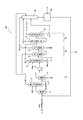
- An example of the apparatus for producing 1,3-butadiene according to the present invention has a configuration as shown in FIG.
- the production apparatus 100 shown in FIG. 1 extracts and distills a C 4 hydrocarbon mixture as a raw material to obtain a fraction (A) containing 1,3-butadiene and an extract (B) containing vinylacetylene.
- the C 4 hydrocarbon mixture may be any C 4 containing 1,3-butadiene and vinyl acetylene, such as a C 4 fraction obtained when cracking naphtha to produce ethylene. Hydrocarbon mixtures can be used.
- the manufacturing apparatus 100 mixes at least one of the high VA fraction obtained in the diffusion unit 20, the fraction produced in the extractive distillation unit 10 and the fraction produced in the impurity removal unit 30, preferably both.
- a mixing unit 40 for obtaining a dilute fraction having a vinylacetylene concentration lower than that of the high VA fraction, and a dilute fraction obtained in the mixing unit 40 are hydrogenated to hydrogenate vinyl acetylene in the dilute fraction to obtain 1,
- the extractive distillation section 10 is, for example, C 4 and evaporated tower 11 to vaporize the hydrocarbon mixture, an extractive distillation to distillate C 4 hydrocarbon mixture vaporized in the evaporating tower 11 (C) and extract (
- a stripping column 13 that removes the solvent from the extract (D)
- a compressor 14 that pressurizes the fraction obtained by removing the solvent from the extract (D);
- a second extractive distillation column 15 for separating and distilling the fraction pressurized by the compressor 14 into a fraction (A) and an extract (B).
- the first extractive distillation column 12 by supplying the solvent to the upper than the supply stage C 4 hydrocarbon mixture to extractive distillation to C 4 hydrocarbon mixture, than 1,3-butadiene in the solvent flame A fraction (C) containing soluble butanes and butenes is distilled from the top of the column, and an extract (D) containing 1,3-butadiene and vinylacetylene is taken out from the bottom of the column.
- the solvent to be supplied to the first extractive distillation column 12 used, for example, such solvents are described in WO 99/051552, the known solvent C 4 are used in the extractive distillation of hydrocarbon mixtures be able to.
- the solvent is removed from the bottom of the tower, and a fraction containing 1,3-butadiene and vinylacetylene is distilled from the top of the tower.
- recovered by the stripping tower 13 can be reused by the 1st extractive distillation tower 12, the 2nd extractive distillation tower 15, etc. arbitrarily.
- the solvent is supplied to the upper stage from the supply stage of the fraction containing 1,3-butadiene and vinylacetylene distilled from the stripping tower 13 and contains 1,3-butadiene and vinylacetylene.
- the fraction (A) containing 1,3-butadiene is distilled from the top of the column by extractive distillation, and also contains vinyl acetylene, which is more soluble in solvents than 1,3-butadiene.
- Liquid (B) is removed from the bottom of the column.
- the solvent to be supplied to the second extractive distillation column 15 used, for example, such solvents are described in WO 99/051552, the known solvent C 4 are used in the extractive distillation of hydrocarbon mixtures be able to.
- the diffusion unit 20 includes, for example, a first diffusion tower 21 for recovering 1,3-butadiene mixed in the extract (B) and an extract (B) after recovering 1,3-butadiene. And a second stripping tower 22 for obtaining a high VA fraction containing vinylacetylene by removing the solvent from
- a fraction containing 1,3-butadiene mixed in the extract (B) is distilled from the top of the tower, and a bottom liquid containing vinylacetylene is removed from the bottom of the tower. Take out.
- the fraction containing 1,3-butadiene distilled from the top of the first stripping tower 21 can be optionally returned to the second extractive distillation tower 15.
- the high VA fraction containing vinylacetylene contained in the bottoms from the first stripping tower 21 is distilled from the tower top and the solvent is taken out from the tower bottom.
- recovered with the 2nd stripping tower 22 can be reused by the 1st extractive distillation tower 12, the 2nd extractive distillation tower 15, etc. arbitrarily.
- the impurity removal unit 30 includes, for example, a low boiling point removal column 31 that removes impurities having a lower boiling point than 1,3-butadiene contained in the fraction (A) obtained in the second extractive distillation column 15. And a high boiler removal column 32 for removing impurities having a boiling point higher than that of 1,3-butadiene.
- a fraction (E) containing impurities having a low boiling point such as methylacetylene is distilled off from the top of the column, and a 1,3-butadiene-enriched bottom is removed from the bottom of the column. Allow the liquid to escape.
- a fraction further enriched with 1,3-butadiene is distilled from the top of the tower, and a fraction containing impurities with a high boiling point such as 1,2-butadiene (F ) From the bottom.
- ⁇ Mixing section> In the mixing unit 40, from the fraction (C) generated in the first extractive distillation column 12, the fraction (E) generated in the low boiler removal column 31, and the fraction (F) generated in the high boiler removal column 32. At least one selected from the group is mixed with the high VA fraction obtained in the diffusion unit 20 to obtain a diluted fraction.
- the concentration of vinylacetylene contained in the fraction (C), fraction (E) and fraction (F) is lower than the concentration of vinylacetylene contained in the high VA fraction.
- the concentration of vinyl acetylene in the diluted fraction is lower than the concentration of vinyl acetylene in the high VA fraction. Therefore, in this manufacturing apparatus 100, an abnormal reaction of the high VA fraction can be prevented.
- the mixing unit 40 can uniformly mix at least one selected from the group consisting of a fraction (C), a fraction (E), and a fraction (F) and a high VA fraction. If so, there is no particular limitation, and a mixing device such as an inline mixer, a merging pipe or the like can be used.
- the mixing unit 40 it is preferable to mix at least one of the fraction (E) and the fraction (F) and the high VA fraction, and at least one of the fraction (E) and the fraction (F), More preferably, the fraction (C) is mixed with the high VA fraction, and the fraction (C), the fraction (E) and the fraction (F) are further mixed with the high VA fraction.
- the production apparatus 100 uses the fraction (E) line for supplying the fraction (E) from the low boiling point removal column 31 to the mixing unit 40 and the fraction (F) from the high boiling point removal column 32 to the mixing unit 40.
- the distillate (F) lines and the high VA distillate line for supplying the high VA distillate from the diverging unit 20 (second distilling tower 22 in the illustrated example) to the mixing unit 40.
- the fraction (C) is supplied from at least one of the fraction (E) line and the fraction (F) line and the extractive distillation section 10 (first extractive distillation column 12 in the illustrated example) to the mixing section 40. More preferably, a fraction (C) line and a high VA fraction line are provided, and a fraction (C) line, a fraction (E) line, a fraction (F) line, and a high VA fraction line are all provided. More preferably.
- the fraction (E) and the fraction (F) contain 1,3-butadiene, for example, at 2% by mass or more, at least the fraction (E) and / or the fraction (F) is a high VA fraction.
- the 1,3-butadiene concentration in the hydride obtained by hydrotreating the diluted fraction and the diluted fraction can be increased, so that the recovery efficiency of 1,3-butadiene from the hydride can be increased. It is because it can raise.
- the fraction (C) is enriched with butanes and butenes
- the fraction (E) is enriched with low-boiling impurities such as methylacetylene
- the fraction (F) Is enriched with impurities having a high boiling point such as 1,2-butadiene. If all of the fraction (C), fraction (E) and fraction (F) are mixed with the high VA fraction, it can be obtained. It is because it can suppress that the density
- the fraction that is not mixed with the high VA fraction is not particularly limited, and can be treated using a known treatment method such as incineration.
- the diluted fraction obtained in the mixing unit 40 is hydrogenated, and vinyl acetylene in the diluted fraction is hydrogenated to produce 1,3-butadiene.
- the mixing part 40 is provided and the high VA fraction and at least one selected from the group which consists of a fraction (C), a fraction (E), and a fraction (F) are mixed. Since the prepared diluted fraction is hydrotreated, even if the diluted fraction is hydrotreated, the amount of 1,3-butadiene that can be separated and recovered from the C 4 hydrocarbon mixture is prevented from decreasing. can do. Therefore, 1,3-butadiene can be obtained in high yield while preventing abnormal reaction of the high VA fraction.
- the mixing unit 40 From the viewpoint of preventing a decrease in the amount of 1,3-butadiene that can be separated and recovered from the C 4 hydrocarbon mixture, in the mixing unit 40, the high VA fraction, the fraction (C), and the fraction (E ) And at least one selected from the group consisting of the fraction (F).
- the hydrogenation section 50 is not particularly limited, and includes a reactor filled with a hydrogenation catalyst capable of selectively hydrogenating vinylacetylene to 1,3-butadiene, It is possible to use a hydrogenation apparatus that includes a hydrogen supply line that supplies hydrogen to the reactor, and further includes an evaporator that optionally vaporizes the diluted fraction that is fed into the reactor.
- the return line 60 connects the hydrogenation unit 50 and the extractive distillation unit 10, and returns the hydride obtained in the hydrogenation unit 50 to the extractive distillation unit 10. Specifically, the return line 60 connects the outlet of the hydrogenation unit 50 and the evaporation tower 11 of the extractive distillation unit 10. The hydride returned through the return line 60 is mixed with the C 4 hydrocarbon mixture and supplied to the extractive distillation section 10. As a result, 1,3-butadiene contained in the hydride is efficiently separated and recovered together with 1,3-butadiene contained in the C 4 hydrocarbon mixture.
- the return line 60 may have a condenser or a pressure blower for condensing the hydride.
- the apparatus for producing 1,3-butadiene of the present invention has been described above using an example, but the apparatus for producing 1,3-butadiene of the present invention is not limited to the above example.
- the apparatus for producing 1,3-butadiene according to the present invention may include a separation / recovery device for separating and collecting 1,3-butadiene from a hydride instead of the return line 60.
- the configurations of the extractive distillation unit 10, the diffusion unit 20, and the impurity removal unit 30 are not limited to the above configurations, and can be changed to any configuration capable of separating and recovering 1,3-butadiene.
- a fraction containing 1,3-butadiene distilled from the top of the first stripping tower 21 is supplied to the mixing section 40 without being returned to the second extractive distillation tower 15. And may be used to dilute the high VA fraction.
- Example 1 1,3-butadiene was produced using the production apparatus 100 shown in FIG. Specifically, the high VA distillate fraction that generated C 4 1,3-butadiene from a hydrocarbon mixture comprising C 4 fraction obtained in the production of ethylene naphtha cracking when separating recovered Diluted fraction obtained by diluting with (C), fraction (E) and fraction (F) was hydrotreated by gas phase reaction to produce 1,3-butadiene.
- a hydrogenation catalyst a palladium catalyst having an egg shell structure, a carrier obtained by calcining a palladium catalyst (manufactured by JGC Catalysts & Chemicals Co., Ltd., N1182AZ) at 1000 ° C. for 3 hours in an air atmosphere.
- Example 1 From Table 1, in Example 1, the concentration of 1,3-butadiene in the hydride is higher than the concentration of 1,3-butadiene in the diluted fraction, and abnormal reaction is prevented by dilution of the high VA fraction. It can be seen that 1,3-butadiene can be produced in a high yield.
- 1,3-butadiene can be obtained in high yield while preventing abnormal reaction of a fraction containing vinylacetylene at a high concentration.
Landscapes
- Chemical & Material Sciences (AREA)
- Organic Chemistry (AREA)
- Engineering & Computer Science (AREA)
- Analytical Chemistry (AREA)
- Oil, Petroleum & Natural Gas (AREA)
- Water Supply & Treatment (AREA)
- Chemical Kinetics & Catalysis (AREA)
- General Chemical & Material Sciences (AREA)
- Organic Low-Molecular-Weight Compounds And Preparation Thereof (AREA)
- Low-Molecular Organic Synthesis Reactions Using Catalysts (AREA)
Abstract
Priority Applications (5)
| Application Number | Priority Date | Filing Date | Title |
|---|---|---|---|
| CN201780016649.4A CN108779044A (zh) | 2016-03-31 | 2017-03-27 | 1,3-丁二烯的制造方法及制造装置 |
| US16/083,609 US10968150B2 (en) | 2016-03-31 | 2017-03-27 | Method and apparatus for producing 1,3-butadiene |
| EP17774920.7A EP3438079B1 (fr) | 2016-03-31 | 2017-03-27 | Procédé et appareil de production de 1,3-butadiène |
| KR1020187026101A KR102393861B1 (ko) | 2016-03-31 | 2017-03-27 | 1,3-부타디엔의 제조 방법 및 제조 장치 |
| JP2018507979A JP6888612B2 (ja) | 2016-03-31 | 2017-03-27 | 1,3−ブタジエンの製造方法および製造装置 |
Applications Claiming Priority (2)
| Application Number | Priority Date | Filing Date | Title |
|---|---|---|---|
| JP2016071330 | 2016-03-31 | ||
| JP2016-071330 | 2016-03-31 |
Publications (1)
| Publication Number | Publication Date |
|---|---|
| WO2017170383A1 true WO2017170383A1 (fr) | 2017-10-05 |
Family
ID=59965606
Family Applications (1)
| Application Number | Title | Priority Date | Filing Date |
|---|---|---|---|
| PCT/JP2017/012362 Ceased WO2017170383A1 (fr) | 2016-03-31 | 2017-03-27 | Procédé et appareil de production de 1,3-butadiène |
Country Status (6)
| Country | Link |
|---|---|
| US (1) | US10968150B2 (fr) |
| EP (1) | EP3438079B1 (fr) |
| JP (1) | JP6888612B2 (fr) |
| KR (1) | KR102393861B1 (fr) |
| CN (1) | CN108779044A (fr) |
| WO (1) | WO2017170383A1 (fr) |
Families Citing this family (1)
| Publication number | Priority date | Publication date | Assignee | Title |
|---|---|---|---|---|
| US11952333B2 (en) | 2019-09-13 | 2024-04-09 | Sabic Global Technologies B.V. | Integrated systems and methods for producing 1,3-butadiene via extractive distillation, distillation, and/or selective hydrogenation |
Citations (5)
| Publication number | Priority date | Publication date | Assignee | Title |
|---|---|---|---|---|
| JPS51127006A (en) * | 1975-04-15 | 1976-11-05 | Basf Ag | Process for preparing 33butadiene from c44hydrocarbon mixture |
| JP2006502122A (ja) * | 2002-07-24 | 2006-01-19 | ビーエーエスエフ アクチェンゲゼルシャフト | C4フラクションの連続的分別 |
| JP2006502123A (ja) * | 2002-07-24 | 2006-01-19 | ビーエーエスエフ アクチェンゲゼルシャフト | 粗−1,3−ブタジエンの後処理法 |
| JP2010265188A (ja) * | 2009-05-12 | 2010-11-25 | Jsr Corp | ブタジエンの製造方法 |
| JP2011528655A (ja) * | 2008-07-17 | 2011-11-24 | エスケー イノベーション カンパニー リミテッド | アセチレン転換を用いた原油c4留分からの1,3−ブタジエン分離方法 |
Family Cites Families (5)
| Publication number | Priority date | Publication date | Assignee | Title |
|---|---|---|---|---|
| JPS5646824A (en) | 1979-09-27 | 1981-04-28 | Japan Synthetic Rubber Co Ltd | Recovery of 1,3-butadiene |
| JP4134391B2 (ja) | 1998-04-07 | 2008-08-20 | 日本ゼオン株式会社 | 不飽和炭化水素の分離精製装置および分離精製方法 |
| KR100338363B1 (ko) * | 1999-06-16 | 2002-05-30 | 유승렬 | C4 탄화수소 혼합물로부터 c4 아세틸렌의 제거방법 |
| CN100577619C (zh) * | 2008-03-12 | 2010-01-06 | 王明华 | 一种丁二烯-1,3抽提工艺 |
| CN101434508B (zh) * | 2008-12-11 | 2013-07-31 | 中国石油天然气股份有限公司 | 一种炔烃选择加氢的方法 |
-
2017
- 2017-03-27 KR KR1020187026101A patent/KR102393861B1/ko not_active Expired - Fee Related
- 2017-03-27 WO PCT/JP2017/012362 patent/WO2017170383A1/fr not_active Ceased
- 2017-03-27 JP JP2018507979A patent/JP6888612B2/ja active Active
- 2017-03-27 US US16/083,609 patent/US10968150B2/en active Active
- 2017-03-27 CN CN201780016649.4A patent/CN108779044A/zh active Pending
- 2017-03-27 EP EP17774920.7A patent/EP3438079B1/fr active Active
Patent Citations (5)
| Publication number | Priority date | Publication date | Assignee | Title |
|---|---|---|---|---|
| JPS51127006A (en) * | 1975-04-15 | 1976-11-05 | Basf Ag | Process for preparing 33butadiene from c44hydrocarbon mixture |
| JP2006502122A (ja) * | 2002-07-24 | 2006-01-19 | ビーエーエスエフ アクチェンゲゼルシャフト | C4フラクションの連続的分別 |
| JP2006502123A (ja) * | 2002-07-24 | 2006-01-19 | ビーエーエスエフ アクチェンゲゼルシャフト | 粗−1,3−ブタジエンの後処理法 |
| JP2011528655A (ja) * | 2008-07-17 | 2011-11-24 | エスケー イノベーション カンパニー リミテッド | アセチレン転換を用いた原油c4留分からの1,3−ブタジエン分離方法 |
| JP2010265188A (ja) * | 2009-05-12 | 2010-11-25 | Jsr Corp | ブタジエンの製造方法 |
Non-Patent Citations (1)
| Title |
|---|
| See also references of EP3438079A4 * |
Also Published As
| Publication number | Publication date |
|---|---|
| EP3438079A4 (fr) | 2019-12-18 |
| EP3438079A1 (fr) | 2019-02-06 |
| JP6888612B2 (ja) | 2021-06-16 |
| KR20180125147A (ko) | 2018-11-22 |
| US10968150B2 (en) | 2021-04-06 |
| US20190071375A1 (en) | 2019-03-07 |
| KR102393861B1 (ko) | 2022-05-02 |
| CN108779044A (zh) | 2018-11-09 |
| EP3438079B1 (fr) | 2023-12-20 |
| JPWO2017170383A1 (ja) | 2019-02-07 |
Similar Documents
| Publication | Publication Date | Title |
|---|---|---|
| JP5038573B2 (ja) | C4−カットを処理するための方法および装置 | |
| JP5758922B2 (ja) | 粗1,3−ブタジエンから純粋な1,3−ブタジエンを蒸留抽出する方法及び装置 | |
| CN105566032B (zh) | 富炔碳四的选择加氢工艺 | |
| DE3338269A1 (de) | Verfahren zur gewinnung von isopren aus einem c(pfeil abwaerts)5(pfeil abwaerts)-kohlenwasserstoffgemisch | |
| JP5260281B2 (ja) | ジシクロペンタジエンの製造方法 | |
| JP7088161B2 (ja) | 炭化水素の製造方法および製造装置 | |
| JP4243246B2 (ja) | 粗−1,3−ブタジエンの後処理法 | |
| DE102009027770B4 (de) | Verfahren zur Hydrierung von Butadiin | |
| TWI592395B (zh) | 更爲節能的c5氫化方法 | |
| JPWO2017170383A1 (ja) | 1,3−ブタジエンの製造方法および製造装置 | |
| PL108032B1 (pl) | Sposob odzyskiwania izoprenu method of recovering isoprene | |
| JPWO2017170421A1 (ja) | 水素化方法 | |
| RU2220128C1 (ru) | Способ выделения циклопентана | |
| CN101544533B (zh) | 用后脱炔烃工艺脱除裂解碳五馏分中的炔烃的方法 | |
| RU2568114C2 (ru) | Способ выделения бензола из смесей с неароматическими углеводородами | |
| JP4608341B2 (ja) | ガソリン基材の製造方法 | |
| JP7216279B2 (ja) | 1,3-ブタジエンの分離回収方法および分離回収装置 | |
| CN108026455A (zh) | 用于分离包含烃和硫化合物的物质混合物的方法和系统 |
Legal Events
| Date | Code | Title | Description |
|---|---|---|---|
| ENP | Entry into the national phase |
Ref document number: 2018507979 Country of ref document: JP Kind code of ref document: A |
|
| ENP | Entry into the national phase |
Ref document number: 20187026101 Country of ref document: KR Kind code of ref document: A |
|
| NENP | Non-entry into the national phase |
Ref country code: DE |
|
| WWE | Wipo information: entry into national phase |
Ref document number: 2017774920 Country of ref document: EP |
|
| ENP | Entry into the national phase |
Ref document number: 2017774920 Country of ref document: EP Effective date: 20181031 |
|
| 121 | Ep: the epo has been informed by wipo that ep was designated in this application |
Ref document number: 17774920 Country of ref document: EP Kind code of ref document: A1 |