WO2017170548A1 - 非水電解質二次電池用の正極活物質及びその製造方法、並びにそれを用いた非水電解質二次電池 - Google Patents
非水電解質二次電池用の正極活物質及びその製造方法、並びにそれを用いた非水電解質二次電池 Download PDFInfo
- Publication number
- WO2017170548A1 WO2017170548A1 PCT/JP2017/012635 JP2017012635W WO2017170548A1 WO 2017170548 A1 WO2017170548 A1 WO 2017170548A1 JP 2017012635 W JP2017012635 W JP 2017012635W WO 2017170548 A1 WO2017170548 A1 WO 2017170548A1
- Authority
- WO
- WIPO (PCT)
- Prior art keywords
- active material
- positive electrode
- electrode active
- compound
- precursor
- Prior art date
- Legal status (The legal status is an assumption and is not a legal conclusion. Google has not performed a legal analysis and makes no representation as to the accuracy of the status listed.)
- Ceased
Links
Images
Classifications
-
- C—CHEMISTRY; METALLURGY
- C01—INORGANIC CHEMISTRY
- C01G—COMPOUNDS CONTAINING METALS NOT COVERED BY SUBCLASSES C01D OR C01F
- C01G53/00—Compounds of nickel
- C01G53/40—Complex oxides containing nickel and at least one other metal element
- C01G53/42—Complex oxides containing nickel and at least one other metal element containing alkali metals, e.g. LiNiO2
- C01G53/44—Complex oxides containing nickel and at least one other metal element containing alkali metals, e.g. LiNiO2 containing manganese
- C01G53/50—Complex oxides containing nickel and at least one other metal element containing alkali metals, e.g. LiNiO2 containing manganese of the type (MnO2)n-, e.g. Li(NixMn1-x)O2 or Li(MyNixMn1-x-y)O2
-
- C—CHEMISTRY; METALLURGY
- C01—INORGANIC CHEMISTRY
- C01G—COMPOUNDS CONTAINING METALS NOT COVERED BY SUBCLASSES C01D OR C01F
- C01G53/00—Compounds of nickel
-
- H—ELECTRICITY
- H01—ELECTRIC ELEMENTS
- H01M—PROCESSES OR MEANS, e.g. BATTERIES, FOR THE DIRECT CONVERSION OF CHEMICAL ENERGY INTO ELECTRICAL ENERGY
- H01M4/00—Electrodes
- H01M4/02—Electrodes composed of, or comprising, active material
- H01M4/36—Selection of substances as active materials, active masses, active liquids
- H01M4/48—Selection of substances as active materials, active masses, active liquids of inorganic oxides or hydroxides
- H01M4/52—Selection of substances as active materials, active masses, active liquids of inorganic oxides or hydroxides of nickel, cobalt or iron
- H01M4/525—Selection of substances as active materials, active masses, active liquids of inorganic oxides or hydroxides of nickel, cobalt or iron of mixed oxides or hydroxides containing iron, cobalt or nickel for inserting or intercalating light metals, e.g. LiNiO2, LiCoO2 or LiCoOxFy
-
- C—CHEMISTRY; METALLURGY
- C01—INORGANIC CHEMISTRY
- C01G—COMPOUNDS CONTAINING METALS NOT COVERED BY SUBCLASSES C01D OR C01F
- C01G53/00—Compounds of nickel
- C01G53/40—Complex oxides containing nickel and at least one other metal element
- C01G53/42—Complex oxides containing nickel and at least one other metal element containing alkali metals, e.g. LiNiO2
-
- C—CHEMISTRY; METALLURGY
- C01—INORGANIC CHEMISTRY
- C01G—COMPOUNDS CONTAINING METALS NOT COVERED BY SUBCLASSES C01D OR C01F
- C01G53/00—Compounds of nickel
- C01G53/40—Complex oxides containing nickel and at least one other metal element
- C01G53/42—Complex oxides containing nickel and at least one other metal element containing alkali metals, e.g. LiNiO2
- C01G53/44—Complex oxides containing nickel and at least one other metal element containing alkali metals, e.g. LiNiO2 containing manganese
-
- C—CHEMISTRY; METALLURGY
- C01—INORGANIC CHEMISTRY
- C01G—COMPOUNDS CONTAINING METALS NOT COVERED BY SUBCLASSES C01D OR C01F
- C01G53/00—Compounds of nickel
- C01G53/40—Complex oxides containing nickel and at least one other metal element
- C01G53/66—Complex oxides containing nickel and at least one other metal element containing alkaline earth metals, e.g. SrNiO3 or SrNiO2
-
- H—ELECTRICITY
- H01—ELECTRIC ELEMENTS
- H01M—PROCESSES OR MEANS, e.g. BATTERIES, FOR THE DIRECT CONVERSION OF CHEMICAL ENERGY INTO ELECTRICAL ENERGY
- H01M10/00—Secondary cells; Manufacture thereof
- H01M10/05—Accumulators with non-aqueous electrolyte
- H01M10/052—Li-accumulators
-
- H—ELECTRICITY
- H01—ELECTRIC ELEMENTS
- H01M—PROCESSES OR MEANS, e.g. BATTERIES, FOR THE DIRECT CONVERSION OF CHEMICAL ENERGY INTO ELECTRICAL ENERGY
- H01M10/00—Secondary cells; Manufacture thereof
- H01M10/05—Accumulators with non-aqueous electrolyte
- H01M10/052—Li-accumulators
- H01M10/0525—Rocking-chair batteries, i.e. batteries with lithium insertion or intercalation in both electrodes; Lithium-ion batteries
-
- H—ELECTRICITY
- H01—ELECTRIC ELEMENTS
- H01M—PROCESSES OR MEANS, e.g. BATTERIES, FOR THE DIRECT CONVERSION OF CHEMICAL ENERGY INTO ELECTRICAL ENERGY
- H01M4/00—Electrodes
- H01M4/02—Electrodes composed of, or comprising, active material
- H01M4/13—Electrodes for accumulators with non-aqueous electrolyte, e.g. for lithium-accumulators; Processes of manufacture thereof
- H01M4/131—Electrodes based on mixed oxides or hydroxides, or on mixtures of oxides or hydroxides, e.g. LiCoOx
-
- H—ELECTRICITY
- H01—ELECTRIC ELEMENTS
- H01M—PROCESSES OR MEANS, e.g. BATTERIES, FOR THE DIRECT CONVERSION OF CHEMICAL ENERGY INTO ELECTRICAL ENERGY
- H01M4/00—Electrodes
- H01M4/02—Electrodes composed of, or comprising, active material
- H01M4/13—Electrodes for accumulators with non-aqueous electrolyte, e.g. for lithium-accumulators; Processes of manufacture thereof
- H01M4/139—Processes of manufacture
- H01M4/1391—Processes of manufacture of electrodes based on mixed oxides or hydroxides, or on mixtures of oxides or hydroxides, e.g. LiCoOx
-
- H—ELECTRICITY
- H01—ELECTRIC ELEMENTS
- H01M—PROCESSES OR MEANS, e.g. BATTERIES, FOR THE DIRECT CONVERSION OF CHEMICAL ENERGY INTO ELECTRICAL ENERGY
- H01M4/00—Electrodes
- H01M4/02—Electrodes composed of, or comprising, active material
- H01M4/36—Selection of substances as active materials, active masses, active liquids
- H01M4/48—Selection of substances as active materials, active masses, active liquids of inorganic oxides or hydroxides
- H01M4/485—Selection of substances as active materials, active masses, active liquids of inorganic oxides or hydroxides of mixed oxides or hydroxides for inserting or intercalating light metals, e.g. LiTi2O4 or LiTi2OxFy
-
- H—ELECTRICITY
- H01—ELECTRIC ELEMENTS
- H01M—PROCESSES OR MEANS, e.g. BATTERIES, FOR THE DIRECT CONVERSION OF CHEMICAL ENERGY INTO ELECTRICAL ENERGY
- H01M4/00—Electrodes
- H01M4/02—Electrodes composed of, or comprising, active material
- H01M4/36—Selection of substances as active materials, active masses, active liquids
- H01M4/48—Selection of substances as active materials, active masses, active liquids of inorganic oxides or hydroxides
- H01M4/50—Selection of substances as active materials, active masses, active liquids of inorganic oxides or hydroxides of manganese
- H01M4/505—Selection of substances as active materials, active masses, active liquids of inorganic oxides or hydroxides of manganese of mixed oxides or hydroxides containing manganese for inserting or intercalating light metals, e.g. LiMn2O4 or LiMn2OxFy
-
- C—CHEMISTRY; METALLURGY
- C01—INORGANIC CHEMISTRY
- C01P—INDEXING SCHEME RELATING TO STRUCTURAL AND PHYSICAL ASPECTS OF SOLID INORGANIC COMPOUNDS
- C01P2002/00—Crystal-structural characteristics
- C01P2002/60—Compounds characterised by their crystallite size
-
- C—CHEMISTRY; METALLURGY
- C01—INORGANIC CHEMISTRY
- C01P—INDEXING SCHEME RELATING TO STRUCTURAL AND PHYSICAL ASPECTS OF SOLID INORGANIC COMPOUNDS
- C01P2004/00—Particle morphology
- C01P2004/50—Agglomerated particles
-
- C—CHEMISTRY; METALLURGY
- C01—INORGANIC CHEMISTRY
- C01P—INDEXING SCHEME RELATING TO STRUCTURAL AND PHYSICAL ASPECTS OF SOLID INORGANIC COMPOUNDS
- C01P2004/00—Particle morphology
- C01P2004/60—Particles characterised by their size
- C01P2004/61—Micrometer sized, i.e. from 1-100 micrometer
-
- C—CHEMISTRY; METALLURGY
- C01—INORGANIC CHEMISTRY
- C01P—INDEXING SCHEME RELATING TO STRUCTURAL AND PHYSICAL ASPECTS OF SOLID INORGANIC COMPOUNDS
- C01P2006/00—Physical properties of inorganic compounds
- C01P2006/40—Electric properties
-
- H—ELECTRICITY
- H01—ELECTRIC ELEMENTS
- H01M—PROCESSES OR MEANS, e.g. BATTERIES, FOR THE DIRECT CONVERSION OF CHEMICAL ENERGY INTO ELECTRICAL ENERGY
- H01M4/00—Electrodes
- H01M4/02—Electrodes composed of, or comprising, active material
- H01M2004/026—Electrodes composed of, or comprising, active material characterised by the polarity
- H01M2004/028—Positive electrodes
-
- Y—GENERAL TAGGING OF NEW TECHNOLOGICAL DEVELOPMENTS; GENERAL TAGGING OF CROSS-SECTIONAL TECHNOLOGIES SPANNING OVER SEVERAL SECTIONS OF THE IPC; TECHNICAL SUBJECTS COVERED BY FORMER USPC CROSS-REFERENCE ART COLLECTIONS [XRACs] AND DIGESTS
- Y02—TECHNOLOGIES OR APPLICATIONS FOR MITIGATION OR ADAPTATION AGAINST CLIMATE CHANGE
- Y02E—REDUCTION OF GREENHOUSE GAS [GHG] EMISSIONS, RELATED TO ENERGY GENERATION, TRANSMISSION OR DISTRIBUTION
- Y02E60/00—Enabling technologies; Technologies with a potential or indirect contribution to GHG emissions mitigation
- Y02E60/10—Energy storage using batteries
Definitions
- the present invention relates to a positive electrode active material for a non-aqueous electrolyte secondary battery, a method for producing the same, and a non-aqueous electrolyte secondary battery using the same, and in particular, stable charge / discharge with little deterioration against repeated charge / discharge.
- the present invention relates to a positive electrode active material that can be used, a manufacturing method thereof, and a nonaqueous electrolyte secondary battery using the same.
- means for controlling the interfacial reaction between the electrode active material and the electrolytic solution accompanying the insertion / desorption of Li ions during charging / discharging is usually employed.
- One example is various surface treatments of the active material, and its effect has been proven.
- Ti is present at the grain boundaries (see, for example, Patent Document 1), and Nb is present (for example, see Patent Document 2).
- Nb is present (for example, see Patent Document 2).
- Ti, Zr, Hf, Si, Ge, Sn containing a compound containing at least one element see, for example, Patent Document 3).
- Patent Documents 1 to 3 cannot sufficiently improve the performance of the positive electrode active material, and sufficiently perform stable charge / discharge with little deterioration against repeated charge / discharge. It is difficult to obtain a positive electrode that can be used.
- the present invention has been made in view of the above problems, and an object of the present invention is to obtain a positive electrode active material capable of performing stable charge and discharge with little deterioration with respect to repeated charge and discharge, and a battery. It is to enable higher output and longer life.
- grain boundary precipitation of the Li component which is a raw material for the positive electrode active material
- grain boundary precipitation of the Li component is caused by variation in the Li concentration in the particles due to excessive addition of Li during synthesis of the active material or poor mixing of raw materials.
- the positive electrode active material for a non-aqueous electrolyte secondary battery is composed of a lithium transition metal layered oxide, and the variation coefficient of Li concentration in the particles is 30% or less.
- the variation in the Li / M ratio increases due to such a decrease in the M concentration at the grain boundary portion and precipitation of Li which is an unreacted or decomposition product.
- the variation coefficient of the Li / M ratio is Is 30% or less, the Li / M variation is small and local compositional deviation is suppressed, and the aggregated particles have an average composition as a whole. Therefore, according to the positive electrode active material of the present invention, grain boundary precipitation of the Li component can be suppressed, and as a result, there is little deterioration with respect to repeated charge and discharge, enabling stable charge and discharge, and high output of the battery. Allows long life.
- the positive electrode active material F, Mg, Al, P, Ca, Ti, Y, Sn, Bi, Ce, Zr, La, Te, Mo, Sc, Nb, and W (In the following, it is preferable that a plurality of or any one of A) is present. Since these A elements react with a part of Li which is unreacted or decomposed to form a Li—A—O compound, the coefficient of variation is reduced. In addition, the grain boundary of the secondary particles in this case indicates an interface where the primary particles are in contact with each other.
- the above-mentioned coefficient of variation is suppressed because the Li component, which is an unreacted or decomposed product that easily precipitates at grain boundaries, becomes a compound with the A element, and as a result, the resistance component in the battery We found that removal was achieved. Furthermore, since this reaction product is a Li ion conductor, it is possible to obtain a positive electrode active material that is less deteriorated by repeated charge and discharge when it is used as a battery, and that can perform more stable charge and discharge. In order to obtain excellent battery characteristics, the inventors have concluded that the coefficient of variation is 30% or less.
- “Li” in the Li / M ratio related to the coefficient of variation means Li that is not combined with the element A.
- the crystallite size is preferably 100 nm or more and 600 nm or less, and the average secondary particle diameter is preferably 3.0 ⁇ m or more and 20 ⁇ m or less.
- the crystallite size when the upper limit exceeds 600 nm, the mechanical cohesive strength of the secondary particles is lowered, which causes cracking of the aggregate.
- the lower limit is less than 100 nm, the grain interface area in the secondary aggregate structure increases, and the battery performance deterioration factor due to the side reaction becomes dominant.
- about an average secondary particle diameter when an upper limit exceeds 20 micrometers, the spreading
- the lower limit is less than 3.0 ⁇ m, the active material / electrolyte interface increases, leading to an increase in undesirable side reactions.
- the crystallite size is preferably 100 nm or more and 600 nm or less, and the average secondary particle diameter is preferably 3.0 ⁇ m or more and 20 ⁇ m or less.
- the non-aqueous electrolyte secondary battery according to the present invention is characterized by using the positive electrode active material for the non-aqueous electrolyte secondary battery.
- the non-aqueous electrolyte secondary battery according to the present invention since the positive electrode active material as described above is used, there is little deterioration with respect to repeated charge and discharge, enabling stable charge and discharge, and high output of the battery. Long service life is possible.
- the method for producing a positive electrode active material according to the present invention includes a method of coprecipitation using a Ni compound and a Co compound, and optionally at least one of an Al compound and a Me compound.
- a step of obtaining a composite compound precursor comprising one as a main component and a lithium compound mixed with the precursor so that the molar ratio of Li / M (M Ni + Co + Al + Me) is in the range of 1.00 to 1.15.
- a step of firing the mixture at 600 ° C. to 950 ° C. in an oxidizing atmosphere, and an annealing treatment of the fired mixture at 500 ° C. to 750 ° C. To do.
- the coefficient of variation of the Li / M ratio as described above is 30% or less, and it is possible to suppress grain boundary precipitation of the Li component, resulting in repeated charge and discharge.
- a positive electrode active material that is less deteriorated and enables stable charge and discharge can be obtained.
- a compound compound precursor may be obtained by coprecipitation reaction of a compound containing a plurality of or any one of the metal components with Ni compound and Co compound, and optionally at least one of Al compound and Me compound.
- the method for producing a positive electrode active material according to the present invention includes F, Mg, Al, P, Ca, Ti, Y, Sn, Bi, Ce, Zr, La, Mo, Sc, Nb and a mixture.
- a step of mixing a compound containing a plurality of W or any metal component of W may be further provided.
- the obtained composite compound precursor is heat-treated in an oxidizing atmosphere at a temperature range of 400 ° C. to 800 ° C. for 3 hours to 5 hours.
- the residual carbonate radical of the precursor can be reduced and the precursor can be used after being oxidized, whereby the synthesis of the precursor and Li can be facilitated, and the obtained active material The remaining lithium carbonate can be reduced.
- the positive electrode active material according to the present invention can suppress precipitation of grain boundaries of the Li component, so that the battery is less likely to deteriorate with respect to repeated charge and discharge and enables stable charge and discharge.
- the nonaqueous electrolyte secondary battery of the present invention since the positive electrode active material is used, high output and long life can be achieved.
- the variation coefficient of the Li concentration ratio is 30% or less, and the general formula is Li a (Ni b Co c Al d Me e ) O 2 (where 1.00 ⁇ a ⁇ 1.15, 0.25 ⁇ b ⁇ 1 And 0 ⁇ c ⁇ 0.30, 0 ⁇ d ⁇ 0.05, and 0 ⁇ e ⁇ 0.40).
- the local composition deviation is suppressed, and the aggregated particles have an average composition. Therefore, it is possible to reduce the initial resistance inside the secondary particles due to Li deposition in the battery and the generation of resistance components during the cycle, and as a result, cracking of the repetitive charge / discharge aggregation form and the accompanying battery performance degradation. Can be reduced.
- a more preferable coefficient of variation is 28% or less, and even more preferably 27% or less.
- the lower limit value is zero. However, the lower limit is not limited to this when the Li / M at the grain boundary is lower than that within the crystal.
- a more preferable composition is Li a (Ni b Co c Al d Me e ) O 2 , and the range of a (Li / M) is 1.00 to 1.15, A more preferable range of a is 1.00 to 1.12, still more preferably 1.00 to 1.10, a range of b is 0.30 to 0.98, and a range of c is 0.05 to 0. .35, d ranges from 0 to 0.05, and e ranges from 0 to 0.35.
- the composition becomes Li-rich with respect to stoichio, so that Ni can be prevented from entering the Li site which is the 3a site.
- the positive electrode active material according to the present embodiment has F, Mg, Al, P, Ca, Ti, Y, Sn, Bi, Ce, Zr, La, Mo, Sc, Nb, W at the grain boundaries of the secondary particles. It is preferable to contain dissimilar metals such as. Thereby, said element reacts with few Li components (Li component which is unreacted or a decomposition product) in a grain boundary, Li compound is produced, and this functions as a kind of Li ion conductor. As a result, precipitation of the Li component at the grain boundary can be suppressed.
- the dissimilar metal may be substituted in the crystal lattice of the positive electrode active material.
- the dissimilar metal moves to the grain boundary of the secondary particles due to repeated charging and discharging in the battery, and as a result, it can react with the Li component that is a decomposition product at the grain boundary, It is thought that an effect can be produced.
- the different metal may be present on the surface of the secondary particle in addition to the grain boundary of the secondary particle.
- the crystallite size of the positive electrode active material according to the present invention is preferably 100 nm to 600 nm.
- the upper limit exceeds 600 nm, the mechanical agglomeration strength of the secondary particles is lowered, which causes cracking of the agglomerates.
- the lower limit is less than 100 nm, the grain interface area in the secondary aggregate structure increases, and the battery performance deterioration factor due to the side reaction becomes dominant.
- a more preferable crystallite size is 150 nm to 500 nm.
- the average secondary particle diameter of the positive electrode active material according to this embodiment is preferably 3.0 ⁇ m to 20 ⁇ m.
- the upper limit exceeds 20 ⁇ m, the diffusion of Li accompanying charge / discharge is hindered, causing a decrease in input / output of the battery.
- the lower limit is preferably 3.0 ⁇ m. Below this, the active material / electrolyte interface increases, leading to an increase in undesirable side reactions.
- a more preferable average secondary particle size is 4.0 ⁇ m to 19 ⁇ m.
- the positive electrode active material according to this embodiment can be manufactured, for example, as follows.
- a nickel, cobalt, manganese mixed sulfuric acid aqueous solution adjusted to an optimal pH value is continuously supplied to cause wet coprecipitation reaction, and a spherical nickel-cobalt-manganese composite compound as a precursor Get particles.
- the nickel / cobalt / manganese composite compound particles are preferably composite hydroxide.
- a mixture of this precursor and the lithium compound with a molar ratio of Li / (Ni + Co + Mn) in a predetermined range, for example, about 1.00 to 1.15 is obtained, and this mixture is obtained at 600 to 950 ° C. in an oxidizing atmosphere.
- Bake in Incidentally, annealing may be performed at 500 ° C. to 750 ° C.
- the positive electrode active material according to this embodiment can be obtained.
- the case where the Me element was not contained was demonstrated above, naturally, you may add a Me element and may manufacture complex oxide.
- different metals such as F, Mg, Al, P, Ca, Ti, Y, Sn, Bi, Ce, Zr, La, Mo, Sc, Nb, and W may be added.
- the above may be at the time of the wet coprecipitation reaction, or may be added thereafter by dry mixing, and is not particularly limited.
- the complex compound particles crystallite size of 100 nm ⁇ 600 nm, average secondary particle diameter is prepared as 3 [mu] m ⁇ 20 [mu] m, a BET specific surface area becomes 0.15m 2 /g ⁇ 1.0m 2 / g It is preferable to perform a process such as pulverization.
- the lithium compound used in the present embodiment is not particularly limited, and various lithium salts can be used.
- lithium hydroxide monohydrate, lithium nitrate, lithium carbonate, lithium acetate, lithium bromide examples include lithium chloride, lithium citrate, lithium fluoride, lithium iodide, lithium lactate, lithium oxalate, lithium phosphate, lithium pyruvate, lithium sulfate, and lithium oxide, preferably lithium carbonate or hydroxide Lithium monohydrate.
- the Li / M ratio in the mixture of the precursor and the Li compound is 1.00 to 1.15 in molar ratio.
- the Li / M ratio is smaller than 1.00, Ni is mixed into the Li site of the crystal structure, and a single crystal phase cannot be obtained, which causes a decrease in battery performance.
- the Li / M ratio is larger than 1.15, the excess Li than the stoichiometric composition becomes a factor of the resistance component and causes a decrease in battery performance.
- a more preferred Li / M ratio is 1.00 to 1.12 in molar ratio, and even more preferably 1.00 to 1.10.
- the atmosphere when firing the mixture of the precursor and the Li compound is an oxidizing atmosphere, and the preferable oxygen content is 20 vol% or more.
- the oxygen content is below the above range, Li ions are mixed into the transition metal site, leading to a decrease in battery performance.
- the upper limit of the oxygen content is not particularly limited.
- the firing temperature is preferably 600 ° C. to 950 ° C.
- the firing temperature is lower than 600 ° C.
- the diffusion energy of the element is insufficient, so that the target crystal structure in the thermal equilibrium state cannot be reached and a single layer cannot be obtained.
- the firing temperature exceeds 950 ° C., oxygen vacancies in the crystal due to reduction of the transition metal occur, and a single layer having the target crystal structure cannot be obtained.
- a preferable baking time is 5 to 20 hours, and an even more preferable baking time is 5 to 15 hours.
- the annealing treatment after firing is preferably in the temperature range of 500 ° C. to 750 ° C., and the atmosphere is preferably an oxidizing atmosphere.
- the annealing temperature is less than 500 ° C., the diffusion energy of the element is insufficient, so that the unreacted or decomposition product Li cannot react with the A element and diffuse to the grain boundary.
- the intended composition variation cannot be reduced, that is, the Li / M variation coefficient cannot be reduced to 30% or less.
- the annealing temperature exceeds 750 ° C., the oxygen activity is insufficient, and a transition metal rock salt structure oxide which is an impurity phase is generated.
- a more preferable annealing temperature is 550 ° C.
- a preferable annealing time is 3 to 20 hours, and more preferably 3 to 15 hours. Moreover, it is preferable to perform the annealing process after baking continuously after the baking process.
- the annealing temperature needs to be lower than the firing temperature, and more preferably, annealing is performed at a temperature 30 ° C. or more lower than the firing temperature.
- the nonaqueous electrolyte secondary battery according to the present embodiment includes a positive electrode, a negative electrode, and an electrolyte containing the positive electrode active material.
- the nonaqueous electrolyte secondary battery according to the present invention can be used even when the operating voltage or the voltage accompanying the initial crystal phase transition is 4.5 V or less on the basis of lithium.
- the positive electrode mixture in the present invention is not particularly limited, and for example, it can be obtained by kneading at a ratio of active material: conductive agent: binder of 90: 5: 5.
- lithium metal lithium metal, lithium / aluminum alloy, lithium / tin alloy, silicon, silicon / carbon composite, graphite or the like can be used.
- the solvent for the electrolyte solution includes carbonates having a basic structure of propylene carbonate (PC), dimethyl carbonate (DMC), etc., and dimethoxyethane (DME).
- PC propylene carbonate
- DMC dimethyl carbonate
- DME dimethoxyethane
- An organic solvent containing at least one kind of ether such as) can be used.
- At least one lithium salt such as lithium perchlorate (LiClO 4 ) or lithium tetrafluoroborate (LiBF 4 ) is used as the solvent. It can be used by dissolving.
- the important point in the present invention is that the nonaqueous electrolyte secondary battery using the positive electrode active material according to the present invention can perform stable charge and discharge with little capacity deterioration in repeated charge and discharge from low temperature to high temperature. Is a point.
- the side reaction is a reaction caused by an increase in the electric double layer caused by the high resistance at the interface.
- Side effects caused by these include separation of grain boundaries due to side reaction products in the grain boundaries, further degradation of conductivity within secondary particle behavior units, decomposition of organic impurities, and metal impurities. This is, for example, dissolution and precipitation, and macroscopic expansion of the electrode.
- the variation coefficient of the Li composition ratio Li / M in the secondary particles of the positive electrode active material is 30% or less, the variation in Li / M is small and local compositional deviation is suppressed. And has an average composition throughout the aggregated particles. Therefore, it is possible to reduce the initial resistance inside the secondary particles due to the precipitation of Li which is an unreacted or decomposition product in the battery, and the generation of resistance components during the cycle. Cracks and accompanying battery performance degradation can be reduced.
- the excess Li component reacts with other elements to form a Li ion conductor.
- the resistance component of the grain boundary is reduced, and it is based on the knowledge that stable charge / discharge with little capacity deterioration can be performed in repeated charge / discharge from low temperature to high temperature.
- the confirmation of the crystal grain boundary in the positive electrode active material and the crystal structure inside the crystal grain in the vicinity of the grain boundary are shown in a cross section obtained by Ar ion milling using a TEM Image multi-interference image and a limited field electron diffraction pattern at an acceleration voltage of 300 keV. Identified.
- the cross section (observation surface) of the aggregated particles was obtained by cutting out the positive electrode active material sealed in the resin by ion milling.
- the cross section at this time is at least 3 ⁇ m in diameter
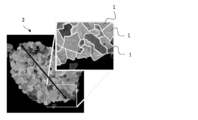
- the composition ratio is continuously measured for at least 3 ⁇ m linear part from one end of the aggregated particle to the opposite end, and the standard deviation value and the average value are calculated, The coefficient of variation (standard deviation / average value) was used.
- FIG. 1 shows a conceptual diagram of the measurement.
- the positive electrode active material according to the present invention is a secondary particle 2 in which a large number of primary particles (crystal particles) 1 are aggregated.
- the straight portion 3 having a predetermined length was selected, and the composition ratio was measured.
- the FIB-SIM image and the above-mentioned NanoSIMS Ni distribution were compared in advance, and it was confirmed that the Ni distribution obtained by NanoSIMS and the actual grain boundary position coincided.
- the state analysis of the transition metal near the grain boundary was performed using STEM-EELS at an acceleration voltage of 200 keV, a beam diameter of 0.2 nm, and an irradiation current of 1.00 nA.
- a 2032 size coin cell was used for the repeated charge / discharge characteristic measurement of the positive electrode mixture containing the positive electrode active material according to the present embodiment.
- 90% by weight of a composite oxide as a positive electrode active material, 5% by weight of carbon black as a conductive agent, and 5% by weight of polyvinylidene fluoride dissolved in N-methylpyrrolidone as a binder were mixed. Then, it was applied to an Al metal foil and dried at 110 ° C. The sheet was punched to ⁇ 16 mm, and then pressure-bonded at 3.0 t / cm 2 was used for the positive electrode. Metal lithium foil was used for the negative electrode.
- As the electrolytic solution a coin cell of the above size was prepared by using 1 mol / L LiPF 6 dissolved in a solvent in which EC and DMC were mixed at a volume ratio of 1: 2.
- the coin cell is charged at a 0.5C rate to 4.3V (CC-CV), and then discharged at a 1C rate to 3.0V (CC), which is repeated 100 cycles.
- CC-CV 0.5C rate to 4.3V
- CC 1C rate to 3.0V
- the capacity maintenance rate was calculated.
- this test was implemented in a 60 degreeC thermostat.
- the value of the average secondary particle diameter (D50) is a volume-based average particle diameter measured by a wet laser method using a laser type particle size distribution measuring device Microtrac HRA [manufactured by Nikkiso Co., Ltd.].
- the crystallite size of the positive electrode active material particles was calculated using an X-ray diffractometer [SmartLab (manufactured by Rigaku Corporation)] with a slit of 2/3 degrees and a range of 2 ⁇ / ⁇ of 10 ° to 90 °, 0 Performed at a step of 1.2 ° / min in increments of .02 °. Thereafter, the crystallite size was calculated by performing Rietveld analysis using text data.
- the mixture was fired at 750 ° C. for 10 hours in an oxidizing atmosphere, and then crushed after heat treatment at 650 ° C. for 7 hours as an annealing treatment in an oxidizing atmosphere.
- the chemical composition of the obtained fired product was Li 1.02 Ni 0.8 Co 0.1 Mn 0.1 O 2 as a result of ICP analysis.
- the average secondary particle size was 10.4 ⁇ m and the crystallite size was 462 nm.
- a multi-wave interference image and a limited-field electron diffraction pattern as well as a STEM-EELS analysis were performed with a high-resolution TEM at intervals of 20 nm from the grain boundary to the inside of the crystal. As a result, it was confirmed that the crystal structure in the vicinity of the grain boundary had an R-3m structure like the bulk, and there was no reduction of the transition metal.
- a coin cell was produced by the above-described method using the final product as the positive electrode active material, and the charge / discharge cycle measurement was performed. As a result, a 99.6% maintenance ratio was obtained.
- a multi-wave interference image and a limited-field electron diffraction pattern as well as a STEM-EELS analysis were performed with a high-resolution TEM at intervals of 20 nm from the grain boundary to the inside of the crystal. As a result, it was confirmed that the crystal structure in the vicinity of the grain boundary had an R-3m structure like the bulk, and there was no reduction of the transition metal.
- Example 3 An aqueous sodium hydroxide solution having a pH of 12.0 was prepared in a reactor equipped with a blade-type stirrer. An aqueous ammonia solution was added dropwise so that the ammonia concentration was 0.80 mol / l. A mixed aqueous solution of nickel sulfate, cobalt sulfate and sodium aluminate was continuously fed to the reactor. During this time, an aqueous sodium hydroxide solution and an aqueous ammonia solution were continuously supplied so that the reaction solution had a pH of 12 and an ammonia concentration of 0.8 mol / l, and was grown to the target average secondary particle size. During this time, a spherical composite transition metal precipitate was obtained by applying mechanical shearing force to the suspension.
- the suspension taken out was washed with a filter press and then dried at 150 ° C. for 12 hours to obtain nickel / cobalt / aluminum compound particles (nickel / cobalt / aluminum composite hydroxide particles).
- the obtained precursor was heat-treated in the atmosphere at a temperature of 580 ° C. for 5 hours.
- Firing was performed at 740 ° C. for 10 hours, and then annealing was performed at 660 ° C. for 5 hours in an oxygen atmosphere as an annealing treatment.
- a positive electrode active material was obtained in the same manner as in Example 1 except that this was pulverized to obtain a positive electrode active material powder.
- the element distribution analysis was performed with NanoSIMS on the cross section of this particle, and the variation coefficient of the Li / M ratio including the crystal and the grain boundary was 26.5%. In addition, it was confirmed that W coexists in a grain boundary having a high Li concentration.
- a multi-wave interference image and a limited-field electron diffraction pattern as well as a STEM-EELS analysis were performed with a high-resolution TEM at intervals of 20 nm from the grain boundary to the inside of the crystal. As a result, it was confirmed that the crystal structure in the vicinity of the grain boundary had an R-3m structure like the bulk, and there was no reduction of the transition metal.
- Example 4 An aqueous sodium hydroxide solution having a pH of 12.0 was prepared in a reactor equipped with a blade-type stirrer. An aqueous ammonia solution was added dropwise so that the ammonia concentration was 0.80 mol / l. A mixed aqueous solution of nickel sulfate, cobalt sulfate, sodium aluminate, manganese sulfate, and magnesium sulfate was continuously supplied to the reactor. During this time, an aqueous sodium hydroxide solution and an aqueous ammonia solution were continuously supplied so that the reaction solution had a pH of 12 and an ammonia concentration of 0.8 mol / l, and was grown to the target average secondary particle size. During this time, a spherical composite transition metal precipitate was obtained by applying mechanical shearing force to the suspension.
- the suspension taken out was washed with water using a filter press and then dried at 150 ° C. for 12 hours to obtain nickel / cobalt / aluminum / manganese / magnesium compound particles (nickel / cobalt / aluminum / manganese).
- -Magnesium composite hydroxide particles were obtained.
- the obtained precursor was heat-treated in the atmosphere at a temperature of 600 ° C. for 5 hours.
- a positive electrode active material was obtained in the same manner as in Example 1 except that this was pulverized to obtain a positive electrode active material powder.
- the element distribution analysis was performed on the cross section of this particle by Nano SIMS, and the coefficient of variation of the Li / M ratio including the crystal and the grain boundary was 25.3%. Moreover, it was confirmed that Zr coexists in a grain boundary having a high Li concentration.
- a multi-wave interference image and a limited-field electron diffraction pattern as well as a STEM-EELS analysis were performed with a high-resolution TEM at intervals of 20 nm from the grain boundary to the inside of the crystal. As a result, it was confirmed that the crystal structure in the vicinity of the grain boundary had an R-3m structure like the bulk, and there was no reduction of the transition metal.
- Example 5 An aqueous sodium hydroxide solution having a pH of 12.0 was prepared in a reactor equipped with a blade-type stirrer. An aqueous ammonia solution was added dropwise so that the ammonia concentration was 0.80 mol / l. A mixed aqueous solution of nickel sulfate, cobalt sulfate, sodium aluminate, and titanyl sulfate was continuously supplied to the reactor. During this time, an aqueous sodium hydroxide solution and an aqueous ammonia solution were continuously supplied so that the reaction solution had a pH of 12 and an ammonia concentration of 0.8 mol / l, and was grown to the target average secondary particle size. During this time, a spherical composite transition metal precipitate was obtained by applying mechanical shearing force to the suspension.
- the suspension taken out was washed with water using a filter press and then dried at 150 ° C. for 12 hours to obtain nickel / cobalt / aluminum / titanium compound particles (nickel / cobalt / aluminum / titanium composite water). Oxide particles) were obtained.
- the obtained precursor was heat-treated in the atmosphere at a temperature of 630 ° C. for 5 hours.
- the mixture was baked at 750 ° C. for 10 hours in an oxidizing atmosphere, and then annealed at 660 ° C. for 5 hours in an oxygen atmosphere as an annealing treatment.
- a positive electrode active material was obtained in the same manner as in Example 1 except that this was pulverized to obtain a positive electrode active material powder.
- a multi-wave interference image and a limited-field electron diffraction pattern as well as a STEM-EELS analysis were performed with a high-resolution TEM at intervals of 20 nm from the grain boundary to the inside of the crystal. As a result, it was confirmed that the crystal structure in the vicinity of the grain boundary had an R-3m structure like the bulk, and there was no reduction of the transition metal.
- Example 6 An aqueous sodium hydroxide solution having a pH of 12.0 was prepared in a reactor equipped with a blade-type stirrer. An aqueous ammonia solution was added dropwise so that the ammonia concentration was 0.80 mol / l. A mixed aqueous solution of nickel sulfate, cobalt sulfate, sodium aluminate, and ruthenium sulfate was continuously supplied to the reactor. During this time, an aqueous sodium hydroxide solution and an aqueous ammonia solution were continuously supplied so that the reaction solution had a pH of 12 and an ammonia concentration of 0.8 mol / l, and was grown to the target average secondary particle size. During this time, a spherical composite transition metal precipitate was obtained by applying mechanical shearing force to the suspension.
- the suspension taken out was washed with water using a filter press and then dried at 150 ° C. for 12 hours to obtain nickel / cobalt / aluminum / ruthenium compound particles (nickel / cobalt / aluminum / ruthenium composite water). Oxide particles) were obtained.
- the obtained precursor was heat-treated in the atmosphere at a temperature of 580 ° C. for 5 hours.
- the mixture was baked at 730 ° C. for 10 hours in an oxidizing atmosphere, and then heat-treated at 620 ° C. for 4 hours in an oxygen atmosphere as an annealing treatment.
- a positive electrode active material was obtained in the same manner as in Example 1 except that this was pulverized to obtain a positive electrode active material powder.
- a multi-wave interference image and a limited-field electron diffraction pattern as well as a STEM-EELS analysis were performed with a high-resolution TEM at intervals of 20 nm from the grain boundary to the inside of the crystal. As a result, it was confirmed that the crystal structure in the vicinity of the grain boundary had an R-3m structure like the bulk, and there was no reduction of the transition metal.
- Example 7 An aqueous sodium hydroxide solution having a pH of 12.0 was prepared in a reactor equipped with a blade-type stirrer. An aqueous ammonia solution was added dropwise so that the ammonia concentration was 0.80 mol / l. A mixed aqueous solution of nickel sulfate, cobalt sulfate, sodium aluminate, and manganese sulfate was continuously supplied to the reactor. During this time, an aqueous sodium hydroxide solution and an aqueous ammonia solution were continuously supplied so that the reaction solution had a pH of 12 and an ammonia concentration of 0.8 mol / l, and was grown to the target average secondary particle size. During this time, a spherical composite transition metal precipitate was obtained by applying mechanical shearing force to the suspension.
- the suspension taken out was washed with water using a filter press and then dried at 150 ° C. for 12 hours to obtain nickel / cobalt / aluminum / manganese compound particles (nickel / cobalt / aluminum / manganese composite water). Oxide particles) were obtained.
- the obtained precursor was heat-treated in the atmosphere at a temperature of 600 ° C. for 5 hours.
- a positive electrode active material was obtained in the same manner as in Example 1 except that this was pulverized to obtain a positive electrode active material powder.
- a multi-wave interference image and a limited-field electron diffraction pattern as well as a STEM-EELS analysis were performed with a high-resolution TEM at intervals of 20 nm from the grain boundary to the inside of the crystal. As a result, it was confirmed that the crystal structure in the vicinity of the grain boundary had an R-3m structure like the bulk, and there was no reduction of the transition metal.
- Example 8 An aqueous sodium hydroxide solution having a pH of 12.0 was prepared in a reactor equipped with a blade-type stirrer. An aqueous ammonia solution was added dropwise so that the ammonia concentration was 0.80 mol / l. A mixed aqueous solution of nickel sulfate, cobalt sulfate, sodium aluminate, magnesium sulfate, and molybdenum oxide was continuously supplied to the reactor. During this time, an aqueous sodium hydroxide solution and an aqueous ammonia solution were continuously supplied so that the reaction solution had a pH of 12 and an ammonia concentration of 0.8 mol / l, and was grown to the target average secondary particle size. During this time, a spherical composite transition metal precipitate was obtained by applying mechanical shearing force to the suspension.
- the suspension taken out was washed with water using a filter press and then dried at 150 ° C. for 12 hours to obtain nickel / cobalt / aluminum / manganese compound particles (nickel / cobalt / aluminum / manganese composite water). Oxide particles) were obtained.
- the obtained precursor was heat-treated in the atmosphere at a temperature of 570 ° C. for 5 hours.
- a positive electrode active material was obtained in the same manner as in Example 1 except that this was pulverized to obtain a positive electrode active material powder.
- a multi-wave interference image and a limited-field electron diffraction pattern as well as a STEM-EELS analysis were performed with a high-resolution TEM at intervals of 20 nm from the grain boundary to the inside of the crystal. As a result, it was confirmed that the crystal structure in the vicinity of the grain boundary had an R-3m structure like the bulk, and there was no reduction of the transition metal.
- a positive electrode active material was obtained in the same manner as in Example 1 except that an annealing treatment was not carried out at 750 ° C. for 10 hours, and thereafter pulverized to obtain an active material powder.
- a coin cell was prepared by the method described above, and the charge / discharge cycle measurement was performed. As a result, a maintenance rate of 90.0% was obtained.
- a positive electrode active material was obtained in the same manner as in Example 1 except that the temperature was set at 950 ° C. for 10 hours, the annealing treatment was not performed, and the powder was then pulverized to obtain an active material powder.
- Comparative Example 3 An aqueous sodium hydroxide solution having a pH of 12.0 was prepared in a reactor equipped with a blade-type stirrer. An aqueous ammonia solution was added dropwise so that the ammonia concentration was 0.80 mol / l. A mixed aqueous solution of nickel sulfate, cobalt sulfate and sodium aluminate was continuously fed to the reactor. During this time, an aqueous sodium hydroxide solution and an aqueous ammonia solution were continuously supplied so that the reaction solution had a pH of 12 and an ammonia concentration of 0.8 mol / l, and was grown to the target average secondary particle size. During this time, a spherical composite transition metal precipitate was obtained by applying mechanical shearing force to the suspension.
- the suspension taken out was washed with a filter press and then dried at 150 ° C. for 12 hours to obtain nickel / cobalt / aluminum compound particles (nickel / cobalt / aluminum composite hydroxide particles).
- the obtained precursor was heat-treated in the atmosphere at a temperature of 570 ° C. for 5 hours.
- a positive electrode active material was obtained in the same manner as in Example 1 except that the temperature was 750 ° C. for 10 hours, the annealing treatment was not performed, and the powder was then crushed to obtain an active material powder.
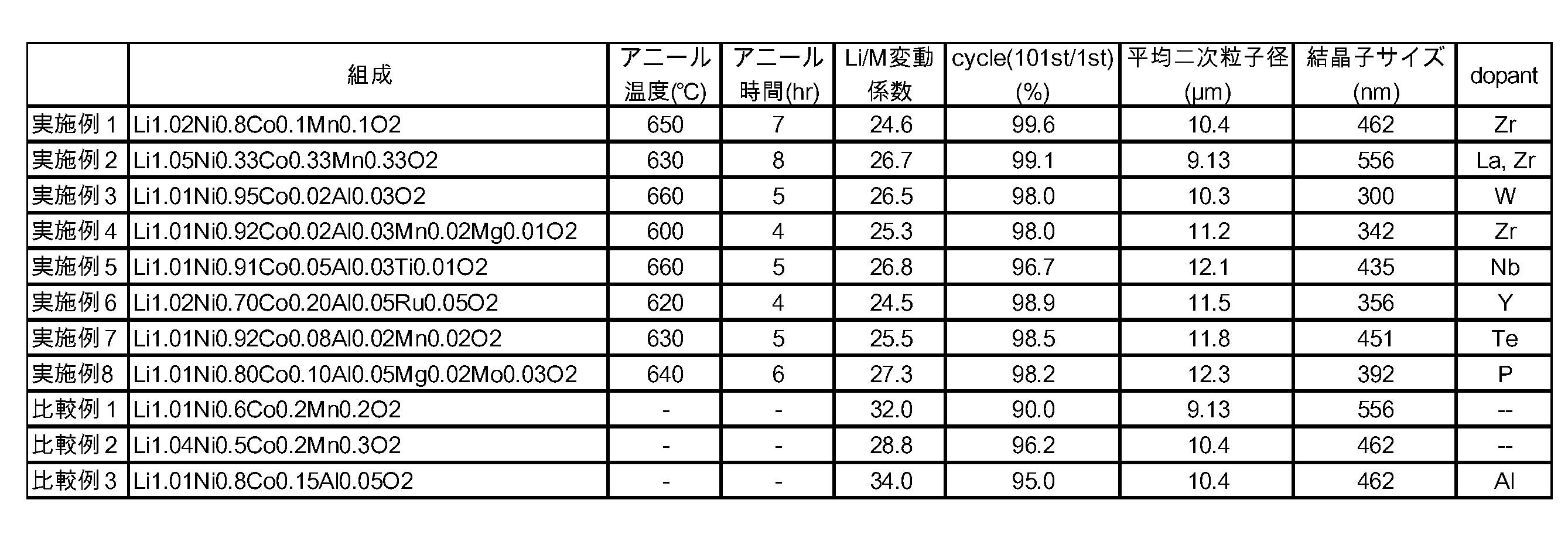
- Table 1 shows various characteristics including the variation coefficient of the Li / M ratio and the charge / discharge characteristics of the positive electrode active materials obtained in Examples 1 to 8 and Comparative Examples 1 to 3.
- the positive electrode active material according to the present invention has a large discharge capacity and excellent cycle characteristics, it is suitable as a positive electrode active material for a non-aqueous electrolyte secondary battery.
Landscapes
- Chemical & Material Sciences (AREA)
- Chemical Kinetics & Catalysis (AREA)
- Inorganic Chemistry (AREA)
- General Chemical & Material Sciences (AREA)
- Electrochemistry (AREA)
- Organic Chemistry (AREA)
- Engineering & Computer Science (AREA)
- Materials Engineering (AREA)
- Manufacturing & Machinery (AREA)
- Life Sciences & Earth Sciences (AREA)
- General Life Sciences & Earth Sciences (AREA)
- Geology (AREA)
- Battery Electrode And Active Subsutance (AREA)
Abstract
Description
<作用>
羽根型攪拌機を具備した反応器内に、pH=12.0となるような水酸化ナトリウム水溶液を調製した。ここにアンモニア濃度が0.80mol/lとなるようにアンモニア水溶液を滴下した。硫酸ニッケル、硫酸コバルト、硫酸マンガン混合水溶液を、Ni/Co/Mn=0.8/0.1/0.1の組成比となるように、連続的に反応器に供給した。この間、反応溶液のpHが12、アンモニア濃度が0.8mol/lとなるように水酸化ナトリウム水溶液およびアンモニア水溶液を連続的に供給して、目標平均二次粒子径まで成長させた。この間、懸濁液に機械的なせん断力を加えることで球状の複合遷移金属の沈殿物を得た。
前駆体の組成比についてNi/Co/Mn=1.0/1.0/1.0に変更し、Li原料と遷移金属混合球状酸化物とZrO2とLa2O3の混合物を酸化性雰囲気下、850℃にて10時間焼成し、その後アニール処理として大気雰囲気下で630℃にて8時間熱処理を行った。これを解砕して正極活物質粉末を得た以外は、実施例1と同様にして正極活物質を得た。
羽根型攪拌機を具備した反応器内に、pH=12.0となるような水酸化ナトリウム水溶液を調製した。ここにアンモニア濃度が0.80mol/lとなるようにアンモニア水溶液を滴下した。硫酸ニッケル、硫酸コバルト、アルミン酸ナトリウム混合水溶液を、連続的に反応器に供給した。この間、反応溶液のpHが12、アンモニア濃度が0.8mol/lとなるように水酸化ナトリウム水溶液およびアンモニア水溶液を連続的に供給して、目標平均二次粒子径まで成長させた。この間、懸濁液に機械的なせん断力を加えることで球状の複合遷移金属の沈殿物を得た。
羽根型攪拌機を具備した反応器内に、pH=12.0となるような水酸化ナトリウム水溶液を調製した。ここにアンモニア濃度が0.80mol/lとなるようにアンモニア水溶液を滴下した。硫酸ニッケル、硫酸コバルト、アルミン酸ナトリウム、硫酸マンガン、硫酸マグネシウム混合水溶液を、連続的に反応器に供給した。この間、反応溶液のpHが12、アンモニア濃度が0.8mol/lとなるように水酸化ナトリウム水溶液およびアンモニア水溶液を連続的に供給して、目標平均二次粒子径まで成長させた。この間、懸濁液に機械的なせん断力を加えることで球状の複合遷移金属の沈殿物を得た。
羽根型攪拌機を具備した反応器内に、pH=12.0となるような水酸化ナトリウム水溶液を調製した。ここにアンモニア濃度が0.80mol/lとなるようにアンモニア水溶液を滴下した。硫酸ニッケル、硫酸コバルト、アルミン酸ナトリウム、硫酸チタニル混合水溶液を、連続的に反応器に供給した。この間、反応溶液のpHが12、アンモニア濃度が0.8mol/lとなるように水酸化ナトリウム水溶液およびアンモニア水溶液を連続的に供給して、目標平均二次粒子径まで成長させた。この間、懸濁液に機械的なせん断力を加えることで球状の複合遷移金属の沈殿物を得た。
羽根型攪拌機を具備した反応器内に、pH=12.0となるような水酸化ナトリウム水溶液を調製した。ここにアンモニア濃度が0.80mol/lとなるようにアンモニア水溶液を滴下した。硫酸ニッケル、硫酸コバルト、アルミン酸ナトリウム、硫酸ルテニウム混合水溶液を、連続的に反応器に供給した。この間、反応溶液のpHが12、アンモニア濃度が0.8mol/lとなるように水酸化ナトリウム水溶液およびアンモニア水溶液を連続的に供給して、目標平均二次粒子径まで成長させた。この間、懸濁液に機械的なせん断力を加えることで球状の複合遷移金属の沈殿物を得た。
羽根型攪拌機を具備した反応器内に、pH=12.0となるような水酸化ナトリウム水溶液を調製した。ここにアンモニア濃度が0.80mol/lとなるようにアンモニア水溶液を滴下した。硫酸ニッケル、硫酸コバルト、アルミン酸ナトリウム、硫酸マンガン混合水溶液を、連続的に反応器に供給した。この間、反応溶液のpHが12、アンモニア濃度が0.8mol/lとなるように水酸化ナトリウム水溶液およびアンモニア水溶液を連続的に供給して、目標平均二次粒子径まで成長させた。この間、懸濁液に機械的なせん断力を加えることで球状の複合遷移金属の沈殿物を得た。
羽根型攪拌機を具備した反応器内に、pH=12.0となるような水酸化ナトリウム水溶液を調製した。ここにアンモニア濃度が0.80mol/lとなるようにアンモニア水溶液を滴下した。硫酸ニッケル、硫酸コバルト、アルミン酸ナトリウム、硫酸マグネシウム、酸化モリブデン混合水溶液を、連続的に反応器に供給した。この間、反応溶液のpHが12、アンモニア濃度が0.8mol/lとなるように水酸化ナトリウム水溶液およびアンモニア水溶液を連続的に供給して、目標平均二次粒子径まで成長させた。この間、懸濁液に機械的なせん断力を加えることで球状の複合遷移金属の沈殿物を得た。
前駆体の組成比についてNi/Co/Mn=0.6/0.2/0.2に変更し、Li原料と遷移金属混合球状酸化物の混合物に対して、焼成条件を酸化性雰囲気下、750℃にて10時間とし、アニール処理は行わず、その後解砕して活物質粉末を得た以外は、実施例1と同様にして正極活物質を得た。
前駆体の組成比についてNi/Co/Mn=0.5/0.2/0.3に変更し、Li原料と遷移金属混合球状酸化物の混合物に対して、焼成条件を酸化性雰囲気下、950℃にて10時間とし、アニール処理を行わず、その後解砕して活物質粉末を得た以外は、実施例1と同様にして正極活物質を得た。
羽根型攪拌機を具備した反応器内に、pH=12.0となるような水酸化ナトリウム水溶液を調製した。ここにアンモニア濃度が0.80mol/lとなるようにアンモニア水溶液を滴下した。硫酸ニッケル、硫酸コバルト、アルミン酸ナトリウム混合水溶液を、連続的に反応器に供給した。この間、反応溶液のpHが12、アンモニア濃度が0.8mol/lとなるように水酸化ナトリウム水溶液およびアンモニア水溶液を連続的に供給して、目標平均二次粒子径まで成長させた。この間、懸濁液に機械的なせん断力を加えることで球状の複合遷移金属の沈殿物を得た。
2 二次粒子
3 組成比を測定する目安となる直線
Claims (8)
- 一般式が、
Lia(NibCocAldMee)O2
(但し、Me=Mn、Mg、Ti、Ru、Zr、Nb、Mo、Wであり、1.00≦a≦1.15、0.25<b<1、0<c≦0.30、0<d≦0.05、0≦e≦0.40である)
で表されるリチウム遷移金属層状酸化物からなる正極活物質であって、
前記正極活物質は、一次粒子が凝集した二次粒子により構成され、該二次粒子内におけるLi/M(M=Ni+Co+Al+Me)の変動係数が28.0%以下であることを特徴とする非水電解質二次電池用の正極活物質。 - 前記二次粒子の粒界に、F、Mg、Al、P、Ca、Ti、Y、Sn、Bi、Te、Ce、Zr、La、Mo、Sc、Nb及びWのうちの複数、若しくはいずれかが存在する請求項1に記載の正極活物質。
- 前記正極活物質における結晶子サイズは100nm以上600nm以下であり、且つ平均二次粒子径は3.0μm以上20μm以下である請求項1又は2に記載の正極活物質。
- 請求項1~3のいずれか1項に記載の正極活物質を用いた非水電解質二次電池。
- 請求項1に記載の正極活物質を製造する方法であって、
Ni化合物とCo化合物とAl化合物と任意にMe化合物とを用いた共沈法によりNiとCoとAlと、任意にMe元素とを主成分とする複合化合物前駆体を得るステップと、
前記前駆体にリチウム化合物をLi/M(M=Ni+Co+Al+Me)のモル比率が1.00以上1.15以下の範囲となるように混合して混合物を得るステップと、
前記混合物を酸化性雰囲気において600℃以上950℃以下で焼成するステップと、
前記焼成するステップの後に続けて前記焼成された混合物を500℃以上750℃以下でアニール処理するステップとを備えていることを特徴とする正極活物質の製造方法。 - 前記前駆体を得るステップにおいて、F、Mg、Al、P、Ca、Ti、Y、Sn、Bi、Ce、Zr、La、Mo、Sc、Nb及びWのうちの複数、若しくはいずれかの金属成分を含む化合物を、前記Ni化合物とCo化合物とAl化合物と任意にMe化合物と共に共沈反応させて複合酸化物前駆体を得る請求項5に記載の正極活物質の製造方法。
- 前記混合物にF、Mg、Al、P、Ca、Ti、Y、Sn、Bi、Ce、Zr、La、Mo、Sc、Nb及びWのうちの複数、若しくはいずれかの金属成分を含む化合物を混合するステップをさらに備えている請求項5に記載の正極活物質の製造方法。
- 前記前駆体を得るステップの後で且つ前記混合物を得るステップの前に、得られた前記複合化合物前駆体に対して酸化性雰囲気中にて400℃~800℃の温度で3時間~5時間の熱処理を行うことを特徴とする請求項5~7のいずれか1項に記載の正極活物質の製造方法。
Priority Applications (4)
| Application Number | Priority Date | Filing Date | Title |
|---|---|---|---|
| EP17775085.8A EP3439084A4 (en) | 2016-03-30 | 2017-03-28 | POSITIVE ELECTRODE ACTIVE MATERIAL FOR SECONDARY BATTERIES WITH A WATER-FREE ELECTROLYTE, A METHOD FOR THE PRODUCTION THEREOF AND A SECONDARY BATTERY WITH A WATER-FREE ELECTROLYTE |
| CN201780020416.1A CN108886144B (zh) | 2016-03-30 | 2017-03-28 | 用于非水电解质二次电池的正极活性物质及其制造方法、以及使用其的非水电解质二次电池 |
| KR1020187031221A KR102363230B1 (ko) | 2016-03-30 | 2017-03-28 | 비수전해질 이차전지용 양극 활물질, 그 제조방법 및 이를 이용한 비수전해질 이차전지 |
| US16/148,335 US11018339B2 (en) | 2016-03-30 | 2018-10-01 | Positive electrode active material for nonaqueous electrolyte secondary batteries, method for producing same, and nonaqueous electrolyte secondary battery using same |
Applications Claiming Priority (4)
| Application Number | Priority Date | Filing Date | Title |
|---|---|---|---|
| JP2016-067667 | 2016-03-30 | ||
| JP2016067667 | 2016-03-30 | ||
| JP2017-008699 | 2017-01-20 | ||
| JP2017008699A JP2017188428A (ja) | 2016-03-30 | 2017-01-20 | 非水電解質二次電池用の正極活物質及びその製造方法、並びにそれを用いた非水電解質二次電池 |
Related Child Applications (1)
| Application Number | Title | Priority Date | Filing Date |
|---|---|---|---|
| US16/148,335 Continuation US11018339B2 (en) | 2016-03-30 | 2018-10-01 | Positive electrode active material for nonaqueous electrolyte secondary batteries, method for producing same, and nonaqueous electrolyte secondary battery using same |
Publications (1)
| Publication Number | Publication Date |
|---|---|
| WO2017170548A1 true WO2017170548A1 (ja) | 2017-10-05 |
Family
ID=59964648
Family Applications (1)
| Application Number | Title | Priority Date | Filing Date |
|---|---|---|---|
| PCT/JP2017/012635 Ceased WO2017170548A1 (ja) | 2016-03-30 | 2017-03-28 | 非水電解質二次電池用の正極活物質及びその製造方法、並びにそれを用いた非水電解質二次電池 |
Country Status (3)
| Country | Link |
|---|---|
| KR (1) | KR102363230B1 (ja) |
| CN (1) | CN108886144B (ja) |
| WO (1) | WO2017170548A1 (ja) |
Cited By (6)
| Publication number | Priority date | Publication date | Assignee | Title |
|---|---|---|---|---|
| WO2019103037A1 (ja) * | 2017-11-21 | 2019-05-31 | 住友金属鉱山株式会社 | 非水系電解質二次電池用正極活物質、非水系電解質二次電池用正極活物質の製造方法 |
| JP2021518049A (ja) * | 2018-05-23 | 2021-07-29 | エルジー・ケム・リミテッド | リチウム二次電池用正極材、これを含むリチウム二次電池用正極及びリチウム二次電池 |
| JPWO2021152997A1 (ja) * | 2020-01-27 | 2021-08-05 | ||
| JPWO2021152996A1 (ja) * | 2020-01-31 | 2021-08-05 | ||
| EP3919445A1 (en) * | 2020-06-04 | 2021-12-08 | SK Innovation Co., Ltd. | Cathode active material for lithium secondary battery and lithium secondary battery |
| JP2022038350A (ja) * | 2020-08-26 | 2022-03-10 | 住友金属鉱山株式会社 | リチウムイオン二次電池用正極活物質、リチウムイオン二次電池用正極活物質の製造方法、リチウムイオン二次電池 |
Families Citing this family (10)
| Publication number | Priority date | Publication date | Assignee | Title |
|---|---|---|---|---|
| KR102569296B1 (ko) * | 2019-01-10 | 2023-08-22 | 주식회사 엘지화학 | 리튬 이차전지용 양극 활물질의 제조 방법, 상기 제조방법에 의해 제조된 양극 활물질 |
| KR102722641B1 (ko) | 2019-01-17 | 2024-10-25 | 주식회사 엘지에너지솔루션 | 리튬 금속 전지 |
| CN113474297A (zh) * | 2019-02-26 | 2021-10-01 | 住友金属矿山株式会社 | 锂离子二次电池用正极活性物质、锂离子二次电池用正极活性物质的制造方法、锂离子二次电池 |
| US12249710B2 (en) * | 2019-07-08 | 2025-03-11 | Panasonic Energy Co., Ltd. | Positive electrode active material for lithium ion secondary battery and lithium ion secondary battery |
| KR102412692B1 (ko) * | 2019-10-18 | 2022-06-24 | 주식회사 에코프로비엠 | 리튬 이차전지 양극활물질, 이의 제조방법, 및 이를 포함하는 리튬 이차전지 |
| JP7128245B2 (ja) * | 2019-10-18 | 2022-08-30 | エコプロ ビーエム カンパニー リミテッド | リチウム二次電池用正極活物質、その製造方法、及びこれを含むリチウム二次電池 |
| CN119008890A (zh) * | 2019-10-18 | 2024-11-22 | Ecopro Bm有限公司 | 锂二次电池正极活性物质、其制备方法以及包含其的锂二次电池 |
| JP7399538B2 (ja) * | 2019-11-28 | 2023-12-18 | エルジー・ケム・リミテッド | リチウム二次電池用正極活物質の製造方法および前記方法により製造されたリチウム二次電池用正極活物質 |
| WO2021172010A1 (ja) * | 2020-02-28 | 2021-09-02 | パナソニックIpマネジメント株式会社 | 非水電解質二次電池用正極活物質および非水電解質二次電池 |
| KR20210150863A (ko) * | 2020-06-04 | 2021-12-13 | 에스케이이노베이션 주식회사 | 리튬 이차 전지 |
Citations (9)
| Publication number | Priority date | Publication date | Assignee | Title |
|---|---|---|---|---|
| JP2007280723A (ja) | 2006-04-05 | 2007-10-25 | Hitachi Metals Ltd | リチウム二次電池用の正極活物質の製造方法、リチウム二次電池用の正極活物質及びそれを用いた非水系リチウム二次電池 |
| JP2008243447A (ja) | 2007-03-26 | 2008-10-09 | Mitsubishi Chemicals Corp | リチウム遷移金属複合酸化物、その製造方法、および、それを用いたリチウム二次電池用正極、ならびに、それを用いたリチウム二次電池 |
| JP2012028163A (ja) * | 2010-07-23 | 2012-02-09 | Sumitomo Metal Mining Co Ltd | 非水系電解質二次電池用正極活物質とその製造方法および非水系電解質二次電池 |
| JP2012230898A (ja) * | 2011-04-14 | 2012-11-22 | Toda Kogyo Corp | Li−Ni複合酸化物粒子粉末及びその製造方法、並びに非水電解質二次電池 |
| US20130221271A1 (en) | 2009-12-22 | 2013-08-29 | Jx Nippon Mining & Metals Corporation | Positive Electrode Active Material For Lithium-Ion Battery, Positive Electrode For A Lithium-Ion Battery, Lithium-Ion Battery Using Same, And Precursor To A Positive Electrode Active Material For A Lithium-Ion Battery |
| JP2015164119A (ja) * | 2014-01-31 | 2015-09-10 | パナソニック株式会社 | 非水電解質二次電池用正極活物質及び非水電解質二次電池 |
| WO2016002158A1 (ja) * | 2014-06-30 | 2016-01-07 | 三洋電機株式会社 | 非水電解質二次電池用正極活物質およびそれを用いた非水電解質二次電池 |
| WO2016133042A1 (ja) * | 2015-02-17 | 2016-08-25 | 戸田工業株式会社 | 非水電解質二次電池用正極活物質、非水電解質二次電池 |
| JP2017188428A (ja) | 2016-03-30 | 2017-10-12 | Basf戸田バッテリーマテリアルズ合同会社 | 非水電解質二次電池用の正極活物質及びその製造方法、並びにそれを用いた非水電解質二次電池 |
Family Cites Families (5)
| Publication number | Priority date | Publication date | Assignee | Title |
|---|---|---|---|---|
| JP4406744B2 (ja) | 2000-11-08 | 2010-02-03 | Dowaエレクトロニクス株式会社 | 非水系二次電池用正極活物質とその製造方法およびそれを用いた非水系二次電池 |
| JP4240060B2 (ja) | 2006-05-26 | 2009-03-18 | ソニー株式会社 | 正極活物質および電池 |
| CN101719422B (zh) * | 2010-01-08 | 2012-08-29 | 西北工业大学 | 一种锂离子电容和电池的正极材料及其制备方法 |
| CN104241640A (zh) * | 2014-10-10 | 2014-12-24 | 国家电网公司 | 一种镍钴铝酸锂正极材料、其制备方法及锂离子电池 |
| CN104300145B (zh) * | 2014-10-10 | 2017-02-15 | 东莞市长安东阳光铝业研发有限公司 | 一种高振实改性镍钴锰酸锂正极材料的制备方法 |
-
2017
- 2017-03-28 CN CN201780020416.1A patent/CN108886144B/zh active Active
- 2017-03-28 KR KR1020187031221A patent/KR102363230B1/ko active Active
- 2017-03-28 WO PCT/JP2017/012635 patent/WO2017170548A1/ja not_active Ceased
Patent Citations (11)
| Publication number | Priority date | Publication date | Assignee | Title |
|---|---|---|---|---|
| JP2007280723A (ja) | 2006-04-05 | 2007-10-25 | Hitachi Metals Ltd | リチウム二次電池用の正極活物質の製造方法、リチウム二次電池用の正極活物質及びそれを用いた非水系リチウム二次電池 |
| JP2008243447A (ja) | 2007-03-26 | 2008-10-09 | Mitsubishi Chemicals Corp | リチウム遷移金属複合酸化物、その製造方法、および、それを用いたリチウム二次電池用正極、ならびに、それを用いたリチウム二次電池 |
| US20130221271A1 (en) | 2009-12-22 | 2013-08-29 | Jx Nippon Mining & Metals Corporation | Positive Electrode Active Material For Lithium-Ion Battery, Positive Electrode For A Lithium-Ion Battery, Lithium-Ion Battery Using Same, And Precursor To A Positive Electrode Active Material For A Lithium-Ion Battery |
| JP2012028163A (ja) * | 2010-07-23 | 2012-02-09 | Sumitomo Metal Mining Co Ltd | 非水系電解質二次電池用正極活物質とその製造方法および非水系電解質二次電池 |
| JP2012230898A (ja) * | 2011-04-14 | 2012-11-22 | Toda Kogyo Corp | Li−Ni複合酸化物粒子粉末及びその製造方法、並びに非水電解質二次電池 |
| KR20140016314A (ko) | 2011-04-14 | 2014-02-07 | 도다 고교 가부시끼가이샤 | Li-Ni 복합 산화물 입자 분말 및 그의 제조 방법, 및 비수전해질 이차 전지 |
| US9764962B2 (en) | 2011-04-14 | 2017-09-19 | Toda Kogyo Corporation | Li—Ni composite oxide particles and process for producing the same, and non-aqueous electrolyte secondary battery |
| JP2015164119A (ja) * | 2014-01-31 | 2015-09-10 | パナソニック株式会社 | 非水電解質二次電池用正極活物質及び非水電解質二次電池 |
| WO2016002158A1 (ja) * | 2014-06-30 | 2016-01-07 | 三洋電機株式会社 | 非水電解質二次電池用正極活物質およびそれを用いた非水電解質二次電池 |
| WO2016133042A1 (ja) * | 2015-02-17 | 2016-08-25 | 戸田工業株式会社 | 非水電解質二次電池用正極活物質、非水電解質二次電池 |
| JP2017188428A (ja) | 2016-03-30 | 2017-10-12 | Basf戸田バッテリーマテリアルズ合同会社 | 非水電解質二次電池用の正極活物質及びその製造方法、並びにそれを用いた非水電解質二次電池 |
Cited By (20)
| Publication number | Priority date | Publication date | Assignee | Title |
|---|---|---|---|---|
| JP7099475B2 (ja) | 2017-11-21 | 2022-07-12 | 住友金属鉱山株式会社 | 非水系電解質二次電池用正極活物質、非水系電解質二次電池用正極活物質の製造方法 |
| JPWO2019103037A1 (ja) * | 2017-11-21 | 2020-12-17 | 住友金属鉱山株式会社 | 非水系電解質二次電池用正極活物質、非水系電解質二次電池用正極活物質の製造方法 |
| US11735728B2 (en) | 2017-11-21 | 2023-08-22 | Sumitomo Metal Mining Co., Ltd. | Cathode active material for non-aqueous electrolyte secondary battery and method of manufacturing cathode active material for non-aqueous electrolyte secondary battery |
| WO2019103037A1 (ja) * | 2017-11-21 | 2019-05-31 | 住友金属鉱山株式会社 | 非水系電解質二次電池用正極活物質、非水系電解質二次電池用正極活物質の製造方法 |
| JP2021518049A (ja) * | 2018-05-23 | 2021-07-29 | エルジー・ケム・リミテッド | リチウム二次電池用正極材、これを含むリチウム二次電池用正極及びリチウム二次電池 |
| US12080877B2 (en) | 2018-05-23 | 2024-09-03 | Lg Energy Solution, Ltd. | Positive electrode material for lithium secondary battery, and positive electrode for lithium secondary battery and lithium secondary battery including the same |
| JP7171121B2 (ja) | 2018-05-23 | 2022-11-15 | エルジー エナジー ソリューション リミテッド | リチウム二次電池用正極材、これを含むリチウム二次電池用正極及びリチウム二次電池 |
| WO2021152997A1 (ja) * | 2020-01-27 | 2021-08-05 | パナソニックIpマネジメント株式会社 | 非水電解質二次電池用正極活物質、及び非水電解質二次電池 |
| JPWO2021152997A1 (ja) * | 2020-01-27 | 2021-08-05 | ||
| JP7759572B2 (ja) | 2020-01-27 | 2025-10-24 | パナソニックIpマネジメント株式会社 | 非水電解質二次電池用正極活物質、及び非水電解質二次電池 |
| US12473209B2 (en) | 2020-01-27 | 2025-11-18 | Panasonic Intellectual Property Management Co., Ltd. | Positive electrode active material for nonaqueous electrolyte secondary batteries, and nonaqueous electrolyte secondary battery |
| WO2021152996A1 (ja) * | 2020-01-31 | 2021-08-05 | パナソニックIpマネジメント株式会社 | 非水電解質二次電池用正極活物質、非水電解質二次電池用正極活物質の製造方法、及び非水電解質二次電池 |
| JPWO2021152996A1 (ja) * | 2020-01-31 | 2021-08-05 | ||
| JP7692183B2 (ja) | 2020-01-31 | 2025-06-13 | パナソニックIpマネジメント株式会社 | 非水電解質二次電池用正極活物質、非水電解質二次電池用正極活物質の製造方法、及び非水電解質二次電池 |
| JP2025109955A (ja) * | 2020-01-31 | 2025-07-25 | パナソニックIpマネジメント株式会社 | 非水電解質二次電池用正極活物質の製造方法 |
| JP7811715B2 (ja) | 2020-01-31 | 2026-02-06 | パナソニックIpマネジメント株式会社 | 非水電解質二次電池用正極活物質の製造方法 |
| EP3919445A1 (en) * | 2020-06-04 | 2021-12-08 | SK Innovation Co., Ltd. | Cathode active material for lithium secondary battery and lithium secondary battery |
| US12087945B2 (en) | 2020-06-04 | 2024-09-10 | Sk Innovation Co., Ltd. | Cathode active material for lithium secondary battery and lithium secondary battery including the same |
| JP2022038350A (ja) * | 2020-08-26 | 2022-03-10 | 住友金属鉱山株式会社 | リチウムイオン二次電池用正極活物質、リチウムイオン二次電池用正極活物質の製造方法、リチウムイオン二次電池 |
| JP7596673B2 (ja) | 2020-08-26 | 2024-12-10 | 住友金属鉱山株式会社 | リチウムイオン二次電池用正極活物質、リチウムイオン二次電池用正極活物質の製造方法、リチウムイオン二次電池 |
Also Published As
| Publication number | Publication date |
|---|---|
| KR20180124996A (ko) | 2018-11-21 |
| KR102363230B1 (ko) | 2022-02-16 |
| CN108886144B (zh) | 2022-03-04 |
| CN108886144A (zh) | 2018-11-23 |
Similar Documents
| Publication | Publication Date | Title |
|---|---|---|
| US11018339B2 (en) | Positive electrode active material for nonaqueous electrolyte secondary batteries, method for producing same, and nonaqueous electrolyte secondary battery using same | |
| CN108886144B (zh) | 用于非水电解质二次电池的正极活性物质及其制造方法、以及使用其的非水电解质二次电池 | |
| JP6089433B2 (ja) | Li−Ni複合酸化物粒子粉末及びその製造方法、並びに非水電解質二次電池 | |
| KR102636863B1 (ko) | 비수전해질 이차 전지용 정극 활물질, 비수전해질 이차 전지 | |
| JP6244713B2 (ja) | 非水電解質二次電池用正極活物質の製造方法 | |
| JP7293576B2 (ja) | 金属複合水酸化物とその製造方法、非水電解質二次電池用正極活物質とその製造方法、及び、それを用いた非水電解質二次電池 | |
| JP5737513B2 (ja) | 非水電解質二次電池用正極活物質粒子粉末及びその製造方法、並びに非水電解質二次電池 | |
| KR102771131B1 (ko) | 비수성 전해질 2차전지용 양극활물질 입자 및 그 제조방법, 그리고 비수성 전해질 2차전지 | |
| KR20180043403A (ko) | 정극 활성 물질 전구체 입자 분말 및 정극 활성 물질 입자 분말, 및 비수전해질 이차 전지 | |
| JP2004292264A (ja) | 四酸化三マンガン粒子粉末及びその製造法、非水電解質二次電池用正極活物質及びその製造法、並びに非水電解質二次電池 | |
| CN104703921A (zh) | Li-Ni复合氧化物颗粒粉末和非水电解质二次电池 | |
| JP6436335B2 (ja) | 遷移金属複合水酸化物粒子とその製造方法、およびそれを用いた非水系電解質二次電池用正極活物質の製造方法 | |
| JP2023040082A (ja) | 金属複合水酸化物とその製造方法、リチウムイオン二次電池用正極活物質とその製造方法、及び、それを用いたリチウムイオン二次電池 | |
| CN111801820A (zh) | Li-Ni复合氧化物颗粒粉末和非水电解质二次电池 | |
| JP2024001041A (ja) | リチウムイオン二次電池用正極活物質、リチウムイオン二次電池 | |
| JP6341095B2 (ja) | 非水電解質二次電池用マンガン酸リチウム粒子粉末及びその製造方法、並びに非水電解質二次電池 | |
| JP7464102B2 (ja) | 金属複合水酸化物とその製造方法、非水電解質二次電池用正極活物質とその製造方法、及び、それを用いた非水電解質二次電池 | |
| JP7206819B2 (ja) | リチウムイオン二次電池用正極活物質とその製造方法、及び、リチウムイオン二次電池 | |
| JP2017199591A (ja) | 非水電解質二次電池用の正極活物質粒子及びその製造方法、並びにそれを用いた非水電解質二次電池 | |
| WO2019177017A1 (ja) | 非水電解質二次電池用の正極活物質粒子及びその製造方法、並びに非水電解質二次電池 | |
| JP6109399B1 (ja) | 非水電解質二次電池用の正極活物質粒子及びその製造方法、並びに非水電解質二次電池 | |
| US12595189B2 (en) | Metal composite hydroxide and method for producing the same, positive electrode active material for lithium ion secondary battery and method for producing the same, and lithium ion secondary battery using the same |
Legal Events
| Date | Code | Title | Description |
|---|---|---|---|
| NENP | Non-entry into the national phase |
Ref country code: DE |
|
| ENP | Entry into the national phase |
Ref document number: 20187031221 Country of ref document: KR Kind code of ref document: A |
|
| WWE | Wipo information: entry into national phase |
Ref document number: 2017775085 Country of ref document: EP |
|
| ENP | Entry into the national phase |
Ref document number: 2017775085 Country of ref document: EP Effective date: 20181030 |
|
| 121 | Ep: the epo has been informed by wipo that ep was designated in this application |
Ref document number: 17775085 Country of ref document: EP Kind code of ref document: A1 |