WO2017170614A1 - Batterie, système de commande de batterie, dispositif de commande de batterie et programme - Google Patents
Batterie, système de commande de batterie, dispositif de commande de batterie et programme Download PDFInfo
- Publication number
- WO2017170614A1 WO2017170614A1 PCT/JP2017/012766 JP2017012766W WO2017170614A1 WO 2017170614 A1 WO2017170614 A1 WO 2017170614A1 JP 2017012766 W JP2017012766 W JP 2017012766W WO 2017170614 A1 WO2017170614 A1 WO 2017170614A1
- Authority
- WO
- WIPO (PCT)
- Prior art keywords
- battery
- unit
- substation
- information
- movement instruction
- Prior art date
- Legal status (The legal status is an assumption and is not a legal conclusion. Google has not performed a legal analysis and makes no representation as to the accuracy of the status listed.)
- Ceased
Links
Images



Classifications
-
- B—PERFORMING OPERATIONS; TRANSPORTING
- B60—VEHICLES IN GENERAL
- B60L—PROPULSION OF ELECTRICALLY-PROPELLED VEHICLES; SUPPLYING ELECTRIC POWER FOR AUXILIARY EQUIPMENT OF ELECTRICALLY-PROPELLED VEHICLES; ELECTRODYNAMIC BRAKE SYSTEMS FOR VEHICLES IN GENERAL; MAGNETIC SUSPENSION OR LEVITATION FOR VEHICLES; MONITORING OPERATING VARIABLES OF ELECTRICALLY-PROPELLED VEHICLES; ELECTRIC SAFETY DEVICES FOR ELECTRICALLY-PROPELLED VEHICLES
- B60L3/00—Electric devices on electrically-propelled vehicles for safety purposes; Monitoring operating variables, e.g. speed, deceleration or energy consumption
-
- B—PERFORMING OPERATIONS; TRANSPORTING
- B60—VEHICLES IN GENERAL
- B60L—PROPULSION OF ELECTRICALLY-PROPELLED VEHICLES; SUPPLYING ELECTRIC POWER FOR AUXILIARY EQUIPMENT OF ELECTRICALLY-PROPELLED VEHICLES; ELECTRODYNAMIC BRAKE SYSTEMS FOR VEHICLES IN GENERAL; MAGNETIC SUSPENSION OR LEVITATION FOR VEHICLES; MONITORING OPERATING VARIABLES OF ELECTRICALLY-PROPELLED VEHICLES; ELECTRIC SAFETY DEVICES FOR ELECTRICALLY-PROPELLED VEHICLES
- B60L58/00—Methods or circuit arrangements for monitoring or controlling batteries or fuel cells, specially adapted for electric vehicles
- B60L58/10—Methods or circuit arrangements for monitoring or controlling batteries or fuel cells, specially adapted for electric vehicles for monitoring or controlling batteries
-
- H—ELECTRICITY
- H01—ELECTRIC ELEMENTS
- H01M—PROCESSES OR MEANS, e.g. BATTERIES, FOR THE DIRECT CONVERSION OF CHEMICAL ENERGY INTO ELECTRICAL ENERGY
- H01M50/00—Constructional details or processes of manufacture of the non-active parts of electrochemical cells other than fuel cells, e.g. hybrid cells
- H01M50/20—Mountings; Secondary casings or frames; Racks, modules or packs; Suspension devices; Shock absorbers; Transport or carrying devices; Holders
- H01M50/204—Racks, modules or packs for multiple batteries or multiple cells
-
- H—ELECTRICITY
- H02—GENERATION; CONVERSION OR DISTRIBUTION OF ELECTRIC POWER
- H02J—ELECTRIC POWER NETWORKS; CIRCUIT ARRANGEMENTS OR SYSTEMS FOR SUPPLYING OR DISTRIBUTING ELECTRIC POWER; SYSTEMS FOR STORING ELECTRIC ENERGY
- H02J13/00—Circuit arrangements for providing remote monitoring or remote control of equipment in a power distribution network
-
- H—ELECTRICITY
- H02—GENERATION; CONVERSION OR DISTRIBUTION OF ELECTRIC POWER
- H02J—ELECTRIC POWER NETWORKS; CIRCUIT ARRANGEMENTS OR SYSTEMS FOR SUPPLYING OR DISTRIBUTING ELECTRIC POWER; SYSTEMS FOR STORING ELECTRIC ENERGY
- H02J7/00—Circuit arrangements for charging or discharging batteries or for supplying loads from batteries
-
- Y—GENERAL TAGGING OF NEW TECHNOLOGICAL DEVELOPMENTS; GENERAL TAGGING OF CROSS-SECTIONAL TECHNOLOGIES SPANNING OVER SEVERAL SECTIONS OF THE IPC; TECHNICAL SUBJECTS COVERED BY FORMER USPC CROSS-REFERENCE ART COLLECTIONS [XRACs] AND DIGESTS
- Y02—TECHNOLOGIES OR APPLICATIONS FOR MITIGATION OR ADAPTATION AGAINST CLIMATE CHANGE
- Y02E—REDUCTION OF GREENHOUSE GAS [GHG] EMISSIONS, RELATED TO ENERGY GENERATION, TRANSMISSION OR DISTRIBUTION
- Y02E60/00—Enabling technologies; Technologies with a potential or indirect contribution to GHG emissions mitigation
- Y02E60/10—Energy storage using batteries
-
- Y—GENERAL TAGGING OF NEW TECHNOLOGICAL DEVELOPMENTS; GENERAL TAGGING OF CROSS-SECTIONAL TECHNOLOGIES SPANNING OVER SEVERAL SECTIONS OF THE IPC; TECHNICAL SUBJECTS COVERED BY FORMER USPC CROSS-REFERENCE ART COLLECTIONS [XRACs] AND DIGESTS
- Y02—TECHNOLOGIES OR APPLICATIONS FOR MITIGATION OR ADAPTATION AGAINST CLIMATE CHANGE
- Y02T—CLIMATE CHANGE MITIGATION TECHNOLOGIES RELATED TO TRANSPORTATION
- Y02T10/00—Road transport of goods or passengers
- Y02T10/60—Other road transportation technologies with climate change mitigation effect
- Y02T10/70—Energy storage systems for electromobility, e.g. batteries
-
- Y—GENERAL TAGGING OF NEW TECHNOLOGICAL DEVELOPMENTS; GENERAL TAGGING OF CROSS-SECTIONAL TECHNOLOGIES SPANNING OVER SEVERAL SECTIONS OF THE IPC; TECHNICAL SUBJECTS COVERED BY FORMER USPC CROSS-REFERENCE ART COLLECTIONS [XRACs] AND DIGESTS
- Y02—TECHNOLOGIES OR APPLICATIONS FOR MITIGATION OR ADAPTATION AGAINST CLIMATE CHANGE
- Y02T—CLIMATE CHANGE MITIGATION TECHNOLOGIES RELATED TO TRANSPORTATION
- Y02T90/00—Enabling technologies or technologies with a potential or indirect contribution to GHG emissions mitigation
- Y02T90/10—Technologies relating to charging of electric vehicles
- Y02T90/16—Information or communication technologies improving the operation of electric vehicles
Definitions
- the present invention relates to a battery, a battery control system, a battery control device, and a program.
- Patent Document 1 JP-A-2015-146162
- a battery may include a housing.
- the battery may include a battery cell built in the housing.
- the battery may include a connector unit that detachably holds the SIM.
- the battery may include a position acquisition unit that acquires the position of the battery.
- the battery may include a wireless communication unit that transmits position information indicating the position of the battery by wireless communication using information recorded in the SIM.
- the battery may further include a notification data output unit that outputs notification data when the remaining battery level of the battery cell is lower than a predetermined threshold.
- the wireless communication unit may receive position information of the charging station, and the notification data output unit may output notification data including the position information of the charging station received by the wireless communication unit.
- the wireless communication unit may receive battery location information that can be charged to the battery, and the notification data output unit may output notification data including the battery location information received by the wireless communication unit.
- the battery may be mounted on an electric vehicle, and the electric power of the battery cell may be supplied to the electric vehicle.
- the battery control system may include a battery and a battery control device.
- the battery includes a battery cell built in the housing, a connector unit that detachably holds a SIM (Subscriber Identity Module), a position acquisition unit that acquires a position, and wireless communication using information recorded in the SIM
- SIM Subscriber Identity Module
- the battery control device may include a battery information receiving unit that receives battery remaining amount and position information from the battery.
- the battery control device may include a demand status deriving unit that derives a power demand status based on the remaining battery levels and positions of a plurality of batteries.
- the battery control device may include a movement instruction transmission unit that transmits a movement instruction to a battery that can move autonomously among the plurality of batteries based on the demand situation.
- the autonomously movable battery may be a battery in which a plurality of batteries can move together.
- the demand situation deriving unit may derive a position where power supply is required, and the movement instruction transmitting unit is configured to determine whether the remaining battery level is a predetermined threshold value among the autonomously movable batteries. You may transmit the movement instruction
- the demand situation deriving unit may derive a position where power can be supplied, and the movement instruction transmitting unit has a remaining battery level less than a predetermined threshold among the autonomously movable batteries. You may transmit the movement instruction
- the battery control system is configured to derive a deterioration degree of the battery cell based on a remaining battery level at the first position and a remaining battery level at the second position of the battery that moves using the power of the battery cell.
- a degree deriving unit may be further provided, wherein the movement instruction transmitting unit transmits a movement instruction to move to an exchange station capable of replacing the battery cell, to the battery having the deterioration degree higher than a predetermined threshold. Good.
- the battery control device may further include a substation position acquisition unit that acquires a position of the substation, and the movement instruction transmission unit is a battery that can supply power to the substation among the plurality of batteries. In addition, an instruction to move to the position acquired by the substation position acquisition unit may be transmitted.
- a battery control device includes a battery cell built in a housing, a connector unit that removably holds a SIM, a position acquisition unit that acquires a position, and wireless communication using information recorded in the SIM, You may provide the battery information receiving part which receives battery remaining amount and a positional infomation from the battery which has a wireless communication part which transmits the battery residual amount of a cell, and the positional information which shows a position.
- the battery control device may include a demand status deriving unit that derives a power demand status based on the remaining battery levels and positions of a plurality of batteries.
- the battery control device may include a movement instruction transmission unit that transmits a movement instruction to a battery that can move autonomously among a plurality of batteries based on the demand situation.
- a program for causing a computer to function as the battery control device is provided.
- the battery control system may include a battery that can move autonomously and a battery control device.
- the battery includes a battery cell built in the housing, a connector unit that removably holds the SIM, a battery position acquisition unit that acquires the position, and wireless communication that uses information recorded in the SIM. And a wireless communication unit that transmits position information indicating the position.
- the battery control device may include a battery information receiving unit that receives the remaining battery capacity and position from the battery.
- the battery control device may include a substation position acquisition unit that acquires the position of the substation where power supply is interrupted due to the occurrence of a failure.
- the battery control device may include a movement instruction transmission unit that transmits a movement instruction to the position acquired by the substation position acquisition unit to a battery that can supply power to the substation among the plurality of batteries.
- the battery control device may further include a standard voltage acquisition unit that acquires a standard voltage of the substation, and the movement instruction transmission unit includes a standard voltage of the plurality of batteries, and a standard voltage acquisition unit of the plurality of batteries. You may transmit the movement instruction
- the battery may further include a connector for connecting the battery cell to a battery cell of another battery, and the movement instruction transmission unit is connected to the standard voltage acquired by the standard voltage acquisition unit. You may transmit the movement instruction
- the battery may further include a power supply plug that supplies power of the battery cell, and the substation includes a charging plug that is connected to the power supply plug and receives the power supply of the battery cell.
- the movement instruction transmission unit may instruct the battery to supply power to the charging plug by the power supply plug.
- the battery may further include a radiation measuring unit that measures radiation, and the battery information receiving unit includes the amount of radiation measured by the radiation measuring unit and position information of the battery that measures the radiation.
- the battery control device may further include a radiation information transmitting unit that transmits the radiation amount and the position information received by the battery information receiving unit to another device.
- a battery control device includes a battery cell built in the housing, a connector unit that removably holds the SIM, a battery position acquisition unit that acquires a position, and wireless communication using information recorded in the SIM.
- a wireless communication unit that transmits the remaining battery level of the battery cell and position information indicating the position, and a battery information receiving unit that receives the remaining battery level and position of the battery cell from a battery that can move autonomously. It's okay.
- the battery control device may include a substation position acquisition unit that acquires the position of the substation.
- the battery control device may include a movement instruction transmission unit that transmits a movement instruction to the position acquired by the substation position acquisition unit to a battery that can supply power to the substation among the plurality of batteries.
- a program for causing a computer to function as the battery control device for causing a computer to function as the battery control device.
- An example of battery 100 is shown roughly.
- An example of a functional composition of communication unit 120 is shown roughly.
- An example of the electric vehicle 300 carrying the battery 100 is shown schematically.
- An example of display data 400 is shown roughly.
- Another example of the battery 100 is shown schematically.
- An example of battery control system 600 is shown roughly.
- An example of functional composition of information management server 500 is shown roughly.
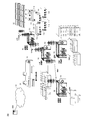
- 1 schematically illustrates an example of a battery control system 700.
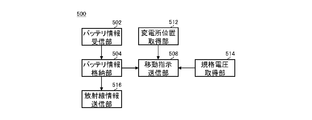
- An example of functional composition of information management server 500 is shown roughly.
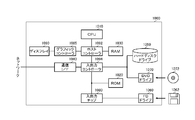
- An example of the computer 1000 which functions as the information management server 500 is schematically shown.
- FIG. 1 schematically shows an example of a battery 100.
- the battery 100 may supply power to an arbitrary device.
- the battery 100 is mounted on an electric vehicle and supplies power to the electric vehicle.
- the battery 100 may be mounted on an electric motorcycle, an electric bicycle, a drone, or the like to supply electric power thereto.
- the battery 100 is mounted on, for example, a robot and supplies power to the robot.
- the battery 100 includes a battery cell 110 and a communication unit 120.
- the communication unit 120 includes a connector unit 122, a wireless communication unit 124, and a position acquisition unit 126.
- the connector unit 122 holds a SIM (Subscriber Identity Module) in a detachable manner.
- the connector unit 122 holds, for example, a SIM card so as to be detachable.
- the wireless communication unit 124 performs wireless communication using information recorded in the SIM held by the connector unit 122.
- the wireless communication unit 124 is, for example, a 3G (3rd Generation) communication system such as WCDMA (registered trademark) (Wideband Code Division Multiple Access) and CDMA2000 (Code Division Multiple Access 2000), LTE (Long 3), etc. Wireless communication is performed according to a 9G communication system and a mobile communication system such as a 4G communication system such as Advanced LTE.
- the wireless communication unit 124 may further include an antenna for WiFi communication, and may execute WiFi (registered trademark) (Wireless Fidelity) communication.
- the wireless communication unit 124 may execute communication via the network 10.
- the network 10 includes, for example, the Internet and a telephone network.
- the wireless communication unit 124 communicates with the communication terminal 210 and the information management server 500 via the network 10.
- the communication terminal 210 may be any terminal as long as it is a communicable terminal, such as a mobile phone such as a smartphone, a tablet terminal, and a PC (Personal Computer).
- the information management server 500 manages information transmitted by the battery 100. Further, the information management server 500 may manage information transmitted to the battery 100.
- the wireless communication unit 124 transmits the remaining battery level of the battery cell 110, for example.
- the wireless communication unit 124 may transmit the remaining battery level of the battery cell 110 to the communication terminal 210. Thereby, the user of the communication terminal 210 can grasp the remaining battery level of the battery 100. Further, the wireless communication unit 124 may transmit the remaining battery level of the battery cell 110 to the information management server 500. As a result, the remaining battery level of the battery 100 can be managed by the information management server 500.
- the position acquisition unit 126 acquires the position of the battery 100.
- the position acquisition unit 126 is, for example, a GPS (Global Positioning System) unit, and acquires GPS data as the position of the battery 100.
- the position acquisition unit 126 may acquire the position of the WiFi access point with which the wireless communication unit 124 has established communication as the position of the battery 100.
- the position acquisition unit 126 may acquire both the position of the WiFi access point with which the wireless communication unit 124 has established communication and the GPS data as the position of the battery 100.
- the wireless communication unit 124 may transmit position information indicating the position of the battery 100 together with the remaining battery level of the battery 100.
- the wireless communication unit 124 transmits the remaining battery level of the battery 100 and the position information of the battery 100 to the communication terminal 210, for example.
- the communication terminal 210 informs the user of the position of the rechargeable point closest to the position indicated by the position information of the battery 100.
- the chargeable portion is, for example, a charging stand that is fixedly installed. Further, the rechargeable portion may be a charging station that can charge the battery 100 and can move autonomously. Thereby, when the battery remaining amount of the battery 100 is low, the user can be made aware of the position of the chargeable portion.
- the wireless communication unit 124 transmits the remaining battery capacity of the battery 100 and the position information of the battery 100 to the information management server 500, for example. For example, when the remaining battery level of the battery 100 received from the battery 100 is lower than a predetermined threshold, the information management server 500 determines the position of the chargeable location closest to the position indicated by the position information of the battery 100 as a communication terminal. To 210. The communication terminal 210 may notify the user of the position of the received chargeable location.
- the wireless communication unit 124 may transmit position information indicating the position of the battery 100 when the remaining battery level of the battery 100 is lower than a predetermined threshold.
- the wireless communication unit 124 transmits the position information of the battery 100 to the communication terminal 210.
- the communication terminal 210 may notify the user of the position of the rechargeable point closest to the position indicated by the position information of the battery 100.
- the wireless communication unit 124 transmits the position information of the battery 100 to the information management server 500.
- the information management server 500 transmits to the communication terminal 210 the position of the rechargeable point closest to the position indicated by the position information of the battery 100.
- the communication terminal 210 may notify the user of the position of the received chargeable location.
- the information management server 500 transmits, for example, the position of the rechargeable location closest to the position indicated by the position information of the battery 100 to the battery 100.
- the battery 100 may notify the position of the rechargeable location received from the information management server 500.
- the battery 100 when the battery 100 is mounted on an electric vehicle, the battery 100 notifies the passenger of the electric vehicle of the position of the rechargeable location by displaying the position of the rechargeable location on a display included in the electric vehicle. You can do it.
- the wireless communication unit 124 may transmit the position information of the battery 100 to the communication terminal 210 in response to a request from the communication terminal 210. For example, when the battery 100 is stolen, the user of the communication terminal 210 can confirm the position of the battery 100 by transmitting a request to the battery 100 using the communication terminal 210.
- FIG. 2 schematically shows an example of the functional configuration of the communication unit 120.
- the communication unit 120 includes a wireless communication unit 124, a position acquisition unit 126, a remaining amount acquisition unit 134, a notification data output unit 136, a battery information storage unit 138, and a history storage unit 140. Note that it is not essential that the communication unit 120 has all these configurations. For example, at least one of the wireless communication unit 124 and the battery information storage unit 138 may be included in the battery 100 without the communication unit 120.
- the remaining amount acquisition unit 134 acquires the remaining battery level of the battery cell 110.
- the remaining amount acquisition unit 134 may periodically acquire the remaining battery level of the battery cell 110.
- the notification data output unit 136 outputs notification data.
- the notification data output unit 136 causes the wireless communication unit 124 to transmit notification data for notifying the remaining battery level of the battery cell 110.
- the notification data output unit 136 may cause the wireless communication unit 124 to transmit notification data that notifies the remaining battery level of the battery cell 110 and the position information of the battery 100 acquired by the position acquisition unit 126.
- the notification data output unit 136 causes the wireless communication unit 124 to transmit notification data to that effect.
- the notification data output unit 136 wirelessly communicates notification data for notifying that fact and the position information of the battery 100 acquired by the position acquisition unit 126. You may make it transmit to the part 124.
- the battery information storage unit 138 stores information on the battery cell 110.
- the battery information storage unit 138 may store the characteristics of the battery cell 110.
- the battery information storage unit 138 stores, for example, charge / discharge characteristics of the battery cell 110.
- the notification data output unit 136 may also transmit the characteristics of the battery cell 110 stored in the battery information storage unit 138 when transmitting the remaining battery level of the battery cell 110 to the wireless communication unit 124.
- the battery information storage unit 138 may store manufacturer information regarding the manufacturer of the battery cell 110.
- the battery information storage unit 138 may store type information indicating the types of other battery cells that can charge the battery cell 110.
- the notification data output unit 136 may transmit at least one of these pieces of information together when the wireless communication unit 124 transmits the remaining battery level of the battery cell 110.
- the history storage unit 140 stores the history of notification data output from the notification data output unit 136.
- the notification data output unit 136 may cause the wireless communication unit 124 to transmit a history of notification data stored in the history storage unit 140.
- the history storage unit 140 stores the history of the remaining battery level of the battery cell 110 acquired by the remaining amount acquisition unit 134 and the position information of the battery 100 when the remaining amount acquisition unit 134 acquires the remaining battery level. May be.
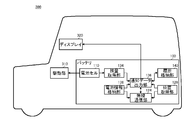
- FIG. 3 schematically shows an example of an electric vehicle 300 on which the battery 100 is mounted.
- the electric vehicle 300 includes a drive unit 310 and a display 320.
- the drive unit 310 drives the electric vehicle 300 with the electric power supplied from the battery cell 110.
- the display 320 executes display based on the notification data received from the notification data output unit 136.
- the display 320 may be, for example, a display included in a car navigation system.
- the notification data output unit 136 transmits, for example, notification data including position information indicating the position of the rechargeable portion received by the wireless communication unit 124 from the information management server 500 to the display 320.
- Display 320 displays the position indicated by the received position information of the chargeable location.
- the display 320 displays, for example, map data highlighting the position indicated by the position information of the chargeable location.
- the notification data output unit 136 transmits the notification data including the position information of the battery that can be charged to the battery 100 received by the wireless communication unit 124 from the information management server 500 to the display 320.
- the notification data output unit 136 receives, from the information management server 500, battery position information that can charge the battery 100 as follows, for example.
- the notification data output unit 136 first stores the position information of the battery 100 acquired by the position acquisition unit 126 and the battery information storage unit 138 when the remaining battery level of the battery cell 110 is lower than a predetermined threshold.
- the wireless communication unit 124 is made to transmit to the information management server 500 the type information indicating the type of the other battery cell 110 that can charge the battery cell 110 being charged.
- the information management server 500 transmits, to the wireless communication unit, position information indicating the position of the electric vehicle that is closer to the position indicated by the position information of the received battery 100 among the electric vehicles that include the battery cell 110 indicated by the type of the received battery cell 110. 124.
- the notification data output unit 136 includes the position information of the electric vehicle received by the wireless communication unit 124 in the notification data as the position information of the battery that can be charged in the battery 100, and transmits the notification data to the display 320.
- the display 320 displays the map data which emphasized the position which the received positional information shows, for example. Thereby, when the battery remaining amount of the battery cell 110 is low, the passenger of the electric vehicle 300 can grasp the position of the electric vehicle on which the battery cell 110 capable of charging the battery cell 110 is mounted.
- the battery 100 may be mounted on an autonomously movable electric vehicle capable of automatic driving.
- the battery 100 may be mounted on a robot that can move autonomously.
- the battery 100 may be mounted on each of the plurality of robots, and each of the plurality of batteries 100 mounted on the plurality of robots transmits the remaining battery level and position information of each battery cell 110 to the information management server 500. You can do it.
- Each of the plurality of batteries 100 may receive the remaining battery capacity and position information of the other batteries 100 from the information management server 500. When it is determined that the remaining battery level of the other battery 100 received is less than its own battery level and can be moved to the position indicated by the position information, the battery 100 moves to the position indicated by the position information. The other battery 100 may be charged.
- any of the plurality of batteries 100 may be a battery 100 dedicated to charging.
- the battery 100 dedicated to charging receives the remaining battery capacity and position information of the other battery 100 from the information management server 500, and the position information of the battery 100 in which the remaining battery capacity is lower than a predetermined threshold is indicated by the position information. It may move and charge the battery 100.
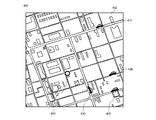
- FIG. 4 schematically shows an example of the display data 400.
- the display data 400 may be data generated based on the notification data output from the notification data output unit 136.
- the display data 400 is generated by the display 320 that has received the notification data, for example.
- the display data 400 is generated by the communication terminal 210 that has received the notification data, for example.
- the display data 400 may be generated by the notification data output unit 136 and transmitted to the display 320, the communication terminal 210, etc., and displayed.
- Display data 400 includes map data 402, own vehicle object 410, charging station object 420, and corresponding vehicle object 430.
- the own vehicle object 410 is arranged at the position of the battery 100 acquired by the position acquisition unit 126 on the map data 402.
- the charging station object 420 is arranged on the map data 402 at a position indicated by the charging station position information received from the information management server 500.
- the corresponding vehicle object 430 is disposed at the position of the electric vehicle on which the battery cell 110 capable of charging the battery cell 110 received from the information management server 500 is mounted.
- Display 320 or communication terminal 210 causes display data 400 to be displayed so that a viewer can easily find the location of a charging station where battery 100 can be charged and the location of an electric vehicle equipped with battery cell 110 capable of charging battery 100. It can be grasped.
- FIG. 5 schematically shows another example of the battery 100.
- 5 includes a battery cell 110, a wireless communication unit 124, a position acquisition unit 126, a remaining amount acquisition unit 134, a notification data output unit 136, a battery information storage unit 138, and a history storage unit 140.
- Unit 152 and supply connector 154 The battery 100 illustrated in FIG. 5 can be moved by the wheel unit 152, and a plurality of other batteries can be charged by the plurality of supply connectors 154.
- the battery 100 moves to the position indicated by the instruction data according to the instruction data received from the communication terminal 210, for example. For example, the battery 100 moves to a place where a plurality of batteries that require charging are present.
- the battery 100 transmits the remaining battery level of the battery cell 110 to the communication terminal 210 while supplying power to the plurality of batteries.
- the battery 100 may further transmit the position information of the battery 100 acquired by the position acquisition unit 126.
- the user of the communication terminal 210 transmits a feedback instruction to the battery 100 using the communication terminal 210 when, for example, the remaining battery level of the battery cell 110 is lower than a predetermined threshold.
- the battery 100 returns in response to receiving the feedback instruction.
- the battery 100 may be capable of storing the wheel portion 152.
- the battery 100 stores the wheel unit 152 after moving to the position indicated by the instruction data in accordance with the instruction data received from the communication terminal 210. Thereby, the unexpected movement by the wheel part 152 can be prevented, and electric power can be stably supplied to a plurality of batteries.
- the battery 100 may include an outrigger (not shown). For example, the battery 100 moves to the position indicated by the instruction data according to the instruction data received from the communication terminal 210, and then fixes the vehicle body to the ground by the outrigger. Thereby, the unexpected movement by the wheel part 152 can be prevented, and electric power can be stably supplied to a plurality of batteries.
- the battery 100 in the above embodiment may further include an emotion management unit (not shown) that manages the emotion of the battery 100.
- the battery 100 receives position information indicating the position of an electric vehicle on which a battery cell that can be charged to the battery cell 110 of the battery 100 is mounted from the information management server 500.
- the emotion management unit may manage the emotion of the battery 100 such that the greater the distance between the battery 100 and the electric vehicle equipped with a battery cell that can be charged in the battery cell 110, the higher the degree of scissors.
- the emotion management unit has a greater degree of scissors as the number of electric vehicles equipped with battery cells that can be charged in the battery cells 110 is within a predetermined range based on the position of the battery 100.
- the emotion of battery 100 may be managed so as to increase.
- the notification data output unit 136 causes the wireless communication unit 124 to transmit notification data indicating a warning when the degree of saliency of the battery 100 managed by the emotion management unit is higher than a predetermined threshold. It may be displayed.
- the battery 100 may receive position information indicating the position of the charging stand from the information management server 500, and the emotion management unit increases the degree of scissors as the distance between the battery 100 and the charging stand increases.
- the emotion of the battery 100 may be managed.
- the emotion management unit may manage the emotion of the battery 100 such that the smaller the number of charging stations that are within a predetermined range based on the position of the battery 100, the higher the degree of mischief. .
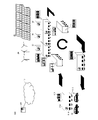
- FIG. 6 schematically shows an example of the battery control system 600.
- the battery control system 600 includes an information management server 500 and a plurality of charging stations 610.
- the information management server 500 may be an example of a battery control device.
- the charging station 610 is equipped with at least one battery 100.
- the charging station 610 may be equipped with a plurality of batteries 100.
- the charging station 610 includes a wheel portion 612 and a supply connector 614.
- the charging station 610 can be moved by the wheel portion 612, and a plurality of other batteries can be charged by the plurality of supply connectors 614.
- Charging station 610 may be an example of a battery that can move autonomously.
- the charging station 610 can charge the battery 100 by receiving the supply of power from the charging station 30.
- the charging station 30 may receive power from any power system such as a thermal power generation system and a nuclear power generation system.
- the charging station 30 receives power from the solar power generation system 22 and the wind power generation system 24.
- the charging station 610 may be able to charge the battery 100 by receiving the supply of power from the other charging station 610.
- the charging station 610 may supply power to an arbitrary device on which the battery 100 is mounted.
- the charging station 610 supplies power to the battery-equipped vehicle 42 on which the battery 100 is mounted, the battery-equipped vehicle 44, and the like.
- the charging station 610 supplies power to the battery-equipped vehicle 42, the battery-equipped vehicle 44, and the like, so that the charging station 610 is charged when the remaining battery level of the mounted battery 100 becomes lower than a predetermined threshold value.
- the battery 100 may be charged by moving to 30.
- the remaining battery level 616 schematically represents the remaining battery level of the battery 100 installed in the charging station 610.
- the charging station 610 may perform movement, charging, and power supply in accordance with instructions from the information management server 500.
- the information management server 500 receives and stores battery remaining amount and position information from a plurality of charging stations 610.
- the information management server 500 receiving the battery remaining amount and position information from the charging station 610 may be receiving the battery remaining amount and position information from the battery 100 mounted on the charging station 610.
- the information management server 500 may receive the remaining battery capacity and position information from each of the plurality of batteries 100.
- the information management server 500 may receive the remaining battery capacity and position information of the plurality of batteries 100 from any one of the plurality of batteries 100. Note that only the position information of any of the plurality of batteries 100 may be received as the position information.
- the information management server 500 receives and stores battery remaining amount and position information from any device on which the battery 100 is mounted, such as the battery mounted vehicle 42 and the battery mounted vehicle 44.
- the information management server 500 derives the power demand status based on the stored battery remaining capacity and location information.
- the power demand situation indicates, for example, a position where power supply is required.
- the position where the power supply is required is, for example, a position indicated by the position information of the battery 100 in which the remaining battery level is less than a predetermined threshold.
- the position where power supply is required may be a position where the number of batteries 100 that require power supply is larger than a predetermined threshold.
- the position where power supply is required is an area in which a predetermined number or more of batteries 100 whose remaining battery capacity is smaller than a predetermined threshold exist in an area of a predetermined size. Is one of the positions.
- the power demand situation indicates, for example, a position where power can be supplied.
- the position where the power can be supplied is, for example, a position indicated by the position information of the charging station 610 in which the remaining battery level is greater than a predetermined threshold.
- the position where the power can be supplied may be a position where the number of charging stations 610 in which the remaining battery level is greater than a predetermined threshold is greater than the predetermined threshold.
- the position where power can be supplied is an area in which a predetermined number or more of charging stations 610 having a remaining battery capacity greater than a predetermined threshold exist in an area of a predetermined size. Is one of the positions.
- the information management server 500 transmits a movement instruction to the autonomously movable battery 100 among the plurality of batteries 100 based on the derived power demand situation. For example, the information management server 500 transmits a movement instruction to any one of the plurality of charging stations 610.
- the information management server 500 transmitting the movement instruction to the charging station 610 may be transmitting the movement instruction to any of the batteries 100 installed in the charging station 610.
- the information management server 500 is, for example, a charge that is located near a position where the remaining amount of the battery is more than a predetermined threshold among the plurality of charging stations 610 and needs to be supplied with power more than the other charging stations 610.
- a movement instruction to move to a position where the power supply is required is transmitted to the station 610.
- the information management server 500 transmits a movement instruction to move to a position where power can be supplied, for example, among the batteries 100 that can move autonomously, with the remaining battery level being less than a predetermined threshold. To do. For example, when the remaining battery level of the battery 100 of the battery-equipped vehicle 42 is less than a predetermined threshold, the information management server 500 transmits a movement instruction to move to a position where power can be supplied to the battery 100. .
- the information management server 500 may transmit a movement instruction to the charging station 610 according to the degree of deterioration of the battery cell of the battery 100 installed in the charging station 610. For example, the information management server 500 determines the degree of deterioration of the battery cell based on the degree of decrease in the remaining battery level with respect to the moving distance of the charging station 610. As a specific example, the information management server 500 calculates the difference between the remaining battery level of the charging station 610 at the first location and the remaining battery level of the charging station 610 at the second location from the first location to the second location. When the value divided by the moving distance to is higher than a predetermined threshold value, it is determined that the battery 100 mounted on the charging station 610 needs to be replaced. The information management server 500 may transmit a movement instruction to move the battery 100 or the battery cell to the exchange station where the battery 100 or the battery cell can be exchanged, to the charging station 610 determined to be exchanged. The movement instruction may include position information of the exchange station.
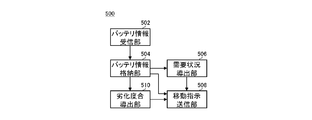
- FIG. 7 schematically shows an example of the functional configuration of the information management server 500.
- the information management server 500 includes a battery information receiving unit 502, a battery information storage unit 504, a demand situation deriving unit 506, a movement instruction transmitting unit 508, and a deterioration degree deriving unit 510. Note that it is not essential that the information management server 500 has all these configurations.
- the battery information receiving unit 502 receives battery remaining amount and position information from each of the plurality of batteries 100.
- the battery information receiving unit 502 may periodically receive the remaining battery capacity and position information.
- the battery information storage unit 504 stores the remaining battery level and position information received by the battery information reception unit 502.
- the demand status deriving unit 506 derives the power demand status based on the remaining battery capacity and location information stored in the battery information storage unit 504.
- the movement instruction transmission unit 508 transmits a movement instruction to the battery 100 based on the power demand situation derived by the demand situation deriving unit 506.
- the movement instruction transmission unit 508 may transmit a movement instruction to a plurality of batteries 100 that can move autonomously. For example, the movement instruction transmission unit 508 transmits a movement instruction to the battery 100 mounted on the charging station 610.
- the deterioration degree deriving unit 510 derives the deterioration degree of the battery 100.
- the degree of deterioration of the battery 100 may be the degree of deterioration of the battery cell of the battery 100.
- Deterioration degree deriving unit 510 derives the deterioration degree of battery 100 based on the remaining battery level at the first position and the remaining battery level at the second position of battery 100 that moves using the power of the battery cell of battery 100. To do.
- the movement instruction transmission unit 508 may transmit a movement instruction to move to the exchange station to the battery 100 whose deterioration degree derived by the deterioration degree deriving unit 510 is higher than a predetermined threshold.
- FIG. 8 schematically shows an example of the battery control system 700.
- the battery control system 700 includes an information management server 500 and a plurality of charging stations 710.
- Charging station 710 may have the same configuration as charging station 610.
- the plurality of charging stations 710 include charging stations 710 having different standard voltages.
- the plurality of charging stations 710 include a charging station with a standard voltage that can supply power to the nuclear power plant 50, a charging station with a standard voltage that can supply power to the ultra-high voltage substation 52, and charging with a standard voltage that can supply power to the primary substation 54.
- the charging station 710 capable of supplying power to the nuclear power plant 50 includes a power supply plug 712 that is connected to the charging plug 51 of the nuclear power plant 50 in order to supply power to the nuclear power plant 50.
- the charging station 710 capable of supplying power to the ultrahigh voltage substation 52 has a power supply plug 712 that is connected to the charging plug 53 of the ultrahigh voltage substation 52 in order to supply power to the ultrahigh voltage substation 52.
- the charging station 710 that can supply power to the primary substation 54 has a power supply plug 712 that is connected to the charging plug 55 of the primary substation 54 in order to supply power to the primary substation 54.
- the charging station 710 that can supply power to the intermediate substation 56 includes a power supply plug 712 that is connected to the charging plug 57 of the intermediate substation 56 in order to supply power to the intermediate substation 56.
- the charging station 710 that can supply power to the distribution substation 58 has a power supply plug 712 that is connected to the charging plug 59 of the distribution substation 58 in order to supply power to the distribution substation 58.
- the power network including the ultra-high voltage substation 52, the primary substation 54, the intermediate substation 56, and the distribution substation 58 supplies the power generated by the nuclear power plant 50, the solar power generation system 22, and the like hierarchically. However, if a failure occurs in the middle of a hierarchy, power supply to a hierarchy below the hierarchy in which the failure has occurred may stop. For example, when the power supply to the primary substation 54 is interrupted due to a failure occurring between the ultrahigh voltage substation 52 and the primary substation 54, the nuclear power plant 50, the solar power generation system 22, and the ultrahigh voltage substation Even if the station 52 is in operation and the primary substation 54 can be operated, the power supply to the intermediate substation 56 and the distribution substation 58 and lower layers will be stopped.
- the information management server 500 acquires the position of a substation where power supply is interrupted due to the occurrence of a failure when a failure occurs in the power network, and charging that can supply power to the substation An instruction to move to the substation is transmitted to the station 710.
- the charging station 710 that can supply power to the substation where the power supply is interrupted due to the occurrence of a failure may be a charging station 710 that matches the standard voltage of the substation. When the standard voltage of the substation and the standard voltage of the charging station 710 do not match, power cannot be supplied from the charging station 710 to the substation.
- the substation in which a failure has occurred.
- the charging station 710 having the same voltage as that of the station can be moved to the substation where the power supply is cut off, the power supply from the charging station 710 to the substation can be realized. And thereby, the power supply to the hierarchy below the primary substation 54 can be restarted.
- the information management server 500 moves the charging station 710 to the position of the charging station 30 that realizes charging using the power generated by the solar power generation system 22 or the nuclear power plant 50, and then the power supply is performed. It may be moved to the location of the blocked substation. Thereby, a part of the power network can be assigned to the charging station 710, which can contribute to the temporary resumption of the power network when a failure occurs.
- the charging station 710 may further include a connector connected to another charging station 710.
- the information management server 500 connects a plurality of charging stations 710 to a plurality of charging stations 710 capable of supplying power at a standard voltage of a substation where power supply is cut off by connecting to another charging station 710.
- a movement instruction to move to the position of the substation may be transmitted.
- a plurality of charging stations 710 having a standard voltage lower than the standard voltage of the substation are provided. It is possible to supply power to the substation by moving the base to the substation and connecting them.
- the charging station 710 may have a function of measuring radiation.
- the function of measuring radiation may be included in the charging station 710 or the battery 100 mounted on the charging station 710.
- the information management server 500 may receive, from the battery 100 of the charging station 710, the measured amount of radiation and position information indicating the position when the radiation is measured.
- the information management server 500 may transmit the received radiation amount and position information to another device such as the communication terminal 210. As a result, it is possible to collect and provide information on radiation at substations and power plants while realizing the replacement of the power network by the charging station 710.
- FIG. 9 schematically shows an example of the functional configuration of the information management server 500.
- the information management server 500 includes a battery information reception unit 502, a battery information storage unit 504, a movement instruction transmission unit 508, a substation position acquisition unit 512, a standard voltage acquisition unit 514, and a radiation information transmission unit 516. Note that it is not essential that the information management server 500 has all these configurations.
- the information management server 500 may further include other functions.
- the information management server 500 may further include at least one of a demand situation deriving unit 506 and a deterioration degree deriving unit 510.
- the battery information receiving unit 502 receives battery remaining amount and position information from each of the plurality of batteries 100.
- the battery information receiving unit 502 may periodically receive the remaining battery capacity and position information.
- the battery information storage unit 504 stores the remaining battery level and position information received by the battery information reception unit 502.
- the battery information receiving unit 502 may receive from each of the plurality of batteries 100 the measured radiation amount and position information indicating the position when the radiation is measured.
- the battery information storage unit 504 may store the radiation amount and position information received by the battery information reception unit 502.
- the substation position acquisition unit 512 acquires the position of the substation.
- the substation position acquisition unit 512 acquires, for example, the position of the substation where the supply of power is interrupted due to the occurrence of a failure.
- the substation location acquisition unit 512 may receive the location of the substation via the network 10.
- the substation location acquisition unit 512 is connected to the network 10 from a substation management server that manages the status of the substation, and the location of the substation where the supply of power is interrupted due to the occurrence of a fault and the location of the substation. Receive identification information.
- the standard voltage acquisition unit 514 acquires the standard voltage of the substation from which the substation position acquisition unit 512 has acquired the position.
- the standard voltage acquisition unit 514 may receive the standard voltage via the network 10.
- the standard voltage acquisition unit 514 receives a standard voltage from a substation management server.
- the standard voltage acquisition unit 514 stores information on each standard voltage in advance in association with the identification information of the plurality of substations, and corresponds to the identification information of the substation received from the substation management server.
- the standard voltage to be read may be read out.
- the movement instruction transmission unit 508 has acquired the substation position acquisition unit 512 in the charging station 710 that can supply power to the substation from which the substation position acquisition unit 512 has acquired the position among the plurality of charging stations 710. An instruction to move to the position may be transmitted.
- the movement instruction transmission unit 508 moves the charging station 710 to the position acquired by the substation position acquisition unit 512 to the charging station 710 whose standard voltage matches the standard voltage acquired by the standard voltage acquisition unit 514 among the plurality of charging stations 710. Instructions may be sent.
- the movement instruction transmission unit 508 acquires the substation position from the charging stations 710 out of other charging stations 710 out of the charging stations 710 whose standard voltage matches the standard voltage acquired by the standard voltage acquisition unit 514 among the plurality of charging stations 710.
- the movement instruction may be transmitted to the charging station 710 close to the position acquired by the unit 512.
- the movement instruction transmission unit 508 displays route information from the current position of the charging station 710 whose standard voltage matches the standard voltage acquired by the standard voltage acquisition unit 514 to the position acquired by the substation position acquisition unit 512.
- the charging station 710 that is received via the network 10 and can reach the position acquired by the substation position acquisition unit 512 may be determined, and a movement instruction may be transmitted to the charging station 710.
- the position acquired by the substation position acquisition unit 512 depends on the road conditions. You may not be able to move.
- the information management server 500 confirms the route information from each charging station 710 to the position acquired by the substation position acquisition unit 512, the substation position acquisition unit 512 The movement instruction can be transmitted to the charging station 710 having a higher possibility of reaching the acquired position.
- the radiation information transmission unit 516 transmits the amount of radiation stored in the battery information storage unit 504 and position information indicating the position where the radiation is measured to another device such as the communication terminal 210.
- FIG. 10 schematically shows an example of a computer 1000 that functions as the information management server 500.
- the computer 1000 includes a CPU peripheral unit including a CPU 1010, a RAM 1030, and a graphic controller 1085 connected to each other by a host controller 1092; a communication I / F 1040 connected to the host controller 1092 by an input / output controller 1094; An input / output unit having a hard disk drive 1050 and a DVD drive 1070, and a legacy input / output unit having a ROM 1020, an FD drive 1060, and an input / output chip 1080 connected to the input / output controller 1094 are provided.
- the CPU 1010 operates based on programs stored in the ROM 1020 and the RAM 1030 and controls each unit.
- the graphic controller 1085 acquires image data generated by the CPU 1010 or the like on a frame buffer provided in the RAM 1030 and displays the image data on the display 1090.
- the graphic controller 1085 may include a frame buffer that stores image data generated by the CPU 1010 or the like.
- the communication I / F 1040 communicates with another device via a wired or wireless network.
- the communication I / F 1040 functions as hardware that performs communication.
- the hard disk drive 1050 stores programs and data used by the CPU 1010.
- the DVD drive 1070 reads a program or data from the DVD-ROM 1072 and provides it to the hard disk drive 1050 via the RAM 1030.
- the ROM 1020 stores a boot program executed when the computer 1000 is started up, a program depending on the hardware of the computer 1000, and the like.
- the FD drive 1060 reads a program or data from the flexible disk 1062 and provides it to the hard disk drive 1050 via the RAM 1030.
- the input / output chip 1080 connects the FD drive 1060 to the input / output controller 1094, and connects various input / output devices to the input / output controller 1094 via, for example, a parallel port, a serial port, a keyboard port, and a mouse port. Connect to.
- the program provided to the hard disk drive 1050 via the RAM 1030 is stored in a recording medium such as the flexible disk 1062, the DVD-ROM 1072, or an IC card and provided by the user.
- the program is read from the recording medium, installed in the hard disk drive 1050 via the RAM 1030, and executed by the CPU 1010.
- a program that is installed in the computer 1000 and causes the computer 1000 to function as the information management server 500 may work on the CPU 1010 or the like to cause the computer 1000 to function as each unit of the information management server 500.
- the information processing described in these programs is read by the computer 1000, so that the battery information receiving unit 502, the battery information storing unit, which are specific means in which the software and the various hardware resources described above cooperate with each other. 504, a demand status deriving unit 506, a movement instruction transmitting unit 508, a deterioration degree deriving unit 510, a substation position acquiring unit 512, a standard voltage acquiring unit 514, and a radiation information transmitting unit 516.
- the specific information management server 500 according to the purpose of use is constructed
- each unit of the communication unit 120 may be realized by hardware or may be realized by software. Further, it may be realized by a combination of hardware and software. Further, the computer may function as the communication unit 120 by executing the program. The program may be installed in a computer constituting at least a part of the communication unit 120 from a computer-readable medium or a storage device connected to a network.
- a program that is installed in a computer and causes the computer to function as the communication unit 120 according to the present embodiment works on a CPU or the like to cause the computer to function as each unit of the communication unit 120.
- Information processing described in these programs functions as a specific means in which software and hardware resources of the communication unit 120 cooperate with each other by being read by a computer.
Landscapes
- Engineering & Computer Science (AREA)
- Power Engineering (AREA)
- Mechanical Engineering (AREA)
- Sustainable Energy (AREA)
- Sustainable Development (AREA)
- Transportation (AREA)
- Life Sciences & Earth Sciences (AREA)
- Chemical & Material Sciences (AREA)
- Chemical Kinetics & Catalysis (AREA)
- Electrochemistry (AREA)
- General Chemical & Material Sciences (AREA)
- Electric Propulsion And Braking For Vehicles (AREA)
- Charge And Discharge Circuits For Batteries Or The Like (AREA)
Abstract
La présente invention a trait à une batterie, un dispositif de commande de batterie et un programme. En ce qui concerne les batteries installées dans des automobiles électriques et similaires, il est souhaitable qu'une batterie hautement pratique soit fournie. Par conséquent, l'invention concerne une batterie dotée : d'un boîtier ; d'une cellule de batterie logée à l'intérieur du boîtier ; d'une unité de connecteur maintenant un module d'identité d'abonné (SIM) d'une manière détachable ; d'une unité d'acquisition de position qui acquiert la position de la batterie ; et d'une unité de communication sans fil qui transmet des informations de position indiquant la position de la batterie au moyen d'une communication sans fil à l'aide d'informations enregistrées dans le SIM.
Applications Claiming Priority (4)
| Application Number | Priority Date | Filing Date | Title |
|---|---|---|---|
| JP2016-069749 | 2016-03-30 | ||
| JP2016069749A JP6576869B2 (ja) | 2016-03-30 | 2016-03-30 | バッテリ |
| JP2016085478A JP6050909B1 (ja) | 2016-04-21 | 2016-04-21 | バッテリ制御システム、バッテリ制御装置及びプログラム |
| JP2016-085478 | 2016-04-21 |
Publications (1)
| Publication Number | Publication Date |
|---|---|
| WO2017170614A1 true WO2017170614A1 (fr) | 2017-10-05 |
Family
ID=59964728
Family Applications (1)
| Application Number | Title | Priority Date | Filing Date |
|---|---|---|---|
| PCT/JP2017/012766 Ceased WO2017170614A1 (fr) | 2016-03-30 | 2017-03-28 | Batterie, système de commande de batterie, dispositif de commande de batterie et programme |
Country Status (1)
| Country | Link |
|---|---|
| WO (1) | WO2017170614A1 (fr) |
Cited By (3)
| Publication number | Priority date | Publication date | Assignee | Title |
|---|---|---|---|---|
| JP2019164767A (ja) * | 2018-03-06 | 2019-09-26 | 光陽工業股▲分▼有限公司 | 紛失した電池を追跡するための電動運搬システム及び方法 |
| JP2019207555A (ja) * | 2018-05-29 | 2019-12-05 | 京セラ株式会社 | 基地装置、基地装置の制御方法、及び基地装置の制御プログラム |
| US20230184836A1 (en) * | 2020-05-15 | 2023-06-15 | Yokogawa Electric Corporation | Analysis device, analysis system, and analysis method |
Citations (9)
| Publication number | Priority date | Publication date | Assignee | Title |
|---|---|---|---|---|
| JPS60205386A (ja) * | 1984-03-30 | 1985-10-16 | Toshiba Corp | 放射線管理モニタ−装置 |
| JPS61155787A (ja) * | 1984-12-28 | 1986-07-15 | Nippon Atom Ind Group Co Ltd | 自動放射線測定装置 |
| JP2000102102A (ja) * | 1998-09-18 | 2000-04-07 | Oki Electric Ind Co Ltd | 電気走行車の残電気量管理及び緊急充電方法及びそのシステム |
| JP2002058102A (ja) * | 2000-08-09 | 2002-02-22 | Matsushita Electric Ind Co Ltd | 電動車両の電池保守サービスシステム |
| JP2011061561A (ja) * | 2009-09-10 | 2011-03-24 | Nec Corp | 携帯端末装置、該携帯端末装置に用いられる電池管理方法及び電池管理制御プログラム |
| JP2011060477A (ja) * | 2009-09-08 | 2011-03-24 | Toshihisa Shirakawa | 未臨界量劣性プルトニウム暖熱源NaSモジュール蓄電池電源駆動電気自動車 |
| JP2012108870A (ja) * | 2010-10-28 | 2012-06-07 | Smk Corp | 情報提供装置、情報提供サーバ、車両支援システム、ナビゲーション装置および充電ケーブル |
| JP2013104680A (ja) * | 2011-11-10 | 2013-05-30 | Hitachi Automotive Systems Ltd | 充電スタンド表示システム及び充電スタンド表示方法 |
| JP2015044576A (ja) * | 2008-12-31 | 2015-03-12 | ドイチェ ポスト アーゲー | バッテリーのローディングステーションとその操作方法 |
-
2017
- 2017-03-28 WO PCT/JP2017/012766 patent/WO2017170614A1/fr not_active Ceased
Patent Citations (9)
| Publication number | Priority date | Publication date | Assignee | Title |
|---|---|---|---|---|
| JPS60205386A (ja) * | 1984-03-30 | 1985-10-16 | Toshiba Corp | 放射線管理モニタ−装置 |
| JPS61155787A (ja) * | 1984-12-28 | 1986-07-15 | Nippon Atom Ind Group Co Ltd | 自動放射線測定装置 |
| JP2000102102A (ja) * | 1998-09-18 | 2000-04-07 | Oki Electric Ind Co Ltd | 電気走行車の残電気量管理及び緊急充電方法及びそのシステム |
| JP2002058102A (ja) * | 2000-08-09 | 2002-02-22 | Matsushita Electric Ind Co Ltd | 電動車両の電池保守サービスシステム |
| JP2015044576A (ja) * | 2008-12-31 | 2015-03-12 | ドイチェ ポスト アーゲー | バッテリーのローディングステーションとその操作方法 |
| JP2011060477A (ja) * | 2009-09-08 | 2011-03-24 | Toshihisa Shirakawa | 未臨界量劣性プルトニウム暖熱源NaSモジュール蓄電池電源駆動電気自動車 |
| JP2011061561A (ja) * | 2009-09-10 | 2011-03-24 | Nec Corp | 携帯端末装置、該携帯端末装置に用いられる電池管理方法及び電池管理制御プログラム |
| JP2012108870A (ja) * | 2010-10-28 | 2012-06-07 | Smk Corp | 情報提供装置、情報提供サーバ、車両支援システム、ナビゲーション装置および充電ケーブル |
| JP2013104680A (ja) * | 2011-11-10 | 2013-05-30 | Hitachi Automotive Systems Ltd | 充電スタンド表示システム及び充電スタンド表示方法 |
Cited By (5)
| Publication number | Priority date | Publication date | Assignee | Title |
|---|---|---|---|---|
| JP2019164767A (ja) * | 2018-03-06 | 2019-09-26 | 光陽工業股▲分▼有限公司 | 紛失した電池を追跡するための電動運搬システム及び方法 |
| JP2019207555A (ja) * | 2018-05-29 | 2019-12-05 | 京セラ株式会社 | 基地装置、基地装置の制御方法、及び基地装置の制御プログラム |
| WO2019230266A1 (fr) * | 2018-05-29 | 2019-12-05 | 京セラ株式会社 | Dispositif de station de base, procédé de commande de dispositif de station de base et programme de commande de dispositif de station de base |
| US11905036B2 (en) | 2018-05-29 | 2024-02-20 | Kyocera Corporation | Autonomous mobile base apparatus for charging UAVs |
| US20230184836A1 (en) * | 2020-05-15 | 2023-06-15 | Yokogawa Electric Corporation | Analysis device, analysis system, and analysis method |
Similar Documents
| Publication | Publication Date | Title |
|---|---|---|
| JP6050909B1 (ja) | バッテリ制御システム、バッテリ制御装置及びプログラム | |
| US12184069B2 (en) | Managing electric vehicle loads on an electric grid | |
| JP6445908B2 (ja) | 電力配送システム及び電力配送方法 | |
| US8635269B2 (en) | Systems and methods to provide access to a network | |
| KR102352434B1 (ko) | 전기 차량의 배터리 교환 제어방법 및 장치 | |
| KR101672314B1 (ko) | 배터리 모니터링 시스템 | |
| EP3070823A2 (fr) | Gestion de puissance dans des véhicules électriques | |
| EP2230146A2 (fr) | Procédé de gestion de l'alimentation pour véhicule électrique et hybride enfichable | |
| KR101489641B1 (ko) | 소형 무인비행장치의 배터리 비탈착 자동충전장치 | |
| JPWO2013171844A1 (ja) | 車両の走行制御支援装置 | |
| CN105984527A (zh) | 蓄电池收纳装置及其控制方法和信息终端的控制方法 | |
| WO2017170614A1 (fr) | Batterie, système de commande de batterie, dispositif de commande de batterie et programme | |
| KR101692839B1 (ko) | 배터리 원격 제어 시스템 | |
| JP2013183521A (ja) | 移動型蓄電媒体を用いた分散電源制御装置、方法、およびプログラム | |
| CN104240031A (zh) | 电动车管理方法及其管理系统 | |
| JP7039532B2 (ja) | バッテリ | |
| CN107069840B (zh) | 蓄电装置及其控制方法、充电装置及其控制方法以及无线连接设定系统 | |
| KR20140085629A (ko) | 배터리 수명 추적 시스템 | |
| US20230396075A1 (en) | Method of controlling charging of an electrically powered machine | |
| CN107571764A (zh) | 一种基于物联网的电动车自动充断电装置 | |
| WO2015115070A1 (fr) | Terminal de communication, procédé de gestion de batterie rechargeable, et programme de gestion de batterie rechargeable | |
| KR20170020163A (ko) | 모니터링이 가능한 전기자동차용 보조배터리 팩 시스템 | |
| KR101736474B1 (ko) | 배터리 충전 이동체 및 이동체의 배터리 충전 시스템 | |
| JP7320548B2 (ja) | 外部給電機及び外部給電システム | |
| JP6576869B2 (ja) | バッテリ |
Legal Events
| Date | Code | Title | Description |
|---|---|---|---|
| NENP | Non-entry into the national phase |
Ref country code: DE |
|
| 121 | Ep: the epo has been informed by wipo that ep was designated in this application |
Ref document number: 17775151 Country of ref document: EP Kind code of ref document: A1 |
|
| 122 | Ep: pct application non-entry in european phase |
Ref document number: 17775151 Country of ref document: EP Kind code of ref document: A1 |