WO2017170669A1 - Filtre de purification de gaz d'échappement - Google Patents
Filtre de purification de gaz d'échappement Download PDFInfo
- Publication number
- WO2017170669A1 WO2017170669A1 PCT/JP2017/012865 JP2017012865W WO2017170669A1 WO 2017170669 A1 WO2017170669 A1 WO 2017170669A1 JP 2017012865 W JP2017012865 W JP 2017012865W WO 2017170669 A1 WO2017170669 A1 WO 2017170669A1
- Authority
- WO
- WIPO (PCT)
- Prior art keywords
- exhaust gas
- gas purification
- catalytic layer
- purification filter
- partitions
- Prior art date
- Legal status (The legal status is an assumption and is not a legal conclusion. Google has not performed a legal analysis and makes no representation as to the accuracy of the status listed.)
- Ceased
Links
Images

Classifications
-
- F—MECHANICAL ENGINEERING; LIGHTING; HEATING; WEAPONS; BLASTING
- F01—MACHINES OR ENGINES IN GENERAL; ENGINE PLANTS IN GENERAL; STEAM ENGINES
- F01N—GAS-FLOW SILENCERS OR EXHAUST APPARATUS FOR MACHINES OR ENGINES IN GENERAL; GAS-FLOW SILENCERS OR EXHAUST APPARATUS FOR INTERNAL-COMBUSTION ENGINES
- F01N3/00—Exhaust or silencing apparatus having means for purifying, rendering innocuous, or otherwise treating exhaust
- F01N3/02—Exhaust or silencing apparatus having means for purifying, rendering innocuous, or otherwise treating exhaust for cooling, or for removing solid constituents of, exhaust
- F01N3/021—Exhaust or silencing apparatus having means for purifying, rendering innocuous, or otherwise treating exhaust for cooling, or for removing solid constituents of, exhaust by means of filters
- F01N3/033—Exhaust or silencing apparatus having means for purifying, rendering innocuous, or otherwise treating exhaust for cooling, or for removing solid constituents of, exhaust by means of filters in combination with other devices
- F01N3/035—Exhaust or silencing apparatus having means for purifying, rendering innocuous, or otherwise treating exhaust for cooling, or for removing solid constituents of, exhaust by means of filters in combination with other devices with catalytic reactors
-
- B—PERFORMING OPERATIONS; TRANSPORTING
- B01—PHYSICAL OR CHEMICAL PROCESSES OR APPARATUS IN GENERAL
- B01D—SEPARATION
- B01D46/00—Filters or filtering processes specially modified for separating dispersed particles from gases or vapours
- B01D46/24—Particle separators, e.g. dust precipitators, using rigid hollow filter bodies
- B01D46/2403—Particle separators, e.g. dust precipitators, using rigid hollow filter bodies characterised by the physical shape or structure of the filtering element
- B01D46/2418—Honeycomb filters
-
- B—PERFORMING OPERATIONS; TRANSPORTING
- B01—PHYSICAL OR CHEMICAL PROCESSES OR APPARATUS IN GENERAL
- B01D—SEPARATION
- B01D53/00—Separation of gases or vapours; Recovering vapours of volatile solvents from gases; Chemical or biological purification of waste gases, e.g. engine exhaust gases, smoke, fumes, flue gases, aerosols
- B01D53/34—Chemical or biological purification of waste gases
- B01D53/92—Chemical or biological purification of waste gases of engine exhaust gases
- B01D53/94—Chemical or biological purification of waste gases of engine exhaust gases by catalytic processes
-
- B—PERFORMING OPERATIONS; TRANSPORTING
- B01—PHYSICAL OR CHEMICAL PROCESSES OR APPARATUS IN GENERAL
- B01D—SEPARATION
- B01D53/00—Separation of gases or vapours; Recovering vapours of volatile solvents from gases; Chemical or biological purification of waste gases, e.g. engine exhaust gases, smoke, fumes, flue gases, aerosols
- B01D53/34—Chemical or biological purification of waste gases
- B01D53/92—Chemical or biological purification of waste gases of engine exhaust gases
- B01D53/94—Chemical or biological purification of waste gases of engine exhaust gases by catalytic processes
- B01D53/944—Simultaneously removing carbon monoxide, hydrocarbons or carbon making use of oxidation catalysts
-
- B—PERFORMING OPERATIONS; TRANSPORTING
- B01—PHYSICAL OR CHEMICAL PROCESSES OR APPARATUS IN GENERAL
- B01D—SEPARATION
- B01D53/00—Separation of gases or vapours; Recovering vapours of volatile solvents from gases; Chemical or biological purification of waste gases, e.g. engine exhaust gases, smoke, fumes, flue gases, aerosols
- B01D53/34—Chemical or biological purification of waste gases
- B01D53/92—Chemical or biological purification of waste gases of engine exhaust gases
- B01D53/94—Chemical or biological purification of waste gases of engine exhaust gases by catalytic processes
- B01D53/9445—Simultaneously removing carbon monoxide, hydrocarbons or nitrogen oxides making use of three-way catalysts [TWC] or four-way-catalysts [FWC]
- B01D53/9454—Simultaneously removing carbon monoxide, hydrocarbons or nitrogen oxides making use of three-way catalysts [TWC] or four-way-catalysts [FWC] characterised by a specific device
-
- B—PERFORMING OPERATIONS; TRANSPORTING
- B01—PHYSICAL OR CHEMICAL PROCESSES OR APPARATUS IN GENERAL
- B01J—CHEMICAL OR PHYSICAL PROCESSES, e.g. CATALYSIS OR COLLOID CHEMISTRY; THEIR RELEVANT APPARATUS
- B01J21/00—Catalysts comprising the elements, oxides, or hydroxides of magnesium, boron, aluminium, carbon, silicon, titanium, zirconium, or hafnium
- B01J21/02—Boron or aluminium; Oxides or hydroxides thereof
- B01J21/04—Alumina
-
- B—PERFORMING OPERATIONS; TRANSPORTING
- B01—PHYSICAL OR CHEMICAL PROCESSES OR APPARATUS IN GENERAL
- B01J—CHEMICAL OR PHYSICAL PROCESSES, e.g. CATALYSIS OR COLLOID CHEMISTRY; THEIR RELEVANT APPARATUS
- B01J23/00—Catalysts comprising metals or metal oxides or hydroxides, not provided for in group B01J21/00
- B01J23/38—Catalysts comprising metals or metal oxides or hydroxides, not provided for in group B01J21/00 of noble metals
- B01J23/40—Catalysts comprising metals or metal oxides or hydroxides, not provided for in group B01J21/00 of noble metals of the platinum group metals
- B01J23/44—Palladium
-
- B—PERFORMING OPERATIONS; TRANSPORTING
- B01—PHYSICAL OR CHEMICAL PROCESSES OR APPARATUS IN GENERAL
- B01J—CHEMICAL OR PHYSICAL PROCESSES, e.g. CATALYSIS OR COLLOID CHEMISTRY; THEIR RELEVANT APPARATUS
- B01J23/00—Catalysts comprising metals or metal oxides or hydroxides, not provided for in group B01J21/00
- B01J23/38—Catalysts comprising metals or metal oxides or hydroxides, not provided for in group B01J21/00 of noble metals
- B01J23/54—Catalysts comprising metals or metal oxides or hydroxides, not provided for in group B01J21/00 of noble metals combined with metals, oxides or hydroxides provided for in groups B01J23/02 - B01J23/36
- B01J23/56—Platinum group metals
- B01J23/58—Platinum group metals with alkali- or alkaline earth metals
-
- B—PERFORMING OPERATIONS; TRANSPORTING
- B01—PHYSICAL OR CHEMICAL PROCESSES OR APPARATUS IN GENERAL
- B01J—CHEMICAL OR PHYSICAL PROCESSES, e.g. CATALYSIS OR COLLOID CHEMISTRY; THEIR RELEVANT APPARATUS
- B01J23/00—Catalysts comprising metals or metal oxides or hydroxides, not provided for in group B01J21/00
- B01J23/38—Catalysts comprising metals or metal oxides or hydroxides, not provided for in group B01J21/00 of noble metals
- B01J23/54—Catalysts comprising metals or metal oxides or hydroxides, not provided for in group B01J21/00 of noble metals combined with metals, oxides or hydroxides provided for in groups B01J23/02 - B01J23/36
- B01J23/56—Platinum group metals
- B01J23/63—Platinum group metals with rare earths or actinides
-
- B—PERFORMING OPERATIONS; TRANSPORTING
- B01—PHYSICAL OR CHEMICAL PROCESSES OR APPARATUS IN GENERAL
- B01J—CHEMICAL OR PHYSICAL PROCESSES, e.g. CATALYSIS OR COLLOID CHEMISTRY; THEIR RELEVANT APPARATUS
- B01J35/00—Catalysts, in general, characterised by their form or physical properties
- B01J35/19—Catalysts containing parts with different compositions
-
- B—PERFORMING OPERATIONS; TRANSPORTING
- B01—PHYSICAL OR CHEMICAL PROCESSES OR APPARATUS IN GENERAL
- B01J—CHEMICAL OR PHYSICAL PROCESSES, e.g. CATALYSIS OR COLLOID CHEMISTRY; THEIR RELEVANT APPARATUS
- B01J35/00—Catalysts, in general, characterised by their form or physical properties
- B01J35/50—Catalysts, in general, characterised by their form or physical properties characterised by their shape or configuration
- B01J35/56—Foraminous structures having flow-through passages or channels, e.g. grids or three-dimensional [3D] monoliths
-
- B—PERFORMING OPERATIONS; TRANSPORTING
- B01—PHYSICAL OR CHEMICAL PROCESSES OR APPARATUS IN GENERAL
- B01J—CHEMICAL OR PHYSICAL PROCESSES, e.g. CATALYSIS OR COLLOID CHEMISTRY; THEIR RELEVANT APPARATUS
- B01J37/00—Processes, in general, for preparing catalysts; Processes, in general, for activation of catalysts
- B01J37/0009—Use of binding agents; Moulding; Pressing; Powdering; Granulating; Addition of materials ameliorating the mechanical properties of the product catalyst
- B01J37/0018—Addition of a binding agent or of material, later completely removed among others as result of heat treatment, leaching or washing,(e.g. forming of pores; protective layer, desintegrating by heat)
-
- B—PERFORMING OPERATIONS; TRANSPORTING
- B01—PHYSICAL OR CHEMICAL PROCESSES OR APPARATUS IN GENERAL
- B01J—CHEMICAL OR PHYSICAL PROCESSES, e.g. CATALYSIS OR COLLOID CHEMISTRY; THEIR RELEVANT APPARATUS
- B01J37/00—Processes, in general, for preparing catalysts; Processes, in general, for activation of catalysts
- B01J37/02—Impregnation, coating or precipitation
- B01J37/0215—Coating
-
- B—PERFORMING OPERATIONS; TRANSPORTING
- B01—PHYSICAL OR CHEMICAL PROCESSES OR APPARATUS IN GENERAL
- B01J—CHEMICAL OR PHYSICAL PROCESSES, e.g. CATALYSIS OR COLLOID CHEMISTRY; THEIR RELEVANT APPARATUS
- B01J37/00—Processes, in general, for preparing catalysts; Processes, in general, for activation of catalysts
- B01J37/02—Impregnation, coating or precipitation
- B01J37/0215—Coating
- B01J37/0219—Coating the coating containing organic compounds
-
- B—PERFORMING OPERATIONS; TRANSPORTING
- B01—PHYSICAL OR CHEMICAL PROCESSES OR APPARATUS IN GENERAL
- B01J—CHEMICAL OR PHYSICAL PROCESSES, e.g. CATALYSIS OR COLLOID CHEMISTRY; THEIR RELEVANT APPARATUS
- B01J37/00—Processes, in general, for preparing catalysts; Processes, in general, for activation of catalysts
- B01J37/02—Impregnation, coating or precipitation
- B01J37/024—Multiple impregnation or coating
- B01J37/0248—Coatings comprising impregnated particles
-
- C—CHEMISTRY; METALLURGY
- C04—CEMENTS; CONCRETE; ARTIFICIAL STONE; CERAMICS; REFRACTORIES
- C04B—LIME, MAGNESIA; SLAG; CEMENTS; COMPOSITIONS THEREOF, e.g. MORTARS, CONCRETE OR LIKE BUILDING MATERIALS; ARTIFICIAL STONE; CERAMICS; REFRACTORIES; TREATMENT OF NATURAL STONE
- C04B38/00—Porous mortars, concrete, artificial stone or ceramic ware; Preparation thereof
- C04B38/0051—Porous mortars, concrete, artificial stone or ceramic ware; Preparation thereof characterised by the pore size, pore shape or kind of porosity
- C04B38/0054—Porous mortars, concrete, artificial stone or ceramic ware; Preparation thereof characterised by the pore size, pore shape or kind of porosity the pores being microsized or nanosized
-
- C—CHEMISTRY; METALLURGY
- C04—CEMENTS; CONCRETE; ARTIFICIAL STONE; CERAMICS; REFRACTORIES
- C04B—LIME, MAGNESIA; SLAG; CEMENTS; COMPOSITIONS THEREOF, e.g. MORTARS, CONCRETE OR LIKE BUILDING MATERIALS; ARTIFICIAL STONE; CERAMICS; REFRACTORIES; TREATMENT OF NATURAL STONE
- C04B38/00—Porous mortars, concrete, artificial stone or ceramic ware; Preparation thereof
- C04B38/0051—Porous mortars, concrete, artificial stone or ceramic ware; Preparation thereof characterised by the pore size, pore shape or kind of porosity
- C04B38/0058—Porous mortars, concrete, artificial stone or ceramic ware; Preparation thereof characterised by the pore size, pore shape or kind of porosity open porosity
-
- C—CHEMISTRY; METALLURGY
- C04—CEMENTS; CONCRETE; ARTIFICIAL STONE; CERAMICS; REFRACTORIES
- C04B—LIME, MAGNESIA; SLAG; CEMENTS; COMPOSITIONS THEREOF, e.g. MORTARS, CONCRETE OR LIKE BUILDING MATERIALS; ARTIFICIAL STONE; CERAMICS; REFRACTORIES; TREATMENT OF NATURAL STONE
- C04B38/00—Porous mortars, concrete, artificial stone or ceramic ware; Preparation thereof
- C04B38/06—Porous mortars, concrete, artificial stone or ceramic ware; Preparation thereof by burning-out added substances by burning natural expanding materials or by sublimating or melting out added substances
-
- F—MECHANICAL ENGINEERING; LIGHTING; HEATING; WEAPONS; BLASTING
- F01—MACHINES OR ENGINES IN GENERAL; ENGINE PLANTS IN GENERAL; STEAM ENGINES
- F01N—GAS-FLOW SILENCERS OR EXHAUST APPARATUS FOR MACHINES OR ENGINES IN GENERAL; GAS-FLOW SILENCERS OR EXHAUST APPARATUS FOR INTERNAL-COMBUSTION ENGINES
- F01N3/00—Exhaust or silencing apparatus having means for purifying, rendering innocuous, or otherwise treating exhaust
- F01N3/02—Exhaust or silencing apparatus having means for purifying, rendering innocuous, or otherwise treating exhaust for cooling, or for removing solid constituents of, exhaust
- F01N3/021—Exhaust or silencing apparatus having means for purifying, rendering innocuous, or otherwise treating exhaust for cooling, or for removing solid constituents of, exhaust by means of filters
-
- F—MECHANICAL ENGINEERING; LIGHTING; HEATING; WEAPONS; BLASTING
- F01—MACHINES OR ENGINES IN GENERAL; ENGINE PLANTS IN GENERAL; STEAM ENGINES
- F01N—GAS-FLOW SILENCERS OR EXHAUST APPARATUS FOR MACHINES OR ENGINES IN GENERAL; GAS-FLOW SILENCERS OR EXHAUST APPARATUS FOR INTERNAL-COMBUSTION ENGINES
- F01N3/00—Exhaust or silencing apparatus having means for purifying, rendering innocuous, or otherwise treating exhaust
- F01N3/02—Exhaust or silencing apparatus having means for purifying, rendering innocuous, or otherwise treating exhaust for cooling, or for removing solid constituents of, exhaust
- F01N3/021—Exhaust or silencing apparatus having means for purifying, rendering innocuous, or otherwise treating exhaust for cooling, or for removing solid constituents of, exhaust by means of filters
- F01N3/022—Exhaust or silencing apparatus having means for purifying, rendering innocuous, or otherwise treating exhaust for cooling, or for removing solid constituents of, exhaust by means of filters characterised by specially adapted filtering structure, e.g. honeycomb, mesh or fibrous
- F01N3/0222—Exhaust or silencing apparatus having means for purifying, rendering innocuous, or otherwise treating exhaust for cooling, or for removing solid constituents of, exhaust by means of filters characterised by specially adapted filtering structure, e.g. honeycomb, mesh or fibrous the structure being monolithic, e.g. honeycombs
-
- F—MECHANICAL ENGINEERING; LIGHTING; HEATING; WEAPONS; BLASTING
- F01—MACHINES OR ENGINES IN GENERAL; ENGINE PLANTS IN GENERAL; STEAM ENGINES
- F01N—GAS-FLOW SILENCERS OR EXHAUST APPARATUS FOR MACHINES OR ENGINES IN GENERAL; GAS-FLOW SILENCERS OR EXHAUST APPARATUS FOR INTERNAL-COMBUSTION ENGINES
- F01N3/00—Exhaust or silencing apparatus having means for purifying, rendering innocuous, or otherwise treating exhaust
- F01N3/08—Exhaust or silencing apparatus having means for purifying, rendering innocuous, or otherwise treating exhaust for rendering innocuous
- F01N3/10—Exhaust or silencing apparatus having means for purifying, rendering innocuous, or otherwise treating exhaust for rendering innocuous by thermal or catalytic conversion of noxious components of exhaust
- F01N3/24—Exhaust or silencing apparatus having means for purifying, rendering innocuous, or otherwise treating exhaust for rendering innocuous by thermal or catalytic conversion of noxious components of exhaust characterised by constructional aspects of converting apparatus
- F01N3/28—Construction of catalytic reactors
- F01N3/2803—Construction of catalytic reactors characterised by structure, by material or by manufacturing of catalyst support
- F01N3/2825—Ceramics
- F01N3/2828—Ceramic multi-channel monoliths, e.g. honeycombs
-
- B—PERFORMING OPERATIONS; TRANSPORTING
- B01—PHYSICAL OR CHEMICAL PROCESSES OR APPARATUS IN GENERAL
- B01D—SEPARATION
- B01D2255/00—Catalysts
- B01D2255/10—Noble metals or compounds thereof
- B01D2255/102—Platinum group metals
- B01D2255/1021—Platinum
-
- B—PERFORMING OPERATIONS; TRANSPORTING
- B01—PHYSICAL OR CHEMICAL PROCESSES OR APPARATUS IN GENERAL
- B01D—SEPARATION
- B01D2255/00—Catalysts
- B01D2255/10—Noble metals or compounds thereof
- B01D2255/102—Platinum group metals
- B01D2255/1023—Palladium
-
- B—PERFORMING OPERATIONS; TRANSPORTING
- B01—PHYSICAL OR CHEMICAL PROCESSES OR APPARATUS IN GENERAL
- B01D—SEPARATION
- B01D2255/00—Catalysts
- B01D2255/10—Noble metals or compounds thereof
- B01D2255/102—Platinum group metals
- B01D2255/1025—Rhodium
-
- B—PERFORMING OPERATIONS; TRANSPORTING
- B01—PHYSICAL OR CHEMICAL PROCESSES OR APPARATUS IN GENERAL
- B01D—SEPARATION
- B01D2255/00—Catalysts
- B01D2255/10—Noble metals or compounds thereof
- B01D2255/102—Platinum group metals
- B01D2255/1026—Ruthenium
-
- B—PERFORMING OPERATIONS; TRANSPORTING
- B01—PHYSICAL OR CHEMICAL PROCESSES OR APPARATUS IN GENERAL
- B01D—SEPARATION
- B01D2255/00—Catalysts
- B01D2255/10—Noble metals or compounds thereof
- B01D2255/104—Silver
-
- B—PERFORMING OPERATIONS; TRANSPORTING
- B01—PHYSICAL OR CHEMICAL PROCESSES OR APPARATUS IN GENERAL
- B01D—SEPARATION
- B01D2255/00—Catalysts
- B01D2255/20—Metals or compounds thereof
- B01D2255/202—Alkali metals
-
- B—PERFORMING OPERATIONS; TRANSPORTING
- B01—PHYSICAL OR CHEMICAL PROCESSES OR APPARATUS IN GENERAL
- B01D—SEPARATION
- B01D2255/00—Catalysts
- B01D2255/20—Metals or compounds thereof
- B01D2255/202—Alkali metals
- B01D2255/2022—Potassium
-
- B—PERFORMING OPERATIONS; TRANSPORTING
- B01—PHYSICAL OR CHEMICAL PROCESSES OR APPARATUS IN GENERAL
- B01D—SEPARATION
- B01D2255/00—Catalysts
- B01D2255/20—Metals or compounds thereof
- B01D2255/202—Alkali metals
- B01D2255/2027—Sodium
-
- B—PERFORMING OPERATIONS; TRANSPORTING
- B01—PHYSICAL OR CHEMICAL PROCESSES OR APPARATUS IN GENERAL
- B01D—SEPARATION
- B01D2255/00—Catalysts
- B01D2255/20—Metals or compounds thereof
- B01D2255/204—Alkaline earth metals
-
- B—PERFORMING OPERATIONS; TRANSPORTING
- B01—PHYSICAL OR CHEMICAL PROCESSES OR APPARATUS IN GENERAL
- B01D—SEPARATION
- B01D2255/00—Catalysts
- B01D2255/20—Metals or compounds thereof
- B01D2255/204—Alkaline earth metals
- B01D2255/2042—Barium
-
- B—PERFORMING OPERATIONS; TRANSPORTING
- B01—PHYSICAL OR CHEMICAL PROCESSES OR APPARATUS IN GENERAL
- B01D—SEPARATION
- B01D2255/00—Catalysts
- B01D2255/20—Metals or compounds thereof
- B01D2255/204—Alkaline earth metals
- B01D2255/2045—Calcium
-
- B—PERFORMING OPERATIONS; TRANSPORTING
- B01—PHYSICAL OR CHEMICAL PROCESSES OR APPARATUS IN GENERAL
- B01D—SEPARATION
- B01D2255/00—Catalysts
- B01D2255/20—Metals or compounds thereof
- B01D2255/204—Alkaline earth metals
- B01D2255/2047—Magnesium
-
- B—PERFORMING OPERATIONS; TRANSPORTING
- B01—PHYSICAL OR CHEMICAL PROCESSES OR APPARATUS IN GENERAL
- B01D—SEPARATION
- B01D2255/00—Catalysts
- B01D2255/20—Metals or compounds thereof
- B01D2255/206—Rare earth metals
-
- B—PERFORMING OPERATIONS; TRANSPORTING
- B01—PHYSICAL OR CHEMICAL PROCESSES OR APPARATUS IN GENERAL
- B01D—SEPARATION
- B01D2255/00—Catalysts
- B01D2255/20—Metals or compounds thereof
- B01D2255/206—Rare earth metals
- B01D2255/2063—Lanthanum
-
- B—PERFORMING OPERATIONS; TRANSPORTING
- B01—PHYSICAL OR CHEMICAL PROCESSES OR APPARATUS IN GENERAL
- B01D—SEPARATION
- B01D2255/00—Catalysts
- B01D2255/20—Metals or compounds thereof
- B01D2255/206—Rare earth metals
- B01D2255/2065—Cerium
-
- B—PERFORMING OPERATIONS; TRANSPORTING
- B01—PHYSICAL OR CHEMICAL PROCESSES OR APPARATUS IN GENERAL
- B01D—SEPARATION
- B01D2255/00—Catalysts
- B01D2255/20—Metals or compounds thereof
- B01D2255/207—Transition metals
- B01D2255/20715—Zirconium
-
- B—PERFORMING OPERATIONS; TRANSPORTING
- B01—PHYSICAL OR CHEMICAL PROCESSES OR APPARATUS IN GENERAL
- B01D—SEPARATION
- B01D2255/00—Catalysts
- B01D2255/20—Metals or compounds thereof
- B01D2255/207—Transition metals
- B01D2255/20738—Iron
-
- B—PERFORMING OPERATIONS; TRANSPORTING
- B01—PHYSICAL OR CHEMICAL PROCESSES OR APPARATUS IN GENERAL
- B01D—SEPARATION
- B01D2255/00—Catalysts
- B01D2255/20—Metals or compounds thereof
- B01D2255/207—Transition metals
- B01D2255/20792—Zinc
-
- B—PERFORMING OPERATIONS; TRANSPORTING
- B01—PHYSICAL OR CHEMICAL PROCESSES OR APPARATUS IN GENERAL
- B01D—SEPARATION
- B01D2255/00—Catalysts
- B01D2255/20—Metals or compounds thereof
- B01D2255/209—Other metals
- B01D2255/2092—Aluminium
-
- B—PERFORMING OPERATIONS; TRANSPORTING
- B01—PHYSICAL OR CHEMICAL PROCESSES OR APPARATUS IN GENERAL
- B01D—SEPARATION
- B01D2255/00—Catalysts
- B01D2255/90—Physical characteristics of catalysts
- B01D2255/908—O2-storage component incorporated in the catalyst
-
- B—PERFORMING OPERATIONS; TRANSPORTING
- B01—PHYSICAL OR CHEMICAL PROCESSES OR APPARATUS IN GENERAL
- B01D—SEPARATION
- B01D2255/00—Catalysts
- B01D2255/90—Physical characteristics of catalysts
- B01D2255/915—Catalyst supported on particulate filters
- B01D2255/9155—Wall flow filters
-
- B—PERFORMING OPERATIONS; TRANSPORTING
- B01—PHYSICAL OR CHEMICAL PROCESSES OR APPARATUS IN GENERAL
- B01D—SEPARATION
- B01D2255/00—Catalysts
- B01D2255/90—Physical characteristics of catalysts
- B01D2255/92—Dimensions
- B01D2255/9202—Linear dimensions
-
- B—PERFORMING OPERATIONS; TRANSPORTING
- B01—PHYSICAL OR CHEMICAL PROCESSES OR APPARATUS IN GENERAL
- B01D—SEPARATION
- B01D2255/00—Catalysts
- B01D2255/90—Physical characteristics of catalysts
- B01D2255/92—Dimensions
- B01D2255/9205—Porosity
-
- F—MECHANICAL ENGINEERING; LIGHTING; HEATING; WEAPONS; BLASTING
- F01—MACHINES OR ENGINES IN GENERAL; ENGINE PLANTS IN GENERAL; STEAM ENGINES
- F01N—GAS-FLOW SILENCERS OR EXHAUST APPARATUS FOR MACHINES OR ENGINES IN GENERAL; GAS-FLOW SILENCERS OR EXHAUST APPARATUS FOR INTERNAL-COMBUSTION ENGINES
- F01N2330/00—Structure of catalyst support or particle filter
- F01N2330/02—Metallic plates or honeycombs, e.g. superposed or rolled-up corrugated or otherwise deformed sheet metal
-
- F—MECHANICAL ENGINEERING; LIGHTING; HEATING; WEAPONS; BLASTING
- F01—MACHINES OR ENGINES IN GENERAL; ENGINE PLANTS IN GENERAL; STEAM ENGINES
- F01N—GAS-FLOW SILENCERS OR EXHAUST APPARATUS FOR MACHINES OR ENGINES IN GENERAL; GAS-FLOW SILENCERS OR EXHAUST APPARATUS FOR INTERNAL-COMBUSTION ENGINES
- F01N2330/00—Structure of catalyst support or particle filter
- F01N2330/06—Ceramic, e.g. monoliths
-
- F—MECHANICAL ENGINEERING; LIGHTING; HEATING; WEAPONS; BLASTING
- F01—MACHINES OR ENGINES IN GENERAL; ENGINE PLANTS IN GENERAL; STEAM ENGINES
- F01N—GAS-FLOW SILENCERS OR EXHAUST APPARATUS FOR MACHINES OR ENGINES IN GENERAL; GAS-FLOW SILENCERS OR EXHAUST APPARATUS FOR INTERNAL-COMBUSTION ENGINES
- F01N2330/00—Structure of catalyst support or particle filter
- F01N2330/30—Honeycomb supports characterised by their structural details
-
- F—MECHANICAL ENGINEERING; LIGHTING; HEATING; WEAPONS; BLASTING
- F01—MACHINES OR ENGINES IN GENERAL; ENGINE PLANTS IN GENERAL; STEAM ENGINES
- F01N—GAS-FLOW SILENCERS OR EXHAUST APPARATUS FOR MACHINES OR ENGINES IN GENERAL; GAS-FLOW SILENCERS OR EXHAUST APPARATUS FOR INTERNAL-COMBUSTION ENGINES
- F01N2510/00—Surface coverings
- F01N2510/06—Surface coverings for exhaust purification, e.g. catalytic reaction
- F01N2510/068—Surface coverings for exhaust purification, e.g. catalytic reaction characterised by the distribution of the catalytic coatings
- F01N2510/0682—Surface coverings for exhaust purification, e.g. catalytic reaction characterised by the distribution of the catalytic coatings having a discontinuous, uneven or partially overlapping coating of catalytic material, e.g. higher amount of material upstream than downstream or vice versa
-
- Y—GENERAL TAGGING OF NEW TECHNOLOGICAL DEVELOPMENTS; GENERAL TAGGING OF CROSS-SECTIONAL TECHNOLOGIES SPANNING OVER SEVERAL SECTIONS OF THE IPC; TECHNICAL SUBJECTS COVERED BY FORMER USPC CROSS-REFERENCE ART COLLECTIONS [XRACs] AND DIGESTS
- Y02—TECHNOLOGIES OR APPLICATIONS FOR MITIGATION OR ADAPTATION AGAINST CLIMATE CHANGE
- Y02T—CLIMATE CHANGE MITIGATION TECHNOLOGIES RELATED TO TRANSPORTATION
- Y02T10/00—Road transport of goods or passengers
- Y02T10/10—Internal combustion engine [ICE] based vehicles
- Y02T10/12—Improving ICE efficiencies
Definitions
- the present invention relates to an exhaust gas purification filter.
- PM Particulate matter
- PM is contained in exhaust gas discharged from fuel-burning combustion engines, especially from high-pressure fuel injection internal combustion engines.
- PM comprises: a component (e.g., a carbon-based substance) including soot and other carbon atoms produced by fuel combustion; a soluble organic component (referred to below, as appropriate, as "SOF") comprising unburned fuel (hydrocarbons) or unburned oil; and trace amounts of sulfates.
- SOF soluble organic component
- PM is known as a substance which contaminates the atmosphere and has an adverse effect on plant and animal life, and reducing PM is becoming an important issue in the automotive industry at the present time.
- exhaust gas catalysts are prepared for the most part by forming a catalyst component slurry and uniformly soaking a support in this slurry and then baking the support. Consequently, it has been found that when the exhaust gas flows into the catalyst component (catalytic layer) there is a reduction in the gas diffusion properties of the exhaust gas (hydrocarbon gas having a long carbon chain in particular), and as a result the capacity to purify the exhaust gas cannot be adequately demonstrated.
- a porous structure is generally used for the support for holding the catalytic layer, but the pore size may produce a reduction in the exhaust gas removal rate due to a limitation on exhaust gas diffusion under large space velocity conditions.
- Patent Document 1 and Patent Document 2 propose a NOx occlusion and reduction catalyst in which the exhaust gas diffusion properties are improved so as to improve the NOx purification efficiency, by supporting a NOx occluding agent and a precious metal on a coating layer comprising a porous structure provided with pores having a specific size.
- the inventors of the present invention discovered a configuration for an exhaust gas purification filter which makes it possible to achieve efficient treatment of particulate matter in exhaust gas.
- the present invention was devised against this background, and the aim thereof lies in providing an exhaust gas purification filter in which pressure loss hysteresis occurring when PM is repeatedly regenerated is improved, and particulate matter in exhaust gas can be efficiently treated.
- a further aim of the present invention lies in providing the structure of the abovementioned exhaust gas purification filter and a method for producing same.
- the present invention provides an exhaust gas purification filter including a substrate comprising a plurality of porous partitions, wherein the partitions form an exhaust gas flow path, a porous catalytic layer is provided on the partitions and the catalytic layer having a thickness of 10 ⁇ m or greater is provided over at least 20% of the total length of the partitions in the lengthwise direction thereof, and the catalytic layer having a thickness of 10 ⁇ m or greater is not present on the partitions 15 mm from an outflow side.
- the application amount of catalyst component forming part of the catalytic layer varies according to the specific gravity of the catalyst component and the pore volume in the catalytic layer.
- the mean diameter of pores formed by an organic pore-forming material in the catalytic layer is between 1 and 5 ⁇ m.
- the void ratio of the catalytic layer is no greater than 50%.
- a slurry including a catalyst component and an organic pore-forming material is applied in order to form the catalytic layer.
- the mean length/diameter ratio of the organic pore-forming material is 1.5 or less.
- the void ratio of the substrate partitions is between 40% and 60%.
- the mean diameter of the pores in the substrate partitions is between 10 ⁇ m and 20 ⁇ m.
- the catalyst component may include at least one of platinum and palladium, and may further include at least one of an alkali metal and a rare earth metal.
- the thickness of the catalytic layer is between 10 ⁇ m and 50 ⁇ m.
- a mode of the present invention provides a method for producing the abovementioned exhaust gas purification filter, comprising a step in which a slurry including a catalyst component and an organic pore-forming material is applied in order to form pores in the catalytic layer.
- the mean length/diameter ratio of the organic pore-forming material is 1.5 or less in the method for producing the abovementioned exhaust gas purification filter.
- the present invention makes it possible to provide a filter that does not impair performance in relation to PM trapping efficiency, and can also maintain CO and HC oxide treatment efficiency by means of a catalyst, while also enabling a shorter drying time when the exhaust gas purification filter is produced.
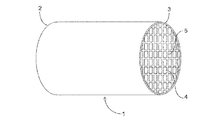
- Fig. 1 is a schematic diagram to illustrate the exhaust gas purification filter according to a mode of embodiment of the present invention
- Fig. 2 is a graph showing the correlation between void ratio obtained from an SEM image and void ratio obtained from measurement results of a mercury porosimeter.
- a feature of the exhaust gas purification filter according to this mode of embodiment lies in the fact that said exhaust gas purification filter includes a substrate comprising a plurality of porous partitions, the partitions form an exhaust gas flow path, a porous catalytic layer formed by an organic pore-forming material is provided on the partitions and the catalytic layer having a thickness of 10 ⁇ m or greater is provided over at least 20% of the total length of the partitions in the lengthwise direction thereof, and the catalytic layer having a thickness of 10 ⁇ m or greater is not present on a gas inflow-side partition 15 mm from an outflow side.
- the exhaust gas purification filter according to this mode of embodiment restricts deep PM filtration by virtue of the fact that it is coated (on-wall coated) with a catalytic layer having a constant thickness or greater and comprising a suitable porous structure, and "pressure loss hysteresis" from repeated PM deposition and regeneration can be improved.
- the exhaust gas purification filter includes a substrate 1, and a catalytic substance (not depicted) provided inside the substrate 1, said substrate 1 comprising a plurality of cells 4 that form a gas (exhaust gas) flow path and have a gas inflow-side end 2 and outflow-side end 3, and a plurality of porous partitions 5 that define the cells 4.
- a porous catalytic layer (not depicted) is provided on the partitions 5.
- the substrate 1 supports the catalytic substance and serves to form an exhaust gas flow path; the substrate 1 is preferably durable so that as far as possible there is no reduction in combustion efficiency in a connected internal combustion engine caused by pressure loss.
- the porous material forming the substrate 1 as long as pores are provided at least in the partitions 5, but a porous ceramic material is preferably used.
- Preferred materials for the substrate 1 include a cordierite ceramic comprising three components, namely aluminium oxide (Al 2 O 3 : alumina), silicon dioxide (SiO 2 : silica) and magnesium oxide (MgO); silicon carbide and aluminium titanate.
- a cordierite ceramic comprising three components, namely aluminium oxide (Al 2 O 3 : alumina), silicon dioxide (SiO 2 : silica) and magnesium oxide (MgO); silicon carbide and aluminium titanate.
- a honeycomb shape comprising the abovementioned materials is preferred as the substrate 1.
- a honeycomb-shaped filter includes a plurality of cells forming a gas flow path, but there is no particular limitation as to the cross-sectional shape of the cells and a grid-like mesh is feasible, as shown in fig. 1, or a hexagonal shape is equally feasible, but there is no restriction as to the shape thereof.
- what is known as an asymmetrical cell structure having cells of different sizes at an inlet and outlet may be used.
- the substrate 1 comprises at least the gas inflow-side end 2 and outflow-side end 3. Furthermore, the substrate 1 comprises at least the plurality of cells 4 forming the gas flow path, and the plurality of porous partitions 5 defining said cells 4.
- the plurality of cells 4 in the exhaust gas purification filter according to this mode of embodiment are alternately sealed at the inlets/outlets thereof at the ends of at least some of the cells 4.
- the exhaust gas purification filter according to this mode of embodiment more preferably employs a substrate having a configuration such as that described above, but the substrate supporting the catalytic substance is not limited to the abovementioned configurations.
- the porous catalytic layer is provided on the partitions of the exhaust gas purification filter according to this mode of embodiment, said catalytic layer having a thickness of 10 ⁇ m or greater being provided over at least 20% of the total length of the partitions in the lengthwise direction thereof, while the catalytic layer having a thickness of 10 ⁇ m or greater is not present on the gas inflow-side partitions 15 mm from the outflow side.
- the catalytic layer having a thickness of 10 ⁇ m or greater more preferably constitutes at least 50% (excluding 15 mm from the outlet) of the total length of the partitions in the lengthwise direction thereof, from the point of view of reducing pressure loss hysteresis. Furthermore, it is preferable for a high-concentration precious metal component also to be present from the inlet portion in an amount of less than 50%, from the point of view of improving catalyst oxidation activity.
- the catalytic layer having a thickness of 10 ⁇ m or greater is not present on the gas inflow-side partitions of the inlet cells within 15 mm of the outflow side.
- the thickness of the catalytic layer on the partitions 15 mm from the outflow side is more preferably either between 10 and 40 ⁇ m or distributed in an in-wall state.
- the catalytic layer is preferably not provided in a range of less than 5 mm from the ends of the plugs.
- Coating 100% of the total length of the catalytic layer having a constant thickness is intrinsically advantageous in view of a DPF function, but this advantage can still be maintained to a certain extent if a partially uncoated portion is present. Furthermore, if an on-wall layer formed using a wet slurry is shortened, it is possible to shorten the time taken to dry moisture filling the pores in the partitions, which makes it possible to improve producibility. It is also possible to reduce pressure loss in terms of air circulation.
- the catalytic layer having a thickness of 10 ⁇ m or greater is not applied over the total length of 100%, so ventilated drying is possible directly after coating and it is possible to resolve said problem.
- the exhaust gas purification filter according to this mode of embodiment has the configuration described above, and therefore it is possible to overcome production drawbacks while imparting the effect of an on-wall catalytic layer.
- the catalytic layer has pores formed by means of the organic pore-forming material, and as a result it is possible for the exhaust gas catalyst to perform efficient oxidation treatment of gaseous components such as CO and HC.
- Pores formed by means of the organic pore-forming material indicate that voids are present inside, on the surface of, and at the interface etc. of the catalytic layer and the partitions.
- shape of the "pores" There is no particular limitation as to the shape of the "pores", and a hole shape, spherical shape, elliptical shape, prism shape, through-path or any similar shape is feasible, but preferably L/D ⁇ 1.5.
- the thickness of the catalytic layer in the portion of the exhaust gas purification filter according to this mode of embodiment having a thickness of 10 ⁇ m or greater is between 10 ⁇ m and 50 ⁇ m.
- the thickness of the catalytic layer in the portion having a thickness of 10 ⁇ m or greater is more preferably between 10 and 20 ⁇ m.
- a catalytic layer having a thickness of between 10 and 20 ⁇ m is preferred for reasons of reduced pressure loss and formation of an on-wall PM-trapping layer, and 50% or more (excluding a range of 15 mm from the outflow-side end) of the total length of the partitions in the lengthwise direction thereof is preferably coated from the point of view of reducing pressure loss hysteresis. Furthermore, less than 50% from the inflow-side end is preferably coated from the point of view of improving catalyst oxidation activity.
- the catalytic layer preferably includes a precious metal component such as platinum or palladium; a metal oxide such as alumina, silica or titania or a composite oxide thereof, or a component in which a rare earth element has been added thereto, such as ceria; and a Ba, Mn, Cu or OSC material and/or an alkali metal such as K or Cs serving as an auxiliary catalyst. More preferably, the catalytic layer comprises a precious metal, a composite oxide having alumina as the main component serving as a support material for the precious metal, and an OSC (oxygen storage) material serving as a PM combustion catalyst.
- a precious metal component such as platinum or palladium
- a metal oxide such as alumina, silica or titania or a composite oxide thereof, or a component in which a rare earth element has been added thereto, such as ceria
- a Ba, Mn, Cu or OSC material and/or an alkali metal such as K or Cs serving as an auxiliary catalyst
- the catalyst component which is used has the feature of catalysing the combustion of particulate matter and oxygen in the exhaust gas, and also of catalysing nitric oxide in the exhaust gas to nitrogen dioxide, catalysing carbon monoxide to carbon dioxide, and catalysing hydrocarbons to carbon dioxide and water.
- This kind of catalyst component which may be cited are those selected from the group consisting of alkali metals, alkaline earth metals, transition elements and elements from groups 10 to 12 of the extended periodic table of the elements, and mixtures thereof.
- Alkali metals which may be cited are selected from the group consisting of sodium (Na), potassium (K), caesium (Cs) and mixtures thereof, with potassium and caesium and mixtures thereof being preferred.
- Alkaline earth metals which may be cited are selected from the group consisting of magnesium, calcium, barium and mixtures thereof, with magnesium, barium and mixtures thereof being preferred.
- Transition elements which may be cited are selected from the group consisting of zirconium, lanthanum, cerium, platinum, rhodium, ruthenium, palladium, iron, silver and mixtures thereof, with cerium, platinum, iron and mixtures thereof being preferred.
- Zinc may be cited as an element from group 12 of the extended periodic table of the elements.
- Elements from group 13 of the extended periodic table of the elements which may be cited are selected from the group consisting of aluminium, gallium, indium and mixtures thereof, with aluminium being preferred.
- the catalyst component preferably also brings a function of oxidizing gaseous components in the exhaust gas.
- Catalyst components of this kind which may be cited belong to the precious metals and the base metals from among those mentioned above.
- the catalyst component in the exhaust gas purification filter according to this mode of embodiment more preferably includes at least one of platinum and palladium, and at least one of an alkali metal and a rare earth element.
- the weight ratio of platinum and palladium is more preferably at least 1:1 for the catalytic substance.
- platinum and palladium are preferably included at a ratio of between 2:1 and 5:1 from the point of view of sulfur tolerance.
- the exhaust gas purification filter according to this mode of embodiment more preferably further includes, as a catalyst auxiliary, at least one material selected from the group consisting of an OSC material, an alkali metal and a perovskite material.
- a PM combustion catalyst comprising this kind of transition metal group makes it possible to achieve an effect of promoting combustion of carbon-based substances.
- oxygen storage materials examples include materials comprising Ce, Pr, Zr and Nd. Among these, Ce is particularly preferably used for reasons of promoting combustion.
- alkali metals examples include K, Cs and Mg. Among these, K and Cs are particularly preferably used for reasons of promoting combustion.
- perovskite materials which may be cited include Bi 4 Ti 3 O 4 (JP 2010-69471 A) and Ce 0.5 Bi 0.1 Pr 0.4 (JP 2009-112907 A).
- the application amount of the catalyst component forming part of the catalytic layer of the exhaust gas purification filter according to this mode of embodiment is more preferably set at 40 g/L or less, taking the catalyst component as ⁇ -alumina.
- the amount of catalyst applied is related to the actual formation of an on-wall catalytic layer, and also affects pressure loss characteristics. 40 g/L may be converted to approximately 0.7 g/in 3 .
- an on-wall layer cannot be adequately formed when the material used in order to impart the catalytic function is applied at 10 g/L or less.
- the amount of catalyst component applied is more preferably 30 g/L or less for reasons of being able to limit a large increase in pressure loss, but the minimum amount is also affected by the specific gravity and pore volume of the material used. For example, when ⁇ -alumina having a pore volume of 0.7 ml/g is used, an application amount of 40 g/L or less is preferred, and when cerium oxide having a pore volume of 0.21 ml/g is applied, an application amount of approximately 200 g/L is preferred. These show that the optimum application amount varies according to the material forming the slurry.
- a further catalyst auxiliary may be added to the exhaust gas purification filter according to this mode of embodiment.
- catalyst auxiliaries are selected from the group consisting of aluminium oxide, cerium oxide, titanium oxide, zirconium oxide, silicon oxide, magnesium oxide and mixtures thereof, with magnesium oxide, cerium oxide, titanium oxide, zirconium oxide and silicon oxide being preferred.
- the catalyst auxiliary is added in an amount of 50-99% with respect to the total weight of the components forming the catalytic layer.
- the mean diameter of the pores in the catalytic layer in the exhaust gas purification filter according to this mode of embodiment is more preferably between 1 and 5 ⁇ m.
- the mean diameter of the pores in the catalytic layer is more preferably between 2 and 5 ⁇ m for reasons of a balance between pressure loss and restricting deep filtration of PM particles.
- the void ratio of the catalytic layer in the exhaust gas purification filter according to this mode of embodiment is more preferably no greater than 50%.
- the void ratio of the catalytic layer is more preferably between 50 and 30% for reasons of pressure loss and of maintaining the mechanical strength of the on-wall layer.
- the slurry including the catalyst component and the organic pore-forming material is more preferably mixed and applied in order to form the catalytic layer as an on-wall structure and in order to form pores in the catalytic layer of the exhaust gas purification filter according to this mode of embodiment.
- One such method employs solid particles which are larger than the pores in the partitions. It is possible to restrict the penetration of catalyst particles into the pores in the partitions by means of a pore-forming material having large particles which also serves as the catalyst solid content. Furthermore, this pore-forming material also contributes to reducing pressure loss in the on-wall catalytic layer.
- the particle size of the pore-forming material is preferably between 1 and 5 ⁇ m, and more preferably between 2 and 5 ⁇ m in order to prevent deep filtration in the actual voids formed.
- means for providing voids in the catalytic layer include a means by which an exhaust gas catalyst component and a pore-forming material are added to and stirred in a medium (e.g., water) to prepare a slurry which is then supported on a support and baked in order to combust and decompose the forming agent.
- a medium e.g., water
- the forming agent can therefore preferably be removed by combustion during the baking process.
- Any type of forming agent can be used provided that it causes the formation of voids, and materials having the same or different shapes, types or sizes etc. can be used.
- a forming material which is spherical or cylindrical etc. and can be thermally decomposed or combusted is preferred.
- An organic pore-forming material is more preferably used as the forming agent.
- An organic pore-forming material can be advantageously used provided that it is a combustible material having a specific gravity at the same level as that of a slurry aqueous solution. This is because the organic pore-forming material does not readily form a uniform dispersed state with other materials in the aqueous solution if the specific gravity thereof is excessively low or excessively high.
- foaming agents include La 2 (CO 3 ) 3 , Al 2 (CO) 3 , and Ce 2 (CO) 3 , and the same elements as in the exhaust gas catalyst component are preferably included.
- surfactants include anionic surfactants such as sulfonic acid surfactants and carbonic acid surfactants; cationic surfactants such as amine surfactants; and amphoteric surfactants such as fatty acid ester surfactants.
- Foamable synthetic resins and the like which may be cited include polyurethane-based, polystyrene-based (e.g., polystyrene), polyethylene-based, polyester-based, and polyacrylic-based (e.g., polymethyl methacrylate) synthetic resins.
- the mean length/diameter ratio of the organic pore-forming material is preferably 1.5 or less.
- the spheres of spherical particles generally make point contact and although this is believed to produce poor void communication, results up until now show that the advantages can be maintained. It is believed that setting L/D close to spherical facilitates predicting the amount of penetration into the pores in the partitions due to differences in the orientation of the pore-forming material, enabling the usage amount to be set more reliably.
- a more preferred example of an organic pore-forming material is a polymer such as a polylactic acid polymer.
- the void ratio of the pores in the partitions in the exhaust gas purification filter according to this mode of embodiment is preferably between 40% and 60%.
- the void ratio of the pores in the partitions is more preferably between 40 and 55% from the point of view of compatibility between reducing pressure loss and PM trapping performance.
- the mean diameter of the pores in the partitions in the exhaust gas purification filter according to this mode of embodiment is preferably between 10 ⁇ m and 20 ⁇ m.
- the mean diameter of the pores in the partitions is preferably 10 ⁇ m or greater from the point of view of DPF pressure loss and is preferably 20 ⁇ m or less because this provides a high PM trapping efficiency from the outset.
- the mean diameter of the pores is more preferably between 10 and 15 ⁇ m.
- the form of the pores and the void ratio of the catalytic substance in the abovementioned mode of embodiment can be obtained using an SEM (scanning electron microscope)/EPMA (electron probe microanalyser).
- SEM scanning electron microscope
- EPMA electron probe microanalyser
- the pore area (A) of the substrate before application of the catalytic substance can be obtained by image processing in a field of view magnified between 150 and 500 times by means of an SEM/EPMA.
- the pore area (B) after application of the catalyst can also be obtained by the same method.
- the area of the substrate portion is obtained by means of image processing using the same two-dimensional method, which makes it possible to calculate the relative ratio of the pore area of holes in the substrate 1 and the occupied area ratio.
- the mercury intrusion method is generally used as the method for measuring the three-dimensional pore structure volume, and the result of the correlation between that method and the abovementioned image processing method is as shown in fig. 2; there is a correlation between the two-dimensional void ratio (ratio of occupied area) obtained from the SEM image and the void occupation volume ratio obtained from the measurement results using a mercury porosimeter, which constitutes three-dimensional data.
- a compositional image at a magnification of 150 to 200 times is preferably used here in the SEM/EPMA method, and the occupied area can be obtained by separating the areas occupied by the substrate and the catalyst into individual colours using the RGB method, for example.
- the occupied area is obtained by image processing in the exhaust gas purification filter according to this mode of embodiment, the image is preferably binarized and a calculation is preferably made using an automatic mode or the like in order to prevent human error.
- the exhaust gas purification filter according to the abovementioned mode of embodiment is used to purify exhaust gas and a device employing the exhaust gas purification filter according to the abovementioned mode of embodiment is preferably used in an exhaust system of an internal combustion engine, in particular a spark-ignition engine (e.g., a petrol engine) or a compression-ignition engine (e.g., a diesel engine).
- a spark-ignition engine e.g., a petrol engine
- a compression-ignition engine e.g., a diesel engine
- these engines may be engines which burn fuel by adjusting the air-fuel ratio
- preferred specific examples thereof which may be cited include lean-burn engines, direct-injection engines, and preferably an engine combining these (i.e., a direct-injection lean-burn engine).
- a direct-ignition engine employs a fuel supply system which enables a higher compression ratio, improved combustion efficiency and also a reduction in exhaust gas. By combining this with a lean-burn engine, it is therefore possible to further improve combustion efficiency and reduce exhaust gas.
- the exhaust gas purification filter according to this mode of embodiment is preferably used in an exhaust system of an internal combustion engine mounted in a conveyance vehicle or a machine etc.
- conveyance vehicles and machines which may be cited include: transportation vehicles such as motor vehicles, buses, trucks, dumper cars, diesel railcars, motorcycles, motorized bicycles, ships, tankers, motorboats, and aircraft; agricultural machines such as cultivators, tractors, combine harvesters, chainsaws, and timber carriers; aquatic and fishing machines such as fishing boats; timber working machines such as tank lorries, cranes, compressors, and excavators; and generators.
- the exhaust gas purification filter according to this mode of embodiment may be installed for a start catalyst, an underfloor catalyst, or a manifold converter in a vehicle exhaust system, for example.
- the DPF which was used was an SD082 produced by IBIDEN: diameter 143.8 mm ⁇ length 150.2 mm, mean pore size 12 ⁇ m, porosity 42%.
- a wash coat (referred to below as a “WC”) in which an organic pore-forming material was kneaded with a slurry containing alumina as the main component and also platinum and palladium was prepared and coated on the DPF by means of a filter coating apparatus in such a way that the amount of catalyst was 20 g/L. After drying at 100°C, the coated filter was baked for 1 hour at 500°C.
- the organic pore-forming material which was used was a spherical material having an aspect ratio of 1:1 and comprising a polylactic acid polymer which was Landy PL-1000 (produced by Miyoshi Oil & Fat Co., Ltd.).
- exhaust gas purification filters were produced with different lengths of catalytic layer on the partitions.
- the WC containing the organic pore-forming material was applied in such a way that the length thereof was 15 mm, 76 mm and 150 mm, and these lengths correspond to Exemplary Embodiment 1 and Comparative Examples 1 and 2, respectively.
- the location which was not coated with the WC containing the organic pore-forming material were coated using a WC that did not contain an organic pore-forming material.
- the amounts of platinum, palladium and WC per exhaust gas purification filter were the same.
- an exhaust gas purification filter in which the catalytic layer having a thickness of 10 ⁇ m or greater was applied over at least 20% of the total length of the partitions in the lengthwise direction thereof, and the catalytic layer having a thickness of 10 ⁇ m or greater was not present at a position 15 mm from the outflow side, dried in a shorter time in the slurry drying process, which is a consideration in mass production, and also had superior performance in terms of CO 50% conversion efficiency temperature, and also PM deposition pressure loss and PM deposition pressure loss hysteresis.
- the PM deposition pressure loss was measured under soot generation conditions of a gas flow rate of 240 kg/hr and a gas temperature of 250°C.
- Exhaust gas purification filters were produced in accordance with Exemplary Embodiment 1 with catalyst component application amounts of 35 g/L, 55 g/L and 5 g/L, and these correspond to Exemplary Embodiments 3, 4 and 5.
- the thickness of the catalytic layer and the partitions increased and there was a deterioration in PM deposition pressure loss. Furthermore, when the amount of catalyst component applied was 10 g/L or less, as in Exemplary Embodiment 5, the thickness of the catalytic layer on the partitions decreased and the effect as an on-wall layer could not be demonstrated.
Landscapes
- Chemical & Material Sciences (AREA)
- Engineering & Computer Science (AREA)
- Chemical Kinetics & Catalysis (AREA)
- Organic Chemistry (AREA)
- Materials Engineering (AREA)
- Combustion & Propulsion (AREA)
- General Engineering & Computer Science (AREA)
- Mechanical Engineering (AREA)
- Health & Medical Sciences (AREA)
- Ceramic Engineering (AREA)
- General Chemical & Material Sciences (AREA)
- Oil, Petroleum & Natural Gas (AREA)
- Biomedical Technology (AREA)
- Environmental & Geological Engineering (AREA)
- Analytical Chemistry (AREA)
- Structural Engineering (AREA)
- Physics & Mathematics (AREA)
- Geometry (AREA)
- Nanotechnology (AREA)
- Toxicology (AREA)
- Catalysts (AREA)
- Exhaust Gas Treatment By Means Of Catalyst (AREA)
- Processes For Solid Components From Exhaust (AREA)
- Filtering Materials (AREA)
- Exhaust Gas After Treatment (AREA)
Abstract
Priority Applications (6)
| Application Number | Priority Date | Filing Date | Title |
|---|---|---|---|
| CN201780029763.0A CN109475815A (zh) | 2016-04-01 | 2017-03-29 | 废气净化过滤器 |
| RU2018138395A RU2018138395A (ru) | 2016-04-01 | 2017-03-29 | Фильтр для очистки выхлопного газа |
| EP17720242.1A EP3436182A1 (fr) | 2016-04-01 | 2017-03-29 | Filtre de purification de gaz d'échappement |
| JP2018551490A JP2019516541A (ja) | 2016-04-01 | 2017-03-29 | 排気ガス浄化用フィルター |
| BR112018069967A BR112018069967A2 (pt) | 2016-04-01 | 2017-03-29 | filtro para purificação de gás de escape, e, método para produzir um filtro. |
| KR1020187031088A KR20180132743A (ko) | 2016-04-01 | 2017-03-29 | 배기 가스 정화 필터 |
Applications Claiming Priority (2)
| Application Number | Priority Date | Filing Date | Title |
|---|---|---|---|
| JP2016-073878 | 2016-04-01 | ||
| JP2016073878 | 2016-04-01 |
Publications (1)
| Publication Number | Publication Date |
|---|---|
| WO2017170669A1 true WO2017170669A1 (fr) | 2017-10-05 |
Family
ID=58640953
Family Applications (1)
| Application Number | Title | Priority Date | Filing Date |
|---|---|---|---|
| PCT/JP2017/012865 Ceased WO2017170669A1 (fr) | 2016-04-01 | 2017-03-29 | Filtre de purification de gaz d'échappement |
Country Status (10)
| Country | Link |
|---|---|
| US (2) | US10233803B2 (fr) |
| EP (1) | EP3436182A1 (fr) |
| JP (1) | JP2019516541A (fr) |
| KR (1) | KR20180132743A (fr) |
| CN (1) | CN109475815A (fr) |
| BR (1) | BR112018069967A2 (fr) |
| DE (1) | DE102017106374A1 (fr) |
| GB (1) | GB2551608A (fr) |
| RU (1) | RU2018138395A (fr) |
| WO (1) | WO2017170669A1 (fr) |
Cited By (1)
| Publication number | Priority date | Publication date | Assignee | Title |
|---|---|---|---|---|
| US11473472B2 (en) | 2020-04-21 | 2022-10-18 | Toyota Jidosha Kabushiki Kaisha | Exhaust gas control apparatus and manufacturing method thereof |
Families Citing this family (11)
| Publication number | Priority date | Publication date | Assignee | Title |
|---|---|---|---|---|
| JP7037985B2 (ja) * | 2018-03-30 | 2022-03-17 | 日本碍子株式会社 | ハニカムフィルタ |
| JP7230671B2 (ja) * | 2019-04-26 | 2023-03-01 | 株式会社デンソー | 排ガス浄化フィルタ |
| KR102256046B1 (ko) * | 2019-08-09 | 2021-05-25 | 주식회사 아이비머티리얼즈 | 기공률이 향상된 VOCs 로터 시스템용 실리콘 카바이드 허니컴 구조체의 제작방법 |
| JP6751831B1 (ja) * | 2020-03-09 | 2020-09-09 | 三井金属鉱業株式会社 | 排ガス浄化用触媒 |
| JP7385510B2 (ja) | 2020-03-19 | 2023-11-22 | 日本碍子株式会社 | ハニカムフィルタ |
| JP7328192B2 (ja) * | 2020-10-06 | 2023-08-16 | トヨタ自動車株式会社 | 排ガス浄化装置 |
| CN114534486B (zh) * | 2020-11-26 | 2023-03-31 | 长城汽车股份有限公司 | 一种净化氮氧化物的方法 |
| EP4015065B1 (fr) * | 2020-12-15 | 2025-02-26 | Umicore AG & Co. KG | Filtre à particules catalytiquement actif à efficacité de filtration élevée |
| KR20250065551A (ko) * | 2022-06-09 | 2025-05-13 | 바스프 모바일 에미션스 카탈리스츠 엘엘씨 | 가솔린 미립자 필터 |
| JP2025130091A (ja) * | 2022-07-20 | 2025-09-08 | 綜研化学株式会社 | 乳酸-ビニル共重合体、バインダー組成物および焼成用ペースト |
| EP4424407A1 (fr) * | 2023-02-28 | 2024-09-04 | Umicore AG & Co. KG | Gpf avec distribution de couche d'imprégnation améliorée |
Citations (12)
| Publication number | Priority date | Publication date | Assignee | Title |
|---|---|---|---|---|
| JP2002191988A (ja) | 2000-12-25 | 2002-07-10 | Toyota Central Res & Dev Lab Inc | 排ガス浄化用触媒 |
| JP2002253968A (ja) | 2001-03-02 | 2002-09-10 | Toyota Central Res & Dev Lab Inc | 排ガス浄化用触媒 |
| DE10247946A1 (de) * | 2002-10-15 | 2004-04-29 | Robert Bosch Gmbh | Abgasnachbehandlungsanordnung |
| EP1657410A2 (fr) * | 2004-11-11 | 2006-05-17 | Cataler Corporation | Filtre catalytique |
| JP2009112907A (ja) | 2007-11-02 | 2009-05-28 | Dowa Electronics Materials Co Ltd | 排気ガス浄化材および排気ガス浄化用フィルター |
| EP2108447A2 (fr) * | 2008-03-28 | 2009-10-14 | NGK Insulators, Ltd. | Structure en nid d'abeille |
| JP2010069471A (ja) | 2008-08-22 | 2010-04-02 | Dowa Electronics Materials Co Ltd | Pm燃焼用複合酸化物触媒、それを用いたスラリー及び排ガス浄化用フィルター |
| EP2239036A1 (fr) * | 2009-03-31 | 2010-10-13 | NGK Insulators, Ltd. | Filtre en nid d'abeille et son procédé de fabrication |
| JP2010227743A (ja) * | 2009-03-26 | 2010-10-14 | Ngk Insulators Ltd | ハニカムフィルタ |
| EP2339135A1 (fr) * | 2009-12-25 | 2011-06-29 | NGK Insulators, Ltd. | Substrat avec couche de collecte en surface et substrat de support de catalyseur avec couche de collecte en surface |
| EP3001000A1 (fr) * | 2013-05-22 | 2016-03-30 | Mitsui Mining & Smelting Co., Ltd | Filtre à particules diesel, et dispositif de purification de gaz d'échappement |
| WO2017001829A1 (fr) * | 2015-06-28 | 2017-01-05 | Johnson Matthey Public Limited Company | Filtre catalytique à écoulement sur paroi ayant une membrane |
Family Cites Families (31)
| Publication number | Priority date | Publication date | Assignee | Title |
|---|---|---|---|---|
| EP0369163A1 (fr) * | 1988-10-11 | 1990-05-23 | Sakai Chemical Industry Co., Ltd., | Filtre catalytique et procédé pour l'élimination des particules |
| JP2002253698A (ja) | 2001-02-27 | 2002-09-10 | Takashi Saito | 簡単折りたたみ式逆立ち台 |
| JP4567285B2 (ja) * | 2002-11-22 | 2010-10-20 | 日本碍子株式会社 | 排ガス浄化用触媒体 |
| JP2005021818A (ja) * | 2003-07-03 | 2005-01-27 | Johnson Matthey Japan Inc | 排気ガス中の微粒子状物質を処理するための排気ガス触媒 |
| US7722829B2 (en) | 2004-09-14 | 2010-05-25 | Basf Catalysts Llc | Pressure-balanced, catalyzed soot filter |
| EP1795261A4 (fr) * | 2004-09-30 | 2009-07-08 | Ibiden Co Ltd | Structure alvéolaire |
| EP1818098A4 (fr) * | 2004-11-26 | 2008-02-06 | Ibiden Co Ltd | Structure en nid d'abeille |
| JP4971166B2 (ja) * | 2005-08-31 | 2012-07-11 | 日本碍子株式会社 | ハニカム触媒体、ハニカム触媒体製造用のプレコート担体及びハニカム触媒体の製造方法 |
| US8609581B2 (en) * | 2005-08-31 | 2013-12-17 | Ngk Insulators, Ltd. | Honeycomb structure and honeycomb catalytic body |
| US7754160B2 (en) * | 2005-08-31 | 2010-07-13 | Ngk Insulators | Honeycomb catalytic body and process for manufacturing honeycomb catalytic body |
| WO2007052479A1 (fr) * | 2005-11-04 | 2007-05-10 | Ngk Insulators, Ltd. | Structure en nid d’abeilles et catalyseur en nid d’abeilles |
| JP5073303B2 (ja) * | 2006-03-24 | 2012-11-14 | 日本碍子株式会社 | 触媒コンバータ及び触媒コンバータの製造方法 |
| WO2008126328A1 (fr) * | 2007-03-30 | 2008-10-23 | Ibiden Co., Ltd. | Filtre en nid d'abeilles |
| WO2008136078A1 (fr) | 2007-04-20 | 2008-11-13 | Ibiden Co., Ltd. | Filtre en nid d'abeilles |
| JP5096978B2 (ja) | 2008-03-27 | 2012-12-12 | 日本碍子株式会社 | ハニカム触媒体 |
| JP2010167366A (ja) * | 2009-01-22 | 2010-08-05 | Ngk Insulators Ltd | ハニカム触媒体 |
| JP5064432B2 (ja) | 2009-03-24 | 2012-10-31 | 日本碍子株式会社 | ハニカム触媒体 |
| JP5409070B2 (ja) | 2009-03-24 | 2014-02-05 | 日本碍子株式会社 | 排ガス浄化装置の製造方法及び排ガス浄化装置 |
| JP2010227767A (ja) * | 2009-03-26 | 2010-10-14 | Ngk Insulators Ltd | ハニカムフィルタ |
| JP5548470B2 (ja) * | 2010-02-16 | 2014-07-16 | 日本碍子株式会社 | ハニカム触媒体 |
| JP5390438B2 (ja) * | 2010-03-11 | 2014-01-15 | 日本碍子株式会社 | ハニカム触媒体 |
| JP2012127336A (ja) * | 2010-11-24 | 2012-07-05 | Sumitomo Chemical Co Ltd | ハニカムフィルタ |
| JP2012117487A (ja) * | 2010-12-03 | 2012-06-21 | Toyota Central R&D Labs Inc | 触媒付パティキュレートフィルタ、排ガス浄化排出システム、触媒配置部割合算出方法、及び触媒配置部割合算出装置 |
| US8789356B2 (en) * | 2011-07-28 | 2014-07-29 | Johnson Matthey Public Limited Company | Zoned catalytic filters for treatment of exhaust gas |
| JP6532826B2 (ja) | 2013-12-11 | 2019-06-19 | 株式会社キャタラー | 排ガス浄化材 |
| JP6285225B2 (ja) * | 2014-03-12 | 2018-02-28 | 日本碍子株式会社 | ハニカム構造体 |
| CN204147880U (zh) * | 2014-08-13 | 2015-02-11 | 江阴华音陶瓷机电科技有限公司 | 椭圆形陶瓷蜂窝载体 |
| CN115155668B (zh) | 2014-10-16 | 2025-10-24 | 株式会社科特拉 | 废气净化用催化剂 |
| JP6353918B2 (ja) | 2014-10-16 | 2018-07-04 | 株式会社キャタラー | 排ガス浄化用触媒 |
| US10159934B2 (en) | 2015-02-17 | 2018-12-25 | Cataler Corporation | Exhaust gas purification catalyst |
| CN105153620B (zh) * | 2015-07-31 | 2018-01-12 | 江苏省电力公司泰州供电公司 | 一种改性聚丙烯/超支化聚酰亚胺绝缘合金材料及其制备方法 |
-
2017
- 2017-03-24 DE DE102017106374.9A patent/DE102017106374A1/de not_active Ceased
- 2017-03-29 RU RU2018138395A patent/RU2018138395A/ru not_active Application Discontinuation
- 2017-03-29 EP EP17720242.1A patent/EP3436182A1/fr not_active Withdrawn
- 2017-03-29 US US15/473,007 patent/US10233803B2/en active Active
- 2017-03-29 KR KR1020187031088A patent/KR20180132743A/ko not_active Withdrawn
- 2017-03-29 WO PCT/JP2017/012865 patent/WO2017170669A1/fr not_active Ceased
- 2017-03-29 CN CN201780029763.0A patent/CN109475815A/zh active Pending
- 2017-03-29 JP JP2018551490A patent/JP2019516541A/ja active Pending
- 2017-03-29 BR BR112018069967A patent/BR112018069967A2/pt not_active Application Discontinuation
- 2017-03-31 GB GB1705213.5A patent/GB2551608A/en not_active Withdrawn
-
2019
- 2019-03-14 US US16/353,081 patent/US20190211723A1/en not_active Abandoned
Patent Citations (12)
| Publication number | Priority date | Publication date | Assignee | Title |
|---|---|---|---|---|
| JP2002191988A (ja) | 2000-12-25 | 2002-07-10 | Toyota Central Res & Dev Lab Inc | 排ガス浄化用触媒 |
| JP2002253968A (ja) | 2001-03-02 | 2002-09-10 | Toyota Central Res & Dev Lab Inc | 排ガス浄化用触媒 |
| DE10247946A1 (de) * | 2002-10-15 | 2004-04-29 | Robert Bosch Gmbh | Abgasnachbehandlungsanordnung |
| EP1657410A2 (fr) * | 2004-11-11 | 2006-05-17 | Cataler Corporation | Filtre catalytique |
| JP2009112907A (ja) | 2007-11-02 | 2009-05-28 | Dowa Electronics Materials Co Ltd | 排気ガス浄化材および排気ガス浄化用フィルター |
| EP2108447A2 (fr) * | 2008-03-28 | 2009-10-14 | NGK Insulators, Ltd. | Structure en nid d'abeille |
| JP2010069471A (ja) | 2008-08-22 | 2010-04-02 | Dowa Electronics Materials Co Ltd | Pm燃焼用複合酸化物触媒、それを用いたスラリー及び排ガス浄化用フィルター |
| JP2010227743A (ja) * | 2009-03-26 | 2010-10-14 | Ngk Insulators Ltd | ハニカムフィルタ |
| EP2239036A1 (fr) * | 2009-03-31 | 2010-10-13 | NGK Insulators, Ltd. | Filtre en nid d'abeille et son procédé de fabrication |
| EP2339135A1 (fr) * | 2009-12-25 | 2011-06-29 | NGK Insulators, Ltd. | Substrat avec couche de collecte en surface et substrat de support de catalyseur avec couche de collecte en surface |
| EP3001000A1 (fr) * | 2013-05-22 | 2016-03-30 | Mitsui Mining & Smelting Co., Ltd | Filtre à particules diesel, et dispositif de purification de gaz d'échappement |
| WO2017001829A1 (fr) * | 2015-06-28 | 2017-01-05 | Johnson Matthey Public Limited Company | Filtre catalytique à écoulement sur paroi ayant une membrane |
Cited By (1)
| Publication number | Priority date | Publication date | Assignee | Title |
|---|---|---|---|---|
| US11473472B2 (en) | 2020-04-21 | 2022-10-18 | Toyota Jidosha Kabushiki Kaisha | Exhaust gas control apparatus and manufacturing method thereof |
Also Published As
| Publication number | Publication date |
|---|---|
| US20190211723A1 (en) | 2019-07-11 |
| GB201705213D0 (en) | 2017-05-17 |
| US10233803B2 (en) | 2019-03-19 |
| RU2018138395A (ru) | 2020-05-14 |
| GB2551608A (en) | 2017-12-27 |
| JP2019516541A (ja) | 2019-06-20 |
| US20170284247A1 (en) | 2017-10-05 |
| EP3436182A1 (fr) | 2019-02-06 |
| KR20180132743A (ko) | 2018-12-12 |
| DE102017106374A1 (de) | 2017-10-05 |
| CN109475815A (zh) | 2019-03-15 |
| BR112018069967A2 (pt) | 2019-01-29 |
| RU2018138395A3 (fr) | 2020-05-14 |
Similar Documents
| Publication | Publication Date | Title |
|---|---|---|
| US10233803B2 (en) | Exhaust gas purification filter | |
| JP7383099B2 (ja) | ガソリンパティキュレートフィルター | |
| EP2324904B1 (fr) | Filtre de support de catalyseur et système de purification de gaz d'échappement | |
| RU2650992C2 (ru) | Подложка фильтра, содержащая зонально нанесенное покрытие из пористого оксида с катализатором | |
| CN107073447B (zh) | 废气净化用催化剂 | |
| CN104254387B (zh) | 包含三元催化剂的过滤器基底 | |
| CN107249737B (zh) | 排气净化用催化剂 | |
| JP2020008022A (ja) | ガソリン車用の汚染物質低減装置 | |
| US20110005211A1 (en) | Coating of substrates ensuring a high porosity with simutaneously high abrasion resistance of the coating | |
| WO2009139107A1 (fr) | Catalyseur de purification de gaz d'échappement et son procédé de fabrication | |
| US20040033175A1 (en) | Catalyst-carrying filter | |
| CN102333579A (zh) | 用于从强制点火发动机排出的尾气中滤除颗粒物质的过滤器 | |
| CN110997141B (zh) | 排气净化用催化剂 | |
| CN112074657B (zh) | 经涂覆的壁流式过滤器 | |
| JP5447377B2 (ja) | 排気ガス浄化触媒 | |
| JP7023770B2 (ja) | 排ガス浄化用触媒 | |
| JP2016524066A5 (fr) | ||
| JP2006110485A (ja) | 排気ガス触媒およびそれを用いた排気ガス処理装置 | |
| WO2019065206A1 (fr) | Catalyseur de purification de gaz d'échappement | |
| WO2020031975A1 (fr) | Filtre à particules d'essence revêtu de catalyseur et son procédé de production | |
| JP2006007117A (ja) | 排気ガス浄化構造体および該構造体を用いた排気ガス浄化方法 | |
| JP2004330025A (ja) | 排気ガス触媒およびそれを用いた排気ガス処理装置 | |
| Pfeifer et al. | New platinum/palladium based catalyzed filter technologies for future passenger car applications | |
| EP3400999B1 (fr) | Filtre | |
| GB2547325A (en) | Filter |
Legal Events
| Date | Code | Title | Description |
|---|---|---|---|
| ENP | Entry into the national phase |
Ref document number: 2018551490 Country of ref document: JP Kind code of ref document: A |
|
| NENP | Non-entry into the national phase |
Ref country code: DE |
|
| REG | Reference to national code |
Ref country code: BR Ref legal event code: B01A Ref document number: 112018069967 Country of ref document: BR |
|
| ENP | Entry into the national phase |
Ref document number: 20187031088 Country of ref document: KR Kind code of ref document: A |
|
| WWE | Wipo information: entry into national phase |
Ref document number: 2017720242 Country of ref document: EP |
|
| 121 | Ep: the epo has been informed by wipo that ep was designated in this application |
Ref document number: 17720242 Country of ref document: EP Kind code of ref document: A1 |
|
| ENP | Entry into the national phase |
Ref document number: 112018069967 Country of ref document: BR Kind code of ref document: A2 Effective date: 20180928 |