WO2017170944A1 - Pile rechargeable aqueuse - Google Patents
Pile rechargeable aqueuse Download PDFInfo
- Publication number
- WO2017170944A1 WO2017170944A1 PCT/JP2017/013420 JP2017013420W WO2017170944A1 WO 2017170944 A1 WO2017170944 A1 WO 2017170944A1 JP 2017013420 W JP2017013420 W JP 2017013420W WO 2017170944 A1 WO2017170944 A1 WO 2017170944A1
- Authority
- WO
- WIPO (PCT)
- Prior art keywords
- group
- secondary battery
- active material
- compound
- positive electrode
- Prior art date
- Legal status (The legal status is an assumption and is not a legal conclusion. Google has not performed a legal analysis and makes no representation as to the accuracy of the status listed.)
- Ceased
Links
Images




Classifications
-
- H—ELECTRICITY
- H01—ELECTRIC ELEMENTS
- H01M—PROCESSES OR MEANS, e.g. BATTERIES, FOR THE DIRECT CONVERSION OF CHEMICAL ENERGY INTO ELECTRICAL ENERGY
- H01M4/00—Electrodes
- H01M4/02—Electrodes composed of, or comprising, active material
- H01M4/36—Selection of substances as active materials, active masses, active liquids
- H01M4/60—Selection of substances as active materials, active masses, active liquids of organic compounds
-
- H—ELECTRICITY
- H01—ELECTRIC ELEMENTS
- H01M—PROCESSES OR MEANS, e.g. BATTERIES, FOR THE DIRECT CONVERSION OF CHEMICAL ENERGY INTO ELECTRICAL ENERGY
- H01M10/00—Secondary cells; Manufacture thereof
- H01M10/36—Accumulators not provided for in groups H01M10/05-H01M10/34
-
- H—ELECTRICITY
- H01—ELECTRIC ELEMENTS
- H01M—PROCESSES OR MEANS, e.g. BATTERIES, FOR THE DIRECT CONVERSION OF CHEMICAL ENERGY INTO ELECTRICAL ENERGY
- H01M4/00—Electrodes
- H01M4/02—Electrodes composed of, or comprising, active material
- H01M4/36—Selection of substances as active materials, active masses, active liquids
- H01M4/60—Selection of substances as active materials, active masses, active liquids of organic compounds
- H01M4/602—Polymers
- H01M4/606—Polymers containing aromatic main chain polymers
- H01M4/608—Polymers containing aromatic main chain polymers containing heterocyclic rings
-
- H—ELECTRICITY
- H01—ELECTRIC ELEMENTS
- H01M—PROCESSES OR MEANS, e.g. BATTERIES, FOR THE DIRECT CONVERSION OF CHEMICAL ENERGY INTO ELECTRICAL ENERGY
- H01M2300/00—Electrolytes
- H01M2300/0002—Aqueous electrolytes
-
- Y—GENERAL TAGGING OF NEW TECHNOLOGICAL DEVELOPMENTS; GENERAL TAGGING OF CROSS-SECTIONAL TECHNOLOGIES SPANNING OVER SEVERAL SECTIONS OF THE IPC; TECHNICAL SUBJECTS COVERED BY FORMER USPC CROSS-REFERENCE ART COLLECTIONS [XRACs] AND DIGESTS
- Y02—TECHNOLOGIES OR APPLICATIONS FOR MITIGATION OR ADAPTATION AGAINST CLIMATE CHANGE
- Y02E—REDUCTION OF GREENHOUSE GAS [GHG] EMISSIONS, RELATED TO ENERGY GENERATION, TRANSMISSION OR DISTRIBUTION
- Y02E60/00—Enabling technologies; Technologies with a potential or indirect contribution to GHG emissions mitigation
- Y02E60/10—Energy storage using batteries
Definitions
- the present invention relates to an aqueous secondary battery.
- lithium ion secondary batteries are widely used as an electricity storage device from the viewpoints of particularly high battery characteristics such as electromotive force, energy density, charge / discharge energy efficiency, and low self-discharge.
- a nonaqueous electrolytic solution containing an organic solvent in the electrolytic solution is used.
- a lithium transition metal oxide or the like is used for either the positive electrode or the negative electrode.
- Patent Document 1 discloses a technique of applying an organic compound having a naphthalenediimide structure as an electrode active material of a coin-type lithium ion secondary battery.
- an organic compound having a naphthalenediimide structure is used as an electrode active material, so that a secondary battery with a large energy density and high output and a relatively small capacity decrease even after repeated charge and discharge can be obtained. it can.
- an electrolytic solution containing an organic solvent used in a lithium ion secondary battery is flammable and harmful to the human body.
- the battery is damaged during use and the electrolyte leaks out of the battery casing, there is a disadvantage that the user is in danger.
- the lithium ion secondary battery using an imide-based compound as an electrode active material has a disadvantage that the cycle characteristics are not sufficient.
- an object of the present invention is to provide an electricity storage device using an aqueous electrolyte that is safe even if it is damaged during use and leaks from a battery casing. Specifically, an object of the present invention is to provide a secondary battery that is excellent in safety and cycle characteristics.
- the present inventors have intensively studied to solve the above-mentioned problems, and in a secondary battery, a compound having a naphthalene diimide structure or a perylene diimide structure is included as an electrode active material, and an aqueous electrolytic solution is provided as an electrolytic solution.
- a secondary battery that is excellent in safety, can improve stability during charge and discharge, and has excellent cycle characteristics can be obtained. That is, the gist of the present invention for solving the above problems is as follows.
- the compound (I) is a compound represented by the following formula (1) or (2), or a polymer having a structural unit represented by the following formula (3) or (4).
- the water-based secondary battery according to [1]. R 1 to R 4 , R 7 to R 14 , R 17 to R 20 , R 22 to R 29 are each independently a hydrogen atom, a halogen atom, a hydroxy group, An alkoxy group or a hydrocarbon group.
- R 5 , R 6 , R 15 , and R 16 are each independently a hydrogen atom, a hydroxy group, an alkoxy group, a hydrocarbon group, or any group represented by formulas (5) to (9).
- R 36 to R 39 are each independently a hydrogen atom or a halogen atom.
- M is a transition metal.
- R 21 and R 30 are derived from a single bond, alkylene group, carbonyl group, ester group, nitrogen-containing group, aromatic group, heterocyclic group, phenylene group, oxygen-containing hydrocarbon chain, nitrogen-containing hydrocarbon chain or metallocene. It is a group.
- X 1 to X 16 are each independently an oxygen atom, a sulfur atom or an organic group.
- Each group represented by R 1 to R 39 and X 1 to X 16 may be substituted with a substituent.
- m and n are integers of 2 or more.
- R 40 to R 61 each independently represents a hydrogen atom, a halogen atom, an aromatic group, a heterocyclic group, a carboxy group, an amino group, a nitro group, a formyl group, or a cyano group.
- a group, a hydroxy group, an alkoxy group, a thiol group, an alkylthio group or a hydrocarbon group, M is a transition metal, and each group represented by R 40 to R 61 may be substituted with a substituent.
- a hybrid capacitor comprising a compound (I) having a naphthalene diimide structure or a perylene diimide structure as an electrode active material, and comprising an aqueous electrolyte.
- the aqueous secondary battery of the present invention includes a compound (I) having a naphthalenediimide structure or a perylene diimide structure as an active material in at least one of a positive electrode and a negative electrode, and uses an aqueous electrolyte.
- the water-based secondary battery of the present invention is safer than a secondary battery using an electrolytic solution containing an organic solvent, and can be charged and discharged even if it is damaged in use. Excellent cycle characteristics. Therefore, the water-based secondary battery of the present invention is specialized for use as a stationary storage battery, and can be widely used as a power source for IT devices such as mobile phones and notebook personal computers, and electric vehicles.
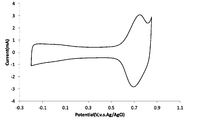
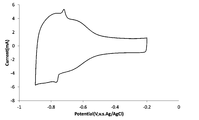
- FIG. 2 is a cyclic voltammogram of the aqueous secondary battery of Example 1.
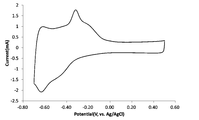
- FIG. 3 is a cyclic voltammogram of the aqueous secondary battery of Example 2.
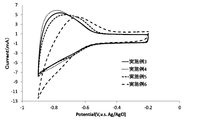
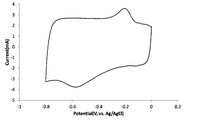
- FIG. 7 is a cyclic voltammogram of the aqueous secondary batteries of Examples 3 to 6.
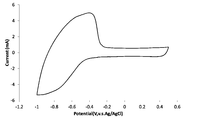
- FIG. 10 is a cyclic voltammogram of the aqueous secondary battery of Example 7.
- FIG. 10 is a cyclic voltammogram of the aqueous secondary battery of Example 8.
- FIG. 10 is a cyclic voltammogram of the aqueous secondary battery of Example 9.
- FIG. 10 is a cyclic voltammogram of the aqueous secondary battery of Example 10.
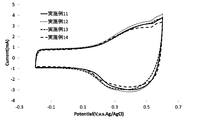
- FIG. 14 is a cyclic voltammogram of aqueous secondary batteries of Examples 11-14.
- 18 is a cyclic voltammogram of the aqueous secondary battery of Example 15.
- 18 is a cyclic voltammogram of the aqueous secondary battery of Example 16.
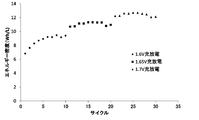
- FIG. 6 is a diagram showing cycle characteristics of water-based secondary batteries of Examples 17 to 19.
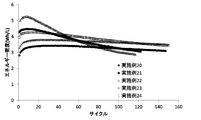
- FIG. 6 is a diagram showing cycle characteristics of water-based secondary batteries of Examples 20 to 24.
- FIG. 10 is a diagram showing cycle characteristics of the water-based secondary battery of Example 25.
- the aqueous secondary battery of the present invention includes a positive electrode, a negative electrode, and an aqueous electrolyte solution. At least one of the positive electrode and the negative electrode includes a compound (I) having a naphthalenediimide structure or a perylene diimide structure as an electrode active material, and the electrolytic solution is an aqueous electrolytic solution.
- a compound (I) having a naphthalenediimide structure or a perylene diimide structure as an electrode active material
- the electrolytic solution is an aqueous electrolytic solution.
- a cylindrical water-based secondary battery 10 (FIG. 1) according to an embodiment of the present invention includes a positive electrode sheet 13 in which a positive electrode active material layer 12 is formed on a positive electrode current collector 11 and a negative electrode active material 14 on the surface of a negative electrode current collector 14.
- the aqueous secondary battery 10 is characterized in that at least one of the positive electrode active material layer and the negative electrode active material layer contains a compound (I) having a naphthalenediimide structure or a perylene diimide structure as an electrode active material.
- the separator 19 is sandwiched between the positive electrode sheet 13 and the negative electrode sheet 18, and these are wound and inserted into the cylindrical case 22, and the positive electrode terminal 24 and the negative electrode sheet 18 connected to the positive electrode sheet 13. And a negative electrode terminal 26 connected to each other.
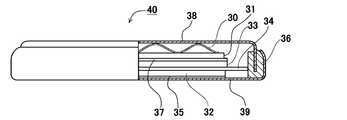
- a coin-type water-based secondary battery 40 (FIG. 2) according to an embodiment of the present invention includes a positive electrode sheet in which a positive electrode active material layer 32 is formed on a positive electrode current collector 35 and a negative electrode current collector 37 on a negative electrode.
- a negative electrode sheet on which the active material layer 33 is formed, and a separator 34 provided between the positive electrode sheet and the negative electrode sheet are provided.
- the aqueous secondary battery 40 includes a positive electrode sheet and a negative electrode sheet impregnated with an aqueous electrolyte solution, or includes a gel-like aqueous electrolyte solution.
- the ring washer 30 is placed on the negative electrode side current collector 37, and the gasket 36 is arranged on the periphery, and the negative electrode case 38 is fixed to the positive electrode case 39 with a caulking machine or the like, and is externally sealed.
- An aqueous secondary battery 40 is produced.
- the aqueous secondary battery 40 is characterized in that at least one of the positive electrode active material layer 32 and the negative electrode active material layer 33 contains a compound (I) having a naphthalenediimide structure or a perylene diimide structure as an electrode active material.
- At least one of the positive electrode and the negative electrode contains the compound (I) having a naphthalenediimide structure or a perylene diimide structure as an electrode active material.
- Compound (I) is preferably a compound represented by the following formula (1) or (2), or a polymer having a structural unit represented by the following formula (3) or (4).
- R 1 to R 4 , R 7 to R 14 , R 17 to R 20 , R 22 to R 29 are each independently a hydrogen atom, a halogen atom, a hydroxy group, An alkoxy group or a hydrocarbon group.
- R 5 , R 6 , R 15 , and R 16 are each independently a hydrogen atom, a hydroxy group, an alkoxy group, a hydrocarbon group, or any group represented by formulas (5) to (9).
- R 36 to R 39 are each independently a hydrogen atom or a halogen atom.
- M is a transition metal.
- R 21 and R 30 are derived from a single bond, alkylene group, carbonyl group, ester group, nitrogen-containing group, aromatic group, heterocyclic group, phenylene group, oxygen-containing hydrocarbon chain, nitrogen-containing hydrocarbon chain or metallocene. It is a group.
- X 1 to X 16 are each independently an oxygen atom, a sulfur atom or an organic group. Each group represented by R 1 to R 39 and X 1 to X 16 may be substituted with a substituent.
- m and n are integers of 2 or more.
- Examples of the halogen atom of R 1 to R 4 , R 7 to R 14 , R 17 to R 20 , R 22 to R 29 in the above formulas (1) to (4) include fluorine, chlorine, bromine, iodine and the like. It is done.
- Examples of the alkoxy group include a methoxy group, an ethoxy group, a propoxy group, and a butoxy group.
- hydrocarbon group examples include methyl groups, ethyl groups, propyl groups, butyl groups, pentyl groups, hexyl groups, heptyl groups, octyl groups, cyclopropyl groups, cyclobutyl groups, cyclopentyl groups, cyclohexyl groups and the like alkyl groups; phenyl groups Aryl groups such as naphthyl group and anthranyl group; aralkyl groups such as benzyl group and phenethyl group; alkenyl groups such as vinyl group, hexenyl group, cyclopentenyl group, cyclohexenyl group and cyclohexenyl group.
- R 1 to R 4 , R 7 to R 14 , R 17 to R 20 , and R 22 to R 29 are each independently preferably a hydrogen atom or a halogen atom. More preferably, all are hydrogen atoms.
- the alkoxy group and hydrocarbon group of R 5 , R 6 , R 15 , and R 16 are the above R 1 to R 4 , R 7 to R 14 , R 17 to R 20 , The same atoms and groups as those mentioned for R 22 to R 29 can be mentioned.
- R 5 , R 6 , R 15 and R 16 in the above formulas (1) to (4) are preferably hydrocarbon groups and groups represented by the above formulas (5) to (9). More preferably a group represented by the above formulas (5) to (9), an alkyl group having 6 or less carbon atoms, or a group represented by the above formulas (5) or (9). Further preferred. R 36 to R 39 in the groups represented by formulas (5) to (9) are preferably hydrogen atoms. Further, as M in the above formula (9), Fe (iron), Ni (nickel), Sc (scandium), Ti (titanium), V (vanadium), Cr (chromium), Mn (manganese), Co (cobalt) ), Cu (copper), Zn (zinc) and the like.
- Fe and Ni are preferable, and Fe is more preferable. That is, more preferred metallocene compounds are ferrocene compounds and oligoferrocene compounds in which M is Fe in the formula (9). Most preferred is ferrocene. In addition, other molecules such as halides may be added to M.
- Examples of the alkylene group in R 21 in the above formula (3) and R 30 in the formula (4) include a methylene group, an ethylene group, a propylene group, and a butylene group. Of these, a methylene group and an ethylene group are preferable.
- Examples of the aromatic group include groups containing a benzene ring, a naphthalene ring, and the like.
- heterocyclic group examples include a pyridine ring, a pyrimidine ring, a furan ring, a thiophene ring, a tetrahydrofuran ring, a tetrahydropyran ring, a pyrrolidine ring, a piperidine ring, and a piperazine ring, and a nitrogen atom, an oxygen atom, a sulfur atom, etc.
- a group containing a 5- to 6-membered aromatic heterocyclic ring or an aliphatic heterocyclic ring examples include a pyridine ring, a pyrimidine ring, a furan ring, a thiophene ring, a tetrahydrofuran ring, a tetrahydropyran ring, a pyrrolidine ring, a piperidine ring, and a piperazine ring, and a nitrogen atom, an oxygen atom, a sulfur atom, etc.
- R 21 in the above formula (3) and R 30 in the formula (4) are preferably a single bond or an alkylene group, more preferably an alkylene group, and even more preferably an ethylene group.
- R x1 to R x3 are a hydrogen atom, an alkyl group, an aryl group, an aralkyl group, a cycloalkyl group, an alkoxy group, an alkenyl group, an aryloxy group, an arylamino group, an alkylamino group, a thioaryl group, a thioalkyl group.
- Heterocyclic group, formyl group, silyl group, boryl group, stannyl group, cyano group, nitro group, nitroso group, amino group, imino group, carboxy group, alkoxycarbonyl group, and halogen atom are used. can do. These groups may be substituted with a substituent.
- R x1 to R x3 may be the same or may be connected to each other to form a saturated or unsaturated ring.
- ⁇ O is particularly preferable.
- the charge / discharge voltage can be further increased, and a suitable electrode active material can be obtained by increasing the energy density of the secondary battery. it can.
- Compound (I) is preferably a compound represented by the following formula.
- n represents an integer of 2 or more
- m represents an integer of 0 or more.
- Compound (I) is more preferably a compound represented by the following formula.
- n represents an integer of 2 or more.
- the positive electrode may contain the compound (I) as an electrode active material
- the negative electrode may contain the compound (I) as an electrode active material
- both the positive electrode and the negative electrode may contain the compound (I) as an electrode active material.
- the negative electrode is preferably an electrode containing the compound (I) as an electrode active material.
- the counter electrode active material is not particularly limited as long as it sufficiently exhibits the secondary battery performance.
- the following formula Examples thereof include compounds represented by (10) to (16).
- R 40 to R 61 are each independently a hydrogen atom, halogen atom, aromatic group, heterocyclic group, carboxy group, amino group, nitro group, formyl group, cyano Group, hydroxy group, alkoxy group, thiol group, alkylthio group or hydrocarbon group.
- M is a transition metal.
- Each group represented by R 40 to R 61 may be substituted with a substituent.
- Examples of the alkoxy group of R 40 to R 61 in the above formulas (10) to (16) include a methoxy group, an ethoxy group, a propoxy group, and a butoxy group.
- Examples of the alkylthio group include a methylthio group, an ethylthio group, and a propylthio group.
- hydrocarbon group examples include methyl groups, ethyl groups, propyl groups, butyl groups, pentyl groups, hexyl groups, heptyl groups, octyl groups, cyclopropyl groups, cyclobutyl groups, cyclopentyl groups, cyclohexyl groups and the like alkyl groups; phenyl groups Aryl groups such as naphthyl group and anthranyl group; aralkyl groups such as benzyl group and phenethyl group; alkenyl groups such as vinyl group, hexenyl group, cyclopentenyl group, cyclohexenyl group and cyclohexenyl group.
- the electrode active material represented by the above formula (16) is preferably a ferrocene compound or an oligoferrocene compound in which M is Fe, and more preferably ferrocene. Further, other molecules such as halides may be added to M.
- R 40 to R 61 in the above formulas (10) to (16) are preferably a hydrogen atom or an alkyl group, and more preferably a hydrogen atom.
- the electrode active material of the counter electrode in the aqueous secondary battery of the present invention is also preferably an oligomer containing a structural unit derived from the compounds represented by the above formulas (12) to (16).
- Examples of the electrode active material for the counter electrode in the aqueous secondary battery of the present invention include tetrathiafulvalene (TTF), bis (ethylenedithio) tetrathiafulvalene (BEDT-TTF), ferrocene polymer, nitroxide polymer and the like represented by the following formula: It is mentioned as a preferable compound. These compounds are preferably a positive electrode active material.
- compounds other than the above compound (I) are preferably TTF, BEDT-TTF, ferrocene polymer, and nitroxide polymer.
- a combination using BEDT-TTF as the positive electrode active material and the compound of the above formula (I-3) as the negative electrode active material is preferable.
- the positive electrode or negative electrode in the water-based secondary battery of the present invention may contain a conductive additive, a binder and the like in addition to the above active material.
- carbon materials As the conductive assistant contained in the positive electrode and the negative electrode, carbon materials, conductive polymers, powder metals, inorganic conductive oxides, and the like can be used.
- the carbon material include activated carbon, activated carbon fiber, porous carbon, graphite, carbon black, carbon nanotube, carbon nanofiber, carbon nanohorn, and graphene.
- the conductive polymer include polyaniline, polyacetylene, polyfluorene, polypyrrole, and polythiophene.
- the powder metal include aluminum, gold, and platinum. Of these, carbon materials are preferable, and activated carbon is particularly preferable.
- a material suitable for the application that does not decompose in the potential region to be used can be selected and used.
- a material suitable for the application that does not decompose in the potential region to be used can be selected and used.
- polyvinylidene fluoride, polytetrafluoroethylene, carboxymethyl cellulose, styrene butadiene rubber, polyacrylic acid, polyimide resin, polyamide resin, fluorine rubber, and the like can be selected and used.
- polyvinylidene fluoride polytetrafluoroethylene
- carboxymethyl cellulose carboxymethyl cellulose
- styrene butadiene rubber polyacrylic acid
- polyimide resin polyimide resin
- polyamide resin polyamide resin
- fluorine rubber fluorine rubber
- Each of the conductive assistant and the binder contained in the positive electrode and the negative electrode may be used alone or in combination of two or more.
- the composition ratio of the electrode active material of the positive electrode or the negative electrode, the conductive auxiliary agent, and the binder is 5 to 100% by mass on a mass basis, respectively. It may be appropriately adjusted within the range of 0 to 100% by mass: 0 to 30% by mass.
- the conductive auxiliary agent and the binder may not be added.
- the thickness of the negative electrode active material layer and the positive electrode active material layer is not particularly limited.
- the aqueous electrolyte solution in the present invention contains water and at least one water-soluble salt.
- the water-soluble salt is preferably at least one salt selected from the group consisting of alkali metal element salts and alkaline earth metal element salts, such as sodium salt, magnesium salt, calcium salt, lithium salt, potassium salt, It is more preferably at least one salt selected from the group consisting of beryllium salts, more preferably sodium salts, magnesium salts, lithium salts, and potassium salts, and particularly preferably sodium salts.
- the type of anion contained in the water-soluble salt is not particularly limited.
- the anions include halide ions, sulfate ions, nitrate ions, phosphate ions, tetrafluoroborate ions, and the like.
- the halide ions are chloride ions, bromide ions, iodide ions and the like.
- the water-soluble salt is preferably a neutral salt or an alkaline salt at 25 ° C., more preferably a neutral salt.
- at least one neutral sodium salt selected from the group consisting of sodium chloride, sodium bromide, sodium iodide, sodium sulfate, sodium nitrate, sodium tetrafluoroborate, etc .
- magnesium chloride, magnesium bromide, magnesium iodide At least one neutral magnesium salt selected from the group consisting of magnesium sulfate, magnesium nitrate, magnesium tetrafluoroborate and the like; at least one selected from the group consisting of lithium chloride, lithium bromide, lithium tetrafluoroborate and the like More preferably, the neutral lithium salt of the species; at least one neutral potassium salt selected from the group consisting of potassium chloride, potassium bromide, potassium iodide, potassium tetrafluoroborate and the like, more preferably sodium chloride, sodium sulfate, chloride More preferably such magnesium, sodium
- the concentration of the water-soluble salt in the aqueous electrolyte is appropriately selected according to the type of the water-soluble salt.
- the concentration of the water-soluble salt in the aqueous electrolytic solution varies depending on the temperature and solute. For example, when the aqueous electrolytic solution is 20 ° C. and the water-soluble salt is sodium chloride, 0.1 mol / L-6 It is preferably in the range of 1 mol / L. If the water-soluble salt is magnesium chloride, it is preferably in the range of 0.1 mol / L to 5.7 mol / L.
- the concentration of the water-soluble salt in the aqueous electrolyte solution may be equal to or lower than the saturation solubility, and a higher concentration is preferable.
- the aqueous electrolyte may contain a water-soluble organic solvent.
- the organic solvent include acetonitrile and acetone.
- the aqueous electrolyte contains an organic solvent
- the content is more than 0 and 50% by mass or less, and preferably more than 0 and 10% by mass or less with respect to water.
- the aqueous electrolyte may contain various additives as necessary.
- the additive include sodium sulfite; a gelling agent such as carboxymethyl cellulose.
- the aqueous electrolyte solution preferably has a dissolved oxygen content of 7.3 ppm or less.
- the dissolved oxygen amount is 7.3 ppm or less, the cycle characteristics of the secondary battery tend to be further improved.
- a more preferable dissolved oxygen amount is 5 ppm or less, and a most preferable dissolved oxygen amount is 4 ppm or less.
- the amount of saturated dissolved oxygen in an aqueous electrolyte at room temperature is 8.2 to 8.6 ppm, and the amount of dissolved oxygen can be reduced to 7.3 ppm or less by a commonly used operation.
- the amount of dissolved oxygen can be maintained in a desired range by degassing at least once at the time of battery manufacture, or by providing a structure for suppressing an increase in the amount of oxygen by providing packing at the time of battery manufacture.
- the degassing method is appropriately selected from commonly used methods, and can be performed, for example, by reducing pressure, heating, or the like.
- the aqueous electrolyte includes a gel made using a gelling agent.
- the gel aqueous electrolyte in the present invention is a liquid aqueous electrolyte in a gel form, and can be obtained by adding a gelling agent to a liquid aqueous electrolyte.
- gel is a type of dispersion, which is a colloid of a liquid dispersion medium such as sol, but has a high viscosity due to a dispersoid network and loses fluidity, and the entire system becomes solid.
- the aqueous electrolyte may be enclosed in the internal space in the storage case, or may be used by impregnating an electrode sheet or the like.
- the gel aqueous electrolyte is, for example, a method in which a liquid electrolyte is put into a snap cup, an appropriate amount of carboxymethylcellulose is added, crushed with a spatula, and stirred at room temperature at 10,000 rpm for about 5 minutes. Can be produced.
- an amount of dissolved oxygen can be reduced by providing an insertion tube in the aqueous electrolyte and constantly bubbling nitrogen gas.
- the aqueous secondary battery may include a separator.
- the separator is disposed so as to separate the positive electrode and the negative electrode, and is required to pass ions and prevent a short circuit between the positive and negative electrodes.
- the separator is not particularly limited, and a conventionally known separator can be used.
- a polyolefin fiber nonwoven fabric, a microporous membrane made of polyolefin, a glass filter, a ceramic porous material, or the like can be used.
- the water-based secondary battery may include a current collector (a positive electrode current collector and a negative electrode current collector).
- a material for the positive electrode current collector and the negative electrode current collector a material that does not cause a side reaction at the potential of each of the positive electrode and the negative electrode is used. More specifically, a material having corrosion resistance that does not cause a reaction such as dissolution at the potential of the positive electrode and the negative electrode may be used for the positive electrode current collector and the negative electrode current collector.
- a material for the positive electrode current collector and the negative electrode current collector for example, a metal material, an alloy, a carbon material, an inorganic conductive oxide material, or the like can be used. Examples of the metal material include copper, nickel, brass, zinc, aluminum, stainless steel, tungsten, gold, and platinum.
- the alloy is, for example, SUS.
- Examples of the carbon material include graphite, hard carbon, and glassy carbon.
- the aqueous secondary battery of the present invention is manufactured by sealing a negative electrode, a positive electrode, and an electrolytic solution in a housing case such as a cylindrical case or a coin-type case. Specific manufacturing procedures will be described in detail in the following examples.
- any shape of the water-based secondary battery of the present invention may be used.
- a cylindrical shape, a coin shape, a button shape, a sheet shape, a laminated shape, a cylindrical shape, a flat shape, a square shape, and the like can be given.
- the present invention is an electricity storage device in which at least one of the positive electrode and the negative electrode includes a compound (I) having a naphthalenediimide structure or a perylene diimide structure as an active material and includes an aqueous electrolyte.
- the electrode chemical reaction containing the compound (I) having the naphthalenediimide structure or the perylene diimide structure and its counter electrode are adsorption / desorption in the formation of an electric double layer of ions at the electrode interface of the conductive assistant. Examples include devices that use and store energy, such as hybrid capacitors.
- a higher energy density can be realized compared to a capacitor formed only with a conductive additive.
- the aqueous electrolyte solution is adopted, it is excellent also in safety.
- the description in the aqueous secondary battery of the present invention can be applied to the description of the electrode and the aqueous electrolyte provided in the electricity storage device of the present invention.
- a positive electrode active material was supported on a carbon material (activated carbon and carbon black) which is a conductive additive.
- carbon carrying the positive electrode active material, a carbon material not carried as a conductive auxiliary agent, and polytetrafluoroethylene (PTFE) as a binder were mixed and kneaded. This mixture was rolled into a sheet with a roller press.
- a positive electrode active material was supported on a carbon material (activated carbon and carbon black) which is a conductive additive.
- a carbon material activated carbon and carbon black
- an electrolyte solution is added and kneaded so as to be almost the same as the electrode weight.
- Fluoroethylene (PTFE) was mixed and kneaded. This mixture was rolled into a sheet with a roller press.
- Battery assembly beaker cell
- the obtained positive electrode and negative electrode were cut into a circular shape and attached to a platinum mesh provided with a platinum wire. And the said electrode was attached to the glass sample bottle cell.
- a platinum mesh with an electrode attached to a glass sample bottle cell was immersed in an electrolytic solution, and the electrode was impregnated with the electrolytic solution in a vacuum atmosphere.
- the obtained positive electrode and negative electrode were cut into a circle and the electrode was placed on the current collector.
- a separator is placed between the positive electrode and the negative electrode, and a gel substance (gel aqueous electrolyte) of carboxymethyl cellulose and 3M NaCl is placed between the electrode and the separator.
- the electrode was immersed in an electrolytic solution, and the electrode was impregnated with the electrolytic solution under a vacuum atmosphere.
- the electrode sheet obtained by the above method 1 was attached to a platinum mesh provided with a platinum wire to obtain a working electrode.
- An electrode made of activated carbon and PTFE was press bonded to the electrode with a platinum wire attached to the counter electrode.
- the electrolyte was added to a glass sample bottle cell. The sample bottle cell was sealed with a lid, an insertion tube was provided in the electrode, and nitrogen gas was constantly bubbled.
- the counter electrode was kneaded with activated carbon, carbon black, and PTFE and formed into a sheet so that the weight of the working electrode was more than twice.
- Example 8 As the composition ratio of the working electrode, except for Example 8, the ratio of active material / activated carbon / KB / PTFE is shown. For Example 8, the ratio (*) of active material / carbon black / PTFE is shown. Activated charcoal and KB (Ketjen black) were used as conductive aids, and PTFE (polytetrafluoroethylene) was used as a binder. Moreover, activated carbon was used as the conductive auxiliary agent at the counter electrode, and PTFE was used as the binder.
- the aqueous secondary batteries of Examples 17 to 25 were produced by the above method.
- Table 2 shows the types and masses of the positive electrode active material, the negative electrode active material, the conductive additive, the binder, and the electrolyte used in the aqueous secondary batteries of Examples 17 to 25.
- Table 2 also shows the method for producing the positive electrode and the negative electrode (method 1 or 2). Examples 17 to 19 and 25 were performed using coin cells, and Examples 20 to 24 were performed using beaker cells.
- the type (number) of the active material shown in Table 2 is the same as the type (number) of the active material in Table 1.
- Activated carbon and KB were used as conductive aids, and PTFE (polytetrafluoroethylene) was used as a binder.
- Examples 17 to 24 The aqueous secondary batteries obtained in Examples 17 to 24 were subjected to a charge / discharge test.
- the completed electrode sheet was immersed in a 3M NaCl solution, placed in a desiccator, and vacuumed and impregnated with the 3M NaCl solution.
- an electrolytic solution was put into activated carbon and KB carrying an active material, kneaded, then PTFE was added, kneaded again, and formed into a sheet by applying a roller press to prepare an electrode sheet.
- FIG. 13 shows the cycle characteristics of the aqueous secondary batteries of Examples 17 to 19, and
- FIG. 14 shows the cycle characteristics of the aqueous secondary batteries of Examples 20 to 24.
- the charging / discharging voltages of Examples 17, 18, and 19 were 1.6, 1.65, and 1.7 V, respectively, and charging / discharging was performed at a current value of 1 C (based on the theoretical capacity of the negative electrode).
- Examples 20, 23, and 24 were charged and discharged at a voltage of 1.25 V, Example 21 was 1.35 V, and Example 22 was 1.4 V, and the current value was 3 C (based on the theoretical capacity of the positive electrode). I went there.
- FIG. 15 shows the result of charging / discharging under the condition of current value.
- the water-based secondary battery of the present invention has few resource problems and cost problems, does not use an organic solvent, or contains a small amount of organic solvent in the water-based electrolyte, so that safety is greatly improved, and high output and cycle characteristics are achieved. Since it is excellent, it is suitably used for a power source or an uninterruptible power supply for various portable electronic devices and transportation devices.
Landscapes
- Chemical & Material Sciences (AREA)
- Chemical Kinetics & Catalysis (AREA)
- Electrochemistry (AREA)
- General Chemical & Material Sciences (AREA)
- Engineering & Computer Science (AREA)
- Manufacturing & Machinery (AREA)
- Secondary Cells (AREA)
- Battery Electrode And Active Subsutance (AREA)
- Electric Double-Layer Capacitors Or The Like (AREA)
Abstract
La présente invention concerne un dispositif de stockage d'énergie mettant en œuvre un électrolyte aqueux qui est sûr même en cas d'endommagement lors de l'utilisation et de fuite à partir du boîtier de la pile. Plus spécifiquement, l'invention concerne une pile rechargeable qui présente une excellente sécurité et qui présente également d'excellentes caractéristiques de cycle. L'invention concerne une pile rechargeable aqueuse dans laquelle au moins l'une de l'électrode positive et de l'électrode négative contient un composé (I) ayant une structure naphtalène diimide ou une structure pérylène diimide en tant que matière active.
Priority Applications (3)
| Application Number | Priority Date | Filing Date | Title |
|---|---|---|---|
| CN201780021262.8A CN109314240B (zh) | 2016-03-31 | 2017-03-30 | 水系二次电池 |
| US16/090,099 US11094938B2 (en) | 2016-03-31 | 2017-03-30 | Aqueous secondary battery |
| EP17775478.5A EP3439086B1 (fr) | 2016-03-31 | 2017-03-30 | Pile rechargeable aqueuse |
Applications Claiming Priority (2)
| Application Number | Priority Date | Filing Date | Title |
|---|---|---|---|
| JP2016-071009 | 2016-03-31 | ||
| JP2016071009A JP6827232B2 (ja) | 2016-03-31 | 2016-03-31 | 水系二次電池 |
Publications (1)
| Publication Number | Publication Date |
|---|---|
| WO2017170944A1 true WO2017170944A1 (fr) | 2017-10-05 |
Family
ID=59964760
Family Applications (1)
| Application Number | Title | Priority Date | Filing Date |
|---|---|---|---|
| PCT/JP2017/013420 Ceased WO2017170944A1 (fr) | 2016-03-31 | 2017-03-30 | Pile rechargeable aqueuse |
Country Status (5)
| Country | Link |
|---|---|
| US (1) | US11094938B2 (fr) |
| EP (1) | EP3439086B1 (fr) |
| JP (1) | JP6827232B2 (fr) |
| CN (1) | CN109314240B (fr) |
| WO (1) | WO2017170944A1 (fr) |
Cited By (1)
| Publication number | Priority date | Publication date | Assignee | Title |
|---|---|---|---|---|
| WO2020201405A1 (fr) | 2019-04-02 | 2020-10-08 | Rivus Ab | Batterie à flux redox et nouveaux composés utiles dans celle-ci |
Families Citing this family (8)
| Publication number | Priority date | Publication date | Assignee | Title |
|---|---|---|---|---|
| US20180269538A1 (en) * | 2017-03-17 | 2018-09-20 | Kabushiki Kaisha Toshiba | Secondary battery, battery pack and vehicle |
| JP6920637B2 (ja) * | 2017-08-31 | 2021-08-18 | パナソニックIpマネジメント株式会社 | リチウム空気電池 |
| JP6668302B2 (ja) * | 2017-09-20 | 2020-03-18 | 株式会社東芝 | 二次電池、電池パック及び車両 |
| JP7321432B2 (ja) * | 2018-02-22 | 2023-08-07 | 公立大学法人大阪 | 水系二次電池 |
| CN110534711B (zh) * | 2019-07-24 | 2020-11-03 | 宁波锋成先进能源材料研究院有限公司 | 一种聚酰亚胺复合材料的制备方法以及聚酰亚胺复合材料在电池中的应用 |
| CN110964198A (zh) * | 2019-12-10 | 2020-04-07 | 宁波锋成先进能源材料研究院 | 一种聚酰亚胺材料及其制备方法与应用 |
| FR3128463A1 (fr) * | 2021-10-22 | 2023-04-28 | Commissariat A L'energie Atomique Et Aux Energies Alternatives | Procédé de préparation d’un matériau (co)polyimide électro-actif. |
| CN119504750B (zh) * | 2024-11-21 | 2026-02-17 | 兰州大学 | 基于苝二酰亚胺的水系铵离子电池电极材料、制备方法及应用 |
Citations (7)
| Publication number | Priority date | Publication date | Assignee | Title |
|---|---|---|---|---|
| JP2002117830A (ja) * | 2000-10-05 | 2002-04-19 | Mitsubishi Chemicals Corp | リチウム二次電池用正極材料、リチウム二次電池用正極及びリチウム二次電池 |
| JP2012248478A (ja) * | 2011-05-30 | 2012-12-13 | Denso Corp | リチウムイオン二次電池 |
| JP2013048012A (ja) * | 2009-12-04 | 2013-03-07 | Waseda Univ | 空気電池 |
| WO2013157458A1 (fr) * | 2012-04-18 | 2013-10-24 | 株式会社村田製作所 | Électrode, son procédé de fabrication et élément secondaire |
| WO2014169122A1 (fr) * | 2013-04-10 | 2014-10-16 | University Of Houston System | Dispositif de stockage d'énergie aqueuse avec des matériaux d'électrodes organiques |
| JP2015536365A (ja) * | 2012-10-31 | 2015-12-21 | トヨタ モーター ヨーロッパ ナームロゼ フェンノートシャップ/ソシエテ アノニム | 電気化学エネルギー蓄積用の有機活物質 |
| WO2016024594A1 (fr) * | 2014-08-12 | 2016-02-18 | 国立研究開発法人産業技術総合研究所 | Électrolyte pour pile secondaire non aqueuse et cellule secondaire non aqueuse l'utilisant |
Family Cites Families (5)
| Publication number | Priority date | Publication date | Assignee | Title |
|---|---|---|---|---|
| JP2005150410A (ja) * | 2003-11-17 | 2005-06-09 | Japan Science & Technology Agency | 薄膜トランジスタ |
| WO2007146453A2 (fr) | 2006-03-03 | 2007-12-21 | California Institute Of Technology | Pile électrochimique à l'ion fluorure |
| JPWO2012121145A1 (ja) * | 2011-03-10 | 2014-07-17 | 株式会社村田製作所 | 電極活物質、電極、及び二次電池 |
| KR101310240B1 (ko) | 2011-03-10 | 2013-09-23 | 주식회사 알란텀 | 고표면적을 가지는 다공성 금속폼 콘 어셈블리의 제조방법 |
| WO2016025467A1 (fr) * | 2014-08-11 | 2016-02-18 | The Regents Of The University Of California | Mediateurs redox pour batteries metal-soufre |
-
2016
- 2016-03-31 JP JP2016071009A patent/JP6827232B2/ja active Active
-
2017
- 2017-03-30 US US16/090,099 patent/US11094938B2/en active Active
- 2017-03-30 WO PCT/JP2017/013420 patent/WO2017170944A1/fr not_active Ceased
- 2017-03-30 CN CN201780021262.8A patent/CN109314240B/zh active Active
- 2017-03-30 EP EP17775478.5A patent/EP3439086B1/fr active Active
Patent Citations (7)
| Publication number | Priority date | Publication date | Assignee | Title |
|---|---|---|---|---|
| JP2002117830A (ja) * | 2000-10-05 | 2002-04-19 | Mitsubishi Chemicals Corp | リチウム二次電池用正極材料、リチウム二次電池用正極及びリチウム二次電池 |
| JP2013048012A (ja) * | 2009-12-04 | 2013-03-07 | Waseda Univ | 空気電池 |
| JP2012248478A (ja) * | 2011-05-30 | 2012-12-13 | Denso Corp | リチウムイオン二次電池 |
| WO2013157458A1 (fr) * | 2012-04-18 | 2013-10-24 | 株式会社村田製作所 | Électrode, son procédé de fabrication et élément secondaire |
| JP2015536365A (ja) * | 2012-10-31 | 2015-12-21 | トヨタ モーター ヨーロッパ ナームロゼ フェンノートシャップ/ソシエテ アノニム | 電気化学エネルギー蓄積用の有機活物質 |
| WO2014169122A1 (fr) * | 2013-04-10 | 2014-10-16 | University Of Houston System | Dispositif de stockage d'énergie aqueuse avec des matériaux d'électrodes organiques |
| WO2016024594A1 (fr) * | 2014-08-12 | 2016-02-18 | 国立研究開発法人産業技術総合研究所 | Électrolyte pour pile secondaire non aqueuse et cellule secondaire non aqueuse l'utilisant |
Non-Patent Citations (1)
| Title |
|---|
| See also references of EP3439086A4 * |
Cited By (1)
| Publication number | Priority date | Publication date | Assignee | Title |
|---|---|---|---|---|
| WO2020201405A1 (fr) | 2019-04-02 | 2020-10-08 | Rivus Ab | Batterie à flux redox et nouveaux composés utiles dans celle-ci |
Also Published As
| Publication number | Publication date |
|---|---|
| US11094938B2 (en) | 2021-08-17 |
| JP6827232B2 (ja) | 2021-02-10 |
| EP3439086A1 (fr) | 2019-02-06 |
| EP3439086A4 (fr) | 2019-10-30 |
| US20190097231A1 (en) | 2019-03-28 |
| JP2017183167A (ja) | 2017-10-05 |
| CN109314240A (zh) | 2019-02-05 |
| CN109314240B (zh) | 2021-10-29 |
| EP3439086B1 (fr) | 2021-09-08 |
Similar Documents
| Publication | Publication Date | Title |
|---|---|---|
| JP6827232B2 (ja) | 水系二次電池 | |
| JP5673825B2 (ja) | 蓄電デバイス | |
| JP7062155B2 (ja) | 二次電池用電解質及びこれを含む二次電池 | |
| JP6370584B2 (ja) | リチウム硫黄二次電池 | |
| JP5637858B2 (ja) | 電気二重層キャパシタ | |
| JP7321432B2 (ja) | 水系二次電池 | |
| Yamaguchi et al. | Effect of a pyrrolidinium zwitterion on charge/discharge cycle properties of Li/LiCoO2 and graphite/Li cells containing an ionic liquid electrolyte | |
| JP5892490B2 (ja) | 硫黄系二次電池 | |
| JP5509627B2 (ja) | 蓄電デバイス | |
| WO2020179585A1 (fr) | Condensateur électrochimique | |
| JP6268833B2 (ja) | 非水電解液二次電池及び非水電解液二次電池の製造方法 | |
| JP2016192279A (ja) | 水系擬似固体二次電池 | |
| JP4998392B2 (ja) | 非水電解質電池 | |
| JP2012028366A (ja) | 蓄電デバイス | |
| JP6875818B2 (ja) | 電解液ならびにそれを用いた電気化学デバイス | |
| WO2024147239A1 (fr) | Solution électrolytique pour batteries secondaires, et batterie secondaire | |
| JP2013089413A (ja) | 二次電池用電極活物質及び二次電池 | |
| JP2016110970A (ja) | 水系二次電池 | |
| JP2012155992A (ja) | 非水電解質ヨウ素電池の使用方法 | |
| Sahoo | Electrolytes for Hybrid Supercapacitors | |
| JP5640391B2 (ja) | 蓄電デバイス | |
| JP2014127274A (ja) | 非水電解液二次電池、およびそれに用いる正極シート | |
| JP6182932B2 (ja) | 蓄電デバイス | |
| JP2010111639A (ja) | ケトン化合物の製造方法および蓄電デバイスの製造方法 | |
| JP2008078040A (ja) | 二次電池 |
Legal Events
| Date | Code | Title | Description |
|---|---|---|---|
| NENP | Non-entry into the national phase |
Ref country code: DE |
|
| WWE | Wipo information: entry into national phase |
Ref document number: 2017775478 Country of ref document: EP |
|
| ENP | Entry into the national phase |
Ref document number: 2017775478 Country of ref document: EP Effective date: 20181031 |
|
| 121 | Ep: the epo has been informed by wipo that ep was designated in this application |
Ref document number: 17775478 Country of ref document: EP Kind code of ref document: A1 |