WO2017171071A1 - 潤滑材及びsrt材料 - Google Patents
潤滑材及びsrt材料 Download PDFInfo
- Publication number
- WO2017171071A1 WO2017171071A1 PCT/JP2017/013786 JP2017013786W WO2017171071A1 WO 2017171071 A1 WO2017171071 A1 WO 2017171071A1 JP 2017013786 W JP2017013786 W JP 2017013786W WO 2017171071 A1 WO2017171071 A1 WO 2017171071A1
- Authority
- WO
- WIPO (PCT)
- Prior art keywords
- cpb
- polymer
- thickened
- chain
- graft
- Prior art date
- Legal status (The legal status is an assumption and is not a legal conclusion. Google has not performed a legal analysis and makes no representation as to the accuracy of the status listed.)
- Ceased
Links
Images









Classifications
-
- C—CHEMISTRY; METALLURGY
- C10—PETROLEUM, GAS OR COKE INDUSTRIES; TECHNICAL GASES CONTAINING CARBON MONOXIDE; FUELS; LUBRICANTS; PEAT
- C10M—LUBRICATING COMPOSITIONS; USE OF CHEMICAL SUBSTANCES EITHER ALONE OR AS LUBRICATING INGREDIENTS IN A LUBRICATING COMPOSITION
- C10M119/00—Lubricating compositions characterised by the thickener being a macromolecular compound
- C10M119/04—Lubricating compositions characterised by the thickener being a macromolecular compound containing oxygen
- C10M119/06—Macromolecular compounds obtained by reactions only involving carbon-to-carbon unsaturated bonds
- C10M119/12—Macromolecular compounds obtained by reactions only involving carbon-to-carbon unsaturated bonds containing monomers having an unsaturated radical bound to a carboxyl radical, e.g. acrylate
-
- C—CHEMISTRY; METALLURGY
- C10—PETROLEUM, GAS OR COKE INDUSTRIES; TECHNICAL GASES CONTAINING CARBON MONOXIDE; FUELS; LUBRICANTS; PEAT
- C10M—LUBRICATING COMPOSITIONS; USE OF CHEMICAL SUBSTANCES EITHER ALONE OR AS LUBRICATING INGREDIENTS IN A LUBRICATING COMPOSITION
- C10M107/00—Lubricating compositions characterised by the base-material being a macromolecular compound
- C10M107/20—Lubricating compositions characterised by the base-material being a macromolecular compound containing oxygen
- C10M107/22—Macromolecular compounds obtained by reactions only involving carbon-to-carbon unsaturated bonds
- C10M107/28—Macromolecular compounds obtained by reactions only involving carbon-to-carbon unsaturated bonds containing monomers having an unsaturated radical bound to a carboxyl radical, e.g. acrylate
-
- C—CHEMISTRY; METALLURGY
- C08—ORGANIC MACROMOLECULAR COMPOUNDS; THEIR PREPARATION OR CHEMICAL WORKING-UP; COMPOSITIONS BASED THEREON
- C08F—MACROMOLECULAR COMPOUNDS OBTAINED BY REACTIONS ONLY INVOLVING CARBON-TO-CARBON UNSATURATED BONDS
- C08F120/00—Homopolymers of compounds having one or more unsaturated aliphatic radicals, each having only one carbon-to-carbon double bond, and only one being terminated by only one carboxyl radical or a salt, anhydride, ester, amide, imide or nitrile thereof
- C08F120/02—Monocarboxylic acids having less than ten carbon atoms; Derivatives thereof
- C08F120/10—Esters
- C08F120/12—Esters of monohydric alcohols or phenols
- C08F120/14—Methyl esters, e.g. methyl (meth)acrylate
-
- C—CHEMISTRY; METALLURGY
- C10—PETROLEUM, GAS OR COKE INDUSTRIES; TECHNICAL GASES CONTAINING CARBON MONOXIDE; FUELS; LUBRICANTS; PEAT
- C10M—LUBRICATING COMPOSITIONS; USE OF CHEMICAL SUBSTANCES EITHER ALONE OR AS LUBRICATING INGREDIENTS IN A LUBRICATING COMPOSITION
- C10M109/00—Lubricating compositions characterised by the base-material being a compound of unknown or incompletely defined constitution
-
- C—CHEMISTRY; METALLURGY
- C10—PETROLEUM, GAS OR COKE INDUSTRIES; TECHNICAL GASES CONTAINING CARBON MONOXIDE; FUELS; LUBRICANTS; PEAT
- C10M—LUBRICATING COMPOSITIONS; USE OF CHEMICAL SUBSTANCES EITHER ALONE OR AS LUBRICATING INGREDIENTS IN A LUBRICATING COMPOSITION
- C10M111/00—Lubrication compositions characterised by the base-material being a mixture of two or more compounds covered by more than one of the main groups C10M101/00 - C10M109/00, each of these compounds being essential
- C10M111/04—Lubrication compositions characterised by the base-material being a mixture of two or more compounds covered by more than one of the main groups C10M101/00 - C10M109/00, each of these compounds being essential at least one of them being a macromolecular organic compound
-
- C—CHEMISTRY; METALLURGY
- C10—PETROLEUM, GAS OR COKE INDUSTRIES; TECHNICAL GASES CONTAINING CARBON MONOXIDE; FUELS; LUBRICANTS; PEAT
- C10M—LUBRICATING COMPOSITIONS; USE OF CHEMICAL SUBSTANCES EITHER ALONE OR AS LUBRICATING INGREDIENTS IN A LUBRICATING COMPOSITION
- C10M177/00—Special methods of preparation of lubricating compositions; Chemical modification by after-treatment of components or of the whole of a lubricating composition, not covered by other classes
-
- F—MECHANICAL ENGINEERING; LIGHTING; HEATING; WEAPONS; BLASTING
- F16—ENGINEERING ELEMENTS AND UNITS; GENERAL MEASURES FOR PRODUCING AND MAINTAINING EFFECTIVE FUNCTIONING OF MACHINES OR INSTALLATIONS; THERMAL INSULATION IN GENERAL
- F16C—SHAFTS; FLEXIBLE SHAFTS; ELEMENTS OR CRANKSHAFT MECHANISMS; ROTARY BODIES OTHER THAN GEARING ELEMENTS; BEARINGS
- F16C33/00—Parts of bearings; Special methods for making bearings or parts thereof
- F16C33/02—Parts of sliding-contact bearings
- F16C33/04—Brasses; Bushes; Linings
- F16C33/20—Sliding surface consisting mainly of plastics
-
- F—MECHANICAL ENGINEERING; LIGHTING; HEATING; WEAPONS; BLASTING
- F16—ENGINEERING ELEMENTS AND UNITS; GENERAL MEASURES FOR PRODUCING AND MAINTAINING EFFECTIVE FUNCTIONING OF MACHINES OR INSTALLATIONS; THERMAL INSULATION IN GENERAL
- F16C—SHAFTS; FLEXIBLE SHAFTS; ELEMENTS OR CRANKSHAFT MECHANISMS; ROTARY BODIES OTHER THAN GEARING ELEMENTS; BEARINGS
- F16C33/00—Parts of bearings; Special methods for making bearings or parts thereof
- F16C33/02—Parts of sliding-contact bearings
- F16C33/04—Brasses; Bushes; Linings
- F16C33/20—Sliding surface consisting mainly of plastics
- F16C33/201—Composition of the plastic
-
- C—CHEMISTRY; METALLURGY
- C08—ORGANIC MACROMOLECULAR COMPOUNDS; THEIR PREPARATION OR CHEMICAL WORKING-UP; COMPOSITIONS BASED THEREON
- C08F—MACROMOLECULAR COMPOUNDS OBTAINED BY REACTIONS ONLY INVOLVING CARBON-TO-CARBON UNSATURATED BONDS
- C08F2438/00—Living radical polymerisation
-
- C—CHEMISTRY; METALLURGY
- C10—PETROLEUM, GAS OR COKE INDUSTRIES; TECHNICAL GASES CONTAINING CARBON MONOXIDE; FUELS; LUBRICANTS; PEAT
- C10N—INDEXING SCHEME ASSOCIATED WITH SUBCLASS C10M RELATING TO LUBRICATING COMPOSITIONS
- C10N2020/00—Specified physical or chemical properties or characteristics, i.e. function, of component of lubricating compositions
- C10N2020/01—Physico-chemical properties
- C10N2020/04—Molecular weight; Molecular weight distribution
-
- C—CHEMISTRY; METALLURGY
- C10—PETROLEUM, GAS OR COKE INDUSTRIES; TECHNICAL GASES CONTAINING CARBON MONOXIDE; FUELS; LUBRICANTS; PEAT
- C10N—INDEXING SCHEME ASSOCIATED WITH SUBCLASS C10M RELATING TO LUBRICATING COMPOSITIONS
- C10N2020/00—Specified physical or chemical properties or characteristics, i.e. function, of component of lubricating compositions
- C10N2020/01—Physico-chemical properties
- C10N2020/071—Branched chain compounds
-
- C—CHEMISTRY; METALLURGY
- C10—PETROLEUM, GAS OR COKE INDUSTRIES; TECHNICAL GASES CONTAINING CARBON MONOXIDE; FUELS; LUBRICANTS; PEAT
- C10N—INDEXING SCHEME ASSOCIATED WITH SUBCLASS C10M RELATING TO LUBRICATING COMPOSITIONS
- C10N2030/00—Specified physical or chemical properties which is improved by the additive characterising the lubricating composition, e.g. multifunctional additives
- C10N2030/02—Pour-point; Viscosity index
-
- C—CHEMISTRY; METALLURGY
- C10—PETROLEUM, GAS OR COKE INDUSTRIES; TECHNICAL GASES CONTAINING CARBON MONOXIDE; FUELS; LUBRICANTS; PEAT
- C10N—INDEXING SCHEME ASSOCIATED WITH SUBCLASS C10M RELATING TO LUBRICATING COMPOSITIONS
- C10N2030/00—Specified physical or chemical properties which is improved by the additive characterising the lubricating composition, e.g. multifunctional additives
- C10N2030/06—Oiliness; Film-strength; Anti-wear; Resistance to extreme pressure
-
- C—CHEMISTRY; METALLURGY
- C10—PETROLEUM, GAS OR COKE INDUSTRIES; TECHNICAL GASES CONTAINING CARBON MONOXIDE; FUELS; LUBRICANTS; PEAT
- C10N—INDEXING SCHEME ASSOCIATED WITH SUBCLASS C10M RELATING TO LUBRICATING COMPOSITIONS
- C10N2030/00—Specified physical or chemical properties which is improved by the additive characterising the lubricating composition, e.g. multifunctional additives
- C10N2030/58—Elastohydrodynamic lubrication, e.g. for high compressibility layers
-
- C—CHEMISTRY; METALLURGY
- C10—PETROLEUM, GAS OR COKE INDUSTRIES; TECHNICAL GASES CONTAINING CARBON MONOXIDE; FUELS; LUBRICANTS; PEAT
- C10N—INDEXING SCHEME ASSOCIATED WITH SUBCLASS C10M RELATING TO LUBRICATING COMPOSITIONS
- C10N2040/00—Specified use or application for which the lubricating composition is intended
- C10N2040/02—Bearings
-
- C—CHEMISTRY; METALLURGY
- C10—PETROLEUM, GAS OR COKE INDUSTRIES; TECHNICAL GASES CONTAINING CARBON MONOXIDE; FUELS; LUBRICANTS; PEAT
- C10N—INDEXING SCHEME ASSOCIATED WITH SUBCLASS C10M RELATING TO LUBRICATING COMPOSITIONS
- C10N2040/00—Specified use or application for which the lubricating composition is intended
- C10N2040/34—Lubricating-sealants
Definitions
- the present invention relates to a lubricant and an SRT material.
- CPB concentrated polymer brushes
- the present inventors have produced a graft surface solid (CPB) made of a homopolymer of poly (methyl methacrylate) (PMMA) by living radical polymerization (LRP) (Patent Document 1).
- CPB graft surface solid
- PMMA poly (methyl methacrylate)
- LRP living radical polymerization
- This graft surface solid can be applied as an ultrasensitive sensor and / or a highly functional separation membrane.
- the present inventors have produced a lubricant containing a surface (CPB) on which polymer chains are grafted (Patent Document 2).
- This lubricant exhibits low friction when the thickness of the polymer chain layer is on the order of 10 to 100 nm, and is effective as a sliding member that requires submicron or nano-order smoothness.
- the present inventors have produced a sliding member that forms a polymer graft chain layer containing an ionic liquid structure on the sliding surface (Patent Document 3).
- This sliding member has a friction reducing effect between sliding surfaces, and becomes a low friction sliding member whose effect is sustained.
- Japanese Patent No. 3422463 Japanese Unexamined Patent Publication No. 2006-316169 Japanese Unexamined Patent Publication No. 2014-169787
- the present invention provides an SRT material (lubricant). *
- the present invention provides an SRT material effective as a sliding mechanism.
- the present invention provides an SRT material (lubricant) that can be applied to the surface of a machine element such as a bearing, a seal, and / or a guide (guide mechanism) constituting a movable part of the machine.
- a machine element such as a bearing, a seal, and / or a guide (guide mechanism) constituting a movable part of the machine.
- CPB Concentrated Polymer Polymer Brush
- the ultra-low friction characteristics of CPB have been proven by microtribology measurement.
- the swelling film thickness is usually about 100 nm, adapting to the surface roughness of the base material (silicon substrate, glass substrate, various metal substrates, etc.), and abrasive wear (foreign matter intervening between friction surfaces, There is room for improvement in overcoming the wear phenomenon that the surface is scraped off.
- thickened CPB (hereinafter also referred to as “thickened CPB”) is applied to the lubricant to achieve both toughness (resiliency) and low friction, which were difficult with conventional technologies. Aim to extend the life and energy saving of machine products.
- Group 1 invention SRT material centered on thickened CPB SRT material including thickened polymer brush (thickened CPB).
- Item 2 The SRT material according to Item 1, wherein the SRT material is used for a sliding mechanism.
- Item 3 The SRT material according to Item 1 or 2, wherein the thickened polymer brush (thickened CPB) is thickened to 500 nm or more and is a thickened CPB having a molecular weight distribution index of 1.5 or less.
- Thickened CPB can be thickened to about 600 nm to 5 ⁇ m as an example of thickening 500 nm or more.
- Item 4. The SRT material according to any one of Items 1 to 3, wherein the indentation amount is 100 nm or more and the compression elastic modulus is 1 MPa or more.
- Item 5 The SRT material according to any one of Items 1 to 4, wherein the thickened polymer brush (thickened CPB) has a crosslinked structure.
- Item 6. The SRT material according to any one of Items 1 to 5, comprising a lubricating liquid and having a coefficient of friction ( ⁇ ) of 0.1 or less.
- the friction coefficient ( ⁇ ) of the SRT material is preferably 0.01 or less.
- Group 2 invention SRT material with "physical property value" as its axis 7.
- the SRT material of the present invention does not necessarily need to contain a thickened CPB if the compressive modulus and friction coefficient ( ⁇ ) are satisfied as a concept of the present invention.
- Item 8 The SRT material according to Item 7, comprising at least one component selected from the group consisting of a thickened polymer brush and a component that exhibits a CPB effect.
- the SRT material (narrow concept) of the present invention is an embodiment of a lubricant (wide concept).
- the SRT material of the present invention which is an embodiment of the lubricant is effective as a bearing, seal or guide (guide mechanism).
- Thickened CPB used in the SRT material of the present invention is synthesized by surface-initiated living radical polymerization under conditions such as high pressure, ionic liquid solvent, or a combination thereof. can do. At that time, when a free initiator is added to the polymerization solution, a free polymer having a molecular weight and molecular weight distribution equivalent to that of the polymer brush constituent chain can be obtained.
- This free polymer can be analyzed using size exclusion chromatography to determine the number average molecular weight and molecular weight distribution index.
- Indentation amount and compression modulus of SRT material are measured using a nanoindentation method or an atomic force microscope (AFM) colloid probe method.
- Nanomechanics iMicro sensor: inForce50
- a 10 ⁇ m diameter silica probe particle is fixed to the tip of an AFM cantilever, and a thick film formed on a silicon substrate using AFM manufactured by JPK instruments or AFM manufactured by Seiko Instruments Inc. Measure force curve for CPB (eg thick PMMA brush).
- the cross-linked structure of the thickened CPB includes a physical cross-linked structure and a chemical cross-linked structure.
- the experimental example is preferably a chemically crosslinked structure.
- the crosslinked structure of the thickened CPB controls the elastic modulus of the thickened CPB.
- the method of introducing physical crosslinking and chemical crosslinking as a crosslinked structure is useful at any time during the formation of a polymer brush (at the time of polymerization, referred to as in-situ crosslinking) and at the time of post-polymerization (at the time of post-crosslinking).
- Friction coefficient of SRT material For the ball-on-disk test, for example, a tribo tester UMT TriboLab manufactured by Bruker is used. The friction force (F s ) of the thickened CPB is measured in a good solvent at a load (F n ) of 0.1 to 40 N and a rotational speed of 10 to 2000 rpm. The coefficient of friction ( ⁇ ) is defined as the ratio (F s / F n ) of these F s and F n .
- Durability thickened CPB of SRT material slides in a distance of about 1200m in DEME-TFSI with a load of 1-10N.
- the ball side (always sliding surface) is also evaluated.
- the present invention is an SRT material (lubricant) that realizes a high level of thickened CPB having excellent properties such as high elasticity and ultra-low friction.
- SRT material lubricant
- a dramatic increase in film thickness by innovation in surface formation technology and excellent tribological characteristics in macro systems were demonstrated.
- the SRT material of the present invention has a compression modulus of 1 MPa or more and a friction coefficient ( ⁇ ) of 0.1 or less.
- the lubricant and SRT material of the present invention can be applied to a practical machine system as a bearing, a seal, a sliding member of a guide (guide mechanism), and the like.
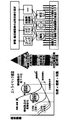
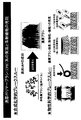
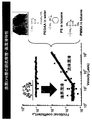
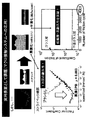
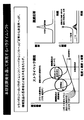
- FIG. 1 It is a figure which shows the paradigm shift of this invention. It is a figure which shows the resiliency of CPB which produces the durability of a sliding surface. It is a figure which shows the characteristic comparison of a hard type
- a schematic diagram of a ball-on-disk test by a tribo tester (Bruker UMT TriboLab) for obtaining a Stribeck curve is shown.
- the Stribeck curve (load: 0.1-4N) of a thick PMMA brush in ionic liquid (DEME-TFSI) is shown.
- the Stribeck curve (high load condition) of thick PMMA brush in ionic liquid (DEME-TFSI) is shown.
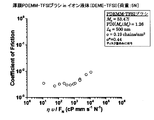
- Thickened poly N, N-diethyl-N- (2-methacryloylethyl) -N-methylammonium bis (trifluoromethylsulfonyl) imide
- PEMM-TFSI Thickened poly
- load: 5N Shows the brush's Stribeck curve (load: 5N).
- FIG. 3 shows the Stribeck curve (load: 0.1 N) of thickened poly (lauryl methacrylate) (PLMA) (lipophilic) brush rods in POE lubricants (3 types).
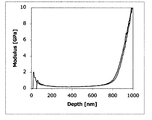
- the measurement result of the compressive elastic modulus of the thick PMMA brush in the ionic liquid (DEME-TFSI) obtained by the nanoindentation method is shown.
- the result of the force curve test of the thick film PMMA brush in the ionic liquid (DEME-TFSI) obtained by the atomic force microscope colloid probe method is shown.
- concentration of a crosslinking agent with respect to the swelling degree of a crosslinking brush is shown.
- a thick polymer brush (thickened CPB) having a thick film was produced by using an advanced living radical polymerization method (LRP).
- LRP advanced living radical polymerization method
- the SRT material of the present invention is a tribo system with soft (soft) and resilient (resilient, toughness) as a bearing lubricant, seal lubricant and / or guide (guide mechanism) lubricant.
- Tribosystem System of tribological components
- Tribosystem is a comprehensive sliding system with highly controlled friction and lubrication.
- FIG. 2 is a diagram showing the realization of the CPB system and the expression of innovative functions.
- SRT material a Tribology system material having soft and resilient utilizing the toughness (resilience) derived from the flexibility and ultra-low friction of CPB.
- the SRT material of the present invention is a machine element technology that makes use of the characteristics of soft materials, and includes CPB that also has high lubricity.
- the SRT material of the present invention is a science that targets tribology (solid surface contact, friction, wear, lubrication related problems from the viewpoint of large deformation, flexibility (followability) and toughness (recoverability). It can be applied to machinery as a base material in one technical field.
- the SRT material (lubricant) of the present invention achieves CPB thickening (at least 500 nm) by applying conditions such as high pressure, ionic liquid solvents, or combinations thereof to CPB synthesis, and macro measurement The first successful acquisition of CPB's original Stribeck curve.
- This Stribeck curve represents the influence of the viscosity, average speed and vertical load of the lubricant on the friction coefficient of the lubrication surface, and is the data that is the basis of the mechanical design in relation to the lubrication mechanism.
- the friction coefficient of the thickened CPB of the present invention is significantly reduced in the low speed region as compared with the friction coefficient of the non-brush system, and the value reaches the order of 10 ⁇ 3 (ultra low friction property). Further, with the thickened CPB of the present invention, little wear was observed even after the friction test, and a practical CPB could be produced by increasing the thickness (flexibility and toughness).
- the thick film CPB of the present invention can be mounted on society as an SRT material (lubricant or sliding member).
- SRT material including thickened CPB SRT material is preferably for a sliding mechanism.
- the SRT material (narrow concept) of the present invention is an aspect of a lubricant (wide concept).
- the SRT material of the present invention which is an embodiment of the lubricant, is effective for bearings, seals or guides (guide mechanisms) (bearings, seals or guides (guide mechanisms)).
- the contained thickened CPB is preferably thickened to 500 nm or more and has a molecular weight distribution index of 1.5 or less.
- Thickened CPB can be as thick as 800 nm as an example of thickening 500 nm or more.
- the SRT material preferably has an indentation amount of 100 nm or more and a compressive elastic modulus of 1 MPa or more.
- the contained thickened CPB preferably has a crosslinked structure.
- the SRT material lubricant
- lubricant preferably contains a lubricating liquid and has a friction coefficient ( ⁇ ) of 0.1 or less.
- the coefficient of friction ( ⁇ ) of the SRT material is preferably 0.01 or less.
- Polymer chain forming thickened CPB is preferably a non-electrolyte polymer or an electrolyte polymer, a hydrophobic polymer or a hydrophilic polymer.
- PMMA poly (methyl methacrylate)
- PSGMA poly (sodium sulfonated glycidyl methacrylate)
- ionic liquid type polymer or the like is preferable.
- poly (alkyl (meth) acrylate) such as PMMA is preferable.
- poly (hydroxyalkyl (meth) acrylate) such as poly (2-hydroxyethyl methacrylate) (PHEMA), poly (meth) acrylate having a polyethylene glycol side chain, and the like are preferable.
- the hydrophilic polymer may be prepared using a hydrophilic monomer, or may be prepared by introducing a hydrophilic group into this polymer after preparing the polymer using a hydrophobic monomer.
- the polymer chain is preferably a homopolymer of one type of monomer or a copolymer of two or more types of monomers.
- Copolymerization includes random copolymerization, block copolymerization, gradient copolymerization, and the like.
- the monomer used for polymer chain formation those capable of forming a polymer chain to be grafted (on the substrate surface) are preferable.
- a monomer having at least one addition polymerizable double bond such as a monofunctional monomer having one addition polymerizable double bond is preferred.
- a (meth) acrylic acid monomer, a styrene monomer and the like are preferable.
- monomers used for polymer chain formation include (meth) acrylic acid monomers, styrene monomers, monofunctional monomers having one addition-polymerizable double bond, and hydrophobic groups exemplified below.
- Monomer, hydrophilic monomer, monomer having a group easily convertible to a carboxyl group or a carboxyl base in the side chain, and the like can be used.
- hydrophobic monomers As monomers used for polymer chain formation, hydrophobic monomers, hydrophilic monomers, and the like can be suitably used.
- (meth) acrylic acid monomers As (meth) acrylic acid monomers, (meth) acrylic acid, methyl (meth) acrylate, ethyl (meth) acrylate, propyl (meth) acrylate, isopropyl (meth) acrylate, butyl (meth) acrylate, isobutyl (meth) acrylate Tert-butyl (meth) acrylate, pentyl (meth) acrylate, hexyl (meth) acrylate, cyclohexyl (meth) acrylate and the like are preferable.
- (meth) acrylic acid monomers heptyl (meth) acrylate, octyl (meth) acrylate, 2-ethylhexyl (meth) acrylate, nonyl (meth) acrylate, decyl (meth) acrylate, dodecyl (meth) acrylate, phenyl (meth) ) Acrylate, toluyl (meth) acrylate, benzyl (meth) acrylate and the like are preferred.
- (meth) acrylic acid monomers 2-methoxyethyl (meth) acrylate, 3-methoxypropyl (meth) acrylate, 3-methoxybutyl (meth) acrylate, 2-hydroxyethyl (meth) acrylate, 2-hydroxypropyl ( Preference is given to meth) acrylate, stearyl (meth) acrylate, glycidyl (meth) acrylate, 3-ethyl-3- (meth) acryloyloxymethyloxetane and the like.
- (meth) acrylic acid monomers 2- (meth) acryloyloxyethyl isocyanate, (meth) acrylate-2-aminoethyl, 2- (2-bromopropionyloxy) ethyl (meth) acrylate, 2- (2-bromo Isobutyryloxy) ethyl (meth) acrylate and the like are preferable.
- (meth) acrylic acid monomers 1- (meth) acryloxy-2-phenyl-2- (2,2,6,6-tetramethyl-1-piperidinyloxy) ethane, 1- (4-(( 4- (Meth) acryloxy) ethoxyethyl) phenylethoxy) piperidine, ⁇ - (methacryloyloxypropyl) trimethoxysilane and the like are preferable.
- (meth) acrylic acid monomers 2-perfluoromethyl-2-perfluoroethylethyl (meth) acrylate, 2-perfluorohexylethyl (meth) acrylate, 2-perfluorodecylethyl (meth) acrylate, 2-perfluorohexadecylethyl (Meth) acrylate and the like are preferred.
- Styrene monomers include styrene, vinyltoluene, ⁇ -methylstyrene, p-chlorostyrene, p-chloromethylstyrene, m-chloromethylstyrene, o-aminostyrene, p-styrene chlorosulfonic acid, styrenesulfonic acid and its salts Vinylphenylmethyldithiocarbamate, 2- (2-bromopropionyloxy) styrene, 2- (2-bromoisobutyryloxy) styrene and the like are preferable.
- styrene monomers 1- (2-((4-vinylphenyl) methoxy) -1-phenylethoxy) -2,2,6,6-tetramethylpiperidine, 1- (4-vinylphenyl) -3,5 , 7,9,11,13,15-heptaethylpentacyclo [9.5.1.13,9.15,15.17,13] octasiloxane, 1- (4-vinylphenyl) -3,5,7,9,11,13, 15-heptaisobutylpentacyclo [9.5.1.13, 9.15, 15.17,13] octasiloxane and the like are preferable.
- styrenic monomer 1- (4-vinylphenyl) -3,5,7,9,11,13,15-heptaisooctylpentacyclo [9.5.1.13,9.15,15.17,13] octasiloxane, 1- ( 4-vinylphenyl) -3,5,7,9,11,13,15-heptacyclopentylpentacyclo [9.5.1.13,9.15,15.17,13] octasiloxane, 1- (4-vinylphenyl) -3,5 7,9,11,13,15-heptaphenylpentacyclo [9.5.13.13,9.15,15.17,13] octasiloxane and the like are preferable.
- monofunctional monomers having one addition polymerizable double bond fluorine-containing vinyl monomers (perfluoroethylene, perfluoropropylene, vinylidene fluoride, etc.), silicon-containing vinyl monomers (vinyltrimethoxysilane, vinyltriethoxysilane) Etc.), maleic anhydride, maleic acid, monoalkyl esters and dialkyl esters of maleic acid, fumaric acid, monoalkyl esters and dialkyl esters of fumaric acid, and the like.
- fluorine-containing vinyl monomers perfluoroethylene, perfluoropropylene, vinylidene fluoride, etc.
- silicon-containing vinyl monomers vinyltrimethoxysilane, vinyltriethoxysilane
- maleic anhydride maleic acid, monoalkyl esters and dialkyl esters of maleic acid, fumaric acid, monoalkyl esters and dialkyl esters of fumaric acid, and the like.
- maleimide monomers (maleimide, methylmaleimide, ethylmaleimide, propylmaleimide, butylmaleimide, hexylmaleimide, octylmaleimide, dodecylmaleimide, stearylmaleimide, phenylmaleimide) Cyclohexyl maleimide, etc.).
- Monofunctional monomers having one addition-polymerizable double bond include nitrile group-containing monomers (acrylonitrile, methacrylonitrile, etc.), amide group-containing monomers (acrylamide, methacrylamide, etc.), vinyl ester monomers (vinyl acetate) , Vinyl propionate, vinyl pivalate, vinyl benzoate, vinyl cinnamate, etc.).
- Monofunctional monomers having one addition-polymerizable double bond include olefins (ethylene, propylene, etc.), conjugated diene monomers (butadiene, isoprene, etc.), vinyl halides (vinyl chloride, etc.), vinylidene halides (Vinylidene chloride and the like), allyl halide (such as allyl chloride) and the like are preferable.
- allyl alcohol vinyl pyrrolidone, vinyl pyridine, N-vinyl carbazole, methyl vinyl ketone, vinyl isocyanate and the like are preferable.
- a macromonomer having one polymerizable double bond in one molecule and having a main chain derived from styrene, (meth) acrylic acid ester, siloxane or the like is preferable.
- acrylic acid ester eg, methyl acrylate, ethyl acrylate, propyl acrylate, butyl acrylate, cyclohexyl acrylate, hexafluoroisopropyl acrylate, etc. alkyl ester; phenyl acrylate, etc .; aryl acrylate, etc .; aryl benzyl acrylate, etc.
- Alkyl acrylates; alkoxyalkyl acrylates such as methoxymethyl acrylate) and the like are preferable.
- Methacrylic acid ester eg, methyl methacrylate, ethyl methacrylate, propyl methacrylate, butyl methacrylate, cyclohexyl methacrylate, hexafluoroisopropyl methacrylate, etc .
- alkyl methacrylates such as phenyl methacrylate
- aryl methacrylates such as benzyl methacrylate
- Alkyl methacrylate alkoxyalkyl methacrylate such as methoxymethyl methacrylate
- alkoxyalkyl methacrylate such as methoxymethyl methacrylate
- fumaric acid esters eg, alkyl esters of fumaric acid such as dimethyl fumarate, diethyl fumarate, diallyl fumarate, etc.
- maleic acid esters eg, dimethyl maleate, diethyl maleate, diallyl maleate, etc.
- alkyl esters of maleic acid and the like are preferred.
- Hydrophobic monomers include itaconic acid esters (eg, itaconic acid alkyl esters), crotonic acid esters (eg, crotonic acid alkyl esters), methyl vinyl ether, ethoxyethyl vinyl ether, vinyl acetate, vinyl propionate, vinyl benzoate Styrene and the like are preferable.
- alkyl styrene As the hydrophobic monomer, alkyl styrene, vinyl chloride, vinyl methyl ketone, vinyl stearate, vinyl alkyl ether, and mixtures thereof are preferable.
- Hydrophilic monomers such as hydroxy-substituted alkyl acrylates (eg 2-hydroxyethyl acrylate, 2-hydroxypropyl acrylate, 2-hydroxypropyl acrylate, 2,3-dihydroxypropyl acrylate, polyethoxyethyl acrylate, polyethoxypropyl acrylate, etc.) Is preferred.
- hydroxy-substituted alkyl acrylates eg 2-hydroxyethyl acrylate, 2-hydroxypropyl acrylate, 2-hydroxypropyl acrylate, 2,3-dihydroxypropyl acrylate, polyethoxyethyl acrylate, polyethoxypropyl acrylate, etc.
- Hydroxy monomers such as hydroxy-substituted alkyl methacrylates (eg, 2-hydroxyethyl methacrylate, 2-hydroxypropyl methacrylate, 2-hydroxypropyl methacrylate, 2,3-dihydroxypropyl methacrylate, polyethoxyethyl methacrylate, polyethoxypropyl methacrylate) Is preferred.
- hydroxy-substituted alkyl methacrylates eg, 2-hydroxyethyl methacrylate, 2-hydroxypropyl methacrylate, 2-hydroxypropyl methacrylate, 2,3-dihydroxypropyl methacrylate, polyethoxyethyl methacrylate, polyethoxypropyl methacrylate
- hydrophilic monomer acrylamide, N-alkylacrylamide (eg, N-methylacrylamide, N, N-dimethylacrylamide, etc.), N-alkylmethacrylamide (eg, N-methylmethacrylamide, etc.) and the like are preferable.
- hydrophilic monomer polyethylene glycol monoacrylate, polyethylene glycol monomethacrylate, alkoxy polyethylene glycol acrylate, alkoxy polyethylene glycol methacrylate, phenoxy polyethylene glycol acrylate, phenoxy polyethylene glycol methacrylate, 2-glucosiloxyethyl methacrylate and the like are preferable.
- Preferred hydrophilic monomers include acrylic acid, methacrylic acid, fumaric acid, maleic acid, itaconic acid, crotonic acid, methacrylamide, allyl alcohol, N-vinylpyrrolidone and N, N-dimethylaminoethyl acrylate, and mixtures thereof. .
- a monomer having a specific group in the side chain can also be suitably used.
- a monomer having a group easily convertible to a carboxyl group or a carboxyl base in the side chain can be rendered hydrophilic by converting the side chain of the polymer to a carboxyl group or a carboxyl base after the polymer has been prepared. It is preferable in that it can be performed.
- Examples of monomers having a side chain that can be easily converted into a carboxyl group or a carboxyl base include 1-methoxyethyl acrylate, 1-ethoxyethyl acrylate, 1-propoxyethyl acrylate, 1- (1-methylethoxy) ethyl acrylate, 1-butoxyethyl acrylate, 1- (2-methylpropoxy) ethyl acrylate, 1- (2-ethylhexoxy) ethyl acrylate and the like are preferable.
- Monomers having a side chain with a group that can be easily converted to a carboxyl group or a carboxyl base include pyranyl acrylate, 1-methoxyethyl methacrylate, 1-ethoxyethyl methacrylate, 1-propoxyethyl methacrylate, 1- (1-methyl Ethoxy) ethyl methacrylate, 1-butoxyethyl methacrylate, 1- (2-methylpropoxy) ethyl methacrylate, 1- (2-ethylhexoxy) ethyl methacrylate and the like are preferable.
- Monomers having a carboxyl group or a group that can be easily converted to a carboxyl base in the side chain include pyranyl methacrylate, di-1-methoxyethyl maleate, di-1-ethoxyethyl maleate, di-1-propoxyethyl maleate Di-1- (1-methylethoxy) ethyl maleate, di-1-butoxyethyl maleate, di-1- (2-methylpropoxy) ethyl maleate, dipyranyl malate and the like are preferable.
- Monomers used for polymer chain formation may be used alone or in combination of two or more.
- the ionic liquid monomer is not particularly limited, and examples thereof include a polymer obtained by polymerizing a compound represented by the following general formula (1).
- m represents an integer of 1 to 10.
- N represents an integer from 1 to 5.
- R 1 represents a hydrogen atom or an alkyl group having 1 to 3 carbon atoms.
- R 2 , R 3 , and R 4 represent an alkyl group having 1 to 5 carbon atoms.
- R 2 , R 3 , and R 4 may contain one or more hetero atoms selected from an oxygen atom, a sulfur atom, and a fluorine atom, and two or more of R 2 , R 3 , and R 4 It may be connected to form a ring structure.
- the monovalent anion Y is not particularly limited, and BF 4 ⁇ , PF 6 ⁇ , AsF 6 ⁇ , SbF 6 ⁇ , AlCl 4 ⁇ , NbF 6 ⁇ , HSO 4 ⁇ , ClO 4 ⁇ , CH 3 Anions such as SO 3 ⁇ , CF 3 SO 3 ⁇ , CF 3 CO 2 ⁇ , (CF 3 SO 2 ) 2 N ⁇ , Cl ⁇ , Br ⁇ , and I ⁇ can be used.
- the anion Y is particularly preferably BF 4 ⁇ , PF 6 ⁇ , (CF 3 SO 2 ) 2 N ⁇ , CF 3 SO 3 ⁇ , or CF 3 CO 2 ⁇ .
- the compounds represented by the general formula (1) the compounds represented by the following general formulas (2) to (9) can be used particularly suitably.
- the SRT material can achieve high lubricity by using a surface obtained by grafting polymer chains with a high graft density.
- a non-electrolytic polymer such as poly (methyl methacrylate) (PMMA) can also be suitably used.
- Grafting-from method Grafting-to method and the like can be used, and graft-from method is preferable.
- the hydrophobic part of a polymer chain eg, PMMA-b-PSGMA
- PMMA-b-PSGMA which is a hydrophobic-hydrophilic diblock copolymer
- a method capable of polymerizing a polymer chain at a desired graft density is preferable, and a radical polymerization method is preferable.
- LRP living radical polymerization
- an atom transfer radical polymerization (ATRP) method is more preferable (J. Am. Chem. Soc., 117, 5614 (1995), Macromolecules, 28, 7901 (1995), Science, 272, 866 ( 1996), Macromolecules, 31, 5934-5936 (1998)).
- ATRP atom transfer radical polymerization
- NMP Nitroxide-mediated polymerization
- RAFT reversible addition-fragmentation chain transfer
- RTCP reversible transfer catalytic polymerization
- RCMP reversible complexation-mediated polymerization
- the grafting method using living radical polymerization is particularly preferable.
- the catalyst used for radical polymerization may be any catalyst that can control radical polymerization, and more preferably a transition metal complex.
- transition metal complex is a metal complex having a central metal of Group 7, 8, 9, 10, or 11 of the periodic table.
- Further preferred catalysts are copper complexes, ruthenium complexes, iron complexes or nickel complexes.
- a copper complex is preferable.
- the monovalent copper compound are cuprous chloride, cuprous bromide, cuprous iodide, cuprous cyanide, cuprous oxide, and cuprous perchlorate.
- Examples of the ligand of the metal complex include 2,2′-bipyridyl or a derivative thereof, 1,10-phenanthroline or a derivative thereof, polyamine (tetramethylethylenediamine, pentamethyldiethylenetriamine, hexamethyltris (2-aminoethyl) amine Etc.), and polycyclic alkaloids such as L-(-)-spartein are preferred.
- a tristriphenylphosphine complex of divalent ruthenium chloride (RuCl 2 (PPh 3 ) 3 ) is also suitable as a catalyst.
- RuCl 2 (PPh 3 ) 3 divalent ruthenium chloride
- Bivalent iron bistriphenylphosphine complex FeCl 2 (PPh 3 ) 2
- divalent nickel bistriphenylphosphine complex NiCl 2 (PPh 3 ) 2
- divalent nickel bistributylphosphine complex NiBr 2 (PBu 3 ) 2
- PBu 3 nickel bistributylphosphine complex
- solvents preferably used include hydrocarbon solvents (benzene, toluene, etc.), ether solvents (diethyl ether, tetrahydrofuran, diphenyl ether, anisole, dimethoxybenzene, etc.), halogenated hydrocarbon solvents (methylene chloride, chloroform, chlorobenzene). Etc.), ketone solvents (acetone, methyl ethyl ketone, methyl isobutyl ketone, etc.).
- hydrocarbon solvents benzene, toluene, etc.
- ether solvents diethyl ether, tetrahydrofuran, diphenyl ether, anisole, dimethoxybenzene, etc.
- halogenated hydrocarbon solvents methylene chloride, chloroform, chlorobenzene.
- Etc. ketone solvents (acetone, methyl ethyl ketone, methyl isobutyl ketone, etc.).
- solvents preferably used are alcohol solvents (methanol, ethanol, propanol, isopropanol, butyl alcohol, t-butyl alcohol, etc.), nitrile solvents (acetonitrile, propionitrile, benzonitrile, etc.), ester solvents (acetic acid, etc.) Ethyl, butyl acetate, etc.), carbonate solvents (ethylene carbonate, propylene carbonate, etc.) and the like.
- alcohol solvents methanol, ethanol, propanol, isopropanol, butyl alcohol, t-butyl alcohol, etc.
- nitrile solvents acetonitrile, propionitrile, benzonitrile, etc.
- ester solvents acetic acid, etc.
- carbonate solvents ethylene carbonate, propylene carbonate, etc.
- solvents preferably used include amide solvents (N, N-dimethylformamide, N, N-dimethylacetamide), hydrochlorofluorocarbon solvents (HCFC-141b, HCFC-225), hydrofluorocarbon (HFCs) solvents ( HFCs having 2 to 4, 5 and 6 carbon atoms), perfluorocarbon solvents (perfluoropentane, perfluorohexane) and the like.
- amide solvents N, N-dimethylformamide, N, N-dimethylacetamide
- hydrochlorofluorocarbon solvents HCFC-141b, HCFC-225
- hydrofluorocarbon (HFCs) solvents HFCs having 2 to 4, 5 and 6 carbon atoms
- perfluorocarbon solvents perfluoropentane, perfluorohexane
- solvent preferably used are alicyclic hydrofluorocarbon solvents (fluorocyclopentane, fluorocyclobutane), oxygen-containing fluorine solvents (fluoroether, fluoropolyether, fluoroketone, fluoroalcohol), water, and the like.
- Polymerization can also be performed in an emulsion system or a system using supercritical fluid CO 2 as a medium.
- a polymerization initiating group When using a graft from method as a polymer chain grafting method, a polymerization initiating group must be present on the surface of the substrate.
- polymerization initiating group those capable of initiating polymerization are preferable.
- a halogenated alkyl group, a halogenated sulfonyl group and the like are preferable.
- the polymerization initiating group is physically or chemically bonded to the substrate surface in terms of the controllability of the graft density and the primary structure of the grafted polymer chain (molecular weight, molecular weight distribution, monomer arrangement pattern). preferable.
- the method of introducing (bonding) the polymerization initiating group to the substrate surface can be performed by a chemical adsorption method, a Langmuir-Blodget (LB) method, or the like.
- LB Langmuir-Blodget
- immobilization of a chlorosulfonyl group (polymerization initiating group) on the surface of a silicon wafer (base material) by chemical bonding is performed by 2- (4-chlorosulfonylphenyl) ethyltrimethoxysilane and / or 2- (4-chlorosulfonyl). This can be done by reacting phenyl) ethyltrichlorosilane or the like with the oxide layer on the silicon wafer surface.
- a surface treatment agent having the polymerization initiating group and the substrate binding / affinity group may be a low molecular compound or a high molecular compound. For example, the following formula:
- the spacer chain length n is preferably an integer of 1 to 10, more preferably an integer of 3 to 8, and most preferably 6.
- At least one of R 1 , R 2 and R 3 is preferably an alkoxyl group or a halogen atom.
- R 4 and R 5 are preferably C1-C3 alkyl, an aromatic functional group or the like.
- X is preferably a halogen atom, particularly preferably Br) It is preferable to use a polymerization initiating group-containing silane coupling agent.
- the polymerization initiating group-containing silane coupling agent can be produced, for example, according to the method described in WO2006 / 087839.
- Typical examples of the polymerization initiator-containing silane coupling agent include (2-bromo-2-methyl) propionyloxyhexyltriethoxysilane (BHE), (2-bromo-2-methyl) propionyloxypropyltriethoxysilane ( BPE) and the like.
- a silane coupling agent that does not contain a polymerization initiating group for example, a commonly used alkylsilane coupling agent may be used.
- the silane coupling agent When a polymerization initiating group-containing silane coupling agent is used as a raw material for the binding group, the silane coupling agent is hydrolyzed to silanol in the presence of water, and partially condensed to an oligomer state. In this state, after adsorbing on the silica surface by hydrogen bonding, the inorganic-metal material may be dried to cause a dehydration condensation reaction to form a polymerization initiating group on the material.
- the graft density can be freely changed by adjusting the ratio of the polymerization initiation group-containing silane coupling agent and the silane coupling agent not containing the polymerization initiation group.
- all of the silane coupling agents are polymerization-initiating group-containing silane coupling agents, a surface occupancy of more than 10% can be achieved after the following polymerization.
- the introduction of the polymerization initiating group to the substrate surface may adopt the LB method or the gas phase adsorption method in terms of the uniformity of the introduced polymerization initiating group and the controllability of the graft density of the polymerization initiating group. Is possible.
- the film forming material is first dissolved in an appropriate solvent (eg, chloroform, benzene, etc.). Next, after a small amount of this solution is developed on a clean liquid surface, preferably on the surface of pure water, the solvent is evaporated or diffused into the adjacent aqueous phase to form a low-density film-forming molecule on the water surface. A film is formed.
- an appropriate solvent eg, chloroform, benzene, etc.
- the partition plate is mechanically swept over the water surface, and the membrane is compressed by increasing the density by reducing the surface area of the water surface on which the film-forming molecules are deployed. Get.
- the substrate on which the monomolecular layer is deposited is immersed in a direction across the monomolecular film on the water surface while maintaining the surface density of the molecules constituting the monomolecular film on the water surface constant.
- the monomolecular film on the water surface is transferred onto the substrate, and a monomolecular layer is deposited on the substrate.
- the polymer chain forming the thickened CPB preferably has a crosslinked structure of CPBs .
- the polymer chain preferably has a reactive substituent (crosslinking group) for bonding with the substrate.
- crosslinking group examples include an azide group and a halogen group (preferably a bromo group).
- the crosslinking group may be present in either the main chain or the graft chain.
- a reactive group with the unreacted graft chain in the main chain can be used as a crosslinking group, or a reactive group remaining at the end of the graft chain when the graft chain is formed by living radical polymerization can be used as a crosslinking group. it can.
- the cross-linked structure of the thickened CPB includes a physical cross-linked structure and a chemical cross-linked structure.
- the crosslinked structure of the thickened CPB controls the elastic modulus of the thickened CPB.
- the method of introducing physical crosslinking and chemical crosslinking as the crosslinked structure is useful both at the time of polymer brush formation (at the time of polymerization, referred to as in-situ crosslinking) and at the time of post-polymerization (for post-crosslinking).
- divinyl monomer for example, ethylene glycol dimethacrylate
- ⁇ Atom transfer radical polymerization (ATRP) in solution is performed.
- ATRP Atom transfer radical polymerization
- the degree of swelling of the polymer brush layer is measured in a good solvent (for example, o-dichlorobenzene) by the AFM colloid probe method
- a good solvent for example, o-dichlorobenzene
- the graft density of the polymer chain forming the thickened CPB may be any graft density that exhibits high lubricity.
- the graft density of the polymer chain forming the thickened CPB may be appropriately set depending on the type of polymer and / or solvent used.
- the graft density of the polymer chain in CPB is usually 0.1 chain / nm 2 or more, preferably 0.15 chain / nm 2 or more, more preferably 0.2 chain / nm 2 or more, and further preferably Is 0.3 chain / nm 2 or more, particularly preferably 0.4 chain / nm 2 or more, and most preferably 0.45 chain / nm 2 or more.
- the graft density of the polymer chain in CPB is usually 0.04 chain / nm 2 or more, preferably 0.06 chain / nm 2 or more, more preferably 0.08 chain / nm 2 or more, more preferably Is 0.12 chain / nm 2 or more, particularly preferably 0.16 chain / nm 2 or more, and most preferably 0.18 chain / nm 2 or more.
- the graft density of polymer chains in CPB is usually 0.02 chain / nm 2 or more, preferably 0.03 chain / nm 2 or more, more preferably 0.04 chain / nm 2 or more, further preferably 0.06 chain / nm 2 or more, particularly preferably 0.08 chain / nm 2 or more, most preferably 0.09 Chain / nm 2 or more.
- the graft density of the polymer chain can be measured according to a known method.
- the graft density of the polymer chain is measured according to the method described in, for example, Macromolecules, 31, 5934-5936 ⁇ (1998), Macromolecules, 33, 5608-5612 ⁇ (2000), Macromolecules, 38, 2137-2142 (2005), etc. be able to.
- the graft amount (W) is measured by measuring the film thickness in the dry state, that is, the thickness of the grafted polymer chain layer in the dry state by an ellipsometry method. It can be determined by calculating the graft amount per unit area using the density of the film.
- the substrate is silica particles or the like, it can be measured by infrared absorption spectroscopy (IR), thermogravimetric loss measurement (TG), elemental analysis measurement or the like.
- IR infrared absorption spectroscopy
- TG thermogravimetric loss measurement
- elemental analysis measurement or the like.
- the number average molecular weight (M n), during polymerization the M n of free polymer produced in the solution substantially equal to M n of the graft chains may be used M n of free polymer produced in solution during polymerization.
- Mn and Mw / Mn can be determined by gel permeation chromatography (GPC) method after cutting the graft chain from the graft point using a hydrofluoric acid solution. In addition, it has confirmed that these values are substantially equal to the value of the free polymer produced
- the slope of a graph plotting the thickness of the grafted polymer chain layer in the dry state and the number average molecular weight of the polymer chain (see, for example, JP-A-11-263819), grafted
- the graft density of the polymer chain can be determined from the slope of the graph plotting the graft amount of the polymer chain and the number average molecular weight of the polymer chain.
- Thickened CPB is a graft that occupies 10% or more of the occupied area ratio (surface occupancy ratio: occupancy ratio per polymer cross-sectional area) relative to the substrate surface area.
- the density is preferably formed, more preferably 15% or more, and still more preferably 20% or more.
- the graft density can be calculated from the absolute value of the number average molecular weight (M n ) of the graft chain, the amount of grafted polymer, and the surface area of the substrate.
- the surface occupancy ratio in the thickened CPB layer can be calculated by obtaining the cross-sectional area from the repeating unit length in the fully stretched form of the polymer and the bulk density of the polymer and multiplying by the graft density.
- the surface occupancy rate means the ratio of the graft surface (first monomer) to the substrate surface.
- the closest packing is 100% and no further grafting is possible.
- the number average molecular weight (M n ) of the polymer chain forming the thickened CPB is preferably a molecular weight exhibiting desired lubricity.
- the number average molecular weight (M n ) of the polymer chain forming the thickened CPB is preferably about 500 to 10,000,000, more preferably about 100,000 to 10,000,000.
- the molecular weight distribution index (PDI) is preferably about 1.5 or less, more preferably about 1.01 to 1.5.
- the thickening of the polymer chain forming the thickened CPB is preferably of a length that exhibits the desired lubricity.
- the thickening of the polymer chain forming the thickened CPB is preferably about 500 nm or more.
- the thickening of the polymer chain forming the thickened CPB is more preferably about 700 nm or more (0.7 ⁇ m or more), more preferably about 800 nm or more, and particularly preferably about 1,000 nm or more (1 ⁇ m or more).
- the average molecular chain length of the polymer chain can be determined from the measurement results obtained by measuring, for example, the number average molecular weight (M n ) and molecular weight distribution (M w / M n ) of the polymer chain.
- the number average molecular weight (M n ) and molecular weight distribution (M w / M n ) of the polymer chains were determined by size exclusion chromatography using the polymer chains cut out from the substrate by hydrofluoric acid treatment. The method of measuring by a graphic method is mentioned.
- the free polymer produced during polymerization has a molecular weight equal to that of the polymer chain introduced into the substrate
- the free polymer is subjected to size exclusion chromatography, and the number average molecular weight (M n ) and molecular weight distribution ( M w / M n ) can be measured and used as it is.
- Thickened CPB can be synthesized by surface-initiated living radical polymerization under conditions such as high pressure, ionic liquid solvents, or combinations thereof. . At that time, when a free initiator is added to the polymerization solution, a free polymer having a molecular weight and molecular weight distribution equivalent to that of the polymer brush constituent chain can be obtained.
- This free polymer can be analyzed using size exclusion chromatography to determine the number average molecular weight and molecular weight distribution index.
- the number average molecular weight and the molecular weight distribution index can be determined using a size exclusion chromatography method by cutting out the polymer brush constituent chain from the substrate surface as necessary.
- the ellipsometry method is mainly used to quantify the graft amount.
- the graft density can be calculated from the dry film thickness of the surface graft layer, that is, the graft amount and the number average molecular weight.
- the base material used for the thickened CPB is preferably a base material that can be used for grafting polymer chains by the graft-from method or graft-toe method described above.
- it can be appropriately selected from organic materials, inorganic materials, metal materials, and the like.
- a hydrophobic substrate and a hydrophilic substrate can be preferably used.
- Solids used as the base material include polyurethane materials, polyvinyl chloride materials, polystyrene materials, polyolefin materials, PMMA, PET, cellulose acetate, silica, inorganic glass, paper, plastic laminate films, ceramics (eg, alumina ceramics) And composite ceramics such as bioceramics and zirconia-alumina composite ceramics).
- metal eg, aluminum, zinc, copper, titanium, etc.
- paper on which metal is deposited silicon, silicon oxide, silicon nitride, polycrystalline silicon, and a composite material thereof are preferable.
- hydrophobic organic material used as a base material examples include polyolefin (eg, polyethylene, polypropylene, polyisobutylene, ethylene alpha olefin copolymer), silicon polymer, acrylic polymer (eg, polyacrylonitrile, polymethyl methacrylate). , Polyethyl methacrylate, polyethyl acrylate, etc.) and copolymers thereof.
- Hydrophobic organic materials used as substrates include fluoropolymers (eg, polytetrafluoroethylene, chlorotrifluoroethylene, fluorinated ethylene-propylene, polyvinyl fluoride, etc.), vinyl polymers (eg, polyvinyl chloride, polyvinyl) Methyl ether, polystyrene, polyvinyl acetate, polyvinyl ketone, and the like) and copolymers thereof.
- fluoropolymers eg, polytetrafluoroethylene, chlorotrifluoroethylene, fluorinated ethylene-propylene, polyvinyl fluoride, etc.
- vinyl polymers eg, polyvinyl chloride, polyvinyl) Methyl ether, polystyrene, polyvinyl acetate, polyvinyl ketone, and the like
- Hydrophobic organic materials used as base materials include vinyl monomer-containing copolymers (eg, ABS), natural and synthetic rubbers (eg, latex rubber, butadiene-styrene copolymer, polyisoprene, polybutadiene, butadiene-acrylonitrile) Copolymer, polychloroprene polymer, polyisobutylene rubber, ethylene-propylene diene copolymer, polyisobutylene-isoprene, and the like, and copolymers thereof are preferred.
- vinyl monomer-containing copolymers eg, ABS
- natural and synthetic rubbers eg, latex rubber, butadiene-styrene copolymer, polyisoprene, polybutadiene, butadiene-acrylonitrile
- polychloroprene polymer polyisobutylene rubber, ethylene-propylene diene copolymer, polyisobutylene-isoprene, and
- polyurethane eg, polyether urethane, polyester urethane, polycarbonate urethane, polysiloxane urethane, etc.
- polyamide eg, nylon 6, nylon 66, nylon 10, nylon 11, etc.
- Polyester epoxy polymer, cellulose, modified cellulose, and copolymers thereof are preferable.
- hydrophilic organic materials used as the base material hydrophilic acrylic polymers (eg, polyacrylamide, poly-2-hydroxyethyl acrylate, poly-N, N-dimethylacrylamide, polyacrylic acid, polymethacrylic acid, etc.), And copolymers thereof are preferred.
- hydrophilic acrylic polymers eg, polyacrylamide, poly-2-hydroxyethyl acrylate, poly-N, N-dimethylacrylamide, polyacrylic acid, polymethacrylic acid, etc.
- copolymers thereof are preferred.
- hydrophilic organic materials used as substrates hydrophilic vinyl polymers (eg, poly-N-vinyl pyrrolidone, polyvinyl pyridine, etc.), polymaleic acid, poly-2-hydroxyethyl fumarate, maleic anhydride, polyvinyl alcohol , And copolymers thereof are preferred.
- the base material is preferably, for example, a tube, a sheet, a fiber, a strip, a film, a plate, a foil, a membrane, a pellet, a powder, a molded product (eg, an extrusion molded product, a cast molded product, or the like).
- the substrate may have any form or shape.
- the material of the base material for example, polyurethane, polyvinyl chloride, polystyrene, polycarbonate, PMMA, PET, cellulose acetate, silica, inorganic glass, aluminum, copper, silicon, silicon oxide and the like are preferable.
- the base material is preferably rubber (for oil seal use), inorganic oxide (for mechanical seal use), or the like.
- the base material is preferably a metal (SUS, SUJ2, carbon steel, etc.) or a resin (polyethylene, etc.).
- the substrate is a metal (SUS, SUJ2, carbon steel, etc.), a resin (polyphenylene sulfide, polytetrafluoroethylene, etc.) Etc.) are preferred.
- the SRT material (lubricant) of the present invention is used as a sliding member, iron such as cast iron, steel, and stainless steel, iron alloy, non-ferrous and non-ferrous alloys such as aluminum and copper, silicon wafer, glass, quartz, etc. It is preferable to use a nonmetal or the like.
- the SRT material (lubricant) of the present invention has, for example, grafted polymer chains on the surface of a sheet-like substrate. Can be produced.
- the obtained sheet-like SRT material (lubricant) is bonded and welded to places where lubrication is required (for example, sliding parts) such as articles that require lubrication (for example, micromachines, artificial joints, etc.). It can fix and use by well-known methods, such as.
- SRT material is a place where lubrication is required by grafting a polymer chain on the surface of the material, etc. where lubrication is required as a base material You may produce on the surface of. Thus, it is preferable that the SRT material (lubricant) is produced on the surface where lubrication is required because the step of fixing the SRT material (lubricant) is unnecessary.
- the surface grafted with the polymer chain used for the SRT material (lubricant) can also be produced, for example, according to the method described in JP-A-11-263819.
- Friction coefficient of SRT material (lubricant) ( ⁇ )
- the friction coefficient ( ⁇ ) of the SRT material (lubricant) is preferably about 0.1 or less.
- the friction coefficient ( ⁇ ) of the SRT material is preferably 0.01 or less.
- the friction coefficient ( ⁇ ) of the SRT material can be measured using an atomic force microscope (AFM).
- SRT material lubricant
- a probe such as silicon wafer and silica particles (radius R)
- the probe is bonded to the cantilever, and the polymer chain is swollen with a good solvent.
- G cantilever shear coefficient
- W cantilever width
- T cantilever thickness
- L cantilever length
- the cantilever angle (twist) displacement ( ⁇ L ) is calculated by reciprocating the probe (silica particles) with a constant vertical force on the sample substrate (silicon wafer) at a constant speed in the y direction. Then, it can be measured by sliding.
- the friction coefficient ( ⁇ ) can be obtained from the relationship between the obtained vertical force (F N ) and horizontal force (F L , lateral force).
- the friction coefficient ( ⁇ ) of the SRT material (lubricant) is preferably about 0.1 or less, more preferably about 0.01 or less, and further preferably about 10 ⁇ 3 or less.
- the coefficient of friction ( ⁇ ) is defined as the ratio (F s / F n ) of these F s and F n .
- the ball side (always sliding surface) is also evaluated.
- Evaluation can be made with reference to a micrograph of the ball surface after peeling the thickened CPB.
- the SRT material (lubricant) preferably has an indentation amount of about 100 nm or more and a compression elastic modulus of about 1 MPa or more.
- the SRT material of the present invention does not necessarily need to contain a thickened CPB if the compressive modulus and friction coefficient ( ⁇ ) are satisfied as a concept of the present invention.
- ⁇ Indentation amount of SRT material (lubricant) can be measured using AFM or nanoindenter.
- the indentation amount of the SRT material (lubricant) is preferably about 100 nm or more, more preferably about 120 nm or more, and further preferably about 150 nm or more.
- Compressive modulus of SRT material can be measured using AFM or nanoindenter.
- the compression elastic modulus of the SRT material is preferably about 0.1 MPa or more, more preferably about 1 MPa or more, and further preferably about 10 MPa or more.
- the compression modulus is preferably about 0.1 MPa or more, more preferably about 1 MPa or more, and further preferably about 10 MPa or more.
- the compression modulus is preferably about 0.1 MPa or more, more preferably about 1 MPa or more, and further preferably about 10 MPa or more.
- Nanometer indentation method or atomic force microscope (AFM) colloid probe method is used to measure indentation amount and compressive elastic modulus of SRT material.
- Nanomechanics iMicro sensor: inForce50
- CPB thickened PMMA brush
- measurement mode constant strain rate, strain rate: 0.2% per second, excitation frequency: 100 Hz, excitation amplitude: 2 nm, and surface detection threshold : Compressive modulus can be measured under the condition of 50 N / m.
- a silica probe particle having a diameter of 10 ⁇ m is fixed to the tip of an AFM cantilever, and a thick film formed on a silicon substrate using AFM manufactured by JPK instruments or AFM manufactured by Seiko Instruments Inc. Force curve measurement is performed on a modified CPB (eg thick PMMA brush).
- a modified CPB eg thick PMMA brush
- an indentation amount of 100 nm or more is ensured, and the compression elastic modulus can be estimated from this force curve.
- Compressive modulus can be calculated from Young's modulus by drawing a force-distance curve from a force curve and assuming Hertz contact.
- the present invention also relates to an article containing an SRT material (lubricant) having a surface grafted with a polymer chain forming a thickened CPB.
- the SRT material of the present invention is preferably for a sliding mechanism.
- the article containing the SRT material (lubricant) preferably has the lubricant of the present invention on both sliding surfaces where lubrication is required (for example, a sliding portion).
- sheet-like SRT material (lubricant) of the present invention is bonded to a place where lubrication is required (for example, a sliding part). It can be manufactured by fixing by a known method such as welding.
- the SRT material of the present invention is formed on the surface of the place where lubrication is required by grafting a polymer chain on the surface of the member where the lubrication of the article requiring lubrication is used as a base material. It can also be produced by producing (lubricant).
- the SRT material (lubricant) that has a surface grafted with the polymer chain that forms the CPB of the lubricant thickened in the SRT material (lubricant) is a lubricant (solvent, liquid substance). Good lubricity is exhibited by swelling the grafted polymer chain.
- SRT materials have polymer chains grafted at a high graft density, they are stretched by swelling the polymer chains with a lubricating liquid, preferably highly stretched to be comparable to stretched chains. Is done.
- SRT materials are thought to be able to support large loads due to the large osmotic effect due to the concentrated solution system of swollen polymer chain layers when their polymer chains are swollen with a lubricating liquid. . Also, in the contact area, the grafted polymer chains do not interpenetrate and suppress entanglement by eliminating the increase in local concentration and the large entropy gain (obtained due to the high stretch state). It is considered that low friction characteristics are developed.
- the SRT material (lubricant) exhibits low frictional properties when the polymer chain is extended in the solvent as described above, it is preferably used in a lubricating liquid capable of swelling or extending the polymer chain. .
- a good solvent is preferable as the lubricating liquid capable of swelling or extending the polymer chain.
- the good solvent varies depending on the grafted polymer chain, it may be appropriately selected according to the polymer chain.
- the good solvent is preferably a nonpolar solvent such as toluene or a hydrophobic ionic liquid.
- the good solvent is preferably a polar solvent such as methanol.
- the good solvent is preferably an aqueous solvent containing water.
- SRT material is a layer formed by swelling a lubricating liquid (liquid substance) in a polymer chain formed on a substrate.
- a lubricating liquid liquid substance
- a compound exhibiting swelling property with respect to the polymer graft chain is preferable.
- An ionic liquid is a low melting point salt having ionic conductivity, also called an ionic liquid or a room temperature molten salt, many of which are an organic onium ion as a cation and an organic or inorganic anion as an anion. Means having a comparatively low melting point characteristic obtained by combining.
- the melting point is usually 100 ° C. or lower, preferably room temperature (25 ° C.) or lower.
- ionic liquid those represented by the following general formula (10) and having a melting point of 50 ° C. or lower, preferably 25 ° C. or lower can be used.
- R 3 , R 4 , R 5 , and R 6 are the same or different alkyl groups having 1 to 5 carbon atoms, or R′—O— (CH 2 ) n —
- An alkoxyalkyl group (R ′ represents a methyl group or an ethyl group, and n is an integer of 1 to 4), and any two groups of these R 3 , R 4 , R 5 and R 6 May form a ring.
- R 3 , R 4 , R 5 and R 6 is the alkoxyalkyl group.
- X represents a nitrogen atom or a phosphorus atom
- Y represents a monovalent anion.
- alkyl group having 1 to 5 carbon atoms include a methyl group, an ethyl group, an n-propyl group, a 2-propyl group, an n-butyl group, and an n-pentyl group.
- Examples of the alkoxyalkyl group represented by R′—O— (CH 2 ) n — include a methoxymethyl group or an ethoxymethyl group, a 2-methoxyethyl group or a 2-ethoxyethyl group, a 3-methoxypropyl group or a 3-ethoxy group.
- a propyl group, 4-methoxybutyl group or 4-ethoxybutyl group is preferred.
- any two groups of R 3 , R 4 , R 5 and R 6 form a ring when a nitrogen atom is employed for X, an aziridine ring, an azetidine ring, a pyrrolidine ring, a piperidine A quaternary ammonium salt having a ring or the like is preferable.
- the compound in which any two groups of R 3 , R 4 , R 5 and R 6 form a ring has a pentamethylene phosphine (phosphorinane) ring when a phosphorus atom is employed as X Quaternary phosphonium salts are preferred.
- a quaternary ammonium salt having at least one 2-methoxyethyl group in which R ′ is a methyl group and n is 2 is preferable.
- a quaternary salt represented by the following general formula (11) having a methyl group, two ethyl groups, and an alkoxyethyl group can also be suitably used.
- R ′ represents a methyl group or an ethyl group
- X represents a nitrogen atom or a phosphorus atom
- Y represents a monovalent anion
- the monovalent anion Y in the general formulas (10) and (11) is not particularly limited.
- quaternary ammonium salt and quaternary phosphonium salt that are preferably used include the following compounds (12) to (20).
- Me represents a methyl group
- Et represents an ethyl group
- quaternary ammonium salt and quaternary phosphonium salt it is more preferable to use a quaternary ammonium salt represented by the following formula (12) or (17) in consideration of obtaining an electricity storage device having excellent low-temperature characteristics. preferable.
- quaternary ammonium salt and quaternary phosphonium salt a quaternary ammonium salt represented by the following formula (17) is particularly preferable from the viewpoint that the viscosity is low and the dynamic friction coefficient during sliding can be further reduced.
- An ionic liquid other than the compound represented by the general formula (10) may be used.
- SRT material is a layer formed by swelling a lubricating liquid (liquid substance) in a polymer chain formed on a substrate.
- a lubricating liquid liquid substance
- a compound exhibiting swelling property with respect to the polymer graft chain is preferable, and an ionic liquid is particularly preferable.
- an ionic liquid containing an imidazolium ion represented by the following general formula (21) is preferable.
- Examples of counter anions that form ionic liquids containing imidazolium ions and other aromatic cations include the same monovalent anions as the compounds represented by the general formulas (10) and (11). it can.
- R 7 is an alkyl group having 1 to 4 carbon atoms or a hydrogen atom, and a methyl group having 1 carbon atom is particularly preferable.
- R 8 is an alkyl group having 10 or less carbon atoms (which may contain an ether bond), and a preferred example is an ethyl group.
- R 9 , R 10 , and R 11 are each independently an alkyl group having 1 to 20 carbon atoms and may contain an oxygen atom.
- R 9 , R 10 , and R 11 may be a hydrogen atom.
- Ionic liquids containing other aromatic cations represented by the following formulas (22) to (27) are preferred.
- the method for swelling the liquid substance on the polymer chain formed on the substrate is not particularly limited.
- the liquid substance is applied to the polymer chain formed on the substrate, Then, the method of leaving still, the method of immersing the base material in which the polymer chain was formed in a liquid substance, etc. are preferable.
- ⁇ SRT material exhibits low friction characteristics because the polymer chain is grafted at a high graft density.
- the SRT material (lubricant) exhibits low friction characteristics in a good solvent
- the SRT material (lubricant) of the present invention is fixed or produced on both the sliding surface where lubrication is required, and the SRT
- the sliding surface or the like can be lubricated by swelling or stretching the polymer chain grafted on the material (lubricant) with a good solvent.
- the SRT material has a compression modulus of 1 MPa or more and a friction coefficient ( ⁇ ) of 0.1 or less.
- the SRT material preferably contains at least one component selected from the group consisting of thickened CPB and a component that exhibits the CPB effect.
- the SRT material has a compressive modulus of about 1 MPa or more.
- the compression elastic modulus is more preferably about 10 MPa or more.
- the friction coefficient ( ⁇ ) of the SRT material is 0.1 or less, preferably about 0.01 or less.
- the SRT material of the present invention does not necessarily need to contain a thickened CPB if the compressive modulus and friction coefficient ( ⁇ ) are satisfied as a concept of the present invention.
- the SRT material (lubricant) containing the thickened CPB can be used for the compression elastic modulus and friction coefficient ( ⁇ ) of the SRT material.
- the SRT material preferably contains at least one component selected from the group consisting of thickened CPB and a component that exhibits the CPB effect. Material) can be used.
- the component that exhibits the CPB effect is preferably a bottle brush, CPB-supporting composite fine particles, CPB-supporting fiber, or the like.
- the bottle brush is a comb-shaped polymer, which is a molecule in which a graft side chain (branch) is extended from one main chain (trunk). Especially, a high-density comb polymer has an extended main chain due to the excluded volume effect of the side chain. Because of its cylindrical shape, it is called a bottle brush (because its shape resembles that used to wash bottles and flasks).
- the synthesis of bottle brushes consists of a Grafting-to method in which side chains are introduced into the trunk polymer, a Grafting-from method in which monomers are polymerized from a macroinitiator (a trunk polymer having a polymerization active site), and a macromonomer (polymerizable functional group at one end) Grafting-through method for polymerizing a polymer having a group).
- Living anionic polymerization, ring-opening metathesis polymerization (ROMP), or a highly versatile living radical polymerization method (LRP) is useful for these syntheses (FIG. 12).
- the polymer chain forming the thickened CPB forms a bottle brush having a structure in which a graft chain as a side chain extends from a polymer in the main chain portion.
- the graft polymer When the graft polymer is regarded as a cylinder whose main chain is the central axis (Fig. 12), the graft chain density on the side surface of the graft polymer decreases as the graft efficiency and the length of the graft chain increase. The degree of freedom in the structure becomes high.
- the side surface of the graft polymer is a cylinder when the graft polymer is captured as a cylinder whose outer periphery is a circle formed by connecting the graft chain tips with the main chain as the central axis and the graft chain extending in a straight line. Of the side.
- the circle is a circle drawn with a broken line in FIG.
- the graft chain can be folded freely.
- the density of the graft chains is also dense on the side surface of the graft polymer.
- the graft chain is long and the density of the graft chain is very low on the side surface of the graft polymer.
- the surface occupancy ( ⁇ * ) of the bottle brush is represented by the following formula (1).
- the graft chains also have a certain volume, and each graft chain can be regarded as a cylinder (Fig. 13).
- the graft density indicates the number of graft chains in the unit area of the graft polymer side surface
- the surface occupancy is relative to the graft polymer side surface with the graft chains extending straight from the main chain in a vertical direction.
- the surface occupancy rate is a value from 0 to 1, and the larger the value, the greater the proportion of the graft chain tip to the side surface. For this reason, the surface occupancy is considered to be a numerical value that reflects the degree of freedom of the graft chain.
- the high degree of surface occupancy restricts the degree of freedom in the structure of the graft chain and can maintain the state in which the graft chain extends in a substantially vertical direction with respect to the main chain.
- the outer surface of the graft polymer can easily take a structure in which the graft chain stands perpendicular to the main chain, and exhibits a characteristic characteristic of the structure. Guessed.
- the surface occupancy ( ⁇ * ) is the following formula (1):
- ⁇ is the following formula (2):
- ⁇ is the length of the repeating unit of the graft chain portion
- the volume (v 0 [nm 3 ]) per monomer of the graft chain portion is represented by the following formula (3):
- the length of the repeating unit of the graft chain part is 0.25 nm.
- ⁇ is the following formula (2 ′):
- the surface occupancy is preferably 0.1 or more.
- the upper limit of the surface occupancy is not particularly limited.
- the surface occupancy is usually 1.0 or less.
- the surface occupancy is, for example, preferably about 0.1 to 0.6, and more preferably about 0.1 to 0.3.
- the surface occupancy is preferably about 0.3 to 0.6, for example.
- the surface occupancy is preferably about 0.6 to 1.0, for example.
- the CPB-supporting composite fine particles are preferably those formed by bonding CPB to the surface of the fine particles.
- polymer graft chains made of a monomer having a polymerizable functional group as a raw material are bonded to the surface of the fine particles with a bonding group at a very high density (brush shape).
- the surface occupancy ratio of the graft chains on the surface of the fine particles is preferably a high density of several% or more, more preferably 5 to 50%, and still more preferably 10 to 40%.
- the graft chain takes an anisotropic form (highly stretched form).
- the fine particles of the CPB-supporting composite fine particles are preferably inorganic substances and organic substances.
- silicon oxide such as silica
- Noble metals such as Au, Ag, Pt, Pd
- Transition metals such as Ti, Zr, Ta, Sn, Zn, Cu, V, Sb, In, Hf, Y, Ce, Sc, La, Eu, Ni, Co, Fe, etc.
- inorganic such as oxides or nitrides thereof Substances; or organic substances such as polymers are preferred.
- the fine particle is a core part in the composite fine particle having the CPB layer.
- the average particle size of the fine particles, which are the core is preferably 5 nm to 30 ⁇ m, more preferably 10 nm to 10 ⁇ m, and even more preferably 10 nm to 1 ⁇ m for graft polymerization from the surface of the fine particles at ultra-high density.
- the average particle size of the composite fine particles is preferably 10 nm to 30 ⁇ m, more preferably 10 nm to 20 ⁇ m, still more preferably 15 nm to 10 ⁇ m, and particularly preferably 20 nm to 3 ⁇ m.
- the composite fine particles are preferably “composite fine particles with a narrow particle size distribution” having a particle size variation of 20% or less.
- CPB-supported fiber refers to a fiber with CPB added to the fiber surface, or a composite of fiber and bottle brush or CPB-supported composite fine particles.
- Fiber refers to commercially available fibers such as cotton, regenerated cellulose, PET, PVA, nanofibers by electrospinning, cellulose nanofibers or bacterial celluloses that can be obtained from nature.
- SI-LRP surface-initiated living radical polymerization
- This graft density is more than an order of magnitude higher than the density of typical semi-dilute polymer brush (SDPB) and reaches the CPB range.
- SDPB semi-dilute polymer brush
- a brush (CPB) was synthesized. This is a thickened CPB.
- the thickness of the synthesized PMMA thickened CPB succeeded in reaching the micrometer level under high pressure. This is a level that cannot be realized with conventional ATRP.
- the lubrication mechanism of PMMA thickened CPB film was measured on both microscale and macroscale using atomic force microscope (tribometer) and tribometer.
- the present invention is not limited to these.
- MMA methyl methacrylate
- EBIB ethyl 2-bromo-2-methylpropionate
- Cu (I) Br copper bromide
- Cu (II) Br 2 odor Copper
- dNbipy 4,4′-dinonyl-2,2′-bipyridyl
- the substrate was taken out from the reaction solution, ultrasonically washed with tetrahydrofuran (hereinafter referred to as THF), and dried to obtain a glass disk having a polymer graft chain introduced on the substrate surface.
- THF tetrahydrofuran
- compression modulus measurement The compression modulus was obtained by nanoindentation method or AFM colloid probe method.
- Measurement mode Constant strain rate Strain rate: 0.2% per second
- Excitation frequency 100 Hz
- Excitation amplitude 2 nm
- Surface detection threshold 50 N / m
- silica probe particles with a diameter of 10 ⁇ m are fixed to the tip of an AFM cantilever, and thick film CPBs formed on a silicon substrate using AFM manufactured by JPK instruments or AFM manufactured by Seiko Instruments Inc.
- a force curve measurement was performed on (example: thick PMMA brush).
- Compressive modulus (Young's modulus) E was calculated from the force curve assuming Hertz contact.
- the elastic modulus E of CPB was calculated from the indentation distance ⁇ , Poisson's ratio ⁇ , colloid radius R, and force F.
- the Poisson's ratio was 0.5.
- FIG. 14 (Fig. 1) is a plot of “dry thickness L d of PMMA brush film” and “average molecular weight M n of free PMMA”.
- Free PMMA is PMMA synthesized by a free initiator at the same time as a silicon wafer.
- the graft density ( ⁇ ) of the PMMA brush showed a maximum value of 0.35 (chain / nm 2 ).
- thickened CPBs can be obtained by polymerization under the conditions shown in Table 1.
- BPE (2-bromoisobutyryloxy) propyltriethoxysilane
- BPM (2-bromoisobutyryloxy) propyltrimethoxysilane
- HMA hexyl methacrylate
- LMA lauryl methacrylate
- C 12 -C 13 synthetic lauryl methacrylate
- SLMA Bremer SLMA-S manufactured by NOF
- Polymerization can be performed without adding EBIB, which is a free low molecular initiator. For example, by setting the polymerization time longer, a film thickness close to 5 ⁇ m can be achieved (Table 1, Run 5).
- High film thickness can also be obtained by ATRP using an ionic liquid as a solvent.
- ionic liquid DEME-TFSI N, N-diethyl N- (2-methoxyethyl) -N-methylammonium bis (trifluoromethylsulfonylimide)
- copper chloride (I) hereinafter Cu (I) Cl
- copper chloride Thickened CPBs can also be obtained by performing surface-initiated ATRP under a pressure of (II) (hereinafter Cu (II) Cl 2 ) and 100 MPa (Table 1, Run 6).
- thickened CPBs can also be obtained by performing surface-initiated ATRP method under normal pressure using ionic liquid BMI-PF 6 (1-n-butyl-3-methylimidazolium hexafluorophosphate) as a solvent (Table 1, Run 7 and 8). ).
- thickened CPBs can also be obtained by surface-initiating ATRP of an ionic liquid monomer in an ionic liquid.
- an ionic liquid monomer for example, 3-((3- (triethoxysilyl) propyl) thio) propyl-2-bromo-2-methylpropanate (BPTPE) is used as an immobilization initiator, ionic liquid DEME-TFSI is used as a solvent, and ionic liquid monomer DEMM -TFSI (N, N-diethyl- N- (2-methacryloylethyl) -N-methylammonium bis (trifluoromethyl sulfonyl) imide, CuCl, CuCl 2, 2,2- bipyridine (hereinafter bpy), a surface-initiated ATRP method at normal pressure Doing so also yields thickened CPBs (Table 1, Run 9).
- a cross-linking brush is obtained by adding a bi-crosslinking monomer to the polymerization solution.
- thickened cross-linked CPBs can be obtained by adding ethylene glycol dimethacrylate (hereinafter referred to as EGDMA) as a cross-linking agent and subjecting it to high-pressure surface-initiated ATRP (Table 1, Run 10). In this case, gelation of the entire system can be prevented by not adding a free low molecular initiator.
- EGDMA ethylene glycol dimethacrylate
- ATRP high-pressure surface-initiated ATRP
- AFM atomic force microscope
- the data in FIG. 15 (a) is classified into two regions, boundary lubrication and hydrodynamic lubrication, depending on the action of the shear rate (v).
- the shear rate (v) depends on the coefficient of friction ( ⁇ ) (there is a correlation). It is known as a characteristic of hydrodynamic lubrication.
- Fig. 15 (b) shows DEME-TFSI (N, N-diethyl-N- (2-methoxyethyl) -N-methylammonium with friction coefficient ( ⁇ ) and F n of 0.1-4N. This is a plot of the friction coefficient ( ⁇ ) and v / Fn of a PMMA brush in bis (trifluoromethylsulphonylimide), a kind of ionic liquid solvent.
- Fig. 16 shows a schematic diagram of a ball-on-disk test by a tribo tester (Bruker UMT TriboLab) for obtaining a Stribeck curve.
- Fig. 17 shows the Stribeck curve (load: 0.1-4N) of the thick film PMMA brush in ionic liquid (DEME-TFSI). Compared to the case without a brush, a significant decrease in the coefficient of friction (expansion of the fluid lubrication region) is observed in the high load / low speed region.
- Fig. 18 shows the Stribeck curve (high load condition) of the thickened PMMA brush in ionic liquid (DEME-TFSI).
- the Stribeck curve has a shoulder due to the high viscosity of the swollen CPB layer. This means that when an external stimulus such as vibration occurs in the sliding mechanism, it functions as a safety layer (buffer layer) that avoids problems such as sticking between the base materials. This is one of the characteristics of SRT materials that have both flexibility and toughness.
- FIG. 19 shows a Stribeck curve (load: 5N) of a PDEMM-TFSI (ionic liquid type) brush in an ionic liquid (DEME-TFSI). It can be seen that the boundary lubrication region has a low friction coefficient of about 10 ⁇ 3 .
- FIG. 20 shows a comparison of data on the Stribeck curves of thick film PMMA brush and thick film PDEMM-TFSI (ionic liquid type) brush in ionic liquid (DEME-TFSI).
- DEME-TFSI ionic liquid type brush in ionic liquid
- Figure 21 shows a thickened poly (synthetic lauryl methacrylate) (PSLMA) (lipophilic) brush in a polyol ester (POE) type lubricant (3 types: linear and branched) that is a type of industrial lubricant.
- PSLMA synthetic lauryl methacrylate
- POE polyol ester
- the Stribeck curve (load: 0.1 N) is shown. Stable fluid lubrication was achieved by selecting an appropriate brush type for the POE system used as lubricating oil.
- FIG. 22 shows the measurement results of the compressive elastic modulus of the thick PMMA brush in ionic liquid (DEME-TFSI) obtained by the nanoindentation method.
- the compressive elastic modulus shows an almost constant value (about 200 MPa). Note that, at a depth of about 800 nm or more, the compression elastic modulus increases rapidly due to the influence of the hard base material.
- FIG. 23 shows the force curve test result of the thick film PMMA brush in ionic liquid (DEME-TFSI) obtained by the atomic force microscope colloid probe method. In this measurement, it can be seen that pushed up 10% (460 nm) from the mean swollen film thickness L e.
- Compressive modulus improved as the indentation depth increased.
- the crosslinking brush was synthesized by the surface-initiated ATRP method with the addition of a crosslinking agent (divinyl monomer). In the polymerization, it was confirmed that the polymerization inhibition due to the addition of the crosslinking agent did not occur.
- the obtained bridging brush had a film thickness of about several tens of nanometers under normal pressure conditions, whereas the film thickness increased significantly under high pressure.
- the swelling degree of the polymer brush layer was measured by an AFM colloid probe method in a good solvent (for example, o-dichlorobenzene).
- FIG. 24 shows the influence of the concentration of the crosslinking agent on the swelling degree of the crosslinking brush. As the concentration of the added crosslinking agent increased, the degree of swelling decreased, suggesting that crosslinking was effectively formed. By adding 1% mol% of the divinyl monomer to the monomer, it was confirmed that the polymer brush layer was not dissolved in a good solvent even when cut out from the substrate surface, and a sufficiently effective cross-link was formed. It was.
- Microscale and macroscale friction properties were measured and an ultra-low frictional coefficient ( ⁇ ⁇ 10 ⁇ 3 ) was observed on both scales.
- SRT materials (lubricants) containing the thickened CPB of the present invention can provide SRT materials for bearing applications, seal applications, and guide (guide mechanism) applications. it can.
- the technology including this thickened CPB leads to a sliding member with flexibility (high indentation and compression modulus) and ultra-low friction (low friction coefficient) (Fig. 2).
- thickening of CPB (about 5 ⁇ m thickness) was achieved by applying the high pressure LRP method to CPB synthesis.
- the thick film CPB of the present invention can be mounted on society as an SRT material (lubricant or sliding member).
Landscapes
- Chemical & Material Sciences (AREA)
- Chemical Kinetics & Catalysis (AREA)
- Organic Chemistry (AREA)
- General Engineering & Computer Science (AREA)
- Engineering & Computer Science (AREA)
- General Chemical & Material Sciences (AREA)
- Oil, Petroleum & Natural Gas (AREA)
- Health & Medical Sciences (AREA)
- Mechanical Engineering (AREA)
- Emergency Medicine (AREA)
- Polymers & Plastics (AREA)
- Medicinal Chemistry (AREA)
- Lubricants (AREA)
- Sliding-Contact Bearings (AREA)
- Paints Or Removers (AREA)
- Addition Polymer Or Copolymer, Post-Treatments, Or Chemical Modifications (AREA)
Abstract
Description
項1.
厚膜化ポリマーブラシ(厚膜化CPB)を含むSRT材料。
前記SRT材料が摺動機構用である前記項1のSRT材料。
前記厚膜化ポリマーブラシ(厚膜化CPB)が500nm以上に厚膜化されており、分子量分布指数が1.5以下の厚膜化CPBである、前記項1又は2に記載のSRT材料。
押し込み量が100nm以上、圧縮弾性率が1MPa以上である、前記項1~3のいずれかに記載のSRT材料。
前記厚膜化ポリマーブラシ(厚膜化CPB)が架橋構造を有する、前記項1~4のいずれかに記載のSRT材料。
潤滑液を含み、摩擦係数(μ)が0.1以下である、前記項1~5のいずれかに記載のSRT材料。
項7.
圧縮弾性率が1MPa以上であり、摩擦係数(μ)が0.1以下であるSRT材料。
厚膜化ポリマーブラシ及びCPB効果を発現する成分からなる群から選ばれる少なくとも一種の成分を含む、前記項7に記載のSRT材料。
本発明のSRT材料(狭概念)は、潤滑材(広概念)の一態様である。潤滑材の一態様である本発明のSRT材料は、軸受、シール又はガイド(案内機構)の用途として有効である。
本発明のSRT材料に用いる厚膜化CPBは、高圧、イオン液体溶媒、又はそれらを組み合わせる等した条件の下、表面開始リビングラジカル重合により合成することができる。その際、重合溶液に、遊離開始剤を添加すると、ポリマーブラシ構成鎖と同等の分子量及び分子量分布を有する遊離ポリマーを得ることができる。
SRT材料の押し込み量及び圧縮弾性率の測定は、ナノインデンテーション法又は原子間力顕微鏡(AFM)コロイドプローブ法を用いる。
架橋構造は、物理的架橋構造及び化学的架橋構造を含む。実験例は化学的架橋構造であることが好ましい。厚膜化CPBの架橋構造は、厚膜化CPBの弾性率を制御する。
ボールオンディスク試験には、例えば、Bruker社製トライボ試験機UMT TriboLabを用いる。厚膜化CPBを、良溶媒中、荷重(Fn)0.1~40N、回転速度10~2000rpmで、摩擦力(Fs)を測定する。摩擦係数(μ)は、それらFsとFnの比(Fs/Fn)と定義される。
厚膜化CPB同士をDEME-TFSI中、荷重1~10Nにて、距離約1200mを摺動する。
本発明では、CPBの柔軟性と超低摩擦性に由来する強靱さ(レジリエンシー)を活用したソフト(Soft)&レジリエント(Resilient)を備えたトライボ(Tribology)システム材料(以下、「SRT材料」とも記す。)を提供する。
SRT材料が摺動機構用であることが好ましい。
厚膜化CPBを形成する高分子鎖は、非電解質高分子又は電解質高分子や、疎水性高分子又は親水性高分子が好ましい。

一価のアニオンYとしては、特に限定されるものではなく、BF4 -、PF6 -、AsF6 -、SbF6 -、AlCl4 -、NbF6 -、HSO4 -、ClO4 -、CH3SO3 -、CF3SO3 -、CF3CO2 -、(CF3SO2)2N-、Cl-、Br-、I-等のアニオンを用いることができる。アニオンYの安定性を考慮すると、アニオンYは、特に、BF4 -、PF6 -、(CF3SO2)2N-、CF3SO3 -、又はCF3CO2 -が好適である。

SRT材料(潤滑材)は、高分子鎖を高いグラフト密度でグラフトした表面を用いることによって、高い潤滑性を達成することができる。例えば、ポリ(メチルメタクリレート)(PMMA)等の非電解質高分子も好適に用いることができる。
厚膜化CPBを形成する高分子鎖のグラフト方法としては、所望のグラフト密度で高分子鎖のグラフトを行うことができる。
・グラフトされる高分子鎖の分子量及び分子量分布のコントロールがし易い、
・多様な共重合体(例、ランダム共重合体、ブロック共重合体、組成傾斜型共重合体等)のグラフトがし易い
等の点で、リビングラジカル重合(LRP)法が、更に好ましい。

重合開始基含有シランカップリング剤を用いることが好ましい。
「福田清成他著、新実験化学講座18巻(界面とコロイド)6章、(1977年)丸善」、
「福田清成・杉道夫・雀部博之編集、LB膜とエレクトロニクス、(1986年)シーエムシー」、或いは
「石井淑夫著、よいLB膜をつくる実践的技術、(1989年)共立出版」
等に記載されている。
厚膜化CPBを形成する高分子鎖は、CPB同士での架橋構造を有していることが好ましい。高分子鎖は、基材との結合のための反応性の置換基(架橋基)を有していることが好ましい。
架橋構造は、物理的架橋構造及び化学的架橋構造を含む。厚膜化CPBの架橋構造は、厚膜化CPBの弾性率を制御する。
厚膜化CPBを形成する高分子鎖のグラフト密度は、高い潤滑性を示すグラフト密度であれば良い。厚膜化CPBを形成する高分子鎖のグラフト密度は、用いられる高分子及び/又は溶媒の種類等によって適宜設定すればよい。
グラフト密度(鎖/nm2)= W(g/nm2)/Mn ×(アボガドロ数)
(式中、Wはグラフト量を表し、Mnは数平均分子量を表す。)
によって求めることができる。
厚膜化CPBは、基材表面の面積に対する占有面積率(表面占有率:ポリマー断面積当たりの占有率)で10%以上となるようなグラフト密度で形成されることが好ましく、より好ましくは15%以上、更に好ましくは20%以上である。
厚膜化CPBを形成する高分子鎖の数平均分子量(Mn)は、所望の潤滑性を示す分子量が好ましい。
厚膜化CPBを形成する高分子鎖の厚膜化は、所望の潤滑性を示す長さが好ましい。
厚膜化CPBは、高圧、イオン液体溶媒、又はそれらを組み合わせる等した条件の下、表面開始リビングラジカル重合により合成することができる。その際、重合溶液に、遊離開始剤を添加すると、これより、ポリマーブラシ構成鎖と同等の分子量及び分子量分布を有する遊離ポリマーを得ることができる。
用いられる基材としては、前述のグラフトフロム法、グラフトトウ法等による高分子鎖のグラフトに用いることができる基材が好ましい。例えば、有機材料、無機材料、金属材料等から適宜選択することができる。疎水性基材及び親水性基材を好適に用いることができる。
本発明のSRT材料(潤滑材)は、例えばシート状の基材の表面に高分子鎖をグラフトして作製することができる。得られたシート状のSRT材料(潤滑材)は、潤滑が必要な物品(例えば、マイクロマシン、人工関節等)等の、潤滑が必要とされる場所(例えば、摺動部等)に接着、溶着等公知の方法により固定して用いることができる。
SRT材料(潤滑材)の摩擦係数(μ)は、0.1程度以下が好ましい。
kL=GWT3/3L
により、カンチレバーのねじれバネ定数kLが算出される(Adv Colloid Interface Sci, 27, 189 (1987)参照)。
FN=kNΔz
(式中、Δzはカンチレバーの垂直変位を表す。)
によって求めることができる。
FL=kLθL/R
によって求めることができ、得られた垂直方向の力(FN)と水平方向の力(FL、lateral force)との関係から、摩擦係数(μ)を求めることができる。
ボールオンディスク試験には、例えば、Bruker社製トライボ試験機UMT TriboLabを用いる。例として、曲率半径7.79 mmのガラスボールとガラス基板との、両方又は片方に、厚膜化CPBを付与する。これを、良溶媒中、荷重(Fn)0.1~40N、回転速度10~2000rpmで、摩擦力(Fs)を測定する。
厚膜化CPB(例:厚膜化PMMAブラシ(Mn=227万、PDI(Mw/Mn) = 1.45、Ld = 820 nm、σ = 0.25 鎖/nm2))同士をDEME-TFSI中、荷重1~10Nにて、距離約1200mを摺動する。
SRT材料(潤滑材)は、押し込み量が100nm程度以上、圧縮弾性率が1MPa程度以上であることが好ましい。
SRT材料の押し込み量及び圧縮弾性率の測定は、ナノインデンテーション法又は原子間力顕微鏡(AFM)コロイドプローブ法を用いる。
本発明は、厚膜化CPBを形成する高分子鎖がグラフトされた表面を有するSRT材料(潤滑材)を含む物品にも関する。
厚膜化CPBを形成する高分子鎖がグラフトされた表面を有するSRT材料(潤滑材)は、潤滑液(溶媒、液体物質)でグラフトされた高分子鎖を膨潤させることにより良好な潤滑性を示す。

炭素数1~5のアルキル基としては、メチル基、エチル基、n-プロピル基、2-プロピル基、n-ブチル基、n-ペンチル基等が挙げられる。

一般式(10)及び(11)における一価のアニオンYとしては、特に限定されるものではない。
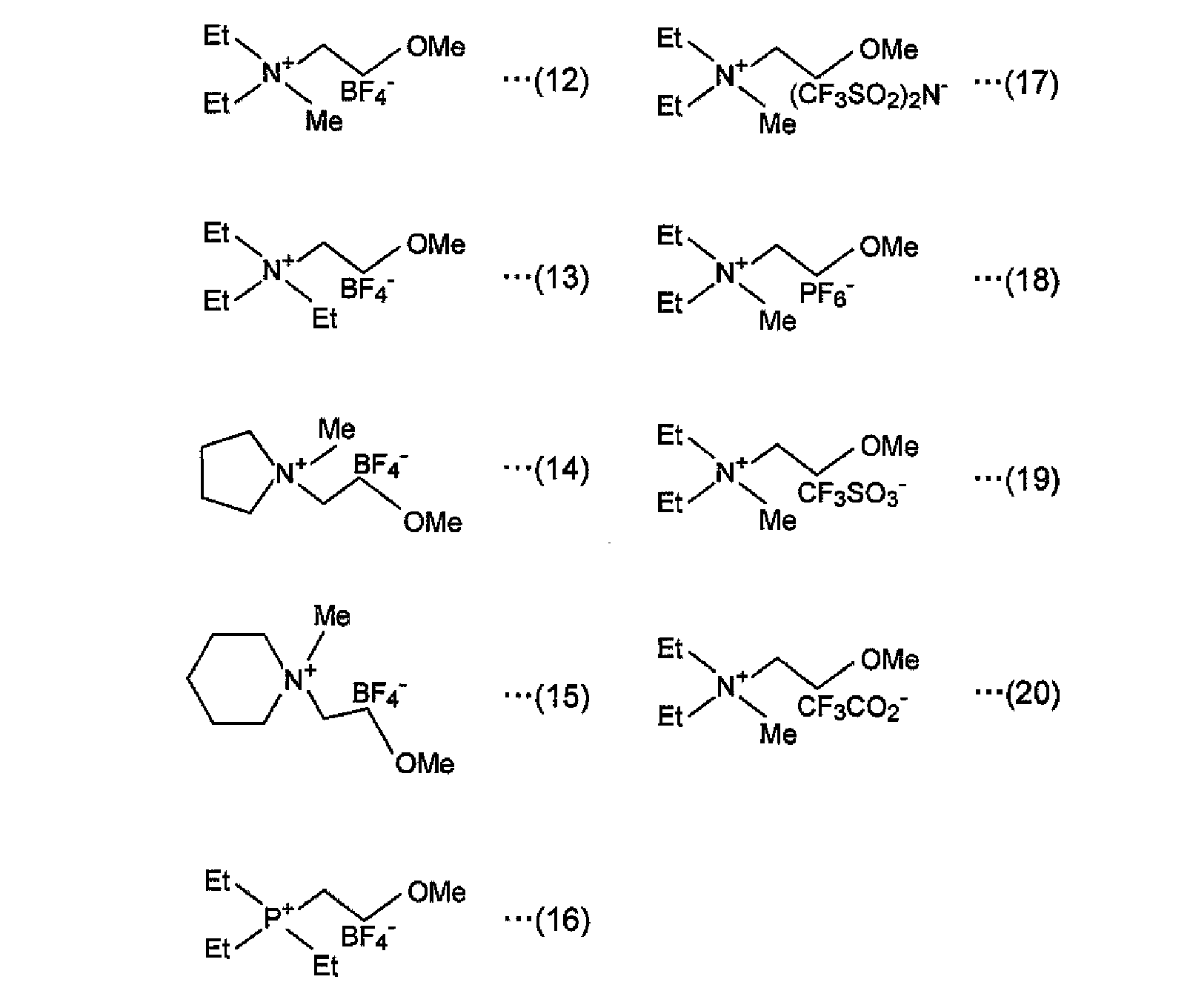
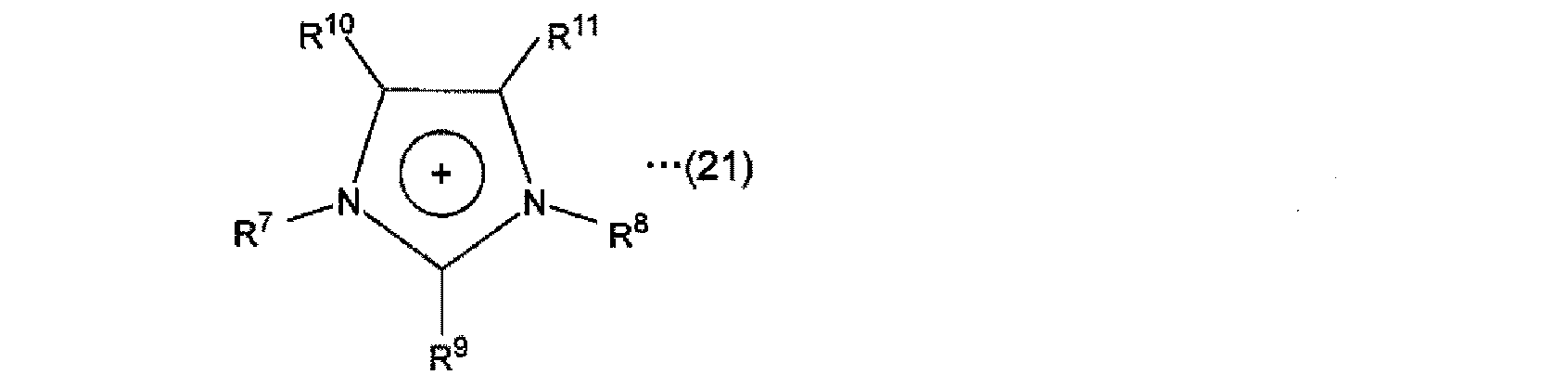
下記式(22)~(27)に示すその他の芳香族系カチオンを含むイオン液体等が好ましい。

SRT材料は、圧縮弾性率が1MPa以上であり、摩擦係数(μ)が0.1以下である。
SRT材料は、圧縮弾性率が1MPa程度以上である。圧縮弾性率は10MPa程度以上がより好ましい。
SRT材料は、厚膜化CPB及びCPB効果を発現する成分からなる群から選ばれる少なくとも一種の成分を含むことが好ましい
厚膜化CPBは、前記SRT材料(潤滑材)に含まれる厚膜化CPBを採用することができる。


より求められる。


Au、Ag、Pt、Pd等の貴金属;
Ti、Zr、Ta、Sn、Zn、Cu、V、Sb、In、Hf、Y、Ce、Sc、La、Eu、Ni、Co、Fe等の遷移金属、それらの酸化物又は窒化物等の無機物質;或いは
ポリマー等の有機物質が好ましい。
ポリマーブラシ(Polymer brush)は、あらゆる表面の特性制御に有用な方法として、注目されている。
これまで、適切な溶剤中で膨潤されたCPBは、優れた潤滑性、圧縮の程度に依存しない超低摩擦性(compression-independent ultra-low frictional force)を示し、よって10-4という低い摩擦係数(frictional coefficient、(μ))を与える。
しかしながら、従来のLRPsで合成されたCPBの厚みは、ラジカル停止反応等のために100nm程度未満に限定され、時折マイクロメーターサイズの硬い粒子が混入すると、潤滑材においてアブレシブ摩耗(abrasive wear)の原因となることがある。
今回、高圧下で原子移動ラジカル重合(ATRP、LRPsの一方法)を行い、ポリ(メチルメタクリレート)(PMMA)のCPBを合成し、CPBの厚みをマイクロメーターレベルにまで劇的に厚くすることができた(厚膜化CPB)。
(1) PMMAブラシ(厚膜化CPB)の合成
メチルメタクリレート(MMA)のATRP用反応液を下記文献に記載の方法で作成した。シリコン基板(silicon wafer)及びガラスディスク(glass discs)上で、表面開始リビングラジカル重合(SI-ATRP)を60°C、500MPaで行った。
重合終了後、サンプルを取り出して、ゲル浸透クロマトグラフィー及び偏光解析法(ellipsometry)により、分子量とCPB層の乾燥膜厚(グラフト量)を分析した。
シリコン基板及びシリカ粒子(半径:5 μm)上で合成されたPMMAのCPBを用いて、そのミクロスケールの摩擦特性を、原子間力顕微鏡(AFM)コロイドプローブ法で測定した。ガラスディスク及びレンズ(直径:10 mm、曲率半径: 7.79 mm)上にグラフトされた同様のサンプルを用いて、そのマクロスケールの摩擦特性を、トライボ試験機を用いて測定した 。
ナノインデンテーション法、或いはAFMコロイドプローブ法により圧縮弾性率を求めた。
ひずみ速度:毎秒0.2%
加振周波数:100 Hz
加振振幅:2 nm
表面検知閾値:50 N/m
AFMコロイドプローブ法では、AFMカンチレバーの先端に、直径10μmのシリカプローブ粒子を固定し、JPK instruments社製AFM、或いはセイコーインスツルメント社製AFMを用いて、シリコン基板上に形成した厚膜化CPBs(例:厚膜化PMMAブラシ)に対するフォースカーブ測定を行った。

PMMAブラシは、Cu(I)Br及びCu(II)Br2錯体の存在下、60℃、500MPaの高圧でSI-ATRPを行うことにより合成された。
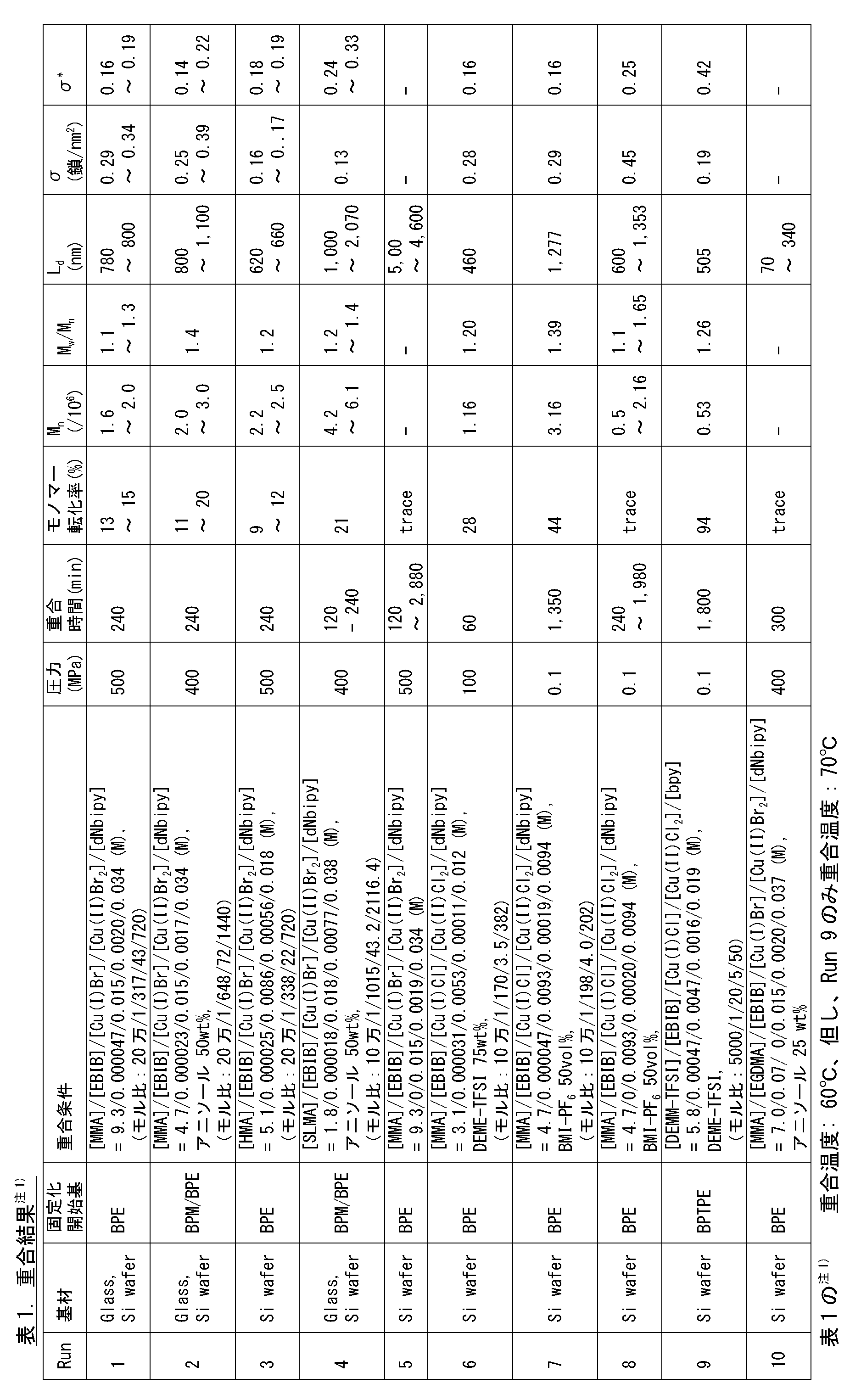
図16に、ストライベック曲線を取得するためのトライボ試験機(Bruker UMT TriboLab)によるボールオンディスク試験の模式図を示す。
図22に、ナノインデンテーション法により得た、イオン液体(DEME-TFSI)中における厚膜化PMMAブラシの圧縮弾性率の計測結果を示す。
架橋ブラシは、架橋剤(ジビニルモノマー)を添加して表面開始ATRP法により合成した。重合にあたり、架橋剤添加による重合阻害は起こっていないことを確認した。
高圧下において、ATRPを採用することにより、非常に厚いPMMAのCPB(厚膜化CPB)を合成することに成功した。合成されたPMMAブラシ(厚膜化PMMA-CPB)の厚みは、マイクロメーターレベルにまで達した。
本発明の厚膜化CPBを含むSRT材料(潤滑材)は、軸受用途、シール用途やガイド(案内機構)用途として、SRT材料を提供することができる。この厚膜化CPBを含む技術は、柔軟性(押し込み量及び圧縮弾性率が大きい)と超低摩擦性(摩擦係数が小さい)とを備えた摺動部材に繋がる(図2)。
Claims (8)
- 厚膜化ポリマーブラシを含むSRT材料。
- 前記SRT材料が摺動機構用である請求項1のSRT材料。
- 前記厚膜化ポリマーブラシが500nm以上に厚膜化されており、分子量分布指数が1.5以下の厚膜化ポリマーブラシである、請求項1又は2に記載のSRT材料。
- 押し込み量が100nm以上、圧縮弾性率が1MPa以上である、請求項1~3のいずれかに記載のSRT材料。
- 前記厚膜化ポリマーブラシが架橋構造を有する、請求項1~4のいずれかに記載のSRT材料。
- 潤滑液を含み、摩擦係数(μ)が0.1以下である、請求項1~5のいずれかに記載のSRT材料。
- 圧縮弾性率が1MPa以上であり、摩擦係数(μ)が0.1以下であるSRT材料。
- 厚膜化ポリマーブラシ及び濃厚ポリマーブラシ効果を発現する成分からなる群から選ばれる少なくとも一種の成分を含む、請求項7に記載のSRT材料。
Priority Applications (4)
| Application Number | Priority Date | Filing Date | Title |
|---|---|---|---|
| JP2018509698A JP7002080B2 (ja) | 2016-03-31 | 2017-03-31 | 潤滑材及びsrt材料 |
| EP17775602.0A EP3438231B1 (en) | 2016-03-31 | 2017-03-31 | Material for slide mechanisms comprising a polymer brush |
| US16/089,520 US20190119596A1 (en) | 2016-03-31 | 2017-03-31 | Lubricant and srt material |
| CN201780020779.5A CN109415643A (zh) | 2016-03-31 | 2017-03-31 | 润滑材料及srt材料 |
Applications Claiming Priority (2)
| Application Number | Priority Date | Filing Date | Title |
|---|---|---|---|
| JP2016-073586 | 2016-03-31 | ||
| JP2016073586 | 2016-03-31 |
Publications (1)
| Publication Number | Publication Date |
|---|---|
| WO2017171071A1 true WO2017171071A1 (ja) | 2017-10-05 |
Family
ID=59964894
Family Applications (1)
| Application Number | Title | Priority Date | Filing Date |
|---|---|---|---|
| PCT/JP2017/013786 Ceased WO2017171071A1 (ja) | 2016-03-31 | 2017-03-31 | 潤滑材及びsrt材料 |
Country Status (5)
| Country | Link |
|---|---|
| US (1) | US20190119596A1 (ja) |
| EP (1) | EP3438231B1 (ja) |
| JP (1) | JP7002080B2 (ja) |
| CN (1) | CN109415643A (ja) |
| WO (1) | WO2017171071A1 (ja) |
Cited By (15)
| Publication number | Priority date | Publication date | Assignee | Title |
|---|---|---|---|---|
| WO2018199181A1 (ja) * | 2017-04-25 | 2018-11-01 | 国立大学法人京都大学 | 隙間狭小化材、隙間狭小化材複合体およびそれらを用いた物品 |
| WO2018225693A1 (ja) * | 2017-06-06 | 2018-12-13 | 独立行政法人国立高等専門学校機構 | ポリマーブラシ層の形成方法 |
| JP2020507495A (ja) * | 2017-02-20 | 2020-03-12 | ザ ジレット カンパニー リミテッド ライアビリティ カンパニーThe Gillette Company Llc | ポリマー層を含む物品 |
| WO2020059368A1 (ja) * | 2018-09-19 | 2020-03-26 | 大日精化工業株式会社 | ポリマーの製造方法及び表面改質基材の製造方法 |
| JP2020070796A (ja) * | 2018-11-02 | 2020-05-07 | 東芝キヤリア株式会社 | 圧縮機及び冷凍サイクル装置 |
| JP2020105460A (ja) * | 2018-12-28 | 2020-07-09 | 日清紡ホールディングス株式会社 | 複合材料 |
| WO2020166128A1 (ja) * | 2019-02-13 | 2020-08-20 | 大日精化工業株式会社 | 表面処理膜、その製造方法、及び物品 |
| WO2021065621A1 (ja) | 2019-09-30 | 2021-04-08 | 日清紡ホールディングス株式会社 | 複合材料 |
| JP2021130828A (ja) * | 2018-09-19 | 2021-09-09 | 大日精化工業株式会社 | 表面改質基材の製造方法及び検査方法 |
| JP2022108284A (ja) * | 2015-12-30 | 2022-07-25 | スーパーダイエレクトリクス リミテッド | 電気活性親水性バイオポリマー |
| JP2023047807A (ja) * | 2021-09-27 | 2023-04-06 | 大日精化工業株式会社 | 成形物、成形物の製造方法、及び物品 |
| JP2023047809A (ja) * | 2021-09-27 | 2023-04-06 | 大日精化工業株式会社 | 親水化膜の製造方法及び表面親水化基材 |
| JP2023047808A (ja) * | 2021-09-27 | 2023-04-06 | 大日精化工業株式会社 | 表面処理膜の製造方法 |
| CN116157422A (zh) * | 2020-08-06 | 2023-05-23 | 大日精化工业株式会社 | 表面处理膜及其制造方法和物品 |
| US11912952B2 (en) | 2019-12-09 | 2024-02-27 | Kyoto University | Material and sliding system |
Families Citing this family (2)
| Publication number | Priority date | Publication date | Assignee | Title |
|---|---|---|---|---|
| DE102019218117A1 (de) * | 2019-11-25 | 2021-05-27 | Zf Friedrichshafen Ag | Selbstheilendes Gleitlager |
| CN114231342B (zh) * | 2021-12-22 | 2022-08-05 | 金陵科技学院 | 一种含多元有机/无机杂化添加剂自修复润滑油 |
Citations (6)
| Publication number | Priority date | Publication date | Assignee | Title |
|---|---|---|---|---|
| JP2001082543A (ja) * | 1999-07-09 | 2001-03-27 | Nippon Pillar Packing Co Ltd | 免震滑り支承 |
| JP2012056165A (ja) * | 2010-09-08 | 2012-03-22 | Toyota Motor Corp | 摺動部材 |
| JP2013144740A (ja) * | 2012-01-13 | 2013-07-25 | Toyota Motor Corp | 摺動部材 |
| JP2014514583A (ja) * | 2011-05-09 | 2014-06-19 | ザ・スウォッチ・グループ・リサーチ・アンド・ディベロップメント・リミテッド | 油相溶性ポリマーブラシによる潤滑 |
| JP2014145401A (ja) * | 2013-01-28 | 2014-08-14 | Toyota Motor Corp | 摺動部材および摺動構造 |
| JP2014169787A (ja) * | 2013-02-07 | 2014-09-18 | Institute Of National Colleges Of Technology Japan | 摺動機構および摺動部材 |
Family Cites Families (9)
| Publication number | Priority date | Publication date | Assignee | Title |
|---|---|---|---|---|
| EP1754731A1 (en) * | 2005-08-16 | 2007-02-21 | Nederlandse Organisatie voor Toegepast-Natuuurwetenschappelijk Onderzoek TNO | Method of modifying materials surfaces |
| AU2010339654B2 (en) * | 2009-12-21 | 2014-07-17 | Innovative Surface Technologies, Inc. | Coating agents and coated articles |
| HK1206775A1 (en) * | 2012-07-10 | 2016-01-15 | The Swatch Group Research And Development Ltd. | Surface lubrication of an article |
| JP6063167B2 (ja) * | 2012-08-02 | 2017-01-18 | 住友ゴム工業株式会社 | 表面改質方法及び表面改質弾性体 |
| JP5620456B2 (ja) * | 2012-11-20 | 2014-11-05 | 住友ゴム工業株式会社 | 表面改質方法及び表面改質弾性体 |
| US10106699B2 (en) * | 2013-02-20 | 2018-10-23 | Wisconsin Alumni Research Foundation | Inimer-containing random copolymers and crosslinked copolymer films for dense polymer brush growth |
| JP5797239B2 (ja) * | 2013-06-11 | 2015-10-21 | 住友ゴム工業株式会社 | 立体形状物の表面改質方法及び注射器用ガスケット |
| US10647829B2 (en) * | 2013-06-20 | 2020-05-12 | Sumitomo Rubber Industries, Ltd. | Surface modification method and surface modification body |
| US9982105B2 (en) * | 2014-09-18 | 2018-05-29 | Sumitomo Rubber Industries, Ltd. | Surface modification method and surface-modified elastic body |
-
2017
- 2017-03-31 WO PCT/JP2017/013786 patent/WO2017171071A1/ja not_active Ceased
- 2017-03-31 EP EP17775602.0A patent/EP3438231B1/en active Active
- 2017-03-31 US US16/089,520 patent/US20190119596A1/en not_active Abandoned
- 2017-03-31 CN CN201780020779.5A patent/CN109415643A/zh active Pending
- 2017-03-31 JP JP2018509698A patent/JP7002080B2/ja active Active
Patent Citations (6)
| Publication number | Priority date | Publication date | Assignee | Title |
|---|---|---|---|---|
| JP2001082543A (ja) * | 1999-07-09 | 2001-03-27 | Nippon Pillar Packing Co Ltd | 免震滑り支承 |
| JP2012056165A (ja) * | 2010-09-08 | 2012-03-22 | Toyota Motor Corp | 摺動部材 |
| JP2014514583A (ja) * | 2011-05-09 | 2014-06-19 | ザ・スウォッチ・グループ・リサーチ・アンド・ディベロップメント・リミテッド | 油相溶性ポリマーブラシによる潤滑 |
| JP2013144740A (ja) * | 2012-01-13 | 2013-07-25 | Toyota Motor Corp | 摺動部材 |
| JP2014145401A (ja) * | 2013-01-28 | 2014-08-14 | Toyota Motor Corp | 摺動部材および摺動構造 |
| JP2014169787A (ja) * | 2013-02-07 | 2014-09-18 | Institute Of National Colleges Of Technology Japan | 摺動機構および摺動部材 |
Non-Patent Citations (1)
| Title |
|---|
| See also references of EP3438231A4 * |
Cited By (35)
| Publication number | Priority date | Publication date | Assignee | Title |
|---|---|---|---|---|
| JP2022108284A (ja) * | 2015-12-30 | 2022-07-25 | スーパーダイエレクトリクス リミテッド | 電気活性親水性バイオポリマー |
| JP7385694B2 (ja) | 2015-12-30 | 2023-11-22 | スーパーダイエレクトリクス リミテッド | 電気活性親水性バイオポリマー |
| JP2020507495A (ja) * | 2017-02-20 | 2020-03-12 | ザ ジレット カンパニー リミテッド ライアビリティ カンパニーThe Gillette Company Llc | ポリマー層を含む物品 |
| WO2018199181A1 (ja) * | 2017-04-25 | 2018-11-01 | 国立大学法人京都大学 | 隙間狭小化材、隙間狭小化材複合体およびそれらを用いた物品 |
| US11168170B2 (en) | 2017-04-25 | 2021-11-09 | Kyoto University | Clearance narrowing material, clearance narrowing material composite, and article using same |
| WO2018225693A1 (ja) * | 2017-06-06 | 2018-12-13 | 独立行政法人国立高等専門学校機構 | ポリマーブラシ層の形成方法 |
| JP7223375B2 (ja) | 2017-06-06 | 2023-02-16 | 独立行政法人国立高等専門学校機構 | ポリマーブラシ層の形成方法 |
| JPWO2018225693A1 (ja) * | 2017-06-06 | 2020-07-16 | 独立行政法人国立高等専門学校機構 | ポリマーブラシ層の形成方法 |
| JP2020045427A (ja) * | 2018-09-19 | 2020-03-26 | 大日精化工業株式会社 | ポリマーの製造方法及び表面改質基材の製造方法 |
| TWI812781B (zh) * | 2018-09-19 | 2023-08-21 | 日商大日精化工業股份有限公司 | 表面改質基材之製造方法 |
| JP2021130828A (ja) * | 2018-09-19 | 2021-09-09 | 大日精化工業株式会社 | 表面改質基材の製造方法及び検査方法 |
| JP7213503B2 (ja) | 2018-09-19 | 2023-01-27 | 大日精化工業株式会社 | 表面改質基材の検査方法 |
| JP7048943B2 (ja) | 2018-09-19 | 2022-04-06 | 大日精化工業株式会社 | 表面改質基材の製造方法 |
| WO2020059368A1 (ja) * | 2018-09-19 | 2020-03-26 | 大日精化工業株式会社 | ポリマーの製造方法及び表面改質基材の製造方法 |
| JP2020070796A (ja) * | 2018-11-02 | 2020-05-07 | 東芝キヤリア株式会社 | 圧縮機及び冷凍サイクル装置 |
| JP7190693B2 (ja) | 2018-11-02 | 2022-12-16 | 東芝キヤリア株式会社 | 圧縮機及び冷凍サイクル装置 |
| JP2020105460A (ja) * | 2018-12-28 | 2020-07-09 | 日清紡ホールディングス株式会社 | 複合材料 |
| JP7232045B2 (ja) | 2018-12-28 | 2023-03-02 | 日清紡ホールディングス株式会社 | 複合材料 |
| WO2020166128A1 (ja) * | 2019-02-13 | 2020-08-20 | 大日精化工業株式会社 | 表面処理膜、その製造方法、及び物品 |
| JP7048946B2 (ja) | 2019-02-13 | 2022-04-06 | 大日精化工業株式会社 | 表面処理膜、その製造方法、及び物品 |
| JP2020132671A (ja) * | 2019-02-13 | 2020-08-31 | 大日精化工業株式会社 | 表面処理膜、その製造方法、及び物品 |
| TWI813817B (zh) * | 2019-02-13 | 2023-09-01 | 日商大日精化工業股份有限公司 | 表面處理膜、其製造方法及物品 |
| US11739284B2 (en) | 2019-09-30 | 2023-08-29 | Nisshinbo Holdings Inc. | Composite material |
| JP2021054927A (ja) * | 2019-09-30 | 2021-04-08 | 日清紡ホールディングス株式会社 | 複合材料 |
| WO2021065621A1 (ja) | 2019-09-30 | 2021-04-08 | 日清紡ホールディングス株式会社 | 複合材料 |
| JP7333239B2 (ja) | 2019-09-30 | 2023-08-24 | 日清紡ホールディングス株式会社 | 複合材料 |
| US11912952B2 (en) | 2019-12-09 | 2024-02-27 | Kyoto University | Material and sliding system |
| EP4194204A4 (en) * | 2020-08-06 | 2024-03-20 | Dainichiseika Color & Chemicals Mfg. Co., Ltd. | SURFACE TREATMENT FILM, PRODUCTION METHOD THEREOF AND ARTICLES |
| CN116157422A (zh) * | 2020-08-06 | 2023-05-23 | 大日精化工业株式会社 | 表面处理膜及其制造方法和物品 |
| JP2023047808A (ja) * | 2021-09-27 | 2023-04-06 | 大日精化工業株式会社 | 表面処理膜の製造方法 |
| JP2023047809A (ja) * | 2021-09-27 | 2023-04-06 | 大日精化工業株式会社 | 親水化膜の製造方法及び表面親水化基材 |
| JP2023047807A (ja) * | 2021-09-27 | 2023-04-06 | 大日精化工業株式会社 | 成形物、成形物の製造方法、及び物品 |
| JP7605435B2 (ja) | 2021-09-27 | 2024-12-24 | 大日精化工業株式会社 | 親水化膜の製造方法及び表面親水化基材 |
| JP7626397B2 (ja) | 2021-09-27 | 2025-02-04 | 大日精化工業株式会社 | 成形物、成形物の製造方法、及び物品 |
| JP7656298B2 (ja) | 2021-09-27 | 2025-04-03 | 大日精化工業株式会社 | 表面処理膜の製造方法 |
Also Published As
| Publication number | Publication date |
|---|---|
| JPWO2017171071A1 (ja) | 2019-02-21 |
| CN109415643A (zh) | 2019-03-01 |
| EP3438231A1 (en) | 2019-02-06 |
| EP3438231B1 (en) | 2023-08-02 |
| EP3438231A4 (en) | 2019-12-11 |
| JP7002080B2 (ja) | 2022-02-04 |
| US20190119596A1 (en) | 2019-04-25 |
Similar Documents
| Publication | Publication Date | Title |
|---|---|---|
| JP7002080B2 (ja) | 潤滑材及びsrt材料 | |
| Terayama et al. | Well-defined poly (sulfobetaine) brushes prepared by surface-initiated ATRP using a fluoroalcohol and ionic liquids as the solvents | |
| Kobayashi et al. | Polyelectrolyte brushes: a novel stable lubrication system in aqueous conditions | |
| De Beer et al. | Solvent-induced immiscibility of polymer brushes eliminates dissipation channels | |
| Zhang et al. | Effect of brush thickness and solvent composition on the friction force response of poly (2-(methacryloyloxy) ethylphosphorylcholine) brushes | |
| JP7246597B2 (ja) | 隙間狭小化材、隙間狭小化材複合体およびそれらを用いた物品 | |
| Kobayashi et al. | Direct synthesis of well-defined poly [{2-(methacryloyloxy) ethyl} trimethylammonium chloride] brush via surface-initiated atom transfer radical polymerization in fluoroalcohol | |
| JP2006316169A (ja) | 固形潤滑材 | |
| CN103492540B (zh) | 用油相容性聚合物刷润滑 | |
| US10882962B2 (en) | SRT material, composite and method for producing the same | |
| Ishikawa et al. | Macroscopic frictional properties of poly (1-(2-methacryloyloxy) ethyl-3-butyl imidazolium bis (trifluoromethanesulfonyl)-imide) brush surfaces in an ionic liquid | |
| Kobayashi et al. | Interferometry study of aqueous lubrication on the surface of polyelectrolyte brush | |
| Zhang et al. | Nanoscale contact mechanics of biocompatible polyzwitterionic brushes | |
| Hsu et al. | Controlled synthesis of concentrated polymer brushes with ultralarge thickness by surface-initiated atom transfer radical polymerization under high pressure | |
| Kobayashi et al. | Tribological properties of cross-linked oleophilic polymer brushes on diamond-like carbon films | |
| Burgess et al. | Surface-grafted poly (ionic liquid) that lubricates in both non-polar and polar solvents | |
| WO2021117537A1 (ja) | 防曇、水滴付着抑制、着氷抑制または氷核形成抑制用の部材 | |
| JP7586435B2 (ja) | 材料および摺動システム | |
| Røn et al. | Aqueous lubricating properties of charged (ABC) and neutral (ABA) triblock copolymer chains | |
| Mizukami et al. | Dynamics of lubricious, concentrated PMMA brush layers studied by surface forces and resonance shear measurements | |
| Liu et al. | Polymerization-induced self-assembled micelles in oil as lubricant additives with enhanced tribological properties | |
| US20190002787A1 (en) | Hyper-branched macromolecular architectures and methods of use | |
| WO2024053649A1 (ja) | 氷核形成抑制または着雪氷抑制用の部材 | |
| Zhang et al. | The electrostatic self‐assembly of microgels on polymer brushes and its effects on interfacial friction | |
| JP2015067709A (ja) | (メタ)アクリレート系グラフトポリマー及びその製造方法 |
Legal Events
| Date | Code | Title | Description |
|---|---|---|---|
| WWE | Wipo information: entry into national phase |
Ref document number: 2018509698 Country of ref document: JP |
|
| NENP | Non-entry into the national phase |
Ref country code: DE |
|
| WWE | Wipo information: entry into national phase |
Ref document number: 2017775602 Country of ref document: EP |
|
| ENP | Entry into the national phase |
Ref document number: 2017775602 Country of ref document: EP Effective date: 20181031 |
|
| 121 | Ep: the epo has been informed by wipo that ep was designated in this application |
Ref document number: 17775602 Country of ref document: EP Kind code of ref document: A1 |