WO2017171341A2 - 친수성 폴리우레탄 나노섬유 및 그의 제조방법 - Google Patents
친수성 폴리우레탄 나노섬유 및 그의 제조방법 Download PDFInfo
- Publication number
- WO2017171341A2 WO2017171341A2 PCT/KR2017/003298 KR2017003298W WO2017171341A2 WO 2017171341 A2 WO2017171341 A2 WO 2017171341A2 KR 2017003298 W KR2017003298 W KR 2017003298W WO 2017171341 A2 WO2017171341 A2 WO 2017171341A2
- Authority
- WO
- WIPO (PCT)
- Prior art keywords
- nanofibers
- pva
- hydrophilic polymer
- water
- hydrophilic
- Prior art date
- Legal status (The legal status is an assumption and is not a legal conclusion. Google has not performed a legal analysis and makes no representation as to the accuracy of the status listed.)
- Ceased
Links
Images




Classifications
-
- A—HUMAN NECESSITIES
- A61—MEDICAL OR VETERINARY SCIENCE; HYGIENE
- A61F—FILTERS IMPLANTABLE INTO BLOOD VESSELS; PROSTHESES; DEVICES PROVIDING PATENCY TO, OR PREVENTING COLLAPSING OF, TUBULAR STRUCTURES OF THE BODY, e.g. STENTS; ORTHOPAEDIC, NURSING OR CONTRACEPTIVE DEVICES; FOMENTATION; TREATMENT OR PROTECTION OF EYES OR EARS; BANDAGES, DRESSINGS OR ABSORBENT PADS; FIRST-AID KITS
- A61F13/00—Bandages or dressings; Absorbent pads
- A61F13/01—Non-adhesive bandages or dressings
- A61F13/01008—Non-adhesive bandages or dressings characterised by the material
- A61F13/01017—Non-adhesive bandages or dressings characterised by the material synthetic, e.g. polymer based
-
- A—HUMAN NECESSITIES
- A61—MEDICAL OR VETERINARY SCIENCE; HYGIENE
- A61F—FILTERS IMPLANTABLE INTO BLOOD VESSELS; PROSTHESES; DEVICES PROVIDING PATENCY TO, OR PREVENTING COLLAPSING OF, TUBULAR STRUCTURES OF THE BODY, e.g. STENTS; ORTHOPAEDIC, NURSING OR CONTRACEPTIVE DEVICES; FOMENTATION; TREATMENT OR PROTECTION OF EYES OR EARS; BANDAGES, DRESSINGS OR ABSORBENT PADS; FIRST-AID KITS
- A61F13/00—Bandages or dressings; Absorbent pads
- A61F13/02—Adhesive bandages or dressings
-
- A—HUMAN NECESSITIES
- A61—MEDICAL OR VETERINARY SCIENCE; HYGIENE
- A61L—METHODS OR APPARATUS FOR STERILISING MATERIALS OR OBJECTS IN GENERAL; DISINFECTION, STERILISATION OR DEODORISATION OF AIR; CHEMICAL ASPECTS OF BANDAGES, DRESSINGS, ABSORBENT PADS OR SURGICAL ARTICLES; MATERIALS FOR BANDAGES, DRESSINGS, ABSORBENT PADS OR SURGICAL ARTICLES
- A61L15/00—Chemical aspects of, or use of materials for, bandages, dressings or absorbent pads
- A61L15/16—Bandages, dressings or absorbent pads for physiological fluids such as urine or blood, e.g. sanitary towels, tampons
- A61L15/22—Bandages, dressings or absorbent pads for physiological fluids such as urine or blood, e.g. sanitary towels, tampons containing macromolecular materials
-
- A—HUMAN NECESSITIES
- A61—MEDICAL OR VETERINARY SCIENCE; HYGIENE
- A61L—METHODS OR APPARATUS FOR STERILISING MATERIALS OR OBJECTS IN GENERAL; DISINFECTION, STERILISATION OR DEODORISATION OF AIR; CHEMICAL ASPECTS OF BANDAGES, DRESSINGS, ABSORBENT PADS OR SURGICAL ARTICLES; MATERIALS FOR BANDAGES, DRESSINGS, ABSORBENT PADS OR SURGICAL ARTICLES
- A61L15/00—Chemical aspects of, or use of materials for, bandages, dressings or absorbent pads
- A61L15/16—Bandages, dressings or absorbent pads for physiological fluids such as urine or blood, e.g. sanitary towels, tampons
- A61L15/22—Bandages, dressings or absorbent pads for physiological fluids such as urine or blood, e.g. sanitary towels, tampons containing macromolecular materials
- A61L15/26—Macromolecular compounds obtained otherwise than by reactions only involving carbon-to-carbon unsaturated bonds; Derivatives thereof
-
- A—HUMAN NECESSITIES
- A61—MEDICAL OR VETERINARY SCIENCE; HYGIENE
- A61M—DEVICES FOR INTRODUCING MEDIA INTO, OR ONTO, THE BODY; DEVICES FOR TRANSDUCING BODY MEDIA OR FOR TAKING MEDIA FROM THE BODY; DEVICES FOR PRODUCING OR ENDING SLEEP OR STUPOR
- A61M1/00—Suction or pumping devices for medical purposes; Devices for carrying-off, for treatment of, or for carrying-over, body-liquids; Drainage systems
- A61M1/02—Blood transfusion apparatus
-
- A—HUMAN NECESSITIES
- A61—MEDICAL OR VETERINARY SCIENCE; HYGIENE
- A61M—DEVICES FOR INTRODUCING MEDIA INTO, OR ONTO, THE BODY; DEVICES FOR TRANSDUCING BODY MEDIA OR FOR TAKING MEDIA FROM THE BODY; DEVICES FOR PRODUCING OR ENDING SLEEP OR STUPOR
- A61M1/00—Suction or pumping devices for medical purposes; Devices for carrying-off, for treatment of, or for carrying-over, body-liquids; Drainage systems
- A61M1/02—Blood transfusion apparatus
- A61M1/0281—Apparatus for treatment of blood or blood constituents prior to transfusion, e.g. washing, filtering or thawing
-
- B—PERFORMING OPERATIONS; TRANSPORTING
- B01—PHYSICAL OR CHEMICAL PROCESSES OR APPARATUS IN GENERAL
- B01D—SEPARATION
- B01D39/00—Filtering material for liquid or gaseous fluids
- B01D39/14—Other self-supporting filtering material ; Other filtering material
- B01D39/16—Other self-supporting filtering material ; Other filtering material of organic material, e.g. synthetic fibres
-
- B—PERFORMING OPERATIONS; TRANSPORTING
- B01—PHYSICAL OR CHEMICAL PROCESSES OR APPARATUS IN GENERAL
- B01D—SEPARATION
- B01D39/00—Filtering material for liquid or gaseous fluids
- B01D39/14—Other self-supporting filtering material ; Other filtering material
- B01D39/16—Other self-supporting filtering material ; Other filtering material of organic material, e.g. synthetic fibres
- B01D39/1607—Other self-supporting filtering material ; Other filtering material of organic material, e.g. synthetic fibres the material being fibrous
- B01D39/1623—Other self-supporting filtering material ; Other filtering material of organic material, e.g. synthetic fibres the material being fibrous of synthetic origin
-
- D—TEXTILES; PAPER
- D01—NATURAL OR MAN-MADE THREADS OR FIBRES; SPINNING
- D01D—MECHANICAL METHODS OR APPARATUS IN THE MANUFACTURE OF ARTIFICIAL FILAMENTS, THREADS, FIBRES, BRISTLES OR RIBBONS
- D01D5/00—Formation of filaments, threads, or the like
- D01D5/0007—Electro-spinning
-
- D—TEXTILES; PAPER
- D01—NATURAL OR MAN-MADE THREADS OR FIBRES; SPINNING
- D01D—MECHANICAL METHODS OR APPARATUS IN THE MANUFACTURE OF ARTIFICIAL FILAMENTS, THREADS, FIBRES, BRISTLES OR RIBBONS
- D01D5/00—Formation of filaments, threads, or the like
- D01D5/0007—Electro-spinning
- D01D5/0015—Electro-spinning characterised by the initial state of the material
- D01D5/003—Electro-spinning characterised by the initial state of the material the material being a polymer solution or dispersion
-
- D—TEXTILES; PAPER
- D01—NATURAL OR MAN-MADE THREADS OR FIBRES; SPINNING
- D01D—MECHANICAL METHODS OR APPARATUS IN THE MANUFACTURE OF ARTIFICIAL FILAMENTS, THREADS, FIBRES, BRISTLES OR RIBBONS
- D01D5/00—Formation of filaments, threads, or the like
- D01D5/0007—Electro-spinning
- D01D5/0061—Electro-spinning characterised by the electro-spinning apparatus
-
- D—TEXTILES; PAPER
- D01—NATURAL OR MAN-MADE THREADS OR FIBRES; SPINNING
- D01D—MECHANICAL METHODS OR APPARATUS IN THE MANUFACTURE OF ARTIFICIAL FILAMENTS, THREADS, FIBRES, BRISTLES OR RIBBONS
- D01D5/00—Formation of filaments, threads, or the like
- D01D5/28—Formation of filaments, threads, or the like while mixing different spinning solutions or melts during the spinning operation; Spinnerette packs therefor
- D01D5/30—Conjugate filaments; Spinnerette packs therefor
- D01D5/34—Core-skin structure; Spinnerette packs therefor
-
- D—TEXTILES; PAPER
- D01—NATURAL OR MAN-MADE THREADS OR FIBRES; SPINNING
- D01F—CHEMICAL FEATURES IN THE MANUFACTURE OF ARTIFICIAL FILAMENTS, THREADS, FIBRES, BRISTLES OR RIBBONS; APPARATUS SPECIALLY ADAPTED FOR THE MANUFACTURE OF CARBON FILAMENTS
- D01F8/00—Conjugated, i.e. bi- or multicomponent, artificial filaments or the like; Manufacture thereof
- D01F8/04—Conjugated, i.e. bi- or multicomponent, artificial filaments or the like; Manufacture thereof from synthetic polymers
- D01F8/10—Conjugated, i.e. bi- or multicomponent, artificial filaments or the like; Manufacture thereof from synthetic polymers with at least one other macromolecular compound obtained by reactions only involving carbon-to-carbon unsaturated bonds as constituent
-
- D—TEXTILES; PAPER
- D01—NATURAL OR MAN-MADE THREADS OR FIBRES; SPINNING
- D01F—CHEMICAL FEATURES IN THE MANUFACTURE OF ARTIFICIAL FILAMENTS, THREADS, FIBRES, BRISTLES OR RIBBONS; APPARATUS SPECIALLY ADAPTED FOR THE MANUFACTURE OF CARBON FILAMENTS
- D01F8/00—Conjugated, i.e. bi- or multicomponent, artificial filaments or the like; Manufacture thereof
- D01F8/04—Conjugated, i.e. bi- or multicomponent, artificial filaments or the like; Manufacture thereof from synthetic polymers
- D01F8/16—Conjugated, i.e. bi- or multicomponent, artificial filaments or the like; Manufacture thereof from synthetic polymers with at least one other macromolecular compound obtained otherwise than by reactions only involving carbon-to-carbon unsaturated bonds as constituent
-
- D—TEXTILES; PAPER
- D04—BRAIDING; LACE-MAKING; KNITTING; TRIMMINGS; NON-WOVEN FABRICS
- D04H—MAKING TEXTILE FABRICS, e.g. FROM FIBRES OR FILAMENTARY MATERIAL; FABRICS MADE BY SUCH PROCESSES OR APPARATUS, e.g. FELTS, NON-WOVEN FABRICS; COTTON-WOOL; WADDING ; NON-WOVEN FABRICS FROM STAPLE FIBRES, FILAMENTS OR YARNS, BONDED WITH AT LEAST ONE WEB-LIKE MATERIAL DURING THEIR CONSOLIDATION
- D04H1/00—Non-woven fabrics formed wholly or mainly of staple fibres or like relatively short fibres
- D04H1/40—Non-woven fabrics formed wholly or mainly of staple fibres or like relatively short fibres from fleeces or layers composed of fibres without existing or potential cohesive properties
- D04H1/42—Non-woven fabrics formed wholly or mainly of staple fibres or like relatively short fibres from fleeces or layers composed of fibres without existing or potential cohesive properties characterised by the use of certain kinds of fibres insofar as this use has no preponderant influence on the consolidation of the fleece
- D04H1/4326—Condensation or reaction polymers
- D04H1/4358—Polyurethanes
-
- D—TEXTILES; PAPER
- D04—BRAIDING; LACE-MAKING; KNITTING; TRIMMINGS; NON-WOVEN FABRICS
- D04H—MAKING TEXTILE FABRICS, e.g. FROM FIBRES OR FILAMENTARY MATERIAL; FABRICS MADE BY SUCH PROCESSES OR APPARATUS, e.g. FELTS, NON-WOVEN FABRICS; COTTON-WOOL; WADDING ; NON-WOVEN FABRICS FROM STAPLE FIBRES, FILAMENTS OR YARNS, BONDED WITH AT LEAST ONE WEB-LIKE MATERIAL DURING THEIR CONSOLIDATION
- D04H1/00—Non-woven fabrics formed wholly or mainly of staple fibres or like relatively short fibres
- D04H1/70—Non-woven fabrics formed wholly or mainly of staple fibres or like relatively short fibres characterised by the method of forming fleeces or layers, e.g. reorientation of fibres
- D04H1/72—Non-woven fabrics formed wholly or mainly of staple fibres or like relatively short fibres characterised by the method of forming fleeces or layers, e.g. reorientation of fibres the fibres being randomly arranged
- D04H1/728—Non-woven fabrics formed wholly or mainly of staple fibres or like relatively short fibres characterised by the method of forming fleeces or layers, e.g. reorientation of fibres the fibres being randomly arranged by electro-spinning
-
- A—HUMAN NECESSITIES
- A61—MEDICAL OR VETERINARY SCIENCE; HYGIENE
- A61L—METHODS OR APPARATUS FOR STERILISING MATERIALS OR OBJECTS IN GENERAL; DISINFECTION, STERILISATION OR DEODORISATION OF AIR; CHEMICAL ASPECTS OF BANDAGES, DRESSINGS, ABSORBENT PADS OR SURGICAL ARTICLES; MATERIALS FOR BANDAGES, DRESSINGS, ABSORBENT PADS OR SURGICAL ARTICLES
- A61L2400/00—Materials characterised by their function or physical properties
- A61L2400/12—Nanosized materials, e.g. nanofibres, nanoparticles, nanowires, nanotubes; Nanostructured surfaces
-
- A—HUMAN NECESSITIES
- A61—MEDICAL OR VETERINARY SCIENCE; HYGIENE
- A61M—DEVICES FOR INTRODUCING MEDIA INTO, OR ONTO, THE BODY; DEVICES FOR TRANSDUCING BODY MEDIA OR FOR TAKING MEDIA FROM THE BODY; DEVICES FOR PRODUCING OR ENDING SLEEP OR STUPOR
- A61M1/00—Suction or pumping devices for medical purposes; Devices for carrying-off, for treatment of, or for carrying-over, body-liquids; Drainage systems
- A61M1/34—Filtering material out of the blood by passing it through a membrane, i.e. hemofiltration or diafiltration
-
- A—HUMAN NECESSITIES
- A61—MEDICAL OR VETERINARY SCIENCE; HYGIENE
- A61M—DEVICES FOR INTRODUCING MEDIA INTO, OR ONTO, THE BODY; DEVICES FOR TRANSDUCING BODY MEDIA OR FOR TAKING MEDIA FROM THE BODY; DEVICES FOR PRODUCING OR ENDING SLEEP OR STUPOR
- A61M1/00—Suction or pumping devices for medical purposes; Devices for carrying-off, for treatment of, or for carrying-over, body-liquids; Drainage systems
- A61M1/36—Other treatment of blood in a by-pass of the natural circulatory system, e.g. temperature adaptation, irradiation ; Extra-corporeal blood circuits
- A61M1/3621—Extra-corporeal blood circuits
- A61M1/3627—Degassing devices; Buffer reservoirs; Drip chambers; Blood filters
- A61M1/3633—Blood component filters, e.g. leukocyte filters
- A61M1/3635—Constructional details
-
- A—HUMAN NECESSITIES
- A61—MEDICAL OR VETERINARY SCIENCE; HYGIENE
- A61M—DEVICES FOR INTRODUCING MEDIA INTO, OR ONTO, THE BODY; DEVICES FOR TRANSDUCING BODY MEDIA OR FOR TAKING MEDIA FROM THE BODY; DEVICES FOR PRODUCING OR ENDING SLEEP OR STUPOR
- A61M1/00—Suction or pumping devices for medical purposes; Devices for carrying-off, for treatment of, or for carrying-over, body-liquids; Drainage systems
- A61M1/90—Negative pressure wound therapy devices, i.e. devices for applying suction to a wound to promote healing, e.g. including a vacuum dressing
- A61M1/91—Suction aspects of the dressing
- A61M1/915—Constructional details of the pressure distribution manifold
-
- B—PERFORMING OPERATIONS; TRANSPORTING
- B01—PHYSICAL OR CHEMICAL PROCESSES OR APPARATUS IN GENERAL
- B01D—SEPARATION
- B01D2239/00—Aspects relating to filtering material for liquid or gaseous fluids
- B01D2239/02—Types of fibres, filaments or particles, self-supporting or supported materials
- B01D2239/025—Types of fibres, filaments or particles, self-supporting or supported materials comprising nanofibres
-
- B—PERFORMING OPERATIONS; TRANSPORTING
- B01—PHYSICAL OR CHEMICAL PROCESSES OR APPARATUS IN GENERAL
- B01D—SEPARATION
- B01D2239/00—Aspects relating to filtering material for liquid or gaseous fluids
- B01D2239/04—Additives and treatments of the filtering material
- B01D2239/0414—Surface modifiers, e.g. comprising ion exchange groups
- B01D2239/0421—Rendering the filter material hydrophilic
-
- C—CHEMISTRY; METALLURGY
- C02—TREATMENT OF WATER, WASTE WATER, SEWAGE, OR SLUDGE
- C02F—TREATMENT OF WATER, WASTE WATER, SEWAGE, OR SLUDGE
- C02F1/00—Treatment of water, waste water, or sewage
- C02F1/001—Processes for the treatment of water whereby the filtration technique is of importance
-
- C—CHEMISTRY; METALLURGY
- C02—TREATMENT OF WATER, WASTE WATER, SEWAGE, OR SLUDGE
- C02F—TREATMENT OF WATER, WASTE WATER, SEWAGE, OR SLUDGE
- C02F2305/00—Use of specific compounds during water treatment
- C02F2305/08—Nanoparticles or nanotubes
-
- D—TEXTILES; PAPER
- D01—NATURAL OR MAN-MADE THREADS OR FIBRES; SPINNING
- D01F—CHEMICAL FEATURES IN THE MANUFACTURE OF ARTIFICIAL FILAMENTS, THREADS, FIBRES, BRISTLES OR RIBBONS; APPARATUS SPECIALLY ADAPTED FOR THE MANUFACTURE OF CARBON FILAMENTS
- D01F6/00—Monocomponent artificial filaments or the like of synthetic polymers; Manufacture thereof
- D01F6/02—Monocomponent artificial filaments or the like of synthetic polymers; Manufacture thereof from homopolymers obtained by reactions only involving carbon-to-carbon unsaturated bonds
- D01F6/14—Monocomponent artificial filaments or the like of synthetic polymers; Manufacture thereof from homopolymers obtained by reactions only involving carbon-to-carbon unsaturated bonds from polymers of unsaturated alcohols, e.g. polyvinyl alcohol, or of their acetals or ketals
-
- D—TEXTILES; PAPER
- D01—NATURAL OR MAN-MADE THREADS OR FIBRES; SPINNING
- D01F—CHEMICAL FEATURES IN THE MANUFACTURE OF ARTIFICIAL FILAMENTS, THREADS, FIBRES, BRISTLES OR RIBBONS; APPARATUS SPECIALLY ADAPTED FOR THE MANUFACTURE OF CARBON FILAMENTS
- D01F6/00—Monocomponent artificial filaments or the like of synthetic polymers; Manufacture thereof
- D01F6/58—Monocomponent artificial filaments or the like of synthetic polymers; Manufacture thereof from homopolycondensation products
- D01F6/70—Monocomponent artificial filaments or the like of synthetic polymers; Manufacture thereof from homopolycondensation products from polyurethanes
-
- D—TEXTILES; PAPER
- D10—INDEXING SCHEME ASSOCIATED WITH SUBLASSES OF SECTION D, RELATING TO TEXTILES
- D10B—INDEXING SCHEME ASSOCIATED WITH SUBLASSES OF SECTION D, RELATING TO TEXTILES
- D10B2505/00—Industrial
- D10B2505/04—Filters
-
- D—TEXTILES; PAPER
- D10—INDEXING SCHEME ASSOCIATED WITH SUBLASSES OF SECTION D, RELATING TO TEXTILES
- D10B—INDEXING SCHEME ASSOCIATED WITH SUBLASSES OF SECTION D, RELATING TO TEXTILES
- D10B2509/00—Medical; Hygiene
- D10B2509/02—Bandages, dressings or absorbent pads
Definitions
- the present invention relates to a method for preparing polyurethane nanofibers having improved hydrophilicity by preparing polyurethane / water-soluble polymer blend nanofibers prepared by coaxial electrospinning and dissolving and removing water-soluble polymers in water.
- Electrospinning is primarily a method of dissolving or directly dissolving a polymer in solution to produce fibers with diameters from a few micrometers to several nanometers.
- Nanofibers produced by electrospinning have a much larger specific surface area than micro-fibers, have small pores, freely control the size of the pores, and have strong surface adsorption and selective permeability to materials.
- it has many advantages that it is possible to combine different materials.
- the smaller the diameter the larger the ratio of surface area to volume. The large surface area not only creates a sufficient wet state, but since the structure has a three-dimensional structure similar to that of the extracellular matrix, it is easy to release the drug to the wound and effective in wound regeneration.
- Nanofibers produced by electrospinning are used in almost all industries, including filter materials, fiber materials, secondary electrode materials, tissue engineering supports, energy storage materials, fiber-reinforced nanocomposites, sensor fibers, and electro-optic fiber materials.
- Various applications are being attempted across.
- Polyurethane (PU) is produced by the reaction of polyisocyanate (-NCO) and polyol (-OH), and is widely used for various purposes due to its excellent properties. Only polyurethane, polyurethane, PU, refrigerator, It is used to manufacture products that can always be found around our lives, such as building materials, flooring, and tracks. In addition, its application is expanding to eco-friendly and medical functional materials such as biofilters for organic waste treatment, blood and plasma filters, and wet dressing materials.
- hydrophobic polymer material when applied as a water treatment filter or a blood filter, contamination and clogging due to the adsorption of various organic compounds, chemical or biological components such as proteins or microorganisms are a problem, and thus the hydrophilicity of the polymer filter is prevented. Improvements are emerging as key technologies.
- Polyurethane is also applied to various filters in the form of nanofibers obtained by electrospinning, but has similar problems due to hydrophobicity. Especially, nanofibers have relatively finer pores than membranes for general filters. Because of this, clogging is pointed out as a more serious problem.
- polyurethane is manufactured in the form of porous foam and commercialized as a representative wettable dressing material. However, when it is made of nanofibers, the water absorption of the hydrophobic nanoweb surface is significantly lowered than that of the foam, thereby improving the wet wound healing effect. It's hard to expect Therefore, it is essential to improve the hydrophilicity of polyurethane nanofibers in order to apply polyurethane to wound coating materials in the form of nanofibers.
- hydrophilicity of the hydrophobic polymer structure In order to improve the hydrophilicity of the hydrophobic polymer structure, introduction of hydrophilic groups on the surface by plasma treatment, coating and blending of hydrophilic materials, etc. have been applied in a general manner.
- plasma treatment the effect of improving hydrophilicity is insignificant, and in order to improve this, the mechanical properties are deteriorated when the treatment conditions are severe.
- a hydrophilic polymer or the like is coated on the surface of a nanofiber structure such as a nanoweb, clogging of pores occurs, so that the development of a filter is limited.
- most hydrophobic polymers, including most polyurethanes are incompatible with hydrophilic polymers and precipitate or form phase separation when mixed to form a non-uniform solution. Electrospinning the mixed solution of the two polymers results in uniform nanofibers. It is practically impossible to manufacture.
- the inventors of the present invention solve the problems of the prior art, and while studying the hydrophilic improvement method of PU to overcome the problems of hydrophobic PU nanofibers, using a coaxial electrospinning method of hydrophilic polymer and hydrophobic PU which are not blended with each other
- a hydrophilic polymer and PU are blended.
- PU nanoparticles prepared by dissolving and removing the hydrophilic polymer component in the blend nanofibers in water are removed.
- the discovery of better hydrophilicity for fibers led to the completion of the present invention.
- An object of the present invention is to prepare a water-soluble polymer / PU blend nanofibers using coaxial electrospinning of water-soluble polymers and hydrophobic PU which are not compatible with each other, and then, by dissolving and removing the water-soluble polymer in the blend nanofibers in water, remarkably It is to provide an improved method for producing PU nanofibers.
- the present invention is to prepare a hydrophilic polymer solution dissolved in water; Preparing a hydrophobic polymer solution dissolved in an organic solvent; Coaxial electrospinning by injecting the hydrophilic polymer solution and the hydrophobic polymer solution into an inner nozzle and an outer nozzle, or an outer nozzle and an outer nozzle, respectively; It provides a method for producing a hydrophilic polymer nanofiber, including removing the hydrophilic polymer by water treatment of the coaxial electrospun nanofibers.
- coaxial electrospinning is an electrospinning by injecting two polymer solutions independently into a separate inner nozzle and an outer nozzle, and the two solutions are radiated and stretched through the nozzle to be core-sheathed. (core-sheath) to form nanofibers.
- core-sheath core-sheath
- hydrophilic polymer solution and the hydrophobic polymer solution are respectively injected into the inner nozzle and the outer nozzle of the coaxial electrospinning, in this way, the hydrophilic / core-type hydrophilic / in which the hydrophilic polymer is located in the core and the hydrophobic polymer is located in the shell Hydrophobic mixed fibers can be prepared.
- the hydrophobic polymer is characterized in that the polyurethane.
- Polyurethane is a polymer that is relatively difficult to disperse in water, and the method of the present invention provides a method in which such polyurethane fibers are relatively hydrophilic.
- Relative means improved hydrophilicity as compared to the polyurethane nanofibers of the process-free process of the present invention, and may also mean improved hydrophilicity compared to mixed fibers in which hydrophilic polymers are mixed.
- the organic solvent may include one or more organic solvents selected from the group consisting of DMF, DMAc, MEK, and THF.
- the hydrophilic polymer polyvinyl alcohol (polyvinyl alcohol: PVA), polyvinylpyrrolidone (polyvinyl pyrrolidone, PVP), polyethylene oxide (PEO), polyacrylic acid (polyacrylic acid, PAA), sodium polyacrylate (poly (sodium acrylate), carboxymethyl cellulose, sodium alginate (SA)), chitosan, pullulan, starch, gelatin and collagen may comprise one or more polymers selected from the group consisting of.
- the water treatment is characterized in that the hot water treatment by distilled water of 0 ⁇ 100 °C.
- Polyurethane nanofiber web prepared by the method of the present invention is characterized by having the following shape, which is conventionally distinguished from nanofiber web.
- the polyurethane nanofiber webs produced by the method of the present invention are characterized in that the polyurethane nanofiber strands have a porous and serpentine shape. This porosity can be formed by removing the core's hydrophilic polymer from the coreshell nanofibers. That is, the polyurethane nanofiber strands may be hollow fiber type.
- the present invention provides a water treatment or blood / plasma filter comprising such a hydrophilic polyurethane nanofiber web.
- the present invention provides a wettable dressing material comprising the hydrophilic polyurethane nanofiber web as described above.
- the water-soluble polymer / PU blend nanofiber according to the present invention was prepared by coaxial electrospinning, and it was confirmed that the hydrophilicity such as decrease in contact angle and absorption of PU nanofibers obtained by dissolving and removing the water-soluble polymer component in water significantly increased. .
- the hydrophilic PU nanofibers produced by the present invention can suppress contamination and clogging due to adsorption of various organic compounds, chemical and biological components such as proteins and microorganisms due to the outstanding hydrophilicity when applied to water treatment and blood filters.
- it can be used in various fields such as medical materials such as wettable wound dressings, healthcare materials, and outdoor materials.
- hydrophobic polymer nanofibers may be improved in hydrophilicity as physical modifications rather than chemical modifications.
- FIG. 1 is a diagram schematically showing a coaxial electrospinning process for producing a PVA / PU blend nanofiber of the present invention.
- 3 is an SEM image of PVA / PU blend nanofibers.
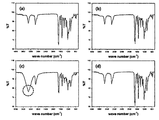
- FIG. 5 is a diagram showing infrared (IR) spectroscopic analysis results of (a) and (b) PU nanofibers before and after hydrothermal treatment (c) and (d) PVA / PU blend nanofibers.
- IR infrared
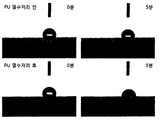
- 7A is a contact angle photograph of PU and PVA / PU blend nanofibers
- FIG. 8 is a view showing the results of measuring the contact angle over time of PU and PVA / PU blend nanofibers.
- PVA / PU blended nanofibers are prepared by coaxial electrospinning of various aqueous aqueous solution of aqueous polymer including PVA, the most representative water-soluble polymer, and PU solution dissolved in organic solvent, and based on this, PVA / PU blended nanofibers are subjected to hot water treatment. By removing the hydrophilic PU nanofibers can be produced.
- the present invention can provide a method for producing hydrophilic PU nanofibers, comprising the following steps:
- the water-soluble polymer in step (a) is a synthetic polymer such as PVA, PVP, PEO, PAA and PSA, cellulose derivatives including CMC, SA, CS and derivatives thereof, polysaccharide-based polymers such as pullulan, starch, gelatin, collagen and the like. It may be the same protein-based polymer or a mixture thereof.
- the organic solvent may be a mixed solvent including one or more organic solvents selected from the group consisting of DMF, DMAc, MEK, and THF.
- the voltage applied in the step (d) may be 1kV to 100kV, the discharge rate may be adjusted according to the difference between the type of the polymer and the voltage applied to the electrode.
- Removal of the water-soluble polymer by the hot water treatment in step (e) may be performed in distilled water at 0 ⁇ 100 °C, if the temperature to remove the water-soluble polymer is not limited to the above range.
- the PVA / PU blended nanofibers prepared by coaxial electrospinning of PVA, which is a water-soluble polymer, and a PU soluble in a polar organic solvent, were prepared by removing PVA through hydrothermal treatment, thereby preparing PU nanofibers.
- the change of hydrophilicity is shown through the measurement of component properties and contact angles.
- PVA electrospinning solution After dissolving PVA (Mw 88,000, 99 +% hydrolyzed, OCI, Korea) in distilled water at 10% (w / v) for 4 hours at 80 ° C. to completely dissolve it, a PVA electrospinning solution was prepared. PVA nanofibers were prepared by electrospinning at 15 cm and a discharge rate of 0.2 ml / h.
- PU poly-based thermoplastic polyurethane, Lubrizol, USA
- PU electrospinning solution a voltage of 12kV, a distance of 15cm, and a discharge rate of 0.3ml / h.
- PU nanofibers were prepared by electrospinning under the conditions of.
- PU nanofibers prepared in Example 2 were put in 80 ° C. 3 distilled water, stirred slowly for 24 hours, and vacuum-dried at room temperature for 24 hours to prepare hot water-treated PU nanofibers.
- PVA Mw 88,000, 99 +% hydrolyzed, OCI, Korea
- PU polyester-based thermoplastic polyurethane, Lubrizol, USA
- PVA / PU blended nanofibers were prepared by coaxial electrospinning of two spinning solutions at a voltage of 20 kV, a distance of 15 cm, and a discharge rate of 0.2 ml / h for PVA (core) and 0.3 ml / h for PU (shell). See FIG. 1).
- the PVA / PU blended nanofibers prepared in Example 4 were added to 80 ° C. tertiary distilled water, stirred slowly for 24 hours, and vacuum dried at room temperature for 24 hours to prepare PVA / PU nanofibers.
- FIG. 2 are SEM photographs of PVA and PU nanofibers, respectively
- FIG. 3 is SEM photographs of PVA / PU blend nanofibers, compared with SEM photographs of PVA and PU nanofibers. The thickness of the PU blend nanofibers was found to be somewhat increased.
- FIG. 4 is a SEM photograph taken after hot water treatment of PU (a) and PVA / PU blends (b) nanofibers in distilled water at 80 ° C. for 24 hours, and drying for 12 hours in a vacuum state. There was no significant change in fiber thickness before and after the hydrothermal treatment, but the overall squirming form appeared. This may be due to the heat shrinkage of the PU by the removal of residual solvent and PVA component and the heating during the hydrothermal treatment.
- FIG. 5 shows the results of IR spectroscopy of (a) and (b) PU nanofibers before and after hydrothermal treatment (c) and (d) PVA / PU blend nanofibers.
- PU nanofibers showed PU characteristic absorption peaks at 3400 ⁇ 3200cm - 1 and 1800 ⁇ 1630cm -1 , and showed no peak change with or without hot water treatment.
- PVA / PU blended nanofibers showed strong absorption peaks of -OH groups at 3650 ⁇ 3000cm -1 along with PU absorption peaks due to the effect of PVA, but PVA was removed and only PU remained after disappearing after hydrothermal treatment. I could confirm that there is.
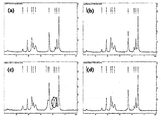
- 13 C-solid NMR spectroscopy was performed for component analysis of PU and PVA / PU nanofibers.
- the PU characteristic peaks were found at 24 to 41 ppm, 65 ppm, 120 to 136 ppm, and 154 ppm before (a) and after (b) PU nanofiber hydrothermal treatment.
- the PVA characteristic peak was found at 45 ppm and 70 ppm, but after the hydrothermal treatment (d), the PVA was removed and only the PU remained. I could confirm it.
- the contact angle between water and nanoweb surfaces was measured using a contact angle meter at a temperature of 21 ° C. and a humidity of 25% ⁇ 20.
- FIG. 7 (a) shows the PU nanofibers before the hydrothermal treatment, and the initial contact angle was 133.1 °, and after 5 minutes, the contact angle was 130.4 °. After hydrothermal treatment, the initial contact angle of PU nanofibers was 126 °, and after 5 minutes, the contact angle was 78.2 °.
- FIG. 7 (b) shows that the PVA / PU blended nanofibers before the hydrothermal treatment had an initial contact angle of 109.8 ° and after 5 minutes, showed 19.8 °. After hot water treatment, the initial contact angle of PVA / PU blended nanofibers was 82.0 °, and water was completely absorbed before 30 seconds and no longer measured.
- Blending water-soluble polymers such as PVA that are incompatible with hydrophobic polymer PU by coaxial electrospinning is a modification that can impart hydrophilicity.However, when used as a water treatment, as a plasma filter or as a wet wound dressing, It is dissolved and absorbed into the treatment liquid, blood, and skin, which may cause side effects. In order to prevent this, an insolubilization process of a water-soluble polymer such as crosslinking or crystallization is additionally required.
- the water-soluble polymer blended with PU is exclusively removed by dissolution by water, thereby bringing a physical change in the nanofibers, which may result in an improved hydrophilicity than the water-soluble polymer simply coexists with.
Landscapes
- Engineering & Computer Science (AREA)
- Health & Medical Sciences (AREA)
- Chemical & Material Sciences (AREA)
- Textile Engineering (AREA)
- Chemical Kinetics & Catalysis (AREA)
- Life Sciences & Earth Sciences (AREA)
- Heart & Thoracic Surgery (AREA)
- General Health & Medical Sciences (AREA)
- Veterinary Medicine (AREA)
- Animal Behavior & Ethology (AREA)
- Public Health (AREA)
- Vascular Medicine (AREA)
- Biomedical Technology (AREA)
- Hematology (AREA)
- Mechanical Engineering (AREA)
- General Chemical & Material Sciences (AREA)
- Anesthesiology (AREA)
- Materials Engineering (AREA)
- Epidemiology (AREA)
- Dispersion Chemistry (AREA)
- Organic Chemistry (AREA)
- Environmental & Geological Engineering (AREA)
- Hydrology & Water Resources (AREA)
- Water Supply & Treatment (AREA)
- Cardiology (AREA)
- Spinning Methods And Devices For Manufacturing Artificial Fibers (AREA)
- Artificial Filaments (AREA)
- Medicinal Chemistry (AREA)
- Polymers & Plastics (AREA)
- Materials For Medical Uses (AREA)
Abstract
본 발명은 동축전기방사법을 통해 제조된 폴리우레탄/수용성 고분자 블렌드 나노섬유를 제조한 뒤 수용성 고분자를 물에 용해시켜 제거함으로써 친수성이 향상된 폴리우레탄 나노섬유를 제조하는 방법에 관한 것이다.
Description
본 발명은 동축전기방사법을 통해 제조된 폴리우레탄/수용성 고분자 블렌드 나노섬유를 제조한 뒤 수용성 고분자를 물에 용해시켜 제거함으로써 친수성이 향상된 폴리우레탄 나노섬유를 제조하는 방법에 관한 것이다.
전기방사는 주로 고분자를 용액에 용해시키거나 직접 녹여 수 마이크로미터에서 수 나노미터까지의 직경을 가지는 섬유를 만드는 방법이다. 전기방사로 제조된 나노섬유는 마이크로 단위의 섬유보다 비표면적이 매우 크며, 작은 기공을 가지고 있을 뿐 아니라 기공의 크기를 자유롭게 조절할 수 있고, 강한 표면 흡착성, 물질에 대한 선택적 투과성을 지닌다. 게다가, 서로 다른 소재의 복합화가 가능하다는 많은 장점을 가진다. 또한 나노섬유는 그 직경이 작을수록 부피 대비 표면적 비율이 상당히 넓다. 넓은 표면적은 습윤 상태를 충분히 조성할 뿐만 아니라, 이러한 구조는 세포외 기질의 구조와 유사한 삼차원적 구조를 가지고 있기 때문에 상처부위에 약물 방출이 용이하고 상처 재생이 효과적이다. 전기방사에 의해 제조된 나노섬유는 필터소재, 섬유소재, 2차 전기용 전극소재, 조직공학용 지지체, 에너지 저장소재, 섬유강화 나노복합재료, 센서용 섬유, 전자 광학용 섬유소재 등 거의 모든 산업 전반에 걸친 다양한 활용이 시도되고 있다.
폴리우레탄(polyurethane, PU)은 폴리이소시아네이트(-NCO)와 폴리올(-OH)의 반응에 의해 생성되며, 우레탄만이 가지는 뛰어난 물성으로 인해 다양한 용도로 응용되어 신발, 소파, 침대, 자동차, 냉장고, 건축재료, 바닥재, 육상트랙 등 우리의 생활 주변에서 항상 만날 수 있는 제품 제조에 사용되고 있다. 또한 유기성 폐기물 처리를 위한 바이오필터, 혈액 및 혈장 필터 및 습윤성 드레싱재 등 친환경 및 메디컬 기능성 소재로도 그 응용이 확대되고 있다.
그러나 소수성 고분자 소재가 수처리 필터나 혈액 필터 등으로 적용되었을 때, 각종 유기화합물이나 단백질이나 미생물 등 화학적 또는 생물학적 성분의 흡착에 의한 오염 및 막힘 현상이 문제점으로 대두되어, 이를 방지하기 위하여 고분자 필터의 친수성 향상이 핵심 기술로 부각되고 있다.
폴리우레탄 역시 전기방사하여 얻은 나노섬유의 형태로 각종 필터로의 응용이 시도되고 있으나, 소수성에 기인한 유사한 문제점을 안고 있으며, 특히 나노섬유의 경우는 일반 필터용 멤브레인에 비하여 상대적으로 더욱 미세한 공극을 가지고 있으므로 막힘 현상이 더욱 심각한 문제점으로 지적되고 있다. 또한 폴리우레탄은 다공성 폼(foam) 형태로 제조되어 대표적인 습윤성 드레싱재로 제품화되어 사용되고 있으나, 나노섬유로 제조되었을 경우에는 소수성 나노웹 표면의 수분 흡수가 폼에 비하여 현저하게 저하되어 습윤성 창상 치유 효과를 기대하기 어렵다. 따라서 폴리우레탄을 나노섬유의 형태로 창상 피복재에 적용하기 위해서도 폴리우레탄 나노섬유의 친수성 개선은 필수적이다.
소수성 고분자 구조체의 친수성을 개선하기 위해서는 플라즈마 처리에 의한 표면의 친수성기의 도입, 친수성 물질의 코팅 및 블렌드 등이 일반적인 방법으로 적용되고 있다. 그러나 플라즈마 처리의 경우 친수성 향상 효과가 미미하며, 이를 향상시키기 위해 처리 조건을 가혹하게 했을 경우 기계적 물성이 저하되는 단점을 가지고 있다. 또한 친수성 고분자 등을 나노웹 등의 나노섬유 구조체의 표면에 코팅할 경우에는 기공의 막힘 현상이 발생하여 필터로의 용도전개가 제한적이다. 더욱이 대부분의 폴리우레탄을 포함한 대부분의 소수성 고분자는 친수성 고분자와 상용성이 없고 혼합 시 침전이나 기타 상분리 현상이 발생하여 불균일한 용액을 형성하므로, 두 고분자의 혼합용액을 전기방사하여 균일한 나노섬유를 제조하는 것은 실질적으로 불가능하다.
본 발명자들은 상기와 같은 종래기술의 문제점을 해결하고, 소수성 PU 나노섬유의 문제점을 극복하기 위하여 PU의 친수성 개선 방법에 대하여 연구하던 중, 서로 블렌드 되지 않는 친수성 고분자와 소수성 PU를 동축전기방사법을 이용하여 나노섬유를 제조할 경우 친수성 고분자와 PU가 블렌드 되어진 나노섬유를 제조할 수 있다는 것과, 더 나아가, 오히려 예상외의 결과로서, 상기 블렌드 나노섬유 내의 친수성 고분자 성분을 물에 용해시켜 제거하여 제조된 PU 나노섬유의 경우 더 우수한 친수성을 가진다는 것을 발견함으로써 본 발명을 완성하기에 이르렀다.
본 발명의 목적은 서로 상용성이 없는 수용성 고분자와 소수성 PU를 동축전기방사를 이용하여 수용성 고분자/PU 블렌드 나노섬유를 제조한 뒤 블렌드 나노섬유 내의 수용성 고분자를 물에 용해시켜 제거함으로써 친수성이 현저하게 향상된 PU 나노섬유의 제조방법을 제공하는 것이다.
그러나, 본 발명이 이루고자 하는 기술적 과제는 이상에서 언급한 과제에 제한되지 않으며, 언급되지 않은 또 다른 과제들은 아래의 기재로부터 당업자에게 명확하게 이해될 수 있을 것이다.
본 발명은, 물에 용해된 친수성 고분자 용액을 준비하고; 유기용매에 용해된 소수성 고분자 용액을 준비하며; 상기 친수성 고분자 용액 및 상기 소수성 고분자 용액을 각각 동축전기방사의 내부 노즐과 외부 노즐, 또는 외부 노즐 및 외부 노즐에 주입하여 동축전기방사하고; 상기 동축전기방사된 나노섬유를 수처리하여 친수성 고분자를 제거함을 포함하는, 친수성 고분자 나노 섬유 제조 방법을 제공한다.
본 발명에서, 동축전기방사(coaxial electrospinning)는 두 가지의 고분자 용액을 분리되어 있는 내부 노즐과 외부 노즐에 독립적으로 주입하여 전기방사하는 것으로, 두 용액이 노즐을 통해 나오며 방사 및 연신 되어 코어-쉬쓰(core-sheath)형 나노섬유를 형성하게 한다. 이중노즐을 사용하면 서로 다른 고분자를 적용하여 이중구조 나노섬유를 제조할 수 있으며, 특히 상용성이 없는 두 고분자 용액을 방사하여 블렌드한 나노섬유를 제조할 수 있다는 장점이 있다.
상기 친수성 고분자 용액 및 상기 소수성 고분자 용액을 각각 동축전기방사의 내부 노즐과 외부 노즐에 주입됨을 특징으로 하며, 이러한 방식으로 코어에 친수성 고분자가 위치하고 쉘에 소수성 고분자가 위치하는 코어/쉘 형태의 친수성/소수성 혼합섬유를 제조할 수 있다.
상기 소수성 고분자는 폴리우레탄임을 특징으로 한다. 폴리우레탄은 수분산이 상대적으로 어려운 고분자이며, 본 발명의 방법에 의해 이러한 폴리우레탄 섬유가 상대적으로 친수성을 가지는 방법을 제공한다. 상대적이라 함은 본 발명의 처리가 없는 방식의 폴리우레탄 나노섬유에 비해 향상된 친수성을 의미하고, 또한 친수성고분자가 혼합되어 있는 혼합섬유에 비해 향상된 친수성을 의미할 수 있다.
상기 유기 용매는, DMF, DMAc, MEK, 및 THF으로 이루어지는 군으로부터 선택되는 하나 이상의 유기 용매를 포함할 수 있다.
상기 친수성 고분자는, 폴리비닐알코올(polyvinyl alcohol: PVA), 폴리비닐피롤리돈(polyvinyl pyrrolidone, PVP), 폴리에틸렌옥시드(polyethylene oxide, PEO), 폴리아크릴산(polyacrylic acid, PAA), 쇼듐폴리아크릴산염(poly(sodium acrylate), 카르복시메틸 셀룰로오스, 쇼듐 알지네이트(sodium alginate (SA)), 키토산, 풀루란, 전분, 젤라틴 및 콜라겐으로 이뤄진 군으로부터 선택된 하나 이상의 고분자를 포함할 수 있다.
상기 수처리는 0~100℃의 증류수에 의한 열수처리임을 특징으로 한다.
본 발명의 방법에 의해 제조한 폴리우레탄 나노섬유웹은 종래에 나노섬유웹과 구별되는 다음과 같은 형상을 가짐을 특징으로 한다. 본 발명의 방법에 의해 제조된 폴리우레탄 나노섬유웹은 폴리우레탄 나노섬유 가닥이 다공성을 가지며, 구불구불한 형상을 가짐을 특징으로 한다. 이 다공성은 코어쉘 나노섬유에서 코어의 친수성 고분자가 제거되면서, 형성될 수 있다. 즉, 폴리우레탄 나노섬유 가닥은 중공사 형일 수 있다.
다른 측면으로서 본 발명은 상기와 같은 친수성 폴리우레탄 나노섬유 웹을 포함하는, 수처리 또는 혈액/혈장 필터를 제공한다.
또 다른 측면으로서, 본 발명은 상기와 같은 친수성 폴리우레탄 나노섬유 웹을 포함하는, 습윤성 드레싱재를 제공한다.
본 발명에 따른 수용성 고분자/PU 블렌드 나노섬유는 동축전기방사에 의해 제조되며, 수용성 고분자 성분을 물에 용해시켜 제거해 줌으로써 얻어진 PU 나노섬유의 접촉각 감소 및 흡수성 증가 등의 친수성이 현저히 증가하는 것을 확인하였다.
본 발명에 의해 제조되는 친수성 PU 나노섬유는 수처리 및 혈액 필터 등으로 응용되었을 시 두드러진 친수성 향상에 기인하여 각종 유기화합물이나 단백질이나 미생물 등 화학적·생물학적 성분의 흡착에 의한 오염 및 막힘 현상을 억제할 수 있으며, 습윤성 창상피복재 등의 메디컬 소재 및 헬스케어 소재, 아웃도어 소재 등 다양한 분야로의 용도전개가 가능하다.
또한 본 발명에서 제시한 고분자 이외의 다양한 이종의 고분자를 동축전기방사하고 어느 한 부분을 용해시켜 제거함으로써 소수성 고분자 나노섬유를 화학적인 개질이 아닌 물리적인 개질로서 친수성을 향상시킬 수 있다.
도 1은 본 발명의 PVA/PU 블렌드 나노섬유를 제작하기 위한 동축전기방사 공정을 도식적으로 나타낸 도면이다.
도 2은 PVA(a) 및 PU(b) 나노섬유의 주사전자현미경(scanning electron microscope, SEM) 사진이다.
도 3은 PVA/PU 블렌드 나노섬유의 SEM 사진이다.
도 4은 열수처리한 PU(a) 및 PVA/PU 블렌드(b) 나노섬유의 SEM 사진이다.
도 5는 열수처리 전(a)·후(b) PU 나노섬유와 열수처리 전(c)·후(d) PVA/PU 블렌드 나노섬유의 적외선(infrared, IR) 분광분석 결과를 나타낸 도면이다.
도 6은 열수처리 전(a)·후(b) PU 나노섬유와 열수처리 전(c)·후(d) PVA/PU 블렌드 나노섬유의 13C-고체 핵자기공명(13C-solid nuclear magnetic resonance, 13C-solid NMR) 분광분석 결과를 나타낸 도면이다.
도 7a은 PU 및 PVA/PU 블렌드 나노섬유의 접촉각 사진이고,
도 8은 PU 및 PVA/PU 블렌드 나노섬유의 시간에 따른 접촉각 측정 결과를 나타낸 도면이다.
이하, 첨부한 도면을 참조하여 본 발명의 실시예에 대해 상세히 설명한다. 본 발명은 다양한 변경을 가할 수 있고 여러 가지 형태를 가질 수 있는바, 특정 실시예들을 도면에 예시하고 본문에 상세하게 설명하고자 한다. 그러나 이는 본 발명을 특정한 개시 형태에 대해 한정하려는 것이 아니며, 본 발명의 사상 및 기술 범위에 포함되는 모든 변경, 균등물 내지 대체물을 포함하는 것으로 이해되어야 한다. 각 도면을 설명하면서 유사한 참조부호를 유사한 구성요소에 대해 사용하였다.
본 출원에서 사용한 용어는 단지 특정한 실시 예를 설명하기 위해 사용된 것으로서 본 발명을 한정하려는 의도가 아니다. 단수의 표현은 문맥상 명백하게 다르게 뜻하지 않는 한, 복수의 표현을 포함한다. 본 출원에서, "포함하다" 또는 "가지다" 등의 용어는 명세서 상에 기재된 특징, 단계, 동작, 구성요소, 부분품 또는 이들을 조합한 것이 존재함을 지정하려는 것이지, 하나 또는 그 이상의 다른 특징들이나 단계, 동작, 구성요소, 부분품 또는 이들을 조합한 것들의 존재 또는 부가 가능성을 미리 배제하지 않는 것으로 이해되어야 한다.
다르게 정의되지 않는 한, 기술적이거나 과학적인 용어를 포함해서 여기서 사용되는 모든 용어들은 본 발명이 속하는 기술 분야에서 통상의 지식을 가진 자에 의해 일반적으로 이해되는 것과 동일한 의미를 가지고 있다. 일반적으로 사용되는 사전에 정의되어 있는 것과 같은 용어들은 관련 기술의 문맥 상 가지는 의미와 일치하는 의미를 가지는 것으로 해석되어야 하며, 본 출원에서 명백하게 정의하지 않는 한, 이상적이거나 과도하게 형식적인 의미로 해석되지 않는다.
가장 대표적인 수용성 고분자인 PVA를 포함하는 다양한 수용성 고분자 수용액과 유기 용매에 용해된 PU 용액을 동축전기방사하여 PVA/PU 블렌드 나노섬유를 제조하고, 이를 토대로 PVA/PU 블렌드 나노섬유를 열수처리하여 PVA를 제거함으로써 친수성이 향상된 PU 나노섬유를 제조할 수 있다.
따라서, 본 발명에서는 하기 단계를 포함하는 친수성이 향상된 PU 나노섬유의 제조방법을 제공할 수 있다:
(a) PVA를 포함한 수용성 고분자를 증류수에 용해하여 PVA 전기방사 용액을 제조하는 단계;
(b) PU를 유기용매에 용해하여 PU 전기방사 용액을 제조하는 단계;
(c) 상기 수용성 고분자 전기방사 용액 및 PU 전기방사 용액을 각각의 주입기구에 넣는 단계;
(d) 상기 각각의 주입기구에 연결된 전극에 전압을 가하고 수용성 고분자 및 PU 용액을 이중동축노즐을 통해 토출하여 동축전기방사함으로써 수용성 고분자 /PU 나노섬유를 제조하는 단계;
(e) 수용성 고분자/PU 나노섬유 내 수용성 고분자 성분을 물에 용해시켜 제거하는 단계; 및
(f) 수용성 고분자가 제거된 PU 나노섬유를 진공건조하는 단계.
상기 (a) 단계에서 수용성 고분자는 PVA, PVP, PEO, PAA 및 PSA 등과 같은 합성 고분자, CMC를 포함한 셀룰로오스 유도체, SA, CS 및 그 유도체, 풀루란, 전분 등과 같은 다당류계 고분자, 젤라틴, 콜라겐 등과 같은 단백질계 고분자 또는 이들의 혼합물일 수 있다.
상기 (b) 단계에서 유기용매는 DMF, DMAc, MEK, 및 THF 등으로 이루어지는 군으로부터 선택되는 하나 또는 그 이상 유기용매를 포함하는 혼합용매일 수 있다.
상기 (d) 단계에서 가하는 전압은 1kV 내지 100kV일 수 있으며, 토출속도는 고분자의 종류 및 전극에 가해지는 전압의 차이에 따라 조절할 수 있다.
상기 (e) 단계에서 열수처리에 의한 수용성 고분자의 제거는 0~100℃의 증류수에서 수행될 수 있으나, 수용성 고분자를 제거할 수 있는 온도라면 상기 범위에 제한되는 것은 아니다.
본 발명의 실시예에서는 수용성 고분자인 PVA와 극성 유기용매에 가용인 PU를 동축전기방사하여 제조한 PVA/PU 블렌드 나노섬유를 열수처리를 통해 PVA를 제거하여 PU 나노섬유를 제조하였고, 이들의 구조, 성분 특성 및 접촉각 측정을 통한 친수성의 변화를 나타내었다.
PVA와 PU 용액을 이용하여 방사한 나노섬유와 PVA/PU 블렌드 나노섬유의 SEM 관찰 결과, 최적 전기방사조건에서 PVA와 PU 나노섬유는 섬유의 직경이 수백 nm이고 굵기가 균일하였으며 PVA/PU 블렌드 나노섬유의 경우 섬유의 직경이 증가하였다. 또한, 수용성인 PVA를 열수처리를 통해 제거한 PU 나노섬유의 접촉각이 감소하고 시간의 흐름에 따라 빠르게 물을 흡수하는 것을 확인하였다.
이하 실시예에 의해 본 발명을 보다 상세하게 설명하나, 이는 본 발명의 내용을 구체화하기 위한 설명일 뿐 이들에 의해 본 발명의 기술적 범위가 한정되는 것은 아니다.
[실시예 1]
전기방사에 의한 PVA 나노섬유의 제조
PVA(Mw 88,000, 99+% hydrolyzed, OCI, Korea)를 증류수에 10 %(w/v)로 80 ℃에서 4시간 동안 교반하여 완전히 용해시켜 PVA 전기방사 용액을 제조한 후, 이를 전압 12kV, 거리 15cm, 토출속도 0.2ml/h의 조건에서 전기방사하여 PVA 나노섬유를 제조하였다.
[실시예 2]
전기방사에 의한 PU 나노섬유의 제조
PU(polyester-based thermoplastic polyurethane, Lubrizol, USA)를 DMF에 13 wt%로 상온에서 4시간 교반하여 완전히 용해시켜 PU 전기방사 용액을 제조한 후, 이를 전압 12kV, 거리 15cm, 토출속도 0.3ml/h의 조건에서 전기방사하여 PU 나노섬유를 제조하였다.
[실시예 3]
열수처리 PU 나노섬유의 제조
상기 실시예 2에서 제조한 PU 나노섬유를 80℃ 3차 증류수에 넣고 24시간 동안 천천히 교반한 후 상온에서 24시간 진공건조하여 열수처리한 PU 나노섬유를 제조하였다.
[실시예 4]
동축전기방사에 의한 PVA/PU 블렌드 나노섬유의 제조
PVA(Mw 88,000, 99+% hydrolyzed, OCI, Korea)를 증류수에 10 %(w/v)로 80 ℃에서 4시간 동안 교반하여 완전히 용해시켜 PVA 전기방사 용액을 제조하였으며, PU(polyester-based thermoplastic polyurethane, Lubrizol, USA)를 DMF에 13 wt%로 상온에서 4시간 교반하여 완전히 용해시켜 PU 전기방사 용액을 제조하였다. 두 방사용액을 전압 20kV, 거리 15cm, PVA(core)의 토출속도 0.2ml/h 및 PU(shell)의 토출속도 0.3ml/h의 조건에서 동축전기방사하여 PVA/PU 블렌드 나노섬유를 제조하였다(도 1 참조).
[실시예 5]
열수처리 PVA/PU 나노섬유의 제조
상기 실시예 4에서 제조한 PVA/PU 블렌드 나노섬유를 80℃ 3차 증류수에 넣고 24시간 동안 천천히 교반한 후 상온에서 24시간 진공건조하여 열수처리한 PVA/PU 나노섬유를 제조하였다.
형태학적 관찰 결과
상기 방법으로 제조한 나노섬유를 백금코팅한 후 SEM을 사용하여 외부형태학적 구조를 관찰하였다. 도 2의 (a)와 (b)는 각각 PVA 및 PU 나노섬유의 SEM 사진이고, 도 3은 PVA/PU 블렌드 나노섬유의 SEM 사진인데, PVA와 PU 나노섬유의 SEM 사진과 비교했을 때 PVA/PU 블렌드 나노섬유의 굵기가 다소 증가된 것으로 나타났다.
도 4는 PU(a) 및 PVA/PU 블렌드(b) 나노섬유를 80℃ 증류수에 24시간 열수처리하고, 진공상태에서 12시간 건조한 뒤 촬영한 SEM 사진이다. 열수처리 전후 두드러진 섬유 굵기의 변화는 없지만 전체적으로 구불거리는 형태가 나타났는데, 이것은 열수처리 시 잔류용매 및 PVA 성분의 이탈과 가열에 의한 PU의 열 수축에 의한 것이라고 생각된다.
이와 같은 결과로부터 PU 및 PVA/PU 블렌드 나노섬유를 열수처리 했을 때 나노섬유의 미세구조 상의 변화가 유발됨을 짐작할 수 있으며, 그 정도는 잔류용매와 분자량이 큰 PVA의 이탈이 동시에 일어나는 PVA/PU 블렌드 나노섬유의 경우가 더 클 것으로 생각된다.
IR 분광분석 결과
PU 및 PVA/PU 나노섬유의 성분분석을 위해 IR 분광분석을 실시하였다. 도 5는 열수처리 전(a)·후(b) PU 나노섬유와 열수처리 전(c)·후(d) PVA/PU 블렌드 나노섬유의 IR 분광분석 결과이다. PU 나노섬유의 경우 3400~3200cm-
1와 1800~1630cm-1에서 PU 특성 흡수피크가 나타났으며, 열수처리 유·무에 따른 피크의 변화는 나타나지 않았다. PVA/PU 블렌드 나노섬유의 경우 PVA의 영향으로 PU 특성 흡수 피크와 더불어 3650~3000cm-1에서 -OH기의 강한 특성 흡수피크가 나타났으나, 열수처리 후 사라지는 것으로부터 PVA가 제거되고 PU만 남아있는 것을 확인할 수 있었다.
13
C-solid NMR 분광분석 결과
PU 및 PVA/PU 나노섬유의 성분분석을 위해 13C-solid NMR 분광분석을 실시하였다. 도 6에서 PU 나노섬유 열수처리 전(a), 후(b)의 경우 24~41 ppm, 65 ppm, 120~136 ppm, 154ppm에서 PU 특성 피크를 발견할 수 있었다. PVA/PU 블렌드 나노섬유 열수처리 전(c)의 경우 45 ppm, 70 ppm 부근에서 PVA 특성 피크를 확인할 수 있었으나, 열수처리 후(d)의 경우 나타나지 않는 것으로부터 PVA가 제거되고 PU만 남아있는 것을 확인할 수 있었다.
접촉각 측정 결과
PU 및 PVA/PU 나노섬유의 친수성을 평가하기 위해 접촉각 측정기를 사용하여 온도 21℃ 및 습도 25%±20의 조건에서 물-나노웹 표면간의 접촉각을 측정하였다.
순수한 PVA 나노섬유의 경우 수분과 접촉 시 용해되므로 측정에서 제외하였다. 도 7(a)는 열수처리 전 PU 나노섬유인데 초기 접촉각은 133.1°이었으며, 5분이 지난 후에는 130.4°의 접촉각을 나타내었다. 열수처리 후 PU 나노섬유로써 초기 접촉각은 126°이었으며, 5분이 지난 후에는 78.2°의 접촉각을 나타내었다. 도 7(b)는 열수처리 전 PVA/PU 블렌드 나노섬유로써 초기 접촉각은 109.8°이었으며, 5분이 지난 후에는 19.8°를 나타내었다. 열수처리 후 PVA/PU 블렌드 나노섬유로써 초기 접촉각은 82.0°이었으며, 30초가 지나기 전에 물이 완전히 흡수되어 더 이상 측정이 되지 않았다.
PU 나노섬유의 경우 열수처리에 의해 잔류용매의 이탈로 나노섬유 내에 미세한 공간이 생기고 이에 기인한 모세관 현상으로 물의 흡수가 증가한 것으로 생각되어 진다. PVA/PU 블렌드 나노섬유의 경우 수용성 고분자인 PVA의 존재에 기인하여 접촉각이 큰 폭으로 감소하였다. 도 8에서 보듯이, 수용성 고분자인 PVA의 용해에 의해 급격한 접촉각 감소를 보였다가 PVA가 일정량 용해된 후에는 접촉각의 감소가 둔화되는 것을 확인할 수 있다.
열수처리한 PVA/PU 블렌드 나노섬유의 경우 PVA가 제거되고 PU만 남아 있음에도 초기 접촉각이 가장 낮았으며 흡수속도도 가장 빨라 30초가 지나기 전에 완전히 흡수되어 접촉각 측정이 이루어지지 않았는데, 이는 열수처리에 의한 PVA 및 잔여용매의 이탈에 기인한 미세공간 발생 및 모세관 현상이 심화되어 물의 흡수가 가장 큰 폭으로 증가했기 때문인 것으로 생각된다.
동축전기방사에 의해 소수성 고분자인 PU와 상용성이 없는 PVA와 같은 수용성 고분자를 블렌드하는 것은 친수성을 부여할 수 있는 개질 방법이지만, 수처리 및 혈장 필터나 습윤성 창상피복재 등으로 사용되었을 시 수용성 고분자 성분이 용해되어 처리액이나 혈액, 피부에 흡수되어 이로 인한 부작용을 가져올 수 있으며, 이를 방지하기 위해 별도의 가교나 결정화 등 수용성 고분자의 불용화 공정이 부수적으로 요구되어진다.
본 발명에 의하면 PU와 블렌드된 수용성 고분자를 물에 의한 용해에 의하여 배타적으로 제거하여 나노섬유 내에 물리적인 변화를 가져옴으로써 수용성 고분자가 단순히 공존하는 것보다 월등한 친수성의 향상을 가져올 수 있다.
전술한 본 발명의 설명은 예시를 위한 것이며, 본 발명이 속하는 기술분야의 통상의 지식을 가진 자는 본 발명의 기술적 사상이나 필수적인 특징을 변경하지 않고서 다른 구체적인 형태로 쉽게 변형이 가능하다는 것을 이해할 수 있을 것이다. 그러므로 이상에서 기술한 실시예들은 모든 면에서 예시적인 것이며 한정적이 아닌 것으로 이해되어야 한다.
Claims (10)
- 물에 용해된 친수성 고분자 용액을 준비하고;유기용매에 용해된 소수성 고분자 용액을 준비하며;상기 친수성 고분자 용액 및 상기 소수성 고분자 용액을 각각 동축전기방사의 내부 노즐과 외부 노즐, 또는 외부 노즐 및 외부 노즐에 주입하여 동축전기방사하고;상기 동축전기방사된 나노섬유를 수처리하여 친수성 고분자를 제거함을 포함하는,친수성 고분자 나노 섬유 제조 방법.
- 제1항에 있어서,상기 친수성 고분자 용액 및 상기 소수성 고분자 용액을 각각 동축전기방사의 내부 노즐과 외부 노즐에 주입됨을 특징으로친수성 고분자 나노 섬유 제조 방법.
- 제1항에 있어서,상기 소수성 고분자는 폴리우레탄임을 특징으로 하는,친수성 고분자 나노 섬유 제조 방법.
- 제1항에 있어서,상기 유기 용매는, DMF, DMAc, MEK, 및 THF으로 이루어지는 군으로부터 선택되는 하나 이상의 유기 용매를 포함하는,친수성 고분자 나노 섬유 제조 방법.
- 제1항에 있어서,상기 친수성 고분자는, 폴리비닐알코올(polyvinyl alcohol: PVA), 폴리비닐피롤리돈(polyvinyl pyrrolidone, PVP), 폴리에틸렌옥시드(polyethylene oxide, PEO), 폴리아크릴산(polyacrylic acid, PAA), 쇼듐폴리아크릴산염(poly(sodium acrylate), 카르복시메틸 셀룰로오스, 쇼듐 알지네이트(sodium alginate (SA)), 키토산, 풀루란, 전분, 젤라틴 및 콜라겐으로 이뤄진 군으로부터 선택된 하나 이상의 고분자를 포함하는,친수성 고분자 나노 섬유 제조 방법.
- 제1항에 있어서,상기 수처리는 0~100℃의 증류수에 의한 열수처리임을 특징으로 하는,친수성 고분자 나노 섬유 제조 방법.
- 폴리우레탄 나노섬유 가닥이 다공성을 가지며, 구불구불한 형상을 가지는,친수성 폴리우레탄 나노섬유 웹.
- 제7항에 있어서,상기 폴리우레탄 나노섬유 가닥은 중공사 형을 포함하는,친수성 폴리우레탄 나노섬유 웹.
- 제7항 또는 제8항의 친수성 폴리우레탄 나노섬유 웹을 포함하는,수처리 또는 혈액/혈장 필터.
- 제7항 또는 제8항의 친수성 폴리우레탄 나노섬유 웹을 포함하는,습윤성 드레싱재.
Priority Applications (2)
| Application Number | Priority Date | Filing Date | Title |
|---|---|---|---|
| US16/076,942 US10751222B2 (en) | 2016-03-29 | 2017-03-28 | Hydrophilic polyurethane nanofiber and method for manufacturing same |
| CN201780019235.7A CN108884617B (zh) | 2016-03-29 | 2017-03-28 | 亲水性聚氨酯纳米纤维及其制备方法 |
Applications Claiming Priority (2)
| Application Number | Priority Date | Filing Date | Title |
|---|---|---|---|
| KR10-2016-0037731 | 2016-03-29 | ||
| KR1020160037731A KR101802641B1 (ko) | 2016-03-29 | 2016-03-29 | 친수성이 향상된 폴리우레탄 나노섬유 및 그의 제조방법 |
Publications (2)
| Publication Number | Publication Date |
|---|---|
| WO2017171341A2 true WO2017171341A2 (ko) | 2017-10-05 |
| WO2017171341A3 WO2017171341A3 (ko) | 2018-09-07 |
Family
ID=59964939
Family Applications (1)
| Application Number | Title | Priority Date | Filing Date |
|---|---|---|---|
| PCT/KR2017/003298 Ceased WO2017171341A2 (ko) | 2016-03-29 | 2017-03-28 | 친수성 폴리우레탄 나노섬유 및 그의 제조방법 |
Country Status (4)
| Country | Link |
|---|---|
| US (1) | US10751222B2 (ko) |
| KR (1) | KR101802641B1 (ko) |
| CN (1) | CN108884617B (ko) |
| WO (1) | WO2017171341A2 (ko) |
Cited By (4)
| Publication number | Priority date | Publication date | Assignee | Title |
|---|---|---|---|---|
| CN110284203A (zh) * | 2019-06-21 | 2019-09-27 | 东华大学 | 一种电场均布的多组分孔套孔喷嘴 |
| CN110484979A (zh) * | 2019-06-21 | 2019-11-22 | 东华大学 | 一种电场均布的孔套孔喷嘴 |
| EP3702507A1 (en) * | 2016-03-16 | 2020-09-02 | Kabushiki Kaisha Toshiba | Method for manufacturing a fiber sheet |
| CN115467084A (zh) * | 2022-09-05 | 2022-12-13 | 南通大学 | 一种亲水性pla油水分离膜及其制备方法 |
Families Citing this family (13)
| Publication number | Priority date | Publication date | Assignee | Title |
|---|---|---|---|---|
| CN111203114A (zh) * | 2019-11-22 | 2020-05-29 | 江苏大学 | 一种多层生物基中空纳米纤维水处理膜、制备方法及其应用 |
| WO2021181489A1 (ja) * | 2020-03-09 | 2021-09-16 | 株式会社ナフィアス | 低溶解性ナノファイバーの製造方法 |
| KR102395825B1 (ko) | 2020-09-02 | 2022-05-11 | 연세대학교 산학협력단 | 다층형 복합나노섬유막 및 그 제조방법 |
| CN115121129B (zh) * | 2021-03-25 | 2023-12-26 | 南开大学 | 一种高效分离油水体系的高耐压复合膜的制备 |
| KR102757299B1 (ko) | 2021-10-27 | 2025-01-23 | 연세대학교 산학협력단 | 일방향 수분전달 텍스타일 시스템 및 이의 제조방법 |
| CN114703587B (zh) * | 2021-12-20 | 2023-08-18 | 东华大学 | 一种湿度调节面料 |
| CN115312265A (zh) * | 2022-08-30 | 2022-11-08 | 深圳大学 | 导电纤维及其制备方法和应用 |
| CN115897059B (zh) * | 2022-10-24 | 2025-02-18 | 中原工学院 | 一种Janus亲疏复合膜及其制备方法和应用 |
| CN116905118B (zh) * | 2022-11-25 | 2024-04-26 | 吴江福华织造有限公司 | 一种功能纤维的制备方法 |
| CN115778827B (zh) * | 2023-02-02 | 2023-05-05 | 广东碧茜生物科技有限公司 | 一种高vc载量芯/壳型纳米纤维面膜及其制备方法和应用 |
| CN115948809A (zh) * | 2023-02-07 | 2023-04-11 | 厦门安踏体育用品有限公司 | 一种吸湿性纤维和面料及其制备方法 |
| CN117758443B (zh) * | 2023-12-05 | 2025-09-12 | 智程无纺布(江苏)有限公司 | 一种具有高吸收性能的复合无纺布及其制备方法 |
| CN119308073A (zh) * | 2024-11-01 | 2025-01-14 | 深圳市华新纳微科技有限公司 | 一种用于油/水过滤的纳米纤维膜及其制备方法和应用 |
Family Cites Families (12)
| Publication number | Priority date | Publication date | Assignee | Title |
|---|---|---|---|---|
| JPH07126918A (ja) * | 1993-11-02 | 1995-05-16 | Kuraray Co Ltd | 熱圧着性および水溶性を有するポリビニルアルコール系繊維とその熱圧着法 |
| JP2002143299A (ja) | 2000-11-13 | 2002-05-21 | Asahi Medical Co Ltd | 中空糸膜型血液処理装置及びその製造方法 |
| US7390760B1 (en) * | 2004-11-02 | 2008-06-24 | Kimberly-Clark Worldwide, Inc. | Composite nanofiber materials and methods for making same |
| US20060094320A1 (en) * | 2004-11-02 | 2006-05-04 | Kimberly-Clark Worldwide, Inc. | Gradient nanofiber materials and methods for making same |
| AU2007303821B9 (en) * | 2006-10-05 | 2013-06-20 | Technion Research & Development Foundation Ltd. | Microtubes and methods of producing same |
| KR101226851B1 (ko) * | 2007-06-20 | 2013-01-25 | (주)엘지하우시스 | 이중노즐을 이용한 나노섬유의 제조방법 |
| CN102234846B (zh) * | 2010-04-28 | 2013-08-21 | 中国科学院化学研究所 | 具有微米管套纳米线结构的核/壳纤维及其制备方法 |
| CN102493009B (zh) * | 2011-12-08 | 2014-07-02 | 东华大学 | 一种多孔纳米纤维的制备方法 |
| KR101355678B1 (ko) * | 2012-08-16 | 2014-01-28 | 금오공과대학교 산학협력단 | 나노섬유시트 형태의 의료용 지지 필름 및 그의 제조방법 |
| JP6112701B2 (ja) | 2012-09-12 | 2017-04-12 | 花王株式会社 | ナノファイバ構造体の製造方法 |
| KR101679789B1 (ko) | 2014-04-08 | 2016-12-07 | 다이텍연구원 | 폴리비닐알코올/폴리에틸렌테레프탈레이트 나노섬유의 제조방법 |
| KR101490140B1 (ko) | 2014-07-08 | 2015-02-09 | 주식회사 동우에이엘티 | 높은 통기성 및 유연성을 가지는 폴리우레탄 합성피혁 또는 필름의 제조방법 |
-
2016
- 2016-03-29 KR KR1020160037731A patent/KR101802641B1/ko active Active
-
2017
- 2017-03-28 CN CN201780019235.7A patent/CN108884617B/zh active Active
- 2017-03-28 WO PCT/KR2017/003298 patent/WO2017171341A2/ko not_active Ceased
- 2017-03-28 US US16/076,942 patent/US10751222B2/en active Active
Cited By (7)
| Publication number | Priority date | Publication date | Assignee | Title |
|---|---|---|---|---|
| EP3702507A1 (en) * | 2016-03-16 | 2020-09-02 | Kabushiki Kaisha Toshiba | Method for manufacturing a fiber sheet |
| US10801140B2 (en) | 2016-03-16 | 2020-10-13 | Kabushiki Kaisha Toshiba | Fiber sheet and method for manufacturing same |
| US11421360B2 (en) | 2016-03-16 | 2022-08-23 | Kabushiki Kaisha Toshiba | Fiber sheet and method for manufacturing same |
| CN110284203A (zh) * | 2019-06-21 | 2019-09-27 | 东华大学 | 一种电场均布的多组分孔套孔喷嘴 |
| CN110484979A (zh) * | 2019-06-21 | 2019-11-22 | 东华大学 | 一种电场均布的孔套孔喷嘴 |
| CN115467084A (zh) * | 2022-09-05 | 2022-12-13 | 南通大学 | 一种亲水性pla油水分离膜及其制备方法 |
| CN115467084B (zh) * | 2022-09-05 | 2023-08-08 | 南通大学 | 一种亲水性pla油水分离膜及其制备方法 |
Also Published As
| Publication number | Publication date |
|---|---|
| US10751222B2 (en) | 2020-08-25 |
| CN108884617A (zh) | 2018-11-23 |
| KR101802641B1 (ko) | 2017-11-28 |
| KR20170111733A (ko) | 2017-10-12 |
| WO2017171341A3 (ko) | 2018-09-07 |
| US20190046361A1 (en) | 2019-02-14 |
| CN108884617B (zh) | 2021-05-28 |
Similar Documents
| Publication | Publication Date | Title |
|---|---|---|
| WO2017171341A2 (ko) | 친수성 폴리우레탄 나노섬유 및 그의 제조방법 | |
| JP6686141B2 (ja) | 複合フィルム、その製造方法およびそれを有するリチウム電池 | |
| Xia et al. | Fabrication of centrifugally spun prepared poly (lactic acid)/gelatin/ciprofloxacin nanofibers for antimicrobial wound dressing | |
| CN102747453B (zh) | 一种聚合物多孔超细纤维及其制备方法 | |
| CN106498558B (zh) | 一种同轴电纺聚酰亚胺微/纳米中空结构材料及其制备方法 | |
| WO2017209536A1 (ko) | 필터여재, 이의 제조방법 및 이를 포함하는 필터모듈 | |
| DE10040897A1 (de) | Herstellung von Polymerfasern mit nanoskaligen Morphologien | |
| KR20050114708A (ko) | 부직포 및 그 제조방법 | |
| WO2011040718A2 (ko) | 웨스턴 블롯용 나노섬유 멤브레인 및 그 제조방법 | |
| CN103147165A (zh) | 一种双壁结构中空超细聚合物纤维及其制备方法 | |
| WO2011149165A1 (ko) | 두께관통형 미세기공을 가지는 고분자 또는 고분자복합재료 멤브레인 및 그 제조방법 | |
| Kiani et al. | Preparation and characterization of polyphenylsulfone nanofibrous membranes for the potential use in liquid filtration | |
| WO2012128470A4 (ko) | 강도 및 수투과도가 우수한 폴리설폰계 중공사막 및 그 제조방법 | |
| CN103963393A (zh) | 一种防水透湿复合膜及其制备方法 | |
| KR101355678B1 (ko) | 나노섬유시트 형태의 의료용 지지 필름 및 그의 제조방법 | |
| CN102268784A (zh) | 多孔天然高分子纳米纤维无纺布的制备 | |
| WO2010120100A2 (en) | Composite hollow fiber membrane and method for manufacturing the same | |
| CN114832145A (zh) | 一种多孔皮芯结构相变调温控释纤维敷料及其制备方法 | |
| KR101494053B1 (ko) | 비대칭성 중공사막의 제조방법 및 이에 의해 제조된 비대칭성 중공사막 | |
| NV et al. | Morphology and hydroscopic properties of acrylic/thermoplastic polyurethane core–shell electrospun micro/nano fibrous mats with tunable porosity | |
| WO2012074222A9 (ko) | 셀룰로오스계 수지를 이용한 수처리용 중공사막의 제조방법 | |
| CN105363358B (zh) | 聚醚砜/聚碳酸丁二醇酯中空纤维共混膜及制备方法 | |
| CN101619501A (zh) | 一种直径可控的高分子超细纤维的制备方法 | |
| CN115652532A (zh) | 一种水处理用凹凸棒石多孔纳米纤维膜及其制备方法 | |
| WO2014027707A1 (ko) | 나노섬유시트 형태의 의료용 지지 필름 및 그의 제조방법 |
Legal Events
| Date | Code | Title | Description |
|---|---|---|---|
| NENP | Non-entry into the national phase |
Ref country code: DE |
|
| 121 | Ep: the epo has been informed by wipo that ep was designated in this application |
Ref document number: 17775765 Country of ref document: EP Kind code of ref document: A2 |
|
| 122 | Ep: pct application non-entry in european phase |
Ref document number: 17775765 Country of ref document: EP Kind code of ref document: A2 |