WO2017175739A1 - オーステナイト系ステンレス鋼材 - Google Patents
オーステナイト系ステンレス鋼材 Download PDFInfo
- Publication number
- WO2017175739A1 WO2017175739A1 PCT/JP2017/014008 JP2017014008W WO2017175739A1 WO 2017175739 A1 WO2017175739 A1 WO 2017175739A1 JP 2017014008 W JP2017014008 W JP 2017014008W WO 2017175739 A1 WO2017175739 A1 WO 2017175739A1
- Authority
- WO
- WIPO (PCT)
- Prior art keywords
- less
- steel material
- stainless steel
- austenitic stainless
- grain size
- Prior art date
- Legal status (The legal status is an assumption and is not a legal conclusion. Google has not performed a legal analysis and makes no representation as to the accuracy of the status listed.)
- Ceased
Links
Classifications
-
- C—CHEMISTRY; METALLURGY
- C22—METALLURGY; FERROUS OR NON-FERROUS ALLOYS; TREATMENT OF ALLOYS OR NON-FERROUS METALS
- C22C—ALLOYS
- C22C38/00—Ferrous alloys, e.g. steel alloys
- C22C38/18—Ferrous alloys, e.g. steel alloys containing chromium
- C22C38/40—Ferrous alloys, e.g. steel alloys containing chromium with nickel
- C22C38/48—Ferrous alloys, e.g. steel alloys containing chromium with nickel with niobium or tantalum
-
- C—CHEMISTRY; METALLURGY
- C21—METALLURGY OF IRON
- C21D—MODIFYING THE PHYSICAL STRUCTURE OF FERROUS METALS; GENERAL DEVICES FOR HEAT TREATMENT OF FERROUS OR NON-FERROUS METALS OR ALLOYS; MAKING METAL MALLEABLE, e.g. BY DECARBURISATION OR TEMPERING
- C21D6/00—Heat treatment of ferrous alloys
- C21D6/004—Heat treatment of ferrous alloys containing Cr and Ni
-
- C—CHEMISTRY; METALLURGY
- C21—METALLURGY OF IRON
- C21D—MODIFYING THE PHYSICAL STRUCTURE OF FERROUS METALS; GENERAL DEVICES FOR HEAT TREATMENT OF FERROUS OR NON-FERROUS METALS OR ALLOYS; MAKING METAL MALLEABLE, e.g. BY DECARBURISATION OR TEMPERING
- C21D6/00—Heat treatment of ferrous alloys
- C21D6/02—Hardening by precipitation
-
- C—CHEMISTRY; METALLURGY
- C21—METALLURGY OF IRON
- C21D—MODIFYING THE PHYSICAL STRUCTURE OF FERROUS METALS; GENERAL DEVICES FOR HEAT TREATMENT OF FERROUS OR NON-FERROUS METALS OR ALLOYS; MAKING METAL MALLEABLE, e.g. BY DECARBURISATION OR TEMPERING
- C21D8/00—Modifying the physical properties of ferrous metals or ferrous alloys by deformation combined with, or followed by, heat treatment
-
- C—CHEMISTRY; METALLURGY
- C21—METALLURGY OF IRON
- C21D—MODIFYING THE PHYSICAL STRUCTURE OF FERROUS METALS; GENERAL DEVICES FOR HEAT TREATMENT OF FERROUS OR NON-FERROUS METALS OR ALLOYS; MAKING METAL MALLEABLE, e.g. BY DECARBURISATION OR TEMPERING
- C21D8/00—Modifying the physical properties of ferrous metals or ferrous alloys by deformation combined with, or followed by, heat treatment
- C21D8/10—Modifying the physical properties of ferrous metals or ferrous alloys by deformation combined with, or followed by, heat treatment during manufacturing of tubular bodies
-
- C—CHEMISTRY; METALLURGY
- C21—METALLURGY OF IRON
- C21D—MODIFYING THE PHYSICAL STRUCTURE OF FERROUS METALS; GENERAL DEVICES FOR HEAT TREATMENT OF FERROUS OR NON-FERROUS METALS OR ALLOYS; MAKING METAL MALLEABLE, e.g. BY DECARBURISATION OR TEMPERING
- C21D9/00—Heat treatment, e.g. annealing, hardening, quenching or tempering, adapted for particular articles; Furnaces therefor
- C21D9/08—Heat treatment, e.g. annealing, hardening, quenching or tempering, adapted for particular articles; Furnaces therefor for tubular bodies or pipes
-
- C—CHEMISTRY; METALLURGY
- C21—METALLURGY OF IRON
- C21D—MODIFYING THE PHYSICAL STRUCTURE OF FERROUS METALS; GENERAL DEVICES FOR HEAT TREATMENT OF FERROUS OR NON-FERROUS METALS OR ALLOYS; MAKING METAL MALLEABLE, e.g. BY DECARBURISATION OR TEMPERING
- C21D9/00—Heat treatment, e.g. annealing, hardening, quenching or tempering, adapted for particular articles; Furnaces therefor
- C21D9/52—Heat treatment, e.g. annealing, hardening, quenching or tempering, adapted for particular articles; Furnaces therefor for wires; for strips ; for rods of unlimited length
- C21D9/525—Heat treatment, e.g. annealing, hardening, quenching or tempering, adapted for particular articles; Furnaces therefor for wires; for strips ; for rods of unlimited length for wire, for rods
-
- C—CHEMISTRY; METALLURGY
- C22—METALLURGY; FERROUS OR NON-FERROUS ALLOYS; TREATMENT OF ALLOYS OR NON-FERROUS METALS
- C22C—ALLOYS
- C22C38/00—Ferrous alloys, e.g. steel alloys
-
- C—CHEMISTRY; METALLURGY
- C22—METALLURGY; FERROUS OR NON-FERROUS ALLOYS; TREATMENT OF ALLOYS OR NON-FERROUS METALS
- C22C—ALLOYS
- C22C38/00—Ferrous alloys, e.g. steel alloys
- C22C38/001—Ferrous alloys, e.g. steel alloys containing N
-
- C—CHEMISTRY; METALLURGY
- C22—METALLURGY; FERROUS OR NON-FERROUS ALLOYS; TREATMENT OF ALLOYS OR NON-FERROUS METALS
- C22C—ALLOYS
- C22C38/00—Ferrous alloys, e.g. steel alloys
- C22C38/002—Ferrous alloys, e.g. steel alloys containing In, Mg, or other elements not provided for in one single group C22C38/001 - C22C38/60
-
- C—CHEMISTRY; METALLURGY
- C22—METALLURGY; FERROUS OR NON-FERROUS ALLOYS; TREATMENT OF ALLOYS OR NON-FERROUS METALS
- C22C—ALLOYS
- C22C38/00—Ferrous alloys, e.g. steel alloys
- C22C38/02—Ferrous alloys, e.g. steel alloys containing silicon
-
- C—CHEMISTRY; METALLURGY
- C22—METALLURGY; FERROUS OR NON-FERROUS ALLOYS; TREATMENT OF ALLOYS OR NON-FERROUS METALS
- C22C—ALLOYS
- C22C38/00—Ferrous alloys, e.g. steel alloys
- C22C38/04—Ferrous alloys, e.g. steel alloys containing manganese
-
- C—CHEMISTRY; METALLURGY
- C22—METALLURGY; FERROUS OR NON-FERROUS ALLOYS; TREATMENT OF ALLOYS OR NON-FERROUS METALS
- C22C—ALLOYS
- C22C38/00—Ferrous alloys, e.g. steel alloys
- C22C38/18—Ferrous alloys, e.g. steel alloys containing chromium
- C22C38/40—Ferrous alloys, e.g. steel alloys containing chromium with nickel
- C22C38/44—Ferrous alloys, e.g. steel alloys containing chromium with nickel with molybdenum or tungsten
-
- C—CHEMISTRY; METALLURGY
- C22—METALLURGY; FERROUS OR NON-FERROUS ALLOYS; TREATMENT OF ALLOYS OR NON-FERROUS METALS
- C22C—ALLOYS
- C22C38/00—Ferrous alloys, e.g. steel alloys
- C22C38/18—Ferrous alloys, e.g. steel alloys containing chromium
- C22C38/40—Ferrous alloys, e.g. steel alloys containing chromium with nickel
- C22C38/46—Ferrous alloys, e.g. steel alloys containing chromium with nickel with vanadium
-
- C—CHEMISTRY; METALLURGY
- C22—METALLURGY; FERROUS OR NON-FERROUS ALLOYS; TREATMENT OF ALLOYS OR NON-FERROUS METALS
- C22C—ALLOYS
- C22C38/00—Ferrous alloys, e.g. steel alloys
- C22C38/18—Ferrous alloys, e.g. steel alloys containing chromium
- C22C38/40—Ferrous alloys, e.g. steel alloys containing chromium with nickel
- C22C38/58—Ferrous alloys, e.g. steel alloys containing chromium with nickel with more than 1.5% by weight of manganese
-
- C—CHEMISTRY; METALLURGY
- C21—METALLURGY OF IRON
- C21D—MODIFYING THE PHYSICAL STRUCTURE OF FERROUS METALS; GENERAL DEVICES FOR HEAT TREATMENT OF FERROUS OR NON-FERROUS METALS OR ALLOYS; MAKING METAL MALLEABLE, e.g. BY DECARBURISATION OR TEMPERING
- C21D2211/00—Microstructure comprising significant phases
- C21D2211/001—Austenite
-
- Y—GENERAL TAGGING OF NEW TECHNOLOGICAL DEVELOPMENTS; GENERAL TAGGING OF CROSS-SECTIONAL TECHNOLOGIES SPANNING OVER SEVERAL SECTIONS OF THE IPC; TECHNICAL SUBJECTS COVERED BY FORMER USPC CROSS-REFERENCE ART COLLECTIONS [XRACs] AND DIGESTS
- Y02—TECHNOLOGIES OR APPLICATIONS FOR MITIGATION OR ADAPTATION AGAINST CLIMATE CHANGE
- Y02E—REDUCTION OF GREENHOUSE GAS [GHG] EMISSIONS, RELATED TO ENERGY GENERATION, TRANSMISSION OR DISTRIBUTION
- Y02E60/00—Enabling technologies; Technologies with a potential or indirect contribution to GHG emissions mitigation
- Y02E60/30—Hydrogen technology
- Y02E60/32—Hydrogen storage
Definitions
- the present invention relates to a stainless steel material, and more particularly to an austenitic stainless steel material.
- stainless steel When stainless steel is used for the hydrogen station, stainless steel is used in a high-pressure hydrogen gas environment. Therefore, excellent strength is required for stainless steel used in hydrogen station applications.
- Patent Literature 1 International Publication No. 2012/132992
- Patent Literature 2 International Publication No. 2004/083476
- Patent Literature 3 International Publication No. 2004/083477
- Patent Literature 4 proposes stainless steel that is used in a high-pressure hydrogen environment and has high strength.
- the austenitic stainless steel for high-pressure hydrogen gas disclosed in Patent Document 1 is in mass%, C: 0.10% or less, Si: 1.0% or less, Mn: 3% or more and less than 7%, Cr: 15-30% Ni: 10% or more and less than 17%, Al: 0.10% or less, N: 0.10 to 0.50%, and V: 0.01 to 1.0% and Nb: 0.01 to 0.50 %, And the balance consists of Fe and impurities, P in the impurities is 0.0050% or less, S is 0.050% or less, tensile strength is 800 MPa or more, grain size number ( ASTM E 112) contains 8 or more alloy carbonitrides having a maximum diameter of 50 to 1000 nm in a cross-sectional observation of 0.4 pieces / ⁇ m 2 or more.
- the stainless steel for hydrogen gas disclosed in Patent Document 2 is, by mass%, C: 0.02% or less, Si: 1.0% or less, Mn: 3 to 30%, Cr: more than 22% and 30% Ni: 17 to 30%, V: 0.001 to 1.0%, N: 0.10 to 0.50%, and Al: 0.10% or less, with the balance being Fe and impurities, P in the impurity is 0.030% or less, S is 0.005% or less, Ti, Zr, and Hf are each 0.01% or less, and the contents of Cr, Mn, and N are 5Cr + 3.4Mn ⁇ 500N Meet.
- the stainless steel for high-pressure hydrogen gas disclosed in Patent Document 3 is mass%, C: 0.04% or less, Si: 1.0% or less, Mn: 7-30%, Cr: 15-22%, Ni : 5 to 20%, V: 0.001 to 1.0%, N: 0.20 to 0.50% and Al: 0.10% or less, with the balance being Fe and impurities, P is 0.030% or less, S is 0.005% or less, Ti, Zr, and Hf are each 0.01% or less, and 2.5Cr + 3.4Mn ⁇ 300N is satisfied.
- the austenitic stainless steel for hydrogen gas disclosed in Patent Document 4 is in mass%, C: 0.10% or less, Si: 1.0% or less, Mn: 0.01-30%, P: 0.040%
- S 0.01% or less
- Cr 15-30%
- Ni 5.0-30%
- sol. Al 0.10% or less
- N 0.001 to 0.30%
- the balance being a chemical composition consisting of Fe and impurities
- Intensity I (111) is 5 times or less of the random orientation, and contains a structure having X-ray integrated intensity I (220) / I (111) ⁇ 10 in the cross section along the processing direction.
- stainless steel used for hydrogen station applications is required to suppress not only excellent strength but also strength variation.
- the stainless steel disclosed in Patent Documents 1 to 4 described above has a strength of 700 MPa or more even after the solution treatment, and the stainless steel of Patent Document 4 is subjected to the solution treatment and cold working. By doing so, it has high strength.
- these literatures do not examine the intensity variation. Even the stainless steels described in Patent Documents 1 to 4 described above have large variations in strength, and stable high strength may not be obtained.
- An object of the present invention is to provide an austenitic stainless steel material having high strength that is stable over the entire length of the steel material.
- the austenitic stainless steel material according to the present embodiment is, in mass%, C: 0.10% or less, Si: 1.0% or less, Mn: 3 to 8%, P: 0.05% or less, S: 0.03. %: Ni: 10-20%, Cr: 15-30%, N: 0.20-0.70%, Mo: 0-5.0%, V: 0-0.5%, and Nb: It has a chemical composition comprising 0 to 0.5%, the balance being Fe and impurities, and a grain size number according to ASTM E 112 is 6.0 or more.
- the tensile strength is 800 MPa or more, and the difference between the maximum value and the minimum value of the tensile strength is 50 MPa or less.
- the number of alloy carbonitrides with an equivalent circle diameter exceeding 1000 nm in the steel is 10 pieces / mm 2 or more.
- the austenitic stainless steel material according to the present embodiment has a stable and high strength over the entire length of the steel material.
- the present inventors investigated and examined the increase in strength of the austenitic stainless steel material and the strength variation over the entire length of the steel material, and obtained the following knowledge.
- the austenitic stainless steel of the present embodiment contains 0.20 to 0.70% N and increases the strength by solid solution strengthening. If the crystal grains are refined, the strength further increases.
- the strength variation of the entire length of the steel material is caused by the crystal grain size. As the variation in crystal grain size in the steel material is smaller, the variation in strength can be reduced. Specifically, the crystal grain size number based on ASTM E 112 is 6.0 or more, and the difference between the maximum value and the minimum value of the crystal grain size number in the entire steel material (hereinafter referred to as crystal grain size difference ⁇ GS) is 1.5 or less. In some cases, the difference between the maximum value and the minimum value of the tensile strength over the entire length of the steel material (hereinafter referred to as strength difference ⁇ TS) is 50 MPa or less, and the strength variation can be sufficiently suppressed.
- crystal grain size difference ⁇ GS the difference between the maximum value and the minimum value of the tensile strength over the entire length of the steel material
- (C) In order to suppress the intensity variation, it is effective to suppress the temperature change of the material during hot working.
- the variation in crystal grain size is most prominently formed during hot working.
- the amount of strain introduced differs between the low temperature portion and the high temperature portion. If the amount of strain introduced differs, the degree of crystal grain refinement during recrystallization also differs. Therefore, the variation in crystal grain size becomes large. Therefore, it is preferable that the temperature change of the material is small during hot working.
- the temperature at the completion of the first part of the material that completes the hot working (hereinafter referred to as initial temperature) and the temperature at the end of the last part of the material that completes the hot working (hereinafter referred to as the following)
- initial temperature the temperature at the completion of the first part of the material that completes the hot working
- the temperature at the end of the last part of the material that completes the hot working (hereinafter referred to as the following)
- the alloy carbonitride contains Cr, V, Nb, Mo, W, Ta or the like as a main component, Cr 2 N, Z phase, that is, Cr (Nb, V) (C, N), and It means MX type (M: Cr, V, Nb, Mo, W, Ta, etc., X: C, N). “Main component” means 40% or more by mass%.
- the alloy carbonitride in the present invention encompasses the case where the content of C (carbon) is ultimately low, that is, the case of being a nitride.
- the alloy carbonitride in the present invention includes a carbide.
- the austenitic stainless steel material of the present embodiment completed based on the above knowledge is mass%, C: 0.10% or less, Si: 1.0% or less, Mn: 3 to 8%, P: 0.05. %: S: 0.03% or less, Ni: 10-20%, Cr: 15-30%, N: 0.20-0.70%, Mo: 0-5.0%, V: 0-0 0.5% and Nb: 0 to 0.5%, with the balance being a chemical composition consisting of Fe and impurities, and a grain size number according to ASTM E 112 of 6.0 or more.
- the tensile strength is 800 MPa or more, and the difference between the maximum value and the minimum value of the tensile strength is 50 MPa or less.
- the number of alloy carbonitrides with an equivalent circle diameter exceeding 1000 nm in the steel is 10 pieces / mm 2 or more.
- the chemical composition is selected from the group consisting of Mo: 1.5 to 5.0%, V: 0.1 to 0.5%, and Nb: 0.1 to 0.5% by mass%. You may contain 1 type, or 2 or more types.
- the difference between the maximum value and the minimum value of the crystal grain size number is 1.5 or less.
- the austenitic stainless steel material is, for example, a steel pipe, a steel bar, or a wire.
- the chemical composition of the austenitic stainless steel material of this embodiment contains the following elements.
- C 0.10% or less Carbon (C) is unavoidably contained.
- C stabilizes austenite, which is an fcc structure that hardly causes hydrogen embrittlement.
- C further combines with Cr and the like, and increases the strength of the steel by precipitation strengthening.
- the C content is 0.10% or less.
- the upper limit with preferable C content is 0.08%, More preferably, it is 0.06%.
- the minimum with preferable C content for stabilizing austenite is 0.005%.
- Si 1.0% or less Silicon (Si) combines with Ni and Cr to form an intermetallic compound. Si further promotes the growth of intermetallic compounds such as a sigma phase ( ⁇ phase). These intermetallic compounds reduce the hot workability of steel. Therefore, the Si content is 1.0% or less. The upper limit with preferable Si content is 0.8%. From the viewpoint of deoxidation of steel, the preferable lower limit of the Si content is 0.2%.
- Mn 3-8% Manganese (Mn) stabilizes austenite and suppresses the formation of martensite that is highly susceptible to hydrogen embrittlement. Furthermore, Mn combines with S to form MnS and enhances the machinability of steel. If the Mn content is too low, the above effect cannot be obtained. On the other hand, if the Mn content is too high, the ductility and hot workability of the steel decrease. Therefore, the Mn content is 3 to 8%.
- the minimum with preferable Mn content is 4.0%, More preferably, it is 5.0%.
- the upper limit with preferable Mn content is 6.0%, More preferably, it is 5.9%.
- P 0.05% or less Phosphorus (P) is an impurity. P decreases the hot workability and toughness of the steel. Therefore, the P content is 0.05% or less.
- the upper limit with preferable P content is 0.045%, More preferably, it is 0.035%, More preferably, it is 0.020%.
- the P content is preferably as low as possible.
- S 0.03% or less Sulfur (S) combines with Mn to form MnS and enhances the machinability of steel. However, if the S content is too high, the toughness of the steel decreases. Therefore, the S content is 0.03% or less.
- the upper limit with preferable S content is 0.02%, More preferably, it is 0.01%.
- the S content is preferably as low as possible.
- Ni 10-20% Nickel (Ni) stabilizes austenite. Ni further increases the ductility and toughness of the steel. If the Ni content is too low, the above effect cannot be obtained. On the other hand, if the Ni content is too high, the above effects are saturated and the manufacturing cost is increased. Therefore, the Ni content is 10 to 20%.
- the minimum with preferable Ni content is 11.5%, More preferably, it is 12.0%.
- the upper limit with preferable Ni content is 13.5%, More preferably, it is 13.4%.
- Chromium (Cr) increases the corrosion resistance of steel. Further, Cr combines with N by heat treatment to form an alloy carbonitride such as Cr 2 N and enhances the strength of the steel by precipitation strengthening. If the Cr content is too low, the above effect cannot be obtained. On the other hand, if the Cr content is too high, M 23 C 6 type carbides are produced and the ductility and toughness of the steel are reduced. Therefore, the Cr content is 15 to 30%. The minimum with preferable Cr content is 20.5%, More preferably, it is 21.0%. The upper limit with preferable Cr content is 23.5%, More preferably, it is 23.4%.
- N 0.20 to 0.70% Nitrogen (N) stabilizes austenite. N further increases the strength of the steel by solid solution strengthening. N further combines with Cr by heat treatment to form an alloy carbonitride such as Cr 2 N and enhances the strength of the steel by precipitation strengthening. If the N content is too low, the above effect cannot be obtained. On the other hand, if the N content is too high, the toughness of the steel decreases. Therefore, the N content is 0.20 to 0.70%. The minimum with preferable N content is 0.21%, More preferably, it is 0.22%. The upper limit with preferable N content is 0.40%, More preferably, it is 0.35%.
- the balance of the chemical composition of the austenitic stainless steel material according to the present embodiment is composed of Fe and impurities.
- the impurities are mixed from ore, scrap, or production environment as raw materials when industrially producing austenitic stainless steel, and adversely affect the austenitic stainless steel of the present embodiment. It means that it is allowed in the range that does not give.
- the austenitic stainless steel material according to the present embodiment may further contain one or more selected from the group consisting of Mo, V, and Nb instead of a part of Fe. All of these elements increase the strength of the steel.
- Mo 0 to 5.0% Molybdenum (Mo) is an optional element and may not be contained. When contained, Mo strengthens austenite as a solid solution. Mo further enhances the corrosion resistance of the steel. However, if the Mo content is too high, intermetallic compounds are likely to precipitate, and the ductility and toughness of the steel will be reduced. Therefore, the Mo content is 0 to 5.0%. The minimum with preferable Mo content is 1.5%, More preferably, it is 1.9%. The upper limit with preferable Mo content is 3.0%, More preferably, it is 2.9%.
- V 0 to 0.5%
- Vanadium (V) is an optional element and may not be contained. When contained, V produces carbides and increases the strength of the steel. However, if the V content is too high, the effect is saturated and the manufacturing cost increases. Therefore, the V content is 0 to 0.5%.
- the minimum with preferable V content is 0.1%, More preferably, it is 0.12%.
- the upper limit with preferable V content is 0.3%, More preferably, it is 0.28%.
- Niobium (Nb) is an optional element and may not be contained. When contained, Nb generates carbides and increases the strength of the steel. However, if the Nb content is too high, the effect is saturated and the manufacturing cost increases. Therefore, the Nb content is 0 to 0.5%.
- the minimum with preferable Nb content is 0.1%, More preferably, it is 0.12%.
- the upper limit with preferable Nb content is 0.3%, More preferably, it is 0.28%.
- the austenitic stainless steel material of this embodiment has the high intensity
- the intensity and intensity difference ⁇ TS can be realized by the following organization, for example.
- the crystal grain size number defined by ASTM E 112 is 6.0 or more.
- the grain size number is measured according to ASTM E112.
- the strength decreases.
- the grain size number is 6.0 or more, high strength is obtained in the austenitic stainless steel material having the above-described chemical composition. Specifically, the tensile strength of 800 MPa or more necessary for the austenitic stainless steel material of the present embodiment is obtained.
- the grain size number is determined by the following method.
- a specimen for microscopic observation is prepared from the central portion of the cross section perpendicular to the longitudinal direction of the austenitic stainless steel material.
- the observation surface Using the surface corresponding to the cross section (referred to as the observation surface) among the surfaces of the test piece, the microscopic test method for the crystal grain size defined in ASTM E 112 is performed, and the crystal grain size number is evaluated.
- the observation surface is mechanically polished, it is corroded using a well-known corrosive liquid (such as glyceresia, curling reagent or marble reagent), and crystal grain boundaries on the observation surface appear. For 10 fields on the corroded surface, determine the grain size number for each field.
- a well-known corrosive liquid such as glyceresia, curling reagent or marble reagent
- the area of each field is about 10.2 mm 2 .
- the grain size number in each field of view is evaluated by comparison with the grain size standard diagram defined in ASTM E 112.
- the average of the grain size numbers in each field of view is defined as the grain size number of the austenitic stainless steel material of the present embodiment.
- crystal grain size difference ⁇ GS the difference between the maximum value and the minimum value of the crystal grain size numbers (called crystal grain size difference ⁇ GS) measured at an arbitrary plurality of portions of the total length of the austenitic stainless steel material is 1.5. It is as follows. When the grain size difference ⁇ GS exceeds 1.5, the difference between the maximum value and the minimum value of the tensile strength measured at a plurality of portions of the steel material (strength difference ⁇ TS) exceeds 50 MPa, and the strength variation over the entire length of the steel material is large. Become.
- the austenitic stainless steel material of this embodiment has a stable high strength.
- the crystal grain size difference ⁇ GS is measured by the following method.
- a test piece for microscopic observation similar to the above is prepared from a plurality of arbitrary portions in the longitudinal direction over the entire length of the austenitic stainless steel material.
- the crystal grain size microscopic test method defined in ASTM E 112 is performed in the same manner as described above to determine the crystal grain size number.
- a maximum value and a minimum value are selected, and a difference between the maximum value and the minimum value is defined as a crystal grain size difference ⁇ GS.
- the austenitic stainless steel material is a steel pipe, steel bar, wire rod, etc.
- specimens are taken from both ends (top and bottom) in the hot working direction (rolling direction, extrusion direction, etc.), and the grain size difference ⁇ GS Ask for.
- the top portion is defined as a portion within a range of 200 mm from the steel material front end toward the center portion
- the bottom portion is defined as a portion within a range of 200 mm from the steel material rear end toward the center portion.
- a smaller crystal grain size difference ⁇ GS is preferable.
- the upper limit with preferable crystal grain size difference (DELTA) GS is 1.3, More preferably, it is 1.0.
- the alloy carbonitride contains Cr, V, Nb, Mo, W, Ta and the like as main components, and Cr 2 N, Z phase, that is, Cr (Nb, V) (C, N), and MX type (M : Cr, V, Nb, Mo, W, Ta, etc., X: C, N). Further, the carbonitride in the present invention includes a case where the content of C (carbon) is ultimately small, that is, a case where it is a nitride.
- the carbonitride in the present invention includes a carbide.
- the number of alloy carbonitrides (coarse alloy carbonitrides) having an equivalent circle diameter exceeding 1000 nm in the steel is 10 pieces / mm 2 or more.
- high tensile strength is obtained by precipitation strengthening.
- the toughness of the steel may decrease, so the preferred upper limit of the number of coarse alloy carbonitrides in the steel is 1.5 ⁇ 10 5 pieces / mm 2 .
- the heat treatment is performed at a heat treatment temperature of 930 ° C. to less than 1000 ° C., coarse alloy carbonitrides of 10 pieces / mm 2 or more can be obtained.
- the number of coarse alloy carbonitrides is defined as follows. A sample including a central portion (observation region having a radius of 10 mm centered on the steel material central axis) perpendicular to the longitudinal direction of the austenitic stainless steel material is collected. The above observation area of the sample is mirror-polished. Thereafter, in any 10 visual fields (200 ⁇ m ⁇ 200 ⁇ m) in the observation region, using a scanning electron microscope (SEM) equipped with an energy dispersive X-ray spectrometer (EDS), the precipitates and inclusions in each visual field From this, the alloy carbonitride is specified. The equivalent circle diameter of each alloy carbide specified in each field of view is obtained by image analysis.
- SEM scanning electron microscope
- EDS energy dispersive X-ray spectrometer
- the equivalent circle diameter means a diameter (nm) when the area of the alloy carbide in the visual field is converted into a circle.
- the number of alloy carbonitrides (coarse alloy carbonitrides) whose equivalent circle diameter exceeds 1000 nm is measured.
- the average value of the number of coarse alloy carbonitrides obtained in each of the 10 fields of view is defined as the number of coarse alloy carbonitrides (pieces / mm 2 ) in this specification.
- This manufacturing method includes a preparation process for preparing a material, a hot processing process for manufacturing an intermediate material by performing hot processing on the material, a cooling process for cooling the hot-processed intermediate material, and as necessary. And a heat treatment step of performing a heat treatment on the cooled intermediate material.
- the manufacturing method will be described.
- a molten steel having the above chemical composition is produced.
- a well-known degassing process is implemented with respect to the manufactured molten steel as needed.
- the material is manufactured from the molten steel that has been degassed.
- the material manufacturing method is, for example, a continuous casting method.
- a continuous casting material (material) is manufactured by a continuous casting method.
- the continuous cast material is, for example, a slab, bloom, billet and the like.
- Molten steel may be made into an ingot by the ingot-making method.
- a material (continuous cast material or ingot) is hot-worked by a known method to produce an austenitic stainless steel intermediate material.
- the intermediate material is, for example, a steel pipe, a steel bar, or a wire rod.
- the intermediate material is manufactured, for example, by hot extrusion processing by the Eugene Sejurune method.
- the heating temperature and cross-sectional reduction rate in the hot working process are as follows.
- Heating temperature 1160 ° C. or less If the heating temperature is too high, the crystal grains become coarse, and the grain size number of the steel structure becomes less than 6.0. Therefore, the heating temperature is 1160 ° C. or lower.
- the upper limit with preferable heating temperature is 1100 degreeC.
- the lower limit of the heating temperature may be a known temperature. If the heating temperature is too low, coarse alloy carbonitrides are unlikely to be formed even if heat treatment described later is performed after hot working. Therefore, the preferable lower limit of the heating temperature is 1060 ° C.
- the cross-section reduction rate is 70% or less, the amount of strain introduced into the steel material is insufficient, so that the crystal grains are difficult to refine. If the cross-sectional reduction rate is 70% or more, sufficient strain is introduced by hot working to refine the crystal grains, and the crystal grain size number becomes 6.0 or more. A preferable lower limit of the cross-section reduction rate is 75%.
- Temperature difference of material during hot working ⁇ T 100 ° C or less
- initial temperature the temperature at the time of completion of hot working of the first part of the material that completes hot working
- final temperature the difference between the temperature at which the hot working is completed and the temperature at which hot working is completed
- the first part of the material that completes hot working is the top part of the material, and finally hot working is completed.
- the part to do is the bottom part. Therefore, in this case, the initial temperature is the temperature at the completion of hot working on the top portion, and the final temperature is the temperature at the completion of hot working on the bottom portion.
- the material temperature difference ⁇ T exceeds 100 ° C
- the temperature variation over the entire length of the steel material is too large.
- the crystal grain size of the top part and the crystal grain size of the bottom part are greatly different, and the crystal grain size difference ⁇ GS exceeds 1.5.
- the strength difference ⁇ TS exceeds 50 MPa.
- the material temperature difference ⁇ T is 100 ° C. or less, the variation in crystal grain size between the top part and the bottom part is suppressed, and the crystal grain size difference ⁇ GS becomes 1.5 or less.
- the strength difference ⁇ TS is 50 MPa or less.
- the upper limit with preferable temperature difference (DELTA) T is 90 degreeC, More preferably, it is 80 degreeC.
- the intermediate product after hot working is cooled at 0.10 ° C./sec or more.
- the cooling rate is less than 0.10 ° C./sec, the ⁇ phase is precipitated.
- the ⁇ phase decreases the corrosion resistance. In order to improve the corrosion resistance, the generation of the ⁇ phase must be suppressed.
- the cooling rate is less than 0.10 ° C./sec, the crystal grains are further coarsened and the strength of the steel is lowered. Therefore, the cooling rate is 0.10 ° C./sec or more.
- ⁇ Bend correction may be performed on the intermediate product after cooling to force the intermediate product to bend.
- the straightening machine is disposed inline or offline on the downstream side of the cooling device and / or the upstream side of the heating device.
- ⁇ Descaling may be performed on intermediate products after cooling or straightening.
- the descaling process is performed by pickling or shot blasting.
- the descaling treatment is performed in order to remove the oxide scale inevitably formed on the surface of the intermediate product by being heated in the previous process.
- the austenitic stainless steel material of this embodiment is manufactured by the above process.
- Heat treatment process In the heat treatment step, depositing a coarse alloy carbonitrides 10 / mm 2 or more. This further increases the tensile strength of the austenitic stainless steel material.
- the heat treatment temperature is as follows.
- Heat treatment temperature 930 ° C. to less than 1000 ° C. If the heat treatment temperature is less than 930 ° C., an austenite single phase structure cannot be obtained, and the strength decreases. If the heat treatment temperature is lower than 930 ° C., a ⁇ phase is further generated, and the corrosion resistance of the steel is lowered. On the other hand, if the heat treatment temperature is 1000 ° C. or more, the coarse alloy carbonitride in the steel becomes smaller or completely dissolved, and the number of coarse alloy carbonitrides is less than 10 / mm 2. Become. As a result, precipitation strengthening cannot be obtained.
- the heat treatment temperature is 930 ° C. to less than 1000 ° C.
- coarse alloy carbonitrides precipitate, and the number of coarse alloy carbonitrides becomes 10 pieces / mm 2 or more.
- the strength of the steel material is further increased by precipitation strengthening. If the heat treatment temperature is less than 1000 ° C., the coarse alloy carbonitride is sufficiently precipitated, and a strength of 800 MPa or more can be stably obtained even when the particle size number is in the range of 6.0 to less than 8.0.
- the grain size number is 6.0 or more and the number of coarse alloy carbonitrides in the steel is 10 pieces / mm 2 or more, high strength is obtained, If the crystal grain size difference ⁇ GS is 1.5 or less, the strength difference ⁇ TS can be suppressed to 50 MPa or less.
- the holding time at the above heat treatment temperature at the time of heat treatment is not particularly limited, but is, for example, 1 minute or more.
- the manufacturing method according to the present embodiment may include a cold working process in which cold working is performed after the heat treatment process. However, since a coarse alloy carbonitride may not be obtained, the solution heat treatment is not performed after the cold working process.
- the manufactured raw tube was cooled at a cooling rate shown in Table 2. Further, bending correction and descaling were performed on the cooled raw tube. Furthermore, heat treatment was performed at a heat treatment temperature shown in Table 2 to produce an austenitic stainless steel material (steel pipe). The retention time was 45 minutes. In test number 18, no heat treatment was performed. Note that the tensile strength (crystal grain size) is greatly affected by the processing completion temperature during hot working, with the top portion having a high temperature having a high strength (small crystal grain size) and the bottom portion having a low temperature having a low strength (large crystal grain size). Tend to be. Therefore, the maximum value and the minimum value of the tensile strength were measured at the top part and the bottom part.
- Crystal grain size number measurement A grain size test was carried out based on the above-mentioned ASTM E 112, using test pieces collected from the top part and the bottom part in the hot working of the steel materials of each manufactured test number. Samples were taken from positions corresponding to the top and bottom of each steel material (wall thickness center). The crystal grain size numbers of the top part and the bottom part were determined, and further the crystal grain size difference ⁇ GS was determined. The obtained crystal grain size number and crystal grain size difference ⁇ GS are shown in Table 2.
- [Tensile test] A round bar tensile test piece was collected from the center part of the top part and the bottom part of the steel material of each test number.
- the round bar tensile test piece included the thickness center of the steel material (steel pipe), and the parallel part of the round bar test piece was parallel to the longitudinal direction of the steel material. The diameter of the parallel part was 5 mm.
- a tensile test is performed at room temperature (25 ° C.) and in the atmosphere, and the tensile strength TS (MPa) of the top and bottom portions of each test number Asked. Furthermore, the strength difference ⁇ TS (MPa) at each test number was determined.
- the chemical compositions and production conditions of the steels of test numbers 1 to 4 were appropriate. Therefore, the crystal grain size number was 6.0 or more, and the crystal grain size difference ⁇ GS was 1.5 or less. Furthermore, the number of coarse alloy carbonitrides was 10 / mm 2 or more. Therefore, the tensile strength is as high as 800 MPa or more, and the strength difference ⁇ TS is 50 MPa or less, and a stable high strength is obtained over the entire length of the steel material.
- test numbers 5 to 7 although the chemical composition was appropriate, the heating temperature during hot working was too high. Therefore, the crystal grain size number in the top part and / or the bottom part was less than 6.0. As a result, the strength of the steel was less than 800 MPa, and the strength was low.
- test number 11 Although the chemical composition was appropriate, the heat treatment temperature after cooling was less than 930 ° C. As a result, the strength of the steel was less than 800 MPa, and the strength was low.
- test number 13 the N content was too low. As a result, the tensile strength was less than 800 MPa.
- test numbers 14 and 15 although the chemical composition was appropriate, the heat treatment temperature after cooling was 1000 ° C. or higher. Therefore, the number of coarse alloy carbonitrides was less than 10 / mm 2 . As a result, the tensile strength was less than 800 MPa.
- test number 18 In test number 18, no heat treatment was performed. Therefore, there was no coarse alloy carbonitride. As a result, the tensile strength was less than 800 MPa.
Landscapes
- Chemical & Material Sciences (AREA)
- Engineering & Computer Science (AREA)
- Mechanical Engineering (AREA)
- Materials Engineering (AREA)
- Metallurgy (AREA)
- Organic Chemistry (AREA)
- Physics & Mathematics (AREA)
- Thermal Sciences (AREA)
- Crystallography & Structural Chemistry (AREA)
- Manufacturing & Machinery (AREA)
- Heat Treatment Of Steel (AREA)
Abstract
Description
本実施形態のオーステナイト系ステンレス鋼材の化学組成は、次の元素を含有する。
炭素(C)は不可避に含有される。Cは水素脆性を生じにくいfcc構造であるオーステナイトを安定化する。Cはさらに、Cr等と結合し、析出強化により鋼の強度を高める。しかしながら、C含有量が高すぎれば、炭化物が粒界に析出して鋼の靭性を低下する。したがって、C含有量は0.10%以下である。C含有量の好ましい上限は0.08%であり、さらに好ましくは0.06%である。また、オーステナイトを安定化するためのC含有量の好ましい下限は0.005%である。
シリコン(Si)は、Ni及びCrと結合して金属間化合物を形成する。Siはさらに、シグマ相(σ相)等の金属間化合物の成長を促進する。これらの金属間化合物は、鋼の熱間加工性を低下する。したがって、Si含有量は1.0%以下である。Si含有量の好ましい上限は0.8%である。鋼の脱酸の観点から、Si含有量の好ましい下限は0.2%である。
マンガン(Mn)はオーステナイトを安定化して、水素脆化感受性の高いマルテンサイトの生成を抑制する。Mnはさらに、Sと結合してMnSを形成し、鋼の被削性を高める。Mn含有量が低すぎれば、上記効果が得られない。一方、Mn含有量が高すぎれば、鋼の延性及び熱間加工性が低下する。したがって、Mn含有量は3~8%である。Mn含有量の好ましい下限は4.0%であり、さらに好ましくは5.0%である。Mn含有量の好ましい上限は6.0%であり、さらに好ましくは5.9%である。
燐(P)は不純物である。Pは鋼の熱間加工性及び靭性を低下する。したがって、P含有量は0.05%以下である。P含有量の好ましい上限は0.045%であり、さらに好ましくは0.035%であり、さらに好ましくは0.020%である。P含有量はなるべく低い方が好ましい。
硫黄(S)は、Mnと結合してMnSを形成し、鋼の被削性を高める。しかしながら、S含有量が高すぎれば、鋼の靭性が低下する。したがって、S含有量は0.03%以下である。S含有量の好ましい上限は0.02%であり、さらに好ましくは0.01%である。S含有量はなるべく低い方が好ましい。
ニッケル(Ni)はオーステナイトを安定化する。Niはさらに、鋼の延性及び靭性を高める。Ni含有量が低すぎれば、上記効果が得られない。一方、Ni含有量が高すぎれば、上記効果が飽和し、製造コストが高くなる。したがって、Ni含有量は10~20%である。Ni含有量の好ましい下限は11.5%であり、さらに好ましくは12.0%である。Ni含有量の好ましい上限は13.5%であり、さらに好ましくは13.4%である。
クロム(Cr)は鋼の耐食性を高める。Crはさらに、熱処理によりNと結合してCr2N等の合金炭窒化物を形成して、析出強化により鋼の強度を高める。Cr含有量が低すぎれば、上記効果が得られない。一方、Cr含有量が高すぎれば、M23C6型の炭化物が生成し、鋼の延性及び靭性が低下する。したがって、Cr含有量は15~30%である。Cr含有量の好ましい下限は20.5%であり、さらに好ましくは21.0%である。Cr含有量の好ましい上限は23.5%であり、さらに好ましくは23.4%である。
窒素(N)はオーステナイトを安定化する。Nはさらに、固溶強化により鋼の強度を高める。Nはさらに、熱処理によりCrと結合してCr2N等の合金炭窒化物を形成して、析出強化により鋼の強度を高める。N含有量が低すぎれば、上記効果が得られない。一方、N含有量が高すぎれば、鋼の靭性が低下する。したがって、N含有量は0.20~0.70%である。N含有量の好ましい下限は0.21%であり、さらに好ましくは0.22%である。N含有量の好ましい上限は0.40%であり、さらに好ましくは0.35%である。
本実施形態によるオーステナイト系ステンレス鋼材はさらに、Feの一部に代えて、Mo、V、及びNbからなる群から選択される1種又は2種以上を含有してもよい。これらの元素はいずれも、鋼の強度を高める。
モリブデン(Mo)は任意元素であり、含有されなくてもよい。含有される場合、Moはオーステナイトを固溶強化する。Moはさらに、鋼の耐食性を高める。しかしながら、Mo含有量が高すぎれば、金属間化合物が析出しやすくなり、鋼の延性及び靭性が低下する。したがって、Mo含有量は0~5.0%である。Mo含有量の好ましい下限は1.5%であり、さらに好ましくは1.9%である。Mo含有量の好ましい上限は3.0%であり、さらに好ましくは2.9%である。
バナジウム(V)は任意元素であり、含有されなくてもよい。含有される場合、Vは炭化物を生成し、鋼の強度を高める。しかしながら、V含有量が高すぎれば、その効果は飽和し、製造コストが高くなる。したがって、V含有量は0~0.5%である。V含有量の好ましい下限は0.1%であり、さらに好ましくは0.12%である。V含有量の好ましい上限は0.3%であり、さらに好ましくは0.28%である。
ニオブ(Nb)は任意元素であり、含有されなくてもよい。含有される場合、Nbは炭化物を生成し、鋼の強度を高める。しかしながら、Nb含有量が高すぎれば、その効果は飽和し、製造コストが高くなる。したがって、Nb含有量は0~0.5%である。Nb含有量の好ましい下限は0.1%であり、さらに好ましくは0.12%である。Nb含有量の好ましい上限は0.3%であり、さらに好ましくは0.28%である。
本実施形態のオーステナイト系ステンレス鋼材では、引張強度が800MPa以上であり、かつ、引張強度の最大値と最小値との差(以下、強度差ΔTSという)が50MPa以下である。これにより、本実施形態のオーステナイト系ステンレス鋼材は、鋼材全長にわたって安定した高強度を有する。上記強度及び強度差ΔTSはたとえば、次の組織で実現できる。
本実施形態のオーステナイト系ステンレス鋼材では、ASTM E 112で規定される結晶粒度番号が6.0以上である。結晶粒度番号は、ASTM E 112に準拠して測定される。結晶粒度番号が6.0未満である場合、強度が低下する。結晶粒度番号が6.0以上であれば、上述の化学組成のオーステナイト系ステンレス鋼材において高強度が得られる。具体的には、本実施形態のオーステナイト系ステンレス鋼材に必要な、800MPa以上の引張強度が得られる。
本実施形態のオーステナイト系ステンレス鋼材ではさらに、オーステナイト系ステンレス鋼材全長のうち、任意の複数の部分で測定された結晶粒度番号の最大値と最小値の差(結晶粒度差ΔGSという)が1.5以下である。結晶粒度差ΔGSが1.5を超える場合、鋼材の複数の部分で測定された引張強度の最大値と最小値との差(強度差ΔTS)が50MPaを超え、鋼材全長での強度ばらつきが大きくなる。結晶粒度差ΔGSが1.5以下である場合、強度差ΔTSが50MPa以下となり、鋼材全長での強度ばらつきが抑えられる。そのため、本実施形態のオーステナイト系ステンレス鋼材は安定した高強度を有する。
鋼材に対して熱処理を実施して、粗大合金炭窒化物が析出すれば、析出強化により鋼材の強度が高まる。
粗大合金炭窒化物の個数は、次のとおり定義する。オーステナイト系ステンレス鋼材の長手方向に垂直な断面の中心部(鋼材中心軸を中心とした半径10mmの観察領域)を含むサンプルを採取する。サンプルの上記観察領域を鏡面研磨する。その後、観察領域内の任意の10視野(200μm×200μm)において、エネルギー分散型X線分光器(EDS)を備えた走査電子顕微鏡(SEM)を用いて、各視野の析出物及び介在物の中から、合金炭窒化物を特定する。各視野において特定された各合金炭化物の円相当径を画像解析により求める。円相当径とは、視野中の合金炭化物の面積を円に換算したときの直径(nm)を意味する。円相当径が1000nmを超える合金炭窒化物(粗大合金炭窒化物)の個数を計測する。10視野各々で得られた粗大合金炭窒化物の個数の平均値を、本明細書における、粗大合金炭窒化物の個数(個/mm2)と定義する。
本実施形態のオーステナイト系ステンレス鋼材の製造方法の一例を説明する。本製造方法は、素材を準備する準備工程、素材に対して熱間加工を実施して中間材を製造する熱間加工工程、熱間加工した中間材を冷却する冷却工程、及び、必要に応じて、冷却された中間材に対して熱処理を実施する熱処理工程を備える。以下、製造方法について説明する。
上述の化学組成を有する溶鋼を製造する。製造された溶鋼に対して、必要に応じて周知の脱ガス処理を実施する。脱ガス処理を実施した溶鋼から、素材を製造する。素材の製造方法はたとえば、連続鋳造法である。連続鋳造法により、連続鋳造材(素材)を製造する。連続鋳造材はたとえば、スラブ、ブルーム及びビレット等である。溶鋼を造塊法によりインゴットにしてもよい。
素材(連続鋳造材又はインゴット)を周知の方法により熱間加工して、オーステナイト系ステンレス鋼材の中間材を製造する。中間材はたとえば、鋼管、棒鋼、及び線材等である。中間材はたとえば、ユジーン・セジュルネ法による熱間押出加工により製造される。
加熱温度が高すぎれば、結晶粒が粗大化し、鋼組織の結晶粒度番号が6.0未満になる。したがって、加熱温度は1160℃以下である。加熱温度の好ましい上限は、1100℃である。
熱間加工前の素材の断面積をA0(mm2)、最終の熱間加工後の素材の断面積をA1(mm2)とした場合、断面減少率RA(%)は式(1)で定義される。
RA=(A0-A1)/A0×100 (1)
熱間加工工程において、素材のうち、最初に熱間加工を完了する部分の熱間加工完了時の温度(初期温度という)と、最後に熱間加工を完了する部分の熱間加工完了時の温度(終期温度という)との差(温度差ΔT)は、100℃以下である。
冷却工程では、熱間加工後の中間品を0.10℃/sec以上で冷却する。冷却速度が0.10℃/sec未満である場合、σ相が析出する。σ相は、耐腐食性を低下する。耐食性を高めるためには、σ相の生成を抑えなければならない。冷却速度が0.10℃/sec未満である場合はさらに、結晶粒が粗大化し、鋼の強度が低下する。したがって、冷却速度は0.10℃/sec以上である。
熱処理工程では、粗大合金炭窒化物を10個/mm2以上析出する。これにより、オーステナイト系ステンレス鋼材の引張強度がさらに高まる。熱処理温度は次のとおりである。
熱処理温度が930℃未満であれば、オーステナイト単相の組織が得られず、強度が低下する。熱処理温度が930℃未満であればさらに、σ相が生成され、鋼の耐腐食性が低下する。一方、熱処理温度が1000℃以上であれば、鋼中の粗大な合金炭窒化物が小さくなるか、又は完全に固溶してしまい、粗大合金炭窒化物の個数が10個/mm2未満となる。その結果、析出強化が得られない。

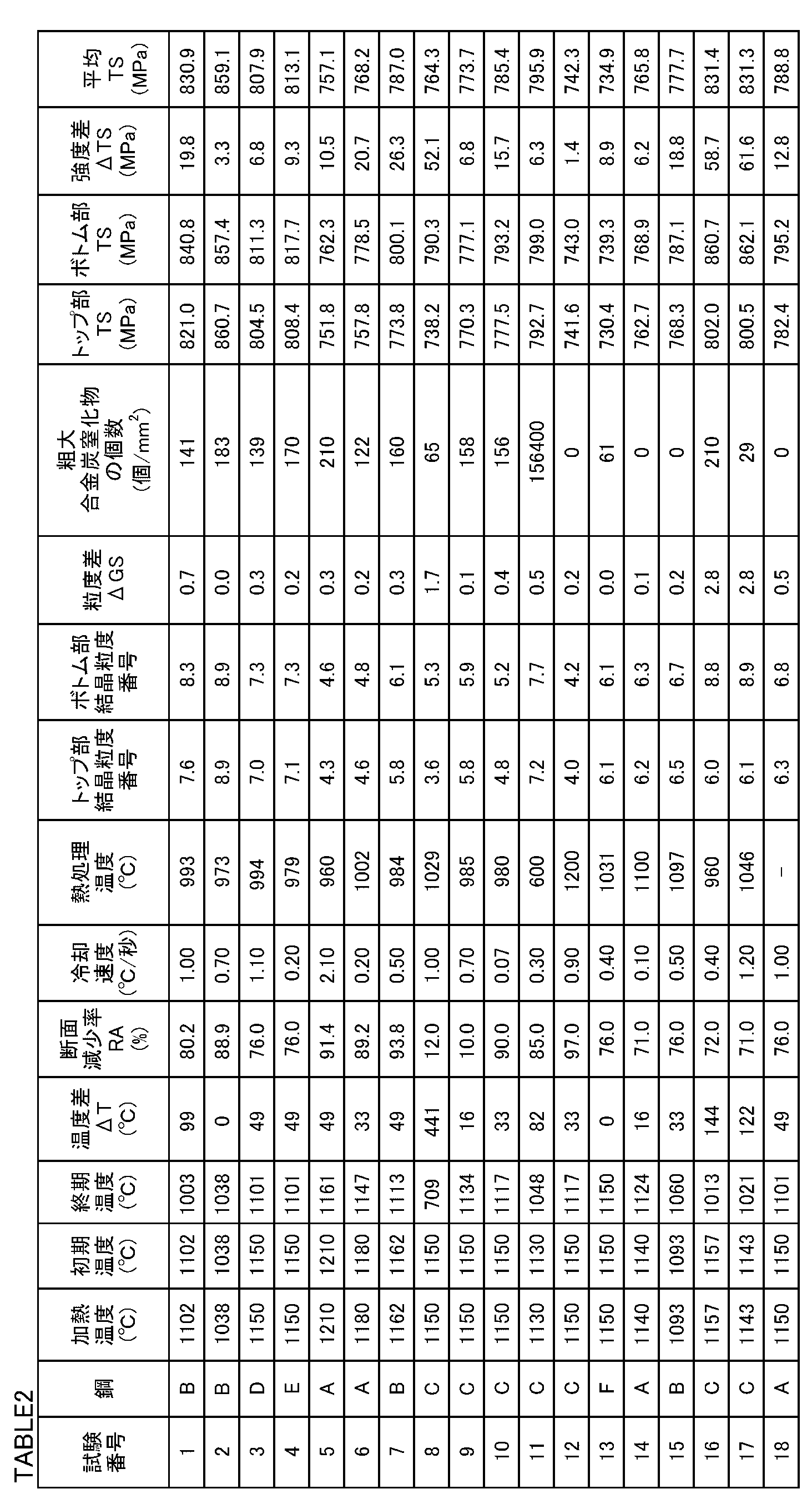
製造された各試験番号の鋼材の熱間加工でのトップ部及びボトム部から採取した試験片を用いて、上述のASTM E 112に基づいて結晶粒度試験を実施した。サンプルは各鋼材のトップ部及びボトム部に相当する位置(肉厚中央部)から採取した。トップ部とボトム部との結晶粒度番号を求め、さらに、結晶粒度差ΔGSを求めた。得られた結晶粒度番号及び結晶粒度差ΔGSを表2に示す。
各試験番号の鋼材の肉厚中央部から試験片を採取した。採取された試験片を用いて、上述の方法により粗大合金炭窒化物の個数(個/mm2)を求めた。
各試験番号の鋼材のトップ部、ボトム部の中心部から、丸棒引張試験片を採取した。丸棒引張試験片は鋼材(鋼管)の肉厚中央部を含み、丸棒試験片の平行部は、鋼材の長手方向に平行であった。平行部の直径は5mmであった。丸棒試験片を用いて、JIS Z2241(2011)に準拠して、常温(25℃)、大気中にて引張試験を実施し、各試験番号のトップ部、ボトム部の引張強度TS(MPa)を求めた。さらに、各試験番号での強度差ΔTS(MPa)を求めた。
表2に試験結果を示す。
Claims (4)
- オーステナイト系ステンレス鋼材であって、
質量%で、
C:0.10%以下、
Si:1.0%以下、
Mn:3~8%、
P:0.05%以下、
S:0.03%以下、
Ni:10~20%、
Cr:15~30%、
N:0.20~0.70%、
Mo:0~5.0%、
V:0~0.5%、及び、
Nb:0~0.5%を含有し、残部がFe及び不純物からなる化学組成を有し、
ASTM E 112に準拠した結晶粒度番号が6.0以上であり、
引張強度が800MPa以上であり、
前記引張強度の最大値と最小値との差が50MPa以下であり、
鋼中の円相当径が1000nmを超える合金炭窒化物の個数が10個/mm2以上である、オーステナイト系ステンレス鋼材。 - 請求項1に記載のオーステナイト系ステンレス鋼材であって、
前記化学組成は、
Mo:1.5~5.0%、
V:0.1~0.5%、及び、
Nb:0.1~0.5%からなる群から選択される1種又は2種以上を含有する、オーステナイト系ステンレス鋼材。 - 請求項1又は請求項2に記載のオーステナイト系ステンレス鋼材であって、
前記結晶粒度番号の最大値と最小値との差が1.5以下である、オーステナイト系ステンレス鋼材。 - 請求項1~請求項3のいずれか1項に記載のオーステナイト系ステンレス鋼材であって、
前記オーステナイト系ステンレス鋼材は、鋼管、棒鋼、又は線材である、オーステナイト系ステンレス鋼材。
Priority Applications (9)
| Application Number | Priority Date | Filing Date | Title |
|---|---|---|---|
| EP17779117.5A EP3441495B1 (en) | 2016-04-07 | 2017-04-04 | Austenitic stainless steel material |
| AU2017247759A AU2017247759B2 (en) | 2016-04-07 | 2017-04-04 | Austenitic stainless steel material |
| CA3019892A CA3019892C (en) | 2016-04-07 | 2017-04-04 | Austenitic stainless steel material |
| BR112018069311A BR112018069311A8 (pt) | 2016-04-07 | 2017-04-04 | Material de aço inoxidável austenítico |
| KR1020187031952A KR102172891B1 (ko) | 2016-04-07 | 2017-04-04 | 오스테나이트계 스테인리스 강재 |
| CN201780021538.2A CN109072377B (zh) | 2016-04-07 | 2017-04-04 | 奥氏体系不锈钢材 |
| ES17779117T ES2905422T3 (es) | 2016-04-07 | 2017-04-04 | Material de acero inoxidable austenítico |
| JP2018510603A JP6652191B2 (ja) | 2016-04-07 | 2017-04-04 | オーステナイト系ステンレス鋼材 |
| US16/090,306 US20190112694A1 (en) | 2016-04-07 | 2017-04-04 | Austenitic Stainless Steel Material |
Applications Claiming Priority (2)
| Application Number | Priority Date | Filing Date | Title |
|---|---|---|---|
| JP2016-077628 | 2016-04-07 | ||
| JP2016077628 | 2016-04-07 |
Publications (1)
| Publication Number | Publication Date |
|---|---|
| WO2017175739A1 true WO2017175739A1 (ja) | 2017-10-12 |
Family
ID=60001254
Family Applications (1)
| Application Number | Title | Priority Date | Filing Date |
|---|---|---|---|
| PCT/JP2017/014008 Ceased WO2017175739A1 (ja) | 2016-04-07 | 2017-04-04 | オーステナイト系ステンレス鋼材 |
Country Status (11)
| Country | Link |
|---|---|
| US (1) | US20190112694A1 (ja) |
| EP (1) | EP3441495B1 (ja) |
| JP (1) | JP6652191B2 (ja) |
| KR (1) | KR102172891B1 (ja) |
| CN (1) | CN109072377B (ja) |
| AU (1) | AU2017247759B2 (ja) |
| BR (1) | BR112018069311A8 (ja) |
| CA (1) | CA3019892C (ja) |
| ES (1) | ES2905422T3 (ja) |
| TW (1) | TWI634219B (ja) |
| WO (1) | WO2017175739A1 (ja) |
Cited By (9)
| Publication number | Priority date | Publication date | Assignee | Title |
|---|---|---|---|---|
| CN107557670A (zh) * | 2017-10-24 | 2018-01-09 | 山西太钢不锈钢股份有限公司 | 奥氏体不锈钢及其制备方法与应用 |
| JP2020132979A (ja) * | 2019-02-25 | 2020-08-31 | 日本製鉄株式会社 | オーステナイト系ステンレス鋼及びオーステナイト系ステンレス鋼の製造方法 |
| JP2020196912A (ja) * | 2019-05-31 | 2020-12-10 | 日本製鉄株式会社 | オーステナイト系ステンレス鋼材 |
| JP2021139007A (ja) * | 2020-03-06 | 2021-09-16 | 日本製鉄株式会社 | オーステナイト系ステンレス鋼材 |
| JPWO2022059186A1 (ja) * | 2020-09-18 | 2022-03-24 | ||
| JP2022155987A (ja) * | 2021-03-31 | 2022-10-14 | 日本製鉄株式会社 | オーステナイト系ステンレス鋼溶接材料 |
| CN116536586A (zh) * | 2023-05-19 | 2023-08-04 | 宣化钢铁集团有限责任公司 | 一种耐低温高强高韧奥氏体不锈钢及其制备方法 |
| EP4227433A1 (en) | 2022-02-14 | 2023-08-16 | Daido Steel Co., Ltd. | Austenitic stainless steel and hydrogen resistant member |
| EP4530367A2 (en) | 2023-09-27 | 2025-04-02 | Daido Steel Co., Ltd. | Austenitic stainless steel and hydrogen resistant member |
Families Citing this family (11)
| Publication number | Priority date | Publication date | Assignee | Title |
|---|---|---|---|---|
| DE102018133255A1 (de) * | 2018-12-20 | 2020-06-25 | Voestalpine Böhler Edelstahl Gmbh & Co Kg | Superaustenitischer Werkstoff |
| DE102018133251A1 (de) | 2018-12-20 | 2020-06-25 | Schoeller-Bleckmann Oilfield Technology Gmbh | Bohrstrangkomponente mit hoher Korrosionsbeständigkeit und Verfahren zu ihrer Herstellung |
| JP7818896B2 (ja) * | 2020-11-27 | 2026-02-24 | 三菱重工エンジン&ターボチャージャ株式会社 | オーステナイト系ステンレス鋳鋼およびオーステナイト系ステンレス鋳鋼の製造方法 |
| KR102868007B1 (ko) * | 2020-12-10 | 2025-10-01 | 가부시키가이샤 프로테리아루 | 오스테나이트계 스테인리스강대의 제조방법 |
| CN113136533B (zh) * | 2021-04-15 | 2022-08-16 | 鞍钢股份有限公司 | 一种低温用奥氏体不锈钢及其制造方法 |
| CN114574780B (zh) * | 2022-03-02 | 2022-11-04 | 中国医科大学附属第一医院 | 一种高强高耐蚀高氮奥氏体不锈钢克氏针及其制备方法 |
| CN114934240B (zh) * | 2022-04-25 | 2023-10-10 | 中国科学院金属研究所 | 一种超高强高耐蚀高氮奥氏体不锈钢的制备方法 |
| JP7845035B2 (ja) * | 2022-05-10 | 2026-04-14 | 大同特殊鋼株式会社 | 非磁性オーステナイト系ステンレス鋼材及びその製造方法 |
| EP4547882A1 (en) * | 2022-06-29 | 2025-05-07 | Alleima StripTech AB | Austenitic stainless steel and method for producing a strip product thereof |
| CN120719224B (zh) * | 2025-08-18 | 2025-11-18 | 鞍钢股份有限公司 | 4.2K屈服强度1500MPa级核聚变超导铠甲结构用钢及其制造方法 |
| CN121759830A (zh) * | 2026-03-02 | 2026-03-31 | 鞍钢股份有限公司 | 一种聚变堆包层结构用奥氏体不锈钢板、制造及焊接方法 |
Citations (3)
| Publication number | Priority date | Publication date | Assignee | Title |
|---|---|---|---|---|
| WO2012132992A1 (ja) * | 2011-03-28 | 2012-10-04 | 住友金属工業株式会社 | 高圧水素ガス用高強度オーステナイトステンレス鋼 |
| WO2015159554A1 (ja) * | 2014-04-17 | 2015-10-22 | 新日鐵住金株式会社 | オーステナイト系ステンレス鋼及びその製造方法 |
| WO2016068009A1 (ja) * | 2014-10-29 | 2016-05-06 | 新日鐵住金株式会社 | オーステナイトステンレス鋼及びその製造方法 |
Family Cites Families (17)
| Publication number | Priority date | Publication date | Assignee | Title |
|---|---|---|---|---|
| US4554028A (en) * | 1983-12-13 | 1985-11-19 | Carpenter Technology Corporation | Large warm worked, alloy article |
| DE3407307A1 (de) * | 1984-02-24 | 1985-08-29 | Mannesmann AG, 4000 Düsseldorf | Verwendung einer korrosionsbestaendigen austenitischen eisen-chrom-nickel-stickstoff-legierung fuer mechanisch hoch beanspruchte bauteile |
| JPH0565601A (ja) * | 1991-09-03 | 1993-03-19 | Hitachi Metals Ltd | 高強度、高疲労強度オーステナイト系ステンレス鋼およびその製造方法 |
| JPH06179952A (ja) * | 1992-12-15 | 1994-06-28 | Sumitomo Metal Ind Ltd | ソーダ回収ボイラ伝熱管用オーステナイトステンレス鋼 |
| JPH07109548A (ja) * | 1993-10-07 | 1995-04-25 | Daido Steel Co Ltd | 熱間加工性に優れたオーステナイト系ステンレス鋼 |
| JP3597707B2 (ja) * | 1998-06-10 | 2004-12-08 | 日本精線株式会社 | ブラシ軸用線材と該線材を用いてなる歯間ブラシ製品 |
| EP1605072B1 (en) * | 2003-03-20 | 2012-09-12 | Sumitomo Metal Industries, Ltd. | Stainless steel for high pressure hydrogen gas, vessel and equipment comprising the steel |
| KR100617465B1 (ko) | 2003-03-20 | 2006-09-01 | 수미도모 메탈 인더스트리즈, 리미티드 | 고압 수소 가스용 스테인레스강, 그 강으로 이루어지는 용기 및 기기 |
| JP4539559B2 (ja) | 2003-06-10 | 2010-09-08 | 住友金属工業株式会社 | 水素ガス用オーステナイトステンレス鋼とその製造方法 |
| ES2728670T3 (es) * | 2008-06-16 | 2019-10-28 | Nippon Steel Corp | Aleación austenítica resistente al calor, miembro a presión resistente al calor que comprende la aleación, y método para la fabricación del mismo miembro |
| JP2010121190A (ja) * | 2008-11-21 | 2010-06-03 | Nisshin Steel Co Ltd | 高圧水素輸送用オーステナイト系ステンレス鋼溶接管およびその製造方法 |
| JP5143960B1 (ja) * | 2011-05-11 | 2013-02-13 | 株式会社神戸製鋼所 | 高温強度と耐繰返し酸化特性に優れた耐熱オーステナイト系ステンレス鋼 |
| CA2839876C (en) * | 2011-06-24 | 2016-04-12 | Nippon Steel & Sumitomo Metal Corporation | Austenitic stainless steel and method for producing austenitic stainless steel material |
| CN102732806A (zh) * | 2012-06-26 | 2012-10-17 | 江苏兴海特钢有限公司 | 抗晶间腐蚀奥氏体系不锈钢 |
| JP6149435B2 (ja) * | 2013-03-12 | 2017-06-21 | 新日鐵住金株式会社 | 高圧水素ガス用低合金鋼および高圧水素用蓄圧器 |
| CN105324495A (zh) * | 2013-07-09 | 2016-02-10 | 新日铁住金株式会社 | 高Cr钢管的制造方法 |
| JP6068314B2 (ja) * | 2013-10-22 | 2017-01-25 | 株式会社神戸製鋼所 | 冷間加工性と浸炭熱処理後の表面硬さに優れる熱延鋼板 |
-
2017
- 2017-04-04 US US16/090,306 patent/US20190112694A1/en not_active Abandoned
- 2017-04-04 BR BR112018069311A patent/BR112018069311A8/pt not_active Application Discontinuation
- 2017-04-04 EP EP17779117.5A patent/EP3441495B1/en active Active
- 2017-04-04 CN CN201780021538.2A patent/CN109072377B/zh active Active
- 2017-04-04 ES ES17779117T patent/ES2905422T3/es active Active
- 2017-04-04 CA CA3019892A patent/CA3019892C/en active Active
- 2017-04-04 KR KR1020187031952A patent/KR102172891B1/ko active Active
- 2017-04-04 AU AU2017247759A patent/AU2017247759B2/en active Active
- 2017-04-04 WO PCT/JP2017/014008 patent/WO2017175739A1/ja not_active Ceased
- 2017-04-04 JP JP2018510603A patent/JP6652191B2/ja active Active
- 2017-04-07 TW TW106111756A patent/TWI634219B/zh active
Patent Citations (3)
| Publication number | Priority date | Publication date | Assignee | Title |
|---|---|---|---|---|
| WO2012132992A1 (ja) * | 2011-03-28 | 2012-10-04 | 住友金属工業株式会社 | 高圧水素ガス用高強度オーステナイトステンレス鋼 |
| WO2015159554A1 (ja) * | 2014-04-17 | 2015-10-22 | 新日鐵住金株式会社 | オーステナイト系ステンレス鋼及びその製造方法 |
| WO2016068009A1 (ja) * | 2014-10-29 | 2016-05-06 | 新日鐵住金株式会社 | オーステナイトステンレス鋼及びその製造方法 |
Cited By (18)
| Publication number | Priority date | Publication date | Assignee | Title |
|---|---|---|---|---|
| CN107557670A (zh) * | 2017-10-24 | 2018-01-09 | 山西太钢不锈钢股份有限公司 | 奥氏体不锈钢及其制备方法与应用 |
| JP2020132979A (ja) * | 2019-02-25 | 2020-08-31 | 日本製鉄株式会社 | オーステナイト系ステンレス鋼及びオーステナイト系ステンレス鋼の製造方法 |
| JP7277715B2 (ja) | 2019-02-25 | 2023-05-19 | 日本製鉄株式会社 | オーステナイト系ステンレス鋼及びオーステナイト系ステンレス鋼の製造方法 |
| JP2020196912A (ja) * | 2019-05-31 | 2020-12-10 | 日本製鉄株式会社 | オーステナイト系ステンレス鋼材 |
| JP7556675B2 (ja) | 2019-05-31 | 2024-09-26 | 日本製鉄株式会社 | オーステナイト系ステンレス鋼材 |
| JP7425299B2 (ja) | 2020-03-06 | 2024-01-31 | 日本製鉄株式会社 | オーステナイト系ステンレス鋼材 |
| JP2021139007A (ja) * | 2020-03-06 | 2021-09-16 | 日本製鉄株式会社 | オーステナイト系ステンレス鋼材 |
| US12067703B2 (en) | 2020-09-18 | 2024-08-20 | Kabushiki Kaisha Toshiba | Grain size estimation device, grain size estimation method, grain size estimation program, and grain size estimation system |
| JP7297083B2 (ja) | 2020-09-18 | 2023-06-23 | 株式会社東芝 | 粒度推定装置、粒度推定方法、粒度推定プログラム、粒度推定システム。 |
| JPWO2022059186A1 (ja) * | 2020-09-18 | 2022-03-24 | ||
| JP2022155987A (ja) * | 2021-03-31 | 2022-10-14 | 日本製鉄株式会社 | オーステナイト系ステンレス鋼溶接材料 |
| JP7633507B2 (ja) | 2021-03-31 | 2025-02-20 | 日本製鉄株式会社 | オーステナイト系ステンレス鋼溶接材料 |
| EP4227433A1 (en) | 2022-02-14 | 2023-08-16 | Daido Steel Co., Ltd. | Austenitic stainless steel and hydrogen resistant member |
| KR20230122548A (ko) | 2022-02-14 | 2023-08-22 | 다이도 토쿠슈코 카부시키가이샤 | 오스테나이트계 스테인리스강 및 내수소성 부재 |
| US12188113B2 (en) | 2022-02-14 | 2025-01-07 | Daido Steel Co., Ltd. | Austenitic stainless steel and hydrogen resistant member |
| CN116536586A (zh) * | 2023-05-19 | 2023-08-04 | 宣化钢铁集团有限责任公司 | 一种耐低温高强高韧奥氏体不锈钢及其制备方法 |
| EP4530367A2 (en) | 2023-09-27 | 2025-04-02 | Daido Steel Co., Ltd. | Austenitic stainless steel and hydrogen resistant member |
| KR20250047201A (ko) | 2023-09-27 | 2025-04-03 | 다이도 토쿠슈코 카부시키가이샤 | 오스테나이트계 스테인레스강 및 내수소성 부재 |
Also Published As
| Publication number | Publication date |
|---|---|
| ES2905422T3 (es) | 2022-04-08 |
| KR20180125594A (ko) | 2018-11-23 |
| TWI634219B (zh) | 2018-09-01 |
| BR112018069311A8 (pt) | 2021-10-13 |
| TW201741473A (zh) | 2017-12-01 |
| CA3019892A1 (en) | 2017-10-12 |
| CN109072377A (zh) | 2018-12-21 |
| CN109072377B (zh) | 2020-10-16 |
| AU2017247759B2 (en) | 2020-04-30 |
| BR112018069311A2 (pt) | 2019-01-22 |
| AU2017247759A1 (en) | 2018-10-18 |
| EP3441495A1 (en) | 2019-02-13 |
| US20190112694A1 (en) | 2019-04-18 |
| JPWO2017175739A1 (ja) | 2019-01-17 |
| EP3441495A4 (en) | 2019-11-20 |
| JP6652191B2 (ja) | 2020-02-19 |
| CA3019892C (en) | 2020-12-22 |
| KR102172891B1 (ko) | 2020-11-02 |
| EP3441495B1 (en) | 2022-01-12 |
Similar Documents
| Publication | Publication Date | Title |
|---|---|---|
| JP6652191B2 (ja) | オーステナイト系ステンレス鋼材 | |
| JP6256458B2 (ja) | オーステナイト系ステンレス鋼及びその製造方法 | |
| KR20190065352A (ko) | NiCrFe 합금 | |
| US11578394B2 (en) | Nickel-containing steel for low temperature | |
| JP7114998B2 (ja) | オーステナイト系ステンレス鋼 | |
| WO2017208946A1 (ja) | 二相ステンレス鋼及び二相ステンレス鋼の製造方法 | |
| CN102712971B (zh) | 耐碱性优异的双相不锈钢 | |
| WO2018146783A1 (ja) | オーステナイト系耐熱合金およびその製造方法 | |
| WO2018003823A1 (ja) | オーステナイト系ステンレス鋼 | |
| WO2021132634A1 (ja) | 合金 | |
| JP6520546B2 (ja) | オーステナイト系耐熱合金部材およびその製造方法 | |
| JP6206423B2 (ja) | 低温靭性に優れた高強度ステンレス厚鋼板およびその製造方法 | |
| JPWO2019098233A1 (ja) | 2相ステンレス鋼及び2相ステンレス鋼の製造方法 | |
| JP6627662B2 (ja) | オーステナイト系ステンレス鋼 | |
| JP6725191B2 (ja) | Ni含有高Cマルテンサイト系耐熱鋼 | |
| EP4411006A1 (en) | Duplex stainless steel material | |
| JP6575265B2 (ja) | オーステナイト系ステンレス鋼 | |
| JP6575266B2 (ja) | オーステナイト系ステンレス鋼 | |
| WO2024252667A1 (ja) | 鋼材 |
Legal Events
| Date | Code | Title | Description |
|---|---|---|---|
| WWE | Wipo information: entry into national phase |
Ref document number: 2018510603 Country of ref document: JP |
|
| ENP | Entry into the national phase |
Ref document number: 3019892 Country of ref document: CA |
|
| NENP | Non-entry into the national phase |
Ref country code: DE |
|
| REG | Reference to national code |
Ref country code: BR Ref legal event code: B01A Ref document number: 112018069311 Country of ref document: BR |
|
| ENP | Entry into the national phase |
Ref document number: 2017247759 Country of ref document: AU Date of ref document: 20170404 Kind code of ref document: A |
|
| ENP | Entry into the national phase |
Ref document number: 20187031952 Country of ref document: KR Kind code of ref document: A |
|
| WWE | Wipo information: entry into national phase |
Ref document number: 2017779117 Country of ref document: EP |
|
| ENP | Entry into the national phase |
Ref document number: 2017779117 Country of ref document: EP Effective date: 20181107 |
|
| 121 | Ep: the epo has been informed by wipo that ep was designated in this application |
Ref document number: 17779117 Country of ref document: EP Kind code of ref document: A1 |
|
| ENP | Entry into the national phase |
Ref document number: 112018069311 Country of ref document: BR Kind code of ref document: A2 Effective date: 20180921 |