WO2017187583A1 - Dispositif de suture de corps vivant - Google Patents
Dispositif de suture de corps vivant Download PDFInfo
- Publication number
- WO2017187583A1 WO2017187583A1 PCT/JP2016/063303 JP2016063303W WO2017187583A1 WO 2017187583 A1 WO2017187583 A1 WO 2017187583A1 JP 2016063303 W JP2016063303 W JP 2016063303W WO 2017187583 A1 WO2017187583 A1 WO 2017187583A1
- Authority
- WO
- WIPO (PCT)
- Prior art keywords
- staple
- ejection hole
- staple ejection
- jaw
- living body
- Prior art date
- Legal status (The legal status is an assumption and is not a legal conclusion. Google has not performed a legal analysis and makes no representation as to the accuracy of the status listed.)
- Ceased
Links
- 0 *CC(C*)N=C Chemical compound *CC(C*)N=C 0.000 description 2
Images





Classifications
-
- A—HUMAN NECESSITIES
- A61—MEDICAL OR VETERINARY SCIENCE; HYGIENE
- A61B—DIAGNOSIS; SURGERY; IDENTIFICATION
- A61B17/00—Surgical instruments, devices or methods
- A61B17/068—Surgical staplers, e.g. containing multiple staples or clamps
Definitions
- the present invention relates to a biological suturing device.
- a living body suturing device that joins living tissues by applying energy and reinforces the joining strength by stapling is known (for example, see Patent Document 1).
- a living body suturing device (electrosurgical tool) described in Patent Document 1 includes a long first jaw (jaw member) having a first clamping surface, and the first clamping surface facing the first clamping surface. And a long second jaw (jaw member) having a second clamping surface for clamping the living tissue therebetween.
- the first jaw is provided with a structure for driving staples into the living tissue.
- the second jaw is provided with a pair of electrodes for applying energy to the living tissue.
- the living body suturing device described in Patent Document 1 employs the following structure as a structure for driving staples into living tissue.
- a plurality of first and second staple ejection holes for ejecting staples to the outside are formed on the first clamping surface.
- the plurality of first staple ejection holes are located on one end side in the width direction of the first clamping surface, and are arranged in parallel along the longitudinal direction of the first clamping surface.
- the plurality of second staple ejection holes are located at the other end side in the width direction of the first clamping surface, and are provided at positions facing the respective first staple ejection holes in the width direction.
- a plurality of first staple holding members (drivers), a plurality of second staple holding members (drivers), and a driving member (wedge) are provided inside the first jaw.
- the plurality of first staple holding members are respectively provided for the plurality of first staple ejection holes, and hold the respective staples inside the first jaw.
- the plurality of second staple holding members have the same shape as the first staple holding member, are respectively provided for the plurality of second staple ejection holes, and hold the respective staples inside the first jaw.
- the drive member moves to the distal end side along the longitudinal direction of the first jaw in the first jaw in response to an operation on an operation knob provided in the living body suturing device.
- the driving member sequentially presses the first and second staple holding members in accordance with the movement, and sequentially ejects the staples from the plurality of first and second staple ejection holes.
- the staple ejected from the first jaw first punctures the living tissue sandwiched between the first jaw and the second jaw, and then needles the anvil provided on the second sandwiching surface of the second jaw. The tip abuts, and finally the needle tip is bent by the anvil. That is, when the staple is driven into the living tissue, the staple follows the above-described process, and therefore it is necessary to apply a relatively large driving force (a force for operating the driving member) to the driving member.
- the first and second staple ejection holes are provided at positions facing each other in the width direction of the first jaw. .
- the drive member sequentially presses the two first and second staple holding members simultaneously in accordance with the movement of the first jaw toward the distal end along the longitudinal direction, and from the first and second staple ejection holes.
- two staples are sequentially ejected. That is, since two staples are simultaneously driven into the living tissue, there is a problem that it is necessary to apply a large driving force (a force for operating the driving member) to the driving member at the start of staple driving.
- the present invention has been made in view of the above, and an object of the present invention is to provide a living body suturing device that can reduce the driving force at the start of staple driving.
- a living body suturing device includes a first jaw having a first clamping surface provided with staple ejection holes, and a first jaw surface facing the first jaw.
- a second jaw having a second clamping surface for clamping the living tissue with the first clamping surface, a staple ejected from the staple ejection hole, a staple holding member for retaining the staple, and the staple ejection hole
- a drive member that moves in a second direction that intersects a first direction in which the staple is ejected, presses the staple holding member in accordance with the movement, and ejects the staple from the staple ejection hole; and An excision portion disposed along the direction and excising the living tissue sandwiched between the first sandwiching surface and the second sandwiching surface.
- first staple ejection hole provided in the one surface and a second provided in the other surface
- a staple ejection hole, and the first staple ejection hole and the second staple ejection hole are provided at positions shifted from each other in the second direction.
- the living body suturing device according to the present invention has an effect that the driving force at the start of staple driving can be reduced.
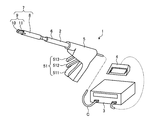
- FIG. 1 is a diagram schematically showing a treatment system according to Embodiment 1 of the present invention.
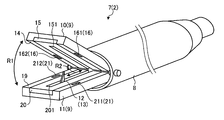
- FIG. 2 is a perspective view schematically showing the biological suturing device shown in FIG.
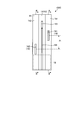
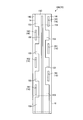
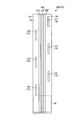
- FIG. 3 is a view of the first jaw shown in FIGS. 1 and 2 as viewed from the first clamping surface side.
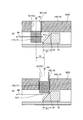
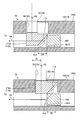
- FIG. 4 is a cross-sectional view of the first jaw shown in FIGS. 1 to 3.
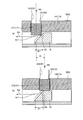
- FIG. 5 is a diagram illustrating a state in which the first and second staple holding members are interlocked with the operation of the driving member illustrated in FIG. 4.
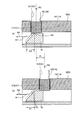
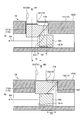
- FIG. 6 is a diagram illustrating a state in which the first and second staple holding members are interlocked with the operation of the driving member illustrated in FIG. 4.
- FIG. 5 is a diagram illustrating a state in which the first and second staple holding members are interlocked with the operation of the driving member illustrated in FIG. 4.
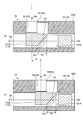
- FIG. 7 is a diagram illustrating a state in which the first and second staple holding members are interlocked with the operation of the driving member illustrated in FIG. 4.
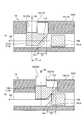
- FIG. 8 is a diagram illustrating a state in which the first and second staple holding members are interlocked with the operation of the driving member illustrated in FIG. 4.
- FIG. 9 is a view of the second jaw shown in FIGS. 1 and 2 as viewed from the second clamping surface side.
- FIG. 10 is a diagram schematically showing a first jaw constituting the living body suturing device according to Embodiment 2 of the present invention.
- FIG. 11 is a diagram illustrating a state in which the first and second staple holding members are interlocked with the operation of the driving member illustrated in FIG. 10.
- FIG. 12 is a diagram illustrating a state in which the first and second staple holding members are interlocked with the operation of the driving member illustrated in FIG. 10.
- FIG. 13 is a diagram illustrating a state in which the first and second staple holding members are interlocked with the operation of the driving member illustrated in FIG. 10.
- FIG. 14 is a diagram illustrating a state in which the first and second staple holding members are interlocked with the operation of the driving member illustrated in FIG. 10.
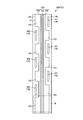
- FIG. 15 is a view of the first jaw constituting the living body suturing device according to Embodiment 3 of the present invention as viewed from the first clamping surface side.
- FIG. 16 is a view of the first jaw constituting the living body suturing device according to the fourth embodiment of the present invention as viewed from the first clamping surface side.
- FIG. 17 is a view of the first jaw constituting the living body suturing device according to the fifth embodiment of the present invention as seen from the first clamping surface side.
- FIG. 18 is a diagram showing a modification of the
- FIG. 1 is a diagram schematically showing a treatment system 1 according to Embodiment 1 of the present invention.
- the treatment system 1 treats (joins (or anastomoses), detaches, etc.) biological tissues to be treated by applying energy and stapling.
- the treatment system 1 includes a treatment tool 2, a control device 3, and a foot switch 4.
- the treatment tool 2 is, for example, a linear type surgical treatment tool for performing treatment on a living tissue through the abdominal wall.
- the treatment tool 2 includes a handle 5, a first shaft 6, and a living body suturing device 7.
- the handle 5 is a portion that the operator holds.
- the handle 5 is provided with a plurality of operation knobs 51 (in the first embodiment, three of first to third operation knobs 511 to 513).
- the first shaft 6 has a substantially cylindrical shape, and one end (the right end portion in FIG. 1) is connected to the handle 5.
- an electric cable C (FIG. 1) connected to the control device 3 is disposed from one end side to the other end side via the handle 5.
- FIG. 2 is a perspective view schematically showing the living body suturing device 7.
- the living body suturing device 7 is a disposable part discarded after use, and is detachably attached to the other end (the left end in FIG. 1) of the first shaft 6.
- the living body suturing device 7 is not limited to a configuration (disposable configuration) that is detachable from the first shaft 6, and may be configured integrally with the first shaft 6.
- the biological suturing device 7 includes a second shaft 8 and a clamping portion 9 as shown in FIG. 1 or FIG.
- the second shaft 8 has a substantially cylindrical shape, and one end (the right end portion in FIGS. 1 and 2) is the other end of the first shaft 6 (the left end portion in FIG. 1). ) Is detachable. Moreover, the clamping part 9 is attached to the other end (the left end part in FIGS. 1 and 2) of the second shaft 8.
- the first and second shafts 6 and 8 are connected to each other in a state where the second shaft 8 is attached to the first shaft 6, and according to the operation of the first operation knob 511 by the operator, First and second opening / closing mechanisms (not shown) for opening and closing the first and second jaws 10 and 11 (FIGS. 1 and 2) constituting the holding portion 9 are provided.
- first and second shafts 6 and 8 are connected to each other with the second shaft 8 attached to the first shaft 6, and according to the operation of the second operation knob 512 by the operator,
- the drive member 18 (see FIGS. 3 and 4) is operated to fire U-shaped first and second staples St1 and St2 (see FIG. 4) made of metal or resin to stapling the living tissue.
- First and second firing mechanisms (not shown) are provided.
- the first and second shafts 6 and 8 are connected to each other with the second shaft 8 attached to the first shaft 6, and according to the operation of the third operation knob 513 by the operator,
- First and second moving mechanisms (not shown) for moving the cutter 12 (FIG. 2) are provided.
- the electric cable C routed to the other end (the left end portion in FIG. 1) of the first shaft 6 with the second shaft 8 attached to the first shaft 6. Are connected to the first and second energy generators 15 and 20 (FIG. 2).
- the clamping unit 9 is a part that clamps a living tissue and treats the living tissue.
- the clamping unit 9 includes a first jaw 10, a second jaw 11, and a cutter 12 (FIG. 2).
- the first and second jaws 10 and 11 are pivotally supported on the other end (left end portion in FIGS. 1 and 2) of the second shaft 8 so as to be opened and closed in the direction of the arrow R1 (FIG. 2).
- the living tissue can be clamped according to the operation of the operation knob 511.
- the detailed configuration of the first and second jaws 10 and 11 will be described later.
- the cutter 12 is attached to the other end of the second shaft 8 so as to be movable along the direction of the arrow R2 (FIG.
- the cutter 12 has a function as the excision part 13 according to the present invention.
- the first jaw 10 is disposed on the upper side in FIGS. 1 and 2 with respect to the second jaw 11, and has a hollow, substantially rectangular parallelepiped shape extending along the central axis of the second shaft 8.
- the material of the first jaw 10 include a material having high heat resistance and excellent electrical insulation, for example, PEEK (polyether ether ketone) resin.
- the shape of the first jaw 10 is not limited to a rectangular parallelepiped shape, and it may be configured to improve the insertability to the trocar by giving the outer peripheral surface a curvature. 1 and 2 of the first jaw 10 functions as a first clamping surface 14 that clamps the living tissue with the second jaw 11.
- FIG. 3 is a view of the first jaw 10 as viewed from the first clamping surface 14 side.
- FIG. 4 is a cross-sectional view of the first jaw 10. Specifically, FIG. 4A is a cross-sectional view taken along line AA in FIG.
- FIG. 4B is a sectional view taken along line BB in FIG.
- the first energy generating unit 15 is embedded in the first clamping surface 14 at a substantially central position in the width direction of the first clamping surface 14.
- the first energy generation unit 15 is embedded in the first clamping surface 14 with the surface exposed, and generates energy under the control of the control device 3.
- the 1st energy generation part 15 also has a function as the cutting part 13 (energy generation part) which concerns on this invention.
- the first energy generating unit 15 is configured by, for example, a conductive material such as copper, or a heater that generates heat when electric power is applied.
- the first energy generation unit 15 extends along the longitudinal direction of the first jaw 10 and is set so that the longitudinal dimension thereof is substantially the same as the longitudinal dimension of the first jaw 10.
- the first energy generation unit 15 has a surface (a surface on the lower side in FIG. 2) in a region other than the region where the first energy generation unit 15 is disposed on the first clamping surface 14 (first described later). , Except for the second staple ejection holes 161 and 162), it is embedded in the first clamping surface 14 so as to be substantially flush.
- the first energy generating unit 15 is connected to the second jaw 11 by the control device 3 via the electric cable C and the connection unit (not shown) with the second shaft 8 attached to the first shaft 6. Energy is generated by supplying electric power to the second energy generation unit 20 (FIG. 2). That is, the first energy generating unit 15 is configured as an electrode or a heater to which high frequency power is supplied.
- one end in the longitudinal direction of the first energy generation unit 15 (as shown in FIG. 2 or 3) is provided at a substantially central position in the width direction of the first energy generation unit 15.
- a first cutter moving groove that extends along the longitudinal direction from the end portion on the second shaft 8 side (in FIG. 2, right end portion (lower end portion in FIG. 3)) toward the other end and serves as a moving path of the cutter 12. 151 is formed.
- first and second staple ejection holes 161 and 162 for ejecting the first and second staples St ⁇ b> 1 and St ⁇ b> 2 are formed in the first clamping surface 14.
- the first and second staple ejection holes 161 and 162 differ only in the positions formed in the first jaw 10 and have the same shape and function. For this reason, the description of the first and second staple ejection holes 161 and 162 will be described by using the first and second staple ejection holes 161 and 162 as the staple ejection holes 16 (FIGS. 2 to 4).
- the first and second staples St1, St2 are different only in the positions where they are disposed, and have the same shape and function.
- the first and second staples St1 and St2 will be described as the staple St (FIG. 4).
- the staple ejection hole 16 is formed by an elongated hole that penetrates the inside and outside of the first jaw 10 and extends along the longitudinal direction of the first jaw 10, and holds the staple St on the first clamping surface. 14 in the normal direction R3 (FIG. 4).
- the normal direction R3 corresponds to the first direction according to the present invention.
- the normal direction R3 is referred to as a first direction R3.
- the formation positions of the first and second staple ejection holes 161 and 162 will be described later.
- first and second staple holding members 171 and 172 and a drive member 18 are disposed inside the first jaw 10.
- the first and second staple holding members 171 and 172 differ only in the positions where they are disposed on the first jaw 10, and have the same shape and function. For this reason, the first and second staple holding members 171 and 172 will be described as the staple holding member 17 with respect to overlapping portions.
- the staple holding member 17 has a rectangular parallelepiped shape that can be inserted into the staple ejection hole 16, and holds the staple St on the upper surface in FIG.
- the staple holding member 17 is disposed so as to be movable from the inside of the first jaw 10 to the staple ejection hole 16 in the first direction R3.
- the drive member 18 is disposed inside the first jaw 10, and in the longitudinal direction of the first jaw 10 by the first and second firing mechanisms (not shown) according to the operation of the second operation knob 512 by the operator. Move to R4 (FIGS. 3 and 4). Then, the drive member 18 presses the staple holding member 17 at the distal end portion (the end portion on the distal end side of the first jaw 10) in accordance with the movement of the first jaw 10 toward the distal end side along the longitudinal direction R4. Then, the staple holding member 17 is moved in the first direction R3 (the staple St is ejected from the staple ejection hole 16).
- the longitudinal direction R4 intersects with the first direction R3 (orthogonal in the first embodiment) and corresponds to the second direction according to the present invention.
- the longitudinal direction R4 is referred to as a second direction R4.
- the drive member 18 is formed in a prismatic shape, and the distal end portion of the drive member 18 is inclined toward the base end side (the base end side of the first jaw 10) from the bottom to the top in FIG.
- a drive-side inclined surface 181 is formed.
- the drive-side inclined surface 181 has a drive-side slidable contact area Ar1 that slidably contacts the staple holding member 17 when the drive member 18 moves to the distal end side of the first jaw 10 along the second direction R4 (FIG. 3, FIG. 3). 4).
- the drive-side inclined surface 181 is a portion that moves the staple holding member 17 in the first direction R3 while being in sliding contact with the staple holding member 17.
- the first and second staple ejection holes 161 and 162 are formed at the following positions, respectively.
- the first staple injection hole 161 is formed when the first clamping surface 14 is divided into one (the right side in FIG. 3) surface 141 and the other (the left side in FIG. 3) surface 142 with the cut portion 13 as the center.
- the surface 141 is provided.
- the second staple ejection hole 162 is provided on the other surface 142.
- the first and second staple ejection holes 161 and 162 are provided at positions shifted from each other in the second direction R4, as shown in FIG. 3 or FIG.
- the first staple ejection hole 161 is provided at a position shifted from the position facing the second staple ejection hole 162 to the distal end side of the first jaw 10 along the second direction R4 with respect to the cut portion 13 as a reference.
- the distance between the first and second staple ejection holes 161 and 162 shifted in the second direction R4 is Pi (FIGS. 3 and 4).
- a length dimension along the second direction R4 in the driving side sliding contact area Ar1 is defined as D1 (FIG. 4).
- the first staple St1 and the first staple holding member 171 are respectively disposed at positions corresponding to the first staple ejection holes 161 as shown in FIG.
- the second staple St2 and the second staple holding member 172 are disposed at positions corresponding to the second staple ejection holes 162, respectively.
- FIG. 5A, FIG. 6A, FIG. 7A, and FIG. 8A are cross-sectional views corresponding to FIG. 5 (b), FIG. 6 (b), FIG. 7 (b), and FIG. 8 (b) are cross-sectional views corresponding to FIG. 4 (b).
- the second staple ejection hole 162 (second staple St2 and second staple holding member 172) is located with respect to the first staple ejection hole 161 (first staple St1 and first staple holding member 171).
- the first jaw 10 is provided at a position shifted to the proximal end side. Therefore, the driving member 18 first comes into contact with the second staple holding member 172 in accordance with the movement of the first jaw 10 toward the distal end side along the second direction R4.
- the driving-side inclined surface 181 is slidably contacted with the second staple holding member 172 as shown in FIGS. 5B and 6B. 2
- the staple holding member 172 is pressed.
- FIG. 6 shows a point in time when the ejection of the second staple St2 is completed.
- FIG. 6B shows the second staple St2.
- FIG. 7B and FIG. 8B the second staple St2 is shown for convenience of explanation.
- One staple holding member 171 is pressed. As a result, the first staple holding member 171 moves in the first direction R3 and is inserted from the inside of the first jaw 10 into the first staple ejection hole 161. Then, the first staple St1 is ejected from the first staple ejection hole 161 in the first direction R3.
- the second jaw 11 has a substantially rectangular parallelepiped shape extending along the central axis of the second shaft 8.
- a material having high heat resistance and excellent electrical insulation for example, PEEK resin can be exemplified.
- the shape of the second jaw 11 is not limited to a rectangular parallelepiped shape like the first jaw 11, but is configured to improve the insertability to the trocar by giving the outer peripheral surface a curvature. It doesn't matter.
- the upper surface of the second jaw 11 in FIGS. 1 and 2 functions as a second clamping surface 19 that clamps the living tissue with the first clamping surface 14.
- FIG. 9 is a view of the second jaw 11 as viewed from the second clamping surface 19 side.
- the second energy generating unit 20 is embedded in the second clamping surface 19 at a substantially central position in the width direction of the second clamping surface 19.
- the second energy generation unit 20 is embedded in the second clamping surface 19 with the surface exposed, and generates energy under the control of the control device 3.
- the 2nd energy generation part 20 also has a function as the cutting part 13 (energy generation part) which concerns on this invention.
- the 2nd energy generation part 20 is comprised by the heater which heat
- the second energy generating unit 20 is set so as to extend along the longitudinal direction of the second jaw 11 and the longitudinal dimension thereof is substantially the same as the longitudinal dimension of the second jaw 11.
- the second energy generation unit 20 has a surface (upper surface in FIG. 2) in a region other than a region where the second energy generation unit 20 is disposed on the second clamping surface 19 (first described later). Embedded in the second clamping surface 19 so as to be substantially flush with the second needle tip receiving portions 211 and 212). Furthermore, the second energy generation unit 20 faces the first energy generation unit 15 in a state where the first and second jaws 10 and 11 are closed.
- the second energy generation unit 20 generates the first energy by the control device 3 via the electric cable C and the connection unit (not shown) with the second shaft 8 attached to the first shaft 6. Energy is generated by supplying electric power to the unit 15. That is, the second energy generation unit 15 is configured as an electrode or a heater to which high frequency power is supplied.
- a substantially central position in the width direction of the second energy generating unit 20 (a position facing the first cutter moving groove 151 in a state where the first and second jaws 10 and 11 are closed).
- a second cutter moving groove 201 that extends along the longitudinal direction toward the other end and serves as a moving path of the cutter 12 is formed.
- first and second needle tip receiving portions 211 and 212 are formed on the second clamping surface 19 in regions other than the second energy generating portion 20, respectively.
- the first and second needle tip receiving portions 211 and 212 are different only in the formed positions, and have the same shape and function. For this reason, with respect to the portions where the descriptions of the first and second needle tip receiving portions 211 and 212 overlap, the first and second needle tip receiving portions 211 and 212 are used as the needle tip receiving portion 21 (FIGS. 2 and 9). explain.
- the needle tip receiving portion 21 is constituted by a recess formed in the second clamping surface 19.
- the needle tip receiving portion 21 receives the needle tips (both ends of the U-shaped staple St) ejected from the staple ejection hole 16 and deforms the needle tips (the U-shaped staple St is substantially B). It has a function of deforming into a letter shape.
- the first needle tip receiving portion 211 has the second clamping surface 19 on one side (left side in FIG. 9) and the other side (right side in FIG. 9) with the second clamping surface 19 centered on the cutting portion 13 (second energy generating portion 20). ) Is provided on one surface 191.
- the one surface 191 faces one surface 141 of the first clamping surface 14 in a state where the first and second jaws 10 and 11 are closed.
- the first needle tip receiving portion 211 faces the first staple ejection hole 161 in a state where the first and second jaws 10 and 11 are closed.
- the second needle tip receiving portion 212 is provided on the other surface 192.
- the other surface 192 faces the other surface 142 of the first clamping surface 14 in a state where the first and second jaws 10 and 11 are closed.
- the second needle tip receiving portion 212 faces the second staple ejection hole 162 in a state where the first and second jaws 10 and 11 are closed.
- the needle tip receiving portion 21 is configured to receive the staple tips of the staple St (both ends of the U-shaped staple St). Therefore, it may be provided in one-to-two.
- the foot switch 4 is a part operated by the operator with his / her foot. Then, in response to the operation to the foot switch 4, for example, supply of high-frequency power or the like is started from the control device 3 to the biological suturing device 7 (first and second energy generating units 15 and 20).
- the first and second energy generators 15 and 20 are configured as electrodes or heaters. In the following, for convenience of explanation, the case where the first and second energy generating units 15 and 20 are configured by electrodes (when high-frequency power is supplied between the first and second energy generating units 15 and 20). Explained as an example.
- the means for starting the supply of high-frequency power is not limited to the foot switch 4, and a switch operated by hand or the like may also be employed.
- the control device 3 includes a CPU (Central Processing Unit) and the like, and comprehensively controls the operation of the biological suturing device 7 according to a predetermined control program. More specifically, the control device 3 responds to the operation of the foot switch 4 by the surgeon via the electric cable C and the connecting portion (not shown), and the first and second energy generating portions 15 and 20. During this period, high-frequency power having a preset output is supplied.
- CPU Central Processing Unit
- a high-frequency current flows between the first and second energy generation units 15 and 20, and a part of the living tissue sandwiched between the first and second energy generation units 15 and 20 (hereinafter, Joule heat is generated at the energy bonding site. And the energy joining part is joined by generation
- the surgeon operates the third operation knob 513.
- the cutter 12 moves to the distal end side of the living body suturing device 7, and cuts out the substantially center position in the width direction at the energy bonding portion.
- the stapling of the living tissue by operating the second operation knob 512 is performed between the time when the living tissue is held by the first and second jaws 10 and 11 until the foot switch 4 is operated, or the foot Between the time when the switch 4 is operated and the time when the third operation knob 513 is operated (while supplying high-frequency power to the first and second energy generating units 15 and 20 or after completing the supply of the high-frequency power) It may be executed at any timing.
- a notification unit not shown
- the surgeon recognizes that the above-described high-frequency power supply has been completed.
- the notification unit include a display that displays predetermined information, an LED (Light Emitting Diode) that notifies predetermined information by lighting or blinking, and a speaker that notifies predetermined information by sound.
- the first and second staple ejection holes 161 and 162 are provided at positions shifted from each other in the second direction R4. Therefore, the driving member 18 first presses the second staple holding member 172 and then presses the first staple holding member 171 in accordance with the movement of the first jaw 10 toward the distal end side along the second direction R4. . That is, the drive member 18 does not press the first and second staple holding members 171 and 172 at the same time when the staple St is started to be driven. From the above, the surgeon only moves the drive member 18 along the second direction R4 along the second direction R4 by operating the second operation knob 512 with a relatively small force at the start of driving of the staple St. The staple St can be driven into the living tissue. Therefore, the operability of the treatment tool 2 can be improved.
- a period that partially overlaps the first period and the second period it is necessary to simultaneously press the first and second staple holding members 171 and 172 with the driving member 18 during the overlapping period. is there. For this reason, the surgeon needs to operate the second operation knob 512 with a relatively large force during the overlapping period.
- the first and second periods do not overlap each other and are independent periods, so that the surgeon can always perform the first and second periods with a relatively small force during the first and second periods.
- the two operation knob 512 may be operated. Therefore, the operability of the treatment tool 2 can be further improved.
- FIG. 10 is a diagram schematically showing a living body suturing device 7A according to Embodiment 2 of the present invention. Specifically, FIG. 10A is a cross-sectional view corresponding to FIG. FIG. 10B is a cross-sectional view corresponding to FIG.
- the staple holding member 17 and the drive member 18 have shapes different from those of the biological suturing device 7 described in the first embodiment. Different staple holding members 17A and drive members 18A are employed.
- the drive member 18 ⁇ / b> A has the drive-side inclined surface 181 at the tip portion omitted from the drive member 18 described in the first embodiment.
- tip of the drive member 18A is comprised by the flat surface 181A orthogonal to 2nd direction R4.
- the staple holding member 17A corresponds to the first and second staple ejection holes 161 and 162 (first and second staples St1 and St2) similarly to the staple holding member 17 described in the first embodiment.
- 1 and 2nd staple holding members 171A and 172A are provided.
- the first and second staple holding members 171A and 172A have the same shape and function. For this reason, as for the overlapping description of the first and second staple holding members 171A and 172A, the first and second staple holding members 171A and 172A will be described as the staple holding member 17A.
- the staple holding member 17A has the same function as the staple holding member 17 described in the first embodiment and is disposed at the same position, but has a different shape. Specifically, as shown in FIG.
- the staple holding member 17 ⁇ / b> A is formed in a prismatic shape extending in the width direction of the first jaw 10. Then, on the proximal end side of the staple holding member 17 (the proximal end side of the first jaw 10), a holding-side inclined surface 173 that is inclined toward the proximal end side is formed from the lower side to the upper side in FIG. ing.
- the holding-side inclined surface 173 has a holding-side slidable contact area Ar2 (see FIG. 10) that slidably contacts the front end of the drive member 18A when the drive member 18A moves to the front end side of the first jaw 10 along the second direction R4. ). That is, the holding-side inclined surface 173 is a portion that is pressed by the driving member 18A while being in sliding contact with the driving member 18A.
- 11 to 14 are views showing a state in which the first and second staple holding members 171A and 172A are interlocked with the operation of the driving member 18A. Specifically, (a) in FIG. 11, (a) in FIG. 12, (a) in FIG. 13, and (a) in FIG. 14 are cross-sectional views corresponding to (a) in FIG. 11B, FIG. 12B, and FIG.
- FIGS. 14B are cross-sectional views corresponding to FIG. 10B.
- the behavior of the first and second staple holding members 171A and 172A according to the movement of the driving member 18A toward the distal end side of the first jaw 10 is shown in time series in the order of FIGS.
- the drive member 18A moves from the pre-operation position (position shown in FIG. 10) on the proximal end side of the first jaw 10 to the first and second firing mechanisms (illustrated). Omitted) moves to the tip side of the first jaw 10 along the second direction R4.
- the second staple ejection hole 162 (second staple St2 and second staple holding member 172A) is similar to the first embodiment described above in that the first staple ejection hole 161 (first staple St1 and first staple holding).
- the member 171 ⁇ / b> A) is provided at a position shifted toward the proximal end side of the first jaw 10.
- the drive member 18A first contacts the second staple holding member 172A in accordance with the movement of the first jaw 10 toward the distal end side along the second direction R4.
- the holding-side inclined surface 173 of the second staple holding member 172A is moved toward the tip of the driving member 18A as shown in FIGS. 11B and 12B. It is pressed while sliding.
- the second staple holding member 172A moves in the first direction R3 and moves from the inside of the first jaw 10 to the second staple ejection hole 162.
- the second staple St2 is ejected from the second staple ejection hole 162 in the first direction R3.
- FIG. 12 shows a point in time when the ejection of the second staple St2 is completed, but for convenience of explanation, the second staple St is shown in FIG.
- the second staple St2 is shown for convenience of explanation.
- the holding-side inclined surface 173 of the first staple holding member 171A moves to the tip of the driving member 18A as shown in FIGS. 13 (a) and 14 (a). It is pressed while sliding.
- the first staple holding member 171A moves in the first direction R3 and moves from the inside of the first jaw 10 to the first staple ejection hole 161. Then, the first staple St1 is ejected from the first staple ejection hole 161 in the first direction R3.
- the staple holding member 17A and the driving member 18A having different shapes from the staple holding member 17 and the driving member 18 described in the first embodiment are employed. Also, the same effects as those of the first embodiment described above can be obtained.
- FIG. 15 is a view of the first jaw 10B constituting the living body suturing device 7B according to Embodiment 3 of the present invention as viewed from the first clamping surface 14 side.
- the first and second staple ejection holes 161 and 162 are respectively provided to the biological suturing device 7 described in the first embodiment.
- a plurality (three in the third embodiment) are provided.
- the three first staple ejection holes 161 are juxtaposed along the second direction R4 on one surface 141.
- three first staples St1 and first staple holding members 161 are provided in correspondence with the three first staple ejection holes 161.
- the three second staple ejection holes 162 are arranged side by side along the second direction R4 on the other surface 142.
- three second staples St ⁇ b> 2 and second staple holding members 162 are provided in correspondence with the three second staple ejection holes 162.
- the second jaw according to the third embodiment is provided with three first needle tip receiving portions corresponding to the three first staple ejection holes 161, and three Three second needle tip receiving portions are provided corresponding to the second staple ejection holes 162.
- first and second staple ejection holes 161 and 162 are provided as in the third embodiment described above, the same effects as those of the first embodiment described above can be obtained. Further, since a plurality of first and second staple ejection holes 161 and 162 are provided, the bonding strength of the living tissue can be further reinforced by stapling with the plurality of first and second staples St1 and St2. In particular, the intervals Pi1 and Pi2 are set to twice D1 (twice Pi). Therefore, while improving the operability of the treatment instrument 2, the first and second staples St1 and St2 can be densely driven into the living tissue to reinforce the bonding strength of the living tissue.
- FIG. 16 is a view of the first jaw 10B constituting the living body suturing device 7C according to the fourth embodiment of the present invention as viewed from the first clamping surface 14 side.
- the first energy generating unit 15 is different in shape from the first energy generating unit 15 as compared with the biological suturing device 7B described in the third embodiment.
- An energy generating unit 15C is employed.
- the first energy generating unit 15C includes a main energy generating unit 152 and a sub energy generating unit 153 as shown in FIG.
- the first energy generation unit 15C is arranged with the first energy generation unit 15C on the first clamping surface 14 in the same manner as the first energy generation unit 15 described in the first to third embodiments. It is embedded in the first clamping surface 14 so as to be substantially flush with a region other than the region that is formed.
- the main energy generation unit 152 is provided between the three first staple ejection holes 161 and the three second staple ejection holes 162, and the first energy generation unit 15 described in the first to third embodiments described above. Have the same shape.
- the sub energy generating portion 153 is a portion that is integrally formed with the main energy generating portion 152 and that protrudes from the outer edge in the width direction of the main energy generating portion 152 in a direction away from the first and second staple ejection holes 161 and 162. . That is, the auxiliary energy generation unit 153 is positioned between each adjacent first staple ejection hole 161 and between each adjacent second staple ejection hole 162.
- the second energy generation unit provided in the second jaw according to the fourth embodiment has a shape corresponding to the first energy generation unit 15C.
- a sub-energy generating unit 153 is provided between each adjacent first staple ejection hole 161 and between each adjacent second staple ejection hole 162. For this reason, in the living tissue, energy can be applied between the adjacent first staples St1 and between the adjacent second staples St2, and the bonding strength of the living tissue can be further increased.
- FIG. 17 is a view of the first jaw 10B constituting the living body suturing device 7D according to Embodiment 5 of the present invention as viewed from the first clamping surface 14 side.
- the living body suturing device 7D according to the fifth embodiment employs a configuration in which the cutter 12 is omitted and the living tissue is excised by applying energy. That is, in the biological suturing device 7D, as shown in FIG. 17, the first energy generating unit 15D having a shape different from that of the first energy generating unit 15 is different from the biological suturing device 7C described in the fourth embodiment. Adopted.
- the first energy generation unit 15D includes a cutting energy generation unit 154 and a joining energy generation unit 155, as shown in FIG.
- the excision energy generation unit 154 is a part that applies energy to the living tissue and excises the living tissue.
- the cutting energy generating part 154 extends along the longitudinal direction of the first jaw 10B, and is set so that the longitudinal dimension is substantially the same as the longitudinal dimension of the first jaw 10B.
- the resecting energy generation unit 154 is disposed at a substantially central position in the width direction of the first jaw 10B.
- the excision energy generating unit 154 is disposed in the same manner as the first energy generating unit 15 described in the first to third embodiments. It is embedded in the first clamping surface 14 so as to be substantially flush with a region other than the region that is formed.
- the joining energy generating unit 155 is a part that applies energy to the living tissue and joins the living tissue.
- the joining energy generation unit 155 is configured by dividing the first energy generation unit 15C described in the fourth embodiment into two bodies at the center in the width direction.
- the joining energy generating sections 155 are cut so that the sub energy generating sections 153 are positioned between the adjacent first staple ejection holes 161 and between the adjacent second staple ejection holes 162.
- a predetermined gap is provided from the energy generating unit 154 and the cutting energy generating unit 154 is disposed on both sides in the width direction.
- Each joining energy generating portion 155 is embedded in the first clamping surface 14 so that the surface thereof is substantially flush with the surface of the cutting energy generating portion 154.
- the second energy generation unit provided in the second jaw according to the fifth embodiment has a shape corresponding to the first energy generation unit 15D.
- the control device 3 according to the fifth embodiment outputs a preset output between each bonding energy generation unit 155 in the first energy generation unit 15D and each bonding energy generation unit in the second energy generation unit.
- a high-frequency power of an output similar to the output described in Embodiments 1 to 4 (hereinafter referred to as a first output) is supplied.
- a first output A high-frequency power of an output similar to the output described in Embodiments 1 to 4
- control device 3 generates high-frequency power having a second output higher than the first output between the ablation energy generation unit 154 in the first energy generation unit 15D and the ablation energy generation unit in the second energy generation unit. Supply. Thereby, the living tissue sandwiched between the excision energy generation unit 154 in the first energy generation unit 15D and the excision energy generation unit in the second energy generation unit is excised.
- FIG. 18 is a diagram showing a modification of the fifth embodiment of the present invention. Specifically, FIG. 18 corresponds to FIG. In the above-described first jaw 10B according to the fifth embodiment, as shown in FIG. 18, a configuration in which the sub energy generation units 153 are omitted from the two joining energy generation units 155 may be employed. Even in the case of such a configuration, similarly to the above-described fifth embodiment, by omitting the cutter 12, it is possible to reduce the number of parts and reduce the size of the biological suturing device 7D.
- the surfaces of the first energy generating unit 15D are configured as flat surfaces, but are not limited thereto.
- the shape of the surface may be changed to a surface other than a flat surface.
- the cutter 12 is omitted, the surface of the first energy generation unit 15 or 15C is changed to a surface other than a flat surface, and the living tissue is excised by applying energy. You may comprise.
- the configuration according to the above-described second embodiment may be employed in the biological suturing devices 7B to 7D according to the above-described third to fifth embodiments.
Landscapes
- Health & Medical Sciences (AREA)
- Life Sciences & Earth Sciences (AREA)
- Surgery (AREA)
- Heart & Thoracic Surgery (AREA)
- Engineering & Computer Science (AREA)
- Biomedical Technology (AREA)
- Nuclear Medicine, Radiotherapy & Molecular Imaging (AREA)
- Medical Informatics (AREA)
- Molecular Biology (AREA)
- Animal Behavior & Ethology (AREA)
- General Health & Medical Sciences (AREA)
- Public Health (AREA)
- Veterinary Medicine (AREA)
- Surgical Instruments (AREA)
Abstract
La présente invention concerne un dispositif de suture de corps vivant comprenant : une première mâchoire (10) présentant une première surface de pincement (14) dans laquelle est ménagé un trou d'éjection d'agrafe (16) ; une agrafe devant être éjectée du trou d'éjection d'agrafe (16) ; un élément de maintien d'agrafe pour maintenir l'agrafe ; un élément d'entraînement qui se déplace dans une seconde direction R4 et presse l'élément de maintien d'agrafe selon ledit déplacement de façon à provoquer l'éjection de l'agrafe hors du trou d'éjection d'agrafe (16) ; et une partie de résection (13) qui est disposée dans la seconde direction R4 et effectue une résection du tissu corporel pincé par la première mâchoire (10) et par une seconde mâchoire. Lorsque la première surface de pincement (14) est divisée en une surface (141) et en l'autre surface (142), de telle sorte que la partie de résection (13) est située au centre entre ces dernières, le trou d'éjection d'agrafe (16) est conçu pour comporter un premier trou d'éjection d'agrafe (161) ménagé dans la première surface et un second trou d'éjection d'agrafe (162) ménagé dans l'autre surface (142). Les premier et second trous d'éjection d'agrafe (161, 162) sont ménagés à des positions qui sont décalées l'une par rapport à l'autre dans la seconde direction R4.
Priority Applications (1)
| Application Number | Priority Date | Filing Date | Title |
|---|---|---|---|
| PCT/JP2016/063303 WO2017187583A1 (fr) | 2016-04-27 | 2016-04-27 | Dispositif de suture de corps vivant |
Applications Claiming Priority (1)
| Application Number | Priority Date | Filing Date | Title |
|---|---|---|---|
| PCT/JP2016/063303 WO2017187583A1 (fr) | 2016-04-27 | 2016-04-27 | Dispositif de suture de corps vivant |
Publications (1)
| Publication Number | Publication Date |
|---|---|
| WO2017187583A1 true WO2017187583A1 (fr) | 2017-11-02 |
Family
ID=60161353
Family Applications (1)
| Application Number | Title | Priority Date | Filing Date |
|---|---|---|---|
| PCT/JP2016/063303 Ceased WO2017187583A1 (fr) | 2016-04-27 | 2016-04-27 | Dispositif de suture de corps vivant |
Country Status (1)
| Country | Link |
|---|---|
| WO (1) | WO2017187583A1 (fr) |
Citations (2)
| Publication number | Priority date | Publication date | Assignee | Title |
|---|---|---|---|---|
| EP1300117A2 (fr) * | 1993-10-08 | 2003-04-09 | United States Surgical Corporation | Instrument chirurgical pour appliquer des agrafes chirurgicales |
| JP2009213878A (ja) * | 2008-02-14 | 2009-09-24 | Ethicon Endo Surgery Inc | Rf電極を有する外科用切断・固定器具 |
-
2016
- 2016-04-27 WO PCT/JP2016/063303 patent/WO2017187583A1/fr not_active Ceased
Patent Citations (2)
| Publication number | Priority date | Publication date | Assignee | Title |
|---|---|---|---|---|
| EP1300117A2 (fr) * | 1993-10-08 | 2003-04-09 | United States Surgical Corporation | Instrument chirurgical pour appliquer des agrafes chirurgicales |
| JP2009213878A (ja) * | 2008-02-14 | 2009-09-24 | Ethicon Endo Surgery Inc | Rf電極を有する外科用切断・固定器具 |
Similar Documents
| Publication | Publication Date | Title |
|---|---|---|
| US11207129B2 (en) | Electric stapler device | |
| EP0695535B1 (fr) | Instrument à ultrasons de l'hémostase et de coupe | |
| EP3998978B1 (fr) | Mâchoire pour effecteur terminal d'instrument chirurgical | |
| CN102413787B (zh) | 外科手术器具 | |
| US10194977B2 (en) | Electrosurgical system | |
| CN103099670B (zh) | 手术钳 | |
| US7717914B2 (en) | Treatment device | |
| JP5137303B2 (ja) | 止血鉗子スタイルの機器における、組織を分割するための機構 | |
| JP6329996B2 (ja) | コードレスのパワーアシスト医療用焼灼および切断装置 | |
| JP4398406B2 (ja) | 手術器具 | |
| US9907600B2 (en) | Ultrasonic anastomosis instrument with piezoelectric sealing head | |
| JP4804871B2 (ja) | モノポーラ伸長部を有するバイポーラ鉗子 | |
| JP4461008B2 (ja) | 電気手術用ステープリング装置 | |
| JPH1170123A (ja) | 改良された電気外科止血法および電気外科装置 | |
| WO2012081515A1 (fr) | Dispositif de traitement | |
| WO2005055846A1 (fr) | Instrument chirurgical | |
| US20170000558A1 (en) | Medical treatment apparatus | |
| JP5945635B2 (ja) | 処置デバイス及び処置システム | |
| WO2017085847A1 (fr) | Outil de traitement énergétique et système de traitement énergétique | |
| CN106994042B (zh) | 用于组织密封和机械夹持的装置和方法 | |
| JP2015080579A (ja) | 手術用処置具 | |
| WO2014102849A1 (fr) | Dispositif électrochirurgical bipolaire |
Legal Events
| Date | Code | Title | Description |
|---|---|---|---|
| NENP | Non-entry into the national phase |
Ref country code: DE |
|
| 121 | Ep: the epo has been informed by wipo that ep was designated in this application |
Ref document number: 16900453 Country of ref document: EP Kind code of ref document: A1 |
|
| 122 | Ep: pct application non-entry in european phase |
Ref document number: 16900453 Country of ref document: EP Kind code of ref document: A1 |
|
| NENP | Non-entry into the national phase |
Ref country code: JP |