WO2017187584A1 - 情報処理装置及び方法 - Google Patents
情報処理装置及び方法 Download PDFInfo
- Publication number
- WO2017187584A1 WO2017187584A1 PCT/JP2016/063305 JP2016063305W WO2017187584A1 WO 2017187584 A1 WO2017187584 A1 WO 2017187584A1 JP 2016063305 W JP2016063305 W JP 2016063305W WO 2017187584 A1 WO2017187584 A1 WO 2017187584A1
- Authority
- WO
- WIPO (PCT)
- Prior art keywords
- user
- information
- time
- unit
- position data
- Prior art date
- Legal status (The legal status is an assumption and is not a legal conclusion. Google has not performed a legal analysis and makes no representation as to the accuracy of the status listed.)
- Ceased
Links
Images





Classifications
-
- H—ELECTRICITY
- H04—ELECTRIC COMMUNICATION TECHNIQUE
- H04W—WIRELESS COMMUNICATION NETWORKS
- H04W4/00—Services specially adapted for wireless communication networks; Facilities therefor
- H04W4/02—Services making use of location information
-
- G—PHYSICS
- G06—COMPUTING OR CALCULATING; COUNTING
- G06F—ELECTRIC DIGITAL DATA PROCESSING
- G06F13/00—Interconnection of, or transfer of information or other signals between, memories, input/output devices or central processing units
-
- G—PHYSICS
- G06—COMPUTING OR CALCULATING; COUNTING
- G06F—ELECTRIC DIGITAL DATA PROCESSING
- G06F16/00—Information retrieval; Database structures therefor; File system structures therefor
- G06F16/20—Information retrieval; Database structures therefor; File system structures therefor of structured data, e.g. relational data
- G06F16/22—Indexing; Data structures therefor; Storage structures
- G06F16/2228—Indexing structures
-
- G—PHYSICS
- G06—COMPUTING OR CALCULATING; COUNTING
- G06F—ELECTRIC DIGITAL DATA PROCESSING
- G06F16/00—Information retrieval; Database structures therefor; File system structures therefor
- G06F16/20—Information retrieval; Database structures therefor; File system structures therefor of structured data, e.g. relational data
- G06F16/29—Geographical information databases
-
- G—PHYSICS
- G06—COMPUTING OR CALCULATING; COUNTING
- G06Q—INFORMATION AND COMMUNICATION TECHNOLOGY [ICT] SPECIALLY ADAPTED FOR ADMINISTRATIVE, COMMERCIAL, FINANCIAL, MANAGERIAL OR SUPERVISORY PURPOSES; SYSTEMS OR METHODS SPECIALLY ADAPTED FOR ADMINISTRATIVE, COMMERCIAL, FINANCIAL, MANAGERIAL OR SUPERVISORY PURPOSES, NOT OTHERWISE PROVIDED FOR
- G06Q30/00—Commerce
- G06Q30/02—Marketing; Price estimation or determination; Fundraising
-
- H—ELECTRICITY
- H04—ELECTRIC COMMUNICATION TECHNIQUE
- H04W—WIRELESS COMMUNICATION NETWORKS
- H04W4/00—Services specially adapted for wireless communication networks; Facilities therefor
- H04W4/02—Services making use of location information
- H04W4/021—Services related to particular areas, e.g. point of interest [POI] services, venue services or geofences
Definitions
- the present invention relates to an information processing apparatus and method, and is suitably applied to, for example, an information distribution system that distributes information useful to a user to a mobile terminal such as a smartphone or a mobile phone terminal.
- the user of the mobile terminal can acquire the current position information based on the positioning result of the mobile terminal, and can transmit the positioning result to the information distribution device of the communication carrier or service provider via the network. It becomes possible to receive various service information according to the current position of the user.
- GPS Global Positioning System
- Patent Document 1 As a technique for acquiring user position information, a method disclosed in Patent Document 1 is known.
- the method for acquiring the user position disclosed in Patent Document 1 includes triangulation by transmitting a plurality of signals to a mobile phone, signal strength of a plurality of signals, differences in arrival times of different signals, differences in arrival angles of different signals, GPS The latitude and longitude coordinate position of the mobile phone is captured based on the signal and the combination thereof.
- Patent Documents 2 to 4 Conventionally, techniques disclosed in Patent Documents 2 to 4 have been proposed as techniques for predicting an area where such a user is likely to visit in the future and distributing service information corresponding to the area.
- Patent Document 2 a transition pattern between staying places of a user is extracted, and a transition model between staying places in which transition pattern appearance probabilities are associated with each transition pattern between staying places is constructed. And based on the longest matching partial sequence length between past staying residence time-series data and staying residence time-series data related to other portable terminals, search for a portable terminal that takes a movement route similar to the movement route of the portable terminal By doing so, it is disclosed that the future position of the user is predicted.
- the top two points where the user's stay time or stay frequency is high are determined as private-related points such as home or work, and the public-related points where the user often stops at a point whose average stay time is equal to or greater than the threshold. It is disclosed that a suitable advertisement candidate corresponding to the user's position is made into a database in advance and an appropriate advertisement is distributed according to the user's position and time zone. It is disclosed.
- JP 2002-199423 A Japanese Patent Laying-Open No. 2015-49881 JP 2011-154004 A JP2015-114755A
- Patent Document 2 Patent Document 3 and Patent Document 4 an event such as information distribution is predicted based on the predicted route information by predicting a user's future route or staying point using past route data of the user or others. Is disclosed.
- a person's behavior pattern usually differs depending on the day or time zone, such as whether it is a working day or a holiday. Moreover, even if it is the same working day, for example, when attending a lesson after the end of work, the behavior pattern differs depending on the day of the week. Therefore, there is a problem that the method of predicting the existence probability for each point from the route data of all the past periods cannot predict the difference in behavior due to the difference in day and time zone. In order to effectively distribute information to users of mobile terminals, based on habitual behavior patterns of individual users, distribute information that can be expected to be effective in the time zone where the effect of information distribution can be expected It is desirable.
- the present invention has been made in consideration of the above points, and intends to propose an information processing apparatus and method capable of planning an effective measure such as distributing information suitable for a user.
- the information processing apparatus collects time-series position data including time-series position information of a mobile communication body, and based on the collected time-series position data of the mobile communication body.
- a regular behavior estimation unit for estimating regular behavior of the user of the mobile communication body is provided.
- time-series position data including time-series position information of a mobile communication body is collected, and the mobile communication body of the mobile communication body is collected based on the collected time-series position data of the mobile communication body.
- a first step for estimating the user's regular behavior is provided.
- the information processing apparatus and method it is possible to perform efficient information processing such as information distribution according to the regular behavior of the user.
- (A) And (B) is a characteristic curve figure with which it uses for description of a periodic action estimation process. It is a flowchart which shows the process sequence of an action pattern classification
- reference numeral 1 denotes an information distribution system according to this embodiment as a whole.
- the information distribution system 1 includes one or a plurality of mobile terminals 2 and an information distribution apparatus 3 that is an information apparatus, and includes a wireless communication network including a wireless base station 4 and an exchange station 5. And can be connected to each other via the network 6.
- the mobile terminal 2 includes a portable communication terminal device such as a mobile phone equipped with a positioning function, and includes a CPU (Central Processing Unit) 10, a storage device 11, a communication device 12, an input / output device 13, a positioning device 14, and the like. Prepare.
- a CPU Central Processing Unit
- the CPU 10 is a processor that controls operation of the entire mobile terminal 2.
- the storage device 11 includes a semiconductor memory and is mainly used for storing and holding various programs. When the CPU 10 executes the program stored in the storage device 11, various processes as the entire mobile terminal 2 as described below are executed.
- the communication device 12 has a function of performing wireless communication with the wireless base station 4 using a communication method compliant with a predetermined wireless communication standard.
- the input / output device 13 is an input device that is hardware for a user of the mobile terminal 2 (hereinafter simply referred to as a user) to perform various operation inputs, and output that is hardware that outputs images and sounds.
- a user for example, a button and a cross key, a touch panel, and the like are applied, and as the output device, for example, a liquid crystal panel and a speaker are applied.
- the positioning device 14 has a function of receiving signals transmitted from a plurality of GPS satellites and positioning the current position of the mobile terminal 2 based on the received signals.
- Position data representing the current position of the mobile terminal 2 measured by the positioning device 14 (hereinafter referred to as the current position of the user carrying the mobile terminal 2) is accumulated in the storage device 11, and the accumulated time-series position Data is transmitted as time-series position data by the communication device 12 to the information distribution device 3 via the wireless communication network and the network 6.
- the radio base station 4 is a terminal facility of a mobile phone network that directly communicates with the mobile terminal 2.
- the radio base station 4 converts a radio signal transmitted from the mobile terminal 2 into a signal that conforms to the communication standard of the mobile phone network and converts the radio base station 4. Or the signal given from the exchange 5 is converted into a radio signal conforming to the radio communication standard and transmitted to the destination mobile terminal 2.
- the exchange 5 is a facility that constitutes a part of the mobile phone network, and converts the signal given from the radio base station 4 into a signal of a method compliant with the communication standard of the network 6 and distributes information via the network 6.
- a signal transmitted to the device 3 or given from the information distribution device 3 via the network 6 is converted into a signal conforming to the communication standard of the wireless communication network and output to the wireless base station 4.
- the network 6 includes, for example, a LAN (Local Area Network), the Internet, a public line, or a dedicated line. Communication between the switching center 5 and the information distribution apparatus 3 via the network 6 is performed according to a TCP / IP (Transmission Control Protocol / Internet Protocol) protocol when the network 6 is a LAN or the Internet, for example.
- TCP / IP Transmission Control Protocol / Internet Protocol
- the information distribution device 3 is a server device that distributes optimum service information according to the current position of the user and the user's preference based on the time-series position data collected from each mobile terminal 2, and includes a CPU 15 and a storage device 16.
- the communication device 17 and the input / output device 18 are provided.
- the CPU 15 is a processor that controls the operation of the information distribution apparatus 3 as a whole.
- the storage device 16 is constituted by, for example, a semiconductor memory or a hard disk device, and is used for holding various programs and various data. When the CPU 15 executes the program stored in the storage device 16, various processes as the information distribution device 3 as described below are executed.
- the communication device 17 is an interface that performs protocol control when the information distribution device 3 communicates with the exchange 5 via the network 6, and includes a NIC (Network Interface Card).
- NIC Network Interface Card
- the input / output device 18 includes an input device and an output device.
- the input device is hardware for a user to perform various operation inputs. For example, a keyboard, a mouse, a touch panel, or the like is applied.
- the output device is hardware that outputs images and sounds, and for example, a liquid crystal display and a speaker are applied.
- This information distribution function predicts a user's regular behavior for each user based on time-series position data for each day in the user's period (for example, one year), and distributes information to the user based on the prediction result. It is a function to plan.
- the storage device 16 of the information distribution apparatus 3 includes a regular behavior estimation unit 20 and an information distribution event determination / execution unit 21 as programs as shown in FIG.
- a user position information table 22 As shown in FIG. 1, as a table and database for managing necessary information, a user position information table 22, a user attribute information database 23, a user position prediction information table 24, and a distribution candidate information table 25 are stored.
- the distribution information database 26 is stored.
- the regular behavior estimation unit 20 is a program having a function of grasping a regular behavior pattern of the user based on the user's past time-series position data and predicting the future location of the user. As shown in the figure, a time-series position data frequency analysis unit 30, a periodic behavior estimation unit 31, a behavior pattern classification unit 32, and a future position / position error estimation unit 33 are configured.
- the time-series position data frequency analysis unit 30 performs a frequency analysis on each user's day time-series position data for each user, and has a function of calculating the feature amount of the time-series position data for each day. And includes a position information acquisition unit 40 and a feature value generation unit 41.
- the position information acquisition unit 40 includes time-series position data (1 day) of user position information (latitude and longitude) measured at fixed time intervals (for example, every 5 minutes) by the positioning device 14 (FIG. 1) of each mobile terminal 2. This is a module having a function of collecting (minute position information) as user movement information.
- the position information acquisition unit 40 collects time-series position data for each day held by the mobile terminals 2 by transmitting a request for transferring time-series position data to each mobile terminal 2 periodically or irregularly.
- the collected time series position data is registered in the user position information table 22 and managed.
- each mobile terminal 2 periodically or irregularly transmits such time-series position data to the information distribution device 3, and the position information acquisition unit 40 registers and manages these time-series position data in the user position information table 22. You may make it do.
- the feature amount generation unit 41 has a function of generating, for each user, feature amounts of time series position data for each user based on the time series position data of each user acquired by the position information acquisition unit 40. It is a module.
- the periodic behavior estimation unit 31 is a module group having a function of detecting a periodic behavior of the user for each user, and includes a visit periodicity calculation unit 42 and a feature point estimation unit 43.
- the visit periodicity calculation unit 42 is a module having a function for calculating the periodicity of the user's action based on the time-series position data for each user for each user.
- the feature point estimation unit 43 is based on the periodicity of the user's behavior calculated by the visit periodicity calculation unit 42 for each point that the user visits periodically (hereinafter referred to as a feature point as appropriate). This is a module having a function of calculating the periodicity of visits (hereinafter referred to as visit periodicity) and estimating the attribute (such as home or work) of the feature point based on the calculation result.
- the feature point estimation unit 43 stores and manages the estimated attributes and positions (latitude and longitude) of each point in a feature point estimation result table 23X described later with reference to FIG.
- the behavior pattern classification unit 32 is a module group having a function of classifying a user's daily behavior into several behavior patterns, and includes a clustering execution unit 44 and a cluster centroid locus generation unit 45.
- the clustering execution unit 44 obtains the time series position data for each user's day based on the feature amount of the day's day time series position data generated by the time series position data frequency analysis unit 30.
- This module has a function of executing clustering processing for classifying into a plurality of clusters.
- the clustering execution unit 44 stores the processing result of the clustering process in the day classification information table 23Y of the user attribute information database 23 described later with reference to FIG.
- the cluster centroid trajectory generation unit 45 generates a cluster centroid trajectory for each user's cluster generated by the clustering execution unit 44 for each user, and the generated cluster centroid trajectory for each cluster is classified into the day classification information.
- This module has a function of storing in the table 23Y.
- the cluster centroid locus for each cluster generated by the cluster centroid locus generator 45 is displayed on the input / output device 18 (FIG. 1) as necessary. Further, the cluster centroid trajectory generation unit 45 is based on the attribute and position of each feature point stored in the feature point estimation result table 23X and the cluster centroid trajectory of each cluster stored in the day classification information table 23Y. For each day, an attribute indicating whether the day of the week and the day is a work day (hereinafter referred to as a day attribute) is estimated, and the estimation result is stored in a day attribute information table 23Z described later with reference to FIG.
- a day attribute For each day, an attribute indicating whether the day of the week and the day is a work day (hereinafter referred to
- the future position / position error estimation unit 33 is a function for estimating a future position (hereinafter referred to as a future position) for each user at a certain time (for example, 5 minutes) and a prediction error of these future positions for each user.
- the module includes a user position prediction unit 46 and a position error range estimation unit 47.
- the user position prediction unit 46 is a module having a function of predicting the future position of the user.
- the future position of the user predicted by the user position prediction unit 46 is stored and managed in a user position prediction information table 24 described later with reference to FIG.
- the position error range estimation unit 47 is a module having a function of estimating the error range of the user's future position predicted by the user position prediction unit 46.
- the error range estimated by the position error range estimation unit 47 is also stored and managed in the user position prediction information table 24.
- the information distribution event determination / execution unit 21 is a program having a function of determining, for each user, information to be distributed to the user and distributing the determined information to the user. As shown in FIG. 2, the information distribution event determination / execution unit 21 includes an information distribution event determination unit 48 and an information distribution event execution unit 49.
- the information distribution event determination unit 48 distributes to each user based on the future position of the user predicted by the future position / position error estimation unit 33 and the distribution candidate information table 25 described later with reference to FIG. This module has a function for determining information to be processed.
- the information distribution event execution unit 49 is a module having a function of executing an information distribution event for distributing information to each user according to the determination result of the information distribution event determination unit 48.
- the user location information table 22 is used to manage the time-series location data for each user's day collected from each mobile terminal 2 by the location information acquisition unit 40 of the behavior pattern classification unit 32 described above with reference to FIG. As shown in FIG. 3, the table includes a user ID column 22A, an item column 22B, and a value column 22C.
- an identifier unique to the user assigned to the user of each mobile terminal 2 from which the information distribution device 3 has collected time-series position data is stored.
- the item field 22B is divided into a time stamp field 22D and a position information field 22E, and the position information field 22E is further divided into a latitude field 22F, a longitude field 22G, and a position measurement error field 22H. , The value of the corresponding item is stored.
- the position data for each fixed time (5 minutes in FIG. 3) constituting the time-series position data of the corresponding user is stored in the positioning device 14 ( FIG. 1) stores a list in which the acquired times are in chronological order
- the value column 22C corresponding to each of the latitude column 22F and the longitude column 22G includes the latitude and longitude acquired by the positioning device 14 at these times.
- a list in which one of the corresponding values is arranged in chronological order is stored.
- the value column 22C corresponding to the position measurement error column 22H stores a list in which the position measurement errors when the position measurement error of the positioning device 14 at each time can be recognized are arranged in chronological order.
- the positioning result of ⁇ 2015-01-01 09:00 '' is latitude ⁇ 35.451414 ''
- longitude is ⁇ 139.632177 ''
- position measurement error is ⁇ 10.0m ''
- the positioning result of 2015-01-01 09:05 indicates that the latitude is “35.451416”, the longitude is “139.635137”, and the position measurement error is “10.0m”.
- the user attribute information database 23 includes a feature point estimation result table 23X shown in FIG. 4, a day classification information table 23Y shown in FIG. 5, and a day attribute information table 23Z shown in FIG.
- the feature point estimation result table 23X includes the attributes (such as home or work) and the position of each feature point related to the user estimated by the feature point estimation unit 43 (FIG. 2) of the periodic behavior estimation unit 31 (FIG. 2) described above. This table is used for managing the user ID and is created for each user. As shown in FIG. 4, the feature point estimation result table 23X includes a point ID column 23XA, an attribute column 23XB, an item column 23XC, and a value column 23XD.
- point ID column 23XA an identifier (point ID) unique to the feature point assigned to each feature point related to the corresponding user estimated by the feature point estimation unit 43 is stored, and in the attribute column 23XB Stores the attribute of the feature point estimated by the feature point estimation unit 43.
- the item column 23XC is divided into a latitude column 23XE and a longitude column 23XF, and the value of the item corresponding to the value column 23XD is stored. Specifically, the latitude of the corresponding feature point is stored in the value column 23XD corresponding to the latitude column 23XE, and the longitude of the corresponding feature point is stored in the value column 23XD corresponding to the longitude column 23XF.
- the feature point with the point ID “1” is estimated as “home” by the feature point estimation unit 43, and the position is latitude “35.451414” and longitude “139.632177”. It is shown.
- the day classification information table 23Y includes a cluster centroid of each cluster generated by the clustering process result generated by the clustering process performed by the clustering execution unit 44 (FIG. 2) of the behavior pattern classification unit 32 (FIG. 2) and the cluster centroid locus generation unit 45. This table is used for managing the trajectory and is created for each user. As shown in FIG. 5, the day classification information table 23Y includes a cluster ID column 23YA, an item column 23YB, and a value column 23YC.
- the cluster ID column 23YA stores an identifier (cluster ID) unique to each cluster assigned to each cluster generated by the clustering process.
- the item column 23YB is divided into a sample date column 23YD, a sample date ID list column 23YE, and a cluster centroid column 23YF.
- the cluster centroid column 23YF is divided into a latitude column 23YG and a longitude column 23YH, and a value column 23YC. Each stores the value of the corresponding item.
- the value column 23YC corresponding to the sample days column 23YD has a predetermined period (one year in the present embodiment, but a period for one year when there is no data for one year).
- the number of days (number of days) belonging to the corresponding cluster is stored, and a list in which the dates belonging to the cluster are listed is stored in the value column 23YC corresponding to the sample user ID list column 23YE.
- the centroid position of the cluster calculated based on the position data collected at the same time of each day belonging to the corresponding cluster (hereinafter, this is referred to as the cluster).
- a list including a list of latitudes of the cluster centroid positions) is stored, and a list including a list of longitudes of the cluster centroid positions is stored in the value column 23YC corresponding to the longitude column 23YH of the cluster centroid column 23YF.
- the number of days belonging to the cluster is “23”, and the days of these days are “1, 2, 3,. It is shown that the latitude and longitude of the cluster centroid at each time were “35.451414, 139.632177”, “35.451416, 139.635137”,.
- the date attribute information table 23Z is a table used for managing the date attribute information of the user estimated by the feature point estimation unit 43 (FIG. 2), and is created for each user. As shown in FIG. 6, the day attribute information table 23Z includes a day type field 23ZA and a work day flag field 23ZB.
- the day type column 23ZA stores the day type such as each day of the week (Monday to Sunday) and a specific day (such as the fifth Monday), and the work day flag column 23ZB stores the day or day having the corresponding day type.
- a flag hereinafter referred to as a work day flag
- a day attribute an attribute relating to work of the corresponding day type
- the working day flag is set to “1” when the corresponding day of the week or date is estimated to be a working day, and is set to “0” when it is estimated that the working day is not a working day.
- the corresponding user has a working day from “Monday” to “Friday” in one week (the working day flag is “1”), and “Saturday” and “Sunday” are not working. It is shown that it is estimated that “5th Monday” is also a non-working day.
- the user position prediction information table 24 stores the position of each user at every future fixed time (every 5 minutes) predicted by the user position prediction unit 46 (FIG. 2) of the future position / position error estimation unit 33 (FIG. 2). 7 is a table used for managing the future position) and the error of these future positions estimated by the position error range estimation unit 47 (FIG. 2). As shown in FIG. The configuration is the same as in FIG.
- the user ID column 24A of the user position prediction information table 24 the user ID of the user assigned to the user of each mobile terminal 2 from which the information distribution device 3 has collected time-series position data is stored.
- the item field 24B is divided into a time stamp field 24D and a position information field 24E, and the position information field 24E is further divided into a latitude field 24F, a longitude field 24G, and an estimation error field 24H. Stores the value of the corresponding item.
- the future time intervals (hereinafter, referred to as future times) at which the position of the corresponding user is predicted (hereinafter referred to as future times) are listed in order of speed.
- the arranged list is stored, and in the value column 24C corresponding to the latitude column 24F and the longitude column 24G respectively, the latitude (value column 24C corresponding to the latitude) that the corresponding user is predicted to be located at these future times, respectively.
- longitude in the case of the value column 24C corresponding to longitude
- a list in which the corresponding times are arranged in ascending order of time is stored.
- the distribution candidate information table 25 is a table used for managing distribution candidate information (hereinafter referred to as distribution candidate information) to be distributed to the user according to the predicted future position of the user. As shown in FIG. 8, a distribution information ID column 25A, an attribute item column 25B, and a distribution information content column 25C are provided.
- the distribution information ID column 25A stores an identifier (distribution information ID) unique to the distribution candidate information assigned to each of the distribution candidate information, and the distribution information content column 25C stores the corresponding distribution information ID. The contents of the distribution candidate information to which is given is stored.
- the attribute item column 25B is divided into a day attribute column 25D, a time zone column 25E, a workplace flag column 25F, and a home flag column 25G, and the day attribute column 25D relates to the date on which the corresponding distribution candidate information should be distributed.
- Information in this embodiment, “working day” or “non-working day” is stored, and the time zone column 25E stores a time zone in which the delivery candidate information is to be delivered.
- a flag indicating whether or not the delivery candidate information corresponding to the case where the user is predicted to be at the workplace is transmitted (“1” when transmission is to be performed, Is stored in the home flag field 25G, and a flag indicating whether or not to transmit the distribution candidate information corresponding to the case where the user is predicted to be at home (if the transmission should be performed, “1” is stored). ", Or” 0 "if not to be transmitted).
- the distribution information database 26 uses, for each sponsor who requested the user to distribute information such as lunch information and dinner information using the information distribution service of the present embodiment, the type of information requested by the sponsor (lunch information, Dinner information, pub information, cafe information, etc.), the specific contents of the information, and the distribution area of the information requested by the sponsor are associated and registered. Detailed description of the distribution information database 26 will be omitted.
- FIG. 9 shows a flow of a series of processing (hereinafter referred to as information distribution processing) regarding the information distribution function according to the present embodiment. This information distribution process is executed periodically (for example, in a year cycle).
- the time-series position data frequency analysis unit 30 (FIG. 2) starts the day for a certain period (for example, one year) accumulated from each mobile terminal 2 in the mobile terminal 2. For each user corresponding to each mobile terminal 2, each user's day time-series position data is frequency-converted, and the frequency-converted time-series position data of each day is collected. A time-series position data frequency analysis process for generating each feature quantity is executed (SP1). The time-series position data frequency analyzing unit 30 then activates the periodic behavior estimating unit 31 (FIG. 2) and the future position / position error estimating unit 33 (FIG. 2).
- Periodic behavior estimation processing for estimating the position and attribute (such as home or work) of each is executed (SP2). Then, the periodic behavior estimation unit 31 starts up the behavior pattern classification unit 32 (FIG. 2).
- the behavior pattern classification unit 32 When activated by the periodic behavior estimation unit 31, the behavior pattern classification unit 32 is based on the feature amount of the time series position data for each user generated by the time series position data frequency analysis unit 30 for each user. Then, the time-series position data is classified into a plurality of clusters (that is, the daily movement pattern of the user is classified into a plurality of clusters), and the classification result and each feature point estimated by the periodic behavior estimation unit 31 Based on the position and attribute information, the action pattern classification process for estimating the day attribute (behavior pattern) for each day of the week and each day is executed (SP4). Then, when this behavior pattern classification process ends, the behavior pattern classification unit 32 notifies the information distribution event determination / execution unit 21 (FIG. 2) to that effect.
- the future position / position error estimation unit 33 is activated by the time-series position data frequency analysis unit 30, for each user, based on the time-series position data of each user's day, the user's fixed period (this implementation) In the form of (5), a future position / position error estimation process for predicting a future position every 5 minutes and estimating a prediction error of the position is executed (SP3). Then, when the future position / position error estimation process is completed, the future position / position error estimation unit 33 notifies the information distribution event determination / execution unit 21 of the fact.
- the information distribution event determination / execution unit 21 receives a notification that the behavior pattern classification process has been completed from the behavior pattern classification unit 32 and the future position / position error estimation unit 33 has completed the future position / position error estimation process.
- the distribution candidate information to be distributed to the user is determined for each user, information corresponding to the determined distribution candidate information is acquired from the distribution information database 26, and the information is transmitted to the user.
- Information distribution event determination / execution processing for distribution is executed (SP5).
- the information distribution event determination / execution unit 21 thereafter executes this information distribution event determination / execution process every several hours or every predetermined time.
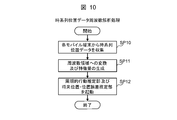
- FIG. 10 shows a specific processing flow of the time series position data frequency analysis process executed by the time series position data frequency analysis unit 30 in step SP1 of FIG. .
- the position information acquisition unit 40 obtains time-series position data (including the current position) for each day held by each mobile terminal 2 from each mobile terminal 2.
- the collected time-series position data for each user and each day is stored in the user position information table 22 (FIG. 3) (SP10).
- the position information acquisition unit 40 calls the feature value generation unit 41 (FIG. 2).
- the feature amount generation unit 41 When the feature amount generation unit 41 is called by the position information acquisition unit 40, for each user, the user's day for a certain period (one year in the present embodiment) stored in the user position information table 22 Are generated for each time-series position data (SP11).
- the feature value generation unit 41 performs feature analysis including the position and the moving speed, so that for each user, the time-series position data for each day is converted into a frequency domain by performing Fourier transform, and then daily. The feature amounts of the time-series position data are respectively generated.
- the feature quantity generation unit 41 firstly sets each piece of position information constituting the time series position data for each day of time series position data (in this embodiment, information on latitude and longitude every 5 minutes). Are converted into complex number data in which latitude data is a real part and longitude data is an imaginary part. In addition, the feature quantity generation unit 41 performs Fourier transform on these complex number data (time-series position data) to convert to frequency data. Further, the feature value generation unit 41 generates a feature value vector by linearly combining the real part and the imaginary part of each piece of position information converted into frequency data as described above for each time-series position data for one day. The generated feature quantity vector is used as the feature quantity of the time-series position data for one day.
- the latitude data of time-series position data may be linearly combined with longitude data as real values, and may be converted into frequency data by Fourier transform. In this case, since complex data is not used, it is possible to suppress the complexity of implementation of the processing program.
- the feature quantity generation unit 41 activates the periodic behavior estimation unit 31 and the future position / position error estimation unit 33 (SP12), whereby the time series position data frequency analysis unit 30 performs time series position data frequency analysis. The process ends.
- FIG. 11 shows a specific processing flow of the periodic behavior estimation processing executed by the periodic behavior estimation unit 31 in step SP2 of FIG.
- FIG. 11 shows the flow of periodic behavior estimation processing for one user, and the same periodic behavior estimation processing is executed for each user in order or in parallel.
- This periodic behavior estimation process is started when the periodic behavior estimation unit 31 is activated by the time-series position data frequency analysis unit 30.
- the visit periodicity calculation unit 42 is the target user (hereinafter, referred to as the following). This is called the target user), and the periodicity of the visit to each point visited so far (hereinafter referred to as the visit periodicity) is calculated (SP20).
- the visit periodicity calculation unit 42 acquires the frequency data of the time-series position data for each day of the target user from the feature value generation unit 41 of the time-series position data frequency analysis unit 30, and the acquired frequency data By performing the power spectrum analysis, the power spectrum density for each frequency as shown in FIG. 12A (that is, the strength of the periodicity (visiting periodicity) of movement of the target user) is calculated. Then, the visiting periodicity calculation unit 42 calls the feature point estimation unit 43 (FIG. 2).
- the feature point estimation unit 43 When called by the visit periodicity calculation unit 42, the feature point estimation unit 43 is stored in the power spectral density for each frequency calculated by the visit periodicity calculation unit 42 and the user position information table 22 (FIG. 3). Based on the movement trajectory of the target user as shown by a thick line in FIG. 12B recognized based on the time series position data of the target user for each day, a feature point that the target user visits periodically is detected, The attributes (such as home or work) of these characteristic points are estimated (SP21).
- FIG. 12B shows a three-week movement trajectory L (time transition of a position represented by latitude / longitude) of a certain target user.
- the power spectrum density for each frequency is as shown in FIG.
- the target user for example, works at the company only on weekdays (Monday to Friday) and does not work at the company on Saturday and Sunday. It is presumed that the person repeats a life that repeats the movement in a cycle of one week and the movement in a daily cycle of returning home every day.
- the feature point estimation unit 43 extracts a frequency value indicating that the power spectral density is greater than or equal to a predetermined value (the predetermined value is input in advance from the input / output device 18), and the extracted frequency indicates
- a frequency value indicating that the power spectral density is greater than or equal to a predetermined value (the predetermined value is input in advance from the input / output device 18)
- the extracted frequency indicates
- the point visited at a frequency (21 Hz) indicating that the cycle of movement is one day is home, and the site moves at a frequency (3 Hz) of seven days (day not visited). It is estimated that the workplace is a spot that is visited at a frequency (21 Hz) indicating that the movement cycle is 1 day).
- the movements (visits) to these points are managed by flags placed on a table for each combination of user ID and point ID (not shown). Moreover, you may make it estimate that the point where an object user is located at night on a weekday is a home.
- the feature point estimation unit 43 creates a feature point estimation result table 23X of the target user storing the attribute and position (latitude and longitude) of the target point of the target user estimated in this way (SP22).
- the periodic behavior estimation processing by the periodic behavior estimation unit 31 is completed by the processing described above. Then, the feature point estimation unit 43 of the periodic behavior estimation unit 31 calls the clustering execution unit 44 (FIG. 2) of the behavior pattern classification unit 32 thereafter.
- FIG. 13 shows a specific flow of behavior pattern classification processing executed by the behavior pattern classification unit 32 in step SP4 of FIG.
- FIG. 13 shows the flow of behavior pattern classification processing for one user, and the same behavior pattern classification processing is executed for each user in order or in parallel.
- This behavior pattern classification process is started when the clustering execution unit 44 is called by the feature point estimation unit 43 of the periodic behavior estimation unit 31 as described above.
- the clustering execution unit 44 is called by the feature point estimation unit 43, each time-series position data for each day of the target user generated by the feature amount generation unit 41 (FIG. 2) of the time-series position data frequency analysis unit 30.
- Clustering execution processing to classify these time-converted daily time-series position data into multiple clusters using clustering methods such as k-means method, vector quantization method, support vector machine, etc. Implement (SP30).
- the clustering execution unit 44 performs classification by sequentially setting the number of clusters to 2, 3, 4,..., And evaluates the similarity within the cluster and the separation between the clusters each time. The correct number of clusters.
- Similarity within a cluster is evaluated by, for example, the clustering result of each of the clusters 1 to M based on the feature amount of the time-series position data for each day of the target user and the distance of the cluster centroid between the clusters. .
- the feature amount of each time-series position data for each day in the cluster and between the clusters Evaluation is performed using the distance of the cluster centroid, the dispersion of each time-series position data for each day in the cluster, and the number of clusters.
- the Akaike information criterion is generally the order where L is the maximum likelihood and K is the number of degrees of freedom parameters. It is represented by
- the maximum likelihood L is, for example, It is represented by In the equation (2), RSS k represents the sum of squares of the distance from the cluster centroid of all members of the cluster k (here, time series position data for each day of the target user), and d represents the variance of the members.
- the number of degrees of freedom parameter K is, for example, It is represented by In Equation (3), M represents the number of clusters, and D represents the number of dimensions of the feature amount.
- evaluation criteria other than the Akaike information criterion for example, Bayesian Information Criterion (BIC)
- BIC Bayesian Information Criterion
- the separation between clusters is evaluated using, for example, the distance between the clusters.
- the distance between clusters is calculated, for example, by using a multi-class support vector machine for each boundary surface that can be separated from each other, and then the total value of the margin (distance) between each cluster is defined as MN.
- MN the total value of the margin between each cluster
- N represents the number of clusters.
- the intercluster average separation degree B (N) is an index representing the degree of separation between clusters as described above, and the larger this value, the more separated the clusters are.
- the average degree of separation between clusters may be any index that increases as long as the average distance between the clusters is large.
- the average of the distances between the cluster centroid sets ⁇ C k ⁇ A value may be applied.
- a user day classification information table 23Y (FIG. 5) is created (SP31). Then, the clustering execution unit 44 calls the cluster centroid locus generation unit 45 (FIG. 2).
- the cluster center-of-gravity locus generation unit 45 When called by the clustering execution unit 44, the cluster center-of-gravity locus generation unit 45 generates time-series position data (hereinafter referred to as cluster centroid time-series position data) of the cluster centroid of each cluster (SP32). .
- the cluster center-of-gravity locus generation unit 45 generates, for each cluster, complex number data in the frequency domain in which the first half data of the cluster center of gravity of the cluster obtained in the clustering execution process described above is a real part and the second half data is an imaginary part.
- the generated complex number data is converted into complex number data representing position information by inverse Fourier transform.
- the cluster centroid locus generation unit 45 generates time series position data of the cluster centroid with the real part of the complex number data (position information) as latitude and the imaginary part as longitude. It can be said that the time-series position data of the cluster centroid generated for each cluster at this time represents a typical movement pattern of the user in the cluster. It can be said that the fine difference between a plurality of movement trajectories classified into the same cluster represents a difference due to noise. By this processing, extraction of a typical movement pattern that eliminates the influence of noise is achieved.
- the cluster centroid locus generation unit 45 stores the cluster centroid time series position data of each cluster obtained in this way in the day classification information table 23Y generated in step SP31 (SP33).
- cluster centroid trajectory generator 45 causes the input / output device 18 (FIG. 1) to display a waveform based on the cluster centroid time series position data of each cluster as necessary, for example, in the format shown in FIG.
- FIG. 14 is an example when the time-series position data of the target user is classified into two clusters, and the locus of the cluster centroid of these clusters is displayed on three-dimensional coordinates with the latitude, longitude, and time axes, respectively.
- the example of a drawn display is shown. In this way, by drawing the locus of the cluster center of gravity on the three-dimensional coordinates with the latitude, longitude, and time axes respectively, representative movement patterns of users belonging to these clusters are displayed as waveforms that take the position and movement speed into consideration. can do.
- the cluster center-of-gravity locus generation unit 45 also displays the number of days belonging to each cluster.
- the cluster center-of-gravity locus generation unit 45 is based on the target user's feature point estimation result table 23X (FIG. 4) and the target user's day classification information table 23Y (FIG. 5) created as described above.
- the day attribute for each day of the week and each day is estimated, and the day attribute information table 23Z (FIG. 6) of the target user is created based on the estimation result (SP34).
- the cluster center-of-gravity locus generation unit 45 includes the position and attribute of each feature point registered in the feature point estimation result table 23X (FIG. 4) of the target user and the day classification information table 23Y (FIG. 5) of the target user. For example, if the cluster centroid of a cluster stays at a feature point estimated to be a workplace for a certain period of time based on the cluster centroid time-series position data of each cluster stored in The date is estimated to be a working day, otherwise the date belonging to the cluster is estimated to be a non-working day.
- the cluster center-of-gravity locus generation unit 45 for example, a calendar that can identify whether it is a working day or a non-working day for each day as shown in FIG. 50) is created.
- the date when the time series position data of the target user is collected is “2/22”, and the current date is “3/24”. It is an example in the case where it is in a state where it cannot be determined.
- the cluster center-of-gravity locus generation unit 45 determines, for each day of the week, when the number of days estimated as a working day is greater than the day estimated as a non-working day, Day attributes are estimated as work days, and other day attributes of days of the week and dates are estimated as non-work days. Further, the cluster center-of-gravity locus generation unit 45, for example, aggregates the day attributes for the same day of each month, and when the number of days estimated to be non-working days is large for the days, the day of the day is estimated. The day attribute is estimated as a non-working day, and the day attribute of other days is estimated as a working day. Then, the cluster center-of-gravity locus generation unit 45 creates the date attribute information table 23Z based on such an estimation result.
- the action pattern classification process by the action pattern classification unit 32 is completed by the above processing.
- the cluster center-of-gravity locus generation unit 45 thereafter notifies the information distribution event determination / execution unit 21 (FIG. 2) that the action pattern classification process has ended.
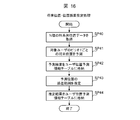
- FIG. 16 shows specific processing of future position / position error estimation processing executed by the future position / position error estimation unit 33 (FIG. 2) in step SP3 of FIG. Shows the flow.
- FIG. 16 shows the flow of the future position / position error estimation process for one user, and the same future position / position error estimation process is executed for each user in order or in parallel.
- the future position / position error estimation process is started when the future position / position error estimation unit 33 is activated by the time-series position data frequency analysis unit 30.
- the user position prediction unit 46 From the information table 22 (FIG. 3), position data for the N periods nearest to the target user is acquired (SP40).
- One period is a period in which the mobile terminal 2 acquires position data. In the present embodiment, it is 5 minutes as described above.
- the user position predicting unit 46 sequentially predicts the position of the target user after one period has elapsed from the current time based on the acquired position data (SP41).
- the user position prediction unit 46 calculates the following equation based on the position data for the N period of the target user acquired from the user position information table 22.
- An autoregression model (AR (Auto Regression) model) given by
- the predicted location of the target user in y t is the time t
- c is a constant
- P is the model of order
- ⁇ i ( ⁇ 1, ?? , ⁇ P) is the model parameters
- epsilon t is Represents an error.
- an optimal value can be calculated using the Akaike information criterion (AIC) as an index, and the value of each parameter ⁇ i ( ⁇ 1 ,..., ⁇ P ) For example, the optimum value can be calculated for each set using the Yulewalker method.
- the user position prediction unit 46 uses the position data for the N period of the target user read from the user position information table, and uses the autoregressive model of the equation (5), as shown in FIG. The future position of the target user after one period has been calculated. Further, the user position prediction unit 46 uses the position data for the N periods that are old in order from the future position starting from the calculated future position of the target user, and finally uses the autoregressive model of equation (5). The future position of the user after one period has elapsed from the calculated future position of the target user is calculated. The user position predicting unit 46 sequentially calculates the future positions of the target user after one period has elapsed from the current time by repeating such calculation.
- the number of periods ahead to be predicted is determined according to, for example, the interval at which information is distributed.
- an information distribution interval input in advance from the input / output device 18 is set to a period length for performing future position prediction.
- a delay occurs in information distribution to the user due to a communication delay between user position information acquisition and distribution.
- future position prediction ahead for the information distribution interval it is possible to determine the information to be distributed at the time of the next information distribution in consideration of the point where the user is likely to be at that time, so the information distribution delay to the user is reduced. Can be suppressed.
- the current time is used as the future time, the current location can be predicted.
- the position prediction of one period ahead is performed to suppress the error from the actual user's current position due to the communication delay of information acquisition, and the actual user's position at the time of sudden positioning error of GPS positioning occurs. It is possible to suppress an error from the current position.
- the user position predicting unit 46 associates the future position of the target user calculated in this way for a certain period with the future date and time (time stamp) corresponding to these future positions. 7) (SP42). The user position predicting unit 46 then calls the position error range estimating unit 47 (FIG. 2).
- the position error range estimation unit 47 estimates the error range of the future position for each period of the target user predicted by the user position prediction unit 46 as described above (SP43).
- conditional volatility data fluctuation rate
- GARCH Generalized Auto Regressive Conditional Heteroscedasticity
- the position error range estimation unit 47 stores the error range of the future position of the user for each period estimated in this way in the user position prediction information table 24 in association with the corresponding future time (SP44).
- the future position / position error estimation process by the future position / position error estimation unit 33 is completed by the above processing.
- the position error range estimation unit 47 thereafter notifies the information distribution event determination / execution unit 21 (FIG. 2) that the future position / position error estimation process has been completed.
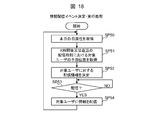
- FIG. 18 shows a specific processing flow of the information distribution event determination / execution processing executed by the information distribution event determination / execution unit 21 in step SP5 of FIG. .
- FIG. 18 shows the flow of information distribution event determination / execution processing for one user, and the same information distribution event determination / execution processing is executed for each user in order or in parallel.
- This information distribution event determination / execution process is performed when the information distribution event determination / execution unit 21 notifies the fact that the above-described behavior pattern classification process transmitted from the cluster centroid locus generation unit 45 of the behavior pattern classification unit 32 is completed.
- the process is started when both the notification of the end of the above-described future position / position error estimation process transmitted from the position error range estimation unit 47 of the future position / position error estimation unit 33 is received.
- the information distribution event determination unit 48 acquires today's day attribute from the day attribute information table 23Z (FIG. 6) (SP50).
- the information distribution event determination unit 48 distributes information to the user at a predetermined time interval, the time specified in advance by the user after a predetermined distribution cycle time (X time) has elapsed.
- X time a predetermined distribution cycle time
- the predicted position (future position) of the target user at the most recent distribution scheduled time from the current time is the user position. Obtained from the prediction information table 24 (SP51).
- the information distribution event determination unit 48 determines the feature point estimation result based on the current day attribute (working day or non-working day) of the target user acquired in step SP50 and the predicted position of the target user acquired in step SP51.
- the information type of the distribution candidate to be directed to the target user (hereinafter referred to as the distribution candidate information type) is determined (SP52).
- the position coordinates of each point ID in the feature point estimation result table 23X (FIG.
- the current or future position coordinates acquired in step SP51, the estimation error acquired in step SP51, and the preset point-by-point It is determined whether or not the user is at a predetermined feature point by processing using an allowable error.
- a circle having a current or future position coordinate as a center and an estimation error as a radius, and a circle having a position ID of the point ID as a center and an allowable error at the point as a radius are calculated. It is determined whether the two calculated circles overlap. If there is an overlap, the point is determined as the user's presence point. The determination process is repeated for all points with the point ID to determine the user's location.
- a value for a predetermined point is input from the input / output device 18 in advance.
- GPS positioning causes an error from the actual mobile terminal position due to radio wave interference caused by various obstacles in the vicinity of the mobile terminal.
- the values are compared after rounding to the specified decimal point of the latitude and longitude of the current coordinates and future position coordinates and the position coordinates of each point ID, and whether the points match Processing such as determining the presence or absence may be simplified.
- the information distribution event determination unit 48 determines that the current day attribute of the target user acquired in step SP50 is “working day”, and the target user after X hours acquired in step SP51 or the latest predetermined distribution time When the predicted position is “workplace” and the latest delivery time after X hours or in advance is “11:00”, the delivery candidate information table 25 is referred to and the delivery candidate information type is set to “workplace”. “Lunch information near”.
- the information distribution event determination unit 48 thereafter waits for the X time to elapse or the latest distribution scheduled time specified in advance (SP53). Then, the information distribution event determination unit 48 calls the information distribution event execution unit 49 when X time has passed or the latest distribution scheduled time is reached.
- the information distribution event execution unit 49 When called by the information distribution event determination unit 48, the information distribution event execution unit 49 acquires distribution information that matches the distribution candidate information type determined by the information distribution event determination unit 48 from the distribution information database 26, and acquires the acquired distribution. Information is distributed to the target user (SP54).
- step SP50 the processing returns to step SP50, and thereafter, the processing of step SP50 to step SP54 is repeated as necessary.
- this information distribution system since an autoregressive model is generated based on the latest time-series position data of the user and the future position of the user is predicted, the user can perform actions that deviate from regular actions.
- the future position of the user can be predicted with a certain degree of accuracy, and thus appropriate information corresponding to the current position of the user can be distributed to the user.
- the mobile communication body is a portable communication terminal device such as the mobile terminal 2
- the present invention is not limited to this, for example, a car
- the present invention can also be applied to a mobile communication body other than a portable communication terminal device such as a navigation system.
- each The mobile communication body may detect its own position by some means such as a sensor other than the positioning device 14, and the mobile communication body itself is not equipped with a function for positioning its own position,
- the external device may measure the position of each mobile communication body with the monitoring camera or the like, and the information distribution apparatus 3 may collect the result (position information of each mobile communication body).
- the Fourier transform is applied as a conversion method for converting each time-series position data into frequency domain frequency data in the clustering execution processing.
- a transform method other than Fourier transform such as wavelet transform, can be widely applied.
- the position information (including time-series position data) collected by the information distribution device 3 from each mobile terminal 2 is composed of only two coordinate values of latitude and longitude.
- the present invention is not limited to this.
- position information including time-series position data
- the time-series position data may be converted into complex number data so as to be distributed to either the part or the imaginary part.
- the present invention is not limited thereto, and for example, the above-described implementation
- the present invention can also be applied to a system that predicts the future position of a taxi by the same method as in the above form and controls the position of the taxi based on the prediction result.
- the time series position data including the time series position information of the mobile communication body is collected, and the rules of the user having the mobile communication body based on the collected time series position data of the mobile communication body It is possible to estimate the behavior and plan the optimum information distribution for the user or the like, or to plan the user to control the user to the optimum state.
- the present invention can be widely applied to an information distribution apparatus that distributes information to a mobile communication body equipped with a positioning function for acquiring position data of its current position.
Landscapes
- Engineering & Computer Science (AREA)
- Theoretical Computer Science (AREA)
- Business, Economics & Management (AREA)
- Physics & Mathematics (AREA)
- General Physics & Mathematics (AREA)
- Signal Processing (AREA)
- Computer Networks & Wireless Communication (AREA)
- Accounting & Taxation (AREA)
- Finance (AREA)
- Strategic Management (AREA)
- Development Economics (AREA)
- General Engineering & Computer Science (AREA)
- Databases & Information Systems (AREA)
- Data Mining & Analysis (AREA)
- General Business, Economics & Management (AREA)
- Entrepreneurship & Innovation (AREA)
- Game Theory and Decision Science (AREA)
- Economics (AREA)
- Marketing (AREA)
- Software Systems (AREA)
- Remote Sensing (AREA)
- Telephonic Communication Services (AREA)
- Information Transfer Between Computers (AREA)
- Mobile Radio Communication Systems (AREA)
- Management, Administration, Business Operations System, And Electronic Commerce (AREA)
- Information Retrieval, Db Structures And Fs Structures Therefor (AREA)
Priority Applications (4)
| Application Number | Priority Date | Filing Date | Title |
|---|---|---|---|
| US15/762,296 US10560797B2 (en) | 2016-04-27 | 2016-04-27 | Information processing device and method |
| JP2018514042A JP6594529B2 (ja) | 2016-04-27 | 2016-04-27 | 情報処理装置及び方法 |
| EP16900454.6A EP3451275B1 (de) | 2016-04-27 | 2016-04-27 | Informationsverarbeitungsvorrichtung und -verfahren |
| PCT/JP2016/063305 WO2017187584A1 (ja) | 2016-04-27 | 2016-04-27 | 情報処理装置及び方法 |
Applications Claiming Priority (1)
| Application Number | Priority Date | Filing Date | Title |
|---|---|---|---|
| PCT/JP2016/063305 WO2017187584A1 (ja) | 2016-04-27 | 2016-04-27 | 情報処理装置及び方法 |
Publications (1)
| Publication Number | Publication Date |
|---|---|
| WO2017187584A1 true WO2017187584A1 (ja) | 2017-11-02 |
Family
ID=60161432
Family Applications (1)
| Application Number | Title | Priority Date | Filing Date |
|---|---|---|---|
| PCT/JP2016/063305 Ceased WO2017187584A1 (ja) | 2016-04-27 | 2016-04-27 | 情報処理装置及び方法 |
Country Status (4)
| Country | Link |
|---|---|
| US (1) | US10560797B2 (de) |
| EP (1) | EP3451275B1 (de) |
| JP (1) | JP6594529B2 (de) |
| WO (1) | WO2017187584A1 (de) |
Cited By (6)
| Publication number | Priority date | Publication date | Assignee | Title |
|---|---|---|---|---|
| JP2019175123A (ja) * | 2018-03-28 | 2019-10-10 | エヌ・ティ・ティ・アドバンステクノロジ株式会社 | 情報配信装置、及び情報配信方法 |
| JP2020052976A (ja) * | 2018-09-28 | 2020-04-02 | 株式会社ジオロジック | 情報処理装置及びプログラム |
| JP2020134953A (ja) * | 2019-02-12 | 2020-08-31 | トヨタ自動車株式会社 | 情報処理装置、情報処理方法、及びプログラム |
| JP2020149251A (ja) * | 2019-03-12 | 2020-09-17 | Kddi株式会社 | ユーザの定常的行動を変容させる情報提示装置、プログラム及び方法 |
| JP2021158617A (ja) * | 2020-03-30 | 2021-10-07 | トッパン・フォームズ株式会社 | 位置管理装置、位置管理方法、及びプログラム |
| JP2022088278A (ja) * | 2020-12-02 | 2022-06-14 | 株式会社竹中工務店 | 予測装置及び予測モデル学習装置 |
Families Citing this family (4)
| Publication number | Priority date | Publication date | Assignee | Title |
|---|---|---|---|---|
| WO2020260626A1 (en) * | 2019-06-28 | 2020-12-30 | Basf Agro Trademarks Gmbh | Sensor fusion |
| JP7567922B2 (ja) * | 2020-09-28 | 2024-10-16 | 日本電気株式会社 | 予測装置、予測方法、及び、プログラム |
| JP7171968B1 (ja) * | 2021-03-25 | 2022-11-15 | 楽天グループ株式会社 | 推定システム、推定方法、及びプログラム |
| JP7087147B1 (ja) | 2021-03-25 | 2022-06-20 | 楽天グループ株式会社 | 推定システム、推定方法、及びプログラム |
Citations (4)
| Publication number | Priority date | Publication date | Assignee | Title |
|---|---|---|---|---|
| JP2005148289A (ja) * | 2003-11-13 | 2005-06-09 | Nec Fielding Ltd | 広告配信システム,方法およびプログラム |
| JP2006163996A (ja) * | 2004-12-09 | 2006-06-22 | Evolium Sas | 行動履歴に基づくプッシュ型の情報提供システム |
| JP2008181184A (ja) * | 2007-01-23 | 2008-08-07 | Hewlett-Packard Development Co Lp | 情報提供システム、情報提供装置およびその方法。 |
| JP2011100182A (ja) * | 2009-11-04 | 2011-05-19 | Nec Corp | リコメンド情報配信システム、サーバ、携帯端末、リコメンド情報配信方法、そのプログラムおよび記録媒体 |
Family Cites Families (9)
| Publication number | Priority date | Publication date | Assignee | Title |
|---|---|---|---|---|
| US6377793B1 (en) | 2000-12-06 | 2002-04-23 | Xybernaut Corporation | System and method of accessing and recording messages at coordinate way points |
| US8031595B2 (en) * | 2007-08-21 | 2011-10-04 | International Business Machines Corporation | Future location determination using social networks |
| US8060406B2 (en) * | 2008-09-26 | 2011-11-15 | Microsoft Corporation | Predictive geo-temporal advertisement targeting |
| US20100159871A1 (en) | 2008-12-22 | 2010-06-24 | Nortel Networks Limited | Predictive notification system for emergency services |
| JP5525835B2 (ja) | 2010-01-28 | 2014-06-18 | Kddi株式会社 | Poi推薦サーバおよびpoi推薦システム |
| US9119039B2 (en) * | 2012-09-06 | 2015-08-25 | Dell Products, Lp | Method and apparatus for connection context aware radio communication management with predictive mobile path |
| JP6053027B2 (ja) | 2013-08-30 | 2016-12-27 | Kddi株式会社 | 類似移動経路をとるユーザを検索する装置、プログラム及び方法 |
| JP6179896B2 (ja) | 2013-12-10 | 2017-08-16 | 株式会社オプティム | 広告配信サーバ、広告表示端末、広告配信方法、広告配信サーバ用プログラム |
| US20150334077A1 (en) * | 2014-05-16 | 2015-11-19 | Douglas E. Feldman | Map-based remarks |
-
2016
- 2016-04-27 JP JP2018514042A patent/JP6594529B2/ja not_active Expired - Fee Related
- 2016-04-27 US US15/762,296 patent/US10560797B2/en not_active Expired - Fee Related
- 2016-04-27 EP EP16900454.6A patent/EP3451275B1/de not_active Not-in-force
- 2016-04-27 WO PCT/JP2016/063305 patent/WO2017187584A1/ja not_active Ceased
Patent Citations (4)
| Publication number | Priority date | Publication date | Assignee | Title |
|---|---|---|---|---|
| JP2005148289A (ja) * | 2003-11-13 | 2005-06-09 | Nec Fielding Ltd | 広告配信システム,方法およびプログラム |
| JP2006163996A (ja) * | 2004-12-09 | 2006-06-22 | Evolium Sas | 行動履歴に基づくプッシュ型の情報提供システム |
| JP2008181184A (ja) * | 2007-01-23 | 2008-08-07 | Hewlett-Packard Development Co Lp | 情報提供システム、情報提供装置およびその方法。 |
| JP2011100182A (ja) * | 2009-11-04 | 2011-05-19 | Nec Corp | リコメンド情報配信システム、サーバ、携帯端末、リコメンド情報配信方法、そのプログラムおよび記録媒体 |
Cited By (11)
| Publication number | Priority date | Publication date | Assignee | Title |
|---|---|---|---|---|
| JP2019175123A (ja) * | 2018-03-28 | 2019-10-10 | エヌ・ティ・ティ・アドバンステクノロジ株式会社 | 情報配信装置、及び情報配信方法 |
| JP2020052976A (ja) * | 2018-09-28 | 2020-04-02 | 株式会社ジオロジック | 情報処理装置及びプログラム |
| JP7171350B2 (ja) | 2018-09-28 | 2022-11-15 | 株式会社ジオロジック | 情報処理装置及びプログラム |
| JP2020134953A (ja) * | 2019-02-12 | 2020-08-31 | トヨタ自動車株式会社 | 情報処理装置、情報処理方法、及びプログラム |
| JP7136717B2 (ja) | 2019-02-12 | 2022-09-13 | トヨタ自動車株式会社 | 情報処理装置、情報処理方法、及びプログラム |
| JP2020149251A (ja) * | 2019-03-12 | 2020-09-17 | Kddi株式会社 | ユーザの定常的行動を変容させる情報提示装置、プログラム及び方法 |
| JP7080570B2 (ja) | 2019-03-12 | 2022-06-06 | Kddi株式会社 | ユーザの定常的行動を変容させる情報提示装置、プログラム及び方法 |
| JP2021158617A (ja) * | 2020-03-30 | 2021-10-07 | トッパン・フォームズ株式会社 | 位置管理装置、位置管理方法、及びプログラム |
| JP7454798B2 (ja) | 2020-03-30 | 2024-03-25 | Toppanホールディングス株式会社 | 位置管理装置、位置管理方法、及びプログラム |
| JP2022088278A (ja) * | 2020-12-02 | 2022-06-14 | 株式会社竹中工務店 | 予測装置及び予測モデル学習装置 |
| JP7541470B2 (ja) | 2020-12-02 | 2024-08-28 | 株式会社竹中工務店 | 予測装置及び予測モデル学習装置 |
Also Published As
| Publication number | Publication date |
|---|---|
| EP3451275A4 (de) | 2019-09-04 |
| EP3451275B1 (de) | 2020-10-28 |
| US20180302741A1 (en) | 2018-10-18 |
| JP6594529B2 (ja) | 2019-10-23 |
| EP3451275A1 (de) | 2019-03-06 |
| JPWO2017187584A1 (ja) | 2018-07-12 |
| US10560797B2 (en) | 2020-02-11 |
Similar Documents
| Publication | Publication Date | Title |
|---|---|---|
| JP6594529B2 (ja) | 情報処理装置及び方法 | |
| JP6334825B2 (ja) | 情報配信装置及び方法 | |
| EP3149975B1 (de) | Bestimmung eines signifikanten benutzerortes zur bereitstellung von ortsbasierten diensten | |
| JP6545158B2 (ja) | タスク割当て方法、コンピュータプログラム製品及びタスク割当てシステム | |
| CN108885723A (zh) | 用于基于位置数据预测用户行为的系统和方法 | |
| Vlassenroot et al. | The use of smartphone applications in the collection of travel behaviour data | |
| Kumar et al. | A hybrid model based method for bus travel time estimation | |
| Charlton et al. | Bicycle route choice data collection using GPS-enabled smartphones | |
| JP6516899B2 (ja) | 情報配信装置及び方法 | |
| US20200292344A1 (en) | Information processing apparatus, information processing method, and non-transitory computer readable storage medium storing program | |
| CN111242723B (zh) | 用户子女情况判断方法、服务器及计算机可读存储介质 | |
| Akande et al. | Improving the quality of service in public road transportation using real time travel information system | |
| JP6389301B1 (ja) | 判定装置、判定方法及び判定プログラム | |
| JP6864982B2 (ja) | 推定装置 | |
| CN105637484A (zh) | 任务分配方法、计算机程序产品和任务分配系统 | |
| JP2018190468A (ja) | 算出装置、算出方法及び算出プログラム | |
| JP5998182B2 (ja) | Poiデータ生成装置、端末装置、poiデータ生成方法およびプログラム | |
| JP2020149729A (ja) | 情報処理装置、情報処理方法およびコンピュータプログラム | |
| Ashqar | Strategic design of smart bike-sharing systems for smart cities | |
| WO2024151812A1 (en) | Location tracking for event attendance | |
| JP2019049993A (ja) | 判定装置、判定方法、及び判定プログラム | |
| JP2019128611A (ja) | 生成装置、生成方法及び生成プログラム | |
| WO2009094690A1 (en) | Intelligent location system | |
| Jariyasunant | Improving traveler information and collecting behavior data with smartphones | |
| Li | Next-Gen Travel Insights: Creating a Smartphone-Based Travel Diary Tool |
Legal Events
| Date | Code | Title | Description |
|---|---|---|---|
| ENP | Entry into the national phase |
Ref document number: 2018514042 Country of ref document: JP Kind code of ref document: A |
|
| WWE | Wipo information: entry into national phase |
Ref document number: 15762296 Country of ref document: US |
|
| NENP | Non-entry into the national phase |
Ref country code: DE |
|
| 121 | Ep: the epo has been informed by wipo that ep was designated in this application |
Ref document number: 16900454 Country of ref document: EP Kind code of ref document: A1 |