WO2017188031A1 - マレイミド系ブロック共重合体の製造方法 - Google Patents
マレイミド系ブロック共重合体の製造方法 Download PDFInfo
- Publication number
- WO2017188031A1 WO2017188031A1 PCT/JP2017/015330 JP2017015330W WO2017188031A1 WO 2017188031 A1 WO2017188031 A1 WO 2017188031A1 JP 2017015330 W JP2017015330 W JP 2017015330W WO 2017188031 A1 WO2017188031 A1 WO 2017188031A1
- Authority
- WO
- WIPO (PCT)
- Prior art keywords
- block copolymer
- polymer
- block
- polymerization
- monomer
- Prior art date
- Legal status (The legal status is an assumption and is not a legal conclusion. Google has not performed a legal analysis and makes no representation as to the accuracy of the status listed.)
- Ceased
Links
Classifications
-
- C—CHEMISTRY; METALLURGY
- C08—ORGANIC MACROMOLECULAR COMPOUNDS; THEIR PREPARATION OR CHEMICAL WORKING-UP; COMPOSITIONS BASED THEREON
- C08F—MACROMOLECULAR COMPOUNDS OBTAINED BY REACTIONS ONLY INVOLVING CARBON-TO-CARBON UNSATURATED BONDS
- C08F4/00—Polymerisation catalysts
- C08F4/40—Redox systems
-
- C—CHEMISTRY; METALLURGY
- C08—ORGANIC MACROMOLECULAR COMPOUNDS; THEIR PREPARATION OR CHEMICAL WORKING-UP; COMPOSITIONS BASED THEREON
- C08F—MACROMOLECULAR COMPOUNDS OBTAINED BY REACTIONS ONLY INVOLVING CARBON-TO-CARBON UNSATURATED BONDS
- C08F293/00—Macromolecular compounds obtained by polymerisation on to a macromolecule having groups capable of inducing the formation of new polymer chains bound exclusively at one or both ends of the starting macromolecule
-
- G—PHYSICS
- G02—OPTICS
- G02B—OPTICAL ELEMENTS, SYSTEMS OR APPARATUS
- G02B1/00—Optical elements characterised by the material of which they are made; Optical coatings for optical elements
- G02B1/04—Optical elements characterised by the material of which they are made; Optical coatings for optical elements made of organic materials, e.g. plastics
-
- G—PHYSICS
- G02—OPTICS
- G02B—OPTICAL ELEMENTS, SYSTEMS OR APPARATUS
- G02B5/00—Optical elements other than lenses
- G02B5/30—Polarising elements
Definitions
- the present invention relates to a method for producing a block copolymer having a polymer block containing a structural unit derived from an acrylate ester and a polymer block containing a structural unit derived from an N-substituted maleimide ring structure and a methacrylic acid ester.
- acrylic resins have been mainly used as these optical material resins.
- acrylic resins having a ring structure are used for optical films and the like because they have transparency and heat resistance.
- polymers polymerized using maleimide monomers are known to be thermoplastic resins with excellent heat resistance, and to be suitably used as raw materials for optical films due to excellent transparency and retardation control. Yes. Therefore, the acrylic resin which has a maleimide ring structure obtained by superposing
- acrylic polymers are decomposed from the polymer ends by a depolymerization reaction, and in order to impart thermal decomposition resistance, the molecular ends are sealed in the form of thioethers with a chain transfer agent using a thiol compound such as dodecyl mercaptan.
- a thiol compound such as dodecyl mercaptan.
- a monomer (B1) containing methacrylic acid ester and N-substituted maleimide in the presence of a thiol compound (C1) a block copolymer having excellent flexibility and strength can be obtained. It was.
- Such a polymerization method is usually a living radical polymerization.
- thiol compounds are not commonly used in living radical polymerizations to inhibit polymerization reactions, it is surprising that only the idea of using thiol compounds in living radical polymerizations is surprising. Furthermore, the present inventors have surprisingly found that the polymerization reaction is not hindered despite the fact that such a polymerization method is a living radical polymerization using a thiol compound. Moreover, it has also been found that in such a polymerization method, there are few unreacted maleimide monomers. This is thought to be due to the suppression of the occurrence of Michael adducts of maleimide monomers and thiol compounds. Even though the maleimide monomers and thiol compounds coexist, the generation of such Michael adducts can be suppressed. Is a surprising finding.
- the present invention relates to a block copolymer having a polymer block (A) containing a structural unit derived from an acrylate ester and a polymer block (B) containing a structural unit derived from an N-substituted maleimide ring structure and a methacrylic ester. It relates to a manufacturing method and the like.
- the method for producing a block copolymer of the present invention comprises a nitroxide polymer (A1) having a nitroxide structure having an organophosphorus unit at the terminal of a polymer block (A), a monomer (B1 ) In the presence of the thiol compound (C1).
- the present invention also includes a block copolymer having a polymer block (A) containing a structural unit derived from an acrylate ester and a polymer block (B) containing a structural unit derived from an N-substituted maleimide ring structure and a methacrylic ester. included.
- the weight average molecular weight of such a block copolymer may be, for example, 150,000 to 450,000.
- such a block copolymer may be manufactured by the manufacturing method.
- the present invention includes a resin composition containing the block copolymer.
- a resin composition may contain the block copolymer and another resin as a resin component.
- Such other resins include, for example, resins having a skeleton in common with the block copolymer (for example, resins having structural units derived from at least one monomer selected from methacrylic acid esters and N-substituted maleimides, particularly Or a resin having a structural unit derived from the monomer (B1).
- a typical resin composition containing another resin has, for example, a structural unit derived from at least one monomer selected from the block copolymer and a methacrylic acid ester and an N-substituted maleimide as a resin component.
- a resin composition for example, a polymer having a structural unit derived from the monomer (B1)) and having a weight average molecular weight of the whole resin component of 50,000 to 500,000.
- the present invention also includes a film containing the block copolymer or the resin composition (for example, an optical film such as a polarizer protective film), a polarizing plate provided with the film, and an image display provided with the polarizing plate. Also includes devices.
- a maleimide block copolymer having a structural unit derived from an acrylic monomer can be provided.
- Such a block copolymer is excellent in flexibility and strength.
- the terminal of such a block copolymer is sealed with a thiol compound, it is excellent in thermal decomposition resistance.
- the maleimide monomer remaining in the polymerization solution is small, the amount of maleimide monomer that volatilizes even when the polymerization solution is heat-treated is small, and the amount of maleimide monomer attached to the production facility can be reduced.
- a novel block copolymer having a polymer block containing a structural unit derived from an acrylate ester, and a polymer block containing a structural unit derived from an N-substituted maleimide ring structure and a methacrylic acid ester, and this A resin composition containing a block copolymer can be provided.
- Such a block copolymer or resin composition has excellent physical properties (characteristics) such as excellent heat resistance, and is extremely useful in optical film applications and the like.
- the present invention relates to a polymer block (A) comprising a structural unit derived from an acrylate ester (or simply referred to as “acrylate unit”, hereinafter the same in the same expression), an N-substituted maleimide ring structure and
- This is a method for producing a block copolymer having a polymer block (B) containing a structural unit derived from a methacrylic ester (or a methacrylic ester unit).
- a nitroxide polymer (A1) having a nitroxide structure having an organophosphorus unit at the terminal of a polymer block (A), and a monomer (B1) containing a methacrylic acid ester and an N-substituted maleimide are thiol-based.
- a polymerization step of polymerizing in the presence of the compound (C1) is included.
- the nitroxide polymer (A1) has a nitroxide structure having an organophosphorus unit at the end of the polymer block (A) containing an acrylate unit.
- the nitroxide polymer (A1) may have a nitroxide structure having an organic phosphorus unit at least at one end of the polymer block (A), but preferably has both ends of the polymer block (A).
- the acrylate unit is not particularly limited.
- aliphatic acrylate for example, acrylic acid alkyl ester (for example, acrylic acid C such as methyl acrylate, ethyl acrylate, butyl acrylate, etc.) 1-18 alkyl), etc.
- alicyclic acrylates for example, cycloalkyl acrylates (eg, C 3-20 cycloalkyl acrylates such as cyclopropyl acrylate, cyclobutyl acrylate), crosslinked cyclic acrylates (eg, isobornyl acrylate) and the like]
- aromatic acrylates for example, acrylic acid aryl esters (e.g., phenyl acrylate, C 6-20 aryl such as acrylic acid o- tolyl) acrylic acid aralkyl ester (e.g., benzyl acrylate Acrylic acid C 6-10 aryl C 1-4 alkyl), acrylic acid phenoxyalkyl
- the acrylate unit preferably includes at least an alkyl acrylate unit, more preferably includes at least a C 1-18 alkyl acrylate unit, and an n-butyl acrylate unit. It is more preferable that at least be included.
- the content of the acrylic acid alkyl ester unit in the acrylic acid ester unit is, for example, 50 to 100 mol%, preferably 70 to 100 mol%, in terms of the monomer constituting the polymer block (A). is there.
- the content of the acrylic acid alkyl ester unit in the acrylic acid ester unit is, for example, 50 to 100% by mass, preferably 70 to 100% by mass.
- the polymer block (A) may have one or more units derived from monomers other than the acrylate unit.
- the nitroxide structure having an organic phosphorus unit usually has a nitroxy free radical (NO).
- NO nitroxy free radical
- the nitroxide structure having an organophosphorus unit is, for example, a structure represented by the following formula (1).
- R 1 represents a hydrogen atom or a substituent
- R 2 represents a linking group
- X represents an organophosphorus unit.
- examples of the substituent include a hydrocarbon group.
- examples of the hydrocarbon group include aliphatic groups [eg, C 1-10 alkyl groups (eg, methyl group, ethyl group, n-propyl group, isopropyl group, n-butyl group, isobutyl group, tert-butyl group, etc.
- C 1-4 alkyl group etc. Preferably C 1-4 alkyl group etc.], alicyclic group [eg C 3-12 cycloalkyl group (eg cyclopropyl group, cyclobutyl group, cyclopentyl group, cyclohexyl group etc.), preferably C 3-7 cycloalkyl group etc.], aromatic group ⁇ eg C 6-20 aromatic group [eg C 6-20 aryl group (eg phenyl group, o-tolyl group, m-tolyl group, p-tolyl group) Group, 2,3-xylyl group, 1-naphthyl group, etc.), C 7-20 aralkyl group (eg benzyl group, etc.)] ⁇ and the like.
- the hydrocarbon group may further have a substituent (for example, a halogen atom).
- R 1 is preferably an aliphatic group, more preferably a C 1-10 alkyl group, and even more preferably a C 1-4 alkyl group.
- examples of the linking group include a hydrocarbon group.
- examples of the hydrocarbon group include aliphatic groups [eg, C 1-10 alkyl groups (eg, methyl group, ethyl group, n-propyl group, isopropyl group, n-butyl group, isobutyl group, tert-butyl group, etc.
- a C 1-5 alkyl group an alicyclic group [eg, a C 3-12 cycloalkyl group (eg, a cyclopropyl group, a cyclobutyl group, a cyclopentyl group, a cyclohexyl group, etc.), preferably a C 3 -7 cycloalkyl group etc.], aromatic group ⁇ eg C 6-20 aromatic group [eg C 6-20 aryl group (eg phenyl group, o-tolyl group, m-tolyl group, p-tolyl group] , 2,3-xylyl group, 1-naphthyl group, etc.), C 7-20 aralkyl group (eg, benzyl group, etc.)] ⁇ and the like.
- the hydrocarbon group may further have a substituent (for example, a halogen atom).
- R 2 is preferably an aliphatic group, more preferably a C 1-10 alkyl group, and further preferably a C 1-5 alkyl group.
- the organic phosphorus unit may be a group containing phosphorus (phosphorus-containing group).
- the phosphorus-containing group preferably includes at least a structure represented by a P ( ⁇ O) OR 3 structure (R 3 represents a hydrogen atom or a hydrocarbon group).
- the hydrocarbon group includes, for example, an aliphatic group [for example, a C 1-10 alkyl group (for example, a methyl group, an ethyl group, an n-propyl group, an isopropyl group, an n-butyl group, an isobutyl group, a tert group, -Butyl group etc., preferably C 1-4 alkyl group etc.], alicyclic group (eg C 3-12 cycloalkyl group etc.), aromatic group (eg C 6-20 aromatic group etc.) Etc.
- an aliphatic group for example, a C 1-10 alkyl group (for example, a methyl group, an ethyl group, an n-propyl group, an isopropyl group, an n-butyl group, an isobutyl group, a tert group, -Butyl group etc., preferably C 1-4 alkyl group etc.]
- alicyclic group e
- R 3 is preferably an aliphatic group, more preferably a C 1-10 alkyl group, and even more preferably a C 1-4 alkyl group.
- organic phosphorus unit a structure represented by the following formula (2) is preferable.
- R 3 represents a hydrogen atom or a hydrocarbon group
- Y represents a hydrogen atom or —OR 4 (wherein R 4 represents a hydrogen atom or a hydrocarbon group).
- examples of the hydrocarbon group include the hydrocarbon groups described above.
- the hydrocarbon group includes, for example, an aliphatic group [for example, a C 1-10 alkyl group (for example, a methyl group, an ethyl group, an n-propyl group, an isopropyl group, an n-butyl group, an isobutyl group, a tert group, -Butyl group etc., preferably C 1-4 alkyl group etc.], alicyclic group (eg C 3-12 cycloalkyl group etc.), aromatic group (eg C 6-20 aromatic group etc.) Etc.
- an aliphatic group for example, a C 1-10 alkyl group (for example, a methyl group, an ethyl group, an n-propyl group, an isopropyl group, an n-butyl group, an isobutyl group, a tert group, -Butyl group etc., preferably C 1-4 alkyl group etc.]
- alicyclic group e
- R 4 is preferably an aliphatic group, more preferably a C 1-10 alkyl group, and even more preferably a C 1-4 alkyl group.
- R 3 is a C 1-4 alkyl group
- Y is preferably a hydrogen atom or -OR 4
- R 3 is a C 1-4 alkyl group
- Y is - More preferably, it is OR 4 and R 4 is a C 1-4 alkyl group.
- the nitroxide structure having an organic phosphorus unit is particularly preferably a structure represented by the above formula (1), wherein R 1 is a C 1-4 alkyl group and R 2 is a C 1-5 alkyl group.
- X is a structure represented by the above formula (2)
- R 3 is a C 1-4 alkyl group
- Y is a hydrogen atom or —OR 4 .
- Examples of nitroxide structures having an organophosphorus unit include, for example, structures represented by the following formula (1-1).
- the polymer block (A) is usually a chain.
- the nitroxide polymer (A1) may have a plurality of nitroxide structures having an organic phosphorus unit.
- the nitroxide structure having an organophosphorus unit may be at the ends of the polymer block (A), but is preferably at both ends of the polymer block (A).
- the nitroxide polymer (A1) preferably has a nitroxide structure having an organophosphorus unit at both ends of the chain polymer block (A).
- the weight average molecular weight (Mw) of the nitroxide polymer (A1) as measured by GPC is not particularly limited, but is, for example, 4 to 300,000, preferably 50,000 to 250,000.
- nitroxide polymer (A1) a commercially available product may be used, for example, Flexibloc (registered trademark) D2 (manufactured by Arkema France) or the like.
- the monomer (B1) contains at least a methacrylic acid ester and an N-substituted maleimide.
- the methacrylic acid ester is not particularly limited.
- aliphatic methacrylate eg, alkyl methacrylate ester (eg, C 1-18 alkyl methacrylate such as methyl methacrylate, ethyl methacrylate, butyl methacrylate, etc.], etc.
- Alicyclic methacrylates eg, methacrylic acid cycloalkyl esters (eg, C 3-20 cycloalkyl methacrylate such as cyclopropyl methacrylate, cyclobutyl methacrylate), cross-linked cyclic methacrylates (eg, isobornyl methacrylate), etc.] aromatic family methacrylate [for example, methacrylic acid aryl esters (e.g., phenyl methacrylate, methacrylic acid
- methacrylic acid esters from the viewpoint of improving transparency, it is preferable to include at least a methacrylic acid alkyl ester, more preferably at least a C 1-18 alkyl methacrylate, and at least a methyl methacrylate. More preferably.
- the content of the methacrylic acid alkyl ester in the methacrylic acid ester is, for example, 50 to 95% by mass, preferably 70 to 90% by mass.
- the content of the methacrylic acid alkyl ester in the methacrylic acid ester is, for example, 50 to 95 mol%, preferably 70 to 90 mol%.
- the N-substituted maleimide is not particularly limited.
- N-alkylmaleimide eg, N—C 1-10 alkylmaleimide such as N-methylmaleimide, N-ethylmaleimide, etc.
- N-cycloalkylmaleimide eg, , N-C 3-20 cycloalkyl maleimides such as cyclohexyl maleimide
- N- aryl maleimides e.g., N- phenylmaleimide, etc. N-C 6-10 aryl maleimides, etc.
- N- aralkyl-maleimide e.g., N- And N—C 7-10 aralkylmaleimide such as benzylmaleimide.
- N-substituted maleimides N-cycloalkylmaleimide, N-arylmaleimide, and the like are preferable from the viewpoint of excellent optical properties, and more preferable are N-cyclohexylmaleimide, N-phenylmaleimide, and the like. is there.
- the mass ratio of the methacrylic acid ester to the N-substituted maleimide is not particularly limited, but is, for example, 60/40 to 95/5, preferably 70/30 to 93/7, more preferably 75/25 to 90/10.
- the monomer (B1) may contain a monomer other than methacrylic acid ester and N-substituted maleimide.
- Other monomers include, for example, styrene monomers [eg, styrene, vinyl toluene, styrene having a substituent (eg, halogen group, alkoxy group, alkyl group, hydroxy group, etc.) (eg, ⁇ -methylstyrene, Chlorostyrene, etc.), styrene sulfonic acid or its salt, etc.], methacrylic acid, acrylic acid, vinyl compounds [eg, vinyl esters (eg, vinyl acetate), etc.], ⁇ , ⁇ -unsaturated nitriles (eg, acrylonitrile, methacrylo) Nitriles), olefins (eg, C 2-10 alkenes such as ethylene, propylene, 1-butene, isobutylene, 1-octen
- the other monomers can be used alone or in combination of two or more.
- the other monomer can be appropriately selected depending on the use of the block copolymer, but from the viewpoint of adjusting optical properties, it is preferable to include a styrene monomer, and more preferably to include styrene.
- the content of methacrylic acid ester and N-substituted maleimide is, for example, 50 to 95% by mass, preferably 70 to 90% by mass.
- the content of methacrylic acid ester and N-substituted maleimide is, for example, 50 to 95 mol%, preferably 70 to 90 mol%.
- the content ratio of the other monomer is, for example, 1 to 20 parts by mass, preferably 100 parts by mass with respect to the total amount of methacrylic acid ester and N-substituted maleimide. Is 1 to 10 parts by mass.
- the thiol compound (C1) only needs to be usable as a chain transfer agent. Although it does not specifically limit as thiol type compound (C1), For example, aliphatic thiol [For example, alkanethiol (for example, butanethiol, octanethiol, decanethiol, dodecanethiol (dodecyl mercaptan), hexadecanethiol, octadecanethiol, decane) C 1-20 alkanethiol such as cantrithiol), cycloalkyl mercaptan (eg, C 3-20 cycloalkyl mercaptan such as cyclohexyl mercaptan), etc.], aromatic thiol (eg, C 6-20 aryl such as thiophenol) Mercaptan etc.), mercaptocarboxylic acid esters [eg thio
- C 1-20 alkanoic acid mercapto C 1-20 alkyl such as mercaptoethyl
- ethylene glycol bis (mercaptoalkyl) ether eg, ethylene glycol bis (mercapto) such as 1,8-dimercapto-3,6-dioxaoctane C 1-20 alkyl
- thiol compounds those having a hydrocarbon group having 3 or more carbon atoms are preferable.
- the polymerization method of the nitroxide polymer (A1) and the monomer (B1) is usually living radical polymerization.
- the block copolymer (1) can be formed by polymerizing the nitroxide polymer (A1) and the monomer (B1) via the nitroxide structure of the nitroxide polymer (A1).
- the polymerization step (I) of the nitroxide polymer (A1) and the monomer (B1) is performed in the presence of the thiol compound (C1).
- the block copolymer (1) has a nitroxide structure having an organophosphorus unit at the end, and this nitroxide structure is considered to repeat dissociation and bonding from the block copolymer (1).
- the radical derived from the thiol compound (C1) is bonded to the terminal of the block copolymer (1), whereby the block copolymer of the present invention. Can be obtained.
- the polymerization method of the nitroxide polymer (A1) and the monomer (B1) is preferably solution polymerization.
- the polymerization temperature is not particularly limited, but is, for example, 80 to 130 ° C, and preferably 90 to 120 ° C.
- the polymerization time in the polymerization step (I) is not particularly limited and can be appropriately selected depending on the polymerization temperature. For example, it is 0.5 to 6 hours, preferably 1 to 3 hours. In addition, it is preferable that superposition
- the polymerization solvent examples include alcohol solvents (eg, methanol, ethanol, etc.), aromatic hydrocarbon solvents (eg, toluene, ethylbenzene, xylene, etc.), ketone solvents (eg, acetone, methyl isobutyl ketone, methyl ethyl ketone, etc.). ) And ester solvents (for example, butyl acetate and the like).
- alcohol solvents eg, methanol, ethanol, etc.
- aromatic hydrocarbon solvents eg, toluene, ethylbenzene, xylene, etc.
- ketone solvents eg, acetone, methyl isobutyl ketone, methyl ethyl ketone, etc.
- ester solvents for example, butyl acetate and the like.
- methanol, toluene, xylene and the like are particularly preferable.
- These solvents may
- a catalyst may be used in the polymerization. Although it does not specifically limit as a catalyst, for example, at least 1 sort (s) chosen from an acid, a base and these salts, a metal complex, and a metal oxide can be used. Kinds of acids, bases and salts thereof, metal complexes, and metal oxides are not particularly limited.
- the catalyst is not reduced in transparency, It is preferable to use it in a range where no adverse effects such as coloring occur.
- the acid examples include, but are not limited to, inorganic acids such as hydrochloric acid, sulfuric acid, phosphoric acid, and phosphorous acid, and organic acids such as p-toluenesulfonic acid, phenylsulfonic acid, carboxylic acid, and phosphoric acid ester.
- the base is not limited, and examples thereof include metal hydroxides, amines, imines, alkali metal derivatives, alkoxides, and ammonium hydroxide salts.
- the salt of an acid and a base is not limited, For example, they are metal organic acid salt (for example, metal carboxylate), metal inorganic acid salt (for example, metal carbonate etc.).
- metal organic acid salt for example, metal carboxylate
- metal inorganic acid salt for example, metal carbonate etc.
- the metal of the metal organic acid salt or metal inorganic acid salt does not impair the properties of the finally obtained block copolymer, resin composition or resin molded article, and does not cause environmental pollution at the time of disposal.
- alkali metals such as lithium, sodium, and potassium
- alkaline earth metals such as magnesium, calcium, strontium, and barium
- zinc zirconium and the like.
- zinc is preferable.
- the carboxylic acid constituting the metal carboxylate is not limited, and for example, formic acid, acetic acid, propionic acid, butyric acid, valeric acid, hexanoic acid, heptanoic acid, octanoic acid, octylic acid, nonanoic acid, decanoic acid, lauric acid, Myristic acid, palmitic acid, stearic acid, behenic acid, tridecanoic acid, pentadecanoic acid, heptadecanoic acid, lactic acid, malic acid, citric acid, oxalic acid, malonic acid, succinic acid, fumaric acid, maleic acid, adipic acid.
- zinc acetate, zinc propionate, zinc octylate, or zinc stearate is preferable.
- a metal complex is not limited,
- the example of the organic component is acetylacetone.
- the metal oxide is not limited and is, for example, zinc oxide, calcium oxide, or magnesium oxide.
- acid and base salts are preferable, metal organic acid salts are more preferable, and metal carboxylates are particularly preferable.
- usage-amount of a catalyst is not specifically limited.
- the mass ratio of the nitroxide polymer (A1) and the monomer (B1) is not particularly limited, but is, for example, 3/97 to 40/60, preferably 5 / 95 to 30/70, more preferably 7/93 to 25/75.
- the amount of the thiol compound (C1) used is not particularly limited, but the total amount of the nitroxide polymer (A1) and the monomer (B1) is 100.
- the parts are by weight, it is, for example, 1 ppm to 10000 ppm, preferably 10 ppm to 3000 ppm, more preferably 50 ppm to 1000 ppm.
- the usage-amount of a thiol type compound (C1) is 1 ppm or more, since the heat resistance of resin is excellent, it is preferable. Moreover, if it is 10000 ppm or less, since superposition
- additional polymerization may be performed after the polymerization step (I) of the nitroxide polymer (A1) and the monomer (B1).
- additional polymerization is preferably performed by adding a radical polymerization initiator.
- radical polymerization initiator examples include organic peroxides [for example, tert-amylperoxyisononanoate, t-amylperoxy-2-ethylhexanoate, tert-butylperoxy-3,5,5- Trimethylhexanate, tert-butyl peroxylaurate, tert-butyl peroxyisopropyl monocarbonate, tert-hexyl peroxyisopropyl monocarbonate, tert-butyl peroxyacetate, 1,1-bis (tert-butylperoxy) 3 , 3,5-trimethylcyclohexane, 1,1-bis (tert-butylperoxy) cyclohexane, tert-butylperoxy 2-ethylhexanate, tert-butylperoxyisobutyrate, tert-hexylperoxy-2- Tilhexanate, di-tert-butyl peroxide, 2,5
- a polymerization initiator may be used independently or may use 2 or more types together.
- the amount of the polymerization initiator used is not particularly limited, but the monomer [monomer in additional polymerization, for example, monomer (B1), remaining monomer or unreacted monomer (and additional monomer (if necessary) (The total amount of B1))] is preferably about 0.1 to 10 parts by weight, more preferably about 0.5 to 5 parts by weight per 100 parts by weight.
- a chain transfer agent may be added.
- the chain transfer agent include thiol compounds (C1) exemplified above; halides such as carbon tetrachloride, carbon tetrabromide, methylene chloride, bromoform, bromotrichloroethane; ⁇ -methylstyrene dimer, ⁇ -terpinene, ⁇ -Unsaturated hydrocarbon compounds such as terpinene, dipentene and terpinolene. These may be used alone or in combination of two or more. Among them, it is preferable to use a thiol compound (C1) having a hydrocarbon group having 3 or more carbon atoms.
- the amount of the chain transfer agent used is not particularly limited, but the monomer [monomer in additional polymerization, for example, monomer (B1), remaining monomer or unreacted monomer (and additional monomer (if necessary) (The total amount of B1))] is preferably about 0.001 to 1 part by weight, more preferably about 0.01 to 0.3 part by weight per 100 parts by weight. Moreover, it is also a preferable form to use what removed the foreign material and impurities with the filter etc. before use as a chain transfer agent.
- the monomer (B1) to be added may be one type or two or more types.
- the monomer (B1) to be added is preferably another monomer in the monomer (B1) described above, and more preferably includes a styrene monomer, and further preferably includes styrene.
- the addition ratio of the monomer (B1) to be added is not particularly limited, but it is, for example, 1 to 50 parts by mass, preferably 100 parts by mass with respect to the total amount of methacrylic acid ester and N-substituted maleimide used in the polymerization step (I). 2 to 30 parts by mass.
- the polymerization liquid after completion of the polymerization reaction may be filtered, dried, added with a solvent (for example, an aromatic hydrocarbon solvent such as toluene), heated, devolatilized, etc., if necessary.
- a solvent for example, an aromatic hydrocarbon solvent such as toluene
- heated, devolatilized, etc. if necessary.
- additives for example, an ultraviolet absorber, an antioxidant, a stabilizer, a reinforcing material, a flame retardant, an antistatic agent, an organic filler, an inorganic filler, An anti-blocking agent, a resin modifier, an organic filler, an inorganic filler, a plasticizer, a lubricant, a retardation reducing agent, etc.
- Other additives may be added to the polymerization solution after completion of the polymerization reaction.
- the amount of other additives is not particularly limited.
- the compounding quantity of other resin is not specifically limited.
- Examples of the ultraviolet absorber include benzophenone compounds, salicylate compounds, benzoate compounds, triazole compounds, triazine compounds, and the like.
- Examples of benzophenone compounds include 2,4-dihydroxybenzophenone, 4-n-octyloxy-2-hydroxybenzophenone, 2,2′-dihydroxy-4,4′-dimethoxybenzophenone, 2-hydroxy-4-n- Examples include octyloxybenzophenone, bis (5-benzoyl-4-hydroxy-2-methoxyphenyl) methane, 1,4-bis (4-benzoyl-3-hydroxyphenone) -butane.
- silicate compound examples include pt-butylphenyl silicate.
- benzoate-based compound examples include 2,4-di-t-butylphenyl-3 ′, 5′-di-t-butyl-4′-hydroxybenzoate.
- triazole compounds examples include 2,2′-methylenebis [4- (1,1,3,3-tetramethylbutyl) -6- (2H-benzotriazol-2-yl) phenol], 2- (3,5-di-tert-butyl-2-hydroxyphenyl) -5-chlorobenzotriazole, 2- (2H-benzotriazol-2-yl) -p-cresol, 2- (2H-benzotriazole-2- Yl) -4,6-bis (1-methyl-1-phenylethyl) phenol, 2-benzotriazol-2-yl-4,6-di-tert-butylphenol, 2- [5-chloro (2H) -benzo Triazol-2-yl] -4-methyl-6-t-butylphenol, 2- (2H-benzotriazol-2-yl) -4,6-di-t-butylpheno 2- (2H-benzotriazol-2-yl) -4- (1,1,3,3-tetra
- triazine compounds for example, 2-mono (hydroxyphenyl) -1,3,5-triazine compounds, 2,4-bis (hydroxyphenyl) -1,3,5-triazine compounds, 2,4, 6-tris (hydroxyphenyl) -1,3,5-triazine compound, and specifically, 2,4-diphenyl-6- (2-hydroxy-4-methoxyphenyl) -1,3,5- Triazine, 2,4-diphenyl-6- (2-hydroxy-4-ethoxyphenyl) -1,3,5-triazine, 2,4-diphenyl- (2-hydroxy-4-propoxyphenyl) -1,3 5-triazine, 2,4-diphenyl- (2-hydroxy-4-butoxyphenyl) -1,3,5-triazine, 2,4-diphenyl-6- (2-hydroxy-4 Butoxyphenyl) -1,3,5-triazine, 2,4-diphenyl-6- (2-hydroxy-4-hexyloxypheny
- UV absorbers having a — (3-alkyloxy-2-hydroxypropyloxy) -5- ⁇ -cumylphenyl] -s-triazine skeleton (alkyloxy; long-chain alkyloxy groups such as octyloxy, nonyloxy, decyloxy, etc.) It is done.
- an ultraviolet absorber having a 2,4,6-tris (hydroxyphenyl) -1,3,5-triazine skeleton is preferably used, and 2,4,6-tris (2-hydroxy-4-long chain alkyloxy) is used.
- the ultraviolet absorber having is a particularly preferred triazine-based ultraviolet absorber.
- antioxidant is not specifically limited,
- well-known antioxidants such as a phenol type, a phosphorus type, or a sulfur type
- phenolic antioxidants include n-octadecyl-3- (3,5-di-t-butyl-4-hydroxyphenyl) propionate, n-octadecyl-3- (3,5-di-t-butyl).
- thioether antioxidant examples include pentaerythrityl tetrakis (3-lauryl thiopropionate), dilauryl-3,3′-thiodipropionate, dimyristyl-3,3′-thiodipropionate, distearyl. -3,3'-thiodipropionate and the like.
- phosphoric acid antioxidants include tris (2,4-di-t-butylphenyl) phosphite, 2-[[2,4,8,10-tetrakis (1,1-dimethylethyl) dibenzo [ d, f] [1,3,2] dioxaphosphin-6-yl] oxy] -N, N-bis [2-[[2,4,8,10-tetrakis (1,1 dimethylethyl) Dibenzo [d, f] [1,3,2] dioxaphosphin-6-yl] oxy] -ethyl] ethanamine, genyltridecyl phosphite, triphenyl phosphite, 2,2-methylenebis (4,6 -Di-t-butylphenyl) octyl phosphite, bis (2,6-di-t-butyl-4-methylphenyl) pentaerythritol diphosphi
- thermoplastic polymer examples include olefin polymers such as polyethylene, polypropylene, ethylene-propylene copolymer, and poly (4-methyl-1-pentene); halogens such as polyvinyl chloride, polyvinylidene chloride, and polyvinyl chloride.
- Styrene polymers such as polystyrene, styrene-methyl methacrylate copolymer, styrene-acrylonitrile copolymer, acrylonitrile-butadiene-styrene block copolymer; polyethylene terephthalate, polybutylene terephthalate, polyethylene naphthalate, etc.
- Polyester such as cellulose triacetate, cellulose acetate propionate, cellulose acetate butyrate, etc .; Polyester such as nylon 6, nylon 66, nylon 610, etc. Polyacetal; Polycarbonate; Polyphenylene oxide; Polyphenylene sulfide; Polyether ether ketone; Polysulfone; Polyethersulfone; Polyoxybenzylene; Polyamideimide; Rubber such as ABS resin and ASA resin blended with polybutadiene rubber or acrylic rubber Polymer and the like.
- Block copolymer Using the production method described above, a block copolymer having a polymer block (A) containing a structural unit derived from an acrylate ester and a polymer block (B) containing a structural unit derived from an N-substituted maleimide ring structure and a methacrylic ester is used. A polymer can be obtained.
- a block copolymer having a polymer block (A) containing a structural unit derived from an acrylate ester and a polymer block (B) containing a structural unit derived from an N-substituted maleimide ring structure and a methacrylic acid ester can provide.
- Such a block copolymer is not particularly limited in its production method, but may be produced in particular by the production method.
- Such a block copolymer may be a polyblock copolymer (for example, a di-deca block copolymer).
- the block copolymer preferably has a polymer block (B) at least on both sides of the polymer block (A) (having (B)-(A)-(B)).
- a block copolymer has a structural unit derived from a thiol type compound (C1).
- the block copolymer preferably has a thiol-based compound (C1) -derived structural unit at the ends, and more preferably at both ends.
- the N-substituted maleimide ring structure possessed by the block copolymer is preferably a unit represented by the following formula (3).
- R 4 and R 5 are each independently a hydrogen atom or a methyl group, and R 6 is a hydrogen atom or a substituent.
- examples of the substituent include a hydrocarbon group.
- examples of the hydrocarbon group include an aliphatic group ⁇ eg, an alkyl group [eg, a C 1-6 linear alkyl group (eg, a methyl group, an ethyl group), etc.], a C 1-6 branched alkyl group (eg, an isopropyl group).
- C 1-6 alkyl group etc. etc.]
- alicyclic group eg C 3-20 cycloalkyl group such as cyclopentyl group, cyclohexyl group etc.
- aromatic group ⁇ eg C 6-20 aromatic Group [for example, C 7-20 aralkyl group (eg, benzyl group, etc.), C 6-20 aryl group (eg, phenyl group, etc.)] ⁇ .
- the hydrocarbon group may further have a substituent such as halogen.
- the formula (3) is preferably such that R 4 and R 5 are each independently a hydrogen atom, and R 6 is a C 3- 20 cycloalkyl group or C 6-20 aromatic group, more preferably R 4 and R 5 are each independently a hydrogen atom, and R 6 is a cyclohexyl group or a phenyl group.
- the content ratio of the N-substituted maleimide ring structure is, for example, 5 to 90% by mass from the viewpoint that the block copolymer has excellent heat resistance, and preferably It is 10 to 70% by mass, more preferably 10 to 60% by mass, and further preferably 10 to 50% by mass.
- the content of the N-substituted maleimide ring structure in the polymer block (B) of the block copolymer is such that the monomer constituting the polymer block (B) is from the viewpoint that the block copolymer has excellent heat resistance. In terms of conversion, for example, it is 7 to 90 mol%, preferably 10 to 75 mol%, more preferably 10 to 60 mol%.
- the block copolymer is a triblock copolymer
- the content ratio of the N-substituted maleimide ring structure in each polymer block (B) may be within such a range.
- the content of other units in the polymer block (B) is, for example, 30% by weight or less (eg, 0.1 to 20% by weight), preferably Is 15% by weight or less (for example, 1 to 10% by weight).
- the content of other units in the polymer block (B) is, for example, 30 mol% or less (for example, 0.1 to 20 mol%), preferably 15 mol%, in terms of the monomer constituting the polymer block (B). The following (for example, 1 to 10 mol%).
- the block copolymer when used for optical applications such as an optical film, it preferably has a styrenic unit from the viewpoint of canceling out the positive birefringence of the N-substituted maleimide ring.
- the content ratio of the styrenic unit in the polymer block (B) can be appropriately selected according to the desired optical properties and the like. For example, it is 0.1 to 15% by weight, preferably 1 to 10% by weight, more preferably 3 to 8%. % By weight.
- the content ratio of the styrenic unit in the polymer block (B) is, for example, 0.1 to 20 mol%, preferably 1 to 12 mol%, more preferably 3 to 3 mol in terms of the monomer constituting the polymer block (B). 10 mol%.
- the content rate of the other unit (for example, styrene-type unit etc.) in each polymer block (B) should just be the above ranges.
- the content of the N-substituted maleimide ring structure is, for example, 1 to 50% by mass, preferably 5 to 30% by mass, from the viewpoint that the block copolymer has excellent heat resistance. More preferably, it is 10 to 20% by mass.
- the content of the N-substituted maleimide ring structure is, for example, 2 to 80 in terms of the monomer constituting the block copolymer from the viewpoint that the block copolymer has excellent heat resistance.
- the mol% preferably 7 to 50 mol%, more preferably 15 to 30 mol%.
- the content ratio of the N-substituted maleimide ring structure in each polymer block (B) may be within such a range.
- the weight average molecular weight (Mw) determined by the GPC measurement method of the block copolymer is not particularly limited, but is, for example, 0.5 to 500,000, preferably 50,000 to 500,000, more preferably 100,000 to 500,000.
- the weight average molecular weight (Mw) in the GPC measurement method of the block copolymer may be 450,000 or less (for example, 1 to 450,000), preferably 18 to 450,000, more preferably 200 to 400,000. .
- Mw weight average molecular weight
- it is easy to obtain sufficient film strength.
- it may be easy to obtain an appropriate melt viscosity, or it may be advantageous in terms of workability.
- gelation hardly occurs during melt molding.
- the molecular weight distribution (Mw / Mn) of the block copolymer is not particularly limited, but is, for example, 1.1 to 2.7, preferably 1.2 to 2.3, and more preferably 1.3 to 1.9. .
- the molecular weight distribution (Mw / Mn) of the block copolymer is 1.65 or more (for example, 1.65 to 2.5), preferably 1.7 to 2.4 (for example, 1.8 to 2. 3). By setting the molecular weight distribution within this range, it is easy to obtain a film having excellent smoothness.
- the ratio of the weight average molecular weight (Mw) of the polymer block (A) to the polymer block (B) is not particularly limited, and is, for example, 1: 0.5 to 1: 3, preferably 1: 0.8 to 1: 2.5 (for example, 1: 0.9 to 1: 2), more preferably 1: 1 to 1: 2.
- the ratio of the number average molecular weight (Mn) of the polymer block (A) to the polymer block (B) is not particularly limited, but is preferably 1: 0.2 to 1: 2, for example. Is 1: 0.4 to 1: 1.
- the viscosity at the time of melt-processing the block copolymer can be easily set to an appropriate range, and a molded product excellent in appearance such as smoothness can be easily obtained.
- the block copolymer is a triblock copolymer
- the ratio of the weight average molecular weight (Mw) and the number average molecular weight (Mn) between the polymer block (A) and each polymer block (B) is as described above. As long as it is within the range.
- the weight average molecular weight (Mw) and the like may be a value measured by GPC in terms of polystyrene, for example.
- the thermal decomposition temperature of the block copolymer depends on the type of monomer used and the content of the N-substituted maleimide ring structure, but is, for example, 270 ° C. or higher (eg, 270 ° C. to 350 ° C.), preferably 280 ° C. to 350 ° C.
- the glass transition temperature (Tg) of the block copolymer depends on the type of monomer used, the content of the N-substituted maleimide ring structure, etc., for example, 110 ° C. or higher (eg, 110 ° C. to 200 ° C.), preferably It is 115 ° C to 160 ° C, more preferably 120 ° C to 150 ° C.
- the present invention also includes a resin composition containing the block copolymer.
- a resin composition containing the block copolymer.
- Such a resin composition should just contain the said block copolymer as resin (or resin component), and may contain other resin.
- resins can be appropriately selected according to the use and are not particularly limited.
- Other resins include thermoplastic polymers such as olefin polymers such as polyethylene, polypropylene, ethylene-propylene copolymer, poly (4-methyl-1-pentene); polyvinyl chloride, polyvinylidene chloride, polychlorinated Vinyl halide polymers such as vinyl; styrene polymers such as polystyrene, styrene-methyl methacrylate copolymer, styrene-acrylonitrile copolymer, acrylonitrile-butadiene-styrene block copolymer; polyethylene terephthalate, polybutylene terephthalate, Polyesters such as polyethylene naphthalate; cellulose acylates such as cellulose triacetate, cellulose acetate propionate, and cellulose acetate butyrate; nylon 6, nylon 66, nylon 610 Polyacetal; Polycarbonate; Polyphenylene oxide
- the rubbery polymer preferably has a graft portion having a composition compatible with the acrylic resin on the surface.
- the average particle diameter of the rubbery polymer is, for example, 20 to 20 from the viewpoint of improving transparency when formed into a film.
- the thickness is preferably 300 nm, more preferably 50 to 200 nm, still more preferably 70 to 150 nm.
- thermoplastic polymers include acrylic resins.
- acrylic resin a methacrylic resin containing a resin corresponding to the block (A) and / or the block (B) [for example, methacrylic acid ester (for example, the above exemplified methacrylic acid ester such as methyl methacrylate) as a polymerization component.
- methacrylic acid ester for example, the above exemplified methacrylic acid ester such as methyl methacrylate
- Resins for example, resins having a methacrylate as a polymerization component such as polymethyl methacrylate, resins having a methacrylate as a polymerization component and an aromatic vinyl compound as a polymerization component such as methyl methacrylate-styrene copolymer
- methacryl A resin in which a ring structure is introduced into a resin a methacrylic resin having a ring structure, for example, a methacrylate such as methyl methacrylate-styrene-N-substituted maleimide copolymer, an aromatic vinyl compound, and a cyclic imide (maleimide Compounds etc.) resins having structural units derived from) etc.
- Block copolymers not belonging to the category of the block copolymer for example, a block copolymer in which a ring structure such as a block copolymer having no N-substituted maleimide structure is not introduced into the block (B)] Is also included.
- the other resin is a resin having a skeleton common to the block copolymer, for example, a resin corresponding to the block (B) (a structure derived from at least one monomer selected from a methacrylic acid ester and an N-substituted maleimide) Resin having a unit, for example, a methacrylic resin having a methacrylic acid ester as a polymerization component; a monomer such as a methacrylic acid ester-N-substituted maleimide copolymer, a methacrylic acid ester-styrene monomer-N-substituted maleimide copolymer ( Resin having a structural unit derived from B1), resin corresponding to block (A), block copolymer having block (A) and block (B) and having no ring structure [for example, polymerizing methyl methacrylate Polymerizes block (hard block) and acrylic ester (butyl acrylate, etc.) Min to block
- the block copolymer of the present invention can also be used as a modifier for other resins (particularly, resins having a skeleton common to acrylic resins and block copolymers).
- a resin composition including the block copolymer and a resin having a skeleton common to the block copolymer [for example, the block copolymer and a monomer A mixture (polymer blend) with a polymer containing (B1) as a polymerization component can be obtained efficiently.
- the content of the other resin in the resin composition can be appropriately selected depending on the application and the like, for example, 1 to 99% by mass (for example, 5 to 90% by mass) ), Preferably 15 to 80% by mass (for example, 20 to 75% by mass), more preferably about 30 to 70% by mass.
- the block copolymer of the present invention contains another resin [for example, an acrylic resin (for example, an acrylic resin having a skeleton common to the block copolymer)], the block copolymer of the present invention
- the ratio with the other resin can be appropriately selected according to the desired physical properties.
- the former / the latter (mass ratio) 99/1 to 1/99 (for example, 95/5 to 5/95)
- it may be about 90/10 to 10/90 (for example, 85/15 to 15/85), more preferably about 70/30 to 30/70.
- the physical properties (Mw, molecular weight distribution, thermal decomposition temperature, Tg, etc.) of the resin composition containing such a block copolymer are not necessarily the same as those of the block copolymer, but from the same range. You may choose.
- the physical properties of the entire resin component satisfy the physical properties of the block copolymer (for example, Mw is 5 to 500,000, 150,000 to 450,000, etc.). It is not necessary and may be satisfied.
- the weight average molecular weight (Mw) by the GPC measurement method of the resin composition of the present invention is not particularly limited, but is, for example, 50,000 or more (for example, 50,000 to 500,000), preferably 80,000 or more (for example, 80 to 400,000). ), More preferably about 100,000 or more (for example, about 100,000 to 300,000). With such a molecular weight, it is easy to obtain an appropriate melt viscosity, which is advantageous in terms of molding processing, and is advantageous in terms of physical properties (such as strength) of the molded product.
- the glass transition temperature (Tg) of the resin composition of the present invention may be, for example, 110 ° C. or higher (eg, 110 ° C. to 200 ° C.), preferably 115 ° C. to 160 ° C., more preferably 120 ° C. to 150 ° C. Good.
- Tg glass transition temperature
- the thermal decomposition temperature of the resin composition of the present invention is, for example, 270 ° C. to 350 ° C., preferably 280 ° C. to 350 ° C., although it depends on the type of monomer used and the content of the N-substituted maleimide ring structure. May be.
- the degree of coloration (YI) of the resin composition (or block copolymer) of the present invention varies depending on the type of resin constituting the resin composition, the presence or absence of an additive (particularly an ultraviolet absorber), and the like.
- the resin (resin component) constituting the product is the block copolymer, or the resin having a structural unit derived from at least one monomer selected from the block copolymer and a methacrylic acid ester and an N-substituted maleimide. If it is constituted and does not contain an ultraviolet absorber, YI is preferably 4.0 or less, more preferably 3.5 or less.
- the resin component is composed of the block copolymer, or the block copolymer and a resin having a structural unit derived from at least one monomer selected from methacrylic acid ester and N-substituted maleimide, and absorbs ultraviolet rays.
- the coloring degree YI is preferably 20.0 or less, and more preferably 17.5 or less.
- the degree of coloration (YI) of the resin composition can be measured with a color difference meter according to JIS-K7103 by dissolving a sample in chloroform to give a 15% solution.
- the resin composition (or block copolymer) is a conventional additive (additives exemplified in the section of the method for producing the block copolymer, for example, an ultraviolet absorber, an antioxidant, etc.) depending on applications. May be included. You may use an additive individually or in combination of 2 or more types.
- the ratio of the additive is not particularly limited, and can be appropriately selected depending on the type of additive, the type of resin component, the use, and the like.
- the amount of the ultraviolet absorber used is not particularly limited, but is 0.1 to 10 parts by weight, preferably 0.5 to 5 parts by weight with respect to 100 parts by weight of the resin (resin component) constituting the resin composition. It may be a degree. If it is in such a range, it is advantageous in respect of ultraviolet absorption and difficulty in bleeding out.
- a resin composition having excellent strength may be efficiently obtained by constituting a resin composition with a block copolymer (or a mixture of a block copolymer and another resin) and a metal alkoxide. is there.
- metal alkoxide for example, periodic table Group 13 metal alkoxide [e.g., aluminum alkoxide (e.g., aluminum trimethoxide, aluminum triisopropoxide, aluminum C 1-10 alkoxide such as ethyl acetoacetate aluminum diisopropylate)
- Typical metal alkoxides of Group 4 metal alkoxides eg, titanium alkoxides (titanium C 1-10 alkoxides such as titanium tetramethoxide, titanium tetraisopropoxide), zirconium alkoxides (zirconium tetramethoxide, zirconium iso transition metal alkoxides such as zirconium C 1-10 alkoxide), etc.
- silicon alkoxide e.g., tetraethoxysilane, vinyl tri Tokishishiran like mono- to tetra-C 1-10 alkoxysilane
- the ratio of the metal alkoxide may be, for example, about 0.0001 to 1 part by mass with respect to 100 parts by mass of the resin component (or block copolymer).
- the resin composition which has the outstanding stability can be obtained efficiently by comprising a resin composition with a block copolymer (or a mixture of a block copolymer and another resin) and an antioxidant. There is a case.
- Such an antioxidant may be composed of a combination of a phenolic antioxidant (particularly a hindered phenolic antioxidant), a phosphorus antioxidant, and a sulfurous antioxidant.
- these antioxidants include the antioxidants exemplified above.
- the ratio (mass ratio) of the total amount of the phenolic antioxidant and sulfur antioxidant and the phosphorus antioxidant is, for example, 2/3 to 8/1, preferably 1/1 to It may be about 4/1, more preferably about 1/1 to 3/1.
- the proportion of the antioxidant is, for example, about 0.0001 to 10 parts by mass, preferably about 0.001 to 1 part by mass with respect to 100 parts by mass of the resin component (or block copolymer). It may be.
- the block copolymer of the present invention (for example, the block copolymer obtained by the production method of the present invention) or the molded product of the resin composition (for example, a film or a sheet) is not particularly limited, but optical It is suitable for use, and examples thereof include an optical protective film, an optical film, and an optical sheet.
- the optical protective film is not particularly limited as long as it is a film that protects optical components.
- the optical film is not particularly limited as long as it has excellent optical characteristics, but preferably a retardation film, a zero retardation film (in-plane, thickness direction retardation is extremely small), a viewing angle compensation film, a light diffusion film.
- a retardation film a zero retardation film (in-plane, thickness direction retardation is extremely small)
- a viewing angle compensation film a light diffusion film.
- examples thereof include a film, a reflection film, an antireflection film, an antiglare film, a brightness enhancement film, and a conductive film for a touch panel.
- the optical sheet include a diffusion plate, a light guide, a retardation plate, a zero retardation plate, and a prism sheet.
- molding method is not specifically limited, You may follow a conventionally well-known method.
- a film is formed by forming a block copolymer or a resin composition by a known film formation method [for example, solution casting method (solution casting method), melt extrusion method, calendar method, compression molding method, etc.] Can be obtained.
- a solution casting method solution casting method
- melt extrusion method calendar method
- compression molding method etc.
- a solution casting method melt extrusion method, or the like is preferable.
- a solvent for example, thermoplastic polymers
- other additives for example, ultraviolet absorbers, antioxidants, stabilizers, reinforcing materials, flame retardants
- Antistatic agents organic fillers, inorganic fillers, anti-blocking agents, resin modifiers, organic fillers, inorganic fillers, plasticizers, lubricants, retardation reducing agents, etc.
- block copolymers can be mixed with block copolymers. Good.
- the blending amount of the ultraviolet absorber in the film is not particularly limited, but is preferably 0.01 to 10% by mass, more preferably 0.05 to 5% by mass in the film. If the blending amount is too small, the contribution to improving the weather resistance is low, and if it is too large, the mechanical strength may be lowered or yellowing may be caused.
- the apparatus for performing the solution casting method is, for example, a drum type casting machine, a band type casting machine, or a spin coater.
- the solvent used in the solution casting method is not limited as long as the block copolymer is dissolved.
- the solvent include aromatic hydrocarbons such as benzene, toluene, and xylene; aliphatic hydrocarbons such as cyclohexane and decalin; esters such as ethyl acetate and butyl acetate; ketones such as acetone, methyl ethyl ketone, and methyl isobutyl ketone.
- alcohols such as methyl cellosolve, ethyl cellosolve, butyl cellosolve
- ethers such as tetrahydrofuran and dioxane
- halogenated hydrocarbons such as dichloromethane, chloroform and carbon tetrachloride
- dimethylformamide dimethyl sulfoxide is there.
- the melt extrusion method is, for example, a T-die method or an inflation method.
- the molding temperature during melt extrusion is preferably 150 to 350 ° C, more preferably 200 to 300 ° C.
- a belt-like film can be formed by attaching a T-die to the tip of a known extruder.
- the formed belt-like film may be wound up on a roll to form a film roll.
- melt extrusion method from the formation of an acrylic resin by mixing materials to the formation of a film using the resin can be performed continuously.
- a band-shaped optical film may be obtained by forming an easy-adhesion layer on the band-shaped film.
- the film may be a biaxially stretched film from the viewpoint of increasing mechanical strength.
- the biaxially stretched film may be a simultaneous biaxially stretched film or a sequential biaxially stretched film.
- the direction of the slow axis of the stretched film may be the film flow direction, the width direction, or an arbitrary direction.
- the thickness of the film is not particularly limited and can be appropriately adjusted depending on the use and the like. For example, it is 1 to 400 ⁇ m, preferably 5 to 200 ⁇ m, more preferably 10 to 100 ⁇ m, and still more preferably 20 to 60 ⁇ m. For example, when used for applications such as protective films, antireflection films, polarizing films, etc. used in image display devices such as liquid crystal display devices and organic EL display devices, it is preferably 1 to 250 ⁇ m, more preferably 10 to 100 ⁇ m, and further The thickness is preferably 20 to 80 ⁇ m.
- the haze of the film is preferably 1% or less (for example, 0 to 1%), more preferably 0.5% or less (for example, 0 to 0.5%). Haze is measured based on JIS K7136.
- the b value of the film is preferably 2% or less (for example, 0.1 to 2%), more preferably 1.5% or less (for example, 0.1 to 1.5%), and even more preferably 1% or less ( For example, 0.1 to 1%), most preferably 0.5% or less (for example, 0.1 to 0.5%).
- the Tg of the film is, for example, 110 ° C. or higher (eg, 110 ° C. to 200 ° C.), preferably 115 ° C. to 160 ° C.
- the film of the present invention can be used as a polarizer protective film used for a polarizing plate provided in an image display device such as a liquid crystal display device (LCD), and can usually be used as a polarizer protective film as it is.
- LCD liquid crystal display device
- the present invention also includes a polarizing plate provided with the film of the present invention. That is, the film of the present invention can be used as a polarizer protective film for a polarizing plate.
- the manufacturing method of a polarizing plate is not specifically limited, You may follow a conventionally well-known method.
- a polarizing plate can be obtained by bonding the film of the present invention to at least one surface of a polarizer using a conventional method.
- the side of the film of the present invention bonded to the polarizer is subjected to alkali saponification treatment, and after applying a completely saponified polyvinyl alcohol aqueous solution to at least one surface of the polarizer, the film of the present invention and the polarizer are bonded together. Therefore, it can be suitably implemented.
- the polarizer is an element that passes only polarized waves in a certain direction.
- the polarizer used in the present invention is not particularly limited, and conventionally known polarizers can be used, and examples thereof include a polyvinyl alcohol film.
- a polyvinyl alcohol-type film what dye
- the polyvinyl alcohol film is formed, for example, by forming a polyvinyl alcohol aqueous solution and uniaxially stretching it to dye or dyeing it and then uniaxially stretching it, and then preferably performing a durability treatment using a boron compound. Etc. can be used suitably.
- the film thickness of the polarizer is preferably 1 to 30 ⁇ m, and more preferably 1 to 20 ⁇ m.
- the present invention also includes an image display device provided with the polarizing plate of the present invention described above.
- the manufacturing method of the image display device is not particularly limited, and may be a conventionally known method.
- a liquid crystal display device (LCD) or the like is preferable.
- the liquid crystal display device usually comprises a liquid crystal cell and polarizing plates disposed on both sides thereof, and it is preferable to dispose the film of the present invention in contact with the liquid crystal cell. Moreover, it is preferable to further laminate
- the weight average molecular weight (Mw), number average molecular weight (Mn) and molecular weight distribution (D) of the block polymer, polymer and composition were determined by gel permeation chromatography (GPC) in terms of polystyrene.
- GPC gel permeation chromatography
- the glass transition temperature (Tg) was determined according to JIS K7121. Specifically, it is obtained by using a differential scanning calorimeter (manufactured by Rigaku, DSC-8230) to raise a temperature of about 10 mg from room temperature to 200 ° C. (temperature increase rate 20 ° C./min) in a nitrogen gas atmosphere. The DSC curve was evaluated by the starting point method. ⁇ -alumina was used as a reference.
- the thermal decomposition temperature was analyzed by the following method (dynamic TG method).
- Measuring apparatus differential type differential thermal balance (ThermoPlus2TG-8120 dynamic TG, manufactured by Rigaku Corporation) Measurement conditions: Sample amount 10 mg Temperature increase rate: 10 ° C / min Atmosphere: Nitrogen flow 200 mL / min Method: Step-like isothermal control method (controlled to a mass reduction rate value of 0.005% / s or less in the range from 150 ° C to 500 ° C)
- N-phenylmaleimide (PMI) contained in the block copolymer is 7.45-7.50 ppm corresponding to the ortho-position and para-position protons of the benzene ring of PMI, as determined by 1 H-NMR measurement.
- the peak intensity was obtained as an index.
- a nuclear magnetic resonance spectrometer manufactured by BRUKER, AV300M
- deuterated chloroform manufactured by Wako Pure Chemical Industries
- MIT MIT folding resistance
- the number of folding times of the film was measured according to JIS P8115. Specifically, two types of test films having a length of 90 mm and a width of 15 mm were used after being allowed to stand in a state of 23 ° C. and 50% RH for 1 hour or longer, and then used in an MIT folding fatigue tester (Toyo Seiki, DA The molds were tested under the conditions of a folding angle of 135 °, a bending speed of 175 cpm, and a load of 200 g, and the average values of the number of times until the films of the five samples broke were obtained.
- ⁇ Thickness of film> The thickness of the film was measured using a Digimatic micrometer (manufactured by Mitutoyo Corporation). Samples for measuring and evaluating the physical properties of the film, including the physical properties indicating the evaluation methods, were obtained from the center in the width direction of the film.
- ⁇ Haze of film> The haze of the film was measured by immersing 1,2,3,4-tetrahydronaphthalene (tetralin) in a quartz cell using NDH-1001DP manufactured by Nippon Denshoku Industries Co., Ltd. Calculated as internal haze value.
- Example 1 Synthesis of block copolymer (A-1) by nitroxide polymerization
- a reactor equipped with a stirrer, a temperature sensor, a condenser tube, and a nitrogen inlet tube has a nitroxide structure having phosphonate ester units at both ends.
- Polybutyl butyl 60% toluene solution (Flexibloc D2®, Arkema France) 41 parts, 15 parts phenylmaleimide (PMI), 60 parts methyl methacrylate (MMA), 0.075 parts n -Dodecyl mercaptan (DM) and 50 parts of toluene as a polymerization solvent were charged, and the temperature was raised to 105 ° C while introducing nitrogen.
- a block polymer copolymer (A-1) having a polymer block (B) was obtained.
- A-1 had a weight average molecular weight of 341,000, a number average molecular weight of 169,000, and a glass transition temperature of 132 ° C.
- the evaluation of foamability of A-1 was ⁇ .
- Example 2 Synthesis of block copolymer (A-2) by nitroxide polymerization
- a reactor equipped with a stirrer, a temperature sensor, a cooling tube, and a nitrogen introduction tube has a nitroxide structure having phosphonate ester units at both ends.
- Polybutyl butyl 60% toluene solution (Flexibloc D2®, Arkema France) 41 parts, 15 parts phenylmaleimide (PMI), 56 parts methyl methacrylate (MMA), 0.08 parts n -Dodecyl mercaptan (DM) and 50 parts of toluene as a polymerization solvent were charged, and the mixture was heated to 105 ° C while refluxing nitrogen, and refluxed.
- Example 3 Synthesis of Block Copolymer by Nitroxide Polymerization and Synthesis of Resin Composition (B-1) Containing Copolymer by Additional Polymerization of Unreacted Monomer 16 parts Flexibloc D2®, 18 parts PMI Solution polymerization was allowed to proceed for 1 hour under reflux in the same manner as in Example 1 except that 72 parts of MMA, 0.05 part of DM, and 101 parts of toluene as the polymerization solvent were used. At this time, the reaction rate calculated from the amount of monomers in the polymerization solution was 23% for MMA and 29% for PMI. A part of the polymerization solution was taken out and the block copolymer was isolated in the same manner as in Example 1.
- the PMI content in the block copolymer determined by 1 H-NMR was 19% by mass.
- the weight average molecular weight (Mw) was 392,000
- the number average molecular weight (Mn) was 17,000
- the molecular weight distribution (Mw / Mn) was 2.3. there were.
- t-amylperoxyisononanoate manufactured by Arkema Yoshitomi Corp., Luperox (registered trademark) 570
- t-amylperoxyisonononanoate is added simultaneously for additional polymerization of unreacted monomers (Arkema Yoshitomi, Lupelox (registered trademark) 570)
- a solution consisting of 0.115 parts and 3.5 parts of toluene was added dropwise over 2 hours. After completion of dropping, a polymerization reaction is performed for 5 hours while maintaining a temperature of 105 ° C.
- the polymer block (A) made of polybutyl acrylate has polymer blocks (B) made of PMI and MMA at both ends.
- a polymer solution containing a block polymer copolymer and a copolymer composed of PMI and MMA was obtained.
- the reaction rates calculated from the residual monomer amount after completion of the polymerization reaction were MMA 98% and PMI 98%.
- the obtained polymer solution was diluted with MEK so that the polymer solid content concentration was 30% by mass, then barrel temperature was 270 ° C., rotation speed was 200 rpm, degree of vacuum was 13.3 to 400 hPa (10 to 300 mmHg), and the number of vents was 2.
- a resin composition (B-1) comprising a block polymer copolymer having (B) and a copolymer comprising PMI and MMA was obtained.
- B-1 had a weight average molecular weight of 181,000, a number average molecular weight of 57,000, a glass transition temperature of 134 ° C., and a thermal decomposition temperature of 320 ° C. Further, the evaluation of foamability of B-1 was ⁇ .
- Comparative Example 1 Synthesis of Block Copolymer (A-3) by Nitroxide Polymerization
- a reaction apparatus equipped with a stirrer, a temperature sensor, a cooling pipe, and a nitrogen introduction pipe, 58 parts of Flexibloc D2 (registered trademark) and 65 parts of methacrylic acid were added.
- Methyl acid (MMA), 0.05 part of DM, and 40 parts of toluene as a polymerization solvent were charged, and the temperature was raised to 105 ° C. while passing nitrogen through this. Thereafter, solution polymerization was allowed to proceed for 3 hours under reflux at about 105 to 110 ° C.
- the reaction rate of MMA calculated from the amount of monomer in the polymerization solution at this time was 20%.
- A-3 has a polymerization average molecular weight of 181,000, a number average molecular weight of 113,000, a glass transition temperature of 107 ° C., and a thermal decomposition temperature of 267 ° C., confirming a gradual weight loss and isothermal at 290 ° C. Degradation behavior was shown. Further, the evaluation of foamability of A-3 was evaluated as x.
- Comparative Example 2 Synthesis of PMI, MMA, St Copolymer (C-1) 17 parts of phenylmaleimide (PMI), 83 parts of a reactor equipped with a stirrer, temperature sensor, cooling pipe and nitrogen introduction pipe Methyl methacrylate (MMA), 0.1 part of n-dodecyl mercaptan (DM), and 110 parts of toluene as a polymerization solvent were charged, and the temperature was raised to 105 ° C. while passing nitrogen.
- PMI phenylmaleimide
- MMA Methyl methacrylate
- DM n-dodecyl mercaptan
- toluene as a polymerization solvent
- C-1 a copolymer composed of PMI, MMA and St.
- the reaction rates calculated from the residual monomer amount after completion of the polymerization reaction were MMA 97%, PMI 99%, and St 99%.
- the solvent was removed from the solution and monomers at 240 ° C. under vacuum to obtain a copolymer (C-1) composed of PMI, MMA, and St.
- C-1 had a weight average molecular weight of 21 million, a number average molecular weight of 72,000, and a glass transition temperature of 135 ° C.
- the evaluation of foaming property of C-1 was ⁇ .
- the reaction rates calculated from the amount of residual monomer after completion of the polymerization reaction were MMA 96% and PMI 95%. Thereafter, the solvent was removed from the solution and monomers at 240 ° C. under vacuum to obtain a copolymer (C-2) composed of PMI and MMA.
- C-2 had a weight average molecular weight of 180,000, a number average molecular weight of 42,000, and a glass transition temperature of 155 ° C. In addition, the evaluation of foamability of C-2 was ⁇ .
- Example 4 Synthesis of block copolymer (A-4) by nitroxide polymerization
- a reactor equipped with a stirrer, a temperature sensor, a condenser tube, and a nitrogen inlet tube has a nitroxide structure having phosphonate ester units at both ends.
- the reaction rates calculated from the amount of residual monomer in the polymerization solution at this time were MMA 38%, PMI 48%, styrene 65%, and acrylonitrile 70%.
- the PMI content in the block copolymer determined by 1 H-NMR was 22% by mass.
- 100 parts of methyl ethyl ketone (MEK) was added for dilution, and then slowly added to a large amount of hexane with stirring. At this time, the precipitated white solid was taken out, dried at 2.6 kPa and 80 ° C.
- a block polymer copolymer (A-4) having a polymer block (B) composed of AN was obtained.
- (A-4) had a weight average molecular weight of 251,000, a number average molecular weight of 132,000, and a glass transition temperature of 132 ° C.
- the evaluation of foamability of (A-4) was ⁇ .
- Example 1 to 4 and Comparative Examples 1 to 3 are shown in Table 1. From a comparison between Examples 1 and 2 and Comparative Example 1, it was confirmed that the block copolymer had an N-substituted maleimide ring structure, and thus heat resistance was excellent.
- Example 5 The resin composition (B-1) was press-molded at 250 ° C. to obtain a 120 ⁇ m film. Next, the film was stretched 2 ⁇ 2 times at 160 ° C. (Tg + 23 ° C.) to obtain a biaxially stretched film. Table 2 shows the Tg, thickness, haze, and folding resistance of the stretched film thus obtained.
- Examples 6-7, Comparative Example 4 The copolymers obtained in Examples 1 and 2 and Comparative Examples 1 to 3 were mixed at 270 ° C. for 5 minutes using a lab plast mill at the blending ratio shown in Table 2, and the resin compositions (B-2 to 4) were mixed. Obtained. The obtained resin composition was processed in the same manner as in Example 5 to obtain a biaxially stretched film. Table 2 shows the Tg, thickness, haze, and folding resistance of the stretched film thus obtained.
- Comparative Examples 5-6 Using the copolymers (C-1) to (C-2) synthesized in Comparative Examples 2 to 3, press films and biaxially stretched films were obtained in the same manner as in Example 5. Table 2 shows the Tg, thickness, haze, and folding resistance of the obtained stretched film. In Comparative Example 6, the film after press molding was brittle and broke during biaxial stretching.
- the film formed by the block copolymer obtained by the production method of the present invention or the resin composition containing the block copolymer is excellent in heat resistance, transparency, flexibility and strength. It was confirmed to be excellent.
- Example 8 Synthesis of Block Copolymer (A-5) by Nitroxide Polymerization 16 parts Flexibloc D2®, 18 parts PMI, 72 parts MMA, 0.1 parts DM, and 101 as polymerization solvent Except for the part of toluene, the solution polymerization was allowed to proceed for 1 hour under reflux in the same manner as in Example 3. The reaction rates calculated from the amount of monomers in the polymerization solution at this time were MMA 23% and PMI 29%. A part of the polymerization solution was taken out and the block copolymer (A-5) was isolated in the same manner as in Example 1. The PMI content in the block copolymer determined by 1 H-NMR was 19% by mass.
- a block polymer copolymer (A-5) having a polymer block (B) was obtained.
- (A-5) had a weight average molecular weight of 262,000, a number average molecular weight of 134,000, a glass transition temperature of 135 ° C., and a thermal decomposition temperature of 319 ° C.
- the sample residue which measured the thermal decomposition temperature was melt
- Comparative Example 7 Synthesis of Block Copolymer (A-6) by Nitroxide Polymerization Solution polymerization for 1 hour was allowed to proceed under reflux in the same manner as in Example 8 except that DM was not used during the polymerization. At this time, the reaction rate calculated from the amount of monomers in the polymerization solution was MMA 26% and PMI 31%. A part of the polymerization solution was taken out and the block copolymer (A-6) was isolated in the same manner as in Example 1. The PMI content in the block copolymer determined by 1 H-NMR was 19% by mass.
- (A-6) had a weight average molecular weight of 492,000, a number average molecular weight of 231,000, a glass transition temperature of 135 ° C., and a thermal decomposition temperature of 298 ° C. Moreover, when the sample residue which measured the thermal decomposition temperature was melt
- Example 9 Synthesis of Block Copolymer by Nitroxide Polymerization and Synthesis of Resin Composition (B-5) Containing Copolymer by Additional Polymerization of Unreacted Monomer 16 parts Flexibloc D2®, 18 parts PMI Solution polymerization was allowed to proceed for 1 hour under reflux in the same manner as in Example 1 except that 72 parts of MMA, 0.1 part of DM, and 101 parts of toluene as the polymerization solvent were used. The reaction rate calculated from the amount of monomers in the polymerization solution at this time was 22% for MMA and 26% for PMI. A part of the polymerization solution was taken out and the block copolymer was isolated in the same manner as in Example 1.
- the PMI content in the block copolymer determined by 1 H-NMR was 19% by mass.
- the weight average molecular weight (Mw) was 271,000
- the number average molecular weight (Mn) was 120,000
- the molecular weight distribution (Mw / Mn) was 2.2. there were.
- 0.058 parts of t-amyl peroxyisononanoate manufactured by Arkema Yoshitomi Corp., Luperox (registered trademark) 570
- t-amyl peroxyisononanoate manufactured by Arkema Yoshitomi Corp., Luperox (registered trademark) 570
- a solution comprising 0.115 parts of Eate (manufactured by Arkema Yoshitomi, Luperox (registered trademark) 570) and 3.5 parts of toluene was added dropwise over 2 hours. After completion of dropping, a polymerization reaction is performed for 5 hours while maintaining a temperature of 105 ° C. to 110 ° C., and the polymer block (A) made of polybutyl acrylate has polymer blocks (B) made of PMI and MMA at both ends. A polymer solution containing a block polymer copolymer and a copolymer composed of PMI and MMA was obtained. The reaction rates calculated from the residual monomer amount after completion of the polymerization reaction were MMA 98% and PMI 97%.
- the obtained polymer solution was diluted with MEK so that the polymer solid content concentration was 30% by mass, then barrel temperature was 270 ° C., rotation speed was 200 rpm, degree of vacuum was 13.3 to 400 hPa (10 to 300 mmHg), and the number of vents was 2.
- a resin composition (B-5) containing a block polymer copolymer having (B) and a copolymer composed of PMI and MMA was obtained.
- B-5 had a weight average molecular weight of 152,000, a number average molecular weight of 50,000, a glass transition temperature of 134 ° C., and a thermal decomposition temperature of 326 ° C.
- the reaction rates calculated from the residual monomer amount after completion of the polymerization reaction were MMA 97% and PMI 99%. Thereafter, the solvent was removed from the solution and monomers at 240 ° C. under vacuum to obtain a copolymer (C-3) composed of PMI and MMA.
- C-3 had a weight average molecular weight of 21 million, a number average molecular weight of 68,000, and a glass transition temperature of 134 ° C.
- Example 10 Synthesis of Block Copolymer by Nitroxide Polymerization and Synthesis of Resin Composition (B-6) Containing Copolymer by Additional Polymerization of Unreacted Monomer 16 parts of Flexibloc D2®, 22.5 parts Cyclohexyl maleimide (CMI), 65 parts of MMA, 0.1 part of DM, and 95 parts of toluene as a polymerization solvent were allowed to proceed for 1 hour under reflux in the same manner as in Example 1. The reaction rate calculated from the amount of monomers in the polymerization solution at this time was 30% for MMA and 14% for CMI. A part of the polymerization solution was taken out and the block copolymer was isolated in the same manner as in Example 1.
- CMI Cyclohexyl maleimide
- the CMI content in the block copolymer determined by 1 H-NMR was 21% by mass.
- Mw weight average molecular weight
- Mn number average molecular weight
- Mw / Mn molecular weight distribution
- t-amylperoxyisononanoate manufactured by Arkema Yoshitomi Corp., Luperox (registered trademark) 570
- t-amylperoxyisonononanoate is added simultaneously for additional polymerization of unreacted monomers (Arkema Yoshitomi, Lupelox (registered trademark) 570)
- a solution consisting of 0.115 parts and 3.5 parts of toluene was added dropwise over 2 hours. After completion of dropping, a polymerization reaction is carried out for 5 hours while maintaining a temperature of 105 ° C.
- polymer blocks (B) made of CMI and MMA are present at both ends of the polymer block (A) made of polybutyl acrylate.
- a polymer solution containing a block polymer copolymer and a copolymer composed of CMI and MMA was obtained.
- the reaction rates calculated from the residual monomer amount after completion of the polymerization reaction were MMA 98% and CMI 98%.
- the resulting polymer solution was diluted by adding 100 parts of MEK, and then slowly added to a large amount of hexane with stirring. At this time, the precipitated white solid is taken out, dried at 2.6 kPa and 200 ° C.
- a resin composition (B-6) containing a block polymer copolymer having a polymer block (B) and a copolymer comprising CMI and MMA was obtained.
- B-6 had a weight average molecular weight of 1270, a number average molecular weight of 41,000, a glass transition temperature of 133 ° C., and a thermal decomposition temperature of 322 ° C.
- Table 3 shows the results of Examples 8 to 10 and Comparative Example 7.
- Example 11 Resin composition containing copolymer by synthesis of block polymer by nitroxide polymerization and additional polymerization of unreacted monomer (B-7) 1 hour under reflux as in Example 1 except that 13 parts Flexibloc D2®, 17 parts PMI, 71 parts MMA, 0.10 parts DM, and 93 parts toluene as polymerization solvent. The solution polymerization proceeded. The reaction rate calculated from the amount of monomers in the polymerization solution at this time was 33% for MMA and 34% for PMI. A part of the polymerization solution was taken out, and the block copolymer was isolated in the same manner as in Example 1. The PMI content in the block copolymer determined by 1 H-NMR was 18% by mass.
- the weight average molecular weight (Mw) was 284,000
- the number average molecular weight (Mn) was 1270
- the molecular weight distribution (Mw / Mn) was 2.2. there were.
- 0.035 parts of t-amylperoxyisononanoate manufactured by Arkema Yoshitomi Corp., Luperox (registered trademark) 570
- St styrene
- a polymer solution containing a block polymer copolymer having a polymer block (B) made of PMI and MMA at both ends of a polymer block (A) made of butyl acrylate and a copolymer made of PMI, MMA and St is obtained. It was. The reaction rates calculated from the amount of monomers in the polymer solution at this time were 95% for MMA, 99% for PMI, and 96% for St. To the resulting polymer solution was added a solution prepared by dissolving 0.66 parts of an ultraviolet absorber (“ADEKA STAB (registered trademark) LA-F70” manufactured by ADEKA) in 1.23 parts of toluene, and the solid content concentration of the polymer was 30.
- ADEKA STAB registered trademark
- B-7 had a weight average molecular weight of 17,000, a number average molecular weight of 62,000, a glass transition temperature of 134 ° C., and a thermal decomposition temperature of 320 ° C. In addition, when the foamability evaluation of B-7 was carried out, the result was ⁇ .
- Example 12 Resin composition (B-8) comprising a copolymer by synthesis of a block polymer by nitroxide polymerization and additional polymerization of unreacted monomers
- Example 11 except that 0.005 part of tetraethoxysilane (manufactured by Shin-Etsu Chemical Co., Ltd., KBE-04) was used instead of 0.009 part of ethyl acetoacetate aluminum diisopropylate, A polymer solution containing a block polymer copolymer having a polymer block (B) made of PMI and MMA at both ends of a polymer block (A) made of polybutyl acrylate and a copolymer made of PMI, MMA and St Obtained.
- tetraethoxysilane manufactured by Shin-Etsu Chemical Co., Ltd., KBE-04
- the reaction rates calculated from the amount of monomers in the polymer solution at this time were 95% for MMA, 99% for PMI, and 96% for St.
- ADEKA STAB registered trademark
- LA-F70 ultraviolet absorber
- a resin composition (B-8) containing a block polymer copolymer having a copolymer of PMI, MMA and St was obtained.
- B-8 had a weight average molecular weight of 169,000, a number average molecular weight of 63,000, a glass transition temperature of 134 ° C., and a thermal decomposition temperature of 319 ° C. Further, the evaluation of foamability of B-8 was ⁇ . Further, when the molecular weight of the block copolymer obtained before the additional polymerization was determined, the weight average molecular weight (Mw) was 288,000, the number average molecular weight (Mn) was 1290,000, and the molecular weight distribution (Mw / Mn) ) Was 2.2.
- Example 13 Resin composition (B-9) containing a copolymer by synthesis of a block polymer by nitroxide polymerization and addition polymerization of unreacted monomers
- Example 11 in place of 0.009 part of ethyl acetoacetate aluminum diisopropylate, 0.05 part of Irganox 1010 (manufactured by BASF Japan), 0.05 part of ADK STAB AO-412S, 0
- the polymer block (B) made of PMI and MMA was used on both ends of the polymer block (A) made of polybutyl acrylate in the same manner except that 0.05 part of ADK STAB 2112 (both made by ADEKA) was used.
- a polymer solution containing a block polymer copolymer having a copolymer made of PMI, MMA and St was obtained.
- the reaction rates calculated from the amount of monomers in the polymer solution at this time were 95% for MMA, 99% for PMI, and 96% for St.
- To the obtained polymer solution was added a solution prepared by dissolving 0.66 parts of an ultraviolet absorber (“ADEKA STAB (registered trademark) LA-F70” manufactured by ADEKA) in 1.23 parts of toluene, and the solid content concentration of the polymer was 30.
- ADEKA STAB registered trademark
- LA-F70 ultraviolet absorber
- Example 11 After diluting with toluene to a mass percent, devolatilization was carried out in the same manner as in Example 11, and polymer blocks (B) consisting of PMI and MMA were added to both ends of the polymer block (A) consisting of polybutyl acrylate.
- B-9 had a weight average molecular weight of 168,000, a number average molecular weight of 62,000, a glass transition temperature of 134 ° C., and a thermal decomposition temperature of 324 ° C. Further, the evaluation of foamability of B-9 was ⁇ .
- the weight average molecular weight (Mw) was 284,000
- the number average molecular weight (Mn) was 1270
- the molecular weight distribution (Mw / Mn ) was 2.2.
- Example 14 Resin composition containing a copolymer by synthesis of a block polymer by nitroxide polymerization and additional polymerization of unreacted monomers (B-10) 1 hour under reflux as in Example 1 except that 13 parts Flexibloc D2®, 17 parts PMI, 71 parts MMA, 0.10 parts DM, and 93 parts toluene as polymerization solvent.
- the solution polymerization proceeded.
- the reaction rate calculated from the amount of monomers in the polymerization solution at this time was 33% for MMA and 34% for PMI.
- a part of the polymerization solution was taken out, and the block copolymer was isolated in the same manner as in Example 1.
- the PMI content in the block copolymer determined by 1 H-NMR was 18% by mass.
- the weight average molecular weight (Mw) was 285,000
- the number average molecular weight (Mn) was 120,000
- the molecular weight distribution (Mw / Mn) was 2.2. there were.
- 0.035 parts of t-amylperoxyisononanoate manufactured by Arkema Yoshitomi Corp., Luperox (registered trademark) 570
- St styrene
- reaction rates calculated from the amount of monomers in the polymer solution at this time were 95% for MMA, 99% for PMI, and 96% for St.
- the barrel temperature is 270 ° C.
- the rotation speed is 200 rpm
- the degree of vacuum is 13.3 to 400 hPa (10 to 300 mmHg)
- the number of vents is 3.
- a resin composition (B-10) comprising a block polymer copolymer having a polymer block (B) composed of PMI and MMA at both ends of (A) and a copolymer composed of PMI, MMA and St is obtained. It was. B-10 had a weight average molecular weight of 169,000, a number average molecular weight of 64,000, a glass transition temperature of 134 ° C., and a thermal decomposition temperature of 323 ° C. Further, the evaluation of foamability of B-10 was ⁇ .
- Table 4 shows the results of Examples 11 to 14.
- Comparative Example 9 30 parts of the block copolymer (A-6) obtained in Comparative Example 7 and 70 parts of the polymer (C-1) obtained in Comparative Example 2 were mixed at 270 ° C. for 5 minutes using a lab plast mill to obtain a resin composition. A product (B-11) was obtained. The resin composition (B-11) had a Tg of 133 ° C.
- Resin compositions (B-7), (B-8), (B-9), (B-10) and (B-11) were each press-molded at 250 ° C. to obtain 120 ⁇ m films. Next, the film was stretched 2 ⁇ 2 times at Tg + 23 ° C. to obtain a biaxially stretched film. The Tg, thickness, haze, and folding resistance of the stretched film thus obtained were measured. In addition, the resin compositions (B-7), (B-8), (B-9), (B-10) and (B-11) were respectively converted into manual heating press machines (IMC-180C, manufactured by Imoto Seisakusho). ) At 250 ° C. to obtain a 160 ⁇ m film.
- IMC-180C manual heating press machines
- the internal haze of the film was measured by filling the quartz cell with 1,2,3,4-tetrahydronaphthalene (tetralin) using NDH-1001DP manufactured by Nippon Denshoku Industries Co., Ltd. Converted to value. Next, the internal haze value (100 ⁇ m conversion value) after heating at 250 ° C. for 20 minutes was determined by a manual heating press, and the internal haze change rate (%) before and after heating was determined. The results are shown in the table below.
- a maleimide block copolymer having a structural unit derived from an acrylic monomer and excellent in flexibility and strength can be efficiently produced.
Landscapes
- Chemical & Material Sciences (AREA)
- Physics & Mathematics (AREA)
- Health & Medical Sciences (AREA)
- Chemical Kinetics & Catalysis (AREA)
- Medicinal Chemistry (AREA)
- Polymers & Plastics (AREA)
- Organic Chemistry (AREA)
- General Physics & Mathematics (AREA)
- Optics & Photonics (AREA)
- Engineering & Computer Science (AREA)
- Materials Engineering (AREA)
- Graft Or Block Polymers (AREA)
Abstract
Description
これら光学材料用樹脂としては、従来、アクリル樹脂が主として用いられてきた。中でも、環構造を有するアクリル樹脂は、透明性と耐熱性を有することから、光学フィルム等に使用されている。
よって、マレイミド系モノマーを用いて重合して得られる、マレイミド環構造を有するアクリル樹脂は、光学フィルムとして好適に使用することができる。
しかし、マレイミド系モノマーをチオール系連鎖移動剤存在下で重合すると、マレイミド系モノマーとチオール系連鎖移動剤とのマイケル付加物が生成し、このマイケル付加物からマレイミド系モノマーが再生してしまう。また、マレイミド系モノマーが多く残存すると、得られた樹脂を処理(例えば、加熱処理等)する際にマレイミド系モノマーが多量に揮散するという問題もあった。
よって、アクリル系モノマーとマレイミド系モノマーの重合においては、マレイミド系モノマーの残存量を低減できる重合方法が求められていた。
本発明の他の目的は、アクリル系モノマー由来の構造単位を有し、柔軟性や強度に優れたマレイミド系ブロック共重合体の製造方法を提供することにある。
本発明のさらに他の目的は、アクリル系モノマー由来の構造単位を有し、耐熱分解性に優れたマレイミド系ブロック共重合体の製造方法を提供することにある。
本発明のさらに他の目的は、アクリル系モノマー由来の構造単位を有するマレイミド系ブロック共重合体の製造方法であって、未反応のマレイミド系モノマーが少ない製造方法を提供することにある。
本発明の別の目的は、アクリル系モノマー由来の構造単位を有する新規なマレイミド系ブロック共重合体、このブロック共重合体を含むフィルムを提供することにある。
このような重合方法は、通常、リビングラジカル重合である。チオール化合物は、リビングラジカル重合では、一般的に重合反応を阻害するために使用されないにもかかわらず、チオール化合物をリビングラジカル重合に使用することに着想しただけでも驚くべきことである。さらに、本発明者らは、このような重合方法が、チオール化合物を用いたリビングラジカル重合であるにもかかわらず、意外なことに重合反応が阻害されないことを見出した。
また、このような重合方法では、未反応のマレイミド系モノマーが少ないことも見出した。これは、マレイミド系モノマーとチオール化合物とのマイケル付加物の発生が抑制されたためと考えられ、マレイミド系モノマーとチオール化合物が共存しているにもかかわらずこのようなマイケル付加物の発生が抑制できることは、驚くべき知見である。
本発明のブロック共重合体の製造方法は、ポリマーブロック(A)の末端に、有機リン単位を有するニトロキシド構造を有するニトロキシドポリマー(A1)と、メタクリル酸エステル及びN-置換マレイミドを含むモノマー(B1)とを、チオール系化合物(C1)存在下で重合させる重合工程を含む。
なお、このようなブロック共重合体は、前記製造方法により製造されたものであってもよい。
また、本発明には、前記ブロック共重合体又は前記樹脂組成物を含むフィルム(例えば、偏光子保護フィルムなどの光学フィルム)、このフィルムを備えた偏光板、及びこの偏光板を備えた画像表示装置も含む。
このようなブロック共重合体は、柔軟性や強度に優れる。
また、このようなブロック共重合体は、末端がチオール系化合物によって封止されているため、耐熱分解性に優れる。
さらに、本発明の製造方法によれば、未反応のマレイミド系モノマーが少ない。また、重合液に残存するマレイミド系モノマーが少ないため、重合液を加熱処理しても揮散するマレイミド系モノマーが少なく、製造設備へのマレイミド系モノマーの付着量を低減することができる。
本発明の他の態様では、アクリル酸エステル由来の構造単位を含むポリマーブロックと、N-置換マレイミド環構造及びメタクリル酸エステル由来の構造単位を含むポリマーブロックとを有する新規なブロック共重合体及びこのブロック共重合体を含む樹脂組成物を提供できる。
このようなブロック共重合体又は樹脂組成物は、耐熱性に優れるなど、優れた物性(特性)を有しており、光学フィルム用途等において、極めて有用性が高い。
本発明は、アクリル酸エステル由来の構造単位(又は、単に「アクリル酸エステル単位」ということがある。以下、同様の表現において同じ)を含むポリマーブロック(A)と、N-置換マレイミド環構造及びメタクリル酸エステル由来の構造単位(又は、メタクリル酸エステル単位)を含むポリマーブロック(B)とを有するブロック共重合体を製造する方法である。
本発明の製造方法は、ポリマーブロック(A)の末端に有機リン単位を有するニトロキシド構造を有するニトロキシドポリマー(A1)と、メタクリル酸エステル及びN-置換マレイミドを含むモノマー(B1)とを、チオール系化合物(C1)存在下で重合させる重合工程を含む。
ニトロキシドポリマー(A1)は、アクリル酸エステル単位を含むポリマーブロック(A)の末端に、有機リン単位を有するニトロキシド構造を有する。
ニトロキシドポリマー(A1)は、有機リン単位を有するニトロキシド構造を、ポリマーブロック(A)の少なくとも片末端に有していればよいが、ポリマーブロック(A)の両末端に有することが好ましい。
アクリル酸エステル単位は、上記の1種から構成されていても、2種以上から構成されていてもよい。
有機リン単位を有するニトロキシド構造は、例えば、以下の式(1)で表される構造等である。

炭化水素基としては、例えば、脂肪族基[例えば、C1-10アルキル基(例えば、メチル基、エチル基、n-プロピル基、イソプロピル基、n-ブチル基、イソブチル基、tert-ブチル基等)、好ましくは、C1-4アルキル基等]、脂環族基[例えば、C3-12シクロアルキル基(例えば、シクロプロピル基、シクロブチル基、シクロペンチル基、シクロヘキシル基等)、好ましくは、C3-7シクロアルキル基等]、芳香族基{例えば、C6-20芳香族基[例えば、C6-20アリール基(例えば、フェニル基、o-トリル基、m-トリル基、p-トリル基、2,3-キシリル基、1-ナフチル基等)、C7-20アラルキル基(例えば、ベンジル基等)等]}等である。尚、炭化水素基は、さらに置換基(例えば、ハロゲン原子等)を有していてもよい。
炭化水素基としては、例えば、脂肪族基[例えば、C1-10アルキル基(例えば、メチル基、エチル基、n-プロピル基、イソプロピル基、n-ブチル基、イソブチル基、tert-ブチル基等)、好ましくは、C1-5アルキル基]、脂環族基[例えば、C3-12シクロアルキル基(例えば、シクロプロピル基、シクロブチル基、シクロペンチル基、シクロヘキシル基等)、好ましくは、C3-7シクロアルキル基等]、芳香族基{例えば、C6-20芳香族基[例えば、C6-20アリール基(例えば、フェニル基、o-トリル基、m-トリル基、p-トリル基、2,3-キシリル基、1-ナフチル基等)、C7-20アラルキル基(例えば、ベンジル基等)等]}等である。尚、炭化水素基は、さらに置換基(例えば、ハロゲン原子等)を有していてもよい。
リン含有基は、少なくともP(=O)OR3構造で表される構造(R3は、水素原子又は炭化水素基を示す)を含むことが好ましい。
R3において、炭化水素基としては、例えば、脂肪族基[例えば、C1-10アルキル基(例えば、メチル基、エチル基、n-プロピル基、イソプロピル基、n-ブチル基、イソブチル基、tert-ブチル基等)、好ましくは、C1-4アルキル基等]、脂環族基(例えば、C3-12シクロアルキル基等)、芳香族基(例えば、C6-20芳香族基等)等が挙げられる。

有機リン単位を有するニトロキシド構造の例としては、例えば、以下の式(1-1)で表される構造が挙げられる。
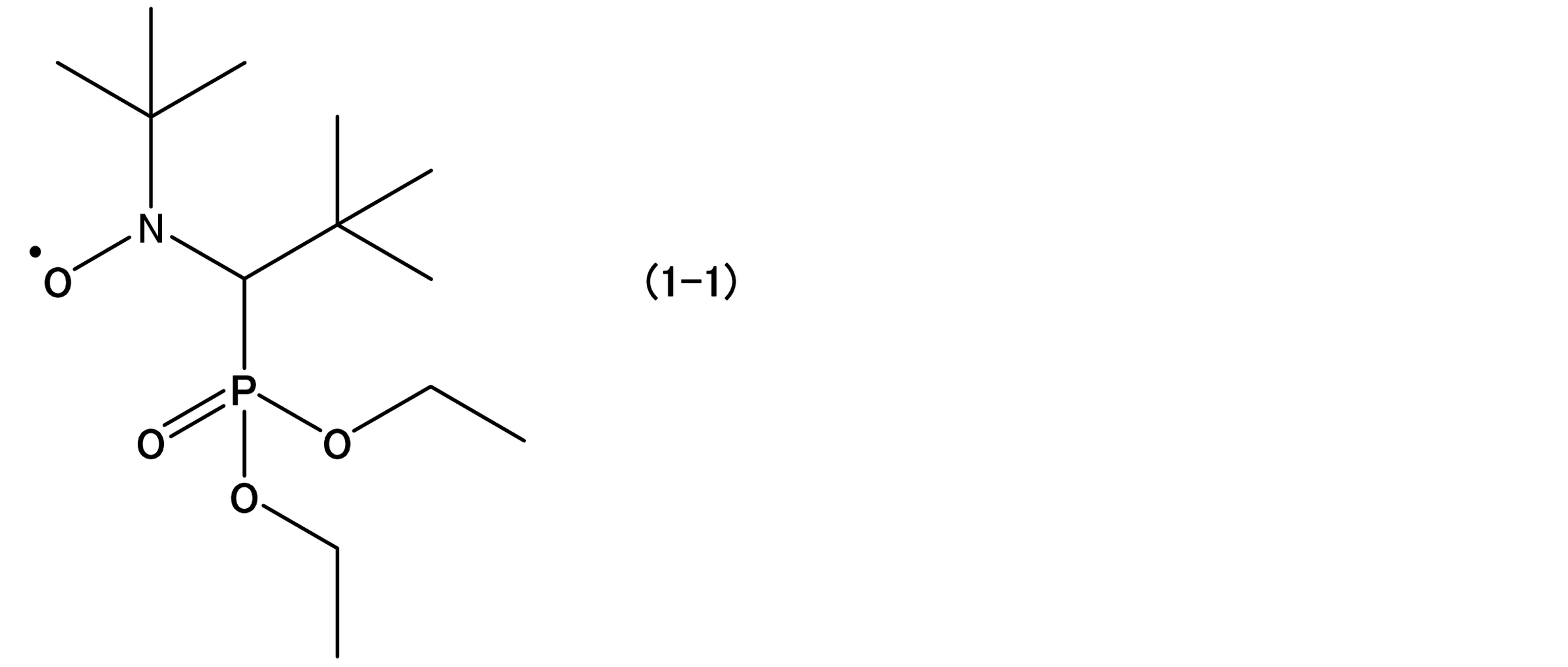
また、ニトロキシドポリマー(A1)は、有機リン単位を有するニトロキシド構造を複数有していてもよい。
ニトロキシドポリマー(A1)において、有機リン単位を有するニトロキシド構造は、ポリマーブロック(A)の末端にあればよいが、ポリマーブロック(A)の両末端にあることが好ましい。
特に、ニトロキシドポリマー(A1)は、鎖状のポリマーブロック(A)の両末端に、有機リン単位を有するニトロキシド構造を有することが好ましい。このようなニトロキシドポリマー(A1)を用いることで、ポリマーブロック(A)の両側にポリマーブロック(B)を有するブロック共重合体を効率良く得ることができる。
モノマー(B1)は、メタクリル酸エステル及びN-置換マレイミドを少なくとも含む。
メタクリル酸エステルとしては、特に限定されないが、例えば、脂肪族メタクリレート[例えば、メタクリル酸アルキルエステル(例えば、メタクリル酸メチル、メタクリル酸エチル、メタクリル酸ブチル等のメタクリル酸C1-18アルキル)等]、脂環族メタクリレート[例えば、メタクリル酸シクロアルキルエステル(例えば、メタクリル酸シクロプロピル、メタクリル酸シクロブチル等のメタクリル酸C3-20シクロアルキル)、架橋環式メタクリレート(例えば、メタクリル酸イソボルニル)等]、芳香族メタクリレート[例えば、メタクリル酸アリールエステル(例えば、メタクリル酸フェニル、メタクリル酸o-トリル等のメタクリル酸C6-20アリール)、メタクリル酸アラルキルエステル(例えば、メタクリル酸ベンジル等のメタクリル酸C6-10アリールC1-4アルキル)、メタクリル酸フェノキシアルキル(例えば、メタクリル酸フェノキシエチル等のメタクリル酸フェノキシC1-4アルキル)等]等が挙げられる。これらは、1種又は2種以上を使用することができる。
これらのN-置換マレイミドの中でも、光学特性が優れる等の観点から、好ましくは、N-シクロアルキルマレイミド、N-アリールマレイミド等であり、より好ましくは、N-シクロヘキシルマレイミド、N-フェニルマレイミド等である。
他の単量体としては、例えば、スチレン系モノマー[例えば、スチレン、ビニルトルエン、置換基(例えば、ハロゲン基、アルコキシ基、アルキル基、ヒドロキシ基等)を有するスチレン(例えば、α―メチルスチレン、クロロスチレン等)、スチレンスルホン酸又はその塩等]、メタクリル酸、アクリル酸、ビニル化合物[例えば、ビニルエステル(例えば、酢酸ビニル)等]、α,β-不飽和ニトリル(例えば、アクリロニトリル、メタクリロニトリル等)、オレフィン(例えば、エチレン、プロピレン、1-ブテン、イソブチレン、1-オクテン等のC2-10アルケン等)等が挙げられる。これらの他の単量体は、1種又は2種以上使用することができる。
他の単量体は、ブロック共重合体の用途に応じて適宜選択できるが、光学特性を調整できる等の観点から、スチレン系モノマーを含むことが好ましく、スチレンを含むことがより好ましい。
チオール系化合物(C1)は、連鎖移動剤として使用可能なものであればよい。
チオール系化合物(C1)としては、特に限定されないが、例えば、脂肪族チオール[例えば、アルカンチオール(例えば、ブタンチオール、オクタンチオール、デカンチオール、ドデカンチオール(ドデシルメルカプタン)、ヘキサデカンチオール、オクタデカンチオール、デカントリチオール等のC1-20アルカンチオール等)、シクロアルキルメルカプタン(例えば、シクロヘキシルメルカプタン等のC3-20シクロアルキルメルカプタン等)等]、芳香族チオール(例えば、チオフェノール等のC6-20アリールメルカプタン等)、メルカプトカルボン酸エステル[例えば、チオグリコール酸エステル(例えば、チオグリコール酸オクチル等のチオグリコール酸C1-20アルキル等)、メルカプトプロピオン酸エステル(例えば、2-メルカプトプロピオン酸オクチル、3-メルカプトプロピオン酸オクチル、メルカプトプロピオン酸2-エチルヘキシルエステル等のメルカプトプロピオン酸C1-20アルキル等)など]、アルカン酸メルカプトアルキルエステル(例えば、オクタン酸2-メルカプトエチル等のC1-20アルカン酸メルカプトC1-20アルキル等)、エチレングリコールビス(メルカプトアルキル)エーテル(例えば、1,8-ジメルカプト-3,6-ジオキサオクタン等のエチレングリコールビス(メルカプトC1-20アルキル)エーテル等)等が挙げられる。これらは、1種又は2種以上使用することができる。
これらのチオール系化合物の中でも、炭素数3以上の炭化水素基を有するものが好ましい。
ニトロキシドポリマー(A1)とモノマー(B1)の重合工程(I)では、ポリマーブロック(A)とポリマーブロック(B)とを有するブロック共重合体(1)が形成される。
ニトロキシドポリマー(A1)とモノマー(B1)とを、ニトロキシドポリマー(A1)が有するニトロキシド構造を介して重合させることにより、ブロック共重合体(1)を形成することができる。
ブロック共重合体(1)は、有機リン単位を有するニトロキシド構造を末端に有しているが、このニトロキシド構造は、ブロック共重合体(1)からの解離と結合を繰り返していると考えられる。ニトロキシド構造がブロック共重合体(1)から解離している際に、チオール系化合物(C1)由来のラジカルがブロック共重合体(1)の末端に結合することによって、本発明のブロック共重合体を得ることができる。
重合温度は、特に限定されないが、例えば、80~130℃であり、好ましくは、90~120℃である。
重合工程(I)の重合時間は、特に限定されず、重合温度に応じて適宜選択できるが、例えば、0.5~6時間、好ましくは1~3時間である。
尚、重合は、窒素等の不活性ガスを導入することにより、溶存酸素を50ppm以下とすることが好ましい。
重合溶媒の使用量は、重合系内における単量体組成物において、10~80重量%が好ましい。
触媒としては、特に限定されないが、例えば、酸、塩基及びこれらの塩、金属錯体、並びに金属酸化物から選ばれる少なくとも1種を使用できる。酸、塩基及びこれらの塩、金属錯体、並びに金属酸化物の種類は、特に限定されない。最終的に得られるブロック共重合体、または当該重合体を含む樹脂組成物もしくは樹脂成形体が透明性の重要視される用途に使用される場合、触媒は、これらの透明性が低下せず、着色などの悪影響が生じない範囲で使用することが好ましい。
塩基は、限定されず、例えば、金属水酸化物、アミン類、イミン類、アルカリ金属誘導体、アルコキシド類、水酸化アンモニウム塩である。
金属有機酸塩又は金属無機酸塩の金属は、最終的に得られるブロック共重合体、樹脂組成物または樹脂成形体の特性を阻害せず、かつこれらの廃棄時に環境汚染を招くことがない限り限定されず、例えば、リチウム、ナトリウム、カリウムなどのアルカリ金属;マグネシウム、カルシウム、ストロンチウム、バリウムなどのアルカリ土類金属;亜鉛;ジルコニウムなどであり、これらの中でも、亜鉛が好ましい。
具体的な金属カルボン酸塩として、酢酸亜鉛、プロピオン酸亜鉛、オクチル酸亜鉛、またはステアリン酸亜鉛が好ましい。
金属酸化物は、限定されず、例えば、酸化亜鉛、酸化カルシウム、酸化マグネシウムである。
尚、触媒の使用量は、特に限定されない。
尚、重合開始剤の使用量は、特に限定されないが、モノマー[追加重合におけるモノマー、例えば、モノマー(B1)のうち、残存するモノマー又は未反応のモノマー(及び必要に応じてさらに追加したモノマー(B1)の総量)]100重量部に対して、0.1~10重量部程度であるのが好ましく、0.5~5重量部程度であるのが更に好ましい。また、ラジカル重合開始剤として、使用前にフィルターなどで異物や不純物を除いたものを使用することも好ましい形態である。
連鎖移動剤としては、例えば、前記例示のチオール系化合物(C1);四塩化炭素、四臭化炭素、塩化メチレン、ブロモホルム、ブロモトリクロロエタンなどのハロゲン化物;α―メチルスチレンダイマー、α―テルピネン、γ―テルピネン、ジペンテン、ターピノーレンなどの不飽和炭化水素化合物である。これは、単独で用いてもよく、2種以上を併用してもよい。なかでも、炭素数3以上の炭化水素基を有するチオール系化合物(C1)を用いることが好ましい。
尚、連鎖移動剤の使用量は、特に限定されないが、モノマー[追加重合におけるモノマー、例えば、モノマー(B1)のうち、残存するモノマー又は未反応のモノマー(及び必要に応じてさらに追加したモノマー(B1)の総量)]100重量部に対して、0.001~1重量部程度であるのが好ましく、0.01~0.3重量部程度であるのが更に好ましい。また、連鎖移動剤として、使用前にフィルターなどで異物や不純物を除いたものを使用することも好ましい形態である。
追加するモノマー(B1)としては、好ましくは、上記したモノマー(B1)における他の単量体であり、スチレン系モノマーを含むことがより好ましく、スチレンを含むことがさらに好ましい。
また、重合反応終了後の重合液に、その他の樹脂(例えば、熱可塑性重合体等)等を混合してもよい。その他の樹脂の配合量は、特に限定されない。
ベンゾフェノン系化合物としては、例えば、2,4-ジヒドロキシベンゾフェノン、4-n-オクチルオキシ-2-ヒドロキシベンゾフェノン、2,2’-ジヒドロキシ-4,4’-ジメトキシベンゾフェノン、2-ヒドロキシ-4-n-オクチルオキシベンゾフェノン、ビス(5-ベンゾイル-4-ヒドロキシ-2-メトキシフェニル)メタン、1,4-ビス(4-ベンゾイル-3-ヒドロキシフェノン)-ブタン等が挙げられる。
ベンゾエート系化合物としては、例えば、2,4-ジ-t-ブチルフェニル-3’,5’-ジ-t-ブチル-4’-ヒドロキシベンゾエート等が挙げられる。
これらは単独で、または2種類以上の組み合わせで使用することができる。
フェノール系酸化防止剤としては、例えば、n-オクタデシル-3-(3,5-ジ-t-ブチル-4-ヒドロキシフェニル)プロピオネート、n-オクタデシル-3-(3,5-ジ-t-ブチル-4-ヒドロキシフェニル)アセテート、n-オクタデシル-3,5-ジ-t-ブチル-4-ヒドロキシベンゾエート、n-ヘキシル-3,5-ジ-t-ブチル-4-ヒドロキシフェニルベンゾエート、n-ドデシル-3,5-ジ-t-ブチル-4-ヒドロキシフェニルベンゾエート、ネオドデシル-3-(3,5-ジ-t-ブチル-4-ヒドロキシフェニル)プロピオネート、ドデシル-β-(3,5-ジ-t-ブチル-4-ヒドロキシフェニル)プロピオネート、エチル-α-(4-ヒドロキシ-3,5-ジ-t-ブチルフェニル)イソブチレート、オクタデシル-α-(4-ヒドロキシ-3,5-ジ-t-ブチルフェニル)イソブチレート、オクタデシル-α-(4-ヒドロキシ-3,5-ジ-t-ブチル-4-ヒドロキシフェニル)プロピオネート、2-(n-オクチルチオ)エチル-3,5-ジ-t-ブチル-4-ヒドロキシベンゾエート、2-(n-オクチルチオ)エチル-3,5-ジ-t-ブチル-4-ヒドロキシフェニルアセテート、2-(n-オクタデシルチオ)エチル-3,5-ジ-t-ブチル-4-ヒドロキシフェニルアセテート、2-(n-オクタデシルチオ)エチル-3,5-ジ-t-ブチル-4-ヒドロキシベンゾエート、2-(2-ヒドロキシエチルチオ)エチル-3,5-ジ-t-ブチル-4-ヒドロキシベンゾエート、ジエチルグリコールビス-(3,5-ジ-t-ブチル-4-ヒドロキシ-フェニル)プロピオネート、2-(n-オクタデシルチオ)エチル-3-(3,5-ジ-t-ブチル-4-ヒドロキシフェニル)プロピオネート、ステアルアミド-N,N-ビス-[エチレン-3-(3,5-ジ-t-ブチル-4-ヒドロキシフェニル)プロピオネート]、n-ブチルイミノ-N,N-ビス-[エチレン-3-(3,5-ジ-t-ブチル-4-ヒドロキシフェニル)プロピオネート]、2-(2-ステアロイルオキシエチルチオ)エチル-3,5-ジ-t-ブチル-4-ヒドロキシベンゾエート、2-(2-ステアロイルオキシエチルチオ)エチル-7-(3-メチル-5-t-ブチル-4-ヒドロキシフェニル)ヘプタノエート、1,2-プロピレングリコールビス-[3-(3,5-ジ-t-ブチル-4-ヒドロキシフェニル)プロピオネート]、エチレングリコールビス-[3-(3,5-ジ-t-ブチル-4-ヒドロキシフェニル)プロピオネート]、ネオペンチルグリコールビス-[3-(3,5-ジ-t-ブチル-4-ヒドロキシフェニル)プロピオネート]、エチレングリコールビス-(3,5-ジ-t-ブチル-4-ヒドロキシフェニルアセテート)、グリセリン-1-n-オクタデカノエート-2,3-ビス-(3,5-ジ-t-ブチル-4-ヒドロキシフェニルアセテート)、ペンタエリスリトールテトラキス-[3-(3′,5′-ジ-t-ブチル-4′-ヒドロキシフェニル)プロピオネート]、1,1,1-トリメチロールエタントリス-[3-(3,5-ジ-t-ブチル-4-ヒドロキシフェニル)プロピオネート]、ソルビトールヘキサ-[3-(3,5-ジ-t-ブチル-4-ヒドロキシフェニル)プロピオネート]、2-ヒドロキシエチル-7-(3-メチル-5-t-ブチル-4-ヒドロキシフェニル)プロピオネート、2-ステアロイルオキシエチル-7-(3-メチル-5-t-ブチル-4-ヒドロキシフェニル)ヘプタノエート、1,6-n-ヘキサンジオールビス[(3′,5′-ジ-t-ブチル-4-ヒドロキシフェニル)プロピオネート]、ペンタエリトリトールテトラキス(3,5-ジ-t-ブチル-4-ヒドロキシヒドロシンナメート)、1,3,5-トリメチル-2,4,6-トリス(3,5-ジ-t-ブチル-4-ヒドロキシベンジル)ベンゼン、3,9-ビス[1,1-ジメチル-2-[β-(3-t-ブチル-4-ヒドロキシ-5-メチルフェニル)プロピオニルオキシ]エチル]-2,4,8,10-テトラオキサスピロ[5,5]-ウンデカン、2,4-ジ-t-アミル-6-[1-(3,5-ジ-t-アミル-2-ヒドロキシフェニル-2-ヒドロキシ-5-メチルベンジル)-4-メチルフェニルアクリレート、1,3,5-トリス(2,6-ジメチル-3-ヒドロキシ-4-t-ブチルベンジル)イソシアヌレート等が挙げられる。
上記した製造方法を用いて、アクリル酸エステル由来の構造単位を含むポリマーブロック(A)と、N-置換マレイミド環構造及びメタクリル酸エステル由来の構造単位を含むポリマーブロック(B)とを有するブロック共重合体を得ることができる。

炭化水素基としては、例えば、脂肪族基{例えば、アルキル基[例えば、C1-6直鎖アルキル基(例えば、メチル基、エチル基等)、C1-6分岐アルキル基(例えば、イソプロピル基等)等のC1-6アルキル基等]等}、脂環族基(例えば、シクロペンチル基、シクロヘキシル基等のC3-20シクロアルキル基等)、芳香族基{例えば、C6-20芳香族基[例えば、C7-20アラルキル基(例えば、ベンジル基等)、C6-20アリール基(例えば、フェニル基等)]}である。尚、炭化水素基は、さらにハロゲン等の置換基を有していてもよい。
なお、ブロック共重合体のポリマーブロック(B)において、N-置換マレイミド環構造の含有割合は、ブロック共重合体が優れた耐熱性を有する等の観点から、ポリマーブロック(B)を構成するモノマー換算で、例えば7~90モル%、好ましくは10~75モル%、より好ましくは10~60モル%である。
尚、ブロック共重合体がトリブロック共重合体である場合、各ポリマーブロック(B)におけるN-置換マレイミド環構造の含有割合が、このような範囲であればよい。
ポリマーブロック(B)におけるスチレン系単位の含有割合は、所望の光学特性などに応じて適宜選択できるが、例えば0.1~15重量%、好ましくは1~10重量%、より好ましくは3~8重量%である。なお、ポリマーブロック(B)におけるスチレン系単位の含有割合は、ポリマーブロック(B)を構成するモノマー換算で、例えば0.1~20モル%、好ましくは1~12モル%、より好ましくは3~10モル%である。
尚、ブロック共重合体がトリブロック共重合体である場合、各ポリマーブロック(B)における他の単位(例えば、スチレン系単位など)の含有割合が、上記のような範囲であればよい。
なお、ブロック共重合体において、N-置換マレイミド環構造の含有割合は、ブロック共重合体が優れた耐熱性を有する等の観点から、ブロック共重合体を構成するモノマー換算で、例えば2~80モル%、好ましくは7~50モル%、より好ましくは15~30モル%である。
尚、ブロック共重合体がトリブロック共重合体である場合、各ポリマーブロック(B)におけるN-置換マレイミド環構造の含有割合が、このような範囲であればよい。
また、ブロック共重合体の分子量分布(Mw/Mn)は、1.65以上(例えば、1.65~2.5)、好ましくは1.7~2.4(例えば、1.8~2.3)であってもよい。分子量分布をこの範囲とすることで、平滑性に優れたフィルムを得やすい。
また、ブロック共重合体において、ポリマーブロック(A)とポリマーブロック(B)との数平均分子量(Mn)の比は、特に限定されないが、例えば1:0.2~1:2であり、好ましくは1:0.4~1:1である。
分子量の比をこのような範囲とすることで、ブロック共重合体を溶融加工する際の粘度を適度な範囲としやすく、平滑性などの外観に優れた成型体を得やすい。
尚、ブロック共重合体がトリブロック共重合体である場合、ポリマーブロック(A)と、各ポリマーブロック(B)との重量平均分子量(Mw)や数平均分子量(Mn)の比が、このような範囲であればよい。
本発明には、前記ブロック共重合体を含む樹脂組成物も含む。このような樹脂組成物は、樹脂(又は樹脂成分)として、前記ブロック共重合体を含んでいればよく、他の樹脂を含んでいてもよい。
そのため、本発明のブロック共重合体は、他の樹脂(特に、アクリル系樹脂やブロック共重合体と共通する骨格を有する樹脂)の改質剤として用いることもできる。
特に、前記のように、追加重合を行う場合には、前記ブロック共重合体と、ブロック共重合体と共通する骨格を有する樹脂とを含む樹脂組成物[例えば、前記ブロック共重合体と、モノマー(B1)を重合成分とするポリマーとの混合物(ポリマーブレンド)]が効率よく得られる。
他方、樹脂成分が、前記ブロック共重合体、又は前記ブロック共重合体とメタクリル酸エステル及びN-置換マレイミドから選択された少なくとも1種のモノマー由来の構造単位を有する樹脂とで構成され、紫外線吸収剤を含有する場合であれば、着色度YIは、好ましくは20.0以下であり、より好ましくは17.5以下であってもよい。
なお、樹脂組成物の着色度(YI)はサンプルをクロロホルムに溶かして15%溶液とし、これを石英セルに入れ、JIS-K7103に従い、色差計で測定ができる。
添加剤は、単独で又は2種以上組み合わせて使用してもよい。添加剤の割合は特に限定されず、添加剤の種類等、樹脂成分の種類、用途等に応じて適宜選択できる。
金属アルコキシドは、単独で又は2種以上組み合わせて使用してもよい。
これらを組み合わせる場合、フェノール系酸化防止剤及びイオウ系酸化防止剤の総量と、リン系酸化防止剤との割合(質量比)は、例えば、2/3~8/1、好ましくは1/1~4/1、さらに好ましくは1/1~3/1程度であってもよい。
光学フィルムは、光学特性に優れたフィルムであれば特に限定されないが、好ましくは、位相差フィルム、ゼロ位相差フィルム(面内、厚み方向位相差が限りなく小さい)、視野角補償フィルム、光拡散フィルム、反射フィルム、反射防止フィルム、防眩フィルム、輝度向上フィルム、タッチパネル用導電フィルム等が挙げられる。
光学シートとしては、拡散板、導光体、位相差板、ゼロ位相差板、プリズムシート等が挙げられる。
尚、成型方法は特に限定されず、従来公知の方法に従ってよい。
例えば、液晶表示装置、有機EL表示装置等の画像表示装置に用いられる保護フィルム、反射防止フィルム、偏光フィルム等の用途に用いる場合には、好ましくは1~250μm、より好ましくは10~100μm、さらに好ましくは20~80μmである。
また、例えば、ITO蒸着フィルム、銀ナノワイヤーフィルム、メタルメッシュフィルム等に用いられる透明導電性フィルム等の用途に用いる場合には、好ましくは20~400μm、より好ましくは30~350μm、さらに好ましくは40~300μmである。
本発明のフィルムは、液晶表示装置(LCD)等の画像表示装置が備える偏光板に用いる偏光子保護フィルムとして使用することができ、通常は、そのまま偏光子保護フィルムとして使用することができる。
本発明は、本発明のフィルムを備えた偏光板も含有する。
すなわち、本発明のフィルムは、偏光子保護フィルムとして用いて、偏光板に使用することができる。
本発明において、偏光板の製造方法は、特に限定されず、従来公知の方法に従ってよい。例えば、偏光子の少なくとも片面に、常法を用いて本発明のフィルムを貼り合わせることにより、偏光板を得ることができる。当該貼り合わせは、本発明のフィルムの偏光子に接合する側をアルカリ鹸化処理し、偏光子の少なくとも片面に完全鹸化型ポリビニルアルコール水溶液を塗布した後、本発明のフィルムと偏光子とを貼り合わせることにより、好適に実施することができる。
また、偏光子の膜厚は、1~30μmが好ましく、1~20μmがより好ましい。
本発明は、上述した本発明の偏光板を備えた画像表示装置も含有する。
本発明において、画像表示装置の製造方法は特に限定されず、従来公知の方法に従ってよい。画像表示装置としては、液晶表示装置(LCD)等が好ましい。
なお、以下では特にことわりのない場合、「%」は「質量%」を、「部」は「質量部」をそれぞれ示す。
ブロックポリマー、重合体および組成物の重量平均分子量(Mw)、数平均分子量(Mn)及び分子量分布(D)は、ゲル浸透クロマトグラフィー(GPC)を用いて、ポリスチレン換算により求めた。測定に用いた装置および測定条件は以下の通りである。
システム:東ソー製GPCシステム HLC-8220
測定側カラム構成
・ガードカラム:東ソー製、TSKguardcolumn SuperHZ-L
・分離カラム:東ソー製、TSKgel SuperHZM-M 2本直列接続
リファレンス側カラム構成
・リファレンスカラム:東ソー製、TSKgel SuperH-RC
展開溶媒:テトラヒドロフラン(和光純薬工業製、特級)
展開溶媒の流量:0.6mL/分
標準試料:TSK標準ポリスチレン(東ソー製、PS-オリゴマーキット)
カラム温度:40℃
転化率は、ガスクロマトグラフィー(島津製作所社製、装置名:GC-2014)を用いて残存モノマー量を測定することで求めた。
ガラス転移温度(Tg)は、JIS K7121に準拠して求めた。具体的には、示差走査熱量計(リガク製、DSC-8230)を用い、窒素ガス雰囲気下、約10mgのサンプルを常温から200℃まで昇温(昇温速度20℃/分)して得られたDSC曲線から、始点法により評価した。リファレンスにはα-アルミナを用いた。
熱分解温度は、以下の方法(ダイナミックTG法)で分析した。
測定装置:差動型示差熱天秤(ThermoPlus2TG―8120ダイナミックTG、(株)リガク製)
測定条件:試料量10mg
昇温速度:10℃/min
雰囲気:窒素フロー200mL/min
方法:階段状等温制御法(150℃から500℃までの範囲内における質量減少速度値0.005%/s以下に制御)
ブロック共重合体に含まれるN-フェニルマレイミド(PMI)の量は、1H-NMR測定により、PMIのベンゼン環のオルト位、及び、パラ位のプロトンに相当する7.45~7.50ppmのピーク強度を指標に求めた。本実施例では、核磁気共鳴分光計(BRUKER製、AV300M)を用い、測定溶媒には重クロロホルム(和光純薬製)を用いた。
ブロックポリマー、重合体の発泡性は加熱時の発泡量の測定によって評価した。すなわち、80℃のオーブンにて少なくとも12時間以上乾燥処理したブロックポリマーを、JIS-K7210に規定されるメルトインデクサーのシリンダー内に装填し、290℃で20分間保持した後、ストランド状に押出し、得られたストランドの上部標線と下部標線との間に存在する泡の発生個数を計数し、熱可塑性樹脂組成物1gあたりの個数で表した。
○:0~10個、△:10~20個、×:20個以上
フィルムの耐折回数は、JIS P8115に準拠して測定した。具体的には、長さ90mm、幅15mmの2種類の試験フィルムを23℃、50%RHの状態に1時間以上静置させてから使用し、MIT耐折疲労試験機(東洋精機製、DA型)を用いて、折り曲げ角度135°、折り曲げ速度175cpm、荷重200gの条件で試験を行い、5枚のサンプルのフィルムが破断するまでの回数の平均値をそれぞれ求めた。
フィルムの厚さは、デジマチックマイクロメーター(ミツトヨ社製)を用いて測定した。以降に評価方法を示す物性を含め、フィルムの物性を測定、評価するためのサンプルはフィルムの幅方向の中央部から取得した。
フィルムのヘイズは、日本電色工業社製NDH-1001DPを用いて石英セルに1,2,3,4-テトラヒドロナフタリン(テトラリン)を満たし、その中にフィルムを浸漬して測定し、100μmあたりの内部ヘイズ値として算出した。
撹拌装置、温度センサー、冷却管、窒素導入管を備えた反応装置に、両末端にホスホン酸エステル単位を有するニトロキシド構造を有するポリアクリル酸ブチルの60%トルエン溶液(Flexibloc D2(登録商標)、Arkema France社製)41部、15部のフェニルマレイミド(PMI)、60部のメタクリル酸メチル(MMA)、0.075部のn-ドデシルメルカプタン(DM)、ならびに重合溶媒として50部のトルエンを仕込み、これに窒素を通じつつ105℃まで昇温させた。その後105-110℃の還流下で2時間の溶液重合を進行させた。この時の重合液中のモノマー残存量より算出した反応率は、MMAが50%、PMIが46%であった。また、1H-NMRで求めたブロック共重合体中のPMI含有量は、14質量%であった。
重合反応終了後、100部のメチルエチルケトン(MEK)を加えて希釈した後、大量のヘキサン中に撹拌しながらゆっくり添加した。その際沈殿した白色の固体を取り出し、2.6kPa,80℃で約1時間乾燥し溶媒を除去することで、ポリアクリル酸ブチルからなるポリマーブロック(A)の両末端に、PMIとMMAからなるポリマーブロック(B)を有するブロックポリマー共重合体(A-1)を得た。
A-1の重量平均分子量は34.1万、数平均分子量は16.9万、ガラス転移温度は132℃であった。またA-1の発泡性評価を実施すると○であった。
撹拌装置、温度センサー、冷却管、窒素導入管を備えた反応装置に、両末端にホスホン酸エステル単位を有するニトロキシド構造を有するポリアクリル酸ブチルの60%トルエン溶液(Flexibloc D2(登録商標)、Arkema France社製)41部、15部のフェニルマレイミド(PMI)、56部のメタクリル酸メチル(MMA)、0.08部のn-ドデシルメルカプタン(DM)、ならびに重合溶媒として50部のトルエンを仕込み、これに窒素を通じつつ105℃まで昇温し還流させた。ここにスチレン(St)4部を1時間かけて滴下し、その後105-110℃の還流下で1時間の溶液重合を進行させた。この時の重合液中のモノマー残存量より算出した反応率は、MMAが48%、PMIが48%、スチレンが90%であった。また、1H-NMRで求めたブロック共重合体中のPMI含有量は、12質量%であった。
重合反応終了後、100部のメチルエチルケトン(MEK)を加えて希釈した後、大量のヘキサン中に撹拌しながらゆっくり添加した。その際沈殿した白色の固体を取り出し、2.6kPa,80℃で約1時間乾燥し溶媒を除去することで、ポリアクリル酸ブチルからなるポリマーブロック(A)の両末端に、PMI、MMA、Stからなるポリマーブロック(B)を有するブロックポリマー共重合体(A-2)を得た。
A-2の重量平均分子量は36.3万、数平均分子量は16.8万、ガラス転移温度は133℃であった。またA-2の発泡性評価を実施すると○であった。
16部のFlexibloc D2(登録商標)、18部のPMI、72部のMMA、0.05部のDM、ならびに重合溶媒として101部のトルエンとした以外は実施例1と同様に還流下で1時間の溶液重合を進行させた。この時重合液中のモノマー量より算出した反応率は、MMAが23%、PMIが29%であった。また、重合液の一部を取り出し、実施例1同様の方法でブロック共重合体を単離した。1H-NMRで求めたブロック共重合体中のPMI含有量は、19質量%であった。得られたブロック共重合体の分子量を求めたところ、重量平均分子量(Mw)は39.2万、数平均分子量(Mn)は17.0万、分子量分布(Mw/Mn)は2.3であった。
次いで未反応モノマーを追加重合するため、t-アミルパーオキシイソノナノエート(アルケマ吉富社製、ルペロックス(登録商標)570)0.058部を一括で加えると同時に、t-アミルパーオキシイソノナノエート(アルケマ吉富社製、ルペロックス(登録商標)570)0.115部とトルエン3.5部からなる液を2時間かけて滴下した。滴下終了後、105℃~110℃の温度を保持しながら5時間重合反応を行い、ポリアクリル酸ブチルからなるポリマーブロック(A)の両末端に、PMI、MMAからなるポリマーブロック(B)を有するブロックポリマー共重合体とPMI、MMAからなる共重合体を含むポリマー溶液を得た。尚、重合反応終了後のモノマー残存量より算出した反応率は、MMA98%、PMI98%であった。
得られたポリマー溶液をポリマー固形分濃度が30質量%となるようにMEKで希釈した後、バレル温度270℃、回転速度200rpm、減圧度13.3~400hPa(10~300mmHg)、ベント数2個のベントタイプ二軸押出機(φ=15mm、L/D=30)に導入し、脱揮を行い、ポリアクリル酸ブチルからなるポリマーブロック(A)の両末端に、PMI、MMAからなるポリマーブロック(B)を有するブロックポリマー共重合体とPMI、MMAからなる共重合体とを含む樹脂組成物(B-1)を得た。B-1の重量平均分子量は18.1万、数平均分子量は5.7万、ガラス転移温度は134℃、熱分解温度は320℃であった。またB-1の発泡性評価を実施すると○であった。
攪拌装置、温度センサー、冷却管、窒素導入管を備えた反応装置に、58部のFlexibloc D2(登録商標)、65部のメタクリル酸メチル(MMA)、0.05部のDM、ならびに重合溶媒として40部のトルエンを仕込み、これに窒素を通じつつ、105℃まで昇温させた。その後約105~110℃の還流下で3時間の溶液重合を進行させた。この時の重合液中のモノマー量より算出したMMAの反応率は20%であった。その後溶液及びモノマー類を真空下240℃で溶媒を除去する事により、中心ブロックがポリアクリル酸ブチル、両側のブロックがMMAのトリブロックコポリマー(A-3)を得た。
A-3の重合平均分子量は18.1万、数平均分子量は11.3万、ガラス転移温度は107℃であり、熱分解温度は267℃から段階的な重量減少を確認し290℃で等温分解挙動を示した。また、A-3の発泡性評価を実施すると、×であった。
撹拌装置、温度センサー、冷却管、窒素導入管を備えた反応装置に、17部のフェニルマレイミド(PMI)、83部のメタクリル酸メチル(MMA)、0.1部のn-ドデシルメルカプタン(DM)、ならびに重合溶媒として110部のトルエンを仕込み、これに窒素を通じつつ105℃まで昇温させた。t-アミルパーオキシイソノナノエート(アルケマ吉富社製、ルペロックス(登録商標)570)0.1部を一括で加えると同時に、t-アミルパーオキシイソノナノエート(アルケマ吉富社製、ルペロックス(登録商標)570)0.2部とトルエン10部からなる液、及びスチレン(St)1部、トルエン10部からなる溶液を2時間かけて滴下した。滴下終了後、105℃~110℃の温度を保持しながら6時間重合反応を行い、PMI、MMA、Stからなる共重合体(C-1)を含むポリマー溶液を得た。尚、重合反応終了後のモノマー残存量より算出した反応率は、MMA97%、PMI99%、St99%であった。
その後溶液及びモノマー類を真空下240℃で溶媒を除去する事により、PMI、MMA、Stからなる共重合体(C-1)を得た。C-1の重量平均分子量は21.0万、数平均分子量は7.2万、ガラス転移温度は135℃であった。またC-1の発泡性評価を実施すると○であった。
撹拌装置、温度センサー、冷却管、窒素導入管を備えた反応装置に、40部のフェニルマレイミド(PMI)、60部のメタクリル酸メチル(MMA)、0.1部のn-ドデシルメルカプタン(DM)、ならびに重合溶媒として120部のトルエンを仕込み、これに窒素を通じつつ105℃まで昇温させた。t-アミルパーオキシイソノナノエート(アルケマ吉富社製、ルペロックス(登録商標)570)0.1部を一括で加えると同時に、t-アミルパーオキシイソノナノエート(アルケマ吉富社製、ルペロックス(登録商標)570)0.2部とトルエン10部からなる液を2時間かけて滴下した。滴下終了後、105℃~110℃の温度を保持しながら6時間重合反応を行い、PMI、MMAからなる共重合体(C-2)を含むポリマー溶液を得た。尚、重合反応終了後のモノマー残存量より算出した反応率は、MMA96%、PMI95%であった。
その後溶液及びモノマー類を真空下240℃で溶媒を除去する事により、PMI、MMAからなる共重合体(C-2)を得た。C-2の重量平均分子量は18万、数平均分子量は4.2万、ガラス転移温度は155℃であった。またC-2の発泡性評価を実施すると○であった。
撹拌装置、温度センサー、冷却管、窒素導入管を備えた反応装置に、両末端にホスホン酸エステル単位を有するニトロキシド構造を有するポリアクリル酸ブチルの60%トルエン溶液(Flexibloc D2(登録商標)、Arkema France社製)41部、22部のフェニルマレイミド(PMI)、28部のメタクリル酸メチル(MMA)、3部のアクリロニトリル(AN)、0.1部のn-ドデシルメルカプタン(DM)、ならびに重合溶媒として60部のトルエンを仕込み、これに窒素を通じつつ105℃まで昇温させた。ここにスチレン(St)30部を1時間かけて滴下し、その後105-110℃の還流下で1時間の溶液重合を進行させた。この時の重合液中のモノマー残存量より算出した反応率は、MMAが38%、PMIが48%、スチレンが65%、アクリロニトリルが70%であった。また、1H-NMRで求めたブロック共重合体中のPMI含有量は、22質量%であった。
重合反応終了後、100部のメチルエチルケトン(MEK)を加えて希釈した後、大量のヘキサン中に撹拌しながらゆっくり添加した。その際沈殿した白色の固体を取り出し、2.6kPa、80℃で約1時間乾燥し溶媒を除去することで、ポリアクリル酸ブチルからなるポリマーブロック(A)の両末端に、PMIとMMA、St、ANからなるポリマーブロック(B)を有するブロックポリマー共重合体(A-4)を得た。
(A-4)の重量平均分子量は25.1万、数平均分子量は13.2万、ガラス転移温度は132℃であった。また(A-4)の発泡性評価を実施すると○であった。
実施例1~2と比較例1の比較から、ブロック共重合体がN-置換マレイミド環構造を有することにより、耐熱性が優れることが確認された。
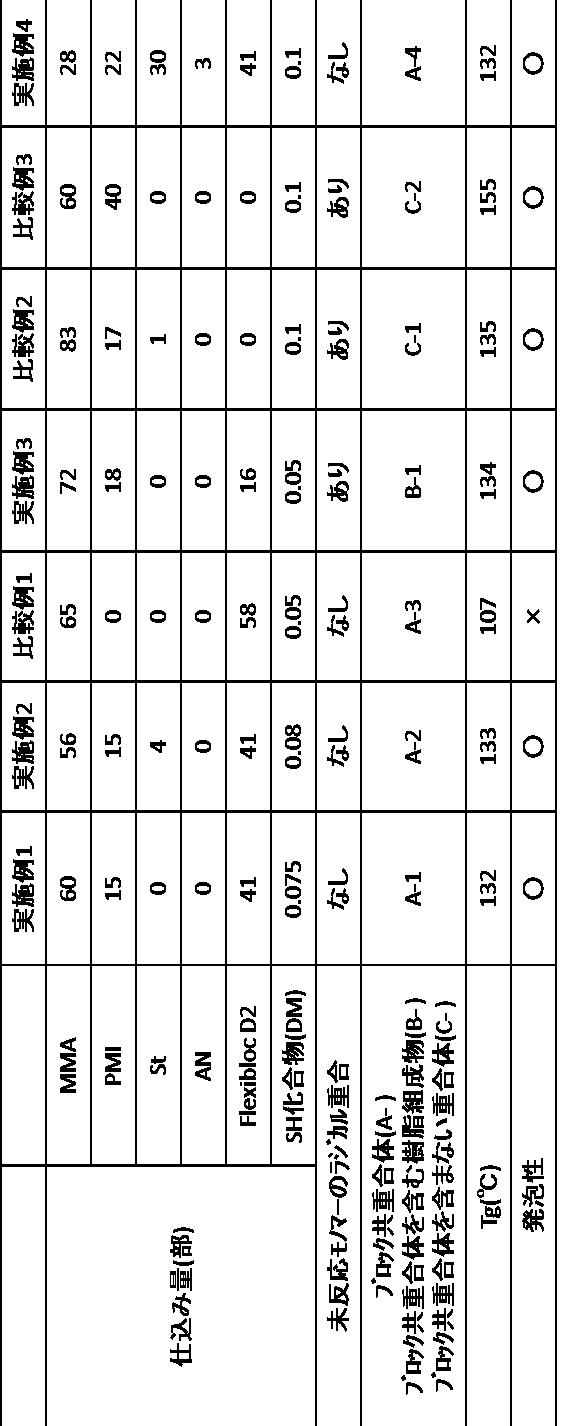
樹脂組成物(B-1)を250℃でプレス成型し、120μmのフィルムを得た。次いで160℃(Tg+23℃)で2×2倍の延伸を実施し二軸延伸フィルムを得た。このようにして得た延伸フィルムのTg、厚み、ヘイズ、耐折回数を表2に示す。
実施例1~2、および比較例1~3で得た共重合体を表2に示す配合比によりラボプラストミルを用い270℃で5分間混合し、樹脂組成物(B-2~4)を得た。得られた樹脂組成物を実施例5同様に処理し、二軸延伸フィルムを得た。このようにして得た延伸フィルムのTg、厚み、ヘイズ、耐折回数を表2に示す。
比較例2~3で合成した共重合体(C-1)~(C-2)を用い、実施例5と同様にしてプレスフィルム及び二軸延伸フィルムを得た。得られた延伸フィルムのTg、厚み、ヘイズ、耐折回数を表2に示す。
尚、比較例6は、プレス成型後のフィルムが脆く、二軸延伸時に破断した。

16部のFlexibloc D2(登録商標)、18部のPMI、72部のMMA、0.1部のDM、ならびに重合溶媒として101部のトルエンとした以外は実施例3と同様に還流下で1時間の溶液重合を進行させた。この時の重合液中のモノマー量より算出した反応率は、MMAが23%、PMIが29%であった。また、重合液の一部を取り出し、実施例1同様の方法でブロック共重合体(A-5)を単離した。1H-NMRで求めたブロック共重合体中のPMI含有量は、19質量%であった。
重合反応終了後、100部のメチルエチルケトン(MEK)を加えて希釈した後、大量のヘキサン中に撹拌しながらゆっくり添加した。その際沈殿した白色の固体を取り出し、2.6kPa、80℃で約1時間乾燥し溶媒を除去することで、ポリアクリル酸ブチルからなるポリマーブロック(A)の両末端に、PMIとMMAからなるポリマーブロック(B)を有するブロックポリマー共重合体(A-5)を得た。
(A-5)の重量平均分子量は26.2万、数平均分子量は13.4万、ガラス転移温度は135℃、熱分解温度は319℃であった。また、熱分解温度を測定したサンプル残渣をクロロホルムに溶解したところ、均一に溶解し不溶物は認められなかった。
重合中にDMを使用しなかった以外は、実施例8と同様に還流下で1時間の溶液重合を進行させた。この時重合液中のモノマー量より算出した反応率は、MMAが26%、PMIが31%であった。また、重合液の一部を取り出し、実施例1同様の方法でブロック共重合体(A-6)を単離した。1H-NMRで求めたブロック共重合体中のPMI含有量は、19質量%であった。
重合反応終了後、100部のメチルエチルケトン(MEK)を加えて希釈した後、大量のヘキサン中に撹拌しながらゆっくり添加した。その際沈殿した白色の固体を取り出し、2.6kPa、80℃で約1時間乾燥し溶媒を除去することで、ポリアクリル酸ブチルからなるポリマーブロック(A)の両末端に、PMIとMMAからなるポリマーブロック(B)を有するブロックポリマー共重合体(A-6)を得た。
(A-6)の重量平均分子量は49.2万、数平均分子量は23.1万、ガラス転移温度は135℃、熱分解温度は298℃であった。また、熱分解温度を測定したサンプル残渣をクロロホルムに溶解したところ、分解に起因する不溶物を確認することができた。
16部のFlexibloc D2(登録商標)、18部のPMI、72部のMMA、0.1部のDM、ならびに重合溶媒として101部のトルエンとした以外は実施例1と同様に還流下で1時間の溶液重合を進行させた。この時の重合液中のモノマー量より算出した反応率は、MMAが22%、PMIが26%であった。また、重合液の一部を取り出し、実施例1同様の方法でブロック共重合体を単離した。1H-NMRで求めたブロック共重合体中のPMI含有量は、19質量%であった。得られたブロック共重合体の分子量を求めたところ、重量平均分子量(Mw)は27.1万、数平均分子量(Mn)は12.6万、分子量分布(Mw/Mn)は2.2であった。
次いで未反応モノマーを追加重合するため、t-アミルパーオキシイソノナノエート(アルケマ吉富社製、ルペロックス(登録商標)570)を0.058部を一括で加えると同時に、t-アミルパーオキシイソノナノエート(アルケマ吉富社製、ルペロックス(登録商標)570)0.115部とトルエン3.5部からなる液を2時間かけて滴下した。滴下終了後、105℃~110℃の温度を保持しながら5時間重合反応を行い、ポリアクリル酸ブチルからなるポリマーブロック(A)の両末端に、PMI、MMAからなるポリマーブロック(B)を有するブロックポリマー共重合体とPMI、MMAからなる共重合体を含むポリマー溶液を得た。尚、重合反応終了後のモノマー残存量より算出した反応率は、MMA98%、PMI97%であった。
得られたポリマー溶液をポリマー固形分濃度が30質量%となるようにMEKで希釈した後、バレル温度270℃、回転速度200rpm、減圧度13.3~400hPa(10~300mmHg)、ベント数2個のベントタイプ二軸押出機(φ=15mm、L/D=30)に導入し、脱揮を行い、ポリアクリル酸ブチルからなるポリマーブロック(A)の両末端に、PMI、MMAからなるポリマーブロック(B)を有するブロックポリマー共重合体とPMI、MMAからなる共重合体とを含む樹脂組成物(B-5)を得た。B-5の重量平均分子量は15.2万、数平均分子量は5.0万、ガラス転移温度は134℃、熱分解温度は326℃であった。
比較例8:PMI、MMA共重合体(C-3)の合成
撹拌装置、温度センサー、冷却管、窒素導入管を備えた反応装置に、20部のフェニルマレイミド(PMI)、80部のメタクリル酸メチル(MMA)、0.1部のn-ドデシルメルカプタン(DM)、ならびに重合溶媒として110部のトルエンを仕込み、これに窒素を通じつつ105℃まで昇温させた。t-アミルパーオキシイソノナノエート(アルケマ吉富社製、ルペロックス(登録商標)570)0.1部を一括で加えると同時に、t-アミルパーオキシイソノナノエート(アルケマ吉富社製、ルペロックス(登録商標)570)0.2部とトルエン10部からなる液を2時間かけて滴下した。滴下終了後、105℃~110℃の温度を保持しながら6時間重合反応を行い、PMI、MMAからなる共重合体を含むポリマー溶液を得た。尚、重合反応終了後のモノマー残存量より算出した反応率は、MMA97%、PMI99%であった。
その後溶液及びモノマー類を真空下240℃で溶媒を除去する事により、PMI、MMAからなる共重合体(C-3)を得た。C-3の重量平均分子量は21.0万、数平均分子量は6.8万、ガラス転移温度は134℃であった。
共重合体に含まれるPMI残存量を、ガスクロマトグラフィー(使用機器:Gerstel社製熱分解装置を備えた、日本電子社製ガスクロマトグラフ(6890シリーズ)四重極質量分析計(JWS-K9))を用いて測定したところ、(B-5-2)に含まれるPMIは50ppm、(C-3)に含まれるPMIは80ppmであった。このように、本発明の製造方法は、未反応のマレイミド系モノマーの量を少なくできることが確認された。
パージアンドトラップ法
使用機器:Gerstel社製熱分解装置を備えた、日本電子社製ガスクロマトグラフ(6890シリーズ)四重極質量分析計(JWS-K9)
熱分解条件:280℃30分
発生したPMI量は、(B-5-2)が130ppm、(C-3)が250ppmであった。このように、本発明の製造方法で得られる共重合体は、加熱による共重合体の分解を抑制でき、加熱による共重合体からのマレイミド系モノマーの解離も抑制できることも確認できた。
16部のFlexibloc D2(登録商標)、22.5部のシクロヘキシルマレイミド(CMI)、65部のMMA、0.1部のDM、ならびに重合溶媒として95部のトルエンとした以外は実施例1と同様に還流下で1時間の溶液重合を進行させた。この時の重合液中のモノマー量より算出した反応率は、MMAが30%、CMIが14%であった。また、重合液の一部を取り出し、実施例1同様の方法でブロック共重合体を単離した。1H-NMRで求めたブロック共重合体中のCMI含有量は、21質量%であった。得られたブロック共重合体の分子量を求めたところ、重量平均分子量(Mw)は23.6万、数平均分子量(Mn)は10.7万、分子量分布(Mw/Mn)は2.2であった。
次いで未反応モノマーを追加重合するため、t-アミルパーオキシイソノナノエート(アルケマ吉富社製、ルペロックス(登録商標)570)0.058部を一括で加えると同時に、t-アミルパーオキシイソノナノエート(アルケマ吉富社製、ルペロックス(登録商標)570)0.115部とトルエン3.5部からなる液を2時間かけて滴下した。滴下終了後、105℃~110℃の温度を保持しながら5時間重合反応を行い、ポリアクリル酸ブチルからなるポリマーブロック(A)の両末端に、CMI、MMAからなるポリマーブロック(B)を有するブロックポリマー共重合体とCMI、MMAからなる共重合体を含むポリマー溶液を得た。尚、重合反応終了後のモノマー残存量より算出した反応率は、MMA98%、CMI98%であった。
得られたポリマー溶液を100部のMEKを加えて希釈した後、大量のヘキサン中に撹拌しながらゆっくり添加した。その際沈殿した白色の固体を取り出し、2.6kPa、200℃で約1時間乾燥し溶媒を除去することで、ポリアクリル酸ブチルからなるポリマーブロック(A)の両末端に、CMI、MMAからなるポリマーブロック(B)を有するブロックポリマー共重合体とCMI、MMAからなる共重合体とを含む樹脂組成物(B-6)を得た。B-6の重量平均分子量は12.7万、数平均分子量は4.1万、ガラス転移温度は133℃、熱分解温度は322℃であった。

特に、実施例8と比較例7の対比から、分子量を比較的小さくすることで、高い耐熱性のブロック共重合体が得られることがわかった。また、加熱による不溶化なども生じず、熱安定性についても優れていることがわかった。
13部のFlexibloc D2(登録商標)、17部のPMI、71部のMMA、0.10部のDM、ならびに重合溶媒として93部のトルエンとした以外は実施例1と同様に還流下で1時間の溶液重合を進行させた。この時の重合液中のモノマー量より算出した反応率はMMAが33%、PMIが34%であった。また重合液の一部を取り出し、実施例1同様の方法でブロック共重合体を単離した。1H-NMRで求めたブロック共重合体中のPMI含有量は18質量%であった。得られたブロック共重合体の分子量を求めたところ、重量平均分子量(Mw)は28.4万、数平均分子量(Mn)は12.7万、分子量分布(Mw/Mn)は2.2であった。
次いで、未反応モノマーを追加重合するため、t-アミルパーオキシイソノナノエート(アルケマ吉富社製、ルペロックス(登録商標)570)0.035部を一括で加えると同時に、スチレン(St)3.9部、トルエン0.44部、滴下開始剤t-アミルパーオキシイソノナノエート(アルケマ吉富社製、ルペロックス(登録商標)570)0.087部からなる溶液を5時間かけて滴下した。
滴下終了後、100℃~110℃の温度を保持しながら2時間重合反応を行い、その後0.009部のエチルアセトアセテートアルミニウムジイソプロピレート(川研ファインケミカル株式会社製、ALCH)を投入し、ポリアクリル酸ブチルからなるポリマーブロック(A)の両末端に、PMI、MMAからなるポリマーブロック(B)を有するブロックポリマー共重合体と、PMI、MMA、Stからなる共重合体を含むポリマー溶液を得た。この時のポリマー溶液中のモノマー量より算出した反応率はMMAが95%、PMIが99%、Stが96%であった。得られたポリマー溶液に紫外線吸収剤(ADEKA社製「アデカスタブ(登録商標)LA-F70」)0.66部をトルエン1.23部に溶解させた溶液を加え、さらにポリマーの固形分濃度が30質量パーセントとなるようにトルエンで希釈した後、バレル温度270℃、回転速度200rpm、減圧度13.3~400hPa(10~300mmHg)、ベント数3個のベントタイプ二軸押出機(φ=15mm、L/D=30)に導入し、脱揮を行い、ポリアクリル酸ブチルからなるポリマーブロック(A)の両末端に、PMI、MMAからなるポリマーブロック(B)を有するブロックポリマー共重合体と、PMI、MMA、Stからなる共重合体とを含む樹脂組成物(B-7)を得た。
B-7の重量平均分子量は17.0万、数平均分子量は6.2万、ガラス転移温度は134℃であり、熱分解温度は320℃であった。また、B-7の発泡性評価を実施すると、○であった。
実施例11において、0.009部のエチルアセトアセテートアルミニウムジイソプロピレートに代えて0.005部のテトラエトキシシラン(信越化学工業株式会社製、KBE-04)を使用したこと以外は同様にして、ポリアクリル酸ブチルからなるポリマーブロック(A)の両末端に、PMI、MMAからなるポリマーブロック(B)を有するブロックポリマー共重合体と、PMI、MMA、Stからなる共重合体を含むポリマー溶液を得た。この時のポリマー溶液中のモノマー量より算出した反応率はMMAが95%、PMIが99%、Stが96%であった。得られたポリマー溶液に紫外線吸収剤(ADEKA社製「アデカスタブ(登録商標)LA-F70」)0.66部をトルエン1.23部に溶解させた溶液を加え、更にポリマーの固形分濃度が30質量パーセントとなるようにトルエンで希釈した後は実施例11と同様に脱揮を行い、ポリアクリル酸ブチルからなるポリマーブロック(A)の両末端に、PMI、MMAからなるポリマーブロック(B)を有するブロックポリマー共重合体と、PMI、MMA、Stからなる共重合体とを含む樹脂組成物(B-8)を得た。
B-8の重量平均分子量は16.9万、数平均分子量は6.3万、ガラス転移温度は134℃であり、熱分解温度は319℃であった。また、B-8の発泡性評価を実施すると、○であった。
また、追加重合前に得られたブロック共重合体の分子量を求めたところ、重量平均分子量(Mw)は28.8万、数平均分子量(Mn)は12.9万、分子量分布(Mw/Mn)は2.2であった。
実施例11において、0.009部のエチルアセトアセテートアルミニウムジイソプロピレートに代えて、酸化防止剤として0.05部のイルガノックス1010(BASFジャパン製)、0.05部のアデカスタブAO-412S、0.05部のアデカスタブ2112(いずれもADEKA社製)を使用したこと以外は同様にして、ポリアクリル酸ブチルからなるポリマーブロック(A)の両末端に、PMI、MMAからなるポリマーブロック(B)を有するブロックポリマー共重合体と、PMI、MMA、Stからなる共重合体を含むポリマー溶液を得た。この時のポリマー溶液中のモノマー量より算出した反応率はMMAが95%、PMIが99%、Stが96%であった。得られたポリマー溶液に紫外線吸収剤(ADEKA社製「アデカスタブ(登録商標)LA-F70」)0.66部をトルエン1.23部に溶解させた溶液を加え、更にポリマーの固形分濃度が30質量パーセントとなるようにトルエンで希釈した後は実施例11と同様に脱揮を行い、ポリアクリル酸ブチルからなるポリマーブロック(A)の両末端に、PMI、MMAからなるポリマーブロック(B)を有するブロックポリマー共重合体と、PMI、MMA、Stからなる共重合体とを含む樹脂組成物(B-9)を得た。
B-9の重量平均分子量は16.8万、数平均分子量は6.2万、ガラス転移温度は134℃であり、熱分解温度は324℃であった。また、B-9の発泡性評価を実施すると、○であった。
また、追加重合前に得られたブロック共重合体の分子量を求めたところ、重量平均分子量(Mw)は28.4万、数平均分子量(Mn)は12.7万、分子量分布(Mw/Mn)は2.2であった。
13部のFlexibloc D2(登録商標)、17部のPMI、71部のMMA、0.10部のDM、ならびに重合溶媒として93部のトルエンとした以外は実施例1と同様に還流下で1時間の溶液重合を進行させた。この時の重合液中のモノマー量より算出した反応率はMMAが33%、PMIが34%であった。また重合液の一部を取り出し、実施例1同様の方法でブロック共重合体を単離した。1H-NMRで求めたブロック共重合体中のPMI含有量は18質量%であった。得られたブロック共重合体の分子量を求めたところ、重量平均分子量(Mw)は28.5万、数平均分子量(Mn)は12.6万、分子量分布(Mw/Mn)は2.2であった。
次いで、未反応モノマーを追加重合するため、t-アミルパーオキシイソノナノエート(アルケマ吉富社製、ルペロックス(登録商標)570)0.035部を一括で加えると同時に、スチレン(St)3.9部、トルエン0.44部、滴下開始剤t-アミルパーオキシイソノナノエート(アルケマ吉富社製、ルペロックス(登録商標)570)0.087部からなる溶液を5時間かけて滴下した。滴下終了後、100℃~110℃の温度を保持しながら2時間重合反応を行い、ポリアクリル酸ブチルからなるポリマーブロック(A)の両末端に、PMI、MMAからなるポリマーブロック(B)を有するブロックポリマー共重合体と、PMI、MMA、Stからなる共重合体を含むポリマー溶液を得た。
この時のポリマー溶液中のモノマー量より算出した反応率はMMAが95%、PMIが99%、Stが96%であった。得られたポリマー溶液の固形分濃度が30質量パーセントとなるようにトルエンで希釈した後、バレル温度270℃、回転速度200rpm、減圧度13.3~400hPa(10~300mmHg)、ベント数3個とサイドフィーダーを備えたベントタイプ二軸押出機(φ=15mm、L/D=30)に導入し、105部/時(樹脂量換算)の処理速度で脱揮を行いつつ、サイドフィーダーより酸化防止剤としてSongnox1790(SONGWON社製)を0.05部/時、アデカスタブAO-412Sおよびアデカスタブ2112をそれぞれ0.05部/時、紫外線吸収剤(ADEKA社製「アデカスタブ(登録商標)LA-31」)2.0部/時をそれぞれ投入し混練することで、ポリアクリル酸ブチルからなるポリマーブロック(A)の両末端に、PMI、MMAからなるポリマーブロック(B)を有するブロックポリマー共重合体と、PMI、MMA、Stからなる共重合体とを含む樹脂組成物(B-10)を得た。
B-10の重量平均分子量は16.9万、数平均分子量は6.4万、ガラス転移温度は134℃であり、熱分解温度は323℃であった。また、B-10の発泡性評価を実施すると、○であった。
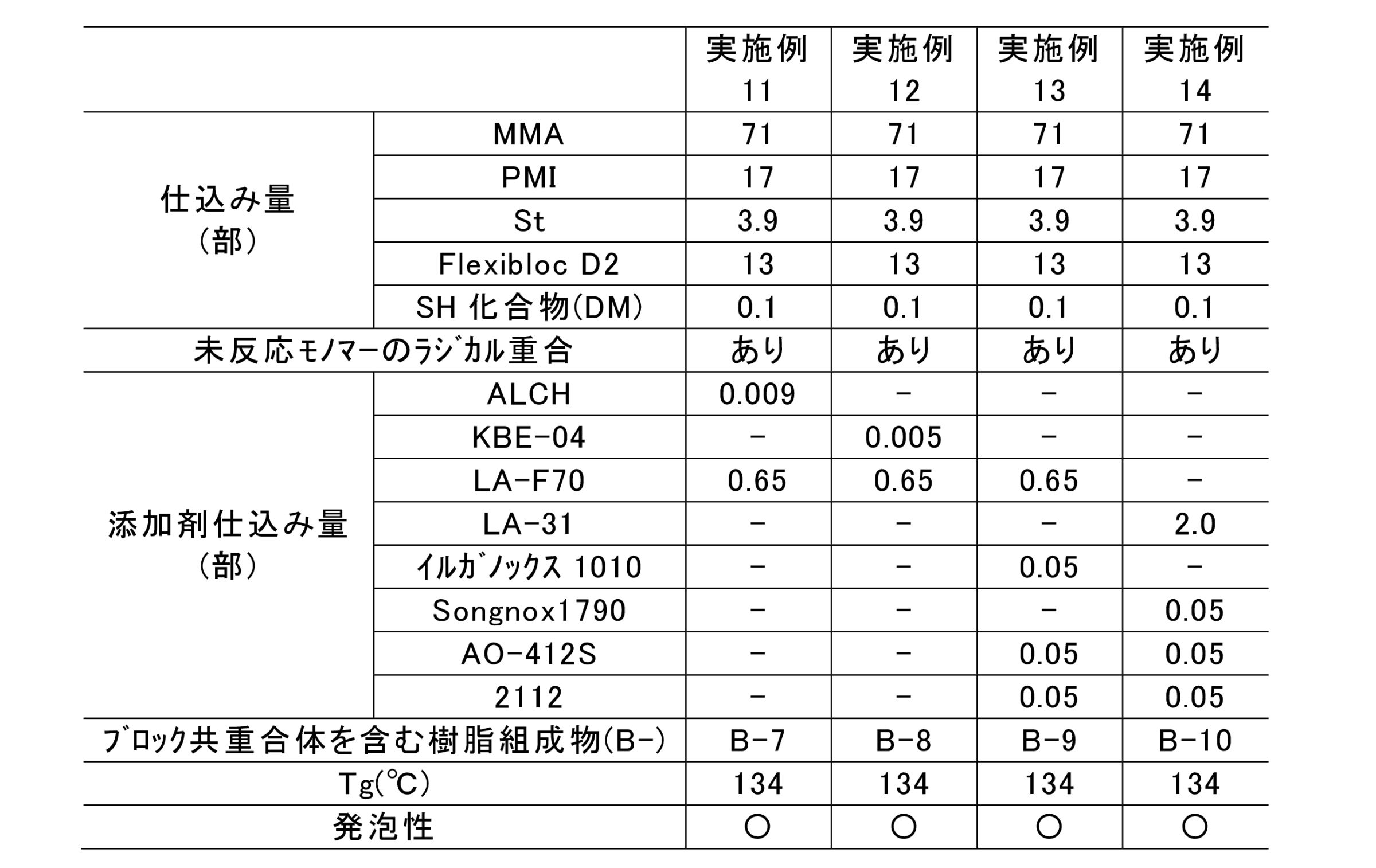
比較例7で得たブロック共重合体(A-6)30部と、比較例2で得た重合体(C-1)70部をラボプラストミルを用い270℃で5分間混合し、樹脂組成物(B-11)を得た。樹脂組成物(B-11)のTgは133℃であった。
樹脂組成物(B-7)、(B-8)、(B-9)、(B-10)および(B-11)をそれぞれ250℃でプレス成型し、120μmのフィルムを得た。
次いでTg+23℃で2×2倍の延伸を実施し二軸延伸フィルムを得、このようにして得た延伸フィルムのTg、厚み、ヘイズ、耐折回数を測定した。
また、樹脂組成物(B-7)、(B-8)、(B-9)、(B-10)および(B-11)をそれぞれ手動式加熱プレス機(井元製作所製、IMC-180C型)にて250℃でプレス成型し、160μmのフィルムを得た。そのフィルムの内部ヘイズを日本電色工業社製NDH-1001DPを用いて石英セルに1,2,3,4-テトラヒドロナフタリン(テトラリン)を満たし、その中にフィルムを浸漬して測定し100μmあたりの値に換算した。次に手動式加熱プレス機にて、250℃で20分間加熱した後の内部ヘイズ値(100μm換算値)を求めて、加熱前後の内部ヘイズ変化率(%)を求めた。
結果を下記表に示す。

Claims (9)
- アクリル酸エステル由来の構造単位を含むポリマーブロック(A)と、N-置換マレイミド環構造及びメタクリル酸エステル由来の構造単位を含むポリマーブロック(B)とを有するブロック共重合体の製造方法であって、ポリマーブロック(A)の末端に、有機リン単位を有するニトロキシド構造を有するニトロキシドポリマー(A1)と、メタクリル酸エステル及びN-置換マレイミドを含むモノマー(B1)とを、チオール系化合物(C1)存在下で重合させる重合工程を含む、ブロック共重合体の製造方法。
- アクリル酸エステル由来の構造単位を含むポリマーブロック(A)と、N-置換マレイミド環構造及びメタクリル酸エステル由来の構造単位を含むポリマーブロック(B)とを有し、重量平均分子量が15~45万であるブロック共重合体。
- 請求項2記載のブロック共重合体を含む樹脂組成物。
- 樹脂成分として、請求項2記載のブロック共重合体と、メタクリル酸エステル及びN-置換マレイミドから選択された少なくとも1種のモノマー由来の構造単位を有する樹脂とを含み、樹脂成分全体の重量平均分子量が5~50万である請求項3記載の樹脂組成物。
- 請求項2~4のいずれかに記載のブロック共重合体又は樹脂組成物を含むフィルム。
- 光学フィルムである請求項5記載のフィルム。
- 偏光子保護フィルムである請求項5又は6記載のフィルム。
- 請求項5~7のいずれかに記載のフィルムを備えた偏光板。
- 請求項8記載の偏光板を備えた画像表示装置。
Priority Applications (3)
| Application Number | Priority Date | Filing Date | Title |
|---|---|---|---|
| US16/095,862 US11015011B2 (en) | 2016-04-28 | 2017-04-14 | Method for producing maleimide block copolymer |
| CN201780026033.5A CN109071740B (zh) | 2016-04-28 | 2017-04-14 | 马来酰亚胺系嵌段共聚物的制造方法 |
| EP17789316.1A EP3450473B1 (en) | 2016-04-28 | 2017-04-14 | Method for producing maleimide block copolymer |
Applications Claiming Priority (4)
| Application Number | Priority Date | Filing Date | Title |
|---|---|---|---|
| JP2016-091630 | 2016-04-28 | ||
| JP2016091630 | 2016-04-28 | ||
| JP2017-074859 | 2017-04-04 | ||
| JP2017074859A JP7170382B2 (ja) | 2016-04-28 | 2017-04-04 | マレイミド系ブロック共重合体の製造方法 |
Publications (1)
| Publication Number | Publication Date |
|---|---|
| WO2017188031A1 true WO2017188031A1 (ja) | 2017-11-02 |
Family
ID=60160373
Family Applications (1)
| Application Number | Title | Priority Date | Filing Date |
|---|---|---|---|
| PCT/JP2017/015330 Ceased WO2017188031A1 (ja) | 2016-04-28 | 2017-04-14 | マレイミド系ブロック共重合体の製造方法 |
Country Status (1)
| Country | Link |
|---|---|
| WO (1) | WO2017188031A1 (ja) |
Cited By (2)
| Publication number | Priority date | Publication date | Assignee | Title |
|---|---|---|---|---|
| WO2021117723A1 (ja) * | 2019-12-13 | 2021-06-17 | 東洋インキScホールディングス株式会社 | ブロック共重合体、樹脂組成物、伸縮性導体、電子デバイスおよび粘着フィルム |
| WO2021251295A1 (ja) * | 2020-06-08 | 2021-12-16 | 日産化学株式会社 | 上層膜形成組成物及び相分離パターン製造方法 |
Citations (7)
| Publication number | Priority date | Publication date | Assignee | Title |
|---|---|---|---|---|
| JPS61171708A (ja) * | 1984-12-14 | 1986-08-02 | Mitsubishi Rayon Co Ltd | 耐熱性樹脂、その製造法およびそれからなる光学用素子 |
| JPH02167325A (ja) * | 1988-09-28 | 1990-06-27 | Nippon Oil & Fats Co Ltd | マレイミド系ブロック共重合体およびその製造法 |
| JP2000506918A (ja) * | 1996-03-13 | 2000-06-06 | レーム ゲゼルシヤフト ミツト ベシユレンクテル ハフツング | 加熱寸法安定性の高いポリメタクリレート成形材料を製造するための多段法 |
| JP2001233919A (ja) * | 1999-12-13 | 2001-08-28 | Nippon Shokubai Co Ltd | 透明性耐熱樹脂およびその製造方法 |
| JP2003128707A (ja) * | 2001-10-29 | 2003-05-08 | Mitsubishi Gas Chem Co Inc | 光学材料用メタクリル樹脂及びその製造方法 |
| JP2010013613A (ja) * | 2008-06-04 | 2010-01-21 | Toray Ind Inc | アクリル系ブロック共重合体、熱可塑性共重合体組成物およびそれからなる成形品 |
| JP2014012782A (ja) * | 2012-07-05 | 2014-01-23 | Asahi Kasei Chemicals Corp | アクリル系熱可塑性樹脂、及びその成形体 |
-
2017
- 2017-04-14 WO PCT/JP2017/015330 patent/WO2017188031A1/ja not_active Ceased
Patent Citations (7)
| Publication number | Priority date | Publication date | Assignee | Title |
|---|---|---|---|---|
| JPS61171708A (ja) * | 1984-12-14 | 1986-08-02 | Mitsubishi Rayon Co Ltd | 耐熱性樹脂、その製造法およびそれからなる光学用素子 |
| JPH02167325A (ja) * | 1988-09-28 | 1990-06-27 | Nippon Oil & Fats Co Ltd | マレイミド系ブロック共重合体およびその製造法 |
| JP2000506918A (ja) * | 1996-03-13 | 2000-06-06 | レーム ゲゼルシヤフト ミツト ベシユレンクテル ハフツング | 加熱寸法安定性の高いポリメタクリレート成形材料を製造するための多段法 |
| JP2001233919A (ja) * | 1999-12-13 | 2001-08-28 | Nippon Shokubai Co Ltd | 透明性耐熱樹脂およびその製造方法 |
| JP2003128707A (ja) * | 2001-10-29 | 2003-05-08 | Mitsubishi Gas Chem Co Inc | 光学材料用メタクリル樹脂及びその製造方法 |
| JP2010013613A (ja) * | 2008-06-04 | 2010-01-21 | Toray Ind Inc | アクリル系ブロック共重合体、熱可塑性共重合体組成物およびそれからなる成形品 |
| JP2014012782A (ja) * | 2012-07-05 | 2014-01-23 | Asahi Kasei Chemicals Corp | アクリル系熱可塑性樹脂、及びその成形体 |
Non-Patent Citations (1)
| Title |
|---|
| See also references of EP3450473A4 * |
Cited By (3)
| Publication number | Priority date | Publication date | Assignee | Title |
|---|---|---|---|---|
| WO2021117723A1 (ja) * | 2019-12-13 | 2021-06-17 | 東洋インキScホールディングス株式会社 | ブロック共重合体、樹脂組成物、伸縮性導体、電子デバイスおよび粘着フィルム |
| WO2021251295A1 (ja) * | 2020-06-08 | 2021-12-16 | 日産化学株式会社 | 上層膜形成組成物及び相分離パターン製造方法 |
| US12578644B2 (en) | 2020-06-08 | 2026-03-17 | Nissan Chemical Corporation | Upper film-forming composition and method for producing phase-separated pattern |
Similar Documents
| Publication | Publication Date | Title |
|---|---|---|
| JP7170382B2 (ja) | マレイミド系ブロック共重合体の製造方法 | |
| CN108627979A (zh) | 头戴式显示器用构件 | |
| JP2018178095A (ja) | メタクリル系樹脂成形体、光学部品又は自動車部品 | |
| JP6895285B2 (ja) | メタクリル系樹脂及びその製造方法、成形体、光学部品又は自動車部品 | |
| JP5601781B2 (ja) | 光学フィルム | |
| JP7361043B2 (ja) | アクリル系ポリマー | |
| JPWO2008047836A1 (ja) | 熱可塑性樹脂組成物 | |
| JP6151423B1 (ja) | メタクリル系樹脂組成物、光学フィルム、及び光学部品 | |
| JP5430187B2 (ja) | 2軸延伸フィルム | |
| JP6457862B2 (ja) | アクリル樹脂組成物、該樹脂組成物で形成されたフィルム、該フィルムを備えた偏光板及び該偏光板を備えた画像表示装置 | |
| JP6982955B2 (ja) | ブロック共重合体の製造方法 | |
| JP2010241883A (ja) | 位相差調節剤とそれを用いた光学用樹脂組成物ならびに光学フィルム | |
| JP2012078778A (ja) | 樹脂組成物、光学フィルムおよび画像表示装置 | |
| JP6933895B2 (ja) | 樹脂組成物 | |
| JP6151422B1 (ja) | メタクリル系樹脂組成物、及び光学部品 | |
| JP5308891B2 (ja) | アクリル系重合体とその製造方法ならびにアクリル樹脂組成物、位相差フィルムおよび画像表示装置 | |
| KR20230031379A (ko) | 메타크릴계 수지, 메타크릴계 수지의 제조 방법, 메타크릴계 수지 조성물, 성형체, 광학 부품 및 자동차 부품 | |
| JP7572236B2 (ja) | 樹脂組成物 | |
| JP7028545B2 (ja) | ブロック共重合体及び樹脂組成物 | |
| JP2010243581A (ja) | リン酸エステルを含むアクリル樹脂よりなる光学フィルム | |
| US10800875B2 (en) | Methacrylic resin and production method, molded article, and optical or automotive component of same | |
| JP7141870B2 (ja) | 樹脂組成物およびフィルム | |
| WO2017110911A1 (ja) | ブロック共重合体の製造方法 | |
| JP2013155218A (ja) | 樹脂組成物 | |
| JP6867177B2 (ja) | 光学用ブロック共重合体 |
Legal Events
| Date | Code | Title | Description |
|---|---|---|---|
| WWE | Wipo information: entry into national phase |
Ref document number: 201780026033.5 Country of ref document: CN |
|
| NENP | Non-entry into the national phase |
Ref country code: DE |
|
| 121 | Ep: the epo has been informed by wipo that ep was designated in this application |
Ref document number: 17789316 Country of ref document: EP Kind code of ref document: A1 |
|
| WWE | Wipo information: entry into national phase |
Ref document number: 2017789316 Country of ref document: EP |
|
| ENP | Entry into the national phase |
Ref document number: 2017789316 Country of ref document: EP Effective date: 20181128 |