WO2017188451A1 - レジスト下層膜形成用組成物、リソグラフィー用下層膜、及び、パターン形成方法 - Google Patents
レジスト下層膜形成用組成物、リソグラフィー用下層膜、及び、パターン形成方法 Download PDFInfo
- Publication number
- WO2017188451A1 WO2017188451A1 PCT/JP2017/017091 JP2017017091W WO2017188451A1 WO 2017188451 A1 WO2017188451 A1 WO 2017188451A1 JP 2017017091 W JP2017017091 W JP 2017017091W WO 2017188451 A1 WO2017188451 A1 WO 2017188451A1
- Authority
- WO
- WIPO (PCT)
- Prior art keywords
- group
- formula
- compound
- underlayer film
- tellurium
- Prior art date
- Legal status (The legal status is an assumption and is not a legal conclusion. Google has not performed a legal analysis and makes no representation as to the accuracy of the status listed.)
- Ceased
Links
- AABJELHKMSKVNF-UHFFFAOYSA-N CC(C)(C)OC(C1CCC1)OC1C=CC(C)=CC1 Chemical compound CC(C)(C)OC(C1CCC1)OC1C=CC(C)=CC1 AABJELHKMSKVNF-UHFFFAOYSA-N 0.000 description 1
- 0 CCOC1CC=C(*C(CC2)=CC=C2OC(C)O)CC1 Chemical compound CCOC1CC=C(*C(CC2)=CC=C2OC(C)O)CC1 0.000 description 1
- WUQQYQSGZOGZPD-YDYFNQANSA-N CC[C@@H](C)C(C1)[O]1C(CC1)C=CC1C(CC1)=CCC1OC(C)OCC Chemical compound CC[C@@H](C)C(C1)[O]1C(CC1)C=CC1C(CC1)=CCC1OC(C)OCC WUQQYQSGZOGZPD-YDYFNQANSA-N 0.000 description 1
Classifications
-
- G—PHYSICS
- G03—PHOTOGRAPHY; CINEMATOGRAPHY; ANALOGOUS TECHNIQUES USING WAVES OTHER THAN OPTICAL WAVES; ELECTROGRAPHY; HOLOGRAPHY
- G03F—PHOTOMECHANICAL PRODUCTION OF TEXTURED OR PATTERNED SURFACES, e.g. FOR PRINTING, FOR PROCESSING OF SEMICONDUCTOR DEVICES; MATERIALS THEREFOR; ORIGINALS THEREFOR; APPARATUS SPECIALLY ADAPTED THEREFOR
- G03F7/00—Photomechanical, e.g. photolithographic, production of textured or patterned surfaces, e.g. printing surfaces; Materials therefor, e.g. comprising photoresists; Apparatus specially adapted therefor
- G03F7/004—Photosensitive materials
- G03F7/09—Photosensitive materials characterised by structural details, e.g. supports, auxiliary layers
- G03F7/11—Photosensitive materials characterised by structural details, e.g. supports, auxiliary layers having cover layers or intermediate layers, e.g. subbing layers
-
- C—CHEMISTRY; METALLURGY
- C08—ORGANIC MACROMOLECULAR COMPOUNDS; THEIR PREPARATION OR CHEMICAL WORKING-UP; COMPOSITIONS BASED THEREON
- C08G—MACROMOLECULAR COMPOUNDS OBTAINED OTHERWISE THAN BY REACTIONS ONLY INVOLVING UNSATURATED CARBON-TO-CARBON BONDS
- C08G16/00—Condensation polymers of aldehydes or ketones with monomers not provided for in the groups C08G4/00 - C08G14/00
- C08G16/02—Condensation polymers of aldehydes or ketones with monomers not provided for in the groups C08G4/00 - C08G14/00 of aldehydes
- C08G16/0287—Condensation polymers of aldehydes or ketones with monomers not provided for in the groups C08G4/00 - C08G14/00 of aldehydes with organometallic or metal-containing organic compounds
-
- C—CHEMISTRY; METALLURGY
- C07—ORGANIC CHEMISTRY
- C07F—ACYCLIC, CARBOCYCLIC OR HETEROCYCLIC COMPOUNDS CONTAINING ELEMENTS OTHER THAN CARBON, HYDROGEN, HALOGEN, OXYGEN, NITROGEN, SULFUR, SELENIUM OR TELLURIUM
- C07F11/00—Compounds containing elements of Groups 6 or 16 of the Periodic Table
-
- C—CHEMISTRY; METALLURGY
- C08—ORGANIC MACROMOLECULAR COMPOUNDS; THEIR PREPARATION OR CHEMICAL WORKING-UP; COMPOSITIONS BASED THEREON
- C08G—MACROMOLECULAR COMPOUNDS OBTAINED OTHERWISE THAN BY REACTIONS ONLY INVOLVING UNSATURATED CARBON-TO-CARBON BONDS
- C08G16/00—Condensation polymers of aldehydes or ketones with monomers not provided for in the groups C08G4/00 - C08G14/00
- C08G16/02—Condensation polymers of aldehydes or ketones with monomers not provided for in the groups C08G4/00 - C08G14/00 of aldehydes
- C08G16/0212—Condensation polymers of aldehydes or ketones with monomers not provided for in the groups C08G4/00 - C08G14/00 of aldehydes with acyclic or carbocyclic organic compounds
- C08G16/0218—Condensation polymers of aldehydes or ketones with monomers not provided for in the groups C08G4/00 - C08G14/00 of aldehydes with acyclic or carbocyclic organic compounds containing atoms other than carbon and hydrogen
- C08G16/0225—Condensation polymers of aldehydes or ketones with monomers not provided for in the groups C08G4/00 - C08G14/00 of aldehydes with acyclic or carbocyclic organic compounds containing atoms other than carbon and hydrogen containing oxygen
-
- C—CHEMISTRY; METALLURGY
- C08—ORGANIC MACROMOLECULAR COMPOUNDS; THEIR PREPARATION OR CHEMICAL WORKING-UP; COMPOSITIONS BASED THEREON
- C08G—MACROMOLECULAR COMPOUNDS OBTAINED OTHERWISE THAN BY REACTIONS ONLY INVOLVING UNSATURATED CARBON-TO-CARBON BONDS
- C08G65/00—Macromolecular compounds obtained by reactions forming an ether link in the main chain of the macromolecule
- C08G65/34—Macromolecular compounds obtained by reactions forming an ether link in the main chain of the macromolecule from hydroxy compounds or their metallic derivatives
- C08G65/38—Macromolecular compounds obtained by reactions forming an ether link in the main chain of the macromolecule from hydroxy compounds or their metallic derivatives derived from phenols
-
- C—CHEMISTRY; METALLURGY
- C08—ORGANIC MACROMOLECULAR COMPOUNDS; THEIR PREPARATION OR CHEMICAL WORKING-UP; COMPOSITIONS BASED THEREON
- C08G—MACROMOLECULAR COMPOUNDS OBTAINED OTHERWISE THAN BY REACTIONS ONLY INVOLVING UNSATURATED CARBON-TO-CARBON BONDS
- C08G8/00—Condensation polymers of aldehydes or ketones with phenols only
- C08G8/04—Condensation polymers of aldehydes or ketones with phenols only of aldehydes
-
- G—PHYSICS
- G03—PHOTOGRAPHY; CINEMATOGRAPHY; ANALOGOUS TECHNIQUES USING WAVES OTHER THAN OPTICAL WAVES; ELECTROGRAPHY; HOLOGRAPHY
- G03F—PHOTOMECHANICAL PRODUCTION OF TEXTURED OR PATTERNED SURFACES, e.g. FOR PRINTING, FOR PROCESSING OF SEMICONDUCTOR DEVICES; MATERIALS THEREFOR; ORIGINALS THEREFOR; APPARATUS SPECIALLY ADAPTED THEREFOR
- G03F7/00—Photomechanical, e.g. photolithographic, production of textured or patterned surfaces, e.g. printing surfaces; Materials therefor, e.g. comprising photoresists; Apparatus specially adapted therefor
- G03F7/004—Photosensitive materials
- G03F7/0045—Photosensitive materials with organic non-macromolecular light-sensitive compounds not otherwise provided for, e.g. dissolution inhibitors
-
- G—PHYSICS
- G03—PHOTOGRAPHY; CINEMATOGRAPHY; ANALOGOUS TECHNIQUES USING WAVES OTHER THAN OPTICAL WAVES; ELECTROGRAPHY; HOLOGRAPHY
- G03F—PHOTOMECHANICAL PRODUCTION OF TEXTURED OR PATTERNED SURFACES, e.g. FOR PRINTING, FOR PROCESSING OF SEMICONDUCTOR DEVICES; MATERIALS THEREFOR; ORIGINALS THEREFOR; APPARATUS SPECIALLY ADAPTED THEREFOR
- G03F7/00—Photomechanical, e.g. photolithographic, production of textured or patterned surfaces, e.g. printing surfaces; Materials therefor, e.g. comprising photoresists; Apparatus specially adapted therefor
- G03F7/004—Photosensitive materials
- G03F7/09—Photosensitive materials characterised by structural details, e.g. supports, auxiliary layers
- G03F7/091—Photosensitive materials characterised by structural details, e.g. supports, auxiliary layers characterised by antireflection means or light filtering or absorbing means, e.g. anti-halation, contrast enhancement
-
- G—PHYSICS
- G03—PHOTOGRAPHY; CINEMATOGRAPHY; ANALOGOUS TECHNIQUES USING WAVES OTHER THAN OPTICAL WAVES; ELECTROGRAPHY; HOLOGRAPHY
- G03F—PHOTOMECHANICAL PRODUCTION OF TEXTURED OR PATTERNED SURFACES, e.g. FOR PRINTING, FOR PROCESSING OF SEMICONDUCTOR DEVICES; MATERIALS THEREFOR; ORIGINALS THEREFOR; APPARATUS SPECIALLY ADAPTED THEREFOR
- G03F7/00—Photomechanical, e.g. photolithographic, production of textured or patterned surfaces, e.g. printing surfaces; Materials therefor, e.g. comprising photoresists; Apparatus specially adapted therefor
- G03F7/004—Photosensitive materials
- G03F7/09—Photosensitive materials characterised by structural details, e.g. supports, auxiliary layers
- G03F7/094—Multilayer resist systems, e.g. planarising layers
-
- G—PHYSICS
- G03—PHOTOGRAPHY; CINEMATOGRAPHY; ANALOGOUS TECHNIQUES USING WAVES OTHER THAN OPTICAL WAVES; ELECTROGRAPHY; HOLOGRAPHY
- G03F—PHOTOMECHANICAL PRODUCTION OF TEXTURED OR PATTERNED SURFACES, e.g. FOR PRINTING, FOR PROCESSING OF SEMICONDUCTOR DEVICES; MATERIALS THEREFOR; ORIGINALS THEREFOR; APPARATUS SPECIALLY ADAPTED THEREFOR
- G03F7/00—Photomechanical, e.g. photolithographic, production of textured or patterned surfaces, e.g. printing surfaces; Materials therefor, e.g. comprising photoresists; Apparatus specially adapted therefor
- G03F7/20—Exposure; Apparatus therefor
-
- G—PHYSICS
- G03—PHOTOGRAPHY; CINEMATOGRAPHY; ANALOGOUS TECHNIQUES USING WAVES OTHER THAN OPTICAL WAVES; ELECTROGRAPHY; HOLOGRAPHY
- G03F—PHOTOMECHANICAL PRODUCTION OF TEXTURED OR PATTERNED SURFACES, e.g. FOR PRINTING, FOR PROCESSING OF SEMICONDUCTOR DEVICES; MATERIALS THEREFOR; ORIGINALS THEREFOR; APPARATUS SPECIALLY ADAPTED THEREFOR
- G03F7/00—Photomechanical, e.g. photolithographic, production of textured or patterned surfaces, e.g. printing surfaces; Materials therefor, e.g. comprising photoresists; Apparatus specially adapted therefor
- G03F7/26—Processing photosensitive materials; Apparatus therefor
-
- H—ELECTRICITY
- H10—SEMICONDUCTOR DEVICES; ELECTRIC SOLID-STATE DEVICES NOT OTHERWISE PROVIDED FOR
- H10P—GENERIC PROCESSES OR APPARATUS FOR THE MANUFACTURE OR TREATMENT OF DEVICES COVERED BY CLASS H10
- H10P14/00—Formation of materials, e.g. in the shape of layers or pillars
- H10P14/60—Formation of materials, e.g. in the shape of layers or pillars of insulating materials
- H10P14/68—Organic materials, e.g. photoresists
- H10P14/683—Organic materials, e.g. photoresists carbon-based polymeric organic materials, e.g. polyimides, poly cyclobutene or PVC
-
- H—ELECTRICITY
- H10—SEMICONDUCTOR DEVICES; ELECTRIC SOLID-STATE DEVICES NOT OTHERWISE PROVIDED FOR
- H10P—GENERIC PROCESSES OR APPARATUS FOR THE MANUFACTURE OR TREATMENT OF DEVICES COVERED BY CLASS H10
- H10P76/00—Manufacture or treatment of masks on semiconductor bodies, e.g. by lithography or photolithography
-
- H—ELECTRICITY
- H10—SEMICONDUCTOR DEVICES; ELECTRIC SOLID-STATE DEVICES NOT OTHERWISE PROVIDED FOR
- H10P—GENERIC PROCESSES OR APPARATUS FOR THE MANUFACTURE OR TREATMENT OF DEVICES COVERED BY CLASS H10
- H10P76/00—Manufacture or treatment of masks on semiconductor bodies, e.g. by lithography or photolithography
- H10P76/20—Manufacture or treatment of masks on semiconductor bodies, e.g. by lithography or photolithography of masks comprising organic materials
- H10P76/204—Manufacture or treatment of masks on semiconductor bodies, e.g. by lithography or photolithography of masks comprising organic materials of organic photoresist masks
-
- C—CHEMISTRY; METALLURGY
- C08—ORGANIC MACROMOLECULAR COMPOUNDS; THEIR PREPARATION OR CHEMICAL WORKING-UP; COMPOSITIONS BASED THEREON
- C08G—MACROMOLECULAR COMPOUNDS OBTAINED OTHERWISE THAN BY REACTIONS ONLY INVOLVING UNSATURATED CARBON-TO-CARBON BONDS
- C08G2650/00—Macromolecular compounds obtained by reactions forming an ether link in the main chain of the macromolecule
- C08G2650/62—Macromolecular compounds obtained by reactions forming an ether link in the main chain of the macromolecule characterised by the nature of monomer used
- C08G2650/64—Monomer containing functional groups not involved in polymerisation
Definitions
- the present invention relates to a resist underlayer film forming composition using a compound or resin having a specific structure, a lithography resist underlayer film obtained from the composition, and a pattern forming method using the composition.
- the light source for lithography used for resist pattern formation is shortened from KrF excimer laser (248 nm) to ArF excimer laser (193 nm).
- KrF excimer laser 248 nm
- ArF excimer laser (193 nm)
- problems such as resolution problems and collapse of the resist pattern after development occur.
- it has been desired to reduce the thickness of the resist.
- the thickness of the resist is simply reduced, it becomes difficult to obtain a resist pattern film thickness sufficient for substrate processing. For this reason, not only a resist pattern, but also a process in which a resist underlayer film is produced between the resist and a semiconductor substrate to be processed, and this resist underlayer film also has a function as a mask during substrate processing is required. I came.
- a terminal layer is removed by applying a predetermined energy as a resist underlayer film for lithography having a dry etching rate selection ratio close to that of a resist.
- a material for forming a lower layer film for a multilayer resist process has been proposed which contains at least a resin component having a substituent that generates a sulfonic acid residue and a solvent (see, for example, Patent Document 1).
- resist underlayer film materials containing a polymer having a specific repeating unit have been proposed as a material for realizing a resist underlayer film for lithography having a lower dry etching rate selectivity than resist (for example, Patent Documents). 2). Furthermore, in order to realize a resist underlayer film for lithography having a low dry etching rate selection ratio compared with a semiconductor substrate, a repeating unit of acenaphthylenes and a repeating unit having a substituted or unsubstituted hydroxy group are copolymerized. A resist underlayer film material containing a polymer is proposed (see, for example, Patent Document 3).
- an amorphous carbon underlayer film formed by CVD (chemical vapor deposition) using methane gas, ethane gas, acetylene gas or the like as a raw material is well known.
- CVD chemical vapor deposition
- methane gas, ethane gas, acetylene gas or the like is well known.
- a resist underlayer film material capable of forming a resist underlayer film by a wet process such as spin coating or screen printing is required from the viewpoint of the process.
- a resist underlayer film forming composition for lithography containing a naphthalene formaldehyde polymer containing a specific structural unit and an organic solvent as a material that is excellent in optical properties and etching resistance and is soluble in a solvent and applicable to a wet process. It has been proposed (see, for example, Patent Documents 4 and 5).
- the formation method of the intermediate layer used in forming the resist underlayer film in the three-layer process for example, a silicon nitride film formation method (see Patent Document 6) or a silicon nitride film CVD formation method (see Patent Document 7).
- a silicon nitride film formation method see Patent Document 6
- a silicon nitride film CVD formation method see Patent Document 7
- an intermediate layer material for a three-layer process a material containing a silsesquioxane-based silicon compound is known (see Patent Documents 8 and 9).
- the resist underlayer film forming composition When used in wet processes such as spin coating and screen printing, the resist underlayer film forming composition is required to have high solvent solubility applicable to these processes. On the other hand, it is desired that the resist underlayer film forming composition is excellent not only in solvent solubility but also in heat resistance and etching resistance.
- a resist underlayer film forming composition that has been conventionally used for many lithography has been proposed, but only has high solvent solubility to which a wet process such as spin coating or screen printing can be applied.
- the resist layer (resist underlayer film) disposed on the substrate side has a high demand.
- the present invention can be applied to a wet process, and is useful for forming a photoresist underlayer film that is excellent in heat resistance, etching resistance, embedding in a stepped substrate, and film flatness.
- the object is to provide a resist underlayer film forming composition, a resist underlayer film for lithography obtained from the composition, and a pattern forming method using the composition.
- the present inventors have found that the above problems can be solved by using a compound or resin having a specific structure in the composition for the lower layer film, and completed the present invention. I arrived. That is, the present invention is as follows.
- X is a 2m-valent group having 0 to 60 carbon atoms including tellurium
- Z is an oxygen atom, sulfur atom or non-bridged
- R 0 is independently
- m is an integer of 1 to 4
- p Are each independently an integer of 0 to 2
- n are each independently an integer of 0 to (5 + 2 ⁇ p).
- X is a 2m valent group having 0 to 60 carbon atoms including tellurium
- Z is an oxygen atom, a sulfur atom, a single bond or non-bridged
- R 0A is Independently, a hydrocarbon group, a halogen atom, a cyano group, a nitro group, an amino group, an alkyl group having 1 to 30 carbon atoms, an alkenyl group having 2 to 30 carbon atoms, an aryl group having 6 to 40 carbon atoms, Selected from the group consisting of a hydroxyl group or a group in which a hydrogen atom of a hydroxyl group is substituted with an acid crosslinkable reactive group or an acid dissociable reactive group, and combinations thereof, wherein the alkyl group, the alkenyl group, and the aryl group are
- X 0 is a 2 m-valent group having 0 to 30 carbon atoms including tellurium
- Z is an oxygen atom, a sulfur atom or non-bridged
- R 0B is independently selected.
- X, Z, m and p have the same meanings as those in the formula (A-1), and R 1 each independently represents an alkyl group, an aryl group, an alkenyl group or a halogen atom.
- R 2 each independently represents a hydrogen atom or an acid dissociable reactive group, n 1 each independently represents an integer of 0 to (5 + 2 ⁇ p), and n 2 each independently represents 0 to (It is an integer of 5 + 2 ⁇ p, where at least one n 2 is an integer of 1 to (5 + 2 ⁇ p).)
- composition for forming a resist underlayer film according to ⁇ 4> wherein the tellurium-containing compound is represented by the following formula (1B).
- X 0 , Z, m and p have the same meanings as those in the formula (A-3), and R 1A each independently represents an alkyl group, an aryl group, an alkenyl group or a halogen atom.
- R 2 are each independently a hydrogen atom, an acid crosslinkable reactive group or an acid dissociable reactive group
- n 1 is each independently an integer of 0 to (5 + 2 ⁇ p)
- n 2 is Each independently represents an integer of 0 to (5 + 2 ⁇ p), provided that at least one n 2 is an integer of 1 to (5 + 2 ⁇ p).
- composition for forming a resist underlayer film according to ⁇ 6> wherein the tellurium-containing compound is represented by the following formula (2A).
- Z, R 1A , R 2 , p, n 1 , and n 2 have the same meaning as in the formula (1B), and X 1 each independently represents a monovalent group containing an oxygen atom, A monovalent group containing a sulfur atom, a monovalent group containing a nitrogen atom, a hydrocarbon group, a hydrogen atom, or a halogen atom.
- R 1B and R 1B ′ are each independently an alkyl group, an aryl group, an alkenyl group, a halogen atom, a hydroxyl group, or a hydrogen atom of a hydroxyl group, an acid crosslinkable reactive group or an acid dissociable reactive group.
- X 1 is the formula and X 1 in (2A)
- n 1 and n 1 ' is the formula and n 1 of (2A)
- p and p' p of the formula (2A) has the same meaning as, R 1B and R 1B ', n 1 and n 1', p and p ', the substitution positions and R 1B of R 1B' substitution position of at least one of the different.
- composition for forming a resist underlayer film according to ⁇ 6> wherein the tellurium-containing compound is represented by the following formula (2B).
- Z, R 1A , R 2 , p, n 1 and n 2 have the same meanings as the formula (1B).
- composition for forming a resist underlayer film according to ⁇ 10> wherein the tellurium-containing compound is represented by the following formula (2B ′).
- R 1B and R 1B ′ each independently represent an alkyl group, an aryl group, an alkenyl group, a halogen atom, a hydroxyl group, or a hydrogen atom of a hydroxyl group, an acid crosslinkable reactive group or an acid dissociable reaction.
- n 1 and n 1 ' is the formula and n 1 of (2B)
- p and p' have the same meaning as p in the formula (2B)
- the tellurium-containing compound has at least one acid-dissociable reactive group as R 2 in the above formula, ⁇ 5> to ⁇ 7>, ⁇ 9> to ⁇ 11>, ⁇ 13> to ⁇ 14>
- the compound containing tellurium is any one of the above items ⁇ 5> to ⁇ 7>, ⁇ 9> to ⁇ 11>, ⁇ 13> to ⁇ 14>, wherein all R 2 in the formula is a hydrogen atom.
- A-1 X is a 2m-valent group having 0 to 60 carbon atoms including tellurium
- Z is an oxygen atom, sulfur atom or non-bridged
- R 0 is independently
- m is 1
- each p is independently an integer of 0 to 2
- n is each independently an integer of 0 to (5 + 2 ⁇ p).
- A-2 X is a 2m valent group having 0 to 60 carbon atoms including tellurium
- Z is an oxygen atom, a sulfur atom, a single bond or non-bridged
- R 0A is Independently, a hydrocarbon group, a halogen atom, a cyano group, a nitro group, an amino group, an alkyl group having 1 to 30 carbon atoms, an alkenyl group having 2 to 30 carbon atoms, an aryl group having 6 to 40 carbon atoms, Selected from the group consisting of a hydroxyl group or a group in which a hydrogen atom of a hydroxyl group is substituted with an acid crosslinkable reactive group or an acid dissociable reactive group, and combinations thereof, wherein the alkyl group, the
- the tellurium-containing resin is a resin including a structural unit derived from a compound represented by the following formula (A-3).
- X 0 is a 2 m-valent group having 0 to 30 carbon atoms including tellurium
- Z is an oxygen atom, a sulfur atom or non-bridged
- R 0B is independently selected.
- each X 2 independently represents a monovalent group containing an oxygen atom, a monovalent group containing a sulfur atom, a monovalent group containing a nitrogen atom, a hydrocarbon group, or a hydrogen atom.
- R 3 is independently a monovalent group containing an oxygen atom, a monovalent group containing a sulfur atom, a monovalent group containing a nitrogen atom, a hydrocarbon group, or a halogen atom.
- R 5 represents a substituted or unsubstituted linear alkylene group having 1 to 20 carbon atoms, a branched alkylene group having 3 to 20 carbon atoms, or a cyclic alkylene group having 3 to 20 carbon atoms, or A substituted or unsubstituted arylene group having 6 to 20 carbon atoms, and each R 5 ′ is independently any one of the above formulas (5 ′), wherein * is the same as R 5 Indicates that you are connected.
- R 7 represents a substituted or unsubstituted linear alkylene group having 1 to 20 carbon atoms, a branched alkylene group having 3 to 20 carbon atoms, or a cyclic alkylene group having 3 to 20 carbon atoms, or A substituted or unsubstituted arylene group having 6 to 20 carbon atoms, and each R 7 ′ is independently any one of the above formulas (6 ′), wherein * is the same as R 7 Indicates that you are connected.
- composition for forming a resist underlayer film according to ⁇ 1> wherein the resin containing tellurium is a resin including a structural unit represented by the following formula (C1).
- X 4 each independently represents a monovalent group containing an oxygen atom, a monovalent group containing a sulfur atom, a monovalent group containing a nitrogen atom, a hydrocarbon group, a hydrogen atom, or
- Each of R 6 is independently a monovalent group containing an oxygen atom, a monovalent group containing a sulfur atom, a monovalent group containing a nitrogen atom, a hydrocarbon group, or a halogen atom; r is an integer from 0 to 2, and n 6 is from 2 to (4 + 2 ⁇ r).
- each R 3 independently represents a monovalent group containing an oxygen atom, a monovalent group containing a sulfur atom, a monovalent group containing a nitrogen atom, a hydrocarbon group, or a halogen atom.
- R 4 is a single bond or any structure represented by the following general formula (5) .
- R 5 represents a substituted or unsubstituted linear alkylene group having 1 to 20 carbon atoms, a branched alkylene group having 3 to 20 carbon atoms, or a cyclic alkylene group having 3 to 20 carbon atoms, or A substituted or unsubstituted arylene group having 6 to 20 carbon atoms
- each R 5 ′ is independently any one of the above formulas (5 ′), wherein * is the same as R 5 (In the formula (5 ′), * indicates that it is connected to R 5. )
- composition for forming a resist underlayer film according to ⁇ 24> wherein the resin containing tellurium is a resin including a structural unit represented by the following formula (B4-M ′).
- the resin containing tellurium is a resin including a structural unit represented by the following formula (B4-M ′).
- R 3 , q, and n 3 have the same meanings as the formula (B3-M)
- R 6 has any structure represented by the following general formula (6).
- R 7 represents a substituted or unsubstituted linear alkylene group having 1 to 20 carbon atoms, a branched alkylene group having 3 to 20 carbon atoms, or a cyclic alkylene group having 3 to 20 carbon atoms, or A substituted or unsubstituted arylene group having 6 to 20 carbon atoms, and each R 7 ′ is independently any one of the above formulas (6 ′), wherein * is the same as R 7 Indicates that you are connected.)
- each R 6 independently represents a monovalent group containing an oxygen atom, a monovalent group containing a sulfur atom, a monovalent group containing a nitrogen atom, a hydrocarbon group, or a halogen atom.
- r is an integer from 0 to 2
- n 6 is from 2 to (4 + 2 ⁇ r).
- ⁇ 28> A method for producing a composition for forming a resist underlayer film according to any one of ⁇ 1> to ⁇ 27>, wherein tellurium halide and a substituted or unsubstituted phenol derivative are used as a base catalyst.
- the manufacturing method of the composition for resist underlayer film formation including the process of making it react in presence and synthesize
- composition for forming a resist underlayer film according to any one of ⁇ 1> to ⁇ 28> further including a solvent.
- composition for forming a resist underlayer film according to any one of ⁇ 1> to ⁇ 29> further comprising an acid generator.
- composition for forming a resist underlayer film according to any one of ⁇ 1> to ⁇ 30> further including an acid crosslinking agent.
- a resist underlayer film is formed on the substrate using the resist underlayer film forming composition according to any one of ⁇ 1> to ⁇ 31>, and at least 1 is formed on the resist underlayer film.
- a pattern forming method in which, after forming a photoresist layer, a predetermined region of the photoresist layer is irradiated with radiation and developed.
- a resist underlayer film is formed on the substrate using the resist underlayer film forming composition according to any one of ⁇ 1> to ⁇ 31>, and a resist intermediate film is formed on the resist underlayer film.
- a resist intermediate layer film is formed using a layer film material, and at least one photoresist layer is formed on the resist intermediate layer film, and then a predetermined region of the photoresist layer is irradiated with radiation and developed. Then, the resist intermediate layer film is etched using the resist pattern as a mask, and the resist lower layer film is etched using the obtained intermediate layer film pattern as an etching mask.
- a composition for forming a resist underlayer film is applicable for forming a photoresist underlayer film that can be applied with a wet process and is excellent in heat resistance, etching resistance, step-filling characteristics, and film flatness. And a resist underlayer film for lithography obtained from the composition and a pattern forming method using the composition.
- the resist underlayer film forming composition of the present invention is a resist underlayer film forming composition containing a tellurium-containing compound or a tellurium-containing resin.
- the composition for forming a resist underlayer film of the present invention can be applied to a wet process, and is a resist underlayer film forming composition useful for forming a photoresist underlayer film having excellent heat resistance, step filling characteristics and flatness. Can be realized.
- this resist underlayer film forming composition uses a compound or resin having a specific structure that has a relatively high carbon concentration, a relatively low oxygen concentration, and a high solvent solubility.
- the composition for forming a resist underlayer film of the present invention is particularly excellent in heat resistance, step filling characteristics and flatness, for example, it can be used as a composition for forming a resist underlayer film provided in the lowest layer among a plurality of resist layers. Can do.
- the resist underlayer film formed using the resist underlayer film forming composition of the present invention may further include another resist underlayer between the substrate and the substrate.
- the resist underlayer film forming composition is obtained, for example, by using a compound represented by the following formula (A-1) and a monomer thereof (that is, a structural unit derived from the compound represented by the formula (A-1)). 1 type or more chosen from resin.
- the resist underlayer film forming composition of the present embodiment can contain a tellurium-containing compound represented by the following formula (A-1).
- X is a 2m-valent group having 0 to 60 carbon atoms including tellurium
- Z is an oxygen atom, sulfur atom or non-bridged
- R 0 is independently
- a monovalent group containing an oxygen atom a monovalent group containing a sulfur atom, a monovalent group containing a nitrogen atom, a hydrocarbon group, a halogen atom, and combinations thereof
- m is 1
- Each is an integer of 0 to 4
- each p is independently an integer of 0 to 2
- n is each independently an integer of 0 to (5 + 2 ⁇ p).
- the compound contained in the resist underlayer film forming composition of the present embodiment contains tellurium as represented by the formula (A-1), a sensitization effect can be expected particularly in lithography using EUV (Extreme Ultraviolet). Moreover, since it has a benzene skeleton or a naphthalene skeleton, it has excellent heat resistance.
- the compound has a relatively low molecular weight and low viscosity, even a stepped substrate (particularly, a fine space or a hole pattern) can be uniformly filled to every corner of the step.
- the composition for forming a resist underlayer film using the composition can be relatively advantageously enhanced in embedding characteristics.
- it is a compound having a relatively high carbon concentration, high etching resistance is also imparted.
- m is an integer of 1 to 4.
- the structural formulas of the m repeating units may be the same or different.
- m is preferably 1 to 3 from the viewpoint of resist properties such as heat resistance, resolution, and roughness.
- structural formula of repeating unit hereinafter referred to as “structural formula of repeating unit”. The same applies to the formula).
- the ring structure A is preferably a benzene structure or a naphthalene structure from the viewpoint of solubility.
- X, Z and R 0 are bonded to any bondable site on the ring structure A.
- X is a 2 m-valent group having 0 to 60 carbon atoms and containing tellurium.
- Examples of X include a single bond containing tellurium or a 2 m-valent hydrocarbon group having 0 to 60 carbon atoms and containing tellurium.
- Examples of the 2m-valent group include those having a linear, branched or cyclic structure.
- the 2m-valent hydrocarbon group may have an alicyclic hydrocarbon group, a double bond, a hetero atom, or an aromatic group having 6 to 60 carbon atoms.
- the alicyclic hydrocarbon group includes a bridged alicyclic hydrocarbon group.
- X preferably has a condensed polycyclic aromatic group (especially a condensed ring structure having 2 to 4 rings) from the viewpoint of heat resistance.
- polyphenyl such as a biphenyl group is preferable. It preferably has a group.
- 2 m-valent group having 0 to 60 carbon atoms and including tellurium represented by X include the following groups.
- Z represents an oxygen atom, a sulfur atom or no bridge.
- each Z may be the same or different.
- structural formulas of different repeating units may be bonded via Z.
- structural formulas of different repeating units may be bonded via Z, and the structural formulas of the plurality of repeating units may constitute a cup-type structure.
- Z is preferably an oxygen atom or a sulfur atom from the viewpoint of heat resistance.
- R 0 is a monovalent group containing an oxygen atom, a monovalent group containing a sulfur atom, a monovalent group containing a nitrogen atom, a halogen atom, or a combination thereof.
- the monovalent group containing an oxygen atom is not limited to the following, but examples thereof include an acyl group having 1 to 20 carbon atoms, an alkoxycarbonyl group having 2 to 20 carbon atoms, and a straight chain having 1 to 6 carbon atoms.
- acyl group having 1 to 20 carbon atoms examples include, but are not limited to, for example, methanoyl group (formyl group), ethanoyl group (acetyl group), propanoyl group, butanoyl group, pentanoyl group, hexanoyl group, octanoyl group, decanoyl group And benzoyl group.
- alkoxycarbonyl group having 2 to 20 carbon atoms examples include, but are not limited to, methoxycarbonyl group, ethoxycarbonyl group, propoxycarbonyl group, butoxycarbonyl group, pentyloxycarbonyl group, hexyloxycarbonyl group, octyloxycarbonyl group And decyloxycarbonyl group.
- linear alkyloxy group having 1 to 6 carbon atoms examples include, but are not limited to, for example, methoxy group, ethoxy group, n-propoxy group, n-butoxy group, n-pentyloxy group, n-hexyloxy group Etc.
- Examples of the branched alkyloxy group having 3 to 20 carbon atoms include, but are not limited to, an isopropoxy group, an isobutoxy group, a tert-butoxy group, and the like.
- Examples of the C3-C20 cyclic alkyloxy group include, but are not limited to, a cyclopropoxy group, a cyclobutoxy group, a cyclopentyloxy group, a cyclohexyloxy group, a cyclooctyloxy group, and a cyclodecyloxy group. .
- linear alkenyloxy group having 2 to 6 carbon atoms examples include, but are not limited to, vinyloxy group, 1-propenyloxy group, 2-propenyloxy group, 1-butenyloxy group, 2-butenyloxy group and the like. It is done.
- Examples of the branched alkenyloxy group having 3 to 6 carbon atoms include, but are not limited to, an isopropenyloxy group, an isobutenyloxy group, an isopentenyloxy group, and an isohexenyloxy group.
- Examples of the cyclic alkenyloxy group having 3 to 10 carbon atoms include, but are not limited to, for example, cyclopropenyloxy group, cyclobutenyloxy group, cyclopentenyloxy group, cyclohexenyloxy group, cyclooctenyloxy group, cyclodecenyloxy group, and the like. Nyloxy group etc. are mentioned.
- aryloxy group having 6 to 10 carbon atoms examples include, but are not limited to, phenyloxy group (phenoxy group), 1-naphthyloxy group, 2-naphthyloxy group, and the like.
- acyloxy group having 1 to 20 carbon atoms examples include, but are not limited to, formyloxy group, acetyloxy group, propionyloxy group, butyryloxy group, isobutyryloxy group, and benzoyloxy group.
- alkoxycarbonyloxy group having 2 to 20 carbon atoms examples include, but are not limited to, for example, methoxycarbonyloxy group, ethoxycarbonyloxy group, propoxycarbonyloxy group, butoxycarbonyloxy group, octyloxycarbonyloxy group, decyloxycarbonyl An oxy group etc. are mentioned.
- alkoxycarbonylalkyl group having 2 to 20 carbon atoms examples include, but are not limited to, for example, methoxycarbonylmethyl group, ethoxycarbonylmethyl group, n-propoxycarbonylmethyl group, isopropoxycarbonylmethyl group, n-butoxycarbonylmethyl group Etc.
- Examples of the 1-substituted alkoxymethyl group having 2 to 20 carbon atoms include, but are not limited to, for example, 1-cyclopentylmethoxymethyl group, 1-cyclopentylethoxymethyl group, 1-cyclohexylmethoxymethyl group, 1-cyclohexylethoxymethyl group 1-cyclooctylmethoxymethyl group, 1-adamantylmethoxymethyl group and the like.
- Examples of the cyclic etheroxy group having 2 to 20 carbon atoms include, but are not limited to, tetrahydropyranyloxy group, tetrahydrofuranyloxy group, tetrahydrothiopyranyloxy group, tetrahydrothiofuranyloxy group, 4-methoxytetrahydro Examples include a pyranyloxy group and a 4-methoxytetrahydrothiopyranyloxy group.
- alkoxyalkyloxy group having 2 to 20 carbon atoms examples include, but are not limited to, methoxymethoxy group, ethoxyethoxy group, cyclohexyloxymethoxy group, cyclohexyloxyethoxy group, phenoxymethoxy group, phenoxyethoxy group, and the like. .
- the (meth) acryl group is not limited to the following, and examples thereof include an acryloyloxy group and a methacryloyloxy group.
- the glycidyl acrylate group is not particularly limited as long as it can be obtained by reacting glycidyloxy group with acrylic acid.
- the glycidyl methacrylate group is not particularly limited as long as it can be obtained by reacting glycidyloxy group with methacrylic acid.
- Examples of the monovalent group containing a sulfur atom include, but are not limited to, a thiol group.
- the monovalent group containing a sulfur atom is preferably a group in which a sulfur atom is directly bonded to the carbon atom constituting the ring structure (A-1) in the formula (A-1).
- Examples of the monovalent group containing a nitrogen atom include, but are not limited to, a nitro group, an amino group, and a diazo group.
- the monovalent group containing a nitrogen atom is preferably a group in which a nitrogen atom is directly bonded to the carbon atom constituting the ring structure (A-1) in the formula (A-1).
- hydrocarbon group examples include, but are not limited to, straight chain alkyl groups having 1 to 6 carbon atoms, branched alkyl groups having 3 to 6 carbon atoms, cyclic alkyl groups having 3 to 10 carbon atoms, and 2 carbon atoms. And a straight chain alkenyl group having 6 to 6 carbon atoms, a branched alkenyl group having 3 to 6 carbon atoms, a cyclic alkenyl group having 3 to 10 carbon atoms, and an aryl group having 6 to 10 carbon atoms.
- linear alkyl group having 1 to 6 carbon atoms examples include, but are not limited to, methyl group, ethyl group, n-propyl group, n-butyl group, n-pentyl group, n-hexyl group and the like. It is done.
- Examples of the branched alkyl group having 3 to 6 carbon atoms include, but are not limited to, isopropyl group, isobutyl group, tert-butyl group, neopentyl group, and 2-hexyl group.
- Examples of the cyclic alkyl group having 3 to 10 carbon atoms include, but are not limited to, a cyclopropyl group, a cyclobutyl group, a cyclopentyl group, a cyclohexyl group, a cyclooctyl group, and a cyclodecyl group.
- straight chain alkenyl group having 2 to 6 carbon atoms examples include, but are not limited to, vinyl group, 1-propenyl group, 2-propenyl group (allyl group), 1-butenyl group, 2-butenyl group, 2 -Pentenyl group, 2-hexenyl group and the like.
- Examples of the branched alkenyl group having 3 to 6 carbon atoms include, but are not limited to, an isopropenyl group, an isobutenyl group, an isopentenyl group, and an isohexenyl group.
- Examples of the cyclic alkenyl group having 3 to 10 carbon atoms include, but are not limited to, a cyclopropenyl group, a cyclobutenyl group, a cyclopentenyl group, a cyclohexenyl group, a cyclohexenyl group, a cyclooctenyl group, and a cyclodecynyl group.
- aryl group having 6 to 10 carbon atoms examples include, but are not limited to, a phenyl group and a naphthyl group.
- halogen atom examples include, but are not limited to, a fluorine atom, a chlorine atom, a bromine atom, and an iodine atom.
- each n is independently an integer of 0 to (5 + 2 ⁇ p).
- at least one of n in the formula (A-1) is an integer of 1 to 4.
- At least one of R 0 in the above formula (A-1) is preferably a monovalent group containing an oxygen atom.
- the tellurium-containing compound represented by the formula (A-1) is preferably a tellurium-containing compound represented by the following formula (A-2) from the viewpoint of curability.
- X is a 2m valent group having 0 to 60 carbon atoms including tellurium
- Z is an oxygen atom, a sulfur atom, a single bond or non-bridged
- R 0A is Independently, a hydrocarbon group, a halogen atom, a cyano group, a nitro group, an amino group, an alkyl group having 1 to 30 carbon atoms, an alkenyl group having 2 to 30 carbon atoms, an aryl group having 6 to 40 carbon atoms, Selected from the group consisting of a hydroxyl group or a group in which a hydrogen atom of a hydroxyl group is substituted with an acid crosslinkable reactive group or an acid dissociable reactive group, and combinations thereof, wherein the alkyl group, the alkenyl group, and the aryl group are , Ether bond, ketone bond or ester bond, m is an integer of 1 to 4, p is independently an integer of 0 to 2, and n is
- the tellurium-containing compound represented by the formula (A-1) is preferably a tellurium-containing compound represented by the following formula (A-3) from the viewpoint of solubility in a safe solvent.
- X 0 is a 2 m-valent group having 0 to 30 carbon atoms including tellurium
- Z is an oxygen atom, a sulfur atom or non-bridged
- R 0B is independently selected.
- p is each independently an integer of 0 to 2
- n is each independently an integer of 0 to (5 + 2 ⁇ p).
- the compound containing tellurium represented by the formula (A-1) is preferably a compound other than BMPT, BHPT, and TDP described later.
- the tellurium-containing compound represented by the formula (A-1) is preferably a tellurium-containing compound represented by the following formula (1A).
- X, Z, m and p are as defined in the formula (A-1), and each R 1 independently represents a hydrocarbon group, a halogen atom, a cyano group, a nitro group, an amino group.
- n 1 is each independently an integer of 0 to (5 + 2 ⁇ p)
- n 2 is each independently an integer of 0 to (5 + 2 ⁇ p) provided that at least one n 2 is 1 to (It is an integer of 5 + 2 ⁇ p).
- n 1 is each independently an integer of 0 to (5 + 2 ⁇ p)
- n 2 is each independently an integer of 0 to (5 + 2 ⁇ p).
- At least one n 2 is an integer of 1 to (5 + 2 ⁇ p). That is, the compound containing tellurium of the general formula (1) has at least one “—OR 2 ” for one ring structure A.
- X, Z, R 1 and —OR 2 are bonded to any bondable site on the ring structure A. For this reason, the upper limit of n 1 + n 2 in one ring structure A coincides with the upper limit of the number of sites capable of binding in ring structure A after taking into account X and Z and the binding sites.
- R 1 each independently represents a hydrocarbon group, a halogen atom, a cyano group, a nitro group, an amino group, an alkyl group having 1 to 30 carbon atoms, an alkenyl group having 2 to 30 carbon atoms, or 6 to 6 carbon atoms. Selected from the group consisting of 40 aryl groups, and combinations thereof, wherein the alkyl group, the alkenyl group and the aryl group may comprise an ether bond, a ketone bond or an ester bond.
- examples of the hydrocarbon group represented by R 1 include a substituted or unsubstituted linear, substituted or unsubstituted branched or substituted or unsubstituted cyclic hydrocarbon group.
- linear, branched or cyclic hydrocarbon group examples include, but are not limited to, for example, a linear alkyl group having 1 to 30 carbon atoms, a branched alkyl group having 3 to 30 carbon atoms, and 3 to 3 carbon atoms. There are 30 cyclic alkyl groups.
- linear alkyl group having 1 to 30 carbon atoms examples include, but are not limited to, a methyl group, an ethyl group, an n-propyl group, an n-butyl group, an n-pentyl group, and an n-hexyl group. It is done.
- Examples of the branched alkyl group having 3 to 30 carbon atoms include, but are not limited to, isopropyl group, isobutyl group, tert-butyl group, neopentyl group, 2-hexyl group and the like.
- Examples of the cyclic alkyl group having 3 to 30 carbon atoms include, but are not limited to, a cyclopropyl group, a cyclobutyl group, a cyclopentyl group, a cyclohexyl group, a cyclooctyl group, and a cyclodecyl group.
- the aryl group represented by R 1 includes, but is not limited to, an aryl group having 6 to 40 carbon atoms, and examples thereof include a phenyl group and a naphthyl group.
- examples of the alkenyl group represented by R 1 include, but are not limited to, a substituted or unsubstituted alkenyl group, such as a linear alkenyl group having 2 to 30 carbon atoms, 30 branched alkenyl groups, and cyclic alkenyl groups having 3 to 30 carbon atoms.
- linear alkenyl group having 2 to 30 carbon atoms examples include, but are not limited to, vinyl group, 1-propenyl group, 2-propenyl group (allyl group), 1-butenyl group, 2-butenyl group, 2 -Pentenyl group, 2-hexenyl group and the like.
- Examples of the branched alkenyl group having 3 to 30 carbon atoms include, but are not limited to, an isopropenyl group, an isobutenyl group, an isopentenyl group, and an isohexenyl group.
- Examples of the cyclic alkenyl group having 3 to 30 carbon atoms include, but are not limited to, a cyclopropenyl group, a cyclobutenyl group, a cyclopentenyl group, a cyclohexenyl group, a cyclohexenyl group, a cyclooctenyl group, and a cyclodecynyl group.
- halogen atom examples include a fluorine atom, a chlorine atom, a bromine atom, and an iodine atom.
- substitution means that, unless otherwise defined, one or more hydrogen atoms in a functional group are a halogen atom, a hydroxyl group, a cyano group, a nitro group, a heterocyclic group, or a carbon number of 1 -20 linear aliphatic hydrocarbon group, branched aliphatic hydrocarbon group having 3-20 carbon atoms, cyclic aliphatic hydrocarbon group having 3-20 carbon atoms, aryl group having 6-20 carbon atoms, carbon number 7-30 aralkyl groups, alkoxy groups having 1-20 carbon atoms, amino groups having 0-20 carbon atoms, alkenyl groups having 2-20 carbon atoms, acyl groups having 1-20 carbon atoms, alkoxy groups having 2-20 carbon atoms It means substituted with a carbonyl group, an alkyloyloxy group having 1 to 20 carbon atoms, an aryloyloxy group having 7 to 30 carbon atoms, or an alkylsily
- the unsubstituted straight-chain aliphatic hydrocarbon group having 1 to 20 carbon atoms is, for example, methyl group, ethyl group, propyl group, butyl group, pentyl group, hexyl group, octyl group, decyl group, dodecyl group, hexadecyl group. Group, octadecyl group and the like.
- Examples of the substituted linear aliphatic hydrocarbon group having 1 to 20 carbon atoms include a fluoromethyl group, a 2-hydroxyethyl group, a 3-cyanopropyl group, and a 20-nitrooctadecyl group.
- the unsubstituted branched aliphatic hydrocarbon group having 3 to 20 carbon atoms is, for example, isopropyl group, isobutyl group, tertiary butyl group, neopentyl group, 2-hexyl group, 2-octyl group, 2-decyl group, 2 -Dodecyl group, 2-hexadecyl group, 2-octadecyl group and the like.
- Examples of the substituted aliphatic hydrocarbon group having 3 to 20 carbon atoms include 1-fluoroisopropyl group and 1-hydroxy-2-octadecyl group.
- Examples of the unsubstituted C3-C20 cyclic aliphatic hydrocarbon group include a cyclopropyl group, a cyclobutyl group, a cyclopentyl group, a cyclohexyl group, a cyclooctyl group, a cyclodecyl group, a cyclododecyl group, a cyclohexadecyl group, a cyclohexyl group, and the like.
- An octadecyl group etc. are mentioned.
- Examples of the substituted cyclic aliphatic hydrocarbon group having 3 to 20 carbon atoms include a 2-fluorocyclopropyl group and a 4-cyanocyclohexyl group.
- Examples of the unsubstituted aryl group having 6 to 20 carbon atoms include a phenyl group and a naphthyl group.
- Examples of the substituted aryl group having 6 to 20 carbon atoms include 4-isopropylphenyl group, 4-cyclohexylphenyl group, 4-methylphenyl group, 6-fluoronaphthyl group and the like.
- Examples of the unsubstituted alkenyl group having 2 to 20 carbon atoms include vinyl group, propynyl group, butynyl group, pentynyl group, hexynyl group, octynyl group, decynyl group, dodecynyl group, hexadecynyl group, and octadecynyl group.
- Examples of the substituted alkenyl group having 2 to 20 carbon atoms include a chloropropynyl group.
- halogen atom examples include a fluorine atom, a chlorine atom, a bromine atom, and an iodine atom.
- each R 2 independently represents a hydrogen atom, an acid crosslinkable reactive group or an acid dissociable reactive group.
- the “acid-crosslinkable group” refers to a characteristic group that reacts in the presence of a radical or an acid / alkali, and changes in solubility in an acid, an alkali, or an organic solvent used in a coating solvent or a developer.
- the acid crosslinkable group include an allyl group, a (meth) acryloyl group, a vinyl group, an epoxy group, an alkoxymethyl group, and a cyanato group, but if they react in the presence of a radical or an acid / alkali, It is not limited.
- the acid crosslinkable group preferably has a property of causing a chain cleavage reaction in the presence of an acid from the viewpoint of improving productivity.
- the “acid-dissociable reactive group” refers to a characteristic group that is cleaved in the presence of an acid to cause a change in an alkali-soluble group or the like.
- an alkali-soluble group For example, a phenolic hydroxyl group, a carboxyl group, a sulfonic acid group, a hexafluoroisopropanol group etc. are mentioned, A phenolic hydroxyl group and a carboxyl group are preferable, and a phenolic hydroxyl group is especially preferable.
- the acid-dissociable reactive group is not particularly limited, and examples thereof include those proposed in hydroxystyrene resins and (meth) acrylic acid resins used for chemically amplified resist compositions for KrF and ArF. Can be appropriately selected and used.
- Preferred examples of the acid dissociable reactive group include a substituted methyl group, a 1-substituted ethyl group, a 1-substituted n-propyl group, a 1-branched alkyl group, a silyl group, and an acyl group, which have a property of being dissociated by an acid.
- the acid dissociable reactive group preferably has no crosslinkable functional group.
- the substituted methyl group is not particularly limited, it can usually be a substituted methyl group having 2 to 20 carbon atoms, preferably a substituted methyl group having 4 to 18 carbon atoms, and preferably a substituted methyl group having 6 to 16 carbon atoms. More preferred.
- substituted methyl group examples include, but are not limited to, a methoxymethyl group, a methylthiomethyl group, an ethoxymethyl group, an n-propoxymethyl group, an isopropoxymethyl group, an n-butoxymethyl group, a t-butoxymethyl group, 2-methylpropoxymethyl group, ethylthiomethyl group, methoxyethoxymethyl group, phenyloxymethyl group, 1-cyclopentyloxymethyl group, 1-cyclohexyloxymethyl group, benzylthiomethyl group, phenacyl group, 4-bromophenacyl group, 4 -Methoxyphenacyl group, piperonyl group, substituent group represented by the following formula (13-1), and the like.
- R 2 in the following formula (13-1) include, but are not limited to, methyl group, ethyl group, isopropyl group, n-propyl group, t-butyl group, n-butyl group and the like. Can be mentioned.
- R 2A is an alkyl group having 1 to 4 carbon atoms.
- the 1-substituted ethyl group is not particularly limited, it can usually be a 1-substituted ethyl group having 3 to 20 carbon atoms, preferably a 1-substituted ethyl group having 5 to 18 carbon atoms, 16 substituted ethyl groups are more preferred.
- 1-substituted ethyl group examples include, but are not limited to, 1-methoxyethyl group, 1-methylthioethyl group, 1,1-dimethoxyethyl group, 1-ethoxyethyl group, 1-ethylthioethyl group, 1,1-diethoxyethyl group, n-propoxyethyl group, isopropoxyethyl group, n-butoxyethyl group, t-butoxyethyl group, 2-methylpropoxyethyl group, 1-phenoxyethyl group, 1-phenylthioethyl Group, 1,1-diphenoxyethyl group, 1-cyclopentyloxyethyl group, 1-cyclohexyloxyethyl group, 1-phenylethyl group, 1,1-diphenylethyl group, and the following formula (13-2) And the like.
- R 2A has the same meaning as the above (13-1).
- the 1-substituted-n-propyl group is not particularly limited, it can usually be a 1-substituted-n-propyl group having 4 to 20 carbon atoms, and a 1-substituted-n-group having 6 to 18 carbon atoms.
- a propyl group is preferred, and a 1-substituted n-propyl group having 8 to 16 carbon atoms is more preferred.
- Specific examples of the 1-substituted-n-propyl group include, but are not limited to, 1-methoxy-n-propyl group and 1-ethoxy-n-propyl group.
- the 1-branched alkyl group is not particularly limited, but can be usually a 1-branched alkyl group having 3 to 20 carbon atoms, preferably a 1-branched alkyl group having 5 to 18 carbon atoms, 16 branched alkyl groups are more preferred.
- Specific examples of the 1-branched alkyl group include, but are not limited to, isopropyl group, sec-butyl group, tert-butyl group, 1,1-dimethylpropyl group, 1-methylbutyl group, 1,1-dimethylbutyl group. , 2-methyladamantyl group, 2-ethyladamantyl group and the like.
- the silyl group is not particularly limited, but can usually be a silyl group having 1 to 20 carbon atoms, preferably a silyl group having 3 to 18 carbon atoms, and more preferably a silyl group having 5 to 16 carbon atoms.
- Specific examples of the silyl group include, but are not limited to, trimethylsilyl group, ethyldimethylsilyl group, methyldiethylsilyl group, triethylsilyl group, tert-butyldimethylsilyl group, tert-butyldiethylsilyl group, tert-butyldiphenylsilyl. Group, tri-tert-butylsilyl group, triphenylsilyl group and the like.
- the acyl group is not particularly limited, but can usually be an acyl group having 2 to 20 carbon atoms, preferably an acyl group having 4 to 18 carbon atoms, and more preferably an acyl group having 6 to 16 carbon atoms.
- Specific examples of the acyl group include, but are not limited to, acetyl group, phenoxyacetyl group, propionyl group, butyryl group, heptanoyl group, hexanoyl group, valeryl group, pivaloyl group, isovaleryl group, laurylyl group, adamantylcarbonyl group, benzoyl group Groups and naphthoyl groups.
- the 1-substituted alkoxymethyl group is not particularly limited, but can be usually a 1-substituted alkoxymethyl group having 2 to 20 carbon atoms, preferably a 1-substituted alkoxymethyl group having 4 to 18 carbon atoms, A 1-substituted alkoxymethyl group having a number of 6 to 16 is more preferred.
- Specific examples of the 1-substituted alkoxymethyl group include, but are not limited to, 1-cyclopentylmethoxymethyl group, 1-cyclopentylethoxymethyl group, 1-cyclohexylmethoxymethyl group, 1-cyclohexylethoxymethyl group, 1-cyclooctyl. Examples thereof include a methoxymethyl group and a 1-adamantylmethoxymethyl group.
- the cyclic ether group is not particularly limited, but can usually be a cyclic ether group having 2 to 20 carbon atoms, preferably a cyclic ether group having 4 to 18 carbon atoms, and a cyclic ether group having 6 to 16 carbon atoms. More preferred. Specific examples of the cyclic ether group include, but are not limited to, a tetrahydropyranyl group, a tetrahydrofuranyl group, a tetrahydrothiopyranyl group, a tetrahydrothiofuranyl group, a 4-methoxytetrahydropyranyl group, and a 4-methoxytetrahydrothiopyranyl group. And the like.
- the alkoxycarbonyl group can usually be an alkoxycarbonyl group having 2 to 20 carbon atoms, preferably an alkoxycarbonyl group having 4 to 18 carbon atoms, and more preferably an alkoxycarbonyl group having 6 to 16 carbon atoms.
- the alkoxycarbonylalkyl group is not particularly limited, but can usually be an alkoxycarbonylalkyl group having 2 to 20 carbon atoms, preferably an alkoxycarbonylalkyl group having 4 to 18 carbon atoms, and an alkoxycarbonyl group having 6 to 16 carbon atoms. More preferred is a carbonylalkyl group.
- R 3A is a hydrogen atom or a linear or branched alkyl group having 1 to 4 carbon atoms, and n is an integer of 0 to 4.
- a substituted methyl group, a 1-substituted ethyl group, a 1-substituted alkoxymethyl group, a cyclic ether group, an alkoxycarbonyl group, and an alkoxycarbonylalkyl group are preferable, and a viewpoint of expressing higher sensitivity.
- a substituted methyl group, a 1-substituted ethyl group, an alkoxycarbonyl group and an alkoxycarbonylalkyl group are more preferable, and an acid having a structure selected from a cycloalkane having 3 to 12 carbon atoms, a lactone and an aromatic ring having 6 to 12 carbon atoms.
- the cycloalkane having 3 to 12 carbon atoms may be monocyclic or polycyclic, but is preferably polycyclic. Specific examples of the cycloalkane having 3 to 12 carbon atoms include, but are not limited to, monocycloalkane, bicycloalkane, tricycloalkane, tetracycloalkane, and the like. More specifically, the cycloalkane is not limited to the following.
- Monocycloalkanes such as cyclopropane, cyclobutane, cyclopentane and cyclohexane, and polycycloalkanes such as adamantane, norbornane, isobornane, tricyclodecane and tetracyclodecane.
- adamantane, tricyclodecane, and tetracyclodecane are preferable, and adamantane and tricyclodecane are more preferable.
- the cycloalkane having 3 to 12 carbon atoms may have a substituent.
- lactone examples include, but are not limited to, butyrolactone or a cycloalkane group having 3 to 12 carbon atoms having a lactone group.
- 6-12 aromatic ring examples include, but are not limited to, a benzene ring, a naphthalene ring, an anthracene ring, a phenanthrene ring, a pyrene ring, and the like.
- a benzene ring and a naphthalene ring are preferable, and a naphthalene ring is more preferable.
- an acid dissociable reactive group selected from the group consisting of groups represented by the following formula (13-4) is preferable because of its high resolution.
- R 5A is a hydrogen atom or a linear or branched alkyl group having 1 to 4 carbon atoms
- R 6A is a hydrogen atom, a linear or branched group having 1 to 4 carbon atoms, or A branched alkyl group, a cyano group, a nitro group, a heterocyclic group, a halogen atom or a carboxyl group
- n 1A is an integer from 0 to 4
- n 2A is an integer from 1 to 5
- n 0A is from 0 to It is an integer of 4.
- the compound represented by the formula (1A) has high heat resistance due to its rigidity even though it has a low molecular weight, and can be used under high-temperature baking conditions. Further, the composition for forming a resist underlayer film according to the present embodiment has such a low molecular weight and is highly sensitive since it contains a compound containing tellurium while being able to be baked at high temperature. A pattern shape can be imparted.
- the compound represented by the formula (1A) is preferably a compound represented by the following formula (1B) from the viewpoint of solubility in a safe solvent.
- R 1A each independently represents an alkyl group, an aryl group, an alkenyl group or a halogen atom.
- R 2 are each independently a hydrogen atom, an acid crosslinkable reactive group or an acid dissociable reactive group
- n 1 is each independently an integer of 0 to (5 + 2 ⁇ p)
- n 2 is Each independently represents an integer of 0 to (5 + 2 ⁇ p), provided that at least one n 2 is an integer of 1 to (5 + 2 ⁇ p).
- the compound represented by the formula (1B) is preferably a compound represented by the following formula (2A) from the viewpoints of solubility in a safe solvent and characteristics of the resist pattern.
- Z, R 1 , R 2 , p, n 1 and n 2 have the same meaning as in the formula (1B), and X 1 each independently represents a monovalent group containing an oxygen atom, A monovalent group containing a sulfur atom, a monovalent group containing a nitrogen atom, a hydrocarbon group, a hydrogen atom, or a halogen atom.
- the compound represented by the formula (2A) is preferably a compound represented by the following formula (2A ′) from the viewpoint of easy physical property control.
- R 1B and R 1B ′ are each independently an alkyl group, an aryl group, an alkenyl group, a halogen atom, a hydroxyl group, or a hydrogen atom of a hydroxyl group, an acid crosslinkable reactive group or an acid dissociable reactive group.
- X 1 is the formula and X 1 in (2A), n 1 and n 1 'is the formula and n 1 of (2A), p and p' p of the formula (2A) (That is, X 1 is independently a monovalent group containing an oxygen atom, a monovalent group containing a sulfur atom, a monovalent group containing a nitrogen atom, a hydrocarbon group, a hydrogen atom or a halogen atom) And at least one of R 1B and R 1B ′ , n 1 and n 1 ′ , p and p ′, R 1B substitution position and R 1B ′ substitution position is different.
- the compound represented by the formula (2A) is preferably a compound represented by the following formula (3A) from the viewpoint of heat resistance.
- R 1A , R 2 , X 1 , n 1 , and n 2 have the same meanings as those in formula (2A).
- the compound represented by the formula (3A) is preferably a compound represented by the following general formula (4A) from the viewpoint of ease of production.
- X 1 in Formula (2A), Formula (2A ′), Formula (3A), and Formula (4A) is more preferably a halogen atom from the viewpoint of ease of production.
- the compound represented by the formula (1B) is preferably a compound represented by the following formula (2B) from the viewpoint of the solubility in a safe solvent and the characteristics of the resist pattern.
- the compound represented by the formula (2B) is preferably a compound represented by the following formula (2B ′) from the viewpoint of easy physical property control.
- R 1B and R 1B ′ each independently represent an alkyl group, an aryl group, an alkenyl group, a halogen atom, a hydroxyl group, or a hydrogen atom of a hydroxyl group, an acid crosslinkable reactive group or an acid dissociable reaction.
- n 1 and n 1 ' is the formula and n 1 of (2B)
- p and p' have the same meaning as p in the formula (2B) (i.e., p, and p ' Are each independently an integer of 0 to 2
- n 1 and n 1 ′ are each independently an integer of 0 to (5 + 2 ⁇ p), or 0 to (5 + 2 ⁇ p ′))
- At least one of R 1B and R 1B ′ , n 1 and n 1 ′ , p and p ′, R 1B substitution position and R 1B ′ substitution position is different.
- the compound represented by the formula (2B) is preferably a compound represented by the following formula (3B) from the viewpoint of heat resistance.
- the compound represented by the formula (3B) is preferably a compound represented by the following general formula (4B) from the viewpoint of ease of production.
- the compound represented by the formula (1A) when a positive pattern is formed by alkali development or a negative pattern is formed by organic development, the compound represented by the formula (1A) is at least one acid dissociable as R 2 ′. It preferably has a reactive group.
- a compound containing tellurium having at least one acid-dissociable reactive group a compound containing tellurium represented by the following formula (1A ′) can be given.
- R 2 ′ each independently represents a hydrogen atom or an acid bridge. And at least one R 2 ′ is an acid dissociable reactive group.
- a compound containing tellurium in which R 2 is all hydrogen atoms can be used as the compound represented by the formula (1A).
- Examples of such a compound include compounds represented by the following general formula (1A ′′).
- the compound represented by the formula (1B) is at least one acid dissociable as R 2 ′. It preferably has a reactive group.
- a compound containing tellurium having at least one acid-dissociable reactive group a compound containing tellurium represented by the following formula (1B ′) can be given.
- X 0 , Z, m, p, R 1A , n 1 , and n 2 have the same meanings as those in Formula (1B), and R 2 ′ is independently a hydrogen atom or An acid dissociable reactive group, and at least one R 2 ′ is an acid dissociable reactive group.
- a compound containing tellurium in which R 2 is all hydrogen atoms can be used as the compound represented by the formula (1B).
- An example of such a compound is a compound represented by the following general formula (1B ′′).
- the method for producing the compound represented by the formula (A-1) is not particularly limited.
- a polyalkoxybenzene compound is obtained by reacting an alkoxybenzene with a corresponding tellurium halide. Subsequently, by performing a reduction reaction with a reducing agent such as boron tribromide to obtain a polyphenol compound, by introducing an acid dissociable reactive group into at least one phenolic hydroxyl group of the obtained polyphenol compound by a known method A compound represented by the formula (A-1) can be obtained.
- a phenol or thiophenol is reacted with a corresponding tellurium halide to obtain a polyphenol compound, and an acid-dissociable reactive group is introduced into at least one phenolic hydroxyl group of the obtained polyphenol compound by a known method.
- the compound represented by the formula (A-1) can be obtained.
- a phenol or thiophenol and a corresponding aldehyde containing tellurium or a ketone containing tellurium are reacted in the presence of an acid or base catalyst to obtain a polyphenol compound, and at least one of the obtained polyphenol compounds is obtained.
- the compound represented by the above formula (A-1) can be obtained.
- tellurium halide such as tellurium tetrachloride (tellurium (IV) tetrachloride) and a substituted or unsubstituted phenol derivative in the presence of a base catalyst.
- a compound containing the tellurium can be synthesized by reaction. That is, the resist underlayer film forming composition of the present embodiment comprises a step of synthesizing the tellurium-containing compound by reacting halogenated tellurium with a substituted or unsubstituted phenol derivative in the presence of a base catalyst. It can manufacture with the manufacturing method of the composition for resist underlayer film forming containing.
- the reaction intermediate is separated and reacted with phenols using only the reaction intermediate. Is desirable.
- the reaction intermediate can be separated by a known method.
- the method for separating the reaction intermediate is not particularly limited, and can be separated by filtration, for example.
- 3 mol or more of phenols may be used per mol of tellurium halide in the reaction for obtaining a tellurium-containing resin from tellurium halide and phenols from the viewpoint of yield improvement.
- the production method using 3 mol or more of phenols per 1 mol of tellurium halide in the reaction for obtaining a tellurium-containing resin from halogenated tellurium and phenols is the production method of formulas (C1) and (C2). Is particularly preferred.
- the tellurium halide is not particularly limited, and examples thereof include tellurium (IV) tetrafluoride, tellurium (IV) tetrachloride, tellurium (IV) tetrabromide, tellurium (IV) tetraiodide and the like.
- the alkoxybenzenes are not particularly limited. For example, methoxybenzene, dimethoxybenzene, methylmethoxybenzene, methyldimethoxybenzene, phenylmethoxybenzene, phenyldimethoxybenzene, methoxynaphthalene, dimethoxynaphthalene, ethoxybenzene, diethoxybenzene, methyl Examples include ethoxybenzene, methyldiethoxybenzene, phenylethoxybenzene, phenyldiethoxybenzene, ethoxynaphthalene, and diethoxynaphthalene.
- a reaction solvent may be used.
- the reaction solvent is not particularly limited as long as the reaction between the alkoxybenzene used and the corresponding tellurium halide proceeds.
- water, methylene chloride, methanol, ethanol, propanol, butanol, tetrahydrofuran, dioxane, dimethylacetamide, N -Methylpyrrolidone or a mixed solvent thereof can be used.
- the amount of the solvent is not particularly limited, and can be, for example, in the range of 0 to 2000 parts by mass with respect to 100 parts by mass of the reaction raw material.
- the reaction temperature is not particularly limited and can be appropriately selected according to the reactivity of the reaction raw material, but is preferably in the range of 10 to 200 ° C.
- the method for producing the polyalkoxybenzene is not particularly limited, and examples thereof include a method in which halogenated tellurium corresponding to the alkoxybenzenes is charged at once, and a method in which the halogenated tellurium corresponding to the alkoxybenzenes is dropped. .
- the temperature of the reaction vessel can be raised to 130 to 230 ° C., and volatile matter can be removed at about 1 to 50 mmHg.
- the amount of the raw material for producing the polyalkoxybenzene compound is not particularly limited. For example, 1 mol to excess of alkoxybenzene is used with respect to 1 mol of tellurium halide, and 20 to 150 ° C. at normal pressure. The reaction can be carried out by reacting for about 20 minutes to 100 hours.
- the desired product can be isolated by a known method after completion of the reaction.
- the method for isolating the target product is not particularly limited.
- the reaction solution is concentrated, pure water is added to precipitate the reaction product, the solution is cooled to room temperature, filtered, and separated to obtain a solid product. After filtering and drying, a method of separating and purifying from by-products by column chromatography, evaporating the solvent, filtering and drying to obtain the target compound can be mentioned.
- the polyphenol compound can be obtained by reducing a polyalkoxybenzene compound.
- the reduction reaction can be performed using a reducing agent such as boron tribromide.
- a reaction solvent may be used.
- the reaction time, reaction temperature, amount of raw material, and isolation method are not particularly limited as long as the polyphenol compound is obtained.
- the phenols are not particularly limited, and examples thereof include phenol, dihydroxybenzenes, trihydroxybenzenes, naphthols, dihydroxynaphthalenes, trihydroxyanthracenes, hydroxybiphenols, dihydroxybiphenols, and a side chain having 1 carbon atom. Examples thereof include phenols having 1 to 4 alkyl groups and / or phenyl groups, and naphthols having 1 to 4 carbon atoms and / or phenyl groups in the side chain.
- an acid dissociable reactive group can be introduced into at least one phenolic hydroxyl group of the polyphenol compound as follows.
- a compound for introducing an acid dissociable reactive group can be synthesized or easily obtained by a known method.
- an active carboxylic acid derivative compound such as acid chloride, acid anhydride, dicarbonate, alkyl halide, vinyl alkyl ether, Examples include dihydropyran and halocarboxylic acid alkyl esters, but are not particularly limited.
- the polyphenol compound is dissolved or suspended in an aprotic solvent such as acetone, tetrahydrofuran (THF), propylene glycol monomethyl ether acetate, dimethylacetamide, or N-methylpyrrolidone.
- an aprotic solvent such as acetone, tetrahydrofuran (THF), propylene glycol monomethyl ether acetate, dimethylacetamide, or N-methylpyrrolidone.
- vinyl alkyl ether such as ethyl vinyl ether or dihydropyran
- the reaction solution is neutralized with an alkali compound and added to distilled water to precipitate a white solid, and then the separated white solid is washed with distilled water and dried to obtain the compound represented by the formula (A-1). be able to.
- the acid catalyst is not particularly limited, and as the known acid catalyst, inorganic acids and organic acids are widely known.
- inorganic acids such as hydrochloric acid, sulfuric acid, phosphoric acid, hydrobromic acid, hydrofluoric acid, , Oxalic acid, malonic acid, succinic acid, adipic acid, sebacic acid, citric acid, fumaric acid, maleic acid, formic acid, p-toluenesulfonic acid, methanesulfonic acid, trifluoroacetic acid, dichloroacetic acid, trichloroacetic acid, trifluoromethanesulfone Acids, organic acids such as benzene sulfonic acid, naphthalene sulfonic acid, naphthalene disulfonic acid, Lewis acids such as zinc chloride, aluminum chloride, iron chloride, boron trifluoride, silicotungstic acid, phosphotungstic acid, silicomolybdic acid or Although solid acids,
- an organic acid and a solid acid are preferable from the viewpoint of production, and hydrochloric acid or sulfuric acid is preferably used from the viewpoint of production such as availability and ease of handling.
- hydrochloric acid or sulfuric acid is preferably used from the viewpoint of production such as availability and ease of handling.
- 1 type can be used individually or in combination of 2 or more types.
- the polyphenol compound is dissolved or suspended in an aprotic solvent such as acetone, THF, propylene glycol monomethyl ether acetate, dimethylacetamide, N-methylpyrrolidone or the like.
- an alkyl halide such as ethyl chloromethyl ether or a halocarboxylic acid alkyl ester such as methyl adamantyl bromoacetate is added, and the reaction is performed at 20 to 110 ° C. for 6 to 72 hours at atmospheric pressure in the presence of an alkali catalyst such as potassium carbonate.
- the base catalyst is not particularly limited and can be appropriately selected from known base catalysts.
- Examples thereof include metal hydrides (alkali metal hydrides such as sodium hydride and potassium hydride), metal alcohol salts (sodium methoxy). Alkali metal alcohol salts such as potassium and potassium ethoxide), metal hydroxides (alkali metal or alkaline earth metal hydroxides such as sodium hydroxide and potassium hydroxide), metal carbonates (sodium carbonate, potassium carbonate) Alkali metals such as alkali metal or alkaline earth metal carbonate, etc.), inorganic bases such as alkali metal or alkaline earth metal hydrogen carbonate such as sodium hydrogen carbonate, potassium hydrogen carbonate, and amines (for example, tertiary amines (triethylamine) Trialkylamines such as N, N-dimethylaniline and the like tertiary amines such as 1-methyli Examples include organic bases such as carboxylic acid metal salts (sodium acetate, calcium
- the acid dissociable reactive group preferably has a property of causing a chain cleavage reaction in the presence of an acid in order to enable pattern formation with higher sensitivity and higher resolution.
- the composition for forming a resist underlayer film of this embodiment contains a resin containing a structural unit derived from the formula (A-1) instead of or together with the tellurium-containing compound represented by the formula (A-1) You may do it.
- the resist underlayer film forming composition of the present embodiment can contain a resin obtained using the compound represented by the formula (A-1) as a monomer.
- the resin of this embodiment can be obtained, for example, by reacting a compound represented by the formula (A-1) with a compound having crosslinking reactivity.
- known compounds can be used without particular limitation as long as the compound represented by the formula (A-1) can be oligomerized or polymerized.
- Specific examples thereof include, but are not particularly limited to, aldehydes, ketones, carboxylic acids, carboxylic acid halides, halogen-containing compounds, amino compounds, imino compounds, isocyanates, unsaturated hydrocarbon group-containing compounds, and the like.
- the resin containing tellurium examples include a resin containing a compound derived from the compound represented by the above formula (A-1) (for example, a compound derived from the compound represented by the above formula (A-2)).
- a resin containing a structural unit represented by the following formula may be used.
- each X 2 independently represents a monovalent group containing an oxygen atom, a monovalent group containing a sulfur atom, a monovalent group containing a nitrogen atom, a hydrocarbon group, or a hydrogen atom.
- R 3 is independently a monovalent group containing an oxygen atom, a monovalent group containing a sulfur atom, a monovalent group containing a nitrogen atom, a hydrocarbon group, or a halogen atom.
- q is an integer of 0 to 2
- n 3 is 0 to (4 + 2 ⁇ q)
- R 4 is a single bond or any structure represented by the following general formula (5).
- R 5 represents a substituted or unsubstituted linear alkylene group having 1 to 20 carbon atoms, a branched alkylene group having 3 to 20 carbon atoms, or a cyclic alkylene group having 3 to 20 carbon atoms, or A substituted or unsubstituted arylene group having 6 to 20 carbon atoms, and each R 5 ′ is independently any one of the above formulas (5 ′), wherein * is the same as R 5 Indicates that you are connected.
- Resin containing a structural unit represented by the following formula (B1-M ′) (resin in which R 4 is a single bond in formula (B1-M))
- X 2 each independently represents a monovalent group containing an oxygen atom, a monovalent group containing a sulfur atom, a monovalent group containing a nitrogen atom, a hydrocarbon group, hydrogen An atom or a halogen atom
- each R 3 independently represents a monovalent group containing an oxygen atom, a monovalent group containing a sulfur atom, a monovalent group containing a nitrogen atom, a hydrocarbon group, or a halogen atom.
- Q is an integer from 0 to 2
- n 3 is from 0 to (4 + 2 ⁇ q).
- Resin containing a structural unit represented by the following formula (B2-M) (resin containing a structural unit in which R 4 is any structure represented by the general formula (5) in formula (B1-M))
- R 4 is any structure represented by the general formula (5) in formula (B1-M)
- X 2 , R 3 , q, and n 3 have the same meanings as in the formula (B1-M)
- R 4 has any structure shown in the general formula (5). is there.
- Resin containing a structural unit represented by the following formula (B2-M ′) (In the formula (B2-M ′), X 2 , R 3 , q, and n 3 have the same meanings as in the formula (B1-M), and R 6 represents any structure represented by the following general formula (6).
- R 7 represents a substituted or unsubstituted linear alkylene group having 1 to 20 carbon atoms, a branched alkylene group having 3 to 20 carbon atoms, or a cyclic alkylene group having 3 to 20 carbon atoms, or A substituted or unsubstituted arylene group having 6 to 20 carbon atoms, and each R 7 ′ is independently any one of the above formulas (6 ′), wherein * is the same as R 7 Indicates that you are connected.
- Resin containing a structural unit represented by the following formula (C1) (In formula (C1), X 4 each independently represents a monovalent group containing an oxygen atom, a monovalent group containing a sulfur atom, a monovalent group containing a nitrogen atom, a hydrocarbon group, a hydrogen atom, or Each of R 6 is independently a monovalent group containing an oxygen atom, a monovalent group containing a sulfur atom, a monovalent group containing a nitrogen atom, a hydrocarbon group, or a halogen atom; r is an integer from 0 to 2, and n 6 is from 2 to (4 + 2 ⁇ r).)
- each R 3 independently represents a monovalent group containing an oxygen atom, a monovalent group containing a sulfur atom, a monovalent group containing a nitrogen atom, a hydrocarbon group, or a halogen atom.
- R 4 is a single bond or any structure represented by the following general formula (5) .
- R 5 represents a substituted or unsubstituted linear alkylene group having 1 to 20 carbon atoms, a branched alkylene group having 3 to 20 carbon atoms, or a cyclic alkylene group having 3 to 20 carbon atoms, or A substituted or unsubstituted arylene group having 6 to 20 carbon atoms
- each R 5 ′ is independently any one of the above formulas (5 ′), wherein * is the same as R 5 Indicates that you are connected.
- each R 3 independently represents a monovalent group containing an oxygen atom, a monovalent group containing a sulfur atom, a monovalent group containing a nitrogen atom, a hydrocarbon group, or A halogen atom, q is an integer of 0 to 2, and n 3 is 0 to (4 + 2 ⁇ q).
- Resin containing a structural unit represented by the following formula (B4-M) (resin containing a structural unit in which R 4 is any structure represented by the general formula (5) in formula (B3-M)) (In the formula (B4-M), R 3 , q and n 3 have the same meanings as in the formula (B3-M), and R 4 has any structure shown in the general formula (5). )
- R 3 , q, and n 3 have the same meanings as the formula (B3-M)
- R 6 has any structure represented by the following general formula (6).
- R 7 represents a substituted or unsubstituted linear alkylene group having 1 to 20 carbon atoms, a branched alkylene group having 3 to 20 carbon atoms, or a cyclic alkylene group having 3 to 20 carbon atoms, or A substituted or unsubstituted arylene group having 6 to 20 carbon atoms, and each R 7 ′ is independently any one of the above formulas (6 ′), wherein * is the same as R 7 Indicates that you are connected.)
- each R 6 independently represents a monovalent group containing an oxygen atom, a monovalent group containing a sulfur atom, a monovalent group containing a nitrogen atom, a hydrocarbon group, or a halogen atom.
- r is an integer from 0 to 2
- n 6 is from 2 to (4 + 2 ⁇ r).
- each substituent may differ between structural units.
- R 5 in the case where R 4 in the formula (B1-M) or (B3-M) is the general formula (5), or the general formula (6 in the formula (B2-M ′) or (B4-M ′)) R 6 may be the same or different between the respective structural units.
- the resin in the present embodiment may be a homopolymer of the compound represented by the formula (A-1), or may be a copolymer with other phenols.
- the copolymerizable phenols include phenol, cresol, dimethylphenol, trimethylphenol, butylphenol, phenylphenol, diphenylphenol, naphthylphenol, resorcinol, methylresorcinol, catechol, butylcatechol, methoxyphenol, methoxyphenol, Although propylphenol, pyrogallol, thymol, etc. are mentioned, it is not specifically limited to these.
- the resin in the present embodiment may be copolymerized with a polymerizable monomer other than the above-described phenols.
- the copolymerization monomer include naphthol, methylnaphthol, methoxynaphthol, dihydroxynaphthalene, indene, hydroxyindene, benzofuran, hydroxyanthracene, acenaphthylene, biphenyl, bisphenol, trisphenol, dicyclopentadiene, tetrahydroindene, 4-vinylcyclohexene. , Norbornadiene, vinylnorbornaene, pinene, limonene and the like, but are not particularly limited thereto.
- the resin in the present embodiment may be a binary or more (for example, a quaternary system) copolymer of the compound represented by the formula (A-1) and the above-described phenols. Even a binary or more (for example, 2-4 quaternary) copolymer of the compound represented by the formula (A-1) and the above-described copolymerization monomer is represented by the formula (A-1). It may be a ternary or higher (for example, ternary to quaternary) copolymer of the compound, the above-described phenols, and the above-mentioned copolymerization monomer.
- the molecular weight of the resin in the present embodiment is not particularly limited, but the polystyrene-equivalent weight average molecular weight (Mw) is preferably 500 to 30,000, more preferably 750 to 20,000. Further, from the viewpoint of increasing the crosslinking efficiency and suppressing the volatile components in the baking, the resin in this embodiment has a dispersity (weight average molecular weight Mw / number average molecular weight Mn) in the range of 1.2 to 7. preferable. The Mn can be obtained by the method described in Examples described later.
- the compound represented by the above formula (A-1) and / or the resin obtained by using the compound as a constituent unit has high solubility in a solvent from the viewpoint of easier application of a wet process. It is preferable. More specifically, when these compounds and / or resins use 1-methoxy-2-propanol (PGME) and / or propylene glycol monomethyl ether acetate (PGMEA) as a solvent, the solubility in the solvent is 10% by mass or more. It is preferable that Here, the solubility in PGM and / or PGMEA is defined as “resin mass ⁇ (resin mass + solvent mass) ⁇ 100 (mass%)”.
- the compound represented by the formula (A-1) and / or the compound represented by the formula (A-1) is evaluated that 10 g of the resin obtained using the compound as a monomer is dissolved in 90 g of PGMEA. And / or the solubility of the resin obtained using the compound as a monomer with respect to PGMEA is “3% by mass or more”, and it is evaluated that the resin does not dissolve when the solubility is “less than 3% by mass”. is there.
- the compound or resin of this embodiment can be purified by a purification method including the following steps. That is, in the purification method, a compound represented by the formula (A-1) or a resin containing a structural unit derived from the formula (A-1) is dissolved in a solvent containing an organic solvent that is not arbitrarily miscible with water. A step of obtaining a solution (A), and contacting the obtained solution (A) with an acidic aqueous solution to extract impurities in the compound represented by the formula (A-1) or the resin And a process.
- the resin is preferably a resin obtained by a reaction between a compound represented by the formula (A-1) and a compound having crosslinking reactivity. According to the purification method of the present embodiment, the content of various metals that can be contained as impurities in the compound or resin having the specific structure described above can be effectively reduced.
- the metal component contained in the solution (A) containing the compound represented by the formula (A-1) or the resin containing the structural unit derived from the compound represented by the formula (A-1) is transferred to the aqueous phase, It is possible to obtain a resin containing a structural unit derived from a compound represented by the formula (A-1) or a compound represented by the formula (A-1) having a reduced metal content by separating a phase and an aqueous phase it can.
- the compound represented by the formula (A-1) or the resin containing the structural unit derived from the compound represented by the formula (A-1) used in the purification method of the present embodiment may be used alone, or two or more types may be mixed. You can also.
- a resin containing a compound represented by the formula (A-1) or a structural unit derived from the compound represented by the formula (A-1) includes various surfactants, various crosslinking agents, various acid generators, and various stabilizers. In addition, it may be applied to the manufacturing method of the present embodiment.
- the “organic solvent that is not arbitrarily miscible with water” used in the purification method of the present embodiment means an organic solvent that does not mix uniformly with water at an arbitrary ratio.
- Such an organic solvent is not particularly limited, but an organic solvent that can be safely applied to a semiconductor manufacturing process is preferable, and specifically, an organic solvent having a solubility in water at room temperature of less than 30%, more
- the organic solvent is preferably less than 20%, particularly preferably less than 10%.
- the amount of the organic solvent used is 1 to 100 parts by mass with respect to 100 parts by mass of the resin containing the compound represented by formula (A-1) and the structural unit derived from the compound represented by formula (A-1). Part.
- one or more organic solvents selected from the group consisting of toluene, 2-heptanone, cyclohexanone, cyclopentanone, methyl isobutyl ketone, propylene glycol monomethyl ether acetate, ethyl acetate and the like are preferable, methyl isobutyl ketone, ethyl acetate Cyclohexanone and propylene glycol monomethyl ether acetate are more preferable, and methyl isobutyl ketone and ethyl acetate are still more preferable. Methyl isobutyl ketone, ethyl acetate, etc.
- the “acidic aqueous solution” used in the purification method of the present embodiment is appropriately selected from aqueous solutions in which generally known organic compounds or inorganic compounds are dissolved in water.
- the acidic aqueous solution is not limited to the following, but for example, a mineral acid aqueous solution in which a mineral acid such as hydrochloric acid, sulfuric acid, nitric acid, phosphoric acid or the like is dissolved in water, or acetic acid, propionic acid, succinic acid, malonic acid, succinic acid, Examples include organic acid aqueous solutions in which organic acids such as fumaric acid, maleic acid, tartaric acid, citric acid, methanesulfonic acid, phenolsulfonic acid, p-toluenesulfonic acid, and trifluoroacetic acid are dissolved in water.
- acidic aqueous solutions can be used alone or in combination of two or more.
- one or more mineral acid aqueous solutions selected from the group consisting of hydrochloric acid, sulfuric acid, nitric acid and phosphoric acid, or acetic acid, propionic acid, succinic acid, malonic acid, succinic acid, fumaric acid, maleic acid,
- One or more organic acid aqueous solutions selected from the group consisting of tartaric acid, citric acid, methanesulfonic acid, phenolsulfonic acid, p-toluenesulfonic acid and trifluoroacetic acid are preferred, and sulfuric acid, nitric acid, acetic acid, oxalic acid,
- An aqueous solution of carboxylic acid such as tartaric acid and citric acid is more preferable
- an aqueous solution of sulfuric acid, succinic acid, tartaric acid and citric acid is more preferable
- the water used here is preferably water having a low metal content, such as ion-exchanged water, in accordance with the purpose of the purification method of the present embodiment.
- the pH of the acidic aqueous solution used in the purification method of the present embodiment is not particularly limited.
- To the resin containing a compound represented by the formula (A-1) or a structural unit derived from the compound represented by the formula (A-1) It is preferable to adjust the acidity of the aqueous solution in consideration of the influence of the above.
- the pH range of an acidic aqueous solution is about 0 to 5, preferably about 0 to 3.
- the amount of acidic aqueous solution used in the purification method of the present embodiment is not particularly limited, but from the viewpoint of reducing the number of extractions for metal removal and securing the operability in consideration of the total liquid amount, It is preferable to adjust the amount used. From the above viewpoint, the amount of the acidic aqueous solution used is preferably 10 to 200% by mass, and more preferably 20 to 100% by mass with respect to 100% by mass of the solution (A).
- the acidic aqueous solution as described above, a compound represented by the formula (A-1) and a resin containing a structural unit derived from the compound represented by the formula (A-1) are selected.
- a metal component can be extracted from the compound or the resin in the solution (A) by contacting the solution (A) containing one or more kinds and an organic solvent which is not arbitrarily miscible with water.
- the method for adding an organic solvent arbitrarily mixed with water is not particularly limited.
- any of a method of adding to a solution containing an organic solvent in advance, a method of adding to water or an acidic aqueous solution in advance, and a method of adding after bringing a solution containing an organic solvent into contact with water or an acidic aqueous solution may be used.
- the method of adding to the solution containing an organic solvent in advance is preferable from the viewpoint of the workability of the operation and the ease of management of the charged amount.
- the organic solvent arbitrarily mixed with water used in the purification method of the present embodiment is not particularly limited, but an organic solvent that can be safely applied to a semiconductor manufacturing process is preferable.
- the amount of the organic solvent arbitrarily mixed with water is not particularly limited as long as the solution phase and the aqueous phase are separated from each other, but the compound represented by the formula (A-1) and the formula (A-1)
- the amount is preferably 0.1 to 100 parts by weight, more preferably 0.1 to 50 parts by weight, and more preferably 0.1 to 20 parts by weight with respect to 100 parts by weight of the resin including the structural unit derived from the compound to be obtained. More preferably, it is part.
- organic solvent arbitrarily mixed with water used in the purification method of the present embodiment include, but are not limited to, ethers such as tetrahydrofuran and 1,3-dioxolane; alcohols such as methanol, ethanol and isopropanol Ketones such as acetone and N-methylpyrrolidone; aliphatic hydrocarbons such as glycol ethers such as ethylene glycol monoethyl ether, ethylene glycol monobutyl ether, propylene glycol monomethyl ether (PGME) and propylene glycol monoethyl ether Can be mentioned.
- ethers such as tetrahydrofuran and 1,3-dioxolane
- alcohols such as methanol, ethanol and isopropanol Ketones such as acetone and N-methylpyrrolidone
- aliphatic hydrocarbons such as glycol ethers such as ethylene glycol monoethyl ether, ethylene glycol monobutyl
- N-methylpyrrolidone, propylene glycol monomethyl ether and the like are preferable, and N-methylpyrrolidone and propylene glycol monomethyl ether are more preferable.
- These solvents can be used alone or in combination of two or more.
- the temperature when the solution (A) is contacted with the acidic aqueous solution is preferably 20 to 90 ° C., more preferably 30 to 80 ° C. It is a range.
- extraction operation is not specifically limited, For example, after mixing a solution (A) and acidic aqueous solution thoroughly by stirring etc., it is performed by leaving the obtained mixed solution still. As a result, a solution (A) containing at least one selected from a compound represented by the formula (A-1) and a resin containing a structural unit derived from the compound represented by the formula (A-1) and an organic solvent is obtained. The metal content contained is transferred to the aqueous phase. This operation also reduces the acidity of the solution (A) and suppresses the alteration of the resin containing the compound represented by the formula (A-1) and the structural unit derived from the compound represented by the formula (A-1). can do.
- a solution phase containing an organic solvent can be recovered.
- the time for allowing the mixed solution to stand is not particularly limited, but it is preferable to adjust the time for standing from the viewpoint of improving the separation between the solution phase containing the organic solvent and the aqueous phase. Usually, the time for standing is 1 minute or longer, preferably 10 minutes or longer, more preferably 30 minutes or longer.
- the extraction process may be performed only once, but it is also effective to repeat the operations of mixing, standing, and separation a plurality of times.
- the solution phase containing the compound or the resin is further brought into contact with water to extract impurities in the compound or the resin (second extraction step).
- second extraction step Is preferably included.
- the compound represented by the formula (A-1) extracted from the aqueous solution and recovered and the compound represented by the formula (A-1) are recovered.
- the solution phase containing one or more selected from resins containing a structural unit derived from a compound and an organic solvent is not particularly limited. For example, after the solution phase and water are mixed well by stirring or the like, the obtained mixed solution can be left still.
- the mixed solution after standing includes one or more selected from a compound represented by the formula (A-1) and a resin containing a structural unit derived from the compound represented by the formula (A-1), and an organic solvent.
- One or more kinds selected from a compound represented by the formula (A-1) and a resin containing a structural unit derived from the compound represented by the formula (A-1) by decantation because it is separated into a solution phase and an aqueous phase And a solution phase containing an organic solvent can be recovered.
- the water used here is water with a low metal content, for example, ion-exchanged water or the like, in accordance with the purpose of the present embodiment.
- the extraction process may be performed only once, but it is also effective to repeat the operations of mixing, standing, and separation a plurality of times. Further, the use ratio of both in the extraction process, conditions such as temperature and time are not particularly limited, but they may be the same as those in the contact process with the acidic aqueous solution.
- the method for isolating at least one selected from the compound represented by -1) and the resin containing the structural unit derived from the compound represented by the formula (A-1) is not particularly limited, and is by removal under reduced pressure or reprecipitation. Separation and combinations thereof can be performed by known methods. If necessary, known processes such as a concentration operation, a filtration operation, a centrifugal separation operation, and a drying operation can be performed.
- the resist underlayer film forming composition may further include a tellurium-containing compound or a tellurium-containing resin, a solvent, an acid generator, an acid crosslinking agent, and the like. Furthermore, as an optional component, a basic compound, other water, alcohol, a curing catalyst, and the like can be included.
- the compound represented by the above formula (A-1) and / or a compound containing tellurium such as a resin obtained by using the compound as a constituent unit or a resin containing tellurium is from the viewpoint of coatability and quality stability.
- the content is preferably 0.1 to 70% by mass, more preferably 0.5 to 50% by mass, and particularly preferably 3.0 to 40% by mass.
- solvent As the solvent used in the present embodiment, at least a compound represented by the above formula (A-1) and / or a compound containing tellurium such as a resin obtained using the compound as a structural unit or a resin containing tellurium is dissolved. If it does, a well-known thing can be used suitably.
- solvents include ketone solvents such as acetone, methyl ethyl ketone, methyl isobutyl ketone, and cyclohexanone; cellosolv solvents such as propylene glycol monomethyl ether and propylene glycol monomethyl ether acetate; ethyl lactate, methyl acetate, ethyl acetate, butyl acetate, Ester solvents such as isoamyl acetate, ethyl lactate, methyl methoxypropionate and methyl hydroxyisobutyrate; alcohol solvents such as methanol, ethanol, isopropanol and 1-ethoxy-2-propanol; aromatic solvents such as toluene, xylene and anisole Although hydrocarbon etc. are mentioned, it is not specifically limited to these. These organic solvents can be used individually by 1 type or in combination of 2 or more types.
- cyclohexanone propylene glycol monomethyl ether
- propylene glycol monomethyl ether acetate propylene glycol monomethyl ether acetate
- ethyl lactate propylene glycol monomethyl ether acetate
- ethyl lactate methyl hydroxyisobutyrate
- 1-methoxy-2-propanol and anisole are particularly preferable from the viewpoint of safety.
- the content of the solvent is not particularly limited, but from the viewpoint of solubility and film formation, it is 100 to 10,000 parts by mass with respect to 100 parts by mass of the total solid content of the resist underlayer film forming composition. It is preferably 200 to 5,000 parts by mass, more preferably 200 to 1,000 parts by mass.
- the resist underlayer film forming composition of the present embodiment may contain an acid crosslinking agent as necessary from the viewpoint of suppressing intermixing.
- the acid crosslinking agent that can be used in this embodiment include double bonds such as melamine compounds, epoxy compounds, guanamine compounds, glycoluril compounds, urea compounds, thioepoxy compounds, isocyanate compounds, azide compounds, and alkenyl ether groups.
- the compound include those having at least one group selected from a methylol group, an alkoxymethyl group, and an acyloxymethyl group as a substituent (crosslinkable group), but are not particularly limited thereto.
- these acid crosslinking agents can be used individually by 1 type or in combination of 2 or more types. Moreover, you may use these as an additive.
- the crosslinkable group may be introduced as a pendant group into a polymer side chain in a resin containing tellurium such as a resin obtained using the compound represented by the above formula (A-1) as a structural unit.
- a compound containing a hydroxy group can also be used as a crosslinking agent.
- Specific examples of the acid crosslinking agent include those described in International Publication No. WO2013 / 024779.
- the content of the acid crosslinking agent is not particularly limited, but is 5 to 50 parts by mass with respect to 100 mass of the total solid content of the resist underlayer film forming composition. It is preferably 10 to 40 parts by mass.
- the resist underlayer film forming composition of the present embodiment may contain an acid generator as necessary from the viewpoint of further promoting the crosslinking reaction by heat.
- an acid generator those that generate an acid by thermal decomposition and those that generate an acid by light irradiation are known, and any of them can be used.
- the acid generator for example, those described in International Publication No. WO2013 / 024779 can be used.
- the content of the acid generator is not particularly limited, but is 0.1 to 50 with respect to 100 parts by mass of the total solid content of the resist underlayer film forming composition.
- the amount is preferably part by mass, more preferably 0.5 to 40 parts by mass.
- the resist underlayer film forming composition of the present embodiment may contain a basic compound from the viewpoint of improving storage stability.
- the basic compound serves as a quencher for the acid to prevent the acid generated in a trace amount from the acid generator from causing the crosslinking reaction to proceed.
- Examples of such basic compounds include primary, secondary or tertiary aliphatic amines, hybrid amines, aromatic amines, heterocyclic amines, nitrogen-containing compounds having a carboxyl group, A nitrogen-containing compound having a sulfonyl group, a nitrogen-containing compound having a hydroxyl group, a nitrogen-containing compound having a hydroxyphenyl group, an alcoholic nitrogen-containing compound, an amide derivative, an imide derivative, and the like are exemplified, but not limited thereto. Specific examples of the basic compound include those described in International Publication WO2013 / 024779.
- the content of the basic compound is not particularly limited, but is 0.001 to 2 with respect to 100 parts by mass of the total solid content of the resist underlayer film forming composition.
- the amount is preferably part by mass, more preferably 0.01 to 1 part by mass.
- the resist underlayer film forming composition of the present embodiment may contain other resins and / or compounds for the purpose of imparting thermosetting properties and controlling absorbance.
- other resins and / or compounds include naphthol resins, xylene resins, naphthol-modified resins, phenol-modified resins of naphthalene resins, polyhydroxystyrene, dicyclopentadiene resins, (meth) acrylates, dimethacrylates, trimethacrylates, tetra Resins containing no heterocyclic ring or aromatic ring such as methacrylate, vinyl naphthalene, polyacenaphthylene and other naphthalene rings, phenanthrenequinone, biphenyl rings such as fluorene, hetero rings having hetero atoms such as thiophene and indene; rosin resins; Examples thereof include resins or compounds containing an alicyclic structure such as cyclodextrin,
- the resist underlayer film for lithography of this embodiment is formed using the resist underlayer film forming composition of this embodiment.
- the pattern formed in the present embodiment can be used as a resist pattern or a circuit pattern, for example.
- the pattern forming method of the present embodiment includes a step of forming a resist underlayer film on the substrate using the resist underlayer film forming composition of the present embodiment (step A-1), and a step of forming the resist underlayer film on the resist underlayer film.
- a developing step (A-3 step).
- the “photoresist layer” means an outermost layer of the resist layer, that is, a layer provided on the most front side (the side opposite to the substrate) in the resist layer.
- another pattern forming method of this embodiment includes a step of forming a resist underlayer film on a substrate using the resist underlayer film forming composition of this embodiment (step B-1),
- a resist intermediate layer material for example, a silicon-containing resist layer
- the resist intermediate layer film was etched using the resist pattern as a mask.
- the underlying film is etched as the etching mask, it has a step of forming a pattern on a substrate by etching the substrate the lower layer pattern obtained as an etch mask (B-5 step), the.
- the formation method of the resist underlayer film for lithography of the present embodiment is not particularly limited as long as it is formed from the composition for forming a resist underlayer film of the present embodiment, and a known method can be applied.
- a known method can be applied.
- the organic solvent is volatilized and removed.
- a resist underlayer film can be formed.
- the baking temperature is not particularly limited, but is preferably in the range of 80 to 450 ° C., more preferably 200 to 400 ° C.
- the baking time is not particularly limited, but is preferably within a range of 10 seconds to 300 seconds.
- the thickness of the resist underlayer film can be appropriately selected according to the required performance, and is not particularly limited, but is usually preferably about 30 to 20,000 nm, more preferably 50 to 15,000 nm. It is preferable to do.
- a resist intermediate layer film can be provided between the photoresist layer and the resist underlayer film.
- a silicon-containing resist layer or a single layer resist made of ordinary hydrocarbon can be provided as a resist intermediate layer film on the resist underlayer film.
- the photoresist material for forming the photoresist layer, the resist intermediate layer film, and the resist layer provided between these layers known materials can be used.
- a silicon-containing resist material for a two-layer process a silicon atom-containing polymer such as a polysilsesquioxane derivative or a vinylsilane derivative is used as a base polymer from the viewpoint of oxygen gas etching resistance, and an organic solvent or acid generator is used.
- a positive type photoresist material containing an agent and, if necessary, a basic compound is preferably used.
- the silicon atom-containing polymer a known polymer used in this type of resist material can be used.
- a polysilsesquioxane-based intermediate layer is preferably used as the silicon-containing intermediate layer for the three-layer process.
- the resist intermediate layer film With an effect as an antireflection film, reflection tends to be effectively suppressed.
- the k value increases and the substrate reflection tends to increase. By suppressing this, the substrate reflection can be reduced to 0.5% or less.
- the intermediate layer having such an antireflection effect is not limited to the following, but for 193 nm exposure, a polysilsesquioxy crosslinked with acid or heat into which a light absorbing group having a phenyl group or a silicon-silicon bond is introduced. Sun is preferably used.
- a resist intermediate layer film formed by a Chemical-Vapor-deposition (CVD) method can be used.
- the intermediate layer having a high effect as an antireflection film produced by the CVD method is not limited to the following, but for example, a SiON film is known.
- the formation of the resist intermediate layer film by a wet process such as spin coating or screen printing has a simpler and more cost-effective advantage than the CVD method.
- the upper layer resist in the three-layer process may be either a positive type or a negative type, and the same one as a commonly used single layer resist can be used.
- the resist underlayer film of this embodiment can also be used as an antireflection film for a normal single layer resist or a base material for suppressing pattern collapse. Since the resist underlayer film of this embodiment is excellent in etching resistance for base processing, it can also be expected to function as a hard mask for base processing.
- a wet process such as spin coating or screen printing is preferably used as in the case of forming the resist underlayer film.
- prebaking is usually performed, but this prebaking is preferably performed at a baking temperature of 80 to 180 ° C. and a baking time of 10 seconds to 300 seconds.
- a resist pattern can be obtained by performing exposure, post-exposure baking (PEB), and development.
- the thickness of each resist film is not particularly limited, but is generally preferably 30 nm to 500 nm, and more preferably 50 nm to 400 nm.
- the exposure light may be appropriately selected and used according to the photoresist material to be used.
- high energy rays having a wavelength of 300 nm or less, specifically, 248 nm, 193 nm, 157 nm excimer laser, 3 to 20 nm soft X-ray, electron beam, X-ray and the like can be mentioned.
- the resist pattern formed by the above-described method is one in which pattern collapse is suppressed by the resist underlayer film of this embodiment. Therefore, a finer pattern can be obtained by using the resist underlayer film of the present embodiment, and the exposure amount necessary for obtaining the resist pattern can be reduced.
- gas etching is preferably used as the etching of the resist underlayer film in the two-layer process.
- gas etching etching using oxygen gas is suitable.
- an inert gas such as He or Ar, or CO, CO 2 , NH 3 , SO 2 , N 2 , NO 2 , or H 2 gas.
- gas etching can be performed only with CO, CO 2 , NH 3 , N 2 , NO 2 , and H 2 gas without using oxygen gas.
- the latter gas is preferably used for side wall protection for preventing undercut of the pattern side wall.
- gas etching is also preferably used in the etching of the intermediate layer (the layer located between the photoresist layer and the resist underlayer film) in the three-layer process.
- the gas etching the same gas etching as described in the above two-layer process can be applied.
- the processing of the intermediate layer in the three-layer process is preferably performed using a fluorocarbon gas and a resist pattern as a mask.
- the resist underlayer film can be processed by, for example, oxygen gas etching using the intermediate layer pattern as a mask.
- a silicon oxide film, a silicon nitride film, or a silicon oxynitride film is formed by a CVD method, an ALD method, or the like.
- the method for forming the nitride film is not limited to the following, but for example, the methods described in JP-A-2002-334869 and WO2004 / 066377 can be used.
- a photoresist film can be formed directly on such an intermediate film, but an organic antireflection film (BARC) is formed on the intermediate film by spin coating, and a photoresist film is formed thereon. May be.
- an intermediate layer based on polysilsesquioxane is also preferably used.
- the resist intermediate film By giving the resist intermediate film an effect as an antireflection film, reflection tends to be effectively suppressed.
- Specific materials of the polysilsesquioxane-based intermediate layer are not limited to the following, but for example, those described in JP2007-226170A and JP2007-226204A can be used.
- the etching of the substrate may also be performed by a conventional method, for example, etching the substrate mainly composed of fluorocarbon gas if SiO 2, SiN, p-Si and Al, chlorine in is W, the bromine-based gas Etching mainly can be performed.
- the substrate is etched with a chlorofluorocarbon gas, the silicon-containing resist of the two-layer resist process and the silicon-containing intermediate layer of the three-layer process are peeled off simultaneously with the substrate processing.
- the silicon-containing resist layer or the silicon-containing intermediate layer is separately peeled, and generally, dry etching peeling with a chlorofluorocarbon-based gas is performed after the substrate is processed. .
- the resist underlayer film of this embodiment is excellent in the etching resistance of these substrates.
- known substrates can be appropriately selected and used, and are not particularly limited. Examples thereof include Si, ⁇ -Si, p-Si, SiO 2 , SiN, SiON, W, TiN, and Al. It is done.
- the substrate may be a laminate having a film to be processed (substrate to be processed) on a base material (support). Examples of such processed films include various low-k films such as Si, SiO 2 , SiON, SiN, p-Si, ⁇ -Si, W, W-Si, Al, Cu, and Al-Si, and their stopper films. In general, a material different from the base material (support) is used.
- the thickness of the substrate to be processed or the film to be processed is not particularly limited, but is usually preferably about 50 nm to 10,000 nm, and more preferably 75 nm to 5,000 nm.
- the resist underlayer film of this embodiment is excellent in flatness of embedding in a substrate having a step.
- a method for evaluating the embedding flatness can be selected and used as appropriate, and is not particularly limited. For example, a solution of each compound adjusted to a predetermined concentration on a silicon substrate having a step is used. Applying by spin coating, solvent removal drying at 110 ° C. for 90 seconds, forming a tellurium-containing underlayer film to a predetermined thickness, and then baking the line after baking for a predetermined time at a temperature of about 240 to 300 ° C. By measuring the difference ( ⁇ T) in the thickness of the lower layer film between the space region and the open region without the pattern with an ellipsometer, the embedded flatness with respect to the stepped substrate can be evaluated.
- solubility Regarding the solubility of the obtained compound in a safe solvent, the solubility in propylene glycol monomethyl ether acetate (PGMEA) was measured. The solubility was evaluated according to the following criteria using the amount dissolved in PGMEA. In addition, the measurement of the amount dissolved in PGMEA was precisely weighed in a test tube at 23 ° C., PGMEA was added to a predetermined concentration, and ultrasonic waves were applied for 30 minutes with an ultrasonic washer. The state was visually observed and evaluated based on the concentration of the completely dissolved amount. ⁇ Standard> A: 5.0% by mass ⁇ dissolved amount B: 3.0% by mass ⁇ dissolved amount ⁇ 5.0% by mass C: Dissolution amount ⁇ 3.0% by mass
- Ph-BHPT bis (3-phenyl4-hydroxyphenyl) tellurium dichloride
- LC-MS measurement method described above.
- the obtained compound (Ph-BHPT) was subjected to NMR measurement under the above-mentioned measurement conditions. As a result, the following peaks were found and confirmed to have the chemical structure of the compound (Ph-BHPT) shown below. did. ⁇ (ppm) 9.0 (2H, —OH), 7.0 to 7.5 (16H, Ph—H)
- Production Example 11 Synthesis of Compound (Ph-TDP-BOC) Production Example 3 was used except that Compound (Ph-TDP) 4.7 g (10 mmol) was used instead of Compound (BHPT) 3.9 g (10 mmol). By the same operation, 1.14 g of a compound (Ph-TDP-BOC) having the structure shown below was obtained. As a result of measuring the molecular weight of the obtained compound (Ph-TDP-BOC) by the above-described measuring method (LC-MS), it was 666. The obtained compound (Ph-TDP-BOC) was subjected to NMR measurement under the measurement conditions described above.
- Production Example 12 Synthesis of Compound (Ph-TDP-EE) Production Example 4 was used except that 4.7 g (10 mmol) of Compound (Ph-TDP) was used instead of 3.9 g (10 mmol) of Compound (BHPT). By the same operation, 1.16 g of a compound (Ph-TDP-EE) having the structure shown below was obtained.
- the obtained compound (Ph-TDP-EE) was measured to have a molecular weight of 610 by the measurement method (LC-MS) described above.
- the obtained compound (Ph-TDP-EE) was subjected to NMR measurement under the measurement conditions described above. As a result, the following peaks were found, and the chemical structure of the compound (Ph-TDP-EE) shown below was determined.
- the obtained solid was filtered and dried, followed by separation and purification by column chromatography to obtain 5.6 g of a target resin (R1-BHPT) having a structure represented by the following formula.
- R1-BHPT the molecular weight in terms of polystyrene was measured by the aforementioned method.
- Mn was 587, Mw: 1216, and Mw / Mn: 2.07.
- the obtained resin (R1-BHPT) was subjected to NMR measurement under the above measurement conditions. As a result, the following peak was found, and it was confirmed that it had a chemical structure of the following formula (R1-BHPT).
- the obtained resin (R2-BHPT-ADBAC) was subjected to NMR measurement under the above measurement conditions. As a result, the following peak was found, and it was confirmed that it had a chemical structure of the following formula (R2-BHPT-ADBAC). . ⁇ (ppm) 6.8 to 8.1 (17H, Ph—H), 4.7 to 5.0 (4H, O—CH 2 —C ( ⁇ O) —), 1.2 to 2.7 ( 34H, C / H / Adamantane of methylene and methine), 4.5 (1H, -CH)
- Production Example 17 Synthesis of R1-BHPT-BOC By operating in the same manner as in Production Example 13, except that 12.3 g of compound resin (BHPT-BOC) was used instead of 8.1 g (21 mmol) of compound (BHPT). As a result, 7.6 g of a target compound resin (R1-BHPT-BOC) having a structure represented by the following formula was obtained.
- the obtained resin (R1-BHPT-BOC) was measured for polystyrene-reduced molecular weight by the method described above, and the results were Mn: 768, Mw: 1846, and Mw / Mn: 2.40.
- the obtained compound resin (R1-BHPT-BOC) was subjected to NMR measurement under the above-described measurement conditions.
- the obtained compound resin (R1-Ph-BHPT-ADBAC) was subjected to NMR measurement under the measurement conditions. As a result, the following peak was found, and the chemical structure of the following formula (R1-Ph-BHPT-ADBAC) It was confirmed to have ⁇ (ppm) 6.8 to 8.1 (8H, Ph—H), 4.7 to 5.0 (4H, O—CH 2 —C ( ⁇ O) —), 1.2 to 2.7 ( 34H, C / H / Adamantane of methylene and methine), 4.1 (2H, -CH 2 )
- Production Example 29 Synthesis of R1-TDP-ADBAC By operating in the same manner as in Production Example 13, except that 15.3 g of compound resin (TDP-ADBAC) was used instead of 8.1 g (21 mmol) of compound (BHPT). As a result, 11.4 g of a target compound resin (R1-TDP-ADBAC) having a structure represented by the following formula was obtained.
- the obtained resin (R1-TDP-ADBAC) was measured for polystyrene-equivalent molecular weight by the above-described method, and was found to be Mn: 954, Mw: 2148, and Mw / Mn: 2.25.
- the obtained compound resin (R1-Ph-PTDP-ADBAC) was subjected to NMR measurement under the measurement conditions. As a result, the following peak was found, and the chemical structure of the following formula (R1-Ph-TDP-ADBAC) It was confirmed to have ⁇ (ppm) 7.1 to 7.7 (16H, Ph—H), 5.0 (4H, O—CH 2 —C ( ⁇ O) —), 1.0 to 2.6 (34H, C— H / Adamantane of methylene and methine), 4.1 (2H, -CH2)
- the obtained reaction product was added dropwise to 1N HCl to obtain brown crystals.
- the crystals were filtered and dried under reduced pressure to obtain 0.40 g of the target resin (BHPT-co-ADTBA).
- the obtained resin (BHPT-co-ADTBA) was measured for polystyrene-equivalent molecular weight by the above-described method, and was found to be Mn: 750, Mw: 1350, and Mw / Mn: 1.80.
- the obtained resin (BHPT-co-ADTBA) was subjected to NMR measurement under the above measurement conditions. As a result, the following peak was found, and it was confirmed that it had a chemical structure of the following formula (BHPT-co-ADTBA). .
- the obtained resin (DBM-co-TeCl2) was measured for polystyrene-equivalent molecular weight by the above-described method. As a result, Mn: 39820, Mw: 62910, and Mw / Mn: 1.58.
- the obtained resin (DMB-co-TeCl2) was subjected to NMR measurement under the above-mentioned measurement conditions. As a result, the following peak was found, and it was confirmed that it had a chemical structure of the following formula (DMB-co-TeCl2). . ⁇ (ppm) 6.0 to 7.2 (2H, Ph—H), 3.6 (6H, —CH 3 )
- the obtained brown solid was put into a container with an internal volume of 100 mL equipped with a stirrer, a condenser tube and a burette, and 10 ml of ethyl acetate and 13.0 g (60 mmol) of copper powder were added and reacted at 80 ° C. for 24 hours under reflux conditions. Went.
- the obtained reaction solution was concentrated twice and added dropwise to chloroform.
- the resulting precipitate was filtered and dried to obtain 0.2 g of a black brown resin (Re-co-Te).
- Re-co-Te the molecular weight in terms of polystyrene was measured by the method described above.
- the obtained brown solid was put into a container with a volume of 100 mL equipped with a stirrer, a condenser tube and a burette, dissolved by adding 20 ml of ethyl acetate, added with 38.0 g (600 mmol) of copper powder, and refluxed at 80 ° C. The reaction was performed for 24 hours.
- the obtained reaction solution was concentrated twice, and the resulting precipitate was added dropwise to hexane, and the resulting precipitate was filtered and dried to obtain 0.11 g of a red resin (DPE-co-Te).
- the obtained resin (DPE-co-Te) was measured for polystyrene-reduced molecular weight by the above-described method.
- the solvent of the reaction solution was distilled off and dried under reduced pressure to obtain 2.0 g of methylteranylstyrene.
- 3.2 g (25 mmol) of tellurium and 25 ml of THF were added to a 200 mL container, and the mixture was stirred and suspended.
- 30 ml of methyllithium solution (1 mol / l, diethyl ether solution) was added dropwise under ice cooling, and the mixture was stirred at 0 ° C. for 1 hour. did.
- 20 ml of 0.5 mol / l ammonium chloride aqueous solution was added, and the mixture was stirred at 25 ° C. for 2 hours to be reacted.
- the aqueous layer was separated and extracted three times with diethyl ether.
- the solvent of the extracted organic layer was distilled off and dried under reduced pressure to obtain 2.2 g of dimethyl ditelluride.
- 80 g of chlorobenzene, 2.6 g (10 mmol) of the above methylteranyl styrene, 0.7 g (2.5 mmol) of dimethylditelluride, azobisiso Butyronitrile 0.4g (2.5mmol) was added, and it stirred at 110 degreeC for 1 hour in nitrogen stream.
- CCHT ((2,4-dihydroxyphenyl) (4-hydroxyphenyl) tellurium dichloride).
- the molecular weight was measured by the aforementioned measuring method (LC-MS), and as a result, it was 401.
- LC-MS aforementioned measuring method
- a four-necked flask having an internal volume of 0.5 L equipped with a Dimroth condenser, a thermometer, and a stirring blade was prepared.
- This four-necked flask was charged with 100 g (0.51 mol) of the dimethylnaphthalene formaldehyde resin obtained as described above and 0.05 g of paratoluenesulfonic acid in a nitrogen stream, and the temperature was raised to 190 ° C. Stir after heating for hours. Thereafter, 52.0 g (0.36 mol) of 1-naphthol was further added, and the temperature was further raised to 220 ° C. to react for 2 hours.
- the obtained resin (CR-1) was Mn: 885, Mw: 2220, and Mw / Mn: 4.17. Further, as a result of evaluating the solubility of the obtained resin (CR-1) in PGMEA by the above-described measurement method, it was evaluated to be 5% by mass or more (Evaluation A).
- a resist underlayer film forming composition was prepared so as to have the composition shown in Table 1 or 2 below.
- the following materials were used for the composition.
- Acid generator “Ditertiary butyldiphenyliodonium nonafluoromethanesulfonate (DTDDPI)” manufactured by Midori Chemical Co., Ltd.
- Acid cross-linking agent “Nicarac MX270 (Nicarac)” manufactured by Sanwa Chemical Co., Ltd.
- Organic solvent Propylene glycol monomethyl ether acetate acetate (PGMEA)
- PMEA Propylene glycol monomethyl ether acetate acetate
- Novolak “PSM4357” manufactured by Gunei Chemical Co., Ltd.
- the composition for forming a resist underlayer film in Examples 1 to 48 and Comparative Example 1 is spin-coated on a silicon substrate, and then baked at 240 ° C. for 60 seconds (Examples 1 to 42, Comparative Example 1), or Baking was performed at 300 ° C. for 60 seconds (Examples 43 to 48), and 200 nm-thick underlayer films were respectively produced. And the etching test was done on the conditions shown below, and etching tolerance was evaluated. The evaluation results are shown in Table 1 or 2.
- Etching system “RIE-10NR” manufactured by Samco International Output: 50W Pressure: 20Pa Time: 2min Etching gas
- Ar gas flow rate: CF 4 gas flow rate: O 2 gas flow rate 50: 5: 5 (sccm)
- Etching resistance was evaluated according to the following procedure. First, a novolak underlayer film was produced under the same conditions as in Example 1 except that novolak (“PSM4357” manufactured by Gunei Chemical Co., Ltd.) was used instead of the compound used in Example 1. And the above-mentioned etching test was done for the lower layer film of this novolak, and the etching rate at that time was measured. Next, the etching test was similarly performed on the lower layer films of Examples 1 to 48 and Comparative Example 1, and the etching rate at that time was measured. Then, the etching resistance was evaluated according to the following evaluation criteria based on the etching rate of the novolak underlayer film.
- Example 49 the resist underlayer film forming composition of Example 1 was applied onto a 300 nm thick SiO 2 substrate, and baked at 240 ° C. for 60 seconds and further at 400 ° C. for 120 seconds to obtain a resist having a film thickness of 85 nm. A lower layer film was formed. On this lower layer film, an ArF resist solution was applied and baked at 130 ° C. for 60 seconds to form a 140 nm-thick photoresist layer.
- the compound represented by the formula (CR-1A) was synthesized as follows.
- An autoclave with a magnetic stirrer with an internal volume of 500 mL (manufactured by SUS316L) capable of controlling the temperature was charged with 74.3 g (3.71 mol) of anhydrous HF and 50.5 g (0.744 mol) of BF 3 and the contents were stirred.
- the pressure was increased to 2 MPa with carbon monoxide while maintaining the liquid temperature at ⁇ 30 ° C.
- the molecular weight 188 of the target 4-cyclohexylbenzaldehyde (hereinafter referred to as “CHBAL”) was shown. That is, the molecular weight was measured using GC-MS QP2010 Ultra manufactured by Shimadzu Corporation.
- the chemical shift value ( ⁇ ppm, TMS standard) of 1 H-NMR in deuterated chloroform solvent is 1.0 to 1.6 (m, 10H), 2.6 (m, 1H), 7.4 (d , 2H), 7.8 (d, 2H), 10.0 (s, 1H).
- the photoresist layer was exposed using an electron beam drawing apparatus (ELIONX, ELS-7500, 50 keV), baked at 115 ° C. for 90 seconds (PEB), and 2.38 mass% tetramethylammonium hydroxide (A positive resist pattern was obtained by developing with an aqueous solution of TMAH for 60 seconds.
- ELIONX electron beam drawing apparatus
- ELS-7500 ELS-7500, 50 keV
- PEB baked at 115 ° C. for 90 seconds
- TMAH 2.38 mass% tetramethylammonium hydroxide
- Example 49 and Comparative Example 2 For each of Example 49 and Comparative Example 2, the obtained resist pattern shapes of 45 nm L / S (1: 1) and 80 nm L / S (1: 1) were analyzed using an electron microscope (S-4800) manufactured by Hitachi, Ltd. Was observed. As for the shape of the resist pattern after development, the resist pattern was not collapsed and the rectangularity was “good”, and the resist pattern was evaluated as “bad”. As a result of the observation, the minimum line width with no pattern collapse and good rectangularity was used as an evaluation index as the resolution. Furthermore, the minimum amount of electron beam energy that can draw a good pattern shape is used as an evaluation index as sensitivity. The results are shown in Table 3.
- the resist underlayer film in Example 49 using the composition for forming a resist underlayer film of the present invention is significantly superior in both resolution and sensitivity as compared with Comparative Example 2.
- the resist pattern shape after development also has no pattern collapse and has good rectangularity, it was confirmed that the pattern does not sag during heating and has excellent heat resistance.
- the composition for forming a resist underlayer film in Example 49 is excellent in the embedding property in the stepped substrate and the flatness of the film, and has good adhesion to the resist material. Indicated.
- Example 50 The resist underlayer film forming composition used in Example 1 was applied onto a 300 nm thick SiO 2 substrate and baked at 240 ° C. for 60 seconds and further at 400 ° C. for 120 seconds, thereby forming a resist underlayer film having a thickness of 90 nm. A film was formed. On this resist underlayer film, a silicon-containing intermediate layer material was applied and baked at 200 ° C. for 60 seconds to form a resist intermediate layer film having a thickness of 35 nm. Further, the ArF resist solution was applied on the resist intermediate layer film and baked at 130 ° C. for 60 seconds to form a 150 nm-thick photoresist layer.
- the silicon-containing intermediate layer material As the silicon-containing intermediate layer material, a silicon atom-containing polymer described in ⁇ Production Example 1> of JP 2007-226170 A was used. Next, the photoresist layer was subjected to mask exposure using an electron beam lithography apparatus (ELIONX, ELS-7500, 50 keV), baked at 115 ° C. for 90 seconds (PEB), and 2.38 mass% tetramethylammonium hydroxide. A positive resist pattern of 45 nm L / S (1: 1) was obtained by developing with an aqueous solution of (TMAH) for 60 seconds.
- TMAH aqueous solution of
- the silicon-containing intermediate layer film (SOG) was dry-etched using the obtained resist pattern as a mask, and then the obtained silicon-containing intermediate layer film pattern was Dry etching of the resist underlayer film using the mask and dry etching of the SiO 2 film using the obtained resist underlayer film pattern as a mask were sequentially performed.
- the compound and resin in the present invention are excellent in embedding characteristics with respect to a stepped substrate, have a relatively high carbon concentration, a relatively low oxygen concentration, a relatively high solvent solubility, and can be applied to a wet process. Therefore, the composition for forming a resist underlayer film and the resist underlayer film using the compound or resin in the present invention can be widely and effectively used in various applications requiring these performances. Further, the present invention can be used particularly effectively in the fields of lithography resist underlayer films, multilayer resist underlayer films, and pattern formation methods.
Landscapes
- Chemical & Material Sciences (AREA)
- Physics & Mathematics (AREA)
- General Physics & Mathematics (AREA)
- Organic Chemistry (AREA)
- Health & Medical Sciences (AREA)
- Structural Engineering (AREA)
- Architecture (AREA)
- Engineering & Computer Science (AREA)
- Chemical Kinetics & Catalysis (AREA)
- Medicinal Chemistry (AREA)
- Polymers & Plastics (AREA)
- Spectroscopy & Molecular Physics (AREA)
- Inorganic Chemistry (AREA)
- Emergency Medicine (AREA)
- Materials For Photolithography (AREA)
- Phenolic Resins Or Amino Resins (AREA)
- Exposure Of Semiconductors, Excluding Electron Or Ion Beam Exposure (AREA)
Abstract
Description


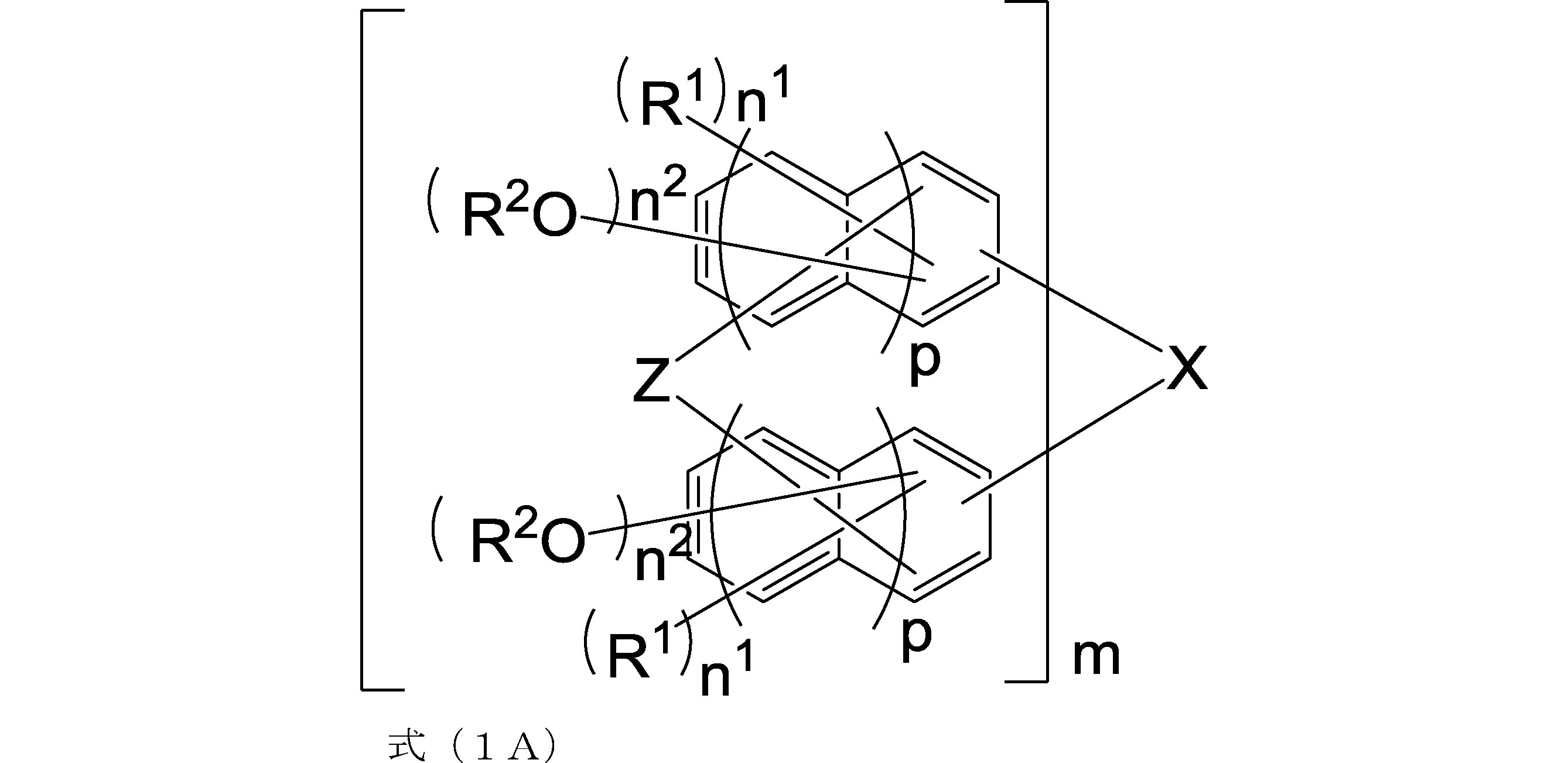
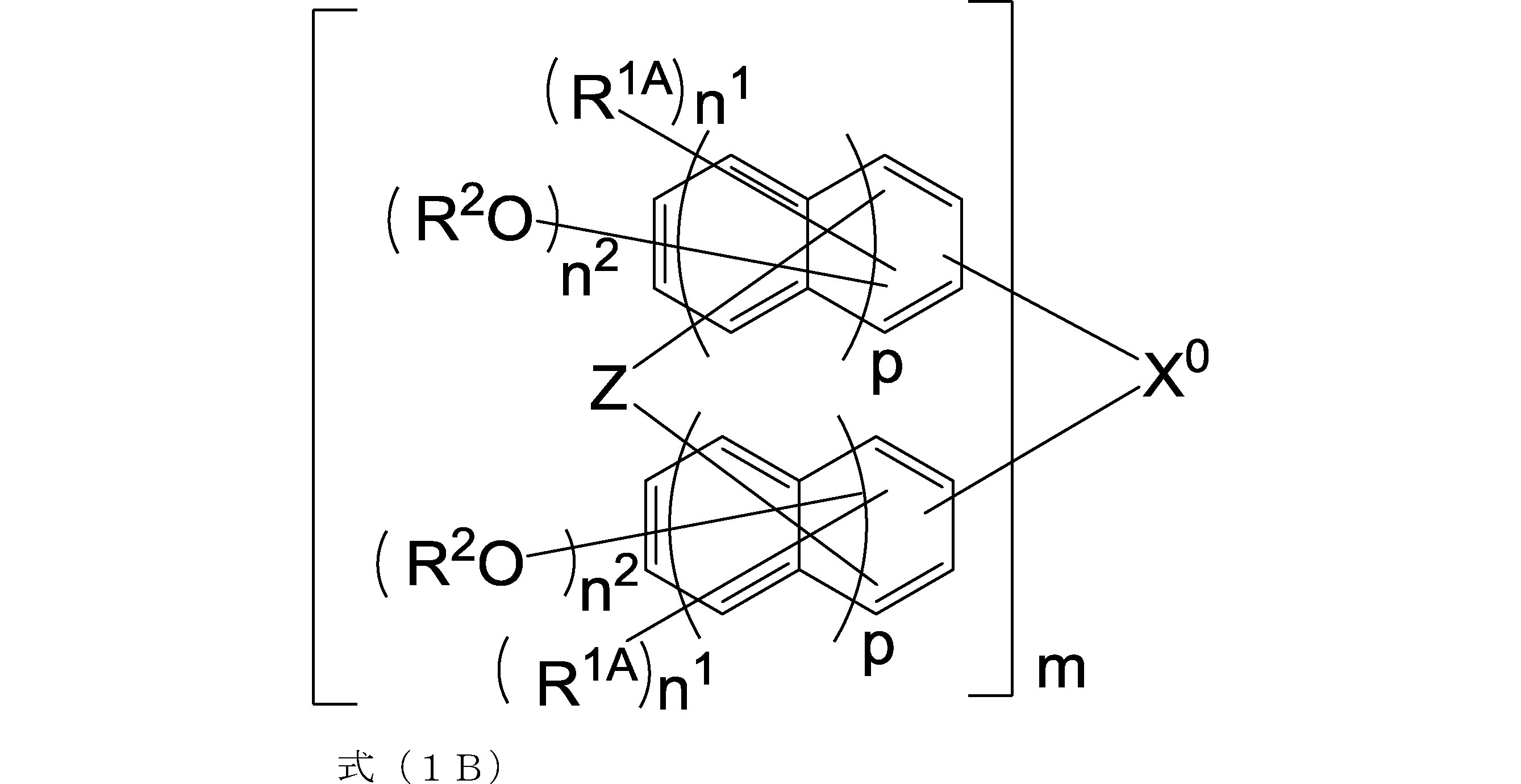
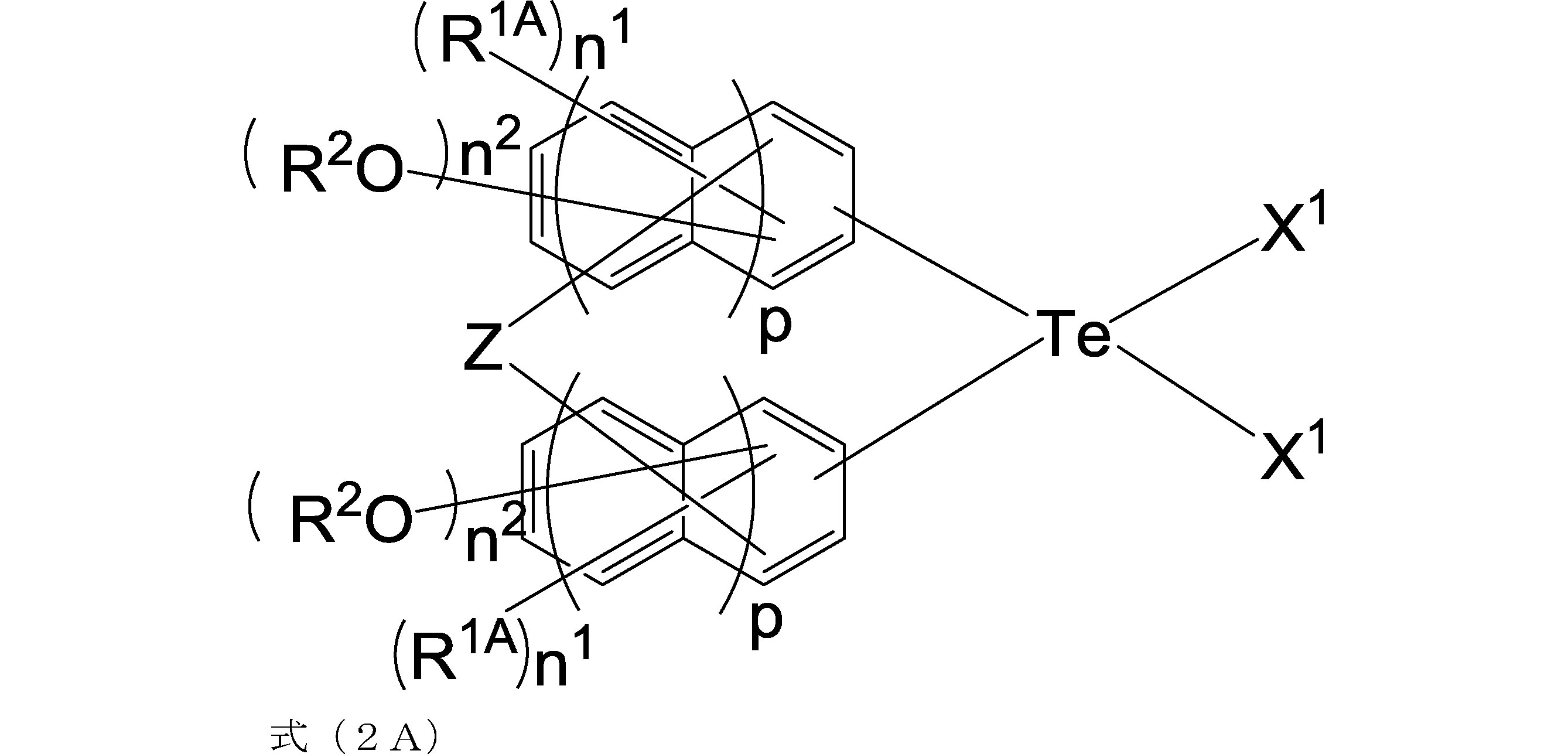

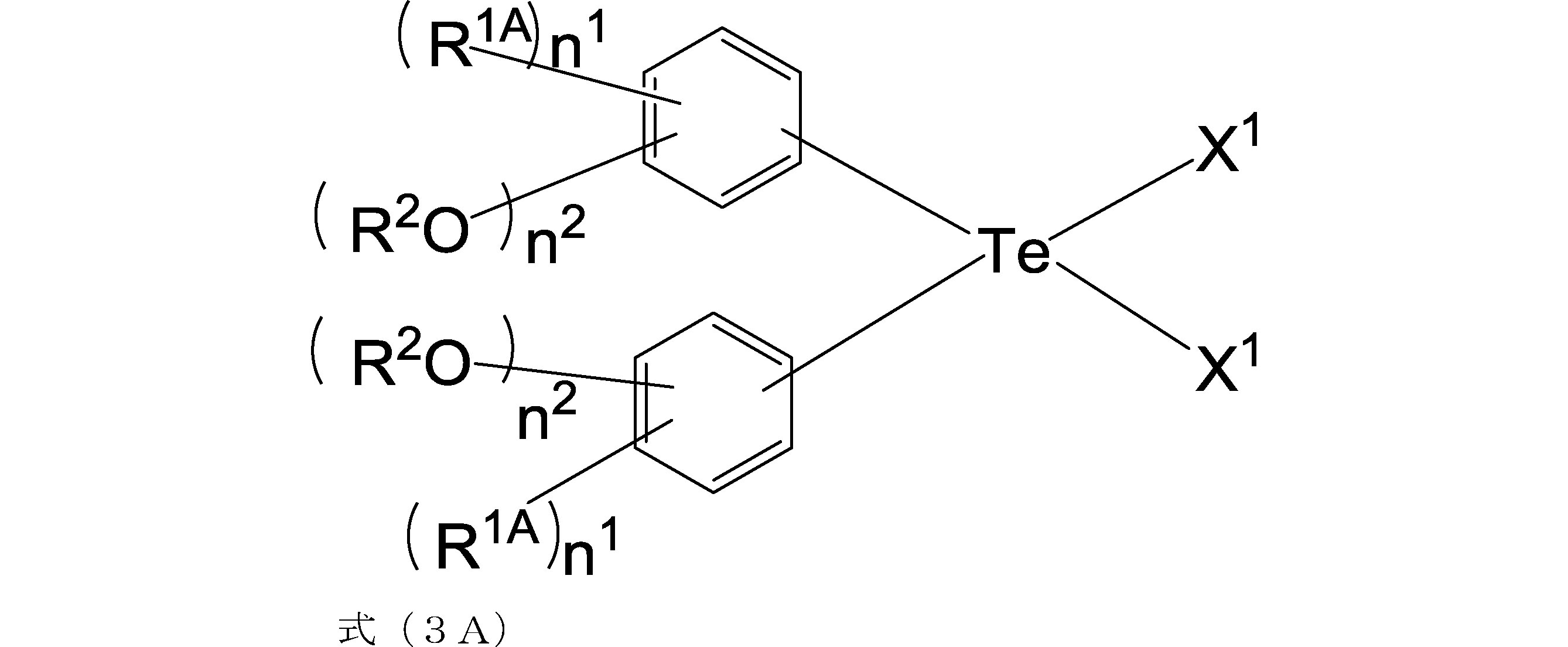
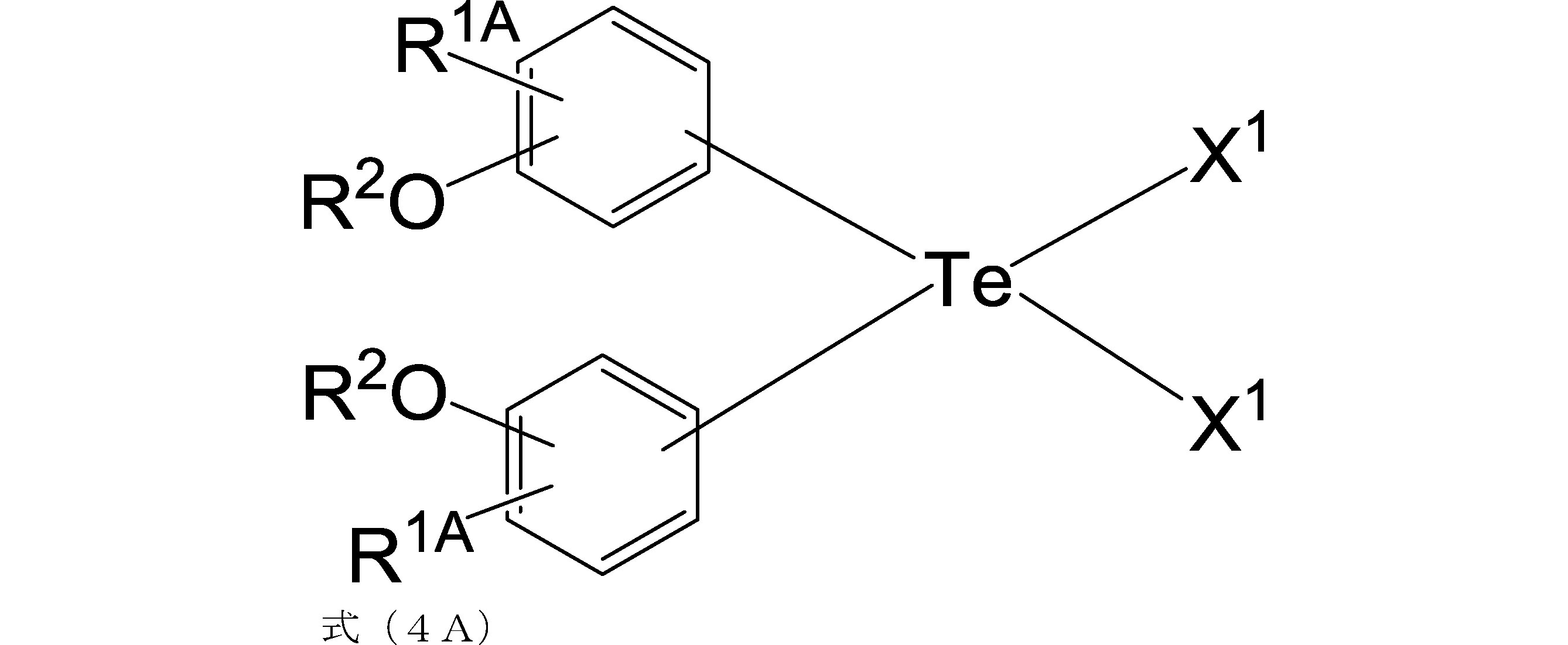
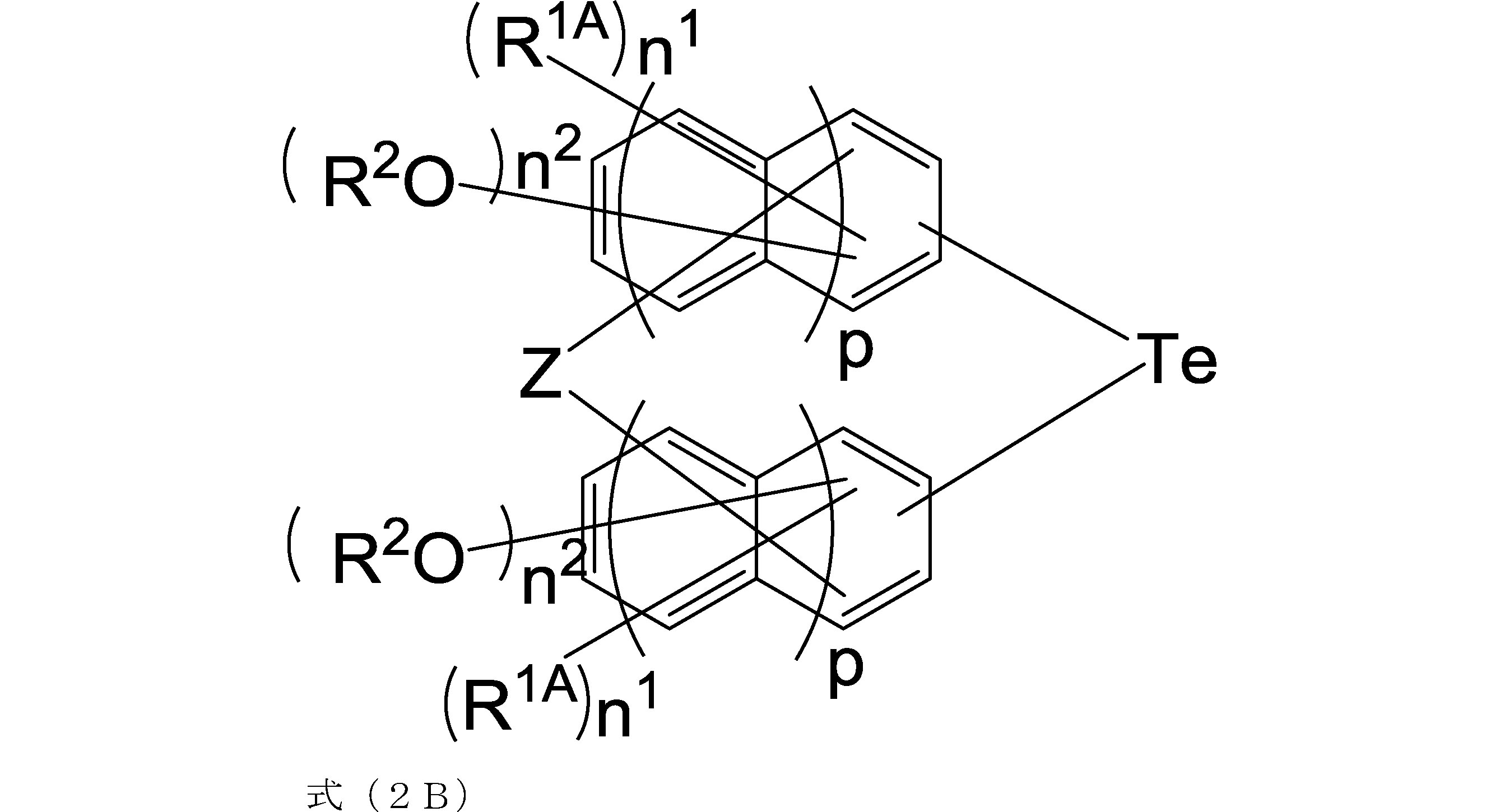


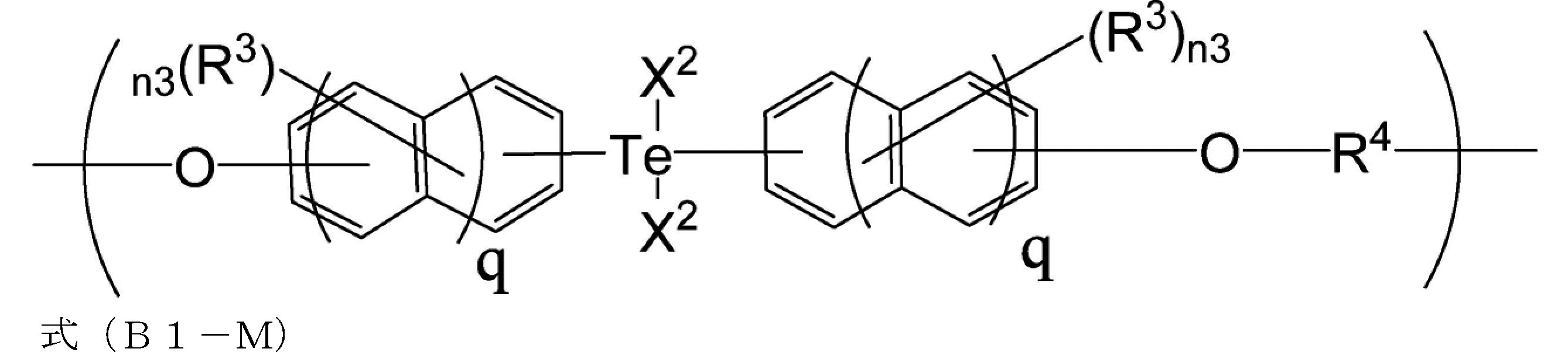


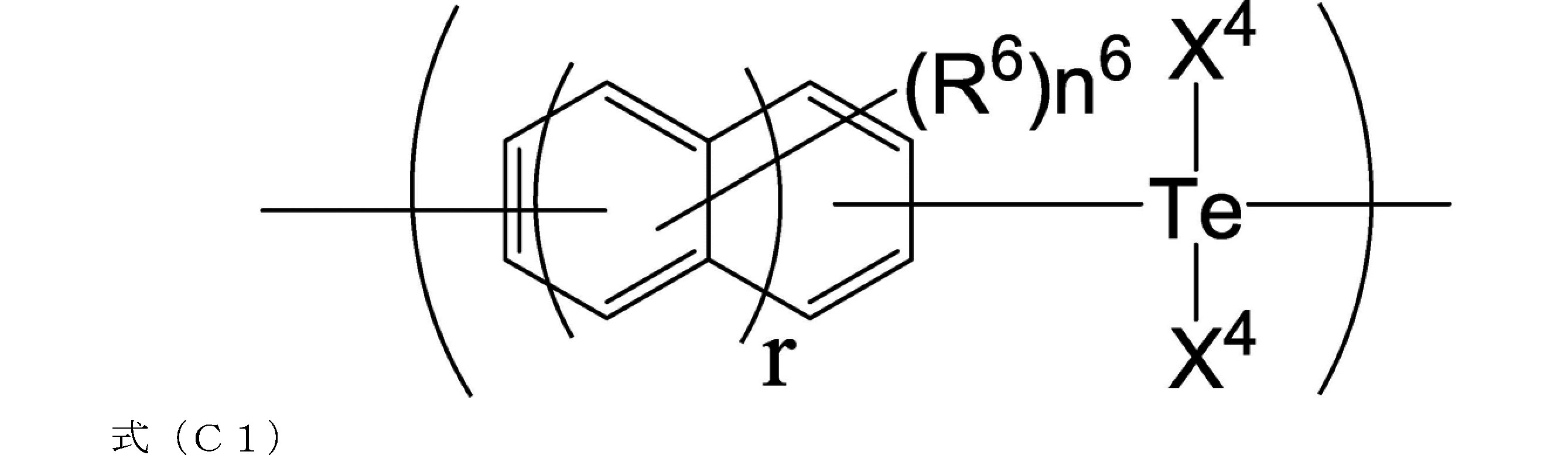
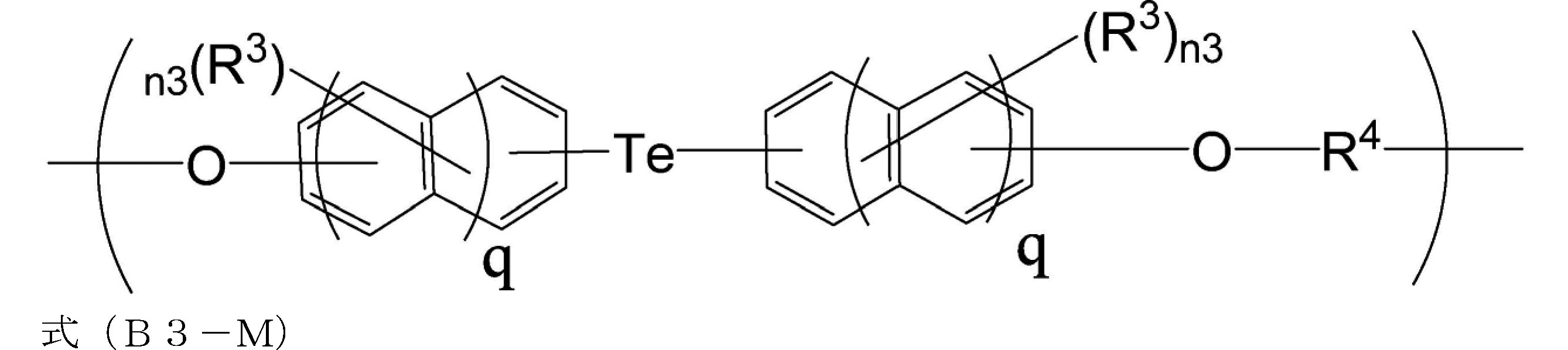


<30> 酸発生剤を更に含有する前記<1>~前記<29>のいずれか1つに記載のレジスト下層膜形成用組成物。
<31> 酸架橋剤を更に含有する前記<1>~前記<30>のいずれか1つに記載のレジスト下層膜形成用組成物。
<32> 前記<1>~前記<31>のいずれか1つに記載のレジスト下層膜形成用組成物を用いて形成されたリソグラフィー用レジスト下層膜。
<33> 基板上に、前記<1>~前記<31>のいずれか1つに記載のレジスト下層膜形成用組成物を用いてレジスト下層膜を形成し、前記レジスト下層膜上に、少なくとも1層のフォトレジスト層を形成した後、前記フォトレジスト層の所定の領域に放射線を照射し、現像を行うパターン形成方法。
<34> 基板上に、前記<1>~前記<31>のいずれか1つに記載のレジスト下層膜形成用組成物を用いてレジスト下層膜を形成し、前記レジスト下層膜上に、レジスト中間層膜材料を用いてレジスト中間層膜を形成し、前記レジスト中間層膜上に、少なくとも1層のフォトレジスト層を形成した後、前記フォトレジスト層の所定の領域に放射線を照射し、現像してレジストパターンを形成し、その後、前記レジストパターンをマスクとして前記レジスト中間層膜をエッチングし、得られた中間層膜パターンをエッチングマスクとして前記レジスト下層膜をエッチングし、得られた下層膜パターンをエッチングマスクとして基板をエッチングすることで基板にパターンを形成するパターン形成方法。
本発明のレジスト下層膜形成用組成物は、テルルを含有する化合物又はテルルを含有する樹脂を含有するレジスト下層膜形成用組成物である。
本発明のレジスト下層膜形成用組成物は、湿式プロセスが適用可能であり、耐熱性、段差埋め込み特性及び平坦性に優れるフォトレジスト下層膜を形成するために有用なレジスト下層膜形成用組成物を実現することができる。そして、このレジスト下層膜形成用組成物は、炭素濃度が比較的に高く、酸素濃度が比較的に低く、溶媒溶解性も高い、特定構造を有する化合物又は樹脂を用いているため、ベーク時の膜の劣化が抑制され、フッ素ガス系プラズマエッチング等に対するエッチング耐性にも優れた下層膜を形成することができる。さらには、レジスト層との密着性にも優れるので、優れたレジストパターンを形成することができる。本発明のレジスト下層膜形成用組成物は、特に耐熱性、段差埋め込み特性及び平坦性に優れるため、例えば、複数のレジスト層のうち最下層に設けられるレジスト下層膜形成用の組成物として用いることができる。ただし、本発明のレジスト下層膜形成用組成物を用いて形成されたレジスト下層膜は、更に基板との間に他のレジスト下層を含むものであってもよい。
本実施形態のレジスト下層膜形成用組成物は、下記式(A-1)で示されるテルルを含有する化合物を含有することができる。
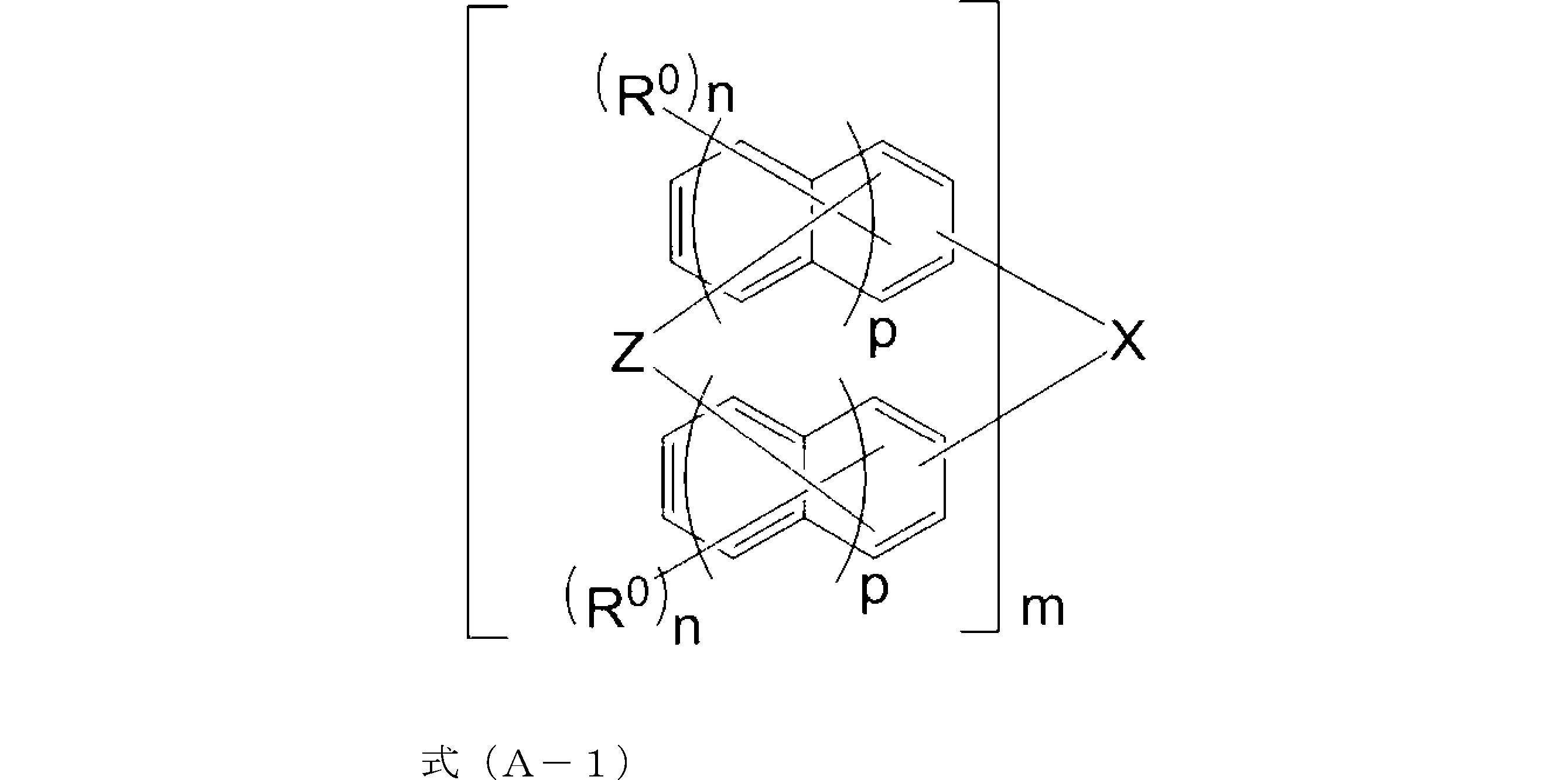
なお、本実施形態の化合物はポリマーではないが、便宜上、前記式(A-1)中のXに結合する[ ](括弧)部内の構造を、"繰り返し単位の構造式"と称する(以下、式についても同様である)。
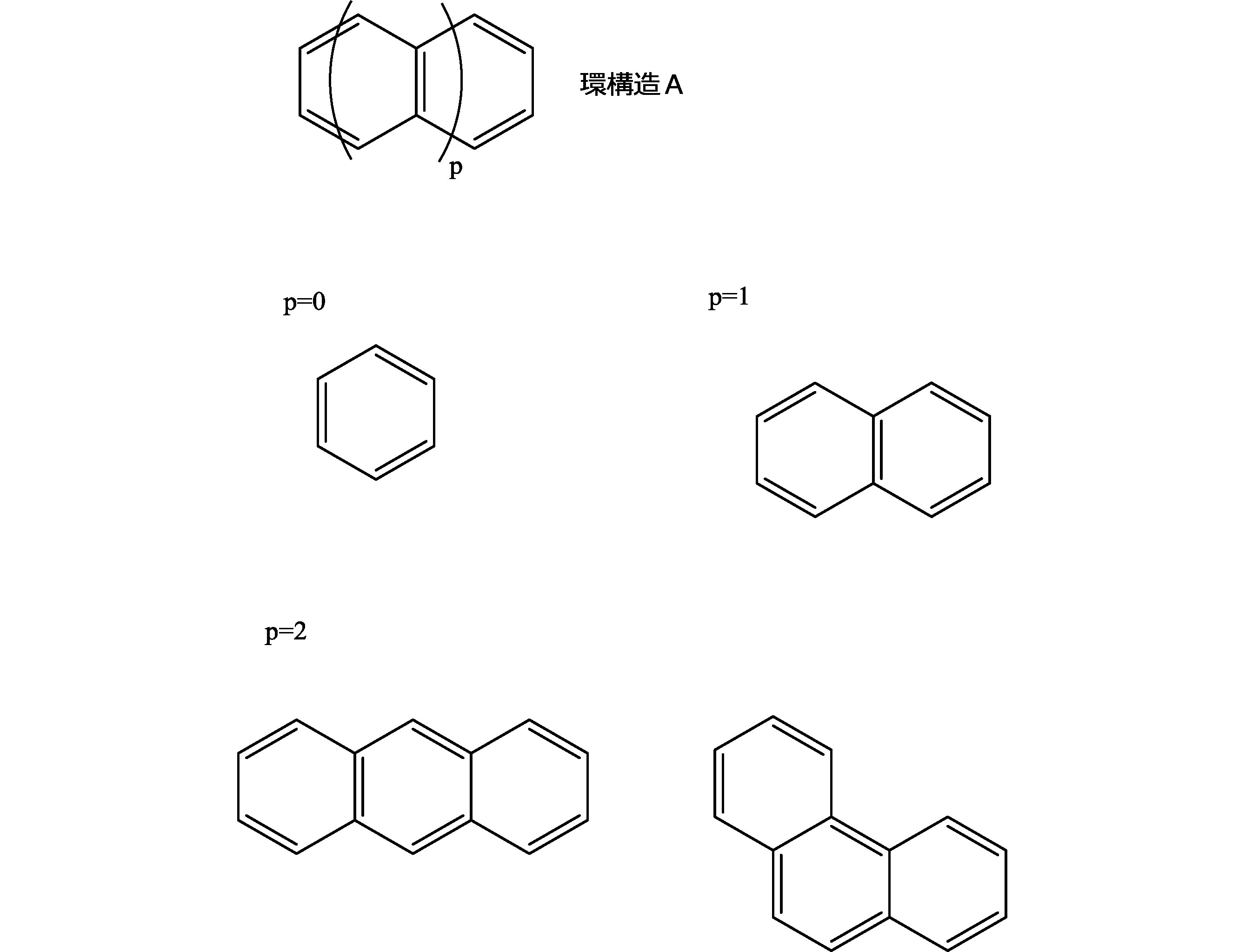
また、前記2m価の炭化水素基は、脂環式炭化水素基、二重結合、ヘテロ原子若しくは炭素数6~60の芳香族基を有していてもよい。ここで、前記脂環式炭化水素基については、有橋脂環式炭化水素基も含まれる。
Xは、耐熱性の点から、縮合多環芳香基(特に2~4環の縮合環構造)を有することが好ましく、安全溶媒への溶解性や耐熱性の点から、ビフェニル基等のポリフェニル基を有することが好ましい。


前記式(A-1)で示されるテルルを含有する化合物は、硬化性の観点から下記式(A-2)で示されるテルル含有化合物であることが好ましい。
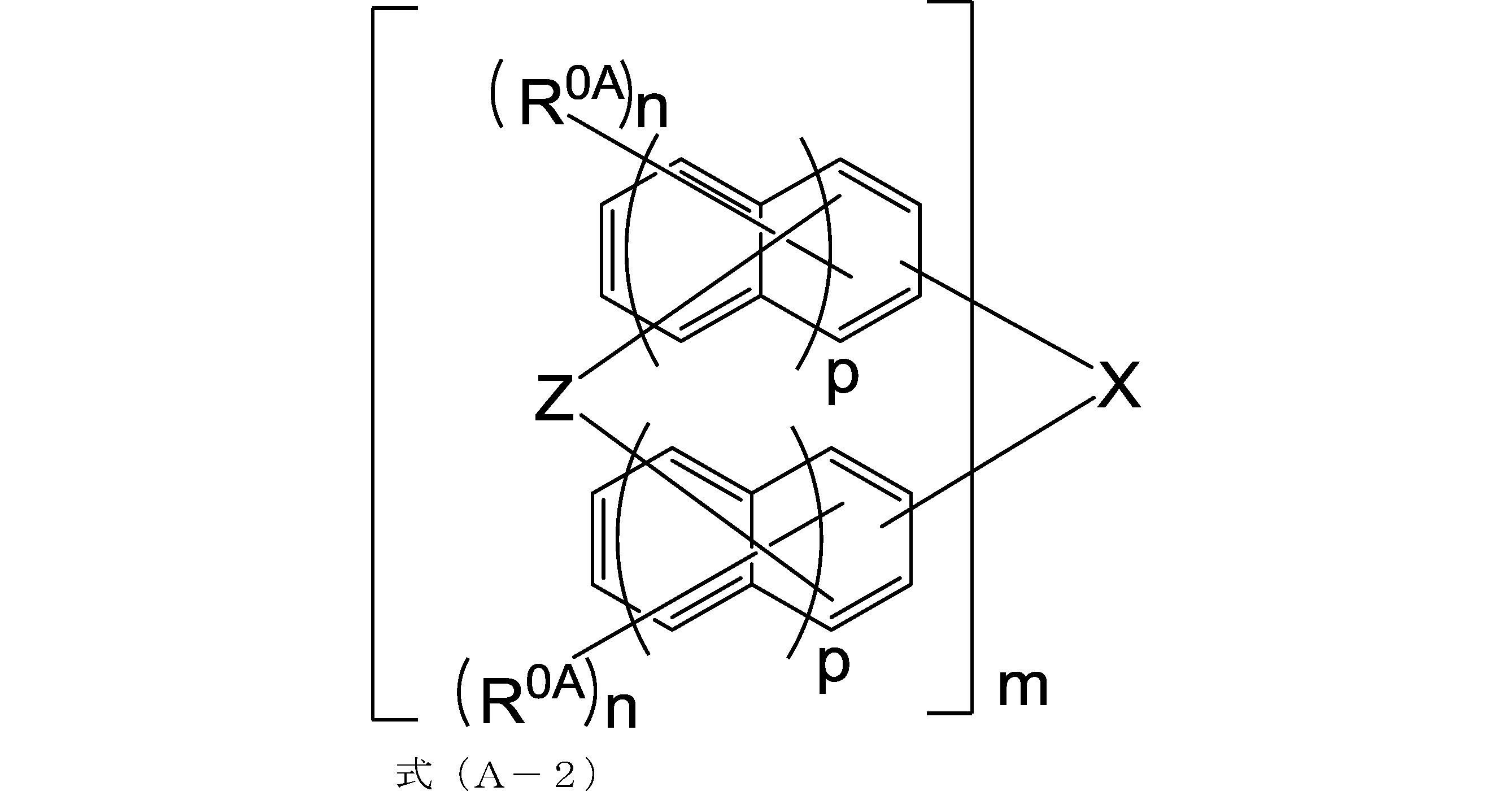

前記式(A-1)で示されるテルルを含有する化合物は、下記式(1A)で示されるテルル含有化合物であることが好ましい。
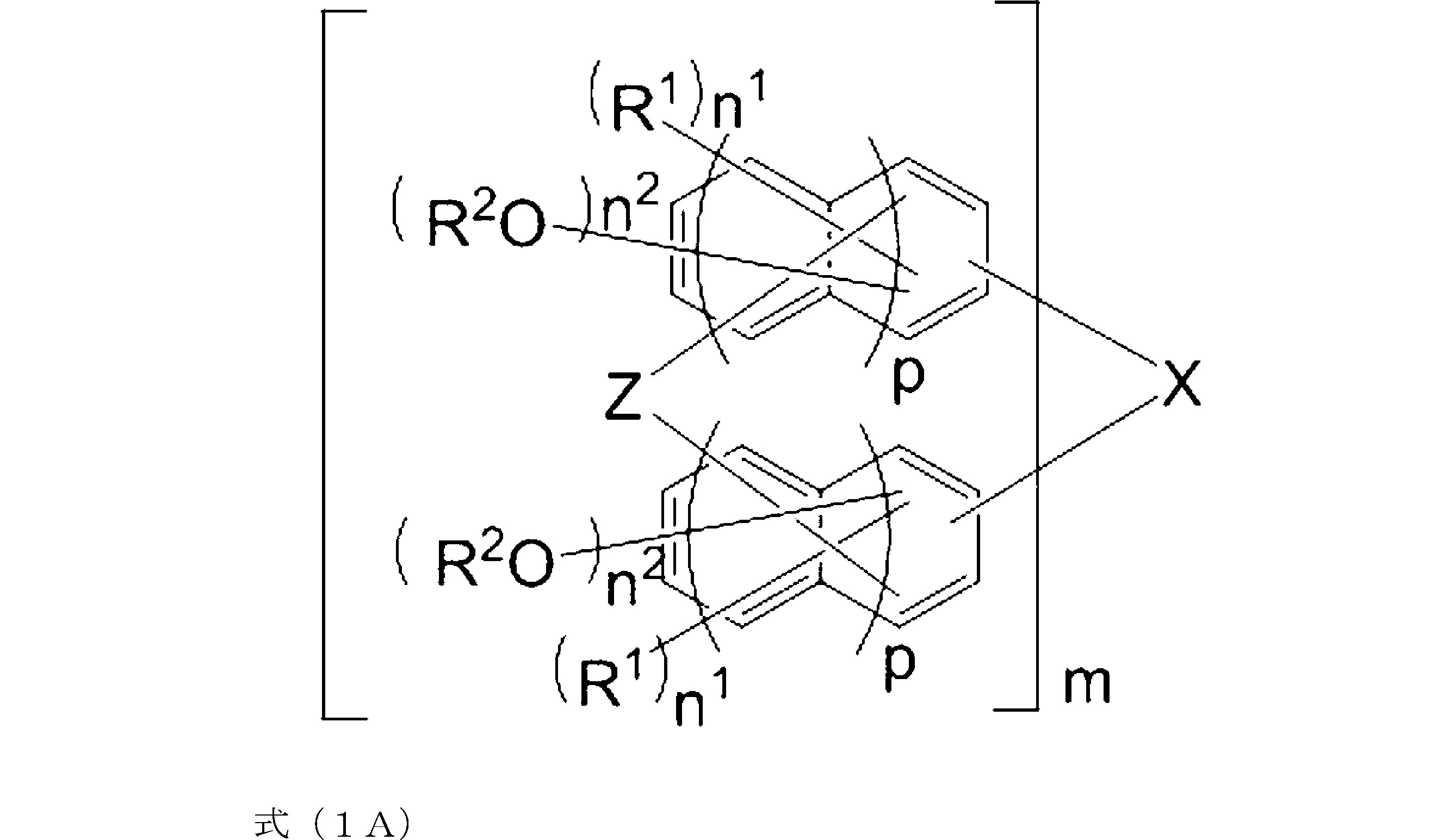
置換の炭素数1~20の直鎖状脂肪族炭化水素基とは、例えば、フルオロメチル基、2-ヒドロキシエチル基、3-シアノプロピル基及び20-ニトロオクタデシル基等が挙げられる。
置換の炭素数3~20の分岐脂肪族炭化水素基とは、例えば、1-フルオロイソプロピル基及び1-ヒドロキシ-2-オクタデシル基等が挙げられる。
置換の炭素数3~20の環状脂肪族炭化水素基とは、例えば、2-フルオロシクロプロピル基及び4-シアノシクロヘキシル基等が挙げられる。
置換の炭素数6~20のアリール基とは、例えば、4-イソプロピルフェニル基、4-シクロヘキシルフェニル基、4-メチルフェニル基、6-フルオロナフチル基等が挙げられる。
置換の炭素数2~20のアルケニル基とは、例えば、クロロプロピニル基等が挙げられる。

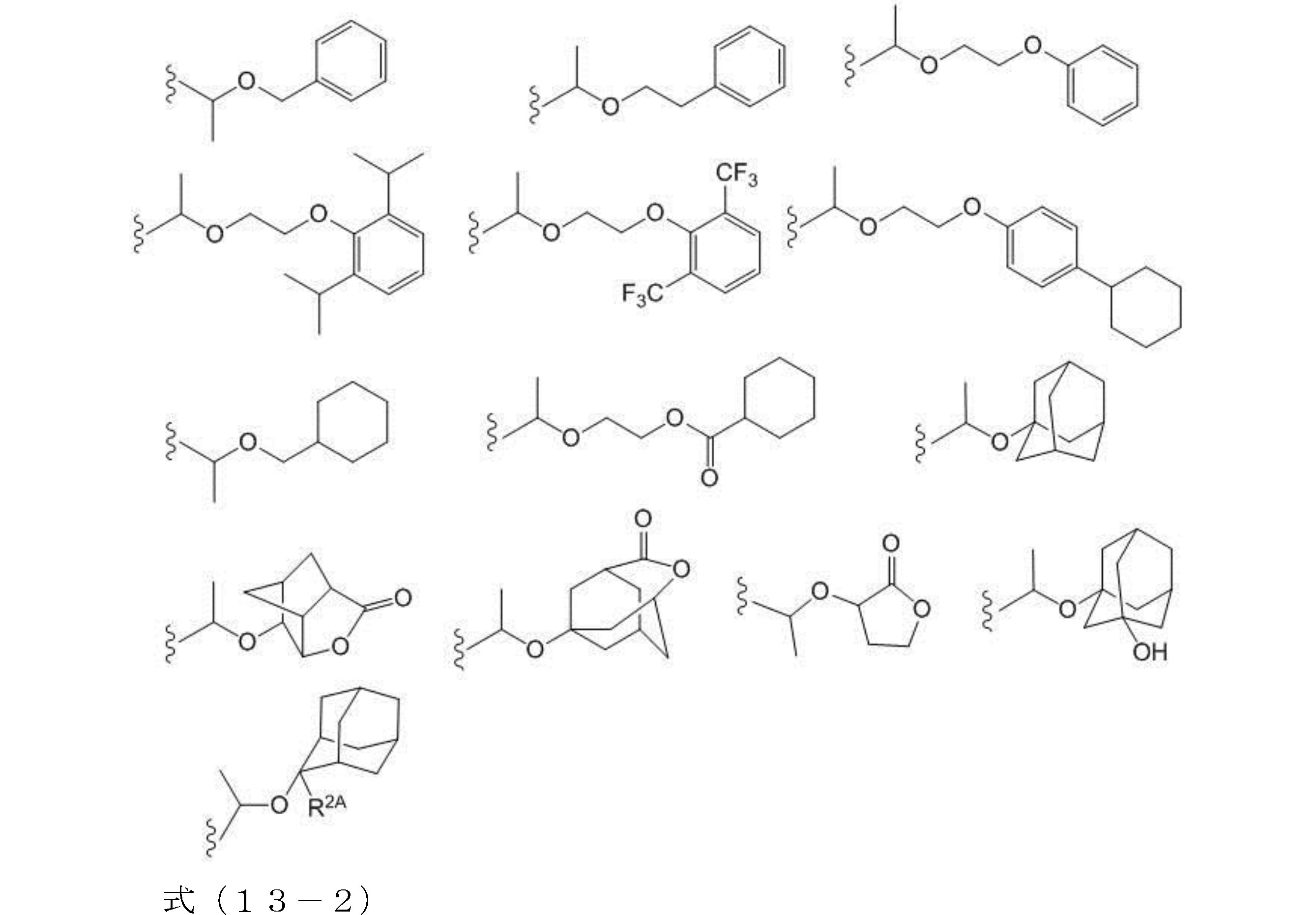

特に下記式(13-4)で表される各基からなる群から選ばれる酸解離性反応基群が、解像性が高く好ましい。


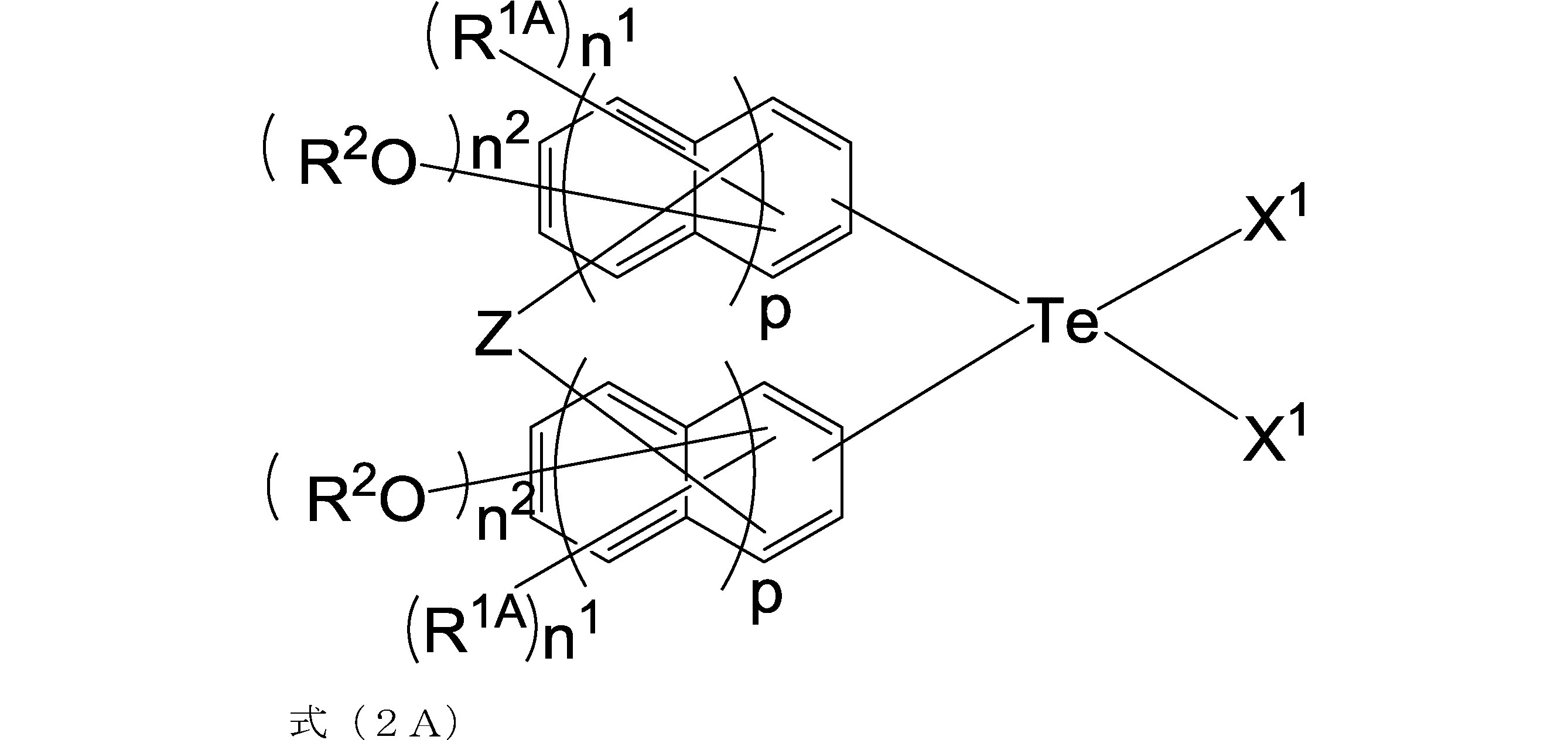
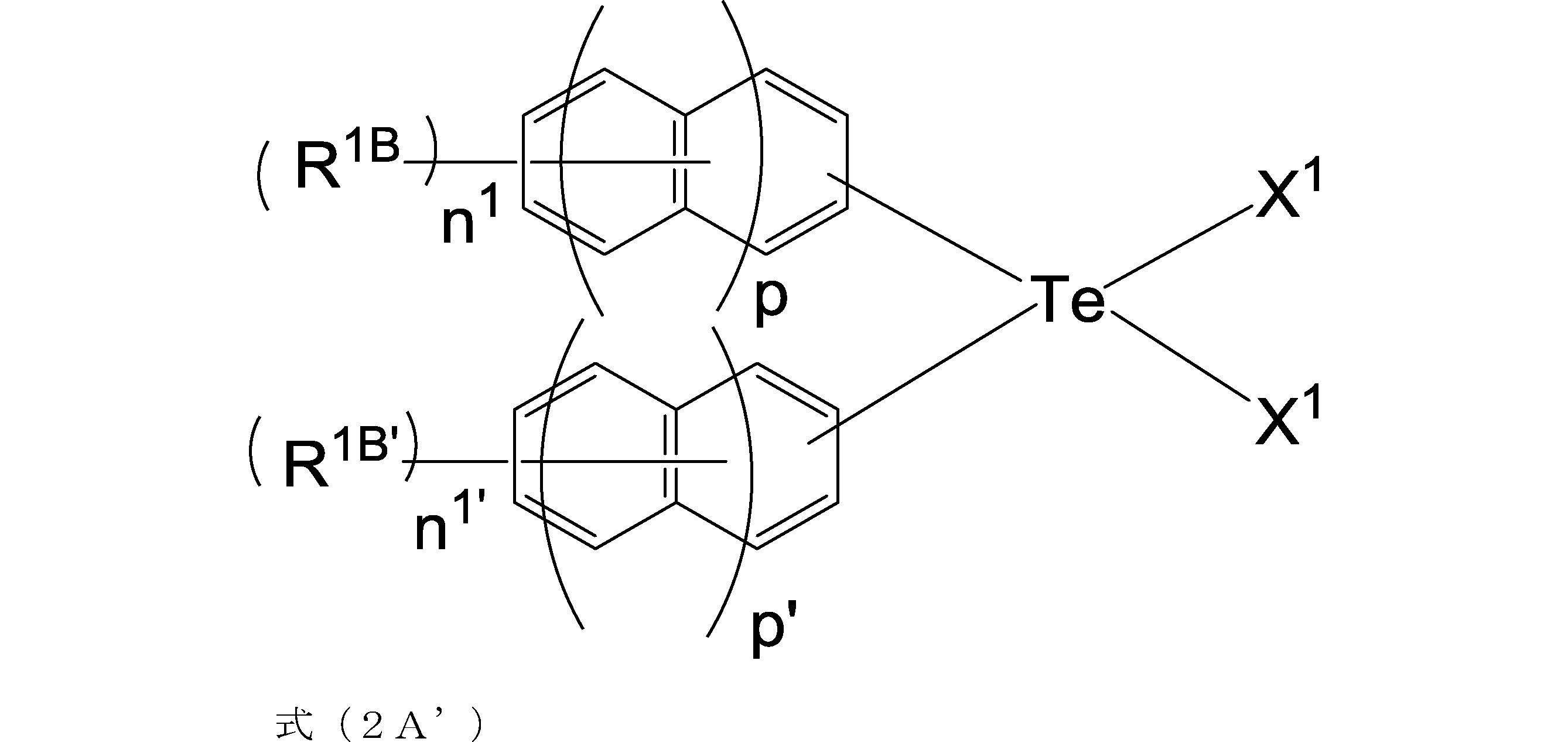
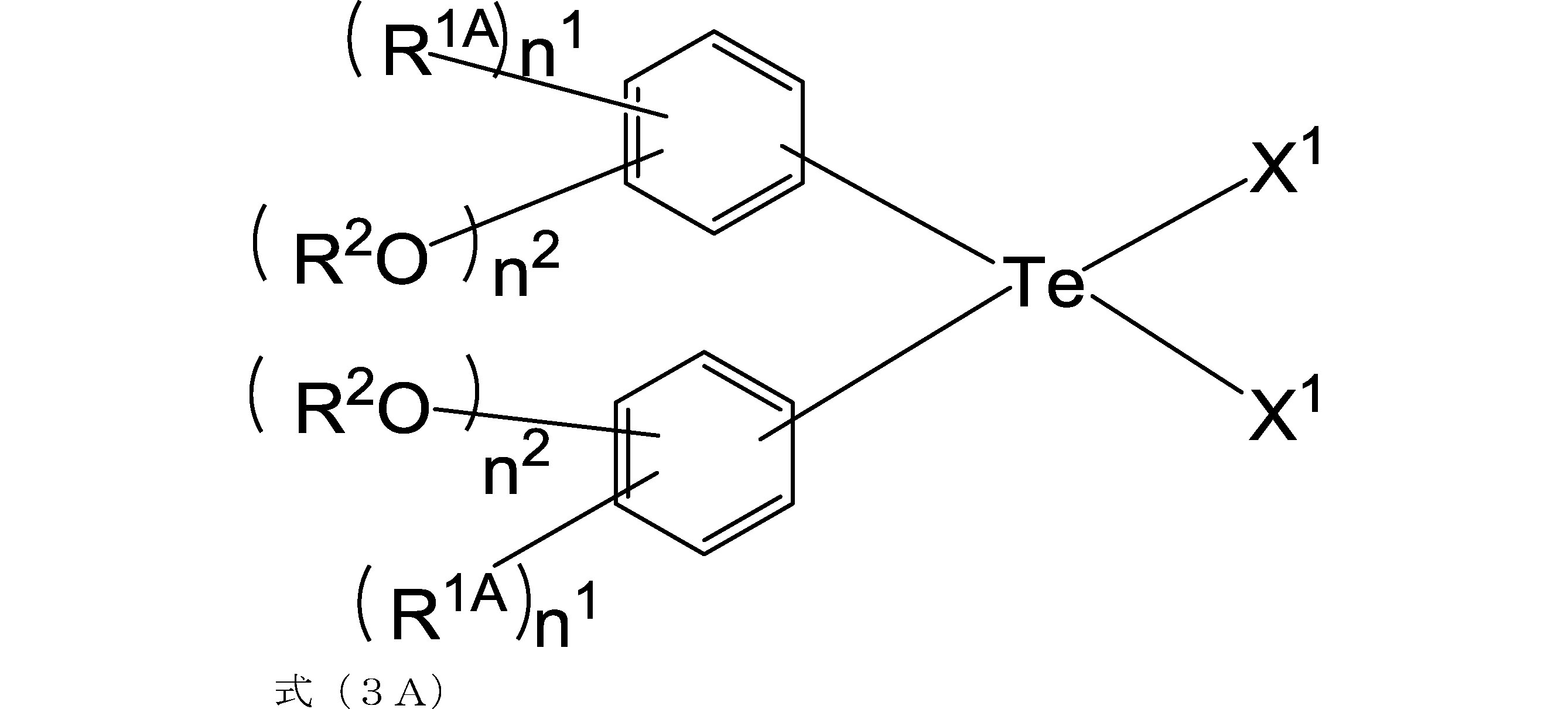
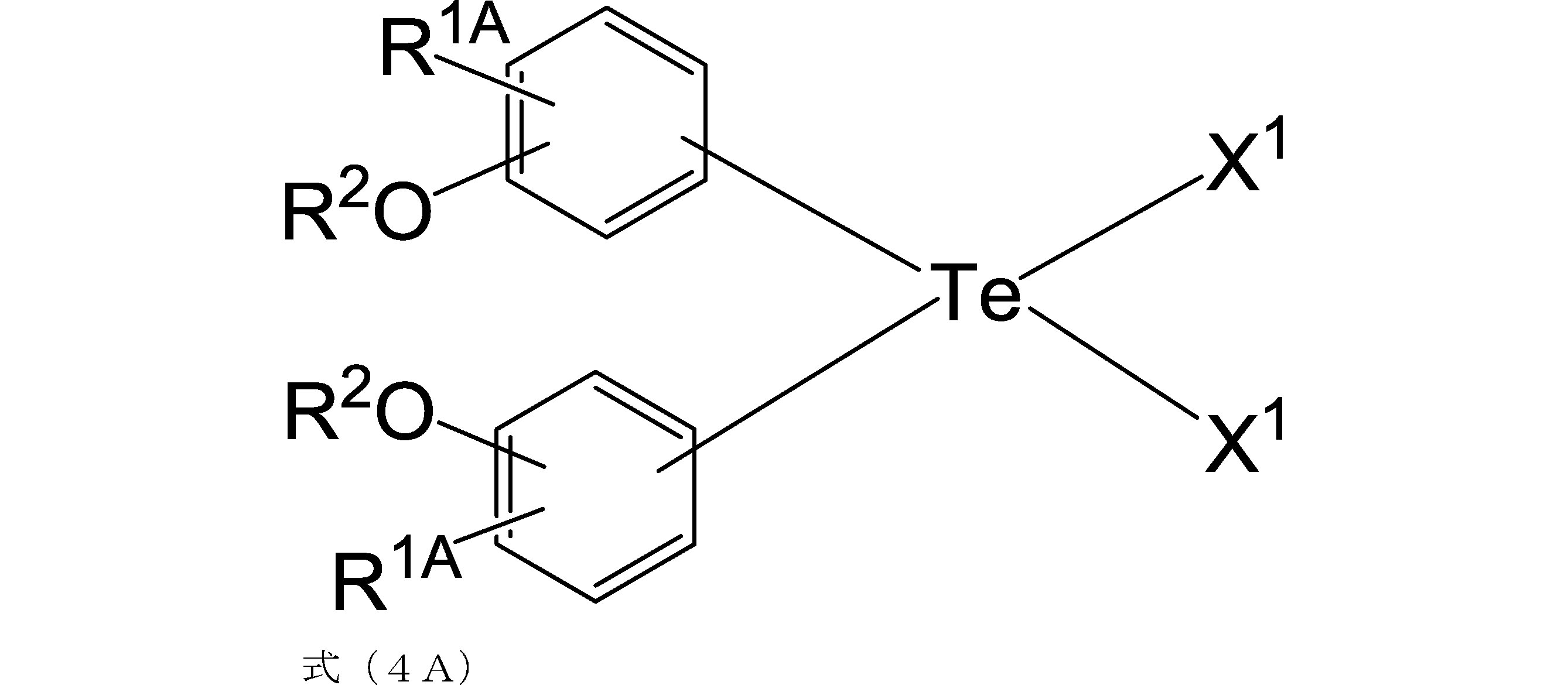

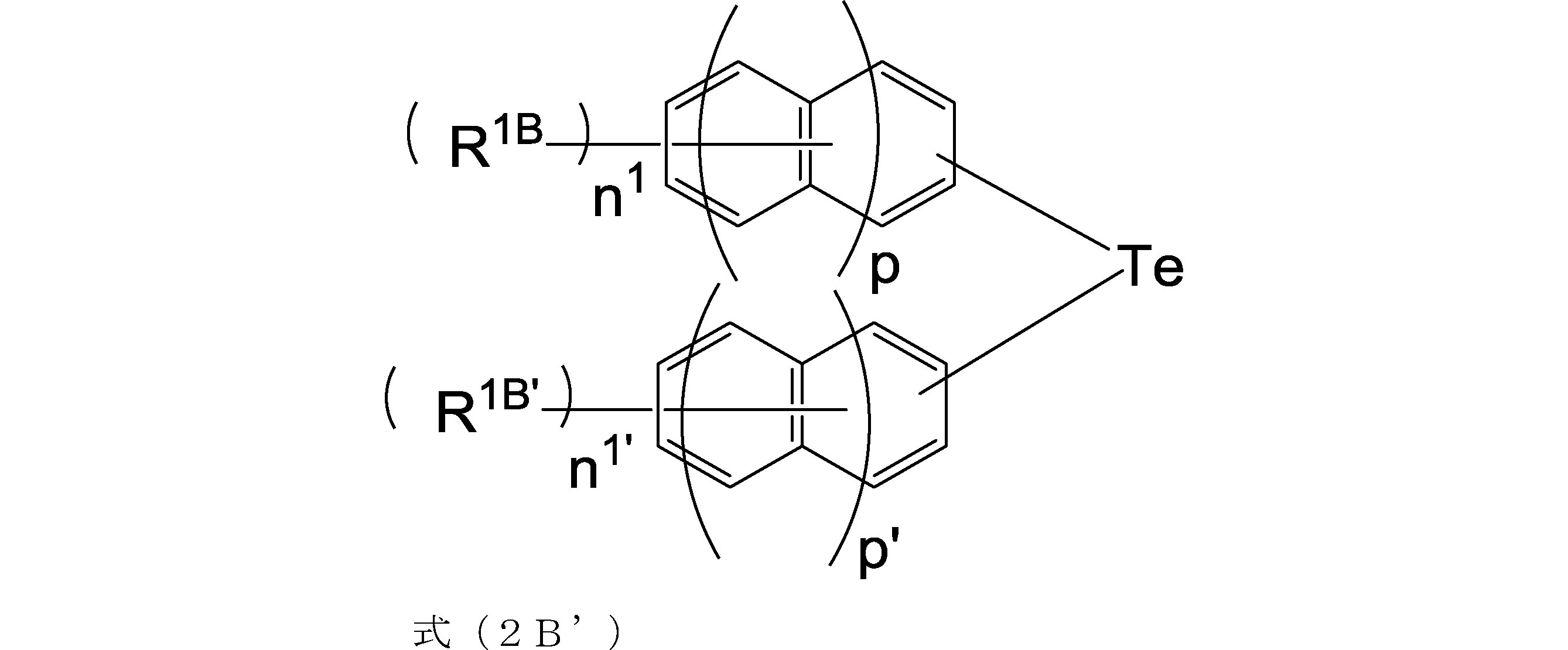


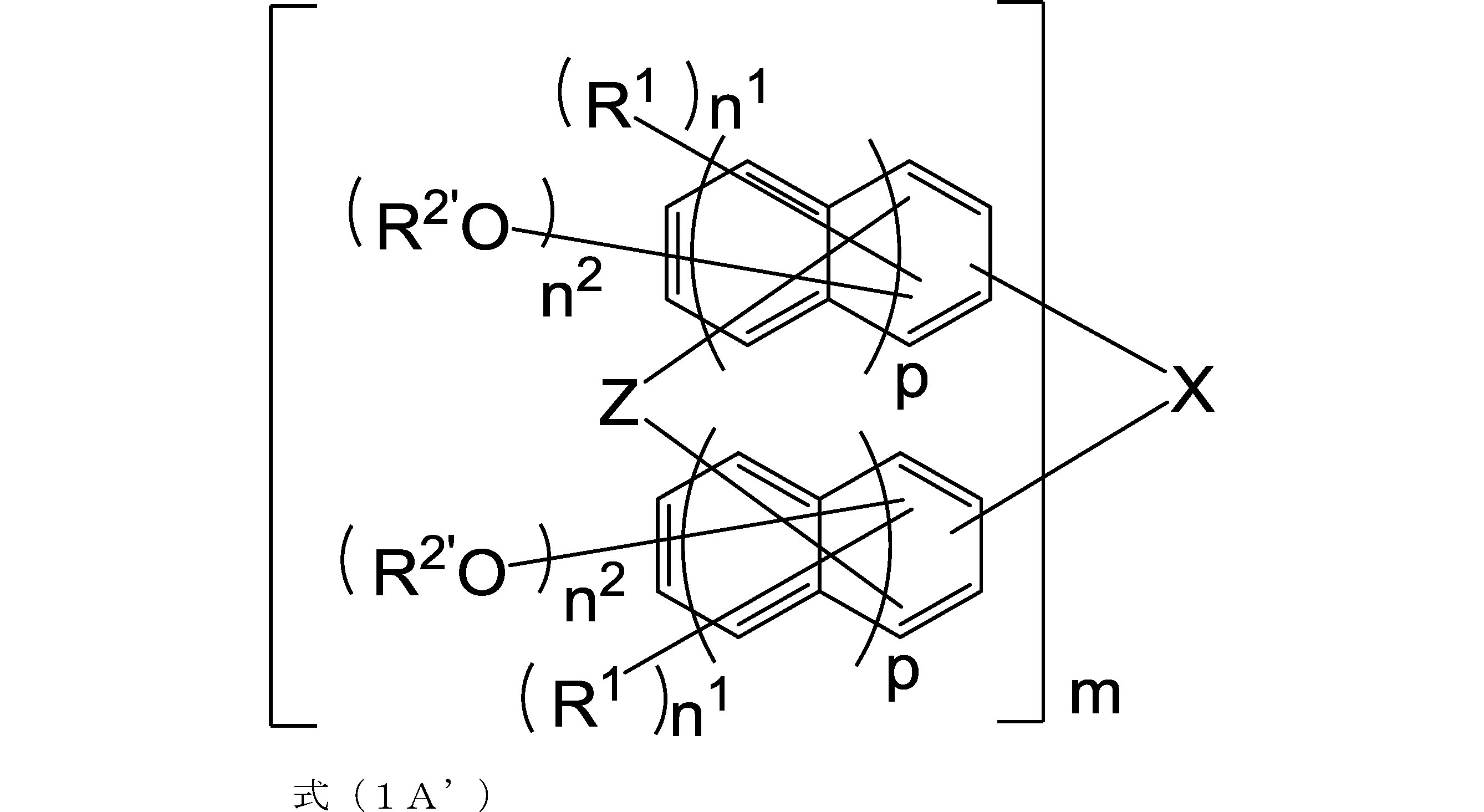
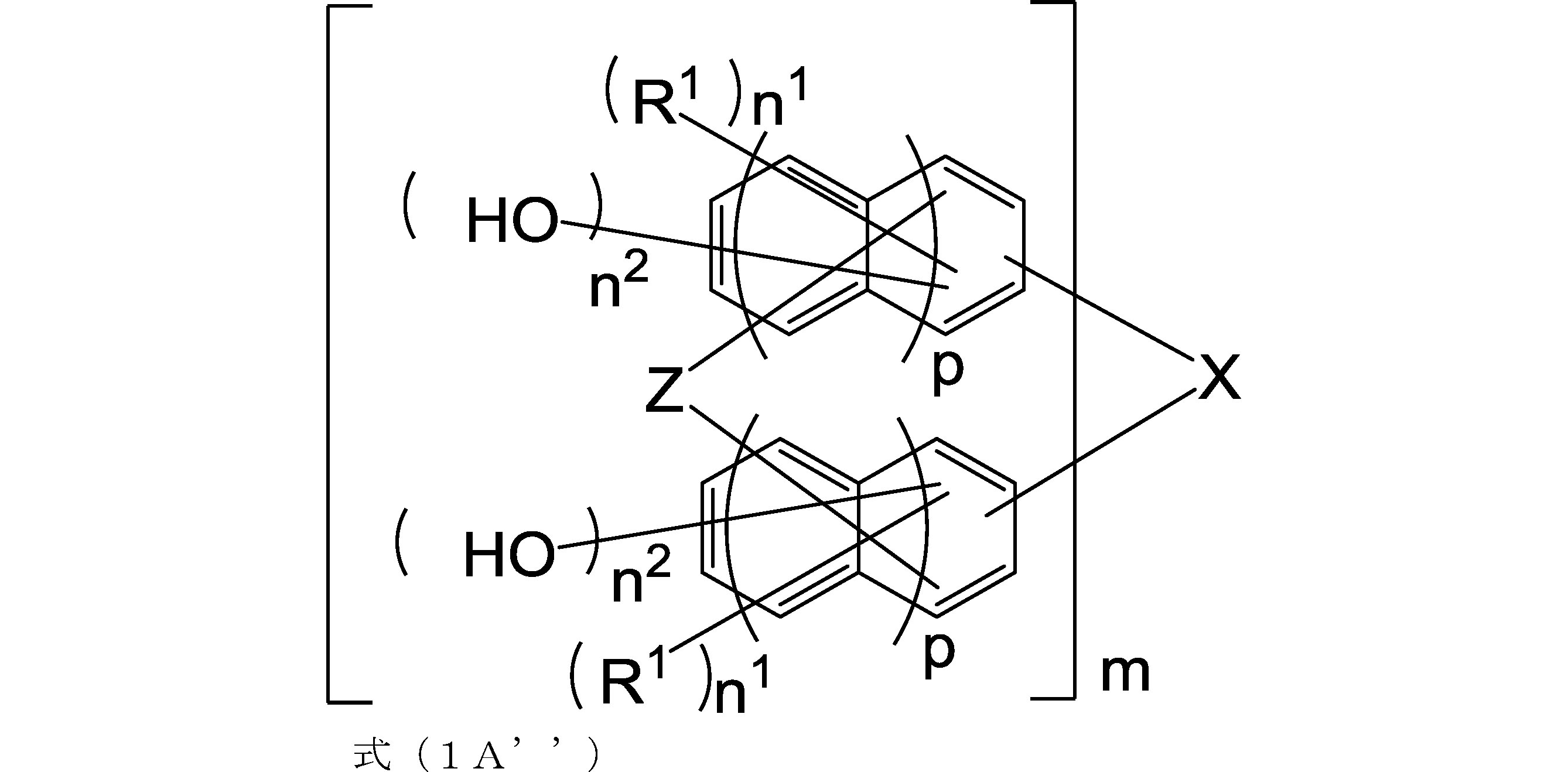

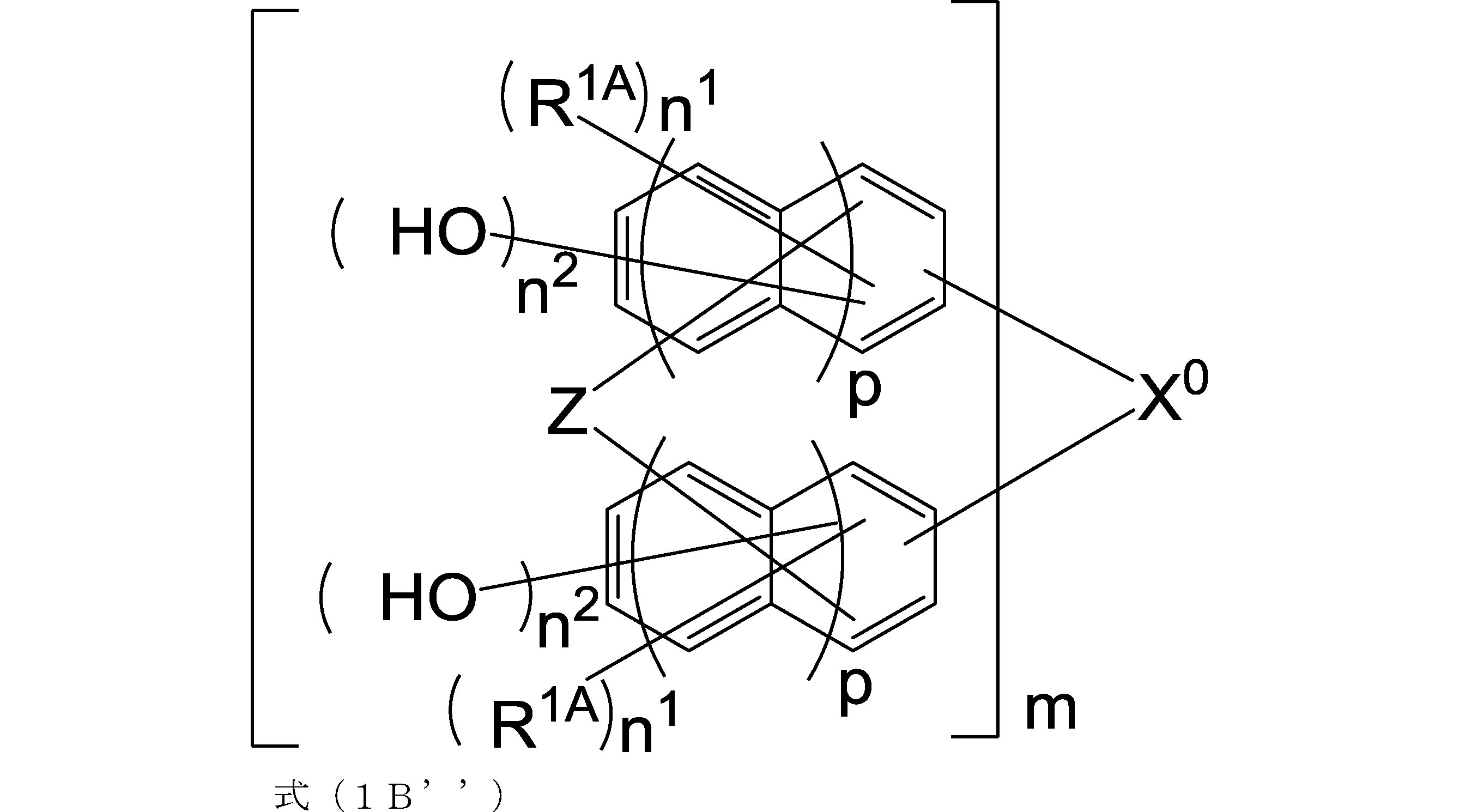
また、フェノール類或いはチオフェノール類と対応するハロゲン化テルルを、反応させることによってポリフェノール化合物を得て、得られたポリフェノール化合物の少なくとも1つのフェノール性水酸基に公知の方法により酸解離性反応基を導入することにより前記式(A-1)で示される化合物を得ることができる。
更には、フェノール類或いはチオフェノール類と対応するテルルを含むアルデヒド類或いはテルルを含むケトン類を、酸又は塩基触媒下にて反応させることによってポリフェノール化合物を得て、得られたポリフェノール化合物の少なくとも1つのフェノール性水酸基に公知の方法により酸解離性反応基を導入することにより前記式(A-1)で示される化合物を得ることができる。
特に限定されるものではないが、例えば、後述のように、四塩化テルル(テルル(IV)テトラクロライド)等のハロゲン化テルルと、置換又は無置換のフェノール誘導体とを、塩基触媒存在下にて反応させて前記テルルを含有する化合物を合成することができる。即ち、本実施形態のレジスト下層膜形成用組成物は、ハロゲン化テルルと、置換又は無置換のフェノール誘導体とを、塩基触媒存在下にて反応させて前記テルルを含有する化合物を合成する工程を含むレジスト下層膜形成用組成物の製造方法によって製造することができる。
当該方法においては、高収率で目的のポリフェノール化合物を得るための観点からは、例えば、ハロゲン化テルルとフェノール類とを、ハロゲン化テルル1モルあたりフェノール類0.4~1.2モルで反応させ、反応終了後に、フェノール類を追加反応させることができる。
また、このような方法においては、異なるフェノール類を反応させることによって、得ることができるポリフェノール化合物の種類を増加するための観点から、ハロゲン化テルルとフェノール類[I]とを反応させ、反応終了後に、フェノール類[II]を追加反応させ、フェノール類[I]及びフェノール類[II]として異なるフェノール類を用いる方法とすることもできる。
このような方法においては、ポリフェノール化合物を高純度で得るための観点から、ハロゲン化テルルとフェノール類の反応終了後に、反応中間体を分離し、反応中間体のみを用いてフェノール類と反応させることが望ましい。反応中間体は公知の方法により分離することができる。反応中間体の分離方法は、特に限定されず、例えば、ろ過により分離することが出来る。
さらに、収率向上の観点から、ハロゲン化テルルとフェノール類とからテルル含有樹脂を得る反応で、ハロゲン化テルル1モルあたりフェノール類3モル以上を用いてもよい。限定されないが、ハロゲン化テルルとフェノール類とからテルル含有樹脂を得る反応で、ハロゲン化テルル1モルあたりフェノール類3モル以上を用いる製造方法は、式(C1)、及び式(C2)の製造方法として特に好ましい。
前記溶媒の量は、特に限定されず、例えば、反応原料100質量部に対して0~2000質量部の範囲とすることができる。
前記ポリアルコキシベンゼンの製造方法は、特に限定されないが、例えば、アルコキシベンゼン類と対応するハロゲン化テルルを一括で仕込む方法や、アルコキシベンゼン類と対応するハロゲン化テルルを滴下していく方法が挙げられる。反応終了後、系内に存在する未反応原料等を除去するために、反応釜の温度を130~230℃にまで上昇させ、1~50mmHg程度で揮発分を除去することもできる。
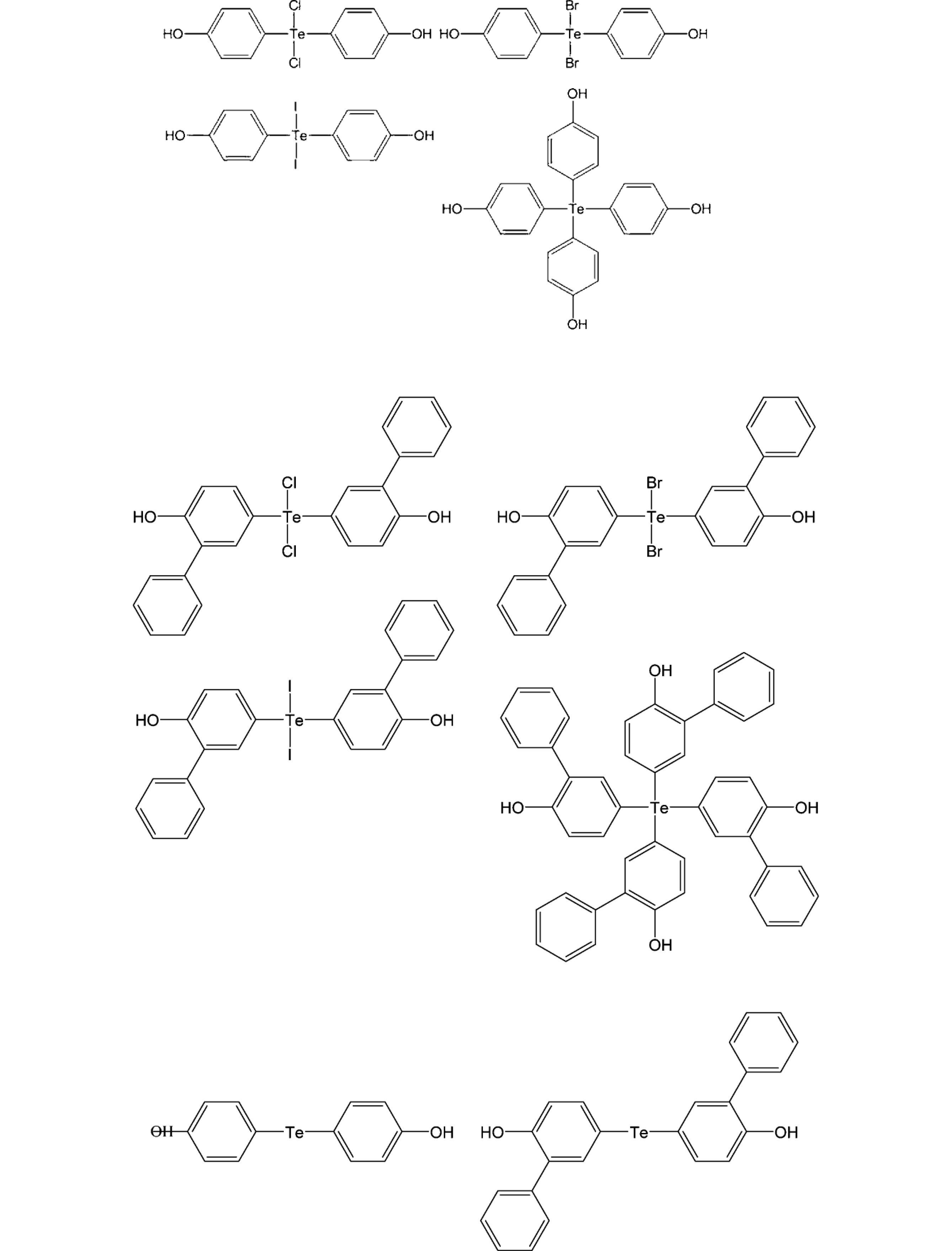


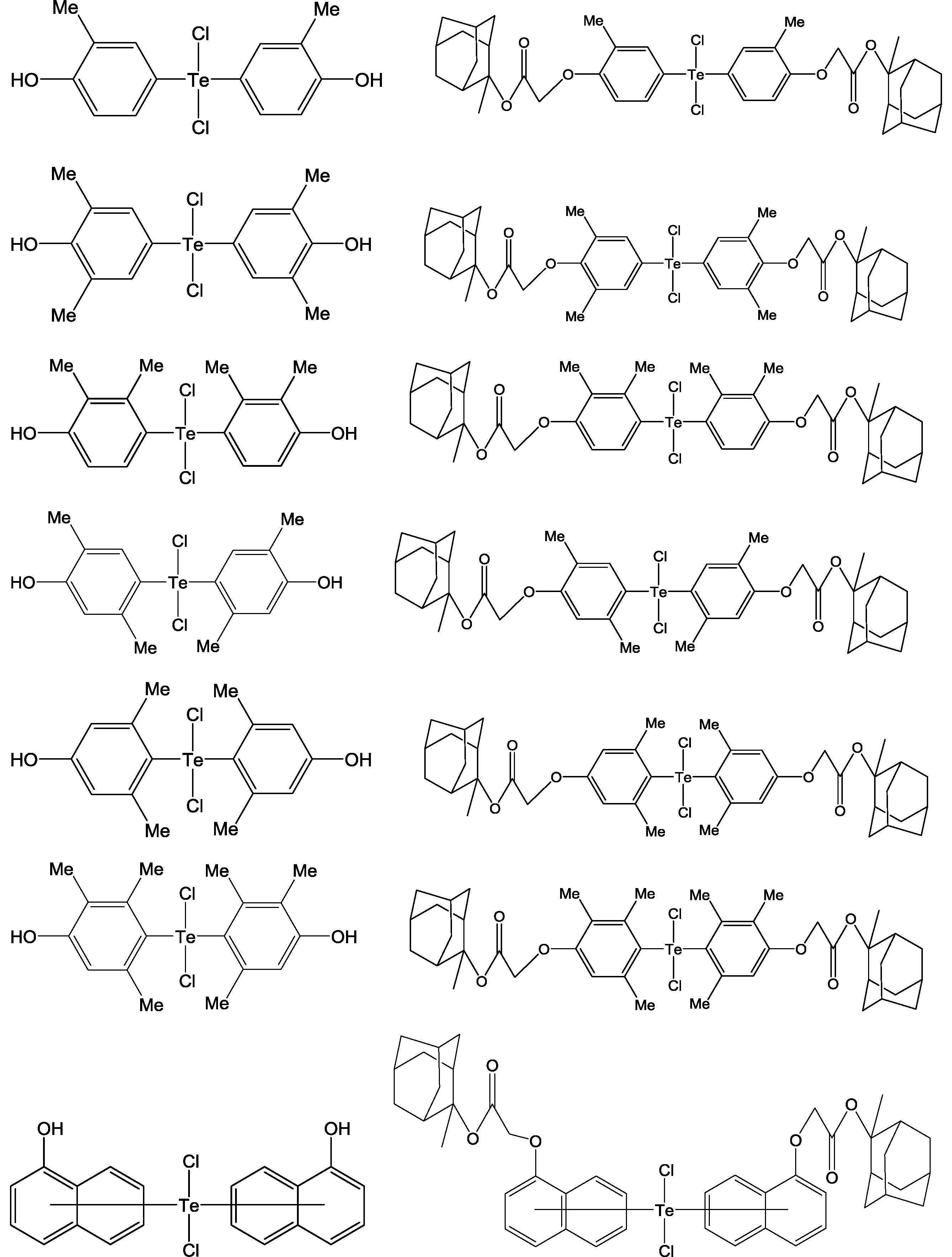

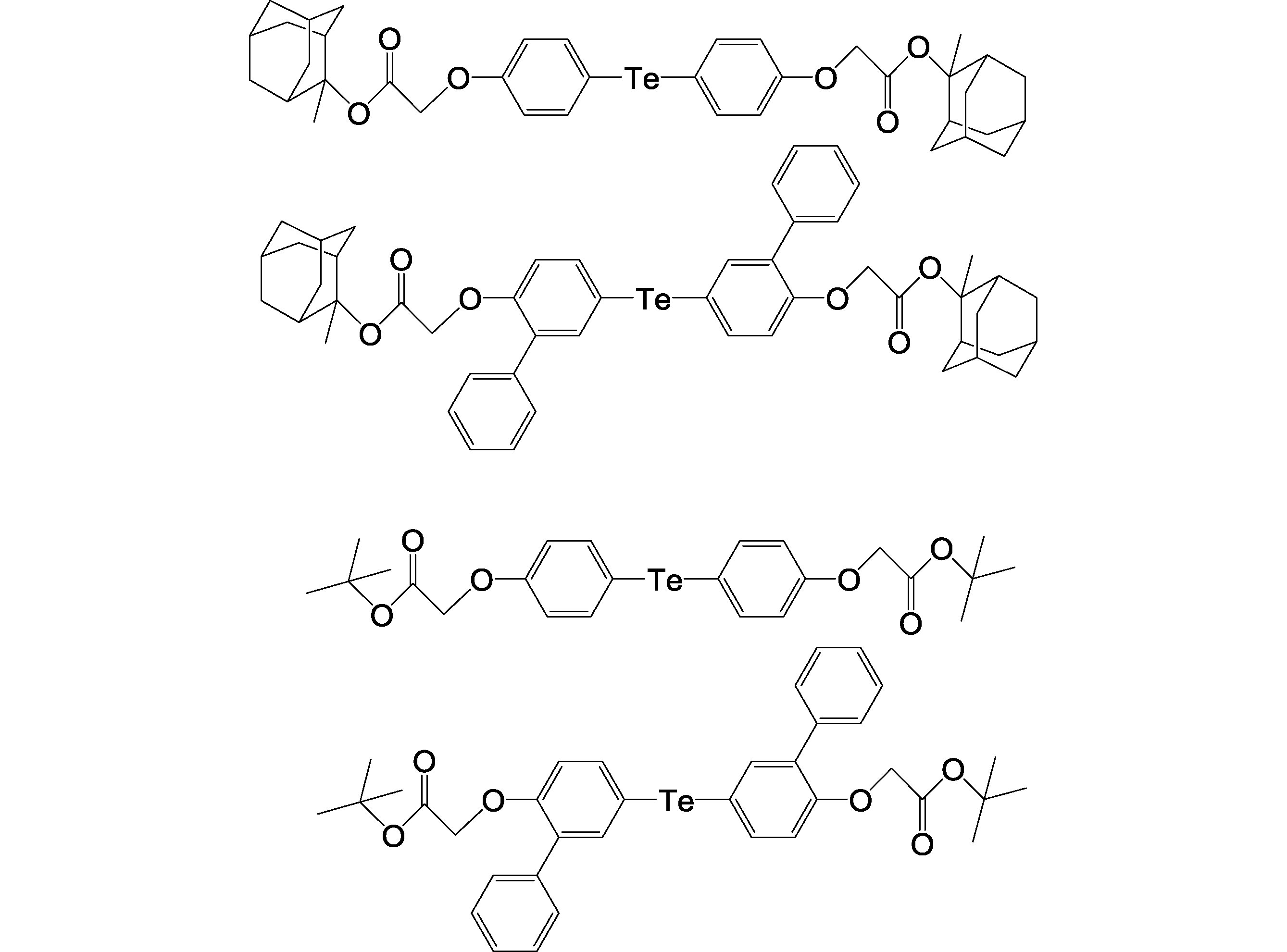
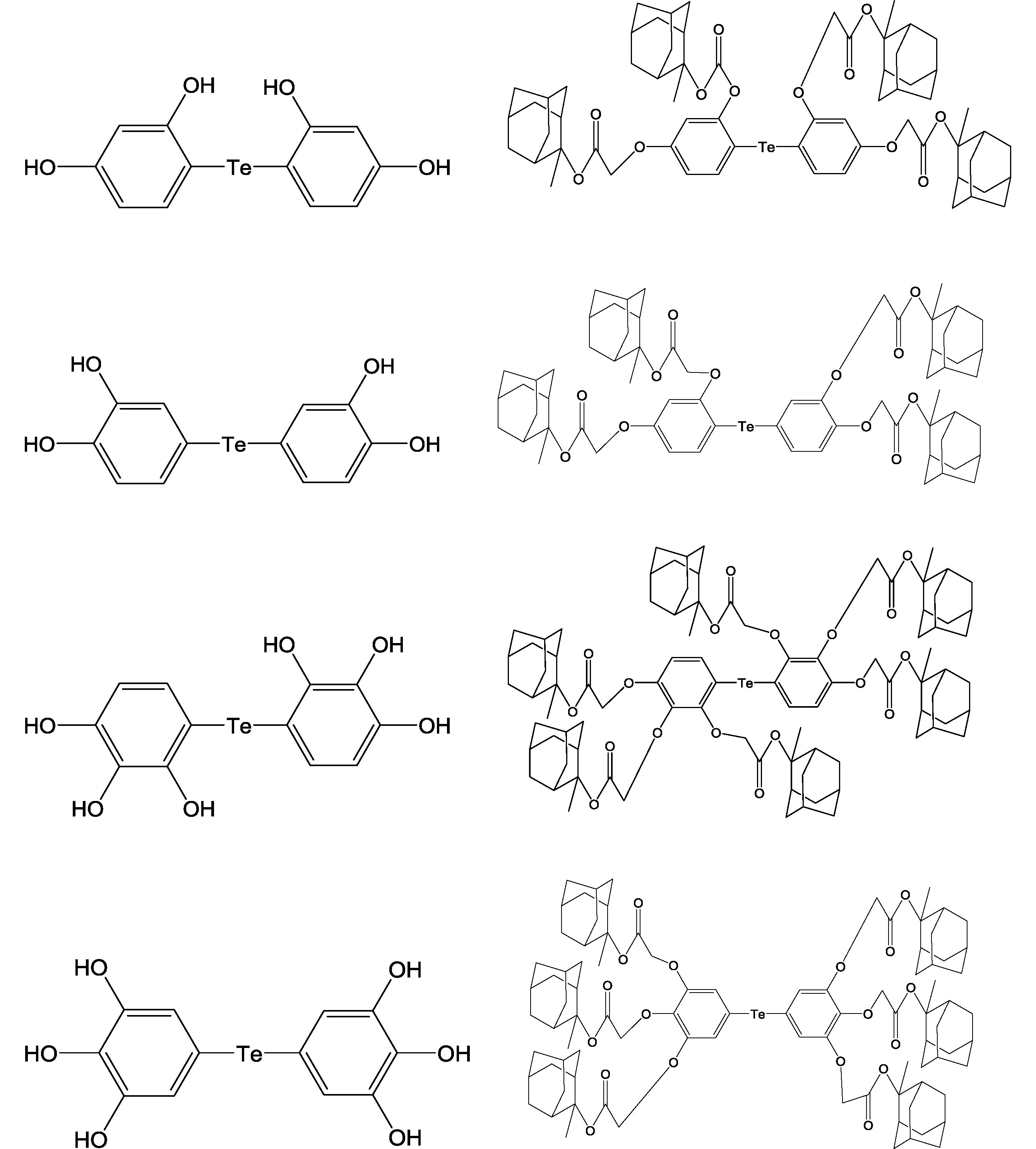

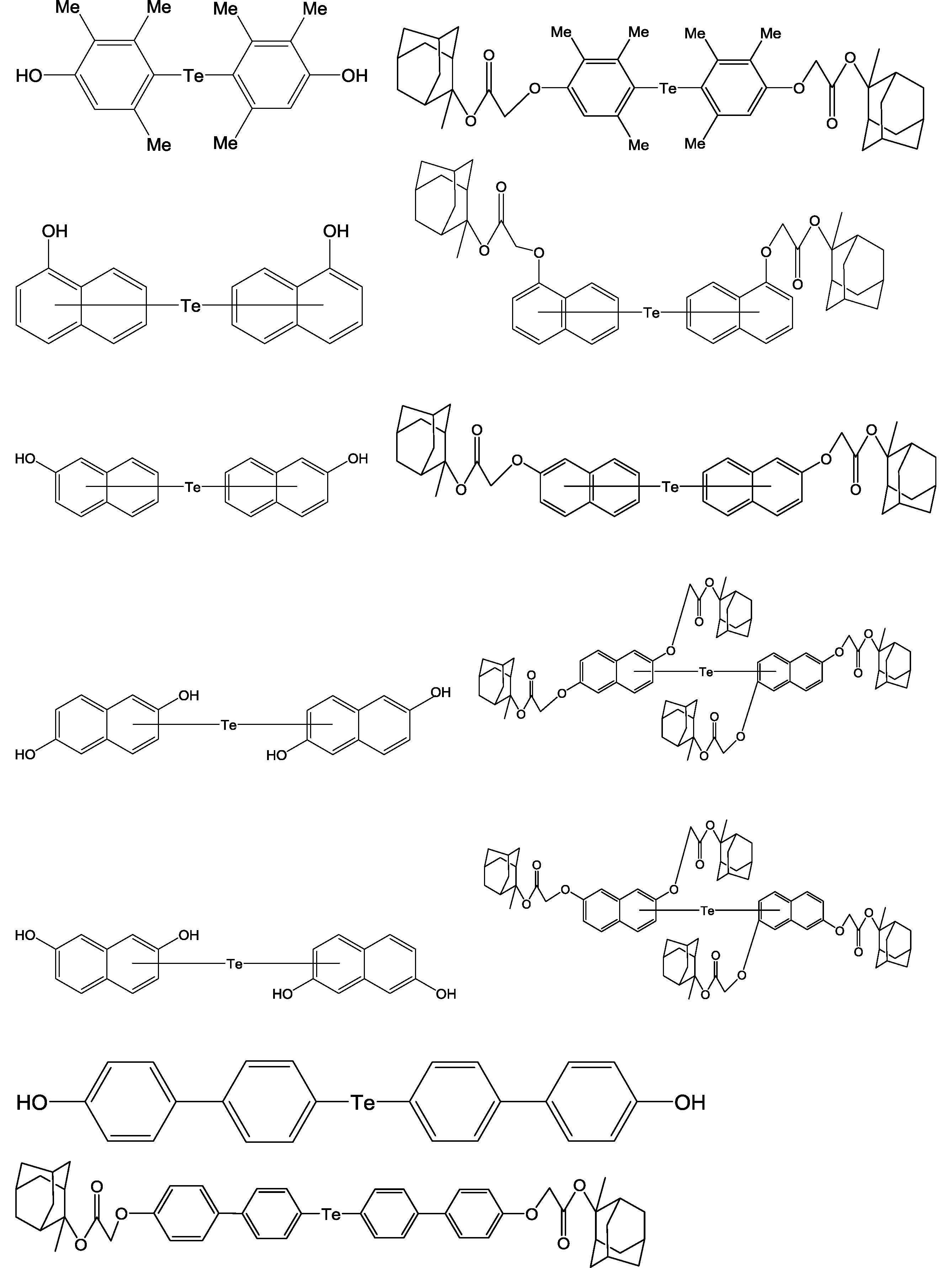


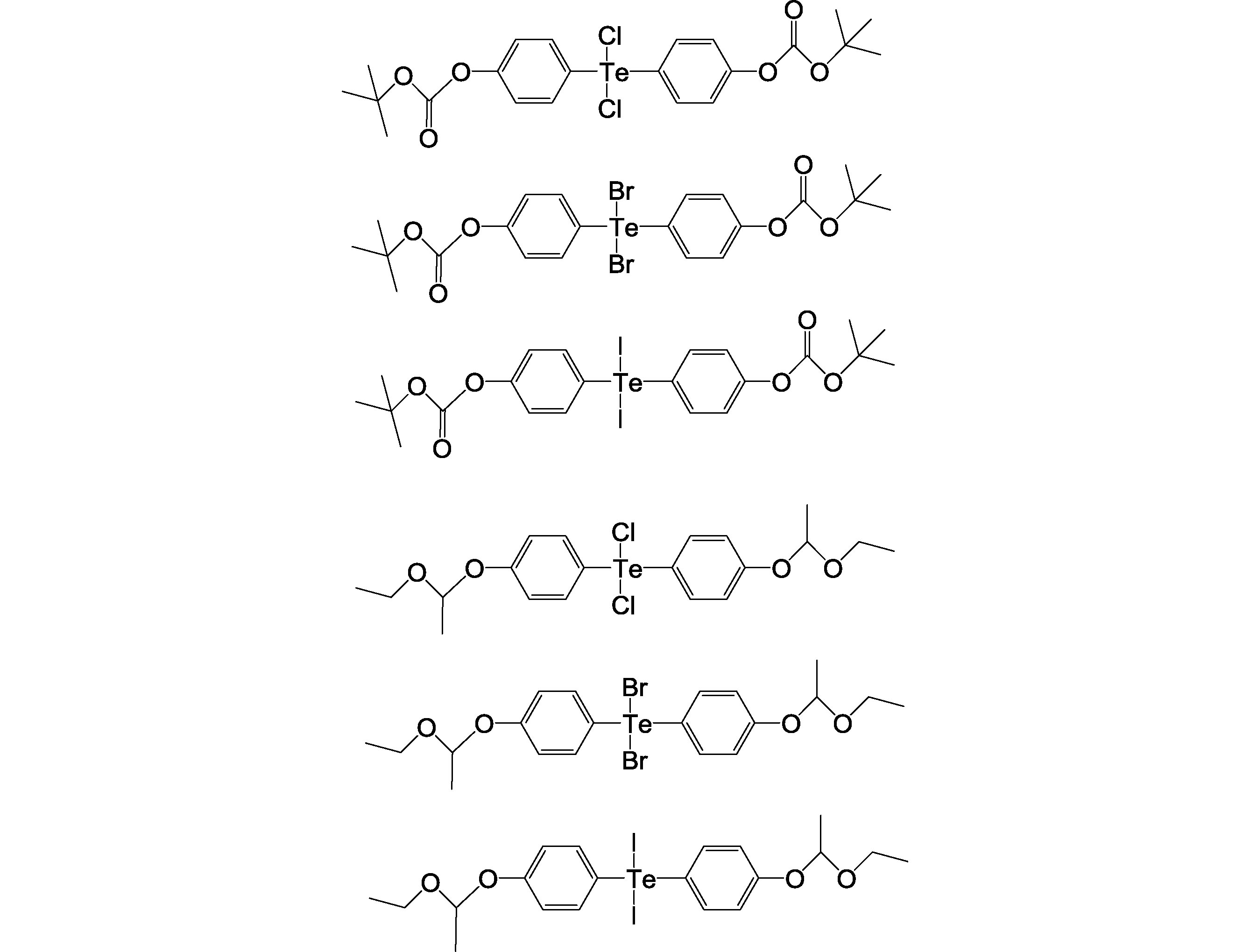
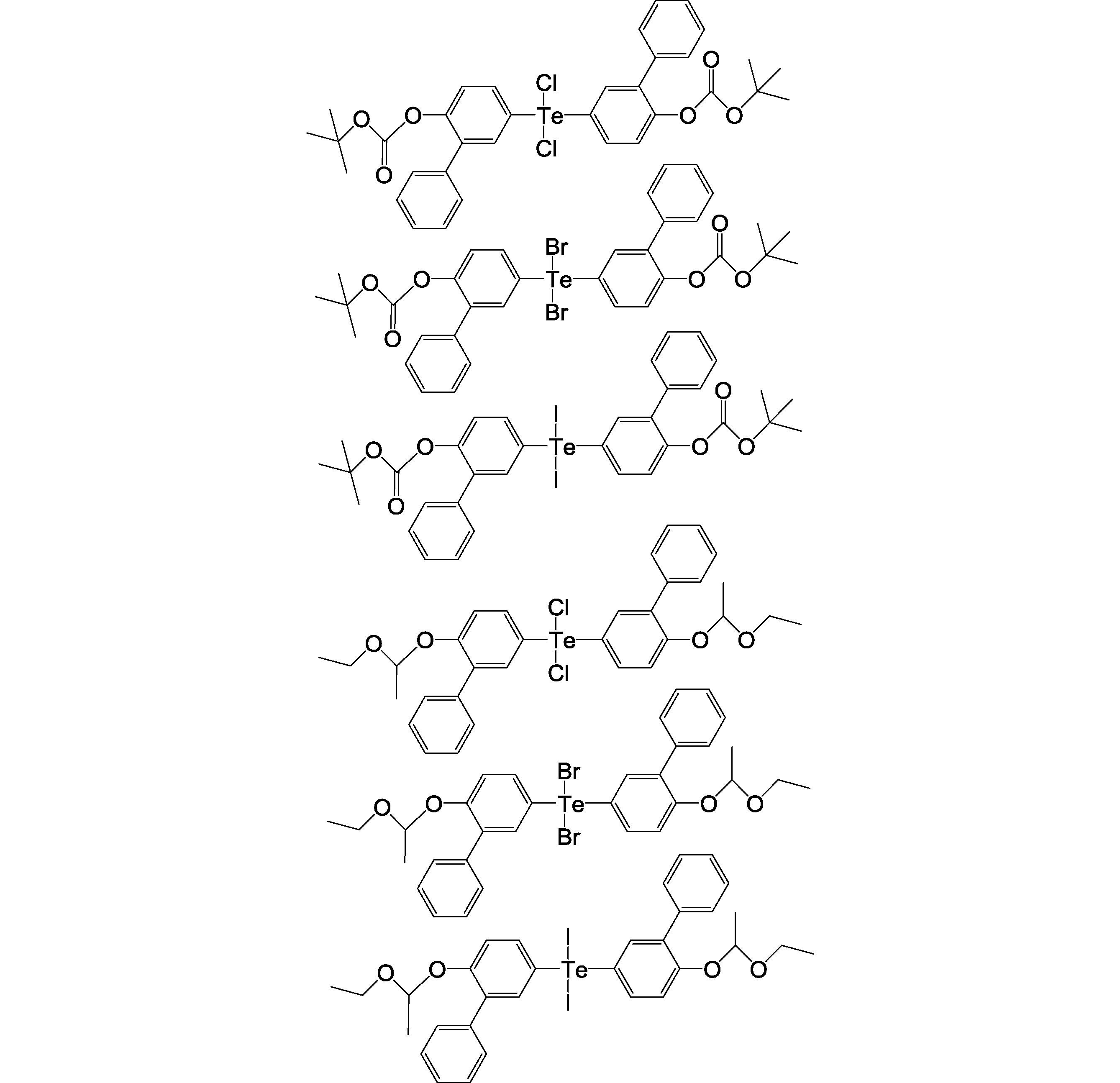
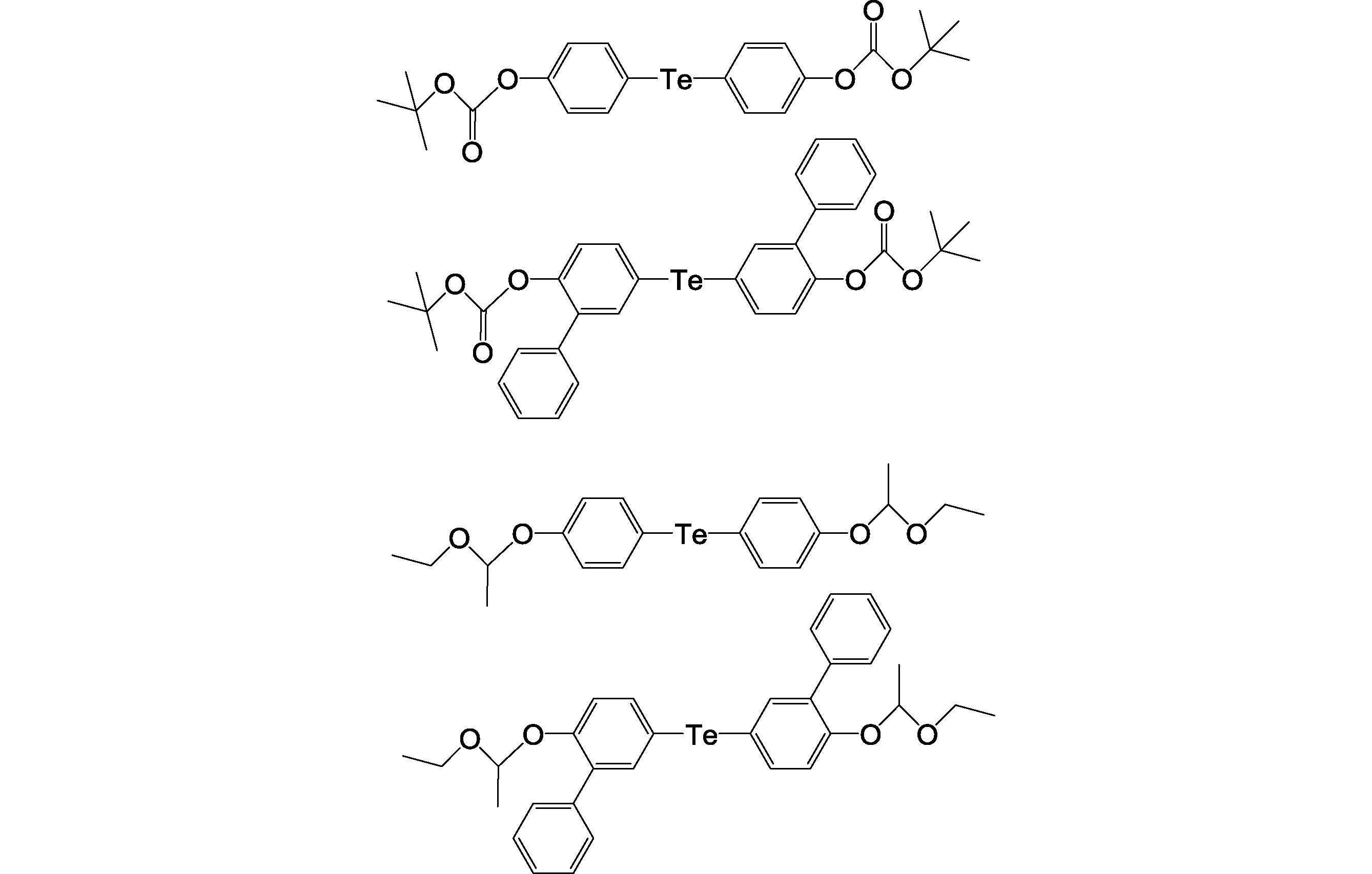


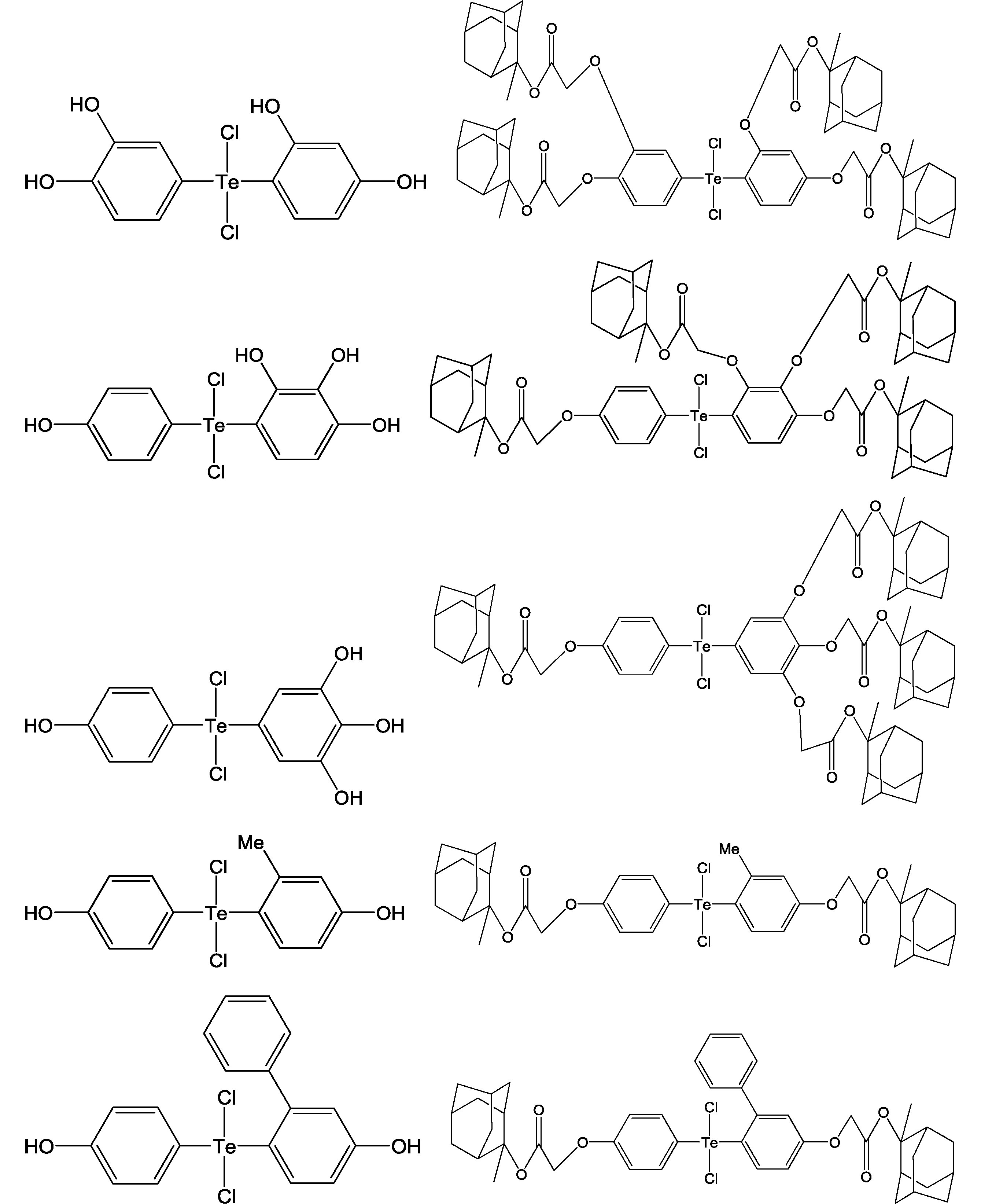


本実施形態のレジスト下層膜形成用組成物は、式(A-1)で示されるテルルを含有する化合物に代えて又はこれと共に、式(A-1)に由来する構成単位を含む樹脂を含有していてもよい。換言すると、本実施形態のレジスト下層膜形成用組成物は、式(A-1)で示される化合物をモノマーとして得られる樹脂を含有することができる。
また、本実施形態の樹脂は、例えば、式(A-1)で示される化合物と架橋反応性を有する化合物とを反応させることによって得ることができる。
架橋反応性を有する化合物としては、式(A-1)で示される化合物をオリゴマー化又はポリマー化し得るものである限り、公知のものを特に制限なく使用することができる。その具体例としては、例えば、アルデヒド、ケトン、カルボン酸、カルボン酸ハライド、ハロゲン含有化合物、アミノ化合物、イミノ化合物、イソシアネート、不飽和炭化水素基含有化合物等が挙げられるが、これらに特に限定されない。


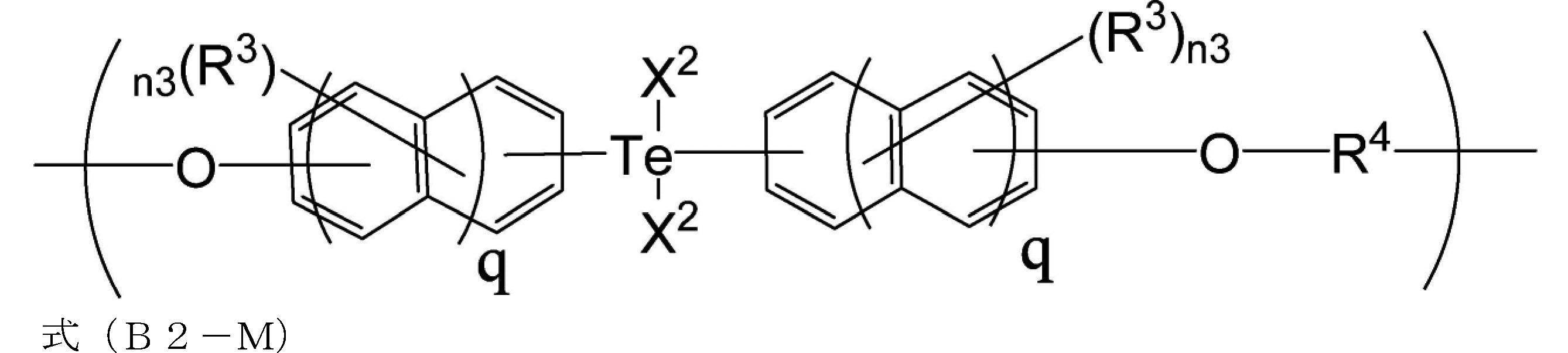

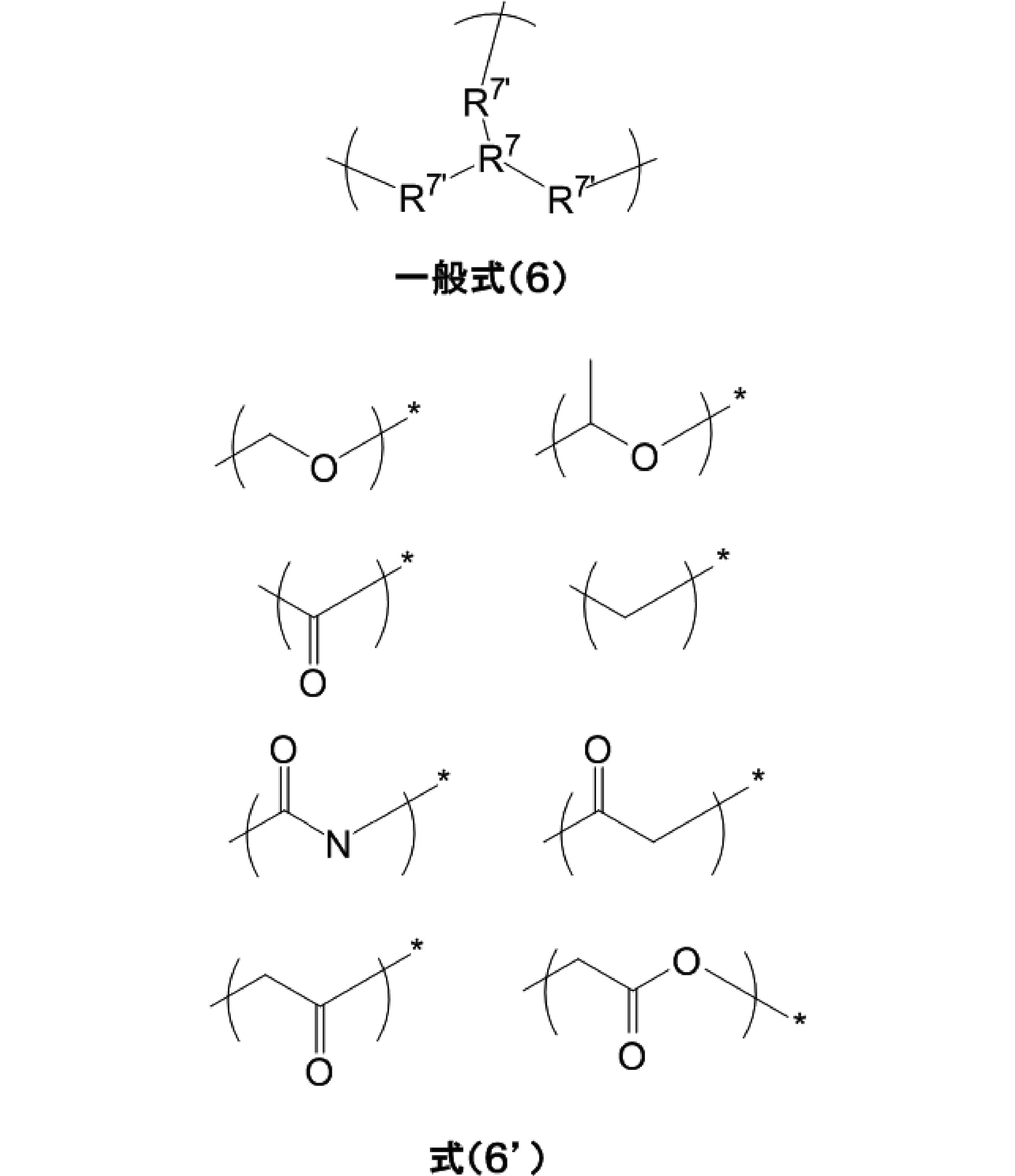

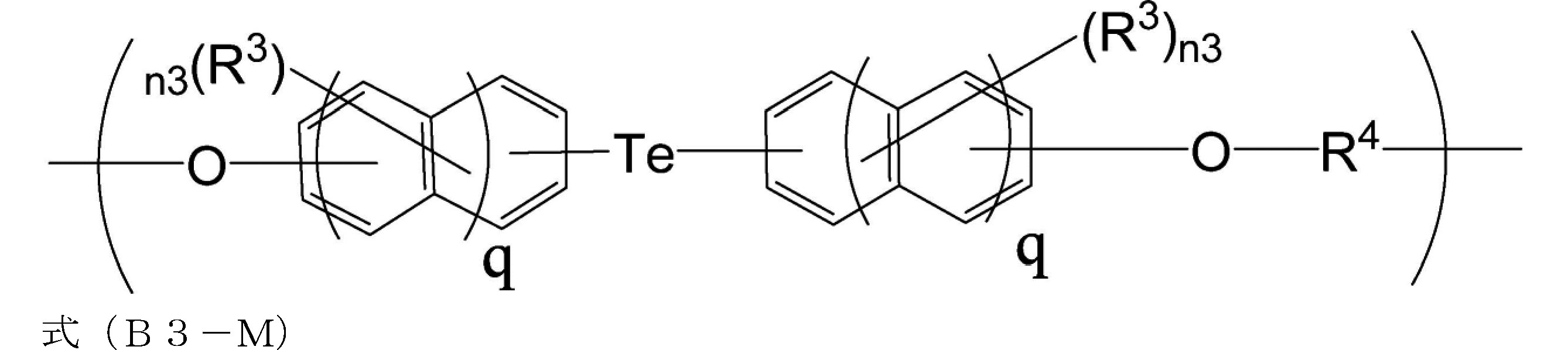


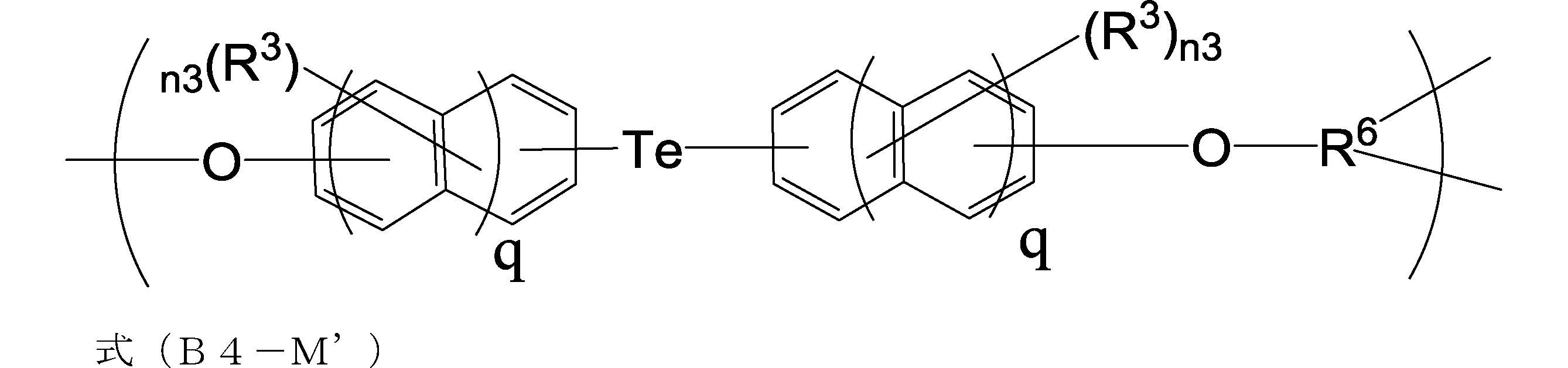


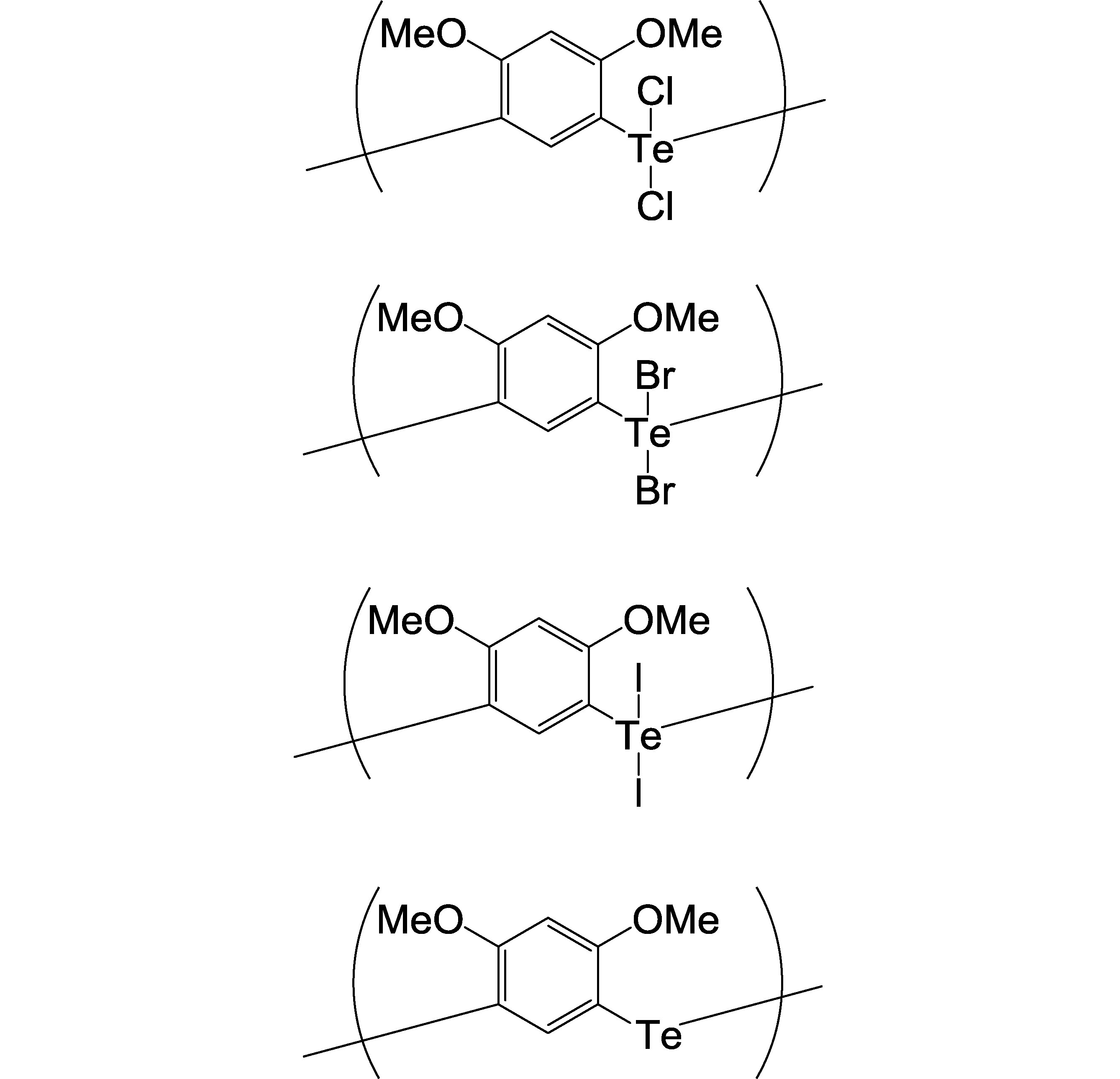
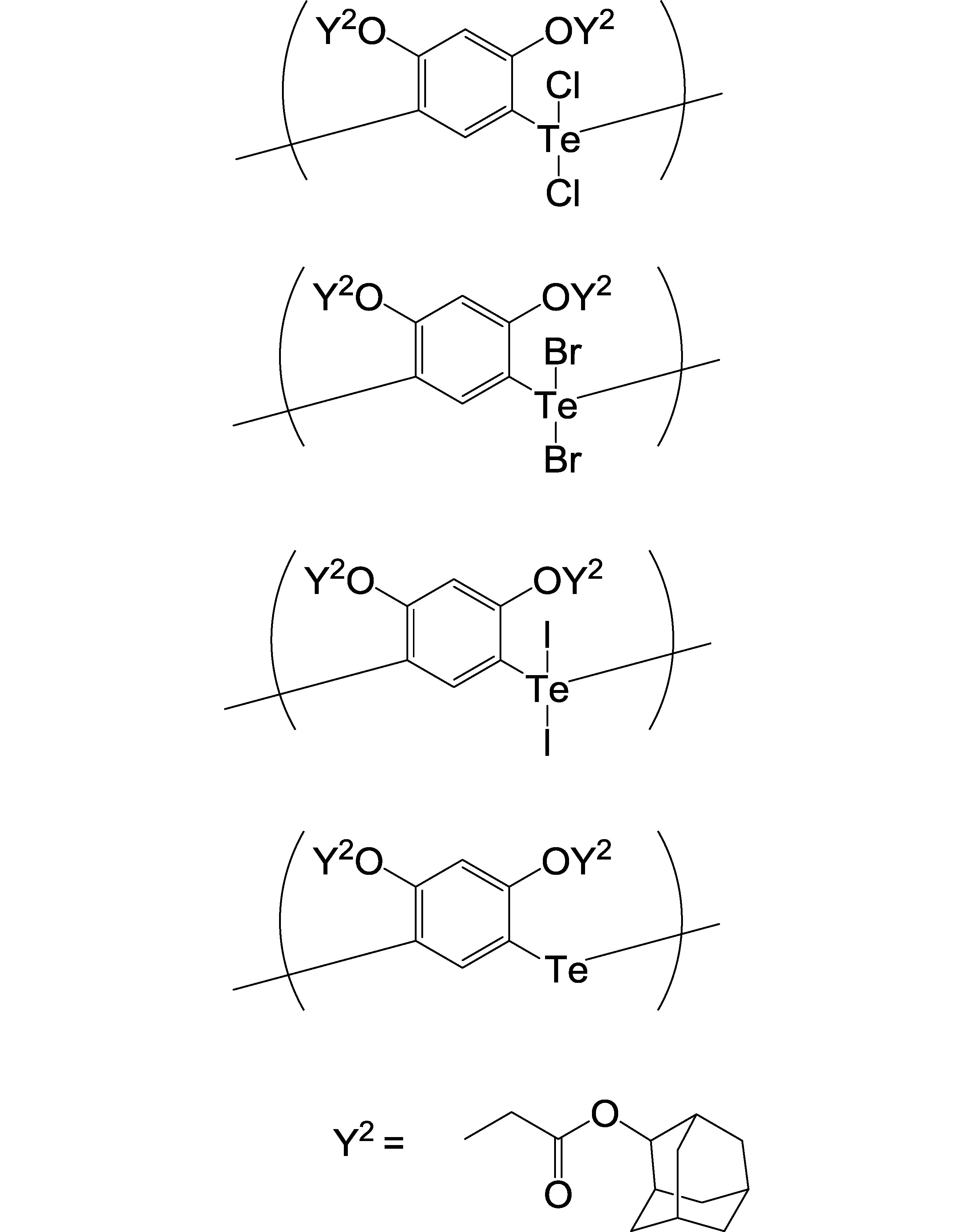

本実施形態の化合物又は樹脂は、以下の工程を含む精製方法によって精製することができる。
即ち、前記精製方法は、式(A-1)で示される化合物、又は、式(A-1)に由来する構成単位を含む樹脂を、水と任意に混和しない有機溶媒を含む溶媒に溶解させて溶液(A)を得る工程と、得られた溶液(A)と酸性の水溶液とを接触させて、前記式(A-1)で示される化合物又は前記樹脂中の不純物を抽出する第一抽出工程と、を含む。
また、本実施形態の精製方法を適用する場合、前記樹脂は、式(A-1)で示される化合物と架橋反応性を有する化合物との反応によって得られる樹脂であることが好ましい。
本実施形態の精製方法によれば、上述した特定の構造を有する化合物又は樹脂に不純物として含まれうる種々の金属の含有量を効果的に低減することができる。
これらの有機溶媒はそれぞれ単独で用いることもできるし、また2種以上を混合して用いることもできる。
具体的には、例えば、酸性の水溶液を用いて前記抽出処理を行った後に、該水溶液から抽出され、回収された式(A-1)で示される化合物及び式(A-1)で示される化合物に由来する構成単位を含む樹脂から選ばれる1種以上と有機溶媒を含む溶液相を、更に水による抽出処理に供することが好ましい。前記の水による抽出処理は、特に限定されないが、例えば、前記溶液相と水とを、撹拌等により、よく混合させたあと、得られた混合溶液を、静置することにより行うことができる。当該静置後の混合溶液は、式(A-1)で示される化合物及び式(A-1)で示される化合物に由来する構成単位を含む樹脂から選ばれる1種以上と有機溶媒とを含む溶液相と、水相とに分離するのでデカンテーション等により式(A-1)で示される化合物及び式(A-1)で示される化合物に由来する構成単位を含む樹脂から選ばれる1種以上と有機溶媒とを含む溶液相を回収することができる。
また、ここで用いられる水は、本実施形態の目的に沿って、金属含有量の少ない水、例えばイオン交換水等であることが好ましい。抽出処理は1回だけでもかまわないが、混合、静置、分離という操作を複数回繰り返して行うのも有効である。また、抽出処理における両者の使用割合や、温度、時間等の条件は特に限定されないが、先の酸性の水溶液との接触処理の場合と同様で構わない。
本実施形態においてレジスト下層膜形成用組成物は、テルルを含有する化合物又はテルルを含有する樹脂と、溶媒、酸発生剤、酸架橋剤など、を更に含むことができる。更に、任意成分として、塩基性化合物、その他、水、アルコール、及び硬化触媒等を含むことができる。
上述した式(A-1)で表される化合物及び/又は該化合物を構成単位として得られる樹脂等のテルルを含有する化合物又はテルルを含有する樹脂は、塗布性及び品質安定性の点から、レジスト下層膜形成用組成物中、0.1~70質量%であることが好ましく、0.5~50質量%であることがより好ましく、3.0~40質量%であることが特に好ましい。
本実施形態において用いる溶媒としては、上述した式(A-1)で表される化合物及び/又は該化合物を構成単位として得られる樹脂等のテルルを含有する化合物又はテルルを含有する樹脂が少なくとも溶解するものであれば、公知のものを適宜用いることができる。
上述のように本実施形態のレジスト下層膜形成用組成物は、インターミキシングを抑制する等の観点から、必要に応じて酸架橋剤を含有していてもよい。本実施形態で使用可能な酸架橋剤としては、例えば、メラミン化合物、エポキシ化合物、グアナミン化合物、グリコールウリル化合物、ウレア化合物、チオエポキシ化合物、イソシアネート化合物、アジド化合物、アルケニルエーテル基などの2重結合を含む化合物であって、メチロール基、アルコキシメチル基、アシロキシメチル基から選ばれる少なくとも一つの基を置換基(架橋性基)として有するものなどが挙げられるが、これらに特に限定されない。なお、これらの酸架橋剤は、1種を単独で、或いは2種以上を組み合わせて用いることができる。また、これらは添加剤として用いてもよい。なお、前記架橋性基を上述した式(A-1)で表される化合物を構成単位として得られる樹脂等のテルルを含有する樹脂におけるポリマー側鎖にペンダント基として導入してもよい。また、ヒドロキシ基を含む化合物も架橋剤として用いることができる。
前記酸架橋剤の具体例としては、例えば、国際公開WO2013/024779号に記載のものが挙げられる。
本実施形態のレジスト下層膜形成用組成物は、熱による架橋反応をさらに促進させるなどの観点から、必要に応じて酸発生剤を含有していてもよい。酸発生剤としては、熱分解によって酸を発生するもの、光照射によって酸を発生するものなどが知られているが、いずれのものも使用することができる。前記酸発生剤としては、例えば、国際公開WO2013/024779号に記載のものを用いることができる。
さらに、本実施形態のレジスト下層膜形成用組成物は、保存安定性を向上させる等の観点から、塩基性化合物を含有していてもよい。
塩基性化合物の具体例としては、例えば、国際公開WO2013/024779号に記載のものが挙げられる。
本実施形態のリソグラフィー用レジスト下層膜は、本実施形態のレジスト下層膜形成用組成物を用いて形成される。本実施形態において形成されたパターンは、例えば、レジストパターンや回路パターンとして用いることができる。
(化合物の構造)
化合物の構造は、Bruker社製「Advance600II spectrometer」を用いて、以下の条件で、1H-NMR測定を行い、確認した。
周波数:400MHz
溶媒:d6-DMSO
内部標準:TMS
測定温度:23℃
(分子量)
LC-MS分析により、Water社製「Acquity UPLC/MALDI-Synapt HDMS」を用いて測定した。
ゲル浸透クロマトグラフィー(GPC)分析により、ポリスチレン換算の重量平均分子量(Mw)、数平均分子量(Mn)を求め、分散度(Mw/Mn)を求めた。
装置:Shodex GPC-101型(昭和電工(株)製)
カラム:KF-80M×3
溶離液:THF 1ml/min
温度:40℃
得られた化合物の安全溶媒への溶解性について、プロピレングリコールモノメチルエーテルアセテート(PGMEA)に対する溶解性を測定した。当該溶解性は、PGMEAへの溶解量を用いて以下の基準に従って評価した。なお、PGMEAに対する溶解量の測定は23℃にて、化合物を試験管に精秤し、PGMEAを所定の濃度となるよう加え、超音波洗浄機にて30分間超音波をかけ、その後の液の状態を目視にて観察し、完全に溶解した溶解量の濃度を基準として評価した。
〈基準〉
A:5.0質量%≦溶解量
B:3.0質量%≦溶解量<5.0質量%
C: 溶解量<3.0質量%
グローブボックス中で、50mL容器に四塩化テルル(5.39g、20mmol)を仕込み、アニソール10.8g(100mmol)を加え還流条件下で160℃、6時間反応を行った。得られた生成物を減圧乾燥し、アセトニトリルを用いて再結晶を二回行い、濾過後橙色結晶を得た。得られた結晶を24時間減圧乾燥し、BMPT(ビス(4-メトキシフェニル)テルルジクロライド)を5.95g得た。
得られた化合物(BMPT)について、上述の測定方法(LC-MS)によって分子量を測定した結果、414であった。
δ(ppm)7.0~7.9(8H,Ph-H)、3.8(6H,-CH3)

得られた化合物(BHPT)について、上述の測定方法(LC-MS)によって分子量を測定した結果、386であった。
得られた化合物(BHPT)について、上述の測定条件で、NMR測定を行ったところ、以下のピークが見出され、下記で示される化合物(BHPT)の化学構造を有することを確認した。
δ(ppm)10.2(2H,-OH)、6.8~7.8(8H,Ph-H)

攪拌機、冷却管及びビュレットを備えた内容積200mLの容器において、上述から得られた化合物(BHPT)3.9g(10mmol)、炭酸カリウム0.30g(22mmol)、テトラブチルアンモニウムブロマイド0.64g(2mmol)を、N-メチルピロリドン50mlに溶解させ、2時間撹拌した。撹拌後、更にブロモ酢酸-2-メチルアダマンタン-2-イル6.3g(22mmol)を加え、100℃にて24時間反応させた。反応終了後、1N塩酸水溶液に滴下し、生じた黒色固体をろ別し、カラムクロマトグラフィーによる分離精製を行うことで、下記化合物(BHPT-ADBAC:ビス(4-(2-メチル-2-アダマンチルオキシカルボニルメトキシ)フェニル)テルル ジクロライド)を1.9g得た。
得られた化合物(BHPT-ADBAC)について、上述の測定方法(LC-MS)によって分子量を測定した結果、798であった。
得られた化合物(BHPT-ADBAC)について、上述の測定条件で、NMR測定を行ったところ、以下のピークが見出され、下記で示される化合物(BHPT-ADBAC)の化学構造を有することを確認した。
δ(ppm)6.8~8.1(8H,Ph-H)、4.7~5.0(4H,O-CH2-C(=O)-)、1.2~2.7(34H,C-H/Adamantane of methylene and methine)

攪拌機、冷却管及びビュレットを備えた内容積200mLの容器において、上述から得られた化合物(BHPT)3.9g(10mmol)とジ-t-ブチルジカーボネート(アルドリッチ社製)5.5g(25mmol)とを、N-メチルピロリドン50mlに溶解させ、炭酸カリウム0.30g(22mmol)を加えて、100℃にて24時間反応させた。反応終了後、1N塩酸水溶液に滴下し、生じた黒色固体をろ別し、カラムクロマトグラフィーによる分離精製を行うことで、下記化合物(BHPT-BOC:ビス(tert-ブトキシカルボキシフェニル)テルル ジクロライド)を1.0g得た。
得られた化合物(BHPT-BOC)について、上述の測定方法(LC-MS)によって分子量を測定した結果、585であった。
得られた化合物(BHPT-BOC)について、上述の測定条件で、NMR測定を行ったところ、以下のピークが見出され、下記で示される化合物(BHPT-BOC)の化学構造を有することを確認した。
δ(ppm)7.1~7.3(8H,Ph-H)、1.4(18H,C-CH 3)
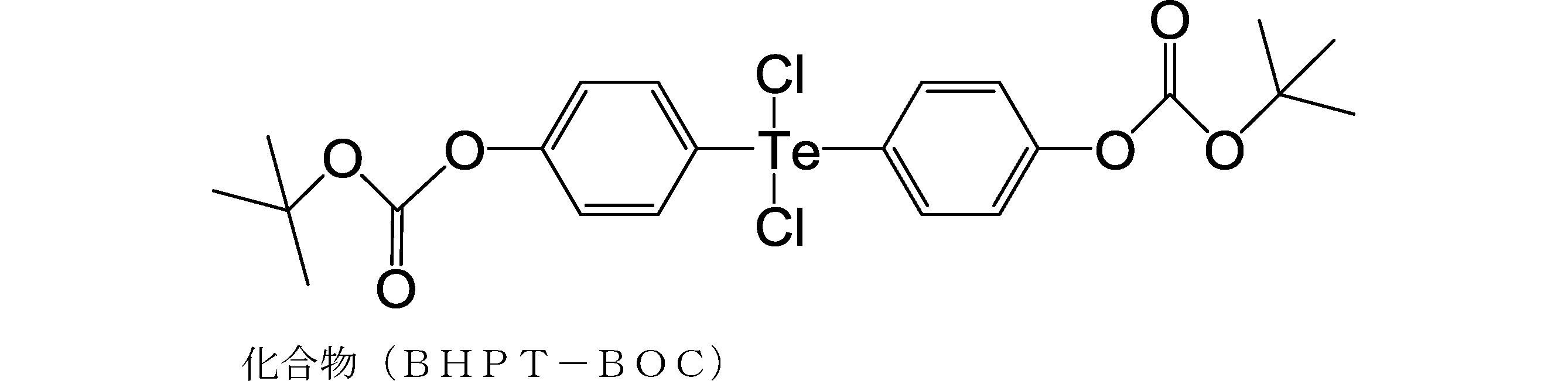
攪拌機、冷却管及びビュレットを備えた内容積200mLの容器において、上述から得られた化合物(BHPT)3.9g(10mmol)とエチルビニルエーテル(東京化成工業社製)1.8g(25mmol)とを、N-メチルピロリドン50mlに溶解させ、炭酸カリウム0.30g(22mmol)を加えて、100℃にて24時間反応させた。反応終了後、1N塩酸水溶液に滴下し、生じた黒色固体をろ別し、カラムクロマトグラフィーによる分離精製を行うことで、下記化合物(BHPT-EE:ビス(エトキシエチルフェニル)テルル ジクロライド)を1.0g得た。
得られた化合物(BHPT-EE)について、上述の測定方法(LC-MS)によって分子量を測定した結果、529であった。
得られた化合物(BHPT-EE)について、上述の測定条件で、NMR測定を行ったところ、以下のピークが見出され、下記で示される化合物(BHPT-EE)の化学構造を有することを確認した。
δ(ppm)6.9~7.4(8H,Ph-H)、5.6(2H,CH)、1.6(6H,-CH 3)、3.9(4H,O-CH 2-)、1.2(6H,-CH 3)
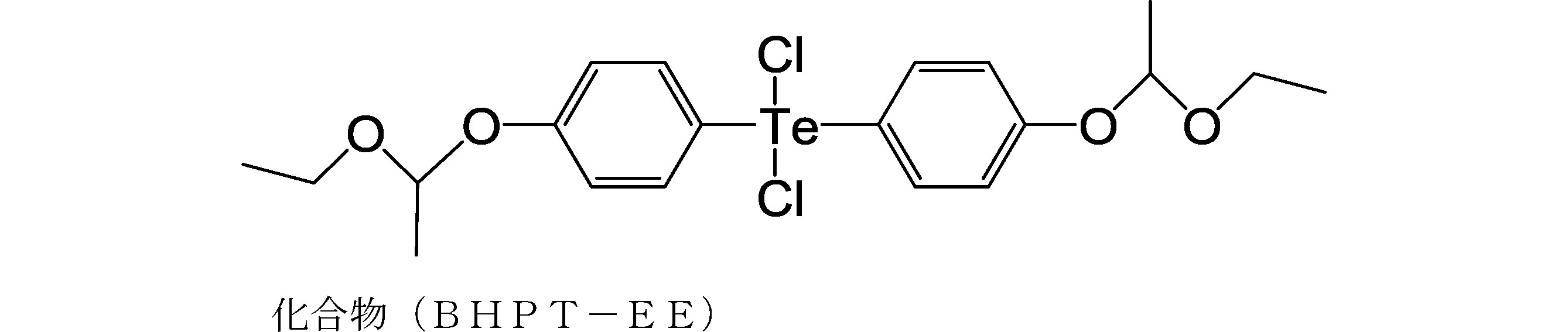
グローブボックス中で、50mL容器に四塩化テルル(5.39g、20mmol)を仕込み、2-フェニルアニソール7.37g(40mmol)を加え還流条件下で160℃、6時間反応を行った。得られた生成物を減圧乾燥し、アセトニトリルを用いて再結晶を二回行い、濾過後橙色結晶を得た。得られた結晶を24時間減圧乾燥し、Ph-BMPT(ビス(3-フェニル4-メトキシフェニル)テルルジクロライド)を3.91g得た。
得られた化合物(Ph-BMPT)について、上述の測定方法(LC-MS)によって分子量を測定した結果、465であった。
δ(ppm)7.0~8.1(16H,Ph-H)、3.8(6H,-CH3)

得られた化合物(Ph-BHPT)について、上述の測定方法(LC-MS)によって分子量を測定した結果、537であった。
得られた化合物(Ph-BHPT)について、上述の測定条件で、NMR測定を行ったところ、以下のピークが見出され、下記で示される化合物(Ph-BHPT)の化学構造を有することを確認した。
δ(ppm)9.0(2H,-OH)、7.0~7.5(16H,Ph-H)
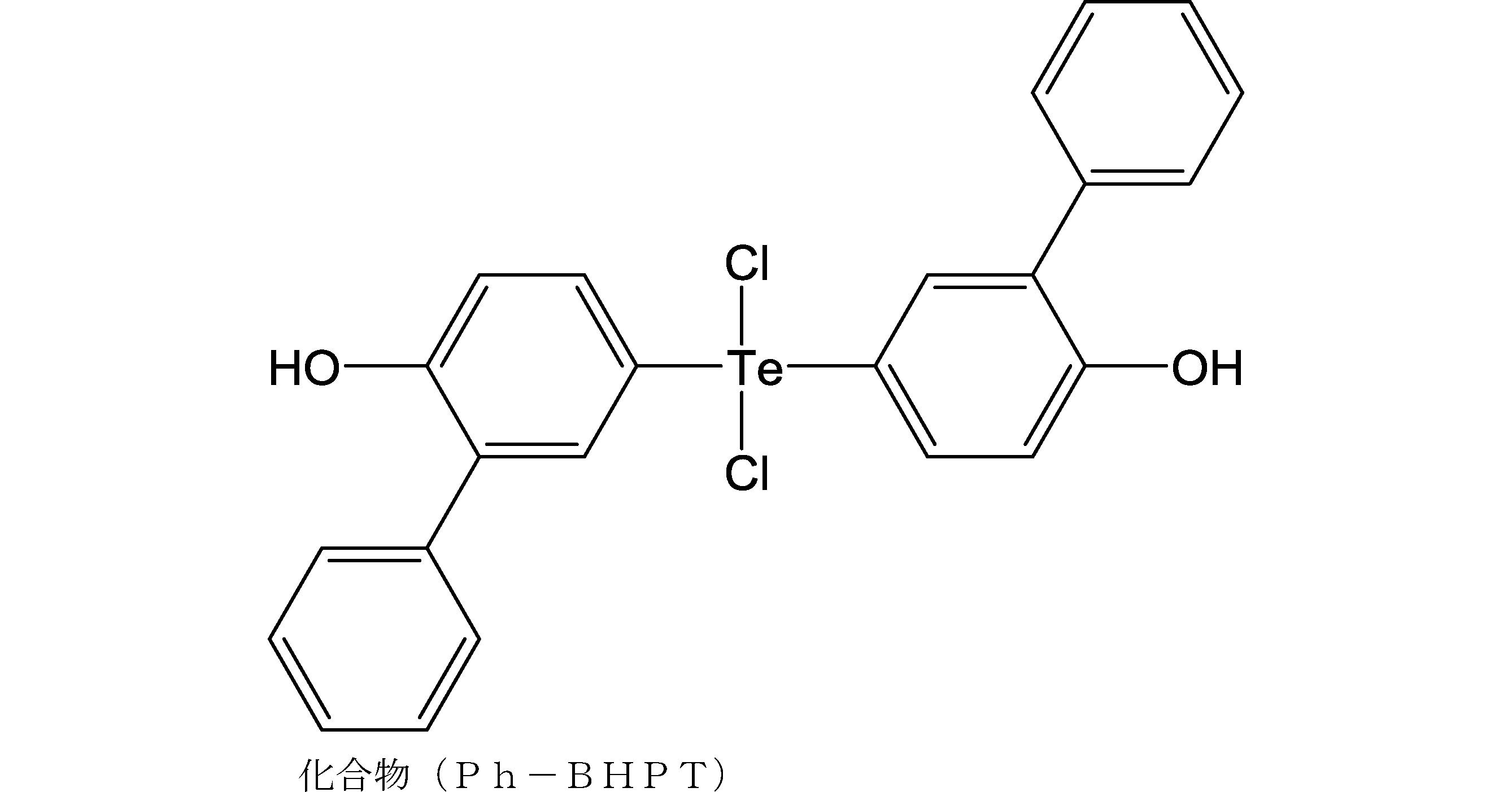
グローブボックス中で、50mL容器に四塩化テルル(6.74g、25mmol)を仕込み、フェノール3.29g(35mmol)を加え還流条件下で160℃、6時間反応を行った。得られた生成物を減圧乾燥し、アセトニトリルを用いて再結晶を二回行い、濾過後かっ色結晶を得た。得られた結晶を24時間減圧乾燥し、TDP(4,4'-テルルジフェノール)を3.60g得た。
得られた化合物(TDP)について、上述の測定方法(LC-MS)によって分子量を測定した結果、314であった。
δ(ppm)6.8~7.7(8H,Ph-H)、9.8(2H,-OH)

グローブボックス中で、50mL容器に四塩化テルル(6.74g、25mmol)を仕込み、2-フェノール6.96g(35mmol)を加え還流条件下で160℃、6時間反応を行った。得られた生成物を減圧乾燥し、アセトニトリルを用いて再結晶を二回行い、濾過後かっ色結晶を得た。得られた結晶を24時間減圧乾燥し、Ph-TDP(ビス(3-フェニル4-ヒドロキシフェニル)テルル)を2.46g得た。
得られた化合物(Ph-TDP)について、上述の測定方法(LC-MS)によって分子量を測定した結果、466であった。
δ(ppm)6.8~7.7(16H,Ph-H)、9.8(2H,-OH)
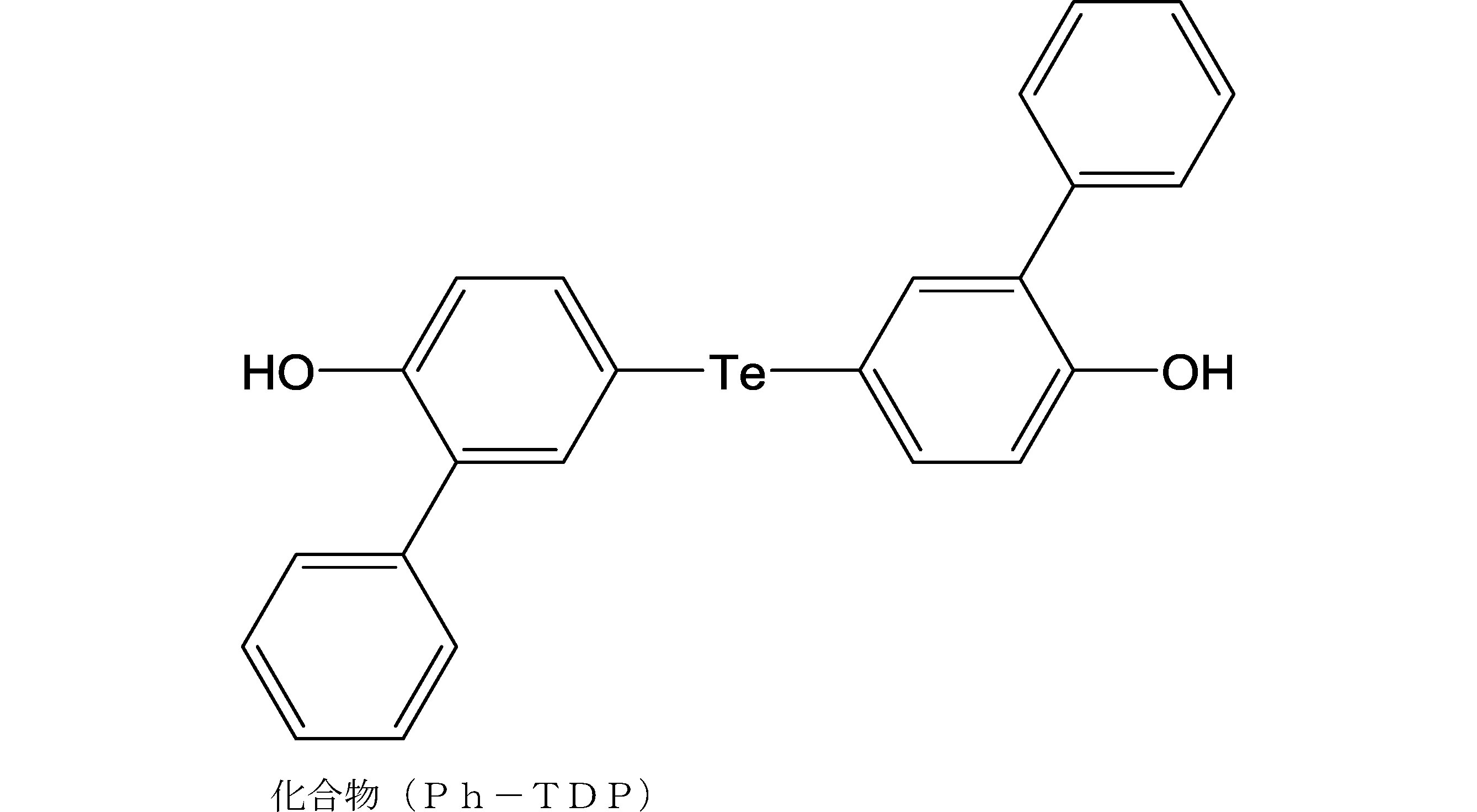
化合物(BHPT)3.9g(10mmol)に代えて化合物(Ph-BHPT)5.4g(10mmol)を用いること以外は、製造例2と同様に操作することにより、下記で示される構造を有する化合物(Ph-BHPT-ADBAC)が1.28g得られた。
得られた化合物(Ph-BHPT-ADBAC)について、上述の測定方法(LC-MS)によって分子量を測定した結果、537であった。
得られた化合物(Ph-BHPT-ADBAC)について、上述の測定条件で、NMR測定を行ったところ、以下のピークが見出され、下記で示される化合物(BHPT-ADBAC)の化学構造を有することを確認した。
δ(ppm)7.1~7.7(16H,Ph-H)、5.0(4H,O-CH2-C(=O)-)、1.0~2.6(34H,C-H/Adamantane of methylene and methine)

化合物(BHPT)3.9g(10mmol)に代えて化合物(TDP)3.2g(10mmol)を用いること以外は、製造例2と同様に操作することにより、下記で示される構造を有する化合物(TDP-ADBAC)が1.46g得られた。
得られた化合物(TDP-ADBAC)について、上述の測定方法(LC-MS)によって分子量を測定した結果、726であった。
得られた化合物(TDP-ADBAC)について、上述の測定条件で、NMR測定を行ったところ、以下のピークが見出され、下記で示される化合物(TDP-ADBAC)の化学構造を有することを確認した。
δ(ppm)7.0~7.4(8H,Ph-H)、5.0(4H,O-CH2-C(=O)-)、1.0~2.6(34H,C-H/Adamantane of methylene and methine)

化合物(BHPT)3.9g(10mmol)に代えて化合物(Ph-TDP)4.7g(10mmol)を用いること以外は、製造例2と同様に操作することにより、下記で示される構造を有する化合物(Ph-TDP-ADBAC)が1.70g得られた。
得られた化合物(Ph-TDP-ADBAC)について、上述の測定方法(LC-MS)によって分子量を測定した結果、879であった。
得られた化合物(Ph-TDP-ADBAC)について、上述の測定条件で、NMR測定を行ったところ、以下のピークが見出され、下記で示される化合物(Ph-TDP-ADBAC)の化学構造を有することを確認した。
δ(ppm)7.1~7.7(16H,Ph-H)、5.0(4H,O-CH2-C(=O)-)、1.0~2.6(34H,C-H/Adamantane of methylene and methine)
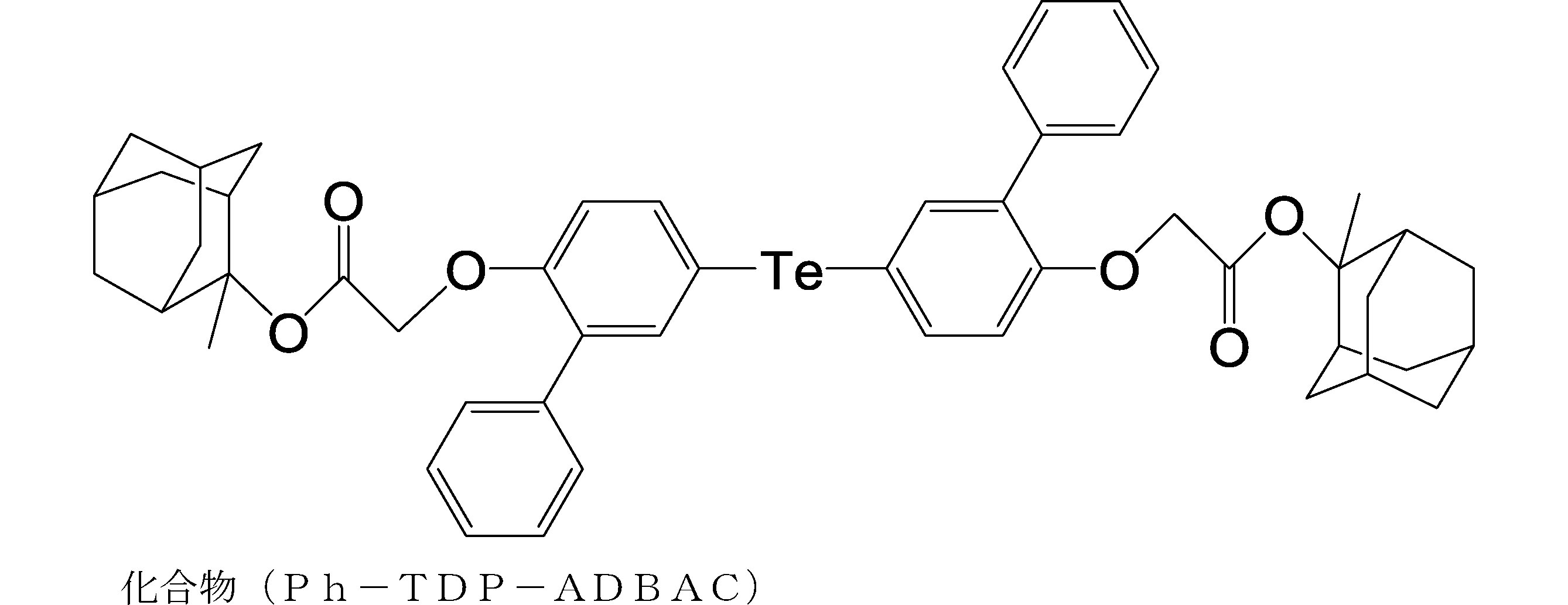
化合物(BHPT)3.9g(10mmol)に代えて化合物(Ph-TDP)4.7g(10mmol)を用いること以外は、製造例3と同様に操作することにより、下記で示される構造を有する化合物(Ph-TDP-BOC)が1.14g得られた。
得られた化合物(Ph-TDP-BOC)について、上述の測定方法(LC-MS)によって分子量を測定した結果、666であった。
得られた化合物(Ph-TDP-BOC)について、上述の測定条件で、NMR測定を行ったところ、以下のピークが見出され、下記で示される化合物(Ph-TDP-BOC)の化学構造を有することを確認した。
δ(ppm)7.3~7.7(8H,Ph-H)、1.4(18H,C-CH 3)

化合物(BHPT)3.9g(10mmol)に代えて化合物(Ph-TDP)4.7g(10mmol)を用いること以外は、製造例4と同様に操作することにより、下記で示される構造を有する化合物(Ph-TDP-EE)が1.16g得られた。
得られた化合物(Ph-TDP-EE)について、上述の測定方法(LC-MS)によって分子量を測定した結果、610であった。
得られた化合物(Ph-TDP-EE)について、上述の測定条件で、NMR測定を行ったところ、以下のピークが見出され、下記で示される化合物(Ph-TDP-EE)の化学構造を有することを確認した。
δ(ppm)7.1~7.7(16H,Ph-H)、5.6(2H,CH)、1.6(6H,-CH 3)、3.9(4H,O-CH 2-)、1.2(6H,-CH 3)

攪拌機、冷却管及びビュレットを備えた内容積100mlの容器に、化合物(BHPT)8.1g(21mmol)と、パラホルムアルデヒド0.7g(42mmol)、氷酢酸50mlとPGME50mlとを仕込み、95%の硫酸8mlを加えて、反応液を100℃で6時間撹拌して反応を行った。次に、反応液を濃縮し、メタノール1000mlを加えて反応生成物を析出させ、室温まで冷却した後、濾過を行って分離した。得られた固形物を濾過し、乾燥させた後、カラムクロマトによる分離精製を行うことにより、下記式で示される構造を有する目的樹脂(R1-BHPT)5.6gを得た。
得られた樹脂(R1-BHPT)について、上述の方法によりポリスチレン換算分子量を測定した結果、Mn:587、Mw:1216、Mw/Mn:2.07であった。
得られた樹脂(R1-BHPT)について、前記測定条件でNMR測定を行ったところ、以下のピークが見出され、下記式(R1-BHPT)の化学構造を有することを確認した。
δ(ppm)10.2(2H,-OH)、6.8~7.8(8H,Ph-H)、4.1(2H,-CH2)

パラホルムアルデヒド 0.7g(42mmol)に代えて4-ビフェニルカルボキシアルデヒド(三菱瓦斯化学社製)7.6g(42mmol)用いること以外は、製造例13と同様に操作することにより、下記式で示される構造を有する目的樹脂(R2-BHPT)を5.7g得た。
得られた樹脂(R2-BHPT)について、上述の方法によりポリスチレン換算分子量を測定した結果、Mn:405、Mw:880、Mw/Mn:2.17であった。
得られた樹脂(R2-BHPT)について、前記測定条件でNMR測定を行ったところ、以下のピークが見出され、下記式(R2-BHPT)の化学構造を有することを確認した。
δ(ppm)10.2(2H,-OH)、6.8~7.8(17H,Ph-H)、4.5(1H,-CH)

化合物(BHPT) 8.1g(21mmol)に代えて化合物樹脂(BHPT-ADBAC)16.8gを用いること以外は製造例13と同様に操作することにより、下記式で示される構造を有する目的化合物樹脂(R1-BHPT-ADBAC)を5.0g得た。
得られた樹脂(R1-BHPT-ADBAC)について、上述の方法によりポリスチレン換算分子量を測定した結果、Mn:1045、Mw:2330、Mw/Mn:2.23であった。
得られた化合物樹脂(R1-BHPT-ADBAC)について、前記測定条件で、NMR測定を行ったところ、以下のピークが見出され、下記式(R1-BHPT-ADBAC)の化学構造を有することを確認した。
δ(ppm)6.8~8.1(8H,Ph-H)、4.7~5.0(4H,O-CH2-C(=O)-)、1.2~2.7(34H,C-H/Adamantane of methylene and methine)、4.1(2H,-CH2)
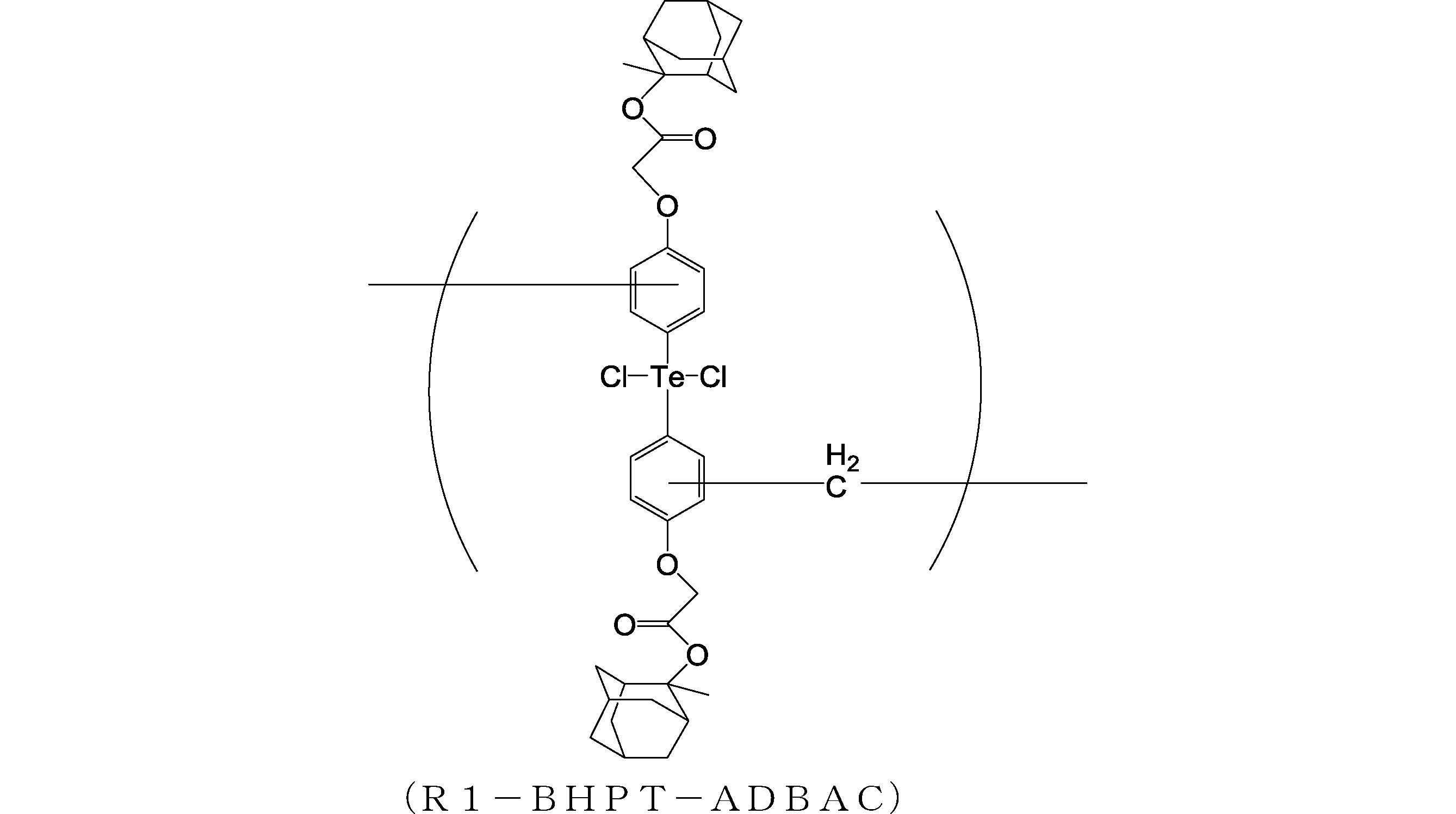
パラホルムアルデヒド 0.7g(42mmol)に代えて4-ビフェニルカルボキシアルデヒド(三菱瓦斯化学社製)7.6g(42mmol)用いること以外は、製造例15と同様に操作することにより、下記式で示される構造を有する目的樹脂(R2-BHPT-ADBAC)を10.4g得た。
得られた樹脂(R2-BHPT-ADBAC)について、上述の方法によりポリスチレン換算分子量を測定した結果、Mn:840、Mw:1819、Mw/Mn:2.16であった。
得られた樹脂(R2-BHPT-ADBAC)について、前記測定条件でNMR測定を行ったところ、以下のピークが見出され、下記式(R2-BHPT-ADBAC)の化学構造を有することを確認した。
δ(ppm)6.8~8.1(17H,Ph-H)、4.7~5.0(4H,O-CH2-C(=O)-)、1.2~2.7(34H,C-H/Adamantane of methylene and methine)、4.5(1H,-CH)

化合物(BHPT) 8.1g(21mmol)に代えて化合物樹脂(BHPT-BOC)12.3gを用いること以外は製造例13と同様に操作することにより、下記式で示される構造を有する目的化合物樹脂(R1-BHPT-BOC)を7.6g得た。
得られた樹脂(R1-BHPT-BOC)について、上述の方法によりポリスチレン換算分子量を測定した結果、Mn:768、Mw:1846、Mw/Mn:2.40であった。
得られた化合物樹脂(R1-BHPT-BOC)について、前記測定条件で、NMR測定を行ったところ、以下のピークが見出され、下記式(R1-BHPT-BOC)の化学構造を有することを確認した。
δ(ppm)7.1~7.3(8H,Ph-H)、1.4(18H,C-CH 3)、4.1(2H,-CH2)

パラホルムアルデヒド 0.7g(42mmol)に代えて4-ビフェニルカルボキシアルデヒド(三菱瓦斯化学社製)7.6g(42mmol)用いること以外は、製造例17と同様に操作することにより、下記式で示される構造を有する目的樹脂(R2-BHPT-BOC)を3.7g得た。
得られた樹脂(R2-BHPT-BOC)について、上述の方法によりポリスチレン換算分子量を測定した結果、Mn:620、Mw:1336、Mw/Mn:2.15であった。
得られた樹脂(R2-BHPT-BOC)について、前記測定条件でNMR測定を行ったところ、以下のピークが見出され、下記式(R2-BHPT-BOC)の化学構造を有することを確認した。
δ(ppm)7.1~7.3(17H,Ph-H)、1.4(18H,C-CH 3)、4.5(1H,-CH)

化合物(BHPT) 8.1g(21mmol)に代えて化合物樹脂(BHPT-EE)11.1gを用いること以外は製造例13と同様に操作することにより、下記式で示される構造を有する目的化合物樹脂(R1-BHPT-EE)を7.8g得た。
得られた樹脂(R1-BHPT-EE)について、上述の方法によりポリスチレン換算分子量を測定した結果、Mn:694、Mw:1548、Mw/Mn:2.23であった。
得られた化合物樹脂(R1-BHPT-EE)について、前記測定条件で、NMR測定を行ったところ、以下のピークが見出され、下記式(R1-BHPT-EE)の化学構造を有することを確認した。
δ(ppm)6.9~7.4(8H,Ph-H)、5.6(2H,CH)、1.6(6H,-CH 3)、3.9(4H,O-CH 2-)、1.2(6H,-CH 3)、4.1(2H,-CH2)
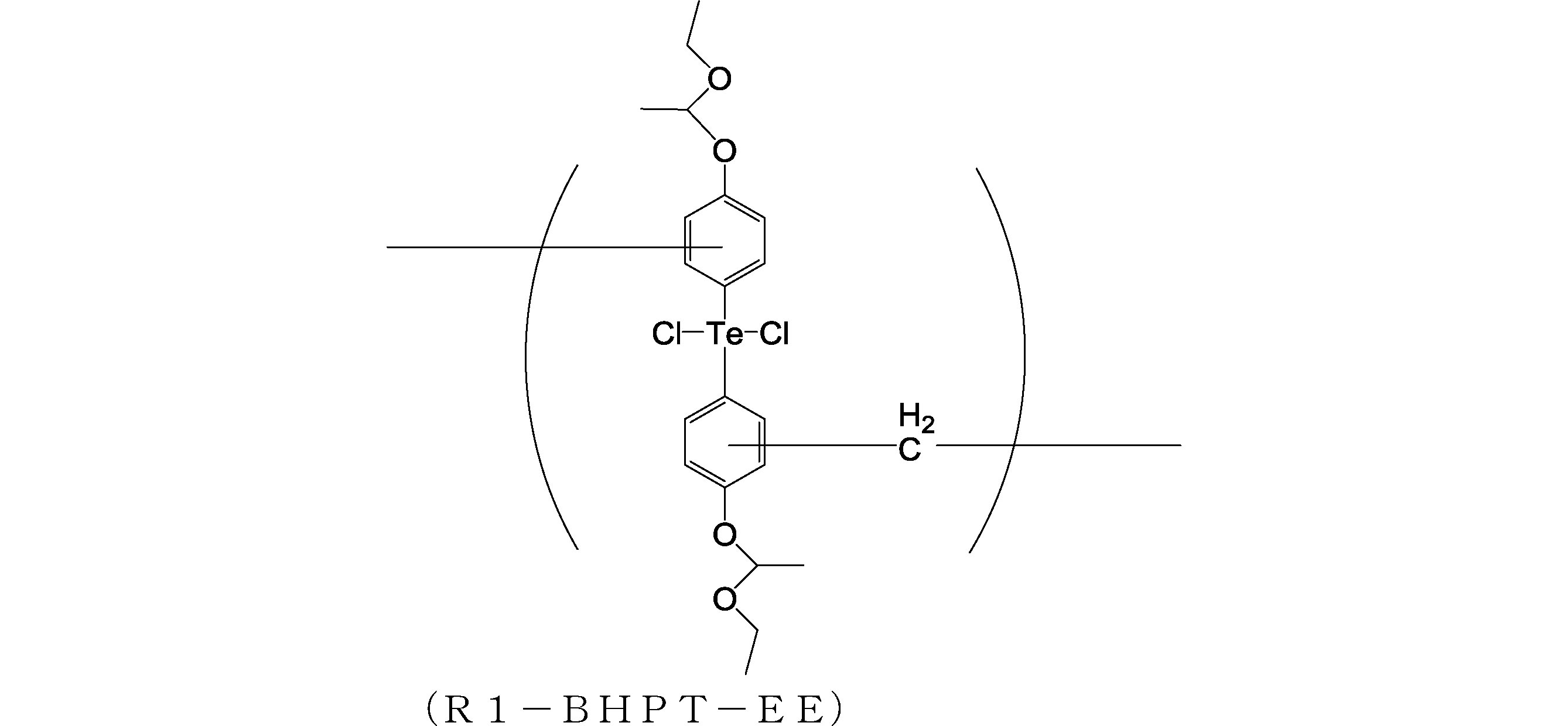
パラホルムアルデヒド 0.7g(42mmol)に代えて4-ビフェニルカルボキシアルデヒド(三菱瓦斯化学社製)7.6g(42mmol)用いること以外は、製造例19と同様に操作することにより、下記式で示される構造を有する目的樹脂(R2-BHPT-EE)を3.6g得た。
得られた樹脂(R2-BHPT-EE)について、上述の方法によりポリスチレン換算分子量を測定した結果、Mn:610、Mw:1208、Mw/Mn:1.98であった。
得られた樹脂(R2-BHPT-EE)について、前記測定条件でNMR測定を行ったところ、以下のピークが見出され、下記式(R2-BHPT-EE)の化学構造を有することを確認した。
δ(ppm)6.9~7.4(17H,Ph-H)、5.6(2H,CH)、1.6(6H,-CH 3)、3.9(4H,O-CH 2-)、1.2(6H,-CH 3)、4.5(1H,-CH)
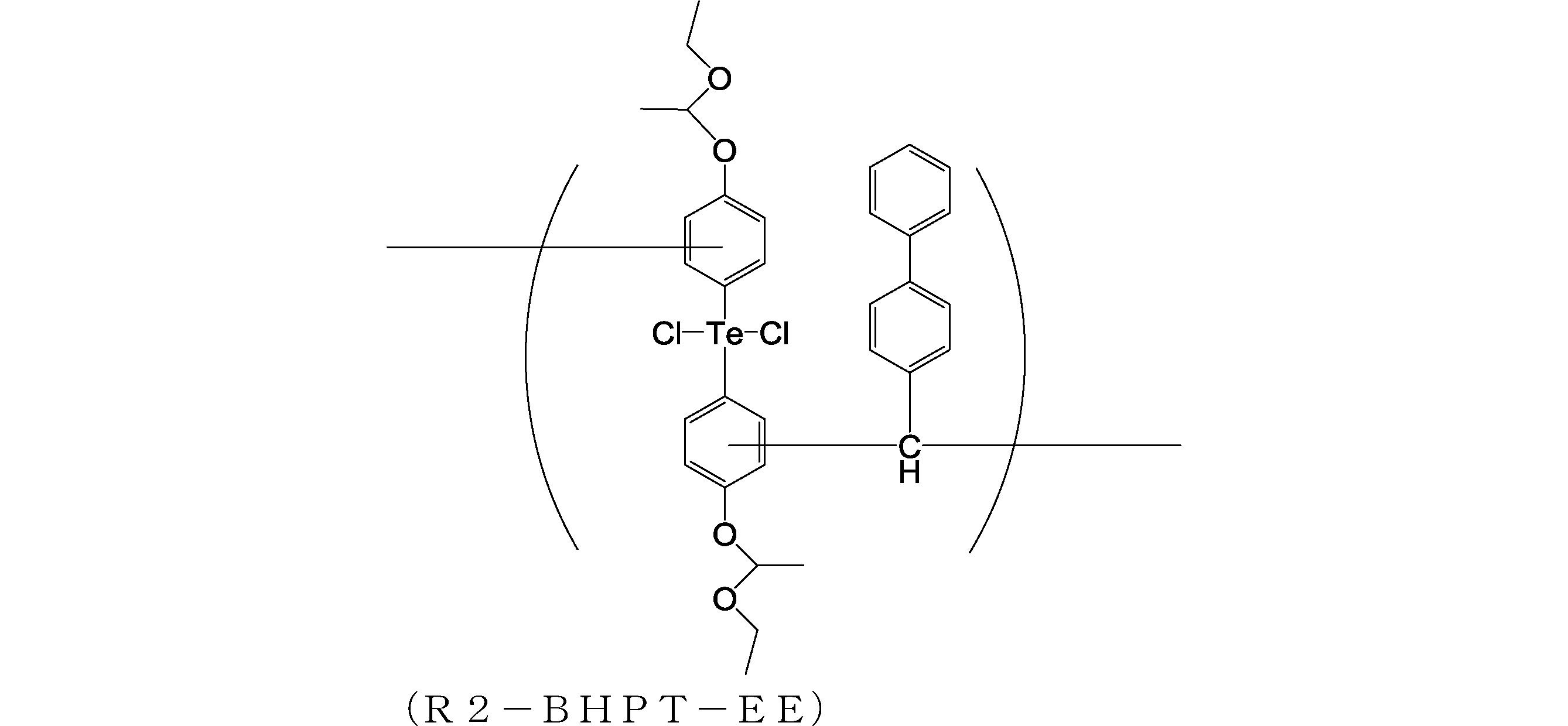
化合物(BHPT) 8.1g(21mmol)に代えて化合物(Ph-BHPT)11.3gを用いること以外は製造例13と同様に操作することにより、下記式で示される構造を有する目的化合物樹脂(R1-Ph-BHPT)を7.0g得た。
得られた樹脂(R1-Ph-BHPT)について、上述の方法によりポリスチレン換算分子量を測定した結果、Mn:764、Mw:1695、Mw/Mn:2.22であった。
得られた化合物樹脂(R1-Ph-BHPT)について、前記測定条件で、NMR測定を行ったところ、以下のピークが見出され、下記式(R1-Ph-BHPT)の化学構造を有することを確認した。
δ(ppm)9.0(2H,-OH)、7.0~7.5(16H,Ph-H)、4.1(2H,-CH2)

パラホルムアルデヒド 0.7g(42mmol)に代えて4-ビフェニルカルボキシアルデヒド(三菱瓦斯化学社製)7.6g(42mmol)用いること以外は、製造例21と同様に操作することにより、下記式で示される構造を有する目的樹脂(R2-Ph-BHPT)を3.4g得た。
得られた樹脂(R2-Ph-BHPT)について、上述の方法によりポリスチレン換算分子量を測定した結果、Mn:672、Mw:1345、Mw/Mn:2.00であった。
得られた樹脂(R2-Ph-BHPT)について、前記測定条件でNMR測定を行ったところ、以下のピークが見出され、下記式(R2-Ph-BHPT)の化学構造を有することを確認した。
δ(ppm)9.0(2H,-OH)、7.0~7.5(25H,Ph-H)、4.5(1H,-CH)
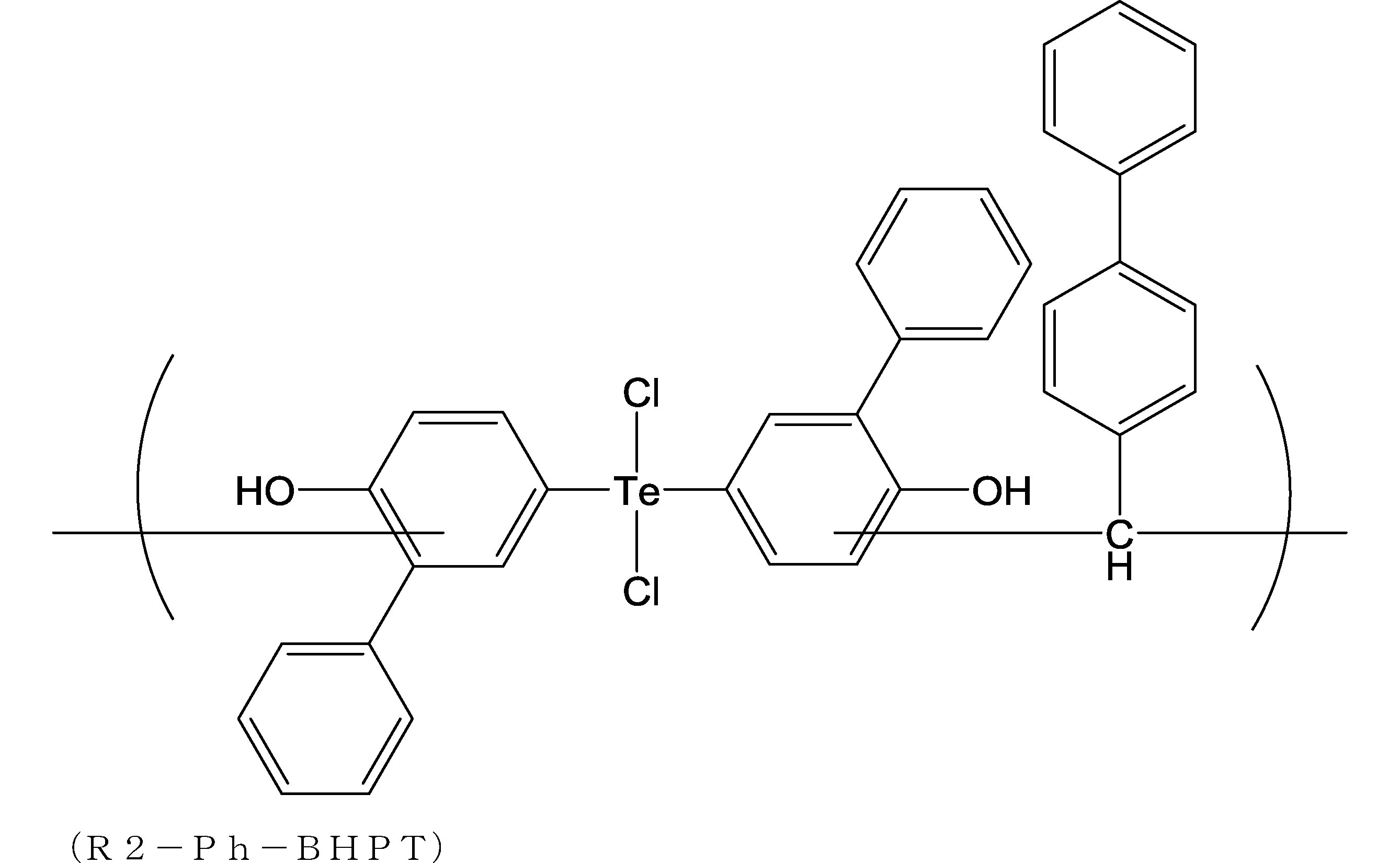
化合物(BHPT) 8.1g(21mmol)に代えて化合物(TDP)6.6gを用いること以外は製造例13と同様に操作することにより、下記式で示される構造を有する目的化合物樹脂(R1-TDP)を4.6g得た。
得られた樹脂(R1-TDP)について、上述の方法によりポリスチレン換算分子量を測定した結果、Mn:449、Mw:995、Mw/Mn:2.22であった。
得られた化合物樹脂(R1-TDP)について、前記測定条件で、NMR測定を行ったところ、以下のピークが見出され、下記式(R1-TDP)の化学構造を有することを確認した。
δ(ppm)6.8~7.7(8H,Ph-H)、9.8(2H,-OH)、4.1(2H,-CH2)

パラホルムアルデヒド 0.7g(42mmol)に代えて4-ビフェニルカルボキシアルデヒド(三菱瓦斯化学社製)7.6g(42mmol)用いること以外は、製造例23と同様に操作することにより、下記式で示される構造を有する目的樹脂(R2-TDP)を2.0g得た。
得られた樹脂(R2-TDP)について、上述の方法によりポリスチレン換算分子量を測定した結果、Mn:414、Mw:922、Mw/Mn:2.23であった。
得られた樹脂(R2-TDP)について、前記測定条件でNMR測定を行ったところ、以下のピークが見出され、下記式(R2-TDP)の化学構造を有することを確認した。
δ(ppm)6.8~7.7(17H,Ph-H)、9.8(2H,-OH)、4.5(1H,-CH)

化合物(BHPT) 8.1g(21mmol)に代えて化合物(Ph-TDP)9.8gを用いること以外は製造例13と同様に操作することにより、下記式で示される構造を有する目的化合物樹脂(R1-Ph-TDP)を6.9g得た。
得られた樹脂(R1-Ph-TDP)について、上述の方法によりポリスチレン換算分子量を測定した結果、Mn:665、Mw:1474、Mw/Mn:2.22であった。
得られた化合物樹脂(R1-Ph-TDP)について、前記測定条件で、NMR測定を行ったところ、以下のピークが見出され、下記式(R1-Ph-TDP)の化学構造を有することを確認した。
δ(ppm)6.8~7.7(16H,Ph-H)、9.8(2H,-OH)、4.1(2H,-CH2)

パラホルムアルデヒド 0.7g(42mmol)に代えて4-ビフェニルカルボキシアルデヒド(三菱瓦斯化学社製)7.6g(42mmol)用いること以外は、製造例25と同様に操作することにより、下記式で示される構造を有する目的樹脂(R2-Ph-TDP)を3.2g得た。
得られた樹脂(R2-Ph-TDP)について、上述の方法によりポリスチレン換算分子量を測定した結果、Mn:608、Mw:1395、Mw/Mn:2.29であった。
得られた樹脂(R2-Ph-TDP)について、前記測定条件でNMR測定を行ったところ、以下のピークが見出され、下記式(R2-Ph-TDP)の化学構造を有することを確認した。
δ(ppm)6.8~7.7(25H,Ph-H)、9.8(2H,-OH)、4.5(1H,-CH)
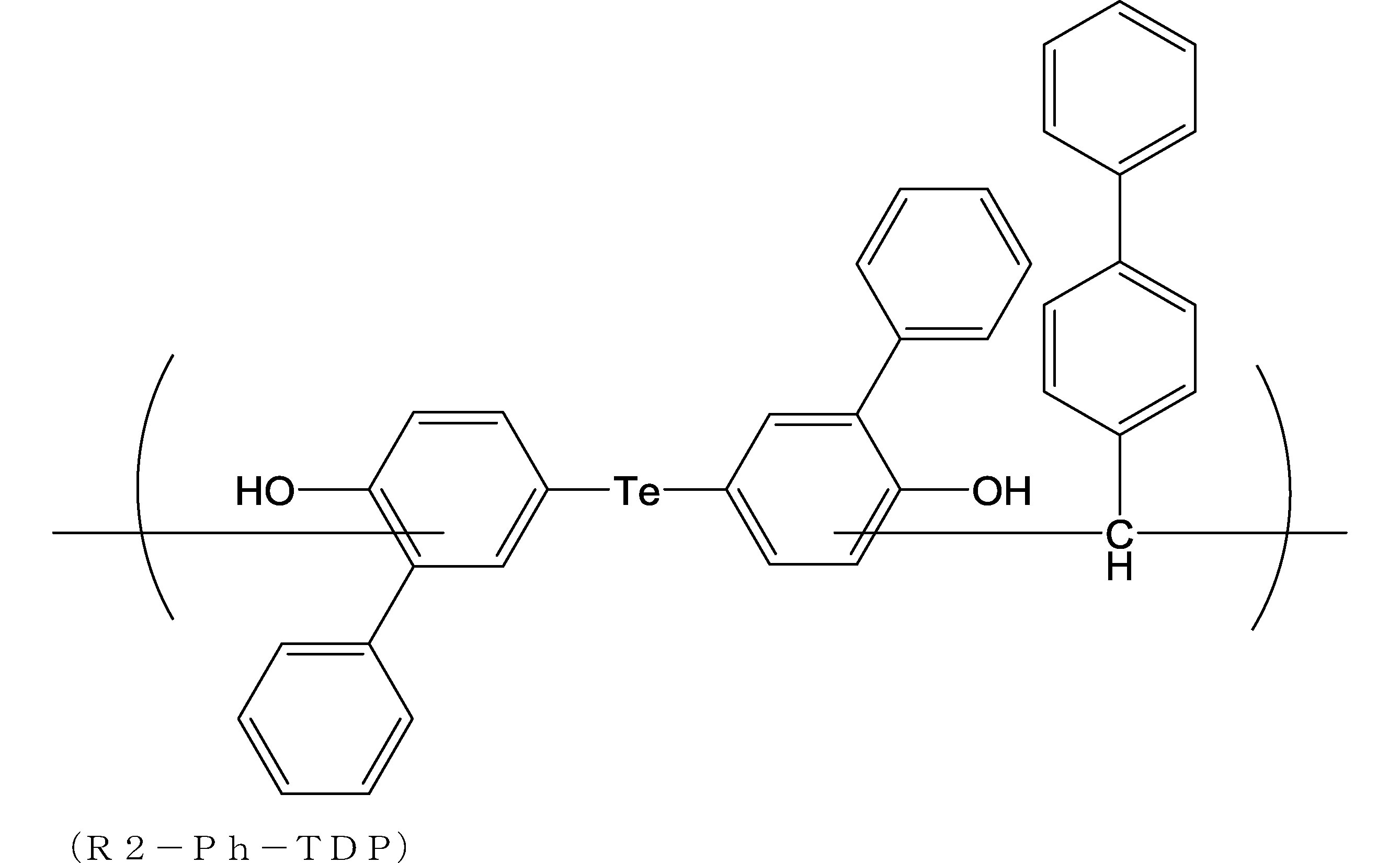
化合物(BHPT) 8.1g(21mmol)に代えて化合物樹脂(Ph-BHPT-ADBAC)20.0gを用いること以外は製造例13と同様に操作することにより、下記式で示される構造を有する目的化合物樹脂(R1-Ph-BHPT-ADBAC)を5.0g得た。
得られた樹脂(R1-Ph-BHPT-ADBAC)について、上述の方法によりポリスチレン換算分子量を測定した結果、Mn:1045、Mw:2330、Mw/Mn:2.23であった。
得られた化合物樹脂(R1-Ph-BHPT-ADBAC)について、前記測定条件で、NMR測定を行ったところ、以下のピークが見出され、下記式(R1-Ph-BHPT-ADBAC)の化学構造を有することを確認した。
δ(ppm)6.8~8.1(8H,Ph-H)、4.7~5.0(4H,O-CH2-C(=O)-)、1.2~2.7(34H,C-H/Adamantane of methylene and methine)、4.1(2H,-CH2)

パラホルムアルデヒド 0.7g(42mmol)に代えて4-ビフェニルカルボキシアルデヒド(三菱瓦斯化学社製)7.6g(42mmol)用いること以外は、製造例27と同様に操作することにより、下記式で示される構造を有する目的樹脂(R2-Ph-BHPT-ADBAC)を6.0g得た。
得られた樹脂(R2-Ph-BHPT-ADBAC)について、上述の方法によりポリスチレン換算分子量を測定した結果、Mn:1188、Mw:2394、Mw/Mn:2.02であった。
得られた樹脂(R2-Ph-BHPT-ADBAC)について、前記測定条件でNMR測定を行ったところ、以下のピークが見出され、下記式(R2-Ph-BHPT-ADBAC)の化学構造を有することを確認した。
δ(ppm)7.1~7.7(25H,Ph-H)、5.0(4H,O-CH2-C(=O)-)、1.0~2.6(34H,C-H/Adamantane of methylene and methine)、4.5(1H,-CH)

化合物(BHPT) 8.1g(21mmol)に代えて化合物樹脂(TDP-ADBAC)15.3gを用いること以外は製造例13と同様に操作することにより、下記式で示される構造を有する目的化合物樹脂(R1-TDP-ADBAC)を11.4g得た。
得られた樹脂(R1-TDP-ADBAC)について、上述の方法によりポリスチレン換算分子量を測定した結果、Mn:954、Mw:2148、Mw/Mn:2.25であった。
得られた化合物樹脂(R1-TDP-ADBAC)について、前記測定条件で、NMR測定を行ったところ、以下のピークが見出され、下記式(R1-TDP-ADBAC)の化学構造を有することを確認した。
δ(ppm)7.0~7.4(8H,Ph-H)、5.0(4H,O-CH2-C(=O)-)、1.0~2.6(34H,C-H/Adamantane of methylene and methine)、4.1(2H,-CH2)

パラホルムアルデヒド 0.7g(42mmol)に代えて4-ビフェニルカルボキシアルデヒド(三菱瓦斯化学社製)7.6g(42mmol)用いること以外は、製造例29と同様に操作することにより、下記式で示される構造を有する目的樹脂(R2-TDP-ADBAC)を4.6g得た。
得られた樹脂(R2-TDP-ADBAC)について、上述の方法によりポリスチレン換算分子量を測定した結果、Mn:910、Mw:1805、Mw/Mn:1.98であった。
得られた樹脂(R2-TDP-ADBAC)について、前記測定条件でNMR測定を行ったところ、以下のピークが見出され、下記式(R2-TDP-ADBAC)の化学構造を有することを確認した。
δ(ppm)7.0~7.4(17H,Ph-H)、5.0(4H,O-CH2-C(=O)-)、1.0~2.6(34H,C-H/Adamantane of methylene and methine)、4.5(1H,-CH)

化合物(BHPT) 8.1g(21mmol)に代えて化合物樹脂(Ph-TDP-ADBAC)18.5gを用いること以外は製造例13と同様に操作することにより、下記式で示される構造を有する目的化合物樹脂(R1-Ph-TDP-ADBAC)を12.0g得た。
得られた樹脂(R1-Ph-TDP-ADBAC)について、上述の方法によりポリスチレン換算分子量を測定した結果、Mn:1152、Mw:2570、Mw/Mn:2.23であった。
得られた化合物樹脂(R1-Ph-PTDP-ADBAC)について、前記測定条件で、NMR測定を行ったところ、以下のピークが見出され、下記式(R1-Ph-TDP-ADBAC)の化学構造を有することを確認した。
δ(ppm)7.1~7.7(16H,Ph-H)、5.0(4H,O-CH2-C(=O)-)、1.0~2.6(34H,C-H/Adamantane of methylene and methine)、4.1(2H,-CH2)

パラホルムアルデヒド 0.7g(42mmol)に代えて4-ビフェニルカルボキシアルデヒド(三菱瓦斯化学社製)7.6g(42mmol)用いること以外は、製造例31と同様に操作することにより、下記式で示される構造を有する目的樹脂(R2-Ph-TDP-ADBAC)を5.6g得た。
得られた樹脂(R2-Ph-TDP-ADBAC)について、上述の方法によりポリスチレン換算分子量を測定した結果、Mn:1100、Mw:2205、Mw/Mn:2.004であった。
得られた樹脂(R2-Ph-TDP-ADBAC)について、前記測定条件でNMR測定を行ったところ、以下のピークが見出され、下記式(R2-Ph-TDP-ADBAC)の化学構造を有することを確認した。
δ(ppm)7.1~7.7(25H,Ph-H)、5.0(4H,O-CH2-C(=O)-)、1.0~2.6(34H,C-H/Adamantane of methylene and methine)、4.5(1H,-CH)
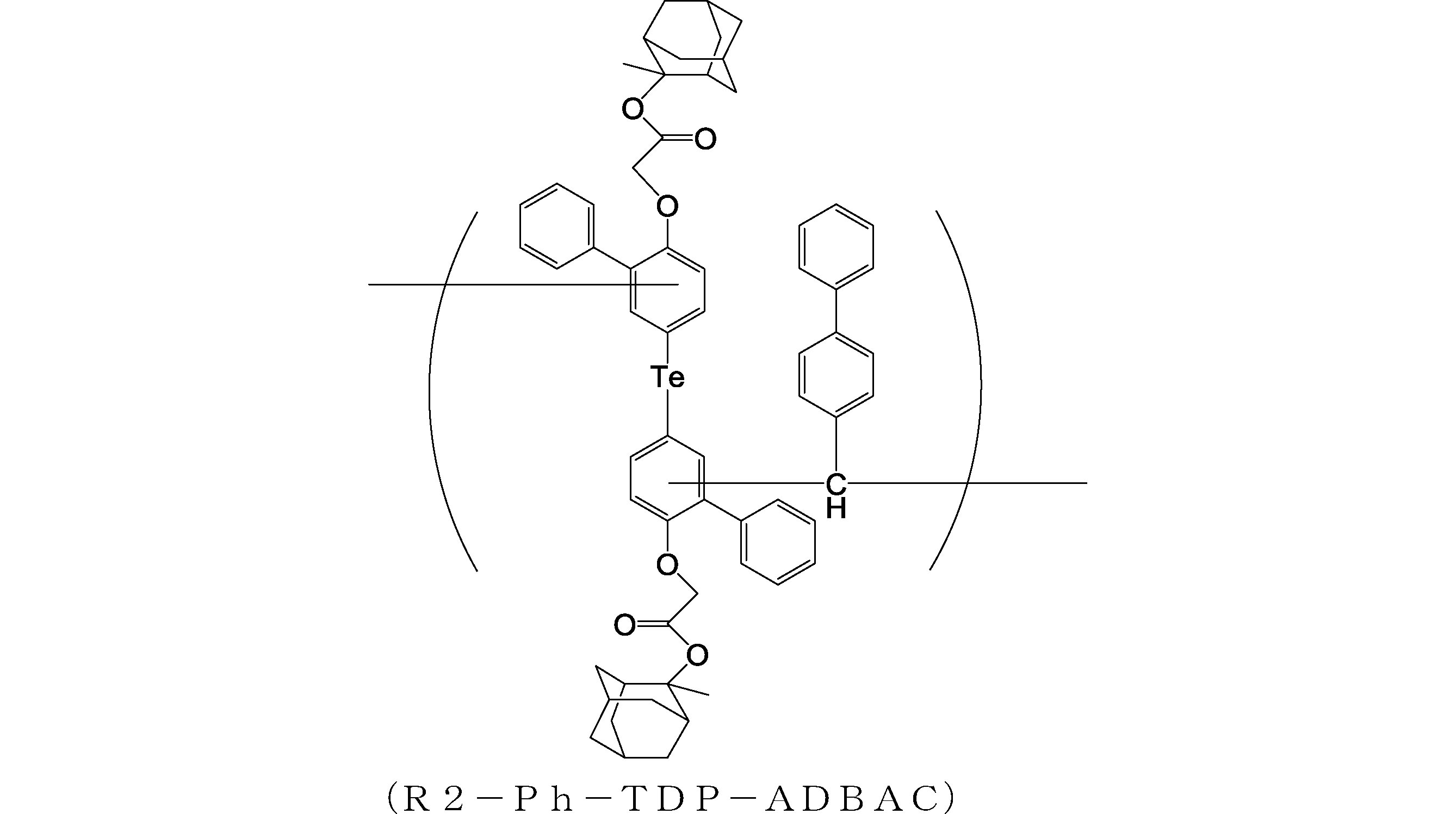
100mL容器に化合物(BHPT)0.58g(1.5mmol)を入れ、テトラブチルアンモニウムブロマイド0.05g(0.15mmol)、炭酸カリウム0.28g(2mmol)、N-メチルピロリドン2mlを加え80℃、2時間攪拌した。次に、ADTBA(1,3,5-アダマンタントリブロモアセテート)0.547g(1.0mmol)をN-メチルピロリドン1mlに溶解させて加え80℃、48時間反応させた。得られた反応物を1N-HClに滴下し、茶色結晶を得た。結晶をろ過後、減圧乾燥し目的樹脂(BHPT-co-ADTBA)を0.40g得た。
得られた樹脂(BHPT-co-ADTBA)について、上述の方法によりポリスチレン換算分子量を測定した結果、Mn:750、Mw:1350、Mw/Mn:1.80であった。
得られた樹脂(BHPT-co-ADTBA)について、前記測定条件でNMR測定を行ったところ、以下のピークが見出され、下記式(BHPT-co-ADTBA)の化学構造を有することを確認した。
δ(ppm)6.9~7.4(4H,Ph-H)、4.6(4H,-O-CH2-CO-)、4.3(2H,-CH2-Br)、1.2~3.4(13H,C-H/Adamantane of methylene and methine)

化合物(BHPT)0.58g(1.5mmol)に代えて化合物(TDP)0.47gを用いること以外は、製造例33と同様に操作することにより、下記式で示される構造を有する目的樹脂(TDP-co-ADTBA)を0.36g得た。
得られた樹脂(TDP-co-ADTBA)について、上述の方法によりポリスチレン換算分子量を測定した結果、Mn:680、Mw:1238、Mw/Mn:1.82であった。
得られた樹脂(TDP-co-ADTBA)について、前記測定条件でNMR測定を行ったところ、以下のピークが見出され、下記式(TDP-co-ADTBA)の化学構造を有することを確認した。
δ(ppm)6.9~7.4(4H,Ph-H)、4.6(4H,-O-CH2-CO-)、4.3(2H,-CH2-Br)、1.2~3.4(13H,C-H/Adamantane of methylene and methine)
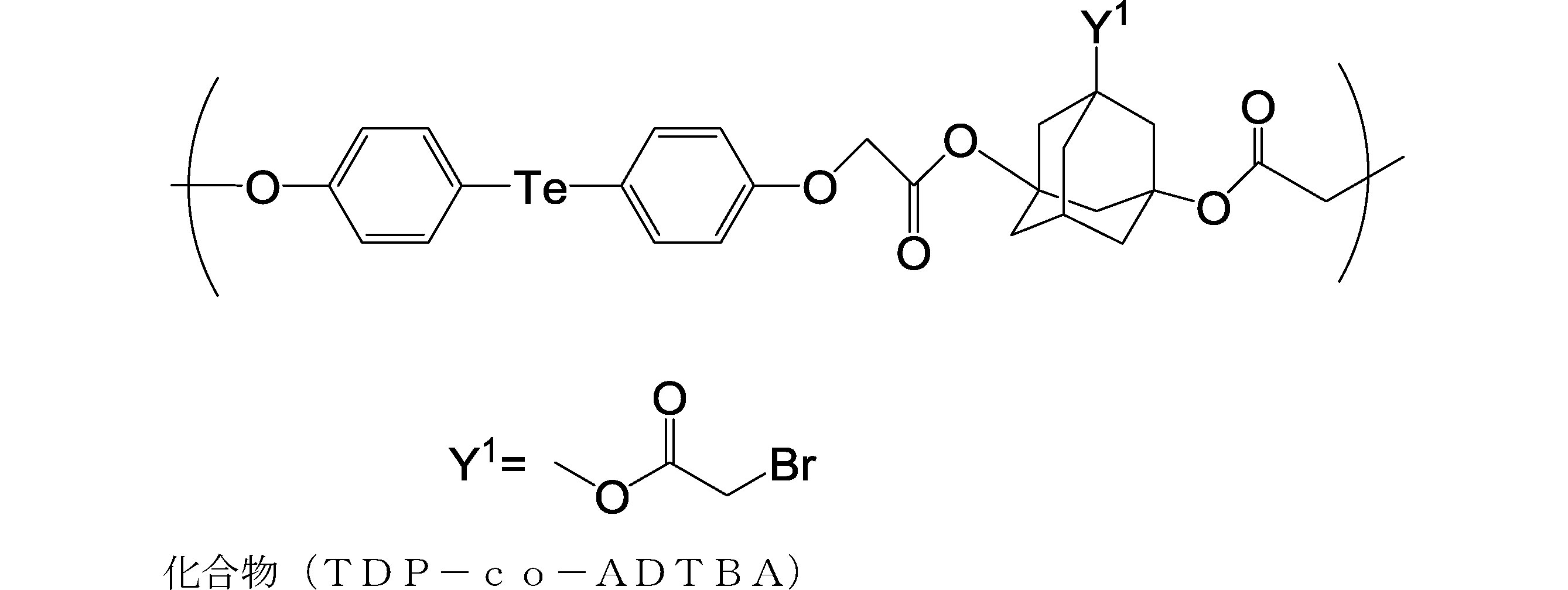
グローブボックス中で、100ml容器に四塩化テルル5.39g(20mmol)を仕込み、1,3-ジメトキシベンゼン2.8g(20mmol)、三塩化アルミニウム5.9g(44mmol)、クロロホルム20mlを加え、氷冷下で24時間反応を行った。得られた生成物を減圧乾燥し、アセトニトリルを用いて再結晶を二回行い、ろ過して得られた結晶を24時間減圧乾燥し、樹脂(DMB-co-TeCl2)を3.0g得た。
得られた樹脂(DBM-co-TeCl2)について、上述の方法によりポリスチレン換算分子量を測定した結果、Mn:39820、Mw:62910、Mw/Mn:1.58であった。
得られた樹脂(DMB-co-TeCl2)について、前記測定条件でNMR測定を行ったところ、以下のピークが見出され、下記式(DMB-co-TeCl2)の化学構造を有することを確認した。
δ(ppm)6.0~7.2(2H,Ph-H)、3.6(6H,-CH3)

得られた樹脂(DMB-co-TeCl2-OH)について、上述の方法によりポリスチレン換算分子量を測定した結果、Mn:39800、Mw:62880、Mw/Mn:1.58であった。
得られた樹脂(DMB-co-TeCl2-OH)について、上述の測定条件で、NMR測定を行ったところ、以下のピークが見出され、下記で示される樹脂(DMB-co-TeCl2-OH)の化学構造を有することを確認した。
δ(ppm)9.0(2H,-OH)、6.4~7.0(2H,Ph-H)

グローブボックス中で、100mL容器に四塩化テルル(7.54g、28mmol)を仕込み、レゾルシノール1.54g(14mmol)、四塩化炭素20mlを加え還流条件下で80℃、24時間反応を行った。得られた反応液にジクロロメタンを加えて洗浄し、ろ過して得られた固体を減圧乾燥した。
続いて、300ml容器中にアスコルビン酸ナトリウム13.0g(66mmol)を水25mlに溶解し、酢酸エチル60mlに溶解した前述の固体を滴下し、25℃、24時間反応した。反応後の溶液を酢酸エチルで15回抽出した後に、有機溶媒を留去し茶色固体を得た。
さらに、攪拌機、冷却管及びビュレットを備えた内容積100mLの容器に得られた茶色固体を入れ、酢酸エチル10ml、銅粉13.0g(60mmol)を加えて還流条件下で80℃、24時間反応を行った。得られた反応液を2倍に濃縮し、クロロホルムに滴下して得られた沈殿物をろ過し乾燥して、黒茶色の樹脂(Re-co-Te)0.2gを得た。
得られた樹脂(Re-co-Te)について、上述の方法によりポリスチレン換算分子量を測定した結果、Mn:21500、Mw:41500、Mw/Mn:1.93であった。
得られた樹脂(Re-co-Te)について、上述の測定条件で、NMR測定を行ったところ、以下のピークが見出され、下記で示される樹脂(Re-co-Te)の化学構造を有することを確認した。
δ(ppm)9.1(2H,-OH)、6.1~7.0(2H,Ph-H)

攪拌機、冷却管及びビュレットを備えた内容積200mLの容器において、樹脂(DMB-co-TeCl2-OH)3.7g、炭酸カリウム0.30g(22mmol)、ブロモ酢酸-2-メチルアダマンタン-2-イル6.3g(22mmol)を、N-メチルピロリドン50mlに溶解させ、2時間撹拌した。撹拌後、更にブロモ酢酸アダマンタン5.7g(22mmol)を加え、100℃にて24時間反応させた。反応終了後、1N塩酸水溶液に滴下し、生じた黒色固体をろ別し、乾燥後、下記樹脂(DMB-co-TeCl2-ADBAC)を5.3g得た。
得られた樹脂(DMB-co-TeCl2-ADBAC)について、上述の測定条件で、NMR測定を行ったところ、以下のピークが見出され、下記で示される樹脂(DMB-co-TeCl2-ADBAC)の化学構造を有することを確認した。
δ(ppm)6.5~7.2(2H,Ph-H)、4.9~5.0(4H,-CH2-)、1.0~2.6(34H,C-H/Adamantane of methylene and methine)

攪拌機、冷却管及びビュレットを備えた内容積200mLの容器において、樹脂(Re-co-Te)2.7g、炭酸カリウム0.30g(22mmol)、テトラブチルアンモニウムブロマイド0.64g(2mmol)を、N-メチルピロリドン50mlに溶解させ、2時間撹拌した。撹拌後、更にブロモ酢酸-2-メチルアダマンタン-2-イル6.3g(22mmol)を加え、100℃にて24時間反応させた。反応終了後、1N塩酸水溶液に滴下し、生じた黒色固体をろ別し、乾燥後、下記樹脂(Re-co-Te-ADBAC)を4.6g得た。
得られた樹脂(Re-co-Te-ADBAC)について、上述の測定条件で、NMR測定を行ったところ、以下のピークが見出され、下記で示される樹脂(Re-co-Te-ADBAC)の化学構造を有することを確認した。
δ(ppm)6.5~7.2(2H,Ph-H)、4.9~5.0(4H,-CH2-)、1.0~2.6(34H,C-H/Adamantane of methylene and methine)

グローブボックス中で、300ml容器に四塩化テルル(75g、280mmol)を仕込み、四塩化炭素100ml、ジフェニルエーテル15g(140mmol)を加え還流条件下で80℃、24時間反応を行った。得られた反応液にジクロロメタンを加えて洗浄し、ろ過して得られた固体を減圧乾燥した。
続いて、1000ml容器中にアスコルビン酸ナトリウム130g(66mmol)を水250mlに溶解し、酢酸エチル120mlに溶解した前述の固体を滴下し、25℃、24時間反応した。反応後の溶液を酢酸エチルで5回抽出した後に、有機溶媒を留去し茶色固体を得た。
さらに、攪拌機、冷却管及びビュレットを備えた内容積100mLの容器に得られた茶色固体を入れ、酢酸エチル20mlを加えて溶、銅粉38.0g(600mmol)を加えて還流条件下で80℃、24時間反応を行った。得られた反応液を2倍に濃縮し、ヘキサンに滴下して得られた沈殿物をろ過し乾燥して、赤色の樹脂(DPE-co-Te)0.11gを得た。
得られた樹脂(DPE-co-Te)について、上述の方法によりポリスチレン換算分子量を測定した結果、Mn:1280、Mw:2406、Mw/Mn:1.88であった。
得られた樹脂(DPE-co-Te)について、上述の測定条件で、NMR測定を行ったところ、以下のピークが見出され、下記で示される樹脂(DPE-co-Te)の化学構造を有することを確認した。
δ(ppm)6.9~8.8(8H,Ph-H)

200mLの容器にテルル3.2g(25mmol)とTHF25mlを加え攪拌し懸濁させ、氷冷下でメチルリチウム溶液(1mol/l、ジエチルエーテル溶液)30mlを滴下し、0℃、1時間攪拌した。さらに、クロロメチルスチレン6.1g(40mmol)を加え、さらに25℃、2時間攪拌し、反応させた。次に反応液の溶媒を留去し、減圧乾燥して、メチルテラニルスチレン2.0gを得た。
また、200mLの容器にテルル3.2g(25mmol)とTHF25mlを加え攪拌し懸濁させ、氷冷下でメチルリチウム溶液(1mol/l、ジエチルエーテル溶液)30mlを滴下し、0℃、1時間攪拌した。次に、0.5mol/l塩化アンモニウム水溶液20mlを加え、25℃、2時間攪拌し、反応させた。反応後、水層を分液しジエチルエーテルで3回抽出した。抽出した有機層の溶媒を留去し、減圧乾燥してジメチルジテルリド2.2gを得た。
さらに、攪拌機、冷却管及びビュレットを備えた内容積500mLの容器に、クロロベンゼン80g、上述のメチルテラニルスチレン2.6g(10mmol)、ジメチルジテルリド0.7g(2.5mmol)、アゾビスイソブチロニトリル0.4g(2.5mmol)を加え、窒素気流中で110℃、1時間攪拌した。攪拌後、ベンゼン90g、アクリル酸0.4g、アクリル酸t-ブチル4.35gを加え、さらに110℃、5時間攪拌し、反応した。反応終了後、反応液に水1500mlを加えてろ過し乾燥してテルル含有コアシェル型ハイパーブランチポリマー2.0gを得た(尚、表2では"Te含有ハイパーブランチポリマー"と表する)。
得られたテルル含有コアシェル型ハイパーブランチポリマーについて、上述の方法によりポリスチレン換算分子量を測定した結果、Mn:3260、Mw:5800、Mw/Mn:1.78であった。
グローブボックス中で、50mL容器に四塩化テルル(0.27g、1.0mmol)と、レゾルシノール(0.15g、1.36mmol)を仕込み、溶媒として四塩化炭素5mLを加え、還流条件化で6時間反応を行った。得られた生成物をろ過し、ジクロロメタンを用いて二回洗浄し、減圧乾燥して淡黄色固体を得た。この固体を50mL容器に入れ、レゾルシノール(1.10g、10mmmol)を加えた後、170℃、24時間反応を行った。得られた反応液を酢酸エチルに溶解させ、n-ヘキサンで再沈殿生成をすることにより、CCHT((2,4-ジヒドロキシフェニル)(4-ヒドロキシフェニル)テルルジクロライド)を得た。
得られた化合物(CCHT)について、上述の測定方法(LC-MS)によって分子量を測定した結果、401であった。
得られた化合物(CCHT)について、上述の測定条件で、NMR測定を行ったところ、以下のピークが見出され、下記で示される化合物(CCHT)の化学構造を有することを確認した。
δ(ppm)9.5~9.9(3H,-OH)、6.3~7.2(7H,Ph-H)

化合物(BHPT)3.9g(10mmol)に代えて化合物(CCHT)2.7g(6.7mmol)を用いること以外は、製造例2と同様に操作することにより、下記で示される構造を有する化合物(CCHT-ADBAC)が1.09g得られた。
得られた化合物(Ph-BHPT-ADBAC)について、上述の測定方法(LC-MS)によって分子量を測定した結果、537であった。
得られた化合物(CCHT-ADBAC)について、上述の測定条件で、NMR測定を行ったところ、以下のピークが見出され、下記で示される化合物(CCHT-ADBAC)の化学構造を有することを確認した。
δ(ppm)6.5~7.0(7H,Ph-H)、5.0(6H,O-CH2-C(=O)-)、1.0~2.6(51H,C-H/Adamantane of methylene and methine)

ジムロート冷却管、温度計及び攪拌翼を備えた、底抜きが可能な内容積10Lの四つ口フラスコを準備した。この四つ口フラスコに、窒素気流中、1,5-ジメチルナフタレン1.09kg(7mol、三菱ガス化学(株)製)、40質量%ホルマリン水溶液2.1kg(ホルムアルデヒドとして28mol、三菱ガス化学(株)製)及び98質量%硫酸(関東化学(株)製)0.97mLを仕込み、常圧下、100℃で還流させながら7時間反応させた。その後、希釈溶媒としてエチルベンゼン(和光純薬工業(株)製、試薬特級)1.8kgを反応液に加え、静置後、下相の水相を除去した。さらに、中和及び水洗を行い、エチルベンゼン及び未反応の1,5-ジメチルナフタレンを減圧下で留去することにより、淡褐色固体のジメチルナフタレンホルムアルデヒド樹脂1.25kgを得た。
得られたジメチルナフタレンホルムアルデヒドの分子量は、Mn:562、Mw:1168、Mw/Mn:2.08であった。
得られた樹脂(CR-1)は、Mn:885、Mw:2220、Mw/Mn:4.17であった。また、得られた樹脂(CR-1)のPGMEAへの溶解性を上述の測定方法によって評価した結果、5質量%以上(評価A)であると評価された。
下記表1又は2に示す組成となるように、レジスト下層膜形成用組成物を調製した。当該組成物には下記材料を用いた。
酸発生剤:みどり化学社製「ジターシャリーブチルジフェニルヨードニウムノナフルオロメタンスルホナート(DTDPI)」
酸架橋剤:三和ケミカル社製「ニカラックMX270(ニカラック)」
有機溶媒:プロピレングリコールモノメチルエーテルアセテートアセテート(PGMEA)
ノボラック:群栄化学社製「PSM4357」
そして、下記に示す条件でエッチング試験を行い、エッチング耐性を評価した。評価結果を表1又は2に示す。
エッチング装置:サムコインターナショナル社製「RIE-10NR」
出力:50W
圧力:20Pa
時間:2min
エッチングガス
Arガス流量:CF4ガス流量:O2ガス流量=50:5:5(sccm)
エッチング耐性の評価は、以下の手順で行った。
まず、実施例1で用いた化合物に代えてノボラック(群栄化学社製「PSM4357」)を用いること以外は、実施例1と同様の条件で、ノボラックの下層膜を作製した。そして、このノボラックの下層膜を対象として、上述のエッチング試験を行い、そのときのエッチングレートを測定した。
次に、実施例1~48及び比較例1の下層膜を対象として、前記エッチング試験を同様に行い、そのときのエッチングレートを測定した。
そして、ノボラックの下層膜のエッチングレートを基準として、以下の評価基準でエッチング耐性を評価した。
[評価基準]
A:ノボラックの下層膜に比べてエッチングレートが、-10%未満
B:ノボラックの下層膜に比べてエッチングレートが、-10%~+5%
C:ノボラックの下層膜に比べてエッチングレートが、+5%超

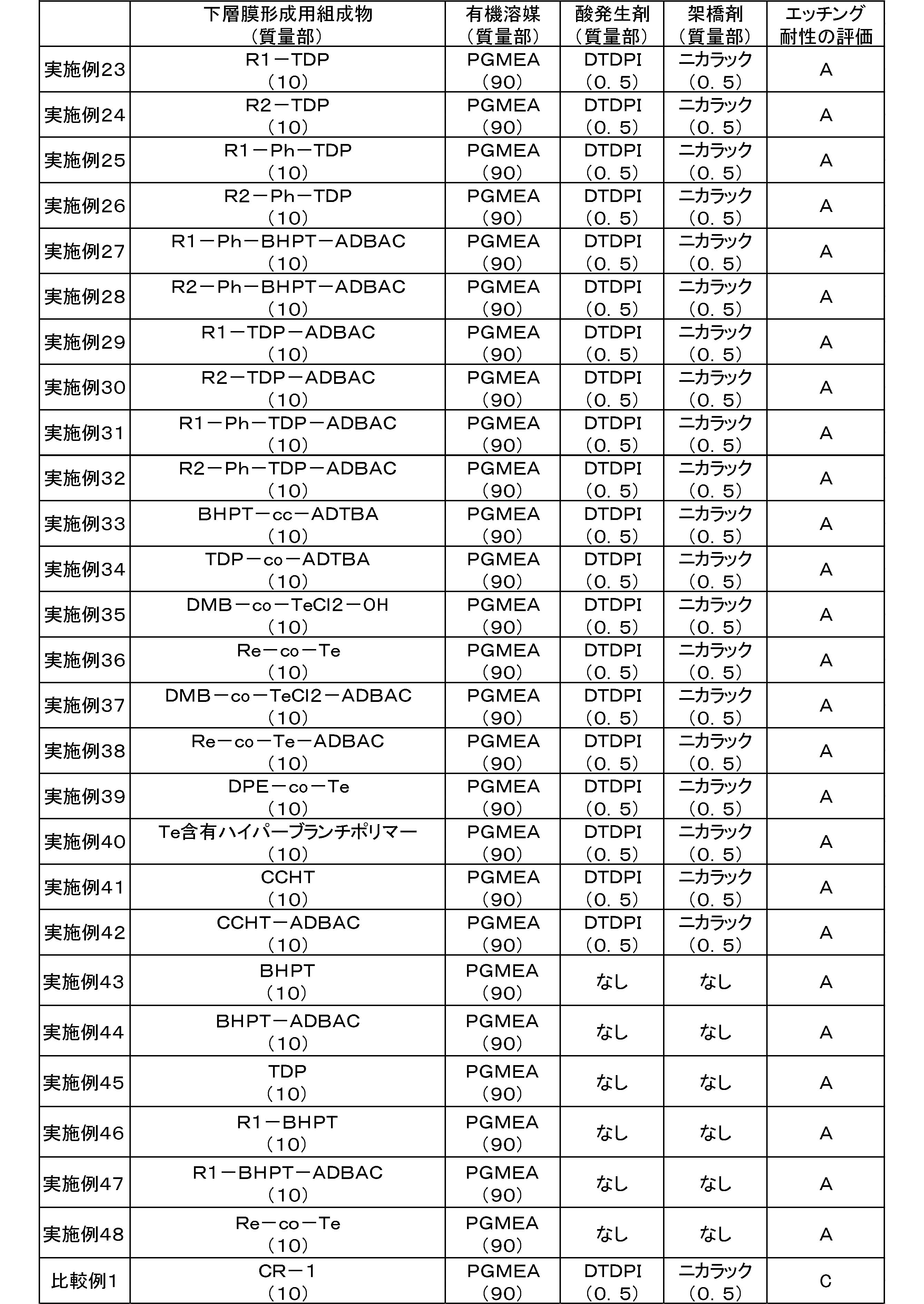
次に、実施例1のレジスト下層膜形成用組成物を膜厚300nmのSiO2基板上に塗布して、240℃で60秒間、さらに400℃で120秒間ベークすることにより、膜厚85nmのレジスト下層膜を形成した。この下層膜上に、ArF用レジスト溶液を塗布し、130℃で60秒間ベークすることにより、膜厚140nmのフォトレジスト層を形成した。
なお、ArF用レジスト溶液としては、下記式(CR-1A)で示される化合物:1質量部、トリフェニルスルホニウムノナフルオロメタンスルホナート:1質量部、トリブチルアミン:2質量部、及びプロピレングリコールモノメチルエーテル:30質量部を配合して調製したものを用いた。

温度を制御できる内容積500mLの電磁撹拌装置付オートクレーブ(SUS316L製)に、無水HF 74.3g(3.71モル)、BF3 50.5g(0.744モル)を仕込み、内容物を撹拌し、液温を-30℃に保ったまま一酸化炭素により2MPaまで昇圧した。その後、圧力を2MPa、液温を-30℃に保ったまま、4-シクロヘキシルベンゼン57.0g(0.248モル)とn-ヘプタン50.0gとを混合した原料を供給し、1時間保った。その後、内容物を採取し氷の中にいれ、ベンゼンで希釈後、中和処理をして得られた油層をガスクロマトグラフィーで分析した。反応成績を求めたところ、4-シクロヘキシルベンゼンは転化率100%、4-シクロヘキシルベンズアルデヒドは選択率97.3%であった。
単蒸留により目的成分を単離し、GC-MSで分析した結果、目的物の4-シクロヘキシルベンズアルデヒド(以下、「CHBAL」と示す)の分子量188を示した。すなわち、上記分子量は、島津製鉄所製社製GC-MS QP2010 Ultraを用いて測定した。また重クロロホルム溶媒中での1H-NMRのケミカルシフト値(δppm,TMS基準)は、1.0~1.6(m,10H)、2.6(m,1H)、7.4(d,2H)、7.8(d,2H)、10.0(s,1H)であった。

この生成物の構造は、LC-MSで分析した結果、分子量1121を示した。また重クロロホルム溶媒中での1H-NMRのケミカルシフト値(δppm,TMS基準)は0.8~1.9(m,44H)、5.5,5.6(d,4H)、6.0~6.8(m,24H)、8.4,8.5(m,8H)であった。これらの結果から、得られた生成物を目的化合物(CR-1A)と同定した(収率91%)。
レジスト下層膜の形成を行わないこと以外は、実施例49と同様にして、フォトレジスト層をSiO2基板上に直接形成し、ポジ型のレジストパターンを得た。
実施例49及び比較例2のそれぞれについて、得られた45nmL/S(1:1)及び80nmL/S(1:1)のレジストパターンの形状を(株)日立製作所製電子顕微鏡(S-4800)を用いて観察した。現像後のレジストパターンの形状については、パターン倒れがなく、矩形性が"良好"なものを良好とし、そうでないものを"不良"として評価した。また、当該観察の結果、パターン倒れが無く、矩形性が良好な最小の線幅を解像性として評価の指標とした。さらに、良好なパターン形状を描画可能な最小の電子線エネルギー量を感度として、評価の指標とした。その結果を、表3に示す。

実施例1で用いたレジスト下層膜形成用組成物を膜厚300nmのSiO2基板上に塗布して、240℃で60秒間、さらに400℃で120秒間ベークすることにより、膜厚90nmのレジスト下層膜を形成した。このレジスト下層膜上に、珪素含有中間層材料を塗布し、200℃で60秒間ベークすることにより、膜厚35nmのレジスト中間層膜を形成した。さらに、このレジスト中間層膜上に、前記ArF用レジスト溶液を塗布し、130℃で60秒間ベークすることにより、膜厚150nmのフォトレジスト層を形成した。なお、珪素含有中間層材料としては、特開2007-226170号公報の<製造例1>に記載の珪素原子含有ポリマーを用いた。
次いで、電子線描画装置(エリオニクス社製;ELS-7500,50keV)を用いて、フォトレジスト層をマスク露光し、115℃で90秒間ベーク(PEB)し、2.38質量%テトラメチルアンモニウムヒドロキシド(TMAH)水溶液で60秒間現像することにより、45nmL/S(1:1)のポジ型のレジストパターンを得た。
その後、サムコインターナショナル社製 RIE-10NRを用いて、得られたレジストパターンをマスクにして珪素含有中間層膜(SOG)のドライエッチング加工を行い、続いて、得られた珪素含有中間層膜パターンをマスクにしたレジスト下層膜のドライエッチング加工と、得られたレジスト下層膜パターンをマスクにしたSiO2膜のドライエッチング加工とを順次行った。
(レジストパターンのレジスト中間層膜へのエッチング条件)
出力:50W
圧力:20Pa
時間:1min
エッチングガス
Arガス流量:CF4ガス流量:O2ガス流量=50:8:2(sccm)
(レジスト中間層膜パターンのレジスト下層膜へのエッチング条件)
出力:50W
圧力:20Pa
時間:2min
エッチングガス
Arガス流量:CF4ガス流量:O2ガス流量=50:5:5(sccm)
(レジスト下層膜パターンのSiO2膜へのエッチング条件)
出力:50W
圧力:20Pa
時間:2min
エッチングガス
Arガス流量:C5F12ガス流量:C2F6ガス流量:O2ガス流量
=50:4:3:1(sccm)
上述のようにして得られた実施例50のパターン断面(エッチング後のSiO2膜の形状)を、(株)日立製作所製電子顕微鏡(S-4800)を用いて観察したところ、多層レジスト加工におけるエッチング後のSiO2膜の形状は矩形であり、欠陥も認められず良好であることが確認された。
また、明細書に記載された全ての文献、特許出願、及び技術規格は、個々の文献、特許出願、及び技術規格が参照により取り込まれることが具体的かつ個々に記された場合と同程度に、本明細書中に参照により取り込まれる。
Claims (34)
- テルルを含有する化合物又はテルルを含有する樹脂を含むレジスト下層膜形成用組成物。
- 前記テルルを含有する化合物が、下記式(A-1)で示される請求項1に記載のレジスト下層膜形成用組成物。
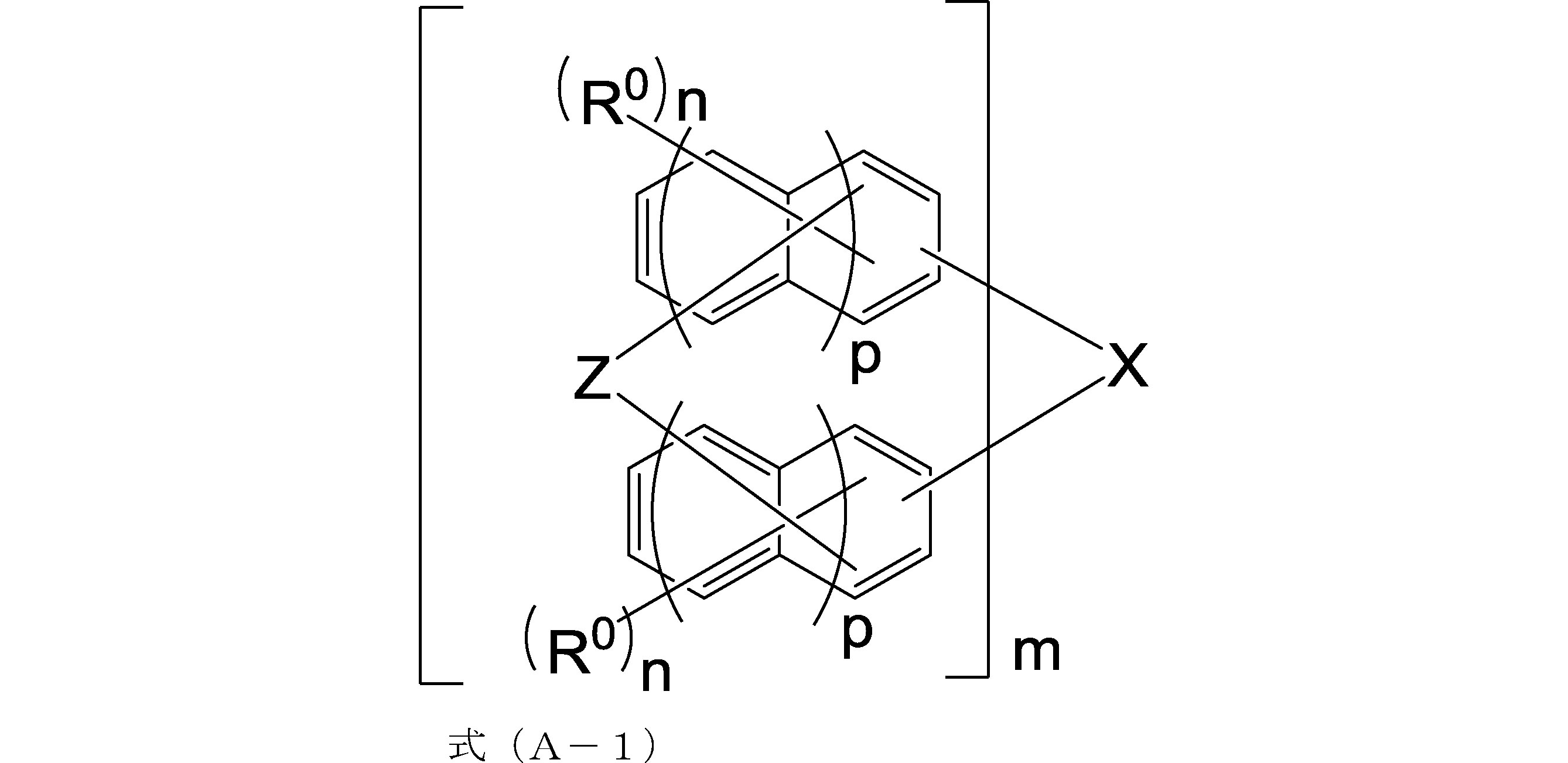
(式(A-1)中、Xは、テルルを含む炭素数0~60の2m価の基であり、Zは、酸素原子、硫黄原子又は無架橋であり、R0は、各々独立して、酸素原子を含む1価の基、硫黄原子を含む1価の基、窒素原子を含む1価の基、炭化水素基、又はハロゲン原子であり、mは、1~4の整数であり、pは、各々独立して0~2の整数であり、nは、各々独立して0~(5+2×p)の整数である。) - 前記テルルを含有する化合物が、下記式(A-2)で示される請求項2に記載のレジスト下層膜形成用組成物。

- 前記テルルを含有する化合物が、下記式(A-3)で示される請求項2に記載のレジスト下層膜形成用組成物。

- 前記テルルを含有する化合物が、下記式(1A)で示される請求項2に記載のレジスト下層膜形成用組成物。
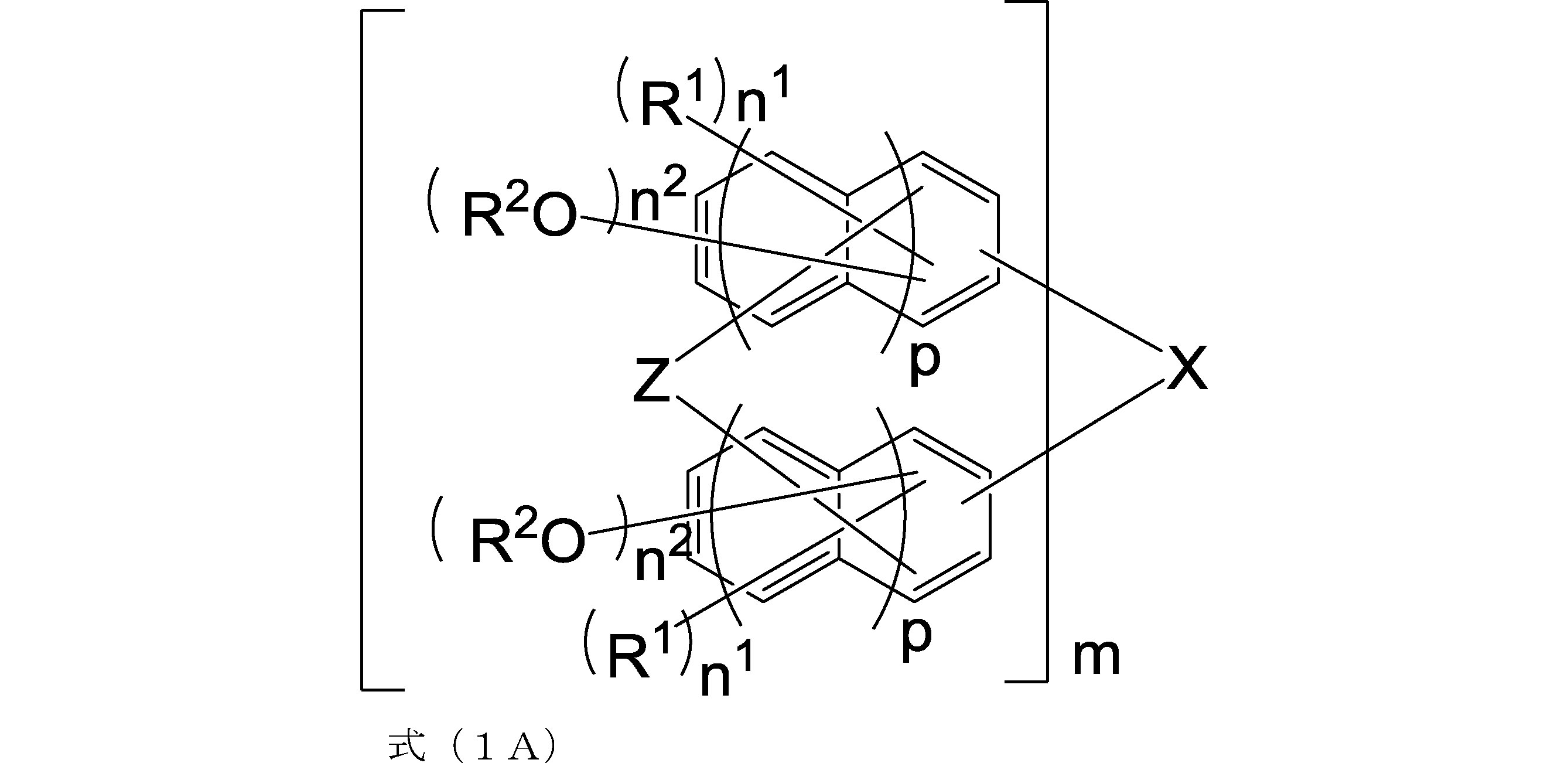
- 前記テルルを含有する化合物が、下記式(1B)で示される請求項4に記載のレジスト下層膜形成用組成物。
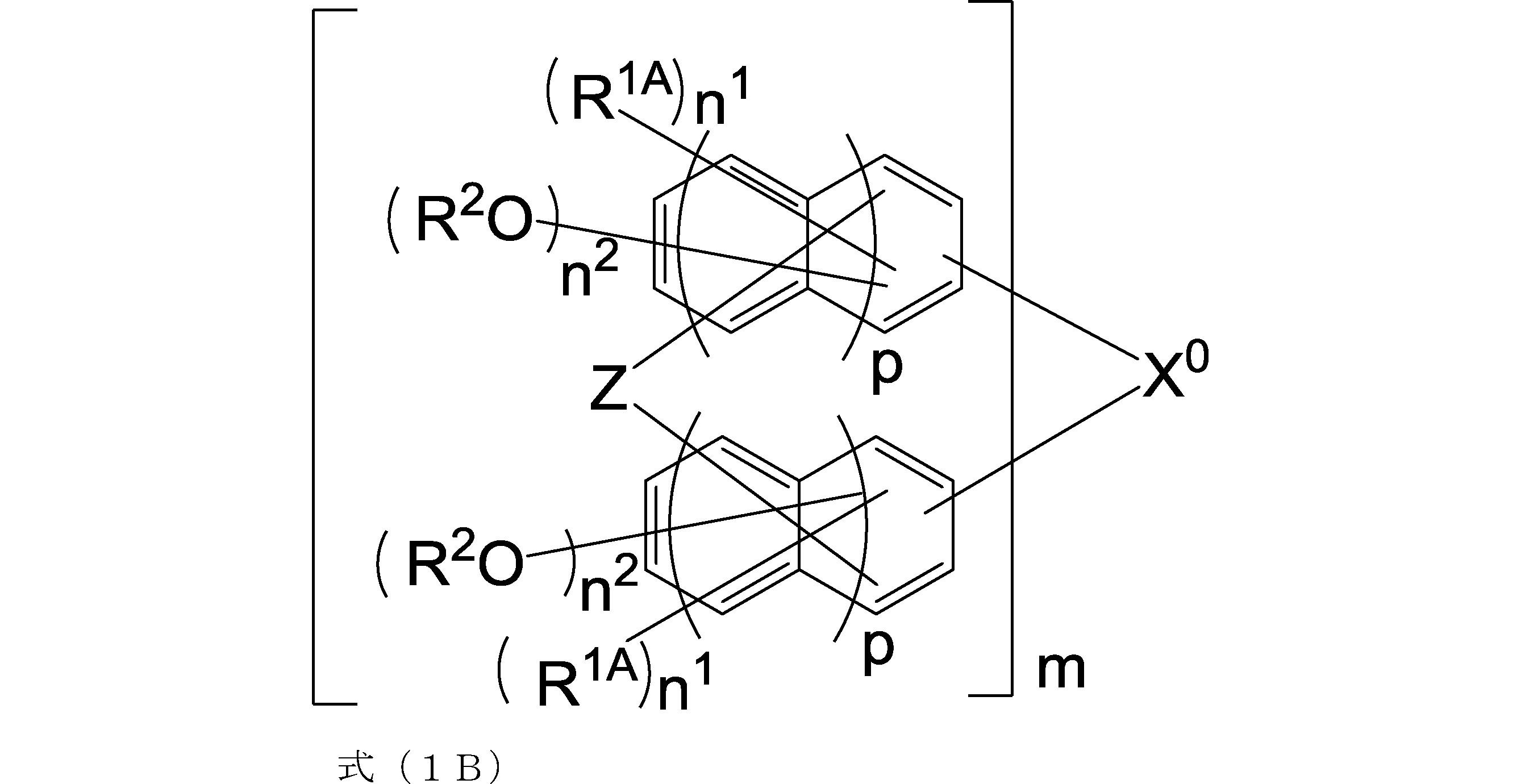
- 前記テルルを含有する化合物が、下記式(2A)で示される請求項6に記載のレジスト下層膜形成用組成物。

- 前記テルルを含有する化合物が、下記式(2A')で示される請求項7に記載のレジスト下層膜形成用組成物。

- 前記テルルを含有する化合物が、下記式(3A)で示される請求項7に記載のレジスト下層膜形成用組成物。

- 前記テルルを含有する化合物が、下記式(4A)で示される請求項9に記載のレジスト下層膜形成用組成物。
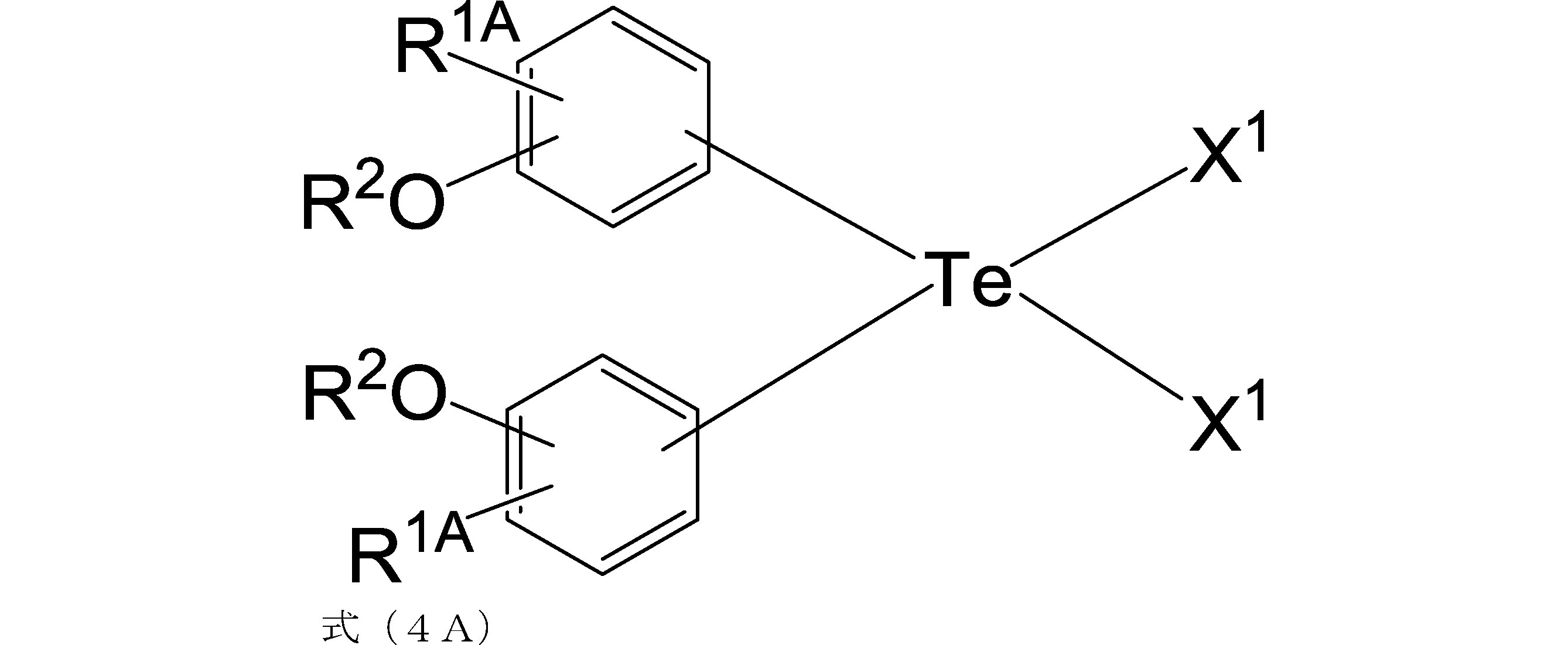
- 前記テルルを含有する化合物が、下記式(2B)で示される請求項6に記載のレジスト下層膜形成用組成物。

- 前記テルルを含有する化合物が、下記式(2B')で示される請求項10に記載のレジスト下層膜形成用組成物。

- 前記テルルを含有する化合物が、下記式(3B)で示される請求項11に記載のレジスト下層膜形成用組成物。

- 前記テルルを含有する化合物が、下記式(4B)で示される請求項13に記載のレジスト下層膜形成用組成物。

- 前記テルルを含有する化合物は、前記式におけるR2として、少なくとも一つの酸解離性反応基を有する請求項5~7,9~11,13~14のいずれか一項に記載のレジスト下層膜形成用組成物。
- 前記テルルを含有する化合物は、前記式におけるR2が全て水素原子である請求項5~7,9~11,13~14のいずれか一項に記載のレジスト下層膜形成用組成物。
- 前記テルルを含有する樹脂が、下記式(A-1)で示される化合物に由来する構成単位を含む樹脂である請求項1に記載のレジスト下層膜形成用組成物。
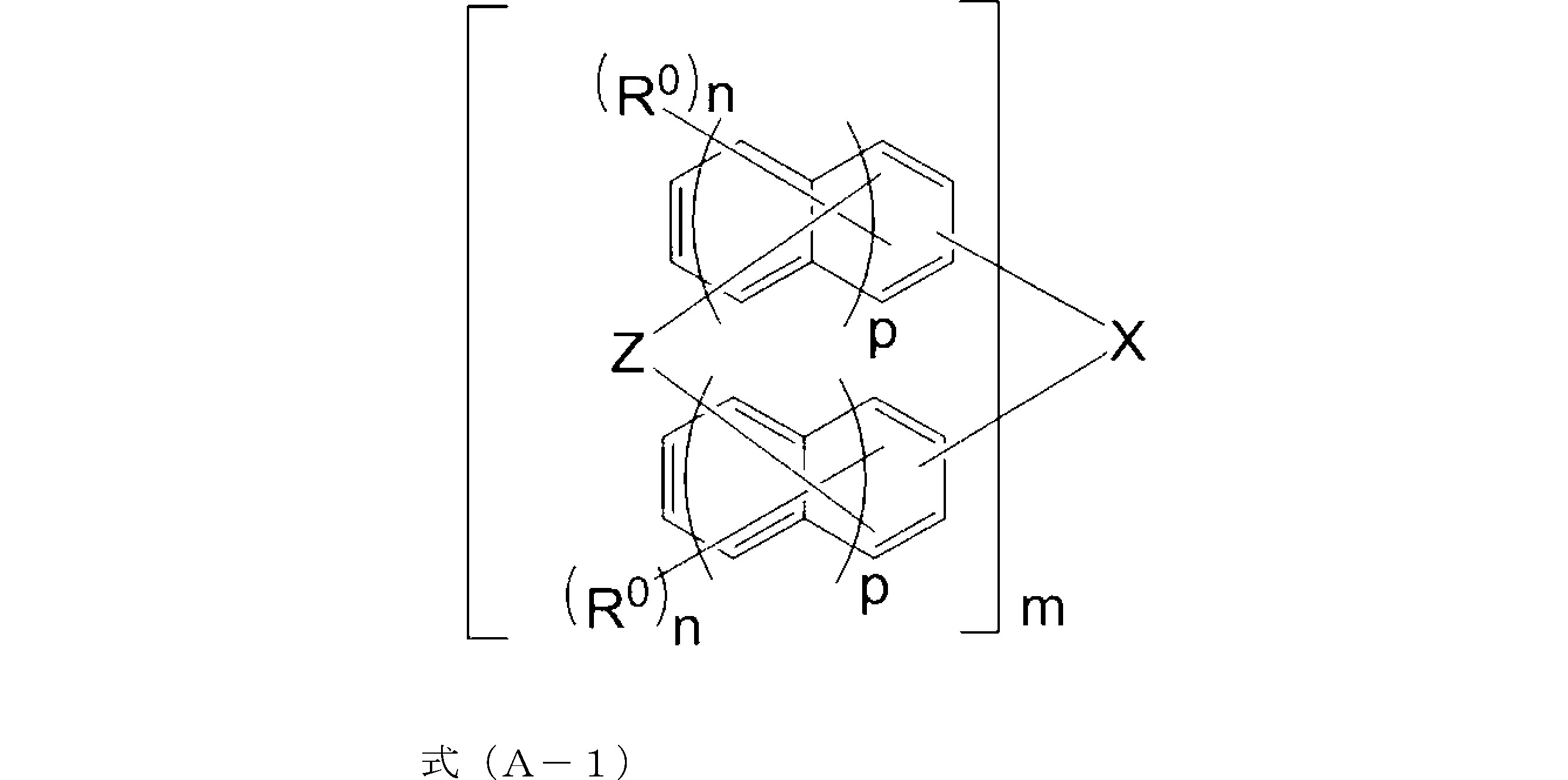
- 前記テルルを含有する樹脂が、下記式(A-2)で示される化合物に由来する構成単位を含む樹脂である請求項1に記載のレジスト下層膜形成用組成物。

- 前記テルルを含有する樹脂が、下記式(A-3)で示される化合物に由来する構成単位を含む樹脂である請求項1に記載のレジスト下層膜形成用組成物。
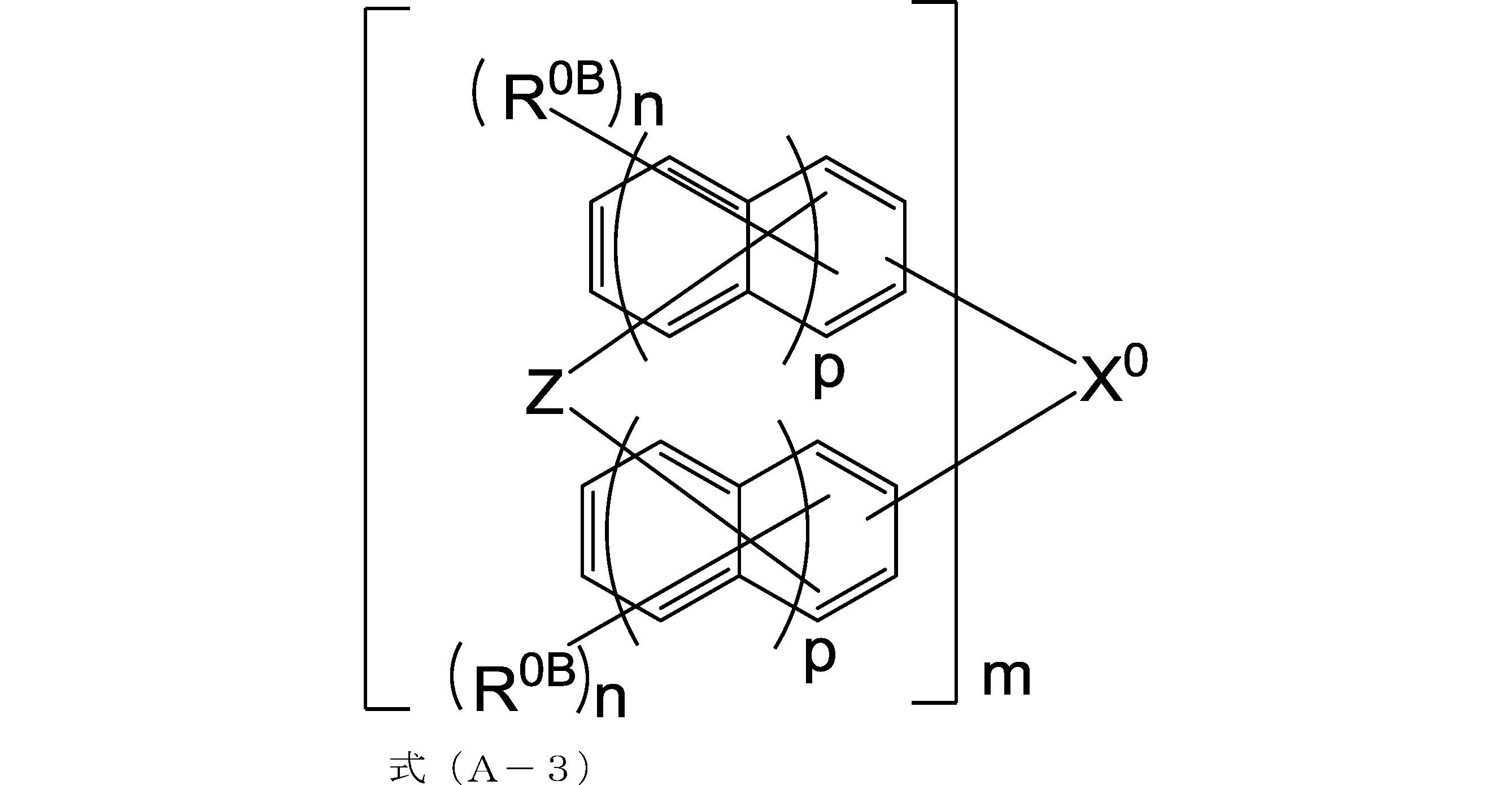
- 前記テルルを含有する樹脂が、下記式(B1-M)で示される構成単位を含む樹脂である請求項1に記載のレジスト下層膜形成用組成物。


- 前記テルルを含有する樹脂は、前記R4が前記一般式(5)で示されたいずれかの構造である請求項20に記載のレジスト下層膜形成用組成物。
- 前記テルルを含有する樹脂が、下記式(B2-M')で示される構成単位を含む樹脂である請求項20に記載のレジスト下層膜形成用組成物。
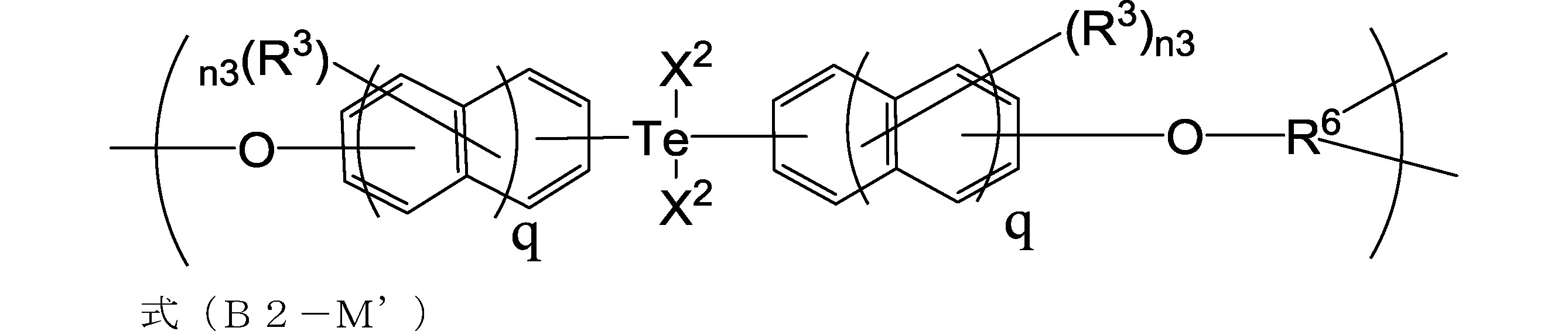

- 前記テルルを含有する樹脂が、下記式(C1)で示される構成単位を含む樹脂である請求項1に記載のレジスト下層膜形成用組成物。
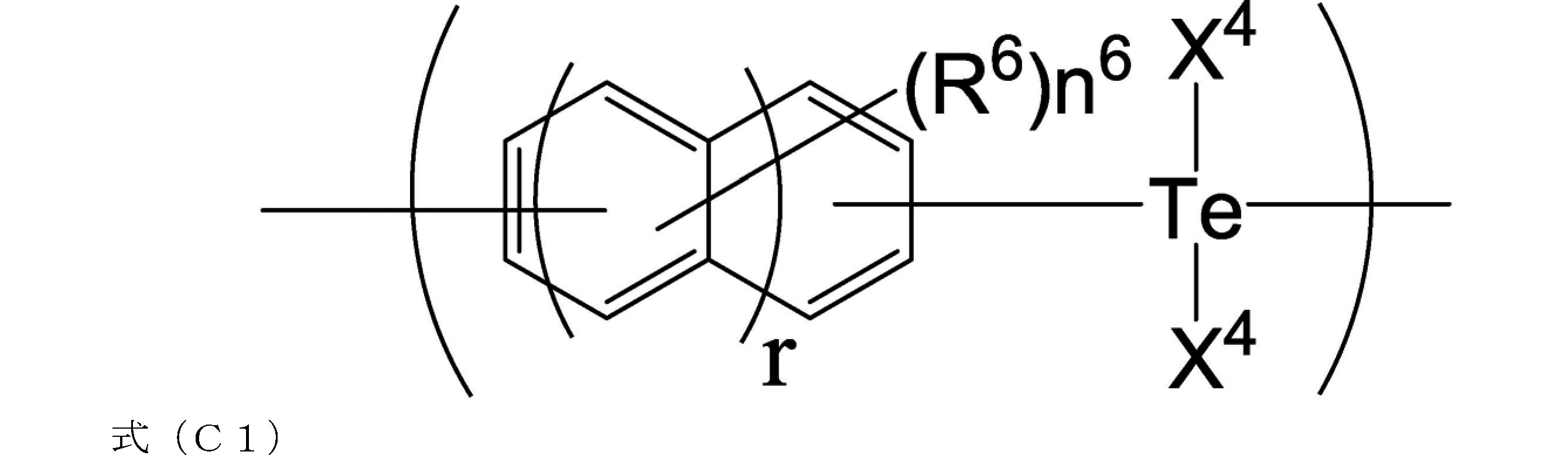
- 前記テルルを含有する樹脂が、下記式(B3-M)で示される構成単位を含む樹脂である請求項1に記載のレジスト下層膜形成用組成物。
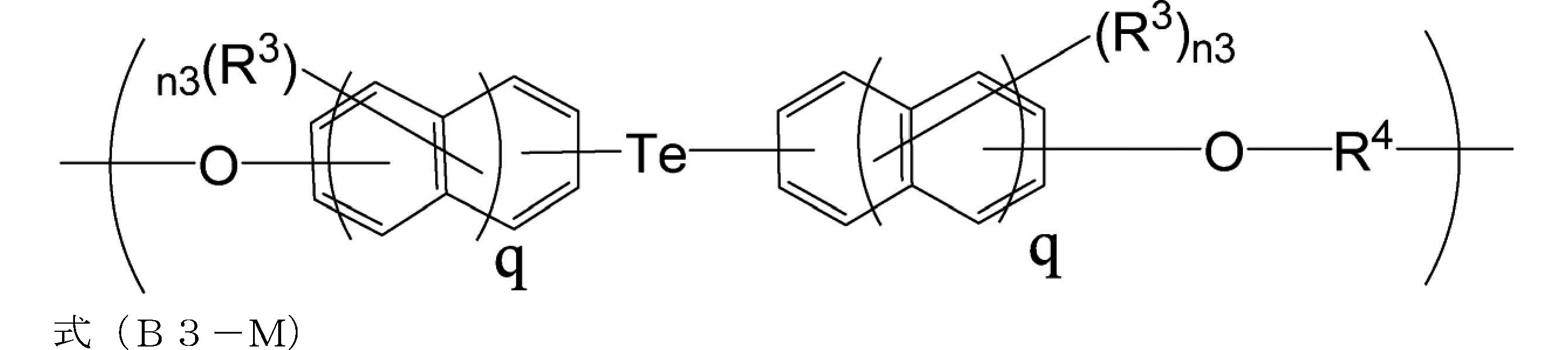

- 前記テルルを含有する樹脂は、前記R4が前記一般式(5)で示されたいずれかの構造である請求項24に記載のレジスト下層膜形成用組成物。
- 前記テルルを含有する樹脂が、下記式(B4-M')で示される構成単位を含む樹脂である請求項24に記載のレジスト下層膜形成用組成物。

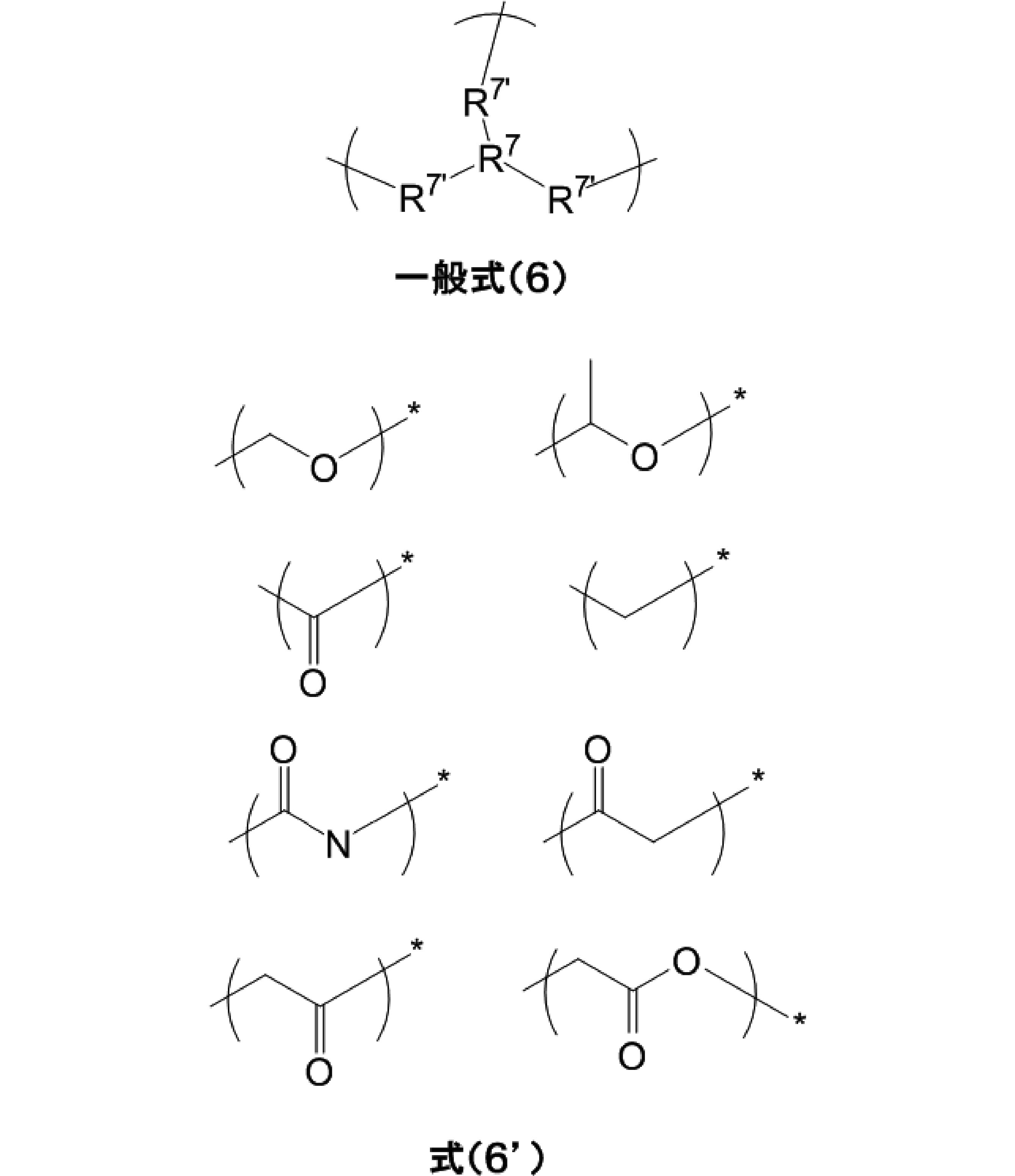
- 前記テルルを含有する樹脂が、下記式(C2)で示される構成単位を含む樹脂である請求項1に記載のレジスト下層膜形成用組成物。

- 請求項1~27のいずれか一項に記載のレジスト下層膜形成用組成物の製造方法であって、ハロゲン化テルルと、置換又は無置換のフェノール誘導体とを、塩基触媒存在下にて反応させて前記テルルを含有する化合物を合成する工程を含む、レジスト下層膜形成用組成物の製造方法。
- 溶媒を更に含む請求項1~請求項28のいずれか一項に記載のレジスト下層膜形成用組成物。
- 酸発生剤を更に含有する請求項1~請求項29のいずれか一項に記載のレジスト下層膜形成用組成物。
- 酸架橋剤を更に含有する請求項1~請求項30のいずれか一項に記載のレジスト下層膜形成用組成物。
- 請求項1~請求項31のいずれか一項に記載のレジスト下層膜形成用組成物を用いて形成されたリソグラフィー用レジスト下層膜。
- 基板上に、請求項1~請求項31のいずれか一項に記載のレジスト下層膜形成用組成物を用いてレジスト下層膜を形成し、前記レジスト下層膜上に、少なくとも1層のフォトレジスト層を形成した後、前記フォトレジスト層の所定の領域に放射線を照射し、現像を行うパターン形成方法。
- 基板上に、請求項1~請求項31のいずれか一項に記載のレジスト下層膜形成用組成物を用いてレジスト下層膜を形成し、前記レジスト下層膜上に、レジスト中間層膜材料を用いてレジスト中間層膜を形成し、前記レジスト中間層膜上に、少なくとも1層のフォトレジスト層を形成した後、前記フォトレジスト層の所定の領域に放射線を照射し、現像してレジストパターンを形成し、その後、前記レジストパターンをマスクとして前記レジスト中間層膜をエッチングし、得られた中間層膜パターンをエッチングマスクとして前記レジスト下層膜をエッチングし、得られた下層膜パターンをエッチングマスクとして基板をエッチングすることで基板にパターンを形成するパターン形成方法。
Priority Applications (5)
| Application Number | Priority Date | Filing Date | Title |
|---|---|---|---|
| JP2018514744A JP7116891B2 (ja) | 2016-04-28 | 2017-04-28 | レジスト下層膜形成用組成物、リソグラフィー用下層膜、及び、パターン形成方法 |
| CN201780026209.7A CN109154777A (zh) | 2016-04-28 | 2017-04-28 | 抗蚀剂下层膜形成用组合物、光刻用下层膜、及图案形成方法 |
| US16/096,674 US20200249573A1 (en) | 2016-04-28 | 2017-04-28 | Composition for resist underlayer film formation, underlayer film for lithography, and pattern formation method |
| KR1020187031194A KR20190003528A (ko) | 2016-04-28 | 2017-04-28 | 레지스트 하층막 형성용 조성물, 리소그래피용 하층막, 및, 패턴 형성방법 |
| EP17789732.9A EP3451059A4 (en) | 2016-04-28 | 2017-04-28 | COMPOSITION FOR FORMING A RESISTANT LAYER, LITHOGRAPHY LAYER AND STRUCTURAL FORMING METHOD |
Applications Claiming Priority (2)
| Application Number | Priority Date | Filing Date | Title |
|---|---|---|---|
| JP2016-091797 | 2016-04-28 | ||
| JP2016091797 | 2016-04-28 |
Publications (1)
| Publication Number | Publication Date |
|---|---|
| WO2017188451A1 true WO2017188451A1 (ja) | 2017-11-02 |
Family
ID=60160834
Family Applications (1)
| Application Number | Title | Priority Date | Filing Date |
|---|---|---|---|
| PCT/JP2017/017091 Ceased WO2017188451A1 (ja) | 2016-04-28 | 2017-04-28 | レジスト下層膜形成用組成物、リソグラフィー用下層膜、及び、パターン形成方法 |
Country Status (7)
| Country | Link |
|---|---|
| US (1) | US20200249573A1 (ja) |
| EP (1) | EP3451059A4 (ja) |
| JP (1) | JP7116891B2 (ja) |
| KR (1) | KR20190003528A (ja) |
| CN (1) | CN109154777A (ja) |
| TW (1) | TW201811876A (ja) |
| WO (1) | WO2017188451A1 (ja) |
Cited By (8)
| Publication number | Priority date | Publication date | Assignee | Title |
|---|---|---|---|---|
| US20180246405A1 (en) * | 2015-08-24 | 2018-08-30 | Mitsubishi Gas Chemical Company, Inc. | Material for lithography, production method therefor, composition for lithography, pattern formation method, compound, resin, and method for purifying the compound or the resin |
| CN109988259A (zh) * | 2017-12-31 | 2019-07-09 | 罗门哈斯电子材料有限责任公司 | 单体、聚合物和包含其的光刻组合物 |
| WO2019208761A1 (ja) * | 2018-04-27 | 2019-10-31 | 三菱瓦斯化学株式会社 | レジスト下層膜形成用組成物及びパターン形成方法 |
| WO2019208762A1 (ja) * | 2018-04-27 | 2019-10-31 | 三菱瓦斯化学株式会社 | レジスト下層膜形成用組成物、リソグラフィー用下層膜、及びパターン形成方法 |
| JPWO2020226150A1 (ja) * | 2019-05-08 | 2020-11-12 | ||
| US11505565B2 (en) | 2017-11-30 | 2022-11-22 | Rohm And Haas Electronic Materials Llc | Zwitterion compounds and photoresists comprising same |
| WO2023032998A1 (ja) * | 2021-08-31 | 2023-03-09 | 三菱瓦斯化学株式会社 | スピンオンカーボン膜形成用組成物、スピンオンカーボン膜形成用組成物の製造方法、リソグラフィー用下層膜、レジストパターン形成方法、及び回路パターン形成方法 |
| WO2025005020A1 (ja) * | 2023-06-30 | 2025-01-02 | 学校法人 関西大学 | リソグラフィー膜形成組成物、リソグラフィー下層膜及びレジストパターン形成方法 |
Families Citing this family (10)
| Publication number | Priority date | Publication date | Assignee | Title |
|---|---|---|---|---|
| JP3426186B2 (ja) | 2000-03-31 | 2003-07-14 | 鹿島建設株式会社 | 可動式間仕切り壁 |
| US12211691B2 (en) | 2018-12-20 | 2025-01-28 | Lam Research Corporation | Dry development of resists |
| TWI910974B (zh) | 2019-06-26 | 2026-01-01 | 美商蘭姆研究公司 | 利用鹵化物化學品的光阻顯影 |
| JP7618601B2 (ja) | 2019-06-28 | 2025-01-21 | ラム リサーチ コーポレーション | 複数のパターニング放射吸収元素および/または垂直組成勾配を備えたフォトレジスト |
| US20220365434A1 (en) * | 2019-10-02 | 2022-11-17 | Lam Research Corporation | Substrate surface modification with high euv absorbers for high performance euv photoresists |
| CN114200776A (zh) | 2020-01-15 | 2022-03-18 | 朗姆研究公司 | 用于光刻胶粘附和剂量减少的底层 |
| KR102796303B1 (ko) * | 2020-06-19 | 2025-04-14 | 주식회사 엘지화학 | 열 가소성 수지 및 이를 포함한 광학 소자 |
| WO2022010809A1 (en) | 2020-07-07 | 2022-01-13 | Lam Research Corporation | Integrated dry processes for patterning radiation photoresist patterning |
| WO2022103764A1 (en) | 2020-11-13 | 2022-05-19 | Lam Research Corporation | Process tool for dry removal of photoresist |
| KR20240103845A (ko) * | 2022-12-27 | 2024-07-04 | 삼성전자주식회사 | 유기금속 화합물, 이를 포함한 레지스트 조성물 및 이를 이용한 패턴 형성 방법 |
Citations (5)
| Publication number | Priority date | Publication date | Assignee | Title |
|---|---|---|---|---|
| JPS5219516A (en) * | 1975-08-05 | 1977-02-14 | Asahi Chem Ind Co Ltd | Photosensitive composition |
| JPH0239156A (ja) * | 1988-07-29 | 1990-02-08 | Fujitsu Ltd | 電子線露光用レジスト層、電子線露光用レジスト層の形成方法およびパターン形成方法 |
| JPH1048831A (ja) * | 1996-08-07 | 1998-02-20 | Sony Corp | レジスト・パターン形成方法 |
| JP2015018223A (ja) * | 2013-06-11 | 2015-01-29 | 信越化学工業株式会社 | 下層膜材料及びパターン形成方法 |
| WO2017033943A1 (ja) * | 2015-08-24 | 2017-03-02 | 学校法人関西大学 | リソグラフィー用材料及びその製造方法、リソグラフィー用組成物、パターン形成方法、並びに、化合物、樹脂、及びこれらの精製方法 |
Family Cites Families (4)
| Publication number | Priority date | Publication date | Assignee | Title |
|---|---|---|---|---|
| US4379827A (en) * | 1971-12-08 | 1983-04-12 | Energy Conversion Devices, Inc. | Imaging structure with tellurium metal film and energy sensitive material thereon |
| EP2345932A4 (en) * | 2008-10-14 | 2012-06-13 | Asahi Kasei Corp | HEAT-RESISTANT RESISTANT MATERIAL, LAMINATED BODY FOR THERMAL LITHOGRAPHY WITH THE MATERIAL AND MOLDING PROCESS WITH THE MATERIAL AND LAMINATE BODY |
| US8647809B2 (en) * | 2011-07-07 | 2014-02-11 | Brewer Science Inc. | Metal-oxide films from small molecules for lithographic applications |
| US10294183B2 (en) * | 2014-03-13 | 2019-05-21 | Mitsubishi Gas Chemical Company, Inc. | Compound, resin, material for forming underlayer film for lithography, underlayer film for lithography, pattern forming method, and method for purifying the compound or resin |
-
2017
- 2017-04-28 EP EP17789732.9A patent/EP3451059A4/en not_active Withdrawn
- 2017-04-28 KR KR1020187031194A patent/KR20190003528A/ko not_active Ceased
- 2017-04-28 CN CN201780026209.7A patent/CN109154777A/zh not_active Withdrawn
- 2017-04-28 TW TW106114317A patent/TW201811876A/zh unknown
- 2017-04-28 US US16/096,674 patent/US20200249573A1/en not_active Abandoned
- 2017-04-28 WO PCT/JP2017/017091 patent/WO2017188451A1/ja not_active Ceased
- 2017-04-28 JP JP2018514744A patent/JP7116891B2/ja active Active
Patent Citations (5)
| Publication number | Priority date | Publication date | Assignee | Title |
|---|---|---|---|---|
| JPS5219516A (en) * | 1975-08-05 | 1977-02-14 | Asahi Chem Ind Co Ltd | Photosensitive composition |
| JPH0239156A (ja) * | 1988-07-29 | 1990-02-08 | Fujitsu Ltd | 電子線露光用レジスト層、電子線露光用レジスト層の形成方法およびパターン形成方法 |
| JPH1048831A (ja) * | 1996-08-07 | 1998-02-20 | Sony Corp | レジスト・パターン形成方法 |
| JP2015018223A (ja) * | 2013-06-11 | 2015-01-29 | 信越化学工業株式会社 | 下層膜材料及びパターン形成方法 |
| WO2017033943A1 (ja) * | 2015-08-24 | 2017-03-02 | 学校法人関西大学 | リソグラフィー用材料及びその製造方法、リソグラフィー用組成物、パターン形成方法、並びに、化合物、樹脂、及びこれらの精製方法 |
Non-Patent Citations (1)
| Title |
|---|
| See also references of EP3451059A4 * |
Cited By (22)
| Publication number | Priority date | Publication date | Assignee | Title |
|---|---|---|---|---|
| US11852970B2 (en) * | 2015-08-24 | 2023-12-26 | Mitsubishi Gas Chemical Company, Inc. | Material for lithography, production method therefor, composition for lithography, pattern formation method, compound, resin, and method for purifying the compound or the resin |
| US20180246405A1 (en) * | 2015-08-24 | 2018-08-30 | Mitsubishi Gas Chemical Company, Inc. | Material for lithography, production method therefor, composition for lithography, pattern formation method, compound, resin, and method for purifying the compound or the resin |
| US11505565B2 (en) | 2017-11-30 | 2022-11-22 | Rohm And Haas Electronic Materials Llc | Zwitterion compounds and photoresists comprising same |
| KR102208670B1 (ko) * | 2017-12-31 | 2021-01-27 | 롬 앤드 하스 일렉트로닉 머트어리얼즈 엘엘씨 | 단량체, 중합체 및 이를 포함하는 리소그래피 조성물 |
| CN109988259A (zh) * | 2017-12-31 | 2019-07-09 | 罗门哈斯电子材料有限责任公司 | 单体、聚合物和包含其的光刻组合物 |
| KR20190082663A (ko) * | 2017-12-31 | 2019-07-10 | 롬 앤드 하스 일렉트로닉 머트어리얼즈 엘엘씨 | 단량체, 중합체 및 이를 포함하는 리소그래피 조성물 |
| JP2019119851A (ja) * | 2017-12-31 | 2019-07-22 | ローム アンド ハース エレクトロニック マテリアルズ エルエルシーRohm and Haas Electronic Materials LLC | モノマー、ポリマーおよびこれを含むリソグラフィ組成物 |
| US11932713B2 (en) | 2017-12-31 | 2024-03-19 | Rohm And Haas Electronic Materials Llc | Monomers, polymers and lithographic compositions comprising same |
| JPWO2019208761A1 (ja) * | 2018-04-27 | 2021-05-13 | 三菱瓦斯化学株式会社 | レジスト下層膜形成用組成物及びパターン形成方法 |
| WO2019208762A1 (ja) * | 2018-04-27 | 2019-10-31 | 三菱瓦斯化学株式会社 | レジスト下層膜形成用組成物、リソグラフィー用下層膜、及びパターン形成方法 |
| WO2019208761A1 (ja) * | 2018-04-27 | 2019-10-31 | 三菱瓦斯化学株式会社 | レジスト下層膜形成用組成物及びパターン形成方法 |
| JPWO2019208762A1 (ja) * | 2018-04-27 | 2021-05-27 | 三菱瓦斯化学株式会社 | レジスト下層膜形成用組成物、リソグラフィー用下層膜、及びパターン形成方法 |
| EP3786710A4 (en) * | 2018-04-27 | 2021-06-23 | Mitsubishi Gas Chemical Company, Inc. | COMPOSITION FORMING RESIST UNDERLAYER FILM, UNDERLAYER FILM FOR LITHOGRAPHY AND PATTERN MAKING METHOD |
| EP3757678A4 (en) * | 2018-04-27 | 2021-05-05 | Mitsubishi Gas Chemical Company, Inc. | RESIST SUBLAYER FILM-FORMING COMPOSITION AND METHOD FOR PREPARING PATTERNS |
| JP7324407B2 (ja) | 2018-04-27 | 2023-08-10 | 三菱瓦斯化学株式会社 | レジスト下層膜形成用組成物及びパターン形成方法 |
| JP7324408B2 (ja) | 2018-04-27 | 2023-08-10 | 三菱瓦斯化学株式会社 | レジスト下層膜形成用組成物、リソグラフィー用下層膜、及びパターン形成方法 |
| JPWO2020226150A1 (ja) * | 2019-05-08 | 2020-11-12 | ||
| WO2020226150A1 (ja) * | 2019-05-08 | 2020-11-12 | 学校法人 関西大学 | 化合物及びその製造方法、樹脂、組成物、レジスト膜、パターン形成方法、リソグラフィー用下層膜、光学部品、並びに化合物又は樹脂の精製方法 |
| JP7523075B2 (ja) | 2019-05-08 | 2024-07-26 | 学校法人 関西大学 | 化合物及びその製造方法、樹脂、組成物、レジスト膜、パターン形成方法、リソグラフィー用下層膜、光学部品、並びに化合物又は樹脂の精製方法 |
| JPWO2023032998A1 (ja) * | 2021-08-31 | 2023-03-09 | ||
| WO2023032998A1 (ja) * | 2021-08-31 | 2023-03-09 | 三菱瓦斯化学株式会社 | スピンオンカーボン膜形成用組成物、スピンオンカーボン膜形成用組成物の製造方法、リソグラフィー用下層膜、レジストパターン形成方法、及び回路パターン形成方法 |
| WO2025005020A1 (ja) * | 2023-06-30 | 2025-01-02 | 学校法人 関西大学 | リソグラフィー膜形成組成物、リソグラフィー下層膜及びレジストパターン形成方法 |
Also Published As
| Publication number | Publication date |
|---|---|
| KR20190003528A (ko) | 2019-01-09 |
| EP3451059A4 (en) | 2019-04-03 |
| EP3451059A1 (en) | 2019-03-06 |
| JPWO2017188451A1 (ja) | 2019-02-28 |
| US20200249573A1 (en) | 2020-08-06 |
| TW201811876A (zh) | 2018-04-01 |
| CN109154777A (zh) | 2019-01-04 |
| JP7116891B2 (ja) | 2022-08-12 |
Similar Documents
| Publication | Publication Date | Title |
|---|---|---|
| JP7116891B2 (ja) | レジスト下層膜形成用組成物、リソグラフィー用下層膜、及び、パターン形成方法 | |
| JP7212449B2 (ja) | 化合物及びその製造方法、並びに、組成物、光学部品形成用組成物、リソグラフィー用膜形成組成物、レジスト組成物、レジストパターンの形成方法、感放射線性組成物、アモルファス膜の製造方法、リソグラフィー用下層膜形成材料、リソグラフィー用下層膜形成用組成物、リソグラフィー用下層膜の製造方法、レジストパターン形成方法、回路パターン形成方法、及び、精製方法 | |
| JPWO2017111165A1 (ja) | 化合物、樹脂、組成物、レジストパターン形成方法、及び、回路パターン形成方法 | |
| WO2017188450A1 (ja) | レジスト下層膜形成用組成物、それを用いたリソグラフィー用下層膜、及び、パターン形成方法、並びに、化合物及びその製造方法 | |
| CN107850848B (zh) | 化合物及其制造方法 | |
| KR20180043283A (ko) | 리소그래피용 재료 및 그 제조방법, 리소그래피용 조성물, 패턴 형성방법, 그리고, 화합물, 수지, 및 이들의 정제방법 | |
| JP7324407B2 (ja) | レジスト下層膜形成用組成物及びパターン形成方法 | |
| TW201817722A (zh) | 化合物、樹脂、組成物及圖型形成方法 | |
| KR20200111698A (ko) | 화합물, 수지, 조성물 및 패턴 형성방법 | |
| JP7578908B2 (ja) | 化合物、樹脂、組成物、レジストパターン形成方法、回路パターン形成方法及び樹脂の精製方法 | |
| KR20180034427A (ko) | 신규 (메트)아크릴로일 화합물 및 그 제조방법 | |
| KR20190129907A (ko) | 레지스트 조성물 및 이를 이용하는 패턴형성방법, 그리고, 화합물 및 수지 | |
| JP7523075B2 (ja) | 化合物及びその製造方法、樹脂、組成物、レジスト膜、パターン形成方法、リソグラフィー用下層膜、光学部品、並びに化合物又は樹脂の精製方法 | |
| KR20210113990A (ko) | 막형성용 조성물, 레지스트 조성물, 감방사선성 조성물, 아모퍼스막의 제조방법, 레지스트 패턴 형성방법, 리소그래피용 하층막 형성용 조성물, 리소그래피용 하층막의 제조방법 및 회로패턴 형성방법 | |
| KR20230035520A (ko) | 막형성용 조성물, 레지스트 조성물, 감방사선성 조성물, 아몰퍼스막의 제조방법, 레지스트패턴 형성방법, 리소그래피용 하층막형성용 조성물, 리소그래피용 하층막의 제조방법 및 회로패턴 형성방법, 광학부재형성용 조성물, 막형성용 수지, 레지스트 수지, 감방사선성 수지, 리소그래피용 하층막형성용 수지 | |
| CN112513737B (zh) | 下层膜形成组合物 | |
| JP7459789B2 (ja) | 化合物、樹脂、組成物、レジストパターン形成方法、回路パターン形成方法及び樹脂の精製方法 | |
| TW201841875A (zh) | 化合物、樹脂、組成物及圖型形成方法 | |
| CN116888181A (zh) | 树脂、组合物、抗蚀图案形成方法、电路图案形成方法及树脂的纯化方法 | |
| JP2025020180A (ja) | 化合物、樹脂、組成物、レジストパターン形成方法、回路パターン形成方法及び精製方法 |
Legal Events
| Date | Code | Title | Description |
|---|---|---|---|
| ENP | Entry into the national phase |
Ref document number: 2018514744 Country of ref document: JP Kind code of ref document: A |
|
| ENP | Entry into the national phase |
Ref document number: 20187031194 Country of ref document: KR Kind code of ref document: A |
|
| NENP | Non-entry into the national phase |
Ref country code: DE |
|
| 121 | Ep: the epo has been informed by wipo that ep was designated in this application |
Ref document number: 17789732 Country of ref document: EP Kind code of ref document: A1 |
|
| WWE | Wipo information: entry into national phase |
Ref document number: 2017789732 Country of ref document: EP |
|
| ENP | Entry into the national phase |
Ref document number: 2017789732 Country of ref document: EP Effective date: 20181128 |