WO2017191830A1 - Résine polyimide, composition de résine polyimide, et pellicule polyimide - Google Patents
Résine polyimide, composition de résine polyimide, et pellicule polyimide Download PDFInfo
- Publication number
- WO2017191830A1 WO2017191830A1 PCT/JP2017/017156 JP2017017156W WO2017191830A1 WO 2017191830 A1 WO2017191830 A1 WO 2017191830A1 JP 2017017156 W JP2017017156 W JP 2017017156W WO 2017191830 A1 WO2017191830 A1 WO 2017191830A1
- Authority
- WO
- WIPO (PCT)
- Prior art keywords
- polyimide resin
- structural unit
- mol
- film
- polyimide
- Prior art date
- Legal status (The legal status is an assumption and is not a legal conclusion. Google has not performed a legal analysis and makes no representation as to the accuracy of the status listed.)
- Ceased
Links
- YGYCECQIOXZODZ-UHFFFAOYSA-N O=C(C(C1C2C(O3)=O)C2C3=O)OC1=O Chemical compound O=C(C(C1C2C(O3)=O)C2C3=O)OC1=O YGYCECQIOXZODZ-UHFFFAOYSA-N 0.000 description 1
Images
Classifications
-
- C—CHEMISTRY; METALLURGY
- C08—ORGANIC MACROMOLECULAR COMPOUNDS; THEIR PREPARATION OR CHEMICAL WORKING-UP; COMPOSITIONS BASED THEREON
- C08G—MACROMOLECULAR COMPOUNDS OBTAINED OTHERWISE THAN BY REACTIONS ONLY INVOLVING UNSATURATED CARBON-TO-CARBON BONDS
- C08G73/00—Macromolecular compounds obtained by reactions forming a linkage containing nitrogen with or without oxygen or carbon in the main chain of the macromolecule, not provided for in groups C08G12/00 - C08G71/00
- C08G73/06—Polycondensates having nitrogen-containing heterocyclic rings in the main chain of the macromolecule
- C08G73/10—Polyimides; Polyester-imides; Polyamide-imides; Polyamide acids or similar polyimide precursors
- C08G73/1039—Polyimides; Polyester-imides; Polyamide-imides; Polyamide acids or similar polyimide precursors comprising halogen-containing substituents
-
- C—CHEMISTRY; METALLURGY
- C08—ORGANIC MACROMOLECULAR COMPOUNDS; THEIR PREPARATION OR CHEMICAL WORKING-UP; COMPOSITIONS BASED THEREON
- C08G—MACROMOLECULAR COMPOUNDS OBTAINED OTHERWISE THAN BY REACTIONS ONLY INVOLVING UNSATURATED CARBON-TO-CARBON BONDS
- C08G73/00—Macromolecular compounds obtained by reactions forming a linkage containing nitrogen with or without oxygen or carbon in the main chain of the macromolecule, not provided for in groups C08G12/00 - C08G71/00
- C08G73/06—Polycondensates having nitrogen-containing heterocyclic rings in the main chain of the macromolecule
- C08G73/10—Polyimides; Polyester-imides; Polyamide-imides; Polyamide acids or similar polyimide precursors
- C08G73/1042—Copolyimides derived from at least two different tetracarboxylic compounds or two different diamino compounds
-
- C—CHEMISTRY; METALLURGY
- C08—ORGANIC MACROMOLECULAR COMPOUNDS; THEIR PREPARATION OR CHEMICAL WORKING-UP; COMPOSITIONS BASED THEREON
- C08G—MACROMOLECULAR COMPOUNDS OBTAINED OTHERWISE THAN BY REACTIONS ONLY INVOLVING UNSATURATED CARBON-TO-CARBON BONDS
- C08G73/00—Macromolecular compounds obtained by reactions forming a linkage containing nitrogen with or without oxygen or carbon in the main chain of the macromolecule, not provided for in groups C08G12/00 - C08G71/00
- C08G73/06—Polycondensates having nitrogen-containing heterocyclic rings in the main chain of the macromolecule
- C08G73/10—Polyimides; Polyester-imides; Polyamide-imides; Polyamide acids or similar polyimide precursors
- C08G73/1003—Preparatory processes
- C08G73/1007—Preparatory processes from tetracarboxylic acids or derivatives and diamines
-
- C—CHEMISTRY; METALLURGY
- C08—ORGANIC MACROMOLECULAR COMPOUNDS; THEIR PREPARATION OR CHEMICAL WORKING-UP; COMPOSITIONS BASED THEREON
- C08G—MACROMOLECULAR COMPOUNDS OBTAINED OTHERWISE THAN BY REACTIONS ONLY INVOLVING UNSATURATED CARBON-TO-CARBON BONDS
- C08G73/00—Macromolecular compounds obtained by reactions forming a linkage containing nitrogen with or without oxygen or carbon in the main chain of the macromolecule, not provided for in groups C08G12/00 - C08G71/00
- C08G73/06—Polycondensates having nitrogen-containing heterocyclic rings in the main chain of the macromolecule
- C08G73/10—Polyimides; Polyester-imides; Polyamide-imides; Polyamide acids or similar polyimide precursors
- C08G73/1075—Partially aromatic polyimides
- C08G73/1082—Partially aromatic polyimides wholly aromatic in the tetracarboxylic moiety
-
- C—CHEMISTRY; METALLURGY
- C08—ORGANIC MACROMOLECULAR COMPOUNDS; THEIR PREPARATION OR CHEMICAL WORKING-UP; COMPOSITIONS BASED THEREON
- C08J—WORKING-UP; GENERAL PROCESSES OF COMPOUNDING; AFTER-TREATMENT NOT COVERED BY SUBCLASSES C08B, C08C, C08F, C08G or C08H
- C08J5/00—Manufacture of articles or shaped materials containing macromolecular substances
- C08J5/18—Manufacture of films or sheets
-
- C—CHEMISTRY; METALLURGY
- C08—ORGANIC MACROMOLECULAR COMPOUNDS; THEIR PREPARATION OR CHEMICAL WORKING-UP; COMPOSITIONS BASED THEREON
- C08K—Use of inorganic or non-macromolecular organic substances as compounding ingredients
- C08K3/00—Use of inorganic substances as compounding ingredients
- C08K3/18—Oxygen-containing compounds, e.g. metal carbonyls
- C08K3/20—Oxides; Hydroxides
- C08K3/22—Oxides; Hydroxides of metals
-
- C—CHEMISTRY; METALLURGY
- C08—ORGANIC MACROMOLECULAR COMPOUNDS; THEIR PREPARATION OR CHEMICAL WORKING-UP; COMPOSITIONS BASED THEREON
- C08L—COMPOSITIONS OF MACROMOLECULAR COMPOUNDS
- C08L79/00—Compositions of macromolecular compounds obtained by reactions forming in the main chain of the macromolecule a linkage containing nitrogen with or without oxygen or carbon only, not provided for in groups C08L61/00 - C08L77/00
- C08L79/04—Polycondensates having nitrogen-containing heterocyclic rings in the main chain; Polyhydrazides; Polyamide acids or similar polyimide precursors
- C08L79/08—Polyimides; Polyester-imides; Polyamide-imides; Polyamide acids or similar polyimide precursors
-
- C—CHEMISTRY; METALLURGY
- C08—ORGANIC MACROMOLECULAR COMPOUNDS; THEIR PREPARATION OR CHEMICAL WORKING-UP; COMPOSITIONS BASED THEREON
- C08J—WORKING-UP; GENERAL PROCESSES OF COMPOUNDING; AFTER-TREATMENT NOT COVERED BY SUBCLASSES C08B, C08C, C08F, C08G or C08H
- C08J2377/00—Characterised by the use of polyamides obtained by reactions forming a carboxylic amide link in the main chain; Derivatives of such polymers
- C08J2377/06—Polyamides derived from polyamines and polycarboxylic acids
-
- C—CHEMISTRY; METALLURGY
- C08—ORGANIC MACROMOLECULAR COMPOUNDS; THEIR PREPARATION OR CHEMICAL WORKING-UP; COMPOSITIONS BASED THEREON
- C08K—Use of inorganic or non-macromolecular organic substances as compounding ingredients
- C08K3/00—Use of inorganic substances as compounding ingredients
- C08K3/18—Oxygen-containing compounds, e.g. metal carbonyls
- C08K3/20—Oxides; Hydroxides
- C08K3/22—Oxides; Hydroxides of metals
- C08K2003/2227—Oxides; Hydroxides of metals of aluminium
-
- C—CHEMISTRY; METALLURGY
- C08—ORGANIC MACROMOLECULAR COMPOUNDS; THEIR PREPARATION OR CHEMICAL WORKING-UP; COMPOSITIONS BASED THEREON
- C08K—Use of inorganic or non-macromolecular organic substances as compounding ingredients
- C08K2201/00—Specific properties of additives
- C08K2201/002—Physical properties
- C08K2201/003—Additives being defined by their diameter
-
- C—CHEMISTRY; METALLURGY
- C08—ORGANIC MACROMOLECULAR COMPOUNDS; THEIR PREPARATION OR CHEMICAL WORKING-UP; COMPOSITIONS BASED THEREON
- C08K—Use of inorganic or non-macromolecular organic substances as compounding ingredients
- C08K2201/00—Specific properties of additives
- C08K2201/002—Physical properties
- C08K2201/005—Additives being defined by their particle size in general
-
- C—CHEMISTRY; METALLURGY
- C08—ORGANIC MACROMOLECULAR COMPOUNDS; THEIR PREPARATION OR CHEMICAL WORKING-UP; COMPOSITIONS BASED THEREON
- C08K—Use of inorganic or non-macromolecular organic substances as compounding ingredients
- C08K2201/00—Specific properties of additives
- C08K2201/011—Nanostructured additives
-
- Y—GENERAL TAGGING OF NEW TECHNOLOGICAL DEVELOPMENTS; GENERAL TAGGING OF CROSS-SECTIONAL TECHNOLOGIES SPANNING OVER SEVERAL SECTIONS OF THE IPC; TECHNICAL SUBJECTS COVERED BY FORMER USPC CROSS-REFERENCE ART COLLECTIONS [XRACs] AND DIGESTS
- Y10—TECHNICAL SUBJECTS COVERED BY FORMER USPC
- Y10T—TECHNICAL SUBJECTS COVERED BY FORMER US CLASSIFICATION
- Y10T428/00—Stock material or miscellaneous articles
- Y10T428/31504—Composite [nonstructural laminate]
- Y10T428/31721—Of polyimide
Definitions
- the present invention relates to a polyimide resin, a polyimide resin composition, and a polyimide film containing the polyimide resin or the polyimide resin composition.
- polyimide resins are obtained from aromatic tetracarboxylic anhydrides and aromatic diamines, and have excellent heat resistance, chemical resistance, mechanical properties, and electrical properties due to molecular rigidity, resonance stabilization, and strong chemical bonds. Therefore, it is widely used in fields such as molding materials, composite materials, electric / electronic parts, optical materials, displays, and aerospace.
- many conventional polyimide resins have a high water absorption rate, and have problems such as poor hygroscopic dimensional stability when used in thin layers.
- Patent Document 1 discloses that a polyimide resin produced using an ester group-containing aromatic tetracarboxylic dianhydride exhibits a low water absorption rate.
- Patent Document 2 discloses an aromatic diamine compound having a structure in which an aromatic ring constituting an aromatic diamine compound is connected via a single bond and an amide bond, and a single bond, an amide bond and an amino group bonded at the para position. It is disclosed that a polyimide resin produced using a group diamine compound exhibits low water absorption. In addition, a film made of polyimide resin is required to have higher transparency than ever.
- the polyimide resins disclosed in Patent Documents 1 and 2 have been difficult to combine heat resistance, colorless transparency, and low water absorption. That is, the problem to be solved by the present invention is a polyimide resin that can form a film having low water absorption in addition to heat resistance and colorless transparency, a polyimide resin composition, and the polyimide resin or the polyimide resin composition It is providing the polyimide film containing this.
- the present invention relates to the following [1] to [3].
- a polyimide resin having a structural unit A derived from tetracarboxylic dianhydride and a structural unit B derived from diamine The structural unit A includes a structural unit (A-1) derived from a compound represented by the following formula (a-1),
- the polyimide resin in which the structural unit B includes a structural unit derived from an aliphatic diamine is derived from an aliphatic diamine.
- a polyimide resin composition comprising the polyimide resin and inorganic fine particles.
- a polyimide film containing the polyimide resin or the polyimide resin composition is also included.
- a polyimide resin capable of forming a film having low water absorption in addition to heat resistance and colorless transparency, a polyimide resin composition, and a polyimide film containing the polyimide resin or the polyimide resin composition are provided. can do.
- the polyimide resin of the present invention is a polyimide resin having a structural unit A derived from tetracarboxylic dianhydride and a structural unit B derived from diamine, and the structural unit A is represented by the following formula (a-1). And a structural unit (A-1) derived from the compound, and a structural unit B includes a structural unit derived from an aliphatic diamine.
- aliphatic diamine refers to a diamine in which an amino group is directly bonded to an aliphatic group, and an aliphatic group, an alicyclic group, an aromatic group, and other parts of the structure. It may contain a substituent and may have at least one functional group selected from the group consisting of a carboxy group, a hydroxyl group and a carbonyl group.
- Alicyclic diamine refers to a diamine in which an amino group is directly bonded to an alicyclic group, and an aliphatic group, an alicyclic group, an aromatic group, and other substituents are part of the structure.
- Aromatic diamine refers to a diamine in which an amino group is directly bonded to an aromatic ring, and includes an aliphatic group, an alicyclic group, an aromatic group, and other substituents in a part of the structure. May be.
- 1,3- or 1,4-bis (aminomethyl) cyclohexane and metaxylylenediamine are aliphatic diamines because the amino group is directly bonded to an aliphatic group (methylene group).
- the polyimide resin of the present invention will be described.
- the structural unit A contained in the polyimide of the present invention is a structural unit derived from tetracarboxylic dianhydride. Tetracarboxylic dianhydride can be used alone or in combination of two or more.
- the structural unit A includes the structural unit (A-1) derived from the compound represented by the formula (a-1).
- the structural unit A contains the structural unit (A-1)
- low water absorption and transparency are improved, and the deformation recovery rate is improved.
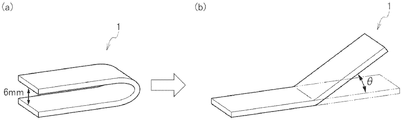
- the deformation recovery rate in the present invention indicates the degree of return from the state in which one film is bent to the original state, and is measured by the method described in the examples. is there.
- the ratio of the structural unit (A-1) to the structural unit A is preferably 30 to 100 mol%, more preferably 40 to 100 mol%, still more preferably 50 to 100 mol%, and still more preferably. Is from 60 to 100 mol%, more preferably from 80 to 100 mol%.
- the structural unit A may contain a structural unit (A-2) derived from a compound represented by the following formula (a-2) from the viewpoint of heat resistance, mechanical properties (elastic modulus), and organic solvent resistance. Good.
- Examples of the compound represented by the formula (a-2) include 3,3 ′, 4,4′-biphenyltetracarboxylic dianhydride (s-BPDA) represented by the following formula (a-2-1), 2,3,3 ′, 4′-biphenyltetracarboxylic dianhydride (a-BPDA) represented by the following formula (a-2-2), 2 represented by the following formula (a-2-3) , 2 ′, 3,3′-biphenyltetracarboxylic dianhydride (i-BPDA), among which 3,3 ′, 4,4′-biphenyl represented by the following formula (a-2-1) Tetracarboxylic dianhydride is preferred.
- s-BPDA 4,4′-biphenyltetracarboxylic dianhydride
- a-BPDA 2,3,3 ′, 4′-biphenyltetracarboxylic dianhydride
- i-BPDA 3,3′-biphenyl represented by
- the compounds represented by the formula (a-2) can be used alone or in combination of two or more.
- s-BPDA is preferable in terms of resistance to organic solvents
- a-BPDA and i-BPDA are preferable in terms of heat resistance and solution processability.
- the ratio of the structural unit (A-2) to the structural unit A is preferably 70 mol% or less, more preferably 60 mol% or less, and further preferably 50 mol% or less, from the viewpoints of low water absorption, transparency, and deformation recovery rate.
- 40 mol% or less is more preferable, and 20 mol% or less is still more preferable.
- the molar ratio of the structural unit (A-1) to the structural unit (A-2) is 30: 70: 99: 1 is preferable, 40: 60-95: 5 is more preferable, 40: 60-90: 10 is still more preferable, 50: 50-85: 15 is still more preferable, and 50: 50-80: 20 is Even more preferable
- the structural unit A may contain a structural unit (A-3) derived from a compound represented by the following formula (a-3) from the viewpoint of colorless transparency and heat resistance.
- the ratio of the structural unit (A-3) to the structural unit A is preferably 40 mol% or less, more preferably 30 mol% or less, and more preferably 20 mol% or less from the viewpoint of low water absorption, organic solvent resistance, and deformation recovery rate. Is more preferable.
- the structural unit A includes the structural unit (A-3)
- the molar ratio of the structural unit (A-1) to the structural unit (A-3) is low water absorption, organic solvent resistance, deformation recovery rate.
- 60:40 to 99: 1 is preferable, 70:30 to 95: 5 is more preferable, and 80:20 to 90:10 is still more preferable.
- the structural unit A may contain a structural unit (A-4) derived from a compound represented by the following formula (a-4) from the viewpoint of colorless transparency and heat resistance.
- the ratio of the structural unit (A-4) to the structural unit A is preferably 60 mol% or less, more preferably 50 mol% or less, and more preferably 40 mol% or less from the viewpoint of low water absorption, organic solvent resistance, and deformation recovery rate. Is more preferable, and 20 mol% or less is still more preferable.
- the molar ratio of the structural unit (A-1) to the structural unit (A-4) is 40:60 to 99 from the viewpoint of low water absorption. 1 is preferable, 50:50 to 95: 5 is more preferable, 40:60 to 90:10 is still more preferable, and 80:20 to 90:10 is still more preferable.
- the structural unit A constituting the polyimide resin of the present invention includes at least one selected from the group consisting of structural units (A-2) to (A-4), the structural unit (A -2) to (A-4) accounts for preferably 70 mol% or less from the viewpoint of low water absorption, transparency, deformation recovery rate or mechanical strength (tensile modulus, tensile strength). Is 60 mol% or less, more preferably 50 mol% or less.
- the ratio of the total of the structural units (A-1) to (A-4) to the structural unit A constituting the polyimide resin of the present invention is preferably 70 from the viewpoint of low water absorption, transparency, and deformation recovery rate. To 100 mol%, more preferably 85 to 100 mol%, still more preferably 99 to 100 mol%, still more preferably 100 mol%.
- the polyimide resin of the present invention has the above formula (a-1) as a structural unit other than the structural units (A-1) to (A-4) in the structural unit A as long as the effects of the present invention are not impaired.
- a structural unit derived from tetracarboxylic dianhydride other than the compound represented by (a-4) may be contained.
- Examples of tetracarboxylic dianhydrides other than the above formulas (a-1) to (a-4) include 1,2,3,4-butanetetracarboxylic dianhydride, 1,2,3,4-pentanetetra Carboxylic dianhydride, 1,2,4,5-cyclopentanetetracarboxylic dianhydride, bicyclo [2.2.2] oct-7-ene-2,3,5,6-tetracarboxylic dianhydride , Dicyclohexyltetracarboxylic dianhydride or their positional isomers, pyromellitic anhydride, 2,3,5,6-toluenetetracarboxylic dianhydride, 1,4,5,8-naphthalenetetracarboxylic acid dianhydride An anhydride etc. are mentioned. These can be used alone or in combination of two or more.
- the structural unit B contained in the polyimide of the present invention is a structural unit derived from diamine. These diamines can be used alone or in combination of two or more.
- the structural unit B contained in the polyimide of the present invention includes a structural unit derived from an aliphatic diamine, and preferably includes a structural unit derived from a diamine having an alicyclic group. By including the structural unit, low water absorption, organic solvent resistance and transparency are improved, and the deformation recovery rate is improved.
- the “alicyclic group” is a divalent aliphatic hydrocarbon group having a structure in which carbon atoms are cyclically bonded.
- Examples of the diamine having an alicyclic group include an alicyclic diamine described later and an aliphatic diamine having an alicyclic group in a part of its structure.
- the aliphatic diamine preferably has 2 to 15 carbon atoms, more preferably 4 to 12 carbon atoms, and still more preferably 6 to 8 carbon atoms.
- the number of carbon atoms of the diamine having an alicyclic group is preferably 4 to 15, more preferably 6 to 12, and still more preferably 6 to 8.
- the structural unit B contains at least one selected from the group consisting of the structural units (B-1) and (B-2), low water absorption, organic solvent resistance, transparency are improved, and deformation The recovery rate is good.
- the structural unit B has the structural unit (B-3), low water absorption, mechanical properties (elastic modulus) and transparency are improved, and the deformation recovery rate is improved.
- the cis: trans ratio of the compounds represented by formula (b-1) and formula (b-2) is preferably 0: 100 to 100: 0, respectively, from the viewpoints of organic solvent resistance and heat resistance.
- 100 to 80:20 is more preferable, 0.1: 99.9 to 70:30 is still more preferable, 0.5: 99.5 to 60:40 is still more preferable, and 1:99 to 20:80 is still more preferable preferable.
- the proportion of the structural units derived from the aliphatic diamine in the structural unit B of the polyimide resin is preferably 10 to 100 mol% from the viewpoint of low water absorption, organic solvent resistance, deformation recovery rate, and transparency. 20 to 100 mol% is more preferable, 20 to 90 mol% is more preferable, 40 to 80 mol% is still more preferable, and 50 to 80 mol% is still more preferable.
- the proportion of the total of the structural units (B-1), (B-2) and (B-3) is low water absorption, organic solvent resistance, deformation recovery rate, From the viewpoint of transparency, 60 mol% or more is preferable, 80 mol% or more is more preferable, 90 mol% or more is more preferable, and 100 mol% is still more preferable.
- the polyimide resin of this invention may contain the structural unit derived from diamine other than aliphatic diamine in the structural unit B in the range which does not impair the effect of this invention.
- the diamine other than the aliphatic diamine include aromatic diamines described later.
- the structural unit B preferably includes a structural unit (B-4) derived from a compound represented by the following formula (b-4) from the viewpoints of heat resistance and mechanical properties.
- the ratio of the structural unit (B-4) to the structural unit B is preferably 90 mol% or less, more preferably 80 mol% or less, and more preferably 50 mol% or less, from the viewpoints of low water absorption, organic solvent resistance, and deformation recovery rate. Is more preferable. Further, the ratio of the structural unit (B-4) to the structural unit B is preferably 10 mol% or more, more preferably 20 mol% or more from the viewpoint of heat resistance and mechanical properties. When the structural unit B includes the structural unit (B-4), the molar ratio of the structural unit derived from the aliphatic diamine to the structural unit (B-4) is low water absorption, organic solvent resistance, deformation recovery.
- the total content of the structural unit derived from the aliphatic diamine and the structural unit (B-4) with respect to the structural unit B constituting the polyimide resin of the present invention is preferably 70 to 100 mol%, more preferably 85 to It is 100 mol%, more preferably 99 to 100 mol%, still more preferably 100 mol%.
- Examples of the structural unit B include structural units (B-1) and (B-3 And at least one selected from the group consisting of the structural unit (B-4), more preferably the structural unit (B-1) and the structural unit (B-4).
- the molar ratio of at least one selected from the group consisting of the structural units (B-1) and (B-3) to the structural unit (B-4) is low water absorption, light transmittance, deformation From the viewpoint of the recovery rate, 10:90 to 90:10 are preferable, 15:85 to 85:15 are more preferable, and 20:80 to 80:20 are still more preferable.
- the ratio of the structural unit (A-1) to the structural unit A is 90 mol% or less, preferably 40 to 90 mol%, more preferably 50 to 80 mol%, other than the structural unit (A-1)
- the structural unit A preferably include at least one selected from the group consisting of the structural units (A-2), (A-3) and (A-4), and the structural unit (A-2) And at least one selected from the group consisting of (A-4), more preferably the structural unit (A-2).
- the structural unit B preferably include at least one selected from the group consisting of the structural units (B-1) and (B-2).
- the structural unit A and the structural unit B as described above, in addition to low water absorption and organic solvent resistance, light transmittance, deformation recovery rate, and mechanical strength (tensile modulus, tensile strength) are improved.
- the molar ratio of at least one selected from the group consisting of the structural units (B-1) and (B-2) to the structural unit (B-4) is low water absorption, light transmittance, resistance to light. From the viewpoint of organic solvent property and deformation recovery rate, 20:80 to 100: 0 is preferable, 30:70 to 95: 5 is preferable, 40:60 to 90:10 is more preferable, and 50:50 to 80:20 is preferable. Further preferred.
- a polyimide resin is obtained by reacting a diamine component and a tetracarboxylic acid component.
- tetracarboxylic acid component examples include tetracarboxylic acid or a derivative thereof.
- the tetracarboxylic acid components can be used alone or in combination of two or more.
- examples of tetracarboxylic acid derivatives include anhydrides or alkyl esters of the tetracarboxylic acid.
- the alkyl ester of tetracarboxylic acid preferably has 1 to 3 carbon atoms of alkyl, and examples thereof include dimethyl ester, diethyl ester, and dipropyl ester of tetracarboxylic acid.
- the tetracarboxylic acid component essentially comprises 4,4 ′-(hexafluoroisopropylidene) diphthalic acid or a derivative thereof, preferably 4,4 ′-(hexafluoroisopropylidene) diphthalic anhydride [formula (a-1 ) ⁇ including. Further, the tetracarboxylic acid component consists of biphenyltetracarboxylic acid and derivatives thereof, 1,2,4,5-cyclohexanetetracarboxylic acid and derivatives thereof, and 1,2,3,4-cyclobutanetetracarboxylic acid and derivatives thereof.
- aromatic tetracarboxylic acids such as pyromellitic acid, 2,3,5,6-toluenetetracarboxylic acid, 1,4,5,8-naphthalenetetracarboxylic acid and their derivatives 1,2,4,5-cyclopentanetetracarboxylic acid, bicyclo [2.2.2] oct-7-ene-2,3,5,6-tetracarboxylic acid, dicyclohexyltetracarboxylic acid or their positional isomerism Tetracarboxylic acids containing derivatives of alicyclic hydrocarbons and their derivatives; 1,2,3,4-butanetetracarboxylic acid, 1,2,3,4-pentanetetracarboxylic acid, etc., or their positional isomerism Bodies and their derivatives.
- the amount of the tetracarboxylic acid component used is preferably 20 mol% or less, more preferably 10 mol% or less, still more preferably 1 mol% or less, still more preferably 0 mol%, based on the total tetracarboxylic acid component. is there.
- the diamine component must be an aliphatic diamine.
- the aliphatic diamine preferably has 2 to 15 carbon atoms, more preferably 4 to 12 carbon atoms, and still more preferably 6 to 8 carbon atoms.
- Examples of the aliphatic diamine include ethylene diamine, hexamethylene diamine, polyethylene glycol bis (3-aminopropyl) ether, polypropylene glycol bis (3-aminopropyl) ether, 1,3-bis (aminomethyl) cyclohexane, 1, Examples include 4-bis (aminomethyl) cyclohexane, p-xylylenediamine, m-xylylenediamine, and siloxane diamines. These can be used alone or in combination of two or more.
- At least one selected from the group consisting of alicyclic diamines is selected from 1,3-bis (aminomethyl) cyclohexane, 1,4-bis (aminomethyl) cyclohexane, and m-xylylenediamine More preferably, it contains at least one selected from the group consisting of 1,3-bis (aminomethyl) cycles Hexane, and 1,4-bis It is further preferred to include at least one selected from the group consisting of (aminomethyl) cyclohexane.
- the amount of the aliphatic diamine other than the aliphatic diamine represented by the formulas (b-1), (b-2) and (b-3) is preferably 10 mol% or less based on the total diamine component. More preferably, it is 5 mol% or less, More preferably, it is 1 mol% or less, More preferably, it is 0 mol%.
- the diamine component may contain an aromatic diamine as a diamine other than the aliphatic diamine having 4 to 15 carbon atoms from the viewpoint of heat resistance and mechanical properties.
- aromatic diamine examples include 2,2′-bis (trifluoromethyl) benzidine [formula (b-4) above], 2,2′-dimethylbenzidine, 1,4-phenylenediamine, 1,3-phenylenediamine, Phenylenediamine, 2,4-toluenediamine, 4,4'-diaminodiphenyl ether, 3,4'-diaminodiphenyl ether, 4,4'-diaminodiphenylmethane, 1,4-bis (4-aminophenoxy) benzene, 1,3 -Bis (4-aminophenoxy) benzene, 1,3-bis (3-aminophenoxy) benzene, ⁇ , ⁇ '-bis (4-aminophenyl) -1,4-diisopropylbenz
- 2,2′-bis (trifluoromethyl) benzidine is preferable from the viewpoint of low water absorption and transparency.
- the amount of aromatic diamine other than 2,2′-bis (trifluoromethyl) benzidine is preferably 20 mol% or less, more preferably 10 mol% or less, and still more preferably 1 mol%, based on the total diamine component. Hereinafter, it is still more preferably 0 mol%.
- the charging ratio of the tetracarboxylic acid component and the diamine component is preferably 0.9 to 1.1 mol of the diamine component with respect to 1 mol of the tetracarboxylic acid component. .
- a terminal blocking agent may be used in addition to the tetracarboxylic acid component and the diamine component.
- end-capping agents monoamines or dicarboxylic acids are preferred.
- the amount of the terminal blocking agent introduced is preferably 0.0001 to 0.1 mol, more preferably 0.001 to 0.06 mol, per 1 mol of the tetracarboxylic acid component.
- Examples of monoamine end-capping agents include methylamine, ethylamine, propylamine, butylamine, benzylamine, 4-methylbenzylamine, 4-ethylbenzylamine, 4-dodecylbenzylamine, 3-methylbenzylamine, 3- Ethylbenzylamine, aniline, 3-methylaniline, 4-methylaniline and the like are recommended. Of these, benzylamine and aniline can be preferably used.
- dicarboxylic acid end-capping agent dicarboxylic acids are preferable, and a part of them may be closed.
- phthalic acid, phthalic anhydride, 4-chlorophthalic acid, tetrafluorophthalic acid, 2,3-benzophenone dicarboxylic acid, 3,4-benzophenone dicarboxylic acid, cyclohexane-1,2-dicarboxylic acid, cyclopentane-1,2 -Dicarboxylic acid, 4-cyclohexene-1,2-dicarboxylic acid and the like are recommended.
- phthalic acid and phthalic anhydride can be suitably used.
- a well-known method can be used. Specifically, (1) a tetracarboxylic acid component, a diamine component, and a reaction solvent are charged into a reactor, stirred at room temperature to 80 ° C. for 0.5 to 30 hours, and then heated to imidize. Method of performing the reaction, (2) The diamine component and the reaction solvent are charged into the reactor and dissolved, then the tetracarboxylic acid component is charged, and if necessary, stirred at room temperature to 80 ° C. for 0.5 to 30 hours, and then (3) A method in which a tetracarboxylic acid component, a diamine component, and a reaction solvent are charged into a reactor and the temperature is immediately raised to carry out an imidization reaction.
- the reaction solvent used for the production of the polyimide resin may be any solvent that does not inhibit the imidization reaction and can dissolve the produced polyimide resin.
- an aprotic solvent, a phenol solvent, an ether solvent, a carbonate solvent, and the like can be given.
- aprotic solvent examples include N, N-dimethylisobutyramide, N, N-dimethylformamide, N, N-dimethylacetamide, N-methyl-2-pyrrolidone, N-methylcaprolactam, and 1,3-dimethyl.
- Amide solvents such as imidazolidinone and tetramethylurea, lactone solvents such as ⁇ -butyrolactone and ⁇ -valerolactone, phosphorus-containing amide solvents such as hexamethylphosphoric amide and hexamethylphosphine triamide, dimethyl sulfone, Sulfur-containing solvents such as dimethyl sulfoxide and sulfolane, ketone solvents such as acetone, cyclohexanone and methylcyclohexane, amine solvents such as picoline and pyridine, ester solvents such as acetic acid (2-methoxy-1-methylethyl), etc. Can be mentioned.
- phenol solvent examples include phenol, o-cresol, m-cresol, p-cresol, 2,3-xylenol, 2,4-xylenol, 2,5-xylenol, 2,6-xylenol, 3,4 -Xylenol, 3,5-xylenol and the like.
- ether solvents include 1,2-dimethoxyethane, bis (2-methoxyethyl) ether, 1,2-bis (2-methoxyethoxy) ethane, bis [2- (2-methoxyethoxy) ethyl]. Examples include ether, tetrahydrofuran, 1,4-dioxane and the like.
- the carbonate solvent examples include diethyl carbonate, methyl ethyl carbonate, ethylene carbonate, propylene carbonate, and the like.
- amide solvents or lactone solvents are preferable.
- the imidization reaction it is preferable to perform the reaction using a Dean Stark apparatus or the like while removing water generated during production. By performing such an operation, the degree of polymerization and the imidization rate can be further increased.
- a known imidation catalyst can be used.
- the imidization catalyst include a base catalyst and an acid catalyst.
- Base catalysts include pyridine, quinoline, isoquinoline, ⁇ -picoline, ⁇ -picoline, 2,4-lutidine, 2,6-lutidine, trimethylamine, triethylamine, tripropylamine, tributylamine, imidazole, N, N-dimethylaniline
- Organic base catalysts such as N, N-diethylaniline
- inorganic base catalysts such as potassium hydroxide, sodium hydroxide, potassium carbonate, sodium carbonate, potassium hydrogen carbonate, sodium hydrogen carbonate and the like.
- the acid catalyst examples include crotonic acid, acrylic acid, trans-3-hexenoic acid, cinnamic acid, benzoic acid, methylbenzoic acid, oxybenzoic acid, terephthalic acid, benzenesulfonic acid, p-toluenesulfonic acid, naphthalenesulfonic acid, etc. Is mentioned.
- the above imidation catalysts may be used alone or in combination of two or more.
- a base catalyst more preferably an organic base catalyst, and still more preferably triethylamine.
- the temperature of the imidization reaction is preferably 120 to 250 ° C., more preferably 160 to 190 ° C., and still more preferably 180 to 190 ° C., from the viewpoint of suppressing the reaction rate and gelation. is there.
- the reaction time is preferably 0.5 to 10 hours after the start of distillation of the produced water.
- the temperature of the imidization reaction when no catalyst is used is preferably 200 to 350 ° C.
- the number average molecular weight of the polyimide resin of the present invention is preferably 5,000 to 100,000 from the viewpoint of mechanical strength of the resulting polyimide film.
- the number average molecular weight of the polyimide resin can be measured by gel filtration chromatography or the like.
- the polyimide resin composition of the present invention includes the polyimide resin of the present invention and inorganic fine particles.
- inorganic fine particles include a metal selected from the group consisting of silica, titanium oxide, aluminum oxide, zirconium oxide, barium titanate, chromium oxide, zinc oxide, magnesium oxide, cerium oxide, iron oxide, copper oxide, and tin oxide.
- Oxide fine particles are preferable, and aluminum oxide is more preferable from the viewpoint of improving mechanical properties (elastic modulus) without impairing heat resistance, colorless transparency, and low water absorption characteristics of the polyimide resin of the present invention. .
- These inorganic fine particles can be used alone or in combination of two or more.
- the inorganic fine particles may be surface-treated as necessary for the purpose of enhancing the dispersibility in the polyimide resin solution and improving the transparency of the polyimide film.
- the inorganic fine particles are preferably surface-treated with a surface treatment agent such as a silane coupling agent.
- a silane coupling agent such as a silane coupling agent
- Amino group containing silane coupling agent is preferable from an affinity viewpoint with a polyimide resin.
- amino group-containing silane coupling agents include 3- (2-aminoethylamino) propyldimethoxymethylsilane, 3- (2-aminoethylamino) propyltrimethoxysilane, and 3- (2-aminoethylamino) propyl.
- the surface treatment method of the inorganic fine particles with a silane coupling agent is not particularly limited, and a known method can be used. For example, it can be carried out by preparing a dispersion in which inorganic fine particles are dispersed in an organic solvent, adding the above-mentioned silane coupling agent, and stirring for several hours at a temperature of about room temperature to 80 ° C. . At this time, a small amount of water may be added to accelerate the treatment reaction.
- the average particle size of the inorganic fine particles is preferably in the range of 1 to 500 nm, more preferably 5 to 300 nm, still more preferably 5 to 200 nm, still more preferably 5 to 100 nm, and still more preferably 8 to 70 nm. If the average particle size is 1 nm or more, the preparation of inorganic fine particles is easy, and if it is 500 nm or less, the transparency is good.
- the average particle size is the average particle size of primary particles.
- the shape of the inorganic fine particles is not particularly limited, and examples thereof include a spherical shape, a plate shape, a scale shape, a column shape, and a fiber shape. Among them, the spherical shape is preferable from the viewpoint of transparency and dispersibility.
- the aspect ratio of the inorganic fine particles is preferably 2 to 700, more preferably 2 to 500.
- the average particle diameter and the aspect ratio of the inorganic fine particles are obtained by, for example, observing using a scanning electron microscope (SEM) or a transmission electron microscope (TEM) and calculating the average of three or more measured values.
- organic solvent examples include alcohol solvents such as methanol, propanol, butanol, ethylene glycol, propylene glycol, butanediol, pentanediol, hexylene glycol, diethylene glycol, dipropylene glycol, and ethylene glycol monopropyl ether; methyl ethyl ketone, methyl isobutyl ketone, etc.
- alcohol solvents such as methanol, propanol, butanol, ethylene glycol, propylene glycol, butanediol, pentanediol, hexylene glycol, diethylene glycol, dipropylene glycol, and ethylene glycol monopropyl ether; methyl ethyl ketone, methyl isobutyl ketone, etc.
- Ketone solvents aromatic hydrocarbon solvents such as toluene and xylene; amide solvents such as N, N-dimethylformamide, N, N-dimethylacetamide and N-methylpyrrolidone; ethyl acetate, butyl acetate, ⁇ -butyrolactone And ether solvents such as tetrahydrofuran and 1,4-dioxane.
- aromatic hydrocarbon solvents such as toluene and xylene
- amide solvents such as N, N-dimethylformamide, N, N-dimethylacetamide and N-methylpyrrolidone
- ether solvents such as tetrahydrofuran and 1,4-dioxane.
- alcohol solvents or ketone solvents are preferred.
- These organic solvents can be used alone or in admixture of two or more.
- the content of the inorganic fine particles contained in the polyimide resin composition is preferably 10 to 60 parts by mass, more preferably 15 to 50 parts by mass, and still more preferably 20 to 45 parts by mass with respect to 100 parts by mass of the polyimide resin. It is.
- the content of the inorganic fine particles is 10 parts by mass or more, the mechanical properties (elastic modulus) are good, and when the content is 60 parts by mass or less, the dispersibility of the inorganic fine particles and the transparency when used as a polyimide film are good. It is.
- the polyimide resin and polyimide resin composition of the present invention may further be mixed with various additives as long as the effects of the present invention are not impaired.
- the additive include an antioxidant, a light stabilizer, a surfactant, a flame retardant, a plasticizer, and a polymer compound other than the polyimide resin.
- the polymer compound include polyimides other than the polyimide resin of the present invention, polyesters such as polycarbonate, polystyrene, polyamide, polyamideimide, and polyethylene terephthalate, polyethersulfone, polycarboxylic acid, polyacetal, polyphenylene ether, polysulfone, polybutylene, polypropylene, poly Examples include acrylamide and polyvinyl chloride.
- the solid content concentration of the polyimide resin of the present invention or the solution containing the polyimide resin composition of the present invention can be appropriately selected according to workability when forming the polyimide film described later, and the polyimide resin of the present invention
- the solid solvent concentration or viscosity of the solution containing the polyimide resin of the present invention or the polyimide resin composition of the present invention may be adjusted by volatilizing and condensing the reaction solvent used in the production, or adding an organic solvent. .
- the organic solvent is not particularly limited as long as it can dissolve the polyimide resin.
- the solid content concentration of the solution containing the polyimide resin of the present invention or the polyimide resin composition of the present invention is preferably 5 to 60% by mass, more preferably 10 to 45% by mass.
- the viscosity of the polyimide resin of the present invention or the polyimide resin composition of the present invention is preferably 1 to 200 Pa ⁇ s, more preferably 5 to 150 Pa ⁇ s.
- the polyimide film of the present invention includes the polyimide resin of the present invention or the polyimide resin composition of the present invention, has excellent transparency and heat resistance, and has a low water absorption rate.
- the polyimide film of the present invention is preferably composed of a cured product of the polyimide resin of the present invention or the polyimide resin composition of the present invention.
- a well-known method can be used.
- a solution containing the polyimide resin of the present invention or the polyimide resin composition of the present invention or a solution containing the polyimide resin of the present invention or the polyimide resin composition of the present invention and the various additives described above, examples thereof include a method of removing a solvent component such as an organic solvent contained in the solution after coating on a smooth support such as a glass plate, a metal plate, or a plastic, or forming into a film.
- the solution containing the polyimide resin may be a polyimide resin solution itself obtained by a polymerization method. Moreover, what mixed at least 1 sort (s) chosen from the compound illustrated above as a solvent which a polyimide resin melt
- the thickness of the polyimide film of the present invention can be easily controlled by adjusting the solid content concentration and viscosity of the solution containing the polyimide resin or the polyimide resin composition as described above.
- a release agent may be applied to the surface of the support.
- the following method is preferable as a method of applying a solution containing the polyimide resin or the polyimide resin composition to the support and then evaporating the solvent component by heating. That is, after evaporating the solvent at a temperature of 120 ° C. or less to form a self-supporting film, the self-supporting film is peeled off from the support, the ends of the self-supporting film are fixed, and the solvent component used It is preferable to produce a polyimide film by drying at a temperature not lower than the boiling point and not higher than 350 ° C. Moreover, it is preferable to dry in nitrogen atmosphere. The pressure in the dry atmosphere may be any of reduced pressure, normal pressure, and increased pressure.
- the thickness of the polyimide film of the present invention can be appropriately selected depending on the application and the like, but is preferably in the range of 1 to 250 ⁇ m, more preferably 5 to 100 ⁇ m, and still more preferably 10 to 80 ⁇ m. When the thickness is 1 to 250 ⁇ m, practical use as a self-supporting film becomes possible.
- a polyimide film having a total light transmittance at a thickness of 80 ⁇ m is preferably 85% or more, more preferably 88% or more, still more preferably 89% or more, and still more preferably 90% or more.
- a polyimide film having a yellow index (YI value) of preferably 3.5 or less, more preferably 3.0 or less, still more preferably 2.9 or less, and even more preferably 2.6 or less can be obtained.
- a polyimide film having a water absorption rate of preferably 1.4% or less, more preferably 1.2% or less, still more preferably 1.0% or less, and still more preferably 0.95% or less can be obtained.
- a polyimide film having a glass transition temperature of preferably 200 ° C. or higher, more preferably 220 ° C. or higher, further preferably 235 ° C. or higher, still more preferably 250 ° C. or higher can be obtained.
- the total light transmittance, YI value, water absorption, and glass transition temperature of the polyimide film can be measured by the methods described in Examples.
- the polyimide film of the present invention or the polyimide film containing the polyimide resin composition of the present invention is suitably used as a film for various members such as color filters, flexible displays, semiconductor parts, optical members and the like.
- the present invention will be specifically described below with reference to examples. However, the present invention is not limited to these examples.
- the solid content concentration and the film thickness were determined as follows.
- the glass transition temperature (Tg) is measured by DSC measurement using a differential scanning calorimeter (DSC6200) manufactured by SII Nanotechnology Co., Ltd. under the condition of a heating rate of 10 ° C./min. Asked.
- Example 1 In a 300 mL five-necked round bottom flask equipped with a stainless steel half-moon stirring blade, a nitrogen inlet tube, a Dean-Stark apparatus equipped with a cooling tube, a thermometer, and a glass end cap, 1,4-bis (amino) as a diamine component Methyl) cyclohexane (Mitsubishi Gas Chemical Co., Ltd., hereinafter referred to as 1,4-BAC: trans ratio 85%) 8.016 g (0.056 mol) and 2,2′-bis (trifluoromethyl) benzidine (Wakayama) Seika Kogyo Co., Ltd.) 4.512 g (0.014 mol), ⁇ -butyrolactone (Mitsubishi Chemical Co., Ltd.) 49.72 g as an organic solvent, and triethylamine (Kanto Chemical Co., Ltd.) 0.356 g as an imidization catalyst The solution was stirred and stirred at a rotation speed of 200
- the polyimide resin solution (A) is applied on a glass substrate, held at 60 ° C. for 30 minutes and at 100 ° C. for 1 hour, and the solvent is evaporated to obtain a colorless and transparent primary dry film having self-supporting property. Further, the film was fixed to a stainless steel frame and dried at 280 ° C. in a nitrogen atmosphere for 2 hours to remove the solvent, thereby obtaining a film having a thickness of 56 ⁇ m. The disappearance of the raw material peak and the appearance of a peak derived from the imide skeleton were confirmed by FT-IR analysis of the obtained film.
- This polyimide film has a tensile modulus of 2.6 GPa, a tensile strength of 127 MPa, a total light transmittance of 91.6%, a transmittance @ 400 nm of 87.0%, a transmittance @ 450 nm of 90.0%, and a YI value of 2.6, Tg was 227 ° C., water absorption was 0.8%, deformation recovery was 20 °, and insoluble in DMAc (1 mg / mL).
- Example 2 In a 300 mL five-necked round bottom flask equipped with a stainless steel half-moon stirring blade, a nitrogen inlet tube, a Dean-Stark apparatus equipped with a cooling tube, a thermometer, and a glass end cap, 1,4-bis (amino) as a diamine component Methyl) cyclohexane (Mitsubishi Gas Chemical Co., Ltd., trans ratio 85%) 5.010 g (0.035 mol) and 2,2′-bis (trifluoromethyl) benzidine (Wakayama Seika Kogyo Co., Ltd.) 11.280 g (0.035 mol), 54.22 g of ⁇ -butyrolactone (manufactured by Mitsubishi Chemical Corporation) as an organic solvent, and 0.356 g of triethylamine (manufactured by Kanto Chemical Co., Ltd.) as an imidization catalyst were charged, the system temperature was 70 ° C., nitrogen The solution was obtained by stirring at 200
- the polyimide resin solution (B) is applied onto a glass substrate, held at 60 ° C. for 30 minutes and at 100 ° C. for 1 hour, and the solvent is evaporated to obtain a colorless and transparent primary dry film having self-supporting properties. Further, the film was fixed to a stainless steel frame and dried at 280 ° C. in a nitrogen atmosphere for 2 hours to remove the solvent, thereby obtaining a film having a thickness of 58 ⁇ m. The disappearance of the raw material peak and the appearance of a peak derived from the imide skeleton were confirmed by FT-IR analysis of the obtained film.
- This polyimide film has a tensile modulus of 2.4 GPa, a tensile strength of 118 MPa, a total light transmittance of 91.0%, a transmittance @ 400 nm of 78.5%, a transmittance @ 450 nm of 89.4%, and a YI value of 2.3, Tg was 265 ° C., water absorption was 0.6%, deformation recovery was 65 °, and soluble in DMAc (1 mg / mL).
- Example 3 In a 300 mL five-necked round bottom flask equipped with a stainless steel half-moon stirring blade, a nitrogen inlet tube, a Dean-Stark apparatus equipped with a cooling tube, a thermometer, and a glass end cap, 1,4-bis (amino) as a diamine component Methyl) cyclohexane (Mitsubishi Gas Chemical Co., Ltd., trans ratio 85%) 1.725 g (0.012 mol) and 2,2′-bis (trifluoromethyl) benzidine (Wakayama Seika Kogyo Co., Ltd.) 15.539 g (0.049 mol), 50.55 g of ⁇ -butyrolactone (manufactured by Mitsubishi Chemical Co., Ltd.) as an organic solvent, and 0.307 g of triethylamine (manufactured by Kanto Chemical Co., Ltd.) as an imidization catalyst were introduced, the system temperature was 70 ° C., nitrogen The solution was
- the polyimide resin solution (C) is applied on a glass substrate, kept at 60 ° C. for 30 minutes, 100 ° C. for 1 hour, and a solvent is volatilized to obtain a colorless and transparent primary dry film having self-supporting property.
- the film was fixed to a stainless steel frame and dried at 280 ° C. in a nitrogen atmosphere for 2 hours to remove the solvent, thereby obtaining a film having a thickness of 55 ⁇ m.
- the disappearance of the raw material peak and the appearance of a peak derived from the imide skeleton were confirmed by FT-IR analysis of the obtained film.
- This polyimide film has a tensile modulus of 2.5 GPa, a tensile strength of 111 MPa, a total light transmittance of 90.8%, a transmittance @ 400 nm of 77.7%, a transmittance @ 450 nm of 89.4%, and a YI value of 2.4, Tg was 294 ° C., water absorption was 0.4%, deformation recovery was 55 °, and soluble in DMAc (1 mg / mL).
- Example 4 Metaxylylenediamine (Mitsubishi Gas) as a diamine component was added to a 300 mL five-necked round bottom flask equipped with a stainless steel half-moon stirrer, nitrogen inlet tube, Dean-Stark device equipped with a cooling tube, thermometer, and glass end cap.
- the polyimide resin solution (D) is applied on a glass substrate, held at 60 ° C. for 30 minutes and at 100 ° C. for 1 hour, and the solvent is evaporated to obtain a colorless and transparent primary dry film having self-supporting property. Further, the film was fixed to a stainless steel frame and dried at 280 ° C. in a nitrogen atmosphere for 2 hours to remove the solvent, thereby obtaining a film having a thickness of 30 ⁇ m. The disappearance of the raw material peak and the appearance of a peak derived from the imide skeleton were confirmed by FT-IR analysis of the obtained film.
- This polyimide film has a tensile modulus of 3.1 GPa, a tensile strength of 116 MPa, a total light transmittance of 91.4%, a transmittance @ 400 nm of 79.6%, a transmittance @ 450 nm of 89.7%, and a YI value of 1.8, Tg was 248 ° C., water absorption was 0.5%, deformation recovery was 40 °, and soluble in DMAc (1 mg / mL).
- a polyimide resin solution (E) was applied on a glass substrate, kept at 60 ° C. for 30 minutes, and kept at 100 ° C. for 1 hour, and a transparent primary dry film having self-supporting property was obtained by volatilizing the solvent, Furthermore, this film was fixed to a stainless steel frame, and the solvent was removed by drying in a nitrogen atmosphere at 280 ° C. for 2 hours to obtain a film having a thickness of 62 ⁇ m. The disappearance of the raw material peak and the appearance of a peak derived from the imide skeleton were confirmed by FT-IR analysis of the obtained film.
- This polyimide film has a tensile modulus of 2.1 GPa, a tensile strength of 79 MPa, a total light transmittance of 90.5%, a transmittance @ 400 nm of 15.6%, a transmittance @ 450 nm of 83.4%, and a YI value of 10.4, Tg was 262 ° C., water absorption was 0.4%, deformation recovery was 40 °, and soluble in DMAc (1 mg / mL).
- the polyimide resin solution (F) is applied on a glass substrate, kept at 60 ° C. for 30 minutes and at 100 ° C. for 1 hour, and the solvent is volatilized to obtain a colorless and transparent primary dry film having self-supporting property. Further, the film was fixed to a stainless frame and dried at 280 ° C. in a nitrogen atmosphere for 2 hours to remove the solvent, thereby obtaining a film having a thickness of 59 ⁇ m. The disappearance of the raw material peak and the appearance of a peak derived from the imide skeleton were confirmed by FT-IR analysis of the obtained film.
- This polyimide film has a tensile modulus of 2.5 GPa, a tensile strength of 104 MPa, a total light transmittance of 90.6%, a transmittance @ 400 nm of 80.3%, a transmittance @ 450 nm of 88.9%, and a YI value of 3.9, Tg was 328 ° C., the water absorption was 1.3%, the deformation recovery rate was 85 °, and it was soluble in DMAc (1 mg / mL).
- Example 5 A 300 mL five-necked round bottom flask equipped with a stainless steel half-moon stirring blade, a Dean-Stark apparatus equipped with a nitrogen inlet tube, a cooling tube, a thermometer, and a glass end cap was charged with 1,3-bis (amino) as a diamine component.
- Methyl) cyclohexane (Mitsubishi Gas Chemical Co., Ltd., hereinafter referred to as 1,3-BAC: trans ratio 30%) 8.554 g (0.060 mol) and 2,2′-bis (trifluoromethyl) benzidine (Wakayama) Seika Kogyo Co., Ltd.) 4.814 g (0.015 mol), ⁇ -butyrolactone (Mitsubishi Chemical Corporation) 50.34 g as an organic solvent, and triethylamine (Kanto Chemical Co., Ltd.) 0.380 g as an imidization catalyst The solution was stirred and stirred at a rotation speed of 200 rpm in a nitrogen atmosphere at a system temperature of 70 ° C.
- the polyimide component was obtained by collecting the components to be distilled off and maintaining the internal temperature of the reaction system at 190 ° C. while refluxing for 2 hours while adjusting the rotational speed according to the increase in viscosity. Thereafter, when the reaction system temperature is cooled to 120 ° C., 104.87 g of N, N-dimethylacetamide (Mitsubishi Gas Chemical Co., Ltd.) is added, and the mixture is further stirred for about 3 hours to homogenize, and the solid content concentration is 20% by mass. A polyimide resin solution (G) was obtained.
- the polyimide resin solution (G) is applied on a glass substrate, held at 60 ° C. for 30 minutes and at 100 ° C. for 1 hour, and the solvent is volatilized to obtain a colorless and transparent primary dry film having self-supporting properties. Further, the film was fixed to a stainless steel frame and dried at 280 ° C. in a nitrogen atmosphere for 2 hours to remove the solvent, thereby obtaining a film having a thickness of 35 ⁇ m. The disappearance of the raw material peak and the appearance of a peak derived from the imide skeleton were confirmed by FT-IR analysis of the obtained film.
- This polyimide film has a tensile modulus of 2.5 GPa, a tensile strength of 106 MPa, a total light transmittance of 90.8%, a transmittance @ 400 nm of 73.5%, a transmittance @ 450 nm of 86.4%, and a YI value of 3.0, Tg was 236 ° C., water absorption was 0.9%, deformation recovery was 40 °, and DMAc was insoluble (swelled) (1 mg / mL).
- Example 6 A 300 mL five-necked round bottom flask equipped with a stainless steel half-moon stirring blade, a Dean-Stark apparatus equipped with a nitrogen inlet tube, a cooling tube, a thermometer, and a glass end cap was charged with 1,3-bis (amino) as a diamine component.
- the polyimide component was obtained by collecting the components to be distilled off and maintaining the internal temperature of the reaction system at 190 ° C. while refluxing for 2 hours while adjusting the rotational speed according to the increase in viscosity. Thereafter, when the reaction system temperature is cooled to 120 ° C., 102.949 g of N, N-dimethylacetamide (Mitsubishi Gas Chemical Co., Ltd.) is added, and the mixture is further stirred for about 3 hours to homogenize. A polyimide resin solution (H) was obtained.
- a polyimide resin solution (H) is applied on a glass substrate, held at 60 ° C. for 30 minutes and at 100 ° C. for 1 hour, and the solvent is volatilized to obtain a colorless and transparent primary dry film having self-supporting properties. Further, the film was fixed to a stainless steel frame and dried at 280 ° C. in a nitrogen atmosphere for 2 hours to remove the solvent to obtain a film having a thickness of 40 ⁇ m. The disappearance of the raw material peak and the appearance of a peak derived from the imide skeleton were confirmed by FT-IR analysis of the obtained film.
- This polyimide film has a tensile modulus of 2.7 GPa, a tensile strength of 119 MPa, a total light transmittance of 89.7%, a transmittance @ 400 nm of 71.6%, a transmittance @ 450 nm of 88.2%, and a YI value of 2.9, Tg was 239 ° C., water absorption was 1.0%, deformation recovery rate was 50 °, and insoluble in DMAc (1 mg / mL).
- Example 7 A 300 mL five-necked round bottom flask equipped with a stainless steel half-moon stirring blade, a Dean-Stark apparatus equipped with a nitrogen inlet tube, a cooling tube, a thermometer, and a glass end cap was charged with 1,3-bis (amino) as a diamine component.
- Methyl) cyclohexane (Mitsubishi Gas Chemical Co., Ltd., trans ratio 30%) 13.56 g (0.092 mol), ⁇ -butyrolactone (Mitsubishi Chemical Co., Ltd.) 52.58 g as an organic solvent, triethylamine (Kanto) as an imidization catalyst (Chemical Co., Ltd.) 0.464 g was added, and the solution was obtained by stirring at a rotation speed of 200 rpm in a nitrogen atmosphere at a system temperature of 70 ° C.
- the polyimide component was obtained by collecting the components to be distilled off and maintaining the internal temperature of the reaction system at 190 ° C. while refluxing for 2 hours while adjusting the rotational speed according to the increase in viscosity. Thereafter, when the reaction system temperature is cooled to 120 ° C., 109.55 g of N, N-dimethylacetamide (Mitsubishi Gas Chemical Co., Ltd.) is added, and the mixture is further stirred for about 3 hours to homogenize. A polyimide resin solution (I) was obtained.
- the polyimide resin solution (I) is applied on a glass substrate, kept at 60 ° C. for 30 minutes and at 100 ° C. for 1 hour, and the solvent is evaporated to obtain a colorless and transparent primary dry film having self-supporting property. Further, the film was fixed to a stainless steel frame and dried at 280 ° C. in a nitrogen atmosphere for 2 hours to remove the solvent, thereby obtaining a film having a thickness of 58 ⁇ m. The disappearance of the raw material peak and the appearance of a peak derived from the imide skeleton were confirmed by FT-IR analysis of the obtained film.
- This polyimide film has a tensile modulus of 2.1 GPa, a tensile strength of 71 MPa, a total light transmittance of 89.8%, a transmittance @ 400 nm of 85.4%, a transmittance @ 450 nm of 88.1%, and a YI value of 2.7, Tg was 228 ° C., water absorption was 1.1%, deformation recovery was 40 °, and insoluble in DMAc (1 mg / mL).
- Example 8 A 300 mL five-necked round bottom flask equipped with a stainless steel half-moon stirring blade, a Dean-Stark apparatus equipped with a nitrogen inlet tube, a cooling tube, a thermometer, and a glass end cap was charged with 1,3-bis (amino) as a diamine component.
- Methyl) cyclohexane (Mitsubishi Gas Chemical Co., Ltd., 1,3-BAC: trans ratio 30%) 5.711 g (0.040 mol) and 2,2′-bis (trifluoromethyl) benzidine (Wakayama Seika) Kogyo Co., Ltd.) 12.858 g (0.040 mol), ⁇ -butyrolactone (Mitsubishi Chemical Corporation) 54.539 g as an organic solvent, and triethylamine (Kanto Chemical Co., Ltd.) 0.406 g as an imidization catalyst
- the solution was obtained by stirring at an internal temperature of 70 ° C. and a rotation speed of 200 rpm in a nitrogen atmosphere.
- the polyimide component was obtained by collecting the components to be distilled off and maintaining the temperature in the reaction system at 190 ° C. while refluxing for 1 hour while adjusting the number of rotations according to the increase in viscosity. Thereafter, when the reaction system temperature is cooled to 120 ° C., 113.618 g of N, N-dimethylacetamide (Mitsubishi Gas Chemical Co., Ltd.) is added, and the mixture is further stirred for about 3 hours to homogenize. The polyimide resin solution (J) was obtained.
- a polyimide resin solution (J) is applied on a glass substrate, held at 60 ° C. for 30 minutes and at 100 ° C. for 1 hour, and the solvent is volatilized to obtain a colorless and transparent primary dry film having self-supporting properties. Further, the film was fixed to a stainless steel frame and dried at 280 ° C. in a nitrogen atmosphere for 2 hours to remove the solvent, thereby obtaining a film having a thickness of 50 ⁇ m. The disappearance of the raw material peak and the appearance of a peak derived from the imide skeleton were confirmed by FT-IR analysis of the obtained film.
- the tensile modulus of this polyimide film is 3.0 GPa, the tensile strength is 125 MPa, the total light transmittance is 90.6%, the transmittance @ 400 nm is 65.9%, the transmittance @ 450 nm is 88.0%, and the YI value is 2.6, Tg was 257 ° C., water absorption was 0.9%, deformation recovery rate was 45 °, and insoluble in DMAc (1 mg / mL).
- Example 9 A 300 mL five-necked round bottom flask equipped with a stainless steel half-moon stirring blade, a Dean-Stark apparatus equipped with a nitrogen inlet tube, a cooling tube, a thermometer, and a glass end cap was charged with 1,3-bis (amino) as a diamine component.
- Methyl) cyclohexane (Mitsubishi Gas Chemical Co., Ltd., 1,3-BAC: trans ratio 30%) 5.711 g (0.040 mol) and 2,2′-bis (trifluoromethyl) benzidine (Wakayama Seika Kogyo Co., Ltd.) (Company) 12.858 g (0.040 mol), N, N-dimethylacetamide (Mitsubishi Gas Chemical Co., Ltd.) 36.358 g as an organic solvent, Triethylamine (Kanto Chemical Co., Ltd.) 0.406 g as an imidization catalyst The solution was stirred and stirred at a rotation speed of 200 rpm in a nitrogen atmosphere at a system temperature of 70 ° C.
- a polyimide solution was obtained by collecting the components to be distilled off and maintaining the temperature in the reaction system at 165 ° C. while refluxing for 5 hours while adjusting the rotational speed to match the increase in viscosity. Thereafter, when the reaction system temperature is cooled to 120 ° C., 136.341 g of N, N-dimethylacetamide (Mitsubishi Gas Chemical Co., Ltd.) is added, and the mixture is further stirred for about 3 hours to homogenize, and the solid content concentration is 20% by mass. A polyimide resin solution (K) was obtained.
- a polyimide resin solution (K) is applied on a glass substrate, kept at 60 ° C. for 30 minutes and at 100 ° C. for 1 hour, and the solvent is volatilized to obtain a colorless and transparent primary dry film having self-supporting properties. Further, the film was fixed to a stainless steel frame and dried at 280 ° C. in a nitrogen atmosphere for 2 hours to remove the solvent to obtain a film having a thickness of 40 ⁇ m. The disappearance of the raw material peak and the appearance of a peak derived from the imide skeleton were confirmed by FT-IR analysis of the obtained film.
- This polyimide film has a tensile modulus of 3.2 GPa, a tensile strength of 120 MPa, a total light transmittance of 90.5%, a transmittance @ 400 nm of 69.3%, a transmittance @ 450 nm of 88.8%, and a YI value of 2.2, Tg was 257 ° C., water absorption was 0.9%, deformation recovery was 45 °, and soluble in DMAc (1 mg / mL).
- Example 10 A 300 ml four-necked round bottom flask equipped with a stainless steel half-moon stirrer, nitrogen inlet tube, thermometer, and glass end cap was charged with an alumina particle dispersion (ALMIBK30WT% -H06, manufactured by CIK Nanotech Co., Ltd. (solid content concentration). 30 mass%)) was introduced in the same manner as in Example 9, and 50.00 g of a polyimide resin solution (K) having a solid content concentration of 20 mass% was charged. The mixture was stirred at 200 rpm to obtain a polyimide resin-alumina composite solution (L).
- AMIBK30WT% -H06 alumina particle dispersion having a solid content concentration of 20 mass%
- a polyimide resin-alumina composite solution (L) is applied onto a glass substrate, kept at 60 ° C. for 30 minutes and at 100 ° C. for 1 hour, and the solvent is volatilized. A film was obtained, and the film was further fixed to a stainless steel frame. The solvent was removed by drying at 280 ° C. in a nitrogen atmosphere for 2 hours to obtain a film having a thickness of 50 ⁇ m.
- the tensile modulus of this polyimide film is 4.2 GPa, the tensile strength is 126 MPa, the total light transmittance is 90.0%, the transmittance @ 400 nm is 60.5%, the transmittance @ 450 nm is 88.0%, and the YI value is 2.6, Tg was 248 ° C., water absorption was 1.4%, deformation recovery was 50 °, and soluble in DMAc (1 mg / mL).
- Example 11 A 300 ml four-necked round bottom flask equipped with a stainless steel half-moon stirrer, nitrogen inlet tube, thermometer, and glass end cap was charged with an alumina particle dispersion (ALMIBK30WT% -H06, manufactured by CIK Nanotech Co., Ltd. (solid content concentration). 30 mass%)) was added in an amount of 13.33 g, and a polyimide resin solution (D) having a solid content concentration of 20 mass% obtained in the same manner as in Example 4 was charged. The mixture was stirred at 200 rpm to obtain a polyimide resin-alumina composite solution (M).
- AMIBK30WT% -H06 alumina particle dispersion
- solid content concentration solid content concentration
- a polyimide resin-alumina composite solution (M) is applied on a glass substrate, kept at 60 ° C. for 30 minutes and at 100 ° C. for 1 hour, and the solvent is volatilized. A film was obtained, and the film was further fixed to a stainless steel frame. The solvent was removed by drying at 280 ° C. in a nitrogen atmosphere for 2 hours to obtain a film having a thickness of 35 ⁇ m.
- This polyimide film has a tensile modulus of 4.3 GPa, a tensile strength of 111 MPa, a total light transmittance of 90.3%, a transmittance @ 400 nm of 82.9%, a transmittance @ 450 nm of 88.5%, and a YI value of 2.1, Tg was 248 ° C., water absorption was 0.8%, deformation recovery was 40 °, and soluble in DMAc (1 mg / mL).
- Example 12 In a 300 mL five-necked round bottom flask equipped with a stainless steel half-moon stirring blade, a nitrogen inlet tube, a Dean-Stark apparatus equipped with a cooling tube, a thermometer, and a glass end cap, 1,4-bis (amino) as a diamine component Methyl) cyclohexane (Mitsubishi Gas Chemical Co., Ltd., trans ratio 85%) 8.554 g (0.060 mol) and 2,2′-bis (trifluoromethyl) benzidine (Wakayama Seika Kogyo Co., Ltd.) 4.814 g (0.015 mol), 50.34 g of ⁇ -butyrolactone (manufactured by Mitsubishi Chemical Corporation) as an organic solvent, and 0.380 g of triethylamine (manufactured by Kanto Chemical Co., Ltd.) as an imidization catalyst were charged, the system temperature was 70 ° C., nitrogen The solution was obtained by stirring at 200
- the polyimide component was obtained by collecting the components to be distilled off and maintaining the internal temperature of the reaction system at 190 ° C. while refluxing for 2 hours while adjusting the rotational speed according to the increase in viscosity. Thereafter, when the reaction system temperature is cooled to 120 ° C., 104.87 g of N, N-dimethylacetamide (Mitsubishi Gas Chemical Co., Ltd.) is added, and the mixture is further stirred for about 3 hours to homogenize, and the solid content concentration is 20 mass%.
- the polyimide resin solution (N) was obtained.
- a polyimide resin solution (N) is applied onto a glass substrate, kept at 60 ° C. for 30 minutes and at 100 ° C. for 1 hour, and the solvent is evaporated to obtain a colorless and transparent primary dry film having self-supporting properties. Further, the film was fixed to a stainless steel frame and dried at 280 ° C. in a nitrogen atmosphere for 2 hours to remove the solvent, thereby obtaining a film having a thickness of 60 ⁇ m. The disappearance of the raw material peak and the appearance of a peak derived from the imide skeleton were confirmed by FT-IR analysis of the obtained film.
- This polyimide film has a tensile modulus of 2.3 GPa, a tensile strength of 109 MPa, a total light transmittance of 90.7%, a transmittance @ 400 nm of 83.8%, a transmittance @ 450 nm of 89.6%, and a YI value of 2.5, Tg was 260 ° C., water absorption was 1.0%, deformation recovery was 55 °, and insoluble in DMAc (1 mg / mL).
- Example 13 In a 300 mL five-necked round bottom flask equipped with a stainless steel half-moon stirring blade, a nitrogen inlet tube, a Dean-Stark apparatus equipped with a cooling tube, a thermometer, and a glass end cap, 1,4-bis (amino) as a diamine component Methyl) cyclohexane (Mitsubishi Gas Chemical Co., Ltd., trans ratio 85%) 5.711 g (0.040 mol) and 2,2′-bis (trifluoromethyl) benzidine (Wakayama Seika Kogyo Co., Ltd.) 12.858 g (0.040 mol), 54.539 g of ⁇ -butyrolactone (manufactured by Mitsubishi Chemical Corporation) as an organic solvent, and 0.406 g of triethylamine (manufactured by Kanto Chemical Co., Ltd.) as an imidization catalyst were introduced, the system temperature was 70 ° C., nitrogen The solution was obtained by stirring at
- the polyimide component was obtained by collecting the components to be distilled off and maintaining the temperature in the reaction system at 190 ° C. while refluxing for 1 hour while adjusting the number of rotations according to the increase in viscosity. Thereafter, when the reaction system temperature is cooled to 120 ° C., 113.618 g of N, N-dimethylacetamide (Mitsubishi Gas Chemical Co., Ltd.) is added, and the mixture is further stirred for about 3 hours to homogenize. The polyimide resin solution (O) was obtained.
- a polyimide resin solution (O) is applied on a glass substrate, held at 60 ° C. for 30 minutes and at 100 ° C. for 1 hour, and the solvent is volatilized to obtain a colorless and transparent primary dry film having self-supporting properties. Further, the film was fixed to a stainless steel frame and dried at 280 ° C. in a nitrogen atmosphere for 2 hours to remove the solvent, thereby obtaining a film having a thickness of 30 ⁇ m. The disappearance of the raw material peak and the appearance of a peak derived from the imide skeleton were confirmed by FT-IR analysis of the obtained film.
- This polyimide film has a tensile modulus of 3.0 GPa, a tensile strength of 123 MPa, a total light transmittance of 90.3%, a transmittance @ 400 nm of 68.5%, a transmittance @ 450 nm of 88.2%, and a YI value of 2.6, Tg was 283 ° C., water absorption was 0.8%, deformation recovery was 40 °, and it was insoluble in DMAc (1 mg / mL).
- Example 14 A 300 mL five-necked round bottom flask equipped with a stainless steel half-moon stirring blade, a Dean-Stark apparatus equipped with a nitrogen inlet tube, a cooling tube, a thermometer, and a glass end cap was charged with 1,3-bis (amino) as a diamine component.
- Methyl) cyclohexane (Mitsubishi Gas Chemical Co., Ltd., 1,3-BAC: trans ratio 30%) 2.134 g (0.015 mol) and 2,2′-bis (trifluoromethyl) benzidine (Wakayama Seika Kogyo Co., Ltd.) (Company) 19.214 g (0.060 mol), ⁇ -butyrolactone (Mitsubishi Chemical Co., Ltd.) 61.29 g as an organic solvent, and triethylamine (Kanto Chemical Co., Ltd.) 0.228 g as an imidization catalyst were added.
- the solution was obtained by stirring at an internal temperature of 70 ° C. under a nitrogen atmosphere at a rotation speed of 200 rpm.
- the polyimide component was obtained by collecting the components to be distilled off and maintaining the internal temperature of the reaction system at 190 ° C. while refluxing for 2 hours while adjusting the rotational speed according to the increase in viscosity. Thereafter, when the internal temperature of the reaction system is cooled to 120 ° C., 116.87 g of ⁇ -butyrolactone (Mitsubishi Chemical Co., Ltd.) is added, and the mixture is further stirred and homogenized for about 3 hours to obtain a polyimide resin solution having a solid content concentration of 20% by mass. (P) was obtained.
- ⁇ -butyrolactone Mitsubishi Chemical Co., Ltd.
- a polyimide resin solution (P) is applied on a glass substrate, held at 60 ° C. for 30 minutes and at 100 ° C. for 1 hour, and the solvent is volatilized to obtain a colorless and transparent primary dry film having self-supporting properties. Further, the film was fixed to a stainless steel frame and dried at 280 ° C. in a nitrogen atmosphere for 2 hours to remove the solvent, thereby obtaining a film having a thickness of 60 ⁇ m. The disappearance of the raw material peak and the appearance of a peak derived from the imide skeleton were confirmed by FT-IR analysis of the obtained film.
- This polyimide film has a tensile modulus of 2.5 GPa, a tensile strength of 122 MPa, a total light transmittance of 91.3%, a transmittance @ 400 nm of 72.4%, a transmittance @ 450 nm of 86.8%, and a YI value of 2.2, Tg was 295 ° C., the water absorption was 0.8%, the deformation recovery rate was 60 °, and it was soluble in DMAc.
- Example 15 A 300 mL five-necked round bottom flask equipped with a stainless steel half-moon stirring blade, a Dean-Stark apparatus equipped with a nitrogen inlet tube, a cooling tube, a thermometer, and a glass end cap was charged with 1,3-bis (amino) as a diamine component.
- Methyl) cyclohexane (Mitsubishi Gas Chemical Co., Ltd., 1,3-BAC: trans ratio 30%) 8.554 g (0.060 mol) and 2,2′-bis (trifluoromethyl) benzidine (Wakayama Seika Kogyo Co., Ltd.) (Company) 4.814 g (0.015 mol), ⁇ -butyrolactone (Mitsubishi Chemical Co., Ltd.) 42.08 g as an organic solvent, and triethylamine (Kanto Chemical Co., Ltd.) 0.2228 g as an imidization catalyst were added.
- the solution was obtained by stirring at an internal temperature of 70 ° C. under a nitrogen atmosphere at a rotation speed of 200 rpm.
- the polyimide component was obtained by collecting the components to be distilled off and maintaining the internal temperature of the reaction system at 190 ° C. while refluxing for 2 hours while adjusting the rotational speed according to the increase in viscosity. Thereafter, when the reaction system temperature is cooled to 120 ° C., 108.729 g of ⁇ -butyrolactone (Mitsubishi Chemical Co., Ltd.) is added, and the mixture is further stirred and homogenized for about 3 hours to obtain a polyimide resin solution having a solid content concentration of 20% by mass. (Q) was obtained.
- ⁇ -butyrolactone Mitsubishi Chemical Co., Ltd.
- the polyimide resin solution (Q) is applied on a glass substrate, held at 60 ° C. for 30 minutes and at 100 ° C. for 1 hour, and the solvent is volatilized to obtain a colorless and transparent primary dry film having self-supporting properties. Further, the film was fixed to a stainless steel frame and dried at 280 ° C. in a nitrogen atmosphere for 2 hours to remove the solvent, thereby obtaining a film having a thickness of 63 ⁇ m. The disappearance of the raw material peak and the appearance of a peak derived from the imide skeleton were confirmed by FT-IR analysis of the obtained film.
- This polyimide film has a tensile modulus of 2.7 GPa, a tensile strength of 103 MPa, a total light transmittance of 91.3%, a transmittance @ 400 nm of 84.1%, a transmittance @ 450 nm of 89.4%, and a YI value of 2.5, Tg was 240 ° C., water absorption was 1.2%, deformation recovery was 40 °, and it was soluble in DMAc.
- the polyimide component was obtained by collecting the components to be distilled off and maintaining the internal temperature of the reaction system at 190 ° C. while refluxing for 2 hours while adjusting the rotational speed according to the increase in viscosity. Thereafter, when the reaction system temperature is cooled to 120 ° C., 102.22 g of N, N-dimethylacetamide (Mitsubishi Gas Chemical Co., Ltd.) is added, and the mixture is further stirred for about 3 hours to homogenize, and the solid content concentration is 20% by mass.
- the polyimide resin solution (R) was obtained.
- the polyimide resin solution (R) is applied on a glass substrate, kept at 60 ° C. for 30 minutes and at 100 ° C. for 1 hour, and the solvent is evaporated to obtain a colorless and transparent primary dry film having self-supporting property. Further, the film was fixed to a stainless frame and dried at 280 ° C. in a nitrogen atmosphere for 2 hours to remove the solvent, thereby obtaining a film having a thickness of 59 ⁇ m. The disappearance of the raw material peak and the appearance of a peak derived from the imide skeleton were confirmed by FT-IR analysis of the obtained film.
- This polyimide film has a tensile modulus of 3.4 GPa, a tensile strength of 139 MPa, a total light transmittance of 91.0%, a transmittance @ 400 nm of 80.7%, a transmittance @ 450 nm of 89.2%, and a YI value of 2.0, Tg was 349 ° C., water absorption was 1.5%, deformation recovery was 80 °, and soluble in DMAc (1 mg / mL).
- the polyimide films of Examples 1 to 13 have good and well-balanced colorless transparency, heat resistance and low water absorption, and are excellent in deformation recovery rate.
- the polyimide films of Examples 14 and 15 are all well-balanced in colorless transparency, heat resistance and low water absorption.
- the polyimide films of Examples 10 to 11 can improve the elastic modulus without impairing the characteristics that all of colorless transparency, heat resistance, and low water absorption are good and balanced.
- the polyimide films of Comparative Examples 1 to 3 have a high water absorption rate or a high YI value, so that all of the colorless transparency, heat resistance, and low water absorption can be improved. There wasn't.
Landscapes
- Chemical & Material Sciences (AREA)
- Health & Medical Sciences (AREA)
- Chemical Kinetics & Catalysis (AREA)
- Medicinal Chemistry (AREA)
- Polymers & Plastics (AREA)
- Organic Chemistry (AREA)
- Engineering & Computer Science (AREA)
- Manufacturing & Machinery (AREA)
- Materials Engineering (AREA)
- Macromolecular Compounds Obtained By Forming Nitrogen-Containing Linkages In General (AREA)
- Compositions Of Macromolecular Compounds (AREA)
- Wire Bonding (AREA)
- Non-Metallic Protective Coatings For Printed Circuits (AREA)
- Laminated Bodies (AREA)
Abstract
Priority Applications (5)
| Application Number | Priority Date | Filing Date | Title |
|---|---|---|---|
| US16/096,920 US11332578B2 (en) | 2016-05-02 | 2017-05-01 | Polyimide resin, polyimide resin composition, and polyimide film |
| EP17792762.1A EP3453733B1 (fr) | 2016-05-02 | 2017-05-01 | Résine polyimide, composition de résine polyimide, et pellicule polyimide |
| CN201780026791.7A CN109071811B (zh) | 2016-05-02 | 2017-05-01 | 聚酰亚胺树脂、聚酰亚胺树脂组合物和聚酰亚胺薄膜 |
| JP2018515731A JP7003914B2 (ja) | 2016-05-02 | 2017-05-01 | ポリイミド樹脂、ポリイミド樹脂組成物、及びポリイミドフィルム |
| KR1020187031821A KR102363084B1 (ko) | 2016-05-02 | 2017-05-01 | 폴리이미드 수지, 폴리이미드 수지 조성물, 및 폴리이미드 필름 |
Applications Claiming Priority (2)
| Application Number | Priority Date | Filing Date | Title |
|---|---|---|---|
| JP2016092590 | 2016-05-02 | ||
| JP2016-092590 | 2016-05-02 |
Publications (1)
| Publication Number | Publication Date |
|---|---|
| WO2017191830A1 true WO2017191830A1 (fr) | 2017-11-09 |
Family
ID=60203009
Family Applications (1)
| Application Number | Title | Priority Date | Filing Date |
|---|---|---|---|
| PCT/JP2017/017156 Ceased WO2017191830A1 (fr) | 2016-05-02 | 2017-05-01 | Résine polyimide, composition de résine polyimide, et pellicule polyimide |
Country Status (7)
| Country | Link |
|---|---|
| US (1) | US11332578B2 (fr) |
| EP (1) | EP3453733B1 (fr) |
| JP (1) | JP7003914B2 (fr) |
| KR (1) | KR102363084B1 (fr) |
| CN (1) | CN109071811B (fr) |
| TW (1) | TWI804465B (fr) |
| WO (1) | WO2017191830A1 (fr) |
Cited By (8)
| Publication number | Priority date | Publication date | Assignee | Title |
|---|---|---|---|---|
| WO2019074047A1 (fr) * | 2017-10-12 | 2019-04-18 | 三菱瓦斯化学株式会社 | Composition de vernis polyimide, son procédé de production, et film polyimide |
| JP2020132885A (ja) * | 2019-02-22 | 2020-08-31 | デュポン エレクトロニクス インコーポレイテッド | ポリイミドフィルム及び電子デバイス |
| CN112041371A (zh) * | 2018-05-01 | 2020-12-04 | 三菱瓦斯化学株式会社 | 聚酰亚胺树脂、聚酰亚胺清漆及聚酰亚胺薄膜 |
| US20200407557A1 (en) * | 2019-06-28 | 2020-12-31 | Skc Co., Ltd. | Polymer film |
| JP2023070869A (ja) * | 2021-11-10 | 2023-05-22 | 株式会社カネカ | 樹脂組成物およびフィルム |
| JP2023155614A (ja) * | 2022-04-11 | 2023-10-23 | 株式会社カネカ | 樹脂組成物、成形体およびフィルム |
| KR20230169973A (ko) | 2021-03-10 | 2023-12-18 | 오사카 가스 케미칼 가부시키가이샤 | 광학 필름 및 그 용도 |
| JP2024028411A (ja) * | 2018-12-28 | 2024-03-04 | ドゥーサン コーポレイション | ポリアミック酸組成物、及びこれを用いた透明ポリイミドフィルム |
Families Citing this family (8)
| Publication number | Priority date | Publication date | Assignee | Title |
|---|---|---|---|---|
| CN110476123B (zh) * | 2019-01-23 | 2022-02-08 | 律胜科技股份有限公司 | 感光性聚酰亚胺树脂组合物及其聚酰亚胺膜 |
| US11697710B2 (en) | 2019-08-07 | 2023-07-11 | Rayitek Hi-Tech Film Company, Ltd., Shenzhen | Colorless polyimide film containing fluorine and cardo structure and preparation method thereof |
| KR102336859B1 (ko) * | 2019-09-24 | 2021-12-09 | 피아이첨단소재 주식회사 | 내화학성이 우수한 폴리이미드 필름 및 이의 제조방법 |
| KR102900870B1 (ko) * | 2019-09-30 | 2025-12-15 | 미쯔비시 가스 케미칼 컴파니, 인코포레이티드 | 폴리이미드 수지 조성물, 폴리이미드 바니시 및 폴리이미드 필름 |
| KR102147265B1 (ko) | 2019-09-30 | 2020-08-24 | 에스케이이노베이션 주식회사 | 폴리이미드계 필름 및 이를 포함하는 플렉서블 디스플레이 패널 |
| CN114867766B (zh) * | 2019-12-27 | 2024-07-19 | 三菱瓦斯化学株式会社 | 聚酰亚胺树脂、清漆和聚酰亚胺薄膜 |
| JP7771955B2 (ja) * | 2020-07-21 | 2025-11-18 | 三菱瓦斯化学株式会社 | ポリイミド樹脂、ポリイミドワニス及びポリイミドフィルム |
| WO2022071443A1 (fr) * | 2020-09-30 | 2022-04-07 | 太陽ホールディングス株式会社 | Copolymère de polyamide-imide et film l'utilisant |
Citations (8)
| Publication number | Priority date | Publication date | Assignee | Title |
|---|---|---|---|---|
| JP2009242395A (ja) * | 2008-03-28 | 2009-10-22 | National Taiwan Univ Of Science & Technology | 新しいジニトロ化合物およびその対応するジアミン含有ヘテロ環式熱安定化合物および有機可溶性ポリイミドおよびポリイミド共重合体 |
| JP2009256666A (ja) * | 2008-03-27 | 2009-11-05 | Hitachi Chem Co Ltd | ポリイミド樹脂、樹脂組成物及び電子材料 |
| WO2011033751A1 (fr) * | 2009-09-18 | 2011-03-24 | 三井化学株式会社 | Polyimide thermoplastique transparent et substrat transparent le contenant |
| KR20140086755A (ko) * | 2012-12-28 | 2014-07-08 | 제일모직주식회사 | 복합시트 및 이를 포함하는 디스플레이 장치 |
| KR20150016737A (ko) * | 2013-08-05 | 2015-02-13 | 연세대학교 산학협력단 | 칼슘 화합물 함유 폴리아믹산 전구체 조성물, 이를 이용한 폴리이미드계 유/무기 복합소재 및 이의 제조방법 |
| CN105461923A (zh) * | 2015-12-25 | 2016-04-06 | 南京理工大学 | 一种聚酰亚胺薄膜及其制备方法 |
| WO2016052323A1 (fr) * | 2014-09-30 | 2016-04-07 | 東レ株式会社 | Substrat de support pour dispositif d'affichage, filtre coloré l'utilisant et procédé de fabrication correspondant, élément del organique et procédé de fabrication correspondant, et dispositif d'affichage el organique souple |
| WO2016143580A1 (fr) * | 2015-03-06 | 2016-09-15 | 東レ株式会社 | Composition de résine photosensible et composant électronique |
Family Cites Families (16)
| Publication number | Priority date | Publication date | Assignee | Title |
|---|---|---|---|---|
| JP2003020404A (ja) * | 2001-07-10 | 2003-01-24 | Hitachi Ltd | 耐熱性低弾性率材およびそれを用いた装置 |
| KR100905682B1 (ko) * | 2001-09-26 | 2009-07-03 | 닛산 가가쿠 고교 가부시키 가이샤 | 포지티브형 감광성 폴리이미드 수지 조성물 |
| US7026436B2 (en) * | 2002-11-26 | 2006-04-11 | E.I. Du Pont De Nemours And Company | Low temperature polyimide adhesive compositions and methods relating thereto |
| WO2006112286A1 (fr) * | 2005-04-14 | 2006-10-26 | Mitsubishi Gas Chemical Company, Inc. | Procede pour produire un film polyimide |
| US8545975B2 (en) * | 2006-06-26 | 2013-10-01 | Sabic Innovative Plastics Ip B.V. | Articles comprising a polyimide solvent cast film having a low coefficient of thermal expansion and method of manufacture thereof |
| CN101627074B (zh) * | 2006-06-26 | 2014-02-12 | 沙伯基础创新塑料知识产权有限公司 | 包含具有低热膨胀系数的聚酰亚胺溶剂流延膜的制品及其制备方法 |
| JP5491735B2 (ja) | 2007-01-26 | 2014-05-14 | 本州化学工業株式会社 | 新規なエステル基含有テトラカルボン酸二無水物類、それから誘導される新規なポリエステルイミド前駆体及びポリエステルイミド |
| KR101227317B1 (ko) * | 2007-07-31 | 2013-01-28 | 코오롱인더스트리 주식회사 | 열안정성이 개선된 폴리이미드 필름 |
| CN101959935B (zh) | 2008-02-25 | 2012-08-22 | 日立化成杜邦微系统股份有限公司 | 聚酰亚胺前体组合物、聚酰亚胺薄膜及透明挠性薄膜 |
| SG173468A1 (en) * | 2009-01-29 | 2011-09-29 | Toray Industries | Resin composition and display device formed using same |
| JP2010180292A (ja) | 2009-02-04 | 2010-08-19 | Jsr Corp | 芳香族ジアミン化合物、ポリイミド系材料、フィルム及びその製造方法 |
| KR102091796B1 (ko) * | 2012-09-27 | 2020-03-20 | 미쯔비시 가스 케미칼 컴파니, 인코포레이티드 | 폴리이미드 수지조성물 |
| KR101387031B1 (ko) * | 2013-02-28 | 2014-04-18 | 한국과학기술원 | 유리섬유직물이 매립된 플렉시블 디스플레이용 무색투명 폴리이미드 필름 제조방법 |
| US10066058B2 (en) * | 2013-07-05 | 2018-09-04 | Mitsubishi Gas Chemical Company, Inc. | Polyimide resin |
| CN105916910B (zh) | 2014-02-14 | 2019-02-19 | 旭化成株式会社 | 聚酰亚胺前体和含有其的树脂组合物 |
| CN106661326B (zh) | 2014-07-17 | 2020-04-21 | 旭化成株式会社 | 树脂前体及含有其的树脂组合物、聚酰亚胺树脂膜、树脂薄膜及其制造方法 |
-
2017
- 2017-05-01 US US16/096,920 patent/US11332578B2/en active Active
- 2017-05-01 KR KR1020187031821A patent/KR102363084B1/ko active Active
- 2017-05-01 CN CN201780026791.7A patent/CN109071811B/zh active Active
- 2017-05-01 JP JP2018515731A patent/JP7003914B2/ja active Active
- 2017-05-01 WO PCT/JP2017/017156 patent/WO2017191830A1/fr not_active Ceased
- 2017-05-01 EP EP17792762.1A patent/EP3453733B1/fr active Active
- 2017-05-01 TW TW106114415A patent/TWI804465B/zh active
Patent Citations (8)
| Publication number | Priority date | Publication date | Assignee | Title |
|---|---|---|---|---|
| JP2009256666A (ja) * | 2008-03-27 | 2009-11-05 | Hitachi Chem Co Ltd | ポリイミド樹脂、樹脂組成物及び電子材料 |
| JP2009242395A (ja) * | 2008-03-28 | 2009-10-22 | National Taiwan Univ Of Science & Technology | 新しいジニトロ化合物およびその対応するジアミン含有ヘテロ環式熱安定化合物および有機可溶性ポリイミドおよびポリイミド共重合体 |
| WO2011033751A1 (fr) * | 2009-09-18 | 2011-03-24 | 三井化学株式会社 | Polyimide thermoplastique transparent et substrat transparent le contenant |
| KR20140086755A (ko) * | 2012-12-28 | 2014-07-08 | 제일모직주식회사 | 복합시트 및 이를 포함하는 디스플레이 장치 |
| KR20150016737A (ko) * | 2013-08-05 | 2015-02-13 | 연세대학교 산학협력단 | 칼슘 화합물 함유 폴리아믹산 전구체 조성물, 이를 이용한 폴리이미드계 유/무기 복합소재 및 이의 제조방법 |
| WO2016052323A1 (fr) * | 2014-09-30 | 2016-04-07 | 東レ株式会社 | Substrat de support pour dispositif d'affichage, filtre coloré l'utilisant et procédé de fabrication correspondant, élément del organique et procédé de fabrication correspondant, et dispositif d'affichage el organique souple |
| WO2016143580A1 (fr) * | 2015-03-06 | 2016-09-15 | 東レ株式会社 | Composition de résine photosensible et composant électronique |
| CN105461923A (zh) * | 2015-12-25 | 2016-04-06 | 南京理工大学 | 一种聚酰亚胺薄膜及其制备方法 |
Non-Patent Citations (2)
| Title |
|---|
| KIM, Y. ET AL.: "Optically Transparent and Colorless Polyimide Hybrid Films with Various Clay Contents", MACROMOLECULAR RESEARCH, vol. 20, no. 12, 2012, pages 1257 - 1263, XP 055532237, ISSN: 1598-5032 * |
| YI, M.H. ET AL.: "Soluble and Colorless Polyimides from Alicyclic Diamines, Journal of macromolecular", SCIENCE , PURE AND APPLIED CHEMISTRY, vol. A35, no. 12, 1998, pages 2009 - 2022, XP055532243, ISSN: 1060-1325 * |
Cited By (14)
| Publication number | Priority date | Publication date | Assignee | Title |
|---|---|---|---|---|
| WO2019074047A1 (fr) * | 2017-10-12 | 2019-04-18 | 三菱瓦斯化学株式会社 | Composition de vernis polyimide, son procédé de production, et film polyimide |
| CN112041371A (zh) * | 2018-05-01 | 2020-12-04 | 三菱瓦斯化学株式会社 | 聚酰亚胺树脂、聚酰亚胺清漆及聚酰亚胺薄膜 |
| CN112041371B (zh) * | 2018-05-01 | 2023-05-02 | 三菱瓦斯化学株式会社 | 聚酰亚胺树脂、聚酰亚胺清漆及聚酰亚胺薄膜 |
| JP2024028411A (ja) * | 2018-12-28 | 2024-03-04 | ドゥーサン コーポレイション | ポリアミック酸組成物、及びこれを用いた透明ポリイミドフィルム |
| JP7728898B2 (ja) | 2018-12-28 | 2025-08-25 | ドゥーサン コーポレイション | ポリアミック酸組成物、及びこれを用いた透明ポリイミドフィルム |
| JP2020132885A (ja) * | 2019-02-22 | 2020-08-31 | デュポン エレクトロニクス インコーポレイテッド | ポリイミドフィルム及び電子デバイス |
| JP7582783B2 (ja) | 2019-02-22 | 2024-11-13 | デュポン エレクトロニクス インコーポレイテッド | ポリイミドフィルム及び電子デバイス |
| US11970613B2 (en) * | 2019-06-28 | 2024-04-30 | Sk Microworks Co., Ltd. | Polymer film |
| US20200407557A1 (en) * | 2019-06-28 | 2020-12-31 | Skc Co., Ltd. | Polymer film |
| KR20230169973A (ko) | 2021-03-10 | 2023-12-18 | 오사카 가스 케미칼 가부시키가이샤 | 광학 필름 및 그 용도 |
| JP2023070869A (ja) * | 2021-11-10 | 2023-05-22 | 株式会社カネカ | 樹脂組成物およびフィルム |
| JP7801879B2 (ja) | 2021-11-10 | 2026-01-19 | 株式会社カネカ | 樹脂組成物およびフィルム |
| JP2023155614A (ja) * | 2022-04-11 | 2023-10-23 | 株式会社カネカ | 樹脂組成物、成形体およびフィルム |
| JP7833331B2 (ja) | 2022-04-11 | 2026-03-19 | 株式会社カネカ | 樹脂組成物、成形体およびフィルム |
Also Published As
| Publication number | Publication date |
|---|---|
| US11332578B2 (en) | 2022-05-17 |
| EP3453733B1 (fr) | 2023-01-18 |
| KR20190003545A (ko) | 2019-01-09 |
| KR102363084B1 (ko) | 2022-02-15 |
| US20190202988A1 (en) | 2019-07-04 |
| EP3453733A1 (fr) | 2019-03-13 |
| TW201742881A (zh) | 2017-12-16 |
| TWI804465B (zh) | 2023-06-11 |
| CN109071811A (zh) | 2018-12-21 |
| EP3453733A4 (fr) | 2019-06-12 |
| JP7003914B2 (ja) | 2022-02-10 |
| CN109071811B (zh) | 2021-06-25 |
| JPWO2017191830A1 (ja) | 2019-03-07 |
Similar Documents
| Publication | Publication Date | Title |
|---|---|---|
| JP7003914B2 (ja) | ポリイミド樹脂、ポリイミド樹脂組成物、及びポリイミドフィルム | |
| EP3018164B1 (fr) | Résine de polyimide | |
| EP2902446B1 (fr) | Composition de résine de polyimide | |
| TWI799505B (zh) | 聚醯亞胺樹脂組成物及聚醯亞胺薄膜 | |
| TWI776960B (zh) | 聚醯亞胺樹脂、聚醯亞胺清漆及聚醯亞胺薄膜 | |
| WO2017195574A1 (fr) | Résine polyimide et composition de résine polyimide | |
| CN111183194A (zh) | 聚酰亚胺清漆组合物、其制造方法和聚酰亚胺薄膜 | |
| US10968316B2 (en) | Polyimide resin and polyimide film | |
| JP7255488B2 (ja) | ポリイミド、ポリイミドワニス、及びポリイミドフィルム | |
| JP7771955B2 (ja) | ポリイミド樹脂、ポリイミドワニス及びポリイミドフィルム | |
| JP7694563B2 (ja) | ポリイミド樹脂、ポリイミドワニス及びポリイミドフィルム | |
| CN111051384A (zh) | 聚酰亚胺、聚酰亚胺清漆和聚酰亚胺薄膜 | |
| JP7771954B2 (ja) | ポリイミド樹脂、ポリイミドワニス及びポリイミドフィルム |
Legal Events
| Date | Code | Title | Description |
|---|---|---|---|
| ENP | Entry into the national phase |
Ref document number: 2018515731 Country of ref document: JP Kind code of ref document: A |
|
| ENP | Entry into the national phase |
Ref document number: 20187031821 Country of ref document: KR Kind code of ref document: A |
|
| NENP | Non-entry into the national phase |
Ref country code: DE |
|
| 121 | Ep: the epo has been informed by wipo that ep was designated in this application |
Ref document number: 17792762 Country of ref document: EP Kind code of ref document: A1 |
|
| ENP | Entry into the national phase |
Ref document number: 2017792762 Country of ref document: EP Effective date: 20181203 |