WO2017192385A1 - Heteroaryl-1,2,4-triazole and heteroaryl-tetrazole compounds for controlling ectoparasites - Google Patents

Heteroaryl-1,2,4-triazole and heteroaryl-tetrazole compounds for controlling ectoparasites Download PDF

Info

Publication number
WO2017192385A1
WO2017192385A1 PCT/US2017/030082 US2017030082W WO2017192385A1 WO 2017192385 A1 WO2017192385 A1 WO 2017192385A1 US 2017030082 W US2017030082 W US 2017030082W WO 2017192385 A1 WO2017192385 A1 WO 2017192385A1
Authority
WO
WIPO (PCT)
Prior art keywords
compound
bis
salt according
trifluoromethyl
formula
Prior art date
Legal status (The legal status is an assumption and is not a legal conclusion. Google has not performed a legal analysis and makes no representation as to the accuracy of the status listed.)
Ceased
Application number
PCT/US2017/030082
Other languages
French (fr)
Inventor
Paolo TOSATTI
Jean-Yves WACH
Current Assignee (The listed assignees may be inaccurate. Google has not performed a legal analysis and makes no representation or warranty as to the accuracy of the list.)
Elanco Tiergesundheit AG
Eli Lilly and Co
Original Assignee
Elanco Tiergesundheit AG
Eli Lilly and Co
Priority date (The priority date is an assumption and is not a legal conclusion. Google has not performed a legal analysis and makes no representation as to the accuracy of the date listed.)
Filing date
Publication date
Priority to AU2017261187A priority Critical patent/AU2017261187B2/en
Priority to EP17722353.4A priority patent/EP3452460B1/en
Priority to KR1020187031569A priority patent/KR102174828B1/en
Priority to DK17722353.4T priority patent/DK3452460T3/en
Priority to NZ746361A priority patent/NZ746361A/en
Priority to MX2018012951A priority patent/MX373315B/en
Priority to CN201780027598.5A priority patent/CN109311841B/en
Priority to EA201892191A priority patent/EA036478B1/en
Priority to US15/556,722 priority patent/US10287276B2/en
Priority to CA3023208A priority patent/CA3023208C/en
Priority to JP2017563601A priority patent/JP6370504B2/en
Priority to BR112018069578-5A priority patent/BR112018069578B1/en
Application filed by Elanco Tiergesundheit AG, Eli Lilly and Co filed Critical Elanco Tiergesundheit AG
Priority to ES17722353T priority patent/ES2776850T3/en
Priority to PL17722353T priority patent/PL3452460T3/en
Publication of WO2017192385A1 publication Critical patent/WO2017192385A1/en
Priority to CONC2018/0011825A priority patent/CO2018011825A2/en
Anticipated expiration legal-status Critical
Priority to US16/399,330 priority patent/US10981897B2/en
Ceased legal-status Critical Current

Links

Classifications

    • CCHEMISTRY; METALLURGY
    • C07ORGANIC CHEMISTRY
    • C07DHETEROCYCLIC COMPOUNDS
    • C07D405/00Heterocyclic compounds containing both one or more hetero rings having oxygen atoms as the only ring hetero atoms, and one or more rings having nitrogen as the only ring hetero atom
    • C07D405/14Heterocyclic compounds containing both one or more hetero rings having oxygen atoms as the only ring hetero atoms, and one or more rings having nitrogen as the only ring hetero atom containing three or more hetero rings
    • AHUMAN NECESSITIES
    • A61MEDICAL OR VETERINARY SCIENCE; HYGIENE
    • A61KPREPARATIONS FOR MEDICAL, DENTAL OR TOILETRY PURPOSES
    • A61K31/00Medicinal preparations containing organic active ingredients
    • A61K31/33Heterocyclic compounds
    • A61K31/395Heterocyclic compounds having nitrogen as a ring hetero atom, e.g. guanethidine or rifamycins
    • A61K31/435Heterocyclic compounds having nitrogen as a ring hetero atom, e.g. guanethidine or rifamycins having six-membered rings with one nitrogen as the only ring hetero atom
    • A61K31/44Non condensed pyridines; Hydrogenated derivatives thereof
    • A61K31/445Non condensed piperidines, e.g. piperocaine
    • A61K31/4523Non condensed piperidines, e.g. piperocaine containing further heterocyclic ring systems
    • A61K31/454Non condensed piperidines, e.g. piperocaine containing further heterocyclic ring systems containing a five-membered ring with nitrogen as a ring hetero atom, e.g. pimozide, domperidone
    • AHUMAN NECESSITIES
    • A61MEDICAL OR VETERINARY SCIENCE; HYGIENE
    • A61KPREPARATIONS FOR MEDICAL, DENTAL OR TOILETRY PURPOSES
    • A61K31/00Medicinal preparations containing organic active ingredients
    • A61K31/33Heterocyclic compounds
    • A61K31/395Heterocyclic compounds having nitrogen as a ring hetero atom, e.g. guanethidine or rifamycins
    • A61K31/495Heterocyclic compounds having nitrogen as a ring hetero atom, e.g. guanethidine or rifamycins having six-membered rings with two or more nitrogen atoms as the only ring heteroatoms, e.g. piperazine or tetrazines
    • A61K31/505Pyrimidines; Hydrogenated pyrimidines, e.g. trimethoprim
    • A61K31/506Pyrimidines; Hydrogenated pyrimidines, e.g. trimethoprim not condensed and containing further heterocyclic rings
    • AHUMAN NECESSITIES
    • A61MEDICAL OR VETERINARY SCIENCE; HYGIENE
    • A61PSPECIFIC THERAPEUTIC ACTIVITY OF CHEMICAL COMPOUNDS OR MEDICINAL PREPARATIONS
    • A61P33/00Antiparasitic agents
    • A61P33/14Ectoparasiticides, e.g. scabicides
    • CCHEMISTRY; METALLURGY
    • C07ORGANIC CHEMISTRY
    • C07DHETEROCYCLIC COMPOUNDS
    • C07D401/00Heterocyclic compounds containing two or more hetero rings, having nitrogen atoms as the only ring hetero atoms, at least one ring being a six-membered ring with only one nitrogen atom
    • C07D401/02Heterocyclic compounds containing two or more hetero rings, having nitrogen atoms as the only ring hetero atoms, at least one ring being a six-membered ring with only one nitrogen atom containing two hetero rings
    • C07D401/04Heterocyclic compounds containing two or more hetero rings, having nitrogen atoms as the only ring hetero atoms, at least one ring being a six-membered ring with only one nitrogen atom containing two hetero rings directly linked by a ring-member-to-ring-member bond
    • CCHEMISTRY; METALLURGY
    • C07ORGANIC CHEMISTRY
    • C07DHETEROCYCLIC COMPOUNDS
    • C07D401/00Heterocyclic compounds containing two or more hetero rings, having nitrogen atoms as the only ring hetero atoms, at least one ring being a six-membered ring with only one nitrogen atom
    • C07D401/14Heterocyclic compounds containing two or more hetero rings, having nitrogen atoms as the only ring hetero atoms, at least one ring being a six-membered ring with only one nitrogen atom containing three or more hetero rings
    • CCHEMISTRY; METALLURGY
    • C07ORGANIC CHEMISTRY
    • C07DHETEROCYCLIC COMPOUNDS
    • C07D403/00Heterocyclic compounds containing two or more hetero rings, having nitrogen atoms as the only ring hetero atoms, not provided for by group C07D401/00
    • C07D403/02Heterocyclic compounds containing two or more hetero rings, having nitrogen atoms as the only ring hetero atoms, not provided for by group C07D401/00 containing two hetero rings
    • C07D403/04Heterocyclic compounds containing two or more hetero rings, having nitrogen atoms as the only ring hetero atoms, not provided for by group C07D401/00 containing two hetero rings directly linked by a ring-member-to-ring-member bond

Definitions

  • the present invention relates to novel heteroaryl-l,2,4-triazole and heteroaryl- tetrazole compounds, to formulations comprising the compounds and to their use in the
  • the present invention is in the field of pest control, in particular the control of
  • Parasitic infections result in significant suffering to the animal, both as a consequence of the infection itself and the diseases transmitted by the parasites.
  • Tins is observed, for example, in the cattle industry where tick infestation, in particular, causes major losses. When ticks feed in large numbers they consume large quantities of blood which can result in anaemia and loss of nutrients. In addition, the irritation caused by the ticks leads to a reduction in food intake by the cattle. All these factors negatively impact weight gain and milk production (Rajput et al, J. Zhejiang Univ. SCIENCE B,
  • ticks cause damage to the hide (Rajput et al.) and
  • babesiosis also known as pyroplasmosis or red water fever, and bovine anaplasmosis,
  • livestock animals these include amitraz; fluazuron; synthetic pyrethroids, for example permethrin; macrocyclic lactones, for example ivermectin; and organophosphates.
  • synthetic pyrethroids for example permethrin
  • macrocyclic lactones for example ivermectin
  • organophosphates for companion animals these include fipronil; synthetic pyrethroids;
  • WO 2006/004924 discloses a series of heteroaryl -imidazole compounds which are modulators of the CXCR3 receptor. Modulators of the CXCR3 receptor are useful in the treatment and prevention of certain inflammatory and immunoregulatory disorders and diseases.
  • the present invention provides novel heteroaryl-l,2,4-triazole and heteroaryl- tetrazole compounds which are useful in the control of pests, especially the control of ectoparasites on animals.
  • the present invention provides compounds of Formula 1:
  • X is O or S:
  • Q ! and Q 2 are independently CR 5 or N, provided at least one of Q 1 and Q 2 is N; Y is a direct bond or CH 2 ;
  • R 1 is H; Ci-Cealkyl optionally substituted with one substituent selected from: CN, CONFfc, COOH, NO?, and -Si(CHs)3; Ci-Cehaloafkyl; Ca-Cealkenyl; C?.-C6haioalkenyI; C 2 -C6alkyny1; C2-C6ha]oalkynyl; C3-C4cycloalky]-Ci-C 2 alkyl- wherein the
  • C3-C4cycloalkyl is optionally substituted with 1 or 2 halo atoms; oxetan-3-yi-CH -; or benzyl optionally substituted with halo or Ci-Cshaloalkyl:
  • R 2 is phenyl, pyridine, pyrimidine, pyrazine or pyridazine, wherein the phenyl, pyridine, pyrimidine, pyrazine or pyridazine is optionally substituted with one to three substituents, provided the substituent(s) are not on either carbon adjacent to the carbon x
  • Ci-Csalkyl bonded to the ' group, each independently selected from: Ci-Csalkyl, Ci-
  • Ci-C3thiohaloalkyl Ci-C alkoxy, Ci-C 3 haloalkoxy, halo, NO2, SFs, CN, CONH2, COOH and C(S)NH 2 ;
  • R 3 is Ci-Csalkyl or Ci-C 3 haloalkyl
  • R 4 is pyridine, pyrimidine, pyrazine or pyridazine, wherein the pyridine, pyrimidine, pyrazine or pyridazine is optionally substituted with one substituent selected from: Ci-Csalkyl, Ci-Cshaloalkyi, Ci-Csalkoxy, C3-C4cycloalkyl, halo or hydroxy:
  • R 5 is H, (•• ⁇ :alk> 1. Ci-Cshaloaikyl, Cs-Gicycioalkyl, Ci-Csalkoxy,
  • X is O or S
  • Q ! and Q 2 are independently CR 3 or N, provided at least one of Q 1 and Q 2 is N; Y is a direct bond or ( I ⁇ :
  • R 1 is H; Ci-Cealkyl optionally substituted with one substituent selected from: CN, CONH2, COO] I and NO2; Ci-Cehaloalkyl; C -Cealkenyl; C 2 -C6haloaIkenyl; C2- Cealkynyl; Ch-Cdiaioalkynyl; C3-C4cycloalkyl-Ci-C2a]kyl- wherein the C3-C4cycloalkyi is optionally substituted with 1 or 2 halo atoms; oxetan-3-yl-CH 2 -; or benzyl optionally substituted with halo or Ci-Cshaloalkyl;
  • R 2 is phenyl, pyridine, pyrimidine, pyrazine or pyridazine, wherein the phenyl, pyridine, pyrimidine, pyrazine or pyridazine is optionally substituted with one to three substituents, provided the substituent(s) are not on either carbon adjacent to the carbon x
  • Ci-Csalkyl Ci- Cshaioalkyl, Ci-Csthiohaloalkyl, Ci-C3aikoxy, Ci-Cshaloalkoxy, halo, NO2, SFs, CN,
  • R 3 is Ci-Csalkyl or Ci-Cshaloalkyl
  • R 4 is pyridine, pyrimidme, pyrazine or pyridazine, wherein the pyridine, pynmidine, pyrazine or pyridazine is optionally substituted with one substituent selected from: Ci-Csalkyl, Ci-Cshaloalkyi, Ci-Csalkoxy, C3-C4cycioalkyl, halo or hydroxy;
  • R 5 is H, Ci-Cialkyl, Ci-Cshaloalkyl, C3-C4cycloalkyl or Ci-C3alkoxy;
  • the present in vention also pro vides a formulation comprising a compound of the invention, or a salt thereof, and at least one acceptable earner.
  • the present invention provides a compound of the invention, or a salt thereof, for use in therapy.
  • the present invention provides a compound of the invention, or a salt thereof, for use in controlling parasites in or on an animal.
  • the present invention further provides a compound of the invention, or a salt thereof, for use in controlling
  • the present invention further provides a compound of the invention, or a salt thereof, for use in preventing and/or treating diseases transmitted by ectoparasites.
  • the present invention provides the use of a compound of the invention, or a salt thereof, for the manufacture of a medicament for controlling parasites in or on an animal.
  • the present invention further provides the use of a compound of the invention, or a salt thereof, for the manufacture of a medicament for controlling ectoparasites on an animal.
  • the present invention further provides the use of a compound of the invention, or a salt thereof, for the manufacture of a medicament for preventing and/or treating diseases transmitted by ectoparasites.
  • the present invention provides the use of a compound of the invention, or a salt thereof, in controlling parasites in or on an animal.
  • the present invention further provides the use of a compound of the invention, or a salt thereof, in controlling ectoparasites on an animal.
  • the present invention provides a method of controlling parasites in or on an animal in need thereof comprising administering an effective amount of a compound of the invention, or a salt thereof.
  • the present invention further provides a method of controlling ectoparasites on an animal in need thereof comprising administering an effective amount of a compound of the invention, or a salt thereof.
  • the present invention further provides a method for preventing and/or treating diseases transmitted by ectoparasites comprising administering an effective amount of a compound of the invention, or a salt thereof, to an animal in need thereof.
  • the present invention additionally provides a method for controlling pests comprising contacting the pests or their environment with an effective amount of a compound of the invention, or a salt thereof.
  • Ci-Cealkyl refers to a straight or branched, monovalent saturated aliphatic chain of one to six carbon atoms, for example, methyl, ethyl, propyl, isopropyl, butyl, t-butyl, and the like.
  • Ci-C3alkyl includes methyl, ethyl , isopropyl, and the like.
  • d-Cehaloalkyl refers to a Ci-Cealkyl moiety substituted with one or more halogen atoms which may be the same or different.
  • Examples include trifluoromethyl, 2-fluoroethyl, 3-fluoropropyl, 3,3,3-trifluoropropyl, 4- chlorobutyl, and the like.
  • Ci-Cshaioalkyl includes trifluoromethyl, 2-fluoroethyl, 3- fluoropropyl, 3,3,3-trifluoropropyl, and the like.
  • Ci-Cithiohaloalkyl refers to a Ci-CAaloalkyl moiety linked through a sulfur atom.
  • C3-C4cycioalkyF * refers to cyciopropyl or cyclobutyl.
  • C3-C4cy cloalkyl-C i-C 2 alky 1- refers to a Cs-
  • C Cealkenyl refers to a straight or branched alkenyl chain having form two to six carbon atoms and one double bond, for example, ethenyl, prop-l -enyl, but-2-enyl, and the like.
  • the term " ' .- ⁇ ( ' ⁇ Jia!orukeny] ' refers to a C 2 -C6alkenyl moiety substituted with one or more halo atoms which may be the same or different.
  • C 2 -C6alkynyl refers to a straight or branched alkynyl chain having from, two to six carbon atoms and one triple bond, for example, ethynyl, prop-2-ynyl, but-3-ynyl, and the like.
  • Cz-Cehaloaikynyl refers to a C 2 -C-6alkynyl moiety substituted with one or more halo atoms which may be the same or different.
  • halo refers to a chlorine, bromine, iodine or fluorine atom.
  • Ci-Cjalkoxy refers to a straight or branched alkyl chain having from 1 to 3 carbon atoms attached to an oxygen atom, for example, ethoxy, propoxy, tert-butoxy, and the like.
  • Ci-Cjhaioalkoxy refers to a Ci-Csalkoxy moiety substituted with one or more halogen atoms which may be the same or different.
  • Examples include tnfluoromethoxy, 2-fiuoroetlioxy, 3-fluoropropoxy, 3,3,3- trifluoropropoxy, 4-chlorobutoxy, and the like.
  • controlling refers to reducing the number of pests or parasites, eliminating pests or parasites and/or preventing further pest or parasite infestation.
  • treating refers to restraining, slowing, stopping or reversing the progression or severity of an existing symptom or disease.
  • the term "preventing” refers to the avoidance of a symptom or disease developing in the animal.
  • the term "animal” may refer to a mammal and a non-mammal, such as a bird or fish. In the case of a mammal, it may be a human or non-human mammal.
  • Non-human mammals include, but are not limited to, livestock animals and companion animals.
  • Livestock animals include, but are not limited to, cattle, camellids, pigs, sheep, goats and horses.
  • Companion animals include, but are not limited to, dogs, cats and rabbits.
  • pest includes, but is not limited to, animal and plant pests. The term encompasses all stages in the life cycle of the pest.
  • a “parasite” is a pest which lives in or on the host animal and benefits by deriving nutrients at the host animal's expense.
  • An “endoparasite” is a parasite which lives in the host animal.
  • An “ectoparasite” is a parasite which lives on the host animal. Ectoparasites include, but are not limited to, acari, insects and crustaceans (e.g. sea lice).
  • the Acari (or Acarina) sub-class comprises ticks and mites.
  • Ticks include, but are not limited to, members of the following genera: Rhipicephalus, for example, Rhipicaphalus (Boophilus) microplus and Rhipicephalus sanguineus; Amhiyomrna; Dermacentor; Haemaphysalis; Hyalomma; Ixodes; Rhipicentor; Margaropus; Argas; Otobius; and Ornithodoros.
  • Rhipicephalus for example, Rhipicaphalus (Boophilus) microplus and Rhipicephalus sanguineus
  • Amhiyomrna Dermacentor
  • Haemaphysalis Hyalomma
  • Ixodes Rhipicentor
  • Margaropus Argas
  • Ornithodoros include, but are not limited to, members of the following genera: Rhipicephalus, for example, Rhipicaphalus (Boophilus) microplus and Rhipicephalus sanguineus; Amhiyomrn
  • Mites include, but are not limited to, members of the following genera: Chorioptes, for example Choriopies bovis; Psoroptes, for example Psoroptes ovis; Cheyietiella; Dermanyssus; for example Dermanyssus gallinae; Ortnithonyssus; Demodex, for example Dem.od.ex canis; Sar copies, for example Sar copies scabiei; and Psorergates.
  • Insects include, but are not limited to, members of the orders: Siphonaptera, Diptera, Phthiraptera, Lepidoptera, Coleoptera and Homoptera.
  • Members of the Siphonaptera order include, but are not limited to, Ctenocephalides felis and Ctenocephatides canis.
  • Members of the Diptera order include, but are not limited to, Musca spp; bot fly, for example GasterophUus iniestinalis and Oestrus ovis; biting flies; horse flies, for example Haematopota spp. and Tabunus spp. ; haematobia, for example haematobia irritans; Stomoxys; Lucilia; midges; and mosquitoes.
  • Members of the Phthiraptera class include, but are not limited to, blood sucking lice and chewing lice, for example Bovicola Ovis and Bovicola Bovis.
  • the term "effective amount” refers to the amount or dose of the compound of the invention, or a salt thereof, which, upon single or multiple dose administration to the animal, provides the desired effect in or on the animal.
  • an effective amount can be readily determined by the attending diagnostician, as one skilled in the art, by the use of known techniques and by observing results obtained under analogous circumstances. In determining the effective amount a number of factors are considered by the attending diagnostician, including, but not limited to: the species of mammal; its size, age, and general health; the parasite to be controlled and the degree of infestation; the specific disease or disorder involved; the degree of or involvement or the severity of the disease or disorder; the response of the individual; the particular compound administered; the mode of administration; the bioavailability characteristics of the preparation administered; the dose regimen selected; the use of concomitant medication; and other relevant circumstances.
  • the compounds of the invention raay be administered to the animal by any route which has the desired effect including, but not limited to topically, orally, parenteral! ⁇ ' ' and subcutaneously.
  • Topical administration is preferred.
  • Formulations suitable for topical administration include, for example, solutions, emulsions and suspensions and may take the form of a pour-on, spot-on, spray-on, spray race or dip.
  • the compounds of the invention may be administered by means of an ear tag or collar.
  • Salt forms of the compounds of the invention include both pharmaceutically acceptable salts and veterinar ' acceptable salts.
  • Pharmaceutically and veterinary acceptable salts and common methodology for preparing them are well known in the art. See, for example, Gould, P.L., "Salt selection for basic drugs," international Journal of Pharmaceutics, 33: 201 -217 (1986); Bastin, R.J., et al. "Salt Selection and Optimization Procedures for Pharmaceutical New Chemical Entities," Organic Process Research and Development, 4: 427-435 (2000); and Berge, S.M., et al, "Pharmaceutical Salts, " ' Journal of Pharmaceutical Sciences, 66: 1-19, (1977).
  • the present invention contemplates both racemates and individual enantiorners.
  • Compounds having preferred stereochemistry are set out below.
  • Preferred compounds of Formula !, or salts thereof, include compounds having one or more of the following features:
  • R 3 is methyl
  • Q 2 is CR 5 and R 5 is H, Ci-C3alkyl, Ci-C 3 alkoxyC(0)-, or (Ci ⁇
  • Q 2 is CR 5 and R 5 is H, Ci-Csalkyl, or (Ci-C3alkoxy) 2 CH-;
  • Q 2 is CR 5 and R 5 is H or d-Csalkyl
  • Q 2 is CR 5 and R 5 is H, methyl or ⁇ ⁇ i hO i )) ( 1 1-:
  • Q 2 is CR 5 and R s is H or methyl
  • Q f is N, Q 2 is CR 5 and R 5 is 1 1. methyl or i C i Ci H> K ' H-.
  • Q 1 is N
  • Q 2 is CR 5 and R 5 is 1 1 or methyl
  • R 4 is a 2-pyridine; or 2-pyrimidine optionally substituted with Ci-C3alkoxy or halo;
  • R 4 is a 2-pyridine; or 2-pyrimidine optionally substituted with
  • R 4 is 2-pyridine or 2-pyrimidine
  • R 4 is 2-pyrimidine
  • Ci-Cchaloalkyl Ci-Cealkyl optionally substituted with CN or Si(CHb) 3 ; Ci-Cealkynyl; C 3 -C4C 'cloalkyl-C i-C2alkyl wherein the tVC cyeloalkyl is optionally substituted with 1 or 2 halo atoms; oxetan-3-yl-CH 2 -; or benzyl optionally substituted with halo;
  • R 1 is H; C i-Cehaloalkyi; Ci-C6alkyl optionally substituted with CN or Si(CH3)s; Cs-Cealkynyl; or wherein the Cs-Ctcycioalkyl is optionally substituted with 1 or 2 halo atoms;
  • R ! is Ci-Cehaloalkyl; Ci-Cealky ; C3-C6alkynyl; C3-C4cycloalkyl-
  • R 1 is cyclopropyl-CFfc.-, n-propyl, CH ⁇ C-CH 2 -, CF3CH2CH2-, FCH2CH2- FCH2CH2CH2-, 2,2-difluorocyclopropyl-CH2, 2,2-dichlorocyclopropyl-CH2-, H, ( ! ! ;- ⁇ . (i i hSii i b ⁇ CH3CH2- or CN-CH2-;
  • R 1 is cydopropyl-CFfc-, n-propyl, CH-C-GH2-, CF3CH2CH2-, FCH2CH2- FCH2CH2CH2-, 2,2-cUfluorocyclopropyI-CH 2 - or 2,2-dichlorocyclopropyl-CH 2 -;
  • R 1 is cyciopropyl-CFfc-, n-propyl, CH-C-GH2-, CF3CH2CH2-, FCH2CH2- FCH2CH2CH2-, 2,2-difluorocyclopropyl-CH2-, H, CH3, ! ( 1 h SiC ! ! > ⁇ or CH3CH2-;
  • R 1 is cyclopropyl-CFfc.-, n-propyl, CH ⁇ C-CH 2 -, CF3CH2CH2-, FCH2CH2- FCH2CH2CH2-, or 2,2-difluorocyciopropyl-CH2-;
  • R 1 is cyclopropyl-CFfc.-, n-propyl, CH ⁇ C-CH 2 -, CF3CH2CH2-, FCH2CH2-
  • R l is CH ⁇ C-CH2-, cyclopropyl-CH 2 -, H or CH3;
  • R 1 is cyciopropyl-Cft-;
  • R 2 is phenyl, 3-pyridine or 4-pyridine substituted with one or two substituents selected from: Ci-Cshaioalkyl, Ci-Cihaioalkoxy, halo, CN or C(S)NH 2 , provided the substituent(s) are not on either carbon adjacent to the carbon bonded to the x
  • R 2 is phenyl, 3-pyridine or 4-pyridine substituted with one or two substituents selected from: Ci-Cihaioalkyl, C l-Cshaloalkoxy, halo or CN, provided the substituent(s) are not on either carbon adjacent to the carbon bonded to the
  • R 2 is phenyl or 3-pyridine substituted with one or two substituents selected from: Ci-Cihaloalkyl, Ci-Cjhaloalkoxy, halo or CN, provided the substituent(s) are not x
  • R 2 is 3,5-bis(trifluoromethyl)phenyl, 3,5-dichlorophenyl, 3- trifluoromethoxyphenyl, 3-chloro-5-trifluoromethylpheny], 3-cyanophenyl, 3-chloro-5- trifluoromethoxyphenyl, 5-trifluoromethylpyridin-3-yl, 3-bromo-5-triiluoromethy]phenyl , 3-cyano-5-trifiuoromethyl-phenyl or 2,6-bis(trifluoromethyl)pyridin-4-yl;
  • R 2 is 3,5-bis(trifluoromethyl)phenyl, 3,5-dichlorophenyl, 3- trifluoromethoxyphenyl, 3-chloro-5-trifluoromethylphenyl, 3-cyanophenyl, 3-chloro-5- trifluoromethoxyphenyl, 5-trifluoromethylpyridiii-3-yi, 3-bromo-5-trifluoromethylphenyi or 3-cyano-5-trifluoromethyl-plienyl;
  • gg) R 2 is 3,5-bis(trifluoromethyl)phenyl, 3,5-dichlorophenyl, 3- trifluoromethoxyphenyl, 3-chloro-5-trifluoromethylphenyl, 3-cyanophenyl, 3-chloro-5- trifluoromethoxyphenyl, or 5-trifluoromethylpyridin-3-yl;
  • R 2 is 3,5-bis(trifluoromethyl)phenyl, 3-chloro-5-trifluoromethylphenyl, 3- cyanophenyL 3-chloro-5-trifluoromethoxyphenyl, 5-trifluoromethylpyridin-3-yl or 3- cy ano-5 -trif! uoromethy 1 pheny 1 ;
  • R 2 is 3,5-bis(trifluoromethyi)phenyi, 3-chloro-5-trifluoromethylphenyl, 3- chl oro-5 -triil uoromethoxy pheny I or S-trifluorometh ⁇ 7 Spy ri din-3 -y 1 ;
  • R 2 is 3,5-bis(trifluoromethyl)phenyl.
  • Preferred compoimds of the present invention are compounds of Formula IF :
  • X is O or S
  • R 1 is H; C i-Cehaloalkyl; Ci-C 6 alkyl optionally substituted with CN or -SifCHs)?;
  • R 2 is phenyl, 3-pyridine or 4-pyridine substituted with one or two substituents elected from: Ci-Cshaloalkyl, Ci-C3haloalkoxy, halo, CN or C(S)NH 2 , provided the ubstituent(s) are not on either carbon adjacent to the carbon bonded to the
  • R 4 is 2-pyridine; or 2-pyrimidine optionally substituted with Ci-C3alkoxy or halo
  • R 5 is H, Ci-Csalkyl, Ci-C3alkoxyC(0)- or or a salt thereof.
  • Preferred compounds of the present invention are compounds of Formula II:
  • R 1 is Ci-Cehaloalkyl; Ci-Ceaikyl; Cs-Cealkynyl; or C3-C4cycloalkyl-Ci-C2alkyl wherein the Cs-C-tcycioalkyl is optionally substituted with 1 or 2 halo atoms;
  • R 2 is phenyl or 3-pyridine substituted with one or two substituents selected from Ci-C ihaloalkyl, Ci-Cshaloaikoxy, halo or CN, provided the substituent(s) are not on
  • R 4 is 2-pyridine; or 2-pyrimidine optionally substituted with Ci-Csalkoxy;
  • R 5 is H or Ci-Csaikyl, or a salt thereof.
  • Particularly preferred compounds of the present invention are compounds of Formula IF a or Ila:
  • X, R 1 , R 2 , R 4 and R 5 are as defined for Forraida IF or Forraula II respectively ; or a salt thereof.
  • Preferred compounds of Formula I, IF and IF a, or salts thereof include those in which R 1 is cyclopropyl-CH?.-, n-propyl, CF C-CFb-, CF3CH2CH2-, FCH2CH2-,
  • R 2 is 3,5-bis(trifluoromethyl)phenyl, 3,5- dichlorophenyl, 3-tri.fluoromethoxyphenyl, 3-chloro-5-trifluoromethylphenyl, 3- cyanophenyl, 3-chloro-5-trifluoromethoxyphenyl, 5-trifluoromethylpyridin-3-yl, 3- bromo-5-trifluoromethylphenyl, 3-cyano-5-trifluoromethylphenyl or 2,6- bis(triiluoromethyl)pyridin-4-yl; R 4 is 2-pyridine, or 2-pyrimidine optionally substituted with Ci-C 3 alkoxy; and R 5 is 1 1. methyl or i C! Fi i bO K '
  • Preferred compounds of Formula I, IF, II, IFa and Ila, or salts thereof include those in which R 1 is cyclopropyl-CH2-, n-propyl, CH ⁇ C-CH2-, CF3CH2CH2-, FCH2CH2-, FCH2CH2CH2-, 2,2 ⁇ difluorocyclopropyl ⁇ CH2- or 2,2-dichlorocyclopropyl-CH 2 -; R 2 is 3,5-bis(trifluoromethyl)phenyl, 3,5-dichlorophenyl, 3-trifluoromethoxyphenyl, 3-chloro- 5-trifluoromethy] phenyl, 3-cyanophenyl, 3-ch]oro-5-trifluoromethoxyphenyl, or 5- trifluoromethylpyridin-3-yl; R 4 is 2-pyridine, or 2-pyrimidine optionally substituted by C1-C3 alkoxy and s is H or methyl.
  • R 1 is cyclopropyl-CFF.-, n-propyl, CH ⁇ C-CFl2-, CF3CH2CH2-, FCH2CH2-, FCH2CH2CH2- or 2,2-difluorocyclopropyl-CH2-;
  • R 2 is 3,5- bis(trifluoromethyl)phenyl, 3,5-dichlorophenyl, 3-trifluoromethoxyphenyl, 3-chloro-5- trifluoromethylphenyl, 3-cyanomethyl, 3-chloro-5-trifluoromethoxyphenyl, or 5- trifluoromethylpyridin-3-yl ;
  • 4 is 2-pyridine, or 2-py rimi dine optionally substituted with Ci-Csalkoxy; and
  • R 5 is H or methyl.
  • R ! is cyclopropyl-CH 2 -, n-propyl, CH ⁇ C-CH 2 -, CF3CH2CFI2-, FCH2CH2- or ! X i l ( ! ! ⁇ ( ' ! i -;
  • R 2 is 3,5-bis(trifluoromethyl)phenyl, 3-chloro-5- tnfluoromethylphenyl, 3-chloro-5-trifluoromethoxyphenyl or 5-trifluoromethylpyridin-3- yl;
  • R 4 is 2-pyridine or 2-pyrimidine; and
  • R 5 is H or methyl.
  • R 1 is CH ⁇ C-CH 2 -, cyciopropyl-CH 2 -, H or CH3
  • R 2 is 3,5- bis(trifluoromethyl)phenyl, 3-chloro-5-trifluorome1hylphenyl, 3-cyanophenyl, 3-chloro-5- trifluoromethoxyphenyl, 5-trifluoromethylpyridin-3-yl or 3-cyano-5- trifluoromethylphenyl
  • R 4 is 2-pyridine, or 2-pyrimidine
  • R 3 is H, methyl or
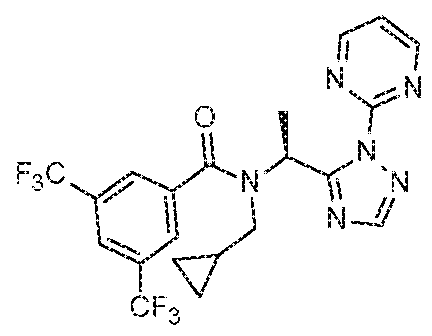
  • a preferred compound of the present invention is N-(cyclopropylmethyl)-N-[l-(2- pyrimidin-2-yl-l,2,4-triazol-3-yl)ethyr -3,5-bis(tritluoromethyl)benzainide, or a salt thereof.
  • An especially preferred compound is N-(cyclopropylmethyl)-N-[(I S)-l -(2- pyrimidin-2-yl-l,2,4 ⁇ triazol ⁇ 3-yl)ethyl]-3,5-bis(trifluoro or a salt thereof.
  • Another preferred compound of the present invention is N-prop-2-ynyl-N-[l-(2- pyrimidin-2-yl-l ,2,4-triazol-3-yl)ethyl]-3,5-bis(trifluoromethyl)benzamide, or a salt thereof.
  • An especially preferred compound is N-prop-2-yny 1 -N-[( 15)- 1 -(2-py rimi din-2- yl-l ,2,4-triazol-3-yl)ethyl]-3,5-bis(trifluoromethyl)benzamide, or a salt thereof.
  • Another preferred compound of the present invention is N-methy 1-N-[1 -(2-py rimidin-2-y 1-1, 2,4- triazol-3-yl)ethyl]-3,5-bis(trifluorornethyl)benzamide, or a salt thereof.
  • An especially preferred compound is N-methyl-N-[(lS)-l-(2-pyrimidin-2-yl-1 ,2,4-triazol-3-yl)ethyl]- 3,5-bis(trifluoromethyl)benzamide, or a salt thereof.
  • the compounds of the present invention may be used for controlling parasites. In particular, they are useful for controlling ectoparasites on an animal.
  • the compounds of th e present invention may be used for controlling ticks on cattle.
  • the compounds of the present invention may be used for controlling ticks on sheep.
  • the compounds of the present invention may be used for controlling lice on sheep.
  • the compounds of the present invention may be used for controlling ticks on a dog or a cat.
  • the compounds of the present invention may be used for controlling fleas on a dog or a cat.
  • the compounds of the present invention may be used for controlling lice on a dog or a cat.
  • the compounds of the present invention may also be used for preventing and/or treating diseases, for example protozoan, bacterial and viral diseases, transmitted by ectoparasites.
  • diseases for example protozoan, bacterial and viral diseases, transmitted by ectoparasites.
  • they may be used for the prevention and/or treatment of babesiosis, anaplasmosis and lyme disease.
  • the compounds of the present invention may be used alone or combination with one or more other compounds with are active against parasites or pests, including afoxolaner, fluralaner, lotilaner, surolaner, albendazole, cambendazole, fenbendazole, flubeiidazole, mebendazole, oxfendazole, parabendazole, tiabendazole, tnclabendazole, amitraz, demiditraz, clorsulon, closantel, oxyclonazide, rafoxanide, cyphenothrin, flumethrin, permethrin, promazine, derquantel, diamphenetide, dicycianil, dinotefuran, imidacloprid, nitenpyram, thiamethoxam, abamectin, doramectin, emamectin, epnnomectin, i
  • the compounds of Formula I, IF, II, IFa and Ila can be prepared by one of ordinary skill in the art following art recognized techniques and procedures. More specifically, compounds of Formula I, IF, II, IFa and Ila can be prepared as set forth in the schemes, methods, and examples set forth below. It will be recognized by one of skill in the art that the individual steps in the following schemes may be varied to provide the compounds of Formula I, IF, II, I a and Ila. The reagents and starting materials are readily available to one of ordinary skill in the art. All substituents, unless otherwise specified, are as previously defined.
  • DIPEA dii sopropy 1 ethyl amine
  • HATU l-[Bis(dimethylarruno)methylenel- iFI-i,2,3 riazolo[4,5-b
  • T3P Propylphosphonic anhydride
  • An azoie compound of formula (a) is reacted with a carbox lic acid of formula (b) to form compounds of formula I.
  • a mixture of an azoie of formula (a), a carboxylic acid of formula (b), a suitable coupling reagent, such as ' ⁇ ' . HATU, DCC or HOBt, a suitable base such as triethylamine or DIPEA, in a suitable solvent, such as ethyl acetate or DMF are mixed at temperatures ranging from around 0 to 100 °C to pro vide compounds of formula I which may then be isolated and, if necessary and desired, purified using techniques well known in the art, such as chromatography.
  • Carboxyiic acids of formula (b) are commercially available or may be synthesized by methods known to the skilled artisan.
  • the requisite azole compounds of formula (a) may be prepared as illustrated in the following scheme, where RA R 3 , R 4 Q 1 , Q 2 and Y are as previously described and LG is a suitable leaving group.
  • An amine of formula (c) is reacted with a substituted azole of formula (d) to form compounds of formula (a).
  • a mixture of an azole of formula (d), an amine of formula (c), a suitable base, such as K2CO3, NaH or DIPEA in a suitable solvent, such as acetonitriie or DMF are mixed at temperatures ranging from around 20 to 120 °C to provide compounds of formula (a) which may then be isolated and, if necessarv' and desired, purified using techniques well known in the art, such as chromatography.
  • a substituted azole of formula (d) is reacted with ammonia to form compounds of formula (e).
  • a solution of ammonia in a suitable solvent, such as methanol, and a substituted azole of formula (d) are mixed in a sealed tube at temperatures ranging from around 0 to 25 °C to provide compounds of formula (e) which may then be isolated and, if necessary and desired, purified using techniques well known in the art, such as trituration.
  • a substituted azole of formula (e), a compound of formula (f), a suitable base, such as K2CO3 or DIPEA in a suitable solvent, such as acetonitrile or DMF are mixed at temperatures ranging from around 20 to 120 °C to provide compounds of formula (a) which may then be isolated and, if necessary and desired, purified using techniques well known in the art, such as chromatography.
  • Amines of formula (c) and compounds of formula (f) are commercially available or may be synthesized by methods known to the skilled artisan.
  • the requisite azole compounds of formula (d) may be prepared as illustrated in the following scheme, where R 3 , R 4 , R 5 , Q 1 , Q 2 and Y are as previously described, LG is a suitable leaving group.
  • An amide of formula (h) is reacted with an NN-dimethylamide dimethyl acetal (g) to form compounds of formula (i) which are subsequently reacted with hydrazines (j) under acidic conditions to form compounds of formula (d).
  • a compound of formula (h) and an N,N-dimethylamide dimethyl acetal of formula (g) are reacted in a suitable solvent, such as CH2CI2 at reflux to provide compounds of formula (i).
  • compounds of formula (i) are reacted with a substituted hydrazine (j) in a suitable solvent such as 1,4-dioxane, acetic acid or a mixture of such solvents at temperatures ranging from around 20 to 100 °C to provide compounds of formula (d) which may then be isolated and, if necessary and desired, purified using techniques well known in the art, such as chromatography.
  • a suitable solvent such as 1,4-dioxane, acetic acid or a mixture of such solvents
  • a carboxylic acid derivative of formuia (k) is reacted with an amine of formula (1) and a suitable base, such as triethyiamine or DIPEA, in a suitable solvent, such as toluene, at temperatures ranging from around 0 to 120 °C.
  • a suitable solvent such as toluene
  • the resulting compounds (m) may then be isolated and, if necessary and desired, purified using techniques well known in the art, such as chromatography.
  • the resulting amides of formula (m) and phosphorus pentachloride are reacted in a suitable solvent, such as CH2CI2, at r.t. and then trimethylsilyi azide is added to the mixture at 0 °C and the mixture is stirred at r.t. to provide compounds of formula (d) which may then be isolated and, if necessary and desired, purified using techniques well known in the art, such as chromatography.
  • NN-dimethylamide acetals of formula (g), amides of formula (h), carboxylic acid derivatives of formula (k) and hydrazines of formula (j) are commercially available or may be synthesized by methods known to the skilled artisan.
  • An amide of formula (n) is reacted with an N ⁇ V-dimethy amide dimethyl acetal of formula (g) to form compounds of formula (o) which are subsequently reacted with substituted hydrazines of formula (j) under acidic conditions to form compounds of formula I".
  • a compound of formula (n) and an NN-dimethylamide dimethyl acetal of formula (g) are reacted in a suitable solvent, such as CH2CI2 at reflux to provide compounds of formula (o).
  • compounds of formula (0) are reacted with a substituted hydrazine of formula (j) in a suitable solvent such as .1 ,4-dioxane, acetic acid or a mixture of such solvents at temperatures ranging from around 20 to 100 °C.
  • a suitable solvent such as .1 ,4-dioxane, acetic acid or a mixture of such solvents at temperatures ranging from around 20 to 100 °C.
  • the resulting compounds of formula I" may then be isolated and, if necessary and desired, pun i led using techniques well known in the art, such as chromatography.
  • ammo amide of formula (p) is reacted with a carboxylic acid of formula (b) to form compounds of formula (n).
  • a carboxylic acid of formula (b) for example, a mixture of an amino amide of formula (p), a carboxylic acid (b), a suitable coupling reagent, such as T3P ® , HATU, DCC or
  • HOBt a suitable base such as triethylamine or DIPEA
  • a suitable solvent such as ethyl acetate or DMF
  • an amino acid of formula (q) is reacted with thionyl chloride in a suitable solvent, such as MeOH, at r.t. to provide amino esters of formula (r).
  • a suitable solvent such as MeOH
  • the resulting amino esters (r) are reacted with an aldehyde or a ketone, a suitable reducing agent, such as sodium triacetoxyborohydride, a dehydrating agent, such as Na 2 S04, in a suitable solvent, such as acetic acid, at r.t. to provide compounds of formula (s).
  • the resulting amino esters of formula (s) are then reacted with a carboxylic acid of formula (b), a suitable coupling reagent, such as OP ® , a suitable base such as DIPEA, in a suitable solvent, such as ethyl acetate at about 90 °C to provide amido esters of formula (t) which may then be isolated and, if necessary and desired, purified using techniques well known in the art, such as chromatography.
  • a suitable coupling reagent such as OP ®
  • DIPEA a suitable base
  • a suitable solvent such as ethyl acetate
  • amido esters of formula (t) are reacted with magnesium nitride in a suitable solvent, such as MeOH at about 80 °C in a sealed tube to provide compounds of formula (n) which may then be isolated and, if necessary and desired, purified using techniques well known in the art, such as chromatography or extraction.
  • a suitable solvent such as MeOH
  • An amine of formula (c) is reacted with an amide of formula (h) to form compounds of formula (p).
  • a mixture of an amine of formula (c), an amide of formula (h), a suitable base, such as 2CO3 or DIPEA in a suitable solvent, s uch as acetonitrile or DMF are mixed at 25-80 °C to provide compounds of formula (p) which may then be isol ated and, if necessary and desired, purified using techniques well known in the art, such as chromatography.
  • cyclopropanecarboxaidehyde (867 uL) and Na 2 S04 (13.8 g) in AcOH (10 mL) and stir at r.t. for 20 min.
  • Add NaBH(OAc) 3 (6.16 g) and stir for 4 h. Partition between NaHCO, (aq. sat.) and EtOAc, adjusting the pH of the aqueous phase to >10 with NaOH (aq. 2 M), separate the layers, wash the organic phase with NaCl (aq. sat.), dry over Na_S04, filter and concentrate under reduced pressure to provide methyl 3-(cyclopropylmethylamino)- 2-methyl-propanoate.
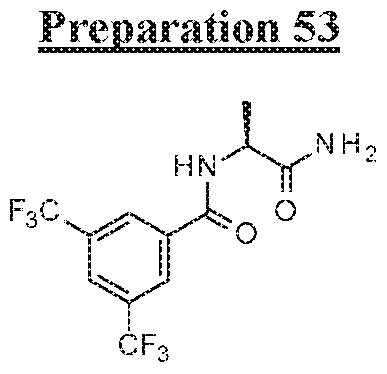
  • the compound of Preparation 54 set forth in table 5 may be prepared essentially as described in Preparation 53.
  • Example 61 set forth in table 6 may be prepared essentially as described in Example 34.
  • rriie compound of Example 36 set forth in table 7 may be prepared essentially as described in Example 35.
  • Examples 38-45 and 62-69 set forth in table 8 may be prepared essentially as described in Example 37.
  • Example 72 set forth in table 9 may be prepared essentially as described in Example 71.
  • N,N-dimethylamide dimethylacetaJ (25.5 raL) to a solution of N-[(l S)-2- amino- 1 -methyl-2-oxo-ethyl] -N-(cy clopropylmethyl)-3, 5-bis(trifluoromethyl)benzamide (48.7 g) in CH2CI2 (490 mL) and stir at reflux for 1 h 15 min. Cool to r.t., concentrate under reduced pressure, dissolve the residue in 1,4-dioxane/AcOH (275 mL/275 mL), add 2-hydrazinopyrimidine (16.9 g) and stir at 50 °C overnight. Cool to r.t.
  • All of the exemplified compounds of Examples 1 to 49 exhibited one or more of the following: greater than 80% efficacy (ECso) at 32 ppm in the in vitro cat flea assay (Assay A); greater than 80% efficacy (ECso) at 3.2 ppm in the in vitro Australia sheep blow fly assay (Assay A); or greater than 80% efficacy (ECso) at 10 ppm in the in vitro dog tick assay (Assay A).
  • All of the exemplified compounds of Examples 50 to 75 exhibited one or more of the following: greater than 50% efficacy (ECso) at 10 ppm in the in vitro cat flea assay (Assay B); greater than 50% efficacy (ECso) at 10 ppm in the in vitro Australian sheep blow fly assay (Assay B); or greater than 50% efficacy (ECso) at 20 ppm in the in vitro dog tick assay (Assay B).
  • a mixed adult population of fleas is placed in a suitably formatted 96-well plate allowing fleas to access and feed on treated blood via an artificial feeding system.
  • Fleas are fed on treated blood for 24 h, after which the compound effect is recorded.
  • Insecticidal activity is determined on the basis of the number of dead fleas recovered from the feeding system.
  • the following examples showed more than 80% (ECso) efficacy at 100 ppm: 1 to 1 1, 13 to 22, 24 to 32 and 34 to 49.
  • Test compounds are added to organic bovine blood contained in an artificial feeding container. Compounds with known insecticidal activity are included to serve as positive controls. Newly emerged unfed adult fleas from a laboratory colony are aspirated into each vial. The test cages are maintained using the artificial feeding apparatus to allow ingestion of compound. Fleas are evaluated for % mortality at 48 hours post infestation. Fleas showing normal movement and/or jumping ability are considered viable and those showing no movement are scored as dead. In this test the following examples showed more tha 50% (ECso) efficacy at 10 ppm: 50 to 61, 63 to 73 and 75. In this test the compound of Example 59 showed an ECso of 1 .6 ppm.
  • Freshly laid blowfly eggs are used to seed a suitably formatted micropiate containing the test substances to be evaluated for antiparasitic activity. Each compound is tested by serial dilution in order to determine its minimum efficacy dose.
  • the test compounds are embedded in an agar-based nutritive medium allowing the full development of the eggs into 3 rd instar larvae. The incubation lasts for 4 days at 28 °C and 60% relative humidity. Egg-hatching and ensuing larval development are also recorded to identify a possible growth-regulating activity. In tins test the following examples showed more than 80% (ECso) efficacy at 32 ppm: 1 to 4, 6 to 33, 35 to 46, 48 and 49.
  • a contact test is performed by pre-coating micropiate with serial dilution of compound allowing evaluating anti-parasitic activity by contact against ticks.
  • a mixed adult tick population is then distributed to each well of the plate and incubated at 28 °C and 80% relative humidity for 7 days, during which the effect of the test compound is monitored.
  • Acaricidal activity is confirmed if and when adult ticks are dead.
  • the following examples showed more than 80% (ECso) efficacy at 100 ppm: 1 to 4, 6, 9 to 15, 19, 20, 24, 26 to 32, 34 to 43 and 47 to 49.
  • the compound fo Example 41 showed an ECso of 32 ppm.
  • a solution of the test compounds is used to coat the inner wail of glass vials containing a filter paper on the bottom of each vial. A second filter paper is also coated and placed in the cap of the vial. Vials and caps are allowed to dry overnight. Each treated vial is infested with ticks. Contact of the ticks with residues is induced by holding the vials in a controlled environment and assessment is performed at 48 hours after application in comparison with untreated glass vials and solvent-treated glass vials. In this test the following examples showed more than 50% (ECso) efficacy at 20 ppm: 50, 54, 55, 58 to 63, 65, 67 to 70 and 73 to 75.
  • gerbils are treated with the test compound at a given dose by pour on application.
  • +1 (+2) the animals are infested with nymphs of Rsanguineus. Ticks are left on the animals until full repletion. Seven days after infestation nymphs dropped off fully engorged are collected and counted. They are kept until molting to also evaluate growth regulating activity of the test compound. Efficacy in killing (and growth regulating) is expressed as a tick number (and molted tick number) reduction in comparison with a placebo treated group, using the Abbott's formula:
  • n number of live ticks
  • T treated group
  • Co control/placebo group
  • n number of ticks
  • T treated group
  • Co control/placebo group

Landscapes

  • Chemical & Material Sciences (AREA)
  • Organic Chemistry (AREA)
  • Health & Medical Sciences (AREA)
  • Veterinary Medicine (AREA)
  • General Health & Medical Sciences (AREA)
  • Life Sciences & Earth Sciences (AREA)
  • Medicinal Chemistry (AREA)
  • Public Health (AREA)
  • Animal Behavior & Ethology (AREA)
  • Pharmacology & Pharmacy (AREA)
  • Chemical Kinetics & Catalysis (AREA)
  • General Chemical & Material Sciences (AREA)
  • Tropical Medicine & Parasitology (AREA)
  • Nuclear Medicine, Radiotherapy & Molecular Imaging (AREA)
  • Epidemiology (AREA)
  • Pharmaceuticals Containing Other Organic And Inorganic Compounds (AREA)
  • Plural Heterocyclic Compounds (AREA)
  • Agricultural Chemicals And Associated Chemicals (AREA)
  • Pyridine Compounds (AREA)

Abstract

The present invention provides compounds of the formula : (I) wherein: X is O or S; Q1 and Q2 are independently CR5 or N, provided at least one of Q1 and Q2 is N; Y is a direct bond or CH2; R1 is H, optionally substituted alkyl, alkenyl, alkynyl, cycloalkylalkyl, benzyl or oxetan-3-yl-CH2-; R2 is optionally substituted phenyl, pyridine, pyrimidine, pyrazine or pyridazine; R3 is alkyl or haloalkyl; R4 is optionally substituted pyridine, pyrimidine, pyrazine or pyridazine; R5 is H, alkyl, haloalkyl, cycloalkyl, alkoxy, alkoxyC(O)- or (alkoxy) 2CH-; or a salt thereof. The compounds are useful for controlling ectoparasites on animals.

Description

HETEROARYL-1 ,2,4-TRIAZOLE AND HETEROARYL-TETRAZOLE COMPOUNDS FOR CONTROLLING ECTOPARASITESI
The present invention relates to novel heteroaryl-l,2,4-triazole and heteroaryl- tetrazole compounds, to formulations comprising the compounds and to their use in the
control of ectoparasites on animals.
The present invention is in the field of pest control, in particular the control of
ectoparasites on animals. Parasitic infections result in significant suffering to the animal, both as a consequence of the infection itself and the diseases transmitted by the parasites.
In addition, parasitic infection in livestock animals can result in significant economic loss.
Tins is observed, for example, in the cattle industry where tick infestation, in particular, causes major losses. When ticks feed in large numbers they consume large quantities of blood which can result in anaemia and loss of nutrients. In addition, the irritation caused by the ticks leads to a reduction in food intake by the cattle. All these factors negatively impact weight gain and milk production (Rajput et al, J. Zhejiang Univ. SCIENCE B,
2006, 7(1 1): 912-921 ). Furthermore, ticks cause damage to the hide (Rajput et al.) and
predispose the cattle to bacterial and fungal infections. A number of diseases are known to be transmitted via tick -borne pathogens, among them are the cattle diseases bovine
babesiosis, also known as pyroplasmosis or red water fever, and bovine anaplasmosis,
also known as gall sickness (Raj ut et al). These diseases lead to lower weight gain,
decreased milk production and increased mortality.
There are many commercially available compounds in common usage for the
control of ectoparasites. For livestock animals these include amitraz; fluazuron; synthetic pyrethroids, for example permethrin; macrocyclic lactones, for example ivermectin; and organophosphates. For companion animals these include fipronil; synthetic pyrethroids;
and GABA-gated chloride channel inhibitors, for example fluralaner. Despite the wide
range of products on the market, there remains a need for alternative compounds which
are effective in the control of ectoparasites.
WO 2006/004924 discloses a series of heteroaryl -imidazole compounds which are modulators of the CXCR3 receptor. Modulators of the CXCR3 receptor are useful in the treatment and prevention of certain inflammatory and immunoregulatory disorders and diseases.
The present invention provides novel heteroaryl-l,2,4-triazole and heteroaryl- tetrazole compounds which are useful in the control of pests, especially the control of ectoparasites on animals.
The present invention provides compounds of Formula 1:
Figure imgf000003_0001
(0
wherein:
X is O or S:
Q! and Q2 are independently CR5 or N, provided at least one of Q1 and Q2 is N; Y is a direct bond or CH2;
R1 is H; Ci-Cealkyl optionally substituted with one substituent selected from: CN, CONFfc, COOH, NO?, and -Si(CHs)3; Ci-Cehaloafkyl; Ca-Cealkenyl; C?.-C6haioalkenyI; C2-C6alkyny1; C2-C6ha]oalkynyl; C3-C4cycloalky]-Ci-C2alkyl- wherein the
C3-C4cycloalkyl is optionally substituted with 1 or 2 halo atoms; oxetan-3-yi-CH -; or benzyl optionally substituted with halo or Ci-Cshaloalkyl:
R2 is phenyl, pyridine, pyrimidine, pyrazine or pyridazine, wherein the phenyl, pyridine, pyrimidine, pyrazine or pyridazine is optionally substituted with one to three substituents, provided the substituent(s) are not on either carbon adjacent to the carbon x
bonded to the ' group, each independently selected from: Ci-Csalkyl, Ci-
Cjhaloalkyl, Ci-C3thiohaloalkyl, Ci-C alkoxy, Ci-C3haloalkoxy, halo, NO2, SFs, CN, CONH2, COOH and C(S)NH2;
R3 is Ci-Csalkyl or Ci-C3haloalkyl; R4 is pyridine, pyrimidine, pyrazine or pyridazine, wherein the pyridine, pyrimidine, pyrazine or pyridazine is optionally substituted with one substituent selected from: Ci-Csalkyl, Ci-Cshaloalkyi, Ci-Csalkoxy, C3-C4cycloalkyl, halo or hydroxy:
R5 is H, (••< :alk> 1. Ci-Cshaloaikyl, Cs-Gicycioalkyl, Ci-Csalkoxy,
Ci-C3alkoxyC(0)- or (Ci-C3alkoxy)2CH-;
or a salt thereof.
In an alternative embodiment the present invention provides compounds of Formula ΐ:
Figure imgf000004_0001
(I)
wherein:
X is O or S;
Q! and Q2 are independently CR3 or N, provided at least one of Q1 and Q2 is N; Y is a direct bond or ( I■:
R1 is H; Ci-Cealkyl optionally substituted with one substituent selected from: CN, CONH2, COO] I and NO2; Ci-Cehaloalkyl; C -Cealkenyl; C2-C6haloaIkenyl; C2- Cealkynyl; Ch-Cdiaioalkynyl; C3-C4cycloalkyl-Ci-C2a]kyl- wherein the C3-C4cycloalkyi is optionally substituted with 1 or 2 halo atoms; oxetan-3-yl-CH2-; or benzyl optionally substituted with halo or Ci-Cshaloalkyl;
R2 is phenyl, pyridine, pyrimidine, pyrazine or pyridazine, wherein the phenyl, pyridine, pyrimidine, pyrazine or pyridazine is optionally substituted with one to three substituents, provided the substituent(s) are not on either carbon adjacent to the carbon x
bonded to the " group, each independently selected from: Ci-Csalkyl, Ci- Cshaioalkyl, Ci-Csthiohaloalkyl, Ci-C3aikoxy, Ci-Cshaloalkoxy, halo, NO2, SFs, CN,
Figure imgf000005_0001
R3 is Ci-Csalkyl or Ci-Cshaloalkyl;
R4 is pyridine, pyrimidme, pyrazine or pyridazine, wherein the pyridine, pynmidine, pyrazine or pyridazine is optionally substituted with one substituent selected from: Ci-Csalkyl, Ci-Cshaloalkyi, Ci-Csalkoxy, C3-C4cycioalkyl, halo or hydroxy;
R5 is H, Ci-Cialkyl, Ci-Cshaloalkyl, C3-C4cycloalkyl or Ci-C3alkoxy;
or a salt thereof.
The present in vention also pro vides a formulation comprising a compound of the invention, or a salt thereof, and at least one acceptable earner.
The present invention provides a compound of the invention, or a salt thereof, for use in therapy. The present invention provides a compound of the invention, or a salt thereof, for use in controlling parasites in or on an animal. The present invention further provides a compound of the invention, or a salt thereof, for use in controlling
ectoparasites on an animal. The present invention further provides a compound of the invention, or a salt thereof, for use in preventing and/or treating diseases transmitted by ectoparasites.
The present invention provides the use of a compound of the invention, or a salt thereof, for the manufacture of a medicament for controlling parasites in or on an animal. The present invention further provides the use of a compound of the invention, or a salt thereof, for the manufacture of a medicament for controlling ectoparasites on an animal. The present invention further provides the use of a compound of the invention, or a salt thereof, for the manufacture of a medicament for preventing and/or treating diseases transmitted by ectoparasites.
The present invention provides the use of a compound of the invention, or a salt thereof, in controlling parasites in or on an animal. The present invention further provides the use of a compound of the invention, or a salt thereof, in controlling ectoparasites on an animal. The present invention provides a method of controlling parasites in or on an animal in need thereof comprising administering an effective amount of a compound of the invention, or a salt thereof. The present invention further provides a method of controlling ectoparasites on an animal in need thereof comprising administering an effective amount of a compound of the invention, or a salt thereof. The present invention further provides a method for preventing and/or treating diseases transmitted by ectoparasites comprising administering an effective amount of a compound of the invention, or a salt thereof, to an animal in need thereof.
The present invention additionally provides a method for controlling pests comprising contacting the pests or their environment with an effective amount of a compound of the invention, or a salt thereof.
As used herein, the term "Ci-Cealkyl" refers to a straight or branched, monovalent saturated aliphatic chain of one to six carbon atoms, for example, methyl, ethyl, propyl, isopropyl, butyl, t-butyl, and the like.
Likewise, the term "Ci-C3alkyl" includes methyl, ethyl , isopropyl, and the like.
As used herein, the term "d-Cehaloalkyl" refers to a Ci-Cealkyl moiety substituted with one or more halogen atoms which may be the same or different.
Examples include trifluoromethyl, 2-fluoroethyl, 3-fluoropropyl, 3,3,3-trifluoropropyl, 4- chlorobutyl, and the like.
Likewise, the term "Ci-Cshaioalkyl" includes trifluoromethyl, 2-fluoroethyl, 3- fluoropropyl, 3,3,3-trifluoropropyl, and the like.
As used herein the term "Ci-Cithiohaloalkyl" refers to a Ci-CAaloalkyl moiety linked through a sulfur atom.
As used herein, the term "'C3-C4cycioalkyF* refers to cyciopropyl or cyclobutyl. As used herein, the term "C3-C4cy cloalkyl-C i-C2alky 1-" refers to a Cs-
C4cycloalkyl linked through a Ci-C2alkyl chain.
As used herein, the term "C Cealkenyl"' refers to a straight or branched alkenyl chain having form two to six carbon atoms and one double bond, for example, ethenyl, prop-l -enyl, but-2-enyl, and the like.
As used herein, the term " '.-~('\Jia!orukeny]' refers to a C2-C6alkenyl moiety substituted with one or more halo atoms which may be the same or different. As used herein, the term "C2-C6alkynyl" refers to a straight or branched alkynyl chain having from, two to six carbon atoms and one triple bond, for example, ethynyl, prop-2-ynyl, but-3-ynyl, and the like.
As used herein, the term "Cz-Cehaloaikynyl" refers to a C2-C-6alkynyl moiety substituted with one or more halo atoms which may be the same or different.
As used herein, the term "halo"' refers to a chlorine, bromine, iodine or fluorine atom.
As used herein, the term "Ci-Cjalkoxy" refers to a straight or branched alkyl chain having from 1 to 3 carbon atoms attached to an oxygen atom, for example, ethoxy, propoxy, tert-butoxy, and the like.
As used herein, the term "Ci-Cjhaioalkoxy" refers to a Ci-Csalkoxy moiety substituted with one or more halogen atoms which may be the same or different.
Examples include tnfluoromethoxy, 2-fiuoroetlioxy, 3-fluoropropoxy, 3,3,3- trifluoropropoxy, 4-chlorobutoxy, and the like.
As used herein, the term "controlling" refers to reducing the number of pests or parasites, eliminating pests or parasites and/or preventing further pest or parasite infestation.
As used herein, the term "treating" refers to restraining, slowing, stopping or reversing the progression or severity of an existing symptom or disease.
As used herein, the term "preventing" refers to the avoidance of a symptom or disease developing in the animal.
As used herein, the term "animal" may refer to a mammal and a non-mammal, such as a bird or fish. In the case of a mammal, it may be a human or non-human mammal. Non-human mammals include, but are not limited to, livestock animals and companion animals. Livestock animals include, but are not limited to, cattle, camellids, pigs, sheep, goats and horses. Companion animals include, but are not limited to, dogs, cats and rabbits.
As used herein, the term "pest" includes, but is not limited to, animal and plant pests. The term encompasses all stages in the life cycle of the pest.
A "parasite" is a pest which lives in or on the host animal and benefits by deriving nutrients at the host animal's expense. An "endoparasite" is a parasite which lives in the host animal. An "ectoparasite" is a parasite which lives on the host animal. Ectoparasites include, but are not limited to, acari, insects and crustaceans (e.g. sea lice). The Acari (or Acarina) sub-class comprises ticks and mites. Ticks include, but are not limited to, members of the following genera: Rhipicephalus, for example, Rhipicaphalus (Boophilus) microplus and Rhipicephalus sanguineus; Amhiyomrna; Dermacentor; Haemaphysalis; Hyalomma; Ixodes; Rhipicentor; Margaropus; Argas; Otobius; and Ornithodoros. Mites include, but are not limited to, members of the following genera: Chorioptes, for example Choriopies bovis; Psoroptes, for example Psoroptes ovis; Cheyietiella; Dermanyssus; for example Dermanyssus gallinae; Ortnithonyssus; Demodex, for example Dem.od.ex canis; Sar copies, for example Sar copies scabiei; and Psorergates. Insects include, but are not limited to, members of the orders: Siphonaptera, Diptera, Phthiraptera, Lepidoptera, Coleoptera and Homoptera. Members of the Siphonaptera order include, but are not limited to, Ctenocephalides felis and Ctenocephatides canis. Members of the Diptera order include, but are not limited to, Musca spp; bot fly, for example GasterophUus iniestinalis and Oestrus ovis; biting flies; horse flies, for example Haematopota spp. and Tabunus spp. ; haematobia, for example haematobia irritans; Stomoxys; Lucilia; midges; and mosquitoes. Members of the Phthiraptera class include, but are not limited to, blood sucking lice and chewing lice, for example Bovicola Ovis and Bovicola Bovis.
As used herein, the term "effective amount" refers to the amount or dose of the compound of the invention, or a salt thereof, which, upon single or multiple dose administration to the animal, provides the desired effect in or on the animal.
An effective amount can be readily determined by the attending diagnostician, as one skilled in the art, by the use of known techniques and by observing results obtained under analogous circumstances. In determining the effective amount a number of factors are considered by the attending diagnostician, including, but not limited to: the species of mammal; its size, age, and general health; the parasite to be controlled and the degree of infestation; the specific disease or disorder involved; the degree of or involvement or the severity of the disease or disorder; the response of the individual; the particular compound administered; the mode of administration; the bioavailability characteristics of the preparation administered; the dose regimen selected; the use of concomitant medication; and other relevant circumstances. The compounds of the invention raay be administered to the animal by any route which has the desired effect including, but not limited to topically, orally, parenteral!}'' and subcutaneously. Topical administration is preferred. Formulations suitable for topical administration include, for example, solutions, emulsions and suspensions and may take the form of a pour-on, spot-on, spray-on, spray race or dip. In the alternative, the compounds of the invention may be administered by means of an ear tag or collar.
Salt forms of the compounds of the invention include both pharmaceutically acceptable salts and veterinar ' acceptable salts. Pharmaceutically and veterinary acceptable salts and common methodology for preparing them are well known in the art. See, for example, Gould, P.L., "Salt selection for basic drugs," international Journal of Pharmaceutics, 33: 201 -217 (1986); Bastin, R.J., et al. "Salt Selection and Optimization Procedures for Pharmaceutical New Chemical Entities," Organic Process Research and Development, 4: 427-435 (2000); and Berge, S.M., et al, "Pharmaceutical Salts,"' Journal of Pharmaceutical Sciences, 66: 1-19, (1977). One skilled in the art of synthesis will appreciate that the compounds of the invention are readily converted to and may be isolated as a salt, such as a hydrochloride salt, using techniques and conditions well known to one of ordinary skill in the art. In addition, one skilled in the art of synthesis will appreciate that the compounds of the invention are readily converted to and may be isolated as the corresponding free base from the corresponding salt.
As one of ordinary skill in the art will appreciate, compounds of Formula I contain a stereosenic centre which is indicated with an asterisk in the structure below:
Figure imgf000009_0001
(I)
The present invention contemplates both racemates and individual enantiorners. Compounds having preferred stereochemistry are set out below. Preferred compounds of Formula !, or salts thereof, include compounds having one or more of the following features:
a) Y is a direct bond:
b) X is O;
c) X is S;
d) R3 is methyl:
e) Q1 is N;
f) Q2 is CR5 and R5 is H, Ci-C3alkyl, Ci-C3alkoxyC(0)-, or (Ci~
Figure imgf000010_0001
g) Q2 is CR5 and R5 is H, Ci-Csalkyl, or (Ci-C3alkoxy)2CH-;
h) Q2 is CR5 and R5 is H or d-Csalkyl;
i) Q2 is CR5 and R5 is H, methyl or ί ί i hO i )) ( 1 1-:
j) Q2 is CR5 and Rs is H or methyl;
k) Q2 is CR5 and R5 is H;
]) Qf is N, Q2 is CR5 and R5 is 1 1. methyl or i C i Ci H> K 'H-.
m) Q1 is N, Q2 is CR5 and R5 is 1 1 or methyl;
n) R4 is a 2-pyridine; or 2-pyrimidine optionally substituted with Ci-C3alkoxy or halo;
o) R4 is a 2-pyridine; or 2-pyrimidine optionally substituted with
Ci-C3alkoxy;
p) R4 is 2-pyridine or 2-pyrimidine;
q) R4 is 2-pyrimidine;
r) R*! is H; Ci-Cchaloalkyl; Ci-Cealkyl optionally substituted with CN or Si(CHb)3; Ci-Cealkynyl; C3-C4C 'cloalkyl-C i-C2alkyl wherein the tVC cyeloalkyl is optionally substituted with 1 or 2 halo atoms; oxetan-3-yl-CH2-; or benzyl optionally substituted with halo;
s) R1 is H; C i-Cehaloalkyi; Ci-C6alkyl optionally substituted with CN or Si(CH3)s; Cs-Cealkynyl; or
Figure imgf000010_0002
wherein the Cs-Ctcycioalkyl is optionally substituted with 1 or 2 halo atoms;
t) R! is Ci-Cehaloalkyl; Ci-Cealky ; C3-C6alkynyl; C3-C4cycloalkyl-
Ci-C alkyi- wherein the Cj-C eycloalkyl is optionally substituted with 1 or 2 halo atoms; u) R1 is cyclopropyl-CFfc.-, n-propyl, CH≡C-CH2-, CF3CH2CH2-, FCH2CH2- FCH2CH2CH2-, 2,2-difluorocyclopropyl-CH2, 2,2-dichlorocyclopropyl-CH2-, H, ( ! ! ;-·. (i i hSii i b~ CH3CH2- or CN-CH2-;
v) R1 is cydopropyl-CFfc-, n-propyl, CH-C-GH2-, CF3CH2CH2-, FCH2CH2- FCH2CH2CH2-, 2,2-cUfluorocyclopropyI-CH2- or 2,2-dichlorocyclopropyl-CH2-;
w) R1 is cyciopropyl-CFfc-, n-propyl, CH-C-GH2-, CF3CH2CH2-, FCH2CH2- FCH2CH2CH2-, 2,2-difluorocyclopropyl-CH2-, H, CH3, ! ( 1 h SiC ! ! >·· or CH3CH2-; x) R1 is cyclopropyl-CFfc.-, n-propyl, CH≡C-CH2-, CF3CH2CH2-, FCH2CH2- FCH2CH2CH2-, or 2,2-difluorocyciopropyl-CH2-;
x) R1 is cyclopropyl-CFfc.-, n-propyl, CH≡C-CH2-, CF3CH2CH2-, FCH2CH2-
Figure imgf000011_0001
y) Rl is CH≡C-CH2-, cyclopropyl-CH2-, H or CH3;
z) R! is CH=C-CH2- or cyclopropyl-CH2-;
aa) R1 is cyciopropyl-Cft-;
bb) R2 is phenyl, 3-pyridine or 4-pyridine substituted with one or two substituents selected from: Ci-Cshaioalkyl, Ci-Cihaioalkoxy, halo, CN or C(S)NH2, provided the substituent(s) are not on either carbon adjacent to the carbon bonded to the x
group;
cc) R2 is phenyl, 3-pyridine or 4-pyridine substituted with one or two substituents selected from: Ci-Cihaioalkyl, C l-Cshaloalkoxy, halo or CN, provided the
Figure imgf000011_0002
substituent(s) are not on either carbon adjacent to the carbon bonded to the
group;
dd) R2 is phenyl or 3-pyridine substituted with one or two substituents selected from: Ci-Cihaloalkyl, Ci-Cjhaloalkoxy, halo or CN, provided the substituent(s) are not x
_J_
on either carbon adjacent to the carbon bonded to the '" group;
ee) R2 is 3,5-bis(trifluoromethyl)phenyl, 3,5-dichlorophenyl, 3- trifluoromethoxyphenyl, 3-chloro-5-trifluoromethylpheny], 3-cyanophenyl, 3-chloro-5- trifluoromethoxyphenyl, 5-trifluoromethylpyridin-3-yl, 3-bromo-5-triiluoromethy]phenyl , 3-cyano-5-trifiuoromethyl-phenyl or 2,6-bis(trifluoromethyl)pyridin-4-yl;
ff) R2 is 3,5-bis(trifluoromethyl)phenyl, 3,5-dichlorophenyl, 3- trifluoromethoxyphenyl, 3-chloro-5-trifluoromethylphenyl, 3-cyanophenyl, 3-chloro-5- trifluoromethoxyphenyl, 5-trifluoromethylpyridiii-3-yi, 3-bromo-5-trifluoromethylphenyi or 3-cyano-5-trifluoromethyl-plienyl;
gg) R2 is 3,5-bis(trifluoromethyl)phenyl, 3,5-dichlorophenyl, 3- trifluoromethoxyphenyl, 3-chloro-5-trifluoromethylphenyl, 3-cyanophenyl, 3-chloro-5- trifluoromethoxyphenyl, or 5-trifluoromethylpyridin-3-yl;
hh) R2 is 3,5-bis(trifluoromethyl)phenyl, 3-chloro-5-trifluoromethylphenyl, 3- cyanophenyL 3-chloro-5-trifluoromethoxyphenyl, 5-trifluoromethylpyridin-3-yl or 3- cy ano-5 -trif! uoromethy 1 pheny 1 ;
ii) R2 is 3,5-bis(trifluoromethyi)phenyi, 3-chloro-5-trifluoromethylphenyl, 3- chl oro-5 -triil uoromethoxy pheny I or S-trifluorometh}7 Spy ri din-3 -y 1 ;
jj) R2 is 3,5-bis(trifluoromethyl)phenyl.
Preferred compoimds of the present invention are compounds of Formula IF :
Figure imgf000012_0001
(Π')
X is O or S;
R1 is H; C i-Cehaloalkyl; Ci-C6alkyl optionally substituted with CN or -SifCHs)?;
Ci-Cealkynyl; C3-C4cycloalkyl-Ci-C2alk}4 wherein the C3-C4cycloalkyl is optionally substituted with 1 or 2 halo atoms; oxetan-3-yl-CH2-; or benzyl optionally substituted by halo; R2 is phenyl, 3-pyridine or 4-pyridine substituted with one or two substituents elected from: Ci-Cshaloalkyl, Ci-C3haloalkoxy, halo, CN or C(S)NH2, provided the ubstituent(s) are not on either carbon adjacent to the carbon bonded to the
x
„ group;
R4 is 2-pyridine; or 2-pyrimidine optionally substituted with Ci-C3alkoxy or halo R5 is H, Ci-Csalkyl, Ci-C3alkoxyC(0)- or
Figure imgf000013_0001
or a salt thereof. Preferred compounds of the present invention are compounds of Formula II:
Figure imgf000013_0002
00
wherein:
R1 is Ci-Cehaloalkyl; Ci-Ceaikyl; Cs-Cealkynyl; or C3-C4cycloalkyl-Ci-C2alkyl wherein the Cs-C-tcycioalkyl is optionally substituted with 1 or 2 halo atoms;
R2 is phenyl or 3-pyridine substituted with one or two substituents selected from Ci-C ihaloalkyl, Ci-Cshaloaikoxy, halo or CN, provided the substituent(s) are not on
Figure imgf000013_0003
either carbon adjacent to the carbon bonded to the group;
R4 is 2-pyridine; or 2-pyrimidine optionally substituted with Ci-Csalkoxy; R5 is H or Ci-Csaikyl, or a salt thereof.
Particularly preferred compounds of the present invention are compounds of Formula IF a or Ila:
Figure imgf000014_0001
(l l'a) (Ma)
wherein X, R1, R2, R4 and R5 are as defined for Forraida IF or Forraula II respectively ; or a salt thereof.
Preferred compounds of Formula I, IF and IF a, or salts thereof, include those in which R1 is cyclopropyl-CH?.-, n-propyl, CF C-CFb-, CF3CH2CH2-, FCH2CH2-,
FCH2CH2CH2-, 2,2-difluorocyciopropyl-CH2-, 2,2-dichlorocyclopropyl-CH2-, H, CH3, (CH3)3SiCH2-, CH3CH2-, or CN-CFI2-; R2 is 3,5-bis(trifluoromethyl)phenyl, 3,5- dichlorophenyl, 3-tri.fluoromethoxyphenyl, 3-chloro-5-trifluoromethylphenyl, 3- cyanophenyl, 3-chloro-5-trifluoromethoxyphenyl, 5-trifluoromethylpyridin-3-yl, 3- bromo-5-trifluoromethylphenyl, 3-cyano-5-trifluoromethylphenyl or 2,6- bis(triiluoromethyl)pyridin-4-yl; R4 is 2-pyridine, or 2-pyrimidine optionally substituted with Ci-C3alkoxy; and R5 is 1 1. methyl or i C! Fi i bO K 'i i-
Preferred compounds of Formula I, IF, II, IFa and Ila, or salts thereof, include those in which R1 is cyclopropyl-CH2-, n-propyl, CH≡C-CH2-, CF3CH2CH2-, FCH2CH2-, FCH2CH2CH2-, 2,2~difluorocyclopropyl~CH2- or 2,2-dichlorocyclopropyl-CH2-; R2 is 3,5-bis(trifluoromethyl)phenyl, 3,5-dichlorophenyl, 3-trifluoromethoxyphenyl, 3-chloro- 5-trifluoromethy] phenyl, 3-cyanophenyl, 3-ch]oro-5-trifluoromethoxyphenyl, or 5- trifluoromethylpyridin-3-yl; R4 is 2-pyridine, or 2-pyrimidine optionally substituted by C1-C3 alkoxy and s is H or methyl.
Further preferred compounds of Formula I, IF, II, IFa and Ila, or salts thereof, include those in which R1 is cyclopropyl-CFF.-, n-propyl, CH≡C-CFl2-, CF3CH2CH2-, FCH2CH2-, FCH2CH2CH2- or 2,2-difluorocyclopropyl-CH2-; R2 is 3,5- bis(trifluoromethyl)phenyl, 3,5-dichlorophenyl, 3-trifluoromethoxyphenyl, 3-chloro-5- trifluoromethylphenyl, 3-cyanomethyl, 3-chloro-5-trifluoromethoxyphenyl, or 5- trifluoromethylpyridin-3-yl ; 4 is 2-pyridine, or 2-py rimi dine optionally substituted with Ci-Csalkoxy; and R5 is H or methyl.
Further preferred compounds of Formula 1, IF, II, IFa and Ila, or salts thereof, include those in which R! is cyclopropyl-CH2-, n-propyl, CH≡C-CH2-, CF3CH2CFI2-, FCH2CH2- or ! X i l ( ! !■('! i -; R2 is 3,5-bis(trifluoromethyl)phenyl, 3-chloro-5- tnfluoromethylphenyl, 3-chloro-5-trifluoromethoxyphenyl or 5-trifluoromethylpyridin-3- yl; R4 is 2-pyridine or 2-pyrimidine; and R5 is H or methyl.
Further preferred compounds of Formula I, II', and IFa, or salts thereof, include those in which R1 is CH≡C-CH2-, cyciopropyl-CH2-, H or CH3; R2 is 3,5- bis(trifluoromethyl)phenyl, 3-chloro-5-trifluorome1hylphenyl, 3-cyanophenyl, 3-chloro-5- trifluoromethoxyphenyl, 5-trifluoromethylpyridin-3-yl or 3-cyano-5- trifluoromethylphenyl; R4 is 2-pyridine, or 2-pyrimidine; and R3 is H, methyl or
(( H ;( ! ! ) ) ( H-.
A preferred compound of the present invention is N-(cyclopropylmethyl)-N-[l-(2- pyrimidin-2-yl-l,2,4-triazol-3-yl)ethyr -3,5-bis(tritluoromethyl)benzainide, or a salt thereof. An especially preferred compound is N-(cyclopropylmethyl)-N-[(I S)-l -(2- pyrimidin-2-yl-l,2,4~triazol~3-yl)ethyl]-3,5-bis(trifluoro or a salt thereof. Another preferred compound of the present invention is N-prop-2-ynyl-N-[l-(2- pyrimidin-2-yl-l ,2,4-triazol-3-yl)ethyl]-3,5-bis(trifluoromethyl)benzamide, or a salt thereof. An especially preferred compound is N-prop-2-yny 1 -N-[( 15)- 1 -(2-py rimi din-2- yl-l ,2,4-triazol-3-yl)ethyl]-3,5-bis(trifluoromethyl)benzamide, or a salt thereof. Another preferred compound of the present invention is N-methy 1-N-[1 -(2-py rimidin-2-y 1-1, 2,4- triazol-3-yl)ethyl]-3,5-bis(trifluorornethyl)benzamide, or a salt thereof. An especially preferred compound is N-methyl-N-[(lS)-l-(2-pyrimidin-2-yl-1 ,2,4-triazol-3-yl)ethyl]- 3,5-bis(trifluoromethyl)benzamide, or a salt thereof.
The compounds of the present invention may be used for controlling parasites. In particular, they are useful for controlling ectoparasites on an animal. In one embodiment, the compounds of th e present invention may be used for controlling ticks on cattle. In an alternative embodiment, the compounds of the present invention may be used for controlling ticks on sheep. In another alternative embodiment, the compounds of the present invention may be used for controlling lice on sheep. In another alternative embodiment, the compounds of the present invention may be used for controlling ticks on a dog or a cat. In another alternative embodiment, the compounds of the present invention may be used for controlling fleas on a dog or a cat. In another alternative embodiment, the compounds of the present invention may be used for controlling lice on a dog or a cat.
The compounds of the present invention may also be used for preventing and/or treating diseases, for example protozoan, bacterial and viral diseases, transmitted by ectoparasites. In particular, they may be used for the prevention and/or treatment of babesiosis, anaplasmosis and lyme disease.
The compounds of the present invention may be used alone or combination with one or more other compounds with are active against parasites or pests, including afoxolaner, fluralaner, lotilaner, surolaner, albendazole, cambendazole, fenbendazole, flubeiidazole, mebendazole, oxfendazole, parabendazole, tiabendazole, tnclabendazole, amitraz, demiditraz, clorsulon, closantel, oxyclonazide, rafoxanide, cyphenothrin, flumethrin, permethrin, promazine, derquantel, diamphenetide, dicycianil, dinotefuran, imidacloprid, nitenpyram, thiamethoxam, abamectin, doramectin, emamectin, epnnomectin, ivermectin, moxidectin, selamectin, milbemycin oxime, emodepside, epsiprantel, fipronil, fluazuron, fluhexafon, indoxacarb, levamisol, lufenuron, metaflumizone, methoprene, monepantel, morantel, niclosamide, nitroscanate, nitroxynii, novaluron, oxantel, praziquantel, pyrantel, pynprole, pvriproxyfen, sisaproml, spinosad, spinetoram and triflumezopyrim.
The compounds of Formula I, IF, II, IFa and Ila can be prepared by one of ordinary skill in the art following art recognized techniques and procedures. More specifically, compounds of Formula I, IF, II, IFa and Ila can be prepared as set forth in the schemes, methods, and examples set forth below. It will be recognized by one of skill in the art that the individual steps in the following schemes may be varied to provide the compounds of Formula I, IF, II, I a and Ila. The reagents and starting materials are readily available to one of ordinary skill in the art. All substituents, unless otherwise specified, are as previously defined.
Certain stereogenic centers have been left unspecified and certain substituents have been eliminated in the following schemes for the sake of clarity and are not intended to limit the teaching of the schemes in arty way. Furthermore, individual enantiomers may be separated or resolved by one of ordinary skill in the art at any convenient point in the synthesis of compounds of the invention or pharmaceutically acceptable salts there by methods such as selective crystallization techniques or chiral chromatography (See for example, J. Jacques, et al., "Enantiomers, Racernaies, and Resolutions" , John Wiley and Sons, Inc., 1981, and E.L. Eliel and S.H. Wilen,'" Stereochemistry of Organic
Compounds'', Wiley-Interscience, 1994).
AcOH: acetic acid
aqueous
br: broad
d: doublet
DCC: N,N!-dicyc3ohexylcarbodiimide
DIPEA: dii sopropy 1 ethyl amine
DMF: N ,N-Di methy If ormami de
DMSO: dimethylsulfoxide
ee: enantiomeric excess
eq. : equivalent
ES: electrospray ionization
EtOAc: ethyl acetate
HATU: l-[Bis(dimethylarruno)methylenel- iFI-i,2,3 riazolo[4,5-b|pyridinium 3-oxid hexafluorophosphate
HOBt: 1 -Hy droxybenzotriazole hydrate
HPLC: high performance liquid chromatography
/PrOH: isopropanol
J: coupling constant
LCMS: liquid chromatography -mass spectrometry
m/z: mass-to-charge ratio
M: molarity
m: multiplet MeOH: methanol
NMR: nuclear magnetic resonance
q: quartet
r.t : room temperature
Rt: retention time
s: singlet
sat : saturated
T: temperature
t: triplet
T3P: Propylphosphonic anhydride
THF: tetrahydrofuran
wt. : weight
δ: chemical shift
λ: wavelength
Compounds of formula Γ may be prepared as illustrated in the following scheme where R], l 2, R3, R4 Q!, Q2 and Y are as previously defined.
Figure imgf000018_0001
An azoie compound of formula (a) is reacted with a carbox lic acid of formula (b) to form compounds of formula I. For example, a mixture of an azoie of formula (a), a carboxylic acid of formula (b), a suitable coupling reagent, such as 'ΠΡ ' . HATU, DCC or HOBt, a suitable base such as triethylamine or DIPEA, in a suitable solvent, such as ethyl acetate or DMF are mixed at temperatures ranging from around 0 to 100 °C to pro vide compounds of formula I which may then be isolated and, if necessary and desired, purified using techniques well known in the art, such as chromatography.
Carboxyiic acids of formula (b) are commercially available or may be synthesized by methods known to the skilled artisan.
The requisite azole compounds of formula (a) may be prepared as illustrated in the following scheme, where RA R3, R4 Q1, Q2 and Y are as previously described and LG is a suitable leaving group.
Figure imgf000019_0001
(a)
An amine of formula (c) is reacted with a substituted azole of formula (d) to form compounds of formula (a). For example, a mixture of an azole of formula (d), an amine of formula (c), a suitable base, such as K2CO3, NaH or DIPEA in a suitable solvent, such as acetonitriie or DMF are mixed at temperatures ranging from around 20 to 120 °C to provide compounds of formula (a) which may then be isolated and, if necessarv' and desired, purified using techniques well known in the art, such as chromatography.
Alternatively, a substituted azole of formula (d) is reacted with ammonia to form compounds of formula (e). For exampl e, a solution of ammonia in a suitable solvent, such as methanol, and a substituted azole of formula (d) are mixed in a sealed tube at temperatures ranging from around 0 to 25 °C to provide compounds of formula (e) which may then be isolated and, if necessary and desired, purified using techniques well known in the art, such as trituration.
A substituted azole of formula (e), a compound of formula (f), a suitable base, such as K2CO3 or DIPEA in a suitable solvent, such as acetonitrile or DMF are mixed at temperatures ranging from around 20 to 120 °C to provide compounds of formula (a) which may then be isolated and, if necessary and desired, purified using techniques well known in the art, such as chromatography.
Amines of formula (c) and compounds of formula (f) are commercially available or may be synthesized by methods known to the skilled artisan.
The requisite azole compounds of formula (d) may be prepared as illustrated in the following scheme, where R3, R4, R5, Q1, Q2 and Y are as previously described, LG is a suitable leaving group.
Figure imgf000020_0001
An amide of formula (h) is reacted with an NN-dimethylamide dimethyl acetal (g) to form compounds of formula (i) which are subsequently reacted with hydrazines (j) under acidic conditions to form compounds of formula (d). For example, a compound of formula (h) and an N,N-dimethylamide dimethyl acetal of formula (g) are reacted in a suitable solvent, such as CH2CI2 at reflux to provide compounds of formula (i). Upon removal of the solvent, compounds of formula (i) are reacted with a substituted hydrazine (j) in a suitable solvent such as 1,4-dioxane, acetic acid or a mixture of such solvents at temperatures ranging from around 20 to 100 °C to provide compounds of formula (d) which may then be isolated and, if necessary and desired, purified using techniques well known in the art, such as chromatography.
Alternatively, a carboxylic acid derivative of formuia (k) is reacted with an amine of formula (1) and a suitable base, such as triethyiamine or DIPEA, in a suitable solvent, such as toluene, at temperatures ranging from around 0 to 120 °C. The resulting compounds (m) may then be isolated and, if necessary and desired, purified using techniques well known in the art, such as chromatography. The resulting amides of formula (m) and phosphorus pentachloride are reacted in a suitable solvent, such as CH2CI2, at r.t. and then trimethylsilyi azide is added to the mixture at 0 °C and the mixture is stirred at r.t. to provide compounds of formula (d) which may then be isolated and, if necessary and desired, purified using techniques well known in the art, such as chromatography.
NN-dimethylamide acetals of formula (g), amides of formula (h), carboxylic acid derivatives of formula (k) and hydrazines of formula (j) are commercially available or may be synthesized by methods known to the skilled artisan.
Compounds of formula Γ " may be prepared as illustrated in the following scheme where R1, R , R R4, R-1 and Y are as previously defined.
Figure imgf000022_0001
An amide of formula (n) is reacted with an N^V-dimethy amide dimethyl acetal of formula (g) to form compounds of formula (o) which are subsequently reacted with substituted hydrazines of formula (j) under acidic conditions to form compounds of formula I". For example, a compound of formula (n) and an NN-dimethylamide dimethyl acetal of formula (g) are reacted in a suitable solvent, such as CH2CI2 at reflux to provide compounds of formula (o). Upon removal of the solvent, compounds of formula (0) are reacted with a substituted hydrazine of formula (j) in a suitable solvent such as .1 ,4-dioxane, acetic acid or a mixture of such solvents at temperatures ranging from around 20 to 100 °C. The resulting compounds of formula I" may then be isolated and, if necessary and desired, pun i led using techniques well known in the art, such as chromatography.
The requisite amides of formula (n) may be prepared as illustrated in the following scheme, where R1, R2, R3, and Y are as previously described.
Figure imgf000023_0001
Figure imgf000023_0002
Figure imgf000023_0003
An ammo amide of formula (p) is reacted with a carboxylic acid of formula (b) to form compounds of formula (n). For example, a mixture of an amino amide of formula (p), a carboxylic acid (b), a suitable coupling reagent, such as T3P®, HATU, DCC or
HOBt, a suitable base such as triethylamine or DIPEA, in a suitable solvent, such as ethyl acetate or DMF are mixed at temperatures ranging from around 0 to 100 °C to provide compounds of formula (n) which may then be isolated and, if necessary and desired, purified using techniques well known in the art, such as chromatography.
Alternatively, an amino acid of formula (q) is reacted with thionyl chloride in a suitable solvent, such as MeOH, at r.t. to provide amino esters of formula (r). The resulting amino esters (r) are reacted with an aldehyde or a ketone, a suitable reducing agent, such as sodium triacetoxyborohydride, a dehydrating agent, such as Na2S04, in a suitable solvent, such as acetic acid, at r.t. to provide compounds of formula (s). The resulting amino esters of formula (s) are then reacted with a carboxylic acid of formula (b), a suitable coupling reagent, such as OP®, a suitable base such as DIPEA, in a suitable solvent, such as ethyl acetate at about 90 °C to provide amido esters of formula (t) which may then be isolated and, if necessary and desired, purified using techniques well known in the art, such as chromatography. The resulting amido esters of formula (t) are reacted with magnesium nitride in a suitable solvent, such as MeOH at about 80 °C in a sealed tube to provide compounds of formula (n) which may then be isolated and, if necessary and desired, purified using techniques well known in the art, such as chromatography or extraction.
Compounds of formula (b) and (q) are commercially available. The requisite amino amide compounds of formula (p) are commercially avail able or may be prepared as illustrated in the following scheme, where R!, R3 and Y are as previously described and LG is a suitable leaving group.
Compounds of formul a (c) and (h) are commercially available.
Figure imgf000024_0001
An amine of formula (c) is reacted with an amide of formula (h) to form compounds of formula (p). For example, a mixture of an amine of formula (c), an amide of formula (h), a suitable base, such as 2CO3 or DIPEA in a suitable solvent, s uch as acetonitrile or DMF are mixed at 25-80 °C to provide compounds of formula (p) which may then be isol ated and, if necessary and desired, purified using techniques well known in the art, such as chromatography.
Figure imgf000025_0001
(q) (0 (t) (0
An ami dine h drochloride of formula (q) is reacted with an acid of formula (r) to form compounds of formula (t) which are subsequently reacted with substituted hydrazines of formula (j) under acidic conditions to form compounds of formula I",
Figure imgf000025_0002
2-[5-(l-Bromoethyl)-l,2,4-triazol-l-yl]pyridine
Add NN-dimethylamide dimethyl acetal (3.00 mL) to a solution of 2- brompropanamide (2.28 g) in CH2CI2 (50 mL) and stir at reflux for 1 h. Cool to r.t, concentrate under reduced pressure, dissolve the residue in ,4-dioxane/AcOH (15 mL/1 mL), add 2-hydrazinopyridine (1.80 g) and stir at 90 °C for 2 h. Cool to r.t., concentrate under reduced pressure, partition the residue between NaHCCb (aq. sat.) and CH2CI2. Separate the layers, extract the aqueous phase three times with CH2CI2, dry the combined organic extracts over MgSC , filter, concentrate under reduced pressure and purify the residue by chromatography to provide 2-[5-(l-bromoethyl)-l,2,4-triazol-l -yl]pyridine (2.82 g, 74%), LCMS (method 2): Rt 1.31 min, m/z (ES+) = 253 [M(79BrHH]+ and 255 [M(81Br)+H]+.
Figure imgf000026_0001
2-[5-(l-Bromoethyl)-l,2,4-triazoI-l-yl]pyrimidine
Add N V-dimethylamide dimethylacetal (3.3 ml.) to a solution of 2- brompropanamide (2.5 g) in CH2CI2 (30 ml,) and stir at reflux for 1.5 h. Cool to r.t, concentrate under reduced pressure, dissolve the residue in 1,4-dioxane/AcOH (15 mL/15 mL), add 2-hydrazinopyrimidine (2.2 g) and stir at 50 °C overnight. Cool to r.t., concentrate under reduced pressure and partition the residue between water and EtOAc. Separate the layers, wash the organic phase with NaHCC (aq. sat.), dry the organic phase over MgS04, filter, concentrate under reduced pressure and purify the residue by chromatography to provide 2-[5-(l -bromoethyl)-l ,2,4-triazol-l-yl]pyrimidine (2.0 g, 48%), LCMS (method 4): R, 0,55 min, m/z (ES+) = 254 [M(79Br)+H]+ and 256
[M(81Br)+H]4.
Figure imgf000026_0002
iV-(Cyclopropylmethyl)-l-[2-(2-pyridyl)-l,2,4-triazol-3-yl]ethanamine
Add cyciopropaneniethylanime (8.29 mL) to a suspension of 2-[5-(l-bromoethyl)- l,2,44riazol-l-yl]pyridine (12.2 g) and K2CO3 (20, 1 g) in DMF (100 mL) and stir the mixture at 80 °C for 2 h. Cool the mixture to r.t. and filter through Celite® washing with EtOAc. Concentrate the filtrate under reduced pressure and partition the residue between water and EtOAc. Separate the layers and extract the aqueous layer twice with EtOAc. Dry the combined organic extracts over MgS04, filter, concentrate under reduced pressure and purify the residue by chromatography to provide N-(cy ciopropylmethyl)-l - [2~(2~pyndyl)-l,2,4-triazol-3-yl]ethaiiamine (11.4 g, 97%). ! i l N.V1R (400 MHz, CDCb) δ ppm -0.09-0.11 (2H, m), 0.36-0.47 (2H, m), 0,83-1.03 (IH, m), 1.59 (3H, d. ./ 6.6 I I/). 2.29 (IH, dd, J 1 1.9, 7.5 Hz), 2.50 (IH, dd, J 11 ,7, 6.6 Hz), 4.96 (IH, q, J 6.8 Hz), 7.31- 7.38 (IH, m), 7.90-7.93 (2H, m), 7.97 (IH, s), 8.52 (IH, dt, J 4.7, 1.3 Hz).
The compounds of Preparations 4-19 set forth in table 1 may be prepared essentially as described in Preparation 3.
Table 1
Analytical
Prep Structure Com oun Remarks data
3H NMR
(400 MHz,
CDCb) δ
ppm 1.60
'(3H, d, J
6.8 Hz),
2.07 (IH,
d, J 4.9
Hz), 3.07
(IH, s),
3,38 (IH,
dd. ./ 1 .7,
2.5 Hz),
N-[l -[2-(2-Pyridyl)-l ,2,4- 3.49 (IH,
4 triazol-3-yl]ethyl"|prop-2-yn- - dd, J 16.8,
1 -amine
2.5 Hz),
5.03 (IH,
q, J 6.8
Hz), 7.29- 7.40 (IH,
m), 7.93
(2H, dd, ./
3.7, 1.2
Hz). 7.99
( H, s),
8.54 (IH,
dt, J 4.9,
1.4 Hz)
Figure imgf000028_0001
Figure imgf000029_0001
Figure imgf000030_0001
Figure imgf000031_0001
l-(2-Pyrimidin-2-yl-l.,2,4-triazol-3-yl)ethan amine
Add ammonia (7 M in MeOH, 15 ml.) to 2-[5-(l-bromoethyl)-l,2,4-triazol-l - yl]pyrimidine (1.14 g) and stir at r.t. for 24 h. Concentrate under reduced pressure to provide l-(2-Pyrimidin-2-yl-l ,2,4-triazol-3-yl)ethanarnine (1.27 g, 61% purity, 90%). I .("VIS (method 5): Rt 0.35 mm, m/z (ES+) = 191 | .V! ! ! | .
Figure imgf000031_0002
(2,2-Difluorocyclopropyl)methyl methanesnlfosiate
Add methanesulfonyl chloride (600 uL) to a mixture of triethylamine (1.4 mL) and (2,2-difluorocyclopropyl)methanol (677 mg) in CH2CI2 (10 mL) at 0 °C and stir for 2 h. Warm to r.t. and stir overnight. Partition between water and CH2CI2, separate the layers, extract the aqueous phase twice with CH2CI2, dry the combined organic extracts over Na2S04, filter and concentrate under reduced pressure to provide (2,2- difluorocyclopropyl)methy] methanesulfonate (1 .17 g, 86%). lH NMR (400 MHz,
CDCh) δ ppm 1,27-1.35 (1 1 1, m), 1,63 (1 H, !dd . ./ I I 4. 8,2, 4.9 Hz), 1,97-2.14 (1 1 1,
-4.38 (2 H, m).
Figure imgf000031_0003
iV-[(2,2-Difluorocyclopropyl)methyI]-l-[2-(2-pyridyl)-l,2,4-triazol-3-yl]ethanamine
Add ammonia (sat. in MeOH, 1.8 mL) to 2-[5-(l-bromoethyl)-l,2,4-triazol-l- yl]pyridine (1.80 g) in a sealed tube at 0 °C and stir for 1 h. Allow to warm to r.t. and stir overnight. Concentrate under reduced pressure and triturate the residue in pentane to provide l-[2-(2-pyridyl)-l ,254-triazol-3-yl]etfiaQamine (1.10 g, 82%). LCMS (method 8): Rt 2.51 mm, m/z (ES+) = 190 .
Add (2,2-difluorocyclopropyl)methyl methanesulfonate (500 mg) to a mixture of l-[2-(2-pyridyl)-l ,254-triazol-3-yl]ethatiamine (660 mg) and K2CO3 (1.1 1 g) in DMF (5.0 mL) and stir at r.t. overnight. Dilute with water and extract three times with EtOAc. Wash the organic extracts with NaCl (aq. sat.), dry over Na2S04, filter, concentrate under reduced pressure and purify the residue by chromatography to pro ide N-[ (2,2- difluorocy clopropyl)methyl] - 1 - [2-(2-pyridyl)- 1 ,2,4-triazoi-3-yl] ethanamine (250 mg, 32%). LCMS (method 7): Rt 1.66 mm, m/z (ES+) = 280 [M+H]+.
Preparatiiffl 23
Figure imgf000032_0001
2-Bromo-iV-pyrimidin-2-yl-propanamide
Add 2-aminopyrimidine (1.72 g) and triethylamine (1.85 mL) to 2- bromopropanoyl chloride (900 uL) in toluene (30 mL) and stir at reflux for 2 h. Cool to r.t. and partition between NaHCCb (aq. sat.) and EtOAc, separate the layers, dry the organic phase over MgSCn, filter, concentrate under reduced pressure and purify the residue by chromatography to provide 2-bromo-N-pyrimidin-2-yl-propanamide (750 mg, 40%). ; l ! NMR (400 MHz, CDCb) δ ppm 1.64 (3 H, d, J 6.7 Hz), 5.03 (1 H, q, J 6.7 Hz), 7.20 (1 H, t, J 4.8 Hz), 8.67 (2 H, d, J 4.9 Hz), 10.42 (1 H, s). Preparatio?¾ 24
Figure imgf000033_0001
2-[5-(l-Bromoethyl)tetrazol-l-yl]pyrimidine
Add phosphorus pentachloride (360 rng) to a solution of 2-bromo-N-pyrimidin-2- yl-propanamide (304 mg) in CH2CI2 (6.5 mL) and stir at r.t. for 5 h. Cool to 0 °C, add tnmethyisilyl azide (280 uL), warm to r.t. and stir overnight. Partition between NaHCCb (aq. sat.) and CH2CI2, separate the layers and wash the organic phase with water. Dry the organic phase over MgSCn, filter, concentrate under reduced pressure and purify the residue by chromatography to provide 2-[5-(l-bromoethyl)tetrazol-l-yl]pyrimidine (333 mg, 38%). Ή N.V1R (400 MHz, C DC' ) δ ppm 2.20 (3 H, d, J 6.9 Hz), 6.16-6.22 (1 ! !. m), 7.57 (1 1 1. t, ,14.9 Hz), 9.00 (2 H, dd, .74,9, 1.1 Hz),
Figure imgf000033_0002
Ar-(Cyclopropylmethyl)-l-(l-pyrimidin-2-yltetrazol-5-yl)ethanamine
Add K2CO3 (213 mg) and cyclopropylmethanamine (90 μΐ,) to a solution of 2-[5- (l-bfomoethyl)tetfazol-l-yr|pyrimidine (120 mg) in acetonitrile (2.0 mL) and stir at reflux for 3.5 h and at r.t. for 5 days. Concentrate under reduced pressure, partition the residue between water and EtOAc, separate the layers and extract the aqueous phase with EtOAc. Dry the combined organic extracts over MgSCn, filter, concentrate under reduced pressure and purify the residue by chromatography to provide N-(cyclopropylmethyl)-l- (l -pyrimidin-2-yltetrazol-5-yl)ethanamine (34 mg, 29%). LCMS (method 5): Rt 0.56 min, m/z (ES+) = 246 [M+Hf.
Figure imgf000034_0001
/Y-CCycloprop lmeth -A^-Il-Il-tl- yrid -ljl^-triazol-S- ljeth n-S^- bis(trifluoromethyl)benzainide
Add 3,5-bis(trifluoromethyl)benzoic acid (12.1 g) to a solution of N-
(cyclopropylmethyl)-l ~[2-(2-pyridyl)- l ,2,4 riazol-3-yl lethananiine (10.4 g) and DIPEA (24.6 mL) in EtOAc (415 mL) and stir the mixture at r.t. for 10 min. Add T3P® (>50 wt. % in EtOAc, 45.7 mL) and stir at r.t. overnight. Partition the mixture between water and EtOAc, separate the layers and wash the organic phase sequentially with water, NaHCOs (aq. sat.) and NH4CI (aq. sat.). Dry over MgS04, filter, concentrate under reduced pressure and purify the residue by chromatography to provide N-(cyclopropylmethyl)-N- [l -[2-(2-pyridyl)-l ,2,4-triazol-3-yl]emyl]-3,5-bis(trifluorome1hyl)benzaiTiide (17.2 g, 83%). LCMS (method 2): R, 1 .86 mm, m/z (ES+) = 484 [M+H]+. The compounds of Examples 2-32 and 50-60 set forth in table 2 may be prepared essentially as described in Example 1.
Table 2
LCMS
Example Structure Compound Remarks method
LCMS
(method
clyvcl 3,5-Dichloro-N- 2): Rt
(cyclopropylmethyl)-N-[l-[2- 1.79 min,
- (2-pyridy 1)- 1 ,2,4-triazol-3- m/z
V yl] ethyljbenzamide (ES+) =
416
1 VI · H 1
Figure imgf000035_0001
Figure imgf000036_0001
Figure imgf000037_0001
Figure imgf000038_0001
Figure imgf000039_0001
Figure imgf000040_0001
Figure imgf000041_0001
Figure imgf000042_0001
Figure imgf000043_0001
Figure imgf000043_0002
iV-(Cyclopropylmethyl)-iV-[l -(l -pyrimidin-2-yltetrazol-5-yl)ethyl]-3^- bis(trifluoromethyl)benzamide
Add 3,5-bis(trifluoromethyl)benzoic acid (43 mg) and T3P® (>50 wt. % in EtOAc, 130 _uL) to a solution of N-(c>'c]opropylmethyl)-l-(l -pyrimidin-2-yltetrazol-5- yl)ethanamine (30 mg) and DIPEA (73 μΙ_.) in EtOAc (1.5 mL) and stir at r.t. for 2.5 h. Partition between water and EtOAc, separate the layers and wash the organic phase sequentially with water, aHCO, (aq. sat.) and NEUCl (aq. sat.). Dry the organic phase over MgSOi, filter, concentrate under reduced pressure and purify the residue by chromatography to provide N-(cyclopropylmethyl)-N-[l-(l^
yl)ethyl]-3,5-bis(trifluoromethyl)benzamide (32 mg, 54%). LCMS (method 2): Rt 1.76 min, m/z (ES+) :== 486 [M+H]+.
Y o Add 2CO3 (55 g) and propargylamine (17 mL) to 2-bromopropanamide (20.2 g) in acetonitrile (320 mL) and stir at 80 °C for 3.5 h and at r.t. overnight. Concentrate under reduced pressure, partition the residue between water and EtOAc, separate the layers and extract the aqueous phase twice with EtOAc. Dry the combined organic extracts over MgSOk filter and concentrate under reduced pressure to provide 2-(prop-2- ynylarnino)propanamide (15.7 g, 93%). 'H NMR (400 MHz, CDCI3) δ ppm 1.36 (3 H, d, J 7.0 Hz), 1.58 (1 H, br s), 2.23 (1 H, t, J 2.4 Hz), 3.34 (1 H, dd, J 17.1 , 2.4 Hz), 3.41 (1 H, q, J 7.0 Hz), 3.49 (1 H, dd, J 17.1, 2.5 Hz), 5.39 (1 H, br s), 6.93 (1 H, br s).
Figure imgf000044_0001
2-(Cyclopropylmethylamino)propanamide
Add K2CO3 (1.45 g) and cyclopropylmethanamine (560 uL) to 2- bromopropanamide (490 mg) and in acetonitrile (8 mL) and stir at 80 °C for 1 h. Cool to r.t, filter through Celite®' and wash with acetonitriie. Partition the residue between water and EtOAc, separate the layers and extract the aqueous phase twice with EtOAc. Dry the combined organic extracts over MgSO<i, filter and concentrate under reduced pressure to provide 2-(cyclopropylmethylamino)propanamide (351 mg, 77%). !H NMR (400 MHz, CDCI3) 6 ppm 0.06-0.23 (2 H, m), 0.44-0.58 (2 H, m), 0.83-1.02 (1 H, m), 1.36 (3 H, d, J 6.9 Hz), 1.73 (1 H, br s), 2.42 (1 H, dd, J 12.4, 6.9 Hz), 2.55 (1 H, dd, J 12, 1, 6.6 Hz), 3.24 (1 H, q, J 6.9 Hz), 5.39 (1 H, br s), 7.18 (1 H, br s).
Preparation 28
Figure imgf000044_0002
2-(TrimethylsilylmethyIamino)propanamide
Add K2CO3 (628 mg) and (aminomethyl)trimethylsilane (341 mg) to 2- bromopropanamide (456 mg) in acetonitrile (5 mL) and stir at reflux overnight. Cool to r.t., filter, wash with acetonitrile and dry the resulting solid under reduced pressure to provide 2-(trimethylsilylme1hylarnino)propanarriide (512 mg, 98%). ¾ NMR (400 MHz, CDCh) δ ppm 0,05 (9 H, s), 1.31 (3 H, d, J 6,9 Hz), 3.09 (1 H, q, J 6.9 Hz), 5.63 (1H, br s). 7,04 (1 H, br s).
Figure imgf000045_0001
2-(Metliylamisio)propasiaiiiide
Add K2CO3 (4, 15 g) and meth lamine (2 M in THF, 10 mL) to 2- bromopropanamide (1.53 g) in acetonitrile (30 mL) and stir at 80 °C overnight. Cool to r.t., filter, wash with MeOH and dry the resulting solid under reduced pressure to provide 2-(methylammo)propanamide (792 mg, 77%). lH NMR (400 MHz, DMSO-aV) δ ppm 1.08 (3 1 1, d, J 6.9 Hz) 1.83 (1 H, br s) 2.18 (3 H, s) 2,77 - 2.90 (1 1 1, m) 6.92 (1 H, br s) 7.23 (1 H, br s).
Figure imgf000045_0002
7Y-(2-Amino-l-methyl-2-oxo-ethyl)-iV-prop-2-ynyl-3,5- bis(trifluoromethyl)benzamide
Add DIPEA (73.7 g) to a solution of 2-(prop-2-ynylarnino)propanamide (24.0 g) and 3,5-bis(trifluoromethyl)benzoic acid (58.9 g) in EtOAc (528 mL). Cool to 0 °C and add T3P® (>50 wt % in EtOAc, 170 mL) dropwise. Warm to r.t. and stir overnight. Partition between water and EtOAc, separate the layers, wash the organic phase with NaHCOi (aq. sat.) and NaOH (aq. 1 M). Dry the organic phase over Na2S04, filler, concentrate under reduced pressure and purify the residue by trituration with pentane to provide N-(2-amino-l-methyl-2-oxo-ethyl)-N-prop-2-ynyl-3,5- bis(trifluoromethyl)benzamide (50 g, 72%). LCMS (method 7): Rt 2.17 min, m/z (ES+) = 367 I \ ! H i . The compounds of Preparations 31-40 set forth in table 3 may be prepared essentially as described in Preparation 30.
Table 3
Figure imgf000046_0001
Figure imgf000047_0001
Figure imgf000047_0002
iV-(2-Amiiio-l-
Add DTPEA (587 mg) to a solution of 2-aminopropanamide (661 mg) and 3,5- bis(trifluoromethyl)benzoic acid (387 mg) in DMF (7 mL). Add T3P® (>50 wt. % in EtOAc, 1.79 mL) and stir at r.t. ovemight. Concentrate under reduced pressure, partition between water and EtOAc, separate the layers, wash the organic phase with NaHCCb (aq sat. ) and NaCl (aq. sat.). Dry the organic phase over Na2S€>4, filter, concentrate under reduced pressure to provide N-(2-amino-l -methy l-2-oxo-ethyl)-3, 5- bis(trifluoromethyl)benzamide (387 mg, 79%). LCMS (method 4): Rt 1.27 min, m/z
Figure imgf000048_0001
N- |(L¥)-2-amino- l-methyl-2-oxo-ethyl] -3,5- bis(trifluoromethyl) benzamid e
Add DIPEA (0.5 mL) to a solution of L-alaninamide (263 mg) and 3,5- bis(triiluoromethyl)benzoic acid (250 mg) in DMF (4 mL). Add T3P® (>50 wt. % in EtOAc, 1.0 mL) and stir at r.t. ovemight. Concentrate under reduced pressure, partition between water and EtOAc, separate the layers, wash the organic phase with NaHCOs (aq. sat. ) and NaCl (aq. sat.). Dry the organic phase over MgS04, filter, concentrate under reduced pressure to provide N~[(LS)-2-amino-l-methyS-2-oxo-ethyl]-3,5- bis(trifluoromethyl)benzamide (299 mg, 94%). LCMS (method 4): Rt 1.26 min, m/z (ES+) = 329 .
Figure imgf000048_0002
Methyl 3-amino-2-methyl-propanoate
Add thionyl chloride (1.41 mL) to a solution of 3-amino-2-methyl-propanoic acid (87% purity, 1.15 g) in MeOH (10 mL) and stir at r.t. overnight. Evaporate the solvent to provide methyl 3-amino-2-methyl-propanoate (1.13 g, 100%). ¾ NMR (400 MHz, CDCb) δ ppm 1,35 (3 H, d, ,17.3 Hz), 2.95-3,36 (3 H, m), 3.80 (3 H, s), 8.46 (2 H, br s).
Figure imgf000048_0003
Methyl 3-[[3,5-bis(trifluoromethyl)benzoyl]-(cyclopropylmethyl)amino]-2-methyl- Add methyl 3-arnmo-2-methyl-propanoate (1.13 g) to a mixture of
cyclopropanecarboxaidehyde (867 uL) and Na2S04 (13.8 g) in AcOH (10 mL) and stir at r.t. for 20 min. Add NaBH(OAc)3 (6.16 g) and stir for 4 h. Partition between NaHCO, (aq. sat.) and EtOAc, adjusting the pH of the aqueous phase to >10 with NaOH (aq. 2 M), separate the layers, wash the organic phase with NaCl (aq. sat.), dry over Na_S04, filter and concentrate under reduced pressure to provide methyl 3-(cyclopropylmethylamino)- 2-methyl-propanoate. Dissolve the residue and 3,5-bis(trifluoromethyl)benzoic acid (3.73 g) in EtOAc (30 mL), add T3P® (>50 wt, % in EtOAc, 1 1.7 mL) and DIPEA (7.56 mL) and stir at 90 °C for 3 h. Partition between NaHCCb (aq. sat.) and EtOAc, separate the layers and extract the aqueous phase three times with EtOAc. Dry the combined organic extracts over Na2S04, filter, concentrate under reduced pressure and purify the residue by chromatography to provide methyl 3-[[3,5-bis(trifluoromethyl)benzoyl]- (cyclopropylmethyl)amino]-2-methyl-propanoate (100 mg, 2%). LCMS (method 1): Rt 2.75 min, m/z (ES+) = 412 | M 1 1 j
Figure imgf000049_0001
A7~(3-Ammo-2-methyl-3-oxo-propy!)~A~(eyeIopropyImethyl)~3,S~
bis(trifluoromethyl)benzamide
Add Mg3N2 (123 mg) to a solution of methyl 3-[[3,5-bis(trifluoromethyl)benzoyl]-
(cyclopropylmethyl)amino]-2-methyl-propanoate (100 mg) in MeOH (2.3 mL) at 0 °C and stir in a sealed tube for 1 h. Heat to 80 °C and stir for 4 days. Partition between water and CHCh, separate the layers, wash the organic phase with HC1 (aq. 2 M), extract the aqueous phase three times with CHCh, dry the combined organic extracts over Na2S04, filter and concentrate under reduced pressure to provide N-(3-amino-2-methyl-3-oxo- propyl)-N-(cyxlopropylmemyl)-3,5-bis(1rifluoromethyl)berizamide (55 mg, 57%). LCMS (method 1): t 2.42 mm, m/z { IS ) = 397 | M i ! | .
Figure imgf000050_0001
[(li?)-2-Amino-l-methyI-2-oxo-ethyI| 4-methylbesizeiiesi8lfosiate
Add/?-toluene sulfonyl chloride (154 g) and DIPEA (113 mL) to (R)-(+)- lactamide (48.1 g) in CH2CI2 (1.3 L) at 0 °C, warm to r.t. and stir for 3 days. Concentrate under reduced pressure, partition between NaHCCb (aq. sat.) and EtOAc, separate the layers, dry the organic phase over MgSCK filter, concentrate under reduced pressure and dissolve the residue in CH2CI2. Add pentane, filter the precipitate and partition again between NaHCCb (aq. sat.) and EtOAc, separate the layers, dry the organic phase over MgSC>4, filter, concentrate under reduced pressure to provide [(li?)-2-amino-l-methyl-2- oxQ-ethyfj 4-methylbenzenesulfonate (69.7 g, 48%). ¾ NMR (400 MHz, DMSO- e) δ pprn 1.31 (3 H, d, J 6.9 Hz), 2,43 (3 H, s), 4.70 (1 H, q, J 6.9 Hz), 7.29 (1 1 1, br s), 7.43- 7.54 (2 H, m), 7.80-7.85 (2 H, m).
Figure imgf000050_0002
Mix propargylamine (240 μΕ), [(l ?)-2-amino-l-methyl-2-oxo-ethyl] 4- methylbenzenesulfonate (493 mg) and K2CO3 (790 mg) in acetonitrile (10 mL) and stir at 30 °C for 3 days. Filter through Celite® and wash with acetonitrile. Concentrate under reduced pressure and purify the residue by chromatography to provide (25)-2-(prop-2- ynylamino)propanamide (49 rag, 21%). ¾ NMR (400 MHz, CDC ) δ pprn 1 .37 (3 H, d, ./ 7 3 Hz,), 1.75 (1 H, br s), 2.24 (1 H, t, J2.6 Hz), 3.36 (1 1 1, dd, J 17.2, 2.6 Hz), 3.42 (1 H, q, J 6.9 Hz) 3.49 (1 H, dd, J 17.2, 2.6 Hz), 5.48 (1 H, br s), 6.95 (1 H, br s).
Preparation 48
Figure imgf000050_0003
(2S)-2-(Cyclopropylmethylamino)propan amide
Mix cyclopropylmethanamine (44 ml,), [(li?)-2-amino-l-methyl-2-oxo-ethyl] 4- methylbenzenesulfonate (69.3 g) and K2CO3 (107 g) in acetomtrile (700 mL) and stir at 30 °C for 6 h. Cool to r.t, filter through Celite® and wash with acetonitrile. Concentrate the filtrate under reduced pressure and purify the residue by chromatography to provide (2.5)-2-(cyclopropylmethyiamino)propaiiamide (29.7 g, 81%). ¾ NMR (400 MHz, CDCh) δ ppm 0.09-0.18 (2 H, m), 0.44-0.57 (2 H, m), 0.87 0.98 (1 H, m), 1.35 (3 H, d, J 6.9 Hz), 1.60 (1 H, br s), 2.40 (1 H, dd, J 12.1, 7.3 Hz), 2.54 (1 H, dd, J 12.1, 6.6 Hz), 3.21 (1 H, q, ./ 6,9 Hz), 5.31 (1 H, br s), 7.14 (1 H, br s).
Figure imgf000051_0001
(2S)-2-(Methylamino)propanamide
Mix methylamine (2 M in THF, 1.0 ml,), [(li?)-2-amino-l-methyl-2-oxo-ethyl] 4- methylbenzenesulfonate (243 mg) and K2CO3 (419 mg) in acetonitrile (1 mL) and stir at r.t. for 3 days. Filter through Celite® and wash with acetonitrile. Concentrate the filtrate under reduced pressure to provide (2S)-2-(methylamino)propanamide (50%w, 46 mg, 22%). Ή NMR (400 MHz, DMSO-tfo) δ ppm 1.09 (3 H, d, ./ 6.94 Hz), 1.84 (1 H, br s), 2.19 (3 H, s), 2.86 (1 H, q, J 6.81 Hz), 6.94 (1 H, br s), 7.25 (1 H, br s).
Figure imgf000051_0002
Ar-[(LS)-2-Amino-l-methyl-2-oxo-ethylj-iV-prop-2-ynyl-3,5- bis(trifliioroiiietliy )besizaiiiide
Add T3P® (>50 wt. % in EtOAc, 350 L) and 3,5-bis(trifiuororaethyl)benzoic acid (120 mg) to a solution of DIPEA (200 L) and (25)-2-(prop-2- ynylamino)propanamide (49 rag) in EtOAc (1 ,0 mL) and stir at r.t. ovemighi. Partition between water and EtOAc, separate the layers, wash the organic phase with water, NH4C1 (aq. sat.) and NaOH (aq. 1 M). Diy the organic phase over MgS€>4, filter, concentrate under reduced pressure and puriiy the residue by chromatography to provide N-[(l. S)-2- amino- 1 -methyl-2-oxo-ethyl] -N-prop-2-ynyl-3,5-bis(trifluoromethyl)benzamide (58 nig, 38%). LCMS: (method 4) R, 1.48 mm, m/z (ES-) 365 I . VI l l | .
Figure imgf000052_0001
A^filA^-l-Ammo-l-raeihyl-l-oxo-eihylJ-A^icycIopropylraet y^-SjS- bis(trifluoromethyl)benzainide
Add T3P® (>50 wt. % in EtOAc, 185 mL) and 3,5-bis(trifluoromethyl)benzoic acid (64.3 g) to a solution of DIPEA ( 109 mL) and (2S)-2-
(cyclopropylmethylamino)propanamide (29.5 g) in EtOAc (590 mL) and stir at r.t.
overnight. Partition between water and EtO Ac, separate the layers, wash the organic phase with water, NH4CI (aq. sat.) and NaOH (aq. 1 M). Dry the organic phase over MgS04, filter, concentrate under reduced pressure and purify the residue by precipitation from CH2CI2 and pentane to provide N-[(15)-2-amino-l -methyl-2-oxo-ethyl]-N- (cyclopropyimethyl)~3,5-bis(trifluoromethyl)benzainide (49.1 g, 62%). LCMS : (method 4) Ri 1.61 mm, m/z (ES+) 383 | i i I f
The compound of Preparation 52 set forth in table 4 may be prepared essentially as described in Preparation 51. Analytical
Prep. Structure Compound Remarks data
1 eq. of
LCMS:
carboxylic acid
N-[(lS)-2-Amino-l-methyl-2- (method 4)
and 1.5 eq. of
52 oxo-ethy ij -N-methy 1-3 ,5 - Rt 1.28 min,
lv T3P®: purification bis(trifluoromethyl)benzamide m/z (ES-)
CF3 by
341 l i |
chromatography
Figure imgf000053_0001
N-[(lS)-2-amino-l-methyl-2-oxo-ethyl]-3,5-bis(trifluoromethyl)benzamide
Add 3,5-bis(trifluoromethyl)benzoic acid (900 mg) and T3P® (>50 wt. % in EtOAc, 4.2 ml.) to a mixture of L-alaninarnide (1.25 g) and DIPEA (1.9 mL) in DMF (15 mL). Stir at r.t. overnight. Partition between water and EtOAc, separate the layers, wash the organic phase NaHCOs (aq. sat.) and NaCi (aq. sat.). Dry the organic phase over MgSOi, filter, concentrate under reduced pressure to provide N-[(l 5 -2-amino-l-methyl- 2-oxo-ethyl]-3,5-bis(trifluoromethyl)benzarnide (1,05 g, 92%). LCMS: (method 4) Rt 1.27 mm, m/z (ES+) 329 j f f ί !
The compound of Preparation 54 set forth in table 5 may be prepared essentially as described in Preparation 53.
Table S
Prep. Structure Compound Analytical data Remarks
N-[(lS)-2-amino- 1 - LCMS: (method 4) R.t
3 eq. of L-
54 methy i -2-oxo-ethy 1] -3 - 0.39 min, m/z (ES+)
alaninamide cy ano-benzamide 218 j XI f ί j
Figure imgf000054_0001
S-Cyano-A'-ic clopropylmeth lJ-iV-Il-tS-meth l-l-il-pyrid -l^^-triazol-S- yl]ethyl]benzamide
Add NN-dimethylacetamide dimethyl acetal (88 uL) to a solution of N-(2-amino- l-methyl-2-oxo-ethyi)-3-cyano-Ar-(cycIopiOpylmethyi)benzamide (108 mg) in CH2CI2 (3.0 mL) and stir at reflux for I h. Cool to r.t, concentrate under reduced pressure, dissolve the residue in 1 ,4-dioxane/ AcOH (1 mL/1 mL), add 2~hydrazinopyridine (87 mg) and stir at 90 °C for 2 h. Cool to r.t., concentrate under reduced pressure, partition the residue between water and EtOAc. Separate the layers, wash the organic phase with NaHCOj (aq. sat). Extract the combined aqueous phases twice with EtOAc, wash the combined organic extracts with NaCl (aq. sat.), dry over MgS04, filter, concentrate under reduced pressure and purify the residue by chromatography to provide 3-cyano-N- (cyclopropylmethyl)-N-[l-[5-methyl-2-(2-pyri^
(104 mg, 68%). LCMS (method 3): Rt 2,66 min. m/z (ES+) = 387 [M+H]+.
The compound of Example 61 set forth in table 6 may be prepared essentially as described in Example 34.
Table 6
Figure imgf000054_0002
Figure imgf000055_0001
A'-Prop-2-y!iyI-A^ l-(2-pyrimidisi-2-yI-l,254-triazoI-3-yl)etiiyI]-3,5- bis(trifliioroiiietliyl)besizamide
Add N,iV-dimeihyla,mide dimethylacetal (2,8 mL) to a solution of N-(2-amino-l- methyl-2-oxo-ethyl)-N-prop-2-ynyl-3,5-bis(trifluoromethyl)ben (5,00 g) in CH2CI2
(70 mL) and stir at reflux for 2 h. Cool to r.t, concentrate under reduced pressure, dissolve the residue in 1,4-dioxane/AcOH (80 mL/8 mL), add 2-hydrazinopyrimidine (2.48 g) and stir at 50 °C overnight. Cool to r.t., concentrate under reduced pressure, partition the residue between NaHCCb (aq, sat.) and EtOAc. Separate the layers, extract the aqueous phase three times with EtOAc, dry the combined organic extracts over MgS04, filter, concentrate under reduced pressure and purify the residue by
chromatography to provide N-prop-2-ynyl-N-[l-(2-pyrimidin-2-yl-l ,2,4-triazol-3- yi)ethyl]-3,5-bis(trifluoromethyl)benzamide (2.97 g, 46%). LCMS (method 2): Rt 1.52 mm, m z (ES+) = 469 [M+H]+. Chiral HPLC: column Chiralpak AD-H (250x4.6 mm), heptane/iPrOH/diethylamine 95:5:0.1, flow rate 1 mL/min, r.t, λ 240 nm, Rt 13.8 and 16.6 min.
rriie compound of Example 36 set forth in table 7 may be prepared essentially as described in Example 35.
Table 7
Figure imgf000055_0002
Figure imgf000056_0001
3-chloro-A -(cyclopropylmethyl)-jV-[l-(2-pyrimidin-2-yl-l,2,4-triazol-3-yl)ethyl]-5- (trifluoromethoxy)benzamide
Add NN-dimethylamide dimethylacetal (60 uL) to a solution of N-(2-amino-l - methyl-2-oxo-ethyl)-3-chloro-N-(cyclopropylmethyl)-5-(trifluoromet o
(106 nig) in CH2CI2 (5 mL) and stir at reflux for 1 h. Cool to r.t, concentrate under reduced pressure, dissolve the residue in 1 ,4-dioxane/AcOH (1.5 mL/1.5 mL), add 2- hydrazinopyrimidine (48 mg) and stir at 90 °C for 1 h. Cool to r.t, concentrate under reduced pressure, partition the residue between NaHCCb (aq. sat.) and CH2CI2. Separate the layers, extract the aqueous phase three times with CH2CI2, dry the combined organic extracts over Na2SC¼, filter, concentrate under reduced pressure and purify the residue by chromatography to provide 3-chloro-N-(cyclopropylmethyl)-N-[l -(2-pyrimidin-2-yl- l,2,4-triazol-3-yl)ethyl]-5-(trifluoromethoxy)benzamide (101 mg, 59%). LCMS (method 2): Rt 1.64 mm, m/z (ES+) = 467 [M+H]+.
The compounds of Examples 38-45 and 62-69 set forth in table 8 may be prepared essentially as described in Example 37.
Table 8
Analytical
Example Structure Compound Remarks data
LCMS:
(method 2) Reaction
3-Cyano-N-(cyclopropylmethyl)-
Rt l . l l time:
38 N-[ l-(2-pyriinidin-2-yl-l,2,4- min, m z overnight; triazol-3-yl)ethyl]benzamide
(ES+) 374 T - 80 °C
I M i i j
Figure imgf000057_0001
Figure imgf000058_0001
Figure imgf000059_0001
A^Prop-l-yn l- V-I lSJ-l-il- rimidin-l- l-ljl^-triazol-S- eth ll-SjS- bss(t5ifliioromethy!)bes¾zamide
Add N,N-dimethylamide dimethylacetal (32 μΙ_.) to a solution of N-[(15)-2-amino-
1 -me1hyl-2-oxo-ethyl]-N-prop-2-ynyl-3,5-bis(tTifluoromethyl)benzamid (58 mg) in
CH2CI2 (0.7 mL) and stir at reflux for 1 h. Cool to r.t, concentrate under reduced pressure, dissolve the residue in 1,4-dioxane/AcOH (0.7 mL/0.7 mL), add 2- hydrazinopyrimidine (23 mg) and stir at 50 °C overnight. Cool to r.t., concentrate under reduced pressure, partition the residue between NaHCC (aq. sat.) and EtOAc. Separate the layers, dry the organic phase over MgSCu, filter, concentrate under reduced pressure and purify the residue by chromatography to provide N-prop-2-ynyl-N-[(15)-l-(2- pyrimicUn-2-yl-l,2,4-triazol-3-y])ethyl]-3,5-ta (38 mg, 58%).
I .( VIS: (method 4) Rt 1.59 min, /z (ES) 469 I .V! · i ! | ' . Chiral HPLC: column Chiralpak AD-H (250x4.6 mm), heptaneA'PrOH/diethylamine 95:5:0.1, flow rate 1 mL/min, r.t., λ 240 nm, Rt 14.1 min, ee >99%.
Figure imgf000059_0002
3-Cyano-jV-(cycIopropylmethyl)-iV-[l-[2-(2-pyridyl)-l,2,4-triazol-3-
(i) 3-Cyano-N-(cyclopropylmethyl)-N-[l-[2-(2-pyridyl)-l ,2,4-triazol-3- y 1] ethyl] benzamide
Add 3-cyanobenzoic acid (81 mg) to a solution of N-(cyclopropylmethyl)-l-[2-(2' pyridyl)-l,2,4-triazol-3-yl]ethananiine (60 mg) and DIPEA (287 μΕ) in EtOAc (6 mL) and stir the mixture at r.t for 10 min. Add T3P® (>50 wt. % in EtOAc, 534 uL) and stir at r.t. overnight. Partition the mixture between water and EtOAc, separate the layers and wash the organic phase sequentially with water, NaHCCb (aq. sat.) and NH Cl (aq. sat.). Dry over MgS04, filter, concentrate under reduced pressure and purify the residue by chromatography to provide 3-cyano-N-(cyclopropylmethyl)-N-[l -[2-(2-pyridyl)- l,2,4- triazol-3-yl]ethyl]benzamide (160 nig, 85%). LCMS (method 1): Rt 2.32 mm, m/z (ES+) = 373 I I 1 11 .
(ii) 3-Cyano-N-(cyclopropylmethyl)-N-[l -[2-(2-pyridyl)- l ,2,4-tTiazol-3- yl]ethyl]benzenecarbothioamide
Add Lawesson's reagent (191 mg) to a solution of 3-cyano-N-
(cyclopropylmethyl)-N-| l -| 2-(2-pyndyl)-l ,2,4-triazol-3-yl]ethyl]benzamide (160 mg) in toluene (10 ml,) and stir at reflux overnight. Cool to r.t., concentrate under reduced pressure and purify the residue by chromatography and trituration with pentane to provide 3-tyano-N-(cydopropylmethyl)-N-[l -[2-(2-pyridyl)- l,2,4-triazol-3- yl]ethyl]benzenecarbothioamide (145 mg, 87%). LCMS (method 1 ): Rt 2.58 min, m/z (ES+) = 389 I M - H j .
EXA PI ,E 70
Figure imgf000060_0001
/V~(CydopropyImethyl)~A¾l^~l~(2^
bis(trifluoromethyl)benzenecarbothioamide
Add Lawesson's reagent (92 mg) to a solution of N-(cyclopropylmethyl)-N-[(l<S)- l-(2-pyrimidin-2-yl-l ,2,4-triazoI-3-yl)ethyl]-3,5-bis(trifluoromethyl)benz (100 mg) in toluene (5 mL) and stir at reflux overnight. Cool to r.t., concentrate under reduced pressure and purify the residue by chromatography and trituration with pentane to provide N-(cyclopropylmethyl)-N-[(15)-l-(2-pyri bis(trifluoromethyl)benzenecarbothioamide (61 mg, 59%). LCMS (method 4): Rt 2.19 min, m/z (ES+) = 501 [M+H]+.
Figure imgf000061_0001
3-Carbamothioyl-iV-methyl-iV-[l-(2-pyrimidiii-2-yl-l,2,4-triazol-3- yl)ethyl] benzamide
Add triethylamine (0.1 mL) and ammonium sulfide (aq. 40-48wt. %, 126 mg) to a solution of 3-cyano-N-methyl-N-| l -(2-pyrimidin-2-yl-l,2,4-triazol-3-yl)ethyl |benzamide (224 mg) in pyridine (2 ml.) and stir at 50 °C for 1 h. Cool to r.t, partition the mixture between water and CH2CI2, separate the layers and dry the organic phase over MgSOt, filter, concentrate under reduced pressure and purify the residue by chromatography to provide 3-carbamothioyl-N-methyl-N-[l-(2-py
yl)ethyl] benzamide (62 mg, 24%). LCMS (method 4): Rt 0.41 min, m/z (ES+) = 368 [M+H]+.
The compound of Example 72 set forth in table 9 may be prepared essentially as described in Example 71.
Table 9
Figure imgf000061_0002
Figure imgf000062_0001
2- [[3,5-Bis(trifluoromethyl)benzoyl] ammo] ropanoic acid
Add DL-alanine (918 nig) to a solution of NaOH (1.74 g) in water (6.0 ml.) and acetonitrile (2.0 mL). Cool the mixture to 0°C, add 3,5-bis(trifluoromethyl)benzoyl chloride (2.0 mL) and stirr at 0°C for 30 min. Warm to r.t. and stir for 2 h. Concentrate under reduced pressure, add HC1 (aq. 12 M, 1.0 mL) and filter the resulting solid. Dry the solid under vacuum to provide 2-[[3,5-bis(trifluoromethyl)benzoyl]amino]propanoic acid (3.00 g, 54%). LCMS (method 4): Rt 1.52 min, m/z < I I > = 330 M+Hf.
EXAMPLE 73
Figure imgf000062_0002
N- [ 1- [5-(DiethoxymethyI)-2-pyrimidin-2-yl- l,2,4-triazoI-3-yl] ethyl] -3,5- bis(trifluoromethyl)benzamide
Add NN-diisopropylamine (3.84 mL) to a mixture of 2,2-diethoxyacetamidine hydrochloride (1.33 g), 2-[[3,5-bis(trifluoromethyl)benzoyl]amino]propanoic acid (3.00 g) and HATU (3.05 g) in DMF (10 mL). Stirr at r.t. for 3 h. Add 2-hydrazinopyrimidine (1.20 g) followed by AcOH (4.18 mL) and stir at 80 °C for I h. Cool to r.t. and dilute with EtOAc (50 mL). Wash the organic phase sequentially with aHCO, (aq. sat.) and water. Dry the organic phase over MgSO-t, filter and concentrate under reduced pressure to provide N-[l -[5-(diethoxymethyl)-2-pyrimidin-2-yl-l ,2,4-triazoi-3-yi|ethyl]-3,5- bis(trifluoroniethyl)benzannde (900 mg, 23%). LCMS (method 4): Rt 1.96 min, m/z (ES-) = 531 I I i ! | . The compound of Example 74 set forth in table 10 may be prepared essentially as described in Example 73,
Table 10
Figure imgf000063_0002
Figure imgf000063_0001
iV-(Cyclopropylniethyl)-iV-[l-(2-pyriniidin-2-yl-l,2,4-triazol-3-yl)ethyl]-3,5-
!)is(trii1uoromethyl)!>enzainide
(i) 2-(Cyclopropylmethylamino)propanamide
0 Add K2CO3 (1.45 g) and cyclopropylmethanamine (560 uL) to 2- bromopropanamide (490 mg) and in acetonitrile (8 mL) and stir at 80 °C for 1 h. Cool to r.t., filter through Celite® and wash with acetonitrile. Partition the residue between water and EtOAc, separate the layers and extract the aqueous phase twice with EtOAc. Dry the combined organic extracts over MgS04, filter and concentrate under reduced pressure to 5 provide 2-(cyclopropylmethylamino)propanamide (351 nig, 77%). !H NMR (400 MHz, CDCI3) δ ppm 0.06-0.23 (2 H, m), 0.44-0.58 (2 H, m), 0.83-1.02 (1 H, m), 1.36 (3 H, d, J 6.9 Hz), 1.73 (1 H, br s), 2.42 (1 H, dd, ./ 12,4, 6.9 Hz), 2.55 (1 H, dd, J 12, 1 , 6.6 Hz), 3.24 (1 H, q, J 6.9 Hz), 5.39 (1 H, br s), 7.18 (1 H, br s).
(ii) N-(2-Amino-l -methyl-2-oxo-ethyl)-N-(cyclopropylmethyl)-3,5- 0 bis(triiluorornethyl)benzarnide Add T3P® (>50 wt. % in EtOAc, 6.2 mL) and DIPEA (4 mL) to a mixture of 2- (cyclopropylmethylamino)propanamide (990 mg) and 3,5-bis(trifluoromethyl)benzoic acid (2.02 g) in EtOAc (20 mL) and stir at r.t. overnight. Partition between water and EtOAc, separate the layers, extract the aqueous phase twice with EtOAc. Wash the combined organic extracts with NaCl (aq. sat.), dry over Na2S04, filter, concentrate under reduced pressure. Partition the residue between NaOH (aq. 1 M) and CH2CI2, separate the layers, extract the aqueous phase three times with CH2CI2, dry the combined organic extracis over Na2S04, filter, concentrate under reduced pressure to provide N-(2-amino-l - methyi-2-oxo-ethyl)-N-(cyclopropy (2.37 g, 78%). LCMS: (method 2) Rt 1.52 min, m/z (ES-)=381 [M-H]".
(iii) N-(Cyclopropylmemyl)-N-[ l-(2-pyrirmdin-2-yl-l,2,4-triazol-3-yl)ethyl]-3,5- bi s(trifl uoromethy 1 )benzami d e
Add iV,N-dimethylamide dimethylacetal (220 uL) to a solution of N-(2-amino-l- meihyl-2-oxo-ethy3)-jV-(cyclopropyimethyl)-3,5-bis(trifluoromethyl)b (408 mg) in CH2CI2 (5 mL) and stir at reflux for 1.5 h. Cool to r.t., concentrate under reduced pressure, dissolve the residue in 1 ,4-dioxane/AcOH (6 mL/0.6 mL), add 2- hydrazinopyrimidine (183 mg) and stir at 50 °C overnight. Cool to r.t., concentrate under reduced pressure, partition the residue between NaHCOs (aq. sat.) and EtOAc, Separate the layers, dry the organic phase over MgS04, concentrate under reduced pressure and purify the residue by chromatography to provide N-(Cyclopropylmethyl)-N-[l -(2- pyrirrudin-2-yl-l ,2,4-triazol-3-yl)ethyl]-3,5-bis(fr^ (173 mg,
33%). LCMS (method 5); Rt 2, 16 min, m/z (ES+) ==: 485 [M+H]+. Chiral HPLC: column Chiralpak AD-H (250x4.6 mm), heptane//'PrOH/diethylamine 95:5:0.1, flow rate 1.3 niL/mm, T = 30 °C, λ 240 nm, ¾ 13.5 and 16.9 min.
EXA PI ,E 49
Figure imgf000064_0001
iV-(Cyclopropylmethyl)-iV-[(lS)-i-(2-pyrimidin-2-yl-l,2,4-triazol-3-yl)eth bss(t5ifliioromethy!)bes¾zamide
(i) [( li?)-2- Amino- 1 -methy 1-2-oxo-ethy 1] 4-methy lbenzenesulfonate
Add >toluene sulfonyl chloride (154 g) and DIPEA (113 mL) to (#)-(+)- lactaraide (48.1 g) in CH2CI2 (1.3 L) at 0 °C, warm to r.t. and stir for 3 days. Concentrate under reduced pressure, partition between NaHCCb (aq. sat.) and EtOAc, separate the layers, dry the organic phase over MgSC , filter, concentrate under reduced pressure and dissolve the residue in CH2CI2. Add pentane, filter the precipitate and partition again between NaHCCb (aq. sat.) and EtOAc, separate the layers, dry the organic phase over MgSC>4, filter, concentrate under reduced pressure to provide [(li?)-2-amino-l-methyl-2- oxQ-ethyfj 4-methylbenzenesulfonate (69.7 g, 48%). ¾ NMR (400 MHz, DMSO- e) δ ppm 1 ,31 (3 H, d, J 6.9 Hz), 2,43 (3 H, s), 4.70 (1 H, q, J 6.9 Hz), 7.29 (1 1 1, br s), 7.43- 7.54 (2 H, m), 7,80-7.85 (2 H, m).
(ii) (261)-2-(Cyclopropylmethylamino)propanamide
Mix cyclopropylmethanamine (44 mL), f(li?)-2-amino-l -methy 1-2-oxo-ethy 1] 4- methylbenzenesulfonate (69.3 g) and K2CO3 (107 g) in acetonitrile (700 mL) and stir at 30 °C for 6 h. Cool to r.t., filter through C elite® and wash with acetonitriie. Concentrate the filtrate under reduced pressure and purify the residue by chromatography to provide (2S)-2-(cyclopropylmethylamino)propanamide (29,7 g, 81%). ' ! ! N.MR (400 MHz, CDCI3) 6 ppm 0.09-0.18 (2 H, m), 0.44-0.57 (2 H, m), 0.87-0.98 (1 H, m), 1.35 (3 H, d, J 6.9 Hz), 1.60 (1 H, br s), 2.40 (1 H, dd, J 12.1, 7.3 Hz), 2.54 (1 H, dd, J 12.1, 6.6 Hz), 3.21 (1 H, q, J 6.9 Hz), 5.31 (1 H, br s), 7.14 (1 H, br s).
(iii) N-[(l^-2-Amino-l-methyl-2-oxo-emyl]-N-(cyclopropylmethyl)-3,5- bis(trifluoromethyl)benzamide
Add T3P® (>5() wt. % in EtOAc, 185 mL) and 3,5-bis(trifluoromethyl)benzoic acid (64.3 mg) to a solution of DIPEA (109 mL) and (2,S>2- (cyclopropyimethylamino)propanamide (29.5 g) in EtOAc (590 mL) and stir at r.t. overnight. Partition between water and EtOAc, separate the layers, wash the organic phase with water, NH CI (aq. sat.) and NaOH (aq. 1 M). Dry the organic phase over MgS04, filter, concentrate under reduced pressure and purify the residue by precipitation from CH2CI2 and pentane to provide N-[(15)-2-amino-l-methyl-2-oxo-ethyl]-N- (cyclopropylmethyl)-3,5-bis(trifluoromethy])benzajtnide (49.1 g, 62%). LCMS: (method 4) Rt 1.61 min, m/z (ES+)=383 [M+H]+.
(iv) N-(Cyclopropylmethyl)-N-[(15)-l-(2-pyrimidin-2-yl-l,2,4-1ri
bi s(trifl uoromethy l)benzami de
Add N,N-dimethylamide dimethylacetaJ (25.5 raL) to a solution of N-[(l S)-2- amino- 1 -methyl-2-oxo-ethyl] -N-(cy clopropylmethyl)-3, 5-bis(trifluoromethyl)benzamide (48.7 g) in CH2CI2 (490 mL) and stir at reflux for 1 h 15 min. Cool to r.t., concentrate under reduced pressure, dissolve the residue in 1,4-dioxane/AcOH (275 mL/275 mL), add 2-hydrazinopyrimidine (16.9 g) and stir at 50 °C overnight. Cool to r.t. , concentrate under reduced pressure, and partition the residue between water and EtOAc. Filter through Celite®, separate the layers, wash the organic phase with NaHCCh (aq. sat.), dry the organic phase over MgSCn, concentrate under reduced pressure and purify the residue by chromatography and precipitation from diethyl ether and petroleum ether to provide N- (cyclopropylmethyl)-N-[(l¾-l-(2-pyrinudin-2-yl-l,2,4-triazol-3-yl)ethyl]-3,5- bis(trifluorometh yl)benzamide (29.7 g, 48%). LCMS : (method 4) Rt 1.79 rain, m/z (ES)=485 [M+H]+. Chins! HPLC: column Chiralpak AD-H (250x4.6 mm),
heptane/ZPrOH/diethylamine 95:5:0.1, flow rate 1.3 mL/min, T = 30 °C, λ 240 nm, Rt 13.5 min, (Rt for R-enantiomer 16.9 rain) ee >99%.
EXAMPLE 75
Figure imgf000066_0001
iV-MethyWV- [( IS)- l-(2-pyriniidin-2-yI- 1 ,2,4- triazol-3-yI)ethyl] -3,5- bis(trifluoromethyl)benzamide
(1) [(li?)-2- Amino- 1 -methyl -2-oxo-ethyl] 4-methylbenzenesulfonate
Add / toluene sulfonyl chloride (891 mg) and DIPEA (2.1 mL) to {/<?)-{ )■■ lactamide (891 mg) in CH2CI2 (10 mL) and stir at r.t, for 2 days. Concentrate under reduced pressure, partition between NaHCCb (aq. sat.) and EtOAc, separate the layers. diy the organic phase over MgS€>4, filter, concentrate under reduced pressure and purify by chromatography to provide [(li?)-2-amino-l -methyl-2-oxo-ethyl] 4- methylbenzenesulfonate (1.32 g, 54%). LCMS: (method 4) Rt 0.71 mm, m/z (ES+)=244 [ +H]+.
(li) (25 -2-(Methylamino)propanamide
Mix methanamine (2 M in THF, 1 mL), f(lii)-2-amino-l-methyl-2-oxo-ethyl] 4- methylbenzenesulfonate (243 mg) and K2CO3 (419 mg) in acetonitrile (1 mL) and stir at r.t. overnight. Filter through Celite* and wash with acetonitrile. Concentrate the filtrate under reduced pressure to provide (25)-2-(methylamino)propanamide (50% w., 46 mg, 22%). ¾ NMR (400 MHz, DMSO-<fc) δ ppm 1.09 (3 H, d, J 6.94 Hz), 1.84 (1 H, br s), 2.19 (3 H, s), 2.86 (1 H, q, J 6.81 Hz), 6.94 (1 H, br s), 7.25 (1 H, br s).
(lii) N-[(15 -2-Aiiiino-l-methyl-2-oxo-ethyl]-N-methyl-3,5- bis(trifluoromethyl)benzamide
Add T3P® (>50 wt. % in EtOAc, 320 pL) and 3,5-bis(trifluoromethyl)benzoic acid (70 mg) to a solution of DIPEA (140 fiL) and (25 -2-(methylamino)propanamide (50% w., 46 mg) in DMF (1.3 mL) and stir at r.t. overnight. Partition between water and EtOAc, separate the layers, extract the aqueous phase once with EtOAc, wash the combined organic extracts with NaCl (aq. sat.). Dry the organic phase over MgS(>4, filter, concentrate under reduced pressure and purify the residue by chromatography to provide N-[(lS)-2-armno-l-methyl-2-oxo-emyl]-N-memy
(90% w. purity, 82 mg, 80%). LCMS: (method 4) R, 1.28 m . m/z { VS ) 341 I V! i i j . (iv) N-Methyl-N-[(1 S)- 1 -(2-pyrimidin-2-yl- 1 ,2,4-triazol-3-yl)ethyl]-3,5- bis(trifluoromethyl)benzamide
Add NN-dimethylamide dimethylacetal (38 ,u.L) to a solution ofN-[(15)-2-amino- l-methyl-2-oxo-ethyl ]-Ar-(methyl)-3,5-bis(trifiuoromethyl)benzamide (90% w. purity, 72 mg) in CH2CI2 (2 mL) and stir at reflux for 1.5 h. Cool to r.t., concentrate under reduced pressure, dissolve the residue in 1,4-dioxane/AcOH (0.5 mL/0.5 mL), add 2- hydrazinopyrimidine (25 mg) and stir at 50 °C overnight. Cool to r.t., concentrate under reduced pressure, and partition the residue between water and EtOAc. Filter through Celite®, separate the layers, wash the organic phase with NaCl (aq. sat.), dry the organic phase over MgS04, concentrate under reduced pressure and purify the residue by chromatography to provide N-methyl-N-[(LS - l-(2-pyrimidin-2-yl- l ,2,4-triazol-3- yl)emyl]-3,5-bis(trifluoromethyl)benzaniide (41 nig. 49%). I . ( VIS: (method 4) Rt 1.50 mm, m/z (ES+)=445 [M+H]+. Chiral HPLC : column Diacel Chiralpak IC-3 (150x4.6 mm), 0.1% TFA in H2O/0.1% TFA in MeCN 48:52, flow rate 0.3 mL/min, T = 25 °C, λ 235 mm, Rt 16.4 min (Rt for i?-enantiomer 15.4 min), ee 99.3%.
Analytical methods
Analysis of the samples is in each case done using a Waters Autopurifi cation (HPLC/MS) system or an Agilent Autopurification (HPLC/MS) system with a reversed phase column using one of the methods described below. The samples are characterized by m/z and retention time or by NMR spectroscopy using a Bruker Avarice 400 spectrometer.
Method 1:
Column: Xterra MS C 18 5 μπι 4.6 mm χ
Eluent: water (A) and acetonitriie (B)
Flow rate: 0.6 mL/min
Gradient:
Figure imgf000068_0001
Method 2:
Column: Xterra MS C 18 5 μτη 4.6 mm χ 50 mm
Eluent: 0. 1 % formic acid in water (A) and 0.1 % formic acid in acetonitriie (B)
Flow rate: 2 mL/min
Gradient:
Time [min] A [%] B [%]
0 70 30
0.5 70 30
2.5 5 95
2.8 5 95
2.9 70 30
3.0 70 30 Column: Bischoff SC-03-150 Daisogel SP-120-ODS-AP 5.0 μηι χ3.0 mm 150
Eluent: 0.1% formic acid in water (A) and 0.1% formic acid in acetonitrile (B)
Flow rate: 2 mL/min
Gradient:
Figure imgf000069_0001
Column: Xterra MS CI 8, 5 μηι χ 4.6 mm χ 50 mm
Eluent: 0.1% formic acid in water (A) and 0.1% formic acid in acetonitrile
Flow rate: 2 mL/min
Gradient:
Figure imgf000069_0002
Method s:
Column: XBridge CI 8 5 μηι * 2.1 mm 50 mm
Eluent: 0.1% formic acid in water (A) and 0.1% formic acid in acetonitrile (B)
Flow rate: 0.6 mL/min
Gradient:
Time [rnirs] A[ ] B {%}
0 90 10
0.3 90 10
3.3 5 95
4.0 5 95 Method 6:
Column: XBridge CI 8 2.5 μηι χ 2.1 mm χ 50 mm
Eiuent: 0.5% ammonia in water (A) and 0.5% ammonia in acetonitrile (B) Flow rate: 0.6 raL/min
Gradient:
Figure imgf000070_0001
Method 7:
Column: BEH C 18 1 .7 μηι χ 2.1 mm χ 50 mm
Eiuent: 5mM ammonium acetate + 0.1% formic acid in water (A) and 0.1% formic acid in acetonitrile (B)
Flow rate: 0.55 mL/min
Gradient:
Figure imgf000070_0002
Method s:
Column: XBridge CI 8 3.5 μηι χ 4.6 mm χ 50 mm
Eiuent: 0.1% ammonia in water (A) and 0.1% ammonia in acetonitrile (B)
Flow rate: 1.00 mL/min
Gradient:
Time [mirs] A [ ] B [%]
0.01 95 5
5.00 10 90
5.80 5 95
Figure imgf000071_0001
All of the exemplified compounds of Examples 1 to 49 exhibited one or more of the following: greater than 80% efficacy (ECso) at 32 ppm in the in vitro cat flea assay (Assay A); greater than 80% efficacy (ECso) at 3.2 ppm in the in vitro Australia sheep blow fly assay (Assay A); or greater than 80% efficacy (ECso) at 10 ppm in the in vitro dog tick assay (Assay A). All of the exemplified compounds of Examples 50 to 75 exhibited one or more of the following: greater than 50% efficacy (ECso) at 10 ppm in the in vitro cat flea assay (Assay B); greater than 50% efficacy (ECso) at 10 ppm in the in vitro Australian sheep blow fly assay (Assay B); or greater than 50% efficacy (ECso) at 20 ppm in the in vitro dog tick assay (Assay B).
Activity in vitro against Ctenocephalides felis (Cat flea) - Assay A
A mixed adult population of fleas is placed in a suitably formatted 96-well plate allowing fleas to access and feed on treated blood via an artificial feeding system. Fleas are fed on treated blood for 24 h, after which the compound effect is recorded. Insecticidal activity is determined on the basis of the number of dead fleas recovered from the feeding system. In this test the following examples showed more than 80% (ECso) efficacy at 100 ppm: 1 to 1 1, 13 to 22, 24 to 32 and 34 to 49.
In this test the compound of Example 18 showed an ECso of 10 ppm.
Activity in vitro agairast Ctenocephalides felis (Cat flea) - Assay B
Test compounds are added to organic bovine blood contained in an artificial feeding container. Compounds with known insecticidal activity are included to serve as positive controls. Newly emerged unfed adult fleas from a laboratory colony are aspirated into each vial. The test cages are maintained using the artificial feeding apparatus to allow ingestion of compound. Fleas are evaluated for % mortality at 48 hours post infestation. Fleas showing normal movement and/or jumping ability are considered viable and those showing no movement are scored as dead. In this test the following examples showed more tha 50% (ECso) efficacy at 10 ppm: 50 to 61, 63 to 73 and 75. In this test the compound of Example 59 showed an ECso of 1 .6 ppm.
Activity in vitro against Lucilia Cuprina (Australian sheep blowfly) - Assay A
Freshly laid blowfly eggs are used to seed a suitably formatted micropiate containing the test substances to be evaluated for antiparasitic activity. Each compound is tested by serial dilution in order to determine its minimum efficacy dose. The test compounds are embedded in an agar-based nutritive medium allowing the full development of the eggs into 3rd instar larvae. The incubation lasts for 4 days at 28 °C and 60% relative humidity. Egg-hatching and ensuing larval development are also recorded to identify a possible growth-regulating activity. In tins test the following examples showed more than 80% (ECso) efficacy at 32 ppm: 1 to 4, 6 to 33, 35 to 46, 48 and 49.
In this test the compound of Example 41 showed an ECso of 1 ppm.
Activity in vitro against Lucilia Cuprina (Australian slieep blowfly) - Assay B
Compound formulated in bovine serum is dispensed into scintillation. A dental cotton roll is added to each vial to absorb the compound solution. L. cuprina larvae are added to each treatment vial. The vials are capped and held for 24 hours in an environmental chamber at appropriate temperature, humidity and light/dark cycles. Evaluations are only made at 24 hours because dead larvae after 24 hours may be cannibalized by the remaining live ones. Vials are examined for percent mortality7. In this test the following examples showed more than 50% (ECso) efficacy at 10 ppm: 50, 51, 53, 56 to 70, 72 and 75.
In this test the compound of Example 59 showed and ECso of 0.77 ppm.
Activity in vitro against Rhipicephalus sanguineus (Dog tick) - Assay A
A contact test is performed by pre-coating micropiate with serial dilution of compound allowing evaluating anti-parasitic activity by contact against ticks. A mixed adult tick population is then distributed to each well of the plate and incubated at 28 °C and 80% relative humidity for 7 days, during which the effect of the test compound is monitored. Acaricidal activity is confirmed if and when adult ticks are dead. In this test the following examples showed more than 80% (ECso) efficacy at 100 ppm: 1 to 4, 6, 9 to 15, 19, 20, 24, 26 to 32, 34 to 43 and 47 to 49. In this test the compound fo Example 41 showed an ECso of 32 ppm.
Activity in vitro against Rhipicephalus sanguineus (Dog tick) - Assay B
A solution of the test compounds is used to coat the inner wail of glass vials containing a filter paper on the bottom of each vial. A second filter paper is also coated and placed in the cap of the vial. Vials and caps are allowed to dry overnight. Each treated vial is infested with ticks. Contact of the ticks with residues is induced by holding the vials in a controlled environment and assessment is performed at 48 hours after application in comparison with untreated glass vials and solvent-treated glass vials. In this test the following examples showed more than 50% (ECso) efficacy at 20 ppm: 50, 54, 55, 58 to 63, 65, 67 to 70 and 73 to 75.
In this test the compound of Example 59 showed an ECso of 14 ppm.
Activity in vitro against engorged female Rhipicephalus microplus (Cattle Tick) A contact test is performed by pre-coating 6- well micropiates with serial dilution of the compound to be evaluated for anti-parasitic activity. 10 engorged female ticks of the organophosphorous-resistant Ultimo strain are distributed to each well in triplicates. Plates are then incubated at 28°C and 80% relative humidity. Evaluation takes place 28 days later based on mortality, oviposition and hatched larvae. An indication of the activity of the test compounds is shown by the number of females that:
• die quickly before laying eggs,
• survive for some time without laying eggs,
* lay eggs in which no embryos are formed,
* lay eggs in which embryos form, from which no larvae hatch, and
* lay eggs in which embryos form, from which larvae normally hatch within 26 to
27 days
in this test the following examples showed more than 80% (ECeo) efficacy at 200 ppm: 1 to 4, 6 to 12, 14 to 25, 35 to 41, 44 to 46 and 48. Activity in vivo against Rhipicephalus sanguineus nymphs on Mongolian gerbils (Meriones unguiculatus) (spray application)
On day 0, gerbils are treated with the test compound at a given dose by pour on application. On day +1 (+2), the animals are infested with nymphs of Rsanguineus. Ticks are left on the animals until full repletion. Seven days after infestation nymphs dropped off fully engorged are collected and counted. They are kept until molting to also evaluate growth regulating activity of the test compound. Efficacy in killing (and growth regulating) is expressed as a tick number (and molted tick number) reduction in comparison with a placebo treated group, using the Abbott's formula:
Corrected %
Figure imgf000074_0001
n = number of live ticks, T = treated group, Co = control/placebo group.
In this test the following examples showed more than 90% (EC90) efficacy at 32 mg/kg: 1, 8 to 12, 14, 16, 18 to 20, 23, 26, 28, 29, 31, 35, 37, 39 to 41, 44, 45, 48 and 49.
Activity in vivo against Rhipicephalus sanguineus ticks (dog tick) on rabbits
On day 0, rabbits are treated with the test compound at a given dose by spray application on their ears only. On day +1, the animals are infested on their ears with adult R. sanguineus ticks (sex ratio 1: 1). Evaluation of efficacy is performed 24 h, 48 h, and 72 h after infestation by counting the numbers of dead and live ticks recovered from the animals. Efficacy is expressed as comparison with a placebo treated group using the Abbott's formula: n in T after treatment
n in Co after treatment
Figure imgf000074_0002
n = number of ticks, T = treated group, Co = control/placebo group.
In this test the following examples showed more than 90% (EC90) efficacy at 60 mg/m2: 28, 32, 35, 40, 41 and 48. Activity in vivo against lice (Pofyplax serrata) in mice (topical) Mice naturally infected with P. serrala are treated with the formulated test compound on day 0 by pour-on application. On day +4 and +14, efficacy is evaluated by counting the number of live lice under a binocular. Efficacy at the two time points is expressed as a comparison of lice numbers counted on the same mouse before treatment, using the Henderson & Til ton formula, taking also into account lice numbers found on mice treated with the empty formulation (placebo group):
Corrected % = 100 x n in Co before treatment x n in T after treatment
n in Co after treatment x n in T before treatment
Figure imgf000075_0001
n = number of lice, T = treated group, Co :=: control/placebo group.
In this test the following examples showed more than 90% (EC90) efficacy at 32 mg/kg: 1, 7, 10 to 12, 15 to 21, 24, 25, 27, 28, 30, 35 to 41, 48 and 49,
(Boophilus) rnicroplus on cattle
Studies are conducted to evaluate the curative and the prophylactic activity of the compounds against the cattle tick R (B.) rnicroplus, when administered as pour-on on experimentally infested cattle. Young adult cattle (approximately 80 - 250 kg, n==5 per group) are housed individually in roofed pens, but exposed to the ambient conditions .
During a 30-day acclimation phase all animals are infested three times per week in the dorsal region of the neck with approximately 5000 larvae of R (B.) rnicroplus per infestation. At the end of the acclimation-period the animals are treated with an experimental formulation that is poured on the back-line of each calf (Day 0). For the experimental formulation the compound is dissolved - as an example - in benzyl alcohol, propylene carbonate and isopropanol. The dose is set to achieve a point dose of <10 mg/kg body weight. After treatment, the infestation of the animals with R. (B.) rnicroplus- larvae continues at a frequency of two infestations per week until the end of the study. Starting on Day 1 after treatment, adult engorged female ticks are collected daily from each animal according to Holdsworth et al. (W. A.A.V.P. guidelines for evaluating the efficacy of acari tides against ticks (Ixodidae) on ruminants. Vet Parasitol, 136(1):29- 43(2005)). This setup allows evaluating the curative efficacy (onset of efficacy) as well as the residual protection. The infestation of the animals and the daily collection of the ticks continues until Study Day 77,

Claims

1. A compound of the formula
Figure imgf000077_0001
wherein:
X is O or S;
Q1 and Q2 are independently CR5 or N, provided at least one of Q1 and Q2 is N; Y is a direct bond or CH2;
R1 is H; Ci-Cealkyl optionally substituted with one substituent selected from: CN, CONH2, COOH, NO2 and Si{CH .) .; Ci -Cehaloalkyl; C V·· .,alken> 1; Ca-Cehaloalkenyl; C -Cealkynyl; C2-C6haloalkynyl; C3-C4cycloalkyl-Ci-C2alkyl- wherein the
C3-C4cycloalkyl is optionally substituted with 1 or 2 halo atoms; oxetan-3-yl-CH2-; or benzyl optionally substituted with halo or Ci-Cshaloalkyl;
R2 is phenyl, pyridine, pyrimidine, pyrazine or pyridazine, wherein the phenyl, pyridine, pyrimidine, pyrazine or pyridazine is optionally substituted with one to three substituents, provided the substituent(s) are not on either carbon adjacent to the carbon
x
_JL_
bonded to the "' group, each independently selected from: Cj-Csalkyl, Ci- Cihaloalkyl, Ci-Csthiohaloalkyl, Ci-C3alkoxy, Ci-Cjhaloalkoxy, halo, NO2, SF5, CN, CONH2, COOH and C(S)NH2;
R3 is Ci-Csalkyl or Ci-Cshaloalkyl;
R4 is pyridine, pyrimidine, pyrazine or pyridazine, wherein the pyridine, pyrimidine, pyrazine or pyridazine is optionally substituted with one substituent selected from: Ci-C3alkyl, Ci-Cshaloalkyl, Ci-C3alkoxy, C3~C4cycloalkyl, halo or hydroxy;
R5 is H, Ci-Csalkyl, Ci-Cshaloalkyl, C3-C4cycloalkyl, Ci-Csalkoxy, Ci- CjalkoxyC(O)- or {(' ···( ;alkox> Η 'Π-: or a salt thereof.
2. The compound or salt according to claim I, wherein Y is a direct
3. The compound or salt according to claim ! or claim 2, wherein X is O.
4. The compound or salt according to any one of claims 1 to 3, wherein R3 is methyi
5. The compound or salt according to any one of claims 1 to 4, wherein Q1 is N, Q" is CR5 and R5 is I I. methyl, or (("! I ;( '! K) );·('! !-.
6. The compound or salt according to any one of claims 1 to 5, wherein R4 is 2-pyridine, or 2-pyrimidine optionally substituted by Ci-Cj alkoxy,
7. The compound or salt according to claim 6, wherein R4 is 2-pyrimidine.
8. The compound or salt according to any one of claims I to 7, wherein Rf is cyclopropyl-CH2-, n-propyl, CH=C-CH2-, CF3CH2CH2-, FCH2CH2-, FCH2CH2CH2-, 2,2- difluorocyclopropyl-CH2-, 2,2-dichlorocyclopropyl-CH2-, H, CH3, (CH3)3SiCH2-,
9. The compound or salt according to claim 8, wherein R"' is cyclopropyl- C! ! - C! ! ί ~Ci b~. H or CH3.
10. The compound or salt according to any one of claims 1 to 9, wherein R2 is 3,5-bis(trifluoromethyl)phenyl, 3,5-dichlorophenyl, 3-trifluoromethoxyphenyl, 3-chloro- 5-trifluoromethylphenyl, 3-cyanophenyl, 3-chloro-5-trifluoromethoxyphenyL or 5- trifluoromethylpyridin-3-yl, 3-bromo-5-trifluoromethylphenyl, 3-cyano-5- trifluoromethylphenyl or 2,6-bis(tri.fluoromethyl)pyridin-4-yl.
1 1. Hie compound or salt according to claim 10, wherein R2 is 3,5- bis(trifluoromethyl)phenyl.
12. The compound or salt according to claim I, which is N- (cyc]opropyimethyl)~A¾l S)~l -(2-py
bis(trifluoromethyl)benzamide, N-Prop-2-ynyl-N-[(15)-l-(2-pyrimidin-2-yl-l,2,4-triazol- 3-yl)ethyl]-3,5-bis(trifluoromethyl)benzamide or N-methyl-N-[{l S)-l-(2-pyrimidin-2-yl- l,2,4-triazol-3-yl)ethyl]-3,5-bis(trifluoromethyl)benzamide.
13. A formulation comprising a compound or salt according to any one of claims 1 to 12, and at least one acceptable carrier.
14. A compound or salt according to any one of claims 1 to 12 for use in therapy.
15. A compound or salt according to any one of claims 1 to 12 for use in controlling ectoparasites on an animal.
16. A method of controlling ectoparasites on an animal in need thereof comprising administering an effective amount of the compound or salt accordmg to any one of claims 1 to 12.
PCT/US2017/030082 2016-05-05 2017-04-28 Heteroaryl-1,2,4-triazole and heteroaryl-tetrazole compounds for controlling ectoparasites Ceased WO2017192385A1 (en)

Priority Applications (16)

Application Number Priority Date Filing Date Title
EP17722353.4A EP3452460B1 (en) 2016-05-05 2017-04-28 Heteroaryl-1,2,4-triazole and heteroaryl-tetrazole compounds for controlling ectoparasites
KR1020187031569A KR102174828B1 (en) 2016-05-05 2017-04-28 Heteroaryl-1,2,4-triazole and heteroaryl-tetrazole compounds for controlling ectoparasites
DK17722353.4T DK3452460T3 (en) 2016-05-05 2017-04-28 HETEROARYL-1,2,4-TRIAZOL AND HETEROARYL-TETRAZOLE COMPOUNDS FOR MONITORING ECTOPARASITES
NZ746361A NZ746361A (en) 2016-05-05 2017-04-28 Heteroaryl-1,2,4-triazole and heteroaryl-tetrazole compounds for controlling ectoparasites
MX2018012951A MX373315B (en) 2016-05-05 2017-04-28 HETEROARYL-1,2,4-TRIAZOLE AND HETEROARYL-TETRAZOLE COMPOUNDS FOR CONTROLLING ECTOPARASITES.
CN201780027598.5A CN109311841B (en) 2016-05-05 2017-04-28 Heteroaryl-1,2,4-triazole and heteroaryl-tetrazole compounds for the control of ectoparasites
EA201892191A EA036478B1 (en) 2016-05-05 2017-04-28 Heteroaryl-1,2,4-triazole and heteroaryl-tetrazole compounds and use thereof for controlling ectoparasites
CA3023208A CA3023208C (en) 2016-05-05 2017-04-28 Heteroaryl-1,2,4-triazole and heteroaryl-tetrazole compounds for controlling ectoparasites
US15/556,722 US10287276B2 (en) 2016-05-05 2017-04-28 Heteroaryl-1,2,4-triazole and heteroaryl-tetrazole compounds for controlling ectoparasites
AU2017261187A AU2017261187B2 (en) 2016-05-05 2017-04-28 Heteroaryl-1,2,4-triazole and heteroaryl-tetrazole compounds for controlling ectoparasites
BR112018069578-5A BR112018069578B1 (en) 2016-05-05 2017-04-28 HETEROARYL-1,2,4-TRIAZOLE AND HETEROARYLTETRAZOLE COMPOUNDS TO CONTROL ECTOPARASITES, THEIR USES, AND FORMULATION
JP2017563601A JP6370504B2 (en) 2016-05-05 2017-04-28 Heteroaryl-1,2,4-triazole and heteroaryl-tetrazole compounds
ES17722353T ES2776850T3 (en) 2016-05-05 2017-04-28 Heteroaryl-1,2,4-triazole and heteroaryltetrazole compounds to control ectoparasites
PL17722353T PL3452460T3 (en) 2016-05-05 2017-04-28 Heteroaryl-1,2,4-triazole and heteroaryl-tetrazole compounds for controlling ectoparasites
CONC2018/0011825A CO2018011825A2 (en) 2016-05-05 2018-10-31 Heteroaryl-1,2,4-triazole and heteroaryl-tetrazole compounds
US16/399,330 US10981897B2 (en) 2016-05-05 2019-04-30 Heteroaryl-1,2,4-triazole and heteroaryl-tetrazole compounds for controlling ectoparasites

Applications Claiming Priority (2)

Application Number Priority Date Filing Date Title
US201662332004P 2016-05-05 2016-05-05
US62/332,004 2016-05-05

Related Child Applications (2)

Application Number Title Priority Date Filing Date
US15/556,722 A-371-Of-International US10287276B2 (en) 2016-05-05 2017-04-28 Heteroaryl-1,2,4-triazole and heteroaryl-tetrazole compounds for controlling ectoparasites
US16/399,330 Continuation US10981897B2 (en) 2016-05-05 2019-04-30 Heteroaryl-1,2,4-triazole and heteroaryl-tetrazole compounds for controlling ectoparasites

Publications (1)

Publication Number Publication Date
WO2017192385A1 true WO2017192385A1 (en) 2017-11-09

Family

ID=58672822

Family Applications (1)

Application Number Title Priority Date Filing Date
PCT/US2017/030082 Ceased WO2017192385A1 (en) 2016-05-05 2017-04-28 Heteroaryl-1,2,4-triazole and heteroaryl-tetrazole compounds for controlling ectoparasites

Country Status (20)

Country Link
US (2) US10287276B2 (en)
EP (1) EP3452460B1 (en)
JP (1) JP6370504B2 (en)
KR (1) KR102174828B1 (en)
CN (1) CN109311841B (en)
AR (1) AR108222A1 (en)
AU (1) AU2017261187B2 (en)
BR (1) BR112018069578B1 (en)
CA (1) CA3023208C (en)
CL (1) CL2018003021A1 (en)
CO (1) CO2018011825A2 (en)
DK (1) DK3452460T3 (en)
EA (1) EA036478B1 (en)
ES (1) ES2776850T3 (en)
MX (1) MX373315B (en)
NZ (1) NZ746361A (en)
PL (1) PL3452460T3 (en)
PT (1) PT3452460T (en)
TW (2) TWI679197B (en)
WO (1) WO2017192385A1 (en)

Cited By (66)

* Cited by examiner, † Cited by third party
Publication number Priority date Publication date Assignee Title
WO2019170626A1 (en) 2018-03-08 2019-09-12 Bayer Aktiengesellschaft Use of heteroaryl-triazole and heteroaryl-tetrazole compounds as pesticides in plant protection
WO2019197468A1 (en) 2018-04-12 2019-10-17 Bayer Aktiengesellschaft N-(cyclopropylmethyl)-5-(methylsulfonyl)-n-{1-[1-(pyrimidin-2-yl)-1h-1,2,4-triazol-5-yl]ethyl}benzamide derivatives and the corresponding pyridine-carboxamide derivatives as pesticides
WO2019202077A1 (en) 2018-04-20 2019-10-24 Bayer Aktiengesellschaft Heteroaryl-triazole and heteroaryl-tetrazole compounds as pesticides
WO2019201835A1 (en) 2018-04-17 2019-10-24 Bayer Aktiengesellschaft Heteroaryl-triazole and heteroaryl-tetrazole compounds as pesticides
WO2019206799A1 (en) 2018-04-25 2019-10-31 Bayer Aktiengesellschaft Novel heteroaryl-triazole and heteroaryl-tetrazole compounds as pesticides
WO2019215198A1 (en) 2018-05-08 2019-11-14 Syngenta Crop Protection Ag Methods of applying one or more certain heteroaryl-1,2,4-triazole and heteroaryl-tetrazole compounds to control damage on plants, propagation material thereof, and plant derived products
WO2020002563A1 (en) 2018-06-29 2020-01-02 Syngenta Participations Ag Pesticidally active azole-amide compounds
WO2020053364A1 (en) 2018-09-13 2020-03-19 Syngenta Participations Ag Pesticidally active azole-amide compounds
WO2020053365A2 (en) 2018-09-13 2020-03-19 Syngenta Participations Ag Pesticidally active azole-amide compounds
WO2020070049A1 (en) 2018-10-02 2020-04-09 Syngenta Participations Ag Pesticidally active benzene- and azine-amide compounds
WO2020079198A1 (en) 2018-10-19 2020-04-23 Syngenta Participations Ag Pesticidally active azole-amide compounds
WO2020094363A1 (en) 2018-11-05 2020-05-14 Syngenta Participations Ag Pesticidally active azole-amide compounds
EP3696175A1 (en) 2019-02-18 2020-08-19 Syngenta Crop Protection AG Pesticidally active azole-amide compounds
WO2020182649A1 (en) 2019-03-08 2020-09-17 Syngenta Crop Protection Ag Pesticidally active azole-amide compounds
WO2020188014A1 (en) 2019-03-20 2020-09-24 Syngenta Crop Protection Ag Pesticidally active azole amide compounds
WO2020188027A1 (en) 2019-03-20 2020-09-24 Syngenta Crop Protection Ag Pesticidally active azole amide compounds
WO2020193341A1 (en) 2019-03-22 2020-10-01 Syngenta Crop Protection Ag N-[1-(5-bromo-2-pyrimidin-2-yl-1,2,4-triazol-3-yl)ethyl]-2-cyclopropyl-6-(trifluoromethyl)pyridine-4-carboxamide derivatives and related compounds as insecticides
WO2020201398A1 (en) 2019-04-05 2020-10-08 Syngenta Crop Protection Ag Pesticidally active diazine-amide compounds
WO2020201079A1 (en) 2019-03-29 2020-10-08 Syngenta Crop Protection Ag Pesticidally active diazine-amide compounds
WO2020208036A1 (en) 2019-04-11 2020-10-15 Syngenta Crop Protection Ag Pesticidally active diazine-amide compounds
EP3725788A1 (en) 2019-04-15 2020-10-21 Bayer AG Novel heteroaryl-substituted aminoalkyl azole compounds as pesticides
WO2021013720A1 (en) 2019-07-23 2021-01-28 Bayer Aktiengesellschaft Novel heteroaryl-triazole compounds as pesticides
WO2021013719A1 (en) 2019-07-23 2021-01-28 Bayer Aktiengesellschaft Novel heteroaryl-triazole compounds as pesticides
WO2021037614A1 (en) 2019-08-23 2021-03-04 Syngenta Crop Protection Ag Pesticidally active pyrazine-amide compounds
WO2021069569A1 (en) 2019-10-09 2021-04-15 Bayer Aktiengesellschaft Novel heteroaryl-triazole compounds as pesticides
WO2021069567A1 (en) 2019-10-09 2021-04-15 Bayer Aktiengesellschaft Novel heteroaryl-triazole compounds as pesticides
WO2021069575A1 (en) 2019-10-11 2021-04-15 Bayer Animal Health Gmbh Heteroaryl-substituted pyrazine derivatives as pesticides
WO2021068179A1 (en) * 2019-10-11 2021-04-15 Bayer Animal Health Gmbh Novel heteroaryl-substituted pyrazine derivatives as pesticides
WO2021083936A1 (en) 2019-11-01 2021-05-06 Syngenta Crop Protection Ag Pesticidally active fused bicyclic heteroaromatic compounds
WO2021099303A1 (en) 2019-11-18 2021-05-27 Bayer Aktiengesellschaft Novel heteroaryl-triazole compounds as pesticides
WO2021105091A1 (en) 2019-11-25 2021-06-03 Bayer Aktiengesellschaft Novel heteroaryl-triazole compounds as pesticides
WO2021122911A1 (en) 2019-12-18 2021-06-24 Intervet International B.V. Anthelmintic compounds comprising a quinoline structure
WO2021122906A1 (en) 2019-12-18 2021-06-24 Intervet International B.V. Anthelmintic compounds comprising azaindoles structure
WO2021122645A1 (en) 2019-12-20 2021-06-24 Syngenta Crop Protection Ag Pesticidally active azole-amide compounds
WO2021165195A1 (en) 2020-02-18 2021-08-26 Bayer Aktiengesellschaft Heteroaryl-triazole compounds as pesticides
WO2021170881A1 (en) 2020-02-27 2021-09-02 Syngenta Crop Protection Ag Pesticidally active diazine-bisamide compounds
WO2021224323A1 (en) 2020-05-06 2021-11-11 Bayer Aktiengesellschaft Novel heteroaryl-triazole compounds as pesticides
EP3909950A1 (en) 2020-05-13 2021-11-17 Basf Se Heterocyclic compounds for the control of invertebrate pests
WO2021228594A1 (en) 2020-05-13 2021-11-18 Basf Se Heterocyclic compounds for the control of invertebrate pests
EP3929189A1 (en) 2020-06-25 2021-12-29 Bayer Animal Health GmbH Novel heteroaryl-substituted pyrazine derivatives as pesticides
WO2022101265A1 (en) 2020-11-13 2022-05-19 Syngenta Crop Protection Ag Pesticidally active fused bicyclic heteroaromatic compounds
WO2022122988A1 (en) 2020-12-11 2022-06-16 Intervet International B.V. Anthelmintic compounds comprising a thienopyridine structure
WO2022233777A1 (en) 2021-05-06 2022-11-10 Bayer Aktiengesellschaft Alkylamide substituted, annulated imidazoles and use thereof as insecticides
EP4119547A1 (en) 2021-07-12 2023-01-18 Basf Se Triazole compounds for the control of invertebrate pests
WO2023285175A1 (en) 2021-07-12 2023-01-19 Basf Se Triazole compounds for the control of invertebrate pests
WO2023006789A1 (en) 2021-07-29 2023-02-02 Syngenta Crop Protection Ag Pesticidally active fused bicyclic heteroaromatic compounds
EP4140995A1 (en) 2021-08-27 2023-03-01 Basf Se Pyrazine compounds for the control of invertebrate pests
EP4140986A1 (en) 2021-08-23 2023-03-01 Basf Se Pyrazine compounds for the control of invertebrate pests
WO2023025602A1 (en) 2021-08-23 2023-03-02 Basf Se Pyrazine compounds for the control of invertebrate pests
WO2023025682A1 (en) 2021-08-25 2023-03-02 Bayer Aktiengesellschaft Novel pyrazinyl-triazole compounds as pesticides
WO2023025617A1 (en) 2021-08-27 2023-03-02 Basf Se Pyrazine compounds for the control of invertebrate pests
WO2023037249A1 (en) 2021-09-08 2023-03-16 Pi Industries Ltd. Sulfoximines/ sulfilimine containing aromatic caboxamide compounds and their use therof
EP4151631A1 (en) 2021-09-20 2023-03-22 Basf Se Heterocyclic compounds for the control of invertebrate pests
WO2023041422A1 (en) 2021-09-20 2023-03-23 Basf Se Heterocyclic compounds for the control of invertebrate pests
JPWO2023058748A1 (en) * 2021-10-08 2023-04-13
EP4198033A1 (en) 2021-12-14 2023-06-21 Basf Se Heterocyclic compounds for the control of invertebrate pests
WO2023200911A1 (en) 2022-04-14 2023-10-19 Fmc Corporation Novel sulfonate benzamide compounds for controlling invertebrate pests
RU2807086C2 (en) * 2018-04-25 2023-11-09 Байер Акциенгезельшафт Heteroaryl-triazoles and heteroaryl-tetrazoles compounds as pesticides
EP4455137A1 (en) 2023-04-24 2024-10-30 Basf Se Pyrimidine compounds for the control of invertebrate pests
WO2024223373A1 (en) 2023-04-24 2024-10-31 Basf Se Pyrimidine compounds for the control of invertebrate pests
WO2024235738A1 (en) * 2023-05-17 2024-11-21 Basf Se Pesticidal mixtures comprising a benzamide compound
US12187742B2 (en) 2018-04-20 2025-01-07 Xrad Therapeutics, Inc. Dual ATM and DNA-PK inhibitors for use in anti-tumor therapy
WO2025179036A1 (en) * 2024-02-21 2025-08-28 University Of Washington 1,2,3-triazole binding compounds for klhdc2 and methods for their use
WO2025186065A1 (en) 2024-03-05 2025-09-12 Bayer Aktiengesellschaft Heteroaryl-substituted (aza)quinoxaline derivatives as pesticides
WO2025224076A1 (en) 2024-04-23 2025-10-30 Bayer Aktiengesellschaft Substituted arylpyrazines and salts thereof, and use thereof as herbicides
WO2025257242A1 (en) 2024-06-14 2025-12-18 Bayer Aktiengesellschaft Heterocyclyl-substituted aryl- and heteroarylpyrazines and salts thereof, and the use thereof as herbicidal active substances

Families Citing this family (3)

* Cited by examiner, † Cited by third party
Publication number Priority date Publication date Assignee Title
JP2023007504A (en) * 2019-09-30 2023-01-19 日本農薬株式会社 Imine compound or salt thereof, pest control agent containing that compound as active ingredient, and pest control method
WO2021069705A1 (en) * 2019-10-09 2021-04-15 Monte Rosa Therapeutics Isoindolinone compounds
TW202142235A (en) * 2020-01-29 2021-11-16 德商拜耳動物保健有限公司 Pharmaceutical composition for controlling parasites on non-human organisms

Citations (2)

* Cited by examiner, † Cited by third party
Publication number Priority date Publication date Assignee Title
WO2006004924A2 (en) 2004-06-28 2006-01-12 Amgen Sf, Llc Imidazolo-related compounds, compositions and methods for their use
WO2012080376A1 (en) * 2010-12-17 2012-06-21 Syngenta Participations Ag Insecticidal compounds

Family Cites Families (9)

* Cited by examiner, † Cited by third party
Publication number Priority date Publication date Assignee Title
AU2005219788B2 (en) * 2004-03-05 2010-06-03 Nissan Chemical Corporation Isoxazoline-substituted benzamide compound and noxious organism control agent
DE102004041530A1 (en) * 2004-08-27 2006-03-02 Bayer Cropscience Ag biphenyl thiazole carboxamides
EP2038264B1 (en) * 2006-06-29 2016-10-26 F.Hoffmann-La Roche Ag Tetrazole-substituted arylamides
AU2007275221A1 (en) * 2006-07-20 2008-01-24 Allen J. Borchardt Benzothiophene inhibitors of RHO kinase
ES2541662T3 (en) * 2007-12-17 2015-07-23 F. Hoffmann-La Roche Ag Ariamide derivatives substituted with triazole and use thereof as antagonists of purinergic receptors P2X3 and / or P2X2 / 3
EP2955176B1 (en) * 2010-06-15 2017-12-06 Bayer Intellectual Property GmbH Composition comprising crystalline form b of 1- (3-chloropyridin-2-yl)-n-[4-cyano-2-methyl-6-(methylcarbamoyl)phenyl]-3-([5-(trifluoromethyl)-2h- tetrazol-2-yl]methyl)-1h-pyrazol-5-carboxamide and its use
LT2925757T (en) * 2012-11-19 2017-12-27 Novartis Ag Compounds and compositions for the treatment of parasitic diseases
CN105473558B (en) * 2013-06-20 2019-04-19 拜耳作物科学股份公司 Aryl Sulfide Derivatives and Aryl Sulfur Oxide Derivatives as Acaricides and Insecticides
BR112016020067B1 (en) * 2014-03-06 2021-08-31 Bayer Cropscience Aktiengesellschaft HETEROCYCLIC COMPOUNDS AS PESTICIDES.

Patent Citations (2)

* Cited by examiner, † Cited by third party
Publication number Priority date Publication date Assignee Title
WO2006004924A2 (en) 2004-06-28 2006-01-12 Amgen Sf, Llc Imidazolo-related compounds, compositions and methods for their use
WO2012080376A1 (en) * 2010-12-17 2012-06-21 Syngenta Participations Ag Insecticidal compounds

Non-Patent Citations (8)

* Cited by examiner, † Cited by third party
Title
"W A.A.V.P. guidelines for evaluating the efficacy of acaricides against ticks (Ixodidae) on ruminants", VET PARASITOL., vol. 136, no. 1, 2005, pages 29 - 43
BASTIN, R.J. ET AL.: "Salt Selection and Optimization Procedures for Pharmaceutical New Chemical Entities", ORGANIC PROCESS RESEARCH AND DEVELOPMENT, vol. 4, 2000, pages 427 - 435
BERGE, S.M. ET AL.: "Pharmaceutical Salts", JOURNAL OF PHARMACEUTICAL SCIENCES, vol. 66, 1977, pages 1 - 19, XP002675560, DOI: doi:10.1002/jps.2600660104
E.L. ELIEL; S.H. WILEN: "Stereochemistry of Organic Compounds", 1994, WILEY-INTERSCIENCE
GOULD, P.L.: "Salt selection for basic drugs", INTERNATIONAL JOURNAL OF PHARMACEUTICS, vol. 33, 1986, pages 201 - 217, XP025813036, DOI: doi:10.1016/0378-5173(86)90055-4
J. JACQUES ET AL.: "Enantiomers. Racemates. and Resolutions", 1981, JOHN WILEY AND SONS, INC.
KÜÇÜKGÜZEL S GÜNIZ ET AL: "Recent advances bioactive 1,2,4-triazole-3-thiones", EUROPEAN JOURNAL OF MEDICINAL CHEMISTRY, vol. 97, 2014, pages 830 - 870, XP029171119, ISSN: 0223-5234, DOI: 10.1016/J.EJMECH.2014.11.033 *
RAJPUT ET AL., J. ZHEJIANG UNIV. SCIENCE B, vol. 7, no. 11, 2006, pages 912 - 921

Cited By (169)

* Cited by examiner, † Cited by third party
Publication number Priority date Publication date Assignee Title
JP2021516238A (en) * 2018-03-08 2021-07-01 バイエル・アクチエンゲゼルシヤフト Use of heteroaryl-triazole compounds and heteroaryl-tetrazole compounds as pesticides in plant protection
CN111818801A (en) * 2018-03-08 2020-10-23 拜耳公司 Use of heteroaryl-triazoles and heteroaryl-tetrazole compounds as pesticides in plant protection
WO2019170626A1 (en) 2018-03-08 2019-09-12 Bayer Aktiengesellschaft Use of heteroaryl-triazole and heteroaryl-tetrazole compounds as pesticides in plant protection
EP3904349A2 (en) 2018-04-12 2021-11-03 Bayer Aktiengesellschaft N-(cyclopropylmethyl)-5-(methylsulfonyl)-n-{1-[1-(pyrimidin-2-yl)-1h-1,2,4-triazol-5-yl]ethyl}heterocyclyl amide derivatives and similar compounds as pesticides
KR20200143367A (en) * 2018-04-12 2020-12-23 바이엘 악티엔게젤샤프트 N-(cyclopropylmethyl)-5-(methylsulfonyl)-N-p1-[1-(pyrimidine-2-yl)-1H-1,2,4-triazole-5-yl] as an insecticide Ethyl benzamide derivatives and corresponding pyridine-carboxamide derivatives
JP2021521133A (en) * 2018-04-12 2021-08-26 バイエル・アクチエンゲゼルシヤフト N- (cyclopropylmethyl) -5- (methylsulfonyl) -N- {1- [1- (pyrimidine-2-yl) -1H-1,2,4-triazole-5-yl as a pesticide ] Ethyl} benzamide derivatives and corresponding pyridine-carboxamide derivatives
JP2025094025A (en) * 2018-04-12 2025-06-24 バイエル・アクチエンゲゼルシヤフト N-(cyclopropylmethyl)-5-(methylsulfonyl)-N-{1-[1-(pyrimidin-2-yl)-1H-1,2,4-triazol-5-yl]ethyl}benzamide derivatives and corresponding pyridine-carboxamide derivatives as pesticides
IL277777B1 (en) * 2018-04-12 2023-06-01 Bayer Ag N-(cyclopropylmethyl)-5-(methylsulfonyl)-n-{1-[1-(pyrimidin-2-yl)-1h-1,2,4-triazol-5-yl]ethyl}benzamide derivatives and the corresponding pyridine-carboxamide derivatives as pesticides
EP3904349A3 (en) * 2018-04-12 2022-01-19 Bayer Aktiengesellschaft N-(cyclopropylmethyl)-5-(methylsulfonyl)-n-{1-[1-(pyrimidin-2-yl)-1h-1,2,4-triazol-5-yl]ethyl}heterocyclyl amide derivatives and similar compounds as pesticides
CN111989323A (en) * 2018-04-12 2020-11-24 拜耳公司 N-(Cyclopropylmethyl)-5-(methylsulfonyl)-N-{1-[1-(pyrimidin-2-yl)-1H-1,2,4-triazole-5 as a pesticide -yl]ethyl}benzamide derivatives and the corresponding picolinamide derivatives
JP7812478B2 (en) 2018-04-12 2026-02-09 バイエル・アクチエンゲゼルシヤフト N-(cyclopropylmethyl)-5-(methylsulfonyl)-N-{1-[1-(pyrimidin-2-yl)-1H-1,2,4-triazol-5-yl]ethyl}benzamide derivatives and corresponding pyridine-carboxamide derivatives as pesticides
AU2022263462C1 (en) * 2018-04-12 2024-10-10 Bayer Aktiengesellschaft Heteroaryl-triazole and heteroaryl-tetrazole compounds as pesticides
IL277777B2 (en) * 2018-04-12 2023-10-01 Bayer Ag N-(cyclopropylmethyl)-5-(methylsulfonyl)-n-{1-[1-(pyrimidin-2-yl)-1h-1,2,4-triazol-5-yl]ethyl}benzamide derivatives and the corresponding pyridine-carboxamide derivatives as pesticides
KR102709674B1 (en) * 2018-04-12 2024-09-27 바이엘 악티엔게젤샤프트 N-(cyclopropylmethyl)-5-(methylsulfonyl)-N-{1-[1-(pyrimidin-2-yl)-1H-1,2,4-triazol-5-yl]ethyl}benzamide derivatives as insecticides and corresponding pyridine-carboxamide derivatives
CN116925043A (en) * 2018-04-12 2023-10-24 拜耳公司 Heteroaryl-triazole compounds
CN116925043B (en) * 2018-04-12 2026-04-17 拜耳公司 heteroaryl-triazole compounds
CN116969925A (en) * 2018-04-12 2023-10-31 拜耳公司 Heteroaryl-triazole compounds
JP7458690B2 (en) 2018-04-12 2024-04-01 バイエル・アクチエンゲゼルシヤフト N-(cyclopropylmethyl)-5-(methylsulfonyl)-N-{1-[1-(pyrimidin-2-yl)-1H-1,2,4-triazol-5-yl]ethyl}benzamide derivatives and corresponding pyridine-carboxamide derivatives as pesticides
US12187705B2 (en) 2018-04-12 2025-01-07 Bayer Aktiengesellschaft Heteroaryl-triazole and heteroaryl-tetrazole compounds as pesticides
AU2019250361B2 (en) * 2018-04-12 2023-03-23 Bayer Aktiengesellschaft Heteroaryl-triazole compounds as pesticides
IL298251B1 (en) * 2018-04-12 2024-10-01 Bayer Ag N-(cyclopropylmethyl)-5-(methylsulfonyl)-N-{1-[1-(pyrimidin-2-yl)-H1-1, 2, 4-triazol-5-yl]ethyl}benzamide derivatives and pyridine-carboxamide derivatives Compatible as pest killers
IL298250B2 (en) * 2018-04-12 2025-01-01 Bayer Ag N-(cyclopropylmethyl)-5-(methylsulfonyl)-n-{1-[1-(pyrimidin-2-yl)-1h-1,2,4-triazol-5-yl]ethyl}benzamide derivatives and the corresponding pyridine-carboxamide derivatives as pesticides
IL298250B1 (en) * 2018-04-12 2024-09-01 Bayer Ag N-(cyclopropylmethyl)-5-(methylsulfonyl)-N-{1-[1-(pyrimidin-2-yl)-H1-1, 2, 4-triazol-5-yl]ethyl}benzamide derivatives and pyridine-carboxamide derivatives Compatible as pest killers
EP3904350A1 (en) 2018-04-12 2021-11-03 Bayer Aktiengesellschaft N-(cyclopropylmethyl)-5-(methylsulfonyl)-n-{1-[1-(pyrimidin-2-yl)-1h-1,2,4-triazol-5-yl]ethyl}benzamide derivatives and the corresponding pyridine-carboxamide derivatives as pesticides
IL298251B2 (en) * 2018-04-12 2025-02-01 Bayer Ag N-(cyclopropylmethyl)-5-(methylsulfonyl)-n-{1-[1-(pyrimidin-2-yl)-1h-1,2,4-triazol-5-yl]ethyl}benzamide derivatives and the corresponding pyridine-carboxamide derivatives as pesticides
WO2019197468A1 (en) 2018-04-12 2019-10-17 Bayer Aktiengesellschaft N-(cyclopropylmethyl)-5-(methylsulfonyl)-n-{1-[1-(pyrimidin-2-yl)-1h-1,2,4-triazol-5-yl]ethyl}benzamide derivatives and the corresponding pyridine-carboxamide derivatives as pesticides
KR20200143456A (en) * 2018-04-17 2020-12-23 바이엘 악티엔게젤샤프트 Heteroaryl-triazole and heteroaryl-tetrazole compounds as pesticides
EP4039682A1 (en) 2018-04-17 2022-08-10 Bayer Aktiengesellschaft Novel heteroaryl-triazole and heteroaryl-tetrazole compounds as pesticides
CN112189011A (en) * 2018-04-17 2021-01-05 拜耳公司 Heteroaryl triazole and heteroaryl tetrazole compounds as pesticides
US20210155608A1 (en) * 2018-04-17 2021-05-27 Bayer Aktiengesellschaft Heteroaryl-triazole and heteroaryl-tetrazole compounds as pesticides
US12116357B2 (en) * 2018-04-17 2024-10-15 Bayer Aktiengesellschaft Heteroaryl-triazole and heteroaryl-tetrazole compounds as pesticides
JP7453153B2 (en) 2018-04-17 2024-03-19 バイエル・アクチエンゲゼルシヤフト Heteroaryl-triazole and heteroaryl-tetrazole compounds as pesticides
WO2019201835A1 (en) 2018-04-17 2019-10-24 Bayer Aktiengesellschaft Heteroaryl-triazole and heteroaryl-tetrazole compounds as pesticides
JP2021521223A (en) * 2018-04-17 2021-08-26 バイエル・アクチエンゲゼルシヤフト Heteroaryl-triazole compounds and heteroaryl-tetrazole compounds as pesticides
KR102709676B1 (en) * 2018-04-17 2024-09-26 바이엘 악티엔게젤샤프트 Heteroaryl-triazole and heteroaryl-tetrazole compounds as pesticides
CN112135819A (en) * 2018-04-20 2020-12-25 拜耳公司 Heteroaryl-triazole and heteroaryl-tetrazole compounds as pesticides
US12187742B2 (en) 2018-04-20 2025-01-07 Xrad Therapeutics, Inc. Dual ATM and DNA-PK inhibitors for use in anti-tumor therapy
WO2019202077A1 (en) 2018-04-20 2019-10-24 Bayer Aktiengesellschaft Heteroaryl-triazole and heteroaryl-tetrazole compounds as pesticides
JP2021522181A (en) * 2018-04-20 2021-08-30 バイエル・アクチエンゲゼルシヤフト Heteroaryl-triazole compounds and heteroaryl-tetrazole compounds as pesticides
AU2022231707B2 (en) * 2018-04-25 2023-12-07 Bayer Aktiengesellschaft Novel heteroaryl-triazole and heteroaryl-tetrazole compounds as pesticides
AU2019260016B2 (en) * 2018-04-25 2022-11-17 Bayer Aktiengesellschaft Novel heteroaryl-triazole and heteroaryl-tetrazole compounds as pesticides
IL277978B2 (en) * 2018-04-25 2024-07-01 Bayer Ag Heteroaryl-triazole and heteroaryl-tetrazole compounds as pesticides
JP2021522233A (en) * 2018-04-25 2021-08-30 バイエル・アクチエンゲゼルシヤフト New heteroaryl-triazole compounds and heteroaryl-tetrazole compounds as pesticides
US12171229B2 (en) 2018-04-25 2024-12-24 Bayer Aktiengesellschaft Heteroaryl-triazole and heteroaryl-tetrazole compounds as pesticides
IL277978B1 (en) * 2018-04-25 2024-03-01 Bayer Ag Heteroaryl-triazole and heteroaryl-tetrazole compounds as pesticides
US11864557B2 (en) 2018-04-25 2024-01-09 Bayer Aktiengesellschaft Heteroaryl-triazole and heteroaryl-tetrazole compounds as pesticides
EP3919486A1 (en) 2018-04-25 2021-12-08 Bayer Aktiengesellschaft Novel heteroaryl-triazole and heteroaryl-tetrazole compounds as pesticides
KR102709679B1 (en) * 2018-04-25 2024-09-26 바이엘 악티엔게젤샤프트 Novel heteroaryl-triazole and heteroaryl-tetrazole compounds as insecticides
CN112204021A (en) * 2018-04-25 2021-01-08 拜耳公司 Novel heteroaryltriazole and heteroaryltetrazole compounds as pesticides
KR20210005065A (en) * 2018-04-25 2021-01-13 바이엘 악티엔게젤샤프트 Novel heteroaryl-triazole and heteroaryl-tetrazole compounds as pesticides
US11528907B2 (en) 2018-04-25 2022-12-20 Bayer Aktiengesellschaft Heteroaryl-triazole and heteroaryl-tetrazole compounds as pesticides
RU2807086C2 (en) * 2018-04-25 2023-11-09 Байер Акциенгезельшафт Heteroaryl-triazoles and heteroaryl-tetrazoles compounds as pesticides
TWI818881B (en) * 2018-04-25 2023-10-11 德商拜耳廠股份有限公司 Novel heteroaryl-triazole and heteroaryl-tetrazole compounds as pesticides
JP7349450B2 (en) 2018-04-25 2023-09-22 バイエル・アクチエンゲゼルシヤフト Novel heteroaryl-triazole and heteroaryl-tetrazole compounds as pesticides
TWI811343B (en) * 2018-04-25 2023-08-11 德商拜耳廠股份有限公司 Novel heteroaryl-triazole and heteroaryl-tetrazole compounds as pesticides
WO2019206799A1 (en) 2018-04-25 2019-10-31 Bayer Aktiengesellschaft Novel heteroaryl-triazole and heteroaryl-tetrazole compounds as pesticides
CN112204021B (en) * 2018-04-25 2024-05-28 拜耳公司 New heteroaryltriazole and heteroaryltetrazolyl compounds as pesticides
CN112087951A (en) * 2018-05-08 2020-12-15 先正达农作物保护股份公司 Methods of applying certain one or more heteroaryl-1,2,4-triazole and heteroaryl-tetrazole compounds to control damage to plants, their propagation material and plant-derived products
WO2019215198A1 (en) 2018-05-08 2019-11-14 Syngenta Crop Protection Ag Methods of applying one or more certain heteroaryl-1,2,4-triazole and heteroaryl-tetrazole compounds to control damage on plants, propagation material thereof, and plant derived products
WO2020002563A1 (en) 2018-06-29 2020-01-02 Syngenta Participations Ag Pesticidally active azole-amide compounds
JP2021528473A (en) * 2018-06-29 2021-10-21 シンジェンタ パーティシペーションズ アーゲー Pesticide active azole-amide compound
CN112351978A (en) * 2018-06-29 2021-02-09 先正达参股股份有限公司 Pesticidally active azole-amide compounds
WO2020053365A3 (en) * 2018-09-13 2020-05-07 Syngenta Participations Ag Pesticidally active azole-amide compounds
CN112702917A (en) * 2018-09-13 2021-04-23 先正达参股股份有限公司 Pesticidally active azole-amide compounds
WO2020053365A2 (en) 2018-09-13 2020-03-19 Syngenta Participations Ag Pesticidally active azole-amide compounds
CN112689628A (en) * 2018-09-13 2021-04-20 先正达参股股份有限公司 Pesticidally active azole-amide compounds
WO2020053364A1 (en) 2018-09-13 2020-03-19 Syngenta Participations Ag Pesticidally active azole-amide compounds
WO2020070049A1 (en) 2018-10-02 2020-04-09 Syngenta Participations Ag Pesticidally active benzene- and azine-amide compounds
US12528788B2 (en) 2018-10-02 2026-01-20 Syngenta Crop Protection Ag Pesticidally active benzene- and azine-amide compounds
CN112839933A (en) * 2018-10-02 2021-05-25 先正达参股股份有限公司 Pesticide active benzene-amide and azine-amide compounds
WO2020079198A1 (en) 2018-10-19 2020-04-23 Syngenta Participations Ag Pesticidally active azole-amide compounds
CN112888680A (en) * 2018-10-19 2021-06-01 先正达参股股份有限公司 Pesticidally active azole-amide compounds
WO2020094363A1 (en) 2018-11-05 2020-05-14 Syngenta Participations Ag Pesticidally active azole-amide compounds
US12152020B2 (en) 2018-11-05 2024-11-26 Syngenta Crop Protection Ag Pesticidally active azole-amide compounds
CN112955442A (en) * 2018-11-05 2021-06-11 先正达参股股份有限公司 Pesticidally active azole-amide compounds
EP3696175A1 (en) 2019-02-18 2020-08-19 Syngenta Crop Protection AG Pesticidally active azole-amide compounds
WO2020169445A1 (en) 2019-02-18 2020-08-27 Syngenta Crop Protection Ag Pesticidally active azole-amide compounds
CN113574053A (en) * 2019-02-18 2021-10-29 先正达农作物保护股份公司 Pesticidally active azole-amide compounds
US20220167618A1 (en) * 2019-03-08 2022-06-02 Syngenta Crop Protection Ag Pesticidally active azole-amide compounds
WO2020182649A1 (en) 2019-03-08 2020-09-17 Syngenta Crop Protection Ag Pesticidally active azole-amide compounds
WO2020188027A1 (en) 2019-03-20 2020-09-24 Syngenta Crop Protection Ag Pesticidally active azole amide compounds
WO2020188014A1 (en) 2019-03-20 2020-09-24 Syngenta Crop Protection Ag Pesticidally active azole amide compounds
US12552766B2 (en) 2019-03-20 2026-02-17 Syngenta Crop Protection Ag Pesticidally active azole amide compounds
US20220213063A1 (en) * 2019-03-22 2022-07-07 Syngenta Crop Protection Ag N-[l-(5-BROMO-2-PYRIMIDIN-2-YL-1,2,4-TRIAZOL-3-YL)ETHYL]-2-CYCLOPROPYL-6-(TRIFLUOROMETHYL)PYRIDINE-4-CARBOXAMIDE DERIVATIVES AND RELATED COMPOUNDS AS INSECTICIDES
WO2020193341A1 (en) 2019-03-22 2020-10-01 Syngenta Crop Protection Ag N-[1-(5-bromo-2-pyrimidin-2-yl-1,2,4-triazol-3-yl)ethyl]-2-cyclopropyl-6-(trifluoromethyl)pyridine-4-carboxamide derivatives and related compounds as insecticides
WO2020201079A1 (en) 2019-03-29 2020-10-08 Syngenta Crop Protection Ag Pesticidally active diazine-amide compounds
US12281095B2 (en) 2019-03-29 2025-04-22 Syngenta Crop Protection Ag Pesticidally active diazine-amide compounds
TWI853009B (en) * 2019-03-29 2024-08-21 瑞士商先正達農作物保護公司 Pesticidally active diazine-amide compounds
US12527325B2 (en) * 2019-04-05 2026-01-20 Syngenta Crop Protection Ag Pesticidally active diazine-amide compounds
WO2020201398A1 (en) 2019-04-05 2020-10-08 Syngenta Crop Protection Ag Pesticidally active diazine-amide compounds
US20220159958A1 (en) * 2019-04-05 2022-05-26 Syngenta Crop Protection Ag Pesticidally active diazine-amide compounds
WO2020208036A1 (en) 2019-04-11 2020-10-15 Syngenta Crop Protection Ag Pesticidally active diazine-amide compounds
CN113677672A (en) * 2019-04-11 2021-11-19 先正达农作物保护股份公司 Pesticidally active diazine-amide compounds
TWI920025B (en) 2019-04-15 2026-04-01 德商拜耳動物保健有限公司 Novel heteroaryl-substituted aminoalkyl azole compounds as pesticides
EP3725788A1 (en) 2019-04-15 2020-10-21 Bayer AG Novel heteroaryl-substituted aminoalkyl azole compounds as pesticides
WO2020212235A1 (en) 2019-04-15 2020-10-22 Bayer Animal Health Gmbh Novel heteroaryl-substituted aminoalkyl azole compounds as pesticides
AU2020260327B2 (en) * 2019-04-15 2026-02-05 Elanco Animal Health Gmbh Novel heteroaryl-substituted aminoalkyl azole compounds as pesticides
US12384769B2 (en) 2019-04-15 2025-08-12 Elanco Animal Health Gmbh Heteroaryl-substituted aminoalkyl azole compounds as pesticides
RU2854648C2 (en) * 2019-04-15 2026-01-15 Байер Энимэл Хельс ГмбХ New heteroaryl-substituted aminoalkylazole compounds as pesticides
WO2021013719A1 (en) 2019-07-23 2021-01-28 Bayer Aktiengesellschaft Novel heteroaryl-triazole compounds as pesticides
KR20220038403A (en) * 2019-07-23 2022-03-28 바이엘 악티엔게젤샤프트 Novel heteroaryl-triazole compounds as pesticides
IL289810B2 (en) * 2019-07-23 2026-02-01 Bayer Ag Novel heteroaryl-triazole compounds as pesticides
TWI862634B (en) * 2019-07-23 2024-11-21 德商拜耳廠股份有限公司 Novel heteroaryl-triazole compounds as pesticides
IL289767B1 (en) * 2019-07-23 2026-01-01 Bayer Ag Novel heteroaryl-triazole compounds as pesticides
KR102947962B1 (en) * 2019-07-23 2026-04-06 바이엘 악티엔게젤샤프트 Novel heteroaryl-triazole compounds as insecticides
RU2824488C2 (en) * 2019-07-23 2024-08-08 Байер Акциенгезельшафт Novel heteroaryltriazole compounds as pesticides
US12610949B2 (en) 2019-07-23 2026-04-28 Bayer Aktiengesellschaft Heteroaryl-triazole compounds as pesticides
WO2021013720A1 (en) 2019-07-23 2021-01-28 Bayer Aktiengesellschaft Novel heteroaryl-triazole compounds as pesticides
RU2844832C2 (en) * 2019-07-23 2025-08-07 Байер Акциенгезельшафт Novel heteroaryltriazole compounds as pesticides
KR102881314B1 (en) 2019-07-23 2025-11-05 바이엘 악티엔게젤샤프트 Novel heteroaryl-triazole compounds as insecticides
IL289810B1 (en) * 2019-07-23 2025-10-01 Bayer Ag Novel heteroaryl-triazole compounds as pesticides
WO2021037614A1 (en) 2019-08-23 2021-03-04 Syngenta Crop Protection Ag Pesticidally active pyrazine-amide compounds
WO2021069569A1 (en) 2019-10-09 2021-04-15 Bayer Aktiengesellschaft Novel heteroaryl-triazole compounds as pesticides
WO2021069567A1 (en) 2019-10-09 2021-04-15 Bayer Aktiengesellschaft Novel heteroaryl-triazole compounds as pesticides
US12583851B2 (en) 2019-10-11 2026-03-24 Elanco Animal Health Gmbh Heteroaryl-substituted pyrazine derivatives as pesticides
RU2859944C2 (en) * 2019-10-11 2026-04-13 Эланко Энимэл Хелс ГмбХ Novel heteroaryl-substituted pyrazine derivatives as pesticides
WO2021069575A1 (en) 2019-10-11 2021-04-15 Bayer Animal Health Gmbh Heteroaryl-substituted pyrazine derivatives as pesticides
WO2021068179A1 (en) * 2019-10-11 2021-04-15 Bayer Animal Health Gmbh Novel heteroaryl-substituted pyrazine derivatives as pesticides
KR102937597B1 (en) 2019-10-11 2026-03-11 엘랑코 애니멀 헬스 게엄베하 Heteroaryl-substituted pyrazine derivatives as insecticides
CN114761393A (en) * 2019-10-11 2022-07-15 拜耳动物保健有限责任公司 Heteroaryl substituted pyrazine derivatives as pesticides
WO2021083936A1 (en) 2019-11-01 2021-05-06 Syngenta Crop Protection Ag Pesticidally active fused bicyclic heteroaromatic compounds
EP4643644A2 (en) 2019-11-01 2025-11-05 Syngenta Crop Protection AG Pesticidally active fused bicyclic heteroaromatic compounds
EP4643644A3 (en) * 2019-11-01 2025-12-24 Syngenta Crop Protection AG Pesticidally active fused bicyclic heteroaromatic compounds
WO2021099303A1 (en) 2019-11-18 2021-05-27 Bayer Aktiengesellschaft Novel heteroaryl-triazole compounds as pesticides
WO2021105091A1 (en) 2019-11-25 2021-06-03 Bayer Aktiengesellschaft Novel heteroaryl-triazole compounds as pesticides
US12509449B2 (en) 2019-12-18 2025-12-30 Intervet Inc. Anthelmintic compounds comprising a quinoline structure
WO2021122906A1 (en) 2019-12-18 2021-06-24 Intervet International B.V. Anthelmintic compounds comprising azaindoles structure
WO2021122911A1 (en) 2019-12-18 2021-06-24 Intervet International B.V. Anthelmintic compounds comprising a quinoline structure
US12479841B2 (en) 2019-12-18 2025-11-25 Intervet, Inc. Anthelmintic compounds comprising azaindoles structure
WO2021122645A1 (en) 2019-12-20 2021-06-24 Syngenta Crop Protection Ag Pesticidally active azole-amide compounds
WO2021165195A1 (en) 2020-02-18 2021-08-26 Bayer Aktiengesellschaft Heteroaryl-triazole compounds as pesticides
US20230148601A1 (en) * 2020-02-18 2023-05-18 Bayer Aktiengesellschaft Novel heteroaryl-triazole compounds as pesticides
WO2021170881A1 (en) 2020-02-27 2021-09-02 Syngenta Crop Protection Ag Pesticidally active diazine-bisamide compounds
WO2021224323A1 (en) 2020-05-06 2021-11-11 Bayer Aktiengesellschaft Novel heteroaryl-triazole compounds as pesticides
US12612386B2 (en) 2020-05-06 2026-04-28 Bayer Aktiengesellschaft Heteroaryl-triazole compounds as pesticides
EP3909950A1 (en) 2020-05-13 2021-11-17 Basf Se Heterocyclic compounds for the control of invertebrate pests
WO2021228594A1 (en) 2020-05-13 2021-11-18 Basf Se Heterocyclic compounds for the control of invertebrate pests
EP3929189A1 (en) 2020-06-25 2021-12-29 Bayer Animal Health GmbH Novel heteroaryl-substituted pyrazine derivatives as pesticides
WO2021259997A1 (en) 2020-06-25 2021-12-30 Bayer Animal Health Gmbh Novel heteroaryl-substituted pyrazine derivatives as pesticides
WO2022101265A1 (en) 2020-11-13 2022-05-19 Syngenta Crop Protection Ag Pesticidally active fused bicyclic heteroaromatic compounds
WO2022122988A1 (en) 2020-12-11 2022-06-16 Intervet International B.V. Anthelmintic compounds comprising a thienopyridine structure
WO2022233777A1 (en) 2021-05-06 2022-11-10 Bayer Aktiengesellschaft Alkylamide substituted, annulated imidazoles and use thereof as insecticides
WO2023285175A1 (en) 2021-07-12 2023-01-19 Basf Se Triazole compounds for the control of invertebrate pests
EP4119547A1 (en) 2021-07-12 2023-01-18 Basf Se Triazole compounds for the control of invertebrate pests
WO2023006789A1 (en) 2021-07-29 2023-02-02 Syngenta Crop Protection Ag Pesticidally active fused bicyclic heteroaromatic compounds
EP4140986A1 (en) 2021-08-23 2023-03-01 Basf Se Pyrazine compounds for the control of invertebrate pests
WO2023025602A1 (en) 2021-08-23 2023-03-02 Basf Se Pyrazine compounds for the control of invertebrate pests
WO2023025682A1 (en) 2021-08-25 2023-03-02 Bayer Aktiengesellschaft Novel pyrazinyl-triazole compounds as pesticides
EP4140995A1 (en) 2021-08-27 2023-03-01 Basf Se Pyrazine compounds for the control of invertebrate pests
WO2023025617A1 (en) 2021-08-27 2023-03-02 Basf Se Pyrazine compounds for the control of invertebrate pests
WO2023037249A1 (en) 2021-09-08 2023-03-16 Pi Industries Ltd. Sulfoximines/ sulfilimine containing aromatic caboxamide compounds and their use therof
WO2023041422A1 (en) 2021-09-20 2023-03-23 Basf Se Heterocyclic compounds for the control of invertebrate pests
EP4151631A1 (en) 2021-09-20 2023-03-22 Basf Se Heterocyclic compounds for the control of invertebrate pests
JP7597944B2 (en) 2021-10-08 2024-12-10 日本農薬株式会社 Pyrimidinyltriazole compound or its salt, and pest control agent and pest control method containing said compound as an active ingredient
AU2022361189B2 (en) * 2021-10-08 2025-01-23 Nihon Nohyaku Co., Ltd. Pyrimidinyl triazole compound or salt thereof, pest control agent containing said compound as active ingredient, and pest control method
WO2023058748A1 (en) 2021-10-08 2023-04-13 日本農薬株式会社 Pyrimidinyl triazole compound or salt thereof, pest control agent containing said compound as active ingredient, and pest control method
JPWO2023058748A1 (en) * 2021-10-08 2023-04-13
EP4414364A4 (en) * 2021-10-08 2025-09-24 Nihon Nohyaku Co Ltd Pyrimidyl triazole compound or salt thereof, pesticide containing said compound as active ingredient, and pest control method
KR20240052811A (en) 2021-10-08 2024-04-23 니혼노야쿠가부시키가이샤 A pyrimidinyltriazole compound or a salt thereof, a pest control agent containing the compound as an active ingredient, and a pest control method
RU2836301C2 (en) * 2021-10-08 2025-03-12 Нихон Нохияку Ко., Лтд. Pyrimidinyltriazole compound or salt thereof, pest control agent containing said compound as active ingredient, and pest control method
EP4198033A1 (en) 2021-12-14 2023-06-21 Basf Se Heterocyclic compounds for the control of invertebrate pests
WO2023200911A1 (en) 2022-04-14 2023-10-19 Fmc Corporation Novel sulfonate benzamide compounds for controlling invertebrate pests
WO2024223373A1 (en) 2023-04-24 2024-10-31 Basf Se Pyrimidine compounds for the control of invertebrate pests
EP4455137A1 (en) 2023-04-24 2024-10-30 Basf Se Pyrimidine compounds for the control of invertebrate pests
WO2024235738A1 (en) * 2023-05-17 2024-11-21 Basf Se Pesticidal mixtures comprising a benzamide compound
WO2025179036A1 (en) * 2024-02-21 2025-08-28 University Of Washington 1,2,3-triazole binding compounds for klhdc2 and methods for their use
WO2025186065A1 (en) 2024-03-05 2025-09-12 Bayer Aktiengesellschaft Heteroaryl-substituted (aza)quinoxaline derivatives as pesticides
WO2025224076A1 (en) 2024-04-23 2025-10-30 Bayer Aktiengesellschaft Substituted arylpyrazines and salts thereof, and use thereof as herbicides
WO2025257242A1 (en) 2024-06-14 2025-12-18 Bayer Aktiengesellschaft Heterocyclyl-substituted aryl- and heteroarylpyrazines and salts thereof, and the use thereof as herbicidal active substances

Also Published As

Publication number Publication date
MX2018012951A (en) 2019-01-21
PL3452460T3 (en) 2020-06-01
CL2018003021A1 (en) 2019-02-15
BR112018069578A2 (en) 2019-01-22
CO2018011825A2 (en) 2018-11-22
DK3452460T3 (en) 2020-03-16
BR112018069578B1 (en) 2024-02-06
CN109311841B (en) 2021-04-27
NZ746361A (en) 2020-04-24
EP3452460A1 (en) 2019-03-13
US20180186778A1 (en) 2018-07-05
EP3452460B1 (en) 2020-02-12
ES2776850T3 (en) 2020-08-03
EA036478B1 (en) 2020-11-16
US20190256501A1 (en) 2019-08-22
KR20180132100A (en) 2018-12-11
TWI696615B (en) 2020-06-21
CA3023208A1 (en) 2017-11-09
MX373315B (en) 2020-04-30
PT3452460T (en) 2020-03-24
US10287276B2 (en) 2019-05-14
EA201892191A1 (en) 2019-04-30
JP2018517716A (en) 2018-07-05
CN109311841A (en) 2019-02-05
TW201938548A (en) 2019-10-01
JP6370504B2 (en) 2018-08-08
AR108222A1 (en) 2018-08-01
KR102174828B1 (en) 2020-11-06
TW201803863A (en) 2018-02-01
TWI679197B (en) 2019-12-11
AU2017261187B2 (en) 2019-04-18
AU2017261187A1 (en) 2018-10-04
CA3023208C (en) 2020-11-03
US10981897B2 (en) 2021-04-20

Similar Documents

Publication Publication Date Title
WO2017192385A1 (en) Heteroaryl-1,2,4-triazole and heteroaryl-tetrazole compounds for controlling ectoparasites
JP6817354B2 (en) Anthelmintic and pesticidal isooxazoline compounds
KR101136251B1 (en) Antiparasitic agents
US10045979B2 (en) Anthelmintic compounds
EP2529620B1 (en) Composition for control of animal parasites, and method for control of animal parasites
JP5276599B2 (en) Substituted arylpyrazoles
US20110251247A1 (en) Substituted isoxazoline derivatives
JP2013530176A (en) 5-Arylisoxazolines for controlling pests
BRPI0707185A2 (en) substituted imidazoles and their use as pesticides
EP2253617A1 (en) Halogenated compounds as pesticides
US9420793B2 (en) Antiparasitic compounds
JP2024109913A (en) Antiparasitic Compounds
CN111194316A (en) Pesticidal and parasiticidal pyrazole-isoxazoline compounds
US9617216B2 (en) Antifungal oxodihydropyridinecarbohydrazide derivative
JP2005206582A (en) Haloalkane-based compound, method for producing the same and harmful organism-controlling agent containing the same
JP2014521592A (en) Pesticide diaryl heterocyclic derivatives

Legal Events

Date Code Title Description
ENP Entry into the national phase

Ref document number: 2017563601

Country of ref document: JP

Kind code of ref document: A

ENP Entry into the national phase

Ref document number: 2017261187

Country of ref document: AU

Date of ref document: 20170428

Kind code of ref document: A

REG Reference to national code

Ref country code: BR

Ref legal event code: B01A

Ref document number: 112018069578

Country of ref document: BR

WWE Wipo information: entry into national phase

Ref document number: 201892191

Country of ref document: EA

ENP Entry into the national phase

Ref document number: 20187031569

Country of ref document: KR

Kind code of ref document: A

ENP Entry into the national phase

Ref document number: 3023208

Country of ref document: CA

NENP Non-entry into the national phase

Ref country code: DE

121 Ep: the epo has been informed by wipo that ep was designated in this application

Ref document number: 17722353

Country of ref document: EP

Kind code of ref document: A1

ENP Entry into the national phase

Ref document number: 2017722353

Country of ref document: EP

Effective date: 20181205

ENP Entry into the national phase

Ref document number: 112018069578

Country of ref document: BR

Kind code of ref document: A2

Effective date: 20180925