WO2017195253A1 - Dispositif de calcul de caractéristique de décharge pour batterie composite - Google Patents
Dispositif de calcul de caractéristique de décharge pour batterie composite Download PDFInfo
- Publication number
- WO2017195253A1 WO2017195253A1 PCT/JP2016/063761 JP2016063761W WO2017195253A1 WO 2017195253 A1 WO2017195253 A1 WO 2017195253A1 JP 2016063761 W JP2016063761 W JP 2016063761W WO 2017195253 A1 WO2017195253 A1 WO 2017195253A1
- Authority
- WO
- WIPO (PCT)
- Prior art keywords
- unit
- battery
- composite battery
- characteristic calculation
- composite
- Prior art date
- Legal status (The legal status is an assumption and is not a legal conclusion. Google has not performed a legal analysis and makes no representation as to the accuracy of the status listed.)
- Ceased
Links
Images




Classifications
-
- H—ELECTRICITY
- H01—ELECTRIC ELEMENTS
- H01M—PROCESSES OR MEANS, e.g. BATTERIES, FOR THE DIRECT CONVERSION OF CHEMICAL ENERGY INTO ELECTRICAL ENERGY
- H01M10/00—Secondary cells; Manufacture thereof
- H01M10/42—Methods or arrangements for servicing or maintenance of secondary cells or secondary half-cells
- H01M10/44—Methods for charging or discharging
-
- H—ELECTRICITY
- H02—GENERATION; CONVERSION OR DISTRIBUTION OF ELECTRIC POWER
- H02J—ELECTRIC POWER NETWORKS; CIRCUIT ARRANGEMENTS OR SYSTEMS FOR SUPPLYING OR DISTRIBUTING ELECTRIC POWER; SYSTEMS FOR STORING ELECTRIC ENERGY
- H02J7/00—Circuit arrangements for charging or discharging batteries or for supplying loads from batteries
-
- H—ELECTRICITY
- H02—GENERATION; CONVERSION OR DISTRIBUTION OF ELECTRIC POWER
- H02J—ELECTRIC POWER NETWORKS; CIRCUIT ARRANGEMENTS OR SYSTEMS FOR SUPPLYING OR DISTRIBUTING ELECTRIC POWER; SYSTEMS FOR STORING ELECTRIC ENERGY
- H02J7/00—Circuit arrangements for charging or discharging batteries or for supplying loads from batteries
- H02J7/14—Circuit arrangements for charging or discharging batteries or for supplying loads from batteries for charging batteries from dynamo-electric generators driven at varying speed, e.g. on vehicle
-
- Y—GENERAL TAGGING OF NEW TECHNOLOGICAL DEVELOPMENTS; GENERAL TAGGING OF CROSS-SECTIONAL TECHNOLOGIES SPANNING OVER SEVERAL SECTIONS OF THE IPC; TECHNICAL SUBJECTS COVERED BY FORMER USPC CROSS-REFERENCE ART COLLECTIONS [XRACs] AND DIGESTS
- Y02—TECHNOLOGIES OR APPLICATIONS FOR MITIGATION OR ADAPTATION AGAINST CLIMATE CHANGE
- Y02E—REDUCTION OF GREENHOUSE GAS [GHG] EMISSIONS, RELATED TO ENERGY GENERATION, TRANSMISSION OR DISTRIBUTION
- Y02E60/00—Enabling technologies; Technologies with a potential or indirect contribution to GHG emissions mitigation
- Y02E60/10—Energy storage using batteries
-
- Y—GENERAL TAGGING OF NEW TECHNOLOGICAL DEVELOPMENTS; GENERAL TAGGING OF CROSS-SECTIONAL TECHNOLOGIES SPANNING OVER SEVERAL SECTIONS OF THE IPC; TECHNICAL SUBJECTS COVERED BY FORMER USPC CROSS-REFERENCE ART COLLECTIONS [XRACs] AND DIGESTS
- Y02—TECHNOLOGIES OR APPLICATIONS FOR MITIGATION OR ADAPTATION AGAINST CLIMATE CHANGE
- Y02T—CLIMATE CHANGE MITIGATION TECHNOLOGIES RELATED TO TRANSPORTATION
- Y02T10/00—Road transport of goods or passengers
- Y02T10/60—Other road transportation technologies with climate change mitigation effect
- Y02T10/70—Energy storage systems for electromobility, e.g. batteries
Definitions
- the present invention relates to an apparatus for calculating discharge characteristics of a composite battery in which different types of batteries are connected in parallel.
- the performance of the secondary battery constituting the composite battery generally decreases with the period of use. Specifically, for example, the discharge capacity, the voltage when a predetermined current is passed, and the like gradually decrease with the use period. Therefore, in order to show whether or not the composite battery maintains the required performance, it is important to calculate the discharge characteristics at that time simply and with high accuracy.
- Patent Document 1 has not sufficiently studied the calculation of the discharge characteristics of the composite battery.
- Patent Document 2 discloses calculation of discharge characteristics of a lithium ion secondary battery and a current of the lithium ion secondary battery and the lead storage battery in a composite battery in which the lithium ion secondary battery is connected in parallel with the lead storage battery via a switch. Techniques that are performed based on values and internal resistance values are disclosed. Patent Document 3 discloses a technique for calculating the discharge characteristics of a lead storage battery using a Hall effect type current sensor in a composite battery in which a nickel hydride secondary battery is connected in parallel with the lead storage battery. .
- Patent Document 2 calculates the discharge characteristics of a lithium ion secondary battery, but there is a problem that the calculation of the discharge characteristics of the lead storage battery and the composite battery as a whole has not been sufficiently studied. Moreover, although patent document 3 is calculating the discharge characteristic of lead acid battery, there existed a problem that calculation of the discharge characteristic of the nickel hydride secondary battery and the composite battery was not fully examined. The reason why neither of Patent Documents 2 and 3 is sufficiently studied about the calculation of the discharge characteristics of the entire composite battery is that the deterioration rates of the two types of secondary batteries constituting the composite battery are different from each other. This is because it is difficult to grasp the deterioration state.
- the present inventor firstly, a first function indicating the relationship between the charging rate of the lithium ion secondary battery constituting the composite battery unit and the discharge capacity of the composite battery, The second function indicating the relationship between the discharge capacity and the open circuit voltage of the composite battery is measured in advance, and then the charge rate of the lithium ion secondary battery calculated based on the amount of electricity entering and exiting the lithium ion secondary battery is calculated.
- the discharge capacity of the composite battery is calculated, and using the value, the second function, the voltage of the composite battery, and the current flowing through the composite battery, the composite when the battery is continuously discharged at a predetermined current It has been found that by calculating the remaining discharge capacity of a battery, the discharge characteristics of the entire composite battery can be calculated easily and with high accuracy.
- the present inventor performs the above series of calculations when the current exchanged between the lithium ion secondary battery and the lead storage battery is small and the battery state hardly changes, thereby discharging the entire composite battery.
- the present inventors have found that the characteristics can be calculated with higher accuracy and have arrived at the present invention.
- the present invention includes a composite battery unit in which a lithium ion secondary battery and an aqueous secondary battery using a water-soluble electrolyte are connected in parallel, a voltage detection unit that detects a voltage value of the composite battery unit, The current detection unit for detecting the current value flowing in the battery unit, the amount of electricity entering and exiting the lithium ion secondary battery, and the voltage value of the lithium ion secondary battery are detected, and the charging rate of the lithium ion secondary battery is determined.
- Discharge characteristic calculation of a composite battery comprising: a charge rate detector for calculating; and a characteristic calculator for calculating discharge characteristics of the composite battery using values detected or calculated by the voltage detector, the current detector, and the charge rate detector A device is provided.
- the aqueous secondary battery is preferably a lead acid battery.
- the charging rate of the lithium ion secondary battery is determined by the current integration method based on the amount of electricity flowing into and out of the lithium ion secondary battery detected by the charging rate detection unit, and the voltage of the lithium ion secondary battery detected by the charging rate detection unit. It is preferably calculated by at least one of a voltage reference scheme based on values.
- a detection determination unit is provided, and the detection determination unit detects a current value flowing through the lithium ion secondary battery or the aqueous solution type secondary battery, and the current value flowing through the composite battery unit detected by the current detection unit.
- the characteristic calculation unit determines that it is below the threshold value and then the voltage detection unit, current detection unit, and charging It is preferable to calculate the discharge characteristics of the composite battery using the value detected by the rate detector. Further, a detection determination unit is provided, the detection determination unit detects an elapsed time since the composite battery unit last charged and discharged, and determines whether or not the detected value is equal to or greater than a predetermined threshold value. The characteristic calculation unit calculates the discharge characteristic of the composite battery using the values detected by the voltage detection unit, the current detection unit, and the charge rate detection unit after being determined to be equal to or higher than the threshold value when it is equal to or higher than the threshold value. Is preferred.
- a detection determination unit is provided, the detection determination unit detects the ON / OFF state of the protection switch provided in the lithium ion secondary battery, and the characteristic calculation unit discharges the composite battery based on the ON / OFF state of the protection switch. It is preferred to calculate the properties.
- the characteristic calculation unit preferably includes a communication unit for transmitting the discharge characteristic calculated by itself to an external device.
- the characteristic calculation unit preferably includes a storage unit for storing discharge characteristics calculated by the characteristic calculation unit in time series.
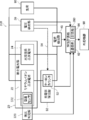
- FIG. 1 is a block diagram showing an apparatus for calculating discharge characteristics of a composite battery according to a first embodiment of the present invention.
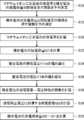
- FIG. 2 is a block diagram illustrating a calculation method of the composite battery discharge characteristic calculation apparatus of FIG.
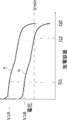
- FIG. 3 is a graph schematically showing discharge capacity-voltage characteristics of the composite battery of FIG.
- FIG. 4 is a block diagram showing an apparatus for calculating discharge characteristics of a composite battery according to a second embodiment of the present invention.
- FIG. 5 is a block diagram illustrating a calculation method of the discharge characteristic calculation apparatus for the composite battery of FIG.
- FIG. 6 is a block diagram showing an apparatus for calculating discharge characteristics of a composite battery according to a third embodiment of the present invention.
- FIG. 1 is a block diagram showing an apparatus for calculating discharge characteristics of a composite battery according to a first embodiment of the present invention.
- FIG. 2 is a block diagram illustrating a calculation method of the composite battery discharge characteristic calculation apparatus of FIG.
- FIG. 3 is a graph schematically showing
- FIG. 7 is a block diagram illustrating a calculation method of the composite battery discharge characteristic calculation apparatus of FIG. 6.
- FIG. 8 is a block diagram showing a discharge characteristic calculation apparatus for a composite battery according to a fourth embodiment of the present invention.
- FIG. 9 is a block diagram illustrating a calculation method of the composite battery discharge characteristic calculation apparatus of FIG.
- FIG. 1 is a block diagram showing an apparatus for calculating discharge characteristics of a composite battery according to a first embodiment of the present invention.
- the discharge characteristic calculation device 10 for a composite battery includes a composite battery unit 20, a voltage detection unit 30, a current detection unit 40, a charge rate detection unit 50, and a characteristic calculation unit 60.
- the composite battery unit 20 is formed by connecting a lithium ion secondary battery 22 and an aqueous secondary battery 24 using a water-soluble electrolyte in parallel.
- the voltage detection unit 30 detects the voltage value of the composite battery unit 20, and the current detection unit 40 detects the current value flowing through the composite battery unit 20.
- the charge rate detection unit 50 detects at least one of the amount of electricity that enters and exits the lithium ion secondary battery 22 and the voltage value of the lithium ion secondary battery 22, and calculates the charge rate of the lithium ion secondary battery 22. is there.
- the characteristic calculation unit 60 calculates the discharge characteristics of the composite battery using values detected or calculated by the voltage detection unit 30, the current detection unit 40, and the charge rate detection unit 50.
- the voltage detection unit 30 includes, for example, a voltage sensor and an A / D converter, and the voltage of the digital value obtained by A / D conversion of the voltage value of the composite battery unit 20 detected by the voltage sensor is characterized. The result is output to the calculation unit 60.
- the current detection unit 40 includes, for example, a current sensor and an A / D converter, and calculates a digital value current obtained by A / D conversion of the current value of the composite battery unit 20 detected by the current sensor. 60.
- the current sensor is, for example, a clamp ammeter typified by a current transformer (CT) or a Hall effect type current sensor, and may be composed of a shunt resistor and a voltmeter.
- the charging rate detection unit 50 includes, for example, a coulomb counter 52, a charging rate calculation unit, and an A / D converter, and the lithium ion secondary battery is calculated from the amount of electricity that enters and exits the lithium ion secondary battery 22 detected by the coulomb counter 52.
- the charging rate of 22 is calculated, and the charging rate of the digital value obtained by A / D converting the value is output to the characteristic calculation unit 60.
- the charging rate detection unit 50 calculates the charging rate of the lithium ion secondary battery 22 from the voltage value of the composite battery unit 20 output from the voltage detection unit 30 as indicated by an arrow 54 instead of the coulomb counter 52,
- the value may be output to the characteristic calculator 60.
- a relational expression between the voltage of the composite battery unit 20 and the charging rate of the lithium ion secondary battery 22 is measured in advance, and the charging rate of the lithium ion secondary battery 22 is calculated based on the relational expression.
- the characteristic calculator 60 calculates the voltage value of the composite battery unit 20 detected by the voltage detector 30, the current value flowing through the composite battery unit 20 detected by the current detector 40, and the charge rate detector 50.
- the discharge characteristics of the composite battery are calculated using the charging rate of the lithium ion secondary battery 22.
- the discharge characteristic of the composite battery calculated by the characteristic calculation unit 60 is output to the external device 90 that operates to achieve a predetermined purpose.
- the composite battery discharge characteristic calculation apparatus 10 of the present invention can be used by being incorporated into, for example, an automobile idle stop system, a stationary power storage system, an uninterruptible power supply system, or a backup power supply system.
- the load 80 is connected in parallel to the composite battery unit 20, for example, an ISG (Integrated Starter Generator) in an automobile idle stop system, a power conditioner in a stationary power storage system, an unprotected load in an uninterruptible power load, and a power in a backup power supply device Conditioner.
- the lithium ion secondary battery 22 may be one in which a plurality of lithium ion secondary batteries are connected in series and parallel, and the aqueous solution type secondary battery 24 has a plurality of aqueous solution type secondary batteries connected in series and parallel. Things can be used.
- the aqueous secondary battery 24 of the composite battery discharge characteristic calculation apparatus 10 of the present invention may be a lead storage battery.
- the charging rate of the lithium ion secondary battery 22 of the discharge characteristic calculation device 10 for the composite battery of the present invention is based on the current integration method based on the amount of electricity flowing into and out of the lithium ion secondary battery 22 detected by the charging rate detection unit 50. , And at least one of voltage reference methods based on the voltage value of the lithium ion secondary battery 22 detected by the charging rate detection unit 50.
- the charging rate of the lithium ion secondary battery 22 may be calculated by using the discharge characteristics and temperature characteristics of the lithium ion secondary battery 22 that are measured and stored in advance. You may calculate using the impedance value of the lithium ion secondary battery 22 obtained by monitoring a voltage, an electric current, and temperature.
- the characteristic calculation unit 60 may include a communication unit 62.
- the communication unit 62 transmits the discharge characteristics calculated by the characteristic calculation unit 60 to the external device 90. That is, the communication unit 62 is not particularly limited as long as it transmits digital information by wire or wireless.
- the characteristic calculation unit 60 may include a storage unit 64.
- the storage unit 64 stores the discharge characteristics calculated by the characteristic calculation unit 60 in time series. That is, the storage unit 64 is not particularly limited as long as it holds digital information for a certain period and a certain capacity.
- the communication unit 62 may transmit the past discharge characteristics stored in the storage unit 64 to the external device 90.
- the external device 90 may be a control device that is connected to the load 80 in a wired or wireless manner and that controls the operation of the load 80 based on the discharge characteristics transmitted by the communication unit 62.
- the external device 90 may be the load 80 itself.
- the load 80 may be a display device that displays the discharge characteristics transmitted by the communication unit 62 or a control device that controls its own operation based on the discharge characteristics.
- FIG. 2 is a block diagram illustrating a calculation method of the composite battery discharge characteristic calculation apparatus of FIG. 1
- FIG. 3 is a graph schematically illustrating discharge capacity-voltage characteristics of the composite battery of FIG.
- the composite battery unit 20 includes a lithium ion secondary battery 22 and an aqueous secondary battery 24 connected in parallel.
- the measurement accuracy of the charge rate of the aqueous secondary battery 24 is determined by the lithium ion secondary battery 22. Low compared to This is because it is difficult to calculate the charging rate by integrating the current value flowing through the aqueous secondary battery 24 because the water splitting reaction, which is a side reaction, always occurs during charging and discharging of the aqueous secondary battery 24.
- the charge / discharge reaction of the aqueous secondary battery 24 is a heterogeneous reaction, the charge / discharge voltage is essentially flat, and the charge rate is calculated from the voltage of the aqueous secondary battery 24. This is because it is difficult. Therefore, the discharge capacity Q1 of the composite battery cannot be calculated with high accuracy only by detecting the voltage value of the composite battery section 20 or the current value flowing through the composite battery section 20.
- step S10 the first function indicating the relationship between the charging rate of the lithium ion secondary battery 22 constituting the composite battery unit 20 and the discharge capacity of the composite battery is measured in advance to calculate the calculation unit.
- step S12 a second function (curve A) indicating the relationship between the discharge capacity and the open circuit voltage of the composite battery is measured in advance and stored in the calculation unit. Note that the order of step S10 and step S12 may be reversed.
- step S20 the charging rate detection unit 50 calculates the charging rate of the lithium ion secondary battery 22.
- step S22 the characteristic calculation unit 60 calculates the discharge capacity Q1 of the composite battery by applying the charging rate of the lithium ion secondary battery 22 to the first function.
- step S24 the characteristic calculation unit 60 applies the discharge capacity Q1 of the composite battery to the second function to obtain the value of the open voltage V1A of the composite battery in the discharge capacity Q1 of the composite battery.
- step S26 the voltage detection unit 30 detects the voltage value V0 of the composite battery unit 20, the current detection unit 40 detects the current value I0 flowing through the composite battery unit 20, and the characteristic calculation unit 60 detects the composite battery.
- the value of 20 voltage V1B is obtained.
- step S28 when the characteristic calculation unit 60 subtracts the value of I1 ⁇ V0 / I0 from the second function and discharges the composite battery unit 20 from the state of the discharge capacity Q1 with the current value I1, ⁇ A voltage characteristic function (curve B) is calculated.
- step S30 when the battery is continuously discharged at the current value I1, the discharge capacity Q2 at which the voltage of the composite battery unit 20 reaches the discharge end voltage Vmin is calculated.
- step S32 the remaining discharge capacity Q2-Q1 of the composite battery unit 20 when the battery is continuously discharged at the current value I1 is calculated.
- the characteristic calculation unit 60 further determines deterioration of the composite battery unit 20 based on the remaining discharge capacity Q2-Q1 and the voltage V1B of the composite battery unit 20 immediately after the start of discharge at the current value I1. May be.
- the discharge characteristic calculation apparatus and calculation method for a composite battery according to the first embodiment of the present invention are basically configured as described above. With such a configuration, the composite battery discharge characteristic calculation apparatus of the present invention can easily and accurately calculate the discharge characteristics of the entire composite battery in which two types of secondary batteries having different properties are combined. .
- FIG. 4 is a block diagram showing an apparatus for calculating discharge characteristics of a composite battery according to a second embodiment of the present invention.
- the composite battery discharge characteristic calculation device 110 according to the second embodiment calculates the point including the detection determination unit 170 and the determination result of the detection determination unit 170, with respect to the composite battery discharge characteristic calculation device 10 of the present invention. Since it has the same configuration except that it has the characteristic calculation unit 160, the description of the same component is omitted.
- the communication unit and the storage unit included in the characteristic calculation unit 160 are the same as the communication unit 62 and the storage unit 64 of the characteristic calculation unit 60, and thus description thereof is omitted.
- the composite battery discharge characteristic calculation apparatus 110 of the present invention may further include a detection determination unit 170.
- the detection determination unit 170 detects the current value flowing through the lithium ion secondary battery 22 or the aqueous solution-based secondary battery 24, and both the detected value and the current value flowing through the composite battery unit 20 detected by the current detection unit 40 are detected. It is determined whether or not each threshold value is not more than a predetermined threshold value. When it is below the threshold, the characteristic calculation unit 160 determines the discharge characteristics of the composite battery using values detected by the voltage detection unit 30, the current detection unit 40, and the charge rate detection unit 50 after being determined to be below the threshold. calculate.
- FIG. 5 is a block diagram illustrating a calculation method of the discharge characteristic calculation apparatus for the composite battery of FIG.
- step S20 In the composite battery unit 20, even when charging / discharging with respect to the load 80 is not performed, current exchange occurs between the lithium ion secondary battery 22 and the aqueous solution-type secondary battery 24 constituting the composite battery unit 20. However, the battery state changes slightly. Therefore, even if the calculation in step S20 is performed while the battery state is changing, the calculation accuracy of the charging rate of the lithium ion secondary battery 22 is deteriorated. On the other hand, when the current exchanged is small and the battery state hardly changes, the calculation of the above step S20 can calculate the charging rate of the lithium ion secondary battery 22 with higher accuracy. it can.
- the detection / determination unit 170 includes, for example, a current sensor 172 and a determination calculation unit.
- the detection / determination unit 170 is a digital obtained by A / D converting the value of the current flowing through the lithium ion secondary battery 22 detected by the current sensor 172.
- the current of the value and the current of the digital value flowing through the composite battery unit 20 detected by the current detection unit 40 are compared with predetermined threshold values. When both are equal to or less than the respective threshold values, the battery state is almost Judge that it has not changed.
- characteristic calculation unit 160 calculates the discharge characteristics of the composite battery using values detected by voltage detection unit 30, current detection unit 40, and charge rate detection unit 50 in this state.
- the current sensor 172 is, for example, a clamp ammeter typified by a current transformer (CT) or a Hall effect type current sensor, and may be composed of a shunt resistor and a voltmeter.
- the discharge characteristic calculation apparatus and calculation method for a composite battery according to the second embodiment of the present invention are basically configured as described above. By adopting such a configuration, the composite battery discharge characteristic calculation apparatus of the present invention can calculate the discharge characteristics of the whole composite battery combining two types of secondary batteries having different properties with higher accuracy.
- FIG. 6 is a block diagram showing an apparatus for calculating discharge characteristics of a composite battery according to a third embodiment of the present invention.
- the composite battery discharge characteristic calculation device 210 according to the third embodiment calculates the point including the detection determination unit 270 and the determination result of the detection determination unit 270 with respect to the composite battery discharge characteristic calculation device 10 of the present invention. Since the configuration is the same except that the characteristic calculation unit 260 is provided, description of the same components is omitted. Further, since the communication unit and the storage unit included in the characteristic calculation unit 260 are the same as the communication unit 62 and the storage unit 64 of the characteristic calculation unit 60, the description thereof is omitted.
- the discharge characteristic calculation apparatus 210 for a composite battery of the present invention may further include a detection determination unit 270.
- the detection determination unit 270 detects an elapsed time since the composite battery unit 20 last charged / discharged, and determines whether or not the detected value is equal to or greater than a predetermined threshold value. When the threshold value is equal to or greater than the threshold value, the characteristic calculation unit 260 uses the values detected by the voltage detection unit 30, the current detection unit 40, and the charge rate detection unit 50 after determining that the threshold value is equal to or greater than the threshold value. calculate.
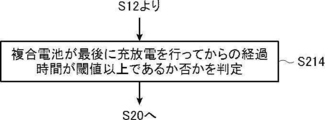
- FIG. 7 is a block diagram illustrating a calculation method of the composite battery discharge characteristic calculation apparatus of FIG. 6.
- the battery state slightly changes even when the load 80 is not charged / discharged. Therefore, the calculation in step S20 is performed while the battery state is changing. Even if it goes, the calculation accuracy of the charging rate of the lithium ion secondary battery 22 will deteriorate. On the other hand, since the battery state hardly changes if the suspension time of the composite battery unit 20 is long, the charge rate of the lithium ion secondary battery 22 can be calculated with higher accuracy if the calculation in step S20 is performed at that time. can do.
- the detection determination unit 270 includes, for example, an operation rate meter 272 and a determination calculation unit for detecting an elapsed time since the composite battery unit 20 last charged / discharged, and is detected by the operation rate meter 272 in step S214.
- the elapsed time of the digital value obtained by A / D converting the elapsed time is compared with a predetermined threshold value, and when it is equal to or greater than the threshold value, it is determined that the battery state has hardly changed.
- characteristic calculation unit 260 calculates the discharge characteristics of the composite battery using the values detected by voltage detection unit 30, current detection unit 40, and charge rate detection unit 50 in this state.
- the discharge characteristic calculation apparatus and calculation method for a composite battery according to the third embodiment of the present invention are basically configured as described above. By adopting such a configuration, the composite battery discharge characteristic calculation apparatus of the present invention can calculate the discharge characteristics of the whole composite battery combining two types of secondary batteries having different properties with higher accuracy.
- FIG. 8 is a block diagram showing a discharge characteristic calculation apparatus for a composite battery according to a fourth embodiment of the present invention.
- the composite battery discharge characteristic calculation device 310 according to the fourth embodiment calculates the point including the detection determination unit 370 and the determination result of the detection determination unit 370 with respect to the composite battery discharge characteristic calculation device 10 of the present invention. Since it has the same configuration except that it has the characteristic calculation unit 360, the description of the same component is omitted. Further, the communication unit and the storage unit included in the characteristic calculation unit 360 are the same as the communication unit 62 and the storage unit 64 of the characteristic calculation unit 60, and thus the description thereof is omitted.
- the discharge characteristic calculation device 310 for a composite battery of the present invention may further include a detection determination unit 370.
- the detection determination unit 370 detects the ON / OFF state of the protection switch provided in the lithium ion secondary battery 22.
- the characteristic calculator 360 calculates the discharge characteristics of the composite battery based on the ON / OFF state of the protection switch.
- the protection switch provided in the lithium ion secondary battery 22 may be, for example, a semiconductor switching element such as FET, IGBT, GTO, a relay, an electromagnetic switch, a breaker, or the like. Also, for example, a current fuse, a thermal fuse, a thermistor As in the case of a self-control protector (SCP), the electrical connection may not be automatically recovered unless it is replaced once it is activated.
- SCP self-control protector
- FIG. 9 is a block diagram illustrating a calculation method of the composite battery discharge characteristic calculation apparatus of FIG.
- the detection determination unit 370 includes, for example, a continuity sensor 372 for detecting the ON / OFF state of the FET switch of the lithium ion secondary battery 22 and a determination calculation unit.
- step S314 the ON / OFF detected by the continuity sensor 372.
- the OFF state is binarized to 1 if the FET switch is ON, and to 0 if the FET switch is OFF.
- the detection value is 1, that is, the FET switch is ON, and the lithium ion secondary battery 22 is electrically connected to the aqueous solution secondary battery 24 and the load 80
- the detection determination unit 370 Based on the state, the characteristic calculation unit 360 is instructed to calculate the discharge characteristic of the entire composite battery.
- the discharge characteristic calculation apparatus for a composite battery and the calculation method thereof according to the fourth embodiment of the present invention are basically configured as described above. By adopting such a configuration, the composite battery discharge characteristic calculation apparatus of the present invention can calculate the discharge characteristics of the whole composite battery combining two types of secondary batteries having different properties with higher accuracy.
- the apparatus for calculating the discharge characteristics of a composite battery according to the present invention has the effect that it can easily and accurately calculate the discharge characteristics of the composite battery as a whole by combining two types of secondary batteries having different properties. It is.
Landscapes
- Engineering & Computer Science (AREA)
- Power Engineering (AREA)
- Manufacturing & Machinery (AREA)
- Chemical & Material Sciences (AREA)
- Chemical Kinetics & Catalysis (AREA)
- Electrochemistry (AREA)
- General Chemical & Material Sciences (AREA)
- Secondary Cells (AREA)
- Tests Of Electric Status Of Batteries (AREA)
- Charge And Discharge Circuits For Batteries Or The Like (AREA)
Abstract
L'invention concerne un dispositif de calcul de caractéristique de décharge pour batterie composite, ledit dispositif de calcul de caractéristique de décharge pouvant calculer de manière simple et très précise la caractéristique de décharge de l'ensemble d'une batterie composite dans laquelle deux types de batteries rechargeables possédant des caractéristiques différentes sont combinés. Un dispositif de calcul de caractéristique de décharge (10) pour batterie composite comprend une unité de batterie composite (20), une unité de détection de tension (30), une unité de détection de courant (40), une unité de détection de régime de charge (50) et une unité de calcul de caractéristique (60). L'unité de batterie composite (20) est formée par connexion en parallèle d'une batterie rechargeable au lithium-ion (22) et d'une batterie rechargeable à base de solution aqueuse (24) utilisant un électrolyte aqueux. L'unité de détection de tension (30) détecte la valeur de tension de l'unité de batterie composite (20), et l'unité de détection de courant (40) détecte la valeur d'un courant circulant vers l'unité de batterie composite (20). L'unité de détection de régime de charge (50) détecte la quantité d'électricité circulant vers/depuis la batterie rechargeable au lithium-ion (22), et/ou la valeur de tension de la batterie rechargeable au lithium-ion (22), et calcule le régime de charge de la batterie rechargeable au lithium-ion (22). L'unité de calcul de caractéristique (60) calcule, à l'aide des valeurs détectées ou calculées par l'unité de détection de tension (30), l'unité de détection de courant (40) et l'unité de détection de régime de charge (50), la caractéristique de décharge de la batterie composite.
Priority Applications (3)
| Application Number | Priority Date | Filing Date | Title |
|---|---|---|---|
| PCT/JP2016/063761 WO2017195253A1 (fr) | 2016-05-09 | 2016-05-09 | Dispositif de calcul de caractéristique de décharge pour batterie composite |
| JP2018516231A JPWO2017195253A1 (ja) | 2016-05-09 | 2016-05-09 | 複合電池の放電特性計算装置 |
| CN201680085472.9A CN109075402A (zh) | 2016-05-09 | 2016-05-09 | 复合电池的放电特性计算装置 |
Applications Claiming Priority (1)
| Application Number | Priority Date | Filing Date | Title |
|---|---|---|---|
| PCT/JP2016/063761 WO2017195253A1 (fr) | 2016-05-09 | 2016-05-09 | Dispositif de calcul de caractéristique de décharge pour batterie composite |
Publications (1)
| Publication Number | Publication Date |
|---|---|
| WO2017195253A1 true WO2017195253A1 (fr) | 2017-11-16 |
Family
ID=60266393
Family Applications (1)
| Application Number | Title | Priority Date | Filing Date |
|---|---|---|---|
| PCT/JP2016/063761 Ceased WO2017195253A1 (fr) | 2016-05-09 | 2016-05-09 | Dispositif de calcul de caractéristique de décharge pour batterie composite |
Country Status (3)
| Country | Link |
|---|---|
| JP (1) | JPWO2017195253A1 (fr) |
| CN (1) | CN109075402A (fr) |
| WO (1) | WO2017195253A1 (fr) |
Families Citing this family (1)
| Publication number | Priority date | Publication date | Assignee | Title |
|---|---|---|---|---|
| CN112180264B (zh) * | 2020-09-25 | 2021-10-26 | 惠州亿纬锂能股份有限公司 | 一种复合电池组的电量预警方法 |
Citations (3)
| Publication number | Priority date | Publication date | Assignee | Title |
|---|---|---|---|---|
| JP2001307780A (ja) * | 2000-04-24 | 2001-11-02 | Shizuki Electric Co Inc | 二次蓄電池の等価回路、この等価回路を利用した二次蓄電池の蓄電量検出方法および二次蓄電池とキャパシタとからなるハイブリッド電源装置 |
| JP2015092444A (ja) * | 2013-10-04 | 2015-05-14 | Connexx Systems株式会社 | ハイブリッド蓄電池、ならびにそれを利用するハイブリッド蓄電装置、発蓄電ユニット、電力網システムおよび走行体 |
| JP2016025688A (ja) * | 2014-07-17 | 2016-02-08 | 株式会社関谷 | 電源制御装置及び電源制御装置の制御方法 |
Family Cites Families (6)
| Publication number | Priority date | Publication date | Assignee | Title |
|---|---|---|---|---|
| JPH095410A (ja) * | 1995-06-22 | 1997-01-10 | Hitachi Denshi Ltd | 異種電池の選択使用が可能な電子機器 |
| JP4074596B2 (ja) * | 2004-03-18 | 2008-04-09 | 日立マクセル株式会社 | 充電電池あるいは充電電池パック |
| JP5040733B2 (ja) * | 2008-03-05 | 2012-10-03 | 日産自動車株式会社 | 電池の充放電可能電力推定方法 |
| JP5870590B2 (ja) * | 2011-09-29 | 2016-03-01 | ミツミ電機株式会社 | 電池状態計測方法及び電池状態計測装置 |
| JP2014190728A (ja) * | 2013-03-26 | 2014-10-06 | Panasonic Corp | 充電率推定装置 |
| US9837834B2 (en) * | 2013-04-03 | 2017-12-05 | Panasonic Intellectual Property Management Co., Ltd. | Battery apparatus |
-
2016
- 2016-05-09 WO PCT/JP2016/063761 patent/WO2017195253A1/fr not_active Ceased
- 2016-05-09 CN CN201680085472.9A patent/CN109075402A/zh active Pending
- 2016-05-09 JP JP2018516231A patent/JPWO2017195253A1/ja active Pending
Patent Citations (3)
| Publication number | Priority date | Publication date | Assignee | Title |
|---|---|---|---|---|
| JP2001307780A (ja) * | 2000-04-24 | 2001-11-02 | Shizuki Electric Co Inc | 二次蓄電池の等価回路、この等価回路を利用した二次蓄電池の蓄電量検出方法および二次蓄電池とキャパシタとからなるハイブリッド電源装置 |
| JP2015092444A (ja) * | 2013-10-04 | 2015-05-14 | Connexx Systems株式会社 | ハイブリッド蓄電池、ならびにそれを利用するハイブリッド蓄電装置、発蓄電ユニット、電力網システムおよび走行体 |
| JP2016025688A (ja) * | 2014-07-17 | 2016-02-08 | 株式会社関谷 | 電源制御装置及び電源制御装置の制御方法 |
Non-Patent Citations (1)
| Title |
|---|
| YASUHARA, KAZUKI: "An Experimental Study on Equivalent Circuit Model of Discharge Current Behavior in Multicell Lithium-ion Battery", IEICE TECHNICAL REPORT, vol. 114, no. 250, 9 October 2014 (2014-10-09), pages 33 - 38 * |
Also Published As
| Publication number | Publication date |
|---|---|
| CN109075402A (zh) | 2018-12-21 |
| JPWO2017195253A1 (ja) | 2019-04-04 |
Similar Documents
| Publication | Publication Date | Title |
|---|---|---|
| US10048322B2 (en) | Method of measuring battery pack current and correcting offsets of a current sensor | |
| KR100995075B1 (ko) | 배터리 관리 시스템 및 그 구동 방법 | |
| KR101057542B1 (ko) | 배터리 관리 시스템 및 그 구동 방법 | |
| JP5264434B2 (ja) | バッテリー管理システムおよびその駆動方法 | |
| JP5274110B2 (ja) | 車両用の電源装置 | |
| KR101057547B1 (ko) | 배터리 관리 시스템 및 그 구동 방법 | |
| JP5179047B2 (ja) | 蓄電装置の異常検出装置、蓄電装置の異常検出方法及びその異常検出プログラム | |
| KR101610906B1 (ko) | 커패시터를 이용한 절연 저항 추정 장치 및 그 방법 | |
| JP6132314B2 (ja) | 電源装置、電源装置を備える車両並びに蓄電装置、及び電池の残容量の検出方法 | |
| EP2717415A1 (fr) | Système de stockage d'électricité | |
| KR101678277B1 (ko) | 스위치 열화 검출 장치 및 방법 | |
| CN101141013A (zh) | 电池管理系统及其驱动方法 | |
| WO2008053969A1 (fr) | Dispositif de détection d'anomalie pour élément de mémorisation, procédé de détection d'anomalie pour élément de mémorisation, programme de détection d'anomalie pour élément de mémorisation, et support d'enregistrement pouvant | |
| KR20130110355A (ko) | 배터리 관리 시스템 및 그 시스템의 soc 값 보정 방법 | |
| JPWO2014132403A1 (ja) | 二次電池劣化度判定装置 | |
| US20150346283A1 (en) | Apparatus and method for calculating precharge resistance of battery pack | |
| JP6823885B2 (ja) | 複合電池、それを備えた自動車及び鉄道回生電力貯蔵装置 | |
| WO2022224681A1 (fr) | Dispositif de surveillance de batterie et véhicule électrique équipé de celui-ci | |
| JP2014115088A (ja) | 電池残容量検出装置、電動車両および電力供給装置 | |
| WO2019230110A1 (fr) | Dispositif de commande de batterie, système de commande de batterie, et procédé de commande de batterie | |
| KR101856068B1 (ko) | 배터리 팩 전압을 이용한 절연 저항 측정 장치 및 방법 | |
| JP6086487B2 (ja) | 電池状態検出装置 | |
| WO2017195253A1 (fr) | Dispositif de calcul de caractéristique de décharge pour batterie composite | |
| JP2014223003A (ja) | 蓄電システム | |
| JP2013024694A (ja) | 漏電状態の検出装置および検出方法 |
Legal Events
| Date | Code | Title | Description |
|---|---|---|---|
| ENP | Entry into the national phase |
Ref document number: 2018516231 Country of ref document: JP Kind code of ref document: A |
|
| NENP | Non-entry into the national phase |
Ref country code: DE |
|
| 121 | Ep: the epo has been informed by wipo that ep was designated in this application |
Ref document number: 16901602 Country of ref document: EP Kind code of ref document: A1 |
|
| 122 | Ep: pct application non-entry in european phase |
Ref document number: 16901602 Country of ref document: EP Kind code of ref document: A1 |