WO2017195421A1 - Équipement de placement de poids et procédé de placement de poids pour ligne de moulage sans châssis - Google Patents
Équipement de placement de poids et procédé de placement de poids pour ligne de moulage sans châssis Download PDFInfo
- Publication number
- WO2017195421A1 WO2017195421A1 PCT/JP2017/004722 JP2017004722W WO2017195421A1 WO 2017195421 A1 WO2017195421 A1 WO 2017195421A1 JP 2017004722 W JP2017004722 W JP 2017004722W WO 2017195421 A1 WO2017195421 A1 WO 2017195421A1
- Authority
- WO
- WIPO (PCT)
- Prior art keywords
- weight
- mold
- lowering
- jacket
- deceleration position
- Prior art date
- Legal status (The legal status is an assumption and is not a legal conclusion. Google has not performed a legal analysis and makes no representation as to the accuracy of the status listed.)
- Ceased
Links
Images






Classifications
-
- B—PERFORMING OPERATIONS; TRANSPORTING
- B22—CASTING; POWDER METALLURGY
- B22C—FOUNDRY MOULDING
- B22C11/00—Moulding machines characterised by the relative arrangement of the parts of same
-
- B—PERFORMING OPERATIONS; TRANSPORTING
- B22—CASTING; POWDER METALLURGY
- B22C—FOUNDRY MOULDING
- B22C21/00—Flasks; Accessories therefor
- B22C21/12—Accessories
-
- B—PERFORMING OPERATIONS; TRANSPORTING
- B22—CASTING; POWDER METALLURGY
- B22C—FOUNDRY MOULDING
- B22C23/00—Tools; Devices not mentioned before for moulding
Definitions
- the present disclosure relates to a weight placement facility and a weight placement method for placing a weight on a mold of a frame forming line.
- a taper-shaped jacket is put on the outer periphery of the casting mold, and the casting is overlaid on the casting mold. A weight is placed. After the melt has solidified, the jacket and weight are removed from the mold and the cast product is removed.
- Patent Document 1 describes a weight jacket transfer device in a frame making line.
- the weight jacket transfer device described in Patent Document 1 removes the weight from the mold on the cooling line and installs the weight on the mold on the pouring line. Then, the jacket is removed from the mold on the cooling line, and the jacket is put on the mold on the pouring line.
- the pouring line and the cooling line described in Patent Document 1 are arranged in parallel, and the weight jacket transfer device is arranged across the pouring line and the cooling line. Therefore, the space required for changing the weight and jacket can be suppressed.
- the descent speed of the weight from when the weight starts to fall until it is placed on the mold is such that the mold does not collapse due to the impact when the weight is placed on the mold. Is set. Since this speed is low, the cycle time from when the weight starts to descend until it is placed on the mold becomes long.
- one form of the present disclosure is a weight placement facility for placing a weight on a mold on a frame forming line, wherein the weight is lowered to be placed on the mold.
- the descending speed includes a first descending speed from the start of descending to reaching the deceleration position, and a second descending speed from the deceleration position to being placed on the mold.
- the second descending speed is lower than the first descending speed.
- the deceleration position determining device determines the deceleration position of the weight descending direction in the weight lifting device.
- the weight is lowered by the weight lifting device to be placed on the mold.
- the descent speed of the weight is a section from the start of the descent until reaching the deceleration position (first section), and a section from the deceleration position to being placed on the mold (second section).
- the descending speed of the weight in the second section (second descending speed) is set to a speed at which the mold does not collapse due to the impact when the weight is placed. That is, the descending speed (first descending speed) of the weight in the first section is set at a speed faster than the second descending speed.
- the weight mounting facility may further include a jacket lifting / lowering device that is disposed upstream of the weight lifting / lowering device and covers a jacket on a side surface of the mold.
- the deceleration position determining device may be disposed in the jacket lifting device. According to this aspect, the deceleration position determination device operates when the jacket lifting device provided upstream of the weight lifting device is operating, and determines the deceleration position of the weight lifting direction in the weight lifting device. can do.
- the deceleration position determination device may include an optical measurement unit that is disposed in the weight lifting device and measures a distance to the upper surface of the mold using light.
- the light measuring means may be arranged so that light emitted from the light measuring means hits the upper surface of the mold perpendicularly.
- the distance from the weight lifting device to the upper surface of the mold is measured by the optical measuring means provided in the weight lifting device.
- the deceleration position is determined by the deceleration position determination device.
- the measurement of the distance to the upper surface of the mold and the determination of the deceleration position of the weight can be performed with one apparatus called an optical measurement unit.
- the deceleration position determination device includes a first detector that can be moved up and down relative to the jacket lifting device, and a first detector that moves up and down together with the jacket lifting device and detects the first detection body.
- the first proximity switch may include a plurality of proximity switches corresponding to different heights of the mold.
- the weight lifting device may include a deceleration position detection device that detects the deceleration position.
- the deceleration position detection device includes: a second detector that moves up and down with the lifting operation of the weight lifting device; and a second proximity switch that is attached to the weight lifting device and detects the second detection body. You may have.
- the second proximity switch may include a plurality of proximity switches corresponding to different mold heights. Since the proximity switch can be easily replaced, it is possible to quickly respond to problems such as damage. Therefore, according to this form, it becomes the weight mounting equipment excellent in maintainability.
- the deceleration position determination device may further include a bar member extending in a height direction of the mold.
- the first detection body may be disposed at an upper end of the bar member, and a lower end of the bar member may be disposed so as to be able to contact a collar portion formed on the jacket.
- the deceleration position can be determined with a simple structure.
- the first detector may have a cylindrical shape extending in the height direction of the mold and having an open lower end. If the shape of the first detection body is a cylindrical shape having an open upper end, foundry sand will enter the first detection body. Moreover, if the shape of the first detection body is a cylindrical shape, the material cost of the first detection body will be expensive. According to this embodiment, the first detection body can keep the foundry sand inside, and can keep the material cost low.
- Another embodiment of the present disclosure is a method of placing a weight on a mold on the above-described frame forming line, and a jacket covering step of lowering the jacket and covering the side surface of the mold with the jacket lifting device
- the weight is lowered at the second lowering speed from the deceleration position until the weight is placed on the mold by the first weight lowering step of lowering at the first lowering speed and the weight lifting device.
- a second double weight lowering step is a second double weight lowering step.
- this weight placement method the deceleration position of the weight is determined by the first detector and the first proximity switch, and the descending speed of the weight decreases at the deceleration position, and the weight is placed on the mold. Is done. For this reason, this weight mounting method can place a weight on a mold having an arbitrary height. In this weight mounting method, each process may be performed in order, or two or more processes may be performed simultaneously.
- Yet another embodiment of the present disclosure is a method of placing a weight on a mold on the above-described frame forming line, and measuring the distance from the optical measurement means to the upper surface of the mold by the optical measurement means.
- a decelerating position determining step of determining a decelerating position of the weight lifting device in the descending direction of the weight based on the distance measured in the measuring step, and the decelerating position by the weight lifting device.
- this weight placement method the deceleration position of the weight is determined based on the distance measured by the optical measuring means, the descending speed of the weight decreases at the deceleration position, and the weight is placed on the mold. The For this reason, this weight mounting method can place a weight on a mold having an arbitrary height. In this weight mounting method, each process may be performed in order, or two or more processes may be performed simultaneously.
- the first section that descends at the first descending speed and the second section that descends at the second descending speed are set. Therefore, the cycle time from when the weight starts to descend to when the weight is placed on the mold can be shortened compared to when the entire section descends at the second descending speed.
- FIG. 9A is a schematic diagram when the mold height is H
- FIG. 9B is a schematic diagram when the mold height is N
- FIG. 9C is a mold height.
- FIG. 9D is a schematic diagram in the case where there is no mold. It is a schematic diagram which shows the deceleration position of the weight raising / lowering apparatus in 1st embodiment. It is a schematic diagram which shows the weight raising / lowering apparatus in 2nd embodiment.
- FIG. 1 the whole structure of the frame making line 1 in 1st embodiment is shown.
- a pouring line 2 and a cooling line 3 are arranged in parallel along the X-axis direction in the figure, and a platen carriage transfer equipment (pusher device, cushion device and traverser) 4 is provided at both ends thereof. Be placed.
- the frame making line 1 is configured by a conveyor that pitch-feeds the surface plate carriage 9 at regular intervals.
- the frame making machine 10 is arranged so that the mold 8 molded by the frame making machine 10 can be carried into the pouring line 2 from the carry-in position 11.
- the weight mounting equipment 7 including the jacket lifting device 5 and the weight lifting device 6 is disposed so as to straddle the pouring line 2 and the cooling line 3.
- the arrows shown in FIG. 1 indicate the traveling direction of the surface plate carriage 9 and the casting mold 8 placed on the surface plate carriage 9.
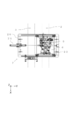
- FIG. 2 shows a plan view of the weight mounting facility 7 in the first embodiment.
- the equipment frame 20 of the weight mounting equipment 7 is disposed so as to straddle the pouring line 2 and the cooling line 3.
- the equipment frame 20 is provided with a cylinder 21 and a connecting frame 22.
- the connecting frame 22 fixes the jacket lifting device 5 and the weight lifting device 6 so as to be integrated.
- the jacket lifting / lowering device 5 and the weight lifting / lowering device 6 fixed by the connecting frame 22 move along the equipment frame 20 by the operation of the cylinder 21 (Y-axis direction in the figure). And it is comprised so that it can stop on the pouring line 2 and the cooling line 3.
- FIG. 1 shows a plan view of the weight mounting facility 7 in the first embodiment.
- the equipment frame 20 of the weight mounting equipment 7 is disposed so as to straddle the pouring line 2 and the cooling line 3.
- the equipment frame 20 is provided with a cylinder 21 and a connecting frame 22.
- the connecting frame 22 fixes the jacket lifting device 5 and the
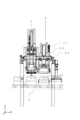
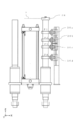
- FIG. 3 shows the structure of the weight mounting facility 7 in the first embodiment. Specifically, a structure in which the jacket lifting device 5 when positioned on the pouring line 2 and the weight lifting device 6 when positioned on the cooling line 3 are viewed from the right side is shown.
- the jacket elevating device 5 includes an elevating cylinder 14, a frame 15, and a jacket elevating claw 16.
- the elevating cylinder 14 is connected to the frame 15.
- the jacket raising / lowering claw 16 is provided on the frame 15.
- the jacket 12 has a flange 12a.
- the jacket lifting / lowering claw 16 engages with the collar portion 12 a and rises in the engaged state. Thereby, the jacket lifting / lowering device 5 can lift the jacket 12 placed on the mold 8 on the cooling line 3.
- the jacket elevating device 5 includes a deceleration position determining device 30.
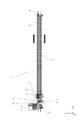
- FIG. 5 shows the structure of the deceleration position determining device 30.
- the deceleration position determining device 30 includes a bar member 31, a first detector 32, and first proximity switches 33a, 33b, and 33c.
- a first frame 34 is disposed above the frame 15 in the jacket lifting device 5.
- first proximity switches 33a, 33b, and 33c are arranged at different heights.
- the first proximity switches 33a, 33b, and 33c are separated so as not to affect each other.
- the three first proximity switches are arranged in the order of the first proximity switches 33a, 33b, and 33c from the top.
- the bar member 31 is disposed so as to extend in the vertical direction of the jacket lifting device 5 (the height direction of the mold 8) (Z-axis direction in the figure).
- a first detector 32 is attached to one end of the bar member 31.
- the first detector 32 has a cylindrical shape with one end opened. As shown in FIG. 8, the first detection body 32 is attached to the rod member 31 so that the opening of the first detection body 32 faces downward.
- the height width of the first detector 32 (the length in the Z-axis direction in the figure) is set to be longer than the separation distance between the first proximity switches 33a and 33c. And when the jacket raising / lowering apparatus 5 raises / lowers the jacket 12, the other end of the bar member 31 and the collar part 12a contact
- Each of the three first proximity switches transmits a signal to a sequencer (not shown) when the first detector 32 moves up and down and is positioned at the same height.
- the movement of the deceleration position determining device 30 during the operation of the jacket lifting device 5 is shown below.
- Each of the three first proximity switches is disposed on the first frame 34.
- the first frame 34 is disposed on the frame 15 of the jacket lifting device 5. Therefore, the three first proximity switches move together with the jacket lifting device 5.
- the bar member 31 to which the first detection body 32 is attached is in contact with the jacket 12.
- the jacket 12 is lowered by the jacket lifting device 5. Therefore, the first detector 32 also moves with the jacket lifting device 5. Therefore, the positional relationship between the three first proximity switches and the first detector 32 does not change. In this case, the first detector 32 is located at a lower height than the three first proximity switches. For this reason, none of the three first proximity switches detects the first
- the movement of the deceleration position determining device 30 from when the jacket elevating device 5 covers the mold 8 on the pouring line 2 until the jacket 12 is lowered on the pouring line 2 is shown.
- the three first proximity switches move (lower) together with the jacket lifting device 5 as described above.
- the bar member 31 to which the first detection body 32 is attached is in contact with the jacket 12.
- the jacket 12 does not descend because it covers the mold 8. Therefore, the first detection body 32 does not move (lower) with the jacket elevating device 5. Therefore, when the first detector 32 is observed from the three first proximity switches, the first detector 32 appears to rise in height. As described above, the first detector 32 can be moved up and down relatively with respect to the jacket lifting device 5. Then, as shown in FIG.
- the height distance A1 of the first detection body 32 is a distance from the lower end of the flange 12a to the upper surface of the jacket lifting / lowering claw 16 when the jacket lifting / lowering claw 16 of the jacket lifting / lowering device 5 is located at the lower limit position on the pouring line 2. It is equal to the distance to A2.
- the first proximity switch and the first detector 32 need to approach each other to some extent. For this reason, the first proximity switch and the first detection body 32 are arranged such that the first proximity switch has a distance at which the first detection body 32 can be detected.
- the first detector 32 has a cylindrical shape. For this reason, even if the 1st detection body 32 rotates centering on the rod member 31, the 1st detection body 32 and the 1st proximity switch do not contact. And when the 1st detection body 32 is attached to the rod member 31, it attaches so that the opening of the 1st detection body 32 may become down. For this reason, impurities such as casting sand do not enter the first detection body 32. Furthermore, a hole through which impurities such as casting sand can pass may be provided in the upper part of the first detection body 32. Thereby, it is possible to prevent impurities from accumulating on the first detector 32.
- the stopper 35 is provided on the rod member 31 so that the rod member 31 and the first detector 32 do not fall more than necessary with respect to the frame 15.
- the weight lifting device 6 in the weight mounting facility 7 includes a lifting cylinder 17, a frame 18, and a weight lifting claw 19.
- the elevating cylinder 17 is connected to the frame 18.
- the weight lifting / lowering claw 19 is provided on the frame 18.
- the frame 18 and the weight lifting claw 19 of the weight lifting device 6 can be moved in the vertical direction by the lifting cylinder 17 (Z-axis direction in the figure).
- the weight lifting claw 19 engages with the weight 13 and rises in the engaged state.
- the weight lifting device 6 can lift the weight 13 placed on the upper surface of the mold 8 on the cooling line 3.
- the weight lifting device 6 is moved in the Y-axis direction in the figure by the operation of the cylinder 21, and the weight 13 lifted by the cooling line 3 can be placed on the upper surface of the mold 8 on the pouring line 2. .
- the weight lifting device 6 includes a deceleration position detection device 37.
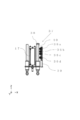
- FIG. 7 shows the structure of the deceleration position detection device 37.
- the deceleration position detection device 37 includes a second detection body 38 and second proximity switches 36a, 36b, 36c, and 36d.
- the second proximity switches 36a, 36b, 36c, and 36d are disposed at different heights.
- the second proximity switches 36a, 36b, 36c, and 36d are separated so as not to affect each other.
- the four second proximity switches are arranged in the order of the second proximity switches 36a, 36b, 36c, and 36d from the top.
- the four second proximity switches are disposed on the second frame 39.
- the second frame 39 is disposed on the equipment frame 20 as shown in FIG. As described above, the second proximity switches 36 a, 36 b, 36 c, and 36 d are attached to the weight lifting device 6.
- the second detector 38 is disposed on the upper part of the weight side guide pin 40 that moves up and down in accordance with the lifting and lowering of the weight 13 by the weight lifting device 6.
- Each of the four second proximity switches transmits a signal to a sequencer (not shown) when the second detector 38 is moved up and down and positioned at the same height.
- the height of the upper frame and the lower frame in the mold 8 is assumed to be the same.
- the outer peripheral lower part of the upper frame and the outer peripheral upper part of the lower frame are both tapered, and the center of the outer periphery of the mold 8 becomes one tapered shape by combining the upper frame and the lower frame.
- the inner periphery of the jacket 12 has a tapered shape, and the jacket 12 covers the mold 8 because the outer periphery of the mold 8 and the inner periphery of the jacket 12 are combined.
- the center of the height of the jacket 12 is assumed to be located on the mating surface of the upper frame and the lower frame in the mold 8.
- the jacket elevating claw 16 is separated from the flange 12a and continues to descend to the lower limit position.
- the descent limit position indicates a position when the jacket raising / lowering claw 16 of the jacket raising / lowering device 5 has been lowered.
- the three first proximity switches continue to descend together with the jacket elevating device 5 until the jacket elevating claw 16 comes off the collar 12a and reaches the lower limit position.
- the first detector 32 is not displaced because it is in contact with the jacket 12 covered with the mold 8 via the rod member 31. Therefore, when the first detection body 32 is observed from the three first proximity switches, the first detection body 32 appears to rise.
- FIG. 8 shows an enlarged view of the deceleration position determining device 30.
- the height of the upper end of the first detection body 32 before the jacket 12 covers the mold 8 is defined as a height ⁇ .
- the first proximity switches 33a, 33b, and 33c are positioned at heights that are separated from the height ⁇ by distances Da, Db, and Dc, respectively.
- FIG. 9 shows the positional relationship between the jacket elevating device 5 and the jacket 12 in a state where the jacket elevating claw 16 of the jacket elevating device 5 has reached the lower limit position.
- a method for determining the deceleration position of the weight 13 in the descending direction of the weight lifting device 6 will be described.
- a method for determining the deceleration position of the weight 13 when the weight 13 is placed on the molds 8H, 8N, and 8L having three different heights H, N, and L will be described.
- a method for determining the deceleration position of the weight 13 when the mold 8 is not placed on the platen carriage 9 will also be described.
- the deceleration position is a position where the weight 13 descending at the first descending speed starts to decelerate.
- the upper surface height of the jacket raising / lowering claw 16 at the lowering limit is defined as the lowering limit height ⁇ .
- the three different heights are set lower in the order of height H> N> L.
- the jacket raising / lowering claw 16 is lowered by a distance h from the time when the jacket raising / lowering claw 16 is disengaged from the collar 12a until reaching the lower limit position.
- the first detection body 32 rises from the height ⁇ by the distance h as in the case of the jacket lifting / lowering claw 16.
- the distance h is longer than the distance Da in FIG. That is, the upper end of the first detection body 32 is positioned above the first proximity switch 33a when the jacket elevating claw 16 of the jacket elevating device 5 reaches the lowering limit position.
- the heights of the three first proximity switches 33a, 33b, 33c are all at the upper end of the first detector 32. It is located so that it is within the range of the lower end.
- each of the three first proximity switches 33a, 33b, 33c detects the first detection body 32 and transmits a signal to the sequencer. By transmitting a signal to the sequencer as described above, the deceleration position of the weight 13 when the weight 13 is placed on the mold 8H is determined.
- the operation of the jacket lifting / lowering device 5 and the deceleration position determining device 30 in the deceleration position determining step when the weight 13 is placed on the mold 8N shown in FIG. 9B will be described.
- the first detector 32 has a height ⁇ as viewed from the three first proximity switches, as described in the mold 8H. From the distance n.
- the distance n is longer than the distance Db in FIG. 8 and shorter than the distance Da. That is, the upper end of the first detection body 32 is located between the first proximity switches 33a and 33b.
- the two first proximity switches 33b and 33c When the first detection body 32 rises from the height ⁇ by a distance n with respect to the three first proximity switches, the heights of the two first proximity switches 33b and 33c become the upper and lower ends of the first detection body 32, respectively. It is located within the range. Therefore, when the jacket lifting / lowering claw 16 of the jacket lifting / lowering device 5 reaches the lowering limit position, the two first proximity switches 33b and 33c each detect the first detection body 32 and transmit a signal to the sequencer. By transmitting a signal to the sequencer as described above, the deceleration position of the weight 13 when the weight 13 is placed on the mold 8N is determined.
- the operation of the jacket lifting / lowering device 5 and the deceleration position determining device 30 in the deceleration position determining step when the weight 13 is placed on the mold 8L shown in FIG. 9C will be described.
- the first detector 32 has a height ⁇ as viewed from the three first proximity switches, as described in the mold 8H. Ascend a distance 1 from
- the distance l is longer than the distance Dc in FIG. 8 and shorter than the distance Db. That is, the upper end of the first detection body 32 is located between the first proximity switches 33b and 33c.
- the height of one first proximity switch 33c is within the range between the upper end and the lower end of the first detector 32. Located to fit in. Therefore, when the jacket lifting / lowering claw 16 of the jacket lifting / lowering device 5 reaches the lowering limit position, one first proximity switch 33c detects the first detection body 32 and transmits a signal to the sequencer. By transmitting a signal to the sequencer as described above, the deceleration position of the weight 13 when the weight 13 is placed on the mold 8L is determined.
- the operation of the jacket lifting / lowering device 5 and the deceleration position determining device 30 in the deceleration position determining step when the mold 8 does not exist on the platen carriage 9 as shown in FIG. 9 (D) will be described.
- the first detector 32 has a height ⁇ as viewed from the three first proximity switches, as described in the mold 8H. From the distance e.
- the distance e is shorter than the distance Dc. That is, the upper end of the first detection body 32 is located below the first proximity switch 33c.
- the heights of the three first proximity switches are all higher than the upper end of the first detector 43. Located at a high position. Therefore, when the jacket lifting / lowering claw 16 of the jacket lifting / lowering device 5 reaches the lowering limit position, none of the three first proximity switches detects the first detector 32 and transmits a signal to the sequencer. The deceleration position of the weight 13 is determined by not transmitting a signal from the first proximity switch to the sequencer in the deceleration position determination step.
- the mold 8 does not exist on the surface plate carriage 9
- the jacket 12 is placed directly on the surface plate carriage 9, as shown in FIG.
- the jacket lifting / lowering claw 16 of the jacket lifting / lowering device 5 After the jacket lifting / lowering claw 16 of the jacket lifting / lowering device 5 reaches the lowering limit, the jacket lifting / lowering device 5 is lifted again so as not to contact the mold 8 and the jacket 12. Thereafter, the jacket elevating device 5 is moved onto the cooling line 3 by the cylinder 21. Then, the mold 8 placed on the surface plate carriage 9 is intermittently conveyed by one pitch (one mold) by the surface plate carriage transfer equipment 4 in the state of a continuous mold group. The four different distances become shorter in the order of distance h> n> l> e. When the jacket lifting / lowering claw 16 of the jacket lifting / lowering device 5 reaches the lowering limit position, the jacket lifting / lowering claw 16 and the flange portion 12a do not contact in any of the above cases.
- Step 3 First weight lowering step
- the weight 13 placed on the mold 8 on the cooling line 3 is lifted by the weight lifting device 6 and moved onto the mold 8 on the pouring line 2. Thereafter, the weight 13 is lowered toward the mold 8.
- the descending speed of the weight lifting device 6 at this time is defined as a first descending speed.
- the first descending speed is higher than the second descending speed described later.
- the first lowering speed is set in consideration of the load on the weight lifting device 6 and the time from when the weight 13 is lowered to the second lowering speed.
- the deceleration position of the weight lifting device 6 is set by a signal transmitted to the sequencer by the three first proximity switches.
- the flow of setting the deceleration position for the molds 8H, 8N, and 8L having the heights H, N, and L, which are three different heights, will be described.
- a flow for setting the deceleration position when the mold 8 is not placed on the surface plate carriage 9 (when only the jacket 12 is placed) will be described.
- the height of the second detection body 38 before the weight lifting device 6 lowers the weight 13 is defined as a height ⁇ .
- the second proximity switches 36a, 36b, 36c, 36d are positions where the second detector 38 can be detected, and the second detector 38 is at the same height as the second proximity switches 36a, 36b, 36c, 36d.
- the positions are set as positions P1, P2, P3, and P4, respectively.
- FIG. 10 shows the deceleration position of the weight lifting device 6.
- Table 1 shows the relationship between the signal transmitted by the first proximity switch and the position of the second detector 38 in the first embodiment.
- the “presence / absence of signal transmitted by first proximity switch” column in Table 1 indicates whether or not the three first proximity switches 33a, 33b, and 33c transmit signals to the sequencer in the deceleration position determination step. Described for each type (mold height).
- “ ⁇ ” indicates that a signal is transmitted in the deceleration position determination step
- “ ⁇ ” indicates that no signal is transmitted.
- the “second detection body position” column indicates the position of the second detection body 38 when the weight lifting device 6 starts to decelerate.
- the type of signal transmitted from the first proximity switch to the sequencer differs depending on the mold height, and the deceleration position of the second detector 38 corresponding to the type of signal is set in advance. Yes. Specifically, when the three first proximity switches 33a, 33b, and 33c transmit signals to the sequencer, the second proximity switch 36a detects the second detector 38 (the second detector 38 is at the position P1). Once positioned), the weight lifting device 6 starts to decelerate. When the two first proximity switches 33b and 33c transmit signals to the sequencer, when the second proximity switch 36b detects the second detection body 38 (when the second detection body 38 is positioned at the position P2), the weight is lifted and lowered. The device 6 is decelerated.
- the weight is raised or lowered.
- Device 6 begins to decelerate.
- the first proximity switch does not transmit a signal to the sequencer in the deceleration position determination step
- the second proximity switch 36d detects the second detection body 38 (when the second detection body 38 is positioned at the position P4)
- the weight is raised or lowered.
- Device 6 begins to decelerate.
- the deceleration position is set to a higher position in the order of P1> P2> P3> P4. The higher the deceleration position is, the shorter the section that descends at the first descending speed.
- the weight lifting device 6 that has started decelerating then continues to descend at the second descending speed until the weight 13 is placed on the mold 8 or the jacket 12.
- the second descending speed is lower than the first descending speed.
- the second descending speed can be arbitrarily set as long as it is a speed that does not cause the mold 8 to collapse due to an impact when the weight 13 is placed on the mold 8.
- the weight lifting device 6 After the weight lifting device 6 places the weight 13 on the mold 8 (or the jacket 12) while maintaining the second descending speed, the weight lifting device 6 moves down a certain distance and stops. Then, the weight lifting device 6 is raised again so as not to contact the mold 8 and the weight 13. Thereafter, in order to repeat the above steps, the weight lifting device 6 is moved onto the cooling line 3 by the cylinder 21.
- the height of the upper frame and the lower frame in the mold 8 is the same, and the center of the height of the jacket 12 is located on the mating surface of the upper frame and the lower frame.
- the distance from the lower surface of the flange 12a to the lower limit height ⁇ is the same as the distance by which the first detector 32 rises from the height ⁇ in the deceleration position determination step. Therefore, in the deceleration position determination step, the greater the height value of the mold 8, the longer the distance from the lower surface of the flange 12a to the lower limit height ⁇ , and the distance that the first detector 32 rises from the height ⁇ . Also gets longer.
- a method for setting the height positions of the first proximity switches 33a, 33b, 33c and the second proximity switches 36a, 36b, 36c, 36d will be described below.
- the first proximity switches 33a, 33b, 33c and the second proximity switches 36a, 36b, 36c, 36d are all separated so as not to affect each other.
- a decelerating position determination step is performed in advance on the mold 8M having the maximum height and the mold 8m having the minimum height among molds that can be molded by the frame making machine 10, and the upper end height position of the first detector 32 is confirmed.
- the upper end heights of these first detection bodies 32 are indicated as PM and Pm in FIG.
- the two first proximity switches 33a and 33b are arranged within the range of the upper end heights PM and Pm.
- the height of the mold 8M is set as H +, and the height of the mold 8m is set as L-.
- the deceleration position determining step is performed in the same manner, and the upper end height position of the first detection body 32 is confirmed.
- the upper end height of the first detector 32 is indicated as Pn in FIG.
- one first proximity switch 33c is arranged within the range of the upper end heights Pm and Pn.
- the first proximity switch 33b is disposed at an intermediate position between the first proximity switches 33a and 33c.
- the three first proximity switches 33a, 33b, and 33c can be arranged at arbitrary positions within the above-described range.
- the template when the first detector 32 is raised by the distance Da is the template 8Da having the template height M +
- the template when the first detector 32 is raised by the distance Db is the template height.
- a template 8Db having a thickness L + is used.
- the position of the second proximity switch 36a is set so that the weight 13 can be placed at the second descending speed when the weight 13 is placed on the mold 8M. Specifically, only the distance necessary to decelerate from the first descending speed to the second descending speed from the position of the second detector 38 at the moment when the weight 13 is placed on the mold 8M having the mold height H +.
- the position of the second proximity switch 36a is set so that the upper position becomes the position P1.
- the position of the second proximity switch 36b is set so that it can be placed at the second descending speed when the weight 13 is placed on the mold 8Da. Specifically, only the distance necessary to decelerate from the first descending speed to the second descending speed from the position of the second detector 38 at the moment when the weight 13 is placed on the mold 8Da having the mold height M +.
- the position of the second proximity switch 36b is set so that the upper position becomes the position P2.
- the position of the second proximity switch 36c is set so that the weight 13 can be placed at the second descending speed when the weight 13 is placed on the mold 8Db. Specifically, only the distance necessary for decelerating from the first descending speed to the second descending speed from the position of the second detector 38 at the moment when the weight 13 is placed on the mold 8Db having the mold height L +.
- the position of the second proximity switch 36c is set so that the upper position becomes the position P3.
- the position of the second proximity switch 36d is set so that the weight 13 can be placed at the second descending speed when the weight 13 is placed on the jacket 12.
- the position above the position of the second detector 38 at the moment when the weight 13 is placed on the jacket 12 is a position P4 that is a distance necessary to decelerate from the first descending speed to the second descending speed.
- the position of the second proximity switch 36d is set so that
- Table 1 summarizes the relationship between the mold height and the deceleration position of the second detector 38.
- the height H is in the range of heights M + to H +
- the height M is in the range of heights L + to M +
- the height L is in the range of heights L ⁇ to L +.
- the deceleration position is determined in consideration of the height of the mold on which the weight 13 is placed.
- the deceleration position may be determined in consideration of the mechanical load on the weight lifting device 6 when the lowering speed of the weight lifting device is decreased from the first lowering speed to the second lowering speed.
- the two first proximity switches 33a and 33b are arranged in the range of the upper end heights PM and Pm.
- the present invention is not limited to this, and one or three or more first proximity switches are arranged. You may do it.
- a second proximity switch other than the above four may be arranged based on a method for setting the height position of the second proximity switch.
- the steps from lowering the weight 13 by the weight lifting device 6 to placing it on the mold 8 are the first weight lowering step of lowering the weight 13 at the first lowering speed. And a second double weight lowering step of lowering the weight 13 at the second lowering speed.
- the weight 13 is placed at a speed without breaking the mold 8 having an arbitrary height, and the descent time of the weight 13 due to the second descent speed, which is lower than the first descent speed, is minimized. Since it is possible to limit to the limit, the process time is shortened.
- the deceleration position determination device 30 determines a deceleration position that is a position for changing from the first descending speed to the second descending speed for each mold 8 flowing in the pouring line 2. With this configuration, the deceleration position is determined for each mold 8 flowing in the pouring line 2, so that it is possible to cope with casting molds having different heights flowing in the pouring line 2. That is, according to this embodiment, since the height of the mold on which the weight is placed can be set arbitrarily, it is possible to cope with a change in the height of the mold.
- both the deceleration position determination device 30 and the deceleration position detection device 37 include a plurality of proximity switches. Since the proximity switch can be easily removed, when a trouble such as breakage occurs, it is possible to promptly replace the proximity switch.
- a weight mounting facility including an optical measurement unit as a deceleration position determination device will be described as a second embodiment.
- a laser sensor is used as the optical measurement means.
- the weight mounting facility 107 includes a weight lifting device 106, and is disposed across the pouring line and the cooling line.
- a jacket elevating device 105 is disposed on the upstream side of the pouring line as viewed from the weight elevating device 106 so as to straddle the pouring line and the cooling line.
- the jacket lifting / lowering device 105 has the same configuration as the jacket lifting / lowering device 5 in the first embodiment except that it does not include the deceleration position determination device 30.
- FIG. 11 shows the configuration of the weight lifting device 106 in the second embodiment.
- the weight lifting device 106 includes a lifting cylinder (not shown), a frame 118, a weight lifting claw 119, and a frame 150.
- the frame 150 has a cylindrical shape, and the lifting cylinder is disposed so as to be surrounded by the frame 150.
- the lifting cylinder is connected to the frame 118.
- the weight lifting / lowering claw 119 is provided on the frame 118.
- the frame 118 and the weight lifting claw 119 of the weight lifting device 106 can be moved up and down by the lifting cylinder (Z-axis direction in the figure). When lifting the weight 13, the weight lifting claw 119 engages with the lower surface of the weight 13 and rises in the engaged state.
- the weight lifting apparatus 106 can lift the weight 13 placed on the upper surface of the mold 8 on the cooling line.
- the weight lifting device 106 can place the weight 13 lifted by the cooling line on the upper surface of the mold 8 on the pouring line.
- the frame 150 is integrated with the weight lifting device 106 and is moved in the vertical direction by the lifting cylinder together with the weight lifting device 106.
- the weight lifting device 106 includes two laser sensors 130 as a deceleration position determining device.
- the two laser sensors 130 are attached to the frame 150 and are arranged so as to emit laser light perpendicular to the horizontal plane (the upper surface of the mold).
- the laser sensor 130 can continuously measure the distance from the laser sensor 130 to the mold 8 by receiving the laser light reflected from the mold 8. Then, the measured distance is transmitted to a sequencer (not shown) as needed.
- the jacket 12 is previously placed on the mold 8 on the pouring line by the jacket lifting device 105.
- the mold 8 covering the jacket 12 is located below the weight lifting device 106.
- the weight 13 placed on the mold 8 on the cooling line is lifted by the weight lifting device 106 and moved to the mold 8 on the pouring line. Thereafter, the weight 13 is lowered by the weight lifting device 106.
- Each of the two laser sensors 130 emits laser light vertically toward the upper surface of the mold 8 and starts measuring the distance from the laser sensor 130 to the upper surface of the mold 8 (measurement process). In this measurement process, the distance is continuously measured from when the weight 13 starts being lowered by the weight lifting device 106 until it is placed on the mold 8, and the measurement result is transmitted to the sequencer. Yes. Note that when the weight lifting device 106 is descending the weight 13, the two laser sensors 130 are attached to the frame 150, and thus move together with the weight lifting device 106. On the other hand, the mold 8 is placed on a pouring line. Therefore, the laser sensor 130 approaches the mold 8 over time.
- the distance PS from the laser sensor 130 to the upper surface of the mold 8 when the weight lifting device 106 starts decelerating from the first lowering speed to the second lowering speed is set in advance.
- the deceleration position of the weight lifting device 106 is determined and the deceleration is started. (Deceleration position determination step). It should be noted that the weight 13 descending process by the weight lifting device 106 includes the process of descending at the first descending speed from the start of the descending to the deceleration position (first weight descending process), and the mold 8 from the deceleration position.
- the distance PS in the second embodiment is arbitrarily set in consideration of the deceleration distance from the first descending speed to the second descending speed.
- the weight lifting device 106 starts decelerating when the smaller value of the distances continuously measured by the two laser sensors 130 becomes the distance PS. This is because the case where the laser light emitted from one laser sensor 130 hits the gate on the upper surface of the mold 8 is taken into consideration.
- the laser light emitted from the laser sensor 130 strikes the surface plate carriage.
- the distance measured by the laser sensor 130 when the weight 13 starts to descend is significantly longer than when the mold 8 is placed on the platen carriage.
- the sequencer determines that only the jacket 12 is placed on the surface plate carriage.
- the deceleration position of the weight 13 is set to a position above the upper surface of the flange portion 12a of the jacket 12 by a distance necessary to decelerate from the first descending speed to the second descending speed.
- the weight lifting device 106 After placing the weight 13 on the mold 8 (or on the jacket 12), the weight lifting device 106 is lowered by a certain distance and stopped. Then, the weight lifting device 106 is lifted so as not to contact the mold 8 and the weight 13. Thereafter, the weight lifting device 106 moves over the cooling line to repeat the process.
- the deceleration position determination device is only two laser sensors 130, and does not have a deceleration position detection device. Therefore, a simple equipment configuration can be achieved.
- the number of times the weight is decelerated by the weight lifting device is set to one time, but the number of times of deceleration may be divided into two or more times to decelerate the weight in stages. Thereby, the mechanical load of the weight lifting apparatus can be suppressed.
- the weight lifting device 6 is set to decelerate when the second proximity switches 36a and 36c detect the second detector 38, respectively. May be.
- SYMBOLS 1 Frame making line, 5,105 ... Jacket raising / lowering device, 6,106 ... Weight raising / lowering device, 7,107 ... Weight mounting equipment, 8 ... Mold, 12 ... Jacket, 12a ... Gutter part, 13 ... Heavy Weight ... 30 ... Deceleration position determination device, 31 ... Bar member, 32 ... First detector, 33a, 33b, 33c ... First proximity switch, 36a, 36b, 36c, 36d ... Second proximity switch, 37 ... Deceleration position detection Device: 38 ... second detector, 106 ... weight lifting device, 130 ... laser sensor (light measuring means).
Landscapes
- Engineering & Computer Science (AREA)
- Mechanical Engineering (AREA)
- Casting Devices For Molds (AREA)
- Moulds For Moulding Plastics Or The Like (AREA)
Abstract
L'invention concerne un équipement de placement de poids, comprenant un dispositif de hissage de poids (6) pour abaisser le poids et le placer sur un moule, et un dispositif de détermination de position de décélération (30) pour déterminer une position de décélération pour la direction d'abaissement du poids dans le dispositif de hissage de poids. Les vitesses d'abaissement pour le poids dans le dispositif de hissage de poids (6) comprennent une première vitesse d'abaissement depuis le départ de l'abaissement jusqu'à la position de décélération et une seconde vitesse d'abaissement depuis la position de décélération vers le placement sur le dessus du moule. La seconde vitesse d'abaissement est inférieure à la première vitesse d'abaissement.
Priority Applications (2)
| Application Number | Priority Date | Filing Date | Title |
|---|---|---|---|
| JP2018516349A JP6673472B2 (ja) | 2016-05-07 | 2017-02-09 | 抜枠造型ラインにおける重錘載置設備及び重錘載置方法 |
| CN201780004428.5A CN108367342B (zh) | 2016-05-07 | 2017-02-09 | 脱箱造型线上的重锤载置设备及重锤载置方法 |
Applications Claiming Priority (2)
| Application Number | Priority Date | Filing Date | Title |
|---|---|---|---|
| JP2016-093512 | 2016-05-07 | ||
| JP2016093512 | 2016-05-07 |
Publications (1)
| Publication Number | Publication Date |
|---|---|
| WO2017195421A1 true WO2017195421A1 (fr) | 2017-11-16 |
Family
ID=60268039
Family Applications (1)
| Application Number | Title | Priority Date | Filing Date |
|---|---|---|---|
| PCT/JP2017/004722 Ceased WO2017195421A1 (fr) | 2016-05-07 | 2017-02-09 | Équipement de placement de poids et procédé de placement de poids pour ligne de moulage sans châssis |
Country Status (4)
| Country | Link |
|---|---|
| JP (1) | JP6673472B2 (fr) |
| CN (1) | CN108367342B (fr) |
| TW (1) | TW201739542A (fr) |
| WO (1) | WO2017195421A1 (fr) |
Citations (2)
| Publication number | Priority date | Publication date | Assignee | Title |
|---|---|---|---|---|
| JPS58189051U (ja) * | 1982-06-10 | 1983-12-15 | 新東工業株式会社 | 枠合せ装置 |
| JP2010221255A (ja) * | 2009-03-24 | 2010-10-07 | Sintokogio Ltd | 重錘の上・下両面の清掃装置 |
Family Cites Families (4)
| Publication number | Priority date | Publication date | Assignee | Title |
|---|---|---|---|---|
| US3731822A (en) * | 1970-12-24 | 1973-05-08 | Hartman M W Manuf Co Inc | Foundry mold jacket and weight shifter |
| JPS5577972A (en) * | 1978-12-08 | 1980-06-12 | Nippon Kokan Keishiyu Kk | Mold treating method |
| US6216767B1 (en) * | 2000-01-07 | 2001-04-17 | Vulcan Engineering Company, Inc. | Mold handling apparatus |
| JP6064497B2 (ja) * | 2012-10-02 | 2017-01-25 | 新東工業株式会社 | 鋳造用鋳枠 |
-
2017
- 2017-02-09 WO PCT/JP2017/004722 patent/WO2017195421A1/fr not_active Ceased
- 2017-02-09 JP JP2018516349A patent/JP6673472B2/ja active Active
- 2017-02-09 CN CN201780004428.5A patent/CN108367342B/zh active Active
- 2017-02-17 TW TW106105199A patent/TW201739542A/zh unknown
Patent Citations (2)
| Publication number | Priority date | Publication date | Assignee | Title |
|---|---|---|---|---|
| JPS58189051U (ja) * | 1982-06-10 | 1983-12-15 | 新東工業株式会社 | 枠合せ装置 |
| JP2010221255A (ja) * | 2009-03-24 | 2010-10-07 | Sintokogio Ltd | 重錘の上・下両面の清掃装置 |
Also Published As
| Publication number | Publication date |
|---|---|
| JPWO2017195421A1 (ja) | 2019-03-07 |
| TW201739542A (zh) | 2017-11-16 |
| JP6673472B2 (ja) | 2020-03-25 |
| CN108367342B (zh) | 2020-07-24 |
| CN108367342A (zh) | 2018-08-03 |
Similar Documents
| Publication | Publication Date | Title |
|---|---|---|
| CN104858404B (zh) | 铸件毛坯的吊出方法以及装置 | |
| CN109967726B (zh) | 脱模方法及脱模装置 | |
| CN104936726B (zh) | 试件采集方法、试件数据管理方法以及试件模型 | |
| US20250375835A1 (en) | Laser marking apparatus and laser marking method | |
| JP2010506726A (ja) | 鋳物製品の鋳造方法および該鋳造方法に用いられるプレス装置 | |
| KR20180103832A (ko) | 상하 주형의 형 어긋남 검지장치 및 형 어긋남 검지방법 | |
| JP6673472B2 (ja) | 抜枠造型ラインにおける重錘載置設備及び重錘載置方法 | |
| CN112264982B (zh) | 一种板坯自动测长划线装置及划线方法 | |
| CN102873313B (zh) | 用于松动套管的方法及装置 | |
| JP4437765B2 (ja) | 注湯済枠付砂鋳型の解枠装置 | |
| WO2019163221A1 (fr) | Procédé pour empêcher un défaut dû au déplacement d'une partie de cavité | |
| US20220001440A1 (en) | Mold processing system and mold processing method | |
| CN220011283U (zh) | 一种精准分包堆叠系统 | |
| JP5408797B2 (ja) | 注湯設備 | |
| CN119076887A (zh) | 一种金属铸造件快速成型的铸造模具 | |
| CN110666136B (zh) | 一种半自动砂型低压辊道成型系统 | |
| CN110072652B (zh) | 铸造设备的工作方法以及工作装置 | |
| CN212285848U (zh) | 一种消失模铸造自动浇注系统 | |
| JP2012081485A (ja) | 鋳型造型装置 | |
| JP4430739B2 (ja) | 鋳物製品の鋳造方法および該鋳造方法に用いられるプレス装置 | |
| KR20160068038A (ko) | 벤더 세그먼트 승강장치 | |
| JP2001198668A (ja) | 造型・鋳造ライン設備 | |
| JPH04167965A (ja) | 鋳型冷却装置 | |
| CN213033546U (zh) | 一种锻压设备 | |
| JP2011206818A (ja) | 竪型鋳造機用金型 |
Legal Events
| Date | Code | Title | Description |
|---|---|---|---|
| ENP | Entry into the national phase |
Ref document number: 2018516349 Country of ref document: JP Kind code of ref document: A |
|
| NENP | Non-entry into the national phase |
Ref country code: DE |
|
| 121 | Ep: the epo has been informed by wipo that ep was designated in this application |
Ref document number: 17795782 Country of ref document: EP Kind code of ref document: A1 |
|
| 122 | Ep: pct application non-entry in european phase |
Ref document number: 17795782 Country of ref document: EP Kind code of ref document: A1 |