WO2017195428A1 - Nouveau composé, composition photodurcissable, produit durci correspondant, encre d'impression et matériel imprimé utilisant l'encre d'impression - Google Patents
Nouveau composé, composition photodurcissable, produit durci correspondant, encre d'impression et matériel imprimé utilisant l'encre d'impression Download PDFInfo
- Publication number
- WO2017195428A1 WO2017195428A1 PCT/JP2017/006308 JP2017006308W WO2017195428A1 WO 2017195428 A1 WO2017195428 A1 WO 2017195428A1 JP 2017006308 W JP2017006308 W JP 2017006308W WO 2017195428 A1 WO2017195428 A1 WO 2017195428A1
- Authority
- WO
- WIPO (PCT)
- Prior art keywords
- group
- carbon atoms
- compound
- structural formula
- following structural
- Prior art date
- Legal status (The legal status is an assumption and is not a legal conclusion. Google has not performed a legal analysis and makes no representation as to the accuracy of the status listed.)
- Ceased
Links
- 0 CC*(CC)[N+](C)[O-] Chemical compound CC*(CC)[N+](C)[O-] 0.000 description 5
Images



Classifications
-
- G—PHYSICS
- G03—PHOTOGRAPHY; CINEMATOGRAPHY; ANALOGOUS TECHNIQUES USING WAVES OTHER THAN OPTICAL WAVES; ELECTROGRAPHY; HOLOGRAPHY
- G03F—PHOTOMECHANICAL PRODUCTION OF TEXTURED OR PATTERNED SURFACES, e.g. FOR PRINTING, FOR PROCESSING OF SEMICONDUCTOR DEVICES; MATERIALS THEREFOR; ORIGINALS THEREFOR; APPARATUS SPECIALLY ADAPTED THEREFOR
- G03F7/00—Photomechanical, e.g. photolithographic, production of textured or patterned surfaces, e.g. printing surfaces; Materials therefor, e.g. comprising photoresists; Apparatus specially adapted therefor
- G03F7/004—Photosensitive materials
- G03F7/027—Non-macromolecular photopolymerisable compounds having carbon-to-carbon double bonds, e.g. ethylenic compounds
-
- C—CHEMISTRY; METALLURGY
- C07—ORGANIC CHEMISTRY
- C07D—HETEROCYCLIC COMPOUNDS
- C07D241/00—Heterocyclic compounds containing 1,4-diazine or hydrogenated 1,4-diazine rings
- C07D241/02—Heterocyclic compounds containing 1,4-diazine or hydrogenated 1,4-diazine rings not condensed with other rings
- C07D241/04—Heterocyclic compounds containing 1,4-diazine or hydrogenated 1,4-diazine rings not condensed with other rings having no double bonds between ring members or between ring members and non-ring members
-
- C—CHEMISTRY; METALLURGY
- C07—ORGANIC CHEMISTRY
- C07D—HETEROCYCLIC COMPOUNDS
- C07D295/00—Heterocyclic compounds containing polymethylene-imine rings with at least five ring members, 3-azabicyclo [3.2.2] nonane, piperazine, morpholine or thiomorpholine rings, having only hydrogen atoms directly attached to the ring carbon atoms
- C07D295/16—Heterocyclic compounds containing polymethylene-imine rings with at least five ring members, 3-azabicyclo [3.2.2] nonane, piperazine, morpholine or thiomorpholine rings, having only hydrogen atoms directly attached to the ring carbon atoms acylated on ring nitrogen atoms
- C07D295/18—Heterocyclic compounds containing polymethylene-imine rings with at least five ring members, 3-azabicyclo [3.2.2] nonane, piperazine, morpholine or thiomorpholine rings, having only hydrogen atoms directly attached to the ring carbon atoms acylated on ring nitrogen atoms by radicals derived from carboxylic acids, or sulfur or nitrogen analogues thereof
- C07D295/182—Radicals derived from carboxylic acids
- C07D295/192—Radicals derived from carboxylic acids from aromatic carboxylic acids
-
- C—CHEMISTRY; METALLURGY
- C08—ORGANIC MACROMOLECULAR COMPOUNDS; THEIR PREPARATION OR CHEMICAL WORKING-UP; COMPOSITIONS BASED THEREON
- C08F—MACROMOLECULAR COMPOUNDS OBTAINED BY REACTIONS ONLY INVOLVING CARBON-TO-CARBON UNSATURATED BONDS
- C08F2/00—Processes of polymerisation
- C08F2/46—Polymerisation initiated by wave energy or particle radiation
- C08F2/48—Polymerisation initiated by wave energy or particle radiation by ultraviolet or visible light
- C08F2/50—Polymerisation initiated by wave energy or particle radiation by ultraviolet or visible light with sensitising agents
-
- C—CHEMISTRY; METALLURGY
- C09—DYES; PAINTS; POLISHES; NATURAL RESINS; ADHESIVES; COMPOSITIONS NOT OTHERWISE PROVIDED FOR; APPLICATIONS OF MATERIALS NOT OTHERWISE PROVIDED FOR
- C09D—COATING COMPOSITIONS, e.g. PAINTS, VARNISHES OR LACQUERS; FILLING PASTES; CHEMICAL PAINT OR INK REMOVERS; INKS; CORRECTING FLUIDS; WOODSTAINS; PASTES OR SOLIDS FOR COLOURING OR PRINTING; USE OF MATERIALS THEREFOR
- C09D11/00—Inks
- C09D11/02—Printing inks
- C09D11/10—Printing inks based on artificial resins
- C09D11/101—Inks specially adapted for printing processes involving curing by wave energy or particle radiation, e.g. with UV-curing following the printing
-
- G—PHYSICS
- G03—PHOTOGRAPHY; CINEMATOGRAPHY; ANALOGOUS TECHNIQUES USING WAVES OTHER THAN OPTICAL WAVES; ELECTROGRAPHY; HOLOGRAPHY
- G03F—PHOTOMECHANICAL PRODUCTION OF TEXTURED OR PATTERNED SURFACES, e.g. FOR PRINTING, FOR PROCESSING OF SEMICONDUCTOR DEVICES; MATERIALS THEREFOR; ORIGINALS THEREFOR; APPARATUS SPECIALLY ADAPTED THEREFOR
- G03F7/00—Photomechanical, e.g. photolithographic, production of textured or patterned surfaces, e.g. printing surfaces; Materials therefor, e.g. comprising photoresists; Apparatus specially adapted therefor
- G03F7/004—Photosensitive materials
- G03F7/027—Non-macromolecular photopolymerisable compounds having carbon-to-carbon double bonds, e.g. ethylenic compounds
- G03F7/028—Non-macromolecular photopolymerisable compounds having carbon-to-carbon double bonds, e.g. ethylenic compounds with photosensitivity-increasing substances, e.g. photoinitiators
- G03F7/031—Organic compounds not covered by group G03F7/029
-
- C—CHEMISTRY; METALLURGY
- C08—ORGANIC MACROMOLECULAR COMPOUNDS; THEIR PREPARATION OR CHEMICAL WORKING-UP; COMPOSITIONS BASED THEREON
- C08F—MACROMOLECULAR COMPOUNDS OBTAINED BY REACTIONS ONLY INVOLVING CARBON-TO-CARBON UNSATURATED BONDS
- C08F290/00—Macromolecular compounds obtained by polymerising monomers on to polymers modified by introduction of aliphatic unsaturated end or side groups
- C08F290/02—Macromolecular compounds obtained by polymerising monomers on to polymers modified by introduction of aliphatic unsaturated end or side groups on to polymers modified by introduction of unsaturated end groups
- C08F290/06—Polymers provided for in subclass C08G
Definitions
- the present invention relates to a novel compound useful as a photopolymerization initiator, a photocurable composition containing the photopolymerization initiator, a cured product thereof, a photocurable printing ink containing the photopolymerization initiator, and the printing
- the present invention relates to printed matter using ink.
- photocuring systems have been widely applied from the viewpoints of high production efficiency, cost reduction of curing energy, and reduction of VOC.
- the ultraviolet curing system is mainstream because the equipment introduction cost is lower and the installation area is smaller than other photocuring systems.
- the photopolymerization initiator which is an essential component in the ultraviolet curing system, differs from the reactive monomer that becomes a high molecular weight polymer and is fixed to the cured film after curing, and the photopolymerization initiator itself or its decomposition product in the cured product. Remains.
- the remaining photopolymerization initiator itself or a decomposition product thereof also has a low molecular weight, which has conventionally caused odor and the like.
- the residue may migrate to the material side in contact with the cured product.
- the residue is the back side of the printed product in direct contact with food.
- Patent Document 2 discloses a polymerization initiator having a molecular structure in which an ⁇ -aminoalkylphenone type polymerization initiation site is bonded via a nodule site such as a polyethylene glycol chain.
- Patent Document 1 Example 1 and Example 3 An example is described in which a compound obtained by Michael addition reaction of acrylate and 2-benzyl-2-N, N-dimethylamino-1- [4-piperazinophenyl] -1-butanone is used as a polymerization initiator.
- Patent Document 1 Example 1 and Example 3 An example is described in which a compound obtained by Michael addition reaction of acrylate and 2-benzyl-2-N, N-dimethylamino-1- [4-piperazinophenyl] -1-butanone is used as a polymerization initiator.
- Patent Document 2 Even in the polymerization initiator described in Patent Document 2, the generation of low molecular weight compounds after decomposition is unavoidable.
- the problem to be solved by the present invention is that, when used as a photopolymerization initiator, migration of unreacted initiator residue and initiator decomposition product after curing can be reduced and excellent curability can be exhibited. It is an object of the present invention to provide a novel compound which can be produced, a photopolymerization initiator using the same, and a photocurable composition containing the photopolymerization initiator.
- the present inventors have, as a photopolymerization initiator used in the photocurable composition, a high molecular weight type having a plurality of radical generating sites in the molecular structure and having a predetermined molecular structure.
- a photopolymerization initiator used in the photocurable composition a high molecular weight type having a plurality of radical generating sites in the molecular structure and having a predetermined molecular structure.
- R 1 is an alkyl group having 1 to 10 carbon atoms
- R 2 is substituted with an alkyl group having 1 to 12 carbon atoms, a hydroxyalkyl group having 2 to 4 carbon atoms, or an alkoxy group having 1 or 2 carbon atoms.
- R 3 is an alkyl group having 1 to 12 carbon atoms, a hydroxyalkyl group having 2 to 4 carbon atoms, a methoxyethyl group, an ethoxyethyl group, R 2 and R 3 are integrated.
- An alkylene group that forms a ring structure with a nitrogen atom, and a ring structure forming site that forms a morpholine skeleton, an N-methylpiperazine skeleton, and a 2,6-dimethylmorpholine skeleton together with the nitrogen atom together with R 2 and R 3 , R 4 to R 7 each independently represents a hydrogen atom, an alkyl group having 1 to 8 carbon atoms, or a phenyl group, and Y 1 has no substituent, or has a halogen atom or a hydroxyl group as a substituent.
- R 8 is an alkylene group having 2 to 4 carbon atoms
- R 9 is a hydrogen atom, a phenyl group, or an alkyl group having 1 to 4 carbon atoms
- R 10 is a hydrogen atom or a methyl group
- m is 0 to 20 Represents an integer.
- R 12 represents an alkyl group having 1 to 18 carbon atoms.
- R 8 is independently an alkylene group having 2 to 4 carbon atoms
- R 10 is a hydrogen atom or a methyl group
- R 14 is a hydrocarbon group having 3 to 25 carbon atoms having a p + 1 bond
- l represents an integer of 0 to 20
- p represents an integer of 1 to 3.
- R 15 represents an alkyl group having 4 to 18 carbon atoms, an aliphatic cyclic hydrocarbon group having 6 to 10 carbon atoms, or an aromatic group.
- X 2 and X 3 form a covalent bond at the broken line part, and integrally form an ethylene group, a 1,3-propylene group, a 1,2-propylene group, a 2,3-propylene group, or X 1 , X 2 , and X 3 are integrally represented by the following structural formula
- Y 2 represents an organic nodule group having a (n + 1) bond having a nitrogen atom or an oxygen atom at the end of the structural site
- Y 3 represents a single bond, an alkylene group having 1 to 3 carbon atoms, or an alkylidene group having 1 to 3 carbon atoms
- n represents an integer of 1 to 3.
- the present invention relates to a novel compound having a molecular structure represented by
- the present invention further relates to a photopolymerization initiator containing the novel compound.
- the present invention further relates to a photocurable composition containing the photopolymerization initiator and a photocurable compound as essential components.
- the present invention further relates to a cured product obtained by curing the photocurable composition.
- the present invention further relates to a photocurable printing ink containing the photocurable composition.
- the present invention is a printed material obtained by further printing a photocurable printing ink on a substrate, and the following structural formula 2a is included in the printed material.
- the migration concentration of the compound (2b) measured under the following conditions is 50 ppb or less, and the migration concentration of the compound (2b) measured under the following conditions is 50 ppb or less. It is related with the printed matter characterized by being. [Measurement condition] The cured ink layer uniformly printed on the milk carton paper is overlaid so that the back side of the non-printed milk carton white paper is in contact, and pressed under a press pressure of 40 kg / cm 2 and a 25 ° C. atmosphere for 48 hours.
- a 1000 ml volume liquid container is prepared from this non-printed milk carton blank, and 1000 ml of an aqueous ethanol solution (mixed solution of 95% by weight of ethanol and 5% by weight of pure water) is poured into the liquid container and sealed at room temperature of 25 ° C.
- the ink components that have been allowed to stand for 24 hours under the atmosphere and transferred to the back side of the milk carton white paper are extracted into an aqueous ethanol solution.
- the aqueous ethanol solution is taken out from the liquid container, and the elution concentrations of the compound (2a) and the compound (2b) are quantified as migration concentrations by LC / MS / MS analysis.
- a novel compound capable of reducing migration of unreacted initiator residue and initiator decomposition product after curing, and exhibiting excellent curability can be provided, and a photocurable composition containing the photopolymerization initiator.
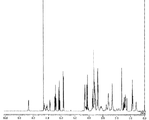
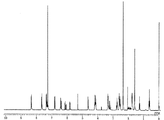
- FIG. 3 is a 1 H-NMR chart of the compound M1 obtained in Example 1.
- 4 is a 1 H-NMR chart of the compound M4 obtained in Example 2.
- FIG. 5 is a 1 H-NMR chart of the compound M31 obtained in Example 7.
- 6 is a 1 H-NMR chart of the compound M32 obtained in Example 8.
- FIG. 7 is a 1 H-NMR chart of Compound M50 obtained in Example 12.
- FIG. 8 is a 1 H-NMR chart of the compound M64 obtained in Example 14.
- novel compound of the present invention has the following general formula 1
- excellent curability is exhibited even though the molecular weight is relatively large and the amount of radical generation sites is relatively small.
- R 1 is methyl group, ethyl group, propyl group, isopropyl group, n-butyl group, isobutyl group, t-butyl group; s-butyl group, pentyl group, hexyl group, Heptyl, octyl, nonyl, decyl, 2-ethylbutyl, isopentyl, 1-methylpentyl, 1,3-dimethylbutyl, 1-methylhexyl, isoheptyl, 1,1,3,3 -Tetramethylbutyl group, 2,2,4,4-tetramethylbutyl group, 1-methylheptyl group, 3-methylheptyl group, 2-ethylhexyl group, 1,1,3-trimethylhexyl group, 1,1, Represents an alkyl group having 1 to 10 carbon atoms such as 3,3-tetramethylpentyl group, isodecyl group and the like
- R 2 and R 3 are each independently a methyl group, ethyl group, propyl group, isopropyl group, n-butyl group, isobutyl group, t-butyl group, s-butyl group, pentyl group, hexyl group
- a linear or branched alkyl group having 1 to 12 carbon atoms such as heptyl group, octyl group, nonyl group, decyl group, undecyl group, dodecyl group, etc .; hydroxyethyl group, hydroxypropyl group, hydroxybutyl group, etc.
- R 4 to R 7 are each independently a hydrogen atom; methyl group, ethyl group, propyl group, isopropyl group, n-butyl group, isobutyl group, t-butyl group, s-butyl group, pentyl group, hexyl group, Heptyl group, octyl group, 2-ethylbutyl group, isopentyl group, 1-methylpentyl group, 1,3-dimethylbutyl group, 1-methylhexyl group, isoheptyl group, 1,1,3,3-tetramethylbutyl group, An alkyl group having 1 to 8 carbon atoms such as 2,2,4,4-tetramethylbutyl group, 1-methylheptyl group, 3-methylheptyl group, 2-ethylhexyl group; or a phenyl group.
- it is preferable that all of R 4 to R 7 are hydrogen atoms from the viewpoint of easy availability of raw
- X 1 represents an ethylene group, a 1,3-propylene group, a 1,2-propylene group, or a 2,3-propylene group
- X 2 represents a hydrogen atom or a methyl group
- X 3 represents a hydrogen atom or a methyl group.
- an ethyl group, or X 2 and X 3 form a covalent bond at the broken line and integrally form an ethylene group, a 1,3-propylene group, a 1,2-propylene group, a 2,3-propylene group
- X 1 , X 2 , and X 3 are integrally represented by the following structural formula
- the tetravalent aliphatic hydrocarbon group which comprises a bicyclo ring with a nitrogen atom represented by these is represented.
- Y 1 represents propyl group, isopropyl group, n-butyl group, isobutyl group, t-butyl group, s-butyl group, pentyl group, hexyl group, heptyl group, octyl group, nonyl group, decyl group, undecyl group.
- R 8 is an alkylene group having 2 to 4 carbon atoms
- R 9 is a hydrogen atom, a phenyl group, or an alkyl group having 1 to 4 carbon atoms
- R 10 is a hydrogen atom or a methyl group
- m is 0 to 20 Represents an integer.
- R 12 represents an alkyl group having 1 to 18 carbon atoms.
- R 8 is an alkylene group having 2 to 4 carbon atoms
- R 10 is a hydrogen atom or a methyl group
- R 14 is a hydrocarbon group having 5 to 18 carbon atoms having a p + 1 bond
- l is 0 to (An integer of 20 and p represents an integer of 1 to 3)
- R 15 represents an alkyl group having 4 to 18 carbon atoms, an aliphatic cyclic hydrocarbon group having 6 to 10 carbon atoms, or an aromatic group
- y1-9 Is mentioned.
- the alkylene group having 2 to 4 carbon atoms of R 8 is an n-propylene group, a 1,2-propylene group, an n-butylene group, 2-methyl-propane- 1,2-diyl group and the like
- examples of the alkyl group having 1 to 4 carbon atoms in R 9 include methyl group, ethyl group, propyl group, isopropyl group, n-butyl group, isobutyl group, t- Examples thereof include a butyl group or a s-butyl group.
- R 8 and R 9 in the structural moiety (y1-4) have the same meaning as in the structural formula (y1-3).
- the alkyl group having 1 to 18 carbon atoms or the alkyl group having 1 to 18 carbon atoms of R 11 is methyl group, ethyl group, propyl group, isopropyl group, n-butyl.
- examples of the aryl group having 6 to 18 carbon atoms include a phenyl group, a benzyl group, Phenethyl group, biphenyl group, naphthyl group, tolyl group, xylyl group, mesityl group, cumenyl group, chlorophenyl group, bromophenyl group, chloromethylphenyl group, hydroxyphenyl group, methoxyphenyl group, ethoxyphenyl group, phenoxyphenyl group, acetoxy Phenyl group, benzoyloxyphenyl group, methylthiophenyl group, phenylthio Enyl group, methylaminophenyl group, dimethylaminophenyl group,
- alkyl group having 1 to 18 carbon atoms of R 12 a methyl group, an ethyl group, a propyl group, an isopropyl group, an n-butyl group, an isobutyl group, a t-butyl group, S-butyl, pentyl, hexyl, heptyl, octyl, nonyl, decyl, undecyl, dodecyl, tridecyl, tetradecyl, pentadecyl, hexadecyl, heptadecyl, octadecyl, 2- Ethylbutyl group, isopentyl group, 1-methylpentyl group, 1,3-dimethylbutyl group, 1-methylhexyl group, isoheptyl group, 1,1,3,3-tetramethylbutyl group, 2,2,4,4- Te
- R 8 in formula (y1-7) has the same meaning as R 8 in the structural moiety (Y1-3), the alkyl group having 1 to 6 carbon atoms R 13, a methyl group, an ethyl group, Propyl group, Isopropyl, n-butyl, isobutyl, t-butyl, s-butyl, pentyl, hexyl, 2-ethylbutyl, isopentyl, 1-methylpentyl, 1,3-dimethylbutyl, etc.
- the halogen atom include a bromine atom, a chlorine atom, and a fluorine atom.
- R 8 in the formula (y1-8) in has the same meaning as R 8 in the structural moiety (Y1-3), and a hydrocarbon group having a carbon number of 3 to 25 having a bond p + 1 in R 14 is , Aliphatic polyhydric alcohol residues such as glycerol residue, trimethylolpropane residue, pentaerythritol residue; n-propylene group, 1,2-propylene group, n-butylene group, 2-methyl-propane-1, 2-diyl group, 1,5-pentanediyl group, 1,6-hexanediyl group, 1,7-heptanediyl group, 1,8-octanediyl group, 1,9-nonanediyl group, 1,10-decandiyl group, 3 , 8-decanediyl group, 1,11-undecanediyl group, 1,12-dodecanediyl group, 1,13-tride
- the residue refers to a hydrocarbon structure site excluding the hydroxyl group of the polyhydric alcohol.
- R 8 is an alkylene group having 2 to 4 carbon atoms
- R 9 is a hydrogen atom, a phenyl group, or an alkyl group having 1 to 4 carbon atoms
- R 10 is a hydrogen atom or a methyl group
- m is 0 to 20
- R 8 is independently an alkylene group having 2 to 4 carbon atoms
- R 10 is a hydrogen atom or a methyl group
- R 14 is a hydrocarbon group having 3 to 25 carbon atoms having a p + 1 bond
- l represents an integer of 0 to 20
- p represents an integer of 1 to 3.
- the structural site represented by (y1-8) is preferred from the viewpoint that the introduction of Y 1 during the synthesis of the novel compound is easy and the effect of reducing migration after curing is favorable, and particularly has an acryloyl group. Therefore, the structural portion (y1-8) is particularly preferable from the viewpoint that the effect of preventing migration is more remarkable.
- Y 2 is an organic nodule group having a (n + 1) bond having a nitrogen atom or an oxygen atom at the end of the structural site.
- the structural site shown below
- the type of structural site is preferable because it is easy to obtain raw materials and the reaction can be easily controlled.
- n in the general formula 1 is 1, and the following structural formula
- R 16 is a linear or cyclic alkylene group having 2 to 18 carbon atoms, a phenylene group, a xylylene group, a phenylene group having an alkyl group having 1 to 3 carbon atoms as a nuclear substituent, or 1 carbon atom
- R 16 represents a xylylene group having an alkyl group of ⁇ 3 as a nuclear substituent.
- Examples of the linear or cyclic alkylene group having 2 to 18 carbon atoms constituting R 16 in the structural formula (y2-1) include an ethylene group, an n-propylene group, a 1,2-propylene group, and an n-butylene.
- examples of the phenylene group having an alkyl group having 1 to 3 carbon atoms as a nuclear substituent include a methylphenylene group, an ethylphenylene group, an n-propylphenylene group, and i-propyl.
- examples of the xylylene group having an alkyl group having 1 to 3 carbon atoms as a nuclear substituent include a methylxylylene group, an ethylxylylene group, an n-propylxylylene group, and an i-propylxylylene group. The group can be mentioned.
- n in the general formula 1 is 1, and the following structural formula
- R 17 is a linear or branched alkylene group or phenylene group having 2 to 6 carbon atoms
- R 18 is a linear or branched alkylene group or phenylene group having 2 to 6 carbon atoms.
- Q represents an integer of 0 to 12.
- examples of the linear or branched alkylene group having 2 to 6 carbon atoms constituting R 17 and R 17 in the general formula (y2-2) include, for example, an ethylene group, an n-propylene group, , 2-propylene group, n-butylene group, 2-methyl-propane-1,2-diyl group, 1,5-pentanediyl group, 1,6-hexanediyl group.
- n in the general formula 1 is 1, and the following structural formula (y2-3)
- R 19 to R 22 each independently represents hydrogen or a linear or branched alkyl group having 1 to 3 carbon atoms).
- examples of the linear or branched alkyl group having 1 to 3 carbon atoms constituting R 19 to R 22 include a methyl group, an ethyl group, a propyl group, and an isopropyl group.
- n in the general formula 1 is 1, and the following structural formula (y2-4)
- R 23 represents an oxygen atom, a methylene group, an ethylene group, an ethylidene group, a 2,2-propylene group, or a 1,3-propylene group.
- R 23 represents an oxygen atom, a methylene group, an ethylene group, an ethylidene group, a 2,2-propylene group, or a 1,3-propylene group.
- n in the general formula 1 is 1, and the following structural formula (y2-5)
- R 24 is independently a hydrogen atom or a linear or branched alkyl group having 1 to 3 carbon atoms
- R 25 is independently a hydrogen atom or 1 to 3 carbon atoms
- R 26 represents an oxygen atom, a methylene group, a 2,2-propylene group, a sulfonyl group, or a carbonyl group.
- examples of the linear or branched alkyl group having 1 to 3 carbon atoms constituting R 24 or R 25 include a methyl group, an ethyl group, a propyl group, and an isopropyl group.
- n in the general formula 1 is 2 or 3, and the following structural formula (y2-6)
- R 27 is an alkylene group having 2 to 6 carbon atoms
- R 28 is a (n + 1) -valent hydrocarbon group having 4 to 12 carbon atoms
- r is an integer of 0 to 3
- the alkylene group having 2 to 6 carbon atoms constituting R 27 include an ethylene group, an n-propylene group, a 1,2-propylene group, an n-butylene group, a 2-methyl-propane-1,2-diyl group, Examples include 1,5-pentanediyl group and 1,6-hexanediyl group, and the hydrocarbon group having 4 to 12 carbon atoms constituting R 28 and having an (n + 1) -valent bond is a residue of a polyhydric alcohol.
- the “residue” is a hydrocarbon structure site obtained by removing a hydroxyl group from the corresponding polyhydric alcohol.
- Step IV a diamine compound serving as a constituent raw material for the structure is easily obtained.
- * represents a bond with another structural site.
- R 29 represents a linear, branched or cyclic alkylene group, phenylene group or xylylene group having 2 to 18 carbon atoms.
- the linear, branched or cyclic alkylene group having 2 to 18 carbon atoms constituting R 29 includes an ethylene group, an n-propylene group, a 1,2-propylene group, an n-butylene group, 2- Methyl-propane-1,2-diyl group, 1,5-pentanediyl group, 1,6-hexanediyl group, 1,7-heptanediyl group, 1,8-octanediyl group, 1,9-nonanediyl group, 1, 10-decanediyl group, 3,8-decanediyl group, 1,11-undecanediyl group, 1,12-dodecanediyl group, 1,13-tridecanediyl group, 1,14-te
- Step IV In the method for producing a novel compound of the present invention described later [Step IV], it is preferable that a diol compound as a constituent material of the structure is easily obtained.
- * represents a bond with another structural site.
- each R 30 independently represents an alkylene group having 2 to 6 carbon atoms, and q represents an integer of 1 to 20).
- the alkylene group having 2 to 6 carbon atoms constituting R 30 include an ethylene group, an n-propylene group, a 1,2-propylene group, an n-butylene group, a 2-methyl-propane-1,2-diyl group, Examples thereof include 1,5-pentanediyl group and 1,6-hexanediyl group.
- Step IV In the method for producing a novel compound of the present invention described later [Step IV], it is preferable that a diol compound as a constituent material of the structure is easily obtained.
- * represents a bond with another structural site.
- the structural part (y2-9) which is an ester bond-forming type structural part has n in the general formula 1 of 2 or 3, and the following structural formula (y2-9)
- R 31 is a (n + 1) -valent hydrocarbon group having 4 to 12 carbon atoms
- R 32 is an alkylene group having 2 to 6 carbon atoms
- s is an integer of 0 to 3
- Examples of (n + 1) -valent hydrocarbon groups having 4 to 12 carbon atoms constituting R 31 include polyhydric alcohol residues, such as trimethylolpropane residue, pentaerythritol residue, glycerin residue, and the like. Examples thereof include a roll residue and ditrimethylolpropane residue.
- the “residue” is a hydrocarbon structure site obtained by removing a hydroxyl group from the corresponding polyhydric alcohol.
- alkylene group having 2 to 6 carbon atoms constituting R 32 examples include ethylene, n-propylene, 1,2-propylene, n-butylene, 2-methyl-propane-1,2-diyl. Group, 1,5-pentanediyl group and 1,6-hexanediyl group. As such a structural moiety (y2-9), specifically, the following structural formula
- Step IV In the method for producing a novel compound of the present invention described later [Step IV], it is preferable that a diol compound as a constituent material of the structure is easily obtained.
- * represents a bond with another structural site.
- the amide bond forming type structural site selected from the group consisting of the structural sites (y2-1) to (y2-6) is the chemical stability of the product.
- the structural part (y2-1), the structural part (y2-2), and the structural part (y2-3) are preferable from the viewpoint of easy availability of raw materials and excellent photocurability.
- the intermediate is easily crystallized and can be easily purified in production.
- Y 3 in the general formula 1 represents a single bond, an alkylene group having 1 to 3 carbon atoms, or an alkylidene group having 2 or 3 carbon atoms.
- alkylene group having 1 to 3 carbon atoms examples include a methylene group, an ethylene group, an n-propylene group, and a 1,2-propylene group.
- alkylidene group having 2 or 3 carbon atoms examples include an ethylidene group and a propylidene group.
- a single bond or an alkylidene group having 2 or 3 carbon atoms is preferable from the viewpoint of easy availability of a benzyl bromide derivative that is a raw material component constituting the structural part, and particularly, the safety of a decomposition product after irradiation with light.
- an alkylidene group having 2 or 3 carbon atoms is preferred.
- novel compound of the present invention represented by the general formula 1 described in detail above includes compounds M1 to M86 shown in the following Tables 1 to 12.
- M1, M4, M7, M14, M23, M28, M31, M32, M1, M4, M7, M14, M23, M28, M31, M32 are particularly preferable because the balance between photocuring property and low migration property is good.
- M41, M43, M45, M50, M55, M64, and M78 compounds are preferred.
- the novel compound of the present invention represented by the above general formula 1 can be industrially produced through the following [Step I] to [Step VI].
- [Step I] A halogenated benzene and an acid halide compound having a halide atom at the ⁇ -position are reacted to synthesize an alkyl acetophenone derivative having a halogen atom on the ⁇ -carbon atom of the carbonyl.
- the reaction of [Step I] can be carried out by Friedel-Craft-acylation reaction in the presence of anhydrous aluminum chloride.
- examples of the halogenated benzene include fluorinated benzene, chlorobenzene, and bromobenzene.
- Examples of the acid halide compound having a halide atom at the ⁇ -position include 2-bromopropionic acid bromide, 2-bromopropionic acid chloride, 2-bromovaleric acid bromide, 2-bromovaleric acid chloride, 2-bromohexanoic acid. Examples thereof include bromide and 2-bromooctanoic acid bromide.
- the secondary monoamine compound (HN (R 2 ) (R 3 )) used here is dimethylamine, diethylamine, methylbutylamine, methyloctylamine, methyldodecylamine, ethylhexylamine, diethanolamine, diisopropanolamine, diisobutanolamine.
- the reaction conditions can be carried out at a temperature of 0 ° C. to 80 ° C.
- Step III benzyl bromide (where R is an alkyl group or a hydrogen atom) having a substituent (—Y 3 —C ( ⁇ O) —OR) as a substituent on the aromatic nucleus is converted to a tertiary amine of the acetophenone derivative.
- the reaction is led to a quaternary ammonium salt, and then subjected to a 1.2-rearrangement reaction (Stevens transition) by alkali treatment, and an ⁇ -aminoacetophenone intermediate compound A (general formula 3) represented by general formula 3 Is synthesized.
- the ⁇ -aminoacetophenone intermediate compound thus obtained (general formula 3) has a halogen atom on the aromatic ring of the acetophenone moiety and a carboxyl group on the aromatic ring of the benzyl group substituted at the ⁇ -position. .
- Y 3 in benzyl bromide having a substituent (—Y 3 —C ( ⁇ O) —OR) as a substituent on the aromatic nucleus is a single bond, an alkylene group having 1 to 3 carbon atoms as described above. Or an alkylidene group having 2 or 3 carbon atoms, particularly preferably a single bond, a methylene group, or an ethylidene group from the viewpoint of easy availability of raw materials, and R is a hydrogen atom or a methyl group.
- R is methyl
- Group, ethyl group or hydrogen atom for example, methyl bromomethylbenzoate, methyl 2- [4- (bromomethyl) phenyl]] propionate, 2- [4- (bromomethyl) phenyl]] acetic acid Etc.
- the quaternary ammonium conversion in [Step III] is performed at 20 to 100 ° C.
- the subsequent 1.2-rearrangement reaction (Stevens transition) is performed at 20 to 80 ° C. using an aqueous sodium hydroxide solution as a base. Can do.
- Step IV the carboxyl group of the ⁇ -aminoacetophenone intermediate compound (general formula 3) is subjected to a condensation reaction between a bifunctional or higher primary or secondary amine or a bifunctional or higher alcohol (general formula 4), respectively. It leads to the intermediate compound B which is a compound.
- a bifunctional diamine is used as the compound represented by the general formula 4
- 1 mol of the bifunctional diamine is reacted with 2 mol of the ⁇ -aminoacetophenone intermediate compound (general formula 3).
- Intermediate compound B in which the amide group has a symmetrical molecular structure can be synthesized.
- a bifunctional or higher functional amine is obtained after converting the carboxyl group arranged on the aromatic ring of the ⁇ -aminoacetophenone intermediate compound represented by the general formula 3 into an acid chloride using thionyl chloride or the like.
- DCC dicyclohexylcarbodiimide
- the synthesis method of the intermediate compound B in the case of using a bifunctional or higher alcohol as the compound represented by the general formula 4 is such that the carboxyl group arranged on the aromatic ring of the intermediate compound of the general formula 3 is substituted with thionyl chloride or the like.
- a method of reacting with a bifunctional or higher alcohol after conversion into an acid chloride using a method a method of reacting with a bifunctional or higher alcohol by dehydration condensation using an acid catalyst such as para-toluenesulfonic acid, dicyclohexylcarbodiimide ( A method of reacting with a bifunctional or higher alcohol using an active esterification reagent such as DCC), and converting to a mixed acid anhydride using an acid anhydride such as acetic anhydride, and then reacting with a bifunctional or higher alcohol.
- an acid catalyst such as para-toluenesulfonic acid, dicyclohexylcarbodiimide
- DCC active esterification reagent
- the method etc. are mentioned.
- Hal represents a halogen atom.
- the primary or secondary amine for example, ethylenediamine, 1,3-diaminopropane, 1,2-diaminopropane, 1,4-diaminobutane, 1, 2-diamino-2-methylpropane, 2-methyl-1,3-propanediamine, 1,5-diaminopentane, 2,2-dimethyl-1,3-propanediamine, 1,6-diaminohexane, 1,2 -Diaminocyclohexane, 1,3-diaminocyclohexane, 1,4-diaminocyclohexane, 2,2'-diamino-N-methyldiethylamine, 1,7-diaminoheptane, 1,3-bis (aminomethyl) cyclohexane, 1, 4-bis (aminomethyl) cyclohexane, 1, 4-bis (aminomethyl) cyclohexane, 1,
- bifunctional or higher alcohols include, for example, ethylene glycol, diethylene glycol, 1,3-propanediol, 1,4-butanediol, 1,5-pentanediol, 1 , 6-hexanediol, 1,7-heptanediol, 1,8-octanediol, 1,9-nonanediol, 1,10-decanediol, 1,12-dodecanediol, 1,14-tetradecanediol, , 16-hexadecanediol, 1,18-octadecanediol, 1,20-icosanediol and other linear alkylene diols and their ethylene oxide modified products and propylene oxide modified products such as polyoxyethylene glycol and polyoxypropylene glycol Ether glycol; Modified polyethers obtained by ring-opening polymerization
- Such a reaction can be performed at a temperature of 60 ° C. to 160 ° C.
- an inorganic carbonate such as potassium carbonate can be used in addition to an excessively bifunctional cyclic amine represented by the general formula 5 as a scavenger for the acid generated in the system.
- examples of the bifunctional cyclic amine represented by the general formula 5 include piperazine, 2-methylpiperazine, 2,5-dimethylpiperazine, 2,3-dimethylpiperazine, 2,5-diazabicyclo [2. 2.1] heptane, homopiperazine and the like.
- Step VI Next, as a final reaction, a (meth) acrylic acid ester compound compound, an isocyanate ester, a glycidyl ether, or an alkyl with respect to the secondary amine located at the structure terminal of the intermediate compound C obtained in [Step V].
- a halide By reacting with a halide, the novel compound of the present invention represented by the general formula 1 can be produced.
- [Step VI] can be classified into the following (Step VI-1) to (Step VI-9) depending on the compound to be reacted with the intermediate compound C.
- Hal is a halogen atom
- R ′ is a halogen atom or an alkyl group optionally having a hydroxyl group.
- examples of the halogenated alkane having 3 to 18 carbon atoms represented by Hal-R ′ include 1-chloropropane, 2-chloropropane, 1-chlorobutane, 2-chlorobutane, 2-methyl-2-chloropropane, 2- Methyl-1-chloropropane, 1-chloropentane, 2-chloropentane, 3-chloropentane, 2-chloro-2-methylbutane, 1-chloro-2-ethylbutane, 1-chlorohexane, 2-chlorohexane, 3-chloro Hexane, 2-chloro-methyl-pentane, 1-chloroheptane, 2-chloroheptane, 3-chloroheptane, 1-chlorooctane, 2-chlorooctane, 3-chlorooctane, 1-chloro-1,1,3 3-tetramethylbutane, 1-chloro-2,2,4,
- Hal-R ′ When the halogenated alkane having 3 to 18 carbon atoms represented by Hal-R ′ further has a halogen atom on the alkane structure, 1-bromo-3-fluoropropane, 1-bromo-3 -Chloropropane, 1-iodo-3-fluoropropane, 1-iodo-3-chloropropane, 1-bromo-2-fluoropropane, 1,1,1-trifluoro-3-iodopropane, 1,1,1,2 , 2-Peentafluoro-3-iodopropane, 1-bromo-4-fluorobutane, 1-bromo-3-fluorobutane, 1-bromo-4-chlororobutane, 1,1,1-trifluoro-4-iodobutane 1,1,1,2,2,3,3-pentafluoro-4-iodobutane, 1-bromo-5-fluoropentane, 1-iodo
- halogenated alkane having 3 to 18 carbon atoms represented by Hal-R ′ further has a hydroxyl group on the alkane structure, 3-bromo-1-propanol, 3-iodo-1-propanol 4-iodo-2-methyl-2-butanol, 4-bromo-2-methyl-2-butanol, 1-iodo-2-methyl-2-propanol, 1-bromo-2-methyl-2-propanol, 1 -Iodo-4-butanol, 1-bromo-4-butanol, 1-iodo-2-butanol, 1-bromo-2-butanol, 5-iodo-1-pentanol, 5-bromo-1-pentanol, 1 -Iodo-6-hexanol, 1-bromo-6-hexanol, 5-iodo-3-methyl-1-pentanol, 5-bromo-3-methyl-1-pentanol, 1-iool,
- the reaction in (Step VI-1) is carried out using a carbonate such as potassium carbonate as a basic catalyst in a polar solvent such as N, N-dimethylformamide, or a halogenated solvent such as dichloromethane or chloroform.
- a carbonate such as potassium carbonate
- a polar solvent such as N, N-dimethylformamide
- a halogenated solvent such as dichloromethane or chloroform.
- a tertiary amine such as triethylamine can be used as a basic catalyst.
- Hal is a halogen atom
- Aral is an aralkyl group.
- the halogenated aromatic compound represented by Hal-Aral includes benzyl chloride, benzyl bromide, methoxybenzyl chloride, methoxybenzyl bromide, chlorobenzyl bromide, hydroxybenzyl bromide, and the like.
- Phenethyl group, phenylbenzyl bromide, methoxyphenylbenzyl bromide, naphthylmethyl bromide, methoxynaphthylmethyl bromide, phenylpropyl iodide, phenylpropenyl iodide, phenoxybenzyl bromide, methylthiobenzyl bromide, terphenylmethyl bromide Can be carried out under the same reaction conditions as in (Step VI-1).
- a novel compound in which Y 1 is the structural formula (y1-3) can be produced by reacting with a halogenated polyether compound represented by the formula:
- the alkylene group having 2 to 4 carbon atoms of R 8 includes an n-propylene group, a 1,2-propylene group, an n-butylene group, 2-methyl-propane-1,2-diyl group and the like
- examples of the alkyl group having 1 to 4 carbon atoms in R 9 include a methyl group, an ethyl group, a propyl group, an isopropyl group, and an n-butyl group.
- the reaction conditions in the above (Step VI-3) can be carried out at 20 to 120 ° C. in the presence of a basic catalyst such as potassium carbonate.
- R 8 is an alkylene group having 2 to 4 carbon atoms
- R 9 is a hydrogen atom, a phenyl group, or an alkyl group having 1 to 4 carbon atoms
- R 10 is a hydrogen atom or a methyl group
- m is 0 to 20
- Y 1 in the general formula 1 is the structural formula (y1-4) can be produced by a Michael addition reaction with the (meth) acryloyl group of the compound represented by formula (1).
- the alkylene group having 2 to 4 carbon atoms of R 8 includes an n-propylene group, a 1,2-propylene group, an n-butylene group, 2-methyl-propane-1,2-diyl group and the like
- examples of the alkyl group having 1 to 4 carbon atoms in R 9 include a methyl group, an ethyl group, a propyl group, an isopropyl group, and an n-butyl group.
- the Michael addition reaction in (Step VI-4) can be carried out under known and usual reaction conditions.
- the intermediate compound C and the compound represented by the structural formula (y1-4r) having a function as the Michael acceptor are mixed at 0 to 150 ° C. in a reaction vessel.
- the method is mentioned and a catalyst and a solvent can also be used.
- Examples of usable catalysts include tetrabutylammonium hydroxide, tetramethylguanidine, diazabicycloundecene, 1,4-diazabicyclo [2.2.2], sodium tert-butylate, and the like.
- organic solvent examples include saturated hydrocarbon solvents such as pentane, hexane, heptane and cyclohexane, aromatic hydrocarbon solvents such as toluene and xylene, methanol, ethanol, isopropanol, 2-butanol, t-butanol and ethylene.
- Alcohol solvents such as glycol and carbitol, ether solvents such as dimethyl ether, diethyl ether, 1,4-dioxane and tetrahydrofuran (THF), amide solvents such as dimethylformamide (DMF), and halogen solvents such as chloroform and dichloromethane And dimethyl sulfoxide (DMSO).
- the mixing ratio of the intermediate compound C and the compound represented by the structural formula (y1-4r) having a function as the Michael acceptor is not particularly limited.
- the equivalent ratio [(i) / (ii)] of the primary amino group (i) and the (meth) acryloyl group (ii) in the compound represented by the structural formula (y1-4r) is 1/1. It is preferably 5 to 1/30.
- the equivalent ratio [(i) / (ii)] exceeds 1 / 1.5, the possibility of migration from the coating film of the intermediate compound C or a decomposition product thereof increases, and the equivalent ratio [(i) / When (ii)] is less than 1/30, the curing performance of the Michael addition reaction product tends to be inferior.
- the equivalent ratio [(i) / (ii)] is particularly preferably from 1/2 to 1/20.
- the structural formula (y1-4r) having a function as the Michael acceptor for example, methoxyethyl (meth) acrylate, methoxypolyethylene glycol (meth) acrylate, ethoxypolyethyleneglycol (meth) acrylate, butoxypolyethyleneglycol (Meth) acrylate, methoxypolypropylene glycol (meth) acrylate, etc. are mentioned.
- the reaction conditions can be carried out at 20 to 120 ° C. in the presence of a catalyst such as diazabicycloundecene (DBU).
- DBU diazabicycloundecene
- R 11 represents an alkyl group having 1 to 18 carbon atoms such as methyl group, ethyl group, propyl group, isopropyl group, n-butyl group, isobutyl group, t-butyl group; s-butyl group, pentyl Group, hexyl group, heptyl group, octyl group, nonyl group, decyl group, undecyl group, dodecyl group, tridecyl group, tetradecyl group, pentadecyl group, hexadecyl group, heptadecyl group, octadecyl group, 2-ethylbutyl group, isopentyl group, 1 -Methylpentyl group, 1,3-dimethylbutyl group, 1-methylhexyl group, isoheptyl group, 1,1,3,3-tetramethylbutyl group, 2,2,
- R 12 represents an alkyl group having 1 to 18 carbon atoms.
- a novel compound in which Y 1 is the structural formula (y1-6) can be produced by reacting with the epoxy group of the epoxy compound represented by the formula:
- the alkyl group having 1 to 18 carbon atoms of R 12 includes a methyl group, an ethyl group, a propyl group, an isopropyl group, and an n-butyl group.
- reaction with the epoxy compound in (Step VI-6) is carried out by subjecting the intermediate compound C and the compound represented by the structural formula (y1-6r) to a temperature condition of 0 to 150 ° C. in a reaction vessel.
- a catalyst or a solvent can also be used.
- Examples of usable catalysts include triethylamine, diisopropylethylamine, benzyldiethylamine, imidazole, tetrabutylammonium bromide, tri-n-octylphosphine, triphenylphosphine, and the like.
- organic solvent examples include aromatic hydrocarbon solvents such as toluene and xylene, ethers such as dimethyl ether, diethyl ether, 1,4-dioxane, and tetrahydrofuran (THF), acetone, 2-butanone, methyl isobutyl ketone, and the like.
- aromatic hydrocarbon solvents such as toluene and xylene
- ethers such as dimethyl ether, diethyl ether, 1,4-dioxane, and tetrahydrofuran (THF)
- THF tetrahydrofuran
- acetone 2-butanone
- 2-butanone methyl isobutyl ketone
- examples thereof include ketone solvents, amide solvents such as dimethylformamide (DMF), halogen solvents such as chloroform and dichloromethane, dimethyl sulfoxide (DMSO), and the like.
- a novel compound in which Y 1 is the structural formula (y1-7) can be produced by reacting with an epoxy group of an epoxy compound represented by the following formula.
- R 8 in said formula (y1-7r) and the general formula 1-7 is synonymous with R 8 in the structural moiety (Y1-3), from 1 to 6 carbon atoms of R 13
- the alkyl group include methyl group, ethyl group, propyl group, isopropyl group, n-butyl group, isobutyl group, t-butyl group, s-butyl group, pentyl group, hexyl group, 2-ethylbutyl group, isopentyl group, 1 -A methylpentyl group, a 1,3-dimethylbutyl group and the like are mentioned, and a halogen atom includes a bromine atom, a chlorine atom and a fluorine atom.
- reaction with the epoxy compound in Step VI-7 includes, for example, mixing the intermediate compound C and the compound represented by the structural formula (y1-7r) at 0 to 150 ° C. in a reaction vessel.
- the method of making it react is mentioned.
- a catalyst or a solvent can also be used.
- Examples of usable catalysts include triethylamine, diisopropylethylamine, benzyldiethylamine, imidazole, tetrabutylammonium bromide, tri-n-octylphosphine, triphenylphosphine, and the like.
- organic solvent examples include aromatic hydrocarbon solvents such as toluene and xylene, ether solvents such as dimethyl ether, diethyl ether, 1,4-dioxane, and tetrahydrofuran (THF), acetone, 2-butanone, and methyl isobutyl ketone.
- ketone solvents such as dimethylformamide (DMF), halogen solvents such as chloroform and dichloromethane, and dimethyl sulfoxide (DMSO).
- the secondary amine located at the structure end in the intermediate compound C is represented by the following structural formula (y1-8r)
- R 8 is an alkylene group having 2 to 4 carbon atoms
- R 10 is a hydrogen atom or a methyl group
- R 14 is a hydrocarbon group having 5 to 18 carbon atoms having a p + 1 bond
- l is 0 to (An integer of 20 and p represents an integer of 1 to 3)
- the structural formula (y1-8r) and the general formula in 1-8 R 8 has the same meaning as R 8 in the structural moiety (Y1-3), the number of carbon atoms with a bond p + 1 in R 14 3 to 25 hydrocarbon groups are aliphatic polyhydric alcohol residues such as glycerol residue, trimethylolpropane residue, pentaerythritol residue; n-propylene group, 1,2-propylene group, n-butylene group 2-methyl-propane-1,2-diyl group, 1,5-pentanediyl group, 1,6-hexanediyl group, 1,7-heptanediyl group, 1,8-octanediyl group, 1,9-nonanediyl group 1,10-decanediyl group, 3,8-decanediyl group, 1,11-undecanediyl group, 1,12-dodecanediyl group, 1,13-
- the residue refers to a hydrocarbon structure site excluding the hydroxyl group of the polyhydric alcohol.
- the Michael addition reaction in (Step VI-8) can be carried out under known and usual reaction conditions.
- the intermediate compound C and the compound represented by the structural formula (y1-8r) having a function as the Michael acceptor are mixed at 0 to 150 ° C. in a reaction vessel.
- the method of making it react is mentioned.
- a catalyst or a solvent can also be used.
- Examples of usable catalysts include tetrabutylammonium hydroxide, tetramethylguanidine, diazabicycloundecene, 1,4-diazabicyclo [2.2.2], sodium tert-butylate, and the like.
- organic solvent examples include saturated hydrocarbon solvents such as pentane, hexane, heptane and cyclohexane, aromatic hydrocarbon solvents such as toluene and xylene, methanol, ethanol, isopropanol, 2-butanol, t-butanol and ethylene.
- Alcohol solvents such as glycol and carbitol, ether solvents such as dimethyl ether, diethyl ether, 1,4-dioxane and tetrahydrofuran (THF), amide solvents such as dimethylformamide (DMF), and halogen solvents such as chloroform and dichloromethane And dimethyl sulfoxide (DMSO).
- the mixing ratio of the intermediate compound C and the compound represented by the structural formula (y1-8r) having a function as the Michael acceptor is not particularly limited.
- the equivalent ratio [(i) / (ii)] of the primary amino group (i) and the (meth) acryloyl group (ii) in the compound represented by the structural formula (y1-8r) is 1/1. It is preferably 5 to 1/30.
- the equivalent ratio [(i) / (ii)] exceeds 1 / 1.5, the possibility of migration from the coating film of the intermediate compound C or a decomposition product thereof increases, and the equivalent ratio [(i) / When (ii)] is less than 1/30, the curing performance of the Michael addition reaction product tends to be inferior.
- the equivalent ratio [(i) / (ii)] is particularly preferably from 1/2 to 1/20.
- examples of the compound represented by the structural formula (y1-8r) having a function as the Michael acceptor include, for example, diethylene glycol di (meth) acrylate, dipropylene glycol di (meth) acrylate, and tripropylene.
- Bifunctional acrylates such as glycol di (meth) acrylate, 3-methyl-1,5-pentanediol di (meth) acrylate, hexanediol di (meth) acrylate, neopentylglycol di (meth) acrylate; trimethylolpropane tri ( (Meth) acrylate and its modified alkylene oxide such as ethylene oxide and propylene oxide; pentaerythritol tri or tetra (meth) acrylate and its modified alkylene oxide such as ethylene oxide and propylene oxide Ditrimethylolpropane tetra (meth) acrylate and its alkylene oxide modified products such as ethylene oxide and propylene oxide; dipentaerythritol tetra or penta or hexa (meth) acrylate and its polyfunctional (meth) acrylate such as caprolactone modified products; bisphenol A di Epoxy (meth) acrylate obtained by reaction
- a novel compound in which Y 1 is the structural formula (y1-9) can be produced by reacting with an isocyanate group of an isocyanate compound represented by the following formula.
- examples of the isocyanate compound represented by the structural formula (y1-9r) include alkyl isocyanates having 4 to 18 carbon atoms such as propyl isocyanate, butyl isocyanate, hexyl isocyanate, dodecyl isocyanate, octadecyl isocyanate, and the like; cyclohexyl isocyanate, Examples thereof include an isocyanate group-containing aliphatic cyclic hydrocarbon having 6 to 10 carbon atoms such as adamantyl isocyanate; and an isocyanate group-containing aromatic hydrocarbon such as phenyl isocyanate, benzyl isocyanate, phenethyl isocyanate, and toluidyl isocyanate.
- alkyl isocyanates having 4 to 18 carbon atoms such as propyl isocyanate, butyl isocyanate, hexyl isocyanate, dodecyl isocyanate,
- Step VI-9 the reaction between the intermediate compound C and the isocyanate compound represented by the structural formula (y1-9r) is performed, for example, by mixing both at 0 to 150 ° C. in a reaction vessel.
- the method of making it react is mentioned, A catalyst and a solvent can also be used.
- Examples of usable catalysts include triethylamine, diazabicycloundecene, dibutyltin dilaurate, tri-n-octylphosphine, triphenylphosphine, and the like.
- organic solvent examples include aromatic hydrocarbon solvents such as toluene and xylene, ether solvents such as dimethyl ether, diethyl ether, 1,4-dioxane, and tetrahydrofuran (THF), acetone, 2-butanone, and methyl isobutyl ketone.
- ketone solvents such as dimethylformamide (DMF), halogen solvents such as chloroform and dichloromethane, and dimethyl sulfoxide (DMSO).
- novel compound of the present invention described in detail above is useful as a photopolymerization initiator, and can be blended with a photocurable compound such as a photocurable monomer or a photocurable resin to form a photocurable composition. it can.
- the photocurable composition of the present invention is characterized by using the novel compound of the present invention as a photopolymerization initiator and containing a photocurable compound, and as such a photocurable compound,
- a maleimide compound having an ethylenic double bond, a maleic acid ester compound, a fumaric acid ester compound, a (meth) acrylate compound, and the like can be used depending on the application.
- the photocurable composition of the present invention specifically includes printing ink, ink for ink jet recording, paint, molding resin, casting resin, resin for stereolithography, sealant, dental polymerization resin, printing.
- the photocurable compound is preferably a polyfunctional (meth) acrylate compound having a plurality of reactive groups contributing to curing by irradiation.
- Epoxy (meth) acrylates obtained by reaction of polyglycidyl ethers such as bisphenol A diglycidyl ether and trimethylolpropane triglycidyl ether with (meth) acrylic acid; polyisocyanate compounds such as isophorone diisocyanate and hexamethylene diisocyanate trimer And urethane (meth) acrylate obtained by reaction of hydroxyethyl (meth) acrylate, pentaerythritol tri (meth) acrylate and other acrylates having hydroxyl groups; polybasic acids such as trimellitic acid and succinic acid, ethylene glycol, Reaction between a polyol such as neopentyl glycol and a (meth) acrylate having a hydroxyl group such as hydroxyethyl (meth) acrylate or pentaerythritol tri (meth) acrylate Polyesters obtained by (meth) acrylate; Oligomeric polyvalent
- a trifunctional or higher monomer type (meth) acrylate compound is most preferable as the reactive compound because it becomes a high molecular weight body after curing and can be firmly fixed by a cured film.
- the blending ratio of the trifunctional or higher monomer type (meth) acrylate compound and the oligomer type polyvalent (meth) acrylate is such that the mass ratio [the former / the latter] is 10/100 to 300/100. Is preferred.
- the photopolymerizable compound is a monofunctional (meth) acrylate compound that is a monomeric monofunctional compound.
- a monofunctional vinyl ether compound can be used in combination.
- (meth) acrylic acid alkyl esters such as methyl acrylate, ethyl acrylate, butyl acrylate, 2-ethylhexyl acrylate; 2-hydroxyethyl acrylate, 2-hydroxypropyl acrylate, etc.
- Hydroxyalkyl (meth) acrylates such as methoxybutyl (meth) acrylate; polyethylene glycol mono (meth) acrylate, methoxydiethylene glycol (meth) acrylate, phenoxypolyethylene glycol (meth) acrylate, Polypropylene glycol mono (meth) acrylate, methoxypolypropylene glycol (meth) acrylate, Polyalkylene glycol (meth) acrylates such as ruphenoxy polypropylene glycol (meth) acrylate; Cycloalkyl (meth) acrylates such as cyclohexyl (meth) acrylate, dicyclopentadienyl (meth) acrylate, and isobornyl (meth) acrylate; benzyl ( (Meth) acrylates such as (meth) acrylate, 2-hydroxyethyl (meth) acrylate;
- examples of the monofunctional vinyl ether compound include alkyl vinyl ethers and cycloalkyl vinyl ethers such as ethyl vinyl ether, isobutyl vinyl ether, 2-ethylhexyl vinyl ether, and cyclohexyl vinyl ether; hydroxyl group-containing vinyl ethers such as 2-hydroxyethyl vinyl ether and 3-hydroxypropyl vinyl ether. It is done.
- the amount used is such an amount that does not induce an increase in the migration amount of the unreacted monomer and a decrease in the abrasion resistance of the ink coating film.
- the photopolymerizable compound (A) it is preferably in the range of 30% by mass or less.
- the photo-curable printing ink of the present invention can be blended with the photopolymerization initiator of the present invention, a photopolymerizable compound, a pigment, a binder resin, and other various additives.
- the blending ratio of each component is a ratio of 1 to 70 parts by weight of the pigment and 3 to 70 parts by weight of the binder resin with respect to 100 parts by weight of the mixture of the photocurable compound and the polymerization initiator.
- the pigment content is 5 to 30 parts by mass and the binder resin is 5 to 50 parts by mass with respect to 100 parts by mass of the mixture of the photocurable compound and the initiator.
- the offset ink obtained in this manner is usually designed to be 3 to 200 Pa ⁇ s (25 ° C.), although it depends on the printing apparatus used.
- an inorganic pigment or an organic pigment can be used.
- Inorganic pigments include yellow lead, bitumen, barium sulfate, cadmium red, titanium oxide, zinc white, alumina white, calcium carbonate, ultramarine, carbon black, graphite, bengara, iron oxide, contact method, furnace method, thermal method, etc. Carbon black produced by the above method can be used.
- carbon black produced by the above method can be used.
- carbon black produced by the above method can be used.
- carbon black produced by the above method can be used.
- carbon black that easily absorbs long-wavelength UV light is used, excellent curability is exhibited. Therefore, when carbon black is blended, a UV printing ink with good curability is produced. It becomes possible.
- Organic pigments include azo pigments (including azo lakes, insoluble azo pigments, condensed azo pigments, chelate azo pigments), polycyclic pigments (for example, phthalocyanine pigments, perylene pigments, perinone pigments, anthraquinone pigments, quinacridone pigments, dioxazines). Pigments, thioindigo pigments, isoindolinone pigments, quinofullerone pigments, etc.), dye chelates (eg basic dye chelates, acidic dye chelates), nitro pigments, nitroso pigments, aniline black, various fluorescent pigments, metal powder pigments Various known and publicly used pigments can be used.
- azo pigments including azo lakes, insoluble azo pigments, condensed azo pigments, chelate azo pigments
- polycyclic pigments for example, phthalocyanine pigments, perylene pigments, perinone pigments, anthraquinone pigments, quinacrid
- the average particle size of the pigment is appropriately designed according to the application.
- the average particle size of the pigment is preferably in the range of 10 to 500 nm, more preferably about 50 to 300 nm. is there.
- a pigment dispersant for the purpose of enhancing dispersion stability with respect to the photopolymerizable compound and the like.
- a pigment dispersant for the purpose of enhancing dispersion stability with respect to the photopolymerizable compound and the like.
- the amount of the pigment dispersant used is preferably in the range of 3 to 80% by mass, particularly preferably in the range of 5 to 60% by mass with respect to the pigment.
- the amount used is less than 3% by mass, the dispersion stability tends to be insufficient, and when it exceeds 80% by mass, the viscosity of the ink tends to increase.
- the binder resin may be any resin having appropriate pigment affinity and dispersibility and having rheological properties required for printing ink, and the oligomer type exemplified as the photopolymerizable compound (A).
- non-reactive resins include diallyl phthalate resin, epoxy resin, polyurethane resin, polyester resin, petroleum resin, rosin ester resin, poly (meth) acrylate ester, cellulose derivative, vinyl chloride A vinyl acetate copolymer, a polyamide resin, a polyvinyl acetal resin, a butadiene-acrylonitrile copolymer, and the like, or an epoxy acrylate resin having at least one polymerizable group in the resin molecule, a urethane acrylate resin, Polyester acrylate resin etc. It is.
- diallyl phthalate resin is preferable from the viewpoint of excellent printability, low elution of low molecular weight components due to the resin, and excellent solubility in a photocurable compound.
- 2-hydroxyethyl acrylate having high skin irritation may remain in diallyl phthalate resin
- urethane acrylate resin is preferable from the viewpoint of safety and hygiene.
- the polyfunctional aromatic isocyanate (a) and the hydroxyl group-containing mono (meth) acrylate (b) are particularly preferred for the former (a) because they are excellent in printability and curability.
- a urethane (meth) acrylate resin having a (meth) acryloyl group concentration of 1.5 to 4.0 mmol / g obtained by reacting the product with the polyol (c) is preferred.
- the urethane (meth) acrylate resin having a (meth) acryloyl group concentration of 1.5 to 4.0 mmol / g uses an aromatic polyisocyanate (a) as a raw material polyisocyanate, so that a printing ink having good printability is used. It becomes.
- the aromatic polyisocyanate (a) and the hydroxyl group-containing mono (meth) acrylate (b) are reacted in a proportion in which the latter is relatively large, and then crosslinked with the polyol (c), thereby (meth) acryloyl.
- the group concentration is high, the molecular weight can be made relatively small, and both excellent curability and printability as a printing ink can be provided.
- polyfunctional aromatic isocyanate (a) used here examples include 2,4-tolylene diisocyanate, 2,6-tolylene diisocyanate, 1,3-xylylene diisocyanate, diphenylmethane-4,4-diisocyanate, 1, Diisocyanate compounds such as 5-naphthalene diisocyanate; polymethylene polyphenyl polyisocyanate, and polyfunctional polyisocyanate compound containing a component having three or more isocyanate groups per molecule, such as adducts of these isocyanate compounds and polyfunctional alcohols Is mentioned.
- These polyfunctional aromatic isocyanates may be used alone or in combination of two or more.
- by providing an aromatic structure in the chemical structure of the raw material polyfunctional isocyanate compound when making a printing ink using the urethane (meth) acrylate resin finally obtained, it exhibits excellent curability. Can do.
- a polyfunctional polyisocyanate compound containing a component having three or more isocyanate groups per molecule is preferable because a UV curable ink having excellent curability can be designed.
- a trifunctional or higher component in a proportion of 30% by mass or higher is preferable.
- the aromatic polyisocyanate containing a trifunctional or higher functional component include polymethylene polyphenyl polyisocyanate, and polymethylene polyphenyl polyisocyanate having a viscosity of 100 to 700 mPa ⁇ s is particularly preferable.
- the viscosity is a value measured with an E-type viscometer (25 ° C.).
- the hydroxyl group-containing mono (meth) acrylate (b) to be reacted with the polyfunctional aromatic isocyanate (a) is, for example, hydroxyethyl (meth) acrylate, hydroxypropyl (meth) acrylate, hydroxybutyl acrylate, hydroxyethyl
- hydroxyl group-containing (meth) acrylates such as vinyl ether
- ethylene oxide adducts of the hydroxyl group-containing (meth) acrylates propylene oxide adducts of the hydroxyl group-containing (meth) acrylates, tetramethylene glycol adducts, and lactone adducts.
- hydroxyl group-containing mono (meth) acrylates (b) may be used alone or in combination of two or more.
- hydroxyethyl acrylate and hydroxypropyl acrylate are particularly preferable from the viewpoint of excellent curability of the composition.
- the polyfunctional aromatic isocyanate (a) and the hydroxyl group-containing mono (meth) acrylate (b) reacting the polyfunctional aromatic isocyanate (a) and the hydroxyl group-containing mono (meth) acrylate (b), the polyfunctional aromatic isocyanate (a) and, if necessary, a known and commonly used urethane
- a catalyst is added and heated to 20 to 120 ° C., and a predetermined amount of the hydroxyl group-containing mono (meth) acrylate (b) is continuously or intermittently added to the reaction system.
- the hydroxyl group-containing oil and fat react at a ratio of 0.1 to 30 parts by mass in a total of 100 parts by mass of the reaction raw material, the fluidity and misting resistance of the finally obtained printing ink are dramatically improved. be able to.
- the intended urethane (meth) acrylate resin can be obtained by reacting the reaction product thus obtained with the polyol (c).
- the polyol (c) is preferably an aliphatic polyhydric alcohol having a molecular weight in the range of 90 to 400 from the viewpoint of curability and printability. That is, when the molecular weight is less than 90, the effect of improving the appropriate offset printability is reduced. On the other hand, when the molecular weight exceeds 400, the functional group of the urethane (meth) acrylate resin finally obtained is obtained. The concentration is lowered, and the effect of improving curability is reduced.
- bifunctional polyols such as neopentyl glycol, 1,3-butanediol, 1,4-butanediol and tripropylene glycol; trifunctional polyols such as glycerin and trimethylolpropane
- a tetrafunctional polyol such as pentaerythritol and ditrimethylolpropane
- a hexafunctional polyol such as dipentaerythritol
- an ethylene oxide adduct of the trifunctional polyol (average 1 to 4 mol addition per molecule), the trifunctional Propylene oxide adduct of type polyol (average 1 to 4 mol addition per molecule), 1,3-butanediol addition product of trifunctional polyol (average 1 to 2 mol addition per molecule), tetrafunctional polyol Of ethylene oxide adduct (average 1 to 3 mol addition per molecule), before 6 ethylene oxide adduct of the functionalized
- polyols (c) may be used alone or in combination of two or more.
- trifunctional polyols such as glycerin and trimethylolpropane, neopentyl glycol, etc., because urethane (meth) acrylate resins having an appropriate branched structure can be obtained and can exhibit excellent offset printing suitability and curability.
- 1,6-hexanediol and tripropylene glycol are preferred, and trifunctional polyols such as glycerin and trimethylolpropane are particularly preferred because of their excellent misting properties and curability.
- the urethane (meth) acrylate resin (A) finally obtained by adding the polyol (c) at a ratio of 1 to 15% by mass with respect to the total mass of the components (a) to (c)
- the (meth) acryloyl group concentration in the medium is increased, and this is preferable from the viewpoint that the curability and printability are dramatically improved.
- the polyol (c) is added to the reaction product, and 20 A method of heating to ⁇ 120 ° C. and carrying out the reaction until the infrared absorption spectrum of 2250 cm ⁇ 1 showing the isocyanate group disappears can be mentioned.
- the reaction product of the aromatic polyisocyanate (a) and the hydroxyl group-containing mono (meth) acrylate (b) was knotted via the polyol (c).
- a urethane (meth) acrylate resin having a structure and a high concentration of (meth) acryloyl group is obtained.
- the urethane (meth) acrylate resin (A) has a (meth) acryloyl group concentration in the range of 1.5 to 4.0 mmol / g, thereby exhibiting excellent curability. Can do.
- the urethane (meth) acrylate resin (A) obtained in this way has a weight average molecular weight (Mw) in the range of 3000 to 40000, and has excellent fluidity, misting properties, and printability. It is preferable from the point of becoming ink.
- the photocurable printing ink of the present invention may use a photosensitizer or an amine-based sensitizer in addition to the above-described components.
- the photosensitizer is not particularly limited, and examples thereof include thioxanthone series such as 2,4-diethylthioxanthone and 2,4-diisopropylthioxanthone, benzophenone series such as 4,4′-bis (diethylamino) benzophenone, anthraquinone and the like. .
- examples of amine-based sensitizers include aminobenzoate compounds (“GENOPOL AB-2” manufactured by RAHN) and compounds having two dimethylaminobenzoate structures in one molecule (“ESACURE A198” manufactured by Lamberti). And compounds having aminobenzoyl groups at both ends of a polyethylene glycol chain (“Omnipol ASA” manufactured by IGM Resin), ethyl-4-dimethylaminobenzoate (“ESACURE A198" manufactured by Lamberti), and the like.
- aminobenzoate compounds (“Genopol AB-2” manufactured by RAHN) and compounds having two dimethylaminobenzoate structures in one molecule (manufactured by Lamberti “ ESACURE A198 ”) and a compound having an aminobenzoyl group at both ends of a polyethylene glycol chain (“ Omnipol ASA "manufactured by IGM Resin) are preferred.
- the amount of the amine-based sensitizer used is preferably in the range of 5 to 100 parts by mass with respect to 100 parts by mass of the sensitizer (C).
- These photosensitizers and amine-based sensitizers are preferably used in an amount of 0.03 to 20 parts by weight, more preferably 0.1 to 10 parts by weight, based on the total amount of the photocurable printing ink. preferable.
- a well-known photoinitiator can also be used together in the range which does not impair the effect of this invention.
- molecular cleavage types include 1-hydroxycyclohexyl phenyl ketone, benzoin ethyl ether, benzyl dimethyl ketal, 2-hydroxy-2-methyl-1-phenylpropan-1-one, 1- (4-Isopropylphenyl) -2-hydroxy-2-methylpropan-1-one and 2-methyl-1- (4-methylthiophenyl) -2-morpholinopropan-1-one can be used in combination.
- hydrogen abstraction type photopolymerization initiators such as benzophenone, 4-phenylbenzophenone, isophthalphenone, 4-benzoyl-4′-methyl-diphenyl sulfide can be used in combination.
- various coupling agents within a range that does not depart from the object of the present invention, in particular, within a range that can maintain storage stability, heat resistance, solvent resistance, and the like.
- Stabilizers, fillers, and other auxiliaries can be added.
- Extender pigments are widely used for the purpose of improving physical properties and imparting functionality such as ink fluidity adjustment, prevention of misting during printing, and prevention of penetration into paper substrates.
- extender pigments include publicly known organic pigments for coloring, such as extender pigments for printing inks published in “Handbook of Pigments (edited by the Japan Pigment Technical Association)”, calcium carbonate, magnesium carbonate Kaolin clay, talc, bentonite, mica, barium sulfate, silica, aluminum hydroxide and the like can be used.
- a coupling agent is a compound that chemically binds both inorganic materials and organic materials, or improves affinity through chemical reaction and enhances the function of the composite material.
- ⁇ - (2-aminoethyl) Aminopropyltrimethoxysilane, ⁇ - (2-aminoethyl) aminopropylmethyldimethoxysilane; ⁇ -methacryloxypropyltrimethoxysilane; silane compounds such as ⁇ -glycidoxypropyltrimethoxysilane, tetra-isopropoxytitanium
- titanium compounds such as tetra-n-butoxy titanium and aluminum compounds such as aluminum isopropylate.
- the amount of these added is 0.1 to 10 parts by mass, preferably 0.2 to 5 parts by mass, with respect to 100 parts by mass of the photocurable printing ink of the present invention.
- Antioxidants include 2,6-di-t-butyl-p-cresol, butylated hydroxyanisole, 2,4,6-tri-t-butylphenol, 2,2'-methylene-bis (4-methyl- 6-t-butylphenol) and the like, 2,2,6,6-tetramethylpiperidine derivative antioxidants called HALS, phosphorus-based and sulfur-based secondary antioxidants.
- examples of the polymerization inhibitor include, but are not limited to, nitrosamine salts and the like. These antioxidants and polymerization inhibitors can be used alone or in combination of two or more. These addition amounts are each 0.01 to 2.0 parts by weight, preferably 0.03 to 1.0 parts by weight, with respect to 100 parts by weight of the photocurable composition of the present invention. Is preferred.
- auxiliary agents include, for example, paraffin wax, polyethylene wax, polypropylene wax, polytetrafluoroethylene wax, silicon compound for the purpose of imparting friction resistance, anti-blocking property, slipperiness or anti-scratch property; Depending on the required performance, ultraviolet absorbers, infrared absorbers, antibacterial agents and the like can be mentioned.
- the addition amount of these auxiliaries is preferably 0 to 10 parts by mass with respect to 100 parts by mass of the total composition.
- each of the above components at a temperature between room temperature and 100 ° C., kneader, three rolls, sand mill, gate mixer, ultrasonic homogenizer, high pressure homogenizer, paint shaker, sand grinder, dyno mill, disperse mat, bead mill, SC mill, nanomizer, etc. can be obtained by using a kneaded meat, a mixing machine, a preparation machine or the like.
- the photo-curable printing ink of the present invention can be printed on a printing substrate and polymerized and cured by light to obtain a printed matter.
- the light used here refers to ionizing radiation such as ultraviolet rays, electron beams, ⁇ rays, ⁇ rays, and ⁇ rays, microwaves, high frequencies, visible rays, infrared rays, laser rays, and the like. Of these, ultraviolet rays are preferred.
- Ultraviolet rays having a wavelength of 180 to 400 nm are effective, but light having wavelengths of 254 nm, 308 nm, 313 nm, and 365 nm is particularly effective for curing the photocurable composition and the photocurable ink composition of the present invention. It is.
- light sources include low-pressure mercury lamps, high-pressure mercury lamps, ultra-high-pressure mercury lamps, metal halide lamps, chemical lamps, black light lamps, mercury-xenon lamps, excimer lamps, short arc lamps, helium / cadmium lasers, and argon lasers. , Excimer laser, and LED lamp.
- the amount of ultraviolet irradiation is not generally determined because it is affected by the type of light source used and the amount of the compound (M) and reaction product, but is preferably in the range of 10 to 2000 J / m 2 from the viewpoint of productivity.
- the photo-curable printing ink of the present invention described in detail above, when offset ink is printed in multiple colors, is a process 4 for inks used, for example, yellow (yellow), red (magenta), indigo (cyan), and black (black).
- the photocurable printing ink of the present invention may be used for one color ink, or may be used for all colors.
- the photocurable composition of the present invention for all colors in order to suppress migration as much as possible.
- the printing substrate used in the printed matter of the present invention is not particularly limited, and paper such as fine paper, coated paper, art paper, imitation paper, thin paper, cardboard, various synthetic papers, polyester resin, acrylic resin, chloride Films or sheets of vinyl resin, vinylidene chloride resin, polyvinyl alcohol, polyethylene, polypropylene, polyacrylonitrile, ethylene vinyl acetate copolymer, ethylene vinyl alcohol copolymer, ethylene methacrylic acid copolymer, nylon, polylactic acid, polycarbonate, Examples include cellophane, aluminum foil, and other various base materials conventionally used as printing base materials.
- the printed product printed on the base material contains the novel compound of the present invention represented by the above general formula 1.
- the novel compound of the present invention represented by the above general formula 1.
- R 1 , Y 2 , Y 3 and n have the same meanings as in general formula 1).
- the alkyl benzyl ketone compound (2b) represented by these is included.
- the compound represented by the general formula 1 generates a radical by absorption of ultraviolet rays to initiate polymerization, and a part thereof releases an amine compound [NHR 2 R 3 ] as shown below.
- the compounds represented by the general formula 2a and the general formula 2b are included.
- radicals are generated by irradiation with ultraviolet rays to initiate polymerization, and by-products are left in the cured product as shown below.
- the printed matter of the present invention contains the benzaldehyde compound (2a) and the alkyl benzyl ketone compound (2b) in the printed matter, and the migration concentration of the benzaldehyde compound (2a) measured under the following conditions is 50 ppb or less.
- the migration concentration of the alkyl benzyl ketone compound (2b) measured under the following conditions is 50 ppb or less.
- a 1000 ml volume liquid container is prepared from this non-printed milk carton blank, and 1000 ml of an aqueous ethanol solution (mixed solution of 95% by weight of ethanol and 5% by weight of pure water) is poured into the liquid container and sealed at room temperature of 25 ° C.
- an aqueous ethanol solution mixed solution of 95% by weight of ethanol and 5% by weight of pure water
- the ink components that have been allowed to stand for 24 hours under the atmosphere and transferred to the back side of the milk carton white paper are extracted into an aqueous ethanol solution.
- the ethanol aqueous solution is taken out from the liquid container, and the elution concentration of the compound (2a) and the compound (2b) is quantified as a migration concentration by LC / MS / MS analysis.
- fluidity regulators such as silicon and polyamide, inorganic fine particles such as silica, titanium oxide and zinc oxide, Various leveling agents such as silicon-based, fluorine-based and acrylic-based materials, ultraviolet absorbers, sagging inhibitors, thickeners and the like can be blended in the amounts usually used.
- the pigment can be used in a composition of 0.1 to 30 parts by weight, the binder resin compound 0 to 20 parts by weight, a (meth) acrylate derivative and / or a low-viscosity monomer 40 to 90. From the balance, the pigment is preferably 0.2 to 20 parts by mass, the binder resin compound 0 to 10 parts by mass, the acrylate derivative and / or the low viscosity monomer 50 to 80 with respect to 100 parts by mass of the photocurable composition. .
- the ink for ink jet recording thus obtained is usually 1 to 100 mPa.s depending on the ink jet apparatus used. It is preferable to design so that it may become s (25 degreeC).
- the ink to be used for example, four process inks of yellow, magenta, cyan, and black, or each of them.
- the photocurable composition of the present invention may be used for one color of light black or matte black, which may be used for all colors.
- surfactants In addition to the above, surfactants, leveling additives, matting agents, polyester resins for adjusting film properties, polyurethane resins, vinyl resins, acrylic resins, as long as the ejection stability is not impaired. , Rubber resin and wax can be added.
- a 1 L flask equipped with a stirrer, thermometer, nitrogen inlet tube, alkali trap, and dropping funnel was charged with 121.8 g of aluminum chloride (anhydrous) and 300 mL of dehydrated dichloromethane, and ice-cooled using an ice bath under a nitrogen stream. .
- a mixed solution of 83.6 g of fluorobenzene and 100 mL of dehydrated dichloromethane was dropped into the previous flask using a dropping funnel over 20 minutes. After completion of dropping, the ice bath was removed and stirring was continued for 2 hours. After completion of the stirring, the reaction solution was put into 1 L of ice water and stirring was continued for 2 hours.
- a 1000 mL flask equipped with a stirrer, a thermometer, and a dropping funnel was charged with 35.0 g of 2-chloro-4.6-dimethoxy-1,3,5-triazine and 400 mL of dehydrated dichloromethane and cooled in an ice bath using an ice bath. . Thereto, 80.8 g of N-methylmorpholine was added dropwise using a dropping funnel over 10 minutes. After completion of dropping, 76.0 g of intermediate (104) was added and stirred for 1 hour under ice cooling. 200 mL of dehydrated dichloromethane in which 9.5 g of piperazine was dissolved was added dropwise using a dropping funnel over 20 minutes. The ice bath was removed and stirring was continued for 1 hour at room temperature.
- FIG. 3 shows a 1 H-NMR chart of the resulting photopolymerizable initiator (M1). Yield: 22.0 g, Yield: 91.0% by mass
- Example 1 [Step VI], butanediol diacrylate (Osaka Organic Chemical Industry Co., Ltd.) was used instead of tetraethylene glycol diacrylate with respect to 17.4 g of the intermediate (106) obtained in Example 1 [Step V].
- a photopolymerization initiator (M4) of the present invention was obtained according to the method described in Example 1 except that 19.8 g of “Biscoat # 195” manufactured by the present invention was used.
- FIG. 4 shows a 1 H-NMR chart of the resulting photopolymerizable initiator (M4).
- Example 1 In Example 1 [Step VI], 21.8 g of methoxytriethylene glycol acrylate (instead of tetraethylene glycol diacrylate) was added to 17.4 g of the intermediate (106) obtained in Example 1 [Step V].
- a photopolymerization initiator (M7) of the present invention was obtained according to the method described in Example 1 except that “Biscoat #MTG” manufactured by Osaka Organic Chemical Industry Co., Ltd.) was used.
- reaction product was transferred to a separatory funnel, and the lower organic layer was recovered. Further, after washing twice with distilled water, it was dried overnight with magnesium sulfate. Dichloromethane was distilled off under reduced pressure, and the resulting crude product was recrystallized from ethanol to obtain an intermediate (109).
- Step IV To a 300 mL flask equipped with a stirrer, a condenser and a thermometer, 15.5 g of tetraethylene glycol diacrylate (Kyoeisha Chemical Co., Ltd. Light Acrylate 4EG-A) and 15.5 g of intermediate (110) and 100 mL of ethanol were added. Stir at room temperature for 24 hours. The solvent was removed by concentration under reduced pressure, and the resulting reaction mixture was purified by silica gel chromatography to obtain the photopolymerization initiator (M14) of the present invention.
- Example 1 Example 1 except that 16.8 g of dodecyl acrylate (LA manufactured by Osaka Organic Chemical Industry Co., Ltd.) was used instead of tetraethylene glycol diacrylate with respect to 17.4 g of the intermediate (106) obtained in Step V. According to the method described in 1, the photopolymerization initiator (M23) of the present invention was obtained. Yield: 22.1 g, Yield: 93.8% by mass
- Example 9 Synthesis of Exemplary Compound (M41) According to the method described in Example 1, except that 29.4 g of 2,5-dimethylpiperazine was used instead of 22.2 g of piperazine in Example 1 [Step V]. The photoinitiator (M41) of this invention was obtained.
- Example 10 Synthesis of Exemplified Compound (M43) According to the method described in Example 1, except that 256.6 g of methyldodecylamine was used in place of 174 g of the 50 mass% dimethylamine aqueous solution in Example 1 [Step II]. The photoinitiator (M43) of this invention was obtained.
- Step II intermediate (111) was obtained using 2.92 g of 2,5-dimethylpiperazine instead of 2.2 g of piperazine. Yield: 21.0 g, Yield: 79.0% by mass
- Example 12 Synthesis of Compound (M50) In the synthesis of Example 1 [Step IV], diethylene glycol bis (3-aminopropyl) ether was used instead of piperazine and butanediol diacrylate was used instead of ethylene glycol diacrylate. Synthesis was performed according to the method described in Example 1 to obtain a photopolymerization initiator (M50) of the present invention.
- FIG. 7 shows a 1 H-NMR chart of the resulting photopolymerizable initiator (M50).
- Example 13 Synthesis of Exemplary Compound (M55) Synthesis was performed according to the method described in Example 4 except that 2.97 g of 1,6-diaminohexane was used instead of 2.2 g of piperazine in Example 4 [Step II]. And the photoinitiator (M55) of this invention was obtained.
- Example 14 Synthesis of Exemplary Compound (M64) In Example 1 [Step IV], synthesis was carried out according to the method described in Example 1, except that 15.1 g of m-xylenediamine was used instead of 9.5 g of piperazine. The photoinitiator (M64) of this invention was obtained.
- FIG. 8 shows a 1 H-NMR chart of the resulting photopolymerizable initiator (M64).
- Example 15 Synthesis of Exemplary Compound (M78) In Example 1 [Step IV], instead of 9.5 g of piperazine, 15.1 g of polyethylene glycol (molecular weight 200) and 13.N of N, N-dimethylaminopyridine as a catalyst were used.
- a photopolymerization initiator (M78) of the present invention was obtained by synthesis according to the method described in Example 1 except that 5 g was used.
- Examples 16 to 30 and Comparative Examples 1 and 2 [Method for producing photocurable printing ink]
- the base ink for printing ink was manufactured by mix
- the obtained photo-curable printing ink is uniformly stretched on the rubber roll and metal roll of the RI tester using a simple color developing machine (RI tester, manufactured by Toyoe Seiko Co., Ltd.) and using 0.10 ml of ink, and a milk carton.
- the surface of the paper (polyethylene laminated paper) was developed so as to be uniformly applied with an indigo density of 1.6 (measured with a “SpectroEye” densitometer manufactured by X-Rite) to produce a printed matter.
- the RI tester is a test machine that develops ink on paper or film, and can adjust the amount of ink transferred and the printing pressure.
- UV curable printing ink with UV lamp light source The printed matter after the photocurable printing ink was applied was irradiated with ultraviolet rays (UV) to cure and dry the ink film.
- UV irradiation device equipped with a water-cooled metal halide lamp (output: 100 W / cm1 light) and a belt conveyor (made by Eye Graphics Co., Ltd., with a cold mirror), place the printed material on the conveyor, and directly below the lamp (irradiation distance: 11 cm) It was made to pass on the predetermined conditions described in the following.
- the amount of ultraviolet irradiation under each condition was measured using an ultraviolet integrated light quantity system (UNIMETER UIT-150-A / receiver UVD-C365 manufactured by USHIO INC.).
- the cured ink layer on the upper surface of the printed material is superposed so that the back surface of the milk carton blank paper (hereinafter, the non-printed milk carton paper on which the ink is not developed is referred to as the milk carton blank paper) is contacted with a hydraulic press.
- Unreacted components in the cured ink layer were migrated to the back side of the milk carton white paper by pressing for 48 hours under a press pressure of 40 kg / cm 2 and an atmosphere of room temperature of 25 ° C. (see FIGS. 1 and 2).
- the milk carton blank paper was removed and molded to prepare a 1000 ml liquid container. In this liquid container, the back surface to which the ink component has transferred faces inward.
- aqueous ethanol solution (mixed solution of 95% by weight of ethanol and 5% by weight of pure water) prepared as a simulated liquid food was poured into a liquid container and sealed.
- the total area of the inner surface of the liquid container in contact with 1000 ml of the ethanol aqueous solution was about 600 cm 2 .
- the sealed liquid container was allowed to stand at room temperature and 25 ° C. for 24 hours, and the ink components transferred to the back of the milk carton white paper were extracted into an aqueous ethanol solution.
- the ethanol aqueous solution was taken out from the liquid container, and the initiator used in the liquid chromatograph mass spectrometry, the decomposition product thereof, and the respective elution concentrations (migration concentrations) were quantified.
- the decomposition product benzaldehyde compound (2a) and benzaldehyde compound (2a) are as follows.
- “Omnipol 910” polyethylene glycol di ⁇ -4- [4- (2-dimethylamino-2-benzyl) butanoylphenyl] piperazine ⁇ propionate ”used in Comparative Example, manufactured by Insight High Technology
- An ethanol solution of “Irgacure 369” (2-benzyl-2-dimethylamino-1- (4-morpholinophenyl) -butanone-1, manufactured by BASF) was prepared as a standard sample.
- 1-phenyl-2-butanone which is a degradation product of “Omnipol 910” and “Irgacure 369” was synthesized, and its ethanol solution was prepared as a standard sample. While identifying as these standard samples, a calibration curve was prepared to calculate the elution concentration.
- the elution amount of each substance was calculated, and migration was evaluated according to the following criteria. ⁇ : Less than 20 ppb ⁇ : 20 to less than 30 ppb ⁇ : 30 ppb or more to less than 60 ppb ⁇ : 60 ppb or more
- Carbon black “Raven 1060 Ultra” ⁇ Phthalocyanine blue: Blue pigment “FASTOGEN BLUE TGR-1” manufactured by DIC Corporation ⁇ Dioxazine violet: Dioxazine violet “Hoster Palm Violet RL 02” manufactured by Clariant -Talc: hydrous magnesium silicate (external pigment manufactured by Matsumura Sangyo Co., Ltd.
- EOTMPTA ethylene oxide-modified trimethylolpropane triacrylate (“MIRAMER M3130” manufactured by MIWON Co., Ltd., viscosity: 50-70 mPa ⁇ s (25 ° C.), average number of ethylene oxide additions per molecule: 3)
Landscapes
- Chemical & Material Sciences (AREA)
- Organic Chemistry (AREA)
- Physics & Mathematics (AREA)
- General Physics & Mathematics (AREA)
- Spectroscopy & Molecular Physics (AREA)
- Wood Science & Technology (AREA)
- Life Sciences & Earth Sciences (AREA)
- Materials Engineering (AREA)
- Engineering & Computer Science (AREA)
- Health & Medical Sciences (AREA)
- Chemical Kinetics & Catalysis (AREA)
- Medicinal Chemistry (AREA)
- Polymers & Plastics (AREA)
- Organic Low-Molecular-Weight Compounds And Preparation Thereof (AREA)
- Inks, Pencil-Leads, Or Crayons (AREA)
- Polymerisation Methods In General (AREA)
Abstract
L'invention concerne un nouveau composé présentant une structure moléculaire représentée par la formule générale 1 [par exemple, dans laquelle R1 représente un groupe alkyle en C1-10, R2 représente un groupe alkyle en C1-12, R3 représente un groupe alkyle en C1-12, R4 à R7 représentent des atomes d'hydrogène ou des groupes alkyle en C1-8, Y1 représente un groupe alkyle en C3-19, Y2 représente un groupe de liaison organique, X1 représente un groupe éthylène, X2 et X3 représentent des groupes éthylène, Y3 représente une simple liaison ou un groupe alkylidène et n représente un nombre entier de 1 à 3], le nouveau composé étant utilisé comme nouvel initiateur de photopolymérisation.
Priority Applications (3)
| Application Number | Priority Date | Filing Date | Title |
|---|---|---|---|
| CN201780029623.3A CN109153653B (zh) | 2016-05-13 | 2017-02-21 | 新型化合物、光固化性组合物、其固化物、印刷油墨和使用了该印刷油墨的印刷物 |
| US16/096,401 US11079675B2 (en) | 2016-05-13 | 2017-02-21 | Compound, photocurable composition, cured product of same, printing ink, and printed matter curing the printing ink |
| JP2017547019A JP6260845B1 (ja) | 2016-05-13 | 2017-02-21 | 新規化合物、光硬化性組成物、その硬化物、印刷インキ及び該印刷インキを用いた印刷物 |
Applications Claiming Priority (2)
| Application Number | Priority Date | Filing Date | Title |
|---|---|---|---|
| JP2016097074 | 2016-05-13 | ||
| JP2016-097074 | 2016-05-13 |
Publications (1)
| Publication Number | Publication Date |
|---|---|
| WO2017195428A1 true WO2017195428A1 (fr) | 2017-11-16 |
Family
ID=60266497
Family Applications (1)
| Application Number | Title | Priority Date | Filing Date |
|---|---|---|---|
| PCT/JP2017/006308 Ceased WO2017195428A1 (fr) | 2016-05-13 | 2017-02-21 | Nouveau composé, composition photodurcissable, produit durci correspondant, encre d'impression et matériel imprimé utilisant l'encre d'impression |
Country Status (5)
| Country | Link |
|---|---|
| US (1) | US11079675B2 (fr) |
| JP (1) | JP6260845B1 (fr) |
| CN (1) | CN109153653B (fr) |
| TW (1) | TWI711613B (fr) |
| WO (1) | WO2017195428A1 (fr) |
Cited By (4)
| Publication number | Priority date | Publication date | Assignee | Title |
|---|---|---|---|---|
| WO2019198490A1 (fr) * | 2018-04-10 | 2019-10-17 | Dic株式会社 | Composition de résine photosensible, objet durci, matériau isolant, matériau de résine pour réserve de soudure, et élément de soudure |
| EP4624538A1 (fr) | 2024-03-26 | 2025-10-01 | FUJIFILM Corporation | Encre pour jet d'encre durcissable par rayonnement d'énergie active, procédé d'enregistrement d'image et procédé de fabrication de stratifié |
| EP4624539A1 (fr) | 2024-03-26 | 2025-10-01 | FUJIFILM Corporation | Encre pour jet d'encre, procédé d'enregistrement d'image et procédé de fabrication de stratifié |
| WO2026063522A1 (fr) * | 2024-09-20 | 2026-03-26 | 積水化学工業株式会社 | Composition durcissable pour impression à jet d'encre, composant électronique, et procédé de production de composant électronique |
Families Citing this family (1)
| Publication number | Priority date | Publication date | Assignee | Title |
|---|---|---|---|---|
| JP7658371B2 (ja) * | 2020-06-24 | 2025-04-08 | 住友電気工業株式会社 | 樹脂組成物、光ファイバ及び光ファイバの製造方法 |
Citations (5)
| Publication number | Priority date | Publication date | Assignee | Title |
|---|---|---|---|---|
| JP2008519760A (ja) * | 2004-11-10 | 2008-06-12 | サン ケミカル リミテッド | ピペラジノ系の光開始剤 |
| WO2011001928A1 (fr) * | 2009-06-29 | 2011-01-06 | Dic株式会社 | Produit de réaction d'addition de michael et composition durcissable par rayonnement d'énergie active |
| CN101974112A (zh) * | 2010-11-16 | 2011-02-16 | 南通新昱化工有限公司 | 大分子双官能团胺基酮光引发剂及其制备方法 |
| WO2015174402A1 (fr) * | 2014-05-15 | 2015-11-19 | Dic株式会社 | Composé, composition durcissable par rayon d'énergie actif, article durci de celui-ci, encre d'impression et encre d'impression à jet d'encre |
| JP2017019979A (ja) * | 2015-07-15 | 2017-01-26 | Dic株式会社 | 活性エネルギー線硬化性印刷インキ、及びその印刷物 |
Family Cites Families (11)
| Publication number | Priority date | Publication date | Assignee | Title |
|---|---|---|---|---|
| DE3471486D1 (de) | 1983-08-15 | 1988-06-30 | Ciba Geigy Ag | Photocurable compositions |
| EP0284561B1 (fr) | 1987-03-26 | 1993-05-12 | Ciba-Geigy Ag | Alpha-aminoacétophénones comme photo-initiateurs |
| JP2764967B2 (ja) | 1988-12-05 | 1998-06-11 | 住友電気工業株式会社 | 被覆光ファイバ |
| TW452575B (en) | 1996-12-06 | 2001-09-01 | Ciba Sc Holding Ag | New Α-aminoacetophenone photoinitiators and photopolymerizable compositions comprising these photoinitiators |
| GB0125099D0 (en) | 2001-10-18 | 2001-12-12 | Coates Brothers Plc | Multi-functional photoinitiators |
| US7732504B2 (en) | 2004-02-02 | 2010-06-08 | Ciba Specialty Chemicals Corporation | Functionalized photoinitiators |
| US7524565B2 (en) * | 2004-04-21 | 2009-04-28 | Ashland Licensing And Intellectual Property Llc | Radiation curable Michael addition resins having built-in photoinitiators |
| JP2012007071A (ja) | 2010-06-24 | 2012-01-12 | Fujifilm Corp | インク組成物、インクセット及び画像形成方法。 |
| CN102020728A (zh) | 2010-11-29 | 2011-04-20 | 长沙新宇高分子科技有限公司 | 复合型多官能团光引发剂 |
| CN103402975B (zh) * | 2011-03-04 | 2016-08-17 | 东洋油墨Sc控股株式会社 | β-羟基烷基酰胺及树脂组合物 |
| JP6075529B2 (ja) | 2012-07-23 | 2017-02-08 | 三菱自動車工業株式会社 | アイドリングストップ車両の空調装置 |
-
2017
- 2017-02-21 WO PCT/JP2017/006308 patent/WO2017195428A1/fr not_active Ceased
- 2017-02-21 JP JP2017547019A patent/JP6260845B1/ja active Active
- 2017-02-21 CN CN201780029623.3A patent/CN109153653B/zh not_active Expired - Fee Related
- 2017-02-21 US US16/096,401 patent/US11079675B2/en not_active Expired - Fee Related
- 2017-04-19 TW TW106113028A patent/TWI711613B/zh active
Patent Citations (5)
| Publication number | Priority date | Publication date | Assignee | Title |
|---|---|---|---|---|
| JP2008519760A (ja) * | 2004-11-10 | 2008-06-12 | サン ケミカル リミテッド | ピペラジノ系の光開始剤 |
| WO2011001928A1 (fr) * | 2009-06-29 | 2011-01-06 | Dic株式会社 | Produit de réaction d'addition de michael et composition durcissable par rayonnement d'énergie active |
| CN101974112A (zh) * | 2010-11-16 | 2011-02-16 | 南通新昱化工有限公司 | 大分子双官能团胺基酮光引发剂及其制备方法 |
| WO2015174402A1 (fr) * | 2014-05-15 | 2015-11-19 | Dic株式会社 | Composé, composition durcissable par rayon d'énergie actif, article durci de celui-ci, encre d'impression et encre d'impression à jet d'encre |
| JP2017019979A (ja) * | 2015-07-15 | 2017-01-26 | Dic株式会社 | 活性エネルギー線硬化性印刷インキ、及びその印刷物 |
Cited By (8)
| Publication number | Priority date | Publication date | Assignee | Title |
|---|---|---|---|---|
| WO2019198490A1 (fr) * | 2018-04-10 | 2019-10-17 | Dic株式会社 | Composition de résine photosensible, objet durci, matériau isolant, matériau de résine pour réserve de soudure, et élément de soudure |
| CN111954848A (zh) * | 2018-04-10 | 2020-11-17 | Dic株式会社 | 感光性树脂组合物、固化物、绝缘材料、阻焊剂用树脂材料和抗蚀构件 |
| JPWO2019198490A1 (ja) * | 2018-04-10 | 2021-05-20 | Dic株式会社 | 感光性樹脂組成物、硬化物、絶縁材料、ソルダーレジスト用樹脂材料及びレジスト部材 |
| JP7310802B2 (ja) | 2018-04-10 | 2023-07-19 | Dic株式会社 | 感光性樹脂組成物、硬化物、絶縁材料、ソルダーレジスト用樹脂材料及びレジスト部材 |
| CN111954848B (zh) * | 2018-04-10 | 2024-05-03 | Dic株式会社 | 感光性树脂组合物、固化物、绝缘材料、阻焊剂用树脂材料和抗蚀构件 |
| EP4624538A1 (fr) | 2024-03-26 | 2025-10-01 | FUJIFILM Corporation | Encre pour jet d'encre durcissable par rayonnement d'énergie active, procédé d'enregistrement d'image et procédé de fabrication de stratifié |
| EP4624539A1 (fr) | 2024-03-26 | 2025-10-01 | FUJIFILM Corporation | Encre pour jet d'encre, procédé d'enregistrement d'image et procédé de fabrication de stratifié |
| WO2026063522A1 (fr) * | 2024-09-20 | 2026-03-26 | 積水化学工業株式会社 | Composition durcissable pour impression à jet d'encre, composant électronique, et procédé de production de composant électronique |
Also Published As
| Publication number | Publication date |
|---|---|
| US11079675B2 (en) | 2021-08-03 |
| US20190137872A1 (en) | 2019-05-09 |
| CN109153653A (zh) | 2019-01-04 |
| JPWO2017195428A1 (ja) | 2018-05-31 |
| JP6260845B1 (ja) | 2018-01-17 |
| TWI711613B (zh) | 2020-12-01 |
| CN109153653B (zh) | 2022-06-28 |
| TW201806946A (zh) | 2018-03-01 |
Similar Documents
| Publication | Publication Date | Title |
|---|---|---|
| JP6260845B1 (ja) | 新規化合物、光硬化性組成物、その硬化物、印刷インキ及び該印刷インキを用いた印刷物 | |
| JP6011744B2 (ja) | 化合物、活性エネルギー線硬化性組成物、その硬化物、印刷インキ及びインクジェット記録用インキ | |
| JP6852739B2 (ja) | 化合物、光重合開始剤、光硬化性組成物、その硬化物、光硬化性インキ及び該インキを用いた印刷物 | |
| US9382259B2 (en) | Compounds with oxime ester and/or acyl groups | |
| KR101389057B1 (ko) | 설포늄 염 개시제 | |
| KR101723693B1 (ko) | 신규 소관능성 광개시제 | |
| EP2450344B1 (fr) | Produit de réaction d'addition de michael et composition durcissable par rayonnement d'énergie active | |
| EP1711862A2 (fr) | Photoinitiateurs fonctionnalisés | |
| CN101522613A (zh) | 锍盐光引发剂 | |
| JP2017019979A (ja) | 活性エネルギー線硬化性印刷インキ、及びその印刷物 | |
| JP2018002958A (ja) | 活性エネルギー線硬化性印刷インキ、及びその印刷物 | |
| EP3929219A1 (fr) | Photo-initiateur polymère à faibles substances extractible et à faible migration pour applications de conditionnement d'aliments | |
| JP2018002957A (ja) | 活性エネルギー線硬化性印刷インキ、及びその印刷物 | |
| JP2016210931A (ja) | 活性エネルギー線硬化性印刷インキ、及び印刷物 | |
| US12071556B2 (en) | Curable ink composition | |
| JP7336098B2 (ja) | 活性エネルギー線硬化型組成物、活性エネルギー線硬化型インク組成物、活性エネルギー線硬化型インクジェット用インク組成物、組成物収容容器、2次元または3次元の像形成装置、2次元または3次元の像形成方法、硬化物、及び、加飾体 | |
| JP2017014310A (ja) | 活性エネルギー線硬化性印刷インキ、及びその印刷物 | |
| CN115010614B (zh) | 一种α-胺基酮双官能团化类化合物、其制备方法及其光聚合引发剂 | |
| JP2019044153A (ja) | 活性エネルギー線硬化性組成物 | |
| JP2016121080A (ja) | 新規化合物、光重合開始剤及び活性エネルギー線硬化性組成物 | |
| WO2020208833A1 (fr) | Agent de réduction de l'inhibition de l'oxygène durcissable par voie photoradicalaire, composition polymérisable par voie photoradicalaire contenant l'agent de réduction de l'inhibition de l'oxygène durcissable par voie photoradicalaire, film de revêtement contenant l'agent de réduction de l'inhibition de l'oxygène durcissable par voie photoradicalaire et son procédé de durcissement | |
| JP7104366B2 (ja) | 反応性光重合増感剤 | |
| JP2026013261A (ja) | 光ラジカル重合開始剤 | |
| CN115925564A (zh) | 一种α-胺基酮类化合物、其制备方法及光聚合引发剂 | |
| CN117720577A (zh) | 一种新型高分子双酰基膦氧化物及其制备方法与应用 |
Legal Events
| Date | Code | Title | Description |
|---|---|---|---|
| ENP | Entry into the national phase |
Ref document number: 2017547019 Country of ref document: JP Kind code of ref document: A |
|
| NENP | Non-entry into the national phase |
Ref country code: DE |
|
| 121 | Ep: the epo has been informed by wipo that ep was designated in this application |
Ref document number: 17795789 Country of ref document: EP Kind code of ref document: A1 |
|
| 122 | Ep: pct application non-entry in european phase |
Ref document number: 17795789 Country of ref document: EP Kind code of ref document: A1 |