WO2017195508A1 - 室温硬化性オルガノポリシロキサン組成物及び該組成物の硬化物でコーティングされた基材 - Google Patents
室温硬化性オルガノポリシロキサン組成物及び該組成物の硬化物でコーティングされた基材 Download PDFInfo
- Publication number
- WO2017195508A1 WO2017195508A1 PCT/JP2017/014339 JP2017014339W WO2017195508A1 WO 2017195508 A1 WO2017195508 A1 WO 2017195508A1 JP 2017014339 W JP2017014339 W JP 2017014339W WO 2017195508 A1 WO2017195508 A1 WO 2017195508A1
- Authority
- WO
- WIPO (PCT)
- Prior art keywords
- group
- parts
- mass
- carbon atoms
- composition
- Prior art date
- Legal status (The legal status is an assumption and is not a legal conclusion. Google has not performed a legal analysis and makes no representation as to the accuracy of the status listed.)
- Ceased
Links
Classifications
-
- C—CHEMISTRY; METALLURGY
- C09—DYES; PAINTS; POLISHES; NATURAL RESINS; ADHESIVES; COMPOSITIONS NOT OTHERWISE PROVIDED FOR; APPLICATIONS OF MATERIALS NOT OTHERWISE PROVIDED FOR
- C09D—COATING COMPOSITIONS, e.g. PAINTS, VARNISHES OR LACQUERS; FILLING PASTES; CHEMICAL PAINT OR INK REMOVERS; INKS; CORRECTING FLUIDS; WOODSTAINS; PASTES OR SOLIDS FOR COLOURING OR PRINTING; USE OF MATERIALS THEREFOR
- C09D5/00—Coating compositions, e.g. paints, varnishes or lacquers, characterised by their physical nature or the effects produced; Filling pastes
- C09D5/16—Antifouling paints; Underwater paints
- C09D5/1656—Antifouling paints; Underwater paints characterised by the film-forming substance
- C09D5/1662—Synthetic film-forming substance
- C09D5/1675—Polyorganosiloxane-containing compositions
-
- C—CHEMISTRY; METALLURGY
- C08—ORGANIC MACROMOLECULAR COMPOUNDS; THEIR PREPARATION OR CHEMICAL WORKING-UP; COMPOSITIONS BASED THEREON
- C08G—MACROMOLECULAR COMPOUNDS OBTAINED OTHERWISE THAN BY REACTIONS ONLY INVOLVING UNSATURATED CARBON-TO-CARBON BONDS
- C08G77/00—Macromolecular compounds obtained by reactions forming a linkage containing silicon with or without sulfur, nitrogen, oxygen or carbon in the main chain of the macromolecule
- C08G77/04—Polysiloxanes
- C08G77/14—Polysiloxanes containing silicon bound to oxygen-containing groups
-
- C—CHEMISTRY; METALLURGY
- C08—ORGANIC MACROMOLECULAR COMPOUNDS; THEIR PREPARATION OR CHEMICAL WORKING-UP; COMPOSITIONS BASED THEREON
- C08G—MACROMOLECULAR COMPOUNDS OBTAINED OTHERWISE THAN BY REACTIONS ONLY INVOLVING UNSATURATED CARBON-TO-CARBON BONDS
- C08G77/00—Macromolecular compounds obtained by reactions forming a linkage containing silicon with or without sulfur, nitrogen, oxygen or carbon in the main chain of the macromolecule
- C08G77/04—Polysiloxanes
- C08G77/14—Polysiloxanes containing silicon bound to oxygen-containing groups
- C08G77/16—Polysiloxanes containing silicon bound to oxygen-containing groups to hydroxy groups
-
- C—CHEMISTRY; METALLURGY
- C08—ORGANIC MACROMOLECULAR COMPOUNDS; THEIR PREPARATION OR CHEMICAL WORKING-UP; COMPOSITIONS BASED THEREON
- C08G—MACROMOLECULAR COMPOUNDS OBTAINED OTHERWISE THAN BY REACTIONS ONLY INVOLVING UNSATURATED CARBON-TO-CARBON BONDS
- C08G77/00—Macromolecular compounds obtained by reactions forming a linkage containing silicon with or without sulfur, nitrogen, oxygen or carbon in the main chain of the macromolecule
- C08G77/04—Polysiloxanes
- C08G77/20—Polysiloxanes containing silicon bound to unsaturated aliphatic groups
-
- C—CHEMISTRY; METALLURGY
- C08—ORGANIC MACROMOLECULAR COMPOUNDS; THEIR PREPARATION OR CHEMICAL WORKING-UP; COMPOSITIONS BASED THEREON
- C08K—Use of inorganic or non-macromolecular organic substances as compounding ingredients
- C08K3/00—Use of inorganic substances as compounding ingredients
- C08K3/18—Oxygen-containing compounds, e.g. metal carbonyls
- C08K3/20—Oxides; Hydroxides
-
- C—CHEMISTRY; METALLURGY
- C08—ORGANIC MACROMOLECULAR COMPOUNDS; THEIR PREPARATION OR CHEMICAL WORKING-UP; COMPOSITIONS BASED THEREON
- C08K—Use of inorganic or non-macromolecular organic substances as compounding ingredients
- C08K5/00—Use of organic ingredients
- C08K5/54—Silicon-containing compounds
- C08K5/541—Silicon-containing compounds containing oxygen
- C08K5/5415—Silicon-containing compounds containing oxygen containing at least one Si—O bond
-
- C—CHEMISTRY; METALLURGY
- C08—ORGANIC MACROMOLECULAR COMPOUNDS; THEIR PREPARATION OR CHEMICAL WORKING-UP; COMPOSITIONS BASED THEREON
- C08K—Use of inorganic or non-macromolecular organic substances as compounding ingredients
- C08K5/00—Use of organic ingredients
- C08K5/54—Silicon-containing compounds
- C08K5/541—Silicon-containing compounds containing oxygen
- C08K5/5425—Silicon-containing compounds containing oxygen containing at least one C=C bond
-
- C—CHEMISTRY; METALLURGY
- C08—ORGANIC MACROMOLECULAR COMPOUNDS; THEIR PREPARATION OR CHEMICAL WORKING-UP; COMPOSITIONS BASED THEREON
- C08L—COMPOSITIONS OF MACROMOLECULAR COMPOUNDS
- C08L83/00—Compositions of macromolecular compounds obtained by reactions forming in the main chain of the macromolecule a linkage containing silicon with or without sulfur, nitrogen, oxygen or carbon only; Compositions of derivatives of such polymers
- C08L83/04—Polysiloxanes
- C08L83/06—Polysiloxanes containing silicon bound to oxygen-containing groups
-
- C—CHEMISTRY; METALLURGY
- C09—DYES; PAINTS; POLISHES; NATURAL RESINS; ADHESIVES; COMPOSITIONS NOT OTHERWISE PROVIDED FOR; APPLICATIONS OF MATERIALS NOT OTHERWISE PROVIDED FOR
- C09D—COATING COMPOSITIONS, e.g. PAINTS, VARNISHES OR LACQUERS; FILLING PASTES; CHEMICAL PAINT OR INK REMOVERS; INKS; CORRECTING FLUIDS; WOODSTAINS; PASTES OR SOLIDS FOR COLOURING OR PRINTING; USE OF MATERIALS THEREFOR
- C09D183/00—Coating compositions based on macromolecular compounds obtained by reactions forming in the main chain of the macromolecule a linkage containing silicon, with or without sulfur, nitrogen, oxygen, or carbon only; Coating compositions based on derivatives of such polymers
- C09D183/04—Polysiloxanes
- C09D183/06—Polysiloxanes containing silicon bound to oxygen-containing groups
-
- C—CHEMISTRY; METALLURGY
- C09—DYES; PAINTS; POLISHES; NATURAL RESINS; ADHESIVES; COMPOSITIONS NOT OTHERWISE PROVIDED FOR; APPLICATIONS OF MATERIALS NOT OTHERWISE PROVIDED FOR
- C09D—COATING COMPOSITIONS, e.g. PAINTS, VARNISHES OR LACQUERS; FILLING PASTES; CHEMICAL PAINT OR INK REMOVERS; INKS; CORRECTING FLUIDS; WOODSTAINS; PASTES OR SOLIDS FOR COLOURING OR PRINTING; USE OF MATERIALS THEREFOR
- C09D183/00—Coating compositions based on macromolecular compounds obtained by reactions forming in the main chain of the macromolecule a linkage containing silicon, with or without sulfur, nitrogen, oxygen, or carbon only; Coating compositions based on derivatives of such polymers
- C09D183/14—Coating compositions based on macromolecular compounds obtained by reactions forming in the main chain of the macromolecule a linkage containing silicon, with or without sulfur, nitrogen, oxygen, or carbon only; Coating compositions based on derivatives of such polymers in which at least two but not all the silicon atoms are connected by linkages other than oxygen atoms
-
- C—CHEMISTRY; METALLURGY
- C09—DYES; PAINTS; POLISHES; NATURAL RESINS; ADHESIVES; COMPOSITIONS NOT OTHERWISE PROVIDED FOR; APPLICATIONS OF MATERIALS NOT OTHERWISE PROVIDED FOR
- C09D—COATING COMPOSITIONS, e.g. PAINTS, VARNISHES OR LACQUERS; FILLING PASTES; CHEMICAL PAINT OR INK REMOVERS; INKS; CORRECTING FLUIDS; WOODSTAINS; PASTES OR SOLIDS FOR COLOURING OR PRINTING; USE OF MATERIALS THEREFOR
- C09D7/00—Features of coating compositions, not provided for in group C09D5/00; Processes for incorporating ingredients in coating compositions
- C09D7/40—Additives
Definitions
- the present invention relates to a room temperature curable organopolysiloxane composition suitable as a coating material for a substrate such as an underwater structure, and a substrate coated with the cured product.
- RTV silicone rubber composition A cured rubber obtained from a room temperature curable silicone rubber composition (hereinafter referred to as an RTV silicone rubber composition) has excellent weather resistance, durability, heat resistance, cold resistance and the like compared to other organic rubbers. Therefore, it is used in various fields, and particularly in the field of architecture, it is frequently used for bonding glass, bonding metal and glass, sealing concrete joints, and the like. In recent years, it has been widely used as a coating material for buildings, plants, water pipe inner surfaces, water pipe outer surfaces, and the like.
- antifouling paints containing toxic antifouling agents such as organotin compounds and cuprous oxide were applied to the structures. Although adherence and growth of living organisms were almost prevented, a toxic antifouling agent was used, which is undesirable for environmental safety and hygiene during the manufacture and painting of paints. In the long term, there is a risk of contaminating the water area, so its use is legally prohibited.
- liquid paraffin or petrolatum is added to the RTV silicone rubber composition which has an effect of preventing adhesion and growth of aquatic organisms, and imparts antifouling properties by reducing the surface tension of the coating film as a paint not containing a toxic antifouling agent.
- a non-toxic antifouling paint blended with benzene was proposed (Japanese Patent Laid-Open No. 58-13673: Patent Document 1, Japanese Patent Laid-Open No. 62-84166: Patent Document 2).
- volumetric shrinkage associated with the curing of the reaction-curable silicone resin causes the non-reactive and non-reactive polar group-containing silicone resin to bleed out onto the surface, preventing the combination with the low surface tension of the reaction-curable silicone resin.
- Non-toxic antifouling paint compositions exhibiting soiling properties (Patent No. 2503986: Patent Document 3, Patent No. 2952375: Patent Document 4) have also been proposed.
- the non-toxic antifouling paint composition is a polyoxyethylene in which ethylene oxide, propylene oxide, etc. are added to Si atoms via a C—C bond with a poorly compatible and non-reactive polar group-containing silicone resin. Since the silicone resin having a group or the silicone resin in which an alkoxy group is introduced into the molecular terminal through an ethylene oxide or propylene oxide group in Si atom is oil-bleeded, there is a problem in environmental safety and health.
- an object of the present invention is to have excellent curability while not containing an organic tin compound that is problematic in terms of environmental safety and health, and the resulting cured coating film has excellent rubber strength and surface smoothness, and is long
- An object of the present invention is to provide a room temperature-curable organopolysiloxane composition exhibiting excellent antifouling performance for a period of time and a substrate coated with a cured product of the composition.
- the present inventor has found that the alkoxy group in the alkoxysilyl group can be hydrolyzed only when the bonding group adjacent to the alkoxysilyl group is a vinylene group (ethenylene group).
- hydrolyzable silyl groups in the molecule represented by the following formula (2) and the two silicon atoms present in the hydrolyzable silyl group Hydrolyzable organosilicon compounds such as bissilyl-type organosilanes and / or partially hydrolyzed condensates thereof (hydrolyzable siloxane oligomers) characterized by having a structure linked by a carbon-carbon double bond (ethenylene group)
- a crosslinking agent curing agent
- a room temperature-curing organopolysiloxane of the dealcohol type that gives a cured product with excellent fast curing properties and good storage stability
- the sun composition is obtained, and further, by blending a specific bleed oil, the obtained cured coating film is found to have excellent rubber strength, surface smoothness, and excellent antifouling performance for a long period of time, The present invention has been completed.
- the present invention provides a room temperature curable organopolysiloxane composition shown below and a substrate coated with the cured product.
- a room temperature-curable organopolysiloxane composition containing the following components (A) to (C) and (G). (A) 100 mass parts of organopolysiloxane represented by the following general formula (1)
- R 1 is a hydrogen atom or a monovalent hydrocarbon group having 1 to 20 carbon atoms which may have a substituent, and a plurality of R 1 may be the same or different.
- N is an integer of 1 or more.
- B Hydrolyzable organosilicon compound represented by the following general formula (2) and / or partial hydrolysis condensate thereof 0.1 to 30 parts by mass
- R 1 is a monovalent hydrocarbon group hydrogen atom, or a substituent from carbon atoms 1 may have 20, a plurality of R 1 may be the same or different.
- R 2 is an optionally substituted alkyl group having 1 to 20 carbon atoms or a cycloalkyl group having 3 to 20 carbon atoms, and a is an integer of 1 to 3.
- C Curing catalyst 0.001 to 20 parts by mass
- G Bleed oil 0.01 to 100 parts by mass
- the room temperature curable organopolysiloxane composition of the present invention is useful as a curing catalyst but does not contain a tin compound that is problematic in terms of environmental safety and health, it has excellent curability and can be obtained.
- the coating film is excellent in rubber strength, surface smoothness, coating film strength, and coating film hardness, and when used as an antifouling paint, it exhibits excellent antifouling performance for a long time.
- it is coated on an underwater structure, and is suitable for preventing the attachment and growth of aquatic organisms on the surface of the underwater structure, and the sustainability of the effect is good.
- the coating film obtained from the room temperature curable organopolysiloxane composition of the present invention is non-toxic, and when the coating film is provided on an underwater structure, it prevents adhesion and growth of aquatic organisms over a long period of time. It shows antifouling properties. Therefore, the composition of the present invention can be applied to ship bottom paint, power plant seawater introduction pipe paint, fishnet paint and other water-resistant coating materials, LCD and PDP moisture-proof coating materials such as LCD and PDP, and between electric wires and resin coatings. Highly compatible with applications such as adhesive seals, resin cases or adhesive seals between resin connectors and wires, adhesive seals for decompression or pressure chambers, especially ship bottom paints, power plant seawater inlet pipe paints, fish net paints, etc. It is useful to prevent the attachment and growth of aquatic organisms on these surfaces.
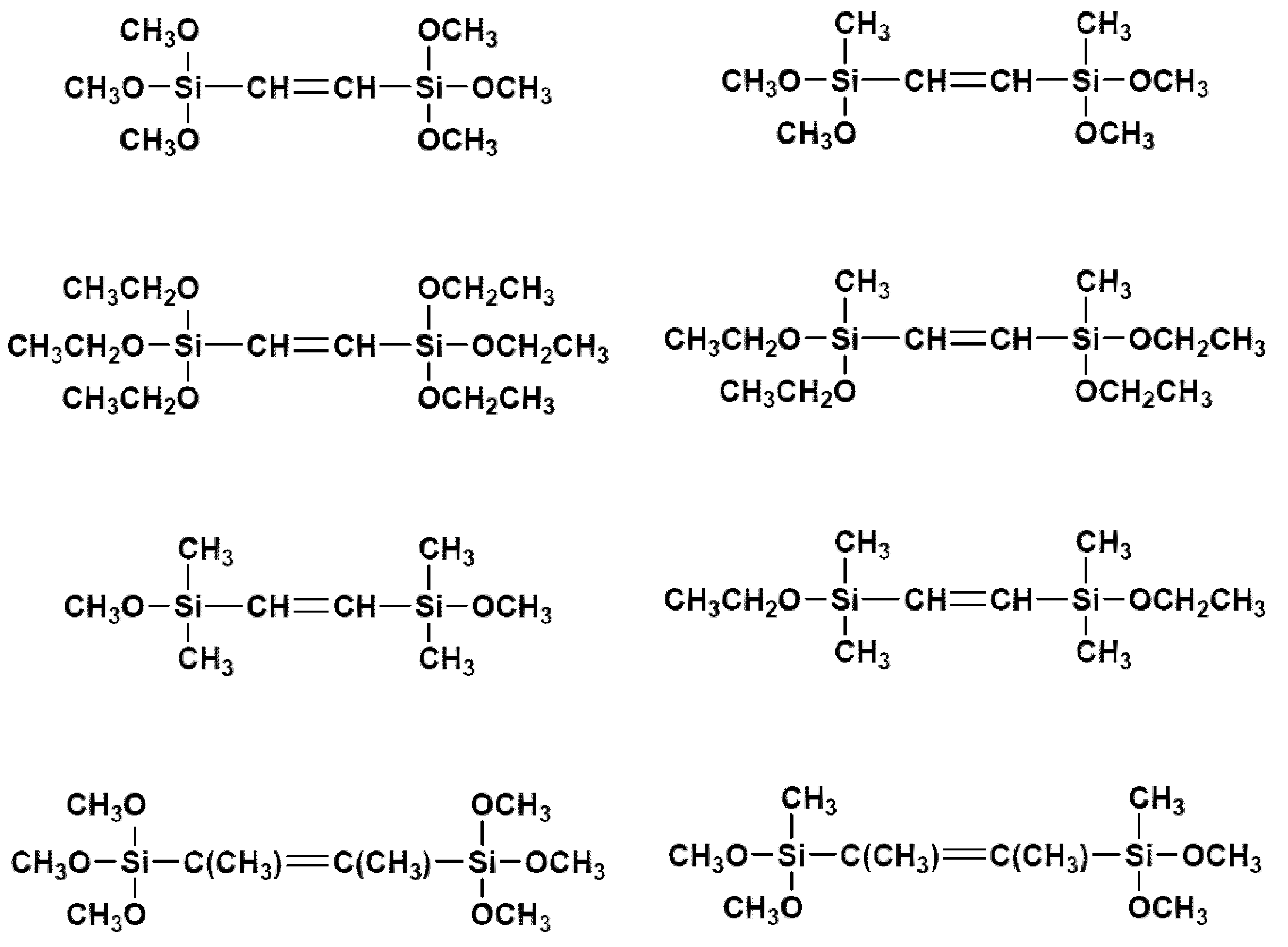
- hydrolyzable silyl groups represented by the above general formula (2) and two silicon atoms existing in the hydrolyzable silyl group are bonded to each other by a carbon-carbon double bond (ethenylene group).
- a hydrolyzable organosilicon compound such as bissilyl-type organosilane and / or a partially hydrolyzed condensate thereof (hydrolyzable siloxane oligomer), characterized in that it has a structure linked to each other, is used as the curing agent component (B).
- a general-purpose vinylsilane (monovinylalkoxysilane or the like) can be used, and the room temperature-curable organopolysiloxane composition of the present invention can be produced industrially advantageously.
- the component (A) is a linear organopolysiloxane blocked by a hydroxyl group (namely, silanol group or diorganohydroxysiloxy group) represented by the following general formula (1) where both ends of the molecular chain are bonded to silicon atoms. And acts as the main agent (base polymer) in the composition of the present invention.
- a hydroxyl group namely, silanol group or diorganohydroxysiloxy group
- R 1 is a hydrogen atom or a monovalent hydrocarbon group having 1 to 20 carbon atoms which may have a substituent, and a plurality of R 1 may be the same or different.
- N is an integer of 1 or more.
- the monovalent hydrocarbon radical of a substituted or unsubstituted R 1 is from 1 to 20 carbon atoms, preferably 1 to 10, more preferably about 1-8, more of R 1 is They may be the same or different.
- the organopolysiloxane of component (A) preferably has a viscosity at 25 ° C. of 10 to 1,000,000 mPa ⁇ s, more preferably 50 to 500,000 mPa ⁇ s, particularly preferably 100 to 100,000 mPa ⁇ s. ⁇ S, more preferably 500 to 80,000 mPa ⁇ s. If the organopolysiloxane has a viscosity of 10 mPa ⁇ s or more, it is easy to obtain a coating film excellent in physical and mechanical strength. If the viscosity is 1,000,000 mPa ⁇ s or less, the composition of This is preferable because the viscosity does not become too high and the workability during use is good.
- the viscosity is a numerical value obtained by a rotational viscometer (for example, BL type, BH type, BS type, cone plate type, rheometer, etc.).
- a rotational viscometer for example, BL type, BH type, BS type, cone plate type, rheometer, etc.
- the value of n in the general formula (1) is In general, it is desirable that the integer is from 10 to 2,000, preferably from 30 to 1,500, more preferably from 50 to 1,200, still more preferably from about 100 to 1,000.
- the degree of polymerization can be determined, for example, as the number average degree of polymerization (or number average molecular weight) in terms of polystyrene in gel permeation chromatography (GPC) analysis using toluene or the like as a developing solvent.
- the organopolysiloxane of component (A) can be used alone or in combination of two or more.
- the organopolysiloxane of component (A) is preferably contained in an amount of 25 to 98% by mass, particularly preferably 60 to 90% by mass, in the room temperature curable organopolysiloxane composition of the present invention.
- component- Component (B) represented by the following general formula (2), two hydrolyzable silyl groups in the molecule, and two silicon atoms existing in the hydrolyzable silyl group are bonded to each other by a carbon-carbon double bond.
- a hydrolyzable organosilicon compound such as a bissilyl-type organosilane and / or a partially hydrolyzed condensate thereof (that is, the hydrolyzable organosilicon compound is partially hydrolyzed, characterized by having a structure linked by (ethenylene group)
- the hydrolyzable siloxane oligomer having at least 2, preferably 3 or more residual hydrolyzable groups in the molecule obtained by decomposition is a component that acts as a curing agent (crosslinking agent) in the composition of the present invention.
- the cured product (silicone rubber) that contributes to the fast curability of the composition is excellent in moisture resistance.
- R 1 is a monovalent hydrocarbon group hydrogen atom, or a substituent from carbon atoms 1 may have 20, a plurality of R 1 may be the same or different.
- R 2 is an optionally substituted alkyl group having 1 to 20 carbon atoms or a cycloalkyl group having 3 to 20 carbon atoms, a is an integer of 1 to 3.
- the substituted or unsubstituted monovalent hydrocarbon group of R 1 has 1 to 20 carbon atoms, preferably 1 to 10 carbon atoms, more preferably about 1 to 8 carbon atoms.
- a plurality of R 1 may be the same or different, specifically, methyl group, ethyl group, n-propyl group, isopropyl group, n-butyl group, isobutyl group, tert-butyl group, pentyl group, neopentyl group Group, hexyl group, heptyl group, octyl group, 2-ethylhexyl group, nonyl group, decyl group, undecyl group, dodecyl group, tridecyl group, tetradecyl group, pentadecyl group, hexadecyl group, heptadecyl group, octadecyl group, nonadec
- each silicon atom present in two hydrolyzable silyl groups is bonded to two carbon atoms that are connected by a carbon-carbon double bond (ethenylene group).
- the two R 1 groups are preferably hydrogen atoms.
- the unsubstituted or substituted alkyl group for R 2 has 1 to 20, preferably 1 to 6, more preferably about 1 to 4 carbon atoms, and a plurality of R 2 may be the same or different.
- R 2 may be the same or different.
- the unsubstituted or substituted cycloalkyl group has 3 to 20, preferably 4 to 8, more preferably about 5 to 6 carbon atoms, and examples thereof include a cyclopentyl group and a cyclohexyl group.
- some or all of the hydrogen atoms of these alkyl groups and cycloalkyl groups are substituted with halogen atoms such as F, Cl and Br, cyano groups, or lower alkoxy groups having about 1 to 4 carbon atoms.
- R 2 is preferably a methyl group, an ethyl group or a methoxyethyl group, particularly preferably a methyl group, from the viewpoint of hydrolyzability.
- the hydrolyzable organosilicon compound represented by the general formula (2) of the component (B) is mainly used as a curing agent (crosslinking agent).
- each a is independently an integer of 1 to 3, but 2 or 3 is preferable from the viewpoint of curability.
- a molecule having three alkoxy groups such as a methoxy group on the same silicon atom (that is, a total of six in the molecule) has two trifunctional alkoxysilane sites in one molecule.
- a synthesis example of the component (B) is shown below.
- the component (B) has a structure in which two hydrolyzable silyl groups in the molecule and two silicon atoms present in the hydrolyzable silyl group are connected by a carbon-carbon double bond (ethenylene group).
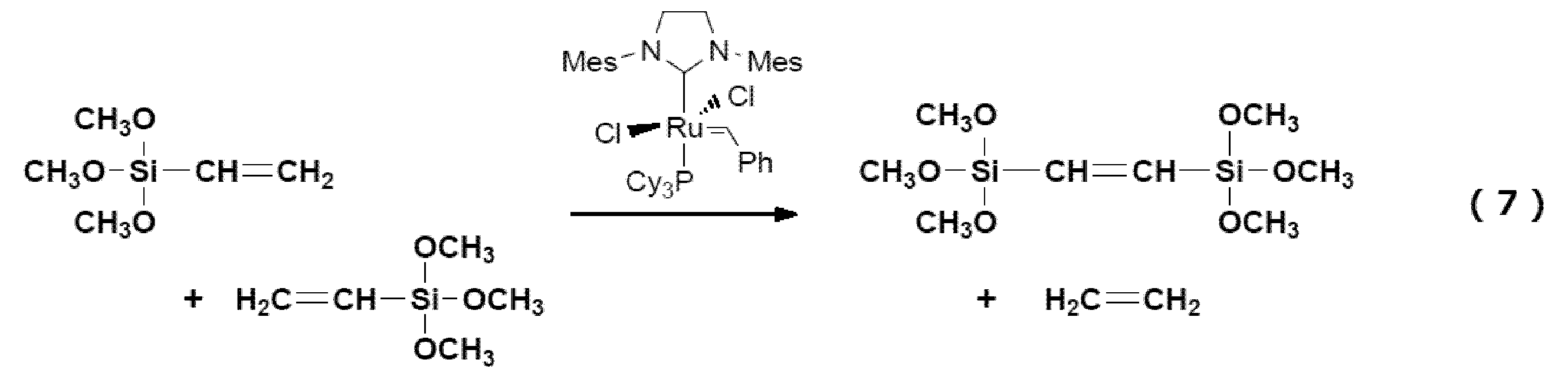
- a hydrolyzable organosilicon compound such as a bissilyl-type organosilane is characterized by the fact that an olefin recombination reaction, for example, by an olefin metathesis reaction of an alkoxysilane having a carbon-carbon double bond such as a vinyl group on a silicon atom Can be manufactured more easily. This reaction is represented by the following reaction formula, for example.
- the olefin metathesis catalyst used for olefin recombination by metathesis reaction is a ruthenium carbene complex or an osmium carbene complex, which is formally +2 in oxidation state, has 16 electrons, and has the following general formula (5) And those having a pentacoordinate metal center.
- M is ruthenium or osmium
- X 1 and X 2 are arbitrary anionic ligands, which may be the same or different
- L 1 and L 2 are arbitrary Neutral electron donating ligands which may be the same or different.
- R 3 and R 4 are a hydrogen atom or an optionally substituted alkyl group having 1 to 20 carbon atoms, an alkenyl group having 2 to 20 carbon atoms, or 2 to 20 carbon atoms.
- the substituent represented by the group represented by R 3 or R 4 may be one selected from an alkyl group having 1 to 10 carbon atoms, an alkoxy group having 1 to 10 carbon atoms, and an aryl group.
- the above substituents are mentioned, and further, these substituents are one or more groups selected from a halogen atom, an alkyl group having 1 to 5 carbon atoms, an alkoxy group having 1 to 5 carbon atoms, and a phenyl group. May be substituted.
- any of the catalyst ligands may further have one or more functional groups.
- Suitable functional groups include hydroxyl, thiol, thioether, ketone, aldehyde, ester, ether, amine, imine, amide, nitro, carboxylic acid, disulfide, carbonate, isocyanate, carbodiimide, carboalkoxy, carbamate and halogen. However, it is not limited to these.
- Preferred examples of the catalyst include those in which R 3 is a hydrogen atom, and R 4 has a group selected from an alkyl group having 1 to 20 carbon atoms, an alkenyl group having 2 to 20 carbon atoms, and an aryl group. And even more preferred, R 4 is optionally substituted with one or more groups selected from an alkyl group having 1 to 5 carbon atoms, an alkoxy group having 1 to 5 carbon atoms, a phenyl group, and a functional group Having a modified phenyl group or vinyl group.
- R 4 is substituted with one or more groups selected from a chlorine atom, a bromine atom, an iodine atom, a fluorine atom, a nitro group, an amino group, a methyl group, a methoxy group, and a phenyl group Those having a phenyl group or vinyl group, and most preferred are those in which R 4 has a phenyl group.
- L 1 and L 2 may be the same or different, and phosphine, sulfonated phosphine, phosphite, phosphinite, phosphonite, arsine, stibine, ether, amine, amide, imine , Sulfoxide, carboxyl, nitrosyl, pyridine, and thioether. More preferably, L 1 and L 2 are each a phosphine represented by the structural formula PR 6 R 7 R 8 .
- R 6 , R 7 and R 8 are each independently an aryl group or an alkyl group having 1 to 10 carbon atoms, and in particular, a primary alkyl group, a secondary alkyl group, or A cycloalkyl group is preferred.
- the L 1 and L 2 ligands are each selected from —P (cyclohexyl) 3 , —P (cyclopentyl) 3 , —P (isopropyl) 3 , and —P (phenyl) 3. Is.
- Another preferred one of these catalysts includes those in which L 1 is any neutral electron donor and L 2 is an imidazolidine ligand.
- L 2 include those represented by the following structural formula (6).
- R 5 , R 6 , R 7 and R 8 are each independently a hydrogen atom or an alkyl group having 1 to 20 carbon atoms which may have a substituent, and 2 carbon atoms.
- alkenyl group having 2 to 20 carbon atoms alkynyl group having 2 to 20 carbon atoms, aryl group, carboxylate group having 2 to 20 carbon atoms, alkoxy group having 1 to 20 carbon atoms, alkenyloxy group having 2 to 20 carbon atoms, 2 carbon atoms
- Is one group selected from R 6 and R 7 are bonded together at the end to form a cycloalkyl ring structure or an aromatic ring structure, or are unsubstituted. Further, both L 1 and L 2 may be bidentate ligands.
- X 1 and X 2 are preferably each independently a hydrogen atom, a halogen atom, an alkyl group having 1 to 20 carbon atoms, an aryl group, an alkoxide group having 1 to 20 carbon atoms, or aryl.
- Oxide group alkyl diketonate group having 3 to 20 carbon atoms, aryl diketonate group, carboxylate group having 1 to 20 carbon atoms, aryl sulfonate group, alkyl sulfonate group having 1 to 20 carbon atoms, 1 to 20 carbon atoms Or an alkylsulfonyl group having 1 to 20 carbon atoms or an alkylsulfinyl group having 1 to 20 carbon atoms.
- X 1 and X 2 are each optionally one or more atoms selected from a halogen atom, an alkyl group having 1 to 5 carbon atoms, an alkoxy group having 1 to 5 carbon atoms, and a phenyl group, It may be one or more groups selected from an alkyl group having 1 to 10 carbon atoms, an alkoxy group having 1 to 10 carbon atoms, and an aryl group, which are further substituted with a group.
- X 1 and X 2 are a halogen atom, CF 3 CO 2 , CH 3 CO 2 , CFH 2 CO 2 , (CH 3 ) 3 CO, (CF 3 ) 2 (CH 3 ) CO, (CF 3 ) (CH 3 ) 2 CO, PhO, MeO, EtO, tosylate, mesylate or trifluoromethanesulfonate.
- Me, Et, and Ph represent a methyl group, an ethyl group, and a phenyl group, respectively.
- X 1 and X 2 are each a chlorine atom.
- X 1 and X 2 may both be bidentate ligands.
- hydrolyzable organosilicon compound in which the silicon atoms of the general formula (2) are connected by a vinylene group (ethenylene group) include, for example, those represented by the following structural formula. Can be used alone or in combination of two or more.
- the hydrolyzable organosilicon compound as the component (B) is 0.1 to 30 parts by weight, preferably 1 to 25 parts by weight, more preferably 3 to 3 parts by weight with respect to 100 parts by weight of the organopolysiloxane as the component (A).
- the hydrolyzable organosilicon compound as the component (B) is 0.1 to 30 parts by weight, preferably 1 to 25 parts by weight, more preferably 3 to 3 parts by weight with respect to 100 parts by weight of the organopolysiloxane as the component (A).
- the hydrolyzable organosilicon compound as the component (B) is 0.1 to 30 parts by weight, preferably 1 to 25 parts by weight, more preferably 3 to 3 parts by weight with respect to 100 parts by weight of the organopolysiloxane as the component (A).
- component (C)- The curing catalyst of component (C) is used to accelerate the hydrolysis condensation reaction between the present composition and moisture in the air, and is generally called a curing catalyst.
- a curing catalyst As this, a known material usually used in a room temperature curable silicone resin composition that cures in the presence of moisture can be used, but organic tin compounds that are problematic in terms of environmental safety are excluded.
- curing catalyst for component (C) examples include phosphazenes such as N, N, N ′, N ′, N ′′, N ′′ -hexamethyl-N ′′ ′-(trimethylsilylmethyl) -phosphorimidic triamide.
- aminoalkyl group-substituted alkoxysilanes such as 3-aminopropyltriethoxysilane and N- ⁇ (aminoethyl) ⁇ -aminopropyltrimethoxysilane
- amine compounds such as hexylamine and dodecylamine phosphate or salts thereof
- benzyl Quaternary ammonium salts such as triethylammonium acetate
- dialkylhydroxylamines such as dimethylhydroxylamine and diethylhydroxylamine
- tetramethylguanidylpropyltrimethoxysilane tetramethylguanidylpropylmethyldimethoxysilane, tetramethylguanidylpropyl Tris
- Examples include silanes and siloxanes containing guanidyl groups such as (trimethylsiloxy) silane, but the component (C) is not limited thereto.
- the component (C) may be used alone or in combination of two or more.
- the amount of the curing catalyst used may be a so-called catalytic amount, and the amount of component (C) is 0.001 to 20 parts by mass, especially 0. 005 to 10 parts by mass, more preferably 0.01 to 5 parts by mass is preferred. If the amount is less than 0.001 part by mass, good curability cannot be obtained, so that a problem that the curing rate is delayed occurs. On the contrary, if the amount exceeds 20 parts by mass, the curability of the composition is too fast, so that the allowable range of working time after application of the composition may be shortened or the mechanical properties of the resulting rubber may be reduced. is there.
- composition of the present invention one or more selected from the following components (D), (E), and (F) may be blended as an optional component as required.
- ethyl silicate propyl silicate, methyltrimethoxysilane, methyltriethoxysilane, vinyltrimethoxysilane, vinyltriethoxysilane, methyltris (methoxyethoxy) silane, vinyltris (methoxyethoxy) silane, methyltripropenoxysilane.
- the amount of component (D) is usually 0 to 30 parts by weight, preferably 0.1 to 20 parts by weight, more preferably 0.1 to 100 parts by weight of component (A). 5 to 15 parts by mass. If the blending amount exceeds 30 parts by mass, there may be a problem that the cured product becomes too hard or economically disadvantageous.
- component- Component (E) is a filler (inorganic filler and / or organic resin filler), and is an optional component that can be blended as necessary, and provides sufficient mechanical strength to the cured product formed from this composition. Used for.
- Known fillers can be used, such as finely divided silica, fumed silica (dry silica), precipitated silica (wet silica), and silica whose surface is hydrophobized with an organosilicon compound.
- silica-based fillers glass beads, glass balloons, transparent resin beads, silica aerogels, diatomaceous earth, iron oxide, zinc oxide, titanium oxide, fumed metal oxides, wet silica or their surfaces Silane-treated, quartz powder (crystalline silica fine powder), carbon black, talc, zeolite, bentonite and other reinforcing agents, asbestos, glass fiber, carbon fiber, calcium carbonate, magnesium carbonate, zinc carbonate and other metal carbonates , Asbestos, glass wool, fine mica, fused silica powder, polystyrene, polychlorinated Cycloalkenyl, synthetic resin powders such as such as polypropylene is used.
- inorganic fillers such as silica, calcium carbonate, and zeolite are preferable, and fumed silica and calcium carbonate whose surfaces are hydrophobized are particularly preferable.
- the amount of component (E) is usually preferably 0 to 1000 parts by weight, particularly 0.5 to 600 parts by weight, especially about 5 to 300 parts by weight, per 100 parts by weight of component (A). Preferably there is.
- a larger amount than 1000 parts by mass not only the viscosity of the composition increases and the workability deteriorates, but also the rubber strength after curing decreases and it becomes difficult to obtain rubber elasticity.
- the component (F) is an adhesion promoter and is an optional component that can be blended as necessary.
- the component (F) is used for imparting sufficient adhesiveness to a cured product formed from this composition.
- the adhesion promoter a silane coupling agent such as a functional group-containing hydrolyzable silane
- known ones are preferably used, such as a vinyl silane coupling agent, a (meth) acryl silane coupling agent, an epoxy silane coupling agent
- Examples include aminosilane coupling agents, mercaptosilane coupling agents, and the like, specifically, vinyltris ( ⁇ -methoxyethoxy) silane, ⁇ -methacryloxypropyltrimethoxysilane, ⁇ - (3,4-epoxycyclohexyl) ethyltri Methoxysilane, ⁇ -glycidoxypropyltrimethoxysilane, ⁇ -glycidoxypropylmethyldiethoxysilane, N- ⁇ - ⁇
- aminosilanes such as ⁇ -aminopropyltriethoxysilane, 3-2- (aminoethylamino) propyltrimethoxysilane, ⁇ -glycidoxypropyltrimethoxysilane, ⁇ - (3,4-epoxycyclohexyl), among others.
- Epoxy silanes such as ethyltrimethoxysilane and isocyanate silane are preferred.
- the component (F) is preferably blended in an amount of 0 to 30 parts by weight, particularly 0.1 to 20 parts by weight, especially 0.3 to 15 parts by weight, per 100 parts by weight of the component (A).
- the adhesion promoter is not used with the filler and the adherend, it is not necessary to use it.
- the component (G) is bleed oil and is an essential component of the composition of the present invention.
- a silicone oil whose non-reactive (non-condensation reactive) main chain that does not undergo a condensation reaction with the diorganopolysiloxane of the (A) component is a siloxane skeleton (for example, main oil)
- a linear diorganopolysiloxane whose chain is composed of repeating diorganosiloxane units and both ends of the molecular chain are blocked with triorganosiloxy groups such as trimethylsiloxy groups, and is involved in the curing (crosslinking) reaction of the composition
- triorganosiloxy groups such as trimethylsiloxy groups
- a dimethyl silicone oil in which all of the monovalent organic groups (organo groups) bonded to silicon atoms in the diorganosiloxane unit constituting the main chain are methyl groups, and a part of the methyl groups of the dimethyl silicone oils are Methyl phenyl silicone oil substituted with phenyl group, monoamine, diamine or amino modified silicone oil substituted with amino polyether group, epoxy, cycloaliphatic epoxy, epoxy polyether or epoxy substituted with epoxy aralkyl group Modified silicone oil, carbinol-modified silicone oil substituted with carbinol group, mercapto-modified silicone oil substituted with mercapto group, carboxyl-modified silicone oil substituted with carboxyl group, methacryl-modified silicone substituted with methacryl group N'oiru, polyether or polyether long chain (C 6-18) substituted alkyl, aralkyl polyether-modified silicone oil, long chain (C 6-18) alkyl or long-chain (C 6-18)
- the number average molecular weight in terms of polystyrene by gel permeation chromatography (GPC) of the component (G) is preferably 250 to 100,000, more preferably 1,000 to 60,000. If the number average molecular weight is less than 250, the antifouling property may be inferior, and if it is more than 100,000, the composition may have a too high viscosity and may be difficult to use.
- the viscosity of component (G) at 25 ° C. is preferably 20 to 30,000 mPa ⁇ s, more preferably 50 to 10,000 mPa ⁇ s. When the viscosity at 25 ° C. is less than 20 mPa ⁇ s, the antifouling property may be inferior, and when it is higher than 30,000 mPa ⁇ s, the viscosity of the composition may be too high to be used.
- any one or more of the components (G) are 0.01 to 100 parts by mass, preferably 0.1 to 80 parts by mass with respect to 100 parts by mass of the component (A). It is desirable that it is contained in an amount of about 1 part by weight, more preferably about 1 to 60 parts by weight, still more preferably about 5 to 50 parts by weight.
- the amount of this silicone oil is in the above range, for example, when used as an antifouling paint, there is a tendency to obtain a (antifouling) paint film excellent in both antifouling properties and paint film strength, which is less than the above range. In some cases, the antifouling property may be lowered, and if it is more than the above range, the coating strength may be lowered.
- the room temperature curable organopolysiloxane composition of the present invention further includes, as additives, known flame retardants such as pigments, dyes, anti-aging agents, antioxidants, antistatic agents, antimony oxides, and paraffin chlorides. Additives can be blended. Furthermore, a polyether as a thixotropy improver, a fungicide, and an antibacterial agent can be blended. Furthermore, in order to improve sclerosis
- metal-containing curing catalysts other than tin compounds include tetraisopropoxy titanium, tetra n-butoxy titanium, tetrakis (2-ethylhexoxy) titanium, dipropoxy bis (acetylacetonato) titanium, titanium isopropoxy octylene glycol, etc.
- Titanate ester or titanium chelate compound zinc naphthenate, zinc stearate, zinc-2-ethyl octoate, iron-2-ethylhexoate, cobalt-2-ethylhexoate, manganese-2-ethylhexo Alcohols, cobalt naphthenates, aluminum isopropylates, aluminum secondary butyrate and other alcoholate aluminum compounds, aluminum alkyl acetate diisopropylate, aluminum bisethylacetoacetate monoa
- Aluminum chelate compounds such as tylacetonate, organometallic compounds such as bismuth (III) neodecanoate, bismuth (III) 2-ethylhexanoate, bismuth citrate, bismuth octylate, potassium acetate, sodium acetate, oxalic acid
- the lower fatty acid salt of alkali metals, such as lithium is illustrated, the curing catalyst of other components is not limited to these.
- the amount used is not particularly limited and may be an effective amount as a catalyst, but is usually preferably 0.01 to 20 parts by mass with respect to 100 parts by mass of component (A).
- the content is preferably 0.1 to 10 parts by mass.
- the above components are mixed under normal pressure or reduced pressure, preferably 0.09 to 0.01 MPa, and unheated, preferably 60 ° C. or less. In general, it can be produced by mixing for about 30 minutes to 3 hours.
- the components (A) and (E) are mixed in advance under reduced pressure, and mixed under heating, preferably at 80 ° C. to 160 ° C. for about 30 minutes to 3 hours, and the remaining components are mixed under normal pressure or reduced pressure.
- the surface smoothness of the cured coating film is preferably produced by mixing under a reduced pressure of 0.09 to 0.01 MPa, and by mixing without heating, preferably at 60 ° C. or less, usually for about 30 minutes to 3 hours.
- a material having a more excellent viscosity stability with time can be obtained.
- the room temperature curable organopolysiloxane composition of the present invention When used as a coating material, paint, particularly antifouling paint, etc., it is excellent in stability during preparation, storage and storage, and has good curability, and the resulting coating film Is excellent in a good balance of rubber physical properties such as hardness, tensile strength and elongation, and also has excellent antifouling properties and the like, and can be suitably used particularly as an antifouling coating film.
- the room temperature curable organopolysiloxane composition of the present invention has a viscosity at 23 ° C. of preferably 500 to 200,000 mPa ⁇ s, particularly preferably 1,000 to 150,000 mPa ⁇ s, and is particularly suitable for coating. Viscosity.
- the room temperature curable organopolysiloxane composition of the present invention is a coating material requiring water resistance such as ship bottom paint, power plant seawater introduction pipe paint, fish net paint, etc., moisture proof coating material such as LCD and PDP, etc.
- Highly compatible with applications such as adhesive seals between resin and resin coatings, resin cases or adhesive seals between resin connectors and wires, adhesive seals in vacuum or pressurized chambers, among others, ships, port facilities, buoys, pipelinescan be coated on underwater structures such as bridges, submarine bases, offshore oilfield drilling equipment, powerhouse conduit pipes, aquaculture nets, stationary nets, etc., and the cured coating of the composition is non-toxic and environmentally friendly Without any problem, it can prevent adhesion and growth of aquatic organisms over a long period of time and can exhibit excellent antifouling properties.
- the coating amount on the underwater structure of the room temperature curable organopolysiloxane composition of the present invention is not particularly limited, but is an amount such that the film thickness after curing is 10 to 1,000 ⁇ m, particularly 50 to 500 ⁇ m. It is preferable that The room temperature curable organopolysiloxane composition obtained by the production method of the present invention may be applied and cured at room temperature (room temperature).
- part means “part by mass”, and the viscosity is a value measured by a rotational viscometer at 25 ° C.
- Synthesis Example 2 In Synthesis Example 1, the same reaction and operation were performed except that vinyltriethoxysilane was used instead of vinyltrimethoxysilane. As a result, bis (triethoxysilyl) ethylene (bis (triethoxysilyl) ethene) was obtained with a yield of 90%.
- Synthesis Example 3 In Synthesis Example 1, the same reaction and operation were performed except that vinylmethyldimethoxysilane was used instead of vinyltrimethoxysilane. As a result, bis (methyldimethoxysilyl) ethylene (bis (methyldimethoxysilyl) ethene) was obtained with a yield of 85%.
- Synthesis Example 4 In Synthesis Example 1, the same reaction and operation were performed except that vinylmethyldiethoxysilane was used instead of vinyltrimethoxysilane. As a result, bis (methyldiethoxysilyl) ethylene (bis (methyldiethoxysilyl) ethene) was obtained with a yield of 90%.
- Example 1 50 parts of ⁇ , ⁇ -dihydroxy-dimethylpolysiloxane having a viscosity of 1,500 mPa ⁇ s (blocked dimethylpolysiloxane having hydroxydimethylsiloxy groups at both ends of the molecular chain), ⁇ , ⁇ -dihydroxy-dimethylpolysiloxane having a viscosity of 5,000 mPa ⁇ s 50 parts of siloxane and 10 parts of fumed silica having a BET specific surface area of 120 m 2 / g surface-treated with dimethyldichlorosilane were uniformly mixed and mixed at 30 to 40 ° C. for 1 hour at normal pressure.
- Example 2 A composition was prepared in the same manner except that 6.0 parts of bis (triethoxysilyl) ethylene obtained in Synthesis Example 2 was used instead of bis (trimethoxysilyl) ethylene of Example 1.
- Example 3 A composition was prepared in the same manner except that 5.0 parts of bis (methyldimethoxysilyl) ethylene obtained in Synthesis Example 3 was used instead of bis (trimethoxysilyl) ethylene of Example 1.
- Example 4 A composition was prepared in the same manner except that 6.0 parts of bis (methyldiethoxysilyl) ethylene obtained in Synthesis Example 4 was used instead of bis (trimethoxysilyl) ethylene of Example 1.
- Example 5 30 parts of an ⁇ , ⁇ -trimethylsiloxy-dimethyldiphenylpolysiloxane having a viscosity of 300 mPa ⁇ s in Example 1 was added to an ⁇ , ⁇ -trimethylsiloxy-dimethyl-methyl (polyether) polysiloxane having a viscosity of 180 mPa ⁇ s (molecular chain).
- a composition was prepared in the same manner as in Example 1, except that 30 parts of trimethylsiloxy-blocked dimethylsiloxane / methyl (polyether) siloxane copolymer) (HLB 4) was used.
- Example 6 50 parts ⁇ , ⁇ -dihydroxy-dimethylpolysiloxane with a viscosity of 1,500 mPa ⁇ s, 50 parts ⁇ , ⁇ -dihydroxy-dimethylpolysiloxane with a viscosity of 5,000 mPa ⁇ s, and a haze with a BET specific surface area of 130 m 2 / g 10 parts of vitreous silica were uniformly mixed and mixed at 110 to 120 ° C. for 2 hours under a reduced pressure of 0.04 to 0.06 MPa. Cool to 60 ° C.
- Example 7 A composition was prepared in the same manner except that 6.0 parts of bis (triethoxysilyl) ethylene obtained in Synthesis Example 2 was used instead of bis (trimethoxysilyl) ethylene of Example 6.
- Example 1 A composition was prepared in the same manner as in Example 1, except that 30 parts of ⁇ , ⁇ -trimethylsiloxy-dimethyldiphenyl polysiloxane having a viscosity of 300 mPa ⁇ s was excluded from the composition of Example 1.
- Tack free time was measured according to JIS A1439.
- (C) Coating workability 90 g of a sample (composition) and 10 g of xylene were mixed to prepare a test sample.
- a mild steel plate of 100 mm x 100 mm x 1 mm (thickness) is attached to the center of a tin plate with a size of 1,000 mm x 1,000 mm x 1 mm (thickness), and airless spray coating is performed with the tinplate leaning vertically, The presence / absence (sprayability) of the appliance during spraying (sprayability) was confirmed (visually) and the limit film thickness at which film sagging occurred was measured after drying the coating.
- a test coating plate was prepared by coating a coated plate previously coated with an epoxy anticorrosive coating (thickness: 200 ⁇ m) so that the cured film thickness was 300 ⁇ m.
- the test coated plate thus prepared was cured for 7 days under the condition of 23 ° C./50% RH.
- the test plate after curing was subjected to a suspension test for 24 months at a depth of 1.5 m off the coast of Kanagawa Prefecture. The state of adhesion of shellfish such as barnacles and seaweeds was observed after 3, 6, 12 and 24 months.
- the composition of the present invention is a composition that does not contain organotin with an emphasis on the environmental aspect.
- the obtained coating film has coating film strength, coating film hardness, rubber physical properties, water resistance, and moisture resistance, water resistance such as ship bottom coating, power plant seawater introduction pipe coating, fish net coating, etc.
- Coating materials that require high resistance, moisture-proof coating materials that require moisture resistance such as LCD and PDP, adhesive seals between electric wires and resin coatings, adhesive seals between resin cases or resin connectors and electric wires, vacuum or pressurized chambers It is highly compatible with applications such as adhesive seals, and in particular, it can prevent adhesion and growth of aquatic organisms on these surfaces as ship bottom paint, power plant seawater introduction pipe paint, fish net paint, and the like.
Landscapes
- Chemical & Material Sciences (AREA)
- Organic Chemistry (AREA)
- Chemical Kinetics & Catalysis (AREA)
- Health & Medical Sciences (AREA)
- Medicinal Chemistry (AREA)
- Polymers & Plastics (AREA)
- Life Sciences & Earth Sciences (AREA)
- Engineering & Computer Science (AREA)
- Materials Engineering (AREA)
- Wood Science & Technology (AREA)
- Compositions Of Macromolecular Compounds (AREA)
- Paints Or Removers (AREA)
Abstract
Description
下記成分(A)~(C)及び(G)を含有する室温硬化性オルガノポリシロキサン組成物。
(A)下記一般式(1)で示されるオルガノポリシロキサン 100質量部

(B)下記一般式(2)で示される加水分解性有機ケイ素化合物及び/又はその部分加水分解縮合物 0.1~30質量部

(C)硬化触媒 0.001~20質量部
(G)ブリードオイル 0.01~100質量部
更に、
(D)(A)成分及び(B)成分以外の加水分解性オルガノシラン及び/又はその部分加水分解縮合物 0.1~30質量部、
(E)充填剤 0.5~1000質量部 及び
(F)接着促進剤 0.1~30質量部
から選ばれる1種以上を含有する、〔1〕記載の室温硬化性オルガノポリシロキサン組成物。
〔1〕又は〔2〕記載の室温硬化性オルガノポリシロキサン組成物の硬化物でコーティングされた基材。
基材が水中構造物である〔3〕記載の基材。
すなわち、本発明の室温硬化性オルガノポリシロキサン組成物より得られる塗膜は、無毒であり、該塗膜を水中構造物に設けた場合、長期間にわたって水生生物の付着・生育を防止し、優れた防汚性を示すものである。従って、本発明の組成物は、船底塗料、発電所海水導入管用塗料、魚網塗料等の耐水性が必要なコーティング材料、LCDやPDP等の耐湿性が必要な防湿コーティング材料、電線と樹脂被覆間の接着シール、樹脂ケース、又は樹脂コネクタと電線の間の接着シール、減圧又は加圧チャンバーの接着シール等の用途に対する適合性が高く、とりわけ、船底塗料、発電所海水導入管用塗料、魚網塗料等として、これらの表面への水生生物の付着・生育を防止することが有用である。
<室温硬化性オルガノポリシロキサン組成物>
-(A)成分-
(A)成分は、下記一般式(1)で示される、分子鎖両末端がケイ素原子に結合した水酸基(即ち、シラノール基あるいはジオルガノヒドロキシシロキシ基)で封鎖された直鎖状のオルガノポリシロキサンであり、本発明の組成物において主剤(ベースポリマー)として作用するものである。

上記式(1)中、R1の置換又は非置換の1価炭化水素基は、炭素数が1~20、好ましくは1~10、より好ましくは1~8程度であり、複数のR1は同一または異なっていてもよく、具体的には、メチル基、エチル基、n-プロピル基、イソプロピル基、n-ブチル基、イソブチル基、tert-ブチル基、ペンチル基、ネオペンチル基、ヘキシル基、ヘプチル基、オクチル基、2-エチルヘキシル基、ノニル基、デシル基、ウンデシル基、ドデシル基、トリデシル基、テトラデシル基、ペンタデシル基、ヘキサデシル基、ヘプタデシル基、オクタデシル基、ノナデシル基、エイコシル基等のアルキル基;シクロペンチル基、シクロヘキシル基等のシクロアルキル基;ビニル基、アリル基、プロペニル基、イソプロペニル基、ブテニル基、ペンテニル基、ヘキセニル基等のアルケニル基;フェニル基、トリル基、キシリル基、α-,β-ナフチル基等のアリール基;ベンジル基、2-フェニルエチル基、3-フェニルプロピル基等のアラルキル基;また、これらの基の水素原子の一部又は全部が、F、Cl、Br等のハロゲン原子やシアノ基等で置換された基、例えば、3-クロロプロピル基、3,3,3-トリフルオロプロピル基、2-シアノエチル基等を例示することができる。これらの中でも、メチル基、エチル基、フェニル基が好ましく、入手の容易さ、生産性、コストの面からメチル基、フェニル基が特に好ましい。
なお、(A)成分のオルガノポリシロキサンが上記の粘度を取り得る範囲として、上記一般式(1)におけるnの値(分子中に存在する2官能性ジオルガノシロキサン単位の数又は重合度)は、通常、10~2,000、好ましくは30~1,500、より好ましくは50~1,200、更に好ましくは100~1,000程度の整数であることが望ましい。なお、重合度(又は分子量)は、例えば、トルエン等を展開溶媒としてゲルパーミエーションクロマトグラフィー(GPC)分析におけるポリスチレン換算の数平均重合度(又は数平均分子量)等として求めることができる。
(A)成分のオルガノポリシロキサンは1種又は2種以上を併用することができる。
(A)成分のオルガノポリシロキサンは、本発明の室温硬化性オルガノポリシロキサン組成物中、25~98質量%含有することが好ましく、特に60~90質量%含有することが好ましい。
(B)成分である下記一般式(2)で示される、分子内に2つの加水分解性シリル基と、該加水分解性シリル基中に存在する2つのケイ素原子同士を炭素-炭素二重結合(エテニレン基)で連結する構造を有することを特徴とするビスシリル型のオルガノシラン等の加水分解性有機ケイ素化合物及び/又はその部分加水分解縮合物(即ち、該加水分解性有機ケイ素化合物を部分加水分解して得られる分子中に残存加水分解性基を少なくとも2個、好ましくは3個以上有する加水分解性シロキサンオリゴマー)は、本発明の組成物において硬化剤(架橋剤)として作用する成分であり、組成物の速硬化性に寄与し、かつ得られた硬化物(シリコーンゴム)は耐湿性に優れる。

(B)成分の、分子内に2つの加水分解性シリル基と、該加水分解性シリル基中に存在する2つのケイ素原子間を炭素-炭素二重結合(エテニレン基)で連結する構造を有することを特徴とするビスシリル型のオルガノシラン等の加水分解性有機ケイ素化合物は、例えばケイ素原子上にビニル基等の炭素-炭素二重結合を有するアルコキシシランのオレフィンメタセシス反応による、オレフィンの組換え反応により容易に製造することができる。この反応は、例えば次の反応式で表される。

メタセシス反応によるオレフィンの組換えを行う際に用いるオレフィンメタセシス触媒のとしては、ルテニウムカルベン錯体またはオスミウムカルベン錯体で、形式的に+2の酸化状態で、電子数を16有し、下記一般式(5)のように五配位の金属中心を有するものが挙げられる。

また、式(5)中、R3、R4は水素原子、または、置換基を有してもよい炭素数1から20のアルキル基、炭素数2から20のアルケニル基、炭素数2から20のアルキニル基、アリール基、炭素数2から20のカルボキシレート基、炭素数1から20のアルコキシ基、炭素数2から20のアルケニルオキシ基、炭素数2から20のアルキニルオキシ基、アリールオキシ基、炭素数2から20のアルコキシカルボニル基、炭素数1から20のアルキルチオ基、炭素数1から20のアルキルスルホニル基及び、炭素数1から20のアルキルスルフィニル基のうちから選択される基である。
さらに、触媒配位子のいずれも、1つ以上の官能基をさらに有してもよい。適当な官能基の例としては、水酸基、チオール、チオエーテル、ケトン、アルデヒド、エステル、エーテル、アミン、イミン、アミド、ニトロ、カルボン酸、ジスルフィド、カルボネート、イソシアネート、カルボジイミド、カルボアルコキシ、カーバメイト及びハロゲンが挙げられるが、これらに限定されるものではない。
これらの触媒のまた別の好ましいものとしては、L1が任意の中性電子供与体であり、L2はイミダゾリジン配位子であるものが挙げられる。例えば、L2としては、下記構造式(6)で示されるものが挙げられる。

さらに、L1及びL2は共に二座配位子であってもよい。
(C)成分の硬化触媒は、本組成物と空気中の水分との加水分解縮合反応を促進させるために使用され、一般的に硬化触媒と呼ばれるものである。これは湿分の存在下で硬化する室温硬化性シリコーン樹脂組成物に通常使用されている公知のものを使用することができるが、環境安全面に問題のある有機スズ化合物は除く。
これらの硬化触媒の使用量はいわゆる触媒量でよく、(C)成分の配合量は前記(A)成分のオルガノポリシロキサン100質量部に対して0.001~20質量部であり、特に0.005~10質量部、更に0.01~5質量部が好ましい。0.001質量部未満であると良好な硬化性を得ることができないため、硬化速度が遅れる不具合を生じる。逆に、20質量部を超える量になると、組成物の硬化性が速すぎるため、組成物塗布後の作業時間の許容範囲が短くなったり、得られるゴムの機械特性が低下したりするおそれがある。
(D)成分の、上記(A)成分及び(B)成分以外の加水分解性オルガノシラン及び/又はその部分加水分解縮合物(即ち、(B)成分以外の加水分解性オルガノシランを部分加水分解して得られる分子中に残存加水分解性基を少なくとも2個、好ましくは3個以上有するシロキサンオリゴマー)は、必要に応じて配合してもよい任意の架橋剤成分である。具体例としては、エチルシリケート、プロピルシリケート、メチルトリメトキシシラン、メチルトリエトキシシラン、ビニルトリメトキシシラン、ビニルトリエトキシシラン、メチルトリス(メトキシエトキシ)シラン、ビニルトリス(メトキシエトキシ)シラン、メチルトリプロペノキシシラン、ビニルトリプロペノキシシラン、フェニルトリプロペノキシシラン等及びこれらの部分加水分解縮合物が挙げられる。これらは1種単独でも2種以上を組み合わせても使用することができる。
(E)成分は充填剤(無機質充填剤及び/又は有機樹脂充填剤)であり、必要に応じて配合できる任意成分であり、この組成物から形成される硬化物に十分な機械的強度を与えるために使用される。この充填剤としては公知のものを使用することができ、例えば微粉末シリカ、煙霧質シリカ(乾式シリカ)、沈降性シリカ(湿式シリカ)、これらのシリカ表面を有機ケイ素化合物で疎水化処理したシリカなどの補強性シリカ系充填剤、ガラスビーズ、ガラスバルーン、透明樹脂ビーズ、シリカエアロゲル、珪藻土、酸化鉄、酸化亜鉛、酸化チタン、煙霧状金属酸化物などの金属酸化物、湿式シリカあるいはこれらの表面をシラン処理したもの、石英粉末(結晶性シリカ微粉末)、カーボンブラック、タルク、ゼオライト及びベントナイト等の補強剤、アスベスト、ガラス繊維、炭素繊維、炭酸カルシウム、炭酸マグネシウム、炭酸亜鉛などの金属炭酸塩、アスベスト、ガラスウール、微粉マイカ、溶融シリカ粉末、ポリスチレン、ポリ塩化ビニル、ポリプロピレンなどの合成樹脂粉末等が使用される。これらの充填剤のうち、シリカ、炭酸カルシウム、ゼオライトなどの無機質充填剤が好ましく、特に表面を疎水化処理した煙霧質シリカ、炭酸カルシウムが好ましい。
(F)成分は接着促進剤であり、必要に応じて配合できる任意成分であり、この組成物から形成される硬化物に十分な接着性を与えるために使用される。接着促進剤(官能性基含有加水分解性シラン等のシランカップリング剤)としては公知のものが好適に使用され、ビニルシランカップリング剤、(メタ)アクリルシランカップリング剤、エポキシシランカップリング剤、アミノシランカップリング剤、メルカプトシランカップリング剤などが例示され、具体的には、ビニルトリス(β-メトキシエトキシ)シラン、γ-メタクリロキシプロピルトリメトキシシラン、β-(3,4-エポキシシクロヘキシル)エチルトリメトキシシラン、γ-グリシドキシプロピルトリメトキシシラン、γ-グリシドキシプロピルメチルジエトキシシラン、N-β-(アミノエチル)γ-アミノプロピルトリメトキシシラン、γ-アミノプロピルトリエトキシシラン、3-2-(アミノエチルアミノ)プロピルトリメトキシシラン、γ-メルカプトプロピルトリメトキシシラン、イソシアネートシラン等が例示される。
これらの内、特にγ-アミノプロピルトリエトキシシラン、3-2-(アミノエチルアミノ)プロピルトリメトキシシラン等のアミノシラン類、γ-グリシドキシプロピルトリメトキシシラン、β-(3,4-エポキシシクロヘキシル)エチルトリメトキシシラン等のエポキシシラン類、イソシアネートシランが好ましい。
(G)成分は、ブリードオイルであり、本発明組成物の必須成分である。この(G)成分のブリードオイルとしては、特には、(A)成分のジオルガノポリシロキサンと縮合反応しない非反応性(非縮合反応性)の主鎖がシロキサン骨格であるシリコーンオイル(例えば、主鎖がジオルガノシロキサン単位の繰り返しからなり、分子鎖両末端がトリメチルシロキシ基等のトリオルガノシロキシ基で封鎖された直鎖状ジオルガノポリシロキサンなど)で、組成物の硬化(架橋)反応に関与せず、硬化物中からブリードしていくシリコーンオイルなら特に制限されない。
例えば、主鎖を構成するジオルガノシロキサン単位中のケイ素原子に結合する一価の有機基(オルガノ基)の全てがメチル基であるジメチルシリコーンオイル、このジメチルシリコーンオイルのメチル基の一部が、フェニル基に置換されたメチルフェニルシリコーンオイル、モノアミン、ジアミン又はアミノ・ポリエーテル基に置換されたアミノ変性シリコーンオイル、エポキシ、脂環式エポキシ、エポキシ・ポリエーテル又はエポキシ・アラルキル基に置換されたエポキシ変性シリコーンオイル、カルビノール基に置換されたカルビノール変性シリコーンオイル、メルカプト基に置換されたメルカプト変性シリコーンオイル、カルボキシル基に置換されたカルボキシル変性シリコーンオイル、メタクリル基に置換されたメタクリル変性シリコーンオイル、ポリエーテル又はポリエーテル・長鎖(C6-18)アルキル・アラルキル基に置換されたポリエーテル変性シリコーンオイル、長鎖(C6-18)アルキル又は長鎖(C6-18)アルキル・アラルキル基に置換された長鎖(C6-18)アルキル変性シリコーンオイル、高級脂肪酸エステル基に置換された高級脂肪酸変性シリコーンオイル、フロロアルキル基に置換されたフロロアルキル変性シリコーンオイル等が挙げられ、中でもメチルフェニルシリコーンオイル、ポリエーテル変性シリコーンオイル、長鎖(C6-18)アルキル変性シリコーンオイル等が好ましい。
また、(G)成分の25℃における粘度は20~30,000mPa・sであることが好ましく、より好ましくは50~10,000mPa・sである。25℃における粘度が20mPa・s未満であると防汚性が劣る場合があり、30,000mPa・sより高いと組成物の粘度が高すぎて使用しにくい場合がある。
また、本発明の室温硬化性オルガノポリシロキサン組成物には、更に、添加剤として、顔料、染料、老化防止剤、酸化防止剤、帯電防止剤、酸化アンチモン、塩化パラフィン等の難燃剤など公知の添加剤を配合することができる。更に、チクソ性向上剤としてのポリエーテル、防かび剤、抗菌剤、を配合することもできる。更に、硬化性を向上させるため、スズ化合物以外の金属含有の硬化触媒を配合することができる。
本発明の室温硬化性オルガノポリシロキサン組成物は、例えば、上記各成分を常圧下又は減圧下、好ましくは0.09~0.01MPaの減圧下で混合し、非加熱下、好ましくは60℃以下で、通常30分~3時間程度混合することによって製造することができる。また、予め(A)と(E)成分を減圧下で混合し、加熱下、好ましくは80℃~160℃で、30分~3時間程度混合し、残りの成分を、常圧下又は減圧下、好ましくは0.09~0.01MPaの減圧下で混合し、非加熱下、好ましくは60℃以下で、通常30分~3時間程度混合することによって製造することにより、硬化塗膜の表面平滑性、経時での粘度安定性がより優れたものが得られる。
なお、本発明の室温硬化性オルガノポリシロキサン組成物は、23℃における粘度が好ましくは500~200,000mPa・s、特に好ましくは1,000~150,000mPa・sであり、特に塗装に適した粘度である。
(B)成分の2つのケイ素原子間に炭素-炭素二重結合を有する加水分解性有機ケイ素化合物の合成方法は、以下の通りである。
<2つのトリアルコキシシリル基をエテニレン基で連結した加水分解性有機ケイ素化合物の合成-[ビス(トリメトキシシリル)エチレン]>
アルゴン雰囲気下、25℃で、ビニルトリメトキシシラン50g(0.337mol)、第二世代Grubbs触媒0.2g(0.235mmol)をトルエン中、120℃で、8時間撹拌した。反応終了後、反応溶液をガスクロマトグラフィーにより分析したところ、ビス(トリメトキシシリル)エチレン(ビス(トリメトキシシリル)エテン)は、収率85%で得られた。この反応を下記式(7)に示す。
合成例1において、ビニルトリメトキシシランの代わりに、ビニルトリエトキシシランを用いた以外は同様の反応、および操作を行った。その結果、収率90%で、ビス(トリエトキシシリル)エチレン(ビス(トリエトキシシリル)エテン)が得られた。
合成例1において、ビニルトリメトキシシランの代わりに、ビニルメチルジメトキシシランを用いた以外は同様の反応、および操作を行った。その結果、収率85%で、ビス(メチルジメトキシシリル)エチレン(ビス(メチルジメトキシシリル)エテン)が得られた。
合成例1において、ビニルトリメトキシシランの代わりに、ビニルメチルジエトキシシランを用いた以外は同様の反応、および操作を行った。その結果、収率90%で、ビス(メチルジエトキシシリル)エチレン(ビス(メチルジエトキシシリル)エテン)が得られた。
粘度が1,500mPa・sのα,ω-ジヒドロキシ-ジメチルポリシロキサン(分子鎖両末端ヒドロキシジメチルシロキシ基封鎖ジメチルポリシロキサン)50部、粘度が5,000mPa・sのα,ω-ジヒドロキシ-ジメチルポリシロキサン50部、ジメチルジクロロシランで表面処理されたBET比表面積が120m2/gの煙霧状シリカ10部を均一に混合し、30~40℃で1時間、常圧で混合した。
更に、合成例1で得られたビス(トリメトキシシリル)エチレンを5.0部、テトラメチルグアニジルプロピルトリメトキシシランを0.5部、3-アミノプロピルトリエトキシシラン1.0部を加えて、0.04~0.06MPaの減圧下、30~40℃にて均一になるまで混合した。更に、粘度が300mPa・sのα,ω-トリメチルシロキシ-ジメチルジフェニルポリシロキサン(分子鎖両末端トリメチルシロキシ基封鎖ジメチルシロキサン・ジフェニルシロキサン共重合体)30部を加えて0.04~0.06MPaの減圧下、30~40℃にて均一になるまで混合して組成物を調製した。
実施例1のビス(トリメトキシシリル)エチレンの代わりに、合成例2で得られたビス(トリエトキシシリル)エチレン6.0部を用いた以外は同様に組成物を調製した。
実施例1のビス(トリメトキシシリル)エチレンの代わりに、合成例3で得られたビス(メチルジメトキシシリル)エチレン5.0部を用いた以外は同様に組成物を調製した。
実施例1のビス(トリメトキシシリル)エチレンの代わりに、合成例4で得られたビス(メチルジエトキシシリル)エチレン6.0部を用いた以外は同様に組成物を調製した。
実施例1の粘度が300mPa・sのα,ω-トリメチルシロキシ-ジメチルジフェニルポリシロキサン30部を、粘度が180mPa・sのα,ω-トリメチルシロキシ-ジメチル-メチル(ポリエーテル)ポリシロキサン(分子鎖両末端トリメチルシロキシ基封鎖ジメチルシロキサン・メチル(ポリエーテル)シロキサン共重合体)(HLB 4)30部に変更したこと以外は、実施例1と同様にして組成物を調製した。
粘度が1,500mPa・sのα,ω-ジヒドロキシ-ジメチルポリシロキサン50部、粘度が5,000mPa・sのα,ω-ジヒドロキシ-ジメチルポリシロキサン50部、BET比表面積が130m2/gの煙霧状シリカ10部を均一に混合し、0.04~0.06MPaの減圧下、110~120℃で2時間混合した。60℃以下になるまで冷却し、更に、合成例1で得られたビス(トリメトキシシリル)エチレンを5.0部、テトラメチルグアニジルプロピルトリメトキシシランを0.5部、3-アミノプロピルトリエトキシシラン0.5部を加えて、0.04~0.06MPaの減圧下、30~40℃にて均一になるまで混合した。更に、粘度が300mPa・sのα,ω-トリメチルシロキシ-ジメチルジフェニルポリシロキサン30部を加えて0.04~0.06MPaの減圧下、30~40℃にて均一になるまで混合して組成物を調製した。
実施例6のビス(トリメトキシシリル)エチレンの代わりに、合成例2で得られたビス(トリエトキシシリル)エチレン6.0部を用いた以外は同様に組成物を調製した。
実施例1の組成物から粘度が300mPa・sのα,ω-トリメチルシロキシ-ジメチルジフェニルポリシロキサン30部を除いたこと以外は、実施例1と同様にして組成物を調製した。
実施例1のビス(トリメトキシシリル)エチレンの代わりに、ビス(トリメトキシシリル)エタン[下記構造式(8)]を5.0部用いた以外は同様に組成物を調製した。

実施例1のビス(トリメトキシシリル)エチレンの代わりに、ビス(トリエトキシシリル)エタン[下記構造式(9)]を6.0部用いた以外は同様に組成物を調製した。

実施例1のビス(トリメトキシシリル)エチレンの代わりに、トリメトキシシランを4.0部用いた以外は同様に組成物を調製した。
上記で得られた組成物を用いて、下記に示す試験方法により各種性能試験を行った。
(A)硬化前物性:タックフリータイムをJIS A1439に準じて測定した。
これらの試験結果を表1、2に示す。


Claims (4)
- 下記成分(A)~(C)及び(G)を含有する室温硬化性オルガノポリシロキサン組成物。
(A)下記一般式(1)で示されるオルガノポリシロキサン 100質量部

(B)下記一般式(2)で示される加水分解性有機ケイ素化合物及び/又はその部分加水分解縮合物 0.1~30質量部

(C)硬化触媒 0.001~20質量部
(G)ブリードオイル 0.01~100質量部 - 更に、
(D)(A)成分及び(B)成分以外の加水分解性オルガノシラン及び/又はその部分加水分解縮合物 0.1~30質量部、
(E)充填剤 0.5~1000質量部 及び
(F)接着促進剤 0.1~30質量部
から選ばれる1種以上を含有する、請求項1記載の室温硬化性オルガノポリシロキサン組成物。 - 請求項1又は2記載の室温硬化性オルガノポリシロキサン組成物の硬化物でコーティングされた基材。
- 基材が水中構造物である請求項3記載の基材。
Priority Applications (5)
| Application Number | Priority Date | Filing Date | Title |
|---|---|---|---|
| JP2018516897A JP6729687B2 (ja) | 2016-05-09 | 2017-04-06 | 室温硬化性オルガノポリシロキサン組成物の硬化物でコーティングされた水中構造物、水中構造物のコーティング用の室温硬化性オルガノポリシロキサン組成物及び水中構造物表面への水生生物の付着・生育を防止する方法 |
| US16/092,708 US10590286B2 (en) | 2016-05-09 | 2017-04-06 | Room-temperature-curable organopolysiloxane composition, and base member coated with cured object obtained from said composition |
| KR1020187035223A KR102325611B1 (ko) | 2016-05-09 | 2017-04-06 | 실온 경화성 오르가노폴리실록산 조성물의 경화물로 코팅된 수중 구조물, 수중 구조물 코팅용의 실온 경화성 오르가노폴리실록산 조성물 및 수중 구조물 표면으로의 수생 생물의 부착·생육을 방지하는 방법 |
| CN201780026758.4A CN109071949B (zh) | 2016-05-09 | 2017-04-06 | 室温固化性有机聚硅氧烷组合物和涂有所述组合物的固化物的基材 |
| EP17795869.1A EP3456786B1 (en) | 2016-05-09 | 2017-04-06 | Room-temperature-curable organopolysiloxane composition, and base coated with cured object obtained from said composition |
Applications Claiming Priority (2)
| Application Number | Priority Date | Filing Date | Title |
|---|---|---|---|
| JP2016093587 | 2016-05-09 | ||
| JP2016-093587 | 2016-05-09 |
Publications (1)
| Publication Number | Publication Date |
|---|---|
| WO2017195508A1 true WO2017195508A1 (ja) | 2017-11-16 |
Family
ID=60266986
Family Applications (1)
| Application Number | Title | Priority Date | Filing Date |
|---|---|---|---|
| PCT/JP2017/014339 Ceased WO2017195508A1 (ja) | 2016-05-09 | 2017-04-06 | 室温硬化性オルガノポリシロキサン組成物及び該組成物の硬化物でコーティングされた基材 |
Country Status (6)
| Country | Link |
|---|---|
| US (1) | US10590286B2 (ja) |
| EP (1) | EP3456786B1 (ja) |
| JP (1) | JP6729687B2 (ja) |
| KR (1) | KR102325611B1 (ja) |
| CN (1) | CN109071949B (ja) |
| WO (1) | WO2017195508A1 (ja) |
Cited By (5)
| Publication number | Priority date | Publication date | Assignee | Title |
|---|---|---|---|---|
| JPWO2016157948A1 (ja) * | 2015-04-03 | 2018-02-15 | 信越化学工業株式会社 | 室温硬化性オルガノポリシロキサン組成物及び該組成物の硬化物である成形物 |
| WO2019146523A1 (ja) * | 2018-01-24 | 2019-08-01 | ダウ・東レ株式会社 | コーティング剤組成物および構造物のコーティング方法 |
| JP2021507031A (ja) * | 2017-12-19 | 2021-02-22 | ハネウェル・インターナショナル・インコーポレーテッドHoneywell International Inc. | 耐亀裂性ケイ素系平坦化組成物、方法、及びフィルム |
| JP2022513883A (ja) * | 2018-12-14 | 2022-02-09 | ソープション テクノロジーズ ゲーエムベーハー | 熱交換器用の吸着性、多孔質、フレキシブルコーティングを製造するためのコーティング材料、及びその製造方法 |
| JP2024512020A (ja) * | 2021-03-30 | 2024-03-18 | アクゾ ノーベル コーティングス インターナショナル ビー ヴィ | 汚損制御コーティング組成物 |
Families Citing this family (5)
| Publication number | Priority date | Publication date | Assignee | Title |
|---|---|---|---|---|
| CN110041705A (zh) * | 2019-04-24 | 2019-07-23 | 北京北化高科新技术股份有限公司 | 一种高硅酮含量的硅酮母粒及其制备方法 |
| CN118146635A (zh) * | 2019-07-25 | 2024-06-07 | Ngnt材料科学公司 | 具有聚硅氧烷改性的碳纳米颗粒的涂料组合物 |
| CN112126066A (zh) * | 2020-09-24 | 2020-12-25 | 宁波曙翔新材料股份有限公司 | 一种高硅氢含量聚碳硅烷的制备方法 |
| CN113999613A (zh) * | 2021-12-03 | 2022-02-01 | 广州大学 | 一种室温固化无溶剂的防涂鸦涂料 |
| CN120988574A (zh) * | 2025-10-24 | 2025-11-21 | 中国建筑科学研究院有限公司 | 一种具备制冷性能的超疏建筑防水涂料及其制备方法 |
Citations (9)
| Publication number | Priority date | Publication date | Assignee | Title |
|---|---|---|---|---|
| JPS5488224A (en) * | 1977-12-21 | 1979-07-13 | Toshiba Silicone | Manufacture of 1*22disilyl alkane compound |
| JPS5488225A (en) * | 1977-12-21 | 1979-07-13 | Toshiba Silicone | Ciss1*22disilyl alkane compound |
| JPS5813673A (ja) | 1981-07-16 | 1983-01-26 | Chugoku Toryo Kk | 海洋生物付着防止用塗料 |
| JPS6284166A (ja) | 1985-10-08 | 1987-04-17 | Chugoku Toryo Kk | 無毒性防汚塗料組成物 |
| JP2503986B2 (ja) | 1986-08-08 | 1996-06-05 | 関西ペイント株式会社 | 無毒性防汚塗料組成物 |
| JP2952375B2 (ja) | 1990-03-05 | 1999-09-27 | 関西ペイント株式会社 | 無毒性防汚塗料組成物 |
| WO2015093139A1 (ja) * | 2013-12-17 | 2015-06-25 | 信越化学工業株式会社 | 多成分系室温硬化性オルガノポリシロキサン組成物、該組成物の硬化物及び該硬化物からなる成型物 |
| WO2015194340A1 (ja) * | 2014-06-16 | 2015-12-23 | 信越化学工業株式会社 | 室温硬化性オルガノポリシロキサン組成物及び該室温硬化性オルガノポリシロキサン組成物の硬化物である成形物 |
| WO2016157948A1 (ja) * | 2015-04-03 | 2016-10-06 | 信越化学工業株式会社 | 室温硬化性オルガノポリシロキサン組成物及び該組成物の硬化物である成形物 |
Family Cites Families (6)
| Publication number | Priority date | Publication date | Assignee | Title |
|---|---|---|---|---|
| JP3835796B2 (ja) * | 2002-07-03 | 2006-10-18 | 信越化学工業株式会社 | 室温硬化性オルガノポリシロキサン組成物 |
| EP2937352B1 (en) * | 2012-12-20 | 2019-07-17 | Shin-Etsu Chemical Co., Ltd. | Novel alkoxysilyl-ethylene-group-terminated silicon-containing compound, room-temperature-curable organopolysiloxane composition, and molded article obtained by curing said composition |
| WO2014097573A1 (ja) * | 2012-12-20 | 2014-06-26 | 信越化学工業株式会社 | 新規エチニル基含有オルガノポリシロキサン化合物、分子鎖両末端エチニル基含有直鎖状オルガノポリシロキサン化合物の製造方法、アルコキシシリル-エチレン基末端オルガノシロキサンポリマーの製造方法、室温硬化性組成物及びその硬化物である成形物 |
| ES2749862T3 (es) * | 2014-01-27 | 2020-03-24 | Molecular Templates Inc | Polipéptidos efectores desinmunizados de subunidad A de toxina Shiga para aplicaciones en mamíferos |
| JP6024839B2 (ja) * | 2014-01-31 | 2016-11-16 | 信越化学工業株式会社 | オルガノポリシロキサン化合物及びその製造方法並びに付加硬化型シリコーン組成物 |
| DE102014222826A1 (de) * | 2014-11-07 | 2016-05-12 | Wacker Chemie Ag | Vernetzbare Organopolysiloxanzusammensetzungen |
-
2017
- 2017-04-06 WO PCT/JP2017/014339 patent/WO2017195508A1/ja not_active Ceased
- 2017-04-06 JP JP2018516897A patent/JP6729687B2/ja active Active
- 2017-04-06 CN CN201780026758.4A patent/CN109071949B/zh active Active
- 2017-04-06 US US16/092,708 patent/US10590286B2/en active Active
- 2017-04-06 EP EP17795869.1A patent/EP3456786B1/en active Active
- 2017-04-06 KR KR1020187035223A patent/KR102325611B1/ko active Active
Patent Citations (9)
| Publication number | Priority date | Publication date | Assignee | Title |
|---|---|---|---|---|
| JPS5488224A (en) * | 1977-12-21 | 1979-07-13 | Toshiba Silicone | Manufacture of 1*22disilyl alkane compound |
| JPS5488225A (en) * | 1977-12-21 | 1979-07-13 | Toshiba Silicone | Ciss1*22disilyl alkane compound |
| JPS5813673A (ja) | 1981-07-16 | 1983-01-26 | Chugoku Toryo Kk | 海洋生物付着防止用塗料 |
| JPS6284166A (ja) | 1985-10-08 | 1987-04-17 | Chugoku Toryo Kk | 無毒性防汚塗料組成物 |
| JP2503986B2 (ja) | 1986-08-08 | 1996-06-05 | 関西ペイント株式会社 | 無毒性防汚塗料組成物 |
| JP2952375B2 (ja) | 1990-03-05 | 1999-09-27 | 関西ペイント株式会社 | 無毒性防汚塗料組成物 |
| WO2015093139A1 (ja) * | 2013-12-17 | 2015-06-25 | 信越化学工業株式会社 | 多成分系室温硬化性オルガノポリシロキサン組成物、該組成物の硬化物及び該硬化物からなる成型物 |
| WO2015194340A1 (ja) * | 2014-06-16 | 2015-12-23 | 信越化学工業株式会社 | 室温硬化性オルガノポリシロキサン組成物及び該室温硬化性オルガノポリシロキサン組成物の硬化物である成形物 |
| WO2016157948A1 (ja) * | 2015-04-03 | 2016-10-06 | 信越化学工業株式会社 | 室温硬化性オルガノポリシロキサン組成物及び該組成物の硬化物である成形物 |
Non-Patent Citations (1)
| Title |
|---|
| See also references of EP3456786A4 |
Cited By (9)
| Publication number | Priority date | Publication date | Assignee | Title |
|---|---|---|---|---|
| JPWO2016157948A1 (ja) * | 2015-04-03 | 2018-02-15 | 信越化学工業株式会社 | 室温硬化性オルガノポリシロキサン組成物及び該組成物の硬化物である成形物 |
| JP2021507031A (ja) * | 2017-12-19 | 2021-02-22 | ハネウェル・インターナショナル・インコーポレーテッドHoneywell International Inc. | 耐亀裂性ケイ素系平坦化組成物、方法、及びフィルム |
| JP7374092B2 (ja) | 2017-12-19 | 2023-11-06 | ハネウェル・インターナショナル・インコーポレーテッド | 耐亀裂性ケイ素系平坦化組成物、方法、及びフィルム |
| KR20240058957A (ko) * | 2017-12-19 | 2024-05-03 | 허니웰 인터내셔날 인코포레이티드 | 내균열성 규소계 평탄화 조성물, 방법 및 필름 |
| KR102817158B1 (ko) | 2017-12-19 | 2025-06-05 | 허니웰 인터내셔날 인코포레이티드 | 내균열성 규소계 평탄화 조성물, 방법 및 필름 |
| WO2019146523A1 (ja) * | 2018-01-24 | 2019-08-01 | ダウ・東レ株式会社 | コーティング剤組成物および構造物のコーティング方法 |
| JP2022513883A (ja) * | 2018-12-14 | 2022-02-09 | ソープション テクノロジーズ ゲーエムベーハー | 熱交換器用の吸着性、多孔質、フレキシブルコーティングを製造するためのコーティング材料、及びその製造方法 |
| JP2024512020A (ja) * | 2021-03-30 | 2024-03-18 | アクゾ ノーベル コーティングス インターナショナル ビー ヴィ | 汚損制御コーティング組成物 |
| JP7653539B2 (ja) | 2021-03-30 | 2025-03-28 | アクゾ ノーベル コーティングス インターナショナル ビー ヴィ | 汚損制御コーティング組成物 |
Also Published As
| Publication number | Publication date |
|---|---|
| EP3456786A1 (en) | 2019-03-20 |
| EP3456786B1 (en) | 2021-05-26 |
| JP6729687B2 (ja) | 2020-07-22 |
| US10590286B2 (en) | 2020-03-17 |
| EP3456786A4 (en) | 2019-12-25 |
| KR20190006509A (ko) | 2019-01-18 |
| CN109071949B (zh) | 2021-08-31 |
| KR102325611B1 (ko) | 2021-11-12 |
| JPWO2017195508A1 (ja) | 2019-03-07 |
| CN109071949A (zh) | 2018-12-21 |
| US20190127593A1 (en) | 2019-05-02 |
Similar Documents
| Publication | Publication Date | Title |
|---|---|---|
| JP6729687B2 (ja) | 室温硬化性オルガノポリシロキサン組成物の硬化物でコーティングされた水中構造物、水中構造物のコーティング用の室温硬化性オルガノポリシロキサン組成物及び水中構造物表面への水生生物の付着・生育を防止する方法 | |
| JP4952952B2 (ja) | 室温硬化性オルガノポリシロキサン組成物の製造方法 | |
| EP2691487B1 (en) | Foul preventing coating composition | |
| KR102207422B1 (ko) | 다성분계 실온 경화성 오르가노폴리실록산 조성물, 해당 조성물의 경화물 및 해당 경화물을 포함하는 성형물 | |
| JP4557180B2 (ja) | 防汚性縮合硬化型オルガノポリシロキサン組成物及びその製造方法並びに水中構造物 | |
| EP3608367B1 (en) | Room-temperature-curable organopolysiloxane composition and base material | |
| CN107429061B (zh) | 室温固化性有机聚硅氧烷组合物和为该组合物的固化物的成型物 | |
| JP2012131898A (ja) | 室温硬化性オルガノポリシロキサン組成物及びその製造方法並びに該組成物の硬化物で被覆された物品 | |
| WO2020209083A1 (ja) | オイルシール用室温硬化性オルガノポリシロキサン組成物及び自動車用部品 | |
| JP4829583B2 (ja) | 室温硬化性オルガノポリシロキサン組成物の製造方法 | |
| JP2013049747A (ja) | 室温硬化性オルガノポリシロキサン組成物及びその製造方法並びに基材 | |
| JP2014015565A (ja) | 変色性オルガノポリシロキサン組成物及び該組成物で接着した構造体 | |
| WO2015045221A1 (ja) | 室温硬化性オルガノポリシロキサン組成物、該組成物の硬化物を用いた建築用シーラント、電気電子部品、及び自動車用オイルシール | |
| WO2024185319A1 (ja) | 室温硬化性オルガノポリシロキサン組成物及び基材 |
Legal Events
| Date | Code | Title | Description |
|---|---|---|---|
| ENP | Entry into the national phase |
Ref document number: 2018516897 Country of ref document: JP Kind code of ref document: A |
|
| NENP | Non-entry into the national phase |
Ref country code: DE |
|
| 121 | Ep: the epo has been informed by wipo that ep was designated in this application |
Ref document number: 17795869 Country of ref document: EP Kind code of ref document: A1 |
|
| ENP | Entry into the national phase |
Ref document number: 20187035223 Country of ref document: KR Kind code of ref document: A |
|
| ENP | Entry into the national phase |
Ref document number: 2017795869 Country of ref document: EP Effective date: 20181210 |