WO2017195541A1 - 体積ホログラム記録層形成用組成物およびホログラフィック光学素子 - Google Patents
体積ホログラム記録層形成用組成物およびホログラフィック光学素子 Download PDFInfo
- Publication number
- WO2017195541A1 WO2017195541A1 PCT/JP2017/015619 JP2017015619W WO2017195541A1 WO 2017195541 A1 WO2017195541 A1 WO 2017195541A1 JP 2017015619 W JP2017015619 W JP 2017015619W WO 2017195541 A1 WO2017195541 A1 WO 2017195541A1
- Authority
- WO
- WIPO (PCT)
- Prior art keywords
- acid
- volume hologram
- hologram recording
- recording layer
- optical element
- Prior art date
- Legal status (The legal status is an assumption and is not a legal conclusion. Google has not performed a legal analysis and makes no representation as to the accuracy of the status listed.)
- Ceased
Links
Images

Classifications
-
- G—PHYSICS
- G02—OPTICS
- G02B—OPTICAL ELEMENTS, SYSTEMS OR APPARATUS
- G02B5/00—Optical elements other than lenses
- G02B5/32—Holograms used as optical elements
-
- G—PHYSICS
- G03—PHOTOGRAPHY; CINEMATOGRAPHY; ANALOGOUS TECHNIQUES USING WAVES OTHER THAN OPTICAL WAVES; ELECTROGRAPHY; HOLOGRAPHY
- G03H—HOLOGRAPHIC PROCESSES OR APPARATUS
- G03H1/00—Holographic processes or apparatus using light, infrared or ultraviolet waves for obtaining holograms or for obtaining an image from them; Details peculiar thereto
- G03H1/02—Details of features involved during the holographic process; Replication of holograms without interference recording
-
- G—PHYSICS
- G11—INFORMATION STORAGE
- G11B—INFORMATION STORAGE BASED ON RELATIVE MOVEMENT BETWEEN RECORD CARRIER AND TRANSDUCER
- G11B7/00—Recording or reproducing by optical means, e.g. recording using a thermal beam of optical radiation by modifying optical properties or the physical structure, reproducing using an optical beam at lower power by sensing optical properties; Record carriers therefor
- G11B7/004—Recording, reproducing or erasing methods; Read, write or erase circuits therefor
- G11B7/0065—Recording, reproducing or erasing by using optical interference patterns, e.g. holograms
-
- G—PHYSICS
- G11—INFORMATION STORAGE
- G11B—INFORMATION STORAGE BASED ON RELATIVE MOVEMENT BETWEEN RECORD CARRIER AND TRANSDUCER
- G11B7/00—Recording or reproducing by optical means, e.g. recording using a thermal beam of optical radiation by modifying optical properties or the physical structure, reproducing using an optical beam at lower power by sensing optical properties; Record carriers therefor
- G11B7/24—Record carriers characterised by shape, structure or physical properties, or by the selection of the material
- G11B7/2403—Layers; Shape, structure or physical properties thereof
- G11B7/24035—Recording layers
- G11B7/24044—Recording layers for storing optical interference patterns, e.g. holograms; for storing data in three dimensions [3D], e.g. volume storage
-
- G—PHYSICS
- G11—INFORMATION STORAGE
- G11B—INFORMATION STORAGE BASED ON RELATIVE MOVEMENT BETWEEN RECORD CARRIER AND TRANSDUCER
- G11B7/00—Recording or reproducing by optical means, e.g. recording using a thermal beam of optical radiation by modifying optical properties or the physical structure, reproducing using an optical beam at lower power by sensing optical properties; Record carriers therefor
- G11B7/24—Record carriers characterised by shape, structure or physical properties, or by the selection of the material
- G11B7/241—Record carriers characterised by shape, structure or physical properties, or by the selection of the material characterised by the selection of the material
- G11B7/242—Record carriers characterised by shape, structure or physical properties, or by the selection of the material characterised by the selection of the material of recording layers
- G11B7/244—Record carriers characterised by shape, structure or physical properties, or by the selection of the material characterised by the selection of the material of recording layers comprising organic materials only
- G11B7/245—Record carriers characterised by shape, structure or physical properties, or by the selection of the material characterised by the selection of the material of recording layers comprising organic materials only containing a polymeric component
Definitions
- the present invention relates to a composition for forming a volume hologram recording layer and a holographic optical element.
- Holographic optical elements having a volume hologram recording layer function as an optical combiner and are applied to optical lenses, display elements and the like, and the demand is increasing.
- a holographic optical element as a display element such as a head-mounted display or a head-up display can be used as a see-through display element because the volume hologram recording layer has high transparency.
- volume holographic optical elements used for optical element applications are required to reduce the thickness of the volume hologram recording layer for the purpose of improving transparency.
- the technique which can improve diffraction efficiency is calculated
- a holographic optical element using a volume hologram recording material containing a tertiary amine compound disclosed in International Publication No. 2005/078532 (corresponding to US Patent Publication No. 2007/184353) has sufficient diffraction efficiency.
- a technique that can further improve the diffraction efficiency there is a need for a technique that can maintain the transparency of the holographic optical element well.
- the present inventors have conducted intensive studies. As a result, the volume hologram recording layer forming composition containing a matrix resin or a precursor thereof, a radical polymerizable monomer, and a radical polymerization initiator further contains a polyvalent acid, thereby finding that the above problem can be solved.
- the present invention has been completed.
- composition for forming a volume hologram recording layer comprising a matrix resin or a precursor thereof, a radical polymerizable monomer, a radical polymerization initiator, and a polyvalent acid.
- FIG. 1 is a schematic cross-sectional view showing a typical configuration of a holographic optical element.
- reference numeral 10 indicates a holographic optical element
- reference numeral 11 indicates a volume hologram recording layer
- reference numeral 12 indicates an adjacent layer.
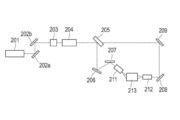
- FIG. 2 is a schematic view showing an example of an exposure apparatus used for holographic exposure.
- reference numeral 201 is a laser light source
- reference numeral 202 is a beam steerer
- reference numeral 203 is a shutter
- reference numeral 204 is a beam expander
- reference numeral 205 is a beam splitter
- reference numerals 206, 207, 208, and 209 are mirrors.
- Reference numerals 211 and 212 denote spatial filters
- reference numeral 213 denotes a manufacturing optical system.
- a layer containing a polymerizable monomer before holographic exposure is referred to as a “photosensitive layer”, and a layer in which a volume hologram is recorded by performing holographic exposure on the photosensitive layer is referred to as a “volume hologram recording layer”.
- composition for forming a volume hologram recording layer of the present embodiment (hereinafter sometimes simply referred to as “photosensitive composition”) is a photosensitive composition used for forming a volume hologram recording layer of a holographic optical element. .
- the volume hologram recording layer forming composition according to the present embodiment includes a matrix resin or a precursor thereof, a radical polymerizable monomer, a radical polymerization initiator, and a polyvalent acid.
- a holographic optical element produced using such a photosensitive composition is excellent in diffraction efficiency. Moreover, the transparency of a holographic optical element is also maintained favorable by using the photosensitive composition which concerns on this embodiment.
- the volume hologram recording layer having such a configuration can have high diffraction efficiency with low light scattering loss.
- the photosensitive layer formed by the photosensitive composition of the present embodiment contains a polyvalent acid therein.
- radicals radiation monomers generated in the initial stage of the radical polymerization reaction and radicals of low molecular weight oligomers generated by polymerization of several monomers
- the polyvalent acid coordinates to the intermediate. Therefore, it is presumed that, due to the coordination of the polyvalent acid, the molecular weight of these radical bodies is apparently increased, so that diffusion transfer is suppressed and the radical bodies moving to the non-exposed part (dark part) are reduced.
- the polyvalent acid does not prevent the radical polymerizable monomer that is not a radical body (that is, neutral) from moving to the exposed portion (bright portion) in the non-exposed portion (dark portion), and the exposed portion. It is difficult to inhibit the radical polymerization reaction in (light part). Therefore, also from this point, it is presumed that the polyvalent acid contributes to the improvement of the diffraction efficiency.
- the present inventors say that the holographic optical element manufactured using the photosensitive composition according to the present embodiment maintains high transparency. From the viewpoint, it has been found that it is excellent in durability. Although there are various causes for reducing the durability of the holographic optical element, one reason is the diffusion movement of the polymer (photopolymer) in the photosensitive layer. On the other hand, since the photosensitive layer (volume hologram recording layer) formed using the photosensitive composition of the present embodiment contains a polyvalent acid as described above, the polyvalent acid is a polymer (photopolymer). ) Are moderately interacting with each other, and it is presumed that the diffusion movement is suppressed. Therefore, it is considered that the holographic optical element produced using the photosensitive composition according to the present embodiment can maintain high transparency.
- the said mechanism is based on assumption and the photosensitive composition of this embodiment and a holographic optical element using the same are not restrict
- X to Y indicating a range includes X and Y, and means “X or more and Y or less”. Unless otherwise specified, operations and physical properties are measured under conditions of room temperature (20 to 25 ° C.) / Relative humidity 40 to 50% RH.
- the volume hologram recording layer forming composition (photosensitive composition) according to this embodiment further contains a polyvalent acid in addition to the matrix resin or a precursor thereof, a radical polymerizable monomer, and a radical polymerization initiator.
- the photosensitive composition may contain a sensitizer, a chain transfer agent, a solvent, and the like.
- the photosensitive composition may contain other additives. Hereinafter, these components will be described.
- the photosensitive composition according to this embodiment contains a polyvalent acid.
- Polyvalent acid refers to an acid having hydrogen capable of generating two or more hydrogen ions in one molecule.
- the polyvalent acid may be either an organic acid or an inorganic acid.
- a holographic optical element having high diffraction efficiency can be obtained by forming a volume hologram recording layer using the photosensitive composition according to this embodiment containing such a polyvalent acid.
- the holographic optical element can maintain high transparency favorably.
- an operation of cutting to a predetermined size may be performed after forming a photosensitive layer by applying and drying the photosensitive composition according to the present embodiment.
- the cutting machine used for performing the above cutting operation and the photosensitive layer are bonded, the photosensitive composition may pull the yarn, after that, holographic exposure is performed to produce a volume hologram recording layer, The part where the thread is pulled may remain, which may cause a poor appearance.
- the photosensitive composition according to the present embodiment the details of the mechanism are not clear, but it has been found that such a stringing phenomenon can also be reduced. Therefore, the photosensitive composition according to this embodiment is useful for producing a holographic optical element having a good appearance.
- the acid group contained in the polyvalent acid is not particularly limited.
- the “acid group” refers to a group capable of generating hydrogen ions.
- Examples of the acid group include a carboxyl group (—CO 2 H), a phosphoric acid group (—O—PO (OH) 2 ), a phosphonic acid group (—PO (OH) 2 ), and a sulfonic acid group (—SO 3 H). ) And sulfinic acid groups (—SO 2 H) and the like.
- the polyvalent acid may be contained in the photosensitive composition (or in the volume hologram recording layer) in a state where the acid group is in the form of a salt.
- the polyvalent acid may have only one kind of the acid group, or may have two or more kinds of the acid group.
- the polyvalent acid preferably has at least one selected from a carboxyl group, a phosphoric acid group, a phosphonic acid group, and a sulfonic acid group as an acid group.
- the acid group in the polyvalent acid is more preferably a carboxyl group and a phosphate group, and particularly preferably a carboxyl group.
- the polyvalent acid having the above acid group can particularly improve the diffraction efficiency of the volume hologram recording layer.
- the polyvalent acid is preferably a divalent or higher carboxylic acid, phosphoric acid, phosphonic acid or a divalent or higher sulfonic acid, more preferably a divalent or higher carboxylic acid or phosphoric acid, more preferably a divalent or higher valent acid.
- a carboxylic acid is particularly preferred.
- the valence of the polyvalent acid (the number at which one molecule can release hydrogen ions) is not particularly limited as long as it is 2 or more.
- the polyvalent acid preferably has a valence of 2 to 7, more preferably 2 to 5, more preferably 2 to Trivalent is even more preferable, and trivalent is particularly preferable.
- the number of acid groups (number in one molecule) possessed by the polyvalent acid is not particularly limited as long as the compound is a polyvalent acid, but it facilitates the interaction with radicals generated during holographic exposure, and the diffraction efficiency. From the viewpoint of enhancing the ratio, it is preferably 2 or more. On the other hand, the upper limit is not particularly limited, but is preferably 7 or less from the viewpoint of easy availability and the function of other components in the photosensitive composition. Furthermore, the number of acid groups (number in one molecule) of the polyvalent acid is more preferably 2 to 5, and particularly preferably 2 to 3. In addition, when a polyvalent acid has 2 or more types of acid groups, it is preferable in the total number of each acid group being in the said range.
- the polyvalent acid is preferably a carboxylic acid, phosphoric acid, phosphonic acid or sulfonic acid, wherein the number of acid groups in one molecule is 2 to 7, and the number of acid groups in one molecule is Those having 2 to 5 are more preferable, and those having 2 to 3 acid groups in one molecule are particularly preferable.
- the polyvalent acid is a carboxylic acid or phosphoric acid, preferably having 2 to 7 acid groups in one molecule, and having 2 to 5 acid groups in one molecule. More preferred are those having 2 to 3 acid groups in one molecule.
- the polyvalent carboxylic acid is preferably a carboxylic acid having 2 to 7 acid groups in one molecule, more preferably 2 to 5 acid groups in one molecule. Those having 2 to 3 acid groups in one molecule are particularly preferred.
- the polyvalent acid has a radical reactive unsaturated bond. It is preferable that it is a compound which does not have. That is, the polyvalent acid is preferably other than an unsaturated aliphatic (aliphatic having an unsaturated bond) polyvalent acid. Therefore, the polyvalent acid is preferably a saturated aliphatic polyvalent acid and an aromatic polyvalent acid, more preferably a saturated aliphatic polyvalent acid, and particularly preferably a saturated aliphatic polyvalent carboxylic acid.
- examples of the compound contained as a polyvalent acid include, but are not limited to, the following.
- the above polyvalent acids may be used alone or in combination of two or more.
- the polyvalent acid may be a commercially available product or a synthetic product.
- polyvalent acids include oxalic acid, tartaric acid, and citric acid. It is preferable that it is at least one selected from the group consisting of
- the molecular weight of the polyvalent acid is not particularly limited, but is preferably 400 or less, more preferably 300 or less, and more preferably 250 or less from the viewpoints of availability and difficulty in inhibiting the diffusion transfer of the radical polymerizable monomer. Particularly preferred.
- the lower limit is not particularly limited, but is substantially about 90.
- the molecular weight of the polyvalent acid can be measured by a known method, and can be analyzed by, for example, LC-MS (liquid chromatography-mass spectrometry).
- the addition amount of the polyvalent acid is not particularly limited as long as the effects of the present invention can be obtained, but it is preferably 20 to 80% by mass and preferably 30 to 70% by mass with respect to the total amount of the radical polymerization initiator. More preferably, it is particularly preferably 40 to 60% by mass. If it is 20 mass% or more, the effect of improving the diffraction efficiency of the volume hologram recording layer and the effect of maintaining good transparency can be sufficiently obtained. Moreover, since it is hard to inhibit the function of the other component contained in a photosensitive composition if it is 80 mass% or less, it is preferable. In addition, when mixing and using 2 or more types of polyhydric acid, it is preferable in the total amount of each polyhydric acid being in the said range.
- the addition amount of the polyvalent acid to the radical polymerizable monomer is not particularly limited, but for the purpose of sufficiently obtaining the effects of the present invention, 0.01 to 0.5% by mass with respect to the total amount of the radical polymerizable monomer. Is preferable, and 0.02 to 0.1% by mass is more preferable.
- the content of the polyvalent acid in the photosensitive composition is not particularly limited, but is preferably 0.001 to 0.1% by mass, and preferably 0.005 to 0% with respect to the total amount of the photosensitive composition. .05% by mass is more preferable.
- the total amount of each polyhydric acid being in the said range.
- the radical polymerizable monomer is polymerized by holographic exposure to form a diffraction grating composed of a high refractive index region and a low refractive index region.
- a photopolymer is formed by the polymerization of the radically polymerizable monomer.
- photopolymer refers to a polymer obtained as a result of polymerization of a radical polymerizable monomer contained in a photosensitive composition.
- the photosensitive composition according to the present embodiment may be an embodiment containing a matrix resin that forms a low refractive index region and a radically polymerizable monomer that forms a high refractive index region, or a high refractive index.
- region may be sufficient.
- a high refractive index region and a low refractive index region are formed in the photosensitive layer by polymerizing the radical polymerizable monomer during holographic exposure. These regions can form a plurality of diffraction gratings with high contrast.
- the matrix resin when the matrix resin forms a high refractive region, the matrix resin often includes a bulky cyclic skeleton. Then, since the matrix resin is difficult to move, the refractive index difference between the exposed portion (bright portion) and the non-exposed portion (dark portion) may not be increased. For this reason, among the above-described embodiments, it is preferable that the matrix resin selects a component that forms a low refractive index region and the radical polymerizable monomer selects a component that forms a high refractive index region.
- those having a relatively high refractive index include, for example, acrylamide, methacrylamide, methylenebisacrylamide, polyethylene glycol diacrylate, trimethylolpropane Acrylate, pentaerythritol triacrylate, dipentaerythritol hexaacrylate, 2,3-dibromopropyl acrylate, dicyclopentanyl acrylate, dibromoneopentyl glycol diacrylate, 2-phenoxyethyl acrylate, 2-phenoxymethyl methacrylate, phenol ethoxylate mono Acrylate (2-phenoxyethyl acrylate), 2- (p-chlorophenoxy) ethyl acrylate, p-chlorophenylacrylic , Phenyl acrylate, 2-phenylethyl acrylate, 2- (1-naphthyloxy) ethyl acrylate,
- di (2-methacryloxyethyl) ether of bisphenol A di (2-methacryloxyethyl) ether of bisphenol A, ethoxylated bisphenol A diacrylate (bisphenol A epoxy diacrylate), di (3-acryloxy-2-hydroxypropyl) of bisphenol A ) Ether, di (2-acryloxyethyl) ether of bisphenol A, N-vinylcarbazole, 2- (9-carbazolyl) ethyl acrylate, and 2- [ ⁇ - (N-carbazyl) propionyloxy] ethyl acrylate are preferred. .
- the radical polymerizable monomer is di (2-methacryloxyethyl) ether of bisphenol A, ethoxylated bisphenol A diacrylate (bisphenol A epoxy diacrylate), di (3-acryloxy-2-hydroxypropyl) ether of bisphenol A From the group consisting of di (2-acryloxyethyl) ether of bisphenol A, N-vinylcarbazole, 2- (9-carbazolyl) ethyl acrylate, and 2- [ ⁇ - (N-carbazyl) propionyloxy] ethyl acrylate It is preferable to include at least one selected.
- the radically polymerizable monomer particularly preferably contains ethoxylated bisphenol A diacrylate (bisphenol A epoxy diacrylate) or N-vinylcarbazole. These monomers have a relatively high refractive index and tend to interact with polyvalent acids when they become radicals. Therefore, the effect of improving the diffraction rate is easily obtained.
- those having a 9,9-diarylfluorene skeleton and having at least one ethylenically unsaturated bond in the molecule can be mentioned. Specifically, it is a compound having the following structure.
- R 1 and R 2 are each independently a radical polymerizable group containing an acryloyl group or a methacryloyl group at the terminal.
- a preferred form is a group having an acryloyl group or a methacryloyl group at the terminal and capable of binding to the benzene ring of the above compound via an oxyethylene chain, an oxypropylene chain, a urethane bond, an amide bond, or the like.
- X 1 to X 4 are each independently a hydrogen atom or a substituent.
- substituents include an alkyl group having 1 to 4 carbon atoms, an alkoxy group having 1 to 4 carbon atoms, an amino group, a dialkylamino group, a hydroxyl group, a carboxyl group, and a halogen atom.
- urethane acrylates composed of a condensate of a phenyl isocyanate compound and a compound having a group having an ethylenically unsaturated bond such as a hydroxy group and an acryloyl group in one molecule can be used. Specifically, it is a compound having the following structure.
- each R is independently a group having an ethylenically unsaturated bond
- each X is independently a single bond, an oxygen atom, or a straight-chain, A branched or cyclic divalent aliphatic hydrocarbon group.
- R 1 to R 5 are each independently a hydrogen atom, a halogen atom, an alkyl group having 1 to 6 carbon atoms, a trifluoromethyl group, an alkylthio group having 1 to 6 carbon atoms, or a carbon number.
- An alkylseleno group having 1 to 6 carbon atoms, an alkyl tellurium group having 1 to 6 carbon atoms, or a nitro group, and R 6 and R 7 are each independently a hydrogen atom or an alkyl group having 1 to 6 carbon atoms. .
- A represents a linear or branched alkylene group having 1 to 6 carbon atoms, a linear or branched alkenylene group having 2 to 6 carbon atoms, or an ethylene oxide unit or propylene oxide unit having 2 to 6 carbon atoms.
- a polyalkylene oxide group represents a linear or branched alkylene group having 1 to 6 carbon atoms, a linear or branched alkenylene group having 2 to 6 carbon atoms, or an ethylene oxide unit or propylene oxide unit having 2 to 6 carbon atoms.
- R 1 to R 5 are each independently a hydrogen atom or an alkylthio group having 1 to 6 carbon atoms
- R 6 and R 7 are hydrogen atoms
- A is linear or branched And preferably an alkylene group having 2 to 6 carbon atoms.
- radical polymerizable monomers a monomer having a substituted or unsubstituted phenyl group, a monomer having a substituted or unsubstituted naphthyl group, a substituted or unsubstituted heterocyclic aromatic moiety having up to 3 rings , A monomer having a chlorine atom, and a monomer containing a bromine atom are preferable because of their relatively high refractive index.
- the above radical polymerizable monomers can be used alone or in combination of two or more.
- the content of the radical polymerizable monomer in the photosensitive composition is preferably 1 to 35% by mass with respect to the total amount of the photosensitive composition. More preferably, it is mass%.
- the radical polymerization initiator is an agent that initiates photopolymerization of a radical polymerizable monomer by irradiation with laser light having a specific wavelength or light having excellent coherence in holographic exposure.
- photo radical polymerization initiators that can be used in such a reaction include US Pat. Nos. 4,766,055, 4,868,092, 4,965,171, JP-A-54-151024, and 58. No. 15503, No. 58-29803, No. 59-189340, No. 60-76735, JP-A No. 1-28715, No. 4-239505 and “Proceedings of Conference.
- Known polymerization initiators described in, for example, “PROCEEDINGS OF CONFERENCE ON RADIATION CURING ASIA” (pp. 461-477, 1988) can be used, but are not limited thereto.
- radical polymerization initiator include, for example, diaryliodonium salts, 2,4,6-substituted-1,3,5-triazines (triazine compounds), azo compounds, azide compounds, Examples thereof include organic peroxides, organoborates, onium salts, halogenated hydrocarbon derivatives, titanocene compounds, monoacylphosphine oxides, bisacylphosphine oxides, and combinations of bisacylphosphine oxides and ⁇ -hydroxyketones.
- the radical photopolymerization initiator system by combined use of hydrogen donors, such as a thiol compound, and a bisimidazole derivative can also be utilized. These radical polymerization initiators (photo radical polymerization initiators) may be used alone or in combination of two or more.
- the amount of radical polymerization initiator used is preferably 0.01 to 50 parts by mass, more preferably 0.05 to 30 parts by mass with respect to 100 parts by mass of the radical polymerizable monomer.
- the content of the radical polymerization initiator in the photosensitive composition is not particularly limited, but is 0.001 to 1% by mass with respect to the total amount of the photosensitive composition. Preferably, the content is 0.01 to 0.5% by mass.
- the photosensitive composition concerning this embodiment may contain the sensitizer which has a sensitization function with respect to radical photopolymerization initiator.
- a sensitizer has an absorption maximum wavelength in the range of 400 to 800 nm, particularly 450 to 700 nm. These sensitizers absorb light in the above range, thereby causing a sensitizing action on the radical photopolymerization initiator.
- Examples of such a sensitizer include polymethine compounds such as cyanine dyes and styryl dyes, xanthene compounds such as rhodamine B, rhodamine 6G, and pyronin GY, phenazine compounds such as safranin O, cresyl violet, Phenoxazine compounds such as brilliant cresyl blue, phenothiazine compounds such as methylene blue and new methylene blue, diarylmethane compounds such as auramine, triarylmethane compounds such as crystal violet, brilliant green and lissamine green, (thio) pyrylium Examples thereof include salt compounds, squarylium compounds, coumarin dyes, thioxanthene dyes, acene dyes, merocyanine dyes, thiazolium dyes, and the like. These sensitizers can be used alone or in combination of two or more.
- the amount used is preferably 1 to 2000 parts by weight, more preferably 20 to 1500 parts by weight, based on 100 parts by weight of the radical photopolymerization initiator.
- the photosensitive composition according to this embodiment may include a chain transfer agent.
- the chain transfer agent is not particularly limited, and a known radical chain transfer agent can be used.
- chain transfer agent examples include n-butyl mercaptan, t-butyl mercaptan, t-dodecyl mercaptan, n-octyl mercaptan, n-lauryl mercaptan, 5-chloro-2-mercaptobenzothiazole, 4-methyl-4H-1 Mercaptans such as 1,2,4-triazole-3-thiol and 6-ethoxy-2-mercaptobenzothiazole; disulfides such as tetramethylthuradium disulfide and tetraethylthuradium disulfide; carbon tetrachloride and carbon tetrabromide Halogen compounds; olefins such as 2-methyl-1-butene and ⁇ -methylstyrene dimer; and the like. These chain transfer agents can be used alone or in combination of two or more.
- the amount used is preferably 0.05 to 50 parts by mass, more preferably 0.1 to 30 parts by mass with respect to 100 parts by mass of the radical polymerizable monomer.
- the matrix resin functions to improve the uniformity of the film thickness of the volume hologram recording layer, heat resistance, mechanical properties, etc., and stabilize the hologram formed by holographic exposure. Further, when the volume hologram recording layer is formed, it may have a function of not inhibiting or efficiently expressing the diffusion transfer phenomenon of the polymerizable monomer.
- the matrix resin or a precursor thereof a material that forms a high refractive index region or a material that forms a low refractive index region can be appropriately employed in relation to the radical polymerizable monomer.
- the radical polymerizable monomer preferably exhibits a high refractive index
- the matrix resin or its precursor preferably has a low refractive index.
- the matrix resin for example, any of thermoplastic resin, thermosetting resin, active energy ray curable resin, and the like can be used without limitation.
- those resins modified with a polysiloxane chain or a perfluoroalkylene chain can also be used.
- the matrix resins can be used alone or in combination of two or more.
- thermoplastic resins include, for example, polyvinyl acetate, polyvinyl butyrate, polyvinyl formal, polyvinyl carbazole, polyacrylic acid, polymethacrylic acid, polymethyl acrylate, polymethyl methacrylate, polyethyl acrylate, polybutyl acrylate, polymethacrylo Nitrile, polyethyl methacrylate, polybutyl methacrylate, polyacrylonitrile, poly-1,2-dichloroethylene, ethylene-vinyl acetate copolymer, tetrafluoroethylene-vinyl acetate copolymer, syndiotactic polymethyl methacrylate, poly- ⁇ -Vinyl naphthalate, polycarbonate, cellulose acetate, cellulose triacetate, cellulose acetate butyrate, polystyrene, poly- ⁇ -methyls Tylene, poly-o-methylstyrene, poly-p-methylstyrene, poly-
- thermosetting resin examples include unsaturated polyester, acrylic urethane resin, epoxy-modified acrylic resin, epoxy-modified unsaturated polyester, polyurethane, alkyd resin, phenol resin and the like.
- active energy ray-curable resin examples include epoxy acrylate, urethane acrylate, and acrylic-modified polyester. These active energy ray-curable resins can contain other monofunctional or polyfunctional monomers, oligomers and the like as described below for the purpose of adjusting the cross-linked structure and viscosity.
- thermoplastic resin thermosetting resin, or active energy ray curable resin
- metal soap such as cobalt naphthenate and zinc naphthenate
- organic peroxides such as benzoyl peroxide and methyl ethyl ketone peroxide
- benzophenone Thermal or active energy ray curing agents such as acetophenone, anthraquinone, naphthoquinone, azobisisobutyronitrile, diphenyl sulfide and the like can be contained in the photosensitive composition.
- thermosetting resin or an active energy ray curable resin after forming a photosensitive layer containing an uncured resin on the adjacent layer, it can be cured by heating or irradiation with an active energy ray. Curing may be performed before or after holographic exposure.
- a matrix resin precursor may be used.
- the precursor include an isocyanate compound and a polyol compound that form a polyurethane by addition polymerization.
- the isocyanate compound those having two or more isocyanate groups in one molecule are preferable, but the type is not particularly limited. If the number of isocyanate groups in one molecule is small, the hardness required for the matrix resin may not be obtained.
- the upper limit of the number of isocyanate groups in one molecule is not particularly limited, but is usually about 20 or less, preferably 8 or less, and more preferably 4 or less.
- the type is not particularly limited as long as it has two or more isocyanate groups in one molecule.
- isocyanate compounds used in this embodiment include aliphatic isocyanates such as hexamethylene diisocyanate, lysine methyl ester diisocyanate, 2,4,4-trimethylhexamethylene diisocyanate, isophorone diisocyanate, 4,4′-methylenebis (cyclohexyl).
- Alicyclic isocyanates such as isocyanate); aromatic isocyanates such as tolylene diisocyanate, 4,4′-diphenylmethane diisocyanate, xylylene diisocyanate, naphthalene-1,5′-diisocyanate; and multimers or derivatives thereof. It is done.
- reaction products of polyhydric alcohols such as water, trimethylolethane, trimethylolpropane and the above-mentioned isocyanate compounds.
- polyol compound examples include polypropylene polyol, polycaprolactone polyol, polyester polyol, polycarbonate polyol, ethylene glycol, propylene glycol, 1,4-butanediol, 1,5-pentanediol, 3-methyl-1,5-pentanediol, , 6-hexanediol, neopentyl glycol, diethylene glycol, 1,4-cyclohexanediol, 1,4-cyclohexanedimethanol, decamethylene glycol, trimethylolpropane, polyethylene glycol, polypropylene glycol, polytetramethylene glycol and the like.
- These polyol compounds may be used alone or in combination of two or more.
- a catalyst for addition polymerization of an isocyanate compound and a polyol compound can be blended in the photosensitive composition. Although it can be cured at room temperature by using a catalyst, it may be cured by heating. The temperature during curing is preferably in the range of 40 to 90 ° C., and the curing time is preferably 1 to 24 hours.
- the catalyst examples include ordinary urethanization reaction catalysts, for example, tin compounds such as dibutyltin dilaurate, dioctyltin dilaurate and dibutyltin dioctanoate, and tertiary amine compounds such as triethylamine and triethylenediamine.
- tin compounds such as dibutyltin dilaurate, dioctyltin dilaurate and dibutyltin dioctanoate
- tertiary amine compounds such as triethylamine and triethylenediamine.
- the tin compound has good solubility and performance as a medium, and dibutyltin dilaurate is particularly preferable.
- the amount of the catalyst used is preferably 0.0001% by mass or more, more preferably 0.001% by mass or more, and preferably 10% by mass or less, based on the total amount of the isocyanate compound and the polyol compound, and 5% by mass or less. Is more preferable.
- a cationic polymerizable monomer may be used as another precursor of the matrix resin.
- the matrix resin obtained from the cationic polymerizable monomer makes it possible to produce a volume hologram recording layer having excellent film strength.
- cationic polymerizable monomers include diglycerol polyglycidyl ether, pentaerythritol polyglycidyl ether, 1,4-bis (2,3-epoxypropoxyperfluoroisopropyl) cyclohexane, sorbitol polyglycidyl ether, trimethylolpropane poly Glycidyl ether, resorcin diglycidyl ether, 1,6-hexanediol diglycidyl ether, polyethylene glycol diglycidyl ether, phenyl glycidyl ether, para-t-butylphenyl glycidyl ether, adipic acid diglycidyl ester, orthophthalic acid diglycidyl ester, dibromo Phenyl glycidyl ether, dibromoneopentyl glycol diglycidyl ether, 1,2,7,8-diepoxy Octane,
- a photo cationic polymerization initiator or a thermal cationic polymerization initiator may be used.
- cationic photopolymerization initiator examples include iodonium salts and triarylsulfonium salts.
- iodonium salts include iodonium tetrafluoroborate, hexafluorophosphate, hexafluoroarsenate, hexafluoroantimonate, trifluoromethanesulfonate, 9,10-dimethoxyanthracene-2-sulfonate, and the like.
- triarylsulfonium salts include triarylsulfonium, triphenylsulfonium, 4-tert-butyltriphenylsulfonium, tris (4-methylphenyl) sulfonium, tris (4-methoxyphenyl) sulfonium, 4-thiophenyltri Examples include sulfonium tetrafluoroborate such as phenylsulfonium, hexafluorophosphate, hexafluoroarsenate, hexafluoroantimonate, trifluoromethanesulfonate, 9,10-dimethoxyanthracene-2-sulfonate, and the like. These photocationic polymerization initiators can be used singly or in combination of two or more.
- thermal cationic polymerization initiator examples include cationic or protonic acid catalysts such as triflate, boron trifluoride etherate compound, boron trifluoride, etc.
- Preferred thermal cationic polymerization initiators Triflate.
- Specific examples include diethylammonium triflate, triethylammonium triflate, diisopropylammonium triflate, ethyldiisopropylammonium triflate available from 3M as “FC-520” (many of which are by RR Alm in 1980). There is Modern Coatings (listed in Modern Coatings) issued in October.
- aromatic onium salts used as active energy ray cationic polymerization initiators there are those that generate cationic species by heat, and these can also be used as thermal cationic polymerization initiators. Examples include “Sun-Aid (registered trademark) SI-60L”, “Sun-Aid (registered trademark) SI-80L” and “Sun-Aid (registered trademark) SI-100L” (manufactured by Sanshin Chemical Industry Co., Ltd.).
- the amount of the photo cationic polymerization initiator or the thermal cationic polymerization initiator used is preferably 0.05 to 50 parts by mass with respect to 100 parts by mass of the cationic polymerizable monomer. More preferred is 30 parts by mass.
- the content of the matrix resin or the precursor thereof in the photosensitive composition is preferably 1 to 30% by mass, more preferably 1 to 25% by mass with respect to the total mass of the photosensitive composition, More preferably, it is 5 to 20% by mass.
- the photosensitive composition according to the present embodiment may use a solvent as necessary when coating. However, when the photosensitive composition contains a component that is liquid at room temperature, a solvent may not be necessary.
- the solvent examples include aliphatic solvents such as n-pentane, n-hexane, n-heptane, n-octane, cyclohexane, and methylcyclohexane; ketone solvents such as methyl ethyl ketone (2-butanone), acetone, and cyclohexanone; Ether solvents such as diethyl ether, isopropyl ether, tetrahydrofuran, dioxane, ethylene glycol dimethyl ether, ethylene glycol diethyl ether, diethylene glycol dimethyl ether, diethylene glycol diethyl ether, propylene glycol monomethyl ether, anisole, phenetole; ethyl acetate, butyl acetate, ethylene glycol diacetate Ester solvents such as: aromatic solvents such as toluene and xylene; methyl cellosolve, ethyl Cello
- the content of the solvent in the photosensitive composition is not particularly limited, but is preferably 40 to 80% by mass, more preferably 55 to 70% by mass with respect to the total mass of the photosensitive composition, More preferably, it is 60 to 65% by mass.
- the photosensitive composition is optionally made of a plasticizer, a compatibilizer, a polymerization inhibitor, a surfactant, a silane coupling agent, an antifoaming agent, a release agent, a stabilizer, an oxidation
- a plasticizer such as an acrylic acid, a polymethyl methacrylate, a polymethyl methacrylate, a polymethyl methacrylate, a polymethyl methacrylate, a polymethyl methacrylate, sodium bicarbonate, sodium bicarbonate, sodium bicarbonate, sodium bicarbonate, sodium bicarbonate, sodium bicarbonate, sodium bicarbonate, sodium bicarbonate, sodium bicarbonate, sodium bicarbonate, sodium bicarbonate, sodium bicarbonate, sodium bicarbonate, sodium bicarbonate, sodium bicarbonate, sodium bicarbonate, sodium bicarbonate, sodium bicarbonate, sodium bicarbonate, sodium bicarbonate, sodium bicarbonate, sodium bicarbonate, sodium bicarbonate, sodium bicarbonate, sodium bicarbonate, sodium bicarbonate, sodium sulf
- the photosensitive composition can be obtained by mixing the above-described components all at once or sequentially.
- the apparatus used for mixing include stirring or mixing apparatuses such as a magnetic stirrer, homodisper, quick homomixer, and planetary mixer.
- the obtained photosensitive composition may be used after filtration, if necessary.
- the present invention also provides a holographic optical element having a volume hologram recording layer obtained by curing the photosensitive composition. That is, other embodiment of this invention is a holographic optical element containing the hardened
- FIG. 1 is a schematic cross-sectional view showing a typical configuration of the holographic optical element of the present embodiment.
- the holographic optical element 10 according to this embodiment preferably includes a volume hologram recording layer 11 and a pair of adjacent layers 12.
- the constituent material and thickness of each adjacent layer 12 may be the same or different.
- the holographic optical element shown in FIG. 1 is provided with a pair of adjacent layers 12 so as to be in contact with both surfaces of the volume hologram recording layer 11, but the adjacent layer 12 is provided only on one surface of the volume hologram recording layer 11. It may be a form.
- the volume hologram recording layer is formed by performing at least holographic exposure on a coating film (photosensitive layer) obtained by applying the photosensitive composition to the above-mentioned adjacent layer and drying it.
- a diffraction grating composed of a high refractive index region and a low refractive index region is formed in the photosensitive layer, whereby a volume hologram recording layer is formed.
- the thickness of the volume hologram recording layer (photosensitive layer) is preferably 10 to 100 ⁇ m, more preferably 10 to 50 ⁇ m from the viewpoint of durability.
- the volume hologram recording layer formed by performing holographic exposure on the photosensitive composition contains the polyvalent acid.
- the content of the polyvalent acid is not particularly limited, but is preferably 0.0001 to 0.1% by mass and more preferably 0.0005 to 0.05% by mass with respect to the total mass of the volume hologram recording layer. preferable.
- content of the said polyhydric acid can be calculated
- the material of the adjacent layer can be appropriately selected depending on the form of the holographic optical element, and can be selected from known materials that are optically transparent.
- “transparent” means that the total light transmittance in the visible light wavelength region is 60% or more.
- the material of the adjacent layer is not particularly limited as long as it is optically transparent.
- inorganic materials such as glass, silicon, and quartz; (meth) acrylic resin, polycarbonate, polyethylene terephthalate (PET), polybutylene Terephthalate, polyethylene naphthoate, polyethylene, polypropylene, amorphous polyolefin, cellulose acetate, hydrated cellulose, cellulose nitrate, cycloolefin polymer, polystyrene, polyepoxide, polysulfone, cellulose acylate, polyamide, polyimide, polymethyl methacrylate, polyvinyl chloride, polyvinyl Examples thereof include organic materials such as butyral and polydicyclopentadiene.
- the above resins (polymers) may be used alone or in admixture of two or more. Among these, since cellulose acylate is excellent in optical properties, it can be suitably used as a material for the adjacent layer.
- the adjacent layer may contain components other than the above resin as long as the density, optical properties and the like are not impaired.
- resin components such as cycloolefin resins and fluorine-containing resins, ultraviolet absorbers, antioxidants, deterioration inhibitors, light stabilizers, thermal stabilizers, lubricants, plasticizers, antistatic agents, flame retardants, fillers, fine particles
- other components such as an optical property adjusting agent may be included.
- the addition amount of other components (the total when two or more are added) is preferably 0.1 to 25% by mass with respect to the total mass of the adjacent layers.
- the adjacent layer may be in the form of a film or plate, or may be in the form of a substrate that also serves as a prism.
- processing by cutting is possible, and there is a convenience that it can be applied to various optical elements.
- the photosensitive composition and the cutting machine are bonded, and the photosensitive composition may pull the thread, but the photosensitive layer formed using the photosensitive composition according to the present embodiment, The above stringing can be suppressed, which is preferable.
- the thickness is not particularly limited, but is preferably 10 to 1000 ⁇ m, and more preferably 50 to 200 ⁇ m.
- the holographic optical element of the present embodiment may have other layers such as a protective layer, a reflective layer, an antireflection film, and an ultraviolet absorption layer.
- the protective layer is a layer for preventing the influence of deterioration of storage stability of the recording layer.
- a protective layer There is no restriction
- a layer made of a water-soluble polymer, an organic / inorganic material, or the like can be formed as a protective layer.
- limiting in particular in the formation position of a protective layer For example, you may form between the surface of a volume hologram recording layer, an adjacent layer, and a support body, and may form on the outer surface side of a support body.
- the reflective layer is formed when the holographic optical element is configured to be reflective.
- the reflective layer is usually formed on the outer surface of the adjacent layer.
- the reflective layer conventionally known ones can be applied as appropriate, and for example, a metal thin film or the like can be used.
- an antireflection film may be provided on the side on which object light and reproduction light are incident and emitted, or between the volume hologram recording layer and the adjacent layer. Good.
- the antireflection film functions to improve light utilization efficiency and suppress the generation of ghost images.
- the antireflection film conventionally known ones can be referred to as appropriate.
- the holographic optical element of this embodiment may be further sandwiched between transparent supports.
- the support may be employed to protect and hold the holographic optical element of this embodiment, or may be employed to function as an optical element such as a prism in combination with the holographic optical element.
- the support is not particularly limited as long as it has necessary strength and durability, and any support can be used. Moreover, although there is no restriction
- the support is made of a transparent material
- inorganic materials such as glass, silicon and quartz can be cited.
- glass is preferable.
- Non-transparent materials for the support include metals such as aluminum; metals such as gold, silver and aluminum coated on the transparent support or dielectrics such as magnesium fluoride and zirconium oxide Is mentioned.
- the surface of the support may be subjected to surface treatment.
- This surface treatment is usually performed to improve the adhesion between the support and the holographic optical element.
- Examples of the surface treatment include subjecting the support to corona discharge treatment or forming an undercoat layer on the support in advance.
- examples of the composition of the undercoat layer include halogenated phenols, partially hydrolyzed vinyl chloride-vinyl acetate copolymers, polyurethane resins, and the like.
- the surface treatment may be performed for purposes other than improving the adhesiveness.
- examples thereof include a reflective coating treatment for forming a reflective coating layer made of a metal such as gold, silver, and aluminum; a dielectric coating treatment for forming a dielectric layer such as magnesium fluoride and zirconium oxide, and the like. It is done.
- these layers may be formed of a single layer or two or more layers.
- These surface treatments may be provided for the purpose of controlling the gas and moisture permeability of the holographic optical element. Thereby, the reliability of the holographic optical element can be further improved.
- the support may be provided only on either the upper side or the lower side of the holographic optical element, or may be provided on both. However, when providing supports on both the upper and lower sides, at least one of the supports is configured to be transparent so as to transmit active energy rays (recording light, reference light, reproduction light, etc.).
- active energy rays recording light, reference light, reproduction light, etc.
- highly transparent adhesives such as a silicone adhesive and an acrylic adhesive, can be used.
- a transmissive or reflective hologram can be recorded.
- a support having reflection characteristics is used on one side of the holographic optical element, a reflection hologram can be recorded.
- a manufacturing method includes forming a photosensitive layer using the photosensitive composition according to the present embodiment, subjecting the photosensitive layer to holographic exposure, and forming a volume hologram recording layer. A method is mentioned.
- the method for forming the photosensitive layer on the adjacent layer is not particularly limited.
- the photosensitive composition is directly applied on the adjacent layer and dried, or the photosensitive composition is applied on a separately prepared substrate. Then, after drying, there is a method of laminating the adjacent layer using a laminator or the like and then peeling the substrate.
- the photosensitive layer is more easily adhered to the adjacent layer, and the combination with the adjacent layer promotes the formation of a diffraction grating up to the interface with the adjacent layer within the photosensitive layer. It is preferable to form the photosensitive layer by directly applying and drying the product.
- a conventionally known method can be used, and specific examples include a spray method, a spin coating method, a wire bar method, a dip coating method, Examples thereof include an air knife coating method, a roll coating method, a blade coating method, and a doctor roll coating method.
- the drying temperature is not particularly limited, and is, for example, in the range of 10 to 80 ° C.
- the drying time is not particularly limited, and is, for example, in the range of 1 to 60 minutes.
- the polymerization reaction of the polymerizable monomer in the photosensitive layer proceeds.
- the photocured photopolymer region generated by the polymerization reaction and the other component region are formed in the same pattern as the interference wave irradiated in the holographic exposure.
- the volume hologram recording layer has a structure sandwiched between two adjacent layers, after forming a photosensitive layer on one adjacent layer, another on the photosensitive layer.
- a holographic optical element having the structure can be obtained.
- the method of performing holographic exposure on the photosensitive layer and recording (writing) a volume hologram to form a volume hologram recording layer and the method of reproducing (reading) the volume hologram are not particularly limited, and examples thereof include the following methods. .
- recording light capable of causing a chemical change of the polymerizable monomer, that is, polymerization and concentration change
- recording light also called object light
- the interference light causes polymerization and concentration change of the polymerizable monomer in the photosensitive layer.
- the interference fringes cause a refractive index difference in the photosensitive layer, and the interference fringes recorded in the photosensitive layer It is recorded as a volume hologram and becomes a volume hologram recording layer. Thereby, a holographic optical element can be obtained.
- the recording light used for recording the volume hologram (the wavelength in the parentheses indicates a wavelength)
- a visible light laser having excellent coherence for example, an argon ion laser (458 nm, 488 nm, 514 nm), a krypton ion laser (647). 0.1 nm), helium-neon laser (633 nm), YAG laser (532 nm), etc. can be used.
- the irradiation energy amount (exposure amount) at the time of hologram recording is not particularly limited, but is preferably in the range of 10 to 250 mJ / cm 2 .
- a hologram recording system there are a polarization collinear hologram recording system, a reference light incident angle multiplexing type hologram recording system, etc., and any recording system can provide good recording quality.
- the exposure apparatus is not particularly limited.
- an exposure apparatus having a schematic configuration shown in FIG. 2 can be used.
- the light beam (recording light) emitted from the laser light source 201 guides the light beam to a suitable position in the exposure system by the beam steerers 202a and 202b composed of two pairs of mirrors.
- a shutter 203 controls ON / OFF of a light beam (recording light).
- a beam expander 204 has a function of expanding the beam diameter and changing the aperture ratio (NA) according to the exposure area of the photosensitive layer.
- the light beam (recording light) that has passed through the beam expander 204 is divided into two light beams by the beam splitter 205.
- the divided light beams (recording light) are guided to the spatial filters 211 and 212 by the mirrors 206 and 207 and the mirrors 209 and 208, respectively.
- Spatial filters 211 and 212 are composed of a lens and a pinhole, and collect light rays (recording light) with the lenses, and guide the light rays (recording light) to the manufacturing optical system 213 through the pinholes.
- the production optical system 213 can set and fix a sample such as a glass prism provided with a photosensitive layer serving as a volume hologram recording layer at a suitable position so that the reflection angle of the light beam of the holographic optical element can be controlled.
- a photosensitive layer provided on a prism or the like fixed to the manufacturing optical system 213 is divided into two light beams, and is subjected to holographic exposure (interference exposure) by light beams (recording light) guided through the spatial filters 211 and 212, respectively.
- a glitch mirror is inserted in the optical path before the shutter 203 to The emitted laser beam may be synthesized stepwise.
- the volume hologram recording layer can be further subjected to appropriate treatments such as full exposure with ultraviolet rays and heating in order to promote refractive index modulation and complete (fix) the polymerization reaction.
- a light source used for the entire surface exposure for example, a light source emitting ultraviolet rays such as an ultrahigh pressure mercury lamp, a high pressure mercury lamp, a carbon arc lamp, a xenon arc lamp, a metal halide lamp, or the like can be used.
- the irradiation energy amount in the case of performing the entire surface exposure with ultraviolet rays is preferably 50 to 200 J / cm 2 .
- the temperature during the heat treatment is preferably 50 to 150 ° C., and the treatment time is preferably 30 minutes to 3 hours.
- the order is not particularly limited, and the whole surface exposure may be performed first, or the heat treatment may be performed first.
- predetermined reproduction light (usually reference light) is irradiated to the volume hologram recording layer.
- the irradiated reproduction light is diffracted according to the interference fringes. Since this diffracted light contains the same information as the volume hologram recording layer, the information recorded in the volume hologram recording layer can be reproduced by reading the diffracted light with an appropriate detection means.
- the wavelength regions of the object light, the reproduction light, and the reference light are arbitrary depending on the application, and may be in the visible light region or the ultraviolet light region.
- the holographic optical element of the present embodiment includes, for example, a head mounted display (HMD), a head-up display (HUD), an optical memory, an optical disk pickup lens, a liquid crystal color filter, a reflective liquid crystal reflector, a lens, a diffraction grating, and an interference.
- HMD head mounted display
- HUD head-up display
- an optical memory for example, a liquid crystal color filter, a reflective liquid crystal reflector, a lens, a diffraction grating, and an interference.
- Example 1 Production of holographic optical element 1 The following components were put into a container in a dark room and stirred at room temperature for 30 minutes to obtain a solution. The obtained solution was filtered through a mesh to obtain a volume hologram recording layer forming composition 1 (photosensitive composition 1).
- PVAc Polyvinyl acetate
- 2-phenoxyethyl acrylate 6.0 parts by mass Bisphenol A epoxy diacrylate 1.0 part by mass N-vinylcarbazole 3.0 parts by mass Tetrabutylammonium triphenylbutyl borate (organic) Borate polymerization initiator, Showa D
- a volume hologram recording layer forming composition 1 was applied onto a polyethylene terephthalate (PET) film having a thickness of 100 ⁇ m using a blade coater and dried in an environment of 20 ° C. and 50% RH for 30 minutes, and a thickness of 15 ⁇ m.
- PET polyethylene terephthalate
- a photosensitive layer was obtained.
- the photosensitive precursor 1 which has the photosensitive layer formed from the composition 1 for volume hologram recording layer formation was obtained by affixing the photosensitive layer surface on the glass surface of AR glass.
- the obtained photosensitive precursor 1 was subjected to holographic exposure using an exposure apparatus (light source: argon ion laser, exposure wavelength 514 nm) so that the irradiation energy amount on the photosensitive layer surface was 24 mJ / cm 2 .
- the volume hologram recording layer KO is formed by placing the high pressure mercury lamp (illuminance of 100 W / cm 2 ) at a position of 15 cm for 60 minutes for post exposure, and then performing heat treatment at 100 ° C. for 3 hours. A holographic optical element 1 having ⁇ 1 was obtained.
- Example 2 Production of holographic optical element 2 A holographic optical element 2 having a volume hologram recording layer KO-2 was obtained in the same manner as in Example 1 except that tartaric acid was changed to oxalic acid (molecular weight: 90.0).
- Example 3 Production of Holographic Optical Element 3 A holographic optical element 3 having a volume hologram recording layer KO-3 was obtained in the same manner as in Example 1 except that tartaric acid was changed to citric acid (molecular weight: 192.1).
- Example 4 Production of Holographic Optical Element 4 A holographic optical element 4 having a volume hologram recording layer KO-4 was obtained in the same manner as in Example 1 except that tartaric acid was changed to pyrophosphoric acid (molecular weight: 178.0).
- Example 5 Production of Holographic Optical Element 5 A holographic optical element 5 having a volume hologram recording layer KO-5 was obtained in the same manner as in Example 1 except that tartaric acid was changed to triphosphoric acid (molecular weight: 258.0).
- Comparative Example 1 Production of holographic optical element 6 >> A holographic optical element 6 having a volume hologram recording layer KO-20 was obtained in the same manner as in Example 1 except that tartaric acid was not used.
- Comparative Example 2 Production of holographic optical element 7 >> A holographic optical element 7 having a volume hologram recording layer KO-21 was obtained in the same manner as in Example 1 except that tartaric acid was changed to caprylic acid (molecular weight: 144.2).
- a baseline was calculated from the transmittance of the obtained transmittance data at wavelengths of 600 nm to 460 nm, and the diffraction efficiency was calculated from the values of the transmittance T and the baseline transmittance B ′ at the diffraction wavelength ⁇ max by the following equation.
- Diffraction efficiency [(B′ ⁇ T) / B ′] ⁇ 100 (%)
- the diffraction efficiency is 75% or more, for example, when an LED light source is used as the light source of reproduction light, there is a possibility that the power consumption of the LED light source can be reduced.
- the transmittance at a wavelength of 430 nm was measured under the same conditions as described above to determine the initial transmittance T1 (%).
- the wavelength is a wavelength suitable for the evaluation of the holographic optical element because it is easily affected by coloring and scattering of the compound itself.
- Evaluation results are shown in Table 1.
- “content” indicates the content ratio of the polyvalent acid (or the corresponding compound) to the total mass of the radical polymerization initiator.
- “content” indicates the content ratio of the polyvalent acid (or the corresponding compound) to the total mass of the radical polymerization initiator.
- the holographic optical elements 1 to 5 produced using the photosensitive composition according to the present invention have high diffraction efficiency.
- the diffraction efficiency tends to be high when carboxylic acid is used as the polyvalent acid.
- the holographic optical element using the photosensitive composition according to the present invention showed a good value and was excellent in durability.
- the holographic optical elements 6 to 8 made of a photosensitive composition that does not contain a polyvalent acid or contains another compound instead of the polyvalent acid of the present invention have poor initial diffraction efficiency, The result was that the durability was not good.
Landscapes
- Physics & Mathematics (AREA)
- General Physics & Mathematics (AREA)
- Optics & Photonics (AREA)
- Holo Graphy (AREA)
Abstract
本発明は、マトリクス樹脂またはその前駆体と、ラジカル重合性モノマーと、ラジカル重合開始剤と、多価酸と、を含む、体積ホログラム記録層形成用組成物に関する。本発明によれば、体積ホログラム記録層を有するホログラフィック光学素子の回折効率を向上させる手段が提供される。
Description
本発明は、体積ホログラム記録層形成用組成物およびホログラフィック光学素子に関する。
体積ホログラム記録層を有するホログラフィック光学素子は、光コンバイナとして機能し、光学レンズ、表示素子等に応用され、需要が高まりつつある。とりわけ、ヘッドマウントディスプレイやヘッドアップディスプレイなどの表示素子としてのホログラフィック光学素子は体積ホログラム記録層の透明性が高いが故、シースルータイプの表示素子として利用が可能である。
上記表示素子の需要の高まりや用途の多様化に伴い、ホログラフィック光学素子への要求性能は高まり、品質項目は多様化してきている。シースルータイプの表示素子では、外部光(背景)の存在下で情報光を表示するために体積ホログラム記録層の高い回折効率が要求される。このように、光学素子用途に用いられる体積型ホログラフィック光学素子には、透明性の向上という目的から、体積ホログラム記録層の厚みの低減が求められる。そして、体積ホログラム記録層の厚みを低減するため、回折効率を向上させることができる技術が求められる。
例えば、回折効率および記録品質を向上させることができる技術として、国際公開第2005/078532号(米国特許公開第2007/184353号公報に対応)では、重合性モノマー等を含む体積型ホログラム記録材料(体積ホログラム記録層形成用組成物)に、3級アミン化合物を添加する技術が提案されている。
しかしながら、国際公開第2005/078532号(米国特許公開第2007/184353号公報に対応)に開示された3級アミン化合物を含む体積型ホログラム記録材料を用いたホログラフィック光学素子は、回折効率が十分に高いとは言えず、さらに回折効率を向上させることができる技術が求められていた。加えて、ホログラフィック光学素子の透明性を、良好に維持することができる技術もまた求められている。
そこで本発明は、体積ホログラム記録層を有するホログラフィック光学素子の回折効率を向上させる手段を提供することを目的とする。また、本発明の他の目的は、体積ホログラム記録層を有するホログラフィック光学素子の透明性を、良好に維持することができる手段を提供することを目的とする。
本発明者らは鋭意検討を行った。その結果、マトリクス樹脂またはその前駆体、ラジカル重合性モノマーおよびラジカル重合開始剤を含む体積ホログラム記録層形成用組成物が、さらに多価酸を含むことにより、上記課題が解決し得ることを見出し、本発明を完成するに至った。
すなわち、上記目的は、マトリクス樹脂またはその前駆体と、ラジカル重合性モノマーと、ラジカル重合開始剤と、多価酸と、を含む、体積ホログラム記録層形成用組成物によって達成される。
以下、本発明の一実施形態である体積ホログラム記録層形成用組成物について説明する。
なお、以下においては、ホログラフィ露光(干渉露光)前の重合性モノマーを含む層を「感光層」と称し、感光層にホログラフィ露光を行って体積ホログラムが記録された層を「体積ホログラム記録層」と称する。
本実施形態の体積ホログラム記録層形成用組成物(以下、単に「感光性組成物」とも称することがある)は、ホログラフィック光学素子の体積ホログラム記録層の形成に用いられる感光性組成物である。
本実施形態に係る体積ホログラム記録層形成用組成物は、マトリクス樹脂またはその前駆体と、ラジカル重合性モノマーと、ラジカル重合開始剤と、多価酸と、を含む。かような感光性組成物を用いて作製されるホログラフィック光学素子は、回折効率に優れる。また、本実施形態に係る感光性組成物を用いることにより、ホログラフィック光学素子の透明性も良好に維持される。
本実施形態の感光性組成物により、上記のような効果が得られる詳細な理由は不明であるが、以下のようなメカニズムが考えられる。
本実施形態に係る感光性組成物により形成した感光層に対してホログラフィ露光を行うと、その露光部では、ラジカル重合性モノマーと他成分との界面をなるべく少なくするようラジカル重合性モノマーの拡散移動が起こるとともに、さらに重合反応が進む。これにより、感光層内では重合反応により形成されたフォトポリマーの領域と他成分の領域とが、ホログラフィ露光で照射された干渉波と同一のパターンとして形成される。そして、前記のフォトポリマーの領域と他成分の領域とでは屈折率に差があり、干渉波に応じた高屈折率領域および低屈折率領域の形成がなされ、体積ホログラム記録層内に回折格子(ホログラム)が形成される。このような構成を有する体積ホログラム記録層は、低い光散乱損失で高い回折効率を有することができる。
このとき、本実施形態の感光性組成物により形成される感光層は、多価酸がその内部に存在する。そして、かような感光層にホログラフィ露光を行うと、露光部(明部)では、ラジカル体(ラジカル重合反応の初期段階に生じるラジカルモノマーや、モノマーが数個重合して生じる低分子量オリゴマーのラジカル中間体)に対して多価酸が配位すると考えられる。したがって、多価酸の配位により、これらのラジカル体の分子量が見かけ上大きくなる結果、拡散移動が抑制され、非露光部(暗部)へ移動するラジカル体が少なくなると推測される。その結果、露光部におけるラジカル重合反応が効率的に行われ、回折効率に優れる体積ホログラム記録層が形成できると考えられる。一方、一価酸等の他の化合物は、上記のようなラジカル体への配位力が弱く、上記のような効果が得られないものと推測される。
また、多価酸は、非露光部(暗部)では、ラジカル体となっていない(すなわち、中性である)ラジカル重合性モノマーが露光部(明部)へ移動することを妨げず、露光部(明部)におけるラジカル重合反応を阻害しにくい。よってこの点からも、回折効率の向上に多価酸が寄与していると推測される。
さらに、本発明者らは、上記のように回折効率の向上について検討する過程で、本実施形態に係る感光性組成物を用いて作製されたホログラフィック光学素子は、高い透明性を維持するという観点から、耐久性にも優れることを見出した。ホログラフィック光学素子の耐久性が低下する原因は種々あるものの、一因として、感光層内における重合体(フォトポリマー)の拡散移動が挙げられる。これに対し、本実施形態の感光性組成物を用いて形成される感光層(体積ホログラム記録層)は、上述のように、多価酸を含むため、当該多価酸が重合体(フォトポリマー)とも適度に相互作用し、上記拡散移動を抑制していると推測される。よって、本実施形態に係る感光性組成物を用いて作製されたホログラフィック光学素子は、高い透明性を維持できると考えられる。
なお、上記メカニズムは推測によるものであり、本実施形態の感光性組成物およびこれを用いたホログラフィック光学素子が上記メカニズムによって何ら制限されるものではない。
以下、好ましい実施形態をより詳細に説明するが、下記の実施形態のみには限定されない。
本明細書において、範囲を示す「X~Y」はXおよびYを含み、「X以上Y以下」を意味する。また、特記しない限り、操作および物性等の測定は室温(20~25℃)/相対湿度40~50%RHの条件で測定する。
[体積ホログラム記録層形成用組成物]
本実施形態に係る体積ホログラム記録層形成用組成物(感光性組成物)は、マトリクス樹脂またはその前駆体、ラジカル重合性モノマーおよびラジカル重合開始剤に加え、多価酸をさらに含む。また、これら以外にも、感光性組成物は、増感剤、連鎖移動剤、溶媒等を含みうる。さらに、感光性組成物は、その他の添加剤を含んでいてもよい。以下、これらの成分について説明する。
本実施形態に係る体積ホログラム記録層形成用組成物(感光性組成物)は、マトリクス樹脂またはその前駆体、ラジカル重合性モノマーおよびラジカル重合開始剤に加え、多価酸をさらに含む。また、これら以外にも、感光性組成物は、増感剤、連鎖移動剤、溶媒等を含みうる。さらに、感光性組成物は、その他の添加剤を含んでいてもよい。以下、これらの成分について説明する。
<多価酸>
本実施形態に係る感光性組成物は、多価酸を含む。「多価酸」とは、一分子内に2つ以上の水素イオンを発生させ得る水素を持つ酸をいう。多価酸は、有機酸および無機酸のいずれであってもよい。
本実施形態に係る感光性組成物は、多価酸を含む。「多価酸」とは、一分子内に2つ以上の水素イオンを発生させ得る水素を持つ酸をいう。多価酸は、有機酸および無機酸のいずれであってもよい。
このような多価酸を含む本実施形態に係る感光性組成物を用いて体積ホログラム記録層を形成することにより、高い回折効率を有するホログラフィック光学素子を得ることができる。また、当該ホログラフィック光学素子は、高い透明性を良好に維持することができる。
ところで、ホログラフィック光学素子を作製する際、本実施形態に係る感光性組成物を塗布・乾燥して感光層を形成した後、所定の大きさに切断する操作を行うことがある。このとき、上記切断操作を行うために用いる切断機と感光層とが接着し、感光性組成物が糸を引いてしまうことがあり、その後、ホログラフィ露光を行って体積ホログラム記録層を作製すると、糸を引いた部分が残り、外観不良の原因となることがある。しかしながら、本実施形態による感光性組成物によれば、そのメカニズムの詳細は明らかではないが、このような糸引き現象もまた低減することができることが判明した。したがって、本実施形態に係る感光性組成物は、外観の良好なホログラフィック光学素子の製造に有用である。
多価酸に含まれる酸基は、特に制限されない。ここで、「酸基」とは、水素イオンを発生させうる基をいう。酸基としては、例えば、カルボキシル基(-CO2H)、リン酸基(-O-PO(OH)2)、ホスホン酸基(-PO(OH)2)、スルホン酸基(-SO3H)およびスルフィン酸基(-SO2H)等が挙げられる。なお、多価酸は、上記の酸基が塩の形態となった状態で感光性組成物中(または、体積ホログラム記録層中)に含まれていてもよい。また、多価酸は、上記酸基を一種のみ有するものであってもよいし、上記酸基を2種以上有するものであってもよい。
ラジカル体(ホログラフィ露光時におけるラジカル重合反応の初期段階に生じるラジカルモノマーや、モノマーが数個重合して生じる低分子量オリゴマーのラジカル中間体)に対して配位しやすく、また、感光性組成物中の他の成分の機能を阻害しにくいという観点から、多価酸は、酸基として、カルボキシル基、リン酸基、ホスホン酸基およびスルホン酸基から選択される少なくとも一種を有していると好ましい。さらに、多価酸中の酸基は、カルボキシル基およびリン酸基がより好ましく、カルボキシル基が特に好ましい。上記の酸基を有する多価酸は、特に体積ホログラム記録層の回折効率を特に向上させることができる。
さらに、多価酸は、2価以上のカルボン酸、リン酸、ホスホン酸または2価以上のスルホン酸であると好ましく、2価以上のカルボン酸またはリン酸であるとより好ましく、2価以上のカルボン酸であると特に好ましい。
また、多価酸の価数(一分子が水素イオンを放出することができる数)は、2以上であれば特に制限されない。化合物の入手容易性や上記ラジカル体との相互作用のしやすさを考慮すると、多価酸の価数は、2~7価であると好ましく、2~5価であるとより好ましく、2~3価であるとさらにより好ましく、3価であると特に好ましい。
多価酸が有する酸基の数(一分子中の数)は、当該化合物が多価酸である限り特に制限されないが、ホログラフィ露光時に生じるラジカル体との相互作用をよりしやすくし、回折効率を高めるという観点から、2以上であると好ましい。他方、その上限は特に制限されないが、入手容易性の観点や、感光性組成物中の他の成分の機能を阻害しにくいという観点から、7以下であると好ましい。さらに、多価酸が有する酸基の数(一分子中の数)は、2~5であるとより好ましく、2~3であると特に好ましい。なお、多価酸が2種以上の酸基を有する場合には、各酸基の合計の数が上記範囲内であると好ましい。
以上より、多価酸は、カルボン酸、リン酸、ホスホン酸またはスルホン酸であって、一分子中の酸基の数が2~7であるものが好ましく、一分子中の酸基の数が2~5であるものがより好ましく、一分子中の酸基の数が2~3であるものが特に好ましい。さらに、多価酸は、カルボン酸またはリン酸であって、一分子中の酸基の数が2~7であるものが好ましく、一分子中の酸基の数が2~5であるものがより好ましく、一分子中の酸基の数が2~3であるものが特に好ましい。さらにまた、多価カルボン酸は、カルボン酸であって、一分子中の酸基の数が2~7であるものが好ましく、一分子中の酸基の数が2~5であるものがより好ましく、一分子中の酸基の数が2~3であるものが特に好ましい。
また、ホログラフィ露光の際、ラジカル重合性モノマーと多価酸との反応を抑制し、体積ホログラム記録層内における屈折率差を十分に大きくするため、多価酸は、ラジカル反応性不飽和結合を有さない化合物であると好ましい。すなわち、多価酸は、不飽和脂肪族(不飽和結合を有する脂肪族)の多価酸以外であると好ましい。よって、多価酸は、飽和脂肪族多価酸および芳香族多価酸であると好ましく、飽和脂肪族多価酸であるとより好ましく、飽和脂肪族多価カルボン酸であると特に好ましい。
本実施形態に係る感光性組成物において、多価酸として含まれる化合物としては、例えば、以下のものが例示されるが、これらに限定されない。
シュウ酸、マロン酸、コハク酸、グルタル酸、アジピン酸、ピメリン酸、アゼライン酸、セバシン酸、グルコン酸、リンゴ酸、酒石酸、イソクエン酸、エタントリカルボン酸、クエン酸(以上、飽和脂肪族多価カルボン酸)、トリメリット酸、トリメシン酸(以上、芳香族多価カルボン酸)、ムコン酸、マレイン酸、フマル酸、イタコン酸、シトラコン酸、メサコン酸、アコニット酸(以上、不飽和脂肪族多価カルボン酸)等の一分子中にカルボキシル基を2個以上有する多価カルボン酸;
ピロリン酸(二リン酸)、トリリン酸(三リン酸)、メタリン酸等の一分子中にリン酸基を2個以上有する多価リン酸;
メチレンジホスホン酸、1,4-ブチレンジホスホン酸、1,6-ヘキシレンジホスホン酸、1,4-フェニレンジホスホン酸(以上、飽和脂肪族多価ホスホン酸)等の一分子中にホスホン酸基を2個以上有する多価ホスホン酸;
メタンジスルホン酸、エタンジスルホン酸、プロピオンジスルホン酸、ブタンジスルホン酸、ペンタンジスルホン酸、ヘキサンジスルホン酸、ヘプタンジスルホン酸、オクタンジスルホン酸、ノナンジスルホン酸、デカンジスルホン酸、1,11-ウンデカンジスルホン酸、1,12-ドデカンジスルホン酸(以上、飽和脂肪族多価スルホン酸)、ジノニルナフタレンジスルホン酸、1,5-ナフタレンジスルホン酸、1,6-ナフタレンジスルホン酸、2,6-ナフタレンジスルホン酸、2,7-ナフタレンジスルホン酸、1,3,6-ナフタレントリスルホン酸、4,4-ビフェニルジスルホン酸、o-ベンゼンジスルホン酸、m-ベンゼンジスルホン酸、p-ベンゼンジスルホン酸、2,5-ジアミノ-1,3-ベンゼンジスルホン酸、フェノール-2,4-ジスルホン酸、アニリン-2,4-ジスルホン酸、アントラキノン-1,5-ジスルホン酸、ベンジジンジスルホン酸、2-ナフトール-3,6-ジスルホン酸、2-ナフトール-6,8-ジスルホン酸、1,3,5-ベンゼントリスルホン酸、ポリスチレンスルホン酸(以上、芳香族多価スルホン酸)等の一分子中にスルホン酸基を2個以上有する多価スルホン酸。
ピロリン酸(二リン酸)、トリリン酸(三リン酸)、メタリン酸等の一分子中にリン酸基を2個以上有する多価リン酸;
メチレンジホスホン酸、1,4-ブチレンジホスホン酸、1,6-ヘキシレンジホスホン酸、1,4-フェニレンジホスホン酸(以上、飽和脂肪族多価ホスホン酸)等の一分子中にホスホン酸基を2個以上有する多価ホスホン酸;
メタンジスルホン酸、エタンジスルホン酸、プロピオンジスルホン酸、ブタンジスルホン酸、ペンタンジスルホン酸、ヘキサンジスルホン酸、ヘプタンジスルホン酸、オクタンジスルホン酸、ノナンジスルホン酸、デカンジスルホン酸、1,11-ウンデカンジスルホン酸、1,12-ドデカンジスルホン酸(以上、飽和脂肪族多価スルホン酸)、ジノニルナフタレンジスルホン酸、1,5-ナフタレンジスルホン酸、1,6-ナフタレンジスルホン酸、2,6-ナフタレンジスルホン酸、2,7-ナフタレンジスルホン酸、1,3,6-ナフタレントリスルホン酸、4,4-ビフェニルジスルホン酸、o-ベンゼンジスルホン酸、m-ベンゼンジスルホン酸、p-ベンゼンジスルホン酸、2,5-ジアミノ-1,3-ベンゼンジスルホン酸、フェノール-2,4-ジスルホン酸、アニリン-2,4-ジスルホン酸、アントラキノン-1,5-ジスルホン酸、ベンジジンジスルホン酸、2-ナフトール-3,6-ジスルホン酸、2-ナフトール-6,8-ジスルホン酸、1,3,5-ベンゼントリスルホン酸、ポリスチレンスルホン酸(以上、芳香族多価スルホン酸)等の一分子中にスルホン酸基を2個以上有する多価スルホン酸。
上記多価酸は、単独でもまたは2種以上組み合わせて用いてもよい。また、上記多価酸は、市販品を用いてもよいし合成品を用いてもよい。
これらの中でも、ラジカル重合性モノマーとの反応性が低いことに加え、本発明の効果が得られやすく、また、入手も容易であることから、多価酸は、シュウ酸、酒石酸、およびクエン酸からなる群から選択される少なくとも一種であると好ましい。
多価酸の分子量は特に制限されないが、入手容易性や、ラジカル重合性モノマーの拡散移動を阻害しにくい等の観点から、400以下であると好ましく、300以下であるとより好ましく、250以下であると特に好ましい。また、その下限は、特に制限されないが、実質的には90程度である。なお、上記多価酸の分子量は、公知の方法により測定することができ、例えば、LC-MS(液体クロマトグラフィ-質量分析)によって分析することができる。
多価酸の添加量は、本発明の効果が得られる限り、特に制限されないが、ラジカル重合開始剤の全量に対して、20~80質量%であると好ましく、30~70質量%であるとより好ましく、40~60質量%であると特に好ましい。20質量%以上であれば、体積ホログラム記録層の回折効率の向上効果や、透明性を良好に維持する効果を十分に得ることができる。また、80質量%以下であれば、感光性組成物に含まれる他の成分の機能を阻害しにくいため、好ましい。なお、2種以上の多価酸を混合して用いる場合には、各多価酸の合計量が上記範囲内であると好ましい。
また、多価酸のラジカル重合性モノマーに対する添加量もまた、特に制限されないが、本発明の効果を十分に得る目的から、ラジカル重合性モノマーの全量に対し、0.01~0.5質量%であると好ましく、0.02~0.1質量%であるとより好ましい。なお、2種以上の多価酸を混合して用いる場合には、各多価酸の合計量が上記範囲内であると好ましい。
さらに、感光性組成物中の多価酸の含有量は、特に制限されないが、感光性組成物の全量に対して、0.001~0.1質量%であると好ましく、0.005~0.05質量%であるとより好ましい。なお、2種以上の多価酸を混合して用いる場合には、各多価酸の合計量が上記範囲内であると好ましい。
<ラジカル重合性モノマー>
ラジカル重合性モノマーは、ホログラフィ露光により重合し、高屈折率領域と低屈折率領域とからなる回折格子を形成する。このように、ラジカル重合性モノマーが重合することにより、フォトポリマーが形成される。なお、本明細書中、「フォトポリマー」とは、感光性組成物に含まれるラジカル重合性モノマーが重合した結果得られる高分子のことをいう。
ラジカル重合性モノマーは、ホログラフィ露光により重合し、高屈折率領域と低屈折率領域とからなる回折格子を形成する。このように、ラジカル重合性モノマーが重合することにより、フォトポリマーが形成される。なお、本明細書中、「フォトポリマー」とは、感光性組成物に含まれるラジカル重合性モノマーが重合した結果得られる高分子のことをいう。
ラジカル重合性モノマーは、後述のマトリクス樹脂との関係において、高屈折率領域を形成するもの、または、低屈折率領域を形成するものを適宜採用することができる。すなわち、本実施形態に係る感光性組成物は、低屈折率領域を形成するマトリクス樹脂と、高屈折率領域を形成するラジカル重合性モノマーとを含む態様であってもよいし、また、高屈折率領域を形成するマトリクス樹脂と、低屈折率領域を形成するラジカル重合性モノマーとを含む態様であってもよい。いずれの態様であっても、ホログラフィ露光時にラジカル重合性モノマーを重合させることにより、感光層中に高屈折率領域および低屈折率領域が形成される。そして、これらの各領域によって複数の回折格子を高いコントラストで形成することができる。
ここで、マトリクス樹脂が高屈折領域を形成する場合、当該マトリクス樹脂は嵩高い環状骨格を含むことが多い。そうすると、マトリクス樹脂が移動しにくいことから、露光部(明部)および非露光部(暗部)との間において屈折率差が大きくなりにくいことがある。このような理由から、上記態様の中でも、マトリクス樹脂は、低屈折率領域を形成する成分を選択すると共に、ラジカル重合性モノマーは、高屈折率領域を形成する成分を選択すると好ましい。
本実施形態に係る感光性組成物に含まれるラジカル重合性モノマーのうち、比較的高屈折率を呈するものとしては、例えば、アクリルアミド、メタクリルアミド、メチレンビスアクリルアミド、ポリエチレングリコールジアクリレート、トリメチロールプロパントリアクリレート、ペンタエリスリトールトリアクリレート、ジペンタエリスリトールヘキサアクリレート、2,3-ジブロモプロピルアクリレート、ジシクロペンタニルアクリレート、ジブロモネオペンチルグリコールジアクリレート、2-フェノキシエチルアクリレート、2-フェノキシメチルメタクリレート、フェノールエトキシレートモノアクリレート(アクリル酸2-フェノキシエチル)、2-(p-クロロフェノキシ)エチルアクリレート、p-クロロフェニルアクリレート、フェニルアクリレート、2-フェニルエチルアクリレート、2-(1-ナフチルオキシ)エチルアクリレート、o-ビフェニルメタクリレート、o-ビフェニルアクリレート、スチレン、メトキシスチレン、ベンジルアクリレート、フェニルアクリレート、2-フェニルエチルアクリレート、2-フェノキシエチルアクリレート、2-フェノキシエチルメタクリレート、フェノールエトキシレートアクリレート、メチルフェノキシエチルアクリレート、ノニルフェノキシエチルアクリレート、2-ヒドロキシ-3-フェノキシプロピルアクリレート、フェノキシポリエチレングリコールアクリレート、1,4-ベンゼンジオールジメタクリレート、1,4-ジイソプロペニルベンゼン、1,3,5-トリイソプロペニルベンゼン、ベンゾキノンモノメタクリレート、2-(1-ナフチロキシ)エチルアクリレート、2,3-ナフタレンジカルボン酸(アクリロキシエチル)モノエステル、ジフェノール酸のジ(3-メタクリロキシ-2-ヒドロキシプロピル)エーテル、β-アクリロキシエチルハイドロゲンフタレート、2,2-ジ(p-ヒドロキシフェニル)プロパンジアクリレート、2,3-ジ(p-ヒドロキシフェニル)プロパンジメタクリレート、2,2-ジ(p-ヒドロキシフェニル)プロパンジメタクリレート、ポリオキシエチレン-2,2-ジ(p-ヒドロキシフェニル)プロパンジメタクリレート、ビスフェノールAのジ(2-メタクリロキシエチル)エーテル、エトキシ化ビスフェノールAジアクリレート(ビスフェノールAエポキシジアクリレート)、ビスフェノールAのジ(3-アクリロキシ-2-ヒドロキシプロピル)エーテル、ビスフェノールAのジ(2-アクリロキシエチル)エーテル、2,2-ビス(4-アクリロキシエトキシフェニル)プロパン、2,2-ビス(4-メタクリロキシエトキシフェニル)プロパン、2,2-ビス(4-アクリロキシジエトキシフェニル)プロパン、2,2-ビス(4-メタクリロキシジエトキシフェニル)プロパン、ビス(4-アクリロキシジエトキシフェニル)メタン、ビス(4-メタクリロキシジエトキシフェニル)メタン、2-クロロスチレン、2-ブロモスチレン、2-(p-クロロフェノキシ)エチルアクリレート、テトラクロロ-ビスフェノールAのジ(3-アクリロキシ-2-ヒドロキシプロピル)エーテル、テトラクロロ-ビスフェノールAのジ(2-メタクリロキシエチル)エーテル、テトラブロモ-ビスフェノールAのジ(3-メタクリロキシ-2-ヒドロキシプロピル)エーテル、テトラブロモ-ビスフェノールAのジ(2-メタクリロキシエチル)エーテル、ビス(4-アクリロキシエトキシ-3,5-ジブロモフェニル)メタン、ビス(4-メタクリロキシエトキシ-3,5-ジブロモフェニル)メタン、2,2-ビス(4-アクリロキシエトキシ-3,5-ジブロモフェニル)プロパン、2,2-ビス(4-メタクリロキシエトキシ-3,5-ジブロモフェニル)プロパン、ビス(4-アクリロキシエトキシフェニル)スルホン、ビス(4-メタクリロキシエトキシフェニル)スルホン、ビス(4-アクリロキシジエトキシフェニル)スルホン、ビス(4-メタクリロキシジエトキシフェニル)スルホン、ビス(4-アクリロキシプロポキシフェニル)スルホン、ビス(4-メタクリロキシプロポキシフェニル)スルホン、ジエチレンジチオグリコールジアクリレート、ジエチレンジチオグリコールジメタクリレート、トリフェニルメチルチオアクリレート、2-({[3-(メチルスルファニル)フェニル]カルバモイル}オキシ)エチルプロパ-2-エノエート、2-(トリシクロ[5.2.1.02,6]ジブロモデシルチオ)エチルアクリレート、S-(1-ナフチルメチル)チオアクリレート、特開平2-247205号公報や特開平2-261808号公報に記載の分子内に少なくとも硫黄原子を2個以上含むエチレン性不飽和結合含有化合物、N-ビニルカルバゾール、2-(9-カルバゾリル)エチルアクリレート、2-〔β-(N-カルバジル)プロピオニロキシ〕エチルアクリレート、2-ナフチルアクリレート、ペンタクロロフェニルアクリレート、2,4,6-トリブロモフェニルアクリレート、2-(2-ナフチルオキシ)エチルアクリレート、N-フェニルマレイミド、p-ビフェニルメタクリレート、2-ビニルナフタレン、2-ナフチルメタクリレート、2,3-ナフタリンジカルボン酸(2-アクリロキシエチル)(3-アクリロキシプロピル-2-ヒドロキシ)ジエステル、N-フェニルメタクリルアミド、t-ブチルフェニルメタクリレート、ジフェン酸(2-メタクリロキシエチル)モノエステル、ジフェン酸(2-アクリロキシエチル)(3-アクリロキシプロピル-2-ヒドロキシ)ジエステル、4,5-フェナントレンジカルボン酸(2-アクリロキシエチル)(3-アクリロキシプロピル-2-ヒドロキシ)ジエステルなどが挙げられる。
これらのラジカル重合性モノマーのなかでも、ビスフェノールAのジ(2-メタクリロキシエチル)エーテル、エトキシ化ビスフェノールAジアクリレート(ビスフェノールAエポキシジアクリレート)、ビスフェノールAのジ(3-アクリロキシ-2-ヒドロキシプロピル)エーテル、ビスフェノールAのジ(2-アクリロキシエチル)エーテル、N-ビニルカルバゾール、2-(9-カルバゾリル)エチルアクリレート、および2-〔β-(N-カルバジル)プロピオニロキシ〕エチルアクリレートが好ましい。すなわち、ラジカル重合性モノマーは、ビスフェノールAのジ(2-メタクリロキシエチル)エーテル、エトキシ化ビスフェノールAジアクリレート(ビスフェノールAエポキシジアクリレート)、ビスフェノールAのジ(3-アクリロキシ-2-ヒドロキシプロピル)エーテル、ビスフェノールAのジ(2-アクリロキシエチル)エーテル、N-ビニルカルバゾール、2-(9-カルバゾリル)エチルアクリレート、および2-〔β-(N-カルバジル)プロピオニロキシ〕エチルアクリレートからなる群から選択される少なくとも一種を含んでいると好ましい。さらに、ラジカル重合性モノマーは、エトキシ化ビスフェノールAジアクリレート(ビスフェノールAエポキシジアクリレート)またはN-ビニルカルバゾールを含んでいると特に好ましい。これらのモノマーは、比較的高い屈折率を有し、また、ラジカル体となったとき、多価酸と相互作用しやすい。よって、回折率の向上効果が得られやすくなる。
また、9,9-ジアリールフルオレン骨格を有し、分子中に少なくとも一つのエチレン性不飽和結合を有するものが挙げられる。具体的には下記構造を有する化合物である。

ここで、R1およびR2は、それぞれ独立して、末端にアクリロイル基またはメタクリロイル基を含むラジカル重合性基である。好ましい形態としては、末端にアクリロイル基またはメタクリロイル基を有しオキシエチレン鎖、オキシプロピレン鎖、ウレタン結合、アミド結合などを介して、上記化合物のベンゼン環と結合し得る基である。
また、X1~X4は、それぞれ独立して、水素原子または置換基である。置換基の具体例としては、炭素数1~4のアルキル基、炭素数1~4のアルコキシ基、アミノ基、ジアルキルアミノ基、水酸基、カルボキシル基、ハロゲン原子などが挙げられる。
また、フェニルイソシアネート化合物と、一分子中にヒドロキシ基およびアクリロイル基等のエチレン性不飽和結合を有する基を有する化合物とによる縮合物からなるウレタンアクリレートも利用できる。具体的には、以下の構造を有する化合物である。
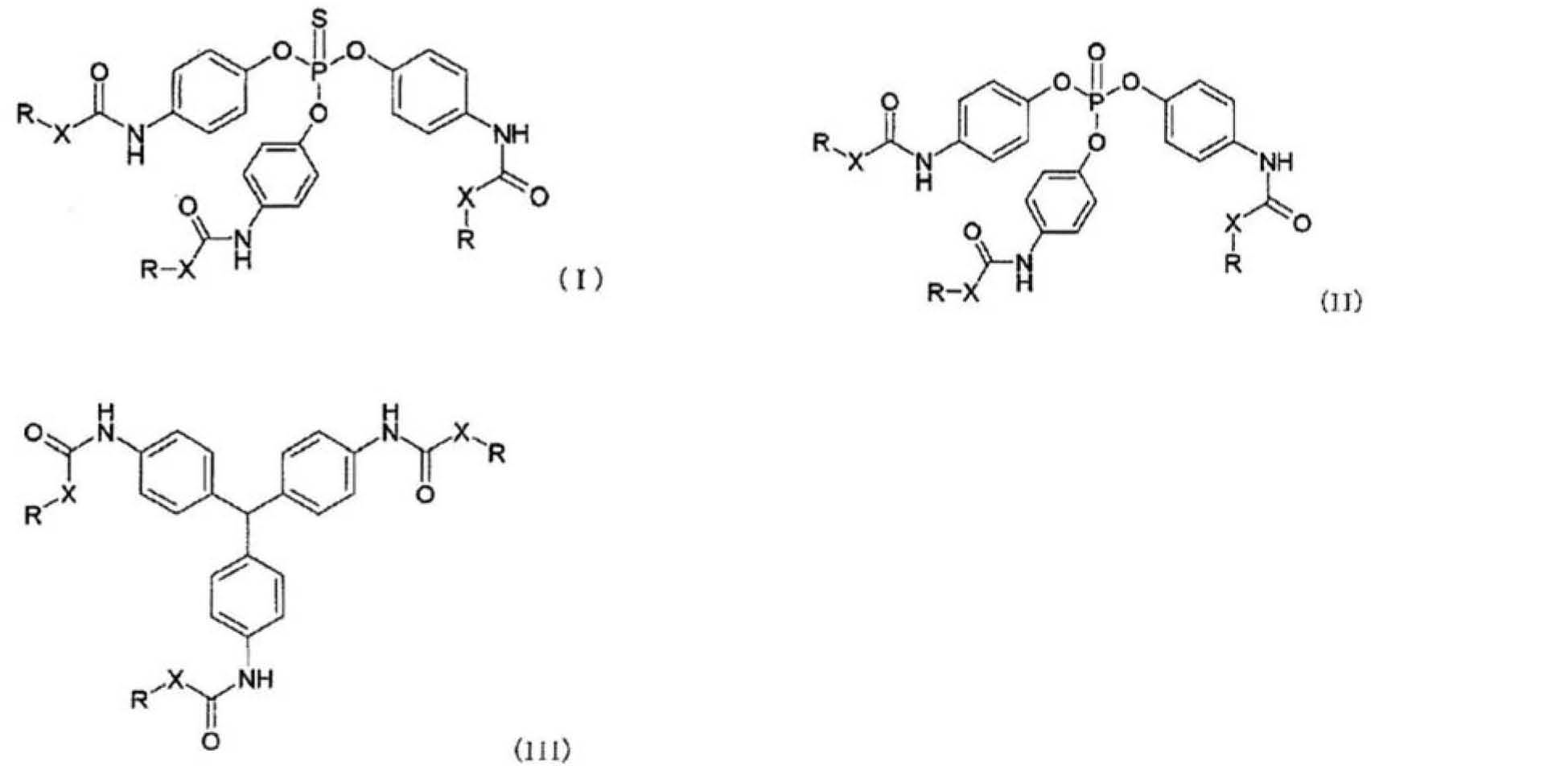
上記化学式(I)~(III)中、Rは、それぞれ独立して、エチレン性不飽和結合を有する基であり、Xは、それぞれ独立して、単結合、酸素原子、または直鎖状、分枝状、もしくは環状の2価の脂肪族炭化水素基である。
また、下記化学式(IV)で表される構造を有する化合物も使用することができる。
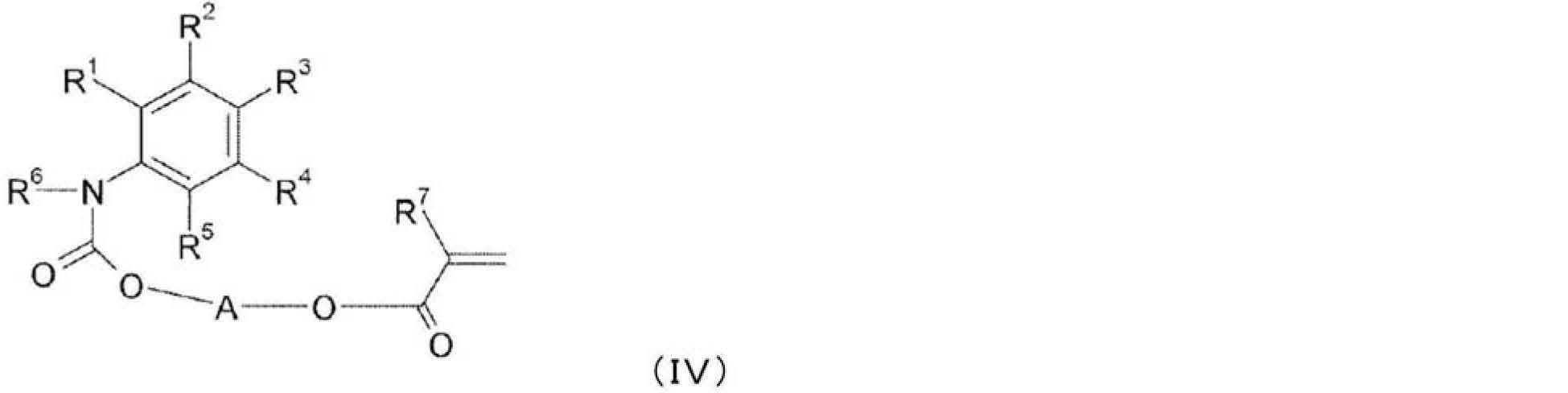
上記化学式(IV)中、R1~R5は、それぞれ独立して、水素原子、ハロゲン原子、炭素数1~6のアルキル基、トリフルオロメチル基、炭素数1~6のアルキルチオ基、炭素数1~6のアルキルセレノ基、炭素数1~6のアルキルテルロ基、またはニトロ基であり、R6およびR7は、それぞれ独立して、水素原子、または炭素数1~6のアルキル基である。
Aは、直鎖状もしくは分岐状の炭素数1~6のアルキレン基、直鎖状もしくは分岐状の炭素数2~6のアルケニレン基、または炭素数2~6個のエチレンオキシド単位またはプロピレンオキシド単位を有するポリアルキレンオキシド基である。
なかでも、R1~R5は、それぞれ独立して、水素原子または炭素数1~6のアルキルチオ基であり、R6およびR7は、水素原子であり、Aは、直鎖状もしくは分岐状の炭素数2~6のアルキレン基であると好ましい。
これらのラジカル重合性モノマーのなかでも、置換または未置換のフェニル基を有するモノマー、置換または未置換のナフチル基を有するモノマー、3個までの環を有する置換または未置換の複素環式芳香族部分を有するモノマー、塩素原子を有するモノマー、臭素原子を含有するモノマーは、その屈折率が比較的高いため、好ましい。
上記ラジカル重合性モノマーは、単独でもまたは2種以上組み合わせても用いることができる。
感光性組成物中のラジカル重合性モノマーの含有量(2種以上の場合は、その合計量)は、感光性組成物の全量に対して1~35質量%であることが好ましく、5~30質量%であることがより好ましい。
<ラジカル重合開始剤>
ラジカル重合開始剤は、ホログラフィ露光における、特定波長のレーザー光またはコヒーレンス性の優れた光の照射によって、ラジカル重合性モノマーの光重合を開始させる剤である。かような反応に用いることができる光ラジカル重合開始剤として、例えば米国特許第4766055号明細書、同第4868092号明細書、同第4965171号明細書、特開昭54-151024号公報、同58-15503号公報、同58-29803号公報、同59-189340号公報、同60-76735号公報、特開平1-28715号公報、同4-239505号公報および「プロシーディングス・オブ・コンフェレンス・オン・ラジエーション・キュアリング・エイジア(PROCEEDINGS OF CONFERENCE ON RADIATION CURING ASIA)」(pp.461~477、1988年)等に記載されている公知の重合開始剤が使用できるが、これらに制限されない。
ラジカル重合開始剤は、ホログラフィ露光における、特定波長のレーザー光またはコヒーレンス性の優れた光の照射によって、ラジカル重合性モノマーの光重合を開始させる剤である。かような反応に用いることができる光ラジカル重合開始剤として、例えば米国特許第4766055号明細書、同第4868092号明細書、同第4965171号明細書、特開昭54-151024号公報、同58-15503号公報、同58-29803号公報、同59-189340号公報、同60-76735号公報、特開平1-28715号公報、同4-239505号公報および「プロシーディングス・オブ・コンフェレンス・オン・ラジエーション・キュアリング・エイジア(PROCEEDINGS OF CONFERENCE ON RADIATION CURING ASIA)」(pp.461~477、1988年)等に記載されている公知の重合開始剤が使用できるが、これらに制限されない。
ラジカル重合開始剤(光ラジカル重合開始剤)の具体例として、例えば、ジアリールヨードニウム塩類、2,4,6-置換-1,3,5-トリアジン類(トリアジン系化合物)、アゾ化合物、アジド化合物、有機過酸化物、有機ホウ素酸塩、オニウム塩類、ハロゲン化炭化水素誘導体、チタノセン化合物、モノアシルホスフィンオキサイド、ビスアシルホスフィンオキサイド、ビスアシルホスフィンオキサイドとα-ヒドロキシケトンとの組み合わせなどが挙げられる。また、チオール化合物などの水素供与体とビスイミダゾール誘導体との併用による光ラジカル重合開始剤システムも利用できる。これらラジカル重合開始剤(光ラジカル重合開始剤)は、単独でもまたは2種以上を組み合わせて用いてもよい。
ラジカル重合開始剤の使用量は、ラジカル重合性モノマー100質量部に対して好ましくは0.01~50質量部、より好ましくは0.05~30質量部である。
また、感光性組成物中のラジカル重合開始剤の含有量(2種以上の場合は、その合計量)は、特に制限されないが、感光性組成物の全量に対して0.001~1質量%であることが好ましく、0.01~0.5質量%であることがより好ましい。
<増感剤>
本実施形態に係る感光性組成物は、光ラジカル重合開始剤に対する増感機能を有する増感剤を含んでもよい。このような増感剤は、400~800nm、特に450~700nmの範囲に吸収極大波長を有する。これらの増感剤が上記範囲の光を吸収し、これにより光ラジカル重合開始剤に対して増感作用が生じる。
本実施形態に係る感光性組成物は、光ラジカル重合開始剤に対する増感機能を有する増感剤を含んでもよい。このような増感剤は、400~800nm、特に450~700nmの範囲に吸収極大波長を有する。これらの増感剤が上記範囲の光を吸収し、これにより光ラジカル重合開始剤に対して増感作用が生じる。
このような増感剤としては、例えば、シアニン系色素、スチリル系色素等のポリメチン系化合物、ローダミンB、ローダミン6G、ピロニンGY等のキサンテン系化合物、サフラニンO等のフェナジン系化合物、クレシルバイオレット、ブリリアントクレシルブルー等のフェノキサジン系化合物、メチレンブルー、ニューメチレンブルー等のフェノチアジン系化合物、オーラミン等のジアリールメタン系化合物、クリスタルバイオレット、ブリリアントグリーン、リサミングリーン等のトリアリールメタン系化合物、(チオ)ピリリウム塩系化合物、スクアリリウム系化合物、クマリン系色素、チオキサンテン系色素、アセン系色素、メロシアニン系色素、チアゾリウム系色素等が挙げられる。これら増感剤は、単独でもまたは2種以上組み合わせても用いることができる。
増感剤を用いる場合の使用量は、光ラジカル重合開始剤100質量部に対して1~2000質量部が好ましく、20~1500質量部がより好ましい。
<連鎖移動剤>
本実施形態に係る感光性組成物は、連鎖移動剤を含んでもよい。連鎖移動剤としては、特に限定されず、公知のラジカル連鎖移動剤を使用することができる。
本実施形態に係る感光性組成物は、連鎖移動剤を含んでもよい。連鎖移動剤としては、特に限定されず、公知のラジカル連鎖移動剤を使用することができる。
連鎖移動剤としては、例えば、n-ブチルメルカプタン、t-ブチルメルカプタン、t-ドデシルメルカプタン、n-オクチルメルカプタン、n-ラウリルメルカプタン、5-クロロ-2-メルカプトベンゾチアゾール、4-メチル-4H-1,2,4-トリアゾール-3-チオール、6-エトキシ-2-メルカプトベンゾチアゾール等のメルカプタン類;テトラメチルチウラジウムジスルフィド、テトラエチルチウラジウムジスルフィドなどのジスルフィド類;四塩化炭素、四臭化炭素などのハロゲン化合物;2-メチル-1-ブテン、α-メチルスチレンダイマー等のオレフィン類;等が挙げられる。これら連鎖移動剤は、単独でもまたは2種以上組み合わせても用いることができる。
連鎖移動剤を用いる場合の使用量は、ラジカル重合性モノマー100質量部に対して好ましくは0.05~50質量部、より好ましくは0.1~30質量部である。
<マトリクス樹脂またはその前駆体>
マトリクス樹脂は、体積ホログラム記録層の膜厚の均一性、耐熱性、機械的物性等を向上させ、ホログラフィ露光により形成されるホログラムを安定化させる働きを有する。また、体積ホログラム記録層形成時には、重合性モノマーの拡散移動現象を阻害しない、または効率よく発現させる機能を有し得る。
マトリクス樹脂は、体積ホログラム記録層の膜厚の均一性、耐熱性、機械的物性等を向上させ、ホログラフィ露光により形成されるホログラムを安定化させる働きを有する。また、体積ホログラム記録層形成時には、重合性モノマーの拡散移動現象を阻害しない、または効率よく発現させる機能を有し得る。
マトリクス樹脂またはその前駆体は、上記ラジカル重合性モノマーとの関係において、高屈折率領域を形成するもの、または、低屈折率領域を形成するものを適宜採用することができる。上述のように、ラジカル重合性モノマーは、高屈折率を呈するものが好ましいため、これに対応して、マトリクス樹脂またはその前駆体は、低屈折率を呈するものが好ましい。
該マトリクス樹脂としては、例えば、熱可塑性樹脂、熱硬化性樹脂、活性エネルギー線硬化性樹脂等、いずれも制限なく使用することができる。また、これら樹脂にポリシロキサン鎖やパーフルオロアルキレン鎖で修飾したものなども使用することができる。マトリクス樹脂は、単独でもまたは2種以上組み合わせても用いることができる。
熱可塑性樹脂の例としては、例えば、ポリビニルアセテート、ポリビニルブチラート、ポリビニルホルマール、ポリビニルカルバゾール、ポリアクリル酸、ポリメタクリル酸、ポリメチルアクリレート、ポリメチルメタクリレート、ポリエチルアクリレート、ポリブチルアクリレート、ポリメタクリロニトリル、ポリエチルメタクリレート、ポリブチルメタクリレート、ポリアクリロニトリル、ポリ-1,2-ジクロロエチレン、エチレン-酢酸ビニル共重合体、テトラフルオロエチレン-酢酸ビニル共重合体、シンジオタクチック型ポリメチルメタクリレート、ポリ-α-ビニルナフタレート、ポリカーボネート、セルロースアセテート、セルローストリアセテート、セルロースアセテートブチラート、ポリスチレン、ポリ-α-メチルスチレン、ポリ-o-メチルスチレン、ポリ-p-メチルスチレン、ポリ-p-フェニルスチレン、ポリ-2,5-ジクロロスチレン、ポリ-p-クロロスチレン、ポリアリレート、ポリスルホン、ポリエーテルスルホン、スチレン-アクリロニトリル共重合体、スチレン-ジビニルベンゼン共重合体、スチレン-ブタジエン共重合体、スチレン-無水マレイン酸共重合体、ABS樹脂、ポリエチレン、ポリ塩化ビニル、ポリプロピレン、ポリエチレンテレフタレート、ポリブチレンテレフタレート、ポリエチレンナフタレート、ポリビニルピロリドン、ポリ塩化ビニリデン、水素化スチレン-ブタジエン-スチレン共重合体、ポリウレタン、ポリテトラフルオロエチレン、ポリフッ化ビニリデン、テトラフルオロエチレンやヘキサフルオロエチレンとビニルアルコール、ビニルエステル、ビニルエーテル、ビニルアセタール、ビニルブチラールなどとの共重合体、(メタ)アクリル酸環状脂肪族エステルとメチル(メタ)アクリレートとの共重合体、ポリ酢酸ビニル、メチルメタクリレート-エチルアクリレート-アクリル酸共重合体等が挙げられる。
熱硬化性樹脂としては、不飽和ポリエステル、アクリルウレタン樹脂、エポキシ変性アクリル樹脂、エポキシ変性不飽和ポリエステル、ポリウレタン、アルキド樹脂、フェノール樹脂等が挙げられる。
活性エネルギー線硬化性樹脂としては、エポキシアクリレート、ウレタンアクリレート、アクリル変性ポリエステル等が挙げられる。これらの活性エネルギー線硬化性樹脂に、架橋構造、粘度の調整等を目的として、下記のようなその他の単官能または多官能モノマー、オリゴマー等を包含させることができる。例えば、単官能ではテトラヒドロフルフリル(メタ)アクリレート、ヒドロキシエチル(メタ)アクリレート、(メタ)アクリロイルオキシエチルサクシネート、(メタ)アクリロイルオキシエチルフタレート等のモノ(メタ)アクリレート、ビニルピロリドン、多官能では骨格構造で分類するとポリオール(メタ)アクリレート(エポキシ変性ポリオール(メタ)アクリレート、ラクトン変性ポリオール(メタ)アクリレート等)、ポリエステル(メタ)アクリレート、エポキシ(メタ)アクリレート、ウレタン(メタ)アクリレート、その他ポリブタジエン系、イソシアヌール酸系、ヒダントイン系、メラミン系、リン酸系、イミド系、ホスファゼン系等の骨格を有するポリ(メタ)アクリレートであり、紫外線または電子線硬化性である様々なモノマー、オリゴマー、ポリマーが利用できる。
上記の熱可塑性樹脂、熱硬化性樹脂、または活性エネルギー線硬化性樹脂を用いる場合は、ナフテン酸コバルト、ナフテン酸亜鉛等の金属石鹸、ベンゾイルパーオキサイド、メチルエチルケトンパーオキサイド等の有機過酸化物、ベンゾフェノン、アセトフェノン、アントラキノン、ナフトキノン、アゾビスイソブチロニトリル、ジフェニルスルフィド等の熱または活性エネルギー線硬化剤を、感光性組成物に含有させることができる。
熱硬化性樹脂や活性エネルギー線硬化性樹脂を用いる場合には、隣接層上に未硬化の樹脂を含む感光層を形成した後、加熱または活性エネルギー線照射により硬化を行うことができる。硬化は、ホログラフィ露光の前に行ってもよいし後に行ってもよい。
また、マトリクス樹脂の前駆体を用いてもよい。該前駆体としては、付加重合することによりポリウレタンを形成するイソシアネート化合物およびポリオール化合物が挙げられる。
イソシアネート化合物としては、1分子中に2つ以上のイソシアネート基を有するものが好ましいが、その種類は特に制限されない。1分子中のイソシアネート基の数が少ないと、マトリクス樹脂として必要な硬さが得られなくなる場合がある。1分子中のイソシアネート基の数の上限は特に制限されないが、通常20以下程度であり、8以下であると好ましく、4以下であるとさらに好ましい。1分子中に2つ以上のイソシアネート基を有するものであれば、その種類は特に制限されない。
本実施形態で使用されるイソシアネート化合物の例としては、ヘキサメチレンジイソシアネート、リジンメチルエステルジイソシアネート、2,4,4-トリメチルヘキサメチレンジイソシアネート等の脂肪族イソシアネート、イソホロンジイソシアネート、4,4’-メチレンビス(シクロヘキシルイソシアネート)等の脂環族イソシアネート;トリレンジイソシアネート、4,4’-ジフェニルメタンジイソシアネート、キシリレンジイソシアネート、ナフタレン-1,5’-ジイソシアネート等の芳香族イソシアネート;およびこれらの多量体またはその誘導体等が挙げられる。
また、この他に、水、トリメチロールエタン、トリメチロールプロパン等の多価アルコール類とこれら上記のイソシアネート化合物との反応物等を挙げることができる。
これらイソシアネート化合物は、単独でもまたは2種以上組み合わせて用いてもよい。
ポリオール化合物としては、ポリプロピレンポリオール、ポリカプロラクトンポリオール、ポリエステルポリオール、ポリカーボネートポリオール、エチレングリコール、プロピレングリコール、1,4-ブタンジオール、1,5-ペンタンジオール、3-メチル-1,5-ペンタンジオール、1,6-ヘキサンジオール、ネオペンチルグリコール、ジエチレングリコール、1,4-シクロヘキサンジオール、1,4-シクロヘキサンジメタノール、デカメチレングリコール、トリメチロールプロパン、ポリエチレングリコール、ポリプロピレングリコール、ポリテトラメチレングリコール等が挙げられる。
これらポリオール化合物は、単独でもまたは2種以上組み合わせて用いてもよい。
イソシアネート化合物とポリオール化合物とを付加重合させる触媒を感光性組成物中に配合することができる。触媒を使うことにより室温で硬化させることができるが、加熱して硬化させてもよい。硬化時の温度としては40~90℃の範囲が好ましく、硬化時間は1~24時間が好ましい。
触媒の例としては、通常のウレタン化反応触媒、例えば、ジラウリン酸ジブチルスズ、ジラウリン酸ジオクチルスズ、ジオクタン酸ジブチルスズ等のスズ化合物、トリエチルアミン、トリエチレンジアミン等の三級アミン化合物が挙げられる。これらのうちスズ化合物は溶解性や媒体としての性能がよく、特に、ジラウリン酸ジブチルスズが好ましい。
触媒の使用量は、イソシアネート化合物およびポリオール化合物の合計量に対して、0.0001質量%以上が好ましく、0.001質量%以上がより好ましく、また、10質量%以下が好ましく、5質量%以下がより好ましい。なお、これら触媒を用いる場合は、感光層塗膜の均一性確保の観点から、感光性組成物を隣接層上に塗布する10分前以内に感光性組成物中に添加することが好ましい。
また、マトリクス樹脂の別の前駆体として、カチオン重合性モノマーを用いてもよい。カチオン重合性モノマーから得られるマトリクス樹脂は、膜強度に優れた体積ホログラム記録層の作製を可能とする。
係るカチオン重合性モノマーの具体例としては、ジグリセロールポリグリシジルエーテル、ペンタエリスリトールポリグリシジルエーテル、1,4-ビス(2,3-エポキシプロポキシパーフルオロイソプロピル)シクロヘキサン、ソルビトールポリグリシジルエーテル、トリメチロールプロパンポリグリシジルエーテル、レゾルシンジグリシジルエーテル、1,6-ヘキサンジオールジグリシジルエーテル、ポリエチレングリコールジグリシジルエーテル、フェニルグリシジルエーテル、パラ-t-ブチルフェニルグリシジルエーテル、アジピン酸ジグリシジルエステル、オルソフタル酸ジグリシジルエステル、ジブロモフェニルグリシジルエーテル、ジブロモネオペンチルグリコールジグリシジルエーテル、1,2,7,8-ジエポキシオクタン、1,6-ジメチロールパーフルオロヘキサンジグリシジルエーテル、4,4’-ビス(2,3-エポキシプロポキシパーフルオロイソプロピル)ジフェニルエーテル、3,4-エポキシシクロヘキシルメチル-3’,4’-エポキシシクロヘキサンカルボキシレート、3,4-エポキシシクロヘキシルオキシラン、1,2,5,6-ジエポキシ-4,7-メタノペルヒドロインデン、2-(3,4-エポキシシクロヘキシル)-3’,4’-エポキシ-1,3-ジオキサン-5-スピロシクロヘキサン、1,2-エチレンジオキシ-ビス(3,4-エポキシシクロヘキシルメタン)、4’,5’-エポキシ-2’-メチルシクロヘキシルメチル-4,5-エポキシ-2-メチルシクロヘキサンカルボキシレート、エチレングリコール-ビス(3,4-エポキシシクロヘキサンカルボキシレート)、ビス-(3,4-エポキシシクロヘキシルメチル)アジペート、ジ-2,3-エポキシシクロペンチルエーテル、ビニル-2-クロロエチルエーテル、ビニル-n-ブチルエーテル、トリエチレングリコールジビニルエーテル、1,4-シクロヘキサンジメタノールジビニルエーテル、トリメチロールエタントリビニルエーテル、ビニルグリシジルエーテル等が挙げられる。これらカチオン重合性モノマーは、単独でもまたは2種以上組み合わせても用いることができる。
上記カチオン重合性モノマーを用いる場合は、光カチオン重合開始剤、熱カチオン重合開始剤を用いてもよい。
光カチオン重合開始剤の具体例としては、例えばヨードニウム塩類、トリアリールスルホニウム塩類などが挙げられる。ヨードニウム塩類として具体的には、ヨードニウムのテトラフルオロボレート、ヘキサフルオロホスフェート、ヘキサフルオロアルセネート、ヘキサフルオロアンチモネート、トリフルオロメタンスルホネート、9,10-ジメトキシアントラセン-2-スルホネート等が挙げられる。トリアリールスルホニウム塩類として具体的には、トリアリールスルホニウム、トリフェニルスルホニウム、4-t-ブチルトリフェニルスルホニウム、トリス(4-メチルフェニル)スルホニウム、トリス(4-メトキシフェニル)スルホニウム、4-チオフェニルトリフェニルスルホニウム等スルホニウムのテトラフルオロボレート、ヘキサフルオロホスフェート、ヘキサフルオロアルセネート、ヘキサフルオロアンチモネート、トリフルオロメタンスルホネート、9,10-ジメトキシアントラセン-2-スルホネート等が挙げられる。これら光カチオン性重合開始剤は、単独でもまたは2種以上組み合わせても用いることができる。
熱カチオン重合開始剤の具体例としては、例えばトリフル酸塩、三フッ化ホウ素エーテル錯化合物、三フッ化ホウ素等のようなカチオン系またはプロトン酸触媒が挙げられ、好ましい熱カチオン重合開始剤としては、トリフル酸塩である。具体例としては、3M社から「FC-520」として入手できるトリフル酸ジエチルアンモニウム、トリフル酸トリエチルアンモニウム、トリフル酸ジイソプロピルアンモニウム、トリフル酸エチルジイソプロピルアンモニウム等(これらの多くはR.R.Almによって1980年10月発行のモダン・コーティングス(Modern Coatings)に記載されている)がある。また、活性エネルギー線カチオン重合開始剤としても用いられる芳香族オニウム塩のうち、熱によりカチオン種を発生するものがあり、これらも熱カチオン重合開始剤として用いることができる。例としては、「サンエイド(登録商標)SI-60L」、「サンエイド(登録商標)SI-80L」および「サンエイド(登録商標)SI-100L」(以上三新化学工業株式会社製)がある。マトリクス樹脂としてカチオン重合性モノマーを用いる場合、光カチオン重合開始剤もしくは熱カチオン重合開始剤の使用量は、カチオン重合性モノマー100質量部に対して0.05~50質量部が好ましく、0.1~30質量部がより好ましい。
感光性組成物中のマトリクス樹脂もしくはその前駆体の含有量は、感光性組成物の全質量に対して1~30質量%であることが好ましく、1~25質量%であることがより好ましく、5~20質量%であることがさらに好ましい。
<溶媒>
本実施形態に係る感光性組成物は、塗工する際に必要に応じて溶媒を用いてもよい。ただし、感光性組成物に、常温で液状である成分が含有されている場合は、溶媒が必要ない場合もある。
本実施形態に係る感光性組成物は、塗工する際に必要に応じて溶媒を用いてもよい。ただし、感光性組成物に、常温で液状である成分が含有されている場合は、溶媒が必要ない場合もある。
上記溶媒としては、例えば、n-ペンタン、n-ヘキサン、n-ヘプタン、n-オクタン、シクロヘキサン、メチルシクロヘキサンなどの脂肪族系溶媒;メチルエチルケトン(2-ブタノン)、アセトン、シクロヘキサノンなどのケトン系溶媒;ジエチルエーテル、イソプロピルエーテル、テトラヒドロフラン、ジオキサン、エチレングリコールジメチルエーテル、エチレングリコールジエチルエーテル、ジエチレングリコールジメチルエーテル、ジエチレングリコールジエチルエーテル、プロピレングリコールモノメチルエーテル、アニソール、フェネトールなどのエーテル系溶媒;酢酸エチル、酢酸ブチル、エチレングリコールジアセテートなどのエステル系溶媒;トルエン、キシレンなどの芳香族系溶媒;メチルセロソルブ、エチルセロソルブ、ブチルセロソルブなどのセロソルブ系溶媒;メタノール、エタノール、プロパノール、イソプロピルアルコールなどのアルコール系溶媒;テトラヒドロフラン、ジオキサンなどのエーテル系溶媒;ジクロロメタン、クロロホルムなどのハロゲン系溶媒;アセトニトリル、プロピオニトリルなどのニトリル系溶媒;N-メチル-2-ピロリドン、N-エチル-2-ピロリドン、N,N-ジメチルホルムアミド、N,N-ジメチルアセトアミド等の極性溶媒などが挙げられる。これら溶媒は、単独でもまたは2種以上を組み合わせても用いることができる。
感光性組成物中の溶媒の含有量は、特に制限されないが、感光性組成物の全質量に対して40~80質量%であることが好ましく、55~70質量%であることがより好ましく、60~65質量%であることがさらに好ましい。
<添加剤>
感光性組成物は、上記効果を損なわない限り、必要に応じて、可塑剤、相溶化剤、重合抑制剤、界面活性剤、シランカップリング剤、消泡剤、剥離剤、安定化剤、酸化防止剤、難燃剤、光学増白剤、紫外線吸収剤等の添加剤をさらに含んでもよい。
感光性組成物は、上記効果を損なわない限り、必要に応じて、可塑剤、相溶化剤、重合抑制剤、界面活性剤、シランカップリング剤、消泡剤、剥離剤、安定化剤、酸化防止剤、難燃剤、光学増白剤、紫外線吸収剤等の添加剤をさらに含んでもよい。
〔感光性組成物の調製方法〕
感光性組成物は、上記した各成分を一括または順次混合することにより得ることができる。混合の際用いる装置としては、例えば、マグネチックスターラー、ホモディスパー、クイックホモミキサー、プラネタリーミキサーなどの攪拌または混合装置が挙げられる。得られた感光性組成物は、必要に応じて、濾過してから用いてもよい。
感光性組成物は、上記した各成分を一括または順次混合することにより得ることができる。混合の際用いる装置としては、例えば、マグネチックスターラー、ホモディスパー、クイックホモミキサー、プラネタリーミキサーなどの攪拌または混合装置が挙げられる。得られた感光性組成物は、必要に応じて、濾過してから用いてもよい。
[ホログラフィック光学素子]
本発明は、上記感光性組成物を硬化させてなる体積ホログラム記録層を有するホログラフィック光学素子もまた提供する。すなわち、本発明の他の実施形態は、上記感光性組成物の硬化物を含むホログラフィック光学素子である。
本発明は、上記感光性組成物を硬化させてなる体積ホログラム記録層を有するホログラフィック光学素子もまた提供する。すなわち、本発明の他の実施形態は、上記感光性組成物の硬化物を含むホログラフィック光学素子である。
本実施形態のホログラフィック光学素子の全体の構成を説明する。
図1は、本実施形態のホログラフィック光学素子の典型的な構成を示す断面模式図である。本実施形態に係るホログラフィック光学素子10は、体積ホログラム記録層11と、一対の隣接層12と、を含んでいると好ましい。それぞれの隣接層12の構成材料および厚さは同じでもよいし、異なっていてもよい。なお、図1に示すホログラフィック光学素子は、体積ホログラム記録層11の両面に接するように一対の隣接層12が設けられているが、体積ホログラム記録層11の片面にのみ隣接層12が設けられている形態であってもよい。
<体積ホログラム記録層>
体積ホログラム記録層は、上記感光性組成物を前述の隣接層に塗布し、乾燥することで得られる塗膜(感光層)に対して、少なくともホログラフィ露光を行うことにより、形成される。上記ホログラフィ露光を行うことにより、感光層内に高屈折率領域と低屈折率領域とからなる回折格子が形成され、これにより、体積ホログラム記録層が形成される。
体積ホログラム記録層は、上記感光性組成物を前述の隣接層に塗布し、乾燥することで得られる塗膜(感光層)に対して、少なくともホログラフィ露光を行うことにより、形成される。上記ホログラフィ露光を行うことにより、感光層内に高屈折率領域と低屈折率領域とからなる回折格子が形成され、これにより、体積ホログラム記録層が形成される。
本実施形態において、体積ホログラム記録層(感光層)の厚さは、耐久性の観点から、10~100μmであることが好ましく、10~50μmであることがより好ましい。
上記感光性組成物に対してホログラフィ露光を行うことにより形成される体積ホログラム記録層は、上記多価酸を含む。多価酸の含有量は、特に制限されないが、体積ホログラム記録層の全質量に対し、0.0001~0.1質量%であると好ましく、0.0005~0.05質量%であるとより好ましい。なお、2種以上の多価酸を混合して用いる場合には、各多価酸の合計量が上記範囲内であると好ましい。なお、上記多価酸の含有量は、イオンクロマトグラフィによる定量分析により求めることができる。
<隣接層>
隣接層の材料は、ホログラフィック光学素子の形態によって適宜選択することができ、光学的に透明である公知の材料から選択できる。本明細書中、「透明」とは、可視光波長領域における全光線透過率が60%以上であることをいう。
隣接層の材料は、ホログラフィック光学素子の形態によって適宜選択することができ、光学的に透明である公知の材料から選択できる。本明細書中、「透明」とは、可視光波長領域における全光線透過率が60%以上であることをいう。
隣接層の材料としては、光学的に透明であるものであれば特に制限されないが、例えば、ガラス、シリコン、石英等の無機材料;(メタ)アクリル樹脂、ポリカーボネート、ポリエチレンテレフタレート(PET)、ポリブチレンテレフタレート、ポリエチレンナフトエート、ポリエチレン、ポリプロピレン、アモルファスポリオレフィン、酢酸セルロース、水和セルロース、硝酸セルロース、シクロオレフィンポリマー、ポリスチレン、ポリエポキシド、ポリスルホン、セルロースアシレート、ポリアミド、ポリイミド、ポリメチルメタクリレート、ポリ塩化ビニル、ポリビニルブチラール、ポリジシクロペンタジエン等の有機材料が挙げられる。上記樹脂(ポリマー)は、単独でもまたは2種以上混合して用いてもよい。これらの中でも、セルロースアシレートは、光学特性に優れているため、隣接層の材料として好適に使用できる。
隣接層には、その密度、光学的性質等を損なわない範囲で、上記樹脂以外の成分を含有してもよい。たとえば、シクロオレフィン樹脂やフッ素含有樹脂などの樹脂成分、紫外線吸収剤、酸化防止剤、劣化防止剤、光安定剤、熱安定剤、滑剤、可塑剤、帯電防止剤、難燃剤、充填剤、微粒子、光学特性調整剤等、他の成分を含んでもよい。他の成分の添加量(2種以上添加する場合はその合計)としては、隣接層の全質量に対して、0.1~25質量%が好ましい。
隣接層は、その形態がフィルム状、板状などの層状であってもよく、プリズムを兼ねる基体状であってもよい。層状である場合は、断裁による加工が可能となり、種々の光学素子へ適応できるという利便性がある。断裁加工をする場合、感光性組成物と切断機とが接着し、感光性組成物が糸を引くことがあるが、本実施形態に係る感光性組成物を用いて形成された感光層は、上記の糸引きを抑制することができるため、好適である。
隣接層が層状である場合には、その厚さは、特に制限はされないが、10~1000μmが好ましく、50~200μmであることがより好ましい。
<他の層>
本実施形態のホログラフィック光学素子は、上記以外に、保護層、反射層、反射防止膜、紫外線吸収層等、他の層を有していてもよい。
本実施形態のホログラフィック光学素子は、上記以外に、保護層、反射層、反射防止膜、紫外線吸収層等、他の層を有していてもよい。
保護層は、記録層の保存安定性の劣化等の影響を防止するための層である。保護層の具体的構成に制限は無く、公知のものを任意に適用することが可能である。例えば、水溶性ポリマー、有機/無機材料等からなる層を保護層として形成することができる。保護層の形成位置は、特に制限はなく、例えば体積ホログラム記録層の表面や、隣接層と支持体との間に形成してもよく、また支持体の外表面側に形成してもよい。
反射層は、ホログラフィック光学素子を反射型に構成する際に形成される。反射型のホログラフィック光学素子の場合、反射層は通常、隣接層の外側面に形成される。反射層としては、従来公知のものを適宜参照して適用することができ、例えば金属の薄膜等を用いることができる。
さらに、透過型および反射型のいずれのホログラフィック光学素子においても、物体光および再生光が入射および出射する側や、あるいは体積ホログラム記録層と隣接層との間に、反射防止膜を設けてもよい。反射防止膜は、光の利用効率を向上させ、かつゴースト像の発生を抑制する働きをする。反射防止膜としては、従来公知のものを適宜参照して適用することができる。
<支持体>
本実施形態のホログラフィック光学素子は、透明な支持体にさらに挟持されていてもよい。支持体は本実施形態のホログラフィック光学素子の保護、保持の為に採用されてもよいし、ホログラフィック光学素子と複合してプリズムなどの光学素子として機能するために採用されてもよい。
本実施形態のホログラフィック光学素子は、透明な支持体にさらに挟持されていてもよい。支持体は本実施形態のホログラフィック光学素子の保護、保持の為に採用されてもよいし、ホログラフィック光学素子と複合してプリズムなどの光学素子として機能するために採用されてもよい。
支持体は、必要な強度および耐久性を有しているものであれば、特に制限はなく、任意の支持体を使用することができる。また、支持体の形状にも制限は無いが、通常は平板状またはフィルム状に形成される。また、支持体の材料にも制限は無く、透明であっても不透明であってもよい。
支持体の材料として透明なものを挙げると、ガラス、シリコン、石英等の無機材料が挙げられる。これらの中でも、ガラスが好ましい。支持体の材料として不透明なものを挙げると、アルミニウム等の金属;前記の透明支持体上に金、銀、アルミニウム等の金属、または、フッ化マグネシウム、酸化ジルコニウム等の誘電体をコーティングしたものなどが挙げられる。
支持体の表面には、表面処理を施してもよい。この表面処理は、通常、支持体とホログラフィック光学素子との接着性を向上させるためになされる。表面処理の例としては、支持体にコロナ放電処理を施したり、支持体上に予め下塗り層を形成したりすることが挙げられる。ここで、下塗り層の組成物としては、ハロゲン化フェノール、または部分的に加水分解された塩化ビニル-酢酸ビニル共重合体、ポリウレタン樹脂等が挙げられる。
さらに、表面処理は、接着性の向上以外の目的で行なってもよい。その例としては、例えば、金、銀、アルミニウム等の金属を素材とする反射コート層を形成する反射コート処理;フッ化マグネシウムや酸化ジルコニウム等の誘電体層を形成する誘電体コート処理等が挙げられる。また、これらの層は、単層で形成してもよく2層以上で形成してもよい。
また、これらの表面処理は、ホログラフィック光学素子の気体や水分の透過性を制御する目的で設けてもよい。これにより、ホログラフィック光学素子の信頼性をより向上させることができる。
支持体は、ホログラフィック光学素子の上側および下側のいずれか一方にのみ設けてもよく、両方に設けてもよい。ただし、上下両側に支持体を設ける場合は、支持体の少なくとも一方は、活性エネルギー線(記録光、参照光、再生光など)を透過させるように、透明に構成する。支持体とホログラフィック光学素子とを貼り合わせる場合は、シリコーン粘着剤やアクリル粘着剤等、透明性の高い粘着剤を使用することができる。
ホログラフィック光学素子の片側または両側に支持体を有する場合、透過型または反射型のホログラムが記録可能である。また、ホログラフィック光学素子の片側に反射特性を有する支持体を用いる場合は、反射型のホログラムが記録可能である。
[ホログラフィック光学素子の製造方法]
ホログラフィック光学素子の製造方法としては、本実施形態に係る感光性組成物を用いて感光層を形成し、該感光層に対してホログラフィ露光を行い、体積ホログラム記録層を形成することを有する製造方法が挙げられる。
ホログラフィック光学素子の製造方法としては、本実施形態に係る感光性組成物を用いて感光層を形成し、該感光層に対してホログラフィ露光を行い、体積ホログラム記録層を形成することを有する製造方法が挙げられる。
隣接層上に感光層を形成する方法としては、特に制限されず、例えば、隣接層上に感光性組成物を直接塗布し乾燥する方法や、別途用意した基材上に感光性組成物を塗布し乾燥した後、ラミネーター等を用いて隣接層と貼り合わせその後基材を剥離する方法等が挙げられる。中でも、隣接層に対して感光層がより密着しやすく、隣接層との組み合わせにより、感光層内部で隣接層との界面まで回折格子の形成を促進させるという観点から、隣接層上に感光性組成物を直接塗布し乾燥することにより感光層を形成することが好ましい。
隣接層上や基材上に感光性組成物を塗布する方法としては、従来公知の方法を使用することができ、具体例としては、スプレー法、スピンコート法、ワイヤーバー法、ディップコート法、エアーナイフコート法、ロールコート法、ブレードコート法、ドクターロールコート法などが挙げられる。
乾燥は、ホットプレート、オーブン、ベルト炉等を用いた従来公知の種々の方法を採用することができる。乾燥温度は特に制限されず、例えば10~80℃の範囲であり、乾燥時間も特に制限されず、例えば1~60分の範囲である。
感光層の厚さは、上述の体積ホログラム記録層(感光層)の好ましい厚さの範囲となるよう、適宜設定すればよい。
隣接層上に感光層を形成し隣接層と感光層とを接合させた後ホログラフィ露光を行うことによって、感光層中の重合性モノマーの重合反応が進む。その結果、重合反応により生成する光硬化されたフォトポリマーの領域と他成分の領域とが、ホログラフィ露光で照射された干渉波と同一のパターンとして形成される。
本実施形態のホログラフィック光学素子において、体積ホログラム記録層が2つの隣接層に挟持されている構造を有する場合は、1つの隣接層上に感光層を形成した後、感光層上にもう1つの隣接層を、ラミネーター等を用いてラミネートすることにより、当該構造を有するホログラフィック光学素子を得ることができる。
〔記録方法〕
感光層にホログラフィ露光を行い、体積ホログラムを記録(書き込み)し体積ホログラム記録層とする方法、および体積ホログラムを再生(読み出し)する方法としては、特に制限されないが、例えば、下記の方法が挙げられる。
感光層にホログラフィ露光を行い、体積ホログラムを記録(書き込み)し体積ホログラム記録層とする方法、および体積ホログラムを再生(読み出し)する方法としては、特に制限されないが、例えば、下記の方法が挙げられる。
まず、情報の記録時には、重合性モノマーの化学変化、すなわち、その重合および濃度変化を生じさせることが可能な光を、記録光(物体光とも呼ばれる)として用いる。
例えば、情報を体積ホログラムとして記録する場合には、物体光を参照光と共に感光層に対して照射し、感光層において物体光と参照光とを干渉させるようにする。これによってその干渉光が、感光層内の重合性モノマーの重合および濃度変化を生じさせ、その結果、干渉縞が感光層内に屈折率差を生じさせ、感光層内に記録された干渉縞により体積ホログラムとして記録され、体積ホログラム記録層となる。これにより、ホログラフィック光学素子を得ることができる。
体積ホログラムの記録に用いられる記録光(カッコ内は波長を示す)としては、コヒーレンス性に優れる可視光レーザーを用いることが好ましく、例えばアルゴンイオンレーザー(458nm、488nm、514nm)、クリプトンイオンレーザー(647.1nm)、ヘリウム-ネオンレーザー(633nm)、YAGレーザー(532nm)等を使用することができる。
ホログラム記録時の照射エネルギー量(露光量)としては、特に制限されないが、10~250mJ/cm2の範囲であることが好ましい。
また、ホログラム記録方式としては、偏光コリニアホログラム記録方式、参照光入射角多重型ホログラム記録方式等があるが、いずれの記録方式でも良好な記録品質を提供することが可能である。
露光装置としては、特に制限されないが、例えば、概略構成が図2によって示される形式の露光装置を用いることができる。図2に示す露光装置においては、レーザー光源201から出射された光線(記録光)は、2対のミラーよりなるビームステアラー202a、202bによって露光系の適した位置に光線を誘導する。203はシャッターであり、光線(記録光)のON/OFFを制御する。204はビームエキスパンダーであり、感光層の露光面積に応じて、光束径を広げ、開口率(NA)を変化させる機能を有する。
ビームエキスパンダー204を通った光線(記録光)は、ビームスプリッター205で二光束に分けられる。分けられた光線(記録光)は、それぞれミラー206、207、およびミラー209、208によってスペイシャルフィルター211、212に誘導される。スペイシャルフィルター211、212はレンズとピンホールとから構成され、該レンズで光線(記録光)を集光し、ピンホールを介して製造光学系213に光線(記録光)を誘導する。
製造光学系213は、ホログラフィック光学素子の光線の反射角を制御できるように、体積ホログラム記録層となる感光層を具備したガラスプリズム等のサンプルを好適な位置に設置および固定することができる。
製造光学系213に固定されたプリズムなどに具備された感光層は、二光束に分けられ、各々スペイシャルフィルター211、212を介して誘導された光線(記録光)によってホログラフィ露光(干渉露光)される。
なお、図2に示す光源は1つのみであるが、異なる波長を有する複数のレーザー光源を用いてホログラフィ露光する場合には、シャッター203手前の光路にグロイックミラーを挿入し、複数の光源から発せられるレーザー光線を段階的に合成させてもよい。
体積ホログラムを記録した後、屈折率変調の促進や重合反応完結(定着)のために、体積ホログラム記録層に対して、さらに紫外線による全面露光や加熱等の処理を適宜行うことができる。全面露光で用いられる光源としては、例えば、超高圧水銀ランプ、高圧水銀ランプ、カーボンアークランプ、キセノンアークランプ、メタルハライドランプ等の紫外線を発する光源を用いることができる。紫外線による全面露光を行う場合の照射エネルギー量としては、50~200J/cm2が好ましい。また、加熱処理を行う時の温度は50~150℃が好ましく、処理時間は30分間~3時間が好ましい。
全面露光と加熱処理とを共に行う場合、その順序は特に制限されず、全面露光を先に行ってもよいし、加熱処理を先に行ってもよい。
体積ホログラム記録層に記録された体積ホログラムを再生する場合は、所定の再生光(通常は参照光)を体積ホログラム記録層に照射する。照射された再生光は前記の干渉縞に応じて回折を生じる。この回折光は、体積ホログラム記録層と同様の情報を含むものであるので、前記の回折光を適当な検出手段によって読み取ることにより、体積ホログラム記録層に記録された情報の再生を行なうことができる。なお、物体光、再生光および参照光の波長領域はそれぞれの用途に応じて任意であり、可視光領域でも紫外光領域でも構わない。
[用途]
本実施形態のホログラフィック光学素子は、例えば、ヘッドマウントディスプレイ(HMD)、ヘッドアップディスプレイ(HUD)、光メモリ、光ディスク用ピックアップレンズ、液晶用カラーフィルター、反射型液晶反射板、レンズ、回折格子、干渉フィルター、光ファイバー用結合器、ファクシミリ用光偏光器、建築用窓ガラス、書籍、雑誌等の表紙、POPなどのディスプレイ、ギフト、偽造防止用のセキュリティ目的としてクレジットカード、紙幣、包装等に好適に用いられる。
本実施形態のホログラフィック光学素子は、例えば、ヘッドマウントディスプレイ(HMD)、ヘッドアップディスプレイ(HUD)、光メモリ、光ディスク用ピックアップレンズ、液晶用カラーフィルター、反射型液晶反射板、レンズ、回折格子、干渉フィルター、光ファイバー用結合器、ファクシミリ用光偏光器、建築用窓ガラス、書籍、雑誌等の表紙、POPなどのディスプレイ、ギフト、偽造防止用のセキュリティ目的としてクレジットカード、紙幣、包装等に好適に用いられる。
以下、具体的な実施例および比較例について説明する。ただし、本発明の技術的範囲が以下の実施例のみに制限されるわけではない。また、下記操作において、特記しない限り、操作および物性等の測定は室温(20~25℃)/相対湿度40~50%RHの条件で行う。
[ホログラフィック光学素子の作製]
≪実施例1:ホログラフィック光学素子1の作製≫
暗室下で下記成分を容器に投入し、30分間室温で攪拌し溶液を得た。得られた溶液をメッシュで濾過し、体積ホログラム記録層形成用組成物1(感光性組成物1)とした。
≪実施例1:ホログラフィック光学素子1の作製≫
暗室下で下記成分を容器に投入し、30分間室温で攪拌し溶液を得た。得られた溶液をメッシュで濾過し、体積ホログラム記録層形成用組成物1(感光性組成物1)とした。
<体積ホログラム記録層形成用組成物1>
ポリ酢酸ビニル(PVAc) 5.0質量部
アクリル酸2-フェノキシエチル 6.0質量部
ビスフェノールAエポキシジアクリレート 1.0質量部
N-ビニルカルバゾール 3.0質量部
テトラブチルアンモニウムトリフェニルブチルボレート
(有機ホウ素酸塩重合開始剤、昭和電工社製) 0.01質量部
サフラニンO(東京化成工業社製) 0.1質量部
酢酸エチル 25.0質量部
酒石酸(分子量:150.1) 0.005質量部。
ポリ酢酸ビニル(PVAc) 5.0質量部
アクリル酸2-フェノキシエチル 6.0質量部
ビスフェノールAエポキシジアクリレート 1.0質量部
N-ビニルカルバゾール 3.0質量部
テトラブチルアンモニウムトリフェニルブチルボレート
(有機ホウ素酸塩重合開始剤、昭和電工社製) 0.01質量部
サフラニンO(東京化成工業社製) 0.1質量部
酢酸エチル 25.0質量部
酒石酸(分子量:150.1) 0.005質量部。
厚さ100μmのポリエチレンテレフタレート(PET)フィルム上に、体積ホログラム記録層形成用組成物1を、ブレードコーターを用いて塗布し、20℃、50%RHの環境下で30分間乾燥させ、厚さ15μmの感光層を得た。その後、ARガラスのガラス面上に感光層面を貼りつけることで、体積ホログラム記録層形成用組成物1から形成された感光層を有する感光性前駆体1を得た。
得られた感光性前駆体1について、露光装置(光源:アルゴンイオンレーザー、露光波長514nm)を用い、感光層面における照射エネルギー量が24mJ/cm2となるようにホログラフィ露光を行った。
ホログラフィ露光を行った後、高圧水銀ランプ(照度100W/cm2)から15cmの位置に60分間配置してポスト露光を行い、次いで100℃で3時間の熱処理を行うことにより、体積ホログラム記録層KO-1を有するホログラフィック光学素子1を得た。
≪実施例2:ホログラフィック光学素子2の作製≫
酒石酸をシュウ酸(分子量:90.0)に変えたこと以外は、実施例1と同様にして、体積ホログラム記録層KO-2を有するホログラフィック光学素子2を得た。
酒石酸をシュウ酸(分子量:90.0)に変えたこと以外は、実施例1と同様にして、体積ホログラム記録層KO-2を有するホログラフィック光学素子2を得た。
≪実施例3:ホログラフィック光学素子3の作製≫
酒石酸をクエン酸(分子量:192.1)に変えたこと以外は、実施例1と同様にして、体積ホログラム記録層KO-3を有するホログラフィック光学素子3を得た。
酒石酸をクエン酸(分子量:192.1)に変えたこと以外は、実施例1と同様にして、体積ホログラム記録層KO-3を有するホログラフィック光学素子3を得た。
≪実施例4:ホログラフィック光学素子4の作製≫
酒石酸をピロリン酸(分子量:178.0)に変えたこと以外は、実施例1と同様にして、体積ホログラム記録層KO-4を有するホログラフィック光学素子4を得た。
酒石酸をピロリン酸(分子量:178.0)に変えたこと以外は、実施例1と同様にして、体積ホログラム記録層KO-4を有するホログラフィック光学素子4を得た。
≪実施例5:ホログラフィック光学素子5の作製≫
酒石酸を三リン酸(分子量:258.0)に変えたこと以外は、実施例1と同様にして、体積ホログラム記録層KO-5を有するホログラフィック光学素子5を得た。
酒石酸を三リン酸(分子量:258.0)に変えたこと以外は、実施例1と同様にして、体積ホログラム記録層KO-5を有するホログラフィック光学素子5を得た。
≪比較例1:ホログラフィック光学素子6の作製≫
酒石酸を用いなかったこと以外は、実施例1と同様にして、体積ホログラム記録層KO-20を有するホログラフィック光学素子6を得た。
酒石酸を用いなかったこと以外は、実施例1と同様にして、体積ホログラム記録層KO-20を有するホログラフィック光学素子6を得た。
≪比較例2:ホログラフィック光学素子7の作製≫
酒石酸をカプリル酸(分子量:144.2)に変えたこと以外は、実施例1と同様にして、体積ホログラム記録層KO-21を有するホログラフィック光学素子7を得た。
酒石酸をカプリル酸(分子量:144.2)に変えたこと以外は、実施例1と同様にして、体積ホログラム記録層KO-21を有するホログラフィック光学素子7を得た。
≪比較例3:ホログラフィック光学素子8の作製≫
酒石酸をN,N-ジメチルベンジルアミン(分子量:135.2)に変えたこと以外は、実施例1と同様にして、体積ホログラム記録層KO-22を有するホログラフィック光学素子8を得た。
酒石酸をN,N-ジメチルベンジルアミン(分子量:135.2)に変えたこと以外は、実施例1と同様にして、体積ホログラム記録層KO-22を有するホログラフィック光学素子8を得た。
[分析および評価]
得られたホログラフィック光学素子1~8について、初期の回折効率、ならびに初期および光劣化試験後の430nm透過率を、以下の方法で測定した。
得られたホログラフィック光学素子1~8について、初期の回折効率、ならびに初期および光劣化試験後の430nm透過率を、以下の方法で測定した。
<回折効率>
分光光度計U-3900(株式会社日立製作所製)を用い、以下の条件で透過率を測定した。
分光光度計U-3900(株式会社日立製作所製)を用い、以下の条件で透過率を測定した。
スキャン範囲 800nm~400nm
スキャンスピード 600nm/min
得られた透過率データの波長600nm~460nmの透過率よりベースラインを算出し、回折波長λmaxにおける透過率Tとベースライン透過率B’との値から、回折効率を以下の式により算出した。
スキャンスピード 600nm/min
得られた透過率データの波長600nm~460nmの透過率よりベースラインを算出し、回折波長λmaxにおける透過率Tとベースライン透過率B’との値から、回折効率を以下の式により算出した。
回折効率=[(B’-T)/B’]×100(%)
回折効率が75%以上であると、例えば再生光の光源としてLED光源を用いた場合、LED光源の消費電力を削減することができる可能性がある。
回折効率が75%以上であると、例えば再生光の光源としてLED光源を用いた場合、LED光源の消費電力を削減することができる可能性がある。
<初期における430nm透過率の測定>
分光光度計U-3900(株式会社日立製作所製)を用い、上記と同条件にて、波長430nmにおける透過率を測定し、初期透過率T1(%)を求めた。上記波長は、化合物自体の着色や散乱の影響を受けやすい波長であることから、ホログラフィック光学素子の評価に適した波長と言える。
分光光度計U-3900(株式会社日立製作所製)を用い、上記と同条件にて、波長430nmにおける透過率を測定し、初期透過率T1(%)を求めた。上記波長は、化合物自体の着色や散乱の影響を受けやすい波長であることから、ホログラフィック光学素子の評価に適した波長と言える。
<光劣化試験後の430nm透過率の測定>
キセノンランプからAMフィルター(AM-1.5)を通して強度100mW/cm2の擬似太陽光を200時間照射した後、上記と同様にして波長430nmにおける透過率を測定し、光劣化試験後の透過率T2(%)を求めた。そして、初期の430nm透過率T1に対する光劣化試験後の透過率T2の比率T2/T1を求めた。
キセノンランプからAMフィルター(AM-1.5)を通して強度100mW/cm2の擬似太陽光を200時間照射した後、上記と同様にして波長430nmにおける透過率を測定し、光劣化試験後の透過率T2(%)を求めた。そして、初期の430nm透過率T1に対する光劣化試験後の透過率T2の比率T2/T1を求めた。
評価結果を表1に示す。なお、表中、「含有量」は、ラジカル重合開始剤の総質量に対する多価酸(またはこれに対応する化合物)の含有比を示す。また、比較例については、多価酸に対応する化合物として添加したものを括弧書きにて記載した。

上記表の結果より、本発明に係る感光性組成物を用いて作製されたホログラフィック光学素子1~5は、高い回折効率を有することが示された。特に、ホログラフィック光学素子1~3と、4~5との対比から、多価酸としてカルボン酸を使用したとき、回折効率が高くなりやすいという傾向が見られた。
また、透過率(光透過率)に関する評価においても、本発明に係る感光性組成物を用いたホログラフィック光学素子は良好な値を示し、耐久性に優れるという結果が得られた。
一方、多価酸を含まないか、あるいは本発明の多価酸の代わりに他の化合物を含む感光性組成物により作製されたホログラフィック光学素子6~8は、初期回折効率に劣り、また、耐久性も良好でないという結果であった。
なお、本発明に係る各感光性組成物を厚さ100μmのPETフィルム上に塗布し、さらにPETフィルムを積層したサンプルを切断したところ、感光性組成物の糸引きが抑制されることが確認できた。
さらに、本出願は、2016年5月9日に出願された日本特許出願番号第2016-094064号に基づいており、その開示内容は、参照され、全体として、組み入れられている。
Claims (5)
- マトリクス樹脂またはその前駆体と、
ラジカル重合性モノマーと、
ラジカル重合開始剤と、
多価酸と、を含む、体積ホログラム記録層形成用組成物。 - 前記多価酸は、2価以上のカルボン酸である、請求項1に記載の体積ホログラム記録層形成用組成物。
- 前記多価酸は、シュウ酸、酒石酸、およびクエン酸からなる群から選択される少なくとも一種である、請求項1または2に記載の体積ホログラム記録層形成用組成物。
- 前記多価酸を、前記ラジカル重合開始剤の全量に対して20~80質量%含む、請求項1~3のいずれか1項に記載の体積ホログラム記録層形成用組成物。
- 請求項1~4のいずれか1項に記載の体積ホログラム記録層形成用組成物の硬化物を含む、ホログラフィック光学素子。
Applications Claiming Priority (2)
| Application Number | Priority Date | Filing Date | Title |
|---|---|---|---|
| JP2016-094064 | 2016-05-09 | ||
| JP2016094064A JP2019113573A (ja) | 2016-05-09 | 2016-05-09 | 体積ホログラム記録層形成用組成物およびホログラフィック光学素子 |
Publications (1)
| Publication Number | Publication Date |
|---|---|
| WO2017195541A1 true WO2017195541A1 (ja) | 2017-11-16 |
Family
ID=60266942
Family Applications (1)
| Application Number | Title | Priority Date | Filing Date |
|---|---|---|---|
| PCT/JP2017/015619 Ceased WO2017195541A1 (ja) | 2016-05-09 | 2017-04-18 | 体積ホログラム記録層形成用組成物およびホログラフィック光学素子 |
Country Status (2)
| Country | Link |
|---|---|
| JP (1) | JP2019113573A (ja) |
| WO (1) | WO2017195541A1 (ja) |
Cited By (5)
| Publication number | Priority date | Publication date | Assignee | Title |
|---|---|---|---|---|
| CN112154504A (zh) * | 2018-06-11 | 2020-12-29 | 三菱化学株式会社 | 全息记录介质用组合物、全息记录介质用固化物和全息记录介质 |
| CN113795533A (zh) * | 2019-01-31 | 2021-12-14 | 索尼集团公司 | 全息记录组合物、全息记录介质、光学元件、装置和部件、以及形成全息衍射光栅的方法 |
| JP2022027727A (ja) * | 2020-07-31 | 2022-02-14 | 三菱ケミカル株式会社 | 画像表示用導光板 |
| WO2023054365A1 (ja) * | 2021-09-29 | 2023-04-06 | ソニーグループ株式会社 | ホログラム感光性組成物、ホログラム記録媒体、ホログラム光学素子、光学装置および光学部品 |
| GB2630335A (en) * | 2023-05-24 | 2024-11-27 | Trulife Optics Ltd | Lens with holographic material |
Families Citing this family (1)
| Publication number | Priority date | Publication date | Assignee | Title |
|---|---|---|---|---|
| WO2024107034A1 (ko) * | 2022-11-18 | 2024-05-23 | 고려대학교 산학협력단 | 광반응성 고분자 조성물, 이를 포함하는 광 기록 매체, 이를 이용한 3차원 구조체의 제조 방법 |
Citations (3)
| Publication number | Priority date | Publication date | Assignee | Title |
|---|---|---|---|---|
| JP2005029611A (ja) * | 2003-07-08 | 2005-02-03 | Fuji Photo Film Co Ltd | 重合性組成物及びそれを用いた平版印刷版原版 |
| JP2006113164A (ja) * | 2004-10-13 | 2006-04-27 | Daiso Co Ltd | 高透明なホログラム記録材料組成物、ホログラム記録媒体、およびその製造方法 |
| WO2016001108A1 (en) * | 2014-06-30 | 2016-01-07 | Dublin Institute Of Technology | A holographic recording composition |
-
2016
- 2016-05-09 JP JP2016094064A patent/JP2019113573A/ja active Pending
-
2017
- 2017-04-18 WO PCT/JP2017/015619 patent/WO2017195541A1/ja not_active Ceased
Patent Citations (3)
| Publication number | Priority date | Publication date | Assignee | Title |
|---|---|---|---|---|
| JP2005029611A (ja) * | 2003-07-08 | 2005-02-03 | Fuji Photo Film Co Ltd | 重合性組成物及びそれを用いた平版印刷版原版 |
| JP2006113164A (ja) * | 2004-10-13 | 2006-04-27 | Daiso Co Ltd | 高透明なホログラム記録材料組成物、ホログラム記録媒体、およびその製造方法 |
| WO2016001108A1 (en) * | 2014-06-30 | 2016-01-07 | Dublin Institute Of Technology | A holographic recording composition |
Cited By (6)
| Publication number | Priority date | Publication date | Assignee | Title |
|---|---|---|---|---|
| CN112154504A (zh) * | 2018-06-11 | 2020-12-29 | 三菱化学株式会社 | 全息记录介质用组合物、全息记录介质用固化物和全息记录介质 |
| CN113795533A (zh) * | 2019-01-31 | 2021-12-14 | 索尼集团公司 | 全息记录组合物、全息记录介质、光学元件、装置和部件、以及形成全息衍射光栅的方法 |
| JP2022027727A (ja) * | 2020-07-31 | 2022-02-14 | 三菱ケミカル株式会社 | 画像表示用導光板 |
| JP7841226B2 (ja) | 2020-07-31 | 2026-04-07 | 三菱ケミカル株式会社 | 画像表示用導光板 |
| WO2023054365A1 (ja) * | 2021-09-29 | 2023-04-06 | ソニーグループ株式会社 | ホログラム感光性組成物、ホログラム記録媒体、ホログラム光学素子、光学装置および光学部品 |
| GB2630335A (en) * | 2023-05-24 | 2024-11-27 | Trulife Optics Ltd | Lens with holographic material |
Also Published As
| Publication number | Publication date |
|---|---|
| JP2019113573A (ja) | 2019-07-11 |
Similar Documents
| Publication | Publication Date | Title |
|---|---|---|
| JP2873126B2 (ja) | 体積ホログラム記録用感光性組成物 | |
| JP2849021B2 (ja) | 体積ホログラム記録用感光性組成物 | |
| WO2017195541A1 (ja) | 体積ホログラム記録層形成用組成物およびホログラフィック光学素子 | |
| JP6652136B2 (ja) | ホログラフィック光学素子およびその製造方法 | |
| JP6610667B2 (ja) | ホログラフィック光学素子およびその製造方法 | |
| JP4365494B2 (ja) | 体積ホログラム記録用感光組成物およびこれから得られるホログラム | |
| JP6064607B2 (ja) | 体積型ホログラム記録用感光性組成物、体積型ホログラム記録体、及び体積型ホログラム記録体の製造方法 | |
| WO2017195877A1 (ja) | 光学素子およびその製造方法 | |
| JP3532675B2 (ja) | 体積ホログラム記録用感光性組成物、及びそれを用いた記録媒体ならびに体積ホログラム形成方法 | |
| JPH08101501A (ja) | 体積ホログラム記録用感光性組成物、及びそれを用いた記録媒体ならびに体積ホログラム形成方法 | |
| JP3532621B2 (ja) | 体積ホログラム記録用感光性組成物、及びそれを用いた記録媒体ならびに体積ホログラム形成方法 | |
| JPH08101503A (ja) | 体積ホログラム記録用感光性組成物、及びそれを用いた記録媒体ならびに体積ホログラム形成方法 | |
| JPH08101502A (ja) | 体積ホログラム記録用感光性組成物、及びそれを用いた記録媒体ならびに体積ホログラム形成方法 | |
| JP4500532B2 (ja) | 体積型ホログラム記録用感光性組成物および体積型ホログラム記録用感光性媒体 | |
| JPWO2017104402A1 (ja) | ホログラム記録材料、体積ホログラム媒体及び体積ホログラム媒体の製造方法 | |
| JP4177867B2 (ja) | 体積ホログラム記録用感光性組成物、及びそれを用いた記録媒体ならびに体積ホログラム形成方法 | |
| WO2017014106A1 (ja) | ホログラフィック光学素子およびその製造方法 | |
| WO2017110537A1 (ja) | 体積ホログラム製造用感光性組成物、体積ホログラムの製造方法、体積ホログラム、ホログラフィック光学素子 | |
| JP2008275671A (ja) | ホログラフィック記録用組成物、ホログラフィック記録媒体、情報記録方法、および酸発生促進剤 | |
| JP3482256B2 (ja) | 体積ホログラム記録用感光性組成物、及びそれを用いた記録媒体ならびに体積ホログラム形成方法 | |
| JP2018116209A (ja) | 体積ホログラム積層体 | |
| JP2017223913A (ja) | ホログラフィック光学素子 | |
| JP4423017B2 (ja) | 体積型ホログラム記録用感光性組成物および体積型ホログラム記録用感光性媒体 | |
| WO2017098891A1 (ja) | ホログラフィック光学素子及びホログラフィック光学素子の製造方法 | |
| JP2014010278A (ja) | ホログラム記録用感光性基板、及びホログラム記録体 |
Legal Events
| Date | Code | Title | Description |
|---|---|---|---|
| NENP | Non-entry into the national phase |
Ref country code: DE |
|
| 121 | Ep: the epo has been informed by wipo that ep was designated in this application |
Ref document number: 17795902 Country of ref document: EP Kind code of ref document: A1 |
|
| 122 | Ep: pct application non-entry in european phase |
Ref document number: 17795902 Country of ref document: EP Kind code of ref document: A1 |
|
| NENP | Non-entry into the national phase |
Ref country code: JP |