WO2017195564A1 - 非水系二次電池機能層用組成物、非水系二次電池用機能層、及び非水系二次電池 - Google Patents
非水系二次電池機能層用組成物、非水系二次電池用機能層、及び非水系二次電池 Download PDFInfo
- Publication number
- WO2017195564A1 WO2017195564A1 PCT/JP2017/015943 JP2017015943W WO2017195564A1 WO 2017195564 A1 WO2017195564 A1 WO 2017195564A1 JP 2017015943 W JP2017015943 W JP 2017015943W WO 2017195564 A1 WO2017195564 A1 WO 2017195564A1
- Authority
- WO
- WIPO (PCT)
- Prior art keywords
- functional layer
- water
- secondary battery
- composition
- aqueous secondary
- Prior art date
- Legal status (The legal status is an assumption and is not a legal conclusion. Google has not performed a legal analysis and makes no representation as to the accuracy of the status listed.)
- Ceased
Links
Classifications
-
- C—CHEMISTRY; METALLURGY
- C08—ORGANIC MACROMOLECULAR COMPOUNDS; THEIR PREPARATION OR CHEMICAL WORKING-UP; COMPOSITIONS BASED THEREON
- C08L—COMPOSITIONS OF MACROMOLECULAR COMPOUNDS
- C08L33/00—Compositions of homopolymers or copolymers of compounds having one or more unsaturated aliphatic radicals, each having only one carbon-to-carbon double bond, and only one being terminated by only one carboxyl radical, or of salts, anhydrides, esters, amides, imides or nitriles thereof; Compositions of derivatives of such polymers
- C08L33/24—Homopolymers or copolymers of amides or imides
- C08L33/26—Homopolymers or copolymers of acrylamide or methacrylamide
-
- H—ELECTRICITY
- H01—ELECTRIC ELEMENTS
- H01M—PROCESSES OR MEANS, e.g. BATTERIES, FOR THE DIRECT CONVERSION OF CHEMICAL ENERGY INTO ELECTRICAL ENERGY
- H01M10/00—Secondary cells; Manufacture thereof
- H01M10/05—Accumulators with non-aqueous electrolyte
- H01M10/052—Li-accumulators
- H01M10/0525—Rocking-chair batteries, i.e. batteries with lithium insertion or intercalation in both electrodes; Lithium-ion batteries
-
- H—ELECTRICITY
- H01—ELECTRIC ELEMENTS
- H01M—PROCESSES OR MEANS, e.g. BATTERIES, FOR THE DIRECT CONVERSION OF CHEMICAL ENERGY INTO ELECTRICAL ENERGY
- H01M4/00—Electrodes
- H01M4/02—Electrodes composed of, or comprising, active material
- H01M4/13—Electrodes for accumulators with non-aqueous electrolyte, e.g. for lithium-accumulators; Processes of manufacture thereof
-
- H—ELECTRICITY
- H01—ELECTRIC ELEMENTS
- H01M—PROCESSES OR MEANS, e.g. BATTERIES, FOR THE DIRECT CONVERSION OF CHEMICAL ENERGY INTO ELECTRICAL ENERGY
- H01M4/00—Electrodes
- H01M4/02—Electrodes composed of, or comprising, active material
- H01M4/13—Electrodes for accumulators with non-aqueous electrolyte, e.g. for lithium-accumulators; Processes of manufacture thereof
- H01M4/139—Processes of manufacture
-
- H—ELECTRICITY
- H01—ELECTRIC ELEMENTS
- H01M—PROCESSES OR MEANS, e.g. BATTERIES, FOR THE DIRECT CONVERSION OF CHEMICAL ENERGY INTO ELECTRICAL ENERGY
- H01M50/00—Constructional details or processes of manufacture of the non-active parts of electrochemical cells other than fuel cells, e.g. hybrid cells
- H01M50/40—Separators; Membranes; Diaphragms; Spacing elements inside cells
- H01M50/409—Separators, membranes or diaphragms characterised by the material
- H01M50/411—Organic material
- H01M50/414—Synthetic resins, e.g. thermoplastics or thermosetting resins
- H01M50/417—Polyolefins
-
- H—ELECTRICITY
- H01—ELECTRIC ELEMENTS
- H01M—PROCESSES OR MEANS, e.g. BATTERIES, FOR THE DIRECT CONVERSION OF CHEMICAL ENERGY INTO ELECTRICAL ENERGY
- H01M50/00—Constructional details or processes of manufacture of the non-active parts of electrochemical cells other than fuel cells, e.g. hybrid cells
- H01M50/40—Separators; Membranes; Diaphragms; Spacing elements inside cells
- H01M50/409—Separators, membranes or diaphragms characterised by the material
- H01M50/411—Organic material
- H01M50/414—Synthetic resins, e.g. thermoplastics or thermosetting resins
- H01M50/42—Acrylic resins
-
- H—ELECTRICITY
- H01—ELECTRIC ELEMENTS
- H01M—PROCESSES OR MEANS, e.g. BATTERIES, FOR THE DIRECT CONVERSION OF CHEMICAL ENERGY INTO ELECTRICAL ENERGY
- H01M50/00—Constructional details or processes of manufacture of the non-active parts of electrochemical cells other than fuel cells, e.g. hybrid cells
- H01M50/40—Separators; Membranes; Diaphragms; Spacing elements inside cells
- H01M50/409—Separators, membranes or diaphragms characterised by the material
- H01M50/411—Organic material
- H01M50/414—Synthetic resins, e.g. thermoplastics or thermosetting resins
- H01M50/423—Polyamide resins
-
- H—ELECTRICITY
- H01—ELECTRIC ELEMENTS
- H01M—PROCESSES OR MEANS, e.g. BATTERIES, FOR THE DIRECT CONVERSION OF CHEMICAL ENERGY INTO ELECTRICAL ENERGY
- H01M50/00—Constructional details or processes of manufacture of the non-active parts of electrochemical cells other than fuel cells, e.g. hybrid cells
- H01M50/40—Separators; Membranes; Diaphragms; Spacing elements inside cells
- H01M50/409—Separators, membranes or diaphragms characterised by the material
- H01M50/443—Particulate material
-
- H—ELECTRICITY
- H01—ELECTRIC ELEMENTS
- H01M—PROCESSES OR MEANS, e.g. BATTERIES, FOR THE DIRECT CONVERSION OF CHEMICAL ENERGY INTO ELECTRICAL ENERGY
- H01M50/00—Constructional details or processes of manufacture of the non-active parts of electrochemical cells other than fuel cells, e.g. hybrid cells
- H01M50/40—Separators; Membranes; Diaphragms; Spacing elements inside cells
- H01M50/409—Separators, membranes or diaphragms characterised by the material
- H01M50/446—Composite material consisting of a mixture of organic and inorganic materials
-
- H—ELECTRICITY
- H01—ELECTRIC ELEMENTS
- H01M—PROCESSES OR MEANS, e.g. BATTERIES, FOR THE DIRECT CONVERSION OF CHEMICAL ENERGY INTO ELECTRICAL ENERGY
- H01M50/00—Constructional details or processes of manufacture of the non-active parts of electrochemical cells other than fuel cells, e.g. hybrid cells
- H01M50/40—Separators; Membranes; Diaphragms; Spacing elements inside cells
- H01M50/409—Separators, membranes or diaphragms characterised by the material
- H01M50/449—Separators, membranes or diaphragms characterised by the material having a layered structure
-
- H—ELECTRICITY
- H01—ELECTRIC ELEMENTS
- H01M—PROCESSES OR MEANS, e.g. BATTERIES, FOR THE DIRECT CONVERSION OF CHEMICAL ENERGY INTO ELECTRICAL ENERGY
- H01M50/00—Constructional details or processes of manufacture of the non-active parts of electrochemical cells other than fuel cells, e.g. hybrid cells
- H01M50/40—Separators; Membranes; Diaphragms; Spacing elements inside cells
- H01M50/409—Separators, membranes or diaphragms characterised by the material
- H01M50/449—Separators, membranes or diaphragms characterised by the material having a layered structure
- H01M50/451—Separators, membranes or diaphragms characterised by the material having a layered structure comprising layers of only organic material and layers containing inorganic material
-
- H—ELECTRICITY
- H01—ELECTRIC ELEMENTS
- H01M—PROCESSES OR MEANS, e.g. BATTERIES, FOR THE DIRECT CONVERSION OF CHEMICAL ENERGY INTO ELECTRICAL ENERGY
- H01M50/00—Constructional details or processes of manufacture of the non-active parts of electrochemical cells other than fuel cells, e.g. hybrid cells
- H01M50/40—Separators; Membranes; Diaphragms; Spacing elements inside cells
- H01M50/409—Separators, membranes or diaphragms characterised by the material
- H01M50/449—Separators, membranes or diaphragms characterised by the material having a layered structure
- H01M50/454—Separators, membranes or diaphragms characterised by the material having a layered structure comprising a non-fibrous layer and a fibrous layer superimposed on one another
-
- H—ELECTRICITY
- H01—ELECTRIC ELEMENTS
- H01M—PROCESSES OR MEANS, e.g. BATTERIES, FOR THE DIRECT CONVERSION OF CHEMICAL ENERGY INTO ELECTRICAL ENERGY
- H01M50/00—Constructional details or processes of manufacture of the non-active parts of electrochemical cells other than fuel cells, e.g. hybrid cells
- H01M50/40—Separators; Membranes; Diaphragms; Spacing elements inside cells
- H01M50/46—Separators, membranes or diaphragms characterised by their combination with electrodes
-
- H—ELECTRICITY
- H01—ELECTRIC ELEMENTS
- H01M—PROCESSES OR MEANS, e.g. BATTERIES, FOR THE DIRECT CONVERSION OF CHEMICAL ENERGY INTO ELECTRICAL ENERGY
- H01M50/00—Constructional details or processes of manufacture of the non-active parts of electrochemical cells other than fuel cells, e.g. hybrid cells
- H01M50/40—Separators; Membranes; Diaphragms; Spacing elements inside cells
- H01M50/489—Separators, membranes, diaphragms or spacing elements inside the cells, characterised by their physical properties, e.g. swelling degree, hydrophilicity or shut down properties
-
- C—CHEMISTRY; METALLURGY
- C08—ORGANIC MACROMOLECULAR COMPOUNDS; THEIR PREPARATION OR CHEMICAL WORKING-UP; COMPOSITIONS BASED THEREON
- C08L—COMPOSITIONS OF MACROMOLECULAR COMPOUNDS
- C08L2203/00—Applications
- C08L2203/20—Applications use in electrical or conductive gadgets
-
- C—CHEMISTRY; METALLURGY
- C08—ORGANIC MACROMOLECULAR COMPOUNDS; THEIR PREPARATION OR CHEMICAL WORKING-UP; COMPOSITIONS BASED THEREON
- C08L—COMPOSITIONS OF MACROMOLECULAR COMPOUNDS
- C08L2312/00—Crosslinking
-
- H—ELECTRICITY
- H01—ELECTRIC ELEMENTS
- H01M—PROCESSES OR MEANS, e.g. BATTERIES, FOR THE DIRECT CONVERSION OF CHEMICAL ENERGY INTO ELECTRICAL ENERGY
- H01M10/00—Secondary cells; Manufacture thereof
- H01M10/05—Accumulators with non-aqueous electrolyte
- H01M10/052—Li-accumulators
-
- Y—GENERAL TAGGING OF NEW TECHNOLOGICAL DEVELOPMENTS; GENERAL TAGGING OF CROSS-SECTIONAL TECHNOLOGIES SPANNING OVER SEVERAL SECTIONS OF THE IPC; TECHNICAL SUBJECTS COVERED BY FORMER USPC CROSS-REFERENCE ART COLLECTIONS [XRACs] AND DIGESTS
- Y02—TECHNOLOGIES OR APPLICATIONS FOR MITIGATION OR ADAPTATION AGAINST CLIMATE CHANGE
- Y02E—REDUCTION OF GREENHOUSE GAS [GHG] EMISSIONS, RELATED TO ENERGY GENERATION, TRANSMISSION OR DISTRIBUTION
- Y02E60/00—Enabling technologies; Technologies with a potential or indirect contribution to GHG emissions mitigation
- Y02E60/10—Energy storage using batteries
Definitions
- the present invention relates to a non-aqueous secondary battery functional layer composition, a non-aqueous secondary battery functional layer, and a non-aqueous secondary battery.
- Non-aqueous secondary batteries such as lithium ion secondary batteries (hereinafter sometimes simply referred to as “secondary batteries”) have the characteristics of being small and light, having high energy density, and capable of repeated charge and discharge. Yes, it is used for a wide range of purposes.
- the non-aqueous secondary battery generally includes a battery member such as a positive electrode, a negative electrode, and a separator that separates the positive electrode and the negative electrode and prevents a short circuit between the positive electrode and the negative electrode.
- a battery member having a functional layer that imparts desired performance (for example, heat resistance and strength) to the battery member is used.
- a separator in which a functional layer is formed on a separator base material, or an electrode in which a functional layer is formed on an electrode base material in which an electrode mixture layer is provided on a current collector It is used as a battery member.
- a functional layer that can improve the heat resistance and strength of the battery member a functional layer made of a porous film layer formed by binding non-conductive particles with a binder (binder) is used.
- the functional layer includes, for example, a functional layer composition containing non-conductive particles, various polymers that can function as a binder, and a dispersion medium as a base material (such as a separator base material or an electrode base material).
- the functional layer composition is applied to the surface and dried.
- the composition for a porous film which is a composition for a non-aqueous functional layer, contains 35% by mass or more of a (meth) acrylic acid alkyl ester monomer unit, and an aromatic monovinyl monomer.
- a random copolymer containing 30% to 65% by mass of body units, and a technique of incorporating a particulate polymer having a swelling degree with respect to a non-aqueous electrolyte solution of more than 1.0 times and 2.0 times or less is proposed.
- the particulate polymer having such a composition and properties in the functional layer composition the durability of the porous film constituting the functional layer is improved and the stability of the functional layer composition under high shear is improved. Can be increased.
- the functional layer formed using the functional layer composition has a low resistance itself, and the output characteristics of the secondary battery including such a functional layer It is required to be able to improve.
- the application range of non-aqueous secondary batteries has been expanded, and it is required to exhibit good electrical characteristics even under harsh usage conditions in which large vibrations can be applied to non-aqueous secondary batteries. ing.
- the non-aqueous secondary battery generates heat during charging and discharging, and the functional layer provided in the non-aqueous secondary battery can be shrunk by heating, but from the viewpoint of improving the high-temperature cycle characteristics of the secondary battery, the functional layer may be heated. It is difficult to shrink, that is, the functional layer is required to have sufficient heat shrinkage.
- the functional layer formed by using the composition for a non-aqueous secondary battery functional layer containing a particulate polymer satisfying a predetermined composition and properties described in Patent Document 1 is immersed in an electrolytic solution. When vibration was applied, non-conductive particles could fall off from the functional layer relatively easily, and the heat shrinkability was insufficient. And the secondary battery provided with such a functional layer has room for improvement in electrical characteristics (particularly, high-temperature cycle characteristics and output characteristics).
- the present invention makes it difficult for non-conductive particles and the like to fall off from the functional layer even when vibration is applied in a state immersed in the electrolyte (that is, excellent resistance to vibration drop-off in the electrolyte). Furthermore, it aims at providing the composition for non-aqueous secondary battery functional layers which can form the functional layer for non-aqueous secondary batteries which is excellent in heat-resistant shrinkage.
- the present invention also includes a non-aqueous secondary battery functional layer formed using the non-aqueous secondary battery functional layer composition, and an electrical property (particularly, the non-aqueous secondary battery functional layer).
- An object of the present invention is to provide a non-aqueous secondary battery having excellent high-temperature cycle characteristics and output characteristics.
- the present inventor has intensively studied for the purpose of solving the above problems. Then, the present inventor uses both a water-soluble polymer having a predetermined property and a water-insoluble polymer having a particle diameter in a predetermined range, thereby allowing vibration drop-off resistance and heat shrinkage in the electrolytic solution.
- a non-aqueous secondary battery functional layer composition capable of forming a functional layer for a non-aqueous secondary battery having excellent performance is obtained, and a secondary battery comprising a functional layer formed using such a functional layer composition
- the inventors have found that electrical characteristics (particularly, high temperature cycle characteristics and output characteristics) can be improved, and have completed the present invention.
- the composition for non-aqueous secondary battery functional layers of this invention has nonelectroconductive particle and electrolyte solution swelling degree. It contains a water-soluble polymer that is more than 0 times and 2.0 times or less and a water-insoluble polymer whose volume average particle diameter is 0.01 ⁇ m or more and 0.3 ⁇ m or less.
- the functional layer composition includes non-conductive particles, a water-soluble polymer having an electrolyte swelling degree of more than 1.0 and less than 2.0 times, and a volume average particle size of 0.01 ⁇ m or more and 0. ..
- Non-aqueous secondary battery capable of forming functional layer for non-aqueous secondary battery excellent in vibration drop-off resistance and heat-shrinkage resistance in electrolytic solution by containing non-water-soluble polymer of 30 ⁇ m or less A composition for a functional layer is obtained. Furthermore, the electrical characteristics (particularly, high temperature cycle characteristics and output characteristics) of a non-aqueous secondary battery including a functional layer formed using such a functional layer composition can be improved.
- the “electrolyte swelling degree” of the water-soluble polymer can be measured using the measuring method described in the examples of the present specification.
- the “volume average particle diameter” of the water-insoluble polymer is 50% of the cumulative volume calculated from the small diameter side in the particle diameter distribution (volume basis) measured by the laser diffraction method according to JIS Z 8825. Is a particle diameter (D50).
- the “water-soluble polymer” refers to a polymer having an insoluble content of less than 1.0% by mass when 0.5 g of the polymer is dissolved in 100 g of water at a temperature of 25 ° C.
- the “water-insoluble polymer” means that an insoluble content becomes 90% by mass or more when 0.5 g of a polymer is dissolved in 100 g of water at 25 ° C.
- the water-soluble polymer preferably contains a (meth) acrylamide monomer unit in a proportion of 70% by mass to 99% by mass. . If the water-soluble polymer contains a (meth) acrylamide monomer unit in the above ratio, the heat shrinkability of the functional layer and the electrical characteristics of the non-aqueous secondary battery including such a functional layer can be further improved. Because.
- the polymer "contains a monomer unit" means that "a monomer-derived structural unit is contained in a polymer obtained using the monomer”. means.
- the water-soluble polymer contains a crosslinkable monomer unit in a proportion of 0.01% by mass to 2.0% by mass. Is preferred. If the water-soluble polymer contains the crosslinkable monomer unit in the above ratio, it is possible to further improve the output characteristics of a non-aqueous secondary battery including a functional layer formed using such a functional layer composition. It is.
- the electrolyte solution swelling degree of the water-insoluble polymer is preferably more than 1.0 times and 3.0 times or less. If the degree of swelling of the electrolyte solution of the water-insoluble polymer is within the above range, the output characteristics of a non-aqueous secondary battery comprising a functional layer formed using such a functional layer composition can be further improved. is there.
- the “electrolyte swelling degree” of the water-insoluble polymer can be measured using the measuring method described in the examples of the present specification.
- the composition for a non-aqueous secondary battery functional layer of the present invention contains the water-insoluble polymer in an amount of 0.1 to 2.5 times the water-soluble polymer on a mass basis. Is preferred. If the ratio of the water-insoluble polymer to the water-soluble polymer contained in the functional layer composition is within the above range, the non-aqueous secondary battery is further excellent in vibration detachment resistance and heat shrinkage resistance in the electrolyte solution. A composition for a functional layer of a non-aqueous secondary battery capable of forming a functional layer for a battery is obtained.
- the functional layer for non-aqueous secondary batteries of this invention was formed using either of the composition for non-aqueous secondary battery functional layers mentioned above. Moreover, the non-aqueous secondary battery of this invention is provided with the functional layer for non-aqueous secondary batteries mentioned above.
- the composition for non-aqueous secondary battery functional layers which can form the functional layer for non-aqueous secondary batteries which is excellent in the vibration drop-off property and heat-resistant shrinkage property in electrolyte solution can be provided.
- the composition for a non-aqueous secondary battery functional layer is used, the non-aqueous secondary battery functional layer excellent in vibration drop-off resistance and heat shrinkage resistance in the electrolyte, and the non-aqueous secondary battery function
- a non-aqueous secondary battery having excellent electrical characteristics (particularly, output characteristics and high-temperature cycle characteristics) including a layer can be formed satisfactorily.
- the composition for non-aqueous secondary battery functional layers of the present invention is used as a material for preparing a functional layer for non-aqueous secondary batteries.
- the functional layer for non-aqueous secondary batteries of this invention is formed using the composition for non-aqueous secondary battery functional layers of this invention.
- the nonaqueous secondary battery of this invention is provided with the functional layer for nonaqueous secondary batteries of this invention at least.
- composition for functional layer of non-aqueous secondary battery contains non-conductive particles, a water-soluble polymer, and a water-insoluble polymer, and optionally further contains additives, water, etc. Is a slurry composition using as a dispersion medium.
- the composition for non-aqueous secondary battery functional layers of the present invention is a water-soluble polymer, a polymer having an electrolyte swelling degree of more than 1.0 times and less than 2.0 times, and a water-insoluble polymer. And a polymer having a volume average particle diameter of 0.01 ⁇ m or more and 0.30 ⁇ m or less.
- composition for non-aqueous secondary battery functional layers of the present invention uses a water-soluble polymer having a predetermined property and a water-insoluble polymer having a predetermined particle size in combination, thus, it is possible to form a functional layer for a non-aqueous secondary battery that is excellent in vibration dropout resistance and heat shrinkage resistance.
- the non-conductive particles are particles that do not dissolve in the dispersion medium of the composition for the non-aqueous secondary battery functional layer and the non-aqueous electrolyte solution of the secondary battery, and the shape is maintained in them. is there. And since a nonelectroconductive particle is electrochemically stable, it exists stably in a functional layer under the use environment of a secondary battery.
- non-conductive particles various inorganic particles and organic particles can be used, for example.
- the non-conductive particles both inorganic particles and organic fine particles other than the water-insoluble polymer can be used.
- a material of nonelectroconductive particle the material which exists stably in the use environment of a non-aqueous secondary battery and is electrochemically stable is preferable.
- inorganic particles that can be used as non-conductive particles include aluminum oxide (alumina), aluminum oxide hydrate (boehmite (AlOOH), gibbsite (Al (OH) 3 ), silicon oxide, magnesium oxide.
- Covalent crystal particles Barium sulfate, calcium fluoride, barium fluoride and other poorly soluble ion crystal particles, clay fine particles such as talc, montmorillonite, etc. These particles are also elemental as required. Substitution, surface treatment, solid solution, etc. may be applied, among these, non-conductive
- the inorganic particles to be formulated as particles, barium sulfate particles, alumina particles are preferred.
- organic particles that can be used as non-conductive particles include polyethylene, polystyrene, polydivinylbenzene, styrene-divinylbenzene copolymer cross-linked products, and polyimide, polyamide, polyamideimide, melamine resin, phenol resin, Examples include general organic particles such as various crosslinked polymer particles such as benzoguanamine-formaldehyde condensate and heat-resistant polymer particles such as polysulfone, polyacrylonitrile, polyaramid, polyacetal, and thermoplastic polyimide.
- organic particles having a core-shell structure having a core part and a shell part formed by polymers having different compositions and / or properties can be used as the organic particles.
- the organic particles having such a core-shell structure are not particularly limited, and examples thereof include the following organic particles.
- Such an organic particle is, for example, a (meth) acrylic acid ester such as a polymer that forms a core part, such as methyl acrylate, ethyl acrylate, butyl acrylate, methyl methacrylate, ethyl methacrylate, 2-ethylhexyl acrylate, etc.
- a polymer formed by polymerizing a crosslinkable monomer such as an acrylate compound, and the polymer that forms the shell portion is an aromatic monovinyl monomer such as styrene or a styrene derivative such as styrenesulfonic acid.
- the ratio of various monomer units constituting the organic particles is such that, for the core part, the total monomer units constituting the organic particles are 100% by mass, and the (meth) acrylate monomer unit is 50% by mass. % To 100% by mass, 0.1% to 20% by mass of the acid group-containing monomer unit, and 0.1% to 5% by mass of the crosslinkable monomer unit are preferable. Moreover, about a shell part, it is preferable that the ratio of an aromatic monovinyl monomer unit is 20 to 100 mass% by making all the monomer units which comprise organic particles into 100 mass%. As the organic particles, organic particles having a core-shell structure are preferable.
- a core portion including a methyl methacrylate monomer unit, a methacrylic acid monomer unit, and an ethylene glycol dimethacrylate monomer unit, and a styrene unit are preferable.
- Organic particles having a core-shell structure composed of a shell portion containing a monomer unit are more preferable.
- meta (acrylic) means acrylic or methacrylic.
- the organic particle which can be used as a nonelectroconductive particle has a glass transition temperature more than 30 degreeC and 200 degrees C or less.
- the non-conductive particles are organic particles having a core-shell structure
- at least the glass transition temperature of the polymer in the shell part is preferably more than 30 ° C. and 200 ° C. or less.
- these organic particles differ from the water-insoluble polymer described later in that these organic particles have no binding ability, whereas the water-insoluble polymer has binding ability. These organic particles do not include a water-insoluble polymer described later.
- the organic particles are water-insoluble and are organic particles whose insoluble content is 90% by mass or more when 0.5 g of organic particles are dissolved in 100 g of water at a temperature of 25 ° C.
- the nonelectroconductive particle mentioned above may be used individually by 1 type, and may be used in combination of 2 or more types.
- the non-conductive particles one or more kinds of inorganic particles may be used in combination, one or more kinds of organic particles may be used in combination, and moreover, one or more kinds of inorganic particles may be used.
- a combination of inorganic particles and one or more organic particles may be used.
- the volume average particle diameter of the non-conductive particles is preferably 0.1 ⁇ m or more, more preferably 0.2 ⁇ m or more, further preferably 0.3 ⁇ m or more, and 2.0 ⁇ m or less. Preferably, it is 1.5 ⁇ m or less, more preferably 1.2 ⁇ m or less. If the volume average particle diameter of the non-conductive particles is equal to or greater than the above lower limit value, the Gurley value of the functional layer is excessively increased and the ion conductivity of the functional layer is suppressed from being lowered, and the secondary battery including the functional layer Can exhibit excellent output characteristics.
- the “volume average particle diameter” of the non-conductive particles represents a particle diameter at which the cumulative volume calculated from the small diameter side is 50% in the particle size distribution (volume basis) measured by the laser diffraction method.
- the specific surface area of the non-conductive particles is preferably 3.0 m 2 / g or more, more preferably 3.5 m 2 / g or more, still more preferably 4.0 m 2 / g or more, and 8.0 m 2.
- / G or less is preferable, 7.5 m 2 / g or less is more preferable, and 7.0 m 2 / g or less is more preferable.
- the specific surface area is preferably at least 0.01 m 2 / g, more preferably at least 0.02 m 2 / g, more preferably not less than 0.05m 2 / g, 5.0m 2 / g or less Is preferably 4.0 m 2 / g or less, more preferably 2.0 m 2 / g or less.
- the specific surface area of the non-conductive particles is equal to or greater than the lower limit, the packing density of the functional layer can be increased, and the strength and heat shrinkage resistance of the functional layer in the electrolytic solution can be increased.
- the Gurley value of the functional layer is excessively increased and the conductivity of the ions contributing to the battery reaction (that is, the ionic conductivity) is suppressed from decreasing.
- the secondary battery including the functional layer can exhibit excellent output characteristics.
- the water-soluble polymer contained in the composition for a non-aqueous secondary battery functional layer of the present invention preferably contains a crosslinkable monomer unit in a proportion of 0.01% by mass to 2.0% by mass. Furthermore, the water-soluble polymer preferably contains a (meth) acrylamide monomer unit in a proportion of 70% by mass or more and 99% by mass or less, and optionally, an acid group-containing monomer unit, and other single monomers. It further contains body units. Furthermore, a mixture of a plurality of types of water-soluble polymers may be used as the water-soluble polymer.
- the crosslinkable monomer capable of forming a crosslinkable monomer unit a monomer capable of forming a crosslinked structure upon polymerization can be used. Specifically, a monofunctional monomer having a thermally crosslinkable crosslinkable group and one ethylenically unsaturated bond per molecule, and a polyfunctional having two or more ethylenically unsaturated bonds per molecule Ionic monomers. Examples of the thermally crosslinkable group contained in the monofunctional monomer include an epoxy group, an N-methylolamide group, an oxetanyl group, an oxazoline group, and combinations thereof.
- the degree of swelling of the electrolyte solution of the water-insoluble polymer can be adjusted to an appropriate level while enhancing the powder resistance of the functional layer.
- the crosslinkable monomer may be hydrophobic or hydrophilic.
- that the crosslinkable monomer is “hydrophobic” means that the crosslinkable monomer does not contain a hydrophilic group, and the crosslinkable monomer is “hydrophilic”.
- the term “crosslinkable monomer” includes a hydrophilic group.
- the “hydrophilic group” in the crosslinkable monomer means a carboxylic acid group, a hydroxyl group, a sulfonic acid group, a phosphoric acid group, an epoxy group, a thiol group, an aldehyde group, an amide group, an oxetanyl group, or an oxazoline group.
- Hydrophobic crosslinkable monomers include allyl (meth) acrylate, ethylene di (meth) acrylate, ethylene glycol di (meth) acrylate, diethylene glycol di (meth) acrylate, triethylene glycol di (meth) acrylate, tetraethylene glycol Multifunctional (meth) acrylates such as di (meth) acrylate and trimethylolpropane-tri (meth) acrylate; dipropylene glycol diallyl ether, polyglycol diallyl ether, triethylene glycol divinyl ether, hydroquinone diallyl ether, tetraallyloxyethane And polyfunctional allyl / vinyl ethers; and divinylbenzene.
- hydrophilic crosslinkable monomer examples include vinyl glycidyl ether, allyl glycidyl ether, N-methylol acrylamide, acrylamide, and allyl methacrylamide. In addition, these can be used individually by 1 type or in combination of 2 or more types. Of these, ethylene glycol dimethacrylate is preferably used as the crosslinkable monomer.
- the content ratio of the crosslinkable monomer unit in the water-soluble polymer when the amount of all monomer units contained in the water-soluble polymer is 100% by mass is preferably 0.01% by mass or more, 0.02 mass% or more is more preferable, 0.03 mass% or more is further preferable, 2.0 mass% or less is preferable, 1.8 mass% or less is more preferable, and 1.5 mass% or less is still more preferable. If the content of the crosslinkable monomer unit in the water-soluble polymer is not less than the above lower limit, the degree of swelling of the electrolyte solution of the water-soluble polymer will be excessively increased and the ionic conductivity of the functional layer will be prevented from decreasing. Thus, the output characteristics of the secondary battery can be improved.
- the content of the crosslinkable monomer unit in the water-soluble polymer is not more than the above upper limit, the polymerization stability in preparing the water-soluble polymer is improved, and the water-soluble polymer is efficiently prepared. As a result, the manufacturing efficiency of the secondary battery can be improved.
- (meth) acrylamide monomer that can form a (meth) acrylamide monomer unit
- (meth) acrylamide monomer examples include acrylamide and methacrylamide.
- acrylamide is preferred. Any one of these may be used alone, or both may be used in combination at any ratio.
- the content ratio of the (meth) acrylamide monomer unit in the water-soluble polymer when the amount of all monomer units contained in the water-soluble polymer is 100% by mass is preferably 70% by mass or more, 72 mass% or more is more preferable, 75 mass% or more is more preferable, 99 mass% or less is preferable, 95 mass% or less is more preferable, and 93 mass% or less is still more preferable. If the content ratio of the (meth) acrylamide monomer unit in the water-soluble polymer is not less than the above lower limit value, the heat shrinkability of the functional layer can be improved.
- the content ratio of the (meth) acrylamide monomer unit in the water-soluble polymer is not more than the above upper limit, the dispersion stability of the solid component in the functional layer composition is improved, and the functional layer composition It is possible to homogenize the functional layer formed using the above, and as a result, it is possible to improve the electrical characteristics of the secondary battery including such a functional layer.
- a monomer having an acid group for example, a monomer having a carboxylic acid group, a monomer having a sulfonic acid group, and Examples thereof include a monomer having a monomer having a phosphate group.
- Examples of the monomer having a carboxylic acid group include monocarboxylic acid and dicarboxylic acid.
- Examples of the monocarboxylic acid include acrylic acid, methacrylic acid, and crotonic acid.
- Examples of the dicarboxylic acid include maleic acid, fumaric acid, itaconic acid and the like.
- Examples of the monomer having a sulfonic acid group include vinyl sulfonic acid, methyl vinyl sulfonic acid, (meth) allyl sulfonic acid, ethyl (meth) acrylic acid-2-sulfonic acid, 2-acrylamido-2-methyl. Examples include propanesulfonic acid, 3-allyloxy-2-hydroxypropanesulfonic acid, and the like.
- examples of the monomer having a phosphate group include phosphoric acid-2- (meth) acryloyloxyethyl phosphate, methyl-2- (meth) acryloyloxyethyl phosphate, and ethyl phosphate- (meth) acryloyloxyethyl phosphate.
- “(meth) allyl” means allyl and / or methallyl
- “(meth) acryloyl” means acryloyl and / or methacryloyl.
- the acid group-containing monomer is preferably a monomer having a carboxylic acid group, more preferably a monocarboxylic acid, and still more preferably acrylic acid.
- an acid group containing monomer may be used individually by 1 type, and may be used combining two or more types by arbitrary ratios.
- the ratio of the acid group-containing monomer unit contained in the water-soluble polymer is preferably 2.0% by mass or more, preferably 40.0% by mass or less, and 35.0% by mass or less. Is more preferable, and it is still more preferable that it is 30.0 mass% or less. If the content ratio of the acid group-containing monomer unit is set to the above lower limit or more, the aggregation of the solid component in the composition for the functional layer can be suppressed, and the degree of swelling of the electrolytic solution of the water-soluble polymer can be appropriately increased. it can.
- the content ratio of the acid group-containing monomer unit is less than or equal to the above upper limit value, the degree of swelling of the electrolyte solution of the water-soluble polymer in the functional layer formed using the functional layer composition is excessively increased. And the output characteristics of the secondary battery including such a functional layer can be improved. Furthermore, if the content ratio of the acid group-containing monomer unit is not more than the above upper limit value, the water content derived from the water-soluble polymer that can be contained in the functional layer formed using the functional layer composition is reduced. The cycle characteristics of a secondary battery including such a functional layer can be improved.
- the water-soluble polymer preferably contains (meth) acrylamide monomer units at least 2.0 times the acid group-containing monomer units, more preferably at least 3.0 times. It is more preferable to contain 0.0 times or more, preferably 40 times or less, more preferably 35 times or less, and still more preferably 30 times or less. If the content ratio of the (meth) acrylamide monomer unit to the acid group-containing monomer unit is equal to or higher than the above lower limit value, the electrolytic solution swelling of the water-soluble polymer in the functional layer formed using the functional layer composition The output characteristics of the secondary battery including such a functional layer can be improved by suppressing the degree from becoming excessively high.
- the content ratio of the (meth) acrylamide monomer unit to the acid group-containing monomer unit is not more than the above upper limit value, the dispersion stability of the solid component in the functional layer composition is improved, and the functional layer composition It is possible to homogenize a functional layer formed using a product, and as a result, it is possible to improve electrical characteristics of a secondary battery including such a functional layer.
- the water-soluble polymer may contain other monomer units in addition to the monomer units described above.
- the other monomer that can form another monomer unit is not particularly limited, and examples thereof include vinyl cyanide monomers.
- the water-soluble polymer whose electrolyte solution swelling degree is in a specific range and an amine compound can be optionally mixed and used.
- an amine compound By blending an amine compound with the water-soluble polymer, the viscosity change that can occur when the functional layer composition is stored can be suppressed, and the storage stability of the functional layer composition can be improved. It is.
- amine compounds are not particularly limited, and examples thereof include hydroxylamine sulfate, diethylhydroxylamine, dimethylhydroxylamine, dipropylhydroxylamine, isopropylhydroxyamine, and isothiazoline-based compounds. One of these may be used alone, or two or more of these may be used in combination at any ratio.
- the compounding ratio of an amine compound can be 0.01 mass part or more and 0.5 mass part or less per 100 mass parts of solid content of a water-soluble polymer, for example. Furthermore, it is preferable that the electrolyte swelling degree measured about the mixture obtained by mixing these in accordance with the blending ratio of the water-soluble polymer and the amine compound in the functional layer composition is within the specific range.
- a mixture of a water-soluble polymer having a degree of electrolyte solution swelling within a specific range and a synthetic polymer is not particularly limited, and examples thereof include polyacrylates such as sodium polyacrylate, polyvinyl alcohol, polyethylene oxide, polyvinyl pyrrolidone, acrylic acid or a copolymer of acrylate and vinyl alcohol.
- vinyl polymers and acrylamide polymers into which carboxylic acid groups have been introduced examples thereof include vinyl polymers and acrylamide polymers into which carboxylic acid groups have been introduced.
- the mixing ratio of the synthetic polymer is not particularly limited as long as the effect of the composition for a functional layer according to the present invention is not impaired, for example, with respect to 100 parts by mass of the solid content of the water-soluble polymer , 100 parts by mass or less.
- the electrolyte swelling degree measured for the mixture obtained by mixing these in accordance with the blending ratio of the water-soluble polymer and the synthetic polymer in the functional layer composition is within the specific range. .
- the degree of swelling of the water-soluble polymer with respect to the electrolytic solution is preferably more than 1.0 times, more preferably more than 1.15 times, still more preferably more than 1.2 times. It is preferably 0 times or less, more preferably 1.8 times or less, and even more preferably 1.5 times or less. If the degree of swelling of the electrolytic solution of the water-soluble polymer exceeds the lower limit, the functional layer can easily transmit ions contributing to the battery reaction in the electrolytic solution, and the output characteristics of the secondary battery are improved.
- the degree of swelling of the electrolytic solution of the water-soluble polymer is not more than the above upper limit value, the water-soluble polymer will swell excessively with respect to the electrolytic solution in the functional layer and block the voids formed in the functional layer. It can suppress and can improve the output characteristic of a secondary battery so that the ionic conductivity of a functional layer may not fall. Further, if the degree of swelling of the electrolytic solution of the water-soluble polymer is not more than the above upper limit value, the non-water-soluble particles can firmly hold the non-conductive particles in the functional layer in the electrolytic solution, and the vibration drop-off resistance Can be increased.
- the water-soluble polymer contained in the composition for a non-aqueous secondary battery functional layer of the present invention preferably has a weight average molecular weight (Mw) of 200,000 or more and 10,000,000 or less, and 1,000. Is more preferably 1,000 or less. If the weight average molecular weight of the water-soluble polymer is not less than the above lower limit, the water-soluble polymer is prevented from eluting into the electrolyte in the non-aqueous secondary battery, and the high-temperature cycle characteristics of the non-aqueous secondary battery are reduced. In addition, the coating property of the composition for a non-aqueous secondary battery functional layer can be improved and the heat shrinkability of the functional layer can be enhanced.
- Mw weight average molecular weight
- the weight average molecular weight of the water-soluble polymer is not more than the above upper limit value, the coating property of the composition for a non-aqueous secondary battery functional layer and the flexibility of the functional layer for a non-aqueous secondary battery may be improved. it can.
- the “weight average molecular weight of the water-soluble polymer” can be measured by the method described in the examples of the present specification.
- the amount of the water-soluble polymer contained in the composition for a non-aqueous secondary battery functional layer of the present invention is 0.000 per 100 parts by mass of the non-conductive particles when the non-conductive particles are inorganic particles. It is preferably 1 part by mass or more, more preferably 0.3 part by mass or more, further preferably 0.5 part by mass or more, and preferably 5.0 part by mass or less. The amount is more preferably 0 part by mass or less, and further preferably 3.0 parts by mass or less. When the nonconductive particles are organic particles, the amount is preferably 0.4 parts by mass or more, more preferably 1.2 parts by mass or more per 100 parts by mass of the nonconductive particles.
- the composition for the functional layer is imparted with an appropriate viscosity to the composition for the functional layer. It is possible to avoid formation of a non-uniform functional layer by being repelled. Further, by setting the content of the water-soluble polymer to the above lower limit value or more, the solid component settles in the composition for the functional layer, or solid when applied to the substrate at the time of forming the functional layer. A uniform functional layer can be formed by suppressing the components from being biased.
- the water-soluble polymer can be produced by polymerizing a monomer composition containing the above-described monomer in an aqueous solvent such as water. At this time, the content ratio of each monomer in the monomer composition can be determined according to the content ratio of each repeating unit (monomer unit) in the water-soluble polymer.
- the polymerization mode is not particularly limited, and any method such as a solution polymerization method, a suspension polymerization method, a bulk polymerization method, and an emulsion polymerization method can be used.
- any reaction such as ionic polymerization, radical polymerization, and living radical polymerization can be used.
- additives such as an emulsifier used for superposition
- the amount of these additives used may also be a commonly used amount.
- the polymerization conditions can be appropriately adjusted according to the polymerization method and the type of polymerization initiator.
- the water-insoluble polymer contained in the composition for a non-aqueous secondary battery functional layer of the present invention is dispersed in a state of maintaining the particle shape in the composition for a non-aqueous secondary battery functional layer. Along with the functional polymer, it functions as a binder.
- the composition for a non-aqueous secondary battery functional layer of the present invention comprises a water-soluble polymer having a relatively low degree of electrolyte swelling and a water-insoluble polymer having a relatively small volume average particle size as described later. Since it is used in combination as a binder component, not only the solid component such as non-conductive particles contained in the functional layer composition is firmly held in the functional layer, but also the strength of the functional layer itself can be improved.
- the composition for a non-aqueous secondary battery functional layer of the present invention not only the vibration drop-out property of the functional layer can be improved but also the heat shrinkage resistance of the functional layer can be enhanced.
- the water-insoluble polymer is usually a water-insoluble polymer.
- the water-insoluble polymer is not particularly limited, and a known water-insoluble polymer that can be used as a binder when forming a functional layer, such as a thermoplastic elastomer, can be used.
- the water-insoluble polymer is not particularly limited, and a conjugated diene polymer and an acrylic polymer are preferable, and an acrylic polymer is more preferable.
- these water-insoluble polymers may be used individually by 1 type, and may be used in combination of 2 or more types.
- the conjugated diene polymer that can be used as the water-insoluble polymer is a polymer containing a conjugated diene monomer unit.
- a specific example of the conjugated diene polymer is not particularly limited, and is a copolymer containing an aromatic vinyl monomer unit such as a styrene-butadiene copolymer (SBR) and an aliphatic conjugated diene monomer unit. Examples thereof include a polymer, butadiene rubber (BR), acrylic rubber (NBR) (a copolymer containing acrylonitrile units and butadiene units), hydrides and fluorides thereof.
- the acrylic polymer which can be preferably used as a water-insoluble polymer is a polymer containing a (meth) acrylic acid ester monomer unit.
- the (meth) acrylic acid ester monomer capable of forming a (meth) acrylic acid ester monomer unit methyl acrylate, ethyl acrylate, butyl acrylate, methyl methacrylate, ethyl methacrylate, 2 -Alkyl esters of (meth) acrylic acid such as ethylhexyl acrylate can be used.
- the acrylic polymer is a (meth) acrylonitrile monomer unit, an acid group-containing monomer unit, a crosslinkable monomer unit, an aromatic monovinyl monomer It is preferable to contain at least one monomer unit selected from the group consisting of a body unit and a fluorine-containing monomer unit, an acid group-containing monomer unit, a crosslinkable monomer unit, and an aromatic monovinyl It is more preferable to contain a monomer unit.
- the acid group-containing monomer that can form an acid group-containing monomer unit and the crosslinkable monomer that can form a crosslinkable monomer unit are the same monomers as the water-soluble polymer described above. Can be used.
- the crosslinkable monomer used for the preparation of the water-insoluble polymer it is preferable to use a hydrophilic crosslinkable monomer and a hydrophobic crosslinkable monomer in combination, allyl glycidyl ether and allyl methacrylate. It is particularly preferable to use in combination.
- the monomer capable of forming an aromatic monovinyl monomer unit for example, aromatic monovinyl monomers such as styrene, styrenesulfonic acid, ⁇ -methylstyrene, and vinyltoluene can be used.
- examples of the fluorine-containing monomer that can form a fluorine-containing monomer unit include fluorine-containing olefins such as vinylidene fluoride, tetrafluoroethylene, hexafluoropropylene, trifluorochloroethylene, and perfluoroalkyl vinyl ether; And a fluorine-containing (meth) acrylate represented by the following general formula (1).
- R 1 is a hydrogen atom or a methyl group
- R 2 is a C 1-18 hydrocarbon group containing a fluorine atom.
- R 2 in the general formula (1) examples include a fluorinated alkyl group having 1 to 12 carbon atoms, a fluorinated aryl group having 6 to 16 carbon atoms, and a fluorinated aralkyl group having 7 to 18 carbon atoms. Among these, a fluorinated alkyl group having 1 to 12 carbon atoms is preferable.
- R 2 in the general formula (1) include, for example, 2,2,2-trifluoroethyl group, 2,2,3,3,3-pentafluoropropyl group, 1,1,1, 3,3,3-hexafluoropropan-2-yl group, ⁇ - (perfluorooctyl) ethyl group, 2,2,3,3-tetrafluoropropyl group, 2,2,3,4,4,4- Hexafluorobutyl group, 1H, 1H, 5H-octafluoropentyl group, 1H, 1H, 9H-perfluoro-1-nonyl group, 1H, 1H, 11H-perfluoroundecyl group, perfluorooctyl group, etc. .
- fluorine-containing olefins vinylidene fluoride and vinylidene hexafluoride are preferable.
- fluorine-containing (meth) acrylates represented by the general formula (1) 2,2,2-trifluoroethyl methacrylate, acrylic The acid 2,2,2-trifluoroethyl and acrylic acid 1,1,1,3,3,3-hexafluoroisopropyl are preferred.
- the water-insoluble polymer needs to have a volume average particle diameter of 0.01 ⁇ m or more and 0.30 ⁇ m or less, more preferably 0.05 ⁇ m or more, and further preferably 0.10 ⁇ m or more. 0.28 ⁇ m or less is more preferable, and 0.25 ⁇ m or less is still more preferable. If the volume average particle diameter of the water-insoluble polymer is not less than the above lower limit value, the functional layer is excessively clogged, the ionic conductivity of the functional layer is excessively reduced, and the secondary battery having such a functional layer is provided. It is possible to improve the rate characteristics of a secondary battery including a functional layer.
- the volume average particle diameter of the water-insoluble polymer is set to the above lower limit value or more, the high-temperature cycle characteristics of the secondary battery can be improved. If the volume average particle diameter of the water-insoluble polymer is not more than the above upper limit value, the water-insoluble polymer is well dispersed in the functional layer and is located in the gap between the non-conductive particles. Contributes to holding non-conductive particles firmly in the functional layer, improving the vibration resistance of the functional layer in the electrolyte solution, and from the functional layer in a state not immersed in the electrolyte solution. Can be prevented from falling off (powder falling).
- the “volume average particle diameter of the water-insoluble polymer” is a particle whose cumulative volume calculated from the small diameter side is 50% in the particle diameter distribution (volume basis) measured by the laser diffraction method. Refers to the diameter (D50).
- the above measurement method for a dispersion containing the plurality of types of water-insoluble polymers in the same ratio as that contained in the functional layer composition is required to be within the above range.
- the volume average particle diameter of the water-insoluble polymer is preferably 0.15 times or more, preferably 0.60 times or less, and 0.48 times the volume average particle diameter of the non-conductive particles. The following is more preferable. If the ratio between the volume average particle diameter of the water-insoluble polymer and the volume average particle diameter of the non-conductive particles is within the above range, the water-insoluble polymer located in the gap between the non-conductive particles Contributes to holding non-conductive particles firmly in the functional layer, and can improve the vibration drop-off resistance of the functional layer in the electrolyte. Moreover, if the said ratio is in the said range, the heat-resistant shrinkage of a functional layer can also be improved.
- the water-insoluble polymer preferably has a glass transition temperature of 30 ° C. or lower, more preferably 20 ° C. or lower, still more preferably 15 ° C. or lower, and ⁇ 50 ° C. or higher.
- the temperature is preferably ⁇ 40 ° C. or higher, more preferably ⁇ 20 ° C. or higher.
- the water-insoluble polymer can easily handle the functional layer composition if the glass transition temperature is not more than the above upper limit.
- a glass transition temperature is more than the said lower limit, a water-insoluble polymer can improve the binding ability of a functional layer and can improve peel strength.
- the “glass transition temperature of the water-insoluble polymer” can be measured by differential scanning calorimetry according to JIS K7121.
- the water-insoluble polymer preferably has an electrolyte swelling degree of more than 1.0 times, more preferably more than 1.1 times, and still more preferably more than 1.2 times. It is preferably 0.0 times or less, more preferably 2.5 times or less, still more preferably 2.3 times or less, and particularly preferably 2.2 times or less. If the degree of swelling of the electrolyte solution of the water-insoluble polymer exceeds the lower limit, the functional layer can easily transmit ions contributing to the battery reaction in the electrolyte solution, and the output characteristics of the secondary battery are improved.
- the degree of swelling of the electrolyte solution of the water-insoluble polymer is not more than the above upper limit value, the water-insoluble polymer will swell excessively in the functional layer and shield the ion flow path that contributes to the battery reaction. This can avoid the output characteristics of the secondary battery. Furthermore, if the degree of swelling of the electrolyte solution of the water-insoluble polymer is not more than the above upper limit value, the water-insoluble polymer will swell excessively, so that the ability to retain non-conductive particles by the water-insoluble polymer will be excessively reduced. To suppress vibration dropout in the electrolytic solution, thereby improving the high-temperature cycle characteristics of the secondary battery.
- the degree of swelling of the electrolyte solution of the water-insoluble polymer is not particularly limited, and can be controlled, for example, by adjusting the composition of the water-insoluble polymer.
- one way to control the degree of electrolyte swelling of the water-insoluble polymer is to use a (meth) acrylate containing a fluorine atom represented by the general formula (1). It is done. Thereby, it can suppress that the electrolyte solution swelling degree of a water-insoluble polymer becomes large too much.
- the said general formula (1) when using the (meth) acrylate containing the fluorine atom represented by the said General formula (1), from a viewpoint of improving the high temperature cycling characteristic of a secondary battery provided with the functional layer obtained, the said general formula ( The content ratio of the monomer unit derived from (meth) acrylate containing a fluorine atom represented by 1) in the water-insoluble polymer is 100% of all monomer units contained in the water-insoluble polymer.
- the mass% is preferably 5.0 mass% or less, more preferably 4.0 mass% or less, and even more preferably 3.0 mass% or less.
- Another method for controlling the degree of electrolyte solution swelling of the water-insoluble polymer is to use the crosslinkable monomer described above.
- the content rate of the crosslinkable monomer in a water-insoluble polymer is 3.0% by mass or less, more preferably 2.5% by mass or less, and still more preferably 2.3% by mass or less.
- the crosslinking in the water-insoluble polymer is preferably 0.1% by mass or more.
- the water-insoluble polymer may have a core-shell structure having a core portion and a shell portion made of polymers having different properties.
- at least the shell part can satisfy the requirements for the glass transition temperature and the electrolyte swelling degree as described above.
- the amount of the water-insoluble polymer contained in the composition for a non-aqueous secondary battery functional layer of the present invention is 0 per 100 parts by mass of the non-conductive particles when the non-conductive particles are inorganic particles. .2 parts by mass or more, preferably 0.5 parts by mass or more, more preferably 1.0 parts by mass or more, and preferably 10 parts by mass or less, 7 parts by mass More preferably, it is more preferably 5 parts by mass or less.
- the amount is preferably 0.8 parts by mass or more, more preferably 2.0 parts by mass or more, per 100 parts by mass of the nonconductive particles.
- the amount is more preferably 0.0 parts by mass or more, preferably 40 parts by mass or less, more preferably 28 parts by mass or less, and still more preferably 20 parts by mass or less.
- the content of the water-insoluble polymer in the functional layer composition is preferably 0.1 times or more, more preferably 0.3 times or more the content of the water-soluble polymer described above. , 0.7 times or more, more preferably 2.5 times or less, more preferably 2.2 times or less, and even more preferably 2.0 times or less.
- the ratio of the content of the water-insoluble polymer to the content of the water-soluble polymer is not less than the above lower limit value, the non-conductive particles are not immersed in the electrolyte. It is possible to improve the peel strength of the functional layer by preventing the functional layer from falling off.
- the vibration resistance of the functional layer can be improved.
- the heat shrinkage resistance of the functional layer can be improved.
- the value of (water-insoluble polymer / water-soluble polymer) is not more than the above upper limit value, the Gurley value of the functional layer is excessively increased, and the internal resistance of the secondary battery including the functional layer is excessive. It is possible to improve the output characteristics of the secondary battery.
- content of the water-insoluble polymer and water-soluble polymer in the composition for functional layers can be measured as follows, for example.
- the content of the water-soluble polymer is such that the functional layer composition is filtered to remove solid components, and the obtained filtrate is subjected to liquid chromatography, using the water-soluble polymer, dispersant, and wetting agent. Quantify the content ratio. Further, the content of the water-soluble polymer contained in the filtrate per unit amount can be calculated by drying a part of the filtrate and measuring the weight of the dried product. Then, the content of the water-insoluble polymer is determined by re-dispersing the solid component obtained by filtration in a solvent such as water and centrifuging, so that the non-conductive particles and the water-insoluble weight contained in the solid component are obtained. It can be obtained by separating the coalescence, collecting a fraction containing the water-insoluble polymer, drying it, and measuring the weight of the dried product.
- the water-insoluble polymer can be produced by polymerizing a monomer composition containing a monomer used for polymerization of the water-insoluble polymer in an aqueous solvent such as water.
- the content rate of each monomer in a monomer composition can be defined according to the content rate of each repeating unit (monomer unit) in a water-insoluble polymer.
- the polymerization mode is not particularly limited, and any method such as a solution polymerization method, a suspension polymerization method, a bulk polymerization method, and an emulsion polymerization method can be used.
- any reaction such as ionic polymerization, radical polymerization, and living radical polymerization can be used.
- additives such as an emulsifier used for superposition
- the amount of these additives used may also be a commonly used amount.
- the polymerization conditions can be appropriately adjusted according to the polymerization method and the type of polymerization initiator.
- the composition for a non-aqueous secondary battery functional layer may contain any other component in addition to the components described above.
- the other components are not particularly limited as long as they do not affect the battery reaction, and known components can be used. Moreover, these other components may be used individually by 1 type, and may be used in combination of 2 or more types.
- known additives such as a dispersing agent and a wetting agent, are mentioned, for example.
- the dispersant is not particularly limited, and polycarboxylic acid, sodium polycarboxylate or ammonium polycarboxylate, polycarboxylic acid sulfonic acid copolymer, polycarboxylic acid sulfonic acid copolymer sodium or polycarboxylic acid. Ammonium sulfonic acid copolymer can be used. And when the nonconductive particles are inorganic particles, the amount of the dispersant used is preferably 0.1 parts by mass or more per 100 parts by mass of the nonconductive particles, and 0.5 parts by mass or more.
- the amount is preferably 0.4 parts by mass or more, more preferably 2.0 parts by mass or more per 100 parts by mass of the nonconductive particles. More preferably, it is more preferably 20 parts by mass or less, more preferably 16 parts by mass or less, and still more preferably 14 parts by mass or less.
- the amount of the dispersant used is not less than the above lower limit, the dispersion stability of the functional layer composition is sufficiently improved, and the non-conductive particles in the functional layer formed using the functional layer composition
- the packing density can be improved moderately, and the heat shrinkage can be improved by increasing the strength while maintaining the flexibility of the functional layer.
- the amount of the dispersant used is not more than the above upper limit, the amount of moisture remaining in the functional layer formed using the composition for a non-aqueous secondary battery functional layer is reduced, and the high temperature of the secondary battery is reduced. Cycle characteristics can be improved.
- the weight average molecular weight of a dispersing agent is 100,000 or less. If the weight average molecular weight of the dispersant is 100,000 or less, it is possible to suppress the viscosity of the functional layer composition from becoming excessively high, and to improve the handling properties and coating properties of the functional layer composition. .
- the “weight average molecular weight of the dispersant” can be measured by the method described in the examples of the present specification.
- the electrolyte swelling degree of the dispersant is usually 1.1 times or more and 3.0 times or less.
- the wetting agent is not particularly limited, and a nonionic surfactant or an anionic surfactant can be used. Among these, it is preferable to use a nonionic surfactant. Moreover, it is preferable that the weight average molecular weight of a wetting agent is 100,000 or less. In the present invention, the “weight average molecular weight of the wetting agent” can be measured by the method described in the examples of the present specification. Furthermore, the electrolyte swelling degree of the wetting agent is usually more than twice. And when the non-conductive particles are inorganic particles, the amount of the wetting agent used is preferably 0.05 parts by mass or more per 100 parts by mass of the non-conductive particles, and 0.1 parts by mass or more.
- the amount is preferably 0.2 parts by mass or more, more preferably 0.4 parts by mass or more per 100 parts by mass of the nonconductive particles, More preferably, it is more preferably 8 parts by mass or less, more preferably 6 parts by mass or less, and still more preferably 4 parts by mass or less. If the amount of wetting agent used is at least the above lower limit, the wettability with respect to the substrate is improved, and the occurrence of repellency is suppressed when the functional layer composition is applied to the substrate. And the functional layer can be formed satisfactorily.
- the amount of wetting agent used is less than or equal to the above upper limit, the Gurley value of the functional layer is excessively increased, and the internal resistance of the secondary battery including the functional layer is suppressed from increasing, and the secondary battery Output characteristics can be improved.
- Dispersion medium of the composition for a non-aqueous secondary battery functional layer of the present invention water is usually used.
- a mixture of water and another solvent can be used as long as the above-mentioned water-soluble polymer can be dissolved and the above-mentioned water-insoluble polymer can maintain the particle state.
- the other solvent is not particularly limited.
- cycloaliphatic hydrocarbon compounds such as cyclopentane and cyclohexane
- aromatic hydrocarbon compounds such as toluene and xylene
- ketones such as ethyl methyl ketone and cyclohexanone.
- ester compounds such as ethyl acetate, butyl acetate, ⁇ -butyrolactone, ⁇ -caprolactone
- nitrile compounds such as acetonitrile and propionitrile
- ether compounds such as tetrahydrofuran and ethylene glycol diethyl ether
- Alcohol compounds such as ethylene glycol monomethyl ether
- amide compounds such as N-methylpyrrolidone (NMP) and N, N-dimethylformamide
- composition for a non-aqueous secondary battery functional layer of the present invention is not particularly limited, and the above-described non-conductive particles, a water-soluble polymer, a water-insoluble polymer, and any optionally used These additives can be obtained by mixing in the presence of a dispersion medium such as water.
- the mixing method and mixing order of the components described above are not particularly limited, but it is preferable to perform mixing using a disperser as a mixing device in order to disperse each component efficiently.
- a disperser is an apparatus which can disperse
- the disperser include a ball mill, a sand mill, a pigment disperser, a crusher, an ultrasonic disperser, a homogenizer, and a planetary mixer.
- composition for a non-aqueous secondary battery functional layer of the present invention preferably has a solid content concentration of 35% by mass or more, more preferably 40% by mass or more, and preferably 65% by mass or less.
- the content is more preferably no more than mass%, and even more preferably no more than 55 mass%.
- the functional layer composition preferably has a viscosity of 10 mPa ⁇ s to 100 mPa ⁇ s. If the viscosity of the composition for functional layers is in the said range, the coating property of the composition for functional layers can fully be improved.
- the “viscosity of the composition for a non-aqueous secondary battery functional layer” refers to a viscosity at a rotational speed of 60 rpm measured with a B-type viscometer at a temperature of 25 ° C. The viscosity of the non-aqueous secondary battery functional layer composition can be adjusted by adjusting the molecular weight of the water-soluble polymer and the content of each component in the non-aqueous secondary battery functional layer composition. .
- the functional layer for a non-aqueous secondary battery of the present invention is formed from the above-described composition for a non-aqueous secondary battery functional layer.
- the functional layer composition described above is applied to the surface of an appropriate substrate. After forming the coating film by coating, it can be formed by drying the formed coating film. That is, the functional layer for a non-aqueous secondary battery of the present invention is composed of a dried product of the above-described composition for a non-aqueous secondary battery functional layer, and usually has a non-conductive particle and a degree of electrolyte swelling of 1.0 times.
- the composition for a non-aqueous secondary battery functional layer may be cross-linked at the time of drying or at the time of heat treatment optionally performed after drying (that is, the functional layer for a non-aqueous secondary battery is a non-conductive material as described above). Or a cross-linked product of water-insoluble polymer and / or water-insoluble polymer).
- the functional layer for a non-aqueous secondary battery of the present invention is formed using the above-described composition for a functional layer of a non-aqueous secondary battery, it is excellent in vibration drop-off resistance and heat shrinkage resistance in an electrolyte solution. Furthermore, the electrical characteristics of a secondary battery provided with such a functional layer can be improved.
- a functional layer composition coating film is formed on the surface of a release substrate, and the coating film is dried to form a functional layer.
- the release substrate may be peeled off from the functional layer.
- the functional layer peeled off from the release substrate can be used as a self-supporting film for forming a battery member of a secondary battery.
- the functional layer peeled off from the release substrate may be laminated on the separator substrate to form a separator having the functional layer, or the functional layer peeled off from the release substrate may be used as the electrode substrate.
- An electrode provided with a functional layer may be formed by stacking on the substrate.
- a separator substrate or an electrode substrate as the substrate.
- the functional layer provided on the separator substrate and the electrode substrate can be suitably used as a protective layer for improving the heat resistance and strength of the separator and the electrode.
- Separator substrate Although it does not specifically limit as a separator base material, Known separator base materials, such as an organic separator base material, are mentioned.
- the organic separator substrate is a porous member made of an organic material. Examples of the organic separator substrate include a microporous membrane or a nonwoven fabric containing a polyolefin resin such as polyethylene and polypropylene, an aromatic polyamide resin, and the like. From the viewpoint of excellent strength, a polyethylene microporous film or nonwoven fabric is preferred.
- the thickness of a separator base material can be made into arbitrary thickness, Preferably they are 5 micrometers or more and 30 micrometers or less, More preferably, they are 5 micrometers or more and 20 micrometers or less, More preferably, they are 5 micrometers or more and 18 micrometers or less. If the thickness of the separator substrate is 5 ⁇ m or more, sufficient safety can be obtained. In addition, if the thickness of the separator base material is 30 ⁇ m or less, it is possible to suppress a decrease in ionic conductivity, a reduction in output characteristics of the secondary battery, and a thermal contraction of the separator base material. Heat resistance can be increased by suppressing the increase in force.
- Electrode substrate Although it does not specifically limit as an electrode base material (a positive electrode base material and a negative electrode base material), The electrode base material with which the electrode compound-material layer was formed on the electrical power collector is mentioned.
- the current collector, the electrode active material in the electrode mixture layer (positive electrode active material, negative electrode active material), and the binder for electrode mixture layer (binder for positive electrode mixture layer, binder for negative electrode mixture layer) As a method for forming the electrode mixture layer on the current collector and the current collector, known ones can be used, for example, those described in JP2013-145663A.
- Examples of the method for forming a functional layer on a substrate such as the separator substrate and electrode substrate described above include the following methods. 1) The composition for a non-aqueous secondary battery functional layer of the present invention is applied to the surface of a separator substrate or electrode substrate (in the case of an electrode substrate, the surface on the electrode mixture layer side, the same shall apply hereinafter), and then dried. Method; 2) A method of drying a separator substrate or an electrode substrate after immersing the separator substrate or electrode substrate in the composition for a non-aqueous secondary battery functional layer of the present invention; and 3) a composition for a non-aqueous secondary battery functional layer of the present invention.
- the method 1) is particularly preferable because the layer thickness of the functional layer can be easily controlled.
- the method 1) includes a step of applying a functional layer composition on a substrate (application step) and a functional layer formed by drying the functional layer composition applied on the substrate. Step (functional layer forming step).
- the method for coating the functional layer composition on the substrate is not particularly limited.
- the doctor blade method, the reverse roll method, the direct roll method, the gravure method, the extrusion method, the brush coating The method of the method etc. is mentioned.
- a functional layer formation process it does not specifically limit as a method of drying the composition for functional layers on a base material.
- a well-known method can be used. Examples of the drying method include drying with warm air, hot air, low-humidity air, vacuum drying, and drying by irradiation with infrared rays, electron beams, or the like.
- the drying conditions are not particularly limited, but the drying temperature is preferably 50 to 150 ° C., and the drying time is preferably 5 to 30 minutes.
- the thickness of the functional layer formed using the composition for non-aqueous secondary battery functional layers of this invention is 0.5 micrometer or more and 5 micrometers or less. If the thickness of the functional layer is 0.5 ⁇ m or more, the protective function can be further enhanced, so that the heat resistance and strength of the battery member provided with the functional layer can be further improved. In addition, when the thickness of the functional layer is 5 ⁇ m or less, the secondary battery can exhibit excellent output characteristics.
- the battery member (separator and electrode) provided with the functional layer of the present invention is not limited to the separator base or electrode base and the functional layer of the present invention, as long as the effects of the present invention are not significantly impaired. You may provide components other than a functional layer.
- constituent elements other than the functional layer of the present invention are not particularly limited as long as they do not correspond to the functional layer of the present invention, and are provided on the functional layer of the present invention for bonding between battery members. Examples thereof include an adhesive layer used.
- the non-aqueous secondary battery of the present invention includes the above-described functional layer for a non-aqueous secondary battery of the present invention. More specifically, the non-aqueous secondary battery of the present invention includes a positive electrode, a negative electrode, a separator, and an electrolyte solution, and the functional layer for the non-aqueous secondary battery described above is a battery member of the positive electrode, the negative electrode, and the separator. Included in at least one. And the non-aqueous secondary battery of this invention can exhibit the outstanding battery characteristic (for example, high temperature cycling characteristic and output characteristic).
- At least one of the positive electrode, the negative electrode, and the separator used in the secondary battery of the present invention includes the functional layer of the present invention.
- a positive electrode and a negative electrode having a functional layer an electrode in which the functional layer of the present invention is provided on an electrode substrate formed by forming an electrode mixture layer on a current collector can be used.
- a separator which has a functional layer the separator which provides the functional layer of this invention on a separator base material can be used.
- an electrode base material and a separator base material the thing similar to what was mentioned by the term of the "functional layer for non-aqueous secondary batteries" can be used.
- a positive electrode a negative electrode, and a separator which do not have a functional layer
- the separator which consists of the electrode which consists of the electrode base mentioned above, and the separator base which mentioned above can be used.
- an organic electrolytic solution in which a supporting electrolyte is dissolved in an organic solvent is usually used.
- a lithium salt is used in a lithium ion secondary battery.
- the lithium salt include LiPF 6 , LiAsF 6 , LiBF 4 , LiSbF 6 , LiAlCl 4 , LiClO 4 , CF 3 SO 3 Li, C 4 F 9 SO 3 Li, CF 3 COOLi, (CF 3 CO) 2 NLi , (CF 3 SO 2 ) 2 NLi, (C 2 F 5 SO 2 ) NLi, and the like.
- LiPF 6 , LiClO 4 , and CF 3 SO 3 Li are preferable because they are easily dissolved in a solvent and exhibit a high degree of dissociation.
- electrolyte may be used individually by 1 type and may be used in combination of 2 or more types.
- the lithium ion conductivity tends to increase as the supporting electrolyte having a higher degree of dissociation is used, so that the lithium ion conductivity can be adjusted depending on the type of the supporting electrolyte.
- the organic solvent used in the electrolytic solution is not particularly limited as long as it can dissolve the supporting electrolyte.
- dimethyl carbonate (DMC) dimethyl carbonate (DMC), ethylene carbonate (EC), diethyl carbonate (DEC).
- Carbonates such as propylene carbonate (PC), butylene carbonate (BC), ethylmethyl carbonate (EMC), vinylene carbonate (VC); esters such as ⁇ -butyrolactone and methyl formate; 1,2-dimethoxyethane, tetrahydrofuran, etc. Ethers; sulfur-containing compounds such as sulfolane and dimethyl sulfoxide; and the like are preferably used.
- carbonates are preferable because they have a high dielectric constant and a wide stable potential region.
- the lower the viscosity of the solvent used the higher the lithium ion conductivity tends to be, so the lithium ion conductivity can be adjusted depending on the type of solvent.
- the concentration of the electrolyte in the electrolytic solution can be adjusted as appropriate.
- a positive electrode and a negative electrode are overlapped via a separator, and this is placed in a battery container by winding or folding as necessary. It can be manufactured by pouring and sealing.
- the positive electrode, the negative electrode, and the separator at least one member is a member with a functional layer.
- an expanded metal, an overcurrent prevention element such as a fuse or a PTC element, a lead plate, or the like may be placed in the battery container to prevent an increase in pressure inside the battery or overcharge / discharge.
- the shape of the battery may be any of a coin shape, a button shape, a sheet shape, a cylindrical shape, a square shape, a flat shape, and the like.
- each volume average particle size non-conductive particles and water-insoluble polymer
- each weight average molecular weight water-soluble polymer, dispersant, and wetting agent
- water-soluble polymer water-soluble polymer and water-insoluble water
- the electrolyte solution swelling degree of the water-soluble polymer and the glass transition temperature of the water-insoluble polymer were measured by the following methods. Further, the dispersion stability of the functional layer composition, the heat shrinkage resistance, vibration drop-off resistance, and peel strength of the functional layer, and the output characteristics and high-temperature cycle characteristics of the secondary battery were evaluated by the following methods.
- this test piece was immersed in the said electrolyte solution at the temperature of 60 degreeC for 72 hours, and the test piece was taken out from the electrolyte solution after that.
- the results are shown in Table 1.
- the ratio of the residue to the entire functional layer composition (200 g) was calculated, and the dispersion stability of the functional layer composition was evaluated according to the following criteria.
- the smaller the residue the more excellent the dispersion stability of the functional layer composition, and the lower the probability that the components once dispersed will re-aggregate.
- the separator with a functional layer prepared in Examples and Comparative Examples was cut into a square having a width of 12 cm and a length of 12 cm, and a square having a side of 10 cm was drawn inside the square with a black magic pen to obtain a test piece. Then, after placing the test piece in a thermostat at 150 ° C.
- Vibration drop rate ⁇ M is 0% to less than 20%
- B Vibration drop rate ⁇ M is 20% to less than 40%
- C Vibration drop rate ⁇ M is 40% to less than 60%
- D Vibration drop rate ⁇ M is 60% or more ⁇ Peel strength>
- the separator with a functional layer produced by the Example and the comparative example was cut out to the rectangle of length 100mm and width 10mm, and it was set as the test piece.
- the cellophane tape was fixed to the test stand beforehand. As the cellophane tape, one specified in “JIS Z1522” was used.
- the test piece was affixed to a cellophane tape with the functional layer side facing down.
- the test piece adhered to the cellophane tape on the surface on the functional layer side. Thereafter, the stress was measured when one end of the separator was pulled in a vertical direction at a pulling speed of 10 mm / min and peeled off. The measurement was performed 3 times, the average value was calculated
- the 800 mAh stacked lithium ion secondary battery manufactured in the examples and comparative examples was allowed to stand for 24 hours in an environment of 25 ° C., and then charged with 4.35 V and 0.1 C in an environment of 25 ° C. A charge / discharge operation was performed at a discharge of 0.0 V and 0.1 C, and the initial capacity C 0 was measured. Thereafter, in a 25 ° C.
- ⁇ C (C 0 ⁇ C 1 ) / C 0 ⁇ 100 (%), and the larger this value, the better the rate characteristic.
- the 800 mAh stacked lithium ion secondary battery manufactured in Examples and Comparative Examples was charged to 4.35 V by a constant current method of 0.5 C in a 45 ° C.
- Example 1 Preparation of water-soluble polymer> 710 g of ion-exchanged water was charged into a glass 1 L flask, heated to a temperature of 40 ° C., and the inside of the flask was replaced with nitrogen gas at a flow rate of 100 mL / min. Next, ethylene glycol dimethacrylate 0.1 (solid content) that is a crosslinkable monomer, 89.9 g (solid content) of acrylamide that is a (meth) acrylamide monomer, and an acid group-containing monomer Acrylic acid 10.0 g (solid content) was mixed and injected into the flask with a syringe.
- ion exchange water 50 parts of ion exchange water, 0.5 part of sodium dodecylbenzenesulfonate as a dispersant, 64 parts of 2-ethylhexyl acrylate which is an acrylate monomer as a polymerizable monomer, aromatic 30 parts of styrene as a monovinyl monomer, 4 parts of acrylic acid as an acid group-containing monomer, 1.8 parts of allyl glycidyl ether as a hydrophilic crosslinkable monomer, allyl as a hydrophobic crosslinkable monomer A monomer mixture was obtained by mixing 0.2 parts of methacrylate. This monomer mixture was continuously added to the reactor over 4 hours for polymerization.
- a monomer composition was obtained.
- a four-necked flask equipped with a thermometer, a stirrer, and a reflux condenser was charged with 150 parts of water and heated to 80 ° C.
- the monomer composition and 10 parts of a 30% aqueous sodium persulfate solution were continuously added dropwise to the flask with a metering pump over 3 hours, and a polymerization reaction was performed at 80 ° C. .
- the system was further aged for 1 hour while maintaining the system at 80 ° C. to complete the polymerization reaction.
- ⁇ Preparation of functional layer composition Barium sulfate particles as a non-conductive particles (specific gravity: 4.4 g / cm 3, specific surface area: 5.5 m 2 / g, a volume average particle diameter: 0.50 .mu.m) 100 parts, and polycarboxylic described above as dispersing agents To 1.0 part of acid sulfonic acid copolymer, ion-exchanged water is added so that the solid content concentration is 55% by mass, and a media-less dispersion device (product name: LMZ-015, manufacturer name: Ashizawa Finetech) The barium sulfate particles were dispersed using beads having a diameter of 0.4 mm at a peripheral speed of 6 m / sec and a flow rate of 0.3 L / min.
- a media-less dispersion device product name: LMZ-015, manufacturer name: Ashizawa Finetech
- the volume average particle diameter D50 of the barium sulfate particles in the dispersion was measured with a laser diffraction particle size distribution measuring apparatus (“SALD-7100” manufactured by Shimadzu Corporation), and was 0.65 ⁇ m.
- SALD-7100 laser diffraction particle size distribution measuring apparatus
- the above-mentioned water-soluble polymer was added to and mixed with 100 parts by mass of the non-conductive particles so as to be 2 parts by mass corresponding to the solid content.
- the above-mentioned water-insoluble polymer is 3.5 parts in terms of solid content with respect to 100 parts by mass of the non-conductive particles, and ethylene oxide-propylene oxide which is a nonionic surfactant as a wetting agent.
- the separator was coated with a gravure coater at a speed of 20 m / min so as to have a thickness of 2.0 ⁇ m, and then dried in a drying oven at 50 ° C. to prepare a separator with a functional layer, which was wound up. And about the obtained separator with a functional layer, according to the said method, heat-resistant shrinkage, vibration-proof fall-off property, and peel strength were evaluated. The results are shown in Table 1.
- ⁇ Preparation of particulate binder for negative electrode> In a 5 MPa pressure vessel with a stirrer, 33.5 parts of 1,3-butadiene, 3.5 parts of itaconic acid, 62 parts of styrene, 1 part of 2-hydroxyethyl acrylate, 0.4 part of sodium dodecylbenzenesulfonate as an emulsifier, ion exchange After adding 150 parts of water and 0.5 part of potassium persulfate as a polymerization initiator and stirring sufficiently, the mixture was heated to 50 ° C. to initiate polymerization. When the polymerization conversion rate reached 96%, the reaction was stopped by cooling to obtain a mixture containing a particulate binder (SBR).
- SBR particulate binder
- a 5% aqueous sodium hydroxide solution was added to the mixture containing the particulate binder to adjust the pH to 8. Thereafter, unreacted monomers were removed from the mixture by heating under reduced pressure, and the mixture was cooled to 30 ° C. or lower to obtain an aqueous dispersion containing a desired particulate binder for negative electrode.
- MAC350HC carboxymethyl cellulose sodium salt
- the negative electrode raw material before pressing was rolled with a roll press to obtain a negative electrode after pressing with a negative electrode active material layer having a thickness of 80 ⁇ m.
- the positive electrode slurry was applied onto a 20 ⁇ m-thick aluminum foil as a current collector by a comma coater so that the film thickness after drying was about 150 ⁇ m and dried. This drying was performed by conveying the aluminum foil in an oven at 60 ° C. at a speed of 0.5 m / min for 2 minutes. Thereafter, heat treatment was performed at 120 ° C. for 2 minutes to obtain a positive electrode raw material before pressing. The positive electrode raw material before pressing was rolled with a roll press to obtain a positive electrode.
- a separator with a functional layer cut out to 55 cm ⁇ 5.5 cm was disposed on the positive electrode active material layer of the cut out positive electrode. Furthermore, the negative electrode after pressing was cut into 50 cm ⁇ 5.2 cm, and the cut negative electrode was disposed on the side opposite to the positive electrode of the separator so that the surface on the negative electrode active material layer side faced the separator with a functional layer. This was wound by a winding machine to obtain a wound body. The wound body was pressed at 60 ° C. and 0.5 MPa to obtain a flat body.
- Volume ratio, electrolyte: LiPF 6 at a concentration of 1M was injected so that no air remained.
- a heat press treatment is performed at a temperature of 80 ° C. and a pressure of 0.5 MPa for 10 seconds, the positive electrode and the negative electrode are pressure-bonded to the separator, and a laminate including the positive electrode and the separator with a functional layer, and the negative electrode and the separator with a functional layer
- a laminate comprising: was obtained.
- Example 5 Except that the composition ratio of the water-soluble polymer was changed as shown in Table 1, the functional layer composition, the functional layer, the separator with the functional layer, and the lithium ion secondary battery were obtained in the same manner as in Example 1. Manufactured. Various measurements and evaluations were performed in the same manner as in Example 1. The results are shown in Table 1.
- Example 6 The composition ratio of the water-insoluble polymer was changed as shown in Table 2, except that an acrylic polymer (ACL2) was prepared in Example 6, and an acrylic polymer (ACL3) was prepared in Example 7.
- ACL2 acrylic polymer
- ACL3 acrylic polymer
- Example 7 a functional layer composition, a functional layer, a separator with a functional layer, and a lithium ion secondary battery were produced.
- Various measurements and evaluations were performed in the same manner as in Example 1. The results are shown in Table 1.
- Example 8 When preparing the water-insoluble polymer, the amount of the sodium dodecylbenzenesulfonate dispersant was changed to 1.0 part by mass in Example 8 and 0.2 part by mass in Example 9, respectively.
- the comparatively small-diameter acrylic polymer (ACL1 s ) was prepared in Example 8 and the comparatively large-diameter acrylic polymer (ACL1 L1 ) was prepared in Example 9, respectively.
- a functional layer composition, a functional layer, a separator with a functional layer, and a lithium ion secondary battery were produced.
- Various measurements and evaluations were performed in the same manner as in Example 1. The results are shown in Table 1.
- Example 10 to 11 With the same composition as in Example 1, except that the addition ratio of the water-insoluble polymer was changed as shown in Table 1 when the functional layer composition was prepared. A separator and a lithium ion secondary battery were manufactured. Various measurements and evaluations were performed in the same manner as in Example 1. The results are shown in Table 1.
- Example 12 As shown in Table 2, at the time of preparation of the water-insoluble polymer, 93 parts of butyl acrylate which is an acrylate monomer, 2 parts of acrylonitrile which is an acrylonitrile monomer, an acid group-containing monomer An acrylic polymer (ACL4) was prepared by mixing 2 parts of methacrylic acid as a monomer, 1.5 parts of allyl glycidyl ether and 1.5 parts of N-methylolacrylamide as hydrophilic crosslinkable monomers. Except for this, a composition for a functional layer, a functional layer, a separator with a functional layer, and a lithium ion secondary battery were produced in the same manner as in Example 1. Various measurements and evaluations were performed in the same manner as in Example 1. The results are shown in Table 1.
- Example 13 At the time of preparation of the functional layer composition, alumina particles (“LS256” manufactured by Nippon Light Metal Co., Ltd., specific gravity: 3.94 g / cm 3 , specific surface area: 6.0 m 2 / g, volume average particle diameter, as non-conductive particles) : 0.60 ⁇ m) was used in the same manner as in Example 1 to produce a functional layer composition, a functional layer, a separator with a functional layer, and a lithium ion secondary battery. Various measurements and evaluations were performed in the same manner as in Example 1. The results are shown in Table 1.
- Example 14 In the preparation of the functional layer composition, the functional layer composition was prepared in the same manner as in Example 1 except that 25 parts of organic particles having a core-shell structure prepared as follows were used as the non-conductive particles to be blended. A functional layer, a separator with a functional layer, and a lithium ion secondary battery were produced. Various measurements and evaluations were performed in the same manner as in Example 1. The results are shown in Table 1. ⁇ Preparation of non-conductive particles> As non-conductive particles, organic particles having a core-shell structure were prepared according to the following procedure.
- an aqueous dispersion containing a polymer forming the core part of the organic particles having the core-shell structure was obtained.
- 20 parts of styrene, which is an aromatic monovinyl monomer was continuously added as a monomer composition used for producing the shell part, and the polymerization was continued by heating to 70 ° C.
- the reaction was stopped by cooling to produce an aqueous dispersion containing organic particles having a core-shell structure.
- the obtained organic particles had a volume average particle diameter of 0.50 ⁇ m, a specific gravity of 1.1 g / cm 3 , and a specific surface area of 0.06 m 2 / g.
- the glass transition temperature of the shell part was measured according to the measuring method of the glass transition temperature of the water-insoluble polymer mentioned above.
- a measurement sample was prepared and obtained by drying the aqueous dispersion.
- the glass transition temperature of the shell part was 105 ° C.
- Example 15 Except that the composition ratio of the water-soluble polymer was changed as shown in Table 1, in the same manner as in Example 1, the functional layer composition, the functional layer, the functional layer separator, the functional layer separator, and the lithium ion A secondary battery was manufactured. Various measurements and evaluations were performed in the same manner as in Example 1. The results are shown in Table 1.
- the polymerizable monomer was 13 parts of vinylidene fluoride and 5 parts of propylene hexafluoride as a fluorine-containing olefin as a fluorine-containing monomer, and 0.35 part of sodium lauryl sulfate as an emulsifier. From the container A containing the mixture, the addition of these mixtures to the pressure vessel B is started, and at the same time, the polymerization is started by starting the addition of 1 part of potassium persulfate to the pressure vessel B as a polymerization initiator. did. The reaction temperature was maintained at 75 ° C.
- Example 17 In preparation of the water-insoluble polymer, 2,4,2-trifluoroethyl methacrylate was further added as a fluorine-containing (meth) acrylate, which is a fluorine-containing monomer added to the heat-resistant container B after 4 hours from the start of polymerization.
- Examples 17 and 20 2,2,2-trifluoroethyl acrylate (Example 18), or 1,1,1,3,3,3-hexafluoroisopropyl acrylate (Example 19), respectively.
- a water-insoluble polymer was prepared in the same manner as in Example 16 except that it was blended in the ratio shown in Table 2 and the blending amount of other polymerizable monomer was changed as shown in Table 2.
- the fluorine-containing acrylic polymers prepared in each example were F-ACL2 (Example 17), F-ACL3 (Example 18), F-ACL4 (Example 19), and F-ACL5 (Example), respectively.
- Example 20 A functional layer composition, a functional layer, a functional layer separator, a functional layer separator, and a lithium ion secondary battery are produced in the same manner as in Example 1 except that the water-insoluble polymer thus obtained is used. did.
- Various measurements and evaluations were performed in the same manner as in Example 1. The results are shown in Table 1.
- Example 1 A functional layer composition, a functional layer, and a functional layer separator functional layer were obtained in the same manner as in Example 1 except that a maleimide-maleic anhydride copolymer prepared as follows was used as the water-soluble polymer. A separator and a lithium ion secondary battery were manufactured. Various measurements and evaluations were performed in the same manner as in Example 1. The results are shown in Table 1.
- the composition of the obtained maleimide-maleic anhydride copolymer was 50 mol% isobutylene, 30 mol% maleic anhydride and 20 mol% maleimide.
- a reactor equipped with a stirrer is charged with 100 parts of the maleimide-maleic anhydride copolymer obtained above, 21.9 parts of sodium hydroxide and 487.7 parts of ion-exchanged water, and stirred at 90 ° C. for 5 hours.
- a maleimide-maleic anhydride copolymer aqueous solution having a solid content concentration of 20% was obtained.
- Comparative Example 2 Except that the composition ratio of the water-soluble polymer was changed as shown in Table 1, in the same manner as in Example 1, the functional layer composition, the functional layer, the functional layer separator, the functional layer separator, and the lithium ion A secondary battery was manufactured. Various measurements and evaluations were performed in the same manner as in Example 1. The results are shown in Table 1.
- Example 3 When preparing the water-insoluble polymer, the amount of the dispersing agent sodium dodecylbenzenesulfonate was changed to 0.3 parts by mass, and an acrylic polymer (ACL1 L2 ) having a larger diameter than that of Example 9 was prepared. Except for the above, a functional layer composition, a functional layer, a separator with a functional layer, a separator with a functional layer, and a lithium ion secondary battery were produced in the same manner as in Example 1. Various measurements and evaluations were performed in the same manner as in Example 1. The results are shown in Table 1.
- (M) AAm is a (meth) acrylamide copolymer
- EDMA means ethylene glycol dimethacrylate
- AAm means acrylamide
- AA is acrylic acid
- MI-MAH is a maleimide-maleic anhydride copolymer
- 2EHA 2-ethylhexyl acrylate
- ST is styrene
- AGE is allyl glycidyl ether
- AMA means allyl methacrylate
- BA is butyl acrylate
- NMA means N-methylolacrylamide
- MAA means methacrylic acid
- AN means acrylonitrile
- VDF is vinylidene fluoride
- HFP means propylene hexafluoride
- TFEMA refers to 2,2,2-trifluoroethyl methacrylate
- TFEA is 2,2,2-trifluoroethyl acrylate
- non-conductive particles a water-soluble polymer having an electrolyte swelling degree of more than 1.0 times and not more than 2.0 times, and a water-insoluble water having a volume average particle diameter of 0.01 ⁇ m or more and 0.30 ⁇ m or less.
- the functional layer is excellent in vibration drop-off resistance and heat shrinkage resistance, and can improve the electrical characteristics (particularly, high-temperature cycle characteristics and output characteristics) of the secondary battery. I understand that.
- the present invention it is possible to provide a composition for a non-aqueous secondary battery functional layer that can form a functional layer for a non-aqueous secondary battery that is excellent in vibration drop-off resistance and heat shrinkage resistance in an electrolytic solution. If the composition for a non-aqueous secondary battery functional layer is used, the non-aqueous secondary battery functional layer and the non-aqueous secondary battery functional layer that are excellent in vibration drop-off resistance and heat shrinkage resistance in the electrolyte Can be formed satisfactorily.
Landscapes
- Chemical & Material Sciences (AREA)
- Chemical Kinetics & Catalysis (AREA)
- Electrochemistry (AREA)
- General Chemical & Material Sciences (AREA)
- Engineering & Computer Science (AREA)
- Materials Engineering (AREA)
- Manufacturing & Machinery (AREA)
- Inorganic Chemistry (AREA)
- Polymers & Plastics (AREA)
- Organic Chemistry (AREA)
- Health & Medical Sciences (AREA)
- Medicinal Chemistry (AREA)
- Composite Materials (AREA)
- Cell Separators (AREA)
- Secondary Cells (AREA)
- Battery Electrode And Active Subsutance (AREA)
Abstract
Description
具体的には、特許文献1では、非水系機能層用組成物である多孔膜用組成物に、(メタ)アクリル酸アルキルエステル単量体単位を35質量%以上含み、かつ芳香族モノビニル単量体単位を30質量%以上65質量%以下含むランダム共重合体であり、非水系電解液に対する膨潤度が1.0倍超2.0倍以下である、粒子状重合体を含有させる技術が提案されている。かかる組成及び性状の粒子状重合体を機能層用組成物に含有させることで、機能層を構成する多孔膜の耐久性を向上させると共に、機能層用組成物の高せん断下での安定性を高めることができる。
なお、本発明において、水溶性重合体の「電解液膨潤度」は、本明細書の実施例に記載の測定方法を用いて測定することができる。また、本発明において、非水溶性重合体の「体積平均粒子径」は、JIS Z 8825に従うレーザー回折法にて測定した粒子径分布(体積基準)において、小径側から計算した累積体積が50%となる粒子径(D50)を指す。そして、本発明において、「水溶性重合体」とは、温度25℃において重合体0.5gを100gの水に溶解した際に、不溶分が1.0質量%未満となる重合体を指す。さらに、本発明において「非水溶性重合体」とは、25℃において、重合体0.5gを100gの水に溶解した際に、不溶分が90質量%以上となることをいう。
なお、本発明において、重合体が「単量体単位を含有する」とは、「その単量体を用いて得た重合体中に単量体由来の構造単位が含まれている」ことを意味する。
なお、本発明において、非水溶性重合体の「電解液膨潤度」は、本明細書の実施例に記載の測定方法を用いて測定することができる。
また、本発明の非水系二次電池は、上述した非水系二次電池用機能層を備えることを特徴とする。
ここで、本発明の非水系二次電池機能層用組成物は、非水系二次電池用機能層を調製する際の材料として用いられる。そして、本発明の非水系二次電池用機能層は、本発明の非水系二次電池機能層用組成物を用いて形成される。また、本発明の非水系二次電池は、少なくとも本発明の非水系二次電池用機能層を備えるものである。
本発明の非水系二次電池機能層用組成物は、非導電性粒子と、水溶性重合体と、非水溶性重合体とを含有し、任意に、添加剤などを更に含有する、水などを分散媒としたスラリー組成物である。そして、本発明の非水系二次電池機能層用組成物は、水溶性重合体としての、電解液膨潤度が1.0倍超2.0倍以下である重合体と、非水溶性重合体としての、体積平均粒子径が0.01μm以上0.30μm以下である重合体とを含有することを特徴とする。
ここで、非導電性粒子は、非水系二次電池機能層用組成物の分散媒及び二次電池の非水系電解液に溶解せず、それらの中においても、その形状が維持される粒子である。そして、非導電性粒子は、電気化学的にも安定であるため、二次電池の使用環境下で機能層中に安定に存在する。
そして、非導電性粒子としては、例えば各種の無機粒子や有機粒子を使用することができる。
具体的には、非導電性粒子としては、無機粒子と、非水溶性重合体以外の有機微粒子との双方を用いることができる。なかでも、非導電性粒子の材料としては、非水系二次電池の使用環境下で安定に存在し、電気化学的に安定である材料が好ましい。具体的には、非導電性粒子として使用しうる無機粒子としては、酸化アルミニウム(アルミナ)、酸化アルミニウムの水和物(ベーマイト(AlOOH)、ギブサイト(Al(OH)3)、酸化ケイ素、酸化マグネシウム(マグネシア)、酸化カルシウム、酸化チタン(チタニア)、チタン酸バリウム(BaTiO3)、ZrO、アルミナ-シリカ複合酸化物等の酸化物粒子;窒化アルミニウム、窒化ホウ素等の窒化物粒子;シリコン、ダイヤモンド等の共有結合性結晶粒子;硫酸バリウム、フッ化カルシウム、フッ化バリウム等の難溶性イオン結晶粒子;タルク、モンモリロナイト等の粘土微粒子;などが挙げられる。また、これらの粒子は、必要に応じて元素置換、表面処理、固溶体化等が施されていてもよい。これらの中でも、非導電性粒子として配合する無機粒子としては、硫酸バリウム粒子、アルミナ粒子が好ましい。
そして、有機粒子としては、コアシェル構造を有する有機粒子が好ましく、中でも、メタクリル酸メチル単量体単位、メタクリル酸単量体単位、及びエチレングリコールジメタクリレート単量体単位を含むコア部と、スチレン単量体単位を含むシェル部よりなるコアシェル構造を有する有機粒子がより好ましい。
なお、本明細書において、メタ(アクリル)とは、アクリル又はメタクリルを意味する。
そして、これらの有機粒子と、後述する非水溶性重合体とは、非水溶性重合体が結着能を有することに対して、これらの有機粒子が結着能を有さないという点で異なり、これらの有機粒子には後述する非水溶性重合体は含まれない。なお、有機粒子は非水溶性であり、温度25℃において有機粒子0.5gを100gの水に溶解した際に、不溶分が90質量%以上となる有機粒子である。
なお、上述した非導電性粒子は、1種類を単独で使用してもよいし、2種類以上を組み合わせて用いてもよい。例えば、非導電性粒子として、一種又は複数種の無機粒子を組み合わせて使用しても良いし、一種又は複数種の有機粒子を組み合わせて使用しても良いし、更には、一種又は複数種の無機粒子と、一種又は複数種の有機粒子とを組み合わせて使用しても良い。
また、非導電性粒子の体積平均粒子径は、0.1μm以上であることが好ましく、0.2μm以上であることがより好ましく、0.3μm以上であることがさらに好ましく、2.0μm以下であることが好ましく、1.5μm以下であることがより好ましく、1.2μm以下であることがより好ましい。非導電性粒子の体積平均粒子径が上記下限値以上であれば、機能層のガーレー値が過度に高くなって機能層のイオン伝導性が低下することを抑制し、機能層を備える二次電池に優れた出力特性を発揮させることができる。また、非導電性粒子の体積平均粒子径が上記上限値以下であれば、機能層の充填密度を高め、電解液中における機能層の強度及び耐熱収縮性を高めることができる。
なお、本発明において、非導電性粒子の「体積平均粒子径」は、レーザー回折法で測定された粒度分布(体積基準)において小径側から計算した累積体積が50%となる粒子径を表す。
本発明の非水系二次電池機能層用組成物に含まれる水溶性重合体は、架橋性単量体単位を0.01質量%以上2.0質量%以下の割合で含有することが好ましい。さらに、水溶性重合体は、(メタ)アクリルアミド単量体単位を70質量%以上99質量%以下の割合で含有することが好ましく、任意に、酸基含有単量体単位、及びその他の単量体単位を更に含有する。さらに、水溶性重合体として、複数種の水溶性重合体の混合物を用いても良い。
-架橋性単量体単位-
ここで、架橋性単量体単位を形成しうる架橋性単量体としては、重合した際に架橋構造を形成しうる単量体を用いることができる。具体的には、熱架橋性の架橋性基及び1分子あたり1つのエチレン性不飽和結合を有する単官能性単量体、並びに、1分子あたり2つ以上のエチレン性不飽和結合を有する多官能性単量体が挙げられる。単官能性単量体に含まれる熱架橋性の架橋性基の例としては、エポキシ基、N‐メチロールアミド基、オキセタニル基、オキサゾリン基及びこれらの組み合わせが挙げられる。架橋性単量体単位を含有させることで、機能層の耐粉落ち性を高めつつ、非水溶性重合体の電解液膨潤度の大きさを適度な大きさとすることができる。
なお、本発明において、架橋性単量体が「疎水性」であるとは、当該架橋性単量体が親水性基を含まないことをいい、架橋性単量体が「親水性」であるとは、当該架橋性単量体が親水性基を含むことをいう。ここで架橋性単量体における「親水性基」とは、カルボン酸基、水酸基、スルホン酸基、リン酸基、エポキシ基、チオール基、アルデヒド基、アミド基、オキセタニル基、オキサゾリン基を指す。
親水性の架橋性単量体としては、ビニルグリシジルエーテル、アリルグリシジルエーテル、N‐メチロールアクリルアミド、アクリルアミド、アリルメタクリルアミドなどが挙げられる。
なお、これらは一種単独で、または、2種以上を組み合わせて用いることができる。中でも、架橋性単量体としては、エチレングリコールジメタクリレートを用いることが好ましい。
(メタ)アクリルアミド単量体単位を形成し得る(メタ)アクリルアミド単量体としては、アクリルアミド及びメタクリルアミドが挙げられる。特に、アクリルアミドが好ましい。これらは、何れか一方を単独で用いてもよく、両方を任意の比率で組み合わせて用いてもよい。
酸基含有単量体単位を形成し得る酸基含有単量体としては、酸基を有する単量体、例えば、カルボン酸基を有する単量体、スルホン酸基を有する単量体、及び、リン酸基を有する単量体を有する単量体が挙げられる。
また、スルホン酸基を有する単量体としては、例えば、ビニルスルホン酸、メチルビニルスルホン酸、(メタ)アリルスルホン酸、(メタ)アクリル酸‐2‐スルホン酸エチル、2‐アクリルアミド‐2‐メチルプロパンスルホン酸、3‐アリロキシ‐2‐ヒドロキシプロパンスルホン酸などが挙げられる。
更に、リン酸基を有する単量体としては、例えば、リン酸‐2‐(メタ)アクリロイルオキシエチル、リン酸メチル‐2‐(メタ)アクリロイルオキシエチル、リン酸エチル‐(メタ)アクリロイルオキシエチルなどが挙げられる。
なお、本発明において、「(メタ)アリル」とは、アリル及び/またはメタリルを意味し、「(メタ)アクリロイル」とは、アクリロイル及び/またはメタクリロイルを意味する。
また、酸基含有単量体は、1種類を単独で用いてもよく、2種類以上を任意の比率で組み合わせて用いてもよい。
さらに、水溶性重合体は、(メタ)アクリルアミド単量体単位を、酸基含有単量体単位の2.0倍以上含有することが好ましく、3.0倍以上含有することがより好ましく、5.0倍以上含有することが更に好ましく、40倍以下含有することが好ましく、35倍以下含有することがより好ましく、30倍以下含有することが更に好ましい。(メタ)アクリルアミド単量体単位の酸基含有単量体単位に対する含有比率が上記下限値以上であれば、機能層用組成物を用いて形成した機能層中における水溶性重合体の電解液膨潤度が過度に大きくなることを抑制して、かかる機能層を備える二次電池の出力特性を向上させることができる。(メタ)アクリルアミド単量体単位の酸基含有単量体単位に対する含有比率が上記上限値以下であれば、機能層用組成物中における固形成分の分散安定性が向上し、かかる機能層用組成物を用いて形成した機能層を均質化することが可能となり、結果的にかかる機能層を備える二次電池の電気的特性を向上させることができる。
水溶性重合体は、上述した単量体単位以外に、その他の単量体単位を含有していてもよい。そして、その他の単量体単位を形成しうるその他の単量体としては、特に限定されることなく、シアン化ビニル系単量体が挙げられる。
水溶性重合体は、電解液に対する膨潤度が、1.0倍超であることが好ましく、1.15倍超であることがより好ましく、1.2倍超であることがさらに好ましく、2.0倍以下であることが好ましく、1.8倍以下であることがより好ましく、1.5倍以下であることが更に好ましい。水溶性重合体の電解液膨潤度が上記下限値超であれば、電解液中にて、機能層が電池反応に寄与するイオンを透過させやすくなり、二次電池の出力特性が向上する。水溶性重合体の電解液膨潤度が上記上限値以下であれば、機能層中で水溶性重合体が電解液に対して過度に膨潤して機能層中に形成された空隙を閉塞することを抑制して、機能層のイオン伝導性が低下しないようにして、二次電池の出力特性を向上することができる。さらに、水溶性重合体の電解液膨潤度が上記上限値以下であれば、電解液中において非水溶性粒子が非導電性粒子を機能層内に強固に保持することができ、耐振動脱落性を高めることができる。
また、本発明の非水系二次電池機能層用組成物に含まれる水溶性重合体は、重量平均分子量(Mw)が200,000以上10,000,000以下であることが好ましく、1,000,000以下であることがより好ましい。水溶性重合体の重量平均分子量が上記下限値以上であれば、非水系二次電池中において水溶性重合体が電解液に溶出することを抑制し、非水系二次電池の高温サイクル特性が低下することを防止することができると共に、非水系二次電池機能層用組成物の塗工性を向上させて機能層の耐熱収縮性を高めることができる。また、水溶性重合体の重量平均分子量が上記上限値以下であれば、非水系二次電池機能層用組成物の塗工性及び非水系二次電池用機能層の柔軟性を向上させることもできる。
なお、本発明において「水溶性重合体の重量平均分子量」は、本明細書の実施例に記載の方法により測定することができる。
そして、本発明の非水系二次電池機能層用組成物に含まれる水溶性重合体の量は、非導電性粒子が無機粒子である場合には、非導電性粒子100質量部当たり、0.1質量部以上であることが好ましく、0.3質量部以上であることがより好ましく、0.5質量部以上であることが更に好ましく、5.0質量部以下であることが好ましく、4.0質量部以下であることがより好ましく、3.0質量部以下であることが更に好ましい。非導電性粒子が有機粒子である場合には、非導電性粒子100質量部当たり、0.4質量部以上であることが好ましく、1.2質量部以上であることがより好ましく、2質量部以上であることが更に好ましく、20質量部以下であることが好ましく、16質量部以下であることがより好ましく、12質量部以下であることが更に好ましい。水溶性重合体の含有量を上記下限値以上とすることにより、機能層用組成物に適度な粘性を与え、機能層の形成時に基材に対して塗布する際に、機能層用組成物がはじかれて不均一な機能層が形成されることを回避することができる。また、水溶性重合体の含有量を上記下限値以上とすることで、機能層用組成物中にて固形成分が沈降し、或いは、機能層の形成時に基材に対して塗布する際に固形成分が偏ることを抑制して、均一な機能層を形成することができる。そして、水溶性重合体の含有量を上記上限値以下とすることで、機能層の形成時に基材に対して塗布する際に、スジやムラが生じることを抑制して、均一な機能層を形成することができる。さらに、水溶性重合体の含有量を上記上限値以下とすることで、得られる機能層にて非導電性粒子間の間隙が過度に大きくなることを回避して、機能層における非導電性粒子の充填密度を高めて、機能層の耐熱収縮性を向上させることができる。
水溶性重合体は、上述した単量体を含む単量体組成物を、例えば水などの水系溶媒中で重合することにより、製造し得る。この際、単量体組成物中の各単量体の含有割合は、水溶性重合体中の各繰り返し単位(単量体単位)の含有割合に準じて定めることができる。
そして、重合様式は、特に制限なく、溶液重合法、懸濁重合法、塊状重合法、乳化重合法などのいずれの方法も用いることができる。また、重合反応としては、イオン重合、ラジカル重合、リビングラジカル重合などいずれの反応も用いることができる。
また、重合に使用される乳化剤、分散剤、重合開始剤、重合助剤などの添加剤は、一般に用いられるものを使用しうる。これらの添加剤の使用量も、一般に使用される量としうる。重合条件は、重合方法及び重合開始剤の種類などに応じて適宜調整しうる。
本発明の非水系二次電池機能層用組成物に含まれる非水溶性重合体は、非水系二次電池機能層用組成物中において粒子形状を維持した状態で分散しており、上述した水溶性重合体と共に、結着材として機能する。そして、本発明の非水系二次電池機能層用組成物は、電解液膨潤度の比較的低い水溶性重合体と、後述するように体積平均粒子径の比較的小さい非水溶性重合体とを結着成分として併用しているので、機能層用組成物に含まれる非導電性粒子などの固形成分を機能層内に強固に保持するだけではなく、機能層自体の強度を向上させることができる。これにより、二次電池の充放電に伴う加熱による機能層の収縮を抑制することを可能である。従って、本発明の非水系二次電池機能層用組成物によれば、機能層の耐振動脱落性を向上させるのみならず、機能層の耐熱収縮性を高めることができる。
ここで、通常、非水溶性重合体は、非水溶性の重合体である。そして、非水溶性重合体としては、特に限定されることなく、熱可塑性エラストマーなどの、機能層を形成する際に結着材として使用し得る既知の非水溶性重合体を用いることができる。具体的には、非水溶性重合体としては、特に限定されることなく、共役ジエン系重合体及びアクリル系重合体が好ましく、アクリル系重合体がより好ましい。そして、これらの非水溶性重合体は、1種類を単独で使用してもよいし、2種類以上を組み合わせて用いてもよい。
そして、アクリル系重合体は、(メタ)アクリル酸エステル単量体単位以外に、(メタ)アクリロニトリル単量体単位、酸基含有単量体単位、架橋性単量体単位、芳香族モノビニル単量体単位、及びフッ素含有単量体単位からなる群より選択される少なくとも一種の単量体単位を含有することが好ましく、酸基含有単量体単位、架橋性単量体単位、及び芳香族モノビニル単量体単位を含有することがより好ましい。なお、酸基含有単量体単位を形成し得る酸基含有単量体及び架橋性単量体単位を形成し得る架橋性単量体としては、上述した水溶性重合体と同様の単量体を用いることができる。中でも、非水溶性重合体の調製に用いる架橋性単量体として、親水性の架橋性単量体と疎水性の架橋性単量体とを併用することが好ましく、アリルグリシジルエーテルとアリルメタクリレートとを併用することが特に好ましい。そして、芳香族モノビニル単量体単位を形成しうる単量体としては、例えば、スチレン、スチレンスルホン酸、α-メチルスチレン、及びビニルトルエン等の芳香族モノビニル単量体を用いることができる。

ここで、非水溶性重合体は、体積平均粒子径が0.01μm以上0.30μm以下である必要があり、0.05μm以上であることがより好ましく、0.10μm以上であることが更に好ましく、0.28μm以下であることがより好ましく、0.25μm以下であることが更に好ましい。非水溶性重合体の体積平均粒子径を上記下限値以上とすれば、機能層が過度に目詰めされて、機能層のイオン伝導性が過剰に低下して、かかる機能層を備える二次電池の内部抵抗が上昇することを抑制し、機能層を備える二次電池のレート特性を向上させることができる。また、非水溶性重合体の体積平均粒子径を上記下限値以上とすれば、二次電池の高温サイクル特性を向上させることができる。非水溶性重合体の体積平均粒子径を上記上限値以下とすれば、機能層中において非水溶性重合体が良好に分散し、非導電性粒子の間の間隙に位置する非水溶性重合体が非導電性粒子を機能層中にて強固に保持することに寄与して機能層の電解液中における耐振動脱落性を向上させると共に、電解液に浸漬しない状態において機能層から非導電性粒子が脱落する(粉落ちする)ことを抑制することができる。さらに、非水溶性重合体の体積平均粒子径を上記上限値以下とすれば、機能層の表層付近に位置する非水溶性重合体により、機能層の接着性が向上して、機能層のピール強度が向上し、更には、耐熱収縮性が向上する。
なお、本発明において、「非水溶性重合体の体積平均粒子径」とは、レーザー回折法にて測定した粒子径分布(体積基準)において、小径側から計算した累積体積が50%となる粒子径(D50)を指す。また、複数種類の非水溶性重合体を併用する場合には、かかる複数種類の非水溶性重合体を機能層用組成物に含有される比率と同様の比率で含有する分散液について上記測定方法に従って測定した体積平均粒子径(D50)が、上記範囲内である必要がある。
なお、本発明において、「非水溶性重合体のガラス転移温度」は、JIS K7121に準拠し、示差走査熱量分析により測定することができる。
そして、本発明の非水系二次電池機能層用組成物に含まれる非水溶性重合体の量は、非導電性粒子が無機粒子である場合には、非導電性粒子100質量部当たり、0.2質量部以上であることが好ましく、0.5質量部以上であることがより好ましく、1.0質量部以上であることが更に好ましく、10質量部以下であることが好ましく、7質量部以下であることがより好ましく、5質量部以下であることが更に好ましい。また、非導電性粒子が有機粒子である場合には、非導電性粒子100質量部当たり、0.8質量部以上であることが好ましく、2.0質量部以上であることがより好ましく、4.0質量部以上であることが更に好ましく、40質量部以下であることが好ましく、28質量部以下であることがより好ましく、20質量部以下であることが更に好ましい。非水溶性重合体の含有量を上記下限値以上とすることにより、非導電性粒子が電解液に浸漬しない状態の機能層から脱落することを抑制して、機能層のピール強度を向上させることができる。また、非水溶性重合体の含有量を上記下限値以上とすることで、機能層の耐振動脱落性を向上させることができる。さらに、非水溶性重合体の含有量を上記上限値以下とすることにより、機能層のガーレー値が過度に高まり、二次電池の内部抵抗が上昇して、二次電池の出力特性が低下することを抑制することができる。
なお、機能層用組成物中における非水溶性重合体及び水溶性重合体の含有量は、例えば、以下のようにして測定することができる。まず、水溶性重合体の含有量は、機能層用組成物をろ過して固形成分を除去し、得られたろ液について、液体クロマトグラフィーを用いて、水溶性重合体、分散剤、濡れ剤の含有比率を定量する。また、ろ液の一部を乾燥させて、乾燥物の重量を測定することにより、単位量当たりのろ液に含有される水溶性重合体の含有量を算出することができる。そして、非水溶性重合体の含有量は、ろ過により得られた固形成分を水等の溶媒に再分散させて遠心分離することにより、固形成分中に含まれる非導電性粒子及び非水溶性重合体を分離して、非水溶性重合体を含む画分を採取して乾燥させ、乾燥物の重量を測定して得ることができる。
非水溶性重合体は、非水溶性重合体の重合に用いる単量体を含む単量体組成物を、例えば水などの水系溶媒中で重合することにより、製造し得る。この際、単量体組成物中の各単量体の含有割合は、非水溶性重合体中の各繰り返し単位(単量体単位)の含有割合に準じて定めることができる。
そして、重合様式は、特に制限なく、溶液重合法、懸濁重合法、塊状重合法、乳化重合法などのいずれの方法も用いることができる。また、重合反応としては、イオン重合、ラジカル重合、リビングラジカル重合などいずれの反応も用いることができる。
また、重合に使用される乳化剤、分散剤、重合開始剤、重合助剤などの添加剤は、一般に用いられるものを使用しうる。これらの添加剤の使用量も、一般に使用される量としうる。重合条件は、重合方法及び重合開始剤の種類などに応じて適宜調整しうる。
非水系二次電池機能層用組成物は、上述した成分以外にも、任意のその他の成分を含んでいてもよい。前記その他の成分は、電池反応に影響を及ぼさないものであれば特に限られず、公知のものを使用することができる。また、これらのその他の成分は、1種類を単独で使用してもよいし、2種類以上を組み合わせて用いてもよい。
前記その他の成分としては、例えば、分散剤や濡れ剤などの既知の添加剤が挙げられる。
なお、分散剤としては、特に限定されることなく、ポリカルボン酸、ポリカルボン酸ナトリウムやポリカルボン酸アンモニウム、ポリカルボン酸スルホン酸共重合体、ポリカルボン酸スルホン酸共重合体ナトリウムやポリカルボン酸スルホン酸共重合体アンモニウムなどを用いることができる。
そして、分散剤の使用量は、非導電性粒子が無機粒子である場合には、非導電性粒子100質量部当たり、0.1質量部以上とすることが好ましく、0.5質量部以上とすることがより好ましく、1.0質量部以上とすることが更に好ましく、5質量部以下とすることが好ましく、4質量部以下とすることがより好ましく、3.5質量部以下とすることが更に好ましい。非導電性粒子が有機粒子である場合には、非導電性粒子100質量部当たり、0.4質量部以上とすることが好ましく、2.0質量部以上とすることがより好ましく、4.0質量部以上とすることが更に好ましく、20質量部以下とすることが好ましく、16質量部以下とすることがより好ましく、14質量部以下とすることが更に好ましい。分散剤の使用量を上記下限値以上とすれば、機能層用組成物の分散安定性を十分に向上させて、かかる機能層用組成物を用いて形成した機能層中おける非導電性粒子の充填密度を適度に向上させることができ、機能層の柔軟性を保ちつつ強度を高めて耐熱収縮性を高めることができる。また、分散剤の使用量を上記上限値以下とすれば、非水系二次電池機能層用組成物を用いて形成した機能層中に残留する水分の量を低減して、二次電池の高温サイクル特性を向上させることができる。
さらにまた、分散剤の電解液膨潤度は、通常、1.1倍以上3.0倍以下である。
また、濡れ剤としては、特に限定されることなく、ノニオン性界面活性剤やアニオン性界面活性剤を用いることができる。中でも、ノニオン性界面活性剤を用いることが好ましい。また、濡れ剤の重量平均分子量は、100,000以下であることが好ましい。なお、本発明において、「濡れ剤の重量平均分子量」は、本明細書の実施例に記載の方法により測定することができる。さらにまた、濡れ剤の電解液膨潤度は、通常、2倍超である。
そして、濡れ剤の使用量は、非導電性粒子が無機粒子である場合には、非導電性粒子100質量部当たり、0.05質量部以上とすることが好ましく、0.1質量部以上とすることがより好ましく、0.15質量部以上とすることが更に好ましく、2質量部以下とすることが好ましく、1.5質量部以下とすることがより好ましく、1質量部以下とすることが更に好ましい。非導電性粒子が有機粒子である場合には、非導電性粒子100質量部当たり、0.2質量部以上とすることが好ましく、0.4質量部以上とすることがより好ましく、0.6質量部以上とすることが更に好ましく、8質量部以下とすることが好ましく、6質量部以下とすることがより好ましく、4質量部以下とすることが更に好ましい。濡れ剤の使用量を上記下限値以上とすれば、基材に対する濡れ性が向上して、機能層用組成物を基材に対して塗工する際に、ハジキが発生することを抑制することができ、機能層を良好に形成することができる。また、濡れ剤の使用量を上記上限値以下とすれば、機能層のガーレー値が過度に上昇して、かかる機能層を備える二次電池の内部抵抗が上昇することを抑制し、二次電池の出力特性を向上させることができる。
本発明の非水系二次電池機能層用組成物の分散媒としては、通常、水が用いられる。なお、分散媒としては、上述した水溶性重合体を溶解可能で、且つ、上述した非水溶性重合体が粒子状態を維持可能であれば、水と他の溶媒との混合物も用いることができる。ここで、他の溶媒としては、特に限定されることなく、例えば、シクロペンタン、シクロヘキサン等の環状脂肪族炭化水素化合物;トルエン、キシレン等の芳香族炭化水素化合物;エチルメチルケトン、シクロヘキサノン等のケトン化合物;酢酸エチル、酢酸ブチル、γ-ブチロラクトン、ε-カプロラクトン等のエステル化合物;アセトニトリル、プロピオニトリル等のニトリル化合物;テトラヒドロフラン、エチレングリコールジエチルエーテル等のエーテル化合物;メタノール、エタノール、イソプロパノール、エチレングリコール、エチレングリコールモノメチルエーテル等のアルコール化合物;N-メチルピロリドン(NMP)、N,N-ジメチルホルムアミド等のアミド化合物;などが挙げられる。これらは、1種類を単独で用いてもよく、2種類以上を任意の比率で組み合わせて用いてもよい。
本発明の非水系二次電池機能層用組成物は、特に限定されることなく、上述した非導電性粒子と、水溶性重合体と、非水溶性重合体と、必要に応じて用いられる任意の添加剤とを、水などの分散媒の存在下で混合して得ることができる。
そして、本発明の非水系二次電池機能層用組成物は、固形分濃度が35質量%以上であることが好ましく、40質量%以上がより好ましく、65質量%以下であることが好ましく、60質量%以下であることがより好ましく、55質量%以下であることが更に好ましい。固形分濃度がかかる範囲内であれば、塗工性が良好となるととともに、機能層用組成物に適度な沈降性を付与して、塗工時にハジキが発生することを抑制することができる。固形分濃度を上記上限値以下とすれば、機能層用組成物に適度な粘性を付与することで、機能層用組成物のレベリング性を高めて均一塗布可能としうる。
さらに、機能層用組成物は、粘度が10mPa・s以上100mPa・s以下であることが好ましい。機能層用組成物の粘度が上記範囲内であれば、機能層用組成物の塗工性を十分に向上させることができる。なお、本発明において、「非水系二次電池機能層用組成物の粘度」とは、温度25℃においてB型粘度計により測定した、回転数60rpmでの粘度を指す。そして、非水系二次電池機能層用組成物の粘度は、水溶性重合体の分子量、並びに、非水系二次電池機能層用組成物中の各成分の含有量を調節することにより調整しうる。
本発明の非水系二次電池用機能層は、上述した非水系二次電池機能層用組成物から形成されたものであり、例えば、上述した機能層用組成物を適切な基材の表面に塗布して塗膜を形成した後、形成した塗膜を乾燥することにより、形成することができる。即ち、本発明の非水系二次電池用機能層は、上述した非水系二次電池機能層用組成物の乾燥物よりなり、通常、非導電性粒子と、電解液膨潤度が1.0倍超2.0倍以下である水溶性重合体と、体積平均粒子径が0.01μm以上0.30μm以下である非水溶性重合体と、任意の添加剤とを含有する。なお、上述した非導電性粒子、水溶性重合体、及び/または非水溶性重合体が架橋性単量体単位を含有する場合には、当該架橋性単量体単位を含有する重合体は、非水系二次電池機能層用組成物の乾燥時、或いは、乾燥後に任意に実施される熱処理時などに架橋されていてもよい(即ち、非水系二次電池用機能層は、上述した非導電性粒子、水溶性重合体、及び/又は非水溶性重合体の架橋物を含んでいてもよい)。
そして、本発明の非水系二次電池用機能層は、上述した非水系二次電池機能層用組成物を用いて形成しているので、電解液中における耐振動脱落性及び耐熱収縮性に優れ、さらに、かかる機能層を備える二次電池の電気的特性を向上させることができる。
ここで、機能層用組成物を塗布する基材に制限は無く、例えば離型基材の表面に機能層用組成物の塗膜を形成し、その塗膜を乾燥して機能層を形成し、機能層から離型基材を剥がすようにしてもよい。このように、離型基材から剥がされた機能層を自立膜として二次電池の電池部材の形成に用いることもできる。具体的には、離型基材から剥がした機能層をセパレータ基材の上に積層して機能層を備えるセパレータを形成してもよいし、離型基材から剥がした機能層を電極基材の上に積層して機能層を備える電極を形成してもよい。
しかし、機能層を剥がす工程を省略して電池部材の製造効率を高める観点からは、基材としてセパレータ基材または電極基材を用いることが好ましい。セパレータ基材及び電極基材上に設けられた機能層は、セパレータ及び電極の耐熱性や強度などを向上させる保護層として好適に使用することができる。
セパレータ基材としては、特に限定されないが、有機セパレータ基材などの既知のセパレータ基材が挙げられる。有機セパレータ基材は、有機材料からなる多孔性部材であり、有機セパレータ基材の例を挙げると、ポリエチレン、ポリプロピレン等のポリオレフィン樹脂、芳香族ポリアミド樹脂などを含む微多孔膜または不織布などが挙げられ、強度に優れることからポリエチレン製の微多孔膜や不織布が好ましい。なお、セパレータ基材の厚さは、任意の厚さとすることができ、好ましくは5μm以上30μm以下であり、より好ましくは5μm以上20μm以下であり、更に好ましくは5μm以上18μm以下である。セパレータ基材の厚さが5μm以上であれば、十分な安全性が得られる。また、セパレータ基材の厚さが30μm以下であれば、イオン伝導性が低下するのを抑制し、二次電池の出力特性が低下するのを抑制することができると共に、セパレータ基材の熱収縮力が大きくなるのを抑制して耐熱性を高めることができる。
電極基材(正極基材及び負極基材)としては、特に限定されないが、集電体上に電極合材層が形成された電極基材が挙げられる。
ここで、集電体、電極合材層中の電極活物質(正極活物質、負極活物質)及び電極合材層用結着材(正極合材層用結着材、負極合材層用結着材)、並びに、集電体上への電極合材層の形成方法には、既知のものを用いることができ、例えば特開2013-145763号公報に記載のものを用いることができる。
上述したセパレータ基材、電極基材などの基材上に機能層を形成する方法としては、以下の方法が挙げられる。
1)本発明の非水系二次電池機能層用組成物をセパレータ基材または電極基材の表面(電極基材の場合は電極合材層側の表面、以下同じ)に塗布し、次いで乾燥する方法;
2)本発明の非水系二次電池機能層用組成物にセパレータ基材または電極基材を浸漬後、これを乾燥する方法;及び
3)本発明の非水系二次電池機能層用組成物を離型基材上に塗布し、乾燥して機能層を製造し、得られた機能層をセパレータ基材または電極基材の表面に転写する方法。
これらの中でも、前記1)の方法が、機能層の層厚制御をしやすいことから特に好ましい。前記1)の方法は、詳細には、機能層用組成物を基材上に塗布する工程(塗布工程)と、基材上に塗布された機能層用組成物を乾燥させて機能層を形成する工程(機能層形成工程)を含む。
そして、塗布工程において、機能層用組成物を基材上に塗布する方法としては、特に制限は無く、例えば、ドクターブレード法、リバースロール法、ダイレクトロール法、グラビア法、エクストルージョン法、ハケ塗り法などの方法が挙げられる。
また、機能層形成工程において、基材上の機能層用組成物を乾燥する方法としては、特に限定されず公知の方法を用いることができる。乾燥法としては、例えば、温風、熱風、低湿風による乾燥、真空乾燥、赤外線や電子線などの照射による乾燥が挙げられる。乾燥条件は特に限定されないが、乾燥温度は好ましくは50~150℃で、乾燥時間は好ましくは5~30分である。
そして、本発明の非水系二次電池機能層用組成物を用いて形成される機能層の厚みは、0.5μm以上5μm以下であることが好ましい。機能層の厚みが0.5μm以上であれば、保護機能を更に高めることができるので、機能層を設けた電池部材の耐熱性や強度を更に向上させることができる。また、機能層の厚みが5μm以下であれば、二次電池に優れた出力特性を発揮させることができる。
本発明の機能層を備える電池部材(セパレータ及び電極)は、本発明の効果を著しく損なわない限り、セパレータ基材または電極基材と、本発明の機能層との他に、上述した本発明の機能層以外の構成要素を備えていてもよい。
本発明の非水系二次電池は、上述した本発明の非水系二次電池用機能層を備えるものである。より具体的には、本発明の非水系二次電池は、正極、負極、セパレータ、及び電解液を備え、上述した非水系二次電池用機能層が、電池部材である正極、負極及びセパレータの少なくとも一つに含まれる。そして、本発明の非水系二次電池は、優れた電池特性(例えば、高温サイクル特性及び出力特性)を発揮し得る。
本発明の二次電池に用いる正極、負極及びセパレータは、少なくとも一つが本発明の機能層を含む。具体的には、機能層を有する正極及び負極としては、集電体上に電極合材層を形成してなる電極基材の上に本発明の機能層を設けてなる電極を用いることができる。また、機能層を有するセパレータとしては、セパレータ基材の上に本発明の機能層を設けてなるセパレータを用いることができる。なお、電極基材及びセパレータ基材としては、「非水系二次電池用機能層」の項で挙げたものと同様のものを用いることができる。
また、機能層を有さない正極、負極及びセパレータとしては、特に限定されることなく、上述した電極基材よりなる電極及び上述したセパレータ基材よりなるセパレータを用いることができる。
電解液としては、通常、有機溶媒に支持電解質を溶解した有機電解液が用いられる。支持電解質としては、例えば、リチウムイオン二次電池においてはリチウム塩が用いられる。リチウム塩としては、例えば、LiPF6、LiAsF6、LiBF4、LiSbF6、LiAlCl4、LiClO4、CF3SO3Li、C4F9SO3Li、CF3COOLi、(CF3CO)2NLi、(CF3SO2)2NLi、(C2F5SO2)NLiなどが挙げられる。なかでも、溶媒に溶けやすく高い解離度を示すので、LiPF6、LiClO4、CF3SO3Liが好ましい。なお、電解質は1種類を単独で用いてもよく、2種類以上を組み合わせて用いてもよい。通常は、解離度の高い支持電解質を用いるほどリチウムイオン伝導度が高くなる傾向があるので、支持電解質の種類によりリチウムイオン伝導度を調節することができる。
なお、電解液中の電解質の濃度は適宜調整することができる。また、電解液には、既知の添加剤を添加してもよい。
上述した本発明の非水系二次電池は、例えば、正極と負極とをセパレータを介して重ね合わせ、これを必要に応じて、巻く、折るなどして電池容器に入れ、電池容器に電解液を注入して封口することで製造することができる。なお、正極、負極、セパレータのうち、少なくとも一つの部材を機能層付きの部材とする。また、電池容器には、必要に応じてエキスパンドメタルや、ヒューズ、PTC素子などの過電流防止素子、リード板などを入れ、電池内部の圧力上昇、過充放電の防止をしてもよい。電池の形状は、例えば、コイン型、ボタン型、シート型、円筒型、角形、扁平型など、何れであってもよい。
また、複数種類の単量体を共重合して製造される重合体において、ある単量体を重合して形成される単量体単位の前記重合体における割合は、別に断らない限り、通常は、その重合体の重合に用いる全単量体に占める当該ある単量体の比率(仕込み比)と一致する。
実施例及び比較例において、各体積平均粒子径(非導電性粒子及び非水溶性重合体)、各重量平均分子量(水溶性重合体、分散剤、及び濡れ剤)、水溶性重合体及び非水溶性重合体の電解液膨潤度、並びに非水溶性重合体のガラス転移温度は、下記の方法で測定した。また、機能層用組成物の分散安定性、機能層の耐熱収縮性、耐振動脱落性、及びピール強度、並びに、二次電池の出力特性及び高温サイクル特性は、下記の方法で評価した。
実施例、比較例にて準備又は調製した非導電性粒子について、固形分濃度0.1質量%の水分散溶液を調製し、レーザー回折式粒子径分布測定装置(島津製作所社製「SALD-7100」)により粒度分布(体積基準)を取得した。そして、得られた粒度分布について、小径側から計算した累積体積が50%となる粒子径を体積平均粒子径として求めた。
<重量平均分子量>
水溶性重合体、分散剤、及び濡れ剤の重量平均分子量は、ゲル浸透クロマトグラフィー(GPC)を用いて測定した。具体的には、実施例、比較例で調製又は用意した水溶性重合体、分散剤、及び濡れ剤について、それぞれ、固形分濃度0.05質量%の水溶液を調製して測定サンプルとした。そして、標準物質で検量線を作成することにより、標準物質換算値としての重量平均分子量を算出した。なお、測定条件は以下の通りであった。結果を表1に示す。
装置 :ゲル浸透クロマトグラフィー(東ソー社製、ポンプ:製品名「DP-8020」、オートサンプラー:製品名「AS-8020」、検出器:製品名「RI-8020」)
カラム :昭和電工社製、製品名「Shodex OHpak(SB-G,SB-807HQ,SB-806MHQ)」
移動相 :0.1M トリス緩衝液(pH9.0)+0.1M 塩化カリウム
流速 :0.5mL/分
注入量 :0.2mL
温度 :40℃
検出器 :示差屈折率検出器(RI)
標準物質 :単分散プルラン
<電解液膨潤度>
電解液膨潤度を測定するために用いる電解液としては、エチレンカーボネートとエチルメチルカーボネートの混合溶媒(体積混合比:エチレンカーボネート(EC)/エチルメチルカーボネート(EMC)=3/7;SP値18.9(cal/cm3)1/2)に、支持電解質としてLiPF6を1mol/Lの濃度で溶かした溶液を用いた。
実施例、比較例で調製又は用意した水溶性重合体、非水溶性重合体、分散剤、及び濡れ剤について、その溶液または水分散液を、ポリテトラフルオロエチレン製のシャーレに入れ、温度25℃、48時間の条件で乾燥して、厚み0.5mmのフィルムを作製した。
次に、上記のようにして作製したフィルムを1cm角に裁断して、試験片を得た。この試験片の重量を測定し、W0とした。また、この試験片を上記電解液に温度60℃で72時間浸漬し、その後、試験片を電解液から取り出した。取り出した試験片の表面の電解液を拭き取り、浸漬後の試験片の重量W1を測定した。
そして、これらの重量W0及びW1を用いて、膨潤度S(倍)を、S=W1/W0に従って算出した。結果を表1に示す。
<非水溶性重合体のガラス転移温度>
実施例、比較例で調製した非水溶性重合体について、示差熱分析測定装置(エスアイアイ・ナノテクノロジー社製、EXSTAR DSC6220)を用い、JIS K7121に従ってDSC(Differential scanning calorimeter)曲線を測定した。具体的には、乾燥させた測定試料10mgをアルミパンに計量し、リファレンスとして空のアルミパンを用い、測定温度範囲-100℃~100℃の間で、昇温速度10℃/分、常温常湿下で、DSC曲線を測定した。この昇温過程で、微分信号(DDSC)が0.05mW/分/mg以上となるDSC曲線の吸熱ピークが出る直前のベースラインと、吸熱ピーク後に最初に現れる変曲点でのDSC曲線の接線との交点から、非水溶性重合体のガラス転移温度を求めた。
実施例、比較例で調製した機能層用組成物を200g秤とり、目開き10μmのメッシュでろ過し、メッシュ上に残留した残渣物の量を秤量した(重量a)。得られたろ過物を直径130mm高さ100mmのカップに入れ、ディスパー(羽径:60mm)を用いて3000rpmで20分間撹拌した。撹拌後、目開き10μmのメッシュでろ過し、メッシュ上に残留した残渣物の量を秤量した(重量b)。重量bから重量aを引いた値を残渣物量として、機能層用組成物全体(200g)に対する残渣物の比率を算出し、以下の基準に従って機能層用組成物の分散安定性を評価した。なお、残渣物が少ないほど、機能層用組成物は分散安定性に優れており、一旦分散された成分が再凝集する蓋然性が低いことを意味する。
A:残渣物量が50ppm以下
B:残渣物量が50ppm以上100ppm以下
C:残渣物量が100ppm以上
<機能層の耐熱収縮性>
実施例、比較例で作製した機能層付きセパレータを、幅12cm×長さ12cmの正方形に切り出し、かかる正方形の内部に1辺が10cmの正方形を黒マジックペンで描いて試験片とした。そして、試験片を150℃の恒温槽に入れて1時間放置した後、内部に描いた正方形の面積変化(={(放置前の正方形の面積-放置後の正方形の面積)/放置前の正方形の面積}×100%)を熱収縮率として求め、以下の基準で評価した。この熱収縮率が小さいほど、機能層付きセパレータの耐熱収縮性が優れていることを示す。
A:熱収縮率が5%未満
B:熱収縮率が5%以上10%未満
C:熱収縮率が10%以上
<耐振動脱落性>
実施例、比較例で作製した機能層付きセパレータを、5×5cm2に切り出し、その重量M0を測定した。続いて電解液溶媒(溶媒:エチレンカーボネート(EC)/エチルメチルカーボネート(EMC)=3/7体積比)に浸漬し、60℃、10分間、30kHzの超音波振動を与え、機能層付きセパレータを取出し、60℃、10時間の乾燥後、重量M1を測定した。振動脱落率ΔMは、ΔM(%)=(M0-M1)/M0×100から求め、下記の基準に従って評価した。ΔMが小さいほど、機能層が耐久性に優れることを示す。
A:振動脱落率ΔMが0%以上20%未満
B:振動脱落率ΔMが20%以上40%未満
C:振動脱落率ΔMが40%以上60%未満
D:振動脱落率ΔMが60%以上
<ピール強度>
実施例、比較例で作製した機能層付きセパレータを、長さ100mm、幅10mmの長方形に切り出して試験片とした。また、予め試験台にセロハンテープを固定した。このセロハンテープとしては、「JIS Z1522」に規定されるものを用いた。前記の試験片を、機能層側の面を下にしてセロハンテープに貼り付けた。これにより、試験片は機能層側の表面でセロハンテープに貼り付いた。その後、セパレータの一端を垂直方向に引張り速度10mm/分で引っ張って剥がしたときの応力を測定した。測定を3回行い、その平均値を求めて、これをピール強度とした。ピール強度の値が大きいほど、機能層とセパレータとの密着性が高いことを意味する。
A:ピール強度が130N/m以上
B:ピール強度が120N/m以上130N/m未満
C:ピール強度が100N/m以上120N/m未満
D:ピール強度が100N/m未満
<二次電池の出力特性>
実施例、比較例で製造した800mAh積層型のリチウムイオン二次電池を25℃の環境下で24時間静置させた後に、25℃の環境下で、4.35V、0.1Cの充電、3.0V、0.1Cの放電にて充放電の操作を行い、初期容量C0を測定した。その後、25℃の環境下で、4.35V、0.1C充電、3.0V、2Cの放電にて充放電の操作を行い、容量C1を測定した。レート特性は、ΔC=(C0-C1)/C0×100(%)にて評価し、この値が大きいほどレート特性に優れることを示す。
A:ΔCが90%以上
B:ΔCが85%以上90%未満
C:ΔCが80%以上85%未満
D:ΔCが80%未満
<二次電池の高温サイクル特性>
実施例、比較例で製造した800mAh積層型のリチウムイオン二次電池を、45℃雰囲気下、0.5Cの定電流法によって4.35Vに充電し、3Vまで放電する充放電を200サイクル繰り返し、放電容量を測定した。5つのリチウムイオン二次電池についての平均値を測定値とし、3サイクル終了時の放電容量に対する200サイクル終了時の電気容量の割合を百分率で算出して充放電容量保持率を求めた。得られた値が高いほど、リチウムイオン二次電池が高温サイクル特性に優れることを示す。
A:充放電容量保持率が80%以上
B:充放電容量保持率が70%以上80%未満
C:充放電容量保持率が60%以上70%未満
D:充放電容量保持率が60%未満
<水溶性重合体の調製>
ガラス製1Lフラスコに、イオン交換水710gを投入して、温度40℃に加熱し、流量100mL/分の窒素ガスでフラスコ内を置換した。次に、架橋性単量体であるエチレングリコールジメタクリレート0.1(固形分)と、(メタ)アクリルアミド単量体であるアクリルアミド89.9g(固形分)と、酸基含有単量体であるアクリル酸10.0g(固形分)とを混合して、シリンジでフラスコ内に注入した。その後、反応開始時の重合開始剤として、過硫酸カリウムの2.5%水溶液8.0gをシリンジでフラスコ内に追加した。更に、その15分後に、重合助剤としてテトラメチルエチレンジアミンの2.0%水溶液20gをシリンジで追加し、反応を開始させた。開始剤添加の4時間後、重合開始剤としての過硫酸カリウムの2.5%水溶液4.0gをフラスコ内に追加し、更に重合助剤としてのテトラメチルエチレンジアミンの2.0%水溶液10gを追加して、温度を60℃に昇温し、重合反応を進めた。3時間後、フラスコを空気中に開放して重合反応を停止させ、生成物を温度80℃で脱臭し、残留モノマーを除去した。
その後、水酸化ナトリウムの5%水溶液を用いて生成物のpHを8に調整して、水溶性重合体を得た。なお、得られた水溶性重合体について、上記方法に従って電解液膨潤度及び重量平均分子量を測定した。結果を表1に示す。
<非水溶性重合体の調製>
以下の手順に従って、非水溶性重合体として、アクリル系重合体(ACL1)を調製した。
撹拌機を備えた反応器に対して、イオン交換水70部、乳化剤としてラウリル硫酸ナトリウム(花王ケミカル社製、製品名「エマール2F」)0.15部、及び重合開始剤として過流酸アンモニウム0.5部を、それぞれ供給し、気相部を窒素ガスで置換し、60℃に昇温した。
一方、別の容器でイオン交換水50部、分散剤としてドデシルベンゼンスルホン酸ナトリウム0.5部、並びに、重合性単量体としてアクリル酸エステル単量体である2-エチルヘキシルアクリレート64部、芳香族モノビニル単量体であるスチレン30部、酸基含有単量体であるアクリル酸4部、親水性架橋性単量体であるアリルグリシジルエーテル1.8部、疎水性架橋性単量体であるアリルメタクリレート0.2部を混合して単量体混合物を得た。この単量体混合物を4時間かけて前記反応器に連続的に添加して重合を行った。添加中は、70℃で反応を行った。添加終了後、さらに80℃で3時間撹拌して反応を終了し、非水溶性重合体としてアクリル系重合体(ACL1)を含む水分散液を製造した。
得られた非水溶性重合体について、上記方法に従って体積平均粒子径、電解液膨潤度、及びガラス転移温度を測定した。結果を表1に示す。
<分散剤の調製>
水50部、アクリル酸80部、アクリルアミド-2-メチルプロパンスルホン酸19.92部及び2-(N-アクリロイル)アミノ-2-メチル-1,3-プロパン-ジスルホン酸0.08部を混合して、単量体組成物を得た。温度計、攪拌機及び還流冷却器を備えた四つ口フラスコに水150部を仕込み、80℃まで昇温した。次いで、攪拌下に、前記の単量体組成物と、30%過硫酸ナトリウム水溶液10部とを、それぞれ3時間にわたって定量ポンプでフラスコに連続的に滴下供給し、80℃で重合反応を行った。滴下終了後、更に系を80℃に保ったまま1時間熟成し、重合反応を完了した。その後、32%水酸化ナトリウム水溶液120部をフラスコ中に加えて反応液を完全に中和させて、ポリカルボン酸スルホン酸共重合体の水溶液を得た。この重合体の重量平均分子量は、11000であり、電解液膨潤度は1.5倍であった。このポリカルボン酸スルホン酸共重合体を分散剤として使用した。
<機能層用組成物の調製>
非導電性粒子としての硫酸バリウム粒子(比重:4.4g/cm3、比表面積:5.5m2/g、体積平均粒子径:0.50μm)を100部、及び分散剤として上述したポリカルボン酸スルホン酸共重合体1.0部に対し、固形分濃度が55質量%となるようにイオン交換水を添加し、メディアレス分散装置(製品名:LMZ-015、メーカー名:アシザワファインテック)を用いて、直径0.4mmビーズを用いて、周速6m/秒、流量0.3L/分にて硫酸バリウム粒子を分散させた。このとき、分散液中における硫酸バリウム粒子の体積平均粒子径D50を、レーザー回折式粒子径分布測定装置(島津製作所社製「SALD-7100」)にて測定したところ、0.65μmであった。その後、ここに、前述の水溶性重合体を、非導電性粒子100質量部に対して、固形分相当で2質量部となるように添加して混合した。次いで、前述の非水溶性重合体を、非導電性粒子100質量部に対して、固形分相当で3.5部、及び、濡れ剤として、ノニオン性界面活性剤であるエチレンオキサイド-プロピレンオキサイドの重合比50:50(モル比)の重合体(重量平均分子量:8000、電解液膨潤度:2.2倍)を0.3質量部それぞれ添加し、固形分濃度が50質量%となるようにイオン交換水を混合し、スラリー状の機能層用組成物を調製した。得られた機能層用組成物について上記方法に従って分散安定性を評価した。結果を表1に示す。
<機能層付きセパレータの作製>
湿式法により製造された、幅250mm、長さ1000m、厚さ12μmの単層のポリエチレン製のセパレータ基材上(ガーレー値:155sec/100cc)に、前述の機能層用組成物を、乾燥後の厚さが2.0μmになるようにグラビアコーターを用いて20m/分の速度で塗布し、次いで50℃の乾燥炉で乾燥して機能層付きセパレータを作製し、これを巻き取った。
そして、得られた機能層付きセパレータについて、上記方法に従って、耐熱収縮性、耐振動脱落性、及びピール強度を評価した。結果を表1に示す。
攪拌機付き5MPa耐圧容器に、1,3-ブタジエン33.5部、イタコン酸3.5部、スチレン62部、2-ヒドロキシエチルアクリレート1部、乳化剤としてドデシルベンゼンスルホン酸ナトリウム0.4部、イオン交換水150部及び重合開始剤として過硫酸カリウム0.5部を入れ、十分に攪拌した後、50℃に加温して重合を開始した。重合転化率が96%になった時点で冷却し反応を停止して、粒子状バインダー(SBR)を含む混合物を得た。上記粒子状バインダーを含む混合物に、5%水酸化ナトリウム水溶液を添加して、pH8に調整した。その後、加熱減圧蒸留によって前記の混合物から未反応単量体の除去を行い、30℃以下まで冷却して、所望の負極用粒子状バインダーを含む水分散液を得た。
<負極用スラリー組成物の調製>
人造黒鉛(体積平均粒子径:15.6μm)100部、及び、増粘剤としてカルボキシメチルセルロースナトリウム塩(日本製紙社製「MAC350HC」)の2%水溶液を固形分相当で1部混合し、さらにイオン交換水を加えて固形分濃度を68%に調製し、25℃で60分間混合した。こうして得られた混合液に、イオン交換水を加えて固形分濃度を62%に調製した後、さらに25℃15分間混合した。この混合液に、上記の粒子状バインダーを含む水分散液を固形分相当で1.5部入れ、さらにイオン交換水を加えて最終固形分濃度が52%となるように調整し、さらに10分間混合した。これを減圧下で脱泡処理して、流動性の良い負極用スラリーを得た。
<負極の製造>
前記負極用スラリーを、コンマコーターで、集電体である厚さ20μmの銅箔上に、乾燥後の膜厚が150μm程度になるように塗布し、乾燥させた。この乾燥は、銅箔を0.5m/分の速度で60℃のオーブン内を2分間かけて搬送することにより行った。その後、120℃にて2分間加熱処理して、プレス前の負極原反を得た。このプレス前の負極原反をロールプレスで圧延して、負極活物質層の厚みが80μmのプレス後の負極を得た。
<正極用スラリーの調製>
正極活物質として体積平均粒子径12μmのLiCoO2を100部、導電材としてアセチレンブラック(電気化学工業社製、製品名「HS-100」)を2部、及び、正極用バインダーとしてポリフッ化ビニリデン(クレハ社製、製品名「#7208」)を固形分相当で2部混合し、これにN-メチルピロリドンを加えて全固形分濃度を70%にした。これらをプラネタリーミキサーにより混合し、正極用スラリーを得た。
<正極の製造>
前記正極用スラリーを、コンマコーターで、集電体である厚さ20μmのアルミニウム箔上に、乾燥後の膜厚が150μm程度になるように塗布し、乾燥させた。この乾燥は、アルミニウム箔を0.5m/分の速度で60℃のオーブン内を2分間かけて搬送することにより行った。その後、120℃にて2分間加熱処理して、プレス前の正極原反を得た。このプレス前の正極原反をロールプレスで圧延して、正極を得た。
<リチウムイオン二次電池の製造>
プレス後の正極を49cm×5cmに切り出した。切り出された正極の正極活物質層上に、55cm×5.5cmに切り出した機能層付きセパレータを配置した。さらに、プレス後の負極を50cm×5.2cmに切り出し、この切り出された負極を前記セパレータの正極とは反対側に、負極活物質層側の表面が機能層付きセパレータに向かい合うよう配置した。これを捲回機によって捲回し、捲回体を得た。この捲回体を60℃0.5MPaでプレスし、扁平体とした。この扁平体を、電池の外装としてのアルミニウム包材外装で包み、電解液(溶媒:エチレンカーボネート(EC)/エチルメチルカーボネート(EMC)/ビニレンカーボネート(VC)=68.5/30/1.5体積比、電解質:濃度1MのLiPF6)を空気が残らないように注入した。その後、温度80℃、圧力0.5MPaで10秒間、加熱プレス処理を施して、正極及び負極をセパレータに圧着して、正極及び機能層付きセパレータを備える積層体、並びに、負極及び機能層付きセパレータを備える積層体を得た。さらに、アルミニウム包材の開口を密封するために、150℃のヒートシールをしてアルミニウム外装を閉口した。これにより、800mAhの捲回型リチウムイオン二次電池を製造した。
こうして得られたリチウムイオン二次電池について、上述した方法で、出力特性及び高温サイクル特性を評価した。結果を表1に示す。
水溶性重合体の組成比を、表1に示すように変更したこと以外は、実施例1と同様にして、機能層用組成物、機能層、機能層付きセパレータ、及びリチウムイオン二次電池を製造した。そして、実施例1と同様にして各種測定及び評価を行った。結果を表1に示す。
非水溶性重合体の組成比を、表2に示すように変更し、実施例6でアクリル系重合体(ACL2)を、実施例7でアクリル系重合体(ACL3)をそれぞれ調製したこと以外は、実施例1と同様にして、機能層用組成物、機能層、機能層付きセパレータ、及びリチウムイオン二次電池を製造した。そして、実施例1と同様にして各種測定及び評価を行った。結果を表1に示す。
非水溶性重合体の調製時に、分散剤ドデシルベンゼンスルホン酸ナトリウムの量を、それぞれ、実施例8にて1.0質量部に、実施例9にて0.2質量部に変更した。これにより、実施例8にて比較的小径のアクリル系重合体(ACL1s)を、実施例9にて比較的大径のアクリル系重合体(ACL1L1)をそれぞれ調製したこと以外は、実施例1と同様にして、機能層用組成物、機能層、機能層付きセパレータ、及びリチウムイオン二次電池を製造した。そして、実施例1と同様にして各種測定及び評価を行った。結果を表1に示す。
機能層用組成物の調製時に、非水溶性重合体の添加割合を表1に示すように変更したこと以外は、実施例1と同様にして、機能層用組成物、機能層、機能層付きセパレータ及びリチウムイオン二次電池を製造した。そして、実施例1と同様にして各種測定及び評価を行った。結果を表1に示す。
表2に示すように、非水溶性重合体の調製時に、重合性単量体として、アクリル酸エステル単量体であるブチルアクリレート93部、アクリロニトリル単量体であるアクリロニトリル2部、酸基含有単量体であるメタクリル酸2部、並びに親水性架橋性単量体であるアリルグリシジルエーテル1.5部及びN-メチロールアクリルアミド1.5部を混合して、アクリル系重合体(ACL4)を調製したこと以外は、実施例1と同様にして、機能層用組成物、機能層、機能層付きセパレータ及びリチウムイオン二次電池を製造した。そして、実施例1と同様にして各種測定及び評価を行った。結果を表1に示す。
機能層用組成物の調製時に、非導電性粒子として、アルミナ粒子(日本軽金属社製、「LS256」、比重:3.94g/cm3、比表面積:6.0m2/g、体積平均粒子径:0.60μm)を使用したこと以外は、実施例1と同様にして、機能層用組成物、機能層、機能層付きセパレータ及びリチウムイオン二次電池を製造した。そして、実施例1と同様にして各種測定及び評価を行った。結果を表1に示す。
機能層用組成物の調製にあたり、配合する非導電性粒子として、以下のようにして調製したコアシェル構造を有する有機粒子を25部使用した以外は実施例1と同様にして、機能層用組成物、機能層、機能層付きセパレータ及びリチウムイオン二次電池を製造した。そして、実施例1と同様にして各種測定及び評価を行った。結果を表1に示す。
<非導電性粒子の調製>
非導電性粒子として、コアシェル構造を有する有機粒子を以下の手順に従って調製した。
攪拌機付き5MPa耐圧容器に、コア部の製造に用いる単量体組成物として、アクリル酸エステル単量体であるメタクリル酸メチル75部、酸基含有単量体であるメタクリル酸4部、及び架橋性単量体であるエチレンジメタクリレート1部、さらに、乳化剤であるドデシルベンゼンスルホン酸ナトリウム1部、イオン交換水150部、及び、重合開始剤である過硫酸カリウム0.5部を入れ、十分に攪拌した。その後、単量体組成物を60℃に加温して重合を開始した。重合転化率が96%になるまで重合を継続させることにより、コアシェル構造を有する有機粒子の、コア部を形成する重合体を含む水分散液を得た。
この水分散液に、シェル部の製造に用いる単量体組成物として、芳香族モノビニル単量体であるスチレン20部を連続添加し、70℃に加温して重合を継続した。重合転化率が96%になった時点で冷却して反応を停止することにより、コアシェル構造を有する有機粒子を含む水分散液を製造した。得られた有機粒子の体積平均粒子径は、0.50μm、比重は1.1g/cm3、比表面積は0.06m2/gであった。また、シェル部のガラス転移温度を、上述した非水溶性重合体のガラス転移温度の測定方法に従って測定した。このときの測定試料としては、シェル部の調製に用いた単量体組成物をシェル部の調製時の重合条件と同様の重合条件で重合して測定試料となる重合体を含む水分散液を作製し、当該水分散液を乾固させて得られた測定試料を使用した。シェル部のガラス転移温度は105℃であった。
水溶性重合体の組成比を、表1に示すように変更したこと以外は、実施例1と同様にして、機能層用組成物、機能層、機能層付きセパレータ機能層付きセパレータ及びリチウムイオン二次電池を製造した。そして、実施例1と同様にして各種測定及び評価を行った。結果を表1に示す。
非水溶性重合体の調製にあたり、重合性単量体として、フッ素含有単量体であるフッ素含有オレフィンとしてフッ化ビニリデン13部及び六フッ化プロピレン5部、乳化剤としてラウリル硫酸ナトリウム0.35部の混合物を入れた容器Aから、これらの混合物の耐圧容器Bへの添加を開始し、これと同時に、重合開始剤として過硫酸カリウム1部の耐圧容器Bへの添加を開始することで重合を開始した。反応温度は75℃を維持した。
また、重合開始から4時間後(単量体組成物全体のうち70%添加後)、耐圧容器Bに芳香族モノビニル単量体であるスチレン32部、並びに、アクリル酸エステル単量体である2-エチルヘキシルアクリレート50部を、1時間半に亘って加えた。
重合開始から5時間半後、これら単量体組成物の全量添加を完了し、その後、さらに85℃に加温して6時間反応させた。
重合転化率が97%になった時点で冷却し反応を停止して、非水溶性重合体を得た。この非水溶性重合体に、5%水酸化ナトリウム水溶液を添加して、pH8に調整した。その後、加熱減圧蒸留によって未反応単量体の除去を行った。さらにその後冷却し、所望の非水溶性重合体を含む水分散液(固形分濃度:40%)を得た。この非水溶性重合体を含む水分散液を用いて、実施例1と同様にして、機能層用組成物、機能層、機能層付きセパレータ機能層付きセパレータ及びリチウムイオン二次電池を製造した。そして、実施例1と同様にして各種測定及び評価を行った。結果を表1に示す。
非水溶性重合体の調製にあたり、重合開始から4時間後、耐熱容器Bに加えるフッ素含有単量体であるフッ素含有(メタ)アクリレートとして、さらにメタクリル酸2,2,2‐トリフルオロエチル(実施例17及び20)、アクリル酸2,2,2‐トリフルオロエチル(実施例18)、又は、アクリル酸1,1,1,3,3,3‐ヘキサフルオロイソプロピル(実施例19)を、それぞれ表2示す割合で配合し、さらに、他の重合性単量体の配合量を表2に示す通りに変更した以外は実施例16と同様にして、非水溶性重合体を調製した。各実施例にて調製したフッ素含有アクリル系重合体は、それぞれ、F‐ACL2(実施例17)、F‐ACL3(実施例18)、F‐ACL4(実施例19)、及びF‐ACL5(実施例20)と称する。このようにして得られた非水溶性重合体を使用した以外は実施例1と同様にして、機能層用組成物、機能層、機能層付きセパレータ機能層付きセパレータ及びリチウムイオン二次電池を製造した。そして、実施例1と同様にして各種測定及び評価を行った。結果を表1に示す。
水溶性重合体として、以下のようにして調製したマレイミド-無水マレイン酸共重合体を用いた以外は、実施例1と同様にして、機能層用組成物、機能層、機能層付きセパレータ機能層付きセパレータ及びリチウムイオン二次電池を製造した。そして、実施例1と同様にして各種測定及び評価を行った。結果を表1に示す。
<水溶性重合体の調製>
撹拌機を備えた反応器に、イソブチレン-無水マレイン酸共重合体(株式会社クラレ、製品名:イソバン-04)100部を入れ、アンモニア/窒素の混合ガス(混合容量比15/85)を吹き込み水浴で冷却しながら発熱が止まるまで(約1時間)反応させた。続いてオイルバスで加熱しながらアンモニア/窒素混合ガスを圧入し、生成する水を系外に留去しつつ、200℃まで昇温し、イミド化反応を行なった。反応終了後、反応生成物を取出し、加熱乾燥した。得られたマレイミド-無水マレイン酸共重合体の組成はイソブチレン50モル%、無水マレイン酸30モル%及びマレイミド20モル%であった。
撹拌機を備えた反応器に、上述で得たマレイミド-無水マレイン酸共重合体を100部、水酸化ナトリウム21.9部及びイオン交換水487.7部を入れ、90℃で5時間攪拌することで、固形分濃度が20%のマレイミド-無水マレイン酸共重合体水溶液を得た。
水溶性重合体の組成比を、表1に示すように変更したこと以外は、実施例1と同様にして、機能層用組成物、機能層、機能層付きセパレータ機能層付きセパレータ及びリチウムイオン二次電池を製造した。そして、実施例1と同様にして各種測定及び評価を行った。結果を表1に示す。
非水溶性重合体の調製時に、分散剤ドデシルベンゼンスルホン酸ナトリウムの量を、0.3質量部に変更し、実施例9よりもさらに大径のアクリル系重合体(ACL1L2)を調製したこと以外は、実施例1と同様にして、機能層用組成物、機能層、機能層付きセパレータ機能層付きセパレータ及びリチウムイオン二次電池を製造した。そして、実施例1と同様にして各種測定及び評価を行った。結果を表1に示す。
表2に示すように、非水溶性重合体の調製時に、重合性単量体として、アクリル酸エステル単量体であるブチルアクリレート94部、アクリロニトリル単量体であるアクリロニトリル2部、酸基含有単量体であるメタクリル酸2部、並びに親水性架橋性単量体であるアリルグリシジルエーテル1部及びN-メチロールアクリルアミド1部を混合し、分散剤であるドデシルベンゼンスルホン酸ナトリウムの量を0.1質量部に変更して、アクリル系重合体(ACL5)を調製したこと以外は、実施例1と同様にして、機能層用組成物、機能層、機能層付きセパレータ及びリチウムイオン二次電池を製造した。そして、実施例1と同様にして各種測定及び評価を行った。結果を表1に示す。
「(M)AAm」は、(メタ)アクリルアミド共重合体を、
「EDMA」は、エチレングリコールジメタクリレートを、
「AAm」は、アクリルアミドを、
「AA」は、アクリル酸を、
「MI‐MAH」は、マレイミド‐無水マレイン酸共重合体を、
「2EHA」は、2-エチルヘキシルアクリレートを、
「ST」は、スチレンを、
「AGE」は、アリルグリシジルエーテルを、
「AMA」は、アリルメタクリレートを、
「BA」は、ブチルアクリレートを、
「NMA」は、N‐メチロールアクリルアミドを、
「MAA」は、メタクリル酸を、
「AN」は、アクリロニトリルを、
「VDF」は、フッ化ビニリデンを、
「HFP」は、六フッ化プロピレンを、
「TFEMA」は、メタクリル酸2,2,2‐トリフルオロエチルを、
「TFEA」は、アクリル酸2,2,2‐トリフルオロエチルを、
「HFIPA」は、アクリル酸1,1,1,3,3,3‐ヘキサフルオロイソプロピルを、
それぞれ示す。

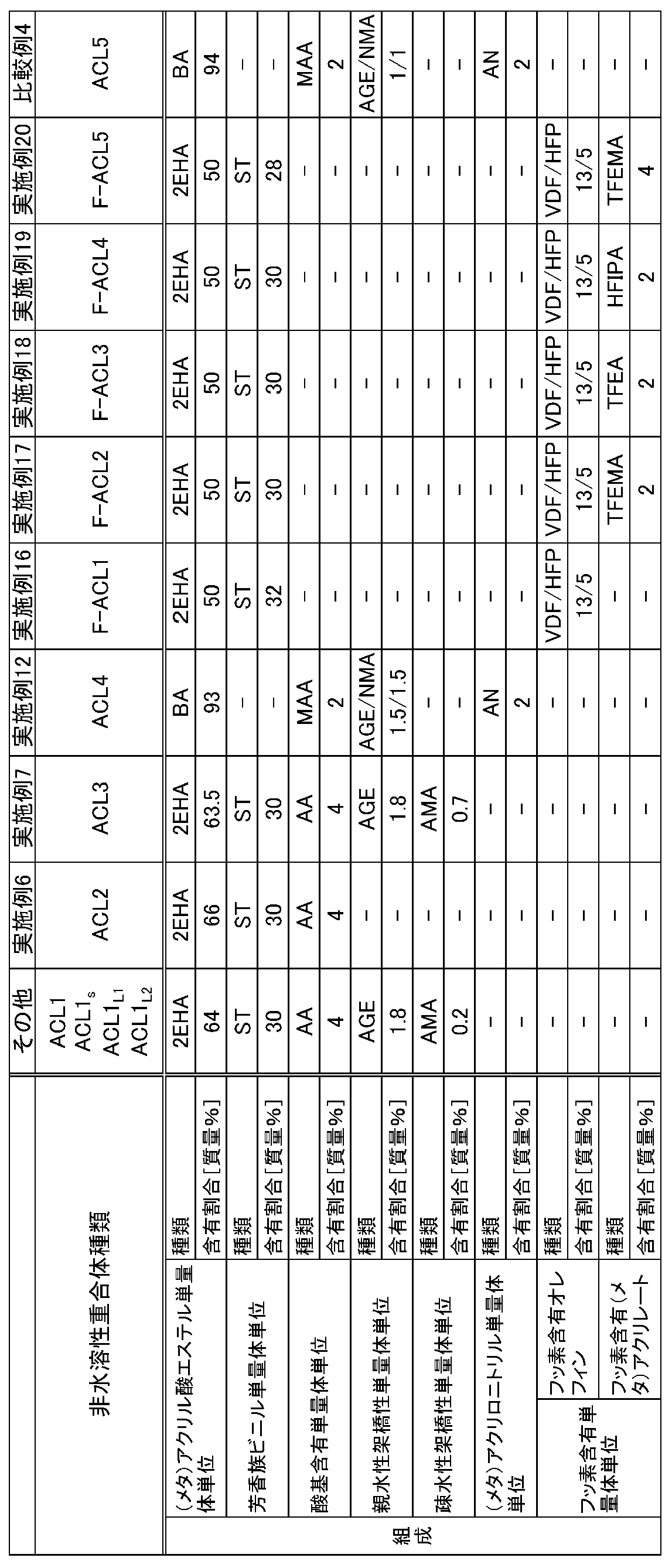
Claims (7)
- 非導電性粒子と、
電解液膨潤度が1.0倍超2.0倍以下である水溶性重合体と、
体積平均粒子径が0.01μm以上0.30μm以下である非水溶性重合体と、
を含む、非水系二次電池機能層用組成物。 - 前記水溶性重合体が、(メタ)アクリルアミド単量体単位を70質量%以上99質量%以下の割合で含有する、請求項1に記載の非水系二次電池機能層用組成物。
- 前記水溶性重合体が、架橋性単量体単位を0.01質量%以上2.0質量%以下の割合で含有する、請求項1又は2に記載の非水系二次電池機能層用組成物。
- 前記非水溶性重合体の電解液膨潤度が、1.0倍超3.0倍以下である、請求項1~3の何れかに記載の非水系二次電池機能層用組成物。
- 質量基準で、前記非水溶性重合体を、前記水溶性重合体の0.1倍以上2.5倍以下含有する、請求項1~4の何れかに記載の非水系二次電池機能層用組成物。
- 請求項1~5の何れかに記載の非水系二次電池機能層用組成物を用いて形成した非水系二次電池用機能層。
- 請求項6に記載の非水系二次電池用機能層を備える、非水系二次電池。
Priority Applications (6)
| Application Number | Priority Date | Filing Date | Title |
|---|---|---|---|
| CN201780025231.XA CN109075295B (zh) | 2016-05-10 | 2017-04-20 | 非水系二次电池功能层用组合物、非水系二次电池用功能层以及非水系二次电池 |
| JP2018516923A JP6908033B2 (ja) | 2016-05-10 | 2017-04-20 | 非水系二次電池機能層用組成物、非水系二次電池用機能層、及び非水系二次電池 |
| US16/094,591 US11456509B2 (en) | 2016-05-10 | 2017-04-20 | Composition for non-aqueous secondary battery functional layer, non-aqueous secondary battery functional layer, and non-aqueous secondary battery |
| EP17795925.1A EP3457457B1 (en) | 2016-05-10 | 2017-04-20 | Composition for non-aqueous secondary cell functional layer, functional layer for non-aqueous secondary cell, and non-aqueous secondary cell |
| PL17795925T PL3457457T3 (pl) | 2016-05-10 | 2017-04-20 | Kompozycja dla warstwy funkcjonalnej niewodnej baterii akumulatorowej, warstwa funkcjonalna niewodnej baterii akumulatorowej i niewodna bateria akumulatorowa |
| KR1020187030136A KR102361542B1 (ko) | 2016-05-10 | 2017-04-20 | 비수계 2차 전지 기능층용 조성물, 비수계 2차 전지용 기능층, 및 비수계 2차 전지 |
Applications Claiming Priority (2)
| Application Number | Priority Date | Filing Date | Title |
|---|---|---|---|
| JP2016-094778 | 2016-05-10 | ||
| JP2016094778 | 2016-05-10 |
Publications (1)
| Publication Number | Publication Date |
|---|---|
| WO2017195564A1 true WO2017195564A1 (ja) | 2017-11-16 |
Family
ID=60267693
Family Applications (1)
| Application Number | Title | Priority Date | Filing Date |
|---|---|---|---|
| PCT/JP2017/015943 Ceased WO2017195564A1 (ja) | 2016-05-10 | 2017-04-20 | 非水系二次電池機能層用組成物、非水系二次電池用機能層、及び非水系二次電池 |
Country Status (8)
| Country | Link |
|---|---|
| US (1) | US11456509B2 (ja) |
| EP (1) | EP3457457B1 (ja) |
| JP (1) | JP6908033B2 (ja) |
| KR (1) | KR102361542B1 (ja) |
| CN (1) | CN109075295B (ja) |
| HU (1) | HUE052066T2 (ja) |
| PL (1) | PL3457457T3 (ja) |
| WO (1) | WO2017195564A1 (ja) |
Cited By (8)
| Publication number | Priority date | Publication date | Assignee | Title |
|---|---|---|---|---|
| WO2019244643A1 (ja) * | 2018-06-20 | 2019-12-26 | 日本ゼオン株式会社 | 二次電池機能層用スラリーの製造方法 |
| JP2020187958A (ja) * | 2019-05-16 | 2020-11-19 | Dic株式会社 | リチウムイオン二次電池セパレータ耐熱層バインダー用水性樹脂組成物 |
| JP2022026935A (ja) * | 2020-07-31 | 2022-02-10 | 帝人株式会社 | 非水系二次電池用セパレータ及び非水系二次電池 |
| WO2022181560A1 (ja) * | 2021-02-26 | 2022-09-01 | 日本ゼオン株式会社 | 電気化学素子機能層用組成物、電気化学素子用積層体及び電気化学素子 |
| WO2023008502A1 (ja) * | 2021-07-30 | 2023-02-02 | 日本ゼオン株式会社 | 二次電池機能層用バインダー、二次電池機能層用スラリー組成物、二次電池用機能層、及び二次電池 |
| WO2023210785A1 (ja) * | 2022-04-28 | 2023-11-02 | 帝人株式会社 | 非水系二次電池用セパレータ及び非水系二次電池 |
| KR20240069710A (ko) | 2021-09-29 | 2024-05-20 | 니폰 제온 가부시키가이샤 | 비수계 이차 전지 기능층용 조성물, 비수계 이차 전지용 기능층, 비수계 이차 전지용 세퍼레이터 및 비수계 이차 전지 |
| JP2024524024A (ja) * | 2021-10-29 | 2024-07-05 | エルジー エナジー ソリューション リミテッド | 有機/無機複合多孔性コーティング層を含む電気化学素子用分離膜及びそれを含む電気化学素子 |
Families Citing this family (6)
| Publication number | Priority date | Publication date | Assignee | Title |
|---|---|---|---|---|
| JP6908029B2 (ja) * | 2016-04-19 | 2021-07-21 | 日本ゼオン株式会社 | 非水系二次電池機能層用バインダー組成物、非水系二次電池機能層用組成物、非水系二次電池用機能層、非水系二次電池用電池部材および非水系二次電池 |
| PL3474348T3 (pl) * | 2016-06-21 | 2024-03-04 | Zeon Corporation | Kompozycja do warstwy funkcjonalnej do niewodnej baterii akumulatorowej, warstwa funkcjonalna do niewodnej baterii akumulatorowej i niewodna bateria akumulatorowa |
| KR102861754B1 (ko) * | 2020-09-10 | 2025-09-18 | 에스케이이노베이션 주식회사 | 리튬이차전지용 분리막과 이의 제조방법 및 이를 구비한 전기화학소자 |
| KR20220135527A (ko) * | 2021-03-30 | 2022-10-07 | 삼성에스디아이 주식회사 | 리튬 이차 전지용 전극 조립체 및 이를 포함하는 리튬 이차 전지 |
| WO2023113330A1 (ko) * | 2021-12-15 | 2023-06-22 | 주식회사 엘지에너지솔루션 | 음극 조성물, 이를 포함하는 리튬 이차 전지용 음극 및 음극을 포함하는 리튬 이차 전지 |
| US20250038212A1 (en) * | 2021-12-28 | 2025-01-30 | Zeon Corporation | Binder composition for non-aqueous secondary battery functional layer, slurry composition for non-aqueous secondary battery functional layer, functional layer for non-aqueous secondary battery, non-aqueous secondary battery member, and non-aqueous secondary battery |
Citations (4)
| Publication number | Priority date | Publication date | Assignee | Title |
|---|---|---|---|---|
| WO2011040562A1 (ja) * | 2009-09-30 | 2011-04-07 | 日本ゼオン株式会社 | 二次電池用多孔膜及び二次電池 |
| WO2015008626A1 (ja) * | 2013-07-18 | 2015-01-22 | Jsr株式会社 | 蓄電デバイス用バインダー組成物、蓄電デバイス用スラリー、蓄電デバイス電極、セパレーターおよび蓄電デバイス |
| WO2015145967A1 (ja) * | 2014-03-24 | 2015-10-01 | 日本ゼオン株式会社 | 非水系二次電池多孔膜用バインダー、非水系二次電池多孔膜用組成物、非水系二次電池用多孔膜および非水系二次電池 |
| JP2016081896A (ja) * | 2014-10-20 | 2016-05-16 | 日本ゼオン株式会社 | 非水系二次電池多孔膜用バインダー、非水系二次電池多孔膜用組成物、非水系二次電池用多孔膜および非水系二次電池 |
Family Cites Families (6)
| Publication number | Priority date | Publication date | Assignee | Title |
|---|---|---|---|---|
| EP2282364B1 (en) * | 2008-03-31 | 2014-05-21 | Zeon Corporation | Porous film and secondary cell electrode |
| KR101801049B1 (ko) * | 2010-08-31 | 2017-11-24 | 제온 코포레이션 | 전지 다공막용 슬러리 조성물, 이차 전지용 다공막의 제조 방법, 이차 전지용 다공막, 이차 전지용 전극, 이차 전지용 세퍼레이터 및 이차 전지 |
| WO2013005796A1 (ja) | 2011-07-06 | 2013-01-10 | 日本ゼオン株式会社 | 二次電池用多孔膜、二次電池用セパレーター及び二次電池 |
| JP6186852B2 (ja) | 2013-04-30 | 2017-08-30 | 日本ゼオン株式会社 | 二次電池多孔膜用スラリー組成物、二次電池用電極、二次電池用セパレータおよび二次電池 |
| JP6327251B2 (ja) * | 2013-06-04 | 2018-05-23 | 日本ゼオン株式会社 | リチウムイオン二次電池用多孔膜スラリー組成物、リチウムイオン二次電池用セパレーター、リチウムイオン二次電池用電極及びリチウムイオン二次電池 |
| US9917287B2 (en) * | 2014-02-14 | 2018-03-13 | Zeon Corporation | Secondary-battery porous membrane composition, secondary-battery porous membrane and secondary battery |
-
2017
- 2017-04-20 KR KR1020187030136A patent/KR102361542B1/ko active Active
- 2017-04-20 CN CN201780025231.XA patent/CN109075295B/zh not_active Expired - Fee Related
- 2017-04-20 WO PCT/JP2017/015943 patent/WO2017195564A1/ja not_active Ceased
- 2017-04-20 US US16/094,591 patent/US11456509B2/en active Active
- 2017-04-20 JP JP2018516923A patent/JP6908033B2/ja not_active Expired - Fee Related
- 2017-04-20 HU HUE17795925A patent/HUE052066T2/hu unknown
- 2017-04-20 EP EP17795925.1A patent/EP3457457B1/en active Active
- 2017-04-20 PL PL17795925T patent/PL3457457T3/pl unknown
Patent Citations (4)
| Publication number | Priority date | Publication date | Assignee | Title |
|---|---|---|---|---|
| WO2011040562A1 (ja) * | 2009-09-30 | 2011-04-07 | 日本ゼオン株式会社 | 二次電池用多孔膜及び二次電池 |
| WO2015008626A1 (ja) * | 2013-07-18 | 2015-01-22 | Jsr株式会社 | 蓄電デバイス用バインダー組成物、蓄電デバイス用スラリー、蓄電デバイス電極、セパレーターおよび蓄電デバイス |
| WO2015145967A1 (ja) * | 2014-03-24 | 2015-10-01 | 日本ゼオン株式会社 | 非水系二次電池多孔膜用バインダー、非水系二次電池多孔膜用組成物、非水系二次電池用多孔膜および非水系二次電池 |
| JP2016081896A (ja) * | 2014-10-20 | 2016-05-16 | 日本ゼオン株式会社 | 非水系二次電池多孔膜用バインダー、非水系二次電池多孔膜用組成物、非水系二次電池用多孔膜および非水系二次電池 |
Non-Patent Citations (1)
| Title |
|---|
| See also references of EP3457457A4 * |
Cited By (17)
| Publication number | Priority date | Publication date | Assignee | Title |
|---|---|---|---|---|
| WO2019244643A1 (ja) * | 2018-06-20 | 2019-12-26 | 日本ゼオン株式会社 | 二次電池機能層用スラリーの製造方法 |
| JPWO2019244643A1 (ja) * | 2018-06-20 | 2021-06-24 | 日本ゼオン株式会社 | 二次電池機能層用スラリーの製造方法 |
| JP7347419B2 (ja) | 2018-06-20 | 2023-09-20 | 日本ゼオン株式会社 | 二次電池機能層用スラリーの製造方法 |
| JP2020187958A (ja) * | 2019-05-16 | 2020-11-19 | Dic株式会社 | リチウムイオン二次電池セパレータ耐熱層バインダー用水性樹脂組成物 |
| JP2022026935A (ja) * | 2020-07-31 | 2022-02-10 | 帝人株式会社 | 非水系二次電池用セパレータ及び非水系二次電池 |
| JP7628780B2 (ja) | 2020-07-31 | 2025-02-12 | 帝人株式会社 | 非水系二次電池用セパレータ及び非水系二次電池 |
| WO2022181560A1 (ja) * | 2021-02-26 | 2022-09-01 | 日本ゼオン株式会社 | 電気化学素子機能層用組成物、電気化学素子用積層体及び電気化学素子 |
| JPWO2022181560A1 (ja) * | 2021-02-26 | 2022-09-01 | ||
| JP7831472B2 (ja) | 2021-02-26 | 2026-03-17 | 日本ゼオン株式会社 | 電気化学素子機能層用組成物、電気化学素子用積層体及び電気化学素子 |
| EP4300697A4 (en) * | 2021-02-26 | 2025-06-11 | Zeon Corporation | Composition for functional layer of an electrochemical element, layered body for an electrochemical element and electrochemical element |
| WO2023008502A1 (ja) * | 2021-07-30 | 2023-02-02 | 日本ゼオン株式会社 | 二次電池機能層用バインダー、二次電池機能層用スラリー組成物、二次電池用機能層、及び二次電池 |
| KR20240069710A (ko) | 2021-09-29 | 2024-05-20 | 니폰 제온 가부시키가이샤 | 비수계 이차 전지 기능층용 조성물, 비수계 이차 전지용 기능층, 비수계 이차 전지용 세퍼레이터 및 비수계 이차 전지 |
| JP2024524024A (ja) * | 2021-10-29 | 2024-07-05 | エルジー エナジー ソリューション リミテッド | 有機/無機複合多孔性コーティング層を含む電気化学素子用分離膜及びそれを含む電気化学素子 |
| JP7744080B2 (ja) | 2021-10-29 | 2025-09-25 | エルジー エナジー ソリューション リミテッド | 有機/無機複合多孔性コーティング層を含む電気化学素子用分離膜及びそれを含む電気化学素子 |
| JP7411005B2 (ja) | 2022-04-28 | 2024-01-10 | 帝人株式会社 | 非水系二次電池用セパレータ及び非水系二次電池 |
| JP2023164113A (ja) * | 2022-04-28 | 2023-11-10 | 帝人株式会社 | 非水系二次電池用セパレータ及び非水系二次電池 |
| WO2023210785A1 (ja) * | 2022-04-28 | 2023-11-02 | 帝人株式会社 | 非水系二次電池用セパレータ及び非水系二次電池 |
Also Published As
| Publication number | Publication date |
|---|---|
| HUE052066T2 (hu) | 2021-04-28 |
| EP3457457B1 (en) | 2020-11-18 |
| EP3457457A1 (en) | 2019-03-20 |
| KR102361542B1 (ko) | 2022-02-09 |
| JP6908033B2 (ja) | 2021-07-21 |
| US20190305279A1 (en) | 2019-10-03 |
| JPWO2017195564A1 (ja) | 2019-03-07 |
| US11456509B2 (en) | 2022-09-27 |
| CN109075295B (zh) | 2021-06-08 |
| EP3457457A4 (en) | 2019-11-27 |
| CN109075295A (zh) | 2018-12-21 |
| PL3457457T3 (pl) | 2021-04-19 |
| KR20190005154A (ko) | 2019-01-15 |
Similar Documents
| Publication | Publication Date | Title |
|---|---|---|
| JP6908032B2 (ja) | 非水系二次電池機能層用組成物、非水系二次電池用機能層、及び非水系二次電池 | |
| JP6908033B2 (ja) | 非水系二次電池機能層用組成物、非水系二次電池用機能層、及び非水系二次電池 | |
| JP6409782B2 (ja) | リチウムイオン二次電池のバインダー用の粒子状重合体、接着層及び多孔膜組成物 | |
| CN105934838B (zh) | 二次电池多孔膜用组合物、二次电池用多孔膜、及二次电池 | |
| KR102407601B1 (ko) | 비수계 이차 전지 기능층용 조성물, 비수계 이차 전지용 기능층, 비수계 이차 전지, 및 비수계 이차 전지용 전극의 제조 방법 | |
| JP6327251B2 (ja) | リチウムイオン二次電池用多孔膜スラリー組成物、リチウムイオン二次電池用セパレーター、リチウムイオン二次電池用電極及びリチウムイオン二次電池 | |
| KR102408245B1 (ko) | 비수계 이차 전지 다공막용 조성물, 비수계 이차 전지용 다공막 및 비수계 이차 전지 | |
| JP6171680B2 (ja) | リチウムイオン二次電池用多孔膜組成物、リチウムイオン二次電池用セパレータ、リチウムイオン二次電池用電極、及びリチウムイオン二次電池 | |
| WO2015005145A1 (ja) | リチウムイオン二次電池用接着剤、リチウムイオン二次電池用セパレータ、及びリチウムイオン二次電池 | |
| JP6988799B2 (ja) | 非水系二次電池機能層用組成物、非水系二次電池用機能層及び非水系二次電池 | |
| JP2015028842A (ja) | リチウムイオン二次電池用接着剤、リチウムイオン二次電池用セパレータ、及びリチウムイオン二次電池 | |
| WO2016031163A1 (ja) | 非水系二次電池用積層体および非水系二次電池部材の製造方法 | |
| JPWO2017026095A1 (ja) | 非水系二次電池機能層用組成物、非水系二次電池用機能層および非水系二次電池 | |
| WO2017183641A1 (ja) | 非水系二次電池機能層用バインダー組成物、非水系二次電池機能層用組成物、非水系二次電池用機能層、非水系二次電池用電池部材および非水系二次電池 | |
| WO2019065130A1 (ja) | 非水系二次電池機能層用組成物、非水系二次電池用機能層および非水系二次電池 | |
| JP6337900B2 (ja) | 二次電池用多孔膜スラリー組成物、二次電池用セパレータ、二次電池用電極及び二次電池 | |
| WO2024048378A1 (ja) | 電気化学素子機能層用組成物、電気化学素子用機能層、電気化学素子用積層体、および電気化学素子 | |
| WO2022181560A1 (ja) | 電気化学素子機能層用組成物、電気化学素子用積層体及び電気化学素子 |
Legal Events
| Date | Code | Title | Description |
|---|---|---|---|
| WWE | Wipo information: entry into national phase |
Ref document number: 2018516923 Country of ref document: JP |
|
| ENP | Entry into the national phase |
Ref document number: 20187030136 Country of ref document: KR Kind code of ref document: A |
|
| NENP | Non-entry into the national phase |
Ref country code: DE |
|
| 121 | Ep: the epo has been informed by wipo that ep was designated in this application |
Ref document number: 17795925 Country of ref document: EP Kind code of ref document: A1 |
|
| ENP | Entry into the national phase |
Ref document number: 2017795925 Country of ref document: EP Effective date: 20181210 |