WO2017195670A1 - Élément de protection isolant, son procédé de fabrication, procédé de construction, élément interne de four, et four de chauffage - Google Patents
Élément de protection isolant, son procédé de fabrication, procédé de construction, élément interne de four, et four de chauffage Download PDFInfo
- Publication number
- WO2017195670A1 WO2017195670A1 PCT/JP2017/016993 JP2017016993W WO2017195670A1 WO 2017195670 A1 WO2017195670 A1 WO 2017195670A1 JP 2017016993 W JP2017016993 W JP 2017016993W WO 2017195670 A1 WO2017195670 A1 WO 2017195670A1
- Authority
- WO
- WIPO (PCT)
- Prior art keywords
- base material
- protective member
- furnace
- insulating protective
- heat insulating
- Prior art date
- Legal status (The legal status is an assumption and is not a legal conclusion. Google has not performed a legal analysis and makes no representation as to the accuracy of the status listed.)
- Ceased
Links
Images





Classifications
-
- C—CHEMISTRY; METALLURGY
- C04—CEMENTS; CONCRETE; ARTIFICIAL STONE; CERAMICS; REFRACTORIES
- C04B—LIME, MAGNESIA; SLAG; CEMENTS; COMPOSITIONS THEREOF, e.g. MORTARS, CONCRETE OR LIKE BUILDING MATERIALS; ARTIFICIAL STONE; CERAMICS; REFRACTORIES; TREATMENT OF NATURAL STONE
- C04B35/00—Shaped ceramic products characterised by their composition; Ceramics compositions; Processing powders of inorganic compounds preparatory to the manufacturing of ceramic products
- C04B35/01—Shaped ceramic products characterised by their composition; Ceramics compositions; Processing powders of inorganic compounds preparatory to the manufacturing of ceramic products based on oxide ceramics
- C04B35/10—Shaped ceramic products characterised by their composition; Ceramics compositions; Processing powders of inorganic compounds preparatory to the manufacturing of ceramic products based on oxide ceramics based on aluminium oxide
-
- C—CHEMISTRY; METALLURGY
- C04—CEMENTS; CONCRETE; ARTIFICIAL STONE; CERAMICS; REFRACTORIES
- C04B—LIME, MAGNESIA; SLAG; CEMENTS; COMPOSITIONS THEREOF, e.g. MORTARS, CONCRETE OR LIKE BUILDING MATERIALS; ARTIFICIAL STONE; CERAMICS; REFRACTORIES; TREATMENT OF NATURAL STONE
- C04B35/00—Shaped ceramic products characterised by their composition; Ceramics compositions; Processing powders of inorganic compounds preparatory to the manufacturing of ceramic products
- C04B35/71—Ceramic products containing macroscopic reinforcing agents
- C04B35/78—Ceramic products containing macroscopic reinforcing agents containing non-metallic materials
- C04B35/80—Fibres, filaments, whiskers, platelets, or the like
-
- C—CHEMISTRY; METALLURGY
- C21—METALLURGY OF IRON
- C21D—MODIFYING THE PHYSICAL STRUCTURE OF FERROUS METALS; GENERAL DEVICES FOR HEAT TREATMENT OF FERROUS OR NON-FERROUS METALS OR ALLOYS; MAKING METAL MALLEABLE, e.g. BY DECARBURISATION OR TEMPERING
- C21D1/00—General methods or devices for heat treatment, e.g. annealing, hardening, quenching or tempering
-
- F—MECHANICAL ENGINEERING; LIGHTING; HEATING; WEAPONS; BLASTING
- F27—FURNACES; KILNS; OVENS; RETORTS
- F27D—DETAILS OR ACCESSORIES OF FURNACES, KILNS, OVENS OR RETORTS, IN SO FAR AS THEY ARE OF KINDS OCCURRING IN MORE THAN ONE KIND OF FURNACE
- F27D1/00—Casings; Linings; Walls; Roofs
-
- F—MECHANICAL ENGINEERING; LIGHTING; HEATING; WEAPONS; BLASTING
- F27—FURNACES; KILNS; OVENS; RETORTS
- F27D—DETAILS OR ACCESSORIES OF FURNACES, KILNS, OVENS OR RETORTS, IN SO FAR AS THEY ARE OF KINDS OCCURRING IN MORE THAN ONE KIND OF FURNACE
- F27D1/00—Casings; Linings; Walls; Roofs
- F27D1/14—Supports for linings
Definitions
- the present invention relates to a heat insulating protective member made of an inorganic fiber molded body, a manufacturing method thereof, an in-furnace member using the heat insulating protective member, and a heating furnace.
- High-temperature furnaces such as heating furnaces in the steel industry include high-temperature pipes with bent parts, corner parts, curved parts, and columnar members such as walking beam type skid posts.
- Inorganic fiber aggregates and inorganic fiber molded bodies are used.
- a needling-processed inorganic fiber aggregate is often used because of its characteristics such as lightness, easy processability, thermal shock resistance, wind erosion resistance, and low thermal conductivity.
- the needle blanket is formed by compressing or laminating it, and a veneering method or a block laminate is attached to the needle blanket.
- Such a heat insulating protective member has a problem of corrosion caused by scales or alkali substances generated in the furnace.
- alumina / silica-based inorganic fibers generate low melting point compounds, especially with FeO, due to the scale in the furnace, and there is a problem of early deterioration due to erosion and brittleness starting from there. is there.
- Patent Document 1 describes an inorganic fibrous heat insulating material block in which a furnace inner surface of a blanket laminate is impregnated with a liquid containing a component that generates Al 2 O 3 by firing and a component that generates CaO. Has been.
- the inorganic fibrous heat insulating material block described in Patent Document 1 has a shape that is compressed in the stacking direction by being sandwiched from both sides by a shape-retaining plate, and is held in a compressed state by wrapping a binding band. After arranging this inorganic fibrous heat insulating material block on the furnace inner surface, it is constructed so as to cut the binding band and remove the binding band and the shape retaining plate.
- the inorganic fiber heat insulating material block of the above-mentioned patent document 1 has a package shape in which a binding band is wound around and held in a compressed state, when the furnace inner surface is curved, it is made to conform to the furnace inner surface during construction. Can not be curved. Therefore, when the construction target surface is curved with a small curvature average, it is not easy to construct the inorganic fibrous heat insulating material block without causing a gap between the construction target surface and the construction target surface.
- the present invention is a heat insulation protective member that is easy to construct so as to be closely adhered to the construction target surface even if the construction target surface is curved, its manufacturing method and construction method, and the heat insulation protective member. It aims at providing an in-furnace member and a heating furnace.
- the gist of the present invention is as follows.
- the amount of water in the impregnated part is 50 to 400 parts by mass with respect to 100 parts by mass of the inorganic fibers in the impregnated part,
- the moisture content of the whole heat insulating protective member is 50 to 400 parts by mass with respect to 100 parts by mass of the inorganic fibers of the whole heat insulating protective member,
- the oxide precursor-containing liquid contains a component that produces an alumina-calcia composition containing aluminum oxide and calcium oxide by firing,
- an insulating protection member in which the oxide precursor-containing liquid is attached in an
- the moisture content of the end portion having the joint portion with the base material portion is opposite to the end portion having the joint portion between the base material portion and the base material portion in the vertical direction of the laminate and the opposite end portion thereof.
- the bulk density of the end portion having the joint portion with the base material portion is opposite to the end portion having the joint portion between the base material portion and the base material portion in the vertical direction of the laminate and the opposite end portion thereof.
- the heat insulating protective member according to any one of [1] to [7], which is higher than an end portion.
- the bulk density of the inorganic fiber in each part of the base part, the end part having the joint part of the base part and the base part in the vertical direction, and the opposite end part thereof is the base part and the base part.
- [10] A method for producing the heat insulating protective member according to any one of [1] to [9], Overlaying the needle blanket and the base material part for constituting the laminate, and joining at the part to be the folded part, The manufacturing method of the heat insulation protection member which has the process of folding up the needle blanket for comprising the said laminated body in a perpendicular direction with a base material part in this junction part.
- a method for constructing a heat insulating protective member comprising a step of attaching the heat insulating protective member according to any one of [1] to [9] to an inner surface of a furnace body or a surface of a member in the furnace.
- a heating furnace in which the heat insulating protective member according to any one of [1] to [9] is mounted on the inner surface of the furnace body or the surface of the in-furnace member.
- An in-furnace member in which a heat insulating protective member is mounted on the surface,
- the heat-insulating protective member is a base material comprising a laminate in which a folded back of an alumina fiber needle blanket is laminated, and an alumina fiber needle blanket attached to one surface of the laminated body on the folded portion side of the needle blanket And The folded portion of the needle blanket and the base material portion are combined,
- An in-furnace member comprising an alumina / calcia composition containing aluminum oxide and calcium oxide in at least a part of the laminate and the base material.
- a heating furnace in which the heat insulating protection member is attached to the inner surface of the furnace body or the surface of the in-furnace member,
- the heat-insulating protective member is a base material comprising a laminate in which a folded back of an alumina fiber needle blanket is laminated, and an alumina fiber needle blanket attached to one surface of the laminated body on the folded portion side of the needle blanket And The folded portion of the needle blanket and the base material portion are combined,
- a heating furnace comprising an alumina calcia composition containing aluminum oxide and calcium oxide in at least a part of the laminate and the base material.
- the heat insulation protective member of the present invention has a laminate in which folded bodies of needle blankets made of alumina fibers are laminated, and a base material portion attached to one surface of the laminate.
- this thermal insulation protective member is constructed so that the laminate is applied to the surface to be constructed, the needle blanket that is a component of the laminate is deformed and compressed in the thickness direction to reduce the circumferential length difference between the inner and outer circumferences. Absorb.
- the heat insulating protection member can be curved and brought into close contact with the construction target surface.
- the needle blankets are arranged in a direction perpendicular to the base material portion.
- the fibers are generally oriented in the mat surface direction of the needle blanket, in the laminated body of the needle blanket folded body of the heat insulation protection member of the present invention, the fibers are oriented in the direction perpendicular to the base material portion. is doing. Therefore, when this heat insulation protective member is coat
- the base material portion in which the fibers are oriented in the direction of the exposed surface in the furnace is exposed to the atmosphere in the furnace, it is likely to deteriorate with time or to scatter and peel off due to wind erosion.
- the fibers are oriented in the direction perpendicular to the surface to be constructed, that is, in the direction perpendicular to the in-furnace exposed surface of the heat-insulating protective member, as described above. Are better.
- the heat insulating protective member of the present invention provided in the furnace maintains an excellent heat insulating protective action over a long period of time.
- the scale resistance is improved by impregnating the needle blanket of inorganic fiber with the oxide precursor-containing liquid.
- the molar ratio of Al to Ca (Al / Ca) in the entire impregnated portion is 10 to 330, an appropriate amount of CaO diffuses inside the inorganic fiber when fired to a high temperature.
- the presence of CaO inside the inorganic fiber makes it difficult for FeO to diffuse into the inorganic fiber. That is, the reaction between the inorganic fibers and FeO is suppressed, and the scale resistance of the heat insulating protective member is improved.
- the heat insulation protective member of the present invention has flexibility by leaving the impregnated oxide precursor-containing liquid in an undried state until construction, and in particular, construction of bent portions, corner portions, and curved portions. Excellent in adhesion and adhesion.
- the heat insulation protective member of the present invention is excellent in mechanical strength and workability by controlling the water content.
- the heat insulating protective member of the present invention can be easily coated and fixed on a skid post or a skid beam.
- FIG. 8a is a perspective view of a skid post and a skid beam as the in-furnace member on which the heat insulating protection member is applied
- FIG. 8b is a sectional view taken along the line VIIIb-VIIIb of FIG. 8a.
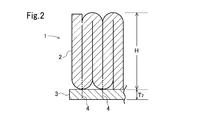
- the heat insulation protective member 1 includes a laminate 2 formed by laminating a folded body obtained by folding a needle blanket of alumina fiber, and an alumina fiber needle attached to one surface of the laminated body where a folded portion of the needle blanket is exposed.
- the base part 3 made of a blanket is provided, and the folded portion of the laminate 2 and the base part 3 are joined.
- the base material portion 3 has a rectangular shape extending in the stacking direction of the stacked body 2. At least a part of the heat insulation protective member 1 is impregnated with an oxide precursor-containing liquid described later.
- the needle blanket 5 and the base material portion 3 are overlapped, and a portion at a predetermined distance from the one end side 5a of the needle blanket 5 and the base material portion 3 are combined. Suture is sewn with an alumina thread 4.
- the laminate 2 in the joining means between the folded portion of the laminate 2 and the base material portion 3, the laminate 2 is sewn with an alumina-made sewing thread 4, but the laminate 2 is bonded with a heat-resistant adhesive such as an alumina / silica adhesive. You may adhere
- one end side 5b of the needle blanket 5 and the subsequent portion 5c are folded and overlapped with the base member 3 in the vertical direction.
- the portion 5d following the portion 5c is folded back, and the boundary between the portion 5d and the subsequent portion 5e is sewn to the base material portion 3 with the sewing thread 4.
- the heat insulation protective member 1 is manufactured by repeating this procedure and then impregnating the precursor liquid.
- the portions 5 b, 5 c, 5 d of the needle blanket 5 constituting the laminate 2 are perpendicular to the base material portion 3.
- the length L in the longitudinal direction of the laminate 2 and the base material portion 3 is equal, and the width W is also equal.
- the thickness T 1 of the needle blanket 5 constituting the laminate 2 is preferably about 5 to 25 mm, particularly about 10 to 15 mm.
- the thickness T 2 are about 5 ⁇ 25 mm, especially 10 ⁇ 15 mm is suitable.
- the length L in the longitudinal direction of the heat insulating protective member 1 is preferably about 500 to 3000 mm, particularly about 1000 to 2000 mm.
- the width W is preferably about 100 to 800 mm, particularly about 300 to 600 mm.
- the height (height in the direction perpendicular to the base material portion 3) H of the laminate 2 is usually 30 to 150 mm, preferably 40 to 120 mm, particularly preferably about 50 to 90 mm.
- the bulk density of the heat-insulating protection member 1 is generally 0.10 ⁇ 0.75g / cm 3, is preferably 0.15 ⁇ 0.60g / cm 3, particularly preferably about 0.20 ⁇ 0.45g / cm 3 .
- the bulk density of the laminate 2 is usually 0.10 ⁇ 0.75g / cm 3, preferably 0.15 ⁇ 0.60g / cm 3, particularly preferably about 0.20 ⁇ 0.45g / cm 3.
- the laminate 2 has an end portion having a joint portion with the base material portion in a direction perpendicular to the base material portion and an opposite end portion thereof. Especially, it is preferable that the bulk density of the edge part which has a coupling
- the bulk density of the end portion having the bonding portion with the base material portion is preferably 0.15 to 0.75 g / cm 3 , more preferably 0.20 to 0.65 g / cm 3 , and particularly preferably 0.25 to It is about 0.60 g / cm 3 .
- the bulk density of the opposite end is preferably about 0.15 to 0.75 g / cm 3 , more preferably about 0.20 to 0.60 g / cm 3 , and particularly preferably about 0.25 to 0.50 g / cm 3 . is there.
- the bulk density of the base portion 3 is preferably 0.10 ⁇ 0.75 g / cm 3, more preferably 0.15 ⁇ 0.60 g / cm 3, particularly preferably about 0.20 ⁇ 0.45 g / cm 3 It is.
- the heat insulation protective member 1 is constructed so as to press the side 1 f opposite to the base material portion 3 against the outer surface of the construction object 10.
- the side 1f opposite to the base material part 3 of the heat insulating protective member 1 is compressed in the direction of arrow P (that is, the direction parallel to the base material part 3), and the opposite side 1f is bent concavely so Adhere to.
- the repulsive force on the opposite side 1f with respect to bending may be strong and peel away in the opposite direction of P even if the heat insulating protective member 1 is bent and brought into close contact.
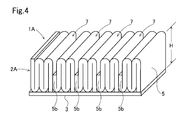
- the length of at least one end side 5b of the needle blanket 5 is shortened so as to be opposite to the base material portion 3 of the heat insulation protection member 1A as in the laminated body 2A of the heat insulation protection member 1A in FIG.
- the recess 7 may be formed.
- the depth of the recess 7 is preferably about 10 to 70%, particularly about 30 to 50% of the height H of the laminate 2A.
- the alumina-based sewing thread 4 is preferably an alumina long fiber thread. In addition, you may use the sewing thread made from refractory materials other than an alumina material.
- the long rectangular needle blanket 5 is folded back into a zigzag shape.
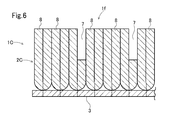
- the laminated body 2B may be configured by the needle blanket 8 having a shape folded only once. The folded portion of the needle blanket 8 is also sewn to the base material portion 3 with the alumina sewing thread 4.
- the heat insulating protective member 1B can be manufactured by repeatedly folding the needle blanket 8 in the direction perpendicular to the base material portion 3 after the needle blanket 8 is sewn with the sewing thread 4. Moreover, this heat insulation protective member 1B can be manufactured also by cutting and removing the 1f opposite side to the base material part 3 of the heat insulation protection member 1 shown in FIG.
- the end surface of the needle blanket 8 is aligned on the opposite side 1f to the base material part 3, but on the opposite side 1f like the heat insulation protective member 1C of FIG.
- a recess 7 similar to that of the heat insulating protection member 1A may be formed to facilitate the compression in the P direction.
- the end surfaces (cut surfaces) of the needle blankets 8 constituting the laminated bodies 2B and 2C are exposed on the opposite side surface 1f.
- the end surface of the needle blanket 8 has an adhesive layer 11 which will be described later as compared to a folded portion in which the folded portion on the opposite side 1f is a longitudinal surface of the needle blanket 5, that is, a mat surface, as in the heat insulating protection members 1 and 1A. Easy to get used to.
- the opposite side 1f is a flat surface, which is easily adhered to the entire construction target surface. Furthermore, since it is easy to make it adhere when the construction target surface is flat, it can also be used as a veneering material that can be constructed easily over a wide range of the furnace inner wall.
- FIG. 7 shows a method of constructing the thermal insulation protection member 1 on the construction object 10.
- an adhesive layer 11 made of a kneaded material obtained by kneading alumina cement with water and an additive such as a thickener on the surface of the construction object 10 with a predetermined thickness (for example, 0. 0). 3 to 10 mm, especially 0.5 to 5 mm).
- the adhesive layer 11 may contain refractory aggregate particles or refractory fibers in addition to the alumina cement.
- the side 1f opposite to the base material part 3 of the heat insulation protective member 1 is pressed against the adhesive layer 11 on the surface of the construction object 10 in a state of being compressed in the arrow P direction.
- an oxide precursor-containing liquid-impregnated needle blanket may be wound around the outer periphery of the heat insulation protection member 1 as necessary. Further, the outer periphery may be fixed with a tape or a rope.
- an oxide precursor containing liquid impregnation needle blanket is wound around the surface of the construction target object 10, the unevenness
- it may be pressed against the adhesive layer 11 on the surface of the construction object 10 while being compressed in the direction of the arrow P.
- the insulation protection members 1A to 1C are also constructed in the same procedure as above.
- the needle blanket 5 is oriented in the direction perpendicular to the exposed surface in the furnace, that is, the outer surface of the base member 3.
- the fibers of the laminate 2 are oriented in the direction perpendicular to the base material portion 3.
- the fibers in the needle blanket constituting the base material part 3 are oriented in the direction of the exposed surface in the furnace, they are easily peeled off by the high-temperature gas flow in the furnace when the furnace is operated, and are susceptible to wind erosion. .
- the fibers of the laminate 2 are oriented in a direction perpendicular to the furnace exposure surface, the base material portion 3 disappears and the laminate 2 is directly exposed to the furnace atmosphere.
- the fiber is hardly peeled off and is not easily affected by wind erosion. Therefore, the heat insulation and protection members 1, 1A to 1C of the present invention maintain excellent heat insulation and protection for a very long time.
- the skid post 21 on which the heat insulation protective member of the present invention is constructed is a steel pipe shape, and is erected from the hearth G.
- the skid post 21 includes not only a steel pipe shape itself but also one having an existing heat insulating material such as a refractory castable around the steel pipe shape.
- a skid beam 22 is installed so as to be supported by a plurality of skid posts 21.
- a fireproof coating 23 made of fireproof castable is applied to the upper part of the skid post 21.
- the heat insulating protection member 1 of the present invention is applied below the fireproof coating 23.
- the heat insulating protection member 1 is constructed with the side 1 f opposite to the base material portion 3 facing the skid post 21.
- a fireproof coating 24 made of fireproof castable is also applied to the upper half side of the skid beam 22.
- the heat insulation protection member 1 of the present invention is applied to the lower half side of the skid beam 22.
- the heat insulating protection member 1 is constructed with the side 1 f opposite to the base material portion 3 facing the skid beam 22.
- the heat insulation protective member 1 of the present invention is constructed on the lower half side of the skid post 21 or the skid beam 22 in which the construction target surface of the in-furnace member is a convex curved surface, and in particular, the laminate is applied to the construction target surface. Being constructed absorbs the circumferential length difference between the inner and outer circumferences by deforming and compressing the thickness direction of the needle blanket that is a component of the laminate. As a result, even if the construction target surface is convexly curved with a small radius of curvature, it is preferable in that the heat insulating protection member can be curved and brought into close contact with the construction target surface.
- the bulk of the inorganic fiber in each part at the end part having the joint part with the base part 3 and the base part and the opposite end part thereof is preferable that the density be increased in the order of the base portion, the end portion having the joint portion with the base portion, and the opposing end portion.
- the adhesive layer 11 (not shown in FIGS. 8a and 8b) is applied to the outer surfaces of the skid post 21 and the skid beam 22.
- the alumina fiber needle blanket 30 impregnated with the oxide precursor-containing liquid After attaching the alumina fiber needle blanket 30 impregnated with the oxide precursor-containing liquid to the outer peripheral side of the heat insulating protective member 1 that has been applied, it is fixed with a tape or rope. The tape and rope are then burned out when the temperature in the furnace is raised. In addition, the oxide precursor is baked by this temperature rise to become an oxide, and not only the bonds between the alumina fibers in the needle blanket but also the bonds between the interfaces of the folded bodies are strengthened by sintering of the oxide. Therefore, the shape of the heat insulation protective member 1 is maintained.
- the base material part after the fired construction of the heat insulation protective member 1 the end part having the joint part with the base material part and the bulk density at the opposite end part are the base part and the joint part with the base material part. It is preferable that it becomes high in order of the edge part which has, and an opposing edge part.
- the insulation protection members 1A to 1C are similarly constructed.
- the heat insulating protective member of the present invention is preferably provided with an impregnated part in which an oxide precursor-containing liquid adheres in an undried state on at least a part of the needle blanket, and the water content of the impregnated part is the amount of the impregnated part. 50 to 400 parts by mass with respect to 100 parts by mass of the inorganic fiber, and the moisture content of the entire heat insulating protective member is 50 to 400 parts by mass with respect to 100 parts by mass of the inorganic fiber of the entire heat insulating protective member.
- the body-containing liquid may be an alumina / calcia composition containing aluminum oxide (Al 2 O 3 ) and calcium oxide (CaO) by firing (Al 2 O 3 and CaO may be a simple substance or a complex oxide).
- the oxide precursor-containing liquid is 2 to 50 parts by mass with respect to 100 parts by mass of the inorganic fiber in the impregnated part.
- the molar ratio (Al / Ca) of Al to Ca in the entire impregnation part (the whole of the inorganic fibers and the deposit) is 10 or more and 330 or less.
- the inorganic fiber needle blanket used in the present invention (hereinafter sometimes simply referred to as “blanket” or “needle blanket”) is a fiber aggregate of inorganic fibers substantially free of fibers having a fiber diameter of 3 ⁇ m or less. Those subjected to needling treatment are preferred. By using such a needle blanket, the wind erosion resistance of the heat insulation protective member of the present invention can be enhanced.
- the inorganic fiber constituting the needle blanket is not particularly limited, and examples thereof include silica, alumina / silica, zirconia containing these, spinel, titania and calcia alone, or a composite fiber. From the viewpoint of fiber strength (toughness) and safety, it is an alumina / silica fiber, particularly a polycrystalline alumina / silica fiber.
- composition ratio (mass ratio) of alumina / silica fiber is preferably in the range of 65 to 98/35 to 2 called mullite composition or high alumina composition, more preferably 70 to 95/30 to 5, particularly preferably in the range of 70 to 74/30 to 26.
- the inorganic fiber is 80% by mass or more, preferably 90% by mass or more, and particularly preferably the total amount thereof is a polycrystalline alumina / silica fiber having the above mullite composition.
- the molar ratio of Ca to Al (Ca / Al) in the inorganic fiber is preferably 0.03 or less, and it is particularly preferable that the inorganic fiber does not contain Ca.
- This inorganic fiber is preferably substantially free of fibers having a fiber diameter of 3 ⁇ m or less.
- substantially free of fibers having a fiber diameter of 3 ⁇ m or less means that the fibers having a fiber diameter of 3 ⁇ m or less is 0.1 mass% or less of the total fiber weight.
- the average fiber diameter of the inorganic fibers is preferably 5 to 8 ⁇ m. If the average fiber diameter of the inorganic fiber is too thick, the repulsive force and toughness of the fiber assembly will be lost, and if it is too thin, the amount of dust generation floating in the air will increase, and there is a high probability that fibers with a fiber diameter of 3 ⁇ m or less will be contained. Become.
- the inorganic fiber aggregate having the above-mentioned preferred average fiber diameter and substantially free of fibers having a fiber diameter of 3 ⁇ m or less is used to control the spinning solution viscosity in the production of the inorganic fiber aggregate by the sol-gel method. It can be obtained by controlling the air flow used for the spinning nozzle, controlling the drying of the drawn yarn, and controlling the needling.
- the needle blanket includes a step of obtaining a mat-like aggregate of inorganic fiber precursors by a sol-gel method as described in a conventionally known method, for example, JP-A-2014-5173, and the obtained inorganic fiber precursor.
- This mat-like aggregate is manufactured through a step of needling treatment and a firing step of firing the aggregate of the inorganic fiber precursor subjected to the needling treatment to form an inorganic fiber aggregate.
- the inorganic fiber precursor is oriented in the mat surface direction during the accumulation process. Therefore, in the needle blanket, the fibers are oriented in the blanket surface direction (mat surface direction).
- the needle blanket includes a step of obtaining an aggregate of inorganic fiber precursors by a sol-gel method as described in a conventionally known method, for example, JP-A-2014-5173, and an aggregate of the obtained inorganic fiber precursors. It is manufactured through a step of subjecting the body to a needling treatment and a firing step of firing the aggregate of the inorganic fiber precursor subjected to the needling treatment to form an inorganic fiber aggregate.
- the needle mark density of the needle blanket is preferably 2 to 200 strokes / cm 2 , particularly 2 to 150 strokes / cm 2 , particularly 2 to 100 strokes / cm 2 , and particularly preferably 2 to 50 strokes / cm 2 . If the needle mark density is too low, the uniformity of the needle blanket thickness is lowered and the thermal shock resistance is lowered. If the needle mark density is too high, the fibers may be damaged and scattered after firing. .
- the bulk density of the needle blanket is preferably 50 to 200 kg / m 3 , and more preferably 80 to 150 kg / m 3 . If the bulk density is too low, a fragile inorganic fiber molded body is obtained. If the bulk density is too high, the mass of the inorganic fiber molded body increases and the repulsive force is lost, resulting in a molded body having low toughness.
- the areal density of the needle blanket 500 ⁇ 4000g / m 2, particularly 600 ⁇ 3800g / m 2, it is preferred especially is 1000 ⁇ 2000g / m 2. If the surface density of the needle blanket is too small, the amount of fibers is small and only a very thin molded body can be obtained, and the usefulness as an inorganic fiber molded body for heat insulation is reduced. If the surface density is too large, the amount of fibers is too large. This makes it difficult to control the thickness by the needling process.
- the thickness of the needle blanket is preferably about 2 to 35 mm. As will be described later, from the viewpoint of ensuring the impregnation depth of the oxide precursor-containing liquid is 3 mm or more, preferably 10 mm or more, the thickness of the needle blanket is It is preferably 3 mm or more, particularly 10 mm or more.
- the inorganic fiber needle blanket is formed into a plate shape so that a plate-shaped inorganic fiber molded body of the present invention can be manufactured.
- the plate-shaped needle blanket may be formed into a roll shape at the time of handling.
- the oxide precursor-containing liquid impregnated in the needle blanket is a component that produces an alumina-calcia composition containing aluminum oxide (Al 2 O 3 ) and calcium oxide (CaO) by firing as an oxide precursor. Including.
- Al 2 O 3 and CaO may be a simple substance or a double oxide of Al 2 O 3 and CaO.
- the mixed oxide of Al 2 O 3 and CaO although CaO ⁇ Al 2 O 3, CaO ⁇ 2Al 2 O 3, CaO ⁇ 6Al 2 O 3 and the like, but is not limited thereto.
- the presence form of the oxide in the fired product when only the oxide precursor-containing liquid is dried and fired may be any of the following (i) to (v).
- the oxide precursor-containing liquid includes at least a component containing Ca and a component containing Al.
- the component containing Ca include calcium hydroxide, chloride, acetate, lactate, nitrate, carbonate, and the like. Only 1 type of these may be contained in the oxide precursor containing liquid, and 2 or more types may be contained.
- calcium acetate, hydroxide, or carbonate is preferably water and carbon dioxide, and is preferable from the viewpoint of not deteriorating metal members in the furnace, steel plates, and the like.
- the component containing Ca may be dissolved in the oxide precursor-containing liquid, sol form, or dispersed form.
- the Ca-containing component is dissolved or uniformly dispersed in the oxide precursor-containing liquid, so that the oxide precursor is uniformly coated on the entire surface of each inorganic fiber constituting the needle blanket. In addition, it is preferable in that it can be easily impregnated into the inorganic fiber.
- the Ca-containing component precipitates in the oxide precursor-containing liquid, the surface of the inorganic fiber cannot be uniformly coated, and an uncoated portion is formed on the fiber surface, from which there is a risk of erosion due to scale. Therefore, there is a possibility that the effect of improving the scale resistance cannot be sufficiently exhibited.
- the component containing Al include aluminum hydroxide, chloride, acetate, lactate, nitrate, carbonate and the like. Only 1 type of these may be contained in the oxide precursor containing liquid, and 2 or more types may be contained. Especially, it is preferable that it is an acetate, a hydroxide, or carbonate of aluminum that the components which generate
- the component containing Al may be dissolved in the oxide precursor-containing liquid, sol form, or dispersed form. Since the component containing Al is dissolved or uniformly dispersed in the oxide precursor-containing liquid, the oxide precursor is uniformly coated on the entire surface of each inorganic fiber constituting the needle blanket. In addition, it is preferable in that it can be easily impregnated into the inorganic fiber.
- the Al-containing component is precipitated in the oxide precursor-containing liquid, the surface of the inorganic fiber cannot be uniformly coated, and there is a portion that is not coated on the fiber surface, from which there is a risk of erosion due to scale. For this reason, the effect of improving the scale resistance may be poor.
- the heat shrinkage rate of the heat insulating protective member is higher than that of the heat insulating protective member using the alumina sol using acetic acid as a dispersing agent. There is a tendency.
- the component that generates CaO by firing used when the above-mentioned alumina sol is used is preferably calcium acetate.
- the acetate By mixing the acetate, it is possible to suppress a decrease in the dispersibility of the alumina sol and to suppress an increase in the viscosity of the oxide precursor-containing liquid.
- the viscosity of the oxide precursor-containing liquid is within an appropriate range, it is easy to impregnate and control the amount of adhesion. If the viscosity of the oxide precursor-containing liquid is excessively high, impregnation of inorganic fibers may be difficult.
- an aqueous calcium acetate solution in which alumina sol is dispersed is preferable.
- the molar ratio of Al to Ca is 4 or more and 100 or less between the component that generates Al 2 O 3 by firing and the component that generates CaO by firing. It is preferable that it is contained, more preferably 6 or more and 36 or less, and particularly preferably 9 or more and 13 or less.
- Al / Ca ratio is within this range, when heated in the furnace, the calcium component can be appropriately diffused and the inorganic fibers and scale can be prevented from reacting. Further, since a calcium oxide-based oxide having high scale resistance is generated, the effect of improving the scale resistance is excellent.
- the oxide precursor concentration of the oxide precursor-containing liquid (the total content of the component that produces Al 2 O 3 by firing and the component that produces CaO by firing) is 2 to 30% by mass, especially 5 to 10% by mass is preferred. If the oxide precursor concentration of the oxide precursor-containing liquid is too low, the amount of oxide precursor component attached to the needle blanket (attachment amount) may be low. When the oxide precursor concentration of the oxide precursor-containing liquid is too high, the viscosity of the oxide precursor-containing liquid increases and it may be difficult to impregnate.
- the oxide precursor-containing liquid is a sol or a solution because the surface of each inorganic fiber of the needle blanket can be uniformly coated with the oxide precursor.
- the dispersion medium or solvent for the oxide precursor-containing liquid water, an organic solvent such as alcohol, or a mixture thereof, preferably water is used.
- the oxide precursor-containing liquid may contain a polymer component such as polyvinyl alcohol.
- a dispersion stabilizer may be added to increase the stability of the compound in the sol or solution. Examples of the dispersion stabilizer include acetic acid, lactic acid, hydrochloric acid, nitric acid, sulfuric acid and the like.
- a coloring agent may be blended in the oxide precursor-containing liquid. Coloring the oxide precursor-containing liquid is preferable in that the region of the needle blanket impregnated portion and the non-impregnated portion can be visually confirmed.
- the coloring color is preferably black or blue.
- a water-soluble ink or the like can be used as the colorant.
- the preferable amount of impregnation of the oxide precursor-containing liquid into the needle blanket is as described later.
- the excess liquid is removed by suction or compression, centrifugal dehydration, etc. as necessary so that the desired water content and oxide precursor adhesion amount are obtained. It may be desorbed.
- the spray coating method increases the solid density of the inorganic binder in the vicinity of the surface, so that it cannot be impregnated uniformly in the thickness direction of the needle blanket.
- the method of applying by spraying is not desirable because firing causes a problem that warpage and cracking occur in the surface portion of the inorganic fiber molded body.
- the oxide precursor-containing liquid after impregnating the oxide precursor-containing liquid and removing the excess liquid as necessary, it may be further dried to a predetermined moisture content as necessary.
- the water content can be reduced while maintaining a high oxide precursor adhesion amount (adhesion amount).
- adheresion amount By reducing the amount of moisture, the adhesiveness with the adhesive during construction can be increased.
- This drying condition is appropriately set in the range of 0.5 to 24 hours at 80 to 180 ° C. according to the amount of water to be desorbed.
- the amount of the oxide precursor-containing liquid attached is preferably 2 to 50 parts by mass with respect to 100 parts by mass of the inorganic fiber as an oxide (CaO and Al 2 O 3 ) equivalent.
- the heat insulating protective member of the present invention has an end having at least a bonded portion between the laminated body 2 and the base material portion of the laminated body 2 at least in the laminated body 2 and the base material portion 3 of the heat insulating protective member.
- Part, its opposite end and the base part 3 side, more preferably the laminated body 2 and the whole base part 3 are impregnated with the oxide precursor-containing liquid and are in an undried state (hereinafter, It may be simply referred to as “impregnated part”).
- This impregnated portion is preferably formed on the base material portion 3 which becomes at least the exposed surface (heated surface) of the heat insulating protective member when the heat insulating protective member is used in the heating furnace. This is because erosion due to scale occurs in the unimpregnated portion.
- the impregnated part is formed to be 1/2 or more of the height from the laminate 2 and the base material part 3 side in the H direction, and in particular, the entire heat insulating protective member is the impregnated part, thereby improving the scale resistance. Can do.
- the water content in the impregnated part is 50 to 400 parts by mass with respect to 100 parts by mass of the inorganic fibers in the impregnated part.
- the water content in the impregnated portion is excessively small, flexibility is lost due to the binder effect.
- the generation of fiber dust increases.
- the water content in the impregnated portion is excessively large, the liquid leaks from the inorganic fiber only by applying a little pressure to the inorganic fiber molded body.
- the thermal shock resistance and the heat shrinkage rate are deteriorated. That is, in order to maintain the uniformity of the entire impregnated part, it is important that the water content of the impregnated part does not exceed 400 parts by mass.
- the water content in the impregnation part is 80 to 350 parts by mass with respect to 100 parts by mass of the inorganic fibers in the impregnation part.
- the amount of water contained in the entire heat insulating protective member of the present invention is 50 to 400 parts by mass with respect to 100 parts by mass of the inorganic fibers in the entire heat insulating protective member. If the moisture content in the heat insulating protective member is less than 50 parts by weight with respect to 100 parts by weight of the inorganic fibers, it is difficult to maintain the undried state of the heat insulating protective member, and the flexibility becomes low, causing problems of peeling and cracking during construction. Arise. When the moisture content of the heat insulating protective member is more than 400 parts by weight with respect to 100 parts by weight of the inorganic fiber, the liquid leaks from the inorganic fiber only by applying a little pressure to the heat insulating protective member.
- the heat insulation protection member is crushed by its own weight, which causes a problem that end face peeling becomes large.
- the water content of the entire heat insulating protective member is preferably 150 to 300 parts by mass with respect to 100 parts by mass of the inorganic fibers of the entire heat insulating protective member.
- the moisture content of the entire laminate 2 is preferably 50 to 400 parts by mass, particularly 150 to 300 parts by mass with respect to 100 parts by mass of the inorganic fibers of the entire laminate 2.
- bond part with the base material part of the laminated body 2, and its opposing edge part it is that the moisture content of the edge part which has a coupling
- the amount of water with respect to 100 parts by mass of the inorganic fiber at the end part having the joint part with the base material part is preferably 50 to 400 parts by mass from the viewpoint of improving the scale resistance and the bulk density, More preferred is 100 to 350 parts by mass, and particularly preferred is 200 to 300 parts by mass.
- an end test piece for example, width 12.5 mm ⁇ depth 60 mm ⁇ height 10 mm
- the moisture content of the test piece with respect to 100 parts by mass of the inorganic fiber is measured.
- the amount of water in the opposite end with respect to 100 parts by mass of the inorganic fibers is preferably 50 to 400 parts by mass, more preferably 75 to 300 parts by mass, from the viewpoint of improving scale resistance and bulk density. Particularly preferred is 100 to 200 parts by mass.
- a test piece for example, width 12.5 mm ⁇ depth 60 mm ⁇ height 10 mm
- the moisture content with respect to 100 parts by mass of the inorganic fiber of the test piece is measured.
- the water content of the whole base material part 3 is preferably 50 to 400 parts by weight, particularly 150 to 300 parts by weight with respect to 100 parts by weight of the inorganic fibers of the whole base material part 3.
- the oxide precursor-containing liquid has an amount of deposited oxide (CaO and Al 2 O 3 ) after firing (hereinafter, sometimes simply referred to as “amount of deposited oxide”) of the impregnated part.
- the needle blanket of the heat insulating protection member is impregnated so as to be 2 to 50 parts by mass with respect to 100 parts by mass.
- the oxide adhesion amount is preferably 5 to 30 parts by mass, and most preferably 10 to 25 parts by mass with respect to 100 parts by mass of the inorganic fibers in the impregnated part. When the oxide adhesion amount is small, the desired scale resistance may not be obtained.
- the amount is too large, the density of the impregnated portion increases, and deterioration of the thermal shrinkage rate, thermal shock resistance and mechanical shock resistance are observed. Further, when the calcium component is present in a large amount on the fiber surface, the calcium component and the inorganic fiber produce a large amount of a low melting point component, so that the heat resistance of the impregnated portion is lowered.
- the oxide adhesion amount of the entire heat insulation protection member is 5 to 40 parts by mass, particularly 8 to 30 parts by mass with respect to 100 parts by mass of the inorganic fibers of the whole heat insulation protection member. It is preferable that
- the oxide adhesion amount of the entire laminate 2 is 5 to 40 parts by mass, particularly 8 to 30 parts by mass with respect to 100 parts by mass of the inorganic fibers of the entire laminate 2. It is preferable that Especially, the oxide precursor containing liquid amount of the edge part which has the coupling
- the oxide precursor-containing liquid as an oxide adhesion amount with respect to 100 parts by mass of the inorganic fiber at the end portion from the viewpoint of improving the scale resistance and the bulk density.
- the amount is preferably 8 to 50 parts by mass, more preferably 15 to 40 parts by mass, and particularly preferably 25 to 35 parts by mass.
- an end test piece for example, width 12.5 mm ⁇ depth 60 mm ⁇ height 10 mm
- an oxide precursor with respect to 100 parts by mass of the inorganic fiber of the test piece. Measured as the amount of body-containing liquid (in terms of oxide adhesion).
- the workability when the oxide precursor containing liquid has a high curvature of an object to be constructed such as a skid post or a skid beam with respect to 100 parts by mass of the inorganic fiber at the opposite end as an oxide adhesion amount is preferably 8 to 50 parts by mass, more preferably 12 to 40 parts by mass, and particularly preferably 15 to 30 parts by mass. Part.
- a test piece for example, width 12.5 mm ⁇ depth 60 mm ⁇ height 10 mm
- the amount of oxide precursor containing liquid (oxide adhesion) with respect to 100 parts by mass of the inorganic fiber of the test piece is measured as a quantity).
- the amount of oxide attached to the entire base portion 3 is 5 to 40 parts by weight, particularly 8 to 30 parts by weight, based on 100 parts by weight of the inorganic fibers of the entire heat insulating protective member. Part.
- the molar ratio of Al to Ca (Al / Ca) in the entire impregnated portion of the heat insulating protective member of the present invention is 10 to 330, preferably 30 to 100, particularly preferably 32 to 70.
- the whole impregnation part represents the whole of inorganic fibers and deposits constituting the impregnation part.
- the molar ratio of Al to Ca (Al / Ca) in the entire impregnated part is based on the molar amount of Al contained in the inorganic fibers constituting the needle blanket present in the impregnated part of the inorganic fiber molded body and the oxide precursor containing liquid. It is a ratio of the sum of the molar amount of Ca contained in the inorganic fiber to the sum of the molar amount of Al derived from the sum of the molar amount of Ca derived from the oxide precursor-containing liquid.
- the molar ratio (Al / Ca) of Al and Ca is substantially equal between the heat insulation protective member before construction and the heat insulation protective member fired by heating after construction.
- the Al: Si: Ca molar ratio of the entire impregnated portion of the heat insulating protective member of the present invention is 77.2 to 79.5: 18.9 to 21.6: 0.9 to 2.2. From the viewpoint of heat resistance, heat resistance and thermal shock resistance.
- the molar amount of Al and the molar amount of Ca in the entire impregnated portion are, as described above, each of the molar amounts of Al and Ca contained in the inorganic fibers constituting the needle blanket present in the impregnated portion and the oxide precursor content. It is the sum of the molar amounts of Al and Ca derived from the liquid.
- the molar amount of Si is the molar amount of Si contained in the inorganic fibers constituting the needle blanket.
- the amount of Al, the amount of Ca and the amount of Si in the impregnated part can be measured by fluorescent X-ray analysis.
- the molar ratio of Al to Ca (Al / Ca) in the entire laminate 2 is usually 10 to 330, preferably 30 to 30 for the same reason as the molar ratio of Al to Ca in the entire impregnation part (Al / Ca). 100, particularly preferably 32 to 70.
- the molar ratio of Al to Ca (Al / Ca) at the end having the joint with the base material is usually 10 to 330 for the same reason as the molar ratio of Al to Ca in the entire impregnation part (Al / Ca). And preferably 30 to 100, particularly preferably 32 to 70.
- an end test piece for example, width 12.5 mm ⁇ depth 60 mm ⁇ height 10 mm
- Al and Ca in the entire impregnation portion of the test piece are collected.
- the molar ratio (Al / Ca) is the molar amount of Ca contained in the inorganic fiber relative to the sum of the molar amount of Al contained in the inorganic fiber constituting the needle blanket and the molar amount of Al derived from the oxide precursor-containing liquid. It calculates using the ratio of the sum of the molar amount of Ca originating in an oxide precursor containing liquid.
- the molar ratio of Al to Ca (Al / Ca) at the opposite end is usually 10 to 330, preferably 30 to 100, for the same reason as the Al to Ca molar ratio (Al / Ca) of the entire impregnated part. Particularly preferred is 32-70.
- an end test piece for example, width 12.5 mm ⁇ depth 60 mm ⁇ height 10 mm
- Al and Ca in the entire impregnation portion of the test piece are collected.
- the molar ratio (Al / Ca) is the molar amount of Ca contained in the inorganic fiber relative to the sum of the molar amount of Al contained in the inorganic fiber constituting the needle blanket and the molar amount of Al derived from the oxide precursor-containing liquid. It calculates using the ratio of the sum of the molar amount of Ca originating in an oxide precursor containing liquid.
- the molar ratio of Al to Ca (Al / Ca) in the whole base material part 3 is usually 10 to 330, preferably 30 for the same reason as the molar ratio of Al to Ca in the whole impregnation part (Al / Ca). -100, particularly preferably 35-80.
- the molar ratio of Al to Ca (Al / Ca) in the impregnated part is less than 10, since a large amount of low melting point compound with the inorganic fiber is generated by the inorganic fiber and CaO diffused therein, the heat resistance and heat resistance There is a risk that impact properties will be reduced. Moreover, when the molar ratio of Al to Ca (Al / Ca) in the impregnation part is more than 330, the diffusion of CaO is insufficient and the scale resistance may not be improved.
- the heat insulating protective member of the present invention is preferably packed and stored and transported by vacuum packing or shrink packing.
- the end portion having the joint portion between the base material portion of the laminate and the base material portion in the vertical direction and the opposite end portion thereof may be referred to as the lower portion of the laminate and the upper portion of the laminate, respectively.
- the moisture content of the heat-insulating protective member-impregnated portion is obtained by drying the heat-insulating protective member at 150 ° C. for 12 hours, and the difference between the mass W 1 of the heat-insulating protective member before drying and the mass W 2 of the heat-insulating protective member after drying (W 1 ⁇
- the water content was determined from (W 2 ) and calculated as a mass ratio of water to 100 parts by mass of the inorganic fibers.
- the sample used for the measurement was a test piece cut into a width 12.5 mm ⁇ depth 60 mm ⁇ height 10 mm for the upper part of the laminate and the lower part of the laminate, and a width 10 mm ⁇ depth 60 mm ⁇ height 12.5 mm for the base part.
- the test piece cut into pieces was used.
- the oxide adhesion rate of the heat insulating protective member impregnated portion is oxidized by baking the heat insulating protective member at 1200 ° C. for 8 hours, measuring the mass of the heat insulating protective member, and subtracting the mass of the needle blanket of inorganic fibers in the heat insulating protective member.
- the object adhesion amount was calculated and calculated as a mass ratio of the oxide adhesion amount to 100 parts by mass of the inorganic fibers in the heat insulating protective member.
- the sample used for the measurement was a test piece cut into a width 12.5 mm ⁇ depth 60 mm ⁇ height 10 mm for the upper part of the laminate and the lower part of the laminate, and a width 10 mm ⁇ depth 60 mm ⁇ height 12.5 mm for the base part.
- the test piece cut into pieces was used.
- the insulation protection member is dried at 150 ° C. for 12 hours, coated with a mortar of about 3 mm thickness, applied to a tube of an irregular refractory having a diameter of 340 mm and a height of 800 mm, and the temperature rising time is 5 ° C./min, 1400 ° C., 8 hours.
- the clearance gap between the amorphous refractory and the heat insulation protective member after baking on conditions was observed.
- ⁇ Evaluation criteria> ⁇ : No gap ⁇ : Very little gap ⁇ : Innumerable gap
- Example 1 A polycrystalline alumina / silica fiber containing 72% by mass of alumina and 28% by mass of silica, which has an average fiber diameter of 5.5 ⁇ m and does not substantially contain fibers having a fiber diameter of 3 ⁇ m or less, is accumulated and needsling.
- an oxide precursor-containing liquid calcium acetate monohydrate is added to an alumina sol solution containing acetic acid as a dispersant so that the molar ratio of Al to Ca (Al / Ca) is 12, and the solid in terms of oxide is added.
- a liquid having a partial concentration adjusted to 7.0% by mass was prepared. After this liquid was impregnated into the entire inorganic fiber molded body, the base material side was grounded to the suction port, sucked at a suction force of 8.0 m 3 / min, and dried at 100 ° C. for 3 hours to obtain a heat insulating protective member. .
- Example 2 After processing into the same shape as Example 1, the heat insulation protection member was produced similarly except having made the opposing edge part side of a laminated body contact the suction port, and evaluation similar to Example 1 was performed. The results are shown in Tables 1 and 2.
- Example 1 After processing into the same shape as Example 1, the heat insulation protection member was produced similarly except not performing the process after impregnation with a precursor liquid, and evaluation similar to Example 1 was performed. The results are shown in Tables 1 and 2.
- Example 1 and Example 2 which are heat insulation and protection members of the present application were better than the Comparative Example 1 in terms of the dropout confirmation test, the scale resistance test, and the appearance inspection. It was. On the other hand, since Comparative Example 1 was not impregnated with the oxide precursor-containing liquid, the heat insulating protective member was eroded by the scale, and the scale resistance test and appearance observation were poor.
- Example 2 Comparing Example 1 and Example 2, in Example 1, the oxide precursor-containing liquid was drained by grounding the suction port on the base material side, so that the moisture on the construction surface (upper part of the laminate) The amount of adhesion is small, and the flexibility and repulsive force of the needle blanket that is a constituent material can be maintained, which is excellent. Moreover, since a comparatively much oxide precursor containing liquid can adhere to the base-material part used as an exposed surface, and a laminated body lower part, since higher scale resistance can be provided, it is excellent. On the other hand, in Example 2, since the suction port was grounded on the opposite end side of the laminate to drain the liquid, the attached amount of the oxide precursor-containing liquid in the base material portion was relatively small, and the drop off occurred. Although not, it was observed that some gaps were left.
Landscapes
- Engineering & Computer Science (AREA)
- Chemical & Material Sciences (AREA)
- Ceramic Engineering (AREA)
- Organic Chemistry (AREA)
- Mechanical Engineering (AREA)
- Materials Engineering (AREA)
- General Engineering & Computer Science (AREA)
- Structural Engineering (AREA)
- Manufacturing & Machinery (AREA)
- Thermal Sciences (AREA)
- Chemical Kinetics & Catalysis (AREA)
- Metallurgy (AREA)
- Crystallography & Structural Chemistry (AREA)
- Physics & Mathematics (AREA)
- Furnace Housings, Linings, Walls, And Ceilings (AREA)
- Heat Treatments In General, Especially Conveying And Cooling (AREA)
- Furnace Charging Or Discharging (AREA)
Abstract
L'invention concerne un élément de protection isolant qui est facile à installer, de façon à adhérer à une face de construction sans jeu même si la face de construction est incurvée, son procédé de fabrication, un élément interne de four, et un four de chauffage dans lequel l'élément de protection isolant est installé. Un élément de protection isolant (1) comprend un corps stratifié (2), dont une couverture d'aiguille en fibre d'alumine (5) est repliée, et une base (3) composée d'une couverture d'aiguille en fibre d'alumine montée sur une face du corps stratifié sur le côté de partie repliée de la couverture d'aiguille (5). La partie repliée de la couverture d'aiguille (5) du corps stratifié (2) est reliée à la base en étant cousue conjointement avec un fil d'alumine (4) ou analogue.
Priority Applications (1)
| Application Number | Priority Date | Filing Date | Title |
|---|---|---|---|
| JP2018516973A JP6838606B2 (ja) | 2016-05-13 | 2017-04-28 | 断熱保護部材、その製造方法、施工方法、炉内部材及び加熱炉 |
Applications Claiming Priority (2)
| Application Number | Priority Date | Filing Date | Title |
|---|---|---|---|
| JP2016097230 | 2016-05-13 | ||
| JP2016-097230 | 2016-05-13 |
Publications (1)
| Publication Number | Publication Date |
|---|---|
| WO2017195670A1 true WO2017195670A1 (fr) | 2017-11-16 |
Family
ID=60267189
Family Applications (1)
| Application Number | Title | Priority Date | Filing Date |
|---|---|---|---|
| PCT/JP2017/016993 Ceased WO2017195670A1 (fr) | 2016-05-13 | 2017-04-28 | Élément de protection isolant, son procédé de fabrication, procédé de construction, élément interne de four, et four de chauffage |
Country Status (3)
| Country | Link |
|---|---|
| JP (1) | JP6838606B2 (fr) |
| TW (1) | TW201742963A (fr) |
| WO (1) | WO2017195670A1 (fr) |
Cited By (1)
| Publication number | Priority date | Publication date | Assignee | Title |
|---|---|---|---|---|
| CN117644568A (zh) * | 2022-12-09 | 2024-03-05 | 揖斐电株式会社 | 无机纤维垫的制造方法及无机纤维垫 |
Citations (6)
| Publication number | Priority date | Publication date | Assignee | Title |
|---|---|---|---|---|
| JPS60156398U (ja) * | 1984-03-28 | 1985-10-18 | 新日鐵化学株式会社 | 円弧状断熱モジユ−ル |
| JPH094982A (ja) * | 1995-06-15 | 1997-01-10 | Nippon Steel Corp | 高温用セラミックファイバーモジュール |
| US5728326A (en) * | 1997-03-18 | 1998-03-17 | Suey; Paul V. | Method of making hard-faced ceramic fiber module |
| JP2012225633A (ja) * | 2011-04-06 | 2012-11-15 | Nippon Steel Engineering Co Ltd | セラミックファイバーブロック及びその取付け方法 |
| JP2015081752A (ja) * | 2013-10-24 | 2015-04-27 | 新日鐵住金株式会社 | 無機繊維質断熱材ブロック及びこれを内壁に施工した炉 |
| WO2016076258A1 (fr) * | 2014-11-14 | 2016-05-19 | 三菱樹脂株式会社 | Élément protecteur thermo-isolant pour montant de patin, et procédé d'application d'élément protecteur thermo-isolant pour montant de patin |
-
2017
- 2017-04-28 JP JP2018516973A patent/JP6838606B2/ja active Active
- 2017-04-28 WO PCT/JP2017/016993 patent/WO2017195670A1/fr not_active Ceased
- 2017-05-11 TW TW106115574A patent/TW201742963A/zh unknown
Patent Citations (6)
| Publication number | Priority date | Publication date | Assignee | Title |
|---|---|---|---|---|
| JPS60156398U (ja) * | 1984-03-28 | 1985-10-18 | 新日鐵化学株式会社 | 円弧状断熱モジユ−ル |
| JPH094982A (ja) * | 1995-06-15 | 1997-01-10 | Nippon Steel Corp | 高温用セラミックファイバーモジュール |
| US5728326A (en) * | 1997-03-18 | 1998-03-17 | Suey; Paul V. | Method of making hard-faced ceramic fiber module |
| JP2012225633A (ja) * | 2011-04-06 | 2012-11-15 | Nippon Steel Engineering Co Ltd | セラミックファイバーブロック及びその取付け方法 |
| JP2015081752A (ja) * | 2013-10-24 | 2015-04-27 | 新日鐵住金株式会社 | 無機繊維質断熱材ブロック及びこれを内壁に施工した炉 |
| WO2016076258A1 (fr) * | 2014-11-14 | 2016-05-19 | 三菱樹脂株式会社 | Élément protecteur thermo-isolant pour montant de patin, et procédé d'application d'élément protecteur thermo-isolant pour montant de patin |
Cited By (2)
| Publication number | Priority date | Publication date | Assignee | Title |
|---|---|---|---|---|
| CN117644568A (zh) * | 2022-12-09 | 2024-03-05 | 揖斐电株式会社 | 无机纤维垫的制造方法及无机纤维垫 |
| US12209339B2 (en) | 2022-12-09 | 2025-01-28 | Ibiden Co., Ltd. | Method of producing inorganic fiber mat and inorganic fiber mat |
Also Published As
| Publication number | Publication date |
|---|---|
| JPWO2017195670A1 (ja) | 2019-04-25 |
| JP6838606B2 (ja) | 2021-03-03 |
| TW201742963A (zh) | 2017-12-16 |
Similar Documents
| Publication | Publication Date | Title |
|---|---|---|
| KR101865069B1 (ko) | 무기섬유 성형체 및 그의 제조방법 | |
| US20170198622A1 (en) | Thermally Stable Inorganic Fibers For Exhaust Gas Treatment Device Insulating Mat | |
| CN103781964B (zh) | 无机纤维成型体 | |
| US8951323B2 (en) | Multiple layer mat and exhaust gas treatment device | |
| KR102145611B1 (ko) | 박막형 시트용 에어로겔 단열 조성물 및 이를 포함하는 박막형 에어로겔 시트 | |
| US8349265B2 (en) | Mounting mat with flexible edge protection and exhaust gas treatment device incorporating the mounting mat | |
| JP6274374B1 (ja) | スキッドパイプ及びその断熱保護部材の施工方法 | |
| KR102453734B1 (ko) | 스키드 포스트용 단열 보호 부재 및 스키드 포스트용 단열 보호 부재의 시공 방법 | |
| EP3464488B1 (fr) | Matériau de revêtement réfractaire renfermant des fibres à faible biopersistance et procédé de fabrication du matériau de revêtement réfractaire | |
| JP6176056B2 (ja) | 無機繊維質断熱材ブロック及びこれを内壁に施工した炉 | |
| JP6838606B2 (ja) | 断熱保護部材、その製造方法、施工方法、炉内部材及び加熱炉 | |
| JP6244813B2 (ja) | 無機繊維耐火断熱ライニング施工方法 | |
| CN112451882A (zh) | 一种防火毯及其制备方法和钢结构的防火方法 | |
| CN121673864A (zh) | 一种稀土基高温复合陶瓷防火涂料组合物及其应用 |
Legal Events
| Date | Code | Title | Description |
|---|---|---|---|
| WWE | Wipo information: entry into national phase |
Ref document number: 2018516973 Country of ref document: JP |
|
| NENP | Non-entry into the national phase |
Ref country code: DE |
|
| 121 | Ep: the epo has been informed by wipo that ep was designated in this application |
Ref document number: 17796031 Country of ref document: EP Kind code of ref document: A1 |
|
| 122 | Ep: pct application non-entry in european phase |
Ref document number: 17796031 Country of ref document: EP Kind code of ref document: A1 |