WO2017195897A1 - 経皮製剤 - Google Patents
経皮製剤 Download PDFInfo
- Publication number
- WO2017195897A1 WO2017195897A1 PCT/JP2017/018086 JP2017018086W WO2017195897A1 WO 2017195897 A1 WO2017195897 A1 WO 2017195897A1 JP 2017018086 W JP2017018086 W JP 2017018086W WO 2017195897 A1 WO2017195897 A1 WO 2017195897A1
- Authority
- WO
- WIPO (PCT)
- Prior art keywords
- transdermal
- acid
- organic
- active ingredient
- preparation
- Prior art date
- Legal status (The legal status is an assumption and is not a legal conclusion. Google has not performed a legal analysis and makes no representation as to the accuracy of the status listed.)
- Ceased
Links
Images
Classifications
-
- A—HUMAN NECESSITIES
- A61—MEDICAL OR VETERINARY SCIENCE; HYGIENE
- A61K—PREPARATIONS FOR MEDICAL, DENTAL OR TOILETRY PURPOSES
- A61K9/00—Medicinal preparations characterised by special physical form
- A61K9/0012—Galenical forms characterised by the site of application
- A61K9/0014—Skin, i.e. galenical aspects of topical compositions
-
- A—HUMAN NECESSITIES
- A61—MEDICAL OR VETERINARY SCIENCE; HYGIENE
- A61K—PREPARATIONS FOR MEDICAL, DENTAL OR TOILETRY PURPOSES
- A61K9/00—Medicinal preparations characterised by special physical form
- A61K9/70—Web, sheet or filament bases ; Films; Fibres of the matrix type containing drug
- A61K9/7023—Transdermal patches and similar drug-containing composite devices, e.g. cataplasms
-
- A—HUMAN NECESSITIES
- A61—MEDICAL OR VETERINARY SCIENCE; HYGIENE
- A61K—PREPARATIONS FOR MEDICAL, DENTAL OR TOILETRY PURPOSES
- A61K31/00—Medicinal preparations containing organic active ingredients
- A61K31/33—Heterocyclic compounds
- A61K31/395—Heterocyclic compounds having nitrogen as a ring hetero atom, e.g. guanethidine or rifamycins
- A61K31/495—Heterocyclic compounds having nitrogen as a ring hetero atom, e.g. guanethidine or rifamycins having six-membered rings with two or more nitrogen atoms as the only ring heteroatoms, e.g. piperazine or tetrazines
- A61K31/496—Non-condensed piperazines containing further heterocyclic rings, e.g. rifampin, thiothixene or sparfloxacin
-
- A—HUMAN NECESSITIES
- A61—MEDICAL OR VETERINARY SCIENCE; HYGIENE
- A61K—PREPARATIONS FOR MEDICAL, DENTAL OR TOILETRY PURPOSES
- A61K47/00—Medicinal preparations characterised by the non-active ingredients used, e.g. carriers or inert additives; Targeting or modifying agents chemically bound to the active ingredient
- A61K47/06—Organic compounds, e.g. natural or synthetic hydrocarbons, polyolefins, mineral oil, petrolatum or ozokerite
- A61K47/08—Organic compounds, e.g. natural or synthetic hydrocarbons, polyolefins, mineral oil, petrolatum or ozokerite containing oxygen, e.g. ethers, acetals, ketones, quinones, aldehydes, peroxides
- A61K47/12—Carboxylic acids; Salts or anhydrides thereof
-
- A—HUMAN NECESSITIES
- A61—MEDICAL OR VETERINARY SCIENCE; HYGIENE
- A61K—PREPARATIONS FOR MEDICAL, DENTAL OR TOILETRY PURPOSES
- A61K47/00—Medicinal preparations characterised by the non-active ingredients used, e.g. carriers or inert additives; Targeting or modifying agents chemically bound to the active ingredient
- A61K47/06—Organic compounds, e.g. natural or synthetic hydrocarbons, polyolefins, mineral oil, petrolatum or ozokerite
- A61K47/08—Organic compounds, e.g. natural or synthetic hydrocarbons, polyolefins, mineral oil, petrolatum or ozokerite containing oxygen, e.g. ethers, acetals, ketones, quinones, aldehydes, peroxides
- A61K47/14—Esters of carboxylic acids, e.g. fatty acid monoglycerides, medium-chain triglycerides, parabens or PEG fatty acid esters
-
- A—HUMAN NECESSITIES
- A61—MEDICAL OR VETERINARY SCIENCE; HYGIENE
- A61K—PREPARATIONS FOR MEDICAL, DENTAL OR TOILETRY PURPOSES
- A61K47/00—Medicinal preparations characterised by the non-active ingredients used, e.g. carriers or inert additives; Targeting or modifying agents chemically bound to the active ingredient
- A61K47/06—Organic compounds, e.g. natural or synthetic hydrocarbons, polyolefins, mineral oil, petrolatum or ozokerite
- A61K47/20—Organic compounds, e.g. natural or synthetic hydrocarbons, polyolefins, mineral oil, petrolatum or ozokerite containing sulfur, e.g. dimethyl sulfoxide [DMSO], docusate, sodium lauryl sulfate or aminosulfonic acids
-
- A—HUMAN NECESSITIES
- A61—MEDICAL OR VETERINARY SCIENCE; HYGIENE
- A61P—SPECIFIC THERAPEUTIC ACTIVITY OF CHEMICAL COMPOUNDS OR MEDICINAL PREPARATIONS
- A61P25/00—Drugs for disorders of the nervous system
- A61P25/18—Antipsychotics, i.e. neuroleptics; Drugs for mania or schizophrenia
-
- A—HUMAN NECESSITIES
- A61—MEDICAL OR VETERINARY SCIENCE; HYGIENE
- A61P—SPECIFIC THERAPEUTIC ACTIVITY OF CHEMICAL COMPOUNDS OR MEDICINAL PREPARATIONS
- A61P25/00—Drugs for disorders of the nervous system
- A61P25/24—Antidepressants
Definitions
- This disclosure relates to transdermal formulations.
- Phenyl piperazine derivatives are widely used as antipsychotic drugs. Specifically, phenylpiperazine derivatives such as aripiprazole and brexpiprazole are effective in improving schizophrenia, manic symptoms in bipolar disorder, or depression, or depression. Among these, aripiprazole, which is one of phenylpiperazine derivatives, has been proposed for use as a schizophrenia drug. (For example, refer to Japanese Patent No. 2608788). Japanese Patent No. 2608788 describes phenylpiperazine derivatives as active ingredients. However, the administration method is limited to oral administration, injection, and suppository.
- transdermal preparation it has the advantage that it can be easily administered by a therapist or a caregiver to an application target of schizophrenia and it can be easily confirmed that the transdermal preparation exists on the skin. .
- phenylpiperazine derivatives have a relatively large molecular weight and are difficult to be transdermally formulated, and various attempts have been made to apply them as transdermal formulations.
- an aromatic sulfonic acid for example, 0.5 mole to 5 moles of an aromatic sulfonic acid, an aliphatic sulfonic acid, an aromatic carboxylic acid or an aliphatic carboxylic acid is contained per mole of aripiprazole, and aripiprazole is converted into an organic acid salt.
- an external preparation composition having good percutaneous absorbability contained in a pharmaceutical system has been proposed (see, for example, International Publication No. 2010/146872).
- a transdermal preparation containing an organic sulfoxide and one or more selected from fatty acid esters and fatty acids with respect to the active ingredient has been proposed (for example, international (See Publication No. 2007/16766).
- the external preparation composition described in WO2010 / 146872 can absorb aripiprazole percutaneously through the stratum corneum.
- the coexisting solvent quickly diffuses into the dermis or epidermis, and it is possible to continuously supply a therapeutically effective concentration of aripiprazole over a long period of time. It can be difficult.
- International Publication No. 2007/16766 describes various compounds in parallel as organic sulfoxide, fatty acid ester and fatty acid as compounds effective for transdermal absorption.
- no particular attention is paid to the phenylpiperazine derivative as an active ingredient after percutaneous absorption, and no investigation has been made regarding the percutaneous absorption effect and the sustainability of the effect of the phenylpiperazine derivative.
- An object of one embodiment of the present invention is that a phenylpiperazine derivative, which is an active ingredient, can be percutaneously absorbed at a high permeability, and the transdermal that can maintain the supply concentration and supply time of the active ingredient in the living body. It is to provide a formulation.
- a transdermal preparation containing a phenylpiperazine derivative, an organic acid, an ester solvent, and an organic sulfoxide [2] The transdermal preparation according to [1], wherein the phenylpiperazine derivative is at least one selected from aripiprazole and brexpiprazole. [3] 5 to 10 parts by weight of organic acid, 15 to 30 parts by weight of ester solvent, and 60 parts by weight of organic sulfoxide with respect to the total content of organic acid, ester solvent and organic sulfoxide.
- the transdermal preparation according to [1] or [2] which is contained in an amount of from 80 to 80 parts by mass.
- a phenylpiperazine derivative which is an active ingredient
- a formulation can be provided.
- the transdermal preparation of the present disclosure (hereinafter sometimes referred to as a transdermal preparation) is a transdermal preparation containing a phenylpiperazine derivative, an organic acid, an ester solvent, and an organic sulfoxide.
- the transdermal formulation of the present disclosure is a transdermal formulation that can percutaneously absorb the phenylpiperazine derivative, which is an active ingredient, with high permeability, and can maintain the supply concentration and supply time of the active ingredient into the living body. is there.
- supplying an active ingredient into a living body refers to supplying the active ingredient subcutaneously, preferably into the blood.
- Phenylpiperazine derivative an active ingredient contained in transdermal preparations, is useful as a treatment for schizophrenia, manic symptoms in bipolar disorder, or depression or depression (hereinafter sometimes referred to as schizophrenia). It is. Phenylpiperazine derivatives are known to have a longer blood half-life when taken into the body than other drugs. From the viewpoint of maintaining the drug effect, the phenylpiperazine derivative is desired to maintain a sufficient concentration in the blood to ensure its effectiveness. In the aforementioned International Publication No.
- an organic acid has high solubility of a phenylpiperazine derivative, and a predetermined organic acid and another solvent can be used in combination for the dissolution of a phenylpiperazine derivative. It is being considered.
- the permeation rate of the solvent that coexists with the organic acid is higher than that of the organic acid, only the other coexisting solvent penetrates deeply into the subcutaneous part of the dermis, epidermis, etc., even if the organic acid remains.
- the transdermal formulation of the present disclosure contains an ester solvent as one of the solvents for the phenylpiperazine derivative.
- the ester solvent By including the ester solvent, the permeability of the three components of the phenylpiperazine derivative, the organic sulfoxide and the organic acid to the skin is improved.
- a mixed solvent of an organic acid and an organic sulfoxide that has penetrated subcutaneously has good solubility of the phenylpiperazine derivative, and the phenylpiperazine derivative exists in the solution in the form of an organic acid salt by dissolution. For this reason, precipitation of the phenyl piperazine derivative is suppressed, and the penetration of the active ingredient into the body, preferably into blood vessels, is improved.
- the organic sulfoxide contained as a solvent has a permeation rate into the dermis and epidermis that is not too fast, such as a known amide solvent, and is relatively slow, and the permeation rate is in an appropriate range. Therefore, when the organic sulfoxide coexists with the organic acid, the high solubility of the obtained phenylpiperazine derivative is maintained, and when the transdermal preparation is applied to the skin, it is in vivo, preferably after infiltrating subcutaneously. It is thought that the necessary active ingredient concentration lasts for the required time in the blood.
- composition can maintain the supply concentration and supply time of the active ingredient in the living body at an appropriate level, there is an advantage that the thickness and area of the transdermal preparation to be applied to the skin can be further reduced. Will have. Note that the present disclosure is not limited to the above estimation mechanism.
- a numerical range indicated by using “to” indicates a range including the numerical values described before and after “to” as the minimum value and the maximum value, respectively.
- the amount of each component contained in the composition means the total amount of the plurality of substances unless the composition includes a plurality of substances corresponding to each component.
- the upper limit value or the lower limit value described in one numerical range may be replaced with the upper limit value or the lower limit value of another numerical range. Good.
- the upper limit value or the lower limit value of the numerical range may be replaced with the values shown in the examples.
- a combination of preferred embodiments is a more preferred embodiment.
- each component contained in the transdermal preparation of this embodiment will be described in detail.
- the transdermal formulation of the present disclosure contains a phenyl piperazine derivative as an active ingredient.
- the phenyl piperazine derivative that can be used in the transdermal preparation is not particularly limited as long as it is effective for the treatment of schizophrenia and the like.
- the phenylpiperazine derivative preferably has a molecular weight of 300 or more, and more preferably has a molecular weight of 400 or more. Although there is no restriction
- the phenyl piperazine derivative used suitably for the transdermal formulation of this indication is illustrated with a molecular weight.
- the numerical value in () after each component name represents the molecular weight of the component written together.
- phenylpiperazine derivatives having a molecular weight of 400 or more include aripiprazole (molecular weight: 448.38), brexpiprazole (433), etoperidone (414.37), nefazodone (506.46), trazodone (371.8), Virazodone (441.52) and the like can be mentioned.
- aripiprazole molecular weight: 448.38
- brexpiprazole 433
- etoperidone 414.37
- nefazodone nefazodone
- trazodone 371.8
- Virazodone Virazodone
- the phenylpiperazine derivative contained in the transdermal formulation of the present disclosure may be one type or two or more types.
- the phenylpiperazine derivative in the transdermal preparation of the present disclosure has a total content of the coexisting solvent, that is, a total content of 100 parts by mass of the phenylpiperazine derivative, the organic acid, the ester solvent, and the organic sulfoxide. It is preferably contained in an amount of 3 parts by mass or more, more preferably 5 to 11 parts by mass, further preferably 6 to 11 parts by mass, and more preferably 8 to 11 parts by mass. It is particularly preferable to do this.
- the content of the phenylpiperazine derivative is within the above-described range, when the transdermal preparation of the present disclosure is applied to the skin, the phenylpiperazine derivative is subcutaneously, preferably in blood, at an effective concentration that can obtain a medicinal effect. It can be expected to maintain the desired time.
- the content of the phenylpiperazine derivative can be measured by high performance liquid chromatography (hereinafter sometimes referred to as HPLC).
- HPLC high performance liquid chromatography
- an apparatus as described in detail below can be used.
- the organic acid contained in the transdermal preparation of the present disclosure is not particularly limited.
- an organic acid that functions as a solvent for a phenylpiperazine derivative (hereinafter sometimes referred to as an active ingredient) is preferable.
- the active ingredient can be in the form of a salt of an organic acid in a transdermal preparation due to the presence of the organic acid.
- the phenyl piperazine derivative is present as an organic acid salt, the solubility of the active ingredient in the transdermal preparation is further improved.
- the active ingredient can be continuously present at an effective concentration over a long period of time.
- the organic acid include a substituted aliphatic carboxylic acid or a substituted aromatic carboxylic acid having at least one selected from a hydroxyl group, an alkoxy group, an acyl group, and a ketone group as a substituent.
- a hydroxyl group is preferred from the viewpoint of better solubility of the active ingredient.
- the aliphatic carboxylic acid may be either an aliphatic monocarboxylic acid or an aliphatic dicarboxylic acid.
- the aliphatic monocarboxylic acid include short-chain aliphatic monocarboxylic acids having 2 to 7 carbon atoms, medium-chain aliphatic monocarboxylic acids having 8 to 11 carbon atoms, and long-chain aliphatic monocarboxylic acids having 12 or more carbon atoms. Can be mentioned.
- Examples of the short-chain aliphatic monocarboxylic acid having 2 to 7 carbon atoms include acetic acid, butyric acid, hexanoic acid, and cyclohexanecarboxylic acid.
- Examples of the medium chain aliphatic monocarboxylic acid having 8 to 11 carbon atoms include octanoic acid and decanoic acid.
- Examples of the long chain aliphatic monocarboxylic acid having 12 or more carbon atoms include myristic acid, stearic acid, isostearic acid and oleic acid.
- aliphatic dicarboxylic acid examples include sebacic acid, adipic acid, malic acid, maleic acid, fumaric acid and the like.
- aromatic carboxylic acid examples include benzoic acid and cinnamic acid.
- aromatic carboxylic acid having a substituent examples include p-hydroxybenzoic acid, salicylic acid, and acetylsalicylic acid.
- aliphatic monocarboxylic acids having the above-described substituents are preferable, and short-chain aliphatic monocarboxylic acids having 2 to 7 carbon atoms having the above-described substituents are more preferable. More specifically, examples include glycolic acid, lactic acid, methoxyacetic acid, mandelic acid, levulinic acid, and 3-hydroxybutyric acid. From the viewpoint of solubility of the active ingredient, biocompatibility, etc., short-chain aliphatic monocarboxylic acids having 2 to 7 carbon atoms having a hydroxyl group as a substituent are more preferable, and lactic acid and glycolic acid are more preferable.
- the solvent of the active ingredient that can be included in the transdermal formulation of the present disclosure contains an organic acid, an ester solvent described in detail below, and an organic sulfoxide, so that the solubility and stability of the active ingredient are as described above. And absorption rate in percutaneous absorption are preferable ranges.
- the organic acid is preferably contained in the range of 5 to 10 parts by mass, and in the range of 7 to 10 parts by mass with respect to 100 parts by mass of the total content of the organic acid, the ester solvent and the organic sulfoxide. More preferably, it is contained in the range of 8 to 10 parts by mass.
- the transdermal formulation of the present disclosure may contain only one type of organic acid or two or more types.
- the content of the organic acid in the transdermal preparation can be measured by a known method.
- the content of the organic acid can be measured by ion chromatography.
- ion chromatography for example, ICS-2000 manufactured by Dionex can be used.
- the prepared transdermal preparation can be diluted and ion chromatography can be measured.
- ester solvent When the transdermal preparation of the present disclosure contains an ester solvent, the permeability of the active ingredient in the transdermal preparation, the organic acid that is a coexisting solvent, and the organic sulfoxide is further improved under the stratum corneum.
- the solvent partitionability in the dermis and epidermis can be made better.
- the ester solvent include aliphatic dicarboxylic acid alkyl esters.
- examples of the ester solvent include triacetin, diethyl sebacate, diisopropyl adipate, diisopropyl sebacate, isopropyl palmitate, isopropyl myristate, and the like.
- ester solvents diethyl sebacate, diisopropyl adipate, and the like are preferable, and diethyl sebacate is more preferable, from the viewpoint of better penetration of the active ingredient into the stratum corneum.
- the transdermal formulation of the present disclosure may contain only one ester solvent or two or more ester solvents.
- the ester-based solvent in the transdermal formulation of the present disclosure is based on 100 parts by mass of the total content of the organic acid, the ester-based solvent, and the organic sulfoxide from the viewpoint of further improving the permeability under the stratum corneum and the solvent partitioning property.
- the content is preferably in the range of 15 to 30 parts by mass, more preferably in the range of 20 to 30 parts by mass, and still more preferably in the range of 25 to 30 parts by mass.
- the content of the ester solvent in the transdermal preparation can be measured by a known method.
- the content of the ester solvent in the transdermal preparation can be measured with a gas chromatograph mass spectrometer (GC-MS).
- GC-MS gas chromatograph mass spectrometer
- GC-QP2010 manufactured by Shimadzu Corporation can be used. Measurement can be performed by using ethanol or the like as a diluent and diluting the prepared transdermal preparation with ethanol or the like.
- the transdermal formulation of the present disclosure includes an organic sulfoxide.
- organic sulfoxide By containing organic sulfoxide, the solubility of the active ingredient in the transdermal formulation is further improved, and the active ingredient that maintains the permeability in the dermis and epidermis at an appropriate rate at the required concentration at the required time. Therefore, it is presumed that the active ingredient in the transdermal preparation is continuously supplied into the dermis and epidermis, and further subcutaneously, preferably into the blood.
- the organic sulfoxide in the present disclosure include a compound represented by the following general formula (I), sulfolane, dimethyl sulfone, and the like.
- R 1 and R 2 each independently represents a monovalent organic group.
- R 1 and R 2 may combine with each other to form a ring structure.
- the monovalent organic group for R 1 and R 2 include an alkyl group and an aryl group.
- the monovalent organic group in the general formula (I) is preferably an alkyl group having 1 to 5 carbon atoms.
- dimethyl sulfoxide hereinafter sometimes referred to as DMSO in which both R 1 and R 2 are methyl groups is more preferable.
- the organic sulfoxide that can be used in the transdermal formulation of the present disclosure is preferably at least one selected from dimethyl sulfoxide, sulfolane, and dimethyl sulfone, and more preferably dimethyl sulfoxide.
- the transdermal formulation of the present disclosure may contain only one kind of organic sulfoxide or two or more kinds.
- the organic sulfoxide in the transdermal formulation of the present disclosure has a total content of 100 masses of the organic acid, the ester solvent and the organic sulfoxide from the viewpoint of maintaining the solubility of the active ingredient and the permeability of the active ingredient in a more appropriate range.
- the organic sulfoxide is preferably contained in the range of 60 parts by weight to 80 parts by weight, more preferably in the range of 60 parts by weight to 70 parts by weight, and in the range of 60 parts by weight to 65 parts by weight. It is more preferable to contain.
- the content of organic sulfoxide is not particularly limited and can be measured by a known method.
- the content of organic sulfoxide can be measured, for example, by GC-MS.
- GC-MS for example, GCMS-QP2010 manufactured by Shimadzu Corporation can be used.
- ethanol or the like can be used as a diluent, and the prepared transdermal preparation can be diluted with ethanol or the like.
- the transdermal preparation of the present disclosure has an organic acid content of 5 to 10 parts by mass and an ester solvent of 15 to 30 parts by mass with respect to a total content of 100 parts by mass of the organic acid, the ester solvent, and the organic sulfoxide. It is preferable to contain 60 parts by weight to 80 parts by weight of organic sulfoxide.
- the content ratio of the organic acid: ester solvent: organic sulfoxide is preferably 5 to 10:10 to 35:60 to 80 in terms of mass ratio. : 15 to 35:60 to 80 is more preferable. More specifically, the content ratio of organic acid: ester solvent: organic sulfoxide is, for example, 5:35:60, 10:30:60, 5:15:60, 10:10:80. Can do.
- the transdermal formulation of the present disclosure can contain known additives according to the purpose in accordance with the dosage form of the transdermal formulation, as long as the effect is not impaired, in addition to the active ingredient and the solvent described above.
- the additive that can be used in the transdermal preparation of the present disclosure include a transdermal absorption enhancer, a wetting agent, an emollient, a skin protectant, a base, a surfactant, a thickener, a gelling agent, and a softener. , Fillers, organic particles, inorganic particles, buffers, pH adjusters, colorants, fragrances and the like.
- the softener include petroleum softeners such as process oil and low molecular weight polybutene, fatty acid softeners such as coconut oil and castor oil, and purified lanolin.
- the filler include zinc oxide, titanium oxide, calcium carbonate, silicic acid and the like.
- components that can be used to adjust the viscosity of the preparation, such as gelling agents and thickeners include cellulose derivatives such as methylcellulose, ethylcellulose, and hydroxypropylmethylcellulose, carboxyvinyl polymer, and polyvinyl alcohol.
- the transdermal preparation of the present disclosure can be produced by a conventional method.
- An example of a method for producing a transdermal preparation is given below.
- An organic sulfoxide, an ester solvent, and an organic acid are weighed in a container and sufficiently mixed to prepare a mixed solvent.
- the percutaneous preparation can be obtained by weighing the required amount of the phenylpiperazine derivative and adding it to the mixed solvent obtained by the above-described method and further sufficiently dissolving it by stirring.
- Preparation of the preparation by stirring can be performed at room temperature (25 ° C.).
- the phenylpiperazine derivative When preparing a formulation having a slow dissolution rate such as a phenylpiperazine derivative, for example, the phenylpiperazine derivative may be added to a mixed solvent and then heated to 40 ° C. to 70 ° C. and stirred. Dissolution promotion by sonication may be performed, and both heating and sonication may be performed. The transdermal preparation produced by the dissolution promotion treatment is allowed to stand at room temperature for one day, and after standing for one day, insoluble matter and precipitates are not observed and the active ingredient is dissolved. It is preferable to check visually. When a transdermal formulation contains other components, it can be contained in the formulation by a conventional method at a stage suitable for each component.
- the viscosity of the transdermal preparation can be adjusted by adding a gelling agent, a thickener, a softening agent, a filler and the like to the liquid transdermal preparation.
- the viscosity of the liquid transdermal preparation can be adjusted by a conventional method.
- a method for preparing the viscosity for example, to the liquid transdermal preparation obtained as described above, at least one selected from the components that can be used for adjusting the viscosity according to the target viscosity is added, A method in which the mixture is sufficiently mixed without being heated and allowed to cool.
- the transdermal formulation of the present disclosure is not particularly limited in dosage form as long as the active ingredient described above can be kept on the skin for a desired time.
- Examples of the dosage form of the transdermal preparation of the present disclosure include liquids, gels, ointments, creams, reservoir type patches and the like. There is no restriction
- Liquids, gels, ointments, creams, and the like are adjusted to a viscosity according to the purpose, and can be used by directly applying to the skin. Gels, ointments, creams, and the like can be used by applying them to a support such as a nonwoven fabric or bandage and bringing the coated surface into contact with the skin.
- Another mode of use of skin preparations such as liquids and gels includes reservoir-type patches. That is, when the transdermal preparation is a liquid, gel, ointment, or cream and has a relatively low viscosity and fluidity, the fluid dosage form is prepared as a non-woven fabric or woven fabric.
- a drug storage layer is formed by impregnating a base material such as a sponge having open cells, the drug storage layer is disposed on the support, and the surface of the drug storage layer opposite to the support is transdermally formulated. It is possible to form a reservoir-type patch by coating with a film capable of controlling the release of the drug.
- the transdermal preparation is a preparation having a higher viscosity and lower fluidity than a liquid preparation, such as a gel or an ointment
- the transdermal preparation is directly applied on the support and transdermal.
- a reservoir layer patch can be obtained by forming a formulation layer and coating the surface of the formed transdermal formulation layer opposite to the support with a membrane capable of controlling the release of the transdermal formulation.
- the transdermal preparation is gradually released into the skin from the fine pores of the membrane located on the surface of the drug storage layer or the transdermal preparation layer, that is, the surface in contact with the skin. Examples of the configuration of the aforementioned reservoir-type patch are described in, for example, paragraphs [0007] to [0022] and FIG. 1 of JP-A-2003-063954 and can be referred to in the present disclosure.
- the transdermal preparation of the present disclosure is excellent in transdermal absorbability of the phenylpiperazine derivative, which is an active ingredient, and allows continuous administration of the phenylpiperazine derivative, and can maintain excellent drug efficacy for a desired time.
- One of the methods for evaluating transdermal absorbability is a known skin permeability evaluation method. Skin permeability can be evaluated by the in vitro skin permeation experiment method described below. In addition, the skin permeability evaluated by a known skin permeability experiment method is synonymous with the transdermal absorbability of the transdermal preparation in this specification. Examples of the in vitro skin permeation experiment method include a method using a diffusion cell.
- diffusion cells examples include vertical cells such as Franz diffusion cells, horizontal cells, and the like.
- the diffusion cell is composed of two cell parts, and a membrane for measuring permeability is sandwiched between the two cell parts.
- the membrane examples include human skin, animal skin, a three-dimensional cultured skin model, and an artificial membrane.
- evaluation is performed in the following skin permeability test using isolated rat skin.
- Example of evaluation method For example, using a Franz diffusion cell (permeation area: 1 cm 2 , receptor liquid volume: 8 mL) at a test temperature of 32 ° C., a transdermal absorbability evaluation test can be performed under the following conditions.
- the skin of the abdomen of 8-week-old SPF (Specific Pathogen Free) rat is used as a membrane.
- As the receptor solution polyethylene glycol 400: PBS pH 7.4 (6: 4) is used.
- the concentration of the active ingredient to be permeated is measured using high performance liquid chromatography (HPLC: prominence, Shimadzu Corporation).
- the above-described commercially available rat abdominal excised skin is sandwiched between vertical diffusion cells (effective diffusion area: 1 cm 2 ), the percutaneous preparation as the subject is applied to the stratum corneum, and the above-described receptor fluid is applied to the dermis side. . 300 ⁇ L of the receptor solution was sampled at 4 hours, 7 hours, 10 hours, (22 hours) and 24 hours after the start of the experiment, and the concentration of the phenylpiperazine derivative eluted through the skin was determined by the HPLC described above. Measure and measure the cumulative amount of drug permeation at each time.
- Examples of in vivo skin permeation experiments include skin pharmacokinetic tests, biological tests, residual amount tests, kinetic tests, clinical tests, animal tests, and exposure dose tests.
- the transdermal preparation of the present disclosure is used by being administered to the skin of an application subject.
- a transdermal preparation impregnated in a base material is fixed on the skin and applied, or a reservoir-type patch
- the base material that can be used as the support in the reservoir-type patch include a resin film having air permeability, a nonwoven fabric, a cloth, and a film having no air permeability.
- the single dose of phenylpiperazine derivative contained in the transdermal preparation and the number of administrations per day can be appropriately selected according to the purpose. That is, the amount and the number of times that a necessary amount of phenylpiperazine derivative can be absorbed into the skin are selected for the application target.
- a single dose is about 3 mg to 6 mg as a transdermal preparation, and the daily dose is about 1 to 2 times.
- the dose and the number of doses are not limited to the ranges described above.
- the transdermal preparation of the present disclosure is percutaneously absorbed with high permeability, penetrates rapidly into the stratum corneum, and has a permeation rate in the dermis and epidermis within an appropriate range, so in vivo (subcutaneous, preferably in blood) It is possible to maintain the supply concentration and supply time of the active ingredient at an appropriate level. Therefore, the phenylpiperazine derivative, which is an active ingredient, can be supplied into the body by, for example, continuously permeating the skin for a certain period from the region where the patch is fixed.
- ⁇ Treatment method> Another embodiment of the present disclosure is a schizophrenia comprising transdermally administering a transdermal preparation described above containing a phenylpiperazine derivative as an active ingredient to an application subject to be treated such as the above described schizophrenia. Also included are methods of treating the disease.
- transdermal formulation of the present disclosure will be described in detail with reference to examples.
- the transdermal preparation of the present disclosure is not limited to the following examples, and various embodiments can be taken without departing from the gist of the present invention.
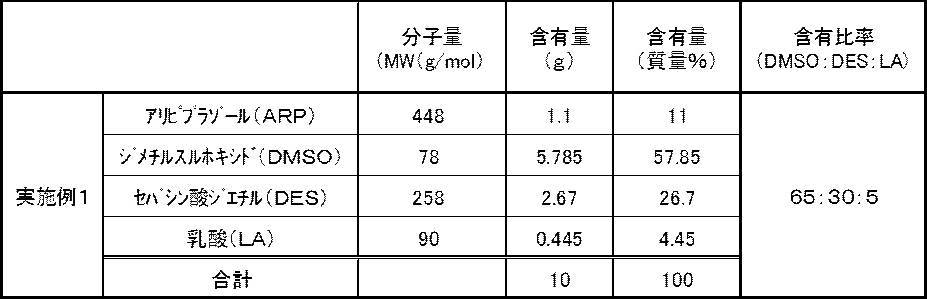
- Example 1 In accordance with the composition shown in Table 1 below, dimethyl sulfoxide (DMSO), which is an organic sulfoxide, ethyl sebacate (DES), which is an ester solvent, and lactic acid (LA), which is an organic acid, are weighed in a container and stirred thoroughly. A mixed solvent was prepared. In Tables 1 and 2 below, the solvent content is based on mass. Thereafter, aripiprazole (ARP), which is a phenylpiperazine derivative, was weighed and added to the mixed solvent obtained by the above-described method, and further stirred to be dissolved sufficiently to obtain the transdermal preparation of Example 1. Preparation of the preparation by stirring was performed at room temperature (25 ° C.). In the obtained transdermal preparation, insoluble matters, precipitates and the like were not observed by visual observation, and it was confirmed that the active ingredient was uniformly dissolved.
- ARP aripiprazole
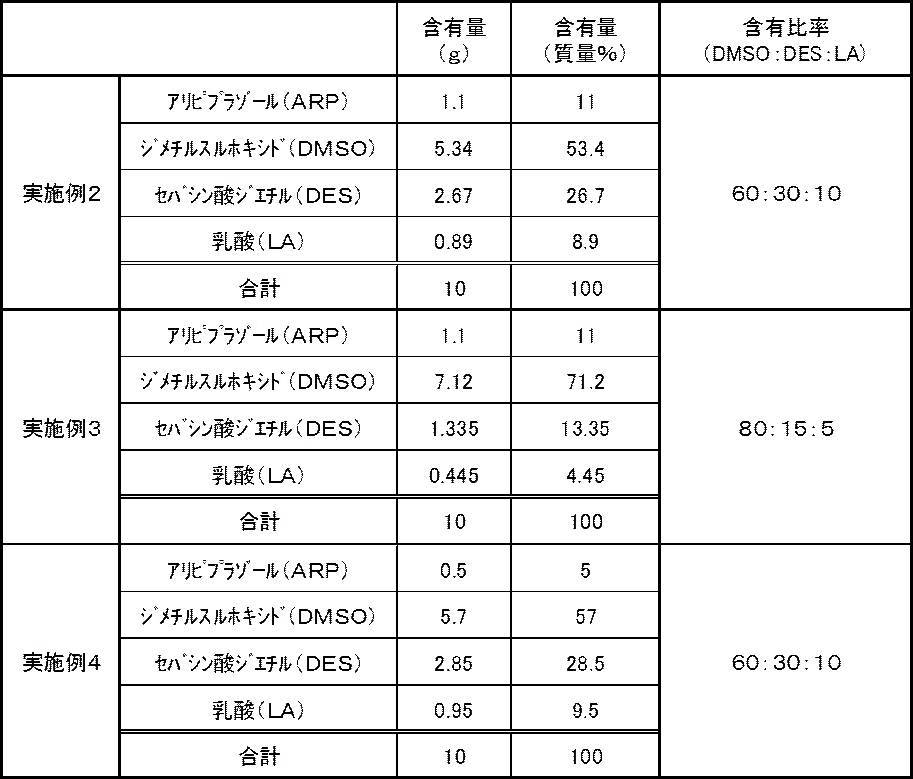
- Examples 2 to 4 According to the composition shown in Table 2 below, the transdermal preparations of Examples 2 to 4 were prepared in the same manner as in Example 1. In any of the transdermal preparations, insoluble matters, precipitates and the like were not observed by visual observation, and it was confirmed that the active ingredient was uniformly dissolved.
- the molecular weights of ARP, DMSO, DES and LA described in Table 2 are all the same as the molecular weights described in Table 1.
- transdermal absorbability of the transdermal preparations of Examples 1 to 4 obtained above was evaluated by the following method. Using a Franz diffusion cell (permeation area: 1 cm 2 , receptor liquid volume: 8 mL) at a test temperature of 32 ° C., a transdermal absorbability evaluation test was performed under the following conditions. The skin of the abdomen of 8-week-old SPF (Specific Pathogen Free) rat was used as a membrane. As the receptor solution, polyethylene glycol 400: PBS pH 7.4 (6: 4) was used. The concentration of the active ingredient to be permeated was measured using high performance liquid chromatography (HPLC: prominence, Shimadzu Corporation).
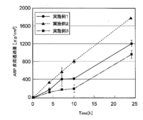
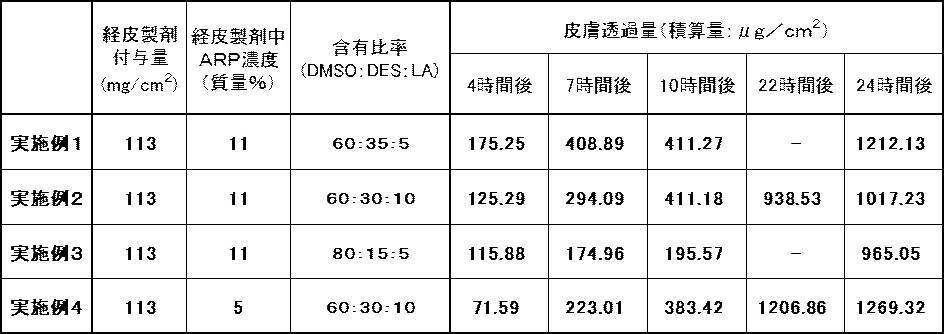
- the transdermal preparations of Examples 1 to 4 all have good skin permeability (percutaneous absorption) of ARP, which is an active ingredient, and the skin of ARP until 24 hours after application.
- the accumulated amount of transmission increases with time.
- each graph has a certain slope and the cumulative amount increases. From these results, it can be seen that the transdermal preparation of each example maintained the supply of a predetermined amount of ARP subcutaneously by skin permeation of ARP for at least 24 hours.
- Example 5 Comparative Examples 1 and 2
- Example 5 Comparative Examples 1 and 2
- Example 5 Comparative Examples 1 and 2
- Example 5 Comparative Examples 1 and 2
- Example 5 Comparative Examples 1 and 2
- Example 5 Comparative Examples 1 and 2
- Example 5 Comparative Examples 1 and 2
- Example 5 Comparative Examples 1 and 2
- Example 5 Comparative Examples 1 and 2
- Example 5 Comparative Examples 1 and 2
- 4 was prepared in the same manner as in Example 1.
- the obtained percutaneous preparation of Example 5 was confirmed by visual observation that insolubles, precipitates and the like were not observed, and that the active ingredient was uniformly dissolved.
- Comparative Example 1 and Comparative Example 2 insoluble matters and precipitates were not observed by visual observation, and it was confirmed that the active ingredient was uniformly dissolved.
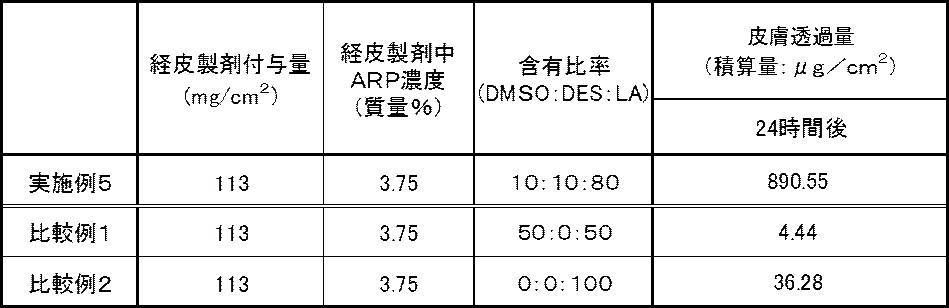
- Example 5 For the transdermal preparations of Example 5, Comparative Example 1 and Comparative Example 2 obtained above, the transdermal absorbability was evaluated in the same manner as in Example 1, and the cumulative amount of ARP permeated through the skin after 24 hours was measured. . The results are shown in Table 5 below.
- Example 5 As shown in Table 5, in Example 5, even when the skin preparation had a low ARP content, the cumulative amount of ARP permeated through the skin after 24 hours was sufficient. On the other hand, even though lactic acid (LA), which is known to have excellent solubility of ARP, is contained in the solvent, in Comparative Examples 1 and 2 that do not contain any of the three kinds of DMSO, DES, and LA, It can be seen that the amount of accumulated transmission is significantly lower than that of Example 5.
- LA lactic acid
Landscapes
- Health & Medical Sciences (AREA)
- Chemical & Material Sciences (AREA)
- Public Health (AREA)
- Medicinal Chemistry (AREA)
- Life Sciences & Earth Sciences (AREA)
- Pharmacology & Pharmacy (AREA)
- General Health & Medical Sciences (AREA)
- Veterinary Medicine (AREA)
- Animal Behavior & Ethology (AREA)
- Epidemiology (AREA)
- Engineering & Computer Science (AREA)
- General Chemical & Material Sciences (AREA)
- Chemical Kinetics & Catalysis (AREA)
- Oil, Petroleum & Natural Gas (AREA)
- Bioinformatics & Cheminformatics (AREA)
- Dermatology (AREA)
- Neurology (AREA)
- Organic Chemistry (AREA)
- Nuclear Medicine, Radiotherapy & Molecular Imaging (AREA)
- Neurosurgery (AREA)
- Biomedical Technology (AREA)
- Psychiatry (AREA)
- Pain & Pain Management (AREA)
- Medicinal Preparation (AREA)
- Pharmaceuticals Containing Other Organic And Inorganic Compounds (AREA)
Abstract
Description
なかでも、フェニルピペラジン誘導体の一つであるアリピプラゾールは、統合失調症薬としての利用が提案されている。(例えば、特許第2608788号公報参照)。
特許第2608788号公報には有効成分としてのフェニルピペラジン誘導体が記載される。しかし、投与方法については、経口投与、注射、および座薬の検討に留まる。
また、国際公開第2007/16766号には、経皮吸収に有効とされる化合物として、有機スルホキシド、脂肪酸エステルおよび脂肪酸として、種々の化合物が並列に記載される。しかし、経皮吸収後の有効成分としてのフェニルピペラジン誘導体について特に着目してはおらず、フェニルピペラジン誘導体の経皮吸収効果および効果の持続性に関しては、何らの検討はなされていない。
[1] フェニルピペラジン誘導体と、有機酸と、エステル系溶媒と、有機スルホキシドと、を含有する経皮製剤。
[2] フェニルピペラジン誘導体が、アリピプラゾールおよびブレクスピプラゾールから選ばれる少なくとも一方である[1]に記載の経皮製剤。
[3] 有機酸と、エステル系溶媒と、有機スルホキシドとの総含有量に対し、有機酸を5質量部~10質量部、エステル系溶媒を15質量部~30質量部、有機スルホキシドを60質量部~80質量部含有する[1]または[2]に記載の経皮製剤。
[4] フェニルピペラジン誘導体と、有機酸と、エステル系溶媒と、有機スルホキシドとの総含有量に対し、フェニルピペラジン誘導体を5質量部~11質量部含有する[1]~[3]のいずれか1つに記載の経皮製剤。
なお、本明細書において「生体内への有効成分の供給」とは、皮下、好ましくは血中への有効成分の供給を指す。
経皮製剤に含まれる有効成分であるフェニルピペラジン誘導体は、統合失調症、双極性障害における躁症状、またはうつ病若しくはうつ状態(以下、統合失調症等と称することがある)の治療薬として有用である。フェニルピペラジン誘導体は、体内に取り込まれると血中半減期が他の薬剤に比較して長いことが知られている。フェニルピペラジン誘導体は、薬効を持続させるという観点から、血液中において、有効性を担保するのに十分な濃度を持続させることが望まれている。
既述の国際公開第2010/146872号には、有機酸はフェニルピペラジン誘導体の溶解性が高いことが記載され、フェニルピペラジン誘導体の溶解に、所定の有機酸と他の溶媒とを併用することが検討されてはいる。しかし、有機酸と共存する溶媒の浸透速度が、有機酸よりも高い場合、共存する他の溶媒のみが先に真皮、表皮等の皮下の深部へ浸透してしまい、たとえ有機酸が残存したとしても、フェニルピペラジン誘導体の溶解性を適正な範囲で、適正な時間維持することは困難である。したがって、公知の技術では、必要な有効成分濃度を必要時間、生体内、具体的には、皮下、好ましくは血中へ持続的に供給することが困難であった。
皮下へ浸透した有機酸と有機スルホキシドとの混合溶媒は、フェニルピペラジン誘導体の溶解性が良好であり、溶解によりフェニルピペラジン誘導体は有機酸塩の状態で溶液中に存在する。このため、フェニルピペラジン誘導体の析出が抑制され、有効成分の体内、好ましくは血管中への浸透性が良好となる。ここで、溶媒として含まれる有機スルホキシドは、真皮、表皮への浸透速度が、例えば、公知のアミド系溶媒等のように速すぎず、比較的緩やかであり、浸透速度が適正な範囲である。よって、有機スルホキシドが有機酸と共存することで、得られるフェニルピペラジン誘導体の高い溶解性が維持され、かつ、経皮製剤を皮膚に適用した際、皮下へ浸透した後も、生体内、好ましくは血中において、必要な有効成分濃度が必要時間持続すると考えられる。
また、上記組成により、生体内への有効成分の供給濃度、および供給時間を適正水準で持続し得るため、皮膚に貼付する経皮製剤の厚みおよび面積をより小さくすることができるという利点をも有することになる。
なお、本開示は上記の推定機構に何ら制限されない。
更に、本明細書において組成物に含まれる各成分の量は、組成物中に、各成分に該当する物質が複数含まれる場合、特に断らない限り、当該複数の物質の合計量を意味する。
本明細書中に段階的に記載されている数値範囲において、一つの数値範囲で記載された上限値又は下限値は、他の段階的な記載の数値範囲の上限値又は下限値に置き換えてもよい。また、本明細書中に記載されている数値範囲において、その数値範囲の上限値又は下限値は、実施例に示されている値に置き換えてもよい。
本明細書において、好ましい態様の組み合わせは、より好ましい態様である。
以下、本実施形態の経皮製剤に含まれる各成分について、詳細に説明する。
本開示の経皮製剤は、有効成分としてフェニルピペラジン誘導体を含む。
経皮製剤に用いうるフェニルピペラジン誘導体は、統合失調症等の治療に有効であれば特に制限はない。
フェニルピペラジン誘導体は、分子量が300以上であることが好ましく、分子量400以上であることがより好ましい。
分子量の上限には特に制限はないが、共存する溶媒への溶解性の観点からは、分子量は600以下とすることができる。
本開示の経皮製剤に好適に使用されるフェニルピペラジン誘導体を、分子量と共に例示する。各成分名の後ろの( )内の数値は、併記された成分の分子量を表す。
分子量が400以上のフェニルピペラジン誘導体としては、例えば、アリピプラゾール(分子量:448.38)、ブレクスピプラゾール(433)、エトペリドン(414.37)、ネファゾドン(506.46)、トラゾドン(371.8)、ビラゾドン(441.52)等が挙げられる。
なかでも、フェニルピペラジン誘導体としては、アリピプラゾール(以下、ARPと称することがある)およびブレクスピプラゾールから選ばれる少なくとも一方が好ましい。
本開示の経皮製剤におけるフェニルピペラジン誘導体は、共存する溶媒との総含有量、即ち、フェニルピペラジン誘導体と、有機酸と、エステル系溶媒と、有機スルホキシドとの総含有量100質量部に対し、3質量部以上含有することが効果の観点から好ましく、5質量部~11質量部含有することがより好ましく、6質量部~11質量部含有することがさらに好ましく、8質量部~11質量部含有することが特に好ましい。
フェニルピペラジン誘導体の含有量が既述の範囲において、本開示の経皮製剤を皮膚に適用した場合に、皮下、好ましくは血中において、フェニルピペラジン誘導体を、薬効を得ることができる有効濃度で、所望の時間維持することが期待できる。
フェニルピペラジン誘導体の含有量の測定は、高速液体クロマトグラフィ(以下、HPLCと称することがある。)により行うことができる。使用するHPLC測定装置などは以下に詳述するとおりの装置等が使用できる。
本開示の経皮製剤に含まれる有機酸は、特に限定されない。有機酸としては、フェニルピペラジン誘導体(以下、有効成分と称することがある)の溶媒として機能する有機酸が好ましい。詳細には、有効成分は、有機酸の存在により、経皮製剤中で有機酸の塩の形態となり得ることが好ましい。
例えば、フェニルピペラジン誘導体が有機酸の塩として存在する場合、経皮製剤中における有効成分の溶解性がより向上する。さらに、経皮製剤が角質下に浸透した後も、体内において結晶の析出が抑制され、有効成分が長期間に亘り有効な濃度で持続的に存在することができる。
有機酸としては、水酸基、アルコキシ基、アシル基、およびケトン基から選ばれる少なくとも一つを置換基として有する、置換された脂肪族カルボン酸または置換された芳香族カルボン酸などが挙げられる。
脂肪族カルボン酸または芳香族カルボン酸に導入される既述の置換基の中でも、有効成分の溶解性がより良好である観点から、水酸基が好ましい。
脂肪族カルボン酸としては、脂肪族モノカルボン酸、および脂肪族ジカルボン酸のいずれであってもよい。
脂肪族モノカルボン酸としては、炭素数2~7の短鎖脂肪族モノカルボン酸、炭素数8~11の中鎖脂肪族モノカルボン酸、炭素数12以上の長鎖脂肪族モノカルボン酸等が挙げられる。
炭素数2~7の短鎖脂肪族モノカルボン酸としては、例えば、酢酸、酪酸、ヘキサン酸、シクロヘキサンカルボン酸等が挙げられる。炭素数8~11の中鎖脂肪族モノカルボン酸としては、例えば、オクタン酸、デカン酸等が挙げられる。炭素数12以上の長鎖脂肪族モノカルボン酸としては、例えば、ミリスチン酸、ステアリン酸、イソステアリン酸、オレイン酸等が挙げられる。
置換基を有する芳香族カルボン酸としては、p-ヒドロキシ安息香酸、サリチル酸、アセチルサリチル酸等を挙げることができる。
有機酸とエステル系溶媒と有機スルホキシドとの総含有量100質量部に対し、有機酸は、5質量部~10質量部の範囲で含有することが好ましく、7質量部~10質量部の範囲で含有することがより好ましく、8質量部~10質量部の範囲で含有することがさらに好ましい。
本開示の経皮製剤は、有機酸を1種のみ含んでもよく、2種以上を含んでもよい。
経皮製剤における有機酸の含有量は、公知の方法で測定できる。
例えば、有機酸の含有量は、イオンクロマトグラフィーにより測定を行うことができる。イオンクロマトグラフィーの測定には、例えば、Dionex社製、ICS-2000が使用できる。溶離液として1mM KOHを使用し、調製した経皮製剤を希釈してイオンクロマトグラフィーの測定を行うことができる。
本開示の経皮製剤がエステル系溶媒を含むことで、経皮製剤中における有効成分、共存する溶媒である有機酸、および有機スルホキシドの角質下への浸透性をより向上させ、角質下である真皮および表皮中における溶媒分配性をより良好にすることができる。
エステル系溶媒としては、脂肪族ジカルボン酸のアルキルエステルなどが挙げられる。具体的には、エステル系溶媒としては、例えば、トリアセチン、セバシン酸ジエチル、アジピン酸ジイソプロピル、セバシン酸ジイソプロピル、パルミチン酸イソプロピル、ミスチリン酸イソプロピル等が挙げられる。エステル系溶媒のなかでも、有効成分等の角質下への浸透性がより良好であるという観点からは、セバシン酸ジエチル、アジピン酸ジイソプロピル等が好ましく、セバシン酸ジエチルがより好ましい。
本開示の経皮製剤におけるエステル系溶媒は、角質下への浸透性と溶媒分配性をより向上させるという観点から、有機酸とエステル系溶媒と有機スルホキシドとの総含有量100質量部に対し、15質量部~30質量部の範囲で含有することが好ましく、20質量部~30質量部の範囲で含有することがより好ましく、25質量部~30質量部の範囲で含有することがさらに好ましい。
なお、経皮製剤におけるエステル系溶媒の含有量は、公知の方法により測定することができる。
例えば、経皮製剤におけるエステル系溶媒の含有量は、ガスクロマトグラフ質量分析計(GC-MS)により測定することができる。GC-MSとしては、例えば、(株)島津製作所のGCMS-QP2010が使用できる。希釈液としてエタノール等を使用し、調製した経皮製剤をエタノール等にて希釈して測定を行なうことができる。
本開示の経皮製剤は、有機スルホキシドを含む。
有機スルホキシドを含むことで、経皮製剤中における有効成分の溶解性がより向上し、かつ、真皮および表皮中における浸透性が適切な速度に維持される有効成分を必要な濃度で必要な時間に亘り、経皮製剤における有効成分を持続的に真皮および表皮中、さらには、皮下、好ましくは血中に供給すると推測される。
本開示における有機スルホキシドとして、例えば、下記一般式(I)で表される化合物、スルホラン、ジメチルスルホン等が挙げられる。

R1およびR2における1価の有機基としては、アルキル基、アリール基などが挙げられる。有効成分の溶解性がより良好となり、浸透速度がより適切な範囲に制御されるという観点からは、一般式(I)における1価の有機基としては炭素数1~5のアルキル基が好ましい。
一般式(I)で表される化合物のなかでも、R1およびR2の双方がメチル基であるジメチルスルホキシド(以下、DMSOと称することがある)等がより好ましい。
本開示の経皮製剤は、有機スルホキシドを1種のみ含んでもよく、2種以上を含んでもよい。
本開示の経皮製剤における有機スルホキシドは、有効成分の溶解性と有効成分の浸透性をより適切な範囲に維持させるという観点から、有機酸とエステル系溶媒と有機スルホキシドとの総含有量100質量部に対し、有機スルホキシドを60質量部~80質量部の範囲で含有することが好ましく、60質量部~70質量部の範囲で含有することがより好ましく、60質量部~65質量部の範囲で含有することがさらに好ましい。
有機スルホキシドの含有量は、特に限定されず、公知の方法により測定できる。
本開示の経皮製剤は、既述の有効成分および溶媒に加え、効果を損なわない限りにおいて、経皮製剤の剤型に応じて公知の添加物を目的に応じて含有することができる。
本開示の経皮製剤に使用し得る添加物として、例えば、経皮吸収促進剤、湿潤剤、皮膚軟化剤、皮膚保護剤、基剤、界面活性剤、増粘剤、ゲル化剤、軟化剤、充填剤、有機粒子、無機粒子、緩衝剤、pH調整剤、着色剤、香料等を挙げることができる。また、経皮製剤の安定性向上を目的として、公知の安定化剤、抗酸化剤を含有してもよい。
軟化剤としては、例えば、プロセスオイル、低分子ポリブテン等の石油系軟化剤、例えば、ヤシ油、ひまし油等の脂肪酸系軟化剤、精製ラノリン等が挙げられる。
充填剤としては、例えば、酸化亜鉛、酸化チタン、炭酸カルシウム、ケイ酸類等が挙げられる。
ゲル化剤、増粘剤等、製剤の粘度調整に用い得る成分としては、例えば、メチルセルロース、エチルセルロース、ヒドロキシプロピルメチルセルロース等のセルロース誘導体、カルボキシビニルポリマー、ポリビニルアルコール等が挙げられる
本開示の経皮製剤は、常法により製造することができる。以下に経皮製剤の製造方法の一例を挙げる。
有機スルホキシド、エステル系溶媒、および有機酸を容器に秤量し、十分に撹拌して混合溶媒を調製する。
その後、フェニルピペラジン誘導体を必要量秤量し、既述の方法で得た混合溶媒に加えてさらに撹拌を行って十分に溶解させることで経皮製剤を得ることができる。撹拌による製剤の調製は室温(25℃)で行なうことができる。
なお、フェニルピペラジン誘導体等の溶解速度が遅い組成の製剤を調製する場合には、例えば、混合溶媒にフェニルピペラジン誘導体を加えた後、40℃~70℃に加熱して撹拌してもよく、超音波処理による溶解促進を行なってもよく、加熱と超音波処理の双方を行なってもよい。溶解促進処理を行って製造された経皮製剤は、室温にて一日静置し、一日静置後も、不溶物、析出物等が認められず、有効成分が溶解していることを目視にて確認することが好ましい。
経皮製剤が、他の成分を含む場合、それぞれの成分に適する段階で常法により製剤中に含有させることができる。
液状の経皮製剤の粘度調整は、常法により行うことができる。粘度の調製方法としては、例えば、既述の如くして得られた液状の経皮製剤に対し、目的とする粘度に応じて既述の粘度調整に用い得る成分から選ばれる少なくとも1種加え、加熱しなから充分に混合し、放冷する方法が挙げられる。
本開示の経皮製剤は、既述の有効成分を皮膚上に所望の時間保持できる限り、剤型には特に制限はない。
本開示の経皮製剤の剤型としては、液剤、ゲル剤、軟膏剤、クリーム剤、リザーバー型貼付剤等が挙げられる。リザーバー型貼付剤の形状には特に制限はない。
液剤、ゲル剤、軟膏剤、クリーム剤等は、目的に応じた粘度に調整され、皮膚にそのまま塗布して使用することができる。また、ゲル剤、軟膏剤、クリーム剤等は、不織布、包帯などの支持体に塗布して、塗布面を皮膚に接触させて使用することができる。
即ち、経皮製剤が、液剤、ゲル剤、軟膏剤、またはクリーム剤であって比較的粘度が低く、流動性を有する剤型である場合、流動性を有する剤型の製剤を不織布、織布、連通気泡を有するスポンジ等の基材に含浸させて薬物貯蔵層を形成し、薬物貯蔵層を支持体上に配置し、薬物貯蔵層の、支持体とは反対側の面を、経皮製剤の放出を制御しうる膜で被覆して、リザーバー型貼付剤とすることができる。
リザーバー型貼付剤では、薬物貯蔵層または経皮製剤層の表面、即ち、皮膚と接する面に位置する膜の微細な開孔部から、経皮製剤が皮膚へと徐々に放出される。
既述のリザーバー型貼付剤の構成の例は、例えば、特開2003-063954号公報の段落〔0007〕~段落〔0022〕および図1に記載されており、本開示において参照することができる。
本開示の経皮製剤は、有効成分であるフェニルピペラジン誘導体の経皮吸収性に優れ、かつ、フェニルピペラジン誘導体の持続的な投与が可能となり、優れた薬効を所望の時間持続することができる。
経皮吸収性を評価する方法の一つとして、公知の皮膚透過性評価法が挙げられる。皮膚透過性は、以下に記載するin vitro皮膚透過実験法で評価することができる。
なお、公知の皮膚透過性実験法で評価される皮膚透過性は、本明細書において、経皮製剤の経皮吸収性と同義である。
in vitro皮膚透過実験法としては、例えば拡散セルを用いる方法が挙げられる。拡散セルとしては、フランツ型拡散セル等の垂直型セル、水平型セルなどが挙げられる。拡散セルは2つのセルパーツからなり、2つのセルパーツの間に透過性を測定する膜を挟んで用いる。膜としては、ヒト皮膚、動物皮膚、三次元培養皮膚モデル、人工膜などが挙げられる。
本明細書では、皮膚透過性の評価方法の例として、以下に示すラット摘出皮膚を用いた皮膚透過性試験にて評価を行なう。
例えば、試験温度32℃でフランツ拡散セル(透過面積:1cm2、レセプター液容量:8mL)を用いて、以下の条件で経皮吸収性の評価試験を行うことができる。
8週齢のSPF(Specific Pathogen Free:特定病原体不在)ラットの腹部摘出皮膚を膜として用いる。
レセプター液としては、ポリエチレングリコール400:PBS pH7.4 (6:4)を用いる。
透過する有効成分の濃度測定は高速液体クロマトグラフィ(HPLC:prominence、(株)島津製作所)を用いて行なう。
既述の市販のラット腹部摘出皮膚を縦型拡散セル(有効拡散面積:1cm2)に挟み、角質側に被検体である経皮製剤を適用し、真皮側に既述のレセプター液を適用する。
実験開始後、4時間目、7時間目、10時間目、(22時間目)、24時間目にレセプター液を300μLサンプリングし、皮膚を透過して溶出したフェニルピペラジン誘導体濃度を既述のHPLCにより測定し、各時間における薬物の累積透過量を測定する。
本開示の経皮製剤は、適用対象者の皮膚に投与して使用される。
通常は、経時的に所望の量の有効成分を皮膚へ浸透させるため、既述の如く、基材に含浸させた経皮製剤を皮膚上に固定して適用するか、或いは、リザーバー型貼付剤として適用する。リザーバー型貼付剤において、支持体として用い得る基材としては、通気性を有する樹脂フィルム、不織布、布、通気性を有しないフィルム等が挙げられる。
支持体の片面に本開示の経皮製剤を配置してリザーバー型貼付剤とする場合には、経皮製剤を配置した側が皮膚に接着する面となる。
本開示の他の実施形態は、有効成分としてフェニルピペラジン誘導体を含む既述の経皮製剤を、既述の統合失調症等の治療対象となる適用対象者へ経皮投与することを含む統合失調症の治療方法も包含する。
下記表1に示す組成に従い、有機スルホキシドであるジメチルスルホキシド(DMSO)、エステル系溶媒であるセバシン酸エチル(DES)、および有機酸である乳酸(LA)を容器に秤量し、十分に撹拌して混合溶媒を調製した。なお、下記表1~表2における溶媒の含有比率は質量基準である。
その後、フェニルピペラジン誘導体であるアリピプラゾール(ARP)を秤量し、既述の方法で得た混合溶媒に加えてさらに撹拌を行って十分に溶解させることで実施例1の経皮製剤を得た。撹拌による製剤の調製は室温(25℃)で行なった。
得られた経皮製剤は、目視による観察では、不溶物、析出物等が認められず、有効成分が均一に溶解していることが確認された。
下記表2に示す組成に従い、実施例1と同様にして、実施例2~実施例4の経皮製剤を調製した。いずれの経皮製剤も、目視による観察では、不溶物、析出物等が認められず、有効成分が均一に溶解していることが確認された。
なお、表2に記載のARP、DMSO、DESおよびLAの分子量は、全て表1に記載した分子量と同じである。
・アリピプラゾール(東京化成工業(株))
・ジメチルスルホキシド(和光純薬工業(株)、分子生物学用)
・セバシン酸ジエチル(日光ケミカルズ(株)、NIKKOL(登録商標) DES-SP)
・乳酸(メルク(株))
上記で得られた実施例1~実施例4の経皮製剤について、経皮吸収性を以下の方法で評価した。
試験温度32℃でフランツ拡散セル(透過面積:1cm2、レセプター液容量:8mL)を用いて、以下の条件で経皮吸収性の評価試験を行った。
8週齢のSPF(Specific Pathogen Free:特定病原体不在)ラットの腹部摘出皮膚を膜として用いた。
レセプター液としては、ポリエチレングリコール400:PBS pH7.4 (6:4)を用いた。
透過する有効成分の濃度測定は高速液体クロマトグラフィ(HPLC:prominence、(株)島津製作所)を用いて行なった。
既述の市販のラット腹部摘出皮膚を縦型拡散セル(有効拡散面積:1cm2)に挟み、角質側に被検体である経皮製剤をそれぞれ113mg/cm2適用し、真皮側に既述のレセプター液を適用した。
本開示の経皮製剤において、溶媒の効果を確認する目的で、ARPの含有量を3.75質量%とし、異なる溶媒を用いた実施例5、比較例1、および比較例2を、下記表4に記載の処方により、実施例1と同様にして調製した。
得られた実施例5の経皮製剤は、目視による観察では、不溶物、析出物等が認められず、有効成分が均一に溶解していることが確認された。
比較例1および比較例2の経皮製剤も、目視による観察では、不溶物、析出物等が認められず、有効成分が均一に溶解していることが確認された。

結果を下記表5に示す。
本明細書に記載された全ての文献、特許出願、及び技術規格は、個々の文献、特許出願、及び技術規格が参照により取り込まれることが具体的かつ個々に記された場合と同程度に、本明細書中に参照により取り込まれる。
Claims (4)
- フェニルピペラジン誘導体と、有機酸と、エステル系溶媒と、有機スルホキシドと、を含有する経皮製剤。
- フェニルピペラジン誘導体が、アリピプラゾールおよびブレクスピプラゾールから選ばれる少なくとも一方である請求項1に記載の経皮製剤。
- 有機酸と、エステル系溶媒と、有機スルホキシドとの総含有量100質量部に対し、有機酸を5質量部~10質量部、エステル系溶媒を15質量部~30質量部、有機スルホキシドを60質量部~80質量部含有する請求項1または請求項2に記載の経皮製剤。
- フェニルピペラジン誘導体と、有機酸と、エステル系溶媒と、有機スルホキシドとの総含有量100質量部に対し、フェニルピペラジン誘導体を5質量部~11質量部含有する請求項1~請求項3のいずれか1項に記載の経皮製剤。
Priority Applications (4)
| Application Number | Priority Date | Filing Date | Title |
|---|---|---|---|
| EP17796255.2A EP3441068A4 (en) | 2016-05-12 | 2017-05-12 | TRANSDERMALES PREPARATION |
| CN201780028553.XA CN109069505A (zh) | 2016-05-12 | 2017-05-12 | 经皮制剂 |
| JP2018517098A JP6625208B2 (ja) | 2016-05-12 | 2017-05-12 | 経皮製剤 |
| US16/183,738 US20190070123A1 (en) | 2016-05-12 | 2018-11-08 | Transdermal preparation |
Applications Claiming Priority (4)
| Application Number | Priority Date | Filing Date | Title |
|---|---|---|---|
| JP2016096178 | 2016-05-12 | ||
| JP2016-096178 | 2016-05-12 | ||
| JP2016245702 | 2016-12-19 | ||
| JP2016-245702 | 2016-12-19 |
Related Child Applications (1)
| Application Number | Title | Priority Date | Filing Date |
|---|---|---|---|
| US16/183,738 Continuation US20190070123A1 (en) | 2016-05-12 | 2018-11-08 | Transdermal preparation |
Publications (1)
| Publication Number | Publication Date |
|---|---|
| WO2017195897A1 true WO2017195897A1 (ja) | 2017-11-16 |
Family
ID=60267451
Family Applications (1)
| Application Number | Title | Priority Date | Filing Date |
|---|---|---|---|
| PCT/JP2017/018086 Ceased WO2017195897A1 (ja) | 2016-05-12 | 2017-05-12 | 経皮製剤 |
Country Status (5)
| Country | Link |
|---|---|
| US (1) | US20190070123A1 (ja) |
| EP (1) | EP3441068A4 (ja) |
| JP (1) | JP6625208B2 (ja) |
| CN (1) | CN109069505A (ja) |
| WO (1) | WO2017195897A1 (ja) |
Families Citing this family (1)
| Publication number | Priority date | Publication date | Assignee | Title |
|---|---|---|---|---|
| CN117064866B (zh) * | 2023-07-10 | 2024-04-19 | 北京丰科睿泰医药科技有限公司 | 一种布瑞哌唑长效透皮贴剂及其制备方法 |
Citations (5)
| Publication number | Priority date | Publication date | Assignee | Title |
|---|---|---|---|---|
| US3551554A (en) * | 1968-08-16 | 1970-12-29 | Crown Zellerbach Corp | Enhancing tissue penetration of physiologically active agents with dmso |
| JP2008515815A (ja) * | 2004-10-08 | 2008-05-15 | クリヌベール、ファーマスーティカルズ、リミテッド | 対象者におけるメラニン形成を誘導するための組成物および方法 |
| WO2010146872A1 (ja) * | 2009-06-19 | 2010-12-23 | 株式会社メドレックス | アリピプラゾールと有機酸を有効成分とする外用剤組成物 |
| JP2015508821A (ja) * | 2012-02-29 | 2015-03-23 | コヨーテ・ファーマシューティカルズ・インコーポレイテッドCoyote Pharmaceuticals, Inc. | ゲラニルゲラニルアセトンの経皮製剤 |
| JP2015110603A (ja) * | 2015-01-08 | 2015-06-18 | ラボラトリー スキン ケア インコーポレイテッド | 活性剤を充填した、均一、硬質、球状のナノ多孔質リン酸カルシウム粒子の製造方法 |
Family Cites Families (2)
| Publication number | Priority date | Publication date | Assignee | Title |
|---|---|---|---|---|
| US9757374B2 (en) * | 2010-10-28 | 2017-09-12 | Aequus Pharmaceuticals Inc. | Aripiprazole compositions and methods for its transdermal delivery |
| CN107929239B (zh) * | 2010-10-28 | 2021-06-01 | 阿尔法缇欧米茄制药咨询有限公司 | 阿立哌唑组合物和用于其经皮给药的方法 |
-
2017
- 2017-05-12 WO PCT/JP2017/018086 patent/WO2017195897A1/ja not_active Ceased
- 2017-05-12 EP EP17796255.2A patent/EP3441068A4/en not_active Withdrawn
- 2017-05-12 CN CN201780028553.XA patent/CN109069505A/zh active Pending
- 2017-05-12 JP JP2018517098A patent/JP6625208B2/ja not_active Expired - Fee Related
-
2018
- 2018-11-08 US US16/183,738 patent/US20190070123A1/en not_active Abandoned
Patent Citations (5)
| Publication number | Priority date | Publication date | Assignee | Title |
|---|---|---|---|---|
| US3551554A (en) * | 1968-08-16 | 1970-12-29 | Crown Zellerbach Corp | Enhancing tissue penetration of physiologically active agents with dmso |
| JP2008515815A (ja) * | 2004-10-08 | 2008-05-15 | クリヌベール、ファーマスーティカルズ、リミテッド | 対象者におけるメラニン形成を誘導するための組成物および方法 |
| WO2010146872A1 (ja) * | 2009-06-19 | 2010-12-23 | 株式会社メドレックス | アリピプラゾールと有機酸を有効成分とする外用剤組成物 |
| JP2015508821A (ja) * | 2012-02-29 | 2015-03-23 | コヨーテ・ファーマシューティカルズ・インコーポレイテッドCoyote Pharmaceuticals, Inc. | ゲラニルゲラニルアセトンの経皮製剤 |
| JP2015110603A (ja) * | 2015-01-08 | 2015-06-18 | ラボラトリー スキン ケア インコーポレイテッド | 活性剤を充填した、均一、硬質、球状のナノ多孔質リン酸カルシウム粒子の製造方法 |
Non-Patent Citations (2)
| Title |
|---|
| MAEDA KENJI ET AL.: "Brexpiprazole 2: Antipsychotic-Like Procognitive Effects of a Novel Serotonin-Dopamine Activity Modulator", THE JOURNAL OF PHARMACOLOGY AND EXPERIMENTAL THERAPEUTICS, vol. 350, no. 3, 1 September 2014 (2014-09-01), pages 605 - 614, XP055438214 * |
| See also references of EP3441068A4 * |
Also Published As
| Publication number | Publication date |
|---|---|
| JP6625208B2 (ja) | 2019-12-25 |
| EP3441068A4 (en) | 2019-04-10 |
| EP3441068A1 (en) | 2019-02-13 |
| CN109069505A (zh) | 2018-12-21 |
| US20190070123A1 (en) | 2019-03-07 |
| JPWO2017195897A1 (ja) | 2019-01-17 |
Similar Documents
| Publication | Publication Date | Title |
|---|---|---|
| EP2191827B1 (en) | Antifungal composition | |
| JP5544544B2 (ja) | 塩基性薬効成分の脂肪酸塩、安息香酸塩を含有する外用剤とその製造方法 | |
| US20110092438A1 (en) | Composition for external application comprising transcription factor decoy as active ingredient | |
| JP6482570B2 (ja) | 経皮吸収促進剤及び経皮吸収促進助剤 | |
| JP2020011967A (ja) | 爪白癬治療用の外用製剤 | |
| KR20120118495A (ko) | 국부 마취제 에멀전 조성물 및 이의 제조 및 사용 방법 | |
| JP5622410B2 (ja) | ケトプロフェン含有水性貼付剤 | |
| JP5681883B2 (ja) | 核酸を有効成分とする外用剤組成物 | |
| CA2814696A1 (en) | Pharmaceutical formulation for histone deacetylase inhibitors | |
| CA3155267A1 (en) | Topical formulations of cyclooxygenase inhibitors and their use | |
| CN110139641B (zh) | 外用组合物 | |
| JP6625208B2 (ja) | 経皮製剤 | |
| JP6444956B2 (ja) | 経皮吸収用組成物 | |
| US20050158371A1 (en) | Novel external agent | |
| JP2005060386A (ja) | 皮膚外用剤 | |
| TWI544924B (zh) | 經皮吸收製劑 | |
| JP2023538265A (ja) | ホスホイノシチド3-キナーゼ阻害剤の製剤 | |
| CN114502142A (zh) | 包含温度响应性离子液体的医药组合物 | |
| JP2014208618A (ja) | 医薬液体組成物 | |
| JP5816881B2 (ja) | 核酸を有効成分とする外用剤組成物 | |
| JP2003160489A (ja) | オンダンセトロン経皮吸収用医薬組成物 | |
| JP2019043853A (ja) | 経皮吸収促進剤、経皮吸収促進助剤、及び経皮製剤 | |
| JP2009102358A (ja) | 皮膚外用剤 | |
| JPWO2000053226A1 (ja) | 経皮吸収促進組成物 |
Legal Events
| Date | Code | Title | Description |
|---|---|---|---|
| WWE | Wipo information: entry into national phase |
Ref document number: 2018517098 Country of ref document: JP |
|
| WWE | Wipo information: entry into national phase |
Ref document number: 2017796255 Country of ref document: EP |
|
| NENP | Non-entry into the national phase |
Ref country code: DE |
|
| 121 | Ep: the epo has been informed by wipo that ep was designated in this application |
Ref document number: 17796255 Country of ref document: EP Kind code of ref document: A1 |
|
| ENP | Entry into the national phase |
Ref document number: 2017796255 Country of ref document: EP Effective date: 20181109 |