WO2017199983A1 - Copolymère séquencé hydrogéné, amortisseur de vibrations, isolant acoustique, couche intermédiaire pour verre feuilleté, caoutchouc de barrage, matériau de semelle de chaussure, matériau de revêtement de sol, stratifié et verre feuilleté - Google Patents
Copolymère séquencé hydrogéné, amortisseur de vibrations, isolant acoustique, couche intermédiaire pour verre feuilleté, caoutchouc de barrage, matériau de semelle de chaussure, matériau de revêtement de sol, stratifié et verre feuilleté Download PDFInfo
- Publication number
- WO2017199983A1 WO2017199983A1 PCT/JP2017/018444 JP2017018444W WO2017199983A1 WO 2017199983 A1 WO2017199983 A1 WO 2017199983A1 JP 2017018444 W JP2017018444 W JP 2017018444W WO 2017199983 A1 WO2017199983 A1 WO 2017199983A1
- Authority
- WO
- WIPO (PCT)
- Prior art keywords
- block copolymer
- hydrogenated block
- layer
- laminate
- frequency
- Prior art date
- Legal status (The legal status is an assumption and is not a legal conclusion. Google has not performed a legal analysis and makes no representation as to the accuracy of the status listed.)
- Ceased
Links
Images








Classifications
-
- C—CHEMISTRY; METALLURGY
- C08—ORGANIC MACROMOLECULAR COMPOUNDS; THEIR PREPARATION OR CHEMICAL WORKING-UP; COMPOSITIONS BASED THEREON
- C08F—MACROMOLECULAR COMPOUNDS OBTAINED BY REACTIONS ONLY INVOLVING CARBON-TO-CARBON UNSATURATED BONDS
- C08F297/00—Macromolecular compounds obtained by successively polymerising different monomer systems using a catalyst of the ionic or coordination type without deactivating the intermediate polymer
- C08F297/02—Macromolecular compounds obtained by successively polymerising different monomer systems using a catalyst of the ionic or coordination type without deactivating the intermediate polymer using a catalyst of the anionic type
- C08F297/04—Macromolecular compounds obtained by successively polymerising different monomer systems using a catalyst of the ionic or coordination type without deactivating the intermediate polymer using a catalyst of the anionic type polymerising vinyl aromatic monomers and conjugated dienes
-
- B—PERFORMING OPERATIONS; TRANSPORTING
- B32—LAYERED PRODUCTS
- B32B—LAYERED PRODUCTS, i.e. PRODUCTS BUILT-UP OF STRATA OF FLAT OR NON-FLAT, e.g. CELLULAR OR HONEYCOMB, FORM
- B32B17/00—Layered products essentially comprising sheet glass, or glass, slag, or like fibres
- B32B17/06—Layered products essentially comprising sheet glass, or glass, slag, or like fibres comprising glass as the main or only constituent of a layer, next to another layer of a specific material
- B32B17/10—Layered products essentially comprising sheet glass, or glass, slag, or like fibres comprising glass as the main or only constituent of a layer, next to another layer of a specific material of synthetic resin
- B32B17/10005—Layered products essentially comprising sheet glass, or glass, slag, or like fibres comprising glass as the main or only constituent of a layer, next to another layer of a specific material of synthetic resin laminated safety glass or glazing
- B32B17/10009—Layered products essentially comprising sheet glass, or glass, slag, or like fibres comprising glass as the main or only constituent of a layer, next to another layer of a specific material of synthetic resin laminated safety glass or glazing characterized by the number, the constitution or treatment of glass sheets
- B32B17/10036—Layered products essentially comprising sheet glass, or glass, slag, or like fibres comprising glass as the main or only constituent of a layer, next to another layer of a specific material of synthetic resin laminated safety glass or glazing characterized by the number, the constitution or treatment of glass sheets comprising two outer glass sheets
-
- A—HUMAN NECESSITIES
- A43—FOOTWEAR
- A43B—CHARACTERISTIC FEATURES OF FOOTWEAR; PARTS OF FOOTWEAR
- A43B13/00—Soles; Sole-and-heel integral units
- A43B13/02—Soles; Sole-and-heel integral units characterised by the material
- A43B13/04—Plastics, rubber or vulcanised fibre
-
- B—PERFORMING OPERATIONS; TRANSPORTING
- B29—WORKING OF PLASTICS; WORKING OF SUBSTANCES IN A PLASTIC STATE IN GENERAL
- B29C—SHAPING OR JOINING OF PLASTICS; SHAPING OF MATERIAL IN A PLASTIC STATE, NOT OTHERWISE PROVIDED FOR; AFTER-TREATMENT OF THE SHAPED PRODUCTS, e.g. REPAIRING
- B29C48/00—Extrusion moulding, i.e. expressing the moulding material through a die or nozzle which imparts the desired form; Apparatus therefor
- B29C48/03—Extrusion moulding, i.e. expressing the moulding material through a die or nozzle which imparts the desired form; Apparatus therefor characterised by the shape of the extruded material at extrusion
- B29C48/07—Flat, e.g. panels
- B29C48/08—Flat, e.g. panels flexible, e.g. films
-
- B—PERFORMING OPERATIONS; TRANSPORTING
- B32—LAYERED PRODUCTS
- B32B—LAYERED PRODUCTS, i.e. PRODUCTS BUILT-UP OF STRATA OF FLAT OR NON-FLAT, e.g. CELLULAR OR HONEYCOMB, FORM
- B32B17/00—Layered products essentially comprising sheet glass, or glass, slag, or like fibres
- B32B17/06—Layered products essentially comprising sheet glass, or glass, slag, or like fibres comprising glass as the main or only constituent of a layer, next to another layer of a specific material
- B32B17/10—Layered products essentially comprising sheet glass, or glass, slag, or like fibres comprising glass as the main or only constituent of a layer, next to another layer of a specific material of synthetic resin
-
- B—PERFORMING OPERATIONS; TRANSPORTING
- B32—LAYERED PRODUCTS
- B32B—LAYERED PRODUCTS, i.e. PRODUCTS BUILT-UP OF STRATA OF FLAT OR NON-FLAT, e.g. CELLULAR OR HONEYCOMB, FORM
- B32B17/00—Layered products essentially comprising sheet glass, or glass, slag, or like fibres
- B32B17/06—Layered products essentially comprising sheet glass, or glass, slag, or like fibres comprising glass as the main or only constituent of a layer, next to another layer of a specific material
- B32B17/10—Layered products essentially comprising sheet glass, or glass, slag, or like fibres comprising glass as the main or only constituent of a layer, next to another layer of a specific material of synthetic resin
- B32B17/10005—Layered products essentially comprising sheet glass, or glass, slag, or like fibres comprising glass as the main or only constituent of a layer, next to another layer of a specific material of synthetic resin laminated safety glass or glazing
- B32B17/1055—Layered products essentially comprising sheet glass, or glass, slag, or like fibres comprising glass as the main or only constituent of a layer, next to another layer of a specific material of synthetic resin laminated safety glass or glazing characterized by the resin layer, i.e. interlayer
-
- B—PERFORMING OPERATIONS; TRANSPORTING
- B32—LAYERED PRODUCTS
- B32B—LAYERED PRODUCTS, i.e. PRODUCTS BUILT-UP OF STRATA OF FLAT OR NON-FLAT, e.g. CELLULAR OR HONEYCOMB, FORM
- B32B17/00—Layered products essentially comprising sheet glass, or glass, slag, or like fibres
- B32B17/06—Layered products essentially comprising sheet glass, or glass, slag, or like fibres comprising glass as the main or only constituent of a layer, next to another layer of a specific material
- B32B17/10—Layered products essentially comprising sheet glass, or glass, slag, or like fibres comprising glass as the main or only constituent of a layer, next to another layer of a specific material of synthetic resin
- B32B17/10005—Layered products essentially comprising sheet glass, or glass, slag, or like fibres comprising glass as the main or only constituent of a layer, next to another layer of a specific material of synthetic resin laminated safety glass or glazing
- B32B17/1055—Layered products essentially comprising sheet glass, or glass, slag, or like fibres comprising glass as the main or only constituent of a layer, next to another layer of a specific material of synthetic resin laminated safety glass or glazing characterized by the resin layer, i.e. interlayer
- B32B17/10724—Layered products essentially comprising sheet glass, or glass, slag, or like fibres comprising glass as the main or only constituent of a layer, next to another layer of a specific material of synthetic resin laminated safety glass or glazing characterized by the resin layer, i.e. interlayer containing polyamide
-
- B—PERFORMING OPERATIONS; TRANSPORTING
- B32—LAYERED PRODUCTS
- B32B—LAYERED PRODUCTS, i.e. PRODUCTS BUILT-UP OF STRATA OF FLAT OR NON-FLAT, e.g. CELLULAR OR HONEYCOMB, FORM
- B32B17/00—Layered products essentially comprising sheet glass, or glass, slag, or like fibres
- B32B17/06—Layered products essentially comprising sheet glass, or glass, slag, or like fibres comprising glass as the main or only constituent of a layer, next to another layer of a specific material
- B32B17/10—Layered products essentially comprising sheet glass, or glass, slag, or like fibres comprising glass as the main or only constituent of a layer, next to another layer of a specific material of synthetic resin
- B32B17/10005—Layered products essentially comprising sheet glass, or glass, slag, or like fibres comprising glass as the main or only constituent of a layer, next to another layer of a specific material of synthetic resin laminated safety glass or glazing
- B32B17/1055—Layered products essentially comprising sheet glass, or glass, slag, or like fibres comprising glass as the main or only constituent of a layer, next to another layer of a specific material of synthetic resin laminated safety glass or glazing characterized by the resin layer, i.e. interlayer
- B32B17/10743—Layered products essentially comprising sheet glass, or glass, slag, or like fibres comprising glass as the main or only constituent of a layer, next to another layer of a specific material of synthetic resin laminated safety glass or glazing characterized by the resin layer, i.e. interlayer containing acrylate (co)polymers or salts thereof
-
- B—PERFORMING OPERATIONS; TRANSPORTING
- B32—LAYERED PRODUCTS
- B32B—LAYERED PRODUCTS, i.e. PRODUCTS BUILT-UP OF STRATA OF FLAT OR NON-FLAT, e.g. CELLULAR OR HONEYCOMB, FORM
- B32B17/00—Layered products essentially comprising sheet glass, or glass, slag, or like fibres
- B32B17/06—Layered products essentially comprising sheet glass, or glass, slag, or like fibres comprising glass as the main or only constituent of a layer, next to another layer of a specific material
- B32B17/10—Layered products essentially comprising sheet glass, or glass, slag, or like fibres comprising glass as the main or only constituent of a layer, next to another layer of a specific material of synthetic resin
- B32B17/10005—Layered products essentially comprising sheet glass, or glass, slag, or like fibres comprising glass as the main or only constituent of a layer, next to another layer of a specific material of synthetic resin laminated safety glass or glazing
- B32B17/1055—Layered products essentially comprising sheet glass, or glass, slag, or like fibres comprising glass as the main or only constituent of a layer, next to another layer of a specific material of synthetic resin laminated safety glass or glazing characterized by the resin layer, i.e. interlayer
- B32B17/10761—Layered products essentially comprising sheet glass, or glass, slag, or like fibres comprising glass as the main or only constituent of a layer, next to another layer of a specific material of synthetic resin laminated safety glass or glazing characterized by the resin layer, i.e. interlayer containing vinyl acetal
-
- B—PERFORMING OPERATIONS; TRANSPORTING
- B32—LAYERED PRODUCTS
- B32B—LAYERED PRODUCTS, i.e. PRODUCTS BUILT-UP OF STRATA OF FLAT OR NON-FLAT, e.g. CELLULAR OR HONEYCOMB, FORM
- B32B17/00—Layered products essentially comprising sheet glass, or glass, slag, or like fibres
- B32B17/06—Layered products essentially comprising sheet glass, or glass, slag, or like fibres comprising glass as the main or only constituent of a layer, next to another layer of a specific material
- B32B17/10—Layered products essentially comprising sheet glass, or glass, slag, or like fibres comprising glass as the main or only constituent of a layer, next to another layer of a specific material of synthetic resin
- B32B17/10005—Layered products essentially comprising sheet glass, or glass, slag, or like fibres comprising glass as the main or only constituent of a layer, next to another layer of a specific material of synthetic resin laminated safety glass or glazing
- B32B17/1055—Layered products essentially comprising sheet glass, or glass, slag, or like fibres comprising glass as the main or only constituent of a layer, next to another layer of a specific material of synthetic resin laminated safety glass or glazing characterized by the resin layer, i.e. interlayer
- B32B17/1077—Layered products essentially comprising sheet glass, or glass, slag, or like fibres comprising glass as the main or only constituent of a layer, next to another layer of a specific material of synthetic resin laminated safety glass or glazing characterized by the resin layer, i.e. interlayer containing polyurethane
-
- B—PERFORMING OPERATIONS; TRANSPORTING
- B32—LAYERED PRODUCTS
- B32B—LAYERED PRODUCTS, i.e. PRODUCTS BUILT-UP OF STRATA OF FLAT OR NON-FLAT, e.g. CELLULAR OR HONEYCOMB, FORM
- B32B17/00—Layered products essentially comprising sheet glass, or glass, slag, or like fibres
- B32B17/06—Layered products essentially comprising sheet glass, or glass, slag, or like fibres comprising glass as the main or only constituent of a layer, next to another layer of a specific material
- B32B17/10—Layered products essentially comprising sheet glass, or glass, slag, or like fibres comprising glass as the main or only constituent of a layer, next to another layer of a specific material of synthetic resin
- B32B17/10005—Layered products essentially comprising sheet glass, or glass, slag, or like fibres comprising glass as the main or only constituent of a layer, next to another layer of a specific material of synthetic resin laminated safety glass or glazing
- B32B17/1055—Layered products essentially comprising sheet glass, or glass, slag, or like fibres comprising glass as the main or only constituent of a layer, next to another layer of a specific material of synthetic resin laminated safety glass or glazing characterized by the resin layer, i.e. interlayer
- B32B17/10788—Layered products essentially comprising sheet glass, or glass, slag, or like fibres comprising glass as the main or only constituent of a layer, next to another layer of a specific material of synthetic resin laminated safety glass or glazing characterized by the resin layer, i.e. interlayer containing ethylene vinylacetate
-
- B—PERFORMING OPERATIONS; TRANSPORTING
- B32—LAYERED PRODUCTS
- B32B—LAYERED PRODUCTS, i.e. PRODUCTS BUILT-UP OF STRATA OF FLAT OR NON-FLAT, e.g. CELLULAR OR HONEYCOMB, FORM
- B32B27/00—Layered products comprising a layer of synthetic resin
- B32B27/06—Layered products comprising a layer of synthetic resin as the main or only constituent of a layer, which is next to another layer of the same or of a different material
- B32B27/08—Layered products comprising a layer of synthetic resin as the main or only constituent of a layer, which is next to another layer of the same or of a different material of synthetic resin
-
- B—PERFORMING OPERATIONS; TRANSPORTING
- B32—LAYERED PRODUCTS
- B32B—LAYERED PRODUCTS, i.e. PRODUCTS BUILT-UP OF STRATA OF FLAT OR NON-FLAT, e.g. CELLULAR OR HONEYCOMB, FORM
- B32B27/00—Layered products comprising a layer of synthetic resin
- B32B27/30—Layered products comprising a layer of synthetic resin comprising vinyl (co)polymers; comprising acrylic (co)polymers
-
- B—PERFORMING OPERATIONS; TRANSPORTING
- B32—LAYERED PRODUCTS
- B32B—LAYERED PRODUCTS, i.e. PRODUCTS BUILT-UP OF STRATA OF FLAT OR NON-FLAT, e.g. CELLULAR OR HONEYCOMB, FORM
- B32B27/00—Layered products comprising a layer of synthetic resin
- B32B27/30—Layered products comprising a layer of synthetic resin comprising vinyl (co)polymers; comprising acrylic (co)polymers
- B32B27/302—Layered products comprising a layer of synthetic resin comprising vinyl (co)polymers; comprising acrylic (co)polymers comprising aromatic vinyl (co)polymers, e.g. styrenic (co)polymers
-
- C—CHEMISTRY; METALLURGY
- C08—ORGANIC MACROMOLECULAR COMPOUNDS; THEIR PREPARATION OR CHEMICAL WORKING-UP; COMPOSITIONS BASED THEREON
- C08F—MACROMOLECULAR COMPOUNDS OBTAINED BY REACTIONS ONLY INVOLVING CARBON-TO-CARBON UNSATURATED BONDS
- C08F236/00—Copolymers of compounds having one or more unsaturated aliphatic radicals, at least one having two or more carbon-to-carbon double bonds
- C08F236/02—Copolymers of compounds having one or more unsaturated aliphatic radicals, at least one having two or more carbon-to-carbon double bonds the radical having only two carbon-to-carbon double bonds
- C08F236/04—Copolymers of compounds having one or more unsaturated aliphatic radicals, at least one having two or more carbon-to-carbon double bonds the radical having only two carbon-to-carbon double bonds conjugated
- C08F236/045—Copolymers of compounds having one or more unsaturated aliphatic radicals, at least one having two or more carbon-to-carbon double bonds the radical having only two carbon-to-carbon double bonds conjugated conjugated hydrocarbons other than butadiene or isoprene
-
- C—CHEMISTRY; METALLURGY
- C08—ORGANIC MACROMOLECULAR COMPOUNDS; THEIR PREPARATION OR CHEMICAL WORKING-UP; COMPOSITIONS BASED THEREON
- C08F—MACROMOLECULAR COMPOUNDS OBTAINED BY REACTIONS ONLY INVOLVING CARBON-TO-CARBON UNSATURATED BONDS
- C08F236/00—Copolymers of compounds having one or more unsaturated aliphatic radicals, at least one having two or more carbon-to-carbon double bonds
- C08F236/02—Copolymers of compounds having one or more unsaturated aliphatic radicals, at least one having two or more carbon-to-carbon double bonds the radical having only two carbon-to-carbon double bonds
- C08F236/04—Copolymers of compounds having one or more unsaturated aliphatic radicals, at least one having two or more carbon-to-carbon double bonds the radical having only two carbon-to-carbon double bonds conjugated
- C08F236/06—Butadiene
-
- C—CHEMISTRY; METALLURGY
- C08—ORGANIC MACROMOLECULAR COMPOUNDS; THEIR PREPARATION OR CHEMICAL WORKING-UP; COMPOSITIONS BASED THEREON
- C08F—MACROMOLECULAR COMPOUNDS OBTAINED BY REACTIONS ONLY INVOLVING CARBON-TO-CARBON UNSATURATED BONDS
- C08F236/00—Copolymers of compounds having one or more unsaturated aliphatic radicals, at least one having two or more carbon-to-carbon double bonds
- C08F236/02—Copolymers of compounds having one or more unsaturated aliphatic radicals, at least one having two or more carbon-to-carbon double bonds the radical having only two carbon-to-carbon double bonds
- C08F236/04—Copolymers of compounds having one or more unsaturated aliphatic radicals, at least one having two or more carbon-to-carbon double bonds the radical having only two carbon-to-carbon double bonds conjugated
- C08F236/08—Isoprene
-
- C—CHEMISTRY; METALLURGY
- C08—ORGANIC MACROMOLECULAR COMPOUNDS; THEIR PREPARATION OR CHEMICAL WORKING-UP; COMPOSITIONS BASED THEREON
- C08F—MACROMOLECULAR COMPOUNDS OBTAINED BY REACTIONS ONLY INVOLVING CARBON-TO-CARBON UNSATURATED BONDS
- C08F236/00—Copolymers of compounds having one or more unsaturated aliphatic radicals, at least one having two or more carbon-to-carbon double bonds
- C08F236/02—Copolymers of compounds having one or more unsaturated aliphatic radicals, at least one having two or more carbon-to-carbon double bonds the radical having only two carbon-to-carbon double bonds
- C08F236/04—Copolymers of compounds having one or more unsaturated aliphatic radicals, at least one having two or more carbon-to-carbon double bonds the radical having only two carbon-to-carbon double bonds conjugated
- C08F236/10—Copolymers of compounds having one or more unsaturated aliphatic radicals, at least one having two or more carbon-to-carbon double bonds the radical having only two carbon-to-carbon double bonds conjugated with vinyl-aromatic monomers
-
- C—CHEMISTRY; METALLURGY
- C08—ORGANIC MACROMOLECULAR COMPOUNDS; THEIR PREPARATION OR CHEMICAL WORKING-UP; COMPOSITIONS BASED THEREON
- C08F—MACROMOLECULAR COMPOUNDS OBTAINED BY REACTIONS ONLY INVOLVING CARBON-TO-CARBON UNSATURATED BONDS
- C08F297/00—Macromolecular compounds obtained by successively polymerising different monomer systems using a catalyst of the ionic or coordination type without deactivating the intermediate polymer
- C08F297/02—Macromolecular compounds obtained by successively polymerising different monomer systems using a catalyst of the ionic or coordination type without deactivating the intermediate polymer using a catalyst of the anionic type
-
- C—CHEMISTRY; METALLURGY
- C08—ORGANIC MACROMOLECULAR COMPOUNDS; THEIR PREPARATION OR CHEMICAL WORKING-UP; COMPOSITIONS BASED THEREON
- C08F—MACROMOLECULAR COMPOUNDS OBTAINED BY REACTIONS ONLY INVOLVING CARBON-TO-CARBON UNSATURATED BONDS
- C08F297/00—Macromolecular compounds obtained by successively polymerising different monomer systems using a catalyst of the ionic or coordination type without deactivating the intermediate polymer
- C08F297/02—Macromolecular compounds obtained by successively polymerising different monomer systems using a catalyst of the ionic or coordination type without deactivating the intermediate polymer using a catalyst of the anionic type
- C08F297/04—Macromolecular compounds obtained by successively polymerising different monomer systems using a catalyst of the ionic or coordination type without deactivating the intermediate polymer using a catalyst of the anionic type polymerising vinyl aromatic monomers and conjugated dienes
- C08F297/046—Macromolecular compounds obtained by successively polymerising different monomer systems using a catalyst of the ionic or coordination type without deactivating the intermediate polymer using a catalyst of the anionic type polymerising vinyl aromatic monomers and conjugated dienes polymerising vinyl aromatic monomers and isoprene, optionally with other conjugated dienes
-
- C—CHEMISTRY; METALLURGY
- C08—ORGANIC MACROMOLECULAR COMPOUNDS; THEIR PREPARATION OR CHEMICAL WORKING-UP; COMPOSITIONS BASED THEREON
- C08F—MACROMOLECULAR COMPOUNDS OBTAINED BY REACTIONS ONLY INVOLVING CARBON-TO-CARBON UNSATURATED BONDS
- C08F8/00—Chemical modification by after-treatment
- C08F8/04—Reduction, e.g. hydrogenation
-
- C—CHEMISTRY; METALLURGY
- C08—ORGANIC MACROMOLECULAR COMPOUNDS; THEIR PREPARATION OR CHEMICAL WORKING-UP; COMPOSITIONS BASED THEREON
- C08J—WORKING-UP; GENERAL PROCESSES OF COMPOUNDING; AFTER-TREATMENT NOT COVERED BY SUBCLASSES C08B, C08C, C08F, C08G or C08H
- C08J5/00—Manufacture of articles or shaped materials containing macromolecular substances
- C08J5/18—Manufacture of films or sheets
-
- C—CHEMISTRY; METALLURGY
- C08—ORGANIC MACROMOLECULAR COMPOUNDS; THEIR PREPARATION OR CHEMICAL WORKING-UP; COMPOSITIONS BASED THEREON
- C08L—COMPOSITIONS OF MACROMOLECULAR COMPOUNDS
- C08L53/00—Compositions of block copolymers containing at least one sequence of a polymer obtained by reactions only involving carbon-to-carbon unsaturated bonds; Compositions of derivatives of such polymers
-
- C—CHEMISTRY; METALLURGY
- C08—ORGANIC MACROMOLECULAR COMPOUNDS; THEIR PREPARATION OR CHEMICAL WORKING-UP; COMPOSITIONS BASED THEREON
- C08L—COMPOSITIONS OF MACROMOLECULAR COMPOUNDS
- C08L53/00—Compositions of block copolymers containing at least one sequence of a polymer obtained by reactions only involving carbon-to-carbon unsaturated bonds; Compositions of derivatives of such polymers
- C08L53/02—Compositions of block copolymers containing at least one sequence of a polymer obtained by reactions only involving carbon-to-carbon unsaturated bonds; Compositions of derivatives of such polymers of vinyl-aromatic monomers and conjugated dienes
-
- C—CHEMISTRY; METALLURGY
- C08—ORGANIC MACROMOLECULAR COMPOUNDS; THEIR PREPARATION OR CHEMICAL WORKING-UP; COMPOSITIONS BASED THEREON
- C08L—COMPOSITIONS OF MACROMOLECULAR COMPOUNDS
- C08L53/00—Compositions of block copolymers containing at least one sequence of a polymer obtained by reactions only involving carbon-to-carbon unsaturated bonds; Compositions of derivatives of such polymers
- C08L53/02—Compositions of block copolymers containing at least one sequence of a polymer obtained by reactions only involving carbon-to-carbon unsaturated bonds; Compositions of derivatives of such polymers of vinyl-aromatic monomers and conjugated dienes
- C08L53/025—Compositions of block copolymers containing at least one sequence of a polymer obtained by reactions only involving carbon-to-carbon unsaturated bonds; Compositions of derivatives of such polymers of vinyl-aromatic monomers and conjugated dienes modified
-
- B—PERFORMING OPERATIONS; TRANSPORTING
- B32—LAYERED PRODUCTS
- B32B—LAYERED PRODUCTS, i.e. PRODUCTS BUILT-UP OF STRATA OF FLAT OR NON-FLAT, e.g. CELLULAR OR HONEYCOMB, FORM
- B32B2250/00—Layers arrangement
- B32B2250/03—3 layers
-
- B—PERFORMING OPERATIONS; TRANSPORTING
- B32—LAYERED PRODUCTS
- B32B—LAYERED PRODUCTS, i.e. PRODUCTS BUILT-UP OF STRATA OF FLAT OR NON-FLAT, e.g. CELLULAR OR HONEYCOMB, FORM
- B32B2274/00—Thermoplastic elastomer material
-
- B—PERFORMING OPERATIONS; TRANSPORTING
- B32—LAYERED PRODUCTS
- B32B—LAYERED PRODUCTS, i.e. PRODUCTS BUILT-UP OF STRATA OF FLAT OR NON-FLAT, e.g. CELLULAR OR HONEYCOMB, FORM
- B32B2307/00—Properties of the layers or laminate
- B32B2307/10—Properties of the layers or laminate having particular acoustical properties
- B32B2307/102—Insulating
-
- B—PERFORMING OPERATIONS; TRANSPORTING
- B32—LAYERED PRODUCTS
- B32B—LAYERED PRODUCTS, i.e. PRODUCTS BUILT-UP OF STRATA OF FLAT OR NON-FLAT, e.g. CELLULAR OR HONEYCOMB, FORM
- B32B2457/00—Electrical equipment
- B32B2457/20—Displays, e.g. liquid crystal displays, plasma displays
-
- B—PERFORMING OPERATIONS; TRANSPORTING
- B32—LAYERED PRODUCTS
- B32B—LAYERED PRODUCTS, i.e. PRODUCTS BUILT-UP OF STRATA OF FLAT OR NON-FLAT, e.g. CELLULAR OR HONEYCOMB, FORM
- B32B2605/00—Vehicles
- B32B2605/08—Cars
-
- C—CHEMISTRY; METALLURGY
- C08—ORGANIC MACROMOLECULAR COMPOUNDS; THEIR PREPARATION OR CHEMICAL WORKING-UP; COMPOSITIONS BASED THEREON
- C08F—MACROMOLECULAR COMPOUNDS OBTAINED BY REACTIONS ONLY INVOLVING CARBON-TO-CARBON UNSATURATED BONDS
- C08F2800/00—Copolymer characterised by the proportions of the comonomers expressed
- C08F2800/10—Copolymer characterised by the proportions of the comonomers expressed as molar percentages
-
- C—CHEMISTRY; METALLURGY
- C08—ORGANIC MACROMOLECULAR COMPOUNDS; THEIR PREPARATION OR CHEMICAL WORKING-UP; COMPOSITIONS BASED THEREON
- C08F—MACROMOLECULAR COMPOUNDS OBTAINED BY REACTIONS ONLY INVOLVING CARBON-TO-CARBON UNSATURATED BONDS
- C08F2800/00—Copolymer characterised by the proportions of the comonomers expressed
- C08F2800/20—Copolymer characterised by the proportions of the comonomers expressed as weight or mass percentages
-
- C—CHEMISTRY; METALLURGY
- C08—ORGANIC MACROMOLECULAR COMPOUNDS; THEIR PREPARATION OR CHEMICAL WORKING-UP; COMPOSITIONS BASED THEREON
- C08L—COMPOSITIONS OF MACROMOLECULAR COMPOUNDS
- C08L2203/00—Applications
- C08L2203/16—Applications used for films
Definitions
- the present invention relates to a hydrogenated block copolymer, a vibration damping material, a sound insulating material, an interlayer film for laminated glass, a dam rubber, a shoe sole material, a flooring material, a laminate, and a laminated glass.
- the sound insulation effect is increased by increasing the thickness of the glass, or two or more glass plates and an interlayer film are laminated.
- the method of improving the sound insulation effect using the laminated glass which becomes is performed.
- the sound insulation of the glass is improved by the damping performance of the intermediate film and the performance of the intermediate film that converts vibration energy into heat energy.
- an interlayer film in which a copolymer of polystyrene and a rubber resin is laminated with a plasticized polyvinyl acetal resin has been proposed (for example, see Patent Document 1). Further, an interlayer film for laminated glass and laminated glass, which are made of polyvinyl butyral and have a certain impact resistance and sound insulation, have been proposed (for example, see Patent Document 2).
- Examples of methods for improving the fuel efficiency of automobiles include a method of suppressing the use of an air conditioner and a method of reducing the weight of an automobile.
- a method of suppressing the use of an air conditioner a method of using laminated glass having high heat shielding properties capable of suppressing temperature rise in the automobile as a window glass of the automobile can be mentioned.
- a device for reducing the weight of an automobile a method for reducing the weight of a window glass or a steel plate can be mentioned.
- reducing the weight of the window glass it is necessary to make the laminated glass thinner.
- there are methods such as reducing the thickness of the plate or replacing the steel with aluminum or resin.
- a layer containing a copolymer of styrene and a rubber-based resin monomer is sandwiched between layers containing a heat-adhesive resin to form a three-layer intermediate film
- a method for producing laminated glass by laminating the interlayer film with two or more glasses for example, see Patent Document 3
- laminating a layer containing polyvinyl acetal and a layer containing polyolefin to improve interlayer adhesion There has been proposed a method for producing a laminated glass using the laminated body (for example, see Patent Document 4).
- any of the conventional techniques has a problem that the sound insulation is insufficient when the laminated glass is thinned.
- laminated glass is often provided with an adhesion auxiliary layer (also referred to as a skin layer) between the glass and the intermediate film, the intermediate film is also required to have low shrinkage.
- the interlayer film is required to be transparent, and it is a problem that wrinkles due to shrinkage appear to be uneven, and thus low shrinkage is also required.
- the subject of this invention is providing the hydrogenated block copolymer which can improve sound insulation in the laminated glass of all thickness, and the damping material obtained using this hydrogenated block copolymer
- Another object of the present invention is to provide a sound insulating material, a low shrink interlayer film for laminated glass, a dam rubber, a shoe sole material, a flooring material, a laminate and a laminated glass.
- the inventors of the present invention have made extensive studies to solve the above problems.
- the coincidence effect that is, the bending vibration of a rigid material such as glass and the vibration of an incident sound wave is one.
- STL sound transmission loss
- the degree of STL reduction itself and increasing the lowest frequency (so-called coincidence limit frequency) at which the coincidence effect occurs the sound insulation in the low frequency region can be further improved. found.
- the polymer block (A) containing a predetermined amount of a structural unit derived from an aromatic vinyl compound, and a predetermined amount of a structural unit derived from at least one selected from the group consisting of a conjugated diene compound and isobutylene It is found that the above-mentioned problems can be solved if the hydrogenated block copolymer has a polymer block (B) contained therein and is a hydrogenated block copolymer satisfying specific conditions. It came to.
- the present invention relates to the following [1] to [29].
- a hydrogenated block copolymer which is a hydrogenated product of a block copolymer having a polymer block (B) containing at least% and satisfies the following conditions (1) and (2).
- Condition (1) The content of the polymer block (A) in the block copolymer is 1 to 30% by mass.
- Condition (2) The main structural unit derived from at least one selected from the group consisting of a conjugated diene compound and isobutylene in the polymer block (B), assuming that the hydrogenation rate is 100 mol%.
- the average methylene chain length of the chain is 1.0 to 6.0.
- the average value of the substituent constants ( ⁇ ) of the side chains per one ethylene unit of the main chain is assumed that the hydrogenation rate is 100 mol%.
- the average value of the substituent constants ( ⁇ ) of the side chains of one ethylene unit of the main chain is ascertained as a structure having a hydrogenation rate of 100 mol%.
- Molding conditions Pressurized for 3 minutes at a temperature of 230 ° C. and a pressure of 10 MPa.
- Molding conditions Pressurized for 3 minutes at a temperature of 230 ° C. and a pressure of 10 MPa.
- An interlayer film for laminated glass comprising the hydrogenated block copolymer of any one of [1] to [12].
- [16] A hydrogenated block copolymer according to any one of the above [1] to [12], wherein a sheet-shaped test piece having a thickness of 1.0 mm obtained by molding in accordance with the following molding conditions is used.
- the peak top temperature of tan ⁇ measured at a strain amount of 0.1%, a frequency of 1 Hz, a measurement temperature of ⁇ 70 to 200 ° C., and a temperature increase rate of 3 ° C./min is ⁇ 40 to
- a dam rubber comprising the hydrogenated block copolymer of any one of [1] to [12].
- a shoe sole material comprising the hydrogenated block copolymer of any one of [1] to [12].
- a flooring comprising the hydrogenated block copolymer of any one of [1] to [12].
- a laminate having an X layer containing the hydrogenated block copolymer of any one of [1] to [12] and a Y layer laminated on at least one surface of the X layer.
- B represents the bending rigidity (Pa ⁇ m 3 ) per unit width of the laminate.
- M represents the surface density (kg / m 2 ) of the laminate.
- Hz represents the frequency at which the tan ⁇ peak of the hydrogenated block copolymer obtained in accordance with the following method is maximized.
- Measuring method of peak top frequency of tan ⁇ Using a 1.0 mm-thick sheet-like test piece obtained by molding according to the following molding conditions, the strain amount is 0.1 according to JIS K7244-10 (2005). %, Frequency of 1 to 100 Hz, measurement temperature of 20 ° C., 10 ° C., 0 ° C., ⁇ 10 ° C., ⁇ 30 ° C. Find the top frequency. Molding conditions: Pressurized for 3 minutes at a temperature of 230 ° C. and a pressure of 10 MPa.
- a hydrogenated block copolymer capable of enhancing sound insulation in laminated glass of any thickness, and a vibration damping material, a sound insulating material, and a low shrink property obtained using the hydrogenated block copolymer.
- An interlayer film for laminated glass, a dam rubber, a shoe sole material, a flooring material, a laminate, and a laminated glass can be provided.
- Example 1 It is the schematic of the micro phase separation structure of a sphere. It is the schematic of the micro phase separation structure of a cylinder. It is the schematic of the micro phase separation structure of a lamella.
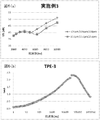
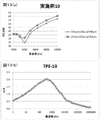
- Example 2 It is a graph which shows the relationship between the frequency of the laminated bodies 3 and 4, and a sound transmission loss.
- Example 2 It is a graph which shows the relationship between the frequency of the laminated bodies 3 and 4, and a sound transmission loss.
- Example 2 It is a graph which shows the relationship between the frequency of the hydrogenated block copolymer used in Example 2, and tan-delta.
- Example 3 it is a graph which shows the relationship between the frequency of the laminated bodies 3 and 4, and a sound transmission loss.
- B It is a graph which shows the relationship between the frequency of the hydrogenated block copolymer used in Example 3, and tan-delta.
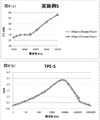
- Example 5 it is a graph which shows the relationship between the frequency of the laminated bodies 3 and 4, and a sound transmission loss.
- Example 6 It is a graph which shows the relationship between the frequency of the hydrogenated block copolymer used in Example 5, and tan-delta.
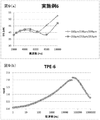
- Example 6 it is a graph which shows the relationship between the frequency of the laminated bodies 3 and 4, and a sound transmission loss.
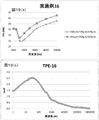
- B It is a graph which shows the relationship between the frequency of the hydrogenated block copolymer used in Example 6, and tan-delta.
- Example 7 it is a graph which shows the relationship between the frequency of the laminated bodies 3 and 4, and a sound transmission loss.
- B It is a graph which shows the relationship between the frequency of the hydrogenated block copolymer used in Example 7, and tan-delta.
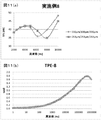
- Example 8 it is a graph which shows the relationship between the frequency of the laminated bodies 3 and 4, and a sound transmission loss.
- B It is a graph which shows the relationship between the frequency of the hydrogenated block copolymer used in Example 8, and tan-delta.
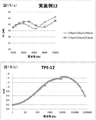
- Example 10 it is a graph which shows the relationship between the frequency of the laminated bodies 3 and 4, and a sound transmission loss.
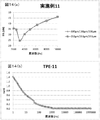
- Example 11 It is a graph which shows the relationship between the frequency of the laminated bodies 3 and 4, and a sound transmission loss.
- B It is a graph which shows the relationship between the frequency of the hydrogenated block copolymer used in Example 11, and tan-delta.
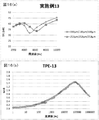
- Example 13 it is a graph which shows the relationship between the frequency of the laminated bodies 3 and 4, and a sound transmission loss.
- B It is a graph which shows the relationship between the frequency of the hydrogenated block copolymer used in Example 13, and tan-delta.
- Example 15 it is a graph which shows the relationship between the frequency of the laminated bodies 3 and 4, and a sound transmission loss.
- Example 16 It is a graph which shows the relationship between the frequency of the hydrogenated block copolymer used in Example 15, and tan-delta.
- Example 16 it is a graph which shows the relationship between the frequency of the laminated bodies 3 and 4, and a sound transmission loss.
- B It is a graph which shows the relationship between the frequency of the hydrogenated block copolymer used in Example 16, and tan-delta.
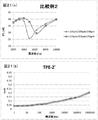
- B It is a graph which shows the relationship between the frequency of the hydrogenated block copolymer used in the comparative example 1, and tan-delta.
- the present invention A polymer block (A) containing more than 70 mol% of structural units derived from an aromatic vinyl compound, and 30 mol% or more of structural units derived from at least one selected from the group consisting of conjugated diene compounds and isobutylene
- Condition (1) The content of the polymer block (A) in the block copolymer is 1 to 30% by mass.
- Condition (2) The main structural unit derived from at least one selected from the group consisting of a conjugated diene compound and isobutylene in the polymer block (B), assuming that the hydrogenation rate is 100 mol%.
- the average methylene chain length of the chain is 1.0 to 6.0. If it is the hydrogenated block copolymer of this invention, in the laminated glass of all thickness, especially in the laminated glass using thin glass (for example, thickness 2.5mm or less), sound-insulating property can be improved efficiently. . This is because the relationship between the frequency at which the sound transmission loss (STL) decreases due to the coincidence effect and the peak frequency of tan ⁇ of the hydrogenated block copolymer is adjusted. This is presumably because the minimum frequency (so-called coincidence limit frequency) at which the coincidence effect occurs can be increased and the frequency can be increased.
- the hydrogenated block copolymer of the present invention will be described in detail.
- the hydrogenated block copolymer of the present invention is a hydrogenated product of a block copolymer having the polymer block (A) and the polymer block (B).
- the polymer block (A) contains a structural unit derived from an aromatic vinyl compound (hereinafter sometimes abbreviated as “aromatic vinyl compound unit”) in excess of 70 mol%, from the viewpoint of mechanical properties, Preferably it is 80 mol% or more, More preferably, it is 85 mol% or more, More preferably, it is 90 mol% or more, Most preferably, it is 95 mol% or more, and it may be 100 mol% substantially.
- aromatic vinyl compound unit aromatic vinyl compound
- aromatic vinyl compound examples include styrene, o-methylstyrene, m-methylstyrene, p-methylstyrene, ⁇ -methylstyrene, ⁇ -methylstyrene, 2,6-dimethylstyrene, 2,4-dimethylstyrene, ⁇ -methyl-o-methylstyrene, ⁇ -methyl-m-methylstyrene, ⁇ -methyl-p-methylstyrene, ⁇ -methyl-o-methylstyrene, ⁇ -methyl-m-methylstyrene, ⁇ -methyl-p -Methylstyrene, 2,4,6-trimethylstyrene, ⁇ -methyl-2,6-dimethylstyrene, ⁇ -methyl-2,4-dimethylstyrene, ⁇ -methyl-2,6-dimethylstyrene, ⁇ -methyl- 2,4-dimethylstyrene,
- aromatic vinyl compounds may be used alone or in combination of two or more.
- styrene, ⁇ -methylstyrene, p-methylstyrene, and a mixture thereof are preferable, and styrene is more preferable from the viewpoint of production cost and physical property balance.
- the polymer block (A) is a structural unit derived from another unsaturated monomer other than the aromatic vinyl compound (hereinafter referred to as “other unsaturated monomer” unless the object and effect of the present invention are hindered. May be abbreviated as “unit.”) In a proportion of 30 mol% or less.
- Examples of the other unsaturated monomer include butadiene, isoprene, 2,3-dimethylbutadiene, 1,3-pentadiene, 1,3-hexadiene, isobutylene, methyl methacrylate, methyl vinyl ether, N-vinyl carbazole, ⁇ And at least one selected from the group consisting of -pinene, 8,9-p-mentene, dipentene, methylene norbornene, 2-methylenetetrahydrofuran and the like.
- the bonding form is not particularly limited, and may be random or tapered.
- the content of the structural unit derived from the other unsaturated monomer in the polymer block (A) is preferably 10 mol% or less, more preferably 5 mol% or less, and still more preferably 0 mol%.
- the block copolymer may have at least one polymer block (A).
- these polymer blocks (A) may be the same or different.
- “the polymer block is different” means that the monomer unit constituting the polymer block, the weight average molecular weight, the stereoregularity, and the ratio and the common ratio of each monomer unit when it has a plurality of monomer units. It means that at least one of polymerization forms (random, gradient, block) is different.
- the weight average molecular weight (Mw) of the polymer block (A) included in the block copolymer is not particularly limited, but at least one polymer block among the polymer blocks (A) included in the block copolymer.
- the weight average molecular weight of (A) is preferably 3,000 to 60,000, more preferably 4,000 to 50,000.
- the block copolymer has at least one polymer block (A) having a weight average molecular weight within the above range, the mechanical strength is further improved and the film moldability is also excellent.
- weight average molecular weights are weight average molecular weights in terms of standard polystyrene determined by gel permeation chromatography (GPC) measurement.
- the weight average molecular weight of each polymer block (A) of the block copolymer can be determined by measuring the sampled liquid every time the polymerization of each polymer block is completed in the production process. For example, in the case of a triblock copolymer having an A1-B-A2 structure, the weight average molecular weights of the first polymer block A1 and the polymer block B are determined by the above method, and the weight average molecular weight of the block copolymer is determined.
- the weight average molecular weight of the second polymer block A2 can be determined.
- the total weight average molecular weight of the polymer block (A) is the same as the weight average molecular weight of the block copolymer and 1 H— It is calculated from the total content of the polymer block (A) to be confirmed by NMR measurement, the weight average molecular weight of the first deactivated polymer block A1 is calculated by GPC measurement, and this is subtracted to obtain the second weight.
- the weight average molecular weight of the combined block A2 can also be determined.
- the hydrogenated block copolymer of the present invention satisfies the following condition (1).
- the content of the polymer block (A) is less than 1% by mass, it becomes difficult to form hydrogenated block copolymer pellets.
- it exceeds 30% by mass the flexibility is poor, the tan ⁇ peak top strength is lowered, and the low shrinkability and moldability are poor.
- the content of the polymer block (A) is preferably 2 to 27% by mass, more preferably 2 to 18% by mass, further preferably 3 to 18% by mass, and particularly preferably 3.5 to 18% by mass, most preferably 3.5 to 15% by mass. Further, considering that the sphere microphase separation structure described later is easily formed, it is preferably 3 to 15% by mass, more preferably 3.5 to 11% by mass, and further preferably 3.5 to 4.5% by mass. . Considering the handleability and mechanical properties of the film, 6 to 18% by mass is preferable, 6 to 15% by mass is more preferable, 8 to 15% by mass is further preferable, and 10 to 15% by mass is particularly preferable.
- the content of the polymer block (A) in the block copolymer is a value determined by 1 H-NMR measurement, and more specifically a value measured according to the method described in the examples.
- the polymer block (B) contains 30 mol% or more of structural units derived from at least one selected from the group consisting of conjugated diene compounds and isobutylene, preferably 50 mol% or more, more preferably 65 mol% or more. More preferably, it contains 80 mol% or more.
- the polymer block (B) may contain 30 mol% or more of structural units derived from a conjugated diene compound, may contain 30 mol% or more of structural units derived from isobutylene, or may be a conjugated diene. You may contain 30 mol% or more of structural units derived from the mixture of a compound and isobutylene.
- the polymer block (B) may contain 30 mol% or more of structural units derived from one kind of conjugated diene compound, or contains 30 mol% or more of structural units derived from two or more kinds of conjugated diene compounds. You may do it.
- the conjugated diene compound include isoprene, butadiene, hexadiene, 2,3-dimethyl-1,3-butadiene, 1,3-pentadiene, and myrcene. Among them, isoprene, butadiene, a mixture of isoprene and butadiene is preferable, and isoprene is more preferable.
- the mixing ratio [isoprene / butadiene] is not particularly limited, but is preferably 5/95 to 95/5, more preferably 10/90 to 90/10, It is preferably 40/60 to 70/30, particularly preferably 45/55 to 65/35.
- the mixing ratio [isoprene / butadiene] is preferably 5/95 to 95/5, more preferably 10/90 to 90/10, still more preferably 40/60 to 70/30, particularly in molar ratio. It is preferably 45/55 to 55/45.
- the polymer block (B) preferably contains 30 mol% or more of a structural unit derived from a conjugated diene compound.
- the structural unit derived from isoprene (hereinafter abbreviated as “isoprene unit”). Is preferably 30 mol% or more, and preferably contains 30 mol% or more of a structural unit derived from butadiene (hereinafter sometimes abbreviated as “butadiene unit”). Further, it is also preferable to contain 30 mol% or more of a structural unit derived from a mixture of isoprene and butadiene (hereinafter sometimes abbreviated as “mixed unit of isoprene and butadiene”).
- the polymer block (B) has two or more kinds of structural units, their bonding form is random, tapered, completely alternating, partially block-like, block, or a combination of two or more thereof. Can be.
- ⁇ Condition (2)> (Average value of methylene chain length of polymer block (B))
- the average value of the methylene chain length (hereinafter sometimes referred to as the average methylene chain length) is 1.0 to 6.0.
- the methylene chain length represents how many methylene groups represented by —CH 2 — are bonded continuously. When the average methylene chain length exceeds 6.0, crystallization is likely to occur, vibration damping properties are reduced, and sound insulation properties are reduced when used for laminated glass.
- the average methylene chain length is preferably 1.0 to 5.0, more preferably 1.0 to 4.0, still more preferably 1.0 to 3.5, still more preferably 1. It is 5 to 3.5, particularly preferably 1.5 to 3.0, most preferably 1.5 to 2.2.
- the average methylene chain length will be described below while showing the structure.
- the average substituent constant is 0.25 or more, the vibration damping property is increased, and when used in a laminate (for example, laminated glass), the sound insulating property is increased, and is 1.1 or less. In addition, it is possible to suppress the main chain from being rigid, the vibration damping property is increased, and the sound insulation property is increased when used for a laminated body (for example, laminated glass).
- the average substituent constant is more preferably 0.30 to 0.55, still more preferably 0.33 to 0.55, and particularly preferably 0.33 to 0.50. Specific examples of the substituent constant ( ⁇ ) are shown in Table 1 below. In addition, “Journal of the American Chemical Society” (1975), Vol. 97, p.1552-1556 and “Journal of Organic” Chemistry "(1976), 41, p.2217-2220 can be used.
- the average substituent constant can be obtained by calculating the average value of the substituent constant ( ⁇ ) of each side chain. For example, when the conjugated diene compound is isoprene and the content ratio of 1,4-bond units to 3,4-bond units is 40/60 (molar ratio), the average substituent constant is 0.47. It can be obtained as follows.
- the average substituent constant is 0.35. It can be obtained as follows.
- the conjugated diene compound is a mixture of isoprene and butadiene (molar ratio: 50/50), and the content ratio of 1,4-bond units to 3,4-bond units in isoprene is 40/60 (molar ratio).
- the average substituent constant is 0.36, but is determined as follows. be able to.
- the conjugated diene compound is mainly isoprene but contains 12 mol% of styrene
- the content ratio of 1,4-bond units to 3,4-bond units in isoprene is 40/60 (molar ratio).
- the average substituent constant is 0.48, which can be determined as follows.
- Vinyl bond amount of polymer block (B) When the structural unit constituting the polymer block (B) is any one of an isoprene unit, a butadiene unit, a mixture unit of isoprene and butadiene, the bonding form of isoprene and butadiene is 1, 2 in the case of butadiene. In the case of isoprene, 1,2-bond, 1,4-bond and 1,4-bond can be formed. In the block copolymer, the total content of 3,4-bond units and 1,2-bond units in the polymer block (B) (hereinafter sometimes referred to as vinyl bond amount) is preferably 20.
- the amount of vinyl bonds in the polymer block (B) is preferably 90 mol% or less, more preferably 85 mol% or less.
- the vinyl bond amount is a value calculated by 1 H-NMR measurement according to the method described in the Examples.
- the above “content of 3,4-bond units and 1,2-bond units” means “content of 1,2-bond units”. And apply.
- the total weight average molecular weight of the polymer block (B) of the block copolymer is determined before the hydrogenation from the viewpoints of vibration damping properties and sound insulation when used as a laminate (for example, laminated glass). In the state, it is preferably 15,000 to 800,000, more preferably 50,000 to 700,000, still more preferably 70,000 to 600,000, particularly preferably 90,000 to 500,000, Most preferably, it is 130,000-450,000.
- the polymer block (B) may contain structural units derived from other polymerizable monomers other than the conjugated diene compound and isobutylene, as long as the object and effect of the present invention are not hindered.
- the content of structural units derived from other polymerizable monomers other than the conjugated diene compound and isobutylene is preferably less than 70 mol%, more preferably less than 50 mol%. More preferably, it is less than 35 mol%, particularly preferably less than 20 mol%.
- the lower limit of the content of structural units derived from other polymerizable monomers other than the conjugated diene compound and isobutylene is not particularly limited, but may be 0 mol% or 5 mol% It may be 10 mol%.
- the other polymerizable monomers include styrene, ⁇ -methylstyrene, o-methylstyrene, m-methylstyrene, p-methylstyrene, pt-butylstyrene, 2,4-dimethylstyrene, vinyl.
- Aromatic vinyl compounds such as naphthalene and vinylanthracene, and methyl methacrylate, methyl vinyl ether, N-vinyl carbazole, ⁇ -pinene, 8,9-p-mentene, dipentene, methylene norbornene, 2-methylenetetrahydrofuran, 1,3- Preferable examples include at least one compound selected from the group consisting of cyclopentadiene, 1,3-cyclohexadiene, 1,3-cycloheptadiene, 1,3-cyclooctadiene, and the like.
- styrene, ⁇ -methylstyrene, and p-methylstyrene are preferable, and styrene is more preferable.
- the polymer block (B) contains a structural unit derived from a polymerizable monomer other than the conjugated diene compound and isobutylene, the specific combination thereof is preferably isoprene, styrene, and butadiene. Styrene, more preferably isoprene and styrene.
- the bonding form is not particularly limited and may be random or tapered. However, random is preferable.
- the block copolymer may have at least one polymer block (B).
- these polymer blocks (B) may be the same or different.
- Block copolymer is not limited in the form of bonding, and is linear, branched, radial, or two of these. Any of the above combined modes may be used.
- bonding type of a polymer block (A) and a polymer block (B) is linear, as an example, a polymer block (A) is A and a polymer block (B)
- B a diblock copolymer represented by AB, a triblock copolymer represented by ABA or BAB, a tetrablock represented by ABAB Block copolymer, pentablock copolymer represented by ABABABA or BABABA, (AB) nX type copolymer (X is residual coupling agent) And n represents an integer of 3 or more.
- a linear triblock copolymer or a diblock copolymer is preferable, and an ABA type triblock copolymer is preferably used from the viewpoints of flexibility and ease of manufacture.
- the entire bonded polymer block is handled as one polymer block. It is. Accordingly, including the above examples, the polymer block that should be originally expressed strictly as YXY (where X represents a coupling residue) must be distinguished from the single polymer block Y in particular. Except for some cases, Y is displayed as a whole.
- this type of polymer block containing a coupling agent residue is treated as described above, so that, for example, it contains a coupling agent residue and, strictly speaking, ABXXBA (A block copolymer to be represented as (X represents a coupling agent residue) is represented as ABA, and is treated as an example of a triblock copolymer.
- ABXXBA A block copolymer to be represented as (X represents a coupling agent residue) is represented as ABA, and is treated as an example of a triblock copolymer.
- the present invention is a hydrogenated product of the block copolymer (also referred to as a hydrogenated block copolymer).
- a hydrogenated block copolymer also referred to as a hydrogenated block copolymer.
- 80 mol% or more of the carbon-carbon double bonds of the polymer block (B) are hydrogenated.
- 85 mol% or more is more preferably hydrogenated
- 89 mol% or more is more preferably hydrogenated
- this value may be called a hydrogenation rate (hydrogenation rate).
- the hydrogenation rate is a value obtained by measuring the content of carbon-carbon double bonds in the structural unit derived from the conjugated diene compound in the polymer block (B) by 1 H-NMR measurement after hydrogenation. More specifically, it is a value measured according to the method described in the examples.
- Weight average molecular weight of hydrogenated block copolymer (Mw) The weight average molecular weight (Mw) determined by gel permeation chromatography of the hydrogenated block copolymer in terms of standard polystyrene is preferably 15,000 to 800,000, more preferably 50,000 to 700,000, and even more preferably. Is 70,000 to 600,000, particularly preferably 90,000 to 500,000, most preferably 130,000 to 450,000. If the weight average molecular weight of a block copolymer is 15,000 or more, heat resistance will become high, and if it is 800,000 or less, a moldability will become favorable.
- the hydrogenated block copolymer of the present invention has a functional group such as a carboxyl group, a hydroxyl group, an acid anhydride group, an amino group, and an epoxy group in the molecular chain and / or at the molecular end unless the purpose and effect of the present invention are impaired.
- the group may have one kind or two or more kinds, or may have no functional group.
- the hydrogenated block copolymer of the present invention was prepared by producing a single-layer sheet having a thickness of 1.0 mm by pressurizing at a temperature of 230 ° C. and a pressure of 10 MPa for 3 minutes, and cutting the single-layer sheet into a disc shape.
- the test piece was used under the conditions of a strain amount of 0.1%, a frequency of 1 Hz, a measurement temperature of -70 to 200 ° C., and a temperature increase rate of 3 ° C./min.
- the measured peak top intensity of tan ⁇ can be 0.5 or more. Higher ones are 1.0 or more, further 1.5 or more, and even 2.0 or more.
- the hydrogenated block copolymer of the present invention is excellent in vibration damping properties and sound insulation properties.
- the tan ⁇ peak top intensity is the value of tan ⁇ when the tan ⁇ peak is maximized.
- the method for measuring the tan ⁇ peak top intensity is as described in the Examples in more detail.
- the tan ⁇ peak top temperature (temperature at which the tan ⁇ peak is maximized) measured under the above conditions is preferably ⁇ It is 40 to 35 ° C., more preferably ⁇ 25 to 15 ° C., and further preferably ⁇ 15 to 5 ° C.
- the peak top temperature of tan ⁇ is preferably ⁇ 10 to 50. ° C, more preferably 0 to 40 ° C, still more preferably 10 to 35 ° C.
- the storage elastic modulus (G ′) at the tan ⁇ peak top temperature + 30 ° C. is preferably 0.01 to 3 MPa, more preferably 0.03 to 1 MPa, still more preferably 0.05 to 0.7 MPa, particularly preferably 0.1. ⁇ 0.5 MPa.
- d (G ′) / dTemp. the minimum value of the value obtained by differentiating the storage elastic modulus (G ′) of the hydrogenated block copolymer with respect to temperature.
- d (G ′) / dTemp. the minimum value of the value obtained by differentiating the storage elastic modulus (G ′) of the hydrogenated block copolymer with respect to temperature.
- d (G ') / dTemp. Is preferably ⁇ 20 MPa / ° C. or less, more preferably ⁇ 30 MPa / ° C. or less, further preferably ⁇ 40 MPa / ° C. or less, and particularly preferably ⁇ 43 MPa / ° C. or less.
- the hydrogenated block copolymer of the present invention has a sphere (spherical shape) shown in FIG. 1 or a morphological shape of a film having a thickness of 1 mm obtained by molding under conditions of pressurization at 230 ° C. and 10 MPa for 3 minutes. 2 has a cylindrical (columnar) microphase separation structure.
- the polymer block (A) is spherical and is present in the polymer block (B), while it has a cylinder (columnar) microphase separation structure.
- the polymer block (A) is columnar and present in the polymer block (B).
- the film obtained by molding as described above has a sphere (spherical) or cylinder (columnar) microphase-separated structure, so that vibration damping and sound insulation when a laminated body (for example, laminated glass) is obtained. The nature becomes even higher. From the same viewpoint, it is more preferable that the film has a sphere (spherical) microphase separation structure.
- a sphere (spherical) microphase separation structure As shown in FIG.
- the shrinkage in the MD direction ⁇ (xy) / x ⁇ ⁇ 100 (%) To do.
- the shrinkage rate may be 10% or less, some may be 6% or less, and some may be 3% or less.
- TD means a vertical direction (Transverse Direction).
- the hydrogenated block copolymer of the present invention can be produced by a solution polymerization method, an emulsion polymerization method or a solid phase polymerization method.
- the solution polymerization method is preferable, and known methods such as an ion polymerization method such as anion polymerization and cation polymerization, and a radical polymerization method can be applied.
- the anionic polymerization method is preferable.
- a hydrogenated block copolymer can be obtained by obtaining a block copolymer, adding a coupling agent as necessary, allowing the block copolymer to react, and then hydrogenating the block copolymer.
- Examples of the organic lithium compound that can be used as a polymerization initiator for anionic polymerization in the above method include methyl lithium, ethyl lithium, n-butyl lithium, sec-butyl lithium, tert-butyl lithium, pentyl lithium, and the like.
- Examples of the dilithium compound that can be used as the polymerization initiator include naphthalenedilithium and dilithiohexylbenzene.
- Examples of the coupling agent include dichloromethane, dibromomethane, dichloroethane, dibromoethane, dibromobenzene, and phenyl benzoate.
- the amount of these polymerization initiator and coupling agent used is appropriately determined depending on the desired weight average molecular weight of the target hydrogenated block copolymer.
- initiators such as alkyllithium compounds and dilithium compounds are used at a ratio of 0.01 to 0.2 parts by mass per 100 parts by mass in total of monomers such as aromatic vinyl compounds, butadiene and isoprene used for polymerization.
- a coupling agent it is preferably used in a proportion of 0.001 to 0.8 parts by mass per 100 parts by mass of the monomers.
- the solvent is not particularly limited as long as it does not adversely affect the anionic polymerization reaction.
- aliphatic hydrocarbons such as cyclohexane, methylcyclohexane, n-hexane and n-pentane; aromatic hydrocarbons such as benzene, toluene and xylene Etc.
- the polymerization reaction is usually carried out at a temperature of 0 to 100 ° C., preferably 10 to 70 ° C., for 0.5 to 50 hours, preferably 1 to 30 hours.
- the polymer block (B) of the block copolymer is a structural unit derived from a conjugated diene
- the polymer block (B) 3 can be obtained by adding a Lewis base as a cocatalyst during the polymerization.
- a Lewis base as a cocatalyst during the polymerization.
- the content of 1,4-bond and 1,2-bond can be increased.
- Lewis bases include ethers such as dimethyl ether, diethyl ether and tetrahydrofuran, glycol ethers such as ethylene glycol dimethyl ether and diethylene glycol dimethyl ether, triethylamine, N, N, N ′, N′-tetramethylenediamine, And amines such as N-methylmorpholine.
- Lewis bases can be used alone or in combination of two or more.
- the amount of the Lewis base added is an isoprene unit constituting the polymer block (B) and / or It is determined by how much the vinyl bond amount of the butadiene unit is controlled. Therefore, although there is no strict limitation on the amount of Lewis base added, usually 0.1 to 1,000 mol per gram atom of lithium contained in the alkyllithium compound or dilithium compound used as the polymerization initiator, It is preferably used in the range of 1 to 100 mol.
- an active hydrogen compound such as alcohols, carboxylic acids and water is added to stop the polymerization reaction.
- a hydrogenation reaction (hydrogenation reaction) is performed in an inert organic solvent in the presence of a hydrogenation catalyst.
- the hydrogen pressure is 0.1 to 20 MPa, preferably 0.5 to 15 MPa, more preferably 0.5 to 5 MPa
- the reaction temperature is 20 to 250 ° C., preferably 50 to 180 ° C., more preferably 70.
- the reaction can be carried out at a temperature of ⁇ 180 ° C. and a reaction time of usually 0.1-100 hours, preferably 1-50 hours.
- hydrogenation catalysts examples include Raney nickel; heterogeneous catalysts in which metals such as Pt, Pd, Ru, Rh, Ni are supported on carbon, alumina, diatomaceous earth, etc .; transition metal compounds and alkylaluminum compounds, alkyllithiums Examples include Ziegler catalysts composed of combinations with compounds, metallocene catalysts, and the like.
- the hydrogenated block copolymer thus obtained is solidified by pouring the polymerization reaction solution into methanol, etc., and then heated or dried under reduced pressure, or the polymerization reaction solution is poured into hot water together with steam, Can be obtained by heating or drying under reduced pressure after so-called steam stripping for removing azeotropically.
- the hydrogenated block copolymer of the present invention is excellent in vibration damping properties and sound insulation when used as a laminate (for example, laminated glass). Therefore, the present invention also provides an interlayer film for laminated glass comprising the hydrogenated block copolymer of the present invention.
- a dam rubber, a shoe sole material, a flooring, and the like, each containing the hydrogenated block copolymer of the present invention are also provided.
- it is also useful as a sound insulating material and a vibration damping material. You may use for a weather strip, a floor mat, etc.
- an adhesive layer can be provided between the interlayer film and the glass.
- various recorders such as TVs, Blu-ray recorders, HDD recorders, etc. in the home appliance field, projectors, game machines, digital cameras, home videos, antennas, speakers, electronic dictionaries, IC recorders, fax machines, copiers, telephones, door phones, rice cookers , Microwave oven, microwave oven, refrigerator, dishwasher, dish dryer, IH cooking heater, hot plate, vacuum cleaner, washing machine, charger, sewing machine, iron, dryer, electric bicycle, air purifier, water purifier, electric toothbrush
- various electrical products such as lighting fixtures, air conditioners, outdoor units of air conditioners, dehumidifiers, humidifiers, etc., they can be used for sealing materials, adhesives, adhesives, packings, O-rings, belts, soundproofing materials, and the like.
- the present invention also provides a laminate having an X layer containing the hydrogenated block copolymer of the present invention and a Y layer laminated on at least one surface of the X layer.
- the laminate of the present invention is excellent in vibration damping properties and sound insulation properties. It may be a laminate composed of one X layer and one Y layer, or a laminate composed of one X layer and two or more Y layers, or two or more layers. A laminate composed of the X layer and one Y layer may be used, or a laminate composed of two or more X layers and two or more Y layers may be used.
- the structure of the laminate of the present invention is not particularly limited when the X layer is represented by “X” and the Y layer is represented by “Y”, but Y / X / Y, Y / X, Y / X / Y / X / Y etc. are mentioned.
- the plurality of Y layers may be made of the same material or different materials. Therefore, when the Y layers made of different materials are expressed in the order of “Y1”, “Y2”, “Y3”.
- Y1 / X / Y1, Y2 / Y1 / X / Y1 / Y2, Y1 / X / Y2, X / Y1 / Y2, Y1 / X / Y2 / Y3, Y1 / X / Y2 / X / Y3 etc. are mentioned.
- a laminate having a configuration of Y1 / X / Y1, Y2 / Y1 / X / Y1 / Y2, and Y1 / X / Y2 is preferable, and a laminate having a configuration of Y1 / X / Y1, Y2 / Y1 / X / Y1 / Y2 is preferable.
- the body is more preferred.
- a laminate having an X layer and a plurality of Y layers, in which the X layer is laminated between at least two Y layers, and a laminate satisfying the following formula (I) is preferable.
- the center value of the formula (I) that is, “tan ⁇ peak top frequency ⁇ (B / m) 0.5 ” may be referred to as an I value.
- the present inventors have found from various studies that the peak top frequencies of B, m, and tan ⁇ correlate with the sound insulation, and the relationship is expressed by the formula (I).
- the peak top frequency of the tan ⁇ of the hydrogenated block copolymer and the coincidence limit frequency of the laminate are close to each other, the sound insulation property due to the decrease in STL caused by the coincidence effect. It is preferable at the point which can suppress a fall effectively.
- B represents the bending rigidity (Pa ⁇ m 3 ) per unit width of the laminate.
- M represents the surface density (kg / m 2 ) of the laminate.
- the peak top frequency of tan ⁇ . (Hz) represents the frequency at which the tan ⁇ peak of the hydrogenated block copolymer obtained in accordance with the following method is maximized.
- the mechanical impedance of the excitation point (the central part of the laminated body to which vibration is applied) is obtained, the horizontal axis is the frequency, and the vertical axis is In the impedance curve obtained as mechanical impedance, the bending rigidity (Pa ⁇ m 3 ) per unit width of the laminate is calculated from the frequency showing the peak (see ISO 16940: 2008).
- B eq is the bending rigidity per unit width
- m S is the surface density
- f res is the peak frequency of the impedance test
- L is the length of the laminated glass measured
- the mass per unit area of the laminate that is, the surface density
- the surface area of a laminated body can be calculated
- the sound insulation is very high.
- the lower limit value of the I value is preferably 400, more preferably 1,000, still more preferably 2,000, and particularly preferably 4,000.
- the upper limit of the I value is preferably 1,000,000, more preferably 400,000, still more preferably 200,000, and particularly preferably 100,000. These lower limit value and upper limit value can be employed in the formula (I) independently or in any combination.
- the layer X is a layer containing the hydrogenated block copolymer of the present invention, and may be a layer containing only the hydrogenated block copolymer of the present invention, or the hydrogenated block of the present invention.
- the layer which consists of a composition containing components other than a block copolymer may be sufficient.
- the X layer is a layer containing the hydrogenated block copolymer of the present invention, and only the hydrogenated block copolymer of the present invention is used. It may be a layer formed or a layer formed of a composition containing components other than the hydrogenated block copolymer of the present invention.
- the components other than the hydrogenated block copolymer of the present invention include, for example, antioxidants, ultraviolet absorbers, light stabilizers, heat shielding materials, antiblocking agents, However, it is not particularly limited to these. These can be used individually by 1 type or in combination of 2 or more types.
- antioxidant examples include a phenolic antioxidant, a phosphorus antioxidant, and a sulfur antioxidant.
- ultraviolet absorber in addition to a benzotriazole ultraviolet absorber, a hindered amine ultraviolet absorber, a benzoate ultraviolet absorber, and the like, a triazine compound, a benzophenone compound, a malonic ester compound, an oxalic acid anilide compound, and the like can also be used.
- the light stabilizer include hindered amine light stabilizers.
- the heat shielding material include a material containing a heat ray shielding particle having a heat ray shielding function or an organic dye compound having a heat ray shielding function in a resin or glass.
- particles having a heat ray shielding function examples include particles of oxides such as tin-doped indium oxide, antimony-doped tin oxide, aluminum-doped zinc oxide, tin-doped zinc oxide, and silicon-doped zinc oxide, LaB 6 (lanthanum hexaboride) Examples thereof include particles of an inorganic material having a heat ray shielding function such as particles.
- organic dye compounds having a heat ray shielding function include diimonium dyes, aminium dyes, phthalocyanine dyes, anthraquinone dyes, polymethine dyes, benzenedithiol-type ammonium compounds, thiourea derivatives, and thiol metal complexes.
- Examples of the antiblocking agent include inorganic particles and organic particles.
- Inorganic particles include Group IA, Group IIA, Group IVA, Group VIA, Group VIIA, Group VIIIA, Group IB, Group IIB, Group IIIB, Group IVB oxides, hydroxides, sulfides, nitrides, halogens , Carbonates, sulfates, acetates, phosphates, phosphites, organic carboxylates, silicates, titanates, borates and their water-containing compounds, and composite compounds and natural mineral particles centered on them Is mentioned.
- Examples of the organic particles include fluororesins, melamine resins, styrene-divinylbenzene copolymers, acrylic resin silicones, and cross-linked products thereof.
- the X layer contains the hydrogenated block copolymer of the present invention. It may be a layer containing only the hydrogenated block copolymer of the present invention or a layer comprising a composition containing components other than the hydrogenated block copolymer of the present invention. May be.
- the components other than the hydrogenated block copolymer of the present invention include, for example, an antioxidant, an ultraviolet absorption Agents, light stabilizers, heat shielding materials, anti-blocking agents, pigments, dyes, softeners, crosslinking agents, crosslinking aids, crosslinking accelerators, and the like are exemplified, but are not particularly limited thereto. These can be used individually by 1 type or in combination of 2 or more types.
- the antioxidant the ultraviolet absorber, the light stabilizer, the heat shielding material, and the anti-blocking agent, the same ones as described above when the X layer is used as an interlayer film for laminated glass can be mentioned.
- the pigment include organic pigments and inorganic pigments.
- organic pigments include azo pigments, quinacridone pigments, and phthalocyanine pigments.
- inorganic pigments include titanium oxide, zinc oxide, zinc sulfide, carbon black, lead pigments, cadmium pigments, cobalt pigments, iron pigments, chromium pigments, ultramarine blue, and bitumen.
- dyes examples include azo, anthraquinone, phthalocyanine, quinacridone, perylene, dioxazine, anthraquino, indolinone, isoindolino, quinoneimine, triphenylmethane, thiazole, nitro, nitroso, etc. Dyes.
- softener examples include hydrocarbon oils such as paraffinic, naphthenic, and aromatic; vegetable oils such as peanut oil and rosin; phosphate esters; low molecular weight polyethylene glycol; liquid paraffin; low molecular weight polyethylene, ethylene- ⁇ -
- Known softeners such as hydrocarbon-based synthetic oils such as olefin copolymer oligomers, liquid polybutene, liquid polyisoprene or hydrogenated products thereof, and liquid polybutadiene or hydrogenated products thereof can be used. These may be used alone or in combination of two or more.
- crosslinking agent examples include radical generators, sulfur and sulfur compounds.
- radical generator examples include dialkyl monoperoxides such as dicumyl peroxide, di-t-butyl peroxide, and t-butylcumyl peroxide; 2,5-dimethyl-2,5-di (t-butylperoxy) hexane, , 5-Dimethyl-2,5-di (t-butylperoxy) hexyne-3, bis (t-butyldioxyisopropyl) benzene, 1,1-bis (t-butylperoxy) -3,3,5-trimethyl Diperoxides such as cyclohexane and n-butyl-4,4-bis (t-butylperoxy) valerate; Diacyl peroxides such as benzoyl peroxide, p-chlorobenzoyl peroxide and 2,4-dichlorobenzoyl peroxide; t-butyl
- 2,5-dimethyl-2,5-di (t-butylperoxy) hexane and dicumyl peroxide are preferable from the viewpoint of reactivity.
- the sulfur compound include sulfur monochloride and sulfur dichloride.
- Other cross-linking agents include phenolic resins such as alkylphenol resins and brominated alkylphenol resins; combinations of p-quinonedioxime and lead dioxide, p, p'-dibenzoylquinonedioxime and trilead tetroxide, etc. can do.
- crosslinking aids known crosslinking aids can be used.
- crosslinking accelerator examples include thiazoles such as N, N-diisopropyl-2-benzothiazole-sulfenamide, 2-mercaptobenzothiazole, 2- (4-morpholinodithio) benzothiazole; diphenylguanidine, triphenylguanidine Guanidines such as; aldehyde-amine reactants such as butyraldehyde-aniline reactant, hexamethylenetetramine-acetaldehyde reactant or aldehyde-ammonia reactants; imidazolines such as 2-mercaptoimidazoline; thiocarbanilide, diethylurea, dibutyl Thioureas such as thiourea, trimethylthiourea, diorthotolylthiourea; dibenzothiazyl disulfide; tetramethylthiuram monosulfide, tetramethylthiuramdisulfur And thiuram monosul
- the hydrogenated block copolymer of the present invention is not particularly limited to its use, and is within the range where the effects of the present invention are not impaired, such as an additive such as a crystal nucleating agent; -Based resins, hydrogenated terpene resins, hydrogenated resins such as alicyclic hydrogenated petroleum resins; tackifying resins such as aliphatic resins composed of olefin and diolefin polymers; hydrogenated polyisoprene, hydrogenated polybutadiene, Butyl rubber, polyisobutylene, polybutene, polyolefin elastomer, specifically ethylene-propylene copolymer, ethylene-butylene copolymer, propylene-butylene copolymer, polyolefin resin, olefin polymer, polyethylene resin, etc.
- an additive such as a crystal nucleating agent
- -Based resins hydrogenated terpene resins, hydrogenated resins such as alicyclic hydrogenated petroleum
- examples of the olefin constituting the polyolefin resin include ethylene, propylene, 1-butene, 1-pentene, 1-hexene, 1-octene, 4-methyl-1-pentene, and cyclohexene.
- the olefin constituting the polyolefin-based resin may be one kind alone or two or more kinds.
- polypropylene resin which is one of polyolefin resins, for example, homopolypropylene, propylene-ethylene random copolymer, propylene-ethylene block copolymer, propylene-butene random copolymer, propylene-ethylene-butene random Copolymer, propylene-pentene random copolymer, propylene-hexene random copolymer, propylene-octene random copolymer, propylene-ethylene-pentene random copolymer, propylene-ethylene-hexene random copolymer, etc. It is done.
- these polypropylene resins include unsaturated monocarboxylic acids such as acrylic acid, methacrylic acid and crotonic acid; unsaturated dicarboxylic acids such as maleic acid, citraconic acid and itaconic acid; unsaturated monocarboxylic acids or unsaturated dicarboxylic acids. It is also possible to use a modified polypropylene resin obtained by graft copolymerization with a modifier such as an acid ester, amide or imide; an unsaturated dicarboxylic acid anhydride such as maleic anhydride, citraconic anhydride or itaconic anhydride.
- a modifier such as an acid ester, amide or imide
- an unsaturated dicarboxylic acid anhydride such as maleic anhydride, citraconic anhydride or itaconic anhydride.
- the olefin polymer is at least one olefin polymer selected from the group consisting of ethylene-propylene-diene copolymer (EPDM) rubber, ethylene-vinyl acetate copolymer (EVA), and polyethylene resin. is there.
- Diene that can be used as a raw material for the ethylene-propylene-diene copolymer rubber is 1,4-hexadiene, 1,6-octadiene, 2-methyl-1,5-hexadiene, 6-methyl-1,6-heptadiene , 7-methyl-1,6-octadiene and other chain non-conjugated dienes; cyclohexadiene, dichloropentadiene, methyltetrahydroindene, 5-vinylnorbornene, 5-ethylidene-2-norbornene, 5-methylene-2-norbornene, 5 Cyclic conjugated dienes such as isopropylidene-2-norbornene and 6-chloromethyl-5-isopropenyl-2-norbornene; 2,3-diisopropylidene-5-norbornene, 2-ethylidene-3-isopropylidene-5 -Norbornene, 2-
- polyethylene resins include ethylene homopolymers such as high density polyethylene, medium density polyethylene, and low density polyethylene; ethylene / butene-1 copolymer, ethylene / hexene copolymer, ethylene / heptene copolymer, Ethylene / octene copolymer, ethylene / 4-methylpentene-1 copolymer, ethylene / vinyl acetate copolymer, ethylene / acrylic acid copolymer, ethylene / acrylic acid ester copolymer, ethylene / methacrylic acid copolymer And ethylene-based copolymers such as ethylene / methacrylic acid ester copolymers.
- the hydrogenated block copolymer of the present invention is not particularly limited in use, and may be used by mixing with a polymer other than the above as long as the effects of the present invention are not impaired.
- polymers include polyphenylene ether resins; polyamide 6, polyamide 6 ⁇ 6, polyamide 6 ⁇ 10, polyamide 11, polyamide 12, polyamide 6 ⁇ 12, polyhexamethylenediamine terephthalamide, polyhexamethylenediamine.
- Polyamide resins such as isophthalamide and xylene group-containing polyamide; Polyester resins such as polyethylene terephthalate and polybutylene terephthalate; Acrylic resins such as polymethyl acrylate and polymethyl methacrylate; Polyoxymethylene homopolymers and polyoxymethylene copolymers Polyoxymethylene resins such as styrene homopolymers, ⁇ -methylstyrene homopolymers, acrylonitrile-styrene resins, acrylonitrile-butadiene-styrene resins, etc.
- Polycarbonate resin ; ethylene-propylene copolymer rubber (EPM); styrene-butadiene copolymer rubber, styrene-isoprene copolymer rubber or hydrogenated product or modified product thereof; natural rubber; synthetic isoprene rubber; Liquid polyisoprene rubber and hydrogenated products or modified products thereof; chloroprene rubber; acrylic rubber; butyl rubber; acrylonitrile-butadiene rubber; epichlorohydrin rubber; silicone rubber; fluororubber; Styrene elastomer; polyester elastomer; soft vinyl chloride resin and the like.
- EPM ethylene-propylene copolymer rubber
- styrene-butadiene copolymer rubber styrene-isoprene copolymer rubber or hydrogenated product or modified product thereof
- natural rubber synthetic isoprene rubber
- Liquid polyisoprene rubber and hydrogenated products or modified products thereof chloro
- the hydrogenated block copolymer of the present invention is not particularly limited in use, and may be used by mixing with various additives.
- additives include talc, clay, mica, calcium silicate, glass, glass hollow sphere, glass fiber, calcium carbonate, magnesium carbonate, basic magnesium carbonate, aluminum hydroxide, magnesium hydroxide, calcium hydroxide, and boron.
- the inorganic hollow particles are not particularly limited as long as they are hollow particles formed from an inorganic material such as ceramics.
- the inorganic hollow particles are preferably at least one selected from a glass balloon, a silica balloon, a shirasu balloon, an alumina balloon, a zirconia balloon, and a fly ash balloon.
- the average particle size of the inorganic hollow particles is preferably in the range of 30 to 150 ⁇ m, for example.
- the average particle size of the inorganic hollow particles is a 50% weight average particle size (D50 value) in the cumulative distribution of particle sizes obtained by the laser light scattering method.
- the hydrogenated block copolymer of the present invention may contain a lubricant, an antistatic agent, a flame retardant, a foaming agent, a water repellent, a waterproofing agent, a conductivity imparting agent, a thermal conductivity imparting agent, an electromagnetic wave shield, if necessary. You may mix and use a property imparting agent, a fluorescent agent, and a fungicide.
- a resin composition containing other materials may be used together with the hydrogenated block copolymer of the present invention.
- Known materials used for dam rubber, shoe sole materials and flooring materials can be contained, and are not particularly limited.
- it may contain an olefin polymer, a crosslinking agent, a crosslinking aid, a crosslinking accelerator, a foaming agent, a foaming aid, a processing aid, various resins, various additives, and the like.
- the production method of the resin composition is not particularly limited, and a known method can be adopted.
- the hydrogenated block copolymer of the present invention and other materials are produced by mixing using a mixer such as a Henschel mixer, a V blender, a ribbon blender, a tumbler blender, a conical blender or the like. It can be produced by melt-kneading with a single screw extruder, twin screw extruder, kneader or the like.
- foaming for example, a resin composition obtained by dry blending a foaming agent is obtained by injection foam molding in a mold having a cavity having a desired shape.
- the X layer is a layer comprising a composition containing components other than the hydrogenated block copolymer of the present invention
- the content of the hydrogenated block copolymer of the present invention in the composition is particularly limited.
- it is preferably 50% by mass or more, more preferably 60% by mass or more, further preferably 80% by mass or more, particularly preferably 90% by mass or more, and most preferably 95% by mass. % Or more.
- the thickness of the X layer is not particularly limited, but is preferably 10 to 800 ⁇ m, more preferably 30 to 500 ⁇ m, still more preferably 50 to 500 ⁇ m, and particularly preferably 70 to 350 ⁇ m.
- the X layer may be 50 to 150 ⁇ m or 200 to 350 ⁇ m.
- the Y layer or at least one of the plurality of Y layers is a glass layer.
- the X layer is an interlayer film for laminated glass.
- the thickness of the glass layer (when there are a plurality of glass layers, the thickness of one layer) is preferably 0.5 to 5 mm, more preferably 0.5 to 3.0 mm, still more preferably 1.0 to 2.5 mm, Particularly preferred is 1.2 to 1.8 mm. From the viewpoint of weight reduction, if the thickness of the glass layer is 5 mm or less, since it is thinner than the conventional setting, the sound insulation is likely to deteriorate originally, but in the laminate using the hydrogenated block copolymer of the present invention.
- the thickness of the glass layer is 0.5 mm or more, sufficient sound insulation can be obtained.
- inorganic glass such as float plate glass, polished plate glass, type
- the glass may be colorless, colored, transparent, translucent, or non-transparent.
- thermoplastic resin (i) different from the hydrogenated block copolymer of the present invention (adhesion auxiliary layer or skin layer).
- the thermoplastic resin (i) has a shear storage elasticity at a temperature of 25 ° C. measured by performing a complex shear viscosity test under the condition of a frequency of 1 Hz according to JIS K7244-10 (2005).
- the rate (G ′) is preferably 10 MPa or more, more preferably 15 MPa or more, further preferably 20 MPa or more, particularly preferably 20 to 70 MPa, and most preferably 35 to 55 MPa. preferable.
- the X layer is bonded from the viewpoint of sound insulation. It is preferably 10% or more of the thickness of the auxiliary layer, more preferably 20% or more, further preferably 60% or more, and the upper limit is not particularly limited, but is 200% or less. Preferably, it is 160% or less, more preferably 130% or less.
- the layer containing the thermoplastic resin (i) may have an uneven shape on the surface.
- thermoplastic resin (i) examples include polyvinyl acetal resin, ionomer, ethylene-vinyl acetate copolymer, urethane resin, polyamide resin, and the like. Of these, polyvinyl acetal resins and ionomers are preferable from the viewpoints of adhesiveness and transparency.
- the polyvinyl acetal resin is a resin having a repeating unit represented by the following formula.
- n represents the number of types of aldehyde used in the acetalization reaction.
- R 1, R 2, ⁇ , R n represents an alkyl residue or a hydrogen atom of aldehyde used for the acetalization reaction
- k (1), k ( 2), ⁇ , k (n) is ,
- Each represents a ratio (molar ratio) of structural units represented by [].
- L represents the proportion (molar ratio) of vinyl alcohol units
- m represents the proportion (molar ratio) of vinyl acetate units.
- Each repeating unit is not particularly limited by the above-described arrangement order, and may be arranged at random, may be arranged in a block shape, or may be arranged in a taper shape.
- polyvinyl acetal resin there is no restriction
- the polyvinyl acetal resin a polyvinyl acetal resin described in International Publication No. 2012/026501 can be used, and among them, polyvinyl butyral (PVB) is preferable.
- the ionomer is not particularly limited, but has a structural unit derived from ethylene and a structural unit derived from an ⁇ , ⁇ -unsaturated carboxylic acid, and at least a part of the ⁇ , ⁇ -unsaturated carboxylic acid is contained by a metal ion.
- a hydrated resin may be mentioned.
- metal ions include sodium ions.
- the content of the constituent unit of ⁇ , ⁇ -unsaturated carboxylic acid is not particularly limited, but is 2% by mass or more. It is preferably 5% by mass or more.
- the content ratio of the structural unit of the ⁇ , ⁇ -unsaturated carboxylic acid is not particularly limited, but is preferably 30% by mass or less, and more preferably 20% by mass or less.
- the ⁇ , ⁇ -unsaturated carboxylic acid constituting the ionomer include acrylic acid, methacrylic acid, maleic acid, monomethyl maleate, monoethyl maleate, and maleic anhydride. Of these, acrylic acid and methacrylic acid are preferable.
- ethylene-acrylic acid copolymer ionomers and ethylene-methacrylic acid copolymer ionomers are preferred, ethylene-acrylic acid copolymer sodium ionomers, ethylene-methacrylic acid copolymer ionomers.
- a polymeric sodium ionomer is more preferred.
- the Y layer may be a layer containing only the thermoplastic resin (i) or other than the thermoplastic resin (i).
- the layer which consists of a composition containing these components may be sufficient.
- the components other than the thermoplastic resin (i) include an adhesive strength modifier, a plasticizer, an antioxidant, an ultraviolet absorber, a light stabilizer, an antiblocking agent, a pigment, a dye, and a heat shielding material. However, it is not particularly limited to these. These can be used individually by 1 type or in combination of 2 or more types.
- an alkali metal salt, an alkaline earth metal salt, etc. are mentioned, More specifically, salts, such as potassium, sodium, magnesium, are mentioned.
- the salt include organic acids such as carboxylic acids such as octanoic acid, hexanoic acid, butyric acid, acetic acid and formic acid; and salts of inorganic acids such as hydrochloric acid and nitric acid.
- carboxylic acid ester type plasticizers such as monovalent carboxylic acid ester type and polyvalent carboxylic acid ester type; Phosphate ester type plasticizer; Polymeric plasticizers such as carboxylic acid polyesters, polyester carbonates, and polyalkylene glycols; ester compounds of hydroxycarboxylic acids and polyhydric alcohols such as castor oil; hydroxys such as ester compounds of hydroxycarboxylic acids and monohydric alcohols Carboxylic ester plasticizers can also be used.
- Antioxidants, ultraviolet absorbers, light stabilizers, anti-blocking agents, pigments, dyes, and heat shielding materials will be described in the same manner as those described above for the X layer.
- the content of the thermoplastic resin (i) in the composition is not particularly limited, but adhesiveness In view of the above, it is preferably 50% by mass or more, more preferably 60% by mass or more, further preferably 80% by mass or more, particularly preferably 90% by mass or more, and most preferably 95% by mass or more.
- Laminated bodies [Y2 / Y1 / X / Y1 / Y2] laminated in order are mentioned, and from the viewpoint of rigidity, a more preferable embodiment includes a glass layer / layer containing an ionomer / X layer / ionomer.
- stacked in order of the layer / glass layer which is formed is mentioned. From the viewpoint of controlling adhesion to glass, a more preferred embodiment is a laminate in which a glass layer / layer containing PVB / X layer / layer containing PVB / glass layer are laminated in this order. .
- a nip roll is used to manufacture a laminate [Y1 / X / Y1] having a three-layer structure of a layer containing a thermoplastic resin (i) / an X layer / a layer containing a thermoplastic resin (i). Is preferably used.
- a laminate having a five-layer structure in which a glass layer / a layer containing a thermoplastic resin (i) / an X layer / a layer containing a thermoplastic resin (i) / a glass layer are laminated in this order
- a vacuum laminator When laminating the Y2 layer of [Y2 / Y1 / X / Y1 / Y2], it is preferable to employ a vacuum laminator.
- the conditions for nip roll are not particularly limited, and a molded product obtained by co-extrusion using an extruder at about 180 to 230 ° C. is sandwiched between two rolls such as a metal mirror roll and taken up at a predetermined take-up speed. Can do.
- the hot plate temperature is preferably 140 to 190 ° C.
- the evacuation time is preferably 6 to 20 minutes
- the press pressure is preferably 35 to 65 MPa
- the press time is preferably 10 to 30 minutes. is there.
- the production method is not particularly limited, and it can be produced by a conventionally known method. Examples thereof include a method using a vacuum laminator, a method using a vacuum bag, a method using a vacuum ring, and a method using a nip roll. Moreover, after temporary pressure bonding, the method of throwing into an autoclave and carrying out this pressure bonding is also employable.
- a vacuum laminator apparatus for example, lamination can be performed at 100 to 200 ° C., particularly 130 to 170 ° C. under a reduced pressure of 1 ⁇ 10 ⁇ 6 to 3 ⁇ 10 ⁇ 2 MPa.
- a method using a vacuum bag or a vacuum ring is described in, for example, European Patent No. 1235683, and can be laminated at 130 to 145 ° C. under a pressure of about 2 ⁇ 10 ⁇ 2 MPa, for example.
- the main pressure bonding by autoclave is preferably performed at a pressure of about 1 to 15 MPa at 130 to 155 ° C. for about 0.5 to 2 hours, depending on the thickness and configuration of the module.
- laminated glass may be obtained by laminating and laminating the glass coated with the Y layer on both sides of the X layer so that the interlayer film for laminated glass of the present invention is provided inside the laminated glass.
- laminated glass is mentioned as one of the preferable uses of the laminate excellent in sound insulation of the present invention.
- the laminated glass is not particularly limited, but is effectively used for, for example, an automobile windshield, an automobile side glass, an automobile sunroof, an automobile rear glass, and a head-up display glass.
- TPE-1 hydrogenated polystyrene-polyisoprene-polystyrene triblock copolymer
- the polymerization reaction was stopped by adding 200 mL of methanol to the obtained reaction mixture.
- the resulting mixed solution was washed with water and then reprecipitated in a large amount of methanol to obtain a styrene-isobutylene-styrene triblock copolymer (TPE-12).
- Examples 1 to 16 and Comparative Examples 1 to 5 Each hydrogenated block copolymer obtained in each Production Example and Comparative Production Example was evaluated for each physical property according to the measurement method described later. The results are shown in Tables 3 and 4. However, in Comparative Example 4, since the moldability was low and each physical property evaluation test sheet could not be prepared, each physical property evaluation could not be performed.
- a laminate (interlayer film for laminated glass) [Y1 layer / X layer / Y1 layer] using the Y1 layer as an ionomer is manufactured, and further, a laminate using laminated glass (laminated glass). ) [Y2 layer / Y1 layer / X layer / Y1 layer / Y2 layer] was produced, and physical properties were evaluated according to the following methods. The results are also shown in Table 3 and Table 4.
- T-die multi-manifold type: multi-manifold type: The ionomer for Y1 layer (DuPont, SentryGlas (registered trademark) Interlayer) was introduced into the Y1 layer using a vent type single screw extruder with a screw diameter of 65 mm, a temperature of 205 ° C., and a discharge rate of 24 kg / hour. It introduced into this T die on the conditions of.
- the molded product coextruded from the T-die was nipped by two metal mirror rolls, one at 50 ° C.
- Y2 layer two sheets of commercially available clear glass [FL2 (four-sided thread surface processing), length 300 mm ⁇ width 25 mm ⁇ thickness 2.0 mm, manufactured by Mishiba Glass Co., Ltd.] are laminated on the interlayer film for laminated glass [laminated body] 1], and using a vacuum laminator (“1522N” manufactured by Nisshinbo Mechatronics Inc.) under the conditions of hot plate temperature 165 ° C., evacuation time 12 minutes, press pressure 50 kPa, press time 17 minutes, Y2 A laminated glass [Laminate 3] having a five-layer structure of layer / Y1 layer / X layer / Y1 layer / Y2 layer was produced.
- the same operation is performed except that the laminated body 2 is used instead of the laminated body 1, and a laminated glass having a five-layer structure of Y2 layer / Y1 layer / X layer / Y1 layer / Y2 layer [laminated body] 4] was produced.
- Weight average molecular weight (Mw) The weight average molecular weight (Mw) in terms of polystyrene of the hydrogenated block copolymer was determined by gel permeation chromatography (GPC) measurement under the following conditions. (GPC measurement equipment and measurement conditions) ⁇ Device: GPC device “HLC-8020” (manufactured by Tosoh Corporation) Separation column: “TSKgel GMHXL”, “G4000HXL” and “G5000HXL” manufactured by Tosoh Corporation were connected in series.
- Average methylene chain length Based on the above description, the average methylene chain length was calculated from the monomer species and the total content of 1,2-bonds and 3,4-bonds (vinyl bond amount).
- a distortion-controlling dynamic viscoelastic device “ARES-G2” with a disk diameter of 8 mm (TE Instruments) -Japan Co., Ltd.) was used as a parallel plate vibration rheometer.
- the test sheet completely fills the gap between the two flat plates, the strain is 0.1%, the test sheet is vibrated at a frequency of 1 Hz, and the temperature is set to 3 ° C./min from ⁇ 70 ° C. to 200 ° C. The temperature was increased at high speed.
- the temperature of the test sheet and disk is maintained until the measured values of the shear loss modulus and the shear storage modulus disappear, and the storage modulus (G ′) of the hydrogenated block copolymer and the peak strength of tan ⁇
- the maximum value (peak top intensity) and the temperature at which the maximum value was obtained (peak top temperature) were determined. Further, the storage elastic modulus (G ′) at the tan ⁇ peak top temperature + 30 ° C. was determined.
- the thickness in the MD direction after standing on talc for 1 week at 230 ° C. is y
- the initial length in the MD direction (4.0 cm) is x
- the shrinkage in the MD direction ⁇ ( xy) / x ⁇ ⁇ 100 (%).
- Shear storage elastic modulus (G ′) of Y layer The ionomer was pressurized at a temperature of 230 ° C. and a pressure of 10 MPa for 3 minutes to produce a single layer sheet having a thickness of 1.0 mm. The single-layer sheet was cut into a disk shape and used as a test sheet. Based on JIS K7244-10, as a parallel plate vibration rheometer, a distortion control type dynamic viscoelastic device “ARES-G2” (manufactured by TA Instruments Japan Co., Ltd.) having a disc diameter of 8 mm was used. .
- the above test sheet completely fills the gap between the two flat plates, the strain is 0.1%, the test sheet is vibrated at a frequency of 1 Hz, and the temperature is set to 3 ° C./min from ⁇ 40 ° C. to 100 ° C. The temperature was increased at high speed. The temperature of the test sheet and the disc was maintained until the measured values of the shear loss elastic modulus and the shear storage elastic modulus were not changed, and the shear storage elastic modulus of the Y layer was measured.
- the mechanical impedance of the excitation point (the central part of the laminated body to which vibration is applied) is obtained, and the horizontal axis indicates the frequency and the vertical axis.
- the bending rigidity (Pa ⁇ m 3 ) per unit width of the laminate (laminated glass) 3 or 4 was calculated from the frequency showing the peak.
- the mechanical impedance of the excitation point (the central part of the laminated body to which vibration is applied) is obtained, and the horizontal axis indicates the frequency and the vertical axis.
- the loss factor of the laminate (laminated glass) 3 or 4 was determined from the peak frequency and half width at half maximum.
- a graph showing the relationship between the frequency at 20 ° C. and sound transmission loss (STL) was created in accordance with ISO 16940 (2008) using the loss coefficient at the third resonance frequency and the bending rigidity per unit width. The created graphs are shown in FIGS. 4 to 23 as (a).
- 330 ⁇ m / 100 ⁇ m / 330 ⁇ m is a graph of the laminate 3
- 253 ⁇ m / 253 ⁇ m / 253 ⁇ m is a graph of the laminate 4.
- a coincidence limit frequency (a frequency at which the STL starts to decrease due to the coincidence effect) was obtained.
- STL calculated from the mass rule (STL when no coincidence effect exists) ⁇ actual STL” at the frequency at which the STL is most decreased by the coincidence effect (coincidence frequency) —actual STL ” is defined as ⁇ STL.
- the interlayer film for laminated glass has a small shrinkage in the MD direction (low shrinkage), and is a comparative example.
- the peak top intensity of tan ⁇ is large.
- the coincidence limit frequency and the tan ⁇ peak top frequency show close values, and the coincidence It turns out that the fall of the sound insulation property by the fall of STL resulting from an effect is suppressed effectively.
- Examples 1 to 5, 9 and 15 more effectively suppress a decrease in sound insulation due to a decrease in STL caused by the coincidence effect.
- the coincidence limit frequency is increased, and it can be said that the sound insulation in the low frequency region (for example, 4,000 Hz or less) is further improved.
- the hydrogenated block copolymer of the present invention can enhance sound insulation in laminated glass of any thickness, it is useful as a vibration damping material, sound insulation material, interlayer film for laminated glass, dam rubber, shoe sole material, flooring material, etc. It is. Furthermore, it can also be used for weather strips, floor mats and the like. In addition, various recorders such as TVs, Blu-ray recorders, HDD recorders, etc.
Landscapes
- Chemical & Material Sciences (AREA)
- Health & Medical Sciences (AREA)
- Chemical Kinetics & Catalysis (AREA)
- Medicinal Chemistry (AREA)
- Polymers & Plastics (AREA)
- Organic Chemistry (AREA)
- Inorganic Chemistry (AREA)
- Engineering & Computer Science (AREA)
- General Chemical & Material Sciences (AREA)
- Materials Engineering (AREA)
- Manufacturing & Machinery (AREA)
- Mechanical Engineering (AREA)
- Compositions Of Macromolecular Compounds (AREA)
- Laminated Bodies (AREA)
- Joining Of Glass To Other Materials (AREA)
- Graft Or Block Polymers (AREA)
- Addition Polymer Or Copolymer, Post-Treatments, Or Chemical Modifications (AREA)
Abstract
Priority Applications (7)
| Application Number | Priority Date | Filing Date | Title |
|---|---|---|---|
| KR1020187033350A KR102352911B1 (ko) | 2016-05-18 | 2017-05-17 | 수소 첨가 블록 공중합체, 제진재, 차음재, 접합 유리용 중간막, 댐 러버, 신발창 재료, 플로어재, 적층체 및 접합 유리 |
| CN201780030073.7A CN109312036B (zh) | 2016-05-18 | 2017-05-17 | 层叠体和夹层玻璃 |
| CA3024492A CA3024492C (fr) | 2016-05-18 | 2017-05-17 | Copolymere sequence hydrogene, amortisseur de vibrations, isolant acoustique, couche intermediaire pour verre feuillete, caoutchouc de barrage, materiau de semelle de chaussure, m ateriau de revetement de sol, stratifie et verre feuillete |
| EP17799407.6A EP3459982B1 (fr) | 2016-05-18 | 2017-05-17 | Copolymère séquencé hydrogéné, amortisseur de vibrations, isolant acoustique, couche intermédiaire pour verre feuilleté, caoutchouc de barrage, matériau de semelle de chaussure, matériau de revêtement de sol, stratifié et verre feuilleté |
| US16/301,592 US11072702B2 (en) | 2016-05-18 | 2017-05-17 | Hydrogenated block copolymer, vibration damper, sound insulator, interlayer for laminated glass, dam rubber, shoe sole material, flooring material, laminate, and laminated glass |
| JP2017547173A JP6291148B1 (ja) | 2016-05-18 | 2017-05-17 | 水添ブロック共重合体、制振材、遮音材、合わせガラス用中間膜、ダムラバー、靴底材料、床材、積層体および合わせガラス |
| US17/320,276 US11692095B2 (en) | 2016-05-18 | 2021-05-14 | Hydrogenated block copolymer, vibration damper, sound insulator, interlayer for laminated glass, dam rubber, shoe sole material, flooring material, laminate, and laminated glass |
Applications Claiming Priority (4)
| Application Number | Priority Date | Filing Date | Title |
|---|---|---|---|
| JP2016100000 | 2016-05-18 | ||
| JP2016-100000 | 2016-05-18 | ||
| JP2016245931 | 2016-12-19 | ||
| JP2016-245931 | 2016-12-19 |
Related Child Applications (2)
| Application Number | Title | Priority Date | Filing Date |
|---|---|---|---|
| US16/301,592 A-371-Of-International US11072702B2 (en) | 2016-05-18 | 2017-05-17 | Hydrogenated block copolymer, vibration damper, sound insulator, interlayer for laminated glass, dam rubber, shoe sole material, flooring material, laminate, and laminated glass |
| US17/320,276 Continuation US11692095B2 (en) | 2016-05-18 | 2021-05-14 | Hydrogenated block copolymer, vibration damper, sound insulator, interlayer for laminated glass, dam rubber, shoe sole material, flooring material, laminate, and laminated glass |
Publications (1)
| Publication Number | Publication Date |
|---|---|
| WO2017199983A1 true WO2017199983A1 (fr) | 2017-11-23 |
Family
ID=60325171
Family Applications (1)
| Application Number | Title | Priority Date | Filing Date |
|---|---|---|---|
| PCT/JP2017/018444 Ceased WO2017199983A1 (fr) | 2016-05-18 | 2017-05-17 | Copolymère séquencé hydrogéné, amortisseur de vibrations, isolant acoustique, couche intermédiaire pour verre feuilleté, caoutchouc de barrage, matériau de semelle de chaussure, matériau de revêtement de sol, stratifié et verre feuilleté |
Country Status (8)
| Country | Link |
|---|---|
| US (2) | US11072702B2 (fr) |
| EP (1) | EP3459982B1 (fr) |
| JP (2) | JP6291148B1 (fr) |
| KR (1) | KR102352911B1 (fr) |
| CN (1) | CN109312036B (fr) |
| CA (1) | CA3024492C (fr) |
| TW (1) | TWI740944B (fr) |
| WO (1) | WO2017199983A1 (fr) |
Cited By (6)
| Publication number | Priority date | Publication date | Assignee | Title |
|---|---|---|---|---|
| JP2019138032A (ja) * | 2018-02-08 | 2019-08-22 | 三井化学株式会社 | ガラス板保持構造 |
| WO2019230527A1 (fr) * | 2018-05-31 | 2019-12-05 | 株式会社クラレ | Produit hydrogéné modifié, son procédé de production, composition de résine et diverses utilisations correspondantes |
| WO2020004577A1 (fr) * | 2018-06-29 | 2020-01-02 | 株式会社クラレ | Film intercouche pour verre feuilleté, et verre feuilleté |
| WO2020163296A1 (fr) * | 2019-02-04 | 2020-08-13 | Kuraray America, Inc. | Vitrage acoustique résistant aux ouragans |
| JPWO2022191280A1 (fr) * | 2021-03-11 | 2022-09-15 | ||
| US20230065457A1 (en) * | 2019-12-27 | 2023-03-02 | Kuraray Co., Ltd. | Thermoplastic elastomer composition, vibration-damping material, gear, and molded composite object |
Families Citing this family (11)
| Publication number | Priority date | Publication date | Assignee | Title |
|---|---|---|---|---|
| US10815352B2 (en) * | 2016-05-18 | 2020-10-27 | Kuraray Co., Ltd. | Molded foam body, dam rubber, composite body of dam rubber and panel, and method for increasing sound transmission loss |
| EP3459982B1 (fr) * | 2016-05-18 | 2025-08-06 | Kuraray Co., Ltd. | Copolymère séquencé hydrogéné, amortisseur de vibrations, isolant acoustique, couche intermédiaire pour verre feuilleté, caoutchouc de barrage, matériau de semelle de chaussure, matériau de revêtement de sol, stratifié et verre feuilleté |
| WO2018116997A1 (fr) * | 2016-12-22 | 2018-06-28 | 日本ゼオン株式会社 | Verre feuilleté |
| JP7332392B2 (ja) * | 2019-08-29 | 2023-08-23 | 株式会社クラレ | メタクリル系樹脂積層体及びその用途 |
| CN111362237B (zh) * | 2020-04-30 | 2020-10-30 | 雅音新材料(常州)有限公司 | 一种隔音功能材料及其制备方法 |
| EP4269451A4 (fr) * | 2020-12-24 | 2024-12-25 | Kuraray Co., Ltd. | Produit hydrogéné de copolymère séquencé, composition de résine et procédé de production de produit hydrogéné de copolymère séquencé |
| CN113611379B (zh) * | 2021-05-18 | 2023-04-25 | 四川大学 | 一种基于阻尼材料温变频变特性的复合结构声学设计方法 |
| US11932756B2 (en) | 2022-04-12 | 2024-03-19 | Leader Shining Material Co., Ltd. | Modified polyvinyl butyral material, and preparation and applications thereof |
| EP4269092A1 (fr) * | 2022-04-27 | 2023-11-01 | Leader Shining Material Co., Ltd. | Matériau en polyvinyl de butyral modifié; sa préparation et ses applications |
| TWI803423B (zh) * | 2022-09-06 | 2023-05-21 | 中華電信股份有限公司 | 抗滑墊組成物、抗滑墊及其施工方法 |
| KR102681912B1 (ko) | 2023-11-02 | 2024-07-05 | 지성산업 주식회사 | 전기 전도성을 구비한 어싱신발 |
Citations (15)
| Publication number | Priority date | Publication date | Assignee | Title |
|---|---|---|---|---|
| JPH08157547A (ja) * | 1994-12-02 | 1996-06-18 | Kuraray Co Ltd | 重合体組成物およびそれからなる成形品 |
| JP2000219781A (ja) * | 1999-02-02 | 2000-08-08 | Kuraray Co Ltd | ポリオレフィン系樹脂組成物 |
| EP1235683A1 (fr) | 1999-10-25 | 2002-09-04 | Ht Troplast Ag | Procede et film permettant de produire des vitres de securite composites |
| WO2003033583A1 (fr) | 2001-10-11 | 2003-04-24 | Ht Troplast Ag | Feuille de pvb pour verre de securite et verre de securite feuillete |
| JP2003192867A (ja) * | 2001-12-26 | 2003-07-09 | Kanegafuchi Chem Ind Co Ltd | 熱可塑性エラストマー樹脂組成物 |
| WO2005018969A1 (fr) | 2003-08-22 | 2005-03-03 | Sekisui Chemical Co., Ltd. | Verre stratifie et film intermediaire pour verre stratifie |
| JP2007091491A (ja) | 2005-09-27 | 2007-04-12 | Central Glass Co Ltd | 中間膜および合わせガラス |
| JP2008045034A (ja) * | 2006-08-16 | 2008-02-28 | Asahi Kasei Chemicals Corp | 新規なブロック共重合体又はその水素添加物 |
| JP2009256128A (ja) | 2008-04-15 | 2009-11-05 | Central Glass Co Ltd | 合わせガラスの製造方法および合わせガラス |
| JP2012006406A (ja) | 2009-08-07 | 2012-01-12 | Kuraray Co Ltd | ポリビニルアセタール積層体およびその用途 |
| WO2012026501A1 (fr) | 2010-08-27 | 2012-03-01 | 株式会社クラレ | Composition polymère thermoplastique et article moulé |
| WO2014002984A1 (fr) * | 2012-06-26 | 2014-01-03 | 旭化成ケミカルズ株式会社 | Pastilles de copolymère séquencé hydrogéné, composition de résine polyoléfinique, et corps moulé les utilisant |
| WO2016039257A1 (fr) * | 2014-09-08 | 2016-03-17 | 株式会社クラレ | Film pour récipients d'emballage de liquide et récipient d'emballage de liquide |
| JP2016108224A (ja) * | 2014-11-10 | 2016-06-20 | 株式会社クラレ | 合わせガラス用中間膜および合わせガラス |
| WO2016136760A1 (fr) * | 2015-02-24 | 2016-09-01 | 株式会社クラレ | Copolymère séquencé hydrogéné, composition de résine, adhésif sensible à la pression, adhésif, objet moulé, récipient d'emballage de liquide, outil médical, sonde médicale, élément d'angle pour joint d'étanchéité, et joint d'étanchéité |
Family Cites Families (6)
| Publication number | Priority date | Publication date | Assignee | Title |
|---|---|---|---|---|
| US5223579A (en) * | 1991-01-28 | 1993-06-29 | Shell Oil Company | Solid viscosity index improvers which provide excellant low temperature viscosity |
| CN102585453B (zh) | 2011-01-13 | 2014-12-17 | 合肥杰事杰新材料股份有限公司 | 基于聚酯-废旧轮胎橡胶的隔声复合材料及其制备方法 |
| EP2762505B1 (fr) | 2011-09-29 | 2016-09-07 | Mitsubishi Chemical Corporation | Copolymère séquencé hydrogéné, composition de résine, film et récipient |
| TWI441729B (zh) | 2012-12-17 | 2014-06-21 | 王靖夫 | Protective film |
| CN103333451B (zh) | 2013-06-07 | 2015-10-07 | 宁波康德新材料有限公司 | 一种高强度塑料的制备方法 |
| EP3459982B1 (fr) * | 2016-05-18 | 2025-08-06 | Kuraray Co., Ltd. | Copolymère séquencé hydrogéné, amortisseur de vibrations, isolant acoustique, couche intermédiaire pour verre feuilleté, caoutchouc de barrage, matériau de semelle de chaussure, matériau de revêtement de sol, stratifié et verre feuilleté |
-
2017
- 2017-05-17 EP EP17799407.6A patent/EP3459982B1/fr active Active
- 2017-05-17 JP JP2017547173A patent/JP6291148B1/ja active Active
- 2017-05-17 WO PCT/JP2017/018444 patent/WO2017199983A1/fr not_active Ceased
- 2017-05-17 CA CA3024492A patent/CA3024492C/fr active Active
- 2017-05-17 KR KR1020187033350A patent/KR102352911B1/ko active Active
- 2017-05-17 US US16/301,592 patent/US11072702B2/en active Active
- 2017-05-17 CN CN201780030073.7A patent/CN109312036B/zh active Active
- 2017-05-18 TW TW106116412A patent/TWI740944B/zh active
-
2018
- 2018-02-07 JP JP2018020363A patent/JP6912142B2/ja active Active
-
2021
- 2021-05-14 US US17/320,276 patent/US11692095B2/en active Active
Patent Citations (15)
| Publication number | Priority date | Publication date | Assignee | Title |
|---|---|---|---|---|
| JPH08157547A (ja) * | 1994-12-02 | 1996-06-18 | Kuraray Co Ltd | 重合体組成物およびそれからなる成形品 |
| JP2000219781A (ja) * | 1999-02-02 | 2000-08-08 | Kuraray Co Ltd | ポリオレフィン系樹脂組成物 |
| EP1235683A1 (fr) | 1999-10-25 | 2002-09-04 | Ht Troplast Ag | Procede et film permettant de produire des vitres de securite composites |
| WO2003033583A1 (fr) | 2001-10-11 | 2003-04-24 | Ht Troplast Ag | Feuille de pvb pour verre de securite et verre de securite feuillete |
| JP2003192867A (ja) * | 2001-12-26 | 2003-07-09 | Kanegafuchi Chem Ind Co Ltd | 熱可塑性エラストマー樹脂組成物 |
| WO2005018969A1 (fr) | 2003-08-22 | 2005-03-03 | Sekisui Chemical Co., Ltd. | Verre stratifie et film intermediaire pour verre stratifie |
| JP2007091491A (ja) | 2005-09-27 | 2007-04-12 | Central Glass Co Ltd | 中間膜および合わせガラス |
| JP2008045034A (ja) * | 2006-08-16 | 2008-02-28 | Asahi Kasei Chemicals Corp | 新規なブロック共重合体又はその水素添加物 |
| JP2009256128A (ja) | 2008-04-15 | 2009-11-05 | Central Glass Co Ltd | 合わせガラスの製造方法および合わせガラス |
| JP2012006406A (ja) | 2009-08-07 | 2012-01-12 | Kuraray Co Ltd | ポリビニルアセタール積層体およびその用途 |
| WO2012026501A1 (fr) | 2010-08-27 | 2012-03-01 | 株式会社クラレ | Composition polymère thermoplastique et article moulé |
| WO2014002984A1 (fr) * | 2012-06-26 | 2014-01-03 | 旭化成ケミカルズ株式会社 | Pastilles de copolymère séquencé hydrogéné, composition de résine polyoléfinique, et corps moulé les utilisant |
| WO2016039257A1 (fr) * | 2014-09-08 | 2016-03-17 | 株式会社クラレ | Film pour récipients d'emballage de liquide et récipient d'emballage de liquide |
| JP2016108224A (ja) * | 2014-11-10 | 2016-06-20 | 株式会社クラレ | 合わせガラス用中間膜および合わせガラス |
| WO2016136760A1 (fr) * | 2015-02-24 | 2016-09-01 | 株式会社クラレ | Copolymère séquencé hydrogéné, composition de résine, adhésif sensible à la pression, adhésif, objet moulé, récipient d'emballage de liquide, outil médical, sonde médicale, élément d'angle pour joint d'étanchéité, et joint d'étanchéité |
Non-Patent Citations (2)
| Title |
|---|
| JOURNAL OF ORGANIC CHEMISTRY, vol. 41, 1976, pages 2217 - 2220 |
| JOURNAL OF THE AMERICAN CHEMICAL SOCIETY, vol. 97, 1975, pages 1552 - 1556 |
Cited By (20)
| Publication number | Priority date | Publication date | Assignee | Title |
|---|---|---|---|---|
| JP7060975B2 (ja) | 2018-02-08 | 2022-04-27 | 三井化学株式会社 | ガラス板保持構造 |
| JP2019138032A (ja) * | 2018-02-08 | 2019-08-22 | 三井化学株式会社 | ガラス板保持構造 |
| US11384192B2 (en) | 2018-05-31 | 2022-07-12 | Kuraray Co., Ltd. | Modified hydrogenated product, method for producing same, resin composition, and various uses thereof |
| WO2019230527A1 (fr) * | 2018-05-31 | 2019-12-05 | 株式会社クラレ | Produit hydrogéné modifié, son procédé de production, composition de résine et diverses utilisations correspondantes |
| CN112154160A (zh) * | 2018-05-31 | 2020-12-29 | 株式会社可乐丽 | 改性加氢物及其制造方法、树脂组合物、以及它们的各种用途 |
| KR20210016364A (ko) * | 2018-05-31 | 2021-02-15 | 주식회사 쿠라레 | 변성 수소 첨가물 및 그 제조 방법, 수지 조성물, 그리고 이들의 각종 용도 |
| JPWO2019230527A1 (ja) * | 2018-05-31 | 2021-06-24 | 株式会社クラレ | 変性水素添加物及びその製造方法、樹脂組成物、並びにこれらの各種用途 |
| KR102637223B1 (ko) * | 2018-05-31 | 2024-02-15 | 주식회사 쿠라레 | 변성 수소 첨가물 및 그 제조 방법, 수지 조성물, 그리고 이들의 각종 용도 |
| CN112154160B (zh) * | 2018-05-31 | 2023-10-31 | 株式会社可乐丽 | 改性加氢物及其制造方法、树脂组合物、以及它们的各种用途 |
| JP7194179B2 (ja) | 2018-05-31 | 2022-12-21 | 株式会社クラレ | 変性水素添加物及びその製造方法、樹脂組成物、並びにこれらの各種用途 |
| JPWO2020004577A1 (ja) * | 2018-06-29 | 2021-08-05 | 株式会社クラレ | 合わせガラス用中間膜および合わせガラス |
| US11465392B2 (en) | 2018-06-29 | 2022-10-11 | Kuraray Europe Gmbh | Interlayer film for laminated glass, and laminated glass |
| WO2020004577A1 (fr) * | 2018-06-29 | 2020-01-02 | 株式会社クラレ | Film intercouche pour verre feuilleté, et verre feuilleté |
| EP3816131A4 (fr) * | 2018-06-29 | 2022-03-23 | Kuraray Co., Ltd. | Film intercouche pour verre feuilleté, et verre feuilleté |
| JP7432507B2 (ja) | 2018-06-29 | 2024-02-16 | クラレイ ユーロップ ゲゼルシャフト ミット ベシュレンクテル ハフツング | 合わせガラス用中間膜および合わせガラス |
| WO2020163296A1 (fr) * | 2019-02-04 | 2020-08-13 | Kuraray America, Inc. | Vitrage acoustique résistant aux ouragans |
| US12030280B2 (en) | 2019-02-04 | 2024-07-09 | Kuraray Europe Gmbh | Hurricane-resistant acoustic glazing |
| US20230065457A1 (en) * | 2019-12-27 | 2023-03-02 | Kuraray Co., Ltd. | Thermoplastic elastomer composition, vibration-damping material, gear, and molded composite object |
| JPWO2022191280A1 (fr) * | 2021-03-11 | 2022-09-15 | ||
| JP7627741B2 (ja) | 2021-03-11 | 2025-02-06 | 株式会社クラレ | 樹脂組成物及び成形体 |
Also Published As
| Publication number | Publication date |
|---|---|
| CN109312036A (zh) | 2019-02-05 |
| TW201817757A (zh) | 2018-05-16 |
| US20190218389A1 (en) | 2019-07-18 |
| JP6912142B2 (ja) | 2021-07-28 |
| EP3459982A4 (fr) | 2020-02-12 |
| JP6291148B1 (ja) | 2018-03-14 |
| US20210292542A1 (en) | 2021-09-23 |
| TWI740944B (zh) | 2021-10-01 |
| JP2018104712A (ja) | 2018-07-05 |
| EP3459982B1 (fr) | 2025-08-06 |
| CN109312036B (zh) | 2022-04-05 |
| CA3024492A1 (fr) | 2017-11-23 |
| KR20190010555A (ko) | 2019-01-30 |
| KR102352911B1 (ko) | 2022-01-20 |
| US11692095B2 (en) | 2023-07-04 |
| EP3459982A1 (fr) | 2019-03-27 |
| JPWO2017199983A1 (ja) | 2018-05-31 |
| US11072702B2 (en) | 2021-07-27 |
| CA3024492C (fr) | 2023-10-17 |
Similar Documents
| Publication | Publication Date | Title |
|---|---|---|
| JP6291148B1 (ja) | 水添ブロック共重合体、制振材、遮音材、合わせガラス用中間膜、ダムラバー、靴底材料、床材、積層体および合わせガラス | |
| JP6609397B2 (ja) | ブロック共重合体の水素添加物、樹脂組成物、及びこれらの各種用途 | |
| TWI856960B (zh) | 嵌段共聚物之氫化物、樹脂組成物、及此等之各種用途 | |
| JP6255143B1 (ja) | ダムラバー、ダムラバーとパネルの複合体 | |
| TW202110920A (zh) | 積層體 | |
| JP7461266B2 (ja) | 制振材、制振材の製造方法、積層体、及び、制振性向上方法 |
Legal Events
| Date | Code | Title | Description |
|---|---|---|---|
| ENP | Entry into the national phase |
Ref document number: 2017547173 Country of ref document: JP Kind code of ref document: A |
|
| ENP | Entry into the national phase |
Ref document number: 20187033350 Country of ref document: KR Kind code of ref document: A Ref document number: 3024492 Country of ref document: CA |
|
| NENP | Non-entry into the national phase |
Ref country code: DE |
|
| 121 | Ep: the epo has been informed by wipo that ep was designated in this application |
Ref document number: 17799407 Country of ref document: EP Kind code of ref document: A1 |
|
| ENP | Entry into the national phase |
Ref document number: 2017799407 Country of ref document: EP Effective date: 20181218 |
|
| WWG | Wipo information: grant in national office |
Ref document number: 2017799407 Country of ref document: EP |