WO2017203747A1 - Pile rechargeable au lithium-ion - Google Patents
Pile rechargeable au lithium-ion Download PDFInfo
- Publication number
- WO2017203747A1 WO2017203747A1 PCT/JP2017/002731 JP2017002731W WO2017203747A1 WO 2017203747 A1 WO2017203747 A1 WO 2017203747A1 JP 2017002731 W JP2017002731 W JP 2017002731W WO 2017203747 A1 WO2017203747 A1 WO 2017203747A1
- Authority
- WO
- WIPO (PCT)
- Prior art keywords
- negative electrode
- graphite
- mixture layer
- metal oxide
- ion secondary
- Prior art date
- Legal status (The legal status is an assumption and is not a legal conclusion. Google has not performed a legal analysis and makes no representation as to the accuracy of the status listed.)
- Ceased
Links
Images
Classifications
-
- H—ELECTRICITY
- H01—ELECTRIC ELEMENTS
- H01M—PROCESSES OR MEANS, e.g. BATTERIES, FOR THE DIRECT CONVERSION OF CHEMICAL ENERGY INTO ELECTRICAL ENERGY
- H01M4/00—Electrodes
- H01M4/02—Electrodes composed of, or comprising, active material
- H01M4/36—Selection of substances as active materials, active masses, active liquids
- H01M4/362—Composites
- H01M4/366—Composites as layered products
-
- H—ELECTRICITY
- H01—ELECTRIC ELEMENTS
- H01M—PROCESSES OR MEANS, e.g. BATTERIES, FOR THE DIRECT CONVERSION OF CHEMICAL ENERGY INTO ELECTRICAL ENERGY
- H01M10/00—Secondary cells; Manufacture thereof
- H01M10/05—Accumulators with non-aqueous electrolyte
- H01M10/052—Li-accumulators
- H01M10/0525—Rocking-chair batteries, i.e. batteries with lithium insertion or intercalation in both electrodes; Lithium-ion batteries
-
- H—ELECTRICITY
- H01—ELECTRIC ELEMENTS
- H01M—PROCESSES OR MEANS, e.g. BATTERIES, FOR THE DIRECT CONVERSION OF CHEMICAL ENERGY INTO ELECTRICAL ENERGY
- H01M4/00—Electrodes
- H01M4/02—Electrodes composed of, or comprising, active material
- H01M4/04—Processes of manufacture in general
- H01M4/0402—Methods of deposition of the material
- H01M4/0404—Methods of deposition of the material by coating on electrode collectors
-
- H—ELECTRICITY
- H01—ELECTRIC ELEMENTS
- H01M—PROCESSES OR MEANS, e.g. BATTERIES, FOR THE DIRECT CONVERSION OF CHEMICAL ENERGY INTO ELECTRICAL ENERGY
- H01M4/00—Electrodes
- H01M4/02—Electrodes composed of, or comprising, active material
- H01M4/13—Electrodes for accumulators with non-aqueous electrolyte, e.g. for lithium-accumulators; Processes of manufacture thereof
- H01M4/131—Electrodes based on mixed oxides or hydroxides, or on mixtures of oxides or hydroxides, e.g. LiCoOx
-
- H—ELECTRICITY
- H01—ELECTRIC ELEMENTS
- H01M—PROCESSES OR MEANS, e.g. BATTERIES, FOR THE DIRECT CONVERSION OF CHEMICAL ENERGY INTO ELECTRICAL ENERGY
- H01M4/00—Electrodes
- H01M4/02—Electrodes composed of, or comprising, active material
- H01M4/13—Electrodes for accumulators with non-aqueous electrolyte, e.g. for lithium-accumulators; Processes of manufacture thereof
- H01M4/133—Electrodes based on carbonaceous material, e.g. graphite-intercalation compounds or CFx
-
- H—ELECTRICITY
- H01—ELECTRIC ELEMENTS
- H01M—PROCESSES OR MEANS, e.g. BATTERIES, FOR THE DIRECT CONVERSION OF CHEMICAL ENERGY INTO ELECTRICAL ENERGY
- H01M4/00—Electrodes
- H01M4/02—Electrodes composed of, or comprising, active material
- H01M4/13—Electrodes for accumulators with non-aqueous electrolyte, e.g. for lithium-accumulators; Processes of manufacture thereof
- H01M4/139—Processes of manufacture
- H01M4/1391—Processes of manufacture of electrodes based on mixed oxides or hydroxides, or on mixtures of oxides or hydroxides, e.g. LiCoOx
-
- H—ELECTRICITY
- H01—ELECTRIC ELEMENTS
- H01M—PROCESSES OR MEANS, e.g. BATTERIES, FOR THE DIRECT CONVERSION OF CHEMICAL ENERGY INTO ELECTRICAL ENERGY
- H01M4/00—Electrodes
- H01M4/02—Electrodes composed of, or comprising, active material
- H01M4/13—Electrodes for accumulators with non-aqueous electrolyte, e.g. for lithium-accumulators; Processes of manufacture thereof
- H01M4/139—Processes of manufacture
- H01M4/1393—Processes of manufacture of electrodes based on carbonaceous material, e.g. graphite-intercalation compounds or CFx
-
- H—ELECTRICITY
- H01—ELECTRIC ELEMENTS
- H01M—PROCESSES OR MEANS, e.g. BATTERIES, FOR THE DIRECT CONVERSION OF CHEMICAL ENERGY INTO ELECTRICAL ENERGY
- H01M4/00—Electrodes
- H01M4/02—Electrodes composed of, or comprising, active material
- H01M4/36—Selection of substances as active materials, active masses, active liquids
- H01M4/48—Selection of substances as active materials, active masses, active liquids of inorganic oxides or hydroxides
- H01M4/483—Selection of substances as active materials, active masses, active liquids of inorganic oxides or hydroxides for non-aqueous cells
-
- H—ELECTRICITY
- H01—ELECTRIC ELEMENTS
- H01M—PROCESSES OR MEANS, e.g. BATTERIES, FOR THE DIRECT CONVERSION OF CHEMICAL ENERGY INTO ELECTRICAL ENERGY
- H01M4/00—Electrodes
- H01M4/02—Electrodes composed of, or comprising, active material
- H01M4/36—Selection of substances as active materials, active masses, active liquids
- H01M4/48—Selection of substances as active materials, active masses, active liquids of inorganic oxides or hydroxides
- H01M4/485—Selection of substances as active materials, active masses, active liquids of inorganic oxides or hydroxides of mixed oxides or hydroxides for inserting or intercalating light metals, e.g. LiTi2O4 or LiTi2OxFy
-
- H—ELECTRICITY
- H01—ELECTRIC ELEMENTS
- H01M—PROCESSES OR MEANS, e.g. BATTERIES, FOR THE DIRECT CONVERSION OF CHEMICAL ENERGY INTO ELECTRICAL ENERGY
- H01M4/00—Electrodes
- H01M4/02—Electrodes composed of, or comprising, active material
- H01M4/36—Selection of substances as active materials, active masses, active liquids
- H01M4/58—Selection of substances as active materials, active masses, active liquids of inorganic compounds other than oxides or hydroxides, e.g. sulfides, selenides, tellurides, halogenides or LiCoFy; of polyanionic structures, e.g. phosphates, silicates or borates
- H01M4/583—Carbonaceous material, e.g. graphite-intercalation compounds or CFx
- H01M4/587—Carbonaceous material, e.g. graphite-intercalation compounds or CFx for inserting or intercalating light metals
-
- H—ELECTRICITY
- H01—ELECTRIC ELEMENTS
- H01M—PROCESSES OR MEANS, e.g. BATTERIES, FOR THE DIRECT CONVERSION OF CHEMICAL ENERGY INTO ELECTRICAL ENERGY
- H01M50/00—Constructional details or processes of manufacture of the non-active parts of electrochemical cells other than fuel cells, e.g. hybrid cells
- H01M50/10—Primary casings; Jackets or wrappings
- H01M50/172—Arrangements of electric connectors penetrating the casing
- H01M50/174—Arrangements of electric connectors penetrating the casing adapted for the shape of the cells
- H01M50/178—Arrangements of electric connectors penetrating the casing adapted for the shape of the cells for pouch or flexible bag cells
-
- H—ELECTRICITY
- H01—ELECTRIC ELEMENTS
- H01M—PROCESSES OR MEANS, e.g. BATTERIES, FOR THE DIRECT CONVERSION OF CHEMICAL ENERGY INTO ELECTRICAL ENERGY
- H01M4/00—Electrodes
- H01M4/02—Electrodes composed of, or comprising, active material
- H01M2004/026—Electrodes composed of, or comprising, active material characterised by the polarity
- H01M2004/027—Negative electrodes
-
- Y—GENERAL TAGGING OF NEW TECHNOLOGICAL DEVELOPMENTS; GENERAL TAGGING OF CROSS-SECTIONAL TECHNOLOGIES SPANNING OVER SEVERAL SECTIONS OF THE IPC; TECHNICAL SUBJECTS COVERED BY FORMER USPC CROSS-REFERENCE ART COLLECTIONS [XRACs] AND DIGESTS
- Y02—TECHNOLOGIES OR APPLICATIONS FOR MITIGATION OR ADAPTATION AGAINST CLIMATE CHANGE
- Y02E—REDUCTION OF GREENHOUSE GAS [GHG] EMISSIONS, RELATED TO ENERGY GENERATION, TRANSMISSION OR DISTRIBUTION
- Y02E60/00—Enabling technologies; Technologies with a potential or indirect contribution to GHG emissions mitigation
- Y02E60/10—Energy storage using batteries
Definitions
- the present invention relates to a lithium ion secondary battery.
- Lithium ion secondary batteries are widely used as batteries used in portable electronic devices such as mobile phones and laptop computers, electric vehicles, and hybrid vehicles. It is known to use graphite as a negative electrode active material of this lithium ion secondary battery.
- the non-aqueous electrolyte is decomposed when used as it is as a negative electrode material.
- SEI solid-electrolyte-interface
- a lithium ion secondary battery is formed using graphite as a negative electrode active material and using a negative electrode in which various metal oxides including the above-described metal oxide are present on the surface of the graphite.
- Patent Documents 1 to 5 disclose this.
- the metal oxide described above has lower electron conductivity and lithium ion conductivity than graphite, the presence of the metal oxide on the surface of the graphite causes a problem that the internal resistance increases.
- An object of the present invention is to solve the above-mentioned problems and to provide a lithium ion secondary battery having a negative electrode having a negative electrode mixture layer in which a metal oxide is present on the surface of graphite and having reduced internal resistance. To do.
- the lithium ion secondary battery of the present invention is A positive electrode having a positive electrode mixture layer; A negative electrode having a negative electrode mixture layer containing graphite and a metal oxide present on the surface of the graphite; A non-aqueous electrolyte, With The negative electrode mixture layer has a D / G ratio determined by Raman spectroscopy of 0.40 or more and 0.52 or less.
- the metal oxide may be titanium oxide.
- the metal oxide may be either TiO 2 or Li 4 Ti 5 O 12 .
- internal resistance can be reduced in a lithium ion secondary battery including a negative electrode having a negative electrode mixture layer containing graphite and a metal oxide present on the surface of the graphite.
- a lithium ion secondary battery having a structure in which a laminated body formed by alternately laminating a plurality of positive electrodes and negative electrodes via separators and a non-aqueous electrolyte is housed in an exterior body will be described as an example.
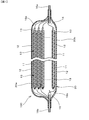
- FIG. 1 is a cross-sectional view of a lithium ion secondary battery 100 according to an embodiment of the present invention.
- a laminate 10 formed by alternately laminating a plurality of positive electrodes 11 and negative electrodes 12 via separators 13 and a nonaqueous electrolyte 14 are accommodated in a laminate case 20.
- a laminate case 20 Have a structure.
- the laminate case 20 that is an exterior body is formed by bonding the peripheral portions of the pair of laminate films 20a and 20b by thermocompression bonding.
- the positive terminal 16a is led out from one end side of the laminate case 20, and the negative terminal 16b is led out from the other end side.
- the plurality of positive electrodes 11 are connected to the positive terminal 16a through lead wires 15a.
- the plurality of negative electrodes 12 are connected to the negative terminal 16b through lead wires 15b.
- the negative electrode 12 has a negative electrode mixture layer containing graphite as a negative electrode active material and a metal oxide present on the outer surface of the graphite.
- the negative electrode mixture layer has a D / G ratio determined by Raman spectroscopy of 0.40 or more and 0.52 or less.
- the negative electrode 12 is formed, for example, by applying a negative electrode mixture layer on both surfaces of a negative electrode current collector made of a metal foil such as copper.
- the negative electrode mixture layer may further contain a conductive additive and a binder.
- the metal oxide present on the surface of the graphite is titanium oxide, and for example, titanium oxide (TiO 2 ), lithium titanate (Li 4 Ti 5 O 12 ), or the like is used.
- the metal oxide is not limited to titanium oxide, and the titanium oxide is not limited to TiO 2 or Li 4 Ti 5 O 12 .
- the negative electrode 12 has a negative electrode mixture layer containing graphite and a metal oxide present on the surface of the graphite, and the negative electrode mixture layer has a D / G ratio of 0.40 determined by Raman spectroscopy.
- the material of the negative electrode current collector, the structure of the negative electrode mixture layer, or the like as long as the requirement of “0.52 or less” is satisfied.
- the D / G ratio of the negative electrode mixture layer obtained by Raman spectroscopic measurement is larger than 0.52, the ratio of carbon having low crystallinity on the graphite surface is large, so that the metal oxide adheres to the graphite surface. It is considered that the metal oxide may slide into the non-aqueous electrolyte when it comes into contact with the non-aqueous electrolyte. Considering the fact that metal oxides are difficult to adhere to the surface of graphite, for example, if more metal oxides are attached, the internal resistance increases and the diffusion of electrons and lithium ions does not proceed smoothly. It is thought that it may occur.
- the D / G ratio of the negative electrode mixture layer obtained by Raman spectroscopy is less than 0.40, the graphite and non-exposed layers are coated except when the metal oxide is coated on the graphite very uniformly.
- the reaction with the aqueous electrolyte promotes the formation of SEI on the graphite surface, increases the interfacial resistance between the negative electrode surface and the non-aqueous electrolyte, and consumes lithium ions as the SEI is formed. Therefore, it is considered that the cycle characteristics deteriorate.
- the D / G ratio of the negative electrode mixture layer obtained by Raman spectroscopy is set to 0.40 or more and 0.52 or less.
- the positive electrode 11 has a positive electrode mixture layer. More specifically, the positive electrode 11 is formed, for example, by applying a positive electrode mixture layer on both surfaces of a positive electrode current collector made of a metal foil such as aluminum.
- the positive electrode mixture layer includes a positive electrode active material, and may further include a conductive additive and a binder.
- the separator 13 various separators that can be used for lithium ion secondary batteries can be used without particular limitation.
- the separator 13 shown in FIG. 1 has a bag-like shape, but may have a sheet-like shape or a ninety-nine fold shape.
- the non-aqueous electrolyte 14 may be anything as long as it can be used for a lithium ion secondary battery.
- a known non-aqueous electrolyte can be used.
- a solid electrolyte may be used as the nonaqueous electrolyte 14.
- a separator may not be necessary.
- the negative electrode 12 has a negative electrode mixture layer containing graphite and a metal oxide present on the surface of the graphite.
- the difference in characteristics between a lithium ion battery that satisfies the requirement of the present invention that the D / G ratio determined by Raman spectroscopy is 0.40 or more and 0.52 or less and a lithium ion battery that does not satisfy the requirement of the present invention In order to confirm the above, an evaluation cell was prepared.
- the cells for evaluation in Examples 1 to 3 are cells that satisfy the requirements of the present invention, and the cells for evaluation in Comparative Examples 1 to 5 are cells that do not satisfy the requirements of the present invention.
- Example 1 In order to fabricate the negative electrode 12, first, a graphite having a D / G ratio of 0.47 obtained by Raman spectroscopy is coated with titanium oxide (TiO 2 ) on the surface using a powder barrel sputtering apparatus. A layer was formed. Then, graphite having a titanium oxide coating layer and polyvinylidene fluoride were mixed so that the weight ratio of the former and the latter was 92.5: 7.5. The obtained mixture was dispersed in N-methyl-2-pyrrolidone to prepare a negative electrode slurry.
- TiO 2 titanium oxide
- the prepared negative electrode slurry was applied to a copper foil having a thickness of 10 ⁇ m so as to be 2.75 mg / cm 2 , dried at 120 ° C., and then pressed to a density of 1.3 g / cc. A sheet was produced. At this time, Raman spectroscopic measurement was performed on the produced negative electrode sheet, and a D / G ratio that is a peak area ratio of the D band and the G band was calculated. In Raman spectroscopic measurement, since the sample surface is analyzed, the D / G ratio of the negative electrode sheet is the same as the D / G ratio of the negative electrode mixture layer.
- the produced negative electrode sheet was punched into a diameter of 14 mm to obtain an evaluation electrode, and a coin cell provided with this evaluation electrode was produced.
- metallic lithium is used as a relative electrode of the electrode for evaluation, and a solvent in which ethylene carbonate (EC): ethyl methyl carbonate (EMC) is mixed at a weight ratio of 1: 3 as the nonaqueous electrolyte 14.
- An organic electrolytic solution in which 1 mol of lithium hexafluorophosphate (LiPF 6 ) was dissolved per liter of the solvent was used.
- a polyethylene porous film was used as the separator 13.
- the diameter of the coin cell was 20 mm, and the thickness was 3.2 mm.
- the produced coin cell was charged and discharged three times in a constant temperature bath at 25 ° C. with a voltage range of 0.01 to 2.0 V and a current value of 0.25 mA, followed by 0.01 to 2.0 V. Charging / discharging was performed once in a voltage range and a current value of 1 mA. And the ratio of the charge capacity at the time of charging / discharging with the electric current value of 1 mA with respect to the charge capacity at the time of charging / discharging with the electric current value of 0.25 mA was computed as a charge capacity maintenance factor.
- the SOC of the coin cell was adjusted to be a predetermined value, the two coin cells were disassembled in the glove box, and the two evaluation electrodes as negative electrodes were taken out. And the coin cell was newly produced using the taken out two electrodes for evaluation, the newly prepared separator, and electrolyte solution.
- the coin cell was measured for impedance in a thermostatic chamber at 0 ° C. at a measurement frequency of 1.00 MHz to 50 mHz and a measurement voltage of ⁇ 10 mV.
- a coin cell was newly produced by the same production method as that for the coin cell produced for impedance measurement, and charging and discharging were repeated 30 times at a current value of 0.50 mA in a thermostatic bath at 25 ° C. And the charge capacity of the 30th cycle with respect to the charge capacity of the 1st cycle was computed as a 30 cycle charge capacity maintenance factor.
- Example 2 In Example 2, in order to produce the negative electrode 12, a powder barrel sputtering apparatus was used for graphite having a D / G ratio of 0.47 obtained by Raman spectroscopy, and lithium titanate (Li A coating layer of 4 Ti 5 O 12 ) was formed. Then, while producing the negative electrode sheet by the method similar to the method demonstrated in Example 1, the coin cell was produced.
- Example 2 Raman spectroscopic measurement of the negative electrode sheet, calculation of the charge capacity maintenance rate, impedance measurement, and calculation of the 30 cycle charge capacity maintenance rate were performed.
- Example 3 A beaker is charged with graphite having a D / G ratio of 0.47 determined by Raman spectroscopy and an aqueous solution of titanium tetrachloride (TiCl 4 ), and an aqueous sodium hydroxide (NaOH) solution is added dropwise while stirring. Titanium oxide particles were deposited on the graphite surface. Then, after raising the bath temperature in a beaker to 60 degreeC and stirring for 24 hours, the titanium oxide nanoparticle was carry
- TiCl 4 titanium tetrachloride
- NaOH aqueous sodium hydroxide
- Example 3 Raman spectroscopic measurement of the negative electrode sheet, calculation of the charge capacity maintenance rate, impedance measurement, and calculation of the 30 cycle charge capacity maintenance rate were performed.
- Graphite having a D / G ratio of 0.47 determined by Raman spectroscopy and polyvinylidene fluoride were mixed so that the weight ratio of the former and the latter was 92.5: 7.5, and the resulting mixture was obtained was dispersed in N-methyl-2-pyrrolidone to prepare a negative electrode slurry. Then, while producing the negative electrode sheet by the method similar to the method demonstrated in Example 1, the coin cell was produced. That is, in the coin cell in the comparative example 1, a graphite having no metal oxide on its surface was used.
- ⁇ Comparative example 4> A beaker was charged with graphite having a D / G ratio of 0.89 determined by Raman spectroscopy and an aqueous solution of titanium tetrachloride (TiCl 4 ), and an aqueous sodium hydroxide (NaOH) solution was added dropwise with stirring. Titanium oxide particles were deposited on the graphite surface. Then, after raising the bath temperature in a beaker to 60 degreeC and stirring for 24 hours, the titanium oxide nanoparticle was carry
- TiCl 4 titanium tetrachloride
- NaOH aqueous sodium hydroxide
- Comparative Example 4 similarly to Examples 1 to 3, Raman spectroscopic measurement of the negative electrode sheet, calculation of the charge capacity retention rate, impedance measurement, and calculation of the 30 cycle charge capacity retention rate were performed.
- Graphite having a D / G ratio of 0.12 determined by Raman spectroscopy and polyvinylidene fluoride are mixed so that the weight ratio of the former and the latter is 92.5: 7.5, and the resulting mixture is obtained was dispersed in N-methyl-2-pyrrolidone to prepare a negative electrode slurry. Then, while producing the negative electrode sheet by the method similar to the method demonstrated in Example 1, the coin cell was produced. Also in Comparative Example 5, graphite having no metal oxide on its surface was used.
- Table 1 shows the characteristics of Examples 1 to 3 and Comparative Examples 1 to 5 described above.
- Table 1 shows the characteristics of Examples 1 to 3 and Comparative Examples 1 to 5 described above.
- Table 1 shows the characteristics of Examples 1 to 3 and Comparative Examples 1 to 5 described above.
- Table 1 shows the D / G ratio of graphite used for preparing the negative electrode slurry, the type of metal oxide present on the surface of the graphite, the D / G ratio of the negative electrode mixture layer, the charge capacity retention rate (%), The absolute value
- the coin cell of Example 1 has an absolute impedance at a frequency of 0.5 Hz obtained from impedance measurement at 0 ° C., as can be seen from the coin cell of Comparative Example 1 in which no metal oxide is present on the surface of graphite constituting the negative electrode.
- is small. Further, even though the metal oxide is present on the surface of the graphite, the D / G ratio of the negative electrode mixture layer obtained by Raman spectroscopic measurement is 0.78, which is larger than 0.52, and the coin cell of Comparative Example 3, The absolute value
- the coin cell of Example 1 showed a high charge capacity maintenance rate of 73.7%, and the 30 cycle charge capacity maintenance rate was also a high value of 63.3%. That is, the coin cell of Example 1 that satisfies the requirements of the present invention had good cycle characteristics.
- the coin cell of Example 2 Compared with the coin cell of Example 1, the coin cell of Example 2 has the same D / G ratio of the negative electrode mixture layer obtained by Raman spectroscopic measurement, but the metal oxide present on the surface of the graphite constituting the negative electrode Different types. It was found that the absolute value
- the coin cell of Example 3 is the same in the type of metal oxide present on the surface of the graphite constituting the negative electrode, but the method for producing the negative electrode is different, so that the Raman spectroscopic measurement is performed.
- the D / G ratio of the required negative electrode composite material layer is different. It was found that the coin cell of Example 3 had a smaller impedance absolute value
- the D / G ratio of the negative electrode mixture layer obtained by Raman spectroscopic measurement is 0.42, which is 0.40 or more and 0.52 or less. There is no metal oxide.
- the coin cell of Comparative Example 1 showed high values for the charge capacity maintenance rate and the 30 cycle charge capacity maintenance rate, but the absolute value
- the metal oxide does not exist on the surface of the graphite constituting the negative electrode, and the D / G ratio of the negative electrode mixture layer obtained by Raman spectroscopic measurement is 0.79, which is larger than 0.52. is there.
- the coin cell of Comparative Example 2 showed a high charge capacity maintenance ratio, but the impedance absolute value
- the coin cell of Comparative Example 3 a metal oxide is present on the surface of graphite constituting the negative electrode, but the D / G ratio of the negative electrode mixture layer obtained by Raman spectroscopic measurement is 0.78, which is larger than 0.52.
- of the impedance is as large as 646.5 and the internal resistance is large. Further, the charge capacity maintenance rate and the 30 cycle charge capacity maintenance rate are lower than those of the coin cells of Examples 1 to 3, and the cycle characteristics are inferior.
- the coin cell of Comparative Example 4 is different from the coin cell of Comparative Example 3 in the method of producing the negative electrode, and the D / G ratio of the negative electrode mixture layer obtained by Raman spectroscopic measurement is greater than 0.79. It is.
- of the impedance was small, but the charge capacity maintenance rate and the 30 cycle charge capacity maintenance rate were lower than those of the coin cells of Examples 1 to 3. In particular, the 30-cycle charge capacity retention rate is 8.4%, and the cycle characteristics are poor.
- the metal oxide does not exist on the surface of the graphite constituting the negative electrode, and the D / G ratio of the negative electrode mixture layer obtained by Raman spectroscopic measurement is 0.11 which is smaller than 0.40. is there.
- of the impedance is as large as 495.5, and the internal resistance is large.
- the charge capacity maintenance rate and the 30 cycle charge capacity maintenance rate are lower than those of the coin cells of Examples 1 to 3, and in particular, the 30 cycle charge capacity maintenance rate is 10.2%, which indicates that the cycle characteristics are poor. It was.
- the negative electrode has a negative electrode mixture layer containing graphite and a metal oxide present on the surface of the graphite, and the negative electrode mixture layer has a D / G ratio of 0.40 or more determined by Raman spectroscopy.
- the lithium ion secondary battery of the present embodiment that satisfies the requirement of “0.52 or less” has low internal resistance at both low temperature and room temperature. Further, the 30 cycle capacity retention rate is high, and the cycle characteristics are also excellent.
- the internal resistance is lowered at low temperature and at room temperature by using titanium oxide, particularly TiO 2 or Li 4 Ti 5 O 12 as the metal oxide present on the surface of graphite. Even when a titanium oxide other than TiO 2 or Li 4 Ti 5 O 12 is used, the internal resistance can be lowered.
- a lithium ion secondary battery having a structure in which a laminated body formed by alternately laminating a plurality of positive electrodes and negative electrodes via separators and a non-aqueous electrolyte is housed in an exterior body will be described as an example.
- the structure of the lithium ion secondary battery according to the present invention is not limited to the above structure.
- the lithium ion secondary battery may have a structure in which a wound body formed by winding a positive electrode and a negative electrode stacked via a separator and a nonaqueous electrolyte are accommodated in an exterior body.
- the exterior body may be a metal can instead of a laminate case.
Landscapes
- Chemical & Material Sciences (AREA)
- Chemical Kinetics & Catalysis (AREA)
- Electrochemistry (AREA)
- General Chemical & Material Sciences (AREA)
- Engineering & Computer Science (AREA)
- Materials Engineering (AREA)
- Manufacturing & Machinery (AREA)
- Inorganic Chemistry (AREA)
- Composite Materials (AREA)
- Battery Electrode And Active Subsutance (AREA)
- Secondary Cells (AREA)
Abstract
L'objet de l'invention est de réduire la résistance interne dans une pile rechargeable au lithium-ion pourvue d'une électrode négative ayant une couche de mélange d'électrode négative dans laquelle un oxyde métallique est présent sur une surface en graphite. Une pile rechargeable au lithium-ion 100 est pourvue : d'une électrode positive 11 ayant une couche de mélange d'électrode positive ; et d'une électrode négative 12 ayant une couche de mélange d'électrode négative contenant du graphite et un oxyde métallique présent sur la surface du graphite. La couche de mélange d'électrode négative contenue dans l'électrode négative 12 présente un rapport D/G, tel que déterminé par spectroscopie Raman, de 0,40 à 0,52.
Priority Applications (3)
| Application Number | Priority Date | Filing Date | Title |
|---|---|---|---|
| JP2018518949A JPWO2017203747A1 (ja) | 2016-05-26 | 2017-01-26 | リチウムイオン二次電池 |
| CN201780022891.2A CN109075322A (zh) | 2016-05-26 | 2017-01-26 | 锂离子二次电池 |
| US16/128,647 US20190013517A1 (en) | 2016-05-26 | 2018-09-12 | Lithium ion secondary battery |
Applications Claiming Priority (2)
| Application Number | Priority Date | Filing Date | Title |
|---|---|---|---|
| JP2016105278 | 2016-05-26 | ||
| JP2016-105278 | 2016-05-26 |
Related Child Applications (1)
| Application Number | Title | Priority Date | Filing Date |
|---|---|---|---|
| US16/128,647 Continuation US20190013517A1 (en) | 2016-05-26 | 2018-09-12 | Lithium ion secondary battery |
Publications (1)
| Publication Number | Publication Date |
|---|---|
| WO2017203747A1 true WO2017203747A1 (fr) | 2017-11-30 |
Family
ID=60411327
Family Applications (1)
| Application Number | Title | Priority Date | Filing Date |
|---|---|---|---|
| PCT/JP2017/002731 Ceased WO2017203747A1 (fr) | 2016-05-26 | 2017-01-26 | Pile rechargeable au lithium-ion |
Country Status (4)
| Country | Link |
|---|---|
| US (1) | US20190013517A1 (fr) |
| JP (1) | JPWO2017203747A1 (fr) |
| CN (1) | CN109075322A (fr) |
| WO (1) | WO2017203747A1 (fr) |
Cited By (1)
| Publication number | Priority date | Publication date | Assignee | Title |
|---|---|---|---|---|
| JP2018185931A (ja) * | 2017-04-25 | 2018-11-22 | トヨタ自動車株式会社 | リチウムイオン二次電池用負極活物質粒子およびその製造方法 |
Families Citing this family (1)
| Publication number | Priority date | Publication date | Assignee | Title |
|---|---|---|---|---|
| CN120072816B (zh) * | 2025-01-22 | 2025-12-30 | 五矿勘查开发有限公司北京石墨技术研究院分公司 | 一种表面改性的球形天然石墨负极材料及其制备方法与锂电池 |
Citations (3)
| Publication number | Priority date | Publication date | Assignee | Title |
|---|---|---|---|---|
| JP2010531041A (ja) * | 2007-06-22 | 2010-09-16 | エルジー・ケム・リミテッド | 導電性が優れたアノード材料及びそれを使用する高出力二次バッテリー |
| JP2014067642A (ja) * | 2012-09-26 | 2014-04-17 | Mitsubishi Chemicals Corp | 非水系二次電池用複合炭素材及びその製造方法、負極並びに非水系二次電池 |
| JP2015115319A (ja) * | 2013-12-10 | 2015-06-22 | 三星エスディアイ株式会社Samsung SDI Co.,Ltd. | 負極活物質、それを備えたリチウム電池、及び該負極活物質の製造方法 |
Family Cites Families (3)
| Publication number | Priority date | Publication date | Assignee | Title |
|---|---|---|---|---|
| KR102131859B1 (ko) * | 2011-03-25 | 2020-07-08 | 가부시키가이샤 한도오따이 에네루기 켄큐쇼 | 리튬 이온 2차 전지 |
| KR101708360B1 (ko) * | 2011-10-05 | 2017-02-21 | 삼성에스디아이 주식회사 | 음극 활물질 및 이를 채용한 리튬 전지 |
| CN105304936B (zh) * | 2015-12-10 | 2018-05-15 | 微宏动力系统(湖州)有限公司 | 一种锂离子二次电池 |
-
2017
- 2017-01-26 WO PCT/JP2017/002731 patent/WO2017203747A1/fr not_active Ceased
- 2017-01-26 JP JP2018518949A patent/JPWO2017203747A1/ja active Pending
- 2017-01-26 CN CN201780022891.2A patent/CN109075322A/zh not_active Withdrawn
-
2018
- 2018-09-12 US US16/128,647 patent/US20190013517A1/en not_active Abandoned
Patent Citations (3)
| Publication number | Priority date | Publication date | Assignee | Title |
|---|---|---|---|---|
| JP2010531041A (ja) * | 2007-06-22 | 2010-09-16 | エルジー・ケム・リミテッド | 導電性が優れたアノード材料及びそれを使用する高出力二次バッテリー |
| JP2014067642A (ja) * | 2012-09-26 | 2014-04-17 | Mitsubishi Chemicals Corp | 非水系二次電池用複合炭素材及びその製造方法、負極並びに非水系二次電池 |
| JP2015115319A (ja) * | 2013-12-10 | 2015-06-22 | 三星エスディアイ株式会社Samsung SDI Co.,Ltd. | 負極活物質、それを備えたリチウム電池、及び該負極活物質の製造方法 |
Cited By (1)
| Publication number | Priority date | Publication date | Assignee | Title |
|---|---|---|---|---|
| JP2018185931A (ja) * | 2017-04-25 | 2018-11-22 | トヨタ自動車株式会社 | リチウムイオン二次電池用負極活物質粒子およびその製造方法 |
Also Published As
| Publication number | Publication date |
|---|---|
| JPWO2017203747A1 (ja) | 2018-09-27 |
| CN109075322A (zh) | 2018-12-21 |
| US20190013517A1 (en) | 2019-01-10 |
Similar Documents
| Publication | Publication Date | Title |
|---|---|---|
| KR102088478B1 (ko) | 리튬이온 이차 전지용 음극 및 이를 제조하는 방법 | |
| US10454102B2 (en) | Lithium manganese composite oxide, secondary battery, electronic device, and method for forming layer | |
| CN101512797B (zh) | 负极活性物质、负极和锂二次电池 | |
| CN105934846B (zh) | 电器件 | |
| JP5702362B2 (ja) | イオン液体を用いたリチウム二次電池 | |
| CN105322153B (zh) | 非水电解质电池、电池模块、以及电池组 | |
| CN104241613B (zh) | 蓄电元件和蓄电池模块 | |
| US10593940B2 (en) | Negative electrode for power storage device, power storage, device and electrical device | |
| CN110537274B (zh) | 电极及其制造方法、电化学装置和聚合物电解质组合物 | |
| CN108028413A (zh) | 锂二次电池用电极组件和包含其的锂二次电池及电池模块 | |
| CN106953099A (zh) | 抗松弛铜箔 | |
| CN105340115A (zh) | 能量存储的方法和装置 | |
| CN105390752B (zh) | 非水电解质二次电池及其制造方法和用于非水电解质二次电池的分离器 | |
| CN105993087A (zh) | 非水电解质二次电池 | |
| JP2012049060A (ja) | 非水電解質二次電池用正極及びその正極を用いた非水電解質二次電池 | |
| WO2017026253A1 (fr) | Procédé de fabrication d'électrode et procédé de fabrication de dispositif de stockage d'électricité | |
| JP2018060672A (ja) | リチウムイオン二次電池の製造方法 | |
| CN107078274B (zh) | 锂离子二次电池用正极以及使用该正极的锂离子二次电池 | |
| CN112054163A (zh) | 二次电池的正极和使用该正极的二次电池 | |
| US20190013517A1 (en) | Lithium ion secondary battery | |
| WO2018168241A1 (fr) | Batterie rechargeable au lithium-ion | |
| CN105359310B (zh) | 负极活性物质、使用其的负极和锂离子二次电池 | |
| JP6455726B2 (ja) | 非水電解液二次電池 | |
| WO2020026483A1 (fr) | Batterie secondaire au lithium | |
| JPWO2017217319A1 (ja) | リチウムイオン二次電池 |
Legal Events
| Date | Code | Title | Description |
|---|---|---|---|
| ENP | Entry into the national phase |
Ref document number: 2018518949 Country of ref document: JP Kind code of ref document: A |
|
| NENP | Non-entry into the national phase |
Ref country code: DE |
|
| 121 | Ep: the epo has been informed by wipo that ep was designated in this application |
Ref document number: 17802349 Country of ref document: EP Kind code of ref document: A1 |
|
| 122 | Ep: pct application non-entry in european phase |
Ref document number: 17802349 Country of ref document: EP Kind code of ref document: A1 |