WO2017204201A1 - 細胞培養容器 - Google Patents
細胞培養容器 Download PDFInfo
- Publication number
- WO2017204201A1 WO2017204201A1 PCT/JP2017/019147 JP2017019147W WO2017204201A1 WO 2017204201 A1 WO2017204201 A1 WO 2017204201A1 JP 2017019147 W JP2017019147 W JP 2017019147W WO 2017204201 A1 WO2017204201 A1 WO 2017204201A1
- Authority
- WO
- WIPO (PCT)
- Prior art keywords
- group
- carbon atoms
- linear
- represented
- cell culture
- Prior art date
- Legal status (The legal status is an assumption and is not a legal conclusion. Google has not performed a legal analysis and makes no representation as to the accuracy of the status listed.)
- Ceased
Links
- 0 *C(C(C(N)O*OP(*)(*O*OC(C(*)=C)=O)=O)=O)=C Chemical compound *C(C(C(N)O*OP(*)(*O*OC(C(*)=C)=O)=O)=O)=C 0.000 description 4
- GDOPTJXRTPNYNR-UHFFFAOYSA-N CC1CCCC1 Chemical compound CC1CCCC1 GDOPTJXRTPNYNR-UHFFFAOYSA-N 0.000 description 1
Images

Classifications
-
- C—CHEMISTRY; METALLURGY
- C08—ORGANIC MACROMOLECULAR COMPOUNDS; THEIR PREPARATION OR CHEMICAL WORKING-UP; COMPOSITIONS BASED THEREON
- C08F—MACROMOLECULAR COMPOUNDS OBTAINED BY REACTIONS ONLY INVOLVING CARBON-TO-CARBON UNSATURATED BONDS
- C08F220/00—Copolymers of compounds having one or more unsaturated aliphatic radicals, each having only one carbon-to-carbon double bond, and only one being terminated by only one carboxyl radical or a salt, anhydride ester, amide, imide or nitrile thereof
- C08F220/02—Monocarboxylic acids having less than ten carbon atoms; Derivatives thereof
- C08F220/10—Esters
- C08F220/34—Esters containing nitrogen, e.g. N,N-dimethylaminoethyl (meth)acrylate
-
- C—CHEMISTRY; METALLURGY
- C09—DYES; PAINTS; POLISHES; NATURAL RESINS; ADHESIVES; COMPOSITIONS NOT OTHERWISE PROVIDED FOR; APPLICATIONS OF MATERIALS NOT OTHERWISE PROVIDED FOR
- C09D—COATING COMPOSITIONS, e.g. PAINTS, VARNISHES OR LACQUERS; FILLING PASTES; CHEMICAL PAINT OR INK REMOVERS; INKS; CORRECTING FLUIDS; WOODSTAINS; PASTES OR SOLIDS FOR COLOURING OR PRINTING; USE OF MATERIALS THEREFOR
- C09D185/00—Coating compositions based on macromolecular compounds obtained by reactions forming in the main chain of the macromolecule a linkage containing atoms other than silicon, sulfur, nitrogen, oxygen, and carbon; Coating compositions based on derivatives of such polymers
- C09D185/02—Coating compositions based on macromolecular compounds obtained by reactions forming in the main chain of the macromolecule a linkage containing atoms other than silicon, sulfur, nitrogen, oxygen, and carbon; Coating compositions based on derivatives of such polymers containing phosphorus
-
- C—CHEMISTRY; METALLURGY
- C08—ORGANIC MACROMOLECULAR COMPOUNDS; THEIR PREPARATION OR CHEMICAL WORKING-UP; COMPOSITIONS BASED THEREON
- C08F—MACROMOLECULAR COMPOUNDS OBTAINED BY REACTIONS ONLY INVOLVING CARBON-TO-CARBON UNSATURATED BONDS
- C08F230/00—Copolymers of compounds having one or more unsaturated aliphatic radicals, each having only one carbon-to-carbon double bond, and containing phosphorus, selenium, tellurium or a metal
- C08F230/02—Copolymers of compounds having one or more unsaturated aliphatic radicals, each having only one carbon-to-carbon double bond, and containing phosphorus, selenium, tellurium or a metal containing phosphorus
-
- C—CHEMISTRY; METALLURGY
- C09—DYES; PAINTS; POLISHES; NATURAL RESINS; ADHESIVES; COMPOSITIONS NOT OTHERWISE PROVIDED FOR; APPLICATIONS OF MATERIALS NOT OTHERWISE PROVIDED FOR
- C09D—COATING COMPOSITIONS, e.g. PAINTS, VARNISHES OR LACQUERS; FILLING PASTES; CHEMICAL PAINT OR INK REMOVERS; INKS; CORRECTING FLUIDS; WOODSTAINS; PASTES OR SOLIDS FOR COLOURING OR PRINTING; USE OF MATERIALS THEREFOR
- C09D133/00—Coating compositions based on homopolymers or copolymers of compounds having one or more unsaturated aliphatic radicals, each having only one carbon-to-carbon double bond, and at least one being terminated by only one carboxyl radical, or of salts, anhydrides, esters, amides, imides, or nitriles thereof; Coating compositions based on derivatives of such polymers
- C09D133/04—Homopolymers or copolymers of esters
- C09D133/14—Homopolymers or copolymers of esters of esters containing halogen, nitrogen, sulfur or oxygen atoms in addition to the carboxy oxygen
-
- C—CHEMISTRY; METALLURGY
- C09—DYES; PAINTS; POLISHES; NATURAL RESINS; ADHESIVES; COMPOSITIONS NOT OTHERWISE PROVIDED FOR; APPLICATIONS OF MATERIALS NOT OTHERWISE PROVIDED FOR
- C09D—COATING COMPOSITIONS, e.g. PAINTS, VARNISHES OR LACQUERS; FILLING PASTES; CHEMICAL PAINT OR INK REMOVERS; INKS; CORRECTING FLUIDS; WOODSTAINS; PASTES OR SOLIDS FOR COLOURING OR PRINTING; USE OF MATERIALS THEREFOR
- C09D143/00—Coating compositions based on homopolymers or copolymers of compounds having one or more unsaturated aliphatic radicals, each having only one carbon-to-carbon double bond, and containing boron, silicon, phosphorus, selenium, tellurium, or a metal; Coating compositions based on derivatives of such polymers
- C09D143/02—Homopolymers or copolymers of monomers containing phosphorus
-
- C—CHEMISTRY; METALLURGY
- C09—DYES; PAINTS; POLISHES; NATURAL RESINS; ADHESIVES; COMPOSITIONS NOT OTHERWISE PROVIDED FOR; APPLICATIONS OF MATERIALS NOT OTHERWISE PROVIDED FOR
- C09D—COATING COMPOSITIONS, e.g. PAINTS, VARNISHES OR LACQUERS; FILLING PASTES; CHEMICAL PAINT OR INK REMOVERS; INKS; CORRECTING FLUIDS; WOODSTAINS; PASTES OR SOLIDS FOR COLOURING OR PRINTING; USE OF MATERIALS THEREFOR
- C09D201/00—Coating compositions based on unspecified macromolecular compounds
- C09D201/02—Coating compositions based on unspecified macromolecular compounds characterised by the presence of specified groups, e.g. terminal or pendant functional groups
- C09D201/025—Coating compositions based on unspecified macromolecular compounds characterised by the presence of specified groups, e.g. terminal or pendant functional groups containing nitrogen atoms
-
- C—CHEMISTRY; METALLURGY
- C09—DYES; PAINTS; POLISHES; NATURAL RESINS; ADHESIVES; COMPOSITIONS NOT OTHERWISE PROVIDED FOR; APPLICATIONS OF MATERIALS NOT OTHERWISE PROVIDED FOR
- C09D—COATING COMPOSITIONS, e.g. PAINTS, VARNISHES OR LACQUERS; FILLING PASTES; CHEMICAL PAINT OR INK REMOVERS; INKS; CORRECTING FLUIDS; WOODSTAINS; PASTES OR SOLIDS FOR COLOURING OR PRINTING; USE OF MATERIALS THEREFOR
- C09D201/00—Coating compositions based on unspecified macromolecular compounds
- C09D201/02—Coating compositions based on unspecified macromolecular compounds characterised by the presence of specified groups, e.g. terminal or pendant functional groups
- C09D201/04—Coating compositions based on unspecified macromolecular compounds characterised by the presence of specified groups, e.g. terminal or pendant functional groups containing halogen atoms
-
- C—CHEMISTRY; METALLURGY
- C12—BIOCHEMISTRY; BEER; SPIRITS; WINE; VINEGAR; MICROBIOLOGY; ENZYMOLOGY; MUTATION OR GENETIC ENGINEERING
- C12M—APPARATUS FOR ENZYMOLOGY OR MICROBIOLOGY; APPARATUS FOR CULTURING MICROORGANISMS FOR PRODUCING BIOMASS, FOR GROWING CELLS OR FOR OBTAINING FERMENTATION OR METABOLIC PRODUCTS, i.e. BIOREACTORS OR FERMENTERS
- C12M23/00—Constructional details, e.g. recesses, hinges
- C12M23/20—Material Coatings
-
- C—CHEMISTRY; METALLURGY
- C12—BIOCHEMISTRY; BEER; SPIRITS; WINE; VINEGAR; MICROBIOLOGY; ENZYMOLOGY; MUTATION OR GENETIC ENGINEERING
- C12M—APPARATUS FOR ENZYMOLOGY OR MICROBIOLOGY; APPARATUS FOR CULTURING MICROORGANISMS FOR PRODUCING BIOMASS, FOR GROWING CELLS OR FOR OBTAINING FERMENTATION OR METABOLIC PRODUCTS, i.e. BIOREACTORS OR FERMENTERS
- C12M3/00—Tissue, human, animal or plant cell, or virus culture apparatus
Definitions
- the present invention relates to a cell culture container, a method for producing the same, and a method for producing a cell aggregate (also referred to as a sphere) using the same.
- the present invention relates to a cell culture container and a method for producing the same, characterized in that the surface is coated with a copolymer having a cell adhesion inhibitory ability.
- organ culture and tissue culture are used to proliferating, differentiating or maintaining cells isolated from organs and tissues in vitro.
- cell culture is a technique for proliferating, differentiating or maintaining isolated cells in a culture medium in vitro, and is indispensable for detailed analysis of the functions and structures of various organs, tissues, and cells in vivo. ing.
- cells and / or tissues cultured by this technique are organs lost due to evaluation of efficacy and toxicity of chemical substances, pharmaceuticals, etc., mass production of useful substances such as enzymes, cell growth factors, antibodies, and diseases and defects. It is used in various fields such as regenerative medicine that supplements tissues and cells, plant breed improvement, and creation of genetically modified crops.
- Suspension cells are cells that do not require a scaffold for growth / proliferation
- adherent cells are cells that require a scaffold for growth / proliferation, but most cells that make up living organisms are the latter adherent cells.
- Known culture methods for adherent cells include monolayer culture, dispersion culture, embedding culture, microcarrier culture, and cell aggregate (sphere) culture.
- sphere culture has attracted attention as a culture method in an environment closer to the living body, and various medium compositions and medium additives suitable for the culture have been reported (for example, Patent Documents 1 and 2).
- stimulation from the culture vessel (base material) is considered to be an important factor affecting the results of the culture, and cells (particularly cell aggregates) are not stimulated from the culture vessel. It is required to culture in a three-dimensional environment or in a completely floating state (for example, see Patent Document 3).
- the present inventors have paid attention to a polymer having a phosphate ester group, which is expected as a coating material having an ability to suppress adhesion of various biological substances, and repeated studies.
- the cell culture vessel coated on at least a part of the surface with a copolymer containing a specific anionic group and a cationic group suppresses adhesion of cells to the vessel surface (inner surface), and the coating Since it can firmly adhere to the surface of the container, it has been reported that it is useful as a cell culture container with improved coating dissolution and radiation resistance (see, for example, Patent Document 4).
- An object of the present invention is to provide a cell culture vessel, a method for producing the same, and a method for producing a cell aggregate using the same.
- the present invention provides a cell culture vessel, a method for producing the same, and a method for producing a cell aggregate using the same, characterized in that a copolymer having a cell adhesion-inhibiting ability is coated on the surface. With the goal.
- the present inventors continued paying attention to the polymer which has a phosphate ester group, and repeated earnest examination.
- a cell culture vessel coated with at least a part of the surface with a copolymer containing a specific hydrophobic group in addition to a specific anionic group and a cationic group is added to the cell, and the protein is applied to the surface of the container.
- the present invention was completed by discovering that the present invention was useful as a cell culture container with improved adhesion to the culture medium because the coating could be firmly fixed to the container surface while suppressing adhesion. That is, the present invention is as follows:
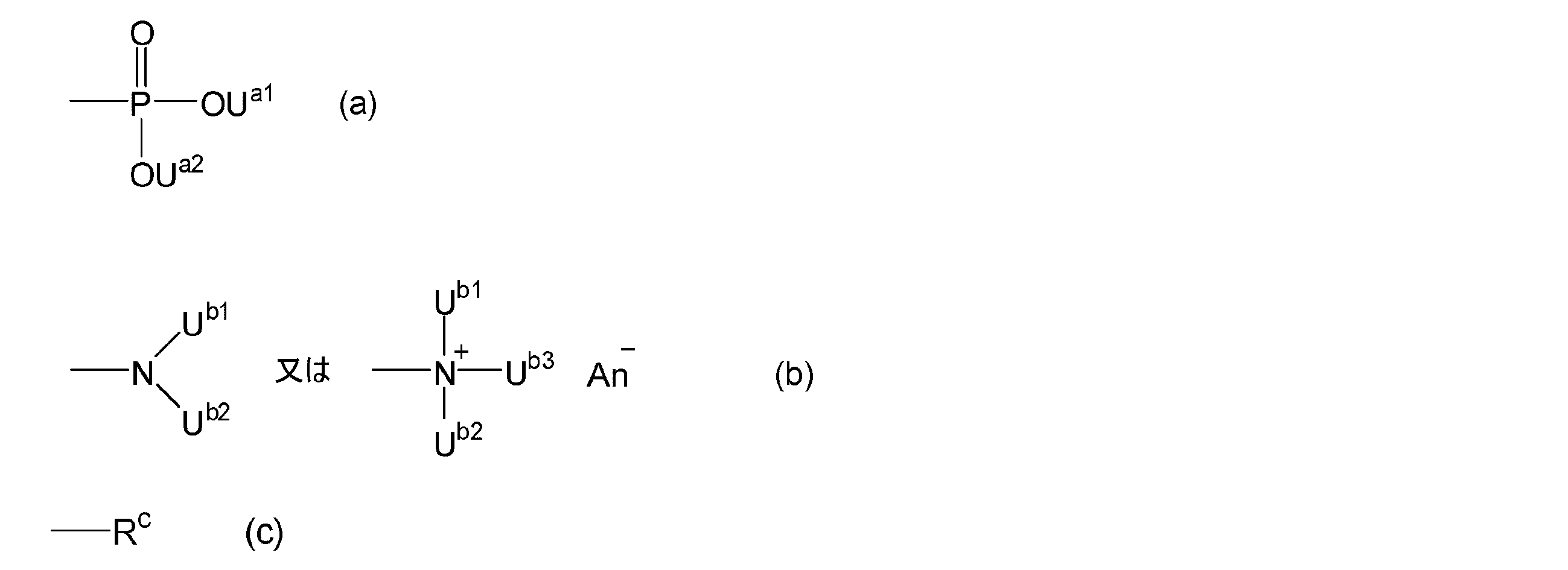
- a co-polymer comprising a repeating unit containing a group represented by the following formula (a), a repeating unit containing a group represented by the following formula (b), and a repeating unit containing a group represented by the following formula (c).
- U a1 , U a2 , U b1 , U b2 and U b3 each independently represent a hydrogen atom or a linear or branched alkyl group having 1 to 5 carbon atoms;
- R c is a linear or branched alkyl group having 1 to 18 carbon atoms, an alicyclic hydrocarbon group having 3 to 10 carbon atoms, an aryl group having 6 to 10 carbon atoms, or an aralkyl having 7 to 15 carbon atoms.
- An ⁇ represents an anion selected from the group consisting of halide ion, inorganic acid ion, hydroxide ion and isothiocyanate ion]
- a cell culture vessel characterized in that is coated on the surface.
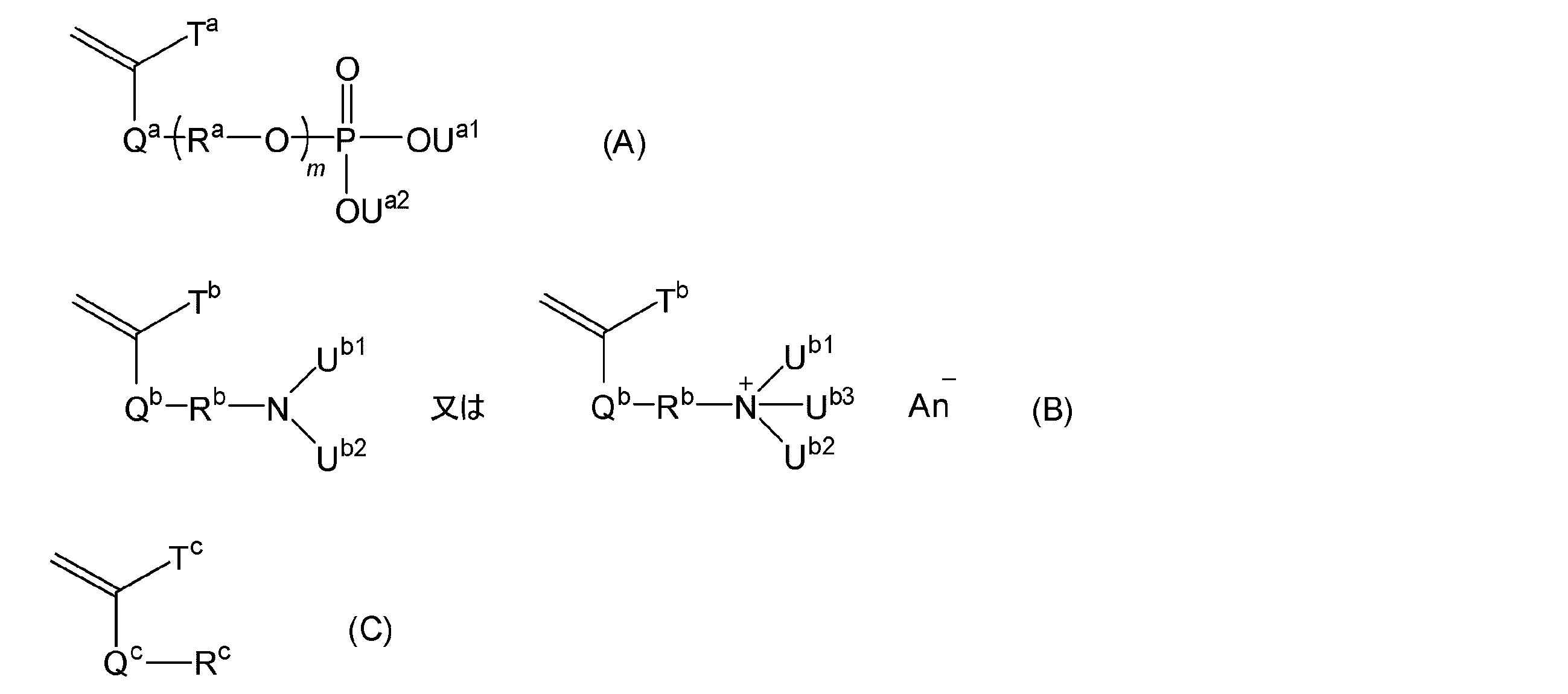
- the repeating units containing groups represented by the above formulas (a), (b) and (c) are respectively represented by the following formulas (A), (B) and (C): [Where: T a , T b , T c , U a1 , U a2 , U b1 , U b2 and U b3 each independently represent a hydrogen atom or a linear or branched alkyl group having 1 to 5 carbon atoms; Q a and Q b each independently represent a single bond, an ester bond or an amide bond, and Q c represents a single bond, an ether bond or an ester bond; R a and R b each independently represent a linear or branched alkylene group having 1 to 10 carbon atoms which may be substituted with a halogen atom, and R c represents a linear chain having 1 to 18 carbon atoms.
- a branched alkyl group an alicyclic hydrocarbon group having 3 to 10 carbon atoms, an aryl group having 6 to 10 carbon atoms, an aralkyl group having 7 to 15 carbon atoms, or an aryloxyalkyl group having 7 to 15 carbon atoms
- the aryl moiety is optionally substituted with a linear or branched alkyl group having 1 to 5 carbon atoms which may be substituted with a halogen atom
- An ⁇ represents a halide ion, Represents an anion selected from the group consisting of inorganic acid ions, hydroxide ions and isothiocyanate ions;
- m represents an integer of 0 to 6] 2.
- the cell culture container according to 1 above which is a repeating unit derived from a monomer represented by:
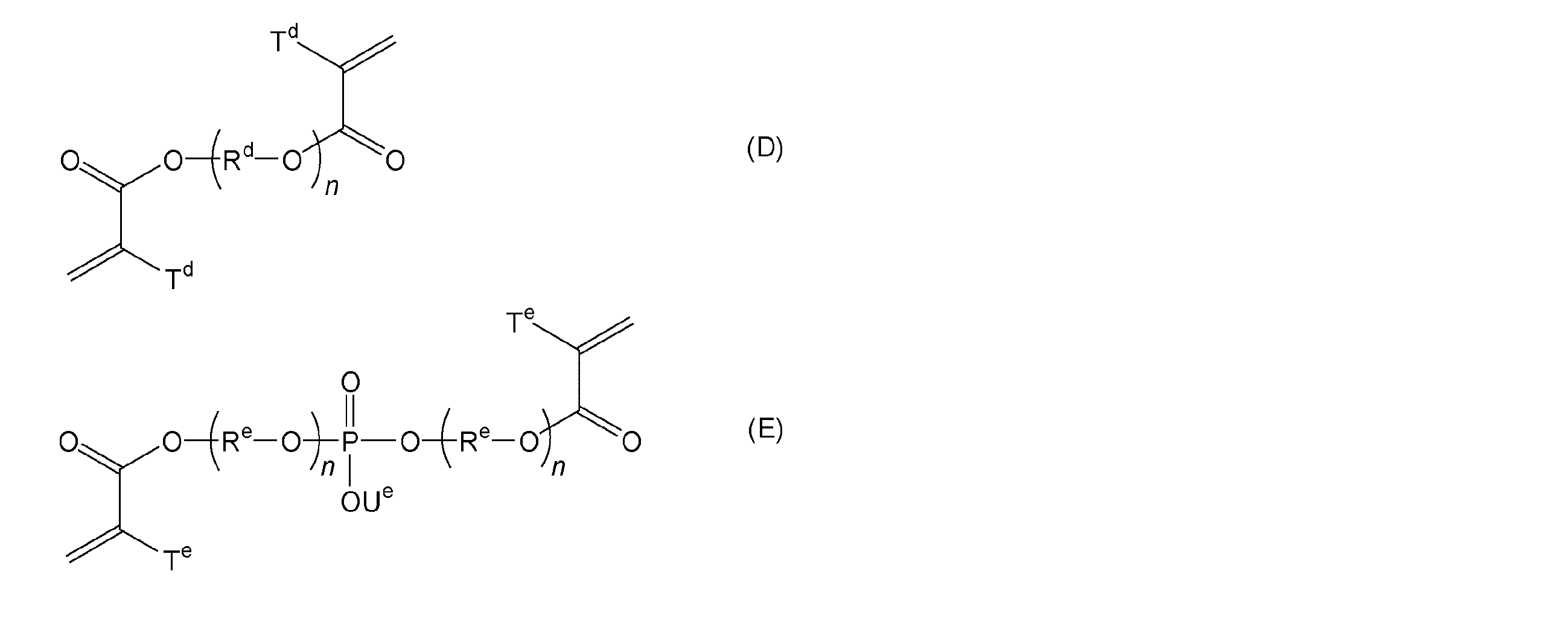
- the copolymer is further represented by the following formula (D) or (E): (Where T d , T e and U e each independently represent a hydrogen atom or a linear or branched alkyl group having 1 to 5 carbon atoms; R d and R e each independently represent a linear or branched alkylene group having 1 to 10 carbon atoms which may be substituted with a halogen atom; n represents an integer of 1 to 6) 4.
- the cell culture vessel according to any one of 1 to 3 above, which comprises a crosslinked structure derived from a monomer represented by
- T d and T e each independently represent a hydrogen atom or a methyl group
- U e represents a hydrogen atom
- R d and R e each independently represents an ethylene group or a propylene group
- a co-polymer comprising a repeating unit containing a group represented by the following formula (a), a repeating unit containing a group represented by the following formula (b), and a repeating unit containing a group represented by the following formula (c).
- U a1 , U a2 , U b1 , U b2 and U b3 each independently represent a hydrogen atom or a linear or branched alkyl group having 1 to 5 carbon atoms;
- R c is a linear or branched alkyl group having 1 to 18 carbon atoms, an alicyclic hydrocarbon group having 3 to 10 carbon atoms, an aryl group having 6 to 10 carbon atoms, or an aralkyl having 7 to 15 carbon atoms.
- An ⁇ represents an anion selected from the group consisting of halide ion, inorganic acid ion, hydroxide ion and isothiocyanate ion]
- the repeating units containing groups represented by the above formulas (a), (b) and (c) are respectively represented by the following formulas (A), (B) and (C): [Where: T a , T b , T c , U a1 , U a2 , U b1 , U b2 and U b3 each independently represent a hydrogen atom or a linear or branched alkyl group having 1 to 5 carbon atoms; Q a and Q b each independently represent a single bond, an ester bond or an amide bond, and Q c represents a single bond, an ether bond or an ester bond; R a and R b each independently represent a linear or branched alkylene group having 1 to 10 carbon atoms which may be substituted with a halogen atom, and R c represents a linear chain having 1 to 18 carbon atoms.
- a branched alkyl group an alicyclic hydrocarbon group having 3 to 10 carbon atoms, an aryl group having 6 to 10 carbon atoms, an aralkyl group having 7 to 15 carbon atoms, or an aryloxyalkyl group having 7 to 15 carbon atoms
- the aryl moiety is optionally substituted with a linear or branched alkyl group having 1 to 5 carbon atoms which may be substituted with a halogen atom
- An ⁇ represents a halide ion, Represents an anion selected from the group consisting of inorganic acid ions, hydroxide ions and isothiocyanate ions;
- m represents an integer of 0 to 6] 8.
- or 10 including the process of wash
- a method for producing a cell aggregate comprising using the cell culture container according to any one of 1 to 6 or the cell culture container produced by the production method according to any one of 7 to 12.
- the cell culture container of the present invention is a copolymer comprising an anion represented by formula (a), a cation represented by formula (b), and a hydrophobic group represented by formula (c).
- an anion represented by formula (a) By coating a part, adhesion of cells and proteins to the container surface can be suppressed. It is considered that the electrostatic balance between the cation and the anion keeps the surface of the container electrically neutral, thereby preventing adhesion of cells and proteins.
- the cations and anions in the coating form ionic bonds (ion complexes), so that they adhere to any type of substrate such as glass, fibers, inorganic particles, or resins (synthetic resins and natural resins). Further, after fixing, the coating is excellent in durability to an aqueous solvent (water, phosphate buffer (PBS), alcohol, etc.).
- PBS phosphate buffer
- the hydrophobic group represented by the formula (c) into the copolymer, the protein adhesion-inhibiting ability is improved, the adhesiveness with a resin such as plastic is good, and durability against an aqueous solvent after fixing.
- a coating with better properties that is, according to the present invention, it is possible to provide a cell culture container excellent in durability to a solvent while suppressing adhesion of proteins to the container surface in addition to cells.
- halogen atom means a fluorine atom, a chlorine atom, a bromine atom or an iodine atom.
- the “alkyl group” means a linear or branched, monovalent group of a saturated aliphatic hydrocarbon.
- Examples of the “linear or branched alkyl group having 1 to 5 carbon atoms” include, for example, methyl group, ethyl group, n-propyl group, isopropyl group, n-butyl group, isobutyl group, s-butyl group, and t-butyl group.
- n-pentyl group 1-methylbutyl group, 2-methylbutyl group, 3-methylbutyl group, 1,1-dimethylpropyl group, 1,2-dimethylpropyl group, 2,2-dimethylpropyl group or 1-ethylpropyl group Groups.
- Examples of the “linear or branched alkyl group having 1 to 18 carbon atoms” include the hexyl group, heptyl group, octyl group, nonyl group, decyl group, in addition to the examples of the linear or branched alkyl group having 1 to 5 carbon atoms.
- a linear or branched alkyl group having 1 to 5 carbon atoms which may be substituted with a halogen atom means the above linear or branched alkyl group having 1 to 5 carbon atoms, or The straight chain or branched alkyl group having 1 to 5 carbon atoms and substituted with one or more halogen atoms.
- Examples of “a linear or branched alkyl group having 1 to 5 carbon atoms” are as described above.
- a linear or branched alkyl group having 1 to 5 carbon atoms substituted with one or more halogen atoms means that one or more arbitrary hydrogen atoms of the linear or branched alkyl group having 1 to 5 carbon atoms are , Means substituted with a halogen atom, and examples include fluoromethyl group, difluoromethyl group, trifluoromethyl group, chloromethyl group, dichloromethyl group, trichloromethyl group, bromomethyl group, iodomethyl group, 2, Examples include 2,2-trifluoroethyl group, 2,2,2-trichloroethyl group, perfluoroethyl group, perfluorobutyl group, and perfluoropentyl group.
- ester bond means —C ( ⁇ O) —O— or —O—C ( ⁇ O) —
- amide bond means —NHC ( ⁇ O) — or —C ( ⁇ O) NH— means “ether bond” means —O—.
- the “linear or branched alkylene group having 1 to 10 carbon atoms which may be substituted with a halogen atom” means a linear or branched alkylene group having 1 to 10 carbon atoms, or one or more halogen atoms. Means a linear or branched alkylene group having 1 to 10 carbon atoms and substituted with
- the “alkylene group” means a divalent organic group corresponding to the alkyl group.
- Examples of “linear or branched alkylene group having 1 to 10 carbon atoms” include methylene group, ethylene group, propylene group, trimethylene group, tetramethylene group, 1-methylpropylene group, 2-methylpropylene group, dimethylethylene.
- ethylethylene group pentamethylene group, 1-methyl-tetramethylene group, 2-methyl-tetramethylene group, 1,1-dimethyl-trimethylene group, 1,2-dimethyl-trimethylene group, 2,2-dimethyl- Trimethylene group, 1-ethyl-trimethylene group, hexamethylene group, octamethylene group, decamethylene group and the like.
- ethylene group, propylene group, octamethylene group and decamethylene group are preferable, for example, ethylene group, Number of carbon atoms such as propylene group, trimethylene group, tetramethylene group Or more preferably a linear or branched alkylene group of 5, in particular an ethylene group or a propylene group is preferable.
- a linear or branched alkylene group having 1 to 10 carbon atoms substituted with one or more halogen atoms means that one or more arbitrary hydrogen atoms of the alkylene group are replaced with halogen atoms. In particular, those in which some or all of the hydrogen atoms of the ethylene group or propylene group are replaced with halogen atoms are preferred.
- an “alicyclic hydrocarbon group having 3 to 10 carbon atoms” means a monocyclic or polycyclic saturated or partially unsaturated aliphatic hydrocarbon having 3 to 10 carbon atoms. It means a monovalent group.
- monovalent or bicyclic monovalent groups of saturated aliphatic hydrocarbons having 3 to 10 carbon atoms are preferable.
- the number of carbon atoms is 3 such as a cyclopropyl group, a cyclobutyl group, or a cyclohexyl group.
- a bicycloalkyl group having 4 to 10 carbon atoms such as a bicyclo [3.2.1] octyl group, bornyl group, or isobornyl group.
- the “aryl group having 6 to 10 carbon atoms” means a monocyclic or polycyclic monovalent aromatic hydrocarbon group having 6 to 10 carbon atoms, such as phenyl Group, naphthyl group or anthryl group.
- the “aryl group having 6 to 10 carbon atoms” may be substituted with one or more of the above “linear or branched alkyl groups having 1 to 5 carbon atoms which may be substituted with a halogen atom”.
- the “aralkyl group having 7 to 15 carbon atoms” refers to a group —R—R ′ (wherein R represents the above “alkylene group having 1 to 5 carbon atoms”, and R ′ represents the above Represents an aryl group having 6 to 10 carbon atoms), and examples thereof include a benzyl group, a phenethyl group, and an ⁇ -methylbenzyl group.
- the aryl part of the “aralkyl group having 7 to 15 carbon atoms” may be substituted with one or more of the above “linear or branched alkyl group having 1 to 5 carbon atoms which may be substituted with a halogen atom”. Good.
- the “aryloxyalkyl group having 7 to 15 carbon atoms” refers to the group —R—O—R ′ (wherein R represents the above “alkylene group having 1 to 5 carbon atoms” and R 'Represents the above "aryl group having 6 to 10 carbon atoms”), and examples thereof include a phenoxymethyl group, a phenoxyethyl group, and a phenoxypropyl group.
- the aryl part of the “aryloxyalkyl group having 7 to 15 carbon atoms” is substituted with one or more of the above “linear or branched alkyl group having 1 to 5 carbon atoms which may be substituted with a halogen atom”. May be.
- halide ion means fluoride ion, chloride ion, bromide ion or iodide ion.
- inorganic acid ion means carbonate ion, sulfate ion, phosphate ion, hydrogen phosphate ion, dihydrogen phosphate ion, nitrate ion, perchlorate ion or borate ion.
- the above An ⁇ is preferably a halide ion, sulfate ion, phosphate ion, hydroxide ion and isothiocyanate ion, and particularly preferably a halide ion.
- the (meth) acrylate compound means both an acrylate compound and a methacrylate compound.
- (meth) acrylic acid means acrylic acid and methacrylic acid.
- Having cell adhesion inhibiting ability means, for example, relative absorbance (WST OD 450 nm) (%) when compared with no coating by the cell number measurement reagent performed by the method described in the Examples (% of Examples)
- Absorbance (WST OD 450 nm) / comparative example (WST OD 450 nm) ⁇ 100) means 50% or less, preferably 30% or less, more preferably 20% or less.
- the ability to suppress protein adhesion means, for example, the mass per unit area (%) compared to the case without a coating film in the QCM-D measurement performed by the method described in the examples (unit area of the examples) per mass (ng / cm 2) / mass per unit area of the Comparative example (ng / cm 2) ⁇ 100 ) is 50% or less, preferably 30% or less, more preferably means that 20% or less .
- proteins include fibrinogen, bovine serum albumin (BSA), human albumin, various globulins, ⁇ -lipoprotein, various antibodies (IgG, IgA, IgM), peroxidase, various complements, various lectins, fibronectin, lysozyme.
- Von Willebrand factor (vWF) Von Willebrand factor
- serum ⁇ -globulin pepsin, ovalbumin
- insulin histone
- ribonuclease collagen
- cytochrome c etc.
- a first aspect of the present invention is represented by a repeating unit containing a group represented by the following formula (a), a repeating unit containing a group represented by the following formula (b), and the following formula (c).
- a copolymer comprising a repeating unit containing a group:
- U a1 , U a2 , U b1 , U b2 and U b3 each independently represent a hydrogen atom or a linear or branched alkyl group having 1 to 5 carbon atoms;
- R c is a linear or branched alkyl group having 1 to 18 carbon atoms, an alicyclic hydrocarbon group having 3 to 10 carbon atoms, an aryl group having 6 to 10 carbon atoms, or an aralkyl having 7 to 15 carbon atoms.
- An ⁇ represents an anion selected from the group consisting of halide ion, inorganic acid ion, hydroxide ion and isothiocyanate ion], and is coated on at least a part of the surface.
- the cell in the present invention is the most basic unit constituting an animal or plant, and has, as its elements, a cytoplasm and various organelles inside a cell membrane.
- the nucleus containing DNA may or may not be contained inside the cell.
- the animal-derived cells in the present invention include germ cells such as sperm and eggs, somatic cells constituting the living body, stem cells (pluripotent stem cells, etc.), progenitor cells, cancer cells separated from the living body, and separated from the living body.
- Cells that have been immortalized and stably maintained outside the body (cell lines), cells that have been isolated from the living body and have been artificially modified, and cells that have been isolated from the living body and have been artificially exchanged in the nucleus Etc.
- somatic cells constituting a living body include, but are not limited to, fibroblasts, bone marrow cells, B lymphocytes, T lymphocytes, neutrophils, erythrocytes, platelets, macrophages, monocytes, bones Cells, bone marrow cells, pericytes, dendritic cells, keratinocytes, adipocytes, mesenchymal cells, epithelial cells, epidermal cells, endothelial cells, vascular endothelial cells, hepatocytes, chondrocytes, cumulus cells, nervous system cells, Glial cells, neurons, oligodendrocytes, microglia, astrocytes, heart cells, esophageal cells, muscle cells (eg, smooth or skeletal muscle cells), pancreatic beta cells, melanocytes, hematopoietic progenitor cells (eg, Cord blood-derived CD34 positive cells), mononuclear cells and the like.
- the somatic cells are, for example, skin, kidney, spleen, adrenal gland, liver, lung, ovary, pancreas, uterus, stomach, colon, small intestine, large intestine, bladder, prostate, testis, thymus, muscle, connective tissue, bone, cartilage, blood vessel Includes cells taken from any tissue such as tissue, blood (including umbilical cord blood), bone marrow, heart, eye, brain or nerve tissue.
- a stem cell is a cell that has the ability to replicate itself and to differentiate into cells of other multiple lineages.
- Examples thereof include, but are not limited to, embryonic stem cells (ES cells) Embryonic tumor cells, embryonic germ stem cells, induced pluripotent stem cells (iPS cells), neural stem cells, hematopoietic stem cells, mesenchymal stem cells, hepatic stem cells, pancreatic stem cells, muscle stem cells, germ stem cells, intestinal stem cells, cancer stem cells, Hair follicle stem cells are included.
- Examples of the pluripotent stem cells include ES cells, embryonic germ stem cells, and iPS cells among the stem cells.
- a progenitor cell is a cell that is in the process of being differentiated from the stem cell into a specific somatic cell or germ cell. Cancer cells are cells that have been derived from somatic cells and have acquired unlimited proliferative capacity.
- a cell line is a cell that has acquired unlimited proliferative ability by artificial manipulation in vitro.
- cancer cell lines include, but are not limited to, HBC-4, BSY-1, BSY-2, MCF-7, MCF-7 / ADR RES, HS578T, MDA as human breast cancer cell lines.
- Examples of cell lines include, but are not limited to, HEK293 (human embryonic kidney cells), MDCK, MDBK, BHK, C-33A, AE-1, 3D9, Ns0 / 1, NIH3T3, PC12, S2 , Sf9, Sf21, High Five (registered trademark), Vero, and the like.
- Examples of hepatocyte cell lines include, but are not limited to, HepG2, Hep3B, HepaRG®, JHH7, HLF, HLE, PLC / PRF / 5, WRL68, HB611, SK-HEP-1, Examples include HuH-4 and HuH-7.
- the plant-derived cells in the present invention include cells separated from each tissue of the plant body, and also include protoplasts obtained by artificially removing cell walls from the cells.
- the container coated with the copolymer constituting the cell culture container of the present invention may be any type of container that can be used in this technical field, for example, a petri dish generally used for cell culture. , Flask, plastic bag, Teflon (registered trademark) bag, dish, petri dish, tissue culture dish, multi-dish, microplate, microwell plate, multiplate, multiwell plate, chamber slide, cell culture flask, spinner flask, A tube, a tray, a culture bag, a roller bottle, etc. are mentioned.
- a multiwell plate having 6 to 1536 holes and a petri dish are used.
- the resin may be either a natural resin or a synthetic resin.
- the natural resin include cellulose, cellulose triacetate (CTA), cellulose having dextran sulfate immobilized thereon
- the synthetic resin includes, for example, poly Acrylonitrile (PAN), polyester polymer alloy (PEPA), polystyrene (PS), polysulfone (PSF), polyethylene terephthalate (PET), polymethyl methacrylate (PMMA), polyvinyl alcohol (PVA), polyurethane (PU), ethylene vinyl alcohol (EVAL), polyethylene (PE), polyester, polypropylene (PP), polyvinylidene fluoride (PVDF), polyethersulfone (PES), polycarbonate (PC), polyvinyl chloride (PVC), poly Trifluoroethylene (PTFE), ultra high molecular weight polyethylene (UHPE), polydimethyls
- PAN poly Acrylonitrile
- PEPA polyester polymer alloy
- PS polystyrene
- PSF poly
- the cell culture container of the present invention is characterized in that at least a part of the surface of the container is coated with a specific copolymer.
- the copolymer according to the present invention is represented by a repeating unit containing a group represented by the following formula (a), a repeating unit containing a group represented by the following formula (b), and the following formula (c).
- U a1 , U a2 , U b1 , U b2 and U b3 each independently represent a hydrogen atom or a linear or branched alkyl group having 1 to 5 carbon atoms;
- R c is a linear or branched alkyl group having 1 to 18 carbon atoms, an alicyclic hydrocarbon group having 3 to 10 carbon atoms, an aryl group having 6 to 10 carbon atoms, or an aralkyl having 7 to 15 carbon atoms.
- An ⁇ represents an anion selected from the group consisting of halide ions, inorganic acid ions, hydroxide ions, and isothiocyanate ions].
- the copolymer according to the present invention is represented by a repeating unit containing a group represented by the above formula (a), a repeating unit containing a group represented by the above formula (b), and the above formula (c). If it is a copolymer containing the repeating unit containing group, there will be no restriction
- the repeating unit containing a group represented by the above formula (c) is a repeating unit containing a group represented by the above formula (a) and a group represented by the above formula (b). Different from unit.
- the copolymer includes a monomer containing a group represented by the formula (a), a monomer containing a group represented by the formula (b), and a monomer containing a group represented by the formula (c).
- Those obtained by radical polymerization of are preferably desirable, but those obtained by polycondensation or polyaddition reaction can also be used.
- Examples of the copolymer include vinyl polymer polymer reacted with olefin, polyamide, polyester, polycarbonate, polyurethane and the like. Among these, vinyl polymer polymer or (meth) acrylate compound reacted with olefin was polymerized. A (meth) acrylic polymer is desirable.
- the monomers containing the groups represented by the above formulas (a), (b) and (c) are represented by the following formulas (A), (B) and (C):
- T a , T b , T c , U a1 , U a2 , U b1 , U b2 and U b3 each independently represent a hydrogen atom or a linear or branched alkyl group having 1 to 5 carbon atoms
- Q a and Q b each independently represent a single bond, an ester bond or an amide bond
- Q c represents a single bond, an ether bond or an ester bond
- R a and R b each independently represent a linear or branched alkylene group having 1 to 10 carbon atoms which may be substituted with a halogen atom
- R c represents a linear chain having 1 to 18 carbon atoms.
- a branched alkyl group an alicyclic hydrocarbon group having 3 to 10 carbon atoms, an aryl group having 6 to 10 carbon atoms, an aralkyl group having 7 to 15 carbon atoms, or an aryloxyalkyl group having 7 to 15 carbon atoms
- the aryl moiety is optionally substituted with a linear or branched alkyl group having 1 to 5 carbon atoms which may be substituted with a halogen atom
- An ⁇ represents a halide ion, Represents an anion selected from the group consisting of inorganic acid ions, hydroxide ions and isothiocyanate ions;
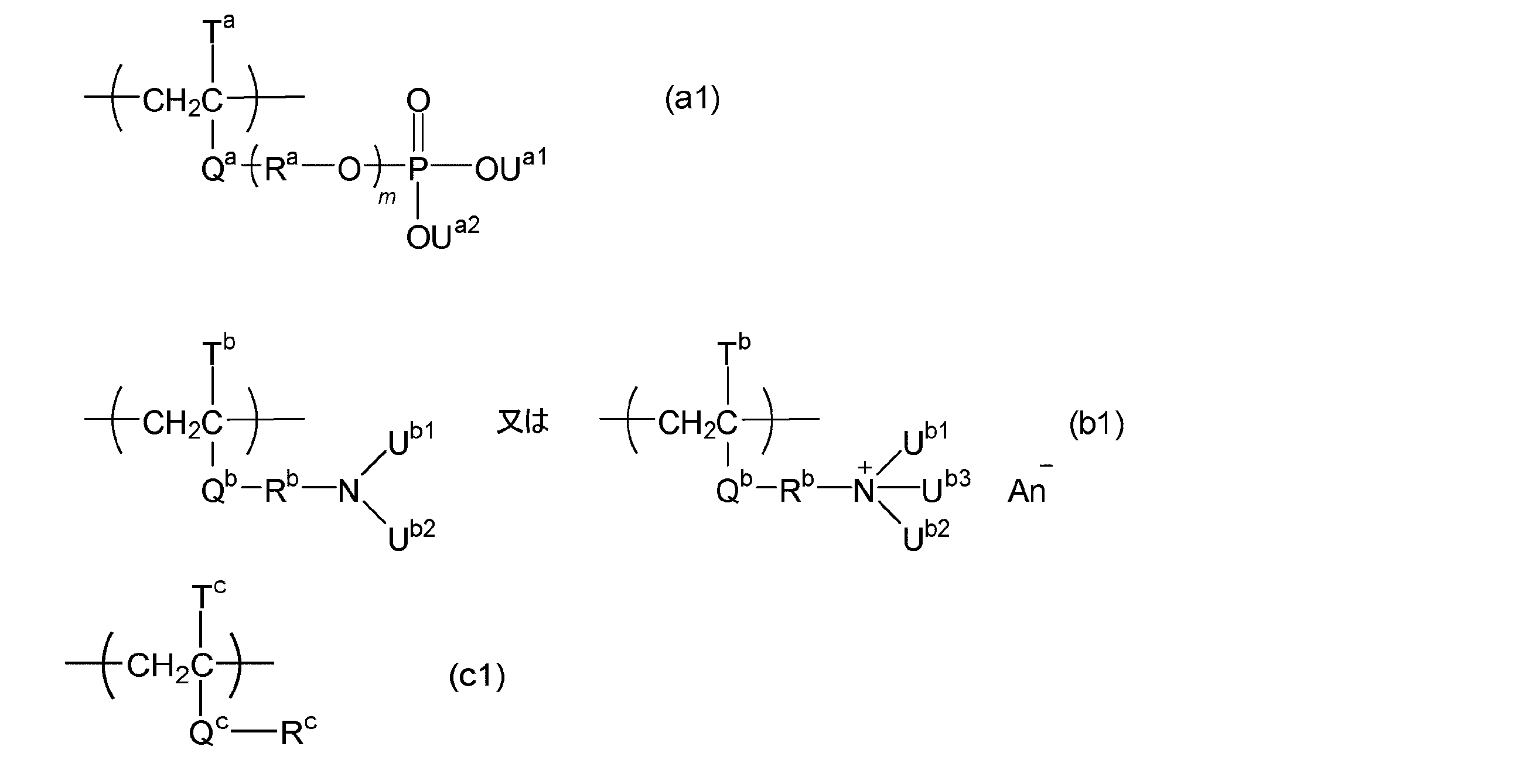
- m represents an integer of 0 to 6]. Accordingly, the repeating units derived from the monomers represented by the formulas (A), (B) and (C) are represented by the following formulas (a1), (b1) and (c1):
- T a , T b and T c are preferably each independently a hydrogen atom, a methyl group or an ethyl group, and more preferably each independently a hydrogen atom or a methyl group.
- U a1 , U a2 , U b1 , U b2 and U b3 are preferably each independently a hydrogen atom, a methyl group, an ethyl group or a t-butyl group.
- U a1 and U a2 are more preferably a hydrogen atom.
- U b1 and U b2 (and U b3 ) are more preferably a methyl group or an ethyl group, and particularly preferably a methyl group.
- Q a and Q b are preferably each independently an ester bond (—C ( ⁇ O) —O— or —O—C ( ⁇ O) —) or an amide bond (—NHC ( ⁇ O) — or —C ( ⁇ O) NH—), more preferably each independently —C ( ⁇ O) —O— or —C ( ⁇ O) NH—, particularly preferably —C ( ⁇ O) -O-.
- R a and R b are preferably each independently a linear or branched alkylene group having 1 to 3 carbon atoms which may be substituted with a halogen atom, and more preferably each independently ethylene.
- R c is preferably a linear or branched alkyl group having 4 to 8 carbon atoms or an alicyclic hydrocarbon group having 3 to 8 carbon atoms, and more preferably a linear chain having 4 to 6 carbon atoms. Alternatively, it is a branched alkyl group or an alicyclic hydrocarbon group having 3 to 6 carbon atoms, and particularly preferably a butyl group or a cyclohexyl group.
- An ⁇ is preferably a halide ion, sulfate ion, phosphate ion, hydroxide ion and isothiocyanate ion, and particularly preferably a halide ion.
- m preferably represents an integer of 0 to 3, more preferably an integer of 1 or 2, and particularly preferably 1.
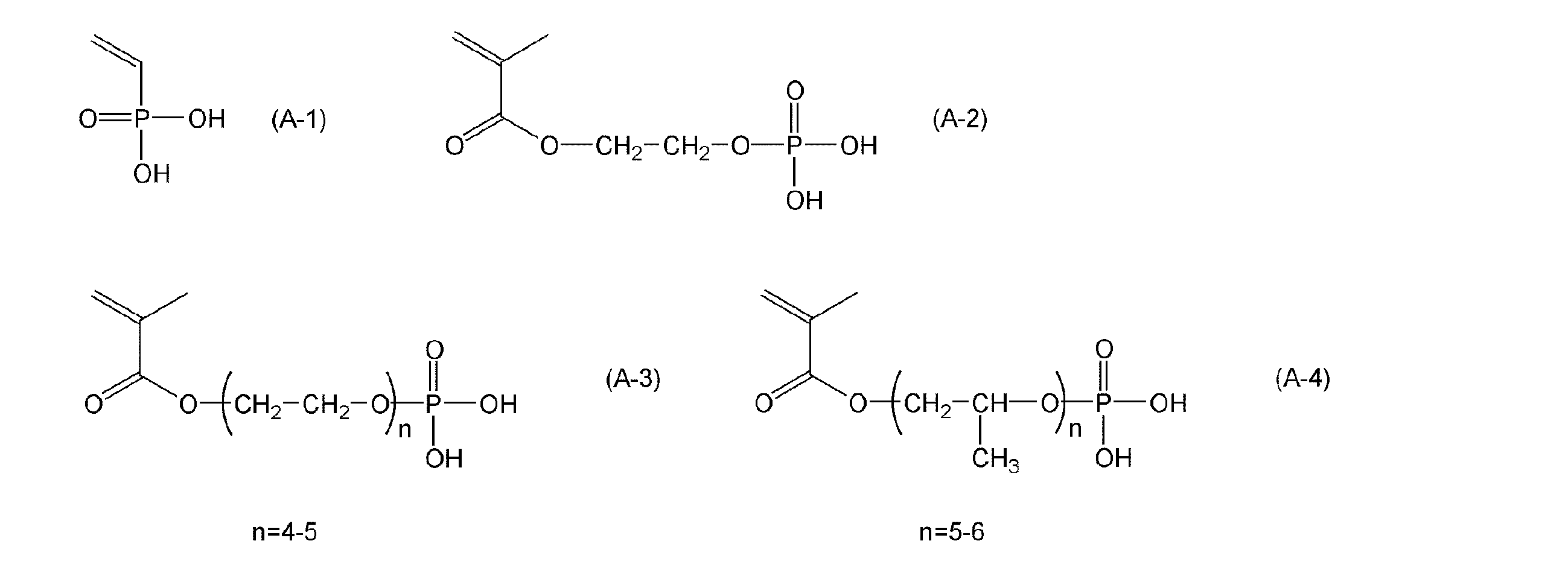
- formula (A) examples include vinylphosphonic acid, acid phosphooxyethyl (meth) acrylate, 3-chloro-2-acid phosphooxypropyl (meth) acrylate, acid phosphooxypropyl (meth) acrylate, and acid phospho Examples include oxymethyl (meth) acrylate, acid phosphooxypolyoxyethylene glycol mono (meth) acrylate, and acid phosphooxypolyoxypropylene glycol mono (meth) acrylate.
- These compounds may contain a (meth) acrylate compound having two functional groups as represented by the general formula (D) or (E) described later at the time of synthesis.
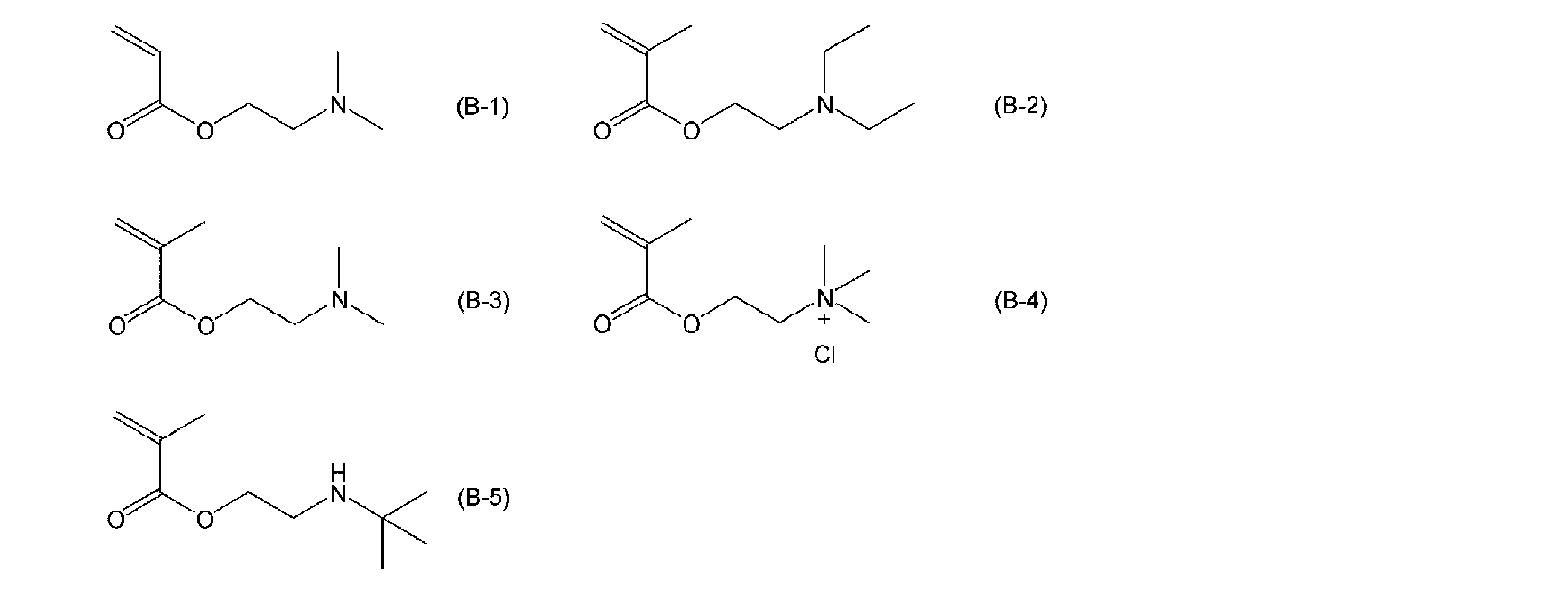
- formula (B) examples include dimethylaminoethyl (meth) acrylate, diethylaminoethyl (meth) acrylate, dimethylaminopropyl (meth) acrylate, 2- (t-butylamino) ethyl (meth) acrylate, and methacryloyl.
- Choline chloride and the like can be mentioned, among which dimethylaminoethyl (meth) acrylate, methacryloylcholine chloride or 2- (t-butylamino) ethyl (meth) acrylate is preferably used.
- Cyclic alkyl esters of (meth) acrylic acid such as cyclohexyl (meth) acrylate and isobornyl (meth) acrylate
- Aralkyl esters of (meth) acrylic acid such as benzyl (meth) acrylate and phenethyl (meth) acrylate
- Styrene Styrene monomers such as methyl styrene and chloromethyl styrene
- vinyl ether monomers such as methyl vinyl ether and butyl vinyl ether
- vinyl ester monomers such as vinyl acetate and vinyl propionate.
- butyl (meth) acrylate or cyclohexyl (meth) acrylate is preferably used.
- the ratio of the repeating unit containing the group represented by the formula (a) contained in the copolymer according to the present invention is 3 mol% to 80 mol%. Preferably, it is 3.5 mol% to 50 mol%, and more preferably 4 mol% to 40 mol%.
- the copolymer which concerns on this invention may contain the repeating unit (or repeating unit represented by Formula (a1)) containing the group represented by 2 or more types of formula (a).
- the ratio of the repeating unit containing the group represented by the formula (b) contained in the copolymer according to the present invention is 3 mol% to 80 mol%, Preferably, it is 5 mol% to 70 mol%, and more preferably 8 mol% to 65 mol%.
- the copolymer which concerns on this invention may contain the repeating unit (or repeating unit represented by Formula (b1)) containing the group represented by 2 or more types of formula (b).
- the ratio of the repeating unit (or the repeating unit represented by the formula (c1)) containing the group represented by the formula (c) contained in the copolymer according to the present invention is the above formula ( All of the remainder obtained by subtracting a) and formula (b) or the remainder obtained by subtracting the total ratio of the above-described formula (a) and formula (b) and the fourth component described below may be used. It is 1 mol% to 90 mol%, preferably 3 mol% to 88 mol%, and more preferably 5 mol% to 87 mol%.
- the copolymer which concerns on this invention may contain the repeating unit (or repeating unit represented by Formula (c1)) containing the group represented by 2 or more types of formula (c).
- the combination of the proportions of the repeating units represented by the above formula (a1), formula (b1) and formula (c1) is: Preferably, Formula (a1): 3 mol% to 80 mol%, Formula (b1): 3 mol% to 80 mol%, Formula (c1): 1 mol% to 90 mol%, More preferably, Formula (a1): 3.5 mol% to 50 mol%, Formula (b1): 5 mol% to 70 mol%, Formula (c1): 3 mol% to 88 mol%, More preferably, Formula (a1): 4 mol% to 40 mol%, Formula (b1): 8 mol% to 65 mol%, Formula (c1): 5 mol% to 87 mol%, It is.
- an optional fourth component may be copolymerized.
- a (meth) acrylate compound having two or more functional groups may be copolymerized as the fourth component, and a part of the polymer may be partially three-dimensionally crosslinked.
- a fourth component for example, the following formula (D) or (E):
- T d , T e and U e each independently represent a hydrogen atom or a linear or branched alkyl group having 1 to 5 carbon atoms, and R d and R e each independently represent Represents a linear or branched alkylene group having 1 to 10 carbon atoms which may be substituted with a halogen atom; and n represents an integer of 1 to 6]. That is, the copolymer according to the present invention preferably contains a crosslinked structure derived from such a bifunctional monomer.
- T d and Te are preferably each independently a hydrogen atom, a methyl group or an ethyl group, and more preferably each independently a hydrogen atom or a methyl group. It is.
- U e is preferably a hydrogen atom, a methyl group, or an ethyl group, and more preferably a hydrogen atom.
- R d is preferably a linear or branched alkylene group having 1 to 3 carbon atoms which may be substituted with a halogen atom, and more preferably each independently an ethylene group or It is a propylene group or an ethylene group or a propylene group substituted with one chlorine atom, and particularly preferably an ethylene group or a propylene group.
- n preferably represents an integer of 1 to 5, particularly preferably 1.
- R e is preferably a linear or branched alkylene group having 1 to 3 carbon atoms which may be substituted with a halogen atom, and more preferably each independently an ethylene group or It is a propylene group or an ethylene group or a propylene group substituted with one chlorine atom, and particularly preferably an ethylene group or a propylene group.
- n preferably represents an integer of 1 to 5, particularly preferably 1.
- the bifunctional monomer represented by the formula (D) is preferably ethylene glycol di (meth) acrylate, triethylene glycol di (meth) acrylate, propylene glycol di (meth) acrylate, or the above formula (A-3) Examples thereof include a bifunctional monomer derived therefrom.
- the bifunctional monomer represented by the formula (E) is preferably bis (methacryloyloxymethyl) phosphate, bis [(2-methacryloyloxy) ethyl] phosphate, bis [3- (methacryloyloxy) propyl phosphate Or a bifunctional monomer derived from the above formula (A-3).
- the optional fourth component may be a trifunctional monomer.
- a trifunctional monomer as the fourth component include phosphiniridine tris (oxy-2,1-ethanediyl) triacrylate.
- ethylene glycol dimethacrylate among difunctional monomers derived from the above formulas (A-3) and (A-4), dimethacrylate having a repeating unit of ethylene glycol and propylene glycol, phosphorus Among the bis [2- (methacryloyloxy) ethyl] acid and the bifunctional monomers derived from the above formulas (A-3) and (A-4), repeating units of ethylene glycol and propylene glycol via a phosphate group are used.
- the dimethacrylates are preferably represented by the following formulas (D-1) to (D-3) and formulas (E-1) to (E-3).
- the copolymer may contain one or more of these fourth components.
- the ratio of the crosslinked structure derived from the fourth component in the copolymer, for example, the bifunctional monomer represented by the above formula (D) or (E) is 0 mol% to 50 mol%.
- the ratio of the compound represented by the formula (A) to the whole monomer forming the copolymer is 3 mol% to 80 mol%, preferably 3.5 mol% to 50 mol%, more preferably Is 4 mol% to 40 mol%. Moreover, 2 or more types may be sufficient as the compound represented by Formula (A).
- the ratio of the compound represented by the formula (B) to the whole monomer forming the copolymer is 3 mol% to 80 mol%, preferably 5 mol% to 70 mol%, more preferably 8 mol%. Mol% to 65 mol%. Moreover, 2 or more types may be sufficient as the compound represented by Formula (B).
- the ratio of the compound represented by the formula (C) to the whole monomer forming the copolymer may be all the remainder obtained by subtracting the ratios of the above formulas (A) and (B), or the above formula (A) and
- the balance obtained by subtracting the total ratio of (B) and the fourth component may be, for example, 1 mol% to 90 mol%, preferably 3 mol% to 88 mol%, and more preferably 5 mol%. Mol% to 87 mol%.
- 2 or more types may be sufficient as the compound represented by Formula (C).
- an ethylenically unsaturated monomer, a polysaccharide or a derivative thereof may be copolymerized as an optional fifth component.
- ethylenically unsaturated monomers include (meth) acrylic acid and esters thereof; vinyl acetate; vinyl pyrrolidone; ethylene; vinyl alcohol; and one or two selected from the group consisting of hydrophilic functional derivatives thereof. Mention may be made of more than one type of ethylenically unsaturated monomer.
- polysaccharides or derivatives thereof include cellulosic polymers such as hydroxyalkyl cellulose (for example, hydroxyethyl cellulose or hydroxypropyl cellulose), starch, dextran, and curdlan.
- the hydrophilic functional derivative refers to an ethylenically unsaturated monomer having a hydrophilic functional group or structure.
- hydrophilic functional groups or structures include betaine structures; amide structures; alkylene glycol residues; amino groups; and sulfinyl groups.
- the betaine structure means a monovalent or divalent group of a compound having an amphoteric center of a quaternary ammonium type cation structure and an acidic anion structure, for example, a phosphorylcholine group: Can be mentioned.
- a phosphorylcholine group for example, a phosphorylcholine group: Can be mentioned.
- the ethylenically unsaturated monomer having such a structure include 2-methacryloyloxyethyl phosphorylcholine (MPC).
- the amide structure has the following formula: [Wherein R 16 , R 17 and R 18 are each independently a hydrogen atom or an organic group (for example, a methyl group, a hydroxymethyl group or a hydroxyethyl group)] Means a group represented by Examples of the ethylenically unsaturated monomer having such a structure include (meth) acrylamide, N- (hydroxymethyl) (meth) acrylamide and the like. Furthermore, a monomer or polymer having such a structure is disclosed in, for example, JP 2010-169604 A.
- alkylene glycol residue remains after the condensation reaction of one or both terminal hydroxyl groups of alkylene glycol (HO-Alk-OH; where Alk is an alkylene group having 1 to 10 carbon atoms) with other compounds.
- An alkyleneoxy group (—Alk—O—) means a poly (alkyleneoxy) group in which an alkyleneoxy unit is repeated.
- the ethylenically unsaturated monomer having such a structure include 2-hydroxyethyl (meth) acrylate and methoxypolyethylene glycol (meth) acrylate.
- a monomer or polymer having such a structure is disclosed in, for example, JP-A-2008-533489.
- the amino group has the formula: —NH 2 , —NHR 19 or —NR 20 R 21 [wherein R 19 , R 20 and R 21 are independently of each other an organic group (for example, having 1 to 5 carbon atoms] A straight-chain or branched alkyl group, etc.)].
- the amino group in the present invention includes a quaternized or salified amino group.
- Examples of the ethylenically unsaturated monomer having such a structure include dimethylaminoethyl (meth) acrylate, 2- (t-butylamino) ethyl (meth) acrylate, methacryloylcholine chloride and the like.
- the sulfinyl group has the following formula: [Wherein R 22 is an organic group (for example, an organic group having 1 to 10 carbon atoms, preferably an alkyl group having 1 to 10 carbon atoms having one or more hydroxy groups)] Means a group represented by Examples of the polymer having such a structure include a copolymer disclosed in JP-A-2014-48278.
- the copolymer according to the present invention can be synthesized by methods such as radical polymerization, anionic polymerization, and cationic polymerization, which are general methods for synthesizing acrylic polymers or methacrylic polymers.
- the form can be various methods such as solution polymerization, suspension polymerization, emulsion polymerization and bulk polymerization.
- the reaction solvent may be water, an alcohol such as a phosphate buffer solution or ethanol, or a mixed solvent in combination of these, but it is preferable to contain water or ethanol. Furthermore, it is preferable that 10 mass% or more and 100 mass% or less of water or ethanol are included. Furthermore, it is preferable to contain 50 mass% or more and 100 mass% or less of water or ethanol. Furthermore, it is preferable to contain 80% by mass or more and 100% by mass or less of water or ethanol. Furthermore, it is preferable that 90 mass% or more and 100 mass% or less of water or ethanol are included. The total of water and ethanol is preferably 100% by mass.
- the concentration in the reaction solvent is preferably 0.01% by mass to 4% by mass.
- the concentration is more than 4% by mass, for example, the copolymer may gel in the reaction solvent due to the strong association property of the phosphate group represented by the formula (a).
- the concentration is less than 0.01% by mass, the concentration of the obtained varnish is too low, and it is difficult to prepare a coating film forming composition for obtaining a coating film having a sufficient film thickness. More preferably, the concentration is 0.01 mass% to 3 mass%, for example 3 mass% or 2 mass%.
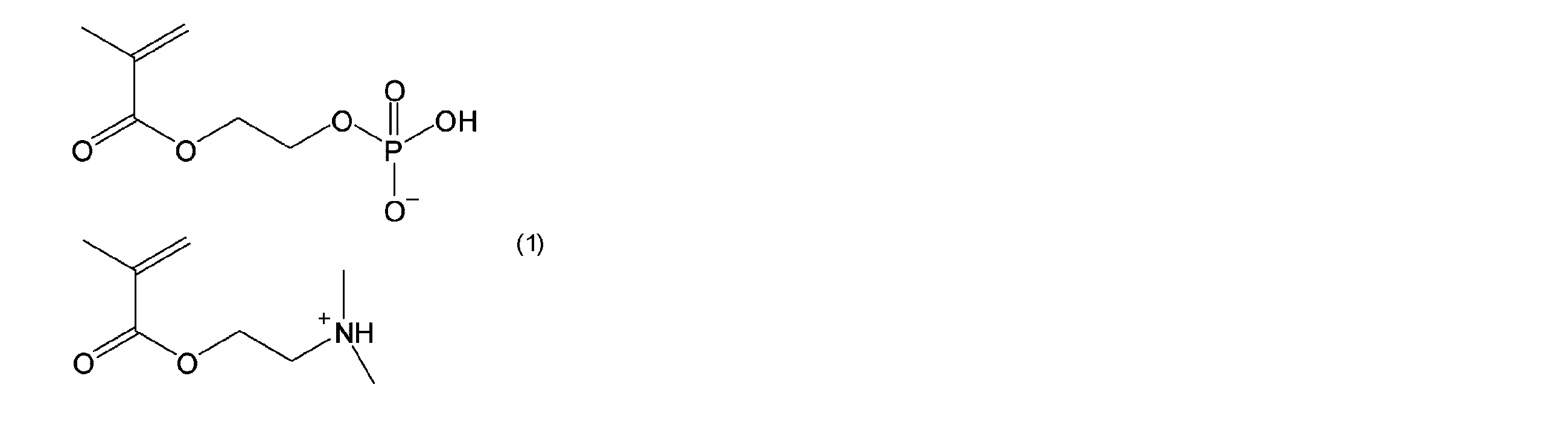
- a monomer containing a group represented by the above formula (a) and a monomer containing a group represented by the above formula (b) are described in, for example, the formula (1).
- a copolymer may be prepared by polymerizing with a monomer containing a group represented by the above formula (c).
- the phosphoric acid group-containing monomer is a monomer that easily associates, when dropped into the reaction system, it may be dropped little by little in the reaction solvent so that it can be quickly dispersed. Further, the reaction solvent may be heated (for example, 40 ° C. to 100 ° C.) to increase the solubility of the monomer and polymer.
- polymerization initiators include 2,2'-azobis (isobutyronitrile), 2,2'-azobis (2-methylbutyronitrile), 2,2'-azobis (2,4-dimethylvaleronitrile) ) (Manufactured by Wako Pure Chemical Industries, Ltd .; VA-065, 10 hours half-life temperature: 51 ° C.), 4,4′-azobis (4-cyanovaleric acid), 2,2′-azobis (4-methoxy-) 2,4-dimethylvaleronitrile), 1,1'-azobis (cyclohexane-1-carbonitrile), 1-[(1-cyano-1-methylethyl) azo] formamide, 2,2'-azobis [2- (2-imidazolin-2-yl) propane], 2,2'-azobis (2-methylpropionamidine) dihydrochloride, 2,2'-azobis [2-methyl-N- (2-hydroxye
- 2,2′-azobis [2 is considered in consideration of ion balance and solubility in water.
- -Methyl-N- (2-hydroxyethyl) propionamide 2,2'-azobis [N- (2-carboxyethyl) -2-methylpropionamidine] n-hydrate
- 4,4'-azobis 4-cyanopentanoic acid
- 2,2'-azobis (2-amidinopropane) it is desirable to use either the dihydrochloride salt or peroxodisulfate.
- the addition amount of the polymerization initiator is 0.05% by mass to 10% by mass with respect to the total weight of the monomers used for the polymerization.
- the reaction conditions are as follows.
- the reaction vessel is heated to 50 ° C. to 200 ° C. with an oil bath or the like and stirred for 1 hour to 48 hours, more preferably 80 ° C. to 150 ° C. for 5 hours to 30 hours.
- a copolymer according to the invention is obtained.
- the reaction atmosphere is preferably a nitrogen atmosphere.
- all the reactants may be put in a reaction solvent at room temperature and then heated to the above temperature for polymerization, or all or a part of the mixture of reactants may be placed in a preheated solvent. You may add it little by little.
- the concentration of the compound represented by the above formula (A), formula (B) or formula (C) in the reaction solvent is, for example, 0.01% by mass to 10% by mass. %. In this case, even if the concentration exceeds 4% by mass, the dropping phase and the reaction phase become a transparent and uniform solution before the reaction, and the gelation of the copolymer after the reaction in the reaction solvent can be suppressed.
- the molecular weight of the copolymer according to the present invention may be about several thousand to several million, preferably 5,000 to 5,000,000. More preferably, it is 10,000 to 2,000,000.
- any of a random copolymer, a block copolymer, and a graft copolymer may be used, and the copolymerization reaction itself for producing the copolymer is not particularly limited, and includes radical polymerization, ionic polymerization, and photopolymerization.
- a method synthesized in a known solution such as polymerization or polymerization utilizing emulsion polymerization can be used.
- any one of the copolymers of the present invention can be used alone, or a plurality of copolymers can be mixed and the ratio thereof can be changed.
- the various copolymers thus produced may be two-dimensional polymers or three-dimensional polymers, and are in a state of being dispersed in a solution containing water. That is, it is not preferable that the varnish containing these polymers can cause non-uniform gelation or cloudiness precipitation, and is preferably a transparent varnish, a dispersed colloidal varnish, or a sol.
- the cell culture container of the present invention is characterized in that the copolymer is coated on at least a part of the surface of the container, and is coated on the inner surface of the container that can come into contact with the cells and the culture solution. Preferably, it is more preferable to coat the entire surface of the container.
- the coating of the copolymer on the cell culture vessel can be formed by a known means, specifically, by means described later in the item ⁇ Method for producing cell culture vessel >> and the means described in Examples.
- the coating thickness of the cell culture container of the present invention is appropriately selected according to the shape and purpose of the container, but is preferably 10 to 1000 mm, more preferably 10 to 500 mm, and particularly preferably 10 to 300 mm.
- the cell culture container of the present invention has an excellent ability to suppress adhesion to cells and proteins due to such a coating.
- the second aspect of the present invention is represented by a repeating unit containing a group represented by the following formula (a), a repeating unit containing a group represented by the following formula (b), and the following formula (c).
- a copolymer comprising a repeating unit containing a group:
- the copolymer is coated on at least a part of the surface of the container.
- the container is a round-bottom multi-well plate, only the well indentation may be coated, or the entire plate may be coated.
- the container and the copolymer are as described in the above items ⁇ container> and ⁇ copolymer>, respectively.
- the coating step is not particularly limited, and may be performed by any coating means known to those skilled in the art (for example, application, immersion, etc.) that can contact the container and the copolymer.
- it can be carried out by applying a varnish containing a copolymer to a container, or immersing the container in a varnish containing a copolymer.
- it implements by immersing a container in the varnish containing a copolymer.
- the varnish containing the copolymer may be prepared by dissolving the copolymer obtained in the above item ⁇ Method for producing copolymer> in a suitable solvent at a desired concentration, or such a production method.
- the reaction solution containing the copolymer obtained in (1) may be used as a varnish as it is or after being diluted to a desired solid content concentration.
- the solvent contained in the varnish include water, phosphate buffer (PBS), and alcohol.
- the concentration of the copolymer in the varnish is 0.01 to 4% by mass, more preferably 0.01 to 3% by mass, more preferably 0.01 to 2% by mass, and still more preferably 0.01 to 1% by mass. %.
- concentration of the copolymer is less than 0.01% by mass, a coating with a sufficient film thickness cannot be formed, and when it is more than 4% by mass, the storage stability of the varnish is deteriorated and precipitation of a dissolved product or gel is caused. May occur.
- other substances can be added to the varnish as necessary in a range that does not impair the performance of the coating obtained.
- examples of other substances include preservatives, surfactants, primers that enhance adhesion to the substrate (container), fungicides, and sugars.
- the pH of the varnish containing the copolymer may be adjusted in advance.
- the pH adjustment may be carried out, for example, by adding a pH adjusting agent to the varnish containing the copolymer so that the varnish has a pH of 3.5 to 8.5, preferably 4.0 to 8.0.
- the kind and amount of the pH adjuster that can be used are appropriately selected according to the concentration of the copolymer in the varnish, the abundance ratio of the anion and cation of the copolymer, and the like.
- pH adjusters include ammonia, diethanolamine, pyridine, N-methyl-D-glucamine, organic amines such as tris (hydroxymethyl) aminomethane; alkali metal hydroxides such as potassium hydroxide and sodium hydroxide; Alkali metal halides such as potassium and sodium chloride; inorganic acids such as sulfuric acid, phosphoric acid, hydrochloric acid and carbonic acid or alkali metal salts thereof; quaternary ammonium cations such as choline; or a mixture thereof (for example, phosphate buffered saline) Etc.).
- alkali metal hydroxides such as potassium hydroxide and sodium hydroxide
- Alkali metal halides such as potassium and sodium chloride
- inorganic acids such as sulfuric acid, phosphoric acid, hydrochloric acid and carbonic acid or alkali metal salts thereof
- quaternary ammonium cations such as choline; or a mixture thereof (for example, phosphate buffered
- ammonia, diethanolamine, N-methyl-D-glucamine, tris (hydroxymethyl) aminomethane, sodium hydroxide and choline are preferable, and ammonia, diethanolamine, sodium hydroxide and choline are particularly preferable.
- a varnish containing such a copolymer is brought into contact with a container to form a coating on at least a part of its surface.
- the coating is desirably formed over the entire surface of the container.
- the surface of the container may be subjected to a known UV / ozone treatment and washed before the coating step.
- a cleaning step can be performed using a commercially available UV / ozone cleaner or the like.
- the coated container is preferably dried at a temperature of -200 ° C to 200 ° C.
- the solvent in the composition for forming a coating film is removed by drying, and the formulas (a) and (b) of the copolymer according to the present invention form ionic bonds and are completely fixed to the substrate.
- the thickness of the coating of the cell culture container of the present invention is preferably 10 to 1000 mm, more preferably 10 to 500 mm, and particularly preferably 10 to 300 mm.
- the present inventors do not require a treatment at a high temperature, a coating having a desired property is formed on the surface of the container by a treatment at a low temperature, and several tens to In spite of a thin film thickness of about several hundreds of liters, the present inventors have found that it is excellent in durability and has excellent adhesion suppressing ability to cells and proteins.
- Drying can be performed, for example, at room temperature (10 ° C. to 35 ° C., for example, 25 ° C.), but may be performed, for example, at 40 ° C. to 50 ° C. in order to form a coating film more quickly. Further, it may be carried out at an extremely low temperature to a low temperature (around ⁇ 200 ° C. to ⁇ 30 ° C.) by freeze drying. Freeze-drying is called vacuum freeze-drying, and is a method in which what is usually dried is cooled with a refrigerant and the solvent is removed by sublimation in a vacuum state.
- Common refrigerants used in freeze drying include dry ice and methanol mixed media ( ⁇ 78 ° C.), liquid nitrogen ( ⁇ 196 ° C.), and the like.
- a more preferable drying temperature is 10 ° C. to 180 ° C., and a further preferable drying temperature is 25 ° C. to 150 ° C.
- the surface of the coated container may be washed with alcohol having 1 to 5 carbon atoms such as ethanol and / or water.
- This washing step can be carried out at a temperature of 0 ° C. to 60 ° C., preferably 25 ° C. (room temperature) to 40 ° C. for 30 minutes to 48 hours, preferably 1 to 24 hours.
- the material is selected from the group consisting of water and an aqueous solution containing an electrolyte.
- the aqueous solution containing water or electrolyte may be heated in the range of 40 ° C. to 95 ° C., for example.
- the aqueous solution containing the electrolyte is preferably PBS and physiological saline (containing only sodium chloride), Dulbecco's phosphate buffered saline, Tris buffered saline, HEPES buffered saline and veronal buffered saline, and PBS is particularly preferred. preferable.
- the coating formed on the surface of the container does not elute and remains firmly adhered to the substrate (ie, the container).
- the formed coating has an ability to suppress adhesion of various biological materials including cells and proteins. Therefore, the cell culture container of the present invention is excellent in durability to solvents in addition to suppressing adhesion of cells and proteins.
- a known sterilization treatment such as radiation, electron beam, ethylene oxide, or autoclave may be performed.
- the third aspect of the present invention is characterized by using the cell culture container of the present invention and the cell culture container obtained by the production method of the present invention (hereinafter, both are referred to as the “cell culture container of the present invention”). And a method for producing a cell aggregate.
- the cell culture container of the present invention When the cell culture container of the present invention is used, the adhesion of the cell aggregate to the surface of the container is suppressed, and the elution of the coating to the culture solution is suppressed, so that the cell aggregate is not stimulated from the container. Can be cultured.
- the cell aggregate is preferably cultured using a medium containing a polysaccharide (in particular, deacylated gellan gum) having an effect of suspending cells or tissues in the cell culture container of the present invention.
- a polysaccharide in particular, deacylated gellan gum
- the specific composition and culture method of such a medium are disclosed in, for example, International Publication No. 2014/017513.
- ⁇ Measurement method of raw material composition The concentration (mass%) of each phosphorus-containing compound in the raw material containing the phosphorus-containing compound was measured by 31 P-NMR. The absolute concentration (absolute mass%) of each phosphorus-containing compound contained in the raw material was calculated using the following standard substance.
- the dropping funnel into which the mixed solution was introduced was set in a three-necked flask, and the mixed solution was dropped into boiling water of pure water and ethanol over 2 hours.
- 496.16 g of a copolymer-containing varnish having a solid content of about 9.70% by mass was obtained by stirring with heating while maintaining the above environment for 24 hours.
- the weight average molecular weight in GFC of the obtained transparent liquid was about 280,000.
- a QCM sensor (PS) was obtained by drying at ° C./1 min.
- the film thickness of the coating film was confirmed with an optical interference film thickness meter using the silicon wafer, it was 90 mm. Further, the coating film forming composition was spin-coated on a QCM sensor (PS) at 3500 rpm / 30 sec, and baked in an oven at 45 ° C. for 24 hours as a drying process. Thereafter, the uncured composition for forming a coating film excessively applied as a cleaning step was washed twice with PBS and ultrapure water to obtain a surface-treated QCM sensor (PS).
- PS QCM sensor
- Example 1 The following treatment steps were performed in order to prepare the cell culture container in the present invention.
- Treatment 1 The copolymer-containing varnish prepared in Synthesis Example 1 was filtered using a filter having a mesh size of 0.22 ⁇ m, and then 200 ⁇ L was added to a well of a 96-well cell culture plate (BD Bioscience, # 351172). (Solid content 1% by mass) / well was added and allowed to stand at room temperature for 1 hour, after which excess varnish was removed.
- Treatment 2 It was dried overnight at 50 ° C. using an oven (manufactured by Advantech Toyo Co., Ltd., dryer FC-612). Then, after adding 200 microliters of sterilized water per well, it removed and wash
- Example 2 Cell adhesion inhibitory effect> (Preparation of coating plate) The coated cell culture vessel obtained in Example 1 and Comparative Example 1 was used. As a positive control sample, a commercially available cell low adhesion plate (Corning, # 3474) was used. As a negative control, a 96-well cell culture plate (BD Bioscience, # 351172) without coating was used.
- Mouse embryo fibroblast C3H10T1 / 2 (DS Pharma Biomedical) was used as the cell.
- the medium used for cell culture is BME medium (manufactured by Thermo Fisher Scientific) containing 10% FBS (manufactured by HyClone) and L-glutamine-penicillin-streptomycin stabilizing solution (manufactured by Sigma-Aldrich). It was.
- the cells were statically cultured for 2 days or more using a petri dish (10 mL of medium) having a diameter of 10 cm while maintaining a 5% carbon dioxide concentration in a 37 ° C./CO 2 incubator.
- the cells were washed with 5 ml of PBS, and 1 mL of trypsin-EDTA solution (manufactured by Invitrogen) was added to detach the cells, and suspended in 10 mL of the above medium.
- This suspension was centrifuged (Tomy Seiko Co., Ltd., model number LC-200, 1000 rpm / 3 minutes, room temperature), the supernatant was removed, and the above medium was added to prepare a cell suspension.
- Cell attachment experiment To the plate prepared above, 100 ⁇ L of each cell suspension was added so as to be 2 ⁇ 10 3 cells / well. Thereafter, the sample was allowed to stand in a CO 2 incubator at 37 ° C. for 4 days while maintaining a 5% carbon dioxide concentration.
- the cell culture container of the present invention is coated on at least a part of its surface with a copolymer containing a specific group.
- a coating suppresses the adhesion of cells and proteins to the surface of the container, and the coating can firmly adhere to the surface of the container, so that suppression of elution of the coating into the culture medium is improved. Therefore, the cell culture container of the present invention is advantageous in that cell aggregates can be cultured without any stimulation from the container.
Landscapes
- Chemical & Material Sciences (AREA)
- Organic Chemistry (AREA)
- Health & Medical Sciences (AREA)
- Engineering & Computer Science (AREA)
- Life Sciences & Earth Sciences (AREA)
- Wood Science & Technology (AREA)
- Bioinformatics & Cheminformatics (AREA)
- Zoology (AREA)
- Materials Engineering (AREA)
- Chemical Kinetics & Catalysis (AREA)
- Biomedical Technology (AREA)
- Polymers & Plastics (AREA)
- Medicinal Chemistry (AREA)
- Microbiology (AREA)
- Sustainable Development (AREA)
- Biochemistry (AREA)
- General Engineering & Computer Science (AREA)
- General Health & Medical Sciences (AREA)
- Genetics & Genomics (AREA)
- Biotechnology (AREA)
- Clinical Laboratory Science (AREA)
- Immunology (AREA)
- Cell Biology (AREA)
- Virology (AREA)
- Apparatus Associated With Microorganisms And Enzymes (AREA)
- Micro-Organisms Or Cultivation Processes Thereof (AREA)
Abstract
Description
すなわち、本発明は以下のとおりである:
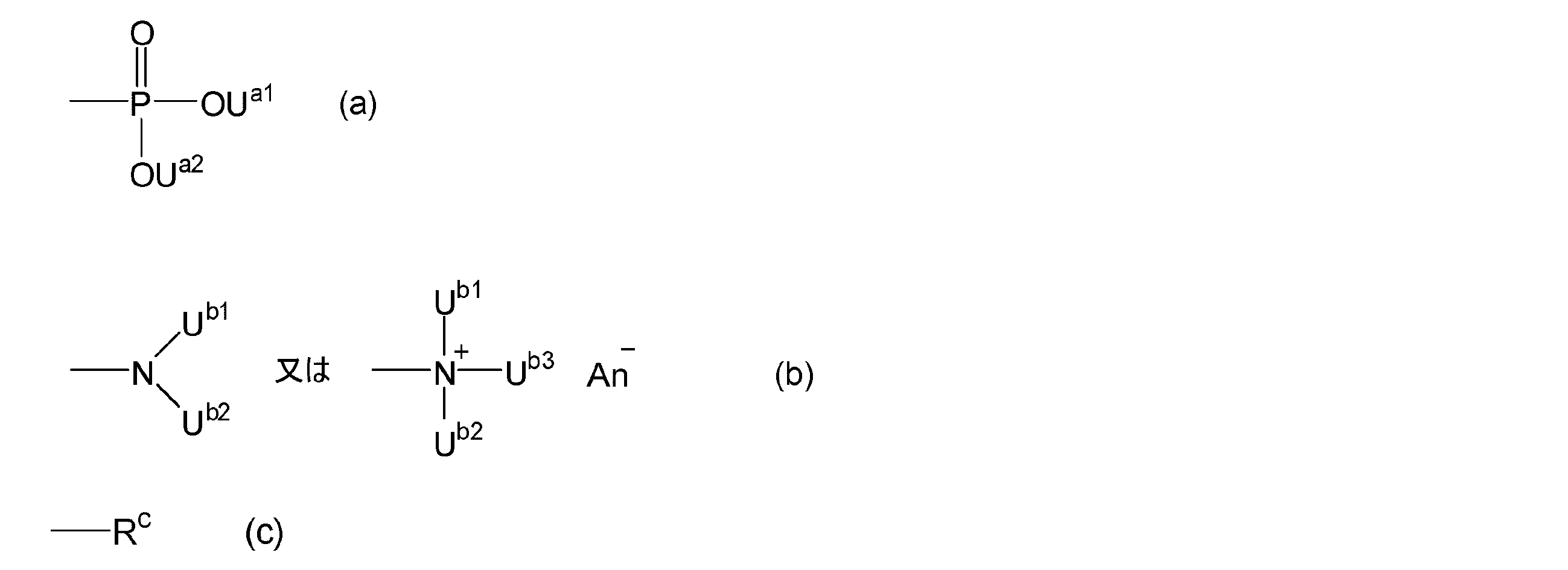
[式中、
Ua1、Ua2、Ub1、Ub2及びUb3は、それぞれ独立して、水素原子又は炭素原子数1乃至5の直鎖若しくは分岐アルキル基を表し;
Rcは、炭素原子数1乃至18の直鎖若しくは分岐アルキル基、炭素原子数3乃至10の脂環式炭化水素基、炭素原子数6乃至10のアリール基、炭素原子数7乃至15のアラルキル基又は炭素原子数7乃至15のアリールオキシアルキル基(ここで、前記アリール部分は、ハロゲン原子で置換されていてもよい炭素原子数1乃至5の直鎖若しくは分岐アルキル基で置換されていてもよい)を表し;
An-は、ハロゲン化物イオン、無機酸イオン、水酸化物イオン及びイソチオシアネートイオンからなる群から選ばれる陰イオンを表す]
が表面にコーティングされていることを特徴とする、細胞培養容器。
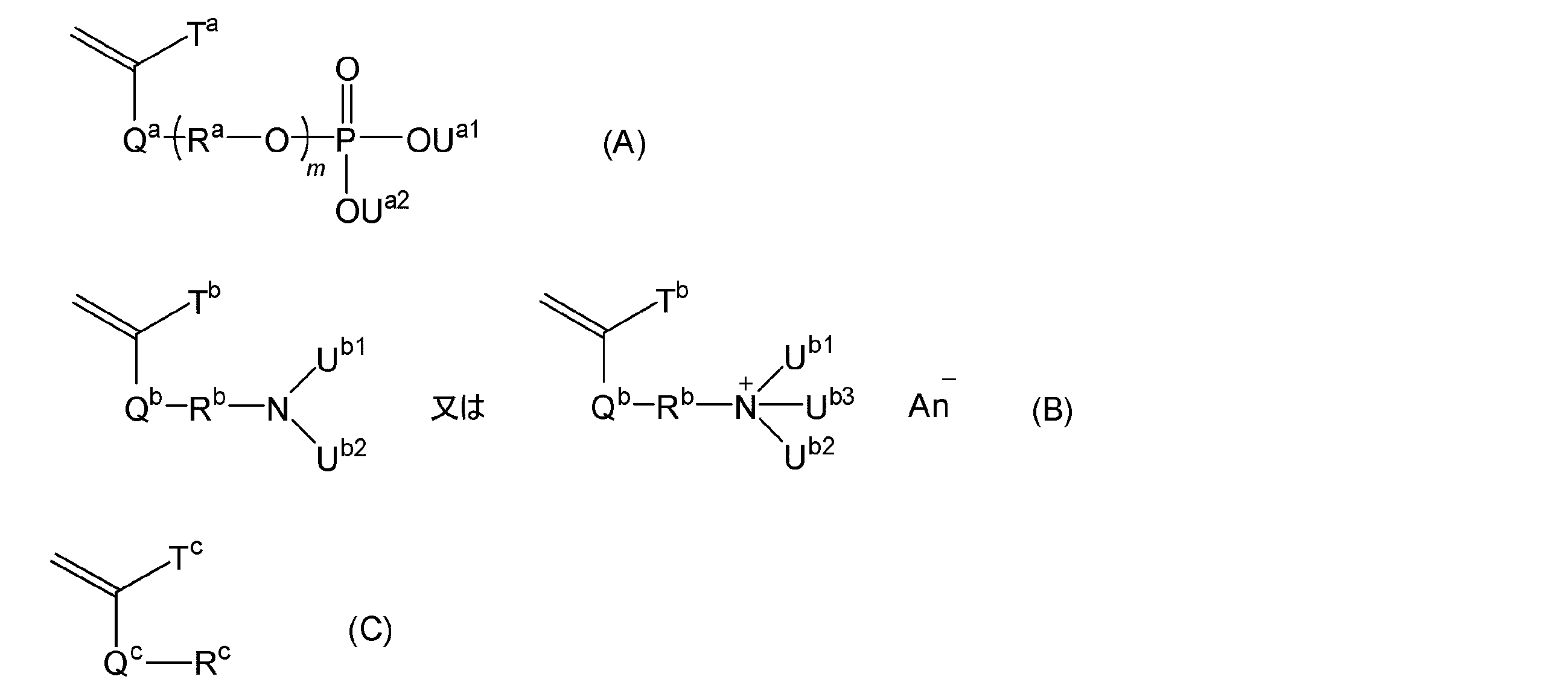
[式中、
Ta、Tb、Tc、Ua1、Ua2、Ub1、Ub2及びUb3は、それぞれ独立して、水素原子又は炭素原子数1乃至5の直鎖若しくは分岐アルキル基を表し;
Qa及びQbは、それぞれ独立して、単結合、エステル結合又はアミド結合を表し、Qcは、単結合、エーテル結合又はエステル結合を表し;
Ra及びRbは、それぞれ独立して、ハロゲン原子で置換されていてもよい炭素原子数1乃至10の直鎖又は分岐アルキレン基を表し、Rcは、炭素原子数1乃至18の直鎖若しくは分岐アルキル基、炭素原子数3乃至10の脂環式炭化水素基、炭素原子数6乃至10のアリール基、炭素原子数7乃至15のアラルキル基又は炭素原子数7乃至15のアリールオキシアルキル基(ここで、前記アリール部分は、ハロゲン原子で置換されていてもよい炭素原子数1乃至5の直鎖若しくは分岐アルキル基で置換されていてもよい)を表し;An-は、ハロゲン化物イオン、無機酸イオン、水酸化物イオン及びイソチオシアネートイオンからなる群から選ばれる陰イオンを表し;
mは、0乃至6の整数を表す]
で表されるモノマーから誘導される繰り返し単位である、上記1に記載の細胞培養容器。
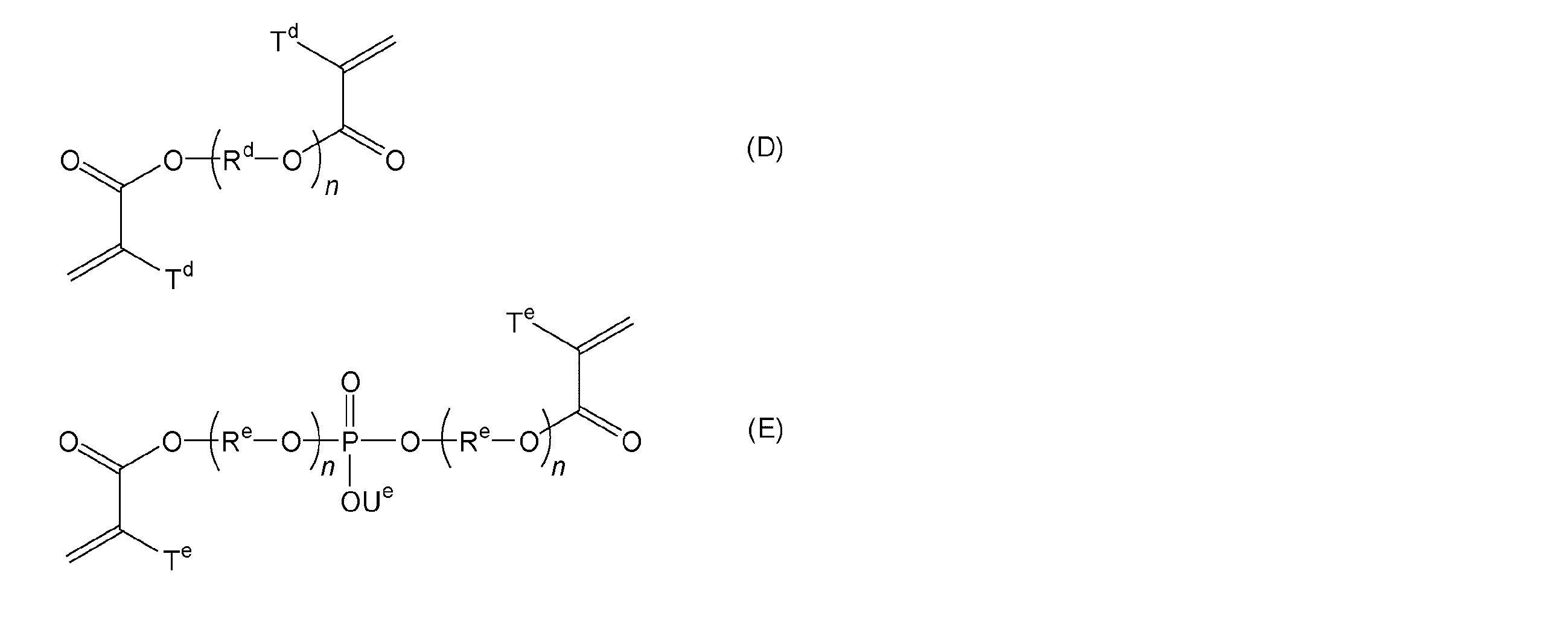
(式中、
Td、Te及びUeは、それぞれ独立して、水素原子又は炭素原子数1乃至5の直鎖若しくは分岐アルキル基を表し;
Rd及びReは、それぞれ独立して、ハロゲン原子で置換されていてもよい炭素原子数1乃至10の直鎖又は分岐アルキレン基を表し;
nは、1乃至6の整数を表わす)
で表されるモノマーから誘導される架橋構造を含む、上記1乃至3何れかに記載の細胞培養容器。

[式中、
Ua1、Ua2、Ub1、Ub2及びUb3は、それぞれ独立して、水素原子又は炭素原子数1乃至5の直鎖若しくは分岐アルキル基を表し;
Rcは、炭素原子数1乃至18の直鎖若しくは分岐アルキル基、炭素原子数3乃至10の脂環式炭化水素基、炭素原子数6乃至10のアリール基、炭素原子数7乃至15のアラルキル基又は炭素原子数7乃至15のアリールオキシアルキル基(ここで、前記アリール部分は、ハロゲン原子で置換されていてもよい炭素原子数1乃至5の直鎖若しくは分岐アルキル基で置換されていてもよい)を表し;
An-は、ハロゲン化物イオン、無機酸イオン、水酸化物イオン及びイソチオシアネートイオンからなる群から選ばれる陰イオンを表す]
を、容器の表面の少なくとも一部にコーティングする工程
を含む、細胞培養容器の製造方法。

[式中、
Ta、Tb、Tc、Ua1、Ua2、Ub1、Ub2及びUb3は、それぞれ独立して、水素原子又は炭素原子数1乃至5の直鎖若しくは分岐アルキル基を表し;
Qa及びQbは、それぞれ独立して、単結合、エステル結合又はアミド結合を表し、Qcは、単結合、エーテル結合又はエステル結合を表し;
Ra及びRbは、それぞれ独立して、ハロゲン原子で置換されていてもよい炭素原子数1乃至10の直鎖又は分岐アルキレン基を表し、Rcは、炭素原子数1乃至18の直鎖若しくは分岐アルキル基、炭素原子数3乃至10の脂環式炭化水素基、炭素原子数6乃至10のアリール基、炭素原子数7乃至15のアラルキル基又は炭素原子数7乃至15のアリールオキシアルキル基(ここで、前記アリール部分は、ハロゲン原子で置換されていてもよい炭素原子数1乃至5の直鎖若しくは分岐アルキル基で置換されていてもよい)を表し;An-は、ハロゲン化物イオン、無機酸イオン、水酸化物イオン及びイソチオシアネートイオンからなる群から選ばれる陰イオンを表し;
mは、0乃至6の整数を表す]
で表されるモノマーから誘導される繰り返し単位である、上記7に記載の製造方法。
すなわち、本発明により、細胞に加え、タンパク質の容器表面への付着を抑制すると共に、溶媒への耐久性にも優れた細胞培養容器を提供することができる。
本発明において用いられる用語は、他に特に断りのない限り、以下の定義を有する。
本発明において、「無機酸イオン」とは、炭酸イオン、硫酸イオン、リン酸イオン、リン酸水素イオン、リン酸二水素イオン、硝酸イオン、過塩素酸イオン又はホウ酸イオンを意味する。
上記An-として好ましいのは、ハロゲン化物イオン、硫酸イオン、リン酸イオン、水酸化物イオン及びイソチオシアネートイオンであり、特に好ましいのはハロゲン化物イオンである。
≪細胞培養容器≫
本発明の第一の態様は、下記式(a)で表される基を含む繰り返し単位と、下記式(b)で表される基を含む繰り返し単位と、下記式(c)で表される基を含む繰り返し単位とを含む共重合体:
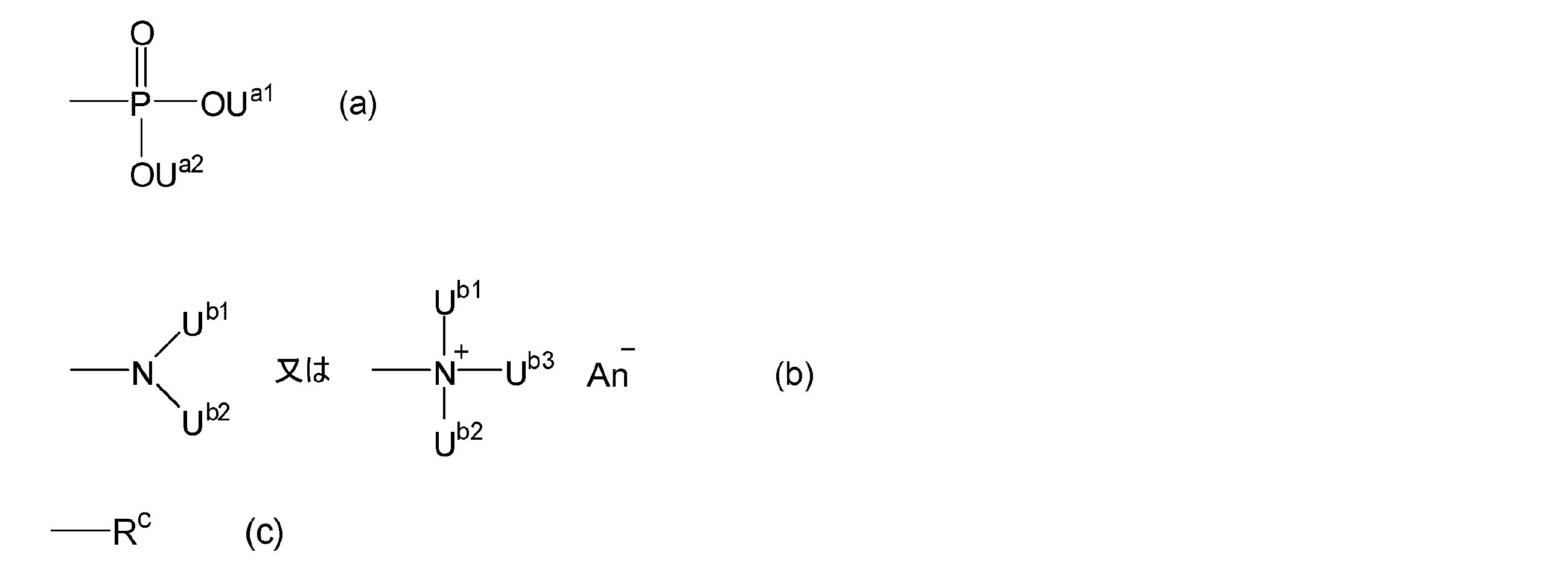
Ua1、Ua2、Ub1、Ub2及びUb3は、それぞれ独立して、水素原子又は炭素原子数1乃至5の直鎖若しくは分岐アルキル基を表し;
Rcは、炭素原子数1乃至18の直鎖若しくは分岐アルキル基、炭素原子数3乃至10の脂環式炭化水素基、炭素原子数6乃至10のアリール基、炭素原子数7乃至15のアラルキル基又は炭素原子数7乃至15のアリールオキシアルキル基(ここで、前記アリール部分は、ハロゲン原子で置換されていてもよい炭素原子数1乃至5の直鎖若しくは分岐アルキル基で置換されていてもよい)を表し;
An-は、ハロゲン化物イオン、無機酸イオン、水酸化物イオン及びイソチオシアネートイオンからなる群から選ばれる陰イオンを表す]が表面の少なくとも一部にコーティングされていることを特徴とする、細胞培養容器である。
本発明における細胞とは、動物又は植物を構成する最も基本的な単位であり、その要素として細胞膜の内部に細胞質と各種の細胞小器官をもつものである。この際、DNAを内包する核は、細胞内部に含まれても含まれなくてもよい。例えば、本発明における動物由来の細胞には、精子や卵子などの生殖細胞、生体を構成する体細胞、幹細胞(多能性幹細胞等)、前駆細胞、生体から分離された癌細胞、生体から分離され不死化能を獲得して体外で安定して維持される細胞(細胞株)、生体から分離され人為的に遺伝子改変が成された細胞、生体から分離され人為的に核が交換された細胞等が含まれる。生体を構成する体細胞の例としては、以下に限定されるものではないが、線維芽細胞、骨髄細胞、Bリンパ球、Tリンパ球、好中球、赤血球、血小板、マクロファージ、単球、骨細胞、骨髄細胞、周皮細胞、樹状細胞、ケラチノサイト、脂肪細胞、間葉細胞、上皮細胞、表皮細胞、内皮細胞、血管内皮細胞、肝実質細胞、軟骨細胞、卵丘細胞、神経系細胞、グリア細胞、ニューロン、オリゴデンドロサイト、マイクログリア、星状膠細胞、心臓細胞、食道細胞、筋肉細胞(たとえば、平滑筋細胞又は骨格筋細胞)、膵臓ベータ細胞、メラニン細胞、造血前駆細胞(例えば、臍帯血由来のCD34陽性細胞)、及び単核細胞等が含まれる。当該体細胞は、例えば皮膚、腎臓、脾臓、副腎、肝臓、肺、卵巣、膵臓、子宮、胃、結腸、小腸、大腸、膀胱、前立腺、精巣、胸腺、筋肉、結合組織、骨、軟骨、血管組織、血液(臍帯血を含む)、骨髄、心臓、眼、脳又は神経組織などの任意の組織から採取される細胞が含まれる。幹細胞とは、自分自身を複製する能力と他の複数系統の細胞に分化する能力を兼ね備えた細胞であり、その例としては、以下に限定されるものではないが、胚性幹細胞(ES細胞)、胚性腫瘍細胞、胚性生殖幹細胞、人工多能性幹細胞(iPS細胞)、神経幹細胞、造血幹細胞、間葉系幹細胞、肝幹細胞、膵幹細胞、筋幹細胞、生殖幹細胞、腸幹細胞、癌幹細胞、毛包幹細胞などが含まれる。多能性幹細胞としては、前記幹細胞のうち、ES細胞、胚性生殖幹細胞、iPS細胞が挙げられる。前駆細胞とは、前記幹細胞から特定の体細胞や生殖細胞に分化する途中の段階にある細胞である。癌細胞とは、体細胞から派生して無限の増殖能を獲得した細胞である。細胞株とは、生体外での人為的な操作により無限の増殖能を獲得した細胞である。
がん細胞株の例としては、以下に限定されるものではないが、ヒト乳がん細胞株としてHBC-4、BSY-1、BSY-2、MCF-7、MCF-7/ADR RES、HS578T、MDA-MB-231、MDA-MB-435、MDA-N、BT-549、T47D、ヒト子宮頸がん細胞株としてHeLa、ヒト肺がん細胞株としてA549、EKVX、HOP-62、HOP-92、NCI-H23、NCI-H226、NCI-H322M、NCI-H460、NCI-H522、DMS273、DMS114、ヒト大腸がん細胞株としてCaco-2、COLO-205、HCC-2998、HCT-15、HCT-116、HT-29、KM-12、SW-620、WiDr、ヒト前立腺がん細胞株としてDU-145、PC-3、LNCaP、ヒト中枢神経系がん細胞株としてU251、SF-295、SF-539、SF-268、SNB-75、SNB-78、SNB-19、ヒト卵巣がん細胞株としてOVCAR-3、OVCAR-4、OVCAR-5、OVCAR-8、SK-OV-3、IGROV-1、ヒト腎がん細胞株としてRXF-631L、ACHN、UO-31、SN-12C、A498、CAKI-1、RXF-393L、786-0、TK-10、ヒト胃がん細胞株としてMKN45、MKN28、St-4、MKN-1、MKN-7、MKN-74、皮膚がん細胞株としてLOX-IMVI、LOX、MALME-3M、SK-MEL-2、SK-MEL-5、SK-MEL-28、UACC-62、UACC-257、M14、白血病細胞株としてCCRF-CRM、K562、MOLT-4、HL-60TB、RPMI8226、SR、UT7/TPO、Jurkat等が挙げられる。細胞株の例としては、以下に限定されるものではないが、HEK293(ヒト胎児腎細胞)、MDCK、MDBK、BHK、C-33A、AE-1、3D9、Ns0/1、NIH3T3、PC12、S2、Sf9、Sf21、High Five(登録商標)、Vero等が含まれる。肝細胞株の例としては、以下に限定されるものではないが、HepG2、Hep3B、HepaRG(登録商標)、JHH7、HLF、HLE、PLC/PRF/5、WRL68、HB611、SK-HEP-1、HuH-4、HuH-7等が挙げられる。
本発明の細胞培養容器を構成する、共重合体がコーティングされる容器は、当技術分野で使用され得る任意の形態の容器類であればよく、例えば、細胞の培養に一般的に用いられるシャーレ、フラスコ、プラスチックバック、テフロン(登録商標)バック、ディッシュ、ペトリデッシュ、組織培養用ディッシュ、マルチディッシュ、マイクロプレート、マイクロウエルプレート、マルチプレート、マルチウェルプレート、チャンバースライド、細胞培養フラスコ、スピナーフラスコ、チューブ、トレイ、培養バック、ローラーボトル等が挙げられる。好ましくは、6~1536穴のマルチウェルプレート及びシャーレが挙げられる。
本発明の細胞培養容器は、容器の表面の少なくとも一部が、特定の共重合体でコーティングされていることを特徴とする。本発明に係る共重合体は、下記式(a)で表される基を含む繰り返し単位と、下記式(b)で表される基を含む繰り返し単位と、下記式(c)で表される基を含む繰り返し単位とを含む共重合体:
Ua1、Ua2、Ub1、Ub2及びUb3は、それぞれ独立して、水素原子又は炭素原子数1乃至5の直鎖若しくは分岐アルキル基を表し;
Rcは、炭素原子数1乃至18の直鎖若しくは分岐アルキル基、炭素原子数3乃至10の脂環式炭化水素基、炭素原子数6乃至10のアリール基、炭素原子数7乃至15のアラルキル基又は炭素原子数7乃至15のアリールオキシアルキル基(ここで、前記アリール部分は、ハロゲン原子で置換されていてもよい炭素原子数1乃至5の直鎖若しくは分岐アルキル基で置換されていてもよい)を表し;
An-は、ハロゲン化物イオン、無機酸イオン、水酸化物イオン及びイソチオシアネートイオンからなる群から選ばれる陰イオンを表す]である。
Ta、Tb、Tc、Ua1、Ua2、Ub1、Ub2及びUb3は、それぞれ独立して、水素原子又は炭素原子数1乃至5の直鎖若しくは分岐アルキル基を表し;
Qa及びQbは、それぞれ独立して、単結合、エステル結合又はアミド結合を表し、Qcは、単結合、エーテル結合又はエステル結合を表し;
Ra及びRbは、それぞれ独立して、ハロゲン原子で置換されていてもよい炭素原子数1乃至10の直鎖又は分岐アルキレン基を表し、Rcは、炭素原子数1乃至18の直鎖若しくは分岐アルキル基、炭素原子数3乃至10の脂環式炭化水素基、炭素原子数6乃至10のアリール基、炭素原子数7乃至15のアラルキル基又は炭素原子数7乃至15のアリールオキシアルキル基(ここで、前記アリール部分は、ハロゲン原子で置換されていてもよい炭素原子数1乃至5の直鎖若しくは分岐アルキル基で置換されていてもよい)を表し;An-は、ハロゲン化物イオン、無機酸イオン、水酸化物イオン及びイソチオシアネートイオンからなる群から選ばれる陰イオンを表し;
mは、0乃至6の整数を表す]で表されるモノマーである。したがって、式(A)、(B)及び(C)で表されるモノマーから誘導される繰り返し単位は、それぞれ、下記式(a1)、(b1)及び(c1):

好ましくは、
式(a1):3モル%乃至80モル%、式(b1):3モル%乃至80モル%、式(c1):1モル%乃至90モル%、
より好ましくは、
式(a1):3.5モル%乃至50モル%、式(b1):5モル%乃至70モル%、式(c1):3モル%乃至88モル%、
さらに好ましくは、
式(a1):4モル%乃至40モル%、式(b1):8モル%乃至65モル%、式(c1):5モル%乃至87モル%、
である。
式(E)で表される2官能性モノマーは、好ましくは、リン酸ビス(メタクリロイルオキシメチル)、リン酸ビス[(2-メタクリロイルオキシ)エチル]、リン酸ビス[3-(メタクリロイルオキシ)プロピル]、又は上記式(A-3)由来の2官能性モノマーが挙げられる。

上記共重合体中における第4成分、例えば、上記式(D)又は(E)で表される2官能性モノマーから誘導される架橋構造の割合は、0モル%乃至50モル%である。
式(B)で表される化合物の、上記共重合体を形成するモノマー全体に対する割合は、3モル%乃至80モル%であり、好ましくは5モル%乃至70モル%であり、さらに好ましくは8モル%乃至65モル%である。また、式(B)で表される化合物は、2種以上であってもよい。
式(C)で表される化合物の、上記共重合体を形成するモノマー全体に対する割合は、上記式(A)及び(B)の割合を差し引いた残部全てでも良いし、上記式(A)及び(B)と上記第4成分との合計割合を差し引いた残部であってもよいが、例えば1モル%乃至90モル%であり、好ましくは3モル%乃至88モル%であり、さらに好ましくは5モル%乃至87モル%である。また、式(C)で表される化合物は、2種以上であってもよい。

を挙げることができる。そのような構造を有するエチレン性不飽和モノマーの例としては、2-メタクリロイルオキシエチルホスホリルコリン(MPC)等を挙げることができる。

[ここで、R16、R17及びR18は、互いに独立して、水素原子又は有機基(例えば、メチル基、ヒドロキシメチル基又はヒドロキシエチル基等)である]
で表される基を意味する。そのような構造を有するエチレン性不飽和モノマーの例としては、(メタ)アクリルアミド、N-(ヒドロキシメチル)(メタ)アクリルアミド等を挙げることができる。さらに、そのような構造を有するモノマー又はポリマーは、例えば、特開2010-169604号公報等に開示されている。

[ここで、R22は、有機基(例えば、炭素原子数1乃至10の有機基、好ましくは、1個以上のヒドロキシ基を有する炭素原子数1乃至10のアルキル基等)である]
で表される基を意味する。そのような構造を有するポリマーとして、特開2014-48278号公報等に開示された共重合体を挙げることができる。
本発明に係る共重合体は、一般的なアクリルポリマー又はメタクリルポリマー等の合成方法であるラジカル重合、アニオン重合、カチオン重合などの方法により合成することができる。その形態は溶液重合、懸濁重合、乳化重合、塊状重合など種々の方法が可能である。
本発明の第二の態様は、下記式(a)で表される基を含む繰り返し単位と、下記式(b)で表される基を含む繰り返し単位と、下記式(c)で表される基を含む繰り返し単位とを含む共重合体:

を含む、細胞培養容器の製造方法である。
本発明の細胞培養容器の製造方法のコーティング工程では、共重合体を、容器の表面の少なくとも一部にコーティングする。例えば、容器が丸底のマルチウェルプレートである場合、ウェルのくぼみの部分のみをコーティングしてもよいが、プレート全体をコーティングしてもよい。ここで、容器及び共重合体は、それぞれ前述の項目<容器>及び<共重合体>で述べた通りである。
コーティング工程後、好ましくはコーティングされた容器を-200℃乃至200℃の温度にて乾燥させる。乾燥により、上記コーティング膜形成用組成物中の溶媒を取り除くと共に、本発明に係る共重合体の式(a)及び式(b)同士がイオン結合を形成して基体へ完全に固着する。本発明の細胞培養容器のコーティングの膜厚は、10~1000Åが好ましく、10~500Åがより好ましく、10~300Åが特に好ましい。本発明者らは、本発明の細胞培養容器の製造方法では、高温での処理を要さず、低温での処理により、所望の特性を有するコーティングが容器の表面に形成され、しかも数十乃至数百Å程度の薄い膜厚にも係らず、耐久性に優れると共に、細胞やタンパク質に対する優れた付着抑制能を有することを見出した。
本発明の第三の態様は、本発明の細胞培養容器及び本発明の製造方法により得られた細胞培養容器(以下、両者を合わせて「本発明の細胞培養容器」という)を用いることを特徴とする、細胞凝集塊の製造方法である。本発明の細胞培養容器を用いると、細胞凝集塊の容器の表面への付着が抑制され、かつコーティングの培養液への溶出が抑制されることから、容器からの刺激のない状態で細胞凝集塊を培養することができる。細胞凝集塊は、好ましくは、本発明の細胞培養容器中で細胞又は組織を浮遊させる効果を有する多糖類(特に、脱アシル化ジェランガム)を含むことを特徴とする培地を用いて培養される。そのような培地の具体的な組成や、培養方法は、例えば、国際公開第2014/017513号公報に開示されている。
リン含有化合物を含む原料の、各リン含有化合物の濃度(質量%)測定は、31P-NMRにより行った。下記標準物質を用いて原料中に含まれる各リン含有化合物の絶対濃度(絶対質量%)を算出した。
・モード:逆ゲートデカップリングモード(定量モード)
・装置:varian 400 MHz
・溶媒:CD3OD(重メタノール)(30重量%)
・回転数:0 Hz
・データポイント:64000
・フリップ角:90°
・待ち時間:70 s
・積算回数:16回,n=4,
・標準物質:トリメチルリン酸+D2O (75%TMP溶液を調製)
アシッドホスホオキシエチルメタクリレート(製品名;ホスマーM、ユニケミカル(株)製、乾固法100℃・1時間における不揮発分:91.8%、アシッドホスホオキシエチルメタクリレート(44.2質量%)、リン酸ビス[2-(メタクリロイルオキシ)エチル](28.6質量%)、その他の物質(27.2質量%)の混合物)7.00gに純水16.05gを加え十分に溶解した。次いで、エタノール48.16g、メタクリル酸2-(ジエチルアミノ)エチル9.41g(東京化成工業(株)製)、メタクリル酸ブチル1.34g(東京化成工業(株)製)、2,2’-アゾビス(N-(2-カルボキシエチル)-2-メチルプロピオンアミジン)n-水和物(VA-057、和光純薬工業(株)製)0.09gを、20℃以下に保ちながら、ホスマーMの水溶液に順に加えた。十分に攪拌して均一となった上記全てのものが入った混合液を、滴下ロートに導入した。一方で、別途純水96.31gを冷却管付きの3つ口フラスコに加えて窒素フローし、撹拌しながらリフラックス温度まで昇温した。この状態を維持しつつ、上記混合液を導入した滴下ロートを3つ口フラスコにセットし、2時間かけて混合液を純水とエタノールの沸騰液内に滴下した。滴下後、24時間上記環境を維持した状態で加熱撹拌することで固形分約10質量%の共重合体含有ワニス178.35gを得た。
アシッドホスホオキシエチルメタクリレート(製品名;ホスマーM、ユニケミカル(株)製、乾固法100℃・1時間における不揮発分:91.8%、アシッドホスホオキシエチルメタクリレート(44.2質量%)、リン酸ビス[2-(メタクリロイルオキシ)エチル](28.6質量%)、その他の物質(27.2質量%)の混合物)28.00gを60℃に維持しながら撹拌し、メタクリル酸2-(ジメチルアミノ)エチル21.37gを滴下した。そこに純水133.96g、次いで、エタノール44.65g、(東京化成工業(株)製)、2,2’-アゾビス(N-(2-カルボキシエチル)-2-メチルプロピオンアミジン)n-水和物(VA-057、和光純薬工業(株)製)0.25gを、20℃以下に保ちながら順に加えた。十分に攪拌して均一となった上記全てのものが入った混合液を、滴下ロートに導入した。一方で、別途純水267.93gを冷却管付きの3つ口フラスコに入れ、これを窒素フローし、撹拌しながらリフラックス温度まで昇温した。この状態を維持しつつ、上記混合液を導入した滴下ロートを3つ口フラスコにセットし、2時間かけて混合液を純水とエタノールの沸騰液内に滴下した。滴下後、24時間上記環境を維持した状態で加熱撹拌することで固形分約9.70質量%の共重合体含有ワニス496.16gを得た。得られた透明液体のGFCにおける重量平均分子量は約280,000であった。
(シリコンウェハの準備)
半導体評価用の市販のシリコンウェハをそのまま用いた。
Au蒸着された水晶振動子(Q-Sense,QSX304)を、UV/オゾン洗浄装置(UV253E、フィルジェン株式会社製)を用いて10分間洗浄し、直後に2-アミノエタンチオール(東京化成工業(株)製)0.0772gをエタノール1000mlに溶解した溶液中に24時間浸漬した。エタノールでセンサー表面を洗浄後自然乾燥し、ポリスチレン(PS)(Aldrich社製)1.00gをトルエン99.00gに溶解したワニスをスピンコーターにて3500rpm/30secで膜センサー側にスピンコートし、120℃/1min乾燥することでQCMセンサー(PS)とした。
上記合成例1で得られた共重合体含有ワニス5.00gに、純水31.5g、エタノール1.35g、1mol/L水酸化ナトリウム水溶液(1N)(関東化学(株)社製)0.24gを加えて十分に攪拌し、コーティング膜形成組成物を調製した。pHは7.3であった。得られたコーティング膜形成組成物中に、上記シリコンウェハをディップし、オーブンにて45℃、24時間乾燥させた。その後、コーティング膜上に付着している未硬化の膜形成用組成物をPBSと純水で十分に洗浄を行って、コーティング膜が形成されたシリコンウェハを得た。上記シリコンウェハを用いて光学式干渉膜厚計でコーティング膜の膜厚を確認したところ90Åであった。
また、上記コーティング膜形成用組成物を3500rpm/30secでQCMセンサー(PS)にスピンコートし、乾燥工程として45℃のオーブンで24時間ベークした。その後、洗浄工程として過剰についた未硬化のコーティング膜形成用組成物をPBSと超純水にて各2回ずつ洗浄し、表面処理済QCMセンサー(PS)を得た。
上記QCMセンサー(PS)をそのまま用いた。
上記比較合成例1で得られた共重合体含有ワニス45.00gに、純水265.92g、エタノール125.58g、1mol/L水酸化ナトリウム水溶液(1N)(関東化学(株)社製)8.18gを加えて十分に攪拌し、コーティング膜形成用組成物を調製した。実施例と同様の方法にて、コーティング膜が形成されたシリコンウェハ、又は表面処理済QCMセンサー(PS)を得た。上記シリコンウェハを用いて光学式干渉膜厚計でコーティング膜の膜厚を確認したところ44Åであった。
調製例1~3で得た表面処理済QCMセンサー(PS)を散逸型水晶振動子マイクロバランスQCM-D(E4、Q-Sense)に取り付け、周波数の変化が1時間で1Hz以下となる安定したベースラインを確立するまでPBSを流した。次に、安定したベースラインの周波数を0Hzとして約10分間PBSを流した。引き続き、41010 - Basal Medium Eagle (BME), no Glutamine(サーモフィッシャーサイエンティフィック株式会社製)に15wt%のウシ血清(FBS)、L-Glutamine、抗生物質としてペニシリンとストレプトマイシンを添加した溶液を約30分流し、その後再びPBSを約20分流した後の11次オーバートーンの吸着誘起周波数のシフト(Δf)を読み取った。分析のためにQ-Tools(Q-Sense)を使用して、吸着誘起周波数のシフト(Δf)を、Sauerbrey式で説明される吸着誘起周波数のシフト(Δf)を単位面積当たりの質量(ng/cm2)と換算したものを生体物質の付着量として下記の表1に示す。本発明に係る合成例1の共重合体をコーティングとして用いた調製例1は、コーティングなしの調製例2及び比較合成例1の共重合体をコーティングとして用いた調製例3と比較し、1桁低い各種タンパク質吸着量を示した。

以下の各処理工程を順番に実施し、本発明における細胞培養容器を調製した。
処理1:合成例1で調製した共重合体含有ワニスを、メッシュサイズが0.22μmのフィルターを用いてろ過した後、96穴細胞培養プレート(BDバイオサイエンス社製、#351172)のウェルに200μL(固形分1質量%)/ウェルとなるよう添加し、室温にて1時間静置後、過剰のワニスを除去した。
実施例1で使用した、合成例1で調製した共重合体含有ワニスを、比較合成例1で調製した共重合体含有ワニスに代えた以外は、実施例1と同様にして、コーティングされた細胞培養容器を得た。
(コーティングプレートの調製)
実施例1及び比較例1で得られたコーティングされた細胞培養容器を用いた。陽性対照のサンプルとしては、市販の細胞低接着プレート(コーニング社製、#3474)を用いた。陰性対照としては、コーティングを施していない96穴細胞培養プレート(BDバイオサイエンス社製、#351172)を用いた。
細胞は、マウス胚線維芽細胞C3H10T1/2(DSファーマバイオメディカル社製)を用いた。細胞の培養に用いた培地は、10%FBS(HyClone社製)とL-グルタミン-ペニシリン-ストレプトマイシン安定化溶液(Sigma-Aldrich社製)を含むBME培地(サーモフィッシャーサイエンティフィック社製)を用いた。細胞は、37℃/CO2インキュベーター内にて5%二酸化炭素濃度を保った状態で、直径10cmのシャーレ(培地10mL)を用いて2日間以上静置培養した。引き続き、本細胞をPBS5mlで洗浄した後、トリプシン-EDTA溶液(インビトロジェン社製)1mLを添加して細胞を剥がし、上記の培地10mLにてそれぞれ懸濁した。本懸濁液を遠心分離(株式会社トミー精工製、型番LC-200、1000rpm/3分、室温)後、上清を除き、上記の培地を添加して細胞懸濁液を調製した。
上記にて調製したプレートに対して、それぞれの細胞懸濁液を2×10³cells/wellとなるように各100μL加えた。その後、5%二酸化炭素濃度を保った状態で、37℃で4日間CO2インキュベーター内にて静置した。
培養4日間後、実施例1のプレート、比較例1のプレート、陽性対照、及び陰性対照のプレートに対する細胞の付着を倒立型顕微鏡(オリンパス社製、CKX31)による観察(倍率:4倍)に基づき比較した。実施例1のプレート、比較例1のプレート、及び陽性対照のプレートで、細胞の付着はほとんど見られなかった。各プレートの結果(培養4日間後)を図1に示す。また、Cell Counting Kit-8溶液(同仁化学研究所製)を1ウェル当たり10μL添加し、37℃で2時間CO2インキュベーター内にて静置した。その後、吸光度計(MolecularDevices社製、SpectraMax)で450nmの吸光度を測定した。各測定値は、それぞれ培地のみを添加したウェルでの測定値を差し引いた。その結果を表2に示す。
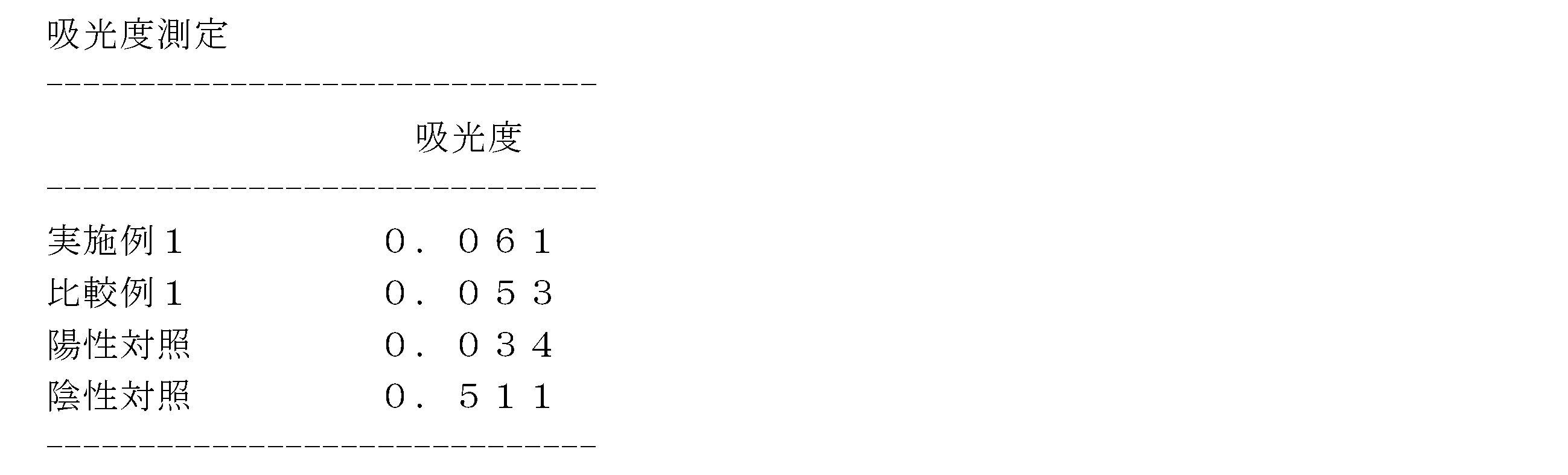
Claims (13)
- 下記式(a)で表される基を含む繰り返し単位と、下記式(b)で表される基を含む繰り返し単位と、下記式(c)で表される基を含む繰り返し単位とを含む共重合体:

[式中、
Ua1、Ua2、Ub1、Ub2及びUb3は、それぞれ独立して、水素原子又は炭素原子数1乃至5の直鎖若しくは分岐アルキル基を表し;
Rcは、炭素原子数1乃至18の直鎖若しくは分岐アルキル基、炭素原子数3乃至10の脂環式炭化水素基、炭素原子数6乃至10のアリール基、炭素原子数7乃至15のアラルキル基又は炭素原子数7乃至15のアリールオキシアルキル基(ここで、前記アリール部分は、ハロゲン原子で置換されていてもよい炭素原子数1乃至5の直鎖若しくは分岐アルキル基で置換されていてもよい)を表し;
An-は、ハロゲン化物イオン、無機酸イオン、水酸化物イオン及びイソチオシアネートイオンからなる群から選ばれる陰イオンを表す]
が表面にコーティングされていることを特徴とする、細胞培養容器。 - 上記式(a)、(b)及び(c)で表される基を含む繰り返し単位が、それぞれ、下記式(A)、(B)及び(C):
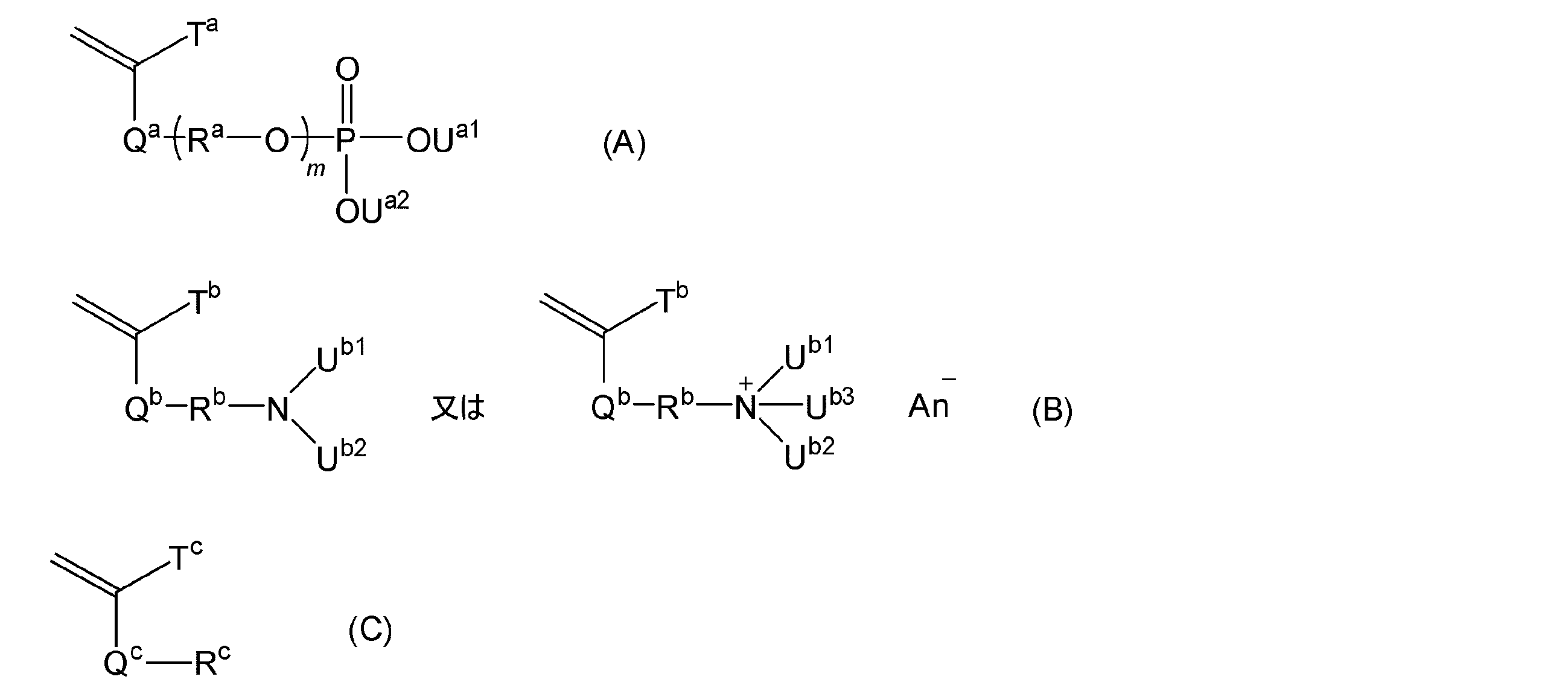
[式中、
Ta、Tb、Tc、Ua1、Ua2、Ub1、Ub2及びUb3は、それぞれ独立して、水素原子又は炭素原子数1乃至5の直鎖若しくは分岐アルキル基を表し;
Qa及びQbは、それぞれ独立して、単結合、エステル結合又はアミド結合を表し、Qcは、単結合、エーテル結合又はエステル結合を表し;
Ra及びRbは、それぞれ独立して、ハロゲン原子で置換されていてもよい炭素原子数1乃至10の直鎖又は分岐アルキレン基を表し、Rcは、炭素原子数1乃至18の直鎖若しくは分岐アルキル基、炭素原子数3乃至10の脂環式炭化水素基、炭素原子数6乃至10のアリール基、炭素原子数7乃至15のアラルキル基又は炭素原子数7乃至15のアリールオキシアルキル基(ここで、前記アリール部分は、ハロゲン原子で置換されていてもよい炭素原子数1乃至5の直鎖若しくは分岐アルキル基で置換されていてもよい)を表し;An-は、ハロゲン化物イオン、無機酸イオン、水酸化物イオン及びイソチオシアネートイオンからなる群から選ばれる陰イオンを表し;
mは、0乃至6の整数を表す]
で表されるモノマーから誘導される繰り返し単位である、請求項1に記載の細胞培養容器。 - mが1であり、Ra及びRbが、それぞれ独立して、エチレン基又はプロピレン基を表す、請求項2に記載の細胞培養容器。
- 上記共重合体が、さらに下記式(D)又は(E):
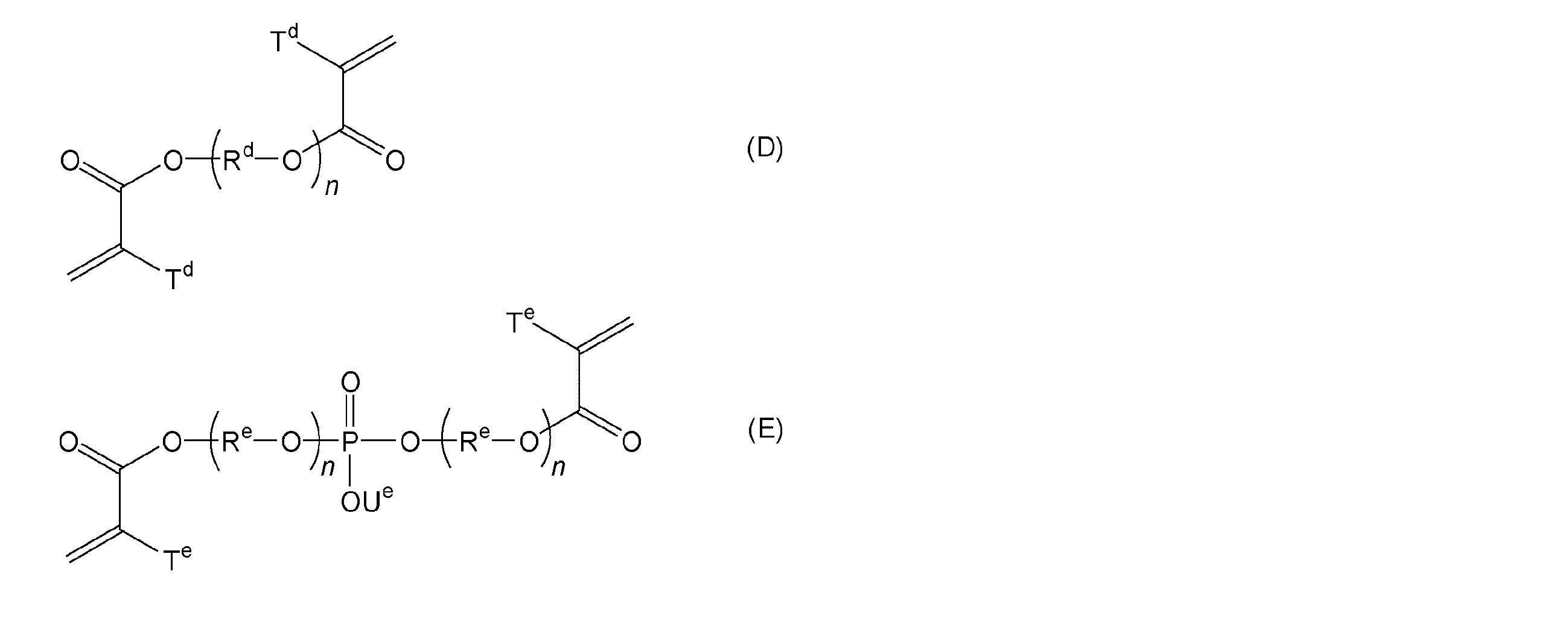
[式中、
Td、Te及びUeは、それぞれ独立して、水素原子又は炭素原子数1乃至5の直鎖若しくは分岐アルキル基を表し、
Rd及びReは、それぞれ独立して、ハロゲン原子で置換されていてもよい炭素原子数1乃至10の直鎖又は分岐アルキレン基を表し;
nは、1乃至6の整数を表わす]
で表されるモノマーから誘導される架橋構造を含む、請求項1乃至3何れかに記載の細胞培養容器。 - Td及びTeが、それぞれ独立して、水素原子又はメチル基を表し、Ueが、水素原子を表し、Rd及びReが、それぞれ独立して、エチレン基又はプロピレン基を表す、請求項4に記載の細胞培養容器。
- タンパク質の付着抑制能を有する、請求項1乃至5何れかに記載の細胞培養容器。
- 下記式(a)で表される基を含む繰り返し単位と、下記式(b)で表される基を含む繰り返し単位と、下記式(c)で表される基を含む繰り返し単位とを含む共重合体:

[式中、
Ua1、Ua2、Ub1、Ub2及びUb3は、それぞれ独立して、水素原子又は炭素原子数1乃至5の直鎖若しくは分岐アルキル基を表し;
Rcは、炭素原子数1乃至18の直鎖若しくは分岐アルキル基、炭素原子数3乃至10の脂環式炭化水素基、炭素原子数6乃至10のアリール基、炭素原子数7乃至15のアラルキル基又は炭素原子数7乃至15のアリールオキシアルキル基(ここで、前記アリール部分は、ハロゲン原子で置換されていてもよい炭素原子数1乃至5の直鎖若しくは分岐アルキル基で置換されていてもよい)を表し;
An-は、ハロゲン化物イオン、無機酸イオン、水酸化物イオン及びイソチオシアネートイオンからなる群から選ばれる陰イオンを表す]
を、容器の表面の少なくとも一部にコーティングする工程
を含む、細胞培養容器の製造方法。 - 上記式(a)、(b)及び(c)で表される基を含む繰り返し単位が、それぞれ、下記式(A)、(B)及び(C):
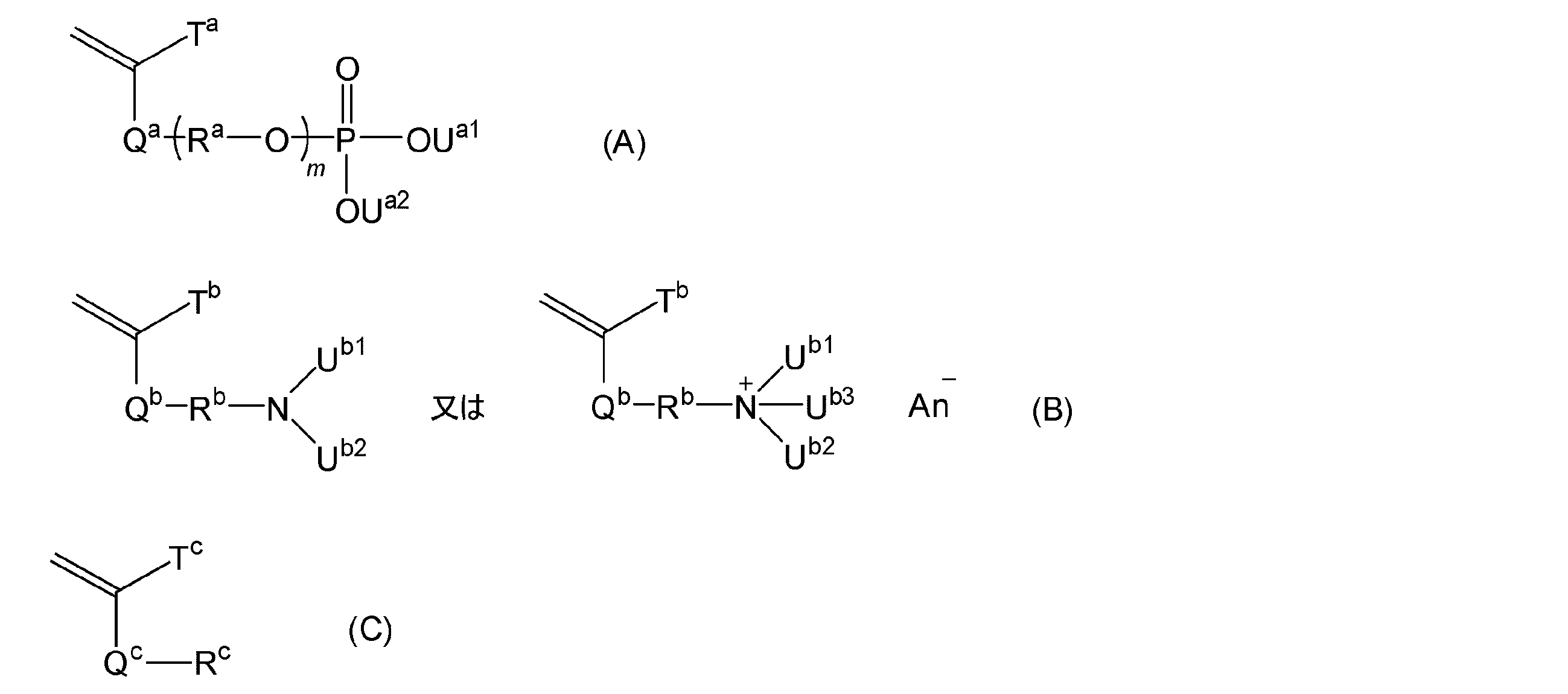
[式中、
Ta、Tb、Tc、Ua1、Ua2、Ub1、Ub2及びUb3は、それぞれ独立して、水素原子又は炭素原子数1乃至5の直鎖若しくは分岐アルキル基を表し;
Qa及びQbは、それぞれ独立して、単結合、エステル結合又はアミド結合を表し、Qcは、単結合、エーテル結合又はエステル結合を表し;
Ra及びRbは、それぞれ独立して、ハロゲン原子で置換されていてもよい炭素原子数1乃至10の直鎖又は分岐アルキレン基を表し、Rcは、炭素原子数1乃至18の直鎖若しくは分岐アルキル基、炭素原子数3乃至10の脂環式炭化水素基、炭素原子数6乃至10のアリール基、炭素原子数7乃至15のアラルキル基又は炭素原子数7乃至15のアリールオキシアルキル基(ここで、前記アリール部分は、ハロゲン原子で置換されていてもよい炭素原子数1乃至5の直鎖若しくは分岐アルキル基で置換されていてもよい)を表し;An-は、ハロゲン化物イオン、無機酸イオン、水酸化物イオン及びイソチオシアネートイオンからなる群から選ばれる陰イオンを表し;
mは、0乃至6の整数を表す]
で表されるモノマーから誘導される繰り返し単位である、請求項7に記載の製造方法。 - コーティング工程が、共重合体を含むワニスを用いて実施される、請求項7又は8に記載の製造方法。
- 共重合体を含むワニスが、予めpH調整されている、請求項9に記載の製造方法。
- さらに、コーティングされた細胞培養容器を、乾燥工程前及び/又は後に、洗浄する工程を含む、請求項7乃至10何れか1項に記載の製造方法。
- 乾燥工程後の洗浄が、水及び電解質を含む水溶液からなる群より選ばれる少なくとも1種の溶媒を用いて実施される、請求項11に記載の製造方法。
- 請求項1乃至6何れか1項に記載の細胞培養容器又は請求項7乃至12何れか1項に記載の製造方法により製造された細胞培養容器を用いることを特徴とする、細胞凝集塊の製造方法。
Priority Applications (5)
| Application Number | Priority Date | Filing Date | Title |
|---|---|---|---|
| EP17802787.6A EP3467095A4 (en) | 2016-05-27 | 2017-05-23 | CELL CULTURE VESSEL |
| CN201780032531.0A CN109196089A (zh) | 2016-05-27 | 2017-05-23 | 细胞培养容器 |
| KR1020187036960A KR20190013856A (ko) | 2016-05-27 | 2017-05-23 | 세포 배양 용기 |
| JP2018519553A JP6965878B2 (ja) | 2016-05-27 | 2017-05-23 | 細胞培養容器 |
| US16/305,002 US20190233792A1 (en) | 2016-05-27 | 2017-05-23 | Cell culture vessel |
Applications Claiming Priority (2)
| Application Number | Priority Date | Filing Date | Title |
|---|---|---|---|
| JP2016-106041 | 2016-05-27 | ||
| JP2016106041 | 2016-05-27 |
Publications (1)
| Publication Number | Publication Date |
|---|---|
| WO2017204201A1 true WO2017204201A1 (ja) | 2017-11-30 |
Family
ID=60412385
Family Applications (1)
| Application Number | Title | Priority Date | Filing Date |
|---|---|---|---|
| PCT/JP2017/019147 Ceased WO2017204201A1 (ja) | 2016-05-27 | 2017-05-23 | 細胞培養容器 |
Country Status (7)
| Country | Link |
|---|---|
| US (1) | US20190233792A1 (ja) |
| EP (1) | EP3467095A4 (ja) |
| JP (1) | JP6965878B2 (ja) |
| KR (1) | KR20190013856A (ja) |
| CN (1) | CN109196089A (ja) |
| TW (1) | TW201809041A (ja) |
| WO (1) | WO2017204201A1 (ja) |
Cited By (6)
| Publication number | Priority date | Publication date | Assignee | Title |
|---|---|---|---|---|
| WO2019065714A1 (ja) * | 2017-09-26 | 2019-04-04 | 日産化学株式会社 | 微小容積を有する細胞培養容器 |
| WO2019093442A1 (ja) * | 2017-11-10 | 2019-05-16 | 日産化学株式会社 | 細胞培養容器 |
| WO2019107503A1 (ja) * | 2017-11-29 | 2019-06-06 | 日産化学株式会社 | 長期培養可能な細胞培養容器及びその製造方法 |
| WO2020166605A1 (ja) * | 2019-02-12 | 2020-08-20 | 日産化学株式会社 | 生体物質への適合性を有するポリマーの製造方法 |
| CN112567021A (zh) * | 2018-08-24 | 2021-03-26 | 日产化学株式会社 | 作为细胞培养的基底膜使用的聚合物的制造方法及细胞培养容器 |
| US11470841B2 (en) | 2016-06-15 | 2022-10-18 | Nissan Chemical Corporation | Cryopreservation vessel |
Families Citing this family (7)
| Publication number | Priority date | Publication date | Assignee | Title |
|---|---|---|---|---|
| CA2914618A1 (en) * | 2013-06-07 | 2014-12-11 | Nissan Chemical Industries, Ltd. | Cell culture vessel |
| EP3882627B1 (en) * | 2018-11-14 | 2024-07-10 | Nissan Chemical Corporation | Container and method for storing, pretreating, and analyzing biomaterial |
| WO2021167037A1 (ja) * | 2020-02-19 | 2021-08-26 | 日産化学株式会社 | 生体物質付着抑制剤 |
| WO2021167042A1 (ja) * | 2020-02-21 | 2021-08-26 | 日産化学株式会社 | 細胞凝集速度が制御可能な細胞培養器 |
| JP7768513B2 (ja) * | 2020-02-21 | 2025-11-12 | 日産化学株式会社 | 細胞凝集塊の製造方法 |
| WO2021256553A1 (ja) * | 2020-06-19 | 2021-12-23 | 日産化学株式会社 | リン酸基含有ポリマーを含むコーティング膜形成組成物 |
| CA3249143A1 (en) * | 2022-02-25 | 2023-08-31 | Duogenic StemCells Corporation | Cell proliferation apparatuses and uses thereof |
Citations (10)
| Publication number | Priority date | Publication date | Assignee | Title |
|---|---|---|---|---|
| JP2008061609A (ja) | 2006-09-08 | 2008-03-21 | Sumitomo Bakelite Co Ltd | 細胞培養容器の製造方法および細胞培養容器。 |
| JP2008533489A (ja) | 2005-03-15 | 2008-08-21 | 住友ベークライト株式会社 | 医療材料用高分子化合物及び該高分子化合物を用いたバイオチップ用基板 |
| JP2010169604A (ja) | 2009-01-26 | 2010-08-05 | Jsr Corp | 非特異吸着防止剤および物品のコーティング方法 |
| WO2013144372A1 (en) | 2012-03-30 | 2013-10-03 | The Provost, Fellows, Foundation Scholars, And The Other Members Of Board, Of The College Of The Holy And Undivided Trinity Of Queen Elizabeth, Near Dublin | Cell suspension medium and cell suspension medium additive for the three dimensional growth of cells |
| WO2014017513A1 (ja) | 2012-07-24 | 2014-01-30 | 日産化学工業株式会社 | 培地組成物及び当該組成物を用いた細胞又は組織の培養方法 |
| JP2014048278A (ja) | 2012-09-04 | 2014-03-17 | Jsr Corp | 無機材料で構成される表面用の表面処理剤、該表面処理剤でコーティングされた器具、その製造方法、及び新規重合体 |
| JP2014120410A (ja) * | 2012-12-19 | 2014-06-30 | Toyo Ink Sc Holdings Co Ltd | 二次電池電極形成用組成物、二次電池電極、及び二次電池 |
| WO2014196652A1 (ja) | 2013-06-07 | 2014-12-11 | 日産化学工業株式会社 | 細胞培養器 |
| WO2016072369A1 (ja) * | 2014-11-04 | 2016-05-12 | 日油株式会社 | 胚様体形成用容器の製造方法 |
| WO2016093293A1 (ja) * | 2014-12-10 | 2016-06-16 | 日産化学工業株式会社 | 生体物質の付着抑制能を有するイオンコンプレックス材料及びその製造方法 |
Family Cites Families (2)
| Publication number | Priority date | Publication date | Assignee | Title |
|---|---|---|---|---|
| JPH06284882A (ja) * | 1993-04-01 | 1994-10-11 | Nippon Sherwood Kk | 水酸アパタイトをコーティングした培養床 |
| CN102229694A (zh) * | 2011-05-16 | 2011-11-02 | 山东交通学院 | H型聚乙二醇-b-(聚苯乙烯-b-聚全氟己基乙基丙烯酸酯)4嵌段共聚物及其制备方法 |
-
2017
- 2017-05-23 US US16/305,002 patent/US20190233792A1/en not_active Abandoned
- 2017-05-23 JP JP2018519553A patent/JP6965878B2/ja not_active Expired - Fee Related
- 2017-05-23 WO PCT/JP2017/019147 patent/WO2017204201A1/ja not_active Ceased
- 2017-05-23 KR KR1020187036960A patent/KR20190013856A/ko not_active Withdrawn
- 2017-05-23 EP EP17802787.6A patent/EP3467095A4/en not_active Withdrawn
- 2017-05-23 CN CN201780032531.0A patent/CN109196089A/zh active Pending
- 2017-05-26 TW TW106117676A patent/TW201809041A/zh unknown
Patent Citations (11)
| Publication number | Priority date | Publication date | Assignee | Title |
|---|---|---|---|---|
| JP2008533489A (ja) | 2005-03-15 | 2008-08-21 | 住友ベークライト株式会社 | 医療材料用高分子化合物及び該高分子化合物を用いたバイオチップ用基板 |
| JP2008061609A (ja) | 2006-09-08 | 2008-03-21 | Sumitomo Bakelite Co Ltd | 細胞培養容器の製造方法および細胞培養容器。 |
| JP2010169604A (ja) | 2009-01-26 | 2010-08-05 | Jsr Corp | 非特異吸着防止剤および物品のコーティング方法 |
| WO2013144372A1 (en) | 2012-03-30 | 2013-10-03 | The Provost, Fellows, Foundation Scholars, And The Other Members Of Board, Of The College Of The Holy And Undivided Trinity Of Queen Elizabeth, Near Dublin | Cell suspension medium and cell suspension medium additive for the three dimensional growth of cells |
| WO2014017513A1 (ja) | 2012-07-24 | 2014-01-30 | 日産化学工業株式会社 | 培地組成物及び当該組成物を用いた細胞又は組織の培養方法 |
| JP2014048278A (ja) | 2012-09-04 | 2014-03-17 | Jsr Corp | 無機材料で構成される表面用の表面処理剤、該表面処理剤でコーティングされた器具、その製造方法、及び新規重合体 |
| JP2014120410A (ja) * | 2012-12-19 | 2014-06-30 | Toyo Ink Sc Holdings Co Ltd | 二次電池電極形成用組成物、二次電池電極、及び二次電池 |
| WO2014196652A1 (ja) | 2013-06-07 | 2014-12-11 | 日産化学工業株式会社 | 細胞培養器 |
| WO2014196650A1 (ja) * | 2013-06-07 | 2014-12-11 | 日産化学工業株式会社 | 生体物質の付着抑制能を有するイオンコンプレックス材料及びその製造方法 |
| WO2016072369A1 (ja) * | 2014-11-04 | 2016-05-12 | 日油株式会社 | 胚様体形成用容器の製造方法 |
| WO2016093293A1 (ja) * | 2014-12-10 | 2016-06-16 | 日産化学工業株式会社 | 生体物質の付着抑制能を有するイオンコンプレックス材料及びその製造方法 |
Cited By (12)
| Publication number | Priority date | Publication date | Assignee | Title |
|---|---|---|---|---|
| US11470841B2 (en) | 2016-06-15 | 2022-10-18 | Nissan Chemical Corporation | Cryopreservation vessel |
| WO2019065714A1 (ja) * | 2017-09-26 | 2019-04-04 | 日産化学株式会社 | 微小容積を有する細胞培養容器 |
| US12291701B2 (en) | 2017-09-26 | 2025-05-06 | Nissan Chemical Corporation | Cell culture container having minute volume |
| WO2019093442A1 (ja) * | 2017-11-10 | 2019-05-16 | 日産化学株式会社 | 細胞培養容器 |
| WO2019107503A1 (ja) * | 2017-11-29 | 2019-06-06 | 日産化学株式会社 | 長期培養可能な細胞培養容器及びその製造方法 |
| CN112567021A (zh) * | 2018-08-24 | 2021-03-26 | 日产化学株式会社 | 作为细胞培养的基底膜使用的聚合物的制造方法及细胞培养容器 |
| JPWO2020040247A1 (ja) * | 2018-08-24 | 2021-08-26 | 日産化学株式会社 | 細胞培養の下地膜として使用するポリマーの製造方法及び細胞培養容器 |
| EP3842519A4 (en) * | 2018-08-24 | 2022-05-04 | Nissan Chemical Corporation | PROCESS FOR PREPARING A POLYMER FOR CELL CULTURE BASE FILM AND CELL CULTURE VESSEL |
| US11859035B2 (en) | 2018-08-24 | 2024-01-02 | Nissan Chemical Corporation | Method for producing polymer used as base film for cell culture, and cell culture container |
| JP7556290B2 (ja) | 2018-08-24 | 2024-09-26 | 日産化学株式会社 | 細胞培養の下地膜として使用するポリマーの製造方法及び細胞培養容器 |
| US12319765B2 (en) | 2018-08-24 | 2025-06-03 | Nissan Chemical Corporation | Method for producing polymer used as base film for cell culture, and cell culture container |
| WO2020166605A1 (ja) * | 2019-02-12 | 2020-08-20 | 日産化学株式会社 | 生体物質への適合性を有するポリマーの製造方法 |
Also Published As
| Publication number | Publication date |
|---|---|
| EP3467095A4 (en) | 2019-06-05 |
| JPWO2017204201A1 (ja) | 2019-03-22 |
| KR20190013856A (ko) | 2019-02-11 |
| TW201809041A (zh) | 2018-03-16 |
| US20190233792A1 (en) | 2019-08-01 |
| CN109196089A (zh) | 2019-01-11 |
| JP6965878B2 (ja) | 2021-11-10 |
| EP3467095A1 (en) | 2019-04-10 |
Similar Documents
| Publication | Publication Date | Title |
|---|---|---|
| JP6965878B2 (ja) | 細胞培養容器 | |
| JP6485349B2 (ja) | 細胞培養器 | |
| JP7131585B2 (ja) | 生体物質の付着抑制能を有するイオンコンプレックス材料及びその製造方法 | |
| JP7235139B2 (ja) | 薄膜段差被覆性を有するコーティング膜、該膜を備える構造基体 | |
| WO2019107503A1 (ja) | 長期培養可能な細胞培養容器及びその製造方法 | |
| JP7294134B2 (ja) | 微小容積を有する細胞培養容器 | |
| JP2024020421A (ja) | 細胞培養容器 | |
| JPWO2017006850A1 (ja) | 生体物質の付着抑制能を有するイオンコンプレックス材料及びその製造方法 | |
| WO2020166605A1 (ja) | 生体物質への適合性を有するポリマーの製造方法 |
Legal Events
| Date | Code | Title | Description |
|---|---|---|---|
| WWE | Wipo information: entry into national phase |
Ref document number: 2018519553 Country of ref document: JP |
|
| 121 | Ep: the epo has been informed by wipo that ep was designated in this application |
Ref document number: 17802787 Country of ref document: EP Kind code of ref document: A1 |
|
| NENP | Non-entry into the national phase |
Ref country code: DE |
|
| ENP | Entry into the national phase |
Ref document number: 20187036960 Country of ref document: KR Kind code of ref document: A |
|
| ENP | Entry into the national phase |
Ref document number: 2017802787 Country of ref document: EP Effective date: 20190102 |