WO2017204334A1 - Procédé de production d'une poudre d'oxyde complexe de nickel-lithium-métal de petite taille de particule - Google Patents
Procédé de production d'une poudre d'oxyde complexe de nickel-lithium-métal de petite taille de particule Download PDFInfo
- Publication number
- WO2017204334A1 WO2017204334A1 PCT/JP2017/019724 JP2017019724W WO2017204334A1 WO 2017204334 A1 WO2017204334 A1 WO 2017204334A1 JP 2017019724 W JP2017019724 W JP 2017019724W WO 2017204334 A1 WO2017204334 A1 WO 2017204334A1
- Authority
- WO
- WIPO (PCT)
- Prior art keywords
- nickel
- lithium
- lithium metal
- composite oxide
- oxide powder
- Prior art date
- Legal status (The legal status is an assumption and is not a legal conclusion. Google has not performed a legal analysis and makes no representation as to the accuracy of the status listed.)
- Ceased
Links
Images






Classifications
-
- C—CHEMISTRY; METALLURGY
- C01—INORGANIC CHEMISTRY
- C01G—COMPOUNDS CONTAINING METALS NOT COVERED BY SUBCLASSES C01D OR C01F
- C01G53/00—Compounds of nickel
- C01G53/40—Complex oxides containing nickel and at least one other metal element
- C01G53/42—Complex oxides containing nickel and at least one other metal element containing alkali metals, e.g. LiNiO2
-
- H—ELECTRICITY
- H01—ELECTRIC ELEMENTS
- H01M—PROCESSES OR MEANS, e.g. BATTERIES, FOR THE DIRECT CONVERSION OF CHEMICAL ENERGY INTO ELECTRICAL ENERGY
- H01M10/00—Secondary cells; Manufacture thereof
- H01M10/05—Accumulators with non-aqueous electrolyte
- H01M10/052—Li-accumulators
- H01M10/0525—Rocking-chair batteries, i.e. batteries with lithium insertion or intercalation in both electrodes; Lithium-ion batteries
-
- H—ELECTRICITY
- H01—ELECTRIC ELEMENTS
- H01M—PROCESSES OR MEANS, e.g. BATTERIES, FOR THE DIRECT CONVERSION OF CHEMICAL ENERGY INTO ELECTRICAL ENERGY
- H01M4/00—Electrodes
- H01M4/02—Electrodes composed of, or comprising, active material
- H01M4/36—Selection of substances as active materials, active masses, active liquids
- H01M4/48—Selection of substances as active materials, active masses, active liquids of inorganic oxides or hydroxides
- H01M4/52—Selection of substances as active materials, active masses, active liquids of inorganic oxides or hydroxides of nickel, cobalt or iron
- H01M4/525—Selection of substances as active materials, active masses, active liquids of inorganic oxides or hydroxides of nickel, cobalt or iron of mixed oxides or hydroxides containing iron, cobalt or nickel for inserting or intercalating light metals, e.g. LiNiO2, LiCoO2 or LiCoOxFy
-
- C—CHEMISTRY; METALLURGY
- C01—INORGANIC CHEMISTRY
- C01P—INDEXING SCHEME RELATING TO STRUCTURAL AND PHYSICAL ASPECTS OF SOLID INORGANIC COMPOUNDS
- C01P2002/00—Crystal-structural characteristics
- C01P2002/50—Solid solutions
- C01P2002/52—Solid solutions containing elements as dopants
- C01P2002/54—Solid solutions containing elements as dopants one element only
-
- C—CHEMISTRY; METALLURGY
- C01—INORGANIC CHEMISTRY
- C01P—INDEXING SCHEME RELATING TO STRUCTURAL AND PHYSICAL ASPECTS OF SOLID INORGANIC COMPOUNDS
- C01P2004/00—Particle morphology
- C01P2004/51—Particles with a specific particle size distribution
-
- C—CHEMISTRY; METALLURGY
- C01—INORGANIC CHEMISTRY
- C01P—INDEXING SCHEME RELATING TO STRUCTURAL AND PHYSICAL ASPECTS OF SOLID INORGANIC COMPOUNDS
- C01P2004/00—Particle morphology
- C01P2004/60—Particles characterised by their size
- C01P2004/61—Micrometer sized, i.e. from 1-100 micrometer
-
- C—CHEMISTRY; METALLURGY
- C01—INORGANIC CHEMISTRY
- C01P—INDEXING SCHEME RELATING TO STRUCTURAL AND PHYSICAL ASPECTS OF SOLID INORGANIC COMPOUNDS
- C01P2004/00—Particle morphology
- C01P2004/60—Particles characterised by their size
- C01P2004/62—Submicrometer sized, i.e. from 0.1-1 micrometer
-
- C—CHEMISTRY; METALLURGY
- C01—INORGANIC CHEMISTRY
- C01P—INDEXING SCHEME RELATING TO STRUCTURAL AND PHYSICAL ASPECTS OF SOLID INORGANIC COMPOUNDS
- C01P2006/00—Physical properties of inorganic compounds
- C01P2006/40—Electric properties
-
- H—ELECTRICITY
- H01—ELECTRIC ELEMENTS
- H01M—PROCESSES OR MEANS, e.g. BATTERIES, FOR THE DIRECT CONVERSION OF CHEMICAL ENERGY INTO ELECTRICAL ENERGY
- H01M4/00—Electrodes
- H01M4/02—Electrodes composed of, or comprising, active material
- H01M2004/026—Electrodes composed of, or comprising, active material characterised by the polarity
- H01M2004/028—Positive electrodes
-
- Y—GENERAL TAGGING OF NEW TECHNOLOGICAL DEVELOPMENTS; GENERAL TAGGING OF CROSS-SECTIONAL TECHNOLOGIES SPANNING OVER SEVERAL SECTIONS OF THE IPC; TECHNICAL SUBJECTS COVERED BY FORMER USPC CROSS-REFERENCE ART COLLECTIONS [XRACs] AND DIGESTS
- Y02—TECHNOLOGIES OR APPLICATIONS FOR MITIGATION OR ADAPTATION AGAINST CLIMATE CHANGE
- Y02E—REDUCTION OF GREENHOUSE GAS [GHG] EMISSIONS, RELATED TO ENERGY GENERATION, TRANSMISSION OR DISTRIBUTION
- Y02E60/00—Enabling technologies; Technologies with a potential or indirect contribution to GHG emissions mitigation
- Y02E60/10—Energy storage using batteries
Definitions
- the present invention relates to a method for producing nickel lithium metal composite oxide powder, nickel lithium metal composite oxide powder obtained by the production method, positive electrode active material comprising the same, lithium ion battery positive electrode and lithium using the positive electrode active material It relates to an ion battery.
- the positive electrode is a member in which a lithium-containing metal oxide called a positive electrode active material is disposed on the electrode. Lowering the cost of the positive electrode active material is indispensable for lowering the cost of the positive electrode and further reducing the cost of the battery.
- Niobium-based active materials that can be expected to have a high capacity as a positive electrode active material for lithium ion batteries.
- One typical high nickel-based active material is a composite metal oxide (NCA) containing cobalt and aluminum in addition to lithium and nickel.
- NCA composite metal oxide
- lithium hydroxide is used as a lithium source for nickel-based active materials such as NCA.
- Lithium carbonate is used as a lithium raw material when producing lithium cobaltate, which is a representative positive electrode active material for lithium ion batteries. In this case, it is usually fired at a temperature higher than the decomposition temperature of lithium carbonate. is there.
- lithium carbonate is used for manufacturing a high nickel-based positive electrode active material such as LNCAO and firing at a high temperature, there is a problem of causing a so-called cation mix.
- Lithium hydroxide is generally used (independent administrative agency, Petroleum Natural Gas / Metal Mineral Resources Organization 2012 Report, pages 148-154).
- lithium hydroxide an industrially synthesized lithium carbonate as a raw material by a reaction represented by the following formula is exclusively used (“Monthly Fine Chemical” November 2009, pages 81-82, CMC). Publication). Naturally, the price of lithium hydroxide is higher than the price of lithium carbonate, which is the raw material. (Production of lithium hydroxide from lithium carbonate) Li 2 CO 3 (aqueous solution) + Ca (OH) 2 (aqueous solution) ⁇ 2LiOH (aqueous solution) + CaCO 3 (solid) As described above, there is an increasing demand for higher performance and lower cost of lithium ion batteries, and it is necessary to improve the performance and cost of each component of the lithium ion battery and the materials constituting each member. Has been. Similarly, a positive electrode active material containing LNO is also required to have high quality and low cost.
- a bimodal mixture is a compound formed by mixing small particles of about one-twentieth to one-tenth of the average particle size of large particles with large particles in a ratio of about 8: 2 to 6: 4. It is a dispersed particle mixture, and the packing density of the particles is increased by filling the voids formed by the large particles with the small particles.
- a lithium secondary battery using an inorganic oxide as a positive electrode active material and carbon as a negative electrode active material is the inorganic oxide or negative electrode active material as the positive electrode active material.
- a lithium secondary battery characterized in that the average particle diameter of carbon is composed of at least two kinds, and the ratio of the particle diameter of the small particles is 0.3 mm or less when the particle diameter of the large particles is 1. It is disclosed.
- Japanese Patent Application Laid-Open No. 2006-318926 discloses a general formula Li x M 1-y N y O 2 ⁇ z (wherein M represents Co, Ni, or Mn, and N represents a transition metal element or atom different from M). Represents one or more elements selected from the group consisting of elements of number 11 or more, x represents a number in the range of 0.2 ⁇ x ⁇ 1.2, and y represents 0 ⁇ y ⁇ 0.5.
- z represents a number in the range of 0 ⁇ z ⁇ 1.0), or the general formula Li a Mn 2-b N b O 4-c (wherein N is the same as that described above)
- N is the same as that described above
- a represents a number in the range of 0 ⁇ a ⁇ 2.0
- b represents a number in the range of 0 ⁇ b ⁇ 0.6
- c represents 0 ⁇ c ⁇ 2.
- 0.0 represents a number in the range of 0.0), and the lithium composite oxide particles have two different types of average particle sizes in the range of 0.1 to 50 ⁇ m in average particle size.
- the particle size distribution of the lithium composite oxide particles has two or more peaks, the particle size ratio of the larger particle size peak and the smaller particle size peak is 1.4 or more,
- the blending ratio of the lithium composite oxide particles having the larger average particle diameter is 70 to 80% by mass, and the blending ratio of the lithium composite oxide particles having the smaller average particle diameter is 20 to 30% by weight.
- a featured positive electrode active material is disclosed. When producing such a positive electrode active material, small particles of about 1/20 to 1/10 of the large particles are required. For example, for large particles having an average particle size of 15 ⁇ m, it is necessary to combine very small particles having an average particle size of about 1.5 ⁇ m.
- the present invention is as follows.
- Lithium carbonate is used as a lithium source and includes the following Step 1 and / or Step 1 ′ and Step 2, and the cumulative% particle size representing particle distribution is 0.8 ⁇ m to 3.0 ⁇ m at D 0.001 ;
- D 10 represents 2.0 ⁇ m to 5.0 ⁇ m,
- D 50 represents 2.0 ⁇ m to 6.5 ⁇ m,
- D 90 represents 5.5 ⁇ m to 12.0 ⁇ m, and
- D 100 represents 10.0 ⁇ m to 20.0 ⁇ m.
- the manufacturing method of nickel lithium metal complex oxide powder which consists of nickel lithium metal complex oxide represented by (1).
- Step 1 Metal M hydroxide and / or metal M oxide and lithium carbonate as a precursor containing nickel hydroxide and / or nickel oxide and cobalt hydroxide and / or cobalt oxide To obtain a mixture.
- Step 1 ′ a precursor containing nickel hydroxide and / or nickel oxide, cobalt hydroxide and / or cobalt oxide, and metal M hydroxide and / or metal M oxide, A step of mixing lithium carbonate to obtain a mixture.
- Step 2 A step of firing the mixture obtained in step 1 and / or step 1 ′ at a temperature below the melting point of lithium carbonate to obtain a fired product.
- M is a metal that contains Al as an essential element and may contain an element selected from Mn, W, Nb, Mg, Zr, and Zn.
- Invention 2 The method for producing a nickel lithium metal composite oxide powder according to Invention 1, wherein a continuous furnace or a batch furnace is used in Step 2.
- Invention 3 The method for producing the nickel lithium metal composite oxide powder of Invention 1 or Invention 2, wherein a firing furnace selected from a rotary kiln, a roller hearth kiln, and a muffle furnace is used in Step 2.
- (Invention 4) The method for producing a nickel-lithium metal composite oxide powder according to any one of Inventions 1 to 3, wherein the nickel-lithium metal composite oxide obtained through Step 2 has no aggregation of particles.
- (Invention 5) A step of pulverizing the calcined product of nickel lithium metal composite oxide that has undergone step 2 after step 2 and / or a step of sieving the calcined product of nickel lithium metal composite oxide that has undergone step 2
- Nickel-lithium metal composite oxide powder showing 0 ⁇ m, D 50 of 2.0 ⁇ m to 6.5 ⁇ m, D 90 of 5.5 ⁇ m to 12.0 ⁇ m, and D 100 of 10.0 ⁇ m to 20.0 ⁇
- M is a metal that contains Al as an essential element and may contain an element selected from Mn, W, Nb, Mg, Zr, and Zn.
- the method for producing a nickel lithium metal composite oxide powder of the present invention it is possible to produce a nickel lithium metal composite oxide powder having a small particle size that does not aggregate after firing and does not require pulverization.
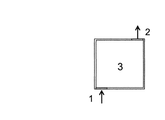
- the 1st example of the container used at the process 2 of this invention is typically shown.
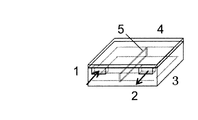
- (3D view) The 1st example of the container used at the process 2 of this invention is typically shown.
- (Top view) An air supply path and an exhaust path formed in the first example of the container used in step 2 of the present invention are schematically shown.
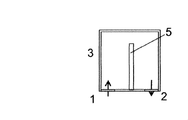
- the 2nd example of the container used at the process 2 of this invention is shown typically.
- (3D view) The 2nd example of the container used at the process 2 of this invention is shown typically.
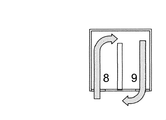
- An air supply path and an exhaust path formed in the second example of the container used in step 2 of the present invention are schematically shown.
- the electron microscope image of the nickel lithium metal complex oxide powder obtained in Example 1. 1000x magnification
- M in the formula (1) is a metal element that contains Al as an essential element and may contain a metal selected from Mn, W, Nb, Mg, Zr, and Zn.
- the amount of one or more kinds of metals selected from Mn, W, Nb, Mg, Zr and Zn, which are optional constituent elements, is a nickel-based positive electrode active material of a nickel-lithium metal composite oxide represented by the formula (1) As long as it does not impair the function, any method may be used.
- the time when one or more kinds of metals selected from Mn, W, Nb, Mg, Zr, and Zn are supplied to the nickel-lithium metal composite oxide may be any step of the production method of the present invention. .
- it may be supplied as an impurity contained in the raw material, may be supplied as a subcomponent to the below-described step 1 or step 1 ′, which is an essential step, or may be supplied in an arbitrary step.
- step 1 and / or step 1 ' the metal raw materials constituting the nickel lithium metal composite oxide are mixed.
- the obtained mixture is fired in Step 2 described later to obtain the target nickel-lithium metal composite oxide powder.
- Step 1 A precursor containing nickel hydroxide and / or nickel oxide, cobalt hydroxide and / or cobalt oxide, metal M hydroxide and / or metal M oxide, and carbonic acid It is a mixing step of mixing lithium.
- Lithium carbonate is a raw material for lithium hydroxide (usually lithium hydroxide monohydrate).
- lithium hydroxide has been used as a raw material for the nickel lithium metal composite oxide.
- lithium carbonate is cheaper than lithium hydroxide.
- lithium carbonate contains a higher concentration of lithium than lithium hydroxide monohydrate. Therefore, the use of lithium carbonate is advantageous from the viewpoint of cost reduction.
- Mixing is performed using various mixers and applying a shearing force.
- Step 1 ′ a precursor containing nickel hydroxide and / or nickel oxide, cobalt hydroxide and / or cobalt oxide, and metal M hydroxide and / or metal M oxide, It is a mixing process of mixing lithium carbonate. As described in Step 1, the use of lithium carbonate is advantageous in terms of production cost. Mixing is performed using various mixers and applying a shearing force.
- the raw material mixture obtained in the mixing step of the present invention is used in Step 2 described later.
- the firing material used in Step 2 was prepared in Step 1 ′ with the mixture prepared in Step 1, whether it was only the mixture prepared in Step 1 or only the mixture prepared in Step 1 ′.
- a mixture obtained by further mixing the mixture may be used.
- Step 2 the mixture obtained in step 1 and / or step 1 'is baked in a baking furnace. Firing is performed in a temperature range below the melting point of lithium carbonate for 3 to 40 hours.
- a container for laying the mixture is placed in the firing atmosphere of the firing furnace, and the mixture is laid on the container.
- the material of such a container is not limited as long as it is excellent in heat resistance and fire resistance, and a flat plate, a bowl, and a tank made of heat resistant ceramic are usually used.
- the volume and shape of the container can be appropriately designed according to the amount of the mixture and the structure of the firing furnace.
- the most typical form of the container used in the present invention is a ceramic container comprising a square dish-shaped container body and a flat lid. In the present invention, such a ceramic rectangular container may be installed alone in the firing furnace, such a ceramic rectangular container may be connected in a horizontal direction, or such a ceramic rectangular container is vertically connected. You may overlap in the direction.
- the gas flowing into the container from the air supply path is not limited as long as it has a composition that promotes the oxidation reaction of the metal contained in the mixture that is the object to be fired.
- Such an oxidizing gas is preferably an oxygen-containing gas, more preferably pure oxygen, air, a mixed gas obtained by adding oxygen to air, or a gas obtained by adding oxygen to an inert gas such as nitrogen, argon, helium, or the like. It is.
- Such oxidizing gas is heated to a temperature suitable for the firing conditions when it reaches the inside of the container through the air supply path.
- Oxidizing gas is ejected from the end of the tube located at the air supply port of the container.
- the oxidizing gas comes into contact with the surface of the mixture facing the air inlet of the container with a fluid pressure.
- This "with fluid pressure” means that the oxidizing gas once flowing into the baking vessel does not come into contact with the surface of the mixture by diffusion, but the flow of the oxidizing gas itself flows from the end of the tube to the surface of the mixture. It means to reach.
- the position of the end of the air supply pipe is determined so that the oxidizing gas contacts the surface of the mixture in such a state.
- the end of the tube can also be expanded to allow the oxidizing gas flow to reach a wider surface uniformly.
- the container is also formed with an exhaust port.
- the exhaust port is positioned so that the gas in the container that accumulates as the firing progresses does not get caught in the newly flowing inflow of oxidizing gas and flows out of the container by convection, diffusion, or suction.
- it is provided at a position farthest from the air supply port in the container or in a space inside the container separated from the inflow portion of the oxidizing gas.
- the process is performed while controlling the gas flow and composition in the firing atmosphere.
- FIGS. FIG. 1 (three-dimensional view) and FIG. 2 (top view) are examples in which an air supply port (1) and an exhaust port (2) are provided on the side surface of the container body (3).
- An air supply pipe (not shown) is connected and opened to the air supply port (1), and the heated oxidizing gas flows into the space inside the container from the air supply port (1).
- An air supply path (flow path (6) in FIG. 3) is formed here.
- the gas accumulated in the container as the firing progresses is discharged into the firing furnace through the exhaust port (2) (the exhaust is exhausted into the space in the firing furnace).
- An exhaust path (flow path (7) in FIG. 3) is formed here.
- the lid (4) completely covers the upper part of the container body, and the air supply path and the exhaust path (2) do not overlap each other because the air supply opening (1) and the exhaust opening (2) are sufficiently separated.
- the atmosphere inside the container is controlled by the composition, concentration, temperature, and displacement of the oxidizing gas.
- the container main body (3) has a partition plate (5), and the air supply port (1) and the exhaust port (2) are provided on the side surface of the container main body (3).
- An air supply pipe (not shown) is connected and opened to the air supply port (1), and the heated oxidizing gas enters the container through the air supply port (1) and is led to the partition plate (5) to be separated from the partition plate (5). 5) Expands to a space in contact with one side.
- An air supply path (flow path (8) in FIG. 6) is formed here.
- the gas accumulated inside the container as the firing proceeds is discharged from the exhaust port (2) into the firing furnace.
- An exhaust path (flow path (9) in FIG. 6) is formed here. Since the space formed by the lid (4) and the container body (3) is substantially divided by the partition plate (5), the air supply path and the exhaust path do not completely overlap. Thus, the atmosphere inside the container is controlled by the composition, concentration, temperature, and displacement of the oxidizing gas.
- firing is performed at a temperature below the melting point of lithium carbonate, specifically at a temperature range of 723 ° C. or less, preferably at a temperature range of 500 ° C. to 700 ° C.
- the calcination temperature is less than 500 ° C.
- a large amount of unreacted lithium carbonate remains, and the production efficiency of the nickel lithium metal composite oxide powder decreases.
- the nickel lithium metal composite oxide powder produced by firing at such a low temperature is used as a positive electrode active material for a lithium ion battery, sufficient battery performance cannot be obtained.
- the firing temperature exceeds the melting point of lithium carbonate, the amount of unreacted lithium carbonate decreases, but strong agglomeration between particles occurs, causing over-disintegration and accompanying fine powder generation. If used, sufficient battery performance cannot be obtained.
- step 2 baking is performed at the above baking temperature for 3 to 40 hours, preferably 5 to 35 hours. If the firing time is shorter than 3 hours, a large amount of unreacted lithium carbonate remains, and the production efficiency of the nickel-lithium metal composite oxide powder decreases. In addition, if the nickel lithium metal composite oxide powder produced by firing at such a low temperature is used as a positive electrode active material for a lithium ion battery, sufficient battery performance cannot be obtained. If the firing time is longer than 40 hours, the consumption rate of lithium carbonate no longer increases, which is economically undesirable.
- the fired product after step 2 can be further fired at a melting point of lithium carbonate or higher. After firing below the melting point of lithium carbonate, the crystal growth of the nickel lithium metal composite oxide can be promoted by firing above the melting point of lithium carbonate.
- the firing furnace used in step 2 is not limited as long as it has a structure capable of inflowing and discharging the oxidizing gas to and from the container as described above.
- a preferred firing furnace is a continuous or batch furnace capable of firing a relatively large amount of a raw material mixture intended for commercial production.
- a rotary kiln, a roller hearth kiln, a muffle furnace, etc. can be used.
- step 2 the lithium carbonate is almost consumed to form a nickel lithium metal composite oxide. Moreover, there is no aggregation in the form and the powder state is maintained.
- the performance of the nickel lithium metal composite oxide powder of the present invention can be confirmed by the following evaluation.
- the obtained nickel lithium metal composite oxide powder is checked for the presence or absence of aggregation by crushing with fingers and visual confirmation. Those that can be easily crushed by fingers and do not aggregate are evaluated as “no aggregation”.
- step 2 Although there is almost no aggregation in the fired product obtained in step 2, there is no need for crushing. However, after step 2, a step of crushing using a ball mill, a mortar or the like can be optionally provided. Further, after step 2, a step of sieving the fired product particles obtained in step 2 may be provided. You may perform both such a crushing process and a sieving process. By such a crushing step and / or a sieving step, a fine-particle nickel-lithium metal composite oxide powder with adjusted fillability and particle size distribution can be produced. Particle size distribution of the nickel lithium-metal composite oxide powder obtained in the present invention is relatively uniform, cumulative percent particle size of the volume-based 0.8 [mu] m ⁇ 3.0 [mu] m in D 0.001, 2 at D 10.
- D 50 0 ⁇ m to 5.0 ⁇ m
- D 50 2.0 ⁇ m to 6.5 ⁇ m
- D 90 to 5.5 ⁇ m to 12.0 ⁇ m
- D 100 10.0 ⁇ m to 20.0 ⁇ m, preferably D 0.001 to 1.0 ⁇ m to 3 2 ⁇ m
- D 10 is 2.2 ⁇ m to 5.0 ⁇ m
- D 50 is 2.0 ⁇ m to 6.0 ⁇ m
- D 90 is 5.5 ⁇ m to 11.0 ⁇ m
- D 100 is 10.0 ⁇ m to 18.0 ⁇ m.
- Such a nickel-lithium metal composite oxide powder obtained in the present invention is a novel material with respect to conventional products in that it exhibits the above particle size distribution.
- the nickel lithium metal composite oxide powder obtained in the present invention can be used as it is as a positive electrode active material for a lithium ion battery without being pulverized. It is technological in that it can be avoided.
- a nickel lithium metal composite oxide powder having a small particle size suitable for a positive electrode active material of a lithium ion battery can be provided efficiently using lithium carbonate as a raw material.
- the positive electrode active material of the lithium ion battery may be constituted only by the nickel lithium metal composite oxide powder of the present invention, or the positive electrode active material for other lithium ion secondary batteries may be added to the nickel lithium metal composite oxide powder of the present invention. Substances may be mixed. For example, 5 to 40 parts by weight of the nickel lithium metal composite oxide powder of the present invention and 60 to 95 parts by weight of a positive electrode active material for a lithium ion secondary battery having a large particle size other than the present invention are 100 parts by weight in total.
- a positive electrode active material containing the above-described nickel lithium metal composite oxide powder of the present invention, a conductive additive, a binder, and an organic solvent for dispersion are added to mix the positive electrode.
- a slurry is prepared and applied to an electrode to produce a positive electrode for a lithium ion secondary battery.
- the nickel lithium metal composite oxide powder was manufactured through the following steps 1 and 2.
- Step 1 Aluminum hydroxide and lithium carbonate were mixed with a precursor having a D 50 of 3.9 ⁇ m composed of nickel hydroxide and cobalt hydroxide prepared from an aqueous solution of nickel sulfate and cobalt sulfate by shearing with a mixer. .
- Aluminum hydroxide was prepared so that aluminum was 2 mol% with respect to the precursor amount, and lithium carbonate was prepared so that the molar ratio with respect to the total of nickel-cobalt-aluminum was 1.025.
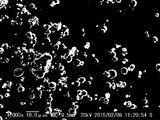
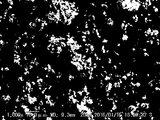
- Step 2 60 g of the mixture obtained in Step 1 was taken in an alumina ceramic boat and placed in a tubular furnace. While raising oxygen from one side of the tubular furnace at a supply rate of 5 L / min, temperature increase was started. The heating rate was 155 ° C./hour up to 690 ° C., held at 690 ° C. for 10 hours, and then cooled to room temperature. In this way, a nickel lithium metal composite oxide powder was obtained. Scanning electron microscope images of the fired product are shown in FIGS. 7 and 8, and the results of particle size distribution measurement are shown in Table 1. FIG.
- Example 2 Firing was carried out in the same manner as in Example 1 except that the precursor used had a D 50 of 1.85 ⁇ m. Scanning electron microscope images of the fired product are shown in FIGS. 9 and 10, and the results of particle size distribution measurement are shown in Table 1. FIG.
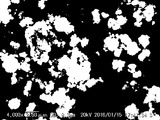
- Example 1 This is an example in which the firing conditions in Step 2 of Example 1 are changed. That is, 60 g of the mixture obtained in step 1 was taken in an alumina ceramic boat and placed in a tubular furnace. While raising oxygen from one side of the tubular furnace at a supply rate of 5 L / hour, temperature increase was started. The heating rate was 155 ° C./hour up to 780 ° C., held at 780 ° C. for 5 hours, and then cooled to room temperature. Thus, a nickel lithium metal composite oxide was obtained. Since the fired product was strongly agglomerated, after pulverization with a mortar, observation with a scanning electron microscope and particle size distribution measurement were performed. 11 and 12 show the electron microscope images, and Table 1 shows the results of the particle size distribution measurement.
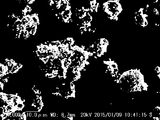
- Example 2 This is an example in which the firing conditions in Step 2 of Example 1 are changed. That is, 60 g of the mixture obtained in step 1 was taken in an alumina ceramic boat and placed in a tubular furnace. While raising oxygen from one side of the tubular furnace at a supply rate of 5 L / hour, temperature increase was started. The heating rate was 155 ° C./hour up to 810 ° C., held at 810 ° C. for 15 hours, and then cooled to room temperature. Thus, a nickel lithium metal composite oxide was obtained. Since the fired product was strongly agglomerated, after pulverization with a mortar, observation with a scanning electron microscope and particle size distribution measurement were performed. The electron microscope images are shown in FIGS. 13 and 14, and the results of the particle size distribution measurement are shown in Table 1.
- Comparative Examples 1 and 2 firing was performed at a temperature higher than the melting point of lithium carbonate.
- D 100 shows a large value of 133, it is considered that a relatively large amount of aggregated particles are generated. From the electron microscope image, it is considered that a large amount of fine powder that appears to have been generated by crushing to loosen strong agglomeration is generated, and this is because D 0.001 shows a minute value of 0.3 ⁇ m. It is supported.
- Example 1 Although no pulverization after firing was performed, cracks were observed in the electron microscope image and no fine powder was observed.
- the median diameter: 5.7 ⁇ m is not significantly different from the median diameter of the precursor: 3.9 ⁇ m, which also indicates that aggregation of the positive electrode active material particles is suppressed. Further, since the particle diameter does not change abruptly from D 0.01 to D 10 , D 50 , and D 100 , it can be seen that lithium metal composite oxide particles having relatively uniform particle sizes are produced.
- Example 2 the precursor particle system is relatively maintained, and metal composite oxide particles having a relatively uniform particle size are generated. Although fine powder is slightly observed in the electron micrograph, it is understood that large aggregated particles are not observed and the shape of the precursor is well maintained.
- nickel-lithium metal composite oxide powder of the present invention by using lithium carbonate as a lithium raw material and firing at a temperature not higher than the melting point of lithium carbonate, relatively small particle size and relatively uniform A nickel lithium metal composite oxide powder exhibiting a particle size distribution can be efficiently produced. Since such nickel lithium metal composite oxide powder can be used as a positive electrode active material as it is, there is no risk of particle over-disintegration, which has been a problem in the past.
- a nickel-lithium metal composite oxide powder can be provided for a lithium ion battery positive electrode active material free from fine powder and particle cracking.
- the present invention is useful as a means for supplying a low-cost and high-performance positive electrode active material for a lithium ion battery.
- the nickel lithium metal composite oxide powder obtained in the present invention and a lithium ion battery using the powder contribute to improving the performance of a portable information terminal or a battery-equipped vehicle.
- Provided is a method for producing a nickel-lithium metal composite oxide powder having a small particle size free from fine powder and particle cracking since there is no excessive cracking of particles.
- Air supply port 2 Air exhaust port 3
- Container body 4 Lid 5 Partition plate 6
- Air supply channel 7 Air exhaust channel 8 Air supply channel 9 Exhaust channel
Landscapes
- Chemical & Material Sciences (AREA)
- Inorganic Chemistry (AREA)
- Organic Chemistry (AREA)
- Chemical Kinetics & Catalysis (AREA)
- Electrochemistry (AREA)
- General Chemical & Material Sciences (AREA)
- Engineering & Computer Science (AREA)
- Materials Engineering (AREA)
- Manufacturing & Machinery (AREA)
- Battery Electrode And Active Subsutance (AREA)
- Inorganic Compounds Of Heavy Metals (AREA)
Abstract
Priority Applications (7)
| Application Number | Priority Date | Filing Date | Title |
|---|---|---|---|
| PL17802920T PL3466889T3 (pl) | 2016-05-27 | 2017-05-26 | Sposób wytwarzania proszku kompozytowego tlenku niklowo-litowego o małym rozmiarze cząstek |
| JP2018519633A JP7121655B2 (ja) | 2016-05-27 | 2017-05-26 | 小粒径のニッケルリチウム金属複合酸化物粉体の製造方法 |
| US16/303,349 US11447399B2 (en) | 2016-05-27 | 2017-05-26 | Method for producing nickel lithium metal complex oxide powder of small particle size |
| KR1020207024845A KR102289288B1 (ko) | 2016-05-27 | 2017-05-26 | 소입경의 니켈리튬 금속 복합 산화물 분체의 제조 방법 |
| EP17802920.3A EP3466889B1 (fr) | 2016-05-27 | 2017-05-26 | Procédé de production d'une poudre d'oxyde complexe de nickel-lithium-métal de petite taille de particule |
| KR1020187031061A KR102195395B1 (ko) | 2016-05-27 | 2017-05-26 | 소입경의 니켈리튬 금속 복합 산화물 분체의 제조 방법 |
| CN201780025758.2A CN109153582B (zh) | 2016-05-27 | 2017-05-26 | 小粒径的镍锂金属复合氧化物粉体的制造方法 |
Applications Claiming Priority (2)
| Application Number | Priority Date | Filing Date | Title |
|---|---|---|---|
| JP2016-105788 | 2016-05-27 | ||
| JP2016105788 | 2016-05-27 |
Publications (1)
| Publication Number | Publication Date |
|---|---|
| WO2017204334A1 true WO2017204334A1 (fr) | 2017-11-30 |
Family
ID=60412726
Family Applications (1)
| Application Number | Title | Priority Date | Filing Date |
|---|---|---|---|
| PCT/JP2017/019724 Ceased WO2017204334A1 (fr) | 2016-05-27 | 2017-05-26 | Procédé de production d'une poudre d'oxyde complexe de nickel-lithium-métal de petite taille de particule |
Country Status (9)
| Country | Link |
|---|---|
| US (1) | US11447399B2 (fr) |
| EP (1) | EP3466889B1 (fr) |
| JP (2) | JP7121655B2 (fr) |
| KR (2) | KR102289288B1 (fr) |
| CN (1) | CN109153582B (fr) |
| HU (1) | HUE054576T2 (fr) |
| PL (1) | PL3466889T3 (fr) |
| TW (1) | TWI651271B (fr) |
| WO (1) | WO2017204334A1 (fr) |
Cited By (1)
| Publication number | Priority date | Publication date | Assignee | Title |
|---|---|---|---|---|
| JP2023085141A (ja) * | 2021-12-08 | 2023-06-20 | 住友化学株式会社 | リチウム二次電池用正極活物質、リチウム二次電池用正極及びリチウム二次電池 |
Families Citing this family (2)
| Publication number | Priority date | Publication date | Assignee | Title |
|---|---|---|---|---|
| JP6803451B1 (ja) * | 2019-12-13 | 2020-12-23 | 住友化学株式会社 | リチウム金属複合酸化物、リチウム二次電池用正極活物質、リチウム二次電池用正極及びリチウム二次電池 |
| JP6804625B1 (ja) * | 2019-12-17 | 2020-12-23 | 住友化学株式会社 | リチウム金属複合酸化物粉末、リチウム二次電池用正極活物質、リチウム二次電池用正極及びリチウム二次電池 |
Citations (6)
| Publication number | Priority date | Publication date | Assignee | Title |
|---|---|---|---|---|
| JP2001196197A (ja) | 2000-01-07 | 2001-07-19 | Tokyo Hiraishin Kogyo Kk | 多段式避雷針の支持管継手装置 |
| JP2005324973A (ja) * | 2004-05-12 | 2005-11-24 | Mitsubishi Chemicals Corp | リチウム遷移金属複合酸化物及びその製造方法と、リチウム二次電池用正極並びにリチウム二次電池 |
| JP2006318926A (ja) | 1998-07-02 | 2006-11-24 | Nippon Chem Ind Co Ltd | 正極活物質及び非水電解質二次電池 |
| WO2012131779A1 (fr) * | 2011-03-31 | 2012-10-04 | 住友金属鉱山株式会社 | Particules d'hydroxyde de nickel composite et batterie secondaire à électrolytes non aqueux |
| WO2012164763A1 (fr) * | 2011-06-01 | 2012-12-06 | 住友金属鉱山株式会社 | Hydroxyde composite de métal de transition capable de servir de précurseur de matériau actif d'électrode positive pour des accumulateurs à électrolyte non aqueux, son procédé de production, matériau actif d'électrode positive pour accumulateurs à électrolyte non aqueux, procédé de production de matériau actif d'électrode positive pour accumulateurs à électrolyte non aqueux, et accumulateur à électrolyte non aqueux utilisant le matériau actif d'électrode positive |
| JP2017100892A (ja) * | 2015-11-30 | 2017-06-08 | Csエナジーマテリアルズ株式会社 | ニッケルリチウム金属複合酸化物の製造方法 |
Family Cites Families (31)
| Publication number | Priority date | Publication date | Assignee | Title |
|---|---|---|---|---|
| JP3798923B2 (ja) * | 1999-07-23 | 2006-07-19 | セイミケミカル株式会社 | リチウム二次電池用正極活物質の製造方法 |
| JP2001196097A (ja) | 2000-12-13 | 2001-07-19 | Mitsubishi Electric Corp | リチウム二次電池 |
| JP2003068300A (ja) * | 2001-08-24 | 2003-03-07 | Toyota Central Res & Dev Lab Inc | リチウム二次電池用正極活物質材料およびそれを用いたリチウム二次電池 |
| JP2004355824A (ja) * | 2003-05-27 | 2004-12-16 | Sumitomo Metal Mining Co Ltd | 非水系二次電池用正極活物質および正極 |
| JP2005108738A (ja) * | 2003-10-01 | 2005-04-21 | Japan Storage Battery Co Ltd | 非水電解質二次電池 |
| KR100599602B1 (ko) * | 2004-10-28 | 2006-07-13 | 삼성에스디아이 주식회사 | 리튬 이차 전지용 양극 및 이를 포함하는 리튬 이차 전지 |
| JP5072242B2 (ja) * | 2005-03-17 | 2012-11-14 | パナソニック株式会社 | 非水電解液二次電池 |
| CN100550484C (zh) * | 2005-03-17 | 2009-10-14 | 松下电器产业株式会社 | 非水电解质二次电池 |
| JP2008147068A (ja) * | 2006-12-12 | 2008-06-26 | Ise Chemicals Corp | 非水電解液二次電池用リチウム複合酸化物 |
| JP2008153017A (ja) * | 2006-12-15 | 2008-07-03 | Ise Chemicals Corp | 非水電解液二次電池用正極活物質 |
| KR101439714B1 (ko) * | 2009-12-02 | 2014-10-13 | 스미토모 긴조쿠 고잔 가부시키가이샤 | 니켈 복합 수산화물 입자 및 그 제조 방법, 정극 활물질 및 그 제조 방법 및 비수계 전해질 이차 전지 |
| US9822015B2 (en) * | 2009-12-07 | 2017-11-21 | Sumitomo Chemical Company, Limited | Method for producing lithium composite metal oxide, lithium composite metal oxide, and nonaqueous electrolyte secondary battery |
| CN102823032B (zh) * | 2010-03-30 | 2014-09-10 | 三井金属矿业株式会社 | 锂离子电池用正极活性物质材料和锂离子电池 |
| US8658312B2 (en) * | 2010-03-31 | 2014-02-25 | Panasonic Corporation | Positive electrode for lithium ion battery, fabrication method thereof, and lithium ion battery using the same |
| JP5494199B2 (ja) * | 2010-05-07 | 2014-05-14 | 住友金属鉱山株式会社 | 非水系電解質二次電池用正極活物質およびその製造方法、ならびに該正極活物質を用いた非水系電解質二次電池 |
| WO2013027432A1 (fr) * | 2011-08-23 | 2013-02-28 | Jx日鉱日石金属株式会社 | Procédé de production de matière active d'électrode positive pour batteries au ion-lithium |
| JP5971109B2 (ja) * | 2011-12-20 | 2016-08-17 | 住友金属鉱山株式会社 | ニッケル複合水酸化物とその製造方法、非水系電解質二次電池用正極活物質とその製造方法、および非水系電解質二次電池 |
| CN102832381A (zh) * | 2012-09-07 | 2012-12-19 | 广州市香港科大霍英东研究院 | 长寿命锂离子电池高压正极材料Li1+xMn3/2-yNi1/2-zMy+zO4的制备方法 |
| WO2014159118A1 (fr) * | 2013-03-14 | 2014-10-02 | Applied Materials, Inc. | Appareil et procédés de synthèse de matériaux actifs de batterie |
| CN110112377A (zh) * | 2013-03-14 | 2019-08-09 | 14族科技公司 | 包含锂合金化的电化学改性剂的复合碳材料 |
| CN103811717B (zh) * | 2014-02-19 | 2016-09-28 | 新乡市赛日新能源科技有限公司 | 核壳结构的动力锂离子电池负极材料及其制备方法 |
| KR102379798B1 (ko) * | 2014-05-29 | 2022-03-28 | 스미또모 가가꾸 가부시끼가이샤 | 리튬 이차 전지용 정극 활물질, 리튬 이차 전지용 정극 및 리튬 이차 전지 |
| CN104051727B (zh) * | 2014-07-03 | 2016-05-25 | 中信国安盟固利电源技术有限公司 | 一种锂离子电池正极材料的制备方法 |
| GB2539612B (en) * | 2014-09-03 | 2021-12-01 | Mitsui Mining & Smelting Co Ltd | Positive electrode active material for lithium secondary cell |
| US10388944B2 (en) * | 2014-10-06 | 2019-08-20 | Hitachi Metals, Ltd. | Positive electrode active material for lithium ion secondary battery, and positive electrode for lithium ion secondary battery and lithium ion secondary battery comprising the same |
| CN104852043A (zh) * | 2014-12-31 | 2015-08-19 | 常州益辉新能源科技有限公司 | 一种高电压锂离子电池正极材料及其制备方法 |
| US20190097222A1 (en) * | 2015-08-14 | 2019-03-28 | Energ2 Technologies, Inc. | Composites of porous nano-featured silicon materials and carbon materials |
| KR101982790B1 (ko) * | 2015-10-20 | 2019-05-27 | 주식회사 엘지화학 | 다층 구조의 리튬 금속 산화물들을 포함하는 리튬 이차전지용 양극 활물질 및 그것을 포함하는 양극 |
| EP3594182A1 (fr) * | 2016-03-31 | 2020-01-15 | Honda Motor Co., Ltd. | Matériau actif d'électrode positive pour batterie secondaire à électrolyte non aqueux |
| WO2018220882A1 (fr) * | 2017-05-29 | 2018-12-06 | パナソニックIpマネジメント株式会社 | Substance active d'électrode positive et batterie |
| KR102165885B1 (ko) * | 2017-11-28 | 2020-10-14 | 주식회사 엘지화학 | 음극 활물질, 이를 포함하는 음극 및 리튬 이차전지 |
-
2017
- 2017-05-25 TW TW106117435A patent/TWI651271B/zh active
- 2017-05-26 WO PCT/JP2017/019724 patent/WO2017204334A1/fr not_active Ceased
- 2017-05-26 CN CN201780025758.2A patent/CN109153582B/zh active Active
- 2017-05-26 KR KR1020207024845A patent/KR102289288B1/ko active Active
- 2017-05-26 EP EP17802920.3A patent/EP3466889B1/fr active Active
- 2017-05-26 US US16/303,349 patent/US11447399B2/en active Active
- 2017-05-26 HU HUE17802920A patent/HUE054576T2/hu unknown
- 2017-05-26 JP JP2018519633A patent/JP7121655B2/ja active Active
- 2017-05-26 KR KR1020187031061A patent/KR102195395B1/ko active Active
- 2017-05-26 PL PL17802920T patent/PL3466889T3/pl unknown
-
2020
- 2020-08-28 JP JP2020144492A patent/JP2020205266A/ja active Pending
Patent Citations (6)
| Publication number | Priority date | Publication date | Assignee | Title |
|---|---|---|---|---|
| JP2006318926A (ja) | 1998-07-02 | 2006-11-24 | Nippon Chem Ind Co Ltd | 正極活物質及び非水電解質二次電池 |
| JP2001196197A (ja) | 2000-01-07 | 2001-07-19 | Tokyo Hiraishin Kogyo Kk | 多段式避雷針の支持管継手装置 |
| JP2005324973A (ja) * | 2004-05-12 | 2005-11-24 | Mitsubishi Chemicals Corp | リチウム遷移金属複合酸化物及びその製造方法と、リチウム二次電池用正極並びにリチウム二次電池 |
| WO2012131779A1 (fr) * | 2011-03-31 | 2012-10-04 | 住友金属鉱山株式会社 | Particules d'hydroxyde de nickel composite et batterie secondaire à électrolytes non aqueux |
| WO2012164763A1 (fr) * | 2011-06-01 | 2012-12-06 | 住友金属鉱山株式会社 | Hydroxyde composite de métal de transition capable de servir de précurseur de matériau actif d'électrode positive pour des accumulateurs à électrolyte non aqueux, son procédé de production, matériau actif d'électrode positive pour accumulateurs à électrolyte non aqueux, procédé de production de matériau actif d'électrode positive pour accumulateurs à électrolyte non aqueux, et accumulateur à électrolyte non aqueux utilisant le matériau actif d'électrode positive |
| JP2017100892A (ja) * | 2015-11-30 | 2017-06-08 | Csエナジーマテリアルズ株式会社 | ニッケルリチウム金属複合酸化物の製造方法 |
Non-Patent Citations (4)
| Title |
|---|
| "Japan Oil", 2012, GAS AND METALS NATIONAL CORPORATION, pages: 148 - 15 |
| "Japan Oil", 2012, GAS AND METALS NATIONAL CORPORATION, pages: 148 - 154 |
| "Monthly Fine Chemical", November 2009, CMC PUBLISHING CO., LTD., pages: 81 - 82 |
| See also references of EP3466889A4 |
Cited By (1)
| Publication number | Priority date | Publication date | Assignee | Title |
|---|---|---|---|---|
| JP2023085141A (ja) * | 2021-12-08 | 2023-06-20 | 住友化学株式会社 | リチウム二次電池用正極活物質、リチウム二次電池用正極及びリチウム二次電池 |
Also Published As
| Publication number | Publication date |
|---|---|
| KR20180123220A (ko) | 2018-11-15 |
| TWI651271B (zh) | 2019-02-21 |
| CN109153582A (zh) | 2019-01-04 |
| KR102195395B1 (ko) | 2020-12-28 |
| HUE054576T2 (hu) | 2021-09-28 |
| JP2020205266A (ja) | 2020-12-24 |
| EP3466889A1 (fr) | 2019-04-10 |
| TW201811677A (zh) | 2018-04-01 |
| US11447399B2 (en) | 2022-09-20 |
| KR20200105541A (ko) | 2020-09-07 |
| CN109153582B (zh) | 2021-07-13 |
| KR102289288B1 (ko) | 2021-08-17 |
| EP3466889B1 (fr) | 2021-05-19 |
| JPWO2017204334A1 (ja) | 2019-03-28 |
| JP7121655B2 (ja) | 2022-08-18 |
| EP3466889A4 (fr) | 2019-11-13 |
| PL3466889T3 (pl) | 2021-11-08 |
| US20200198987A1 (en) | 2020-06-25 |
Similar Documents
| Publication | Publication Date | Title |
|---|---|---|
| KR102603503B1 (ko) | 비수계 전해질 이차 전지용 정극 활물질과 그의 제조 방법 및 비수계 전해질 이차 전지 | |
| JP6094591B2 (ja) | ニッケルコバルト複合水酸化物とその製造方法および製造装置、非水系電解質二次電池用正極活物質とその製造方法、および非水系電解質二次電池 | |
| JP6252384B2 (ja) | ニッケル複合水酸化物及びその製造方法、正極活物質及びその製造方法、並びに非水系電解質二次電池 | |
| JP6252383B2 (ja) | マンガンコバルト複合水酸化物及びその製造方法、正極活物質及びその製造方法、並びに非水系電解質二次電池 | |
| WO2016175268A1 (fr) | Hydroxyde composite contenant du nickel-cobalt enrobé d'aluminium et son procédé de fabrication, matériau actif de cathode pour batterie secondaire à électrolyte non aqueux et son procédé de fabrication, et batterie secondaire à électrolyte non aqueux | |
| CN104247100A (zh) | 正极活性物质颗粒粉末及其制造方法以及非水电解质二次电池 | |
| JP2013229339A (ja) | 非水系二次電池用正極活物質及びその正極活物質を用いた非水系電解質二次電池 | |
| JP2015201431A (ja) | 非水電解液二次電池用正極活物質粒子粉末及びその製造方法、並びに非水電解液二次電池 | |
| JP6479633B2 (ja) | ニッケルリチウム金属複合酸化物の製造方法 | |
| JP6479634B2 (ja) | ニッケルリチウム金属複合酸化物の製造方法 | |
| JP6479632B2 (ja) | ニッケルリチウム金属複合酸化物の製造方法 | |
| JP7559884B2 (ja) | リチウムイオン二次電池用正極活物質の製造方法 | |
| CN106660825A (zh) | 锰复合氢氧化物和其制造方法、正极活性物质和其制造方法、以及非水系电解质二次电池 | |
| JP2020205266A (ja) | 小粒径のニッケルリチウム金属複合酸化物粉体の製造方法 | |
| JP6458542B2 (ja) | 水酸化ニッケル粒子粉末及びその製造方法、正極活物質粒子粉末及びその製造方法、並びに非水電解質二次電池 | |
| CN115385395A (zh) | 金属复合氢氧化物、非水电解质二次电池用正极活性物质以及使用其的非水电解质二次电池 | |
| CN103477474B (zh) | 锂离子二次电池用负极活性物质材料及其制造方法 | |
| JP6739981B2 (ja) | ニッケルリチウム金属複合酸化物の製造方法 | |
| JP2019016481A (ja) | 非水系電解質二次電池用正極活物質、非水系電解質二次電池用正極活物質の製造方法、および該正極活物質を用いた非水系電解質二次電池 | |
| WO2025063203A1 (fr) | Précurseur de matériau actif d'électrode positive pour batterie secondaire au lithium-ion, son procédé de production, matériau actif d'électrode positive pour batterie secondaire au lithium-ion et son procédé de production | |
| CA3250399A1 (fr) | Procédé de fabrication de précurseur de matériau actif d'électrode positive pour batterie secondaire au lithium-ion, précurseur ainsi obtenu, et procédé de fabrication de matériau actif d'électrode positive pour batterie secondaire au lithium-ion |
Legal Events
| Date | Code | Title | Description |
|---|---|---|---|
| ENP | Entry into the national phase |
Ref document number: 2018519633 Country of ref document: JP Kind code of ref document: A |
|
| ENP | Entry into the national phase |
Ref document number: 20187031061 Country of ref document: KR Kind code of ref document: A |
|
| 121 | Ep: the epo has been informed by wipo that ep was designated in this application |
Ref document number: 17802920 Country of ref document: EP Kind code of ref document: A1 |
|
| NENP | Non-entry into the national phase |
Ref country code: DE |
|
| ENP | Entry into the national phase |
Ref document number: 2017802920 Country of ref document: EP Effective date: 20190102 |