WO2017207461A1 - Verwendung von verbindungen mit n 2-oxo-1,3-dioxolan-4-carbonsäureamid-einheiten in zweikomponentenklebstoffen - Google Patents
Verwendung von verbindungen mit n 2-oxo-1,3-dioxolan-4-carbonsäureamid-einheiten in zweikomponentenklebstoffen Download PDFInfo
- Publication number
- WO2017207461A1 WO2017207461A1 PCT/EP2017/062843 EP2017062843W WO2017207461A1 WO 2017207461 A1 WO2017207461 A1 WO 2017207461A1 EP 2017062843 W EP2017062843 W EP 2017062843W WO 2017207461 A1 WO2017207461 A1 WO 2017207461A1
- Authority
- WO
- WIPO (PCT)
- Prior art keywords
- groups
- dioxolane
- oxo
- formula
- compounds
- Prior art date
- Legal status (The legal status is an assumption and is not a legal conclusion. Google has not performed a legal analysis and makes no representation as to the accuracy of the status listed.)
- Ceased
Links
- YCNSBPQSRMYLKT-UHFFFAOYSA-N CC(C(C(O)=O)O1)OC1=C Chemical compound CC(C(C(O)=O)O1)OC1=C YCNSBPQSRMYLKT-UHFFFAOYSA-N 0.000 description 1
- YQPJOJHSZSETEG-UHFFFAOYSA-N CC(C(CO1)OC1=O)=O Chemical compound CC(C(CO1)OC1=O)=O YQPJOJHSZSETEG-UHFFFAOYSA-N 0.000 description 1
Classifications
-
- C—CHEMISTRY; METALLURGY
- C08—ORGANIC MACROMOLECULAR COMPOUNDS; THEIR PREPARATION OR CHEMICAL WORKING-UP; COMPOSITIONS BASED THEREON
- C08G—MACROMOLECULAR COMPOUNDS OBTAINED OTHERWISE THAN BY REACTIONS ONLY INVOLVING UNSATURATED CARBON-TO-CARBON BONDS
- C08G18/00—Polymeric products of isocyanates or isothiocyanates
- C08G18/06—Polymeric products of isocyanates or isothiocyanates with compounds having active hydrogen
- C08G18/70—Polymeric products of isocyanates or isothiocyanates with compounds having active hydrogen characterised by the isocyanates or isothiocyanates used
- C08G18/72—Polyisocyanates or polyisothiocyanates
- C08G18/77—Polyisocyanates or polyisothiocyanates having heteroatoms in addition to the isocyanate or isothiocyanate nitrogen and oxygen or sulfur
- C08G18/78—Nitrogen
- C08G18/79—Nitrogen characterised by the polyisocyanates used, these having groups formed by oligomerisation of isocyanates or isothiocyanates
- C08G18/791—Nitrogen characterised by the polyisocyanates used, these having groups formed by oligomerisation of isocyanates or isothiocyanates containing isocyanurate groups
- C08G18/792—Nitrogen characterised by the polyisocyanates used, these having groups formed by oligomerisation of isocyanates or isothiocyanates containing isocyanurate groups formed by oligomerisation of aliphatic and/or cycloaliphatic isocyanates or isothiocyanates
-
- C—CHEMISTRY; METALLURGY
- C08—ORGANIC MACROMOLECULAR COMPOUNDS; THEIR PREPARATION OR CHEMICAL WORKING-UP; COMPOSITIONS BASED THEREON
- C08G—MACROMOLECULAR COMPOUNDS OBTAINED OTHERWISE THAN BY REACTIONS ONLY INVOLVING UNSATURATED CARBON-TO-CARBON BONDS
- C08G18/00—Polymeric products of isocyanates or isothiocyanates
- C08G18/06—Polymeric products of isocyanates or isothiocyanates with compounds having active hydrogen
- C08G18/28—Polymeric products of isocyanates or isothiocyanates with compounds having active hydrogen characterised by the compounds used containing active hydrogen
- C08G18/2805—Compounds having only one group containing active hydrogen
- C08G18/281—Monocarboxylic acid compounds
-
- C—CHEMISTRY; METALLURGY
- C08—ORGANIC MACROMOLECULAR COMPOUNDS; THEIR PREPARATION OR CHEMICAL WORKING-UP; COMPOSITIONS BASED THEREON
- C08G—MACROMOLECULAR COMPOUNDS OBTAINED OTHERWISE THAN BY REACTIONS ONLY INVOLVING UNSATURATED CARBON-TO-CARBON BONDS
- C08G18/00—Polymeric products of isocyanates or isothiocyanates
- C08G18/06—Polymeric products of isocyanates or isothiocyanates with compounds having active hydrogen
- C08G18/28—Polymeric products of isocyanates or isothiocyanates with compounds having active hydrogen characterised by the compounds used containing active hydrogen
- C08G18/30—Low-molecular-weight compounds
- C08G18/34—Carboxylic acids; Esters thereof with monohydroxyl compounds
-
- C—CHEMISTRY; METALLURGY
- C08—ORGANIC MACROMOLECULAR COMPOUNDS; THEIR PREPARATION OR CHEMICAL WORKING-UP; COMPOSITIONS BASED THEREON
- C08G—MACROMOLECULAR COMPOUNDS OBTAINED OTHERWISE THAN BY REACTIONS ONLY INVOLVING UNSATURATED CARBON-TO-CARBON BONDS
- C08G18/00—Polymeric products of isocyanates or isothiocyanates
- C08G18/06—Polymeric products of isocyanates or isothiocyanates with compounds having active hydrogen
- C08G18/28—Polymeric products of isocyanates or isothiocyanates with compounds having active hydrogen characterised by the compounds used containing active hydrogen
- C08G18/40—High-molecular-weight compounds
- C08G18/48—Polyethers
- C08G18/4833—Polyethers containing oxyethylene units
- C08G18/4837—Polyethers containing oxyethylene units and other oxyalkylene units
- C08G18/4841—Polyethers containing oxyethylene units and other oxyalkylene units containing oxyethylene end groups
-
- C—CHEMISTRY; METALLURGY
- C08—ORGANIC MACROMOLECULAR COMPOUNDS; THEIR PREPARATION OR CHEMICAL WORKING-UP; COMPOSITIONS BASED THEREON
- C08G—MACROMOLECULAR COMPOUNDS OBTAINED OTHERWISE THAN BY REACTIONS ONLY INVOLVING UNSATURATED CARBON-TO-CARBON BONDS
- C08G18/00—Polymeric products of isocyanates or isothiocyanates
- C08G18/06—Polymeric products of isocyanates or isothiocyanates with compounds having active hydrogen
- C08G18/70—Polymeric products of isocyanates or isothiocyanates with compounds having active hydrogen characterised by the isocyanates or isothiocyanates used
- C08G18/71—Monoisocyanates or monoisothiocyanates
- C08G18/714—Monoisocyanates or monoisothiocyanates containing nitrogen in addition to isocyanate or isothiocyanate nitrogen
-
- C—CHEMISTRY; METALLURGY
- C08—ORGANIC MACROMOLECULAR COMPOUNDS; THEIR PREPARATION OR CHEMICAL WORKING-UP; COMPOSITIONS BASED THEREON
- C08G—MACROMOLECULAR COMPOUNDS OBTAINED OTHERWISE THAN BY REACTIONS ONLY INVOLVING UNSATURATED CARBON-TO-CARBON BONDS
- C08G18/00—Polymeric products of isocyanates or isothiocyanates
- C08G18/06—Polymeric products of isocyanates or isothiocyanates with compounds having active hydrogen
- C08G18/70—Polymeric products of isocyanates or isothiocyanates with compounds having active hydrogen characterised by the isocyanates or isothiocyanates used
- C08G18/72—Polyisocyanates or polyisothiocyanates
- C08G18/74—Polyisocyanates or polyisothiocyanates cyclic
- C08G18/76—Polyisocyanates or polyisothiocyanates cyclic aromatic
- C08G18/7614—Polyisocyanates or polyisothiocyanates cyclic aromatic containing only one aromatic ring
- C08G18/7621—Polyisocyanates or polyisothiocyanates cyclic aromatic containing only one aromatic ring being toluene diisocyanate including isomer mixtures
-
- C—CHEMISTRY; METALLURGY
- C08—ORGANIC MACROMOLECULAR COMPOUNDS; THEIR PREPARATION OR CHEMICAL WORKING-UP; COMPOSITIONS BASED THEREON
- C08G—MACROMOLECULAR COMPOUNDS OBTAINED OTHERWISE THAN BY REACTIONS ONLY INVOLVING UNSATURATED CARBON-TO-CARBON BONDS
- C08G71/00—Macromolecular compounds obtained by reactions forming a ureide or urethane link, otherwise, than from isocyanate radicals in the main chain of the macromolecule
- C08G71/04—Polyurethanes
-
- C—CHEMISTRY; METALLURGY
- C08—ORGANIC MACROMOLECULAR COMPOUNDS; THEIR PREPARATION OR CHEMICAL WORKING-UP; COMPOSITIONS BASED THEREON
- C08J—WORKING-UP; GENERAL PROCESSES OF COMPOUNDING; AFTER-TREATMENT NOT COVERED BY SUBCLASSES C08B, C08C, C08F, C08G or C08H
- C08J5/00—Manufacture of articles or shaped materials containing macromolecular substances
- C08J5/12—Bonding of a preformed macromolecular material to the same or other solid material such as metal, glass, leather, e.g. using adhesives
- C08J5/121—Bonding of a preformed macromolecular material to the same or other solid material such as metal, glass, leather, e.g. using adhesives by heating
-
- C—CHEMISTRY; METALLURGY
- C08—ORGANIC MACROMOLECULAR COMPOUNDS; THEIR PREPARATION OR CHEMICAL WORKING-UP; COMPOSITIONS BASED THEREON
- C08J—WORKING-UP; GENERAL PROCESSES OF COMPOUNDING; AFTER-TREATMENT NOT COVERED BY SUBCLASSES C08B, C08C, C08F, C08G or C08H
- C08J5/00—Manufacture of articles or shaped materials containing macromolecular substances
- C08J5/12—Bonding of a preformed macromolecular material to the same or other solid material such as metal, glass, leather, e.g. using adhesives
- C08J5/124—Bonding of a preformed macromolecular material to the same or other solid material such as metal, glass, leather, e.g. using adhesives using adhesives based on a macromolecular component
-
- C—CHEMISTRY; METALLURGY
- C09—DYES; PAINTS; POLISHES; NATURAL RESINS; ADHESIVES; COMPOSITIONS NOT OTHERWISE PROVIDED FOR; APPLICATIONS OF MATERIALS NOT OTHERWISE PROVIDED FOR
- C09J—ADHESIVES; NON-MECHANICAL ASPECTS OF ADHESIVE PROCESSES IN GENERAL; ADHESIVE PROCESSES NOT PROVIDED FOR ELSEWHERE; USE OF MATERIALS AS ADHESIVES
- C09J175/00—Adhesives based on polyureas or polyurethanes; Adhesives based on derivatives of such polymers
- C09J175/04—Polyurethanes
-
- C—CHEMISTRY; METALLURGY
- C09—DYES; PAINTS; POLISHES; NATURAL RESINS; ADHESIVES; COMPOSITIONS NOT OTHERWISE PROVIDED FOR; APPLICATIONS OF MATERIALS NOT OTHERWISE PROVIDED FOR
- C09J—ADHESIVES; NON-MECHANICAL ASPECTS OF ADHESIVE PROCESSES IN GENERAL; ADHESIVE PROCESSES NOT PROVIDED FOR ELSEWHERE; USE OF MATERIALS AS ADHESIVES
- C09J5/00—Adhesive processes in general; Adhesive processes not provided for elsewhere, e.g. relating to primers
- C09J5/06—Adhesive processes in general; Adhesive processes not provided for elsewhere, e.g. relating to primers involving heating of the applied adhesive
-
- C—CHEMISTRY; METALLURGY
- C08—ORGANIC MACROMOLECULAR COMPOUNDS; THEIR PREPARATION OR CHEMICAL WORKING-UP; COMPOSITIONS BASED THEREON
- C08K—Use of inorganic or non-macromolecular organic substances as compounding ingredients
- C08K5/00—Use of organic ingredients
- C08K5/04—Oxygen-containing compounds
- C08K5/05—Alcohols; Metal alcoholates
- C08K5/053—Polyhydroxylic alcohols
-
- C—CHEMISTRY; METALLURGY
- C08—ORGANIC MACROMOLECULAR COMPOUNDS; THEIR PREPARATION OR CHEMICAL WORKING-UP; COMPOSITIONS BASED THEREON
- C08K—Use of inorganic or non-macromolecular organic substances as compounding ingredients
- C08K5/00—Use of organic ingredients
- C08K5/16—Nitrogen-containing compounds
- C08K5/17—Amines; Quaternary ammonium compounds
Definitions
- Frequently used as adhesives are two-component systems of polyisocyanate-based polyurethanes in which isocyanate components with polyol components react to form a high molecular weight polyurethane polymer. These systems are applied either as solvent-free and water-free one hundred percent reactive systems or as an adhesive dissolved in an organic solvent.
- the coating materials are applied by means of a suitable application system on a first substrate and then cured if necessary after evaporation of the solvent.
- Polyurethane systems can also be obtained starting from cyclic carbonate compounds which are toxicologically harmless.
- glycerin carbonate (4- (hydroxymethyl) -2-oxo-1,3-dioxolane) finds application in cosmetics.
- Cyclic carbonate compounds react with amines with ring opening, inter alia to hydroxyurethanes (see the formula scheme). Disadvantages of the systems based on glycerine carbonate are the low regioselectivity leading to the reaction paths A, B and C, the comparatively low reactivity of the systems at room temperature, and the fact that catalysts which accelerate the ring opening evidently also promote the reverse reaction , which may lead to partial decomposition of already formed products.
- the object underlying the present invention was to substantially avoid at least some of the disadvantages of the prior art described above.
- an alternative 2-oxo-1,3-dioxolane system with an electron withdrawing group for adhesive applications should be provided.
- a 2-oxo-1, 3-dioxolane system should be provided which is safe, readily accessible and highly reactive with amines, if possible already at room temperature can cure and also as an adhesive (with a little attacking by amines bond the polymer chain) with good adhesive values.
- An object of the present invention is the use of compounds with n 2-oxo-l, 3-dioxolane-4-carboxamide units as a reactive component in 2-component adhesives, preferably for the preparation of hydroxypolyurethanes or hydroxypolycarbonates for adhesive applications, where n is a number greater or equal to 2.
- n 2 to 5, in particular 2 to 3.
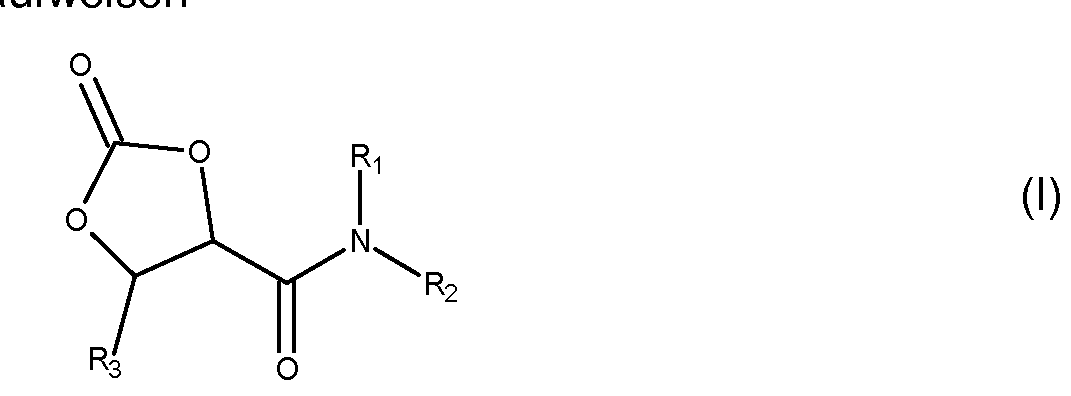
- Suitable compounds having two or more 2-oxo-1,3-dioxolane-4-carboxylic acid amide units are, for example, those of the formula (I)
- Ri and R3 are independently selected from H and an organic radical
- R2 is an n-valent organic radical substituted with n-1 other 2-oxo-1,3-dioxolane-4-carboxylic acid amide groups and n is a number greater than or equal to 2.
- Ri is preferably selected from H, straight-chained, branched or cyclic Ci-12-alkyl groups, C6-io-aryl groups, C6-12-arylalkyl groups and C6-12-alkylaryl groups.
- R 2 is preferably an alkyl group having 2 to 22 carbon atoms or a polymer chain; and is preferably selected from the group consisting of linear or branched C 2 to C 22 alkylene groups; Polyether groups of the general formula - (A-O) m m-, wherein A is C2 to C5 alkylene and m is a number from 1 to 100; Polycarbonate groups, polyester groups and poly (meth) acrylate groups.
- R 2 is particularly preferably selected from n-alkyl units having 2-12 C atoms and polymer chains which contain ethylene oxide and / or propylene oxide units.
- R 3 is preferably selected from H, aryl groups and straight-chain, branched or cyclic C 1-12 -alkyl groups which may also contain O or N atoms;
- the carbon atom to which R3 is bonded may additionally carry another Ci-12-alkyl group.
- the carbon atom in the 4-position may additionally carry a Ci-12-alkyl group. Both can be the case at the same time.
- the groups R 1 and R 3 are each preferably H.
- the compounds have a functionality with respect to the 2-oxo-1,3-dioxolane group of n is greater than or equal to 2.
- R2 is an n-valent radical containing n-1 further 2-oxo-1,3-dioxolane-4 -carbonklareamid phenomenon is substituted, preferably with those of the general formula (II), wherein R3 has the abovementioned meaning.
- n 2 to 5, in particular 2 to 3.
- Suitable polyisocyanates include tetramethylene-1,4-diisocyanate, 2-methylpentamethylene-1,5-diisocyanate, hexamethylene-1,6-diisocyanate (HDI), 2,2,4- and 2,4,4-trimethyl hexamethylene-1,6-diisocyanate (TMDI), dodecamethylene-1,12-diisocyanate, lysine diisocyanate, lysine ester diisocyanate, 1-isocyanato-3,3,5-trimethyl-5-isocyanato-methylcyclohexane (isophorone diisocyanate, IPDI), 1 , 4-diisocyanato-2,2,6-trimethylcyclohexane (TMCDI), 2,2'-, 2,4'- and 4,4'-dicyclohexylmethane diisocyanate (H12MDI), cyclohexane-1, 3-diisocyanate,
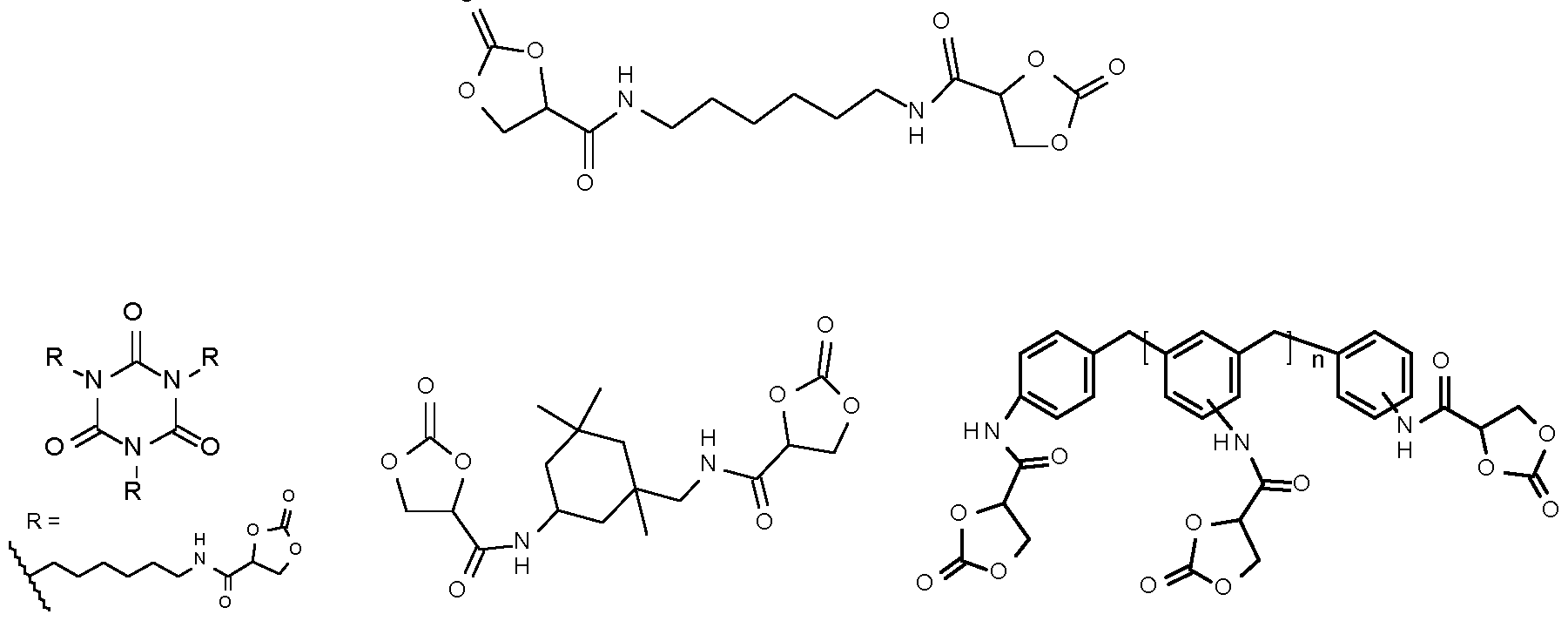
- the polyisocyanates according to the invention also include dimers (uretdiones) and trimers (isocyanurates). Particular importance is attached to the HDI trimer. Furthermore, it is also intended to include oligomers, e.g. "polymeric MDI" with n preferably equal to 1 to 8:
- Suitable polyols include polyoxyalkylene polyols (also called “polyether polyols”), which are described i.a. Ethylene oxide, propylene oxide and butylene oxide units may contain aliphatic diols, aliphatic polyols, polyester polyols, polycarbonate polyols, castor oil, hydroxylated epoxidized soybean oil, and mixtures of said polyols.
- polyoxyalkylene polyols also called "polyether polyols”
- Ethylene oxide, propylene oxide and butylene oxide units may contain aliphatic diols, aliphatic polyols, polyester polyols, polycarbonate polyols, castor oil, hydroxylated epoxidized soybean oil, and mixtures of said polyols.
- n is a number from 0 to 8, preferably from 1 to 8.
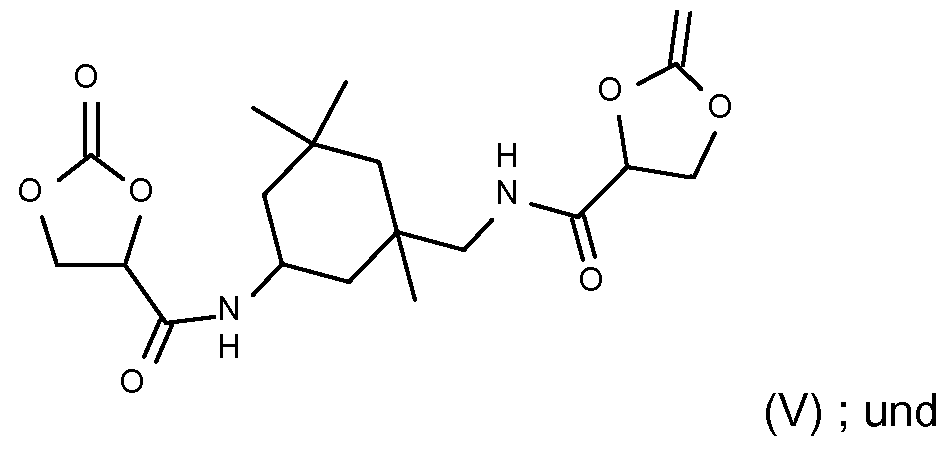
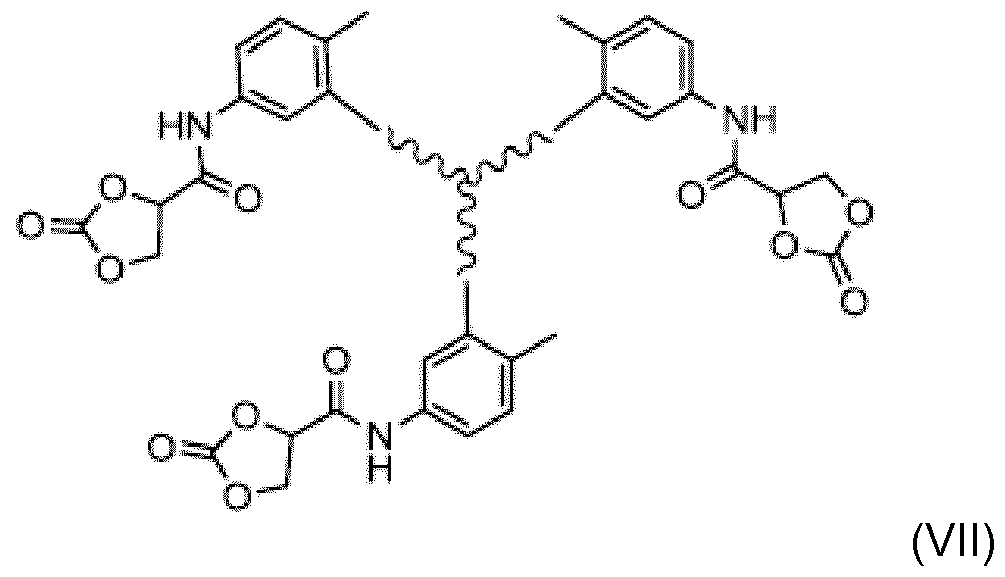
- Preferred compounds with n 2-oxo-1, 3-dioxolane-4-carboxamide units are selected from the group consisting of
- n is a number from 1 to 12;
- y is a number from 1 to 12;
- n is a number greater than or equal to 0, preferably 1 to 8.
- the invention also relates to polyfunctional 2-oxo-1,3-dioxolane-4-carboxamides which are particularly suitable for adhesive applications and have a flexible spacer group between the cyclocarbonate units of the formula (I)
- Ri and R3 are independently selected from H and an organic radical
- R 2 is an n-valent organic radical substituted with n-1 further 2-oxo-1,3-dioxolane-4-carboxylic acid amide groups,
- n is a number greater than or equal to 2
- R 2 in formula (I) is preferably selected from the group consisting of linear or branched C 2 to C 22 alkylene groups; Polyether groups of the general formula - (A-O) m m-, wherein A is C2 to C5 alkylene and is a number from 1 to 100; Polycarbonate groups ;, polyester groups; and poly (meth) acrylate groups.
- 2-oxo-1,3-dioxolane-4-carboxamides are selected from compounds of the formula (IV)
- alkoxylated glycerol with preferably 2 to 5, in particular or 2 and / or 3 C atoms in the alkoxy group, more preferably ethoxylated / propoxylated glycerol.
- the 2-oxo-1,3-dioxolane-4-carboxylic acid amides react with amine hardeners to give hydroxypolyurethanes.
- Hydroxypolyurethanes with secondary hydroxyl groups are predominantly formed here because the negative charge on the oxygen atom, which is closer to the CONR1 R2 group, is better stabilized upon attack of the nucleophilic nitrogen atom.
- Hydroxyurethanes with secondary hydroxyl groups have the advantage that no reverse reaction takes place. Theoretically conceivable would be an attack of the amine on the amide group. However, it could be shown that the amine attacks only the 2-oxo-1,3-dioxolane group.
- Suitable amines here are primary and secondary amines having alkyl groups, aryl groups, aralkyl groups and alkaryl groups as radicals.
- Primary amines react faster than secondary amines; Aliphatic amines react faster than aromatic amines.
- higher molecular weight polyamines such as e.g. Jeffamine® of Huntsman Corp. and polyetheramines from BASF SE come into question here.
- the 2-oxo-1,3-dioxolane-4-carboxylic acid amides react with hydroxy hardeners to give hydroxypolycarbonates.
- hydroxy hardeners to give hydroxypolycarbonates.
- Suitable alcohols of the formula R'-OH are, for example, the abovementioned polyols.
- Blends of the compounds with 2 or more 2-oxo-1,3-dioxolane-4-carboxylic acid amide units with a suitable polyfunctional hardener compound can be used as a two-component adhesive with the 2-oxo-1,3-dioxolane-4 carbonic acid amide compound in a first component and the polyfunctional hardener compound in a second component.
- the polyfunctional hardener component has at least two functional groups selected from the group consisting of primary amino groups, secondary amino groups and hydroxyl groups.
- the two-component adhesive contains at least one catalyst for catalyzing the reaction of the cyclocarbonate groups with the functional groups of the hardener.
- the two-component adhesive may be applied as a solution in an organic solvent or as a solvent and water free one hundred percent system.
- the functional groups of the hardener are selected from
- two-part adhesive an adhesive containing at least two polyfunctional adhesive components which react with each other to form bonds thereby forming a polymeric network. Accordingly, in addition to at least one multifunctional cyclocarbonamide compound, two-component adhesive compositions additionally contain at least one
- the amount of curing agent is chosen so that the molar ratio of functional 2-oxo-1, 3-dioxolane groups to the functional groups F in the curing agent in the range of 1:10 to 10: 1, in particular in the range of 5: 1 to 1: 5 and especially in the range of 1: 2 to 2: 1.
- the hardener may be a low molecular weight substance, i. h., Its molecular weight is below 500 g / mol, or an oligomeric or polymeric substance having a number average molecular weight above 500 g / mol.
- either the compound having two or more 2-oxo-1,3-dioxolane-4-carboxylic acid amide units, or the curing agent compound, or both, contains at least one flexible spacer group.
- a flexible spacer group is a linear or branched linking group having a molecular weight of at least 200 g / mol.
- the spacer group may form the group R2 or a part of the group R2 in formula (I) and / or the spacer group may be located between two functional groups of the hardener.
- the spacer group is preferably selected from alkylene groups, polyether groups, polycarbonate groups, polyester groups and poly (meth) acrylate groups.
- Spacer groups are, for example, linear or branched alkylene groups having at least 15 C atoms; Polyether groups of the general formula - (A-O) m -, wherein A is C2 to C5 alkylene and m is a number chosen such that the molecular weight of - (AO) m- is at least 200 g / mol; Polycarbonate groups; Polyester groups; and poly (meth) acrylate groups.
- a preferred spacer group is alkoxylated glycerol, eg ethoxylated glycerol, propoxylated glycerol and ethoxylated / propoxylated glycerol.
- the amine hardeners hereinafter also referred to as amine hardeners, include, for example, aliphatic and cycloaliphatic polyamines, aromatic and araliphatic
- Amine hardeners crosslink polymers with 1,3-dioxolan-2-one groups, also referred to below as carbonate polymers, by reaction of the primary or secondary amino functions of the polyamines with the 1,3-dioxolan-2-one groups of the carbonate polymers
- Preferred polyamine hardeners have on average at least two primary or secondary amino groups per molecule, e.g. two, three or four primary or secondary amino groups per molecule, on. They may also contain one or more tertiary amino groups.
- Suitable polyamines are, for example
- aliphatic polyamines such as ethylenediamine, 1, 2 and 1, 3-propanediamine
- Neopentanediamine hexamethylenediamine, octamethylenediamine, 1,10-diaminodecane, 1,12-diaminododecane, diethylenetriamine, triethylenetetramine, tetraethylenepentamine, 2,2-dimethylpropylenediamine, trimethylhexamethylenediamine, 1- (3-aminopropyl) -3-aminopropane, 1,3-bis-aminopropane (3-aminopropyl) propane, 4-ethyl-4-methylamino-1-octylamine and the like;
- cycloaliphatic diamines such as 1,2-diaminocyclohexane, 1,2,2,1,3,4-bis (aminomethyl) cyclohexane, 1-methyl-2,4-diaminocyclohexane, N-cyclohexylpropylene-1,3 diamine, 4- (2-aminopropan-2-yl) -1-methylcyclohexan-1-amine, isophoronediamine, 4,4'-diaminodicyclohexylmethane, 3,3'-dimethyl-4,4'-diaminodicyclohexylmethane, 3,3 ', 5,5'-tetramethyl-4,4'-diaminodicyclohexylmethane, 4,8-diamino-tricyclo [5.2.1.0] decane, norbornanediamine, menthanediamine, menthenediamine and the like;
- aromatic diamines such as toluenediamine, xylylenediamine, in particular meta-xylylenediamine (MXDA), bis (4-aminophenyl) methane (MDA or methylenedianiline),
- Bis (4-aminophenyl) sulfone also known as DADS, DDS or dapsone
- cyclic polyamines such as piperazine, N-aminoethylpiperazine and the like;
- Polyetheramines in particular difunctional and trifunctional primary polyether amines based on polypropylene glycol, polyethylene glycol, polybutylene oxide, poly (1,4-butanediol), polytetrahydrofuran (polyTHF) or polypentylene oxide, eg. 4,7,10-trioxatridecane-1, 3-diamine, 4,7,10-trioxatridecane-1, 13-diamine,
- Polyetheramine D 230 (Fa. BASF SE) or Jeffamine ® D 230 (Fa. Huntsman), difunctional, primary polyetheramine based on polypropylene glycol with an average molar mass of 400, z.
- B. Polyetheramine D 2000 (Fa. BASF SE), Jeffamine ® D2000 or Jeffamine ® XTJ 578 (both Fa. Huntsman), difunctional, primary polyetheramines based on propylene oxide with an average molar mass of 4000, such.
- polyetheramine D 4000 (BASF SE), trifunctional, primary polyether amines prepared by reaction of propylene oxide with trimethylolpropane, followed by amination of the terminal OH groups having an average molecular weight of 403 such as
- Polyetheramine T 403 (Fa. BASF SE) or Jeffamine ® T 403 (Fa. Huntsman), trifunctional, primary polyetheramine prepared by reacting propylene oxide with glycerol, followed by amination of the terminal OH groups, with an average molar mass of 5000, such ,
- B. Jeffamine ® ED-600 or Jeffamine ® XTJ-501 (each Fa.
- aliphatic polyetheramines which are composed of a grafted with propylene oxide polyethylene glycol and have an average molecular weight of 900, such as. , Jeffamine ® ED-900 (Fa. Huntsman), aliphatic
- Polyetheramines which are composed of a polyethylene glycol grafted with propylene oxide and have an average molecular weight of 2000, such as Jeffamine ® ED-2003 (Huntsman), difunctional, primary polyetheramine prepared by amination of a propylene oxide grafted diethylene glycol having an average molecular weight of 220 such.
- Jeffamine ® HK-51 1 (Huntsman), aliphatic polyether amines based on a copolymer of poly (tetramethylene ether glycol) and polypropylene glycol having an average molecular weight of 1000 such as.
- Polyamidoamines obtained by the reaction of dimeric fatty acids (eg dimeric linoleic acid) with low molecular weight polyamines such as diethylenetriamine, 1- (3-aminopropyl) -3-aminopropane or triethylenetetramine or other diamines such as the abovementioned aliphatic or cycloaliphatic Diamines are available;
- dimeric fatty acids eg dimeric linoleic acid
- low molecular weight polyamines such as diethylenetriamine, 1- (3-aminopropyl) -3-aminopropane or triethylenetetramine or other diamines such as the abovementioned aliphatic or cycloaliphatic Diamines are available;
- epoxy resin or reactive diluents are obtainable, it being preferable to use those adducts in which about 5 to 20% of the epoxide groups have been reacted with amines, in particular diamines;
- cresols and xylenols p-tert-butylphenol, resorcinol, 4,4'-dihydroxydiphenylmethane, 4,4'-dihydroxydiphenyl-2,2-propane, but preferably phenol, are prepared;
- mixtures of the abovementioned amine hardeners in particular mixtures of difunctional amines from the group of aliphatic, cycloaliphatic and aromatic amines with the abovementioned polyetheramines.
- Preferred aminic hardeners are aliphatic polyamines, in particular 2,2-dimethylpropylenediamine, aromatic diamines, in particular m-xylylenediamine (MXDA) and cycloaliphatic diamines, in particular isophoronediamine, N-cyclohexylpropylene-1,3-diamine and 4,4'-diaminodicyclohexylmethane ( Dicykan).
- MXDA m-xylylenediamine
- Dicykan 4,4'-diaminodicyclohexylmethane
- Polypropylene glycol such as. Jeffamine® D 230 or Jeffamine® T 403.
- Particularly preferred are polyamines which have high mobility and little steric hindrance around the amino group, e.g. 4,9-dioxadodecane-1,1,2-diamine, 4,7,10-trioxatridecane-1,13-diamine, PolyTHF amine 350 (BASF SE).
- mixtures of the amines which are mentioned as being preferred, for example mixtures which contain 2,2-dimethylpropyleneamine and isophorone amine.
- alcoholic hardeners are mainly low molecular weight and higher molecular weight aliphatic and cycloaliphatic alcohols.
- Alcoholic hardeners crosslink
- alcoholic hardeners have on average at least two primary or secondary hydroxyl groups per molecule, eg. B. two, three or four primary or secondary Hydroxy groups per molecule, on.
- Suitable low molecular weight alcoholic hardeners are, for. B. 1, 4-butanediol, ethylene glycol, diethylene glycol, triethylene glycol, neopentyl glycol, 1, 3-propanediol, 1, 5-pentanediol, 1, 6-hexanediol, glycerol, diglycerol,
- Pentaerythritol dipentaerythritol, sugar alcohols such as sorbitol and mannitol.
- Suitable alcoholic hardeners are also relatively high molecular weight, polymeric polyols, for example polyester polyols, polycarbonate polyols, polyether polyols, polyacrylate polyols and polyvinyl alcohols.
- Suitable polymeric polyol hardeners preferably have an average OH functionality of at least 1.5 moles, and especially at least 1.8, e.g. B. in the range of 1, 5 to 10 and in particular in the range of 1, 8 to 4, on.
- the average OH functionality is understood to mean the average number of OH groups per polymer chain.
- Typical polymeric polyol components preferably have a number average molecular weight of from about 250 to 50,000 g / mol, preferably from about 500 to 10,000 g / mol.
- at least 50 mole percent of the hydroxyl groups contained in the polymeric polyol component are primary hydroxyl groups.
- Polyester polyols are preferably linear or branched polymeric compounds having ester groups in the polymer backbone which have free hydroxyl groups at the ends of the polymer chain. These are preferably polyesters which are obtained by polycondensation of dihydric alcohols with dibasic carboxylic acids, if appropriate in the presence of higher-value alcohols (for example 3, 4, 5 or 6-hydric alcohols) and / or higher-value polycarboxylic acids. Instead of the free di- or polycarboxylic acids, it is also possible to use the corresponding di- or polycarboxylic anhydrides or corresponding di- or polycarboxylic acid esters of lower alcohols or mixtures thereof to prepare the polyesterpolyols.
- the di- or polycarboxylic acids may be aliphatic, cycloaliphatic, araliphatic, aromatic or heterocyclic, have preferably 2 to 50 and in particular 4 to 20 C atoms and may optionally, for. B. by halogen atoms, substituted and / or unsaturated.
- polyester polyols examples include suberic acid, azelaic acid, phthalic acid, isophthalic acid, phthalic anhydride, tetrahydrophthalic anhydride, hexahydrophthalic anhydride, tetrachlorophthalic anhydride, endomethylenetetrahydrophthalic anhydride, glutaric anhydride, maleic acid, maleic anhydride, alkenylsuccinic acid, fumaric acid and dimer fatty acids.
- Suitable diols for the preparation of the polyester polyols are, in particular, aliphatic and cycloaliphatic diols having preferably 2 to 40 and in particular 2 to 20 C atoms, eg.
- ethylene glycol propane-1, 2-diol, propane-1, 3-diol, butane-1, 3-diol, butane-1, 4-diol, butene-1, 4-diol, butyne-1, 4- diol, pentane-1,5-diol, neopentylglycol, bis (hydroxymethyl) cyclohexanes such as 1,4-bis (hydroxymethyl) cyclohexane, 2-methylpropane-1,3-diol, methylpentanediols, furthermore diethylene glycol, triethylene glycol, Tetraethylene glycol, polyethylene glycol, dipropylene glycol, polypropylene glycol, dibutylene glycol and polybutylene glycols.
- Alcohols of the general formula HO- (CH 2) x -OH, where x is a number from 2 to 20, preferably an even number from 2 to 12, are preferred.
- examples of these are ethylene glycol, butane-1, 4-diol, hexane-1, 6-diol, octane-1, 8-diol and dodecane-1, 12-diol.
- Further preferred are neopentyl glycol and pentane-1, 5-diol.
- lactone-based polyester polyols which are homopolymers or copolymers of lactones, preferably hydroxyl-terminated addition products of lactones onto suitable difunctional starter molecules.
- Preferred lactones are those which are derived from compounds of the general formula HO- (CH 2) z -COOH, where z is a number from 1 to 20 and an H atom of a methylene unit is also denoted by a d- to C 4 - Alkyl radical may be substituted. Examples are ⁇ -caprolactone, ⁇ -propiolactone, ⁇ -butyrolactone and / or methyl-s-caprolactone and mixtures thereof.
- Suitable starter molecules are z.
- As the above-mentioned as a structural component for the polyester polyols low molecular weight dihydric alcohols. The
- corresponding polymers of ⁇ -caprolactone are particularly preferred.
- Lower polyester diols or polyether diols can also be used as starters for the preparation of the lactone polymers.
- the polymers of lactones it is also possible to use the corresponding, chemically equivalent polycondensates of the hydroxycarboxylic acids corresponding to the lactones.
- polyester polyols are, for. B. from Ullmann's Encyclopedia of Industrial Chemistry, 4th Edition, Volume 19, pages 62 to 65 known
- polyester polyols called low molecular weight alcohols can be considered.
- the polyether polyols are in particular polyether polyols obtained by polymerization of ethylene oxide, propylene oxide, butylene oxide, tetrahydrofuran, styrene oxide or epichlorohydrin with itself, for. B. in the presence of BF3 or by addition of these compounds, optionally in admixture or sequentially, to bi- or polyfunctional starting components with reactive hydrogen atoms, such as polyols or polyfunctional amines, eg.
- water ethylene glycol, propane-1, 2-diol, propane-1, 3-diol, 1, 1 -Bis- (4-hydroxyphenyl) propane, trimethylolpropane, glycerol, sorbitol, ethanolamine or ethylenediamine
- sucrose polyethers see DE 1 176 358 and DE 1064938
- polyethers started on formitol or formose see DE 2639083 and DE 2737951 are suitable.
- polyhydroxyolefins preferably those having 2 terminal hydroxyl groups, for. B. ⁇ - ⁇ -Dihydroxypolybutadien.
- polyhydroxypolyacrylates it being possible for the hydroxyl groups to be arranged laterally or terminally.
- examples of these are ⁇ , ⁇ -dihydroxypoly (meth) acrylic esters which are obtained by homo- or copolymerization of
- OH group-containing regulators such as mercaptoethanol or mercaptopropanol and subsequent transesterification with a low molecular weight polyol, for example an alkylene glycol such as butanediol
- Such polymers are known, for example, from EP-A 622 378. Examples of this are further polymers by
- Copolymerization of alkyl esters of acrylic acid and / or methacrylic acid with hydroxyalkyl esters of ethylenically unsaturated carboxylic acid such as hydroxyethyl acrylate, hydroxypropyl acrylate, hydroxybutyl acrylate, hydroxyethyl methacrylate, hydroxypropyl methacrylate or hydroxybutyl methacrylate are available.
- hydroxyalkyl esters of ethylenically unsaturated carboxylic acid such as hydroxyethyl acrylate, hydroxypropyl acrylate, hydroxybutyl acrylate, hydroxyethyl methacrylate, hydroxypropyl methacrylate or hydroxybutyl methacrylate are available.
- polyvinyl alcohols which can preferably be obtained by complete or partial saponification of polyvinyl esters, in particular polyvinyl acetate.
- polyvinyl esters preferably polyvinyl acetate
- the polyvinyl esters, preferably polyvinyl acetate are completely saponified, generally more than 95% up to 100% of the ester groups are saponified as hydroxyl groups.
- polymeric polyols preferred alcoholic hardeners are in particular polyacrylate, these are available, for example, under the brand name Joncryl® Fa. BASF SE, z. Eg Joncryl® 945.
- Suitable hardeners are also amino acids, eg. As lysine, arginine, glutamine and asparagine and their stereoisomers and mixtures thereof. It is of course also possible to use mixtures of different hardeners, for example mixtures of one or more amine hardeners with one or more alcoholic hardeners, mixtures of one or more amine hardeners with one or more amino acids or mixtures of one or more alcoholic hardeners with one or more amino acids.
- the total amount of curing agent is preferably 0.1% to 50% by weight, often 0.5 to 40% by weight, and more preferably 1 to 30% by weight, based on the total amount of cyclocarbonate - compounds plus hardeners used.
- the curing of the adhesive composition can be carried out thermally by heating the mixture of polymer and hardener according to the invention to a temperature above the mixing temperature. Curing can also be done at lower temperatures. Typically, the curing of the adhesive compositions of the invention takes place at temperatures in the range of -10 ° C to 150 ° C, preferably in the range of 0 to 100 ° C and especially in the range of 10 to 70 ° C. Curing at temperatures of 20-30 ° C is particularly advantageous. Which
- Temperature is suitable, depends on the particular hardeners and the desired curing rate and can be determined in the individual case by a person skilled in the art, for example, based on simple preliminary tests. In the lower temperature range (5 to about 35 C), which corresponds to the most prevalent ambient temperature, it is of course sufficient to mix according to the invention polymer and hardener.
- the curing is preferably carried out by microwave.
- the two-component adhesive compositions may also contain one or more suitable curing catalysts which are known in the art to be of the type of reactive functional groups F.
- the catalysts are, if desired, in proportions of 0.01 wt .-% to about 10 wt .-%, based on the total weight of the polymers according to the invention with functional alkylidene-1, 3-di-oxolan-2-one groups of Formula I and the hardener used.
- no catalysts are needed, especially for curing agents having amino groups as functional groups, that is, the content of catalysts in the catalyst
- Composition is then less than 0.01 wt .-%.
- Catalysts are preferably used when the curing agent has reactive groups F other than amino groups, especially when the curing agent has hydroxyl groups.
- Preferably used catalysts are basic catalysts, more preferably organic amines and organic phosphines.
- organic amines are amidine bases, such as 1, 8-diazabicyclo [5.4.0] undec-7-ene (DBU) and 1, 5-diazabicyclo [4.3.0] non-5-ene (DBN), mono-Ci -C 6 -alkyl, di-C 1 -C 6 -alkyl and tri-C 1 -C 6 -alkylamines, in particular triethylamine and tert-butylamine, are preferred.
- the organic phosphines are trialkyl phosphines and triaryl phosphines preferred, for example, tri-n-butylphosphine and triphenylphosphine.
- Catalysts can of course also be used as mixtures, optionally in combination with tri-C 1 -C 6 -alkylammonium halides and
- Copper salts for example triphenylphosphine in combination with a tri-C 1 -C 6 -alkylammonium halide and a copper salt, e.g. As copper (I) chloride, copper (I) - bromide, copper (II) chloride or copper (II) sulfate.
- the adhesive composition may contain the customary additives.
- suitable conventional additives for the composition of the invention depends on the intended use and can be determined in each case by a person skilled in the art.
- Suitable additives include, for example, antioxidants, UV absorbers / light stabilizers, metal deactivators, antistatic agents, reinforcing agents, fillers,
- Antifogging agents biocides, plasticizers, lubricants, emulsifiers, colorants,
- the optionally used light stabilizers / UV absorbers, antioxidants and metal deactivators preferably have a high migration stability and
- Temperature resistance on. They are selected, for example, from groups a) to t).
- the compounds of groups a) to g) and i) represent light stabilizers / UV absorbers, while compounds j) to t) act as stabilizers.
- the bicomponent adhesive is preferably free of isocyanates, i. it preferably contains no isocyanate compounds as a curing agent.
- the two-component adhesive is preferably either in the form of a solution in an organic solvent or it is solvent-free. Solvent-free means that less than 5% by weight, more preferably less than 2% by weight, or no organic
- Solvent or water is included.
- the two-component adhesive according to the invention is able to build up high binding forces even at room temperature in a short time and in particular with amine hardeners.
- the invention also provides a two-component adhesive comprising, as a reactive first component, the at least one compound described in more detail above with n 2-oxo-1,3-dioxolane-4-carboxylic acid amide units;
- second component the at least one described in more detail above
- Compound selected from polyamines and polyols are Compound selected from polyamines and polyols;
- n is a number greater than or equal to 2;
- the polyamines have two or more amine groups
- the polyols have two or more alcoholic hydroxy groups.
- the two-component adhesive has one after mixing the components
- Brookfield viscosity at temperatures of 70 ° C or below preferably at temperatures of 40 ° C or below, more preferably at temperatures of 23 ° C or below, preferably less than 10,000 mPa s (Brookfield LVT, measured at 12 rpm with Spindle 3).
- the two-component adhesive has an adhesive force of preferably greater than 1.5 N / 15 mm, measured as the peel strength of two polyester films bonded together with an adhesive layer of 3 ⁇ m and a contact pressure of 3 bar after 24 hours.
- the invention also provides an adhesive method, wherein two substrates are bonded together and on the surface of at least one of the substrates, a 2-component adhesive is applied, which at least one of the above-described compounds with n 2-oxo-1, 3-dioxolane-4 contains -carbon Acidmid- units as a reactive component and n is a number greater than or equal to 2.
- Preferred applications and preferred bonding methods are laminated film lamination, gloss film lamination and the lamination of moldings, as used in particular in furniture lamination or in the lamination of automotive interior parts.
- the invention also provides a laminating method for the production of laminated objects selected from glossy films, composite films and
- a) provides a first substrate in the form of a first film
- the first film is preferably selected from plastic films and aluminum foils, wherein the plastic films may also be metallised.
- the lamination is preferably carried out under pressure and / or temperature increase, in particular by thermal activation.
- At least one of the substrates may be printed or metallized on the adhesive coated side.
- the invention also provides film-laminated articles produced by the novel laminating method, wherein the film material is preferably selected from the group consisting of polyvinyl chloride, which may also contain plasticizers, and thermoplastic polyolefin (TPO) and combinations thereof.
- the film material is preferably selected from the group consisting of polyvinyl chloride, which may also contain plasticizers, and thermoplastic polyolefin (TPO) and combinations thereof.
- the films used are often plastic decorative films and can have a surface structure. This surface structure on the plastic film can for example be embossed before, during or after the bonding.
- a surface treatment of the film substrates is not absolutely necessary before coating with the two-component adhesive. Better results can be obtained, however, by modifying the surface of the film substrates prior to coating.
- conventional surface treatments can be used, for example corona treatment to enhance the adhesion.
- the polymer film preferably has hydrophilic groups on the surface which comes into contact with the adhesive. Hydrophilic groups are, for example, oxygen-containing groups, for example OH groups or acid groups. The hydrophilic groups become preferably produced by corona treatment to enhance the adhesion.
- the corona treatment or other surface treatments are performed to the extent necessary for adequate wettability with the coating composition. Usually, a corona treatment of about 10 watts per square meter per minute is sufficient for this purpose.
- the films may have additional additional functional layers, e.g. Barrier layers, printed layers, color or lacquer layers or protective layers.
- the functional layers may be external, i. on the adhesive coated side facing away from the film substrate or inside, between the film substrate and adhesive layer.
- the lamination of moldings relates to the production of composite bodies by permanent bonding of large-area, flexible films on solid (three-dimensionally shaped, dimensionally stable, non-flexible) moldings as a substrate.
- the flexible films are in particular selected from polymer films and metal foils. They are mixed with the solid moldings, e.g. Moldings of metal, painted metal, wood,
- the molded parts may be furniture or furniture parts, i. around components of furniture or around
- the laminated moldings are film-coated furniture.
- the film-coated furniture produced according to the invention is a composite body.
- the composites may additionally have primer layers for adhesion improvement between the film and the adhesive layer and / or between the substrate and the adhesive layer.
- the films and substrates to be bonded can be pretreated with adhesion promoters. Due to the already good adhesive properties of adhesives according to the invention, the use of primers is not absolutely necessary.
- the furniture parts may also be molded parts, which are constructed of synthetic or natural fibers or chips, which are bound by a binder to a molding.
- the moldings can have any shape. Particularly preferred are MDF boards (medium density wood fiber boards).
- the lamination is carried out on a provided for installation in an automobile molding.
- the molded parts can also be molded parts, which are constructed of synthetic or natural fibers or chips, which by a binder to a Molded part are bound;
- molded parts made of plastic, for example ABS are also suitable.
- the moldings can have any shape.
- the first substrate particularly preferred films are polymer films.
- flexible sheet-like plastics in a thickness of 0.05 mm to 5 mm, preferably of 0.25 to 1 mm, which can be rolled up, are understood as the polymer film.
- sealing sheets in addition to “films” in the strict sense of thicknesses below 1 mm, also sealing sheets, as typically for sealing tunnels, roofs or swimming pools in a thickness of typically 1 to 3 mm, in special cases even in a thickness up to 5 mm, used, understood.
- Such plastic films are usually made by brushing, casting, extrusion or more preferably by calendering and are typically in rolls
- the plastic of the polymeric films is preferably a thermoplastic, e.g. Polyesters such as polyethylene terephthalate (PET), thermoplastic polyolefins (TPO) such as polyethylene, oriented polypropylene (OPP), unstretched polypropylene (CPP), polyvinyl chloride, especially plasticized PVC, polyacetal, ethylene / vinyl acetate copolymers (EVA), ASA (acrylonitrile / Styrene / acrylic ester copolymers), PUR (polyurethane), PA (polyamide), poly (meth) acrylates, polycarbonates, or their plastic alloys, cellophane, with metal, eg.
- PET polyethylene terephthalate
- TPO thermoplastic polyolefins
- OPP oriented polypropylene
- CPP unstretched polypropylene
- polyvinyl chloride especially plasticized PVC, polyacetal, ethylene / vinyl acetate copolymers (EVA),
- Aluminum, coated (evaporated) polymer films in short: metallized films
- metal foils e.g. made of aluminium.
- the films mentioned can also be printed with printing inks, for example.
- Particularly preferred are rigid PVC and thermoplastic polyethylene terephthalate (PET).
- the coating of the films and substrates with the adhesive can be carried out by conventional application methods, for example by a spray, brush, knife, stamp, rolling or casting application method. Preference is given to a spray application.
- the amount of adhesive applied is preferably 0.5 to 100 g / m 2 , particularly preferably 2 to 80 g / m 2 , very particularly preferably 10 to 70 g / m 2 , based on adhesive.
- Preferably, only the film or only the substrate is coated on one side. However, it is also a coating of two units to be bonded, ie of film and substrate into consideration. After the coating is usually carried out a drying, preferably at room temperature or at temperatures up to 80 ° C to remove water or other solvents.
- the adhesive can be thermally activated.
- the temperature in the adhesive layer is preferably at least 30 ° C or at least 40 ° C, e.g. from 30 to 200 ° C, or from 40 to 180 ° C.
- a particular advantage of the invention lies in a good
- the bonding is preferably carried out under pressure.
- this e.g. the too
- bonding parts with a pressure of at least 0.005 or at least 0.01 or at least 0.08 N / mm 2 , for example 0.005 to 5 N / mm 2 or 0.01 to 0.8 N / mm 2
- the contact pressure can e.g. be generated by applying a negative pressure between the film and the substrate and / or by air pressure.
- Special significance of the method according to the invention also for the production of built-in parts for vehicles. Particularly preferred is the use of the adhesive according to the invention for the production of interior trim parts for automobiles. Examples of such interior lining parts are interior door linings, switch panels, dashboards, hat racks, finished skylights, sliding skylights, center consoles, glove compartments, sun visors, pillars, door and arm grips, floor,
- the adhesive is applied to the molding. Subsequently, if necessary, bleeding, e.g. at room temperature or in the drying channel at preferably at most 40 ° C.
- the film to be adhered e.g. a decorative film made of air-impermeable material, airtight clamped in a frame. Below the film is a lower mold on which the shaped body is placed. Subform and moldings are pierced or permeable to air. The unit is closed airtight further downwards. When the air is sucked out of this device, the film now conforms snugly to the shaped body under the atmospheric pressure which is applied to its surface. The film is heated before applying the vacuum or negative pressure. The film is because of the to be produced
- the adhesive is likewise applied to the molding and optionally to the film to be bonded, or at least to the molding. This is followed, if appropriate, by flash-off, typically at room temperature or in the drying tunnel, preferably at a maximum of 40 ° C.
- flash-off typically at room temperature or in the drying tunnel, preferably at a maximum of 40 ° C.
- the bonding of moldings with the film can be carried out after heat activation under joining and pressing.
- the films used here are often plastic decorative films and have a surface structure. This surface structure on the plastic film can for example be embossed before, during or after the bonding.
- the two-component adhesive described above or a correspondingly prepared preparation is preferably applied to the substrates to be bonded with a layer thickness of 0.1 to 20 g / m 2 , more preferably 1 to 7 g / m 2 z.
- a layer thickness 0.1 to 20 g / m 2 , more preferably 1 to 7 g / m 2 z.
- Conventional coating methods can be used, such as roll coating, counter roll coating, gravure roll coating, countergraduate roll coating, brush coating, bar brushing, spray coating, airbrush coating, meniscus coating, curtain coating or
- the coated film substrate can then be laminated with a second film substrate, the temperature for example 20 to 200 ° C, preferably 20 to 100 ° C and the pressure z. B. 100 to 3000 kN / m 2 , preferably 300 to 2000 kN / m 2 may be.
- Particularly suitable as substrates for composite film lamination are, for example, polymer films, in particular polyethylene (PE), oriented polypropylene (OPP), unstretched polypropylene (CPP), polyamide (PA), polyethylene terephthalate (PET), polyacetate, cellophane, with metal, eg aluminum, coated (vapor-deposited) polymer films (in short: metallized films) or metal foils, for example made of aluminum.
- the films mentioned can each other or with a film of another type, for.
- As polymer films with metal foils various polymer films are bonded together, etc.
- the films mentioned can also be printed with printing inks, for example.
- An embodiment of the invention is a composite film obtainable by the above-mentioned laminating method, i. prepared using one of the two-component adhesives described above.
- the material of a first film is preferably selected from OPP, CPP, PE, PET and PA and wherein the material of a second film is preferably selected from OPP, CPP, PE, PET, PA and metal foil.
- the thickness of the substrate films may, for example, be from 5 to 100 ⁇ m, preferably from 5 to 40 ⁇ m.
- the film material is selected from the group consisting of aluminum foil, printed polyester film, unprinted polyester film, printed polyamide film, unprinted polyamide film, polypropylene film, polyethylene film, and combinations thereof.
- a first substrate is laminated to a second substrate, wherein the first substrate is a polymeric film, preferably a transparent polymeric film, and the second substrate is paper, board or paperboard, the second substrate is preferably printed and wherein the lamination is preferably carried out under pressure and heating.
- the lamination takes place analogously to the production of the composite films.
- the glossy film laminate is prepared using the two-component adhesive described above, wherein the material of a transparent polymer film (first substrate) is selected from oriented polypropylene (OPP), unstretched Polypropylene (CPP), polyethylene (PE), polyamide (PA), polyethylene terephthalate (PET), polyacetate and cellophane, and wherein the material of the second substrate is selected from paper, cardboard and paperboard.
- a corona-treated oPP film is used as the polymer film for the gloss film lamination.
- the second substrate is the glossy film on the side which is coated with adhesive, colored or printed.
- the thickness of the polymer film may, for example, be from 5 to 100 ⁇ m, preferably from 5 to 40 ⁇ m.
- Example 1 Compound with three ethoxylated / propoxylated glycerol based 2-oxo-1,3-dioxolane-4-carboxamide groups
- the reaction can also be carried out in dry acetonitrile and mi 4-DMAP as catalyst.
- DBTL dibutyltin dilaurate, 0.02% by weight
- the product obtained can be reacted with Lupranol® 2095 (trifunctional polyether polyol having primary hydroxyl end groups) to form a difunctional prepolymer.
- 5.0 g (0.0195 mol) of the product are dissolved in dry THF and 31.2 g of Lupranol® 2095 (6.52 mmol) and 1.2 mg of DBTL (0.002 mmol) are added.
- the reaction mixture is heated to 60 ° C for 4 h. After evaporation of the solvent, the product is obtained as a viscous yellow oil.
- Example 1 The 2-oxo-1,3-dioxolane-4-carboxamide of Example 1 or of Example 2 were dissolved in THF at 23 ° C. and mixed with different amine hardeners (see Table 1).
- the resulting reactive two-component adhesive was applied immediately after mixing in a layer thickness of 3 ⁇ on a printed 36 ⁇ strong polyester film.
- the solvent was evaporated by means of a stream of hot air and then a second 36 ⁇ strong polyester film, which had been previously provided with a corona treatment, was laminated in a calender under a pressure of 3 bar on the adhesive layer.
- the resulting laminate was cut into 15 mm wide strips, and after 24 hours, the peel strength at room temperature (20 ° C) was determined from these strips [N / 15 mm]. For this purpose, one used a tearing machine and performed the peel strength test at a crack angle of 90 ° (T-test). The results are shown in Table 1.
- DODDA 4,9-dioxadodecane-1,2-diamine
- DATOTD 1, 13-diamino-4,7,10-trioxatridecane
- DAP 1, 3-diaminopropane, H2NCH2CH2CH2NH2
- Liofol® UR7732 / Liofol® UR 6084 two-component polyurethane laminating adhesive based on isocyanate-based binder (Liofol® UR7732) and polyol hardener (Liofol® UR 6084)
- a peel strength of greater than 1.5 N after 24 hours is particularly well suited for applications of the adhesive in flexible packaging and for composite film laminations in order to be industrially exploitable.
Landscapes
- Chemical & Material Sciences (AREA)
- Organic Chemistry (AREA)
- Health & Medical Sciences (AREA)
- Chemical Kinetics & Catalysis (AREA)
- Medicinal Chemistry (AREA)
- Polymers & Plastics (AREA)
- Engineering & Computer Science (AREA)
- Manufacturing & Machinery (AREA)
- Materials Engineering (AREA)
- Adhesives Or Adhesive Processes (AREA)
- Polyurethanes Or Polyureas (AREA)
- Polyesters Or Polycarbonates (AREA)
Abstract
Description








Claims


Priority Applications (8)
| Application Number | Priority Date | Filing Date | Title |
|---|---|---|---|
| ES17728098T ES3063687T3 (en) | 2016-06-03 | 2017-05-29 | Use of compounds having n 2-oxo-1,3-dioxolane-4-carboxamide units in two-component adhesives |
| CA3026164A CA3026164A1 (en) | 2016-06-03 | 2017-05-29 | Use of compounds having n 2-oxo-1,3-dioxolane-4-carboxamide units in two-component adhesives |
| CN201780034337.6A CN109219626A (zh) | 2016-06-03 | 2017-05-29 | 具有n个2-氧代-1,3-二氧戊环-4-甲酰胺单元的化合物在双组分粘合剂中的用途 |
| AU2017272494A AU2017272494A1 (en) | 2016-06-03 | 2017-05-29 | Use of compounds having n 2-oxo-1,3-dioxolane-4-carboxamide units in two-component adhesives |
| EP17728098.9A EP3464405B1 (de) | 2016-06-03 | 2017-05-29 | Verwendung von verbindungen mit n 2-oxo-1,3-dioxolan-4-carbonsäureamid-einheiten in zweikomponentenklebstoffen |
| BR112018074473A BR112018074473A2 (pt) | 2016-06-03 | 2017-05-29 | uso de um composto, adesivo de dois componentes, método de ligação de adesivo, artigo laminado com película, e, composto |
| JP2018563052A JP7184650B2 (ja) | 2016-06-03 | 2017-05-29 | 二成分接着剤におけるn個の2-オキソ-1,3-ジオキソラン-4-カルボン酸アミド単位を有する化合物の使用 |
| US16/306,174 US11613681B2 (en) | 2016-06-03 | 2017-05-29 | Use of compounds having n 2-oxo-1,3-dioxolane-4-carboxamide units in two-component adhesives |
Applications Claiming Priority (2)
| Application Number | Priority Date | Filing Date | Title |
|---|---|---|---|
| EP16172975.1 | 2016-06-03 | ||
| EP16172975 | 2016-06-03 |
Publications (1)
| Publication Number | Publication Date |
|---|---|
| WO2017207461A1 true WO2017207461A1 (de) | 2017-12-07 |
Family
ID=56117529
Family Applications (1)
| Application Number | Title | Priority Date | Filing Date |
|---|---|---|---|
| PCT/EP2017/062843 Ceased WO2017207461A1 (de) | 2016-06-03 | 2017-05-29 | Verwendung von verbindungen mit n 2-oxo-1,3-dioxolan-4-carbonsäureamid-einheiten in zweikomponentenklebstoffen |
Country Status (9)
| Country | Link |
|---|---|
| US (1) | US11613681B2 (de) |
| EP (1) | EP3464405B1 (de) |
| JP (1) | JP7184650B2 (de) |
| CN (1) | CN109219626A (de) |
| AU (1) | AU2017272494A1 (de) |
| BR (1) | BR112018074473A2 (de) |
| CA (1) | CA3026164A1 (de) |
| ES (1) | ES3063687T3 (de) |
| WO (1) | WO2017207461A1 (de) |
Cited By (4)
| Publication number | Priority date | Publication date | Assignee | Title |
|---|---|---|---|---|
| EP3569597A1 (de) | 2018-05-18 | 2019-11-20 | Basf Se | Monomere mit mindestens einer 4-(2-oxyethylidene)-1,3-dioxolan-2-on-einheit und ihre verwendung |
| WO2020007634A1 (de) | 2018-07-04 | 2020-01-09 | Basf Se | Klebeverfahren unter verwendung von 2-komponentenklebstoffen auf basis von verbindungen mit cyclothiocarbonat-einheiten |
| US10532970B2 (en) | 2016-06-29 | 2020-01-14 | Basf Se | Process for the preparation of alpha, beta unsaturated aldehydes by oxidation of alcohols in the presence of a liquid phase |
| US10961177B2 (en) | 2017-03-21 | 2021-03-30 | Basf Se | Process for preparing an anticorrosion component for an antifreeze |
Families Citing this family (2)
| Publication number | Priority date | Publication date | Assignee | Title |
|---|---|---|---|---|
| JP2022012343A (ja) * | 2020-07-01 | 2022-01-17 | 昭和電工マテリアルズ株式会社 | チオエーテル系プレポリマー、接着剤セット、及び構造体の製造方法 |
| CN112694860B (zh) * | 2020-12-21 | 2022-08-23 | 广州市白云化工实业有限公司 | 反应型聚氨酯热熔胶及其制备方法 |
Citations (12)
| Publication number | Priority date | Publication date | Assignee | Title |
|---|---|---|---|---|
| DE1064938B (de) | 1956-12-24 | 1959-09-10 | Dow Chemical Co | Verfahren zur Oxypropylierung von mehrwertigen Alkoholen |
| DE1176358B (de) | 1959-08-12 | 1964-08-20 | Pittsburgh Plate Glass Co | Verfahren zur Herstellung von gegebenenfalls verschaeumten Polyurethanen |
| DE2639083A1 (de) | 1976-08-31 | 1978-03-02 | Bayer Ag | Polyaetherpolyole |
| DE2737951A1 (de) | 1977-08-23 | 1979-03-08 | Bayer Ag | Verfahren zur herstellung von polyaetherpolyolen |
| EP0622378A1 (de) | 1993-04-29 | 1994-11-02 | Th. Goldschmidt AG | Alpha,omega-Polymethacrylatdiole, Verfahren zu ihrer Herstellung und deren Verwendung zur Herstellung von Polymeren, insbesondere Polyurethanen und Polyestern |
| WO2011157551A1 (en) | 2010-06-17 | 2011-12-22 | Construction Research & Technology Gmbh | 2-oxo-1,3-dioxolane-4-carboxylic acid and derivatives thereof, their preparation and use |
| WO2013092011A1 (en) | 2011-12-22 | 2013-06-27 | Construction Research & Technology Gmbh | 2-oxo-1,3-dioxolane-4-carboxamides, their preparation and use |
| DE102014206574A1 (de) * | 2014-04-04 | 2015-10-08 | Henkel Ag & Co. Kgaa | Zwei-Komponenten-Bindemittel mit Cyclocarbonat- und Epoxidgruppen |
| US20150353521A1 (en) * | 2013-01-31 | 2015-12-10 | Construction Research & Technology Gmbh | 2-oxo-1,3-dioxolane-4-carboxamide building blocks, their preparation and use |
| EP2998331A1 (de) * | 2014-09-17 | 2016-03-23 | Construction Research & Technology GmbH | Härtbares organisches Polymer mit mindestens einer Acylureaeinheit, dessen Herstellung und Verwendung |
| WO2016062424A1 (de) | 2014-10-23 | 2016-04-28 | Construction Research & Technology Gmbh | Verfahren zur herstellung von glycerinsäurecarbonat |
| US20160145232A1 (en) * | 2013-06-26 | 2016-05-26 | Construction Research & Technology, Gmbh | 2-oxo-1,3-dioxolane-4-acyl halides, their preparation and use |
Family Cites Families (8)
| Publication number | Priority date | Publication date | Assignee | Title |
|---|---|---|---|---|
| US6090891A (en) * | 1997-05-30 | 2000-07-18 | Ciba Specialty Chemicals Corp. | Carboxyl-containing polymer(s) with (2-oxo-1,3-dioxolan-4-yl)methyl groups-containing compound(s) |
| DE102004035542A1 (de) * | 2004-07-22 | 2006-02-09 | Henkel Kgaa | Zwei-Komponenten-Bindemittel |
| ATE517134T1 (de) * | 2007-02-06 | 2011-08-15 | Nolax Ag | Zwei-komponenten klebstoff |
| JP2012111898A (ja) | 2010-11-26 | 2012-06-14 | Yokohama Rubber Co Ltd:The | 接着方法 |
| US9079871B2 (en) * | 2011-12-29 | 2015-07-14 | Basf Se | Preparing cyclocarbonate-functionalized compounds |
| JP2013230169A (ja) * | 2012-04-27 | 2013-11-14 | Panasonic Corp | 炊飯器 |
| EP2915808A1 (de) * | 2014-03-07 | 2015-09-09 | Construction Research & Technology GmbH | 2-Hydroxyethyl-2-Oxo-1,3-Dioxolan-4-carbonsäure und ihre Derivate, Herstellung und Verwendung |
| CA2995337C (en) * | 2015-08-10 | 2023-04-18 | Construction Research & Technology Gmbh | Process for producing a ring-opening polymerization product |
-
2017
- 2017-05-29 WO PCT/EP2017/062843 patent/WO2017207461A1/de not_active Ceased
- 2017-05-29 EP EP17728098.9A patent/EP3464405B1/de active Active
- 2017-05-29 CA CA3026164A patent/CA3026164A1/en not_active Abandoned
- 2017-05-29 AU AU2017272494A patent/AU2017272494A1/en not_active Abandoned
- 2017-05-29 BR BR112018074473A patent/BR112018074473A2/pt not_active Application Discontinuation
- 2017-05-29 US US16/306,174 patent/US11613681B2/en active Active
- 2017-05-29 ES ES17728098T patent/ES3063687T3/es active Active
- 2017-05-29 JP JP2018563052A patent/JP7184650B2/ja active Active
- 2017-05-29 CN CN201780034337.6A patent/CN109219626A/zh active Pending
Patent Citations (13)
| Publication number | Priority date | Publication date | Assignee | Title |
|---|---|---|---|---|
| DE1064938B (de) | 1956-12-24 | 1959-09-10 | Dow Chemical Co | Verfahren zur Oxypropylierung von mehrwertigen Alkoholen |
| DE1176358B (de) | 1959-08-12 | 1964-08-20 | Pittsburgh Plate Glass Co | Verfahren zur Herstellung von gegebenenfalls verschaeumten Polyurethanen |
| DE2639083A1 (de) | 1976-08-31 | 1978-03-02 | Bayer Ag | Polyaetherpolyole |
| DE2737951A1 (de) | 1977-08-23 | 1979-03-08 | Bayer Ag | Verfahren zur herstellung von polyaetherpolyolen |
| EP0622378A1 (de) | 1993-04-29 | 1994-11-02 | Th. Goldschmidt AG | Alpha,omega-Polymethacrylatdiole, Verfahren zu ihrer Herstellung und deren Verwendung zur Herstellung von Polymeren, insbesondere Polyurethanen und Polyestern |
| WO2011157551A1 (en) | 2010-06-17 | 2011-12-22 | Construction Research & Technology Gmbh | 2-oxo-1,3-dioxolane-4-carboxylic acid and derivatives thereof, their preparation and use |
| WO2013092011A1 (en) | 2011-12-22 | 2013-06-27 | Construction Research & Technology Gmbh | 2-oxo-1,3-dioxolane-4-carboxamides, their preparation and use |
| US20150051365A1 (en) * | 2011-12-22 | 2015-02-19 | Construction Research & Technology Gmbh | 2-oxo-1,3-dioxolane-4-carboxamides, their preparation and use |
| US20150353521A1 (en) * | 2013-01-31 | 2015-12-10 | Construction Research & Technology Gmbh | 2-oxo-1,3-dioxolane-4-carboxamide building blocks, their preparation and use |
| US20160145232A1 (en) * | 2013-06-26 | 2016-05-26 | Construction Research & Technology, Gmbh | 2-oxo-1,3-dioxolane-4-acyl halides, their preparation and use |
| DE102014206574A1 (de) * | 2014-04-04 | 2015-10-08 | Henkel Ag & Co. Kgaa | Zwei-Komponenten-Bindemittel mit Cyclocarbonat- und Epoxidgruppen |
| EP2998331A1 (de) * | 2014-09-17 | 2016-03-23 | Construction Research & Technology GmbH | Härtbares organisches Polymer mit mindestens einer Acylureaeinheit, dessen Herstellung und Verwendung |
| WO2016062424A1 (de) | 2014-10-23 | 2016-04-28 | Construction Research & Technology Gmbh | Verfahren zur herstellung von glycerinsäurecarbonat |
Non-Patent Citations (2)
| Title |
|---|
| "Ullmanns Enzyklopädie der Technischen Chemie, 4. Auflage", vol. 19, pages: 62 - 65 |
| See also references of EP3464405A1 |
Cited By (7)
| Publication number | Priority date | Publication date | Assignee | Title |
|---|---|---|---|---|
| US10532970B2 (en) | 2016-06-29 | 2020-01-14 | Basf Se | Process for the preparation of alpha, beta unsaturated aldehydes by oxidation of alcohols in the presence of a liquid phase |
| US10961177B2 (en) | 2017-03-21 | 2021-03-30 | Basf Se | Process for preparing an anticorrosion component for an antifreeze |
| EP3569597A1 (de) | 2018-05-18 | 2019-11-20 | Basf Se | Monomere mit mindestens einer 4-(2-oxyethylidene)-1,3-dioxolan-2-on-einheit und ihre verwendung |
| WO2019219469A1 (en) | 2018-05-18 | 2019-11-21 | Basf Se | Monomers comprising at least one 4-(2-oxyethylidene)-1,3-dioxolan-2-one unit and use thereof |
| US11613524B2 (en) | 2018-05-18 | 2023-03-28 | Basf Se | Monomers comprising at least one 4-(2-oxyethylidene)-1,3-dioxolan-2-one unit and use thereof |
| WO2020007634A1 (de) | 2018-07-04 | 2020-01-09 | Basf Se | Klebeverfahren unter verwendung von 2-komponentenklebstoffen auf basis von verbindungen mit cyclothiocarbonat-einheiten |
| US12486438B2 (en) | 2018-07-04 | 2025-12-02 | Basf Se | Adhesive method using two-component adhesives based on compounds having cyclothiocarbonate units |
Also Published As
| Publication number | Publication date |
|---|---|
| US20200339846A1 (en) | 2020-10-29 |
| EP3464405A1 (de) | 2019-04-10 |
| EP3464405B1 (de) | 2025-12-17 |
| AU2017272494A1 (en) | 2019-01-03 |
| JP7184650B2 (ja) | 2022-12-06 |
| JP2019523798A (ja) | 2019-08-29 |
| US11613681B2 (en) | 2023-03-28 |
| CA3026164A1 (en) | 2017-12-07 |
| BR112018074473A2 (pt) | 2019-03-19 |
| ES3063687T3 (en) | 2026-04-20 |
| CN109219626A (zh) | 2019-01-15 |
Similar Documents
| Publication | Publication Date | Title |
|---|---|---|
| EP3464405B1 (de) | Verwendung von verbindungen mit n 2-oxo-1,3-dioxolan-4-carbonsäureamid-einheiten in zweikomponentenklebstoffen | |
| EP3818097B1 (de) | Klebeverfahren unter verwendung von 2-komponentenklebstoffen auf basis von verbindungen mit cyclothiocarbonat-einheiten | |
| EP2419466B1 (de) | Klebstoff aus polymeren mit kristallinen domänen, amorphem polyurethan und silanverbindungen | |
| EP1979390B1 (de) | Polyurethan-klebstoff mit silan- und carbodiimidgruppen | |
| EP2419465B1 (de) | Verwendung von polyurethanklebstoff aus polyesterdiolen, polyetherdiolen und silanverbindungen zur herstellung folienbeschichteter möbel | |
| EP2914642B1 (de) | Verwendung von wässrigen polyurethandispersionen zur kaschierung von formkörpern | |
| EP3310866B1 (de) | Copolymere aus cyclischen exo-vinylencarbonatacrylaten | |
| EP3024901B1 (de) | Beschichtungsmassen, enthaltend eine verbindung mit mindestens zwei cyclischen carbonatgruppen und einer siloxangruppe | |
| EP2021425A1 (de) | Wärmeaktivierbare polyurethan-folie | |
| DE102008000478A1 (de) | Polyurethan-Dispersionen mit Polyethercarbonatpolyolen als Aufbaukomponente | |
| EP1432748A1 (de) | Modifizierter reaktiver schmelzklebstoff und dessen verwendung | |
| DE102017204525A1 (de) | Verbundfolienlaminate für flexible Verpackungen | |
| EP3402835A1 (de) | Einkomponentiger hitzehärtender epoxidklebstoff mit verbesserter haftung | |
| EP1687353B1 (de) | Kaschierklebstoffe, enthaltend polyurethan und epoxidharz | |
| EP2665790B1 (de) | Lagerstabiler nco-freier kaschierklebstoff | |
| EP3515900B1 (de) | Verbindungen mit zwei oder mehr exovinylen-cyclocarbonateinheiten | |
| EP1831273B1 (de) | Verfahren zur kaschierung unter verwendung spezieller vernetzer mit carbodiimid-gruppen | |
| EP1853639B1 (de) | Polyurethandispersion für die verbundfolienkaschierung | |
| EP1853640B1 (de) | Polyurethandispersion für die verbundfolienkaschierung | |
| DE102010043486A1 (de) | Kaschierverfahren unter Verwendung von Carbodiimid- und Harnstoffgruppen enthaltenden Klebstoffen |
Legal Events
| Date | Code | Title | Description |
|---|---|---|---|
| 121 | Ep: the epo has been informed by wipo that ep was designated in this application |
Ref document number: 17728098 Country of ref document: EP Kind code of ref document: A1 |
|
| ENP | Entry into the national phase |
Ref document number: 2018563052 Country of ref document: JP Kind code of ref document: A Ref document number: 3026164 Country of ref document: CA |
|
| NENP | Non-entry into the national phase |
Ref country code: DE |
|
| REG | Reference to national code |
Ref country code: BR Ref legal event code: B01A Ref document number: 112018074473 Country of ref document: BR |
|
| ENP | Entry into the national phase |
Ref document number: 2017272494 Country of ref document: AU Date of ref document: 20170529 Kind code of ref document: A |
|
| ENP | Entry into the national phase |
Ref document number: 2017728098 Country of ref document: EP Effective date: 20190103 |
|
| ENP | Entry into the national phase |
Ref document number: 112018074473 Country of ref document: BR Kind code of ref document: A2 Effective date: 20181127 |
|
| WWG | Wipo information: grant in national office |
Ref document number: 2017728098 Country of ref document: EP |