WO2017208384A1 - Dispositif de conversion d'énergie - Google Patents
Dispositif de conversion d'énergie Download PDFInfo
- Publication number
- WO2017208384A1 WO2017208384A1 PCT/JP2016/066144 JP2016066144W WO2017208384A1 WO 2017208384 A1 WO2017208384 A1 WO 2017208384A1 JP 2016066144 W JP2016066144 W JP 2016066144W WO 2017208384 A1 WO2017208384 A1 WO 2017208384A1
- Authority
- WO
- WIPO (PCT)
- Prior art keywords
- power conversion
- circulation fan
- conversion device
- sealing
- sealed portion
- Prior art date
- Legal status (The legal status is an assumption and is not a legal conclusion. Google has not performed a legal analysis and makes no representation as to the accuracy of the status listed.)
- Ceased
Links
Images



Classifications
-
- H—ELECTRICITY
- H05—ELECTRIC TECHNIQUES NOT OTHERWISE PROVIDED FOR
- H05K—PRINTED CIRCUITS; CASINGS OR CONSTRUCTIONAL DETAILS OF ELECTRIC APPARATUS; MANUFACTURE OF ASSEMBLAGES OF ELECTRICAL COMPONENTS
- H05K7/00—Constructional details common to different types of electric apparatus
- H05K7/20—Modifications to facilitate cooling, ventilating, or heating
- H05K7/2089—Modifications to facilitate cooling, ventilating, or heating for power electronics, e.g. for inverters for controlling motor
- H05K7/20909—Forced ventilation, e.g. on heat dissipaters coupled to components
-
- H—ELECTRICITY
- H02—GENERATION; CONVERSION OR DISTRIBUTION OF ELECTRIC POWER
- H02M—APPARATUS FOR CONVERSION BETWEEN AC AND AC, BETWEEN AC AND DC, OR BETWEEN DC AND DC, AND FOR USE WITH MAINS OR SIMILAR POWER SUPPLY SYSTEMS; CONVERSION OF DC OR AC INPUT POWER INTO SURGE OUTPUT POWER; CONTROL OR REGULATION THEREOF
- H02M7/00—Conversion of AC power input into DC power output; Conversion of DC power input into AC power output
- H02M7/003—Constructional details, e.g. physical layout, assembly, wiring or busbar connections
-
- H—ELECTRICITY
- H02—GENERATION; CONVERSION OR DISTRIBUTION OF ELECTRIC POWER
- H02M—APPARATUS FOR CONVERSION BETWEEN AC AND AC, BETWEEN AC AND DC, OR BETWEEN DC AND DC, AND FOR USE WITH MAINS OR SIMILAR POWER SUPPLY SYSTEMS; CONVERSION OF DC OR AC INPUT POWER INTO SURGE OUTPUT POWER; CONTROL OR REGULATION THEREOF
- H02M7/00—Conversion of AC power input into DC power output; Conversion of DC power input into AC power output
- H02M7/42—Conversion of DC power input into AC power output without possibility of reversal
- H02M7/44—Conversion of DC power input into AC power output without possibility of reversal by static converters
- H02M7/48—Conversion of DC power input into AC power output without possibility of reversal by static converters using discharge tubes with control electrode or semiconductor devices with control electrode
-
- H—ELECTRICITY
- H02—GENERATION; CONVERSION OR DISTRIBUTION OF ELECTRIC POWER
- H02M—APPARATUS FOR CONVERSION BETWEEN AC AND AC, BETWEEN AC AND DC, OR BETWEEN DC AND DC, AND FOR USE WITH MAINS OR SIMILAR POWER SUPPLY SYSTEMS; CONVERSION OF DC OR AC INPUT POWER INTO SURGE OUTPUT POWER; CONTROL OR REGULATION THEREOF
- H02M7/00—Conversion of AC power input into DC power output; Conversion of DC power input into AC power output
- H02M7/42—Conversion of DC power input into AC power output without possibility of reversal
- H02M7/44—Conversion of DC power input into AC power output without possibility of reversal by static converters
- H02M7/48—Conversion of DC power input into AC power output without possibility of reversal by static converters using discharge tubes with control electrode or semiconductor devices with control electrode
- H02M7/53—Conversion of DC power input into AC power output without possibility of reversal by static converters using discharge tubes with control electrode or semiconductor devices with control electrode using devices of a triode or transistor type requiring continuous application of a control signal
- H02M7/537—Conversion of DC power input into AC power output without possibility of reversal by static converters using discharge tubes with control electrode or semiconductor devices with control electrode using devices of a triode or transistor type requiring continuous application of a control signal using semiconductor devices only, e.g. single switched pulse inverters
- H02M7/5387—Conversion of DC power input into AC power output without possibility of reversal by static converters using discharge tubes with control electrode or semiconductor devices with control electrode using devices of a triode or transistor type requiring continuous application of a control signal using semiconductor devices only, e.g. single switched pulse inverters in a bridge configuration
- H02M7/53871—Conversion of DC power input into AC power output without possibility of reversal by static converters using discharge tubes with control electrode or semiconductor devices with control electrode using devices of a triode or transistor type requiring continuous application of a control signal using semiconductor devices only, e.g. single switched pulse inverters in a bridge configuration with automatic control of output voltage or current
-
- H—ELECTRICITY
- H05—ELECTRIC TECHNIQUES NOT OTHERWISE PROVIDED FOR
- H05K—PRINTED CIRCUITS; CASINGS OR CONSTRUCTIONAL DETAILS OF ELECTRIC APPARATUS; MANUFACTURE OF ASSEMBLAGES OF ELECTRICAL COMPONENTS
- H05K7/00—Constructional details common to different types of electric apparatus
- H05K7/20—Modifications to facilitate cooling, ventilating, or heating
- H05K7/20009—Modifications to facilitate cooling, ventilating, or heating using a gaseous coolant in electronic enclosures
- H05K7/20136—Forced ventilation, e.g. by fans
- H05K7/20154—Heat dissipaters coupled to components
-
- H—ELECTRICITY
- H05—ELECTRIC TECHNIQUES NOT OTHERWISE PROVIDED FOR
- H05K—PRINTED CIRCUITS; CASINGS OR CONSTRUCTIONAL DETAILS OF ELECTRIC APPARATUS; MANUFACTURE OF ASSEMBLAGES OF ELECTRICAL COMPONENTS
- H05K7/00—Constructional details common to different types of electric apparatus
- H05K7/20—Modifications to facilitate cooling, ventilating, or heating
- H05K7/20009—Modifications to facilitate cooling, ventilating, or heating using a gaseous coolant in electronic enclosures
- H05K7/20136—Forced ventilation, e.g. by fans
- H05K7/20172—Fan mounting or fan specifications
-
- H—ELECTRICITY
- H05—ELECTRIC TECHNIQUES NOT OTHERWISE PROVIDED FOR
- H05K—PRINTED CIRCUITS; CASINGS OR CONSTRUCTIONAL DETAILS OF ELECTRIC APPARATUS; MANUFACTURE OF ASSEMBLAGES OF ELECTRICAL COMPONENTS
- H05K7/00—Constructional details common to different types of electric apparatus
- H05K7/20—Modifications to facilitate cooling, ventilating, or heating
- H05K7/20009—Modifications to facilitate cooling, ventilating, or heating using a gaseous coolant in electronic enclosures
- H05K7/20209—Thermal management, e.g. fan control
-
- H—ELECTRICITY
- H05—ELECTRIC TECHNIQUES NOT OTHERWISE PROVIDED FOR
- H05K—PRINTED CIRCUITS; CASINGS OR CONSTRUCTIONAL DETAILS OF ELECTRIC APPARATUS; MANUFACTURE OF ASSEMBLAGES OF ELECTRICAL COMPONENTS
- H05K7/00—Constructional details common to different types of electric apparatus
- H05K7/20—Modifications to facilitate cooling, ventilating, or heating
- H05K7/20845—Modifications to facilitate cooling, ventilating, or heating for automotive electronic casings
- H05K7/20863—Forced ventilation, e.g. on heat dissipaters coupled to components
-
- H—ELECTRICITY
- H05—ELECTRIC TECHNIQUES NOT OTHERWISE PROVIDED FOR
- H05K—PRINTED CIRCUITS; CASINGS OR CONSTRUCTIONAL DETAILS OF ELECTRIC APPARATUS; MANUFACTURE OF ASSEMBLAGES OF ELECTRICAL COMPONENTS
- H05K7/00—Constructional details common to different types of electric apparatus
- H05K7/20—Modifications to facilitate cooling, ventilating, or heating
- H05K7/2089—Modifications to facilitate cooling, ventilating, or heating for power electronics, e.g. for inverters for controlling motor
- H05K7/20909—Forced ventilation, e.g. on heat dissipaters coupled to components
- H05K7/20918—Forced ventilation, e.g. on heat dissipaters coupled to components the components being isolated from air flow, e.g. hollow heat sinks, wind tunnels or funnels
-
- H—ELECTRICITY
- H05—ELECTRIC TECHNIQUES NOT OTHERWISE PROVIDED FOR
- H05K—PRINTED CIRCUITS; CASINGS OR CONSTRUCTIONAL DETAILS OF ELECTRIC APPARATUS; MANUFACTURE OF ASSEMBLAGES OF ELECTRICAL COMPONENTS
- H05K7/00—Constructional details common to different types of electric apparatus
- H05K7/20—Modifications to facilitate cooling, ventilating, or heating
- H05K7/2089—Modifications to facilitate cooling, ventilating, or heating for power electronics, e.g. for inverters for controlling motor
- H05K7/20945—Thermal management, e.g. inverter temperature control
-
- H—ELECTRICITY
- H10—SEMICONDUCTOR DEVICES; ELECTRIC SOLID-STATE DEVICES NOT OTHERWISE PROVIDED FOR
- H10W—GENERIC PACKAGES, INTERCONNECTIONS, CONNECTORS OR OTHER CONSTRUCTIONAL DETAILS OF DEVICES COVERED BY CLASS H10
- H10W40/00—Arrangements for thermal protection or thermal control
- H10W40/40—Arrangements for thermal protection or thermal control involving heat exchange by flowing fluids
- H10W40/43—Arrangements for thermal protection or thermal control involving heat exchange by flowing fluids by flowing gases, e.g. forced air cooling
-
- H—ELECTRICITY
- H02—GENERATION; CONVERSION OR DISTRIBUTION OF ELECTRIC POWER
- H02M—APPARATUS FOR CONVERSION BETWEEN AC AND AC, BETWEEN AC AND DC, OR BETWEEN DC AND DC, AND FOR USE WITH MAINS OR SIMILAR POWER SUPPLY SYSTEMS; CONVERSION OF DC OR AC INPUT POWER INTO SURGE OUTPUT POWER; CONTROL OR REGULATION THEREOF
- H02M3/00—Conversion of DC power input into DC power output
- H02M3/22—Conversion of DC power input into DC power output with intermediate conversion into AC
- H02M3/24—Conversion of DC power input into DC power output with intermediate conversion into AC by static converters
- H02M3/28—Conversion of DC power input into DC power output with intermediate conversion into AC by static converters using discharge tubes with control electrode or semiconductor devices with control electrode to produce the intermediate AC
- H02M3/325—Conversion of DC power input into DC power output with intermediate conversion into AC by static converters using discharge tubes with control electrode or semiconductor devices with control electrode to produce the intermediate AC using devices of a triode or a transistor type requiring continuous application of a control signal
- H02M3/335—Conversion of DC power input into DC power output with intermediate conversion into AC by static converters using discharge tubes with control electrode or semiconductor devices with control electrode to produce the intermediate AC using devices of a triode or a transistor type requiring continuous application of a control signal using semiconductor devices only
- H02M3/33569—Conversion of DC power input into DC power output with intermediate conversion into AC by static converters using discharge tubes with control electrode or semiconductor devices with control electrode to produce the intermediate AC using devices of a triode or a transistor type requiring continuous application of a control signal using semiconductor devices only having several active switching elements
- H02M3/33573—Full-bridge at primary side of an isolation transformer
Definitions
- the present invention relates to a power conversion device including electronic components that are forcibly air-cooled.
- An electric power conversion device that converts electric power acquired from an overhead line and supplies it to an electric motor or in-vehicle equipment is mounted on the roof or under the floor of an electric railway vehicle.
- the power conversion device includes a power conversion unit that converts input power by a switching operation of a semiconductor element and outputs desired AC power. Since the semiconductor element generates heat when performing a switching operation, a fin or a sword-shaped heat sink that dissipates heat transmitted from the semiconductor element is formed. In order to increase the cooling efficiency, the heat sink is provided at a position where it comes into contact with outside air.
- the semiconductor elements that make up the power conversion unit and the electronic components that make up the output control unit that outputs control signals to the power conversion unit are installed inside a housing that does not come into contact with the outside air in order to prevent failure due to dust and moisture. It is done.
- the installation location of each part which comprises a power converter device is determined according to the necessity for cooling, and the necessity for dust prevention and waterproofing.
- a converter, an inverter, and a filter reactor that require forced air cooling and other devices that do not require forced air cooling are housed together in the same casing.
- the In the AC / DC power conversion system, the converter, the inverter, and the filter reactor are installed in the cooling air passage inside the casing, and other devices that do not require forced air cooling are installed outside the cooling air passage.
- the power converter installed under the railcar floor is divided into a plurality of spaces by partition members.
- the present invention has been made in view of the above-described circumstances, and an object thereof is to reduce a difference in temperature rise of each part in the casing.
- a power conversion device of the present invention includes a power conversion unit that converts and outputs input power, a reactor connected to the input side of the power conversion unit, and an electronic component included in the power conversion unit.
- It is a power converter device provided with the control part to control, Comprising: It is comprised by an open part, a 1st sealing part, and a 2nd sealing part. Outside air, which is air outside the power converter, flows into the open portion, and the reactor is accommodated. Outside air does not flow into the first sealed portion adjacent to the open portion, and electronic components are accommodated. Outside air does not flow into the second sealing part adjacent to the first sealing part, and the control part is accommodated.
- the power converter includes at least two ventilation holes formed in a partition wall between the first sealing part and the second sealing part, a circulation fan provided in the at least one ventilation hole, and the first sealing part.
- a heat sink that is provided in the housing to be formed and radiates at least part of the heat transmitted from the electronic component housed in the first sealed portion to the outside air.
- the first sealed portion is formed by forming at least two vent holes in the partition wall between the first sealed portion and the second sealed portion, and providing the circulation fan at the at least one vent port.
- FIG. 1 It is a perspective view of the housing
- FIG. 1 is a perspective view of a casing of a power converter according to an embodiment of the present invention.
- the description of the upper surface of the power conversion device 1 is omitted.
- the inside of the housing of the power conversion device 1 is divided by a partition wall, and the power conversion device 1 is adjacent to the opening portion 10 into which outside air that is air outside the power conversion device 1 flows in, and the opening portion 10 into which outside air does not flow in.
- the first sealing part 20 and the second sealing part 30 adjacent to the first sealing part 20 from which outside air does not flow are configured.
- the adjacent direction between the opening portion 10 and the first sealing portion 20 and the adjacent direction between the first sealing portion 20 and the second sealing portion 30 are the same.
- the power conversion device 1 is attached, for example, under the floor of an electric railway vehicle.
- An inflow port 11 and an outflow port 12 are formed in the casing that forms the opening 10.
- an inflow port 11 and an outflow port 12 are formed on two surfaces facing in a direction orthogonal to the adjacent direction.
- At least two vent holes 22 are formed in the partition wall 21 between the first sealing portion 20 and the second sealing portion 30.
- the at least one ventilation port 22 is provided with a circulation fan described later.
- At least a part of the heat transmitted from the electronic component housed in the first sealing portion 20 is radiated to the outside on the casing forming the first sealing portion 20, that is, the outer surface of the first sealing portion 20.
- a heat sink 23 is provided. In the example of FIG. 1, the heat sink 23 is exposed to the opening 10.
- FIG. 1 is provided in the example of FIG.
- the shape of the heat sink 23 is a fin shape, but any shape of the heat sink 23 can be used, and the shape of the heat sink 23 may be a sword mountain shape.
- the heat sink 23 is formed on the substrate 24 and dissipates heat transmitted from the electronic component provided on the opposite surface of the substrate 24, that is, in the first sealed portion 20.
- the heat sink 23 is exposed to the open portion 10 from the opening formed on the upper surface of the casing of the first sealing portion 20, but the place where the heat sink 23 is provided is limited to the example of FIG. 1. Absent.
- the direction of the power converter 1 can be determined arbitrarily, in the case of the power converter 1 shown in FIG. 1, the facing direction of the inflow port 11 and the outflow port 12 is made to coincide with the traveling direction of the electric railway vehicle. Wind can be introduced into the opening 10.
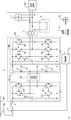
- FIG. 2 is a diagram illustrating a configuration example of an electric railway vehicle including the power conversion device according to the embodiment.
- the power converter 1 converts the power acquired from the overhead line 101 via the current collector 102 and supplies the power to the load device 103 that is an air conditioner or a lighting device connected to the output side.
- the power acquired from the overhead line 101 is input to the power conversion unit 40 via the switch 2 and the input reactor 3.
- the power conversion unit 40 includes a primary circuit 50, a transformer 60, a secondary circuit 70, and a three-phase inverter circuit 80.
- FIG. 1 converts the power acquired from the overhead line 101 via the current collector 102 and supplies the power to the load device 103 that is an air conditioner or a lighting device connected to the output side.
- the power acquired from the overhead line 101 is input to the power conversion unit 40 via the switch 2 and the input reactor 3.
- the power conversion unit 40 includes a primary circuit 50, a transformer 60, a secondary circuit 70, and a three-phase inverter circuit 80.
- the switching elements 52, 53, 54, 55 included in the primary circuit 50 that is an inverter circuit and the switching elements 82, 83, 84, 85, 86, 87 included in the three-phase inverter circuit 80 are IGBTs (Insulated). Gate Bipolar Transistor (insulated gate bipolar transistor), but any semiconductor element can be used.
- the primary circuit 50 converts DC power into high-frequency single-phase AC power.
- the primary circuit 50 has a full bridge configuration, but may have a half bridge configuration or another configuration.
- the transformer 60 is connected to the primary circuit 50 and the secondary circuit 70, and performs power conversion in a state where the primary side and the secondary side are insulated.
- the secondary circuit 70 rectifies the high-frequency AC voltage input from the transformer 60 into a DC voltage, and applies the DC voltage to the capacitor 81 included in the three-phase inverter circuit 80.
- the connection point of the switching elements 52 and 53 and one end of the primary winding of the transformer 60 are connected via a connection conductor, and the connection point of the switching elements 54 and 55 and the other end of the primary winding of the transformer 60 are connected.
- connection conductor One end of the secondary winding of the transformer 60 and the connection point of the diodes 71 and 72 are connected via a connection conductor, and the other end of the secondary winding of the transformer 60 and the connection point of the diodes 73 and 74 are connected. Connected via conductor. In order to prevent the connection conductor from generating heat, a copper thin plate conductor or a litz wire is used as the connection conductor.
- the three-phase inverter circuit 80 performs power conversion and outputs a three-phase AC voltage having a desired frequency and a desired magnitude.
- the control unit 4 controls on / off switching of the switch 2 and switching of the switching elements 52, 53, 54, 55, 82, 83, 84, 85, 86, 87.
- the circulation fan control unit 8 controls the circulation fan 25 so that the circulation fan 25 operates during operation of the power conversion device 1. Power is supplied to the control unit 4, the circulation fan control unit 8, and the circulation fan 25 from the internal power supply of the power conversion device 1.
- a reactor unit 5 composed of an AC reactor provided in each phase
- a capacitor unit 6 composed of an AC capacitor connected to each phase
- a cooling blower 7, and a load device 103 are connected.
- the pulse voltage waveform output from the three-phase inverter circuit 80 is smoothed, and a sine wave AC is obtained.
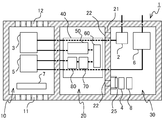
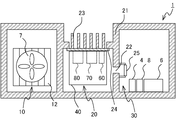
- FIG. 3 and 4 are cross-sectional views of the power converter according to the embodiment.
- 3 is a cross-sectional view taken along the line AA of the power conversion device 1 shown in FIG. 1
- FIG. 4 is a cross-sectional view taken along the line BB of the power conversion device 1 shown in FIG.
- a large amount of high-frequency alternating current flows through the primary circuit 50, the transformer 60, the secondary circuit 70, and the three-phase inverter circuit 80 included in the power conversion unit 40. Therefore, the amount of heat generated is larger than that of other devices. Therefore, the primary circuit 50, the transformer 60, the secondary circuit 70, and the three-phase inverter circuit 80 are accommodated in the first sealed portion 20 where heat generated in the casing is radiated from the casing and the heat sink 23.
- the switch 2, the control unit 4, the capacitor unit 6, and the circulation fan control unit 8 have a smaller calorific value than the devices included in the power conversion unit 40 and may be damaged by dust and moisture. Is accommodated in the hermetically sealed portion 30.
- the AC reactor included in the input reactor 3 and the reactor unit 5 is manufactured by winding a copper or aluminum conductor in a coil shape. During the operation of the power conversion device 1, a large loss occurs due to the resistance of the conductor in the input reactor 3 and the reactor unit 5, so that it is necessary to forcibly cool the input reactor 3 and the reactor unit 5. Therefore, the input reactor 3 and the reactor part 5 are accommodated in the opening part 10.
- the cooling blower 7 is accommodated in the opening 10 in a direction in which air is blown from the inlet 11 toward the outlet 12.
- the connecting conductor that connects the switch 2 and the input reactor 3 and the connecting conductor that connects the reactor unit 5 and the capacitor unit 6 are the partition wall and the first sealed unit between the open unit 10 and the first sealed unit 20. 20 is inserted into a hole (not shown) formed in the partition wall 21 between the second sealing portion 30 and the second sealing portion 30.
- the connection conductor that connects the input reactor 3 and the power conversion unit 40 and the connection conductor that connects the reactor unit 5 and the power conversion unit 40 are formed in the partition wall between the open portion 10 and the first sealed portion 20. Is inserted into a hole (not shown).
- FIG. A circulation fan 25 is provided in at least one of the at least two vent holes 22 formed in the partition wall 21 between the first sealing portion 20 and the second sealing portion 30.
- the circulation fan control unit 8 operates the circulation fan 25 according to the necessary flow rate of the circulation fan 25 calculated in advance based on the estimated value of the temperature change amount of the first sealing unit 20 and the second sealing unit 30. .
- the circulation fan 25 When the circulation fan 25 is activated, the air in the first sealed part 20 moves to the second sealed part 30, the same amount of air moves from the second sealed part 30 to the first sealed part 20, The air of the 1st sealing part 20 and the 2nd sealing part 30 circulates. By circulating the air in the first sealing part 20 and the second sealing part 30, the difference in the temperature rise between the first sealing part 20 and the second sealing part 30 can be reduced.
- the switching frequency of the primary circuit 50 is about 20 kHz, and the electronic components of the power converter 1 mounted on the electric railway vehicle are connected to the first sealed portion 20 and the second sealed portion 30 as shown in FIGS. 3 and 4.
- the amount of heat radiated to the first sealed portion 20 is about 500 W, whereas the amount of heat generated in the second sealed portion 30 is about 100 W. That is, the temperature rise at the first sealed portion 20 is larger than the temperature rise at the second sealed portion 30.
- the required flow rate of the circulation fan 25 is calculated based on the estimated values of the heat resistant temperature and the temperature change amount of the electronic components housed in the first sealed part 20 and the second sealed part 30.
- the estimated value of the temperature change amount can be calculated from the estimated value of the heat generation amount and the estimated value of the heat dissipation amount.
- the temperature rise of the second sealed portion 30 may be larger than the temperature rise of the first sealed portion 20. Even in that case, the circulation fan 25 is operated to circulate the air between the first sealing portion 20 and the second sealing portion 30, thereby suppressing the temperature rise in the second sealing portion 30. be able to. By operating the circulation fan 25, the difference in temperature rise between the first sealed portion 20 and the second sealed portion 30 can be reduced.
- the connection conductor between the primary circuit 50 and the transformer 60 and the connection conductor between the secondary circuit 70 and the transformer 60 have a frequency of about 20 kHz. Since a current of about 100 A flows, the amount of heat generated by the connecting conductor is large.
- the primary circuit 50, the transformer 60, and the secondary circuit 70 are accommodated in the first sealed part 20, and the connection conductor and the secondary circuit 70 between the primary circuit 50 and the transformer 60 are accommodated. By shortening the length of the connection conductor between the transformer 60 and the transformer 60, the amount of heat generated by the connection conductor due to the skin effect can be reduced.
- the circulation fan 25 is operated according to the required flow rate calculated in advance. However, even if the circulation fan 25 is operated according to the temperature difference between the first sealed portion 20 and the second sealed portion 30. Good.
- the circulation fan control unit 8 acquires the temperature from the temperature sensors provided in the first sealing unit 20 and the second sealing unit 30, and responds to the temperature difference between the first sealing unit 20 and the second sealing unit 30. Then, the required flow rate of the circulation fan 25 is calculated, and the flow rate of the circulation fan 25 is adjusted according to the calculated required flow rate.
- the circulation fan control unit 8 detects the magnitude of the current flowing through the connecting conductor in the first sealed portion 20 and the magnitude of the current flowing through the connecting conductor in the second sealed portion 30, and responds to the difference in the detected value. Then, the required flow rate of the circulation fan 25 may be calculated, and the flow rate of the circulation fan 25 may be adjusted according to the calculated required flow rate.
- vent holes 22 are formed in the partition wall 21 between the first sealing portion 20 and the second sealing portion 30, and at least 1
- the circulation fan 25 at one ventilation port 22
- the embodiment of the present invention is not limited to the above-described embodiment.
- the configuration of the power conversion unit 40 is not limited to the example of FIG. 2, and may be a power conversion circuit including a capacitor and a switching element without a transformer, or a DC-DC converter (Direct-Current-to-Direct- Current Converter) or chopper circuit. You may cool each part of the power converter device 1 with the running wind of an electric railway vehicle, without providing the cooling blower 7.
- the power conversion device 1 may be provided not only under the floor of the electric railway vehicle but also on the roof.
- the number of sealed portions is not limited to two, and the power conversion device 1 may include three or more sealed portions. In that case, at least two or more ventilation openings are formed in each of the partition walls between the sealed portions.
- the structure of the power converter 1 is not limited to the above example.
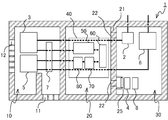
- 5, 6 and 7 are cross-sectional views of the power converter according to the embodiment.
- the heat sink 23 is exposed to the outside of the power conversion device 1.
- the adjacent direction of the opening portion 10 and the first sealing portion 20 and the adjacent direction of the first sealing portion 20 and the second sealing portion 30 are orthogonal to each other.
- the inlet 11 and the outlet 12 are formed on two adjacent surfaces of the casing forming the opening 10.
Landscapes
- Engineering & Computer Science (AREA)
- Microelectronics & Electronic Packaging (AREA)
- Physics & Mathematics (AREA)
- Thermal Sciences (AREA)
- Power Engineering (AREA)
- Inverter Devices (AREA)
Abstract
La présente invention concerne un dispositif de conversion d'énergie (1) dont le boîtier est intérieurement divisé par des parois de séparation et qui est constitué par une section ouverte (10), dans laquelle de l'air extérieur circule, par une première section étanche à l'air (20), adjacente à la section ouverte (10), et dans laquelle l'air extérieur ne circule pas, et par une seconde section étanche à l'air (30), adjacente à la première section étanche à l'air (20), et dans laquelle l'air extérieur ne circule pas. Au moins deux trous de ventilation (22) sont formés dans une paroi de séparation (21) entre la première section étanche à l'air (20) et la seconde section étanche à l'air (30). Au moins un trou desdits trous de ventilation (22) est pourvu d'un ventilateur de recirculation (25). La surface externe de la première section étanche à l'air (20) est pourvue d'un dissipateur thermique (23) qui dissipe la chaleur transférée depuis un composant électronique logé dans la première section étanche à l'air (20), ledit dissipateur thermique étant exposé à la section ouverte (10).
Priority Applications (4)
| Application Number | Priority Date | Filing Date | Title |
|---|---|---|---|
| JP2018520273A JP6479268B2 (ja) | 2016-06-01 | 2016-06-01 | 電力変換装置 |
| PCT/JP2016/066144 WO2017208384A1 (fr) | 2016-06-01 | 2016-06-01 | Dispositif de conversion d'énergie |
| EP16904009.4A EP3468025B1 (fr) | 2016-06-01 | 2016-06-01 | Dispositif de conversion d'énergie |
| US16/304,007 US10555442B2 (en) | 2016-06-01 | 2016-06-01 | Power conversion device |
Applications Claiming Priority (1)
| Application Number | Priority Date | Filing Date | Title |
|---|---|---|---|
| PCT/JP2016/066144 WO2017208384A1 (fr) | 2016-06-01 | 2016-06-01 | Dispositif de conversion d'énergie |
Publications (1)
| Publication Number | Publication Date |
|---|---|
| WO2017208384A1 true WO2017208384A1 (fr) | 2017-12-07 |
Family
ID=60478134
Family Applications (1)
| Application Number | Title | Priority Date | Filing Date |
|---|---|---|---|
| PCT/JP2016/066144 Ceased WO2017208384A1 (fr) | 2016-06-01 | 2016-06-01 | Dispositif de conversion d'énergie |
Country Status (4)
| Country | Link |
|---|---|
| US (1) | US10555442B2 (fr) |
| EP (1) | EP3468025B1 (fr) |
| JP (1) | JP6479268B2 (fr) |
| WO (1) | WO2017208384A1 (fr) |
Cited By (10)
| Publication number | Priority date | Publication date | Assignee | Title |
|---|---|---|---|---|
| JP2019040968A (ja) * | 2017-08-24 | 2019-03-14 | 株式会社三社電機製作所 | 電気機器 |
| WO2019092800A1 (fr) * | 2017-11-08 | 2019-05-16 | 三菱電機株式会社 | Transformateur et dispositif de conversion de puissance |
| JP2019134658A (ja) * | 2018-01-30 | 2019-08-08 | エルエス産電株式会社Lsis Co., Ltd. | インバータ及びこの制御方法 |
| JP2019161879A (ja) * | 2018-03-14 | 2019-09-19 | 富士電機株式会社 | 電力変換装置 |
| CN110932571A (zh) * | 2019-12-03 | 2020-03-27 | 西安中车永电电气有限公司 | 一种新型逆变功率单元及其功率电路 |
| WO2020067304A1 (fr) * | 2018-09-27 | 2020-04-02 | 株式会社日立製作所 | Dispositif d'entraînement de véhicule ferroviaire, procédé d'équipement de celui-ci, véhicule ferroviaire équipé dudit dispositif d'entraînement, et son procédé de production |
| WO2021001997A1 (fr) * | 2019-07-04 | 2021-01-07 | 三菱電機株式会社 | Système d'entraînement de véhicule électrique et procédé de protection de dispositif de commande de véhicule électrique |
| WO2022190325A1 (fr) * | 2021-03-11 | 2022-09-15 | 三菱電機株式会社 | Appareil de refroidissement et dispositif embarqué |
| WO2023188043A1 (fr) * | 2022-03-29 | 2023-10-05 | 三菱電機株式会社 | Dispositif de conversion de puissance |
| JPWO2024084666A1 (fr) * | 2022-10-20 | 2024-04-25 |
Families Citing this family (9)
| Publication number | Priority date | Publication date | Assignee | Title |
|---|---|---|---|---|
| WO2017218614A1 (fr) | 2016-06-15 | 2017-12-21 | Hunter Fan Company | Système de ventilateur de plafond et boîtier de composants électroniques |
| WO2018020615A1 (fr) * | 2016-07-27 | 2018-02-01 | 三菱電機株式会社 | Dispositif de conversion de puissance |
| CN110073586A (zh) * | 2016-11-28 | 2019-07-30 | 东芝三菱电机产业系统株式会社 | 电力变换装置 |
| JP6725586B2 (ja) * | 2018-05-18 | 2020-07-22 | 本田技研工業株式会社 | 電力変換装置 |
| JP7093747B2 (ja) * | 2019-06-07 | 2022-06-30 | 本田技研工業株式会社 | 電力制御装置及び駆動ユニット |
| US20210267099A1 (en) * | 2020-02-21 | 2021-08-26 | North American Electric, Inc. | Vortex cooling tunnel in variable frequency drive |
| US12501569B2 (en) * | 2021-06-16 | 2025-12-16 | Mitsubishi Electric Corporation | Electronic device |
| US20240326651A1 (en) * | 2023-03-30 | 2024-10-03 | InductEV, Inc. | System and method for thermal management of an inductive wireless power charger |
| US12568609B2 (en) * | 2023-07-11 | 2026-03-03 | Hamilton Sundstrand Corporation | Thermal management systems for rectifier assemblies |
Citations (5)
| Publication number | Priority date | Publication date | Assignee | Title |
|---|---|---|---|---|
| JPH0213266A (ja) * | 1988-06-29 | 1990-01-17 | Hitachi Ltd | インバータ装置 |
| JPH10210762A (ja) * | 1997-01-24 | 1998-08-07 | Toshiba Corp | インバータ装置 |
| JP2001258263A (ja) * | 2000-03-10 | 2001-09-21 | Toshiba Corp | 鉄道車両用電力変換装置 |
| JP2005001598A (ja) | 2003-06-13 | 2005-01-06 | Toshiba Corp | 交直電車用電力変換システム |
| JP2009096460A (ja) | 2007-09-28 | 2009-05-07 | Toshiba Corp | 鉄道車両用床下装置およびその製造方法 |
Family Cites Families (15)
| Publication number | Priority date | Publication date | Assignee | Title |
|---|---|---|---|---|
| JPH11155257A (ja) * | 1997-11-20 | 1999-06-08 | Toshiba Corp | インバータユニット付きモータ |
| US6144556A (en) * | 1999-03-30 | 2000-11-07 | Lanclos; Kenneth W. | Heat dissipating housing for electronic components |
| US7272008B2 (en) * | 2004-03-09 | 2007-09-18 | Intec, Inc. | Portable power inverter with pass through device |
| ES2377018T3 (es) | 2004-06-24 | 2012-03-21 | Sma Solar Technology Ag | Inversor con una carcasa con componentes eléctricos y/o electrónicos presentando disipadores de calor |
| US7142423B2 (en) * | 2004-10-26 | 2006-11-28 | Comarco Wireless Technologies, Inc. | Power adapter with fan assembly |
| JP5483209B2 (ja) * | 2011-03-30 | 2014-05-07 | 株式会社安川電機 | 電力変換装置 |
| JP2012223032A (ja) * | 2011-04-13 | 2012-11-12 | Yaskawa Electric Corp | 電力変換装置 |
| WO2013145246A1 (fr) * | 2012-03-29 | 2013-10-03 | 富士通株式会社 | Centre de données modulaire et son procédé de commande |
| JPWO2014147962A1 (ja) * | 2013-03-19 | 2017-02-16 | 富士電機株式会社 | 磁気部品の冷却構造及びこれを備えた電力変換装置 |
| JP5971403B2 (ja) * | 2013-03-19 | 2016-08-17 | 富士電機株式会社 | 冷却装置及びこれを備えた電力変換装置 |
| KR20150011176A (ko) * | 2013-07-22 | 2015-01-30 | 엘에스산전 주식회사 | 냉각 장치 |
| CN104679163A (zh) * | 2013-11-30 | 2015-06-03 | 鸿富锦精密工业(深圳)有限公司 | 电子设备机箱 |
| DE102014001423A1 (de) | 2014-02-03 | 2015-08-06 | Unify Gmbh & Co. Kg | Belüftungseinrichtung |
| JP2016032367A (ja) * | 2014-07-29 | 2016-03-07 | 株式会社安川電機 | 電力変換装置 |
| US9795067B2 (en) * | 2015-04-03 | 2017-10-17 | Mitsubishi Electric Corporation | Electronic apparatus |
-
2016
- 2016-06-01 EP EP16904009.4A patent/EP3468025B1/fr active Active
- 2016-06-01 US US16/304,007 patent/US10555442B2/en active Active
- 2016-06-01 WO PCT/JP2016/066144 patent/WO2017208384A1/fr not_active Ceased
- 2016-06-01 JP JP2018520273A patent/JP6479268B2/ja active Active
Patent Citations (5)
| Publication number | Priority date | Publication date | Assignee | Title |
|---|---|---|---|---|
| JPH0213266A (ja) * | 1988-06-29 | 1990-01-17 | Hitachi Ltd | インバータ装置 |
| JPH10210762A (ja) * | 1997-01-24 | 1998-08-07 | Toshiba Corp | インバータ装置 |
| JP2001258263A (ja) * | 2000-03-10 | 2001-09-21 | Toshiba Corp | 鉄道車両用電力変換装置 |
| JP2005001598A (ja) | 2003-06-13 | 2005-01-06 | Toshiba Corp | 交直電車用電力変換システム |
| JP2009096460A (ja) | 2007-09-28 | 2009-05-07 | Toshiba Corp | 鉄道車両用床下装置およびその製造方法 |
Non-Patent Citations (1)
| Title |
|---|
| See also references of EP3468025A4 |
Cited By (16)
| Publication number | Priority date | Publication date | Assignee | Title |
|---|---|---|---|---|
| JP2019040968A (ja) * | 2017-08-24 | 2019-03-14 | 株式会社三社電機製作所 | 電気機器 |
| WO2019092800A1 (fr) * | 2017-11-08 | 2019-05-16 | 三菱電機株式会社 | Transformateur et dispositif de conversion de puissance |
| JP2019134658A (ja) * | 2018-01-30 | 2019-08-08 | エルエス産電株式会社Lsis Co., Ltd. | インバータ及びこの制御方法 |
| JP2019161879A (ja) * | 2018-03-14 | 2019-09-19 | 富士電機株式会社 | 電力変換装置 |
| JPWO2020067304A1 (ja) * | 2018-09-27 | 2021-05-20 | 株式会社日立製作所 | 鉄道車両用駆動装置、この艤装方法、当該駆動装置を搭載する鉄道車両、およびこの生産方法 |
| WO2020067304A1 (fr) * | 2018-09-27 | 2020-04-02 | 株式会社日立製作所 | Dispositif d'entraînement de véhicule ferroviaire, procédé d'équipement de celui-ci, véhicule ferroviaire équipé dudit dispositif d'entraînement, et son procédé de production |
| WO2021001997A1 (fr) * | 2019-07-04 | 2021-01-07 | 三菱電機株式会社 | Système d'entraînement de véhicule électrique et procédé de protection de dispositif de commande de véhicule électrique |
| JPWO2021001997A1 (fr) * | 2019-07-04 | 2021-01-07 | ||
| CN110932571A (zh) * | 2019-12-03 | 2020-03-27 | 西安中车永电电气有限公司 | 一种新型逆变功率单元及其功率电路 |
| WO2022190325A1 (fr) * | 2021-03-11 | 2022-09-15 | 三菱電機株式会社 | Appareil de refroidissement et dispositif embarqué |
| US12588170B2 (en) | 2021-03-11 | 2026-03-24 | Mitsubishi Electric Corporation | In-vehicle device including cooling apparatus |
| WO2023188043A1 (fr) * | 2022-03-29 | 2023-10-05 | 三菱電機株式会社 | Dispositif de conversion de puissance |
| JPWO2023188043A1 (fr) * | 2022-03-29 | 2023-10-05 | ||
| JP7570559B2 (ja) | 2022-03-29 | 2024-10-21 | 三菱電機株式会社 | 電力変換装置 |
| JPWO2024084666A1 (fr) * | 2022-10-20 | 2024-04-25 | ||
| JP7849494B2 (ja) | 2022-10-20 | 2026-04-21 | ファナック株式会社 | ノイズフィルタ |
Also Published As
| Publication number | Publication date |
|---|---|
| JPWO2017208384A1 (ja) | 2018-08-09 |
| EP3468025A1 (fr) | 2019-04-10 |
| EP3468025B1 (fr) | 2022-01-05 |
| JP6479268B2 (ja) | 2019-03-06 |
| EP3468025A4 (fr) | 2019-06-05 |
| US10555442B2 (en) | 2020-02-04 |
| US20190208671A1 (en) | 2019-07-04 |
Similar Documents
| Publication | Publication Date | Title |
|---|---|---|
| JP6479268B2 (ja) | 電力変換装置 | |
| JP6433631B2 (ja) | 電力変換装置 | |
| JP5544255B2 (ja) | 半導体パワーモジュール及び電力変換装置 | |
| JP6161127B2 (ja) | 電力変換装置 | |
| JP5712760B2 (ja) | 誘導加熱調理器 | |
| CN111327208A (zh) | 具散热机制的逆变器装置 | |
| US9960725B2 (en) | Electric compressor | |
| WO2011104909A1 (fr) | Système de machine électrique tournante | |
| JP6410972B2 (ja) | 電力変換装置 | |
| JP6074346B2 (ja) | 配電盤装置 | |
| JP2010284033A (ja) | 鉄道車両の電源装置 | |
| KR101726099B1 (ko) | 공기 조화기의 인버터 장치 | |
| JP2015163013A (ja) | 圧縮機制御装置、力率改善回路、電装部品の放熱構造、及び電気機器 | |
| JP5225759B2 (ja) | 機器冷却装置 | |
| JP5468690B2 (ja) | 機器冷却装置 | |
| JP7520259B2 (ja) | 電子機器 | |
| JP2013252006A (ja) | モータ駆動装置及びそれを備えた空気調和機 | |
| JP2012222952A (ja) | 負荷駆動装置 | |
| JP4396626B2 (ja) | 電力変換装置 | |
| JP2021151073A (ja) | 電力変換装置 | |
| JP7310467B2 (ja) | 電力変換装置 | |
| JP2019022300A (ja) | 電源装置 | |
| JP6487119B1 (ja) | 電力変換装置 | |
| JPWO2016194097A1 (ja) | 電力変換装置 | |
| JPWO2019026162A1 (ja) | 電力変換装置 |
Legal Events
| Date | Code | Title | Description |
|---|---|---|---|
| ENP | Entry into the national phase |
Ref document number: 2018520273 Country of ref document: JP Kind code of ref document: A |
|
| NENP | Non-entry into the national phase |
Ref country code: DE |
|
| 121 | Ep: the epo has been informed by wipo that ep was designated in this application |
Ref document number: 16904009 Country of ref document: EP Kind code of ref document: A1 |
|
| ENP | Entry into the national phase |
Ref document number: 2016904009 Country of ref document: EP Effective date: 20190102 |