WO2017208401A1 - Écrou de blocage et procédé de fixation - Google Patents
Écrou de blocage et procédé de fixation Download PDFInfo
- Publication number
- WO2017208401A1 WO2017208401A1 PCT/JP2016/066263 JP2016066263W WO2017208401A1 WO 2017208401 A1 WO2017208401 A1 WO 2017208401A1 JP 2016066263 W JP2016066263 W JP 2016066263W WO 2017208401 A1 WO2017208401 A1 WO 2017208401A1
- Authority
- WO
- WIPO (PCT)
- Prior art keywords
- male
- diameter
- loosening prevention
- hole
- thread
- Prior art date
- Legal status (The legal status is an assumption and is not a legal conclusion. Google has not performed a legal analysis and makes no representation as to the accuracy of the status listed.)
- Ceased
Links
Images



Classifications
-
- F—MECHANICAL ENGINEERING; LIGHTING; HEATING; WEAPONS; BLASTING
- F16—ENGINEERING ELEMENTS AND UNITS; GENERAL MEASURES FOR PRODUCING AND MAINTAINING EFFECTIVE FUNCTIONING OF MACHINES OR INSTALLATIONS; THERMAL INSULATION IN GENERAL
- F16B—DEVICES FOR FASTENING OR SECURING CONSTRUCTIONAL ELEMENTS OR MACHINE PARTS TOGETHER, e.g. NAILS, BOLTS, CIRCLIPS, CLAMPS, CLIPS OR WEDGES; JOINTS OR JOINTING
- F16B39/00—Locking of screws, bolts or nuts
- F16B39/22—Locking of screws, bolts or nuts in which the locking takes place during screwing down or tightening
- F16B39/28—Locking of screws, bolts or nuts in which the locking takes place during screwing down or tightening by special members on, or shape of, the nut or bolt
- F16B39/30—Locking exclusively by special shape of the screw-thread
Definitions
- the present invention relates to a loosening prevention nut and a fastening method that are fastened to a mating member such as a bolt and prevent loosening due to return rotation caused by vibration or the like.
- Bolts and nuts are used as fastening parts in order to fix various building members or machine parts.
- Bolts and nuts used as fastening parts may rotate in the return direction due to slippage due to vibration or rotation of the parts to be fastened. For this reason, loosening due to the rotation of the nut returns to the nut, and the reduction of the fastening effect becomes a problem.
- Patent Documents 1 and 2 In order to prevent loosening due to this return rotation, various bolt and nut structures have been proposed (see Patent Documents 1 and 2).
- JP 11-315820 A JP-A-62-86409
- a male screw part of a bolt has a destruction part, and loosening is prevented by breaking a part of the female screw part of the nut.
- the bolt is not a structure that can improve the looseness of the nut having the male screw portion.
- the present invention is for solving the above-described problems, and an object of the present invention is to provide a loosening prevention nut and a fastening method that more firmly prevent loosening due to return rotation of the nut.
- the loosening prevention nut according to the present invention is continuous from an opening opened in one end surface, and is continuous from an internal thread portion screwed into a male screw portion of a mating member and an opening portion opened in the other end surface, And a hole having a diameter smaller than the outer diameter of the male screw of the member and larger than the diameter of the male screw.
- the fastening method according to the present invention includes a female screw portion that is continuous from an opening portion that is open to one end face, and is threaded into a male screw portion of a counterpart member, and is continuous from an opening portion that is open to the other end face.
- a loosening prevention nut having a diameter smaller than the male screw outer diameter of the male screw portion and larger than the male screw valley diameter from the female screw portion side with respect to the counterpart member
- the loosening prevention nut and the fastening method according to the present invention, the loosening prevention nut provided with the female screw portion and the hole is attached to the mating member from the female screw portion side and screwed into the mating member.
- the thread of the male screw portion of the mating member is plastically deformed at the hole portion.
- the plastically deformed male screw portion does not screw into the female screw portion of the loosening prevention nut.
- the loosening prevention nut does not rotate in the backward direction of the plastically deformed male screw portion. Therefore, the loosening prevention nut can more firmly prevent loosening due to return rotation.
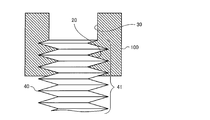
- FIG. 1 is a cross-sectional view showing a loosening prevention nut 100 according to Embodiment 1 of the present invention.
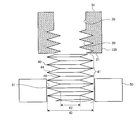
- FIG. 2 is a diagram showing a state in which the loosening prevention nut 100 according to the first embodiment of the present invention is fastened to the bolt 40.
- a loosening prevention nut 100 shown in FIG. 1 includes a female screw portion 20 and a hole portion 30.
- the loosening prevention nut 100 has a general outer shape such as a hexagon, an octagon, or a tetragon.
- the female screw portion 20 is continuous from the opening portion opened on one end surface 21 on the side attached to the bolt 40 which is the counterpart member, and is screwed into the male screw portion 41 of the bolt 40.
- the female thread portion 20 is formed with a thread 22 having a catching height according to a predetermined lead angle and pitch.
- the hole portion 30 is continuous from the opening portion opened in the other end surface 31 opposite to the side attached to the bolt 40.
- the hole diameter of the hole portion 30 is smaller than the male screw outer diameter 42 of the male screw portion 41 of the bolt 40 and larger than the male screw valley diameter 43.
- the hole 30 is formed by plastically deforming the thread 44 of the male thread 41 of the bolt 40 so that the thread groove 45 of the male thread 41 of the bolt 40 is filled, and the male thread of the bolt 40 that becomes the outer peripheral surface 46. This is a hole diameter that configures the portion 41 to be larger than the inner diameter 23 of the female screw portion 20.
- the hole diameter of the hole portion 30 is the same hole diameter dimension extending in the axial direction along the same center line.
- the center line extending in the axial direction of the female screw portion 20 and the hole portion 30 coincides.
- the female screw portion 20 and the hole portion 30 are formed directly and continuously inside the loosening prevention nut 100.
- the loosening prevention nut 100 having the above-described configuration has a hole portion 30 continuous with the female screw portion 20 in a backward direction that is opposite to the tightening rotation direction.
- the hole 30 is plastically deformed so that the thread 44 of the male screw part 41 of the bolt 40 is crushed and does not screw with the female screw part 20 of the loosening prevention nut 100.
- the loosening prevention nut 100 has a hole portion 30 continuous with the female screw portion 20.
- FIG. 3 is a diagram showing a state in which the female thread portion of the loosening prevention nut according to the first embodiment of the present invention is screwed into the male thread portion of the bolt.
- FIG. 4 is a diagram illustrating a state in which the hole portion of the loosening prevention nut according to the first embodiment of the present invention plastically deforms the male screw portion of the bolt.
- the female opening at one end face 21 of the loosening prevention nut 100 is opened.
- the screw part 20 is screwed together.
- the loosening prevention nut 100 is rotated by the user in the tightening rotation direction using a jig, and proceeds to the fastened member 50 side. As shown in FIG. 3, when the loosening prevention nut 100 is screwed into the bolt 40, the hole 30 of the loosening prevention nut 100 comes into contact with the tip of the male screw portion 41 of the bolt 40.
- the hole 30 of the loosening prevention nut 100 When the loosening prevention nut 100 is further tightened, the hole 30 of the loosening prevention nut 100 tries to advance in the tightening rotation direction without plastic deformation. At this time, the hole diameter of the hole portion 30 of the loosening prevention nut 100 is smaller than the male screw outer diameter 42 of the male screw portion 41 of the bolt 40 to be screwed. Therefore, as shown in FIG. 4, the hole 30 is plastically deformed by embedding the thread 44 of the male thread 41 of the bolt 40 in the thread groove 45. The outer diameter of the outer peripheral surface 46 of the male thread portion 41 of the bolt 40 that has been plastically deformed substantially matches the hole diameter of the hole portion 30 of the loosening prevention nut 100.
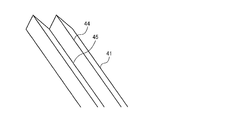
- FIG. 5 is a partially developed view showing the male thread portion 41 of the bolt 40 according to Embodiment 1 of the present invention.
- FIG. 6 is a partial development view showing a boundary 47 in which the male thread portion 41 of the bolt 40 according to Embodiment 1 of the present invention is plastically deformed.
- the loosening prevention nut 100 After the loosening prevention nut 100 is tightened, the female threaded portion 20 of the loosening prevention nut 100 and the outer peripheral surface 46 that is a plastically deformed portion of the bolt 40 do not mesh. For this reason, the loosening prevention nut 100 cannot return and rotate in the direction opposite to the tightening rotation direction of the bolt 40. In other words, the loosening prevention nut 100 does not loosen due to the return rotation even when the fastened member 50 receives vibration or receives slippage of the fastening portion when rotating.
- the loosening prevention nut 100 includes the female screw portion 20 that is continuous from the opening portion that is opened in the one end surface 21 and that is screwed into the male screw portion 41 of the bolt 40.
- the loosening prevention nut 100 is provided with a hole 30 that is continuous from an opening that is open to the other end face 31 and that is smaller in diameter than the male thread outer diameter 42 of the male thread 41 of the bolt 40.
- the loosening prevention nut 100 including the female screw portion 20 and the hole portion 30 is attached to the bolt 40 from the female screw portion 20 side, and is tightened and rotated with respect to the bolt 40 to be screwed. In doing so, the thread 44 of the male thread 41 of the bolt 40 is plastically deformed in the hole 30.
- the plastically deformed male screw portion 41 does not screw into the female screw portion 20 of the loosening prevention nut 100. For this reason, the loosening prevention nut 100 does not rotate in the backward direction of the plastically deformed male screw portion 41. Accordingly, the loosening prevention nut 100 can more firmly prevent loosening due to return rotation.
- the center line of the female screw portion 20 and the hole portion 30 coincide with each other. According to this configuration, the thread 44 of the male threaded portion 41 of the bolt 40 can be plastically deformed by the hole 30 when the nut 40 is tightened and rotated with respect to the bolt 40 to be screwed.
- the female screw portion 20 and the hole portion 30 are formed continuously. According to this configuration, a large force is required for the male screw portion 41 of the bolt 40 to enter the hole portion 30 when the loosening prevention nut 100 is rotated by the user in the tightening rotation direction using a jig. However, when the user plastically deforms the thread 44 of the male threaded portion 41 of the bolt 40 with a great force, the plastically deformed portion is difficult to deform again. Accordingly, the loosening prevention nut 100 can more firmly prevent loosening due to return rotation.
- the loosening prevention nut 100 is attached to the bolt 40 from the female screw portion 20 side, and the screw thread 44 of the male screw portion 41 of the bolt 40 is inserted into the hole portion 30 when tightening and rotating with respect to the bolt 40 to be screwed. With plastic deformation. According to this configuration, the plastically deformed male screw portion 41 does not screw into the female screw portion 20 of the loosening prevention nut 100. For this reason, the loosening prevention nut 100 does not rotate in the backward direction of the plastically deformed male screw portion 41. Accordingly, the loosening prevention nut 100 can more firmly prevent loosening due to return rotation.
- the hole 30 plastically deforms the thread 44 of the male threaded portion 41 of the bolt 40 so that the screw groove 45 of the male threaded portion 41 of the bolt 40 is filled, and the male threaded portion 41 of the bolt 40 is replaced with the inner diameter 23 of the female threaded portion 20.
- the hole diameter is configured to be larger than that. According to this configuration, the plastically deformed male screw portion 41 is deformed to an outer diameter dimension that is an outer peripheral surface 46 that is not screwed into the female screw portion 20 of the loosening prevention nut 100.
- the loosening prevention nut 100 includes a female screw portion 20 that is continuous from an opening portion opened in one end surface 21 and is screwed into a male screw portion 41 of the bolt 40.
- the loosening prevention nut 100 is provided with a hole 30 that is continuous from an opening that is open to the other end face 31 and that is smaller in diameter than the male thread outer diameter 42 of the male thread 41 of the bolt 40.
- the loosening prevention nut 100 is attached to the bolt 40 from the female screw portion 20 side.
- the fastening method is to plastically deform the thread 44 of the male threaded portion 41 of the bolt 40 at the hole 30 when rotating with respect to the bolt 40 to be screwed.
- the loosening prevention nut 100 has the female screw portion 20 that is screwed into the bolt 40. For this reason, when the loosening prevention nut 100 is fastened to the bolt 40, the loosening prevention nut 100 can rotate in the traveling direction which is the fastening rotation direction. Further, the loosening prevention nut 100 has a hole portion 30 continuous to the female screw portion 20. When the screw 40 is tightened and rotated with respect to the bolt 40, the screw thread 44 of the male screw portion 41 of the bolt 40 is plastically deformed in the hole 30. Therefore, the bolt 40 is plastically deformed so as not to be screwed with the female screw portion 20 of the loosening prevention nut 100.
- the loosening prevention nut 100 cannot rotate in the backward direction which is the return rotation direction.
- the force of returning rotation due to vibration of the fastened building part or rotation of the machine part is weaker than the force of plastic deformation of the thread 44 of the male screw part 41 of the bolt 40 at the hole 30.
- the loosening prevention nut 100 does not rotate back and does not deform the outer peripheral surface 46 of the male screw portion 41 of the bolt 40 again. Therefore, the loosening prevention nut 100 can more firmly prevent loosening due to return rotation caused by vibration of a fastened building part or rotation of a machine part.
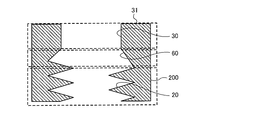
- FIG. FIG. 7 is a cross-sectional view showing a loosening prevention nut 200 according to Embodiment 2 of the present invention.
- a description will be given focusing on differences from the first embodiment.
- a loosening prevention nut 200 shown in FIG. 7 includes a female screw part 20, a taper part 60, and a hole part 30.
- the female screw portion 20, the taper portion 60, and the hole portion 30 have the same center line extending in the axial direction. Further, the female screw portion 20 and the hole portion 30 are continuously formed via the taper portion 60.
- the taper portion 60 has a conical trapezoidal inner peripheral surface whose diameter decreases from the female screw portion 20 toward the hole portion 30.
- the female screw part 20 and the hole part 30 have the same configuration as that of the first embodiment.
- the loosening prevention nut 200 having the above-described configuration has a taper portion 60 that is continuous with the female screw portion 20 in a backward direction that is opposite to the tightening rotation direction.
- the loosening prevention nut 100 has a hole 30 that extends in the axial direction with the same hole diameter continuously to the minimum hole diameter of the tapered portion 60.
- the taper portion 60 gradually crushes the thread 44 of the male screw portion 41 of the bolt 40 into a shape not screwed with the female screw portion 20 of the loosening prevention nut 100. Plastically deform.
- the hole 30 plastically deforms the thread 44 of the male thread 41 of the bolt 40 to the hole diameter of the hole 30. For this reason, the force at which the loosening prevention nut 200 is rotated by the user in the tightening rotation direction using a jig may be smaller than when the loosening prevention nut 100 of the first embodiment is rotated.
- the female screw portion 20 and the hole portion 30 are continuously formed via the taper portion 60 whose diameter decreases from the female screw portion 20 toward the hole portion 30. According to this configuration, when passing through the taper portion 60, the thread 44 of the male screw portion 41 of the bolt 40 gradually undergoes plastic deformation to reduce the diameter. For this reason, the force when the loosening prevention nut 200 is rotated by the user in the tightening rotation direction using a jig may be small.
Landscapes
- Engineering & Computer Science (AREA)
- General Engineering & Computer Science (AREA)
- Mechanical Engineering (AREA)
- Bolts, Nuts, And Washers (AREA)
- Dowels (AREA)
Abstract
La présente invention évite de manière plus sûre le desserrage provoqué par la rotation inverse de l'écrou. Un écrou de blocage est pourvu : d'une section de filetage femelle qui s'étend d'une ouverture qui s'ouvre sur une face d'extrémité et qui est vissée avec la section de filetage mâle d'un élément homologue ; et d'un trou qui s'étend depuis une ouverture qui s'ouvre vers l'autre face d'extrémité, qui a un diamètre inférieur au diamètre principal du filetage mâle de la section de filetage mâle de l'élément homologue et qui a un diamètre supérieur au diamètre du filetage mâle.
Priority Applications (3)
| Application Number | Priority Date | Filing Date | Title |
|---|---|---|---|
| JP2018520288A JP6529671B2 (ja) | 2016-06-01 | 2016-06-01 | 緩み防止ナットおよび締結方法 |
| CN201690000313.XU CN207064445U (zh) | 2016-06-01 | 2016-06-01 | 防松螺母 |
| PCT/JP2016/066263 WO2017208401A1 (fr) | 2016-06-01 | 2016-06-01 | Écrou de blocage et procédé de fixation |
Applications Claiming Priority (1)
| Application Number | Priority Date | Filing Date | Title |
|---|---|---|---|
| PCT/JP2016/066263 WO2017208401A1 (fr) | 2016-06-01 | 2016-06-01 | Écrou de blocage et procédé de fixation |
Publications (1)
| Publication Number | Publication Date |
|---|---|
| WO2017208401A1 true WO2017208401A1 (fr) | 2017-12-07 |
Family
ID=60479240
Family Applications (1)
| Application Number | Title | Priority Date | Filing Date |
|---|---|---|---|
| PCT/JP2016/066263 Ceased WO2017208401A1 (fr) | 2016-06-01 | 2016-06-01 | Écrou de blocage et procédé de fixation |
Country Status (3)
| Country | Link |
|---|---|
| JP (1) | JP6529671B2 (fr) |
| CN (1) | CN207064445U (fr) |
| WO (1) | WO2017208401A1 (fr) |
Cited By (1)
| Publication number | Priority date | Publication date | Assignee | Title |
|---|---|---|---|---|
| JP2021038573A (ja) * | 2019-09-03 | 2021-03-11 | 株式会社竹中工務店 | ねじ固定方法 |
Families Citing this family (1)
| Publication number | Priority date | Publication date | Assignee | Title |
|---|---|---|---|---|
| CN114012185B (zh) * | 2021-10-15 | 2026-04-28 | 许润柱 | 一种制作防松螺母的方法及产品 |
Citations (9)
| Publication number | Priority date | Publication date | Assignee | Title |
|---|---|---|---|---|
| JPS469138Y1 (fr) * | 1967-07-25 | 1971-04-01 | ||
| JPS5923117A (ja) * | 1982-07-30 | 1984-02-06 | 株式会社佐賀鉄工所 | 緩み止めナツト |
| JPS6286409U (fr) * | 1985-11-19 | 1987-06-02 | ||
| JPH01166814U (fr) * | 1988-04-30 | 1989-11-22 | ||
| JPH01166813U (fr) * | 1988-04-28 | 1989-11-22 | ||
| JP3053251U (ja) * | 1998-04-15 | 1998-10-23 | 株式会社 エクシオ | メガネ用ナット |
| JP2003166519A (ja) * | 2001-12-03 | 2003-06-13 | Maruzen Byora:Kk | 樹脂製ゆるみ止めナット |
| US20140086704A1 (en) * | 2011-06-02 | 2014-03-27 | A. Raymond Et Cie | Fasteners manufactured by three-dimensional printing |
| US20160115990A1 (en) * | 2013-07-03 | 2016-04-28 | Songlin Xu | Anti-loosening cylindrical threaded part |
-
2016
- 2016-06-01 JP JP2018520288A patent/JP6529671B2/ja not_active Expired - Fee Related
- 2016-06-01 CN CN201690000313.XU patent/CN207064445U/zh not_active Expired - Fee Related
- 2016-06-01 WO PCT/JP2016/066263 patent/WO2017208401A1/fr not_active Ceased
Patent Citations (9)
| Publication number | Priority date | Publication date | Assignee | Title |
|---|---|---|---|---|
| JPS469138Y1 (fr) * | 1967-07-25 | 1971-04-01 | ||
| JPS5923117A (ja) * | 1982-07-30 | 1984-02-06 | 株式会社佐賀鉄工所 | 緩み止めナツト |
| JPS6286409U (fr) * | 1985-11-19 | 1987-06-02 | ||
| JPH01166813U (fr) * | 1988-04-28 | 1989-11-22 | ||
| JPH01166814U (fr) * | 1988-04-30 | 1989-11-22 | ||
| JP3053251U (ja) * | 1998-04-15 | 1998-10-23 | 株式会社 エクシオ | メガネ用ナット |
| JP2003166519A (ja) * | 2001-12-03 | 2003-06-13 | Maruzen Byora:Kk | 樹脂製ゆるみ止めナット |
| US20140086704A1 (en) * | 2011-06-02 | 2014-03-27 | A. Raymond Et Cie | Fasteners manufactured by three-dimensional printing |
| US20160115990A1 (en) * | 2013-07-03 | 2016-04-28 | Songlin Xu | Anti-loosening cylindrical threaded part |
Cited By (2)
| Publication number | Priority date | Publication date | Assignee | Title |
|---|---|---|---|---|
| JP2021038573A (ja) * | 2019-09-03 | 2021-03-11 | 株式会社竹中工務店 | ねじ固定方法 |
| JP7269841B2 (ja) | 2019-09-03 | 2023-05-09 | 株式会社竹中工務店 | ねじ固定方法 |
Also Published As
| Publication number | Publication date |
|---|---|
| JP6529671B2 (ja) | 2019-06-12 |
| JPWO2017208401A1 (ja) | 2018-12-20 |
| CN207064445U (zh) | 2018-03-02 |
Similar Documents
| Publication | Publication Date | Title |
|---|---|---|
| JP4072832B1 (ja) | ゆるみ止めナット | |
| JP6437313B2 (ja) | 緩み止め特殊ダブルナット | |
| JP6427022B2 (ja) | 緩み止めナット | |
| CN100387853C (zh) | 锁紧螺母 | |
| US11274696B2 (en) | Fastening structure | |
| JP5957716B2 (ja) | 焼付き防止ボルト | |
| JP2005069254A5 (fr) | ||
| JP2015203492A (ja) | 緩み止めナット | |
| KR20150137910A (ko) | 풀림방지 볼트 및 너트 | |
| US12221994B2 (en) | Loosening prevention device | |
| JPWO2017208401A1 (ja) | 緩み防止ナットおよび締結方法 | |
| JP2017115907A (ja) | 締結機構およびこれを備えた後施工アンカー | |
| JP2012172780A (ja) | 締結具の緩み止め装置 | |
| JP2017141853A (ja) | ボルトとナットとからなる締結具の製造方法 | |
| JP2015145722A (ja) | 緩み止めナット | |
| JP5735905B2 (ja) | 抜け止め具、締結方法および締結構造 | |
| JP2008215466A (ja) | 緩み止めボルト | |
| JP2005090530A (ja) | 複数重積材の緩み止め締結構造 | |
| KR102108429B1 (ko) | 핀 고정형 풀림방지 너트 및 그 제조방법 | |
| KR20060023331A (ko) | 풀림방지체결볼트의 구조와 풀림방지체결볼트너트의체결구조 | |
| JP4198724B2 (ja) | ねじの緩み止め構造 | |
| JP2018091421A (ja) | ボルト・ナットの弛み止め構造 | |
| JP5249087B2 (ja) | 緩み止めボルト | |
| JP3167659U (ja) | ケーシングの接続構造 | |
| JP2009019651A (ja) | 緩み止めボルト,緩み止めナット及び締結構造 |
Legal Events
| Date | Code | Title | Description |
|---|---|---|---|
| WWE | Wipo information: entry into national phase |
Ref document number: 2018520288 Country of ref document: JP |
|
| 121 | Ep: the epo has been informed by wipo that ep was designated in this application |
Ref document number: 16904026 Country of ref document: EP Kind code of ref document: A1 |
|
| NENP | Non-entry into the national phase |
Ref country code: DE |
|
| 122 | Ep: pct application non-entry in european phase |
Ref document number: 16904026 Country of ref document: EP Kind code of ref document: A1 |