WO2017208480A1 - Dispositif d'assistance au mouvement de marche - Google Patents
Dispositif d'assistance au mouvement de marche Download PDFInfo
- Publication number
- WO2017208480A1 WO2017208480A1 PCT/JP2016/085113 JP2016085113W WO2017208480A1 WO 2017208480 A1 WO2017208480 A1 WO 2017208480A1 JP 2016085113 W JP2016085113 W JP 2016085113W WO 2017208480 A1 WO2017208480 A1 WO 2017208480A1
- Authority
- WO
- WIPO (PCT)
- Prior art keywords
- walking
- heel
- drive motor
- wearer
- pattern
- Prior art date
- Legal status (The legal status is an assumption and is not a legal conclusion. Google has not performed a legal analysis and makes no representation as to the accuracy of the status listed.)
- Ceased
Links
Images




Classifications
-
- A—HUMAN NECESSITIES
- A61—MEDICAL OR VETERINARY SCIENCE; HYGIENE
- A61H—PHYSICAL THERAPY APPARATUS, e.g. DEVICES FOR LOCATING OR STIMULATING REFLEX POINTS IN THE BODY; ARTIFICIAL RESPIRATION; MASSAGE; BATHING DEVICES FOR SPECIAL THERAPEUTIC OR HYGIENIC PURPOSES OR SPECIFIC PARTS OF THE BODY
- A61H3/00—Appliances for aiding patients or disabled persons to walk about
-
- A—HUMAN NECESSITIES
- A61—MEDICAL OR VETERINARY SCIENCE; HYGIENE
- A61B—DIAGNOSIS; SURGERY; IDENTIFICATION
- A61B5/00—Measuring for diagnostic purposes; Identification of persons
- A61B5/103—Measuring devices for testing the shape, pattern, colour, size or movement of the body or parts thereof, for diagnostic purposes
- A61B5/1036—Measuring load distribution, e.g. podologic studies
- A61B5/1038—Measuring plantar pressure during gait
-
- A—HUMAN NECESSITIES
- A61—MEDICAL OR VETERINARY SCIENCE; HYGIENE
- A61B—DIAGNOSIS; SURGERY; IDENTIFICATION
- A61B5/00—Measuring for diagnostic purposes; Identification of persons
- A61B5/103—Measuring devices for testing the shape, pattern, colour, size or movement of the body or parts thereof, for diagnostic purposes
- A61B5/107—Measuring physical dimensions, e.g. size of the entire body or parts thereof
- A61B5/1071—Measuring physical dimensions, e.g. size of the entire body or parts thereof measuring angles, e.g. using goniometers
-
- A—HUMAN NECESSITIES
- A61—MEDICAL OR VETERINARY SCIENCE; HYGIENE
- A61B—DIAGNOSIS; SURGERY; IDENTIFICATION
- A61B5/00—Measuring for diagnostic purposes; Identification of persons
- A61B5/103—Measuring devices for testing the shape, pattern, colour, size or movement of the body or parts thereof, for diagnostic purposes
- A61B5/11—Measuring movement of the entire body or parts thereof, e.g. head or hand tremor or mobility of a limb
- A61B5/112—Gait analysis
-
- A—HUMAN NECESSITIES
- A61—MEDICAL OR VETERINARY SCIENCE; HYGIENE
- A61B—DIAGNOSIS; SURGERY; IDENTIFICATION
- A61B5/00—Measuring for diagnostic purposes; Identification of persons
- A61B5/103—Measuring devices for testing the shape, pattern, colour, size or movement of the body or parts thereof, for diagnostic purposes
- A61B5/11—Measuring movement of the entire body or parts thereof, e.g. head or hand tremor or mobility of a limb
- A61B5/1121—Determining geometric values, e.g. centre of rotation or angular range of movement
-
- A—HUMAN NECESSITIES
- A61—MEDICAL OR VETERINARY SCIENCE; HYGIENE
- A61B—DIAGNOSIS; SURGERY; IDENTIFICATION
- A61B5/00—Measuring for diagnostic purposes; Identification of persons
- A61B5/68—Arrangements of detecting, measuring or recording means, e.g. sensors, in relation to patient
- A61B5/6801—Arrangements of detecting, measuring or recording means, e.g. sensors, in relation to patient specially adapted to be attached to or worn on the body surface
- A61B5/6802—Sensor mounted on worn items
- A61B5/6804—Garments; Clothes
- A61B5/6807—Footwear
-
- A—HUMAN NECESSITIES
- A61—MEDICAL OR VETERINARY SCIENCE; HYGIENE
- A61F—FILTERS IMPLANTABLE INTO BLOOD VESSELS; PROSTHESES; DEVICES PROVIDING PATENCY TO, OR PREVENTING COLLAPSING OF, TUBULAR STRUCTURES OF THE BODY, e.g. STENTS; ORTHOPAEDIC, NURSING OR CONTRACEPTIVE DEVICES; FOMENTATION; TREATMENT OR PROTECTION OF EYES OR EARS; BANDAGES, DRESSINGS OR ABSORBENT PADS; FIRST-AID KITS
- A61F5/00—Orthopaedic methods or devices for non-surgical treatment of bones or joints; Nursing devices ; Anti-rape devices
- A61F5/01—Orthopaedic devices, e.g. long-term immobilising or pressure directing devices for treating broken or deformed bones such as splints, casts or braces
- A61F5/0102—Orthopaedic devices, e.g. long-term immobilising or pressure directing devices for treating broken or deformed bones such as splints, casts or braces specially adapted for correcting deformities of the limbs or for supporting them; Ortheses, e.g. with articulations
- A61F5/0104—Orthopaedic devices, e.g. long-term immobilising or pressure directing devices for treating broken or deformed bones such as splints, casts or braces specially adapted for correcting deformities of the limbs or for supporting them; Ortheses, e.g. with articulations without articulation
- A61F5/0111—Orthopaedic devices, e.g. long-term immobilising or pressure directing devices for treating broken or deformed bones such as splints, casts or braces specially adapted for correcting deformities of the limbs or for supporting them; Ortheses, e.g. with articulations without articulation for the feet or ankles
-
- A—HUMAN NECESSITIES
- A63—SPORTS; GAMES; AMUSEMENTS
- A63B—APPARATUS FOR PHYSICAL TRAINING, GYMNASTICS, SWIMMING, CLIMBING, OR FENCING; BALL GAMES; TRAINING EQUIPMENT
- A63B23/00—Exercising apparatus specially adapted for particular parts of the body
- A63B23/035—Exercising apparatus specially adapted for particular parts of the body for limbs, i.e. upper or lower limbs, e.g. simultaneously
- A63B23/04—Exercising apparatus specially adapted for particular parts of the body for limbs, i.e. upper or lower limbs, e.g. simultaneously for lower limbs
- A63B23/08—Exercising apparatus specially adapted for particular parts of the body for limbs, i.e. upper or lower limbs, e.g. simultaneously for lower limbs for ankle joints
-
- G—PHYSICS
- G06—COMPUTING OR CALCULATING; COUNTING
- G06F—ELECTRIC DIGITAL DATA PROCESSING
- G06F18/00—Pattern recognition
- G06F18/20—Analysing
- G06F18/21—Design or setup of recognition systems or techniques; Extraction of features in feature space; Blind source separation
- G06F18/217—Validation; Performance evaluation; Active pattern learning techniques
- G06F18/2178—Validation; Performance evaluation; Active pattern learning techniques based on feedback of a supervisor
-
- A—HUMAN NECESSITIES
- A61—MEDICAL OR VETERINARY SCIENCE; HYGIENE
- A61B—DIAGNOSIS; SURGERY; IDENTIFICATION
- A61B5/00—Measuring for diagnostic purposes; Identification of persons
- A61B5/48—Other medical applications
- A61B5/4851—Prosthesis assessment or monitoring
-
- A—HUMAN NECESSITIES
- A61—MEDICAL OR VETERINARY SCIENCE; HYGIENE
- A61B—DIAGNOSIS; SURGERY; IDENTIFICATION
- A61B5/00—Measuring for diagnostic purposes; Identification of persons
- A61B5/72—Signal processing specially adapted for physiological signals or for diagnostic purposes
- A61B5/7235—Details of waveform analysis
-
- A—HUMAN NECESSITIES
- A61—MEDICAL OR VETERINARY SCIENCE; HYGIENE
- A61F—FILTERS IMPLANTABLE INTO BLOOD VESSELS; PROSTHESES; DEVICES PROVIDING PATENCY TO, OR PREVENTING COLLAPSING OF, TUBULAR STRUCTURES OF THE BODY, e.g. STENTS; ORTHOPAEDIC, NURSING OR CONTRACEPTIVE DEVICES; FOMENTATION; TREATMENT OR PROTECTION OF EYES OR EARS; BANDAGES, DRESSINGS OR ABSORBENT PADS; FIRST-AID KITS
- A61F5/00—Orthopaedic methods or devices for non-surgical treatment of bones or joints; Nursing devices ; Anti-rape devices
- A61F5/01—Orthopaedic devices, e.g. long-term immobilising or pressure directing devices for treating broken or deformed bones such as splints, casts or braces
- A61F5/0102—Orthopaedic devices, e.g. long-term immobilising or pressure directing devices for treating broken or deformed bones such as splints, casts or braces specially adapted for correcting deformities of the limbs or for supporting them; Ortheses, e.g. with articulations
- A61F2005/0132—Additional features of the articulation
- A61F2005/0155—Additional features of the articulation with actuating means
-
- A—HUMAN NECESSITIES
- A61—MEDICAL OR VETERINARY SCIENCE; HYGIENE
- A61F—FILTERS IMPLANTABLE INTO BLOOD VESSELS; PROSTHESES; DEVICES PROVIDING PATENCY TO, OR PREVENTING COLLAPSING OF, TUBULAR STRUCTURES OF THE BODY, e.g. STENTS; ORTHOPAEDIC, NURSING OR CONTRACEPTIVE DEVICES; FOMENTATION; TREATMENT OR PROTECTION OF EYES OR EARS; BANDAGES, DRESSINGS OR ABSORBENT PADS; FIRST-AID KITS
- A61F5/00—Orthopaedic methods or devices for non-surgical treatment of bones or joints; Nursing devices ; Anti-rape devices
- A61F5/01—Orthopaedic devices, e.g. long-term immobilising or pressure directing devices for treating broken or deformed bones such as splints, casts or braces
- A61F5/0102—Orthopaedic devices, e.g. long-term immobilising or pressure directing devices for treating broken or deformed bones such as splints, casts or braces specially adapted for correcting deformities of the limbs or for supporting them; Ortheses, e.g. with articulations
- A61F2005/0188—Orthopaedic devices, e.g. long-term immobilising or pressure directing devices for treating broken or deformed bones such as splints, casts or braces specially adapted for correcting deformities of the limbs or for supporting them; Ortheses, e.g. with articulations having pressure sensors
-
- A—HUMAN NECESSITIES
- A61—MEDICAL OR VETERINARY SCIENCE; HYGIENE
- A61H—PHYSICAL THERAPY APPARATUS, e.g. DEVICES FOR LOCATING OR STIMULATING REFLEX POINTS IN THE BODY; ARTIFICIAL RESPIRATION; MASSAGE; BATHING DEVICES FOR SPECIAL THERAPEUTIC OR HYGIENIC PURPOSES OR SPECIFIC PARTS OF THE BODY
- A61H1/00—Apparatus for passive exercising; Vibrating apparatus; Chiropractic devices, e.g. body impacting devices, external devices for briefly extending or aligning unbroken bones
- A61H1/02—Stretching or bending or torsioning apparatus for exercising
- A61H1/0237—Stretching or bending or torsioning apparatus for exercising for the lower limbs
-
- A—HUMAN NECESSITIES
- A61—MEDICAL OR VETERINARY SCIENCE; HYGIENE
- A61H—PHYSICAL THERAPY APPARATUS, e.g. DEVICES FOR LOCATING OR STIMULATING REFLEX POINTS IN THE BODY; ARTIFICIAL RESPIRATION; MASSAGE; BATHING DEVICES FOR SPECIAL THERAPEUTIC OR HYGIENIC PURPOSES OR SPECIFIC PARTS OF THE BODY
- A61H1/00—Apparatus for passive exercising; Vibrating apparatus; Chiropractic devices, e.g. body impacting devices, external devices for briefly extending or aligning unbroken bones
- A61H1/02—Stretching or bending or torsioning apparatus for exercising
- A61H1/0237—Stretching or bending or torsioning apparatus for exercising for the lower limbs
- A61H1/0266—Foot
-
- A—HUMAN NECESSITIES
- A61—MEDICAL OR VETERINARY SCIENCE; HYGIENE
- A61H—PHYSICAL THERAPY APPARATUS, e.g. DEVICES FOR LOCATING OR STIMULATING REFLEX POINTS IN THE BODY; ARTIFICIAL RESPIRATION; MASSAGE; BATHING DEVICES FOR SPECIAL THERAPEUTIC OR HYGIENIC PURPOSES OR SPECIFIC PARTS OF THE BODY
- A61H3/00—Appliances for aiding patients or disabled persons to walk about
- A61H2003/007—Appliances for aiding patients or disabled persons to walk about secured to the patient, e.g. with belts
-
- A—HUMAN NECESSITIES
- A61—MEDICAL OR VETERINARY SCIENCE; HYGIENE
- A61H—PHYSICAL THERAPY APPARATUS, e.g. DEVICES FOR LOCATING OR STIMULATING REFLEX POINTS IN THE BODY; ARTIFICIAL RESPIRATION; MASSAGE; BATHING DEVICES FOR SPECIAL THERAPEUTIC OR HYGIENIC PURPOSES OR SPECIFIC PARTS OF THE BODY
- A61H2201/00—Characteristics of apparatus not provided for in the preceding codes
- A61H2201/12—Driving means
- A61H2201/1207—Driving means with electric or magnetic drive
- A61H2201/1215—Rotary drive
-
- A—HUMAN NECESSITIES
- A61—MEDICAL OR VETERINARY SCIENCE; HYGIENE
- A61H—PHYSICAL THERAPY APPARATUS, e.g. DEVICES FOR LOCATING OR STIMULATING REFLEX POINTS IN THE BODY; ARTIFICIAL RESPIRATION; MASSAGE; BATHING DEVICES FOR SPECIAL THERAPEUTIC OR HYGIENIC PURPOSES OR SPECIFIC PARTS OF THE BODY
- A61H2201/00—Characteristics of apparatus not provided for in the preceding codes
- A61H2201/16—Physical interface with patient
- A61H2201/1602—Physical interface with patient kind of interface, e.g. head rest, knee support or lumbar support
- A61H2201/164—Feet or leg, e.g. pedal
- A61H2201/1642—Holding means therefor
-
- A—HUMAN NECESSITIES
- A61—MEDICAL OR VETERINARY SCIENCE; HYGIENE
- A61H—PHYSICAL THERAPY APPARATUS, e.g. DEVICES FOR LOCATING OR STIMULATING REFLEX POINTS IN THE BODY; ARTIFICIAL RESPIRATION; MASSAGE; BATHING DEVICES FOR SPECIAL THERAPEUTIC OR HYGIENIC PURPOSES OR SPECIFIC PARTS OF THE BODY
- A61H2201/00—Characteristics of apparatus not provided for in the preceding codes
- A61H2201/16—Physical interface with patient
- A61H2201/1602—Physical interface with patient kind of interface, e.g. head rest, knee support or lumbar support
- A61H2201/165—Wearable interfaces
-
- A—HUMAN NECESSITIES
- A61—MEDICAL OR VETERINARY SCIENCE; HYGIENE
- A61H—PHYSICAL THERAPY APPARATUS, e.g. DEVICES FOR LOCATING OR STIMULATING REFLEX POINTS IN THE BODY; ARTIFICIAL RESPIRATION; MASSAGE; BATHING DEVICES FOR SPECIAL THERAPEUTIC OR HYGIENIC PURPOSES OR SPECIFIC PARTS OF THE BODY
- A61H2201/00—Characteristics of apparatus not provided for in the preceding codes
- A61H2201/16—Physical interface with patient
- A61H2201/1657—Movement of interface, i.e. force application means
- A61H2201/1671—Movement of interface, i.e. force application means rotational
-
- A—HUMAN NECESSITIES
- A61—MEDICAL OR VETERINARY SCIENCE; HYGIENE
- A61H—PHYSICAL THERAPY APPARATUS, e.g. DEVICES FOR LOCATING OR STIMULATING REFLEX POINTS IN THE BODY; ARTIFICIAL RESPIRATION; MASSAGE; BATHING DEVICES FOR SPECIAL THERAPEUTIC OR HYGIENIC PURPOSES OR SPECIFIC PARTS OF THE BODY
- A61H2201/00—Characteristics of apparatus not provided for in the preceding codes
- A61H2201/50—Control means thereof
- A61H2201/5007—Control means thereof computer controlled
-
- A—HUMAN NECESSITIES
- A61—MEDICAL OR VETERINARY SCIENCE; HYGIENE
- A61H—PHYSICAL THERAPY APPARATUS, e.g. DEVICES FOR LOCATING OR STIMULATING REFLEX POINTS IN THE BODY; ARTIFICIAL RESPIRATION; MASSAGE; BATHING DEVICES FOR SPECIAL THERAPEUTIC OR HYGIENIC PURPOSES OR SPECIFIC PARTS OF THE BODY
- A61H2201/00—Characteristics of apparatus not provided for in the preceding codes
- A61H2201/50—Control means thereof
- A61H2201/5023—Interfaces to the user
- A61H2201/5043—Displays
- A61H2201/5046—Touch screens
-
- A—HUMAN NECESSITIES
- A61—MEDICAL OR VETERINARY SCIENCE; HYGIENE
- A61H—PHYSICAL THERAPY APPARATUS, e.g. DEVICES FOR LOCATING OR STIMULATING REFLEX POINTS IN THE BODY; ARTIFICIAL RESPIRATION; MASSAGE; BATHING DEVICES FOR SPECIAL THERAPEUTIC OR HYGIENIC PURPOSES OR SPECIFIC PARTS OF THE BODY
- A61H2201/00—Characteristics of apparatus not provided for in the preceding codes
- A61H2201/50—Control means thereof
- A61H2201/5058—Sensors or detectors
- A61H2201/5069—Angle sensors
-
- A—HUMAN NECESSITIES
- A61—MEDICAL OR VETERINARY SCIENCE; HYGIENE
- A61H—PHYSICAL THERAPY APPARATUS, e.g. DEVICES FOR LOCATING OR STIMULATING REFLEX POINTS IN THE BODY; ARTIFICIAL RESPIRATION; MASSAGE; BATHING DEVICES FOR SPECIAL THERAPEUTIC OR HYGIENIC PURPOSES OR SPECIFIC PARTS OF THE BODY
- A61H2201/00—Characteristics of apparatus not provided for in the preceding codes
- A61H2201/50—Control means thereof
- A61H2201/5058—Sensors or detectors
- A61H2201/5071—Pressure sensors
-
- A—HUMAN NECESSITIES
- A61—MEDICAL OR VETERINARY SCIENCE; HYGIENE
- A61H—PHYSICAL THERAPY APPARATUS, e.g. DEVICES FOR LOCATING OR STIMULATING REFLEX POINTS IN THE BODY; ARTIFICIAL RESPIRATION; MASSAGE; BATHING DEVICES FOR SPECIAL THERAPEUTIC OR HYGIENIC PURPOSES OR SPECIFIC PARTS OF THE BODY
- A61H2201/00—Characteristics of apparatus not provided for in the preceding codes
- A61H2201/50—Control means thereof
- A61H2201/5097—Control means thereof wireless
-
- A—HUMAN NECESSITIES
- A61—MEDICAL OR VETERINARY SCIENCE; HYGIENE
- A61H—PHYSICAL THERAPY APPARATUS, e.g. DEVICES FOR LOCATING OR STIMULATING REFLEX POINTS IN THE BODY; ARTIFICIAL RESPIRATION; MASSAGE; BATHING DEVICES FOR SPECIAL THERAPEUTIC OR HYGIENIC PURPOSES OR SPECIFIC PARTS OF THE BODY
- A61H2205/00—Devices for specific parts of the body
- A61H2205/10—Leg
- A61H2205/106—Leg for the lower legs
-
- A—HUMAN NECESSITIES
- A61—MEDICAL OR VETERINARY SCIENCE; HYGIENE
- A61H—PHYSICAL THERAPY APPARATUS, e.g. DEVICES FOR LOCATING OR STIMULATING REFLEX POINTS IN THE BODY; ARTIFICIAL RESPIRATION; MASSAGE; BATHING DEVICES FOR SPECIAL THERAPEUTIC OR HYGIENIC PURPOSES OR SPECIFIC PARTS OF THE BODY
- A61H2205/00—Devices for specific parts of the body
- A61H2205/12—Feet
-
- G—PHYSICS
- G06—COMPUTING OR CALCULATING; COUNTING
- G06F—ELECTRIC DIGITAL DATA PROCESSING
- G06F2218/00—Aspects of pattern recognition specially adapted for signal processing
- G06F2218/12—Classification; Matching
- G06F2218/14—Classification; Matching by matching peak patterns
Definitions
- the present invention relates to a walking motion assisting device.
- the walking motion assist device that corrects walking motion closer to that of a normal person in rehabilitation for a disabled person such as a paralyzed patient.
- the walking motion assisting device is mounted on the lower limb of a wearer such as a paralyzed patient, and corrects the movement of the wearer's joint so as to approximate the movement of a healthy person.
- the motion pattern obtained by detecting the motion state quantity (ankle joint angle) in the walking cycle of the wearer in time series is used as the motion pattern (reference motion pattern) for a healthy person. It is controlled to approximate.
- the present invention has been made in view of the above matters, and an object thereof is to provide a walking motion assisting device capable of smooth walking training.
- the walking motion assisting device is: A walking motion assisting device for assisting the rotational motion of the wearer's ankle joint, A drive motor; A drive mechanism capable of rotating coaxially with respect to the ankle joint by the drive motor; A control device for performing drive control of the drive motor; A storage unit for storing a basic motion pattern and a correction motion pattern representing a time-series change in ankle joint angle in a walking cycle; A calculation unit that corrects the basic operation pattern based on an operator input to obtain the corrected operation pattern, and The basic motion pattern is represented by a polygonal line having a plurality of predetermined bending points, a Bezier curve, or a combination thereof, The calculation unit generates the corrected operation pattern corrected by position adjustment of the predetermined plurality of points on the basic operation pattern, The control device controls driving of the drive motor based on the correction operation pattern; It is characterized by that.
- the predetermined plural points are four points corresponding to a heel and toe grounding, a heel-off, a toe-off, and a free leg middle stage in a walking cycle.
- the basic operation pattern and the correction operation pattern may be represented by a broken line with the four points as bending points.
- control device controls an angular velocity of the ankle joint along the basic motion pattern or the correction motion pattern.
- a heel-side pressure sensor for detecting the wearer's heel contact and separation
- a toe-side pressure sensor for detecting toe contact and separation
- the heel side pressure sensor and the toe side pressure sensor respectively detect the load on the heel and toe when the wearer is standing, It is preferable to detect the grounding and grounding states of the wearer's heel and toes while walking on the basis of the load detected in the standing state.
- the control device controls driving of the drive motor based on the basic operation pattern or the correction operation pattern as a starting point of a walking cycle. It is preferable.
- the starting point and ending point of the walking cycle of one step are set at the time of heel contact and the next heel contact, respectively. It is preferable that the drive motor is controlled by adjusting the basic operation pattern or the correction operation pattern at the (n + 1) th step as the joint angle. (N represents a positive integer.)
- the correction time at the rehabilitation site can be shortened, and smooth walking training is possible.
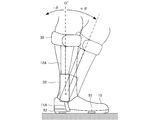
- the walking motion assisting device 1 includes a foot orthosis 10, foot frames 11A and 11B, neck frames 12A and 12B, a neck orthosis 13, a neck housing box 20, and a drive motor 30. , A drive mechanism 31, a rotation sensor 50, a toe side pressure sensor 51, a heel side pressure sensor 52, a display operation device 60, a waist device 70, and a waist housing box 71.
- the foot brace 10 is a shoe-like brace worn on the wearer's foot, and is worn so that the wearer's foot is inserted therein and the foot posture is constrained.
- the foot orthosis 10 is provided with foot frames 11A and 11B.
- the foot frames 11 ⁇ / b> A and 11 ⁇ / b> B are fixed so as not to move relative to the foot orthosis 10.
- a toe side pressure sensor 51 and a heel side pressure sensor 52 are installed at the bottom of the foot orthosis 10.
- the toe-side pressure sensor 51 is installed at the bottom of the foot device 10 near the thumb ball.
- the toe side pressure sensor 52 detects the load weight of the wearer's toe.
- the heel side pressure sensitive sensor 52 is installed at the bottom of the foot orthosis 10 near the heel.
- the heel-side pressure sensor 52 detects the load weight of the wearer's heel.
- the toe side pressure sensor 51 and the heel side pressure sensor 52 are communicably connected to the control device 40 by wireless or wired.
- the neck brace 13 is a brace that is worn around the neck of the wearer so as to be wound around the neck of the wearer, and is stably worn at a position below the wearer's knee.
- the upper portions of the neck frames 12A and 12B are installed in the neck brace 13.
- the neck frames 12 ⁇ / b> A and 12 ⁇ / b> B are fixed so as not to move with respect to the neck brace 13.
- the upper portions of the foot frames 11A and 11B and the lower portions of the neck frames 12A and 12B are connected via a pivot or the like that is positioned coaxially with the rotation axis of the wearer's ankle joint. Accordingly, the neck frames 12A and 12B are connected to the foot frames 11A and 11B so as to be rotatable coaxially with the wearer's ankle joint.
- a neck housing box 20 is installed on the neck frame 11A.
- the neck housing box 20 houses a drive motor 30, a drive mechanism 31, and a rotation sensor 50.
- the drive motor 30 mechanically transmits the rotational drive force to the drive mechanism 31.
- the drive mechanism 31 rotates the foot frame 11A with respect to the neck frame 12A by the transmitted rotational driving force of the drive motor 30. Thereby, the drive motor 30 and the drive mechanism 31 assist the rotation of the wearer's ankle joint.
- the rotation sensor 50 is provided coaxially with the drive shaft of the drive mechanism 31, for example.
- the rotation sensor 50 detects the rotation angle of the wearer's ankle joint by determining the crossing angle between the extension axis of the foot frame 11A and the extension axis of the neck frame 12B. As shown in FIG. 3, the rotation sensor 50 detects the ankle joint angle at the middle stage of stance as a reference angle (0 °), and detects + ⁇ when the ankle joint is bent from the reference angle and ⁇ when the dorsiflexion occurs. To do.
- the rotation sensor 50 is communicably connected to the control device 40 by wireless or wired.
- the display operation device 60 is, for example, a touch panel type device, and is used for operations of an operator such as a physical therapist.
- the display / operation device 60 displays a broken line, a Bezier curve, or a combination thereof having a plurality of predetermined bending points as basic operation patterns or correction operation patterns.
- the basic motion pattern and the correction motion pattern are patterns that represent the relationship between the ankle joint angle ( ⁇ ) and the phase of walking in one cycle of walking in time series.
- a plurality of points are points where the rotation direction of the ankle joint changes.
- the operator can perform a moving operation at a plurality of locations on the basic motion pattern.
- the display operation device 60 is communicably connected to the control device 40 by wireless or wired.
- a waist accommodating box 71 is installed in the waist orthosis 70.
- the waist brace 70 is a brace that is worn around the waist of the wearer so as to be wound around the waist of the wearer.
- the waist brace 70 is stably worn at the waist of the wearer and holds the waist accommodating box 71.
- the waist housing box 71 houses the control device 40 and a battery (not shown).
- the control device 40 includes a calculation unit 41, a storage unit 42, and an input unit 43. As will be described later, the control device 40 controls the rotation and rotational torque of the drive motor 30 based on the parameters of the angle, the angular velocity, and the torque, so that the foot of the wearer wearing the walking motion assisting device 1 is walking. Control the joints.
- the calculation unit 41 is a CPU (Central Professional Unit), and exhibits the entire function of the walking motion assisting device 1 by executing a program stored in the storage unit 42. Moreover, the calculating part 41 has a function which controls the whole walking movement auxiliary
- CPU Central Professional Unit
- the storage unit 42 is a nonvolatile storage device such as a ROM (Read Only Memory), a RAM (Random Access Memory), or a flash memory.
- the storage unit 42 stores a program for controlling the operation of the calculation unit 41.
- the storage unit 42 stores a plurality of basic motion patterns (for example, four patterns) representing time-series changes in ankle joint angle in one cycle of walking. Further, as will be described later, the storage unit 42 stores a corrected operation pattern obtained by correcting the basic operation pattern.
- the information from the display operation device 60 and the detection results of the rotation sensor 50, the toe side pressure sensor 51, and the heel side pressure sensor 52 are input to the input unit 43.
- the battery is a power source for the walking motion assisting device 1 such as the drive motor 30 and the control device 40.
- the drive mechanism 31 is a mechanism that is disposed in the cervical storage box 20, transmits the rotational power of the drive motor 30, and rotates the foot frame 11A with respect to the cervical frame 12A.
- the operation of the walking motion assisting device 1 will be described.
- a wearer's (walking trainer) 's foot is put into the foot brace 10, the foot is fixed, and the neck brace 13 is fixed to the wearer's neck.
- an operator such as a physical therapist uses the display operation device 60 to respond to the walking trainer from a plurality of basic motion patterns stored in the storage unit 42.
- the basic motion pattern represents a time-series change in ankle joint angle in the walking cycle.
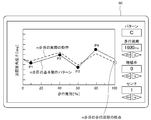
- the basic motion pattern is a line that passes through four points P1 to P4 on the display operation device 60. Is displayed.
- the four points P1 to P4 correspond to the heel contact and toe contact (P1), the toe release (P2), the toe release (P3), and the free leg middle period (P4) in the walking cycle.
- the positions of P1, P2, P3 and P4 are 5 to 15%, 35 to 45%, 55 to 65% and 75 to 85% of the phase in the walking cycle, respectively.
- the walking cycle is from the heel contact of the foot on which the foot brace 10 is worn until the foot is stepped on and the heel contacts the ground. Therefore, when the foot touches the heel, the starting point of the walking cycle (walking cycle: 0% in FIG. 4), and when the foot is stepped on next and the heel touches the ground, the end point of the walking cycle (walking cycle: 100% in FIG. 4). ).
- the walking motion assisting device 1 is adjusted to a walking cycle corresponding to the wearer. For example, when the operator presses the “up” button or “down” button of “walking cycle” shown in FIG. 4, the walking cycle is set to be long or short, and the control device 40 is based on the set walking cycle. Control.
- the detection sensitivity of the toe side pressure sensor 51 and the heel side pressure sensor 52 is set. Specifically, the load detected by the toe side pressure sensor 51 and the heel side pressure sensor 52 when the wearer is in the standing state (standing position) is used as a reference load, and the storage unit 42 of the control device 40.
- the reference load is set larger or smaller when the operator presses the “up” button or “down” button of the sensor of the display operation device 60.
- the control device 40 is in contact with the wearer's toe side, Recognize that the heel side is grounded.
- the detection sensitivity of the toe side pressure sensor 51 and the heel side pressure sensor 52 can be adjusted, and the reference load can be adjusted to be large or small.
- the reference load is set to be large or small when the operator presses the “up” button or “down” button of “sensor”.
- the present embodiment is a control mode in which the toe side pressure sensor 51 is not used.
- the standing body walking trainer steps one foot on the side to which the foot orthosis 10 is attached.
- the control device 40 selects the ankle joint angle at the start of the walking cycle as the ankle joint angle when the heel touches the ground.
- the drive control of the drive motor 30 is started based on the basic operation pattern.
- the control device 40 controls the angular velocity and torque of the drive motor 30 based on the selected basic motion pattern so that the ankle joint angle follows the basic motion pattern.
- the calculation unit 41 includes a built-in timer, and the calculation unit 41 is based on the selected basic operation pattern and one set cycle (1600 ms in FIG. 4), and the walking cycle is 0% to P1, P1 to P2. , P2 to P3, P3 to P4, P4 to walking cycle: The rotation direction, angular velocity, and duration of the drive motor 30 are calculated for each of 100%. And the calculating part 41 controls the drive motor 30 based on the calculated
- the control device 40 controls the drive of the drive motor 30 so as to transmit the timing of switching from dorsiflexion to bottom flexion and the momentum to the wearer. Moreover, the control apparatus 40 controls the drive of the drive motor 30 so that the timing which switches from a buckling to a dorsiflexion, and the momentum may be transmitted to a wearer at the time of P2 (an isolated place). Further, at the time of P3 (toe separation), the control device 40 controls the drive of the drive motor 30 so as to transmit the timing of switching from dorsiflexion to bottom flexion and the momentum to the wearer. Further, at the time of P4 (mid swing leg), the control device 40 controls the drive of the drive motor 30 so as to transmit the timing of switching from bottom flexion to dorsiflexion and the momentum to the wearer.
- the angular velocity of the ankle joint is in the plus (dorsiflexion) direction at P1, the minus (bottom flexion) direction at P2, and the plus (dorsiflexion) direction at P3.
- the rotational drive (angular velocity, torque) of the drive motor 30 is controlled so as to convert to the minus (bottom bending) direction at P4. Further, the rotational drive (angular velocity, torque) of the drive motor 30 is controlled so that the angular velocity is constant from P1 to P2, from P2 to P3, from P3 to P4, and from P4 to P1.
- the wearer walks along the time-series foot joint angle of the walking cycle in the basic motion pattern.
- the detection results of the rotation sensor 50, the toe side pressure sensor 51, and the heel side pressure sensor 52 are transmitted to the input unit 43, and the control device 40 determines the drive motor 30 at an appropriate timing according to the walking state of the wearer. Control the drive.
- the wearer's leg joint angle during walking is forced to follow the time-series foot joint angle expressed as a basic motion pattern or a correction motion pattern by torque control of the drive motor 30. You can also prevent it.
- the torque of the drive motor 30 is set to be high or low. Then, the control device 40 controls the torque of the drive motor 30 based on the set amplification factor.
- the efficiency of training is increased without giving excessive support by setting the amplification factor to be small and controlling the control device 40 to reduce the torque of the drive motor 30.
- the walking motion assisting device 1 controls the torque control and the angular velocity of the ankle joint, and can not control the target ankle joint angle as an absolute angle in the walking cycle.
- the ankle joint angle of the pedestrian in the actual walking motion does not completely match the basic motion pattern, and a deviation may occur.
- the actual motion of the pedestrian's nth step is deviated from the set basic motion pattern, and at the end of the walking cycle of the nth step, the actual motion of The ankle joint angle may be smaller than the ankle joint angle of the basic motion pattern.
- the basic motion pattern as a whole is obtained with the ankle joint angle at the end of the walking cycle in the actual motion of the nth step as the ankle joint angle of the starting point of the walking cycle of the (n + 1) th step. Descend.
- the control device 40 controls the drive of the drive motor 30 based on the basic operation pattern adjusted in this way.
- n represents a positive integer.
- the walking motion assisting apparatus 1 uses the ankle joint angle at the end point of the walking cycle of the nth step as the ankle joint angle of the starting point of the walking cycle of the (n + 1) th step, and the basic motion pattern for the walking cycle of the (n + 1) th step. Adjust and control. For this reason, even if the pedestrian is different step by step, the pedestrian can perform natural walking training without forcibly adjusting to the machine.
- the walking motion assisting apparatus 1 performs control according to different walking motions for each step, and also from bottom buckling to dorsiflexion in P1 to P4, or It only indicates the timing and momentum for switching from dorsiflexion to bottom flexion. For this reason, since the pedestrian has a small sense of being manipulated by the walking motion assisting device 1 and is less likely to feel annoyance, the rehabilitation efficiency is improved.
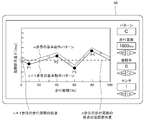
- the operator moves the positions of P1 to P4 in the horizontal axis direction using the display / operation device 60, so that the timing of the heel and toe grounding, the heel-off ground, the toe-off ground, and the free leg middle stage, that is, Adjust the timing from bottom flexion to dorsiflexion, or from dorsiflexion to bottom flexion.
- the operator moves the positions of P1 to P4 in the direction of the vertical axis, so that the heel and toe ground contact, the heel-off, the toe-off, the free leg from the middle to the dorsiflexion, or the dorsiflexion Adjust the magnitude of the angular velocity from bottom to bottom flexion.
- the correction information by the operator is transmitted to the input unit 43, and the calculation unit 41 adjusts the positions of the P1 to P4 points of the moved basic operation pattern vertically and horizontally. Then, the calculation unit 41 generates a correction operation pattern represented by a broken line passing through the position-adjusted points P1 to P4, and the correction operation pattern is displayed on the display operation device 60 as shown in FIG.
- the corrective action pattern represented by the polygonal line can be applied to the heel and toe grounding, the heel offing, the toe offing, and the middle leg of the swing leg from the bottom flexion to the dorsiflexion, or from the dorsiflexion.
- the timing of switching to bottom flexion from heel contact to heel and toe contact, from heel and toe contact to heel off, from heel off to toe off, from toe off to mid-leg, from mid-leg It is corrected to the appropriate angular velocity of each ankle joint until the heel contact.
- the generated corrected operation pattern is stored in the storage unit 42. Then, similarly to the control based on the basic operation pattern, the calculation unit 41 controls the driving of the drive motor 30 based on the correction operation pattern from the time when the bag is grounded. As a result, the walking motion assisting device 1 enables smooth walking motion assistance to the wearer.
- the corrected motion pattern is a walking so that the actual ankle joint angle at the end point of the n-th walk cycle becomes the ankle joint angle at the start point of the n + 1-step walk cycle. It is adjusted every period.
- the corrected motion pattern is obtained by moving the four points on the polygonal line in the basic motion pattern, so that the wearer's standby time can be shortened when the motion pattern is corrected.
- the ankle joint angle amount and phase to be corrected by a physical therapist and the like can be corrected simultaneously, the wearer can efficiently train.
- the basic operation pattern and the correction operation pattern are not only a broken line but also a Bezier curve, a combination of a Bezier curve and a broken line. The form represented by these may be sufficient.
- the calculation unit 41 rotates the drive motor 30 in the walking cycle based on the selected basic motion pattern and the set one cycle so as to follow the basic motion pattern. Find the direction, angular velocity, and duration. And the calculating part 41 controls the drive motor 30 based on the calculated
- a single walking cycle is displayed on the display operation device 60 has been described, a configuration in which a plurality of walking cycles is displayed may be employed.
Landscapes
- Health & Medical Sciences (AREA)
- Life Sciences & Earth Sciences (AREA)
- General Health & Medical Sciences (AREA)
- Engineering & Computer Science (AREA)
- Veterinary Medicine (AREA)
- Animal Behavior & Ethology (AREA)
- Public Health (AREA)
- Biomedical Technology (AREA)
- Heart & Thoracic Surgery (AREA)
- Physics & Mathematics (AREA)
- Orthopedic Medicine & Surgery (AREA)
- Biophysics (AREA)
- Pathology (AREA)
- Medical Informatics (AREA)
- Molecular Biology (AREA)
- Surgery (AREA)
- Oral & Maxillofacial Surgery (AREA)
- Dentistry (AREA)
- Physical Education & Sports Medicine (AREA)
- Rehabilitation Therapy (AREA)
- Epidemiology (AREA)
- Pain & Pain Management (AREA)
- Physiology (AREA)
- Vascular Medicine (AREA)
- Nursing (AREA)
- Data Mining & Analysis (AREA)
- Theoretical Computer Science (AREA)
- Bioinformatics & Cheminformatics (AREA)
- General Physics & Mathematics (AREA)
- General Engineering & Computer Science (AREA)
- Evolutionary Computation (AREA)
- Evolutionary Biology (AREA)
- Computer Vision & Pattern Recognition (AREA)
- Bioinformatics & Computational Biology (AREA)
- Geometry (AREA)
- Artificial Intelligence (AREA)
- Rehabilitation Tools (AREA)
Abstract
Priority Applications (6)
| Application Number | Priority Date | Filing Date | Title |
|---|---|---|---|
| EP16904104.3A EP3466394B1 (fr) | 2016-06-02 | 2016-11-28 | Dispositif d'assistance au mouvement de marche |
| US16/303,563 US11219544B2 (en) | 2016-06-02 | 2016-11-28 | Walking motion assist device |
| DK16904104.3T DK3466394T3 (da) | 2016-06-02 | 2016-11-28 | Gangbevægelseshjælpeanordning |
| CA3026020A CA3026020C (fr) | 2016-06-02 | 2016-11-28 | Dispositif d'assistance au mouvement de marche |
| CN201680086175.6A CN109195565B (zh) | 2016-06-02 | 2016-11-28 | 步行动作辅助装置 |
| KR1020187033829A KR102043449B1 (ko) | 2016-06-02 | 2016-11-28 | 보행 동작 보조 장치 |
Applications Claiming Priority (2)
| Application Number | Priority Date | Filing Date | Title |
|---|---|---|---|
| JP2016-111378 | 2016-06-02 | ||
| JP2016111378A JP6501727B2 (ja) | 2016-06-02 | 2016-06-02 | 歩行動作補助装置 |
Publications (1)
| Publication Number | Publication Date |
|---|---|
| WO2017208480A1 true WO2017208480A1 (fr) | 2017-12-07 |
Family
ID=60478226
Family Applications (1)
| Application Number | Title | Priority Date | Filing Date |
|---|---|---|---|
| PCT/JP2016/085113 Ceased WO2017208480A1 (fr) | 2016-06-02 | 2016-11-28 | Dispositif d'assistance au mouvement de marche |
Country Status (8)
| Country | Link |
|---|---|
| US (1) | US11219544B2 (fr) |
| EP (1) | EP3466394B1 (fr) |
| JP (1) | JP6501727B2 (fr) |
| KR (1) | KR102043449B1 (fr) |
| CN (1) | CN109195565B (fr) |
| CA (1) | CA3026020C (fr) |
| DK (1) | DK3466394T3 (fr) |
| WO (1) | WO2017208480A1 (fr) |
Cited By (3)
| Publication number | Priority date | Publication date | Assignee | Title |
|---|---|---|---|---|
| CN114052724A (zh) * | 2022-01-13 | 2022-02-18 | 西安交通大学医学院第一附属医院 | 基于人工智能的骨科牵引异常检测系统 |
| EP3820410A4 (fr) * | 2018-07-10 | 2022-04-06 | Dephy, Inc. | Système d'augmentation d'articulation pouvant être porté |
| US12370116B2 (en) | 2018-03-27 | 2025-07-29 | Dephy, Inc. | Dynamic mounting mechanism for an exoskeleton |
Families Citing this family (23)
| Publication number | Priority date | Publication date | Assignee | Title |
|---|---|---|---|---|
| WO2020049886A1 (fr) * | 2018-09-07 | 2020-03-12 | 本田技研工業株式会社 | Système d'aide à la marche |
| WO2020066252A1 (fr) * | 2018-09-28 | 2020-04-02 | 本田技研工業株式会社 | Dispositif de contrôle de dispositif d'assistance et système d'observation d'état d'exercice |
| KR102550854B1 (ko) * | 2018-12-13 | 2023-07-04 | 삼성전자주식회사 | 보행 보조 방법 및 그 방법을 수행하는 보행 보조 장치 |
| JP2020110868A (ja) * | 2019-01-11 | 2020-07-27 | 株式会社Atoun | 設定方法、プログラム、及び、動作支援装置 |
| WO2020226067A1 (fr) * | 2019-05-07 | 2020-11-12 | ローム株式会社 | Dispositif d'authentification biométrique |
| WO2021034784A1 (fr) * | 2019-08-16 | 2021-02-25 | Poltorak Technologies, LLC | Dispositif et procédé de diagnostic médical |
| JP7473355B2 (ja) * | 2019-08-29 | 2024-04-23 | パナソニック インテレクチュアル プロパティ コーポレーション オブ アメリカ | 転倒リスク評価方法、転倒リスク評価装置及び転倒リスク評価プログラム |
| GB2588238B (en) * | 2019-10-18 | 2023-11-22 | Mclaren Applied Ltd | Sensor determination |
| CA3158141A1 (fr) | 2019-11-12 | 2021-05-20 | Luke Mooney | Exosquelette de membre inferieur |
| US11369163B1 (en) * | 2019-12-03 | 2022-06-28 | Jesse Offutt | Athletic shoe having integral ankle support |
| JP6912782B2 (ja) * | 2019-12-18 | 2021-08-04 | ヒューマニック株式会社 | 下肢装具用部品及び下肢装具用履物 |
| US11298287B2 (en) | 2020-06-02 | 2022-04-12 | Dephy, Inc. | Systems and methods for a compressed controller for an active exoskeleton |
| US11148279B1 (en) | 2020-06-04 | 2021-10-19 | Dephy, Inc. | Customized configuration for an exoskeleton controller |
| US11147733B1 (en) | 2020-06-04 | 2021-10-19 | Dephy, Inc. | Systems and methods for bilateral wireless communication |
| US11389367B2 (en) * | 2020-06-05 | 2022-07-19 | Dephy, Inc. | Real-time feedback-based optimization of an exoskeleton |
| US12090069B2 (en) | 2020-08-25 | 2024-09-17 | Dephy, Inc. | Systems and methods for a water resistant active exoskeleton |
| US11173093B1 (en) | 2020-09-16 | 2021-11-16 | Dephy, Inc. | Systems and methods for an active exoskeleton with local battery |
| JP7761262B2 (ja) * | 2021-11-24 | 2025-10-28 | 学校法人早稲田大学 | 歩行補助機 |
| CN114795851B (zh) * | 2022-01-27 | 2025-01-21 | 浙江工业大学 | 一种踝足助行器的智能控制方法 |
| EP4454626A4 (fr) * | 2022-02-11 | 2025-03-26 | Samsung Electronics Co., Ltd | Procédé pour déterminer la valeur d'un paramètre de commande, et dispositif électronique pour mettre en ouvre ce procédé |
| CN114564106B (zh) * | 2022-02-25 | 2023-11-28 | 北京字跳网络技术有限公司 | 交互指示线的确定方法、装置、电子设备及存储介质 |
| DE112023000220T5 (de) | 2022-08-05 | 2024-08-01 | Advanced Telecommunications Research Institute International | Modellerzeugungsverfahren, Modellerzeugungsvorrichtung, Phasenschätzverfahren, Steuerungsverfahren und Steuerungsvorrichtung |
| CN115424186B (zh) * | 2022-11-05 | 2023-01-13 | 深圳市亿康医疗技术有限公司 | 用于骨科牵引的监控数据智能处理方法 |
Citations (5)
| Publication number | Priority date | Publication date | Assignee | Title |
|---|---|---|---|---|
| JP2010148759A (ja) * | 2008-12-26 | 2010-07-08 | Toyota Motor Corp | 歩行補助装置 |
| JP2011206289A (ja) * | 2010-03-30 | 2011-10-20 | Toyota Motor Corp | 歩行支援装置 |
| JP2012213554A (ja) * | 2011-04-01 | 2012-11-08 | Toyota Motor Corp | 歩行補助装置 |
| JP2014226151A (ja) * | 2013-05-17 | 2014-12-08 | 学校法人 芝浦工業大学 | 歩行補助装置 |
| JP2015058033A (ja) * | 2013-09-17 | 2015-03-30 | 株式会社安川電機 | 動作補助装置及び動作補助プログラム |
Family Cites Families (12)
| Publication number | Priority date | Publication date | Assignee | Title |
|---|---|---|---|---|
| JP5303743B2 (ja) * | 2008-03-10 | 2013-10-02 | 学校法人 芝浦工業大学 | 密着型歩行支援装置 |
| JP5189911B2 (ja) * | 2008-07-11 | 2013-04-24 | 国立大学法人 筑波大学 | 装着式動作補助装置、基準パラメータデータベース構築装置、装着式動作補助装置における駆動制御方法、基準パラメータデータベース構築方法、及びそのプログラム |
| CA2736079A1 (fr) * | 2008-09-04 | 2010-03-11 | Iwalk, Inc. | Systemes hybrides a extremites inferieures s'adaptant au terrain |
| JP4506890B2 (ja) * | 2008-10-28 | 2010-07-21 | トヨタ自動車株式会社 | 歩行補助装置 |
| CN101548925B (zh) * | 2009-05-05 | 2011-01-05 | 浙江大学 | 一种带踝关节角度自矫正功能的步态相位检测装置 |
| JP5083458B2 (ja) * | 2009-11-04 | 2012-11-28 | トヨタ自動車株式会社 | 歩行補助装置 |
| CN101947151B (zh) * | 2010-08-30 | 2013-04-24 | 北京大学 | 一种基于动力膝下假肢的步态识别方法 |
| US9480618B2 (en) * | 2010-10-05 | 2016-11-01 | Elizabeth T. Hsiao-Wecksler | Portable active pneumatically powered ankle-foot orthosis |
| KR102275241B1 (ko) * | 2013-12-06 | 2021-07-12 | 삼성전자주식회사 | 신호의 변환 및 복원 방법, 신호의 변환 및 복원 시스템, 원본 신호 변환 방법, 원본 신호 변환 장치 및 원본 신호 복원 방법 |
| KR102250265B1 (ko) * | 2014-09-01 | 2021-05-10 | 삼성전자주식회사 | 토크 패턴을 조정하기 위한 장치 및 방법 |
| CN107921631B (zh) * | 2015-06-22 | 2022-04-22 | 马里兰大学巴尔的摩分校 | 用于在受损脚踝的运动阶段期间提供经济的、便携的进行欠缺调节的适应性辅助方法和设备 |
| JP6782086B2 (ja) * | 2016-03-25 | 2020-11-11 | 株式会社安川電機 | 動作補助装置の制御装置、動作補助装置、動作補助装置の制御方法、及び動作補助装置の制御プログラム |
-
2016
- 2016-06-02 JP JP2016111378A patent/JP6501727B2/ja active Active
- 2016-11-28 WO PCT/JP2016/085113 patent/WO2017208480A1/fr not_active Ceased
- 2016-11-28 EP EP16904104.3A patent/EP3466394B1/fr active Active
- 2016-11-28 DK DK16904104.3T patent/DK3466394T3/da active
- 2016-11-28 US US16/303,563 patent/US11219544B2/en active Active
- 2016-11-28 KR KR1020187033829A patent/KR102043449B1/ko active Active
- 2016-11-28 CA CA3026020A patent/CA3026020C/fr active Active
- 2016-11-28 CN CN201680086175.6A patent/CN109195565B/zh active Active
Patent Citations (5)
| Publication number | Priority date | Publication date | Assignee | Title |
|---|---|---|---|---|
| JP2010148759A (ja) * | 2008-12-26 | 2010-07-08 | Toyota Motor Corp | 歩行補助装置 |
| JP2011206289A (ja) * | 2010-03-30 | 2011-10-20 | Toyota Motor Corp | 歩行支援装置 |
| JP2012213554A (ja) * | 2011-04-01 | 2012-11-08 | Toyota Motor Corp | 歩行補助装置 |
| JP2014226151A (ja) * | 2013-05-17 | 2014-12-08 | 学校法人 芝浦工業大学 | 歩行補助装置 |
| JP2015058033A (ja) * | 2013-09-17 | 2015-03-30 | 株式会社安川電機 | 動作補助装置及び動作補助プログラム |
Non-Patent Citations (1)
| Title |
|---|
| See also references of EP3466394A4 * |
Cited By (4)
| Publication number | Priority date | Publication date | Assignee | Title |
|---|---|---|---|---|
| US12370116B2 (en) | 2018-03-27 | 2025-07-29 | Dephy, Inc. | Dynamic mounting mechanism for an exoskeleton |
| EP3820410A4 (fr) * | 2018-07-10 | 2022-04-06 | Dephy, Inc. | Système d'augmentation d'articulation pouvant être porté |
| CN114052724A (zh) * | 2022-01-13 | 2022-02-18 | 西安交通大学医学院第一附属医院 | 基于人工智能的骨科牵引异常检测系统 |
| CN114052724B (zh) * | 2022-01-13 | 2022-09-09 | 西安交通大学医学院第一附属医院 | 基于人工智能的骨科牵引异常检测系统 |
Also Published As
| Publication number | Publication date |
|---|---|
| EP3466394A1 (fr) | 2019-04-10 |
| DK3466394T3 (da) | 2021-04-26 |
| EP3466394A4 (fr) | 2020-01-01 |
| EP3466394B1 (fr) | 2021-03-24 |
| CA3026020C (fr) | 2020-12-08 |
| CN109195565B (zh) | 2021-03-23 |
| US11219544B2 (en) | 2022-01-11 |
| CA3026020A1 (fr) | 2017-12-07 |
| US20190314185A1 (en) | 2019-10-17 |
| JP6501727B2 (ja) | 2019-04-17 |
| CN109195565A (zh) | 2019-01-11 |
| KR20180137543A (ko) | 2018-12-27 |
| KR102043449B1 (ko) | 2019-11-11 |
| JP2017217039A (ja) | 2017-12-14 |
Similar Documents
| Publication | Publication Date | Title |
|---|---|---|
| WO2017208480A1 (fr) | Dispositif d'assistance au mouvement de marche | |
| JP6247483B2 (ja) | 動作補助装置及び動作補助プログラム | |
| CN106137489B (zh) | 交互式外骨骼膝关节机器系统 | |
| JP5343708B2 (ja) | 着地タイミング特定装置及び歩行補助装置 | |
| CA2828420C (fr) | Dispositif et systeme d'entrainement a la marche | |
| US10406057B2 (en) | Step counter, step assist device, and computer-readable medium having stored thereon a step count program | |
| EP2893914B1 (fr) | Appareil d'assistance de mouvement et son procédé de commande | |
| JP2014073199A (ja) | 歩行支援装置、及び歩行支援プログラム | |
| JP2010051416A (ja) | 足関節の動作補助装置および足関節の動作補助装置の制御方法 | |
| JP2012095793A (ja) | 歩行訓練システム | |
| JP5565037B2 (ja) | 歩行支援装置 | |
| KR102162485B1 (ko) | 하지 보조로봇의 제어방법 | |
| JP2013208292A (ja) | 歩行支援装置、及び歩行支援プログラム | |
| JP5477064B2 (ja) | 歩行補助装置 | |
| KR102734254B1 (ko) | 하지 보조로봇의 제어방법 | |
| JP2013048701A (ja) | 歩行支援装置、及び歩行支援プログラム | |
| JP2011143002A (ja) | 歩行補助装置 | |
| TWI594786B (zh) | 自適應於即時步態之穿戴式垂足電刺激控制系統及方法 | |
| KR102919106B1 (ko) | 보행훈련 패턴 생성방법 및 보행훈련장치 | |
| JP2025014523A (ja) | 歩行動作補助装置の制御装置及び制御方法 | |
| JP2025120000A (ja) | 歩行動作補助装置の制御装置及び制御方法 | |
| KR20240139093A (ko) | 보행 훈련 장치 | |
| JP2022039227A (ja) | 歩行補助装置 | |
| WO2011092800A1 (fr) | Dispositif d'aide à la marche | |
| JP2017148427A (ja) | 歩行補助装置 |
Legal Events
| Date | Code | Title | Description |
|---|---|---|---|
| ENP | Entry into the national phase |
Ref document number: 20187033829 Country of ref document: KR Kind code of ref document: A |
|
| 121 | Ep: the epo has been informed by wipo that ep was designated in this application |
Ref document number: 16904104 Country of ref document: EP Kind code of ref document: A1 |
|
| ENP | Entry into the national phase |
Ref document number: 3026020 Country of ref document: CA |
|
| NENP | Non-entry into the national phase |
Ref country code: DE |
|
| ENP | Entry into the national phase |
Ref document number: 2016904104 Country of ref document: EP Effective date: 20190102 |