WO2017208714A1 - Système de fabrication de faisceaux de fils et procédé de fabrication de faisceaux de fils - Google Patents
Système de fabrication de faisceaux de fils et procédé de fabrication de faisceaux de fils Download PDFInfo
- Publication number
- WO2017208714A1 WO2017208714A1 PCT/JP2017/017002 JP2017017002W WO2017208714A1 WO 2017208714 A1 WO2017208714 A1 WO 2017208714A1 JP 2017017002 W JP2017017002 W JP 2017017002W WO 2017208714 A1 WO2017208714 A1 WO 2017208714A1
- Authority
- WO
- WIPO (PCT)
- Prior art keywords
- component
- wire harness
- magazine
- waterproof plug
- assembly line
- Prior art date
- Legal status (The legal status is an assumption and is not a legal conclusion. Google has not performed a legal analysis and makes no representation as to the accuracy of the status listed.)
- Ceased
Links
Images






Classifications
-
- H—ELECTRICITY
- H01—ELECTRIC ELEMENTS
- H01R—ELECTRICALLY-CONDUCTIVE CONNECTIONS; STRUCTURAL ASSOCIATIONS OF A PLURALITY OF MUTUALLY-INSULATED ELECTRICAL CONNECTING ELEMENTS; COUPLING DEVICES; CURRENT COLLECTORS
- H01R43/00—Apparatus or processes specially adapted for manufacturing, assembling, maintaining, or repairing of line connectors or current collectors or for joining electric conductors
- H01R43/20—Apparatus or processes specially adapted for manufacturing, assembling, maintaining, or repairing of line connectors or current collectors or for joining electric conductors for assembling or disassembling contact members with insulating base, case or sleeve
-
- H—ELECTRICITY
- H01—ELECTRIC ELEMENTS
- H01B—CABLES; CONDUCTORS; INSULATORS; SELECTION OF MATERIALS FOR THEIR CONDUCTIVE, INSULATING OR DIELECTRIC PROPERTIES
- H01B13/00—Apparatus or processes specially adapted for manufacturing conductors or cables
- H01B13/012—Apparatus or processes specially adapted for manufacturing conductors or cables for manufacturing wire harnesses
- H01B13/01209—Details
-
- H—ELECTRICITY
- H01—ELECTRIC ELEMENTS
- H01B—CABLES; CONDUCTORS; INSULATORS; SELECTION OF MATERIALS FOR THEIR CONDUCTIVE, INSULATING OR DIELECTRIC PROPERTIES
- H01B13/00—Apparatus or processes specially adapted for manufacturing conductors or cables
- H01B13/012—Apparatus or processes specially adapted for manufacturing conductors or cables for manufacturing wire harnesses
- H01B13/01263—Tying, wrapping, binding, lacing, strapping or sheathing harnesses
-
- H—ELECTRICITY
- H01—ELECTRIC ELEMENTS
- H01B—CABLES; CONDUCTORS; INSULATORS; SELECTION OF MATERIALS FOR THEIR CONDUCTIVE, INSULATING OR DIELECTRIC PROPERTIES
- H01B13/00—Apparatus or processes specially adapted for manufacturing conductors or cables
- H01B13/06—Insulating conductors or cables
- H01B13/062—Insulating conductors or cables by pulling on an insulating sleeve
-
- H—ELECTRICITY
- H01—ELECTRIC ELEMENTS
- H01R—ELECTRICALLY-CONDUCTIVE CONNECTIONS; STRUCTURAL ASSOCIATIONS OF A PLURALITY OF MUTUALLY-INSULATED ELECTRICAL CONNECTING ELEMENTS; COUPLING DEVICES; CURRENT COLLECTORS
- H01R13/00—Details of coupling devices of the kinds covered by groups H01R12/70 or H01R24/00 - H01R33/00
- H01R13/46—Bases; Cases
- H01R13/52—Dustproof, splashproof, drip-proof, waterproof, or flameproof cases
- H01R13/5205—Sealing means between cable and housing, e.g. grommet
-
- H—ELECTRICITY
- H01—ELECTRIC ELEMENTS
- H01R—ELECTRICALLY-CONDUCTIVE CONNECTIONS; STRUCTURAL ASSOCIATIONS OF A PLURALITY OF MUTUALLY-INSULATED ELECTRICAL CONNECTING ELEMENTS; COUPLING DEVICES; CURRENT COLLECTORS
- H01R4/00—Electrically-conductive connections between two or more conductive members in direct contact, i.e. touching one another; Means for effecting or maintaining such contact; Electrically-conductive connections having two or more spaced connecting locations for conductors and using contact members penetrating insulation
- H01R4/10—Electrically-conductive connections between two or more conductive members in direct contact, i.e. touching one another; Means for effecting or maintaining such contact; Electrically-conductive connections having two or more spaced connecting locations for conductors and using contact members penetrating insulation effected solely by twisting, wrapping, bending, crimping, or other permanent deformation
- H01R4/18—Electrically-conductive connections between two or more conductive members in direct contact, i.e. touching one another; Means for effecting or maintaining such contact; Electrically-conductive connections having two or more spaced connecting locations for conductors and using contact members penetrating insulation effected solely by twisting, wrapping, bending, crimping, or other permanent deformation by crimping
- H01R4/183—Electrically-conductive connections between two or more conductive members in direct contact, i.e. touching one another; Means for effecting or maintaining such contact; Electrically-conductive connections having two or more spaced connecting locations for conductors and using contact members penetrating insulation effected solely by twisting, wrapping, bending, crimping, or other permanent deformation by crimping for cylindrical elongated bodies, e.g. cables having circular cross-section
- H01R4/184—Electrically-conductive connections between two or more conductive members in direct contact, i.e. touching one another; Means for effecting or maintaining such contact; Electrically-conductive connections having two or more spaced connecting locations for conductors and using contact members penetrating insulation effected solely by twisting, wrapping, bending, crimping, or other permanent deformation by crimping for cylindrical elongated bodies, e.g. cables having circular cross-section comprising a U-shaped wire-receiving portion
- H01R4/185—Electrically-conductive connections between two or more conductive members in direct contact, i.e. touching one another; Means for effecting or maintaining such contact; Electrically-conductive connections having two or more spaced connecting locations for conductors and using contact members penetrating insulation effected solely by twisting, wrapping, bending, crimping, or other permanent deformation by crimping for cylindrical elongated bodies, e.g. cables having circular cross-section comprising a U-shaped wire-receiving portion combined with a U-shaped insulation-receiving portion
-
- H—ELECTRICITY
- H01—ELECTRIC ELEMENTS
- H01R—ELECTRICALLY-CONDUCTIVE CONNECTIONS; STRUCTURAL ASSOCIATIONS OF A PLURALITY OF MUTUALLY-INSULATED ELECTRICAL CONNECTING ELEMENTS; COUPLING DEVICES; CURRENT COLLECTORS
- H01R43/00—Apparatus or processes specially adapted for manufacturing, assembling, maintaining, or repairing of line connectors or current collectors or for joining electric conductors
- H01R43/005—Apparatus or processes specially adapted for manufacturing, assembling, maintaining, or repairing of line connectors or current collectors or for joining electric conductors for making dustproof, splashproof, drip-proof, waterproof, or flameproof connection, coupling, or casing
-
- H—ELECTRICITY
- H01—ELECTRIC ELEMENTS
- H01R—ELECTRICALLY-CONDUCTIVE CONNECTIONS; STRUCTURAL ASSOCIATIONS OF A PLURALITY OF MUTUALLY-INSULATED ELECTRICAL CONNECTING ELEMENTS; COUPLING DEVICES; CURRENT COLLECTORS
- H01R43/00—Apparatus or processes specially adapted for manufacturing, assembling, maintaining, or repairing of line connectors or current collectors or for joining electric conductors
- H01R43/04—Apparatus or processes specially adapted for manufacturing, assembling, maintaining, or repairing of line connectors or current collectors or for joining electric conductors for forming connections by deformation, e.g. crimping tool
- H01R43/048—Crimping apparatus or processes
-
- H—ELECTRICITY
- H01—ELECTRIC ELEMENTS
- H01R—ELECTRICALLY-CONDUCTIVE CONNECTIONS; STRUCTURAL ASSOCIATIONS OF A PLURALITY OF MUTUALLY-INSULATED ELECTRICAL CONNECTING ELEMENTS; COUPLING DEVICES; CURRENT COLLECTORS
- H01R43/00—Apparatus or processes specially adapted for manufacturing, assembling, maintaining, or repairing of line connectors or current collectors or for joining electric conductors
- H01R43/04—Apparatus or processes specially adapted for manufacturing, assembling, maintaining, or repairing of line connectors or current collectors or for joining electric conductors for forming connections by deformation, e.g. crimping tool
- H01R43/048—Crimping apparatus or processes
- H01R43/05—Crimping apparatus or processes with wire-insulation stripping
-
- H—ELECTRICITY
- H01—ELECTRIC ELEMENTS
- H01R—ELECTRICALLY-CONDUCTIVE CONNECTIONS; STRUCTURAL ASSOCIATIONS OF A PLURALITY OF MUTUALLY-INSULATED ELECTRICAL CONNECTING ELEMENTS; COUPLING DEVICES; CURRENT COLLECTORS
- H01R43/00—Apparatus or processes specially adapted for manufacturing, assembling, maintaining, or repairing of line connectors or current collectors or for joining electric conductors
- H01R43/04—Apparatus or processes specially adapted for manufacturing, assembling, maintaining, or repairing of line connectors or current collectors or for joining electric conductors for forming connections by deformation, e.g. crimping tool
- H01R43/048—Crimping apparatus or processes
- H01R43/055—Crimping apparatus or processes with contact member feeding mechanism
-
- Y—GENERAL TAGGING OF NEW TECHNOLOGICAL DEVELOPMENTS; GENERAL TAGGING OF CROSS-SECTIONAL TECHNOLOGIES SPANNING OVER SEVERAL SECTIONS OF THE IPC; TECHNICAL SUBJECTS COVERED BY FORMER USPC CROSS-REFERENCE ART COLLECTIONS [XRACs] AND DIGESTS
- Y10—TECHNICAL SUBJECTS COVERED BY FORMER USPC
- Y10T—TECHNICAL SUBJECTS COVERED BY FORMER US CLASSIFICATION
- Y10T29/00—Metal working
- Y10T29/53—Means to assemble or disassemble
- Y10T29/5313—Means to assemble electrical device
- Y10T29/532—Conductor
- Y10T29/53209—Terminal or connector
Definitions
- the present invention relates to a wire harness manufacturing system including an assembly line for manufacturing a wire harness through a series of assembly steps, and a supply device for preparing components of the wire harness to be supplied to the assembly line, and The present invention relates to a method for manufacturing a wire harness.
- a wire harness used in an automobile or the like is generally cut after cutting a wire into a predetermined length and crimping a terminal to the terminal, then inserting the terminal into the connector, bundling a plurality of connectors with wires, and waterproofing
- a sub-harness is formed through attachment of a grommet and a protector, and a plurality of sub-harnesses are assembled together to be manufactured. Such a series of assembly processes is generally performed in an assembly line.
- waterproof plug which is one of the components of a wire harness
- conventional system in one of the conventional manufacturing systems (hereinafter referred to as “conventional system”), Is provided on the assembly line (directly connected to the assembly line).
- This device fills a funnel-shaped nozzle with a waterproof plug and draws out the waterproof plug from the nozzle so that the waterproof plug is supplied to the assembly line one by one while adjusting the direction of the waterproof plug.
- the waterproof plug supply device sucks and removes the waterproof plug existing in the deepest part of the funnel-shaped nozzle (closest to the nozzle outlet). More specifically, when the waterproof plug passes through the pipe-shaped passage (pipe) through the discharge port of the funnel-shaped nozzle, the direction of the waterproof plug is adjusted along the axial direction of the passage (pipe). become. That is, this supply device merely has a function of sequentially taking out the waterproof plugs present in the vicinity of the nozzle outlet, and differs in the type of the waterproof plug (for example, the diameter and length of the waterproof plug). It does not have a function to distinguish and take out a wide variety of product numbers.
- the type of the waterproof plug and the supply device correspond one-to-one.
- the wire harness generally has a different structure for each vehicle type, and even if it is the same vehicle type, it has a different structure depending on the upper and lower grades and the presence or absence of optional equipment. That is, the wire harness has various structures due to its characteristics. For example, various types (part numbers) of waterproof plugs are used for each waterproof harness.
- a plurality of supply devices that differ for each type of waterproof plug may be provided on a single assembly line.
- the installation cost of the supply device itself is increased, but also the operation timing of a plurality of supply devices needs to be reset for each specification of the wire harness. Manufacturing cost).
- the present invention has been made in view of the above-described circumstances, and an object of the present invention is to reduce the manufacturing cost of the wire harness as much as possible even when various types of components are to be supplied to the assembly line. It is providing the manufacturing system of a wire harness, and the manufacturing method of a wire harness.
- the “wire harness manufacturing system” is characterized by the following (1) to (4).
- a wire harness manufacturing system comprising: Each of the supply devices It is possible to prepare a plurality of types of the component magazines different for each type of the component parts, The parts magazine is It is possible to transfer from the supply device to at least a part of the series of assembly steps in a state independent of both the assembly line and the supply device.
- the manufacturing system for wire harnesses is characterized by the following (1) to (4).
- the supply device is Continue preparation of the parts magazine regardless of the operating state of the assembly line, The manufacturing system for wire harnesses.
- the supply device is The component magazine is prepared in correspondence with the number of consumption of the specific component in the assembly line per unit time and the number of manufacture of the component magazine loaded with the specific component per unit time. , The manufacturing system for wire harnesses.
- the supply device is A component tray for loading the component, the holder, a transport mechanism for conveying the component from the component tray to the loading port of the holder, and the component arranged at the loading port are loaded into the holder.
- the component tray is It is possible to place the component parts by dividing each type of the component parts,
- the transport mechanism is A camera for photographing the components placed on the parts tray;
- a first movable body that is movable while being restrained by a first rail that extends in a first direction that connects the component tray and the loading port, and on the first movable body that extends in a second direction that intersects the first direction.
- a second moving body that is movable while being restrained by a second rail provided on the driving arm, and a driving arm that applies a driving force in at least one of the first direction and the second direction to the second moving body
- a drive unit capable of moving the second moving body along a moving surface defined by the first direction and the second direction;
- a component moving unit including a motor for rotating the chuck within the moving surface; And having The component is transported from the component tray to the loading port so that the orientation of the component arranged at the loading port is aligned in a predetermined direction based on an image taken by the camera.
- each of the supply devices can supply the component parts to the assembly line via the component magazine, and the type of the component part.
- Different types of parts magazines can be prepared for each.
- the supply device is not a dedicated device that is different for each component type (different for each product number), but a general-purpose device that can handle various types (component numbers) of component parts. That is, the supply device and the component type (part number) are not in a one-to-one relationship as in the conventional system, but in a one-to-many relationship via a component magazine.
- the number of supply devices can be reduced, so that the installation cost of the supply device itself can be reduced. Furthermore, because it is only necessary to use different parts magazines according to the specifications of the wire harness (for example, it is only necessary to attach a parts magazine corresponding to the component type (part number) to the supply device), the supply device will be reconfigured significantly. Therefore, the preparation cost of the manufacturing system can be reduced. In other words, by using the component magazine, the assembly line (and thus the entire manufacturing system) can be flexibly adapted to the manufacture of a wide variety of wire harnesses.
- the wire harness manufacturing system of this configuration can reduce the manufacturing cost of the wire harness as much as possible even when various types of components are to be supplied to the assembly line.
- the supply device and the assembly line are indirectly connected (via the parts magazine). Therefore, unlike the case where the both are directly connected as in the case of the supply device of the conventional system, even if the operation of one of the supply device and the assembly line fails and the operation stops, the other operation can be continued.
- the component magazine functions as a buffer (buffer mechanism) for the entire system. Therefore, the wire harness manufacturing system of this configuration can improve the stability of the entire system.
- a component magazine may be used for some components, and a supply device such as a conventional system may be provided separately from the supply device having the above-described configuration.
- the supply device continues to prepare (manufacture) the component magazine regardless of the operation state of the assembly line (whether it is operating or stopped). become.
- a part magazine can be stocked during a period when the assembly line is stopped due to some trouble or the like, so that future demand for the part magazine can be prepared. Therefore, the wire harness manufacturing system of this configuration can improve the stability of the entire system.
- the wire harness manufacturing system having the configuration (3) a parts magazine can be manufactured according to the actual number of components consumed. Therefore, the wire harness manufacturing system of this configuration can operate the supply device efficiently while taking into account the post-process (a series of assembly processes in the assembly line). As a result, the manufacturing cost of the wire harness can be further reduced.
- the supply device has a function (a function for preparing the above-described component magazine) required for constructing the above-described manufacturing system.
- the supply apparatus having such a configuration is an example of an actual supply apparatus that can be used to construct the manufacturing system described above.
- a “wire harness manufacturing method” is characterized by the following (5).
- a method of manufacturing a wire harness using one or a plurality of supply devices for preparing a component magazine in which components of the wire harness are loaded in a holder so as to be supplied toward the assembly line of the wire harness In each of the supply devices, a step of preparing different types of the component magazines for each type of the component parts; Transferring the parts magazine from the supply device to at least a part of the assembly line in a state independent of both the assembly line and the supply device; Using the component parts taken out from the parts magazine for manufacturing the wire harness in the assembly line, It is a manufacturing method of a wire harness.
- the supply device in addition to supplying the component parts to the assembly line via the component magazine by each of the supply devices (each supply device), Different types of parts magazines are prepared for each type.
- the supply device is not a dedicated device that is different for each component type (different for each product number), but a general-purpose device that can handle various types (component numbers) of component parts. That is, the supply device and the component type (part number) are in a one-to-many relationship via a component magazine, rather than a one-to-one relationship as in the manufacturing method in the conventional system.
- the number of supply devices can be reduced, so that the installation cost of the supply device itself can be reduced. Furthermore, because it is only necessary to use different parts magazines according to the specifications of the wire harness (for example, it is only necessary to attach a parts magazine corresponding to the component type (part number) to the supply device), the supply device will be reconfigured significantly. Therefore, the preparation cost of the manufacturing system can be reduced. In other words, by using the component magazine, the assembly line (and thus the entire manufacturing system) can be flexibly adapted to the manufacture of a wide variety of wire harnesses.
- the wire harness manufacturing method of this configuration can reduce the manufacturing cost of the wire harness as much as possible even when various types of component parts are to be supplied to the assembly line.
- the supply device and the assembly line are indirectly connected (via the parts magazine). Therefore, unlike the case where the two are directly connected as in the manufacturing method in the conventional system, even if one of the supply device and the assembly line malfunctions and the operation stops, the other operation can be continued.
- the component magazine functions as a buffer (buffer mechanism) for the entire system. Therefore, the manufacturing method of the wire harness of this configuration can improve the stability of the entire system.
- a wire harness manufacturing system and a wire harness manufacturing method capable of reducing the manufacturing cost of a wire harness as much as possible even when various types of component parts are to be supplied to an assembly line. Can be provided.
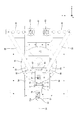
- FIG. 1 is a functional block diagram of a wire harness manufacturing system and a wire harness manufacturing method according to an embodiment of the present invention.
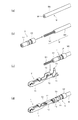
- FIG. 2 is a schematic diagram for explaining a process of crimping an electric wire with a waterproof plug inserted into a terminal.
- FIG. 2 (a) shows a state in which the end of the electric wire is cut
- FIG. FIG. 2 (c) shows a state immediately before the waterproof plug is inserted into the electric wire with the tip end portion of the core wire exposed
- FIG. 2 (c) is just before crimping the terminal (crimping the terminal) to the electric wire with the waterproof plug inserted.
- FIG. 2D shows a state where the crimping of the electric wire to the terminal is completed.
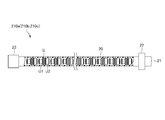
- FIG. 3 is a partial cross-sectional view of a waterproof plug magazine in which a plurality of waterproof plugs are loaded in a holder.
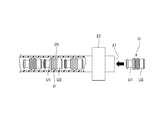
- FIG. 4 is a view showing a state when the waterproof plug is loaded in the holder.
- FIG. 5 is a perspective view showing the whole waterproof plug feeder shown in FIG. 1.
- FIG. 6 is a partially enlarged view in which the periphery of the loading mechanism in FIG. 5 is enlarged.
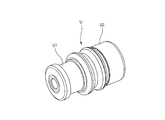
- FIG. 7 is a view showing an example of a waterproof plug constituting the waterproof plug magazine shown in FIG.
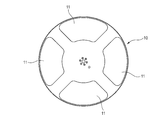
- FIG. 8 is a plan view of the component tray shown in FIG.
- FIG. 9 is a diagram in which some components are not shown in FIG. 6 in order to explain the loading mechanism.
- FIG. 9 is a diagram in which some components are not shown in FIG. 6 in order to explain the loading mechanism.
- FIG. 10 is a partially enlarged view enlarging the part moving part in FIG.
- FIG. 11 is a plan view (top view) of the waterproof plug supplier shown in FIG.
- FIG. 12 is a flowchart showing a processing flow when the waterproof plug supplier shown in FIG. 5 forms the waterproof plug magazine.
- FIG. 13 is a view for explaining the inclination ⁇ of the waterproof plug placed on the component tray.
- FIG. 14 is a view for explaining the movement of the apparatus when the waterproof plug supplier shown in FIG. 5 forms the waterproof plug magazine.
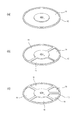
- FIG. 15 is a perspective view showing a modified example of the component tray
- FIG. 15A shows a first modified example of the component tray
- FIG. 15B shows a second modified example of the component tray
- FIG. (C) shows the 3rd modification of a component tray.
- FIG. 16 is a perspective view showing a modified example of the chuck.
- the wire harness manufacturing system SYS is capable of assembling the wire harness components in order and supplying the wire harness components to the assembly line 100.
- a plurality of (two in this example) supply devices 200 are prepared.
- the supply device 200 prepares component magazines (210a to 210c, 220a to 220d) in which the components of the wire harness are loaded in the holder, as will be described later.
- the assembly line 100 may include a lot production line 110 and / or a set production line 120.
- the wire harness manufacturing system SYS according to the embodiment of the present invention can be applied to both the lot production line 110 and the set production line 120.
- the lot production line 110 (A line, B line and C line) manufactures three types of electric wires with different terminals for each type of waterproof plug (waterproof plugs A to C). A necessary amount is used for each of A to C), and three types of waterproof connectors A to C are manufactured independently for each type.
- the set production line 120 (D line) the required number of three types of electric wires with different terminals for each type of waterproof plugs (waterproof plugs A to C) is manufactured together.
- the waterproof connector D is manufactured by being assembled in the (housing D).
- the assembly line 100 (lot production line 110, set production line 120) shown in FIG. 1 is a part of an assembly line for manufacturing a wire harness. Therefore, the waterproof connectors A to D assembled in the assembly line 100 are sent to the next process for manufacturing the wire harness.
- the waterproof plug is a waterproof rubber plug for preventing water or the like from entering the terminal accommodating chamber of the housing.
- a process of crimping an electric wire with a waterproof plug attached (inserted) to a terminal will be briefly described with reference to FIG.
- the electric wire W in which the core wire W1 is covered with the insulating coating W2 is cut into a predetermined length (a different length depending on the specifications of the wire harness).
- the tip end portion of the core wire W1 is exposed by removing (peeling) the tip end portion of the insulating coating W2.
- the waterproof plug U is inserted in the electric wire W from which the tip end portion of the core wire W1 is exposed.
- the waterproof plug U has a stepped cylindrical shape having a small diameter portion U1 and a large diameter portion U2.
- the waterproof plug U is inserted into the electric wire W from the large diameter portion U2 side.
- the exposed core wire W1 and insulating coating W2 are covered by the small diameter portion U1 and the large diameter portion U2 of the waterproof plug U, respectively.
- the terminal T is a female terminal, the electric wire connection part T1 which receives the other male terminal (illustration omitted), and the 1st crimping
- the electric wire A, electric wire B, and electric wire C are different in type (for example, wire diameter, length, material, etc.).
- the waterproof plug A, the waterproof plug B, and the waterproof plug C are different in type (for example, the size of the diameter, the length, the surface shape, and the material).
- the housing A, the housing B, the housing C, and the housing D are different in type (for example, shape, material, type and number of electric wires with terminals to be inserted, and the like).
- the electric wire A is cut to a predetermined length, the tip end portion of the core wire of the electric wire A is exposed, and then the waterproof plug A is inserted into the electric wire A where the tip end portion of the core wire is exposed, and then the waterproof plug A terminal is crimped to the electric wire A into which A is inserted.
- the terminal is crimped after the waterproof plug B is inserted into the electric wire B, and the terminal is crimped after the waterproof plug C is inserted into the electric wire C.
- the electric wire A with the terminal crimped is assembled to the housing A (the terminal of the electric wire A is inserted into the terminal accommodating chamber of the housing A), and the waterproof connector A is manufactured.
- the electric wires A, B, and C with the terminals crimped are assembled to the housing B (the terminals of the electric wires A, B, and C are inserted into the terminal accommodating chamber of the housing B), and the waterproof connector B is manufactured.
- the electric wires B and C whose terminals are crimped are assembled into the housing C (the terminals of the electric wires B and C are inserted into the terminal accommodating chamber of the housing C), and the waterproof connector C is manufactured.
- electric wires A, B, and C whose terminals are crimped are mutually used in a plurality of A lines, B lines, and C lines.
- the assembly line 100 uses only the electric wire A with the terminal crimped in the A line, uses only the electric wire B with the terminal crimped in the B line, and the electric wire C with the terminal crimped in the C line. May be configured to use only.
- the electric wires A, B, and C are each cut to a predetermined length, and the leading ends of the core wires of the electric wires A, B, and C are exposed, and then the electric wires A and B that are exposed at the leading end of the core wire.
- C are respectively inserted into the waterproof plugs A, B, C, and then terminals are crimped to the electric wires A, B, C into which the waterproof plugs A, B, C are inserted, respectively. That is, the electric wires A, B, and C whose terminals are crimped are manufactured together.
- the electric wires A, B, C with the terminals crimped are inserted into the corresponding terminal insertion holes of the housing D, and the waterproof connector D is manufactured.
- the waterproof plug magazines 210a to 210c formed by the waterproof plug feeder 210 are supplied to the corresponding waterproof plug insertion process, respectively.
- the housing magazines 220a to 220d formed by the housing feeder 220 are respectively supplied to the terminal insertion process into the corresponding housing.
- the waterproof plug magazines 210a to 210c indicate holders in which a plurality of waterproof plugs of the same type are loaded in a row with their directions aligned in the same direction (see FIG. 3).
- the housing magazines 220a to 220d indicate holders in which a plurality of housings of the same type are loaded in a row with their directions aligned in the same direction (not shown).
- the waterproof plug magazines 210a to 210c will be briefly described with reference to FIG. 3 and FIG.
- the same kind of resin is placed in a cylindrical holder 20 having a circular cross section made of resin that can be easily deformed.
- a plurality of waterproof plugs U are loaded in a row with their directions aligned in the same direction.
- the waterproof plug magazine 210 a is configured such that each waterproof plug U is directed from the insertion port 21 (opening) on one end side of the holder 20 toward the small diameter portion U1 in the insertion direction by a waterproof plug supply unit 210 described later. In this state, it is formed by being inserted into the holder 20 sequentially.
- a fixing jig 22 is provided in the vicinity of the insertion port 21 of the holder 20. As will be described later, the fixing jig 22 is used when mounting and fixing the holder 20 to a predetermined location of the waterproof plug feeder 210 in order to form the waterproof plug magazine 210a.
- a cover 23 is provided in the opening on the other end side of the holder 20. The cover 23 has a function of preventing the waterproof plug U loaded in the holder 20 from dropping from the opening on the other end side of the holder 20.
- the waterproof plug supplier 210 forms a plurality of types of waterproof plug magazines 210a to 210c for each type of waterproof plug.
- the waterproof plug feeder 210 includes a waterproof plug magazine 210a loaded with only a plurality of waterproof plugs A, a waterproof plug magazine 210b loaded with only a plurality of waterproof plugs B, and a plurality of waterproof plugs C only.
- the loaded waterproof plug magazine 210c is formed.
- the formed waterproof plug magazines 210a to 210c are removed from the waterproof plug supply unit 210, and the corresponding line in the state of the waterproof plug magazine alone (in a state independent of both the waterproof plug supply unit 210 and the assembly line 100). Are supplied respectively.
- the waterproof plug magazine 210a is supplied to the waterproof plug insertion process of lines A and D
- the waterproof plug magazine 210b is supplied to the waterproof plug insertion process of lines B and D
- the waterproof plug magazine 210c is supplied to the lines C and D. Supplied to the waterproof plug insertion process.
- each type of waterproof plug magazine 210a to 210c formed by the waterproof plug supply unit 210 corresponds to the waterproof plug supply unit 210 in a state independent of both the assembly line 100 and the waterproof plug supply unit 210. Delivered to the corresponding process on the line. The removal of the waterproof plug from the waterproof plug magazine on each line and the supply of the waterproof plug magazine to each assembly line may be performed automatically using the device or manually. Good.
- the waterproof plug magazines 210a to 210c have been described above. However, the same applies to the housing magazines 220a to 220d. That is, the housing feeder 220 forms a plurality of types of housing magazines 220a to 220d for each type of housing.
- the housing feeder 220 includes a housing magazine 220a loaded with only a plurality of housings A, a housing magazine 220b loaded with only a plurality of housings B, a housing magazine 220c loaded with only a plurality of housings C, and A housing magazine 220d loaded with only a plurality of housings D is formed.
- Each type of formed housing magazine 220a-220d is removed from the housing feeder 220 and becomes a corresponding line in the state of the housing magazine alone (in a state independent of both the housing feeder 220 and the assembly line 100). Supplied respectively.
- the housing magazine 220a is supplied to the terminal insertion process for line A
- the housing magazine 220b is supplied to the terminal insertion process for line B
- the housing magazine 220c is supplied to the terminal insertion process for line C
- the housing magazine 220d is It is supplied to the terminal insertion process for line D.
- each type of housing magazine 220a to 220d formed by the housing feeder 220 corresponds to a corresponding line from the housing feeder 220 in a state independent of both the assembly line 100 and the housing feeder 220. Delivered to the process.
- the removal of the housing from the housing magazine on each line and the supply of the housing magazine to each assembly line may be performed automatically using an apparatus or may be performed manually.
- the waterproof plug feeder 210 can continue to form and prepare the waterproof plug magazines 210a to 210c regardless of the operation state of the assembly line 100 (whether the assembly line 100 is operating or stopped). Thus, the waterproof plug magazines 210a to 210c can be stocked during the period when the assembly line 100 is stopped due to some trouble or the like, so as to prepare for future demand for the waterproof plug magazines 210a to 210c. The same applies to the housing feeder 220.
- the waterproof plug feeder 210 corresponds to the number of consumptions per unit time in the assembly line 100 and the number of manufactured waterproof plug magazines 210a to 210c per unit time for each type of waterproof plugs A to C.
- Waterproof plug magazines 210a to 210c can be formed and prepared. As a result, the waterproof plug magazines 210a to 210c can be manufactured for each type of the waterproof plugs A to C according to the actual consumption number of the waterproof plugs A to C. The same applies to the housing feeder 220.
- the wire harness manufacturing system SYS has been described above with reference to FIGS.
- the configuration of the waterproof plug feeder 210 will be described in detail with reference to FIGS.
- the housing supply machine 220 can be comprised similarly to the waterproof plug supply machine 210, the description is abbreviate
- the waterproof plug feeder 210 is provided on the upper surface 310 of the movable work table 300. Therefore, the waterproof plug feeder 210 can be appropriately moved with respect to the arrangement of the lines A to D.
- the waterproof plug feeder 210 includes a component tray 10 on which the waterproof plug U is mounted, the above-described holder 20 (see FIGS. 3 and 4) used for forming the waterproof plug magazine, and the waterproof plug U from the component tray 10. And a loading mechanism 40 that loads the waterproof plug U disposed in the vicinity of the insertion port 21 of the holder 20 into the holder 20 to form a waterproof plug magazine.
- a loading mechanism 40 that loads the waterproof plug U disposed in the vicinity of the insertion port 21 of the holder 20 into the holder 20 to form a waterproof plug magazine.
- the component tray 10 is a disk-shaped member made of resin.
- the component tray 10 is circumferentially moved along the xy plane at a position above the upper surface 310 by a predetermined distance by a stay 51 that rises upward (z-axis positive direction) from the center portion of the upper surface 310 of the work table 300. It is fixed to be rotatable. Adjustment of the direction of the circumferential direction of the component tray 10 may be performed automatically using an apparatus, and may be performed manually.
- a plurality of grooves 11 are formed on the upper surface of the component tray 10.
- four identical grooves 11 are independently formed at equal intervals in the circumferential direction.
- a plurality of types of waterproof plugs corresponding to the specifications of the wire harness are placed in different types.
- the circumference of the component tray 10 is such that each of the four grooves 11 is located on the x-axis positive direction side, the x-axis negative direction side, the y-axis positive direction side, and the y-axis negative direction side.
- selection groove Only the waterproof plugs that have been adjusted in the direction and are placed in the groove 11 (hereinafter referred to as “selection groove” in particular) positioned on the negative side of the x-axis are used for forming the waterproof plug magazine.
- the insertion port 21 (see also FIGS. 3 and 4) of the holder 20 stands upward from the edge on the x-axis negative direction side of the upper surface 310 of the work table 300.
- the fixing jig 22 (see also FIGS. 3 and 4) described above is detachably attached to the mounting portion 52a by being inserted into a mounting portion 52a (a through hole (not shown) extending in the x-axis direction) provided on the upper surface of the stay 52. It is fixed to. Thereby, the edge part of the one end side of the holder 20 is being fixed to the attaching part 52a so that attachment or detachment is possible.
- the transport mechanism 30 includes a camera 31, a drive unit 32, and a component moving unit 33.
- the camera 31 is fixedly arranged at a position above the groove 11 (selection groove) of the component tray 10 by a stay (not shown) fixed to the upper surface 310 of the work table 300.
- the camera 31 photographs the waterproof plug U placed in the groove 11 (selection groove) from above.
- the drive unit 32 is a part related to the operation of moving a suction nozzle 68 (to be described later) for holding the waterproof plug U along the xy plane.
- a suction nozzle 68 to be described later
- a configuration related to the drive unit 32 will be described.
- a pair of first rails 54 extending in parallel with a predetermined distance from each other along the x-axis direction is a peripheral portion of the component tray 10 on the upper surface 310 of the work table 300.
- a plurality of stays 53 that rise upward from the top of the component tray 10 are fixed to a position above the component tray 10.
- the first moving body 55 is movable in the x-axis direction (corresponding to the “first direction” of the present invention) while being restrained by the pair of first rails 54. It is provided so as to straddle the rail 54.
- a second rail 56 extending in the y-axis direction (corresponding to the “second direction” of the present invention) is provided on the upper surface of the first moving body 55.
- a second moving body 57 is provided on the second rail 56 so as to be movable in the y-axis direction while being restrained by the second rail 56. As a result, the second moving body 57 can arbitrarily move along the xy plane. As will be described later, the suction nozzle 68 is indirectly fixed to the second moving body 57.
- One end portions of a pair of rod-shaped first drive arms 58 are coupled to both end portions in the y-axis direction of the second moving body 57 so as to be relatively rotatable along the xy plane.
- One end of a pair of rod-like second drive arms 59 is coupled to the other ends of the pair of first drive arms 58 so as to be relatively rotatable along the xy plane.
- a pair of electric motors 62 is fixed to stays 61 that rise upward from the edge on the x-axis positive direction side of upper surface 310 of worktable 300 so as to be arranged at predetermined intervals along the y-axis direction. .
- the motor shafts 63 of the pair of electric motors 62 protrude from the upper surface of the stay 61 toward the z-axis positive direction.
- the other end portions of the pair of second drive arms 59 are integrally connected to the pair of motor shafts 63, respectively.
- the drive unit 32 is configured as described above. As a result, by individually adjusting the rotation angles of the motor shafts 63 of the pair of electric motors 62, the second moving body 57 is driven from the pair of first drive arms 58 in the x-axis direction and the y-axis direction. A force is applied, and the position of the second moving body 57 on the xy plane can be arbitrarily adjusted.
- the component moving unit 33 is related to the operation of moving the suction nozzle 68 for holding the waterproof plug U along the z-axis direction and the operation of rotating the suction nozzle 68 extending in the z-axis direction around its axis. It is a part to do.
- a configuration related to the component moving unit 33 will be described.
- the stay 64 is fixed to the second moving body 57 so as to extend in the negative x-axis direction.
- An electric motor 65 is fixed to the stay 64.
- a motor shaft (not shown) of the electric motor 65 protrudes from the lower surface of the stay 64 in the negative z-axis direction.
- An L-shaped bracket 66 is integrally connected to the motor shaft of the electric motor 65.
- a rod-like suction nozzle 68 is provided at a hanging portion extending in the negative z-axis direction of the bracket 66 via a drive mechanism 67 so as to be relatively movable along the z-axis direction (corresponding to the “third direction” of the present invention). It has been.
- the drive mechanism 67 By controlling the drive mechanism 67, the position of the suction nozzle 68 in the z-axis direction with respect to the bracket 66 (in other words, the second moving body 57) can be adjusted.
- the axis of the suction nozzle 68 is positioned coaxially with the axis of the motor shaft of the electric motor 65. Therefore, by adjusting the rotation angle of the motor shaft of the electric motor 65, the suction nozzle 68 can be rotated around its axis (in the xy plane), and the position of the suction nozzle 68 in the rotation direction can be adjusted. It has become.
- a through hole 69 is formed along its axis.
- One end of a suction hose (not shown) is attached to the upper end of the through hole 69, and a suction vacuum pump (not shown) is connected to the other end of the hose.
- the lower end port of the through hole 69 functions as the suction port 71.
- the transport mechanism 30 has been described above. Next, a configuration related to the loading mechanism 40 will be described.
- a shaft 72 having a rectangular cross section (square) has an x-axis on a stay 72 that stands upward from a portion between the component tray 10 and the stay 52 on the upper surface 310 of the work table 300. It is fixed so as to extend in the negative direction and to be appropriately rotatable around the axis. The adjustment of the position of the shaft 73 in the rotational direction may be performed automatically using the apparatus or may be performed manually.
- FIG. 9 is a diagram in which the description of the stay 52 is omitted in FIG. 6 for convenience of explanation.
- the bracket 74 is fixed so as to extend in the negative x-axis direction at each of the four edge portions corresponding to the four sides at the tip end portion (end portion in the negative z-axis direction) of the shaft 73.
- Each bracket 74 is formed with a through-hole 75 extending in the x-axis direction at the x-axis negative direction side portion, and is continuous from the through-hole 75 in the x-axis positive direction at the x-axis positive direction side portion.
- a groove portion 76 that extends and opens upward is formed.
- the waterproof plug U carried by the suction nozzle 68 is placed in the groove 76.
- the four brackets 74 correspond to the four grooves 11 of the component tray 10, respectively. That is, the inner diameter of each through-hole 75 has a size corresponding to the maximum outer diameter of the waterproof plug U placed in the corresponding groove 11 among the four grooves 11 of the component tray 10. Therefore, in this example, the inner diameters of the through holes 75 of the four brackets are different.
- each of the four brackets 74 is positioned on the y-axis positive direction side, the y-axis negative direction side, the z-axis positive direction side, and the z-axis negative direction side.
- the position in the rotation direction is adjusted, and only the bracket 74 (hereinafter referred to as “selection bracket” in particular) located on the positive z-axis direction side is used for forming the waterproof plug magazine.
- the bracket 74 (selection bracket) is disposed close to the x-axis positive direction side of the mounting portion 52a of the stay 52 described above, and the through hole 75 of the bracket 74 (selection bracket) is provided with the mounting portion. It arrange
- a moving member 77 having an outer peripheral shape having a stepped cylindrical shape is inserted into the shaft 73 so as to be relatively movable in the x-axis direction with respect to the shaft 73 and not relatively rotatable. From the end surface of the moving member 77 on the x-axis negative direction side, the four push-in bars 78 are fixed so as to protrude in the x-axis negative direction toward the groove portions 76 of the corresponding bracket 74, respectively.
- a push bar 78 (hereinafter, particularly “selective push”) corresponding to the bracket 74 (selection bracket).
- the front end surface of the bar is called a waterproof plug U placed in the groove 76 of the bracket 74 (selection bracket) in the negative direction of the x-axis so that the waterproof plug U can be loaded into the holder 20. It has become.
- a pair of drive mechanisms 79 capable of adjusting the positions of the pair of gripping members 81 in the x-axis direction are fixed to the stay 72.
- the pair of gripping members 81 grips the flange portion on the x-axis positive direction side of the moving member 77. Therefore, by controlling the pair of drive mechanisms 79, the position of the moving member 77 in the x-axis direction can be adjusted.
- the waterproof plug U placed in the groove 76 of the bracket 74 (selection bracket) can be pushed in by the selective push bar 78 in the negative x-axis direction.
- the pair of electric motor 62, electric motor 65, drive mechanism 67, drive mechanism 79, and vacuum pump described above are controlled by a control device (microcomputer) (not shown).
- a control device microcomputer (not shown).
- the configuration of the waterproof plug feeder 210 has been described above.
- a plurality of waterproof plugs U corresponding to the waterproof plug magazine to be formed are placed in the groove 11 (selection groove) of the component tray 10, and the holder 20 and the bracket 74 ( It is necessary to switch the selection bracket and the selection push-in bar 78) to the one corresponding to the waterproof plug U of that type.
- a waterproof plug U having a stepped cylindrical shape having a small diameter portion U1 and a large diameter portion U2 is used. .
- each waterproof plug U is sequentially inserted into the holder 20 with the small diameter portion U ⁇ b> 1 side directed in the insertion direction (x-axis negative direction).
- step S5 it is determined whether or not the suction nozzle 68 is in the initial position.
- the initial position refers to a position where the suction nozzle 68 is disposed above a groove 76 (hereinafter also referred to as “magazine insertion slot”) of the bracket 74 (selected bracket) as shown in FIG.
- step S5 If the suction nozzle 68 is in the initial position (when determined “Yes” in step S5), the process proceeds directly to step S15. On the other hand, when the suction nozzle 68 is not in the initial position (when “No” is determined in Step S5), the suction nozzle 68 is moved to the initial position in Step S10, and then the process proceeds to Step S15.
- step S15 a plurality of waterproof plugs U placed in the groove 11 (selection groove) of the component tray 10 are photographed by the camera 31.
- the camera 31 is photographed when the suction nozzle 68 is in the initial position when the drive unit 32 and the component moving unit 33 are out of the photographing range of the camera 31. It is based on the fact that the drive unit 32 and the component moving unit 33 do not interfere with the photographing.
- step S20 pattern matching is performed based on the photographed image.
- pattern matching refers to an operation of specifying the positions (xy coordinates) of the plurality of waterproof plugs U placed in the groove 11 (selection groove).
- step S25 based on the result of pattern matching, a waterproof plug U to be gripped is determined.
- step S30 the determined inclination ⁇ of the waterproof plug U is specified.
- the inclination ⁇ refers to the direction in which the waterproof plug U is placed in the magazine insertion slot (the direction in which the small diameter portion U1 side faces the negative x-axis direction), and the determined direction of the waterproof plug U. Refers to the angle formed by.
- step S35 the suction nozzle 68 is moved along the xy plane to the position just above the determined waterproof plug U while being rotated by an angle ⁇ (see (1) in FIG. 14). Subsequently, in step S40, the suction nozzle 68 is lowered in the negative z-axis direction (see (2) in FIG. 14). As a result, the suction port 71 of the suction nozzle 68 is positioned immediately above the determined waterproof plug U. In this state, the determined waterproof plug U is sucked into the suction port 71 of the suction nozzle 68.
- step S45 the suction nozzle 68 is moved to the initial position while being reversely rotated by the angle ⁇ (see (3) in FIG. 14).
- step S50 the suction nozzle 68 is lowered in the negative z-axis direction (see (4) in FIG. 14).
- the suction port 71 of the suction nozzle 68 is positioned immediately above the magazine insertion port (groove 76).
- the waterproof plug U adsorbed to the suction port 71 of the suction nozzle 68 is opened. Thereafter, the suction nozzle 68 is returned to the initial position.
- step S55 the waterproof plug U is loaded into the holder 20 (magazine) by pushing the waterproof plug U placed in the magazine insertion slot (groove 76) by the selection push-in bar 78.
- the predetermined number of waterproof plugs U of the same type in the holder 20 are aligned in the same direction.
- the loaded waterproof plug magazine (for example, the waterproof plug magazines 210a to 210c in FIG. 1) is completed.
- the completed waterproof plug magazine is removed from the waterproof plug feeder 210. Thereafter, in order to form the next waterproof plug magazine, the component tray 10 is rotated so that the groove 11 on which the waterproof plug U of the type corresponding to the next waterproof plug magazine is placed becomes the selection groove, The shaft 73 is rotated so that the bracket 74 (and push-in bar 78) corresponding to the type of waterproof plug U becomes the bracket 74 (selection bracket and selective push-in bar 78), and the holder 20 is of that type of waterproof. The one corresponding to the plug U is attached to the waterproof plug feeder 210. Then, the next waterproof plug magazine is completed by performing the above-described process again.
- the camera 31 is photographed with the suction nozzle 68 in the initial position, but the drive unit 32 and the component moving unit 33 are located outside the photographing range of the camera 31 ( That is, as long as the drive unit 32 and the component moving unit 33 do not interfere with the shooting), the camera 31 may perform shooting with the suction nozzle 68 in a position other than the initial position.
- the photographing of the camera 31 (the process of step S15) may be performed in the middle of returning the suction nozzle 68 to the initial position.
- the process of step S20, S25, and S30 may be performed following the process of step S15 in the middle of the suction nozzle 68 returning to the initial position.
- the supply device 200 (waterproof plug supply device 210 and housing supply device 220) is assembled via the component magazine (waterproof plug magazine and housing magazine). Components (waterproof plug and housing) can be supplied to the line 100. Further, each of the supply devices 200 (each supply device 200) can prepare different types of component magazines for each type of component. In other words, the supply device 200 is not a dedicated device for each type of component but a general-purpose device that can handle various types of components. That is, the supply device 200 and the type of component have a one-to-many relationship.
- the number of devices can be reduced, so that the cost of the device itself can be reduced.
- the preparation cost of the assembly line 100 can be reduced.
- the assembly line 100 (and thus the entire manufacturing system SYS) can be flexibly adapted to wire harnesses having various specifications.
- the wire harness manufacturing system SYS can reduce the manufacturing cost as much as possible even when various types of components are to be supplied to the assembly line 100.
- the supply device 200 is indirectly connected to the assembly line 100 (via the component magazine). Therefore, compared to the case where the apparatus and the assembly line are directly connected as in the case of the supply apparatus in the conventional system, even if the malfunction occurs in one of the apparatus and the assembly line 100 and the operation stops, the other operation can be continued.
- the component magazine functions as a buffer for the entire system. Therefore, the stability of the manufacturing system SYS can be improved.
- a device such as a supply device of a conventional system using a parts magazine for some components (for example, waterproof plugs A to C and housings A to D) and other components (for example, terminals and clamps) May be provided separately from the supply device 200 configured as described above.
- the supply device 200 can be used regardless of the operating state of the assembly line 100 (whether the assembly line 100 is operating or stopped). Can continue to prepare. As a result, the parts magazine can be stocked during a period in which the assembly line 100 is stopped due to some trouble or the like, so as to prepare for future demand for the parts magazine. Therefore, the stability of the manufacturing system SYS can be improved.
- the supply device 200 includes the number of consumptions per unit time of a specific component in the assembly line 100 and the component magazine loaded with the specific component. It is possible to prepare a parts magazine while corresponding to the number of productions per unit time. Thereby, a parts magazine can be manufactured according to the actual number of components consumed. Therefore, the supply apparatus 200 can be operated efficiently while taking into account the post-process (a series of assembly processes in the assembly line 100).
- the supply device 200 (waterproof plug supply unit 210 and housing supply unit 220) passes the parts magazine (waterproof plug magazine and housing magazine).
- a plurality of types of component magazines (210a to 210c, 220a to 220d) differing for each type of component are prepared.
- the supply device 200 is not a dedicated device that is different for each type of component (different for each product number), but a general-purpose device that can handle various types (component numbers) of component parts. That is, there is a one-to-many relationship between the supply device 200 and the component type (product number) via the component magazine.
- the number of the supply devices 200 can be reduced, so that the installation cost of the supply device 200 itself can be reduced. Furthermore, since it is sufficient to use different parts magazines according to the specifications of the wire harness (for example, it is only necessary to attach a part magazine corresponding to the type (part number) of the component parts to the supply device), the supply device 200 is significantly re-used. Since the setting can be avoided, the preparation cost of the manufacturing system SYS can be reduced. In other words, by using the component magazine, the assembly line 100 (and thus the entire manufacturing system SYS) can be flexibly adapted to the manufacture of a wide variety of wire harnesses.
- the manufacturing method of the wire harness of this configuration can reduce the manufacturing cost of the wire harness as much as possible even when various types of components are to be supplied to the assembly line 100.
- the supply device 200 and the assembly line 100 are indirectly connected (via the component magazine). Therefore, unlike the case where both are directly connected as in the manufacturing method in the conventional system, even if one of the supply device 200 and the assembly line 100 malfunctions and the operation stops, the other operation can be continued.
- the component magazine functions as a buffer (buffer mechanism) for the entire system. Therefore, the manufacturing method of the wire harness of this configuration can improve the stability of the entire system.
- a plurality of types of waterproof plugs may be placed on the component tray 10 in a divided manner. Furthermore, a plurality of types of waterproof plugs may be placed without being divided into areas, and the types of waterproof plugs may be identified by pattern matching based on the captured image of the camera 31.
- a plurality of grooves 11 having the same shape (same area) are formed on the upper surface of the component tray 10, but as shown in FIGS. 15 (b) and 15 (c).
- a plurality of grooves 11 having different shapes (different areas) may be formed on the upper surface of the component tray 10.
- the wire harness manufacturing system SYS is provided with a plurality of supply devices 200 (specifically, the waterproof plug supply device 210 and the housing supply device 220) for the assembly line 100.
- a single supply device 200 (specifically, a waterproof plug supply device 210 or a housing supply device 220) may be provided for the assembly line 100.
- one stick-shaped suction nozzle 68 is used as the component chuck.
- a pair of gripping arms 82 with adjustable intervals may be used as the component chuck.
- the drive unit 32 that moves the suction nozzle 68 along the xy plane includes the first moving body 55, the second moving body 57, the first driving arm 58, and the second driving arm 59. It consists of However, any configuration may be adopted as the drive unit 32 as long as the suction nozzle 68 can be moved along the xy plane.
- waterproof plug magazines 210a to 210c and housing magazines 220a to 220d are used as examples of the parts magazine.
- a parts magazine may be prepared using parts (for example, a clamp, a corrugated tube, etc.) other than a waterproof plug and a housing.
- a wire harness manufacturing system comprising one or more supply devices (210) to be prepared for supply to a line, Each of the supply devices (210) Different types of the component magazines (210a to 210c) can be prepared for each type of the component parts (waterproof plugs A to C), The parts magazines (210a to 210c) It can be transferred from the supply device to at least a part of the series of assembly steps in a state independent of both the assembly line (100) and the supply device (210). Wire harness manufacturing system. (2) In the manufacturing system according to (1) above, The supply device (210) Continue preparation of the component magazines (210a-210c) regardless of the operating state of the assembly line (100). Wire harness manufacturing system.
- the supply device (210) The number of consumption of the specific component (waterproof plugs A to C) in the assembly line per unit time and the component magazine (210a to 210c) loaded with the specific component (waterproof plugs A to C) Preparing the parts magazine in correspondence with the number of manufactured units per unit time, Wire harness manufacturing system.
- the supply device (210) A transport mechanism (30) for transporting the component tray (10) on which the component is placed, the holder (20), and the component (waterproof plugs A to C) from the component tray to the loading port (76) of the holder.
- the transport mechanism (30) is A camera (31) for photographing the components placed on the parts tray; A first movable body (55) that is movable while being restrained by a first rail (54) extending in a first direction that connects the component tray (10) and the loading port (76), and that intersects the first direction.
- a second moving body (57) movable while being restrained by a second rail (56) provided on the first moving body (55) so as to extend in two directions, and the second moving body (57) Driving arms (58, 59) for applying a driving force in at least one of the first direction and the second direction to the second moving body (57) in the first direction and the second direction.
- a drive unit (32) capable of being moved along a moving surface defined by A component moving part (33) supported by the second moving body (57), the component moving in a third direction intersecting the moving surface and capable of holding or releasing the component A component moving part (33) including a chuck (68) and a motor (65) for rotating the component chuck (68) in the moving plane; And having Based on the image taken by the camera (31), the component parts are placed in the component tray so that the components (waterproof plugs A to C) arranged in the loading port (76) are aligned in a predetermined direction. (10) to the loading port (76), Wire harness manufacturing system.
- the component magazines (210a to 210c) in which the wire harness components (waterproof plugs A to C) are loaded in the holder (20) are prepared so that they can be supplied toward the wire harness assembly line (100).
- a method of manufacturing a wire harness using a plurality of supply devices (210) In each of the supply devices (210), preparing a plurality of types of the component magazines (210a to 210c) different for each type of the component (waterproof plugs A to C); Transferring the parts magazine (210a to 210c) from the supply device to at least a part of the assembly line in a state of being independent from both the assembly line (100) and the supply device (200); Using the component parts (waterproof plugs A to C) taken out from the parts magazine in the assembly line (100) for manufacturing the wire harness, Manufacturing method of wire harness.
- the manufacturing cost of the wire harness can be reduced as much as possible even when various types of components are to be supplied to the assembly line.
- the present invention that exhibits this effect is useful for a wire harness manufacturing system and a wire harness manufacturing method.
Landscapes
- Engineering & Computer Science (AREA)
- Manufacturing & Machinery (AREA)
- Manufacturing Of Electrical Connectors (AREA)
- Feeding Of Articles To Conveyors (AREA)
Abstract
L'invention concerne un système (SYS) de fabrication de faisceaux de fils qui comprend une chaîne d'assemblage (100) et un dispositif d'alimentation (200) destiné à préparer des chargeurs de composants (210a à 210c, 220a à 220d) dans lesquels des composants sont chargés dans des supports (20). Le dispositif d'alimentation peut préparer une pluralité de types de chargeurs de composants qui sont différents en termes de types de composants. Dans un état indépendant de la chaîne d'assemblage et du dispositif d'alimentation, chacun des chargeurs de composants peut être distribué du dispositif d'alimentation à au moins certaines étapes d'assemblage d'une série d'étapes d'assemblage.
Priority Applications (2)
| Application Number | Priority Date | Filing Date | Title |
|---|---|---|---|
| CN201780026868.0A CN109074921B (zh) | 2016-05-31 | 2017-04-28 | 线束制造系统和线束制造方法 |
| US16/174,179 US10839988B2 (en) | 2016-05-31 | 2018-10-29 | Wire harness manufacturing system and wire harness manufacturing method |
Applications Claiming Priority (2)
| Application Number | Priority Date | Filing Date | Title |
|---|---|---|---|
| JP2016-109040 | 2016-05-31 | ||
| JP2016109040A JP6475664B2 (ja) | 2016-05-31 | 2016-05-31 | ワイヤハーネスの製造システム、及び、ワイヤハーネスの製造方法 |
Related Child Applications (1)
| Application Number | Title | Priority Date | Filing Date |
|---|---|---|---|
| US16/174,179 Continuation US10839988B2 (en) | 2016-05-31 | 2018-10-29 | Wire harness manufacturing system and wire harness manufacturing method |
Publications (1)
| Publication Number | Publication Date |
|---|---|
| WO2017208714A1 true WO2017208714A1 (fr) | 2017-12-07 |
Family
ID=60479593
Family Applications (1)
| Application Number | Title | Priority Date | Filing Date |
|---|---|---|---|
| PCT/JP2017/017002 Ceased WO2017208714A1 (fr) | 2016-05-31 | 2017-04-28 | Système de fabrication de faisceaux de fils et procédé de fabrication de faisceaux de fils |
Country Status (4)
| Country | Link |
|---|---|
| US (1) | US10839988B2 (fr) |
| JP (1) | JP6475664B2 (fr) |
| CN (1) | CN109074921B (fr) |
| WO (1) | WO2017208714A1 (fr) |
Families Citing this family (6)
| Publication number | Priority date | Publication date | Assignee | Title |
|---|---|---|---|---|
| IT201700103805A1 (it) * | 2017-09-18 | 2019-03-18 | Dab Pumps Spa | Assemblato di pompa con zona umida accessibile all'utente |
| IT201800003390A1 (it) * | 2018-03-09 | 2019-09-09 | Dab Pumps Spa | Assemblato di elettropompa centrifuga con tenuta perfezionata |
| JP7239538B2 (ja) * | 2020-11-04 | 2023-03-14 | 矢崎総業株式会社 | ワイヤハーネス設計方法および設計支援装置 |
| FR3128571A1 (fr) * | 2021-10-22 | 2023-04-28 | Raydiall | Sous-ensemble préassemblé de connecteur comprenant un contact central et deux parties de sertissage de matière et/ou épaisseur différente(s), bobine de sous-ensembles et procédé d’assemblage d’un connecteur à un câble associés. |
| CN115764502B (zh) * | 2022-11-23 | 2026-03-06 | 上海宏联汽车零部件有限公司 | 一种插线排分类架 |
| CN119133981B (zh) * | 2024-09-09 | 2025-11-14 | 厦门海普锐科技股份有限公司 | 一种线束对接压合方法 |
Citations (3)
| Publication number | Priority date | Publication date | Assignee | Title |
|---|---|---|---|---|
| JPH09115640A (ja) * | 1995-10-20 | 1997-05-02 | Harness Sogo Gijutsu Kenkyusho:Kk | ワイヤーハーネスの製造におけるコネクタ供給方法及びその装置 |
| JPH10208844A (ja) * | 1997-01-28 | 1998-08-07 | Harness Sogo Gijutsu Kenkyusho:Kk | ワイヤーハーネス用コネクタ端子の実装装置 |
| JP2015076198A (ja) * | 2013-10-07 | 2015-04-20 | 矢崎総業株式会社 | ワイヤハーネス部品移送装置、端子圧着電線製造装置、ワイヤハーネス部品移送方法、端子圧着電線の製造方法 |
Family Cites Families (9)
| Publication number | Priority date | Publication date | Assignee | Title |
|---|---|---|---|---|
| JP2651400B2 (ja) * | 1992-08-10 | 1997-09-10 | 矢崎総業株式会社 | 電線処理装置における電線反転装置 |
| US5385434A (en) * | 1992-12-09 | 1995-01-31 | Molex Incorporated | Electrical connector delivery system |
| WO1995026583A1 (fr) * | 1994-03-28 | 1995-10-05 | Murata Kogyo Kabushiki Kaisha | Procede et appareil de fabrication d'un faisceau de fils par soudage sous pression |
| EP1642852B9 (fr) | 2003-07-08 | 2010-06-02 | Asahi Seiki Co., Ltd. | Dispositif d'alimentation de parties minces |
| JP4080399B2 (ja) * | 2003-08-29 | 2008-04-23 | 矢崎総業株式会社 | 可動式電線送り装置 |
| EP2615007B1 (fr) | 2012-01-10 | 2016-09-28 | Siemens Aktiengesellschaft | Appareil de transport pour une ligne d' assemblage |
| JP2013149512A (ja) | 2012-01-20 | 2013-08-01 | Yazaki Corp | ワイヤハーネスの製造方法、ワイヤハーネスの製造装置 |
| CN202758535U (zh) * | 2012-07-11 | 2013-02-27 | 浙江天煌科技实业有限公司 | 一种工业机器人与机器视觉系统 |
| JP6002628B2 (ja) * | 2013-05-10 | 2016-10-05 | 矢崎総業株式会社 | 端子挿入装置及び端子挿入方法 |
-
2016
- 2016-05-31 JP JP2016109040A patent/JP6475664B2/ja active Active
-
2017
- 2017-04-28 WO PCT/JP2017/017002 patent/WO2017208714A1/fr not_active Ceased
- 2017-04-28 CN CN201780026868.0A patent/CN109074921B/zh active Active
-
2018
- 2018-10-29 US US16/174,179 patent/US10839988B2/en active Active
Patent Citations (3)
| Publication number | Priority date | Publication date | Assignee | Title |
|---|---|---|---|---|
| JPH09115640A (ja) * | 1995-10-20 | 1997-05-02 | Harness Sogo Gijutsu Kenkyusho:Kk | ワイヤーハーネスの製造におけるコネクタ供給方法及びその装置 |
| JPH10208844A (ja) * | 1997-01-28 | 1998-08-07 | Harness Sogo Gijutsu Kenkyusho:Kk | ワイヤーハーネス用コネクタ端子の実装装置 |
| JP2015076198A (ja) * | 2013-10-07 | 2015-04-20 | 矢崎総業株式会社 | ワイヤハーネス部品移送装置、端子圧着電線製造装置、ワイヤハーネス部品移送方法、端子圧着電線の製造方法 |
Also Published As
| Publication number | Publication date |
|---|---|
| JP2017216139A (ja) | 2017-12-07 |
| US10839988B2 (en) | 2020-11-17 |
| US20190066880A1 (en) | 2019-02-28 |
| CN109074921A (zh) | 2018-12-21 |
| CN109074921B (zh) | 2019-12-10 |
| JP6475664B2 (ja) | 2019-02-27 |
Similar Documents
| Publication | Publication Date | Title |
|---|---|---|
| JP6475664B2 (ja) | ワイヤハーネスの製造システム、及び、ワイヤハーネスの製造方法 | |
| JP6367861B2 (ja) | 部品供給装置 | |
| JP6125894B2 (ja) | 端子圧着電線製造装置及び端子圧着電線の製造方法 | |
| CN105359639B (zh) | 元件安装装置 | |
| CN110120620B (zh) | 线束插头自动化加工方法 | |
| WO2015053284A1 (fr) | Dispositif et procédé de transport de composants de faisceau de fils, dispositif et procédé de production de cosses à sertir | |
| JP7584181B2 (ja) | ケーブル加工センター | |
| US11641086B2 (en) | Method for automatically mounting a connector-housing | |
| US20020144395A1 (en) | Method and apparatus for equipping plug housings with fitted-out cable ends of a cable | |
| JP2921383B2 (ja) | コネクタハウジング供給装置 | |
| JP2017216141A (ja) | 部品受け渡し装置及びそれを備えるワイヤハーネスの製造装置 | |
| JP2008300166A (ja) | 電気部品のリード部寸法調整方法、圧着端子組付け方法および端子圧着方法、並びに電気部品のリード部寸法調整装置および端子圧着設備 | |
| JP4748065B2 (ja) | 圧着端子組付け方法および端子圧着方法並びに端子圧着設備 | |
| JP2013152856A (ja) | 電線保持バー搬送装置 | |
| JP2017204402A (ja) | ワイヤハーネスの製造ライン | |
| EP0855768A1 (fr) | Assemblage d'un faisceau de câbles pour automobiles | |
| JP6335467B2 (ja) | ワイヤハーネス部品移送装置、端子圧着電線製造装置、ワイヤハーネス部品移送方法、端子圧着電線の製造方法 | |
| US10720267B2 (en) | Apparatus for maintaining wire shielding positioning during electrical component placement | |
| CN111788881B (zh) | 安装装置以及安装装置的控制方法 | |
| CN111034384A (zh) | 元件安装机 | |
| CN216750620U (zh) | 插头自动组装设备 | |
| JP6705697B2 (ja) | 電線付きコネクタの製造装置 | |
| US20250350175A1 (en) | Workpiece holding apparatus, winding apparatus, winding processing method, and winding manufacturing method | |
| CN110061401B (zh) | 线束插头自动化加工系统 | |
| CN110649512A (zh) | 布线设备 |
Legal Events
| Date | Code | Title | Description |
|---|---|---|---|
| NENP | Non-entry into the national phase |
Ref country code: DE |
|
| 121 | Ep: the epo has been informed by wipo that ep was designated in this application |
Ref document number: 17806273 Country of ref document: EP Kind code of ref document: A1 |
|
| 122 | Ep: pct application non-entry in european phase |
Ref document number: 17806273 Country of ref document: EP Kind code of ref document: A1 |