WO2017208812A1 - Procédé de simulation de chauffage, programme de simulation de chauffage et dispositif de simulation de chauffage comprenant un support de stockage dans lequel est stocké ledit programme - Google Patents
Procédé de simulation de chauffage, programme de simulation de chauffage et dispositif de simulation de chauffage comprenant un support de stockage dans lequel est stocké ledit programme Download PDFInfo
- Publication number
- WO2017208812A1 WO2017208812A1 PCT/JP2017/018448 JP2017018448W WO2017208812A1 WO 2017208812 A1 WO2017208812 A1 WO 2017208812A1 JP 2017018448 W JP2017018448 W JP 2017018448W WO 2017208812 A1 WO2017208812 A1 WO 2017208812A1
- Authority
- WO
- WIPO (PCT)
- Prior art keywords
- temperature
- physical property
- heating
- property value
- calculated
- Prior art date
- Legal status (The legal status is an assumption and is not a legal conclusion. Google has not performed a legal analysis and makes no representation as to the accuracy of the status listed.)
- Ceased
Links
Images


Classifications
-
- G—PHYSICS
- G06—COMPUTING OR CALCULATING; COUNTING
- G06F—ELECTRIC DIGITAL DATA PROCESSING
- G06F30/00—Computer-aided design [CAD]
- G06F30/20—Design optimisation, verification or simulation
-
- A—HUMAN NECESSITIES
- A23—FOODS OR FOODSTUFFS; TREATMENT THEREOF, NOT COVERED BY OTHER CLASSES
- A23B—PRESERVATION OF FOODS, FOODSTUFFS OR NON-ALCOHOLIC BEVERAGES; CHEMICAL RIPENING OF FRUIT OR VEGETABLES
- A23B2/00—Preservation of foods or foodstuffs, in general
- A23B2/30—Preservation of foods or foodstuffs, in general by heating materials in packages which are not progressively transported through the apparatus
-
- A—HUMAN NECESSITIES
- A61—MEDICAL OR VETERINARY SCIENCE; HYGIENE
- A61L—METHODS OR APPARATUS FOR STERILISING MATERIALS OR OBJECTS IN GENERAL; DISINFECTION, STERILISATION OR DEODORISATION OF AIR; CHEMICAL ASPECTS OF BANDAGES, DRESSINGS, ABSORBENT PADS OR SURGICAL ARTICLES; MATERIALS FOR BANDAGES, DRESSINGS, ABSORBENT PADS OR SURGICAL ARTICLES
- A61L2/00—Disinfection or sterilisation of materials or objects, in general; Accessories therefor
- A61L2/02—Disinfection or sterilisation of materials or objects, in general; Accessories therefor using physical processes
- A61L2/04—Heat
-
- G—PHYSICS
- G01—MEASURING; TESTING
- G01K—MEASURING TEMPERATURE; MEASURING QUANTITY OF HEAT; THERMALLY-SENSITIVE ELEMENTS NOT OTHERWISE PROVIDED FOR
- G01K3/00—Thermometers giving results other than momentary value of temperature
- G01K3/02—Thermometers giving results other than momentary value of temperature giving means values; giving integrated values
- G01K3/04—Thermometers giving results other than momentary value of temperature giving means values; giving integrated values in respect of time
-
- G—PHYSICS
- G01—MEASURING; TESTING
- G01K—MEASURING TEMPERATURE; MEASURING QUANTITY OF HEAT; THERMALLY-SENSITIVE ELEMENTS NOT OTHERWISE PROVIDED FOR
- G01K7/00—Measuring temperature based on the use of electric or magnetic elements directly sensitive to heat ; Power supply therefor, e.g. using thermoelectric elements
- G01K7/42—Circuits effecting compensation of thermal inertia; Circuits for predicting the stationary value of a temperature
-
- G—PHYSICS
- G01—MEASURING; TESTING
- G01K—MEASURING TEMPERATURE; MEASURING QUANTITY OF HEAT; THERMALLY-SENSITIVE ELEMENTS NOT OTHERWISE PROVIDED FOR
- G01K7/00—Measuring temperature based on the use of electric or magnetic elements directly sensitive to heat ; Power supply therefor, e.g. using thermoelectric elements
- G01K7/42—Circuits effecting compensation of thermal inertia; Circuits for predicting the stationary value of a temperature
- G01K7/427—Temperature calculation based on spatial modeling, e.g. spatial inter- or extrapolation
-
- G—PHYSICS
- G01—MEASURING; TESTING
- G01N—INVESTIGATING OR ANALYSING MATERIALS BY DETERMINING THEIR CHEMICAL OR PHYSICAL PROPERTIES
- G01N25/00—Investigating or analyzing materials by the use of thermal means
- G01N25/18—Investigating or analyzing materials by the use of thermal means by investigating thermal conductivity
-
- G—PHYSICS
- G06—COMPUTING OR CALCULATING; COUNTING
- G06F—ELECTRIC DIGITAL DATA PROCESSING
- G06F17/00—Digital computing or data processing equipment or methods, specially adapted for specific functions
- G06F17/10—Complex mathematical operations
- G06F17/17—Function evaluation by approximation methods, e.g. inter- or extrapolation, smoothing, least mean square method
-
- G—PHYSICS
- G01—MEASURING; TESTING
- G01K—MEASURING TEMPERATURE; MEASURING QUANTITY OF HEAT; THERMALLY-SENSITIVE ELEMENTS NOT OTHERWISE PROVIDED FOR
- G01K2207/00—Application of thermometers in household appliances
- G01K2207/02—Application of thermometers in household appliances for measuring food temperature
-
- G—PHYSICS
- G01—MEASURING; TESTING
- G01N—INVESTIGATING OR ANALYSING MATERIALS BY DETERMINING THEIR CHEMICAL OR PHYSICAL PROPERTIES
- G01N33/00—Investigating or analysing materials by specific methods not covered by groups G01N1/00 - G01N31/00
- G01N33/02—Food
-
- G—PHYSICS
- G06—COMPUTING OR CALCULATING; COUNTING
- G06F—ELECTRIC DIGITAL DATA PROCESSING
- G06F2119/00—Details relating to the type or aim of the analysis or the optimisation
- G06F2119/08—Thermal analysis or thermal optimisation
Definitions
- the present invention relates to a heating simulation method for calculating a temperature change of an object to be processed during heating, a heating simulation program, and a heating simulation apparatus including a storage medium incorporating the program.
- the manufactured packaged foods are sterilized by heating.
- Whether or not a specific heating condition is suitable for sterilization of food is generally evaluated by an F value that is a sterilization value represented by the relationship between temperature and time.
- the F value of retort food is set to 120.0 ° C. for 4 minutes or more according to the Food Sanitation Law.
- the temperature history of food can be confirmed by actually measuring the temperature of the food being heated with a sensor or the like, but cost and time are required to confirm the temperature history for food of different shapes and sizes by actual measurement. .
- a simulation method for calculating an estimated temperature of a food being heated using a computer has become widespread (see, for example, Patent Document 1).
- the estimated temperature of the food is calculated by, for example, an arithmetic expression derived by the ATS method (Ambient Temperature Slide method) (see, for example, Non-Patent Document 1).
- the heating condition of the food and the physical property value of the food are set in the simulation device, and the simulation device calculates the estimated temperature by an arithmetic expression based on the heating condition and the physical property value.
- the estimated temperature at the time of the heating with respect to things other than foodstuffs, for example, a processing target like a pharmaceutical is calculated by the same simulation.
- the temporarily set physical property value A physical property value is obtained using a trial and error technique. Specifically, a physical property value of an object is predicted, a simulation is performed using the predicted value of the physical property value, an estimated temperature is calculated, the calculated estimated temperature is compared with the actually measured temperature, and the difference between these is reduced. In this way, the predicted value of the physical property value is corrected, and the estimated temperature obtained by performing simulation again using the corrected physical property value is compared with the measured temperature of the object, and the physical property value is adjusted so that these differences are further reduced.
- a series of methods of correction is repeated until the difference between the estimated temperature and the actually measured temperature is sufficiently reduced.
- the physical property value when this difference becomes sufficiently small is used as the physical property value for calculating the estimated temperature of the object.
- the difference between the estimated temperature and the actually measured temperature may not be sufficiently reduced.
- the present invention provides a simulation method capable of calculating an estimated temperature that approximates an actual temperature change of an object.
- the inventor has intensively studied the above problems, and in the object as described above, when the object reaches a specific temperature due to heating, the physical property changes, and a simulation considering the change in the physical property is performed. Thus, it has been found that the estimated temperature and the actually measured temperature of the object obtained by simulation can be approximated.
- the heating simulation method is a heating simulation method for calculating a temperature change of an object to be heated under a set heating condition by calculation, wherein the physical property value of the object to be heated is a first property value and a second property value. And the temperature at which the physical property value of the heating object changes from the first physical property value to the second physical property value is set as the conversion temperature, and the calculated temperature of the heating object is less than the conversion temperature.
- the temperature change of the heating object is calculated using the second property value as the physical property value of the heating object.
- the physical property value of the heating object when the temperature of the heating object during the calculation is equal to or higher than the conversion temperature, then the physical property value of the heating object regardless of the calculated temperature. You may calculate the temperature change of the said heating target object using a 2nd physical-property value.
- a heating simulation program is a heating simulation program for causing an arithmetic device to execute a calculation of a temperature change of an object to be heated under a set heating condition. Accepting the setting of the first physical property value and the second physical property value as values, and accepting the setting as the conversion temperature, the temperature at which the physical property value of the heating object changes from the first physical property value to the second physical property value Determining whether the calculated temperature of the heating object is equal to or higher than the conversion temperature, and if the calculated temperature of the heating object is lower than the conversion temperature, the heating object A step of calculating a temperature change of the heating object using the first physical property value as a physical property value of the object, and the calculated temperature of the heating object is the conversion temperature. If the above is characterized in that it and a step of calculating the temperature change of the heating object using the second property value as a physical property value of the object to be heated.
- the heating simulation apparatus includes a storage medium incorporating a heating simulation program, and is configured to execute the heating simulation program by an arithmetic device.
- an estimated temperature approximating the actual temperature change of the object can be calculated.
- FIG. 1 is a flowchart for calculating an estimated temperature according to an embodiment of the present invention.
- FIG. 2 is a graph showing measured temperature history and estimated temperature history of an object according to a comparative example of the present invention.
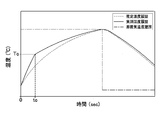
- FIG. 3 is a graph showing the measured temperature history and the estimated temperature history of the object according to the embodiment of the present invention.
- the simulation method according to the present embodiment is implemented by a simulation apparatus including a storage medium that contains a program that can execute the simulation method, and an arithmetic unit (CPU) that executes the program.
- the result of the simulation is displayed on, for example, a display provided in the simulation apparatus and stored in a memory card.
- the heating simulation method of the present invention obtains the temperature change of the object to be heated under the set heating conditions by calculation.
- the heating simulation method of this embodiment is suitable for calculating an estimated temperature of an object whose physical properties change due to heating, particularly an object whose specific heat changes due to heating. Examples of such an object include egg tofu.
- the material liquid containing the liquid egg at the start of heating changes to egg tofu by heating.
- the specific heat of the object also changes, and the physical property value for calculating the estimated temperature of the object also changes.
- a target object contains the protein which denatures by heating like liquid eggs, once the physical property of a target object changes by heating, even if it cools, it will not return to the original physical property.
- the heating simulation method of the present invention sets the first physical property value and the second physical property value as the physical property value of the heating object, and the physical property of the heating object from the first physical property value to the second physical property value.
- the temperature at which the value changes is set as the conversion temperature, and when the calculated temperature of the heating object is lower than the conversion temperature, the temperature change of the heating object using the first physical property value as the physical property value of the heating object If the calculated temperature of the heating object is equal to or higher than the conversion temperature, the temperature change of the heating object is calculated using the second physical property value as the physical property value of the heating object.
- the heating simulation method of the present embodiment (hereinafter referred to as a simulation method) is configured so that the first and second physical property values of the object and the conversion temperature T c are converted into a heating simulation device (hereinafter, referred to as a simulation method).
- the simulation device reads the ambient temperature T wn from the heating conditions (S03), the simulation device determines whether “the state flag S is 1” (S04), the simulation device “estimated temperature T n ⁇ A step of determining whether or not 1 is equal to or higher than the conversion temperature Tc (S05), and simulation The step of calculating the estimated temperature T n based on the first physical property value (S06), the step of setting the state flag S to 1 by the simulation device (S07), and the simulation device estimating the estimated temperature based on the second physical property value.
- the state flag S is a flag indicating that the estimated temperature of the object has reached the conversion temperature. ⁇ t represents a unit time, and n represents the nth time step. In the present embodiment, it is assumed that the estimated temperature of the entire object is uniform.
- the unit time is ⁇ t
- the center point of the object is the center point P
- the ambient temperature and the center point temperature of the object are T wn and T pn , respectively
- the surface temperature of the object matches the ambient temperature T wn
- the temperature gradient inside the object is a straight line
- the thermal conductivity of the object is k
- the surface area of the object is A
- the volume of the object is V, the density of the object and [rho, when the specific heat of the object and c p, the center point temperature T pn shall be consistent with the volume average temperature T p * n, per unit time
- the “amount of heat received by the object from the atmosphere”, that is, the right side of the following equation is obtained.
- kA (T wn-1 -T pn -1) ⁇ t / L V ⁇ c p (T p * n -T p * n-1)
- k / ( ⁇ c p ) is arranged as the thermal diffusion coefficient ⁇ in the above formula, the following formula is obtained.
- T p * n T p * n ⁇ 1 + ⁇ t (T wn ⁇ 1 ⁇ T pn ⁇ 1 ) / L 2
- T pn T p * n
- the first physical property value (first heat transfer coefficient ⁇ 1 and first delay time ⁇ 1 ), second physical property value (second heat transfer coefficient ⁇ 2 and The second delay time ⁇ 2 ) and the conversion temperature T c are set in the simulation apparatus.
- the heat transfer coefficient ⁇ and the delay time ⁇ 1 are determined by the material constituting the object, the shape of the object, and the state of the object.
- the conversion temperature Tc is a temperature at which the first and second physical property values are converted. The user selects the first physical property value (first heat transfer coefficient ⁇ 1 and first delay time ⁇ 1 ), the second physical property value (second heat transfer coefficient ⁇ 2 and second delay time ⁇ 2 ), and the conversion temperature T c.
- this data is input to the simulation apparatus.
- the user selects the first physical property value (first heat transfer coefficient ⁇ 1 and first delay time ⁇ 1 ), the second physical property value (second heat transfer coefficient ⁇ 2 and second delay time ⁇ 2 ), and the conversion temperature T c. If these data are not possessed, they are obtained and input to the simulation apparatus.
- the first physical property value, the second physical property value, and the conversion temperature T c When obtaining the first physical property value, the second physical property value, and the conversion temperature T c , first, after obtaining the conversion temperature T c , the first corresponding to the case where the estimated temperature of the target object is less than the conversion temperature T c .
- One physical property value is obtained, and further a second physical property value corresponding to the case where the estimated temperature of the object is equal to or higher than the conversion temperature Tc is obtained.
- a method for obtaining the conversion temperature Tc and a method for obtaining the first and second physical property values will be described in order.
- the conversion temperature Tc is obtained by comparing the measured temperature with the estimated temperature calculated based on the predicted values of physical properties (predicted values of the heat transfer coefficient ⁇ and the delay time ⁇ ). This will be described with reference to the graph of FIG.
- This graph is a graph which shows the temperature change of the target object with respect to the heating condition of the target object.
- the horizontal axis of the graph indicates time (sec), and the vertical axis of the graph indicates temperature (° C.).
- An alternate long and short dash line indicates the atmospheric temperature T wn set as the heating condition.
- the atmospheric temperature T wn during heating is constant, and the atmospheric temperature T wn during cooling is also constant.
- the solid line shows the measured temperature history obtained by plotting the measured temperature of the object.
- a dotted line shows an estimated temperature history obtained by plotting estimated temperatures calculated based on predicted values of physical properties (predicted values of heat transfer coefficient ⁇ and delay time ⁇ ).
- the conversion temperature T c is a difference between the estimated temperature and the measured temperature when the measured temperature history at the time of heating takes a convex shape and the estimated temperature history is located below the measured temperature. Is obtained as an actually measured temperature at time t c at which is the maximum.
- the upper side means the high temperature side in the graph, and the lower side means the low temperature side in the graph.
- the estimated temperature history may be located above the actually measured temperature history.
- the predicted value of the physical property value is corrected so that the estimated temperature history is located below the measured temperature history, the estimated temperature is calculated based on the corrected predicted value of the physical property value, and the corrected estimated temperature is calculated.
- the conversion temperature Tc is obtained from the difference between the history and the actually measured temperature history.
- the actually measured temperature history during heating may have a downwardly convex shape.
- a predicted value of the physical property value may be selected so that the estimated temperature history is located above the actually measured temperature history, and the estimated temperature may be calculated based on the predicted value of the physical property value.
- the conversion temperature T c is obtained as the actual temperature at the time t c at which the difference between the estimated temperature and the actual temperature is maximum.
- a trial-and-error that is, first, for the first physical property value
- the user selects an appropriate heat transfer coefficient ⁇ and A delay time ⁇ is predicted
- an estimated temperature T n is calculated by the ATS method based on the predicted value
- the estimated temperature T n is compared with the actually measured temperature
- the predicted values of the heat transfer coefficient ⁇ and the delay time ⁇ 1 are calculated.
- the estimated temperature T n is calculated again, and this is repeated until the estimated temperature T n approaches the actually measured temperature.
- the coefficient ⁇ 1 and the first delay time ⁇ 1 ) can be determined.
- the measured temperature of the object is measured using a temperature detection sensor such as a thermistor, for example.
- the estimated temperature T ′ n is calculated based on the predicted heat transfer coefficient ⁇ ′ 1 and the difference between the estimated temperature T ′ n and the actually measured temperature is calculated.
- the difference between the estimated temperature T ′ n and the actually measured temperature is equal to or less than a desired value
- the heat transfer coefficient ⁇ ′ 1 is adopted as the first heat transfer coefficient ⁇ 1 .
- the estimated temperature T ′′ n When the minimum value of the difference between the estimated temperature T ′′ n ... And the measured temperature is smaller than the difference between the estimated temperature T ′ n and the measured temperature and smaller than the desired value, the estimated temperature T ′′ n .
- the heat transfer coefficient ⁇ ′′ 1 used for calculating the minimum value of the difference between the measured temperature and the measured temperature is adopted as the first heat transfer coefficient ⁇ 1 .
- the four heat transfer coefficients ⁇ ''' 1 ... close to the heat transfer coefficient ⁇ '' 1 used to calculate the minimum difference between the measured temperature and the measured temperature are set again, and the four heat transfer coefficients ⁇ ''' 1 ...
- a series of calculations such as calculating the estimated temperature T ′ ′′ n ... Is repeated based on each.
- the heat transfer coefficient ⁇ ′ 1 can be obtained by executing a trial and error technique that repeats a series of calculations.
- the second physical property value is also obtained by the trial and error method described above.
- step S02 for example, the heating condition of the object is set in the simulation apparatus by a user input.
- the heating conditions are, for example, the atmospheric temperature T wn and the heating time. Further, the simulation apparatus sets 0 to the state flag S and sets 1 to n.
- step S03 the simulation apparatus reads the atmospheric temperature T wn from the heating conditions, and sets the atmospheric temperature T wn used in step S06 or step S08. For example, when the atmospheric temperature T wn is different from the atmospheric temperature T wn ⁇ 1 , the atmospheric temperature used in step S06 or step S08 is changed to the atmospheric temperature T wn .
- step S04 after the simulation apparatus determines “whether the state flag S is 1”, in step S05, the simulation apparatus determines whether “the estimated temperature T n ⁇ 1 is equal to or higher than the conversion temperature T c ”. judge. In step S04, it is determined whether or not the estimated temperature of the object has reached the conversion temperature. As described above, the state flag S indicates that the estimated temperature of the object has reached the conversion temperature, and is set to 1 when it is determined Yes in step S05. In step S05, it is determined whether the estimated temperature T n-1 is lower than the conversion temperature T c or higher than the conversion temperature T c .
- step S04 No in step S04, No in step S05, that is, when the estimated temperature of the object has not reached the conversion temperature and the estimated temperature T n-1 is less than the conversion temperature T c , step S06 Then, the simulation apparatus calculates the estimated temperature T n based on the first physical property values (the first heat transfer coefficient ⁇ 1 and the first delay time ⁇ 1 ) according to the following formula derived by the ATS method.
- step S05 Yes in step S05, that is, when the estimated temperature of the object has not reached the conversion temperature and the estimated temperature T n-1 is equal to or higher than the conversion temperature T c , step S07
- the simulation apparatus calculates the second physical property value (second heat transfer coefficient ⁇ 2 and second delay time ⁇ 2 ) according to the following equation derived by the ATS method. Based on the above, an estimated temperature T n is calculated.
- step S04 Yes, that is, when the estimated temperature of the object has reached the conversion temperature Tc , in step S08, the simulation apparatus calculates the second physical property value (second value) by the following equation derived by the ATS method. Based on the heat transfer coefficient ⁇ 2 and the second delay time ⁇ 2 ), the estimated temperature T n is calculated.
- T pn T pn ⁇ 1 + ⁇ 2 ((t ⁇ 2 ) T wn ⁇ 1 ⁇ T pn ⁇ 1 ) That is, when the temperature of the object being calculated is equal to or higher than the conversion temperature T c , the second physical property value (the second heat transfer coefficient ⁇ 2 and the second heat transfer coefficient ⁇ 2 and the second property value) is used as the physical property value of the object regardless of the calculated temperature.
- the temperature change of the object is calculated using the delay time ⁇ 2 ).
- step S10 the simulation apparatus determines whether “ ⁇ t ⁇ n is equal to or longer than the heating time”.
- step S10 when No, that is, ⁇ t ⁇ n is less than the heating time, the simulation apparatus repeats steps S03 to S09.
- step S10 When the answer is Yes in step S10, that is, when ⁇ t ⁇ n is equal to or longer than the heating time, the simulation apparatus ends the execution of the simulation method.
- the estimated temperature of the object approximate to the actual temperature change of the object can be calculated.
- This estimated temperature is used, for example, as an index when the heating condition of food is evaluated from the viewpoint of sterilization.
- the evaluation of the heating condition of the food using the estimated temperature as an index will be described.
- Whether or not a specific heating condition is appropriate from the viewpoint of sterilization of food is generally evaluated based on whether or not the temperature history of the food during heating satisfies the F value, which is an integrated value for sterilization evaluation. Further, from the viewpoint of sterilization, it is preferable to evaluate the temperature of the central part of the food that hardly transmits heat from the atmosphere and is most difficult to sterilize. Therefore, in order to evaluate the heating condition from the viewpoint of sterilization, the estimated temperature history T is obtained from the estimated temperature T n at the center of the food, and whether or not this estimated temperature history T corresponds to the determined F value. evaluate.
- the effect of this embodiment is demonstrated collectively.
- the estimated temperature T is based on the first physical property values (first heat transfer coefficient ⁇ 1 and first delay time ⁇ 1 ).
- the estimated temperature is calculated based on the second physical property value (second heat transfer coefficient ⁇ 2 and second delay time ⁇ 2 ). . Therefore, in the simulation method, the estimated temperature approximated by the actual temperature change of the object is calculated.
- FIG. 3 is a graph showing a history of the estimated temperature calculated by the simulation method of the present embodiment (a graph showing the temperature change of the object with respect to the heating condition of the object). Similar to FIG. 2, in FIG. 3, the horizontal axis of the graph indicates time (sec), and the vertical axis of the graph indicates temperature (° C.). An alternate long and short dash line indicates an ambient temperature set as a heating condition. In the comparative example and the present embodiment, the ambient temperature is the same. The solid line shows the measured temperature history obtained by plotting the measured temperature of the object. A dotted line shows the estimated temperature history calculated by each simulation method. In the simulation method of the present embodiment, an estimated temperature history approximated by the actually measured temperature history (history of the actual temperature change of the object) is calculated as compared with the simulation method of the comparative example.
- the estimated temperature of the object has reached the conversion temperature between step S02 in which the heating conditions are set and step S05 in which the estimated temperature and the conversion temperature Tc are determined.
- Step S04 for determining whether or not there is included.
- the estimation of the object is performed based on the second physical property value.
- the temperature Tn is calculated. That is, when the temperature of the object being calculated is equal to or higher than the conversion temperature Tc , the temperature change of the object is calculated using the second physical property value as the physical property value of the object regardless of the calculated temperature. To do.
- This simulation method is suitable for the case where once the physical properties of the target object change, the physical properties of the target object do not return even if further heating or cooling is performed. Accordingly, in the above simulation method, for example, an estimated temperature approximated by an actual temperature change of the target object is calculated even if egg tofu containing liquid egg as a target object is used as the target object.
- simulation method according to the present invention is not limited to the configuration of the above embodiment, and various modifications can be made without departing from the gist of the present invention.
- the estimated temperature is calculated based on the first and second physical property values, but the present invention is not limited to this. Two or more conversion temperatures may be used, and the estimated temperature may be calculated from a plurality of three or more physical property values such as first, second, third physical property values,.
- both the heat transfer coefficient ⁇ and the delay time ⁇ are used as the first and second physical property values, but the present invention is not limited to this.
- the heat transfer coefficient ⁇ changes before and after the conversion temperature but the delay time ⁇ does not change
- only the heat transfer coefficient ⁇ may be used as the first and second physical property values.
- the conversion temperature is the temperature at which the temperature difference between the actually measured temperature and the estimated temperature is maximized, but is not limited to this.
- the conversion temperature may be a temperature at which the average value of the ratio of the difference between the measured temperature and the estimated temperature with respect to the measured temperature is maximized. That is, the difference ratio can be obtained by the following mathematical formula.
- an absolute value is used. ⁇ (Actual temperature-estimated temperature) / actual temperature ⁇ ⁇ 100
- conversion temperature was calculated
- the first conversion temperature at which the difference between the measured temperature and the estimated temperature is maximized, and the second converted temperature at which the average value of the ratio of the difference between the measured temperature and the estimated temperature with respect to the measured temperature is maximized are obtained.
- An estimated temperature may be calculated based on each of the first and second conversion temperatures, and a conversion temperature at which the calculated estimated temperature of the first and second conversion temperatures is closer to the actually measured temperature may be used.
- the 1st physical property value corresponding to temperature less than conversion temperature Tc is set.
- the second physical property value corresponding to the temperature equal to or higher than the conversion temperature Tc was determined.
- the order of obtaining these may be different from the order described above, and the first and second physical property values may be obtained simultaneously.
- the atmospheric temperature T wn at the time of heating is constant and the atmospheric temperature T wn at the time of cooling is also constant, but is not limited thereto.
- a plurality of atmosphere temperatures may be set for heating and cooling.
- the object is egg tofu, but is not limited to this.
- other packaged foods such as retort foods and canned foods and foods other than foods, for example, pharmaceuticals may be used.
- the conversion temperature exists in the heating process of the object, but the present invention is not limited to this.
- examples of such an object include jelly whose state changes by cooling.
- the estimated temperature of the object is equal to or higher than the conversion temperature, and the estimated temperature may be calculated using different physical property values in each case.
- the physical property of the target object is changed, the physical property of the target object is not changed even if further heating or cooling is performed.
- the present invention is not limited to this.
- the object when the object is jelly, it is in a gel state at the start of heating, changes to a liquid state during heating, and returns to a gel state after cooling.
- the determination of the estimated temperature and the conversion temperature T c The estimated temperature T n may be calculated based on the first physical property value or the second physical property value. Therefore, in this case, when the calculated estimated temperature of the object is lower than the conversion temperature Tc , the estimated temperature Tn is calculated based on the first physical property value.
- the estimated temperature is calculated based on the same second physical property value.
- the present invention is not limited to this. For example, even if the state of the object is the same, if the actual temperature change of the object in the heating process and cooling process is different, the estimated temperature based on the different physical property values in the heating process and cooling process is suitable for this. May be calculated.
- the estimated temperature is calculated by the ATS method, but the present invention is not limited to this.
- the estimated temperature may be calculated by another method such as Ball's mathematical method.
- the simulation device of the above embodiment may be a device different from the device that heats the object, or may be incorporated in a device that heats the object.
- the heating simulation method is a heating simulation method for obtaining a temperature change of a heating object under a set heating condition by calculation, and the first physical property value is a physical property value of the heating object.
- a second physical property value a temperature at which the physical property value of the heating object changes from the first physical property value to the second physical property value is set as a conversion temperature, and a calculated temperature of the heating object Is less than the conversion temperature, the temperature change of the heating object is calculated using the first physical property value as the physical property value of the heating object, and the calculated temperature of the heating object is the conversion temperature.
- the temperature change of the heating object is calculated using the second physical property value as the physical property value of the heating object.
- the temperature change is calculated based on the first physical property value when the estimated temperature of the object is lower than the conversion temperature, and the temperature change based on the second physical property value when the estimated temperature of the object is equal to or higher than the conversion temperature. Is calculated. Therefore, it is possible to provide a heating simulation method in which an estimated temperature approximated by an actual temperature change of an object is calculated.
- the physical property value of the heating object when the temperature of the heating object during the calculation is equal to or higher than the conversion temperature, then the physical property value of the heating object regardless of the calculated temperature. You may calculate the temperature change of the said heating target object using a 2nd physical-property value.
- this heating simulation method when the estimated temperature of the object has reached the conversion temperature, the temperature change of the object is calculated based on the second physical property value. Therefore, this heating simulation method is suitable for the case where once the physical properties of the target object change, the physical properties of the target object do not return even if further heating or cooling is performed. Therefore, for example, even when egg tofu containing liquid egg as a material is an object, a heating simulation method in which an estimated temperature approximated by an actual temperature change of the object can be calculated can be provided.
- a heating simulation program is a heating simulation program for causing an arithmetic device to execute a calculation of a temperature change of an object to be heated under a set heating condition. Accepting the setting of the first physical property value and the second physical property value as values, and accepting the setting as the conversion temperature, the temperature at which the physical property value of the heating object changes from the first physical property value to the second physical property value Determining whether the calculated temperature of the heating object is equal to or higher than the conversion temperature, and if the calculated temperature of the heating object is lower than the conversion temperature, the heating object A step of calculating a temperature change of the heating object using the first physical property value as a physical property value of the object, and the calculated temperature of the heating object is the conversion temperature. If the above is characterized in that it and a step of calculating the temperature change of the heating object using the second property value as a physical property value of the object to be heated.
- the temperature change is calculated based on the first physical property value when the estimated temperature of the object is lower than the conversion temperature, and the temperature change is calculated based on the second physical property value when the estimated temperature of the object is equal to or higher than the conversion temperature. Is done. Therefore, it is possible to provide a program in which an estimated temperature approximated by an actual temperature change of the object is calculated.
- the heating simulation apparatus includes a storage medium having a built-in heating simulation program, and is configured to execute the heating simulation program by an arithmetic device.
- a temperature change is calculated based on the first physical property value when the estimated temperature of the object is lower than the conversion temperature, and a temperature change is calculated based on the second physical property value when the estimated temperature of the object is equal to or higher than the conversion temperature. Is done. Therefore, it is possible to provide an apparatus that calculates an estimated temperature approximated by an actual temperature change of an object.
- the simulation method of the present invention can be used when calculating temperature changes due to heating of retort foods, canned foods, pharmaceuticals, and the like.
- T c conversion temperature
- T n estimated temperature
- T wn atmosphere temperature
Landscapes
- Physics & Mathematics (AREA)
- Engineering & Computer Science (AREA)
- General Physics & Mathematics (AREA)
- Life Sciences & Earth Sciences (AREA)
- Health & Medical Sciences (AREA)
- Theoretical Computer Science (AREA)
- General Health & Medical Sciences (AREA)
- Data Mining & Analysis (AREA)
- Mathematical Optimization (AREA)
- Pure & Applied Mathematics (AREA)
- Mathematical Analysis (AREA)
- Computational Mathematics (AREA)
- Mathematical Physics (AREA)
- General Engineering & Computer Science (AREA)
- Public Health (AREA)
- Chemical & Material Sciences (AREA)
- Veterinary Medicine (AREA)
- Animal Behavior & Ethology (AREA)
- Epidemiology (AREA)
- Software Systems (AREA)
- Databases & Information Systems (AREA)
- Algebra (AREA)
- Zoology (AREA)
- Polymers & Plastics (AREA)
- Food Science & Technology (AREA)
- Wood Science & Technology (AREA)
- Computer Hardware Design (AREA)
- Evolutionary Computation (AREA)
- Geometry (AREA)
- Analytical Chemistry (AREA)
- Biochemistry (AREA)
- Immunology (AREA)
- Pathology (AREA)
- Investigating Or Analyzing Materials Using Thermal Means (AREA)
- Management, Administration, Business Operations System, And Electronic Commerce (AREA)
- Food Preservation Except Freezing, Refrigeration, And Drying (AREA)
- Apparatus For Disinfection Or Sterilisation (AREA)
Abstract
La présente invention concerne un procédé de simulation de chauffage permettant d'obtenir par calcul le changement de température d'un objet à chauffer dans des conditions de chauffage définies. Dans le procédé de simulation de chauffage, une première valeur de propriété physique et une seconde valeur de propriété physique sont définies comme valeurs de propriété physique de l'objet à chauffer, une température à laquelle la valeur de propriété physique de l'objet à chauffer passe de la première valeur de propriété physique à la seconde valeur de propriété physique est définie comme la température de conversion, et, dans les cas où la température calculée de l'objet à chauffer est inférieure à la température de conversion, le changement de température de l'objet à chauffer est calculé à l'aide de la première valeur de propriété physique comme valeur de propriété physique de l'objet à chauffer, et, dans les cas où la température calculée de l'objet à chauffer est supérieure ou égale à la température de conversion, le changement de température de l'objet à chauffer est calculé à l'aide de la seconde valeur de propriété physique comme valeur de propriété physique de l'objet à chauffer.
Priority Applications (2)
| Application Number | Priority Date | Filing Date | Title |
|---|---|---|---|
| CN201780031769.1A CN109196342B (zh) | 2016-05-31 | 2017-05-17 | 加热模拟方法、存储介质及加热模拟装置 |
| US16/301,353 US20190163852A1 (en) | 2016-05-31 | 2017-05-17 | Heating simulation method, heating simulation program, and heating simulation device including storage medium having said program stored therein |
Applications Claiming Priority (2)
| Application Number | Priority Date | Filing Date | Title |
|---|---|---|---|
| JP2016-108856 | 2016-05-31 | ||
| JP2016108856A JP6142040B1 (ja) | 2016-05-31 | 2016-05-31 | 加熱シミュレーション方法、加熱シミュレーションプログラム、及びこのプログラムを内蔵した記憶媒体を含む加熱シミュレーション装置 |
Publications (1)
| Publication Number | Publication Date |
|---|---|
| WO2017208812A1 true WO2017208812A1 (fr) | 2017-12-07 |
Family
ID=59012057
Family Applications (1)
| Application Number | Title | Priority Date | Filing Date |
|---|---|---|---|
| PCT/JP2017/018448 Ceased WO2017208812A1 (fr) | 2016-05-31 | 2017-05-17 | Procédé de simulation de chauffage, programme de simulation de chauffage et dispositif de simulation de chauffage comprenant un support de stockage dans lequel est stocké ledit programme |
Country Status (4)
| Country | Link |
|---|---|
| US (1) | US20190163852A1 (fr) |
| JP (1) | JP6142040B1 (fr) |
| CN (1) | CN109196342B (fr) |
| WO (1) | WO2017208812A1 (fr) |
Families Citing this family (2)
| Publication number | Priority date | Publication date | Assignee | Title |
|---|---|---|---|---|
| US11276334B2 (en) * | 2019-10-16 | 2022-03-15 | Spirit Specialty Solutions, Inc. | Rolling information display apparatus including a temperature monitor and indicator |
| JP7276301B2 (ja) * | 2020-03-31 | 2023-05-18 | 横河電機株式会社 | 反応解析装置、反応解析システム、および反応解析方法 |
Citations (3)
| Publication number | Priority date | Publication date | Assignee | Title |
|---|---|---|---|---|
| JPS6087751A (ja) * | 1983-10-20 | 1985-05-17 | House Food Ind Co Ltd | レトルト豆腐の製造法 |
| JP2002142735A (ja) * | 2000-11-13 | 2002-05-21 | Shichiro Asahi | 食品温度シミュレーション測定装置、及びこの装置を使用した加熱殺菌操業方法 |
| US20070071063A1 (en) * | 2005-08-19 | 2007-03-29 | Foxconn Technology Co., Ltd. | Apparatus for simulation of heat generation of electronic components |
Family Cites Families (6)
| Publication number | Priority date | Publication date | Assignee | Title |
|---|---|---|---|---|
| US5893051A (en) * | 1994-09-27 | 1999-04-06 | Matsushita Electric Industrial Co., Ltd. | Method of estimating temperature inside material to be cooked and cooking apparatus for effecting same |
| JP2002232131A (ja) * | 2001-02-02 | 2002-08-16 | Furukawa Electric Co Ltd:The | 熱解析装置、加熱条件演算装置、熱解析方法、加熱条件演算方法およびそれらの方法をコンピュータに実行させるためのプログラム |
| JP2009236630A (ja) * | 2008-03-26 | 2009-10-15 | Mitsubishi Heavy Ind Ltd | セラミックスの物性値推定方法、遮熱コーティング材の物性値推定方法、遮熱コーティング材の余寿命推定方法、及び、高温部材の余寿命推定方法、並びに物性値取得装置 |
| CN101886846B (zh) * | 2010-06-25 | 2012-09-26 | 河海大学 | 太阳能空气吸热器测控系统及性能、温度预测及保护方法 |
| CN202939123U (zh) * | 2012-10-25 | 2013-05-15 | 中南大学 | 一种模拟体内药物溶出的体外微分溶出装置 |
| CN203149424U (zh) * | 2013-01-11 | 2013-08-21 | 上海炬钢机械制造有限公司 | 食品包装机的整体化加热模电热装置 |
-
2016
- 2016-05-31 JP JP2016108856A patent/JP6142040B1/ja active Active
-
2017
- 2017-05-17 US US16/301,353 patent/US20190163852A1/en not_active Abandoned
- 2017-05-17 WO PCT/JP2017/018448 patent/WO2017208812A1/fr not_active Ceased
- 2017-05-17 CN CN201780031769.1A patent/CN109196342B/zh active Active
Patent Citations (3)
| Publication number | Priority date | Publication date | Assignee | Title |
|---|---|---|---|---|
| JPS6087751A (ja) * | 1983-10-20 | 1985-05-17 | House Food Ind Co Ltd | レトルト豆腐の製造法 |
| JP2002142735A (ja) * | 2000-11-13 | 2002-05-21 | Shichiro Asahi | 食品温度シミュレーション測定装置、及びこの装置を使用した加熱殺菌操業方法 |
| US20070071063A1 (en) * | 2005-08-19 | 2007-03-29 | Foxconn Technology Co., Ltd. | Apparatus for simulation of heat generation of electronic components |
Non-Patent Citations (2)
| Title |
|---|
| ISAMU MUKAI, SAKAI NOBORU: "A Practical Verification of Ambient Temperature Slide Method (ATS Method) during Retort Sterilization", JAPAN JOURNAL OF FOOD ENGINEERING, vol. 9, no. 3, September 2008 (2008-09-01), pages 167 - 179, XP055599748 * |
| MUKAI ISAMU, SHU SEIJI: "Clarification of the Theoretical Problem in ATS Method by Using Similarity Relation within Temperature History Curves", JAPAN JOURNAL OF FOOD ENGINEERING, vol. 16, no. 3, September 2015 (2015-09-01), pages 209 - 217, XP055599754 * |
Also Published As
| Publication number | Publication date |
|---|---|
| US20190163852A1 (en) | 2019-05-30 |
| CN109196342B (zh) | 2021-11-23 |
| JP2017212913A (ja) | 2017-12-07 |
| CN109196342A (zh) | 2019-01-11 |
| JP6142040B1 (ja) | 2017-06-07 |
Similar Documents
| Publication | Publication Date | Title |
|---|---|---|
| Ureta et al. | Quality attributes of muffins: Effect of baking operative conditions | |
| CN105962793B (zh) | 用于加热容器中的食物的加热装置和方法 | |
| JP6142040B1 (ja) | 加熱シミュレーション方法、加熱シミュレーションプログラム、及びこのプログラムを内蔵した記憶媒体を含む加熱シミュレーション装置 | |
| Otero et al. | A model to design high-pressure processes towards an uniform temperature distribution | |
| RU2016115733A (ru) | Идентификация исходной степени обжаривания кофейных зерен | |
| JP6163590B1 (ja) | シミュレーション方法、シミュレーションプログラム、及びこのプログラムを内蔵した記憶媒体を含むシミュレーション装置 | |
| González-Pérez et al. | Mass transfer and morphometric characteristics of fresh and osmodehydrated white mushroom pilei during convective drying | |
| US20190019142A1 (en) | System and method of reverse modeling of product temperatures | |
| Vaikousi et al. | Kinetic modelling of non-enzymatic browning in honey and diluted honey systems subjected to isothermal and dynamic heating protocols | |
| Guignon et al. | Determination, analysis and prediction of the volumetric behavior of milk at high pressure | |
| HK1260343A1 (en) | Heating simulation method, heating simulation program, and heating simulation device including storage medium having said program stored therein | |
| Gutierrez et al. | An empirical model to estimate the growth of ice crystals for storage of Tilapia at variable temperature conditions | |
| HK1260343B (zh) | 加热模拟方法、加热模拟程序、及包含内置了该程序的存储介质的加热模拟装置 | |
| JP2010008312A (ja) | 熱伝達率評価方法、及び熱伝達率評価装置 | |
| Šeruga et al. | Determination of thermal conductivity and convective heat transfer coefficient during deep fat frying of “Kroštula” dough | |
| CN113693453B (zh) | 一种烹饪食材量确定方法、装置、计算机设备及存储介质 | |
| HK1262721A1 (en) | Simulation method, simulation program, and simulation device including storage medium having said program stored therein | |
| JP2015087277A (ja) | 測温体校正装置、測温体校正システム及び測温体校正方法 | |
| CN113808674A (zh) | 一种添加茶多酚的乳制品美拉德反应副产物含量的计算方法和应用 | |
| Kou et al. | Evaluation of a heating block system for accurate temperature-time controlled pasteurization treatments on various foods | |
| Pham | Heat transfer coefficient and physical properties | |
| RU2688917C1 (ru) | Способ определения срока годности рыбных консервов | |
| Barrozo et al. | A study of the desorption isotherms of lentils | |
| Ketteringham et al. | Immersion chilling of trays of cooked products | |
| Kahkonen | Comparison and error analysis of instrumentation and methods for assessment of neutral and hot environment on the basis of ISO standards. |
Legal Events
| Date | Code | Title | Description |
|---|---|---|---|
| 121 | Ep: the epo has been informed by wipo that ep was designated in this application |
Ref document number: 17806370 Country of ref document: EP Kind code of ref document: A1 |
|
| NENP | Non-entry into the national phase |
Ref country code: DE |
|
| 122 | Ep: pct application non-entry in european phase |
Ref document number: 17806370 Country of ref document: EP Kind code of ref document: A1 |