WO2017209013A1 - Composition de résine photodurcissable pour film intermédiaire pour verre feuilleté, matériau de film pour film intermédiaire pour verre feuilleté et procédé de fabrication de verre feuilleté - Google Patents
Composition de résine photodurcissable pour film intermédiaire pour verre feuilleté, matériau de film pour film intermédiaire pour verre feuilleté et procédé de fabrication de verre feuilleté Download PDFInfo
- Publication number
- WO2017209013A1 WO2017209013A1 PCT/JP2017/019777 JP2017019777W WO2017209013A1 WO 2017209013 A1 WO2017209013 A1 WO 2017209013A1 JP 2017019777 W JP2017019777 W JP 2017019777W WO 2017209013 A1 WO2017209013 A1 WO 2017209013A1
- Authority
- WO
- WIPO (PCT)
- Prior art keywords
- laminated glass
- meth
- photocurable resin
- glass
- film
- Prior art date
- Legal status (The legal status is an assumption and is not a legal conclusion. Google has not performed a legal analysis and makes no representation as to the accuracy of the status listed.)
- Ceased
Links
Images




Classifications
-
- B—PERFORMING OPERATIONS; TRANSPORTING
- B32—LAYERED PRODUCTS
- B32B—LAYERED PRODUCTS, i.e. PRODUCTS BUILT-UP OF STRATA OF FLAT OR NON-FLAT, e.g. CELLULAR OR HONEYCOMB, FORM
- B32B17/00—Layered products essentially comprising sheet glass, or glass, slag, or like fibres
- B32B17/06—Layered products essentially comprising sheet glass, or glass, slag, or like fibres comprising glass as the main or only constituent of a layer, next to another layer of a specific material
- B32B17/10—Layered products essentially comprising sheet glass, or glass, slag, or like fibres comprising glass as the main or only constituent of a layer, next to another layer of a specific material of synthetic resin
-
- B—PERFORMING OPERATIONS; TRANSPORTING
- B32—LAYERED PRODUCTS
- B32B—LAYERED PRODUCTS, i.e. PRODUCTS BUILT-UP OF STRATA OF FLAT OR NON-FLAT, e.g. CELLULAR OR HONEYCOMB, FORM
- B32B27/00—Layered products comprising a layer of synthetic resin
- B32B27/30—Layered products comprising a layer of synthetic resin comprising vinyl (co)polymers; comprising acrylic (co)polymers
-
- C—CHEMISTRY; METALLURGY
- C08—ORGANIC MACROMOLECULAR COMPOUNDS; THEIR PREPARATION OR CHEMICAL WORKING-UP; COMPOSITIONS BASED THEREON
- C08L—COMPOSITIONS OF MACROMOLECULAR COMPOUNDS
- C08L33/00—Compositions of homopolymers or copolymers of compounds having one or more unsaturated aliphatic radicals, each having only one carbon-to-carbon double bond, and only one being terminated by only one carboxyl radical, or of salts, anhydrides, esters, amides, imides or nitriles thereof; Compositions of derivatives of such polymers
-
- C—CHEMISTRY; METALLURGY
- C09—DYES; PAINTS; POLISHES; NATURAL RESINS; ADHESIVES; COMPOSITIONS NOT OTHERWISE PROVIDED FOR; APPLICATIONS OF MATERIALS NOT OTHERWISE PROVIDED FOR
- C09J—ADHESIVES; NON-MECHANICAL ASPECTS OF ADHESIVE PROCESSES IN GENERAL; ADHESIVE PROCESSES NOT PROVIDED FOR ELSEWHERE; USE OF MATERIALS AS ADHESIVES
- C09J7/00—Adhesives in the form of films or foils
Definitions
- the present invention relates to a photocurable resin composition for an interlayer film of laminated glass, a film material for an interlayer film of laminated glass using the same, and a method for producing the laminated glass.
- an interlayer film for laminated glass made of polyvinyl acetal resin such as polyvinyl butyral resin plasticized with a plasticizer is interposed between and integrated with at least a pair of glass plates. Things.
- the present invention provides a photocurable resin composition for an interlayer film of a laminated glass capable of providing a laminated glass excellent in splitting resistance, and a film material for an interlayer film of laminated glass and a laminated glass using the same. It aims at providing the manufacturing method of.
- one aspect of the present invention is a laminated glass containing (A) (meth) acrylic polymer, (B) (meth) acrylic monomer (or (meth) acrylate monomer), and (D) photopolymerization initiator.
- a photocurable resin composition for an interlayer film is provided.
- Another aspect of the present invention is a pair of laminated layers that include a photocurable resin composition for an interlayer film of laminated glass or that are formed from the resin composition, and the adhesive layer is interposed therebetween.
- a film material for an interlayer film of laminated glass (or an interlayer film for laminated glass with a cover film) is provided.
- film material for interlayer film of laminated glass
- it is easy to store and transport the interlayer film for laminated glass without damaging the adhesive layer. Can do.
- the thickness of the adhesive layer in the film material may be 10 ⁇ m to 5.0 ⁇ 10 3 ⁇ m. Thereby, the intermediate film of laminated glass becomes more excellent in impact resistance and visibility.
- Still another aspect of the present invention provides a method for producing a laminated glass comprising two opposing glass plates and an intermediate film sandwiched between them.
- the adhesive layer of the film material is irradiated with ultraviolet rays and cured, and two glass plates that are adherends are bonded together via the adhesive layer, and the two glass plates and the adhesive layer are bonded together.
- the intermediate film of the obtained laminated glass is the cured adhesive layer.
- the method for producing a laminated glass according to the present invention comprises a laminate comprising the two glass plates and the adhesive layer, wherein the two glass plates as adherends are bonded together via the adhesive layer of the film material.
- a step of obtaining, a step of heating and pressurizing the laminated body under conditions of 30 to 150 ° C. and 0.3 to 1.5 MPa, and any one of the two glass plates (adhesives) to the laminated body You may include the process of irradiating and hardening
- the intermediate film of the obtained laminated glass is the cured adhesive layer.
- the photocurable resin composition for interlayer films of laminated glass according to one aspect of the present invention may further contain (C) a plasticizer component.
- a method for producing a laminated glass according to one aspect of the present invention includes: (A) The process of apply
- a step of obtaining a laminated glass including an intermediate film that is the cured photocurable resin layer by irradiating the photocurable resin layer with ultraviolet rays and curing it may be included.
- a method for producing a laminated glass according to one aspect of the present invention includes: (A) The process of apply
- a method for producing a laminated glass according to one aspect of the present invention includes: (A ') The process of apply
- a step of obtaining a laminated glass having an intermediate film that is the cured photocurable resin layer by irradiating ultraviolet light to the temporarily cured photocurable resin layer that has been cured may be included.
- the glass plate and the glass plate may be laminated via a cured photocurable resin layer (light transmissive cured resin layer).
- the glass plate and the glass plate may be laminated via a light-transmitting cured resin layer (cured photocurable resin layer).
- cured resin layer cured photocurable resin layer
- the “glass plate” is used as a term including not only an inorganic glass plate but also a transparent plastic plate such as a resin substrate and a resin film.
- inorganic glass plates can be bonded to each other, or an inorganic glass plate and a transparent plastic plate can be bonded to each other.
- the interlayer film according to one aspect of the present invention has improved wettability and adhesion to the surface of the glass plate (adhered body), thereby improving the toughness of the laminated glass (laminated body). As a result, a laminated glass having high splitting properties is provided.
- a photocurable resin composition for an interlayer film of laminated glass that can provide a laminated glass that is difficult to break when subjected to an impact from the outside, that is, excellent in splitting resistance.
- the One aspect of the present invention can provide a film material for an interlayer film of a laminated glass using the photocurable resin composition, and a method for producing the laminated glass.
- stable transparency can be maintained, without the intermediate film (adhesion layer) whitening also in the reliability in a high humidity environment.
- (meth) acrylate means “acrylate” or “methacrylate” corresponding thereto.
- (meth) acryl means “acryl” or “methacryl” corresponding thereto, and “(meth) acryloyl” means “acryloyl” or “methacryloyl” corresponding thereto.
- the content of each component in the composition means the total amount of the plurality of types of substances present in the composition unless there is a specific notice when there are a plurality of types of substances corresponding to the respective components in the composition. . Further, unless otherwise specified, the content of each component is shown in a ratio based on the total amount of the photocurable resin composition (excluding the solvent added for coating and the like).
- Photocurable resin composition for interlayer film of laminated glass comprises (A) (meth) acrylic polymer, (B) (meth) acrylic monomer (or (Meth) acrylate monomer) and (D) a photopolymerization initiator, and (C) a plasticizer component may be further contained.
- This photocurable resin composition is cured mainly by a photopolymerization reaction of a (meth) acrylic monomer. That is, the cured photocurable resin composition and the cured adhesive layer or cured photocurable resin layer described below containing the polymer include a polymer formed by polymerization of (B) (meth) acrylic monomer.
- the photocurable resin composition for laminated glass interlayer film of the present embodiment is high in laminated glass by improving the wettability to the adherend (glass plate) surface and the toughness of the laminate (laminated glass). Appears splitting.
- (A) (Meth) acrylic polymer (Meth) acrylic polymer (hereinafter sometimes referred to as “component (A)”) is a (meth) acryloyl group (CH 2 ⁇ C (X) C ( ⁇ O). -, X is a hydrogen atom or a methyl group.)
- a homopolymer formed by polymerizing a monomer (such as a (meth) acrylate compound) having one in the molecule, or two or more of these monomers Is a copolymer formed by copolymerization.
- the monomer ((meth) acrylate compound or the like) constituting the (meth) acrylic polymer is usually a monofunctional monomer having one (meth) acryloyloxy group or (meth) acryloyl group.
- Specific examples thereof include (meth) acrylic acid; methyl (meth) acrylate, ethyl (meth) acrylate, n-butyl (meth) acrylate, isobutyl (meth) acrylate, tert-butyl (meth) acrylate, n-pentyl ( (Meth) acrylate, n-hexyl (meth) acrylate, n-octyl (meth) acrylate, isooctyl (meth) acrylate, 2-ethylhexyl (meth) acrylate, isodecyl (meth) acrylate, dodecyl (meth) acrylate (n-lauryl ( (Meth)
- the (meth) acrylic polymer (or (meth) acrylate polymer) is a main chain containing a monomer such as a (meth) acrylate compound as a monomer unit, a urethane bond bonded to the main chain, and a main chain via the urethane bond.
- Modified (meth) acrylate oligomers having (meth) acryloyloxy groups attached to the chain can be included.
- Such a (meth) acrylic polymer can be a reaction product of a (meth) acrylate oligomer (or (meth) acrylic polymer) having a hydroxyl group in the side chain and an isocyanate.
- Examples of the (meth) acrylate oligomer having a hydroxyl group in the side chain include (meth) acrylic polymers containing 2-hydroxyethyl acrylate, 4-hydroxybutyl acrylate and 6-hydroxyhexyl acrylate as monomer units.
- the (meth) acrylic polymer has a higher molecular weight than the (meth) acrylic polymer in the photocurable resin composition by having an acrylate group bonded to the main chain via a urethane bond in the side chain. Thereby, the entanglement of the (meth) acrylic polymer molecules can be made more complicated.
- the cured product of the photocurable resin composition can be further toughened by adding a (meth) acryloyl group to the (meth) acrylic polymer.
- this modified (meth) acrylic polymer is not a (meth) acrylic monomer (compound having an ethylenically unsaturated bond group) as a component (B) described later, but one kind of (meth) acrylic polymer. are categorized.
- the (meth) acrylic polymer may contain a compound copolymerizable with a monomer such as the (meth) acrylate compound as a copolymerization monomer.
- a monomer such as the (meth) acrylate compound
- examples of the compound copolymerizable with a monomer such as a (meth) acrylate compound include styrene, 4-methylstyrene, vinylpyridine, vinylpyrrolidone, vinyl acetate, cyclohexylmaleimide, phenylmaleimide and maleic anhydride.
- the content of the (meth) acrylic polymer may be 1% by mass or more, 10% by mass or more, or 20% by mass or more based on the total amount of the photocurable resin composition.
- the content of the (meth) acrylic polymer may be 80% by mass or less, 50% by mass or less, or 30% by mass or less based on the total amount of the photocurable resin composition.
- the weight average molecular weight of the (meth) acrylic polymer may be 10,000 to 2 million, or 100,000 to 1 million.
- the weight average molecular weight is 10,000 or more, the entanglement between the molecular chains of the (meth) acrylic polymer is complicated, so that the interlayer film is toughened and the impact strength of the laminated glass tends to be high.
- the weight average molecular weight of the (meth) acrylic polymer is 2 million or less, the viscosity of the photocurable resin composition does not become too high, and handling properties tend to be improved, such as stringing is less likely to occur.
- the weight average molecular weight means a standard polystyrene equivalent value measured by gel permeation chromatography.
- the glass transition temperature (Tg) of the (meth) acrylic polymer may be 0 ° C. or lower or ⁇ 10 ° C. or lower. When the Tg of the (meth) acrylic polymer is low, the impact strength of the laminated glass tends to be high. From the same viewpoint, the Tg of the (meth) acrylic polymer may be ⁇ 15 ° C. or lower.
- the lower limit of Tg of the (meth) acrylic polymer is not particularly limited, but may be ⁇ 40 ° C. or higher.
- (B) (Meth) acrylic monomer
- component (B) is a compound having an ethylenically unsaturated group or a (meth) acryloyl group.
- (meth) acrylic acid methyl (meth) acrylate, ethyl (meth) acrylate, n-butyl (meth) acrylate, isobutyl (meth) acrylate, tert-butyl (meth) acrylate, n-pentyl ( (Meth) acrylate, n-hexyl (meth) acrylate, n-octyl (meth) acrylate, isooctyl (meth) acrylate, 2-ethylhexyl (meth) acrylate, isodecyl (meth) acrylate, dodecyl (meth) acrylate (n-lauryl ( (Meth) acrylates), isomyristyl (meth) acrylates, stearyl (meth) acrylates and the like alkyl groups having 1 to 18 carbon atoms (meth) acrylates; ethylene glycol di (meth) acrylates;
- the polyfunctional (meth) acrylate, glycidyl methacrylate, and alkenyl (meth) acrylate having an alkenyl group having 2 to 18 carbon atoms may be collectively referred to as aliphatic (meth) acrylate.
- Alkoxy polyalkylene glycol (meth) acrylate, polyalkylene glycol mono (meth) acrylate, polyalkylene glycol di (meth) acrylate, (meth) acrylate having an isocyanuric ring skeleton, and (meth) acrylate having a siloxane skeleton are heteroatoms ( Sometimes collectively referred to as (meth) acrylate.
- the content of the (meth) acrylic monomer may be 3% by mass or more, 5% by mass or more, or 10% by mass or more based on the total amount of the photocurable resin composition.
- the content of the (meth) acrylic monomer may be 90% by mass or less, 70% by mass or less, or 50% by mass or less based on the total amount of the photocurable resin composition.
- the plasticizer component is a compound that is compatible with the (meth) acrylic polymer of component (A) and does not photopolymerize itself upon irradiation with ultraviolet rays. If the plasticizer component is not compatible with the (meth) acrylic polymer, the cured product may become cloudy and visibility may be reduced.
- the plasticizer component may contain at least one of a solid tackifier or a liquid plastic component.
- solid (solid) means that the softening point measured by JISK5601-2-2 is 60 to 150 ° C. or 80 to 120 ° C.
- the liquid state means a state where the viscosity measured by a cone plate rheometer is in a range of 0.01 to 100 Pa ⁇ s (25 ° C.) at 25 ° C. under atmospheric pressure.
- a solid tackifier exhibiting such a softening point is not cured by itself by ultraviolet irradiation, and is a cured or temporarily cured photocurable resin layer (or adhesive layer) formed from a photocurable resin composition.
- Tackifiers include, for example, terpene resins such as terpene resins, terpene phenol resins and hydrogenated terpene resins, rosin resins such as natural rosin, polymerized rosin, rosin ester and hydrogenated rosin, and petroleum such as polybutadiene and polyisoprene. Resins, or combinations thereof can be included.
- the liquid plastic component is a component that does not undergo photocuring itself by ultraviolet irradiation, imparts flexibility to the photocuring resin layer after curing or provisional curing, and reduces the curing shrinkage rate.
- a liquid plastic component may be, for example, at least one selected from the group consisting of a liquid polybutadiene plasticizer, a polyisoprene plasticizer, a phthalate ester plasticizer, and an adipate ester plasticizer. Good.
- liquid plastic component examples include butadiene rubber, isoprene rubber, silicon rubber, styrene butadiene rubber, chloroprene rubber, nitrile rubber, butyl rubber, ethylene propylene rubber, urethane rubber, chlorosulfonated polyethylene rubber, fluorine rubber, Liquid rubbers such as hydrogenated nitrile rubber and epichlorohydrin rubber; Poly- ⁇ -olefins (eg polybutene), hydrogenated ⁇ -olefin oligomers (eg hydrogenated polybutene) and polyvinyl oligomers such as atactic polypropylene; Fragrances such as biphenyl and triphenyl Group oligomers; hydrogenated polyene oligomers such as hydrogenated liquid polybutadiene; paraffin oligomers such as paraffin oil and chlorinated paraffin oil; cycloparaffin oligomers such as naphthene oil; dimethyl phthalate; Diethyl
- the content of the plasticizer component may be 5% by mass or more, 10% by mass or more, or 20% by mass or more based on the total amount of the photocurable resin composition.
- the content of the plasticizer component may be 90% by mass or less, 70% by mass or less, or 50% by mass or less based on the total amount of the photocurable resin composition.
- Photopolymerization initiator A photopolymerization initiator (hereinafter sometimes referred to as “component (D)”) initiates or accelerates a curing reaction (particularly, a curing reaction by photoradical polymerization) upon irradiation with active energy rays. It is a compound.
- active energy rays refer to ultraviolet rays, electron beams, ⁇ rays, ⁇ rays, ⁇ rays and the like.
- the photopolymerization initiator is not particularly limited, and known materials such as benzophenone-based, anthraquinone-based, benzoyl-based, sulfonium salt, diazonium salt, onium salt and the like can be used.
- benzophenone, N, N, N ′, N′-tetramethyl-4,4′-diaminobenzophenone (Michler ketone), N, N, N ′, N′-tetraethyl-4,4′-diaminobenzophenone 4- (dimethylamino) -4′-methoxybenzophenone, ⁇ -hydroxyisobutylphenone, 2-ethylanthraquinone, t-butylanthraquinone, 1,4-dimethylanthraquinone, 1-chloroanthraquinone, 2,3-dichloroanthraquinone, 3 -Chloro-2-methylanthraquinone, 1,2-benzoanthraquinone, 2-phenylanthraquinone, 1,4-naphthoquinone, 9,10-phenanthraquinone, thioxanthone, 2-chlorothio
- Benzoin compounds such as benzoin methyl ether, benzoin ethyl ether, benzoin isobutyl ether and benzoin phenyl ether; benzyl compounds such as benzyl and benzyldimethyl ketal; ⁇ - (acridin-9-yl) (meth) acrylic acid Acridine compounds such as ester compounds, 9-phenylacridine, 9-pyridylacridine, 1,7-diacridinoheptane; 2- (o-chlorophenyl) -4,5-diphenylimidazole dimer, 2- (o-chlorophenyl) ) 4,5-di (m-methoxyphenyl) imidazole dimer, 2- (o-fluorophenyl) -4,5-diphenylimidazole dimer, 2- (o-methoxyphenyl) -4,5-diphenylimidazole Dimer, 2- (p-methoxyphenyl)
- the content of the photopolymerization initiator may be 0.1 to 5% by mass, 0.2 to 3% by mass, or 0.3 to 2% by mass with respect to the total amount of the photocurable resin composition. .
- Photopolymerization can be favorably started when the content of the photopolymerization initiator is 0.1% by mass or more.
- the step embedding property and the self-organizing property are easily excellent, and the hue of the obtained cured product is easily suppressed from being yellowish.
- the photocurable resin composition of the present embodiment may contain various additives separately from the components (A) to (D) as necessary.
- various additives include polymerization inhibitors, antioxidants, light stabilizers, silane coupling agents, surfactants, leveling agents, inorganic fillers, and the like.
- the polymerization inhibitor is added for the purpose of enhancing the storage stability of the photocurable resin composition.
- An example is paramethoxyphenol.
- the antioxidant is added for the purpose of improving the heat-resistant coloring property of a cured product obtained by curing the photocurable resin composition with light. Examples thereof include phosphorus-based antioxidants such as rephenyl phosphite; phenol-based; thiol-based antioxidants.
- the light stabilizer is added for the purpose of enhancing the resistance to active energy rays such as ultraviolet rays.
- An example is HALS (Hindered Amine Light Stabilizer).
- a silane coupling agent is added to improve adhesion to glass or the like.
- Examples include methyltrimethoxysilane, methyltriethoxysilane, phenyltrimethoxysilane, phenyltriethoxysilane, ⁇ -aminopropyltrimethoxysilane, ⁇ -aminopropyltriethoxysilane, ⁇ -glycidoxypropyltrimethoxysilane, ⁇ -Glycidoxypropylmethyldiethoxysilane, ⁇ -glycidoxypropylmethyldiisopropenoxysilane.
- a surfactant is added to control the peelability. Examples thereof include polydimethylsiloxane compounds and fluorine compounds.
- a leveling agent is added in order to provide the flatness of a photocurable resin composition. Examples thereof include silicon-based and fluorine-based compounds that lower the surface tension.
- additives may be used alone or in combination of a plurality of additives.
- the content when these additives are used is usually smaller than the total content of the above components (A) to (D), and generally 0.01 to 5 with respect to the total amount of the photocurable resin composition. It is about mass%.
- the photocurable resin composition of the present embodiment may contain an inorganic filler.
- the inorganic filler include crushed silica, fused silica, mica, clay mineral, short glass fiber or fine powder and hollow glass, calcium carbonate, quartz powder, and metal hydrate.
- the content of the inorganic filler is 0.01 to 100 parts by weight, 0.05 to 50 parts by weight, or 0 with respect to 100 parts by weight of the photocurable resin composition, based on the total solid content (components other than the solvent). It may be 1 to 30 parts by mass.
- the content of the inorganic filler is 0.01 to 100 parts by mass, a resin composition that is particularly excellent in terms of low shrinkage, improved mechanical strength, low thermal expansion coefficient, and the like can be obtained. You may improve the dispersibility of an inorganic filler by performing the process using commercially available surface treating agents, such as a coupling agent, and dispersers, such as a triple roll, bead mill, and nanomizer.
- the storage elastic modulus of the intermediate film formed by curing the adhesive layer or the photocurable resin layer may be 100,000 Pa to 100,000,000 Pa at a measurement temperature of 25 ° C. and a frequency of 1000 Hz.
- a storage elastic modulus is measured using the master curve by a dynamic viscoelasticity measuring method.
- the peak (maximum value) of the loss coefficient (tan ⁇ ) measured at a measurement temperature of 25 ° C. and a frequency of 100 Hz or more was 0.5 or more. May be.
- the maximum value of the loss factor may be 0.5 or more at a measurement temperature of 25 ° C. and a frequency of 100 Hz to 100,000 Hz.
- the loss coefficient measured at a measurement temperature of 25 ° C. and a frequency of 100 Hz or more is 0.5 or more, the interlayer film dissipates impact energy, and the splitting property of the laminated glass is further improved.
- the loss coefficient is measured using a master curve obtained by a dynamic viscoelasticity measurement method.
- the condition of a frequency of 100 to 100,000 Hz is that a steel ball or an iron ball is dropped freely from a height of several tens of centimeters to one meter and several tens of centimeters in an impact resistance test described later in the examples, and applied to the laminated glass. Corresponds to the strain rate at the time of collision.
- the dynamic viscoelasticity measurement referred to in the present specification is performed using a dynamic viscoelasticity measuring machine (manufactured by TA instrument, RSA-G2).
- the measurement conditions and analysis method are as follows.
- ⁇ Measurement mode Tensile ⁇ Temperature: -70 °C ⁇ 100 °C ⁇ Frequency: 0.05, 0.5, 5, 50 (s-1) ⁇ Strain amount: 1% -Analysis method: A master curve is calculated from the measurement result by the WLF method or the Arrhenius rule.
- the manufacturing method of the photocurable resin composition for interlayer films of a laminated glass is not particularly limited, and the component (A), (B ) Component, (D) component, and, if necessary, (C) component, the above additives and the like can be mixed and stirred.
- the solid component may be heated and dissolved at least one time before mixing stirring, during mixing stirring, and after mixing stirring. Thereby, each component can disperse
- the temperature is preferably 40 to 130 ° C.
- stirring is sufficiently easy even when the viscosity of the component is high.
- the temperature is 130 ° C. or lower, the volatilization of components is suppressed, and coloring of the resin composition is also suppressed.
- the stirring time is not particularly limited, but is preferably 10 to 60 minutes, and more preferably 20 to 40 minutes.
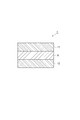
- FIG. 1 is a schematic cross-sectional view showing an embodiment of a film material for an interlayer film of laminated glass.
- a film material 2 for interlayer film of laminated glass shown in FIG. 1 includes a pressure-sensitive adhesive layer 5a containing the photocurable resin composition according to the above-described embodiment, and a pair of base material layers laminated so as to sandwich the pressure-sensitive adhesive layer 5a therebetween. 21 and 22.
- the base material layer 21 may be a light release separator (separate film or cover film), and the base material layer 22 may be a heavy release separator (separate film).
- the heavy release separator and the light release separator may be a polymer film such as a polyethylene terephthalate film.
- the light release separator may be a cover film made of the same material as the heavy release separator.
- the film material for interlayer films of laminated glass can be applied to various types of laminated glass.
- the photocurable resin composition (adhesive resin composition) for the laminated glass interlayer film is a polydimethylsiloxane surfactant
- surfactant such as a fluorochemical surfactant
- the thickness of the adhesive layer may be 10 ⁇ m to 5.0 ⁇ 10 3 ⁇ m.
- the light transmittance of the adhesive layer 5a for light in the visible light region (wavelength: 380 nm to 780 nm) may be 80% or more, 90% or more, or 95% or more.
- the pressure-sensitive adhesive layer 5a is a layer formed by processing the photocurable resin composition for laminated glass interlayer film according to the present embodiment into a sheet shape or a film shape.
- a method of processing a photocurable resin composition into a sheet form or a film form A well-known technique can be used.
- the photocurable resin composition according to the present embodiment is diluted with a ketone solvent such as 2-butanone or cyclohexanone to prepare a coating solution, and this coating solution is flowed onto a substrate such as a polymer film.
- the photocurable resin composition is formed into a sheet having an arbitrary film thickness by applying the coating method, roll coating method, gravure roll method, wire bar method, lip die coating method, etc., and removing (drying) the solvent from the coating film. Or it can process into a film form.
- each component may be blended and then diluted with a solvent, or each component may be diluted with a solvent in advance before blending.
- the solid content concentration of the coating solution (concentration of components other than the solvent) is preferably 30% by mass or more, and 40% by mass or more based on the mass of the coating solution. Is more preferable. From the same viewpoint, the solid content concentration of the coating liquid is preferably 70% by mass or less, and more preferably 60% by mass or less. From the viewpoint of coating properties, the viscosity of the coating liquid is preferably 1 Pa ⁇ s or more, preferably 5 Pa ⁇ s or more, at the coating temperature. From the same viewpoint, the viscosity of the coating liquid is preferably 30 Pa ⁇ s or less, more preferably 25 Pa ⁇ s or less, and further preferably 15 Pa ⁇ s or less.
- the heavy release separator (base material layer 22) may be, for example, a polymer film such as polyethylene terephthalate, polypropylene, polyethylene, and polyester, or a polyethylene terephthalate film (hereinafter sometimes referred to as “PET film”). May be.
- the thickness of the heavy release separator (base material layer 22) may be 50 to 200 ⁇ m, 60 to 150 ⁇ m, or 70 to 130 ⁇ m from the viewpoint of workability.
- the planar shape of the heavy release separator (base material layer 22) may be larger than the planar shape of the adhesive layer 5a, and the outer edge of the heavy release separator (base material layer 22) may protrude outward from the outer edge of the adhesive layer 5a.
- the width at which the outer edge of the heavy release separator (base material layer 22) protrudes from the outer edge of the adhesive layer 5a is 2 to 20 mm, or 4 to 4 from the viewpoint of ease of handling, ease of peeling, and reduction of adhesion of dust and the like. It may be 10 mm.
- the planar shape of the pressure-sensitive adhesive layer 5a and the heavy release separator (base material layer 22) is a substantially rectangular shape such as a substantially rectangular shape
- the width of the outer edge of the base material layer 22 (heavy release separator) overhangs the outer edge of the pressure sensitive adhesive layer 5a. May be 2-20 mm on at least one side, 4-10 mm on at least one side, 2-20 mm on all sides, or 4-10 mm on all sides.
- the light release separator (base material layer 21) may be, for example, a polymer film such as polyethylene terephthalate, polypropylene, polyethylene, or polyester, or may be a polyethylene terephthalate film.
- the thickness of the light release separator (base material layer 21) may be 25 to 150 ⁇ m, 30 to 100 ⁇ m, or 40 to 75 ⁇ m from the viewpoint of workability.
- the planar shape of the light release separator (base material layer 21) may be larger than the planar shape of the adhesive layer 5a, and the outer edge of the light release separator (base material layer 21) may protrude outward from the outer edge of the adhesive layer 5a.
- the width at which the outer edge of the light release separator (base material layer 21) protrudes from the outer edge of the adhesive layer 5a is 2 to 20 mm, or 4 to 4 from the viewpoint of ease of handling, ease of peeling, and reduction of adhesion of dust and the like. It may be 10 mm.
- the planar shape of the pressure-sensitive adhesive layer 5a and the light release separator (base material layer 21) is a substantially rectangular shape such as a substantially rectangular shape
- the width of the outer edge of the light release separator (base material layer 21) overhangs the outer edge of the pressure-sensitive adhesive layer 5a. May be 2-20 mm on at least one side, 4-10 mm on at least one side, 2-20 mm on all sides, or 4-10 mm on all sides.
- the peel strength between the light release separator (base material layer 21) and the adhesive layer 5a is preferably lower than the peel strength between the heavy release separator (base material layer 22) and the adhesive layer 5a. Thereby, a heavy peeling separator (base material layer 22) becomes difficult to peel from the adhesion layer 5a rather than a light peeling separator (base material layer 21).
- the peel strength between the heavy release separator and the pressure-sensitive adhesive layer, and between the light release separator and the pressure-sensitive adhesive layer can be adjusted, for example, by subjecting the heavy release separator and the light release separator to surface treatment. Examples of the surface treatment method include a mold release treatment with a silicone compound or a fluorine compound.
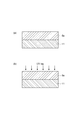
- FIG. 2 is a side sectional view schematically showing one embodiment of a laminated glass.
- a laminated glass 1 shown in FIG. 2 includes a glass plate 11 (for example, float glass), an intermediate film 5 (for example, a cured adhesive layer), and a glass plate 12 (for example, float glass), which are laminated in this order.
- the laminated glass 1 includes two opposing glass plates 11 and 12 and an intermediate film 5 sandwiched between them.
- the glass plates 11 and 12 may be inorganic glass plates, and examples thereof include float glass, air-cooled tempered glass, chemically tempered glass, and multilayer glass.
- the laminated glass may have a functional layer having functions such as an antireflection layer, an antifouling layer, a dye layer, and a hard coat layer, and / or a transparent protective plate (for example, a transparent plastic plate).
- One or both of the two glass plates 11 and 12 may be a transparent protective plate (for example, a transparent plastic plate).
- An interlayer film formed from the photocurable resin composition for interlayer films of laminated glass can also be used to bond them together.
- the thickness of the glass plates 11 and 12 is not particularly limited, but may be, for example, 0.01 to 20 mm.
- the laminated glass may be provided with three or more glass plates. In that case, the intermediate film according to the above-described embodiment can be provided between any two adjacent glass plates.
- the antireflection layer is a layer that prevents reflection of light, and may be a layer having antireflection properties such that the visible light reflectance is 5% or less.
- the antireflection layer may be a transparent substrate such as a transparent plastic film treated by a known antireflection method.
- the antifouling layer is a layer provided to make it difficult to get dirt on the surface.
- a known layer composed of a fluorine-based resin or a silicone-based resin can be used to reduce the surface tension.
- the dye layer is a layer provided to increase color purity.
- the dye layer is used to reduce unnecessary wavelength light transmitted through the laminated glass.
- the dye layer can have a base film such as a polyethylene film or a polyester film, and a layer containing a resin that is laminated on the base and absorbs light having an unnecessary wavelength.
- the hard coat layer is a layer provided for increasing the surface hardness.
- the hard coat layer may be, for example, a layer containing a base film such as a polyethylene film and an acrylic resin and / or an epoxy resin such as urethane acrylate and epoxy acrylate laminated on the base film.
- a hard coat layer formed or laminated on a transparent protective plate such as glass, acrylic resin, or polycarbonate can be used.
- These layers can be laminated using a roll laminate, a vacuum bonding machine, or a sheet bonding machine while sandwiching the adhesive layer 5a.
- the laminated glass which concerns on embodiment can be manufactured by the following method, for example.
- the light release separator base material layer 21
- the surface of the adhesion layer 5a is affixed on the glass plate 11 as a 1st adherend, and it presses with a roller etc.
- the heavy release separator base material layer 22
- the heavy release separator base material layer 22
- the exposed surface of the adhesive layer 5a is affixed to the glass plate 12 as the second adherend.
- the obtained laminate is heated and pressurized by, for example, autoclaving.
- the glass plate 12 as the second adherend can be, for example, an inorganic glass plate or a transparent protective plate (transparent plastic plate).
- the adherends (glass plates) can be bonded to each other through the adhesive layer 5a or the intermediate film 5 formed by curing the adhesive layer 5a.
- the temperature is 30 to 150 ° C. and the pressure is 0.3 to 1.5 MPa. From the viewpoint of further removing entrained bubbles, the temperature may be 50 to 70 ° C. and the pressure may be 0.3 to 0.5 MPa.
- the heating and pressurization time may be 5 to 60 minutes, or 10 to 30 minutes.
- the said manufacturing method is a process which irradiates an ultraviolet-ray from either one side of both adherends (for example, an inorganic glass plate, a transparent protective plate) with respect to the adhesion layer 5a before or after heating and pressurizing a laminated body. May be included.
- adherends for example, an inorganic glass plate, a transparent protective plate
- the pressure-sensitive adhesive layer 5a is sufficiently cured, and the adhesion reliability (reduction of bubbles and suppression of peeling) and adhesion force under high temperature and high humidity conditions can be further improved.
- the irradiation amount of ultraviolet rays is not particularly limited, but may be about 500 to 5000 mJ / cm 2 . You may perform the process of irradiating an ultraviolet-ray after a heating and pressurization of a laminated body from a viewpoint of improving the adhesive reliability in high temperature, high humidity conditions.
- the peel strength between the intermediate film and these glass plates is 5N. / 10 mm or more, 8 N / 10 mm or more, 10 N / 10 mm or more, or 30 N / 10 mm or less.
- the peel strength here was determined by a 180 degree peel test (peeling speed 300 mm / min for 3 seconds, measuring temperature 25 ° C.) using a tensile tester (Orientec Co., Ltd., trade name “Tensilon RTC-1210”). Can be measured.
- the above-mentioned photocurable resin composition for glass interlayer film can be applied to produce laminated glass by the following three methods.
- the other glass plate is laminated so that the coating film is located between the glass plates.
- This is a method of obtaining laminated glass by irradiating active energy rays such as ultraviolet rays from one glass plate side and photocuring the coating film.
- the second manufacturing method is to apply a photocurable resin composition to one glass plate, and then irradiate active energy rays such as ultraviolet rays to photocure the coating without passing through temporary curing.
- the other glass plate is laminated
- the third manufacturing method is to apply a photocurable resin composition to one glass plate, and then irradiate the coating film with an active energy ray such as ultraviolet rays to form a temporarily cured resin layer, and then temporarily cure it.
- an active energy ray such as ultraviolet rays
- the other glass plate is laminated so that the resin layer is positioned between the glass plates, and then the temporarily cured resin layer is further photocured to form a light transmissive cured resin layer.
- FIG. 3 is a process diagram showing an embodiment of the first manufacturing method.
- the method shown in FIG. (A) A laminated glass intermediate film photocurable resin composition (liquid photocurable resin composition) is applied to the surface of one glass plate 11, and the photocurable resin layer 5a (even if it is an adhesive layer). Step) (see FIG. 3A); (B) A step of bonding one glass plate 11 to the other glass plate 12 so that the photocurable resin layer 5a is inside (see (b) of FIG. 3); and (C) two sheets By curing the photocurable resin layer 5a sandwiched between the glass plates 11 and 12 by irradiating with ultraviolet rays (see FIG. 3C), the cured photocurable property shown in FIG. It includes a step of obtaining a laminated glass 1 in which two glass plates 11 and 12 are laminated via an intermediate film 5 which is a resin layer (light transmissive cured resin layer).
- FIG. 4 is a process diagram showing an embodiment of the second manufacturing method.
- the method shown in FIG. 4 includes the following steps: (A) A laminated glass photocurable resin composition for an intermediate film (liquid photocurable resin composition) is applied to the surface of one glass plate 11 to form a photocurable resin layer 5a (adhesive layer). Step (see FIG. 4 (a)); (B) a step of irradiating the photocurable resin layer with ultraviolet rays and curing (see (b) of FIG. 4); and (c) one glass plate 11 is applied to the other glass plate 12 and photocurable.
- the two glass plates 11 are bonded through the intermediate film 5 which is a cured photocurable resin layer (light transmissive cured resin layer) shown in FIG.
- stacked is included.
- FIG. 5 is a process diagram showing an embodiment of the third manufacturing method.
- the method shown in FIG. 5 includes the following steps: (A ′) A photocurable resin composition for laminated glass interlayer film (liquid photocurable resin composition) is applied to the surface of one glass plate 11, and the photocurable resin layer 5a (adhesive layer) is applied. Step (see FIG. 5 (a)); (B ′) a step of irradiating the photocurable resin layer 5a with ultraviolet rays to temporarily cure it (see FIG. 5B); (C ′) A step of bonding the other glass plate 12 to one glass plate 11 so that the temporarily cured photocurable resin layer 5a is inside (see FIG.
- a reaction vessel equipped with a cooling tube, thermometer, stirrer, dropping funnel and nitrogen introducing tube was used as an initial monomer.
- Stearyl acrylate (Osaka Organic Chemical Co., Ltd., trade name “ISTA”) 96.0 g
- 2-hydroxyethyl acrylate (Osaka Organic Chemical Co., Ltd., trade name “HEA”) 24.0 g and methyl ethyl ketone 150.0 g
- (C) Component Plasticizer component / P85 (hydrogenated terpene resin, manufactured by Yasuhara Chemical Co., Ltd.) ⁇ Dimaron (terpene resin, manufactured by Yasuhara Chemical Co., Ltd.)
- the weight average molecular weight was measured by gel permeation chromatography (GPC) using tetrahydrofuran (THF) as a solvent.
- GPC apparatus and measurement conditions are as follows.
- the weight average molecular weight is a value determined by conversion using a standard polystyrene calibration curve. In preparing the calibration curve, 5 sample sets (PStQuick MP-H, PStQuick B [trade name, manufactured by Tosoh Corporation]) were used as standard polystyrene.
- High-speed GPC device HLC-8320GPC (detector: differential refractometer) (trade name, manufactured by Tosoh Corporation)
- Solvent Tetrahydrofuran (THF)
- Column Column TSKGEL SuperMultipore HZ-H (trade name, manufactured by Tosoh Corporation)
- Column size Column length is 15 cm, column inner diameter is 4.6 mm
- Sample concentration 10 mg / THF 5 mL
- Injection volume 20 ⁇ L
- Example 1 Production and evaluation of laminated glass using film material (Example 1-1) [Production of film material for interlayer film of laminated glass (interlayer film for laminated glass with cover film)] Using the 75 ⁇ m thick polyethylene terephthalate (made by Fujimori Kogyo Co., Ltd.) as the heavy release separator and the 75 ⁇ m thick polyethylene terephthalate (made by Fujimori Kogyo Co., Ltd.) as the light release separator, the following (I) and (II) A film material for an interlayer film of laminated glass was prepared by the procedure.
- I-184 1-hydroxycyclohexyl phenyl ketone
- Laminate (film material for interlayer film of laminated glass) having a cured adhesive layer by irradiating with ultraviolet rays (1.0 ⁇ 10 3 mJ / cm 2 ) using an ultraviolet irradiation device (made by Eye Graphics Co., Ltd.) )
- the photocurable resin composition was applied so that the thickness of the adhesive layer was adjusted to 3.8 ⁇ 10 2 ⁇ m.
- the light release separator was peeled from the film material for the interlayer film of laminated glass to expose the surface of the adhesive layer for forming the interlayer film.
- Float glass having a length of 110 mm, a width of 110 mm, and a thickness of 2.7 mm was attached to the surface of the exposed adhesive layer and pressed with a roller.
- the heavy release separator was peeled from the adhesive layer to expose the surface on the opposite side of the adhesive layer.
- a vacuum laminator is used on the surface of the exposed adhesive layer to attach a float glass having a length of 110 mm, a width of 110 mm, and a thickness of 2.7 mm in a vacuum state, and two sheets of float glass are sandwiched between them.
- a laminate having a layer was obtained.
- This laminated body was heated and pressurized by autoclave treatment under the conditions of holding at a temperature of 50 ° C. and a pressure of 0.5 MPa for 30 minutes to obtain a laminated glass.
- Example 1-2 [Production of film material for interlayer film of laminated glass (interlayer film for laminated glass with cover film)] Using the 75 ⁇ m thick polyethylene terephthalate (made by Fujimori Kogyo Co., Ltd.) as the heavy release separator and the 75 ⁇ m thick polyethylene terephthalate (made by Fujimori Kogyo Co., Ltd.) as the light release separator, the following (I) and (II) A film material for an interlayer film of laminated glass was prepared by the procedure.
- the light release separator was peeled from the film material for the interlayer film of laminated glass to expose the surface of the adhesive layer for forming the interlayer film.
- the surface of the exposed adhesive layer was attached to float glass having a length of 110 mm, a width of 110 mm, and a thickness of 2.7 mm, and pressed with a roller.
- the heavy release separator was peeled from the adhesive layer to expose the surface on the opposite side of the adhesive layer.
- the surface of the exposed adhesive layer is attached to a float glass having a length of 110 mm, a width of 110 mm, and a thickness of 2.7 mm in a vacuum state using a vacuum laminator, and the two float glasses and the adhesive sandwiched between them.
- a laminate having a layer was obtained.
- This laminated body was heated and pressurized by autoclave treatment under the conditions of holding at a temperature of 50 ° C. and a pressure of 0.5 MPa for 30 minutes to obtain a laminated glass.
- Example 1-3 [Production of film material for interlayer film of laminated glass (interlayer film for laminated glass with cover film)] Using the 75 ⁇ m thick polyethylene terephthalate (made by Fujimori Kogyo Co., Ltd.) as the heavy release separator and the 75 ⁇ m thick polyethylene terephthalate (made by Fujimori Kogyo Co., Ltd.) as the light release separator, the following (I) and (II) A film material for an interlayer film of laminated glass was prepared by the procedure.
- the light release separator was peeled from the film material for the interlayer film of laminated glass to expose the surface of the adhesive layer for forming the interlayer film.
- the surface of the exposed adhesive layer was attached to float glass having a length of 110 mm, a width of 110 mm, and a thickness of 2.7 mm, and pressed with a roller.
- the heavy release separator was peeled from the adhesive layer to expose the surface on the opposite side of the adhesive layer.
- a vacuum laminator is used on the surface of the exposed adhesive layer to attach a float glass having a length of 110 mm, a width of 110 mm, and a thickness of 2.7 mm in a vacuum state, and two sheets of float glass are sandwiched between them.
- a laminate having a layer was obtained.
- This laminate was heated and pressurized by autoclaving under the conditions of holding at a temperature of 50 ° C. and a pressure of 0.5 MPa for 30 minutes. Furthermore, it has an intermediate film which is an adhesive layer cured by irradiating ultraviolet rays (1.0 ⁇ 10 3 mJ / cm 2 ) using an ultraviolet irradiation device (manufactured by Eye Graphics Co., Ltd.) from one surface side of the laminate.
- a laminated glass was obtained.
- the light release separator is peeled off from the film material for the interlayer film of laminated glass.
- the surface of the adhesive layer for forming the intermediate film was exposed.
- Float glass having a length of 110 mm, a width of 110 mm, and a thickness of 2.7 mm was attached to the surface of the exposed adhesive layer and pressed with a roller.
- the heavy release separator was peeled from the adhesive layer to expose the surface on the opposite side of the adhesive layer.
- the surface of the exposed adhesive layer is attached to a float glass having a length of 110 mm, a width of 110 mm, and a thickness of 2.7 mm in a vacuum using a vacuum laminator, and two sheets of float glass and an adhesive sandwiched therebetween.
- a laminate having a layer was obtained.
- This laminated body was heated and pressurized by autoclave treatment under the conditions of holding at a temperature of 50 ° C. and a pressure of 0.5 MPa for 30 minutes to obtain a laminated glass.
- a photocurable resin composition for a laminated glass interlayer film that was liquid at 25 ° C. was obtained by weighing out parts by mass and mixing them while stirring.
- the light release separator was peeled off from the laminated glass film material to expose the surface of the adhesive layer.
- Float glass having a length of 110 mm, a width of 110 mm, and a thickness of 2.7 mm was attached to the surface of the exposed adhesive layer and pressed with a roller.
- the heavy release separator was peeled from the adhesive layer to expose the surface on the opposite side of the adhesive layer.
- a vacuum laminator is used on the surface of the exposed adhesive layer to attach a float glass having a length of 110 mm, a width of 110 mm, and a thickness of 2.7 mm in a vacuum state, and two sheets of float glass are sandwiched between them.
- a laminate having a layer was obtained. This laminated body was heated and pressurized by autoclave treatment under the conditions of holding at a temperature of 50 ° C. and a pressure of 0.5 MPa for 30 minutes to obtain a laminated glass.
- Laminate (film material for interlayer film of laminated glass) having a cured adhesive layer by irradiating with ultraviolet rays (1.0 ⁇ 10 3 mJ / cm 2 ) using an ultraviolet irradiation device (made by Eye Graphics Co., Ltd.) )
- the photocurable resin composition was applied so that the thickness of the adhesive layer was adjusted to 3.8 ⁇ 10 2 ⁇ m.
- the light release separator was peeled from the film material for the interlayer film of laminated glass to expose the surface of the adhesive layer for forming the interlayer film.
- Float glass having a length of 110 mm, a width of 110 mm, and a thickness of 2.7 mm was attached to the surface of the exposed adhesive layer and pressed with a roller.
- the heavy release separator was peeled from the adhesive layer to expose the surface on the opposite side of the adhesive layer.
- a vacuum laminator is used on the surface of the exposed adhesive layer to attach a float glass having a length of 110 mm, a width of 110 mm, and a thickness of 2.7 mm in a vacuum state, and two sheets of float glass are sandwiched between them.
- This laminated body obtained with a layer was heated and pressurized by autoclave treatment under the conditions of holding at a temperature of 50 ° C. and a pressure of 0.5 MPa for 30 minutes to obtain a laminated glass.
- the light release separator is peeled from the intermediate film for laminated glass with a cover film to expose the surface of the intermediate film.
- the surface of the intermediate film is attached to float glass having a length of 110 mm, a width of 110 mm, and a thickness of 2.7 mm, and pressed with a roller.
- the heavy release separator is peeled from the intermediate film to expose the surface of the intermediate film.
- the surface of the intermediate film is attached to float glass having a length of 110 mm, a width of 110 mm, and a thickness of 2.7 mm in a vacuum state.
- heat and pressure treatment was performed under the conditions of a temperature of 50 ° C., a pressure of 0.5 MPa, and a 30-minute hold to obtain a laminated glass.
- the obtained interlayer film for laminated glass was sandwiched between two transparent glass sheets having a thickness of 2.7 mm, placed in a rubber bag, and the rubber bag was deaerated at a vacuum of 2660 Pa for 20 minutes. While degassed, the rubber bag was transferred to an oven and further vacuum pressed while maintaining at 90 ° C. for 30 minutes.
- the laminated glass preliminarily pressure-bonded in this manner was pressure-bonded in an autoclave at 135 ° C. and a pressure of 118 N / cm 2 for 20 minutes to obtain a laminated glass.
- FIG. 6 is an exploded perspective view schematically showing an example of a measuring apparatus used for an impact resistance test for evaluating the splitting property of laminated glass.
- the measuring apparatus shown in FIG. 6 mainly has a box-shaped support part 140 having a flange part 141 for placing the outer peripheral part of the laminated glass on the upper end, a fixing part 142 having substantially the same shape as the flange part 141, It is comprised from the steel ball 143.
- a plurality of through holes are formed at positions corresponding to each other in the flange portion 141 and the fixing portion 142 of the support portion 140.
- Laminated glass is placed on the flange 141, and after the fixing portion 142 is disposed on the laminated glass, a fixing member such as a screw is screwed into the through-hole so that the laminated glass is held and fixed at the outer peripheral portion thereof. Is done.
- the size of the inner peripheral part of the collar part 141 and the fixing part 142 is 100 mm ⁇ 100 mm.
- the laminated glass having the intermediate film produced from the photocurable resin composition for laminated glass interlayer film of the example has higher impact resistance than the laminated glass having the interlayer film using the polyvinyl butyral resin of Comparative Example 1-5.
- (Splitability) was shown.
- An intermediate film not containing the (meth) acrylic polymer (component (A)) of Comparative Examples 1-1, 1-3, and 1-4, and the (meth) acrylic monomer (component (B) of Comparative Example 1-2 In any laminated glass having an intermediate film not containing), the impact resistance (splitability) was low.
- Two float glasses having a length of 110 mm, a width of 110 mm, and a thickness of 2.7 mm are prepared.
- a photocurable resin composition is applied on one float glass to form a coating film (photocurable resin layer).
- the photocurable resin composition is applied so that the thickness of the coating film is adjusted to 3.8 ⁇ 10 2 ⁇ m after the main curing of the photocurable resin composition.
- the float glass coated with the photocurable resin layer is laminated on the other float glass using a vacuum laminator so that the photocurable resin layer is on the inside.
- the photocurable resin layer sandwiched between the two float glasses is irradiated with ultraviolet rays, and this is fully cured to obtain a laminated glass having an intermediate film which is a cured photocurable resin layer.
- the laminated glass is heated and pressurized by an autoclave treatment in which the temperature is kept at 50 ° C. and the pressure is kept at 0.5 MPa for 30 minutes.
- a photocurable resin composition is applied onto float glass (110 mm long, 110 mm wide, 2.7 mm thick) to form a coating film (photocurable resin layer).
- the photocurable resin composition is applied so that the thickness of the coating film is adjusted to 3.8 ⁇ 10 2 ⁇ m.
- a light release separator on the photocurable resin layer and irradiating with ultraviolet rays (1.0 ⁇ 10 3 mJ / cm 2 ) using an ultraviolet irradiation device (made by Eye Graphics Co., Ltd.)
- a laminate having a coating film (cured photocurable resin layer) sandwiched between light release separators is obtained.
- the light release separator is peeled from the coating film to expose the surface of the coating film.
- a vacuum laminator float glass having a length of 110 mm, a width of 110 mm, and a thickness of 2.7 mm is laminated on the surface of the exposed coating film to obtain a laminated glass.
- the laminated glass is heated and pressurized by an autoclave treatment in which the temperature is maintained at 50 ° C. and the pressure of 0.5 MPa for 30 minutes.
- Two float glasses having a length of 110 mm, a width of 110 mm, and a thickness of 2.7 mm are prepared.
- a photocurable resin composition is applied on one float glass to form a coating film (photocurable resin layer).
- the thickness of the coating film is adjusted to be 3.8 ⁇ 10 2 ⁇ m after the main curing.
- the photocurable resin layer on the float glass is temporarily cured by irradiating with ultraviolet rays (3.0 ⁇ 10 2 mJ / cm 2 ) using an ultraviolet irradiation device (made by Eye Graphics Co., Ltd.).
- the float glass coated with the photocurable resin layer is laminated on the other float glass using a vacuum laminator so that the photocurable resin layer is on the inside. Thereafter, the photocurable resin layer sandwiched between the two sheets of float glass is irradiated with ultraviolet rays to be fully cured to obtain a laminated glass. Thereafter, if necessary, the laminated glass is heated and pressurized by an autoclave treatment in which the temperature is maintained at 50 ° C. and a pressure of 0.5 MPa for 30 minutes.
- Example 2-1 60 parts by mass of (meth) acrylic polymer (A-1), 30.9 parts by mass of isostearyl acrylate (ISTA, B component), 4 parts by mass of 4-hydroxybutyl acrylate (4HBA, B component), hydrogenated terpene resin ( P85, component C) 5 parts by mass, and 1-hydroxycyclohexyl phenyl ketone (I-184, component D) (BASF Japan Ltd., trade name “Irgacure-184”) 0.1 part by mass were weighed, By mixing with stirring, a photocurable resin composition for a laminated glass interlayer film that was liquid at 25 ° C. was obtained. Using the obtained composition, a laminated glass was produced by the manufacturing method I of laminated glass.
- Example 2-2 60 parts by mass of (meth) acrylic polymer (A-1), 30.9 parts by mass of isostearyl acrylate (ISTA, B component), 4 parts by mass of 4-hydroxybutyl acrylate (4HBA, B component), terpene resin (Dimaron, Weigh 5 parts by mass of component C) and 1 part by mass of 1-hydroxycyclohexyl phenyl ketone (I-184, component D) (trade name “Irgacure-184”, manufactured by BASF Japan Ltd.) and stir them. While mixing, a liquid curable resin composition for laminated glass interlayer film was obtained at 25 ° C. Using the obtained composition, a laminated glass was produced by the manufacturing method I of laminated glass.
- Example 2-4 60 parts by mass of (meth) acrylic polymer (A-1), 30.9 parts by mass of isostearyl acrylate (ISTA, B component), 4 parts by mass of 4-hydroxybutyl acrylate (4HBA, B component), hydrogenated terpene resin ( P85, component C) 5 parts by mass, and 1-hydroxycyclohexyl phenyl ketone (I-184, component D) (BASF Japan Ltd., trade name “Irgacure-184”) 0.1 part by mass were weighed, By mixing with stirring, a photocurable resin composition for a laminated glass interlayer film which was liquid at 25 ° C. was obtained. Using the obtained composition, a laminated glass was produced by the laminated glass production method III.
- Example 2-5 60 parts by weight of (meth) acrylic polymer (A-1), 30.9 parts by weight of isostearyl acrylate (ISTA, B component), 9 parts by weight of 4-hydroxybutyl acrylate (4HBA, B component), and 1-hydroxycyclohexyl
- I-184, component D phenylketone (trade name “Irgacure-184”, manufactured by BASF Japan Ltd.)
- the obtained photocurable resin composition and laminated glass were evaluated by the following methods. The results are shown in Table 2.
- a frame-shaped spacer having a length of 175 ⁇ m having an opening having a length of 80 mm and a width of 30 mm was attached to soda glass having dimensions of 100 mm in length and width by using a ny stack (manufactured by Nichiban Co., Ltd.).
- the photocurable resin composition was filled in the spacer frame without any gaps. From that, a polyester film (Toyobo Co., Ltd., trade name: Cosmo Shine A4300) larger than the spacer and having a length of 200 mm, a width of 100 mm, and a thickness of 125 ⁇ m was bonded.
- the photo-curable resin composition bonded with the polyester film is exposed at an illuminance of 100 mW and an exposure amount of 3.0 ⁇ 10 3 mJ / cm 2 using an exposure machine equipped with a high-power metal halide lamp.
- the composition was cured to obtain a test sample in which the soda glass plate and the polyester film were bonded together with a cured product of the photocurable resin composition.
- a cut having a length of 200 mm and a width of 10 mm was cut into the test sample with a cutter from above the polyester film.
- the laminated glass having the intermediate film produced from the photocurable resin composition for laminated glass interlayer film of the example has higher impact resistance than the laminated glass having the interlayer film using the polyvinyl butyral resin of Comparative Example 2-4.
- (Splitability) was shown.
- All the laminated glasses having an intermediate film formed from a photocurable resin composition not containing) have low impact resistance (split resistance).
- SYMBOLS 1 Laminated glass, 2 ... Film material for intermediate films of laminated glass, 5 ... Intermediate film, 5a ... Adhesive layer (photo-curing resin layer), 11, 12 ... Glass plate, 21 ... Base material layer (light release separator, (Separate film, cover film), 22 ... base material layer (heavy release separator, separate film), 140 ... support part, 141 ... collar part, 142 ... fixing part, 143 ... steel ball.
Landscapes
- Chemical & Material Sciences (AREA)
- Organic Chemistry (AREA)
- Health & Medical Sciences (AREA)
- Chemical Kinetics & Catalysis (AREA)
- Medicinal Chemistry (AREA)
- Polymers & Plastics (AREA)
- Adhesives Or Adhesive Processes (AREA)
- Joining Of Glass To Other Materials (AREA)
Abstract
L'invention concerne une composition de résine photodurcissable pour un film intermédiaire de verre feuilleté comprenant un polymère (méth)acrylique, un monomère (méth)acrylique et un photo-initiateur. La composition de résine photodurcissable peut en outre comprendre un constituant d'agent plastifiant. L'invention porte également sur un matériau de film pour un film intermédiaire pour verre feuilleté qui comprend une couche adhésive qui contient la composition de résine photodurcissable pour un film intermédiaire pour verre feuilleté et une paire de couches de matériau de base qui sont stratifiées de façon à intercaler la couche adhésive entre ladite paire de couches de matériau de base.
Applications Claiming Priority (4)
| Application Number | Priority Date | Filing Date | Title |
|---|---|---|---|
| JP2016-110064 | 2016-06-01 | ||
| JP2016110064A JP2019131412A (ja) | 2016-06-01 | 2016-06-01 | 合わせガラス中間膜用光硬化性樹脂組成物及びそれを用いた合わせガラスの製造方法 |
| JP2016110063A JP2019131411A (ja) | 2016-06-01 | 2016-06-01 | 合わせガラス中間膜用光硬化性樹脂組成物、それを用いたカバーフィルム付合わせガラス用中間膜及び合わせガラスの製造方法 |
| JP2016-110063 | 2016-06-01 |
Publications (1)
| Publication Number | Publication Date |
|---|---|
| WO2017209013A1 true WO2017209013A1 (fr) | 2017-12-07 |
Family
ID=60477768
Family Applications (1)
| Application Number | Title | Priority Date | Filing Date |
|---|---|---|---|
| PCT/JP2017/019777 Ceased WO2017209013A1 (fr) | 2016-06-01 | 2017-05-26 | Composition de résine photodurcissable pour film intermédiaire pour verre feuilleté, matériau de film pour film intermédiaire pour verre feuilleté et procédé de fabrication de verre feuilleté |
Country Status (2)
| Country | Link |
|---|---|
| TW (1) | TW201817592A (fr) |
| WO (1) | WO2017209013A1 (fr) |
Cited By (6)
| Publication number | Priority date | Publication date | Assignee | Title |
|---|---|---|---|---|
| JP2019104652A (ja) * | 2017-12-13 | 2019-06-27 | 日立化成株式会社 | 合わせガラスの中間膜用樹脂組成物、合わせガラスの中間膜用フィルム材、合わせガラス、及び合わせガラスの製造方法 |
| WO2019151328A1 (fr) | 2018-02-02 | 2019-08-08 | 積水化学工業株式会社 | Film intermédiaire pour verre feuilleté et verre feuilleté |
| WO2019151327A1 (fr) * | 2018-02-02 | 2019-08-08 | 積水化学工業株式会社 | Film intermédiaire pour verre feuilleté, et verre feuilleté |
| WO2020031558A1 (fr) | 2018-08-09 | 2020-02-13 | 積水化学工業株式会社 | Couche intermédiaire de verre feuilleté et verre feuilleté |
| WO2020031557A1 (fr) | 2018-08-09 | 2020-02-13 | 積水化学工業株式会社 | Film intermédiaire pour verres feuilletés et verre feuilleté |
| WO2021002033A1 (fr) | 2019-07-02 | 2021-01-07 | 積水化学工業株式会社 | Film intercouche pour verre feuilleté, et verre feuilleté |
Families Citing this family (1)
| Publication number | Priority date | Publication date | Assignee | Title |
|---|---|---|---|---|
| JP6670009B1 (ja) * | 2018-11-07 | 2020-03-18 | ナガセケムテックス株式会社 | 光造形用トレイおよびその製造方法 |
Citations (7)
| Publication number | Priority date | Publication date | Assignee | Title |
|---|---|---|---|---|
| JPS62244628A (ja) * | 1986-04-17 | 1987-10-26 | 電気化学工業株式会社 | ガラスの積層方法 |
| JPS63281101A (ja) * | 1987-05-13 | 1988-11-17 | Denki Kagaku Kogyo Kk | 光硬化性樹脂組成物 |
| JP2001019500A (ja) * | 1999-06-30 | 2001-01-23 | Sekisui Chem Co Ltd | 電磁波シールドガラス積層体及びその製造方法 |
| JP2002348150A (ja) * | 2001-05-28 | 2002-12-04 | Mitsubishi Plastics Ind Ltd | 中間膜用粘着シート及び透明積層体 |
| JP2003336013A (ja) * | 2002-05-22 | 2003-11-28 | Mitsubishi Plastics Ind Ltd | 透明粘着剤、透明粘着シート及び積層体 |
| WO2013011969A1 (fr) * | 2011-07-15 | 2013-01-24 | 電気化学工業株式会社 | Procédé de production d'un stratifié de substrats rigides translucides et dispositif pour coller ensemble des substrats rigides translucides |
| WO2013084503A1 (fr) * | 2011-12-08 | 2013-06-13 | 日本化薬株式会社 | Elément optique, composition de résine durcissable sous l'action d'un rayonnement ultraviolet et produit durci |
-
2017
- 2017-05-26 WO PCT/JP2017/019777 patent/WO2017209013A1/fr not_active Ceased
- 2017-06-01 TW TW106118002A patent/TW201817592A/zh unknown
Patent Citations (7)
| Publication number | Priority date | Publication date | Assignee | Title |
|---|---|---|---|---|
| JPS62244628A (ja) * | 1986-04-17 | 1987-10-26 | 電気化学工業株式会社 | ガラスの積層方法 |
| JPS63281101A (ja) * | 1987-05-13 | 1988-11-17 | Denki Kagaku Kogyo Kk | 光硬化性樹脂組成物 |
| JP2001019500A (ja) * | 1999-06-30 | 2001-01-23 | Sekisui Chem Co Ltd | 電磁波シールドガラス積層体及びその製造方法 |
| JP2002348150A (ja) * | 2001-05-28 | 2002-12-04 | Mitsubishi Plastics Ind Ltd | 中間膜用粘着シート及び透明積層体 |
| JP2003336013A (ja) * | 2002-05-22 | 2003-11-28 | Mitsubishi Plastics Ind Ltd | 透明粘着剤、透明粘着シート及び積層体 |
| WO2013011969A1 (fr) * | 2011-07-15 | 2013-01-24 | 電気化学工業株式会社 | Procédé de production d'un stratifié de substrats rigides translucides et dispositif pour coller ensemble des substrats rigides translucides |
| WO2013084503A1 (fr) * | 2011-12-08 | 2013-06-13 | 日本化薬株式会社 | Elément optique, composition de résine durcissable sous l'action d'un rayonnement ultraviolet et produit durci |
Cited By (12)
| Publication number | Priority date | Publication date | Assignee | Title |
|---|---|---|---|---|
| JP2019104652A (ja) * | 2017-12-13 | 2019-06-27 | 日立化成株式会社 | 合わせガラスの中間膜用樹脂組成物、合わせガラスの中間膜用フィルム材、合わせガラス、及び合わせガラスの製造方法 |
| WO2019151328A1 (fr) | 2018-02-02 | 2019-08-08 | 積水化学工業株式会社 | Film intermédiaire pour verre feuilleté et verre feuilleté |
| WO2019151327A1 (fr) * | 2018-02-02 | 2019-08-08 | 積水化学工業株式会社 | Film intermédiaire pour verre feuilleté, et verre feuilleté |
| KR20200118018A (ko) | 2018-02-02 | 2020-10-14 | 세키스이가가쿠 고교가부시키가이샤 | 접합 유리용 중간막 및 접합 유리 |
| US11491768B2 (en) | 2018-02-02 | 2022-11-08 | Sekisui Chemical Co., Ltd. | Intermediate film for laminated glass, and laminated glass |
| WO2020031558A1 (fr) | 2018-08-09 | 2020-02-13 | 積水化学工業株式会社 | Couche intermédiaire de verre feuilleté et verre feuilleté |
| WO2020031557A1 (fr) | 2018-08-09 | 2020-02-13 | 積水化学工業株式会社 | Film intermédiaire pour verres feuilletés et verre feuilleté |
| KR20210040831A (ko) | 2018-08-09 | 2021-04-14 | 세키스이가가쿠 고교가부시키가이샤 | 접합 유리용 중간막 및 접합 유리 |
| KR20210040825A (ko) | 2018-08-09 | 2021-04-14 | 세키스이가가쿠 고교가부시키가이샤 | 접합 유리용 중간막 및 접합 유리 |
| WO2021002033A1 (fr) | 2019-07-02 | 2021-01-07 | 積水化学工業株式会社 | Film intercouche pour verre feuilleté, et verre feuilleté |
| KR20220031546A (ko) | 2019-07-02 | 2022-03-11 | 세키스이가가쿠 고교가부시키가이샤 | 접합 유리용 중간막 및 접합 유리 |
| US11724481B2 (en) | 2019-07-02 | 2023-08-15 | Sekisui Chemical Co., Ltd. | Interlayer film for laminated glass, and laminated glass |
Also Published As
| Publication number | Publication date |
|---|---|
| TW201817592A (zh) | 2018-05-16 |
Similar Documents
| Publication | Publication Date | Title |
|---|---|---|
| WO2017209013A1 (fr) | Composition de résine photodurcissable pour film intermédiaire pour verre feuilleté, matériau de film pour film intermédiaire pour verre feuilleté et procédé de fabrication de verre feuilleté | |
| US20150056417A1 (en) | Adhesive sheet for image display device, method for manufacturing image display device, and image display device | |
| US20180304590A1 (en) | Interlayer filler material for touch panels, and touch panel laminate | |
| JP2014125524A (ja) | 画像表示装置用粘着シート、画像表示装置の製造方法及び画像表示装置 | |
| US20180299980A1 (en) | Interlayer filler material for touch panels, and touch panel laminate | |
| JP2017122154A (ja) | 光硬化性樹脂組成物、画像表示装置用粘着シート、画像表示装置の製造方法及び画像表示装置 | |
| JP6733740B2 (ja) | 中間膜用樹脂組成物、中間膜用フィルム材及び合わせガラスの製造方法 | |
| WO2018078952A1 (fr) | Composition de résine destinée à être utilisée dans une couche intermédiaire de verre stratifié, matériau de film destiné à être utilisé dans une couche intermédiaire et procédé de fabrication de verre stratifié | |
| WO2018079732A1 (fr) | Verre feuilleté et matériau de film pour couche intermédiaire de verre feuilleté | |
| US10647895B2 (en) | Interlayer filler material for touch panels, and touch panel laminate | |
| WO2018079720A1 (fr) | Verre feuilleté et son procédé de production, et composition de résine photodurcissable pour couche intermédiaire pour verre feuilleté | |
| JP2018115085A (ja) | 合わせガラス中間膜用光硬化性樹脂組成物、カバーフィルム付合わせガラス用中間膜、合わせガラス、及び、合わせガラスの製造方法 | |
| JP2014094977A (ja) | 画像表示装置用粘着シート、画像表示装置の製造方法及び画像表示装置 | |
| JP7006420B2 (ja) | 画像表示装置、共重合体溶液、及びフィルム材 | |
| JP2017218477A (ja) | 曲面塗布用光硬化性樹脂組成物、画像表示装置及びその製造方法 | |
| JP6631204B2 (ja) | 光硬化性樹脂組成物、これを用いた画像表示用装置、及び画像表示用装置の製造方法 | |
| JP2019108247A (ja) | 合わせガラス及びその製造方法 | |
| JP2019131412A (ja) | 合わせガラス中間膜用光硬化性樹脂組成物及びそれを用いた合わせガラスの製造方法 | |
| JPWO2019069373A1 (ja) | 合わせガラスの中間膜に用いられる樹脂膜、合わせガラスの中間膜用フィルム材、合わせガラス及び合わせガラスの製造方法 | |
| JP2019131411A (ja) | 合わせガラス中間膜用光硬化性樹脂組成物、それを用いたカバーフィルム付合わせガラス用中間膜及び合わせガラスの製造方法 | |
| JP2019064878A (ja) | 合わせガラスの中間膜に用いられる樹脂膜、中間膜用フィルム材及び合わせガラスの製造方法 | |
| WO2016104525A1 (fr) | Composition de résine photodurcissable, dispositif d'affichage d'image et procédé de fabrication de celui-ci | |
| JP2018115084A (ja) | 合わせガラス中間膜用光硬化性樹脂組成物、カバーフィルム付合わせガラス用中間膜、合わせガラス及び合わせガラスの製造方法 | |
| JP2019196284A (ja) | 合わせガラス中間膜用の樹脂組成物とフィルム及び合わせガラスとその製造方法 | |
| JP2019011222A (ja) | 合わせガラス、合わせガラスの中間膜用フィルム材及び合わせガラスの製造方法 |
Legal Events
| Date | Code | Title | Description |
|---|---|---|---|
| 121 | Ep: the epo has been informed by wipo that ep was designated in this application |
Ref document number: 17806568 Country of ref document: EP Kind code of ref document: A1 |
|
| NENP | Non-entry into the national phase |
Ref country code: DE |
|
| 122 | Ep: pct application non-entry in european phase |
Ref document number: 17806568 Country of ref document: EP Kind code of ref document: A1 |
|
| NENP | Non-entry into the national phase |
Ref country code: JP |