WO2017209020A1 - Composé à usage buccal. - Google Patents
Composé à usage buccal. Download PDFInfo
- Publication number
- WO2017209020A1 WO2017209020A1 PCT/JP2017/019822 JP2017019822W WO2017209020A1 WO 2017209020 A1 WO2017209020 A1 WO 2017209020A1 JP 2017019822 W JP2017019822 W JP 2017019822W WO 2017209020 A1 WO2017209020 A1 WO 2017209020A1
- Authority
- WO
- WIPO (PCT)
- Prior art keywords
- component
- mass
- less
- content
- composition
- Prior art date
- Legal status (The legal status is an assumption and is not a legal conclusion. Google has not performed a legal analysis and makes no representation as to the accuracy of the status listed.)
- Ceased
Links
Images
Classifications
-
- A—HUMAN NECESSITIES
- A61—MEDICAL OR VETERINARY SCIENCE; HYGIENE
- A61K—PREPARATIONS FOR MEDICAL, DENTAL OR TOILETRY PURPOSES
- A61K8/00—Cosmetics or similar toiletry preparations
- A61K8/18—Cosmetics or similar toiletry preparations characterised by the composition
- A61K8/19—Cosmetics or similar toiletry preparations characterised by the composition containing inorganic ingredients
- A61K8/20—Halogens; Compounds thereof
- A61K8/21—Fluorides; Derivatives thereof
-
- A—HUMAN NECESSITIES
- A61—MEDICAL OR VETERINARY SCIENCE; HYGIENE
- A61K—PREPARATIONS FOR MEDICAL, DENTAL OR TOILETRY PURPOSES
- A61K8/00—Cosmetics or similar toiletry preparations
- A61K8/18—Cosmetics or similar toiletry preparations characterised by the composition
- A61K8/19—Cosmetics or similar toiletry preparations characterised by the composition containing inorganic ingredients
- A61K8/24—Phosphorous; Compounds thereof
-
- A—HUMAN NECESSITIES
- A61—MEDICAL OR VETERINARY SCIENCE; HYGIENE
- A61K—PREPARATIONS FOR MEDICAL, DENTAL OR TOILETRY PURPOSES
- A61K8/00—Cosmetics or similar toiletry preparations
- A61K8/18—Cosmetics or similar toiletry preparations characterised by the composition
- A61K8/19—Cosmetics or similar toiletry preparations characterised by the composition containing inorganic ingredients
- A61K8/26—Aluminium; Compounds thereof
-
- A—HUMAN NECESSITIES
- A61—MEDICAL OR VETERINARY SCIENCE; HYGIENE
- A61K—PREPARATIONS FOR MEDICAL, DENTAL OR TOILETRY PURPOSES
- A61K8/00—Cosmetics or similar toiletry preparations
- A61K8/18—Cosmetics or similar toiletry preparations characterised by the composition
- A61K8/30—Cosmetics or similar toiletry preparations characterised by the composition containing organic compounds
- A61K8/33—Cosmetics or similar toiletry preparations characterised by the composition containing organic compounds containing oxygen
- A61K8/34—Alcohols
- A61K8/342—Alcohols having more than seven atoms in an unbroken chain
-
- A—HUMAN NECESSITIES
- A61—MEDICAL OR VETERINARY SCIENCE; HYGIENE
- A61K—PREPARATIONS FOR MEDICAL, DENTAL OR TOILETRY PURPOSES
- A61K8/00—Cosmetics or similar toiletry preparations
- A61K8/18—Cosmetics or similar toiletry preparations characterised by the composition
- A61K8/30—Cosmetics or similar toiletry preparations characterised by the composition containing organic compounds
- A61K8/33—Cosmetics or similar toiletry preparations characterised by the composition containing organic compounds containing oxygen
- A61K8/36—Carboxylic acids; Salts or anhydrides thereof
-
- A—HUMAN NECESSITIES
- A61—MEDICAL OR VETERINARY SCIENCE; HYGIENE
- A61K—PREPARATIONS FOR MEDICAL, DENTAL OR TOILETRY PURPOSES
- A61K8/00—Cosmetics or similar toiletry preparations
- A61K8/18—Cosmetics or similar toiletry preparations characterised by the composition
- A61K8/30—Cosmetics or similar toiletry preparations characterised by the composition containing organic compounds
- A61K8/33—Cosmetics or similar toiletry preparations characterised by the composition containing organic compounds containing oxygen
- A61K8/36—Carboxylic acids; Salts or anhydrides thereof
- A61K8/361—Carboxylic acids having more than seven carbon atoms in an unbroken chain; Salts or anhydrides thereof
-
- A—HUMAN NECESSITIES
- A61—MEDICAL OR VETERINARY SCIENCE; HYGIENE
- A61K—PREPARATIONS FOR MEDICAL, DENTAL OR TOILETRY PURPOSES
- A61K8/00—Cosmetics or similar toiletry preparations
- A61K8/18—Cosmetics or similar toiletry preparations characterised by the composition
- A61K8/30—Cosmetics or similar toiletry preparations characterised by the composition containing organic compounds
- A61K8/49—Cosmetics or similar toiletry preparations characterised by the composition containing organic compounds containing heterocyclic compounds
-
- A—HUMAN NECESSITIES
- A61—MEDICAL OR VETERINARY SCIENCE; HYGIENE
- A61K—PREPARATIONS FOR MEDICAL, DENTAL OR TOILETRY PURPOSES
- A61K8/00—Cosmetics or similar toiletry preparations
- A61K8/18—Cosmetics or similar toiletry preparations characterised by the composition
- A61K8/30—Cosmetics or similar toiletry preparations characterised by the composition containing organic compounds
- A61K8/49—Cosmetics or similar toiletry preparations characterised by the composition containing organic compounds containing heterocyclic compounds
- A61K8/4973—Cosmetics or similar toiletry preparations characterised by the composition containing organic compounds containing heterocyclic compounds with oxygen as the only hetero atom
-
- A—HUMAN NECESSITIES
- A61—MEDICAL OR VETERINARY SCIENCE; HYGIENE
- A61K—PREPARATIONS FOR MEDICAL, DENTAL OR TOILETRY PURPOSES
- A61K8/00—Cosmetics or similar toiletry preparations
- A61K8/18—Cosmetics or similar toiletry preparations characterised by the composition
- A61K8/30—Cosmetics or similar toiletry preparations characterised by the composition containing organic compounds
- A61K8/49—Cosmetics or similar toiletry preparations characterised by the composition containing organic compounds containing heterocyclic compounds
- A61K8/4993—Derivatives containing from 2 to 10 oxyalkylene groups
-
- A—HUMAN NECESSITIES
- A61—MEDICAL OR VETERINARY SCIENCE; HYGIENE
- A61K—PREPARATIONS FOR MEDICAL, DENTAL OR TOILETRY PURPOSES
- A61K8/00—Cosmetics or similar toiletry preparations
- A61K8/18—Cosmetics or similar toiletry preparations characterised by the composition
- A61K8/72—Cosmetics or similar toiletry preparations characterised by the composition containing organic macromolecular compounds
- A61K8/84—Cosmetics or similar toiletry preparations characterised by the composition containing organic macromolecular compounds obtained by reactions otherwise than those involving only carbon-carbon unsaturated bonds
- A61K8/86—Polyethers
-
- A—HUMAN NECESSITIES
- A61—MEDICAL OR VETERINARY SCIENCE; HYGIENE
- A61Q—SPECIFIC USE OF COSMETICS OR SIMILAR TOILETRY PREPARATIONS
- A61Q11/00—Preparations for care of the teeth, of the oral cavity or of dentures; Dentifrices, e.g. toothpastes; Mouth rinses
-
- A—HUMAN NECESSITIES
- A61—MEDICAL OR VETERINARY SCIENCE; HYGIENE
- A61K—PREPARATIONS FOR MEDICAL, DENTAL OR TOILETRY PURPOSES
- A61K2800/00—Properties of cosmetic compositions or active ingredients thereof or formulation aids used therein and process related aspects
- A61K2800/20—Chemical, physico-chemical or functional or structural properties of the composition as a whole
- A61K2800/28—Rubbing or scrubbing compositions; Peeling or abrasive compositions; Containing exfoliants
Definitions
- the present invention relates to an oral composition.
- Patent Document 1 includes an effective component and a water-soluble active ingredient such as tocopherol, and a sucrose fatty acid ester and an anionic surfactant, each having a specific mass ratio, thereby exhibiting excellent medicinal effects.
- Patent Document 2 discloses a dentifrice composition that attempts to develop a good flavor in addition to excellent medicinal effects by using a specific amount of a specific peppermint oil together with the active ingredient and the surfactant.
- the main component of tooth is hydroxyapatite
- elution (decalcification) of phosphate ions and calcium ions and crystallization (remineralization) to calcium phosphate and hydroxyapatite are usually in equilibrium.
- bacteria such as Streptococcus mutans decompose sucrose to produce organic acid, lower pH, and promote decalcification by eluting tooth calcium etc.
- enamel produces subsurface demineralized lesions of the teeth called white spots.
- fluorine ions capable of preventing the occurrence of caries by promoting crystallization of calcium ions and phosphate ions, that is, remineralization, and eliminating such vitiligo are useful.
- Patent Document 3 discloses a technique for improving retention of fluorine on the tooth surface by blending a specific amount of fatty acid amidopropyl betaine and a cellulose derivative such as carrageenan or hydroxyethyl cellulose while containing sodium fluoride.
- Patent Document 4 discloses a technique for improving the adsorption of fluoride ions to teeth by using a fluoride ion supply compound such as sodium fluoride together with an N-acylamino acid salt and a specific sugar alcohol. ing.
- Patent Document 1 JP-A-2005-289917 (Patent Document 2) JP-A-2007-45786 (Patent Document 3) JP-A-2009-155217 (Patent Document 4) JP-A-2014-125443
- the present invention includes the following components (A), (B), (C), and (D):
- Surfactant containing seeds or two or more kinds 0.1% by weight or more and 10% by weight or less, and (D) containing water, the content of component (c1) being 0.05% by weight or more,
- the mass ratio (A) / (B) of the fluorine atom equivalent amount of A) to the content of component (B) is 0.002 or more and 0.2 or less, and a polyvalent metal compound other than component (A)
- the molar amount of (E) is related with the composition for oral cavity which is less than 0.1 time with respect to the molar amount of a component (A).
- the present invention relates to a composition for oral cavity which has improved the remineralization effect by improving the uptake of fluorine ions into tooth enamel.
- the present inventors have conducted various studies, and together with a fluorine ion supply compound such as sodium fluoride and water, a specific higher alcohol and a specific surfactant are used in a specific amount and a mass ratio, respectively, and It was found that the oral composition with limited metal compound content can effectively enhance the uptake of fluoride ions into teeth while using a fluoride ion supply compound that is a water-soluble active ingredient. .
- composition for oral cavity of the present invention an ⁇ -gel having a lamellar structure is formed, and this makes it possible to remove fluoride ions to tooth enamel etc. while using a fluoride ion supply compound which is a water-soluble active ingredient. Uptake is enhanced, it is possible to effectively prevent the occurrence of caries, and it is extremely useful for preventing or improving dentin hypersensitivity.
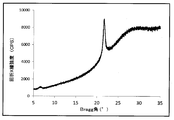
- FIG. 3 is a diagram showing a diffracted X-ray intensity distribution of ⁇ -gel formed in the composition obtained in Example 1 by wide-angle X-ray diffraction.
- the composition for oral cavity of the present invention supplies one or more fluorine ions selected from sodium fluoride, ammonium fluoride, potassium fluoride, sodium monofluorophosphate, and tin fluoride as the component (A).
- the compound is contained in an amount of 0.005% by mass to 2% by mass in terms of fluorine.
- Such component (A) is a water-soluble compound that releases fluorine ions in an aqueous solution.
- sodium fluoride is preferred from the viewpoint of the ability to incorporate fluorine ions into the enamel of the tooth, the solubility in water and the ease of formulation.
- the fluoride ion supply compound can bring about a caries prevention effect, remineralization, a dentine hypersensitivity suppressing action and the like.
- the content of the component (A) is a fluorine atom equivalent amount in the oral composition of the present invention, from the viewpoint of securing a sufficient amount of fluorine ions taken into the tooth enamel and dentin, and safety. It is 0.005 mass% or more, Preferably it is 0.01 mass% or more, More preferably, it is 0.02 mass% or more, More preferably, it is 0.04 mass% or more.
- the content of the component (A) is 2% by mass or less, preferably 1% by mass or less, more preferably 1% by mass or less in terms of fluorine atom in the composition for oral cavity of the present invention from the viewpoint of safety and the like. Is 0.5 mass% or less.
- the content of the component (A) is 0.005% by mass or more and 2% by mass or less, preferably 0.01 to 1% by mass in terms of fluorine atom in the oral composition of the present invention. Yes, more preferably 0.02 to 1% by mass, and still more preferably 0.04 to 0.5% by mass.
- the oral composition of the present invention contains 4% by mass or more and 30% by mass or less of a higher alcohol having 12 to 22 carbon atoms including cetanol (b1) and stearyl alcohol (b2) as the component (B). That is, the component (B) is a higher alcohol having 12 to 22 carbon atoms, which contains the cetanol of the component (b1) and the stearyl alcohol of the component (b2) as essential components.
- a higher alcohol having 12 to 22 carbon atoms which contains the cetanol of the component (b1) and the stearyl alcohol of the component (b2) as essential components.
- the fluidity of the fluorine ion supply of component (A) is ensured in the water of component (D) described later by the structural viscosity of the ⁇ -gel, so that the fluorine ion supply compound flows into the teeth while flowing. It is considered that the adsorption and retention of the released fluorine ions on the teeth and the like can be maintained well by repeating the contact.
- the composition for oral cavity of the present invention contains water that can ensure the good fluidity of the component (A) and has an appropriate viscosity, so that the amount of fluoride ions taken into the enamel of teeth can be reduced. Can be effectively increased.
- the higher alcohol of component (B) is formed from cetanol of component (b1) and stearyl alcohol of component (b2) from the viewpoint of maintaining an appropriate viscosity as an oral composition while forming an ⁇ -gel well.
- a mass ratio of the total content of the component (b1) and the component (b2) to the content of the component (B) (( (B1) + (b2)) / (B)) is preferably 0.85 or more, more preferably 0.9 or more, still more preferably 0.92 or more and 1 or less.
- Component (B) other than component (b1) and component (b2) is preferably one or more selected from lauryl alcohol, myristyl alcohol, and behenyl alcohol.
- the mass ratio ((b1) / (b2)) between the content of component (b1) and the content of component (b2) improves the stability as an oral composition while forming an ⁇ -gel well.
- it is preferably 0.5 or more, more preferably 0.7 or more, preferably 5 or less, more preferably 3 or less, still more preferably 2 or less, and still more preferably 1.7 or less.
- lauryl alcohol and myristyl alcohol which are higher alcohols having 12 to 22 carbon atoms other than component (b1) and component (b2), are the total content of lauryl alcohol and myristyl alcohol from the viewpoint of taste.
- the mass ratio of the amount and the content of component (B) ((lauryl alcohol + myristyl alcohol) / (B)) is preferably 0.05 or less, more preferably 0.03 or less, and still more preferably Is 0.01 or less.
- Behenyl alcohol which is a higher alcohol having 12 to 22 carbon atoms other than component (b1) and component (b2), is the content of behenyl alcohol and component (B) from the viewpoint of suppressing precipitation and separation of component (B).
- the mass ratio with respect to the content (behenyl alcohol / (B)) is preferably 0.1 or less, more preferably 0.05 or less.
- the higher alcohol having 10 or less carbon atoms is a mass ratio of the content of higher alcohol having 10 or less carbon atoms and the content of component (B) (higher alcohol having 10 or less carbon atoms / (B )) Is preferably 0.1 or less, more preferably 0.01 or less, even more preferably 0.005 or less, or the oral composition of the present invention is a higher alcohol having 10 or less carbon atoms. It is still more preferable not to contain.
- the higher alcohol having 24 or more carbon atoms is a mass ratio of the content of the higher alcohol having 24 or more carbon atoms and the content of the component (B) (higher alcohol having 24 or more carbon atoms / (B )) Is preferably 0.1 or less, more preferably 0.01 or less, even more preferably 0.005 or less, or the oral composition of the present invention is a higher alcohol having 24 or more carbon atoms. It is still more preferable not to contain.
- the content of the component (B) is 4% by mass or more and preferably 4.5% by mass or more in the oral composition of the present invention from the viewpoint of satisfactorily forming an ⁇ -gel.
- the content of the component (B) is from the viewpoint of obtaining an appropriate viscosity, and ensuring the fluidity of the fluorine supply compound in the water of the component (D) of the composition and the dispersibility of other components.
- it is 30% by mass or less, preferably 25% by mass or less, more preferably 20% by mass or less, still more preferably 18% by mass or less, and further preferably. Is 15% by mass or less.
- the content of the component (B) is 4% by mass or more and 30% by mass or less, preferably 4 to 25% by mass, more preferably 4 to 20% by mass in the oral composition of the present invention. %, More preferably 4.5 to 18% by mass, and further preferably 4.5 to 15% by mass.
- the mass ratio ((A) / (B)) between the fluorine atom equivalent amount of the component (A) and the content of the component (B) is 0.001 or more and 0.2 or less. is there.
- the mass ratio ((A) / (B)) between the fluorine atom equivalent amount of the component (A) and the content of the component (B) is 0.001 or more from the viewpoint of effectively increasing the amount of fluorine ions taken up.
- it is preferably 0.002 or more, more preferably 0.003 or more.
- the mass ratio ((A) / (B)) of the component (A) in terms of fluorine atom and the content of component (B) is such that the ⁇ -gel is well formed and the fluidity of component (A) From the viewpoint of ensuring, it is 0.2 or less, preferably 0.1 or less, more preferably 0.05 or less.
- the mass ratio ((A) / (B)) of the fluorine atom conversion amount of component (A) and the content of component (B) is 0.001 or more and 0.2 or less, preferably 0.8. It is 002 to 0.1, more preferably 0.003 to 0.05.
- composition for oral cavity of the present invention comprises, as component (C), a nonionic surfactant (c1) selected from sorbitan fatty acid ester and polyoxyethylene sorbitan fatty acid ester, and an anion which is a fatty acid salt having 12 to 22 carbon atoms.
- a nonionic surfactant (c1) selected from sorbitan fatty acid ester and polyoxyethylene sorbitan fatty acid ester
- an anion which is a fatty acid salt having 12 to 22 carbon atoms Surfactant containing 1 type (s) or 2 or more types chosen from surfactant (c2) is 0.1 mass% or more and 10 mass% or less, and content of a component (c1) is 0.05 mass% or more is there.
- the component (C) containing a specific amount or more of the component (c1) while containing one or more selected from the nonionic surfactant of the component (c1) and the anionic surfactant of the component (c2)
- the surfactant in a specific content, the fluidity of the component (A) is secured, and an ⁇ -gel is formed together with the component (B), and the component ( It is possible to effectively increase the amount of fluorine ions released from A) into the tooth enamel and dentin.
- Component (c1) is a nonionic surfactant selected from sorbitan fatty acid esters and polyoxyethylene sorbitan fatty acid esters.
- the sorbitan fatty acid ester is preferably derived from a fatty acid having 10 or more carbon atoms, more preferably derived from a fatty acid having 12 or more carbon atoms, from the viewpoint of taking into account the fluorine ions released from the component (A).
- it is derived from a fatty acid having 20 or less carbon atoms, more preferably one or more selected from those derived from a fatty acid having 18 or less carbon atoms.
- sorbitan monocaprate sorbitan monoundecylate, sorbitan monolaurate, sorbitan monotridecylate, sorbitan monomyristate, sorbitan monopalmitate, sorbitan monooleate, sorbitan trioleate, sorbitan tetraoleate, sesquioxane
- examples thereof include one or more selected from sorbitan oleate, sorbitan monostearate, sorbitan tristearate, and the like.
- sorbitan monooleate one or more selected from sorbitan monooleate, sorbitan sesquioleate, sorbitan monostearate, and sorbitan monopalmitate are preferable, sorbitan monooleate, sorbitan sesquioleate, and sorbitan monostearate 1 type or 2 types or more chosen from are more preferable.
- the polyoxyethylene sorbitan fatty acid ester is preferably derived from a fatty acid having 6 or more carbon atoms, more preferably 12 or more carbon atoms, from the viewpoint of taking into account the fluorine ions released from the component (A). 1 type or 2 types or more selected from the thing derived from the fatty acid of C22 or less, More preferably, the thing derived from the fatty acid of C20 or less is mentioned.
- the average number of moles of ethyleneoxy group added in the polyoxyethylene sorbitan fatty acid ester is preferably 5 to 40 moles, more preferably 10 to 25 moles, and still more preferably 10 to 20 moles. It is.
- polyoxyethylene sorbitan fatty acid esters examples include polyoxyethylene sorbitan monolaurate, polyoxyethylene sorbitan monomyristic acid, polyoxyethylene sorbitan monopalmitate, polyoxyethylene sorbitan monostearate, and polyoxyethylene monooleate 1 type (s) or 2 or more types chosen from sorbitan etc. are mentioned.
- polyoxyethylene sorbitan monopalmitate examples of polyoxyethylene sorbitan monostearate
- the anionic surfactant of component (c2) is a fatty acid having 12 to 22 carbon atoms or a salt thereof.
- Component (c2) has 12 or more carbon atoms, preferably 14 or more carbon atoms, from the viewpoint of taking into account the fluorine ions released from component (A) and ensuring a good flavor. Yes, more preferably 16 or more, 22 or less carbon atoms, preferably 20 or less carbon atoms, more preferably 18 or less.
- the fatty acid constituting the component (c2) may be linear or branched. However, from the viewpoint of incorporation of fluorine ions released from the component (A) into the teeth, the fatty acid may be linear. Is preferred.
- the component (c2) include one or more selected from lauric acid, myristic acid, palmitic acid, stearic acid, coconut oil fatty acid, and salts thereof. Especially, 1 type (s) or 2 or more types chosen from myristic acid, palmitic acid, a stearic acid, and these salts are preferable, and it is still more preferable to contain a stearic acid or its salt as a component (c2) at least.
- the salt constituting component (c2) include alkali metals selected from sodium and potassium; basic amino acids such as arginine; alkanol ammoniums such as monoethanolammonium, diethanolammonium and triethanolammonium; ammonium and the like.
- the alkali metal chosen from sodium and potassium from a stability viewpoint is preferable.
- Component (C) includes one or more selected from the above component (c1) and component (c2), and further selected from polyoxyethylene hydrogenated castor oil, sucrose fatty acid ester, and polyglycerin fatty acid ester
- Nonionic surfactant (c3) and one or more selected from anionic surfactants (c4) selected from sodium alkyl sulfate, acylmethyl taurate, and acyl sarcosine salts may be included.
- the composition for oral cavity of this invention is 1 type, or 2 or more types chosen from the nonionic surfactant of a component (c1), and the anionic surfactant of a component (c2) as a surfactant of a component (C).
- a component (c3) other than the component (c1) can be contained, or a component (c4) other than the component (c2) can be contained as an anionic surfactant.
- the average number of moles of ethyleneoxy group added in the polyoxyethylene hydrogenated castor oil of component (c3) is excellent in stability of the composition while maintaining good incorporation of fluorine ions released from component (A) into teeth. From the viewpoint of ensuring the above, the amount is preferably 20 to 100 mol, more preferably 40 to 80 mol.
- the content of the polyoxyethylene hydrogenated castor oil of the component (c3) is, in the composition for oral cavity of the present invention, from the viewpoint of favorably holding the fluorine ions released from the component (A) into the teeth.
- composition for oral cavity of the invention may not contain polyoxyethylene hydrogenated castor oil.
- Examples of the component (c3) polyglycerol fatty acid ester include those obtained by condensing 1 to 4 fatty acids having 8 to 24 carbon atoms with polyglycerol obtained by condensing 2 to 20 glycerol.
- the fatty acid moiety constituting the polyglycerin fatty acid ester has 12 carbon atoms from the viewpoint of ensuring the stability of the composition while maintaining good incorporation of fluorine ions released from the component (A) into the teeth.
- the average degree of condensation of glycerin in the polyglycerin fatty acid ester is preferably 2 to 20, and more preferably 5 to 12.
- sucrose fatty acid ester examples include sucrose fatty acid esters composed of fatty acid moieties derived from fatty acids having 6 to 20 carbon atoms.
- the viewpoint of ensuring the stability of the composition while maintaining good incorporation of fluorine ions released from the component (A) into the teeth and From the viewpoint of imparting a good feeling of use, those derived from fatty acids having 10 to 18 carbon atoms are preferred, and those derived from fatty acids having 12 to 14 carbon atoms are more preferred.
- One or more anionic surfactants selected from the alkyl sulfates, acylmethyl taurine salts, and acyl sarcosine salts of component (c4) include alkyl sulfates such as sodium lauryl sulfate and sodium myristyl sulfate; Sodium salt or potassium salt of acyl sarcosine such as lauroyl sarcosine, N-myristoyl sarcosine, N-palmitoyl sarcosine, N-stearoyl sarcosine, N-isostearoyl sarcosine, N-oleoyl sarcosine; caprylmethyl taurine, laurylmethyl taurine, myristylmethyl Examples thereof include one or more selected from sodium or potassium salts of acylmethyl taurine such as taurine, palmitylmethyl taurine, stearyl methyl taurine.
- sodium lauryl sulfate one or more selected from sodium lauryl sulfate, N-lauroyl sarcosine salt, N-myristoyl sarcosine salt, lauryl methyl taurine salt, and myristyl methyl taurine salt are preferable, and sodium lauryl sulfate is more preferable.
- the content of the component (c1) effectively forms the ⁇ -gel together with the component (B), has an appropriate structural viscosity, and effectively incorporates the fluorine ions released from the component (A) into the teeth.
- the composition for oral cavity of the present invention is 0.05% by mass or more, preferably 0.2% by mass or more, more preferably 0.4% by mass or more, and still more preferably. 0.5% by mass or more, more preferably 1% by mass or more, and 10% by mass or less from the viewpoint of ensuring the stability of the composition and the balance with appropriate viscosity and flavor. , Preferably it is 8 mass% or less, More preferably, it is 6 mass% or less.
- the composition for oral cavity of the present invention is 0.05% by mass or more, preferably 1% by mass or more, more preferably 1%. 0.5% by mass or more, more preferably 2% by mass or more.
- component (c2) is contained, the content of component (c1) is fluorine released from component (A) while forming an ⁇ -gel together with component (B) and having an appropriate structural viscosity.
- the composition for oral cavity of the present invention is 0.05% by mass or more, preferably 0.1% by mass or more, and more preferably 0%. .2% by mass or more, more preferably 0.4% by mass or more, and still more preferably 0.5% by mass or more.
- the mass ratio ((B) / (c1)) between the content of the component (B) and the content of the component (c1) is the ⁇ -gel together with the component (B). Is preferably 1 or more, more preferably 1.2 from the viewpoint of effectively increasing the uptake of the fluorine ions released from the component (A) into the teeth while having an appropriate structural viscosity.
- the mass ratio ((B) / (c1)) of the content of the component (B) and the content of the component (c1) when the component (c2) is not contained ensures the stability of the composition. From the viewpoint of balance with an appropriate viscosity and flavor, it is preferably 10 or less, more preferably 7 or less, still more preferably 5 or less, and even more preferably 3.5 or less.
- the content of component (c1) is preferably 5% by mass or less in the composition for oral cavity of the present invention.
- the content of component (c2) is that an ⁇ -gel is formed together with component (B) and component (c1) to have an appropriate structural viscosity, and fluorine ions released from component (A) are taken into the teeth.
- the amount of fatty acid in the oral composition of the present invention is preferably 0.05% by mass or more, more preferably 0.08% by mass or more, and still more preferably. 0.1% by mass or more, forms an ⁇ -gel together with component (B), and imparts an appropriate viscosity from the viewpoint of effectively enhancing the ability of fluorine ions released from component (A) to be taken into the teeth. From the viewpoint, it is more preferably 0.2% by mass or more, and further preferably 0.4% by mass or more.
- the content of the component (c2) is used for the oral cavity of the present invention from the viewpoint of securing the stability of the composition, from the viewpoint of balance with an appropriate viscosity and flavor, and from the viewpoint of reducing harm to the oral mucosa.
- the amount in terms of fatty acid is preferably 5% by mass or less, more preferably 3% by mass or less, still more preferably 2.5% by mass or less, and still more preferably 2% by mass or less. From the viewpoint of further improving the flavor, it is preferably 0.5% by mass or less, more preferably 0.2% by mass or less, or the oral composition of the present invention contains the component (c2). It may not be.
- the composition for oral cavity of the present invention is preferably at least 0.1 mass%, more preferably at least 0.2 mass%, even more preferably. Is 0.5% by mass or more, more preferably 1% by mass or more, and preferably 10% by mass or less from the viewpoint of ensuring the stability of the composition and the balance with appropriate viscosity and flavor. More preferably, it is 8 mass% or less, More preferably, it is 6.5 mass% or less.
- composition for oral cavity of this invention combines a component (c1) and a component (c2) with each other, and a fluorine ion Uptake into the teeth From the viewpoint of making it possible to layer improved, it is preferable to contain both of the components (c1) and the component (c2).
- mass ratio ((B) / (c1)) of content of a component (B) and content of a component (c1) is component From the viewpoint of effectively increasing the ability of fluorine ions released from the component (A) to be incorporated into the teeth while forming an ⁇ -gel with (B) and having an appropriate structural viscosity, it is preferably 1 or more. More preferably, it is 1.2 or more, More preferably, it is 1.4 or more. Further, when both the component (c1) and the component (c2) are contained, the mass ratio ((B) / (c1)) between the content of the component (B) and the content of the component (c1) is the composition.
- the mass ratio ((B) / (c1)) between the content of the component (B) and the content of the component (c1) in the case where both the component (c1) and the component (c2) are contained is preferably Is 1 to 20, more preferably 1.2 to 17, and still more preferably 1.4 to 15.
- the mass ratio ((B) / (c2)) between the content of the component (B) and the content of the component (c2) is From the viewpoint of effectively increasing the incorporation of fluorine ions released from the component (A) into the teeth while forming an ⁇ -gel together with (B) and having an appropriate structural viscosity, it is preferably 2 or more , More preferably 4 or more, and still more preferably 5 or more.
- the mass ratio ((B) / (c2)) between the content of the component (B) and the content of the component (c2) is From the viewpoint of ensuring the stability of the product, and from the viewpoint of a balance with appropriate viscosity and flavor, it is preferably 180 or less, more preferably 150 or less, still more preferably 100 or less, and even more preferably 90. It is as follows.
- mass ratio ((B) / (c2)) of content of a component (B) and content of a component (c2) is 2 ⁇ 180, more preferably 4 ⁇ 150, even more preferably 5 ⁇ 100, and even more preferably 5 ⁇ 90.
- the content of the component (c3) is used for the oral cavity of the present invention from the viewpoint of improving the incorporation of fluorine ions released from the component (A) into the teeth and ensuring the balance between the incorporation and flavor.
- it is preferably 0.5% by mass or less, more preferably 0.25% by mass or less, further preferably 0.2% by mass or less, and still more preferably 0.1% by mass or less. And more preferably 0.05% by mass or less.
- the content of the component (c4) is preferably 2% by mass or less, more preferably 1.5% in the oral composition of the present invention, from the viewpoints of harmfulness to gums and oral mucosa and flavor. It is at most mass%, more preferably at most 1 mass%, still more preferably at most 0.7 mass%.
- the content of component (C) effectively increases the uptake of fluorine ions released from component (A) into the teeth while forming an ⁇ -gel together with component (B) to ensure an appropriate viscosity.
- the composition for oral cavity of the present invention is 0.1% by mass or more, preferably 0.2% by mass or more, more preferably 0.3% by mass or more, and further preferably 0%. .5% by mass or more.
- the content of the component (C) is 10% by mass or less in the composition for oral cavity of the present invention from the viewpoint of securing the stability of the composition and the viewpoint of balance with appropriate viscosity and flavor.
- the content of the component (C) is 0.1% by mass or more and 10% by mass or less, preferably 0.2 to 8% by mass, more preferably in the oral composition of the present invention. It is 0.3 to 7% by mass, and more preferably 0.5 to 6.5% by mass.
- the mass ratio of the content of the component (B) and the content of the nonionic surfactant containing the component (c1) is preferably 1 or more, more preferably 1 from the viewpoint of improving the uptake of the fluorine ions released from the component (A) into the teeth by favorably forming an ⁇ -gel. .2 or more, more preferably 1.4 or more.
- mass ratio ((B) / nonionic surfactant) of content of a component (B) and content of nonionic surfactant containing a component (c1) has moderate viscosity as an oral composition.
- the mass ratio of the content of the component (B) and the content of the nonionic surfactant containing the component (c1) ((B) / nonionic surfactant) is preferably 1 to 20, more preferably Is from 1.2 to 17, more preferably from 1.4 to 15.
- the mass ratio of the content of the component (B) and the content of the anionic surfactant containing the component (c2) is preferably 4 or more, more preferably 5 from the viewpoint of improving the uptake of fluorine ions released from the component (A) into the teeth by favorably forming an ⁇ -gel. It is above, More preferably, it is 7 or more, More preferably, it is 10 or more.
- mass ratio ((B) / anionic surfactant) of content of a component (B) and content of an anionic surfactant containing a component (c2) has moderate viscosity as an oral composition.
- the mass ratio ((B) / anionic surfactant) of the content of the component (B) and the content of the anionic surfactant containing the component (c2) is preferably 4 to 180, more preferably Is from 5 to 180, more preferably from 5 to 100, still more preferably from 7 to 100, and even more preferably from 10 to 90.
- the mass ratio ((B) / ((c1)) of the content of the component (B) and the total amount of the content of the component (c1) and the amount of fatty acid equivalent of the component (c2). + (C2))) is preferably larger than 1, more preferably 1.2 from the viewpoint of improving the uptake of the fluorine ions released from the component (A) into the teeth by favorably forming an ⁇ -gel. It is above, More preferably, it is 1.5 or more.
- the mass ratio ((B) / ((c1) + (c2))) of the content of the component (B) and the total content of the component (c1) and the fatty acid equivalent of the component (c2) is From the viewpoint of ensuring stability while maintaining an appropriate viscosity as an oral composition, and from the viewpoint of imparting a good feeling of use, it is preferably 40 or less, more preferably 35 or less, and still more preferably. It is 30 or less, and more preferably 15 or less.
- the mass ratio ((B) / ((c1) + (c2))) of the content of the component (B) and the total amount of the content of the component (c1) and the amount of fatty acid equivalent of the component (c2) is Preferably, it is greater than 1 and 40 or less, more preferably 1.2 to 35, still more preferably 1.5 to 30, and even more preferably 1.5 to 15.
- the oral composition of the present invention preferably contains a cationic surfactant other than the cationic fungicide from the viewpoint of preventing harm to the oral mucosa.
- the content of the cationic surfactant other than the cationic fungicide is preferably 0.1% by mass or less, more preferably 0.05% by mass or less in the oral composition of the present invention, More preferably, it is 0.01 mass% or less, or it is preferable that the composition for oral cavity of this invention does not contain cationic surfactant other than a cationic disinfectant.
- a cationic disinfectant 1 type, or 2 or more types chosen from a quaternary ammonium compound and a biguanide compound is mentioned.
- Examples of the quaternary ammonium compounds include cetylpyridinium chloride, benzethonium chloride, benzalkonium chloride, stearyldimethylammonium chloride, stearyltrimethylammonium chloride, cetyltrimethylammonium chloride, methylbenzethonium chloride, lauryltrimethylammonium chloride, lauroyl colamino chloride. And formylmethylpyridinium.
- Examples of biguanide compounds include chlorhexidine and salts thereof, and examples of such salts include chlorhexidine gluconate and chlorhexidine hydrochloride.
- the oral composition of the present invention contains component (D) water.
- the water of the component (D) in the present invention is not only purified water blended in the oral composition, but also, for example, 70% sorbitol solution (aqueous solution) or 48% potassium hydroxide solution (aqueous solution) used for formulation.
- aqueous solution 70% sorbitol solution
- aqueous solution 48% potassium hydroxide solution
- it means the total moisture contained in the composition for oral cavity, including the moisture contained in each of the blended components.
- each of the formed ⁇ -gels is kept well in the composition. It is possible to disperse or dissolve the components satisfactorily and to improve the good feeling of use and the uptake of the fluorine ions released from the component (A) into the teeth.
- the content of the component (D) is preferably 50% by mass or more, more preferably 55% by mass or more, preferably 95% by mass or less, more preferably in the oral composition of the present invention. It is 92 mass% or less, More preferably, it is 80 mass% or less.
- the content of the component (D) is preferably 50 to 95% by mass, more preferably 55 to 92% by mass, and further preferably 55 to 80% by mass in the oral composition of the present invention. It is.
- content of the component (D) of the composition for oral cavity of the present invention can be calculated from the blended moisture content and the moisture content in the blended component
- a Karl Fischer moisture meter is used. Can be measured.
- a trace moisture measuring device Hiranuma Sangyo
- 5 g of the composition for oral cavity can be taken and suspended in 25 g of anhydrous methanol, and 0.02 g of this suspension can be collected to measure the amount of water.
- the molar amount of the polyvalent metal compound (E) other than the component (A) is less than 0.1 times the molar amount of the component (A).
- the ⁇ -gel is prevented from collapsing, and when the component (c2) is further contained, the metal salt is prevented from precipitating due to the combination of the component (c2) and the polyvalent metal of the component (F).
- component (E) examples include compounds that release polyvalent metal ions such as calcium ions, magnesium ions, aluminum ions, zinc ions, copper ions, and manganese ions in an aqueous solution.
- metal sulfate A polyvalent metal ion supply compound that is a water-soluble compound having a solubility in 100 mL of water at 20 ° C.
- a salt such as a salt, a metal salt of gluconate, a metal salt of lactic acid, a metal salt of glycerophosphate, and a chloride
- Water-insoluble calcium compounds such as calcium carbonate, polyvalent metals such as aluminum, calcium, zirconium, iron, copper, zinc, manganese, calcium hydrogen phosphate, insoluble potassium metaphosphate, aluminum silicate, zirconium silicate, aluminum oxide
- Abrasives such as aluminum hydroxide and zinc oxide
- chlorophyll compound such as copper chlorophyll sodium and iron chlorophyll sodium are compounds in which polyvalent metal ions are stably included in the molecule, there is no risk of releasing polyvalent metal ions.
- these chlorophyll compounds do not correspond to the above component (E) because there is no possibility of forming a precipitate with a metal. Therefore, the chlorophyll compound is preferably contained in the oral composition of the present invention in an amount of 0.001 to 0.5% by mass, more preferably 0.01 to 0.1% by mass, if necessary. it can.
- the molar amount of the polyvalent metal compound (E) other than the component (A) is such that when applied to the oral cavity, the viewpoint of effectively releasing fluorine ions and the viewpoint of suppressing the formed ⁇ -gel from collapsing.
- the composition for oral cavity of the present invention does not contain a polyvalent metal compound (E) other than the component (A).
- the content of the polyvalent metal compound (E) is preferably 0.1% by mass or less, and preferably 0.01% by mass or less, in terms of metal atom, in the oral cavity composition of the present invention. Yes, more preferably 0.001% by mass or less, or the composition for oral cavity of the present invention preferably does not contain the component (E) unless it is inevitably mixed.
- the mass ratio of the component (B), the component (C), the oil-soluble medicinal component, and the content of the oil agent (F) other than the fragrance and the content of the component (B) is preferably less than 1.
- the range of the limited surfactant that can be blended in the composition for oral cavity is limited. The stability of the composition can be improved, the inhibition of the formation of ⁇ -gel by the components (B) and (C) can be effectively suppressed, and the flavor can be improved.
- component (F) examples include hydrocarbon oils such as liquid paraffin, petrolatum, mineral oil, light liquid paraffin, paraffin wax, ceresin, microcrystalline wax, carnauba wax, beeswax, squalane, squalene; isopropyl myristate, palmitic acid Ester oil such as isopropyl acid, propyl adipate, diethyl sebacate, glycerin fatty acid ester, etc .; Triglyceride and vegetable oils including olive oil, rapeseed oil, shea fat, rice bran oil containing this; Silicone oil; methyl paraoxybenzoate, ethyl paraoxybenzoate, etc. Antiseptics; oil-soluble disinfectants and the like.
- hydrocarbon oils such as liquid paraffin, petrolatum, mineral oil, light liquid paraffin, paraffin wax, ceresin, microcrystalline wax, carnauba wax, beeswax, squalane, squalene
- oil-soluble medicinal component examples include ⁇ -glycyrrhetinic acid, tocopherol, azulene, triclosan, isopropylmethylphenol, thymol, and the like.
- these oil-soluble medicinal components are added to the oil agent of the component (F). Is not applicable. Therefore, the oil-soluble medicinal component is preferably contained in the oral composition of the present invention in an amount of 0.01 to 3.5% by mass, more preferably 0.1 to 2.5% by mass, as necessary. be able to.
- the mass ratio ((F) / (B)) of the content of the component (F) and the content of the component (B) is preferably less than 1, more preferably 0.5 or less, and still more preferably Is 0.3 or less.
- the content of the component (F) is preferably 5% by mass or less, more preferably 2% by mass or less, and further preferably 1% by mass or less in the oral composition of the present invention. More preferably, it is 0.5 mass% or less.
- content of this component (F) is preferably 5 mass% or less in the composition for oral cavity of this invention, More preferably Is 3% by mass or less, more preferably 2% by mass or less.
- the oral composition of the present invention maintains an appropriate viscosity and shape retention as an oral composition by the ⁇ -gel formed, and has excellent incorporation of fluoride ions released from the component (A) into the teeth. From the viewpoint of securing the properties, it is preferable to limit the content of the cellulosic binder.
- the cellulose-based binder include sodium carboxymethyl cellulose and hydroxyalkyl cellulose (for example, hydroxyethyl cellulose, hydroxypropyl cellulose).
- the content of the cellulosic binder is preferably 0.3% by mass or less, more preferably 0.25% by mass or less, and further preferably 0.2% in the oral composition of the present invention. It is preferable that the composition for oral cavity of this invention does not contain a cellulosic binder except the case where it is mass% or less, More preferably, it is 0.1 mass% or less, or it inevitably mixes.
- the oral composition of the present invention can contain a binder other than the cellulosic binder.
- binders other than cellulosic binders include sodium alginate, carrageenan, xanthan gum, sodium polyacrylate, pectin, agar, tragacanth gum, gum arabic, guar gum, karaya gum, locust bean gum, gela gum, tamarid gum, and psyllium seed gum. And one or more selected from carboxyvinyl polymers and the like, and one or two binders selected from carrageenan and xanthan gum are preferred.
- the content of the binder other than these cellulosic binders is preferably 0.3% by mass or less in the oral composition of the present invention from the viewpoint of improving the incorporation of fluoride ions into the teeth. Yes, more preferably 0.2% by mass or less, even more preferably 0.1% by mass or less, or the oral composition of the present invention does not contain a binder other than the cellulosic binder. It may be.
- the carboxyvinyl polymer for example, commercially available products such as Carbopol 940, 941 (above, Lubrizol Advanced Materials) can be used, but the content of such carboxyvinyl polymer is preferably further limited.
- the content of the carboxyvinyl polymer in the oral composition of the present invention is preferably 0.3% by mass or less, more preferably 0.2% by mass or less, and still more preferably 0. .1% by mass or less, or the oral composition of the present invention may contain no carboxyvinyl polymer.
- the oral composition of the present invention can further contain a thickener from the viewpoint of enhancing the viscoelasticity of the binder.
- the thickener is preferably one or two selected from thickening silica having an oil absorption of 180 to 350 mL / 100 g and fatty acid dextrin.
- the content of the thickening silica is preferably 5% by mass or less, more preferably 3% by mass or less in the oral composition of the present invention, from the viewpoint of ensuring the ability of fluorine ions to be taken into the teeth. Yes, more preferably 2% by mass or less, and the fatty acid dextrin content in the oral cavity composition of the present invention is from the viewpoint of improving the uptake of fluoride ions into the teeth and the balance with the flavor. , Preferably it is 3 mass% or less, More preferably, it is 1.5 mass% or less.
- the fatty acid dextrin is preferably dextrin palmitate.
- the oral composition of the present invention can contain abrasive silica having an oil absorption of 50 to 150 mL / 100 g.
- the content of abrasive silica suppresses the absorption of water of component (D) and maintains an appropriate structural viscosity due to the ⁇ -gel formed by component (B) and component (C), while maintaining the component (D
- Abrasive silica is an abrasive other than the above-described abrasive (abrasive powder) containing a polyvalent metal, and is a water-absorbing component that is solid at 20 ° C.
- the content of the abrasive silica is preferably 7% by mass or less, more preferably 5% by mass or less in the oral composition of the present invention from the viewpoint of improving the incorporation of fluorine ions into the teeth. Further, it is preferably 3% by mass or less, more preferably 2% by mass or less, still more preferably 1% by mass or less, or the oral composition of the present invention has an oil absorption of 50 to 150 mL / It may not contain 100 g of abrasive silica.
- the amount of oil absorption indicates the amount of oil that can be supported by silica, and the measurement method is specified by the method of JIS K5101-13-2 (established in 2004) and the amount of oil absorbed in the boiled sea bream. Value.
- the oral composition of the present invention preferably further contains a sugar alcohol from the viewpoint of flavor.
- the content of the sugar alcohol is preferably 30% by mass or less, more preferably 20% by mass or less, from the viewpoint of improving the incorporation of fluorine ions released from the component (A) into the teeth.
- it is 15 mass% or less, and from a viewpoint of flavor, Preferably it is 1 mass% or more, More preferably, it is 2 mass% or more, More preferably, it is 5 mass% or more.
- Such sugar alcohol is preferably one or more selected from sorbitol, xylitol, erythritol, reduced palatinose, and mannitol, from the viewpoint of high solubility in water and making the composition feel smooth. And one or two selected from xylitol are more preferable, and at least sorbitol is preferably contained as the sugar alcohol.
- sorbitol and xylitol are solid water-absorbing components at 20 ° C. as in the above-mentioned abrasive silica, the absorption of water in component (D) is suppressed, and components (B) and (C)
- the total content of these water-absorbing components from the viewpoint of ensuring the incorporation of fluorine ions released from the component (A) of the component (D) into the water while having an appropriate viscosity due to the ⁇ -gel formed. It is preferred to limit the amount. Specifically, the total content of the water-absorbing component that is solid at 20 ° C.
- abrasive silica, sorbitol, and xylitol is preferably 35% by mass or less in the oral composition of the present invention. Preferably it is 30 mass% or less, More preferably, it is 25 mass% or less, More preferably, it is 20 mass% or less.
- the composition for oral cavity of the present invention effectively inhibits the ⁇ -gel formed by the component (B) and the component (C) from collapsing, to the teeth of fluorine ions released from the component (A). It is preferable to limit the ethanol content from the viewpoint of maintaining the uptake property, ensuring the appropriate viscosity, and suppressing irritation. Specifically, the content of ethanol in the oral composition of the present invention is preferably 8% by mass or less, more preferably 5% by mass or less, and still more preferably 2% by mass or less. Or it is preferable that the composition for oral cavity of this invention does not contain ethanol.
- composition for oral cavity of the present invention can contain a polyhydric alcohol, sweetener, wetting agent, preservative, fluoride, enzyme, dye, etc. in addition to the above components, as long as the effects of the present invention are not impaired. .
- the viscosity at 20 ° C. of the oral composition of the present invention is such that it retains an appropriate viscosity and exhibits excellent uptake into the teeth of fluorine ions released from the component (A), and good shape retention. From the viewpoint of ensuring the property and usability, it is preferably 5000 dPa ⁇ s or less, more preferably 4000 dPa ⁇ s or less, still more preferably 3800 dPa ⁇ s or less, preferably 300 dPa ⁇ s or more, more preferably Is 400 dPa ⁇ s or more, more preferably 500 dPa ⁇ s or more, and still more preferably 700 dPa ⁇ s or more.
- the viscosity at 20 ° C. of the oral composition of the present invention is preferably 5000 dPa ⁇ s or less, more preferably 300 to 5000 dPa ⁇ s, still more preferably 400 to 4000 dPa ⁇ s, and still more preferably. Is 500 to 3500 dPa ⁇ s, more preferably 700 to 3500 da ⁇ s.
- Such a viscosity is packed in a container for viscosity measurement and stored in a thermostat at 20 ° C. for 24 hours, and after that, using a helicus type viscometer (VISCOMETER TVB-10 Toki Sangyo), rotor TC, rotation speed of 2. It can be measured at 5 rpm for 1 minute.
- Examples of the oral composition of the present invention include toothpastes, coating agents, gargles, liquid dentifrices, and the like. Among them, from the viewpoint of sufficiently spreading the oral composition of the present invention to the gums or the mucous membrane in the oral cavity and effectively incorporating the fluorine ions released from the component (A) into the tooth enamel and the like, a liquid dentifrice A toothpaste is preferred.
- the composition for oral cavity of the present invention is preferably applied to the oral cavity, and after application, water is included in the oral cavity for use. Even if water is included in the oral cavity after application, fluoride ions can be effectively taken into the teeth.
- the application method to the oral cavity may be any one of application, brushing with a toothbrush, or gargle, and application or brushing with a toothbrush is preferable.
- the manufacturing method of the composition for oral cavity of this invention is the process (I) which mixes the liquid mixture containing a component (B) and a component (C) at the temperature more than melting
- Step (II) of adding (A) is provided.
- the production method includes the following steps (IX) and (II).
- the following steps (I-Y) and (II) are performed. It is preferable that it is a manufacturing method provided.
- the production method including the step (IX) and the step (II) is a mixed solution 1-1 containing the component (B) and the component (C) at a temperature not lower than the melting point of the component (B) and not higher than 90 ° C.
- Step (IX) of adding the component (D) to the resulting mixed solution 1-1 and mixing to obtain the mixed solution 1-2, and the step of adding the component (A) (II) It is a manufacturing method provided with.
- the component (A) may be added to and mixed with the liquid mixture 1-2 obtained after the step (IX), or may be added and mixed together with the component (D). . Further, a part of the component (D) may be mixed and mixed in the mixed liquid 1-1.
- the component (C) includes (c2)
- a part of the component (D) is mixed with the mixed liquid 1-1.
- the component (A) is preferably added to the remaining component (D), and added to and mixed with the mixed solution 1-1 to obtain a mixed solution 1-2.
- the temperature at the time of mixing the liquid mixture 1-1 and the temperature of the step of obtaining the liquid mixture 1-2 may be any temperature not lower than the melting point of the component (B) and not higher than 90 ° C.
- the temperature is higher than the high melting point, more preferably the temperature is higher than the melting point of the component (B) and is 85 ° C. or lower, more preferably the temperature is 80 ° C. or higher and 85 ° C. or lower.
- the temperature equal to or higher than the melting point of the component (B) is preferably 65 ° C or higher, more preferably 75 ° C or higher, and further preferably 80 ° C or higher.
- the manufacturing method including the step (I ⁇ Y) and the step (II) includes a step (I ⁇ Y) of mixing the liquid mixture 2 including the components (B) to (D) and a component (A). It is a manufacturing method provided with process (II).
- the component (A) may be added to and mixed with the liquid mixture 2 obtained after obtaining the step (I-Y), or may be added in advance to the component (D).
- composition for oral cavity of the present invention can effectively incorporate the fluorine ions released from the component (A) into the tooth enamel and dentin, it is also very useful as an accelerator for incorporation of such fluorine into the tooth. It is useful, and it is also useful for treatment and prevention of dentin hypersensitivity by incorporation into dentin.
- the present invention further discloses the following oral composition, oral use, and production method thereof.
- Surfactant containing seeds or two or more kinds 0.1% by weight or more and 10% by weight or less, and (D) containing water, the content of component (c1) being 0.05% by weight or more, A mass ratio ((A) / (B)) of the fluorine atom equivalent amount of A) to the content of component (B) is 0.001 or more and 0.2 or less, and a polyvalent metal compound other than component (A)
- the composition for oral cavity whose molar amount of (E) is less than 0.1 time with respect to the molar amount of a component (A).
- the content of component (A) is preferably 0.01% by mass or more, more preferably 0.02% by mass or more, and further preferably 0.04% by mass or more in terms of fluorine atom. Yes, preferably 1% by mass or less, more preferably 0.5% by mass or less, [1] oral cavity composition.
- the content of component (B) is preferably 4.5% by mass or more, preferably 25% by mass or less, more preferably 20% by mass or less, and further preferably 18% by mass or less.
- the mass ratio (((b1) + (b2)) / (B)) of the total content of the component (b1) and the content of the component (b2) and the content of the component (B) is The composition for oral cavity according to the above [1] to [3], preferably 0.85 or more, more preferably 0.9 or more, still more preferably 0.92 or more and 1 or less.
- the mass ratio ((b1) / (b2)) between the content of component (b1) and the content of component (b2) is preferably 0.5 or more, more preferably 0.7 or more.
- the mass ratio ((A) / (B)) of the component (A) converted into fluorine atom and the content of component (B) is preferably 0.002 or more, more preferably 0.003.
- the composition for oral cavity according to the above [1] to [5] which is as described above, preferably 0.1 or less, more preferably 0.05 or less.
- the higher alcohol having 12 to 22 carbon atoms other than the component (b1) and the component (b2) is lauryl alcohol and myristyl alcohol, and the total content of these lauryl alcohol and myristyl alcohol,
- the mass ratio ((lauryl alcohol + myristyl alcohol) / (B)) to the content of (B) is preferably 0.05 or less, more preferably 0.03 or less, and still more preferably 0.01.
- the content of component (C) is preferably 0.2% by mass or more, more preferably 0.3% by mass or more, still more preferably 0.5% by mass or more, and still more preferably. Is 1% by mass or more, preferably 8% by mass or less, more preferably 7% by mass or less, and even more preferably 6.5% by mass or less, the composition for oral cavity according to the above [1] to [7] object.
- the content of component (c1) is preferably 0.2% by mass or more, preferably 8% by mass or less, more preferably 6% by mass or less, and no component (c2) is contained Is preferably 1% by mass or more, more preferably 1.5% by mass or more, and further preferably 2% by mass or more.
- the component (c2) When the component (c2) is contained, preferably 0.1% by mass or more. [1] to [8] above, more preferably 0.2% by mass or more, more preferably 0.4% by mass or more, and still more preferably 0.5% by mass or more. Oral composition. [10] When the component (c2) is not contained, the mass ratio ((B) / (c1)) of the content of the component (B) and the content of the component (c1) is preferably 1 or more, More preferably, it is 1.2 or more, More preferably, it is 1.4 or more, Preferably it is 10 or less, More preferably, it is 7 or less, More preferably, it is 5 or less, More preferably, it is 3.5 The composition for oral cavity according to [1] to [9] above.
- the content of component (c2) in terms of fatty acid is preferably 0.05% by mass or more, more preferably 0.08% by mass or more, and further preferably 0.1% by mass or more. More preferably 0.2% by mass or more, still more preferably 0.4% by mass or more, preferably 5% by mass or less, more preferably 3% by mass or less, and still more preferably 2.% by mass. 5% by mass or less, more preferably 2% by mass or less, more preferably 0.5% by mass or less, still more preferably 0.2% by mass or less, or contains component (c2).
- the composition for oral cavity according to the above [1] to [10] which may not be used.
- the total content of the component (c1) and the fatty acid equivalent of the component (c2) is preferably 0.1% by mass or more, more preferably 0.2% by mass or more, and still more preferably. 0.5% by mass or more, more preferably 1% by mass or more, preferably 10% by mass or less, more preferably 8% by mass or less, and further preferably 6.5% by mass or less.
- the composition for oral cavity according to the above [1] to [11] which preferably contains both the component (c1) and the component (c2).
- the mass ratio ((B) / (c1)) of the content of the component (B) and the content of the component (c1) in the case of containing both the component (c1) and the component (c2) is The number is preferably 1 or more, more preferably 1.2 or more, still more preferably 1.4 or more, preferably 20 or less, more preferably 17 or less, and further preferably 15 or less.
- [1]-[12] oral cavity composition is preferably 1 or more, more preferably 1.2 or more, still more preferably 1.4 or more, preferably 20 or less, more preferably 17 or less, and further preferably 15 or less.
- the mass ratio ((B) / (c2)) of the content of the component (B) and the content of the component (c2) is Preferably it is 2 or more, more preferably 4 or more, still more preferably 5 or more, preferably 180 or less, more preferably 150 or less, still more preferably 100 or less, even more preferably
- it is preferably 1 or more and larger, more preferably 1.2 or more, further preferably 1.5 or more, preferably 40 or less, more preferably 35 or less, and still more preferably 30
- the content of a cationic surfactant other than the cationic fungicide is preferably 0.1% by mass or less, more preferably 0.05% by mass or less, and still more preferably 0.01% by mass.
- the content of the component (D) is preferably 50% by mass or more, more preferably 55% by mass or more, preferably 95% by mass or less, more preferably 92% by mass or less, More preferably, the composition for oral cavity according to the above [1] to [16], which is 80% by mass or less.
- the molar amount of the polyvalent metal compound (E) other than the component (A) is less than 0.1 times, preferably 0.05 times or less, relative to the molar amount of the component (A).
- the content of component (E), in terms of metal atom is preferably 0.1% by mass or less, more preferably 0.01% by mass or less, and further preferably 0.001% by mass or less. Or preferably the composition for oral cavity according to the above [1] to [18], which does not contain the component (E).
- the content of component (B), component (C), oil-soluble medicinal component, and oil agent (F) other than fragrance is preferably 5% by mass or less, more preferably 2% by mass or less,
- the mass ratio ((F) / (B)) between the content of component (F) and the content of component (B) is preferably less than 1, more preferably 0.5 or less.
- the composition for oral cavity according to the above [20] which is more preferably 0.3 or less.
- the content of the cellulosic binder is preferably 0.3% by mass or less, more preferably 0.25% by mass or less, still more preferably 0.2% by mass or less, and still more.
- the content of the binder other than the cellulose-based binder improves the uptake of fluoride ions into the teeth, preferably 0.3% by mass or less in the oral composition of the present invention.
- composition More preferably, it is 0.2% by mass or less, more preferably 0.1% by mass or less, or the above-mentioned [1] to [22], which does not contain a binder other than a cellulose-based binder.
- Oral composition [24]
- the content of the thickening silica is preferably 5% by mass or less, more preferably 3% by mass or less, and further preferably 2% by mass or less, according to the above [1] to [23].
- Composition [25]
- the content of abrasive silica is preferably 7% by mass or less, more preferably 5% by mass or less, still more preferably 3% by mass or less, and still more preferably 2% by mass or less.
- the content of the sugar alcohol is preferably 30% by mass or less, more preferably 20% by mass or less, further preferably 15% by mass or less, preferably 1% by mass or more, and more preferably The composition for oral cavity according to the above [1] to [25], wherein is 2% by mass or more, more preferably 5% by mass or more.
- abrasive silica, sorbitol, and xylitol is preferably 35% by mass or less, more preferably 30% by mass or less, and still more preferably The composition for oral cavity according to the above [1] to [26], which is 25% by mass or less, more preferably 20% by mass or less.
- the viscosity at 20 ° C. is preferably 5000 dPa ⁇ s or less, more preferably 4000 dPa ⁇ s or less, still more preferably 3800 dPa ⁇ s or less, preferably 300 dPa ⁇ s or more, more preferably
- Step (I) for mixing the mixture containing the component (C) and component (C), and Step (II) for adding the component (A) A method for producing a composition for oral cavity according to the above [1] to [28].
- the composition for oral cavity according to the above [1] to [28] which is an accelerator for taking in fluorine ions into teeth.
- composition for oral cavity according to any one of [1] to [28] above for promoting the uptake of fluoride ions into a tooth.
- composition for oral cavity according to any one of the above [1] to [28] for producing an accelerator for taking up fluoride ions into teeth.
- a method for incorporating fluoride ions into a tooth wherein the composition for oral cavity according to any one of [1] to [28] is applied to the oral cavity, and preferably contains water in the oral cavity after application.
- Examples 1 to 18, Comparative Examples 1 to 3 Each oral composition was produced according to the formulations shown in Tables 1 and 2. Specifically, component (B) and component (C) were heated to 80 ° C. (80 to 82 ° C.), mixed, and stirred for about 10 minutes. Subsequently, after adding and mixing a component (D), the composition for oral cavity was obtained by adding a component (A) and another component and mixing for 10 minutes. Using each oral composition thus obtained, the viscosity and the amount of fluorine ions taken up were measured according to the following method, and the formation of ⁇ -gel was observed. The results are shown in Tables 1-2.
Landscapes
- Health & Medical Sciences (AREA)
- Life Sciences & Earth Sciences (AREA)
- Public Health (AREA)
- Veterinary Medicine (AREA)
- Animal Behavior & Ethology (AREA)
- General Health & Medical Sciences (AREA)
- Epidemiology (AREA)
- Birds (AREA)
- Chemical & Material Sciences (AREA)
- Inorganic Chemistry (AREA)
- Emergency Medicine (AREA)
- Oral & Maxillofacial Surgery (AREA)
- Cosmetics (AREA)
Abstract
L'invention porte sur un composé à usage buccal ayant pour effet d'améliorer l'absorption du fluor dans l'émail et de participer à la recalcification dentaire. Ce composé est fait de 0,005 à 2 % du composant (A) qui comprend du fluor choisi parmi le fluorure de sodium, le fluorure d'ammonium, le fluorure de potassium, le monofluorophosphate de sodium et le fluorure d'étain; de 4 à 30 % du composant (B) qui comprend des alcools supérieurs à 12-22 atomes de carbone qui contient du cétanol (b1) et de l'alcool stéarylique (b2); de 0,1 à 10 % du composant (C) qui est un type de tensioactif, tel que le tensioactif non ionique (c1), un ester d'acide gras de sorbitan et un ester d'acide gras de sorbitan de polyoxyéthylène, et un tensioactif anionique (c2), un acide gras ayant de 12 à 22 atomes de carbone et un sel de celui-ci; et un composant (D) qui est de l'eau. Dans ce composé, la teneur en composant (c1) est équivalente ou supérieure à une quantité prédéterminée; le rapport en masse de la quantité, en termes d'atomes de fluor, du composant (A) à la teneur en composant (B) [ (A)/ (B)] est un rapport prédéterminé; et la quantité, par mole, d'un composé métallique polyvalent (E), autre que le composant (A), est une quantité prédéterminée.
Priority Applications (3)
| Application Number | Priority Date | Filing Date | Title |
|---|---|---|---|
| US16/305,643 US10765609B2 (en) | 2016-05-31 | 2017-05-29 | Oral composition |
| EP17806575.1A EP3466400B1 (fr) | 2016-05-31 | 2017-05-29 | Composé à usage buccal. |
| CN201780033353.3A CN109195574B (zh) | 2016-05-31 | 2017-05-29 | 口腔用组合物 |
Applications Claiming Priority (2)
| Application Number | Priority Date | Filing Date | Title |
|---|---|---|---|
| JP2016109189 | 2016-05-31 | ||
| JP2016-109189 | 2016-05-31 |
Publications (1)
| Publication Number | Publication Date |
|---|---|
| WO2017209020A1 true WO2017209020A1 (fr) | 2017-12-07 |
Family
ID=60478618
Family Applications (1)
| Application Number | Title | Priority Date | Filing Date |
|---|---|---|---|
| PCT/JP2017/019822 Ceased WO2017209020A1 (fr) | 2016-05-31 | 2017-05-29 | Composé à usage buccal. |
Country Status (6)
| Country | Link |
|---|---|
| US (1) | US10765609B2 (fr) |
| EP (1) | EP3466400B1 (fr) |
| JP (1) | JP6715799B2 (fr) |
| CN (1) | CN109195574B (fr) |
| TW (1) | TWI749012B (fr) |
| WO (1) | WO2017209020A1 (fr) |
Families Citing this family (2)
| Publication number | Priority date | Publication date | Assignee | Title |
|---|---|---|---|---|
| WO2017081725A1 (fr) | 2015-11-09 | 2017-05-18 | 花王株式会社 | Composition pour la cavité buccale |
| WO2024126876A2 (fr) * | 2023-03-31 | 2024-06-20 | Clariant International Ltd | Composés antimicrobiens pour soins buccaux |
Citations (10)
| Publication number | Priority date | Publication date | Assignee | Title |
|---|---|---|---|---|
| JPS5793906A (en) * | 1980-11-10 | 1982-06-11 | Lion Corp | Emulsifiable base for mucous membrane |
| JP2005289917A (ja) | 2004-04-01 | 2005-10-20 | Lion Corp | 歯磨組成物 |
| JP2007045786A (ja) | 2005-08-12 | 2007-02-22 | Lion Corp | 歯磨組成物 |
| JP2009155217A (ja) | 2007-12-25 | 2009-07-16 | Lion Corp | 歯磨剤組成物 |
| JP2010260794A (ja) * | 2009-04-30 | 2010-11-18 | Lion Corp | 歯槽骨吸収抑制剤 |
| JP2011515492A (ja) * | 2008-03-28 | 2011-05-19 | ザ プロクター アンド ギャンブル カンパニー | ゲル網状組織を含む口腔用組成物の製造方法 |
| US20130108559A1 (en) * | 2011-11-01 | 2013-05-02 | The Procter & Gamble Company | Hydrogen Peroxide Toothpaste With Improved Stability |
| JP2014125443A (ja) | 2012-12-26 | 2014-07-07 | Kao Corp | 口腔用組成物 |
| WO2014169082A1 (fr) * | 2013-04-10 | 2014-10-16 | The Procter & Gamble Company | Compositions de soins orales contenant des particules de polyorganosilsesquioxane |
| JP6096396B1 (ja) * | 2015-11-09 | 2017-03-15 | 花王株式会社 | 口腔用組成物 |
Family Cites Families (4)
| Publication number | Priority date | Publication date | Assignee | Title |
|---|---|---|---|---|
| PL2068816T3 (pl) * | 2006-09-29 | 2018-03-30 | The Procter And Gamble Company | Kompozycje do higieny jamy ustnej zawierające sieci żelowe |
| EP2821472B1 (fr) * | 2013-07-02 | 2018-08-29 | The Procter and Gamble Company | Composition liquide de nettoyage |
| JP6783555B2 (ja) | 2016-05-31 | 2020-11-11 | 花王株式会社 | 口腔用組成物 |
| JP6851767B2 (ja) | 2016-05-31 | 2021-03-31 | 花王株式会社 | 口腔用組成物 |
-
2017
- 2017-05-29 US US16/305,643 patent/US10765609B2/en active Active
- 2017-05-29 WO PCT/JP2017/019822 patent/WO2017209020A1/fr not_active Ceased
- 2017-05-29 JP JP2017105256A patent/JP6715799B2/ja active Active
- 2017-05-29 EP EP17806575.1A patent/EP3466400B1/fr active Active
- 2017-05-29 CN CN201780033353.3A patent/CN109195574B/zh active Active
- 2017-05-31 TW TW106117863A patent/TWI749012B/zh active
Patent Citations (10)
| Publication number | Priority date | Publication date | Assignee | Title |
|---|---|---|---|---|
| JPS5793906A (en) * | 1980-11-10 | 1982-06-11 | Lion Corp | Emulsifiable base for mucous membrane |
| JP2005289917A (ja) | 2004-04-01 | 2005-10-20 | Lion Corp | 歯磨組成物 |
| JP2007045786A (ja) | 2005-08-12 | 2007-02-22 | Lion Corp | 歯磨組成物 |
| JP2009155217A (ja) | 2007-12-25 | 2009-07-16 | Lion Corp | 歯磨剤組成物 |
| JP2011515492A (ja) * | 2008-03-28 | 2011-05-19 | ザ プロクター アンド ギャンブル カンパニー | ゲル網状組織を含む口腔用組成物の製造方法 |
| JP2010260794A (ja) * | 2009-04-30 | 2010-11-18 | Lion Corp | 歯槽骨吸収抑制剤 |
| US20130108559A1 (en) * | 2011-11-01 | 2013-05-02 | The Procter & Gamble Company | Hydrogen Peroxide Toothpaste With Improved Stability |
| JP2014125443A (ja) | 2012-12-26 | 2014-07-07 | Kao Corp | 口腔用組成物 |
| WO2014169082A1 (fr) * | 2013-04-10 | 2014-10-16 | The Procter & Gamble Company | Compositions de soins orales contenant des particules de polyorganosilsesquioxane |
| JP6096396B1 (ja) * | 2015-11-09 | 2017-03-15 | 花王株式会社 | 口腔用組成物 |
Also Published As
| Publication number | Publication date |
|---|---|
| US20190358133A1 (en) | 2019-11-28 |
| EP3466400A4 (fr) | 2020-01-01 |
| US10765609B2 (en) | 2020-09-08 |
| EP3466400A1 (fr) | 2019-04-10 |
| EP3466400B1 (fr) | 2021-03-31 |
| CN109195574B (zh) | 2021-07-23 |
| JP2017214371A (ja) | 2017-12-07 |
| TW201800086A (zh) | 2018-01-01 |
| TWI749012B (zh) | 2021-12-11 |
| CN109195574A (zh) | 2019-01-11 |
| JP6715799B2 (ja) | 2020-07-01 |
Similar Documents
| Publication | Publication Date | Title |
|---|---|---|
| JP6096396B1 (ja) | 口腔用組成物 | |
| BR112013003526B1 (pt) | "composição de cuidado oral, produto embalado e método para realizar melhorias na boca" | |
| JP6783555B2 (ja) | 口腔用組成物 | |
| JP5815969B2 (ja) | 口腔用組成物 | |
| JP6851767B2 (ja) | 口腔用組成物 | |
| JP2005145952A (ja) | う蝕予防用組成物 | |
| JP6715799B2 (ja) | 口腔用組成物 | |
| JP2008074772A (ja) | 口腔用組成物 | |
| JP6598744B2 (ja) | 歯磨き剤組成物 | |
| JP2011190201A (ja) | 歯磨き組成物 | |
| JP6994478B2 (ja) | 口腔用組成物 | |
| JP7379013B2 (ja) | 口腔用組成物 | |
| JP6917192B2 (ja) | 口腔用組成物 | |
| JP5829065B2 (ja) | 歯磨剤 | |
| JP6960382B2 (ja) | 練歯磨組成物 | |
| JP3961479B2 (ja) | 液体口腔用組成物 | |
| JP7333446B2 (ja) | 口腔用組成物 | |
| JP2025148604A (ja) | 口腔用組成物 | |
| WO2023120058A1 (fr) | Composition orale | |
| WO2022054959A1 (fr) | Composition pour cavité buccale | |
| WO2023063180A1 (fr) | Composition orale | |
| JPWO2014054509A1 (ja) | 歯磨剤組成物及び歯の再石灰化促進剤 |
Legal Events
| Date | Code | Title | Description |
|---|---|---|---|
| 121 | Ep: the epo has been informed by wipo that ep was designated in this application |
Ref document number: 17806575 Country of ref document: EP Kind code of ref document: A1 |
|
| NENP | Non-entry into the national phase |
Ref country code: DE |
|
| ENP | Entry into the national phase |
Ref document number: 2017806575 Country of ref document: EP Effective date: 20190102 |