WO2017209074A1 - Article absorbant - Google Patents
Article absorbant Download PDFInfo
- Publication number
- WO2017209074A1 WO2017209074A1 PCT/JP2017/019969 JP2017019969W WO2017209074A1 WO 2017209074 A1 WO2017209074 A1 WO 2017209074A1 JP 2017019969 W JP2017019969 W JP 2017019969W WO 2017209074 A1 WO2017209074 A1 WO 2017209074A1
- Authority
- WO
- WIPO (PCT)
- Prior art keywords
- absorbent article
- leak
- skin
- absorbent
- groove
- Prior art date
- Legal status (The legal status is an assumption and is not a legal conclusion. Google has not performed a legal analysis and makes no representation as to the accuracy of the status listed.)
- Ceased
Links
Images




Classifications
-
- A—HUMAN NECESSITIES
- A61—MEDICAL OR VETERINARY SCIENCE; HYGIENE
- A61F—FILTERS IMPLANTABLE INTO BLOOD VESSELS; PROSTHESES; DEVICES PROVIDING PATENCY TO, OR PREVENTING COLLAPSING OF, TUBULAR STRUCTURES OF THE BODY, e.g. STENTS; ORTHOPAEDIC, NURSING OR CONTRACEPTIVE DEVICES; FOMENTATION; TREATMENT OR PROTECTION OF EYES OR EARS; BANDAGES, DRESSINGS OR ABSORBENT PADS; FIRST-AID KITS
- A61F13/00—Bandages or dressings; Absorbent pads
- A61F13/15—Absorbent pads, e.g. sanitary towels, swabs or tampons for external or internal application to the body; Supporting or fastening means therefor; Tampon applicators
-
- A—HUMAN NECESSITIES
- A61—MEDICAL OR VETERINARY SCIENCE; HYGIENE
- A61F—FILTERS IMPLANTABLE INTO BLOOD VESSELS; PROSTHESES; DEVICES PROVIDING PATENCY TO, OR PREVENTING COLLAPSING OF, TUBULAR STRUCTURES OF THE BODY, e.g. STENTS; ORTHOPAEDIC, NURSING OR CONTRACEPTIVE DEVICES; FOMENTATION; TREATMENT OR PROTECTION OF EYES OR EARS; BANDAGES, DRESSINGS OR ABSORBENT PADS; FIRST-AID KITS
- A61F13/00—Bandages or dressings; Absorbent pads
- A61F13/15—Absorbent pads, e.g. sanitary towels, swabs or tampons for external or internal application to the body; Supporting or fastening means therefor; Tampon applicators
- A61F13/45—Absorbent pads, e.g. sanitary towels, swabs or tampons for external or internal application to the body; Supporting or fastening means therefor; Tampon applicators characterised by the shape
- A61F13/47—Sanitary towels, incontinence pads or napkins
- A61F13/475—Sanitary towels, incontinence pads or napkins characterised by edge leakage prevention means
-
- A—HUMAN NECESSITIES
- A61—MEDICAL OR VETERINARY SCIENCE; HYGIENE
- A61L—METHODS OR APPARATUS FOR STERILISING MATERIALS OR OBJECTS IN GENERAL; DISINFECTION, STERILISATION OR DEODORISATION OF AIR; CHEMICAL ASPECTS OF BANDAGES, DRESSINGS, ABSORBENT PADS OR SURGICAL ARTICLES; MATERIALS FOR BANDAGES, DRESSINGS, ABSORBENT PADS OR SURGICAL ARTICLES
- A61L15/00—Chemical aspects of, or use of materials for, bandages, dressings or absorbent pads
- A61L15/16—Bandages, dressings or absorbent pads for physiological fluids such as urine or blood, e.g. sanitary towels, tampons
- A61L15/22—Bandages, dressings or absorbent pads for physiological fluids such as urine or blood, e.g. sanitary towels, tampons containing macromolecular materials
-
- A—HUMAN NECESSITIES
- A61—MEDICAL OR VETERINARY SCIENCE; HYGIENE
- A61L—METHODS OR APPARATUS FOR STERILISING MATERIALS OR OBJECTS IN GENERAL; DISINFECTION, STERILISATION OR DEODORISATION OF AIR; CHEMICAL ASPECTS OF BANDAGES, DRESSINGS, ABSORBENT PADS OR SURGICAL ARTICLES; MATERIALS FOR BANDAGES, DRESSINGS, ABSORBENT PADS OR SURGICAL ARTICLES
- A61L15/00—Chemical aspects of, or use of materials for, bandages, dressings or absorbent pads
- A61L15/16—Bandages, dressings or absorbent pads for physiological fluids such as urine or blood, e.g. sanitary towels, tampons
- A61L15/42—Use of materials characterised by their function or physical properties
- A61L15/44—Medicaments
Definitions
- the present invention relates to an absorbent article for menstrual blood absorption.
- the surface sheet and the absorbent body are compressed and compressed on the surface of the surface sheet facing the wearer's skin.
- Providing the formed leakage prevention groove is performed (for example, refer patent document 1).
- Such a leak-proof groove is generally formed by integrally compressing and compressing the topsheet and the absorbent body, but if the pressure at the time of compression is too high, the topsheet may be cut or the like. When the pressure at the time is low, the surface sheet is easily peeled from the absorber. Therefore, the leak-proof groove is formed by pressurizing the topsheet and the absorbent body with an appropriate pressure that is neither too strong nor too weak.
- Patent Document 2 discloses a menstrual band including an absorbent pad containing a salt of multivalent ions.
- Patent Document 3 discloses a napkin containing a partially hydrated dicarboxylic anhydride copolymer or polycation as a blood gelling agent.
- Patent Document 4 proposes a personal care absorbent article containing a triblock polymer or polycation containing polypropylene oxide and polyethylene oxide as a fluid treatment material.
- the present applicant has previously proposed an absorbent article containing a blood coagulant containing a water-soluble metal compound in an absorbent core (see Patent Document 5).
- JP 2010-136972 A Japanese Patent Publication No. 38-17449 JP-A-57-153648 Special table 2002-528232 gazette Japanese Patent Laying-Open No. 2005-287997
- the present invention includes a liquid-permeable surface sheet that forms a skin-facing surface, a back sheet that forms a non-skin-facing surface, and an absorbent body disposed between the two sheets, and a longitudinal direction along the wearer's front-rear direction. And an absorbent article for menstrual blood absorption having a transverse direction perpendicular to the longitudinal direction.
- an absorbent article for menstrual blood absorption having a transverse direction perpendicular to the longitudinal direction.
- side leakage-proof grooves in which the top sheet is recessed into the absorber continuously extend on both sides along the longitudinal direction.
- a hemagglutinating agent is included in the lower member disposed at a position closer to the back sheet than the top sheet, the range in which the hemagglutinating agent is disposed in the lower member, and the side leakage grooves,
- the absorbent article which has the part which has overlapped is provided.
- FIG. 1 is a top view which looked at the sanitary napkin which is a 1st embodiment of the absorptive article of the present invention from the skin opposing surface side.
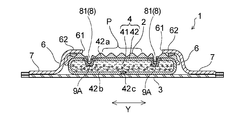
- FIG. 2 is a schematic cross-sectional view taken along the line II-II in FIG.
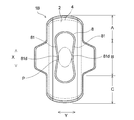
- FIG. 3 is the top view which looked at the sanitary napkin which is 2nd Embodiment of the absorbent article of this invention from the skin opposing surface side.
- 4 is a schematic cross-sectional view taken along line IV-IV in FIG.
- FIG. 5 is an explanatory diagram of the function and effect of the present invention.
- FIG. 6 is the top view which looked at the sanitary napkin which is 3rd Embodiment of the absorbent article of this invention from the skin opposing surface side.
- FIG. 1 is a top view which looked at the sanitary napkin which is a 1st embodiment of the absorptive article of the present invention from the skin opposing surface side.
- FIG. 2 is a schematic cross-sectional view
- FIG. 7 is the top view which looked at the sanitary napkin which is 4th Embodiment of the absorbent article of this invention from the skin opposing surface side.
- FIG. 8 is the top view which looked at the sanitary napkin which is 5th Embodiment of the absorbent article of this invention from the skin opposing surface side.
- Patent Documents 2 and 5 there is no description about a configuration for improving the absorption rate of blood or improving the absorption amount, except that a water-soluble metal compound is used as a blood coagulant.
- a water-soluble metal compound is used as a blood coagulant.
- the embossed form is unclear and the blood gelling agent is concentrated along the end of the embossed wire or along the end thereof, so that an aggregate is formed in the part, Absorber cannot be fully utilized.
- red blood cell clusters are trapped between the fibers of the nonwoven web, but it is difficult to continuously ensure blood absorption by the mechanism.
- Patent Documents 1 to 5 describe nothing about using a blood modifying agent as a countermeasure against a decrease in leak-proof property that accompanies peeling between a surface sheet and an absorbent that occurs in a leak-proof groove. Not. Therefore, the subject of this invention is related with providing the absorbent article from which the improvement effect of the absorption performance by a hemagglutinating agent is expressed more effectively.
- the problem of the present invention also relates to providing an absorbent article that can solve the problems of the prior art.
- a sanitary napkin 1 (hereinafter also referred to as “napkin 1”), which is a first embodiment of the present invention, is a liquid-permeable topsheet 2 that forms a skin-facing surface, as shown in FIGS.
- a back sheet 3 forming a non-skin facing surface and a liquid retaining absorbent 4 disposed between both the sheets 2 and 3 are provided.
- the top sheet 2, the absorber 4 and the back sheet 3 are integrated to form an absorbent main body 5.
- Side leakproof sheets 6 are arranged on the surface sheet 2 side on both sides in the longitudinal direction of the absorbent main body 5.
- the side leak-proof sheet 6 has a free end 61 that is not joined to the top sheet 2 and a fixed end 62 that is joined to the top sheet 2, and is used between the fixed end 62 and the free end 61 when used. Forms a leak-proof pocket (not shown) that separates from the top sheet 2 and prevents lateral leakage to the side.
- a non-skin contact surface of the absorbent main body 5 is provided with a main body adhesive portion (not shown) used for fixing to the crotch portion of the shorts.
- the napkin 1 has a pair of wing portions 7 on both side portions in the longitudinal direction X. On the surface of the pair of wing portions 7 on the back sheet 3 side, a wing adhesive portion (not shown) used for fixing the crotch portion of the shorts to the non-skin facing surface is provided.
- the top sheet 2 As the top sheet 2, the back sheet 3, and the side leak-proof sheet 6, various kinds of materials conventionally used for absorbent articles such as sanitary napkins can be used without particular limitation.
- the surface sheet 2 a single layer or multilayer nonwoven fabric, an apertured film, or the like can be used.
- the surface sheet 2 may have irregularities on the skin contact surface side, or may have an oil agent attached to the surface of the constituent fibers.
- the topsheet 2 has a multilayer structure, the topsheet 2 includes a first fiber layer located on the side close to the wearer's skin and a second fiber layer located on the side far from the wearer's skin.
- both fiber layers are integrated in the thickness direction by a number of joints formed in part, and a portion of the first fiber layer located between the joints is convex. It is possible to use a concavo-convex sheet that protrudes and forms the concavo-convex convex portion.
- the concavo-convex sheet in which the convex portion has a solid structure for example, those described in Japanese Patent Application Laid-Open Nos. 2007-182626 and 2002-187228 can be used.
- the back sheet 3 a resin film, a resin film, a nonwoven fabric, a laminated body, or the like can be used.
- the back sheet 3 is liquid-impermeable (including liquid-impermeable) or water-repellent, and it is also preferable to use a moisture-permeable resin film or the like.
- a laminated nonwoven fabric having a high water pressure resistance, a laminate of a resin film and a nonwoven fabric, or the like can be used.
- the napkin 1 has a longitudinal direction X corresponding to the wearer's front-rear direction and a transverse direction Y orthogonal to the longitudinal direction X.
- the napkin 1 has an excretion part facing part B having an excretion spot part P disposed opposite to a wearer's liquid excretion part such as a vaginal opening in the width direction (lateral direction) Y central part with respect to the vertical direction X, and the excretion A front part A arranged closer to the wearer's stomach side (front side) than the part facing part B, and a rear part C arranged closer to the wearer's back side (rear side) than the excretory part facing part B; have. That is, the napkin 1 is divided into the front part A, the excretion part opposing part B, and the rear part C in this order in the vertical direction X.
- the skin-facing surface is a surface that faces the wearer's skin when the napkin 1 is worn in the napkin 1 or its constituent members (for example, the surface sheet 2 and the absorbent core 41).
- the skin-facing surface is a surface of the napkin 1 or its constituent members that is directed to the side opposite to the skin side (usually the clothing side) when the napkin 1 is worn.
- the excretion spot part P is a part that is disposed opposite to the liquid excretion part of the wearer when the absorbent article such as the napkin 1 is worn, and is directly supplied with menstrual blood. It is located at the center in the vertical direction X and the width direction Y of B.
- the excretion spot portion P has an elliptical shape having a major axis 3 cm along the center line extending in the longitudinal direction X equally dividing the napkin 1 in the width direction and a minor axis 2 cm along the lateral direction Y. It has become.
- the center point of the excretion spot part P is preferably located substantially on the vertical bisector of the wing part.
- substantially located means that the bisector may be deviated 15 mm from the front and rear, but even in that case, the excretion spot portion P is within the excretion portion facing portion B. Exist.
- the excretory part-facing part B is a region having one wing part in the longitudinal direction X of the absorbent article (one side) It means a region sandwiched between a root along the vertical direction X of the wing portion and a root along the vertical direction X of the other wing portion.
- two folding lines that cross the absorbent article in the transverse direction Y which are generated when the absorbent article is folded into a tri-fold individual form.
- region enclosed by the 1st folding line and the 2nd folding line is counted from the front end of the longitudinal direction X of this absorbent article.
- the top sheet 2 covers the entire area of the skin 4 of the absorbent body 4, and the back sheet 3 covers the entire area of the non-skin facing surface of the absorbent body 4.
- the surface sheet 2 and the back surface sheet 3 are joined to each other at the extended portions from both end edges in the longitudinal direction X of the absorber 4.
- the back sheet 3 and the side leak-proof sheet 6 are joined to each other at portions extending outward in the lateral direction Y from both side edges along the longitudinal direction X of the absorber 4. In this way, the absorbent body 4 is sandwiched between the top sheet 2 and the back sheet 3.
- any joining means such as an adhesive, heat sealing, ultrasonic sealing or the like is used.
- the side leakage preventing groove 81 in which the topsheet 2 is invaded into the absorbent body 4 is continuously provided in the excretory part facing part B on both side parts along the vertical direction X. It is extended and formed.
- the napkin 1 according to the first embodiment is a side leakage prevention device in which a surface sheet 2 is invaded into the absorbent body 4 around the excretion spot portion P on the skin facing surface of the napkin 1.
- a groove 81 is provided. More specifically, on the skin-facing surface of the napkin 1, a pair of side leakage grooves 81, 81 extending in the longitudinal direction X and ends of the pair of side leakage grooves 81, 81 are connected to the front portion A.
- An annular leak-proof groove 8 having a front leak-proof groove 82 connected on the side and a rear leak-proof groove 83 connecting ends of the pair of side leak-proof grooves 81, 81 on the rear part C side is formed. Has been.
- Each of the pair of side leakage preventing grooves 81 extends in the longitudinal direction X of the napkin 1 on each side of the excretion spot portion P in the lateral direction Y.
- the pair of side leakage preventing grooves 81 and 81 preferably extend in the longitudinal direction X at least on both sides of the excretion part facing part B with the excretion spot part P interposed therebetween.
- the side leakage prevention groove 81 preferably extends from the excretory part facing part B to the front part A or the rear part B. As shown in FIG. 1, the front part A, the excretion part facing part B, and More preferably, it extends over the rear part C.
- the end part by the side of the front part A is connected by the front leak-proof groove 82 which passes a front side from the excretion spot part P, and a pair of side leak-proof groove 81,81 is excreted.
- End portions on the rear portion C side are connected to each other by a rear leakage prevention groove 83 that passes rearward from the spot portion P.
- Each of the pair of side leakage preventing grooves 81 is convex outwardly in the lateral direction Y at portions located on both sides of the lateral direction Y across the excretory part facing part B, preferably the excretion spot part P. It has a central arc-shaped portion 81b having a curved plan view shape, and has a plan view shape curved convexly outwardly in the lateral direction Y before and after the central arc-shaped portion 81b in the vertical direction X. It has a front arcuate part 81a and a rear arcuate part 81c.
- the three arc-shaped portions (outward convex curved portions) 81a, 81b, 81c that are convexly curved outward in the lateral direction Y are three in the longitudinal direction X.
- the connecting portion between the central arc-shaped portion 81b and the front arc-shaped portion 81a and the connecting portion between the central arc-shaped portion 81b and the rear arc-shaped portion 81c have a pair of side protections. It is a constricted portion in which the distance of the leakage groove 81 is narrowed.
- the skin facing surface side of the absorbent body 4 is recessed in a groove shape together with the surface sheet 2,
- the absorber 4 has portions where the leak-proof grooves 81, 82, and 83 are formed, as compared to the portions of the absorber 4 that are located on both sides of the leak-proof grooves 81, 82, and 83, respectively. And consolidated.
- the leak-proof groove 8 can be formed by, for example, applying embossing with pressurization or heating and pressurization on the superposed sheet 2 and the absorbent body 4.
- the main role of the leak-proof groove 8 is to suppress the diffusion of liquid in the plane direction of the napkin 1.
- the absorbent body 4 of the napkin 1 has an absorbent core 41 containing pulp fibers and a core wrap sheet 42 that covers the absorbent core 41.
- the core wrap sheet 42 in this embodiment is wound down to the skin-side portion 42 a that covers the skin-facing surface side of the absorbent core 41 and the non-skin-facing surface side of the absorbent core 41.
- seat 42 has the overlapping part 42c of a sheet
- the core wrap sheet covering the absorbent core 41 may wrap the entire absorbent core 41 with a single sheet, or may wrap the entire absorbent core 41 with two or more sheets.
- the skin facing surface side and the non-skin facing surface side of the absorbent core 41 may be covered with separate sheets.
- the core wrap sheet covering the skin facing surface side of the absorbent core 41 is defined as the skin side core wrap sheet 42a and the non-absorbing core 41 non-covered.
- a portion covering the skin facing surface side is also referred to as a non-skin side core wrap sheet 42b.
- the skin-side core wrap sheet 42 a is one of the lower members disposed in a position closer to the back sheet 3 than the top sheet 2 in the thickness direction of the napkin 1.
- the napkin 1 has a skin-side core wrap sheet 42a, an absorbent core 41, and a non-skin-side core wrap sheet 42b as lower members.
- the flocculant arrangement part 9 containing a hemagglutinating agent is formed at least on the skin-side core wrap sheet 42a which is a lower member adjacent to the top sheet 2 in the thickness direction of the absorbent article.
- the flocculant disposition part 9 containing the hemagglutinating agent may be formed only on the skin-side core wrap sheet 42a, but may be formed on the skin-side core wrap sheet 42a and the absorbent core 41.
- the wrap sheet 42a, the absorbent core 41 and the non-skin side core wrap sheet 42b may be formed.
- the flocculant arrangement portion 9 of the skin-side core wrap sheet 42a is a range in which the hemagglutinating agent in the lower member is arranged, and in the plan view of the napkin 1, the flocculant arrangement The part 9 and the whole area in the leak-proof groove 8 overlap.
- 1st Embodiment is not limited to this, The part which the flocculant arrangement
- the pair of band-shaped portions spaced apart from each other in the skin-side core wrap sheet 42a includes the aggregating agent arranging portions 9A and 9A containing a hemagglutinating agent. It has become.
- the flocculant arrangement portions 9A and 9A are formed so as to extend in the longitudinal direction X on both sides of the excretion spot portion P in the plan view of the napkin 1, respectively.
- the flocculant arrangement portions 9A and 9A of the skin-side core wrap sheet 42a are in a range in which the hemagglutinating agent in the lower member is arranged. As shown in FIG.
- the flocculant arrangement portions 9A and 9A and the pair of side leakage preventing grooves 81 and 81 extending in the longitudinal direction X in the leakage preventing groove 8 overlap each other.
- the points that are not particularly described for the napkin 1A of the second embodiment are the same as those of the napkin 1 of the first embodiment, and the description of the first embodiment is appropriately applied.
- the side leakage preventing groove 81 in the napkin 1 of the first embodiment overlaps with the aggregating agent arranging portion 9 that is the range in which the hemagglutinating agent is arranged, but in the napkin 1A of the second embodiment.
- a region where the hemagglutinating agent is not disposed is formed in the central portion in the lateral direction Y, and the leakage preventing groove 8 is formed in the front leakage preventing groove 82 and the rear leakage preventing groove 83 in the aggregation agent arranging portion. You may have the part which has not overlapped with 9A and 9A.
- the total length in the longitudinal direction X of the central arc-shaped portion 81b of the pair of side leakage preventing grooves 81, 81 overlaps the flocculant arrangement portion 9 or 9A. It is preferable that 50% or more and 100% or less of the total length of the grooves 81, 81 in the longitudinal direction X overlap with the flocculant arrangement part 9 or 9A, and 70% or more and 100% or less of the flocculant arrangement part 9 or 9A. More preferably, they overlap.
- the core wrap sheet is used for the purpose of improving the shape retention of the absorbent core, which is insufficient in shape retention by itself, or preventing the leakage of the constituent material of the absorbent core.
- the fiber sheet is used.
- the cellulosic fibers constituting the thin paper include wood pulp fibers, rayon fibers, cotton fibers, and cellulose acetate fibers.
- cellulosic fiber pulp include wood pulp such as softwood kraft pulp or hardwood kraft pulp, and non-wood pulp such as cotton pulp or straw pulp. These cellulosic fibers can be used singly or in combination of two or more. Further, from the viewpoint of improving the strength, a small amount of non-cellulosic fibers can be mixed.
- non-cellulosic fibers examples include polyolefin fibers such as polyethylene and polypropylene, and condensation fibers such as polyester and polyamide.
- the proportion of the cellulosic fibers in the constituent fibers of the thin paper is preferably 70% by mass to 100% by mass, more preferably 90% by mass to 100% by mass, and still more preferably 100% by mass.
- a nonwoven fabric can also be used as the core wrap sheet. As the type of nonwoven fabric, nonwoven fabrics produced by various production methods can be used without particular limitation.
- a spunbond nonwoven fabric, a melt blown nonwoven fabric, a spunlace nonwoven fabric that is a nonwoven fabric obtained by entanglement of constituent fibers of a fiber web by high-speed water flow treatment examples thereof include an air-through nonwoven fabric which is a nonwoven fabric obtained by thermally fusing constituent fibers of a fiber web by hot air treatment, and a resin bond nonwoven fabric which is a nonwoven fabric obtained by adhering the constituent fibers of a fiber web with an adhesive.
- the fiber web of spunlace nonwoven fabric, air-through nonwoven fabric, and resin bond nonwoven fabric can be manufactured by a card machine or an airlaid method in which fibers are stacked in air.
- Non-woven fabric fibers are made from cellulose-based hydrophilic fibers such as wood pulp fibers, rayon fibers, cotton fibers and cellulose acetate, polyolefins such as polyethylene and polypropylene, polyesters such as polyethylene terephthalate, and synthetic resins such as polyamides such as nylon.
- the synthetic fiber which becomes is mentioned.
- As the synthetic fiber a core-sheath type or side-by-side type composite fiber may be used. Among these, for the same reason as the use of thin paper, it is preferable that the raw material fibers are cellulosic fibers even in the case of nonwoven fabrics of various production methods.
- the proportion of the cellulosic fibers in the constituent fibers of the nonwoven fabric is preferably 70% by mass to 100% by mass, more preferably 90% by mass to 100% by mass, and still more preferably 100% by mass.
- the raw material fiber of a nonwoven fabric can be used individually by 1 type or in combination of 2 or more types.
- the absorptive core 41 of the napkin 1 of this embodiment is composed of a mixed product of pulp fibers and a superabsorbent polymer.
- the mixed fiber stack is manufactured by a known drum-type fiber stacking apparatus including a stacking drum having a stacking concave portion on the peripheral surface, and is sucked from the bottom surface of the stacking concave portion, The surface is supplied with pulp fibers and superabsorbent polymer as the absorbent core forming material in a scattered state, and after the absorbent core forming material is deposited in the accumulation recess, it is released from the accumulation recess. Is obtained.
- the absorbent core 41 of the napkin 1 of the present embodiment may be a single fiber stack of pulp fibers that does not contain a superabsorbent polymer.
- Examples of the pulp fibers constituting the absorbent core 41 include cellulose-based hydrophilic fibers such as wood pulp fibers, rayon fibers, cotton fibers, and cellulose acetate. These fibers can be used alone or in combination of two or more.
- Examples of the raw material pulp of the pulp fiber include wood pulp such as softwood kraft pulp or hardwood kraft pulp, and non-wood pulp such as cotton pulp or wall pulp.
- the absorbent core 41 is made of synthetic fibers such as polyolefin fibers such as polyethylene and polypropylene, condensed fibers such as polyester and polyamide, in addition to pulp fibers made of cellulosic hydrophilic fibers. A small amount may be mixed.
- the absorbent core in the present invention has a ratio of pulp fibers (cellulosic fibers), particularly wood pulp fibers, of preferably 70% by mass or more and 100% by mass or less, more preferably 90% by mass or more and 100% by mass or less. Preferably it is 100 mass%.
- the absorbent core 41 may contain a superabsorbent polymer (water absorbent polymer).
- a superabsorbent polymer water absorbent polymer
- a particulate polymer is generally used, but a fibrous polymer may be used.
- the shape thereof may be any of a spherical shape, a block shape, a bowl shape, and an amorphous shape.
- a polymer or copolymer of acrylic acid or an alkali metal acrylate can be used. Examples thereof include polyacrylic acid and salts thereof and polymethacrylic acid and salts thereof.
- sodium salts can be preferably used.
- a copolymer obtained by copolymerizing the above-mentioned comonomer within a range that does not deteriorate the performance of the superabsorbent polymer.
- water-absorbing polymer it is possible to more quickly absorb and retain a large amount of excretory fluid such as blood.
- the method for forming the agglutinating agent placement part by including the hemagglutinating agent in the napkin component such as the core wrap sheet 42 is not particularly limited.
- the hemagglutinating agent containing a cationic polymer is water, ethanol,
- the solution can be dissolved in an appropriate solvent such as a mixed solution thereof, adhered as a solution to a desired portion of the constituent member, and then dried to remove the solvent. It is preferable from the point of arrangement.
- dropping of the solution onto a predetermined portion of the constituent member and various coating methods can be employed.
- liquid coating to the predetermined location of the structural member using well-known liquid coating apparatuses such as a spray method, a dipping method, a transfer method, die coating, gravure coating, an inkjet method, screen printing, etc. are mentioned.
- the drying may be any of drying by heating, drying by reduced pressure, and drying combining heating and reduced pressure, but natural drying may be used instead of these forced drying.
- the napkins 1 and 1A of the first and second embodiments are used by being fixed to a crotch portion or the like of a shorts in the same manner as a normal sanitary napkin. According to the napkin 1 of 1st Embodiment and the napkin 1A of 2nd Embodiment, even if it is a case where peeling with the surface sheet 2 and the absorber 4 arises in the leak-proof groove 8 by the external force added during wear. As shown in FIG.
- the hemagglutinating agent contained in the lower member such as the skin-side core wrap sheet 42a acts on the menstrual blood 11 that has entered the gap between the top sheet 2 and the absorbent body 4,
- the menstrual blood 11 is prevented from diffusing beyond the leak-proof groove 8. This prevents leakage such as side leakage.
- the absorbent body 4 Even when a gap in the thickness direction of the absorbent body 4 is formed in the leak-proof groove 8 formed by pressurizing and compressing the top sheet 2 and the absorbent body 4 in the same manner, the absorbent body 4
- the hemagglutinating agent contained in the lower member such as the skin-side core wrap sheet 42a acts on the menstrual blood 11 that has entered the gap, thereby forming an agglomerate 16 of erythrocytes in the gap 4 or in the absorber 4 in the vicinity thereof.
- the menstrual blood 11 is prevented from diffusing beyond the leak-proof groove 8. This prevents leakage such as side leakage.
- the skin-side core wrap sheet 42 a From the viewpoint of effectively suppressing the diffusion of menstrual blood through the gap between the top sheet 2 and the absorbent body 4 generated in the leak-proof groove 8 by forming the red blood cell aggregate 16, the skin-side core wrap sheet 42 a. It is preferable that the coagulant disposing portion 9 or 9A of the lower member such as satisfies the one or more of the following conditions (1) to (3).
- the agglutinating agent disposition portion 9 or 9A has an amount of hemagglutinating agent per unit area in an overlapping portion overlapping the portion (side leakage preventing groove 81) extending in the longitudinal direction X of the leakage preventing groove 8 is 6 g / m 2 or more and 80 g / m 2 or less, more preferably 12 g / m 2 or more and 70 g / m 2 or less.
- the amount of hemagglutinating agent is the pure amount of the cationic polymer when the hemagglutinating agent is a cationic polymer, and the amount per unit area of the hemagglutinating agent is measured as follows. Is done.
- the aggregating agent disposition portion 9 or 9A has a coagulant that has an abundance per unit area of the hemagglutinating agent in an overlapping portion that overlaps a portion (side leakage preventing groove 81) extending in the longitudinal direction X of the leakage preventing groove 8. There is more than the abundance per unit area of the hemagglutinating agent in the portion that does not overlap the leakage preventing groove 8 in the placement portion 9 or 9A.
- the cationic polymer used as the hemagglutinating agent preferably has a molecular weight of 2000 or more, more preferably 10,000 or more, and even more preferably 150,000 or more.
- the upper limit of the molecular weight is preferably 30 million or less, more preferably 22 million or less, and even more preferably 10 million or less. Also, it is preferably 2000 or more and 30 million or less, more preferably 10,000 or more and 22 million or less, and further preferably 150,000 or more and 10 million or less.
- the top sheet 2 of the napkin 1, 1A is preferably hydrophilic as a whole, and at least a portion overlapping with the flocculant arrangement portions 9, 9A and the leakage prevention groove 8, particularly the side leakage prevention groove 81 is present. It is preferably hydrophilic.
- the topsheet 2 is hydrophilic, when the menstrual blood that is hydrophilic diffuses in the absorbent body, it diffuses efficiently even in the side leakage prevention groove 81 that overlaps a part or the whole of the flocculant arrangement portion 9A. I can do it.
- a nonwoven fabric or polyethylene which is mainly composed of cellulose fibers such as wood pulp fibers, rayon fibers, cotton fibers, cellulose acetate fibers, etc., as the topsheet 2
- a method using a non-woven fabric or the like mainly composed of fibers obtained by hydrophilizing synthetic fibers such as polyolefin fibers such as polypropylene and condensed fibers such as polyester and polyamide with a hydrophilic oil a nonwoven fabric or polyethylene, which is mainly composed of cellulose fibers such as wood pulp fibers, rayon fibers, cotton fibers, cellulose acetate fibers, etc.
- a method using a non-woven fabric or the like mainly composed of fibers obtained by hydrophilizing synthetic fibers such as polyolefin fibers such as polypropylene and condensed fibers such as polyester and polyamide with a hydrophilic oil.
- the napkin 1 according to the first embodiment and the napkin 1A according to the second embodiment include the leakage preventing groove 8, more specifically, the pair of side leakage preventing grooves 81 in the leakage preventing groove 8, and the excretion spot portion.
- a portion located on both sides in the lateral direction Y across P has a central arc-shaped portion 81b having a plan view shape curved convexly outward in the lateral direction Y.
- the leak-proof groove 8 or the pair of side leak-proof grooves 81 in the absorbent article of the present invention has an arcuate part 81b that is curved outwardly on both sides of the excretion spot part P.
- the side leak-proof grooves 81 and 81 have a shape curved in a convex shape toward the outside in the lateral direction Y, and the side leak-proof grooves 81 and 81 having the shape are the excretion spot portion P.
- the plasma component is easily diffused in the vertical direction X along the side leakage preventing grooves 81, 81, and the side leakage is less likely to occur.
- the excretion spot portion P generated in the initial stage of wear and the surrounding agglomerates suppress the subsequent menstrual blood excreted from diffusing outward in the lateral direction Y. Since it can function as a leak-proof means, it is also effective in suppressing lateral menstrual leakage when worn for a long time.
- sanitary napkins as third and fourth embodiments of the absorbent article of the present invention will be described.
- a pair of side leak-proof groove 81 is the same flocculant arrangement
- the flocculant arrangement portion 9A, 9A similar to the napkin 1A of the second embodiment, ie, the skin side core wrap, overlaps with the flocculant arrangement portion formed so as to cover the entire area of the overlapping portion of the absorbent core
- the sheet 42a overlaps with the flocculant arrangement portions 9A and 9A partially formed on the portion overlapping the absorbent core.
- FIG. 6 is a plan view showing a sanitary napkin according to a third embodiment of the present invention.
- the side leakage preventing groove 81 is an arcuate part curved in a convex shape toward the inner side in the lateral direction Y. (Inner convex curved part). Specifically, as shown in FIG.
- the pair of side leakage preventing grooves 81 in the napkin 1 ⁇ / b> B has portions located on both sides in the lateral direction Y across the excretory part facing part B, preferably the excretion spot part P, An arcuate portion (inwardly convex curved portion) 81d having a plan view shape curved concavely outward in the lateral direction Y is formed.
- the leakage preventing groove 8 or the pair of side leakage preventing grooves 81 in the absorbent article of the present invention has arc-shaped portions 81d that are curved in a concave shape toward the outside on both sides of the excretion spot portion P.
- the leak-proof groove has the inwardly convex curved portion because there are advantages such as prevention of liquid movement by the leak-proof groove and further improvement of the leak-proof performance of the absorbent article.
- the side leak-proof grooves 81, 81 are convex toward the excretion spot portion P, when a large amount of menstrual blood is discharged in a short time, menstrual blood is transmitted through the leak-proof groove. Almost spread in the longitudinal direction X, and menstrual blood comes into contact with the hemagglutinating agent to easily form aggregates and separate into plasma components in the vicinity of the side leakage prevention groove 81. It becomes easy to diffuse in the vertical direction X. Moreover, in the excretion part opposing part B, the absorptive area of the lateral direction Y outer side is wider than the side leak-proof groove 81. For this reason, even when a large amount of menstrual blood is discharged in a short time, menstrual leakage from the lateral direction is difficult to occur.
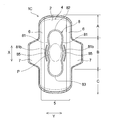
- FIG. 7 is a plan view showing a sanitary napkin according to a fourth embodiment of the present invention.
- the sanitary napkin 1C (hereinafter referred to as napkin 1C) of the fourth embodiment is similar to the napkins 1 and 1A in that the side leakage prevention grooves 81 are provided outward on both sides sandwiching the excretion spot portion P in the lateral direction Y.
- the second leakage prevention groove 85 has a plan view shape that is curved in a convex shape toward the outside in the lateral direction Y.
- the arc-shaped portion 81b and the second leakage prevention groove 85 are formed side by side in the lateral direction Y, and are formed substantially parallel to each other.
- the central arc-shaped portion 81b and the second leakage preventing groove 85 located outside the central arc-shaped portion 81b may overlap the continuous flocculant arrangement portion 9 or 9A, and a gap is formed in the lateral direction Y. You may overlap with the formed separate flocculant arrangement part.
- FIG. 8 is a plan view showing a sanitary napkin according to a fifth embodiment of the present invention.
- a pair of side leakage prevention grooves 81 in the leakage prevention groove 8 are arranged in the lateral direction Y across the excretion spot portion P, similarly to the napkins 1 and 1A.
- a pair of side leakage preventing grooves 81 extending linearly in the longitudinal direction X are formed in portions located on both sides.
- the pair of side leakage preventing grooves 81 are formed so as to cover the entire area where the absorbent core overlaps the flocculant disposition portion 9 similar to the napkin 1 of the first embodiment, that is, the skin-side core wrap sheet 42a.
- positioning part in the leak-proof groove 8 is shown with the code
- FIG. In the case where the hemagglutinating agent is also arranged on the inner side in the lateral direction from the side leakage preventing groove 81, the menstrual blood touches the hemagglutinating agent until the menstrual blood reaches the side leakage preventing groove 81, and the aggregate and plasma. The plasma component that is easily separated into components and reaches the side leakage prevention grooves is quickly diffused in the longitudinal direction X along the linear side leakage prevention grooves 81, so that the amount of absorption is further improved.
- the hemagglutinating agent used in the hemagglutinating fiber of the present invention those having an action capable of aggregating erythrocytes in blood are used. Red blood cells aggregated by the hemagglutinating agent become aggregates.
- the hemagglutinating agent is preferably one that acts to agglutinate erythrocytes in blood to form aggregates and separate them from plasma components.
- a cationic polymer is useful as the hemagglutinating agent. The reason is as follows. Red blood cells have a red blood cell membrane on their surface. The erythrocyte membrane has a two-layer structure.
- This two-layer structure is composed of a red blood cell membrane skeleton as a lower layer and a lipid membrane as an upper layer.
- the lipid film exposed on the surface of erythrocytes contains a protein called glycophorin.
- Glycophorin has a sugar chain to which a sugar having an anionic charge called sialic acid is bonded at its end.
- sialic acid a sugar having an anionic charge
- erythrocytes can be treated as colloidal particles having an anionic charge.
- an aggregating agent is used for aggregating the colloidal particles.
- a cationic substance is advantageous to use from the viewpoint of neutralizing the electric double layer of erythrocytes.
- the aggregating agent has a polymer chain
- the polymer chains of the aggregating agent adsorbed on the surface of the erythrocyte tend to be entangled with each other, thereby promoting the aggregation of erythrocytes.
- the aggregating agent has a functional group
- the hemagglutinating agent cationic polymer
- a preferred hemagglutinating agent used in the present invention is that when 1000 ppm of a measurement sample agent is added to simulated blood, at least two erythrocytes aggregate to form an aggregate while maintaining the fluidity of blood. Those having such properties are particularly preferred.
- the above-mentioned “state in which the fluidity of blood is maintained” means that 10 g of simulated blood to which a measurement sample agent is added 1000 ppm is screw tube bottle (manufactured by Maruemu, product number “screw tube No. 4”, mouth inner diameter 14.5 mm, body When the screw tube bottle containing the simulated blood is turned 180 degrees, the pseudo blood of 80% or more flows down within 5 seconds.
- Simulated blood means that the viscosity measured using a B-type viscometer (model number TVB-10M manufactured by Toki Sangyo Co., Ltd., measurement conditions: rotor No. 19, 30 rpm, 25 ° C., 60 seconds) is 8 mPa ⁇ s.
- the blood cell / plasma ratio of defibrinated horse blood was prepared.
- Whether or not “two or more erythrocytes have aggregated to form an aggregate” is determined as follows. That is, the simulated blood to which a measurement sample agent was added at 1000 ppm was diluted 4000 times with physiological saline, and a laser diffraction / scattering type particle size distribution measuring apparatus (manufactured by HORIBA, model number: LA-950V2, measurement condition: flow type cell). When the median diameter of volume average particle diameter measured at a temperature of 25 ° C. is 10 ⁇ m or more by a laser diffraction scattering method using a measurement, a circulation speed of 1 and no ultrasound), “two or more red blood cells are aggregated. It is determined that an aggregate is formed.
- the hemagglutinating agent used in the present invention satisfies the above-mentioned properties by a single compound that meets the above-described properties, a plurality of combinations of single compounds that meet the above-mentioned properties, or a combination of a plurality of compounds (aggregation of erythrocytes). Agent).
- the hemagglutinating agent is an agent limited to those having an erythrocyte aggregating action as defined above. Therefore, when the hemagglutinating agent contains a third component that does not meet the above definition, it is expressed as a hemagglutinating agent composition and is distinguished from the hemagglutinating agent.
- the hemagglutinating agent used in the present invention those containing a cationic polymer are preferable.
- the cationic polymer include cationized cellulose and cationized starch such as hydroxypropyltrimonium chloride.
- the hemagglutinating agent used in the present invention can also contain a quaternary ammonium salt homopolymer, a quaternary ammonium salt copolymer or a quaternary ammonium salt polycondensate as a cationic polymer.
- the “quaternary ammonium salt” includes a compound having a plus monovalent charge at the nitrogen atom position, or a compound that generates a plus monovalent charge at the nitrogen atom position by neutralization.
- the “copolymer” is a polymer obtained by copolymerization of two or more kinds of polymerizable monomers, and is a binary copolymer or a ternary copolymer or more. Includes both things.
- the “polycondensate” is a polycondensate obtained by polymerizing a condensate composed of two or more monomers.
- the hemagglutinating agent used in the present invention contains a quaternary ammonium salt homopolymer and / or a quaternary ammonium salt copolymer and / or a quaternary ammonium salt polycondensate as the cationic polymer
- the hemagglutination The agent may contain any one of a quaternary ammonium salt homopolymer, a quaternary ammonium salt copolymer and a quaternary ammonium salt polycondensate, or any combination of two or more. May be included.
- a quaternary ammonium salt homopolymer can be used individually by 1 type or in combination of 2 or more types.
- the quaternary ammonium salt copolymer can be used alone or in combination of two or more.
- a quaternary ammonium salt polycondensate can be used individually by 1 type or in combination of 2 or more types.
- the “hemagglutinating agent” means that a single compound capable of aggregating blood erythrocytes, a plurality of combinations of the single compounds, or a combination of a plurality of compounds expresses erythrocyte aggregation. It is an agent to do. That is, the hemagglutinating agent is an agent limited to those having a hemagglutination effect.
- the hemagglutinating agent contains the third component, it is expressed as a hemagglutinating agent composition and is distinguished from the hemagglutinating agent.
- the term “single compound” is a concept including compounds having the same composition formula but having different molecular weights due to different numbers of repeating units.
- quaternary ammonium salt polymer a quaternary ammonium salt homopolymer, a quaternary ammonium salt copolymer or a quaternary ammonium salt polycondensate from the viewpoint of adsorptivity to erythrocytes. preferable.
- the quaternary ammonium salt homopolymer, the quaternary ammonium salt copolymer and the quaternary ammonium salt polycondensate are collectively referred to as “quaternary ammonium salt polymer”.
- the quaternary ammonium salt homopolymer is obtained by polymerizing one type of polymerizable monomer having a quaternary ammonium moiety.
- the quaternary ammonium salt copolymer uses at least one polymerizable monomer having a quaternary ammonium moiety and, if necessary, at least one polymerizable monomer having no quaternary ammonium moiety. It was obtained by using seeds and copolymerizing them. That is, the quaternary ammonium salt copolymer is obtained by using two or more polymerizable monomers having a quaternary ammonium moiety and copolymerizing them, or having a quaternary ammonium moiety.
- the quaternary ammonium salt copolymer may be a random copolymer, an alternating copolymer, a block copolymer, or a graft copolymer.
- the quaternary ammonium salt polycondensate is obtained by polymerizing these condensates using a condensate composed of one or more monomers having a quaternary ammonium moiety.
- the quaternary ammonium salt polycondensate is obtained by polymerizing two or more condensates having two or more monomers having a quaternary ammonium moiety, or the quaternary ammonium moiety. And a condensate comprising one or more monomers having quaternary ammonium moieties and one or more monomers having no quaternary ammonium moiety, and obtained by condensation polymerization.
- the quaternary ammonium salt polymer is a cationic polymer having a quaternary ammonium moiety.
- a quaternary ammonium moiety can be generated by quaternary ammoniumation of a tertiary amine using an alkylating agent.
- the tertiary amine can be dissolved in acid or water and generated by neutralization. Or it can produce
- the alkylating agent include alkyl halides and dialkyl sulfates such as dimethyl sulfate and dimethyl sulfate.
- dialkyl sulfate is preferable because the problem of corrosion that may occur when an alkyl halide is used does not occur.
- the acid include hydrochloric acid, sulfuric acid, nitric acid, acetic acid, citric acid, phosphoric acid, fluorosulfonic acid, boric acid, chromic acid, lactic acid, oxalic acid, tartaric acid, gluconic acid, formic acid, ascorbic acid, and hyaluronic acid. .
- a quaternary ammonium salt polymer in which a tertiary amine moiety is quaternized with an alkylating agent, because the electric double layer of erythrocytes can be reliably neutralized.
- Quaternary ammoniumation by a nucleophilic reaction including a condensation reaction can be caused by a ring-opening polycondensation reaction of dimethylamine and epichlorohydrin or a cyclization reaction of dicyandiamide and diethylenetriamine.
- the cationic polymer used as the hemagglutinating agent has a molecular weight of preferably 2000 or more, more preferably 10,000 or more, from the viewpoint of effectively producing red blood cell aggregates. It is still more preferable that it is 10,000 or more, and it is still more preferable that it is 150,000 or more.
- the molecular weight of the cationic polymer is higher than these values, the cationic polymer is sufficiently entangled between erythrocytes and the cationic polymer is crosslinked between erythrocytes, and menstrual blood has an effect on red blood cell aggregates. It is more preferable because the effect of suppressing the diffusion of blood is enhanced.
- the upper limit of the molecular weight is preferably 30 million or less, more preferably 22 million or less, and even more preferably 10 million or less.
- the molecular weight of the cationic polymer dissolves well into menstrual blood.
- the molecular weight of the cationic polymer is such that menstrual blood is separated into red blood cells and plasma, effectively forming red blood cell aggregates, and plasma is efficiently absorbed by superabsorbent polymers, increasing the amount of absorption and absorption rate, and preventing leakage. From the viewpoint of suppressing the movement of menstrual blood from the inside to the outside of the groove and maintaining good leakage prevention performance, it is preferably from 20 to 30 million, more preferably from 10,000 to 22 million.
- the molecular weight of the cationic polymer is 10,000 or more and 150,000 or less, particularly 10,000 or more and 120,000 or less, the aggregate of menstrual blood is generated in an appropriate size without excessive enlargement. Aggregates do not block the voids in the pulp fiber voids and core wrap sheet contained, and even after the cationic polymer dissolves well into menstrual blood, the menstrual blood flow in the absorbent core and core wrap sheet This is preferable from the viewpoint of maintaining high permeability.
- the molecular weight of the cationic polymer can be controlled by appropriately selecting the polymerization conditions.
- cationic polymers of different molecular weight within the above-mentioned molecular weight range.
- the molecular weight of the cationic polymer can be measured using HLC-8320GPC manufactured by Tosoh Corporation. Specific measurement conditions are as follows.
- the molecular weight said to this invention is a weight average molecular weight.
- a column in which a guard column ⁇ manufactured by Tosoh Corporation and an analytical column ⁇ -M are connected in series is used at a column temperature of 40 ° C.
- the detector uses RI (refractive index).
- 1 mg of the treatment agent (quaternary ammonium salt polymer) to be measured is dissolved in 1 mL of the eluent.
- a copolymer containing a water-soluble polymerizable monomer such as hydroxyethyl methacrylate uses an eluent in which 150 mmol / L sodium sulfate and 1% by mass acetic acid are dissolved in water.
- a copolymer containing a water-soluble polymerizable monomer such as hydroxyethyl methacrylate has a molecular weight of 5900, a pullulan with a molecular weight of 47300, a pullulan with a molecular weight of 212,000, and a molecular weight of 788,000 with respect to 10 mL of the eluent. Pullulan, a pullulan mixture with 2.5 mg each dissolved, is used as the molecular weight standard.
- a copolymer containing a water-soluble polymerizable monomer such as hydroxyethyl methacrylate is measured at a flow rate of 1.0 mL / min and an injection amount of 100 ⁇ L.
- Polyethylene oxide (PEO) having a molecular weight of 50,000, PEO having a molecular weight of 235,000, PEO having a molecular weight of 875,000, and a PEG-PEO mixture in which 10 mg of each is dissolved is used as a molecular weight standard. Except for a copolymer containing a water-soluble polymerizable monomer such as hydroxyethyl methacrylate, the flow rate is 0.6 mL / min and the injection amount is 100 ⁇ L.
- the cationic polymer is preferably water-soluble.
- water-soluble means that 0.05 g of a 1 mm or less powdery or 0.5 mm or less film-like cationic polymer is added to a 100 mL glass beaker (5 mm ⁇ ) and mixed with 50 mL ion-exchanged water at 25 ° C.
- a stirrer chip having a length of 20 mm and a width of 7 mm is inserted, and the whole amount is dissolved in water within 24 hours under stirring at 600 rpm using a magnetic stirrer HPS-100 manufactured by ASONE Co., Ltd.
- the total amount is preferably dissolved in water within 3 hours, and the total amount is more preferably dissolved in water within 30 minutes.
- the cationic polymer preferably has a structure having a main chain and a plurality of side chains bonded thereto.
- the quaternary ammonium salt polymer preferably has a structure having a main chain and a plurality of side chains bonded thereto.
- the quaternary ammonium moiety is preferably present in the side chain.
- the main chain and the side chain are bonded at one point, the flexibility of the side chain is difficult to be hindered, and the quaternary ammonium moiety present in the side chain is smoothly formed on the surface of the erythrocyte. Adsorbs.
- bonded at one point means that one of the carbon atoms constituting the main chain is single-bonded with one carbon atom located at the end of the side chain.
- Connected at two or more points means that two or more of the carbon atoms constituting the main chain are each single-bonded with two or more carbon atoms located at the end of the side chain.
- a quaternary ammonium salt polymer has a structure having a main chain and a plurality of side chains bonded thereto.
- the number of carbon atoms in each side chain is preferably 4 or more, more preferably 5 or more, and even more preferably 6 or more.
- the upper limit of the carbon number is preferably 10 or less, more preferably 9 or less, and even more preferably 8 or less.
- the number of carbon atoms in the side chain is preferably 4 or more and 10 or less, more preferably 5 or more and 9 or less, and still more preferably 6 or more and 8 or less.
- the carbon number of the side chain is the carbon number of the quaternary ammonium moiety (cation moiety) in the side chain, and even if carbon is contained in the anion that is the counter ion, the carbon is counted. Not included.
- the number of carbon atoms from the carbon atom bonded to the main chain to the carbon atom bonded to the quaternary nitrogen is within the aforementioned range, so that the quaternary ammonium salt. This is preferable because the steric hindrance when the polymer is adsorbed on the surface of the erythrocyte is reduced.
- the quaternary ammonium salt polymer is a quaternary ammonium salt homopolymer
- examples of the homopolymer include a polymer of a vinyl monomer having a quaternary ammonium moiety or a tertiary amine moiety.
- a quaternary ammonium salt homopolymer in which the tertiary amine moiety is quaternized with an alkylating agent before and / or after polymerization are examples of the homopolymer.
- alkylating agent and the acid are as described above.
- the quaternary ammonium salt homopolymer preferably has a repeating unit represented by the following formula 1.
- quaternary ammonium salt homopolymer examples include polyethyleneimine.
- examples of the homopolymer in which the side chain having a quaternary ammonium moiety is bonded to the main chain at two or more points include polydiallyldimethylammonium chloride and polydiallylamine hydrochloride.
- the quaternary ammonium salt polymer is a quaternary ammonium salt copolymer
- two kinds of polymerizable monomers used for the polymerization of the quaternary ammonium salt homopolymer described above are used as the copolymer.
- a copolymer obtained by the above copolymerization can be used.
- a quaternary ammonium salt copolymer one or more polymerizable monomers used for the polymerization of the quaternary ammonium salt homopolymer described above and a polymerizable monomer having no quaternary ammonium moiety
- the copolymer obtained by copolymerizing using 1 or more types of bodies can be used.
- the quaternary ammonium salt copolymer can be a binary copolymer or a ternary or higher copolymer.
- the quaternary ammonium salt copolymer has a repeating unit represented by the above-described formula 1 and a repeating unit represented by the following formula 2 to effectively produce an agglomerate of erythrocytes. It is preferable from the viewpoint.
- a cationic polymerizable monomer an anionic polymerizable monomer, or a nonionic polymerizable monomer can be used.
- a cationic polymerizable monomer an anionic polymerizable monomer, or a nonionic polymerizable monomer
- charge cancellation with a quaternary ammonium moiety in a quaternary ammonium salt copolymer is achieved. Therefore, erythrocyte aggregation can be effectively generated.
- Examples of cationic polymerizable monomers include linear compounds having a cation-carrying nitrogen atom in the main chain, such as vinylpyridine as a cyclic compound having a cation-carrying nitrogen atom under a particular condition And a condensed compound of dicyandiamide and diethylenetriamine.
- Examples of the anionic polymerizable monomer include 2-acrylamido-2-methylpropane sulfonic acid, methacrylic acid, acrylic acid, styrene sulfonic acid, and salts of these compounds.
- nonionic polymerizable monomers examples include vinyl alcohol, acrylamide, dimethylacrylamide, ethylene glycol monomethacrylate, ethylene glycol monoacrylate, hydroxyethyl methacrylate, hydroxyethyl acrylate, methyl methacrylate, methyl acrylate, ethyl methacrylate, ethyl Examples include acrylate, propyl methacrylate, propyl acrylate, butyl methacrylate, and butyl acrylate.
- One of these cationic polymerizable monomers, anionic polymerizable monomers, or nonionic polymerizable monomers can be used, or any two or more of them can be used in combination. Can do.
- a quaternary ammonium salt copolymer copolymerized using a cationic polymerizable monomer, an anionic polymerizable monomer and / or a nonionic polymerizable monomer as a polymerizable monomer has a molecular weight of However, as described above, it is preferably 10 million or less, particularly 5 million or less, and particularly preferably 3 million or less (the same applies to the quaternary ammonium salt copolymer exemplified below).
- a polymerizable monomer having a functional group capable of hydrogen bonding can also be used as the polymerizable monomer having no quaternary ammonium moiety.
- a polymerizable monomer having no quaternary ammonium moiety When such a polymerizable monomer is used for copolymerization, and when erythrocytes are aggregated using a quaternary ammonium salt copolymer obtained therefrom, a hard aggregate is likely to be formed. Absorption performance is less likely to be disturbed.
- the functional group capable of hydrogen bonding include —OH, —NH 2 , —CHO, —COOH, —HF, —SH and the like.
- polymerizable monomers having functional groups capable of hydrogen bonding examples include hydroxyethyl methacrylate, vinyl alcohol, acrylamide, dimethylacrylamide, ethylene glycol monomethacrylate, ethylene glycol monoacrylate, hydroxyethyl methacrylate, hydroxyethyl An acrylate etc. are mentioned.
- hydroxyethyl methacrylate, 2-hydroxyethyl methacrylate, hydroxyethyl acrylate, dimethylacrylamide, and the like in which hydrogen bonds work strongly, are preferable because the adsorption state of quaternary ammonium salt polymers on erythrocytes is stabilized.
- These polymerizable monomers can be used individually by 1 type or in combination of 2 or more types.
- a polymerizable monomer having a functional group capable of hydrophobic interaction can also be used.
- a polymerizable monomer for copolymerization By using such a polymerizable monomer for copolymerization, the same advantageous effect as that in the case of using the polymerizable monomer having a functional group capable of hydrogen bonding described above, that is, the hardness of erythrocytes The effect that it becomes easy to produce an agglomerate is produced.
- functional groups capable of hydrophobic interaction include alkyl groups such as methyl, ethyl, and butyl groups, phenyl groups, alkylnaphthalene groups, and fluorinated alkyl groups.
- polymerizable monomers having functional groups capable of hydrophobic interaction examples include methyl methacrylate, methyl acrylate, ethyl methacrylate, ethyl acrylate, propyl methacrylate, propyl acrylate, butyl methacrylate, butyl acrylate, styrene, etc. Is mentioned.
- methyl methacrylate, methyl acrylate, butyl methacrylate, butyl acrylate, etc. which have a strong hydrophobic interaction and do not significantly reduce the solubility of the quaternary ammonium salt polymer, are adsorbed to erythrocytes by the quaternary ammonium salt polymer. Is preferable because of stabilization.
- These polymerizable monomers can be used individually by 1 type or in combination of 2 or more types.
- the molar ratio of the polymerizable monomer having a quaternary ammonium moiety and the polymerizable monomer having no quaternary ammonium moiety in the quaternary ammonium salt copolymer is the quaternary ammonium salt. It is preferable that the red blood cells are appropriately adjusted so as to be sufficiently aggregated by the ammonium salt copolymer.
- the molar ratio of the polymerizable monomer having a quaternary ammonium moiety in the quaternary ammonium salt copolymer is preferably 10 mol% or more, more preferably 22 mol% or more, and 32 mol. % Or more, more preferably 38 mol% or more.
- the molar ratio of the polymerizable monomer having a quaternary ammonium moiety is preferably 10 mol% or more and 100 mol% or less, more preferably 22 mol% or more and 80 mol% or less, More preferably, it is 32 mol% or more and 65 mol% or less, and more preferably 38 mol% or more and 56 mol% or less.
- the quaternary ammonium salt polymer is a quaternary ammonium salt polycondensate
- a condensate composed of one or more monomers having the quaternary ammonium moiety described above is used as the polycondensate.
- Polycondensates obtained by polymerizing these condensates can be used. Specific examples include dicyandiamide / diethylenetriamine polycondensate, dimethylamine / epichlorohydrin polycondensate, and the like.
- the quaternary ammonium salt homopolymer and quaternary ammonium salt copolymer described above can be obtained by a homopolymerization method or a copolymerization method of a vinyl polymerizable monomer.
- the polymerization method for example, radical polymerization, living radical polymerization, living cation polymerization, living anion polymerization, coordination polymerization, ring-opening polymerization, polycondensation and the like can be used.
- radical polymerization, living radical polymerization, living cation polymerization, living anion polymerization, coordination polymerization, ring-opening polymerization, polycondensation and the like can be used.
- the conditions under which a quaternary ammonium salt polymer having the desired molecular weight, streaming potential, and / or IOB value can be obtained may be appropriately selected.
- the cationic polymer described in detail above is an example of the above-mentioned “particularly preferred hemagglutinating agent”, and the effect thereof is disclosed in Japanese Patent Application No. 2015-239286 and Japanese Patent Application Laid-Open No. 2016-107100 which is a Japanese publication of the application. And Examples 1 to 45 described in International Publication No. 2016/093233 pamphlet of the international application based on the priority claim.
- the hemagglutinating agent used in the present invention includes one third component such as a solvent, a plasticizer, a fragrance, an antibacterial / deodorant, and a skin care agent. It may be in the form of a composition (hemagglutinating agent composition) contained above.
- a solvent water, a water-soluble organic solvent such as a saturated aliphatic monohydric alcohol having 1 to 4 carbon atoms, or a mixed solvent of the water-soluble organic solvent and water can be used.
- the plasticizer glycerin, polyethylene glycol, propylene glycol, ethylene glycol, 1,3-butanediol and the like can be used.
- flavor which has the green herbal-like fragrance described in patent 4776407, the extract of a plant, the extract of citrus fruits, etc.
- an antibacterial / deodorant it is polymerized from a cancrinite-like mineral containing a metal having antibacterial properties described in Japanese Patent No. 4526271, and a polymerizable monomer having a phenyl group described in Japanese Patent No. 4587928. Porous polymers, quaternary ammonium salts, activated carbon, clay minerals and the like described in Japanese Patent No. 4651392 can be used.
- the skin care agent plant extracts, collagen, natural moisturizing ingredients, moisturizing agents, keratin softening agents, anti-inflammatory agents and the like described in Japanese Patent No. 4084278 can be used.
- the proportion of the cationic polymer in the hemagglutinating agent composition is preferably 1% by mass or more, more preferably 3% by mass or more, and further preferably 5% by mass or more. Further, it is preferably 50% by mass or less, more preferably 30% by mass or less, and still more preferably 10% by mass or less.
- the mode in which the hemagglutinating agent is arranged over the whole or a part of the portion of the lower member of the skin-side core wrap sheet that overlaps the absorbent core is not limited to that of the first embodiment or the second embodiment, and the leak-proof groove 8 As long as a flocculant arrangement portion that overlaps with the whole or a part of the flocculant can be formed, any mode can be adopted.
- the flocculant arrangement portion may be provided so that the leakage prevention groove 8 overlaps over the entire circumference, and a flocculant arrangement portion where only one or both of the front leakage prevention groove 82 and the rear leakage prevention groove 83 overlap is formed. May be.
- a flocculant arrangement portion in which one or both of the pair of side leakage grooves 81 and the front leakage prevention groove 82 and the rear leakage prevention groove 83 overlap may be formed.
- a flocculant arrangement portion may be formed in which only the central arc-shaped portions of the side leakage prevention grooves overlap.
- the lower member containing the hemagglutinating agent may be a member other than the skin-side core wrap sheet, for example, an absorbent core or a non-skin-side core wrap sheet, and the hemagglutinating agent may be divided into two or more lower members. It may be included. For example, it may be any two or more of the skin-side core wrap sheet, the absorbent core, and the non-skin-side core wrap sheet, and all of the skin-side core wrap sheet, the absorbent core, and the non-skin-side core wrap sheet It is also possible to arrange a hemagglutinating agent over the range.
- the hemagglutinating agent should just be contained in the lower member, and does not exclude containing it in a surface sheet.
- the absorbent article may be one that does not have a side leak-proof sheet and a leak-proof mechanism thereby, or may not have a wing portion.
- the absorbent article of the present invention may be a sanitary napkin, a panty liner (clay sheet), or the like.
- the present invention further discloses the following supplementary notes (absorbent articles and the like).
- a liquid-permeable surface sheet that forms a skin-facing surface, a back sheet that forms a non-skin-facing surface, and an absorber disposed between both sheets, and a longitudinal direction and a longitudinal direction along the front-rear direction of the wearer
- An absorbent article for menstrual blood absorption having a transverse direction perpendicular to the skin, and a side leakage-proof groove in which the topsheet is invaded into the absorbent body extends along the longitudinal direction on the skin facing surface.
- a hemagglutinating agent is included in a lower member that extends continuously on both sides and is disposed closer to the back sheet than the top sheet, and the hemagglutinating agent in the lower member is disposed.
- An absorptive article which has a portion which overlaps with the side leak-proof groove.
- the said side leak-proof groove has the center circular arc-shaped part curved convexly toward the outer side of the said horizontal direction, ⁇ 1>.
- ⁇ 3> Before and after the central arcuate part, there are a front arcuate part and a rear arcuate part having a plan view shape curved in a convex shape outward in the lateral direction, the central arcuate part and the forward circle
- the connection portion with the arc-shaped portion and the connection portion between the central arc-shaped portion and the rear arc-shaped portion are constricted portions in which the distance between the pair of side leakage prevention grooves is narrowed. Goods.
- the absorbent article has a front part arranged closer to the wearer's front side than the excretion part facing part, and a rear part arranged closer to the wearer's rear side than the excretion part facing part.
- ⁇ 5> The absorbent article according to any one of ⁇ 2> to ⁇ 4>, wherein the longitudinal total length of the central arc-shaped portion of the pair of side leakage preventing grooves overlaps with the flocculant arrangement portion.
- the side leakage prevention groove has an arcuate part curved in a convex shape toward the inner side in the lateral direction. Sex goods.
- the range in which the hemagglutinating agent is disposed in the lower member is such that the abundance per unit area of the hemagglutinating agent in the overlapping portion overlapping the side leakage prevention groove is 6 g / m 2 or more and 80 g / m 2.
- the absorbent article according to any one of ⁇ 1> to ⁇ 7> which is as follows. ⁇ 9> ⁇ 1> to ⁇ 8>, wherein the abundance per unit area of the hemagglutinating agent in the overlapping portion is greater than the abundance per unit area of the hemagglutinating agent in a portion that does not overlap the side leakage preventing groove.
- the absorbent article as described in any one. ⁇ 10> The absorbent article according to any one of ⁇ 1> to ⁇ 9>, wherein the hemagglutinating agent is a cationic polymer having a weight average molecular weight of 2000 to 30 million. ⁇ 11>
- the absorbent article according to ⁇ 10>, wherein the hemagglutinating agent has a weight average molecular weight of 10,000 to 22 million, preferably 150,000 to 10,000,000.
- the side leakage preventing groove has a central arcuate part that is convexly curved toward the outer side in the lateral direction, and the central arcuate part and The absorbent article according to ⁇ 12>, wherein the second leakage prevention groove is formed so as to be juxtaposed in the lateral direction.
- a pair of the side leakage preventing grooves are provided with a front leakage preventing groove connected on the front portion side and a rear leakage preventing groove connected on the rear portion side to form an annular leakage preventing groove.
- ⁇ 18> The arrangement portion of the hemagglutinating agent overlaps 50% or more and 100% or less, preferably 70% or more and 100% or less of the total length in the longitudinal direction of the pair of side leakage preventing grooves, ⁇ 1> to ⁇
- ⁇ 19> Any one of ⁇ 1> to ⁇ 18>, wherein the absorbent body includes an absorbent core and a core wrap sheet covering the absorbent core, and the hemagglutinating agent is contained in the core wrap sheet.
- ⁇ 20> The absorbent article according to ⁇ 19>, wherein the absorbent core is a mixed fiber of pulp fibers and a superabsorbent polymer.
- seat is the absorptivity as described in ⁇ 19> or ⁇ 20> in which the whole skin side part which coat
- ⁇ 22> The absorbent article according to any one of ⁇ 1> to ⁇ 21>, wherein the absorbent article is a sanitary napkin.
- a liquid-permeable surface sheet that forms a skin-facing surface, a back sheet that forms a non-skin-facing surface, and an absorber disposed between both sheets, and a longitudinal direction and a longitudinal direction along the front-rear direction of the wearer
- An absorbent article for menstrual blood absorption having a transverse direction perpendicular to the skin, and a side leakage-proof groove in which the topsheet is invaded into the absorbent body extends along the longitudinal direction on the skin facing surface.
- a cationic polymer is included in the lower member that extends continuously on both sides, and is disposed closer to the back sheet than the top sheet, and the cationic polymer in the lower member is disposed.
- An absorptive article which has a portion which overlaps with the side leak-proof groove.
- Example 1 A sanitary napkin having the form shown in FIG. 1 was prepared and used as a sample of Example 1.
- the sanitary napkin had a thickness of 4.2 mm.
- the absorbent 4 is a mixed fiber (absorbent core) containing wood pulp fibers and a superabsorbent polymer.
- the mixed fiber is a thin paper having a basis weight of 16 g / m 2 and a thickness of 0.3 mm. What was coated with (tissue paper) was used.
- the mixed fiber body had a basis weight of wood pulp fibers of 300 g / m 2 and a basis weight of superabsorbent polymer of 56 g / m 2 .
- the superabsorbent polymer a general-purpose grade superabsorbent polymer for sanitary goods manufactured by Nippon Shokubai Co., Ltd. was used.
- a hemagglutinating agent having the following formulation was prepared as an aqueous solution, 5 g was dissolved in 100 g of ion-exchanged water, the solution was impregnated on the entire core wrap sheet in the absorbent body 4, and then at 30 ° C. and 10% RH. And dried for 24 hours, and the amount of hemagglutinating agent per unit area contained in the dried core wrap sheet was 12 g / m 2 .
- Unisense FPA1002L (Senka Co., Ltd .; polydiallyldimethylammonium chloride (weight average molecular weight: 600,000, streaming potential: 7856 ⁇ eq / L)
- Example 2 As the form shown in FIG. 3, the amount of hemagglutinating agent per unit area contained in the dried core wrap sheet is per unit area of the hemagglutinating agent in the overlapping portion overlapping the portion extending in the longitudinal direction of the leak-proof groove. Except that the abundance was 50 g / m 2 , and the abundance of the hemagglutinating agent per unit area of the other part of the core wrap sheet was 12 g / m 2 , the same as in Example 1 A sample napkin was prepared and used as a sample of Example 2.
- Example 3 Polydiallyldimethylammonium chloride (weight average molecular weight 150,000) obtained by drying the product name Marcoat 100 manufactured by Nippon Lubrizol
- Example 4 Trade name PAS-H-5L manufactured by Nitto Bo Medical Co., Ltd. (polydiallyldimethylammonium chloride weight average molecular weight obtained by drying: 30,000, streaming potential 7447 ⁇ eq / L, IOB 2.1)
- Example 5 A sanitary napkin was prepared in the same manner as in Example 1 except that linear leak-proof grooves extending in the longitudinal direction on both sides of the excretion spot portion P as shown in FIG. It was.
- Comparative Example 1 A sanitary napkin was prepared in the same manner as in Example 1 except that the hemagglutinating agent was not applied to the core wrap sheet, and this was used as a sample of Comparative Example 1.
- the sanitary napkins of Examples 1 to 5 are more effective in suppressing the diffusion of the liquid by the leak-proof grooves than the sanitary napkins of Comparative Example 1.
- the leakage prevention groove having an outwardly convex or inwardly convex shape at the excretion spot portion P (Examples 1 to 4) is higher than the leakage prevention groove having a linear shape (Example 5).
- Leak-proof property was shown. The above test assumes that the external force generated by the operation at the time of wearing creates a gap between the surface material of the leak-proof groove and the crimping part of the absorber, and absorbs the surface material and absorption in the leak-proof groove of each sanitary napkin. Evaluation was performed by forcibly separating the body.
- Example 6 A sanitary napkin having the form shown in FIG. 8 was produced and used as a sample of Example 6. Specifically, the hemagglutinating agent was applied to the entire area of the core wrap sheet in the same manner as in Example 1 except that the pair of side leakage preventing grooves 81, 81 were linear as shown in FIG. A sanitary napkin was prepared and used as a sample of Example 6. [Comparative Example 2] A sanitary napkin was produced in the same manner as in Example 6 except that the hemagglutinating agent was not applied to the core wrap sheet, and this was used as a sample of Comparative Example 2.
- ⁇ Dynamic diffusion length> A sample of a sanitary napkin was fixed to a sanitary short and attached to a dynamic model of the human body.
- the walking motion of the dynamic model was started, and after 1 minute from the start of the walking motion, 3 g of pseudo blood was injected from the liquid excretion spot part, and the walking was performed for a total of 3 minutes from the start of the walking motion (first time). Thereafter, the same operation was repeated twice, and then the napkin was removed from the dynamic model, and the length of the napkin in the horizontal direction and the vertical direction of the napkin was measured at the portion colored by the simulated blood of the napkin. The dynamic diffusion length.
- the absorbent article of the present invention the movement of menstrual blood from the inside to the outside of the leak-proof groove is suppressed, and good leak-proof performance is maintained.
Landscapes
- Health & Medical Sciences (AREA)
- Epidemiology (AREA)
- Life Sciences & Earth Sciences (AREA)
- Engineering & Computer Science (AREA)
- Animal Behavior & Ethology (AREA)
- General Health & Medical Sciences (AREA)
- Public Health (AREA)
- Veterinary Medicine (AREA)
- Materials Engineering (AREA)
- Chemical & Material Sciences (AREA)
- Hematology (AREA)
- Biomedical Technology (AREA)
- Heart & Thoracic Surgery (AREA)
- Vascular Medicine (AREA)
- Absorbent Articles And Supports Therefor (AREA)
Abstract
La présente invention décrit un article absorbant (1) destiné à l'absorption du saignement menstruel qui est prévu avec une feuille avant perméable aux liquides (2) formant une surface faisant face à la peau, une feuille de renfort (3) formant une surface ne faisant pas face à la peau, et un corps absorbant (4) disposé entre les feuilles avant et arrière, et qui présente un sens longitudinal (X) le long du sens de l'avant vers l'arrière de la porteuse de l'article absorbant et un sens transversal (Y) perpendiculaire au sens longitudinal, où des rainures latérales de prévention des fuites (81), dans lesquelles la feuille avant (2) se trouve en renfoncement dans le corps absorbant (4), s'étendent connectées ensemble sur les deux côtés le long du sens longitudinal (X) dans la surface faisant face à la peau, un coagulant du sang étant incorporé dans un élément inférieur (42a) disposé dans une position qui est plus proche de la feuille de renfort (3) que de la feuille avant (2), et des sections sont prévues dans lesquelles la région (9) dans laquelle le coagulant du sang est disposé dans l'élément inférieur (42a) chevauche au moins les parties (81, 81) de la rainure de prévention des fuites (8) qui s'étendent dans le sens longitudinal.
Applications Claiming Priority (4)
| Application Number | Priority Date | Filing Date | Title |
|---|---|---|---|
| JP2016-112124 | 2016-06-03 | ||
| JP2016112124 | 2016-06-03 | ||
| JP2017103983A JP2017217466A (ja) | 2016-06-03 | 2017-05-25 | 吸収性物品 |
| JP2017-103983 | 2017-05-25 |
Publications (1)
| Publication Number | Publication Date |
|---|---|
| WO2017209074A1 true WO2017209074A1 (fr) | 2017-12-07 |
Family
ID=60478551
Family Applications (1)
| Application Number | Title | Priority Date | Filing Date |
|---|---|---|---|
| PCT/JP2017/019969 Ceased WO2017209074A1 (fr) | 2016-06-03 | 2017-05-29 | Article absorbant |
Country Status (1)
| Country | Link |
|---|---|
| WO (1) | WO2017209074A1 (fr) |
Citations (6)
| Publication number | Priority date | Publication date | Assignee | Title |
|---|---|---|---|---|
| JPS57153648A (en) * | 1981-02-17 | 1982-09-22 | Kimberly Clark Co | Sanitary article containing blood gelling agent |
| JP2002528232A (ja) * | 1998-10-30 | 2002-09-03 | キンバリー クラーク ワールドワイド インコーポレイテッド | 流体処理剤を備える吸収性物品 |
| JP2003250836A (ja) * | 2001-12-28 | 2003-09-09 | Kao Corp | 吸収性物品用の表面シート |
| JP2008289631A (ja) * | 2007-05-24 | 2008-12-04 | Kao Corp | 吸収性物品及びその製造方法 |
| JP2010136972A (ja) * | 2008-12-15 | 2010-06-24 | Kao Corp | 吸収性物品 |
| JP2012120605A (ja) * | 2010-12-07 | 2012-06-28 | Kao Corp | 吸収性物品 |
-
2017
- 2017-05-29 WO PCT/JP2017/019969 patent/WO2017209074A1/fr not_active Ceased
Patent Citations (6)
| Publication number | Priority date | Publication date | Assignee | Title |
|---|---|---|---|---|
| JPS57153648A (en) * | 1981-02-17 | 1982-09-22 | Kimberly Clark Co | Sanitary article containing blood gelling agent |
| JP2002528232A (ja) * | 1998-10-30 | 2002-09-03 | キンバリー クラーク ワールドワイド インコーポレイテッド | 流体処理剤を備える吸収性物品 |
| JP2003250836A (ja) * | 2001-12-28 | 2003-09-09 | Kao Corp | 吸収性物品用の表面シート |
| JP2008289631A (ja) * | 2007-05-24 | 2008-12-04 | Kao Corp | 吸収性物品及びその製造方法 |
| JP2010136972A (ja) * | 2008-12-15 | 2010-06-24 | Kao Corp | 吸収性物品 |
| JP2012120605A (ja) * | 2010-12-07 | 2012-06-28 | Kao Corp | 吸収性物品 |
Similar Documents
| Publication | Publication Date | Title |
|---|---|---|
| JP6949668B2 (ja) | 吸収性物品 | |
| JP2017217465A (ja) | 吸収性物品 | |
| WO2017209071A1 (fr) | Article absorbant | |
| JP6279014B2 (ja) | 吸収性物品 | |
| JP6674328B2 (ja) | 吸収性物品 | |
| JP2018007705A (ja) | 生理用吸収性物品 | |
| JP2017217466A (ja) | 吸収性物品 | |
| JP6279015B2 (ja) | 吸収性物品 | |
| JP3222476U (ja) | 生理用吸収性物品 | |
| JP6259539B2 (ja) | 生理用吸収性物品 | |
| WO2017209074A1 (fr) | Article absorbant | |
| JP6887878B2 (ja) | 吸収性物品 | |
| JP6669595B2 (ja) | 吸収性物品 | |
| WO2017209069A1 (fr) | Article absorbant | |
| WO2017209076A1 (fr) | Article absorbant hygiénique | |
| JP6762142B2 (ja) | 吸収性物品 | |
| WO2017209072A1 (fr) | Article absorbant | |
| JP6949662B2 (ja) | 吸収性物品 | |
| JP2017217104A (ja) | 吸収性物品 | |
| JP6220947B1 (ja) | 生理用品 | |
| CN108778206A (zh) | 吸收性物品 | |
| JP2019041794A (ja) | 吸収性物品 | |
| WO2017209073A1 (fr) | Article absorbant | |
| JP6714435B2 (ja) | 生理用吸収性物品 | |
| WO2017110716A1 (fr) | Article absorbant |
Legal Events
| Date | Code | Title | Description |
|---|---|---|---|
| 121 | Ep: the epo has been informed by wipo that ep was designated in this application |
Ref document number: 17806629 Country of ref document: EP Kind code of ref document: A1 |
|
| NENP | Non-entry into the national phase |
Ref country code: DE |
|
| 122 | Ep: pct application non-entry in european phase |
Ref document number: 17806629 Country of ref document: EP Kind code of ref document: A1 |