WO2017209172A1 - Led反射板用ポリエステル組成物、led反射板、該反射板を備える発光装置 - Google Patents
Led反射板用ポリエステル組成物、led反射板、該反射板を備える発光装置 Download PDFInfo
- Publication number
- WO2017209172A1 WO2017209172A1 PCT/JP2017/020208 JP2017020208W WO2017209172A1 WO 2017209172 A1 WO2017209172 A1 WO 2017209172A1 JP 2017020208 W JP2017020208 W JP 2017020208W WO 2017209172 A1 WO2017209172 A1 WO 2017209172A1
- Authority
- WO
- WIPO (PCT)
- Prior art keywords
- polyester
- mass
- polyester composition
- led
- acid
- Prior art date
- Legal status (The legal status is an assumption and is not a legal conclusion. Google has not performed a legal analysis and makes no representation as to the accuracy of the status listed.)
- Ceased
Links
Images


Classifications
-
- C—CHEMISTRY; METALLURGY
- C08—ORGANIC MACROMOLECULAR COMPOUNDS; THEIR PREPARATION OR CHEMICAL WORKING-UP; COMPOSITIONS BASED THEREON
- C08K—Use of inorganic or non-macromolecular organic substances as compounding ingredients
- C08K3/00—Use of inorganic substances as compounding ingredients
- C08K3/18—Oxygen-containing compounds, e.g. metal carbonyls
- C08K3/20—Oxides; Hydroxides
- C08K3/22—Oxides; Hydroxides of metals
-
- C—CHEMISTRY; METALLURGY
- C08—ORGANIC MACROMOLECULAR COMPOUNDS; THEIR PREPARATION OR CHEMICAL WORKING-UP; COMPOSITIONS BASED THEREON
- C08K—Use of inorganic or non-macromolecular organic substances as compounding ingredients
- C08K3/00—Use of inorganic substances as compounding ingredients
- C08K3/32—Phosphorus-containing compounds
-
- C—CHEMISTRY; METALLURGY
- C08—ORGANIC MACROMOLECULAR COMPOUNDS; THEIR PREPARATION OR CHEMICAL WORKING-UP; COMPOSITIONS BASED THEREON
- C08K—Use of inorganic or non-macromolecular organic substances as compounding ingredients
- C08K5/00—Use of organic ingredients
- C08K5/04—Oxygen-containing compounds
- C08K5/13—Phenols; Phenolates
-
- C—CHEMISTRY; METALLURGY
- C08—ORGANIC MACROMOLECULAR COMPOUNDS; THEIR PREPARATION OR CHEMICAL WORKING-UP; COMPOSITIONS BASED THEREON
- C08K—Use of inorganic or non-macromolecular organic substances as compounding ingredients
- C08K5/00—Use of organic ingredients
- C08K5/49—Phosphorus-containing compounds
- C08K5/51—Phosphorus bound to oxygen
-
- C—CHEMISTRY; METALLURGY
- C08—ORGANIC MACROMOLECULAR COMPOUNDS; THEIR PREPARATION OR CHEMICAL WORKING-UP; COMPOSITIONS BASED THEREON
- C08L—COMPOSITIONS OF MACROMOLECULAR COMPOUNDS
- C08L67/00—Compositions of polyesters obtained by reactions forming a carboxylic ester link in the main chain; Compositions of derivatives of such polymers
- C08L67/02—Polyesters derived from dicarboxylic acids and dihydroxy compounds
-
- H—ELECTRICITY
- H10—SEMICONDUCTOR DEVICES; ELECTRIC SOLID-STATE DEVICES NOT OTHERWISE PROVIDED FOR
- H10H—INORGANIC LIGHT-EMITTING SEMICONDUCTOR DEVICES HAVING POTENTIAL BARRIERS
- H10H20/00—Individual inorganic light-emitting semiconductor devices having potential barriers, e.g. light-emitting diodes [LED]
- H10H20/80—Constructional details
- H10H20/85—Packages
- H10H20/855—Optical field-shaping means, e.g. lenses
- H10H20/856—Reflecting means
Definitions
- the present invention relates to a polyester composition for an LED reflector, an LED reflector made of the composition, and a light emitting device including the reflector.
- LEDs Light emitting diodes
- LEDs have many advantages such as low power consumption and long life compared to conventional white and fluorescent lamps, and thus are applied to various fields, such as mobile phone displays, It has been used for relatively small electrical and electronic products such as backlights for liquid crystal panels such as personal computers and liquid crystal televisions.
- an LED package mainly includes an LED, a lead frame, a reflector that also serves as a housing, and a sealing member that seals a semiconductor light emitting element.
- a material used for the reflector heat-resistant plastic is known.
- Patent Document 1 discloses an LED reflector using a polyamide composition having a dicarboxylic acid unit containing a 1,4-cyclohexanedicarboxylic acid unit and a diamine unit containing an aliphatic diamine unit having 4 to 18 carbon atoms, It is described that high reflectance and whiteness are maintained even after LED light irradiation for a long period of time.
- Patent Document 2 discloses a light-emitting diode assembly housing including a poly (1,4-cyclohexanedimethanol terephthalate) composition containing titanium dioxide, which exhibits good light reflectance, good UV resistance, It has been described that it has color stability due to.
- the heat-resistant plastic reflector is required to have heat resistance because it is exposed to a temperature of 100 to 200 ° C. for several hours when the conductive adhesive or sealant is thermally cured during LED package manufacture. Further, it is required to maintain a high light reflectance without causing discoloration or the like due to high heat during LED package manufacture or use.
- Patent Documents 1 and 2 there is room for improvement in the techniques of Patent Documents 1 and 2 with respect to maintaining the high light reflectance of the LED reflector in the environment during manufacture and use, particularly in a high temperature environment.
- the present invention has a high light reflectivity, and even when exposed to heat assumed in the manufacturing process and use environment of the LED package, the light reflectivity is small and high light reflectivity. It aims at providing the polyester composition for LED reflecting plates which can maintain LED, the reflecting plate obtained by shape
- the present inventors have found that the above-described problems can be solved by the polyester composition containing a specific inorganic phosphorus compound. That is, the present invention relates to the following [1] to [12].
- a polyester composition for LED reflector wherein the polyester composition contains polyester (A) and titanium oxide (B), and the polyester (A) contains 50 mol% or more of terephthalic acid. And a structural unit derived from a diol containing 50 mol% or more of 1,4-cyclohexanedimethanol, and phosphoric acid, phosphate, condensed phosphoric acid, condensed phosphate, Containing one or more inorganic phosphorus compounds (C) selected from the group consisting of phosphorous acid, phosphite, hypophosphorous acid, and hypophosphite, A) The polyester composition for an LED reflector, wherein the content of the inorganic phosphorus compound (C) is 0.10 to 3.50 parts by mass with respect to 100 parts by mass.
- the mass ratio [(D) component / (E) component] of the phenolic antioxidant (D) to the organophosphorus antioxidant (E) is 0.20 to 3.00.
- R 11 to R 13 are each independently an alkyl group having 1 or 2 carbon atoms
- R 14 to R 17 are each independently a hydrogen atom or an alkyl group having 1 to 10 carbon atoms. Yes, * represents a bond with a phosphorus atom.
- R 21 to R 23 are each independently an alkyl group having 1 or 2 carbon atoms
- R 24 to R 26 are each independently a hydrogen atom or an alkyl group having 1 to 10 carbon atoms. Yes, ** represents a bond.
- Polyester composition for board. [9]
- the polyester (A) has a structural unit derived from dicarboxylic acid containing 75 to 100 mol% of terephthalic acid and a structural unit derived from diol containing 75 to 100 mol% of 1,4-cyclohexanedimethanol.
- An LED reflector comprising the polyester composition for LED reflectors according to any one of [1] to [10].
- a light emitting device comprising the LED reflecting plate according to [11].
- the present invention has a high light reflectance, and even when it is exposed to heat assumed in the manufacturing process or use environment of the LED package, the light reflectance is hardly lowered and a high light reflectance can be maintained.
- a polyester composition for an LED reflector, a reflector obtained by molding the composition, and a light emitting device including the reflector can be provided.
- polyester composition for LED reflector The polyester composition for LED reflector of the present invention (hereinafter also referred to as “polyester composition”) is a polyester composition for LED reflector, and the polyester composition comprises polyester (A) and titanium oxide (B). And the polyester (A) is a polyester having a structural unit derived from a dicarboxylic acid containing 50 mol% or more of terephthalic acid and a structural unit derived from a diol containing 50 mol% or more of 1,4-cyclohexanedimethanol.
- inorganic phosphorus compounds (C) are contained, and the content of the inorganic phosphorus compound (C) with respect to 100 parts by mass of the polyester (A) is 0.10 to 3. 0 parts by mass and LED reflector for polyester compositions.
- the polyester composition of the present invention has high light reflectivity, and even when exposed to heat assumed in the manufacturing process and use environment of the LED package, there is little decrease in light reflectivity and high light reflectivity. Can be maintained.
- the inorganic phosphorus compound (C) stabilizes the terminal carboxy group of the polyester (A), thereby suppressing the thermal discoloration of the polyester, and as a result, reflecting light. It is thought that the decrease in rate is suppressed.
- the said effect is hardly expressed as content of an inorganic phosphorus compound (C) is less than 0.10 mass part with respect to 100 mass parts of polyester (A).
- the polyester composition of the present invention contains a polyester (A), and the polyester (A) contains 50 mol% of a structural unit derived from dicarboxylic acid containing 50 mol% or more of terephthalic acid and 1,4-cyclohexanedimethanol. And a structural unit derived from the diol contained above.
- the polyester (A) By containing the polyester (A), a reflector having high heat resistance and light reflectivity, having little decrease in light reflectivity even after being exposed to heat, and maintaining a high light reflectivity is obtained. Can do.
- the total content of the structural unit derived from the dicarboxylic acid and the structural unit derived from the diol in the polyester (A) is preferably 85 mol% or more, more preferably 90 mol%, from the viewpoint of improving heat resistance. That's it.
- the polyester (A) will be described in more detail.
- the polyester (A) includes a structural unit derived from dicarboxylic acid, and the content of terephthalic acid in the dicarboxylic acid is 50 mol% or more. Thereby, the heat resistance of the obtained reflecting plate improves.
- the content of terephthalic acid units in the dicarboxylic acid is preferably 60 mol% or more, more preferably 75 mol% or more, and still more preferably 90 mol% or more.
- the dicarboxylic acid constituting the polyester (A) may contain a dicarboxylic acid other than terephthalic acid within a range of less than 50 mol%.
- dicarboxylic acids include aliphatic dicarboxylic acids such as malonic acid, succinic acid, glutaric acid, adipic acid, pimelic acid, suberic acid, azelaic acid, and sebacic acid; 1,3-cyclopentanedicarboxylic acid, 1 Cycloaliphatic dicarboxylic acids such as 1,4-cyclohexanedicarboxylic acid; isophthalic acid, 2,6-naphthalenedicarboxylic acid, 2,7-naphthalenedicarboxylic acid, 1,4-naphthalenedicarboxylic acid, 1,4-phenylenedioxydiacetic acid 1,3-phenylenedioxydiacetic acid, diphenic acid, diphenylmethane-4,4′-dicarboxylic acid
- the polyester (A) may contain a constitutional unit derived from a polyvalent carboxylic acid such as trimellitic acid, trimesic acid, pyromellitic acid or the like within a range where melt molding is possible.
- the total amount of dicarboxylic acid and diol in the total amount of monomers constituting the polyester (A) is preferably 60% by mass or more, more preferably 80% by mass or more, still more preferably 90% by mass or more, and still more preferably 95% by mass. % Or more, particularly preferably 100% by mass.
- the polyester (A) contains a structural unit derived from a diol, and the content of 1,4-cyclohexanedimethanol in the diol is 50 mol% or more. This improves the moldability and heat resistance of the resulting reflector, has high light reflectivity, has little decrease in light reflectivity even after being exposed to heat, and can maintain high light reflectivity. it can.
- the content of 1,4-cyclohexanedimethanol in the diol is preferably 60 mol% or more, more preferably 75 mol% or more, still more preferably 90 mol% or more, and preferably 100 mol% or less.
- the trans isomer ratio of 1,4-cyclohexanedimethanol is preferably high.
- the ratio of trans isomer is preferably 50 to 100% by mass, more preferably 60 to 100% by mass.
- the diol constituting the polyester (A) may contain other diols other than 1,4-cyclohexanedimethanol within a range of less than 50 mol%.
- examples of such other diols include ethylene glycol, 1,2-propanediol, 1,3-propanediol, 1,2-butanediol, 1,3-butanediol, 1,4-butanediol, 2,3 -Butanediol, neopentyl glycol, 1,4-butenediol, 1,5-pentanediol, 1,6-hexanediol, 1,8-octanediol, 1,9-nonanediol, 1,10-decanediol, Aliphatic diols such as 1,12-dodecanediol; 1,4-cyclohexanediol, hydrogenated bisphenol A (2,2-bis (4-hydroxycyclohe
- the polyester (A) may contain a structural unit derived from a trihydric or higher polyhydric alcohol such as trimethylolpropane, glycerol, pentaerythritol, or the like within a range where melt molding is possible.
- the polyester (A) is a polycyclohexanediene having a structural unit derived from a dicarboxylic acid containing 75 to 100 mol% of terephthalic acid and a structural unit derived from a diol containing 75 to 100 mol% of 1,4-cyclohexanedimethanol. Methylene terephthalate is preferred. As a result, it is possible to obtain a reflector that has high heat resistance and light reflectivity, and has a small decrease in light reflectivity even after being exposed to heat, and maintains high light reflectivity.
- the melting point of the polyester (A) used in the present invention is preferably 250 to 350 ° C, more preferably 260 to 320 ° C, still more preferably 270 to 300 ° C, and still more preferably 280 to 290 ° C.
- the melting point is 250 ° C. or higher, the toughness effect by the polyester (A) is sufficiently exhibited, and when it is 350 ° C. or lower, good moldability can be obtained without lowering the fluidity.
- fusing point can be measured by the method described in the Example.
- the polyester (A) used in the present invention can be produced using any method known as a method for producing polyester.
- a method for producing polyester for example, it can be produced by adding a catalyst such as a titanium compound or a phosphorus compound, a molecular weight adjusting agent or the like as necessary, and subjecting a dicarboxylic acid component and a diol component to a condensation polymerization reaction.
- a catalyst such as a titanium compound or a phosphorus compound, a molecular weight adjusting agent or the like as necessary
- a dicarboxylic acid component and a diol component to a condensation polymerization reaction.
- the phosphorus compound may remain in the produced polyester (A).
- the residual amount of the phosphorus compound is usually 0.05 in the polyester (A). For example, it is less than 0.01% by mass.
- the molar ratio of the dicarboxylic acid component to the diol component (dicarboxylic acid component / diol component) subjected to the polycondensation reaction is preferably 0.80 to 0 from the viewpoint of improving the moldability and the light reflectance. .99, more preferably 0.83 to 0.99, and still more preferably 0.85 to 0.99.
- the polyester composition of the present invention contains titanium oxide (B).
- the titanium oxide (B) imparts light reflectivity to the resulting reflector, and by including the titanium oxide, the thermal conductivity and heat resistance of the reflector are improved, Even after being exposed to light, the light reflectance is hardly lowered and a high light reflectance can be maintained.
- the titanium oxide (B) include titanium monoxide (TiO), titanium trioxide (Ti 2 O 3 ), titanium dioxide (TiO 2 ), and any of these may be used. Is preferred. Titanium dioxide preferably has a rutile or anatase crystal structure, and more preferably has a rutile crystal structure.
- the average particle diameter of the titanium oxide (B) is preferably 0.10 to 0.50 ⁇ m, more preferably 0.15 to 0.40 ⁇ m, and still more preferably 0.20 to 0, from the viewpoint of improving light reflectance. .30 ⁇ m.
- the average particle diameter of titanium oxide (B) can be determined by image analysis using electron microscopy. Specifically, the major axis and minor axis are measured for 1,000 or more titanium oxide particles photographed using a transmission electron microscope, and the average value is taken as the average particle diameter.
- the shape of the titanium oxide (B) is not particularly limited, but the aggregate shape is preferably indefinite.
- the titanium oxide (B) may be subjected to surface treatment from the viewpoint of enhancing dispersibility in the polyester composition.
- the surface treatment agent include metal oxides such as silica, alumina, zirconia, tin oxide, antimony oxide, and zinc oxide; organosilicon compounds such as silane coupling agents and silicones; organic titanium compounds such as titanium coupling agents; Examples include organic substances such as organic acids and polyols.
- the polyester composition of the present invention is selected from the group consisting of phosphoric acid, phosphate, condensed phosphoric acid, condensed phosphate, phosphorous acid, phosphite, hypophosphorous acid, and hypophosphite. Containing one or more inorganic phosphorus compounds (C).
- the LED reflector obtained by molding the composition can suppress discoloration such as yellowing and a decrease in whiteness, and is particularly exposed to heat assumed in the manufacturing process and use environment of the LED package. In this case, the light reflectance is hardly lowered and a high light reflectance can be maintained. Although this reason is not certain, it is considered that the inorganic phosphorus compound (C) contributes to stabilization of the terminal carboxy group of the polyester (A).
- phosphoric acid and condensed phosphoric acid phosphorous acid, and hypophosphorous acid
- phosphoric acid, pyrophosphoric acid, metaphosphoric acid, phosphorous acid, hypophosphorous acid etc. can be mentioned.
- Phosphate and condensed phosphate, phosphite, and hypophosphite are not particularly limited, and examples thereof include metal salts of phosphoric acid, metal salts of pyrophosphoric acid, metal salts of metaphosphoric acid, and phosphorous acid. Examples thereof include metal salts of acids and metal salts of hypophosphorous acid.
- the inorganic phosphorus compound (C) is preferably an anhydride.
- the inorganic phosphorus compound (C) is preferably a hypophosphite, more preferably an alkaline earth metal salt of hypophosphorous acid.
- the inorganic phosphorus compound (C) includes monosodium phosphate, disodium phosphate, trisodium phosphate, monocalcium phosphate, dicalcium phosphate, tricalcium phosphate, sodium pyrophosphate, sodium metaphosphate, meta Examples thereof include calcium phosphate, sodium hypophosphite, calcium hypophosphite and the like. Among these, sodium hypophosphite and calcium hypophosphite are more preferable, and calcium hypophosphite is more preferable.
- the polyester composition of the present embodiment can further contain an organic phosphorus antioxidant (E) described later from the viewpoint of heat discoloration.
- the polyester composition of the present invention preferably contains at least one selected from the group consisting of a phenolic antioxidant (D) and an organophosphorus antioxidant (E).
- a phenolic antioxidant (D) By containing the phenol-based antioxidant (D), it is possible to capture radicals generated by heat and suppress a decrease in light reflectance of the resulting reflector.
- the organophosphorus antioxidant (E) By containing the organophosphorus antioxidant (E), the peroxide generated by heat can be decomposed.
- phenolic antioxidant (D) the phenol which contains at least 1 group shown by following formula (2) in the molecule
- numerator from a viewpoint which suppresses the improvement of light reflectivity, and the fall of light reflectivity.
- System antioxidants are preferred.
- As shown by the following formula (2) by having an alkyl group at the ortho position of the hydroxy group, it is likely to become a more stable phenoxy radical, and has a higher scavenging ability for radicals generated by heat.
- R 21 to R 23 are each independently an alkyl group having 1 or 2 carbon atoms
- R 24 to R 26 are each independently a hydrogen atom or an alkyl group having 1 to 10 carbon atoms. Yes, ** represents a bond.
- R 21 to R 23 are preferably a methyl group from the viewpoint of suppressing a decrease in light reflectance, that is, represented by —C (R 21 ) (R 22 ) (R 23 ).
- the group to be selected is preferably a t-butyl group.
- R 24 and R 25 are preferably a hydrogen atom or an alkyl group having 1 to 2 carbon atoms from the viewpoint of the stability of the phenoxy radical generated after trapping the radical generated by heat, Preferably it is a hydrogen atom.
- R 26 is preferably an alkyl group having 1 to 7 carbon atoms, more preferably an alkyl group having 1 to 4 carbon atoms, from the viewpoint of suppressing a decrease in light reflectance.
- a methyl group or a t-butyl group is preferred.
- R 21 to R 23 are methyl groups from the viewpoint of improving the light reflectance and suppressing the light reflectance.
- R 26 is a methyl group or a t-butyl group.
- the phenolic hydroxyl group represented by the following formula (3) More preferred is a phenolic antioxidant having a t-butyl group at the ortho position.
- R 31 and R 32 each independently represents a hydrogen atom or a methyl group
- R 33 represents a methyl group or a t-butyl group
- X 1 is a divalent divalent having 1 to 20 carbon atoms.
- Z represents a monovalent to tetravalent organic group
- n is an integer of 1 to 4.
- R 31 and R 32 are preferably a hydrogen atom from the viewpoint of the stability of the phenoxy radical generated after capturing the radical generated by heat, and X 1 is an improvement in light reflectance. And from a viewpoint of suppressing the fall of a light reflectance, the bivalent organic group shown by following formula (4) is preferable.
- R 4 represents a single bond or an alkylene group having 1 to 17 carbon atoms
- Y represents an oxygen atom or a group represented by —NH—.
- *** represents the formula (3).
- phenolic antioxidant represented by the formula (3) when n is 1, Z is a monovalent organic group, and monofunctional phenolic oxidation having a t-butyl group at the ortho position of the phenolic hydroxyl group. It is an inhibitor (hereinafter also referred to as “monofunctional phenolic antioxidant”).
- Y in the formula (4) is preferably an oxygen atom and R 4 is preferably from the viewpoint of suppressing an improvement in light reflectance and a decrease in light reflectance. Is a single bond.
- Z in the formula (3) is preferably an alkyl group having 5 to 25 carbon atoms, more preferably an alkyl group having 10 to 22 carbon atoms, still more preferably an alkyl group having 15 to 20 carbon atoms, and more More preferred is an alkyl group having 18 carbon atoms, and even more preferred is an n-octadecyl group.
- the monofunctional phenolic antioxidant include n-octadecyl-3- (3,5-di-t-butyl-4-hydroxyphenyl) propionate.
- Examples of commercially available products include “Adekastab AO-50” (trade name, manufactured by ADEKA Corporation), “IRGANOX1076” (trade name, manufactured by BASF Japan Co., Ltd.), and the like.
- phenolic antioxidant represented by the formula (3) when n is 2, Z is a divalent organic group and has a t-butyl group at the ortho position of the phenolic hydroxyl group. It is an inhibitor (hereinafter also referred to as “bifunctional phenolic antioxidant”).
- R 4 in the formula (4) is preferably a single bond.
- Z in the formula (3) is preferably from the viewpoint of improving the light reflectivity and suppressing the decrease in the light reflectivity.
- a linear or branched alkylene group having 1 to 10 carbon atoms more preferably a linear or branched alkylene group having 4 to 8 carbon atoms, still more preferably an alkylene group having 6 carbon atoms, and still more preferably.
- Z in the formula (3) is an alkylene group having 1 to 10 carbon atoms from the viewpoint of improving the light reflectivity and suppressing the decrease in the light reflectivity.
- One or more selected are more preferable, and a divalent organic group having a spiro skeleton derived from pentaerythritol represented by the following formula (5) is more preferable.
- X 2 in the ether group, the thioether group, and the divalent organic group represented by the following formula (5) represents a linear or branched alkylene group having 1 to 10 carbon atoms.
- X 2 represents a linear or branched alkylene group having 1 to 10 carbon atoms.
- X 2 in the formula (5) is preferably a linear or branched alkylene group having 1 to 7 carbon atoms, more preferably a linear or branched alkylene group having 2 to 4 carbon atoms, Preferred is a branched butylene group having 4 carbon atoms, that is, X 2 in the formula (5) is preferably represented by the following formula (5 ′).
- bifunctional phenolic antioxidant examples include 2,2-thio-diethylenebis [3- (3,5-di-t-butyl-4-hydroxyphenyl) propionate], N, N′-hexamethylenebis [3 -(3,5-di-tert-butyl-4-hydroxyphenyl) propionamide], triethylene glycol bis [(3-tert-butyl-4-hydroxy-5-methylphenyl) propionate], hexamethylene bis [3 -(3,5-di-tert-butyl-4-hydroxyphenyl) propionate], 3,9-bis [2- [3- (3-tert-butyl-4-hydroxy-5-methylphenyl) propionyloxy] -1,1-dimethylethyl] -2,4,8,10-tetraoxaspiro [5.5] undecane and the like.
- IRGANOX 1035 “IRGANOX 1098”, “IRGANOX 245”, “IRGANOX 259” (trade names, all manufactured by BASF Japan Ltd.), “Adekatab AO-80” (trade names, ADEKA Corporation) And “Sumilizer GA-80” (trade name, manufactured by Sumitomo Chemical Co., Ltd.).
- phenolic antioxidant represented by the formula (3) when n is 3, Z is a trivalent organic group, and a trifunctional phenolic oxidation having a t-butyl group at the ortho position of the phenolic hydroxyl group It is an inhibitor (hereinafter also referred to as “trifunctional phenol-based antioxidant”).
- trifunctional phenolic antioxidant include tris (3,5-di-t-butyl-4-hydroxybenzyl) isocyanurate, 1,3,5-trimethyl-2,4,6-tris (3,5 -Di-t-butyl-4-hydroxybenzyl) benzene and the like.
- commercially available products include “Adekatab AO-20” (trade name, manufactured by ADEKA Corporation), “Adekastab AO-330” (trade name, manufactured by ADEKA Corporation), and the like.
- phenolic antioxidant represented by the formula (3) when n is 4, Z is a tetravalent organic group, and a tetrafunctional phenolic oxidation having a t-butyl group at the ortho position of the phenolic hydroxyl group. It is an inhibitor (hereinafter also referred to as “tetrafunctional phenolic antioxidant”).
- tetrafunctional phenolic antioxidant In the tetrafunctional phenol-based antioxidant used in the present invention, Y in the formula (4) is preferably an oxygen atom and R 4 is preferably from the viewpoint of suppressing an improvement in light reflectance and a decrease in light reflectance.
- Z in the formula (3) is preferably a carbon atom from the viewpoint of improving the light reflectance and suppressing the decrease in the light reflectance.
- the tetrafunctional phenolic antioxidant include pentaerythrityl-tetrakis [3- (3,5-di-t-butyl-4-hydroxyphenyl) propionate].
- Examples of commercially available products include “Adekastab AO-60” (trade name, manufactured by ADEKA Corporation), “IRGANOX1010” (trade name, manufactured by BASF Japan Corporation), and the like.
- the phenol-based antioxidant (D) used in the present invention is n-octadecyl-3- (3,5-di-t-butyl-4) from the viewpoint of improving the light reflectance and suppressing the light reflectance.
- -Hydroxyphenyl) propionate IRGANOX1076)
- N, N′-hexamethylenebis [3- (3,5-di-t-butyl-4-hydroxyphenyl) propionamide] IRGANOX1098)
- 2,2-thio-diethylene Bis [3- (3,5-di-t-butyl-4-hydroxyphenyl) propionate] IRGANOX1035)
- 3,9-bis [2- [3- (3-t-butyl-4-hydroxy-5- Methylphenyl) propionyloxy] -1,1-dimethylethyl] -2,4,8,10-tetraoxaspiro [5.5] undecane Sumili zer GA-80
- the polyester composition of the present invention preferably contains an organophosphorus antioxidant (E) (hereinafter also referred to as “component (E)”). Moreover, it is preferable that this organophosphorus antioxidant (E) contains 3 or more groups shown by following formula (1) in the molecule
- organophosphorus antioxidant (E) the peroxide generated by heat is decomposed, and in combination with the phenolic antioxidant (D), it has high light reflectivity, A reflector with little decrease in light reflectance even after being exposed to heat can be obtained.
- As shown by the following formula (1) by having an alkyl group in the ortho position adjacent to the bonding portion with the phosphorus atom, it has a higher decomposition ability for the peroxide generated by heat.
- R 11 to R 13 are each independently an alkyl group having 1 or 2 carbon atoms
- R 14 to R 17 are each independently a hydrogen atom or an alkyl group having 1 to 10 carbon atoms. Yes, * represents a bond with a phosphorus atom.
- R 11 to R 13 are preferably a methyl group from the viewpoint of suppressing a decrease in light reflectance, that is, represented by —C (R 11 ) (R 12 ) (R 13 ).
- the group to be selected is preferably a t-butyl group.
- R 15 is preferably a secondary or tertiary alkyl group having 3 to 7 carbon atoms, more preferably a tertiary alkyl group having 4 or 5 carbon atoms, still more preferably t- It is a butyl group.
- R 14 and R 16 are each independently preferably a hydrogen atom or a carbon number of 1 to 2 from the viewpoint of reducing steric hindrance and improving the reactivity with a peroxide generated by heat. And more preferably a hydrogen atom.
- R 17 is preferably a hydrogen atom or an alkyl group having 1 to 7 carbon atoms from the viewpoint of reducing steric hindrance and improving the reactivity with a peroxide generated by heat. More preferably, it is a hydrogen atom.
- organophosphorus antioxidant (E) from the viewpoint of suppressing a decrease in light reflectance, phosphites and phosphones containing three or more groups represented by the formula (1) in the molecule
- One or more selected from acid esters are preferable, and one or more selected from organic phosphorus antioxidants represented by the following general formulas (6) to (7) are more preferable.
- R 61 , R 63 and R 64 each independently represents a hydrogen atom or a methyl group, and R 62 represents an alkyl group having 1 to 10 carbon atoms.
- R 62 is preferably a secondary or tertiary alkyl group having 3 to 7 carbon atoms, more preferably a tertiary alkyl group having 4 or 5 carbon atoms, still more preferably t- It is a butyl group.
- R 61 , R 63 and R 64 are preferably hydrogen atoms from the viewpoint of reducing steric hindrance and improving the reactivity with peroxide generated by heat.
- the organophosphorus antioxidant represented by the formula (6) is preferably tris (2,4-di-t-butylphenyl) phosphite. Examples of commercially available products include “IRGAFOS168” (trade name, manufactured by BASF Japan Ltd.).
- R 71 , R 73 , R 74 , R 75 , R 77 , and R 78 each independently represent a hydrogen atom or a methyl group, and R 72 and R 76 are each independently a carbon number.
- R 72 and R 76 are each independently a carbon number.
- X 3 represents a single bond, —O—, —S—, —SO 2 — or a divalent organic group having 1 to 10 carbon atoms.
- R 72 and R 76 are preferably a secondary or tertiary alkyl group of an alkyl group having 3 to 7 carbon atoms, more preferably a tertiary alkyl group having 4 or 5 carbon atoms. More preferably, it is a t-butyl group.
- R 71 , R 73 , R 74 , R 75 , R 77 , and R 78 are preferably hydrogen atoms.
- X 3 which is a divalent organic group is preferably a single bond.
- Examples of the organic phosphorus antioxidant represented by the formula (7) include tetrakis (2,4-di-t-butylphenyl) -4,4′-biphenylenephosphonite, tetrakis (2,4-di-t-). Butyl-5-methylphenyl) -4,4′-biphenylenephosphonite and the like, and tetrakis (2,4-di-t-butyl) is used from the viewpoint of improving the light reflectivity and suppressing the decrease of the light reflectivity. Phenyl) -4,4′-biphenylenephosphonite is preferred.
- Examples of commercially available products include “Hostanox P-EPQ” (trade name, manufactured by Clariant Japan Co., Ltd.), “GSY-P101” (trade name, manufactured by Sakai Chemical Industry Co., Ltd.), and the like. These organic phosphorus antioxidants can be used alone or in combination of two or more.
- organic phosphorus antioxidant (E) examples include tris (2,4-di-t-butylphenyl) phosphite (“IRGAFOS168”) and tetrakis (2,2) from the viewpoint of suppressing a decrease in light reflectance.
- IRGAFOS168 tris (2,4-di-t-butylphenyl) phosphite
- tetrakis (2,2) from the viewpoint of suppressing a decrease in light reflectance.
- One or more selected from 4-di-t-butylphenyl) -4,4′-biphenylenephosphonite (“Hostanox P-EPQ”) is preferred, and tetrakis (2,4-di-t-butylphenyl) -4 4,4′-biphenylenephosphonite (“Hostanox P-EPQ”) is more preferred.
- a suitable combination of the phenolic antioxidant (D) and the organophosphorus antioxidant (E) is n-octadecyl-3 from the viewpoint of improving light reflectance and suppressing light reflectance.
- -(3,5-di-tert-butyl-4-hydroxyphenyl) propionate IRGANOX1076), N, N'-hexamethylenebis [3- (3,5-di-tert-butyl-4-hydroxyphenyl) propion Amido] (IRGANOX 1098), 2,2-thio-diethylenebis [3- (3,5-di-t-butyl-4-hydroxyphenyl) propionate] (IRGANOX1035), 3,9-bis [2- [3- (3-t-butyl-4-hydroxy-5-methylphenyl) propionyloxy] -1,1-dimethylethyl] -2,4,8,10-teto One or more selected from oxaspiro [5.5] undecane (Sumilizer GA
- the polyester composition of the present invention preferably further contains a reinforcing material (F).
- a reinforcing material (F) By including the reinforcing material (F), the moldability and mechanical strength of the resulting reflector can be improved.
- said reinforcing material (F) what has various shapes, such as fibrous form, flat form, needle shape, powder form, cloth shape, can be used.
- fibrous reinforcing materials such as glass fiber, carbon fiber, aramid fiber, liquid crystal polymer (LCP) fiber, metal fiber; flat reinforcing material such as mica and talc; potassium titanate whisker, aluminum borate whisker, Acicular reinforcing materials such as calcium carbonate whisker, magnesium sulfate whisker, wollastonite, sepiolite, zonotlite, zinc oxide whisker; silica, alumina, barium carbonate, magnesium carbonate, aluminum nitride, boron nitride, potassium titanate, aluminum silicate ( Kaolin, clay, pyrophyllite, bentonite), calcium silicate, magnesium silicate (attapulgite), aluminum borate, calcium sulfate, barium sulfate, magnesium sulfate, asbestos, glass beads, carbon black, silver Powdery reinforcing materials such as phyto, carbon nanotubes, silicon carbide, sericite, hydrotalcite, molybdenum disulfide,
- These reinforcing materials can be used alone or in combination of two or more.
- those subjected to surface treatment may be used from the viewpoint of enhancing dispersibility in the polyester composition and from the viewpoint of enhancing adhesiveness with the polyester (A).
- the surface treatment agent include coupling agents such as silane coupling agents and titanium coupling agents; polymer compounds such as acrylic resins, urethane resins and epoxy resins; and other low molecular compounds.
- the reinforcing material (F) used in the present invention is preferably at least one selected from a fibrous reinforcing material and a needle-shaped reinforcing material from the viewpoint of cost reduction and mechanical strength improvement.
- a fibrous reinforcing material is more preferable, and glass fiber is more preferable.
- a needle-like reinforcing material is more preferable.
- at least one selected from glass fiber, wollastonite, potassium titanate whisker, calcium carbonate whisker, and aluminum borate whisker is preferable, and glass fiber and wollastonite.
- the average fiber length of the glass fiber is preferably 1 to 10 mm, more preferably 1 to 7 mm, and still more preferably 2 to 4 mm.
- the cross-sectional shape of glass fiber is not specifically limited, From a viewpoint of productivity and mechanical strength, a non-circular cross section or a circular cross section is preferable, and a circular cross section is more preferable from a viewpoint of cost control.
- the glass fiber having an irregular cross section means that the length of the outer circumference of the cross section is the length of the outer circumference of the glass fiber cross section having a true circular cross section having the same cross sectional area in the cross section perpendicular to the length direction of the fiber.
- the glass fiber having a cross-sectional shape of 1.05 times to 1.7 times.
- the cross-sectional shape an eyebrow shape in which the central portion in the longitudinal direction of the cross-section is constricted, and an oval shape or an oval shape having a portion substantially parallel to a symmetric position with respect to the center of gravity of the cross-section are preferable.
- the average fiber diameter of the glass fiber is preferably 6 to 20 ⁇ m, more preferably 6 to 15 ⁇ m, from the viewpoint of improving mechanical strength.
- the average fiber length and average fiber diameter of the glass fiber can be determined by image analysis using electron microscopy in the same manner as the measurement of the average particle diameter of titanium oxide (B) described above.
- the polyester composition of the present invention preferably further contains a light stabilizer (G) from the viewpoint of preventing discoloration of the resulting reflector and suppressing a decrease in light reflectance.
- a light stabilizer (G) examples include compounds having an ultraviolet absorption effect such as benzophenone compounds, salicylate compounds, benzotriazole compounds, acrylonitrile compounds, other conjugated compounds, and radical scavenging ability such as hindered amine compounds. A certain compound etc. are mentioned.
- a compound having high affinity with the polyester (A) and having an amide bond in the molecule is preferable from the viewpoint of improving heat resistance.
- a compound having an ultraviolet absorption effect and a compound having a radical scavenging ability in combination.
- These light stabilizers can be used alone or in combination of two or more.
- the polyester composition of the present invention comprises nigrosine and other organic or inorganic colorants; antistatic agents; crystal nucleating agents such as talc; plasticizers; waxes such as polyolefin waxes and higher fatty acid esters; Other ingredients such as molds and lubricants can be further blended.
- blending another component with the polyester composition of this invention it is preferable that each content of another component is 5 mass parts or less with respect to 100 mass parts of polyester (A).
- the content of the polyester (A) used in the present invention is preferably 40% by mass or more, more preferably 45% by mass or more, and still more preferably from the viewpoint of improving the moldability to the LED reflector and the heat resistance. Is 50% by mass or more, and from the viewpoint of obtaining a high light reflectance of the obtained reflector, it is preferably 80% by mass or less, more preferably 75% by mass or less, and still more preferably 70% by mass or less.
- the content of titanium oxide (B) used in the present invention is 20 parts by mass or more, preferably 25 parts by mass or more, more preferably 100 parts by mass of polyester (A) from the viewpoint of obtaining high light reflectance. Is 30 parts by mass or more, and is 90 parts by mass or less, preferably 85 parts by mass or less, more preferably 80 parts by mass or less, from the viewpoint of improving moldability to the LED reflector and heat resistance.
- the content of the inorganic phosphorus compound (C) used in the present invention is 0.10 to 3.50 parts by mass with respect to 100 parts by mass of the polyester (A). If it is less than 0.10 parts by mass, the effect of improving heat resistance is hardly exhibited. Moreover, when it exceeds 3.50 mass part, fluidity
- the content of the inorganic phosphorus compound (C) is preferably 0.20 parts by mass or more, more preferably 0.30 parts by mass or more, and still more preferably 0.000 parts by mass with respect to 100 parts by mass of the polyester (A).
- it is 2.50 mass parts or less, More preferably, it is 2.20 mass parts or less, Especially preferably, it is 2.00 mass parts or less, More preferably, it is 1.50 mass parts or less.
- the content of the inorganic phosphorus compound (C) is preferably 0.20 to 3.00 parts by mass, more preferably 0.50 to 2.80 parts by mass with respect to 100 parts by mass of the polyester (A).
- the content is more preferably 0.70 to 2.50 parts by mass, still more preferably 0.70 to 2.00 parts by mass, and particularly preferably 0.70 to 1.50 parts by mass.
- the content of the phenol-based antioxidant (D) used in the present invention is 0.000 parts by mass with respect to 100 parts by mass of the polyester (A) from the viewpoint of obtaining a high light reflectance and suppressing the decrease in the light reflectance. It is 10 parts by mass or more, preferably 0.13 parts by mass or more, more preferably 0.15 parts by mass or more, and suppresses a decrease in light reflectance caused by defects such as gas burning due to gas generated during molding. From this viewpoint, it is 0.80 part by mass or less, preferably 0.75 part by mass or less, more preferably 0.60 part by mass or less.
- the mass ratio of the inorganic phosphorus compound (C) to the organophosphorus antioxidant (E) [(C) component / (E) component] is a viewpoint of obtaining a high light reflectance, and the light reflectance. From the viewpoint of suppressing the decrease in the flow rate and the viewpoint of improving the fluidity, it is preferably 0.50 or more, more preferably 1.00 or more, still more preferably 1.50 or more, still more preferably 2.00 or more, Particularly preferably, it is 3.00 or more, preferably 30.00 or less, more preferably 18.00 or less, still more preferably 16.00 or less, still more preferably 15.00 or less, particularly preferably 10 0.000 or less, more preferably 8.00 or less, and most preferably 6.00 or less.
- the total content of the phenolic antioxidant (D) and the organic phosphorus antioxidant (E) in the polyester composition of the present invention is preferably 1.5 parts by mass with respect to 100 parts by mass of the polyester (A).
- it is 1.0 mass part or less more preferably. If the total content is 1.5 parts by mass or less, the amount of gas generated at the time of molding the polyester composition is small, so that a gas residue is left on the surface of the molded product, leaving a gas burn mark, or discoloration upon heating. It is possible to avoid problems such as.
- the mass ratio of the phenolic antioxidant (D) to the organophosphorus antioxidant (E) [(D) component / (E) component] is a viewpoint that obtains a high light reflectance, and light. From the viewpoint of suppressing the decrease in reflectivity, it is preferably 0.20 or more, more preferably 0.50 or more, still more preferably 0.70 or more, and defects such as gas burning due to gas generated during molding. From the viewpoint of suppressing the decrease in light reflectivity associated with, it is preferably 3.00 or less, more preferably 2.00 or less, still more preferably 1.50 or less, and even more preferably 1.00 or less.
- the content of the reinforcing material (F) used in the present invention is preferably at least 5 parts by mass, more preferably at least 10 parts by mass with respect to 100 parts by mass of the polyester (A), from the viewpoint of improving heat resistance and mechanical strength. Further, it is preferably 15 parts by mass or more, and preferably 50 parts by mass or less, more preferably 40 parts by mass or less, from the viewpoint of obtaining a high light reflectance and suppressing a decrease in light reflectance.
- the content of the light stabilizer (G) used in the present invention is preferably 0 with respect to 100 parts by mass of the polyester (A) from the viewpoint of preventing discoloration of the resulting reflector and suppressing a decrease in light reflectance.
- the polyester composition of the present invention can be prepared by mixing the above-described components according to a known method. For example, a method of adding each component during the condensation polymerization reaction of the polyester (A), a method of dry blending the polyester (A) and other components, a method of melt-kneading each component using an extruder, and the like can be mentioned. . Among these, the method of melt kneading each component using an extruder is preferable because it is easy to operate and a uniform composition can be obtained.
- the extruder used at this time is preferably a twin screw type, and the melt kneading temperature is preferably in the range of 5 ° C. to 350 ° C. higher than the melting point of the polyester (A).
- the LED reflector of the present invention can be obtained by molding the polyester composition of the present invention.
- the reflecting plate can be obtained by a molding method generally used for a thermoplastic resin composition, such as injection molding, extrusion molding, press molding, blow molding, calendar molding, and casting molding.
- a reflector can also be obtained by a molding method that combines the above molding methods.
- injection molding is preferable from the viewpoint of ease of molding, mass productivity, and cost reduction.
- the LED reflector of the present invention can be composite-molded with the polyester composition and another polymer, and further, the polyester composition can be composited with a molded body or fabric made of metal.
- the LED reflector of the present invention is characterized in that the reflectance of light having a wavelength of 460 nm as measured by a spectrophotometer can be maintained at a high level with little reduction even after being exposed to heat.
- the content of titanium oxide (B) is 54.5 parts by mass with respect to 100 parts by mass of polyester (A)
- the amount of decrease in light reflectance from the initial reflectance after short-term heating at 170 ° C. for 5 hours is Preferably it is 3.5% or less, More preferably, it is 3.0% or less, More preferably, it is 2.5% or less. Thereby, the fall of the light reflectivity after being exposed to heat in the manufacturing process of an LED package can be suppressed.
- the amount of decrease in light reflectance from the initial reflectance after heating for reflow for 20 seconds at a peak temperature of 260 ° C. is preferably 6.0% or less, more preferably 5.5% or less. More preferably, it is 5.0% or less, and still more preferably 4.5% or less. Thereby, the fall of a light reflectivity can be suppressed also in a long-term use environment.
- the initial reflectance of light having a wavelength of 460 nm by the spectrophotometer of the LED reflector of the present invention is preferably, for example, when the content of titanium oxide (B) is 54.5 parts by mass with respect to 100 parts by mass of polyester (A). It is 93% or more, more preferably 94% or more, and still more preferably 95% or more. Each of the reflectances is measured by the method described in the examples.
- the LED reflecting plate of the present invention maintains a high light reflectance (reflectance with respect to light in the vicinity of a wavelength of 460 nm) with little decrease in light reflectance even after being exposed to heat, particularly in the manufacturing process and use environment of the LED package. To do. Therefore, the LED reflector of the present invention can be suitably used as, for example, a reflector for LEDs used in backlight light sources, lighting fixtures, various lamps of automobiles, etc., and a light emitting device including the LED reflector of the present invention has a long life. It becomes.
- the light-emitting device of the present invention includes the LED reflector of the present invention.
- Examples of the light emitting device of the present invention include a backlight light source, an illumination light source, and light sources for various lamps of automobiles.
- FIG. 1 shows an example of a typical configuration of a light emitting device of the present invention.
- FIG. 1 schematically shows a light-emitting device (LED device) 1 of an SMD (surface mounted device) type.
- the semiconductor light emitting element 10 is disposed in a package-like portion 50 formed by the substrate 20 and the reflector (housing) 30, and the package-like portion 50 is filled with a sealing member 40 (light transmissive resin). ing.
- the light emitting device of the present invention is not limited to the following elements.
- the semiconductor light emitting device 10 can suitably use one having an emission peak wavelength in a wavelength region of 500 nm or less.
- the semiconductor light emitting device is not limited to a semiconductor light emitting device having a single light emission peak, and a semiconductor light emitting device having a plurality of light emission peaks can also be used.
- when it has a some light emission peak you may have a 1 or 2 or more light emission peak in the area
- a semiconductor light emitting element having an emission peak in a long wavelength region (501 nm to 780 nm) of visible light can also be used.
- the configuration of the semiconductor light emitting element 10 is not particularly limited as long as it has the above wavelength characteristics.
- a semiconductor in which a semiconductor such as GaAlN, ZnS, ZnSe, SiC, GaP, GaAlAs, AlN, InN, AlInGaP, InGaN, GaN, or AlInGaN is formed as a light emitting layer can be used.
- the light emitting layer may contain an arbitrary dopant.
- a plurality of semiconductor light emitting elements 10 can be used as appropriate.
- two light emitting elements capable of emitting green light and one light emitting element capable of emitting blue and red light can be provided.
- the method for connecting the semiconductor light emitting element 10 to the substrate 20 is not particularly limited, but a conductive epoxy or silicone adhesive can be used. Furthermore, a metal having a low melting point can be used to efficiently transfer heat generated from the semiconductor light emitting element to the substrate. For example, Sn / Ag / Cu (melting point 220 degrees), Sn / Au (melting point 282 degrees), etc. can be illustrated.
- the package is a member on which the semiconductor light emitting element 10 is mounted, and a part or the whole is formed of the above-described LED reflector of the present invention.
- the package may be composed of a single member or may be configured by combining a plurality of members.
- the package preferably has a recess (cup-shaped portion).
- One example of the package is a combination of a reflector (housing) and a substrate. For example, in FIG. 1, a desired shape is formed on the substrate 20 so as to form a recess (cup-shaped portion).
- a reflector (housing) 30 is bonded to form a package.
- substrate 20 and the reflector 30 are formed from the LED reflecting plate of this invention which shape
- the concave portion (cup-shaped portion) formed in the package has a bottom portion and a side portion, and the area of the cross section perpendicular to the optical axis is continuous from the bottom portion toward the light extraction direction of the light emitting device or A portion composed of a space having a shape that gradually increases.
- the shape of the bottom part and the side part is not particularly limited as long as this condition is satisfied.
- the sealing member 40 is a member formed so as to cover the semiconductor light emitting element 10 and is provided mainly for the purpose of protecting the semiconductor light emitting element 10 from the external environment.
- a transparent thermosetting resin can be used for the sealing member 40 for the purpose of protecting the semiconductor light emitting element 10 and the wiring.
- the transparent thermosetting resin include thermosetting resins including epoxy or silicone.
- the silicone a resin type, a rubber type, or a gel type can be used according to the required characteristics of the package.
- the reflector 30 can be treated with a rare gas plasma such as argon.
- the sealing member 40 can also be provided such that a plurality of layers made of different materials are stacked on the semiconductor light emitting element 10.
- the sealing member 40 may contain a phosphor.
- a phosphor By using the phosphor, part of the light from the semiconductor light emitting element 10 can be converted into light having a different wavelength, and the emission color of the light emitting device can be changed or corrected. Any phosphor can be used as long as it can be excited by light from the semiconductor light emitting element 10.
- lanthanoid elements such as Ce
- One or more selected from the rare earth aluminates, rare earth silicates to be activated, organic compounds and organic complexes mainly activated by lanthanoid elements such as Eu are preferably used.
- a plurality of types of phosphors can be combined and contained in the sealing member 40.
- a phosphor that emits light when excited by light from the semiconductor light emitting element 10 and a phosphor that emits light when excited by light from the phosphor can also be used in combination.
- a light diffuser such as titanium dioxide or zinc oxide in the sealing member 40
- light diffusion in the sealing member 40 can be promoted to reduce light emission unevenness.
- the reflector 30 which is the LED reflector of the present invention is disposed on the substrate 20 which is the LED reflector of the present invention.
- the semiconductor light emitting element 10 is mounted, and the electrodes of the semiconductor light emitting element 10 and the wiring pattern on the substrate 20 are connected by leads.
- a liquid silicone sealant comprising a main agent and a curing agent is prepared and potted on a cup-shaped part. In this state, the silicone sealant is cured by heating to about 150 ° C. Then, heat is dissipated in the air.
- FIG. 2 shows a schematic diagram of the light emitting device 2 of the present invention having another configuration.
- the same elements as those of the light emitting device 1 are denoted by the same reference numerals.
- a lead frame 80 is used instead of the substrate, and the semiconductor light emitting element 10 is mounted on the lead frame 80.
- Other configurations are the same as those of the light emitting device 1.
- FIG. 3 shows a schematic diagram of the light emitting device 3 of the present invention having another configuration.
- the same elements as those of the light emitting device 1 are denoted by the same reference numerals.
- substrate 70 which is an LED reflecting plate of this invention is used. Desired wiring 71 is provided on the substrate 70.
- the casing (reflector) is not used, and the sealing member 60 can be formed by molding using a desired mold after mounting the semiconductor light emitting element 10 as shown in the figure. Alternatively, a sealing member 60 molded in a desired shape in advance may be prepared and bonded to the substrate 70 so as to cover the semiconductor light emitting element 10.
- the SMD type light emitting device has been described as a configuration example of the present invention.
- a semiconductor light emitting element is mounted on a lead frame having a cup-shaped portion, and the semiconductor light emitting element and a part of the lead frame are sealed.
- the present invention can also be applied to a so-called bullet-type light emitting diode that is covered with a member.
- the present invention can also be applied to a flip chip type light emitting device in which a semiconductor light emitting element is mounted on a substrate or a lead frame in a so-called flip chip form.
- the melting point of polyester is the melting that appears when the temperature is increased from 30 ° C. to 350 ° C. at a rate of 10 ° C./min in a nitrogen atmosphere using a differential scanning calorimeter “DSC822” manufactured by METTLER TOLEDO.
- the peak temperature was the melting point (° C.). When there are a plurality of melting peaks, the melting point is the peak temperature of the melting peak on the highest temperature side.
- each component used by the Example and the comparative example is as follows.
- Polycyclohexane having a structural unit derived from dicarboxylic acid containing 100 mol% of terephthalic acid and a structural unit derived from diol containing 100 mol% of 1,4-cyclohexanedimethanol having a trans isomer ratio of 69% Dimethylene terephthalate (melting point: 290 ° C., molar ratio (dicarboxylic acid component / diol component): 0.98)
- Titanium oxide (B) B-1: Titanium dioxide (average particle size 0.25 ⁇ m, refractive index 2.71)
- E-1 Tetrakis (2,4-di-t-butylphenyl) -4,4′-biphenylenephosphonite (the following formula (9), manufactured by Clariant Japan Co., Ltd., trade name: “Hostanox P-EPQ”) )
- F-1 Glass fiber (manufactured by Nitto Boseki Co., Ltd., trade name: “CS3J256S”, average fiber diameter 11 ⁇ m, average fiber length 3 mm, circular cross section)
- G-1 N, N′-bis (2,2,6,6-tetramethyl-4-piperidinyl) -1,3-benzenedicarboxamide (manufactured by Clariant Japan Co., Ltd., trade name: “Nylostab S- EED ”)
- Examples 1 to 4 and Comparative Examples 1 to 2 Polyester (A-1), titanium dioxide (B-1), inorganic phosphorus compound (C-1), phenolic antioxidant (D-1), organic phosphorus antioxidant (E-1), light stabilizer (G-1), the release agent, and the nucleating agent were dry blended according to the formulation shown in Table 1.
- a test piece having a predetermined shape was prepared and used for evaluation. The results are shown in Table 2.
- the polyester compositions of Examples 1 to 4 have an initial reflectance, a reflectance after short-term heating, and a reflectance after a reflow test as compared with Comparative Examples 1 and 2. Both are expensive.
- the polyester compositions of Examples 1 to 4 all have a bar flow flow length of 50 mm or more, indicating that the moldability is excellent. Therefore, the polyester composition of the present invention has a high light reflectivity, and even when exposed to heat assumed in the manufacturing process and use environment of the LED package, the light reflectivity does not decrease so much and the light reflectivity is high. The rate can be maintained.
- the reflector obtained by molding the polyester composition for LED reflector of the present invention has a high light reflectance, and even when exposed to heat assumed in the manufacturing process and use environment of the LED package. A decrease in reflectance is small, and a high light reflectance can be maintained. For this reason, the light-emitting device provided with the said reflecting plate becomes long life. Moreover, the polyester composition for LED reflectors of the present invention is also excellent in moldability.
Landscapes
- Chemical & Material Sciences (AREA)
- Health & Medical Sciences (AREA)
- Chemical Kinetics & Catalysis (AREA)
- Medicinal Chemistry (AREA)
- Polymers & Plastics (AREA)
- Organic Chemistry (AREA)
- Led Device Packages (AREA)
- Compositions Of Macromolecular Compounds (AREA)
Abstract
ポリエステル組成物がポリエステル(A)及び酸化チタン(B)を含有し、該ポリエステル(A)が、テレフタル酸を50モル%以上含むジカルボン酸に由来する構成単位と1,4-シクロヘキサンジメタノールを50モル%以上含むジオールに由来する構成単位とを有するポリエステルであり、更に、リン酸、リン酸塩、縮合リン酸、縮合リン酸塩、亜リン酸、亜リン酸塩、次亜リン酸、及び次亜リン酸塩からなる群から選択される1種又は2種以上である無機リン化合物(C)を含有しており、該ポリエステル(A)100質量部に対する該無機リン化合物(C)の含有量は、0.10~3.50質量部である、LED反射板用ポリエステル組成物である。
Description
本発明は、LED反射板用ポリエステル組成物、該組成物からなるLED反射板、及び該反射板を備える発光装置に関する。
発光ダイオード(以下、「LED」とも称する)は、従来の白色灯や蛍光灯と比較して、低消費電力で長寿命といった多くの利点を有するため、様々な分野に応用され、携帯電話ディスプレイ、パソコンや液晶テレビ等の液晶パネル用のバックライト等の比較的小型の電気電子製品に用いられてきた。
LEDパッケージは、一般にLED、リードフレーム、ハウジングを兼ねた反射板、半導体発光素子を封止する封止部材から主に構成されている。
この反射板に用いる材料として、耐熱プラスチックが知られている。
例えば特許文献1には、1,4-シクロヘキサンジカルボン酸単位を含むジカルボン酸単位と炭素数4~18の脂肪族ジアミン単位を含むジアミン単位を有するポリアミド組成物を用いたLED反射板が開示され、長期間に亘ってLED光照射を行った後においても、高い反射率と白色度を維持することが記載されている。
この反射板に用いる材料として、耐熱プラスチックが知られている。
例えば特許文献1には、1,4-シクロヘキサンジカルボン酸単位を含むジカルボン酸単位と炭素数4~18の脂肪族ジアミン単位を含むジアミン単位を有するポリアミド組成物を用いたLED反射板が開示され、長期間に亘ってLED光照射を行った後においても、高い反射率と白色度を維持することが記載されている。
また、近年、反射板の材料として、上記のようなポリアミドに代えて、より高い耐熱性を有するポリエステルを用いる試みがなされている。
例えば特許文献2には、二酸化チタンを含有するポリ(1,4-シクロヘキサンジメタノールテレフタレート)組成物を含む発光ダイオードアセンブリハウジングが開示され、良好な光反射率、良好な耐紫外線性を示し、熱による色安定性を有することが記載されている。
例えば特許文献2には、二酸化チタンを含有するポリ(1,4-シクロヘキサンジメタノールテレフタレート)組成物を含む発光ダイオードアセンブリハウジングが開示され、良好な光反射率、良好な耐紫外線性を示し、熱による色安定性を有することが記載されている。
耐熱プラスチック製の反射板は、LEDパッケージ製造時において導電接着剤又は封止剤を熱硬化させる際に、数時間に及び100~200℃の温度に晒されるため、耐熱性が要求されている。また、LEDパッケージ製造時や使用時の高熱による変色等を起こさず、高い光反射率を維持することが要求されている。
しかしながら、LED反射板がその製造時及び使用時の環境下、特に高温環境下において高い光反射率を維持することに関しては、特許文献1及び2の技術には改善の余地があった。
しかしながら、LED反射板がその製造時及び使用時の環境下、特に高温環境下において高い光反射率を維持することに関しては、特許文献1及び2の技術には改善の余地があった。
以上の事情を鑑み、本発明は高い光反射率を有し、LEDパッケージの製造工程や使用環境で想定される熱に晒された場合にも、光反射率の低下が少なく、高い光反射率を維持できるLED反射板用ポリエステル組成物、該組成物を成形して得られる反射板、並びに該反射板を備えた発光装置を提供することを目的とする。
本発明者らは鋭意検討を行った結果、ポリエステル組成物が、特定の無機リン化合物を含有することにより、上記課題を解決できることを見出した。
すなわち本発明は、下記[1]~[12]に関する。
すなわち本発明は、下記[1]~[12]に関する。
[1]LED反射板用ポリエステル組成物であって、該ポリエステル組成物がポリエステル(A)及び酸化チタン(B)を含有し、該ポリエステル(A)が、テレフタル酸を50モル%以上含むジカルボン酸に由来する構成単位と1,4-シクロヘキサンジメタノールを50モル%以上含むジオールに由来する構成単位とを有するポリエステルであり、更に、リン酸、リン酸塩、縮合リン酸、縮合リン酸塩、亜リン酸、亜リン酸塩、次亜リン酸、及び次亜リン酸塩からなる群から選択される1種又は2種以上である無機リン化合物(C)を含有しており、該ポリエステル(A)100質量部に対する該無機リン化合物(C)の含有量は、0.10~3.50質量部である、LED反射板用ポリエステル組成物。
[2]前記無機リン化合物(C)は、次亜リン酸のアルカリ土類金属塩を含有する、上記[1]に記載のLED反射板用ポリエステル組成物。
[3]更に、フェノール系酸化防止剤(D)及び有機リン系酸化防止剤(E)からなる群から選択される少なくとも1種を含有する、上記[1]又は[2]に記載のLED反射板用ポリエステル組成物。
[4]前記有機リン系酸化防止剤(E)に対する前記フェノール系酸化防止剤(D)の質量比[(D)成分/(E)成分]が、0.20~3.00である、上記[3]に記載のLED反射板用ポリエステル組成物。
[5]前記有機リン系酸化防止剤(E)に対する前記無機リン化合物(C)の質量比[(C)成分/(E)成分]が、0.50~30.00である、上記[3]又は[4]に記載のLED反射板用ポリエステル組成物。
[6]前記有機リン系酸化防止剤(E)が、その分子中に下記式(1)で示される基を3つ以上含有する、上記[3]~[5]のいずれかに記載のLED反射板用ポリエステル組成物。
[2]前記無機リン化合物(C)は、次亜リン酸のアルカリ土類金属塩を含有する、上記[1]に記載のLED反射板用ポリエステル組成物。
[3]更に、フェノール系酸化防止剤(D)及び有機リン系酸化防止剤(E)からなる群から選択される少なくとも1種を含有する、上記[1]又は[2]に記載のLED反射板用ポリエステル組成物。
[4]前記有機リン系酸化防止剤(E)に対する前記フェノール系酸化防止剤(D)の質量比[(D)成分/(E)成分]が、0.20~3.00である、上記[3]に記載のLED反射板用ポリエステル組成物。
[5]前記有機リン系酸化防止剤(E)に対する前記無機リン化合物(C)の質量比[(C)成分/(E)成分]が、0.50~30.00である、上記[3]又は[4]に記載のLED反射板用ポリエステル組成物。
[6]前記有機リン系酸化防止剤(E)が、その分子中に下記式(1)で示される基を3つ以上含有する、上記[3]~[5]のいずれかに記載のLED反射板用ポリエステル組成物。
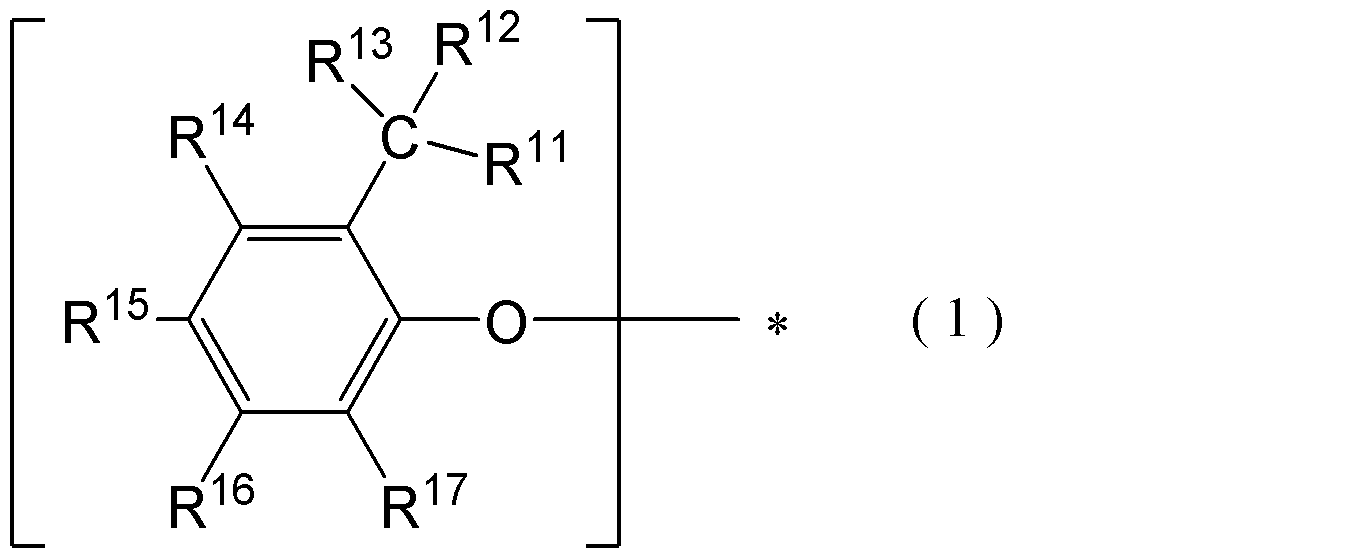
(式(1)中、R11~R13はそれぞれ独立に、炭素数1又は2のアルキル基であり、R14~R17はそれぞれ独立に、水素原子又は炭素数1~10のアルキル基であり、*はリン原子との結合部を表す。)
[7]前記フェノール系酸化防止剤(D)が、その分子中に下記式(2)で示される基を少なくとも1つ含有する、上記[3]~[6]のいずれか1項に記載のLED反射板用ポリエステル組成物。
[7]前記フェノール系酸化防止剤(D)が、その分子中に下記式(2)で示される基を少なくとも1つ含有する、上記[3]~[6]のいずれか1項に記載のLED反射板用ポリエステル組成物。

(式(2)中、R21~R23はそれぞれ独立に、炭素数1又は2のアルキル基であり、R24~R26はそれぞれ独立に、水素原子又は炭素数1~10のアルキル基であり、**は結合部を表す。)
[8]更に、強化材(F)を、該ポリエステル(A)100質量部に対して、5~50質量部含有する、上記[1]~[7]のいずれか1項に記載のLED反射板用ポリエステル組成物。
[9]前記ポリエステル(A)が、テレフタル酸を75~100モル%含むジカルボン酸に由来する構成単位と1,4-シクロヘキサンジメタノールを75~100モル%含むジオールに由来する構成単位とを有するポリシクロヘキサンジメチレンテレフタレートである、上記[1]~[8]のいずれか1項に記載のLED反射板用ポリエステル組成物。
[10]更に、光安定剤(G)を含有する、上記[1]~[9]のいずれか1項に記載のLED反射板用ポリエステル組成物。
[11]上記[1]~[10]のいずれかに記載のLED反射板用ポリエステル組成物からなる、LED反射板。
[12]上記[11]に記載のLED反射板を備える、発光装置。
[8]更に、強化材(F)を、該ポリエステル(A)100質量部に対して、5~50質量部含有する、上記[1]~[7]のいずれか1項に記載のLED反射板用ポリエステル組成物。
[9]前記ポリエステル(A)が、テレフタル酸を75~100モル%含むジカルボン酸に由来する構成単位と1,4-シクロヘキサンジメタノールを75~100モル%含むジオールに由来する構成単位とを有するポリシクロヘキサンジメチレンテレフタレートである、上記[1]~[8]のいずれか1項に記載のLED反射板用ポリエステル組成物。
[10]更に、光安定剤(G)を含有する、上記[1]~[9]のいずれか1項に記載のLED反射板用ポリエステル組成物。
[11]上記[1]~[10]のいずれかに記載のLED反射板用ポリエステル組成物からなる、LED反射板。
[12]上記[11]に記載のLED反射板を備える、発光装置。
本発明によれば、高い光反射率を有し、LEDパッケージの製造工程や使用環境で想定される熱に晒された場合にも、光反射率の低下が少なく、高い光反射率を維持できるLED反射板用ポリエステル組成物、該組成物を成形して得られる反射板、並びに該反射板を備えた発光装置を提供することができる。
[LED反射板用ポリエステル組成物]
本発明のLED反射板用ポリエステル組成物(以下、「ポリエステル組成物」とも称する)は、LED反射板用ポリエステル組成物であって、該ポリエステル組成物がポリエステル(A)及び酸化チタン(B)を含有し、該ポリエステル(A)が、テレフタル酸を50モル%以上含むジカルボン酸に由来する構成単位と1,4-シクロヘキサンジメタノールを50モル%以上含むジオールに由来する構成単位とを有するポリエステルであり、更に、リン酸、リン酸塩、縮合リン酸、縮合リン酸塩、亜リン酸、亜リン酸塩、次亜リン酸、及び次亜リン酸塩からなる群から選択される1種又は2種以上である無機リン化合物(C)を含有しており、該ポリエステル(A)100質量部に対する該無機リン化合物(C)の含有量は、0.10~3.50質量部である、LED反射板用ポリエステル組成物である。
本発明のLED反射板用ポリエステル組成物(以下、「ポリエステル組成物」とも称する)は、LED反射板用ポリエステル組成物であって、該ポリエステル組成物がポリエステル(A)及び酸化チタン(B)を含有し、該ポリエステル(A)が、テレフタル酸を50モル%以上含むジカルボン酸に由来する構成単位と1,4-シクロヘキサンジメタノールを50モル%以上含むジオールに由来する構成単位とを有するポリエステルであり、更に、リン酸、リン酸塩、縮合リン酸、縮合リン酸塩、亜リン酸、亜リン酸塩、次亜リン酸、及び次亜リン酸塩からなる群から選択される1種又は2種以上である無機リン化合物(C)を含有しており、該ポリエステル(A)100質量部に対する該無機リン化合物(C)の含有量は、0.10~3.50質量部である、LED反射板用ポリエステル組成物である。
本発明のポリエステル組成物によると、高い光反射率を有し、LEDパッケージの製造工程や使用環境で想定される熱に晒された場合にも、光反射率の低下が少なく、高い光反射率を維持できる。
このような効果が得られる理由については定かではないが、無機リン化合物(C)が、ポリエステル(A)の末端カルボキシ基を安定化させることにより、ポリエステルの熱変色が抑制され、その結果光反射率の低下が抑制されるものと考えられる。
なお、無機リン化合物(C)の含有量が、ポリエステル(A)100質量部に対して、0.10質量部未満であると、当該効果がほとんど発現しない。
また、無機リン化合物(C)の含有量が3.50質量部を超えると、ポリエステル組成物の流動性が悪化し、成形に不利となる。この理由についても定かではないが、無機リン化合物(C)が、ポリエステル(A)の末端カルボキシ基と反応することにより分子量が過剰に大きくなりやすく、流動性が悪くなるものと考えられる。なお、流動性の悪化は溶融混練時の発熱量の増加およびそれに伴うポリエステル組成物の劣化を引き起こし、加熱後の光反射率低下の一因ともなる。
このような効果が得られる理由については定かではないが、無機リン化合物(C)が、ポリエステル(A)の末端カルボキシ基を安定化させることにより、ポリエステルの熱変色が抑制され、その結果光反射率の低下が抑制されるものと考えられる。
なお、無機リン化合物(C)の含有量が、ポリエステル(A)100質量部に対して、0.10質量部未満であると、当該効果がほとんど発現しない。
また、無機リン化合物(C)の含有量が3.50質量部を超えると、ポリエステル組成物の流動性が悪化し、成形に不利となる。この理由についても定かではないが、無機リン化合物(C)が、ポリエステル(A)の末端カルボキシ基と反応することにより分子量が過剰に大きくなりやすく、流動性が悪くなるものと考えられる。なお、流動性の悪化は溶融混練時の発熱量の増加およびそれに伴うポリエステル組成物の劣化を引き起こし、加熱後の光反射率低下の一因ともなる。
<ポリエステル(A)>
本発明のポリエステル組成物は、ポリエステル(A)を含有し、該ポリエステル(A)は、テレフタル酸を50モル%以上含むジカルボン酸に由来する構成単位と1,4-シクロヘキサンジメタノールを50モル%以上含むジオールに由来する構成単位とを有するものである。前記ポリエステル(A)を含有することにより、高い耐熱性及び光反射率を有し、熱に晒された後においても光反射率の低下が少なく、高い光反射率を維持する反射板を得ることができる。
前記ポリエステル(A)における、前記ジカルボン酸に由来する構成単位と前記ジオールに由来する構成単位との合計含有量は、耐熱性向上の観点から、好ましくは85モル%以上、より好ましくは90モル%以上である。
以下、ポリエステル(A)についてより詳細に説明する。
本発明のポリエステル組成物は、ポリエステル(A)を含有し、該ポリエステル(A)は、テレフタル酸を50モル%以上含むジカルボン酸に由来する構成単位と1,4-シクロヘキサンジメタノールを50モル%以上含むジオールに由来する構成単位とを有するものである。前記ポリエステル(A)を含有することにより、高い耐熱性及び光反射率を有し、熱に晒された後においても光反射率の低下が少なく、高い光反射率を維持する反射板を得ることができる。
前記ポリエステル(A)における、前記ジカルボン酸に由来する構成単位と前記ジオールに由来する構成単位との合計含有量は、耐熱性向上の観点から、好ましくは85モル%以上、より好ましくは90モル%以上である。
以下、ポリエステル(A)についてより詳細に説明する。
前記ポリエステル(A)は、ジカルボン酸に由来する構成単位を含み、該ジカルボン酸におけるテレフタル酸の含有率が50モル%以上である。これにより、得られる反射板の耐熱性が向上する。前記ジカルボン酸におけるテレフタル酸単位の含有率は、好ましくは60モル%以上、より好ましくは75モル%以上、更に好ましくは90モル%以上である。
前記ポリエステル(A)を構成するジカルボン酸は、50モル%未満の範囲で、テレフタル酸以外の他のジカルボン酸を含んでもよい。かかる他のジカルボン酸としては、例えば、マロン酸、コハク酸、グルタル酸、アジピン酸、ピメリン酸、スベリン酸、アゼライン酸、セバシン酸等の脂肪族ジカルボン酸;1,3-シクロペンタンジカルボン酸、1,4-シクロヘキサンジカルボン酸等の脂環式ジカルボン酸;イソフタル酸、2,6-ナフタレンジカルボン酸、2,7-ナフタレンジカルボン酸、1,4-ナフタレンジカルボン酸、1,4-フェニレンジオキシジ酢酸、1,3-フェニレンジオキシジ酢酸、ジフェン酸、ジフェニルメタン-4,4’-ジカルボン酸、ジフェニルスルホン-4,4’-ジカルボン酸、4,4’-ビフェニルジカルボン酸等の芳香族ジカルボン酸などを挙げることができ、これらのうちの1種又は2種以上を含むことができる。かかる他のジカルボン酸としては、イソフタル酸が好適である。ジカルボン酸におけるこれらの他のジカルボン酸の含有率は、好ましくは25モル%以下、より好ましくは10モル%以下である。
更に、前記ポリエステル(A)は、トリメリット酸、トリメシン酸、ピロメリット酸等の多価カルボン酸に由来する構成単位を溶融成形が可能な範囲内で含んでいてもよい。
ポリエステル(A)を構成するモノマーの総量における、ジカルボン酸及びジオールの合計量は、好ましくは60質量%以上、より好ましくは80質量%以上、更に好ましくは90質量%以上、より更に好ましくは95質量%以上、特に好ましくは100質量%である。
更に、前記ポリエステル(A)は、トリメリット酸、トリメシン酸、ピロメリット酸等の多価カルボン酸に由来する構成単位を溶融成形が可能な範囲内で含んでいてもよい。
ポリエステル(A)を構成するモノマーの総量における、ジカルボン酸及びジオールの合計量は、好ましくは60質量%以上、より好ましくは80質量%以上、更に好ましくは90質量%以上、より更に好ましくは95質量%以上、特に好ましくは100質量%である。
前記ポリエステル(A)は、ジオールに由来する構成単位を含み、該ジオールにおける1,4-シクロヘキサンジメタノールの含有率が50モル%以上である。これにより、得られる反射板の成形性及び耐熱性が向上し、高い光反射率を有し、熱に晒された後においても光反射率の低下が少なく、高い光反射率を維持することができる。前記ジオールにおける1,4-シクロヘキサンジメタノールの含有率は、好ましくは60モル%以上、より好ましくは75モル%以上、更に好ましくは90モル%以上であり、そして、好ましくは100モル%以下である。
耐熱性の観点から、1,4-シクロヘキサンジメタノールのトランス異性体比率は高いことが好ましい。トランス異性体の比率は、好ましくは50~100質量%、より好ましくは60~100質量%である。
耐熱性の観点から、1,4-シクロヘキサンジメタノールのトランス異性体比率は高いことが好ましい。トランス異性体の比率は、好ましくは50~100質量%、より好ましくは60~100質量%である。
前記ポリエステル(A)を構成するジオールは、50モル%未満の範囲で、1,4-シクロヘキサンジメタノール以外の他のジオールを含んでもよい。かかる他のジオールとしては、例えば、エチレングリコール、1,2-プロパンジオール、1,3-プロパンジオール、1,2-ブタンジオール、1,3-ブタンジオール、1,4-ブタンジオール、2,3-ブタンジオール、ネオペンチルグリコール、1,4-ブテンジオール、1,5-ペンタンジオール、1,6-ヘキサンジオール、1,8-オクタンジオール、1,9-ノナンジオール、1,10-デカンジオール、1,12-ドデカンジオール等の脂肪族ジオール;1,4-シクロヘキサンジオール、水素添加ビスフェノールA(2,2-ビス(4-ヒドロキシシクロヘキシル)プロパン)、及びそれらの炭素数2以上4以下のアルキレンオキサイド(平均付加モル数2以上12以下)付加物等の1,4-シクロヘキサンジメタノール以外の脂環式ジオール;ヒドロキノン、ビス(4-ヒドロキシフェニル)メタン、2,2-ビス(4-ヒドロキシフェニル)プロパン、1,5-ジヒドロキシナフタレン等の芳香族ジオールなどを挙げることができ、これらのうちの1種又は2種以上を含むことができる。ジオールにおけるこれらの他のジオールの含有率は、好ましくは25モル%以下であり、より好ましくは10モル%以下である。
更に、前記ポリエステル(A)は、トリメチロールプロパン、グリセロール、ペンタエリスリトール等の3価以上の多価アルコールに由来する構成単位を溶融成形が可能な範囲内で含んでいてもよい。
更に、前記ポリエステル(A)は、トリメチロールプロパン、グリセロール、ペンタエリスリトール等の3価以上の多価アルコールに由来する構成単位を溶融成形が可能な範囲内で含んでいてもよい。
前記ポリエステル(A)は、テレフタル酸を75~100モル%含むジカルボン酸に由来する構成単位と1,4-シクロヘキサンジメタノールを75~100モル%含むジオールに由来する構成単位とを有するポリシクロヘキサンジメチレンテレフタレートであることが好ましい。これにより、高い耐熱性及び光反射率を有し、熱に晒された後においても光反射率の低下が少なく、高い光反射率を維持する反射板を得ることができる。
本発明に用いるポリエステル(A)の融点は、好ましくは250~350℃、より好ましくは260~320℃、更に好ましくは270~300℃、より更に好ましくは280~290℃である。融点が250℃以上であるとポリエステル(A)による靱性効果が十分に発揮され、また、350℃以下であると流動性が低下することなく良好な成形性を得ることができる。なお、融点は、実施例に記載した方法により測定することができる。
本発明に用いるポリエステル(A)は、ポリエステルを製造する方法として知られている任意の方法を用いて製造できる。例えば、必要に応じてチタン化合物、リン化合物等の触媒、分子量調整剤等を添加し、ジカルボン酸成分とジオール成分とを縮重合反応させることにより製造することができる。
なお、触媒としてリン化合物を用いると、製造されたポリエステル(A)中にリン化合物が残留する場合があるが、その場合のリン化合物の残留量は、ポリエステル(A)中、通常は0.05質量%未満であり、例えば0.01質量%以下である。
縮重合反応に供されるジカルボン酸成分とジオール成分とのモル比(ジカルボン酸成分/ジオール成分)は、成形性向上の観点、並びに光反射率の向上の観点から、好ましくは0.80~0.99であり、より好ましくは0.83~0.99であり、更に好ましくは0.85~0.99である。
なお、触媒としてリン化合物を用いると、製造されたポリエステル(A)中にリン化合物が残留する場合があるが、その場合のリン化合物の残留量は、ポリエステル(A)中、通常は0.05質量%未満であり、例えば0.01質量%以下である。
縮重合反応に供されるジカルボン酸成分とジオール成分とのモル比(ジカルボン酸成分/ジオール成分)は、成形性向上の観点、並びに光反射率の向上の観点から、好ましくは0.80~0.99であり、より好ましくは0.83~0.99であり、更に好ましくは0.85~0.99である。
<酸化チタン(B)>
本発明のポリエステル組成物は、酸化チタン(B)を含有する。
前記酸化チタン(B)は、得られる反射板に対して光反射性を付与するものであって、該酸化チタンを含むことにより、該反射板の熱伝導性及び耐熱性が向上し、熱に晒された後においても光反射率の低下が少なく、高い光反射率を維持することができる。
前記酸化チタン(B)としては、一酸化チタン(TiO)、三酸化チタン(Ti2O3)、二酸化チタン(TiO2)等が挙げられ、これらのいずれを使用してもよいが、二酸化チタンが好ましい。二酸化チタンとしては、ルチル型又はアナターゼ型の結晶構造を有するものが好ましく、ルチル型の結晶構造を有するものがより好ましい。
前記酸化チタン(B)の平均粒径は、光反射率の向上の観点から、好ましくは0.10~0.50μm、より好ましくは0.15~0.40μm、更に好ましくは0.20~0.30μmである。酸化チタン(B)の平均粒径は、電子顕微鏡法を用いた画像解析により求めることができる。具体的には、透過型電子顕微鏡を用いて撮影した酸化チタン粒子1,000個以上について長径と短径を測定し、その平均値を平均粒径とする。
前記酸化チタン(B)の形状は、特に限定されないが、その凝集形状は不定形であることが好ましい。不定形の酸化チタン(B)を用いた場合には、得られる反射板の寸法変化率及び寸法変化率の異方性が小さく、LEDパッケージ製造時の封止部材との剥離を抑制することができる。
前記酸化チタン(B)は、ポリエステル組成物中への分散性を高める観点から、表面処理を施したものを使用してもよい。表面処理剤としては、例えば、シリカ、アルミナ、ジルコニア、酸化錫、酸化アンチモン、酸化亜鉛等の金属酸化物;シランカップリング剤、シリコーン等の有機珪素化合物;チタンカップリング剤等の有機チタン化合物;有機酸、ポリオール等の有機物等が挙げられる。
本発明のポリエステル組成物は、酸化チタン(B)を含有する。
前記酸化チタン(B)は、得られる反射板に対して光反射性を付与するものであって、該酸化チタンを含むことにより、該反射板の熱伝導性及び耐熱性が向上し、熱に晒された後においても光反射率の低下が少なく、高い光反射率を維持することができる。
前記酸化チタン(B)としては、一酸化チタン(TiO)、三酸化チタン(Ti2O3)、二酸化チタン(TiO2)等が挙げられ、これらのいずれを使用してもよいが、二酸化チタンが好ましい。二酸化チタンとしては、ルチル型又はアナターゼ型の結晶構造を有するものが好ましく、ルチル型の結晶構造を有するものがより好ましい。
前記酸化チタン(B)の平均粒径は、光反射率の向上の観点から、好ましくは0.10~0.50μm、より好ましくは0.15~0.40μm、更に好ましくは0.20~0.30μmである。酸化チタン(B)の平均粒径は、電子顕微鏡法を用いた画像解析により求めることができる。具体的には、透過型電子顕微鏡を用いて撮影した酸化チタン粒子1,000個以上について長径と短径を測定し、その平均値を平均粒径とする。
前記酸化チタン(B)の形状は、特に限定されないが、その凝集形状は不定形であることが好ましい。不定形の酸化チタン(B)を用いた場合には、得られる反射板の寸法変化率及び寸法変化率の異方性が小さく、LEDパッケージ製造時の封止部材との剥離を抑制することができる。
前記酸化チタン(B)は、ポリエステル組成物中への分散性を高める観点から、表面処理を施したものを使用してもよい。表面処理剤としては、例えば、シリカ、アルミナ、ジルコニア、酸化錫、酸化アンチモン、酸化亜鉛等の金属酸化物;シランカップリング剤、シリコーン等の有機珪素化合物;チタンカップリング剤等の有機チタン化合物;有機酸、ポリオール等の有機物等が挙げられる。
<無機リン化合物(C)>
本発明のポリエステル組成物は、リン酸、リン酸塩、縮合リン酸、縮合リン酸塩、亜リン酸、亜リン酸塩、次亜リン酸、及び次亜リン酸塩からなる群から選択される1種又は2種以上である無機リン化合物(C)を含有する。
これにより、該組成物を成形して得られるLED反射板は、黄変等の変色や白色度の低下を抑制することができ、特にLEDパッケージの製造工程や使用環境で想定される熱に晒された場合にも、光反射率の低下が少なく、高い光反射率を維持することができる。この理由については定かではないが、無機リン化合物(C)が、ポリエステル(A)の末端カルボキシ基の安定化に寄与するためであると考えられる。
本発明のポリエステル組成物は、リン酸、リン酸塩、縮合リン酸、縮合リン酸塩、亜リン酸、亜リン酸塩、次亜リン酸、及び次亜リン酸塩からなる群から選択される1種又は2種以上である無機リン化合物(C)を含有する。
これにより、該組成物を成形して得られるLED反射板は、黄変等の変色や白色度の低下を抑制することができ、特にLEDパッケージの製造工程や使用環境で想定される熱に晒された場合にも、光反射率の低下が少なく、高い光反射率を維持することができる。この理由については定かではないが、無機リン化合物(C)が、ポリエステル(A)の末端カルボキシ基の安定化に寄与するためであると考えられる。
リン酸及び縮合リン酸、亜リン酸、並びに次亜リン酸としては、特に限定されないが、例えば、リン酸、ピロリン酸、メタリン酸、亜リン酸、次亜リン酸などを挙げることができる。
リン酸塩及び縮合リン酸塩、亜リン酸塩、並びに次亜リン酸塩としては、特に限定されないが、例えば、リン酸の金属塩、ピロリン酸の金属塩、メタリン酸の金属塩、亜リン酸の金属塩、次亜リン酸の金属塩などを挙げることができる。
リン酸塩及び縮合リン酸塩、亜リン酸塩、並びに次亜リン酸塩としては、特に限定されないが、例えば、リン酸の金属塩、ピロリン酸の金属塩、メタリン酸の金属塩、亜リン酸の金属塩、次亜リン酸の金属塩などを挙げることができる。
無機リン化合物(C)を構成する金属としては、特に限定されないが、例えば、周期律表第1族及び第2族、マンガン、亜鉛、アルミニウムを挙げることができる。
無機リン化合物(C)は、無水物が好ましい。
無機リン化合物(C)は、好ましくは次亜リン酸塩であり、より好ましくは次亜リン酸のアルカリ土類金属塩である。
無機リン化合物(C)は、無水物が好ましい。
無機リン化合物(C)は、好ましくは次亜リン酸塩であり、より好ましくは次亜リン酸のアルカリ土類金属塩である。
例えば、無機リン化合物(C)としては、リン酸一ナトリウム、リン酸二ナトリウム、リン酸三ナトリウム、リン酸一カルシウム、リン酸二カルシウム、リン酸三カルシウム、ピロリン酸ナトリウム、メタリン酸ナトリウム、メタリン酸カルシウム、次亜リン酸ナトリウム、次亜リン酸カルシウム等が挙げられる。これらの中でも次亜リン酸ナトリウム及び次亜リン酸カルシウムがより好ましく、次亜リン酸カルシウムがさらに好ましい。
本実施の形態のポリエステル組成物は、耐熱変色性の観点から、後述する有機リン系酸化防止剤(E)を更に含有することができる。
<フェノール系酸化防止剤(D)/有機リン系酸化防止剤(E)>
本発明のポリエステル組成物は、フェノール系酸化防止剤(D)及び有機リン系酸化防止剤(E)からなる群から選択される少なくとも1種を含有することが好ましい。
フェノール系酸化防止剤(D)を含有することにより、熱により発生したラジカルを捕捉し、得られる反射板の光反射率の低下を抑制することができる。有機リン系酸化防止剤(E)を含有することにより、熱により発生した過酸化物を分解することができる。
本発明のポリエステル組成物において、フェノール系酸化防止剤(D)と有機リン系酸化防止剤(E)とを併用することが好ましい。これにより、高い光反射性を有し、熱に晒された後でも高い光反射率を維持できるLED反射板を得ることができる。
本発明のポリエステル組成物は、フェノール系酸化防止剤(D)及び有機リン系酸化防止剤(E)からなる群から選択される少なくとも1種を含有することが好ましい。
フェノール系酸化防止剤(D)を含有することにより、熱により発生したラジカルを捕捉し、得られる反射板の光反射率の低下を抑制することができる。有機リン系酸化防止剤(E)を含有することにより、熱により発生した過酸化物を分解することができる。
本発明のポリエステル組成物において、フェノール系酸化防止剤(D)と有機リン系酸化防止剤(E)とを併用することが好ましい。これにより、高い光反射性を有し、熱に晒された後でも高い光反射率を維持できるLED反射板を得ることができる。
<フェノール系酸化防止剤(D)>
前記フェノール系酸化防止剤(D)としては、光反射率の向上、及び光反射率の低下を抑制する観点から、その分子中に下記式(2)で示される基を少なくとも1つ含有するフェノール系酸化防止剤が好ましい。下記式(2)で示されるように、ヒドロキシ基のオルト位にアルキル基を有することにより、より安定なフェノキシラジカルとなりやすく、熱により発生したラジカルに対してより高い捕捉能力を有する。
前記フェノール系酸化防止剤(D)としては、光反射率の向上、及び光反射率の低下を抑制する観点から、その分子中に下記式(2)で示される基を少なくとも1つ含有するフェノール系酸化防止剤が好ましい。下記式(2)で示されるように、ヒドロキシ基のオルト位にアルキル基を有することにより、より安定なフェノキシラジカルとなりやすく、熱により発生したラジカルに対してより高い捕捉能力を有する。
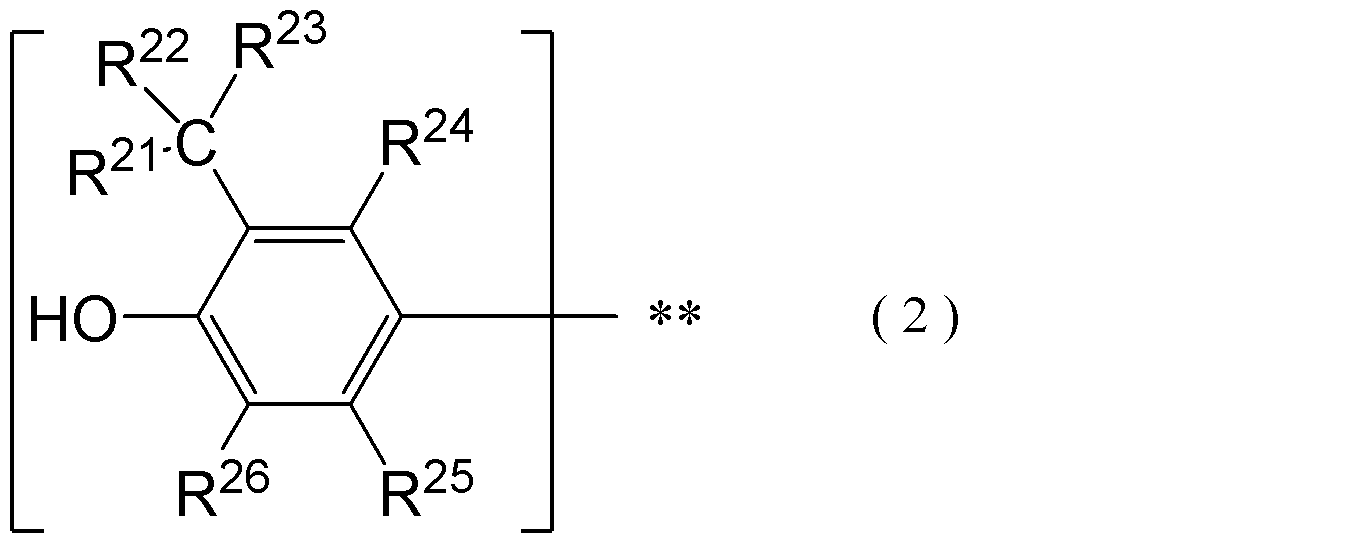
(式(2)中、R21~R23はそれぞれ独立に、炭素数1又は2のアルキル基であり、R24~R26はそれぞれ独立に、水素原子又は炭素数1~10のアルキル基であり、**は結合部を表す。)
前記式(2)中、R21~R23は、光反射率の低下を抑制する観点から、好ましくはメチル基であり、即ち、-C(R21)(R22)(R23)で示される基がt-ブチル基であることが好ましい。
前記式(2)中、R24及びR25は、熱により発生したラジカルを捕捉後生成するフェノキシラジカルの安定性の観点から、好ましくは水素原子又は炭素数1~2のアルキル基であり、より好ましくは水素原子である。
前記式(2)中、R26は、光反射率の低下を抑制する観点から、好ましくは炭素数1~7のアルキル基であり、より好ましくは炭素数1~4のアルキル基であり、更に好ましくはメチル基又はt-ブチル基である。
前記式(2)中、R24及びR25は、熱により発生したラジカルを捕捉後生成するフェノキシラジカルの安定性の観点から、好ましくは水素原子又は炭素数1~2のアルキル基であり、より好ましくは水素原子である。
前記式(2)中、R26は、光反射率の低下を抑制する観点から、好ましくは炭素数1~7のアルキル基であり、より好ましくは炭素数1~4のアルキル基であり、更に好ましくはメチル基又はt-ブチル基である。
前記式(2)で示される基を有するフェノール系酸化防止剤としては、光反射率の向上、及び光反射率の低下を抑制する観点から、R21~R23のすべてがメチル基であり、R26がメチル基又はt-ブチル基であるセミヒンダードタイプ又はフルヒンダードタイプのフェノール系酸化防止剤から選ばれる1種以上が好ましく、具体的には下記式(3)で示されるフェノール性水酸基のオルト位にt-ブチル基を有するフェノール系酸化防止剤がより好ましい。
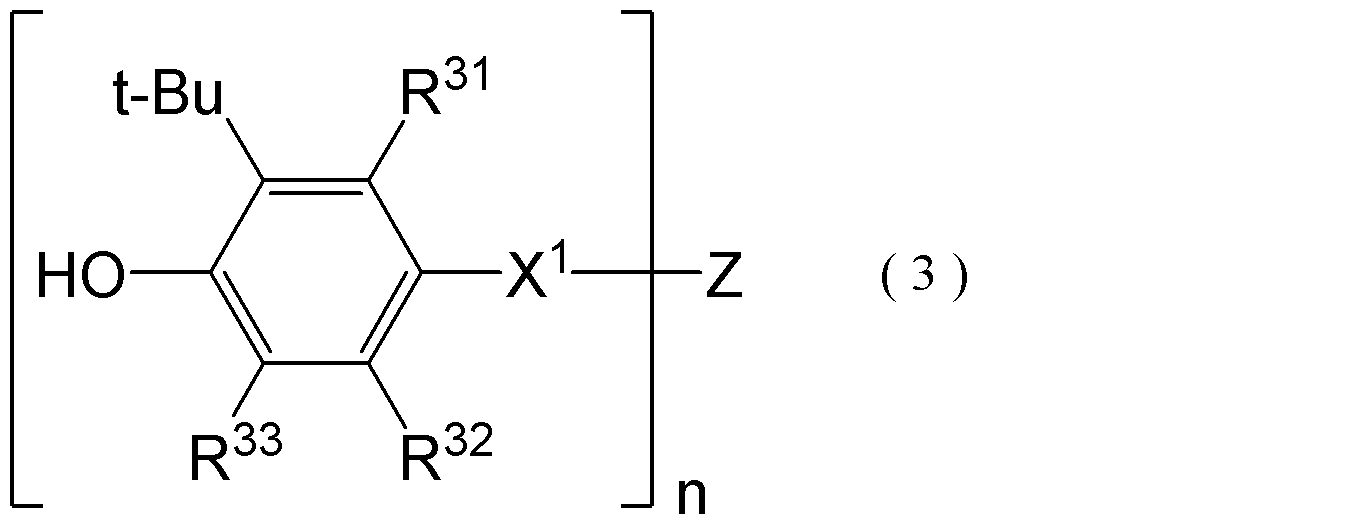
(式(3)中、R31及びR32はそれぞれ独立に、水素原子又はメチル基を表し、R33はメチル基又はt-ブチル基を表し、X1は炭素数1~20の2価の有機基を表し、Zは1~4価の有機基を表す。nは1~4の整数である。)
前記式(3)中、R31及びR32は、熱により発生したラジカルを捕捉後生成するフェノキシラジカルの安定性の観点から、好ましくは水素原子であり、X1は、光反射率の向上、及び光反射率の低下を抑制する観点から、下記式(4)で示される2価の有機基が好ましい。

(式(4)中、R4は単結合又は炭素数1~17のアルキレン基を表し、Yは酸素原子又は-NH-で示される基のいずれかを表す。***は前記式(3)のヒドロキシフェニル基との結合部を表す。)
前記式(3)で示されるフェノール系酸化防止剤は、nが1である場合、Zは1価の有機基であり、フェノール性水酸基のオルト位にt-ブチル基を有する単官能フェノール系酸化防止剤(以下、「単官能フェノール系酸化防止剤」とも称する)である。
本発明に用いる単官能フェノール系酸化防止剤は、光反射率の向上、及び光反射率の低下を抑制する観点から、前記式(4)のYは好ましくは酸素原子であり、R4は好ましくは単結合である。前記式(3)のZは好ましくは炭素数5~25のアルキル基であり、より好ましくは炭素数10~22のアルキル基であり、更に好ましくは炭素数15~20のアルキル基であり、より更に好ましくは炭素数18のアルキル基であり、より更に好ましくはn-オクタデシル基である。
前記単官能フェノール系酸化防止剤としては、n-オクタデシル-3-(3,5-ジ-t-ブチル-4-ヒドロキシフェニル)プロピオネート等が挙げられる。市販のものでは、例えば、「Adekastab AO-50」(商品名、(株)ADEKA製)、「IRGANOX1076」(商品名、BASFジャパン(株)製)等が挙げられる。
本発明に用いる単官能フェノール系酸化防止剤は、光反射率の向上、及び光反射率の低下を抑制する観点から、前記式(4)のYは好ましくは酸素原子であり、R4は好ましくは単結合である。前記式(3)のZは好ましくは炭素数5~25のアルキル基であり、より好ましくは炭素数10~22のアルキル基であり、更に好ましくは炭素数15~20のアルキル基であり、より更に好ましくは炭素数18のアルキル基であり、より更に好ましくはn-オクタデシル基である。
前記単官能フェノール系酸化防止剤としては、n-オクタデシル-3-(3,5-ジ-t-ブチル-4-ヒドロキシフェニル)プロピオネート等が挙げられる。市販のものでは、例えば、「Adekastab AO-50」(商品名、(株)ADEKA製)、「IRGANOX1076」(商品名、BASFジャパン(株)製)等が挙げられる。
前記式(3)で示されるフェノール系酸化防止剤は、nが2である場合、Zは2価の有機基であり、フェノール性水酸基のオルト位にt-ブチル基を有する2官能フェノール系酸化防止剤(以下、「2官能フェノール系酸化防止剤」とも称する)である。
本発明に用いる2官能フェノール系酸化防止剤においては、前記式(4)のR4は好ましくは単結合である。
前記式(4)のYが-NH-で示される基である場合には、光反射率の向上、及び光反射率の低下を抑制する観点から、前記式(3)のZは、好ましくは炭素数1~10の直鎖又は分岐鎖アルキレン基であり、より好ましくは炭素数4~8の直鎖又は分岐鎖アルキレン基であり、更に好ましくは炭素数6のアルキレン基であり、より更に好ましくはn-ヘキシレン基である。
前記式(4)のYが酸素原子である場合には、光反射率の向上、及び光反射率の低下を抑制する観点から、前記式(3)のZは炭素数1~10のアルキレン基、-X2-O-X2-で示されるエーテル基、-X2-S-X2-で示されるチオエーテル基、及び下記式(5)で示されるペンタエリスリトール由来のスピロ骨格を有する2価の有機基から選ばれる1種以上が好ましく、-X2-S-X2-で示されるチオエーテル基、及び下記式(5)で示されるペンタエリスリトール由来のスピロ骨格を有する2価の有機基から選ばれる1種以上がより好ましく、下記式(5)で示されるペンタエリスリトール由来のスピロ骨格を有する2価の有機基が更に好ましい。なお、前記エーテル基、前記チオエーテル基、及び下記式(5)で示される2価の有機基中のX2は、炭素数1~10の直鎖又は分岐鎖のアルキレン基を表す。
本発明に用いる2官能フェノール系酸化防止剤においては、前記式(4)のR4は好ましくは単結合である。
前記式(4)のYが-NH-で示される基である場合には、光反射率の向上、及び光反射率の低下を抑制する観点から、前記式(3)のZは、好ましくは炭素数1~10の直鎖又は分岐鎖アルキレン基であり、より好ましくは炭素数4~8の直鎖又は分岐鎖アルキレン基であり、更に好ましくは炭素数6のアルキレン基であり、より更に好ましくはn-ヘキシレン基である。
前記式(4)のYが酸素原子である場合には、光反射率の向上、及び光反射率の低下を抑制する観点から、前記式(3)のZは炭素数1~10のアルキレン基、-X2-O-X2-で示されるエーテル基、-X2-S-X2-で示されるチオエーテル基、及び下記式(5)で示されるペンタエリスリトール由来のスピロ骨格を有する2価の有機基から選ばれる1種以上が好ましく、-X2-S-X2-で示されるチオエーテル基、及び下記式(5)で示されるペンタエリスリトール由来のスピロ骨格を有する2価の有機基から選ばれる1種以上がより好ましく、下記式(5)で示されるペンタエリスリトール由来のスピロ骨格を有する2価の有機基が更に好ましい。なお、前記エーテル基、前記チオエーテル基、及び下記式(5)で示される2価の有機基中のX2は、炭素数1~10の直鎖又は分岐鎖のアルキレン基を表す。

(式(5)中、X2は炭素数1~10の直鎖又は分岐鎖のアルキレン基を表す。)
前記式(5)のX2は、好ましくは炭素数1~7の直鎖又は分岐鎖のアルキレン基であり、より好ましくは炭素数2~4の直鎖又は分岐鎖のアルキレン基であり、更に好ましくは炭素数4の分岐ブチレン基であり、即ち前記式(5)のX2は下記式(5’)で示されるものが好ましい。
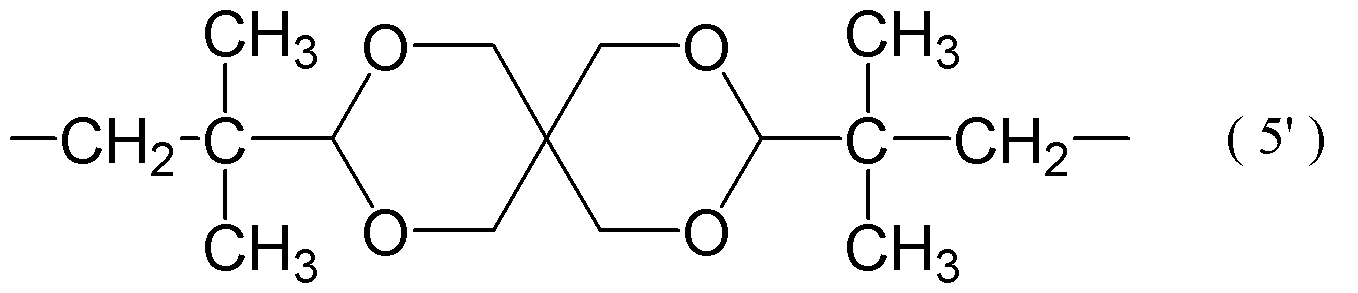
前記2官能フェノール系酸化防止剤として、2,2-チオ-ジエチレンビス[3-(3,5-ジ-t-ブチル-4-ヒドロキシフェニル)プロピオネート]、N,N’-ヘキサメチレンビス[3-(3,5-ジ-t-ブチル-4-ヒドロキシフェニル)プロピオンアミド]、トリエチレングリコールビス[(3-t-ブチル-4-ヒドロキシ-5-メチルフェニル)プロピオネート]、ヘキサメチレンビス[3-(3,5-ジ-t-ブチル-4-ヒドロキシフェニル)プロピオネート]、3,9-ビス[2-〔3-(3-t-ブチル-4-ヒドロキシ-5-メチルフェニル)プロピオニルオキシ〕-1,1-ジメチルエチル]-2,4,8,10-テトラオキサスピロ[5.5]ウンデカン等が挙げられる。市販のものでは、例えば、「IRGANOX1035」、「IRGANOX1098」、「IRGANOX245」、「IRGANOX259」(商品名、いずれもBASFジャパン(株)製)、「Adekastab AO-80」(商品名、(株)ADEKA製)、「Sumilizer GA-80」(商品名、住友化学(株)製)等が挙げられる。
前記式(3)で示されるフェノール系酸化防止剤は、nが3である場合、Zは3価の有機基であり、フェノール性水酸基のオルト位にt-ブチル基を有する3官能フェノール系酸化防止剤(以下、「3官能フェノール系酸化防止剤」とも称する)である。
前記3官能フェノール系酸化防止剤として、トリス(3,5-ジ-t-ブチル-4-ヒドロキシベンジル)イソシアヌレイト、1,3,5-トリメチル-2,4,6-トリス(3,5-ジ-t-ブチル-4-ヒドロキシベンジル)ベンゼン等が挙げられる。市販のものでは、例えば、「Adekastab AO-20」(商品名、(株)ADEKA製)、「Adekastab AO-330」(商品名、(株)ADEKA製)等が挙げられる。
前記3官能フェノール系酸化防止剤として、トリス(3,5-ジ-t-ブチル-4-ヒドロキシベンジル)イソシアヌレイト、1,3,5-トリメチル-2,4,6-トリス(3,5-ジ-t-ブチル-4-ヒドロキシベンジル)ベンゼン等が挙げられる。市販のものでは、例えば、「Adekastab AO-20」(商品名、(株)ADEKA製)、「Adekastab AO-330」(商品名、(株)ADEKA製)等が挙げられる。
前記式(3)で示されるフェノール系酸化防止剤は、nが4である場合、Zは4価の有機基であり、フェノール性水酸基のオルト位にt-ブチル基を有する4官能フェノール系酸化防止剤(以下、「4官能フェノール系酸化防止剤」とも称する)である。
本発明に用いる4官能フェノール系酸化防止剤は、光反射率の向上、及び光反射率の低下を抑制する観点から、前記式(4)のYは好ましくは酸素原子であり、R4は好ましくは炭素数1~7のアルキレン基であり、より好ましくは炭素数1~3のアルキレン基であり、更に好ましくはメチレン基である。
前記式(3)のZは、光反射率の向上、及び光反射率の低下を抑制する観点から、好ましくは炭素原子である。
前記4官能フェノール系酸化防止剤として、ペンタエリスリチル-テトラキス[3-(3,5-ジ-t-ブチル-4-ヒドロキシフェニル)プロピオネート]等が挙げられる。市販のものでは、例えば、「Adekastab AO-60」(商品名、(株)ADEKA製)、「IRGANOX1010」(商品名、BASFジャパン(株)製)等が挙げられる。
本発明に用いる4官能フェノール系酸化防止剤は、光反射率の向上、及び光反射率の低下を抑制する観点から、前記式(4)のYは好ましくは酸素原子であり、R4は好ましくは炭素数1~7のアルキレン基であり、より好ましくは炭素数1~3のアルキレン基であり、更に好ましくはメチレン基である。
前記式(3)のZは、光反射率の向上、及び光反射率の低下を抑制する観点から、好ましくは炭素原子である。
前記4官能フェノール系酸化防止剤として、ペンタエリスリチル-テトラキス[3-(3,5-ジ-t-ブチル-4-ヒドロキシフェニル)プロピオネート]等が挙げられる。市販のものでは、例えば、「Adekastab AO-60」(商品名、(株)ADEKA製)、「IRGANOX1010」(商品名、BASFジャパン(株)製)等が挙げられる。
本発明に用いるフェノール系酸化防止剤(D)は、光反射率の向上、及び光反射率の低下を抑制する観点から、n-オクタデシル-3-(3,5-ジ-t-ブチル-4-ヒドロキシフェニル)プロピオネート(IRGANOX1076)、N,N’-ヘキサメチレンビス[3-(3,5-ジ-t-ブチル-4-ヒドロキシフェニル)プロピオンアミド](IRGANOX1098)、2,2-チオ-ジエチレンビス[3-(3,5-ジ-t-ブチル-4-ヒドロキシフェニル)プロピオネート](IRGANOX1035)、3,9-ビス[2-〔3-(3-t-ブチル-4-ヒドロキシ-5-メチルフェニル)プロピオニルオキシ〕-1,1-ジメチルエチル]-2,4,8,10-テトラオキサスピロ[5.5]ウンデカン(Sumilizer GA-80)、及びペンタエリスリチル-テトラキス[3-(3,5-ジ-t-ブチル-4-ヒドロキシフェニル)プロピオネート](IRGANOX1010)から選ばれる1種以上が好ましく、n-オクタデシル-3-(3,5-ジ-t-ブチル-4-ヒドロキシフェニル)プロピオネート(IRGANOX1076)、3,9-ビス[2-〔3-(3-t-ブチル-4-ヒドロキシ-5-メチルフェニル)プロピオニルオキシ〕-1,1-ジメチルエチル]-2,4,8,10-テトラオキサスピロ[5.5]ウンデカン(Sumilizer GA-80)、及びペンタエリスリチル-テトラキス[3-(3,5-ジ-t-ブチル-4-ヒドロキシフェニル)プロピオネート](IRGANOX1010)から選ばれる1種以上がより好ましく、3,9-ビス[2-〔3-(3-t-ブチル-4-ヒドロキシ-5-メチルフェニル)プロピオニルオキシ〕-1,1-ジメチルエチル]-2,4,8,10-テトラオキサスピロ[5.5]ウンデカン(Sumilizer GA-80)及びペンタエリスリチル-テトラキス[3-(3,5-ジ-t-ブチル-4-ヒドロキシフェニル)プロピオネート](IRGANOX1010)から選ばれる1種以上が更に好ましい。
これらのフェノール系酸化防止剤は、単独で又は2種以上を組み合わせて用いることができる。
これらのフェノール系酸化防止剤は、単独で又は2種以上を組み合わせて用いることができる。
<有機リン系酸化防止剤(E)>
本発明のポリエステル組成物は、有機リン系酸化防止剤(E)(以下、「(E)成分」とも称する)を含有することが好ましい。また、該有機リン系酸化防止剤(E)は、その分子中に下記式(1)で示される基を3つ以上含有することが好ましい。
前記有機リン系酸化防止剤(E)を含有することにより、熱により発生した過酸化物を分解し、前記フェノール系酸化防止剤(D)と併用することにより、高い光反射性を有し、熱に晒された後でも光反射率の低下が少ない反射板が得られる。下記式(1)で示されるように、リン原子との結合部に隣接するオルト位にアルキル基を有することにより、熱により発生した過酸化物に対してより高い分解能力を有する。
本発明のポリエステル組成物は、有機リン系酸化防止剤(E)(以下、「(E)成分」とも称する)を含有することが好ましい。また、該有機リン系酸化防止剤(E)は、その分子中に下記式(1)で示される基を3つ以上含有することが好ましい。
前記有機リン系酸化防止剤(E)を含有することにより、熱により発生した過酸化物を分解し、前記フェノール系酸化防止剤(D)と併用することにより、高い光反射性を有し、熱に晒された後でも光反射率の低下が少ない反射板が得られる。下記式(1)で示されるように、リン原子との結合部に隣接するオルト位にアルキル基を有することにより、熱により発生した過酸化物に対してより高い分解能力を有する。

(式(1)中、R11~R13はそれぞれ独立に、炭素数1又は2のアルキル基であり、R14~R17はそれぞれ独立に、水素原子又は炭素数1~10のアルキル基であり、*はリン原子との結合部を表す。)
前記式(1)中、R11~R13は、光反射率の低下を抑制する観点から、好ましくはメチル基であり、即ち、-C(R11)(R12)(R13)で示される基がt-ブチル基であることが好ましい。
前記式(1)中、R15は、好ましくは炭素数3~7の2級又は3級アルキル基であり、より好ましくは炭素数4又は5の3級アルキル基であり、更に好ましくはt-ブチル基である。
前記式(1)中、R14及びR16はそれぞれ独立に、立体障害を少なくし、熱により発生した過酸化物との反応性を向上させる観点から、好ましくは水素原子又は炭素数1~2のアルキル基であり、より好ましくは水素原子である。
前記式(1)中、R17は、立体障害を少なくし、熱により発生した過酸化物との反応性を向上させる観点から、好ましくは水素原子又は炭素数1~7のアルキル基であり、より好ましくは水素原子である。
前記式(1)中、R15は、好ましくは炭素数3~7の2級又は3級アルキル基であり、より好ましくは炭素数4又は5の3級アルキル基であり、更に好ましくはt-ブチル基である。
前記式(1)中、R14及びR16はそれぞれ独立に、立体障害を少なくし、熱により発生した過酸化物との反応性を向上させる観点から、好ましくは水素原子又は炭素数1~2のアルキル基であり、より好ましくは水素原子である。
前記式(1)中、R17は、立体障害を少なくし、熱により発生した過酸化物との反応性を向上させる観点から、好ましくは水素原子又は炭素数1~7のアルキル基であり、より好ましくは水素原子である。
前記有機リン系酸化防止剤(E)としては、光反射率の低下を抑制する観点から、その分子中に前記式(1)で示される基を3つ以上含有する亜リン酸エステル及び亜ホスホン酸エステルから選ばれる1種以上が好ましく、下記一般式(6)~(7)で示される有機リン系酸化防止剤から選ばれる1種以上がより好ましい。
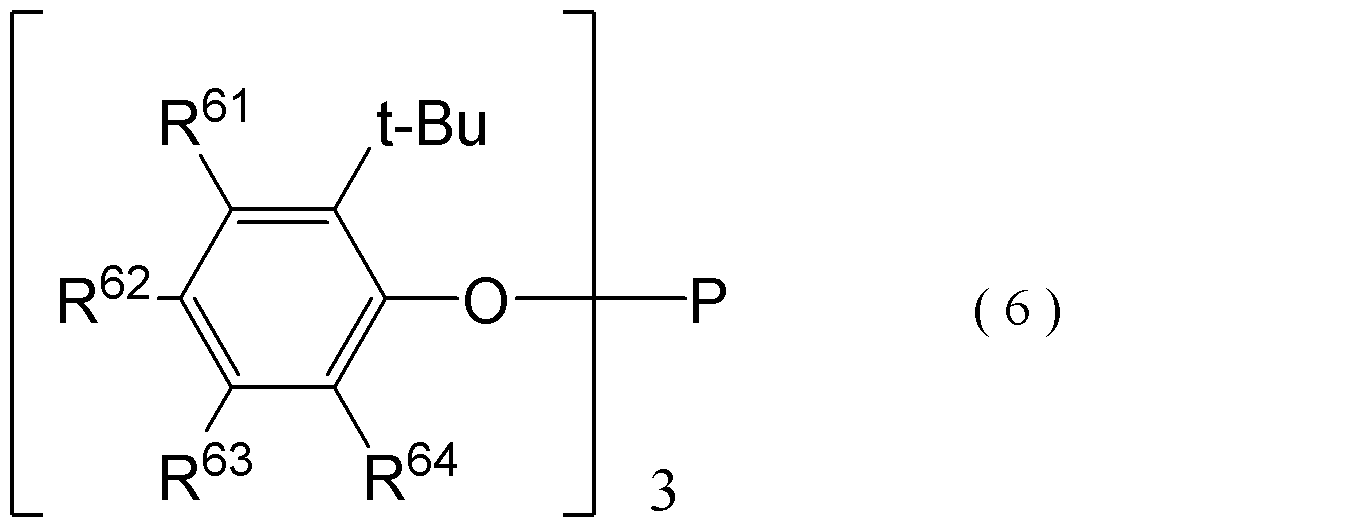
(式(6)中、R61、R63、及びR64はそれぞれ独立に、水素原子又はメチル基を表し、R62は炭素数1~10のアルキル基を表す。)
前記式(6)中、R62は、好ましくは炭素数3~7の2級又は3級アルキル基であり、より好ましくは炭素数4又は5の3級アルキル基であり、更に好ましくはt-ブチル基である。
前記式(6)中、R61、R63、及びR64は、立体障害を少なくし、熱により発生した過酸化物との反応性を向上させる観点から、好ましくは水素原子である。
前記式(6)で示される有機リン系酸化防止剤としては、トリス(2,4-ジ-t-ブチルフェニル)ホスファイトが好ましい。市販のものでは、例えば、「IRGAFOS168」(商品名、BASFジャパン(株)製)等が挙げられる。
前記式(6)中、R61、R63、及びR64は、立体障害を少なくし、熱により発生した過酸化物との反応性を向上させる観点から、好ましくは水素原子である。
前記式(6)で示される有機リン系酸化防止剤としては、トリス(2,4-ジ-t-ブチルフェニル)ホスファイトが好ましい。市販のものでは、例えば、「IRGAFOS168」(商品名、BASFジャパン(株)製)等が挙げられる。

(式(7)中、R71、R73、R74、R75、R77、及びR78はそれぞれ独立に、水素原子又はメチル基を表し、R72及びR76はそれぞれ独立に、炭素数1~10のアルキル基を表す。X3は単結合、-O-、-S-、-SO2-又は炭素数1~10の2価の有機基を示す。)
前記式(7)中、R72及びR76は、好ましくは炭素数3~7のアルキル基の2級又は3級アルキル基であり、より好ましくは炭素数4又は5の3級アルキル基であり、更に好ましくはt-ブチル基である。
前記式(7)中、R71、R73、R74、R75、R77、及びR78は、好ましくは水素原子である。
前記式(7)中、2価の有機基であるX3は、好ましくは単結合である。
前記式(7)で示される有機リン系酸化防止剤としては、テトラキス(2,4-ジ-t-ブチルフェニル)-4,4’-ビフェニレンホスホナイト、テトラキス(2,4-ジ-t-ブチル-5-メチルフェニル)-4,4’-ビフェニレンホスホナイト等が挙げられ、光反射率の向上、及び光反射率の低下を抑制する観点から、テトラキス(2,4-ジ-t-ブチルフェニル)-4,4’-ビフェニレンホスホナイトが好ましい。
市販のものでは、例えば、「Hostanox P-EPQ」(商品名、クラリアントジャパン(株)製)、「GSY-P101」(商品名、堺化学工業(株)製)等が挙げられる。
これらの有機リン系酸化防止剤は、単独で又は2種以上を組み合わせて用いることができる。
前記式(7)中、R71、R73、R74、R75、R77、及びR78は、好ましくは水素原子である。
前記式(7)中、2価の有機基であるX3は、好ましくは単結合である。
前記式(7)で示される有機リン系酸化防止剤としては、テトラキス(2,4-ジ-t-ブチルフェニル)-4,4’-ビフェニレンホスホナイト、テトラキス(2,4-ジ-t-ブチル-5-メチルフェニル)-4,4’-ビフェニレンホスホナイト等が挙げられ、光反射率の向上、及び光反射率の低下を抑制する観点から、テトラキス(2,4-ジ-t-ブチルフェニル)-4,4’-ビフェニレンホスホナイトが好ましい。
市販のものでは、例えば、「Hostanox P-EPQ」(商品名、クラリアントジャパン(株)製)、「GSY-P101」(商品名、堺化学工業(株)製)等が挙げられる。
これらの有機リン系酸化防止剤は、単独で又は2種以上を組み合わせて用いることができる。
前記有機リン系酸化防止剤(E)としては、光反射率の低下を抑制する観点から、トリス(2,4-ジ-t-ブチルフェニル)ホスファイト(「IRGAFOS168」)、及びテトラキス(2,4-ジ-t-ブチルフェニル)-4,4’-ビフェニレンホスホナイト(「Hostanox P-EPQ」)から選ばれる1種以上が好ましく、テトラキス(2,4-ジ-t-ブチルフェニル)-4,4’-ビフェニレンホスホナイト(「Hostanox P-EPQ」)がより好ましい。
前記フェノール系酸化防止剤(D)及び前記有機リン系酸化防止剤(E)の好適な組合せとしては、光反射率の向上、及び光反射率の低下を抑制する観点から、n-オクタデシル-3-(3,5-ジ-t-ブチル-4-ヒドロキシフェニル)プロピオネート(IRGANOX1076)、N,N’-ヘキサメチレンビス[3-(3,5-ジ-t-ブチル-4-ヒドロキシフェニル)プロピオンアミド](IRGANOX1098)、2,2-チオ-ジエチレンビス[3-(3,5-ジ-t-ブチル-4-ヒドロキシフェニル)プロピオネート](IRGANOX1035)、3,9-ビス[2-〔3-(3-t-ブチル-4-ヒドロキシ-5-メチルフェニル)プロピオニルオキシ〕-1,1-ジメチルエチル]-2,4,8,10-テトラオキサスピロ[5.5]ウンデカン(Sumilizer GA-80)、及びペンタエリスリチル-テトラキス[3-(3,5-ジ-t-ブチル-4-ヒドロキシフェニル)プロピオネート](IRGANOX1010)から選ばれる1種以上のフェノール系酸化防止剤と、トリス(2,4-ジ-t-ブチルフェニル)ホスファイト(IRGAFOS168)、及びテトラキス(2,4-ジ-t-ブチルフェニル)-4,4’-ビフェニレンホスホナイト(Hostanox P-EPQ)から選ばれる1種以上の有機リン系酸化防止剤との組合せが好ましく、n-オクタデシル-3-(3,5-ジ-t-ブチル-4-ヒドロキシフェニル)プロピオネート(IRGANOX1076)とテトラキス(2,4-ジ-t-ブチルフェニル)-4,4’-ビフェニレンホスホナイト(Hostanox P-EPQ)との組合せ、3,9-ビス[2-〔3-(3-t-ブチル-4-ヒドロキシ-5-メチルフェニル)プロピオニルオキシ〕-1,1-ジメチルエチル]-2,4,8,10-テトラオキサスピロ[5.5]ウンデカン(Sumilizer GA-80)とテトラキス(2,4-ジ-t-ブチルフェニル)-4,4’-ビフェニレンホスホナイト(Hostanox P-EPQ)との組合せ、ペンタエリスリチル-テトラキス[3-(3,5-ジ-t-ブチル-4-ヒドロキシフェニル)プロピオネート](IRGANOX1010)とテトラキス(2,4-ジ-t-ブチルフェニル)-4,4’-ビフェニレンホスホナイト(Hostanox P-EPQ)との組合せ、及びN,N’-ヘキサメチレンビス[3-(3,5-ジ-t-ブチル-4-ヒドロキシフェニル)プロピオンアミド](IRGANOX1098)とトリス(2,4-ジ-t-ブチルフェニル)ホスファイト(IRGAFOS168)との組合せから選ばれる1種以上がより好ましい。
<強化材(F)>
本発明のポリエステル組成物は、更に強化材(F)を含有することが好ましい。前記強化材(F)を含むことにより、得られる反射板の成形性及び機械的強度を向上させることができる。
前記強化材(F)としては、繊維状、平板状、針状、粉末状、クロス状等の各種形状を有するものを使用することができる。具体的には、ガラス繊維、炭素繊維、アラミド繊維、液晶ポリマー(LCP)繊維、金属繊維等の繊維状強化材;マイカ、タルク等の平板状強化材;チタン酸カリウムウィスカー、ホウ酸アルミニウムウィスカー、炭酸カルシウムウィスカー、硫酸マグネシウムウィスカー、ワラストナイト、セピオライト、ゾノトライト、酸化亜鉛ウィスカー等の針状強化材;シリカ、アルミナ、炭酸バリウム、炭酸マグネシウム、窒化アルミニウム、窒化ホウ素、チタン酸カリウム、ケイ酸アルミニウム(カオリン、クレー、パイロフィライト、ベントナイト)、ケイ酸カルシウム、ケイ酸マグネシウム(アタパルジャイト)、ホウ酸アルミニウム、硫酸カルシウム、硫酸バリウム、硫酸マグネシウム、アスベスト、ガラスビーズ、カーボンブラック、グラファイト、カーボンナノチューブ、炭化ケイ素、セリサイト、ハイドロタルサイト、二硫化モリブデン、フェノール樹脂粒子、架橋スチレン系樹脂粒子、架橋アクリル系樹脂粒子等の粉末状強化材;ガラスクロス等のクロス状強化材などが挙げられる。これらの強化材は、単独で又は2種以上を組み合わせて用いることができる。
これらの強化材は、ポリエステル組成物中への分散性を高める観点から、及び前記ポリエステル(A)との接着性を高める観点から、表面処理を施したものを使用してもよい。表面処理剤としては、シランカップリング剤、チタンカップリング剤等のカップリング剤;アクリル樹脂、ウレタン樹脂、エポキシ樹脂等の高分子化合物;その他低分子化合物等が挙げられる。
本発明のポリエステル組成物は、更に強化材(F)を含有することが好ましい。前記強化材(F)を含むことにより、得られる反射板の成形性及び機械的強度を向上させることができる。
前記強化材(F)としては、繊維状、平板状、針状、粉末状、クロス状等の各種形状を有するものを使用することができる。具体的には、ガラス繊維、炭素繊維、アラミド繊維、液晶ポリマー(LCP)繊維、金属繊維等の繊維状強化材;マイカ、タルク等の平板状強化材;チタン酸カリウムウィスカー、ホウ酸アルミニウムウィスカー、炭酸カルシウムウィスカー、硫酸マグネシウムウィスカー、ワラストナイト、セピオライト、ゾノトライト、酸化亜鉛ウィスカー等の針状強化材;シリカ、アルミナ、炭酸バリウム、炭酸マグネシウム、窒化アルミニウム、窒化ホウ素、チタン酸カリウム、ケイ酸アルミニウム(カオリン、クレー、パイロフィライト、ベントナイト)、ケイ酸カルシウム、ケイ酸マグネシウム(アタパルジャイト)、ホウ酸アルミニウム、硫酸カルシウム、硫酸バリウム、硫酸マグネシウム、アスベスト、ガラスビーズ、カーボンブラック、グラファイト、カーボンナノチューブ、炭化ケイ素、セリサイト、ハイドロタルサイト、二硫化モリブデン、フェノール樹脂粒子、架橋スチレン系樹脂粒子、架橋アクリル系樹脂粒子等の粉末状強化材;ガラスクロス等のクロス状強化材などが挙げられる。これらの強化材は、単独で又は2種以上を組み合わせて用いることができる。
これらの強化材は、ポリエステル組成物中への分散性を高める観点から、及び前記ポリエステル(A)との接着性を高める観点から、表面処理を施したものを使用してもよい。表面処理剤としては、シランカップリング剤、チタンカップリング剤等のカップリング剤;アクリル樹脂、ウレタン樹脂、エポキシ樹脂等の高分子化合物;その他低分子化合物等が挙げられる。
本発明に用いる強化材(F)は、前記強化材の中でも、コスト抑制の観点、及び機械的強度向上の観点からは、繊維状強化材及び針状強化材から選ばれる1種以上が好ましく、コスト抑制の観点、及び機械的強度向上の観点からは、繊維状強化材がより好ましく、ガラス繊維が更に好ましい。また、表面平滑性の高い反射板を得る観点からは、針状強化材がより好ましい。特に、反射板の白色度を保持する観点からは、ガラス繊維、ワラストナイト、チタン酸カリウムウィスカー、炭酸カルシウムウィスカー、及びホウ酸アルミニウムウィスカーから選ばれる1種以上が好ましく、ガラス繊維及びワラストナイトから選ばれる1種以上がより好ましく、ガラス繊維が更に好ましい。
ガラス繊維の平均繊維長は、好ましくは1~10mm、より好ましくは1~7mm、更に好ましくは2~4mmである。また、ガラス繊維の断面形状は特に限定されないが、生産性及び機械的強度の観点から、異形断面又は円状断面が好ましく、コスト抑制の観点から、円形断面がより好ましい。
ここで、異形断面を有するガラス繊維とは、繊維の長さ方向に垂直な断面において、その断面の外周の長さが、同じ断面積の真円形断面を有するガラス繊維断面の外周の長さに対して、1.05倍~1.7倍である断面形状を有するガラス繊維をいう。断面形状としては、特に断面の長手方向の中央部がくびれたまゆ形、断面の重心に対して対称の位置に略平行である部分を有する長円形又は楕円形が好ましい。
ガラス繊維の平均繊維径は、機械的強度向上の観点から、好ましくは6~20μm、より好ましくは6~15μmである。
ガラス繊維の平均繊維長及び平均繊維径は、前述の酸化チタン(B)の平均粒径の測定と同様の方法で、電子顕微鏡法を用いた画像解析により求めることができる。
ガラス繊維の平均繊維長は、好ましくは1~10mm、より好ましくは1~7mm、更に好ましくは2~4mmである。また、ガラス繊維の断面形状は特に限定されないが、生産性及び機械的強度の観点から、異形断面又は円状断面が好ましく、コスト抑制の観点から、円形断面がより好ましい。
ここで、異形断面を有するガラス繊維とは、繊維の長さ方向に垂直な断面において、その断面の外周の長さが、同じ断面積の真円形断面を有するガラス繊維断面の外周の長さに対して、1.05倍~1.7倍である断面形状を有するガラス繊維をいう。断面形状としては、特に断面の長手方向の中央部がくびれたまゆ形、断面の重心に対して対称の位置に略平行である部分を有する長円形又は楕円形が好ましい。
ガラス繊維の平均繊維径は、機械的強度向上の観点から、好ましくは6~20μm、より好ましくは6~15μmである。
ガラス繊維の平均繊維長及び平均繊維径は、前述の酸化チタン(B)の平均粒径の測定と同様の方法で、電子顕微鏡法を用いた画像解析により求めることができる。
<光安定剤(G)>
本発明のポリエステル組成物は、得られる反射板の変色を防止し、光反射率の低下を抑制する観点から、更に光安定剤(G)を含有することが好ましい。
前記光安定剤(G)としては、ベンゾフェノン系化合物、サリチレート系化合物、ベンゾトリアゾール系化合物、アクリロニトリル系化合物、その他の共役系化合物等の紫外線吸収効果のある化合物、ヒンダードアミン系化合物等のラジカル捕捉能力のある化合物等が挙げられる。特に、前記ポリエステル(A)との親和性が高く、耐熱性向上の観点から、その分子中にアミド結合を有する化合物が好ましい。また、より高い安定化効果が得る観点から、紫外線吸収効果のある化合物とラジカル捕捉能力のある化合物を併用することが好ましい。これらの光安定剤は、単独で又は2種以上を組み合わせて用いることができる。
本発明のポリエステル組成物は、得られる反射板の変色を防止し、光反射率の低下を抑制する観点から、更に光安定剤(G)を含有することが好ましい。
前記光安定剤(G)としては、ベンゾフェノン系化合物、サリチレート系化合物、ベンゾトリアゾール系化合物、アクリロニトリル系化合物、その他の共役系化合物等の紫外線吸収効果のある化合物、ヒンダードアミン系化合物等のラジカル捕捉能力のある化合物等が挙げられる。特に、前記ポリエステル(A)との親和性が高く、耐熱性向上の観点から、その分子中にアミド結合を有する化合物が好ましい。また、より高い安定化効果が得る観点から、紫外線吸収効果のある化合物とラジカル捕捉能力のある化合物を併用することが好ましい。これらの光安定剤は、単独で又は2種以上を組み合わせて用いることができる。
〔その他の成分〕
本発明のポリエステル組成物は、ニグロシンやその他有機系又は無機系の着色剤;帯電防止剤;タルク等の結晶核剤;可塑剤;ポリオレフィンワックス、高級脂肪酸エステル等のワックス類;シリコーンオイル等の離型剤;滑剤などの他の成分を更に配合することもできる。
本発明のポリエステル組成物に他の成分を配合する場合、ポリエステル(A)100質量部に対して、その他の成分の各含有量は5質量部以下であることが好ましい。
本発明のポリエステル組成物は、ニグロシンやその他有機系又は無機系の着色剤;帯電防止剤;タルク等の結晶核剤;可塑剤;ポリオレフィンワックス、高級脂肪酸エステル等のワックス類;シリコーンオイル等の離型剤;滑剤などの他の成分を更に配合することもできる。
本発明のポリエステル組成物に他の成分を配合する場合、ポリエステル(A)100質量部に対して、その他の成分の各含有量は5質量部以下であることが好ましい。
〔ポリエステル組成物中の各成分の含有量〕
本発明に用いるポリエステル(A)の含有量は、LED反射板への成形性及び耐熱性向上の観点から、ポリエステル組成物中、好ましくは40質量%以上、より好ましくは45質量%以上、更に好ましくは50質量%以上であり、そして、得られる反射板の高い光反射率を得る観点から、好ましくは80質量%以下、より好ましくは75質量%以下、更に好ましくは70質量%以下である。
本発明に用いる酸化チタン(B)の含有量は、高い光反射率を得る観点から、ポリエステル(A)100質量部に対して、20質量部以上であり、好ましくは25質量部以上、より好ましくは30質量部以上であり、そして、LED反射板への成形性及び耐熱性向上の観点から、90質量部以下であり、好ましくは85質量部以下、より好ましくは80質量部以下である。
本発明に用いるポリエステル(A)の含有量は、LED反射板への成形性及び耐熱性向上の観点から、ポリエステル組成物中、好ましくは40質量%以上、より好ましくは45質量%以上、更に好ましくは50質量%以上であり、そして、得られる反射板の高い光反射率を得る観点から、好ましくは80質量%以下、より好ましくは75質量%以下、更に好ましくは70質量%以下である。
本発明に用いる酸化チタン(B)の含有量は、高い光反射率を得る観点から、ポリエステル(A)100質量部に対して、20質量部以上であり、好ましくは25質量部以上、より好ましくは30質量部以上であり、そして、LED反射板への成形性及び耐熱性向上の観点から、90質量部以下であり、好ましくは85質量部以下、より好ましくは80質量部以下である。
本発明に用いる無機リン化合物(C)の含有量は、ポリエステル(A)100質量部に対して、0.10~3.50質量部である。0.10質量部未満であると、耐熱性向上の効果がほとんど発現しない。また、3.50質量部を超えると、流動性が悪くなる。この理由については定かではないが、無機リン化合物(C)が、ポリエステル(A)の末端カルボキシ基と反応することにより分子量が過剰に大きくなりやすく、流動性が悪くなるものと考えられる。当該観点から、無機リン化合物(C)の含有量は、ポリエステル(A)100質量部に対して、好ましくは0.20質量部以上、より好ましくは0.30質量部以上、更に好ましくは0.40質量部以上、より更に好ましくは0.50質量部以上、特に好ましくは0.70質量部以上であり、また、好ましくは3.00質量部以下、より好ましくは2.80質量部以下、更に好ましくは2.50質量部以下、より更に好ましくは2.20質量部以下、特に好ましくは2.00質量部以下、より特に好ましくは1.50質量部以下である。当該観点から、無機リン化合物(C)の含有量は、ポリエステル(A)100質量部に対して、好ましくは0.20~3.00質量部、より好ましくは0.50~2.80質量部、更に好ましくは0.70~2.50質量部、より更に好ましくは0.70~2.00質量部、特に好ましくは0.70~1.50質量部である。
本発明に用いるフェノール系酸化防止剤(D)の含有量は、高い光反射率を得る観点、及び光反射率の低下を抑制する観点から、ポリエステル(A)100質量部に対して、0.10質量部以上であり、好ましくは0.13質量部以上、より好ましくは0.15質量部以上であり、そして、成形時に発生するガスによるガス焼け等の不良に伴う光反射率の低下を抑制する観点から、0.80質量部以下であり、好ましくは0.75質量部以下、より好ましくは0.60質量部以下である。
本発明において、前記有機リン系酸化防止剤(E)に対する前記無機リン化合物(C)の質量比[(C)成分/(E)成分]は、高い光反射率を得る観点、及び光反射率の低下を抑制する観点、及び流動性を向上させる観点から、好ましくは0.50以上であり、より好ましくは1.00以上、更に好ましくは1.50以上、より更に好ましくは2.00以上、特に好ましくは3.00以上であり、また、好ましくは30.00以下であり、より好ましくは18.00以下、更に好ましくは16.00以下、より更に好ましくは15.00以下、特に好ましくは10.00以下、より特に好ましくは8.00以下、最も好ましくは6.00以下である。
ただし、本発明のポリエステル組成物中のフェノール系酸化防止剤(D)及び有機リン系酸化防止剤(E)の合計含有量は、好ましくはポリエステル(A)100質量部に対し1.5質量部以下、より好ましくは1.0質量部以下である。該合計含有量が1.5質量部以下であれば、ポリエステル組成物の成形時に発生するガス量が少ないため、成形品表面にガス残りが生じることによりガス焼けの跡が残ったり、加熱時に変色するといった不具合を回避することができる。
ただし、本発明のポリエステル組成物中のフェノール系酸化防止剤(D)及び有機リン系酸化防止剤(E)の合計含有量は、好ましくはポリエステル(A)100質量部に対し1.5質量部以下、より好ましくは1.0質量部以下である。該合計含有量が1.5質量部以下であれば、ポリエステル組成物の成形時に発生するガス量が少ないため、成形品表面にガス残りが生じることによりガス焼けの跡が残ったり、加熱時に変色するといった不具合を回避することができる。
本発明において、前記有機リン系酸化防止剤(E)に対する前記フェノール系酸化防止剤(D)の質量比[(D)成分/(E)成分]は、高い光反射率を得る観点、及び光反射率の低下を抑制する観点から、好ましくは0.20以上であり、より好ましくは0.50以上、更に好ましくは0.70以上であり、そして、成形時に発生するガスによるガス焼け等の不良に伴う光反射率の低下を抑制する観点から、好ましくは3.00以下であり、より好ましくは2.00以下、更に好ましくは1.50以下、より更に好ましくは1.00以下である。
本発明に用いる強化材(F)の含有量は、耐熱性及び機械的強度向上の観点から、ポリエステル(A)100質量部に対して、好ましくは5質量部以上、より好ましくは10質量部以上、更に好ましくは15質量部以上であり、そして、高い光反射率を得る観点、及び光反射率の低下を抑制する観点から、好ましくは50質量部以下、より好ましくは40質量部以下である。
本発明に用いる光安定剤(G)の含有量は、得られる反射板の変色を防止し、光反射率の低下を抑制する観点から、ポリエステル(A)100質量部に対して、好ましくは0.10質量部以上、より好ましくは0.15質量部以上であり、そして、コスト抑制の観点から、好ましくは2.0質量部以下、より好ましくは1.2質量部以下、更に好ましくは0.8質量部以下である。
本発明に用いる光安定剤(G)の含有量は、得られる反射板の変色を防止し、光反射率の低下を抑制する観点から、ポリエステル(A)100質量部に対して、好ましくは0.10質量部以上、より好ましくは0.15質量部以上であり、そして、コスト抑制の観点から、好ましくは2.0質量部以下、より好ましくは1.2質量部以下、更に好ましくは0.8質量部以下である。
本発明のポリエステル組成物は、上記した各成分を、公知の方法に従って混合することによって調製することができる。例えば、前記ポリエステル(A)の縮重合反応時に各成分を添加する方法、前記ポリエステル(A)とその他の成分をドライブレンドする方法、押出機を用いて各成分を溶融混練する方法等が挙げられる。これらの中でも操作が容易であること、均一な組成物が得られることなどから、押出機を用いて各成分を溶融混練する方法が好ましい。この際に用いられる押出機は2軸スクリュー型のものが好ましく、溶融混錬温度としては前記ポリエステル(A)の融点より5℃高い温度から350℃以下の範囲内であることが好ましい。
[LED反射板]
本発明のLED反射板は、上記本発明のポリエステル組成物を成形して得られる。成形方法としては、射出成形、押出成形、プレス成形、ブロー成形、カレンダー成形、流延成形等の一般に熱可塑性樹脂組成物に対して用いる成形方法により反射板を得ることができる。また上記の成形方法を組み合わせた成形方法により反射板を得ることもできる。特に、成形容易性、量産性、コスト抑制の観点から、射出成形が好ましい。また、本発明のLED反射板は、前記ポリエステル組成物と他のポリマーとを複合成形することもでき、更に、前記ポリエステル組成物を、金属からなる成形体や布帛等と複合化することできる。
本発明のLED反射板は、上記本発明のポリエステル組成物を成形して得られる。成形方法としては、射出成形、押出成形、プレス成形、ブロー成形、カレンダー成形、流延成形等の一般に熱可塑性樹脂組成物に対して用いる成形方法により反射板を得ることができる。また上記の成形方法を組み合わせた成形方法により反射板を得ることもできる。特に、成形容易性、量産性、コスト抑制の観点から、射出成形が好ましい。また、本発明のLED反射板は、前記ポリエステル組成物と他のポリマーとを複合成形することもでき、更に、前記ポリエステル組成物を、金属からなる成形体や布帛等と複合化することできる。
本発明のLED反射板は、スペクトロフォトメーターによる波長460nmの光の反射率が、熱に晒された後でもその低下が少なく、高いレベルで維持できることを特徴とする。例えばポリエステル(A)100質量部に対し酸化チタン(B)の含有量が54.5質量部の場合、170℃で5時間短期加熱した後における初期反射率からの光反射率の低下量は、好ましくは3.5%以下、より好ましくは3.0%以下、更に好ましくは2.5%以下である。これにより、LEDパッケージの製造工程において熱に晒された後の光反射率の低下を抑制することができる。また、ピーク温度260℃で20秒リフローのために加熱した後における初期反射率からの光反射率の低下量は、好ましくは6.0%以下であり、より好ましくは5.5%以下であり、更に好ましくは5.0%以下、より更に好ましくは4.5%以下である。これにより、長期使用環境下においても光反射率の低下を抑制することができる。
本発明のLED反射板のスペクトロフォトメーターによる波長460nmの光の初期反射率は、例えばポリエステル(A)100質量部に対し酸化チタン(B)の含有量が54.5質量部の場合、好ましくは93%以上、より好ましくは94%以上、更に好ましくは95%以上である。
上記各反射率の測定は、実施例に記載した方法による。
本発明のLED反射板のスペクトロフォトメーターによる波長460nmの光の初期反射率は、例えばポリエステル(A)100質量部に対し酸化チタン(B)の含有量が54.5質量部の場合、好ましくは93%以上、より好ましくは94%以上、更に好ましくは95%以上である。
上記各反射率の測定は、実施例に記載した方法による。
本発明のLED反射板は、特に、LEDパッケージの製造工程や使用環境において熱に晒された後でも光反射率の低下が少なく、高い光反射率(波長460nm付近の光に対する反射率)を維持する。そのため、本発明のLED反射板は、例えばバックライト光源、照明器具、自動車の各種ランプ等に用いられるLED用の反射板として好適に使用でき、本発明のLED反射板を備える発光装置は高寿命となる。
[発光装置]
本発明の発光装置は、上記本発明のLED反射板を備えることを特徴とする。本発明の発光装置の例としては、バックライト光源、照明用光源、自動車の各種ランプの光源等が挙げられる。
図1に本発明の発光装置の代表的な構成の一例を示す。図1は、SMD(surface mounted device)タイプの発光装置(LED装置)1を模式的に表したものである。発光装置1では基板20とリフレクタ(筐体)30により形成されるパッケージ状部50に半導体発光素子10が配置され、パッケージ状部50には封止部材40(光透過性の樹脂)が充填されている。
本発明の発光装置は、上記本発明のLED反射板を備えることを特徴とする。本発明の発光装置の例としては、バックライト光源、照明用光源、自動車の各種ランプの光源等が挙げられる。
図1に本発明の発光装置の代表的な構成の一例を示す。図1は、SMD(surface mounted device)タイプの発光装置(LED装置)1を模式的に表したものである。発光装置1では基板20とリフレクタ(筐体)30により形成されるパッケージ状部50に半導体発光素子10が配置され、パッケージ状部50には封止部材40(光透過性の樹脂)が充填されている。
以下、本発明の発光装置の各要素を説明する。因みに本発明の発光装置は以下の要素に制限されるものではない。
<半導体発光素子>
半導体発光素子10は、発光ピーク波長を500nm以下の波長領域に有するものを好適に使用できる。単一の発光ピークを有する半導体発光素子に限られず、複数の発光ピークを有する半導体発光素子を用いることもできる。なお、複数の発光ピークを有する場合には、500nmよりも長波長の領域に1つ又は2つ以上の発光ピークを有していてもよい。また、可視光の長波長領域(501nm~780nm)に発光ピークを有する半導体発光素子も用いることができる。
半導体発光素子10は、発光ピーク波長を500nm以下の波長領域に有するものを好適に使用できる。単一の発光ピークを有する半導体発光素子に限られず、複数の発光ピークを有する半導体発光素子を用いることもできる。なお、複数の発光ピークを有する場合には、500nmよりも長波長の領域に1つ又は2つ以上の発光ピークを有していてもよい。また、可視光の長波長領域(501nm~780nm)に発光ピークを有する半導体発光素子も用いることができる。
半導体発光素子10の構成は、上記の波長特性を備えるものであれば特に限定されない。例えばGaAlN、ZnS、ZnSe、SiC、GaP、GaAlAs、AlN、InN、AlInGaP、InGaN、GaN、AlInGaN等の半導体を発光層として形成させたものを用いることができる。
また、発光層は任意のドーパントを含有するものであってもよい。
また、発光層は任意のドーパントを含有するものであってもよい。
半導体発光素子10は適宜複数個用いることができる。例えば、緑色系が発光可能な発光素子を2個、青色系及び赤色系が発光可能な発光素子をそれぞれ1個ずつとすることができる。
半導体発光素子10の基板20への接続方法には特に制限はないが、導電性のエポキシあるいはシリコーン接着剤を使用することができる。更に半導体発光素子から発生する熱を効率良く基板へ伝えるために低融点の金属を使用することができる。例えば、Sn/Ag/Cu(融点220度)、Sn/Au(融点282度)等を例示することができる。
<パッケージ>
パッケージは半導体発光素子10が搭載される部材であり、一部又は全体が上述の本発明のLED反射板により形成される。パッケージは、単一の部材からなるものであっても、複数の部材を組み合わせて構成されるものであってもよい。
パッケージは、好ましくは凹部(カップ状部)を有する。パッケージの1つの例としては、リフレクタ(筐体)と基板を組み合わせたものが挙げられ、例えば、図1では、凹部(カップ状部)が形成されるように、基板20上に所望の形状のリフレクタ(筐体)30を接着させてパッケージが構成されている。基板20及びリフレクタ30は、上述のポリエステル組成物を成形した本発明のLED反射板より形成される。基板20及びリフレクタ30の一方のみが、本発明のLED反射板より形成されてもよい。このように複数の本発明のLED反射板を用いる場合には、ポリエステル組成物の組成を変えてLED反射板を形成することにより得られる異なる特性のLED反射板を組み合わせて用いてもよい。別の例としては、上述のポリエステル組成物を、一の面側に凹部(カップ状部)が形成されるように成形し、パッケージを1つのLED反射板より形成した構成が挙げられる。更に別の例として、パッケージとして平板状のLED反射板のみからなるものを用いることもできる。
パッケージは半導体発光素子10が搭載される部材であり、一部又は全体が上述の本発明のLED反射板により形成される。パッケージは、単一の部材からなるものであっても、複数の部材を組み合わせて構成されるものであってもよい。
パッケージは、好ましくは凹部(カップ状部)を有する。パッケージの1つの例としては、リフレクタ(筐体)と基板を組み合わせたものが挙げられ、例えば、図1では、凹部(カップ状部)が形成されるように、基板20上に所望の形状のリフレクタ(筐体)30を接着させてパッケージが構成されている。基板20及びリフレクタ30は、上述のポリエステル組成物を成形した本発明のLED反射板より形成される。基板20及びリフレクタ30の一方のみが、本発明のLED反射板より形成されてもよい。このように複数の本発明のLED反射板を用いる場合には、ポリエステル組成物の組成を変えてLED反射板を形成することにより得られる異なる特性のLED反射板を組み合わせて用いてもよい。別の例としては、上述のポリエステル組成物を、一の面側に凹部(カップ状部)が形成されるように成形し、パッケージを1つのLED反射板より形成した構成が挙げられる。更に別の例として、パッケージとして平板状のLED反射板のみからなるものを用いることもできる。
パッケージに形成される凹部(カップ状部)とは、底部と側面部とを有し、光軸に垂直方向の断面の面積が、該底部から発光装置の光の取り出し方向に向かって連続的又は段階的に増加する形状を有する空間からなる部分をいう。かかる条件を満たす範囲において、底部及び側面部の形状は特に限定されるものではない。
<封止部材>
封止部材40は半導体発光素子10を被覆するように形成される部材であり、主として外部環境から半導体発光素子10を保護する目的で備えられる。
封止部材40には、半導体発光素子10や配線の保護を目的として透明熱硬化性樹脂を使用することができる。透明熱硬化性樹脂としてはエポキシあるいはシリコーンを含む熱硬化性樹脂を例示することができる。シリコーンはパッケージの要求特性に応じて樹脂タイプ、ゴムタイプ、ゲルタイプを使用することができる。また、リフレクタ30と封止部材40との密着性を高めるためにリフレクタ30をアルゴン等の希ガスプラズマで処理することができる。
異なる材料からなる複数の層が半導体発光素子10上に積層して形成されるように封止部材40を設けることもできる。
封止部材40は半導体発光素子10を被覆するように形成される部材であり、主として外部環境から半導体発光素子10を保護する目的で備えられる。
封止部材40には、半導体発光素子10や配線の保護を目的として透明熱硬化性樹脂を使用することができる。透明熱硬化性樹脂としてはエポキシあるいはシリコーンを含む熱硬化性樹脂を例示することができる。シリコーンはパッケージの要求特性に応じて樹脂タイプ、ゴムタイプ、ゲルタイプを使用することができる。また、リフレクタ30と封止部材40との密着性を高めるためにリフレクタ30をアルゴン等の希ガスプラズマで処理することができる。
異なる材料からなる複数の層が半導体発光素子10上に積層して形成されるように封止部材40を設けることもできる。
封止部材40に蛍光体を含有させることもできる。蛍光体を用いることにより、半導体発光素子10からの光の一部を異なる波長の光に変換することができ、発光装置の発光色を変化させ、又は補正することができる。
蛍光体は半導体発光素子10からの光により励起可能なものであれば任意のものを用いることができる。例えば、Eu、Ce等のランタノイド系元素で主に賦活される窒化物蛍光体、酸窒化物系蛍光体、サイアロン系蛍光体;Eu等のランタノイド系又はMn等の遷移金属系の元素により主に賦活されるアルカリ土類金属アルミン酸塩蛍光体、アルカリ土類ケイ酸塩、アルカリ土類硫化物、アルカリ土類チオガレート、アルカリ土類窒化ケイ素、ゲルマン酸塩;Ce等のランタノイド系元素で主に賦活される希土類アルミン酸塩、希土類ケイ酸塩、あるいはEu等のランタノイド系元素で主に賦活される有機化合物及び有機錯体等から選ばれる1種以上が好ましく用いられる。
蛍光体は半導体発光素子10からの光により励起可能なものであれば任意のものを用いることができる。例えば、Eu、Ce等のランタノイド系元素で主に賦活される窒化物蛍光体、酸窒化物系蛍光体、サイアロン系蛍光体;Eu等のランタノイド系又はMn等の遷移金属系の元素により主に賦活されるアルカリ土類金属アルミン酸塩蛍光体、アルカリ土類ケイ酸塩、アルカリ土類硫化物、アルカリ土類チオガレート、アルカリ土類窒化ケイ素、ゲルマン酸塩;Ce等のランタノイド系元素で主に賦活される希土類アルミン酸塩、希土類ケイ酸塩、あるいはEu等のランタノイド系元素で主に賦活される有機化合物及び有機錯体等から選ばれる1種以上が好ましく用いられる。
また複数種類の蛍光体を組み合わせて封止部材40に含有させることもできる。この場合には、半導体発光素子10からの光により励起されて発光する蛍光体、及び該蛍光体からの光により励起されて発光する蛍光体とを組み合わせて用いることもできる。
封止部材40に二酸化チタンや酸化亜鉛等の光拡散体を含有させることにより、封止部材40内での光の拡散を促進させて発光ムラを減少させることもできる。
図1の発光装置1は、例えば、次のように製造される。まず、本発明のLED反射板である基板20上に本発明のLED反射板であるリフレクタ30を配置する。続いて、半導体発光素子10をマウントし、半導体発光素子10の電極と基板20上の配線パターンとをリードで接続する。続いて、主剤と硬化剤からなる液状のシリコーン封止剤を準備し、カップ状部にポッティングする。この状態で約150℃に加熱してシリコーン封止剤を熱硬化させる。その後、空気中で放熱させる。
図2に他の構成からなる本発明の発光装置2の模式図を示す。図2において、発光装置1と同一の要素には同一の符号を付してある。発光装置2では、基板の代わりにリードフレーム80が用いられ、リードフレーム80の上に半導体発光素子10がマウントされる。その他の構成は、発光装置1と同様である。
図3に他の構成からなる本発明の発光装置3の模式図を示す。図3において、発光装置1と同一の要素には同一の符号を付してある。発光装置3では、本発明のLED反射板である基板70が用いられる。基板70には所望の配線71が施されている。また、筐体(リフレクタ)は用いられず、図示されるように半導体発光素子10をマウントした後、所望の型を用いた型成形により封止部材60を形成することができる。また、予め所望の形状に成形した封止部材60を用意しておき、これを半導体発光素子10を覆うように基板70に接着させてもよい。
以上、本発明の構成例としてSMDタイプの発光装置について説明したが、本発明は、カップ状部を有するリードフレーム上に半導体発光素子がマウントされ、半導体発光素子及びリードフレームの一部を封止部材で被覆してなる、いわゆる砲弾型発光ダイオードにも適用できるものである。また、半導体発光素子をいわゆるフリップチップの形に基板又はリードフレーム上にマウントしたフリップチップタイプの発光装置にも適用できるものである。
以下、実施例及び比較例を用いて本発明をより詳細に説明するが、本発明は下記実施例に限定されない。
なお、実施例及び比較例における各評価は、以下に示す方法に従って行った。
なお、実施例及び比較例における各評価は、以下に示す方法に従って行った。
(融点)
ポリエステルの融点は、メトラー・トレド(株)製の示差走査熱量分析装置「DSC822」を使用して、窒素雰囲気下で、30℃から350℃へ10℃/minの速度で昇温した時に現れる融解ピークのピーク温度を融点(℃)とした。なお、融解ピークが複数ある場合は最も高温側の融解ピークのピーク温度を融点とした。
ポリエステルの融点は、メトラー・トレド(株)製の示差走査熱量分析装置「DSC822」を使用して、窒素雰囲気下で、30℃から350℃へ10℃/minの速度で昇温した時に現れる融解ピークのピーク温度を融点(℃)とした。なお、融解ピークが複数ある場合は最も高温側の融解ピークのピーク温度を融点とした。
(初期反射率)
実施例及び比較例で得られたポリエステル組成物を用い、ポリエステルの融点よりも約20℃高いシリンダー温度で射出成形(金型温度:140℃)を行い、厚さ1mm、幅30mm、長さ30mmの試験片を作製した。
この試験片の460nmの波長の光の反射率(初期反射率)を(株)日立製作所製スペクトロフォトメーター(U-4000)により求めた。結果を表2に示す。
実施例及び比較例で得られたポリエステル組成物を用い、ポリエステルの融点よりも約20℃高いシリンダー温度で射出成形(金型温度:140℃)を行い、厚さ1mm、幅30mm、長さ30mmの試験片を作製した。
この試験片の460nmの波長の光の反射率(初期反射率)を(株)日立製作所製スペクトロフォトメーター(U-4000)により求めた。結果を表2に示す。
(短期加熱後の反射率及び反射率の低下量(1))
実施例及び比較例で得られたポリエステル組成物を用い、ポリエステルの融点よりも約20℃高いシリンダー温度で射出成形(金型温度:140℃)を行い、厚さ1mm、幅30mm、長さ30mmの試験片を作製した。
この試験片を熱風乾燥機中、170℃で5時間加熱処理した。加熱処理後の試験片の460nmの波長の光の反射率(短期加熱後の反射率)(1)を(株)日立製作所製スペクトロフォトメーター(U-4000)により求めた。また、反射率の低下量(1)を下記式により求めた。結果を表2に示す。
低下量(1)(%)=(初期反射率(%))-(反射率(1)(%))
実施例及び比較例で得られたポリエステル組成物を用い、ポリエステルの融点よりも約20℃高いシリンダー温度で射出成形(金型温度:140℃)を行い、厚さ1mm、幅30mm、長さ30mmの試験片を作製した。
この試験片を熱風乾燥機中、170℃で5時間加熱処理した。加熱処理後の試験片の460nmの波長の光の反射率(短期加熱後の反射率)(1)を(株)日立製作所製スペクトロフォトメーター(U-4000)により求めた。また、反射率の低下量(1)を下記式により求めた。結果を表2に示す。
低下量(1)(%)=(初期反射率(%))-(反射率(1)(%))
(リフロー試験後の反射率及び反射率の低下量(2))
実施例及び比較例で得られたポリエステル組成物を用い、ポリエステルの融点よりも約20℃高いシリンダー温度で射出成形(金型温度:140℃)を行い、厚さ1mm、幅30mm、長さ30mmの試験片を作製した。
この試験片を温度23℃、相対湿度50%の条件で24時間静置した。その後、赤外線加熱炉(山陽精工(株)製、SMTスコープ)を用いて、試験片に対して図4に示す温度プロファイルのリフロー工程を想定した加熱試験(リフロー試験)を行った。その際、試験片にセンサーを設置して、その温度プロファイルを測定した。
加熱処理後の試験片の460nmの波長の光の反射率(リフロー試験後の反射率)(2)を(株)日立製作所製スペクトロフォトメーター(U-4000)により求めた。また、反射率の低下量(2)を下記式により求めた。結果を表2に示す。
低下量(2)(%)=(初期反射率(%))-(反射率(2)(%))
実施例及び比較例で得られたポリエステル組成物を用い、ポリエステルの融点よりも約20℃高いシリンダー温度で射出成形(金型温度:140℃)を行い、厚さ1mm、幅30mm、長さ30mmの試験片を作製した。
この試験片を温度23℃、相対湿度50%の条件で24時間静置した。その後、赤外線加熱炉(山陽精工(株)製、SMTスコープ)を用いて、試験片に対して図4に示す温度プロファイルのリフロー工程を想定した加熱試験(リフロー試験)を行った。その際、試験片にセンサーを設置して、その温度プロファイルを測定した。
加熱処理後の試験片の460nmの波長の光の反射率(リフロー試験後の反射率)(2)を(株)日立製作所製スペクトロフォトメーター(U-4000)により求めた。また、反射率の低下量(2)を下記式により求めた。結果を表2に示す。
低下量(2)(%)=(初期反射率(%))-(反射率(2)(%))
(流動性(バーフロー流動長))
実施例及び比較例で得られたポリエステル組成物のペレットを用いて、日精樹脂工業(株)製の80トン射出成形機を使用して、シリンダー温度310℃、金型温度140℃の条件下、750kg/cm2の射出圧力で、40mm(横)×200mm(縦)×0.5mm(幅)の大きさを有する金型内に射出成形を行い、その流動長を測定した。結果を表2に示す。
実施例及び比較例で得られたポリエステル組成物のペレットを用いて、日精樹脂工業(株)製の80トン射出成形機を使用して、シリンダー温度310℃、金型温度140℃の条件下、750kg/cm2の射出圧力で、40mm(横)×200mm(縦)×0.5mm(幅)の大きさを有する金型内に射出成形を行い、その流動長を測定した。結果を表2に示す。
なお、実施例及び比較例で用いた各成分は下記のとおりである。
〔ポリエステル(A)〕
・A-1:テレフタル酸を100モル%含むジカルボン酸に由来する構成単位とトランス異性体比率69%の1,4-シクロヘキサンジメタノールを100モル%含むジオールに由来する構成単位とを有するポリシクロヘキサンジメチレンテレフタレート(融点:290℃、モル比(ジカルボン酸成分/ジオール成分):0.98)
〔ポリエステル(A)〕
・A-1:テレフタル酸を100モル%含むジカルボン酸に由来する構成単位とトランス異性体比率69%の1,4-シクロヘキサンジメタノールを100モル%含むジオールに由来する構成単位とを有するポリシクロヘキサンジメチレンテレフタレート(融点:290℃、モル比(ジカルボン酸成分/ジオール成分):0.98)
〔酸化チタン(B)〕
・B-1:二酸化チタン(平均粒径0.25μm、屈折率2.71)
・B-1:二酸化チタン(平均粒径0.25μm、屈折率2.71)
〔無機リン化合物(C)〕
・C-1:次亜リン酸カルシウム(大道製薬(株)製)
・C-1:次亜リン酸カルシウム(大道製薬(株)製)
〔フェノール系酸化防止剤(D)〕
・D-1:3,9-ビス[2-〔3-(3-t-ブチル-4-ヒドロキシ-5-メチルフェニル)プロピオニルオキシ〕-1,1-ジメチルエチル]-2,4,8,10-テトラオキサスピロ[5.5]ウンデカン(下記式(8)、住友化学(株)製、商品名:「Sumilizer GA-80」)
・D-1:3,9-ビス[2-〔3-(3-t-ブチル-4-ヒドロキシ-5-メチルフェニル)プロピオニルオキシ〕-1,1-ジメチルエチル]-2,4,8,10-テトラオキサスピロ[5.5]ウンデカン(下記式(8)、住友化学(株)製、商品名:「Sumilizer GA-80」)
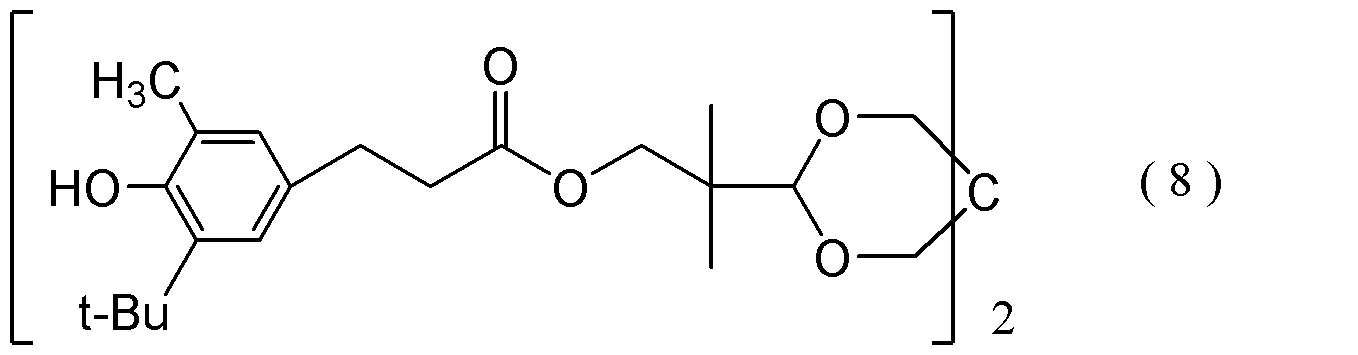
〔有機リン系酸化防止剤(E)〕
・E-1:テトラキス(2,4-ジ-t-ブチルフェニル)-4,4’-ビフェニレンホスホナイト(下記式(9)、クラリアントジャパン(株)製、商品名:「Hostanox P-EPQ」)
・E-1:テトラキス(2,4-ジ-t-ブチルフェニル)-4,4’-ビフェニレンホスホナイト(下記式(9)、クラリアントジャパン(株)製、商品名:「Hostanox P-EPQ」)

〔強化材(F)〕
・F-1:ガラス繊維(日東紡績(株)製、商品名:「CS3J256S」、平均繊維径 11μm、平均繊維長3mm、円形断面)
〔光安定剤(G)〕
・G-1:N,N’-ビス(2,2,6,6-テトラメチル-4-ピペリジニル)-1,3-ベンゼンジカルボキサミド(クラリアントジャパン(株)製、商品名:「Nylostab S-EED」)
・F-1:ガラス繊維(日東紡績(株)製、商品名:「CS3J256S」、平均繊維径 11μm、平均繊維長3mm、円形断面)
〔光安定剤(G)〕
・G-1:N,N’-ビス(2,2,6,6-テトラメチル-4-ピペリジニル)-1,3-ベンゼンジカルボキサミド(クラリアントジャパン(株)製、商品名:「Nylostab S-EED」)
〔その他の成分〕
・離型剤:ポリプロピレン 分解タイプ(三井化学(株)製、商品名:「ハイワックス NP055」)
・核剤:タルク(富士タルク工業(株)製、商品名:「タルクPKP80」)
・離型剤:ポリプロピレン 分解タイプ(三井化学(株)製、商品名:「ハイワックス NP055」)
・核剤:タルク(富士タルク工業(株)製、商品名:「タルクPKP80」)
実施例1~4及び比較例1~2
ポリエステル(A-1)、二酸化チタン(B-1)、無機リン化合物(C-1)、フェノール系酸化防止剤(D-1)、有機リン系酸化防止剤(E-1)、光安定剤(G-1)、上記離型剤、及び上記核剤を、表1に示す配合にてドライブレンドした。得られた混合物を2軸押出機(スクリュー径:32mm、L/D=30、回転数150rpm)のホッパーからフィードして、同時に、サイドフィーダーより強化材(F-1)を表1に示す配合にて添加して、300℃で溶融混練し、ストランド状に押出した後、ペレタイザにより切断してペレット状のポリエステル組成物を得た。得られたポリエステル組成物を用いて、所定形状の試験片を作製し、評価に用いた。結果を表2に示す。
ポリエステル(A-1)、二酸化チタン(B-1)、無機リン化合物(C-1)、フェノール系酸化防止剤(D-1)、有機リン系酸化防止剤(E-1)、光安定剤(G-1)、上記離型剤、及び上記核剤を、表1に示す配合にてドライブレンドした。得られた混合物を2軸押出機(スクリュー径:32mm、L/D=30、回転数150rpm)のホッパーからフィードして、同時に、サイドフィーダーより強化材(F-1)を表1に示す配合にて添加して、300℃で溶融混練し、ストランド状に押出した後、ペレタイザにより切断してペレット状のポリエステル組成物を得た。得られたポリエステル組成物を用いて、所定形状の試験片を作製し、評価に用いた。結果を表2に示す。
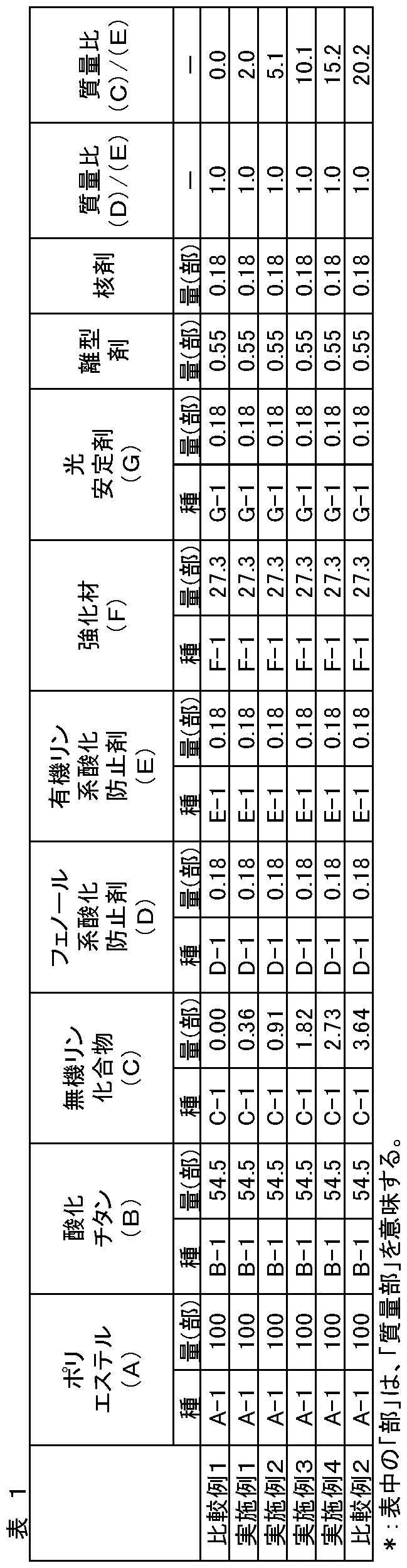
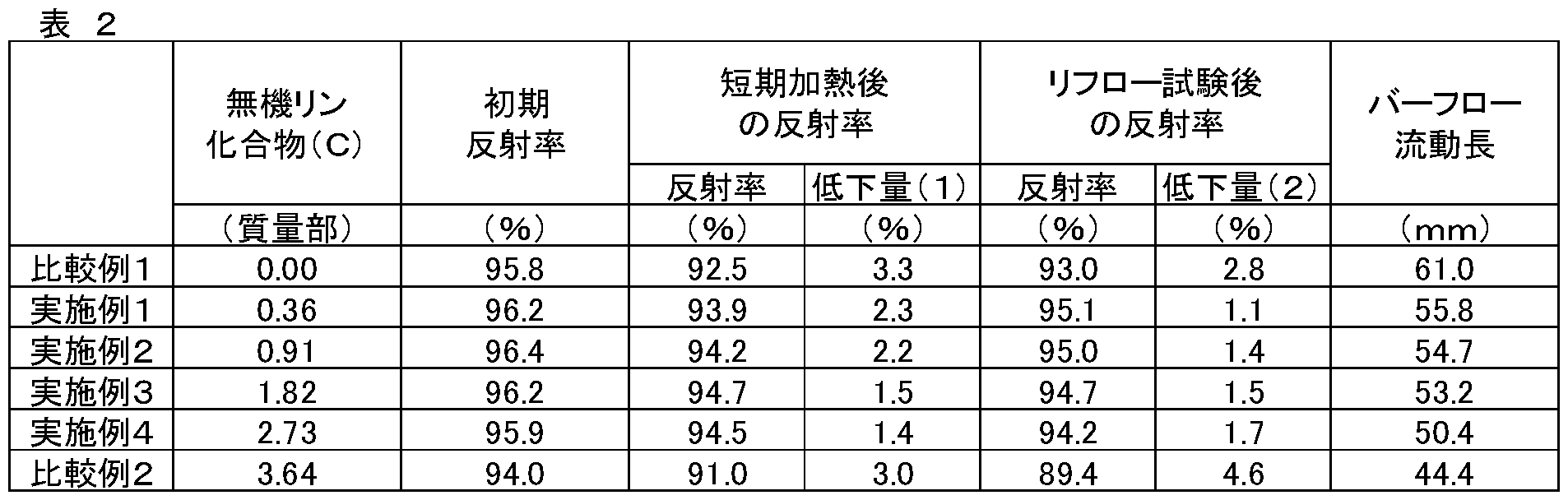
表1及び2に示したように、実施例1~4のポリエステル組成物は、比較例1~2と比較して、初期反射率、短期加熱後の反射率、及びリフロー試験後の反射率がいずれも高い。また、実施例1~4のポリエステル組成物は、バーフロー流動長がいずれも50mm以上であり、成形性に優れることがわかる。
よって、本発明のポリエステル組成物は、高い光反射率を有し、LEDパッケージの製造工程や使用環境で想定される熱に晒された場合にも、光反射率の低下が少なく、高い光反射率を維持できる。
よって、本発明のポリエステル組成物は、高い光反射率を有し、LEDパッケージの製造工程や使用環境で想定される熱に晒された場合にも、光反射率の低下が少なく、高い光反射率を維持できる。
本発明のLED反射板用ポリエステル組成物を成形して得られる反射板は、高い光反射率を有し、LEDパッケージの製造工程や使用環境で想定される熱に晒された場合にも、光反射率の低下が少なく、高い光反射率を維持することができる。このため、当該反射板を備えた発光装置は高寿命となる。また本発明のLED反射板用ポリエステル組成物は成形性にも優れる。
1,2,3 発光装置
10 半導体発光素子
20 基板
30 リフレクタ(筐体)
40 封止部材
50 パッケージ状部
60 封止部材
70 基板
71 配線
80 リードフレーム
10 半導体発光素子
20 基板
30 リフレクタ(筐体)
40 封止部材
50 パッケージ状部
60 封止部材
70 基板
71 配線
80 リードフレーム
Claims (12)
- LED反射板用ポリエステル組成物であって、
該ポリエステル組成物がポリエステル(A)及び酸化チタン(B)を含有し、
該ポリエステル(A)が、テレフタル酸を50モル%以上含むジカルボン酸に由来する構成単位と1,4-シクロヘキサンジメタノールを50モル%以上含むジオールに由来する構成単位とを有するポリエステルであり、
更に、リン酸、リン酸塩、縮合リン酸、縮合リン酸塩、亜リン酸、亜リン酸塩、次亜リン酸、及び次亜リン酸塩からなる群から選択される1種又は2種以上である無機リン化合物(C)を含有しており、
該ポリエステル(A)100質量部に対する該無機リン化合物(C)の含有量は、0.10~3.50質量部である、LED反射板用ポリエステル組成物。 - 前記無機リン化合物(C)は、次亜リン酸のアルカリ土類金属塩を含有する、請求項1に記載のLED反射板用ポリエステル組成物。
- 更に、フェノール系酸化防止剤(D)及び有機リン系酸化防止剤(E)からなる群から選択される少なくとも1種を含有する、請求項1又は2に記載のLED反射板用ポリエステル組成物。
- 前記有機リン系酸化防止剤(E)に対する前記フェノール系酸化防止剤(D)の質量比[(D)成分/(E)成分]が、0.20~3.00である、請求項3に記載のLED反射板用ポリエステル組成物。
- 前記有機リン系酸化防止剤(E)に対する前記無機リン化合物(C)の質量比[(C)成分/(E)成分]が、0.50~30.00である、請求項3又は4に記載のLED反射板用ポリエステル組成物。
- 前記有機リン系酸化防止剤(E)が、その分子中に下記式(1)で示される基を3つ以上含有する、請求項3~5のいずれか1項に記載のLED反射板用ポリエステル組成物。

(式(1)中、R11~R13はそれぞれ独立に、炭素数1又は2のアルキル基であり、R14~R17はそれぞれ独立に、水素原子又は炭素数1~10のアルキル基であり、*はリン原子との結合部を表す。) - 前記フェノール系酸化防止剤(D)が、その分子中に下記式(2)で示される基を少なくとも1つ含有する、請求項3~6のいずれか1項に記載のLED反射板用ポリエステル組成物。
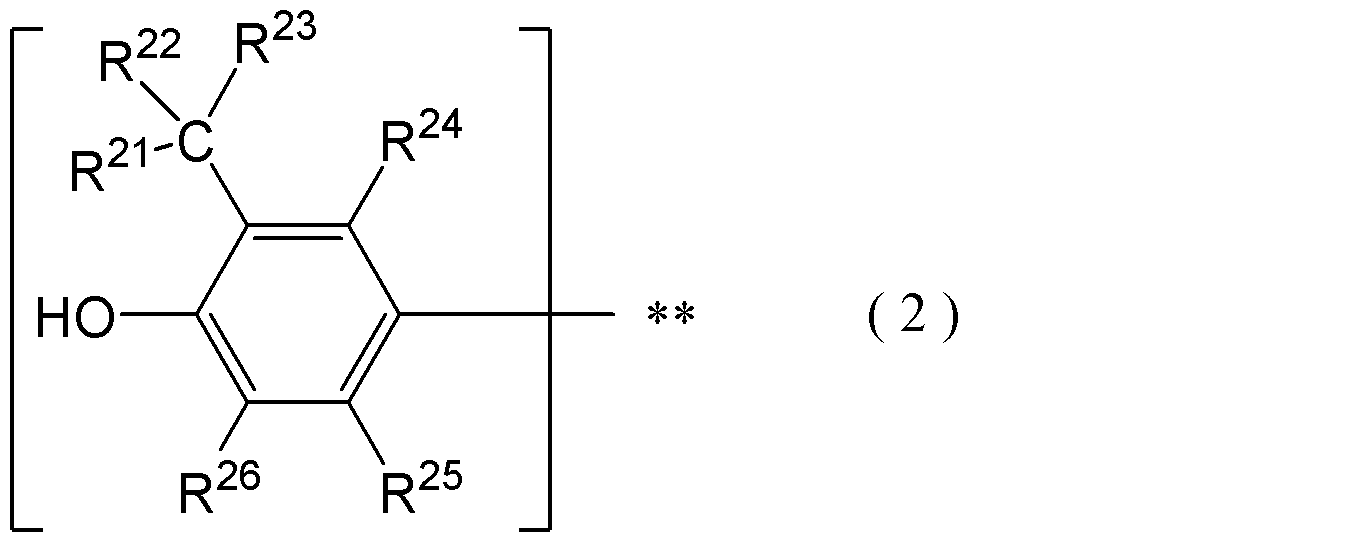
(式(2)中、R21~R23はそれぞれ独立に、炭素数1又は2のアルキル基であり、R24~R26はそれぞれ独立に、水素原子又は炭素数1~10のアルキル基であり、**は結合部を表す。) - 更に、強化材(F)を、該ポリエステル(A)100質量部に対して、5~50質量部含有する、請求項1~7のいずれか1項に記載のLED反射板用ポリエステル組成物。
- 前記ポリエステル(A)が、テレフタル酸を75~100モル%含むジカルボン酸に由来する構成単位と1,4-シクロヘキサンジメタノールを75~100モル%含むジオールに由来する構成単位とを有するポリシクロヘキサンジメチレンテレフタレートである、請求項1~8のいずれか1項に記載のLED反射板用ポリエステル組成物。
- 更に、光安定剤(G)を含有する、請求項1~9のいずれか1項に記載のLED反射板用ポリエステル組成物。
- 請求項1~10のいずれか1項に記載のLED反射板用ポリエステル組成物からなる、LED反射板。
- 請求項11に記載のLED反射板を備える、発光装置。
Applications Claiming Priority (2)
| Application Number | Priority Date | Filing Date | Title |
|---|---|---|---|
| JP2016108891 | 2016-05-31 | ||
| JP2016-108891 | 2016-05-31 |
Publications (1)
| Publication Number | Publication Date |
|---|---|
| WO2017209172A1 true WO2017209172A1 (ja) | 2017-12-07 |
Family
ID=60478622
Family Applications (1)
| Application Number | Title | Priority Date | Filing Date |
|---|---|---|---|
| PCT/JP2017/020208 Ceased WO2017209172A1 (ja) | 2016-05-31 | 2017-05-31 | Led反射板用ポリエステル組成物、led反射板、該反射板を備える発光装置 |
Country Status (2)
| Country | Link |
|---|---|
| TW (1) | TW201811885A (ja) |
| WO (1) | WO2017209172A1 (ja) |
Cited By (1)
| Publication number | Priority date | Publication date | Assignee | Title |
|---|---|---|---|---|
| CN109912939A (zh) * | 2018-12-28 | 2019-06-21 | 金发科技股份有限公司 | 一种聚酯树脂组合物、制备的模制品及其应用 |
Families Citing this family (2)
| Publication number | Priority date | Publication date | Assignee | Title |
|---|---|---|---|---|
| GB2567456B (en) | 2017-10-12 | 2021-08-11 | Si Group Switzerland Chaa Gmbh | Antidegradant blend |
| GB201807302D0 (en) | 2018-05-03 | 2018-06-20 | Addivant Switzerland Gmbh | Antidegradant blend |
Citations (6)
| Publication number | Priority date | Publication date | Assignee | Title |
|---|---|---|---|---|
| JPH1180391A (ja) * | 1997-09-12 | 1999-03-26 | Toray Ind Inc | 液晶性樹脂成形品およびその処理方法 |
| JP2003026909A (ja) * | 2001-07-12 | 2003-01-29 | Asahi Kasei Corp | 熱安定性に優れたポリトリメチレンテレフタレート樹脂組成物 |
| WO2003046085A1 (en) * | 2001-11-30 | 2003-06-05 | Polyplastics Co., Ltd. | Flame-retardant resin composition |
| WO2003046083A1 (en) * | 2001-11-30 | 2003-06-05 | Polyplastics Co., Ltd. | Flame-retardant resin composition |
| JP2009507990A (ja) * | 2005-09-14 | 2009-02-26 | イー・アイ・デュポン・ドウ・ヌムール・アンド・カンパニー | ポリ(シクロヘキサンジメタノールテレフタレート)組成物を含む発光ダイオードアセンブリハウジング |
| JP2015105379A (ja) * | 2013-11-29 | 2015-06-08 | 三星エスディアイ株式会社Samsung SDI Co.,Ltd. | 熱可塑性樹脂組成物 |
-
2017
- 2017-05-31 TW TW106117902A patent/TW201811885A/zh unknown
- 2017-05-31 WO PCT/JP2017/020208 patent/WO2017209172A1/ja not_active Ceased
Patent Citations (6)
| Publication number | Priority date | Publication date | Assignee | Title |
|---|---|---|---|---|
| JPH1180391A (ja) * | 1997-09-12 | 1999-03-26 | Toray Ind Inc | 液晶性樹脂成形品およびその処理方法 |
| JP2003026909A (ja) * | 2001-07-12 | 2003-01-29 | Asahi Kasei Corp | 熱安定性に優れたポリトリメチレンテレフタレート樹脂組成物 |
| WO2003046085A1 (en) * | 2001-11-30 | 2003-06-05 | Polyplastics Co., Ltd. | Flame-retardant resin composition |
| WO2003046083A1 (en) * | 2001-11-30 | 2003-06-05 | Polyplastics Co., Ltd. | Flame-retardant resin composition |
| JP2009507990A (ja) * | 2005-09-14 | 2009-02-26 | イー・アイ・デュポン・ドウ・ヌムール・アンド・カンパニー | ポリ(シクロヘキサンジメタノールテレフタレート)組成物を含む発光ダイオードアセンブリハウジング |
| JP2015105379A (ja) * | 2013-11-29 | 2015-06-08 | 三星エスディアイ株式会社Samsung SDI Co.,Ltd. | 熱可塑性樹脂組成物 |
Cited By (1)
| Publication number | Priority date | Publication date | Assignee | Title |
|---|---|---|---|---|
| CN109912939A (zh) * | 2018-12-28 | 2019-06-21 | 金发科技股份有限公司 | 一种聚酯树脂组合物、制备的模制品及其应用 |
Also Published As
| Publication number | Publication date |
|---|---|
| TW201811885A (zh) | 2018-04-01 |
Similar Documents
| Publication | Publication Date | Title |
|---|---|---|
| TWI549988B (zh) | 反射板用聚醯胺組成物、反射板、具備該反射板之發光裝置、以及具備該發光裝置之照明裝置及影像顯示裝置 | |
| TWI706007B (zh) | Led反射板用聚醯胺組成物、led反射板、具備該反射板之發光裝置 | |
| WO2017086334A1 (ja) | Led反射板用ポリエステル組成物、led反射板、該反射板を備える発光装置 | |
| TWI746444B (zh) | Led反射板用聚醯胺組成物、led反射板、具備該反射板之發光裝置 | |
| WO2017209172A1 (ja) | Led反射板用ポリエステル組成物、led反射板、該反射板を備える発光装置 | |
| WO2018235821A1 (ja) | Led反射板用ポリエステル組成物、該組成物からなるled反射板及び該反射板を備える発光装置 |
Legal Events
| Date | Code | Title | Description |
|---|---|---|---|
| 121 | Ep: the epo has been informed by wipo that ep was designated in this application |
Ref document number: 17806723 Country of ref document: EP Kind code of ref document: A1 |
|
| NENP | Non-entry into the national phase |
Ref country code: DE |
|
| 122 | Ep: pct application non-entry in european phase |
Ref document number: 17806723 Country of ref document: EP Kind code of ref document: A1 |
|
| NENP | Non-entry into the national phase |
Ref country code: JP |