WO2017209263A1 - ゴム組成物、及びタイヤ - Google Patents
ゴム組成物、及びタイヤ Download PDFInfo
- Publication number
- WO2017209263A1 WO2017209263A1 PCT/JP2017/020519 JP2017020519W WO2017209263A1 WO 2017209263 A1 WO2017209263 A1 WO 2017209263A1 JP 2017020519 W JP2017020519 W JP 2017020519W WO 2017209263 A1 WO2017209263 A1 WO 2017209263A1
- Authority
- WO
- WIPO (PCT)
- Prior art keywords
- rubber
- resin
- rubber composition
- mass
- tire
- Prior art date
- Legal status (The legal status is an assumption and is not a legal conclusion. Google has not performed a legal analysis and makes no representation as to the accuracy of the status listed.)
- Ceased
Links
- 0 CC(C)(*)*N(*)*1CC1 Chemical compound CC(C)(*)*N(*)*1CC1 0.000 description 1
Classifications
-
- C—CHEMISTRY; METALLURGY
- C08—ORGANIC MACROMOLECULAR COMPOUNDS; THEIR PREPARATION OR CHEMICAL WORKING-UP; COMPOSITIONS BASED THEREON
- C08L—COMPOSITIONS OF MACROMOLECULAR COMPOUNDS
- C08L7/00—Compositions of natural rubber
-
- B—PERFORMING OPERATIONS; TRANSPORTING
- B60—VEHICLES IN GENERAL
- B60C—VEHICLE TYRES; TYRE INFLATION; TYRE CHANGING; CONNECTING VALVES TO INFLATABLE ELASTIC BODIES IN GENERAL; DEVICES OR ARRANGEMENTS RELATED TO TYRES
- B60C1/00—Tyres characterised by the chemical composition or the physical arrangement or mixture of the composition
-
- B—PERFORMING OPERATIONS; TRANSPORTING
- B60—VEHICLES IN GENERAL
- B60C—VEHICLE TYRES; TYRE INFLATION; TYRE CHANGING; CONNECTING VALVES TO INFLATABLE ELASTIC BODIES IN GENERAL; DEVICES OR ARRANGEMENTS RELATED TO TYRES
- B60C1/00—Tyres characterised by the chemical composition or the physical arrangement or mixture of the composition
- B60C1/0016—Compositions of the tread
-
- C—CHEMISTRY; METALLURGY
- C08—ORGANIC MACROMOLECULAR COMPOUNDS; THEIR PREPARATION OR CHEMICAL WORKING-UP; COMPOSITIONS BASED THEREON
- C08J—WORKING-UP; GENERAL PROCESSES OF COMPOUNDING; AFTER-TREATMENT NOT COVERED BY SUBCLASSES C08B, C08C, C08F, C08G or C08H
- C08J7/00—Chemical treatment or coating of shaped articles made of macromolecular substances
- C08J7/12—Chemical modification
- C08J7/16—Chemical modification with polymerisable compounds
-
- C—CHEMISTRY; METALLURGY
- C08—ORGANIC MACROMOLECULAR COMPOUNDS; THEIR PREPARATION OR CHEMICAL WORKING-UP; COMPOSITIONS BASED THEREON
- C08K—Use of inorganic or non-macromolecular organic substances as compounding ingredients
- C08K3/00—Use of inorganic substances as compounding ingredients
- C08K3/01—Use of inorganic substances as compounding ingredients characterized by their specific function
- C08K3/013—Fillers, pigments or reinforcing additives
-
- C—CHEMISTRY; METALLURGY
- C08—ORGANIC MACROMOLECULAR COMPOUNDS; THEIR PREPARATION OR CHEMICAL WORKING-UP; COMPOSITIONS BASED THEREON
- C08K—Use of inorganic or non-macromolecular organic substances as compounding ingredients
- C08K3/00—Use of inorganic substances as compounding ingredients
- C08K3/02—Elements
- C08K3/04—Carbon
-
- C—CHEMISTRY; METALLURGY
- C08—ORGANIC MACROMOLECULAR COMPOUNDS; THEIR PREPARATION OR CHEMICAL WORKING-UP; COMPOSITIONS BASED THEREON
- C08K—Use of inorganic or non-macromolecular organic substances as compounding ingredients
- C08K3/00—Use of inorganic substances as compounding ingredients
- C08K3/34—Silicon-containing compounds
- C08K3/36—Silica
-
- C—CHEMISTRY; METALLURGY
- C08—ORGANIC MACROMOLECULAR COMPOUNDS; THEIR PREPARATION OR CHEMICAL WORKING-UP; COMPOSITIONS BASED THEREON
- C08K—Use of inorganic or non-macromolecular organic substances as compounding ingredients
- C08K5/00—Use of organic ingredients
- C08K5/54—Silicon-containing compounds
- C08K5/541—Silicon-containing compounds containing oxygen
- C08K5/5415—Silicon-containing compounds containing oxygen containing at least one Si—O bond
- C08K5/5419—Silicon-containing compounds containing oxygen containing at least one Si—O bond containing at least one Si—C bond
-
- C—CHEMISTRY; METALLURGY
- C08—ORGANIC MACROMOLECULAR COMPOUNDS; THEIR PREPARATION OR CHEMICAL WORKING-UP; COMPOSITIONS BASED THEREON
- C08K—Use of inorganic or non-macromolecular organic substances as compounding ingredients
- C08K5/00—Use of organic ingredients
- C08K5/54—Silicon-containing compounds
- C08K5/541—Silicon-containing compounds containing oxygen
- C08K5/5425—Silicon-containing compounds containing oxygen containing at least one C=C bond
-
- C—CHEMISTRY; METALLURGY
- C08—ORGANIC MACROMOLECULAR COMPOUNDS; THEIR PREPARATION OR CHEMICAL WORKING-UP; COMPOSITIONS BASED THEREON
- C08L—COMPOSITIONS OF MACROMOLECULAR COMPOUNDS
- C08L25/00—Compositions of, homopolymers or copolymers of compounds having one or more unsaturated aliphatic radicals, each having only one carbon-to-carbon double bond, and at least one being terminated by an aromatic carbocyclic ring; Compositions of derivatives of such polymers
- C08L25/02—Homopolymers or copolymers of hydrocarbons
- C08L25/04—Homopolymers or copolymers of styrene
- C08L25/08—Copolymers of styrene
- C08L25/10—Copolymers of styrene with conjugated dienes
-
- C—CHEMISTRY; METALLURGY
- C08—ORGANIC MACROMOLECULAR COMPOUNDS; THEIR PREPARATION OR CHEMICAL WORKING-UP; COMPOSITIONS BASED THEREON
- C08L—COMPOSITIONS OF MACROMOLECULAR COMPOUNDS
- C08L47/00—Compositions of homopolymers or copolymers of compounds having one or more unsaturated aliphatic radicals, at least one having two or more carbon-to-carbon double bonds; Compositions of derivatives of such polymers
-
- C—CHEMISTRY; METALLURGY
- C08—ORGANIC MACROMOLECULAR COMPOUNDS; THEIR PREPARATION OR CHEMICAL WORKING-UP; COMPOSITIONS BASED THEREON
- C08L—COMPOSITIONS OF MACROMOLECULAR COMPOUNDS
- C08L93/00—Compositions of natural resins; Compositions of derivatives thereof
- C08L93/04—Rosin
-
- C—CHEMISTRY; METALLURGY
- C08—ORGANIC MACROMOLECULAR COMPOUNDS; THEIR PREPARATION OR CHEMICAL WORKING-UP; COMPOSITIONS BASED THEREON
- C08L—COMPOSITIONS OF MACROMOLECULAR COMPOUNDS
- C08L2205/00—Polymer mixtures characterised by other features
- C08L2205/03—Polymer mixtures characterised by other features containing three or more polymers in a blend
- C08L2205/035—Polymer mixtures characterised by other features containing three or more polymers in a blend containing four or more polymers in a blend
Definitions
- the present invention relates to a rubber composition and a tire.
- Patent Document 2 discloses a technique for improving the wet performance by setting the tan ⁇ at 0 ° C. of the rubber composition for a tire tread to 0.95 or more.
- this invention makes it a subject to solve the said problem of the said prior art and to provide the rubber composition which can improve the fuel consumption performance and wet performance of a tire. Moreover, this invention makes it a subject to provide the tire excellent in fuel consumption performance and wet performance.
- the gist configuration of the present invention for solving the above-described problems is as follows.
- the rubber composition of the present invention has a SP value difference of 1.5 (cal / cm 3 ) 1/2 or less between the rubber component (A) containing 50% by mass or more of natural rubber and the rubber component (A).
- the total blending amount of the compatible resin (B) and the incompatible resin (C) is 10 parts by mass or more with respect to 100 parts by mass of the rubber component (A).
- the tire fuel efficiency and wet performance can be improved by applying the rubber composition to a tread rubber of a tire.
- a resin having a difference in SP value from the rubber component (A) of 1.5 (cal / cm 3 ) 1/2 or less is referred to as a compatible resin (B), and the rubber Resin having a difference in SP value from component (A) exceeding 1.5 (cal / cm 3 ) 1/2 is designated as incompatible resin (C), rubber component (A), compatible resin (B), and
- the SP value (solubility parameter) of the incompatible resin (C) is calculated according to the Fedors method.
- the SP value of the rubber component (A) is the SP value of the main component, that is, the rubber component having the highest content, and when there are a plurality of rubber components having the highest content, the average value thereof. It is.
- the average value is the total value of the blending ratio of each component ⁇ SP value.
- the blending ratio (B / C) by mass of the compatible resin (B) and the incompatible resin (C) is 1/4 to 4/1. is there.
- the wet performance of the tire can be further improved by applying the rubber composition to the tire tread rubber.
- the softening point of the compatible resin (B) is 110 ° C. or lower.
- the wet performance of the tire can be further improved by applying the rubber composition to the tire tread rubber.
- the softening point is a value measured according to a softening point test method [6.4 softening point test method (ring ball method)] described in JIS K 2207.
- the rubber component (A) further contains a modified polymer.
- the fuel efficiency and wet performance of the tire can be further improved by applying the rubber composition to the tread rubber of the tire.
- the tire of the present invention is characterized by using the above rubber composition for a tread rubber.
- the tire of the present invention is excellent in fuel efficiency and wet performance because the rubber composition is used in tread rubber.
- the present invention it is possible to provide a rubber composition capable of improving the fuel efficiency performance and wet performance of a tire. Moreover, according to this invention, the tire excellent in the fuel consumption performance and the wet performance can be provided.
- the rubber composition of the present invention has a SP value difference of 1.5 (cal / cm 3 ) 1/2 or less between the rubber component (A) containing 50% by mass or more of natural rubber and the rubber component (A).
- the total blending amount of the soluble resin (B) and the incompatible resin (C) is 10 parts by mass or more with respect to 100 parts by mass of the rubber component (A).
- the incompatible resin (C) increases the elastic modulus in the low strain region while decreasing the elastic modulus in the high strain region, and the compatible resin (B) includes the low strain region and the high strain. Decrease the modulus of elasticity in both areas.
- the rubber composition of the present invention by blending both the compatible resin (B) and the incompatible resin (C), the fluctuation of the elastic modulus in the low strain region is suppressed, and in the high strain region.
- the elastic modulus of can be greatly reduced. Therefore, by applying the rubber composition of the present invention to the tread rubber of a tire, while increasing the deformation volume of the tread rubber in the vicinity of the ground contact surface with the road surface having a large strain during traveling, a road surface having a small strain during traveling.
- the rubber resin is incompatible with the compatible resin (B).
- the compatible resin (C) By blending both the compatible resin (C) and suppressing the fluctuation of the elastic modulus in the low strain region resulting from the blending of the resin, the influence of the resin on the fuel efficiency of the tire can be suppressed.
- the rubber composition of the present invention when the content of the natural rubber in the rubber component (A) is 50% by mass or more, tan ⁇ (loss tangent) is reduced, and the tire to which the rubber composition is applied Improved fuel efficiency. Since the coefficient of friction ( ⁇ ) on the wet road surface is proportional to the product of the rigidity of the entire tread rubber, the deformation amount of the tread rubber, and tan ⁇ (loss tangent), the rubber composition of the present invention is applied to the tread rubber. The applied tire can increase the amount of deformation of the tread rubber while ensuring the rigidity of the entire tread rubber even if the tan ⁇ is reduced by applying the rubber component (A) containing 50% by mass or more of natural rubber.
- the friction coefficient ( ⁇ ) on the wet road surface can be sufficiently improved, and the wet performance is improved by increasing the friction coefficient ( ⁇ ) on the wet road surface. Therefore, a tire in which the rubber composition of the present invention is applied to a tread rubber has a low tan ⁇ , thereby improving fuel efficiency and a high coefficient of friction ( ⁇ ) on a wet road surface, thereby improving wet performance. .
- the rubber composition containing the compatible resin (B) has a low elastic modulus from a low strain region to a high strain region, and when applied to a tread rubber of a tire, the cornering performance of the tire may be deteriorated.
- the rubber composition containing both the compatible resin (B) and the incompatible resin (C) can suppress the deterioration of the cornering performance of the tire because the change in the elastic modulus in the low strain region is suppressed. .
- the rubber composition containing the compatible resin (B) has high adhesiveness and excessively adheres to an apparatus used in the manufacturing process of rubber products such as a kneading apparatus and an extrusion apparatus, but the compatible resin (B ) And the incompatible resin (C) are blended with each other, the adhesiveness is not excessively high, and the rubber composition does not excessively adhere to the apparatus used in the rubber product manufacturing process. Deterioration in workability when molding can be suppressed.
- the rubber composition containing the compatible resin (B) has poor ozone resistance, but the rubber composition containing both the compatible resin (B) and the incompatible resin (C) is resistant to ozone. Ozone deterioration can be suppressed, and deterioration of weather resistance of a rubber product to which the rubber composition is applied can be suppressed.
- the rubber component (A) of the rubber composition of the present invention contains 50% by mass or more, preferably 60% by mass or more, more preferably 70% by mass or more of natural rubber.
- the upper limit of the content rate of the natural rubber in the rubber component (A) is not particularly limited, and the total amount of the rubber component (A) may be natural rubber. If the content of the natural rubber in the rubber component (A) is 50% by mass or more, the tan ⁇ of the rubber composition is reduced, and the rubber composition is applied to the tread rubber of the tire, thereby improving the fuel efficiency of the tire. Can be improved.
- the rubber component (A) includes natural rubber (NR), synthetic isoprene rubber (IR), polybutadiene rubber (BR), styrene-butadiene copolymer rubber (SBR), styrene-isoprene copolymer rubber (SIR). ) And other synthetic rubbers may be included. These rubber components (A) may be used alone or as a blend of two or more.
- the rubber component (A) preferably further contains a modified polymer.
- the content of the modified polymer in the rubber component (A) is 50% by mass or less, preferably 10 to 45% by mass, more preferably 20 to 40% by mass.
- the rubber component (A) contains a modified polymer the dispersibility of various compounding agents in the rubber composition is improved.
- modified functional group in the modified polymer examples include a nitrogen-containing functional group, a silicon-containing functional group, and an oxygen-containing functional group.
- a conjugated diene compound, or a conjugated diene compound and an aromatic vinyl compound are used as monomers, and a polymer or copolymer of the conjugated diene compound or a conjugated diene compound and an aromatic vinyl compound.
- a polymer obtained by polymerizing or copolymerizing these monomers using an agent can be used.
- conjugated diene compounds include 1,3-butadiene, isoprene, 1,3-pentadiene, 2,3-dimethylbutadiene, 2-phenyl-1,3-butadiene, 1,3 -Hexadiene and the like, and aromatic vinyl compounds include styrene, ⁇ -methylstyrene, 1-vinylnaphthalene, 3-vinyltoluene, ethylvinylbenzene, divinylbenzene, 4-cyclohexylstyrene, 2,4,6 -Trimethylstyrene and the like.
- a hydrocarbyloxysilane compound is preferable.
- the hydrocarbyloxysilane compound include the following general formula (I): R 1 a -Si- (OR 2 ) 4-a (I) The compound represented by these is preferable.
- R 1 and R 2 each independently represent a monovalent aliphatic hydrocarbon group having 1 to 20 carbon atoms or a monovalent aromatic hydrocarbon group having 6 to 18 carbon atoms, a is an integer of 0 to 2, and when there are a plurality of OR 2 s , each OR 2 may be the same as or different from each other, and no active proton is contained in the molecule.
- hydrocarbyloxysilane compound examples include the following general formula (II): The compound represented by these is also preferable.
- n1 + n2 + n3 + n4 is 4 (where n2 is an integer of 1 to 4, and n1, n3 and n4 are integers of 0 to 3), and
- a 1 is a saturated cyclic tertiary amine compound Residue, unsaturated cyclic tertiary amine compound residue, ketimine residue, nitrile group, isocyanate group, thioisocyanate group, epoxy group, thioepoxy group, isocyanuric acid trihydrocarbyl ester group, carbonic acid dihydrocarbyl ester group, pyridine group , Ketone group, thioketone group, aldehyde group, thioaldehyde group, amide group, carboxylic acid ester group, thiocarboxylic acid ester group, metal salt of
- a hydrocarbon group or a halogen atom and when n3 is 2 or more, they may be the same or different, and R 22 is a monovalent aliphatic or alicyclic hydrocarbon group having 1 to 20 carbon atoms or a carbon number 6 to 18 monovalent aromatic hydrocarbon groups, all of which contain a nitrogen atom and / or a silicon atom.
- n2 is 2 or more may be the same or different from each other, or may be taken together to form a ring, R 24, the double having 1 to 20 carbon atoms
- the hydrolyzable group in the primary or secondary amino group having a hydrolyzable group or a mercapto group having a hydrolyzable group a trimethylsilyl group and a tert-butyldimethylsilyl group are preferable, and a trimethylsilyl group is particularly preferable.
- Examples of the compound represented by the general formula (II) include the following general formula (III): The compound represented by these is preferable.
- p1 + p2 + p3 is 2 (provided that p2 is an integer of 1 to 2, p1 and p3 are integers of 0 to 1), and
- a 2 is NRa (Ra is a monovalent A hydrocarbon group, a hydrolyzable group or a nitrogen-containing organic group), or sulfur, and R 25 is a monovalent aliphatic or alicyclic hydrocarbon group having 1 to 20 carbon atoms or 6 to 6 carbon atoms.
- R 18 is a monovalent aromatic hydrocarbon group
- R 27 is a monovalent aliphatic or alicyclic hydrocarbon group having 1 to 20 carbon atoms, or a monovalent aromatic hydrocarbon group having 6 to 18 carbon atoms. Or a halogen atom
- R 26 is a monovalent aliphatic or alicyclic hydrocarbon group having 1 to 20 carbon atoms, a monovalent aromatic hydrocarbon group having 6 to 18 carbon atoms, or a nitrogen-containing organic group.
- R 28 is a divalent aliphatic or alicyclic hydrocarbon group or a C 6-18 having 1 to 20 carbon carbon double Valent aromatic hydrocarbon group.
- a trimethylsilyl group and a tert-butyldimethylsilyl group are preferable, and a trimethylsilyl group is particularly preferable.
- Examples of the compound represented by the general formula (II) include the following general formula (IV): The compound represented by these is also preferable.
- q1 + q2 is 3 (where q1 is an integer of 0 to 2, q2 is an integer of 1 to 3), and R 31 is a divalent aliphatic having 1 to 20 carbon atoms.
- R 31 is a divalent aliphatic having 1 to 20 carbon atoms.
- R 32 and R 33 are each independently a hydrolyzable group and a monovalent fat having 1 to 20 carbon atoms.
- R 34 is a monovalent aliphatic or alicyclic hydrocarbon group having 1 to 20 carbon atoms or a carbon number
- R 35 is a monovalent aliphatic or alicyclic hydrocarbon having 1 to 20 carbon atoms
- a monovalent aromatic hydrocarbon group having 6 to 18 carbon atoms and when q2 is 2 or more, they may be the same or different.
- the hydrolyzable group a trimethylsilyl group and a tert-butyldimethylsilyl group are preferable, and a trimethylsilyl group is particularly preferable.
- Examples of the compound represented by the general formula (II) include the following general formula (V): The compound represented by these is also preferable.
- r1 + r2 is 3 (provided that r1 is an integer of 1 to 3 and r2 is an integer of 0 to 2), and R 36 is a divalent aliphatic having 1 to 20 carbon atoms.
- R 37 is a dimethylaminomethyl group, dimethylaminoethyl group, diethylaminomethyl group, diethylaminoethyl group, methylsilyl (methyl) Aminomethyl group, methylsilyl (methyl) aminoethyl group, methylsilyl (ethyl) aminomethyl group, methylsilyl (ethyl) aminoethyl group, dimethylsilylaminomethyl group, dimethylsilylaminoethyl group, monovalent fat having 1 to 20 carbon atoms
- R 38 is an hydrocarbyloxy group, monovalent 1-20 carbon atoms aliphatic or alicyclic hydrocarbon group or a monovalent
- Examples of the compound represented by the general formula (II) include the following general formula (VI): The compound represented by these is also preferable.
- R 40 is a trimethylsilyl group, a monovalent aliphatic or alicyclic hydrocarbon group having 1 to 20 carbon atoms, or a monovalent aromatic hydrocarbon group having 6 to 18 carbon atoms
- 41 is a hydrocarbyloxy group, a monovalent aromatic hydrocarbon group of monovalent aliphatic or cycloaliphatic hydrocarbon group or a C 6-18 having 1 to 20 carbon atoms having 1 to 20 carbon atoms
- R 42 Is a divalent aliphatic or alicyclic hydrocarbon group having 1 to 20 carbon atoms or a divalent aromatic hydrocarbon group having 6 to 18 carbon atoms.
- TMS represents a trimethylsilyl group (hereinafter the same).
- R 43 and R 44 are each independently a divalent aliphatic or alicyclic hydrocarbon group having 1 to 20 carbon atoms or a divalent aromatic hydrocarbon group having 6 to 18 carbon atoms.
- R 45 is a monovalent aliphatic or alicyclic hydrocarbon group having 1 to 20 carbon atoms or a monovalent aromatic hydrocarbon group having 6 to 18 carbon atoms, and each R 45 is the same or different. It may be.
- Examples of the compound represented by the general formula (II) include the following general formula (VIII): The compound represented by these is also preferable.
- r1 + r2 is 3 (provided that r1 is an integer of 0 to 2 and r2 is an integer of 1 to 3), and R 46 is a divalent aliphatic having 1 to 20 carbon atoms.
- R 46 is a divalent aliphatic having 1 to 20 carbon atoms.
- a plurality of R 47 or R 48 may be the same or different.
- Examples of the compound represented by the general formula (II) include the following general formula (IX): The compound represented by these is also preferable.
- X is a halogen atom
- R 49 is a divalent aliphatic or alicyclic hydrocarbon group having 1 to 20 carbon atoms or a divalent aromatic hydrocarbon group having 6 to 18 carbon atoms.
- R 50 and R 51 are each independently a hydrolyzable group, a monovalent aliphatic or alicyclic hydrocarbon group having 1 to 20 carbon atoms, or a monovalent aromatic hydrocarbon group having 6 to 18 carbon atoms.
- R 50 and R 51 are combined to form a divalent organic group, and R 52 and R 53 are each independently a halogen atom, a hydrocarbyloxy group, or a group having 1 to 20 carbon atoms.
- R 50 and R 51 are preferably hydrolyzable groups, and the hydrolyzable group is preferably a trimethylsilyl group or a tert-butyldimethylsilyl group, and particularly preferably a trimethylsilyl group.
- Examples of the hydrocarbyloxysilane compound represented by the general formula (II) include the following general formulas (X) to (XIII): The compound represented by these is also preferable.
- R 54 to 92 in the general formulas (X) to (XIII) may be the same or different, and are monovalent or divalent aliphatic or alicyclic hydrocarbon group having 1 to 20 carbon atoms, or 6 carbon atoms 18 to 18 monovalent or divalent aromatic hydrocarbon groups.
- ⁇ and ⁇ are integers of 0 to 5.
- the polymerization initiator having the modified functional group is preferably a lithium amide compound.
- the lithium amide compound include lithium hexamethylene imide, lithium pyrrolidide, lithium piperidide, lithium heptamethylene imide, lithium dodecamethylene imide, lithium dimethylamide, lithium diethylamide, lithium dibutylamide, lithium dipropylamide, Lithium diheptylamide, lithium dihexylamide, lithium dioctylamide, lithium di-2-ethylhexylamide, lithium didecylamide, lithium-N-methylpiperazide, lithium ethylpropylamide, lithium ethylbutylamide, lithium ethylbenzylamide, lithium methylphenethylamide Etc.
- the rubber composition of the present invention comprises a compatible resin (B) having a SP value difference of 1.5 (cal / cm 3 ) 1/2 or less from the rubber component (A), and the rubber component (A). And an incompatible resin (C) in which the difference in SP value exceeds 1.5 (cal / cm 3 ) 1/2 .
- an incompatible resin (C) in which the difference in SP value exceeds 1.5 (cal / cm 3 ) 1/2 By blending both the compatible resin (B) and the incompatible resin (C) with the rubber composition, the elastic modulus in the high strain region is greatly reduced while suppressing the fluctuation of the elastic modulus in the low strain region. Can be reduced. Therefore, by applying a rubber composition containing the compatible resin (B) and the incompatible resin (C) to the tread of the tire, the deformation volume of the tread rubber in the vicinity of the ground contact surface with the road surface having
- the rubber composition of the present invention is blended with both the compatible resin (B) and the incompatible resin (C) to suppress the fluctuation of the elastic modulus in the low strain region.
- the influence of the resin on the fuel efficiency of the tire can be suppressed, and further, the deterioration of the cornering performance of the tire can be suppressed.
- a raise of adhesiveness can be suppressed and the deterioration of ozone resistance can be suppressed by mix
- the blending ratio of the compatible resin (B) and the incompatible resin (C) in terms of mass (that is, the blending amount of the compatible resin (B) / the blending amount of the incompatible resin (C)) is 1
- the range of / 4 to 4/1 is preferable, and the range of 1/2 to 2/1 is more preferable.
- the compatible resin (B) preferably has a softening point of 110 ° C. or lower, and more preferably 85 ° C. or lower. If the softening point of the compatible resin (B) is 110 ° C. or less, the wet performance of a tire in which the rubber composition is applied to tread rubber can be further improved.
- the softening point of the incompatible resin (C) is preferably in the range of 145 ° C. or lower. And the wet performance of the tire which applied the rubber composition to the tread rubber by combining the compatible resin (B) having a softening point of 110 ° C. or less and the incompatible resin (C) having a softening point of 145 ° C. or less. Can be further improved.
- the total compounding quantity of the said compatible resin (B) and the said incompatible resin (C) is 10 mass parts or more with respect to 100 mass parts of said rubber components (A), Preferably it is 12 mass parts or more. Moreover, it is preferably 40 parts by mass or less, more preferably 30 parts by mass or less, and still more preferably 20 parts by mass or less.
- the total blending amount of the compatible resin (B) and the incompatible resin (C) is less than 10 parts by mass with respect to 100 parts by mass of the rubber component (A), the elastic modulus in the high strain region of the rubber composition is sufficient. Can not be lowered.
- the rubber composition is used as a tire tread rubber. When applied, sufficient rigidity of the tire tread can be secured.
- the blending amount of the compatible resin (B) is preferably 5 parts by mass or more, preferably 30 parts by mass or less, and more preferably 20 parts by mass or less with respect to 100 parts by mass of the rubber component (A).
- the blending amount of the incompatible resin (C) is preferably 5 parts by mass or more, preferably 30 parts by mass or less, and more preferably 20 parts by mass or less with respect to 100 parts by mass of the rubber component (A). . If the compounding quantity of the said compatible resin (B) and the said incompatible resin (C) is said range, the elasticity modulus in the high strain area
- the compatible resin (B) and the incompatible resin (C) are appropriately selected according to the SP value of the rubber component (A). From the viewpoint of wet performance, C 5 resin and C 9 resin are used. C 5 -C 9 resin, dicyclopentadiene resin, rosin resin, alkylphenol resin and terpenephenol resin are preferable.
- a C 5 resins refers to C 5 type synthetic petroleum resins, examples of the C 5 resin, for example, a C 5 fraction obtained by thermal cracking of petroleum chemical industry naphtha, AlCl 3, BF 3, etc. And aliphatic petroleum resins obtained by polymerization using a Friedel-Crafts type catalyst.
- the C 5 fraction usually contains olefinic hydrocarbons such as 1-pentene, 2-pentene, 2-methyl-1-butene, 2-methyl-2-butene and 3-methyl-1-butene, 2-methyl 1,3-butadiene, 1,2-pentadiene, 1,3-pentadiene, diolefin hydrocarbons such as 3-methyl-1,2-butadiene and the like are included.
- examples of the C 5 resin may be commercially available products, for example, an ExxonMobil Chemical Co. aliphatic petroleum resin "Escorez (registered trademark) 1000 Series", Nippon Zeon Co., Ltd. aliphatic “A100, B170, M100, R100” and the like of “Quinton (registered trademark) 100 series” which is a petroleum-based petroleum resin.
- the C 9 resin is, for example, vinyl toluene, alkyl styrene, and indene, which are C 9 fractions by-produced together with petrochemical basic raw materials such as ethylene and propylene by thermal decomposition of naphtha of petrochemical industry. It is resin which polymerized the C9 aromatic.
- specific examples of the C 9 fraction obtained by thermal decomposition of naphtha include vinyl toluene, ⁇ -methyl styrene, ⁇ -methyl styrene, ⁇ -methyl styrene, o-methyl styrene, p-methyl styrene, indene, etc. Is mentioned.
- the C 9 resin includes C 9 fraction, styrene as C 8 fraction, methyl indene and 1,3-dimethyl styrene as C 10 fraction, naphthalene, vinyl naphthalene, vinyl anthracene, p It can also be obtained by using -tert-butylstyrene as a raw material and copolymerizing these C 8 -C 10 fractions and the like as a mixture, for example, with a Friedel-Crafts catalyst.
- the C 9 resin may be a modified petroleum resin modified with a compound having a hydroxyl group, an unsaturated carboxylic acid compound, or the like. Commercially available products can be used as the C 9 resin.
- the C 5 -C 9 series resin refers to a C 5 -C 9 series synthetic petroleum resin.
- Examples of the C 5 -C 9 series resin include C 5 fraction and C 9 fraction derived from petroleum. Solid polymers obtained by polymerization using Friedel-Crafts type catalysts such as AlCl 3 and BF 3 , and more specifically, styrene, vinyltoluene, ⁇ -methylstyrene, indene and the like as main components. And the like.
- a resin having a small component of C 9 or more is preferable from the viewpoint of compatibility with the rubber component (A).
- “there is little component of C 9 or more” means that the component of C 9 or more in the total amount of the resin is less than 50% by mass, preferably 40% by mass or less.
- Commercially available products may be used as the C 5 -C 9 resin, for example, trade name “Quinton (registered trademark) G100B” (manufactured by Nippon Zeon Co., Ltd.), trade name “ECR213” (ExxonMobil Chemical) Etc.).
- the dicyclopentadiene resin is a petroleum resin produced from dicyclopentadiene obtained by dimerizing cyclopentadiene as a main raw material.
- Commercially available products can be used as the dicyclopentadiene resin.
- the rosin resin is a residue remaining after collecting balsams such as pine sap, which is a sap of a plant of the pine family, and distilling turpentine essential oil, rosin acid (abietic acid, parastolic acid, isopimaric acid, etc.)
- a natural resin as a main component a modified resin obtained by modifying or hydrogenating them, and a hydrogenated resin.
- Examples include natural resin rosin, polymerized rosin and partially hydrogenated rosin; glycerin ester rosin, partially hydrogenated rosin and fully hydrogenated rosin and polymerized rosin; pentaerythritol ester rosin, partially hydrogenated rosin and polymerized rosin, and the like. .
- Examples of natural resin rosins include gum rosin, tall oil rosin, wood rosin and the like contained in raw pine crabs and tall oil.
- Commercially available products can be used as the rosin resin.
- the trade name “Neotor 105” manufactured by Harima Chemicals Co., Ltd.
- the trade name “SN Tac 754” manufactured by San Nopco Co., Ltd.
- the alkylphenol resin is obtained, for example, by a condensation reaction under a catalyst of alkylphenol and formaldehyde.
- a commercially available product can be used.
- a trade name “Hitanol 1502P” (manufactured by Hitachi Chemical Co., Ltd.), a trade name “Tacchi Roll 201” (manufactured by Taoka Chemical Co., Ltd.), 250-I "(brominated alkylphenol formaldehyde resin, manufactured by Taoka Chemical Co., Ltd.), trade name” Tacicol 250-III "(brominated alkylphenol formaldehyde resin, manufactured by Taoka Chemical Co., Ltd.), trade names" R7521P ",” SP1068 “,” R7510PJ “,” R7572P “, and” R7578P "(manufactured by SI GROUP INC.).
- the terpene phenol resin can be obtained, for example, by reacting terpenes with various phenols using a Friedel-Crafts-type catalyst or further condensing with formalin.
- the starting terpenes are not particularly limited, and monoterpene hydrocarbons such as ⁇ -pinene and limonene are preferable, those containing ⁇ -pinene are more preferable, and ⁇ -pinene is particularly preferable.
- Commercially available products can be used as the terpene phenol resin. For example, trade names “Tamanol 803L”, “Tamanol 901” (manufactured by Arakawa Chemical Industries, Ltd.), trade names “YS Polyster (registered trademark) U” series.
- the rubber composition of the present invention preferably contains a filler.
- the rubber composition of the present invention preferably contains silica as the filler, and the ratio of silica in the filler is preferably 70% by mass or more, more preferably 80% by mass or more, and still more preferably. It is 90 mass% or more, and the total amount of the filler may be silica.
- the proportion of silica in the filler is 70% by mass or more, tan ⁇ of the rubber composition is further reduced, and the fuel efficiency performance of the tire to which the rubber composition is applied is further improved.
- the silica is not particularly limited, and examples thereof include wet silica (hydrous silicic acid), dry silica (anhydrous silicic acid), calcium silicate, aluminum silicate, and the like. Among these, wet silica is preferable. These silicas may be used alone or in combination of two or more.
- the compounding amount of the silica is preferably in the range of 40 to 70 parts by mass, more preferably in the range of 45 to 60 parts by mass with respect to 100 parts by mass of the rubber component (A). If the compounding amount of silica is 40 parts by mass or more with respect to 100 parts by mass of the rubber component (A), the tan ⁇ of the rubber composition is further reduced, and the fuel efficiency performance of the tire to which the rubber composition is applied is further improved. Further, if it is 70 parts by mass or less, the rubber composition has high flexibility, and by applying the rubber composition to the tread rubber of the tire, the deformation volume of the tread rubber is increased, and the wet performance of the tire is improved. Further improvement can be achieved.
- the nitrogen adsorption specific surface area of the silica in the filler is not particularly limited, and general silica having a nitrogen adsorption specific surface area exceeding 150 m 2 / g may be used.
- Silica having an average primary particle size of 21 nm or more and a nitrogen adsorption specific surface area of 150 m 2 / g or less (hereinafter sometimes referred to as “large particle size silica”) having a large diameter may be used.
- carbon black is further contained as the filler, and the compounding amount of the carbon black is 1 to 10 parts by mass with respect to 100 parts by mass of the rubber component (A).
- the range of parts is preferable, and the range of 3 to 8 parts by weight is more preferable.
- the carbon black is not particularly limited, and examples thereof include GPF, FEF, HAF, ISAF, and SAF grade carbon black. Among these, from the viewpoint of improving the wet performance of the tire, ISAF and SAF grade carbon black is preferable. These carbon blacks may be used alone or in combination of two or more.
- the filler may contain aluminum hydroxide, alumina, clay, calcium carbonate, etc. in addition to the silica and carbon black described above.
- the blending amount of the filler is preferably 30 parts by mass or more, more preferably 40 parts by mass or more, and preferably 100 parts by mass of the rubber component (A). 100 parts by mass or less, more preferably 80 parts by mass or less. If the blending amount of the filler in the rubber composition is within the above range, the fuel efficiency and wet performance of the tire can be further improved by applying the rubber composition to the tire tread rubber.
- the rubber composition of the present invention preferably further contains a silane coupling agent.
- the silane coupling agent is not particularly limited, and examples thereof include bis (3-triethoxysilylpropyl) tetrasulfide, bis (3-triethoxysilylpropyl) trisulfide, and bis (3-triethoxysilylpropyl).
- Disulfide bis (2-triethoxysilylethyl) tetrasulfide, bis (3-trimethoxysilylpropyl) tetrasulfide, bis (2-trimethoxysilylethyl) tetrasulfide, 3-mercaptopropyltrimethoxysilane, 3-mercapto Propyltriethoxysilane, 2-mercaptoethyltrimethoxysilane, 2-mercaptoethyltriethoxysilane, 3-trimethoxysilylpropyl-N, N-dimethylthiocarbamoyl tetrasulfide, 3-triethoxysilylpro -N, N-dimethylthiocarbamoyl tetrasulfide, 2-triethoxysilylethyl-N, N-dimethylthiocarbamoyl tetrasulfide, 3-trimethoxysilylpropyl-
- silane coupling agents may be used alone or in combination of two or more.
- the blending amount of the silane coupling agent is preferably in the range of 2 to 20 parts by mass, more preferably in the range of 5 to 15 parts by mass with respect to 100 parts by mass of the silica.
- the compounding amount of the silane coupling agent is 2 parts by mass or more with respect to 100 parts by mass of silica, the compounding effect of silica is sufficiently improved, and the compounding amount of the silane coupling agent is with respect to 100 parts by mass of silica. If it is 20 parts by mass or less, the possibility of gelation of the rubber component (A) is low.
- the rubber composition of the present invention may further contain a softening agent from the viewpoint of processability and workability.
- the blending amount of the softener is preferably in the range of 1 to 5 parts by mass, more preferably in the range of 1.5 to 3 parts by mass with respect to 100 parts by mass of the rubber component (A).
- examples of the softener include mineral-derived mineral oil, petroleum-derived aromatic oil, paraffin oil, naphthenic oil, natural-derived palm oil, and the like, among these, the viewpoint of the wet performance of the tire Therefore, a mineral-derived softener and a petroleum-derived softener are preferred.
- the rubber composition of the present invention may further contain a fatty acid metal salt.
- a fatty acid metal salt examples include Zn, K, Ca, Na, Mg, Co, Ni, Ba, Fe, Al, Cu, and Mn, and Zn is preferable.
- the fatty acid used in the fatty acid metal salt includes a fatty acid having 4 to 30 carbon atoms, a saturated or unsaturated linear, branched or cyclic structure, or a mixture thereof. Saturated or unsaturated linear fatty acids of ⁇ 22 are preferred.
- Examples of the saturated linear fatty acid having 10 to 22 carbon atoms include lauric acid, myristic acid, palmitic acid, stearic acid and the like, and examples of the unsaturated linear fatty acid having 10 to 22 carbon atoms include oleic acid and linoleic acid. Linolenic acid, arachidonic acid and the like.
- the said fatty acid metal salt may be used individually by 1 type, and may be used in combination of 2 or more type.
- the amount of the fatty acid metal salt is preferably in the range of 0.1 to 10 parts by mass, more preferably in the range of 0.5 to 5 parts by mass with respect to 100 parts by mass of the rubber component (A).
- the rubber composition of the present invention includes the rubber component (A), compatible resin (B), incompatible resin (C), filler, silane coupling agent, softener, fatty acid metal salt, rubber
- a compounding agent usually used in the industry, for example, stearic acid, anti-aging agent, zinc oxide (zinc white), a vulcanization accelerator, a vulcanizing agent, and the like are appropriately selected within a range not impairing the object of the present invention You may mix
- As these compounding agents commercially available products can be suitably used.
- thermosetting resin such as a novolak type, resole type phenol resin, or resorcin resin.
- the rubber composition of the present invention has a tan ⁇ at 0 ° C. of 0.5 or less, a difference between tan ⁇ at 30 ° C. and tan ⁇ at 60 ° C. of 0.070 or less, dynamic strain of 1%, and storage elasticity at 0 ° C.
- the rate is preferably 20 MPa or less.
- the tan ⁇ at 0 ° C. of the rubber composition is 0.5 or less, the fuel efficiency performance at a low temperature of the tire to which the rubber composition is applied can be improved.
- the tan ⁇ at 0 ° C. is more preferably 0.45 or less, and still more preferably 0.4 or less, from the viewpoint of fuel efficiency performance at low temperatures of the tire.
- the lower limit of tan ⁇ at 0 ° C. is not particularly limited, but usually tan ⁇ at 0 ° C. is 0.15 or more.
- tan ⁇ at 30 ° C. and tan ⁇ at 60 ° C. of the rubber composition is 0.070 or less, the temperature dependency of tan ⁇ is reduced, and the tire to which the rubber composition is applied over a wide temperature range It becomes possible to improve the fuel efficiency of the vehicle.
- the difference between tan ⁇ at 30 ° C. and tan ⁇ at 60 ° C. is more preferably 0.060 or less, still more preferably 0.055 or less, and particularly preferably from the viewpoint of reducing the temperature dependency of the fuel efficiency of the tire.
- the lower limit of the difference between tan ⁇ at 30 ° C. and tan ⁇ at 60 ° C. is not particularly limited, and the difference may be zero.
- the rubber composition has a dynamic strain of 1% and a storage elastic modulus (E ′) at 0 ° C. of 20 MPa or less, the rubber composition has high flexibility at low temperatures, and the rubber composition is used as a tire tread rubber. By applying, the ground contact performance of the tread rubber is improved, and the wet performance of the tire can be further improved.
- the storage elastic modulus (E ′) at 1% dynamic strain and 0 ° C. is more preferably 18 MPa or less, still more preferably 16 MPa or less, and preferably 3 MPa or more, more preferably 5 MPa or more from the viewpoint of wet performance. It is.
- tan ⁇ at 30 ° C. is preferably 0.4 or less, more preferably 0.35 or less, and usually 0.1 or more. Furthermore, in the rubber composition of the present invention, tan ⁇ at 60 ° C. is preferably 0.35 or less, more preferably 0.3 or less, and usually 0.05 or more. In this case, the fuel efficiency of the tire can be improved over a wide temperature range.
- the rubber composition of the present invention preferably has a difference between tan ⁇ at 0 ° C. and tan ⁇ at 30 ° C. of 0.30 or less from the viewpoint of improving wet performance and reducing temperature dependency of fuel efficiency. It is further preferably 0.14 to 0.30, still more preferably 0.15 to 0.25, and particularly preferably 0.16 to 0.20.
- the difference between tan ⁇ at 0 ° C. and tan ⁇ at 60 ° C. is preferably 0.35 or less, more preferably 0.8. 24 or less, more preferably 0.23 or less, and the difference may be zero.
- the rubber composition of the present invention preferably has a tensile strength (Tb) of 20 MPa or more, more preferably 23 MPa or more from the viewpoint of wet performance.
- Tb tensile strength
- a rubber composition having a tensile strength of 20 MPa or more is used for the tread rubber, the rigidity of the tread rubber as a whole is improved, and the wet performance can be further improved.
- the rubber composition according to a preferred embodiment of the present invention in which the tan ⁇ at 0 ° C. is 0.5 or less and the difference between tan ⁇ at 30 ° C. and tan ⁇ at 60 ° C. is 0.070 or less, includes a vulcanizing agent and a vulcanizing agent.
- compounding agents other than the vulcanizing compounding agent are uniformly dispersed in the rubber component (A) while avoiding early vulcanization (scorch). It is possible to reduce the difference between the tan ⁇ at 30 ° C. and the tan ⁇ at 60 ° C. of the rubber composition while reducing the tan ⁇ at 0 ° C. of the rubber composition because the compounding effect of each compounding agent is sufficiently exerted. Can do.
- the tan ⁇ of the rubber composition, the difference in tan ⁇ at each temperature, the storage elastic modulus (E ′), and the tensile strength (Tb) are the types and blend ratios of the rubber component (A) in addition to the kneading temperature described above.
- the type and amount of the compatible resin (B) and incompatible resin (C), the ratio of silica in the filler, the type of silica, etc. Can be made.
- the rubber composition is preferably kneaded at 150 to 165 ° C., and further kneaded by adding a vulcanizing compound at another temperature lower than 150 ° C.
- the rubber composition contains a vulcanizing compound containing a vulcanizing agent and a vulcanization accelerator after sufficiently dispersing a compounding agent other than the vulcanizing compound in the rubber component (A).
- the kneading is preferably performed at a temperature at which early vulcanization (scorch) can be prevented, for example, 90 to 120 ° C.
- the kneading at each temperature is not limited in the kneading time, and can be appropriately set in consideration of the size of the kneading apparatus, the volume of the raw material, the type and state of the raw material, and the like. .
- the amount of the vulcanizing agent is preferably in the range of 0.1 to 10 parts by mass, more preferably in the range of 1 to 4 parts by mass, with respect to 100 parts by mass of the rubber component (A). If the compounding amount of the vulcanizing agent is 0.1 parts by mass or more in terms of sulfur content, the fracture strength, wear resistance, etc. of the vulcanized rubber can be ensured, and if it is 10 parts by mass or less, the rubber elasticity is sufficient. It can be secured. In particular, the wet performance of the tire can be further improved by setting the blending amount of the vulcanizing agent to 4 parts by mass or less as the sulfur content.
- the vulcanization accelerator is not particularly limited, and examples thereof include 2-mercaptobenzothiazole (M), dibenzothiazyl disulfide (DM), N-cyclohexyl-2-benzothiazylsulfenamide ( CZ), thiazole vulcanization accelerators such as N-tert-butyl-2-benzothiazolylsulfenamide (NS), and guanidine vulcanization accelerators such as 1,3-diphenylguanidine (DPG). .
- the rubber composition of the present invention preferably contains three vulcanization accelerators.
- the blending amount of the vulcanization accelerator is preferably in the range of 0.1 to 5 parts by mass, more preferably in the range of 0.2 to 3 parts by mass with respect to 100 parts by mass of the rubber component (A).
- the rubber composition of the present invention requires, for example, a rubber component (A), a compatible resin (B) and an incompatible resin (C), as described above, using a Banbury mixer, a roll, or the like. It can be produced by mixing and kneading various compounding agents appropriately selected according to the above, followed by hot-heating, extruding and the like.
- the rubber composition of the present invention can be used for various rubber products including tires.
- the rubber composition of the present invention is suitable as a tread rubber for tires.
- the tire of the present invention is characterized by using the above-described rubber composition for a tread rubber.
- the tire of the present invention is excellent in fuel efficiency and wet performance because the rubber composition is used in tread rubber.
- the tire of the present invention can be used as a tire for various vehicles, but is preferable as a tire for passenger cars.
- the tire of the present invention may be obtained by vulcanization after molding using an unvulcanized rubber composition according to the type of tire to be applied, or by using a semi-vulcanized rubber that has undergone a preliminary vulcanization process or the like. After molding, it may be obtained by further vulcanization.
- the tire of the present invention is preferably a pneumatic tire, and as a gas filled in the pneumatic tire, an inert gas such as nitrogen, argon, helium, or the like other than normal or oxygen partial pressure adjusted air is used. Can be used.
- each rubber composition contains 3 parts by mass of petroleum oil [trade name “Process X-140” manufactured by Japan Energy Co., Ltd.], an anti-aging agent [N- (1, 3-dimethylbutyl) -N′-phenyl-p-phenylenediamine, manufactured by Ouchi Shinsei Chemical Co., Ltd., trade name “NOCRACK 6C”] 1 part by mass, stearic acid 1 part by mass, zinc white 2.5 parts by mass, Vulcanization accelerator A [1,3-diphenylguanidine, manufactured by Sumitomo Chemical Co., Ltd., trade name “Soccinol (registered trademark) DG”] 0.8 parts by mass, vulcanization accelerator B [dibenzothiazyl disulfide, large Uchisei Chemical Co., Ltd., trade name “Noxeller (
- Tb Tensile strength (Tb) was measured in accordance with JIS K6251-1993 for a vulcanized rubber obtained by vulcanizing the rubber composition at 145 ° C. for 33 minutes.
- Adhesiveness Adhesive strength with the pressed metal was measured for the unvulcanized rubber sheet before vulcanization that was seated, and each index was displayed with the reciprocal of the adhesive strength of Comparative Example 1 being 100. It shows that adhesive force is so small that an index value is large, and adhesiveness is favorable.
- Ozone resistance Evaluation was carried out according to JIS K 6259 "Dynamic ozone degradation test". Specifically, a test piece made of vulcanized rubber obtained by vulcanization at 145 ° C. for 33 minutes was prepared, and the surface of the test piece was subjected to conditions of ozone concentration: 50 pphm, temperature: 40 ° C., and tensile strain: 20%. The time at which ozone cracks occurred was measured, and the ozone crack occurrence time of Comparative Example 1 was taken as 100, and each index was displayed. The larger the index value, the longer the ozone crack generation time and the better the ozone resistance.
- N, N-bis (trimethylsilyl) -3- [diethoxy (methyl) silyl] propylamine [a compound of the general formula (IV) is used as a modifier for the polymerization reaction system in which the polymerization conversion is almost 100%. Equivalent to] was added, and a denaturation reaction was performed at 50 ° C. for 30 minutes. Thereafter, 2 mL of 2,6-di-t-butyl-p-cresol (BHT) 5% by mass of isopropanol was added to stop the reaction, followed by drying according to a conventional method to obtain a modified styrene-butadiene copolymer rubber. It was.
- BHT 2,6-di-t-butyl-p-cresol
- the rubber composition of the present invention can improve the fuel efficiency performance, wet performance, and cornering performance of the tire when applied to a tire. It can also be seen that the rubber composition of the present invention has good adhesion and ozone resistance.
- the rubber composition of the present invention can be used for tire tread rubber.
- the tire of the present invention can be used as a tire for various vehicles.
Landscapes
- Chemical & Material Sciences (AREA)
- Health & Medical Sciences (AREA)
- Chemical Kinetics & Catalysis (AREA)
- Medicinal Chemistry (AREA)
- Polymers & Plastics (AREA)
- Organic Chemistry (AREA)
- Engineering & Computer Science (AREA)
- Mechanical Engineering (AREA)
- General Chemical & Material Sciences (AREA)
- Compositions Of Macromolecular Compounds (AREA)
- Tires In General (AREA)
Abstract
本発明は、タイヤの燃費性能、及びウェット性能を向上させることが可能なゴム組成物として、天然ゴムを50質量%以上含むゴム成分(A)と、該ゴム成分(A)とのSP値の差が1.5(cal/cm3)1/2以下である相溶性樹脂(B)と、該ゴム成分(A)とのSP値の差が1.5(cal/cm3)1/2を超える非相溶性樹脂(C)と、を含み、前記相溶性樹脂(B)と前記非相溶性樹脂(C)との合計配合量が、前記ゴム成分(A)100質量部に対して10質量部以上であることを特徴とする、ゴム組成物を提供する。
Description
本発明は、ゴム組成物、及びタイヤに関するものである。
昨今の環境問題への関心の高まりに伴う世界的な二酸化炭素排出規制の動きに関連して、自動車の低燃費化に対する要求が強まりつつある。このような要求に対応するため、タイヤ性能についても、転がり抵抗の低減が求められている。ここで、タイヤの転がり抵抗に寄与するタイヤのトレッド用ゴム組成物の開発にあたっては、通常走行時のタイヤの温度が60℃程度になることに鑑み、60℃付近での損失正接(tanδ)を指標とすることが一般に有効であり、具体的には、60℃付近でのtanδが低いゴム組成物をトレッドゴムに用いることで、タイヤの発熱を抑制して転がり抵抗を低減し、結果として、タイヤの燃費性能を向上させることができる(特許文献1)。
また、自動車走行の安全性を高める見地から、湿潤路面でのグリップ性能(以下、「ウェット性能」と略称する。)を確保することも重要であり、タイヤの燃費性能を向上させると共にウェット性能を向上させることも求められている。これに対して、特許文献2には、タイヤトレッド用ゴム組成物の0℃におけるtanδを0.95以上にして、ウェット性能を向上させる技術が開示されている。
また、自動車走行の安全性を高める見地から、湿潤路面でのグリップ性能(以下、「ウェット性能」と略称する。)を確保することも重要であり、タイヤの燃費性能を向上させると共にウェット性能を向上させることも求められている。これに対して、特許文献2には、タイヤトレッド用ゴム組成物の0℃におけるtanδを0.95以上にして、ウェット性能を向上させる技術が開示されている。
しかしながら、タイヤのウェット性能を向上させるために、単純に0℃におけるtanδが高いゴム組成物をトレッドゴムに用いると、タイヤの燃費性能と関連する60℃でのtanδも高くなるため、タイヤの燃費性能が悪化するという問題がある。
そこで、本発明は、上記従来技術の問題を解決し、タイヤの燃費性能、及びウェット性能を向上させることが可能なゴム組成物を提供することを課題とする。
また、本発明は、燃費性能、及びウェット性能に優れたタイヤを提供することを課題とする。
また、本発明は、燃費性能、及びウェット性能に優れたタイヤを提供することを課題とする。
上記課題を解決する本発明の要旨構成は、以下の通りである。
本発明のゴム組成物は、天然ゴムを50質量%以上含むゴム成分(A)と、該ゴム成分(A)とのSP値の差が1.5(cal/cm3)1/2以下である相溶性樹脂(B)と、該ゴム成分(A)とのSP値の差が1.5(cal/cm3)1/2を超える非相溶性樹脂(C)と、を含み、
前記相溶性樹脂(B)と前記非相溶性樹脂(C)との合計配合量が、前記ゴム成分(A)100質量部に対して10質量部以上であることを特徴とする。
かかる本発明のゴム組成物によれば、タイヤのトレッドゴムに適用することで、タイヤの燃費性能、及びウェット性能を向上させることができる。
前記相溶性樹脂(B)と前記非相溶性樹脂(C)との合計配合量が、前記ゴム成分(A)100質量部に対して10質量部以上であることを特徴とする。
かかる本発明のゴム組成物によれば、タイヤのトレッドゴムに適用することで、タイヤの燃費性能、及びウェット性能を向上させることができる。
ここで、本発明においては、上記の通り、ゴム成分(A)とのSP値の差が1.5(cal/cm3)1/2以下である樹脂を相溶性樹脂(B)とし、ゴム成分(A)とのSP値の差が1.5(cal/cm3)1/2を超える樹脂を非相溶性樹脂(C)とし、ゴム成分(A)、相溶性樹脂(B)、及び非相溶性樹脂(C)のSP値(溶解パラメーター)は、Fedors法に従って、算出する。
また、ゴム成分(A)のSP値とは、主成分、即ち、最も含有量の多いゴム成分のSP値であり、また、最も含有量の多いゴム成分が複数ある場合は、それらの平均値である。ここで、平均値とは、各成分の配合比率×SP値の合計値である。
また、ゴム成分(A)のSP値とは、主成分、即ち、最も含有量の多いゴム成分のSP値であり、また、最も含有量の多いゴム成分が複数ある場合は、それらの平均値である。ここで、平均値とは、各成分の配合比率×SP値の合計値である。
本発明のゴム組成物の好適例においては、前記相溶性樹脂(B)と前記非相溶性樹脂(C)との質量での配合比率(B/C)が、1/4~4/1である。この場合、該ゴム組成物をタイヤのトレッドゴムに適用することで、タイヤのウェット性能を更に向上させることができる。
本発明のゴム組成物の他の好適例においては、前記相溶性樹脂(B)の軟化点が110℃以下である。この場合、該ゴム組成物をタイヤのトレッドゴムに適用することで、タイヤのウェット性能を更に向上させることができる。
ここで、本発明において、軟化点は、JIS K 2207に記載の軟化点試験方法[6.4 軟化点試験方法(環球法)]に従って測定した値である。
ここで、本発明において、軟化点は、JIS K 2207に記載の軟化点試験方法[6.4 軟化点試験方法(環球法)]に従って測定した値である。
本発明のゴム組成物の他の好適例においては、前記ゴム成分(A)が、更に変性ポリマーを含む。この場合、該ゴム組成物をタイヤのトレッドゴムに適用することで、タイヤの燃費性能、及びウェット性能を更に向上させることができる。
また、本発明のタイヤは、上記のゴム組成物をトレッドゴムに用いたことを特徴とする。本発明のタイヤは、前記ゴム組成物がトレッドゴムに用いられているため、燃費性能、及びウェット性能に優れる。
本発明によれば、タイヤの燃費性能、及びウェット性能を向上させることが可能なゴム組成物を提供することができる。また、本発明によれば、燃費性能、及びウェット性能に優れたタイヤを提供することができる。
以下に、本発明のゴム組成物、及びタイヤを、その実施形態に基づき、詳細に例示説明する。
<ゴム組成物>
本発明のゴム組成物は、天然ゴムを50質量%以上含むゴム成分(A)と、該ゴム成分(A)とのSP値の差が1.5(cal/cm3)1/2以下である相溶性樹脂(B)と、該ゴム成分(A)とのSP値の差が1.5(cal/cm3)1/2を超える非相溶性樹脂(C)と、を含み、前記相溶性樹脂(B)と前記非相溶性樹脂(C)との合計配合量が、前記ゴム成分(A)100質量部に対して10質量部以上であることを特徴とする。
本発明のゴム組成物は、天然ゴムを50質量%以上含むゴム成分(A)と、該ゴム成分(A)とのSP値の差が1.5(cal/cm3)1/2以下である相溶性樹脂(B)と、該ゴム成分(A)とのSP値の差が1.5(cal/cm3)1/2を超える非相溶性樹脂(C)と、を含み、前記相溶性樹脂(B)と前記非相溶性樹脂(C)との合計配合量が、前記ゴム成分(A)100質量部に対して10質量部以上であることを特徴とする。
前記非相溶性樹脂(C)は、低歪領域での弾性率を上昇させる一方、高歪領域での弾性率を低下させ、また、前記相溶性樹脂(B)は、低歪領域及び高歪領域の双方での弾性率を低下させる。本発明のゴム組成物においては、相溶性樹脂(B)と非相溶性樹脂(C)との両方を配合することで、低歪領域での弾性率の変動を抑制しつつ、高歪領域での弾性率を大幅に低下させることができる。そのため、本発明のゴム組成物をタイヤのトレッドゴムに適用することで、走行時の歪が大きい路面との接地面近傍のトレッドゴムの変形体積を大きくしつつ、走行時の歪が小さい路面との接地面から遠い部分のトレッドゴムの剛性を確保できる。
なお、ゴム組成物の低歪領域での弾性率が上昇すると、該ゴム組成物を適用したタイヤの燃費性能が悪化するが、本発明のゴム組成物においては、相溶性樹脂(B)と非相溶性樹脂(C)との両方を配合して、樹脂の配合に起因する低歪領域での弾性率の変動を抑制することで、タイヤの燃費性能への樹脂による影響を抑制できる。
一方、本発明のゴム組成物においては、ゴム成分(A)中の天然ゴムの含有率を50質量%以上とすることで、tanδ(損失正接)が低下し、該ゴム組成物を適用したタイヤの燃費性能が向上する。
そして、湿潤路面での摩擦係数(μ)は、トレッドゴム全体の剛性と、トレッドゴムの変形量と、tanδ(損失正接)との積に比例するため、本発明のゴム組成物をトレッドゴムに適用したタイヤは、天然ゴムを50質量%以上含むゴム成分(A)の適用によりtanδを低下させても、トレッドゴム全体の剛性を確保しつつ、トレッドゴムの変形量を増加させることができるため、湿潤路面での摩擦係数(μ)を十分に向上させることができ、湿潤路面での摩擦係数(μ)が大きくなることで、ウェット性能が向上する。そのため、本発明のゴム組成物をトレッドゴムに適用したタイヤは、tanδが低いことで、燃費性能が向上し、且つ、湿潤路面での摩擦係数(μ)が高いことで、ウェット性能が向上する。
なお、ゴム組成物の低歪領域での弾性率が上昇すると、該ゴム組成物を適用したタイヤの燃費性能が悪化するが、本発明のゴム組成物においては、相溶性樹脂(B)と非相溶性樹脂(C)との両方を配合して、樹脂の配合に起因する低歪領域での弾性率の変動を抑制することで、タイヤの燃費性能への樹脂による影響を抑制できる。
一方、本発明のゴム組成物においては、ゴム成分(A)中の天然ゴムの含有率を50質量%以上とすることで、tanδ(損失正接)が低下し、該ゴム組成物を適用したタイヤの燃費性能が向上する。
そして、湿潤路面での摩擦係数(μ)は、トレッドゴム全体の剛性と、トレッドゴムの変形量と、tanδ(損失正接)との積に比例するため、本発明のゴム組成物をトレッドゴムに適用したタイヤは、天然ゴムを50質量%以上含むゴム成分(A)の適用によりtanδを低下させても、トレッドゴム全体の剛性を確保しつつ、トレッドゴムの変形量を増加させることができるため、湿潤路面での摩擦係数(μ)を十分に向上させることができ、湿潤路面での摩擦係数(μ)が大きくなることで、ウェット性能が向上する。そのため、本発明のゴム組成物をトレッドゴムに適用したタイヤは、tanδが低いことで、燃費性能が向上し、且つ、湿潤路面での摩擦係数(μ)が高いことで、ウェット性能が向上する。
また、前記相溶性樹脂(B)を配合したゴム組成物は、低歪領域から高歪領域に至る弾性率が低く、タイヤのトレッドゴムに適用すると、タイヤのコーナーリング性能を悪化させるおそれがあるが、相溶性樹脂(B)と非相溶性樹脂(C)との両方を配合したゴム組成物は、低歪領域での弾性率の変動が抑制されるため、タイヤのコーナーリング性能の悪化を抑制できる。
また、前記相溶性樹脂(B)を配合したゴム組成物は、密着性が高く、混練装置や押出装置等のゴム製品の製造工程で使用する装置へ過度に密着するが、相溶性樹脂(B)と非相溶性樹脂(C)との両方を配合したゴム組成物は、密着性が過度に高くはなく、ゴム製品の製造工程で使用する装置へ過度に密着することが無く、各種ゴム製品を成形する際の作業性の悪化を抑制できる。
また、前記相溶性樹脂(B)を配合したゴム組成物は、耐オゾン性が悪いが、相溶性樹脂(B)と非相溶性樹脂(C)との両方を配合したゴム組成物は、耐オゾン性の悪化を抑制でき、該ゴム組成物を適用したゴム製品の耐候性の悪化を抑制できる。
また、前記相溶性樹脂(B)を配合したゴム組成物は、密着性が高く、混練装置や押出装置等のゴム製品の製造工程で使用する装置へ過度に密着するが、相溶性樹脂(B)と非相溶性樹脂(C)との両方を配合したゴム組成物は、密着性が過度に高くはなく、ゴム製品の製造工程で使用する装置へ過度に密着することが無く、各種ゴム製品を成形する際の作業性の悪化を抑制できる。
また、前記相溶性樹脂(B)を配合したゴム組成物は、耐オゾン性が悪いが、相溶性樹脂(B)と非相溶性樹脂(C)との両方を配合したゴム組成物は、耐オゾン性の悪化を抑制でき、該ゴム組成物を適用したゴム製品の耐候性の悪化を抑制できる。
本発明のゴム組成物のゴム成分(A)は、天然ゴムを50質量%以上、好ましくは60質量%以上、より好ましくは70質量%以上含む。なお、ゴム成分(A)中の天然ゴムの含有率の上限は特に限定されず、ゴム成分(A)の全量が天然ゴムであってもよい。ゴム成分(A)中の天然ゴムの含有率が50質量%以上であれば、ゴム組成物のtanδが小さくなり、該ゴム組成物をタイヤのトレッドゴムに適用することで、タイヤの燃費性能を改善することができる。
前記ゴム成分(A)としては、天然ゴム(NR)の他、合成イソプレンゴム(IR)、ポリブタジエンゴム(BR)、スチレン-ブタジエン共重合体ゴム(SBR)、スチレン-イソプレン共重合体ゴム(SIR)等の合成ジエン系ゴムを含んでもよく、また、他の合成ゴムを含んでもよい。これらゴム成分(A)は、1種単独で用いてもよいし、2種以上のブレンドとして用いてもよい。
前記ゴム成分(A)は、更に変性ポリマーを含むことが好ましい。該変性ポリマーのゴム成分(A)中での含有率は、50質量%以下、好ましくは10~45質量%、より好ましくは20~40質量%である。ゴム成分(A)が変性ポリマーを含むことで、ゴム組成物中での各種配合剤の分散性が向上し、該ゴム組成物をタイヤのトレッドゴムに適用することで、タイヤの燃費性能、及びウェット性能を更に向上させることができる。
前記変性ポリマーにおける変性官能基としては、例えば、含窒素官能基、含ケイ素官能基、含酸素官能基等が挙げられる。
前記変性ポリマーとしては、モノマーとして共役ジエン化合物、或いは、共役ジエン化合物と芳香族ビニル化合物を使用し、該共役ジエン化合物の重合体又は共重合体、或いは、共役ジエン化合物と芳香族ビニル化合物との共重合体の分子末端及び/又は主鎖を変性剤で変性して得たポリマーや、モノマーとして共役ジエン化合物、或いは、共役ジエン化合物と芳香族ビニル化合物を使用し、変性官能基を有する重合開始剤を用いて、これらのモノマーを重合又は共重合させて得たポリマーを使用することができる。
前記変性ポリマーとしては、モノマーとして共役ジエン化合物、或いは、共役ジエン化合物と芳香族ビニル化合物を使用し、該共役ジエン化合物の重合体又は共重合体、或いは、共役ジエン化合物と芳香族ビニル化合物との共重合体の分子末端及び/又は主鎖を変性剤で変性して得たポリマーや、モノマーとして共役ジエン化合物、或いは、共役ジエン化合物と芳香族ビニル化合物を使用し、変性官能基を有する重合開始剤を用いて、これらのモノマーを重合又は共重合させて得たポリマーを使用することができる。
前記変性ポリマーの合成に用いるモノマーに関し、共役ジエン化合物としては、1,3-ブタジエン、イソプレン、1,3-ペンタジエン、2,3-ジメチルブタジエン、2-フェニル-1,3-ブタジエン、1,3-ヘキサジエン等が挙げられ、また、芳香族ビニル化合物としては、スチレン、α-メチルスチレン、1-ビニルナフタレン、3-ビニルトルエン、エチルビニルベンゼン、ジビニルベンゼン、4-シクロヘキシルスチレン、2,4,6-トリメチルスチレン等が挙げられる。
前記変性剤としては、ヒドロカルビルオキシシラン化合物が好ましい。
前記ヒドロカルビルオキシシラン化合物としては、下記一般式(I):
R1 a-Si-(OR2)4-a ・・・ (I)
で表される化合物が好ましい。
一般式(I)中、R1及びR2は、それぞれ独立して炭素数1~20の一価の脂肪族炭化水素基又は炭素数6~18の一価の芳香族炭化水素基を示し、aは0~2の整数であり、OR2が複数ある場合、各OR2は互いに同一でも異なっていてもよく、また、分子中には活性プロトンは含まれない。
前記ヒドロカルビルオキシシラン化合物としては、下記一般式(I):
R1 a-Si-(OR2)4-a ・・・ (I)
で表される化合物が好ましい。
一般式(I)中、R1及びR2は、それぞれ独立して炭素数1~20の一価の脂肪族炭化水素基又は炭素数6~18の一価の芳香族炭化水素基を示し、aは0~2の整数であり、OR2が複数ある場合、各OR2は互いに同一でも異なっていてもよく、また、分子中には活性プロトンは含まれない。
前記ヒドロカルビルオキシシラン化合物としては、下記一般式(II):

で表される化合物も好ましい。
一般式(II)中、n1+n2+n3+n4は4であり(但し、n2は1~4の整数であり、n1、n3及びn4は0~3の整数である)、A1は、飽和環状3級アミン化合物残基、不飽和環状3級アミン化合物残基、ケチミン残基、ニトリル基、イソシアナート基、チオイソシアナート基、エポキシ基、チオエポキシ基、イソシアヌル酸トリヒドロカルビルエステル基、炭酸ジヒドロカルビルエステル基、ピリジン基、ケトン基、チオケトン基、アルデヒド基、チオアルデヒド基、アミド基、カルボン酸エステル基、チオカルボン酸エステル基、カルボン酸エステルの金属塩、チオカルボン酸エステルの金属塩、カルボン酸無水物残基、カルボン酸ハロゲン化合物残基、並びに加水分解性基を有する第一若しくは第二アミノ基又は加水分解性基を有するメルカプト基の中から選択される少なくとも1種の官能基であり、n4が2以上の場合には同一でも異なっていてもよく、A1は、Siと結合して環状構造を形成する二価の基であってもよく、R21は、炭素数1~20の一価の脂肪族若しくは脂環式炭化水素基又は炭素数6~18の一価の芳香族炭化水素基であり、n1が2以上の場合には同一でも異なっていてもよく、R23は、炭素数1~20の一価の脂肪族若しくは脂環式炭化水素基、炭素数6~18の一価の芳香族炭化水素基又はハロゲン原子であり、n3が2以上の場合には同一でも異なっていてもよく、R22は、炭素数1~20の一価の脂肪族若しくは脂環式炭化水素基又は炭素数6~18の一価の芳香族炭化水素基であり、いずれも窒素原子及び/又はケイ素原子を含有していてもよく、n2が2以上の場合には、互いに同一若しくは異なっていてもよく、或いは、一緒になって環を形成してもよく、R24は、炭素数1~20の二価の脂肪族若しくは脂環式炭化水素基又は炭素数6~18の二価の芳香族炭化水素基であり、n4が2以上の場合には同一でも異なっていてもよい。前記加水分解性基を有する第一若しくは第二アミノ基又は加水分解性基を有するメルカプト基における加水分解性基としては、トリメチルシリル基、tert-ブチルジメチルシリル基が好ましく、トリメチルシリル基が特に好ましい。
一般式(II)中、n1+n2+n3+n4は4であり(但し、n2は1~4の整数であり、n1、n3及びn4は0~3の整数である)、A1は、飽和環状3級アミン化合物残基、不飽和環状3級アミン化合物残基、ケチミン残基、ニトリル基、イソシアナート基、チオイソシアナート基、エポキシ基、チオエポキシ基、イソシアヌル酸トリヒドロカルビルエステル基、炭酸ジヒドロカルビルエステル基、ピリジン基、ケトン基、チオケトン基、アルデヒド基、チオアルデヒド基、アミド基、カルボン酸エステル基、チオカルボン酸エステル基、カルボン酸エステルの金属塩、チオカルボン酸エステルの金属塩、カルボン酸無水物残基、カルボン酸ハロゲン化合物残基、並びに加水分解性基を有する第一若しくは第二アミノ基又は加水分解性基を有するメルカプト基の中から選択される少なくとも1種の官能基であり、n4が2以上の場合には同一でも異なっていてもよく、A1は、Siと結合して環状構造を形成する二価の基であってもよく、R21は、炭素数1~20の一価の脂肪族若しくは脂環式炭化水素基又は炭素数6~18の一価の芳香族炭化水素基であり、n1が2以上の場合には同一でも異なっていてもよく、R23は、炭素数1~20の一価の脂肪族若しくは脂環式炭化水素基、炭素数6~18の一価の芳香族炭化水素基又はハロゲン原子であり、n3が2以上の場合には同一でも異なっていてもよく、R22は、炭素数1~20の一価の脂肪族若しくは脂環式炭化水素基又は炭素数6~18の一価の芳香族炭化水素基であり、いずれも窒素原子及び/又はケイ素原子を含有していてもよく、n2が2以上の場合には、互いに同一若しくは異なっていてもよく、或いは、一緒になって環を形成してもよく、R24は、炭素数1~20の二価の脂肪族若しくは脂環式炭化水素基又は炭素数6~18の二価の芳香族炭化水素基であり、n4が2以上の場合には同一でも異なっていてもよい。前記加水分解性基を有する第一若しくは第二アミノ基又は加水分解性基を有するメルカプト基における加水分解性基としては、トリメチルシリル基、tert-ブチルジメチルシリル基が好ましく、トリメチルシリル基が特に好ましい。
上記一般式(II)で表される化合物としては、下記一般式(III):
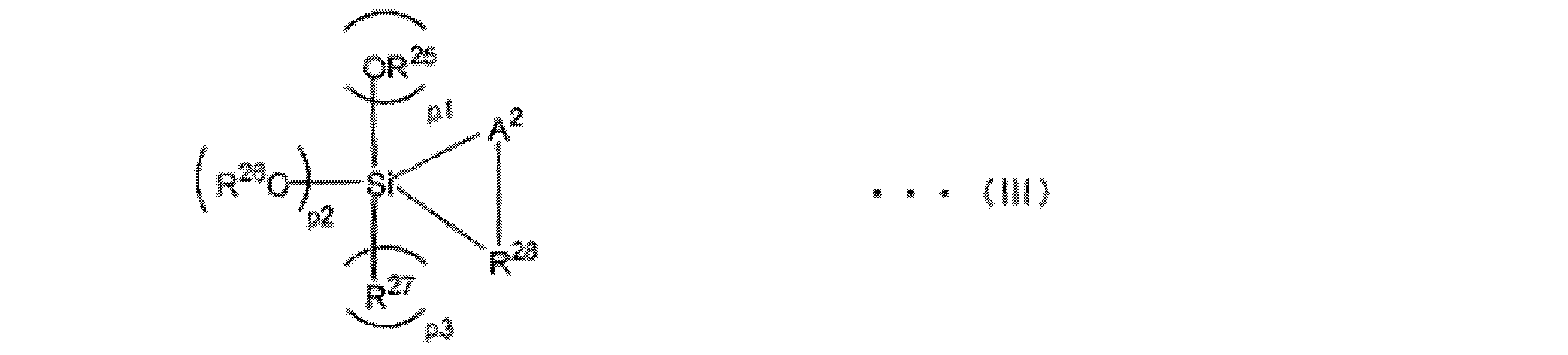
で表される化合物が好ましい。
一般式(III)中、p1+p2+p3は2であり(但し、p2は1~2の整数であり、p1及びp3は0~1の整数である)、A2は、NRa(Raは、一価の炭化水素基、加水分解性基又は含窒素有機基である)、或いは、硫黄であり、R25は、炭素数1~20の一価の脂肪族若しくは脂環式炭化水素基又は炭素数6~18の一価の芳香族炭化水素基であり、R27は、炭素数1~20の一価の脂肪族若しくは脂環式炭化水素基、炭素数6~18の一価の芳香族炭化水素基又はハロゲン原子であり、R26は、炭素数1~20の一価の脂肪族若しくは脂環式炭化水素基、炭素数6~18の一価の芳香族炭化水素基又は含窒素有機基であり、いずれも窒素原子及び/又はケイ素原子を含有していてもよく、p2が2の場合には、互いに同一でも異なっていてもよく、或いは、一緒になって環を形成してもよく、R28は、炭素数1~20の二価の脂肪族若しくは脂環式炭化水素基又は炭素数6~18の二価の芳香族炭化水素基である。前記加水分解性基として、トリメチルシリル基、tert-ブチルジメチルシリル基が好ましく、トリメチルシリル基が特に好ましい。
一般式(III)中、p1+p2+p3は2であり(但し、p2は1~2の整数であり、p1及びp3は0~1の整数である)、A2は、NRa(Raは、一価の炭化水素基、加水分解性基又は含窒素有機基である)、或いは、硫黄であり、R25は、炭素数1~20の一価の脂肪族若しくは脂環式炭化水素基又は炭素数6~18の一価の芳香族炭化水素基であり、R27は、炭素数1~20の一価の脂肪族若しくは脂環式炭化水素基、炭素数6~18の一価の芳香族炭化水素基又はハロゲン原子であり、R26は、炭素数1~20の一価の脂肪族若しくは脂環式炭化水素基、炭素数6~18の一価の芳香族炭化水素基又は含窒素有機基であり、いずれも窒素原子及び/又はケイ素原子を含有していてもよく、p2が2の場合には、互いに同一でも異なっていてもよく、或いは、一緒になって環を形成してもよく、R28は、炭素数1~20の二価の脂肪族若しくは脂環式炭化水素基又は炭素数6~18の二価の芳香族炭化水素基である。前記加水分解性基として、トリメチルシリル基、tert-ブチルジメチルシリル基が好ましく、トリメチルシリル基が特に好ましい。
上記一般式(II)で表される化合物としては、下記一般式(IV):

で表される化合物も好ましい。
一般式(IV)中、q1+q2は3であり(但し、q1は0~2の整数であり、q2は1~3の整数である)、R31は炭素数1~20の二価の脂肪族若しくは脂環式炭化水素基又は炭素数6~18の二価の芳香族炭化水素基であり、R32及びR33はそれぞれ独立して加水分解性基、炭素数1~20の一価の脂肪族若しくは脂環式炭化水素基又は炭素数6~18の一価の芳香族炭化水素基であり、R34は炭素数1~20の一価の脂肪族若しくは脂環式炭化水素基又は炭素数6~18の一価の芳香族炭化水素基であり、q1が2の場合には同一でも異なっていてもよく、R35は炭素数1~20の一価の脂肪族若しくは脂環式炭化水素基又は炭素数6~18の一価の芳香族炭化水素基であり、q2が2以上の場合には同一でも異なっていてもよい。前記加水分解性基としては、トリメチルシリル基、tert-ブチルジメチルシリル基が好ましく、トリメチルシリル基が特に好ましい。
一般式(IV)中、q1+q2は3であり(但し、q1は0~2の整数であり、q2は1~3の整数である)、R31は炭素数1~20の二価の脂肪族若しくは脂環式炭化水素基又は炭素数6~18の二価の芳香族炭化水素基であり、R32及びR33はそれぞれ独立して加水分解性基、炭素数1~20の一価の脂肪族若しくは脂環式炭化水素基又は炭素数6~18の一価の芳香族炭化水素基であり、R34は炭素数1~20の一価の脂肪族若しくは脂環式炭化水素基又は炭素数6~18の一価の芳香族炭化水素基であり、q1が2の場合には同一でも異なっていてもよく、R35は炭素数1~20の一価の脂肪族若しくは脂環式炭化水素基又は炭素数6~18の一価の芳香族炭化水素基であり、q2が2以上の場合には同一でも異なっていてもよい。前記加水分解性基としては、トリメチルシリル基、tert-ブチルジメチルシリル基が好ましく、トリメチルシリル基が特に好ましい。
上記一般式(II)で表される化合物としては、下記一般式(V):

で表される化合物も好ましい。
一般式(V)中、r1+r2は3であり(但し、r1は1~3の整数であり、r2は0~2の整数である)、R36は炭素数1~20の二価の脂肪族若しくは脂環式炭化水素基又は炭素数6~18の二価の芳香族炭化水素基であり、R37はジメチルアミノメチル基、ジメチルアミノエチル基、ジエチルアミノメチル基、ジエチルアミノエチル基、メチルシリル(メチル)アミノメチル基、メチルシリル(メチル)アミノエチル基、メチルシリル(エチル)アミノメチル基、メチルシリル(エチル)アミノエチル基、ジメチルシリルアミノメチル基、ジメチルシリルアミノエチル基、炭素数1~20の一価の脂肪族若しくは脂環式炭化水素基又は炭素数6~18の一価の芳香族炭化水素基であり、r1が2以上の場合には同一でも異なっていてもよく、R38は炭素数1~20のヒドロカルビルオキシ基、炭素数1~20の一価の脂肪族若しくは脂環式炭化水素基又は炭素数6~18の一価の芳香族炭化水素基であり、r2が2の場合には同一でも異なっていてもよい。
一般式(V)中、r1+r2は3であり(但し、r1は1~3の整数であり、r2は0~2の整数である)、R36は炭素数1~20の二価の脂肪族若しくは脂環式炭化水素基又は炭素数6~18の二価の芳香族炭化水素基であり、R37はジメチルアミノメチル基、ジメチルアミノエチル基、ジエチルアミノメチル基、ジエチルアミノエチル基、メチルシリル(メチル)アミノメチル基、メチルシリル(メチル)アミノエチル基、メチルシリル(エチル)アミノメチル基、メチルシリル(エチル)アミノエチル基、ジメチルシリルアミノメチル基、ジメチルシリルアミノエチル基、炭素数1~20の一価の脂肪族若しくは脂環式炭化水素基又は炭素数6~18の一価の芳香族炭化水素基であり、r1が2以上の場合には同一でも異なっていてもよく、R38は炭素数1~20のヒドロカルビルオキシ基、炭素数1~20の一価の脂肪族若しくは脂環式炭化水素基又は炭素数6~18の一価の芳香族炭化水素基であり、r2が2の場合には同一でも異なっていてもよい。
上記一般式(II)で表される化合物としては、下記一般式(VI):

で表される化合物も好ましい。
一般式(VI)中、R40はトリメチルシリル基、炭素数1~20の一価の脂肪族若しくは脂環式炭化水素基又は炭素数6~18の一価の芳香族炭化水素基であり、R41は炭素数1~20のヒドロカルビルオキシ基、炭素数1~20の一価の脂肪族若しくは脂環式炭化水素基又は炭素数6~18の一価の芳香族炭化水素基であり、R42は炭素数1~20の二価の脂肪族若しくは脂環式炭化水素基又は炭素数6~18の二価の芳香族炭化水素基である。ここで、TMSは、トリメチルシリル基を示す(以下、同じ。)。
一般式(VI)中、R40はトリメチルシリル基、炭素数1~20の一価の脂肪族若しくは脂環式炭化水素基又は炭素数6~18の一価の芳香族炭化水素基であり、R41は炭素数1~20のヒドロカルビルオキシ基、炭素数1~20の一価の脂肪族若しくは脂環式炭化水素基又は炭素数6~18の一価の芳香族炭化水素基であり、R42は炭素数1~20の二価の脂肪族若しくは脂環式炭化水素基又は炭素数6~18の二価の芳香族炭化水素基である。ここで、TMSは、トリメチルシリル基を示す(以下、同じ。)。
上記一般式(II)で表される化合物としては、下記一般式(VII):

で表される化合物も好ましい。
一般式(VII)中、R43及びR44はそれぞれ独立して炭素数1~20の二価の脂肪族若しくは脂環式炭化水素基又は炭素数6~18の二価の芳香族炭化水素基であり、R45は炭素数1~20の一価の脂肪族若しくは脂環式炭化水素基又は炭素数6~18の一価の芳香族炭化水素基であり、各R45は、同一でも異なっていてもよい。
一般式(VII)中、R43及びR44はそれぞれ独立して炭素数1~20の二価の脂肪族若しくは脂環式炭化水素基又は炭素数6~18の二価の芳香族炭化水素基であり、R45は炭素数1~20の一価の脂肪族若しくは脂環式炭化水素基又は炭素数6~18の一価の芳香族炭化水素基であり、各R45は、同一でも異なっていてもよい。
一般式(II)で表される化合物としては、下記一般式(VIII):

で表される化合物も好ましい。
一般式(VIII)中、r1+r2は3であり(但し、r1は0~2の整数であり、r2は1~3の整数である)、R46は炭素数1~20の二価の脂肪族若しくは脂環式炭化水素基又は炭素数6~18の二価の芳香族炭化水素基であり、R47およびR48はそれぞれ独立して炭素数1~20の一価の脂肪族若しくは脂環式炭化水素基又は炭素数6~18の一価の芳香族炭化水素基である。複数のR47又はR48は、同一でも異なっていてもよい。
一般式(VIII)中、r1+r2は3であり(但し、r1は0~2の整数であり、r2は1~3の整数である)、R46は炭素数1~20の二価の脂肪族若しくは脂環式炭化水素基又は炭素数6~18の二価の芳香族炭化水素基であり、R47およびR48はそれぞれ独立して炭素数1~20の一価の脂肪族若しくは脂環式炭化水素基又は炭素数6~18の一価の芳香族炭化水素基である。複数のR47又はR48は、同一でも異なっていてもよい。
上記一般式(II)で表される化合物としては、下記一般式(IX):

で表される化合物も好ましい。
一般式(IX)中、Xはハロゲン原子であり、R49は炭素数1~20の二価の脂肪族若しくは脂環式炭化水素基又は炭素数6~18の二価の芳香族炭化水素基であり、R50及びR51はそれぞれ独立して加水分解性基、炭素数1~20の一価の脂肪族若しくは脂環式炭化水素基又は炭素数6~18の一価の芳香族炭化水素基であるか、或いは、R50及びR51は結合して二価の有機基を形成しており、R52及びR53はそれぞれ独立してハロゲン原子、ヒドロカルビルオキシ基、炭素数1~20の一価の脂肪族若しくは脂環式炭化水素基又は炭素数6~18の一価の芳香族炭化水素基である。R50及びR51としては、加水分解性基であることが好ましく、加水分解性基として、トリメチルシリル基、tert-ブチルジメチルシリル基が好ましく、トリメチルシリル基が特に好ましい。
一般式(IX)中、Xはハロゲン原子であり、R49は炭素数1~20の二価の脂肪族若しくは脂環式炭化水素基又は炭素数6~18の二価の芳香族炭化水素基であり、R50及びR51はそれぞれ独立して加水分解性基、炭素数1~20の一価の脂肪族若しくは脂環式炭化水素基又は炭素数6~18の一価の芳香族炭化水素基であるか、或いは、R50及びR51は結合して二価の有機基を形成しており、R52及びR53はそれぞれ独立してハロゲン原子、ヒドロカルビルオキシ基、炭素数1~20の一価の脂肪族若しくは脂環式炭化水素基又は炭素数6~18の一価の芳香族炭化水素基である。R50及びR51としては、加水分解性基であることが好ましく、加水分解性基として、トリメチルシリル基、tert-ブチルジメチルシリル基が好ましく、トリメチルシリル基が特に好ましい。
上記一般式(II)で表されるヒドロカルビルオキシシラン化合物としては、下記一般式(X)~(XIII):


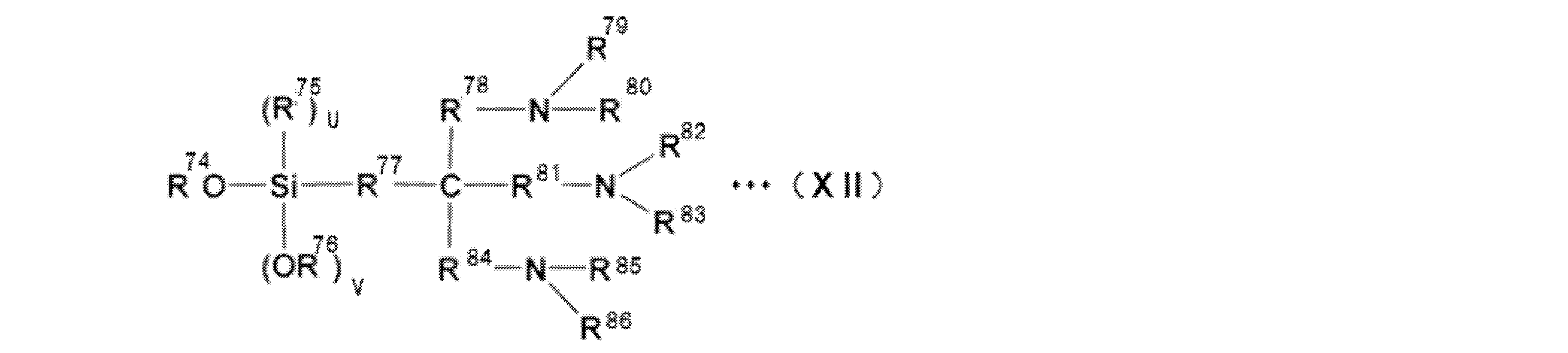

で表される化合物も好ましい。
一般式(X)~(XIII)中、記号U、Vはそれぞれ0~2且つU+V=2を満たす整数である。一般式(X)~(XIII)中のR54~92は同一でも異なっていてもよく、炭素数1~20の一価若しくは二価の脂肪族又は脂環式炭化水素基、或いは炭素数6~18の一価若しくは二価の芳香族炭化水素基である。一般式(XIII)中のα及びβは0~5の整数である。
一般式(X)~(XIII)中、記号U、Vはそれぞれ0~2且つU+V=2を満たす整数である。一般式(X)~(XIII)中のR54~92は同一でも異なっていてもよく、炭素数1~20の一価若しくは二価の脂肪族又は脂環式炭化水素基、或いは炭素数6~18の一価若しくは二価の芳香族炭化水素基である。一般式(XIII)中のα及びβは0~5の整数である。
前記変性官能基を有する重合開始剤としては、リチウムアミド化合物が好ましい。該リチウムアミド化合物としては、例えば、リチウムヘキサメチレンイミド、リチウムピロリジド、リチウムピペリジド、リチウムへプタメチレンイミド、リチウムドデカメチレンイミド、リチウムジメチルアミド、リチウムジエチルアミド、リチウムジブチルアミド、リチウムジプロピルアミド、リチウムジへプチルアミド、リチウムジへキシルアミド、リチウムジオクチルアミド、リチウムジ-2-エチルへキシルアミド、リチウムジデシルアミド、リチウム-N-メチルピペラジド、リチウムエチルプロピルアミド、リチウムエチルブチルアミド、リチウムエチルベンジルアミド、リチウムメチルフェネチルアミド等が挙げられる。
本発明のゴム組成物は、前記ゴム成分(A)とのSP値の差が1.5(cal/cm3)1/2以下である相溶性樹脂(B)と、前記ゴム成分(A)とのSP値の差が1.5(cal/cm3)1/2を超える非相溶性樹脂(C)と、を含む。ゴム組成物に相溶性樹脂(B)と非相溶性樹脂(C)の両方を配合することで、低歪領域での弾性率の変動を抑制しつつ、高歪領域での弾性率を大幅に低下させることができる。そのため、相溶性樹脂(B)及び非相溶性樹脂(C)を配合したゴム組成物をタイヤのトレッドに適用することで、走行時の歪が大きい路面との接地面近傍のトレッドゴムの変形体積を大きくしつつ、走行時の歪が小さい路面との接地面から遠い部分のトレッドゴムの剛性を確保でき、その結果として、湿潤路面での摩擦係数(μ)が高くなり、タイヤのウェット性能を向上させることができる。また、本発明のゴム組成物においては、ゴム組成物に相溶性樹脂(B)と非相溶性樹脂(C)の両方を配合して、低歪領域での弾性率の変動を抑制することで、タイヤの燃費性能への樹脂による影響を抑制でき、更には、タイヤのコーナーリング性能の悪化を抑制できる。また、本発明のゴム組成物においては、相溶性樹脂(B)と非相溶性樹脂(C)との両方を配合することで、密着性の上昇を抑制でき、耐オゾン性の悪化を抑制できる。
前記相溶性樹脂(B)と前記非相溶性樹脂(C)との質量での配合比率(即ち、相溶性樹脂(B)の配合量/非相溶性樹脂(C)の配合量)は、1/4~4/1の範囲が好ましく、1/2~2/1の範囲が更に好ましい。相溶性樹脂(B)と非相溶性樹脂(C)との配合比率を上記範囲内とすることで、ゴム組成物をトレッドゴムに適用したタイヤのウェット性能を更に向上させることができる。
前記相溶性樹脂(B)は、軟化点が110℃以下であることが好ましく、85℃以下であることが更に好ましい。相溶性樹脂(B)の軟化点が110℃以下であれば、ゴム組成物をトレッドゴムに適用したタイヤのウェット性能を更に向上させることができる。
また、前記非相溶性樹脂(C)軟化点は、145℃以下の範囲が好ましい。
そして、軟化点が110℃以下の相溶性樹脂(B)と、軟化点が145℃以下の非相溶性樹脂(C)とを組み合わせることで、ゴム組成物をトレッドゴムに適用したタイヤのウェット性能を更に向上させることができる。
また、前記非相溶性樹脂(C)軟化点は、145℃以下の範囲が好ましい。
そして、軟化点が110℃以下の相溶性樹脂(B)と、軟化点が145℃以下の非相溶性樹脂(C)とを組み合わせることで、ゴム組成物をトレッドゴムに適用したタイヤのウェット性能を更に向上させることができる。
前記相溶性樹脂(B)と前記非相溶性樹脂(C)との合計配合量は、前記ゴム成分(A)100質量部に対して10質量部以上であり、好ましくは12質量部以上であり、また、好ましくは40質量部以下、より好ましくは30質量部以下、より一層好ましくは20質量部以下である。相溶性樹脂(B)と非相溶性樹脂(C)との合計配合量がゴム成分(A)100質量部に対して10質量部未満では、ゴム組成物の高歪領域での弾性率を十分に低下させることができない。また、相溶性樹脂(B)と非相溶性樹脂(C)との合計配合量がゴム成分(A)100質量部に対して40質量部以下であれば、ゴム組成物をタイヤのトレッドゴムに適用した際に、タイヤのトレッドの剛性を十分に確保できる。
また、前記相溶性樹脂(B)の配合量は、前記ゴム成分(A)100質量部に対して5質量部以上が好ましく、また、30質量部以下が好ましく、20質量部以下がより好ましい。また、前記非相溶性樹脂(C)の配合量は、前記ゴム成分(A)100質量部に対して5質量部以上が好ましく、また、30質量部以下が好ましく、20質量部以下がより好ましい。前記相溶性樹脂(B)と前記非相溶性樹脂(C)の配合量が上記の範囲であれば、ゴム組成物の高歪領域での弾性率を十分に低下させることができる。
前記相溶性樹脂(B)及び非相溶性樹脂(C)は、ゴム成分(A)のSP値に応じて、適宜選択されるが、ウェット性能の観点から、C5系樹脂、C9系樹脂、C5-C9系樹脂、ジシクロペンタジエン樹脂、ロジン樹脂、アルキルフェノール樹脂及びテルペンフェノール樹脂が好ましい。
前記C5系樹脂とは、C5系合成石油樹脂を指し、該C5系樹脂としては、例えば、石油化学工業のナフサの熱分解によって得られるC5留分を、AlCl3、BF3等のフリーデルクラフツ型触媒を用いて重合して得られる脂肪族系石油樹脂が挙げられる。前記C5留分には、通常1-ペンテン、2-ペンテン、2-メチル-1-ブテン、2-メチル-2-ブテン、3-メチル-1-ブテン等のオレフィン系炭化水素、2-メチル-1,3-ブタジエン、1,2-ペンタジエン、1,3-ペンタジエン、3-メチル-1,2-ブタジエン等のジオレフィン系炭化水素等が含まれる。なお、前記C5系樹脂としては、市販品を利用することができ、例えば、エクソンモービルケミカル社製脂肪族系石油樹脂である「エスコレッツ(登録商標)1000シリーズ」、日本ゼオン株式会社製脂肪族系石油樹脂である「クイントン(登録商標)100シリーズ」の内「A100、B170、M100、R100」等が挙げられる。
前記C9系樹脂は、例えば、石油化学工業のナフサの熱分解により、エチレン、プロピレン等の石油化学基礎原料と共に副生するC9留分である、ビニルトルエン、アルキルスチレン、インデンを主要なモノマーとする炭素数9の芳香族を重合した樹脂である。ここで、ナフサの熱分解によって得られるC9留分の具体例としては、ビニルトルエン、α-メチルスチレン、β-メチルスチレン、γ-メチルスチレン、o-メチルスチレン、p-メチルスチレン、インデン等が挙げられる。該C9系樹脂は、C9留分と共に、C8留分であるスチレン等、C10留分であるメチルインデン、1,3-ジメチルスチレン等、更にはナフタレン、ビニルナフタレン、ビニルアントラセン、p-tert-ブチルスチレン等をも原料として用い、これらのC8~C10留分等を混合物のまま、例えばフリーデルクラフツ型触媒により共重合して得ることができる。また、前記C9系樹脂は、水酸基を有する化合物、不飽和カルボン酸化合物等で変性された変性石油樹脂であってもよい。なお、前記C9系樹脂としては、市販品を利用することができ、例えば、未変性C9系石油樹脂としては、商品名「日石ネオポリマー(登録商標)L-90」、「日石ネオポリマー(登録商標)120」、「日石ネオポリマー(登録商標)130」、「日石ネオポリマー(登録商標)140」(JX日鉱日石エネルギー株式会社製)等が挙げられる。
前記C5-C9系樹脂とは、C5-C9系合成石油樹脂を指し、該C5-C9系樹脂としては、例えば、石油由来のC5留分とC9留分とを、AlCl3、BF3等のフリーデルクラフツ型触媒を用いて重合して得られる固体重合体が挙げられ、より具体的には、スチレン、ビニルトルエン、α-メチルスチレン、インデン等を主成分とする共重合体等が挙げられる。該C5-C9系樹脂としては、C9以上の成分の少ない樹脂が、ゴム成分(A)との相溶性の観点から好ましい。ここで、「C9以上の成分が少ない」とは、樹脂全量中のC9以上の成分が50質量%未満、好ましくは40質量%以下であることを言うものとする。前記C5-C9系樹脂しては、市販品を利用することができ、例えば、商品名「クイントン(登録商標)G100B」(日本ゼオン株式会社製)、商品名「ECR213」(エクソンモービルケミカル社製)等が挙げられる。
前記ジシクロペンタジエン樹脂は、シクロペンタジエンを二量体化して得られるジシクロペンタジエンを主原料に製造された石油樹脂である。前記ジシクロペンタジエン樹脂としては、市販品を利用することができ、例えば、日本ゼオン株式会社製脂環式系石油樹脂である商品名「クイントン(登録商標)1000シリーズ」の内「1105、1325、1340」等が挙げられる。
前記ロジン樹脂は、マツ科の植物の樹液である松脂(まつやに)等のバルサム類を集めてテレピン精油を蒸留した後に残る残留物で、ロジン酸(アビエチン酸、パラストリン酸、イソピマール酸等)を主成分とする天然樹脂、及びそれらを変性、水素添加等で加工した変性樹脂、水添樹脂である。例えば、天然樹脂ロジン、その重合ロジンや部分水添ロジン;グリセリンエステルロジン、その部分水添ロジンや完全水添ロジンや重合ロジン;ペンタエリスリトールエステルロジン、その部分水添ロジンや重合ロジン等が挙げられる。天然樹脂ロジンとして、生松ヤニやトール油に含まれるガムロジン、トール油ロジン、ウッドロジン等がある。前記ロジン樹脂としては、市販品を利用することができ、例えば、商品名「ネオトール105」(ハリマ化成株式会社製)、商品名「SNタック754」(サンノプコ株式会社製)、商品名「ライムレジンNo.1」、「ペンセルA」及び「ペンセルAD」(荒川化学工業株式会社製)、商品名「ポリペール」及び「ペンタリンC」(イーストマンケミカル株式会社製)、商品名「ハイロジン(登録商標)S」(大社松精油株式会社製)等が挙げられる。
前記アルキルフェノール樹脂は、例えば、アルキルフェノールとホルムアルデヒドとの触媒下における縮合反応によって得られる。該アルキルフェノール樹脂としては、市販品を利用することができ、例えば、商品名「ヒタノール1502P」(日立化成株式会社製)、商品名「タッキロール201」(田岡化学工業株式会社製)、商品名「タッキロール250-I」(臭素化アルキルフェノールホルムアルデヒド樹脂、田岡化学工業株式会社製)、商品名「タッキロール250-III」(臭素化アルキルフェノールホルムアルデヒド樹脂、田岡化学工業株式会社製)、商品名「R7521P」、「SP1068」、「R7510PJ」、「R7572P」及び「R7578P」(SI GROUP INC.製)等が挙げられる。
前記テルペンフェノール樹脂は、例えば、テルペン類と種々のフェノール類とを、フリーデルクラフツ型触媒を用いて反応させたり、又はさらにホルマリンで縮合する方法で得ることができる。原料のテルペン類としては特に制限はなく、α-ピネンやリモネン等のモノテルペン炭化水素が好ましく、α-ピネンを含むものがより好ましく、特にα-ピネンであることが好ましい。該テルペンフェノール樹脂としては、市販品を利用することができ、例えば、商品名「タマノル803L」、「タマノル901」(荒川化学工業株式会社製)、商品名「YSポリスター(登録商標)U」シリーズ、「YSポリスター(登録商標)T」シリーズ、「YSポリスター(登録商標)S」シリーズ、「YSポリスター(登録商標)G」シリーズ、「YSポリスター(登録商標)N」シリーズ、「YSポリスター(登録商標)K」シリーズ、「YSポリスター(登録商標)TH」シリーズ(ヤスハラケミカル株式会社製)等が挙げられる。
本発明のゴム組成物は、充填剤を含むことが好ましい。また、本発明のゴム組成物は、該充填剤として、シリカを含むことが好ましく、充填剤中のシリカの割合は、好ましくは70質量%以上、より好ましくは80質量%以上、より一層好ましくは90質量%以上であり、充填剤の全量がシリカであってもよい。充填剤中のシリカの割合が70質量%以上であれば、ゴム組成物のtanδが更に低下し、該ゴム組成物を適用したタイヤの燃費性能が更に向上する。
前記シリカとしては、特に制限はなく、例えば、湿式シリカ(含水ケイ酸)、乾式シリカ(無水ケイ酸)、ケイ酸カルシウム、ケイ酸アルミニウム等が挙げられ、これらの中でも、湿式シリカが好ましい。これらシリカは、1種単独で使用してもよいし、2種以上を併用してもよい。
本発明のゴム組成物において、前記シリカの配合量は、前記ゴム成分(A)100質量部に対して40~70質量部の範囲が好ましく、45~60質量部の範囲が更に好ましい。シリカの配合量がゴム成分(A)100質量部に対して40質量部以上であれば、ゴム組成物のtanδが更に低下して、該ゴム組成物を適用したタイヤの燃費性能が更に向上し、また、70質量部以下であれば、ゴム組成物の柔軟性が高く、該ゴム組成物をタイヤのトレッドゴムに適用することで、トレッドゴムの変形体積が大きくなって、タイヤのウェット性能を更に向上させることができる。
本発明のゴム組成物においては、充填剤中のシリカの窒素吸着比表面積は、特に制限なく、窒素吸着比表面積が150m2/gを超える一般的なシリカを用いても良いし、比較的粒径が大きいとされる、平均一次粒子径が21nm以上で且つ窒素吸着比表面積が150m2/g以下であるシリカ(以下、「大粒径シリカ」と称することがある)を用いても良い。
本発明のゴム組成物においては、前記充填剤として、更に、カーボンブラックを含むことが好ましく、また、該カーボンブラックの配合量は、前記ゴム成分(A)100質量部に対して1~10質量部の範囲が好ましく、3~8質量部の範囲が更に好ましい。カーボンブラックを1質量部以上配合することで、ゴム組成物の剛性が向上し、また、カーボンブラックの配合量が10質量部以下であれば、tanδの上昇を抑制できるため、該ゴム組成物をタイヤのトレッドゴムに適用することで、タイヤの燃費性能とウェット性能を高いレベルで両立できる。
前記カーボンブラックとしては、特に限定されるものではなく、例えば、GPF、FEF、HAF、ISAF、SAFグレードのカーボンブラックが挙げられる。これらの中でも、タイヤのウェット性能を向上させる観点から、ISAF、SAFグレードのカーボンブラックが好ましい。これらカーボンブラックは、1種単独で使用してもよいし、2種以上を併用してもよい。
また、前記充填剤は、上述したシリカ、カーボンブラックの他、水酸化アルミニウム、アルミナ、クレー、炭酸カルシウム等を含んでもよい。
本発明のゴム組成物において、前記充填剤の配合量は、前記ゴム成分(A)100質量部に対して、好ましくは30質量部以上、より好ましくは40質量部以上であり、また、好ましくは100質量部以下、より好ましくは80質量部以下である。ゴム組成物中の充填剤の配合量が前記範囲内であれば、該ゴム組成物をタイヤのトレッドゴムに適用することで、タイヤの燃費性能とウェット性能を更に向上させることができる。
本発明のゴム組成物は、前記シリカの配合効果を向上させるために、更に、シランカップリング剤を含有することが好ましい。該シランカップリング剤としては、特に限定されるものではなく、例えば、ビス(3-トリエトキシシリルプロピル)テトラスルフィド、ビス(3-トリエトキシシリルプロピル)トリスルフィド、ビス(3-トリエトキシシリルプロピル)ジスルフィド、ビス(2-トリエトキシシリルエチル)テトラスルフィド、ビス(3-トリメトキシシリルプロピル)テトラスルフィド、ビス(2-トリメトキシシリルエチル)テトラスルフィド、3-メルカプトプロピルトリメトキシシラン、3-メルカプトプロピルトリエトキシシラン、2-メルカプトエチルトリメトキシシラン、2-メルカプトエチルトリエトキシシラン、3-トリメトキシシリルプロピル-N,N-ジメチルチオカルバモイルテトラスルフィド、3-トリエトキシシリルプロピル-N,N-ジメチルチオカルバモイルテトラスルフィド、2-トリエトキシシリルエチル-N,N-ジメチルチオカルバモイルテトラスルフィド、3-トリメトキシシリルプロピルベンゾチアゾリルテトラスルフィド、3-トリエトキシシリルプロピルベンゾチアゾリルテトラスルフィド、3-トリエトキシシリルプロピルメタクリレートモノスルフィド、3-トリメトキシシリルプロピルメタクリレートモノスルフィド、ビス(3-ジエトキシメチルシリルプロピル)テトラスルフィド、3-メルカプトプロピルジメトキシメチルシラン、ジメトキシメチルシリルプロピル-N,N-ジメチルチオカルバモイルテトラスルフィド、ジメトキシメチルシリルプロピルベンゾチアゾリルテトラスルフィド等が挙げられる。これらシランカップリング剤は、1種単独で用いてもよいし、2種以上を組み合わせて用いてもよい。
また、前記シランカップリング剤の配合量は、前記シリカ100質量部に対して2~20質量部の範囲が好ましく、5~15質量部の範囲が更に好ましい。シランカップリング剤の配合量がシリカ100質量部に対して2質量部以上であれば、シリカの配合効果が十分に向上し、また、シランカップリング剤の配合量がシリカ100質量部に対して20質量部以下であれば、ゴム成分(A)のゲル化の可能性が低い。
また、前記シランカップリング剤の配合量は、前記シリカ100質量部に対して2~20質量部の範囲が好ましく、5~15質量部の範囲が更に好ましい。シランカップリング剤の配合量がシリカ100質量部に対して2質量部以上であれば、シリカの配合効果が十分に向上し、また、シランカップリング剤の配合量がシリカ100質量部に対して20質量部以下であれば、ゴム成分(A)のゲル化の可能性が低い。
本発明のゴム組成物は、加工性、作業性の観点から、更に、軟化剤を含んでもよい。該軟化剤の配合量は、前記ゴム成分(A)100質量部に対して1~5質量部の範囲が好ましく、1.5~3質量部の範囲が更に好ましい。軟化剤を1質量部以上配合することで、ゴム組成物の混練が容易となり、また、軟化剤を5質量部以下配合することで、ゴム組成物の剛性の低下を抑制できる。
ここで、前記軟化剤としては、鉱物由来のミネラルオイル、石油由来のアロマチックオイル、パラフィンオイル、ナフテンオイル、天然物由来のパームオイル等が挙げられるが、これらの中でも、タイヤのウェット性能の観点から、鉱物由来の軟化剤及び石油由来の軟化剤が好ましい。
ここで、前記軟化剤としては、鉱物由来のミネラルオイル、石油由来のアロマチックオイル、パラフィンオイル、ナフテンオイル、天然物由来のパームオイル等が挙げられるが、これらの中でも、タイヤのウェット性能の観点から、鉱物由来の軟化剤及び石油由来の軟化剤が好ましい。
本発明のゴム組成物は、更に、脂肪酸金属塩を含んでもよい。該脂肪酸金属塩に用いられる金属としては、Zn、K、Ca、Na、Mg、Co、Ni、Ba、Fe、Al、Cu、Mn等が挙げられ、Znが好ましい。一方、前記脂肪酸金属塩に用いられる脂肪酸としては、炭素数4~30の飽和又は不飽和の直鎖、分岐もしくは環状構造を有する脂肪酸、あるいはそれらの混合物が挙げられ、これらの中でも、炭素数10~22の飽和又は不飽和の直鎖脂肪酸が好ましい。炭素数10~22の飽和直鎖脂肪酸としては、ラウリン酸、ミリスチン酸、パルミチン酸、ステアリン酸等が挙げられ、また、炭素数10~22の不飽和直鎖脂肪酸としては、オレイン酸、リノール酸、リノレン酸、アラキドン酸等が挙げられる。前記脂肪酸金属塩は、1種単独で用いてもよいし、2種以上を組み合わせて用いてもよい。前記脂肪酸金属塩の配合量は、前記ゴム成分(A)100質量部に対して0.1~10質量部の範囲が好ましく、0.5~5質量部の範囲が更に好ましい。
本発明のゴム組成物には、前記ゴム成分(A)、相溶性樹脂(B)、非相溶性樹脂(C)、充填剤、シランカップリング剤、軟化剤、脂肪酸金属塩の他、ゴム工業界で通常使用される配合剤、例えば、ステアリン酸、老化防止剤、酸化亜鉛(亜鉛華)、加硫促進剤、加硫剤等を、本発明の目的を害しない範囲内で適宜選択して配合してもよい。これら配合剤としては、市販品を好適に使用することができる。ただし、本発明のゴム組成物の動歪1%、0℃における貯蔵弾性率を低減する観点から、ノボラック型及びレゾール型フェノール樹脂、レゾルシン樹脂等の熱硬化性樹脂を配合しないことが好ましい。
本発明のゴム組成物は、0℃におけるtanδが0.5以下であり、30℃におけるtanδと60℃におけるtanδとの差が0.070以下であり、動歪1%、0℃における貯蔵弾性率が20MPa以下であることが好ましい。
ゴム組成物の0℃におけるtanδが0.5以下の場合、該ゴム組成物を適用したタイヤの低温での燃費性能を向上させることができる。なお、0℃におけるtanδは、タイヤの低温での燃費性能の観点から、より好ましくは0.45以下、より一層好ましくは0.4以下である。また、0℃におけるtanδの下限は特に限定されるものではないが、通常、0℃におけるtanδは、0.15以上である。
また、ゴム組成物の30℃におけるtanδと60℃におけるtanδとの差が0.070以下の場合、tanδの温度依存性が小さくなり、広い温度領域に渡って、該ゴム組成物を適用したタイヤの燃費性能を改善することが可能となる。なお、30℃におけるtanδと60℃におけるtanδとの差は、タイヤの燃費性能の温度依存性を低減する観点から、より好ましくは0.060以下、より一層好ましくは0.055以下、特に好ましくは0.050以下である。また、30℃におけるtanδと60℃におけるtanδとの差の下限は特に限定されるものではなく、該差は0でもよい。
また、ゴム組成物の動歪1%、0℃における貯蔵弾性率(E’)が20MPa以下であれば、低温でのゴム組成物の柔軟性が高く、該ゴム組成物をタイヤのトレッドゴムに適用することで、トレッドゴムの接地性能が良くなり、タイヤのウェット性能を更に向上させることができる。なお、動歪1%、0℃における貯蔵弾性率(E’)は、ウェット性能の観点から、より好ましくは18MPa以下、より一層好ましくは16MPa以下、また、好ましくは3MPa以上、より好ましくは5MPa以上である。
ゴム組成物の0℃におけるtanδが0.5以下の場合、該ゴム組成物を適用したタイヤの低温での燃費性能を向上させることができる。なお、0℃におけるtanδは、タイヤの低温での燃費性能の観点から、より好ましくは0.45以下、より一層好ましくは0.4以下である。また、0℃におけるtanδの下限は特に限定されるものではないが、通常、0℃におけるtanδは、0.15以上である。
また、ゴム組成物の30℃におけるtanδと60℃におけるtanδとの差が0.070以下の場合、tanδの温度依存性が小さくなり、広い温度領域に渡って、該ゴム組成物を適用したタイヤの燃費性能を改善することが可能となる。なお、30℃におけるtanδと60℃におけるtanδとの差は、タイヤの燃費性能の温度依存性を低減する観点から、より好ましくは0.060以下、より一層好ましくは0.055以下、特に好ましくは0.050以下である。また、30℃におけるtanδと60℃におけるtanδとの差の下限は特に限定されるものではなく、該差は0でもよい。
また、ゴム組成物の動歪1%、0℃における貯蔵弾性率(E’)が20MPa以下であれば、低温でのゴム組成物の柔軟性が高く、該ゴム組成物をタイヤのトレッドゴムに適用することで、トレッドゴムの接地性能が良くなり、タイヤのウェット性能を更に向上させることができる。なお、動歪1%、0℃における貯蔵弾性率(E’)は、ウェット性能の観点から、より好ましくは18MPa以下、より一層好ましくは16MPa以下、また、好ましくは3MPa以上、より好ましくは5MPa以上である。
また、本発明のゴム組成物は、30℃におけるtanδが0.4以下であることが好ましく、より好ましくは0.35以下であり、また、通常は0.1以上である。更に、本発明のゴム組成物は、60℃におけるtanδが0.35以下であることが好ましく、より好ましくは0.3以下であり、また、通常は0.05以上である。この場合、広い温度範囲に渡って、タイヤの燃費性能を改善できる。
また、本発明のゴム組成物は、ウェット性能の向上及び燃費性能の温度依存性を低減する観点から、0℃におけるtanδと30℃におけるtanδとの差が0.30以下であることが好ましく、0.14~0.30であることが更に好ましく、より一層好ましくは0.15~0.25、特に好ましくは0.16~0.20である。
また、本発明のゴム組成物は、燃費性能の温度依存性を低減する観点から、0℃におけるtanδと60℃におけるtanδとの差が0.35以下であることが好ましく、より好ましくは0.24以下、より一層好ましくは0.23以下であり、該差は0でもよい。
本発明のゴム組成物は、ウェット性能の観点から、引張強さ(Tb)が20MPa以上であることが好ましく、より好ましくは23MPa以上である。引張強さが20MPa以上のゴム組成物をトレッドゴムに用いると、トレッドゴム全体としての剛性が向上し、ウェット性能を更に向上させることができる。
上述した、0℃におけるtanδが0.5以下であり、30℃におけるtanδと60℃におけるtanδとの差が0.070以下である本発明の好適態様のゴム組成物は、加硫剤及び加硫促進剤を含む加硫系配合剤を除いて、前記ゴム成分(A)と、前記相溶性樹脂(B)と、前記非相溶性樹脂(C)とを150~165℃で混練する工程を経て製造されることが好ましい。
前記加硫系配合剤を除いて、150~165℃で混練することで、早期加硫(スコーチ)を避けつつ、加硫系配合剤以外の配合剤をゴム成分(A)に均一に分散させることができ、各配合剤の配合効果が十分に発揮されて、ゴム組成物の0℃におけるtanδを低下させつつ、ゴム組成物の30℃におけるtanδと60℃におけるtanδとの差を小さくすることができる。
なお、ゴム組成物のtanδ、各温度でのtanδの差、貯蔵弾性率(E’)、引張強さ(Tb)は、上述の混練温度の他、ゴム成分(A)の種類やブレンド比、相溶性樹脂(B)及び非相溶性樹脂(C)の種類や配合量、充填剤中のシリカの割合やシリカの種類等、更には他の配合剤の種類及び量を調整することでも、変化させることができる。
前記加硫系配合剤を除いて、150~165℃で混練することで、早期加硫(スコーチ)を避けつつ、加硫系配合剤以外の配合剤をゴム成分(A)に均一に分散させることができ、各配合剤の配合効果が十分に発揮されて、ゴム組成物の0℃におけるtanδを低下させつつ、ゴム組成物の30℃におけるtanδと60℃におけるtanδとの差を小さくすることができる。
なお、ゴム組成物のtanδ、各温度でのtanδの差、貯蔵弾性率(E’)、引張強さ(Tb)は、上述の混練温度の他、ゴム成分(A)の種類やブレンド比、相溶性樹脂(B)及び非相溶性樹脂(C)の種類や配合量、充填剤中のシリカの割合やシリカの種類等、更には他の配合剤の種類及び量を調整することでも、変化させることができる。
また、前記ゴム組成物は、150~165℃で混練した後、更に150℃未満の別の温度で加硫系配合剤を加えて混練されることが好ましい。ここで、該ゴム組成物は、加硫系配合剤以外の配合剤をゴム成分(A)に十分均一に分散させた後、加硫剤及び加硫促進剤を含む加硫系配合剤を配合して、早期加硫(スコーチ)を防止できる温度、例えば、90~120℃で混練されることが好ましい。
なお、ゴム組成物の製造において、各温度での混練は、混練時間に制限はなく、混練装置の大きさ、原料の体積、原料の種類や状態等を勘案して、適宜設定することができる。
なお、ゴム組成物の製造において、各温度での混練は、混練時間に制限はなく、混練装置の大きさ、原料の体積、原料の種類や状態等を勘案して、適宜設定することができる。
前記加硫剤としては、硫黄等が挙げられる。該加硫剤の配合量は、ゴム成分(A)100質量部に対し、硫黄分として0.1~10質量部の範囲が好ましく、1~4質量部の範囲が更に好ましい。加硫剤の配合量が硫黄分として0.1質量部以上であれば、加硫ゴムの破壊強度、耐摩耗性等を確保でき、また、10質量部以下であれば、ゴム弾性を十分に確保できる。特に、加硫剤の配合量を硫黄分として4質量部以下とすることで、タイヤのウェット性能を更に向上させることができる。
また、前記加硫促進剤としては、特に限定されるものではなく、例えば、2-メルカプトベンゾチアゾール(M)、ジベンゾチアジルジスルフィド(DM)、N-シクロヘキシル-2-ベンゾチアジルスルフェンアミド(CZ)、N-tert-ブチル-2-ベンゾチアゾリルスルフェンアミド(NS)等のチアゾール系加硫促進剤、1,3-ジフェニルグアニジン(DPG)等のグアニジン系加硫促進剤等が挙げられる。なお、本発明のゴム組成物は、3種の加硫促進剤を含むことが好ましい。前記加硫促進剤の配合量は、前記ゴム成分(A)100質量部に対して0.1~5質量部の範囲が好ましく、0.2~3質量部の範囲が更に好ましい。
なお、本発明のゴム組成物は、例えば、バンバリーミキサーやロール等を用いて、上述のように、ゴム成分(A)に、相溶性樹脂(B)及び非相溶性樹脂(C)と、必要に応じて適宜選択した各種配合剤とを配合して混練した後、熱入れ、押出等することにより製造することができる。
本発明のゴム組成物は、タイヤを始めとする種々のゴム製品に利用できる。特には、本発明のゴム組成物は、タイヤのトレッドゴムとして好適である。
<タイヤ>
本発明のタイヤは、上述したゴム組成物をトレッドゴムに用いたことを特徴とする。本発明のタイヤは、前記ゴム組成物がトレッドゴムに用いられているため、燃費性能、及びウェット性能に優れる。また、本発明のタイヤは、各種車輌向けのタイヤとして利用できるが、乗用車用タイヤとして好ましい。
本発明のタイヤは、上述したゴム組成物をトレッドゴムに用いたことを特徴とする。本発明のタイヤは、前記ゴム組成物がトレッドゴムに用いられているため、燃費性能、及びウェット性能に優れる。また、本発明のタイヤは、各種車輌向けのタイヤとして利用できるが、乗用車用タイヤとして好ましい。
本発明のタイヤは、適用するタイヤの種類に応じ、未加硫のゴム組成物を用いて成形後に加硫して得てもよく、又は予備加硫工程等を経た半加硫ゴムを用いて成形後、さらに本加硫して得てもよい。なお、本発明のタイヤは、好ましくは空気入りタイヤであり、空気入りタイヤに充填する気体としては、通常の或いは酸素分圧を調整した空気の他、窒素、アルゴン、ヘリウム等の不活性ガスを用いることができる。
以下に、実施例を挙げて本発明を更に詳しく説明するが、本発明は下記の実施例に何ら限定されるものではない。
<ゴム組成物の調製及び評価>
表1に示す配合処方に従い、通常のバンバリーミキサーを用いて、ゴム組成物を製造した。なお、各ゴム組成物には、表1に示す配合剤以外に、石油系オイル[株式会社ジャパンエナジー製、商品名「プロセスX-140」]3質量部、老化防止剤[N-(1,3-ジメチルブチル)-N’-フェニル-p-フェニレンジアミン、大内新興化学工業株式会社製、商品名「ノクラック6C」]1質量部、ステアリン酸1質量部、亜鉛華2.5質量部、加硫促進剤A[1,3-ジフェニルグアニジン、住友化学株式会社製、商品名「ソクシノール(登録商標)D-G」]0.8質量部、加硫促進剤B[ジベンゾチアジルジスルフィド、大内新興化学工業株式会社製、商品名「ノクセラー(登録商標)DM-P」]1.1質量部、加硫促進剤C[N-シクロヘキシル-2-ベンゾチアジルスルフェンアミド、大内新興化学工業株式会社製、商品名「ノクセラー(登録商標)CZ-G」]1質量部、硫黄1.9質量部を配合した。
得られたゴム組成物に対して、下記の方法で損失正接(tanδ)及び貯蔵弾性率(E’)、並びに、引張強さ(Tb)を測定し、更に、ウェット性能、燃費性能、コーナーリング性能、密着性、耐オゾン性を評価した。結果を表1に示す。
表1に示す配合処方に従い、通常のバンバリーミキサーを用いて、ゴム組成物を製造した。なお、各ゴム組成物には、表1に示す配合剤以外に、石油系オイル[株式会社ジャパンエナジー製、商品名「プロセスX-140」]3質量部、老化防止剤[N-(1,3-ジメチルブチル)-N’-フェニル-p-フェニレンジアミン、大内新興化学工業株式会社製、商品名「ノクラック6C」]1質量部、ステアリン酸1質量部、亜鉛華2.5質量部、加硫促進剤A[1,3-ジフェニルグアニジン、住友化学株式会社製、商品名「ソクシノール(登録商標)D-G」]0.8質量部、加硫促進剤B[ジベンゾチアジルジスルフィド、大内新興化学工業株式会社製、商品名「ノクセラー(登録商標)DM-P」]1.1質量部、加硫促進剤C[N-シクロヘキシル-2-ベンゾチアジルスルフェンアミド、大内新興化学工業株式会社製、商品名「ノクセラー(登録商標)CZ-G」]1質量部、硫黄1.9質量部を配合した。
得られたゴム組成物に対して、下記の方法で損失正接(tanδ)及び貯蔵弾性率(E’)、並びに、引張強さ(Tb)を測定し、更に、ウェット性能、燃費性能、コーナーリング性能、密着性、耐オゾン性を評価した。結果を表1に示す。
(1)損失正接(tanδ)及び貯蔵弾性率(E’)
ゴム組成物を145℃で33分間加硫して得られた加硫ゴムに対して、株式会社上島製作所製スペクトロメーターを用いて、初期荷重160mg、動歪1%、周波数52Hzの条件下で、0℃、30℃及び60℃におけるtanδ(損失正接)、並びに、0℃における貯蔵弾性率(E’)を測定した。
ゴム組成物を145℃で33分間加硫して得られた加硫ゴムに対して、株式会社上島製作所製スペクトロメーターを用いて、初期荷重160mg、動歪1%、周波数52Hzの条件下で、0℃、30℃及び60℃におけるtanδ(損失正接)、並びに、0℃における貯蔵弾性率(E’)を測定した。
(2)引張強さ(Tb)
ゴム組成物を145℃で33分間加硫して得られた加硫ゴムに対して、JIS K6251-1993に準拠して、引張強さ(Tb)を測定した。
ゴム組成物を145℃で33分間加硫して得られた加硫ゴムに対して、JIS K6251-1993に準拠して、引張強さ(Tb)を測定した。
(3)ウェット性能
上記のようにして得られたゴム組成物をトレッドゴムに用いて、サイズ195/65R15の乗用車用空気入りラジアルタイヤを作製した。作製した供試タイヤを試験車に装着し、湿潤路面での実車試験にて、グリップ性能をドライバーのフィーリング評点で表し、比較例1のタイヤのフィーリング評点を100として指数表示した。指数値が大きい程、ウェット性能に優れることを示す。
上記のようにして得られたゴム組成物をトレッドゴムに用いて、サイズ195/65R15の乗用車用空気入りラジアルタイヤを作製した。作製した供試タイヤを試験車に装着し、湿潤路面での実車試験にて、グリップ性能をドライバーのフィーリング評点で表し、比較例1のタイヤのフィーリング評点を100として指数表示した。指数値が大きい程、ウェット性能に優れることを示す。
(4)燃費性能
上記のようにして測定した各加硫ゴムの60℃におけるtanδの逆数を計算し、比較例1のtanδの逆数を100として、それぞれ指数表示した。指数値が大きい程、60℃におけるtanδが小さく、燃費性能が良好であることを示す。
上記のようにして測定した各加硫ゴムの60℃におけるtanδの逆数を計算し、比較例1のtanδの逆数を100として、それぞれ指数表示した。指数値が大きい程、60℃におけるtanδが小さく、燃費性能が良好であることを示す。
(5)コーナーリング性能
上記のようにして得られたゴム組成物をトレッドゴムに用いて、サイズ195/65R15の乗用車用空気入りラジアルタイヤを作製した。作製した供試タイヤを試験車に装着し、実車試験にて、コーナーリング性能をドライバーのフィーリング評点で表し、比較例1のタイヤのフィーリング評点を100として指数表示した。指数値が大きい程、コーナーリング性能に優れることを示す。
上記のようにして得られたゴム組成物をトレッドゴムに用いて、サイズ195/65R15の乗用車用空気入りラジアルタイヤを作製した。作製した供試タイヤを試験車に装着し、実車試験にて、コーナーリング性能をドライバーのフィーリング評点で表し、比較例1のタイヤのフィーリング評点を100として指数表示した。指数値が大きい程、コーナーリング性能に優れることを示す。
(6)密着性
シーティングした加硫前の未加硫ゴムシートに対して、押し付けた金属との密着力を測定し、比較例1の密着力の逆数を100として、それぞれ指数表示した。指数値が大きい程、密着力が小さく、密着性が良好であることを示す。
シーティングした加硫前の未加硫ゴムシートに対して、押し付けた金属との密着力を測定し、比較例1の密着力の逆数を100として、それぞれ指数表示した。指数値が大きい程、密着力が小さく、密着性が良好であることを示す。
(7)耐オゾン性
JIS K 6259「動的オゾン劣化試験」に準じて評価を実施した。具体的には、145℃で33分間加硫して得られた加硫ゴムからなる試験片を準備し、オゾン濃度:50pphm、温度:40℃、引張り歪み:20%の条件で、試験片表面にオゾンクラックが発生する時間を測定し、比較例1のオゾンクラック発生時間を100として、それぞれ指数表示した。指数値が大きい程、オゾンクラック発生時間が長く、耐オゾン性が良好であることを示す。
JIS K 6259「動的オゾン劣化試験」に準じて評価を実施した。具体的には、145℃で33分間加硫して得られた加硫ゴムからなる試験片を準備し、オゾン濃度:50pphm、温度:40℃、引張り歪み:20%の条件で、試験片表面にオゾンクラックが発生する時間を測定し、比較例1のオゾンクラック発生時間を100として、それぞれ指数表示した。指数値が大きい程、オゾンクラック発生時間が長く、耐オゾン性が良好であることを示す。
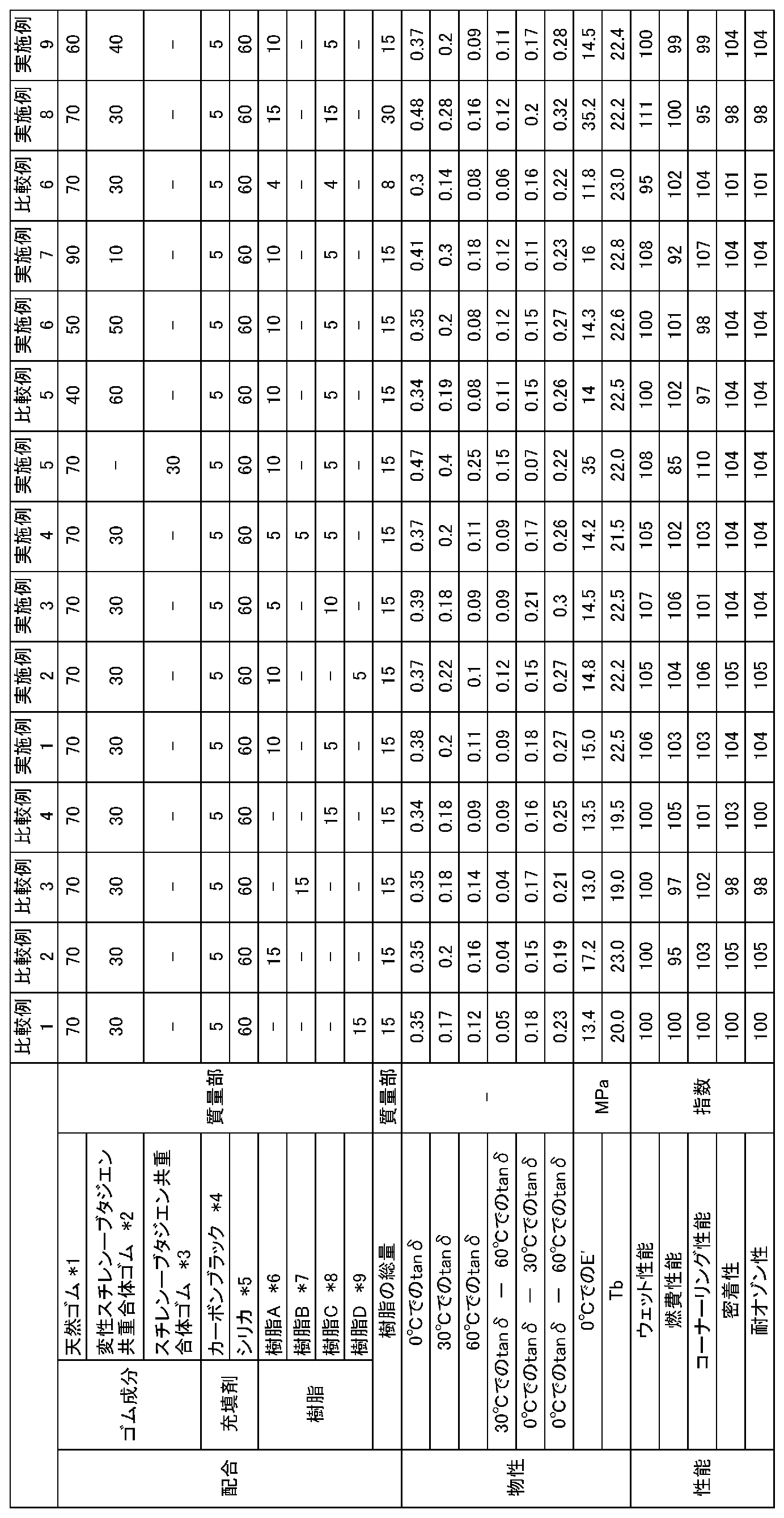
*1 天然ゴム:インドネシア製「SIR20」、SP値=8.50(cal/cm3)1/2
*2 変性スチレン-ブタジエン共重合体ゴム:下記の方法で合成した変性スチレン-ブタジエン共重合体ゴム、SP値=8.65(cal/cm3)1/2
*3 スチレン-ブタジエン共重合体ゴム:JSR株式会社製、商品名「#1500」、SP値=8.60(cal/cm3)1/2
*4 カーボンブラック:N234(ISAF)、旭カーボン株式会社製、商品名「#78」
*5 シリカ:東ソー・シリカ工業株式会社製、商品名「ニプシルAQ」、BET表面積=205m2/g
*6 樹脂A:C9系樹脂、JX日鉱日石エネルギー株式会社製、商品名「日石ネオポリマー(登録商標)140」、SP値=10.5(cal/cm3)1/2、軟化点=145℃
*7 樹脂B:ジシクロペンタジエン樹脂、日本ゼオン株式会社製、商品名「クイントン(登録商標)1105」、SP値=10.7(cal/cm3)1/2、軟化点=85℃
*8 樹脂C:C5-C9系樹脂、日本ゼオン株式会社製、商品名「クイントン(登録商標)G100B」、SP値=8.8(cal/cm3)1/2、軟化点=104℃
*9 樹脂D:C5系樹脂、エクソンモービルケミカル社製、商品名「エスコレッツ(登録商標)1102B、SP値=9.7(cal/cm3)1/2、軟化点=100℃
*2 変性スチレン-ブタジエン共重合体ゴム:下記の方法で合成した変性スチレン-ブタジエン共重合体ゴム、SP値=8.65(cal/cm3)1/2
*3 スチレン-ブタジエン共重合体ゴム:JSR株式会社製、商品名「#1500」、SP値=8.60(cal/cm3)1/2
*4 カーボンブラック:N234(ISAF)、旭カーボン株式会社製、商品名「#78」
*5 シリカ:東ソー・シリカ工業株式会社製、商品名「ニプシルAQ」、BET表面積=205m2/g
*6 樹脂A:C9系樹脂、JX日鉱日石エネルギー株式会社製、商品名「日石ネオポリマー(登録商標)140」、SP値=10.5(cal/cm3)1/2、軟化点=145℃
*7 樹脂B:ジシクロペンタジエン樹脂、日本ゼオン株式会社製、商品名「クイントン(登録商標)1105」、SP値=10.7(cal/cm3)1/2、軟化点=85℃
*8 樹脂C:C5-C9系樹脂、日本ゼオン株式会社製、商品名「クイントン(登録商標)G100B」、SP値=8.8(cal/cm3)1/2、軟化点=104℃
*9 樹脂D:C5系樹脂、エクソンモービルケミカル社製、商品名「エスコレッツ(登録商標)1102B、SP値=9.7(cal/cm3)1/2、軟化点=100℃
<変性スチレン-ブタジエン共重合体ゴムの合成>
乾燥し、窒素置換した800mLの耐圧ガラス容器に、1,3-ブタジエンのシクロヘキサン溶液およびスチレンのシクロヘキサン溶液を、1,3-ブタジエン67.5g及びスチレン7.5gになるように加え、2,2-ジテトラヒドロフリルプロパン0.6mmolを加え、0.8mmolのn-ブチルリチウムを加えた後、50℃で1.5時間重合を行った。この際の重合転化率がほぼ100%となった重合反応系に対し、変性剤としてN,N-ビス(トリメチルシリル)-3-[ジエトキシ(メチル)シリル]プロピルアミン[一般式(IV)の化合物に相当]を0.72mmol添加し、50℃で30分間変性反応を行った。その後、2,6-ジ-t-ブチル-p-クレゾール(BHT)のイソプロパノール5質量%溶液2mLを加えて反応を停止させ、常法に従い乾燥して、変性スチレン-ブタジエン共重合体ゴムを得た。
乾燥し、窒素置換した800mLの耐圧ガラス容器に、1,3-ブタジエンのシクロヘキサン溶液およびスチレンのシクロヘキサン溶液を、1,3-ブタジエン67.5g及びスチレン7.5gになるように加え、2,2-ジテトラヒドロフリルプロパン0.6mmolを加え、0.8mmolのn-ブチルリチウムを加えた後、50℃で1.5時間重合を行った。この際の重合転化率がほぼ100%となった重合反応系に対し、変性剤としてN,N-ビス(トリメチルシリル)-3-[ジエトキシ(メチル)シリル]プロピルアミン[一般式(IV)の化合物に相当]を0.72mmol添加し、50℃で30分間変性反応を行った。その後、2,6-ジ-t-ブチル-p-クレゾール(BHT)のイソプロパノール5質量%溶液2mLを加えて反応を停止させ、常法に従い乾燥して、変性スチレン-ブタジエン共重合体ゴムを得た。
表1から、本発明のゴム組成物は、タイヤに適用することで、タイヤの燃費性能、ウェット性能、コーナーリング性能を向上させられることが分かる。また、本発明のゴム組成物は、密着性、耐オゾン性も良好であることが分かる。
本発明のゴム組成物は、タイヤのトレッドゴムに利用できる。また、本発明のタイヤは、各種車輌向けのタイヤとして利用できる。
Claims (5)
- 天然ゴムを50質量%以上含むゴム成分(A)と、該ゴム成分(A)とのSP値の差が1.5(cal/cm3)1/2以下である相溶性樹脂(B)と、該ゴム成分(A)とのSP値の差が1.5(cal/cm3)1/2を超える非相溶性樹脂(C)と、を含み、
前記相溶性樹脂(B)と前記非相溶性樹脂(C)との合計配合量が、前記ゴム成分(A)100質量部に対して10質量部以上であることを特徴とする、ゴム組成物。 - 前記相溶性樹脂(B)と前記非相溶性樹脂(C)との質量での配合比率(B/C)が、1/4~4/1である、請求項1に記載のゴム組成物。
- 前記相溶性樹脂(B)の軟化点が110℃以下である、請求項1又は2に記載のゴム組成物。
- 前記ゴム成分(A)が、更に変性ポリマーを含む、請求項1~3のいずれか一項に記載のゴム組成物。
- 請求項1~4のいずれか一項に記載のゴム組成物をトレッドゴムに用いたことを特徴とする、タイヤ。
Priority Applications (4)
| Application Number | Priority Date | Filing Date | Title |
|---|---|---|---|
| JP2018521004A JP7000318B2 (ja) | 2016-06-01 | 2017-06-01 | ゴム組成物、及びタイヤ |
| CN201780032890.6A CN109196037A (zh) | 2016-06-01 | 2017-06-01 | 橡胶组合物和轮胎 |
| US16/305,660 US20200181368A1 (en) | 2016-06-01 | 2017-06-01 | Rubber composition and tire |
| EP17806813.6A EP3467017A4 (en) | 2016-06-01 | 2017-06-01 | RUBBER COMPOSITION AND TIRES |
Applications Claiming Priority (2)
| Application Number | Priority Date | Filing Date | Title |
|---|---|---|---|
| JP2016110515 | 2016-06-01 | ||
| JP2016-110515 | 2016-06-01 |
Publications (1)
| Publication Number | Publication Date |
|---|---|
| WO2017209263A1 true WO2017209263A1 (ja) | 2017-12-07 |
Family
ID=60478718
Family Applications (1)
| Application Number | Title | Priority Date | Filing Date |
|---|---|---|---|
| PCT/JP2017/020519 Ceased WO2017209263A1 (ja) | 2016-06-01 | 2017-06-01 | ゴム組成物、及びタイヤ |
Country Status (5)
| Country | Link |
|---|---|
| US (1) | US20200181368A1 (ja) |
| EP (1) | EP3467017A4 (ja) |
| JP (1) | JP7000318B2 (ja) |
| CN (1) | CN109196037A (ja) |
| WO (1) | WO2017209263A1 (ja) |
Cited By (3)
| Publication number | Priority date | Publication date | Assignee | Title |
|---|---|---|---|---|
| EP3580071A4 (en) * | 2017-02-13 | 2021-01-13 | Cooper Tire & Rubber Company | TREAD COMPOUND |
| JPWO2022039108A1 (ja) * | 2020-08-20 | 2022-02-24 | ||
| WO2022249767A1 (ja) * | 2021-05-28 | 2022-12-01 | 株式会社ブリヂストン | タイヤ用ゴム組成物、トレッドゴム及びタイヤ |
Families Citing this family (2)
| Publication number | Priority date | Publication date | Assignee | Title |
|---|---|---|---|---|
| CN112967768B (zh) * | 2021-02-02 | 2023-11-07 | 中策橡胶集团股份有限公司 | 一种硫化橡胶组合物的湿地粘附摩擦系数的计算方法及在轮胎设计中应用 |
| BR102022019425A2 (pt) * | 2021-09-30 | 2023-04-11 | The Goodyear Tire & Rubber Company | Composição de borracha e pneu |
Citations (7)
| Publication number | Priority date | Publication date | Assignee | Title |
|---|---|---|---|---|
| JP2006249403A (ja) * | 2005-02-10 | 2006-09-21 | Sumitomo Rubber Ind Ltd | ゴム組成物およびそれを用いたトレッドを有するタイヤ |
| JP2011126992A (ja) * | 2009-12-17 | 2011-06-30 | Sumitomo Rubber Ind Ltd | 高減衰組成物 |
| WO2011114990A1 (ja) * | 2010-03-17 | 2011-09-22 | 横浜ゴム株式会社 | ゴム組成物、架橋ゴム組成物および高減衰積層体 |
| JP2012092179A (ja) | 2010-10-25 | 2012-05-17 | Bridgestone Corp | ゴム組成物及びそれを用いた空気入りタイヤ |
| JP2013043923A (ja) * | 2011-08-23 | 2013-03-04 | Sumitomo Rubber Ind Ltd | 高減衰組成物 |
| JP2013181069A (ja) * | 2012-02-29 | 2013-09-12 | Nisshin Kasei Kk | アスファルト組成物およびアスファルト混合物 |
| JP2014009324A (ja) | 2012-06-30 | 2014-01-20 | Bridgestone Corp | タイヤトレッド用ゴム組成物 |
Family Cites Families (4)
| Publication number | Priority date | Publication date | Assignee | Title |
|---|---|---|---|---|
| JP2008174696A (ja) * | 2007-01-22 | 2008-07-31 | Bridgestone Corp | タイヤ用ゴム組成物及びそれを用いた空気入りタイヤ |
| JP5629422B2 (ja) * | 2007-12-03 | 2014-11-19 | 株式会社ブリヂストン | タイヤ用ゴム組成物及びそれを用いたタイヤ |
| JP2011246565A (ja) * | 2010-05-26 | 2011-12-08 | Yokohama Rubber Co Ltd:The | タイヤ用ゴム組成物およびそれを用いた空気入りタイヤ |
| WO2011158509A1 (ja) * | 2010-06-18 | 2011-12-22 | 横浜ゴム株式会社 | タイヤ用ゴム組成物およびそれを用いた空気入りタイヤ |
-
2017
- 2017-06-01 CN CN201780032890.6A patent/CN109196037A/zh active Pending
- 2017-06-01 WO PCT/JP2017/020519 patent/WO2017209263A1/ja not_active Ceased
- 2017-06-01 EP EP17806813.6A patent/EP3467017A4/en not_active Withdrawn
- 2017-06-01 JP JP2018521004A patent/JP7000318B2/ja active Active
- 2017-06-01 US US16/305,660 patent/US20200181368A1/en not_active Abandoned
Patent Citations (7)
| Publication number | Priority date | Publication date | Assignee | Title |
|---|---|---|---|---|
| JP2006249403A (ja) * | 2005-02-10 | 2006-09-21 | Sumitomo Rubber Ind Ltd | ゴム組成物およびそれを用いたトレッドを有するタイヤ |
| JP2011126992A (ja) * | 2009-12-17 | 2011-06-30 | Sumitomo Rubber Ind Ltd | 高減衰組成物 |
| WO2011114990A1 (ja) * | 2010-03-17 | 2011-09-22 | 横浜ゴム株式会社 | ゴム組成物、架橋ゴム組成物および高減衰積層体 |
| JP2012092179A (ja) | 2010-10-25 | 2012-05-17 | Bridgestone Corp | ゴム組成物及びそれを用いた空気入りタイヤ |
| JP2013043923A (ja) * | 2011-08-23 | 2013-03-04 | Sumitomo Rubber Ind Ltd | 高減衰組成物 |
| JP2013181069A (ja) * | 2012-02-29 | 2013-09-12 | Nisshin Kasei Kk | アスファルト組成物およびアスファルト混合物 |
| JP2014009324A (ja) | 2012-06-30 | 2014-01-20 | Bridgestone Corp | タイヤトレッド用ゴム組成物 |
Non-Patent Citations (1)
| Title |
|---|
| See also references of EP3467017A4 |
Cited By (4)
| Publication number | Priority date | Publication date | Assignee | Title |
|---|---|---|---|---|
| EP3580071A4 (en) * | 2017-02-13 | 2021-01-13 | Cooper Tire & Rubber Company | TREAD COMPOUND |
| JPWO2022039108A1 (ja) * | 2020-08-20 | 2022-02-24 | ||
| JP7620636B2 (ja) | 2020-08-20 | 2025-01-23 | デンカ株式会社 | 粘着テ-プ及びその製造方法 |
| WO2022249767A1 (ja) * | 2021-05-28 | 2022-12-01 | 株式会社ブリヂストン | タイヤ用ゴム組成物、トレッドゴム及びタイヤ |
Also Published As
| Publication number | Publication date |
|---|---|
| US20200181368A1 (en) | 2020-06-11 |
| EP3467017A1 (en) | 2019-04-10 |
| EP3467017A4 (en) | 2019-06-12 |
| JP7000318B2 (ja) | 2022-01-19 |
| JPWO2017209263A1 (ja) | 2019-03-28 |
| CN109196037A (zh) | 2019-01-11 |
Similar Documents
| Publication | Publication Date | Title |
|---|---|---|
| JP5998310B1 (ja) | ゴム組成物及びその製造方法、並びに、タイヤ | |
| JP6633972B2 (ja) | 空気入りタイヤ | |
| JP7000319B2 (ja) | ゴム組成物、ゴム組成物の製造方法、及びタイヤ | |
| JP7191695B2 (ja) | ゴム組成物、及びタイヤ | |
| JP6995747B2 (ja) | ゴム組成物、及びタイヤ | |
| JP7331332B2 (ja) | タイヤ用ゴム組成物およびタイヤ | |
| JP7422487B2 (ja) | ゴム組成物、及びタイヤ | |
| JP2019044154A (ja) | 空気入りタイヤ | |
| JP7000318B2 (ja) | ゴム組成物、及びタイヤ | |
| JP7000317B2 (ja) | ゴム組成物、及びタイヤ | |
| JP6593250B2 (ja) | タイヤ用ゴム組成物 | |
| WO2016111233A1 (ja) | ゴム組成物、トレッド用部材及び空気入りタイヤ並びにゴム組成物の製造方法 | |
| WO2016111331A1 (ja) | ゴム組成物、トレッド用部材及び空気入りタイヤ並びにゴム組成物の製造方法 | |
| JP5912934B2 (ja) | タイヤ用ゴム組成物及び空気入りタイヤ | |
| WO2018056383A1 (ja) | ゴム組成物、及びタイヤ | |
| JP2020075970A (ja) | トレッドゴム組成物及び空気入りタイヤ | |
| JP2023070526A (ja) | タイヤ用ゴム組成物及び空気入りタイヤ | |
| JP2024027632A (ja) | ゴム組成物 |
Legal Events
| Date | Code | Title | Description |
|---|---|---|---|
| WWE | Wipo information: entry into national phase |
Ref document number: 2018521004 Country of ref document: JP |
|
| 121 | Ep: the epo has been informed by wipo that ep was designated in this application |
Ref document number: 17806813 Country of ref document: EP Kind code of ref document: A1 |
|
| NENP | Non-entry into the national phase |
Ref country code: DE |
|
| ENP | Entry into the national phase |
Ref document number: 2017806813 Country of ref document: EP Effective date: 20190102 |