WO2017221850A1 - T細胞機能向上のためのアダプター分子 - Google Patents
T細胞機能向上のためのアダプター分子 Download PDFInfo
- Publication number
- WO2017221850A1 WO2017221850A1 PCT/JP2017/022414 JP2017022414W WO2017221850A1 WO 2017221850 A1 WO2017221850 A1 WO 2017221850A1 JP 2017022414 W JP2017022414 W JP 2017022414W WO 2017221850 A1 WO2017221850 A1 WO 2017221850A1
- Authority
- WO
- WIPO (PCT)
- Prior art keywords
- cell
- atam
- cells
- cd3ζ
- gene
- Prior art date
- Legal status (The legal status is an assumption and is not a legal conclusion. Google has not performed a legal analysis and makes no representation as to the accuracy of the status listed.)
- Ceased
Links
Images





Classifications
-
- A—HUMAN NECESSITIES
- A61—MEDICAL OR VETERINARY SCIENCE; HYGIENE
- A61K—PREPARATIONS FOR MEDICAL, DENTAL OR TOILETRY PURPOSES
- A61K40/00—Cellular immunotherapy
- A61K40/40—Cellular immunotherapy characterised by antigens that are targeted or presented by cells of the immune system
- A61K40/41—Vertebrate antigens
- A61K40/42—Cancer antigens
-
- A—HUMAN NECESSITIES
- A61—MEDICAL OR VETERINARY SCIENCE; HYGIENE
- A61K—PREPARATIONS FOR MEDICAL, DENTAL OR TOILETRY PURPOSES
- A61K40/00—Cellular immunotherapy
- A61K40/10—Cellular immunotherapy characterised by the cell type used
- A61K40/11—T-cells, e.g. tumour infiltrating lymphocytes [TIL] or regulatory T [Treg] cells; Lymphokine-activated killer [LAK] cells
-
- A—HUMAN NECESSITIES
- A61—MEDICAL OR VETERINARY SCIENCE; HYGIENE
- A61K—PREPARATIONS FOR MEDICAL, DENTAL OR TOILETRY PURPOSES
- A61K40/00—Cellular immunotherapy
- A61K40/40—Cellular immunotherapy characterised by antigens that are targeted or presented by cells of the immune system
- A61K40/46—Viral antigens
-
- A—HUMAN NECESSITIES
- A61—MEDICAL OR VETERINARY SCIENCE; HYGIENE
- A61P—SPECIFIC THERAPEUTIC ACTIVITY OF CHEMICAL COMPOUNDS OR MEDICINAL PREPARATIONS
- A61P31/00—Antiinfectives, i.e. antibiotics, antiseptics, chemotherapeutics
- A61P31/12—Antivirals
-
- A—HUMAN NECESSITIES
- A61—MEDICAL OR VETERINARY SCIENCE; HYGIENE
- A61P—SPECIFIC THERAPEUTIC ACTIVITY OF CHEMICAL COMPOUNDS OR MEDICINAL PREPARATIONS
- A61P35/00—Antineoplastic agents
-
- C—CHEMISTRY; METALLURGY
- C07—ORGANIC CHEMISTRY
- C07K—PEPTIDES
- C07K19/00—Hybrid peptides, i.e. peptides covalently bound to nucleic acids, or non-covalently bound protein-protein complexes
-
- C—CHEMISTRY; METALLURGY
- C12—BIOCHEMISTRY; BEER; SPIRITS; WINE; VINEGAR; MICROBIOLOGY; ENZYMOLOGY; MUTATION OR GENETIC ENGINEERING
- C12N—MICROORGANISMS OR ENZYMES; COMPOSITIONS THEREOF; PROPAGATING, PRESERVING, OR MAINTAINING MICROORGANISMS; MUTATION OR GENETIC ENGINEERING; CULTURE MEDIA
- C12N15/00—Mutation or genetic engineering; DNA or RNA concerning genetic engineering, vectors, e.g. plasmids, or their isolation, preparation or purification; Use of hosts therefor
- C12N15/09—Recombinant DNA-technology
-
- C—CHEMISTRY; METALLURGY
- C12—BIOCHEMISTRY; BEER; SPIRITS; WINE; VINEGAR; MICROBIOLOGY; ENZYMOLOGY; MUTATION OR GENETIC ENGINEERING
- C12N—MICROORGANISMS OR ENZYMES; COMPOSITIONS THEREOF; PROPAGATING, PRESERVING, OR MAINTAINING MICROORGANISMS; MUTATION OR GENETIC ENGINEERING; CULTURE MEDIA
- C12N5/00—Undifferentiated human, animal or plant cells, e.g. cell lines; Tissues; Cultivation or maintenance thereof; Culture media therefor
- C12N5/10—Cells modified by introduction of foreign genetic material
Definitions
- the present invention relates to a technique useful for immunotherapy (particularly, cytotoxic T cell (CTL) therapy).
- CTL cytotoxic T cell
- T cell receptor (TCR) complex formed on the surface of cytotoxic cells is composed of ⁇ chain, ⁇ chain, ⁇ chain, ⁇ chain, CD3, etc., and human leukocyte antigen of antigen presenting cell (APC) (HLA) and the proposed target antigen complex is recognized.
- CTLs that recognize the target are activated to release cytokines, attack the target directly, divide and proliferate, and play an important role in adaptive immunity.
- CTL therapy using specific CTLs targeting viruses and malignant tumors is being promoted as a therapeutic method applying this immune response.
- CTL which expresses TCR that recognizes a specific HLA and a presented peptide
- the former uses and amplifies endogenous CTL by stimulation with a peptide, and is mainly applied to virus-specific CTL adoptive immunotherapy.
- the latter is a method in which the ⁇ chain and ⁇ chain of a T cell receptor complex that recognizes a specific target antigen is directly introduced into a CTL using a viral vector or the like, and is mainly applied to tumor-specific T cell therapy. Yes.
- virus-specific CTL adoptive immunotherapy is actually applied clinically.
- Baylor College of Medicine Boylor College of Medicine
- virus-specific CTL adoptive immunotherapy using CTL from a third-party donor was performed, cytomegalovirus (CMV) infection, Epstein-Barr virus (EBV) infection, and It has been reported that an effective rate of 60% or more was obtained against adenovirus (Adv) infection (Non-patent Document 1).
- CMV-CTL cytomegalovirus
- EBV Epstein-Barr virus
- Adv adenovirus
- a transplant donor-derived CMV-CTL therapy clinical trial was also conducted in Japan for refractory CMV infection after allogeneic hematopoietic stem cell transplantation.
- a clinical trial of CMV-CTL therapy using CTL from a third-party donor has also started.
- virus-specific CTL adoptive immunotherapy is being applied clinically, but in order to enhance its therapeutic effect, improvement in consideration of the type of virus is desired.
- EBV-specific CTLs need to be cultivated for about half a month to two months, and have not been reported to be effective against EBV-related tumors such as head and neck tumors and lymphomas. There are many challenges.
- tumor-specific T cell therapy using T cell receptor gene-introduced CTL has been developed targeting various tumor-specific antigens, its effectiveness and safety are not sufficient, and clinical application There is no established therapeutic method to date.
- Targeting specific tumor specific antigens (MART-1, CEA, NY-ESO-1, MAGE-A3, MAGE-A4) for the treatment of malignant melanoma, colon cancer, synovial leiomyosarcoma, esophageal cancer, etc.
- Tumor-specific T cells were prepared and clinical trials were conducted, but their effectiveness was limited to a partial remission of about 30% at the maximum.
- CTL therapy targeting MAGE-A3 with enhanced TCR affinity (affinity) was also performed to improve efficacy, but lethal due to On-Target side reaction that recognizes the same antigen expressed in normal tissues Neurotoxicity and lethal cardiotoxicity due to the off-target side reaction that recognizes another antigen in normal tissues have been reported, and clinical trials were discontinued (Non-patent Documents 2 and 3). Although improvement in effectiveness is necessary, another measure is desired because modification of affinity for target recognition greatly affects safety.
- CAR-T therapy gene-modified T cell therapy (CAR-T therapy) using a chimeric antigen receptor (hereinafter also referred to as “CAR”) has been applied clinically and has achieved remarkable results.
- CAR chimeric antigen receptor
- a group at the University of Pennsylvania created a CAR linking a mouse-derived CD19 single-chain antibody and the intracellular domain of 4-1BB, and introduced the gene into peripheral blood T cells of chemoresistant chronic lymphocytic leukemia.
- a surprising effect has been reported that when this is administered to a patient, remission is obtained in most cases (Non-patent Document 4).
- Leen AM Bollard CM, Mendizabal AM, et al. Multicenter studyofofbanked third-party virus-specific T cells to treat severe viral infections after hematopoietic stem cell transplantation. Blood. 2013; 121 (123): 5113-5. Morgan RA, Chinnasamy N, Abate-Daga D, et al. Cancer regression and neurological toxicity following anti-MAGE-A3 TCR gene therapy. J Immunother. 2013; 36 (2): 133-151. Linette GP, Stadtmauer EA, Maus MV, et al. Cardiovascular toxicity and titin cross-reactivity of affinity-enhanced T cells in myeloma and melanoma. Blood.
- the target antigen-specific CTL used for CTL therapy requires (1) cytokine production ability, (2) cytotoxic activity, and (3) sustained cell proliferation ability / effect.
- excessive cytokine production increases Infusion reaction, and too high cytotoxic activity may be toxic to normal tissues.
- improving cell proliferation facilitates the culture of CTLs (EBV-specific CTLs and the like) that are difficult to culture and has high clinical utility.
- long-term CTL therapy tumor-specific T cell therapy
- the present invention provides a means for enhancing the function of CTL used in CTL therapy under the above background, and an object thereof is to contribute to clinical application and further development of CTL therapy.
- the designed ATAM incorporates the T28 costimulatory molecule CD28 or 4-1BB intracellular domain (Intracellular domain; ICD) directly under the transmembrane domain of the CD3 ⁇ molecule, and the TCR ⁇ and ⁇ chains are targeted.
- ICD Intracellular domain
- a signal is transmitted into the cell, it is considered that it aggregates with the endogenous CD3 ⁇ molecule into the TCR complex.
- stimulation that improves cell proliferation and maintenance via CD28 and 4-1BB is transmitted inside CTL, and the proliferation of target antigen-specific CTL is improved. Since affinity is not altered, antigen recognition is the same as existing target antigen-specific CTLs, ensuring safety.
- ATAM can be additionally introduced into existing target antigen-specific CTLs, it can be applied to improve various target antigen-specific CTLs that have been limited in effectiveness. It is also possible to improve cell proliferation and maintenance by introducing ATAM into a target antigen-specific CTL with modified TCR affinity.
- various experiments were conducted to verify the effectiveness of ATAM, which is expected to have various advantages (see examples described later), and results that exceeded expectations were brought about. The following invention is mainly based on the above results and considerations.
- An artificial T cell activation molecule comprising a CD3 ⁇ extracellular domain, a transmembrane region, and an intracellular signal domain for T cell activation.
- An expression cassette comprising a promoter and the gene according to [8], which is under the control of the promoter.
- the expression cassette according to [9] further comprising a detection gene.
- [12] A vector carrying the expression cassette according to any one of [9] to [11].
- [13] The vector according to [12], which is a retrovirus vector or a lentivirus vector.
- a method for preparing a T cell that expresses an artificial T cell activation molecule which comprises the step of introducing the vector according to [13] into a target cell.
- [16] The T cell according to [15], which has acquired target specificity.
- [17] The T cell according to [16], wherein the target specificity is virus specificity.
- a cell preparation comprising the therapeutically effective amount of the T cell according to [17] or [18].
- a method for treating a virus-related disease comprising administering the T cell according to [17] to a patient having a virus-related disease in a therapeutically effective amount.
- a method for treating cancer comprising administering a therapeutically effective amount of the T cell according to [18] to a cancer patient.
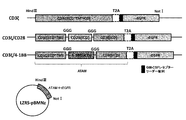
- the upper expression construct (CD3 ⁇ ) consists of an ATAM coding region composed of CD3 ⁇ (including extracellular domain (ECD), transmembrane region (TM) and intracellular domain (ICD)), and GM-CSF receptor.
- TAM coding region Structure of tEGFR coding region with leader sequence added by T2A sequence (Hind III sequence, Kozak sequence, CD3 ⁇ , T2A, GM-CSF receptor leader sequence, tEGFR, NotI sequence in this order) Equipped).
- the nucleotide sequence of the expression construct (CD3 ⁇ ) and the amino acid sequence encoded by it are shown in SEQ ID NO: 5 and SEQ ID NO: 6.
- the TAM coding region is a TAM coding region with a CD28 ⁇ ICD incorporated between CD3 ⁇ TM and ICD, and a tEGFR coding region with a GM-CSF receptor leader sequence added.
- the nucleotide sequence of the expression construct (CD3 ⁇ / CD28) and the amino acid sequence encoded by it are shown in SEQ ID NO: 7 and SEQ ID NO: 8.
- the lower expression construct (CD3 ⁇ / 4-1BB) is a coding region of ATAM with 4-1BB ICD incorporated between CD3 ⁇ TM and ICD, and tEGFR coding with a leader sequence of GM-CSF receptor.
- the glycine linker was used for the connection of CD3 ⁇ ⁇ CDD and CD28 ICD, the connection of CD28 ICD and CD3 ⁇ ICD, the connection of CD3 ⁇ TM and 4-1BB ICD, and the connection of 4-1BB ICDD and CD3 ⁇ ICD.
- Each expression construct was incorporated into a retroviral vector LZRS-pBMNz and introduced into Phoenix-Ampho cells, which are retroviral packaging cells.
- the amino acid sequence of each domain / region used in the expression construct is as follows.
- CD3 ⁇ (including ECD, TM, ICD): SEQ ID NO: 12 CD3 ⁇ ECD to TM: SEQ ID NO: 13 CD3 ⁇ ICD: SEQ ID NO: 14 CD28 ICD: SEQ ID NO: 15 4-1BB ICD: SEQ ID NO: 16 T2A: SEQ ID NO: 17 GM-CSF TEGFR with added leader sequence of receptor: SEQ ID NO: 18 Gene transfer into ATAM CD8 + T cells. The experimental procedure was shown (top). A tEGFR positive fraction was collected (bottom). Gene transfer into ATAM CD8 + T cells. Western blot results (top) and flow cytometry (FCM) analysis results (bottom) are shown. Introduction of ATAM gene into CMV-specific CTL (CMV-CTL).
- CMV-CTL CMV-specific CTL
- the cells were cultured for 4 hours with target cells (K562 cells or K562-HLA + peptide cells). Proliferation of ATAM-CMV-CTL by K562-peptide stimulation. The experimental procedure was shown (top). On day 0, day 7 and day 14, stimulation was performed with K562-peptide cells, and the total number of cells and the number of tetramer positive cells were counted (bottom). Changes in IL2 production ability of repetitively stimulated ATAM-CMV-CTL. Measured with 3 donors. Preparation of ATAM-EBV-CTL and examination of its proliferation ability. The experimental procedure was shown (top). Stimulated repeatedly with LCL-peptide cells, the total number of cells and the number of tetramer positive cells were counted (bottom).
- the first aspect of the present invention relates to an artificial T cell activating molecule (hereinafter sometimes referred to as “ATAM”).
- ATAM is used to enhance the proliferative capacity of T cells (typically cytotoxic T cells (CTL)).
- CTL cytotoxic T cells
- ATAM becomes a TCR complex together with the endogenous CD3 ⁇ molecule. Gather.
- CTL proliferation is improved by transmitting signals through ATAM.
- ATAM has a characteristic structure. Specifically, it comprises a CD3 ⁇ extracellular domain, a transmembrane region, and an intracellular signal domain for T cell activation.
- CD3 ⁇ extracellular domain A specific example of the amino acid sequence of the CD3 ⁇ extracellular domain is shown in SEQ ID NO: 20.
- the transmembrane region is interposed between the CD3 ⁇ extracellular domain and the intracellular signal domain.
- a transmembrane region such as CD3 ⁇ , CD28, CD3 ⁇ , CD8 ⁇ , CD3, CD4, or 4-1BB can be used.
- the transmembrane region determines the directionality of the molecule, and it is said that the amino acid charge in the molecule is assembled as a target when the molecule is assembled after TCR stimulation.
- a transmembrane region made of an artificially constructed polypeptide may be used.
- the amino acid sequence of the transmembrane region of CD3 ⁇ is shown in SEQ ID NO: 21.
- Intracellular signal domain for T cell activation provides a signal (ie, a costimulatory signal) required for T cell activation when the TCR complex recognizes a target. introduce.
- the signal serves as a stimulus for promoting cell proliferation and / or maintenance of cells, and improves the proliferation rate / survival rate of T cells.
- the intracellular domain of a costimulatory molecule is used to exert this effect.
- costimulatory molecules include CD28, 4-1BB (CD137), CD2, CD4, CD5, CD134, OX-40, or ICOS.
- the intracellular domain of CD28 or 4-1BB is employed.
- the intracellular domain of the costimulatory molecule is preferably located immediately below the transmembrane region.
- a peptide linker is a linker consisting of a peptide in which amino acids are linked in a straight chain.
- Typical examples of peptide linkers are linkers composed of glycine and serine (GGS linker and GS linker), and linkers composed of glycine (for example, GGG linker).
- the amino acids constituting these linkers, glycine and serine are small in size and do not easily form higher order structures in the linker.
- the length of the linker is not particularly limited. For example, a linker having 2 to 15 amino acid residues can be used.
- the length of the linker is preferably 2 to 10, more preferably 3 to 5.
- Two or more (ie, a plurality) intracellular domains of costimulatory molecules may be included in the intracellular signal domain. According to the said structure, the effect etc. which enhance the costimulation signal, the cell survival after a stimulation, etc. are expectable.
- the number of costimulatory molecules used in the intracellular domain is not particularly limited. However, if the amount is too large, the molecular size of ATAM becomes excessive, and problems such as its introduction and / or expression may occur. Preferably, the number is 2 to 3.
- the intracellular domains of a plurality of costimulatory molecules are usually linked in tandem directly or via a linker. It is also possible to combine the intracellular domains of two or more types of costimulatory molecules.
- the intracellular domain of CD3 ⁇ may be included in the intracellular signal domain. According to this configuration, induction / enhancement of cytotoxic activity can be expected.
- the intracellular domain of the costimulatory molecule and the intracellular domain of CD3 ⁇ may be linked directly or a linker may be interposed between them.
- a linker for example, a peptide linker can be used.
- the structure, characteristics, etc. of the peptide linker are as described above.
- the length of the linker is not particularly limited. For example, a linker having 2 to 15 amino acid residues can be used.
- a signal peptide is used for transport and localization of ATAM to the cell surface.
- a CD3 ⁇ signal peptide (specific example shown in SEQ ID NO: 19) can be used, but is not limited thereto.
- a spacer domain can also be provided between the transmembrane region and the intracellular signal domain.
- the aforementioned peptide linker can be used as a spacer domain.
- CD3 ⁇ / CD28 ATAM A CD3 ⁇ extracellular domain, a CD3 ⁇ transmembrane region, a CD28 intracellular domain, and a CD3 ⁇ intracellular domain are arranged in series from the N-terminal side to the C-terminal side.
- the CD3 ⁇ transmembrane region and the CD28 intracellular domain, and the CD28 intracellular domain and the CD3 ⁇ intracellular domain are linked via a glycine linker (GGG).
- the amino acid sequence of the ATAM (one example) is shown in SEQ ID NO: 1.
- CD3 ⁇ / 4-1BB ATAM A CD3 ⁇ extracellular domain, a CD3 ⁇ transmembrane region, a 4-1BB intracellular domain, and a CD3 ⁇ intracellular domain are arranged in series from the N-terminal side to the C-terminal side.
- the CD3 ⁇ transmembrane region and the 4-1BB intracellular domain, and the 4-1BB intracellular domain and the CD3 ⁇ intracellular domain are linked via a glycine linker (GGG).
- the amino acid sequence (one example) of the ATAM is shown in SEQ ID NO: 3.
- ATAM having a typical structure can be regarded as a structure in which an intracellular domain of a costimulatory molecule (CD28, 4-1BB ICD, etc.) is inserted into CD3 ⁇ .
- a costimulatory molecule CD28, 4-1BB ICD, etc.
- the second aspect of the present invention is a gene encoding ATAM (hereinafter sometimes referred to as “ATAM gene”) and use thereof (expression cassette, vector, ATAM).
- ATAM gene a gene encoding ATAM
- the present invention relates to a method for preparing an expressed T cell, an ATAM expressing T cell and its use.
- the ATAM gene of the present invention encodes the ATAM having the above structure. Therefore, T cells that express the ATAM of the present invention on the cell surface can be obtained by introducing it into target cells and expressing it.
- the T cells are used, for example, for virus-specific CTL adoptive immunotherapy or tumor-specific T cell therapy (details will be described later).
- the ATAM gene usually also encodes a signal peptide for transport and localization of ATAM in the target cell (ie, including a leader sequence).
- a signal peptide for example, a signal peptide of CD3 ⁇ (a specific example of the sequence is shown in SEQ ID NO: 19) and a signal peptide of the GM-CSF receptor (a specific example of the sequence is shown in SEQ ID NO: 11) can be used.
- a signal peptide of CD3 ⁇ (a specific example of the sequence is shown in SEQ ID NO: 19)
- a signal peptide of the GM-CSF receptor a specific example of the sequence is shown in SEQ ID NO: 11) can be used.
- it encodes a precursor in which a signal peptide is added to a structure containing each of the above domains (CD3 ⁇ extracellular domain, transmembrane region, intracellular signal domain for T cell activation).
- ATAM gene encoding CD3 ⁇ / CD28 ATAM From 5 ′ end to 3 ′ end, region encoding CD3 ⁇ extracellular domain, region encoding CD3 ⁇ transmembrane region, CD28 intracellular domain It has a structure in which a region and a region encoding a CD3 ⁇ intracellular domain are arranged in series.
- a glycine linker (GGG) is inserted between the region encoding the CD3 ⁇ transmembrane region and the region encoding the CD28 intracellular domain, and between the region encoding the CD28 intracellular domain and the region encoding the CD3 ⁇ intracellular domain, respectively.
- GGG glycine linker
- the nucleotide sequence (one example) of the ATAM gene is shown in SEQ ID NO: 2.
- (2) ATAM gene encoding CD3 ⁇ / 4-1BB ATAM From 5 ′ end to 3 ′ end, region encoding CD3 ⁇ extracellular domain, region encoding CD3 ⁇ transmembrane region, 4-1BB intracellular It has a structure in which a domain encoding region and a CD3 ⁇ intracellular domain encoding region are arranged in series.
- the glycine linker between the region encoding the CD3 ⁇ transmembrane region and the region encoding the 4-1BB intracellular domain, and between the region encoding the 4-1BB intracellular domain and the region encoding the CD3 ⁇ intracellular domain, respectively.
- the nucleotide sequence (one example) of the ATAM gene is shown in SEQ ID NO: 4.
- an expression cassette for expressing ATAM (hereinafter also referred to as “ATAM expression cassette”) can be constructed.
- the ATAM expression cassette includes a promoter and an ATAM gene under the control of the promoter.
- the ATAM gene is placed downstream of the promoter so as to be under the control of the promoter.
- the promoter a promoter that functions in T cells that are target cells is used.
- a constitutive promoter, T cell specific promoter, minimal promoter, etc. can be used.
- promoters include phosphoglycerate kinase (PGK) promoter, CMV promoter, CAG promoter, SV40ori, retrovirus LTP, SR ⁇ , EF1 ⁇ , ⁇ actin promoter, nuclear factor-of-activated T-cells- (NFAT) -regulated promoter Etc.
- PGK phosphoglycerate kinase
- CMV CMV promoter
- CAG CAG promoter
- SV40ori retrovirus LTP
- SR ⁇ EF1 ⁇
- ⁇ actin promoter nuclear factor-of-activated T-cells- (NFAT) -regulated promoter Etc.
- a poly A addition signal sequence is usually placed downstream of the ATAM gene. Transcription is terminated by the use of a poly A addition signal sequence.
- a poly A addition signal sequence SV40 poly A addition sequence, bovine-derived growth hormone gene poly A addition sequence and the like can be used.
- a detection gene reporter gene, cell or tissue-specific gene, selectable marker gene, etc.
- enhancer sequence WRPE sequence, etc.
- the detection gene is used for the determination of the success or efficiency of the expression cassette introduction, the detection of the expression of the ATAM gene or the determination of the expression efficiency, the selection and sorting of the cells in which the ATAM gene is expressed, and the like.
- an enhancer sequence can improve the expression efficiency.
- detection genes the neo gene conferring resistance to neomycin, the npt gene conferring resistance to kanamycin and the like (Herrera Estrella, EMBO J.
- nptII gene (Messing & Vierra. Gene 1) 9: 259-268 (1982)), hph gene conferring resistance to hygromycin (Blochinger & Diggl mann, Mol Cell Bio 4: 2929-2931), dhfr gene conferring resistance to metatrexate (Bourouis et al. , EMBO J.2 (7)), etc. (above, marker gene), luciferase gene (Giacomin, P1. Sci. 116 (1996), 59-72; Scikantha, J. Bact.
- the missing epidermal growth factor receptor (EGFR) Genes such gene can be used.
- the detection gene is linked to the ATAM gene via, for example, a bicistronic regulatory sequence (for example, a ribosome internal recognition sequence (IRES)) or a sequence encoding a self-cleaving peptide.
- a bicistronic regulatory sequence for example, a ribosome internal recognition sequence (IRES)
- a sequence encoding a self-cleaving peptide for example, a bicistronic regulatory sequence (for example, a ribosome internal recognition sequence (IRES)
- a self-cleaving peptide is the 2A peptide (T2A) derived from Thosea asigna virus, but is not limited thereto.
- Known as self-cleaving peptides are 2A peptide (F2A) from horseshoe disease virus (FMDV), 2A peptide (E2A) from equine rhinitis A virus (ERAV), 2A peptide (P2A) from porcine teschovirus (PTV-1), etc. It has been.
- the ATAM expression cassette is mounted on a vector for introduction into target cells.
- the term “vector” refers to a nucleic acid molecule that can transport a nucleic acid molecule inserted therein into a target (ie, a T cell or a progenitor cell thereof), and its form, origin, etc. are particularly limited. It is not a thing.
- a suitable vector is a viral vector, but non-viral vectors can also be used.
- the gene transfer method using a virus vector skillfully utilizes the phenomenon that a virus infects cells, and high gene transfer efficiency can be obtained.
- Retrovirus vectors, lentivirus vectors, adenovirus vectors, adeno-associated virus vectors, herpes virus vectors, Sendai virus vectors and the like have been developed as virus vectors.
- retrovirus vectors, lentivirus vectors, and adeno-associated virus vectors, the target gene incorporated into the vector is incorporated into the host chromosome, and stable and long-term expression can be expected.
- Each viral vector can be prepared according to a previously reported method or using a commercially available dedicated kit.
- non-viral vectors include plasmid vectors, liposome vectors, positively charged liposome vectors (Felgner, PL, Gadek, TR, Holm, M. et al., Proc. Natl. Acad. Sci., 84: 7413-7417 , 1987), and YAC vectors and BAC vectors.
- the vector of the present invention may be constructed as a vector used for the transposon method.
- a part of the elements constituting the expression cassette may be supplied from a vector.
- a promoter-free nucleic acid construct (ATAM gene and other elements as required) is inserted into the cloning site to An expression cassette containing the ATAM gene under the control will be constructed.
- the present invention further provides a method for preparing a T cell (ATAM expressing T cell) that expresses an artificial T cell activation molecule using the vector, and a cell obtained thereby.
- the vector is introduced into a target cell. That is, a target cell is transformed with the vector, and the ATAM gene is expressed in the target cell.
- T cells or their progenitor cells can be used as target cells. Examples of T cells herein include CD4 negative CD8 positive T cells, CD4 positive CD8 negative T cells, CD4 positive CD8 positive T cells, ⁇ T cells, and T cells prepared from iPS cells.
- PBMC peripheral blood mononuclear cells
- a cell population obtained by passage and / or purification of a cell population collected from a living body can also be used as a target cell.
- various cells for example, T cells in this specification are human cells.
- Transformation of target cells may be performed by a conventional method. For example, infection (when using a viral vector), electroporation (Potter, H. et al., Proc. Natl. Acad. Sci. USA 81, 7161-7165 (1984)), lipofection (Felgner, PL et al ., Proc. Natl. Acad. Sci. USA 84,7413-7417 (1987)) and the like. As is apparent from the operation, the ATAM-expressing T cells of the present invention are prepared ex vivo.
- the ATAM-expressing T cells of the present invention can be used for virus-specific CTL adoptive immunotherapy and tumor-specific T cell therapy.
- the antigen specificity is acquired in the cells before or after the introduction of the ATAM gene.
- a cell into which the ATAM gene is to be introduced T cell or its precursor cell
- a cell into which the ATAM gene has been introduced T cell or its precursor cell
- an antigen-presenting cell that has taken up the antigen are contacted ex vivo (ie, co-cultured).
- PBMC PBMC
- the antigen is incorporated into cells functioning as antigen-presenting cells (dendritic cells, monocytes, macrophages, B cells) present in PBMC, and the ATAM gene is introduced.
- Antigen presentation is performed on the cells to be differentiated.
- antigen pulsing loading
- antigen presentation and thereby acquisition of antigen specificity can be carried out substantially as one step.
- antigen pulsing loading
- antigen peptide naturally or recombinant
- antigen HLA-binding peptide natural or recombinant
- tumor cell lysate can be used.
- the contact operation described above may be performed using antigen-presenting cells that have been pulsed (loaded) with an antigen in advance.
- the cell is brought into contact with the antigen peptide or the like by adding a pulsing substance (ie, antigen peptide or the like) to the culture medium of the cell that functions as the antigen-presenting cell.
- a pulsing substance ie, antigen peptide or the like
- nucleic acid encoding a specific antigen or its HLA-binding peptide
- total RNA passive pulse method extracted from isolated tumor cells
- lipofection method electroporation method
- viral vector Jonuleit H, Schmitt E, Schuler G, et al. J. Exp Med, 192, 1213-22 (2000)
- Antigen specificity can also be obtained by introducing a target T cell receptor gene or a gene modified from the gene with a retroviral vector or the like.
- the antigen that is the target of the TAM-expressing T cell of the present invention is a viral antigen or a tumor antigen. If a virus antigen is used as a target antigen, cells having acquired virus specificity can be obtained. On the other hand, when a tumor antigen is used as a target antigen, cells having acquired tumor specificity can be obtained.
- the ATAM-expressing T cells of the present invention that have acquired target specificity can be used for treatment, prevention, or improvement of various diseases (hereinafter referred to as “target diseases”) depending on the type of the target antigen.
- target diseases various diseases
- virus-related diseases include viral infections (CMV infection, EBV infection, Adv infection, etc.), hepatitis, measles, HTLV-1, and HIV.
- malignant tumors / cancers include various B cell lymphomas (follicular malignant lymphoma, diffuse malignant lymphoma, mantle cell lymphoma, MALT lymphoma, intravascular B cell lymphoma, CD20 positive Hodgkin lymphoma, multiple myeloma Etc.), myeloproliferative tumors, myelodysplastic / myeloproliferative tumors (CMML, JMML, CML, MDS / MPN-UC), myelodysplastic syndrome, acute myeloid leukemia, neuroblastoma, brain tumor, Ewing sarcoma, bone Sarcoma, retinoblastoma, small cell lung, melanoma, ovarian cancer, rhabdomyosarcoma, kidney cancer, pan
- Treatment includes alleviation of symptoms or concomitant symptoms characteristic of the target disease (mildness), prevention or delay of deterioration of symptoms, and the like. “Prevention” refers to preventing or delaying the onset / onset of a disease (disorder) or its symptoms, or reducing the risk of onset / onset. On the other hand, “improvement” means that a disease (disorder) or a symptom thereof is alleviated (lightened), improved, ameliorated, or cured (including partial healing).
- Virus antigen refers to an epitope peptide capable of inducing a CTL specific for a specific virus or a long peptide containing an epitope.
- examples of viral antigens include, but are not limited to, for example, AdV antigenic peptides (see, for example, WO 2007015540 A1), CMV antigenic peptides (see, for example, JP2002-255997A, JP2004-242599A).
- EBV antigen peptide see, for example, WO2007049737 A1, Japanese Patent Application No. 2011-177487, and JP2006-188513, etc. can be used. .
- Viral peptide antigens can be prepared by conventional methods (eg, liquid phase synthesis method, solid phase synthesis method) based on sequence information. Some viral peptide antigens are commercially available (for example, provided by Medical Biology Laboratory, Takara Bio, Miltenyi Biotech, etc.).
- Two or more types of antigen peptides may be used as virus antigens.
- AdV antigenic peptide mixture, CMV antigenic peptide mixture or EBV antigenic peptide mixture, or a combination of two or more of these antigenic peptide mixtures for example, AdV antigenic peptide mixture, CMV antigenic peptide mixture and EBV antigenic peptide mixture Mixed.
- a plurality of activated T cells having different targets (antigens) can be obtained, and the treatment target (patient) in which the ATAM-expressing T cells of the present invention are effective (coverage rate) Improvement).
- AdV antigen peptide mixture CMV antigen peptide mixture, and EBV antigen peptide mixture are also commercially available (for example, PepTivator (registered trademark) AdV5 Hexon, PepTivator (registered trademark) CMV pp65, provided by Miltenyi Biotech).
- PepTivator (registered trademark) EBV EBNA-1, PepTivator (registered trademark) EBV BZLF1, PepMix TM Collection HCMV provided by JPT Peptide Technologies, PepMix TM EBV (EBNA1), etc.) can be easily obtained.
- tumor antigen is an antigen that characterizes canceration or cancer cells. By using a tumor antigen, it is possible to obtain tumor-specific activated T cells. Examples of tumor antigens are shown below.
- Tissue-specific proteins gp100, MART1, TRP1, TRP2, tyrosinase (melanoma), CEA (colon cancer), PSA (prostate cancer) melanosomal proteins
- Tumor-specific mutant peptides ⁇ -catenin, CDK4, MUM-1 (melanoma), CASP8 (squamous cell carcinoma), KIAA0205 (bladder cancer)
- CT Cancer-testis
- Oncogene or tumor suppressor gene product Her2 / neu (breast cancer, ovarian cancer, lung cancer), p53 (squamous cell carcinoma), ras (colon cancer, thyroid cancer) (5) Viral proteins: HPV16-E7 (cervical cancer), EBV-EBNA-2, -3, -4, -6, EBV-LMP2 (B cell lymphoma) (6) Mutant HLA: HLA-A2 mutation (kidney cancer) (7) Others: GnT-V (melanoma), PRAME (melanoma, various cancers, leukemia), SART-1 (esophageal cancer, lung adenocarcinoma), mucin MUC1 (breast cancer, ovarian cancer, pancreatic cancer), RAGE (kidney cancer) ), WT1 peptide (various cancers)
- the ATAM-expressing T cells that have acquired target specificity may be co-cultured with antigen-presenting cells and further activated.
- antigen-presenting cells obtained by pulsing (loading) an antigen corresponding to the acquired target specificity are used.
- ATAM-expressing T cells that have acquired target specificity may be cultured under conditions that promote their proliferation and / or activation.
- the cells are cultured in the presence of IL-2, IL-15, IL-7, IL-21, IL-12, or two or more thereof.
- T cell growth factors such as IL-2, IL-15, IL-7, IL-21 and IL-12 can be prepared according to a conventional method.
- a commercial item can also be utilized.
- T cell growth factors are derived from humans (may be recombinant).
- T cell growth factors such as human IL-2, IL-15, IL-7, IL-21 and IL-12 can be easily obtained (for example, provided by Miltenyi Biotech, R & D Systems, etc.).
- a medium supplemented with serum (human serum, fetal bovine serum, etc.) may be used, but by using a serum-free medium, the safety in clinical application is high and the culture efficiency due to the difference between serum lots is improved. It becomes possible to prepare cells having the advantage that differences are difficult to make.
- Specific examples of the serum-free medium for T cells are TexMACS TM (Milteny Biotech) and AIM V (registered trademark) (Thermo Fisher Scientific).
- serum autologous serum, that is, serum collected from a patient receiving the ATAM-expressing T cell of the present invention may be used.
- As the basic medium a medium suitable for T cell culture may be used. Specific examples include TexMACS TM and AIM V (registered disease trademark) described above.
- Other culture conditions may be any suitable conditions for the survival and proliferation of T cells, and may be general ones.
- the cells may be cultured in a CO 2 incubator set at 37 ° C. (CO 2 concentration 5%).
- the ATAM-expressing T cells of the present invention can also be provided in the form of a cell preparation.
- the cell preparation of the present invention contains a therapeutically effective amount of the ATAM-expressing T cell of the present invention.
- a therapeutically effective amount of the ATAM-expressing T cell of the present invention for example, for a single administration, 10 4 to 10 10 cells are contained.
- Various components (vitamins) for the purpose of cell activation, proliferation or differentiation induction, such as dimethyl sulfoxide (DMSO) and serum albumin for the purpose of cell protection, such as antibiotics for the purpose of blocking bacterial contamination , Cytokines, growth factors, steroids, etc.) may be included in the cell preparation.
- the administration route of the ATAM-expressing T cell or cell preparation of the present invention is not particularly limited.
- administration is by intravenous injection, intraarterial injection, intraportal injection, intradermal injection, subcutaneous injection, intramuscular injection, or intraperitoneal injection.
- Local administration may be used instead of systemic administration. Examples of the local administration include direct injection into a target tissue / organ / organ.
- the administration schedule may be prepared in consideration of the subject's (patient) sex, age, weight, disease state, and the like. In addition to single administration, multiple administration may be performed continuously or periodically.
- the ATAM-expressing T cell or cell preparation of the present invention may be used not only for autotransplantation but also for allogeneic transplantation.
- ATAM Artificial T cell activating adopter molecule
- Intracellular cytokine (IFN ⁇ , IL2) staining of ATAM-CMV-CTL Immediately after purification using tEGFR, cell function was measured on the 11th day after the start of culture. 6-hour co-culture with purified KATA cells transfected with HLA corresponding to donor or cells pulsed with CMV peptide (TPRpeptide) (K562-peptide cells) using purified ATAM-CMV-CTL After that, intracellular cytokine (IFN ⁇ and IL2) staining was performed.
- FIG. 7 shows the detection results (flow cytometry results) with typical donors. A response was observed for K562-peptide cells, but no response was observed for K562 cells regardless of the presence or absence of ATAM gene transfer.
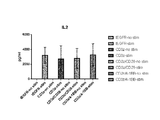
- IL2 measurement by ELISA ATAM-CMV-CTL after tEGFR purification was co-cultured with K562 cells or K562-peptide cells from day 12 of the culture (cell number 1 ⁇ 10 5, cell ratio was 1: 1) ), And IL2 in the culture supernatant after 16 hours was quantified by ELISA. Performed with 3 different donor-derived cells. IL2 production against K562-peptide cells was comparable for the control and each ATAM (FIG. 8). For K562 cells, no IL2 production was observed in all CTLs.
- Cytotoxic activity of ATAM-CMV-CTL Using ATAM-CMV-CTL after tEGFR purification, a standard chromium release test was performed targeting K562 cells or K562-peptide cells. The cytotoxic activity against K562-peptide cells was equivalent for each ATAM-CMV-CTL (FIG. 9 left). For K562 cells, cytotoxic activity was significantly attenuated by all ATAM-CMV-CTLs (right in FIG. 9). In addition, cytotoxic activity was equivalent between each ATAM-CMV-CTL.
- EBV-CTL EBV-specific CTL
- FIG. 12 shows the measurement results of the total cell number (lower left) and the number of tetramer positive cells (lower right). EBV-CTL transfected with CD3 ⁇ / 4-1BB showed good growth.
- ATAM Three types of ATAM (CD3 ⁇ , CD3 ⁇ / CD28, CD3 ⁇ / 4-1BB) were designed, and cells expressing them (ATAM expressing T cells) were successfully produced.
- CMV-CTL introduced with ATAM incorporating 4-1BB ICD showed significantly better growth after repeated stimulation.
- the cell proliferation ability was also improved in ATAM incorporating CD28 ICD.
- the cytotoxic activity and cytokine production ability of CTL were not affected by the introduction of ATAM.
- cytotoxic activity against cells and cytokine production were not observed in non-targets, indicating that the original function of CTL was not affected by the introduction of ATAM.
- the introduction of ATAM also improved the ability of EBV-CTL to proliferate, confirming that ATAM is highly versatile.
- ATAM has the following advantages over the conventional method.
- a luciferin expression gene is introduced into U266 by a lentiviral vector, and U266 cells emit light when luciferin is injected into the peritoneal cavity of mice.
- U266 cells emit light when luciferin is injected into the peritoneal cavity of mice.
- 1.5 Gy X-rays were irradiated, and on day 1, 2 ⁇ 10 6 U266 cells were intravenously injected from the mouse tail vein.
- luciferin luminescence was confirmed, and on day 22, each mouse was administered 2 ⁇ 10 6 CD8 positive T cells by intravenous injection from the tail vein.
- the administered T cells are the following three groups prepared from the same donor-derived human CD8-positive T cells.
- Non-transfected CD8-positive T cells No Tdx: Non-transgenic group NY-ESO-1 TCR gene and gene-transfer marker tEGFR-transfected CD8-positive T cells (tEGFR + NY-ESO-1 TCR): tEGFR group NY -CD8-positive T cells transfected with ESO-1 TCR gene and CD3 ⁇ / 4-1BB (CD3 ⁇ / 4-1BB + NY-ESO-1 TCR): CD3 ⁇ / 4-1BB group luciferin intraperitoneal injection every 7 days The therapeutic effect of CD8T cells was evaluated by confirming the growth of U266 cell line.
- Luciferin luminescence was not suppressed in mice injected non-transfected with CD8 + T cells that had not been transfected with NY-ESO-1 TCR (non-transgenic group). At the time of death, death was confirmed.
- the present invention is useful for improving target-specific cytotoxic T cells.
- the present invention can be applied to both virus-specific CTL adoptive immunotherapy and tumor-specific T cell therapy, and a great contribution can be expected to clinical application or development of these immunotherapy.
- Sequence number 1 Description of artificial sequence: CD3 ⁇ / CD28 ATAM Sequence number 2: Description of artificial sequence: CD3 ⁇ / CD28 ATAM Sequence number 3: Description of artificial sequence: CD3 ⁇ / 4-1BB ATAM Sequence number 4: Description of artificial sequence: CD3 ⁇ / 4-1BB ATAM SEQ ID NO: 5: description of artificial sequence: CD3 ⁇ ATAM expression construct SEQ ID NO: 6: description of artificial sequence: CD3 ⁇ ATAM expression construct SEQ ID NO: 7: description of artificial sequence: CD3 ⁇ / CD28 ATAM expression construct SEQ ID NO: 8: description of artificial sequence: CD3 ⁇ / CD28 ATAM expression construct SEQ ID NO: 9: description of artificial sequence: CD3 ⁇ / 4-1BB ATAM expression construct SEQ ID NO: 10: description of artificial sequence: CD3 ⁇ / 4-1BB ATAM expression construct SEQ ID NO: 18: description of artificial sequence: GM-CSF TEGFR with a receptor leader sequence
Landscapes
- Health & Medical Sciences (AREA)
- Life Sciences & Earth Sciences (AREA)
- General Health & Medical Sciences (AREA)
- Chemical & Material Sciences (AREA)
- Organic Chemistry (AREA)
- Animal Behavior & Ethology (AREA)
- Public Health (AREA)
- Veterinary Medicine (AREA)
- Genetics & Genomics (AREA)
- Epidemiology (AREA)
- Engineering & Computer Science (AREA)
- Biochemistry (AREA)
- Zoology (AREA)
- Bioinformatics & Cheminformatics (AREA)
- Biomedical Technology (AREA)
- Biotechnology (AREA)
- Wood Science & Technology (AREA)
- General Engineering & Computer Science (AREA)
- Medicinal Chemistry (AREA)
- General Chemical & Material Sciences (AREA)
- Chemical Kinetics & Catalysis (AREA)
- Pharmacology & Pharmacy (AREA)
- Nuclear Medicine, Radiotherapy & Molecular Imaging (AREA)
- Molecular Biology (AREA)
- Microbiology (AREA)
- Biophysics (AREA)
- Physics & Mathematics (AREA)
- Plant Pathology (AREA)
- Proteomics, Peptides & Aminoacids (AREA)
- Cell Biology (AREA)
- Virology (AREA)
- Communicable Diseases (AREA)
- Oncology (AREA)
- Medicines Containing Material From Animals Or Micro-Organisms (AREA)
- Micro-Organisms Or Cultivation Processes Thereof (AREA)
- Peptides Or Proteins (AREA)
Abstract
細胞傷害性T細胞療法に用いられる細胞傷害性T細胞の機能を高めるための手段を提供することを課題とする。CD3ζ細胞外ドメインと、膜貫通領域と、T細胞活性化のための細胞内シグナルドメインと、を含む、人工T細胞活性化分子及びそれを利用した治療法などが提供される。
Description
本発明は免疫療法(特に、細胞傷害性T細胞(CTL)療法)に有用な技術に関する。本出願は、2016年6月21日に出願された日本国特許出願第2016-122958号に基づく優先権を主張するものであり、当該特許出願の全内容は参照により援用される。
細胞傷害性細胞(CTL)表面に形成されるT細胞受容体(TCR)複合体はα鎖、β鎖、γ鎖、δ鎖及びCD3などから構成され、抗原提示細胞(APC)のヒト白血球抗原(HLA)及び提示された標的抗原の複合体を認識する。標的を認識したCTLは活性化してサイトカインを放出し、直接標的を攻撃するとともに、分裂・増殖し、適応免疫の重要な役割を果たす。この免疫反応を応用した治療方法として、ウイルスや悪性腫瘍を標的とした特異的CTLによる免疫療法(CTL療法)の開発が進められている。標的特異性を獲得したCTL(特定のHLAと提示されたペプチドを認識するTCRを発現する)を利用する治療法として、養子免疫療法とT細胞受容体遺伝子導入CTL療法がある。前者はペプチドによる刺激により内因性CTLを増幅して利用するものであり、主にウイルス特異的CTL養子免疫療法に応用されている。後者はウイルスベクターなどを用いて特定の標的抗原を認識するT細胞受容体複合体のα鎖及びβ鎖を直接CTLに遺伝子導入するものであり、主に腫瘍特異的T細胞療法に応用されている。
上記のウイルス特異的CTL養子免疫療法は実際に臨床応用されている。ベイラー医科大学(Baylor College of Medicine)では第三者ドナー由来のCTLを用いたウイルス特異的CTL養子免疫療法を実施し、サイトメガロウイルス(CMV)感染症、エプスタインバーウイルス(EBV)感染症、及びアデノウイルス(Adv)感染症に対して60%以上の有効率が得られたことを報告している(非特許文献1)。本邦においても、同種造血幹細胞移植後の難治性CMV感染症に対して移植ドナー由来CMV-CTL療法臨床試験が実施された。また、第三者ドナー由来のCTLを用いたCMV-CTL療法の臨床試験が開始された。このように、ウイルス特異的CTL養子免疫療法は臨床応用されつつあるが、その治療効果を高めるためには、ウイルスの種類などを考慮した改良が望まれる。例えば、EBV特異的CTLはその培養に1月半~2月程度の時間を要すること、頭頚部腫瘍やリンパ腫などのEBV関連腫瘍に対しての有効性は報告されていないことなど、解決すべき課題は多い。
T細胞受容体遺伝子導入CTLを用いた腫瘍特異的T細胞療法については、様々な腫瘍特異的抗原を標的として開発が進められているものの、有効性や安全性が十分とはいえず、臨床応用可能な治療方法として現在までに確立しているものはない。悪性黒色腫、大腸癌、滑膜平滑筋肉腫、食道癌などの治療を目指し、対応する腫瘍特異的抗原(MART-1、CEA、NY-ESO-1、MAGE-A3、MAGE-A4)を標的とした腫瘍特異的T細胞が作製され、臨床試験が施行されたが、その有効性は最大で30%程度の部分寛解にとどまっている。有効性を改善するためにTCRの親和性(アフィニティー)を強化したCTL療法(MAGE-A3を標的)も実施されたが、正常組織に発現する同一抗原を認識するOn-Target副反応による致死的な神経毒性や、正常組織の別抗原を認識してしまうOff-Target副反応による致死的心毒性が報告され、臨床試験は中止された(非特許文献2、3)。有効性の改善が必要であるが、標的認識に関わるアフィニティーの改変は安全性に大きな影響を及ぼすことから、別の対策が望まれる。
一方、キメラ抗原受容体(Chimeric Antigen Receptor。以下、「CAR」とも呼ぶ)を用いた遺伝子改変T細胞療法(CAR-T療法)が近年、臨床応用され、華々しい成果を挙げている。例えば、ペンシルベニア大学のグループはマウス由来のCD19単鎖抗体と4-1BBの細胞内ドメインを連結したCARを作製し、化学療法抵抗性慢性リンパ性白血病の末梢血T細胞に遺伝子導入した。これを患者に投与するとほとんどの場合において寛解が得られるという驚異的な効果を報告している(非特許文献4)。
Leen AM, Bollard CM, Mendizabal AM, et al. Multicenter study of banked third-party virus-specific T cells to treat severe viral infections after hematopoietic stem cell transplantation. Blood. 2013;121(26):5113-5123.
Morgan RA, Chinnasamy N, Abate-Daga D, et al. Cancer regression and neurological toxicity following anti-MAGE-A3 TCR gene therapy. J Immunother. 2013;36(2):133-151.
Linette GP, Stadtmauer EA, Maus MV, et al. Cardiovascular toxicity and titin cross-reactivity of affinity-enhanced T cells in myeloma and melanoma. Blood. 2013;122(6):863-871.
Porter DL, Levine BL, Kalos M, Bagg A, June CH. Chimeric antigen receptor-modified T cells in chronic lymphoid leukemia. N Engl J Med. 2011;365:725-733.
Call ME, Wucherpfennig KW. Molecular mechanisms for the assembly of the T cell receptor-CD3 complex. Mol Immunol. 2004;40(18):1295-1305.
CTL療法に用いる標的抗原特異的CTLには、(1)サイトカイン産生能、(2)細胞傷害活性、(3)細胞増殖能/効果の持続、が必要とされる。しかしながら、過度なサイトカイン産生はInfusion reactionを増加させ、高すぎる細胞傷害活性には正常組織に対する毒性が懸念される。一方、細胞増殖を改善することは、培養に難渋するCTL(EBV特異的CTLなど)の培養を容易にし、臨床上の有用性が高い。また、投与したCTLが生体内で良好に増殖するなどして長期に維持されれば、現在有効性が不十分な腫瘍を標的としたCTL療法(腫瘍特異的T細胞療法)についても、長期の有効性維持、寛解率改善を期待できる。
本発明は、以上の背景の下、CTL療法に用いられるCTLの機能を高めるための手段を提供し、CTL療法の臨床応用及び更なる発展に資することを課題とする。
前述の通り、TCRのアフィニティーを改変することはヒト正常組織に発現する抗原を認識する可能性を高めることから、たとえin vitroの実験及び動物実験の段階で問題がないとしても、ヒトへの応用には適さない可能性が考えられる。この点を打開すべく検討を重ねた結果、本発明者らはTCRの構造及びシグナル伝達のメカニズムに着眼し、TCRのアフィニティーを改変せず、標的抗原特異的CTLの増殖能を改善し得る新たな分子、即ち、人工T細胞活性化分子(Artificial T cell activating adopter molecule; ATAM)を設計した。CTLは抗原刺激を受け、TCR複合体構成要素の一つである内在性CD3ζ分子が集合し、細胞内に刺激が伝わる(非特許文献5)。設計したATAMはCD3ζ分子の膜貫通領域直下にT細胞共刺激分子であるCD28又は4-1BBの細胞内ドメイン(Intracellular domain; ICD)を組込んでおり、TCRのα鎖、β鎖が標的を認識し細胞内にシグナルが伝わると、内在性CD3ζ分子とともにTCR複合体に集合すると考えられる。CTL内部には通常のTCR刺激に加えて、CD28や4-1BBを介した細胞増殖および維持を改善する刺激が伝わり、標的抗原特異的CTLの増殖が改善する。アフィニティーを改変していないため、抗原の認識は既存の標的抗原特異的CTLと変わらず、安全性が担保される。また、ATAMは既存の標的抗原特異的CTLに追加で導入できることから、これまで有効性が限定的であった各種標的抗原特異的CTLの改良に応用できる。TCRのアフィニティーを改変した標的抗原特異的CTLにATAMを導入し、細胞増殖及び維持の改善を図ることも可能である。このように様々な利点が想定されるATAMの有効性を検証すべく各種実験を行ったところ(後述の実施例を参照)、期待を超えるともいえる成果がもたらされた。
以下の発明は主として上記の成果及び考察に基づく。
[1]CD3ζ細胞外ドメインと、膜貫通領域と、T細胞活性化のための細胞内シグナルドメインと、を含む、人工T細胞活性化分子。
[2]膜貫通領域がCD3ζ膜貫通領域である、[1]に記載の人工T細胞活性化分子。
[3]細胞内シグナルドメインが、共刺激分子の細胞内ドメインを含む、[1]又は[2]に記載の人工T細胞活性化分子。
[4]共刺激分子がCD28又は4-1BBである、[3]に記載の人工T細胞活性化分子。
[5]共刺激分子の細胞内ドメインが、膜貫通領域の直下に配置される、[3]又は[4]に記載の人工T細胞活性化分子。
[6]細胞内シグナルドメインが、共刺激分子の細胞内ドメインを複数個含む、[3]~[5]のいずれか一項に記載の人工T細胞活性化分子。
[7]細胞内シグナルドメインが、共刺激分子の細胞内ドメインに加え、CD3ζの細胞内ドメインを含む、[3]~[6]のいずれか一項に記載の人工T細胞活性化分子。
[8][1]~[7]のいずれか一項に記載の人工T細胞活性化分子をコードする遺伝子。
[9]プロモーターと、該プロモーターの制御下にある、[8]に記載の遺伝子と、を含む発現カセット。
[10]検出用遺伝子を更に含む、[9]に記載の発現カセット。
[11]検出用遺伝子が、細胞内ドメインを欠く上皮成長因子受容体遺伝子である、[10]に記載の発現カセット。
[12][9]~[11]のいずれか一項に記載の発現カセットを保持するベクター。
[13]レトロウイルスベクター又はレンチウイルスベクターである、[12]に記載のベクター。
[14][13]に記載のベクターを標的細胞に導入するステップを含む、人工T細胞活性化分子を発現するT細胞の調製方法。
[15][1]~[7]のいずれか一項に記載の人工T細胞活性化分子を発現したT細胞。
[16]標的特異性を獲得している、[15]に記載のT細胞。
[17]標的特異性がウイルス特異性である、[16]に記載のT細胞。
[18]標的特異性が腫瘍特異性である、[16]に記載のT細胞。
[19][17]又は[18]に記載のT細胞を治療上有効量含む、細胞製剤。
[20][17]に記載のT細胞を、治療上有効量、ウイルス関連疾患患者に投与するステップを含む、ウイルス関連疾患の治療法。
[21][18]に記載のT細胞を、治療上有効量、がん患者に投与するステップを含む、がんの治療法。
以下の発明は主として上記の成果及び考察に基づく。
[1]CD3ζ細胞外ドメインと、膜貫通領域と、T細胞活性化のための細胞内シグナルドメインと、を含む、人工T細胞活性化分子。
[2]膜貫通領域がCD3ζ膜貫通領域である、[1]に記載の人工T細胞活性化分子。
[3]細胞内シグナルドメインが、共刺激分子の細胞内ドメインを含む、[1]又は[2]に記載の人工T細胞活性化分子。
[4]共刺激分子がCD28又は4-1BBである、[3]に記載の人工T細胞活性化分子。
[5]共刺激分子の細胞内ドメインが、膜貫通領域の直下に配置される、[3]又は[4]に記載の人工T細胞活性化分子。
[6]細胞内シグナルドメインが、共刺激分子の細胞内ドメインを複数個含む、[3]~[5]のいずれか一項に記載の人工T細胞活性化分子。
[7]細胞内シグナルドメインが、共刺激分子の細胞内ドメインに加え、CD3ζの細胞内ドメインを含む、[3]~[6]のいずれか一項に記載の人工T細胞活性化分子。
[8][1]~[7]のいずれか一項に記載の人工T細胞活性化分子をコードする遺伝子。
[9]プロモーターと、該プロモーターの制御下にある、[8]に記載の遺伝子と、を含む発現カセット。
[10]検出用遺伝子を更に含む、[9]に記載の発現カセット。
[11]検出用遺伝子が、細胞内ドメインを欠く上皮成長因子受容体遺伝子である、[10]に記載の発現カセット。
[12][9]~[11]のいずれか一項に記載の発現カセットを保持するベクター。
[13]レトロウイルスベクター又はレンチウイルスベクターである、[12]に記載のベクター。
[14][13]に記載のベクターを標的細胞に導入するステップを含む、人工T細胞活性化分子を発現するT細胞の調製方法。
[15][1]~[7]のいずれか一項に記載の人工T細胞活性化分子を発現したT細胞。
[16]標的特異性を獲得している、[15]に記載のT細胞。
[17]標的特異性がウイルス特異性である、[16]に記載のT細胞。
[18]標的特異性が腫瘍特異性である、[16]に記載のT細胞。
[19][17]又は[18]に記載のT細胞を治療上有効量含む、細胞製剤。
[20][17]に記載のT細胞を、治療上有効量、ウイルス関連疾患患者に投与するステップを含む、ウイルス関連疾患の治療法。
[21][18]に記載のT細胞を、治療上有効量、がん患者に投与するステップを含む、がんの治療法。
1.人工T細胞活性化分子
本発明の第1の局面は人工T細胞活性化分子(以下、「ATAM」と呼称することがある)に関する。用語「人工」は、T細胞の内在性分子(即ち、本来的に発現する分子)と本発明のT細胞活性化分子(ATAM)を区別する目的で使用される。ATAMはT細胞(典型的には細胞傷害性T細胞(CTL))の増殖能を高めるために用いられる。理論に拘泥する訳ではないが、遺伝子導入等によってATAMを発現することになったCTLでは、TCRが標的を認識して細胞内にシグナルが伝わる際、内在性CD3ζ分子とともにATAMがTCR複合体に集合する。CTL内部には通常のTCR刺激に加えて、ATAMを介したシグナルが伝わりCTLの増殖が改善する。その特有の機能を発揮するため、ATAMは特徴的な構造を備える。具体的には、CD3ζ細胞外ドメイン、膜貫通領域、T細胞活性化のための細胞内シグナルドメインを備える。
本発明の第1の局面は人工T細胞活性化分子(以下、「ATAM」と呼称することがある)に関する。用語「人工」は、T細胞の内在性分子(即ち、本来的に発現する分子)と本発明のT細胞活性化分子(ATAM)を区別する目的で使用される。ATAMはT細胞(典型的には細胞傷害性T細胞(CTL))の増殖能を高めるために用いられる。理論に拘泥する訳ではないが、遺伝子導入等によってATAMを発現することになったCTLでは、TCRが標的を認識して細胞内にシグナルが伝わる際、内在性CD3ζ分子とともにATAMがTCR複合体に集合する。CTL内部には通常のTCR刺激に加えて、ATAMを介したシグナルが伝わりCTLの増殖が改善する。その特有の機能を発揮するため、ATAMは特徴的な構造を備える。具体的には、CD3ζ細胞外ドメイン、膜貫通領域、T細胞活性化のための細胞内シグナルドメインを備える。
(1)CD3ζ細胞外ドメイン
CD3ζ細胞外ドメインのアミノ酸配列の具体例を配列番号20に示す。
CD3ζ細胞外ドメインのアミノ酸配列の具体例を配列番号20に示す。
(2)膜貫通領域
膜貫通領域は、CD3ζ細胞外ドメインと細胞内シグナルドメインの間に介在する。膜貫通領域としては、CD3ζ、CD28、CD3ε、CD8α、CD3、CD4又は4-1BBなどの膜貫通領域を用いることができる。膜貫通領域は当該分子の方向性を決定し、TCR刺激後の分子の集合の際にこの中のアミノ酸電荷を標的として集合するとされている。当該機能を発揮する限りにおいて、人工的に構築したポリペプチドからなる膜貫通領域を用いることにしてもよい。膜貫通領域の具体例として、CD3ζの膜貫通領域のアミノ酸配列を配列番号21に示す。
膜貫通領域は、CD3ζ細胞外ドメインと細胞内シグナルドメインの間に介在する。膜貫通領域としては、CD3ζ、CD28、CD3ε、CD8α、CD3、CD4又は4-1BBなどの膜貫通領域を用いることができる。膜貫通領域は当該分子の方向性を決定し、TCR刺激後の分子の集合の際にこの中のアミノ酸電荷を標的として集合するとされている。当該機能を発揮する限りにおいて、人工的に構築したポリペプチドからなる膜貫通領域を用いることにしてもよい。膜貫通領域の具体例として、CD3ζの膜貫通領域のアミノ酸配列を配列番号21に示す。
(3)T細胞活性化のための細胞内シグナルドメイン
細胞内シグナルドメインは、TCR複合体が標的を認識した際にT細胞の活性化が生じるのに必要なシグナル(即ち、共刺激シグナル)を伝達する。当該シグナルが細胞増殖及び/又は細胞の維持を促す刺激となり、T細胞の増殖率/生存率が改善する。この効果が発揮されるように、典型的には、共刺激分子の細胞内ドメインが用いられる。共刺激分子としてCD28、4-1BB(CD137)、CD2、CD4、CD5、CD134、OX-40又はICOSを例示することができる。好ましくは、CD28又は4-1BBの細胞内ドメインを採用する。共刺激分子の細胞内ドメインは、好ましくは上記膜貫通領域の直下に配置される。このように構成すると、膜直下に存在するT細胞の活性化分子のリン酸化などのシグナル増幅効果を期待できる。「直下に配置される」とは、膜貫通領域と共刺激分子の細胞内ドメインとの間に機能的なドメイン(例えば、以下で言及するCD3ζの細胞内ドメイン)が介在しないことを意味する。従って、例えば、リンカーを介して当該二つのドメインが直接連結されている場合も、膜貫通領域の直下に共刺激分子の細胞内ドメインが配置されていることになる。リンカーとしては例えばペプチドリンカーを用いることができる。ペプチドリンカーとは、直鎖状にアミノ酸が連結したペプチドからなるリンカーである。ペプチドリンカーの代表例は、グリシンとセリンから構成されるリンカー(GGSリンカーやGSリンカー)、グリシンから構成されるリンカー(例えばGGGリンカー)である。これらのリンカーを構成するアミノ酸であるグリシンとセリンは、それ自体のサイズが小さく、リンカー内で高次構造が形成されにくい。リンカーの長さは特に限定されない。例えば、アミノ酸残基数が2~15個のリンカーを用いることができる。リンカーの長さは好ましくは2~10、更に好ましくは3~5である。
細胞内シグナルドメインは、TCR複合体が標的を認識した際にT細胞の活性化が生じるのに必要なシグナル(即ち、共刺激シグナル)を伝達する。当該シグナルが細胞増殖及び/又は細胞の維持を促す刺激となり、T細胞の増殖率/生存率が改善する。この効果が発揮されるように、典型的には、共刺激分子の細胞内ドメインが用いられる。共刺激分子としてCD28、4-1BB(CD137)、CD2、CD4、CD5、CD134、OX-40又はICOSを例示することができる。好ましくは、CD28又は4-1BBの細胞内ドメインを採用する。共刺激分子の細胞内ドメインは、好ましくは上記膜貫通領域の直下に配置される。このように構成すると、膜直下に存在するT細胞の活性化分子のリン酸化などのシグナル増幅効果を期待できる。「直下に配置される」とは、膜貫通領域と共刺激分子の細胞内ドメインとの間に機能的なドメイン(例えば、以下で言及するCD3ζの細胞内ドメイン)が介在しないことを意味する。従って、例えば、リンカーを介して当該二つのドメインが直接連結されている場合も、膜貫通領域の直下に共刺激分子の細胞内ドメインが配置されていることになる。リンカーとしては例えばペプチドリンカーを用いることができる。ペプチドリンカーとは、直鎖状にアミノ酸が連結したペプチドからなるリンカーである。ペプチドリンカーの代表例は、グリシンとセリンから構成されるリンカー(GGSリンカーやGSリンカー)、グリシンから構成されるリンカー(例えばGGGリンカー)である。これらのリンカーを構成するアミノ酸であるグリシンとセリンは、それ自体のサイズが小さく、リンカー内で高次構造が形成されにくい。リンカーの長さは特に限定されない。例えば、アミノ酸残基数が2~15個のリンカーを用いることができる。リンカーの長さは好ましくは2~10、更に好ましくは3~5である。
共刺激分子の細胞内ドメインを2個以上(即ち複数個)、細胞内シグナルドメイン内に含めることにしてもよい。当該構成によれば、共刺激シグナルの増強や刺激後の細胞生存を高める効果等を期待できる。共刺激分子の細胞内ドメインの使用数は特に限定されないが、多すぎればATAMの分子サイズが過大となり、その導入及び/又は発現に影響する等の問題が生じ得ることから、例えば2~5個、好ましくは2~3個にするとよい。複数個の共刺激分子の細胞内ドメインは通常、直接又はリンカーを介してタンデム状に連結される。尚、2種類以上の共刺激分子の細胞内ドメインを組み合わせることも可能である。
共刺激分子の細胞内ドメインに加え、CD3ζの細胞内ドメインを細胞内シグナルドメイン内に含めることにしてもよい。当該構成によれば、細胞傷害活性の誘導・増強等を期待できる。共刺激分子の細胞内ドメインと、CD3ζの細胞内ドメインは、これらを直接連結しても、これらの間にリンカーを介在させてもよい。リンカーとしては例えばペプチドリンカーを用いることができる。ペプチドリンカーの構造、特徴等は前述の通りである。リンカーの長さは特に限定されない。例えば、アミノ酸残基数が2~15個のリンカーを用いることができる。
(4)その他の要素
ATAMの細胞表面への輸送、局在化のためにシグナルペプチドが用いられる。例えば、CD3ζのシグナルペプチド(具体例を配列番号19示す)を用いることができるが、これに限定されるものではない。
ATAMの細胞表面への輸送、局在化のためにシグナルペプチドが用いられる。例えば、CD3ζのシグナルペプチド(具体例を配列番号19示す)を用いることができるが、これに限定されるものではない。
膜貫通領域と細胞内シグナルドメインの間にスペーサードメインを設けることもできる。例えば、前述のペプチドリンカーをスペーサードメインとして用いることができる。
本発明のATAMの構造の具体例を以下に示す。
(1) CD3ζ/CD28 ATAM
N末端側からC末端側に向かって、CD3ζ細胞外ドメイン、CD3ζ膜貫通領域、CD28細胞内ドメイン及びCD3ζ細胞内ドメインが直列的に並ぶ構造を備える。CD3ζ膜貫領域とCD28細胞内ドメイン、CD28細胞内ドメインとCD3ζ細胞内ドメインはグリシンリンカー(GGG)を介して連結されている。当該ATAMのアミノ酸配列(一例)を配列番号1に示す。
(2) CD3ζ/4-1BB ATAM
N末端側からC末端側に向かって、CD3ζ細胞外ドメイン、CD3ζ膜貫通領域、4-1BB細胞内ドメイン及びCD3ζ細胞内ドメインが直列的に並ぶ構造を備える。CD3ζ膜貫通領域と4-1BB細胞内ドメイン、4-1BB細胞内ドメインとCD3ζ細胞内ドメインはグリシンリンカー(GGG)を介して連結されている。当該ATAMのアミノ酸配列(一例)を配列番号3に示す。
(1) CD3ζ/CD28 ATAM
N末端側からC末端側に向かって、CD3ζ細胞外ドメイン、CD3ζ膜貫通領域、CD28細胞内ドメイン及びCD3ζ細胞内ドメインが直列的に並ぶ構造を備える。CD3ζ膜貫領域とCD28細胞内ドメイン、CD28細胞内ドメインとCD3ζ細胞内ドメインはグリシンリンカー(GGG)を介して連結されている。当該ATAMのアミノ酸配列(一例)を配列番号1に示す。
(2) CD3ζ/4-1BB ATAM
N末端側からC末端側に向かって、CD3ζ細胞外ドメイン、CD3ζ膜貫通領域、4-1BB細胞内ドメイン及びCD3ζ細胞内ドメインが直列的に並ぶ構造を備える。CD3ζ膜貫通領域と4-1BB細胞内ドメイン、4-1BB細胞内ドメインとCD3ζ細胞内ドメインはグリシンリンカー(GGG)を介して連結されている。当該ATAMのアミノ酸配列(一例)を配列番号3に示す。
尚、典型的な構造を備えるATAMについては、CD3ζに共刺激分子(CD28や4-1BB ICD等)の細胞内ドメインが挿入された構造体として捉えることができる。
2.人工T細胞活性化分子をコードする遺伝子及びその利用
本発明の第2の局面はATAMをコードする遺伝子(以下、「ATAM遺伝子」と呼称することがある)及びその利用(発現カセット、ベクター、ATAM発現T細胞の調製方法、ATAM発現T細胞及びその用途など)に関する。本発明のATAM遺伝子は上記構造のATAMをコードする。従って、それを標的細胞に導入し、発現させることにより、本発明のATAMを細胞表面に発現するT細胞が得られる。当該T細胞は、例えば、ウイルス特異的CTL養子免疫療法又は腫瘍特異的T細胞療法に用いられる(詳細は後述する)。
本発明の第2の局面はATAMをコードする遺伝子(以下、「ATAM遺伝子」と呼称することがある)及びその利用(発現カセット、ベクター、ATAM発現T細胞の調製方法、ATAM発現T細胞及びその用途など)に関する。本発明のATAM遺伝子は上記構造のATAMをコードする。従って、それを標的細胞に導入し、発現させることにより、本発明のATAMを細胞表面に発現するT細胞が得られる。当該T細胞は、例えば、ウイルス特異的CTL養子免疫療法又は腫瘍特異的T細胞療法に用いられる(詳細は後述する)。
ATAM遺伝子は、通常、標的細胞内でのATAMの輸送、局在化のためにシグナルペプチドもコードする(即ち、リーダー配列を含む)。シグナルペプチドとして、例えば、CD3ζのシグナルペプチド(配列の具体例を配列番号19に示す)、GM-CSFレセプターのシグナルペプチド(配列の具体例を配列番号11に示す)を用いることができる。このように、典型的には、上記の各ドメイン(CD3ζ細胞外ドメイン、膜貫通領域、T細胞活性化のための細胞内シグナルドメイン)を含む構造体にシグナルペプチドが付加された前駆体をコードするようにATAM遺伝子を設計、構築する。
本発明のATAM遺伝子の構造の具体例を以下に示す。
(1) CD3ζ/CD28 ATAMをコードするATAM遺伝子
5'末端側から3'末端側に向かって、CD3ζ細胞外ドメインをコードする領域、CD3ζ膜貫通領域をコードする領域、CD28細胞内ドメインをコードする領域及びCD3ζ細胞内ドメインをコードする領域が直列的に並ぶ構造を備える。CD3ζ膜貫通領域をコードする領域とCD28細胞内ドメインをコードする領域の間、CD28細胞内ドメインをコードする領域とCD3ζ細胞内ドメインをコードする領域の間には、それぞれ、グリシンリンカー(GGG)をコードする配列が介在する。当該ATAM遺伝子のヌクレオチド配列(一例)を配列番号2に示す。
(2) CD3ζ/4-1BB ATAMをコードするATAM遺伝子
5'末端側から3'末端側に向かって、CD3ζ細胞外ドメインをコードする領域、CD3ζ膜貫通領域をコードする領域、4-1BB細胞内ドメインをコードする領域及びCD3ζ細胞内ドメインをコードする領域が直列的に並ぶ構造を備える。CD3ζ膜貫通領域をコードする領域と4-1BB細胞内ドメインをコードする領域の間、4-1BB細胞内ドメインをコードする領域とCD3ζ細胞内ドメインをコードする領域の間には、それぞれ、グリシンリンカー(GGG)をコードする配列が介在する。当該ATAM遺伝子のヌクレオチド配列(一例)を配列番号4に示す。
(1) CD3ζ/CD28 ATAMをコードするATAM遺伝子
5'末端側から3'末端側に向かって、CD3ζ細胞外ドメインをコードする領域、CD3ζ膜貫通領域をコードする領域、CD28細胞内ドメインをコードする領域及びCD3ζ細胞内ドメインをコードする領域が直列的に並ぶ構造を備える。CD3ζ膜貫通領域をコードする領域とCD28細胞内ドメインをコードする領域の間、CD28細胞内ドメインをコードする領域とCD3ζ細胞内ドメインをコードする領域の間には、それぞれ、グリシンリンカー(GGG)をコードする配列が介在する。当該ATAM遺伝子のヌクレオチド配列(一例)を配列番号2に示す。
(2) CD3ζ/4-1BB ATAMをコードするATAM遺伝子
5'末端側から3'末端側に向かって、CD3ζ細胞外ドメインをコードする領域、CD3ζ膜貫通領域をコードする領域、4-1BB細胞内ドメインをコードする領域及びCD3ζ細胞内ドメインをコードする領域が直列的に並ぶ構造を備える。CD3ζ膜貫通領域をコードする領域と4-1BB細胞内ドメインをコードする領域の間、4-1BB細胞内ドメインをコードする領域とCD3ζ細胞内ドメインをコードする領域の間には、それぞれ、グリシンリンカー(GGG)をコードする配列が介在する。当該ATAM遺伝子のヌクレオチド配列(一例)を配列番号4に示す。
ATAM遺伝子を用い、ATAM発現用の発現カセット(以下、「ATAM発現カセット」とも呼称する)を構築することができる。ATAM発現カセットはプロモーターと、当該プロモーターの制御下にあるATAM遺伝子を含む。プロモーターの制御下となるように、通常、プロモーターの下流にATAM遺伝子を配置する。プロモーターとしては、標的細胞であるT細胞で機能するプロモーターが用いられる。構成的プロモーター、T細胞特異的プロモーター、最小プロモーター等を用いることができる。プロモーターの具体例を挙げると、ホスホグリセレートキナーゼ(PGK)プロモーター、CMVプロモーター、CAGプロモーター、SV40ori、レトロウイルスLTP、SRα、EF1α、βアクチンプロモーター、nuclear factor of activated T cells (NFAT)-制御性プロモーターなどである。
ATAM遺伝子の下流には、通常、ポリA付加シグナル配列を配置する。ポリA付加シグナル配列の使用によって転写を終了させる。ポリA付加シグナル配列としては、SV40のポリA付加配列、ウシ由来成長ホルモン遺伝子のポリA付加配列等を用いることができる。
発現カセット内に検出用遺伝子(レポーター遺伝子、細胞又は組織特異的な遺伝子、選択マーカー遺伝子など)、エンハンサー配列、WRPE配列等を含めることにしてもよい。検出用遺伝子は、発現カセットの導入の成否や効率の判定、ATAM遺伝子の発現の検出又は発現効率の判定、ATAM遺伝子が発現した細胞の選択や分取等に利用される。一方、エンハンサー配列の使用によって発現効率の向上が図られる。検出用遺伝子としては、ネオマイシンに対する耐性を付与するneo遺伝子、カナマイシン等に対する耐性を付与するnpt遺伝子(Herrera Estrella、EMBO J. 2(1983)、987-995)やnptII遺伝子(Messing & Vierra.Gene 1 9:259-268(1982))、ハイグロマイシンに対する耐性を付与するhph遺伝子(Blochinger & Diggl mann,Mol Cell Bio 4:2929-2931)、メタトレキセートに対する耐性を付与するdhfr遺伝子(Bourouis et al.,EMBO J.2(7))等(以上、マーカー遺伝子)、ルシフェラーゼ遺伝子(Giacomin、P1. Sci. 116(1996)、59~72;Scikantha、J. Bact. 178(1996)、121)、β-グルクロニダーゼ(GUS)遺伝子、GFP(Gerdes、FEBS Lett. 389(1996)、44-47)やその改変体(EGFPやd2EGFPなど)等の蛍光タンパク質の遺伝子(以上、レポーター遺伝子)、細胞内ドメインを欠く上皮成長因子受容体(EGFR)遺伝子等の遺伝子を用いることができる。検出用遺伝子は、例えば、バイシストロニック性制御配列(例えば、リボソーム内部認識配列(IRES))や自己開裂ペプチドをコードする配列を介してATAM遺伝子に連結している。自己開裂ペプチドの例はThosea asigna virus由来の2Aペプチド(T2A)であるが、これに限定されるものではない。自己開裂ペプチドとして蹄疫ウイルス(FMDV)由来の2Aペプチド(F2A)、ウマ鼻炎Aウイルス(ERAV)由来の2Aペプチド(E2A)、porcine teschovirus(PTV-1)由来の2Aペプチド(P2A)等が知られている。
ATAM発現カセットは標的細胞への導入のためにベクターに搭載される。本明細書において用語「ベクター」は、それに挿入された核酸分子をターゲット(即ちT細胞又はその前駆細胞)内へと輸送することができる核酸性分子をいい、形態、由来などは特に限定されるものではない。様々な種類のベクターが利用可能である。好適なベクターの例はウイルスベクターであるが、非ウイルスベクターを用いることもできる。ウイルスベクターを用いた遺伝子導入法は、ウイルスが細胞へと感染する現象を巧みに利用するものであり、高い遺伝子導入効率が得られる。ウイルスベクターとしてレトロウイルスベクター、レンチウイルスベクター、アデノウイルスベクター、アデノ随伴ウイルスベクター、ヘルペスウイルスベクター、センダイウイルスベクター等が開発されている。この中でレトロウイルスベクター、レンチウイルスベクター、アデノ随伴ウイルスベクターではベクターに組み込んだ目的遺伝子が宿主染色体へと組み込まれ、安定かつ長期的な発現が期待できる。各ウイルスベクターは既報の方法に従い又は市販される専用のキットを用いて作製することができる。非ウイルスベクターの例としては、プラスミドベクター、リポソームベクター、正電荷型リポソームベクター(Felgner, P.L., Gadek, T.R., Holm, M. et al., Proc. Natl. Acad. Sci., 84:7413-7417, 1987)、YACベクター、BACベクターを挙げることができる。トランスポゾン法に利用されるベクターとして本発明のベクターを構築してもよい。
発現カセットを構成する要素の一部(但し、ATAM遺伝子は除く)が、ベクターから供給されてもよい。例えば、プロモーターの制御下にあるクローニングサイトを有するベクターを使用する場合、プロモーターを含まない核酸構築物(ATAM遺伝子と、必要に応じて他の要素を含む)をクローニングサイトに挿入することにより、プロモーターとその制御下にあるATAM遺伝子を含む発現カセットが構築されることになる。
本発明は更に、上記ベクターを利用した、人工T細胞活性化分子を発現するT細胞(ATAM発現T細胞)の調製方法、及びそれによって得られる細胞も提供する。本発明の調製方法では、上記ベクターを標的細胞に導入する。即ち、上記ベクターで標的細胞を形質転換し、ATAM遺伝子を標的細胞内で発現させる。標的細胞にはT細胞又はその前駆細胞(造血幹細胞、リンパ球前駆細胞等)を用いることができる。ここでのT細胞として、CD4陰性CD8陽性T細胞、CD4陽性CD8陰性T細胞、CD4陽性CD8陽性T細胞、γδT細胞、iPS細胞から調製されたT細胞を挙げることができる。上記の如きT細胞又は前駆細胞を含むものであれば、様々な細胞集団を用いることができる。末梢血から採取されるPBMC(末梢血単核細胞)は好ましい標的細胞の一つである。生体から採取された細胞集団を継代及び/又は純化することによって得られた細胞集団を標的細胞にすることもできる。尚、特に言及しない限り、本明細書における各種細胞(例えばT細胞)はヒト細胞である。
標的細胞の形質転換は常法で行えばよい。例えば、感染(ウイルスベクターを使用する場合)、エレクトロポレーション(Potter,H. et al., Proc. Natl. Acad. Sci. U.S.A. 81, 7161-7165(1984))、リポフェクション(Felgner, P.L. et al., Proc. Natl. Acad. Sci. U.S.A. 84,7413-7417(1987))等の方法により形質転換を行うことができる。尚、その操作から明らかな通り、本発明のATAM発現T細胞は生体外で(ex vivo)調製される。
本発明のATAM発現T細胞はウイルス特異的CTL養子免疫療法及び腫瘍特異的T細胞療法に利用され得る。治療効果の発揮に必要な特異的傷害活性を示すようにするため、ATAM遺伝子の導入前又は導入後の細胞に抗原特異性を獲得させる。典型的には、ATAM遺伝子が導入されることになる細胞(T細胞又はその前駆細胞)、又はATAM遺伝子が導入された細胞(T細胞又はその前駆細胞)と、抗原を取り込んだ抗原提示細胞とを生体外で接触させる(即ち共培養する)。例えば、PBMCを抗原の存在下で培養すれば、PBMC中に存在する、抗原提示細胞として機能する細胞(樹状細胞、単球、マクロファージ、B細胞)に抗原が取り込まれ、ATAM遺伝子が導入されることになる細胞に対して抗原提示が行われる。このように、抗原のパルス(ローディング)、抗原提示及びそれによる抗原特異性の獲得を実質的に一つ工程として実施することができる。抗原のパルス(ローディング)には、抗原ペプチド(天然型又は組換え型)又は抗原のHLA結合ペプチド(天然型又は組換え型)、或いは腫瘍細胞溶解液を用いることができる。
予め抗原をパルス(ローディング)した抗原提示細胞を用いて上記の接触操作を実施することにしてもよい。例えば、抗原提示細胞として機能する細胞の培養液中にパルス用物質(即ち、抗原ペプチドなど)を添加することなどによって、当該細胞と抗原ペプチド等とを接触させる。
以上の方法に限らず、特定の抗原又はそのHLA結合ペプチドをコードする核酸(mRNA、cDNA)、或いは腫瘍細胞から抽出・単離したtotal RNAパッシブパルス法、リポフェクション法、エレクトロポレーション法、ウイルスベクターを利用する方法(Jonuleit H, Schmitt E, Schuler G, et al. J. Exp Med, 192, 1213-22(2000))などによって細胞内に導入することによっても、抗原のパルス(ローディング)を行うことが可能である。抗原のパルス(ローディング)にmRNAを使用することについては、Saenz-Badillos J, Amin SP, Granstein RD, Exp Dermatol, 10, 143-54(2001)、Sullenger BA, Gilboa E, Nature, 418, 252-8(2002)、Ponsaerts P, Van Tendeloo VF, Berneman ZN, Clin Exp Immunol, 134, 378-84(2003)を参照することができる。尚、腫瘍細胞から抽出・単離したtotal RNAを使用した場合には、多種の腫瘍抗原(その中には未知のものが含まれると期待される)を取り込ませることが可能である(Nair SK, Morse M, Boczkowski D, et al. Ann Surg, 235, 540-9(2002)、Milazzo C, Reichardt VL, Muller MR, et al. Blood, 101, 977-82(2003)、Su Z, Dannull J, Heiser A, et al. Cancer Res, 63, 2127-33(2003))。
ATAM遺伝子が導入されることになる細胞(T細胞又はその前駆細胞)、又はATAM遺伝子が導入された細胞(T細胞又はその前駆細胞)に、腫瘍抗原特異的Tリンパ球からクローニングした腫瘍抗原特異的T細胞受容体遺伝子、または当該遺伝子を改変した遺伝子をレトロウイルスベクター等で導入することにより、抗原特異性を獲得させることもできる。
本発明のATAM発現T細胞の標的となる抗原はウイルス抗原又は腫瘍抗原である。ウイルス抗原を標的抗原とすれば、ウイルス特異性を獲得した細胞が得られる。一方、腫瘍抗原を標的抗原とした場合には腫瘍特異性を獲得した細胞が得られる。標的特異性を獲得している、本発明のATAM発現T細胞は、標的抗原の種類に応じて、各種疾患(以下、「標的疾患」と呼ぶ)の治療、予防又は改善に利用され得る。各種ウイルス関連疾患及び各種悪性腫瘍/がんが好適な標的疾患となる。ウイルス関連疾患の例として、ウイルス感染症(CMV感染症、EBV感染症、Adv感染症など)、肝炎、麻疹、HTLV-1、HIVを挙げることができる。同様に、悪性腫瘍/がんの例として、各種B細胞リンパ腫(濾胞性悪性リンパ腫、びまん性悪性リンパ腫、マントル細胞リンパ腫、MALTリンパ腫、血管内B細胞性リンパ腫、CD20陽性ホジキンリンパ腫、多発性骨髄腫など)、骨髄増殖性腫瘍、骨髄異形成/骨髄増殖性腫瘍(CMML,JMML,CML,MDS/MPN-UC)、骨髄異形成症候群、急性骨髄生白血病、神経芽腫、脳腫瘍、ユーイング肉腫、骨肉腫、網膜芽細胞腫、肺小細胞腫、メラノーマ、卵巣がん、横紋筋肉腫、腎臓がん、膵臓がん、悪性中皮腫、前立腺がん、食道がん、胃がん、大腸がん、ウイルス関連腫瘍(例えば、EBV関連腫瘍である節外性NK細胞リンパ腫(extranodal NK-cell lymphoma; ENKL)やバーキットリンパ腫など)を挙げることができる。「治療」とは、標的疾患に特徴的な症状又は随伴症状を緩和すること(軽症化)、症状の悪化を阻止ないし遅延すること等が含まれる。「予防」とは、疾病(障害)又はその症状の発症/発現を防止又は遅延すること、或いは発症/発現の危険性を低下させることをいう。一方、「改善」とは、疾病(障害)又はその症状が緩和(軽症化)、好転、寛解、又は治癒(部分的な治癒を含む)することをいう。
「ウイルス抗原」とは、特定のウイルスに特異的なCTLを誘導しうるエピトープペプチドまたはエピトープを含むロングペプチドをいう。ウイルス抗原としては、これらに限定されるものではないが、例えばAdVの抗原ペプチド(例えば、WO 2007015540 A1を参照)、CMVの抗原ペプチド(例えば、特開2002-255997号公報、特開2004-242599号公報、特開2012-87126号公報を参照)、EBVの抗原ペプチド(例えば、WO 2007049737 A1、特願2011-177487号公報、特開2006-188513号公報を参照)、等を用いることができる。ウイルスペプチド抗原は配列情報に基づき常法(例えば液相合成法、固相合成法)で調製することができる。また、ウイルスペプチド抗原の中には市販されているものもある(例えば株式会社医学生物学研究所、タカラバイオ、ミルテニーバイオテックなどが提供する。)
2種類以上の抗原ペプチド(抗原ペプチド混合物)をウイルス抗原として使用することにしてもよい。例えば、AdV抗原ペプチド混合物、CMV抗原ペプチド混合物又はEBV抗原ペプチド混合物、或いはこれら抗原ペプチド混合物の中の二つ以上を組み合わせたもの(例えば、AdV抗原ペプチド混合物、CMV抗原ペプチド混合物及びEBV抗原ペプチド混合物を混合したもの)を用いる。2種類以上の抗原ペプチドを併用することにより、標的(抗原)が異なる複数の活性化T細胞を得ることができ、本発明のATAM発現T細胞が有効な治療対象(患者)の増大(カバー率の向上)を望める。尚、AdV抗原ペプチド混合物、CMV抗原ペプチド混合物、EBV抗原ペプチド混合物については市販もされており(例えば、ミルテニーバイオテク社が提供する、PepTivator(登録商標) AdV5 Hexon、PepTivator(登録商標) CMV pp65、PepTivator(登録商標) EBV EBNA-1、PepTivator(登録商標) EBV BZLF1、JPT Peptide Technologies社が提供するPepMixTM Collection HCMV、PepMixTM EBV (EBNA1)等)、容易に入手することができる。
「腫瘍抗原」とはがん化又はがん細胞を特徴付ける抗原である。腫瘍抗原を用いることにより、腫瘍特異的な活性化T細胞を得ることができる。腫瘍抗原の例を以下に示す。
(1)組織特異的タンパク質:メラノソームタンパク質であるgp100, MART1, TRP1, TRP2, チロシナーゼ(メラノーマ)、CEA(大腸癌)、PSA(前立腺癌)
(2)腫瘍特異的変異ペプチド:β-カテニン、CDK4、MUM-1(メラノーマ)、CASP8(扁平上皮癌)、KIAA0205(膀胱癌)
(3)C-T(Cancer-testis)抗原:MAGE-A1, -A2, -A3. -A4、BAGE、GAGE-1, -2、NY-ESO-1(メラノーマ、各種上皮性癌)
(4)癌遺伝子又は癌抑制遺伝子産物:Her2/neu(乳癌、卵巣癌、肺癌)、p53(扁平上皮癌)、ras(大腸癌、甲状腺癌)
(5)ウイルスタンパク質:HPV16-E7(子宮頸癌)、EBV-EBNA-2,-3,-4,-6、EBV-LMP2(B細胞リンパ腫)
(6)変異HLA:HLA-A2変異(腎臓癌)
(7)その他:GnT-V(メラノーマ)、PRAME(メラノーマ、各種癌、白血病)、SART-1(食道癌、肺腺癌)、ムチンMUC1(乳癌、卵巣癌、膵臓癌)、RAGE(腎臓癌)、WT1ペプチド(各種がん)
(1)組織特異的タンパク質:メラノソームタンパク質であるgp100, MART1, TRP1, TRP2, チロシナーゼ(メラノーマ)、CEA(大腸癌)、PSA(前立腺癌)
(2)腫瘍特異的変異ペプチド:β-カテニン、CDK4、MUM-1(メラノーマ)、CASP8(扁平上皮癌)、KIAA0205(膀胱癌)
(3)C-T(Cancer-testis)抗原:MAGE-A1, -A2, -A3. -A4、BAGE、GAGE-1, -2、NY-ESO-1(メラノーマ、各種上皮性癌)
(4)癌遺伝子又は癌抑制遺伝子産物:Her2/neu(乳癌、卵巣癌、肺癌)、p53(扁平上皮癌)、ras(大腸癌、甲状腺癌)
(5)ウイルスタンパク質:HPV16-E7(子宮頸癌)、EBV-EBNA-2,-3,-4,-6、EBV-LMP2(B細胞リンパ腫)
(6)変異HLA:HLA-A2変異(腎臓癌)
(7)その他:GnT-V(メラノーマ)、PRAME(メラノーマ、各種癌、白血病)、SART-1(食道癌、肺腺癌)、ムチンMUC1(乳癌、卵巣癌、膵臓癌)、RAGE(腎臓癌)、WT1ペプチド(各種がん)
標的特異性を獲得しているATAM発現T細胞を抗原提示細胞と共培養し、更に活性化してもよい。この場合には、原則として、獲得された標的特異性に対応する抗原をパルス(ローディング)した抗原提示細胞を用いる。
また、標的特異性を獲得しているATAM発現T細胞をその増殖及び/又は活性化を促す条件下で培養することにしてもよい。例えば、IL-2、IL-15、IL-7、IL-21、IL-12、或いはこれらの中な二つ以上の存在下で培養する。IL-2、IL-15、IL-7、IL-21、IL-12等のT細胞増殖因子は常法に従って調製することができる。また、市販品を利用することもできる。ヒト以外の動物種のT細胞増殖因子の使用を排除するものではないが、通常、T細胞増殖因子はヒト由来のもの(組換え体であってもよい)を用いる。ヒトIL-2、IL-15、IL-7、IL-21、IL-12等のT細胞増殖因子は容易に入手することができる(例えばミルテニーバイオテク社、R&Dシステムズ社等が提供する)。
血清(ヒト血清、ウシ胎仔血清など)を添加した培地を用いてもよいが、無血清培地を採用することにより、臨床応用する際の安全性が高く、且つ血清ロット間の差による培養効率の違いが出にくいという利点を有する細胞を調製することが可能になる。T細胞用の無血清培地の具体例はTexMACSTM(ミルテニーバイオテク社)、AIM V(登録商標)(Thermo Fisher Scientific社)である。血清を用いる場合には、自己血清、即ち、本発明のATAM発現T細胞の投与を受ける患者から採取した血清を用いるとよい。基本培地にはT細胞の培養に適したものを用いればよく、具体例を挙げれば、上掲のTexMACSTM、AIM V(登録症商標)である。その他の培養条件は、T細胞の生存、増殖に適したものであればよく、一般的なものを採用すればよい。例えば、37℃に設定したCO2インキュベーター(CO2濃度5%)内で培養すればよい。
本発明のATAM発現T細胞を細胞製剤の形態で提供することもできる。本発明の細胞製剤には、本発明のATAM発現T細胞が治療上有効量含有される。例えば1回の投与用として、104個~1010個の細胞を含有させる。細胞の保護を目的としてジメチルスルフォキシド(DMSO)や血清アルブミン等、細菌の混入を阻止する目的で抗生物質等、細胞の活性化、増殖又は分化誘導などを目的とした各種の成分(ビタミン類、サイトカイン、成長因子、ステロイド等)等の成分を細胞製剤に含有させてもよい。
本発明のATAM発現T細胞又は細胞製剤の投与経路は特に限定されない。例えば、静脈内注射、動脈内注射、門脈内注射、皮内注射、皮下注射、筋肉内注射、又は腹腔内注射によって投与する。全身投与によらず、局所投与することにしてもよい。局所投与として、目的の組織・臓器・器官への直接注入を例示することができる。投与スケジュールは、対象(患者)の性別、年齢、体重、病態などを考慮して作成すればよい。単回投与の他、連続的又は定期的に複数回投与することにしてもよい。尚、自家移植に限らず、同種移植に本発明のATAM発現T細胞又は細胞製剤を用いることにしてもよい。
1.ATAMの設計及び有効性の検討
CTL療法の改良に有望な分子としてATAM(Artificial T cell activating adopter molecule)を設計した。ATAMの有効性を検証すべく、レトロウイルスベクターを用いてATAMを遺伝子導入マーカーであるtruncated EGFR(tEGFR)とともにレトロウイルスにパッケージし、遺伝子導入を行った(ATAM-CTL)。CMV特異的CTL(CMV-CTL)を誘導する実験系、及びEBV特異的CTL(EBV-CTL)を誘導する実験系でATAM発現CTLの有効性を検討した。
CTL療法の改良に有望な分子としてATAM(Artificial T cell activating adopter molecule)を設計した。ATAMの有効性を検証すべく、レトロウイルスベクターを用いてATAMを遺伝子導入マーカーであるtruncated EGFR(tEGFR)とともにレトロウイルスにパッケージし、遺伝子導入を行った(ATAM-CTL)。CMV特異的CTL(CMV-CTL)を誘導する実験系、及びEBV特異的CTL(EBV-CTL)を誘導する実験系でATAM発現CTLの有効性を検討した。
(1)ATAM-CTLの設計(図1)
TCRα鎖及びβ鎖が抗原刺激を受けるとATAMはTCR複合体に集合し細胞内にシグナルが伝わる。ATAMの候補として、CD3ζ単独の構造、CD3ζICDにCD28ICDを組み込んだ構造(CD3ζ/CD28)、及びCD3ζICDに4-1BBICDを組み込んだ構造(CD3ζ/4-1BB)を設計した。各々の構造体をコードする遺伝子を遺伝子導入マーカーtEGFRとともにレトロウイルスベクターLZRS-pBMNzに組込み、レトロウイルスパッケージング用細胞であるPhoenix-Ampho細胞に導入し、その後、培養上清を採取してレトロウイルスベクターを得た(図2)。
TCRα鎖及びβ鎖が抗原刺激を受けるとATAMはTCR複合体に集合し細胞内にシグナルが伝わる。ATAMの候補として、CD3ζ単独の構造、CD3ζICDにCD28ICDを組み込んだ構造(CD3ζ/CD28)、及びCD3ζICDに4-1BBICDを組み込んだ構造(CD3ζ/4-1BB)を設計した。各々の構造体をコードする遺伝子を遺伝子導入マーカーtEGFRとともにレトロウイルスベクターLZRS-pBMNzに組込み、レトロウイルスパッケージング用細胞であるPhoenix-Ampho細胞に導入し、その後、培養上清を採取してレトロウイルスベクターを得た(図2)。
(2)CD8陽性T細胞へのATAM遺伝子導入
作製したレトロウイルスベクターを用いて遺伝子導入が可能か、また遺伝子導入後にATAMが発現するかどうかを確認するため、健常ドナー末梢血単核球(PBMC)から分離したCD8陽性T細胞をCD3/CD28ビーズで非特異的に刺激をし、ATAM遺伝子を遺伝子導入した。陰性コントロールとして、遺伝子導入マーカーtEGFRのみを遺伝子導入したCD8陽性T細胞も作製した。培養開始後3日目に遺伝子導入し、10日目にtEGFRをマーカーに遺伝子発現を確認し、陽性分画を磁気ビーズにて分取した(図3)。各コンストラクトのATAM遺伝子導入細胞は85%~90%以上の純度で分取された。それらのATAM-CTLの発現をウエスタンブロット及びFCMによる細胞内CD3ζ染色にて確認した。内在性CD3ζと比較し少量であるが、各ATAMはCD8T細胞において発現していることが確認された(図4)。
作製したレトロウイルスベクターを用いて遺伝子導入が可能か、また遺伝子導入後にATAMが発現するかどうかを確認するため、健常ドナー末梢血単核球(PBMC)から分離したCD8陽性T細胞をCD3/CD28ビーズで非特異的に刺激をし、ATAM遺伝子を遺伝子導入した。陰性コントロールとして、遺伝子導入マーカーtEGFRのみを遺伝子導入したCD8陽性T細胞も作製した。培養開始後3日目に遺伝子導入し、10日目にtEGFRをマーカーに遺伝子発現を確認し、陽性分画を磁気ビーズにて分取した(図3)。各コンストラクトのATAM遺伝子導入細胞は85%~90%以上の純度で分取された。それらのATAM-CTLの発現をウエスタンブロット及びFCMによる細胞内CD3ζ染色にて確認した。内在性CD3ζと比較し少量であるが、各ATAMはCD8T細胞において発現していることが確認された(図4)。
(3)CMV-CTLへのATAM遺伝子導入
実験手順を図5に示す。PBMCをCMV特異的ペプチドにて刺激し、ATAM-tEGFRレトロウイルスを用いて培養4日目に遺伝子導入を行った。培養開始の翌日より72時間毎にIL2を50 U/ml培養液に加えた。
実験手順を図5に示す。PBMCをCMV特異的ペプチドにて刺激し、ATAM-tEGFRレトロウイルスを用いて培養4日目に遺伝子導入を行った。培養開始の翌日より72時間毎にIL2を50 U/ml培養液に加えた。
(4)ATAM遺伝子導入後CMV-CTLのtEGFRを用いた純化
培養開始10日目にtEGFRを標的に磁気ビーズで細胞を分取し、ATAM-CMV-CTLを回収した。代表的ドナーにおいて、磁気ビーズ分取前後の細胞をCMV-TCRテトラマー及びtEGFRにて確認した。tEGFR純化後にはリンパ球分画の約90%の細胞がCMV-TCRテトラマー陽性かつATAM遺伝子導入マーカーtEGFR陽性となっている(図6)。
培養開始10日目にtEGFRを標的に磁気ビーズで細胞を分取し、ATAM-CMV-CTLを回収した。代表的ドナーにおいて、磁気ビーズ分取前後の細胞をCMV-TCRテトラマー及びtEGFRにて確認した。tEGFR純化後にはリンパ球分画の約90%の細胞がCMV-TCRテトラマー陽性かつATAM遺伝子導入マーカーtEGFR陽性となっている(図6)。
(5)ATAM-CMV-CTLの細胞内サイトカイン(IFNγ、IL2)染色
tEGFRを用いた純化の直後、培養開始11日目で細胞機能を測定した。純化後のATAM-CMV-CTLを用いて、ドナーに対応するHLAを遺伝子導入したK562細胞、又は同細胞にCMVペプチド(TPRpeptide)をパルスした細胞(K562-ペプチド細胞)との6時間の共培養を行った後、細胞内サイトカイン(IFNγ及びIL2)染色を行った。代表的なドナーでの検出結果(フローサイトメトリーの結果)を図7に示す。K562-ペプチド細胞に対しては反応が見られたが、K562細胞に対しては、ATAMの遺伝子導入の有無にかかわらず反応は見られなかった。非遺伝子導入細胞(No-Tdx)はtEGFR純化していないためサイトカイン産生は低かったが、遺伝子導入細胞は導入遺伝子の種類(tEGFR又は各ATAM)に関わらず、同等のサイトカイン産生反応を示した。
tEGFRを用いた純化の直後、培養開始11日目で細胞機能を測定した。純化後のATAM-CMV-CTLを用いて、ドナーに対応するHLAを遺伝子導入したK562細胞、又は同細胞にCMVペプチド(TPRpeptide)をパルスした細胞(K562-ペプチド細胞)との6時間の共培養を行った後、細胞内サイトカイン(IFNγ及びIL2)染色を行った。代表的なドナーでの検出結果(フローサイトメトリーの結果)を図7に示す。K562-ペプチド細胞に対しては反応が見られたが、K562細胞に対しては、ATAMの遺伝子導入の有無にかかわらず反応は見られなかった。非遺伝子導入細胞(No-Tdx)はtEGFR純化していないためサイトカイン産生は低かったが、遺伝子導入細胞は導入遺伝子の種類(tEGFR又は各ATAM)に関わらず、同等のサイトカイン産生反応を示した。
(6)ELISAによるIL2測定
tEGFR純化後のATAM-CMV-CTLを、培養開始12日目よりK562細胞又はK562-ペプチド細胞と共培養し(細胞数1×10⁵。細胞の比率は1:1)、16時間後の培養上清中のIL2をELISA法で定量した。3人の異なるドナー由来細胞を用いて施行した。コントロール及び各ATAMについてK562-ペプチド細胞に対するIL2産生は同等であった(図8)。K562細胞に対しては全てのCTLでIL2の産生を認めなかった。
tEGFR純化後のATAM-CMV-CTLを、培養開始12日目よりK562細胞又はK562-ペプチド細胞と共培養し(細胞数1×10⁵。細胞の比率は1:1)、16時間後の培養上清中のIL2をELISA法で定量した。3人の異なるドナー由来細胞を用いて施行した。コントロール及び各ATAMについてK562-ペプチド細胞に対するIL2産生は同等であった(図8)。K562細胞に対しては全てのCTLでIL2の産生を認めなかった。
(7)ATAM-CMV-CTLの細胞傷害活性
tEGFR純化後のATAM-CMV-CTLを用い、K562細胞又はK562-ペプチド細胞を標的として標準的クロム放出試験を行った。K562-ペプチド細胞に対する細胞傷害活性は各ATAM-CMV-CTLで同等であった(図9左)。K562細胞に対しては、全てのATAM-CMV-CTLで細胞傷害活性が有意に減弱した(図9右)。尚、各ATAM-CMV-CTL間で細胞傷害活性は同等であった。
tEGFR純化後のATAM-CMV-CTLを用い、K562細胞又はK562-ペプチド細胞を標的として標準的クロム放出試験を行った。K562-ペプチド細胞に対する細胞傷害活性は各ATAM-CMV-CTLで同等であった(図9左)。K562細胞に対しては、全てのATAM-CMV-CTLで細胞傷害活性が有意に減弱した(図9右)。尚、各ATAM-CMV-CTL間で細胞傷害活性は同等であった。
(8)K562-ペプチド細胞刺激によるATAM-CMV-CTLの増殖
tEGFR純化後のATAM-CMV-CTLをK562-ペプチド細胞で刺激した後(細胞数1×10⁵。細胞比率は1:1)、全細胞数及びCMV tetramer陽性細胞数を測定することで細胞増殖効果を確認した。0日目、7日目及び14日目に上記刺激を繰り返した場合の結果を図10に示す。CD3ζ/4-1BB-CMV-CTLは7日目以降良好な増殖を示し、細胞は最も長期に維持された。CD3ζ/CD28-CMV-CTLにも、細胞増殖能の向上が認められた。
tEGFR純化後のATAM-CMV-CTLをK562-ペプチド細胞で刺激した後(細胞数1×10⁵。細胞比率は1:1)、全細胞数及びCMV tetramer陽性細胞数を測定することで細胞増殖効果を確認した。0日目、7日目及び14日目に上記刺激を繰り返した場合の結果を図10に示す。CD3ζ/4-1BB-CMV-CTLは7日目以降良好な増殖を示し、細胞は最も長期に維持された。CD3ζ/CD28-CMV-CTLにも、細胞増殖能の向上が認められた。
(9)繰り返し刺激を受けたATAM-CMV-CTLのIL2産生能の変化
K562-ペプチド細胞で刺激したATAM-CMV-CTL(0日目、7日目及び14日目)を用い、(6)の実験と同様の方法で各日にELISA法でIL2を測定した。7日目以降では各ATAM-CMV-CTLのIL2産生は同等に低値であった(図11)。
K562-ペプチド細胞で刺激したATAM-CMV-CTL(0日目、7日目及び14日目)を用い、(6)の実験と同様の方法で各日にELISA法でIL2を測定した。7日目以降では各ATAM-CMV-CTLのIL2産生は同等に低値であった(図11)。
(10)EBV-CTLへの導入
次に、ATAMの汎用性を検証するために、EBV特異的CTL(EBV-CTL)にATAM遺伝子を導入し、細胞の増殖能を確認した。実験方法はCMV-CTLにATAM遺伝子を導入する場合に準じた。但し、LCL細胞にEBVペプチドをパルスしたLCL-ペプチド細胞を用い、7日毎に繰り返し刺激した(図12)。図12に総細胞数(下段左)とtetramer陽性細胞数(下段右)の測定結果を示す。CD3ζ/4-1BBを遺伝子導入したEBV-CTLは良好な増殖を示した。
次に、ATAMの汎用性を検証するために、EBV特異的CTL(EBV-CTL)にATAM遺伝子を導入し、細胞の増殖能を確認した。実験方法はCMV-CTLにATAM遺伝子を導入する場合に準じた。但し、LCL細胞にEBVペプチドをパルスしたLCL-ペプチド細胞を用い、7日毎に繰り返し刺激した(図12)。図12に総細胞数(下段左)とtetramer陽性細胞数(下段右)の測定結果を示す。CD3ζ/4-1BBを遺伝子導入したEBV-CTLは良好な増殖を示した。
<まとめ>
3種類のATAM(CD3ζ、CD3ζ/CD28、CD3ζ/4-1BB)を設計し、それらを発現する細胞(ATAM発現T細胞)の作製に成功した。また、CMV特異的CTLにATAMを発現させることにも成功した。4-1BB ICDを組み込んだATAMを導入したCMV-CTLは繰り返し刺激後の増殖が有意に良好であることを複数ドナーで確認した。CD28 ICDを組み込んだATAMにも細胞増殖能の向上が認められた。特筆すべきことは、ATAMの導入によってCTLの細胞傷害活性及びサイトカイン産生能が影響を受けなかったことである。また、非標的に細胞に対する細胞傷害活性とサイトカイン産生も認められず、ATAMの導入によってCTLの本来の機能が影響を受けないことが示された。一方、ATAMの導入によってEBV-CTLの増殖能も向上し、ATAMが汎用性に優れていることが裏づけられた。
3種類のATAM(CD3ζ、CD3ζ/CD28、CD3ζ/4-1BB)を設計し、それらを発現する細胞(ATAM発現T細胞)の作製に成功した。また、CMV特異的CTLにATAMを発現させることにも成功した。4-1BB ICDを組み込んだATAMを導入したCMV-CTLは繰り返し刺激後の増殖が有意に良好であることを複数ドナーで確認した。CD28 ICDを組み込んだATAMにも細胞増殖能の向上が認められた。特筆すべきことは、ATAMの導入によってCTLの細胞傷害活性及びサイトカイン産生能が影響を受けなかったことである。また、非標的に細胞に対する細胞傷害活性とサイトカイン産生も認められず、ATAMの導入によってCTLの本来の機能が影響を受けないことが示された。一方、ATAMの導入によってEBV-CTLの増殖能も向上し、ATAMが汎用性に優れていることが裏づけられた。
以上の実験結果が示すように、ATAMには従来の方法に比較して以下の利点がある。
(a) TCRのアフィニティーを改変することなく、TCR-CTLの機能を改善することができる。従って、正常組織にも微量に発現する標的や交叉抗原を認識してしまう危険性が低く、安全性が確保される。
(b) 細胞傷害活性やサイトカイン産生を変化させないため、生体内での急性期の副作用は増加しないと予想される。細胞増殖/細胞の維持を改善できることから、現在の方法では培養が困難、或いは培養に長時間を要するTCR-CTLを早期に調製可能となり、速やかに患者への投与が可能となる。また、細胞投与後、即ち、生体内でも増殖率の向上やより長期の細胞の維持を期待でき、現在有効性が極めて限定的な悪性腫瘍に対するTCR-CTLの効果を改善し得る。
(c) ウイルス特異的CTL養子免疫療法及び腫瘍特異的T細胞療法の両方に応用できる。即ち、汎用性に優れ、その利用価値は極めて高い。
(a) TCRのアフィニティーを改変することなく、TCR-CTLの機能を改善することができる。従って、正常組織にも微量に発現する標的や交叉抗原を認識してしまう危険性が低く、安全性が確保される。
(b) 細胞傷害活性やサイトカイン産生を変化させないため、生体内での急性期の副作用は増加しないと予想される。細胞増殖/細胞の維持を改善できることから、現在の方法では培養が困難、或いは培養に長時間を要するTCR-CTLを早期に調製可能となり、速やかに患者への投与が可能となる。また、細胞投与後、即ち、生体内でも増殖率の向上やより長期の細胞の維持を期待でき、現在有効性が極めて限定的な悪性腫瘍に対するTCR-CTLの効果を改善し得る。
(c) ウイルス特異的CTL養子免疫療法及び腫瘍特異的T細胞療法の両方に応用できる。即ち、汎用性に優れ、その利用価値は極めて高い。
2.ATAMの有効性の検討(in vivo治療モデル)
(1)ATAM+NY-ESO-1 TCR-CTL in vivo治療モデルの作成(実験シェーマ、図13)
ATAM遺伝子導入によるTCR-CTL療法に対する効果を確認するためin vivoモデルを作成した。CMV-CTLの実験で最も優れた結果を示したCD3ζ/4-1BBを用いた。NOD/Shi scid IL2Rγ knockout (NOG)マウスに、骨髄腫腫瘍細胞株U266を生着させ、in vivoの疾患モデルを作成した。U266にはレンチウイルスベクターにてルシフェリン発現遺伝子を導入しており、ルシフェリンをマウス腹腔内に注射することでU266細胞が発光する。0日目に1.5GyのX線を照射し、1日目にマウス尾静脈から2×10⁶のU266細胞を静注した。21日目にルシフェリン発光を確認し、22日目に各マウスに2×10⁶のCD8陽性T細胞を尾静脈より静脈注射にて投与した。投与したT細胞は、同一ドナー由来ヒトCD8陽性T細胞から調製した以下の3群である。
非遺伝子導入CD8陽性T細胞(No Tdx):非遺伝子導入群
NY-ESO-1 TCR遺伝子と遺伝子導入マーカーtEGFRを遺伝子導入したCD8陽性T細胞(tEGFR+NY-ESO-1 TCR):tEGFR群
NY-ESO-1 TCR遺伝子とCD3ζ/4-1BBを遺伝子導入したCD8陽性T細胞(CD3ζ/4-1BB+NY-ESO-1 TCR):CD3ζ/4-1BB群
以降7日毎にルシフェリン腹腔内注射を行いU266細胞株の増殖を確認することでCD8T細胞による治療効果を評価した。
(1)ATAM+NY-ESO-1 TCR-CTL in vivo治療モデルの作成(実験シェーマ、図13)
ATAM遺伝子導入によるTCR-CTL療法に対する効果を確認するためin vivoモデルを作成した。CMV-CTLの実験で最も優れた結果を示したCD3ζ/4-1BBを用いた。NOD/Shi scid IL2Rγ knockout (NOG)マウスに、骨髄腫腫瘍細胞株U266を生着させ、in vivoの疾患モデルを作成した。U266にはレンチウイルスベクターにてルシフェリン発現遺伝子を導入しており、ルシフェリンをマウス腹腔内に注射することでU266細胞が発光する。0日目に1.5GyのX線を照射し、1日目にマウス尾静脈から2×10⁶のU266細胞を静注した。21日目にルシフェリン発光を確認し、22日目に各マウスに2×10⁶のCD8陽性T細胞を尾静脈より静脈注射にて投与した。投与したT細胞は、同一ドナー由来ヒトCD8陽性T細胞から調製した以下の3群である。
非遺伝子導入CD8陽性T細胞(No Tdx):非遺伝子導入群
NY-ESO-1 TCR遺伝子と遺伝子導入マーカーtEGFRを遺伝子導入したCD8陽性T細胞(tEGFR+NY-ESO-1 TCR):tEGFR群
NY-ESO-1 TCR遺伝子とCD3ζ/4-1BBを遺伝子導入したCD8陽性T細胞(CD3ζ/4-1BB+NY-ESO-1 TCR):CD3ζ/4-1BB群
以降7日毎にルシフェリン腹腔内注射を行いU266細胞株の増殖を確認することでCD8T細胞による治療効果を評価した。
(2)ATAM+NY-ESO-1 TCR-CTL in vivo治療モデルの実験結果(代表例、図14)
前述のシェーマで示した実験結果の代表例を示す。ドナー2のCD3ζ/4-1BB群のうち1匹のマウスはT細胞静注直後に偶発的に死亡した。NY-ESO-1 TCR CTLを静注されたマウス(tEGFR群、CD3ζ/4-1BB群)のルシフェリン発光は低下した。特にCD3ζ/4-1BB+NY-ESO-1 TCR CTLを静注されたマウス(CD3ζ/4-1BB群)は比較的少量のCTL静注にもかかわらず、ルシフェリン発光が高度に低下し、経時的に発光の再燃が抑制された。NY-ESO-1 TCRを遺伝子導入されていないCD8陽性T細胞を静注されたマウス(非遺伝子導入群)のルシフェリン発光は抑制されず、一部のマウスはU266の増殖による衰弱で49日目の時点で死亡が確認された。
前述のシェーマで示した実験結果の代表例を示す。ドナー2のCD3ζ/4-1BB群のうち1匹のマウスはT細胞静注直後に偶発的に死亡した。NY-ESO-1 TCR CTLを静注されたマウス(tEGFR群、CD3ζ/4-1BB群)のルシフェリン発光は低下した。特にCD3ζ/4-1BB+NY-ESO-1 TCR CTLを静注されたマウス(CD3ζ/4-1BB群)は比較的少量のCTL静注にもかかわらず、ルシフェリン発光が高度に低下し、経時的に発光の再燃が抑制された。NY-ESO-1 TCRを遺伝子導入されていないCD8陽性T細胞を静注されたマウス(非遺伝子導入群)のルシフェリン発光は抑制されず、一部のマウスはU266の増殖による衰弱で49日目の時点で死亡が確認された。
(3)ATAM+NY-ESO-1 TCR-CTL in vivo 治療モデルの実験結果(腫瘍量変化、図15)
前述の実験の複数ドナーからの結果を定量する。ルシフェリン発光を経時的に定量した。腫瘍量は、マウス全身のルシフェリン発光を合計し定量した。NY-ESO-1 TCR CTLを静注されたマウス(tEGFR群、CD3ζ/4-1BB群)は早期からルシフェリン発光が低下した。特にCD3ζ/4-1BB+NY-ESO-1 TCR CTLを静注されたマウス(CD3ζ/4-1BB群)では発光量は著明に低下し、49日目に及んでも有意に発光量の低下が確認された。
前述の実験の複数ドナーからの結果を定量する。ルシフェリン発光を経時的に定量した。腫瘍量は、マウス全身のルシフェリン発光を合計し定量した。NY-ESO-1 TCR CTLを静注されたマウス(tEGFR群、CD3ζ/4-1BB群)は早期からルシフェリン発光が低下した。特にCD3ζ/4-1BB+NY-ESO-1 TCR CTLを静注されたマウス(CD3ζ/4-1BB群)では発光量は著明に低下し、49日目に及んでも有意に発光量の低下が確認された。
本発明は標的特異的細胞傷害性T細胞の改善に有用である。本発明はウイルス特異的CTL養子免疫療法及び腫瘍特異的T細胞療法の両方に応用できるものであり、これらの免疫療法の臨床応用ないし発展に大きな貢献が期待できる。
この発明は、上記発明の実施の形態及び実施例の説明に何ら限定されるものではない。特許請求の範囲の記載を逸脱せず、当業者が容易に想到できる範囲で種々の変形態様もこの発明に含まれる。本明細書の中で明示した論文、公開特許公報、及び特許公報などの内容は、その全ての内容を援用によって引用することとする。
配列番号1:人工配列の説明:CD3ζ/CD28 ATAM
配列番号2:人工配列の説明:CD3ζ/CD28 ATAM
配列番号3:人工配列の説明:CD3ζ/4-1BB ATAM
配列番号4:人工配列の説明:CD3ζ/4-1BB ATAM
配列番号5:人工配列の説明:CD3ζATAM発現コンストラクト
配列番号6:人工配列の説明:CD3ζATAM発現コンストラクト
配列番号7:人工配列の説明:CD3ζ/CD28 ATAM発現コンストラクト
配列番号8:人工配列の説明:CD3ζ/CD28 ATAM発現コンストラクト
配列番号9:人工配列の説明:CD3ζ/4-1BB ATAM発現コンストラクト
配列番号10:人工配列の説明:CD3ζ/4-1BB ATAM発現コンストラクト
配列番号18:人工配列の説明:GM-CSFレセプターのリーダー配列を付加したtEGFR
配列番号2:人工配列の説明:CD3ζ/CD28 ATAM
配列番号3:人工配列の説明:CD3ζ/4-1BB ATAM
配列番号4:人工配列の説明:CD3ζ/4-1BB ATAM
配列番号5:人工配列の説明:CD3ζATAM発現コンストラクト
配列番号6:人工配列の説明:CD3ζATAM発現コンストラクト
配列番号7:人工配列の説明:CD3ζ/CD28 ATAM発現コンストラクト
配列番号8:人工配列の説明:CD3ζ/CD28 ATAM発現コンストラクト
配列番号9:人工配列の説明:CD3ζ/4-1BB ATAM発現コンストラクト
配列番号10:人工配列の説明:CD3ζ/4-1BB ATAM発現コンストラクト
配列番号18:人工配列の説明:GM-CSFレセプターのリーダー配列を付加したtEGFR
Claims (21)
- CD3ζ細胞外ドメインと、膜貫通領域と、T細胞活性化のための細胞内シグナルドメインと、を含む、人工T細胞活性化分子。
- 膜貫通領域がCD3ζ膜貫通領域である、請求項1に記載の人工T細胞活性化分子。
- 細胞内シグナルドメインが、共刺激分子の細胞内ドメインを含む、請求項1又は2に記載の人工T細胞活性化分子。
- 共刺激分子がCD28又は4-1BBである、請求項3に記載の人工T細胞活性化分子。
- 共刺激分子の細胞内ドメインが、膜貫通領域の直下に配置される、請求項3又は4に記載の人工T細胞活性化分子。
- 細胞内シグナルドメインが、共刺激分子の細胞内ドメインを複数個含む、請求項3~5のいずれか一項に記載の人工T細胞活性化分子。
- 細胞内シグナルドメインが、共刺激分子の細胞内ドメインに加え、CD3ζの細胞内ドメインを含む、請求項3~6のいずれか一項に記載の人工T細胞活性化分子。
- 請求項1~7のいずれか一項に記載の人工T細胞活性化分子をコードする遺伝子。
- プロモーターと、該プロモーターの制御下にある、請求項8に記載の遺伝子と、を含む発現カセット。
- 検出用遺伝子を更に含む、請求項9に記載の発現カセット。
- 検出用遺伝子が、細胞内ドメインを欠く上皮成長因子受容体遺伝子である、請求項10に記載の発現カセット。
- 請求項9~11のいずれか一項に記載の発現カセットを保持するベクター。
- レトロウイルスベクター又はレンチウイルスベクターである、請求項12に記載のベクター。
- 請求項13に記載のベクターを標的細胞に導入するステップを含む、人工T細胞活性化分子を発現するT細胞の調製方法。
- 請求項1~7のいずれか一項に記載の人工T細胞活性化分子を発現したT細胞。
- 標的特異性を獲得している、請求項15に記載のT細胞。
- 標的特異性がウイルス特異性である、請求項16に記載のT細胞。
- 標的特異性が腫瘍特異性である、請求項16に記載のT細胞。
- 請求項17又は18に記載のT細胞を治療上有効量含む、細胞製剤。
- 請求項17に記載のT細胞を、治療上有効量、ウイルス関連疾患患者に投与するステップを含む、ウイルス関連疾患の治療法。
- 請求項18に記載のT細胞を、治療上有効量、がん患者に投与するステップを含む、がんの治療法。
Priority Applications (1)
| Application Number | Priority Date | Filing Date | Title |
|---|---|---|---|
| JP2018524053A JPWO2017221850A1 (ja) | 2016-06-21 | 2017-06-16 | T細胞機能向上のためのアダプター分子 |
Applications Claiming Priority (2)
| Application Number | Priority Date | Filing Date | Title |
|---|---|---|---|
| JP2016122958 | 2016-06-21 | ||
| JP2016-122958 | 2016-06-21 |
Publications (1)
| Publication Number | Publication Date |
|---|---|
| WO2017221850A1 true WO2017221850A1 (ja) | 2017-12-28 |
Family
ID=60783967
Family Applications (1)
| Application Number | Title | Priority Date | Filing Date |
|---|---|---|---|
| PCT/JP2017/022414 Ceased WO2017221850A1 (ja) | 2016-06-21 | 2017-06-16 | T細胞機能向上のためのアダプター分子 |
Country Status (2)
| Country | Link |
|---|---|
| JP (1) | JPWO2017221850A1 (ja) |
| WO (1) | WO2017221850A1 (ja) |
Cited By (2)
| Publication number | Priority date | Publication date | Assignee | Title |
|---|---|---|---|---|
| JP2022162093A (ja) * | 2017-01-20 | 2022-10-21 | 国立大学法人京都大学 | CD8α+β+細胞傷害性T細胞の製造方法 |
| WO2024059733A3 (en) * | 2022-09-14 | 2024-05-02 | Fred Hutchinson Cancer Center | Chimeric antigen receptors binding nectin-4 |
Citations (3)
| Publication number | Priority date | Publication date | Assignee | Title |
|---|---|---|---|---|
| WO1997035004A1 (en) * | 1996-03-15 | 1997-09-25 | Medical Research Council | Cell stimulation |
| JPH11123082A (ja) * | 1997-10-23 | 1999-05-11 | Tsutomu Takeuchi | T細胞リセプターζ鎖タンパク、これをコードする遺伝子若しくはその一部を含む精製された核酸又は該タンパク若しくは該核酸に基づく自己免疫疾患検出方法 |
| JP2015527070A (ja) * | 2012-08-20 | 2015-09-17 | フレッド ハッチンソン キャンサー リサーチ センター | 細胞免疫療法のための方法および組成物 |
-
2017
- 2017-06-16 WO PCT/JP2017/022414 patent/WO2017221850A1/ja not_active Ceased
- 2017-06-16 JP JP2018524053A patent/JPWO2017221850A1/ja active Pending
Patent Citations (3)
| Publication number | Priority date | Publication date | Assignee | Title |
|---|---|---|---|---|
| WO1997035004A1 (en) * | 1996-03-15 | 1997-09-25 | Medical Research Council | Cell stimulation |
| JPH11123082A (ja) * | 1997-10-23 | 1999-05-11 | Tsutomu Takeuchi | T細胞リセプターζ鎖タンパク、これをコードする遺伝子若しくはその一部を含む精製された核酸又は該タンパク若しくは該核酸に基づく自己免疫疾患検出方法 |
| JP2015527070A (ja) * | 2012-08-20 | 2015-09-17 | フレッド ハッチンソン キャンサー リサーチ センター | 細胞免疫療法のための方法および組成物 |
Non-Patent Citations (6)
| Title |
|---|
| G. ORLOFF DAVID: "Biochemical Characterization of the eta Chain of the T- cell Receptor", THE JOURNAL OF BIOLOGICAL CHEMISTRY, vol. 264, no. 25, 5 September 1989 (1989-09-05), pages 14812 - 14817, XP055601845 * |
| HOMBACH ANDREAS ET AL.: "Tumor-Specific T Cell Activation by Recombinant Immunoreceptors: CDS zeta Signaling and CD 28 Costimulation Are Stimultaneously Required for Efficient IL -2 Secretion and Can Be Integrated Into One Combined CD 28/ CD 3 zeta Signaling Receptor Molecule", THE JOURNAL OF IMMUNOLOGY, vol. 167, no. 11, December 2001 (2001-12-01), pages 6123 - 6131, XP055083123, ISSN: 0022-1767, DOI: 10.4049/jimmunol.167.11.6123 * |
| M. WEISSMAN ALLAN ET AL.: "Role of the zeta chain in the expression of the T cell antigen receptor: genetic reconstitution studies", THE EMBO JOURNAL, vol. 8, 1989, pages 3651 - 3656, XP000068436 * |
| M.WEISSMAN ALLA N ET AL.: "Molecular cloning and chromosomal localization of the human T- cell receptor zeta chain: Distinction from the molecular CD 3 complex", PROC. NATL. ACAD. SCI, vol. 85, no. 24, December 1988 (1988-12-01), pages 9709 - 9713, XP055601816, ISSN: 0027-8424, DOI: 10.1073/pnas.85.24.9709 * |
| YOZO NAKAZAWA: "Gene modified T-cell therapy using chimeric antigen receptor", THE SHINSHU MEDICAL JOURNAL, vol. 61, no. 4, 2013, pages 197 - 203, XP055516593, DOI: 10.11441/shinshumedj.61.197 * |
| ZHANG TONG ET AL.: "Transgenic TCR expression: comparison of single chain with full-length receptor constructs for T- cell function", CANCER GENE THERAPY, vol. 11, 2004, pages 487 - 496, XP002625514, DOI: doi:10.1038/SJ.CGT.7700703 * |
Cited By (3)
| Publication number | Priority date | Publication date | Assignee | Title |
|---|---|---|---|---|
| JP2022162093A (ja) * | 2017-01-20 | 2022-10-21 | 国立大学法人京都大学 | CD8α+β+細胞傷害性T細胞の製造方法 |
| US12006512B2 (en) | 2017-01-20 | 2024-06-11 | Kyoto University | Method for producing CD8alpha+beta+ cytotoxic t cells |
| WO2024059733A3 (en) * | 2022-09-14 | 2024-05-02 | Fred Hutchinson Cancer Center | Chimeric antigen receptors binding nectin-4 |
Also Published As
| Publication number | Publication date |
|---|---|
| JPWO2017221850A1 (ja) | 2019-05-23 |
Similar Documents
| Publication | Publication Date | Title |
|---|---|---|
| JP7460675B2 (ja) | Pd-1-cd28融合タンパク質および医療におけるその使用 | |
| JP6612963B2 (ja) | 腫瘍抗原を直接認識するために組換えt細胞レセプターを使用するための組成物及び方法 | |
| JP6884423B2 (ja) | 免疫機能制御因子を発現する免疫担当細胞及び発現ベクター | |
| JP7475088B2 (ja) | ヒトメソセリンを特異的に認識する細胞表面分子、il-7、及びccl19を発現する免疫担当細胞 | |
| KR102790597B1 (ko) | 메모리 기능을 갖는 t세포 또는 b세포의 증강제, 악성 종양 재발 억제제 및 t세포 또는 b세포에 메모리 기능을 유도하는 유도제 | |
| JP2017522859A (ja) | グリピカン3に特異的なt細胞受容体、及び肝細胞癌の免疫療法のためのその使用 | |
| WO2019096115A1 (zh) | 分离的t细胞受体、其修饰的细胞、编码核酸、表达载体、制备方法、药物组合物和应用 | |
| JP2020527036A (ja) | 癌免疫療法用mr1制限t細胞受容体 | |
| US11702459B2 (en) | MR1 restricted T cell receptors for cancer immunotherapy | |
| US20220339271A1 (en) | Mr1 restricted t cell receptors for cancer immunotherapy | |
| AU2023354543A1 (en) | Compositions and methods for enhancing adoptive t cell therapeutics | |
| WO2025130934A1 (zh) | 表达膜结合型il-15融合蛋白的工程化til及其应用 | |
| WO2017221850A1 (ja) | T細胞機能向上のためのアダプター分子 | |
| AU2020334237B2 (en) | Cell therapy methods | |
| CN118895312A (zh) | 一种响应缺氧环境的差异化基因表达调控系统及其应用 | |
| TW202102237A (zh) | 於抗原特異性免疫細胞中調控cd160功能的方法及其用途 | |
| US20240002465A1 (en) | Mr1 restricted t cell receptors for cancer immunotherapy | |
| US20260053856A1 (en) | Immunocompetent cell and expression vector expressing regulatory factors of immune function / a cell surface molecule specifically recognizing human mesothelin, il-7 and ccl19 | |
| WO2026016166A1 (zh) | 一种响应缺氧环境的差异化基因表达调控系统及其应用 | |
| Fan | Using peptide-based vaccines to enhance adoptive cell therapy with genetically engineered T cells | |
| JP2025501358A (ja) | T細胞受容体、その製造方法、及び使用 | |
| CN119604524A (zh) | 用于癌症疗法的工程化t细胞受体构建体 |
Legal Events
| Date | Code | Title | Description |
|---|---|---|---|
| WWE | Wipo information: entry into national phase |
Ref document number: 2018524053 Country of ref document: JP |
|
| 121 | Ep: the epo has been informed by wipo that ep was designated in this application |
Ref document number: 17815318 Country of ref document: EP Kind code of ref document: A1 |
|
| NENP | Non-entry into the national phase |
Ref country code: DE |
|
| 122 | Ep: pct application non-entry in european phase |
Ref document number: 17815318 Country of ref document: EP Kind code of ref document: A1 |