WO2017223473A1 - Glucose transport inhibitors and methods of using same - Google Patents
Glucose transport inhibitors and methods of using same Download PDFInfo
- Publication number
- WO2017223473A1 WO2017223473A1 PCT/US2017/039036 US2017039036W WO2017223473A1 WO 2017223473 A1 WO2017223473 A1 WO 2017223473A1 US 2017039036 W US2017039036 W US 2017039036W WO 2017223473 A1 WO2017223473 A1 WO 2017223473A1
- Authority
- WO
- WIPO (PCT)
- Prior art keywords
- hydrogen
- alkyl
- formula
- compound according
- ekb
- Prior art date
- Legal status (The legal status is an assumption and is not a legal conclusion. Google has not performed a legal analysis and makes no representation as to the accuracy of the status listed.)
- Ceased
Links
Classifications
-
- C—CHEMISTRY; METALLURGY
- C07—ORGANIC CHEMISTRY
- C07C—ACYCLIC OR CARBOCYCLIC COMPOUNDS
- C07C63/00—Compounds having carboxyl groups bound to a carbon atoms of six-membered aromatic rings
- C07C63/33—Polycyclic acids
- C07C63/331—Polycyclic acids with all carboxyl groups bound to non-condensed rings
-
- C—CHEMISTRY; METALLURGY
- C07—ORGANIC CHEMISTRY
- C07C—ACYCLIC OR CARBOCYCLIC COMPOUNDS
- C07C39/00—Compounds having at least one hydroxy or O-metal group bound to a carbon atom of a six-membered aromatic ring
- C07C39/24—Halogenated derivatives
- C07C39/367—Halogenated derivatives polycyclic non-condensed, containing only six-membered aromatic rings as cyclic parts, e.g. halogenated poly-hydroxyphenylalkanes
-
- A—HUMAN NECESSITIES
- A61—MEDICAL OR VETERINARY SCIENCE; HYGIENE
- A61P—SPECIFIC THERAPEUTIC ACTIVITY OF CHEMICAL COMPOUNDS OR MEDICINAL PREPARATIONS
- A61P35/00—Antineoplastic agents
-
- C—CHEMISTRY; METALLURGY
- C07—ORGANIC CHEMISTRY
- C07C—ACYCLIC OR CARBOCYCLIC COMPOUNDS
- C07C39/00—Compounds having at least one hydroxy or O-metal group bound to a carbon atom of a six-membered aromatic ring
- C07C39/12—Compounds having at least one hydroxy or O-metal group bound to a carbon atom of a six-membered aromatic ring polycyclic with no unsaturation outside the aromatic rings
- C07C39/15—Compounds having at least one hydroxy or O-metal group bound to a carbon atom of a six-membered aromatic ring polycyclic with no unsaturation outside the aromatic rings with all hydroxy groups on non-condensed rings, e.g. phenylphenol
Definitions
- the present disclosure relates to chemical compounds that inhibit or reduce glucose transport and methods of using the chemical compounds to treat cancer.
- Basal glucose transporters function as glucose channels and are required for maintaining the basic glucose needs of cells. These GLUTs are constitutively expressed and functional in cells and are not regulated by (or sensitive to) insulin. All cells use both glycolysis and oxidative phosphorylation in mitochondria but rely overwhelmingly on oxidative phosphorylation when oxygen is abundant, switching to glycolysis at times of oxygen deprivation (hypoxia), as occurs in cancer. In glycolysis, glucose is converted to pyruvate and 2 ATP molecules are generated in the process. Cancer cells, because of their faster proliferation rates, are predominantly in a hypoxic (low oxygen) state. Therefore, cancer cells use glycolysis (lactate formation) as their predominant glucose metabolism pathway.
- Such a glycolytic switch not only gives cancer higher potentials for metastasis and invasiveness, but also increases cancer's vulnerability to external interference in glycolysis since cancer cells are "addicted" to glucose and glycolysis.
- the reduction of basal glucose transport is likely to restrict glucose supply to cancer cells, leading to glucose deprivation that forces cancer cells to slow down growth or to starve.
- X is selected from the group consisting of: hydrogen; halogen; -O-alkyl; azido (- N 3 ); hydroxyl (-OH); cyano (-CN); nitro (-NO2); and methoxycarbonyl (-CC Me);
- R 1 and R 2 are independently selected from the group consisting of: hydrogen;
- R 3 and R 4 are independently selected from the group consisting of: hydrogen; halogen; alkyl; -O-alkyl; hydroxyl (-OH); cyano (-CN); and methoxycarbonyl (-C0 2 Me);
- R 1 and R 2 are hydrogen;
- R 5 is selected from the group consisting of: hydroxyl (-OH); -O-alkyl; - H- alkyl; and -N-(alkyl) 2 ;
- R 6 is selected from the group consisting of: hydrogen; alkyl; and aryl;
- R 7 is selected from the group consisting of: alkyl; aryl; and heteroaryl; and wherein R is selected from the group consisting of: alkyl; aryl; and heteroaryl.
- X is selected from the group consisting of: hydrogen; halogen; -O-alkyl; hydroxyl (-OH); cyano (-CN); azido (-N3); nitro (-NO2); and methoxycarbonyl (-CChMe);
- R 1 and R 2 are independently selected from the group consisting of: hydrogen; hydroxymethyl (-CH2OH); and methoxycarbonyl (-CC Me);
- R 1 and R 2 are hydrogen;
- R 1 is hydrogen, R 3 is hydroxyl (-OH) and R 4 is -O-alkyl;
- R 2 is hydrogen, R 3 is -O-alkyl and R 4 is hydroxyl (-OH).
- a method of treating cancer in a subject includes administering to a subject in need of such treatment a therapeutically effective amount of: a compound according to formula (I), or a compound according to formula (II), or a combination of a compound according to formula (I) and a compound according to formula (II).
- the present disclosure is directed to chemical compounds that inhibit or reduce glucose transport and methods of using the chemical compounds to treat cancer. While various exemplary embodiments of compounds and methods are described herein in detail, these embodiments are provided so that the present disclosure will be thorough and complete and will fully convey the scope of the invention to those skilled in the art. It will be understood that the exemplary embodiments described herein are not intended to limit the claims.
- alkyl refers to a straight- or branched-chain alkyl group having from 1 to 20 carbon atoms in the chain.
- the alkyl group can be a (Ci-C2o)alkyl, a (Ci- Ci2)alkyl, a (Ci-Cs)alkyl, a (Ci-C 6 )alkyl, or a (Ci-C4)alkyl.
- Exemplary alkyl groups include, but are not limited to, methyl (Me), ethyl (Et), n-propyl, isopropyl, butyl, isobutyl, sec-butyl, tert- butyl (tBu), pentyl, isopentyl, tert-pentyl, hexyl, and isohexyl.
- aryl refers to a functional group derived from a simple aromatic ring compound where one hydrogen atom is removed from the ring.
- exemplary aryl groups include, but are not limited to, phenyl; naphthyl; indanyl; indenyl; 2-, 3-, and 4-hydroxyphenyl; 2,3-, 2,4-, 2,5-, 2,6-, 3,4-, and 3,5-dihydroxyphenyl; 2,3,4-, 2,3,5-, 2,3,6-, and 3,4,5-trihydroxyphenyl; 2,3,4,5- and 2,3,4,6-tetrahydroxyphenyl; perhydroxyphenyl; 2, 3, and 4-halophenyl; 2, 3, and 4- alkylphenyl; 2, 3, and 4-cyanophenyl; 2, 3, and 4-ketophenyl; 2, 3, and 4-carboxyphenyl; 2, 3, and 4-aminophenyl; 2, 3, and 4-nitrophenyl; 2, 3, and 4-hydroxyphenyl; 2, 3, and 4- alkoxyphenyl
- heteroaryl refers to a functional group derived from a heteroaromatic ring.
- Heteroaromatic species contain a heteroatom, or an atom other than hydrogen or carbon, including, oxygen, nitrogen, sulfur, phosphorous, silicon, and boron.
- Exemplary heteroaryl groups include, but are not limited to, furans, benzofurans, thiophenes, benzothiophenes, pyrroles, indoles, and borabenzenes.
- O-alkyl refers to an alkyl group singly bonded to an oxygen, or an aryl group singly bonded to an oxygen.
- exemplary O-alkyl groups include, but are not limited to, methoxy (OMe), ethoxy, n-propoxy, i-propoxy, n-butoxy, t-butoxy, and phenoxy.
- salt refers to an ionic species resulting from the pairing of an anionic derivative of one of the compounds of formula (I) and formula (II) with a cationic species.
- the cationic species may include, but is not limited to, lithium, sodium, potassium, magnesium, calcium, and manganese.
- terapéuticaally effective when used to describe an amount of a compound administered in a method, refers to the amount of a compound that achieves the desired biological effect, for example, an amount that leads to the inhibition or reduction of basal glucose transport.
- X is selected from the group consisting of: hydrogen; halogen; -O-alkyl; azido (- N 3 ); hydroxyl (-OH); cyano (-CN); nitro (-NO2); and methoxycarbonyl (-CC Me);
- R 1 and R 2 are independently selected from the group consisting of: hydrogen;
- R 3 and R 4 are independently selected from the group consisting of: hydrogen; halogen; alkyl; -O-alkyl; hydroxyl (-OH); cyano (-CN); and methoxycarbonyl (-C0 2 Me);
- R 1 and R 2 are hydrogen;
- R 5 is selected from the group consisting of: hydroxyl (-OH); -O-alkyl; - H- alkyl; and -N-(alkyl) 2 ;
- R 6 is selected from the group consisting of: hydrogen; alkyl; and aryl;
- R 7 is selected from the group consisting of: alkyl; aryl; and heteroaryl and wherein R 8 is selected from the group consisting of: alkyl; aryl; and heteroaryl.
- X is halo
- R 1 is hydrogen
- R 3 is hydrogen
- R 4 is hydrogen
- R 5 is -O-alkyl
- EKB-1 a compound according to formula (I), referred to herein as EKB-1, is provided, wherein:
- X is -Cl
- R 1 is hydrogen
- R3 is hydrogen
- R4 is hydrogen
- R5 is methoxy (-OMe).
- X is halo
- R 2 is hydrogen
- R 3 is hydrogen
- R 4 is hydrogen
- R 5 is -O-alkyl
- EKB-2 a compound according to formula (I), referred to herein as EKB-2, is provided, wherein:
- R 3 is hydrogen
- R 4 is hydrogen
- R 5 is methoxy (-OMe).
- X is halo
- R 2 is hydrogen
- R 3 is hydrogen
- R 4 is hydrogen
- R 6 is hydrogen
- EKB-3 a compound according to formula (I), referred to herein as EKB-3, is provided, wherein:
- R 3 is hydrogen
- R 4 is hydrogen
- R 6 is hydrogen
- X is halo
- R 1 is hydrogen; is hydrogen;
- EKB-4 a compound according to formula (I), referred to herein as EKB-4, is provided, wherein:
- X is -Cl
- R 1 is hydrogen; R is hydrogen;
- R 4 is hydrogen
- R 6 is hydrogen
- X is selected from the group consisting of: hydrogen; halogen; -O-alkyl; hydroxyl (-OH); cyano (-CN); azido (-N 3 ); nitro (-NO2); and methoxycarbonyl (-CChMe);
- R 1 and R 2 are independently selected from the group consisting of: hydrogen; hydroxymethyl (-CH2OH); and methoxycarbonyl (-CC Me);
- R 1 and R 2 are hydrogen;
- X is halo
- R 1 is hydrogen
- R 2 is methoxycarbonyl (-CCbMe);
- R 3 is hydroxyl (-OH).
- R 4 is -O-alkyl
- JDB-1 a compound according to formula (II), referred to herein as JDB-1, is provided, wherein:
- X is -Cl
- R 1 is hydrogen
- R 2 is methoxycarbonyl (-CCbMe);
- R 3 is hydroxyl (-OH).
- R 4 is methoxy (-OMe).
- JDB-1 The structure of JDB-1 is shown below.
- X is halo
- R 1 is hydrogen
- R 2 is hydroxymethyl (-CH2OH);
- R 3 is hydroxyl (-OH).
- R 4 is -O-alkyl.
- X is -Cl
- R 1 is hydrogen
- R 2 is hydroxymethyl (-CH2OH);
- R 3 is hydroxyl (-OH).
- R 4 is methoxy (-OMe).
- JDB-2 The structure of JDB-2 is shown below.
- analogs of EKB-compounds, enantiomers thereof, or salts thereof are provided.
- analogs of EKB-compounds, enantiomers thereof, or salts thereof according to formula (A) are provided:
- X is selected from the group consisting of: halogen; cyano (-CN); azido (-N3); nitro (-NO2); -O-alkyl; hydroxyl (-OH); and methoxycarbonyl (-CC Me);
- R 1 is selected from the group consisting of: hydroxyl (-OH); -O-alkyl; - H-alkyl; -N(alkyl) 2 ; and
- R 2 and R 3 are independently selected from the group consisting of: alkyl; -O-alkyl; hydroxyl (-OH); halogen; cyano (-CN); and methoxycarbonyl (-C0 2 Me).
- X is selected from the group consisting of: halogen; cyano (-CN); azido (-N3); nitro (-NO2); -O-alkyl; hydroxyl (-OH); and methoxycarbonyl (-C0 2 Me);
- R 1 is selected from the group consisting of: alkyl and aryl
- R 2 and R 3 are independently selected from the group consisting of: alkyl; -O-alkyl; hydroxyl (-OH); halogen; cyano (-CN); and methoxycarbonyl (-C02Me).
- X is selected from the group consisting of: halogen; cyano (-CN); azido (-N3); nitro (-NO2); -O-alkyl; hydroxyl (-OH); and methoxycarbonyl (-CC Me);
- R 1 is selected from the group consisting of: alkyl and aryl
- R 2 and R 3 are independently selected from the group consisting of: alkyl
- Compounds EKB-1, EKB-2, EKB-3, EKB-4, JDB-1, and JDB-2 were assayed for their ability to inhibit glucose uptake and cell growth in A549 lung cancer cell lines.
- a standard glucose uptake assay may be used to evaluate glucose uptake inhibition
- an MTT cell proliferation assay may be used to evaluate cancer cell growth inhibition.
- compounds EKB-1, EKB-2, EKB-3, EKB-4, JDB-1, and JDB-2 inhibited basal glucose transport in A549 cells by 54.3%, 56.1%, 62.8%, 77.8%, 19.7%, and 34.8%, respectively, as measured by a standard glucose uptake assay.
- DMSO treated cells served as the negative control.
- a method of treating cancer in a subject includes administering to a subject in need of such treatment a therapeutically effective amount of a compound according to formula (I), an enantiomer thereof, or a pharmaceutically acceptable salt thereof.
- a compound according to formula (I), an enantiomer thereof, or a pharmaceutically acceptable salt thereof for use in treating cancer is provided.
- a compound according to formula (I), an enantiomer thereof, or a pharmaceutically acceptable salt thereof is used in the manufacture of a medicament for the treatment of cancer.
- a method of treating cancer in a subject includes administering to a subject in need of such treatment a therapeutically effective amount of compound EKB-1, an enantiomer thereof, or a pharmaceutically acceptable salt thereof.
- compound EKB-1, an enantiomer thereof, or a pharmaceutically acceptable salt thereof for use in treating cancer is provided.
- compound EKB-1, an enantiomer thereof, or a pharmaceutically acceptable salt thereof is used in the manufacture of a medicament for the treatment of cancer.
- a method of treating cancer in a subject includes administering to a subject in need of such treatment a therapeutically effective amount of compound EKB-2, an enantiomer thereof, or a pharmaceutically acceptable salt thereof.
- compound EKB-2, an enantiomer thereof, or a pharmaceutically acceptable salt thereof for use in treating cancer is provided.
- compound EKB-2, an enantiomer thereof, or a pharmaceutically acceptable salt thereof is used in the manufacture of a medicament for the treatment of cancer.
- a method of treating cancer in a subject includes administering to a subject in need of such treatment a therapeutically effective amount of compound EKB-3, an enantiomer thereof, or a pharmaceutically acceptable salt thereof.
- compound EKB-3, an enantiomer thereof, or a pharmaceutically acceptable salt thereof for use in treating cancer is provided.
- compound EKB-3, an enantiomer thereof, or a pharmaceutically acceptable salt thereof is used in the manufacture of a medicament for the treatment of cancer.
- a method of treating cancer in a subject includes administering to a subject in need of such treatment a therapeutically effective amount of compound EKB-4, an enantiomer thereof, or a pharmaceutically acceptable salt thereof.
- compound EKB-4, an enantiomer thereof, or a pharmaceutically acceptable salt thereof for use in treating cancer is provided.
- compound EKB-4, an enantiomer thereof, or a pharmaceutically acceptable salt thereof is used in the manufacture of a medicament for the treatment of cancer.
- a method of treating cancer in a subject includes administering to a subject in need of such treatment a therapeutically effective amount of a compound according to formula (II), an enantiomer thereof, or a pharmaceutically acceptable salt thereof.
- a compound according to formula (II), an enantiomer thereof, or a pharmaceutically acceptable salt thereof for use in treating cancer is provided.
- a compound according to formula (II), an enantiomer thereof, or a pharmaceutically acceptable salt thereof is used in the manufacture of a medicament for the treatment of cancer.
- a method of treating cancer in a subject includes administering to a subject in need of such treatment a therapeutically effective amount of compound JDB-1, an enantiomer thereof, or a pharmaceutically acceptable salt thereof.
- compound JDB-1, an enantiomer thereof, or a pharmaceutically acceptable salt thereof for use in treating cancer is provided.
- compound JDB-1, an enantiomer thereof, or a pharmaceutically acceptable salt thereof is used in the manufacture of a medicament for the treatment of cancer.
- a method of treating cancer in a subject includes administering to a subject in need of such treatment a therapeutically effective amount of compound JDB-2, an enantiomer thereof, or a pharmaceutically acceptable salt thereof.
- compound JDB-2, an enantiomer thereof, or a pharmaceutically acceptable salt thereof for use in treating cancer is provided.
- compound JDB-2, an enantiomer thereof, or a pharmaceutically acceptable salt thereof is used in the manufacture of a medicament for the treatment of cancer.
- a method of treating cancer in a subject includes administering to a subject in need of such treatment a therapeutically effective amount of a compound according to formula (I), an enantiomer thereof, or a pharmaceutically acceptable salt thereof in combination with a compound according to formula (II), an enantiomer thereof, or a pharmaceutically acceptable salt thereof.
- a combination of a compound according to formula (II), an enantiomer thereof, or a pharmaceutically acceptable salt thereof and a compound according to formula (II), an enantiomer thereof, or a pharmaceutically acceptable salt thereof for use in treating cancer is provided.
- a compound according to formula (II), an enantiomer thereof, or a pharmaceutically acceptable salt thereof and a compound according to formula (II), an enantiomer thereof, or a pharmaceutically acceptable salt thereof are used in the manufacture of a medicament for the treatment of cancer.
- a method of treating cancer in a subject includes administering to a subject in need of such treatment a therapeutically effective amount of: at least one of compounds EKB-1, EKB-2, EKB-3, and EKB-4, entantiomers thereof, or pharmaceutically acceptable salts thereof; in combination with at least one of compounds JDB-1 and JDB-2, enanatiomers thereof, or pharmaceutically acceptable salts thereof.
- a combination of at least one of compounds EKB-1, EKB-2, EKB-3, and EKB-4, entantiomers thereof, or pharmaceutically acceptable salts thereof; and at least one of compounds JDB-1 and JDB-2, enanatiomers thereof, or pharmaceutically acceptable salts thereof, for use in treating cancer is provided.
- At least one of compounds EKB-1, EKB-2, EKB-3, and EKB-4, entantiomers thereof, or pharmaceutically acceptable salts thereof; and at least one of compounds JDB-1 and JDB-2, enanatiomers thereof, or pharmaceutically acceptable salts thereof, are used in the manufacture of a medicament for the treatment of cancer.
- the cancer is a solid malignant tumor that upregulates basal glucose transport via a biological shift from oxidative phosphorylation to glycolysis in a process known as the Warburg effect.
- the cancer is selected from lung cancer, colon cancer, melanoma, leukemia, ovarian cancer, renal cancer, prostate cancer, breast cancer, or a glioma.
- administration of the compound to a human subject may be by any method selected from the group consisting of oral, topical, intra-arterial, intrapleural, intrathecal, intraventricular, subcutaneous, intraperitoneal, intraveneous, intravesicular, and gliadel wafers.
- a compound of formula (I), a compound of formula (II), enantiomers thereof, or pharmaceutically acceptable salts thereof may be administered to a human subject or patient in combination with one or multiple chemotherapeutic agents as a means to enhance the efficacy of one or more of the therapeutically useful compounds. Accordingly, in certain embodiments of the methods and uses disclosed herein, the methods and uses may further include administering to the subject in need of such treatment a second cancer drug.
- a compound of formula (I), a compound of formula (II), enantiomers thereof, or pharmaceutically acceptable salts thereof may be administered to a human subject or patient in combination with a chemotherapeutic agent selected from the group consisting of methotrexate, doxorubicin hydrochloride, fluorouracil, everolimus, imiquimod, aldesleukin, alemtuzumab, pemetrexed disodium, palonosetron hydrochloride, chlorambucil, aminol evulinic acid, anastrozole, aprepitant, exemestane, nelarabine, arsenic trioxide, ofatumumab, bevacizumab, azacitidine, bendamustine hydrochloride, bexarotene, bleomycin, bortezomib, cabazitaxel, irinotecan hydrochloride,
- a chemotherapeutic agent selected from the group consisting
Landscapes
- Chemical & Material Sciences (AREA)
- Organic Chemistry (AREA)
- Health & Medical Sciences (AREA)
- General Chemical & Material Sciences (AREA)
- Medicinal Chemistry (AREA)
- Nuclear Medicine, Radiotherapy & Molecular Imaging (AREA)
- Chemical Kinetics & Catalysis (AREA)
- Pharmacology & Pharmacy (AREA)
- Life Sciences & Earth Sciences (AREA)
- Animal Behavior & Ethology (AREA)
- General Health & Medical Sciences (AREA)
- Public Health (AREA)
- Veterinary Medicine (AREA)
- Pharmaceuticals Containing Other Organic And Inorganic Compounds (AREA)
Abstract
Compounds that inhibit or reduce glucose transport and methods of using the compounds to treat cancer are provided herein.
Description
GLUCOSE TRANSPORT INHIBITORS AND METHODS OF USING SAME
CROSS-REFERENCE TO RELATED APPLICATIONS
[0001] This application claims priority to and any other benefit of U.S. Provisional Patent Application No. 62/354,479, filed June 24, 2016, the content of which is incorporated by reference herein in its entirety.
FIELD
[0002] The present disclosure relates to chemical compounds that inhibit or reduce glucose transport and methods of using the chemical compounds to treat cancer.
BACKGROUND
[0003] The Warburg effect, or upregulated glycolysis, is a near-universal hallmark of cancer cells. Because of the increasing demands for biomaterials and energy generated during rapid cell proliferation, cancer cells rely on upregulating glycolysis. As a result, cancer cells are much more sensitive to changes in glucose concentration and glucose metabolism than normal cells.
[0004] Basal glucose transporters (GLUTs) function as glucose channels and are required for maintaining the basic glucose needs of cells. These GLUTs are constitutively expressed and functional in cells and are not regulated by (or sensitive to) insulin. All cells use both glycolysis and oxidative phosphorylation in mitochondria but rely overwhelmingly on oxidative phosphorylation when oxygen is abundant, switching to glycolysis at times of oxygen deprivation (hypoxia), as occurs in cancer. In glycolysis, glucose is converted to pyruvate and 2 ATP molecules are generated in the process. Cancer cells, because of their faster proliferation rates, are predominantly in a hypoxic (low oxygen) state. Therefore, cancer cells use glycolysis (lactate formation) as their predominant glucose metabolism pathway. Such a glycolytic switch not only gives cancer higher potentials for metastasis and invasiveness, but also increases cancer's vulnerability to external interference in glycolysis since cancer cells are "addicted" to glucose and glycolysis. The reduction of basal glucose transport is likely to restrict glucose supply to cancer cells, leading to glucose deprivation that forces cancer cells to slow down growth or to starve.
SUMMARY
[0005] Disclosed herein are chemical compounds that inhibit or reduce glucose transport and methods of using the chemical compounds to treat cancer. By way of example to illustrate various aspects of the present disclosure, several exemplary embodiments of chemical compounds and methods of using the chemical compounds to treat cancer are provided herein.
[0006] In one exemplary embodiment, compounds according to formula (I), enantiomers thereof, or salts thereof that inhibit or reduce glucose transport are provided:
Formula (I)
 wherein X is selected from the group consisting of: hydrogen; halogen; -O-alkyl; azido (- N3); hydroxyl (-OH); cyano (-CN); nitro (-NO2); and methoxycarbonyl (-CC Me);
wherein R1 and R2 are independently selected from the group consisting of: hydrogen;

wherein one of R1 and R2 is hydrogen;
wherein R5 is selected from the group consisting of: hydroxyl (-OH); -O-alkyl; - H- alkyl; and -N-(alkyl)2;
wherein R6 is selected from the group consisting of: hydrogen; alkyl; and aryl;
wherein R7 is selected from the group consisting of: alkyl; aryl; and heteroaryl; and
wherein R is selected from the group consisting of: alkyl; aryl; and heteroaryl.
[0007] In one exemplary embodiment, compounds according to formula (II), enantiomers thereof, or salts thereof that inhibit or reduce glucose transport are provided:
Formula (II)

wherein R1 and R2 are independently selected from the group consisting of: hydrogen; hydroxymethyl (-CH2OH); and methoxycarbonyl (-CC Me);
wherein one of R1 and R2 is hydrogen;
wherein when R1 is hydrogen, R3 is hydroxyl (-OH) and R4 is -O-alkyl; and
wherein when R2 is hydrogen, R3 is -O-alkyl and R4 is hydroxyl (-OH).
[0008] In one exemplary embodiment, a method of treating cancer in a subject is provided. The method includes administering to a subject in need of such treatment a therapeutically effective amount of: a compound according to formula (I), or a compound according to formula (II), or a combination of a compound according to formula (I) and a compound according to formula (II).
DETAILED DESCRIPTION
[0009] The present disclosure is directed to chemical compounds that inhibit or reduce glucose transport and methods of using the chemical compounds to treat cancer. While various exemplary embodiments of compounds and methods are described herein in detail, these embodiments are provided so that the present disclosure will be thorough and complete and will
fully convey the scope of the invention to those skilled in the art. It will be understood that the exemplary embodiments described herein are not intended to limit the claims.
[0010] The terminology as set forth herein is for description of the embodiments only and should not be construed as limiting the disclosure as a whole. As used in the description and the appended claims, the singular forms "a," "an," and "the" are intended to include the plural forms as well, unless the context clearly indicates otherwise. All references to singular characteristics or limitations of the present disclosure shall include the corresponding plural characteristic or limitation, and vice versa, unless otherwise specified or clearly implied to the contrary by the context in which the reference is made. All materials incorporated by reference are incorporated in their entirety unless otherwise stated. Unless otherwise indicated (e.g., by use of the term "precisely"), all numbers expressing quantities, properties such as molecular weight, reaction conditions, and so forth as used in this disclosure are to be understood as being modified in all instances by the term "about." Accordingly, unless otherwise indicated, the numerical properties set forth in this disclosure are approximations that may vary depending on the desired properties sought to be obtained in the embodiments described herein.
[001 1] The term "alkyl" refers to a straight- or branched-chain alkyl group having from 1 to 20 carbon atoms in the chain. For example, the alkyl group can be a (Ci-C2o)alkyl, a (Ci- Ci2)alkyl, a (Ci-Cs)alkyl, a (Ci-C6)alkyl, or a (Ci-C4)alkyl. Exemplary alkyl groups include, but are not limited to, methyl (Me), ethyl (Et), n-propyl, isopropyl, butyl, isobutyl, sec-butyl, tert- butyl (tBu), pentyl, isopentyl, tert-pentyl, hexyl, and isohexyl.
[0012] The term "aryl" refers to a functional group derived from a simple aromatic ring compound where one hydrogen atom is removed from the ring. Exemplary aryl groups include, but are not limited to, phenyl; naphthyl; indanyl; indenyl; 2-, 3-, and 4-hydroxyphenyl; 2,3-, 2,4-, 2,5-, 2,6-, 3,4-, and 3,5-dihydroxyphenyl; 2,3,4-, 2,3,5-, 2,3,6-, and 3,4,5-trihydroxyphenyl; 2,3,4,5- and 2,3,4,6-tetrahydroxyphenyl; perhydroxyphenyl; 2, 3, and 4-halophenyl; 2, 3, and 4- alkylphenyl; 2, 3, and 4-cyanophenyl; 2, 3, and 4-ketophenyl; 2, 3, and 4-carboxyphenyl; 2, 3, and 4-aminophenyl; 2, 3, and 4-nitrophenyl; 2, 3, and 4-hydroxyphenyl; 2, 3, and 4- alkoxyphenyl; disubstituted phenyl, and tri substituted phenyl derivatives.
[0013] The term "heteroaryl" refers to a functional group derived from a heteroaromatic ring. Heteroaromatic species contain a heteroatom, or an atom other than hydrogen or carbon, including, oxygen, nitrogen, sulfur, phosphorous, silicon, and boron. Exemplary heteroaryl groups include, but are not limited to, furans, benzofurans, thiophenes, benzothiophenes, pyrroles, indoles, and borabenzenes.
[0014] The term "O-alkyl" refers to an alkyl group singly bonded to an oxygen, or an aryl group singly bonded to an oxygen. Exemplary O-alkyl groups include, but are not limited to, methoxy (OMe), ethoxy, n-propoxy, i-propoxy, n-butoxy, t-butoxy, and phenoxy.
[0015] The term "salt" refers to an ionic species resulting from the pairing of an anionic derivative of one of the compounds of formula (I) and formula (II) with a cationic species. The cationic species may include, but is not limited to, lithium, sodium, potassium, magnesium, calcium, and manganese.
[0016] The term "therapeutically effective" when used to describe an amount of a compound administered in a method, refers to the amount of a compound that achieves the desired biological effect, for example, an amount that leads to the inhibition or reduction of basal glucose transport.
[0017] In one exemplary embodiment, compounds according to formula (I), enantiomers thereof, or salts thereof that inhibit or reduce glucose transport are provided:
Formula (I)
 wherein X is selected from the group consisting of: hydrogen; halogen; -O-alkyl; azido (- N3); hydroxyl (-OH); cyano (-CN); nitro (-NO2); and methoxycarbonyl (-CC Me);
wherein R1 and R2 are independently selected from the group consisting of: hydrogen;

wherein one of R1 and R2 is hydrogen;
wherein R5 is selected from the group consisting of: hydroxyl (-OH); -O-alkyl; - H- alkyl; and -N-(alkyl)2;
wherein R6 is selected from the group consisting of: hydrogen; alkyl; and aryl;
wherein R7 is selected from the group consisting of: alkyl; aryl; and heteroaryl and wherein R8 is selected from the group consisting of: alkyl; aryl; and heteroaryl.
[0018] In certain embodiments, compounds according to formula (I), enantiomers thereof, or salts thereof are provided, wherein:
X is halo;
R1 is hydrogen;

R3 is hydrogen;
R4 is hydrogen; and
R5 is -O-alkyl.
[0019] In certain embodiments, a compound according to formula (I), referred to herein as EKB-1, is provided, wherein:
X is -Cl;
R1 is hydrogen;

R3 is hydrogen;
R4 is hydrogen; and
R5 is methoxy (-OMe).
[0020] The structure of EKB-1 is shown below.

[0021] In certain embodiments, compounds according to formula (I), enantiomers thereof, or salts thereof are provided, wherein:
X is halo;

R2 is hydrogen;
R3 is hydrogen;
R4 is hydrogen; and
R5 is -O-alkyl.
[0022] In certain embodiments, a compound according to formula (I), referred to herein as EKB-2, is provided, wherein:
X is -Cl;
 R2 is hydrogen;
R3 is hydrogen;
R4 is hydrogen; and
R5 is methoxy (-OMe).
[0023] The structure of EKB-2 is shown below.

[0024] In certain embodiments, compounds according to formula (I), enantiomers thereof, or salts thereof are provided, wherein:
X is halo;

R2 is hydrogen;
R3 is hydrogen;
R4 is hydrogen; and
R6 is hydrogen.
[0025] In certain embodiments, a compound according to formula (I), referred to herein as EKB-3, is provided, wherein:
X is -Cl;
 R2 is hydrogen;
R3 is hydrogen;
R4 is hydrogen; and
R6 is hydrogen.
[0026] The structure of EKB-3 is shown below.

[0027] In certain embodiments, compounds according to formula (I), enantiomers thereof, or salts thereof are provided, wherein:
X is halo;
R1 is hydrogen;
 is hydrogen;
is hydrogen; and
is hydrogen.
[0028] In certain embodiments, a compound according to formula (I), referred to herein as EKB-4, is provided, wherein:
X is -Cl;
R1 is hydrogen;
 R is hydrogen;
R4 is hydrogen; and
R6 is hydrogen.
[0029] The structure of EKB-4 is shown below.

[0030] In one exemplary embodiment, compounds according to formula (II), enantiomers thereof, or salts thereof that inhibit or reduce glucose transport are provided:
Formula (II)

wherein R1 and R2 are independently selected from the group consisting of: hydrogen; hydroxymethyl (-CH2OH); and methoxycarbonyl (-CC Me);
wherein one of R1 and R2 is hydrogen;
wherein when R1 is hydrogen, R3 is hydroxyl (-OH) and R4 is -O-alkyl; and wherein when R2 is hydrogen, R3 is -O-alkyl and R4 is hydroxyl (-OH).
[0031] In certain embodiments, compounds according to formula (II), enantiomers thereof, or salts thereof are provided, wherein:
X is halo;
R1 is hydrogen;
R2 is methoxycarbonyl (-CCbMe);
R3 is hydroxyl (-OH); and
R4 is -O-alkyl.
[0032] In certain embodiments, a compound according to formula (II), referred to herein as JDB-1, is provided, wherein:
X is -Cl;
R1 is hydrogen;
R2 is methoxycarbonyl (-CCbMe);
R3 is hydroxyl (-OH); and
R4 is methoxy (-OMe).
[0033] The structure of JDB-1 is shown below.

[0034] In certain embodiments, compounds according to formula (II), enantiomers thereof, or salts thereof are provided, wherein:
X is halo;
R1 is hydrogen;
R2 is hydroxymethyl (-CH2OH);
R3 is hydroxyl (-OH); and
R4 is -O-alkyl.
[0035] In certain embodiments, a compound according to formula (II), referred to herein as JDB-2, is provided, wherein:
X is -Cl;
R1 is hydrogen;
R2 is hydroxymethyl (-CH2OH);
R3 is hydroxyl (-OH); and
R4 is methoxy (-OMe).
[0036] The structure of JDB-2 is shown below.

[0037] In one exemplary embodiment, compounds according to formula (I) and formula (II), and in particular, compounds EKB-1, EKB-2, EKB-3, EKB-4, JDB-1, and JDB-2, are prepared according to the following reaction schemes.


SCHEME 1
[0038] As seen in Scheme 1, two different monoalkylated phenols (10) and (13) were prepared. Commercially available 5-chlorosalicylaldehyde (7) and 4-chlorosalicylaldehyde (11) were alkylated with benzyl bromide (8) to provide compounds (9) and (12), respectively. A Baeyer-Villiger reaction followed by hydrolysis of the resulting formate ester provided the monoalkylated phenol compounds (10) and (13).
[0039] After preparing monoalkylated phenol compounds (10) and (13), the synthesis of a substituted derivative was carried out. As seen in Scheme 2, ester (14) was protected as a MOM- ether and the benzylic position was brominated using BS to provide compound (16) in excellent yield.

SCHEME 2
[0040] As seen in Scheme 3, alkylation of compound (10) with compound (16) provided compound (17) in moderate yield. Removal of the MOM-protecting groups provided compound EKB-1. Reduction of the ester followed by removal of the MOM-protecting groups provided compound EKB-4.

SCHEME 3
[0041] Compounds EKB-2 and EKB-3 were prepared in the same way starting with phenol (13), as shown in Scheme 4.

SCHEME 4
[0042] Compounds JDB-1 and JDB-2 were prepared by the same methods used to prepare the EKB compounds.
[0043] In certain exemplary embodiments, analogs of EKB-compounds, enantiomers thereof, or salts thereof are provided. In certain exemplary embodiments, analogs of EKB-compounds, enantiomers thereof, or salts thereof according to formula (A) are provided:
Formula (A)

wherein R1 is selected from the group consisting of: hydroxyl (-OH); -O-alkyl; - H-alkyl; -N(alkyl)2; and
wherein R2 and R3 are independently selected from the group consisting of: alkyl; -O-alkyl; hydroxyl (-OH); halogen; cyano (-CN); and methoxycarbonyl (-C02Me).
[0044] In certain exemplary embodiments, analogs of EKB-compounds, enantiomers thereof, or salts thereof according to formula (B) are provided:
Formula (B)
 wherein X is selected from the group consisting of: halogen; cyano (-CN); azido (-N3); nitro (-NO2); -O-alkyl; hydroxyl (-OH); and methoxycarbonyl (-C02Me);
wherein R1 is selected from the group consisting of: alkyl and aryl; and
wherein R2 and R3 are independently selected from the group consisting of: alkyl;
-O-alkyl; hydroxyl (-OH); halogen; cyano (-CN); and methoxycarbonyl (-C02Me).
[0045] In certain exemplary embodiments, analogs of EKB-compounds, enantiomers thereof, or salts thereof according to formula (C) are provided:
Formula (C)

wherein R1 is selected from the group consisting of: alkyl and aryl; and
wherein R2 and R3 are independently selected from the group consisting of: alkyl;
-O-alkyl; hydroxyl (-OH); halogen; cyano (-CN); and methoxycarbonyl (-C02Me).
[0046] Compounds EKB-1, EKB-2, EKB-3, EKB-4, JDB-1, and JDB-2 were assayed for their ability to inhibit glucose uptake and cell growth in A549 lung cancer cell lines. A standard glucose uptake assay may be used to evaluate glucose uptake inhibition, and an MTT cell proliferation assay may be used to evaluate cancer cell growth inhibition. As seen in Table 1, compounds EKB-1, EKB-2, EKB-3, EKB-4, JDB-1, and JDB-2 inhibited basal glucose transport in A549 cells by 54.3%, 56.1%, 62.8%, 77.8%, 19.7%, and 34.8%, respectively, as measured by a standard glucose uptake assay. DMSO treated cells served as the negative control. Tested in an MTT cell proliferation assay in A549 cells, the inhibitory activities on cancer cell growth for EKB-1, EKB-2, EKB-3, EKB-4, JDB-1, and JDB-2 were found to be 62.2%, 51.5%, 55.5%, 60.5%), 24.6%), and 39.7%, respectively. Again, DMSO treated cells served as the negative control. The glucose uptake inhibition and cell growth inhibition of comparative compound WZB-134 in A549 cells (structure seen below and described in U.S. Patent No. 9, 181,162, which is incorporated by reference herein) is also provided in Table 1.
TABLE 1


[0047] Compounds EKB-3 and EKB-4 were assayed for their ability to inhibit glucose uptake and cell growth in H1299 lung cancer cell lines. A standard glucose uptake assay may be used to evaluate glucose uptake inhibition, and an MTT cell proliferation assay may be used to evaluate cancer cell growth inhibition. As seen in Table 2, both compounds EKB-3 and EKB-4 inhibited basal glucose transport in H1299 cells by 90.5% as measured by a standard glucose uptake assay. DMSO treated cells served as the negative control. Tested in an MTT cell proliferation assay in H1299 cells, the inhibitory activities on cancer cell growth for EKB-3 and EKB-4 were found to be 54% and 50.6%, respectively. Again, DMSO treated cells served as the negative control. The glucose uptake inhibition and cell growth inhibition of comparative compound WZB-134 in H1299 cells is also provided in Table 2.
TABLE 2

[0048] The incorporation of an ester or a hydroxymethyl side chain to one of the benzyl groups, as in compounds EKB-1, EKB-2, EKB-3, EKB-4, JDB-1, and JDB-2, unexpectedly improved cell growth inhibition relative to the unsubstituted ether compound WZB-134. The incorporation of an ester or a hydroxymethyl side chain to one of the benzyl groups may also improve glucose uptake inhibition relative to the unsubstituted ether compounds, such as WZB- 134.
[0049] In one exemplary embodiment, a method of treating cancer in a subject is provided. The method includes administering to a subject in need of such treatment a therapeutically effective amount of a compound according to formula (I), an enantiomer thereof, or a pharmaceutically acceptable salt thereof. In certain embodiments, a compound according to formula (I), an enantiomer thereof, or a pharmaceutically acceptable salt thereof for use in treating cancer is provided. In certain embodiments, a compound according to formula (I), an enantiomer thereof, or a pharmaceutically acceptable salt thereof is used in the manufacture of a medicament for the treatment of cancer.
[0050] In certain embodiments, a method of treating cancer in a subject includes administering to a subject in need of such treatment a therapeutically effective amount of compound EKB-1, an enantiomer thereof, or a pharmaceutically acceptable salt thereof. In certain embodiments, compound EKB-1, an enantiomer thereof, or a pharmaceutically acceptable salt thereof for use in treating cancer is provided. In certain embodiments, compound EKB-1, an enantiomer thereof, or a pharmaceutically acceptable salt thereof is used in the manufacture of a medicament for the treatment of cancer.
[0051] In certain embodiments, a method of treating cancer in a subject includes administering to a subject in need of such treatment a therapeutically effective amount of compound EKB-2, an enantiomer thereof, or a pharmaceutically acceptable salt thereof. In certain embodiments, compound EKB-2, an enantiomer thereof, or a pharmaceutically acceptable salt thereof for use in treating cancer is provided. In certain embodiments, compound EKB-2, an enantiomer thereof, or a pharmaceutically acceptable salt thereof is used in the manufacture of a medicament for the treatment of cancer.
[0052] In certain embodiments, a method of treating cancer in a subject includes administering to a subject in need of such treatment a therapeutically effective amount of compound EKB-3, an enantiomer thereof, or a pharmaceutically acceptable salt thereof. In certain embodiments, compound EKB-3, an enantiomer thereof, or a pharmaceutically acceptable salt thereof for use in treating cancer is provided. In certain embodiments, compound EKB-3, an enantiomer thereof, or a pharmaceutically acceptable salt thereof is used in the manufacture of a medicament for the treatment of cancer.
[0053] In certain embodiments, a method of treating cancer in a subject includes administering to a subject in need of such treatment a therapeutically effective amount of compound EKB-4, an enantiomer thereof, or a pharmaceutically acceptable salt thereof. In certain embodiments, compound EKB-4, an enantiomer thereof, or a pharmaceutically acceptable salt thereof for use in treating cancer is provided. In certain embodiments, compound EKB-4, an enantiomer thereof, or a pharmaceutically acceptable salt thereof is used in the manufacture of a medicament for the treatment of cancer.
[0054] In one exemplary embodiment, a method of treating cancer in a subject is provided. The method includes administering to a subject in need of such treatment a therapeutically effective amount of a compound according to formula (II), an enantiomer thereof, or a pharmaceutically acceptable salt thereof. In certain embodiments, a compound according to formula (II), an enantiomer thereof, or a pharmaceutically acceptable salt thereof for use in treating cancer is provided. In certain embodiments, a compound according to formula (II), an enantiomer thereof, or a pharmaceutically acceptable salt thereof is used in the manufacture of a medicament for the treatment of cancer.
[0055] In certain embodiments, a method of treating cancer in a subject includes administering to a subject in need of such treatment a therapeutically effective amount of compound JDB-1, an enantiomer thereof, or a pharmaceutically acceptable salt thereof. In certain embodiments, compound JDB-1, an enantiomer thereof, or a pharmaceutically acceptable salt thereof for use in treating cancer is provided. In certain embodiments, compound JDB-1, an enantiomer thereof, or a pharmaceutically acceptable salt thereof is used in the manufacture of a medicament for the treatment of cancer.
[0056] In certain embodiments, a method of treating cancer in a subject includes administering to a subject in need of such treatment a therapeutically effective amount of compound JDB-2, an enantiomer thereof, or a pharmaceutically acceptable salt thereof. In certain embodiments, compound JDB-2, an enantiomer thereof, or a pharmaceutically acceptable salt thereof for use in treating cancer is provided. In certain embodiments, compound JDB-2, an enantiomer thereof, or a pharmaceutically acceptable salt thereof is used in the manufacture of a medicament for the treatment of cancer.
[0057] In one exemplary embodiment, a method of treating cancer in a subject is provided. The method includes administering to a subject in need of such treatment a therapeutically effective amount of a compound according to formula (I), an enantiomer thereof, or a pharmaceutically acceptable salt thereof in combination with a compound according to formula (II), an enantiomer thereof, or a pharmaceutically acceptable salt thereof. In certain embodiments, a combination of a compound according to formula (II), an enantiomer thereof, or a pharmaceutically acceptable salt thereof and a compound according to formula (II), an enantiomer thereof, or a pharmaceutically acceptable salt thereof for use in treating cancer is provided. In certain embodiments, a compound according to formula (II), an enantiomer thereof, or a pharmaceutically acceptable salt thereof and a compound according to formula (II), an enantiomer thereof, or a pharmaceutically acceptable salt thereof are used in the manufacture of a medicament for the treatment of cancer.
[0058] In certain embodiments, a method of treating cancer in a subject includes administering to a subject in need of such treatment a therapeutically effective amount of: at least one of compounds EKB-1, EKB-2, EKB-3, and EKB-4, entantiomers thereof, or
pharmaceutically acceptable salts thereof; in combination with at least one of compounds JDB-1 and JDB-2, enanatiomers thereof, or pharmaceutically acceptable salts thereof. In certain embodiments, a combination of at least one of compounds EKB-1, EKB-2, EKB-3, and EKB-4, entantiomers thereof, or pharmaceutically acceptable salts thereof; and at least one of compounds JDB-1 and JDB-2, enanatiomers thereof, or pharmaceutically acceptable salts thereof, for use in treating cancer is provided. In certain embodiments, at least one of compounds EKB-1, EKB-2, EKB-3, and EKB-4, entantiomers thereof, or pharmaceutically acceptable salts thereof; and at least one of compounds JDB-1 and JDB-2, enanatiomers thereof, or pharmaceutically acceptable salts thereof, are used in the manufacture of a medicament for the treatment of cancer.
[0059] In certain embodiments of the methods and uses disclosed herein, the cancer is a solid malignant tumor that upregulates basal glucose transport via a biological shift from oxidative phosphorylation to glycolysis in a process known as the Warburg effect.
[0060] In certain embodiments of the methods and uses disclosed herein, the cancer is selected from lung cancer, colon cancer, melanoma, leukemia, ovarian cancer, renal cancer, prostate cancer, breast cancer, or a glioma.
[0061] In certain embodiments of the methods and uses disclosed herein, administration of the compound to a human subject may be by any method selected from the group consisting of oral, topical, intra-arterial, intrapleural, intrathecal, intraventricular, subcutaneous, intraperitoneal, intraveneous, intravesicular, and gliadel wafers.
[0062] In certain embodiments of the methods and uses disclosed herein, a compound of formula (I), a compound of formula (II), enantiomers thereof, or pharmaceutically acceptable salts thereof may be administered to a human subject or patient in combination with one or multiple chemotherapeutic agents as a means to enhance the efficacy of one or more of the therapeutically useful compounds. Accordingly, in certain embodiments of the methods and uses disclosed herein, the methods and uses may further include administering to the subject in need of such treatment a second cancer drug.
[0063] In certain embodiments of the methods and uses disclosed herein, a compound of formula (I), a compound of formula (II), enantiomers thereof, or pharmaceutically acceptable
salts thereof may be administered to a human subject or patient in combination with a chemotherapeutic agent selected from the group consisting of methotrexate, doxorubicin hydrochloride, fluorouracil, everolimus, imiquimod, aldesleukin, alemtuzumab, pemetrexed disodium, palonosetron hydrochloride, chlorambucil, aminol evulinic acid, anastrozole, aprepitant, exemestane, nelarabine, arsenic trioxide, ofatumumab, bevacizumab, azacitidine, bendamustine hydrochloride, bexarotene, bleomycin, bortezomib, cabazitaxel, irinotecan hydrochloride, capecitabine, carboplatin, daunorubicin hydrochloride, cetuximab, cisplatin, cyclophosphamide, clofarabine, Ifosfamide, cytarabine, dacarbazine, decitabine, dasatinib, degarelix, denileukin difitox, denosumab, dexrazoxane hydrochloride, docetaxel, rasburicase, epirubicin hydrochloride, oxaliplatin, eltrombopaq olamine, eribulin mesylate, erlotinib hydrochloride, etoposide phosphate, raloxifene hydrochloride, toremifane, fulvestrant, letrozole, filgrastim, fludarabim phosphate, pralatrexate, gefitinib, gemcitabine hydrochloride, gemcitibine- cisplatin, gemtuzumab ozogamicin, imatinib mesylate, trastuzamab, topotecan hydrochloride, ibritumomab tiuxetan, romadepsin, ixabepilone, palifermin, lapatinib ditosylate, lenalidomide, leucovorin calcium, leuprolide acetate, liposomal procarbazine hydrochloride, temozolomide, plerixafor, acetidine, sorafenib tosylate, nilotinib, tamoxifen citrate, romiplostim, paclitaxel, pazopanib hydrochloride, pegaspargase, prednisone, procarbazine hydrochloride, proleukin, rituximab, romidepsin, Talc, sorafenic tosylate, sunitinib malate, thalidomide, temsirolimus, toremifene, trastuzumub, pantiumumab, vinblastine sulfate, vincristine, vorinostat, and zoledronic acid.
[0064] Although several exemplary compounds that inhibit or reduce glucose transport and methods of using the chemical compounds to treat cancer have been described herein, it should be appreciated that many modifications can be made without departing from the spirit and scope of the present disclosure. All such modifications are intended to be included within the scope of the present disclosure and are to be limited only by the following claims.
Claims
WHAT IS CLAIMED IS:
1. A compound according to formula (I), an enantiomer thereof, or a salt thereof:
Formula (I)

wherein R1 and R2 are independently selected from the group consisting of:
; and hydrogen;

wherein one of R1 and R2 is hydrogen;
wherein R6 is selected from the group consisting of: hydrogen; alkyl; and aryl;
wherein R5 is selected from the group consisting of: hydroxyl (-OH); -O-alkyl; - H- alkyl; and -N-(alkyl)2;
wherein R7 is selected from the group consisting of: alkyl; aryl; and heteroaryl and wherein R8 is selected from the group consisting of: alkyl; aryl; and heteroaryl.
The compound according to claim 1, wherein:
X is halo;
R1 is hydrogen;

R3 is hydrogen;
R4 is hydrogen; and
R6 is hydrogen.
The compound according to claim 2, wherein X
The compound according to claim 1, wherein: X is halo;

R2 is hydrogen;
R3 is hydrogen;
R4 is hydrogen; and
R6 is hydrogen.
The compound according to claim 4, wherein X
The compound according to claim 1, wherein:
X is halo;
R1 is hydrogen;

R3 is hydrogen;
R4 is hydrogen; and
R5 is -O-alkyl.
The compound according to claim 6, wherein:
X is -CI; and
R5 is methoxy (-OMe).
The compound according to claim 1, wherein: X is halo;

R2 is hydrogen
R3 is hydrogen;
R4 is hydrogen; and
R5 is -O-alkyl.
The compound according to claim 8, wherein:
X is -CI; and
R5 is methoxy (-OMe).
A compound of the formula:


A compound of the formula:
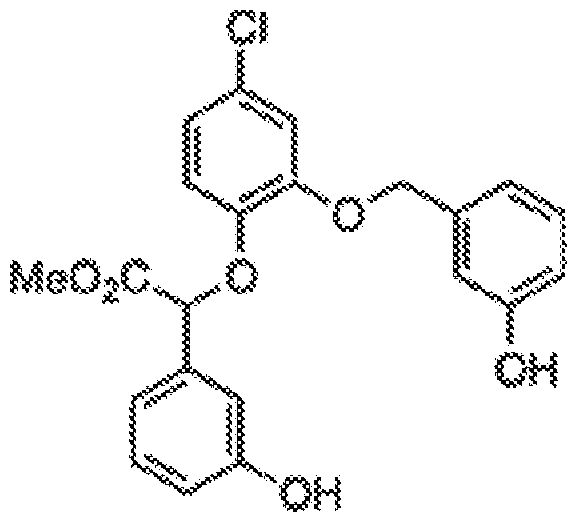
A compound of the formula:

an enantiomer thereof, or a salt thereof.
A compound according to formula (II), an enantiomer thereof, or a salt thereof:
Formula (II)

wherein R1 and R2 are independently selected from the group consisting of: hydrogen; hydroxymethyl (-CH2OH); and methoxycarbonyl (-CC Me);
wherein one of R1 and R2 is hydrogen;
wherein when R1 is hydrogen, R3 is hydroxyl (-OH) and R4 is -O-alkyl; and
wherein when R2 is hydrogen, R3 is -O-alkyl and R4 is hydroxyl (-OH).
15. The compound according to claim 14, wherein:
X is halo;
R1 is hydrogen;
R2 is methoxycarbonyl (-C02Me);
R3 is hydroxyl (-OH); and
R4 is -O-alkyl.
16. The compound according to claim 15, wherein:
X is -CI; and
R4 is methoxy (-OMe).
17. The compound according to claim 14, wherein:
X is halo;
R1 is hydrogen;
R2 is hydroxymethyl (-CH2OH);
R3 is hydroxyl (-OH); and
R4 is -O-alkyl.
The compound according to claim 17, wherein:
X is -CI; and
R4 is methoxy (-OMe).
A compound of the formula:

an enantiomer thereof, or a salt thereof.

an enantiomer thereof, or a salt thereof.
21. A method of treating cancer in a subject comprising:
administering to a subject in need of such treatment a therapeutically effective amount of a compound according to any one of the preceding claims.
22. A compound according to any one of claims 1 to 20 for use in the treatment of cancer.
23. The compound according to claim 22, wherein the cancer is selected from lung cancer, colon cancer, melanoma, leukemia, ovarian cancer, renal cancer, prostate cancer, breast cancer, or a glioma.
24. The compound according to claim 22 or claim 23, wherein the compound is EKB-4.
Priority Applications (3)
| Application Number | Priority Date | Filing Date | Title |
|---|---|---|---|
| CA3025884A CA3025884C (en) | 2016-06-24 | 2017-06-23 | Glucose transport inhibitors and methods of using same |
| CN201780038751.4A CN109476656A (en) | 2016-06-24 | 2017-06-23 | Glucose transport inhibitors and methods of using the same |
| US16/311,417 US10647654B2 (en) | 2016-06-24 | 2017-06-23 | Glucose transport inhibitors and methods of using same |
Applications Claiming Priority (2)
| Application Number | Priority Date | Filing Date | Title |
|---|---|---|---|
| US201662354479P | 2016-06-24 | 2016-06-24 | |
| US62/354,479 | 2016-06-24 |
Publications (1)
| Publication Number | Publication Date |
|---|---|
| WO2017223473A1 true WO2017223473A1 (en) | 2017-12-28 |
Family
ID=60784520
Family Applications (1)
| Application Number | Title | Priority Date | Filing Date |
|---|---|---|---|
| PCT/US2017/039036 Ceased WO2017223473A1 (en) | 2016-06-24 | 2017-06-23 | Glucose transport inhibitors and methods of using same |
Country Status (4)
| Country | Link |
|---|---|
| US (1) | US10647654B2 (en) |
| CN (1) | CN109476656A (en) |
| CA (1) | CA3025884C (en) |
| WO (1) | WO2017223473A1 (en) |
Citations (3)
| Publication number | Priority date | Publication date | Assignee | Title |
|---|---|---|---|---|
| US5407954A (en) * | 1992-02-06 | 1995-04-18 | Merrell Dow Pharmaceuticals Inc. | Arylalkoxyphenoxy-imidazoline compounds |
| US7105554B2 (en) * | 2000-08-31 | 2006-09-12 | Oxford Glycosciences (Uk) Ltd. | Benzylidene thiazolidinediones and their use as antimycotic agents |
| US9181162B2 (en) * | 2010-03-24 | 2015-11-10 | Ohio University | Compositions and methods for glucose transport inhibition |
Family Cites Families (3)
| Publication number | Priority date | Publication date | Assignee | Title |
|---|---|---|---|---|
| DE3116913A1 (en) | 1981-04-29 | 1982-11-18 | Basf Ag, 6700 Ludwigshafen | METHOD FOR PRODUCING RESORCINE DERIVATIVES AND USE OF CERTAIN RESORCINE DERIVATIVES AS A FRAGRANCE |
| US7247261B2 (en) | 2003-05-12 | 2007-07-24 | Electronics And Telecommunications Research Institute | Nonlinear optical material with nano-sized dendrimer structure |
| US20090311249A1 (en) | 2006-06-02 | 2009-12-17 | Luca Gianni | Capecitabine Combination Therapy |
-
2017
- 2017-06-23 US US16/311,417 patent/US10647654B2/en active Active
- 2017-06-23 CA CA3025884A patent/CA3025884C/en active Active
- 2017-06-23 WO PCT/US2017/039036 patent/WO2017223473A1/en not_active Ceased
- 2017-06-23 CN CN201780038751.4A patent/CN109476656A/en active Pending
Patent Citations (3)
| Publication number | Priority date | Publication date | Assignee | Title |
|---|---|---|---|---|
| US5407954A (en) * | 1992-02-06 | 1995-04-18 | Merrell Dow Pharmaceuticals Inc. | Arylalkoxyphenoxy-imidazoline compounds |
| US7105554B2 (en) * | 2000-08-31 | 2006-09-12 | Oxford Glycosciences (Uk) Ltd. | Benzylidene thiazolidinediones and their use as antimycotic agents |
| US9181162B2 (en) * | 2010-03-24 | 2015-11-10 | Ohio University | Compositions and methods for glucose transport inhibition |
Non-Patent Citations (1)
| Title |
|---|
| LIU ET AL.: "A Small-Molecule Inhibitor of Glucose Transporter 1 Downregulates Glycolysis, Induces Cell -Cycle Arrest, and Inhibits Cancer Cell Growth In Vitro and In Vivo", MOLECULAR CANCER THERAPEUTICS, vol. 11, 11 June 2012 (2012-06-11), pages 1672 - 1682, XP055175480 * |
Also Published As
| Publication number | Publication date |
|---|---|
| US10647654B2 (en) | 2020-05-12 |
| US20190322613A1 (en) | 2019-10-24 |
| CA3025884A1 (en) | 2017-12-28 |
| CA3025884C (en) | 2023-03-07 |
| CN109476656A (en) | 2019-03-15 |
Similar Documents
| Publication | Publication Date | Title |
|---|---|---|
| CN103037690B (en) | Compositions and methods for glucose transport inhibition | |
| WO2008151253A1 (en) | Hypoxia activated prodrugs of antineoplastic agents | |
| CN105452237A (en) | Heteroaryl substituted pyrazoles | |
| EA023646B1 (en) | SUBSTITUTED 2,3-DIHYDROIMIDAZO[1,2-c]QUINAZOLINE SALTS | |
| JPH01311091A (en) | Water-soluble prodrug | |
| EP3120849A1 (en) | Cancer stem cell proliferation inhibitor and intracellular active oxygen accumulation inducer | |
| CA3110609C (en) | 5-acetamidomethyl-oxazolidinone derivatives for use in the treatment of cancer | |
| AR075348A1 (en) | METHODS AND COMPOSITIONS TO TREAT BREAST CANCER | |
| EP2928864B1 (en) | New derivatives of indole for the treatment of cancer, viral infections and lung diseases | |
| ES478605A1 (en) | Flavans, process for their preparation and pharmaceutical compositions containing them. | |
| EP4245305B1 (en) | Manufacture of trans-[tetrachlorobis(1h-indazole)ruthenate (iii)]and compositions thereof | |
| WO2018054989A4 (en) | Benzoimidazole derivatives as anticancer agents | |
| CN107428753B (en) | Small molecules for the treatment of primary cancer and cancer metastasis | |
| EP3978473B1 (en) | Compound containing an indoleacetic acid core structure and use thereof | |
| US10647654B2 (en) | Glucose transport inhibitors and methods of using same | |
| EP2224925B1 (en) | Compounds for use in the treatment of cancer | |
| KR20110058818A (en) | Organic Arsenic Compounds and Methods for Cancer Treatment | |
| WO2004058705B1 (en) | Inhibitors of the binding of chemokines i-tac or sdf-1 to the ccxckr2 receptor | |
| JP4814245B2 (en) | Phosphate-containing prodrugs of sulfonylhydrazines as hypoxia-selective antitumor agents | |
| US20030092637A1 (en) | Novel compounds | |
| FI3891156T3 (en) | New crystalline forms of a thienopyrimidine as mcl-1 inhibitor | |
| RU2697551C2 (en) | New derivatives of peg | |
| WO2008085688A1 (en) | Compositions and methods for cancer treatment using a chemically linked phosphonoformic acid partial ester | |
| AU2003212534B2 (en) | Formulations of anthraquinone derivatives | |
| WO2008076826A1 (en) | Pyrophosphoramide alkylators |
Legal Events
| Date | Code | Title | Description |
|---|---|---|---|
| ENP | Entry into the national phase |
Ref document number: 3025884 Country of ref document: CA |
|
| 121 | Ep: the epo has been informed by wipo that ep was designated in this application |
Ref document number: 17816309 Country of ref document: EP Kind code of ref document: A1 |
|
| NENP | Non-entry into the national phase |
Ref country code: DE |
|
| 122 | Ep: pct application non-entry in european phase |
Ref document number: 17816309 Country of ref document: EP Kind code of ref document: A1 |