WO2018003625A1 - 損傷毛髪改善剤及びそれを含有する損傷毛髪改善化粧料 - Google Patents
損傷毛髪改善剤及びそれを含有する損傷毛髪改善化粧料 Download PDFInfo
- Publication number
- WO2018003625A1 WO2018003625A1 PCT/JP2017/022838 JP2017022838W WO2018003625A1 WO 2018003625 A1 WO2018003625 A1 WO 2018003625A1 JP 2017022838 W JP2017022838 W JP 2017022838W WO 2018003625 A1 WO2018003625 A1 WO 2018003625A1
- Authority
- WO
- WIPO (PCT)
- Prior art keywords
- hair
- damaged hair
- improving
- improving agent
- damaged
- Prior art date
- Legal status (The legal status is an assumption and is not a legal conclusion. Google has not performed a legal analysis and makes no representation as to the accuracy of the status listed.)
- Ceased
Links
Classifications
-
- A—HUMAN NECESSITIES
- A61—MEDICAL OR VETERINARY SCIENCE; HYGIENE
- A61K—PREPARATIONS FOR MEDICAL, DENTAL OR TOILETRY PURPOSES
- A61K8/00—Cosmetics or similar toiletry preparations
- A61K8/18—Cosmetics or similar toiletry preparations characterised by the composition
- A61K8/30—Cosmetics or similar toiletry preparations characterised by the composition containing organic compounds
- A61K8/67—Vitamins
- A61K8/676—Ascorbic acid, i.e. vitamin C
-
- A—HUMAN NECESSITIES
- A61—MEDICAL OR VETERINARY SCIENCE; HYGIENE
- A61K—PREPARATIONS FOR MEDICAL, DENTAL OR TOILETRY PURPOSES
- A61K8/00—Cosmetics or similar toiletry preparations
- A61K8/18—Cosmetics or similar toiletry preparations characterised by the composition
- A61K8/30—Cosmetics or similar toiletry preparations characterised by the composition containing organic compounds
- A61K8/67—Vitamins
-
- A—HUMAN NECESSITIES
- A61—MEDICAL OR VETERINARY SCIENCE; HYGIENE
- A61Q—SPECIFIC USE OF COSMETICS OR SIMILAR TOILETRY PREPARATIONS
- A61Q5/00—Preparations for care of the hair
- A61Q5/002—Preparations for repairing the hair, e.g. hair cure
-
- A—HUMAN NECESSITIES
- A61—MEDICAL OR VETERINARY SCIENCE; HYGIENE
- A61Q—SPECIFIC USE OF COSMETICS OR SIMILAR TOILETRY PREPARATIONS
- A61Q5/00—Preparations for care of the hair
- A61Q5/02—Preparations for cleaning the hair
-
- A—HUMAN NECESSITIES
- A61—MEDICAL OR VETERINARY SCIENCE; HYGIENE
- A61Q—SPECIFIC USE OF COSMETICS OR SIMILAR TOILETRY PREPARATIONS
- A61Q5/00—Preparations for care of the hair
- A61Q5/12—Preparations containing hair conditioners
Definitions
- the present invention relates to a damaged hair improving agent having an excellent improvement effect on damaged hair and a damaged hair improving cosmetic containing the same.
- the present invention provides an improved improvement effect on damaged hair without using complicated work, special components, and expensive components, and a damaged hair improving agent and a damaged hair improving cosmetic capable of maintaining the effect for a long period of time.
- the issue is to provide.
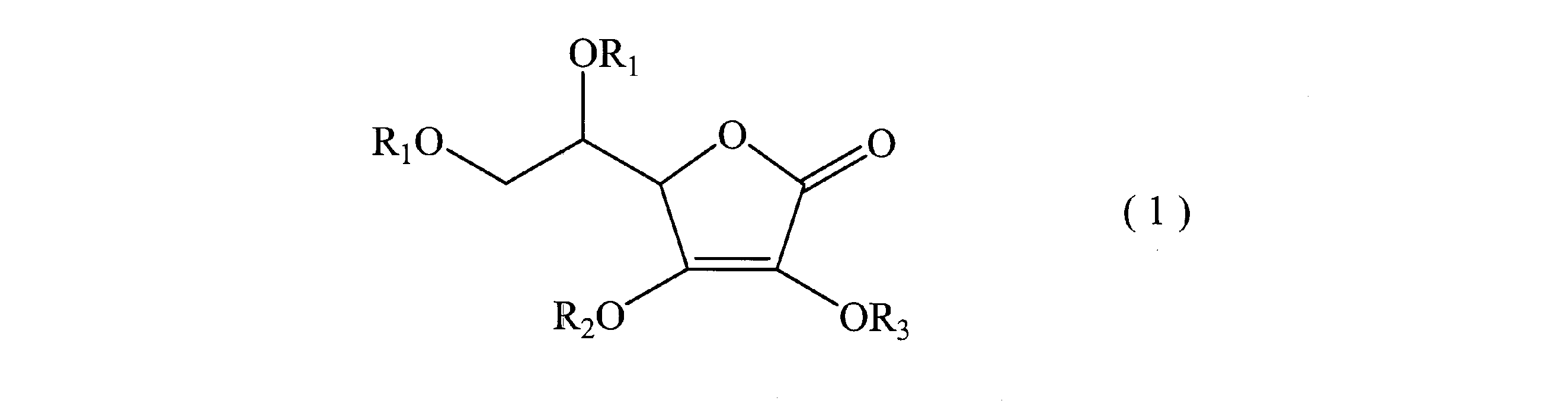
- the present inventors have found that at least one selected from L-ascorbic acid derivatives represented by the general formula (1) and salts thereof is available. The present inventors have found that it has an excellent improvement effect on damaged hair and have completed the present invention.
- the present invention relates to an agent for improving damaged hair comprising as a main component at least one selected from L-ascorbic acid derivatives represented by the general formula (1) and salts thereof.
- each R 1 independently represents hydrogen, a linear or branched saturated or unsaturated hydrocarbon group having 8 to 36 carbon atoms, or a linear or branched saturated or unsaturated group having 8 to 36 carbon atoms.
- R 2 is a fatty acid residue, R 2 is hydrogen, a linear or branched saturated or unsaturated hydrocarbon group having 8 to 36 carbon atoms, or a linear or branched saturated or unsaturated fatty acid residue having 8 to 36 carbon atoms.
- R 3 is hydrogen, a linear or branched saturated or unsaturated hydrocarbon group having 8 to 36 carbon atoms, a linear or branched saturated or unsaturated fatty acid residue having 8 to 36 carbon atoms, a sugar residue, phosphorus An acid ester group or a sulfate ester group, and at least one of R 1 to R 3 is a linear or branched saturated or unsaturated fatty acid residue having 8 to 36 carbon atoms.
- the present invention also relates to a damaged hair improving cosmetic containing the damaged hair improving agent.
- a damaged hair-improving agent comprising at least one selected from L-ascorbic acid derivatives represented by the general formula (1) of the present invention and a salt thereof and a damaged hair-improving cosmetic containing the same are provided for damaged hair.
- the effect of improving damaged hair can be obtained by application, and the effect can be maintained for a long time by heat treatment with a method such as a dryer after application.
- One or more selected from the L-ascorbic acid derivatives represented by the general formula (1) and salts thereof used in the present invention are conventionally whitening action and anti-aging action by delaying melanin formation, inhibiting lipid peroxide, promoting collagen formation. It has been used in cosmetics other than hair cosmetics as a useful ingredient because of its physiological activity.
- one or more selected from L-ascorbic acid derivatives represented by the general formula (1) and salts thereof are effective in improving the surface of damaged hair in addition to whitening action and anti-aging action.
- the present invention provides a damaged hair improving agent having an excellent improving effect on damaged hair and a damaged hair improving cosmetic containing the same.
- the damaged hair improving agent of the present invention contains at least one selected from L-ascorbic acid derivatives represented by the general formula (1) and salts thereof as a main component.
- each R 1 independently represents hydrogen, a linear or branched saturated or unsaturated hydrocarbon group having 8 to 36 carbon atoms, or a linear or branched saturated or unsaturated group having 8 to 36 carbon atoms.
- R 2 is a fatty acid residue, R 2 is hydrogen, a linear or branched saturated or unsaturated hydrocarbon group having 8 to 36 carbon atoms, or a linear or branched saturated or unsaturated fatty acid residue having 8 to 36 carbon atoms.
- R 3 is hydrogen, a linear or branched saturated or unsaturated hydrocarbon group having 8 to 36 carbon atoms, a linear or branched saturated or unsaturated fatty acid residue having 8 to 36 carbon atoms, a sugar residue, phosphorus An acid ester group or a sulfate ester group, and at least one of R 1 to R 3 is a linear or branched saturated or unsaturated fatty acid residue having 8 to 36 carbon atoms.
- the linear or branched saturated or unsaturated hydrocarbon group has 8 to 36 carbon atoms, preferably carbon Equations 12-22. Furthermore, at least one of R 1 to R 3 is a linear or branched saturated or unsaturated fatty acid residue having 8 to 36 carbon atoms, preferably a linear or branched saturated or unsaturated group having 12 to 22 carbon atoms. It is a fatty acid residue.
- the fatty acid residue is one obtained by removing a hydroxyl group from a carboxyl group of a linear or branched saturated or unsaturated fatty acid, and the fatty acid is a saturated fatty acid or an unsaturated fatty acid, such as caprylic acid or capric acid. , Lauric acid, myristic acid, palmitic acid, hexyldecanoic acid, oleic acid, linoleic acid, arachidic acid, behenic acid and the like.
- the sugar residue is one obtained by removing one hydroxyl group from the sugar, and the phosphate ester group becomes a phosphate ester group including an oxygen atom bonded to R 3 .
- the sulfate ester group is a sulfate ester group including an oxygen atom bonded to R 3 .
- Examples of the salt of the L-ascorbic acid derivative include sodium, potassium, magnesium and the like.
- the L-ascorbic acid derivative represented by the general formula (1) and the salt thereof used in the present invention can be easily synthesized as described in, for example, Japanese Patent No. 3253735, and cosmetics other than hair cosmetics. Is widely available, and is easily available and inexpensive.
- the L-ascorbic acid derivative and a salt thereof are not particularly limited, and examples thereof include ascorbyl palmitate, ascorbyl stearate, ascorbyl dipalmitate, ascorbyl tetrapalmitate, ascorbyl tetra-2-hexyldecanoate, glucoside fatty acid ascorbate, Examples include trisodium ascorbyl palmitate, and one or more of these can be used. More preferable examples include ascorbyl dipalmitate (Nikko Chemicals Co., Ltd., NIKKOL CP) and tetra-2-hexyldecanoic acid ascorbyl (Nikko Chemicals Co., Ltd., NIKKOL VC-IP).
- At least one selected from the L-ascorbic acid derivatives represented by the general formula (1) and salts thereof used in the present invention has a characteristic of being dissolved in an oil component and water.
- One or more selected from the L-ascorbic acid derivatives represented by the general formula (1) and salts thereof used in the present invention can be used as they are as damaged hair improving agents, and can also be used for oily components or water. It is mix
- the amount of the L-ascorbic acid derivative represented by the general formula (1) and a salt thereof selected from one or more oily components or water is 0.01 to 100% by mass.
- the content is 0.1 to 50.0% by mass, and more preferably 0.5 to 20% by mass.
- the oily component used in the damaged hair improving agent of the present invention is not particularly limited.
- squalane liquid paraffin, tri (caprylic / capric) glyceryl, glyceryl tri-2-ethylhexanoate, cetyl ethylhexanoate
- examples include diethyl sebacate, ethylhexyl palmitate, isopropyl myristate, olive oil, apricot kernel oil, sunflower oil, argan oil, jojoba oil, silicone oil, dimethyl silicone oil, and the like, and one or more of them can be used.
- Preferred examples of the oil component include squalane, tri (caprylic acid / capric acid) glyceryl, cetyl ethylhexanoate, and the like.
- the damaged hair improving agent of the present invention can be used as a damaged hair improving cosmetic, and further provides a damaged hair improving cosmetic comprising the damaged hair improving agent of the present invention.
- various components used in normal hair cosmetics for example, oily components, higher alcohols, fatty acids, polar, within the range not impairing the effects of the present invention.
- Lipids, moisturizing components, antibacterial components, viscosity modifiers, ultraviolet absorbers, pigments, fragrances and the like can be blended.
- the oil component includes hydrocarbon oils such as squalane and liquid paraffin, olive oil, macadamia nut oil, vegetable oil such as jojoba oil, animal oil such as beef tallow, triethylhexanoin, tri (caprylic acid / capric acid) glyceryl, Examples thereof include esters such as cetyl ethylhexanoate, diethyl sebacate and ethylhexyl palmitate, and silicones such as dimethylsilicone, phenylmethylsilicone and cyclomethicone.
- hydrocarbon oils such as squalane and liquid paraffin
- olive oil macadamia nut oil
- vegetable oil such as jojoba oil
- animal oil such as beef tallow
- triethylhexanoin tri (caprylic acid / capric acid) glyceryl
- esters such as cetyl ethylhexanoate, diethyl sebacate and eth
- Examples of the higher alcohol include lauryl alcohol, cetyl alcohol, stearyl alcohol, isostearyl alcohol, behenyl alcohol, myristyl alcohol, oleyl alcohol, cetostearyl alcohol and the like.
- Examples of fatty acids include straight chain fatty acids having 12 or more carbon atoms, branched fatty acids, unsaturated fatty acids, and hydroxy fatty acids.
- Examples of polar lipids include ceramides, phospholipids, cholesterol and derivatives thereof, and glycolipids.
- Examples of the moisturizing component include polyethylene glycol, glycerin, sorbitol, xylitol, maltitol, chondroitin sulfate, hyaluronic acid and the like.
- the use of the damaged hair-improving cosmetic composition according to the present invention is not particularly limited.
- Hair tonics, hair conditioners, hair rinses, hair treatments, hair shampoos, hair mousses, set gels, pomades, tics, set lotions and other hair cosmetics are not particularly limited.
- Hair tonics, hair conditioners, hair rinses, hair treatments, hair shampoos, hair mousses, set gels, pomades, tics, set lotions and other hair cosmetics are not particularly limited.
- Hair tonics, hair conditioners, hair rinses, hair treatments, hair shampoos, hair mousses, set gels, pomades, tics, set lotions and other hair cosmetics are
- the damaged hair improving agent of the present invention can be easily blended with any damaged hair improving cosmetic, and its blending amount is 0.01 to 100% by mass, preferably 0.05 to 50.0. % By mass, more preferably 0.1 to 30.0% by mass.
- Example 1 Evaluation of water repellency 1. Outline of Experiment The water repellency of the damaged hair improving agent containing the L-ascorbic acid derivative represented by the general formula (1) and a salt thereof was evaluated.
- the hair bundle was rinsed alternately with a 3% by mass sodium laurate aqueous solution and water. After repeating this three times, the hair in the hair bundle was wiped off with a towel. The contact angle between the hair surface and the water of the hair bundle obtained by the treatment was measured using an automatic contact angle meter (Kyowa Interface Science Co., Ltd., DropMaster, DM-501).
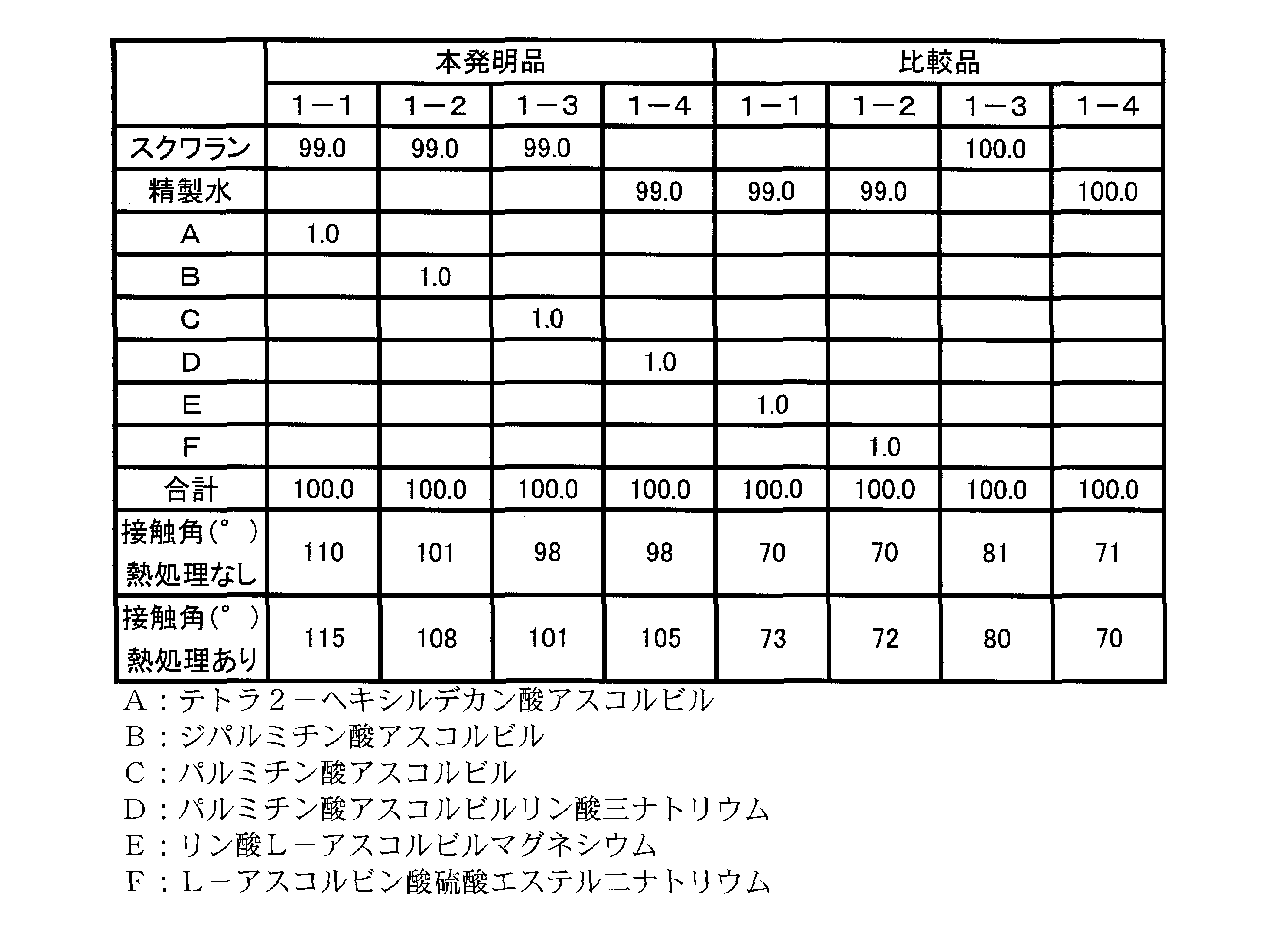
- Results Table 1 shows the experimental results.
- the damaged hair improving agent of the present invention products 1-1 to 1-4 containing the L-ascorbic acid derivative represented by the general formula (1) and a salt thereof to damaged hair, It was confirmed that the contact angle was increased and the water repellency of the damaged hair bundle was improved. Since the contact angle between normal hair and water is 90 ° or more, it means that the damaged hair bundle to which the damaged hair improving agent of the present invention is applied is improved to normal hair.
- the damaged hair improving agent of the present invention exhibited its water repellency effect without being subjected to heat treatment, and the water repellency effect was further exhibited by further heat treatment. Further, the water repellent effect was exhibited by the presence or absence of the fatty acid residue of the L-ascorbic acid derivative and its salt regardless of whether the damaged hair improving agent was water-soluble or oil-soluble.
- Example 2 Sensory evaluation of hair Outline of Experiment Sensory evaluation of the damaged hair bundle treated with the damaged hair improving agent containing the L-ascorbic acid derivative represented by the general formula (1) and a salt thereof was performed.
- the hair bundle was rinsed alternately with a 3% by mass sodium laurate aqueous solution and water. After repeating this three times, the hair in the hair bundle was wiped off with a towel. The obtained hair bundle was subjected to sensory evaluation by five in-house subjects according to the following evaluation criteria.
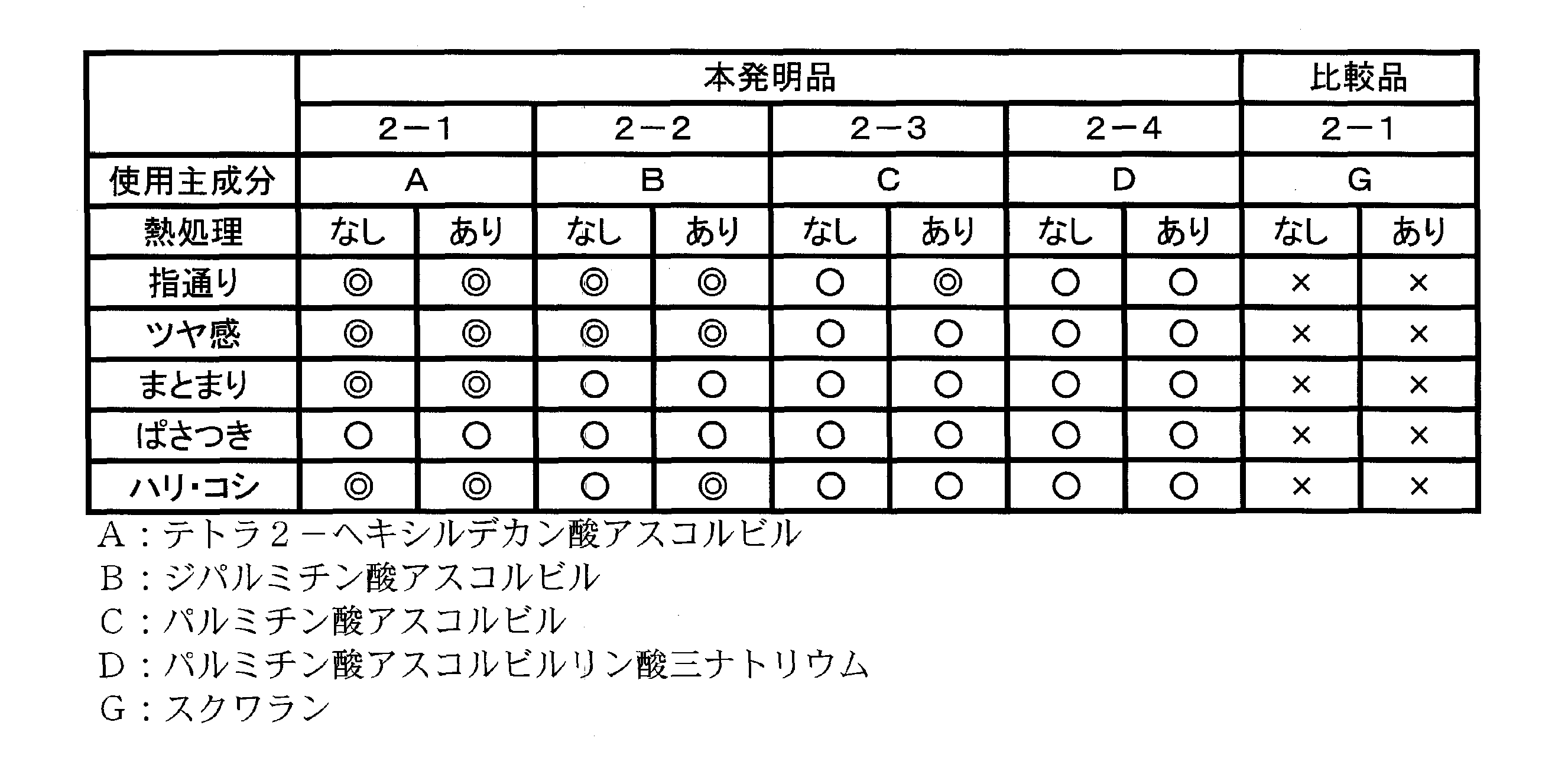
- Results Table 2 shows the experimental results.
- Damaged hair improving agent was greatly improved compared to damaged hair before application: ⁇ Damaged hair improving agent compared with damaged hair before application improved: ⁇ Damaged hair improving agent compared with damaged hair before application improved slightly: ⁇ Compared with damaged hair before application of damaged hair improving agent, no change: ⁇
- Example 3 Confirmation of sustainability of damaged hair improvement effect Outline of Experiment The durability of the damaged hair bundle treated with the hair improving agent containing the L-ascorbic acid derivative represented by the general formula (1) and a salt thereof was confirmed.
- Results Table 3 shows the experimental results. Persistence in water repellency of the hair surface of a hair bundle treated with the improving agent of the present invention containing at least one selected from L-ascorbic acid derivatives represented by the general formula (1) and salts thereof It was confirmed that the effect was sustained for a longer time by applying heat treatment.
- Example 4 Sensory evaluation of damaged hair by concentration Outline of Experiment Sensory evaluation of the damaged hair bundle was performed by changing the concentration of the damaged hair improving agent containing the L-ascorbic acid derivative represented by the general formula (1) and a salt thereof.
- a hair bundle of healthy human hair was subjected to a bleach treatment using a hydrogen peroxide solution and an aqueous ammonia solution to prepare a hair bundle of damaged hair.
- heat treatment is not applied to some hair bundles, and a dryer is applied to some hair bundles.
- Heat treatment was not applied to some hair bundles, and a dryer is applied to some hair bundles.
- the hair bundle was rinsed alternately with a 3% by mass sodium laurate aqueous solution and water. After repeating this three times, the hair in the hair bundle was wiped off with a towel.
- the obtained hair bundle was subjected to sensory evaluation by five in-house subjects according to the following evaluation criteria.
- Results Table 4 shows the experimental results.
- Improvement was confirmed in sensory evaluation such as finger feeling, glossiness, firmness, firmness, and feeling of unity, and even if the amount of L-ascorbic acid derivative represented by the general formula (1) and its salt is changed, the improvement effect was confirmed to be maintained. Even when heat treatment was performed, the improvement effect was not lost.
- Damaged hair improving agent was greatly improved compared to damaged hair before application: ⁇ Damaged hair improving agent compared with damaged hair before application improved: ⁇ Damaged hair improving agent compared with damaged hair before application improved slightly: ⁇ Compared with damaged hair before application of damaged hair improving agent, no change: ⁇
- Example 5 Hair oil Ascorbyl tetra-2-hexyldecanoate / Squalane solution (5%) 20.0 (mass%) Tri (caprylic / capric) glyceryl 28.0 Olive oil 1.0 Tocopherol 1.0 Perfume Trace amount Methyl heptyl palmitate Remaining amount 100.0
- Preparation method The mixed raw materials are stirred and mixed uniformly.
- Example 6 Hair oil mist Ascorbyl tetra-2-hexyldecanoate 1.0 (mass%) Squalane 10.0 Methyl heptyl myristate 5.0 Perfume Trace amount Isododecane Remaining amount 100.0 Preparation method: The mixed raw materials are stirred and mixed uniformly.
- Example 7 Hair shampoo
- A Ascorbyl dipalmitate 1.0 (mass%) Lauroylmethylalanine Na aqueous solution (30%) 20.0 Cocoyl methyl taurine Na aqueous solution (30%) 10.0 Cocamidopropyl betaine aqueous solution (15%) 20.0 Cocamide DEA 4.0 Polyglyceryl oleate-10 1.0 1,3-butylene glycol 3.0 Phenoxyethanol 0.7 Preservative appropriate amount
- B Polyquaternium-10 0.5 Purified water remaining amount 100.0
- Preparation method A and B phases are heated to 80 ° C. and uniformly dissolved. Add Phase B while stirring Phase A and cool to 30 ° C.
- Example 8 Hair conditioner (A) Behenamidopropyldimethylamine 2.5 (mass%) Glyceryl stearate 1.0 Cetyl ethylhexanoate 1.0 Squalane 3.0 Stearyl alcohol 8.0 Dimethyl silicone 6.0 Preservative appropriate amount (B) trisodium ascorbyl palmitate 1.0 Hydroxyethyl cellulose 0.3 Propylene glycol 5.0 Preservative Appropriate amount Purified water Remaining amount 100.0 Preparation method: Each of the A phase and the B phase is heated to 80 ° C. and uniformly dissolved. Continue stirring and cool to 30 ° C.
- Example 9 Invas Treatment
- Ascorbyl dipalmitate 1.0 (mass%) Stearyl alcohol 8.0 Squalane 10.0
- Preservative appropriate amount B
- Behentrimonium chloride 3.0 Cetrimonium chloride aqueous solution (30%) 3.3
- Dipropylene glycol 5.0 Hydroxyethyl cellulose aqueous solution (1%) 30.0
- Preparation method Phase A and phase B are heated to 80 ° C. and uniformly dissolved. Add Phase A while stirring Phase B, continue stirring and cool to 30 ° C.
- Example 10 Hair milk Ascorbyl palmitate 0.5 (mass%) Ascorbyl tetra-2-hexyldecanoate 0.5 Tri (caprylic / capric) glyceryl 2.0 Cetyl ethylhexanoate 3.0 PEG-40 hydrogenated castor oil 0.5 (B) Propanediol 3.0 Acrylates / alkyl acrylate (C10-30) cross-polymer aqueous solution (1%) 40.0 Ethanol 10.0 Phenoxyethanol 0.5 Arginine 0.4 Purified water remaining amount 100.0 Preparation method: Phase A and phase B are heated to 80 ° C. and uniformly dissolved. Add Phase A to Phase B and emulsify at 80 ° C. Continue stirring and cool to 30 ° C.
- Example 11 Hair treatment Ascorbyl stearate 1.0 (mass%) Stearamidopropyldimethylamine 2.5 Glyceryl stearate 0.5 Cetyl alcohol 2.0 (Dimer linoleic acid / stearic acid / Hydroxystearic acid) Polyglyceryl-10 3.0 Isopropyl palmitate 3.0 Propylene glycol laurate 1.0 (B) Polyquaternium-10 0.5 1,3-butylene glycol 10.0 Glutamic acid 0.8 Preservative Small amount Purified water Remaining amount 100.0 Preparation method: Phase A and phase B are heated to 80 ° C. and uniformly dissolved. Add Phase A to Phase B and emulsify at 80 ° C. Continue stirring and cool to 30 ° C.
- Example 12 Leave-on treatment
- B Pentylene glycol 2.0 1,3-butylene glycol 5.0 Glycerin 1.0 Preservative Small amount Purified water Remaining amount 100.0
- Preparation method Phase A and phase B are uniformly heated, phase A is added to phase B and emulsified. Continue stirring and cool to 30 ° C.
- Example 13 Hair oil Ascorbyl tetra-2-hexyldecanoate / Squalane solution (30%) 3.5 (mass%) Methylheptyl laurate 48.0 Apricot oil 2.0 Tocopherol 1.0 Perfume Small amount Dimethyl silicone Remaining amount 100.0
- Preparation method The mixed raw materials are stirred and mixed uniformly. Industrial applicability
- the present invention Since the present invention has an excellent damage care effect on damaged hair, it can be used for hair cosmetics.
Landscapes
- Health & Medical Sciences (AREA)
- Life Sciences & Earth Sciences (AREA)
- Animal Behavior & Ethology (AREA)
- General Health & Medical Sciences (AREA)
- Public Health (AREA)
- Veterinary Medicine (AREA)
- Dermatology (AREA)
- Birds (AREA)
- Epidemiology (AREA)
- Cosmetics (AREA)
Abstract
Description
背景技術
発明の概要
発明を実施するための形態

本発明の損傷毛髪改善剤を含有する損傷毛髪改善化粧料には、本発明の効果を損なわない範囲において、通常の毛髪化粧料に用いられる各種成分、例えば、油性成分、高級アルコール、脂肪酸、極性脂質、保湿成分、抗菌成分、粘度調整剤、紫外線吸収剤、色素、香料などを配合できる。
高級アルコールとしては、ラウリルアルコール、セチルアルコール、ステアリルアルコール、イソステアリルアルコール、ベヘニルアルコール、ミリスチルアルコール、オレイルアルコール、セトステアリルアルコールなどが挙げられる。脂肪酸としては炭素数12以上の直鎖脂肪酸、分岐脂肪酸、不飽和脂肪酸、ヒドロキシ脂肪酸などが挙げられる。極性脂質としては、セラミド類、リン脂質類、コレステロール及びその誘導体、糖脂質などが挙げられる。保湿成分としては、ポリエチレングルコール、グリセリン、ソルビトール、キシリトール、マルチトール、コンドロイチン硫酸、ヒアルロン酸などが挙げられる。
実施例
毛髪の撥水性評価
1.実験の概要
一般式(1)で表されるL-アスコルビン酸誘導体及びその塩を含有する損傷毛髪改善剤における毛髪表面の撥水性評価を行った。
表1に記載のA~FのL-アスコルビン酸誘導体及びその塩と、油性成分もしくは水とを含有する各損傷毛髪改善剤を調製した。健常人毛(ビューラックス社製)の毛束を過酸化水素水とアンモニア水溶液を用いてブリーチ処理を行い、損傷毛髪の毛束を作製した。
作製した損傷毛髪毛束に各損傷毛髪改善剤を塗布し、損傷毛髪毛束全体になじませた後、一部の毛髪毛束については熱処理を行わず、もう一部の毛髪毛束についてはドライヤーの温風を5分間当て熱処理を行った。熱処理の有無に関わらず3質量%ラウリン酸硫酸ナトリウム水溶液と水で交互に毛髪毛束のすすぎ洗いを行った。これを3回繰り返したのち、タオルで毛髪毛束の水分を拭き取った。処理して得られた毛髪毛束についてその毛髪表面と水との接触角を自動接触角計(協和界面科学株式会社製,DropMaster,DM-501)を用いて測定した。
実験結果を表1に示す。一般式(1)で表されるL-アスコルビン酸誘導体及びその塩を含有する本発明品1-1~1-4の損傷毛髪改善剤を損傷毛髪に塗布することで、毛髪表面と水との接触角が高くなり、損傷毛髪毛束の撥水性が向上したことが確認された。正常な毛髪と水との接触角は90°以上になることから、本発明品の損傷毛髪改善剤を塗布した損傷毛髪毛束は正常な毛髪に改善したことを意味している。本発明品の損傷毛髪改善剤は、熱処理を行わずともその撥水効果が発揮されており、さらに熱処理を加えることでその撥水効果はより発揮された。さらに、その撥水効果は損傷毛髪改善剤が水溶性、油溶性にかかわらず、L-アスコルビン酸誘導体及びその塩の脂肪酸残基の有無により発揮された。
毛髪の官能評価
1.実験の概要
一般式(1)で表されるL-アスコルビン酸誘導体及びその塩を含有する損傷毛髪改善剤で処理した損傷毛髪毛束の官能評価を行った。
表2に記載の一般式(1)で表されるL-アスコルビン酸誘導体及びその塩を3質量%含有し、残部を油性成分としてスクワランを用いた各損傷毛髪改善剤(本発明品2-1~2-4)を調製した。また比較品2-1として、スクワラン(100質量%)を用いた。健常人毛(ビューラックス社製)の毛束を過酸化水素水とアンモニア水溶液を用いてブリーチ処理を行い、損傷毛髪の毛束を作製した。作製した損傷毛髪毛束に各損傷毛髪改善剤を塗布し、損傷毛髪毛束全体になじませた後、一部の毛髪毛束については熱処理を行わず、もう一部の毛髪毛束についてはドライヤーの温風を5分間当て熱処理を行った。熱処理の有無に関わらず3質量%ラウリン酸硫酸ナトリウム水溶液と水で交互に毛髪毛束のすすぎ洗いを行った。これを3回繰り返したのち、タオルで毛髪毛束の水分を拭き取った。得られた毛髪毛束について、下記の評価基準で、社内被験者5名による官能評価を実施した。
実験結果を表2に示す。一般式(1)で表されるL-アスコルビン酸誘導体及びその塩から選ばれる1種以上を含有する本発明品2-1~2-4の損傷毛髪改善剤を損傷毛髪に塗布することで、指通りやツヤ感、ハリ・コシなどの官能評価に改善が確認され、その効果は熱処理を行っても効果は失わずに発揮された。
損傷毛髪改善剤を塗布前の損傷毛髪と比較し、非常に改善した:◎
損傷毛髪改善剤を塗布前の損傷毛髪と比較し、改善した :〇
損傷毛髪改善剤を塗布前の損傷毛髪と比較し、やや改善した :△
損傷毛髪改善剤を塗布前の損傷毛髪と比較し、変わらない :×
損傷毛髪改善効果の持続性の確認
1.実験の概要
一般式(1)で表されるL-アスコルビン酸誘導体及びその塩を含有する毛髪改善剤で処理した損傷毛髪毛束の効果持続性の確認を行った。
実施例2における実験方法で、本発明品2-1~2-4、比較品2-1を用いて処理した毛髪毛束を3質量%ラウリン酸硫酸ナトリウム水溶液に浸漬させ、上下に揺らし洗浄し、その後水に浸漬させ、上下に揺らしすすぎを行った。この作業を28回繰り返した。処理して得られた毛髪毛束についてその毛髪表面と水との接触角を自動接触角計(協和界面科学株式会社製,DropMaster,DM-501)を用いて測定した。
実験結果を表3に示す。一般式(1)で表されるL-アスコルビン酸誘導体及びその塩から選ばれる1種以上を含有する本発明品の改善剤を用いて処理した毛髪毛束の毛髪表面の撥水性には持続性があることが確認され、その効果は熱処理を加えることでその効果がより長時間持続された。

濃度による損傷毛髪の官能評価
1.実験の概要
一般式(1)で表されるL-アスコルビン酸誘導体及びその塩を含有する損傷毛髪改善剤の濃度変化による損傷毛髪毛束の官能評価を行った。
表4に記載の使用成分として、一般式(1)で表されるL-アスコルビン酸誘導体及びその塩から選ばれる化合物であるテトラ2-ヘキシルデカン酸アスコルビルを、残部を油性成分のスクワランとして、各損傷毛髪改善剤中の使用成分濃度が、1質量%、10質量%、50質量%、100質量%となるように調製した(本発明品4-1~4-4)。また比較品4-1として、スクワラン(100質量%)を用いた。健常人毛(ビューラックス社製)の毛束を過酸化水素水とアンモニア水溶液を用いてブリーチ処理を行い、損傷毛髪の毛束を作製した。作製した損傷毛髪毛束に各損傷毛髪改善剤を塗布し、損傷毛髪毛束全体になじませた後、一部の毛髪毛束については熱処理を行わず、もう一部の毛髪毛束についてはドライヤーの温風を5分間当て熱処理を行った。熱処理の有無に関わらず3質量%ラウリン酸硫酸ナトリウム水溶液と水で交互に毛髪毛束のすすぎ洗いを行った。これを3回繰り返したのち、タオルで毛髪毛束の水分を拭き取った。得られた毛髪毛束について、下記の評価基準で、社内被験者5名による官能評価を実施した。
実験結果を表4に示す。一般式(1)で表されるL-アスコルビン酸誘導体及びその塩から選ばれる1種以上を含有する本発明品4-1~4-4の損傷毛髪改善剤を損傷毛髪に塗布することで、指通り、ツヤ感やハリ・コシ、まとまり感などの官能評価に改善が確認され、さらに一般式(1)で表されるL-アスコルビン酸誘導体及びその塩の配合量を変化させても改善効果は維持していることが確認された。また熱処理を行ってもその改善効果は失われずに発揮された。

損傷毛髪改善剤を塗布前の損傷毛髪と比較し、非常に改善した:◎
損傷毛髪改善剤を塗布前の損傷毛髪と比較し、改善した :〇
損傷毛髪改善剤を塗布前の損傷毛髪と比較し、やや改善した :△
損傷毛髪改善剤を塗布前の損傷毛髪と比較し、変わらない :×
ヘアオイル
テトラ2-ヘキシルデカン酸アスコルビル/
スクワラン溶液(5%) 20.0(質量%)
トリ(カプリル酸/カプリン酸)グリセリル 28.0
オリーブ油 1.0
トコフェロール 1.0
香料 微量
パルミチン酸メチルへプチル 残量
全量 100.0
調製方法:配合原料を撹拌均一混合する。
ヘアオイルミスト
テトラ2-ヘキシルデカン酸アスコルビル 1.0(質量%)
スクワラン 10.0
ミリスチン酸メチルへプチル 5.0
香料 微量
イソドデカン 残量
全量 100.0
調製方法:配合原料を撹拌均一混合する。
ヘアシャンプー
(A)ジパルミチン酸アスコルビル 1.0(質量%)
ラウロイルメチルアラニンNa水溶液(30%)20.0
ココイルメチルタウリンNa水溶液(30%) 10.0
コカミドプロピルベタイン水溶液(15%) 20.0
コカミドDEA 4.0
オレイン酸ポリグリセリル-10 1.0
1,3-ブチレングリコール 3.0
フェノキシエタノール 0.7
防腐剤 適量
(B)ポリクオタニウム-10 0.5
精製水 残量
全量 100.0
調製方法:A、B相を80℃に加温し、それぞれ均一溶解する。さらにA相を撹拌しながらB相を加え、30℃まで冷却する。
ヘアコンディショナー
(A)ベヘナミドプロピルジメチルアミン 2.5(質量%)
ステアリン酸グリセリル 1.0
エチルヘキサン酸セチル 1.0
スクワラン 3.0
ステアリルアルコール 8.0
ジメチルシリコーン 6.0
防腐剤 適量
(B)パルミチン酸アスコルビルリン酸三ナトリウム 1.0
ヒドロキシエチルセルロース 0.3
プロピレングリコール 5.0
防腐剤 適量
精製水 残量
全量 100.0
調製方法:A相及びB相をそれぞれ80℃に加温し均一溶解し、B相を撹拌しながらA相を加え撹拌して均一にする。撹拌を続けて30℃まで冷却する。
インバストリートメント
(A)ジパルミチン酸アスコルビル 1.0(質量%)
ステアリルアルコール 8.0
スクワラン 10.0
防腐剤 適量
(B)ベヘントリモニウムクロリド 3.0
セトリモニウムクロリド水溶液(30%) 3.3
ジプロピレングリコール 5.0
ヒドロキシエチルセルロース水溶液(1%) 30.0
フェノキシエタノール 0.4
精製水 残量
全量 100.0
調製方法:A相及びB相を80℃に加温し、均一溶解する。B相を撹拌しながらA相を添加し、撹拌を続けて30℃まで冷却する。
ヘアミルク
(A)パルミチン酸アスコルビル 0.5(質量%)
テトラ2-ヘキシルデカン酸アスコルビル 0.5
トリ(カプリル酸/カプリン酸)グリセリル 2.0
エチルヘキサン酸セチル 3.0
PEG-40水添ヒマシ油 0.5
(B)プロパンジオール 3.0
アクリレーツ/アクリル酸アルキル
(C10-30)クロスポリマー水溶液(1%)40.0
エタノール 10.0
フェノキシエタノール 0.5
アルギニン 0.4
精製水 残量
全量 100.0
調製方法:A相及びB相を80℃に加温し、均一溶解する。B相にA相を添加し80℃で乳化する。撹拌を続けて30℃まで冷却する。
ヘアトリートメント
(A)ステアリン酸アスコルビル 1.0(質量%)
ステアラミドプロピルジメチルアミン 2.5
ステアリン酸グリセリル 0.5
セチルアルコール 2.0
(ダイマージリノール酸/ステアリン酸/
ヒドロキシステアリン酸)ポリグリセリル-10 3.0
パルミチン酸イソプロピル 3.0
ラウリン酸プロピレングリコール 1.0
(B)ポリクオタニウム-10 0.5
1,3-ブチレングリコール 10.0
グルタミン酸 0.8
防腐剤 微量
精製水 残量
全量 100.0
調製方法:A相及びB相を80℃に加温し、均一溶解する。B相にA相を添加し80℃で乳化する。撹拌を続けて30℃まで冷却する。
リーブオントリートメント
(A)テトラ2-ヘキシルデカン酸アスコルビル 1.0(質量%)
ベヘニルアルコール 1.0
ステアリン酸グルセリル 0.5
ステアリルアルコール 1.0
セテアリルアルコール 1.5
防腐剤 微量
(B)ペンチレングルコール 2.0
1,3-ブチレングリコール 5.0
グリセリン 1.0
防腐剤 微量
精製水 残量
全量 100.0
調製方法:A相及びB相を均一加温し、B相にA相を添加し乳化する。撹拌を続けて30℃まで冷却する。
ヘアオイル
テトラ2-ヘキシルデカン酸アスコルビル/
スクワラン溶液(30%) 3.5(質量%)
ラウリン酸メチルヘプチル 48.0
杏仁油 2.0
トコフェロール 1.0
香料 微量
ジメチルシリコーン 残量
全量 100.0
調製方法:配合原料を撹拌均一混合する。
産業上の利用可能性
Claims (2)
- 下記一般式(1)で表されるL-アスコルビン酸誘導体及びその塩から選ばれる1種以上を主成分とする損傷毛髪改善剤。

- 請求項1に記載の損傷毛髪改善剤を含有することを特徴とする損傷毛髪改善化粧料。
Priority Applications (6)
| Application Number | Priority Date | Filing Date | Title |
|---|---|---|---|
| EP17819984.0A EP3446677B1 (en) | 2016-06-29 | 2017-06-21 | Damaged hair-improving agent and damaged hair-improving cosmetic containing same |
| JP2018525092A JP6892999B2 (ja) | 2016-06-29 | 2017-06-21 | 損傷毛髪改善剤及びそれを含有する損傷毛髪改善化粧料 |
| US16/300,354 US20190142726A1 (en) | 2016-06-29 | 2017-06-21 | Damaged hair improving agents and damaged hair improving cosmetics containing the same |
| ES17819984T ES2986781T3 (es) | 2016-06-29 | 2017-06-21 | Agente de mejora del cabello dañado y cosmético de mejora del cabello dañado que contiene el mismo |
| CN201780040655.3A CN109640939A (zh) | 2016-06-29 | 2017-06-21 | 损伤毛发改善剂和含有其的损伤毛发改善化妆品 |
| BR112018077476-6A BR112018077476B1 (pt) | 2016-06-29 | 2017-06-21 | Uso de um agente de melhoramento de cabelos danificados |
Applications Claiming Priority (2)
| Application Number | Priority Date | Filing Date | Title |
|---|---|---|---|
| JP2016-128304 | 2016-06-29 | ||
| JP2016128304 | 2016-06-29 |
Publications (1)
| Publication Number | Publication Date |
|---|---|
| WO2018003625A1 true WO2018003625A1 (ja) | 2018-01-04 |
Family
ID=60785443
Family Applications (1)
| Application Number | Title | Priority Date | Filing Date |
|---|---|---|---|
| PCT/JP2017/022838 Ceased WO2018003625A1 (ja) | 2016-06-29 | 2017-06-21 | 損傷毛髪改善剤及びそれを含有する損傷毛髪改善化粧料 |
Country Status (7)
| Country | Link |
|---|---|
| US (1) | US20190142726A1 (ja) |
| EP (1) | EP3446677B1 (ja) |
| JP (1) | JP6892999B2 (ja) |
| CN (1) | CN109640939A (ja) |
| BR (1) | BR112018077476B1 (ja) |
| ES (1) | ES2986781T3 (ja) |
| WO (1) | WO2018003625A1 (ja) |
Cited By (4)
| Publication number | Priority date | Publication date | Assignee | Title |
|---|---|---|---|---|
| WO2021153634A1 (ja) * | 2020-01-31 | 2021-08-05 | 株式会社 資生堂 | 染毛退色防止用組成物又は染毛用キット |
| JP2022030173A (ja) * | 2020-08-06 | 2022-02-18 | 株式会社コーセー | 多剤式毛髪処理剤及び毛髪処理方法 |
| WO2024237269A1 (ja) * | 2023-05-16 | 2024-11-21 | 日光ケミカルズ株式会社 | ヘアトリートメント剤 |
| WO2025216326A1 (ja) * | 2024-04-12 | 2025-10-16 | 高級アルコール工業株式会社 | ダメージ毛髪改善剤及び毛髪化粧料 |
Families Citing this family (1)
| Publication number | Priority date | Publication date | Assignee | Title |
|---|---|---|---|---|
| DE102021204835A1 (de) * | 2021-05-12 | 2022-11-17 | Beiersdorf Aktiengesellschaft | Haar-kosmetische Zubereitung zur Konditionierung der Haare I |
Citations (18)
| Publication number | Priority date | Publication date | Assignee | Title |
|---|---|---|---|---|
| JPS5726469B2 (ja) | 1974-04-26 | 1982-06-04 | ||
| JPS61183206A (ja) * | 1985-02-09 | 1986-08-15 | Lion Corp | 化粧料 |
| JPS62142108A (ja) * | 1985-12-16 | 1987-06-25 | Aikusu Lab Sangyo:Kk | 育毛剤組成物 |
| JPH0578229A (ja) * | 1991-09-19 | 1993-03-30 | Hoyu Co Ltd | 毛髪脱色剤 |
| JPH10510523A (ja) * | 1994-12-13 | 1998-10-13 | バイヤースドルフ・アクチエンゲゼルシヤフト | 化粧品及び皮膚科学的調製物中の、不安定な化粧品活性化合物及び成分を保護するためのフラボノイドの使用 |
| JP2001354522A (ja) * | 2000-06-07 | 2001-12-25 | Dai Ichi Seiyaku Co Ltd | アスコルビン酸誘導体を含有する育毛剤 |
| JP3253735B2 (ja) | 1993-02-26 | 2002-02-04 | 日本サーファクタント工業株式会社 | アスコルビン酸誘導体 |
| JP2003040747A (ja) * | 2001-07-26 | 2003-02-13 | Hoyu Co Ltd | 酸化染毛剤組成物 |
| JP4469874B2 (ja) | 2007-05-31 | 2010-06-02 | 花王株式会社 | 毛髪化粧料 |
| JP4469875B2 (ja) | 2007-05-31 | 2010-06-02 | 花王株式会社 | 毛髪化粧料 |
| JP4559392B2 (ja) | 2005-12-01 | 2010-10-06 | 花王株式会社 | 毛髪化粧料 |
| JP2010235570A (ja) * | 2009-03-31 | 2010-10-21 | Shiseido Co Ltd | 毛髪化粧料 |
| JP5094216B2 (ja) | 2007-05-31 | 2012-12-12 | 花王株式会社 | 毛髪化粧料 |
| JP2013018720A (ja) * | 2011-07-08 | 2013-01-31 | Kao Corp | 毛髪処理用組成物 |
| JP2013053113A (ja) | 2011-09-06 | 2013-03-21 | Nippon Fine Chem Co Ltd | ラクトン化合物による毛髪改善方法 |
| JP5252905B2 (ja) | 2007-12-19 | 2013-07-31 | 花王株式会社 | 分岐脂肪酸の製造方法 |
| JP2014065688A (ja) | 2012-09-27 | 2014-04-17 | Nippon Fine Chem Co Ltd | ラクトン誘導体及びこれを含有する化粧料 |
| JP2014152168A (ja) * | 2013-02-05 | 2014-08-25 | Look:Kk | 毛髪用化粧料 |
Family Cites Families (9)
| Publication number | Priority date | Publication date | Assignee | Title |
|---|---|---|---|---|
| DE19913427A1 (de) * | 1999-03-25 | 2000-09-28 | Wella Ag | Verwendung von reduzierenden Verbindungen zur Verstärkung und Strukturverbesserung von Keratin enthaltenden Materialien |
| JP4642976B2 (ja) * | 2000-07-14 | 2011-03-02 | ホーユー株式会社 | 酸化染毛剤組成物 |
| JP2006028148A (ja) * | 2004-07-14 | 2006-02-02 | Omori Kitaro | 外用組成物 |
| JP4574384B2 (ja) * | 2005-02-17 | 2010-11-04 | 日光ケミカルズ株式会社 | コラーゲン産生促進用の皮膚外用剤 |
| JP2010189363A (ja) * | 2009-02-20 | 2010-09-02 | Seiwa Kasei Co Ltd | 化粧料 |
| JP2014114291A (ja) * | 2013-12-13 | 2014-06-26 | Showa Denko Kk | 化粧料または皮膚外用剤 |
| FR3015244A1 (fr) * | 2013-12-23 | 2015-06-26 | Oreal | Procede de traitement des fibres keratiniques avec un compose d'acide ascorbique |
| JP2015140326A (ja) * | 2014-01-30 | 2015-08-03 | 日本精化株式会社 | 染色した毛髪の褪色防止剤及びこれを用いた褪色防止方法 |
| JP6717594B2 (ja) * | 2015-12-17 | 2020-07-01 | 株式会社ミルボン | 非水系毛髪化粧料および毛髪処理方法 |
-
2017
- 2017-06-21 WO PCT/JP2017/022838 patent/WO2018003625A1/ja not_active Ceased
- 2017-06-21 BR BR112018077476-6A patent/BR112018077476B1/pt active IP Right Grant
- 2017-06-21 EP EP17819984.0A patent/EP3446677B1/en active Active
- 2017-06-21 US US16/300,354 patent/US20190142726A1/en not_active Abandoned
- 2017-06-21 CN CN201780040655.3A patent/CN109640939A/zh active Pending
- 2017-06-21 ES ES17819984T patent/ES2986781T3/es active Active
- 2017-06-21 JP JP2018525092A patent/JP6892999B2/ja active Active
Patent Citations (18)
| Publication number | Priority date | Publication date | Assignee | Title |
|---|---|---|---|---|
| JPS5726469B2 (ja) | 1974-04-26 | 1982-06-04 | ||
| JPS61183206A (ja) * | 1985-02-09 | 1986-08-15 | Lion Corp | 化粧料 |
| JPS62142108A (ja) * | 1985-12-16 | 1987-06-25 | Aikusu Lab Sangyo:Kk | 育毛剤組成物 |
| JPH0578229A (ja) * | 1991-09-19 | 1993-03-30 | Hoyu Co Ltd | 毛髪脱色剤 |
| JP3253735B2 (ja) | 1993-02-26 | 2002-02-04 | 日本サーファクタント工業株式会社 | アスコルビン酸誘導体 |
| JPH10510523A (ja) * | 1994-12-13 | 1998-10-13 | バイヤースドルフ・アクチエンゲゼルシヤフト | 化粧品及び皮膚科学的調製物中の、不安定な化粧品活性化合物及び成分を保護するためのフラボノイドの使用 |
| JP2001354522A (ja) * | 2000-06-07 | 2001-12-25 | Dai Ichi Seiyaku Co Ltd | アスコルビン酸誘導体を含有する育毛剤 |
| JP2003040747A (ja) * | 2001-07-26 | 2003-02-13 | Hoyu Co Ltd | 酸化染毛剤組成物 |
| JP4559392B2 (ja) | 2005-12-01 | 2010-10-06 | 花王株式会社 | 毛髪化粧料 |
| JP4469874B2 (ja) | 2007-05-31 | 2010-06-02 | 花王株式会社 | 毛髪化粧料 |
| JP4469875B2 (ja) | 2007-05-31 | 2010-06-02 | 花王株式会社 | 毛髪化粧料 |
| JP5094216B2 (ja) | 2007-05-31 | 2012-12-12 | 花王株式会社 | 毛髪化粧料 |
| JP5252905B2 (ja) | 2007-12-19 | 2013-07-31 | 花王株式会社 | 分岐脂肪酸の製造方法 |
| JP2010235570A (ja) * | 2009-03-31 | 2010-10-21 | Shiseido Co Ltd | 毛髪化粧料 |
| JP2013018720A (ja) * | 2011-07-08 | 2013-01-31 | Kao Corp | 毛髪処理用組成物 |
| JP2013053113A (ja) | 2011-09-06 | 2013-03-21 | Nippon Fine Chem Co Ltd | ラクトン化合物による毛髪改善方法 |
| JP2014065688A (ja) | 2012-09-27 | 2014-04-17 | Nippon Fine Chem Co Ltd | ラクトン誘導体及びこれを含有する化粧料 |
| JP2014152168A (ja) * | 2013-02-05 | 2014-08-25 | Look:Kk | 毛髪用化粧料 |
Non-Patent Citations (1)
| Title |
|---|
| See also references of EP3446677A4 |
Cited By (7)
| Publication number | Priority date | Publication date | Assignee | Title |
|---|---|---|---|---|
| WO2021153634A1 (ja) * | 2020-01-31 | 2021-08-05 | 株式会社 資生堂 | 染毛退色防止用組成物又は染毛用キット |
| JP2021123535A (ja) * | 2020-01-31 | 2021-08-30 | 株式会社 資生堂 | 染毛退色防止用組成物又は染毛用キット |
| CN115003276A (zh) * | 2020-01-31 | 2022-09-02 | 株式会社资生堂 | 染发褪色防止用组合物或染发用套装 |
| JP2022030173A (ja) * | 2020-08-06 | 2022-02-18 | 株式会社コーセー | 多剤式毛髪処理剤及び毛髪処理方法 |
| JP7649118B2 (ja) | 2020-08-06 | 2025-03-19 | 株式会社コーセー | 多剤式毛髪処理剤及び毛髪処理方法 |
| WO2024237269A1 (ja) * | 2023-05-16 | 2024-11-21 | 日光ケミカルズ株式会社 | ヘアトリートメント剤 |
| WO2025216326A1 (ja) * | 2024-04-12 | 2025-10-16 | 高級アルコール工業株式会社 | ダメージ毛髪改善剤及び毛髪化粧料 |
Also Published As
| Publication number | Publication date |
|---|---|
| CN109640939A (zh) | 2019-04-16 |
| EP3446677B1 (en) | 2024-08-07 |
| JPWO2018003625A1 (ja) | 2019-04-18 |
| EP3446677A4 (en) | 2019-12-25 |
| JP6892999B2 (ja) | 2021-06-23 |
| ES2986781T3 (es) | 2024-11-12 |
| BR112018077476B1 (pt) | 2022-10-25 |
| US20190142726A1 (en) | 2019-05-16 |
| EP3446677A1 (en) | 2019-02-27 |
| BR112018077476A2 (pt) | 2019-04-02 |
Similar Documents
| Publication | Publication Date | Title |
|---|---|---|
| JP6942635B2 (ja) | ヘアトリートメント組成物 | |
| JP6892999B2 (ja) | 損傷毛髪改善剤及びそれを含有する損傷毛髪改善化粧料 | |
| EP2729116B1 (en) | Personal care compositions | |
| JPH06172131A (ja) | 毛髪化粧料 | |
| JP6247340B2 (ja) | アミドアルコールを含む化粧用基剤および化粧品 | |
| JP2019508459A (ja) | ヘアトリートメント組成物 | |
| WO2018018487A1 (en) | A hair composition for hair care containing rose hip oil and use thereof | |
| JP2017019759A (ja) | 毛髪化粧料 | |
| KR20120065941A (ko) | 모발 화장료 | |
| JP2009067733A (ja) | ヘアトリートメント組成物 | |
| JP4772361B2 (ja) | 毛髪化粧料 | |
| CN101321512A (zh) | 水性毛发化妆品组合物 | |
| JP2023090305A (ja) | 油、水溶性アルコール及びスイレン科植物に由来する成分を含む組成物 | |
| JP2023090303A (ja) | 油、水溶性アルコール及び非イオン性グアーガムを含む組成物 | |
| JP2018043981A (ja) | 皮脂洗浄用組成物 | |
| JP5960500B2 (ja) | 毛髪用化粧料 | |
| JP2005239625A (ja) | 毛髪化粧料 | |
| JP2005306786A (ja) | 毛髪化粧料 | |
| JP2005154286A (ja) | 毛髪化粧料 | |
| JP2002348217A (ja) | 化粧品用滑り剤とそれを用いた清浄用化粧品 | |
| JP5693133B2 (ja) | 毛髪化粧料 | |
| JP2008273905A (ja) | 毛髪化粧料 | |
| FR2848828A1 (fr) | Composition cosmetiques contenant un tensioactif amphotere et leurs utilisations | |
| JPH06345620A (ja) | 毛髪化粧料 | |
| JP3953384B2 (ja) | 毛髪用化粧料 |
Legal Events
| Date | Code | Title | Description |
|---|---|---|---|
| WWE | Wipo information: entry into national phase |
Ref document number: 2018525092 Country of ref document: JP |
|
| WWE | Wipo information: entry into national phase |
Ref document number: 2017819984 Country of ref document: EP |
|
| 121 | Ep: the epo has been informed by wipo that ep was designated in this application |
Ref document number: 17819984 Country of ref document: EP Kind code of ref document: A1 |
|
| ENP | Entry into the national phase |
Ref document number: 2017819984 Country of ref document: EP Effective date: 20181122 |
|
| NENP | Non-entry into the national phase |
Ref country code: DE |
|
| REG | Reference to national code |
Ref country code: BR Ref legal event code: B01A Ref document number: 112018077476 Country of ref document: BR |
|
| ENP | Entry into the national phase |
Ref document number: 112018077476 Country of ref document: BR Kind code of ref document: A2 Effective date: 20181228 |