WO2018025610A1 - 酸化亜鉛含有複合粒子、紫外線遮蔽用組成物、及び化粧料 - Google Patents
酸化亜鉛含有複合粒子、紫外線遮蔽用組成物、及び化粧料 Download PDFInfo
- Publication number
- WO2018025610A1 WO2018025610A1 PCT/JP2017/025623 JP2017025623W WO2018025610A1 WO 2018025610 A1 WO2018025610 A1 WO 2018025610A1 JP 2017025623 W JP2017025623 W JP 2017025623W WO 2018025610 A1 WO2018025610 A1 WO 2018025610A1
- Authority
- WO
- WIPO (PCT)
- Prior art keywords
- zinc oxide
- containing composite
- composite particles
- mass
- particles according
- Prior art date
- Legal status (The legal status is an assumption and is not a legal conclusion. Google has not performed a legal analysis and makes no representation as to the accuracy of the status listed.)
- Ceased
Links
Images
Classifications
-
- A—HUMAN NECESSITIES
- A61—MEDICAL OR VETERINARY SCIENCE; HYGIENE
- A61K—PREPARATIONS FOR MEDICAL, DENTAL OR TOILETRY PURPOSES
- A61K8/00—Cosmetics or similar toiletry preparations
- A61K8/18—Cosmetics or similar toiletry preparations characterised by the composition
- A61K8/19—Cosmetics or similar toiletry preparations characterised by the composition containing inorganic ingredients
- A61K8/27—Zinc; Compounds thereof
-
- A—HUMAN NECESSITIES
- A61—MEDICAL OR VETERINARY SCIENCE; HYGIENE
- A61K—PREPARATIONS FOR MEDICAL, DENTAL OR TOILETRY PURPOSES
- A61K8/00—Cosmetics or similar toiletry preparations
- A61K8/02—Cosmetics or similar toiletry preparations characterised by special physical form
- A61K8/0241—Containing particulates characterized by their shape and/or structure
- A61K8/0283—Matrix particles
- A61K8/0287—Matrix particles the particulate containing a solid-in-solid dispersion
-
- A—HUMAN NECESSITIES
- A61—MEDICAL OR VETERINARY SCIENCE; HYGIENE
- A61K—PREPARATIONS FOR MEDICAL, DENTAL OR TOILETRY PURPOSES
- A61K8/00—Cosmetics or similar toiletry preparations
- A61K8/18—Cosmetics or similar toiletry preparations characterised by the composition
- A61K8/19—Cosmetics or similar toiletry preparations characterised by the composition containing inorganic ingredients
- A61K8/25—Silicon; Compounds thereof
-
- A—HUMAN NECESSITIES
- A61—MEDICAL OR VETERINARY SCIENCE; HYGIENE
- A61K—PREPARATIONS FOR MEDICAL, DENTAL OR TOILETRY PURPOSES
- A61K8/00—Cosmetics or similar toiletry preparations
- A61K8/18—Cosmetics or similar toiletry preparations characterised by the composition
- A61K8/72—Cosmetics or similar toiletry preparations characterised by the composition containing organic macromolecular compounds
- A61K8/84—Cosmetics or similar toiletry preparations characterised by the composition containing organic macromolecular compounds obtained by reactions otherwise than those involving only carbon-carbon unsaturated bonds
- A61K8/89—Polysiloxanes
- A61K8/891—Polysiloxanes saturated, e.g. dimethicone, phenyl trimethicone, C24-C28 methicone or stearyl dimethicone
-
- A—HUMAN NECESSITIES
- A61—MEDICAL OR VETERINARY SCIENCE; HYGIENE
- A61Q—SPECIFIC USE OF COSMETICS OR SIMILAR TOILETRY PREPARATIONS
- A61Q17/00—Barrier preparations; Preparations brought into direct contact with the skin for affording protection against external influences, e.g. sunlight, X-rays or other harmful rays, corrosive materials, bacteria or insect stings
- A61Q17/04—Topical preparations for affording protection against sunlight or other radiation; Topical sun tanning preparations
-
- C—CHEMISTRY; METALLURGY
- C01—INORGANIC CHEMISTRY
- C01G—COMPOUNDS CONTAINING METALS NOT COVERED BY SUBCLASSES C01D OR C01F
- C01G9/00—Compounds of zinc
- C01G9/02—Oxides; Hydroxides
-
- C—CHEMISTRY; METALLURGY
- C09—DYES; PAINTS; POLISHES; NATURAL RESINS; ADHESIVES; COMPOSITIONS NOT OTHERWISE PROVIDED FOR; APPLICATIONS OF MATERIALS NOT OTHERWISE PROVIDED FOR
- C09C—TREATMENT OF INORGANIC MATERIALS, OTHER THAN FIBROUS FILLERS, TO ENHANCE THEIR PIGMENTING OR FILLING PROPERTIES ; PREPARATION OF CARBON BLACK ; PREPARATION OF INORGANIC MATERIALS WHICH ARE NO SINGLE CHEMICAL COMPOUNDS AND WHICH ARE MAINLY USED AS PIGMENTS OR FILLERS
- C09C1/00—Treatment of specific inorganic materials other than fibrous fillers; Preparation of carbon black
- C09C1/0081—Composite particulate pigments or fillers, i.e. containing at least two solid phases, except those consisting of coated particles of one compound
-
- C—CHEMISTRY; METALLURGY
- C09—DYES; PAINTS; POLISHES; NATURAL RESINS; ADHESIVES; COMPOSITIONS NOT OTHERWISE PROVIDED FOR; APPLICATIONS OF MATERIALS NOT OTHERWISE PROVIDED FOR
- C09C—TREATMENT OF INORGANIC MATERIALS, OTHER THAN FIBROUS FILLERS, TO ENHANCE THEIR PIGMENTING OR FILLING PROPERTIES ; PREPARATION OF CARBON BLACK ; PREPARATION OF INORGANIC MATERIALS WHICH ARE NO SINGLE CHEMICAL COMPOUNDS AND WHICH ARE MAINLY USED AS PIGMENTS OR FILLERS
- C09C1/00—Treatment of specific inorganic materials other than fibrous fillers; Preparation of carbon black
- C09C1/04—Compounds of zinc
- C09C1/043—Zinc oxide
-
- C—CHEMISTRY; METALLURGY
- C01—INORGANIC CHEMISTRY
- C01P—INDEXING SCHEME RELATING TO STRUCTURAL AND PHYSICAL ASPECTS OF SOLID INORGANIC COMPOUNDS
- C01P2004/00—Particle morphology
- C01P2004/80—Particles consisting of a mixture of two or more inorganic phases
- C01P2004/82—Particles consisting of a mixture of two or more inorganic phases two phases having the same anion, e.g. both oxidic phases
Definitions
- the present invention relates to zinc oxide-containing composite particles, an ultraviolet shielding composition, and a cosmetic.
- zinc oxide for example, is blended in cosmetics as a UV-A (ultraviolet light having a wavelength of 320 nm to 400 nm) shielding agent.
- Zinc oxide which is an oxide of zinc, an amphoteric element, easily dissolves in both acidic and basic solutions, and even in trace amounts even in neutral water. The elution of zinc ions from zinc oxide may impair some properties of products such as cosmetics that contain zinc oxide. For this reason, various techniques have been proposed to suppress elution of zinc oxide.
- Patent Document 1 describes composite particles for cosmetics containing a predetermined polyolefin resin and zinc oxide.
- Patent Document 2 describes a surface-coated zinc oxide having a coating containing titania on the surface of zinc oxide particles and a coating containing silica on the coating.
- Patent Document 3 discloses a step of obtaining zinc oxide particles by reacting a zinc compound with a neutralizing agent in an aqueous medium, and an aqueous medium without heating the obtained zinc oxide particles in a gas phase. And a method for producing a surface-coated zinc oxide comprising a step of coating the particle surface with an inorganic compound such as silica.
- Patent Document 4 discloses a water repellency obtained by dispersing zinc oxide powder in a predetermined acrylic silicone resin solution, adding a volatile alkaline substance and a predetermined alkoxysilane, and hydrolyzing the alkoxysilane. A particulate silica-coated zinc oxide powder is described.
- Patent Documents 5 and 6 describe coated zinc oxide particles having a coating layer made of a sedimentary substance obtained by reacting a carboxyvinyl polymer with a divalent or trivalent metal ion.
- Patent Document 7 describes a zinc oxide composite powder containing zinc oxide powder and a dipeptide that binds to zinc ions and insolubilizes the zinc ions in water.
- Patent Document 8 a core part containing zinc oxide and a first resin, and a coating made of a second resin formed on the surface of the core part and having the same composition as or different from the first resin Ultraviolet shielding composite particles with a film are described.
- Patent Document 9 describes silicon oxide-coated zinc oxide in which the surface of zinc oxide particles having an average particle diameter of 1 nm or more and 50 nm or less is coated with a predetermined silicon oxide film.
- Patent Document 10 uses zinc oxide fine particles having an average particle diameter of 5 to 100 nm as a base material, and 15 to 40 relative to the base material. Silica-coated zinc oxide microparticles coated with mass% silica are described.
- an object of the present invention is to provide novel zinc oxide-containing composite particles that have high acid resistance and can continue to exhibit acid resistance even when contacted with water.
- the present invention A dense matrix formed by silica and polysilsesquioxane; Zinc oxide particles dispersed inside the matrix, The content of the polysilsesquioxane in the matrix is 30% by mass to 70% by mass. Zinc oxide-containing composite particles are provided.
- the present invention also provides: An ultraviolet shielding composition comprising the above zinc oxide-containing composite particles is provided.
- the present invention also provides: A cosmetic comprising the above zinc oxide-containing composite particles is provided.
- the above zinc oxide-containing composite particles are dispersed inside a dense matrix formed of silica and polysilsesquioxane, they have high acid resistance and exhibit acid resistance even when in contact with water. You can continue. Moreover, the composition for ultraviolet shielding or cosmetics containing the zinc oxide containing composite particle
- grains which have high acid resistance can be provided.
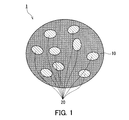
- the zinc oxide-containing composite particle 1 includes a dense matrix 10 and zinc oxide particles 20.
- the dense matrix 10 is made of silica and polysilsesquioxane.
- the zinc oxide particles 20 are dispersed inside the matrix 10.
- the content of polysilsesquioxane in the matrix 10 is 30% by mass to 70% by mass.
- the matrix 10 is dense and exhibits water repellency by polysilsesquioxane. For this reason, even if the zinc oxide-containing composite particles 1 come into contact with water, the zinc oxide particles 20 dispersed inside the matrix 10 are unlikely to come into contact with water. For this reason, even if the zinc oxide-containing composite particles 1 come into contact with water, zinc is hardly eluted from the zinc oxide particles 20, and the zinc oxide-containing composite particles 1 are blended in an aqueous cosmetic that contains a carboxyvinyl polymer. Also has long-term stability. On the other hand, the silica contained in the matrix 10 exhibits a hydrophilic action.
- the zinc oxide-containing composite particles 1 can be favorably dispersed in water by the hydrophilic action exhibited by the silica while the acid resistance is exhibited by the water repellent action of the polysilsesquioxane.
- the content of the polysilsesquioxane in the matrix 10 is, for example, The range is desirably 40% by mass to 70% by mass, and more desirably 50% by mass to 60% by mass.
- the content of polysilsesquioxane in the matrix 10 is, for example, spectroscopic techniques such as Fourier transform infrared spectroscopy (FT-IR) and Si-NMR, chemical techniques using elemental analysis, or thermogravimetry (TG ) And other thermal analysis techniques.
- spectroscopic techniques such as Fourier transform infrared spectroscopy (FT-IR) and Si-NMR, chemical techniques using elemental analysis, or thermogravimetry (TG ) And other thermal analysis techniques.
- the silica forming the matrix 10 is formed by, for example, hydrolysis and dehydration condensation of tetrafunctional alkoxysilane.
- the polysilsesquioxane forming the matrix 10 is formed, for example, by hydrolysis and dehydration condensation of trifunctional alkoxysilane.
- the matrix 10 is formed using, for example, a sol-gel method. Thereby, the matrix 10 tends to have a dense structure.
- the polysilsesquioxane forming the matrix 10 is, for example, polysilsesquioxane in which an alkyl group having 16 or less carbon atoms is bonded to a silicon atom.
- the matrix 10 tends to be dense, and the matrix 10 can exhibit an appropriate water repellency.
- the zinc oxide containing composite particle 1 has high acid resistance more reliably, and has long-term stability even if it contacts water.
- the zinc oxide-containing composite particles 1 can be more reliably dispersed in water more reliably.
- the alkyl group may be linear or branched.
- the polysilsesquioxane forming the matrix 10 is desirably at least one polysilsesquioxane selected from the group consisting of polymethylsilsesquioxane, polyethylsilsesquioxane, and polypropylsilsesquioxane.
- Polymethylsilsesquioxane is a polysiloxane having a basic structural unit in which one methyl group is bonded to one silicon atom.
- Polyethylsilsesquioxane is a polysiloxane having a basic structural unit in which one ethyl group is bonded to one silicon atom.
- Polypropylsilsesquioxane is a polysiloxane having a basic structural unit in which one 1-propyl group or one 2-propyl group is bonded to one silicon atom.
- the zinc oxide-containing composite particles 1 more reliably have high acid resistance and have long-term stability even when in contact with water.
- the zinc oxide-containing composite particles 1 can be more reliably dispersed in water more reliably.
- the specific surface area of the zinc oxide-containing composite particles 1 is small.
- the specific surface area measured by the nitrogen adsorption method is 5 m 2 / g or less.
- the zinc oxide-containing composite particles 1 more reliably have high acid resistance and have long-term stability even when in contact with water.
- the zinc oxide-containing composite particles 1 can be more reliably dispersed in water more reliably.
- the shape of the zinc oxide-containing composite particles 1 is not particularly limited, but is, for example, spherical.
- the “spherical shape” means a lump shape in which the ratio of the maximum diameter to the minimum diameter of the zinc oxide-containing composite particles 1 is in the range of 1 to 1.5.
- desired characteristics can be imparted to the product depending on the application of the product in which the zinc oxide-containing composite particles 1 are blended.
- the average particle diameter of the zinc oxide-containing composite particles 1 is, for example, 3 ⁇ m to 15 ⁇ m.
- the average particle diameter of the zinc oxide-containing composite particles 1 means a particle diameter (D50) corresponding to 50% of the volume accumulation of the particle size distribution measured using a laser diffraction particle size meter.
- the average particle diameter (average secondary particle diameter) of the zinc oxide particles 20 is not particularly limited as long as it is smaller than the minimum diameter of the matrix 10, but is, for example, 10 nm to 1000 nm. In this case, the zinc oxide particles 20 are easily dispersed properly in the matrix 10. For this reason, even if the zinc oxide-containing composite particles 1 come into contact with water, elution of zinc ions from the zinc oxide particles 20 is suppressed.
- the average particle diameter of the zinc oxide particles 20 means a particle diameter (D50) corresponding to 50% of the volume accumulation of the particle size distribution measured using a laser diffraction particle size meter.
- the content of the zinc oxide particles 20 in the zinc oxide-containing composite particles 1 is, for example, 10 to 50% by mass. Thereby, the zinc oxide containing composite particle 1 tends to exhibit a desired characteristic.
- the zinc oxide particles 20 may be particles in which the surface of zinc oxide is coated with a material such as silica as necessary.
- the silica derived from the zinc oxide particles 20 is distinguished from the silica in the matrix 10.
- zinc oxide acts as a UV-A shielding agent, it is possible to provide an ultraviolet shielding composition containing zinc oxide-containing composite particles 1 using zinc oxide-containing composite particles 1.
- cosmetics containing the zinc oxide-containing composite particles 1 can be provided using the zinc oxide-containing composite particles 1.
- This cosmetic has the property of UV-A shielding by including the composite particles 1 containing zinc oxide.
- the cosmetic is, for example, an O / W type water-based cosmetic containing a carboxyl vinyl polymer. In this case, the viscosity of the cosmetic can be adjusted to a desired range by the carboxyl vinyl polymer.
- the carboxyvinyl polymer that is a viscosity modifier and zinc oxide can be satisfactorily coexisted in the cosmetic without elution of zinc ions.
- the zinc oxide-containing composite particles 1 can be blended with the O / W-type water-based cosmetics to which the carboxyvinyl polymer is added, and the desired viscosity can be imparted to the cosmetics. It can be maintained for a long time.
- a hydrophilic polymer such as an amphiphilic substance such as a surfactant or a silane compound having a polyether group, polyvinyl alcohol, polyethylene glycol, or polyvinyl pyrrolidone is attached to the surface of the zinc oxide-containing composite particles according to the present invention. It may be adsorbed. This adjusts the dispersibility of the zinc oxide-containing composite particles in water.
- tetrafunctional alkoxysilane such as tetraethyl orthosilicate (tetraethoxysilane: TEOS), a trifunctional alkoxysilane such as methyltrimethoxysilane, a hydrolysis catalyst such as acetic acid, and pure water are mixed. This mixture is stirred at a predetermined temperature for a predetermined period to prepare a matrix sol solution.
- tetraethyl orthosilicate tetraethoxysilane: TEOS
- a trifunctional alkoxysilane such as methyltrimethoxysilane
- a hydrolysis catalyst such as acetic acid
- silica produced by hydrolysis and dehydration condensation of tetrafunctional alkoxysilane, and polysilsesquioxane produced by hydrolysis and dehydration condensation of trifunctional alkoxysilane, Is included.
- zinc oxide particles are dispersed in the matrix sol solution.
- the powder of zinc oxide particles may be added directly to the matrix sol solution, but preferably a dispersion of zinc oxide particles prepared in advance using a wet bead mill or the like is mixed with the matrix sol solution.
- a sol solution for composite particles is prepared by stirring.
- the surface of the zinc oxide particles added to the matrix sol may be surface-treated with silica in some cases. Thereby, zinc oxide particles are easily dispersed in the matrix.
- the solid content in the sol solution for composite particles is made into particles.
- the particle formation process is not particularly limited, and is performed using, for example, a spray drying method. In this case, spherical zinc oxide-containing composite particles are easily obtained.
- the temperature of the drying furnace in spray drying is, for example, 150 to 220 ° C.
- the conditions for spray drying are adjusted so that the average particle diameter of the obtained zinc oxide-containing composite particles is 3 to 15 ⁇ m.
- the zinc oxide-containing composite particles according to the present invention can be produced in this manner.
- Example 1 To 70 parts by mass of pure water, 30 parts by mass of zinc oxide particles (product name: MZ-500HP, zinc oxide content: 80% by mass, silica content: 20% by mass), 0.65 mm Along with 4.3 kg of zirconia beads having a diameter, circulating agitation for 3 hours (stirring speed: peripheral speed 10 m / sec, flow rate) with a horizontal continuous wet medium stirring mill (manufactured by Shinmaru Enterprises, product name: Dynomill KDL-PILOT A type) : 5 L / min) to obtain a dispersion of zinc oxide particles (dispersion diameter of zinc oxide particles: about 0.2 ⁇ m).
- MZ-500HP was particles in which the surface of zinc oxide was coated with silica.
- the sol solution A contained polymethylsilsesquioxane, a solid content derived from methyltrimethoxysilane, and silica, a solid content derived from tetraethyl orthosilicate.
- the ratio (Ma: Mb) of the mass Ma of the polymethylsilsesquioxane and the mass Mb of silica in the sol solution A was 5: 5.
- a sol liquid B 225 parts by mass of the sol liquid A and 75 parts by mass of the zinc oxide particle dispersion were mixed to obtain a sol liquid B.
- the sol solution B was spray-dried in an atmosphere at 200 ° C. to produce zinc oxide-containing composite particles according to Example 1.
- the zinc oxide-containing composite particles according to Example 1 contained zinc oxide particles whose surface was treated with silica (zinc oxide: 80% by mass, silica: 20% by mass).
- the content rate of the zinc oxide particles in the zinc oxide-containing composite particles according to Example 1 was 37.5% by mass.
- the zinc oxide-containing composite particles according to Example 1 were spherical particles. Further, when the particle size distribution of the zinc oxide-containing composite particles according to Example 1 was measured using a laser diffraction particle size meter, the particle size corresponding to 50% of the cumulative volume of the zinc oxide-containing composite particles according to Example 1 (D50 ) was about 10 ⁇ m. When the pore distribution of the zinc oxide-containing composite particles according to Example 1 was measured by a nitrogen adsorption method, the zinc oxide-containing composite particles according to Example 1 had almost no pores and had a dense structure. Was suggested. The specific surface area of the zinc oxide-containing composite particles according to Example 1 measured by the nitrogen adsorption method was 1.1 m 2 / g.
- Example 1 0.68 parts by mass of zinc oxide-containing composite particles according to Example 1 and 11.32 parts by mass of ion-exchanged water were mixed and stirred for 3 hours to obtain a composite particle dispersion according to Example 1. 1 part by mass of the composite particle dispersion according to Example 1 is added to 10 parts by mass of a 0.1% by mass citric acid aqueous solution having a pH of 2.5 and stirred. Zinc oxide-containing composite particles were dispersed. At this time, the zinc oxide-containing composite particles according to Example 1 were uniformly dispersed in the citric acid aqueous solution.
- the pH of the aqueous solution after about 1 hour from the dispersion of the zinc oxide-containing composite particles according to Example 1 was about 3.4, but the pH of the aqueous solution hardly changed thereafter. For this reason, it is thought that almost no zinc ions were eluted from the zinc oxide contained in the zinc oxide-containing composite particles according to Example 1.
- Example 2 122.42 parts by mass of ion-exchanged water, 5 parts by mass of 1% by mass acetic acid, 45.64 parts by mass of methyltrimethoxysilane (manufactured by Tama Chemical Industry), and tetraethyl orthosilicate (manufactured by Tama Chemical Industry Co., Ltd., normal ethyl silicate) 51.94 parts by mass were mixed and stirred at 25 ° C. for about 20 hours to obtain a transparent sol solution C.
- the ratio of the mass Ma of polymethylsilsesquioxane, which is a solid content derived from methyltrimethoxysilane, to the mass Mb of silica, which is a solid content derived from tetraethyl orthosilicate, contained in the sol C (Ma: Mb) ) was 6: 4.
- the sol liquid D was obtained by mixing 225 parts by mass of the sol liquid C and 75 parts by mass of the dispersion of zinc oxide particles used in Example 1. Using a spray drying apparatus (manufactured by Fujisaki Electric Co., Ltd., product name: MDL-050L), the sol solution D was spray-dried in an atmosphere of 200 ° C. to produce zinc oxide-containing composite particles according to Example 2.
- the zinc oxide-containing composite particles according to Example 2 contained zinc oxide particles whose surface was treated with silica (zinc oxide: 80% by mass, silica: 20% by mass).
- the content rate of the zinc oxide particles in the zinc oxide-containing composite particles according to Example 2 was 37.5% by mass.
- the zinc oxide-containing composite particles according to Example 2 were spherical particles. Further, when the particle size distribution of the zinc oxide-containing composite particles according to Example 2 was measured using a laser diffraction particle size meter, the particle diameter corresponding to 50% of the cumulative volume of the zinc oxide-containing composite particles according to Example 2 (D50 ) was about 10 ⁇ m. When the pore distribution of the zinc oxide-containing composite particles according to Example 2 was measured by a nitrogen adsorption method, the zinc oxide-containing composite particles according to Example 2 had almost no pores and had a dense structure. Was suggested. The specific surface area of the zinc oxide-containing composite particles according to Example 2 as measured by the nitrogen adsorption method was 0.9 m 2 / g.
- Example 1 0.68 parts by mass of zinc oxide-containing composite particles according to Example 2 and 11.32 parts by mass of ion-exchanged water were mixed and stirred for 3 hours to obtain a composite particle dispersion according to Example 2. 1 part by mass of the composite particle dispersion according to Example 2 is added to 10 parts by mass of a 0.1% by mass citric acid aqueous solution having a pH of 2.5 and stirred, and the oxidation according to Example 2 is performed in the citric acid aqueous solution. Zinc-containing composite particles were dispersed. At this time, the zinc oxide-containing composite particles according to Example 2 were uniformly dispersed in the citric acid aqueous solution.
- the pH of the aqueous solution after about 1 hour from the dispersion of the zinc oxide-containing composite particles according to Example 2 was about 3.3, but thereafter, the pH of the aqueous solution hardly changed. For this reason, it is considered that almost no zinc ions were eluted from the zinc oxide contained in the zinc oxide-containing composite particles according to Example 2.
- Example 3 Ion-exchanged water 111.67 parts by mass, 1% by mass of acetic acid 5 parts by mass, methyltrimethoxysilane (manufactured by Tama Chemical Industries) 30.42 parts by mass, and tetraethyl orthosilicate (manufactured by Tama Chemical Industries, Ltd., normal ethyl silicate) 77.91 Mass parts were mixed and stirred at 25 ° C. for about 20 hours to obtain a transparent sol solution E.
- methyltrimethoxysilane manufactured by Tama Chemical Industries
- tetraethyl orthosilicate manufactured by Tama Chemical Industries, Ltd., normal ethyl silicate
- the ratio of the mass Ma of polymethylsilsesquioxane, which is a solid content derived from methyltrimethoxysilane, to the mass Ma of silica, which is a solid content derived from tetraethyl orthosilicate, contained in the sol E (Ma: Mb) ) was 4: 6.
- sol liquid F 225 parts by mass of this sol liquid E and 75 parts by mass of the zinc oxide particle dispersion liquid of Example 1 were mixed to obtain a sol liquid F.
- the sol solution F was spray-dried in an atmosphere of 200 ° C. to produce zinc oxide-containing composite particles according to Example 3.
- the zinc oxide-containing composite particles according to Example 3 contained zinc oxide particles whose surface was treated with silica (zinc oxide: 80% by mass, silica: 20% by mass).
- the content rate of the zinc oxide particles in the zinc oxide-containing composite particles according to Example 3 was 37.5% by mass.
- the zinc oxide-containing composite particles according to Example 3 were spherical particles. Further, when the particle size distribution of the zinc oxide-containing composite particles according to Example 3 was measured using a laser diffraction particle size meter, the particle size corresponding to 50% of the cumulative volume of the zinc oxide-containing composite particles according to Example 3 (D50 ) was about 10 ⁇ m. When the pore distribution of the zinc oxide-containing composite particles according to Example 3 was measured by the nitrogen adsorption method, the zinc oxide-containing composite particles according to Example 3 had almost no pores and had a dense structure. Was suggested. The specific surface area of the zinc oxide-containing composite particles according to Example 3 as measured by a nitrogen adsorption method was 2.0 m 2 / g.
- Example 6 0.68 parts by mass of zinc oxide-containing composite particles according to Example 3 and 11.32 parts by mass of ion-exchanged water were mixed and stirred for 3 hours to obtain a composite particle dispersion according to Example 3. 1 part by mass of the composite particle dispersion according to Example 3 is added to 10 parts by mass of a 0.1% by mass citric acid aqueous solution having a pH of 2.5 and stirred, and the oxidation according to Example 3 is performed in the citric acid aqueous solution. Zinc-containing composite particles were dispersed. At this time, the zinc oxide-containing composite particles according to Example 3 were uniformly dispersed in the citric acid aqueous solution.
- the pH of the aqueous solution after about 1 hour from the dispersion of the zinc oxide-containing composite particles according to Example 3 was about 3.8, but thereafter, the pH of the aqueous solution hardly changed. For this reason, although there is a possibility that zinc ions are slightly eluted from the zinc oxide contained in the zinc oxide-containing composite particles according to Example 3, sufficient acid resistance is ensured. It was suggested.
- Example 4 127.80 parts by mass of ion-exchanged water, 5 parts by mass of 1% acetic acid, 53.24 parts by mass of methyltrimethoxysilane (manufactured by Tama Chemical Industries), and tetraethyl orthosilicate (manufactured by Tama Chemical Industries, Ltd., normal ethyl silicate) 38.95 parts by mass were mixed and stirred at 25 ° C. for about 20 hours to obtain a transparent sol solution G.
- the ratio (Ma: Mb) between the mass Ma of polymethylsilsesquioxane, which is a solid content derived from methyltrimethoxysilane, and the mass Mb of silica, which is a solid content derived from tetraethyl orthosilicate, contained in the sol solution G ) was 7: 3.
- a sol solution H was obtained by mixing 225 parts by mass of the sol solution G and 75 parts by mass of the dispersion of zinc oxide particles used in Example 1. Using a spray dryer (product name: MDL-050L, manufactured by Fujisaki Electric Co., Ltd.), this sol solution H was spray-dried in an atmosphere at 220 ° C. to produce zinc oxide-containing composite particles according to Example 4.
- the zinc oxide-containing composite particles according to Example 4 contained zinc oxide particles whose surface was treated with silica (zinc oxide: 80% by mass, silica: 20% by mass).
- the content rate of the zinc oxide particles in the zinc oxide-containing composite particles according to Example 4 was 37.5% by mass.
- the zinc oxide-containing composite particles according to Example 4 were spherical particles. Further, when the particle size distribution of the zinc oxide-containing composite particles according to Example 4 was measured using a laser diffraction particle size meter, the particle size corresponding to 50% of the cumulative volume of the zinc oxide-containing composite particles according to Example 4 (D50 ) was about 10 ⁇ m. When the pore distribution of the zinc oxide-containing composite particles according to Example 4 was measured by a nitrogen adsorption method, the zinc oxide-containing composite particles according to Example 4 had almost no pores and had a dense structure. Was suggested. The specific surface area of the zinc oxide-containing composite particles according to Example 4 measured by the nitrogen adsorption method was 0.7 m 2 / g.
- Example 6 0.68 parts by mass of zinc oxide-containing composite particles according to Example 4 and 11.32 parts by mass of ion-exchanged water were mixed and stirred for 3 hours to obtain a composite particle dispersion according to Example 4. 1 part by mass of the composite particle dispersion according to Example 4 is added to 10 parts by mass of a 0.1% by mass citric acid aqueous solution having a pH of 2.5 and stirred, and the oxidation according to Example 4 is performed in the citric acid aqueous solution. Zinc-containing composite particles were dispersed. At this time, the zinc oxide-containing composite particles according to Example 4 were dispersed almost uniformly in the citric acid aqueous solution.
- the pH of the aqueous solution after about 1 hour from the dispersion of the zinc oxide-containing composite particles according to Example 4 was about 3.2, but thereafter, the pH of the aqueous solution hardly changed. For this reason, it is considered that almost no zinc ions were eluted from the zinc oxide contained in the zinc oxide-containing composite particles according to Example 2.
- the ratio of the mass Ma of polymethylsilsesquioxane, which is a solid content derived from methyltrimethoxysilane, to the mass Mb of silica, which is a solid content derived from tetraethyl orthosilicate, contained in the sol solution W (Ma: Mb) ) was 8: 2.
- sol liquid X 225 parts by mass of this sol liquid W and 75 parts by mass of the zinc oxide particle dispersion liquid of Example 1 were mixed to obtain a sol liquid X.
- the sol solution X was sprayed in a 220 ° C. atmosphere using a spray drying apparatus (manufactured by Fujisaki Electric Co., Ltd., product name: MDL-050L), but droplets adhered to the apparatus wall surface and could not be formed into particles.
- the mass ratio of polymethylsilsesquioxane, which is a solid content derived from methyltrimethoxysilane, and silica, which is a solid content derived from tetraethyl orthosilicate, contained in the sol Y was 2: 8.
- the zinc oxide-containing composite particles according to Comparative Example 4 contained zinc oxide particles whose surface was treated with silica (zinc oxide: 80% by mass, silica: 20% by mass). The content of zinc oxide particles in the zinc oxide-containing composite particles according to Comparative Example 4 was 37.5% by mass.
- the zinc oxide-containing composite particles according to Comparative Example 4 were spherical particles. Further, when the particle size distribution of the zinc oxide-containing composite particles according to Comparative Example 4 was measured using a laser diffraction particle size meter, the particle size corresponding to 50% of the cumulative volume of the zinc oxide-containing composite particles according to Comparative Example 4 (D50 ) was about 10 ⁇ m.
- a composite particle dispersion according to Comparative Example 4 was obtained by mixing 0.68 parts by mass of the zinc oxide-containing composite particles according to Comparative Example 4 and 11.32 parts by mass of ion-exchanged water and stirring for 3 hours. 1 part by mass of the composite particle dispersion according to Comparative Example 4 is added to 10 parts by mass of a 0.1% by mass citric acid aqueous solution having a pH of 2.5 and stirred, and then the oxidation according to Comparative Example 4 is performed in the citric acid aqueous solution. Zinc-containing composite particles were dispersed. At this time, the zinc oxide-containing composite particles according to Comparative Example 4 were uniformly dispersed in the citric acid aqueous solution. After the zinc oxide-containing composite particles according to Comparative Example 4 were dispersed, the pH of the aqueous solution immediately became 6 or more, and elution of zinc ions was confirmed.
Landscapes
- Health & Medical Sciences (AREA)
- Life Sciences & Earth Sciences (AREA)
- Chemical & Material Sciences (AREA)
- Animal Behavior & Ethology (AREA)
- General Health & Medical Sciences (AREA)
- Public Health (AREA)
- Veterinary Medicine (AREA)
- Epidemiology (AREA)
- Birds (AREA)
- Inorganic Chemistry (AREA)
- Organic Chemistry (AREA)
- Dermatology (AREA)
- Composite Materials (AREA)
- Dispersion Chemistry (AREA)
- Physics & Mathematics (AREA)
- Mathematical Physics (AREA)
- Cosmetics (AREA)
- Inorganic Compounds Of Heavy Metals (AREA)
- Silicon Compounds (AREA)
Abstract
本発明の酸化亜鉛含有複合粒子は、シリカ及びポリシルセスキオキサンによって形成された緻密なマトリクスと、マトリクスの内部に分散している酸化亜鉛粒子と、を備える。マトリクスにおけるポリシルセスキオキサンの含有率は、30質量%~70質量%である。本発明の酸化亜鉛含有複合粒子は、高い耐酸性を有し、水と接触しても耐酸性を発揮し続けることができる。
Description
本発明は、酸化亜鉛含有複合粒子、紫外線遮蔽用組成物、及び化粧料に関する。
従来、酸化亜鉛(ZnO)は、例えば、UV‐A(波長320nm~400nmの紫外線)遮蔽剤として化粧料に配合されている。両性元素である亜鉛の酸化物である酸化亜鉛は、酸性溶液及び塩基性溶液のいずれにも容易に溶解し、中性付近の水にさえ微量ながら溶解する。酸化亜鉛から亜鉛イオンが溶出することによって、酸化亜鉛が配合されている化粧料などの製品の一部の特性が損なわれる可能性がある。このため、酸化亜鉛の溶出を抑制するために、様々な技術が提案されている。
例えば、特許文献1には、所定のポリオレフィン系樹脂及び酸化亜鉛を含む化粧料用複合粒子が記載されている。
特許文献2には、酸化亜鉛の粒子の表面にチタニアを含む被覆を有し、その被覆の上にシリカを含む被覆を有する、表面が被覆された酸化亜鉛が記載されている。
特許文献3には、水性媒液中で亜鉛化合物を中和剤と反応させて酸化亜鉛粒子を得る工程と、得られた酸化亜鉛粒子を気相中で加熱操作をすることなく、水性媒液中でその粒子表面にシリカなどの無機化合物の被覆を行う工程とを含む、表面被覆した酸化亜鉛の製造方法が記載されている。
特許文献4には、酸化亜鉛粉体を所定のアクリルシリコーン樹脂の溶液に分散させた後、揮発性のアルカリ物質及び所定のアルコキシシランを添加し、アルコキシシランを加水分解して得られる、撥水性微粒子シリカ被覆酸化亜鉛粉体が記載されている。
特許文献5及び6には、カルボキシビニルポリマーと2価又は3価の金属イオンとを反応させて得られた沈降性物質からなる被覆層を有する被覆酸化亜鉛粒子が記載されている。
特許文献7には、酸化亜鉛粉体と、亜鉛イオンと結合して該亜鉛イオンを水に不溶化するジペプチドとを含有している酸化亜鉛複合粉体が記載されている。
特許文献8には、酸化亜鉛と第1の樹脂とを含有する芯材部と、該芯材部の表面に形成され第1の樹脂と同一組成または異なる組成の第2の樹脂からなる被覆膜とを備えた紫外線遮蔽複合粒子が記載されている。
特許文献9には、平均粒子径が1nm以上かつ50nm以下である酸化亜鉛粒子の表面を所定の酸化ケイ素被膜により被覆している酸化ケイ素被覆酸化亜鉛が記載されている。
また、酸化亜鉛からの亜鉛イオンの溶出の抑制については言及されていないが、特許文献10には、平均粒子径5~100nmの酸化亜鉛微粒子を基材とし、該基材に対して15~40質量%のシリカを被覆しているシリカ被覆酸化亜鉛微粒子が記載されている。
特許文献2及び3に記載の技術では表面が被覆された酸化亜鉛の耐酸性について検討されているものの、酸化亜鉛を含む複合粒子の耐酸性に関する検討は十分であるとは言い難く、新規な観点から耐酸性を有する酸化亜鉛含有複合粒子を案出する余地がある。そこで、本発明は、高い耐酸性を有し、水と接触しても耐酸性を発揮し続けることができる新規な酸化亜鉛含有複合粒子を提供することを目的とする。
本発明は、
シリカ及びポリシルセスキオキサンによって形成された緻密なマトリクスと、
前記マトリクスの内部に分散している酸化亜鉛粒子と、を備え、
前記マトリクスにおける前記ポリシルセスキオキサンの含有率は、30質量%~70質量%である、
酸化亜鉛含有複合粒子を提供する。
シリカ及びポリシルセスキオキサンによって形成された緻密なマトリクスと、
前記マトリクスの内部に分散している酸化亜鉛粒子と、を備え、
前記マトリクスにおける前記ポリシルセスキオキサンの含有率は、30質量%~70質量%である、
酸化亜鉛含有複合粒子を提供する。
また、本発明は、
上記の酸化亜鉛含有複合粒子を含む、紫外線遮蔽用組成物を提供する。
上記の酸化亜鉛含有複合粒子を含む、紫外線遮蔽用組成物を提供する。
また、本発明は、
上記の酸化亜鉛含有複合粒子を含む、化粧料を提供する。
上記の酸化亜鉛含有複合粒子を含む、化粧料を提供する。
上記の酸化亜鉛含有複合粒子は、シリカ及びポリシルセスキオキサンによって形成された緻密なマトリクスの内部に分散しているので、高い耐酸性を有し、水と接触しても耐酸性を発揮し続けることができる。また、高い耐酸性を有する酸化亜鉛含有複合粒子を含む、紫外線遮蔽用組成物又は化粧料を提供できる。
以下、本発明の実施形態について図面を参照しながら説明する。なお、以下の説明は、本発明の一例に関するものであり、本発明はこれらに限定されるものではない。
図1に示す通り、酸化亜鉛含有複合粒子1は、緻密なマトリクス10と、酸化亜鉛粒子20とを備えている。緻密なマトリクス10は、シリカ及びポリシルセスキオキサンによって形成されている。酸化亜鉛粒子20は、マトリクス10の内部に分散している。マトリクス10におけるポリシルセスキオキサンの含有率は、30質量%~70質量%である。
マトリクス10は緻密であり、ポリシルセスキオキサンにより撥水作用が発揮される。このため、酸化亜鉛含有複合粒子1が水に接触しても、マトリクス10の内部に分散している酸化亜鉛粒子20が水に接触しにくい。このため、酸化亜鉛含有複合粒子1が水に接触しても酸化亜鉛粒子20から亜鉛が溶出しにくく、酸化亜鉛含有複合粒子1は、カルボキシビニルポリマーを含むような水系の化粧料に配合されても、長期の安定性を有する。一方、マトリクス10に含まれるシリカにより親水作用が発揮される。このため、ポリシルセスキオキサンによる撥水作用によって耐酸性が発揮されつつ、シリカによって発揮される親水作用により酸化亜鉛含有複合粒子1を良好に水中に分散できる。酸化亜鉛含有複合粒子1の長期の安定性(耐酸性)及び酸化亜鉛含有複合粒子1の水への分散性を両立する観点から、マトリクス10におけるポリシルセスキオキサンの含有率は、例えば上記の範囲であり、望ましくは40質量%~70質量%であり、より望ましくは50質量%~60質量%である。
マトリクス10におけるポリシルセスキオキサンの含有率は、例えば、フーリエ変換赤外分光法(FT-IR)及びSi-NMR等の分光学的手法、元素分析による化学的手法、又は熱重量測定(TG)等の熱分析手法により求めることができる。
マトリクス10を形成しているシリカは、例えば、四官能性アルコキシシランを加水分解及び脱水縮合することにより形成されている。また、マトリクス10を形成しているポリシルセスキオキサンは、例えば、三官能性アルコキシシランを加水分解及び脱水縮合することにより形成されている。このように、マトリクス10は、例えばゾルゲル法を利用して形成される。これにより、マトリクス10が緻密な構造を有しやすい。
マトリクス10を形成しているポリシルセスキオキサンは、例えば、炭素数が16以下のアルキル基がケイ素原子に結合しているポリシルセスキオキサンである。この場合、マトリクス10が緻密になりやすく、マトリクス10が適切な撥水作用を発揮できる。これにより、酸化亜鉛含有複合粒子1は、より確実に、高い耐酸性を有し、かつ、水に接触しても長期の安定性を有する。加えて、酸化亜鉛含有複合粒子1は、より確実に、水中で良好に分散できる。アルキル基は、直鎖及び分岐鎖のいずれであってもよい。
マトリクス10を形成しているポリシルセスキオキサンは、望ましくは、ポリメチルシルセスキオキサン、ポリエチルシルセスキオキサン、及びポリプロピルシルセスキオキサンからなる群から選ばれる少なくとも1つのポリシルセスキオキサンを含む。ポリメチルシルセスキオキサンは、1つのケイ素原子に1つのメチル基が結合している基本構成単位を有するポリシロキサンである。ポリエチルシルセスキオキサンは、1つのケイ素原子に1つのエチル基が結合している基本構成単位を有するポリシロキサンである。ポリプロピルシルセスキオキサンは、1つのケイ素原子に1つの1-プロピル基又は1つの2-プロピル基が結合している基本構成単位を有するポリシロキサンである。この場合、酸化亜鉛含有複合粒子1は、より確実に、高い耐酸性を有し、かつ、水に接触しても長期の安定性を有する。加えて、酸化亜鉛含有複合粒子1は、より確実に、水中で良好に分散できる。
マトリクス10が緻密な構造を有するので、酸化亜鉛含有複合粒子1の比表面積は小さい。例えば、酸化亜鉛含有複合粒子1において、窒素吸着法により測定される比表面積が5m2/g以下である。この場合、酸化亜鉛含有複合粒子1は、より確実に、高い耐酸性を有し、かつ、水に接触しても長期の安定性を有する。加えて、酸化亜鉛含有複合粒子1は、より確実に、水中で良好に分散できる。
酸化亜鉛含有複合粒子1の形状は、特に限定されないが、例えば球形状である。ここで、「球形状」とは、酸化亜鉛含有複合粒子1の最小径に対する最大径の比が1~1.5の範囲内にある塊状の形状を意味する。酸化亜鉛含有複合粒子1が球形状であることにより、酸化亜鉛含有複合粒子1が配合される製品の用途に応じて、その製品に所望の特性を付与できる。
酸化亜鉛含有複合粒子1の平均粒子径は、例えば3μm~15μmである。ここで、酸化亜鉛含有複合粒子1の平均粒子径は、レーザー回折式粒度計を用いて測定した粒度分布の体積累積50%に相当する粒径(D50)を意味する。
酸化亜鉛粒子20の平均粒子径(平均二次粒子径)は、マトリクス10の最小径より小さい限り特に制限されないが、例えば10nm~1000nmである。この場合、酸化亜鉛粒子20が、マトリクス10の内部に適切に分散しやすい。このため、酸化亜鉛含有複合粒子1が水と接触しても、酸化亜鉛粒子20から亜鉛イオンが溶出することが抑制される。ここで、酸化亜鉛粒子20の平均粒子径は、レーザー回折式粒度計を用いて測定した粒度分布の体積累積50%に相当する粒径(D50)を意味する。
酸化亜鉛含有複合粒子1における酸化亜鉛粒子20の含有率は、例えば、10質量~50質量%である。これにより、酸化亜鉛含有複合粒子1が所望の特性を発揮しやすい。
酸化亜鉛粒子20は、必要に応じて、酸化亜鉛の表面がシリカ等の材料によって被覆された粒子であってもよい。この場合、酸化亜鉛粒子20に由来するシリカはマトリクス10におけるシリカとは区別される。
酸化亜鉛はUV‐A遮蔽剤として作用するので、酸化亜鉛含有複合粒子1を用いて、酸化亜鉛含有複合粒子1を含む、紫外線遮蔽用組成物を提供できる。
また、酸化亜鉛含有複合粒子1を用いて、酸化亜鉛含有複合粒子1を含む、化粧料を提供できる。この化粧料は、酸化亜鉛含有複合粒子1を含むことにより、UV‐A遮蔽の特性を有する。化粧料は、例えば、カルボキシルビニルポリマーを含むO/W型の水系の化粧料である。この場合、カルボキシルビニルポリマーによって、化粧料の粘度を所望の範囲に調整できる。
例えば、水相に粘度調整剤としてカルボキシビニルポリマーが添加されているO/W型の水系の化粧料に酸化亜鉛が配合されると、溶出した亜鉛イオンとカルボキシビニルポリマーとの相互作用により系の粘度が低下する可能性がある。このため、水系の化粧品に酸化亜鉛を配合することができない場合が多い。しかし、酸化亜鉛含有複合粒子1は高い耐酸性を有する。このため、カルボキシビニルポリマーが添加されているO/W型の水系の化粧料に酸化亜鉛含有複合粒子1を配合しても、酸化亜鉛粒子20からの亜鉛イオンの溶出が防止され、亜鉛イオンとカルボキシビニルポリマーとの相互作用も防止される。従って、酸化亜鉛含有複合粒子1を用いれば、化粧料において、粘度調整剤であるカルボキシビニルポリマーと酸化亜鉛とを亜鉛イオンが溶出されることなく良好に共存させることができる。このように、カルボキシビニルポリマーが添加されているO/W型の水系の化粧料に酸化亜鉛含有複合粒子1を配合でき、化粧料に所望の粘度を付与できるとともに、UV‐A遮蔽という特性を長期間にわたって維持できる。
本発明に係る酸化亜鉛含有複合粒子の表面には、界面活性剤などの両親媒性物質又はポリエーテル基を有するシラン化合物、ポリビニルアルコール、ポリエチレングリコール、又はポリビニルピロリドンなどの親水性高分子が付着又は吸着されていてもよい。これにより、酸化亜鉛含有複合粒子の水への分散性が調整される。
本発明に係る酸化亜鉛含有複合粒子の製造方法の一例について説明する。まず、オルトけい酸テトラエチル(テトラエトキシシラン:TEOS)等の四官能性アルコキシシランと、メチルトリメトキシシラン等の三官能性アルコキシシランと、酢酸などの加水分解触媒と、純水とを混合する。この混合物を所定の温度で所定の期間撹拌してマトリクス用のゾル液を調製する。マトリクス用のゾル液中には、固形分として、四官能性アルコキシシランの加水分解及び脱水縮合により生じたシリカと、三官能性アルコキシシランの加水分解及び脱水縮合により生じたポリシルセスキオキサンとが含まれる。
次に、マトリクス用のゾル液に、酸化亜鉛粒子を分散させる。このとき、マトリクス用のゾル液に酸化亜鉛粒子の粉体が直接加えられてもよいが、望ましくは予め湿式ビーズミルなどを用いて調製された酸化亜鉛粒子の分散液をマトリクス用のゾル液と混合して撹拌することにより、複合粒子用のゾル液が調製される。マトリクス用のゾル液に加えられる酸化亜鉛粒子の表面は、場合によってはシリカによって表面処理されていてもよい。これにより、マトリクスに酸化亜鉛粒子が分散しやすい。次に、複合粒子用のゾル液中の固形分を粒子化する。この粒子化のプロセスは、特に制限されないが、例えば噴霧乾燥法を利用して行われる。この場合、球形状の酸化亜鉛含有複合粒子が得られやすい。噴霧乾燥における乾燥炉の温度は、例えば150~220℃である。噴霧乾燥の条件は、得られる酸化亜鉛含有複合粒子の平均粒子径が3~15μmになるように調整される。例えば、このようにして本発明に係る酸化亜鉛含有複合粒子を製造できる。
実施例により、本発明をより詳細に説明する。なお、本発明は以下の実施例に限定されない。
<実施例1>
純水70質量部に、酸化亜鉛粒子(テイカ社製、製品名:MZ-500HP、酸化亜鉛の含有率:80質量%、シリカの含有率:20質量%)30質量部を加え、0.65mm径のジルコニアビーズ4.3kgとともに、横型連続式湿式媒体攪拌ミル(シンマルエンタープライゼス社製、製品名:ダイノーミルKDL-PILOT A型)で3時間循環攪拌(攪拌速度:周速10m/秒、流速:5L/min)し、酸化亜鉛粒子の分散液(酸化亜鉛粒子の分散径:約0.2μm)を得た。なお、MZ-500HPは、酸化亜鉛の表面がシリカによって被覆された粒子であった。
純水70質量部に、酸化亜鉛粒子(テイカ社製、製品名:MZ-500HP、酸化亜鉛の含有率:80質量%、シリカの含有率:20質量%)30質量部を加え、0.65mm径のジルコニアビーズ4.3kgとともに、横型連続式湿式媒体攪拌ミル(シンマルエンタープライゼス社製、製品名:ダイノーミルKDL-PILOT A型)で3時間循環攪拌(攪拌速度:周速10m/秒、流速:5L/min)し、酸化亜鉛粒子の分散液(酸化亜鉛粒子の分散径:約0.2μm)を得た。なお、MZ-500HPは、酸化亜鉛の表面がシリカによって被覆された粒子であった。
イオン交換水117.05質量部、1質量%酢酸5質量部、メチルトリメトキシシラン(多摩化学工業社製)38.03質量部、及びオルトけい酸テトラエチル(多摩化学工業社製、正珪酸エチル)64.92質量部を混合し25℃で約20時間撹拌し、透明なゾル液Aを得た。ゾル液Aには、メチルトリメトキシシラン由来の固形分であるポリメチルシルセスキオキサンと、オルトけい酸テトラエチル由来の固形分であるシリカとが含まれていた。ゾル液Aにおけるポリメチルシルセスキオキサンの質量Maとシリカとの質量Mbとの比(Ma:Mb)は、5:5であった。
225質量部のゾル液Aと、75質量部の前記酸化亜鉛粒子の分散液とを混合し、ゾル液Bを得た。噴霧乾燥装置(藤崎電機社製、製品名:MDL-050L)を用いて、このゾル液Bを200℃雰囲気中で噴霧乾燥して、実施例1に係る酸化亜鉛含有複合粒子を作製した。実施例1に係る酸化亜鉛含有複合粒子の内部には、表面がシリカで処理された酸化亜鉛粒子(酸化亜鉛:80質量%、シリカ:20質量%)が含有されていた。実施例1に係る酸化亜鉛含有複合粒子における酸化亜鉛粒子の含有率は、37.5質量%であった。
実施例1に係る酸化亜鉛含有複合粒子を光学顕微鏡で観察したところ、実施例1に係る酸化亜鉛含有複合粒子は球形状の粒子であった。また、レーザー回折式粒度計を用いて実施例1に係る酸化亜鉛含有複合粒子の粒度分布を測定したところ、実施例1に係る酸化亜鉛含有複合粒子の体積累積50%に相当する粒径(D50)は約10μmであった。実施例1に係る酸化亜鉛含有複合粒子の細孔分布を窒素吸着法により測定したところ、実施例1に係る酸化亜鉛含有複合粒子はほとんど細孔を有しておらず、緻密な構造を有することが示唆された。窒素吸着法により測定した、実施例1に係る酸化亜鉛含有複合粒子の比表面積は1.1m2/gであった。
実施例1に係る酸化亜鉛含有複合粒子0.68質量部と、イオン交換水11.32質量部とを混合して3時間撹拌し、実施例1に係る複合粒子分散液を得た。実施例1に係る複合粒子分散液1質量部を、pHが2.5である0.1質量%のクエン酸水溶液10質量部に添加して撹拌し、クエン酸水溶液中に実施例1に係る酸化亜鉛含有複合粒子を分散させた。このとき、実施例1に係る酸化亜鉛含有複合粒子は、クエン酸水溶液において均一に分散した。実施例1に係る酸化亜鉛含有複合粒子を分散させてから1時間経過後の水溶液のpHは約3.4であったが、それ以降、水溶液のpHはほとんど変化しなかった。このため、実施例1に係る酸化亜鉛含有複合粒子の内部に含有されている酸化亜鉛から亜鉛イオンはほとんど溶出しなかったと考えられる。
<実施例2>
イオン交換水122.42質量部、1質量%酢酸5質量部、メチルトリメトキシシラン(多摩化学工業社製)45.64質量部、及びオルトけい酸テトラエチル(多摩化学工業社製、正珪酸エチル)51.94質量部を混合し、25℃で約20時間撹拌して、透明なゾル液Cを得た。このゾル液Cに含まれる、メチルトリメトキシシラン由来の固形分であるポリメチルシルセスキオキサンの質量Maと、オルトけい酸テトラエチル由来の固形分であるシリカの質量Mbとの比(Ma:Mb)は、6:4であった。
イオン交換水122.42質量部、1質量%酢酸5質量部、メチルトリメトキシシラン(多摩化学工業社製)45.64質量部、及びオルトけい酸テトラエチル(多摩化学工業社製、正珪酸エチル)51.94質量部を混合し、25℃で約20時間撹拌して、透明なゾル液Cを得た。このゾル液Cに含まれる、メチルトリメトキシシラン由来の固形分であるポリメチルシルセスキオキサンの質量Maと、オルトけい酸テトラエチル由来の固形分であるシリカの質量Mbとの比(Ma:Mb)は、6:4であった。
ゾル液C225質量部と、実施例1で用いた酸化亜鉛粒子の分散液75質量部を混合し、ゾル液Dを得た。噴霧乾燥装置(藤崎電機社製、製品名:MDL-050L)を用いて、このゾル液Dを200℃雰囲気中に噴霧乾燥して、実施例2に係る酸化亜鉛含有複合粒子を作製した。実施例2に係る酸化亜鉛含有複合粒子の内部には、表面がシリカで処理された酸化亜鉛粒子(酸化亜鉛:80質量%、シリカ:20質量%)が含有されていた。実施例2に係る酸化亜鉛含有複合粒子における酸化亜鉛粒子の含有率は、37.5質量%であった。
実施例2に係る酸化亜鉛含有複合粒子を光学顕微鏡で観察したところ、実施例2に係る酸化亜鉛含有複合粒子は球形状の粒子であった。また、レーザー回折式粒度計を用いて実施例2に係る酸化亜鉛含有複合粒子の粒度分布を測定したところ、実施例2に係る酸化亜鉛含有複合粒子の体積累積50%に相当する粒径(D50)は約10μmであった。実施例2に係る酸化亜鉛含有複合粒子の細孔分布を窒素吸着法により測定したところ、実施例2に係る酸化亜鉛含有複合粒子はほとんど細孔を有しておらず、緻密な構造を有することが示唆された。窒素吸着法により測定した、実施例2に係る酸化亜鉛含有複合粒子の比表面積は0.9m2/gであった。
実施例2に係る酸化亜鉛含有複合粒子0.68質量部とイオン交換水11.32質量部とを混合して、3時間撹拌し、実施例2に係る複合粒子分散液を得た。実施例2に係る複合粒子分散液1質量部を、pHが2.5である0.1質量%クエン酸水溶液10質量部に添加して撹拌し、クエン酸水溶液中に実施例2に係る酸化亜鉛含有複合粒子を分散させた。このとき、実施例2に係る酸化亜鉛含有複合粒子は、クエン酸水溶液において均一に分散した。実施例2に係る酸化亜鉛含有複合粒子を分散させてから1時間経過後の水溶液のpHは約3.3であったが、それ以降、水溶液のpHはほとんど変化しなかった。このため、実施例2に係る酸化亜鉛含有複合粒子の内部に含有されている酸化亜鉛から亜鉛イオンはほとんど溶出しなかったと考えられる。
<実施例3>
イオン交換水111.67質量部、1質量%酢酸5質量部、メチルトリメトキシシラン(多摩化学工業製)30.42質量部、及びオルトけい酸テトラエチル(多摩化学工業製正珪酸エチル)77.91質量部を混合し、25℃で約20時間撹拌して、透明なゾル液Eを得た。このゾル液Eに含まれる、メチルトリメトキシシラン由来の固形分であるポリメチルシルセスキオキサンの質量Maと、オルトけい酸テトラエチル由来の固形分であるシリカの質量Maとの比(Ma:Mb)は、4:6であった。
イオン交換水111.67質量部、1質量%酢酸5質量部、メチルトリメトキシシラン(多摩化学工業製)30.42質量部、及びオルトけい酸テトラエチル(多摩化学工業製正珪酸エチル)77.91質量部を混合し、25℃で約20時間撹拌して、透明なゾル液Eを得た。このゾル液Eに含まれる、メチルトリメトキシシラン由来の固形分であるポリメチルシルセスキオキサンの質量Maと、オルトけい酸テトラエチル由来の固形分であるシリカの質量Maとの比(Ma:Mb)は、4:6であった。
このゾル液E225質量部と、実施例1の酸化亜鉛粒子の分散液75質量部を混合し、ゾル液Fを得た。噴霧乾燥装置(藤崎電機社製、製品名:MDL-050L)を用いて、ゾル液Fを200℃雰囲気中に噴霧乾燥して、実施例3に係る酸化亜鉛含有複合粒子を作製した。実施例3に係る酸化亜鉛含有複合粒子の内部には、表面がシリカで処理された酸化亜鉛粒子(酸化亜鉛:80質量%、シリカ:20質量%)が含有されていた。実施例3に係る酸化亜鉛含有複合粒子における酸化亜鉛粒子の含有率は、37.5質量%であった。
実施例3に係る酸化亜鉛含有複合粒子を光学顕微鏡で観察したところ、実施例3に係る酸化亜鉛含有複合粒子は球形状の粒子であった。また、レーザー回折式粒度計を用いて実施例3に係る酸化亜鉛含有複合粒子の粒度分布を測定したところ、実施例3に係る酸化亜鉛含有複合粒子の体積累積50%に相当する粒径(D50)は約10μmであった。実施例3に係る酸化亜鉛含有複合粒子の細孔分布を窒素吸着法により測定したところ、実施例3に係る酸化亜鉛含有複合粒子はほとんど細孔を有しておらず、緻密な構造を有することが示唆された。窒素吸着法により測定した、実施例3に係る酸化亜鉛含有複合粒子の比表面積は2.0m2/gであった。
実施例3に係る酸化亜鉛含有複合粒子0.68質量部と、イオン交換水11.32質量部とを混合し3時間撹拌して、実施例3に係る複合粒子分散液を得た。実施例3に係る複合粒子分散液1質量部を、pHが2.5である0.1質量%クエン酸水溶液10質量部に添加して撹拌し、クエン酸水溶液中に実施例3に係る酸化亜鉛含有複合粒子を分散させた。このとき、実施例3に係る酸化亜鉛含有複合粒子は、クエン酸水溶液において均一に分散した。実施例3に係る酸化亜鉛含有複合粒子を分散させてから1時間経過後の水溶液のpHは約3.8であったが、それ以降、水溶液のpHはほとんど変化しなかった。このため、実施例3に係る酸化亜鉛含有複合粒子の内部に含有されている酸化亜鉛から亜鉛イオンの溶出が少し発生している可能性があるものの、十分な耐酸性が確保されていることが示唆された。
<実施例4>
イオン交換水127.80質量部、1質量%酢酸5質量部、メチルトリメトキシシラン(多摩化学工業社製)53.24質量部、及びオルトけい酸テトラエチル(多摩化学工業社製、正珪酸エチル)38.95質量部を混合し、25℃で約20時間撹拌して、透明なゾル液Gを得た。このゾル液Gに含まれる、メチルトリメトキシシラン由来の固形分であるポリメチルシルセスキオキサンの質量Maと、オルトけい酸テトラエチル由来の固形分であるシリカの質量Mbとの比(Ma:Mb)は、7:3であった。
イオン交換水127.80質量部、1質量%酢酸5質量部、メチルトリメトキシシラン(多摩化学工業社製)53.24質量部、及びオルトけい酸テトラエチル(多摩化学工業社製、正珪酸エチル)38.95質量部を混合し、25℃で約20時間撹拌して、透明なゾル液Gを得た。このゾル液Gに含まれる、メチルトリメトキシシラン由来の固形分であるポリメチルシルセスキオキサンの質量Maと、オルトけい酸テトラエチル由来の固形分であるシリカの質量Mbとの比(Ma:Mb)は、7:3であった。
ゾル液G225質量部と、実施例1で用いた酸化亜鉛粒子の分散液75質量部を混合し、ゾル液Hを得た。噴霧乾燥装置(藤崎電機社製、製品名:MDL-050L)を用いて、このゾル液Hを220℃雰囲気中に噴霧乾燥して、実施例4に係る酸化亜鉛含有複合粒子を作製した。実施例4に係る酸化亜鉛含有複合粒子の内部には、表面がシリカで処理された酸化亜鉛粒子(酸化亜鉛:80質量%、シリカ:20質量%)が含有されていた。実施例4に係る酸化亜鉛含有複合粒子における酸化亜鉛粒子の含有率は、37.5質量%であった。
実施例4に係る酸化亜鉛含有複合粒子を光学顕微鏡で観察したところ、実施例4に係る酸化亜鉛含有複合粒子は球形状の粒子であった。また、レーザー回折式粒度計を用いて実施例4に係る酸化亜鉛含有複合粒子の粒度分布を測定したところ、実施例4に係る酸化亜鉛含有複合粒子の体積累積50%に相当する粒径(D50)は約10μmであった。実施例4に係る酸化亜鉛含有複合粒子の細孔分布を窒素吸着法により測定したところ、実施例4に係る酸化亜鉛含有複合粒子はほとんど細孔を有しておらず、緻密な構造を有することが示唆された。窒素吸着法により測定した、実施例4に係る酸化亜鉛含有複合粒子の比表面積は0.7m2/gであった。
実施例4に係る酸化亜鉛含有複合粒子0.68質量部とイオン交換水11.32質量部とを混合して、3時間撹拌し、実施例4に係る複合粒子分散液を得た。実施例4に係る複合粒子分散液1質量部を、pHが2.5である0.1質量%クエン酸水溶液10質量部に添加して撹拌し、クエン酸水溶液中に実施例4に係る酸化亜鉛含有複合粒子を分散させた。このとき、実施例4に係る酸化亜鉛含有複合粒子は、クエン酸水溶液においてほぼ均一に分散した。実施例4に係る酸化亜鉛含有複合粒子を分散させてから1時間経過後の水溶液のpHは約3.2であったが、それ以降、水溶液のpHはほとんど変化しなかった。このため、実施例2に係る酸化亜鉛含有複合粒子の内部に含有されている酸化亜鉛から亜鉛イオンはほとんど溶出しなかったと考えられる。
<比較例1>
シリカ被覆酸化亜鉛粒子(テイカ社製、製品名:MZ-500HP、酸化亜鉛の含有率:80質量%、シリカの含有率:20質量%)0.26質量部と、イオン交換水11.74質量部とを混合し、3時間撹拌して、比較例1に係る粒子分散液を得た。比較例1に係る粒子分散液1質量部を、pHが2.5である0.1質量%クエン酸水溶液10質量部に添加して撹拌し、クエン酸水溶液中にシリカ被覆酸化亜鉛粒子を分散させた。水溶液のpHは直ちに6以上となり、亜鉛イオンの溶出が確認された。
シリカ被覆酸化亜鉛粒子(テイカ社製、製品名:MZ-500HP、酸化亜鉛の含有率:80質量%、シリカの含有率:20質量%)0.26質量部と、イオン交換水11.74質量部とを混合し、3時間撹拌して、比較例1に係る粒子分散液を得た。比較例1に係る粒子分散液1質量部を、pHが2.5である0.1質量%クエン酸水溶液10質量部に添加して撹拌し、クエン酸水溶液中にシリカ被覆酸化亜鉛粒子を分散させた。水溶液のpHは直ちに6以上となり、亜鉛イオンの溶出が確認された。
<比較例2>
オクチルトリエトキシシラン処理済み酸化亜鉛(テイカ社製、製品名:MZX-508OTS)0.26質量部と、イオン交換水11.74質量部とを混合し、3時間撹拌した。しかし、オクチルトリエトキシシラン処理済み酸化亜鉛は、水面に浮かんだ状態を保ち、激しく攪拌しても水中に分散しなかった。
オクチルトリエトキシシラン処理済み酸化亜鉛(テイカ社製、製品名:MZX-508OTS)0.26質量部と、イオン交換水11.74質量部とを混合し、3時間撹拌した。しかし、オクチルトリエトキシシラン処理済み酸化亜鉛は、水面に浮かんだ状態を保ち、激しく攪拌しても水中に分散しなかった。
<比較例3>
イオン交換水133.17質量部、1質量%酢酸5質量部、メチルトリメトキシシラン(多摩化学工業製)60.87質量部、及びオルトけい酸テトラエチル(多摩化学工業製正珪酸エチル)25.96質量部を混合し、25℃で約20時間撹拌して、透明なゾル液Wを得た。このゾル液Wに含まれる、メチルトリメトキシシラン由来の固形分であるポリメチルシルセスキオキサンの質量Maと、オルトけい酸テトラエチル由来の固形分であるシリカの質量Mbとの比(Ma:Mb)は、8:2であった。
イオン交換水133.17質量部、1質量%酢酸5質量部、メチルトリメトキシシラン(多摩化学工業製)60.87質量部、及びオルトけい酸テトラエチル(多摩化学工業製正珪酸エチル)25.96質量部を混合し、25℃で約20時間撹拌して、透明なゾル液Wを得た。このゾル液Wに含まれる、メチルトリメトキシシラン由来の固形分であるポリメチルシルセスキオキサンの質量Maと、オルトけい酸テトラエチル由来の固形分であるシリカの質量Mbとの比(Ma:Mb)は、8:2であった。
このゾル液W225質量部と、実施例1の酸化亜鉛粒子の分散液75質量部を混合し、ゾル液Xを得た。噴霧乾燥装置(藤崎電機社製、製品名:MDL-050L)を用いて、ゾル液Xを220℃雰囲気中に噴霧したが、装置壁面に液滴が付着して粒子化できなかった。
<比較例4>
イオン交換水100.91質量部、1質量%酢酸5質量部、メチルトリメトキシシラン(多摩化学工業製)15.21質量部、及びオルトけい酸テトラエチル(多摩化学工業製正珪酸エチル)103.88質量部を混合し、25℃で約20時間撹拌して、透明なゾル液Yを得た。このゾル液Yに含まれる、メチルトリメトキシシラン由来の固形分であるポリメチルシルセスキオキサンと、オルトけい酸テトラエチル由来の固形分であるシリカの質量比は、2:8であった。
イオン交換水100.91質量部、1質量%酢酸5質量部、メチルトリメトキシシラン(多摩化学工業製)15.21質量部、及びオルトけい酸テトラエチル(多摩化学工業製正珪酸エチル)103.88質量部を混合し、25℃で約20時間撹拌して、透明なゾル液Yを得た。このゾル液Yに含まれる、メチルトリメトキシシラン由来の固形分であるポリメチルシルセスキオキサンと、オルトけい酸テトラエチル由来の固形分であるシリカの質量比は、2:8であった。
このゾル液Y225質量部と、実施例1の酸化亜鉛粒子の分散液75質量部とを混合し、ゾル液Zを得た。このゾル液Zは短時間でゲル化したが、このゾル液Zがゲル化する前に、噴霧乾燥装置(藤崎電機社製、製品名:MDL-050L)を用いて、ゾル液Zを200℃雰囲気中に噴霧乾燥して、比較例4に係る酸化亜鉛含有複合粒を作製した。比較例4に係る酸化亜鉛含有複合粒子の内部には、表面がシリカで処理された酸化亜鉛粒子(酸化亜鉛:80質量%、シリカ:20質量%)が含有されていた。比較例4に係る酸化亜鉛含有複合粒子における酸化亜鉛粒子の含有率は、37.5質量%であった。
比較例4に係る酸化亜鉛含有複合粒子を光学顕微鏡で観察したところ、比較例4に係る酸化亜鉛含有複合粒子は球形状の粒子であった。また、レーザー回折式粒度計を用いて比較例4に係る酸化亜鉛含有複合粒子の粒度分布を測定したところ、比較例4に係る酸化亜鉛含有複合粒子の体積累積50%に相当する粒径(D50)は約10μmであった。
比較例4に係る酸化亜鉛含有複合粒子0.68質量部と、イオン交換水11.32質量部とを混合し3時間撹拌して、比較例4に係る複合粒子分散液を得た。比較例4に係る複合粒子分散液1質量部を、pHが2.5である0.1質量%クエン酸水溶液10質量部に添加して撹拌し、クエン酸水溶液中に比較例4に係る酸化亜鉛含有複合粒子を分散させた。このとき、比較例4に係る酸化亜鉛含有複合粒子は、クエン酸水溶液において均一に分散した。比較例4に係る酸化亜鉛含有複合粒子を分散させてから水溶液のpHは直ちに6以上となり、亜鉛イオンの溶出が確認された。
Claims (9)
- シリカ及びポリシルセスキオキサンによって形成された緻密なマトリクスと、
前記マトリクスの内部に分散している酸化亜鉛粒子と、を備え、
前記マトリクスにおける前記ポリシルセスキオキサンの含有率は、30質量%~70質量%である、
酸化亜鉛含有複合粒子。 - 前記シリカは、四官能性アルコキシシランを加水分解及び脱水縮合することにより形成されており、
前記ポリシルセスキオキサンは、三官能性アルコキシシランを加水分解及び脱水縮合することにより形成されている、請求項1に記載の酸化亜鉛含有複合粒子。 - 前記ポリシルセスキオキサンは、炭素数が16以下のアルキル基がケイ素原子に結合しているポリシルセスキオキサンである、請求項1又は2に記載の酸化亜鉛含有複合粒子。
- 前記ポリシルセスキオキサンは、ポリメチルシルセスキオキサン、ポリエチルシルセスキオキサン、及びポリプロピルシルセスキオキサンからなる群から選ばれる1つ以上のポリシルセスキオキサンを含む、請求項1に記載の酸化亜鉛含有複合粒子。
- 窒素吸着法により測定される比表面積が5m2/g以下である、請求項1~4のいずれか1項に記載の酸化亜鉛含有複合粒子。
- 前記酸化亜鉛含有複合粒子は、球形状である、請求項1~5のいずれか1項に記載の酸化亜鉛含有複合粒子。
- 前記酸化亜鉛粒子の平均粒子径は、10nm~1000nmである、請求項1~6のいずれか1項に記載の酸化亜鉛含有複合粒子。
- 請求項1~7のいずれか1項に記載の酸化亜鉛含有複合粒子を含む、紫外線遮蔽用組成物。
- 請求項1~7のいずれか1項に記載の酸化亜鉛含有複合粒子を含む、化粧料。
Priority Applications (4)
| Application Number | Priority Date | Filing Date | Title |
|---|---|---|---|
| JP2018531810A JP6779294B2 (ja) | 2016-08-04 | 2017-07-13 | 酸化亜鉛含有複合粒子、紫外線遮蔽用組成物、及び化粧料 |
| US16/322,819 US20190183756A1 (en) | 2016-08-04 | 2017-07-13 | Zinc oxide-containing composite particles, ultraviolet-shielding composition, and cosmetic |
| CN201780046351.8A CN109496201B (zh) | 2016-08-04 | 2017-07-13 | 含有氧化锌的复合粒子、紫外线遮蔽用组合物、及化妆料 |
| EP17836717.3A EP3495324B1 (en) | 2016-08-04 | 2017-07-13 | Zinc oxide-containing composite particles, ultraviolet-shielding composition, and cosmetic |
Applications Claiming Priority (2)
| Application Number | Priority Date | Filing Date | Title |
|---|---|---|---|
| JP2016-153495 | 2016-08-04 | ||
| JP2016153495 | 2016-08-04 |
Publications (1)
| Publication Number | Publication Date |
|---|---|
| WO2018025610A1 true WO2018025610A1 (ja) | 2018-02-08 |
Family
ID=61072659
Family Applications (1)
| Application Number | Title | Priority Date | Filing Date |
|---|---|---|---|
| PCT/JP2017/025623 Ceased WO2018025610A1 (ja) | 2016-08-04 | 2017-07-13 | 酸化亜鉛含有複合粒子、紫外線遮蔽用組成物、及び化粧料 |
Country Status (5)
| Country | Link |
|---|---|
| US (1) | US20190183756A1 (ja) |
| EP (1) | EP3495324B1 (ja) |
| JP (1) | JP6779294B2 (ja) |
| CN (1) | CN109496201B (ja) |
| WO (1) | WO2018025610A1 (ja) |
Cited By (3)
| Publication number | Priority date | Publication date | Assignee | Title |
|---|---|---|---|---|
| WO2023191649A1 (en) | 2022-03-28 | 2023-10-05 | Institut Biosens - Istrazivacko-Razvojni Institut Za Informacione Tehnologije Biosistema | Organosilica particles based on bridging polysilsesquioxanes for blocking ultraviolet rays |
| WO2023190487A1 (ja) * | 2022-03-30 | 2023-10-05 | 住友大阪セメント株式会社 | 表面改質酸化亜鉛粒子、分散液、化粧料 |
| WO2025205611A1 (ja) * | 2024-03-28 | 2025-10-02 | 住友大阪セメント株式会社 | 酸化ケイ素被覆酸化亜鉛粒子、分散液、化粧料、酸化ケイ素被覆酸化亜鉛粒子の製造方法 |
Families Citing this family (3)
| Publication number | Priority date | Publication date | Assignee | Title |
|---|---|---|---|---|
| CN112758940B (zh) * | 2020-12-31 | 2022-10-28 | 浙江三时纪新材科技有限公司 | 一种球形粉体填料及其制备方法和应用 |
| JP7625888B2 (ja) * | 2021-02-22 | 2025-02-04 | 住友大阪セメント株式会社 | 表面改質酸化亜鉛粒子、分散液、化粧料、表面改質酸化亜鉛粒子の製造方法 |
| KR20230147093A (ko) * | 2021-02-22 | 2023-10-20 | 스미토모 오사카 세멘토 가부시키가이샤 | 표면 개질 산화 아연 입자, 분산액, 화장료, 표면 개질 산화 아연 입자의 제조 방법 |
Citations (14)
| Publication number | Priority date | Publication date | Assignee | Title |
|---|---|---|---|---|
| JPH11193354A (ja) * | 1997-12-26 | 1999-07-21 | Fuji Shikiso Kk | シリカ被覆酸化亜鉛粒子、その製法及びその粒子を含有する 組成物 |
| JP2000319128A (ja) * | 1999-04-30 | 2000-11-21 | Fuji Shikiso Kk | 変性シリカ被覆金属酸化物、その製法およびそれを含有する組成物 |
| JP2006219437A (ja) | 2005-02-14 | 2006-08-24 | Kao Corp | 化粧料用複合粒子 |
| JP2007016111A (ja) | 2005-07-07 | 2007-01-25 | Tayca Corp | シリカ被覆微粒子酸化チタンまたはシリカ被覆微粒子酸化亜鉛、その製造方法、その水分散体およびそれらを配合した化粧品 |
| JP2007023127A (ja) * | 2005-07-14 | 2007-02-01 | Nippon Chem Ind Co Ltd | シリカ被覆酸化亜鉛の製造方法、シリカ被覆酸化亜鉛およびそれを含む化粧料 |
| JP2008094917A (ja) | 2006-10-10 | 2008-04-24 | Ishihara Sangyo Kaisha Ltd | 表面を被覆した酸化亜鉛及びその製造方法並びにそれを用いた紫外線遮蔽性組成物 |
| WO2008129901A1 (ja) * | 2007-04-13 | 2008-10-30 | Asahi Glass Company, Limited | 疎水化酸化ケイ素被覆金属酸化物粒子の製造方法 |
| JP2008273760A (ja) | 2007-04-26 | 2008-11-13 | Ishihara Sangyo Kaisha Ltd | 表面被覆した酸化亜鉛の製造方法 |
| JP2009023981A (ja) | 2007-07-24 | 2009-02-05 | Daito Kasei Kogyo Kk | 撥水性微粒子シリカ被覆酸化亜鉛粉体およびそれを含有する化粧料 |
| JP2011102291A (ja) | 2009-10-15 | 2011-05-26 | Sakai Chem Ind Co Ltd | 被覆酸化亜鉛粒子、水系組成物及び化粧料 |
| JP2014043376A (ja) | 2012-08-27 | 2014-03-13 | Sumitomo Osaka Cement Co Ltd | 酸化亜鉛複合粉体及び酸化亜鉛複合粉体含有分散液並びに化粧料 |
| JP2014084448A (ja) | 2012-10-26 | 2014-05-12 | Sumitomo Osaka Cement Co Ltd | 紫外線遮蔽複合粒子及び紫外線遮蔽複合粒子含有分散液並びに化粧料 |
| JP2015006976A (ja) | 2013-04-19 | 2015-01-15 | 住友大阪セメント株式会社 | 酸化ケイ素被覆酸化亜鉛とその製造方法及び酸化ケイ素被覆酸化亜鉛含有組成物並びに化粧料 |
| WO2016189828A1 (ja) * | 2015-05-28 | 2016-12-01 | 日本板硝子株式会社 | 酸化亜鉛含有複合粒子、紫外線遮蔽用組成物、及び化粧料 |
Family Cites Families (6)
| Publication number | Priority date | Publication date | Assignee | Title |
|---|---|---|---|---|
| ATE465128T1 (de) * | 1999-02-05 | 2010-05-15 | Showa Denko Kk | Herstellungsverfahren von ultrafeinen zinkoxidteilchen |
| US8632816B2 (en) * | 2007-12-17 | 2014-01-21 | Elc Management, Llc | Compositions comprising solid particles entrapped in collapsed polymeric microspheres, and methods of making the same |
| CN103998559B (zh) * | 2011-12-20 | 2017-10-03 | 住友大阪水泥股份有限公司 | 紫外线遮蔽复合粒子、含有紫外线遮蔽复合粒子的分散液和含有紫外线遮蔽复合粒子的树脂组合物、多层紫外线遮蔽复合粒子和紫外线遮蔽分散液以及化妆料 |
| KR101470577B1 (ko) * | 2013-01-02 | 2014-12-10 | 주식회사 엔엔엠테크놀러지 | 산화아연 나노입자 코어 및 이를 둘러싼 실리콘 화합물과 티타늄디옥사이드 나노입자가 함유된 쉘을 포함하는 코어-쉘 입자 |
| WO2015072499A1 (ja) * | 2013-11-13 | 2015-05-21 | 住友大阪セメント株式会社 | 酸化ケイ素被覆酸化亜鉛とその製造方法及び酸化ケイ素被覆酸化亜鉛含有組成物並びに化粧料 |
| CN103991876B (zh) * | 2014-05-06 | 2016-11-02 | 上海大学 | 有机改性的二氧化硅溶胶及其制备方法 |
-
2017
- 2017-07-13 EP EP17836717.3A patent/EP3495324B1/en active Active
- 2017-07-13 US US16/322,819 patent/US20190183756A1/en not_active Abandoned
- 2017-07-13 CN CN201780046351.8A patent/CN109496201B/zh active Active
- 2017-07-13 WO PCT/JP2017/025623 patent/WO2018025610A1/ja not_active Ceased
- 2017-07-13 JP JP2018531810A patent/JP6779294B2/ja active Active
Patent Citations (15)
| Publication number | Priority date | Publication date | Assignee | Title |
|---|---|---|---|---|
| JPH11193354A (ja) * | 1997-12-26 | 1999-07-21 | Fuji Shikiso Kk | シリカ被覆酸化亜鉛粒子、その製法及びその粒子を含有する 組成物 |
| JP2000319128A (ja) * | 1999-04-30 | 2000-11-21 | Fuji Shikiso Kk | 変性シリカ被覆金属酸化物、その製法およびそれを含有する組成物 |
| JP2006219437A (ja) | 2005-02-14 | 2006-08-24 | Kao Corp | 化粧料用複合粒子 |
| JP2007016111A (ja) | 2005-07-07 | 2007-01-25 | Tayca Corp | シリカ被覆微粒子酸化チタンまたはシリカ被覆微粒子酸化亜鉛、その製造方法、その水分散体およびそれらを配合した化粧品 |
| JP2007023127A (ja) * | 2005-07-14 | 2007-02-01 | Nippon Chem Ind Co Ltd | シリカ被覆酸化亜鉛の製造方法、シリカ被覆酸化亜鉛およびそれを含む化粧料 |
| JP2008094917A (ja) | 2006-10-10 | 2008-04-24 | Ishihara Sangyo Kaisha Ltd | 表面を被覆した酸化亜鉛及びその製造方法並びにそれを用いた紫外線遮蔽性組成物 |
| WO2008129901A1 (ja) * | 2007-04-13 | 2008-10-30 | Asahi Glass Company, Limited | 疎水化酸化ケイ素被覆金属酸化物粒子の製造方法 |
| JP2008273760A (ja) | 2007-04-26 | 2008-11-13 | Ishihara Sangyo Kaisha Ltd | 表面被覆した酸化亜鉛の製造方法 |
| JP2009023981A (ja) | 2007-07-24 | 2009-02-05 | Daito Kasei Kogyo Kk | 撥水性微粒子シリカ被覆酸化亜鉛粉体およびそれを含有する化粧料 |
| JP2011102291A (ja) | 2009-10-15 | 2011-05-26 | Sakai Chem Ind Co Ltd | 被覆酸化亜鉛粒子、水系組成物及び化粧料 |
| JP2012207039A (ja) | 2009-10-15 | 2012-10-25 | Sakai Chem Ind Co Ltd | 被覆酸化亜鉛粒子、水系組成物及び化粧料 |
| JP2014043376A (ja) | 2012-08-27 | 2014-03-13 | Sumitomo Osaka Cement Co Ltd | 酸化亜鉛複合粉体及び酸化亜鉛複合粉体含有分散液並びに化粧料 |
| JP2014084448A (ja) | 2012-10-26 | 2014-05-12 | Sumitomo Osaka Cement Co Ltd | 紫外線遮蔽複合粒子及び紫外線遮蔽複合粒子含有分散液並びに化粧料 |
| JP2015006976A (ja) | 2013-04-19 | 2015-01-15 | 住友大阪セメント株式会社 | 酸化ケイ素被覆酸化亜鉛とその製造方法及び酸化ケイ素被覆酸化亜鉛含有組成物並びに化粧料 |
| WO2016189828A1 (ja) * | 2015-05-28 | 2016-12-01 | 日本板硝子株式会社 | 酸化亜鉛含有複合粒子、紫外線遮蔽用組成物、及び化粧料 |
Non-Patent Citations (2)
| Title |
|---|
| KOICHIRO MAKITA ET AL.: "Development of functional materials for cosmetics using sol- gel method", SHIKIZAI KENKYU HAPPYOKAI KOEN YOSHISHU, vol. 1999, 12 October 1999 (1999-10-12), pages 78 - 79, XP009518380 * |
| See also references of EP3495324A4 * |
Cited By (5)
| Publication number | Priority date | Publication date | Assignee | Title |
|---|---|---|---|---|
| WO2023191649A1 (en) | 2022-03-28 | 2023-10-05 | Institut Biosens - Istrazivacko-Razvojni Institut Za Informacione Tehnologije Biosistema | Organosilica particles based on bridging polysilsesquioxanes for blocking ultraviolet rays |
| WO2023190487A1 (ja) * | 2022-03-30 | 2023-10-05 | 住友大阪セメント株式会社 | 表面改質酸化亜鉛粒子、分散液、化粧料 |
| JP2023148418A (ja) * | 2022-03-30 | 2023-10-13 | 住友大阪セメント株式会社 | 表面改質酸化亜鉛粒子、分散液、化粧料 |
| JP7768010B2 (ja) | 2022-03-30 | 2025-11-12 | 住友大阪セメント株式会社 | 表面改質酸化亜鉛粒子、分散液、化粧料 |
| WO2025205611A1 (ja) * | 2024-03-28 | 2025-10-02 | 住友大阪セメント株式会社 | 酸化ケイ素被覆酸化亜鉛粒子、分散液、化粧料、酸化ケイ素被覆酸化亜鉛粒子の製造方法 |
Also Published As
| Publication number | Publication date |
|---|---|
| CN109496201B (zh) | 2021-06-08 |
| US20190183756A1 (en) | 2019-06-20 |
| EP3495324B1 (en) | 2021-08-25 |
| EP3495324A4 (en) | 2020-04-08 |
| JPWO2018025610A1 (ja) | 2019-05-30 |
| CN109496201A (zh) | 2019-03-19 |
| JP6779294B2 (ja) | 2020-11-04 |
| EP3495324A1 (en) | 2019-06-12 |
Similar Documents
| Publication | Publication Date | Title |
|---|---|---|
| JP6779294B2 (ja) | 酸化亜鉛含有複合粒子、紫外線遮蔽用組成物、及び化粧料 | |
| Ramezani et al. | Preparation of silane-functionalized silica films via two-step dip coating sol–gel and evaluation of their superhydrophobic properties | |
| CN104245857B (zh) | 用于光催化涂层的保护性屏障组合物 | |
| WO2007097284A1 (ja) | 均一分散性光触媒コーティング液及びその製造方法並びにこれを用いて得られる光触媒活性複合材 | |
| JP6573482B2 (ja) | 酸化亜鉛含有複合粒子、酸化亜鉛含有複合粒子の製造方法、紫外線遮蔽用組成物、及び化粧料 | |
| TWI726127B (zh) | 光觸媒層合體 | |
| WO1999037582A1 (en) | Titanium oxide colloidal sol and process for the preparation thereof | |
| JP4619601B2 (ja) | 光触媒性コーティング組成物および光触媒性薄膜を有する製品 | |
| TW201815683A (zh) | 塗佈組成物及被覆物品 | |
| KR20080110847A (ko) | 투명 코팅 | |
| KR20190059901A (ko) | 코팅제 조성물 | |
| JP5426869B2 (ja) | メソポーラスシリカ微粒子の製造方法、メソポーラスシリカ微粒子含有組成物、及びメソポーラスシリカ微粒子含有成型物 | |
| TWI798414B (zh) | 撥水性被膜形成用組成物及撥水性被膜 | |
| JP2009227500A (ja) | 透明酸化チタンオルガノゾルおよびそれを配合したコーティング組成物,光学基材 | |
| WO2018096914A1 (ja) | 無機粒子-シロキサン複合物およびその製造方法、並びに無機粒子含有シリコーン組成物 | |
| WO2014119710A1 (ja) | コーティング液及び反射防止膜 | |
| JP2006008902A (ja) | 光触媒塗料組成物 | |
| JP2010043159A (ja) | 酸化チタン分散液の製造方法及び酸化チタン膜 | |
| WO2021141129A1 (ja) | 車両用ランプ構造体の防曇方法、防曇剤及び親水化剤 | |
| JP2021155664A (ja) | コーティング液 | |
| JP2009209250A (ja) | 光触媒塗膜形成用組成物、光触媒塗膜および光触媒塗膜の形成方法 | |
| JP2007161770A (ja) | 親水性被膜形成用塗布液とその製造方法及び親水性被膜並びに親水性被膜の成膜方法 | |
| JP7574486B1 (ja) | チタニア被覆銀を含有する組成物 | |
| JP7767211B2 (ja) | チタニアナノ粒子、及びその製造方法 | |
| JP2026068231A (ja) | チタニア被覆銀、及びチタニア被覆銀含有組成物 |
Legal Events
| Date | Code | Title | Description |
|---|---|---|---|
| 121 | Ep: the epo has been informed by wipo that ep was designated in this application |
Ref document number: 17836717 Country of ref document: EP Kind code of ref document: A1 |
|
| ENP | Entry into the national phase |
Ref document number: 2018531810 Country of ref document: JP Kind code of ref document: A |
|
| NENP | Non-entry into the national phase |
Ref country code: DE |
|
| ENP | Entry into the national phase |
Ref document number: 2017836717 Country of ref document: EP Effective date: 20190304 |