WO2018047680A1 - Récipient en plastique expansé possédant un aspect extérieur satiné - Google Patents
Récipient en plastique expansé possédant un aspect extérieur satiné Download PDFInfo
- Publication number
- WO2018047680A1 WO2018047680A1 PCT/JP2017/030987 JP2017030987W WO2018047680A1 WO 2018047680 A1 WO2018047680 A1 WO 2018047680A1 JP 2017030987 W JP2017030987 W JP 2017030987W WO 2018047680 A1 WO2018047680 A1 WO 2018047680A1
- Authority
- WO
- WIPO (PCT)
- Prior art keywords
- foamed
- container
- foam
- cells
- preform
- Prior art date
- Legal status (The legal status is an assumption and is not a legal conclusion. Google has not performed a legal analysis and makes no representation as to the accuracy of the status listed.)
- Ceased
Links
- 0 CC1=CC=C*1 Chemical compound CC1=CC=C*1 0.000 description 1
Images





Classifications
-
- B—PERFORMING OPERATIONS; TRANSPORTING
- B29—WORKING OF PLASTICS; WORKING OF SUBSTANCES IN A PLASTIC STATE IN GENERAL
- B29C—SHAPING OR JOINING OF PLASTICS; SHAPING OF MATERIAL IN A PLASTIC STATE, NOT OTHERWISE PROVIDED FOR; AFTER-TREATMENT OF THE SHAPED PRODUCTS, e.g. REPAIRING
- B29C49/00—Blow-moulding, i.e. blowing a preform or parison to a desired shape within a mould; Apparatus therefor
- B29C49/02—Combined blow-moulding and manufacture of the preform or the parison
- B29C49/06905—Using combined techniques for making the preform
- B29C49/0691—Using combined techniques for making the preform using sheet like material, e.g. sheet blow-moulding from joined sheets
-
- B—PERFORMING OPERATIONS; TRANSPORTING
- B65—CONVEYING; PACKING; STORING; HANDLING THIN OR FILAMENTARY MATERIAL
- B65D—CONTAINERS FOR STORAGE OR TRANSPORT OF ARTICLES OR MATERIALS, e.g. BAGS, BARRELS, BOTTLES, BOXES, CANS, CARTONS, CRATES, DRUMS, JARS, TANKS, HOPPERS, FORWARDING CONTAINERS; ACCESSORIES, CLOSURES, OR FITTINGS THEREFOR; PACKAGING ELEMENTS; PACKAGES
- B65D1/00—Rigid or semi-rigid containers having bodies formed in one piece, e.g. by casting metallic material, by moulding plastics, by blowing vitreous material, by throwing ceramic material, by moulding pulped fibrous material or by deep-drawing operations performed on sheet material
-
- B—PERFORMING OPERATIONS; TRANSPORTING
- B65—CONVEYING; PACKING; STORING; HANDLING THIN OR FILAMENTARY MATERIAL
- B65D—CONTAINERS FOR STORAGE OR TRANSPORT OF ARTICLES OR MATERIALS, e.g. BAGS, BARRELS, BOTTLES, BOXES, CANS, CARTONS, CRATES, DRUMS, JARS, TANKS, HOPPERS, FORWARDING CONTAINERS; ACCESSORIES, CLOSURES, OR FITTINGS THEREFOR; PACKAGING ELEMENTS; PACKAGES
- B65D1/00—Rigid or semi-rigid containers having bodies formed in one piece, e.g. by casting metallic material, by moulding plastics, by blowing vitreous material, by throwing ceramic material, by moulding pulped fibrous material or by deep-drawing operations performed on sheet material
- B65D1/02—Bottles or similar containers with necks or like restricted apertures, designed for pouring contents
-
- C—CHEMISTRY; METALLURGY
- C08—ORGANIC MACROMOLECULAR COMPOUNDS; THEIR PREPARATION OR CHEMICAL WORKING-UP; COMPOSITIONS BASED THEREON
- C08J—WORKING-UP; GENERAL PROCESSES OF COMPOUNDING; AFTER-TREATMENT NOT COVERED BY SUBCLASSES C08B, C08C, C08F, C08G or C08H
- C08J9/00—Working-up of macromolecular substances to porous or cellular articles or materials; After-treatment thereof
- C08J9/04—Working-up of macromolecular substances to porous or cellular articles or materials; After-treatment thereof using blowing gases generated by a previously added blowing agent
- C08J9/12—Working-up of macromolecular substances to porous or cellular articles or materials; After-treatment thereof using blowing gases generated by a previously added blowing agent by a physical blowing agent
Definitions
- the present invention relates to a foamed plastic container having a satin-like appearance. More specifically, the present invention has a non-laminate-structured vessel wall made of a thermoplastic resin, and foam cells are distributed inside the vessel wall.
- the present invention relates to a foamed plastic container in which the foamed region is present in at least a part of the trunk.
- polyester containers represented by polyethylene terephthalate (PET) are excellent in properties such as transparency, heat resistance and gas barrier properties, and are widely used in various applications.
- PET polyethylene terephthalate
- the reuse of resources has been strongly demanded, and with respect to the polyester container as described above, a used container is collected and reused for various purposes as a recycled resin.
- a light-shielding property can be imparted without blending a colorant, and at the same time, a highly glossy appearance (for example, pearl tone) can be obtained.
- a colorant is dispersed in the resin forming the container wall, a very specific appearance is obtained, for example, no metal pigment is used. Nevertheless, it is known that metallic luster appears (see Patent Document 2).
- the foam container in which the foam cells are distributed is formed using a resin in which a colorant is dispersed, so that a unique appearance is obtained and a high decorative property is imparted. Even if it does not have, it has high commercial value.
- the present inventors adjusted the distribution form and size of the foamed cell to an appropriate range, thereby coloring It was found that the appearance of a unique satin-like pattern was developed regardless of whether or not the agent was added.
- an object of the present invention is to have a container wall made of a thermoplastic resin and having a non-laminate structure, and a foam region in which foam cells are distributed inside the container wall exists in at least a part of the trunk.
- An object of the present invention is to provide a foamed plastic container having a satin-like appearance.
- a foamed region made of a thermoplastic resin and having a non-laminate structure and having foam cells distributed in the container wall is present in at least a part of the trunk.
- the outer surface of the body is a smooth surface with a surface roughness Ra of 5 ⁇ m or less, In the foamed region, the outer surface of the body part is distributed in a large number of dark parts having a low light reflectivity between bright parts having a high light reflectivity, thereby exhibiting a satin-like pattern.
- a plastic container is provided.
- the foamed plastic container of the present invention (1) When the outer surface of the torso in the foaming region is photographed at a magnification of 50 times, and the brightness distribution is calculated by performing gray scale processing with 256 gradations, the maximum value of the brightness standard deviation is 18 or more. Is preferable in terms of the visibility of the satin-like pattern.
- the inside of the container is visually recognized through the dark part of the foaming region, Is preferable in terms of design.
- the inner surface of the body portion in the foamed region preferably has a surface roughness Ra in the range of 0.1 to 100 ⁇ m.
- the foamed plastic container of the present invention can take an embodiment in which the vessel wall is formed of a thermoplastic resin containing a colorant or a thermoplastic resin containing no colorant (ie, a non-colored resin).
- the vessel wall is formed of a thermoplastic resin containing no colorant
- the number of foam cells in the foam region is 14 or less on average when viewed in the cross section in the body thickness direction. Is preferred.
- the foamed plastic container of the present invention has a self-decorative property, even though an unfoamed resin layer blended with a pattern-printed film or a colorant is not laminated alone, It has a peculiar appearance called a satin-like pattern with a smooth surface, and is decorated at a lower price than those with a laminated structure by attaching a film, etc. Extremely high.
- the satin-like pattern is also expressed in containers molded using a thermoplastic resin that does not contain a colorant, and in particular, when no colorant is added, it has excellent recyclability. Yes.
- the foamed plastic container of the present invention has a unique appearance such as a pear-like pattern as well as light weight due to foaming, it is extremely useful particularly in fields where decoration is required, particularly in cosmetic containers and the like. is there.
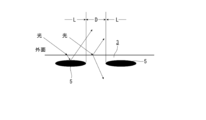
- FIG. 1 It is a figure which shows the outline of the side cross section in the foaming area
- FIG. 6 is a photograph showing the appearance of the foamed plastic container produced in Example 7.
- the foamed plastic container of the present invention is formed using a thermoplastic resin and has a non-laminate structure. At least a part of the body wall of the container wall (usually the entire body part) is foamed. A foamed region in which cells are distributed is formed, and the outer surface of the body part including the portion where the foamed region is formed has a surface roughness Ra (JIS Z-0601-1994, arithmetic average roughness). Has a basic structure of a smooth surface of 5 ⁇ m or less. Such a basic structure is also included in the foam container disclosed in Patent Document 1, and for example, a schematic cross-sectional structure thereof is shown in FIG.
- a large number of foamed cells 5 are distributed in the resin matrix 3 forming the barrel wall 1 of this container to form a foamed region.
- a thin skin layer 7 that is not distributed is formed, and due to the presence of the skin layer 7, the outer surface thereof is a smooth surface, and the surface roughness Ra is 5 ⁇ m or less. If the skin layer 7 is not present, the foamed cells 5 form irregularities on the outer surface, and the outer surface does not become a smooth surface.
- the outer surface of the trunk portion wall 1 is a rough surface having a surface roughness Ra larger than 5 ⁇ m, even if a satin-like pattern is expressed by controlling foaming, which will be described later, the sense of quality is lowered. That is, in order to maximize the decoration of the satin-like pattern, the outer surface of the trunk wall 1 including the foamed region needs to be a smooth surface as described above.
- the foam cell 5 is formed by foaming using microcellular technology.
- Microcellular foaming is a technique in which an inert gas is impregnated into a resin as a foaming agent, and this gas is grown into bubbles to physically form the foamed cells.
- the small foamed cells are evenly distributed throughout.
- it is different from chemical foaming using a compound that generates a gas such as nitrogen or carbon dioxide as a foaming agent in that it can control foaming.
- the container body wall 1 is stretched, and therefore the foam cell 5 has a flat shape stretched in the stretching direction.
- the foamed plastic container of the present invention together with the basic structure as described above, is foamed so that many dark parts with low light reflectance are distributed between bright parts with high light reflectance when observed from the outer surface of the trunk. It has a great feature in that it is controlled and has a satin-like pattern.
- the portion where the foam cells 5 are largely distributed has a large amount of reflected light (the amount of transmitted light is small), and thus becomes a bright bright portion L.
- the amount of reflected light is small (the amount of transmitted light is large), so the dark portion D becomes relatively dark.
- a satin-like pattern is exhibited due to the difference in brightness due to the distribution of the foamed cells 5.
- the satin-like pattern is formed by fine irregularities and has a rough surface, but the satin-like pattern in the present invention is not irregularities on the surface, but by light and dark due to a difference in light reflection. It is formed and is different from a general satin pattern.
- the foamed area where the foamed cells 5 are distributed has a thin skin layer 7 formed on the outer surface thereof, and thus has a glossy appearance as a whole. Is different.
- the appearance of the satin-like pattern due to the difference in brightness is indicated by the brightness distribution measured on the outer surface of the trunk wall 1 where the foamed cells 5 are distributed. That is, when a photograph of the outer surface of the body wall 1 is taken at a magnification of 50, and a lightness distribution is calculated by performing gray scale processing with 256 gradations, the maximum value of the lightness standard deviation is 18 or more, particularly 20 or more. The larger the maximum value, the more bright and dark parts exist. That is, when the maximum value of the lightness standard deviation is smaller than the above range, there are few portions with a light / dark difference, and the satin-like pattern becomes unclear and shows a uniform appearance.
- the satin-like pattern exhibited by the foamed plastic container of the present invention is caused by the difference in brightness due to the distribution of the foamed cells 5.
- the pattern of FIG. 3 has a feature that the bubble diameter of the foam cell 5a located at the uppermost portion closest to the outer surface is large.
- the cell diameter of the outermost layer is large, there is a large difference in the thickness of the matrix 3 to the outer surface between the foam layer 5a and the foam layer 5b.
- the portion where the uppermost foam cell 5a exists becomes the bright portion L (that is, the light is reflected by the foam cell 5a), and the gap portion of the uppermost foam cell 5a becomes the dark portion D (that is, the light is the foam cell 5b). Reflection).
- the resin matrix 3 contains a colorant
- the amount of light absorbed by the colorant until the light passes through the gap and is reflected by the foamed cell 5b is reflected by the foamed cell 5a.
- the amount of light absorbed is extremely large. Therefore, the contrast between the dark part D and the bright part L is clear, and a satin-like pattern is exhibited.
- the pattern of FIG. 4 basically has a portion where the foam cells 5 distributed on the body wall 1 are densely distributed and a portion where the foam cells 5 are sparsely distributed.
- the portion where the light is reflected becomes the bright portion L with much reflection, and the portion which is sparsely distributed becomes the dark portion D with little reflection.
- Such a pattern causes a difference in brightness only by the distribution of the foamed cells 5, and in particular, in a foamed container that is not blended with a colorant and has a milky white appearance due to scattering by the foamed cells 5, multiple reflection, With this pattern, a satin-like pattern is developed.
- the bubble diameter may be set in an appropriate range with respect to the desired appearance.
- the bubble diameter of the foamed cells 5 in the foamed layer at the uppermost part, the central part, or the lowermost part averages 50 ⁇ m or less, more preferably 30 ⁇ m
- the average cell diameter of the foam cell 5 in the foam layer of the uppermost part, the central part, the lowermost part is larger than the above, for example, on average It can be in the range of 50 to 250 ⁇ m, particularly 150 ⁇ m or less, resulting in a rough light and dark (for example, see FIG. 8).
- the number of the foam cells 5 also affects the satin-like pattern (light / dark difference) when viewed in the cross section in the body thickness direction in the foam region. For example, if the number is too large, reflection on the foamed cells 5 existing not only on the surface layer but also on the inside of the trunk wall is increased, the difference in brightness is reduced, and the satin pattern tends to be unclear. . Therefore, in the non-colored milky white foam container in which the colorant is not blended, a difference in brightness appears only by the distribution of the foam cells 5, and therefore the influence of the number of the foam cells 5 on the brightness difference is influenced by the colored foam container.
- the number is preferably larger than that, the number is preferably 14 or less on average, more preferably 10 or less, and even more preferably 6 or less from the viewpoint that the satin-like pattern can be visually recognized more clearly. Is preferred.
- the number of foam cells deeper than the outermost layer does not affect the satin-like pattern so much, and the cell diameter of the surface layer portion.
- the number of the foamed cells 5 described above is preferable in terms of visibility inside the container.
- FIG. 5 shows a photograph of the appearance of the foamed container of the present invention in which a satin-like pattern appears in the pattern of FIG. 3 or FIG. 4 as described above.
- the bottle-shaped foaming container shown in FIG. 5 is blended with a colorant, but it can be seen that a satin-like pattern is exhibited throughout the foamed region.
- the irregularities on the inner surface of the container can be visually recognized while providing the irregularities on the inner surface of the container by foaming. Due to the irregular reflection of light, it is possible to obtain a foamed container that has a smooth surface, but has a textured appearance in addition to a satin-like pattern on the exterior of the container. In such a case, if the number of the foamed cells 5 is large, the visibility of the irregularities on the inner surface of the container is lowered, so that the number is preferably 14 or less on average, more preferably 10 or less, as described above. More preferably it is 6 or less.
- the size of the irregularities on the inner surface of the container is not particularly limited because it is set according to the desired appearance. For example, the average surface roughness Ra is set in the range of 0.1 to 100 ⁇ m, preferably 1 to 10 ⁇ m. .
- thermoplastic resin forming the foamed plastic container of the present invention is not particularly limited as long as it can be foamed by a microcellular impregnated with an inert gas described later.
- a thermoplastic resin known per se can be used.
- Olefin resins such as block copolymers and cyclic olefin copolymers; ethylene / vinyl acetate copolymers, ethylene / vinyl alcohol copolymers, ethylene / vinyl chloride copolymers and other ethylene / vinyl copolymers; polystyrene Styrene resins such as acrylonitrile / styrene copolymer, ABS, ⁇ -methylstyrene / styrene copolymer; polyvinyl chloride, polyvinylidene chloride, vinyl chloride / vinylidene chloride copolymer, polymethyl acrylate, polymethacrylic acid Vinyl resins such as methyl; nylon 6, nylon Polyamide resins such as Ron 6-6, Nylon 6-10, Nylon 11 and Nylon 12; Polyester resins such as polyethylene terephthalate (PET), polybutylene terephthalate, polyethylene naphthalate, and copolymerized polyesters thereof; Polycarbon
- a various pigment can be used according to the target color.
- metallic pigments for example, metal powder pigments such as copper powder, aluminum powder, zinc powder, gold powder, and silver powder, and flaky pigments such as mica, flaky titanium, and flaky stainless steel
- metallic pigments for example, by using a pigment (bright pigment) in which the surface of such a scaly pigment is coated with fine metal particles such as cobalt, nickel, titanium, etc., and using these in combination with pigments of other colors as appropriate, metallic
- the foamed container of the present invention is a colored foamed container formed using a thermoplastic resin containing a colorant, and a non-colored thermoplastic resin containing no colorant. And a non-colored foamed container formed using
- the colored foam container has a color reflecting the color of the colorant as a whole because the resin matrix 3 contains the colorant, and in this color, a satin-like pattern due to the difference in brightness is developed. ing. However, in the foam region where the foam cells 5 are distributed, this color has a slightly different color from the original color exhibited by the colorant due to light scattering and reflection by the foam cells 5, for example, brown The colorant has a color close to gold.
- the bottle-shaped foam container shown in FIG. 5 is a photograph of the appearance of a colored foam container, but since the neck has screws, the foam cells are distributed because strength is required. Therefore, it will be understood that the color that is inherent to the colorant is present, and that the barrel that is the foamed region exhibits a color different from this color.
- the influence of the number of the foam cells 5 in the thickness direction of the body wall 1 is small, and the size and distribution of the foam cells 5 in the surface layer portion close to the outer surface are adjusted. By doing so, a satin-like pattern can be expressed.
- the thickness of the skin layer 7 (corresponding to the distance between the foam cell 5 located at the uppermost part close to the outer surface and the outer surface) is roughly in the range of 500 ⁇ m or less on average (generally a bottle) It is preferable that it is set to half or less of the thickness of the body part of the above. If the thickness of the skin layer 7 is thick, the light absorption by the colorant is large in all of the foamed regions, so that the difference in light reflectance between the bright part L and the dark part D becomes small, making it difficult to visually recognize the light and dark difference, This is because the clearness of the satin pattern may be impaired.
- an uncolored foamed container formed of a thermoplastic resin that does not contain a colorant exhibits milky white as a whole in the foamed region due to light scattering and reflection due to foaming.
- a satin-like pattern due to the difference in brightness appears.
- the inside can be visually recognized through the gap (dark portion) of the foam cell 5 through which light passes, and the milky white light portion L such that the foam cell 5 drifts in the body wall 1. It looks like a sleet while showing the appearance of a satin-like pattern.
- a satin-like pattern is expressed only by the distribution (dense / dense) of the foamed cells 5, for example, as described above, in many cases
- the satin-like pattern appears in the pattern shown in FIG. 4, and the number of foam cells distributed in the thickness direction of the trunk wall 1 greatly affects the generation of the satin-like pattern. For example, if the foamed cells 5 are formed so densely that the difference in brightness cannot be visually recognized, the pearl-like appearance shown in Patent Document 1 will be exhibited.
- the thickness of the surface layer part 7 where the foamed cells 5 are not distributed is not particularly limited, and the thickness of the foamed cell 5a located at the uppermost part is not reflected on the surface. It only has to have.
- the foamed plastic container of the present invention uses an inert gas such as carbon dioxide gas or nitrogen gas as a foaming agent, and employs a method known per se using physical foaming utilizing microcellular technology. It is manufactured by creating a foamed preform and stretch-molding this foamed preform, but it is necessary to control foaming for the appearance of a satin-like pattern. That is, in order to develop a satin-like pattern, it is necessary to adjust the size, number, and distribution state of the foamed cells 5 generated from the inert gas. In principle, it is possible to produce the foamed plastic container of the present invention without particularly performing stretch molding, but the foam cell 5 is not flat when the stretch molding is not performed.
- an inert gas such as carbon dioxide gas or nitrogen gas
- the size, number, and density of the foam cell 5 greatly depend on the dissolved amount of the inert gas used as the foaming agent and the heating conditions for foaming, and the greater the dissolved amount of the inert gas, The number of the foamed cells 5 can be increased, and the heating temperature for foaming is higher and the heating time is longer.
- the solubility with respect to the thermoplastic resin used for preform formation changes with kinds of inert gas, and the growth rate of the foam cell produced
- carbon dioxide gas has a higher solubility in a thermoplastic resin than nitrogen gas, but the foamed cells tend to grow large, the number of cells is small, and large cells are easily formed. Therefore, various conditions are set using the above properties so that a clear satin-like pattern appears.
- the method for producing the foamed plastic container of the present invention can be classified into a cold parison method in which a foamed preform to be subjected to stretch molding is created in two stages and a hot parison method in which it is created in one stage.
- FIG. 6 shows a foamed preform 50 for bottles produced by the above method.
- the foamed preform 50 has a test tube shape as a whole, and includes a neck portion 51 corresponding to a nozzle portion of a bottle obtained by stretch molding, and a cylindrical forming portion 53 connected to the neck portion 51.
- the neck portion 51 is a portion that is not stretch-molded, and has a screw 51 a and a support ring 51 b on the outer surface.
- the molding portion 53 is a portion that is stretch-molded, and its lower end is closed by the bottom wall 55. .
- the foamed cells 5 ′ are distributed inside the vessel wall of the molded part 53, but the neck part 51 is not distributed with the foamed cells 5 ′, and the non-foamed region and It has become. That is, if the foamed cells 5 ′ are distributed in the neck portion 51, the strength of the screw 51 a and the support ring 51 b is reduced, and these functions are impaired.
- molding part 53 shall consider the thinning in the extending
- the cold parison method and the hot parison method will be described by taking the foamed preform as an example.
- the preform is a molding resin in which a predetermined thermoplastic resin is blended with a colorant having a predetermined color.
- blended as molding resin when manufacturing a colored foam container, the preform is a molding resin in which a predetermined thermoplastic resin is blended with a colorant having a predetermined color.
- Preforms that are impregnated with inert gas but not foamed are performed by placing preforms that have not been impregnated with inert gas in a high-pressure inert gas atmosphere with or without heating. be able to.
- the solubility of gas differs depending on the type of inert gas, but the higher the temperature, the smaller the amount of gas dissolved, but the faster the impregnation rate, and the lower the temperature, the greater the amount of dissolved gas. Will take time.
- the larger the amount of gas dissolved the finer the foamed cells 5 ′ can be distributed with high density. Therefore, in order to enlarge the foam cell 5 ′ and further reduce the number thereof, it is preferable to limit the amount of dissolved gas to some extent.
- an inert gas is supplied to the melt-kneading part in the molding machine at a high pressure, and the molding resin composition in which the inert gas is dissolved is injected and filled into a preform mold, whereby the inert gas is obtained. Since an impregnated preform can be obtained and there is no need to provide a separate step of impregnating with an inert gas, in the present invention, an injection molding method using a resin composition in which such a gas is dissolved is preferably used. used. However, in this case, it is necessary to prevent foaming in the mold in order to adjust the size of the foam cell 5 ′.
- the mold is filled with a resin melt having a low viscosity heated to a temperature higher than the melting point of the resin, foaming occurs inside the mold as it is, and the foam cell 5 ′ has a larger diameter than necessary.
- the expanded foam cell 5 ' is stretched to form a foam 5 having a remarkably large diameter, and as a result, the entire body of the resulting container has a light portion L with high reflectivity. This is because it becomes difficult to form a satin-like pattern.
- the mold After injecting and filling the excess gas-impregnated resin melt over a predetermined time (holding time), the mold is opened after the gas-impregnated resin melt in the mold has cooled and solidified over an appropriate period of time.
- the gas-impregnated preform impregnated with inert gas but not foamed is removed.
- the pressure of the holding pressure (resin pressure) and the time for applying the holding pressure can be adjusted to suppress foaming in the mold.
- the gas-impregnated resin is held in the mold until it is sufficiently cooled. After cooling, the molded gas-impregnated non-foamed preform is taken out from the mold.
- the gas-impregnated preform thus obtained is released under normal pressure (atmospheric pressure) for a predetermined time to release an inert gas from its surface.
- a thin skin layer in which the inert gas is not dissolved or the inert gas concentration is low is formed on the surface layer portion of the preform.
- This skin layer corresponds to the skin layer 7 in which the foamed cells are not distributed.
- the thickness of the skin layer 7 can be adjusted by the opening time under atmospheric pressure (substantially, the time until the next heating and foaming). That is, the longer the opening time, the thicker the skin layer 7 becomes, and the shorter the opening time, the thinner the skin layer 7.
- the skin layer 7 only needs to be formed on the outer surface of the trunk portion (corresponding to the region of the molded portion 53 of the foamed preform 50) to be the foamed region, and is not purposely formed over the entire preform. Therefore, only the part that becomes the foaming area is exposed to the atmosphere, and other parts are covered so as not to be exposed to the atmosphere, and gas is selectively applied only to the outer surface of the part that becomes the foaming area. It can also be released.
- Foaming is performed subsequent to the gas releasing step performed for forming the skin layer 7 as described above.
- a cell is generated by the expansion of the inert gas by selectively heating a portion corresponding to the foaming region of the container finally obtained (in the preform 50 of FIG. 6, the molding portion 53). Growing and thus foaming takes place. Therefore, for example, in order to obtain the bottle-shaped container shown in FIG. 5, the neck portion 51 of the preform 50 in FIG. 6 is not heated, and no foam cell is formed in this portion.
- Heating for foaming is performed from the outer surface side of the preform with respect to a portion to be a foamed region by external heating such as hot air blowing, immersion in an infrared heater, oil bath, high-frequency heating or the like.
- the heating temperature for foaming (foaming start temperature) is equal to or higher than the glass transition point (Tg) of the resin and varies depending on the amount of impregnation of the inert gas, and is usually 5 to 15 than the glass transition temperature (Tg) of the resin.
- Tg glass transition point
- Tg glass transition temperature
- the cell density and the cell size are adjusted using the heating conditions for foaming simultaneously with the selection of the gas species and the setting of the gas dissolution amount.
- the diameter of the foamed cell 5 ′ to be generated is the largest on the outer surface side, and the diameter of the foamed cell 5 ′ becomes smaller as going to the inner surface side.
- the foamed cell 5 ′ produced at this stage has a spherical shape or a shape close to a spherical shape because it is not stretched by stretching.
- a satin-like pattern is formed by adjusting the size and distribution state of the flat foam cells 5 stretched by stretching, and in particular, a portion where the foam cells 5 are sparsely distributed (or the foam cells 5). Therefore, it is necessary to generate the foamed cell 5 'so that such a portion is present to some extent. Accordingly, the cell density of the foam cell 5 ′ that is spherical or nearly spherical is considerably lower than that in the case of manufacturing a foam container that exhibits a pearl-like appearance in, for example, a non-colored foam container. ⁇ 10 5 cells / cm 3 or less, particularly 5 ⁇ 10 3 to 10 6 cells / cm 3 .
- a foamed container is obtained by stretching the foamed preform 50 produced as described above.
- the stretch molding performed for the foamed preform 50 is performed by a method known per se, for example, stretched by biaxial stretch blow molding by heating the preform to a temperature not lower than the glass transition temperature of the resin and lower than the melting point.
- Foamed region in which flat foamed cells 5 as shown in FIG. 1 are distributed (axial stretching by a stretch rod and circumferential stretching by blowing a blow fluid such as air into a preform). Is formed on the body wall 1.
- a draw ratio as an appropriate draw ratio so that a satin-like pattern may be formed according to the form of foam cell 5 'currently produced
- FIG. The case where a bottle-shaped container is manufactured by blow molding has been described as an example, but the case where a cup-shaped container is manufactured by plug-assist molding is substantially the same as described above.
- Such a cold parison method can be applied to the production of either a foamed container expressing a satin-like pattern according to the patterns of FIGS. 3 and 4 described above, or a colored foamed container and an uncolored foamed container.
- foaming is performed by heating from the outside of the preform, particularly in the production of a foam container having a satin-like pattern by forming a foam cell 5a having a large cell diameter on the outer surface layer portion, or in the production of a colored foam container, It is particularly preferably applied.
- Hot parison method The cold parison method described above performs foaming by external heating and is performed in an independent process in the foaming process, whereas the hot parison method uses a resin temperature at the time of molding a preform by injection molding.
- foaming is performed by internal heating, a preform that is a molded product is taken out of the mold after molding, and the preform is introduced into the stretching process and then stretched without cooling. That is, it is greatly different from the cold parison method in that foaming is performed by internal heating and the foaming process is not an independent process.
- Such a hot parison method is described in detail, for example, in WO2013 / 047262 by the present applicant.
- an injection molding machine and an inert gas that is a foaming agent are impregnated, and a molding resin melt impregnated with the gas is injected and filled into a molding die.
- the preform is shaped.
- the mold is applied while holding pressure (resin pressure due to filling of an excessive amount of resin) in the mold cavity held at a high pressure. Injection filling is performed. This is because if foaming occurs in the mold, the resin is heated to the melting point or higher, and foaming cannot be controlled.
- Such means is also adopted in the cold parison method, but in the hot parison method, the holding pressure is released while the resin temperature in the mold is maintained at the temperature at which stretch molding and foaming are possible, and the mold The preform formed from is taken out and introduced into the stretch molding process. That is, in the cold parison method, the molded preform is not immediately introduced into the stretch molding process, so that the mold is sufficiently cooled and at least cooled to a temperature at which foaming does not occur and then taken out from the mold. However, in the hot parison method, the central portion of the vessel wall (for example, the central portion of the molding portion 53 in the preform 50 of FIG. 6) must be maintained at least at a foamable temperature (above the glass transition temperature). Yes, this is a big difference between the hot parison method and the cold parison method.
- the central portion of the molded preform wall (for example, the molding portion 53) is maintained at a foamable temperature, but the outer surface temperature can be stretch-molded to form the skin layer 7 described above. However, it is necessary to be cooled to a temperature lower than the foaming start temperature.
- a split mold is used as a molding die to prevent foaming at the neck 51, and a mold corresponding to the neck 51 is used. Therefore, it is necessary that the neck portion 51 is strongly cooled, and the entire resin in this portion needs to be cooled to below the foaming start temperature at least at the stage of releasing the holding pressure. Therefore, in the preform 50 for forming a bottle, the mold corresponding to the neck 51 is strongly cooled and the mold corresponding to the molding part 53 is weakly cooled so that the above temperature distribution is formed. Become.
- the preform formed from the mold is taken out, and a short time (10 to 30) is maintained in the temperature range. Within about 2 seconds).
- foaming is generated from the central portion toward the inner and outer surfaces by heat transfer from the central portion of the vessel wall. That is, at the stage where the holding pressure is released prior to taking out the preform from the mold, the gas dissolved in the resin (in the preform) expands due to the pressure difference from the external pressure, and the phase between the gas and the resin Bubbles (foamed cells) grow by the separation.
- the substantial foaming start temperature is the glass transition temperature (Tg) It is preferable that the central portion of the preform wall at the stage of releasing the pressure holding (or the stage of taking it out of the mold) is kept in this temperature range.
- a portion of the preform to be stretch-molded (for example, the molding portion 53 of the preform 50) must be maintained at least at a temperature at which the preform can be stretched. Therefore, although the above-described cooling in the mold cools the resin to a temperature lower than the melting point of the resin, the center temperature of the molding part 53 in the mold is a temperature at which stretching is possible and a temperature at which foaming is possible (described above). Must be maintained above the foaming start temperature).
- the temperature at which stretch molding is possible is a temperature higher than the glass transition temperature (Tg) of the resin, and is generally about 5 to 15 ° C. higher than the glass transition temperature (Tg). Less than the melting point.
- the temperature distribution of the preform and the time until the preform is taken out from the mold and introduced into the stretch molding process are controlled. For example, at the time of introduction into the stretching process, a foamed region having a cell density as described in the cold parison method described above is formed, and the foaming of the present invention having the desired satin-like pattern by stretching this. A plastic container can be obtained.
- the foamed cell 5 in the trunk part (foaming region) of the container obtained has a core part with the largest cell diameter, The cell diameter decreases with increasing distance from the outer surface to the inner surface.
- Such a hot parison method has the advantage of better thermal efficiency than the cold parison method, but is not suitable for adjusting the distribution form of the foamed cells 5 in the surface layer portion, so the cell diameter of the foamed cells 5 is increased.
- the formation of the pattern of FIG. 4 in which the textured pattern is formed by reducing the number of distributions in the thickness direction is advantageously applied to the production of a non-colored foamed container in which no colorant is used.
- the stretch molding is performed by blow molding, plug assist molding, or the like depending on the form of the preform as in the cold parison method.
- stretching is performed by blow molding using a preform in the form of a test tube.
- a sheet-shaped preform is used, and stretch molding is performed by plug assist molding.
- the colored foamed container of the present invention obtained by the above-mentioned method is independent of itself even though it does not have a laminated structure by pasting a decorated printing film or the like or co-extrusion with other decorative layers.
- it has a peculiar appearance called a satin-like pattern, and is suitably applied to a field where decoration is required in combination with lightness due to foaming.
- a non-colored foamed container molded using a non-colored resin not containing a colorant is also excellent in recyclability.
- the invention is illustrated by the following experimental example.
- a commercially available PET resin for bottles (inherent viscosity 0.84 dl / g) and a commercially available colored master batch were used.
- Supply sufficiently dried resin pellets (PET resin) to the hopper of the injection molding machine supply nitrogen gas or carbon dioxide gas as a blowing agent from the middle of the heating cylinder of the injection molding machine, knead and dissolve with PET resin
- PET resin resin
- nitrogen gas or carbon dioxide gas as a blowing agent from the middle of the heating cylinder of the injection molding machine
- knead and dissolve with PET resin The container was manufactured by injection molding to obtain a preform for the container, and the preform was blow-molded.
- a test tube-shaped preform mold was used as the injection mold.
- a test tube-shaped preform having a PET weight of 26 g and a barrel thickness of 3.8 mm can be obtained on a non-foaming basis.
- high pressure air of about 5 MPa was supplied into the mold prior to the start of filling to suppress foaming during filling.
- foaming in a mold was suppressed by filling while applying a holding pressure of 45 MPa.
- the above-mentioned cold parison method and hot parison method were properly used according to the target container appearance.
- the molding conditions were adjusted mainly by the type and amount of gas, preform temperature, and pressure holding time.
- the preform temperature was adjusted by the heating temperature of the quartz heater, and in the case of the hot parison method, the injection pressure holding time and the in-mold cooling time were adjusted.
- a simple round bottle mold (bottle body diameter 46.6 mm) having a longitudinal draw ratio of about 1.1 times and a transverse draw ratio of about 2 times with respect to the preform was used as a blow mold.
- ⁇ Bottle appearance evaluation> The light and dark evaluation of the blown bottle body was performed by visual evaluation and image processing of a bottle photograph.
- the procedure for image processing evaluation is as follows.
- the bottle body was photographed with a digital microscope (Keyence, VHX-1000) at a magnification of 50 times and a resolution of 1600 ⁇ 1200 pixels.
- the optical conditions were standardized between the bottles (shutter speed 1/120 sec, gain 0 dB, white balance 2700 K, frame rate 15 F / s) so as not to cause differences due to shooting conditions.
- the background is black and the light transmitted through the bottle is absorbed so that there is no difference between the bottles due to the influence of reflected light.
- commercially available image processing software (Win ROOF Professional Ver. 6.3) was used to perform gray scale conversion of 256 gradations, and then the standard deviation of lightness was calculated. The evaluation was performed with the maximum value of the lightness deviation at six locations in the bottle.
- the roughness of the bottle body was evaluated by measuring the arithmetic average roughness Ra with a surface roughness measuring device SURFCOM2000SD3-13 (manufactured by Tokyo Seimitsu Co., Ltd.), and evaluating the average value at three places on the body.
- Ra is in the range of 2 ⁇ m or less
- the measurement length is 4 mm and the cut-off value is 0.8 mm.
- the measurement length is 12.5 mm and the cut-off value is 2.5 mm
- Ra is over 10 ⁇ m.
- the measurement length was 40 mm and the cut-off value was 8 mm.
- Example 1 Using a cold parison method, 0.33% carbon dioxide gas is kneaded and injected into a PET resin containing a tea-based colorant, and then molded while holding pressure so that the preform does not foam, After giving in-mold cooling, the preform was taken out and sufficiently cooled to room temperature. Thereafter, the outer surface of the preform body was heated to 111 ° C. and blow-molded. When the obtained bottle was visually confirmed, it had a pear-like appearance. The standard deviation of the lightness was calculated by image processing of the bottle photograph, and it was 38 when evaluated by the maximum value of the six torso parts. The surface roughness of the bottle body was 1.3 ⁇ m, and it was confirmed that the surface was smooth. Furthermore, when the number of cells in the thickness direction was measured from a cross-sectional photograph of the bottle body, it was 33.3 on average. A cross-sectional photograph of the bottle body is shown in FIG.
- Example 2 The bottle was molded by the same production method as in Example 1 except that the preform body outer surface temperature at the time of blow molding was 96 ° C. When the obtained bottle was visually confirmed, it had a pear-like appearance.
- the standard deviation of the brightness calculated from the photograph of the bottle body was 29, the surface roughness Ra of the bottle body was 0.12 ⁇ m, and the average number of cells in the thickness direction was 28.
- Example 3 The bottle was molded by the same production method as in Example 1 except that a non-colored PET resin not containing a colorant was used and the preform body outer surface temperature during blow molding was 106 ° C. When the obtained bottle was visually confirmed, it looked like a polka dot with a pear-like appearance.
- the standard deviation of the brightness calculated from the photograph of the bottle body was 63, the surface roughness Ra of the bottle body was 0.9 ⁇ m, and the average number of cells in the thickness direction was 2.7.
- Example 4 Using a hot parison method, 0.105% nitrogen gas was kneaded into a PET resin containing no colorant, and the resin was injection filled. Thereafter, a holding time and a cooling time were given so that the preform outer surface temperature was 83 ° C. and the inner surface temperature was 89 ° C. immediately after the injection mold was opened. After the injection mold was opened, it was blow molded as it was after an annealing time of 25 seconds. When the obtained bottle was visually confirmed, it had a pear-like appearance. The standard deviation of the brightness calculated from the photograph of the bottle body was 50, the surface roughness Ra of the bottle body was 0.08 ⁇ m, and the average number of cells in the thickness direction was 3.0.
- Example 5 The bottle was molded by the same production method as in Example 4 except that 0.12% nitrogen gas was kneaded and injection filled. When the obtained bottle was visually confirmed, it looked like a sleet while exhibiting a pear-like appearance.
- the standard deviation of the brightness calculated from the photograph of the bottle body was 36, the surface roughness Ra of the bottle body was 0.1 ⁇ m, and the average number of cells in the thickness direction was 14.0.
- a cross-sectional photograph of the bottle body is shown in FIG.
- Example 6 Same as Example 4 except that 0.09% nitrogen gas was kneaded and injection filled, and the holding time and cooling time were adjusted so that the preform outer surface temperature was 91 ° C. and the inner surface 107 ° C. immediately after the injection mold was opened.
- the bottle was molded by the manufacturing method. When the obtained bottle was visually confirmed, bubbles and irregularities inside the container and on the inner surface side were visually recognized while exhibiting a satin-like appearance, and looked like a ground glass.
- the standard deviation of the brightness calculated from the photograph of the bottle body is 53, the surface roughness Ra of the bottle body is 0.04 ⁇ m (the inner surface roughness Ra is 3.1 ⁇ m), and the average number of cells in the thickness direction is 3.8. there were.
- Example 7 A PET resin containing a tea-based colorant was kneaded with 0.33% carbon dioxide gas and injection-filled, and the pressure holding time was adjusted so that the preform outer surface temperature was 100 ° C. and the inner surface was 115 ° C. immediately after the injection mold was opened.
- the bottle was molded by the same production method as in Example 4 except that the cooling time was adjusted. When the obtained bottle was visually confirmed, a large air bubble inside the container was visible while showing a pear-like appearance, and it looked like a lacquer ware.
- the standard deviation of the brightness calculated from the photograph of the bottle body was 43, the surface roughness Ra of the bottle body was 0.9 ⁇ m, and the average number of cells in the thickness direction was 4.0.
- Example 8> The bottle was molded by the same production method as in Example 4 except that the pressure holding time and the cooling time were adjusted so that the preform outer surface temperature was 108 ° C. and the inner surface was 124 ° C. immediately after the injection mold was opened. When the obtained bottle was visually confirmed, a large air bubble inside the container was visible while showing a pear-like appearance, and it looked like a lacquer ware.
- the standard deviation of the brightness calculated from the photograph of the bottle body was 54, the surface roughness Ra of the bottle body was 4.3 ⁇ m, and the average number of cells in the thickness direction was 4.0.
- Example 9 A PET resin containing a yellow colorant was mixed with 0.08% nitrogen gas and injection-filled, and the pressure holding time and cooling so that the preform outer surface temperature was 93 ° C. and the inner surface was 108 ° C. immediately after the injection mold was opened.
- a bottle was molded by the same production method as in Example 4 except that the time was adjusted. When the obtained bottle was visually confirmed, bubbles and irregularities inside the container and on the inner surface side were visually recognized while exhibiting a satin-like appearance, and looked like a colored ground glass.
- the standard deviation of the brightness calculated from the photograph of the bottle body is 22, the surface roughness Ra of the bottle body is 0.04 ⁇ m (the inner surface roughness Ra is 4.6 ⁇ m), and the average number of cells in the thickness direction is 4.6. there were.
- Example 10 Same as Example 4 except that 0.08% nitrogen gas was kneaded and injection filled, and the holding time and cooling time were adjusted so that the preform outer surface temperature was 86 ° C. and the inner surface 101 ° C. immediately after the injection mold was opened.
- the bottle was molded by the manufacturing method. When the obtained bottle was visually confirmed, air bubbles inside the container could be visually recognized while exhibiting a satin-like appearance, and looked like a scale.
- the standard deviation of the brightness calculated from the photograph of the bottle body is 52, the surface roughness Ra of the bottle body is 0.1 ⁇ m (the inner surface roughness Ra is 7.6 ⁇ m), and the average number of cells in the thickness direction is 3.7. there were.
- Example 11 In Example 10, the pressure holding time was lengthened, but the cooling time was shortened accordingly, and the preform outer surface temperature immediately after opening the injection mold was adjusted to 87 ° C. and the inner surface was 102 ° C. to form a bottle. When the obtained bottle was visually confirmed, small bubbles on the inner and outer surfaces of the container and large bubbles inside the container could be visually recognized while showing a satin appearance, and it seemed that there was a lame in the ground glass.
- the standard deviation of the brightness calculated from the photograph of the bottle body was 53, the surface roughness Ra of the bottle body was 0.05 ⁇ m, and the average number of cells in the thickness direction was 3.6.
- Example 1 A preform was injection molded under the same conditions as in Example 1 except that the cold parison method was used, PET resin not containing a colorant was used, and nitrogen gas was kneaded at 0.105%. Thereafter, the outer surface of the preform body was heated to 103 ° C. and blow-molded. When the obtained bottle was visually confirmed, it exhibited a white pearl tone as a whole. The standard deviation of the brightness calculated from the photograph of the bottle body was 38, but since it did not contain a colorant, the appearance of the bottle was visually poor. The surface roughness Ra of the bottle body was 0.12 ⁇ m, and the average number of cells in the thickness direction was 17.
- Example 4 except that 0.12% nitrogen gas was kneaded and injection filled, and the holding time and cooling time were adjusted so that the preform outer surface temperature immediately after opening the injection mold was 95 ° C. and the inner surface temperature was 111 ° C. Bottles were molded using the same manufacturing method. When the obtained bottle was visually confirmed, the presence of light and darkness was not visible, and the whole had a milky white pearl tone. The standard deviation of the brightness calculated from the photograph of the bottle body was 16, the surface roughness Ra of the bottle body was 0.06 ⁇ m, and the average number of cells in the thickness direction was 27.8. A cross-sectional photograph of the bottle body is shown in FIG.
- ⁇ Comparative example 4> Using a hot parison method, using a resin that does not contain a colorant and foaming gas, adjusting the holding time and cooling time so that the preform outer surface temperature is 100 ° C. and the inner surface temperature is 115 ° C. immediately after the injection mold is opened.
- the bottle was molded by the same production method as in Example 4 except for the above. Since the obtained bottle was a non-colored, non-foamed transparent bottle, the presence of light and darkness could not be visually recognized.
- the standard deviation of the brightness calculated from the photograph of the bottle body was 2, and the surface roughness Ra of the bottle body was 0.04 ⁇ m (the average number of cells in the thickness direction was 0 because it was not foamed).
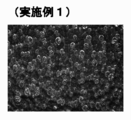
- Table 1 shows the results of comparative studies in this example. Moreover, the external appearance photograph of the container obtained in Example 7 and 10 is shown in FIG. Furthermore, images of Examples 1 and 5 and Comparative Example 2 are shown in FIGS. 9, 10, and 11 as examples of grayscale processed images of digital microscope photographs used for bottle evaluation.
- trunk wall 3 resin matrix 5: flat foam cell 5a: top foam cell 7: skin layer 11: trunk D: dark part L: bright part
Landscapes
- Engineering & Computer Science (AREA)
- Mechanical Engineering (AREA)
- Chemical & Material Sciences (AREA)
- Manufacturing & Machinery (AREA)
- Ceramic Engineering (AREA)
- Chemical Kinetics & Catalysis (AREA)
- Health & Medical Sciences (AREA)
- Medicinal Chemistry (AREA)
- Polymers & Plastics (AREA)
- Organic Chemistry (AREA)
- Materials Engineering (AREA)
- Containers Having Bodies Formed In One Piece (AREA)
- Blow-Moulding Or Thermoforming Of Plastics Or The Like (AREA)
- Molding Of Porous Articles (AREA)
Abstract
L'invention concerne un récipient en plastique expansé comprenant une résine thermoplastique, qui possède une paroi de récipient possédant une structure non stratifiée, et étant conçu de sorte qu'une région mousse dans laquelle des cellules de mousse sont réparties à l'intérieur de la paroi de récipient soit présente dans au moins une partie d'une partie cylindre, le récipient en plastique expansé étant caractérisé en ce que la surface de la partie cylindre est une surface lisse possédant une rugosité de surface Ra inférieure ou égale à 5 µm ; et dans la surface extérieure de la partie cylindre dans la région mousse, de multiples parties sombres (D) possédant un faible facteur de réflexion de lumière sont réparties entre des parties claires (L) possédant un facteur de réflexion de lumière élevé, et un motif satiné est donc obtenu.
Applications Claiming Priority (2)
| Application Number | Priority Date | Filing Date | Title |
|---|---|---|---|
| JP2016175367A JP6926420B2 (ja) | 2016-09-08 | 2016-09-08 | 梨地様外観を有する発泡プラスチック容器 |
| JP2016-175367 | 2016-09-08 |
Publications (1)
| Publication Number | Publication Date |
|---|---|
| WO2018047680A1 true WO2018047680A1 (fr) | 2018-03-15 |
Family
ID=61562268
Family Applications (1)
| Application Number | Title | Priority Date | Filing Date |
|---|---|---|---|
| PCT/JP2017/030987 Ceased WO2018047680A1 (fr) | 2016-09-08 | 2017-08-29 | Récipient en plastique expansé possédant un aspect extérieur satiné |
Country Status (2)
| Country | Link |
|---|---|
| JP (1) | JP6926420B2 (fr) |
| WO (1) | WO2018047680A1 (fr) |
Families Citing this family (5)
| Publication number | Priority date | Publication date | Assignee | Title |
|---|---|---|---|---|
| EP3470195B1 (fr) | 2017-10-12 | 2026-04-29 | The Procter & Gamble Company | Article moulé par soufflage comportant des effets visuels, préforme, procédé |
| US11046473B2 (en) | 2018-07-17 | 2021-06-29 | The Procter And Gamble Company | Blow molded article with visual effects |
| WO2020081114A1 (fr) | 2018-10-19 | 2020-04-23 | The Procter & Gamble Company | Article moulé par soufflage à éléments repoussés |
| CN113661037B (zh) * | 2019-04-11 | 2023-10-13 | 宝洁公司 | 具有视觉效果的吹塑制品 |
| WO2021142194A1 (fr) | 2020-01-08 | 2021-07-15 | The Procter & Gamble Company | Article multicouche moulé par soufflage avec gradient de couleur |
Citations (4)
| Publication number | Priority date | Publication date | Assignee | Title |
|---|---|---|---|---|
| JP2000103893A (ja) * | 1998-07-27 | 2000-04-11 | Chugoku Pearl Hanbai Kk | 氷で作られたように見える発泡成形体及びその製造方法 |
| JP2007022554A (ja) * | 2005-07-13 | 2007-02-01 | Toyo Seikan Kaisha Ltd | パール調外観を有するプラスチック容器及びその製造方法 |
| JP2009248413A (ja) * | 2008-04-04 | 2009-10-29 | Toyo Seikan Kaisha Ltd | 発泡プラスチック成形体及びその製造方法 |
| JP2010111437A (ja) * | 2008-10-10 | 2010-05-20 | Michio Komatsu | 容器 |
-
2016
- 2016-09-08 JP JP2016175367A patent/JP6926420B2/ja active Active
-
2017
- 2017-08-29 WO PCT/JP2017/030987 patent/WO2018047680A1/fr not_active Ceased
Patent Citations (4)
| Publication number | Priority date | Publication date | Assignee | Title |
|---|---|---|---|---|
| JP2000103893A (ja) * | 1998-07-27 | 2000-04-11 | Chugoku Pearl Hanbai Kk | 氷で作られたように見える発泡成形体及びその製造方法 |
| JP2007022554A (ja) * | 2005-07-13 | 2007-02-01 | Toyo Seikan Kaisha Ltd | パール調外観を有するプラスチック容器及びその製造方法 |
| JP2009248413A (ja) * | 2008-04-04 | 2009-10-29 | Toyo Seikan Kaisha Ltd | 発泡プラスチック成形体及びその製造方法 |
| JP2010111437A (ja) * | 2008-10-10 | 2010-05-20 | Michio Komatsu | 容器 |
Also Published As
| Publication number | Publication date |
|---|---|
| JP2018039536A (ja) | 2018-03-15 |
| JP6926420B2 (ja) | 2021-08-25 |
Similar Documents
| Publication | Publication Date | Title |
|---|---|---|
| CN101980921B (zh) | 拉伸发泡塑料容器及其制造方法 | |
| JP7031116B2 (ja) | マーブル調外観を有する発泡延伸プラスチック容器 | |
| WO2018047680A1 (fr) | Récipient en plastique expansé possédant un aspect extérieur satiné | |
| KR101639742B1 (ko) | 발포 연신 플라스틱 보틀 | |
| JP6146407B2 (ja) | 金属色の外観を有する延伸発泡プラスチック成形体 | |
| JP6657694B2 (ja) | 加飾発泡プラスチック成形体 | |
| JP6314615B2 (ja) | 加飾発泡プラスチック成形体 | |
| JP6167638B2 (ja) | 遮光性と鏡面光沢性とに優れた発泡延伸プラスチックボトル | |
| JP6834310B2 (ja) | 発泡延伸プラスチック容器 | |
| JP7091690B2 (ja) | 色ムラが抑制されている発泡容器 | |
| JP6163850B2 (ja) | 発泡延伸プラスチックボトル |
Legal Events
| Date | Code | Title | Description |
|---|---|---|---|
| 121 | Ep: the epo has been informed by wipo that ep was designated in this application |
Ref document number: 17848620 Country of ref document: EP Kind code of ref document: A1 |
|
| NENP | Non-entry into the national phase |
Ref country code: DE |
|
| 122 | Ep: pct application non-entry in european phase |
Ref document number: 17848620 Country of ref document: EP Kind code of ref document: A1 |