WO2018079363A1 - Capteur de pression - Google Patents
Capteur de pression Download PDFInfo
- Publication number
- WO2018079363A1 WO2018079363A1 PCT/JP2017/037651 JP2017037651W WO2018079363A1 WO 2018079363 A1 WO2018079363 A1 WO 2018079363A1 JP 2017037651 W JP2017037651 W JP 2017037651W WO 2018079363 A1 WO2018079363 A1 WO 2018079363A1
- Authority
- WO
- WIPO (PCT)
- Prior art keywords
- pressure sensor
- titanium oxide
- functional
- functional element
- pressure
- Prior art date
- Legal status (The legal status is an assumption and is not a legal conclusion. Google has not performed a legal analysis and makes no representation as to the accuracy of the status listed.)
- Ceased
Links
Images









Classifications
-
- B—PERFORMING OPERATIONS; TRANSPORTING
- B32—LAYERED PRODUCTS
- B32B—LAYERED PRODUCTS, i.e. PRODUCTS BUILT-UP OF STRATA OF FLAT OR NON-FLAT, e.g. CELLULAR OR HONEYCOMB, FORM
- B32B5/00—Layered products characterised by the non- homogeneity or physical structure, i.e. comprising a fibrous, filamentary, particulate or foam layer; Layered products characterised by having a layer differing constitutionally or physically in different parts
- B32B5/02—Layered products characterised by the non- homogeneity or physical structure, i.e. comprising a fibrous, filamentary, particulate or foam layer; Layered products characterised by having a layer differing constitutionally or physically in different parts characterised by structural features of a fibrous or filamentary layer
- B32B5/022—Non-woven fabric
-
- G—PHYSICS
- G01—MEASURING; TESTING
- G01L—MEASURING FORCE, STRESS, TORQUE, WORK, MECHANICAL POWER, MECHANICAL EFFICIENCY, OR FLUID PRESSURE
- G01L1/00—Measuring force or stress, in general
- G01L1/20—Measuring force or stress, in general by measuring variations in ohmic resistance of solid materials or of electrically-conductive fluids; by making use of electrokinetic cells, i.e. liquid-containing cells wherein an electrical potential is produced or varied upon the application of stress
-
- B—PERFORMING OPERATIONS; TRANSPORTING
- B32—LAYERED PRODUCTS
- B32B—LAYERED PRODUCTS, i.e. PRODUCTS BUILT-UP OF STRATA OF FLAT OR NON-FLAT, e.g. CELLULAR OR HONEYCOMB, FORM
- B32B15/00—Layered products comprising a layer of metal
- B32B15/16—Layered products comprising a layer of metal next to a particulate layer
-
- B—PERFORMING OPERATIONS; TRANSPORTING
- B32—LAYERED PRODUCTS
- B32B—LAYERED PRODUCTS, i.e. PRODUCTS BUILT-UP OF STRATA OF FLAT OR NON-FLAT, e.g. CELLULAR OR HONEYCOMB, FORM
- B32B15/00—Layered products comprising a layer of metal
- B32B15/20—Layered products comprising a layer of metal comprising aluminium or copper
-
- B—PERFORMING OPERATIONS; TRANSPORTING
- B32—LAYERED PRODUCTS
- B32B—LAYERED PRODUCTS, i.e. PRODUCTS BUILT-UP OF STRATA OF FLAT OR NON-FLAT, e.g. CELLULAR OR HONEYCOMB, FORM
- B32B19/00—Layered products comprising a layer of natural mineral fibres or particles, e.g. asbestos, mica
- B32B19/04—Layered products comprising a layer of natural mineral fibres or particles, e.g. asbestos, mica next to another layer of the same or of a different material
- B32B19/048—Layered products comprising a layer of natural mineral fibres or particles, e.g. asbestos, mica next to another layer of the same or of a different material made of particles
-
- B—PERFORMING OPERATIONS; TRANSPORTING
- B32—LAYERED PRODUCTS
- B32B—LAYERED PRODUCTS, i.e. PRODUCTS BUILT-UP OF STRATA OF FLAT OR NON-FLAT, e.g. CELLULAR OR HONEYCOMB, FORM
- B32B27/00—Layered products comprising a layer of synthetic resin
- B32B27/14—Layered products comprising a layer of synthetic resin next to a particulate layer
-
- B—PERFORMING OPERATIONS; TRANSPORTING
- B32—LAYERED PRODUCTS
- B32B—LAYERED PRODUCTS, i.e. PRODUCTS BUILT-UP OF STRATA OF FLAT OR NON-FLAT, e.g. CELLULAR OR HONEYCOMB, FORM
- B32B27/00—Layered products comprising a layer of synthetic resin
- B32B27/28—Layered products comprising a layer of synthetic resin comprising synthetic resins not wholly covered by any one of the sub-groups B32B27/30 - B32B27/42
- B32B27/281—Layered products comprising a layer of synthetic resin comprising synthetic resins not wholly covered by any one of the sub-groups B32B27/30 - B32B27/42 comprising polyimides
-
- B—PERFORMING OPERATIONS; TRANSPORTING
- B32—LAYERED PRODUCTS
- B32B—LAYERED PRODUCTS, i.e. PRODUCTS BUILT-UP OF STRATA OF FLAT OR NON-FLAT, e.g. CELLULAR OR HONEYCOMB, FORM
- B32B3/00—Layered products comprising a layer with external or internal discontinuities or unevennesses, or a layer of non-planar shape; Layered products comprising a layer having particular features of form
- B32B3/02—Layered products comprising a layer with external or internal discontinuities or unevennesses, or a layer of non-planar shape; Layered products comprising a layer having particular features of form characterised by features of form at particular places, e.g. in edge regions
- B32B3/08—Layered products comprising a layer with external or internal discontinuities or unevennesses, or a layer of non-planar shape; Layered products comprising a layer having particular features of form characterised by features of form at particular places, e.g. in edge regions characterised by added members at particular parts
-
- B—PERFORMING OPERATIONS; TRANSPORTING
- B32—LAYERED PRODUCTS
- B32B—LAYERED PRODUCTS, i.e. PRODUCTS BUILT-UP OF STRATA OF FLAT OR NON-FLAT, e.g. CELLULAR OR HONEYCOMB, FORM
- B32B3/00—Layered products comprising a layer with external or internal discontinuities or unevennesses, or a layer of non-planar shape; Layered products comprising a layer having particular features of form
- B32B3/26—Layered products comprising a layer with external or internal discontinuities or unevennesses, or a layer of non-planar shape; Layered products comprising a layer having particular features of form characterised by a particular shape of the outline of the cross-section of a continuous layer; characterised by a layer with cavities or internal voids ; characterised by an apertured layer
- B32B3/263—Layered products comprising a layer with external or internal discontinuities or unevennesses, or a layer of non-planar shape; Layered products comprising a layer having particular features of form characterised by a particular shape of the outline of the cross-section of a continuous layer; characterised by a layer with cavities or internal voids ; characterised by an apertured layer characterised by a layer having non-uniform thickness
-
- B—PERFORMING OPERATIONS; TRANSPORTING
- B32—LAYERED PRODUCTS
- B32B—LAYERED PRODUCTS, i.e. PRODUCTS BUILT-UP OF STRATA OF FLAT OR NON-FLAT, e.g. CELLULAR OR HONEYCOMB, FORM
- B32B5/00—Layered products characterised by the non- homogeneity or physical structure, i.e. comprising a fibrous, filamentary, particulate or foam layer; Layered products characterised by having a layer differing constitutionally or physically in different parts
- B32B5/02—Layered products characterised by the non- homogeneity or physical structure, i.e. comprising a fibrous, filamentary, particulate or foam layer; Layered products characterised by having a layer differing constitutionally or physically in different parts characterised by structural features of a fibrous or filamentary layer
- B32B5/024—Woven fabric
-
- B—PERFORMING OPERATIONS; TRANSPORTING
- B32—LAYERED PRODUCTS
- B32B—LAYERED PRODUCTS, i.e. PRODUCTS BUILT-UP OF STRATA OF FLAT OR NON-FLAT, e.g. CELLULAR OR HONEYCOMB, FORM
- B32B5/00—Layered products characterised by the non- homogeneity or physical structure, i.e. comprising a fibrous, filamentary, particulate or foam layer; Layered products characterised by having a layer differing constitutionally or physically in different parts
- B32B5/16—Layered products characterised by the non- homogeneity or physical structure, i.e. comprising a fibrous, filamentary, particulate or foam layer; Layered products characterised by having a layer differing constitutionally or physically in different parts characterised by features of a layer formed of particles, e.g. chips, powder or granules
-
- B—PERFORMING OPERATIONS; TRANSPORTING
- B32—LAYERED PRODUCTS
- B32B—LAYERED PRODUCTS, i.e. PRODUCTS BUILT-UP OF STRATA OF FLAT OR NON-FLAT, e.g. CELLULAR OR HONEYCOMB, FORM
- B32B5/00—Layered products characterised by the non- homogeneity or physical structure, i.e. comprising a fibrous, filamentary, particulate or foam layer; Layered products characterised by having a layer differing constitutionally or physically in different parts
- B32B5/18—Layered products characterised by the non- homogeneity or physical structure, i.e. comprising a fibrous, filamentary, particulate or foam layer; Layered products characterised by having a layer differing constitutionally or physically in different parts characterised by features of a layer of foamed material
-
- B—PERFORMING OPERATIONS; TRANSPORTING
- B32—LAYERED PRODUCTS
- B32B—LAYERED PRODUCTS, i.e. PRODUCTS BUILT-UP OF STRATA OF FLAT OR NON-FLAT, e.g. CELLULAR OR HONEYCOMB, FORM
- B32B5/00—Layered products characterised by the non- homogeneity or physical structure, i.e. comprising a fibrous, filamentary, particulate or foam layer; Layered products characterised by having a layer differing constitutionally or physically in different parts
- B32B5/22—Layered products characterised by the non- homogeneity or physical structure, i.e. comprising a fibrous, filamentary, particulate or foam layer; Layered products characterised by having a layer differing constitutionally or physically in different parts characterised by the presence of two or more layers which are next to each other and are fibrous, filamentary, formed of particles or foamed
- B32B5/30—Layered products characterised by the non- homogeneity or physical structure, i.e. comprising a fibrous, filamentary, particulate or foam layer; Layered products characterised by having a layer differing constitutionally or physically in different parts characterised by the presence of two or more layers which are next to each other and are fibrous, filamentary, formed of particles or foamed one layer being formed of particles, e.g. chips, granules, powder
-
- B—PERFORMING OPERATIONS; TRANSPORTING
- B32—LAYERED PRODUCTS
- B32B—LAYERED PRODUCTS, i.e. PRODUCTS BUILT-UP OF STRATA OF FLAT OR NON-FLAT, e.g. CELLULAR OR HONEYCOMB, FORM
- B32B7/00—Layered products characterised by the relation between layers; Layered products characterised by the relative orientation of features between layers, or by the relative values of a measurable parameter between layers, i.e. products comprising layers having different physical, chemical or physicochemical properties; Layered products characterised by the interconnection of layers
- B32B7/02—Physical, chemical or physicochemical properties
- B32B7/027—Thermal properties
-
- B—PERFORMING OPERATIONS; TRANSPORTING
- B32—LAYERED PRODUCTS
- B32B—LAYERED PRODUCTS, i.e. PRODUCTS BUILT-UP OF STRATA OF FLAT OR NON-FLAT, e.g. CELLULAR OR HONEYCOMB, FORM
- B32B9/00—Layered products comprising a layer of a particular substance not covered by groups B32B11/00 - B32B29/00
-
- B—PERFORMING OPERATIONS; TRANSPORTING
- B32—LAYERED PRODUCTS
- B32B—LAYERED PRODUCTS, i.e. PRODUCTS BUILT-UP OF STRATA OF FLAT OR NON-FLAT, e.g. CELLULAR OR HONEYCOMB, FORM
- B32B9/00—Layered products comprising a layer of a particular substance not covered by groups B32B11/00 - B32B29/00
- B32B9/04—Layered products comprising a layer of a particular substance not covered by groups B32B11/00 - B32B29/00 comprising such particular substance as the main or only constituent of a layer, which is next to another layer of the same or of a different material
- B32B9/045—Layered products comprising a layer of a particular substance not covered by groups B32B11/00 - B32B29/00 comprising such particular substance as the main or only constituent of a layer, which is next to another layer of the same or of a different material of synthetic resin
-
- C—CHEMISTRY; METALLURGY
- C01—INORGANIC CHEMISTRY
- C01G—COMPOUNDS CONTAINING METALS NOT COVERED BY SUBCLASSES C01D OR C01F
- C01G23/00—Compounds of titanium
- C01G23/04—Oxides; Hydroxides
-
- C—CHEMISTRY; METALLURGY
- C01—INORGANIC CHEMISTRY
- C01G—COMPOUNDS CONTAINING METALS NOT COVERED BY SUBCLASSES C01D OR C01F
- C01G23/00—Compounds of titanium
- C01G23/04—Oxides; Hydroxides
- C01G23/043—Titanium sub-oxides
-
- C—CHEMISTRY; METALLURGY
- C01—INORGANIC CHEMISTRY
- C01G—COMPOUNDS CONTAINING METALS NOT COVERED BY SUBCLASSES C01D OR C01F
- C01G23/00—Compounds of titanium
- C01G23/04—Oxides; Hydroxides
- C01G23/047—Titanium dioxide
-
- G—PHYSICS
- G01—MEASURING; TESTING
- G01K—MEASURING TEMPERATURE; MEASURING QUANTITY OF HEAT; THERMALLY-SENSITIVE ELEMENTS NOT OTHERWISE PROVIDED FOR
- G01K11/00—Measuring temperature based upon physical or chemical changes not covered by groups G01K3/00, G01K5/00, G01K7/00 or G01K9/00
-
- G—PHYSICS
- G01—MEASURING; TESTING
- G01K—MEASURING TEMPERATURE; MEASURING QUANTITY OF HEAT; THERMALLY-SENSITIVE ELEMENTS NOT OTHERWISE PROVIDED FOR
- G01K11/00—Measuring temperature based upon physical or chemical changes not covered by groups G01K3/00, G01K5/00, G01K7/00 or G01K9/00
- G01K11/12—Measuring temperature based upon physical or chemical changes not covered by groups G01K3/00, G01K5/00, G01K7/00 or G01K9/00 using changes in colour, translucency or reflectance
- G01K11/16—Measuring temperature based upon physical or chemical changes not covered by groups G01K3/00, G01K5/00, G01K7/00 or G01K9/00 using changes in colour, translucency or reflectance of organic materials
-
- G—PHYSICS
- G01—MEASURING; TESTING
- G01L—MEASURING FORCE, STRESS, TORQUE, WORK, MECHANICAL POWER, MECHANICAL EFFICIENCY, OR FLUID PRESSURE
- G01L1/00—Measuring force or stress, in general
- G01L1/18—Measuring force or stress, in general using properties of piezo-resistive materials, i.e. materials of which the ohmic resistance varies according to changes in magnitude or direction of force applied to the material
- G01L1/183—Measuring force or stress, in general using properties of piezo-resistive materials, i.e. materials of which the ohmic resistance varies according to changes in magnitude or direction of force applied to the material by measuring variations of frequency of vibrating piezo-resistive material
-
- G—PHYSICS
- G01—MEASURING; TESTING
- G01L—MEASURING FORCE, STRESS, TORQUE, WORK, MECHANICAL POWER, MECHANICAL EFFICIENCY, OR FLUID PRESSURE
- G01L1/00—Measuring force or stress, in general
- G01L1/24—Measuring force or stress, in general by measuring variations of optical properties of material when it is stressed, e.g. by photoelastic stress analysis using infrared, visible light, ultraviolet
-
- G—PHYSICS
- G01—MEASURING; TESTING
- G01L—MEASURING FORCE, STRESS, TORQUE, WORK, MECHANICAL POWER, MECHANICAL EFFICIENCY, OR FLUID PRESSURE
- G01L11/00—Measuring steady or quasi-steady pressure of a fluid or a fluent solid material by means not provided for in group G01L7/00 or G01L9/00
- G01L11/02—Measuring steady or quasi-steady pressure of a fluid or a fluent solid material by means not provided for in group G01L7/00 or G01L9/00 by optical means
-
- G—PHYSICS
- G01—MEASURING; TESTING
- G01L—MEASURING FORCE, STRESS, TORQUE, WORK, MECHANICAL POWER, MECHANICAL EFFICIENCY, OR FLUID PRESSURE
- G01L11/00—Measuring steady or quasi-steady pressure of a fluid or a fluent solid material by means not provided for in group G01L7/00 or G01L9/00
- G01L11/02—Measuring steady or quasi-steady pressure of a fluid or a fluent solid material by means not provided for in group G01L7/00 or G01L9/00 by optical means
- G01L11/025—Measuring steady or quasi-steady pressure of a fluid or a fluent solid material by means not provided for in group G01L7/00 or G01L9/00 by optical means using a pressure-sensitive optical fibre
-
- G—PHYSICS
- G01—MEASURING; TESTING
- G01L—MEASURING FORCE, STRESS, TORQUE, WORK, MECHANICAL POWER, MECHANICAL EFFICIENCY, OR FLUID PRESSURE
- G01L9/00—Measuring steady of quasi-steady pressure of fluid or fluent solid material by electric or magnetic pressure-sensitive elements; Transmitting or indicating the displacement of mechanical pressure-sensitive elements, used to measure the steady or quasi-steady pressure of a fluid or fluent solid material, by electric or magnetic means
- G01L9/02—Measuring steady of quasi-steady pressure of fluid or fluent solid material by electric or magnetic pressure-sensitive elements; Transmitting or indicating the displacement of mechanical pressure-sensitive elements, used to measure the steady or quasi-steady pressure of a fluid or fluent solid material, by electric or magnetic means by making use of variations in ohmic resistance, e.g. of potentiometers, electric circuits therefor, e.g. bridges, amplifiers or signal conditioning
-
- G—PHYSICS
- G01—MEASURING; TESTING
- G01L—MEASURING FORCE, STRESS, TORQUE, WORK, MECHANICAL POWER, MECHANICAL EFFICIENCY, OR FLUID PRESSURE
- G01L9/00—Measuring steady of quasi-steady pressure of fluid or fluent solid material by electric or magnetic pressure-sensitive elements; Transmitting or indicating the displacement of mechanical pressure-sensitive elements, used to measure the steady or quasi-steady pressure of a fluid or fluent solid material, by electric or magnetic means
- G01L9/02—Measuring steady of quasi-steady pressure of fluid or fluent solid material by electric or magnetic pressure-sensitive elements; Transmitting or indicating the displacement of mechanical pressure-sensitive elements, used to measure the steady or quasi-steady pressure of a fluid or fluent solid material, by electric or magnetic means by making use of variations in ohmic resistance, e.g. of potentiometers, electric circuits therefor, e.g. bridges, amplifiers or signal conditioning
- G01L9/025—Measuring steady of quasi-steady pressure of fluid or fluent solid material by electric or magnetic pressure-sensitive elements; Transmitting or indicating the displacement of mechanical pressure-sensitive elements, used to measure the steady or quasi-steady pressure of a fluid or fluent solid material, by electric or magnetic means by making use of variations in ohmic resistance, e.g. of potentiometers, electric circuits therefor, e.g. bridges, amplifiers or signal conditioning with temperature compensating means
-
- G—PHYSICS
- G01—MEASURING; TESTING
- G01N—INVESTIGATING OR ANALYSING MATERIALS BY DETERMINING THEIR CHEMICAL OR PHYSICAL PROPERTIES
- G01N25/00—Investigating or analyzing materials by the use of thermal means
- G01N25/02—Investigating or analyzing materials by the use of thermal means by investigating changes of state or changes of phase; by investigating sintering
-
- H—ELECTRICITY
- H10—SEMICONDUCTOR DEVICES; ELECTRIC SOLID-STATE DEVICES NOT OTHERWISE PROVIDED FOR
- H10D—INORGANIC ELECTRIC SEMICONDUCTOR DEVICES
- H10D48/00—Individual devices not covered by groups H10D1/00 - H10D44/00
- H10D48/50—Devices controlled by mechanical forces, e.g. pressure
-
- B—PERFORMING OPERATIONS; TRANSPORTING
- B32—LAYERED PRODUCTS
- B32B—LAYERED PRODUCTS, i.e. PRODUCTS BUILT-UP OF STRATA OF FLAT OR NON-FLAT, e.g. CELLULAR OR HONEYCOMB, FORM
- B32B2262/00—Composition or structural features of fibres which form a fibrous or filamentary layer or are present as additives
- B32B2262/10—Inorganic fibres
- B32B2262/101—Glass fibres
-
- B—PERFORMING OPERATIONS; TRANSPORTING
- B32—LAYERED PRODUCTS
- B32B—LAYERED PRODUCTS, i.e. PRODUCTS BUILT-UP OF STRATA OF FLAT OR NON-FLAT, e.g. CELLULAR OR HONEYCOMB, FORM
- B32B2262/00—Composition or structural features of fibres which form a fibrous or filamentary layer or are present as additives
- B32B2262/10—Inorganic fibres
- B32B2262/106—Carbon fibres, e.g. graphite fibres
-
- B—PERFORMING OPERATIONS; TRANSPORTING
- B32—LAYERED PRODUCTS
- B32B—LAYERED PRODUCTS, i.e. PRODUCTS BUILT-UP OF STRATA OF FLAT OR NON-FLAT, e.g. CELLULAR OR HONEYCOMB, FORM
- B32B2264/00—Composition or properties of particles which form a particulate layer or are present as additives
- B32B2264/10—Inorganic particles
- B32B2264/102—Oxide or hydroxide
-
- B—PERFORMING OPERATIONS; TRANSPORTING
- B32—LAYERED PRODUCTS
- B32B—LAYERED PRODUCTS, i.e. PRODUCTS BUILT-UP OF STRATA OF FLAT OR NON-FLAT, e.g. CELLULAR OR HONEYCOMB, FORM
- B32B2266/00—Composition of foam
- B32B2266/12—Gel
-
- B—PERFORMING OPERATIONS; TRANSPORTING
- B32—LAYERED PRODUCTS
- B32B—LAYERED PRODUCTS, i.e. PRODUCTS BUILT-UP OF STRATA OF FLAT OR NON-FLAT, e.g. CELLULAR OR HONEYCOMB, FORM
- B32B2307/00—Properties of the layers or laminate
- B32B2307/20—Properties of the layers or laminate having particular electrical or magnetic properties, e.g. piezoelectric
- B32B2307/202—Conductive
-
- B—PERFORMING OPERATIONS; TRANSPORTING
- B32—LAYERED PRODUCTS
- B32B—LAYERED PRODUCTS, i.e. PRODUCTS BUILT-UP OF STRATA OF FLAT OR NON-FLAT, e.g. CELLULAR OR HONEYCOMB, FORM
- B32B2307/00—Properties of the layers or laminate
- B32B2307/30—Properties of the layers or laminate having particular thermal properties
-
- B—PERFORMING OPERATIONS; TRANSPORTING
- B32—LAYERED PRODUCTS
- B32B—LAYERED PRODUCTS, i.e. PRODUCTS BUILT-UP OF STRATA OF FLAT OR NON-FLAT, e.g. CELLULAR OR HONEYCOMB, FORM
- B32B2307/00—Properties of the layers or laminate
- B32B2307/30—Properties of the layers or laminate having particular thermal properties
- B32B2307/302—Conductive
-
- B—PERFORMING OPERATIONS; TRANSPORTING
- B32—LAYERED PRODUCTS
- B32B—LAYERED PRODUCTS, i.e. PRODUCTS BUILT-UP OF STRATA OF FLAT OR NON-FLAT, e.g. CELLULAR OR HONEYCOMB, FORM
- B32B2307/00—Properties of the layers or laminate
- B32B2307/30—Properties of the layers or laminate having particular thermal properties
- B32B2307/306—Resistant to heat
-
- B—PERFORMING OPERATIONS; TRANSPORTING
- B32—LAYERED PRODUCTS
- B32B—LAYERED PRODUCTS, i.e. PRODUCTS BUILT-UP OF STRATA OF FLAT OR NON-FLAT, e.g. CELLULAR OR HONEYCOMB, FORM
- B32B2307/00—Properties of the layers or laminate
- B32B2307/40—Properties of the layers or laminate having particular optical properties
- B32B2307/402—Coloured
-
- B—PERFORMING OPERATIONS; TRANSPORTING
- B32—LAYERED PRODUCTS
- B32B—LAYERED PRODUCTS, i.e. PRODUCTS BUILT-UP OF STRATA OF FLAT OR NON-FLAT, e.g. CELLULAR OR HONEYCOMB, FORM
- B32B2307/00—Properties of the layers or laminate
- B32B2307/50—Properties of the layers or laminate having particular mechanical properties
- B32B2307/542—Shear strength
-
- B—PERFORMING OPERATIONS; TRANSPORTING
- B32—LAYERED PRODUCTS
- B32B—LAYERED PRODUCTS, i.e. PRODUCTS BUILT-UP OF STRATA OF FLAT OR NON-FLAT, e.g. CELLULAR OR HONEYCOMB, FORM
- B32B2307/00—Properties of the layers or laminate
- B32B2307/50—Properties of the layers or laminate having particular mechanical properties
- B32B2307/546—Flexural strength; Flexion stiffness
-
- B—PERFORMING OPERATIONS; TRANSPORTING
- B32—LAYERED PRODUCTS
- B32B—LAYERED PRODUCTS, i.e. PRODUCTS BUILT-UP OF STRATA OF FLAT OR NON-FLAT, e.g. CELLULAR OR HONEYCOMB, FORM
- B32B2307/00—Properties of the layers or laminate
- B32B2307/70—Other properties
- B32B2307/704—Crystalline
-
- B—PERFORMING OPERATIONS; TRANSPORTING
- B32—LAYERED PRODUCTS
- B32B—LAYERED PRODUCTS, i.e. PRODUCTS BUILT-UP OF STRATA OF FLAT OR NON-FLAT, e.g. CELLULAR OR HONEYCOMB, FORM
- B32B2307/00—Properties of the layers or laminate
- B32B2307/70—Other properties
- B32B2307/732—Dimensional properties
-
- B—PERFORMING OPERATIONS; TRANSPORTING
- B32—LAYERED PRODUCTS
- B32B—LAYERED PRODUCTS, i.e. PRODUCTS BUILT-UP OF STRATA OF FLAT OR NON-FLAT, e.g. CELLULAR OR HONEYCOMB, FORM
- B32B2457/00—Electrical equipment
-
- C—CHEMISTRY; METALLURGY
- C01—INORGANIC CHEMISTRY
- C01P—INDEXING SCHEME RELATING TO STRUCTURAL AND PHYSICAL ASPECTS OF SOLID INORGANIC COMPOUNDS
- C01P2002/00—Crystal-structural characteristics
- C01P2002/70—Crystal-structural characteristics defined by measured X-ray, neutron or electron diffraction data
- C01P2002/72—Crystal-structural characteristics defined by measured X-ray, neutron or electron diffraction data by d-values or two theta-values, e.g. as X-ray diagram
-
- C—CHEMISTRY; METALLURGY
- C01—INORGANIC CHEMISTRY
- C01P—INDEXING SCHEME RELATING TO STRUCTURAL AND PHYSICAL ASPECTS OF SOLID INORGANIC COMPOUNDS
- C01P2004/00—Particle morphology
- C01P2004/60—Particles characterised by their size
- C01P2004/62—Submicrometer sized, i.e. from 0.1-1 micrometer
Definitions
- the present invention relates to a pressure sensor whose physical properties change according to a pressure change or the like.
- a functional element such as a temperature indicating paint using a color change of a pigment or a thermocouple using a Seebeck effect
- the temperature indicating paint the temperature of the object can be measured by the color tone change of the pigment.
- the thermocouple the temperature of the object can be measured by performing electrical measurement using the Seebeck effect.
- thermocouple it is necessary to use a noble metal such as platinum or rhodium depending on the measurement temperature range, and in this case, the thermocouple becomes expensive.
- a conventional thermometer using a temperature indicating paint or a thermometer using a thermocouple containing a noble metal is expensive.
- titanium trioxide shows a crystal structure of ⁇ -phase trititanium pentoxide in a low temperature region and ⁇ phase trititanium pentoxide in a high temperature region, and these crystal structures change repeatedly due to temperature changes.
- the crystal structure of ⁇ phase trititanium pentoxide generated in the high temperature region is maintained as ⁇ phase trititanium pentoxide after cooling.
- the inventors of the present application heated the titanium pentoxide nano-sized to a predetermined particle size to 350 ° C. or higher, it changed to a crystalline form of titanium dioxide (TiO 2 ) and remained titanium dioxide after cooling. For the first time in the world.
- the above-mentioned ⁇ -phase trititanium pentoxide, ⁇ -phase trititanium pentoxide and titanium dioxide have different physical properties such as color and electrical conductivity.
- the inventor of the present application uses the nanoparticulate trititan pentoxide as a functional element that is the main body of the temperature sensor, and measures the color, electrical conductivity, etc. of the functional element after the thermal history.
- the temperature sensor which can measure the maximum temperature which can take the crystal form is proposed.
- the functional element is provided with two or more electrodes.
- the temperature sensor 100AA shown in FIG. 1 includes a substrate 150A and a functional element 40A made of trititanium pentoxide that is laminated on the substrate 150A and formed into nanoparticles.
- the functional element 40A is, for example, a nano-particulated tritium pentoxide compact.
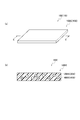
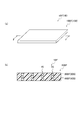
- the shape of the functional element 40A is, for example, a cylindrical shape like the functional element 40AA shown in FIG. 2 or a rectangular plate shape like the functional element 40AB shown in FIG.
- FIG. 4 is a schematic cross-sectional view showing another example of the temperature sensor.
- the temperature sensor 100AB shown in FIG. 4 includes a substrate 150A, the functional element 40A stacked on the substrate 150A, and two electrodes 70A and 70A disposed on the same surface of the functional element 40A.
- the electrode 70A is, for example, a metal, a conductive oxide, a conductive polymer, a carbon-based material, or the like.
- FIG. 5 is a schematic cross-sectional view showing still another example of the temperature sensor.
- a temperature sensor 100AC shown in FIG. 5 includes a substrate 150A, the functional element 40A stacked on the substrate 150A, an electrode 70A disposed on the surface of the functional element 40A, the substrate 150A, and the functional element 40A. And an electrode 70A provided at the interface.
- the inventors of the present application have found that the nanostructured trititan pentoxide constituting the functional element changes the crystal structure of the crystal grains in response to a minute change in pressure. For this reason, the inventors of the present application are considering using the temperature sensors 100AA, 100AB, and 100AC as pressure sensors.
- the substrate 150A used for the temperature sensors 100AA, 100AB, and 100AC and the functional element 40A made of trititanium pentoxide usually have a large difference in thermal expansion coefficient. For this reason, when these temperature sensors are used as pressure sensors, when used in an environment with a large thermal expansion, the substrate 150A is separated from the functional element 40A and the electrode 70A, and the functional element 40A and the electrode 70A are cracked. May occur. For this reason, even when the temperature sensor is used as a pressure sensor, if it is used in an environment with a large thermal expansion, the substrate 150A is peeled off from the functional element 40A or the electrode 70A, and the functional element 40A or the electrode 70A is cracked. There has been a first problem that there is a possibility of occurrence of the above.
- pressure sensors using a color former-containing microcapsule, a strain gauge, and a pressure sensor using a piezoelectric element have been used as means for measuring pressure.
- Patent Document 1 discloses a developer sheet for pressure-sensitive recording paper in which a developer layer is provided on a support.
- color former-containing microcapsules are used for the pressure-sensitive paper.
- Non-Patent Document 3 discloses a pressure sensor using a strain gauge or a piezoelectric element.
- the pressure-sensitive paper using the color former-containing microcapsules described in Patent Document 1 has a second problem that it cannot be used repeatedly.
- the strain gauge and the piezoelectric element have a second problem that a power source is necessary to operate the element.
- the present invention has been made in view of the first problem.
- the present invention uses an inexpensive functional element whose physical properties change according to temperature changes, and prevents or suppresses the occurrence of peeling between the substrate and the functional element or electrode, and the occurrence of cracks in the functional element or electrode.
- An object is to provide an inexpensive pressure sensor.
- An object of this invention is to provide the pressure sensor which can be used repeatedly and does not require a power supply.
- a pressure sensor includes a substrate and crystal grains of ⁇ -phase trititanium pentoxide ( ⁇ -Ti 3 O 5 ) laminated on the substrate. And ⁇ -phase trititanium pentoxide ( ⁇ -Ti 3 O 5 ) and at least one kind of crystal grains, and when heated to 350 ° C.
- ⁇ -phase trititanium pentoxide ( ⁇ -Ti 3 O 5)
- ⁇ -phase trititanium pentoxide ( ⁇ -Ti 3 O 5)
- one or more kinds of crystal grains of ⁇ phase trititanium pentoxide ( ⁇ -Ti 3 O 5 ) have a property of changing to at least a part of titanium dioxide (TiO 2 ) crystal grains
- a functional element made of functional titanium oxide, and the substrate has a thin-film substrate thin film portion in which the thickness in the stacking direction with the functional element is smaller than the thickness in the other direction.
- the pressure sensor according to the second aspect of the present invention has a composition of trititanium pentoxide (Ti 3 O 5 ) and a pressure of 1 MPa or more is applied.
- FIG. 12A is a schematic perspective view showing a pressure sensor according to the sixth embodiment.
- FIG. 12B is a schematic cross-sectional view taken along the line CC of FIG.
- FIG. 13A is a schematic perspective view showing a pressure sensor according to the seventh embodiment.
- FIG. 13B is a schematic cross-sectional view taken along the line DD in FIG.
- FIG. 14A is a schematic perspective view showing a pressure sensor according to the eighth embodiment.
- FIG. 14B is a schematic cross-sectional view along the line EE in FIG.
- FIG. 15A is a schematic perspective view showing a pressure sensor according to the ninth embodiment.
- FIG. 15B is a schematic cross-sectional view taken along the line FF in FIG.
- FIG. 16A is a schematic perspective view showing a pressure sensor according to the tenth embodiment.
- FIG. 16B is a schematic cross-sectional view along the line GG in FIG.
- FIG. 17A is a schematic perspective view showing a pressure sensor according to the eleventh embodiment.
- FIG. 17B is a schematic cross-sectional view taken along the line HH in FIG. It is a typical perspective view showing the pressure sensor concerning a 12th embodiment. It is a typical perspective view which shows the pressure sensor which concerns on 13th Embodiment. It is a typical sectional view showing the pressure sensor concerning a 14th embodiment. It is typical sectional drawing which shows the pressure sensor which concerns on 15th Embodiment.
- FIG. 16 It is a typical perspective view showing the pressure sensor concerning a 16th embodiment.
- the pressure sensors according to the following first to third embodiments all function as a temperature sensor in addition to the pressure sensor, and are sensors that detect pressure and temperature.
- the pressure sensors according to the first and second embodiments are configured so that the substrate thin film portion 51 of the substrate 50A and the functional element 40A are in physical contact with each other.
- the functional element 40 ⁇ / b> A can detect the minute pressure applied through the substrate thin film portion 51.
- the pressure sensor according to the first and second embodiments can particularly detect a minute pressure such as an ultrasonic irradiation pressure.
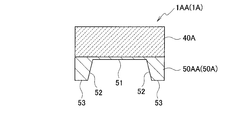
- FIG. 6 is a schematic cross-sectional view showing the pressure sensor according to the first embodiment.
- a pressure sensor 1AA (1A) illustrated in FIG. 6 includes a substrate 50AA (50A) and a functional element 40A stacked on the substrate 50AA. Further, the substrate 50AA has a thin-film substrate thin film portion 51 in which the thickness in the stacking direction with the functional element 40A is smaller than the thickness in the other direction of the substrate 50AA. The substrate thin film portion 51 of the substrate 50AA and the functional element 40A are in physical contact.
- the functional element 40A is an element whose physical properties change according to a temperature change and a pressure change.
- the functional element 40A is an element made of functional titanium oxide whose physical properties change as the crystal structure of crystal grains changes according to temperature change and pressure change. Examples of the physical property that changes according to the temperature change and the pressure change include one or more of electric conductivity and color.
- Functional titanium oxide means a titanium oxide material having a function in which the crystal structure of crystal grains changes at least by heating and the crystal grains of the crystal structure generated by heating are maintained even after cooling.
- functional titanium oxide has a function of generating crystal grains having different crystal structures at least before and after heating, and maintaining the crystal grains of the crystal structure generated by heating even after cooling.
- functional titanium oxide changes the crystal structure of crystal grains in response to a change in pressure applied to the functional titanium oxide in addition to a temperature change caused by heating.
- functional titanium oxide has a function of generating crystal grains having different crystal structures before and after pressurization and maintaining the crystal grains of the generated crystal structure even after release of pressurization.
- Functional titanium oxide generates crystal grains having different crystal structures before and after the supply of current and light, in addition to the above temperature change and pressure change. It may further have a function that is maintained even after the light supply is stopped.
- Functional properties of functional titanium oxide change as the crystal structure changes.
- the changing physical properties include color, electrical conductivity, and the like. The relationship between the change in crystal structure and physical properties such as color and electric conductivity in functional titanium oxide will be described later.
- the functional element 40A substantially consists of functional titanium oxide.
- the minimum unit having a function as functional titanium oxide is a nanoparticle made of functional titanium oxide crystal grains.
- a powder composed of a polycrystalline body of crystal grains of nanoparticles is usually used as the functional titanium oxide.
- the functional element 40A used for the pressure sensor 1AA needs an area that can be stacked with the substrate 50A, and the powder made of a polycrystalline body does not have a sufficient area. For this reason, as the functional element 40A, a molded body or a thin film made of powder made of a functional titanium oxide polycrystal is usually used.
- the compact for example, a thin plate-like compact obtained by pressing and compacting a powder made of a functional titanium oxide polycrystal is used.
- the molded body may be a molded body molded using a mold.
- the shape of the functional element 40A is not particularly limited. Examples of the shape of the functional element 40A include a columnar shape shown in FIG. 2 and a rectangular plate shape shown in FIG. In FIGS. 2 and 3, the thickness is exaggerated for convenience of explanation.
- the thin film using the powder made of the functional titanium oxide polycrystal for example, a thin film formed by sputtering a powder made of the functional titanium oxide polycrystal is used.
- the thickness of the functional element 40A is not particularly limited, but is usually 1 nm to 10 ⁇ m, preferably 0.1 to 1.0 ⁇ m. It is preferable that the thickness of the functional element 40A is within this range because minute changes in temperature and pressure are easily detected with high sensitivity.
- Crystal structure of functional titanium oxide The crystal structure of the functional titanium oxide that is the material of the functional element 40A will be specifically described.
- Functional titanium oxide is usually ⁇ -phase trititanium pentoxide ( ⁇ -Ti 3 O 5 ) crystal grains and ⁇ -phase trititanium pentoxide ( ⁇ -Ti 3 O 5 ) crystals at 450 ° C. or lower under normal pressure. It has one or more kinds of grains.
- the functional titanium oxide is at least a part of one or more kinds of crystal grains of ⁇ -phase trititanium pentoxide and ⁇ -phase trititanium pentoxide when heated to 350 ° C. or higher under normal pressure. Has the property of changing to crystal grains of titanium dioxide (TiO 2 ).
- the functional titanium oxide can take one or more of three forms of ⁇ -phase trititanium pentoxide, ⁇ -phase trititanium pentoxide and titanium dioxide from a low temperature region to a high temperature region.
- the functional titanium oxide is less than 190 ° C. and usually has only ⁇ -phase trititanium pentoxide crystal grains.
- Functional titanium oxide composed of ⁇ -phase trititanium pentoxide is usually a polycrystal of ⁇ -phase trititanium pentoxide crystal grains.
- the composition of the crystal changes, and the titanium dioxide become crystal grains.
- the crystal grains of ⁇ -phase trititanium pentoxide are heated to 350 ° C. or higher, 5 mol% or more phase transitions to titanium dioxide crystal grains.
- titanium dioxide is a concept including rutile, anatase, and brookite. Note that there are variations in the timing of the change in crystal composition from ⁇ -phase trititanium pentoxide to titanium dioxide in a large number of crystal grains constituting the functional titanium oxide in a temperature range of 350 ° C. to 450 ° C. Therefore, when functional titanium oxide is heated to 350 ° C. or higher and 450 ° C. or lower, it usually has mainly titanium dioxide crystal grains, and ⁇ -phase trititanium pentoxide and ⁇ -phase trititanium pentoxide crystal grains are also included. It will have both.
- the functional titanium oxide mainly has ⁇ phase trititanium pentoxide crystal grains and ⁇ phase trititanium pentoxide crystal grains
- the functional titanium oxide is heated to 350 ° C. or higher and 450 ° C. or lower.
- titanium dioxide crystal grains are produced in the functional titanium oxide.
- the ⁇ -phase trititanium pentoxide crystal grains undergo phase transition by heating to become ⁇ -phase trititanium pentoxide crystal grains, and then change into titanium dioxide crystal grains.
- the crystal grains of the ⁇ phase trititanium pentoxide constituting the functional titanium oxide are heated to more than 450 ° C. and less than 550 ° C., most of the crystal grains are white titanium dioxide crystals. Become a grain.
- the temperature at which all of the numerous ⁇ -phase trititanium pentoxide crystal grains constituting the functional titanium oxide change to titanium dioxide crystal grains is approximately 550 ° C. or higher. That is, the functional titanium oxide usually has only titanium dioxide crystal grains when heated to 550 ° C. or higher.
- Functional titanium oxide as described above, has a stable crystal structure depending on the temperature region, and once heated, has the property of maintaining the crystal structure of the crystal grains generated during heating after cooling. For example, once functional titanium oxide is heated to a high temperature region and titanium dioxide crystal grains are formed in the crystal grains constituting the functional titanium oxide, it is generated even if the functional titanium oxide is cooled to room temperature. The composition of the titanium dioxide is maintained as it is.
- ⁇ -phase trititanium pentoxide ⁇ -phase trititanium pentoxide and titanium dioxide have different physical properties. For example, paying attention to color as a physical property, there is a difference in color that ⁇ -phase trititanium pentoxide is red or reddish brown, ⁇ -phase trititanium pentoxide is blue, and titanium dioxide is white.
- the functional titanium oxide when used in a place where a temperature change occurs, if the color of the functional titanium oxide is red or reddish brown, blue or white, the maximum temperature of the thermal history of the functional titanium oxide is detected. be able to. That is, if the color of the functional titanium oxide is red, reddish brown, blue, or white, the functional titanium oxide may be ⁇ -phase trititanium pentoxide, ⁇ -phase trititanium pentoxide, or titanium dioxide, respectively. I understand.
- the functional titanium oxide has the highest temperature range of less than 190 ° C, 190 ° C or more and less than 350 ° C, or 350 ° C or more, respectively. It can be seen that it has a thermal history of temperature. For this reason, functional titanium oxide can be used as a temperature sensor and a pressure sensor material having a function of a temperature sensor by examining a change in color.
- functional titanium oxide usually has only ⁇ -phase trititanium pentoxide and has a red or reddish brown color when there is no heating history of 190 ° C. or higher.
- the functional titanium oxide has a heating history of 190 ° C. or higher and lower than 350 ° C., at least a part of the red or reddish brown ⁇ -phase trititanium pentoxide crystal grains undergo phase transition, and the blue ⁇ -phase five It becomes crystal grains of trititanium oxide.
- functional titanium oxide usually has only white titanium dioxide crystal grains when it has a heating history of 550 ° C. or higher.
- the color of the functional titanium oxide can be evaluated visually or by the absorption spectrum of the functional titanium oxide.
- functional titanium oxide can be used as a temperature sensor and a pressure sensor material that also has a function of a temperature sensor by examining a change in color.
- ⁇ -phase trititanium pentoxide has an electrical conductivity in the same range as many semiconductors
- ⁇ -phase trititanium pentoxide has an electrical conductivity in the same range as many metals.
- Titanium dioxide has an electrical conductivity within the same range as many insulators. These differences in electrical conductivity are maintained after cooling the functional titanium oxide to room temperature.
- the change in the electrical conductivity of the functional titanium oxide can be known, for example, by measuring the electrical resistance between two or more electrodes via the functional titanium oxide.
- the functional titanium oxide had a temperature in the temperature range of less than 190 ° C., 190 ° C. or more and less than 350 ° C., or 350 ° C. or more, respectively. .
- functional titanium oxide can be used as a material for a temperature sensor and a pressure sensor that also functions as a temperature sensor.
- the change in the crystal structure of ⁇ -phase trititanium pentoxide, ⁇ -phase trititanium pentoxide, and titanium dioxide of functional titanium oxide has substantially no influence of the atmosphere in which the functional titanium oxide is used.
- functional titanium oxide can be used in an atmosphere such as air, an oxygen atmosphere, or a nitrogen atmosphere.
- the functional titanium oxide has a function of changing the crystal structure of crystal grains at least by heating and maintaining the crystal grains of the crystal structure generated by heating even after cooling.
- This function of changing the crystal structure of the crystal grains in response to at least heating and maintaining the crystal grains of the crystal structure generated by heating after cooling is hereinafter also referred to as “functional titanium oxide”. .
- Functional titanium oxide is composed of crystal grains in which the smallest unit having a function as functional titanium oxide is nanoparticles. As described above, the crystal grains constituting the functional titanium oxide usually consist of ⁇ -phase trititanium pentoxide when there is no heating history at 190 ° C. or higher under normal pressure.
- the average particle diameter (median diameter) of ⁇ -phase trititanium pentoxide crystal grains is usually 1 to 100 nm, preferably 5 to 50 nm, more preferably 10 to 20 nm. It is.
- the functional titanium oxide has a function as the functional titanium oxide. Therefore, the functional titanium oxide is suitable for a temperature sensor that can know the maximum temperature of the heating history after cooling and a pressure sensor that also has a function of a temperature sensor.
- the smallest unit having a function as functional titanium oxide is a crystal grain having an average grain size within the above range.
- a polycrystalline body of crystal grains of nanoparticles is used as the functional titanium oxide.
- the shape of the nanocrystalline crystal grains is not particularly limited, but for example, a granular form is used.
- the size of the polycrystalline body of the granular crystal grains for example, the average particle diameter (median diameter) is usually 50 nm to 500 ⁇ m, preferably 1 ⁇ m to 50 ⁇ m, more preferably 3 ⁇ m to 8 ⁇ m. When the average particle diameter (median diameter) of the polycrystalline body of the granular crystal grains is within the above range, handling is easy.
- the functional element 40A of the pressure sensor 1AA according to the first embodiment is a thin plate-like pressure obtained by pressing and compacting a functional titanium oxide crystal polycrystal such as a granular crystal polycrystal. It is in powder form.
- the size of the crystal grains of ⁇ -phase trititanium pentoxide constituting the functional titanium oxide does not substantially change even when the phase transition from ⁇ -phase trititanium pentoxide to ⁇ -phase trititanium pentoxide by heating. Conceivable. Therefore, the size of the ⁇ -phase trititanium pentoxide crystal grains constituting the functional titanium oxide is the same as that of the ⁇ -phase trititanium pentoxide and ⁇ -phase trititanium pentoxide crystal grains constituting the functional titanium oxide. It can be regarded as a size.
- conventional titanium trioxide such as trititanium pentoxide consisting of a polycrystalline material whose crystal grains are not nanoparticles or single crystal of titanium trioxide, is a crystal produced during heating, unlike functional titanium oxide. It does not have the property of maintaining the crystal structure of the grains after cooling. The reason for this is that, in ordinary titanium trioxide, the crystal structure changes between the ⁇ phase trititanium pentoxide, ⁇ phase trititanium pentoxide, and titanium dioxide in a crystal grain reversibly and easily. It is guessed. For this reason, the conventional titanium trioxide is not a suitable material for the temperature sensor which can know the maximum temperature of a heating history after cooling, and the pressure sensor which also has a function of a temperature sensor.
- the titanium trioxide that constitutes the pressure sensor 1AA according to the first embodiment is a functional titanium oxide, it is suitable as a material for a temperature sensor and a pressure sensor that also has a function of a temperature sensor. is there.
- the action of functional titanium oxide with respect to pressure change at room temperature will be specifically described. In the following description, it is assumed that the crystal grains constituting the functional titanium oxide are at room temperature and have no pressurization history of 60 MPa or more.
- the functional titanium oxide can take two forms, from a low pressure region to an intermediate high pressure region, ⁇ phase trititanium pentoxide and ⁇ phase trititanium pentoxide titanium dioxide.
- the functional titanium oxide is less than 60 MPa and usually has only ⁇ phase trititanium pentoxide crystal grains.
- the functional titanium oxide made of ⁇ phase trititanium pentoxide is a polycrystal of ⁇ phase trititanium pentoxide crystal grains.
- the ⁇ phase trititanium pentoxide crystal grains constituting the functional titanium oxide is pressurized to 60 MPa or more, it undergoes phase transition, and ⁇ phase trititanium pentoxide crystal grains become.
- the ⁇ -phase trititanium pentoxide crystal grains of functional titanium oxide are pressurized to 60 MPa or more, 5 mol% or more of the grains transition to ⁇ -phase trititanium pentoxide crystal grains.
- Functional titanium oxide as described above, has a stable crystal structure depending on the pressure region, and has a property of maintaining the crystal structure of the crystal grains generated upon pressurization even after the pressurization is released. For example, once the ⁇ phase trititanium pentoxide crystal grains of functional titanium oxide are pressed to 60 MPa or more to form ⁇ phase trititanium pentoxide crystal grains, the pressurization becomes less than 60 MPa. Also, the composition of the produced ⁇ -phase trititanium pentoxide is maintained as it is.
- functional titanium oxide usually consists of ⁇ phase trititanium pentoxide and has a blue color when there is no pressurization history of 60 MPa or more.
- the functional titanium oxide is blue, it can be determined that there is no pressurization history of 60 MPa or more. If the functional titanium oxide is red or reddish brown, it can be determined that there is a pressurization history of 60 MPa or more.
- the color of the functional titanium oxide can be evaluated visually or by an absorption spectrum of the functional titanium oxide.
- functional titanium oxide can be used as a material for a pressure sensor by examining a change in color.
- the functional element 40A is a thin plate-like compact of functional titanium oxide powder and is made of functional titanium oxide. For this reason, the effect
- the functional element 40A includes the functional titanium oxide described above, “the action of the functional titanium oxide on the temperature change under normal pressure” and “the action of the functional titanium oxide on the pressure change at room temperature. ”And acts as a temperature sensor and a pressure sensor. The operation of the functional element 40A is the same as that of the functional titanium oxide, and thus the description thereof is omitted.
- the substrate 50AA (50A) is a base on which the functional element 40A and the like are formed when the pressure sensor 1AA is manufactured. Further, the substrate 50AA has a function of giving mechanical strength to the pressure sensor 1AA and controlling characteristics such as thermal conductivity and electrical conductivity. Furthermore, the substrate 50AA can easily detect a minute change in temperature and pressure with high sensitivity by the thin film substrate thin film portion 51.
- the substrate 50 ⁇ / b> AA includes a thin film substrate thin film portion 51, a substrate outer peripheral portion 53 that is not in a thin film shape, and a substrate wall portion 52 that connects the substrate thin film portion 51 and the substrate outer peripheral portion 53. .
- the substrate 50AA includes a disc-shaped or rectangular and thin-film substrate thin film portion 51, a substrate wall portion 52 that rises obliquely from the peripheral end portion of the substrate thin film portion 51, and an outer periphery of the peripheral end portion of the substrate wall portion 52.
- the substrate thin film portion 51 is a thin film-like portion in the substrate 50AA in which the thickness in the stacking direction with the functional element 40A is smaller than the thickness in the other direction of the substrate 50AA.
- the stacking direction with the functional element 40A is the vertical direction.
- the other direction is a direction different from the stacking direction.
- the direction perpendicular to the stacking direction of the substrate 50AA and the functional element 40A in FIG. 6, that is, the left-right direction in FIG. 6, is the other direction.
- the left-right direction in FIG. 7 of 2nd Embodiment mentioned later and the left-right direction in FIG. 8 of 3rd Embodiment are another directions similarly.
- the thickness of the substrate thin film portion 51 in the stacking direction with the functional element 40A is usually 1 to 100 ⁇ m, preferably 5 to 50 ⁇ m, more preferably 7 to 15 ⁇ m, and still more preferably 8 to 12 ⁇ m. It is preferable that the thickness of the substrate 50A be within this range because the functional element 40A can easily detect minute changes in temperature and pressure with high sensitivity.
- the substrate wall portion 52 and the substrate outer peripheral portion 53 are portions that reinforce the substrate 50AA including the substrate thin film portion 51 and maintain the shape of the substrate thin film portion 51.
- the substrate 50AA has a substrate wall portion 52 and a substrate outer peripheral portion 53 with high mechanical strength in addition to the substrate thin film portion 51, so that the functional element 40A can be supported with high strength.
- the thickness of the substrate outer peripheral portion 53 in the stacking direction with the functional element 40A is not particularly limited, but is, for example, 0.1 to 5.0 mm, preferably 0.7 to 1.0 mm. It is preferable that the thickness of the substrate outer peripheral portion 53 be within this range because the mechanical strength is high and the substrate can be easily used for a processing apparatus.
- substrate thin film part 51 is an essential structure in board
- substrate outer peripheral part 53 can be made into arbitrary structures. That is, as a modification (not shown) of the substrate 50AA, a substrate 50A having only the substrate thin film portion 51 can be formed.
- the substrate 50AA is made of, for example, one or more materials selected from the group consisting of a semiconductor, SOI (Silicon on Insulator), oxide, metal, and polyimide resin.
- a semiconductor Si, SiC, GaN or the like is used.
- SOI for example, a known SOI is used.
- oxide inorganic oxides such as sapphire, Nb—SrTiO 3 and La—SrTiO 3 are used. Note that Nb—SrTiO 3 and La—SrTiO 3 are conductive oxides in which strontium titanate is doped with Nb and La.
- As the metal Al, Cu, Ti, Ni, Sn, Au, Ag, SUS or the like is used.
- the fiber glass fiber or carbon fiber is used. It is preferable that the substrate 50AA is made of the above material because the functional elements 40A and the like can be easily formed, and it is easy to produce many identical elements on one substrate.
- SOI consists of 2 or more types of structures of a Si substrate and a buried insulating layer.
- the substrate thin film portion 51 alone may or may not have an SOI structure, and the SOI may be configured as a whole including the portion other than the substrate thin film portion 51.
- the substrate 50AA having the substrate thin film portion 51 can be manufactured by a known method. Specifically, the substrate 50AA is manufactured by, for example, a method of using a flat substrate on which the substrate thin film portion 51 is not formed as a raw material, and forming the substrate thin film portion 51 by thinning a part of the flat substrate.
- the As a method for thinning a known method can be employed.
- As a specific thinning method for example, wet etching using the anisotropy of Si or dry etching such as reactive ion etching is used.
- an oxide film such as SiO 2 or a nitride film such as Si 3 N 4 included in the SOI wafer can be used as an etching stop layer. Thinning is usually performed on a part of the surface of a flat substrate, and then functional elements are laminated.
- the pressure sensor 1AA has an action based on the substrate 50AA in addition to the action of the functional element 40A itself. Hereinafter, the operation based on the substrate 50AA will be described.
- the material of the substrate 50AA and the functional element 40A are different, and the arrangement intervals of atoms are different. For this reason, when the substrate 50AA and the functional element 40A are stacked so as to be in physical contact, shear stress is generated at the interface between the substrate 50AA and the functional element 40A.
- the functional element 40A is generally subjected to a shear stress that extends the arrangement interval of atoms at the interface of the functional element 40A by the substrate 50AA. For this reason, in a pressure sensor including a conventional flat substrate having a thickness of about 0.7 to 1.0 mm, due to shear stress, the separation of the substrate from the functional element 40A and the functionality A crack or the like is likely to occur in the element 40A.
- the thin film substrate thin film portion 51 occupies most of the area of the interface laminated with the functional element 40A in the substrate 50AA, and the substrate thin film portion 51 is not heated or cooled.
- the shear stress applied to the interface with the functional element 40A is small.
- the substrate thin film portion 51 is thin, shear stress based on the difference in thermal expansion coefficient between the substrate thin film portion 51 and the functional element 40A due to heating and cooling is small. For this reason, in the pressure sensor 1AA, the occurrence of separation between the substrate 50AA and the functional element 40A and the occurrence of cracks in the functional element 40A are prevented or suppressed in cases where heating and cooling are performed and not.
- the substrate has a thickness of about 0.7 to 1.0 mm as in the prior art, strong shear stress acts on the entire functional element 40A by the substrate, and the functional element 40A is difficult to bend.
- the substrate thin film portion 51 that is in physical contact with the functional element 40A has a thin film shape, and shear stress applied to the functional element 40A from the substrate 50AA is reduced. Easy to bend. Therefore, the pressure sensor 1AA can easily deflect the functional element 40A even with a minute pressure such as an ultrasonic irradiation pressure, and can detect a minute pressure such as an ultrasonic irradiation pressure.
- the temperature and pressure can be measured by utilizing the fact that the physical properties change in accordance with the change in the crystal structure of the functional titanium oxide crystal grains constituting the functional element 40A. That is, according to the pressure sensor 1A, a pressure sensor having a temperature sensor function can be obtained.
- the functional titanium oxide constituting the functional element 40A is inexpensive. For this reason, according to the pressure sensor 1AA, an inexpensive pressure sensor having a temperature sensor function can be obtained.
- the pressure sensor 1AA since the substrate thin film portion 51 that is in physical contact with the functional element 40A is in a thin film shape, the difference in the thermal expansion coefficient between the substrate thin film portion 51 and the functional element 40A due to heating and cooling. It is difficult to generate shear stress based on it. For this reason, according to the pressure sensor 1AA, generation
- the substrate thin film portion 51 physically contacting the functional element 40A is in a thin film shape, the substrate thin film portion 51 is added to the interface with the functional element 40A even when heating and cooling are not performed. Small shear stress. For this reason, according to the pressure sensor 1AA, the occurrence of peeling between the substrate 50AA and the functional element 40A and the occurrence of cracks in the functional element 40A when heating and cooling are not performed are prevented or suppressed.
- the pressure sensor 1AA also has the function of a temperature sensor, temperature measurement in a high temperature region of 350 ° C. or higher is possible. For this reason, according to the pressure sensor 1AA, it is possible to measure the temperature in an electric furnace, a distribution board, or the like that requires temperature measurement in a high temperature region of 350 ° C. or higher.
- the pressure sensor 1AA since the substrate thin film portion 51 that is in physical contact with the functional element 40A is in a thin film shape, the functional element 40A is easily bent. For this reason, according to the pressure sensor 1AA, a minute pressure such as an ultrasonic irradiation pressure can be detected.
- the pressure sensor 1AA uses an inexpensive functional element whose physical properties change according to temperature change and pressure change. For this reason, according to the pressure sensor 1AA, an inexpensive pressure sensor having a temperature sensor function can be obtained in which the occurrence of peeling between the substrate and the functional element and the occurrence of cracks in the functional element are prevented or suppressed. It is done.
- FIG. 7 is a schematic cross-sectional view showing a pressure sensor according to the second embodiment.
- a pressure sensor 1AB (1A) shown in FIG. 7 includes a substrate 50AB (50A) and a functional element 40A stacked on the substrate 50AB.
- the substrate 50AB has a thin film substrate thin film portion 51 in which the thickness in the stacking direction with the functional element 40A is smaller than the thickness in the other direction of the substrate 50AB.
- the substrate thin film portion 51 of the substrate 50AB and the functional element 40A are in physical contact.
- the pressure sensor 1AB further includes an electrode 70A, and two electrodes 70AB1 and 70AB2 are provided on the surface of the functional element 40A.
- the pressure sensor 1AB according to the second embodiment shown in FIG. 7 is provided with electrodes 70AB1 and 70AB2 on the surface of the functional element 40A compared to the pressure sensor 1AA according to the first embodiment shown in FIG. The other points are the same. For this reason, the pressure sensor 1AB according to the second embodiment shown in FIG. 7 and the pressure sensor 1AA according to the first embodiment shown in FIG. Is omitted.
- the substrate 50AB (50A) of the pressure sensor 1AB according to the second embodiment is the same as the substrate 50AA (50A) of the pressure sensor 1AA according to the first embodiment, the description thereof is omitted.
- the pressure sensor 1AB includes electrodes 70AB1 and 70AB2 (70A) on the surface of the functional element 40A.
- the electrode 70A is electrically connected to the surface of the functional element 40A.
- the functional element 40A changes in physical properties such as electrical conductivity as the crystal structure of the crystal grains changes in accordance with changes in temperature and pressure.
- the electrodes 70AB1 and 70AB2 detect that the electrical conductivity in the vicinity of the surface of the functional element 40A changes as the crystal structure of the crystal grains changes according to temperature change and pressure change.
- the pressure sensor 1AB it is possible to detect a change in electrical conductivity in the vicinity of the surface of the functional element 40A due to the arrangement of the electrodes 70AB1 and 70AB2.
- the electrodes 70AB1 and 70AB2 are disposed on at least a part of the surface of the functional element 40A. Specifically, the electrodes 70AB1 and 70AB2 are provided separately on the upper surface of the functional element 40A in FIG.
- the number of electrodes 70A can be two or more including electrodes 70AB1 and 70AB2.
- two electrodes 70A (not shown) can be provided on the upper surface in FIG. 7 of the functional element 40A in addition to the electrodes 70AB1 and 70AB2.
- four electrodes 70A are provided on the upper surface in FIG. 7 of the functional element 40A, it is possible to accurately detect a change in electrical conductivity of the functional element 40A by the four-terminal method.
- the electrodes 70AB1 and 70AB2 are made of, for example, one or more materials selected from the group consisting of metals, conductive oxides, carbon materials, and conductive polymers.
- metal Al, Ag, Au, Cu, Pt or the like is used.
- ITO acid value indium tin
- carbon material graphite (graphite) or the like is used.
- conductive polymer a polythiophene polymer, a polyaniline polymer, a polyacetylene polymer, or the like is used. It is preferable that the electrode 70A is made of the above-mentioned material because electrical conduction between the functional element 40A and the electrode 70A is facilitated.
- the thickness of the electrodes 70AB1 and 70AB2 is not particularly limited, but is usually 0.01 to 1000 ⁇ m, preferably 0.1 to 100 ⁇ m. It is preferable that the thickness of the electrodes 70AB1 and 70AB2 be within this range because the conductivity of the electrodes can be ensured.
- the pressure sensor 1AB according to the second embodiment shown in FIG. 7 exhibits the same operation as the pressure sensor 1AA according to the first embodiment shown in FIG.
- the pressure sensor 1AB in the case where the thin film-like substrate thin film portion 51 occupies most of the area of the substrate 50AB in physical contact with the functional element 40A and laminated, and heating / cooling is not performed, The shear stress that the substrate thin film portion 51 applies to the interface with the functional element 40A is small.
- the substrate thin film portion 51 since the substrate thin film portion 51 is thin, shear stress based on the difference in thermal expansion coefficient between the substrate thin film portion 51 and the functional element 40A due to heating and cooling is small. For this reason, in the pressure sensor 1AB, when the heating / cooling is not performed, the substrate 50AB is separated from the functional element 40A and the electrode 70A, and the crack is generated in the functional element 40A and the electrode 70A. Is prevented or suppressed.
- the pressure sensor 1AB includes electrodes 70AB1 and 70AB2 (70A). Therefore, according to the pressure sensor 1AB, the change in the electrical conductivity near the surface of the functional element 40A is detected to detect the crystal structure of the crystal grains of the functional element 40A, and the maximum temperature and pressure of the thermal history are detected. The maximum pressure in the history can be detected.
- the electrodes 70AB1 and 70AB2 are located on the opposite side of the substrate thin film portion 51 as viewed from the functional element 40A. For this reason, the electrode 70 ⁇ / b> A does not obstruct that a minute pressure such as an ultrasonic irradiation pressure applied to the substrate thin film portion 51 is transmitted to the functional element 40 ⁇ / b> A in physical contact with the substrate thin film portion 51. Therefore, according to the pressure sensor 1AB, a minute pressure such as an ultrasonic irradiation pressure applied to the substrate thin film portion 51 is detected by detecting that the electrical conductivity of the functional element 40A changes, The maximum pressure in the pressure history can be detected.
- the pressure sensor 1AB receives ultrasonic waves at the substrate thin film portion 51, and the pressure of the ultrasonic waves is transmitted to the functional element 40A via the substrate thin film portion 51.
- the electrical conductivity of the functional element 40A changes based on the pressure of ultrasonic waves.
- the change in electrical conductivity of the functional element 40A is, for example, an electrical resistance between two or more electrodes via the functional element 40A. Can be determined by measuring.
- the pressure sensor 1AB can be used as a pressure sensor that receives ultrasonic waves at the substrate thin film portion 51 and measures the electrical resistance between the two or more electrodes 70A and 70A via the functional element 40A.
- the pressure sensor 1AB since the substrate thin film portion 51 that is in physical contact with the functional element 40A is in a thin film shape, the difference in thermal expansion coefficient between the substrate thin film portion 51 and the functional element 40A due to heating and cooling. It is difficult to generate shear stress based on it. For this reason, according to the pressure sensor 1AB, generation
- the substrate thin film portion 51 physically contacting the functional element 40A is in a thin film shape, the substrate thin film portion 51 is added to the interface with the functional element 40A even when heating and cooling are not performed. Small shear stress. For this reason, according to the pressure sensor 1AB, the occurrence of separation between the substrate 50AB and the functional element 40A and the electrode 70A and the occurrence of cracks in the functional element 40A and the electrode 70A when not heated and cooled are prevented. Or suppressed.
- the pressure sensor 1AB includes electrodes 70AB1 and 70AB2 (70A). Therefore, according to the pressure sensor 1AB, the change in the electrical conductivity near the surface of the functional element 40A is detected to detect the crystal structure of the crystal grains of the functional element 40A, and the maximum temperature and pressure of the thermal history are detected. The maximum pressure in the history can be detected.
- the pressure sensor 1AB uses an inexpensive functional element whose physical properties change according to temperature change and pressure change. For this reason, the pressure sensor 1AB also has an inexpensive temperature sensor function that prevents or suppresses the occurrence of peeling between the substrate and the functional element or electrode and the occurrence of cracks in the functional element or electrode. A pressure sensor is obtained.
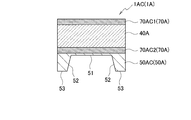
- FIG. 8 is a schematic cross-sectional view showing a pressure sensor according to the third embodiment.
- a pressure sensor 1AC (1A) shown in FIG. 8 includes a substrate 50AC (50A) and a functional element 40A stacked on the substrate 50AC via an electrode 70AC2.
- the substrate 50AC includes a thin film substrate thin film portion 51 in which the thickness in the stacking direction with the functional element 40A is smaller than the thickness in the other direction of the substrate 50AC.
- the pressure sensor 1AC further includes an electrode 70A.
- One electrode 70AC1 is provided on the surface of the functional element 40A, and one electrode 70AC2 is provided on the interface between the substrate 50AC and the functional element 40A.
- the substrate thin film portion 51 of the substrate 50AC and the functional element 40A are not in physical contact because the electrode 70A is interposed.
- the pressure sensor 1AC according to the third embodiment shown in FIG. 8 is provided with one electrode 70AC1 on the surface of the functional element 40A compared to the pressure sensor 1AB according to the second embodiment shown in FIG. It is different. Further, the pressure sensor 1AC according to the third embodiment shown in FIG. 8 has an electrode 70AC2 at the interface between the substrate 50AC and the functional element 40A, as compared with the pressure sensor 1AB according to the second embodiment shown in FIG. Is different in that one is provided.
- the pressure sensor 1AC according to the third embodiment and the pressure sensor 1AB according to the second embodiment are the same in other respects. For this reason, in the pressure sensor 1AC according to the third embodiment shown in FIG. 8 and the pressure sensor 1AB according to the second embodiment shown in FIG. Is omitted.
- the substrate 50AC (50A) of the pressure sensor 1AC according to the third embodiment is the same as the substrate 50AA (50A) of the pressure sensor 1AA according to the first embodiment, description thereof is omitted.
- one electrode 70AC1 is provided on the surface of the functional element 40A, and one electrode 70AC2 is provided at the interface between the substrate 50AC and the functional element 40A.
- the electrode 70AC2 is provided at the interface between the substrate 50AC and the functional element 40A. That is, the electrode 70AC1 and the electrode 70AC2 are arranged so as to sandwich the functional element 40A.
- the pressure sensor 1AC it is possible to detect that the electric conductivity in the perpendicular direction of the functional element 40A changes due to the arrangement of the electrodes 70AC1 and 70AC2.
- the electrode 70AC1 and the electrode 70AC2 are each formed so as to cover the entire front and back surfaces of the functional element 40A. That is, the electrode 70AC1 and the electrode 70AC2 are configured such that the lengths in the front and depth directions in FIG. 8 coincide with the lengths in the front and depth directions of the front and back surfaces of the functional element 40A.
- one or more of the electrode 70AC1 and the electrode 70AC2 may be formed so as to cover a part of the surface of the functional element 40A. That is, the electrode 70AC1 and the electrode 70AC2 can be configured such that the length in the front and depth directions in FIG. 8 is shorter than the length in the front and depth directions of the surface of the functional element 40A. According to this modification, it is possible to measure the electrical conductivity and the like of the functional element 40A in the part where the electrode 70AC1 and the electrode 70AC2 face each other in the functional element 40A.
- the electrode 70A is electrically connected to the front and back surfaces of the functional element 40A.
- the functional element 40A changes in physical properties such as electrical conductivity as the crystal structure of the crystal grains changes in accordance with changes in temperature and pressure.
- the electrodes 70AC1 and 70AC2 detect that the electrical conductivity in the direction perpendicular to the functional element 40A changes as the crystal structure of the crystal grains changes according to temperature change and pressure change.
- the number of electrodes 70A can be two or more including the electrodes 70AC1 and 70AC2. That is, one or more electrodes 70A can be provided on the surface of the functional element 40A, and one or more electrodes 70A can be provided on the interface between the substrate 50AC and the functional element 40A. Specifically, as a modification of the pressure sensor 1AC, in addition to the electrodes 70AC1 and 70AC2, one or more electrodes 70A (not shown) can be provided apart from the electrodes 70AC1 and 70AC2. Thus, when many electrodes 70A are provided, it becomes possible to detect the change in electrical conductivity of the functional element 40A with high accuracy.
- the same material as that of the electrodes 70AB1 and 70AB2 of the pressure sensor 1AB according to the second embodiment shown in FIG. 7 is used.
- the thicknesses of the electrodes 70AC1 and 70AC2 are the same as those of the electrodes 70AB1 and 70AB2 of the pressure sensor 1AB according to the second embodiment shown in FIG.
- the pressure sensor 1AC according to the third embodiment shown in FIG. 8 exhibits the same operation as the pressure sensor 1AA according to the first embodiment shown in FIG.
- the substrate thin film portion 51 and the functional element 40A are not in contact with each other. For this reason, when heating / cooling is not performed, no shear stress is applied to the functional element 40A by the substrate thin film portion 51 at the interface with the functional element 40A. Further, in the pressure sensor 1AC, no shear stress is generated due to the difference in thermal expansion coefficient between the substrate thin film portion 51 and the functional element 40A due to heating and cooling. For this reason, in the pressure sensor 1AC, the occurrence of peeling between the substrate 50AA, the functional element 40A and the electrode 70A and the occurrence of cracks in the functional element 40A and the electrode 70A are prevented or suppressed.
- the pressure sensor 1AC includes electrodes 70AC1 and 70AC2 (70A). Therefore, according to the pressure sensor 1AC, the change in the electric conductivity in the direction perpendicular to the surface of the functional element 40A is detected to detect the crystal structure of the crystal grains of the functional element 40A. The maximum pressure in the pressure history can be detected.
- the pressure sensor 1AC since the electrode 70AC2 is provided at the interface between the substrate thin film portion 51 and the functional element 40A, the substrate thin film portion 51 and the functional element 40A are not in physical contact. For this reason, in the pressure sensor 1AC, a minute pressure such as an ultrasonic irradiation pressure applied to the substrate thin film portion 51 may be attenuated by the electrode 70AC2 before reaching the functional element 40A. For this reason, the pressure sensor 1AC may have a lower ability to detect a minute pressure such as an ultrasonic irradiation pressure than the pressure sensors 1AA and 1B according to the first and second embodiments. However, the pressure sensor 1AC also has a pressure detection capability larger than the ultrasonic irradiation pressure.
- the shear stress based on the difference in thermal expansion coefficient between the substrate thin film portion 51 and the functional element 40A due to heating and cooling. Does not occur.
- the occurrence of peeling between the substrate 50AC, the functional element 40A and the electrode 70A, and the occurrence of cracks in the functional element 40A and the electrode 70A due to heating and cooling are prevented or suppressed. Is done.
- the pressure sensor 1AC since the substrate thin film portion 51 and the functional element 40A are not in physical contact with each other, the shear stress applied to the interface between the substrate thin film portion 51 and the functional element 40A even when heating / cooling is not performed. Does not occur. For this reason, according to the pressure sensor 1AC, the occurrence of separation between the substrate 50AC and the functional element 40A and the electrode 70A and the occurrence of cracks in the functional element 40A and the electrode 70A when not heated and cooled are prevented. Or suppressed.
- the pressure sensor 1AC includes electrodes 70AC1 and 70AC2 (70A). Therefore, according to the pressure sensor 1AC, the change in the electric conductivity in the direction perpendicular to the surface of the functional element 40A is detected to detect the crystal structure of the crystal grains of the functional element 40A. The maximum pressure in the pressure history can be detected.
- the pressure sensor 1AC uses an inexpensive functional element whose physical properties change according to temperature change and pressure change. For this reason, the pressure sensor 1AC also has an inexpensive temperature sensor function that prevents or suppresses the occurrence of peeling between the substrate and the functional element or electrode, and the occurrence of cracks in the functional element or electrode. A pressure sensor is obtained.
- FIG. 10 is a schematic perspective view showing a pressure sensor according to the fourth embodiment.
- a pressure sensor 1BA (1B) shown in FIG. 10 includes a pressure sensor body 10BA (10B). Note that the pressure sensor 1BA only needs to include at least the pressure sensor main body 10BA shown in FIG. 10, and may include peripheral members not shown.
- pressure sensors 1BB to 1BM according to fifth to sixteenth embodiments to be described later also include pressure sensor bodies 10BB to 10BM.
- the pressure sensor main body 10BA is a member that includes the functional element 40B and whose physical properties change according to a pressure change.
- the pressure sensor main body 10BA shown in FIG. 10 is composed of the functional element 40BA (40B) and does not substantially contain any material other than the functional element 40BA.
- the pressure sensor main body 10B includes a base material 30B that is a material other than the functional element 40B.
- the functional element 40B means an element that has a composition of trititanium pentoxide (Ti 3 O 5 ) and whose physical properties change according to a pressure change when a pressure of 1 MPa or more is applied. Usually, this change in physical properties appears when the functional element 40B is below 190 ° C.
- Functional element 40B is an element made of functional titanium oxide.
- functional titanium oxide is the material of the functional element 40B.
- the functional titanium oxide means a substance that has a composition of trititanium pentoxide and whose physical properties change according to a pressure change when a pressure of 1 MPa or more is applied.
- Functional titanium oxide has at least one crystal grain of ⁇ phase trititanium pentoxide in a state where no pressure is applied, and at least one crystal grain of ⁇ phase trititanium pentoxide when a pressure of 1 MPa or more is applied. It is a substance whose part is changed to ⁇ -phase trititanium pentoxide crystal grains.
- functional titanium oxide is usually a crystal of ⁇ -phase trititanium pentoxide even when a pressure of less than 1 MPa is applied from a state where no pressure is applied, at least part of the crystal grains of ⁇ -phase trititanium pentoxide. Change to grain.
- the degree of change from the crystal grains of ⁇ phase trititanium pentoxide to the crystal grains of ⁇ phase trititanium pentoxide is easy.
- the property that at least a part of the crystal grains of ⁇ -phase trititanium pentoxide change to ⁇ -phase trititanium pentoxide crystal grains when a pressure of 1 MPa or more is applied is generally manifested at less than 190 ° C. To do.
- the functional titanium oxide exceeds 190 ° C., at least a part of the crystal grains of the trititanium pentoxide phase change to the crystal grains of the ⁇ -phase trititanium pentoxide, and the ⁇ -phase tritium pentoxide is transformed from the ⁇ -phase trititanium pentoxide Phase transition to titanium becomes difficult.
- Examples of the physical property that the functional element 40B and the functional titanium oxide that is the material thereof change according to the pressure change include one or more selected from electrical conductivity, color, and magnetism. These physical properties will be described later.
- the functional titanium oxide has crystal grains of at least ⁇ phase trititanium pentoxide ( ⁇ -Ti 3 O 5 ) in a state where the temperature is less than 190 ° C. and no pressure is applied.
- Functional titanium oxide usually has a crystal grain of ⁇ -phase trititanium pentoxide ( ⁇ -Ti 3 O 5 ) and ⁇ -phase trititanium pentoxide ( ⁇ -Ti 3 ) in a state where the temperature is less than 190 ° C. and no pressure is applied. O 5 ) crystal grains.
- the functional titanium oxide usually has two phases of ⁇ phase trititanium pentoxide and ⁇ phase trititanium pentoxide in a state where the temperature is less than 190 ° C. and no pressure is applied.
- the phase ratio of ⁇ phase trititanium pentoxide and ⁇ phase trititanium pentoxide is not particularly limited.
- Functional titanium oxide has a property that when a pressure of 1 MPa or more is applied at less than 190 ° C., at least a part of crystal grains of ⁇ phase trititanium pentoxide are changed to crystal grains of ⁇ phase trititanium pentoxide. That is, functional titanium oxide has a phase transition of at least part of the crystal grains of ⁇ phase trititanium pentoxide when a pressure of 1 MPa or more is applied at less than 190 ° C. It has the property of changing to
- functional titanium oxide has the property that, as the pressure applied at less than 190 ° C. increases, the ratio of ⁇ phase trititanium pentoxide crystal grains to phase transition to ⁇ phase trititanium pentoxide crystal grains increases.
- functional titanium oxide has a property that the amount of phase transition from ⁇ phase trititanium pentoxide to ⁇ phase trititanium pentoxide increases with an increase in pressure applied at less than 190 ° C.
- the functional titanium oxide has a property that the phase ratio of the ⁇ phase trititanium pentoxide decreases and the phase ratio of the ⁇ phase trititanium pentoxide increases as the applied pressure increases at less than 190 ° C.
- the functional titanium oxide includes less than 190 ° C. and X mole% of ⁇ -phase trititanium pentoxide grains and 100-X mole% of ⁇ -phase trititanium pentoxide grains in a state where no pressure is applied.
- the value of X decreases when a pressure of 1 MPa or more is applied.
- phase ratio change characteristic The characteristic of the functional titanium oxide that the phase ratio of the ⁇ phase trititanium pentoxide decreases and the phase ratio of the ⁇ phase trititanium pentoxide increases as the applied pressure increases differs for each functional titanium oxide.
- This characteristic is hereinafter referred to as “phase ratio change characteristic”.
- the phase ratio change characteristic is considered to be determined by the phase ratio of the ⁇ phase and the ⁇ phase in a state where no pressure is applied, the size of crystal grains, etc. of the functional titanium oxide. For this reason, if the phase ratio change characteristic is measured in advance for each functional titanium oxide, by measuring the phase ratio of ⁇ phase or ⁇ phase of trititanium pentoxide in the functional titanium oxide after pressure application, It is possible to measure the pressure applied to the characteristic titanium oxide.
- functional titanium oxide has a phase transition at less than 190 ° C. once the crystal structure of the crystal grains undergoes phase transition between ⁇ phase trititanium pentoxide and ⁇ phase trititanium pentoxide in response to pressure changes. It has the property that the subsequent crystalline state is maintained. For this reason, the maximum value of the pressure applied to the functional titanium oxide is calculated by applying the ⁇ phase ratio or ⁇ phase ratio of the functional titanium oxide after pressure application to the phase ratio change characteristic measured in advance. be able to.
- phase ratio change characteristic When the sum of the phase ratios of ⁇ phase trititanium pentoxide and ⁇ phase trititanium pentoxide in the functional titanium oxide is 100 mol%, the phase ratio of ⁇ phase and ⁇ phase trititanium pentoxide is usually It is expressed as follows. That is, in the coordinates where the vertical axis is the phase ratio (mol%) of ⁇ -phase trititanium pentoxide and the horizontal axis is the pressure applied to the functional titanium oxide, the ⁇ -phase ternary pentoxide of functional titanium oxide at less than 190 ° C. The phase ratio of titanium is drawn as a monotonically decreasing curve ( ⁇ phase ratio curve C ⁇ ). On the other hand, at the same coordinates, the phase ratio of ⁇ -phase trititanium pentoxide of functional titanium oxide below 190 ° C. is drawn as a monotonically increasing curve ( ⁇ -phase ratio curve C ⁇ ).
- the ⁇ phase ratio or ⁇ phase ratio of the functional titanium oxide after application of pressure is applied to the previously measured ⁇ phase ratio curve C ⁇ or ⁇ phase ratio curve C ⁇ , it is applied to the functional titanium oxide.
- the maximum value of the applied pressure can be calculated.
- the ⁇ phase ratio curve C ⁇ and the ⁇ phase ratio curve C ⁇ included in the phase ratio change characteristic are the phases of the functional titanium oxide between the ⁇ phase and the ⁇ phase when no pressure is applied. It is considered that it is determined by the ratio, the size of crystal grains, and the like.
- the ⁇ phase ratio curve C ⁇ and the ⁇ phase ratio curve C ⁇ are: May intersect.
- the phase ratio (R ⁇ 0 ) when the applied pressure in the ⁇ phase ratio curve C ⁇ is 0 is larger than the phase ratio (R ⁇ 0 ) when the applied pressure in the ⁇ phase ratio curve C ⁇ is 0, ⁇
- the phase ratio curve C ⁇ may intersect with the ⁇ phase ratio curve C ⁇ .
- the ⁇ phase ratio and the ⁇ phase ratio are reversed at the pressure at the intersection (P INT ) of the ⁇ phase ratio curve C ⁇ and the ⁇ phase ratio curve C ⁇ .
- the intersection point becomes larger than the ⁇ -phase ratio lambda phase ratio in the pressure range of less than the pressure of P INT, lambda phase fraction in the pressure range exceeding the pressure of the intersection point P INT is smaller than ⁇ phase ratio.
- the functional titanium oxide of the present embodiment adjusts the intersection point P INT to an arbitrary pressure value by adjusting the phase ratio of ⁇ phase trititanium pentoxide and ⁇ phase trititanium pentoxide and the size of these crystal grains. It is possible to adjust to.
- the functional titanium oxide is prepared so that the phase ratio of the ⁇ phase trititanium pentoxide is larger than the phase ratio of ⁇ phase trititanium pentoxide when a predetermined pressure is applied at less than 190 ° C. Is possible.
- the applied maximum pressure is equal to or higher than the intersection point P INT. Is easy to detect.
- ⁇ -phase trititanium pentoxide and ⁇ -phase trititanium pentoxide which constitute functional titanium oxide
- ⁇ -phase trititanium pentoxide and ⁇ -phase trititanium pentoxide have different electrical conductivities.
- ⁇ -phase trititanium pentoxide has an electrical conductivity within the same range as many semiconductors
- ⁇ -phase trititanium pentoxide has an electrical conductivity within the same range as many metals.
- the maximum value of the pressure applied to the functional titanium oxide can be calculated by measuring the electrical conductivity of the functional titanium oxide with a known electrical conductivity measuring device.
- the change in the electrical conductivity of the functional titanium oxide can be known, for example, by measuring the electrical resistance between two or more electrodes via the functional titanium oxide.
- the ⁇ -phase trititanium pentoxide and the ⁇ -phase trititanium pentoxide are different in color. Specifically, ⁇ -phase trititanium pentoxide is red or reddish brown, and ⁇ -phase trititanium pentoxide is blue. For this reason, when the ⁇ phase ratio or ⁇ phase ratio of the functional titanium oxide is calculated by visually observing the color of the functional titanium oxide or by evaluating the absorption spectrum of light of each wavelength, the functional oxidation The maximum value of pressure applied to titanium can be calculated.
- the ⁇ -phase trititanium pentoxide and the ⁇ -phase trititanium pentoxide have different magnetic properties.
- ⁇ phase trititanium pentoxide is a non-magnetic material
- ⁇ phase trititanium pentoxide is a paramagnetic material. Therefore, the maximum value of the pressure applied to the functional titanium oxide can be calculated by measuring the magnetic difference of the functional titanium oxide with a known magnetization evaluation apparatus.
- the average particle diameter (median diameter) of functional titanium oxide crystal grains is usually 1 to 1000 nm, preferably 5 to 50 nm, and more preferably 10 to 20 nm.
- the average grain size of the functional titanium oxide crystal grains means the average grain diameter of the ⁇ -phase trititanium pentoxide crystal grains and ⁇ -phase trititanium pentoxide crystal grains constituting the functional titanium oxide.
- the physical properties may not change according to the pressure change. For example, physical properties of bulk trititanium pentoxide generally do not change according to pressure changes.
- the smallest unit having a function as a functional titanium oxide is a crystal grain of trititanium pentoxide having an average particle diameter within the above range.
- a minimum unit having a function as a functional titanium oxide it is also possible to use a nanoparticle made of a single crystal of a crystal grain having an average particle diameter within the above range as it is.
- the functional titanium oxide is usually a polycrystal of crystal grains of trititanium pentoxide having an average particle size in the above range. Is used.
- the polycrystal of the crystal grains is not particularly limited with respect to the shape, but for example, a granular one is used.
- the size of the polycrystalline body of the granular crystal grains is, for example, an average particle diameter (median diameter) of usually 50 nm to 500 ⁇ m, preferably 1 ⁇ m to 50 ⁇ m, more preferably 3 ⁇ m to 8 ⁇ m.
- an average particle diameter (median diameter) of the polycrystalline body of the granular crystal grains is within the above range, handling is easy.
- the polycrystalline body of granular crystal grains can be used as it is, but it is a compact of a polycrystalline body of crystal grains, such as a green compact obtained by compacting a large number of granular crystalline grains, It can be used by being included in the base material 30B.
- the molded body may be molded without using a mold, but may be a molded body manufactured using a mold.
- the functional element 40BA of the pressure sensor main body 10BA of the pressure sensor 1BA according to the fourth embodiment is a molded body made of functional titanium oxide, specifically, a polycrystalline body of functional titanium oxide crystal grains. It is a green compact that is pressed and hardened.
- the functional element 40B and the functional titanium oxide which is the material of the functional element 40B, have a crystal structure of crystal grains that undergo phase transition between ⁇ -phase trititanium pentoxide and ⁇ -phase trititanium pentoxide in accordance with pressure changes.
- the physical properties change.
- the functional element 40B and the functional titanium oxide that is the material of the functional element 40B undergo phase transition between the ⁇ phase trititanium pentoxide and the ⁇ phase trititanium pentoxide even when the temperature changes.
- the composition of crystal grains changes to something other than trititanium pentoxide.
- functional titanium oxide in the case where there is substantially no change in applied pressure once the crystal structure of the crystal grains undergoes phase transition or the composition of the crystal grains changes according to the temperature change, It has the property of maintaining the crystalline state after phase transition or composition change.
- Functional titanium oxide has ⁇ -phase trititanium pentoxide crystal grains and ⁇ -phase trititanium pentoxide crystal grains at normal pressure and lower than 350 ° C.
- Functional titanium oxide usually has the property that, when heated to 190 ° C. or higher and lower than 350 ° C., at least a part of ⁇ -phase trititanium pentoxide crystal grains undergo phase transition to ⁇ -phase trititanium pentoxide crystal grains. . For this reason, even with functional titanium oxide whose phase ratio of ⁇ phase trititanium pentoxide has decreased once according to the pressure change, the phase ratio of ⁇ phase trititanium pentoxide can be increased by heating to 190 ° C or higher and lower than 350 ° C. Can be raised again. Thus, functional titanium oxide can be reused as a substance for detecting pressure change by heating to 190 ° C. or higher and lower than 350 ° C.
- functional titanium oxide has a structure in which at least part of ⁇ -phase trititanium pentoxide crystal grains and ⁇ -phase trititanium pentoxide crystal grains are titanium dioxide (TiO 2 ) when heated to 350 ° C. or higher under normal pressure. It has the property of changing to crystal grains. Specifically, the composition of ⁇ phase trititanium pentoxide crystal grains changes to titanium dioxide crystal grains when heated to 350 ° C. or higher. Therefore, the functional titanium oxide has ⁇ -phase trititanium pentoxide crystal grains, ⁇ -phase trititanium pentoxide crystal grains, and titanium dioxide (TiO 2 ) crystal grains at normal pressure and at 350 ° C. or higher. . Titanium dioxide (TiO 2 ) is a concept including rutile, anatase, and brookite.
- titanium dioxide has different physical properties from ⁇ -phase trititanium pentoxide and ⁇ -phase trititanium pentoxide constituting functional titanium oxide.
- titanium dioxide, ⁇ -phase trititanium pentoxide, and ⁇ -phase trititanium pentoxide have different electrical conductivities.
- titanium dioxide has an electrical conductivity within the same range as many insulators.
- ⁇ -phase trititanium pentoxide has an electrical conductivity in the same range as many semiconductors
- ⁇ -phase trititanium pentoxide has an electrical conductivity in the same range as many metals.
- the presence of titanium dioxide in the functional titanium oxide is confirmed by measuring the difference in electric conductivity in the functional titanium oxide after being heated to 350 ° C. or higher with a known electric conductivity measuring device. be able to.
- titanium dioxide, ⁇ -phase trititanium pentoxide and ⁇ -phase trititanium pentoxide have different colors. Specifically, titanium dioxide has a white color difference, ⁇ -phase trititanium pentoxide is red or reddish brown, and ⁇ -phase trititanium pentoxide has a blue color difference. For this reason, the presence of titanium dioxide in the functional titanium oxide by visually observing the color of the functional titanium oxide after being heated to 350 ° C. or higher or by evaluating the absorption spectrum of light of each wavelength. Can be confirmed.
- the magnetic properties of titanium dioxide, ⁇ -phase trititanium pentoxide and ⁇ -phase trititanium pentoxide are different.
- the difference in magnetism in functional titanium oxide after being heated to 350 ° C. or higher is measured by a known magnetization evaluation apparatus, so that ⁇ -phase trititanium pentoxide and ⁇ -phase pentoxide in functional titanium oxide are measured.
- the presence of trititanium and titanium dioxide can be confirmed.
- the functional titanium oxide which is the material of the functional element 40B constituting the pressure sensor main body 10BA, changes its physical properties in accordance with the pressure change when a pressure of 1 MPa or more is applied, thereby reducing the pressure.
- the action to detect is shown.
- the pressure sensor 1BA is used in a temperature region where the pressure sensor body 10BA is less than 190 ° C. This is because when the pressure sensor main body 10A exceeds 190 ° C., the functional titanium oxide, which is the material of the functional element 40B constituting the pressure sensor main body 10BA, does not change its physical properties according to the pressure change. Further, once the physical property changes according to the pressure change, the pressure sensor main body 10BA of the pressure sensor 1BA maintains the changed physical property even when the applied pressure is released. For this reason, the following description demonstrates the effect
- the pressure sensor 1BA when a pressure of 1 MPa or more is applied to the pressure sensor body 10BA at less than 190 ° C., at least a part of the ⁇ -phase trititanium pentoxide crystal grains of the functional element 40B made of functional titanium oxide is present. It changes to the crystal grain of ⁇ phase trititan pentoxide.
- the ⁇ phase trititanium pentoxide crystal grains undergo phase transition to ⁇ phase trititanium pentoxide crystal grains as the pressure applied at less than 190 ° C. increases.
- the rate increases. That is, in the functional element 40B made of functional titanium oxide, the phase ratio of the ⁇ -phase trititanium pentoxide decreases and the phase ratio of the ⁇ -phase trititanium pentoxide decreases as the applied pressure increases at less than 190 ° C. Has the property of increasing.
- the characteristic of this functional titanium oxide that the phase ratio of ⁇ phase trititanium pentoxide decreases and the phase ratio of ⁇ phase trititanium pentoxide increases with increasing applied pressure (phase ratio change characteristic) Different for each titanium oxide.
- the phase ratio change characteristic is measured in advance for the functional element 40B constituting the pressure sensor body 10BA
- the maximum value of the pressure applied to the pressure sensor body 10BA can be measured. That is, if the phase ratio change characteristic is measured in advance for the functional element 40B, the functional element is obtained by measuring the ⁇ phase or ⁇ phase ratio of trititanium pentoxide in the functional element 40B after pressure application. It becomes possible to measure the maximum value of the pressure applied to 40B.
- the pressure sensor 1BA it is possible to measure the maximum value of the pressure applied to the pressure sensor body 10BA.
- the function of changing the physical properties according to the pressure change of the functional element 40B made of functional titanium oxide is based on the characteristics of the functional titanium oxide itself. This facility is unnecessary.
- the functional element 40B made of functional titanium oxide can raise the phase ratio of the ⁇ -phase trititanium pentoxide again by heating to 190 ° C. or higher and lower than 350 ° C.
- the pressure sensor 1BA can be reused as a substance for detecting a pressure change by heat treatment of the pressure sensor body 10BA at 190 ° C. or higher and lower than 350 ° C.
- the pressure sensor 1BA can be used repeatedly and does not require a power source.
- the property that the physical properties change due to the pressure change of the functional titanium oxide that is the material of the functional element 40B constituting the pressure sensor body 10BA is not affected by the surrounding atmosphere. For this reason, pressure sensor 1BA can be used in atmospheres, such as in air, oxygen, and nitrogen.
- FIG. 11 is a schematic perspective view showing a pressure sensor according to the fifth embodiment.
- a pressure sensor 1BB (1B) shown in FIG. 11 includes a pressure sensor body 10BB (10B).
- the pressure sensor body 10BB is composed of a functional element 40BB (40B), and the functional element 40BB is a thin film 40BB composed of functional titanium oxide.
- the thin film 40BB is formed on the substrate 50B.
- the pressure sensor 1BB includes a substrate 50B and a thin film 40BB as a functional element formed on the substrate 50B.
- the pressure sensor 1BB according to the fifth embodiment shown in FIG. 11 is different from the pressure sensor 1BA according to the fourth embodiment shown in FIG. 10 in terms of the shape of the pressure sensor body 10BB and the presence or absence of the substrate 50B. It is different, but the other points are the same. For this reason, the same reference numerals are given to the same members in the pressure sensor 1BB according to the fifth embodiment shown in FIG. 11 and the pressure sensor 1BA according to the fourth embodiment shown in FIG. Omitted or simplified.
- the pressure sensor body 10BB is composed of the functional element 40BB (40B) and is made of a material other than the functional element 40BB. Not included.
- Functional element 40BB consists of functional titanium oxide which is the same material as functional element 40BA of pressure sensor 1BA which concerns on 4th Embodiment shown in FIG. However, the functional element 40BB is formed on the substrate 50B.
- the functional element 40BB is a functional titanium oxide thin film, unlike the functional element 40BA shown in FIG. According to the thin-film functional element 40BB, the visibility can be improved by thinning the film to facilitate visual observation, and the absorption spectrum can be easily evaluated.
- the thin-film functional element 40BB is formed on the substrate 50B by using, for example, spin coating, dip coating, sputtering, CVD, laser application, aerosol deposition, or the like.
- the material of the substrate 50B is not particularly limited.
- Examples of the material of the substrate 50B include glass; a semiconductor such as Si, SiC, and GaN; an inorganic oxide such as sapphire; a metal such as Al, Cu, Ti, Ni, Sn, Au, Ag, and SUS; and a polyimide resin. Resin can be used.
- the pressure sensor 1BB includes a substrate 50B. For this reason, the pressure sensor 1BB has high mechanical strength. Further, the pressure sensor 1BB can adjust the pressure transfer property, the heat conduction property, the electric conduction property, etc. of the pressure sensor 1BB by adjusting the pressure transfer property, the heat conduction property, the electric conduction property, etc. of the substrate 50B. .
- the functional element 40BB is a thin film, so that the visibility is improved as compared with the pressure sensor 1BA.
- the pressure sensor 1BB includes a substrate 50B. For this reason, according to the pressure sensor 1BB, mechanical strength is high. Further, according to the pressure sensor 1BB, the pressure transferability, heat conduction characteristics, electrical conduction characteristics, etc. of the pressure sensor 1BB are adjusted by adjusting the pressure transferability, heat conduction characteristics, electrical conduction characteristics, etc. of the substrate 50B. Can do.
- FIG. 12A is a schematic perspective view showing a pressure sensor according to the sixth embodiment.
- FIG. 12B is a schematic cross-sectional view taken along the line CC of FIG.
- a pressure sensor 1BC (1B) shown in FIG. 12 includes a pressure sensor body 10BC (10B).
- This pressure sensor main body 10BC includes a base material 30BC (30B) and a functional element 40BC (40B) included in the base material 30BC.
- the pressure sensor 1BC according to the sixth embodiment shown in FIG. 12 differs from the pressure sensor 1BA according to the fourth embodiment shown in FIG. 10 in the configuration of the pressure sensor body 10BC, but other points are different. Are the same. For this reason, the same reference numerals are given to the same members in the pressure sensor 1BC according to the sixth embodiment shown in FIG. 12 and the pressure sensor 1BA according to the fourth embodiment shown in FIG. Omitted or simplified.
- the pressure sensor main body 10BC includes a base material 30BC and a functional element 40BC included in the base material 30BC.
- the base material 30BC shown in FIG. 12 is plate-shaped, the shape of the base material 30BC is not particularly limited.
- the functional element 40BC is a particle 40BC made of functional titanium oxide.
- the particles 40BC made of this functional titanium oxide are polycrystalline particles of functional titanium oxide crystal grains.
- the average particle diameter (median diameter) is usually 100 nm to 500 ⁇ m, preferably 1 ⁇ m to 50 ⁇ m, more preferably 3 ⁇ m to 8 ⁇ m. When the average particle diameter (median diameter) of the polycrystalline body of the granular crystal grains is within the above range, handling is easy.
- a base material 30BC is used to fix the particles 40BC made of functional titanium oxide.
- the base material 30BC is made of resin.
- a heat resistant resin such as polyimide is used.
- the pressure sensor 1BC can be used at a high temperature because the heat resistance is high.
- the resin constituting the base material 30BC may be a completely cured product or a gel-like material.
- the particles 40BC made of functional titanium oxide are contained in the base material 30BC in a dispersed state.
- the pressure sensor body 10BC is obtained, for example, by adding and mixing particles 40BC made of functional titanium oxide in a fluid base material 30BC.
- the action of the pressure sensor 1BC is other than the point that the action of the functional element 40B, which is an element whose physical properties change according to the pressure change, appears in the particulate functional element 40BC, and the action based on the base material 30BC. Is the same as the operation of the pressure sensor 1BA shown in FIG. For this reason, description about the effect
- the functional element 40B which is an element whose physical properties change in response to a pressure change, in the particulate functional element 40BC. Similar to the functional element 40BA of the pressure sensor 1BA according to the fourth embodiment shown in FIG. 10, the physical properties of the particulate functional element 40BC change according to the pressure change. However, since the functional element 40BC is substantially included in the base material 30BC, pressure is indirectly applied through the base material 30BC. The action of the pressure sensor 1BC is the same as that of the pressure sensor 1BA according to the fourth embodiment shown in FIG. 10 except for the action of applying pressure indirectly through the base material 30BC.
- the change of the color of functional element 40BC is observed or measured via base material 30BC.
- the physical property that changes in accordance with the pressure change is electrical conductivity
- the change in electrical conductivity of the functional element 40BC is measured via the base material 30BC.
- the pressure sensor 1BC includes a base material 30BC made of resin. For this reason, according to the pressure sensor 1C, mechanical strength is high. Further, according to the pressure sensor 1BC, the heat conduction characteristic, the electric conduction characteristic, etc. of the pressure sensor 1BC can be adjusted by adjusting the heat conduction characteristic, the electric conduction characteristic, etc. of the base material 30BC. Adjustment of the heat conduction characteristic, the electric conduction characteristic, and the like of the base material 30BC can be performed by adjusting the resin material of the base material 30BC, the amount of the base material 30BC with respect to the functional element 40BC, and the like.
- the pressure sensor 1BC Furthermore, according to the pressure sensor 1BC, at least a base material 30BC made of a resin having fluidity at the time of manufacture is provided. For this reason, according to the pressure sensor 1BC, it is easy to form in arbitrary shapes.
- FIG. 13A is a schematic perspective view showing a pressure sensor according to the seventh embodiment.
- FIG. 13B is a schematic cross-sectional view taken along the line DD in FIG.
- a pressure sensor 1BD (1B) shown in FIG. 13 includes a pressure sensor body 10BD (10B).
- This pressure sensor main body 10BD includes a base material 30BD (30B) and a functional element 40BD (40B) included in the base material 30BD.
- the pressure sensor 1BD according to the seventh embodiment shown in FIG. 13 is different from the pressure sensor 1BC according to the sixth embodiment shown in FIG. 12 in the configuration of the pressure sensor body 10BD, but other points. Are the same. For this reason, the same code
- the pressure sensor main body 10BD has a base material 30BD and a functional element 40BD included in the base material 30BD.
- the base material 30BD shown in FIG. 13 is plate-shaped, the shape of the base material 30BD is not particularly limited.
- the same resin as the base material 30BC used in the pressure sensor 1BC according to the sixth embodiment shown in FIG. 12 is used.
- the functional element 40BD is a particle 40BD made of functional titanium oxide, similar to the functional element 40BC used in the pressure sensor 1BC according to the sixth embodiment shown in FIG.
- the particles 40BD made of functional titanium oxide the same particles 40BC made of functional titanium oxide used in the pressure sensor 1BC according to the sixth embodiment can be used.
- a plurality of particles 40BD made of functional titanium oxide are connected to form a linked body 45 of particles made of functional titanium oxide. That is, in the pressure sensor main body 10BD, a plurality of particles 40BD made of functional titanium oxide are included in the base material 30BD in a state where a plurality of particles 40BD are connected.
- the number of particles 40BD connected in the particle connection body 45 made of functional titanium oxide is not particularly limited, and may be two or more.
- FIG. 13B illustrates a case where the number of particles 40BD connected in the particle connection body 45 made of functional titanium oxide is nine.
- the longitudinal direction of the particle connection body 45 made of functional titanium oxide is a direction perpendicular to the front and back surfaces of the pressure sensor body 10BD.
- the connecting body 45 of particles made of functional titanium oxide is arranged in this way, the pressure transferability, thermal conductivity and conductivity in the direction perpendicular to the front and back surfaces of the pressure sensor body 10BD are improved, and the pressure measurement accuracy is improved. Is improved, and heat treatment for reuse becomes easy.
- the particle connected body 45 made of functional titanium oxide two or more particles 40BD made of functional titanium oxide having higher pressure transferability, thermal conductivity, and conductivity than the resin constituting the base material 30BD are connected. Yes. For this reason, in the pressure sensor body 10BD, the pressure transferability, thermal conductivity, and conductivity between the particles 40BD are high.
- the functional titanium oxide particles 45 are connected so that the longitudinal direction of the particles 45 of the functional titanium oxide is perpendicular to the direction perpendicular to the front and back surfaces of the pressure sensor body 10BD.
- a connecting body 45 can also be arranged.
- the direction orthogonal to the direction perpendicular to the front and back surfaces of the pressure sensor body 10BD is the left-right direction in FIG.
- the pressure sensor main body 10BD is obtained, for example, by introducing and molding a particle-linked body 45 made of functional titanium oxide into a fluid base material 30BD.
- the action of the pressure sensor 1BD is the same as the action of the pressure sensor 1BC according to the sixth embodiment shown in FIG.
- the pressure sensor main body 10BD includes a particle linking body 45 made of functional titanium oxide, a pressure change in a direction perpendicular to the front and back surfaces is quickly observed on the surface side compared to the pressure sensor 1BC. be able to.
- the pressure sensor body 10BD includes a particle connection body 45 made of functional titanium oxide. For this reason, according to the pressure sensor 1BD, the pressure change in the direction perpendicular to the front and back surfaces can be observed more quickly on the front side than the pressure sensor 1BC.
- FIG. 14A is a schematic perspective view showing a pressure sensor according to the eighth embodiment.
- FIG. 14B is a schematic cross-sectional view along the line EE in FIG.
- the pressure sensor 1BE (1B) shown in FIG. 14 includes a pressure sensor body 10BE (10B).
- the pressure sensor body 10BE includes a base material 30BE (30B) and a functional element 40BE (40B) included in the base material 30BE.
- the pressure sensor 1BE according to the eighth embodiment shown in FIG. 14 differs from the pressure sensor 1BC according to the sixth embodiment shown in FIG. 12 in the configuration of the pressure sensor main body 10BE, but other points. Are the same. For this reason, the same code
- the pressure sensor body 10BE has a base material 30BE and a functional element 40BE included in the base material 30BE.
- the base material 30BE shown in FIG. 14 is plate-shaped, but the shape of the base material 30BE is not particularly limited.
- the base material 30BE is made of a film, that is, a thin film.
- the film means a thin film having a dense structure substantially free of voids.
- the thickness of the base material 30BE is, for example, 1 mm or less, preferably 1 ⁇ m to 1 mm.
- the thickness of the base material 30BE is more preferably 1 ⁇ m or more and less than 0.2 mm.
- the thickness of the base material 30BE is more preferably 1 ⁇ m or more and less than 0.5 mm.
- the material of the base material 30BE is not particularly limited.
- a metal such as Al, Cu, Ti, Ni, Sn, Au, Ag, SUS, or a heat resistant resin such as polyimide is used.
- base material 30BE consists of these materials, since heat resistance is high, pressure sensor 1BE can be used under high temperature.
- the particles 40BE made of functional titanium oxide are included in the base material 30BE in a dispersed state.
- the pressure sensor main body 10BE is obtained, for example, by adding particles 40BE made of functional titanium oxide into a base material 30BE having fluidity, and mixing and molding the particles.
- the action of the pressure sensor 1BE is the same as the action of the pressure sensor 1BC according to the sixth embodiment shown in FIG.
- the pressure sensor 1BE is a film in which the base material 30BE is small, the pressure sensor 1BE is excellent in flexibility. For this reason, it is easy to stick or install pressure sensor 1BE on a curved surface.
- the pressure sensor 1BE is a film having a small thickness of the base material 30BE, it is excellent in flexibility. For this reason, according to the pressure sensor 1BE, it is easier to stick or install on the curved surface than the pressure sensor 1BC.
- FIG. 15A is a schematic perspective view showing a pressure sensor according to the ninth embodiment.
- FIG. 15B is a schematic cross-sectional view taken along the line FF in FIG.
- a pressure sensor 1BF (1B) shown in FIG. 15 includes a pressure sensor body 10BF (10B).
- the pressure sensor main body 10BF includes a base material 30BF (30B) and a functional element 40BF (40B) included in the base material 30BF.
- the pressure sensor 1BF according to the ninth embodiment shown in FIG. 15 differs from the pressure sensor 1BE according to the eighth embodiment shown in FIG. 14 in the configuration of the pressure sensor main body 10BF, but other points. Are the same. For this reason, the same reference numerals are given to the same members in the pressure sensor 1BF according to the ninth embodiment shown in FIG. 15 and the pressure sensor 1BE according to the eighth embodiment shown in FIG. Omitted or simplified.
- the pressure sensor body 10BF includes a base material 30BF and a functional element 40BF included in the base material 30BF.
- the base material 30BF shown in FIG. 15 is plate-shaped, but the shape of the base material 30BF is not particularly limited.
- the base material 30BF As the base material 30BF, a film similar to the base material 30BE used in the pressure sensor 1BE according to the eighth embodiment shown in FIG. 14 is used.
- the functional element 40BF is a particle 40BE made of functional titanium oxide, similar to the functional element 40BE used in the pressure sensor 1BE according to the eighth embodiment shown in FIG.
- the particles 40BE made of functional titanium oxide the same particles 40BE made of functional titanium oxide used in the pressure sensor 1BE according to the eighth embodiment can be used.
- a plurality of particles 40BF made of functional titanium oxide are connected to form a connected body 45 of particles made of functional titanium oxide. That is, in the pressure sensor main body 10BF, a plurality of particles 40BF made of functional titanium oxide are included in the base material 30BF in a state where a plurality of particles 40BF are connected.
- the number of connected particles 40BF in the particle connection body 45 made of functional titanium oxide is not particularly limited, and may be two or more.
- FIG. 15B illustrates the case where the number of particles 40BF connected in the particle connection body 45 made of functional titanium oxide is three.
- the longitudinal direction of the particle connection body 45 made of functional titanium oxide is perpendicular to the front and back surfaces of the pressure sensor body 10BF.
- the connecting body 45 of particles made of functional titanium oxide is arranged in this way, the pressure transmission property, thermal conductivity and conductivity in the direction perpendicular to the front and back surfaces of the pressure sensor body 10BF are improved, and the pressure measurement accuracy is improved. Is improved, and heat treatment for reuse becomes easy.
- the particle-linked body 45 made of functional titanium oxide two or more particles 40BF made of functional titanium oxide, which have higher pressure transferability, thermal conductivity, and conductivity than the resin constituting the base material 30BF, are connected. Yes. For this reason, in the pressure sensor body 10BF, the pressure transferability, thermal conductivity, and conductivity between the particles 40BF are high.
- the functional titanium oxide particles 45 are connected so that the longitudinal direction of the particles 45 of the functional titanium oxide is perpendicular to the direction perpendicular to the front and back surfaces of the pressure sensor body 10BF.
- a connecting body 45 can also be arranged.
- the direction orthogonal to the direction perpendicular to the front and back surfaces of the pressure sensor body 10BF is the left-right direction in FIG.
- the pressure sensor main body 10BF is obtained, for example, by charging and molding a particle connection body 45 made of functional titanium oxide in a fluid base material 30BF.
- the action of the pressure sensor 1BF is the same as that of the pressure sensor 1BE according to the eighth embodiment shown in FIG.
- the pressure sensor main body 10BF includes a particle linking body 45 made of functional titanium oxide, a pressure change in a direction perpendicular to the front and back surfaces is quickly observed on the surface side compared to the pressure sensor 1BE. be able to.
- the pressure sensor body 10BF includes a particle connection body 45 made of functional titanium oxide. For this reason, according to the pressure sensor 1BF, the pressure change in the direction perpendicular to the front and back surfaces can be observed on the front surface side more quickly than the pressure sensor 1BE.
- FIG. 16A is a schematic perspective view showing a pressure sensor according to the tenth embodiment.
- FIG. 16B is a schematic cross-sectional view along the line GG in FIG.
- a pressure sensor 1BG (1B) shown in FIG. 16 includes a pressure sensor body 10BG (10B).
- This pressure sensor main body 10BG includes a base material 30BG (30B) and a functional element 40BG (40B) included in the base material 30BG.
- the pressure sensor 1BG according to the tenth embodiment shown in FIG. 16 differs from the pressure sensor 1BC according to the sixth embodiment shown in FIG. 12 in terms of the configuration of the pressure sensor body 10BE, but other points. Are the same. For this reason, the same reference numerals are given to the same members in the pressure sensor 1BG according to the tenth embodiment shown in FIG. 16 and the pressure sensor 1BC according to the sixth embodiment shown in FIG. Omitted or simplified.
- the pressure sensor main body 10BG includes a base material 30BG and a functional element 40BG included in the base material 30BG.
- the base material 30BG is a sheet made of woven fabric or non-woven fabric.
- the sheet means a woven fabric or a non-woven fabric.
- a material of base material 30BG For example, a glass fiber and a carbon fiber are used.
- the base material 30BG for example, a woven fabric of glass fiber or carbon fiber, a nonwoven fabric of glass fiber or carbon fiber, or the like is used.
- base material 30BG consists of these materials, since heat resistance is high, pressure sensor 1BG can be used under high temperature.
- the particles 40BG made of functional titanium oxide are contained in the base material 30BG in a dispersed state.
- the particles 40BG made of functional titanium oxide are included in the base material 30BG in a dispersed state, for example, by being entangled between the fibers constituting the base material 30BG or by being fixed to the fibers constituting the base material 30BG. It is.
- the pressure sensor body 10BG is obtained as follows, for example. That is, the base material 30BG is dipped in a solution or slurry containing the functional titanium oxide particles 40BG and then pulled up, and the functional titanium oxide particles 40BG are dispersed in the gaps between the fibers constituting the base material 30BG. Obtained by fixing.
- the action of the pressure sensor 1BG is the same as the action of the pressure sensor 1BC according to the sixth embodiment shown in FIG.
- the pressure sensor 1BG is excellent in flexibility because the base material 30BG is a sheet made of woven fabric or non-woven fabric. For this reason, it is easy to stick or install pressure sensor 1BG on a curved surface.
- the pressure sensor 1BG is excellent in flexibility because the base material 30BG is a sheet made of woven fabric or non-woven fabric. For this reason, according to the pressure sensor 1BG, it is easier to affix or install on the curved surface than the pressure sensor 1BC.
- FIG. 17A is a schematic perspective view showing a pressure sensor according to the eleventh embodiment.
- FIG. 17B is a schematic cross-sectional view taken along the line HH in FIG.
- a pressure sensor 1BH (1B) shown in FIG. 17 includes a pressure sensor body 10BH (10B).
- the pressure sensor body 10BH includes a base material 30BH (30B) and a functional element 40BH (40B) included in the base material 30BH.
- the pressure sensor 1BH according to the eleventh embodiment shown in FIG. 17 is different from the pressure sensor 1BG according to the tenth embodiment shown in FIG. 16 in the configuration of the pressure sensor body 10BH, but the other points. Are the same. For this reason, the same reference numerals are given to the same members in the pressure sensor 1BH according to the eleventh embodiment shown in FIG. 17 and the pressure sensor 1BG according to the tenth embodiment shown in FIG. Omitted or simplified.
- the pressure sensor main body 10BH has a base material 30BH and a functional element 40BH included in the base material 30BH.
- the base material 30BH As the base material 30BH, a sheet made of a woven fabric or a non-woven fabric similar to the base material 30BG used in the pressure sensor 1G according to the tenth embodiment shown in FIG. 16 is used.
- the functional element 40BH is a particle 40BH made of functional titanium oxide, similar to the functional element 40BG used in the pressure sensor 1BG according to the tenth embodiment shown in FIG.
- the particles 40 ⁇ / b> BH made of functional titanium oxide the same particles 40 ⁇ / b> BG made of functional titanium oxide used in the pressure sensor 1 ⁇ / b> BG according to the tenth embodiment can be used.
- a plurality of particles 40BH made of functional titanium oxide are connected to form a linked body 45 of particles made of functional titanium oxide. That is, in the pressure sensor main body 10BH, the particles 40BH made of functional titanium oxide are included in the base material 30BH in a state where a plurality of particles 40BH are connected.
- a particle connection body 45 made of functional titanium oxide formed by connecting particles 40BH made of functional titanium oxide is contained in the base material 30BH in a dispersed state.
- the particle connection body 45 is included in the base material 30BH in a dispersed state, for example, by being entangled between the fibers constituting the base material 30BH or by being fixed to the fibers constituting the base material 30BH.
- the number of particles 40BH connected in the particle connection body 45 made of functional titanium oxide is not particularly limited, and may be two or more.
- FIG. 17B illustrates the case where the number of particles 40BH connected in the particle connection body 45 made of functional titanium oxide is three.
- the longitudinal direction of the particle connection body 45 made of functional titanium oxide is perpendicular to the front and back surfaces of the pressure sensor body 10BH.
- the connecting body 45 of functional titanium oxide particles is arranged in this way, the pressure transmission property, thermal conductivity and conductivity in the direction perpendicular to the front and back surfaces of the pressure sensor body 10BH are improved, and the pressure measurement accuracy is improved. Is improved, and heat treatment for reuse becomes easy.
- the particle connection body 45 made of functional titanium oxide two or more particles 40BH made of functional titanium oxide having higher pressure transferability, thermal conductivity, and conductivity than the resin constituting the base material 30BH are connected. Yes. For this reason, in the pressure sensor body 10BH, the pressure transferability, thermal conductivity, and conductivity between the particles 40BH are high.
- the functional titanium oxide particles 45 are connected so that the longitudinal direction of the particles 45 of the functional titanium oxide is perpendicular to the direction perpendicular to the front and back surfaces of the pressure sensor body 10BH.
- a connecting body 45 can also be arranged.
- the direction orthogonal to the direction perpendicular to the front and back surfaces of the pressure sensor body 10BD is the left-right direction in FIG.
- the pressure sensor body 10BH is obtained as follows, for example. That is, the base material 30BH is dipped in a solution or slurry containing the particle-linked body 45 made of functional titanium oxide, and then pulled up, and the particles made of functional titanium oxide are placed in the gaps between the fibers constituting the base material 30BH. It is obtained by fixing the connecting body 45.
- the action of the pressure sensor 1BH is the same as the action of the pressure sensor 1BG according to the tenth embodiment shown in FIG.
- the pressure sensor main body 10BH includes a particle linking body 45 made of functional titanium oxide, a pressure change in a direction perpendicular to the front and back surfaces is quickly observed on the surface side as compared with the pressure sensor 1BG. be able to.
- the pressure sensor body 10BH includes a particle connection body 45 made of functional titanium oxide. For this reason, according to the pressure sensor 1BH, a pressure change in a direction perpendicular to the front and back surfaces can be observed on the front surface side more quickly than the pressure sensor 1BG.
- FIG. 18 is a schematic perspective view showing a pressure sensor according to the twelfth embodiment.
- a pressure sensor 1BI (1B) shown in FIG. 18 includes a pressure sensor body 10BI (10B).
- the pressure sensor body 10BI includes a base material 30BI (30B) and a functional element 40BI (40B) included in the base material 30BI.
- the pressure sensor main body 10BI is in the form of a slurry or gel and has fluidity, and thus is accommodated in the container 60.
- the pressure sensor 1BI includes a pressure sensor main body 10BI and a container 60 that accommodates the pressure sensor main body 10BI.
- the pressure sensor 1BI according to the twelfth embodiment shown in FIG. 18 differs from the pressure sensor 1BC according to the sixth embodiment shown in FIG. 12 in the configuration of the pressure sensor main body 10BI, but other points. Are the same. For this reason, the same reference numerals are given to the same members in the pressure sensor 1BI according to the twelfth embodiment shown in FIG. 18 and the pressure sensor 1BC according to the sixth embodiment shown in FIG. Omitted or simplified.
- the pressure sensor body 10BI has a base material 30BI and a functional element 40BI included in the base material 30BI.
- the base material 30BI is a liquid or a gel. Although it does not specifically limit as a material of base material 30BI, For example, a well-known organic solvent, an inorganic solvent, etc. are used. As the inorganic solvent, for example, water is used.
- the base material 30BI is made of an organic solvent or an inorganic solvent, when the slurry having the base material 30BI and the functional element 40BI is sprayed on the object to be measured, the base material 30BI easily evaporates, and only the functional element 40BI is used. This is preferable because it is easily fixed to the pressure measurement object. Further, when the base material 30BI is made of gel, when the gel having the base material 30BI and the functional element 40BI is sprayed on the pressure measurement object, the functional element 40BI in the gel adheres to or adheres to the pressure measurement object. Cheap.
- the particles 40BI made of functional titanium oxide are contained in the base material 30BI in a dispersed state.
- the pressure sensor main body 10BI is obtained, for example, by adding and mixing the particles 40BI made of functional titanium oxide in the base material 30BI.
- the action of the pressure sensor 1BI differs in action depending on whether or not the pressure sensor main body 10BI includes the base material 30BI when measuring the pressure of the pressure measurement object.
- the case where the pressure sensor body 10BI includes the base material 30BI when measuring the pressure of the pressure measurement object is, for example, the case where the pressure sensor body 10BI is used by flowing it into the pressure measurement object such as a pipe.
- the pressure sensor main body 10BI does not include the base material 30BI at the time of pressure measurement of the pressure measurement target object, for example, the pressure sensor main body 10BI is sprayed on the pressure measurement target object to volatilize the base material 30BI, and the functional element This is the case where only 40BI is fixed and used.
- the operation of the pressure sensor 1BI includes the base material 30B between itself and the pressure measurement object. This is the same as the action of the pressure sensor 1BC according to the sixth embodiment shown in FIG. For this reason, explanation of the operation in this case is omitted.
- the pressure sensor main body 10BI is used by being flown into a pressure measurement object such as a pipe, it is preferable in that the pressure at a place where measurement from the outside of the pipe is difficult can be measured.
- the pressure applied to the pressure sensor main body 10BI from the pressure measurement object such as a pipe is the pressure applied via the base material 30BI.
- the action of the pressure sensor 1BI when the pressure sensor body 10BI does not include the base material 30BI when measuring the pressure of the pressure measurement object is substantially the action of the pressure sensor 1BA according to the fourth embodiment shown in FIG. Is the same.
- the base material 30B is not interposed between the pressure sensor 1BI and the pressure measurement object.
- action in case pressure sensor main body 10BI does not contain base material 30BI at the time of the pressure measurement of a pressure measurement object is abbreviate
- the pressure sensor main body 10BI is sprayed onto the pressure measurement object, the base material 30BI is volatilized, and only the functional element 40BI is fixed and used, the pressure of only the portion where the pressure sensor main body 10BI is sprayed is measured. This is preferable in that it can be performed.
- FIG. 19 is a schematic perspective view showing a pressure sensor according to the thirteenth embodiment.
- a pressure sensor 1BJ (1B) shown in FIG. 19 includes a pressure sensor body 10BJ (10B).
- the pressure sensor body 10BJ includes a base material 30BJ (30B) and a functional element 40BJ (40B) included in the base material 30BJ.
- the pressure sensor 1BJ according to the thirteenth embodiment shown in FIG. 19 is different from the pressure sensor 1BI according to the twelfth embodiment shown in FIG. Are the same. For this reason, the same reference numerals are given to the same members in the pressure sensor 1BJ according to the thirteenth embodiment shown in FIG. 19 and the pressure sensor 1BI according to the twelfth embodiment shown in FIG. Omitted or simplified.
- the pressure sensor main body 10BJ includes a base material 30BJ and a functional element 40BJ included in the base material 30BJ.
- the same base material 30BI used in the pressure sensor 1BI according to the twelfth embodiment shown in FIG. 18 is used.
- the functional element 40BJ is a particle 40BJ made of functional titanium oxide, similar to the functional element 40BI used in the pressure sensor 1BI according to the twelfth embodiment shown in FIG.
- the particles 40BJ made of functional titanium oxide particles similar to the particles 40BI made of functional titanium oxide used in the pressure sensor 1BI according to the twelfth embodiment shown in FIG. 18 can be used.
- a plurality of particles 40BJ made of functional titanium oxide are connected to form a connected body 45 of particles made of functional titanium oxide. That is, in the pressure sensor body 10BJ, a plurality of particles 40BJ made of functional titanium oxide are included in the base material 30BJ in a state where a plurality of particles 40BJ are connected.
- the number of particles 40BJ connected in the particle connection body 45 made of functional titanium oxide is not particularly limited, and may be two or more.
- FIG. 19 exemplifies a case where the number of particles 40BJ connected in the particle connection body 45 made of functional titanium oxide is two.
- the pressure sensor main body 10BJ is obtained, for example, by adding and mixing a plurality of particles 40BJ made of functional titanium oxide to a base material 30BJ, and adding and linking particles 45 made of functional titanium oxide. .
- FIG. 20 is a schematic cross-sectional view showing a pressure sensor according to the fourteenth embodiment.
- a pressure sensor 1BK (1B) shown in FIG. 20 includes a pressure sensor main body 10BK (10B) and electrodes 70Ba and 70Bb (70B) in contact with the pressure sensor main body 10BK. That is, the pressure sensor 1BK is further provided with a pressure sensor main body 10BK and two electrodes 70Ba and 70Bb in contact with the pressure sensor main body 10BK.
- the shape of the pressure sensor main body 10BK (10B) shown in FIG. 20 is not particularly limited.
- the shape of the pressure sensor main body 10BK (10B) can be, for example, a cylindrical shape like the pressure sensor main body 10BA shown in FIG. 10 or a plate shape like the pressure sensor main body 10BC shown in FIG.
- the electrodes 70Ba and 70Bb are provided so as to sandwich the pressure sensor body 10BK.
- the shapes of the electrodes 70Ba and 70Bb are not particularly limited.
- the number of electrodes 70B that contact the pressure sensor body 10BK can be two or more.
- the pressure sensor body 10BK constituting the pressure sensor 1BK is not particularly limited, for example, the pressure sensor bodies 10BA to 10BH constituting the pressure sensors 1BA to 1BH of the fourth to eleventh embodiments are used.
- the material of the electrode 70B constituting the pressure sensor 1BK is not particularly limited.
- a metal such as Al, Ag and Au; a conductive oxide such as ITO; a conductive polymer; a carbon-based material such as graphite is used. It is done.
- ⁇ -phase trititanium pentoxide and ⁇ -phase trititanium pentoxide have different electrical conductivities.
- ⁇ -phase trititanium pentoxide has an electrical conductivity in the same range as many semiconductors
- ⁇ -phase trititanium pentoxide has an electrical conductivity in the same range as many metals.
- the pressure sensor 1BK uses the electrodes 70Ba and 70Bb (70B) in contact with the pressure sensor main body 10BK to measure the electrical conductivity of the functional element 40B constituting the pressure sensor main body 10BK. Can function.
- FIG. 21 is a schematic sectional view showing a pressure sensor according to the fifteenth embodiment.
- a pressure sensor 1BL (1B) shown in FIG. 21 includes a pressure sensor main body 10BL (10B) and electrodes 70Bc and 70Bd (70B) in contact with the pressure sensor main body 10BL. That is, the pressure sensor 1BL is further provided with a pressure sensor body 10BL and two electrodes 70Bc and 70Bd in contact with the pressure sensor body 10BL.
- the shape of the pressure sensor body 10BL (10B) shown in FIG. 21 is not particularly limited.
- the shape of the pressure sensor main body 10BL (10B) can be, for example, a cylindrical shape such as the pressure sensor main body 10BA shown in FIG. 10 or a plate shape like the pressure sensor main body 10BC shown in FIG.
- the electrodes 70Bc and 70Bd are provided so as to sandwich the pressure sensor body 10BL.
- the shapes of the electrodes 70Bc and 70Bd are not particularly limited.
- the electrode 70B which contacts the pressure sensor main body 10BL can be made into two or more.
- the pressure sensor main body 10BL constituting the pressure sensor 1BL for example, the same one as the pressure sensor main body 10BK constituting the pressure sensor 1BK of the fourteenth embodiment is used.
- FIG. 22 is a schematic perspective view showing a pressure sensor according to the sixteenth embodiment.
- a pressure sensor 1BM (1B) shown in FIG. 22 includes a pressure sensor main body 10BM (10B) and electrodes 70Be and 70Bf (70B) in contact with the pressure sensor main body 10BM. That is, the pressure sensor 1BM is further provided with a pressure sensor main body 10BM and two electrodes 70Be and 70Bf in contact with the pressure sensor main body 10BM. As shown in FIG. 22, the electrodes 70Be and 70Bf are provided so that a part thereof is immersed in the pressure sensor body 10BM. In addition, although not shown in figure, the electrode 70B which contacts the pressure sensor main body 10BM can be made into two or more.
- the pressure sensor main body 10BM has a base material 30BM (30B) and a functional element 40BM (40B) included in the base material 30BM.
- the pressure sensor main body 10BM is in the form of a slurry or a gel and has fluidity, and thus is accommodated in the container 60.
- the pressure sensor 1BI includes a pressure sensor main body 10BM and a container 60 that accommodates the pressure sensor main body 10BM.
- a pressure sensor 1BM according to the sixteenth embodiment shown in FIG. 22 further includes electrodes 70Be and 70Bf (70B) in contact with the pressure sensor main body 10BM in addition to the pressure sensor 1BI according to the twelfth embodiment shown in FIG. It is a thing.
- the configuration other than the electrodes 70Be and 70Bf (70B) is substantially the same as the pressure sensor 1BI according to the twelfth embodiment shown in FIG. For this reason, description about structures other than electrode 70Be and 70Bf (70B) is abbreviate
- the electrodes 70Be and 70Bf (70B) have the same material and function as the electrodes 70Ba and 70Bb (70B) of the pressure sensor 1BK according to the fourteenth embodiment shown in FIG. For this reason, description about electrode 70Be and 70Bf is abbreviate
- the pressure sensor body 10BJ of the pressure sensor 1BJ according to the thirteenth embodiment shown in FIG. 19 may be used instead of the pressure sensor body 10BM. That is, as a modification of the sixteenth embodiment, in the pressure sensor main body 10B, a plurality of particles 40B made of functional titanium oxide may be included in the base material 30B in a connected state.
- the action of the pressure sensor according to this modification is the sum of the action of the pressure sensor 1BJ according to the thirteenth embodiment shown in FIG. 19 and the action of the pressure sensor 1BK according to the fourteenth embodiment shown in FIG. be equivalent to. For this reason, the description about an effect
- Example 1 A pressure sensor 1BA including the functional element 40BA shown in FIG. 10 was produced.
- the functional element 40BA has characteristics corresponding to the functional element 40AA shown in FIG.
- a pressure sensor 1AA shown in FIG. 6 was manufactured using a pressure sensor 1BA composed of a functional element 40BA (40AA). Details will be described below.
- (Preparation of functional element) ⁇ Preparation of functional titanium oxide> First, TiO 2 containing a rutile type and an anatase type was prepared as a raw material. The X-ray diffraction result of this TiO 2 is shown in (i) of FIG. Next, when this TiO 2 was fired at 1140 ° C. for 2 hours in a hydrogen gas atmosphere, Ti 3 O 5 powder was obtained.
- the X-ray diffraction result of the obtained Ti 3 O 5 powder is shown in FIG. From the X-ray diffraction result of FIG. 9A, the obtained Ti 3 O 5 powder is a mixture of ⁇ -type Ti 3 O 5 and ⁇ -type Ti 3 O 5 (coexistence) in one powder sample. I found out. Incidentally, Ti 3 O 5 powder obtained from the results of the heating test described below, changes in the TiO 2 by heating, TiO 2 is obtained by changing was found to be maintained even after cooling remains TiO 2. Moreover, the obtained Ti 3 O 5 powder shows that the composition ratio of ⁇ -type Ti 3 O 5 is decreased and the composition ratio of ⁇ -type Ti 3 O 5 is increased by pressurization from the result of the pressure test described later. I understood.
- composition ratio of ⁇ -type Ti 3 O 5 decreased and the composition ratio of ⁇ -type Ti 3 O 5 increased as the degree of pressurization of the obtained Ti 3 O 5 powder increased. From these results, it was found that the obtained Ti 3 O 5 powder was functional titanium oxide.
- Heating test of functional titanium oxide moldings About the obtained molding, the test which changes heating temperature in the air was done. Specifically, a plurality of molded bodies made of Ti 3 O 5 were prepared as samples, and a heating test was performed by heating to 250 ° C., 300 ° C., 350 ° C., 400 ° C., 450 ° C., and 550 ° C., respectively. The sample after the heating test was subjected to X-ray diffraction. The X-ray diffraction results of the samples after heating to 250 ° C., 300 ° C., 350 ° C., 400 ° C., 450 ° C. and 550 ° C.
- the obtained molded body and the Ti 3 O 5 powder constituting the molded body are one kind of ⁇ -Ti 3 O 5 crystal grains and ⁇ -Ti 3 O 5 crystal grains before heating. It was found to have the above crystal grains.
- the molded body and the Ti 3 O 5 powder constituting the molded body are one or more of ⁇ -Ti 3 O 5 crystal grains and ⁇ -Ti 3 O 5 crystal grains when heated to 350 ° C or higher. It was found that at least a part of the crystal grains had a property of changing to TiO 2 crystal grains. Furthermore, it was found that the crystal structure changed by heating is maintained as it is after cooling. Therefore, molded, and the material of the Ti 3 O 5 powder constituting the molded body were found to be functional titanium oxide. Moreover, it turned out that a molded object corresponds to each of functional element 40AA and 40BA which consist of functional titanium oxide.
- phase ratio of (lambda) phase trititanium pentoxide and (beta) phase trititanium pentoxide was computed from the X-ray-diffraction pattern measured with the Rigaku Co., Ltd. X-ray-diffraction apparatus.
- these functional titanium oxide powders are filled into a cylindrical shape in the molding die, and the upper and lower plane directions of the filled functional titanium oxide powder are A pressurization test in which vertical pressure was applied was performed. The pressure test was performed once for each functional titanium oxide powder by changing the applied pressure.
- FIG. 23 shows the pressure applied to the functional titanium oxide, the phase ratio of ⁇ -Ti 3 O 5 ( ⁇ phase content) and the phase ratio of ⁇ -Ti 3 O 5 in the functional titanium oxide after pressure application ( It is a graph which shows the relationship with (beta phase content rate).
- the unit of ⁇ phase content and ⁇ phase content is mol%.
- phase ratio of ⁇ phase trititanium pentoxide shows a monotonically decreasing curve and the phase ratio of ⁇ phase trititanium pentoxide shows a monotonically increasing curve as the applied pressure increases. Further, it was estimated that the phase ratio of the ⁇ -phase trititanium pentoxide and the phase ratio of the ⁇ -phase trititanium pentoxide were reversed within the range of 0 to 20 MPa. From the result of the pressure test, it was found that the molded body of the functional titanium oxide powder corresponds to each of the functional elements 40AA and 40BA.
- Example 2 (Preparation of functional titanium oxide)
- the phase ratio (PR ⁇ mol%) of the ⁇ phase trititanium pentoxide and the phase ratio (PR ⁇ mol%) of the ⁇ phase trititanium pentoxide are different in a hydrogen gas atmosphere. Calcination was carried out for 2 hours at four temperatures of ⁇ 1300 ° C. Thereby, functional titanium oxide powders (samples A, B, C and D) were prepared. The total value of PR ⁇ mol% and PR ⁇ mol% of each functional titanium oxide powder was 100 mol%.
- FIG. 24 shows that the ⁇ phase / ⁇ phase ratio ( ⁇ phase content / ⁇ phase content) of functional titanium oxide before pressure application and the ⁇ phase content of functional titanium oxide are reduced by 30%. It is a graph which shows the relationship between applied pressure (response pressure). From FIG.
- the first pressure sensor an inexpensive functional element whose physical properties change according to changes in temperature and pressure is used, occurrence of peeling between the substrate and the functional element or electrode, and cracks in the functional element or electrode. Therefore, it is possible to provide an inexpensive pressure sensor that prevents or suppresses the occurrence of the above.
- a pressure sensor that can be used repeatedly and does not require a power source can be provided.
- the pressure sensor according to the embodiment can be used as a pressure sensor capable of detecting pressure such as ultrasonic irradiation pressure.
- the pressure sensor according to the embodiment can also be used as a temperature sensor. This temperature sensor can be used for, for example, an electric furnace, a distribution board, piping, and the like that require temperature measurement in a high temperature region of 350 ° C. or higher.
Landscapes
- Physics & Mathematics (AREA)
- General Physics & Mathematics (AREA)
- Chemical & Material Sciences (AREA)
- Organic Chemistry (AREA)
- Life Sciences & Earth Sciences (AREA)
- Environmental & Geological Engineering (AREA)
- General Life Sciences & Earth Sciences (AREA)
- Geology (AREA)
- Inorganic Chemistry (AREA)
- Engineering & Computer Science (AREA)
- Textile Engineering (AREA)
- Health & Medical Sciences (AREA)
- Analytical Chemistry (AREA)
- Biochemistry (AREA)
- General Health & Medical Sciences (AREA)
- Immunology (AREA)
- Pathology (AREA)
- Ceramic Engineering (AREA)
- Thermal Sciences (AREA)
- Wood Science & Technology (AREA)
- Measuring Fluid Pressure (AREA)
- Inorganic Compounds Of Heavy Metals (AREA)
- Pressure Sensors (AREA)
Abstract
L'invention concerne un capteur de pression (1) pourvu : d'une plaque de base (50) ; et d'un élément fonctionnel (40) qui est empilé sur la plaque de base (50) et comprend du dioxyde de titane fonctionnel, lequel comprend des grains cristallins d'un ou de plusieurs type(s) de grains cristallins de pentoxyde de trititane en phase β (β-Ti3O5) et de grains cristallins de pentoxyde de trititane en phase λ (λ-Ti3O5), et qui possède la propriété, lorsqu'il est chauffé à au moins 350 °C, de transformer au moins une partie des grains cristallins d'un ou de plusieurs type(s) de grains cristallins de pentoxyde de trititane en phase β (β-Ti3O5) et de grains cristallins de pentoxyde de trititane en phase λ (λ-Ti3O5) en grains cristallins de dioxyde de titane (TiO2). La plaque de base (50) comprend une partie (51) film mince de plaque de base sous forme de film mince, dont l'épaisseur dans la direction d'empilement avec l'élément fonctionnel (40) est inférieure à l'épaisseur dans les autres directions.
Priority Applications (3)
| Application Number | Priority Date | Filing Date | Title |
|---|---|---|---|
| CN201780065568.3A CN109863381B (zh) | 2016-10-25 | 2017-10-18 | 压力传感器 |
| US16/345,174 US11422043B2 (en) | 2016-10-25 | 2017-10-18 | Pressure sensor |
| JP2018547594A JP6861393B2 (ja) | 2016-10-25 | 2017-10-18 | 圧力センサ |
Applications Claiming Priority (4)
| Application Number | Priority Date | Filing Date | Title |
|---|---|---|---|
| JP2016-208521 | 2016-10-25 | ||
| JP2016208521 | 2016-10-25 | ||
| JP2017-078902 | 2017-04-12 | ||
| JP2017078902 | 2017-04-12 |
Publications (1)
| Publication Number | Publication Date |
|---|---|
| WO2018079363A1 true WO2018079363A1 (fr) | 2018-05-03 |
Family
ID=62024928
Family Applications (1)
| Application Number | Title | Priority Date | Filing Date |
|---|---|---|---|
| PCT/JP2017/037651 Ceased WO2018079363A1 (fr) | 2016-10-25 | 2017-10-18 | Capteur de pression |
Country Status (4)
| Country | Link |
|---|---|
| US (1) | US11422043B2 (fr) |
| JP (1) | JP6861393B2 (fr) |
| CN (1) | CN109863381B (fr) |
| WO (1) | WO2018079363A1 (fr) |
Cited By (2)
| Publication number | Priority date | Publication date | Assignee | Title |
|---|---|---|---|---|
| US20200024150A1 (en) * | 2017-03-30 | 2020-01-23 | Panasonic Intellectual Property Management Co., Ltd. | Time-dependent element, physical property temporal change prediction device, and electric circuit breaker |
| TWI898090B (zh) * | 2020-12-24 | 2025-09-21 | 日商富士軟片股份有限公司 | 壓力測量用片材套件、壓力測量方法 |
Families Citing this family (4)
| Publication number | Priority date | Publication date | Assignee | Title |
|---|---|---|---|---|
| US11332381B2 (en) * | 2016-09-01 | 2022-05-17 | Panasonic Intellectual Property Management Co., Ltd. | Functional element and temperature sensor of crystal grain trititanium pentoxide |
| CN109704753A (zh) * | 2019-01-18 | 2019-05-03 | 江苏师范大学 | 一种β相五氧化三钛晶体片的制备方法 |
| CN113213915B (zh) * | 2021-04-15 | 2022-05-13 | 有研资源环境技术研究院(北京)有限公司 | 一种低温五氧化三钛晶体镀膜材料的制备方法 |
| WO2023033182A1 (fr) * | 2021-09-06 | 2023-03-09 | 国立大学法人東北大学 | SUBSTRAT DE FORMATION DE FILM DE λ-Ti3O5 ET PROCÉDÉ POUR PRODUIRE UN SUBSTRAT DE FORMATION DE FILM DE λ-Ti3O5 |
Citations (2)
| Publication number | Priority date | Publication date | Assignee | Title |
|---|---|---|---|---|
| JPS4924683A (fr) * | 1972-06-30 | 1974-03-05 | ||
| JPS53114690A (en) * | 1977-03-17 | 1978-10-06 | Yokogawa Hokushin Electric Corp | Thin film strain gauge convertor |
Family Cites Families (15)
| Publication number | Priority date | Publication date | Assignee | Title |
|---|---|---|---|---|
| JPS5145685A (en) | 1974-10-16 | 1976-04-19 | Matsushita Electric Industrial Co Ltd | Kannetsuzairyo |
| US4775549A (en) * | 1984-12-19 | 1988-10-04 | Matsushita Electric Industrial Co., Ltd. | Method of producing a substrate structure for a large size display panel and an apparatus for producing the substrate structure |
| JP3013897B2 (ja) | 1988-05-24 | 2000-02-28 | 富士写真フイルム株式会社 | 感圧記録紙用顕色剤シートとその製造方法、記録方法及び顕色剤組成物 |
| DE19607833A1 (de) * | 1996-03-01 | 1997-09-04 | Merck Patent Gmbh | Stabilisierte Aufdampfmaterialien auf Basis von Titanoxid |
| CN1188516A (zh) * | 1996-04-01 | 1998-07-22 | 东丽株式会社 | 带薄膜基板的制造方法和制造装置 |
| JP3786566B2 (ja) * | 2000-06-27 | 2006-06-14 | 株式会社東芝 | 半導体装置及びその製造方法 |
| JP4600468B2 (ja) * | 2007-12-10 | 2010-12-15 | セイコーエプソン株式会社 | 半導体圧力センサ及びその製造方法、半導体装置並びに電子機器 |
| US9393418B2 (en) * | 2011-06-03 | 2016-07-19 | Great Lakes Neuro Technologies Inc. | Movement disorder therapy system, devices and methods of tuning |
| JP5733736B2 (ja) * | 2010-05-21 | 2015-06-10 | 国立大学法人 東京大学 | 酸化チタン粒子の製造方法 |
| CN102313617B (zh) * | 2011-07-12 | 2013-10-30 | 东南大学 | 一种微电子压力传感器及其制备工艺 |
| JP5796559B2 (ja) * | 2012-09-20 | 2015-10-21 | トヨタ自動車株式会社 | 電極膜と電極端子 |
| JP6101141B2 (ja) * | 2013-04-18 | 2017-03-22 | ルネサスエレクトロニクス株式会社 | 半導体装置及び半導体装置の製造方法 |
| JP2016161410A (ja) * | 2015-03-02 | 2016-09-05 | 株式会社東芝 | 歪検出素子、圧力センサ及びマイクロフォン |
| US11332381B2 (en) * | 2016-09-01 | 2022-05-17 | Panasonic Intellectual Property Management Co., Ltd. | Functional element and temperature sensor of crystal grain trititanium pentoxide |
| DE102018102415B4 (de) * | 2018-02-02 | 2022-09-01 | Infineon Technologies Ag | Waferverbund und verfahren zur herstellung eines halbleiterbauteils |
-
2017
- 2017-10-18 JP JP2018547594A patent/JP6861393B2/ja active Active
- 2017-10-18 WO PCT/JP2017/037651 patent/WO2018079363A1/fr not_active Ceased
- 2017-10-18 US US16/345,174 patent/US11422043B2/en active Active
- 2017-10-18 CN CN201780065568.3A patent/CN109863381B/zh active Active
Patent Citations (2)
| Publication number | Priority date | Publication date | Assignee | Title |
|---|---|---|---|---|
| JPS4924683A (fr) * | 1972-06-30 | 1974-03-05 | ||
| JPS53114690A (en) * | 1977-03-17 | 1978-10-06 | Yokogawa Hokushin Electric Corp | Thin film strain gauge convertor |
Non-Patent Citations (1)
| Title |
|---|
| TOKORO, HIROKO ET AL.: "External stimulation-controllable heat-storage ceramics", NATURE COMMUNICATIONS, vol. 6, 12 May 2015 (2015-05-12), XP055365218, [retrieved on 20171107] * |
Cited By (2)
| Publication number | Priority date | Publication date | Assignee | Title |
|---|---|---|---|---|
| US20200024150A1 (en) * | 2017-03-30 | 2020-01-23 | Panasonic Intellectual Property Management Co., Ltd. | Time-dependent element, physical property temporal change prediction device, and electric circuit breaker |
| TWI898090B (zh) * | 2020-12-24 | 2025-09-21 | 日商富士軟片股份有限公司 | 壓力測量用片材套件、壓力測量方法 |
Also Published As
| Publication number | Publication date |
|---|---|
| US11422043B2 (en) | 2022-08-23 |
| US20190285489A1 (en) | 2019-09-19 |
| CN109863381A (zh) | 2019-06-07 |
| JP6861393B2 (ja) | 2021-04-21 |
| JPWO2018079363A1 (ja) | 2019-09-12 |
| CN109863381B (zh) | 2021-12-10 |
Similar Documents
| Publication | Publication Date | Title |
|---|---|---|
| JP6861393B2 (ja) | 圧力センサ | |
| JP6945129B2 (ja) | 温度センサ | |
| Lin et al. | Fabrication and electromechanical characterization of a piezoelectric structural fiber for multifunctional composites | |
| KR102271962B1 (ko) | 비스무트 티타네이트 기반 연성 강유전체 서미스터 장치 및 그 제조방법, 비스무트 티타네이트 적용 복합 필름-기반 압전 나노제너레이터 및 그 제조방법, 상기 장치를 적용하는 자가 발전 구조의 실시간 환경 온도 모니터링 시스템 | |
| Mandal et al. | Zn doped NiFe2O4-Pb (Zr0. 58Ti0. 42) O3 multiferroic nanocomposites: Magnetoelectric coupling, dielectric and electrical transport | |
| CN103900726B (zh) | 压电温度传感器 | |
| Mandal et al. | Magnetoelectric coupling, dielectric and electrical properties of xLa0. 7Sr0. 3MnO3–(1− x) Pb (Zr0. 58Ti0. 42) O3 (x= 0.05 and 0.1) multiferroic nanocomposites | |
| Sun et al. | High energy-storage all-inorganic Mn-doped Bi0. 5 Na0. 5TiO3-BiNi0. 5Zr0. 5O3 film capacitor with characteristics of flexibility and plasticity | |
| Zhou et al. | Textured Bi1/2Na1/2TiO3‐BaTiO3 lead‐free films with enhanced piezoelectric property and depolarization temperature | |
| Ren et al. | Investigation of strain gauges based on interdigitated Ba0. 5Sr0. 5TiO3 thin film capacitors | |
| Du et al. | Study on the performance of temperature‐stabilised flexible strain sensors based on silver nanowires | |
| Sadl et al. | Multifunctional energy storage and piezoelectric properties of 0.65 Pb (Mg1/3Nb2/3) O3–0.35 PbTiO3 thick films on stainless-steel substrates | |
| Kumari et al. | Fabrication of Ag/PDMS-TiO2 flexible piezoresistive pressure sensor | |
| KR101260048B1 (ko) | 전도성 입자가 분산된 부온도계수(ntc) 필름 및 이의 제조방법 | |
| JP2005083961A (ja) | 歪センサー | |
| CN113782667A (zh) | 一种基于衬底和辐照调控二维材料压电性能的方法 | |
| JP6807564B2 (ja) | 時間変化素子、物性時間変化予測装置及び電気遮断装置 | |
| Jiang et al. | Epitaxial Growth and Characterization of Self-Doping ${\rm Si} _ {1-{\rm x}}{\rm Ge} _ {\rm x}{\rm/Si} $ Multi-Quantum Well Materials | |
| Rydosz et al. | Thermal and electrical investigation on LTCC gas sensor substrates | |
| Hossein‐Babaei et al. | Pressure sensitivity of charge conduction through the interface between a metal oxide nanocrystallite and graphene | |
| Harshitha et al. | Studies of thermo-electric power and dielectric modulus of polypyrrole/zirconium oxide-molybdenum trioxide (PZM) composites | |
| Xu et al. | Fabrication and magnetoelectric effect of 1–3 type composites with microscale (K, Na) NbO3-based Pb-free piezoceramic pillars embedded in CoFe2O4-epoxy matrix | |
| White | Advances in thick-film sensors | |
| Pachiu | Nanocrystalline graphite thin layers for low-strain, high-sensitivity piezoresistive sensing | |
| Liu et al. | Direct-Printed Mn–Ni–Cu–O/Poly (vinyl butyral) Composites for Sintering-Free, Flexible Thermistors with High Sensitivity |
Legal Events
| Date | Code | Title | Description |
|---|---|---|---|
| 121 | Ep: the epo has been informed by wipo that ep was designated in this application |
Ref document number: 17865455 Country of ref document: EP Kind code of ref document: A1 |
|
| ENP | Entry into the national phase |
Ref document number: 2018547594 Country of ref document: JP Kind code of ref document: A |
|
| NENP | Non-entry into the national phase |
Ref country code: DE |
|
| 122 | Ep: pct application non-entry in european phase |
Ref document number: 17865455 Country of ref document: EP Kind code of ref document: A1 |