WO2018079426A1 - Cuiseur chauffant et procédé de commande de cuiseur chauffant - Google Patents
Cuiseur chauffant et procédé de commande de cuiseur chauffant Download PDFInfo
- Publication number
- WO2018079426A1 WO2018079426A1 PCT/JP2017/037936 JP2017037936W WO2018079426A1 WO 2018079426 A1 WO2018079426 A1 WO 2018079426A1 JP 2017037936 W JP2017037936 W JP 2017037936W WO 2018079426 A1 WO2018079426 A1 WO 2018079426A1
- Authority
- WO
- WIPO (PCT)
- Prior art keywords
- heating
- candidate
- unit
- control information
- character
- Prior art date
- Legal status (The legal status is an assumption and is not a legal conclusion. Google has not performed a legal analysis and makes no representation as to the accuracy of the status listed.)
- Ceased
Links
Images


Classifications
-
- F—MECHANICAL ENGINEERING; LIGHTING; HEATING; WEAPONS; BLASTING
- F24—HEATING; RANGES; VENTILATING
- F24C—DOMESTIC STOVES OR RANGES ; DETAILS OF DOMESTIC STOVES OR RANGES, OF GENERAL APPLICATION
- F24C7/00—Stoves or ranges heated by electric energy
- F24C7/04—Stoves or ranges heated by electric energy with heat radiated directly from the heating element
- F24C7/046—Ranges
-
- F—MECHANICAL ENGINEERING; LIGHTING; HEATING; WEAPONS; BLASTING
- F24—HEATING; RANGES; VENTILATING
- F24C—DOMESTIC STOVES OR RANGES ; DETAILS OF DOMESTIC STOVES OR RANGES, OF GENERAL APPLICATION
- F24C15/00—Details
-
- F—MECHANICAL ENGINEERING; LIGHTING; HEATING; WEAPONS; BLASTING
- F24—HEATING; RANGES; VENTILATING
- F24C—DOMESTIC STOVES OR RANGES ; DETAILS OF DOMESTIC STOVES OR RANGES, OF GENERAL APPLICATION
- F24C7/00—Stoves or ranges heated by electric energy
- F24C7/02—Stoves or ranges heated by electric energy using microwaves
Definitions
- the present disclosure relates to a heating cooker that heats food and a control method thereof.
- a microwave oven which is a typical cooking device, has the convenience of being able to heat food in a container without using a pan or frying pan.
- the store clerk provides a service in which purchased food is heated using a microwave oven.
- the optimal heating time for heating in a microwave oven is displayed on a lunch box or a side dish container. Then, the store clerk looks at the display, sets the heating time in the microwave, and heats.
- the operation part of the microwave oven is provided with numeric keys and the like, and the store clerk manually sets the heating time (minutes and seconds).
- the microwave oven has a plurality of operation buttons, and a separate heating time may be assigned to each operation button.
- the store clerk can select the button corresponding to the heating time of the food to be heated, thereby heating the food or the like by the heating control suitable for the food and providing the customer with the food.
- the microwave oven stores the heating control content for each product in advance. Then, the store clerk reads the barcode information (code information) attached to the product using the barcode reader. The microwave oven performs appropriate heating by calling up the heating control content corresponding to the product from the code information.
- the microwave oven is equipped with a camera that captures the interior of the cabinet, and the barcode portion is extracted from the image of the product that has been photographed by the camera and is placed in the warehouse.
- a reading method has also been proposed. In this method, the microwave oven performs appropriate heating by calling the heating control content corresponding to the product based on the code information (for example, Patent Document 1).
- a code for checking reading errors is embedded in the barcode. For example, if it is a code consisting of a 10-digit number, the last one digit number obtained by adding all the 10-digit numbers is added as the 11th digit at the end. Then, a method of adding all the 10-digit numbers from the read code and checking whether the lower one digit matches the eleventh digit number is used.
- This disclosure has been made in order to solve the above-described problems, and an object thereof is to eliminate operations such as re-reading and improve usability.
- the cooking device of the present disclosure is photographed by a heating chamber in which an object to be heated is stored, a heating unit that heats the object to be heated stored in the heating chamber, an imaging unit that images the inside of the heating chamber, and an imaging unit.
- the heating cooker includes an error determination unit that determines whether or not the heating control information configured by the candidate characters extracted by the candidate extraction unit is an error, and the heating control information that is determined to be error-free by the error determination unit And a heating control unit that controls the heating unit.
- a candidate extraction part extracts the 1st candidate with the highest probability for every character which comprises the character string contained in heating control information, and an error determination part has the heating control information comprised by the 1st candidate. When it determines with it being an error, it replaces the 1st candidate which comprises heating control information with another candidate character among the candidate characters extracted by the candidate extraction part, and performs error determination.
- control method of the heating cooker of the present disclosure includes a heating chamber in which an object to be heated is stored, a heating unit that heats the object to be heated stored in the heating chamber, an imaging unit that images the inside of the heating chamber, It is a control method of the heating cooker provided with. And from the image in the heating chamber image
- heating is performed.
- a candidate extraction step has the step which extracts the 1st candidate with the highest probability for every character which comprises the character string contained in heating control information, and the error determination step was comprised by the 1st candidate.
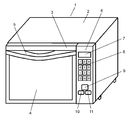
- FIG. 1 is a perspective view illustrating an appearance of a heating cooker according to the first embodiment of the present disclosure.
- FIG. 2 is a front view illustrating a schematic configuration of the heating cooker according to the first embodiment of the present disclosure.
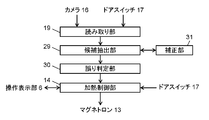
- FIG. 3 is a functional block diagram of the heating cooker according to the first embodiment of the present disclosure.
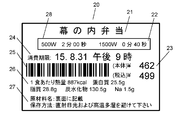
- FIG. 4 is a diagram illustrating an example of product information including heating control information given to a food item heated by the heating cooker according to the first embodiment of the present disclosure.
- FIG. 5 is a diagram illustrating an example of first candidates and candidate characters extracted by the candidate extraction unit of the cooking device according to the first embodiment of the present disclosure.
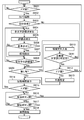
- FIG. 6 is a flowchart showing a flow of operations of the heating cooker according to the first embodiment of the present disclosure.
- the heating cooker includes a heating chamber in which an object to be heated is stored, a heating unit that heats the object to be heated stored in the heating chamber, an imaging unit that images the inside of the heating chamber, And a reading unit that reads the heating control information of the object to be heated from the image in the heating chamber photographed by the photographing unit.
- a candidate extraction unit that extracts a candidate character together with information indicating the probability, and a candidate character extracted by the candidate extraction unit
- An error determination unit that determines whether or not the heating control information that has been performed is an error, and a heating control unit that controls the heating unit based on the heating control information determined by the error determination unit to be error-free .
- a candidate extraction part extracts the 1st candidate with the highest probability for every character which comprises the character string contained in heating control information, and an error determination part has the heating control information comprised by the 1st candidate.
- it determines with it being an error it is a heating cooker which replaces the 1st candidate which comprises heating control information with another candidate character among the candidate characters extracted by the candidate extraction part, and performs error determination.
- Such a configuration eliminates the need for re-reading operations and improves usability.
- the second mode is the first mode, wherein the error determination unit sequentially replaces the character string formed by the first candidate extracted by the candidate extraction unit with another candidate character in units of characters, and sequentially performs error determination. It is the structure to perform.
- the heating control information of the object to be heated includes the first heating power, the first heating time corresponding to the first heating power, and the second And a second heating time corresponding to the second heating power. Then, the error determination unit determines the error in the heating control information based on whether or not the first heating power and the first heating time, and the second heating power and the second heating time are in a predetermined relationship. Is to do.
- the candidate extraction unit extracts a character having a certainty or more certainty as a candidate character.
- the fifth aspect indicates the probability of the candidate character extracted by the candidate extraction unit according to the position in the character string of the candidate character in any one of the first aspect to the fourth aspect.
- the image forming apparatus further includes a correction unit that corrects information.
- a 6th aspect is a heating cooker provided with the heating chamber in which a to-be-heated material is accommodated, the heating part which heats the to-be-heated material accommodated in the heating chamber, and the photography part which picturizes the inside of a heating chamber. It is a control method. And from the image in the heating chamber image
- heating is performed.
- a candidate extraction step has the step which extracts the 1st candidate with the highest probability for every character which comprises the character string contained in heating control information, and the error determination step was comprised by the 1st candidate.
- the first candidate constituting the heating control information is replaced with another candidate character among the candidate characters extracted in the candidate step, and an error determination is performed. .
- FIG. 1 is a perspective view showing an appearance of a microwave oven 1 which is an example of a heating cooker according to the present embodiment.
- the microwave oven 1 includes a casing 2 for storing food.
- the housing 2 is provided with a door 3 for taking in and out food.
- the door 3 is provided with a transparent glass window 4 so that the inside of the housing 2 can be seen from the outside, a handle 5 that is gripped when the door 3 is opened and closed, and an operation display unit 6.
- the operation display unit 6 includes a liquid crystal display 7, a time setting button group 8, a heating start button 9, a cancel button 10, and a pause button 11.
- the microwave oven 1 captures a food that is a heating target (object to be heated) with a photographing unit, reads a heating time displayed on the food, and heats the food with the heating time.
- the read heating time is displayed on the liquid crystal display 7 and information characters are displayed.
- the time set button group 8 is provided in the microwave oven 1 for the case where the heating time cannot be read well or the food for which the heating time is not displayed is heated.
- the user can set the heating time using the numeric buttons and the “minute” and “second” buttons. In this case, the set heating time is displayed on the liquid crystal display 7.
- the heating start button 9 is a button that is pressed when the user starts heating after confirming the heating time displayed on the liquid crystal display 7.
- the cancel button 10 is pressed when the user presses the heating start button 9 to start heating and then stops heating during heating, or when the setting of the heating time displayed on the liquid crystal display 7 is canceled. It is a button that is pressed.
- the pause button 11 is a button that is pressed when the user temporarily stops heating during heating. Further, when heating is temporarily stopped, the user presses the heating start button 9 again, so that the remaining heating is performed halfway.
- FIG. 2 is a front view showing a schematic configuration of the microwave oven 1 according to the present embodiment.
- the microwave oven 1 is capable of heating food and the like by high frequency, and includes a magnetron 13 that is a heating unit that outputs high frequency in a heating chamber 12 that stores an object to be heated such as food.
- the microwave oven 1 supplies the high frequency into the heating chamber 12 by the magnetron 13 to heat the food.
- the microwave oven 1 includes an illumination 15 in the heating chamber 12 and a camera 16 as a photographing unit on the same side as the illumination 15 is provided.
- the camera 16 captures an image in the heating chamber 12. Since the camera 16 is disposed on the same side as the illumination 15, the inside of the heating chamber 12 can be photographed without being backlit and darkening the subject.
- the housing 2 is provided with a door switch 17 for detecting opening / closing of the door 3.
- the door 3 is provided with a protrusion 18 for pushing the door switch 17.
- the microwave oven 1 includes a microcomputer and its peripheral circuit as a control unit that controls the entire apparatus.
- the microwave oven 1 executes various controls by executing a program that runs on a microcomputer.
- the microcomputer and the peripheral circuit may be in any form as long as the control described later is performed.
- the control unit may include an arithmetic processing unit and a storage unit that stores a control program.
- Examples of the arithmetic processing unit include an MPU (Micro Processing Unit) and a CPU (Central Processing Unit).
- a memory is exemplified as the storage unit. The control program recorded in the storage unit is executed by the arithmetic processing unit.
- control unit may be configured by hard logic. Constructing the control unit with hardware logic is effective in improving the processing speed.
- the control unit may be composed of one semiconductor chip or physically composed of a plurality of semiconductor chips. When configured by a plurality of semiconductor chips, each control described later can be realized by a separate semiconductor chip.
- FIG. 3 is a functional block diagram of functions realized by the control unit of the microwave oven 1 according to the first embodiment of the present disclosure.
- the microwave oven 1 includes a heating control unit 14, a reading unit 19, a candidate extraction unit 29, an error determination unit 30, and a correction unit 31.
- a sticker 20 (see FIG. 4), which is a sticker, displaying heating power and heating time, which are food heating control information, is attached to each of the foods.
- the reading unit 19 extracts a portion of the sticker 20 attached to the product where the heating control information is displayed from the image photographed by the camera 16 and reads a character string (characters including at least numerals) of the heating control information. Column).
- FIG. 4 is a diagram illustrating an example of the seal 20 attached to the food according to the first embodiment of the present disclosure.
- the seal 20 includes various items such as a product name 21, heating control information 22, amount information 23, expiration date information 24, a bar code 25 as an example of a code symbol for identifying food, nutrition information 26, and information 27.
- Product information is displayed.
- the seal 20 has a mark frame 28 which is a rectangular position designation mark formed so as to surround the heating control information 22. It is displayed.
- the heating control information 22 of the seal 20 includes two types of heating control information. More specifically, the heating control information 22 includes, for example, a heating time when heating at a heating power of 500 W and a business electronic as a guideline of heating power when heating in a general microwave oven for home use. As a guideline of the heating power when heating with a large heating power for a short time in the range, for example, the heating time when heating with a heating power of 1500 W is also shown. In the example of FIG. 4, the heating control information 22 is displayed as, for example, “500 W 2 minutes 00 seconds 1500 W 0 minutes 40 seconds”.
- the heating control information 22 includes a first character string that is a number representing a heating amount with a predetermined heating power, for example, “500”, and a second character string that represents a unit of the heating power, for example, “W”. Yes. Furthermore, the heating control information 22 includes a third character string that is a number that is the heating time at the heating power, for example, “2”, a fourth character string that represents the unit of the heating time, for example, “minute”, and the A fifth character string that is a number indicating the heating time at the heating power, for example, “00”, and a sixth character string that indicates the unit of the heating time, for example, “second” are included.
- the heating control information 22 is a character string including a first character string, a second character string, a third character string, a fourth character string, a fifth character string, and a sixth character string in this order. Further, the heating control information 22 is a seventh character string that is a number representing the heating amount of the heating power larger than the predetermined heating power described above, for example, “1500”, and an eighth character string that represents the unit of the heating power, For example, “W” is included.
- the heating control information 22 includes a ninth character string that is a number that is the heating time at the heating power, for example, “0”, a tenth character string that represents the unit of the heating time, for example, “minute”, and the It includes an eleventh character string that is a number indicating the heating time at the heating power, for example, “40”, and a twelfth character string that indicates the unit of the heating time, for example, “second”.
- the heating control information 22 is a character string including a seventh character string, an eighth character string, a ninth character string, a tenth character string, an eleventh character string, and a twelfth character string in this order.
- W (watt) which is an SI unit representing the amount of heat is used as the second character string and the eighth character string, but if it represents a unit of heating power, Other characters or units may be used.
- the fourth character string the sixth character string, the tenth character string, and the twelfth character string, “minute” or “second” is used as the character representing the unit of time, but it represents the unit of time. Any other character or unit may be used.
- the reading unit 19 first extracts the mark frame 28 from the image photographed by the camera 16. Next, the reading unit 19 reads the alphanumeric characters in the area surrounded by the mark frame 28. Returning to FIG. 3, the candidate extraction unit 29 and the error determination unit 30 extract error-free character strings while performing error determination and error correction on the alphanumeric characters read by the reading unit 19.
- the candidate extraction unit 29 selects “5”, “0”, “0”, “W”, “2”, “0” character by character from the character string in the region surrounded by the mark frame 28 read by the reading unit 19. ”,“ 0 ”,“ 1 ”,“ 5 ”,“ 0 ”,“ 0 ”,“ W ”,“ 0 ”,“ 4 ”,“ 0 ”are extracted.
- the candidate extraction unit 29 selects ten candidate characters (alphanumeric characters) including ten numbers “0” to “9” and an English letter “W”. Prepare and evaluate which candidate character the extracted character is closest to, for example, with a 100-point evaluation score (information indicating the likelihood of the character), and select the candidate character with the highest score , Each is extracted as a first candidate.
- the candidate extraction unit 29 extracts characters that are not similar to the first candidate but are somewhat similar. Specifically, the candidate extraction unit 29 extracts, as candidate characters, characters having a predetermined score or more, for example, 50 or more characters, when the evaluation score is a maximum of 100 points. For example, as for the first character, the first candidate is “5” and its evaluation score is 95 points, but as other candidate characters, “4” is 90 points, “7” is 70 points, Other alphanumeric characters are assumed to be less than 50 points. In this case, the candidate extraction unit 29 extracts candidate characters “5”, “4”, and “7” with evaluation points for the first character.
- the candidate extraction unit 29 does not extract characters representing units of time such as “minutes” and “seconds” or does not use them for analysis even if they are extracted. Thereby, the candidate characters for error determination can be narrowed down, and the error determination processing time can be shortened.
- the candidate extraction unit 29 first converts the character string of the first candidate for all characters (15 characters) into a numeric string up to “W” and a string after “W” according to a predetermined analysis rule.
- a three-digit numeric string, a numeric string up to “W” following the numeric string, and a three-digit numeric string after “W” are decomposed into four numeric strings, “500”, “200”. , “1500”, “040” are obtained.
- each of the second numeric string and the fourth numeric string is analyzed assuming that the first digit is “minute” and the subsequent two digits are “second”.
- the candidate extraction unit 29 corresponds to the time of the second number string, the first number string being the heating power, the third number string being the heating power, and the time of the fourth number string. Analyzes as corresponding. As a result, the candidate extraction unit 29 extracts the heating control information “500W for 2 minutes” and “1500W for 40 seconds”.
- the error determination unit 30 determines whether or not the relationship between the two types of heating control information is correct.
- the total energy required to heat a food is determined by the food. If the input power is large, heating can be performed in a short time, and if the input power is small, heating for a long time is required.
- the heating power and the heating time are in an inversely proportional relationship.
- the error determination unit 30 sends a result (heating control information) determined to be correctly read to the heating control unit 14.
- the heating control unit 14 performs heating control using the magnetron 13 based on the sent heating control information.
- the error determination unit 30 replaces the first candidate and other candidate characters extracted by the candidate extraction unit 29 in order. The error determination is repeated until an inversely proportional relationship is established. At this time, the error determination unit 30 performs error determination by replacing characters in order from a candidate character having a high evaluation score.
- the error determination unit 30 replaces several tens of candidate characters with the first candidate in descending order of evaluation score. Therefore, it is determined whether or not an inversely proportional relationship holds. If it is determined that there is no error, the error determination unit 30 sends the heating control information as a result of the replacement to the heating control unit 14. If there is an error, the error determination unit 30 repeats the replacement of the candidate characters, and if all the candidate characters are replaced with the first candidate and the error does not disappear, it is determined that the reading is impossible.
- the error determination has been described using an example in which the relationship between the two types of heating control information is determined to be approximately inversely related, but the error determination method of the present disclosure is not limited to this. It is not limited to. For example, in general, three times the heating power for home use becomes the heating power for business use, so whether or not the heating power for business use is about three times the heating power for home use, It is also possible to make an error determination depending on whether the heating time for business use is about one third of the heating time for home use.
- the error determination unit 30 performs the replacement of the first candidate character and the candidate character extracted by the candidate extraction unit 29, one character at a time.
- the details of the replacement process of the error determination unit 30 will be described using an example of the first candidate and the candidate character shown in FIG.
- FIG. 5 is a diagram illustrating an example of a first candidate and a candidate character in the first embodiment of the present disclosure.
- each column indicates the position (for 15 characters) from the beginning of the extracted character string.
- the character extracted as the first candidate is in the candidate character row. Characters extracted as candidate characters are shown respectively.
- the characters in the brackets represent the extracted candidate characters, and the subsequent numbers represent the evaluation points of the candidate characters.
- the error determination unit 30 extracts the heating control information extracted as the first candidate “500 W for 2 minutes” and “1500 W for 50 seconds” as the heating power and the heating time. Since there is a difference exceeding 10% from the inverse proportion in the relationship, it is determined as an error.
- the error determination unit 30 selects “4” (evaluation score 90) as the first candidate character, which is the character with the highest evaluation score, from among all candidate characters that are not the first candidate.
- the selected character is replaced with “5”, which is the character extracted as the first candidate for the first character, and error determination is performed on the heating control information “400 W for 2 minutes” and “1500 W for 50 seconds”.
- the error determination unit 30 also determines that this heating control information is also an error, and after returning the replaced character “4” to the first candidate “5” before replacement, Select high candidate characters.
- the error determination unit 30 selects “4” (evaluation score 86) which is the 14th candidate character having the next highest evaluation score, and “5” which is the character extracted as the first candidate for the 14th character. , And error determination is performed for “500W for 2 minutes” and “1500W for 40 seconds”. In these two types of heating control information, since the relationship between the heating power and the heating time is within 10% of the inverse proportion, the error determination unit 30 determines that it has been read correctly.
- the error determination unit 30 sequentially replaces the candidate characters with the first candidate one character at a time in descending order of the evaluation score of the candidate characters. This is because the possibility of a mistake in one letter is much greater than the chance of a mistake in two or more letters.
- the probability that one of 15 alphanumeric characters will be mistaken is about 15%, but the probability that two or more are wrong at the same time is about 1%. Therefore, if one character can be replaced in this way and the error can be corrected, the error can be corrected correctly, and the probability of mistakes can be greatly reduced, except when two or more of 15 alphanumeric characters are mistakenly extracted. .
- the microwave oven 1 further includes a correction unit 31.
- the correction unit 31 applies to a character having a high occurrence probability in advance. Then, correction for adding the evaluation points is performed. For example, the last two digits of the heating power, that is, the two characters that come before “W” are very likely to be “0”. This is because, even if the heating power of the microwave oven can be set variably, generally, accuracy in units of 1 W is not required, and it is often possible to set it in increments of 100 W. Moreover, it is because the heating control information corresponding to this is also displayed on the food to be heated.
- the correction unit 31 performs correction such as adding, for example, 30 points to the evaluation score of the candidate character “0” for the character at this position (immediately before “W” and two positions before “W”).
- the correction unit 31 corrects the character at this position, for example, by adding 20 points to the evaluation point for the candidate character “0” and adding 10 points to the evaluation point for the candidate character “5”.
- the correction unit 31 corrects the evaluation points for these characters to be subtracted because there is almost no possibility of large numbers such as “9” and “8” in the digits of the minute of the heating time. May be.
- the heating power is, for example, 3000 W or more
- the candidate character of “3” or more in 1000 digits may be corrected to be subtracted from the evaluation score.
- the user opens the door 3, puts food in the heating chamber 12, and closes the door 3.
- the reading unit 19 When the reading unit 19 detects that the door 3 is opened and closed by the door switch 17, the reading unit 19 reads the heating control information as described above from the image inside the heating chamber 12 taken by the camera 16.
- the error determination unit 30 sends the two types of heating control information determined to have no error to the heating control unit 14.
- the heating control unit 14 selects heating control information having a larger power within the range of heating power usable in the microwave oven 1 from the two types of heating control information, and sends the heating control information to the operation display unit 6.
- the operation display unit 6 displays the heating time included in the heating control information on the liquid crystal display 7.
- the user confirms that an appropriate time is displayed on the liquid crystal display 7 and presses the heating start button 9.
- the heating control unit 14 detects that the door 3 is closed by the door switch 17 and receives a signal indicating that the heating start button 9 has been pressed, the heating control unit 14 sends the heating control sent from the error determination unit 30.
- the magnetron 13 is controlled so as to heat the food with the heating power and the heating time included in the information.
- FIG. 6 is a flowchart for explaining the flow of operations of the heating control unit 14, the reading unit 19, the candidate extraction unit 29, the error determination unit 30, and the correction unit 31.
- FIG. 6 is a flowchart showing the operation after the door 3 is opened. That is, the flowchart starts from a state in which the user opens the door 3 and puts food therein.
- step S601 the reading unit 19 detects whether or not the door 3 is closed by the door switch 17, and when the door 3 is closed (S601, YES), the process proceeds to step S602. On the other hand, if the door 3 is not closed (S601, NO), the reading unit 19 waits for the door 3 to be closed in step S601.
- the reading unit 19 captures an image in the heating chamber 12 with the camera 16 in step S602.
- step S603 the reading unit 19 searches for the mark frame 28 from the image in the heating chamber 12 photographed by the camera 16, and if the mark frame 28 is found (S603, YES), the process proceeds to step S604. On the other hand, if the mark frame 28 is not found (S603, NO), the reading unit 19 proceeds to step S612.
- step S612 the heating control unit 14 determines whether the door 3 is opened by the door switch 17. If it is determined that the door 3 has been opened (S612, YES), it is determined that the user is likely to reposition or replace the food, and the process returns to step S601, where all the processes are performed first. Will be redone.
- step S613 the user manually sets the heating time using the time setting button group 8 of the operation display unit 6.
- step S604 the candidate extraction unit 29 recognizes the character string written in the extracted landmark frame 28 one by one.
- the candidate extraction unit 29 compares each character in the mark frame 28 with 10 types of numbers “0” to “9” and 11 types of alphanumeric characters including “W” in English.
- the evaluation score (information indicating the certainty) is calculated.
- the candidate extraction unit 29 preliminarily stores, as a dictionary, a basic shape of eleven alphanumeric characters including ten numbers from “0” to “9” and one letter of “W” in white and white. It is stored as a set of black dots.
- the candidate extraction unit 29 performs binarization processing on the read character image for one character, and divides each dot into either white or black.
- the candidate extraction unit 29 performs normalization processing, and matches the size of the character stored as the dictionary and the binarized character image.
- the candidate extraction unit 29 then superimposes the normalized character image with each of the above-described eleven types of dictionary basic shapes. For each dot, the candidate extraction unit 29 examines whether the dot of the character image and the dot of the basic shape of the dictionary match white or black, and calculates the matching rate.
- “100 points” indicates a state in which white and black of all dots match, and “0 points” indicates that all of white and black do not match, that is, black and white inversion. It shows the state. That is, if such a coincidence rate is used as an evaluation score, the score becomes higher as the read character is more similar to the basic form of the dictionary.
- the candidate extraction unit 29 performs such coincidence rate calculation for all 11 types of alphanumeric characters.
- step S605 the correction unit 31 corrects addition or subtraction to the evaluation point for candidate characters having a high or low probability of appearing in a predetermined order, as described above. That is, the correction unit 31 adds an evaluation point to “0” having a high occurrence probability in a specific number of digits, and subtracts an evaluation point for a number having a low occurrence probability in another specific number of digits.
- step S606 the candidate extraction unit 29 determines whether or not the evaluation score of each candidate character exceeds, for example, 50 points out of 100 as a reference point. If the candidate extraction unit 29 exceeds the reference point (S606, YES), in step S607, the candidate extraction unit 29 sets the candidate character and the corrected evaluation score for each character constituting the character string. Record with. In step S606, when the evaluation score does not exceed the reference point (S606, NO), the process proceeds to step S608.
- step S608 the candidate extraction unit 29 performs the above-described operation on all eleven candidate characters “0” to “9” and “W” for all the characters written in the mark frame 28. If it is determined that the evaluation for all the characters has been completed (S608, YES), the process proceeds to step S609. On the other hand, if the candidate extraction unit 29 determines that the evaluation for all candidate characters is not completed for all characters (S608, NO), the candidate extraction unit 29 returns to step S604.
- step S609 the error determination unit 30 first arranges candidate characters having the highest evaluation score as the first candidate for all characters in the mark frame 28 (15 characters in the examples of FIGS. 4 and 5). Whether or not there is an error is determined for the character string.
- the error determination unit 30 has a heating power of the first heating control information of 500 W, whereas the heating power of the second heating control information is 1500 W, which is three times higher. Since the heating time of the first heating control information is 2 minutes 00 seconds, the heating time of the second heating control information is within one-third of that, within ⁇ 10% of “40 seconds”, that is, 36 seconds to 44 seconds. If there is, it is determined that correct reading has been performed. On the other hand, if it is not within the range, it is determined as an error. In the example of FIG. 5, the heating time of the second heating control information is “50 seconds”, which exceeds the range of ⁇ 10% of the inverse proportion. Therefore, the error determination unit 30 determines that the heating control information is incorrect. (S609, YES), the process proceeds to step S610.
- step S610 the error determination unit 30 replaces only one character from the first candidates of all characters in the mark frame 28.
- the character to be replaced is the character having the highest evaluation score among all the characters extracted as candidate characters in step S607.
- the error determination unit 30 selects the first candidate character “4” (evaluation point: 90 points), and the first candidate character “5” (evaluation point: 95 points). And the first heating control information is set to “2 minutes at 400 W”.
- step S611 the error determination unit 30 determines whether error determination regarding all candidate characters has been completed. If not, the error determination unit 30 returns to step S609 again to perform error determination.
- step S609 when the error determination unit 30 determines that there is an error again (S609, YES), in step S610, after replacing the previously replaced candidate character, the candidate character with the next highest evaluation score is selected. Replace.
- the error determination unit 30 repeats this work as long as there are candidate characters extracted in step S607, and if it is determined that correct reading has been made somewhere (S609, NO), the process proceeds to step S614.
- the error determination unit 30 proceeds to step S612 to determine whether the door is opened when all candidate characters have been determined without being determined that correct reading has been performed (S611, YES).
- step S609 determines that the heating control information has been read correctly, for example, “500W at 2:00 seconds” and “1500W at 40”. Two types of heating control information “second” are sent to the heating control unit 14. For example, if the heating control unit 14 can control the magnetron at a maximum of 1500 W, the heating control unit 14 sends the heating time “40 seconds” at 1500 W to the operation display unit 6. In step S614, the operation display unit 6 displays “40 seconds” on the liquid crystal display 7, and proceeds to step S615.
- step S615 the heating control unit 14 determines whether the door 3 is opened. If the door 3 is opened (S615, YES), the process returns to step S601, and the door 3 is not opened. (S615, NO), the process proceeds to step S616. This is because when the user confirms the heating time displayed on the liquid crystal display 7 and determines that it is wrong, at least one of the position and direction of the food can be changed so that the correct reading can be performed. It is a step to make.
- step S616 the heating control unit 14 determines whether the cancel button 10 has been pressed. If the cancel button 10 has been pressed (S616, YES), the process proceeds to step S612. On the other hand, if the cancel button 10 is not pressed (S616, NO), the process proceeds to step S617. This is a step for enabling the user to change the heating time displayed on the liquid crystal display 7 when it is determined that the heating time is incorrect.
- step S617 the heating control unit 14 determines whether or not the heating start button 9 has been pressed. If the heating start button 9 has been pressed (S617, YES), the process proceeds to step S618, and the heating control unit 14 starts heating. On the other hand, if the heating start button 9 has not been pressed (S617, NO), the process returns to step S616, and the determination is repeated from whether or not the cancel button 10 has been pressed.
- step S611 If the mark frame 28 is not found in step S603 (S603, NO), if it is determined in step S611 that the heat treatment information is incorrect no matter which candidate character is used, then the cancel button 10 is pressed in step S616. If it is determined that the determination has been made (S616, YES), the process proceeds to step S612.
- step S612 the heating control unit 14 determines whether the door 3 is opened by the door switch 17. If it is determined that the door 3 has been opened (YES in S612), the user is likely to reposition or replace the food, so the process returns to step S601 and all the processes are repeated from the beginning. On the other hand, if it is not determined that the door 3 has been opened (S612, NO), the process proceeds to step S613.
- step S613 the user manually sets the heating time using the time setting button group 8.
- the operation display unit 6 may cause the liquid crystal display 7 to display a message that prompts the user to set the heating time by operating the time setting button group 8. Good.
- step S614 the operation display unit 6 displays the heating time set by the user on the liquid crystal display 7. Subsequent processing is as described above.
- the reading unit 19 when food such as a lunch box and / or side dish is put in the heating chamber 12, the reading unit 19 is attached to the food from the image taken by the camera 16.
- the heating control information 22 described in 20 is read.
- the candidate extraction unit 29 extracts a plurality of candidate characters with priorities and the error determination unit 30 determines an error in the heating control information 22 read by the reading unit 19 and determines that there is no error
- the heating control unit 14 controls the magnetron 13 based on the heating control information 22 read by the reading unit 19. If it is determined that the heating control information is incorrect, the candidate character extracted by the candidate extraction unit 29 is used as a candidate, and errors are corrected in priority order. Thereby, an operation such as re-reading is unnecessary, and the heating control content can be automatically set, thereby improving usability.
- the heating control information 22 is included as the heating control information 22, and it is determined whether or not correct reading has been performed based on the relationship between the two heating control information.
- the heating control information of the present disclosure is not limited to this example, and may be a form including a single type of heating control information and determination information for determining whether the heating control information is correct. For example, “1500 W 0 minute 40 seconds” is included as the heating control information, and the number “10” is obtained by adding the digits of each digit constituting the heating control information as information for determining whether the heating control information is correct. There may be.
- the error determination unit 30 determines that the number obtained by adding the digits of each digit constituting the heating control information for each character constituting the heating control information and the determination information extracted by the candidate extraction unit 29 is the determination information. The error determination is performed depending on whether or not it matches. If there is an error, the error determination unit 30 sequentially replaces with another candidate character and repeats the error determination.
- the user simply reads the heating control information printed on the food container and the like and puts the food into the heating chamber, and appropriately heats the food accordingly. Can do. Therefore, there is no troublesome setting, and in addition to a microwave oven used at a store, it can be applied to cooking appliances such as a microwave oven for home use, a rice cooker, and an IH cooking heater, and is useful.
Landscapes
- Engineering & Computer Science (AREA)
- Chemical & Material Sciences (AREA)
- Combustion & Propulsion (AREA)
- Mechanical Engineering (AREA)
- General Engineering & Computer Science (AREA)
- Electric Ovens (AREA)
- Electric Stoves And Ranges (AREA)
Abstract
L'invention concerne un cuiseur chauffant pourvu : d'un compartiment chauffant servant à stocker un article à chauffer ; d'un élément chauffant pour chauffer l'article à chauffer stocké dans le compartiment chauffant ; d'une unité d'imagerie pour capturer une image de l'intérieur du compartiment chauffant ; d'une unité de lecture (19) pour lire des informations de commande de chauffe associées à l'article à chauffer, à partir d'une image de l'intérieur du compartiment chauffant capturée par l'unité d'imagerie ; et d'une unité d'extraction (29) de candidat pour extraire un caractère candidat, conjointement avec des informations indiquant la certitude, pour chaque caractère constituant une chaîne de caractères comprise dans les informations de commande de chauffage lues par l'unité de lecture (19). Le cuiseur chauffant comprend également : une unité (30) de détermination d'erreur pour déterminer si les informations de commande de chauffage constituées par les caractères candidats extraits par l'unité d'extraction (29) de candidat sont erronées ou non ; et une unité de commande (14) de chauffage, pour commander l'élément chauffant sur la base des informations de commande de chauffage ayant été déterminées par l'unité (30) de détermination d'erreur comme non erronées.
Priority Applications (2)
| Application Number | Priority Date | Filing Date | Title |
|---|---|---|---|
| CN201780064398.7A CN109844410B (zh) | 2016-10-31 | 2017-10-20 | 加热烹调器以及加热烹调器的控制方法 |
| JP2018547622A JP6948529B2 (ja) | 2016-10-31 | 2017-10-20 | 加熱調理器および加熱調理器の制御方法 |
Applications Claiming Priority (2)
| Application Number | Priority Date | Filing Date | Title |
|---|---|---|---|
| JP2016212419 | 2016-10-31 | ||
| JP2016-212419 | 2016-10-31 |
Publications (1)
| Publication Number | Publication Date |
|---|---|
| WO2018079426A1 true WO2018079426A1 (fr) | 2018-05-03 |
Family
ID=62023388
Family Applications (1)
| Application Number | Title | Priority Date | Filing Date |
|---|---|---|---|
| PCT/JP2017/037936 Ceased WO2018079426A1 (fr) | 2016-10-31 | 2017-10-20 | Cuiseur chauffant et procédé de commande de cuiseur chauffant |
Country Status (3)
| Country | Link |
|---|---|
| JP (1) | JP6948529B2 (fr) |
| CN (1) | CN109844410B (fr) |
| WO (1) | WO2018079426A1 (fr) |
Families Citing this family (1)
| Publication number | Priority date | Publication date | Assignee | Title |
|---|---|---|---|---|
| JP7345084B2 (ja) * | 2020-04-03 | 2023-09-15 | パナソニックIpマネジメント株式会社 | 加熱調理器 |
Citations (5)
| Publication number | Priority date | Publication date | Assignee | Title |
|---|---|---|---|---|
| JPH0546814A (ja) * | 1991-08-20 | 1993-02-26 | Nec Corp | 文字読み取り装置 |
| US5938966A (en) * | 1997-02-26 | 1999-08-17 | Lg Electronics Inc. | Apparatus for and method of controlling cooking operation of microwave ovens using code system |
| JP2011138435A (ja) * | 2009-12-29 | 2011-07-14 | Omron Corp | 単語認識方法および単語認識用のプログラムならびに情報処理装置 |
| JP2014202414A (ja) * | 2013-04-04 | 2014-10-27 | 東芝ホームテクノ株式会社 | 加熱調理器 |
| WO2016143267A1 (fr) * | 2015-03-10 | 2016-09-15 | パナソニックIpマネジメント株式会社 | Dispositif de chauffage pour la cuisson |
Family Cites Families (1)
| Publication number | Priority date | Publication date | Assignee | Title |
|---|---|---|---|---|
| CN2442474Y (zh) * | 2000-08-31 | 2001-08-08 | 颜志斌 | 读码操控全自动微波炉 |
-
2017
- 2017-10-20 CN CN201780064398.7A patent/CN109844410B/zh active Active
- 2017-10-20 WO PCT/JP2017/037936 patent/WO2018079426A1/fr not_active Ceased
- 2017-10-20 JP JP2018547622A patent/JP6948529B2/ja active Active
Patent Citations (5)
| Publication number | Priority date | Publication date | Assignee | Title |
|---|---|---|---|---|
| JPH0546814A (ja) * | 1991-08-20 | 1993-02-26 | Nec Corp | 文字読み取り装置 |
| US5938966A (en) * | 1997-02-26 | 1999-08-17 | Lg Electronics Inc. | Apparatus for and method of controlling cooking operation of microwave ovens using code system |
| JP2011138435A (ja) * | 2009-12-29 | 2011-07-14 | Omron Corp | 単語認識方法および単語認識用のプログラムならびに情報処理装置 |
| JP2014202414A (ja) * | 2013-04-04 | 2014-10-27 | 東芝ホームテクノ株式会社 | 加熱調理器 |
| WO2016143267A1 (fr) * | 2015-03-10 | 2016-09-15 | パナソニックIpマネジメント株式会社 | Dispositif de chauffage pour la cuisson |
Also Published As
| Publication number | Publication date |
|---|---|
| CN109844410B (zh) | 2020-02-14 |
| JPWO2018079426A1 (ja) | 2019-09-19 |
| JP6948529B2 (ja) | 2021-10-13 |
| CN109844410A (zh) | 2019-06-04 |
Similar Documents
| Publication | Publication Date | Title |
|---|---|---|
| JP6603891B2 (ja) | 加熱調理器 | |
| US10986703B2 (en) | Heating cooker | |
| US11528785B2 (en) | Heating cooker, method of controlling heating cooker, and heating cooking system | |
| JP2023153397A (ja) | 加熱調理器 | |
| JP6887076B2 (ja) | 加熱調理器 | |
| JP6906147B2 (ja) | 加熱調理器および加熱調理器の制御方法 | |
| CN110892197B (zh) | 加热烹调器 | |
| JP2016166724A (ja) | 加熱調理器 | |
| JP6948529B2 (ja) | 加熱調理器および加熱調理器の制御方法 | |
| JP2020076550A (ja) | 加熱調理器 | |
| JPWO2018235703A1 (ja) | 加熱調理器 | |
| WO2019159518A1 (fr) | Appareil de cuisson chauffant et système de cuisson chauffant | |
| JP2020076549A (ja) | 加熱調理器 | |
| WO2018186117A1 (fr) | Appareil de cuisson chauffant |
Legal Events
| Date | Code | Title | Description |
|---|---|---|---|
| 121 | Ep: the epo has been informed by wipo that ep was designated in this application |
Ref document number: 17863369 Country of ref document: EP Kind code of ref document: A1 |
|
| ENP | Entry into the national phase |
Ref document number: 2018547622 Country of ref document: JP Kind code of ref document: A |
|
| NENP | Non-entry into the national phase |
Ref country code: DE |
|
| 122 | Ep: pct application non-entry in european phase |
Ref document number: 17863369 Country of ref document: EP Kind code of ref document: A1 |